WO2024029117A1 - 振動発生装置 - Google Patents
振動発生装置 Download PDFInfo
- Publication number
- WO2024029117A1 WO2024029117A1 PCT/JP2023/008909 JP2023008909W WO2024029117A1 WO 2024029117 A1 WO2024029117 A1 WO 2024029117A1 JP 2023008909 W JP2023008909 W JP 2023008909W WO 2024029117 A1 WO2024029117 A1 WO 2024029117A1
- Authority
- WO
- WIPO (PCT)
- Prior art keywords
- coil
- magnetic flux
- magnet
- vibration generator
- vibrating body
- Prior art date
- Legal status (The legal status is an assumption and is not a legal conclusion. Google has not performed a legal analysis and makes no representation as to the accuracy of the status listed.)
- Ceased
Links
Images





Classifications
-
- H—ELECTRICITY
- H02—GENERATION; CONVERSION OR DISTRIBUTION OF ELECTRIC POWER
- H02K—DYNAMO-ELECTRIC MACHINES
- H02K33/00—Motors with reciprocating, oscillating or vibrating magnet, armature or coil system
- H02K33/18—Motors with reciprocating, oscillating or vibrating magnet, armature or coil system with coil systems moving upon intermittent or reversed energisation thereof by interaction with a fixed field system, e.g. permanent magnets
-
- B—PERFORMING OPERATIONS; TRANSPORTING
- B06—GENERATING OR TRANSMITTING MECHANICAL VIBRATIONS IN GENERAL
- B06B—METHODS OR APPARATUS FOR GENERATING OR TRANSMITTING MECHANICAL VIBRATIONS OF INFRASONIC, SONIC, OR ULTRASONIC FREQUENCY, e.g. FOR PERFORMING MECHANICAL WORK IN GENERAL
- B06B1/00—Methods or apparatus for generating mechanical vibrations of infrasonic, sonic, or ultrasonic frequency
- B06B1/02—Methods or apparatus for generating mechanical vibrations of infrasonic, sonic, or ultrasonic frequency making use of electrical energy
- B06B1/04—Methods or apparatus for generating mechanical vibrations of infrasonic, sonic, or ultrasonic frequency making use of electrical energy operating with electromagnetism
- B06B1/045—Methods or apparatus for generating mechanical vibrations of infrasonic, sonic, or ultrasonic frequency making use of electrical energy operating with electromagnetism using vibrating magnet, armature or coil system
-
- B—PERFORMING OPERATIONS; TRANSPORTING
- B06—GENERATING OR TRANSMITTING MECHANICAL VIBRATIONS IN GENERAL
- B06B—METHODS OR APPARATUS FOR GENERATING OR TRANSMITTING MECHANICAL VIBRATIONS OF INFRASONIC, SONIC, OR ULTRASONIC FREQUENCY, e.g. FOR PERFORMING MECHANICAL WORK IN GENERAL
- B06B1/00—Methods or apparatus for generating mechanical vibrations of infrasonic, sonic, or ultrasonic frequency
- B06B1/10—Methods or apparatus for generating mechanical vibrations of infrasonic, sonic, or ultrasonic frequency making use of mechanical energy
- B06B1/12—Methods or apparatus for generating mechanical vibrations of infrasonic, sonic, or ultrasonic frequency making use of mechanical energy operating with systems involving reciprocating masses
-
- F—MECHANICAL ENGINEERING; LIGHTING; HEATING; WEAPONS; BLASTING
- F16—ENGINEERING ELEMENTS AND UNITS; GENERAL MEASURES FOR PRODUCING AND MAINTAINING EFFECTIVE FUNCTIONING OF MACHINES OR INSTALLATIONS; THERMAL INSULATION IN GENERAL
- F16F—SPRINGS; SHOCK-ABSORBERS; MEANS FOR DAMPING VIBRATION
- F16F15/00—Suppression of vibrations in systems; Means or arrangements for avoiding or reducing out-of-balance forces, e.g. due to motion
- F16F15/02—Suppression of vibrations of non-rotating, e.g. reciprocating systems; Suppression of vibrations of rotating systems by use of members not moving with the rotating systems
- F16F15/03—Suppression of vibrations of non-rotating, e.g. reciprocating systems; Suppression of vibrations of rotating systems by use of members not moving with the rotating systems using magnetic or electromagnetic means
-
- F—MECHANICAL ENGINEERING; LIGHTING; HEATING; WEAPONS; BLASTING
- F16—ENGINEERING ELEMENTS AND UNITS; GENERAL MEASURES FOR PRODUCING AND MAINTAINING EFFECTIVE FUNCTIONING OF MACHINES OR INSTALLATIONS; THERMAL INSULATION IN GENERAL
- F16F—SPRINGS; SHOCK-ABSORBERS; MEANS FOR DAMPING VIBRATION
- F16F15/00—Suppression of vibrations in systems; Means or arrangements for avoiding or reducing out-of-balance forces, e.g. due to motion
- F16F15/02—Suppression of vibrations of non-rotating, e.g. reciprocating systems; Suppression of vibrations of rotating systems by use of members not moving with the rotating systems
- F16F15/03—Suppression of vibrations of non-rotating, e.g. reciprocating systems; Suppression of vibrations of rotating systems by use of members not moving with the rotating systems using magnetic or electromagnetic means
- F16F15/035—Suppression of vibrations of non-rotating, e.g. reciprocating systems; Suppression of vibrations of rotating systems by use of members not moving with the rotating systems using magnetic or electromagnetic means by use of eddy or induced-current damping
Definitions
- the present disclosure relates to a vibration generator.
- actuators vibration generators
- This actuator is configured to vibrate the movable body relative to the support by a magnetic drive circuit including a coil and a magnet. Further, this actuator is configured to suppress resonance of the movable body using a viscoelastic member that is a gel-like damper member disposed between the support body and the movable body.
- the above-mentioned viscoelastic member may have a durability problem.
- a vibration generator includes a housing, a movable body housed in the housing, a support member that supports the movable body so as to be able to vibrate along a first direction, and a support member that supports the movable body so as to vibrate along a first direction.
- a coil having a bundled wire portion extending along a second direction perpendicular to , and generating magnetic flux passing through the bundled wire portion along a third direction perpendicular to each of the first direction and the second direction.
- a magnetic flux generating member one of the coil and the magnetic flux generating member being fixed to the housing, the other of the coil and the magnetic flux generating member being fixed to the movable body, and one of the coil and the magnetic flux generating member being fixed to the movable body; is fixed and extends along the first direction so as to cross the magnetic flux, and generates an eddy current when the movable body moves along the first direction to reduce acceleration of the movable body.
- the invention is characterized in that it includes a conductive member configured to
- the above measures provide a more durable vibration generator.
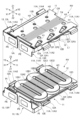
- FIG. 2 is a perspective view of a vibration generator.
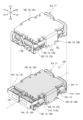
- FIG. 2 is an exploded perspective view of the vibration generator. It is an exploded perspective view of a vibrating part and a non-vibrating body. It is a perspective view of a non-vibrating body. It is a figure which shows the example of a structure of a base member and an elastic support member. It is a perspective view of a vibrating part.
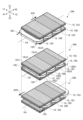
- FIG. 3 is a perspective view of the components of the drive means. It is a perspective view of a leaf spring. It is a perspective view of a base member and a bracket.
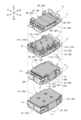
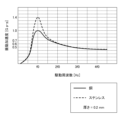
- FIG. 3 is a cross-sectional view of the vibrating body. It is a perspective view of each member which constitutes a vibration generator. It is a perspective view of each member which constitutes a vibration generator. It is a graph which shows the relationship between the drive frequency of a vibrating body, and vibration acceleration.
- FIG. 1 is a perspective view of a vibration device VE including a vibration generator 101 and a control unit CTR.
- the upper diagram in FIG. 1 is a perspective view of the vibration generator 101 connected to the control unit CTR
- the lower diagram in FIG. 1 is a perspective diagram of the vibration generator 101 with the cover member 1 removed. It is a diagram.
- FIG. 2 is an exploded perspective view of the vibration generator 101.
- X1 represents one direction of the X-axis that constitutes a three-dimensional orthogonal coordinate system
- X2 represents the other direction of the X-axis
- Y1 represents one direction of the Y-axis constituting the three-dimensional orthogonal coordinate system
- Y2 represents the other direction of the Y-axis
- Z1 represents one direction of the Z axis constituting the three-dimensional orthogonal coordinate system
- Z2 represents the other direction of the Z axis.
- the X1 side of the vibration generator 101 corresponds to the front side (front side) of the vibration generator 101
- the X2 side of the vibration generator 101 corresponds to the rear side (back side) of the vibration generator 101.
- the Y1 side of the vibration generator 101 corresponds to the left side of the vibration generator 101
- the Y2 side of the vibration generator 101 corresponds to the right side of the vibration generator 101
- the Z1 side of the vibration generator 101 corresponds to the upper side of the vibration generator 101
- the Z2 side of the vibration generator 101 corresponds to the lower side of the vibration generator 101.
- the vibration device VE has a control unit CTR and a vibration generator 101.
- the vibration generator 101 includes a housing HS and a vibrating part VP housed within the housing HS.
- the housing HS has an approximately rectangular parallelepiped outer shape.
- the housing HS is made of a non-magnetic material such as austenitic stainless steel.
- the housing HS is composed of a cover member 1 and a base member 2.
- the cover member 1 is configured to form the side and top surfaces of the housing HS
- the base member 2 is configured to form the bottom surface of the housing HS.
- the base member 2 is configured to function as a base that supports the vibrating part VP.
- the cover member 1 includes a substantially rectangular cylindrical outer peripheral wall 1A, a flat top plate 1T provided so as to be continuous with the upper end (Z1 side end) of the outer peripheral wall 1A, has.
- the outer peripheral wall portion 1A includes four side plate portions formed in a flat plate shape. Specifically, as shown in FIG. 2, the outer peripheral wall 1A is perpendicular to the first side plate 1A1 and the third side plate 1A3 that face each other, and to the first side plate 1A1 and the third side plate 1A3, respectively. It also has a second side plate part 1A2 and a fourth side plate part 1A4 that face each other.
- the control unit CTR is configured to realize the movement of the vibrating unit VP.
- the control unit CTR includes an electronic circuit and is configured to be able to supply alternating current to the vibrating unit VP to vibrate the vibrating unit VP.
- the control unit CTR is installed outside the housing HS, but it may be installed inside the housing HS. In this case, the control unit CTR may be one of the components of the vibration generator 101.
- the vibrating part VP is configured to vibrate the housing HS by vibrating itself.
- the vibrating part VP is configured to be attached within the housing HS and to be able to vibrate the housing HS.
- FIG. 3 is an exploded perspective view of the vibrating part VP.
- the vibrating part VP is configured to include a vibrating body VB, a driving means DM, and an elastic support member ES.
- the vibrating body VB as a movable body has a predetermined natural frequency and is configured to be able to vibrate with respect to the housing HS along a vibration axis VA (see FIG. 2) extending in a predetermined direction.
- the vibrating body VB has a predetermined natural frequency and is configured to vibrate with respect to the base member 2 along a vibration axis VA (see FIG. 2) extending in the X-axis direction (front-back direction). has been done.
- the driving means DM is an example of a vibration force generating section, and is configured to be able to vibrate the vibrating body VB along the vibration axis VA.
- the driving means DM is configured to vibrate the vibrating body VB elastically supported by the elastic support member ES along the vibration axis VA in accordance with the alternating current supplied through the control unit CTR. It is configured.
- the elastic support member ES is an example of a support member, and is configured to be interposed between the housing HS and the vibrating body VB so as to be able to elastically support the vibrating body VB.
- the vibrating part VP including the vibrating body VB, the driving means DM, and the elastic support member ES is composed of a yoke 10, a bracket 11, a coil 12, a wiring board 13, a magnet 15, and a leaf spring 17.
- the vibrating body VB is composed of a yoke 10 and a magnet
- the driving means DM is composed of a coil 12 and a magnet
- the elastic support member ES is composed of a leaf spring 17.
- the bracket 11, the coil 12, and the wiring board 13 constitute a non-vibrating body NV that does not vibrate together with the vibrating body VB.
- the non-vibrating body NV vibrates together with the housing HS, but does not vibrate together with the vibrating body VB.
- the yoke 10 is a member that constitutes a magnetic circuit.
- the yoke 10 is made of a magnetic material containing iron or the like.
- the yoke 10 is composed of two members, an upper yoke 10U and a lower yoke 10D, and is made of cold rolled steel plate (SPCC).
- the upper yoke 10U is a member that constitutes the upper surface of the vibrating body VB, and includes a left side plate portion LW, a right side plate portion RW, and a top plate portion TW.
- a protrusion PR is formed on the Z2 side end surface of each of the left side plate part LW and the right side plate part RW so as to be able to engage with the recessed part RC formed in the lower yoke 10D.
- the lower yoke 10D is a member that constitutes the lower surface of the vibrating body VB, and includes a bottom plate portion BW.
- a recess RC is formed on each of the Y1 side (left side) end surface and the Y2 side (right side) end surface of the lower yoke 10D so as to be able to engage with the protrusion PR formed on the upper yoke 10U. It is formed.
- the bracket 11 is an example of a conductive member, and is configured to support the coil 12 in a state where the coil 12 faces the magnet 15 in a non-contact manner. That is, the bracket 11 is configured to function as a coil holder that supports the coil 12. Further, the bracket 11 is fixed to the base member 2 so as not to come into contact with the vibrating body VB.
- the bracket 11 is a plate-shaped member made of a non-magnetic material such as copper, aluminum, or an alloy thereof, and has a connecting portion 11A and a plate-shaped portion 11B.
- the bracket 11 has four connections that protrude outward from the plate-shaped portion 11B at positions where the bracket 11 and the coil 12 do not come into contact with the vibrating body VB even when the vibrating body VB vibrates. It is fixed to the base member 2 via the portion 11A by a fastening member, welding, adhesion, caulking, or the like. That is, the bracket 11 to which the coil 12 is attached is configured so as not to vibrate together with the vibrating body VB.
- the coil 12 is configured to be able to generate a magnetic field when supplied with current.
- the coil 12 includes three coil winding parts (a first coil winding part 12A, a second coil winding part 12B, and a third coil winding part 12C) connected in series.
- Each of the first coil winding part 12A, the second coil winding part 12B, and the third coil winding part 12C has a substantially elliptical shape (rounded rectangle) with a long axis along the Y-axis direction.
- the coil 12 has a first end 12S on the winding start side and a second end 12E on the winding end side. Further, the coil 12 is fixed to the Z2 side (lower side) surface of the bracket 11 with adhesive or the like.
- the surface of the conductive wire (wire made of copper, copper alloy, etc.) constituting the coil 12 is coated with an insulation coating.
- the coil 12 is illustrated in a simplified state, and detailed illustration of the winding state is omitted. The same applies to other figures.
- the wiring board 13 is a member to which each of the first end 12S and second end 12E of the coil 12 is connected.
- the wiring board 13 is fixed to the Z2 side (lower side) surface of the bracket 11 with an adhesive, as shown in the lower diagram of FIG.
- FIG. 4 is a perspective view of the non-vibrating body NV.
- the upper diagram in FIG. 4 is an upper perspective view of the non-vibrating body NV
- the lower diagram in FIG. 4 is a lower perspective view of the non-vibrating body NV.
- the wiring board 13 is a flexible wiring board having flexibility, and includes a left wiring board 13L and a right wiring board 13R.
- the left wiring board 13L and the right wiring board 13R are fixed to the X1 side (front side) end of the bracket 11 with adhesive or the like.
- the first end 12S of the coil 12 is connected to the inner conductor pattern PI of the right wiring board 13R by solder or conductive adhesive
- the second end 12E of the coil 12 is connected to the inner conductor pattern PI of the right wiring board 13R.
- the outer conductor patterns PE on each of the left wiring board 13L and the right wiring board 13R are connected to the conductive wire from the control unit CTR by solder, conductive adhesive, or the like.
- Each of the first coil winding part 12A, the second coil winding part 12B, and the third coil winding part 12C has an air core part AC.
- the first end portion 12S, the first coil winding portion 12A, the second coil winding portion 12B, the third coil winding portion 12C, and the second end portion 12E are connected by a conducting wire portion CP.
- the conducting wire portion CP includes a first conducting wire portion CP1 to a fourth conducting wire portion CP4.
- the first end portion 12S and the first coil winding portion 12A are connected by the first conducting wire portion CP1, and the first coil winding portion 12A and the second coil winding portion 12B are connected by the second conducting wire portion CP2.
- the second coil winding part 12B and the third coil winding part 12C are connected by a third conductor part CP3, and the third coil winding part 12C and the second end part 12E are connected by a fourth conductor part CP4. It is.
- the coil 12 includes a wire bundle portion extending along the Y-axis direction.
- the first coil winding section 12A has a front wire bundle section 12A1 and a rear wire bundle section 12A2
- the second coil winding section 12B has a front wire bundle section 12B1 and a rear wire bundle section 12A2.
- 12B2 and the third coil winding portion 12C has a front wire bundle portion 12C1 and a rear wire bundle portion 12C2.
- a dot pattern is attached to the bundled wire portion of the coil 12 for clarity.
- the magnet 15 is an example of a magnetic flux generating member, and together with the coil 12 constitutes the driving means DM.
- the magnet 15 includes an upper magnet 15U and a lower magnet 15D.
- Each of the upper magnet 15U and the lower magnet 15D is an 8-pole magnetized permanent magnet having a substantially rectangular parallelepiped outer shape.
- the upper magnet 15U includes a first upper magnet portion 15U1 to a fourth upper magnet portion 15U4, and the lower magnet 15D includes a first lower magnet portion 15D1 to a fourth lower magnet portion 15D4.
- Each of the first upper magnet portion 15U1 to the fourth upper magnet portion 15U4 and the first lower magnet portion 15D1 to the fourth lower magnet portion 15D4 includes one N pole portion and one S pole portion.
- each of the first upper magnet portion 15U1, the third upper magnet portion 15U3, the first lower magnet portion 15D1, and the third lower magnet portion 15D3 are N poles
- the second upper magnet portion 15U2 , the upper surface of each of the fourth upper magnet portion 15U4, the second lower magnet portion 15D2, and the fourth lower magnet portion 15D4 is an S pole.
- a dot pattern is attached to the N pole of the 8-pole magnetized permanent magnet
- a cross pattern is attached to the S pole.
- Each of the upper magnet 15U and the lower magnet 15D may be a combination of four permanent magnets magnetized with two poles, or may be a combination of two permanent magnets magnetized with four poles.
- the leaf spring 17 is an example of an elastic support member ES that is interposed between the housing HS and the vibrating body VB and is configured to elastically support the vibrating body VB.
- the leaf spring 17 is made of a non-magnetic material such as austenitic stainless steel, and has a connecting part 17A, a vibrating body support part 17B, and an elastic arm part 17C, as shown in FIG. .
- the leaf spring 17 is formed, for example, by punching and bending a metal plate made of austenitic stainless steel with a thickness of 0.2 mm. More specifically, as shown in FIG. 5, the connecting portion 17A of the leaf spring 17 is welded to the bottom plate portion 2B of the base member 2. In the leaf spring 17, a gap GP is formed between the bottom plate part 2B of the base member 2 and the vibrating body support part 17B so that the vibrating body support part 17B and the elastic arm part 17C do not come into contact with the base member 2. In this state, it is attached to the base member 2 only via the connecting portion 17A.
- FIG. 5 is a diagram showing a configuration example of the base member 2 and the elastic support member ES (plate spring 17).
- the upper diagram in FIG. 5 is a perspective view of the base member 2 to which the elastic support member ES (plate spring 17) is attached.
- the lower diagram in FIG. 5 is a front view of the base member 2 to which the elastic support member ES (plate spring 17) is attached, and corresponds to an enlarged view of the range R1 surrounded by the broken line in the upper diagram in FIG.
- a dot pattern is attached to the elastic support member ES (plate spring 17) for clarity.
- the connecting portion 17A of the leaf spring 17 includes a first connecting portion 17A1 to a fourth connecting portion 17A4, as shown in the upper diagram of FIG. It includes an elastic arm portion 17C1 to a fourth elastic arm portion 17C4.
- FIG. 6 is a perspective view of the vibrating part VP.
- the upper diagram in FIG. 6 shows the vibrating part VP (elastic support member ES and vibrating body VB) with the non-vibrating body NV (bracket 11, coil 12, and wiring board 13) not shown.
- NV bracket 11, coil 12, and wiring board 13
- a dot pattern is attached to the vibrating parts (the vibrating body VB and the elastic support member ES).
- the presence or absence of a dot pattern is determined by fixing the non-vibrating body NV to which the dot pattern is not attached to the base member 2 (not shown in the lower diagram of FIG. 6) so that it does not come into contact with the vibrating body VB to which the dot pattern is attached. It represents that.
- the lower diagram in FIG. 1 shows a non-vibrating body NV fixed to the base member 2 so as not to come into contact with the vibrating body VB.
- the vibrating body VB is composed of an upper yoke 10U, an upper magnet 15U, a lower magnet 15D, and a lower yoke 10D.
- the Z2 side (lower side) surface of the bottom plate portion BW of the lower yoke 10D is welded to the Z1 side (upper side) surface of the vibrating body support portion 17B of the leaf spring 17.
- FIG. 7 is a perspective view of the components of the drive means DM.
- the upper diagram in FIG. 7 shows the non-vibrating body NV (coil 12) when the current flows in one direction of the coil 12 and the vibrating body VB (magnet 15) moves furthest to the X2 side (rear side). and the positional relationship of the vibrating body VB (magnet 15).
- the center view of FIG. 7 shows the positional relationship between the non-vibrating body NV (coil 12) and the vibrating body VB (magnet 15) when no current flows through the coil 12.
- FIG. 7 shows the non-vibrating body NV (coil 12) and the vibrating body VB (magnet 15) when the current flows in the other direction of the coil 12 and the vibrating body VB (magnet 15) moves furthest to the X1 side (front side). ) shows the positional relationship.
- the magnet 15 is positioned at a neutral position such that its center faces the center of the coil 12 (second coil winding portion 12B).
- the vibrating body VB magnet 15 located at a position other than the neutral position is biased by the elastic support member ES (plate spring 17) so as to return to the neutral position.
- the first coil winding section 12A When a current flows from the first end 12S to the second end 12E of the coil 12, the first coil winding section 12A generates a magnetic field such that the Z1 side becomes the north pole and the Z2 side becomes the south pole.
- the two-coil winding section 12B generates a magnetic field so that the Z2 side becomes the north pole and the Z1 side becomes the south pole
- the third coil winding section 12C generates a magnetic field so that the Z1 side becomes the north pole and the Z2 side becomes the south pole. generate.
- the N pole part of the second upper magnet part 15U2 is moved away from the first coil winding part 12A and is attracted to the second coil winding part 12B, and the S pole part of the third upper magnet part 15U3 is moved away from the first coil winding part 12A.
- the S pole portion of the second lower magnet portion 15D2 is moved away from the first coil winding portion 12A and drawn toward the third coil winding portion 12C.
- the N-pole portion of the third lower magnet portion 15D3 is moved away from the second coil winding portion 12B and is attracted to the third coil winding portion 12C, so that the vibrating body VB (magnet 15) moves as shown in FIG. Move to the X2 side (rear side) as shown by arrow AR1 in the above figure.
- the first coil winding section 12A when a current flows from the second end 12E to the first end 12S of the coil 12, the first coil winding section 12A generates a magnetic field such that the Z1 side becomes the S pole and the Z2 side becomes the N pole.
- the second coil winding section 12B generates a magnetic field so that the Z2 side becomes the S pole and the Z1 side becomes the N pole
- the third coil winding section 12C generates a magnetic field so that the Z1 side becomes the S pole and the Z2 side becomes the N pole. generate a magnetic field.
- the N pole portion of the second upper magnet portion 15U2 is moved away from the second coil winding portion 12B and is attracted to the first coil winding portion 12A
- the S pole portion of the third upper magnet portion 15U3 is moved away from the second coil winding portion 12B
- the S pole portion of the second lower magnet portion 15D2 is moved away from the second coil winding portion 12B and drawn to the first coil winding portion 12A
- the N-pole portion of the third lower magnet portion 15D3 is moved away from the third coil winding portion 12C and is attracted to the second coil winding portion 12B, so that the vibrating body VB (magnet 15) moves as shown in FIG.
- arrow AR2 in the figure below, move to the X1 side (front side).
- the control unit CTR can alternately reverse the direction of the magnetic field generated by the coil 12 by alternately reversing the direction of the current flowing through the coil 12, and in turn, move the vibrating body VB (magnet 15) to the vibration axis VA ( can be vibrated along the X-axis direction).
- FIG. 8 is a perspective view of the leaf spring 17. Specifically, the upper diagram in FIG. 8 shows the state of the leaf spring 17 when no current is flowing through the coil 12, that is, when the vibrating body VB is in the neutral position (not vibrating). The lower diagram in FIG. 8 shows the state of the leaf spring 17 when the vibrating body VB moves toward the X2 side (rear side).
- the elastic arm portion 17C is provided between the connection portion 17A and the vibrating body support portion 17B.
- the first elastic arm portion 17C1 is provided between the first connection portion 17A1 and the vibrating body support portion 17B
- the second elastic arm portion 17C2 is provided between the second connection portion 17A2 and the vibrating body support portion 17B.
- the third elastic arm part 17C3 is provided between the third connection part 17A3 and the vibrating body support part 17B
- the fourth elastic arm part 17C4 is provided between the fourth connection part 17A4 and the vibrating body support part 17B. 17B.
- the elastic arm portion 17C bends as shown in the lower diagram of FIG. It is deflected in the opposite direction to the X1 direction, and enables translation of the vibrating body VB in the X1 direction.
- the upper yoke 10U has a top plate portion TW, a right side plate portion RW, and a left side plate portion LW. Specifically, a left side plate part LW extending in the Z2 direction is formed at the Y1 side end of the top plate part TW, and a right side plate part LW extending in the Z2 direction is formed at the Y2 side end of the top plate part TW. RW is formed. Furthermore, a convex portion PR is formed at the lower end of each of the left side plate portion LW and the right side plate portion RW so as to engage with a concave portion RC formed in the lower yoke 10D.
- the upper diagram of FIG. 6 shows a state in which the recess RC formed in the lower yoke 10D and the protrusion PR of the upper yoke 10U are engaged.
- the upper magnet 15U is attached to the top plate part TW of the upper yoke 10U (see Fig. 3), and the lower magnet 15D is attached to the bottom plate part BW of the lower yoke 10D (see Fig. 3). Furthermore, the protrusion PR of the upper yoke 10U and the recess RC of the lower yoke 10D are engaged. In this manner, in the present embodiment, in the vibrating body VB, the upper yoke 10U and the lower yoke 10D surrounding the magnet 15 are separate members so that assembly is easy.
- the Z1 side (upper side) surface of the upper magnet 15U is magnetically joined to the Z2 side (lower side) surface of the top plate portion TW of the upper yoke 10U, and the lower side
- the Z2 side (lower side) surface of the magnet 15D is magnetically joined to the Z1 side (upper side) surface of the bottom plate portion BW of the lower yoke 10D.
- a coil 12 fixed to the bracket 11 is installed in a non-contact state with the magnet 15U and the lower magnet 15D.
- FIG. 9 is a diagram showing a configuration example of the base member 2 and the bracket 11. Specifically, the upper view of FIG. 9 is a perspective view of the bracket 11, the center view of FIG. 9 is a perspective view of the base member 2, and the lower view of FIG. 9 is a perspective view of the bracket attached to the base member 2. 11 is a perspective view of FIG.
- the connecting portion 11A includes a first connecting portion 11A1 to a fourth connecting portion 11A4.
- the support portion 2P includes a first support portion 2P1 to a fourth support portion 2P4.
- the first connecting part 11A1 is engaged with the first supporting part 2P1
- the second connecting part 11A2 is engaged with the second supporting part 2P2
- the third connecting part 11A3 is engaged with the third supporting part 2P3
- the fourth connecting part 11A2 is engaged with the third supporting part 2P3.
- the portion 11A4 is engaged with the fourth support portion 2P4.
- the connecting portion 11A and the supporting portion 2P are joined by welding.
- the connecting portion 11A and the supporting portion 2P may be joined by a fastening member, an adhesive, caulking, or the like.
- FIG. 10 is a cross-sectional view of the vibrating body VB.
- FIG. 10 shows a vibrating body VB composed of an upper yoke 10U, an upper magnet 15U, a lower magnet 15D, and a lower yoke 10D, and a space surrounded by the upper yoke 10U and the lower yoke 10D.
- the coil 12 installed inside (the space sandwiched between the upper magnet 15U and the lower magnet 15D) is shown.
- the magnet 15 generates magnetic flux represented by lines of magnetic force MF as shown by dotted lines in FIG.
- the magnetic lines of force MF include the first to sixth lines of magnetic force MF1 to MF6.
- the first magnetic line of force MF1 comes out from the N pole portion of the first lower magnet portion 15D1 of the lower magnet 15D, and flows through the first coil winding portion 12A. It passes through the front bundle line portion 12A1 and enters the S pole portion of the first upper magnet portion 15U1 of the upper magnet 15U.
- the second magnetic field line MF2 comes out from the N pole part of the second upper magnet part 15U2 of the upper magnet 15U, passes through the rear bundle part 12A2 of the first coil winding part 12A, and passes through the second lower part of the lower magnet 15D. It enters the S pole part of the side magnet part 15D2.
- the third magnetic force line MF3 comes out from the N pole part of the second upper magnet part 15U2 of the upper magnet 15U, passes through the front bundle part 12B1 of the second coil winding part 12B, and passes through the second lower part of the lower magnet 15D. It enters the S pole part of the magnet part 15D2.
- the fourth magnetic force line MF4 comes out from the N pole part of the third lower magnet part 15D3 of the lower magnet 15D, passes through the rear bundle part 12B2 of the second coil winding part 12B, and passes through the third lower magnet part 15D3 of the upper magnet 15U. It enters the S pole part of the upper magnet part 15U3.
- the fifth magnetic force line MF5 comes out from the N pole part of the third lower magnet part 15D3 of the lower magnet 15D, passes through the front bundle part 12C1 of the third coil winding part 12C, and passes through the third upper part of the upper magnet 15U. It enters the S pole part of the magnet part 15U3.
- the sixth magnetic line of force MF6 comes out from the N pole part of the fourth upper magnet part 15U4 of the upper magnet 15U, passes through the rear side bundle part 12C2 of the third coil winding part 12C, and passes through the fourth lower part of the lower magnet 15D. It enters the S pole part of the side magnet part 15D4.
- the control unit CTR can cause the vibrating body VB to vibrate along the vibration axis VA by passing a current through the coil 12 so that the direction of the current is alternately reversed.
- the bracket 11 to which the coil 12 is attached is fixed to the base member 2 and not fixed to the vibrating body VB, so the bracket 11 and the coil 12 do not vibrate together with the vibrating body VB.
- a magnetic flux (hereinafter referred to as "effective magnetic flux") extending in the Z-axis direction is generated between the upper magnet 15U and the lower magnet 15D included in the vibrating body VB. ) also vibrates along the vibration axis VA. That is, the effective magnetic flux that crosses the bracket 11 as a conductive member between the upper magnet 15U and the lower magnet 15D vibrates along the vibration axis VA while maintaining the relationship that crosses the bracket 11. Therefore, an eddy current flows through the plate-like portion 11B of the bracket 11.
- the upper magnet 15U, the lower magnet 15D, and the bracket 11 are arranged so that the effective magnetic flux and the plate-shaped portion 11B are perpendicular to each other.
- the vibrating body VB is always subjected to a braking force that is a force caused by eddy currents and acts in a direction opposite to the vibration direction.
- the vibrating body VB is vibrated by the Lorentz force generated by the driving means DM, and receives a braking force that acts to decelerate the vibration.
- the braking force increases in proportion to the vibration speed of the vibrating body VB. Therefore, the vibration acceleration at the natural frequency of the vibrating body VB and frequencies in the vicinity thereof is reduced by the braking force.
- the bracket 11 is made of tough pitch copper, which is the same material as the wire of the coil 12, and has a thickness of about 0.3 mm.
- the vibration generator 101 can improve its durability compared to the case where a viscoelastic member for generating braking force is attached between the vibrating body VB and the non-vibrating body NV. This is because the viscoelastic member is easily affected by ambient temperature, dimensional variations, deterioration, peeling, tearing, etc., but the bracket 11 is not easily affected by these factors.
- the bracket 11 is formed to have a plurality of openings (three first openings H1, three second openings H2, and six third openings H3). At least one of the plurality of openings may be a cutout.
- the first opening H1 is such that when the coil 12 is attached to the lower surface of the plate-like portion 11B of the bracket 11, the plate-like portion 11B and the conductive wire portion CP interfere with each other and the coil 12 is attached to the lower surface of the plate-like portion 11B.
- This is a non-circular (approximately teardrop-shaped) opening to prevent the top surface from tilting.
- the second opening H2 is a substantially circular opening for receiving a jig (not shown) used for positioning the air core portion AC of the coil 12.
- the jig (not shown) is, for example, a cylindrical rod member.
- the first opening H1 also functions as an opening for receiving the jig.
- the third opening H3 is a jig for maintaining an appropriate clearance between the bracket 11 and the coil 12 when supplying adhesive between the lower surface of the plate-like portion 11B of the bracket 11 and the upper surface of the coil 12. It is a roughly circular opening formed for inserting.
- the first opening H1 to the third opening H3 are all formed at positions that avoid the trajectory TR.
- the trajectory TR is a trajectory on the plate-shaped portion 11B through which the central axis of the effective magnetic flux when the vibrating body VB vibrates. That is, the vibration generator 101 is configured such that the central axis of the effective magnetic flux extending along the Z-axis direction moves in the X-axis direction along a linear locus TR.
- the central axis of the effective magnetic flux is defined by the first lower magnet portion 15D1, the second upper magnet portion 15U2, the third lower magnet portion 15D3, and the fourth upper magnet portion, as shown by magnetic force lines MF in FIG. 15U4 each includes a central axis of effective magnetic flux generated.
- the locus TR is located on the vibration axis VA when viewed from above.
- the central axis of the effective magnetic flux may be read as the respective coil axes of the first coil winding section 12A, the second coil winding section 12B, and the third coil winding section 12C.
- the central region CR is a region located at the center of the plate-like portion 11B and including the locus TR. Specifically, the central region CR is a region in which eddy currents generated by the effective magnetic flux generated by the magnet 15 and the conductive member (bracket 11) installed across the effective magnetic flux flow. In the upper diagram of FIG. 4, a dot pattern is attached to the central region CR for clarity.
- openings such as the first opening H1 to the third opening H3 are not formed in the rectangular central region CR of the plate-shaped portion 11B. This has the effect that eddy currents flow more easily than when Furthermore, in the vibration generator 101, since the rectangular central region CR of the plate-like portion 11B is flat and has no recesses or projections, no recesses or projections are formed in the central region CR. This has the effect that eddy currents flow more easily than when the surface is not flat.
- the central region CR is symmetrical with respect to the vibration axis VA, and is symmetrical with respect to the line segment L1 (see the upper diagram in FIG. 4) representing the lateral axis passing through the center point of the bracket 11.
- This configuration has the effect that the magnitude of the braking force when the vibrating body VB moves forward (X1 direction) is the same as the magnitude of the braking force when the vibrating body VB moves backward (X2 direction).
- FIGS. 11 and 12 are perspective views of each member constituting the vibration generator 101. Note that in FIGS. 11 and 12, dot patterns are attached to newly attached members for clarity.
- FIG. 11 is a perspective view of the leaf spring 17
- the center view of FIG. 11 is a perspective view of the leaf spring 17 to which the lower yoke 10D is attached
- the lower view of FIG. FIG. 12 is a perspective view of the base member 2 to which the leaf spring 17 in the state shown in the center view of FIG. 11 is attached.
- the topmost figure in FIG. 12 is a perspective view of the base member 2 to which the lower magnet 15D is further attached
- the second figure from the top in FIG. 12 is a perspective view of the base member 2 to which the bracket 11 and the coil 12 are further attached
- the third figure from the top in FIG. 12 is a perspective view of the base member 2 to which the upper yoke 10U and the wiring board 13 are attached
- the bottom figure in FIG. FIG. 2 is a perspective view of the base member 2 to which the member 1 is attached.
- the lower yoke 10D is stacked on the upper surface of the vibrating body support portion 17B of the leaf spring 17, as shown in the center view of FIG.
- the bottom plate portion BW of the lower yoke 10D is stacked on the upper surface of the vibrating body support portion 17B without being coated with adhesive.
- a damping steel plate (not shown), which is a reinforcing material for suppressing deflection of the upright portion EP, may be attached to the outer surface of the upright portion EP of the elastic arm portion 17C of the leaf spring 17. .
- the leaf spring 17 with the lower yoke 10D stacked thereon is installed on the upper surface of the bottom plate portion 2B of the base member 2, as shown in the lower diagram of FIG. Then, the lower yoke 10D and the leaf spring 17 are joined, and the base member 2 and the leaf spring 17 are joined.
- the bottom plate part BW of the lower yoke 10D is joined to the upper surface of the vibrating body support part 17B of the leaf spring 17 by laser welding
- the connecting part 17A of the leaf spring 17 is joined to the bottom plate part 2B of the base member 2 by laser welding. It is joined to the top surface.
- the lower magnet 15D is stacked on the upper surface of the bottom plate part BW of the lower yoke 10D, as shown in the topmost diagram in FIG.
- the lower yoke 10D and the lower magnet 15D are attracted to each other by magnetic force, so that they are not joined by laser welding and are not joined by adhesive.
- the lower yoke 10D and the lower magnet 15D may be joined by laser welding or adhesive.
- the non-vibrating body NV is attached to the base member 2, as shown in the second diagram from the top in FIG.
- the non-vibrating body NV includes a bracket 11, a coil 12, and a wiring board 13.
- the support portion 2P of the base member 2 and the connection portion 11A of the bracket 11 are joined by a fastening member, caulking, laser welding, adhesive, or the like.
- the support portion 2P and the connecting portion 11A are joined with an adhesive. Note that before the non-vibrating body NV is attached to the base member 2, the coil 12 is bonded to the bracket 11 with an adhesive, and the wiring board 13 is bonded to the bracket 11 with double-sided tape.
- the upper yoke 10U to which the upper magnet 15U is attached is joined to the lower yoke 10D at a position where it does not come into contact with the non-vibrating body NV, as shown in the third diagram from the top of FIG. 12.
- the upper yoke 10U and the lower yoke 10D are joined by welding, adhesive, or the like at a portion where the recess RC formed in the lower yoke 10D and the protrusion PR of the upper yoke 10U engage.
- the upper yoke 10U and the lower yoke 10D are joined by laser welding.
- the upper magnet 15U is attached to the upper yoke 10U in the same manner as when the lower magnet 15D is stacked on the top surface of the bottom plate part BW of the lower yoke 10D. It is stacked on the bottom surface of the top plate part TW. Since the upper yoke 10U and the upper magnet 15U are attracted to each other by magnetic force, they are not joined by laser welding, nor are they joined by adhesive. However, the upper yoke 10U and the upper magnet 15U may be joined by laser welding or adhesive.
- the cover member 1 is attached to cover the members other than the base member 2 and the wiring board 13.
- the lower end portion of the outer peripheral wall portion 1A of the cover member 1 and the peripheral edge portion of the bottom plate portion 2B of the base member 2 are joined by laser welding.
- the cover member 1 and the base member 2 may be joined by a fastening member, an adhesive, caulking, or the like.
- the adhesive used in the above-mentioned assembly process may be a thermosetting adhesive, a light-curing adhesive, a moisture-curing adhesive, or a hybrid adhesive that is a combination thereof. .
- the adhesive is a thermosetting adhesive.
- FIG. 13 is a graph showing the relationship between the drive frequency and vibration acceleration of the vibrating body VB, with the drive frequency [Hz] on the horizontal axis and the vibration acceleration [Gpp] on the vertical axis. .
- the solid graph line in FIG. 13 shows the relationship between the drive frequency [Hz] and the vibration acceleration [Gpp] when the copper bracket 11 is adopted, and the broken graph line in FIG.
- the relationship between the drive frequency and the vibration acceleration is shown when a stainless steel bracket is used instead of the bracket 11 shown in FIG.
- the copper bracket 11 and the stainless steel bracket are formed to have the same size and shape.
- the thickness of the copper bracket 11 and the thickness of the stainless steel bracket are both 0.2 [mm].
- the value f0 of the driving frequency corresponds to the resonant frequency (natural frequency) of the vibrating body VB, and vibrating the vibrating body VB at the driving frequency of the value f0 means vibrating the vibrating body VB at the resonant frequency.
- the driving frequency value 2f0 corresponds to a frequency twice the resonant frequency of the vibrating body VB, and vibrating the vibrating body VB with the driving frequency of the value 2f0 means that the vibrating body VB is twice the resonant frequency. It means to vibrate at a frequency.
- the drive frequency value 3f0 (a frequency three times the resonant frequency)
- the value 4f0 a frequency four times the resonant frequency).
- the vibration acceleration of the vibrating body VB is 1.0
- the vibration acceleration has a value of 0.6. That is, the value of vibration acceleration of 1.0 when the vibrating body VB vibrates at the resonant frequency is less than twice the value of vibration acceleration of 0.6 when the vibrating body VB vibrates at a frequency twice the resonant frequency ( approximately 1.67 times).
- the vibration acceleration of the vibrating body VB is 1.4
- the driving frequency is 2f0
- the vibration acceleration is 1.4. If there is, the vibration acceleration has a value of 0.6. That is, the value of vibration acceleration of 1.4 when the vibrating body VB vibrates at the resonant frequency is larger than twice the value of vibration acceleration of 0.6 when the vibrating body VB vibrates at a frequency twice the resonant frequency. , about 2.33 times.
- the vibration generator 101 changes the value of the vibration acceleration when the vibrating body VB vibrates at the resonant frequency to the value of the vibration acceleration when the vibrating body VB vibrates at twice the resonant frequency.
- the vibration acceleration can be suppressed to less than twice the value when Therefore, this configuration has the effect of suppressing the vibration of the vibrating body VB at and around the resonance frequency, compared to a case where the bracket is made of stainless steel.
- the bracket 11 is formed of aluminum, an alloy containing copper, an alloy containing aluminum, or the like.
- the vibration generator 101 includes a housing HS, a movable body (vibrating body VB) housed in the housing HS, and a movable body HS, as shown in FIGS.
- a support member (elastic support member ES) that vibrably supports the body (vibrating body VB) along a first direction (X-axis direction), and a second direction (Y-axis
- the coil 12 has a bundled wire portion extending along the first direction (X-axis direction) and the third direction (Z-axis direction) perpendicular to each of the first direction (X-axis direction) and the second direction (Y-axis direction).
- the vibration generator 101 It includes a magnetic flux generating member (magnet 15) that generates magnetic flux passing through the flux line portion.
- one of the coil 12 and the magnetic flux generating member (magnet 15) is fixed to the housing HS, and the other of the coil 12 and the magnetic flux generating member (magnet 15) is fixed to the movable body (the vibrating body VB). It is configured to be fixed to the Further, the vibration generator 101 is fixed to the coil 12 and extends along the first direction (X-axis direction) so as to cross the magnetic flux, and the movable body (vibrating body VB) is moved in the first direction (X-axis direction).
- the conductive member (bracket 11) is configured to generate an eddy current and reduce the acceleration (vibration acceleration) of the movable body (vibrating body VB) when the movable body (vibrating body VB) moves along the X-axis direction.
- the magnetism generating member (magnet 15) and the conductive member (bracket 11) can generate a braking force (force to suppress vibration) in the same way as a gel damper member that generates viscous resistance. Further, this configuration can suppress resonance of the vibrating body VB by its braking force. Note that in this configuration, the braking force is based on eddy current. Therefore, this configuration, which does not include a deformable part or a sliding part such as a gel-like damper member, has the effect that the durability of the vibration generator 101 can be improved.
- the braking force due to eddy current may become an undesirable force that reduces vibration acceleration, but the vibration generator 101 according to the present disclosure actively reduces the braking force due to eddy current. It is configured to suppress the resonance of the vibrating body VB by making use of the
- the conductive member (bracket 11) may be made of non-magnetic metal. This configuration can prevent magnetic force (attractive force) from acting between the conductive member and the magnet 15 as in the case where the conductive member (bracket 11) is made of magnetic metal, and the driving means DM This has the effect of suppressing the efficient use of the driving force caused by such attraction force.
- the conductive member (bracket 11) is made of tough pitch copper and housed in a housing HS made of austenitic stainless steel having a lower conductivity than tough pitch copper. This configuration has the effect of suppressing the outflow of eddy currents to the outside of the housing HS.
- the conductive member (bracket 11) may be made of a material having higher conductivity than iron or iron alloy. This configuration has the effect of increasing the braking force (force for suppressing vibration) due to eddy current. This is because the greater the conductivity, the greater the braking force due to eddy current. Therefore, this configuration has the effect of suppressing resonance of the heavier vibrating body VB, for example.
- the conductive member may be desirably made of copper, aluminum, or an alloy thereof. This configuration has the effect that material costs can be reduced compared to when the conductive member is formed of noble metals such as silver or alloys thereof.
- the conductive member (bracket 11) may be provided between the magnetic flux generating member (magnet 15) and the coil 12. This configuration allows the conductive member (bracket 11) to be closer to the magnetic flux generating member (magnet 15) than when the coil 12 is installed between the conductive member (bracket 11) and the magnetic flux generating member (magnet 15). Since it can be installed at any position, it has the effect of increasing the braking force (force to suppress vibration). This is because the closer the conductive member (bracket 11) is to the magnetic flux generating member (magnet 15), the higher the magnetic flux density passing through the conductive member (bracket 11) becomes. This is because the braking force increases.
- the vibration generator 101 may include a magnetic flux attracting member that attracts magnetic flux at a position spaced apart from the magnetic flux generating member (magnet 15) along the third direction (Z-axis direction).
- the conductive member (bracket 11) may be arranged between the magnetic flux generating member (magnet 15) and the magnetic flux attracting member.
- the magnet 15 functions as a magnetic flux generating member and a magnetic flux attracting member
- the yoke 10 functions as a magnetic flux attracting member.
- the upper magnet 15U functions as a magnetic flux generating member
- the lower yoke 10D and the lower magnet 15D function as a magnetic flux attracting member.
- the upper yoke 10U and the upper magnet 15U function as a magnetic flux attracting member.
- the upper magnet 15U and the lower magnet 15D may be omitted.
- the upper magnet 15U When the upper magnet 15U is omitted, the lower magnet 15D functions as a magnetic flux generating member, and the upper yoke 10U functions as a magnetic flux attracting member. The same applies to the case where the lower magnet 15D is omitted.
- the braking force (the force that suppresses vibration) can be increased compared to when the magnetic flux angle is other than a right angle. bring about an effect. This is because if the magnetic flux density is the same, the closer the magnetic flux angle is to a right angle, the greater the braking force will be.
- the magnetic flux generating member may be the upper magnet 15U as the first permanent magnet
- the magnetic flux attracting member may be the lower magnet 15D as the second permanent magnet.
- the first permanent magnet (upper magnet 15U) and the second permanent magnet (lower magnet 15D) may be arranged so that their opposing surfaces have different polarities, as shown in FIG. good. This configuration has the effect that the magnetic flux angle can be made closer to a right angle, so that the braking force (force for suppressing vibration) can be further increased.
- the vibration generator 101 extends along a plane parallel to each of a first direction (X-axis direction) and a second direction (Y-axis direction), and has a coil 12 attached thereto.
- the bracket 11 may include a plate-like portion 11B and a connecting portion 11A extending from the plate-like portion 11B and fixed to the housing HS.
- the coil 12 may be fixed to the housing HS (base member 2) via the bracket 11, and the magnetic flux generating member (magnet 15) may be fixed to the movable body (vibrating body VB).
- the plate portion 11B may be made of copper, aluminum, or an alloy thereof, and may be configured to function as a conductive member. This configuration has the effect that the number of parts can be reduced compared to the case where a member other than the bracket 11 (plate-like portion 11B) functions as a conductive member.
- the conductive member (bracket 11) is configured not to have an opening at a position corresponding to the trajectory TR of the center of magnetic flux (see the upper diagram in FIG. 4) when the movable body (vibrating body VB) vibrates. may have been done. That is, the conductive member (bracket 11) may be configured to always cross the magnetic flux at least in the central region CR when the movable body (vibrating body VB) is vibrating. This configuration has the effect that eddy currents flow more easily than in the case where an opening intersects with the locus TR.
- the coil 12 may have an air core part AC that is the innermost part of the coil winding part and a conductor part CP extending outward from the air core part AC.
- the conductive member (bracket 11) may have an opening (see first opening H1 in the upper diagram of FIG. 4) that prevents interference with the conductor portion CP when the coil 12 is attached.
- the opening (first opening H1) may be formed at a position away from the trajectory TR. That is, the opening (first opening H1) may be formed at a position avoiding the central region CR. This configuration prevents interference between the conductor portion CP and the conductive member (bracket 11), and allows eddy currents to flow more easily than when the opening (first opening H1) intersects with the trajectory TR. bring about an effect.
- the air core portion AC may be formed in the shape of a long hole extending along the second direction (Y-axis direction), as shown in the lower diagram of FIG.
- the conducting wire portion CP may be configured to extend outward from the end in the second direction (Y-axis direction) of the air core portion AC, as shown in the upper diagram of FIG. 4 .
- the conducting wire portion CP is configured to extend toward the front (X1 direction) from the right end portion (Y2 side end portion) of the air core portion AC.
- the opening (the first opening ) can be formed.
- the vibration generator 101 is configured such that the acceleration (value of vibration acceleration) when the movable body (vibrating body VB) vibrates at the resonant frequency is It may be configured so that the acceleration (value of vibration acceleration) is twice or less when vibrating at twice the frequency. This configuration has the effect of suppressing vibrations of the vibrating body VB at and near the resonance frequency.
- the magnet 15 is a component of the vibrating body VB
- the coil 12 is a component of the non-vibrating body NV
- the magnet 15 is a component of the non-vibrating body NV
- the coil 12 may be a component of the vibrating body VB. That is, the vibration generator 101 may be configured such that, for example, the magnet 15 is fixed to the cover member 1 or the base member 2, and the bracket 11 and the coil 12 vibrate together with the yoke 10.
- the vibrating body VB includes the yoke 10 and the magnet 15, but the yoke 10 may be a component of the non-vibrating body NV.
- the yoke 10 may be fixed to the inner surface of the housing HS.
- the coil 12 may be fixed to the inner surface of the conductive member (bracket 11), and the conductive member (bracket 11) may be fixed to the inner surface of the yoke 10. That is, the coil 12 may be arranged between the vibrating body VB (magnet 15) and the conductive member (bracket 11), or between the yoke 10 and the conductive member (bracket 11). Good too.
- the magnet 15 includes the upper magnet 15U and the lower magnet 15D, but one of the upper magnet 15U and the lower magnet 15D may be omitted.
- the lower magnet 15D may be omitted.
- the yoke 10 may be a component of the non-vibrating body NV.
- the upper yoke 10U may be omitted and the lower yoke 10D may be fixed to the base member 2.
- the conductive member such as the bracket 11 may be placed on the opposite side of the upper magnet 15U with the coil 12 in between, and may be fixed to the base member 2 or the lower yoke 10D.
- the conductive member may be a cylindrical member.
- the coil 12 may be wound around a cylindrical conductive member.
- the magnet 15 may be configured to vibrate in the axial direction of the cylindrical conductive member inside the cylindrical conductive member.
- the coil 12 wound around the outer circumferential surface of the cylindrical conductive member may be fixed to the inner circumferential surface of the cylindrical yoke 10 disposed on the outside thereof.
- the outer circumferential surface of the cylindrical yoke 10 may be further fixed to the housing HS on the outside.
- the bracket 11 may be configured with a base made of a non-conductive member and a conductive member (conductive film) attached to the base.
- the conductive film may be, for example, a film made of copper, aluminum, or an alloy thereof.
- the vibration generator 101 is configured to include the magnet 15 magnetized with eight poles and the coil 12 having three coil winding parts (six wire bundle parts). , configured to include a magnet 15 magnetized with a number of magnetic poles other than 8, such as 2 poles, 4 poles, 6 poles, 10 poles, or 12 poles, and a coil 12 having a corresponding number of bundle parts. may have been done. That is, the coil 12 may be configured to have one, two, or four or more coil turns.
Landscapes
- Engineering & Computer Science (AREA)
- Physics & Mathematics (AREA)
- Mechanical Engineering (AREA)
- Electromagnetism (AREA)
- General Engineering & Computer Science (AREA)
- Acoustics & Sound (AREA)
- Aviation & Aerospace Engineering (AREA)
- Power Engineering (AREA)
- Reciprocating, Oscillating Or Vibrating Motors (AREA)
- Apparatuses For Generation Of Mechanical Vibrations (AREA)
Priority Applications (6)
| Application Number | Priority Date | Filing Date | Title |
|---|---|---|---|
| JP2024538816A JP7841099B2 (ja) | 2022-08-02 | 2023-03-08 | 振動発生装置 |
| KR1020257002469A KR20250026325A (ko) | 2022-08-02 | 2023-03-08 | 진동 발생 장치 |
| CN202380055317.2A CN119998054A (zh) | 2022-08-02 | 2023-03-08 | 振动产生装置 |
| DE112023003321.8T DE112023003321T5 (de) | 2022-08-02 | 2023-03-08 | Schwingungserzeugungsvorrichtung |
| US19/037,917 US20250183774A1 (en) | 2022-08-02 | 2025-01-27 | Vibration generating device |
| JP2026018700A JP2026066290A (ja) | 2022-08-02 | 2026-02-06 | 振動発生装置 |
Applications Claiming Priority (2)
| Application Number | Priority Date | Filing Date | Title |
|---|---|---|---|
| JP2022123572 | 2022-08-02 | ||
| JP2022-123572 | 2022-08-02 |
Related Child Applications (1)
| Application Number | Title | Priority Date | Filing Date |
|---|---|---|---|
| US19/037,917 Continuation US20250183774A1 (en) | 2022-08-02 | 2025-01-27 | Vibration generating device |
Publications (1)
| Publication Number | Publication Date |
|---|---|
| WO2024029117A1 true WO2024029117A1 (ja) | 2024-02-08 |
Family
ID=89849025
Family Applications (1)
| Application Number | Title | Priority Date | Filing Date |
|---|---|---|---|
| PCT/JP2023/008909 Ceased WO2024029117A1 (ja) | 2022-08-02 | 2023-03-08 | 振動発生装置 |
Country Status (6)
| Country | Link |
|---|---|
| US (1) | US20250183774A1 (https=) |
| JP (2) | JP7841099B2 (https=) |
| KR (1) | KR20250026325A (https=) |
| CN (1) | CN119998054A (https=) |
| DE (1) | DE112023003321T5 (https=) |
| WO (1) | WO2024029117A1 (https=) |
Cited By (2)
| Publication number | Priority date | Publication date | Assignee | Title |
|---|---|---|---|---|
| WO2026009836A1 (ja) * | 2024-07-05 | 2026-01-08 | ミネベアミツミ株式会社 | 振動アクチュエータ |
| WO2026029136A1 (ja) * | 2024-07-31 | 2026-02-05 | ミネベアミツミ株式会社 | 振動アクチュエータ及び電子機器 |
Citations (4)
| Publication number | Priority date | Publication date | Assignee | Title |
|---|---|---|---|---|
| KR20060022375A (ko) * | 2004-09-07 | 2006-03-10 | 엘지이노텍 주식회사 | 진동발생기 |
| CN202274922U (zh) * | 2011-10-26 | 2012-06-13 | 西安工业大学 | 一种可调磁路的速度型振动传感器 |
| US20200313531A1 (en) * | 2019-03-29 | 2020-10-01 | Topray Mems Inc. | Linear vibration motor |
| US20200350810A1 (en) * | 2019-04-30 | 2020-11-05 | Topray Mems Inc. | Linear vibration actuator motor |
Family Cites Families (1)
| Publication number | Priority date | Publication date | Assignee | Title |
|---|---|---|---|---|
| JP6944287B2 (ja) | 2017-06-30 | 2021-10-06 | 日本電産サンキョー株式会社 | アクチュエータ |
-
2023
- 2023-03-08 WO PCT/JP2023/008909 patent/WO2024029117A1/ja not_active Ceased
- 2023-03-08 KR KR1020257002469A patent/KR20250026325A/ko active Pending
- 2023-03-08 CN CN202380055317.2A patent/CN119998054A/zh active Pending
- 2023-03-08 DE DE112023003321.8T patent/DE112023003321T5/de active Pending
- 2023-03-08 JP JP2024538816A patent/JP7841099B2/ja active Active
-
2025
- 2025-01-27 US US19/037,917 patent/US20250183774A1/en active Pending
-
2026
- 2026-02-06 JP JP2026018700A patent/JP2026066290A/ja active Pending
Patent Citations (4)
| Publication number | Priority date | Publication date | Assignee | Title |
|---|---|---|---|---|
| KR20060022375A (ko) * | 2004-09-07 | 2006-03-10 | 엘지이노텍 주식회사 | 진동발생기 |
| CN202274922U (zh) * | 2011-10-26 | 2012-06-13 | 西安工业大学 | 一种可调磁路的速度型振动传感器 |
| US20200313531A1 (en) * | 2019-03-29 | 2020-10-01 | Topray Mems Inc. | Linear vibration motor |
| US20200350810A1 (en) * | 2019-04-30 | 2020-11-05 | Topray Mems Inc. | Linear vibration actuator motor |
Cited By (2)
| Publication number | Priority date | Publication date | Assignee | Title |
|---|---|---|---|---|
| WO2026009836A1 (ja) * | 2024-07-05 | 2026-01-08 | ミネベアミツミ株式会社 | 振動アクチュエータ |
| WO2026029136A1 (ja) * | 2024-07-31 | 2026-02-05 | ミネベアミツミ株式会社 | 振動アクチュエータ及び電子機器 |
Also Published As
| Publication number | Publication date |
|---|---|
| DE112023003321T5 (de) | 2025-05-15 |
| JPWO2024029117A1 (https=) | 2024-02-08 |
| KR20250026325A (ko) | 2025-02-25 |
| JP7841099B2 (ja) | 2026-04-06 |
| US20250183774A1 (en) | 2025-06-05 |
| CN119998054A (zh) | 2025-05-13 |
| JP2026066290A (ja) | 2026-04-16 |
Similar Documents
| Publication | Publication Date | Title |
|---|---|---|
| TWI678057B (zh) | 振動產生裝置 | |
| JP2026066290A (ja) | 振動発生装置 | |
| JP5362425B2 (ja) | 振動発生装置 | |
| US11383270B2 (en) | Vibration generator for vibrating in multiple directions | |
| JP7100239B2 (ja) | 振動アクチュエーター及び携帯機器 | |
| JP2011205870A (ja) | 振動モータ | |
| JP2002525007A (ja) | 振動するバネ質量体システムを備えた電磁アクチエータ | |
| JP6911146B2 (ja) | 振動発生装置 | |
| TWI906983B (zh) | 振動產生裝置及振動產生裝置之製造方法 | |
| JP7404515B2 (ja) | 振動発生装置 | |
| TWI906974B (zh) | 振動產生裝置 | |
| JP2026031129A (ja) | 振動発生装置 | |
| WO2026004276A1 (ja) | 振動発生装置及び振動発生装置の製造方法 | |
| TW202612228A (zh) | 振動產生裝置 | |
| JP7250610B2 (ja) | 振動アクチュエータ及び触覚デバイス | |
| JP2020184843A (ja) | 振動アクチュエータ及び触覚デバイス | |
| WO2025253764A1 (ja) | 振動発生装置 | |
| WO2025046937A1 (ja) | 振動発生装置 | |
| JP2026008303A (ja) | 振動アクチュエータ | |
| JP2020184842A (ja) | 振動アクチュエータ及び触覚デバイス | |
| JP2021052449A (ja) | アクチュエータ及び触覚デバイス |
Legal Events
| Date | Code | Title | Description |
|---|---|---|---|
| 121 | Ep: the epo has been informed by wipo that ep was designated in this application |
Ref document number: 23849685 Country of ref document: EP Kind code of ref document: A1 |
|
| WWE | Wipo information: entry into national phase |
Ref document number: 2024538816 Country of ref document: JP |
|
| WWE | Wipo information: entry into national phase |
Ref document number: 202380055317.2 Country of ref document: CN |
|
| ENP | Entry into the national phase |
Ref document number: 20257002469 Country of ref document: KR Kind code of ref document: A |
|
| WWE | Wipo information: entry into national phase |
Ref document number: 1020257002469 Country of ref document: KR |
|
| WWE | Wipo information: entry into national phase |
Ref document number: 202547015908 Country of ref document: IN |
|
| WWP | Wipo information: published in national office |
Ref document number: 1020257002469 Country of ref document: KR |
|
| WWE | Wipo information: entry into national phase |
Ref document number: 112023003321 Country of ref document: DE |
|
| WWP | Wipo information: published in national office |
Ref document number: 202547015908 Country of ref document: IN |
|
| WWP | Wipo information: published in national office |
Ref document number: 202380055317.2 Country of ref document: CN |
|
| WWP | Wipo information: published in national office |
Ref document number: 112023003321 Country of ref document: DE |
|
| 122 | Ep: pct application non-entry in european phase |
Ref document number: 23849685 Country of ref document: EP Kind code of ref document: A1 |