WO2024014378A1 - 芳香族ポリスルホン組成物、成形体、及び成形体の製造方法 - Google Patents
芳香族ポリスルホン組成物、成形体、及び成形体の製造方法 Download PDFInfo
- Publication number
- WO2024014378A1 WO2024014378A1 PCT/JP2023/024943 JP2023024943W WO2024014378A1 WO 2024014378 A1 WO2024014378 A1 WO 2024014378A1 JP 2023024943 W JP2023024943 W JP 2023024943W WO 2024014378 A1 WO2024014378 A1 WO 2024014378A1
- Authority
- WO
- WIPO (PCT)
- Prior art keywords
- group
- aromatic polysulfone
- fatty acid
- mass
- liquid crystal
- Prior art date
- Legal status (The legal status is an assumption and is not a legal conclusion. Google has not performed a legal analysis and makes no representation as to the accuracy of the status listed.)
- Ceased
Links
Images

Classifications
-
- C—CHEMISTRY; METALLURGY
- C08—ORGANIC MACROMOLECULAR COMPOUNDS; THEIR PREPARATION OR CHEMICAL WORKING-UP; COMPOSITIONS BASED THEREON
- C08L—COMPOSITIONS OF MACROMOLECULAR COMPOUNDS
- C08L81/00—Compositions of macromolecular compounds obtained by reactions forming in the main chain of the macromolecule a linkage containing sulfur with or without nitrogen, oxygen or carbon only; Compositions of polysulfones; Compositions of derivatives of such polymers
- C08L81/06—Polysulfones; Polyethersulfones
-
- B—PERFORMING OPERATIONS; TRANSPORTING
- B29—WORKING OF PLASTICS; WORKING OF SUBSTANCES IN A PLASTIC STATE IN GENERAL
- B29C—SHAPING OR JOINING OF PLASTICS; SHAPING OF MATERIAL IN A PLASTIC STATE, NOT OTHERWISE PROVIDED FOR; AFTER-TREATMENT OF THE SHAPED PRODUCTS, e.g. REPAIRING
- B29C45/00—Injection moulding, i.e. forcing the required volume of moulding material through a nozzle into a closed mould; Apparatus therefor
- B29C45/0001—Injection moulding, i.e. forcing the required volume of moulding material through a nozzle into a closed mould; Apparatus therefor characterised by the choice of material
-
- C—CHEMISTRY; METALLURGY
- C08—ORGANIC MACROMOLECULAR COMPOUNDS; THEIR PREPARATION OR CHEMICAL WORKING-UP; COMPOSITIONS BASED THEREON
- C08K—Use of inorganic or non-macromolecular organic substances as compounding ingredients
- C08K3/00—Use of inorganic substances as compounding ingredients
- C08K3/01—Use of inorganic substances as compounding ingredients characterized by their specific function
- C08K3/013—Fillers, pigments or reinforcing additives
-
- C—CHEMISTRY; METALLURGY
- C08—ORGANIC MACROMOLECULAR COMPOUNDS; THEIR PREPARATION OR CHEMICAL WORKING-UP; COMPOSITIONS BASED THEREON
- C08K—Use of inorganic or non-macromolecular organic substances as compounding ingredients
- C08K5/00—Use of organic ingredients
- C08K5/04—Oxygen-containing compounds
- C08K5/09—Carboxylic acids; Metal salts thereof; Anhydrides thereof
-
- C—CHEMISTRY; METALLURGY
- C08—ORGANIC MACROMOLECULAR COMPOUNDS; THEIR PREPARATION OR CHEMICAL WORKING-UP; COMPOSITIONS BASED THEREON
- C08K—Use of inorganic or non-macromolecular organic substances as compounding ingredients
- C08K5/00—Use of organic ingredients
- C08K5/16—Nitrogen-containing compounds
- C08K5/20—Carboxylic acid amides
-
- C—CHEMISTRY; METALLURGY
- C08—ORGANIC MACROMOLECULAR COMPOUNDS; THEIR PREPARATION OR CHEMICAL WORKING-UP; COMPOSITIONS BASED THEREON
- C08K—Use of inorganic or non-macromolecular organic substances as compounding ingredients
- C08K7/00—Use of ingredients characterised by shape
- C08K7/02—Fibres or whiskers
- C08K7/04—Fibres or whiskers inorganic
- C08K7/14—Glass
-
- C—CHEMISTRY; METALLURGY
- C08—ORGANIC MACROMOLECULAR COMPOUNDS; THEIR PREPARATION OR CHEMICAL WORKING-UP; COMPOSITIONS BASED THEREON
- C08L—COMPOSITIONS OF MACROMOLECULAR COMPOUNDS
- C08L67/00—Compositions of polyesters obtained by reactions forming a carboxylic ester link in the main chain; Compositions of derivatives of such polymers
Definitions
- the present invention relates to an aromatic polysulfone composition, a molded article, and a method for producing the molded article.
- Aromatic polysulfone has properties such as excellent heat resistance, mechanical properties, electrical properties, and hot water resistance. Therefore, aromatic polysulfone compositions are used as molding materials for a number of applications such as electrical and electronic fields, mechanical fields, automobile fields, aircraft fields, medical food industry fields, and the like.
- Patent Document 1 discloses a composition containing an aromatic polysulfone resin having a specific melt viscosity, a liquid crystal polyester having a specific flow temperature, and glass fibers having a specific average fiber diameter.
- the aromatic polysulfone composition containing liquid crystal polyester can improve the fluidity of the composition by containing the liquid crystal polyester.
- the strength of the molded article produced is reduced due to the inclusion of liquid crystal polyester.
- the present invention was made to solve the above-mentioned problems, and it is an object of the present invention to provide an aromatic polysulfone composition that has an excellent balance between fluidity and strength.
- the present inventors found that by containing at least one fatty acid compound selected from the group consisting of fatty acids, fatty acid salts, and fatty acid derivatives, the degree of strength reduction of the molded article can be reduced.
- the present inventors have discovered that it is possible to improve the fluidity of the composition while suppressing this, and have completed the present invention. That is, the present invention has the following aspects.
- ⁇ 4> Any one of ⁇ 1> to ⁇ 3> above, containing the aromatic polysulfone in an amount of 30% by mass or more and 95% by mass or less based on 100% by mass of the total mass of the aromatic polysulfone composition.
- Aromatic polysulfone compositions as described.
- ⁇ 5> The aromatic polysulfone composition according to any one of ⁇ 1> to ⁇ 4>, which contains the fatty acid derivative, and the fatty acid derivative contains a fatty acid amide.
- ⁇ 6> The aromatic polysulfone composition according to any one of ⁇ 1> to ⁇ 5>, wherein the aromatic polysulfone is an aromatic polyether sulfone having a repeating unit represented by the following formula (S1). thing.
- the liquid crystal polyester has a repeating unit (1) represented by the following formula (1), a repeating unit (2) represented by the following formula (2), and a repeating unit represented by the following formula (3).
- the aromatic polysulfone composition according to any one of ⁇ 1> to ⁇ 6> above, which is a liquid crystal polyester having a unit (3).
- Ar 1 represents a phenylene group, a naphthylene group, or a biphenylylene group.
- Ar 2 and Ar 3 each independently represent a phenylene group, a naphthylene group, a biphenylylene group, or a group represented by the following formula (4).
- X and Y each independently represent an oxygen atom or an imino group (-NH-).
- the hydrogen atoms in the groups represented by Ar 1 , Ar 2 or Ar 3 may be each independently substituted with a halogen atom, an alkyl group or an aryl group.
- Ar 4 and Ar 5 each independently represent a phenylene group or a naphthylene group.
- Z represents an oxygen atom, a sulfur atom, a carbonyl group, a sulfonyl group, or an alkylidene group.
- ⁇ 8> The aromatic polysulfone composition according to any one of ⁇ 1> to ⁇ 7>, further containing a fibrous filler.
- ⁇ 9> A molded article comprising the aromatic polysulfone composition according to any one of ⁇ 1> to ⁇ 8>.
- an aromatic polysulfone composition that has an excellent balance between fluidity and strength.
- the aromatic polysulfone composition of the embodiment includes an aromatic polysulfone, a liquid crystal polyester, and at least one fatty acid compound (hereinafter simply referred to as "fatty acid compound") selected from the group consisting of fatty acids, fatty acid salts, and fatty acid derivatives. ).
- fatty acid compound selected from the group consisting of fatty acids, fatty acid salts, and fatty acid derivatives.
- the aromatic polysulfone composition of the embodiment can significantly improve the fluidity of the composition by containing both the liquid crystal polyester and the fatty acid compound. Moreover, by containing a fatty acid compound, it is possible to improve the fluidity of the aromatic polysulfone composition while suppressing a decrease in strength.
- the strength of the aromatic polysulfone composition of the embodiment is evaluated by weld bending strength, which is measured on a test piece (molded body) described below.
- the fluidity of the aromatic polysulfone composition of the embodiment is determined by molding the aromatic polysulfone composition under predetermined conditions using a mold having a specific spiral-shaped channel according to the description in [Evaluation of Fluidity] below. It is evaluated by the flow length of the molded product obtained by injection molding.
- each component of the aromatic polysulfone, liquid crystal polyester, and fatty acid compound that is blended into the aromatic polysulfone composition of the embodiment and optional components that may be blended into the aromatic polysulfone composition of the embodiment as desired.
- the total content of aromatic polysulfone, liquid crystal polyester, and at least one fatty acid compound selected from the group consisting of fatty acids, fatty acid salts, and fatty acid derivatives is based on 100 parts by mass of the total mass of the aromatic polysulfone composition. , may be 50 parts by mass or more and 100 parts by mass or less, and may be 55 parts by mass or more and 100 parts by mass or less.
- Aromatic polysulfone typically has a divalent aromatic group (a residue obtained by removing two hydrogen atoms bonded to the aromatic ring from an aromatic compound) and a sulfonyl group (-SO 2 -). It is a resin having repeating units containing.
- the aromatic polysulfone used in this embodiment is preferably a so-called aromatic polyether sulfone having a repeating unit containing a divalent aromatic group, a sulfonyl group, and an ether bond.
- aromatic polysulfone preferably has a repeating unit represented by the following formula (S1) (hereinafter sometimes referred to as “repeat unit (S1)”).
- Aromatic polysulfone further contains a repeating unit represented by the following formula (S2) (hereinafter sometimes referred to as “repeat unit (S2)”) and a repeating unit represented by the following formula (S3) (hereinafter referred to as “repeat unit (S2)”). It may contain one or more types of other repeating units such as “repeat unit (S3)”).
- Ph 1 and Ph 2 each independently represent a phenylene group.
- the hydrogen atoms in the phenylene group may be each independently substituted with an alkyl group, an aryl group, or a halogen atom.
- Ph 3 and Ph 4 each independently represent a phenylene group.
- the hydrogen atoms in the phenylene group may be each independently substituted with an alkyl group, an aryl group, or a halogen atom.
- R represents an alkylidene group, an oxygen atom or a sulfur atom.
- Ph 5 represents a phenylene group.
- the hydrogen atoms in the phenylene group may be each independently substituted with an alkyl group, an aryl group, or a halogen atom.
- n represents an integer of 1 or more and 3 or less. When n is 2 or more, the plurality of Ph 5 's may be the same or different from each other.
- the phenylene group represented by any one of Ph 1 to Ph 5 may be a p-phenylene group, a m-phenylene group, or an o-phenylene group, but - A phenylene group is preferred.
- the number of carbon atoms is preferably 1 or more and 10 or less. Specific examples include methyl group, ethyl group, n-propyl group, isopropyl group, n-butyl group, isobutyl group, s-butyl group, t-butyl group, n-hexyl group, 2-ethylhexyl group, n-octyl group. group, n-decyl group, etc.
- the number of carbon atoms is preferably 6 or more and 20 or less. Specific examples include phenyl group, o-tolyl group, m-tolyl group, p-tolyl group, 1-naphthyl group, 2-naphthyl group, and the like.
- the number is preferably 2 or less, more preferably 1, for each phenylene group independently. Among the above, it is preferable that the hydrogen atom in the phenylene group is not substituted.
- the number of carbon atoms in the alkylidene group represented by R is preferably 1 or more and 5 or less. Specific examples include methylene group, ethylidene group, isopropylidene group, and 1-butylidene group.
- the aromatic polysulfone preferably has repeating units (S1) in an amount of 50% or more, more preferably 80% or more, based on the total number (100%) of all repeating units; It is more preferable to have only the unit (S1).
- “substantially” means that the repeating unit (S1) is included in 98% or more and 100% or less of the total number of repeating units (100%), and that This means that it may contain a small amount of the resulting structure.
- the aromatic polysulfone may have two or more types of repeating units (S1) to (S3), each independently.
- the reduced viscosity of the aromatic polysulfone may be 0.18 dL/g or more, 0.25 dL/g or more and 0.50 dL/g or less, and 0.30 dL/g or more and 0.42 dL/g or less. It may be.
- the higher the reduced viscosity of aromatic polysulfone the easier it is to improve heat resistance, strength, and rigidity.
- the reduced viscosity of aromatic polysulfone is too high, the melt temperature and melt viscosity tend to increase, and the fluidity tends to decrease.
- the reduced viscosity of the aromatic polysulfone is within the above range, the heat resistance, strength, and rigidity are likely to be improved, the melt temperature and melt viscosity are unlikely to become high, and the fluidity is difficult to become low.
- the reduced viscosity (dL/g) of aromatic polysulfone refers to a value determined by the following method. First, approximately 1 g of aromatic polysulfone is accurately weighed and dissolved in N,N-dimethylformamide to give a volume of 1 dL. Next, the viscosity ( ⁇ ) of this solution and the viscosity ( ⁇ 0 ) of the solvent N,N-dimethylformamide are measured at 25° C. using an Ostwald viscosity tube.
- the reduced viscosity of the aromatic polysulfone is determined by dividing the specific viscosity (( ⁇ - ⁇ 0 )/ ⁇ 0 ) determined from the measured value by the concentration of the solution (approximately 1 g/dL).
- the aromatic polysulfone composition of the embodiment may contain aromatic polysulfone in an amount of 30% by mass or more, and 30% by mass or more and 95% by mass or less, based on the total mass (100% by mass) of the aromatic polysulfone composition.
- Aromatic polysulfone can be produced by polycondensing a dihalogenosulfone compound and a dihydroxy compound corresponding to the repeating units constituting the aromatic polysulfone.
- a resin having a repeating unit (S1) contains a compound represented by the following formula (S4) as a dihalogenosulfone compound (hereinafter also referred to as "compound (S4)”) and a dihydroxy compound represented by the following formula (S5). It can be produced by polycondensing the represented compounds.
- the resin having the repeating unit (S1) and the repeating unit (S2) can be obtained by polycondensing the compound (S4) as a dihalogenosulfone compound and the compound represented by the following formula (S6) as a dihydroxy compound. , can be manufactured.
- the resin having the repeating unit (S1) and the repeating unit (S3) can be obtained by polycondensing the compound (S4) as a dihalogenosulfone compound and the compound represented by the following formula (S7) as a dihydroxy compound. , can be manufactured.
- the polycondensation of aromatic polysulfone is preferably carried out in a solvent using an alkali metal salt of carbonic acid.
- the alkali metal salt of carbonic acid may be a carbonate which is a normal salt, a bicarbonate (bicarbonate) which is an acid salt, or a mixture of both.
- carbonate sodium carbonate and potassium carbonate are preferably used, and as the hydrogen carbonate, sodium bicarbonate and potassium bicarbonate are preferably used.
- organic polar solvents are preferably used as the solvent for polycondensation.
- organic polar solvents include dimethyl sulfoxide, 1-methyl-2-pyrrolidone, sulfolane (also referred to as 1,1-dioxothyrane), 1,3-dimethyl-2-imidazolidinone, and 1,3-diethyl-2-imidazolidinone.
- the liquid crystalline polyester contained in the aromatic polysulfone composition of the present embodiment is not particularly limited as long as it is a polyester resin that exhibits liquid crystallinity in a molten state.
- the liquid crystal polyester may be a liquid crystal polyester amide, a liquid crystal polyester ether, a liquid crystal polyester carbonate, a liquid crystal polyester imide, or the like.
- the flow start temperature of the liquid crystal polyester is preferably 250°C or higher, more preferably 270°C or higher, and even more preferably 280°C or higher. Further, the flow start temperature of the liquid crystal polyester is preferably 400°C or lower, more preferably 360°C or lower, and even more preferably 340°C or lower.
- the flow start temperature of the liquid crystal polyester is preferably 250°C or more and 400°C or less, more preferably 270°C or more and 360°C or less, and even more preferably 280°C or more and 340°C or less.
- the flow start temperature is also called flow temperature or flow temperature, and is a temperature that serves as a guideline for the molecular weight of liquid crystal polyester (edited by Naoyuki Koide, "Liquid Crystal Polymers - Synthesis, Molding, Applications -", Co., Ltd. CMC, June 5, 1987, p. 95).
- liquid crystal polyester is melted while increasing the temperature at a rate of 4° C./min under a load of 9.8 MPa (100 kg/cm 2 ). , a temperature at which it exhibits a viscosity of 4800 Pa ⁇ s (48000 poise) when extruded from a nozzle with an inner diameter of 1 mm and a length of 10 mm.
- the liquid crystal polyester is preferably a wholly aromatic liquid crystal polyester having only repeating units derived from an aromatic compound as a raw material monomer.
- a typical example of a liquid crystalline polyester is one in which an aromatic hydroxycarboxylic acid, an aromatic dicarboxylic acid, and at least one compound selected from the group consisting of an aromatic diol, an aromatic hydroxyamine, and an aromatic diamine are polymerized.
- (polycondensation) polymer polymer formed by polymerizing multiple types of aromatic hydroxycarboxylic acids; selected from the group consisting of aromatic dicarboxylic acids, aromatic diols, aromatic hydroxyamines, and aromatic diamines.
- aromatic hydroxycarboxylic acid, aromatic dicarboxylic acid, aromatic diol, aromatic hydroxyamine and aromatic diamine are each independently a polymerizable derivative thereof in place of a part or all of them. Good too.
- Examples of polymerizable derivatives of compounds having a carboxyl group include those in which the carboxyl group is converted to an alkoxycarbonyl group or an aryloxycarbonyl group (i.e., ester); carboxyl Examples thereof include those obtained by converting a group into a haloformyl group (ie, an acid halide); those obtained by converting a carboxyl group into an acyloxycarbonyl group (ie, an acid anhydride), and the like.
- polymerizable derivatives of compounds having hydroxyl groups such as aromatic hydroxycarboxylic acids, aromatic diols, and aromatic hydroxyamines
- examples of polymerizable derivatives of compounds having an amino group such as aromatic hydroxyamines and aromatic diamines include those obtained by acylating an amino group to convert it into an acylamino group (that is, an acylated product).
- liquid crystal polyester has a repeating unit represented by the following formula (1) (hereinafter also referred to as “repeat unit (1)”).
- Liquid crystal polyester consists of a repeating unit (1), a repeating unit represented by the following formula (2) (hereinafter also referred to as “repeat unit (2)”), and a repeating unit represented by the following formula (3) (hereinafter " It is more preferable to have a repeating unit (3).
- Ar 1 represents a phenylene group, a naphthylene group, or a biphenylylene group.
- Ar 2 and Ar 3 each independently represent a phenylene group, a naphthylene group, a biphenylylene group, or a group represented by the following formula (4).
- X and Y each independently represent an oxygen atom or an imino group (-NH-).
- the hydrogen atoms in the groups represented by Ar 1 , Ar 2 or Ar 3 may each be independently substituted with a halogen atom, an alkyl group or an aryl group.
- Ar 4 and Ar 5 each independently represent a phenylene group or a naphthylene group.
- Z represents an oxygen atom, a sulfur atom, a carbonyl group, a sulfonyl group, or an alkylidene group.
- the alkyl group that can be substituted with one or more hydrogen atoms in the group represented by Ar 1 , Ar 2 or Ar 3 is preferably an alkyl group having 1 or more and 10 or less carbon atoms, such as a methyl group, an ethyl group, Examples include n-propyl group, isopropyl group, n-butyl group, isobutyl group, s-butyl group, t-butyl group, n-hexyl group, 2-ethylhexyl group, n-octyl group, and n-decyl group. .
- the aryl group that can be substituted with one or more hydrogen atoms in the group represented by Ar 1 , Ar 2 or Ar 3 is preferably an aryl group having 6 to 20 carbon atoms, such as phenyl group, o-tolyl group, m-tolyl group, p-tolyl group, 1-naphthyl group, or 2-naphthyl group.
- the number of substitutions is preferably 1 or 2, more preferably 1. be.
- the alkylidene group for Z in formula (4) is preferably an alkylidene group having 1 or more and 10 or less carbon atoms, such as a methylene group, ethylidene group, isopropylidene group, n-butylidene group, or 2-ethylhexylidene group. can be mentioned.
- the liquid crystal polyester has a repeating unit in which X and Y are each an oxygen atom, that is, a repeating unit derived from an aromatic diol, as the repeating unit (3) because the melt viscosity tends to be low. It is more preferable that the repeating unit (3) has only those in which X and Y are each oxygen atoms.
- the liquid crystal polyester having the above repeating units (1) to (3) includes a repeating unit represented by the following formula (1-1), a repeating unit represented by the following formula (2-1), and a repeating unit represented by the following formula ( It is more preferable to have a repeating unit represented by 3-1).
- (1-1)-O-Ar 1-1 -CO- (2-1)-CO-Ar 2-1 -CO- (3-1)-O-Ar 3-1 -O- Ar 1-1 represents a 2,6-naphthylene group, a 1,4-phenylene group, or a 4,4'-biphenylylene group.
- Ar 2-1 and Ar 3-1 each independently represent a 2,6-naphthylene group, a 2,7-naphthylene group, a 1,4-phenylene group, a 1,3-phenylene group, or a 4,4'- Represents a biphenylylene group.
- the hydrogen atom in the group represented by Ar 1-1 , Ar 2-1 or Ar 3-1 is each independently a halogen atom, an alkyl group having 1 to 10 carbon atoms, or 6 to 20 carbon atoms. may be substituted with an aryl group.
- the repeating unit (1) is a repeating unit derived from aromatic hydroxycarboxylic acid.
- the repeating unit (1) is one in which Ar 1 is a 1,4-phenylene group (for example, a repeating unit derived from p-hydroxybenzoic acid), or one in which Ar 1 is a 2,6-naphthylene group (for example, a repeating unit derived from p-hydroxybenzoic acid). , 6-hydroxy-2-naphthoic acid) are preferred.
- oil means that the chemical structure of the functional group that contributes to polymerization changes due to the polymerization of the raw material monomer, and no other structural changes occur.
- oil here is a concept that includes the case where the origin is derived from a polymerizable derivative of a raw material monomer.
- the repeating unit (2) is a repeating unit derived from aromatic dicarboxylic acid.
- Examples of the repeating unit (2) include those in which Ar 2 is a 1,4-phenylene group (for example, a repeating unit derived from terephthalic acid), and those in which Ar 2 is a 1,3-phenylene group (for example, a repeating unit derived from isophthalic acid).
- Ar 2 is a 2,6-naphthylene group (for example, a repeating unit derived from 2,6-naphthalene dicarboxylic acid), or Ar 2 is a diphenyl ether-4,4'-diyl A group (for example, a repeating unit derived from diphenyl ether-4,4'-dicarboxylic acid) is preferable, and Ar 2 is a 1,4-phenylene group, Ar 2 is a 1,3-phenylene group, etc. or Ar 2 is a 2,6-naphthylene group is more preferred.
- the repeating unit (3) is a repeating unit derived from aromatic diol, aromatic hydroxylamine, or aromatic diamine.
- the repeating unit (3) is one in which Ar 3 is a 1,4-phenylene group (for example, a repeating unit derived from hydroquinone, p-aminophenol or p-phenylenediamine), or one in which Ar 3 is a 4,4'- Those which are biphenylylene groups (eg repeating units derived from 4,4'-dihydroxybiphenyl, 4-amino-4'-hydroxybiphenyl or 4,4'-diaminobiphenyl) are preferred.
- the number of repeating units (1) is preferably 30% or more and 80% or less, more preferably 40% or more and 70% or less, and 45% or more, based on the total number (100%) of all repeating units constituting the liquid crystal polyester. More preferably 70% or less.
- the number of repeating units (2) is preferably 35% or less, more preferably 10% or more and 35% or less, and 15% or more and 30% or less, based on the total number (100%) of all repeating units constituting the liquid crystal polyester. is even more preferable.
- the number of repeating units (3) is preferably 35% or less, more preferably 10% or more and 35% or less, and 15% or more and 30% or less, based on the total number (100%) of all repeating units constituting the liquid crystal polyester. is even more preferable.
- the ratio between the number of repeating units (2) and the number of repeating units (3) is 0.9/1 to 1, expressed as [number of repeating units (2)]/[number of repeating units (3)]. /0.9 is preferable, 0.95/1 to 1/0.95 is more preferable, and even more preferably 0.98/1 to 1/0.98.
- the liquid crystal polyester may each have two or more types of repeating units (1) to (3). Further, the liquid crystal polyester may have repeating units other than repeating units (1) to (3), but the number thereof is preferably 10% or less with respect to the total number (100%) of all repeating units. , more preferably 5% or less.
- the number of each repeating unit (the degree of polymerization of each repeating unit) can be determined by the analysis method described in JP-A-2000-19168. Specifically, a liquid crystal polyester is reacted with a lower alcohol (alcohol having 1 to 3 carbon atoms) in a supercritical state to depolymerize the liquid crystal polyester to a monomer that induces its repeating unit, and a depolymerized product is obtained. The number of each repeating unit can be calculated by quantifying the monomer that induces each repeating unit by liquid chromatography.
- the number of repeating units (1) can be determined by determining the molar concentration of monomers that induce repeating units (1) to (3), respectively, by liquid chromatography. It is determined by calculating the ratio of the molar concentration of the monomers that induce the repeating unit (1) when the sum of the molar concentrations of the monomers that induce the repeating units (1) to (3) respectively is 100%. be able to.
- the liquid crystal polyesters may be used alone or in combination of two or more.
- Liquid crystal polyester can be produced by melt polymerizing raw material monomers corresponding to the structural units constituting it. For example, it can be manufactured according to the method described in Japanese Patent No. 6439027.
- the fatty acid compound contained in the aromatic polysulfone composition of this embodiment is at least one fatty acid compound selected from the group consisting of fatty acids, fatty acid salts, and fatty acid derivatives.
- the fatty acid is preferably a fatty acid having 12 or more carbon atoms, preferably a fatty acid having 12 or more carbon atoms and 28 or less carbon atoms, and more preferably a fatty acid having 12 or more carbon atoms and 20 or less carbon atoms.
- the fatty acid may be a saturated fatty acid or an unsaturated fatty acid.
- fatty acids having 12 or more carbon atoms include lauric acid, tridecylic acid, myristic acid, pentadecylic acid, palmitic acid, margaric acid, stearic acid, oleic acid, nonadecylic acid, arachidic acid, henicosylic acid, behenic acid, or montanic acid. Examples include acids.
- fatty acid metal salts are preferred.
- the metal of the fatty acid metal salt include calcium, lithium, barium, aluminum, potassium, and sodium.
- Examples of the fatty acid in the fatty acid salt include fatty acids having 12 or more carbon atoms as exemplified above, preferably fatty acid salts of fatty acids having 12 to 28 carbon atoms, and fatty acid salts of fatty acids having 12 to 20 carbon atoms. It is more preferable.
- fatty acid salts include stearate, such as calcium stearate, lithium stearate, barium stearate, aluminum stearate, potassium stearate, and sodium stearate.
- fatty acid derivatives include fatty acid esters and fatty acid amides. From the viewpoint of improving the fluidity of the composition and suppressing a decrease in the strength of the molded article, the fatty acid derivative preferably contains a fatty acid amide, and is substantially composed only of fatty acid amide. Good too. "Substantially” as used herein means that the fatty acid derivative contains 98% or more and 100% or less of fatty acid amide based on the total mass of the fatty acid derivative.
- Examples of the fatty acid in the fatty acid derivative include fatty acids having 12 or more carbon atoms as exemplified above, preferably fatty acid derivatives having 12 or more carbon atoms and 28 or less carbon atoms, and more preferably fatty acid derivatives having 12 or more carbon atoms and 20 or less carbon atoms. preferable.
- fatty acid amides having 12 or more carbon atoms include lauric acid amide, tridecylic acid amide, myristic acid amide, pentadecyl amide, palmitic acid amide, margaric acid amide, stearic acid amide, oleic acid amide, nonadecylic acid amide, and arachidin.
- Examples include acid amide, henicosylic acid amide, behenic acid amide, and montanic acid amide.
- fatty acid amide is a concept that includes fatty acid bisamide.
- the fatty acid amide is a fatty acid bisamide.
- fatty acid bisamides include stearic acid derivatives such as ethylene bis stearamide, ethylene bis hydroxystearamide, and the like.
- Fatty acid amide and fatty acid bisamide have a fatty acid amide structure (R 0 -CO-NH-; R 0 represents a hydrocarbon chain derived from a fatty acid and which may have a substituent) in the molecule. If so, it may have any substituent or structure.
- the aromatic polysulfone composition of the present embodiment may contain one or more optional components such as a filler, a resin other than the aromatic polysulfone and the liquid crystal polyester, and an additive, if necessary.
- the aromatic polysulfone composition of the present embodiment contains the above-mentioned aromatic polysulfone, liquid crystal polyester, fatty acid compound, and optional components used as necessary in the amount of their content (mass%) in the aromatic polysulfone composition. ) can be obtained by blending the aromatic polysulfone composition so that the total amount does not exceed 100% by mass based on the total mass (100% by mass) of the aromatic polysulfone composition of the embodiment.
- aromatic polysulfone, liquid crystal polyester, fatty acid compound described above as the blended components of the aromatic polysulfone composition, and optional components as required are blended, and the reaction that occurs when these components react with each other.
- the aromatic polysulfone composition of the present invention also includes the aromatic polysulfone composition.
- the aromatic polysulfone composition of this embodiment may further contain a filler.
- the filler may be a fibrous filler, a plate-like filler, a granular filler, or the like. Further, the filler may be an inorganic filler or an organic filler.
- the aromatic polysulfone composition of this embodiment further contains a fibrous filler.
- the fibrous filler may be a fibrous inorganic filler or a fibrous organic filler.
- fibrous inorganic filler examples include glass fiber; carbon fiber; ceramic fiber such as silica fiber, alumina fiber, or silica-alumina fiber; metal fiber such as iron, gold, copper, aluminum, brass, or stainless steel; silicon carbide fiber; Or boron fiber etc. are mentioned.
- fibrous inorganic filler examples include whiskers such as potassium titanate whiskers, barium titanate whiskers, wollastonite whiskers, aluminum borate whiskers, silicon nitride whiskers, and silicon carbide whiskers.
- fibrous organic filler examples include polyester fiber, para- or meta-aramid fiber, or PBO fiber.
- glass fiber or carbon fiber is preferable, and glass fiber is more preferable.
- glass fiber The type of glass fiber is not particularly limited, and known ones can be used.
- glass fibers include those manufactured by various methods, such as chopped glass fibers and milled glass fibers. Further examples include E glass (that is, alkali-free glass), C glass (that is, glass for acid-resistant applications), AR glass (that is, glass for alkali-resistant applications), S glass, or T glass.
- the glass fiber may be untreated or surface-treated. Glass fibers can be treated with a modifier, a silane coupling agent, a boron compound, or the like.
- a modifier include aromatic urethane modifiers, aliphatic urethane modifiers, acrylic modifiers, and the like.
- E glass is preferred.
- the preferred fiber diameter (single fiber diameter) of the glass fiber may be specified by the raw material used in the method for producing an aromatic polysulfone composition described below, and the fiber diameter (single fiber diameter) of the glass fiber is 5 ⁇ m or more and 20 ⁇ m or less. It is preferable. When the fiber diameter of the glass fiber is 5 ⁇ m or more, handling becomes easier than when the fiber diameter is less than 5 ⁇ m, and production efficiency can be improved.
- the fiber diameter of the glass fiber is more preferably 5.5 ⁇ m or more, further preferably 6 ⁇ m or more, particularly preferably more than 8 ⁇ m, and particularly preferably 10 ⁇ m or more.
- the fiber diameter of the glass fiber is 20 ⁇ m or less
- the fluidity of the aromatic polysulfone composition is improved compared to when the fiber diameter is more than 20 ⁇ m, and the effect of the glass fiber as a reinforcing material for the molded article is improved.
- the fiber diameter of the glass fiber is more preferably 17 ⁇ m or less, more preferably 15 ⁇ m or less.
- the numerical range of the fiber diameter (single fiber diameter) of the above glass fiber it is preferably 5 ⁇ m or more and 20 ⁇ m or less, more preferably 5.5 ⁇ m or more and 17 ⁇ m or less, and 6 ⁇ m or more and 15 ⁇ m or less. is more preferable, more than 8 ⁇ m and 15 ⁇ m or less is especially preferable, and 10 ⁇ m or more and 15 ⁇ m or less is particularly preferable.
- the glass fiber diameter does not substantially change even after melt kneading during melt molding.
- the "fiber diameter of the raw material glass fiber” means the value measured by "Method A” among the methods described in JIS R3420 "7.6 Single fiber diameter” unless otherwise specified. .
- the number average fiber length of the raw material glass fiber is preferably 20 ⁇ m or more, more preferably 1000 ⁇ m or more, and even more preferably 2000 ⁇ m or more.
- the number average fiber length of the glass fibers is preferably 6000 ⁇ m or less, more preferably 5000 ⁇ m or less, and even more preferably 4500 ⁇ m or less.
- the numerical range of the number average fiber length of the above-mentioned glass fibers it is preferably 20 ⁇ m or more and 6000 ⁇ m or less, more preferably 1000 ⁇ m or more and 5000 ⁇ m or less, and even more preferably 2000 ⁇ m or more and 4500 ⁇ m or less.
- number average fiber length of raw material glass fiber means a value measured by the method described in JIS R3420 "7.8 Chopped strand length” unless otherwise specified. do.
- the type of carbon fiber is not particularly limited, and any known carbon fiber can be used.
- PAN-based, pitch-based, rayon-based, phenol-based, or lignin-based carbon fibers are preferred.
- carbon fiber coated with a metal such as nickel, copper, or ytterbium can also be used.
- the content of the fibrous filler in the aromatic polysulfone composition is preferably 1 part by mass or more, more preferably 10 parts by mass or more, and 15 parts by mass based on 100 parts by mass of the aromatic polysulfone and liquid crystal polyester. The above is more preferable. Moreover, the content of the fibrous filler is preferably 100 parts by mass or less, more preferably 85 parts by mass or less, and even more preferably 50 parts by mass or less, based on 100 parts by mass of the total mass of the aromatic polysulfone and liquid crystal polyester. The above upper limit value and lower limit value can be arbitrarily combined.
- An example of the numerical range of the content of the fibrous filler in the aromatic polysulfone composition of the embodiment is 1 part by mass or more and 100 parts by mass or less with respect to 100 parts by mass of the total mass of the aromatic polysulfone and liquid crystal polyester. It is preferably 10 parts by mass or more and 85 parts by mass or less, more preferably 15 parts by mass or more and 50 parts by mass or less.
- the mechanical strength of the molded article can be further improved.
- Resins other than the aromatic polysulfone and liquid crystal polyester mentioned above include polypropylene, polyamide, polyester other than liquid crystal polyester, thermoplastic resin such as polyphenylene sulfide, polyether sulfone, polyether ketone, polycarbonate, polyphenylene ether, or polyetherimide; Alternatively, thermosetting resins such as phenol resin, epoxy resin, polyimide resin, or cyanate resin may be used.
- the aromatic polysulfone composition may include a fluororesin such as polytetrafluoroethylene (PTFE). "Fluororesin” means a resin containing a fluorine atom in its molecule, and includes polymers having a structural unit containing a fluorine atom.
- additives examples include mold release agents, colorants (pigments, dyes, carbon black, etc.), and the like.
- the ratio is more preferably 95/5 to 75/25, and particularly preferably 90/10 to 80/20.
- the content of at least one fatty acid compound selected from the group consisting of fatty acids, fatty acid salts, and fatty acid derivatives in the aromatic polysulfone composition is based on 100 parts by mass of the total mass of the aromatic polysulfone and the liquid crystal polyester. , preferably 0.05 parts by mass or more and 5 parts by mass or less, more preferably 0.1 parts by mass or more and 1 part by mass or less, and 0.1 parts by mass or more and 0.5 parts by mass or less. More preferred.
- the aromatic polysulfone composition further contains other resins than the aromatic polysulfone and the liquid crystal polyester
- the content of at least one fatty acid compound is preferably 0.05 parts by mass or more and 5 parts by mass or less, based on 100 parts by mass of the aromatic polysulfone, the liquid crystal polyester, and other resins. It is more preferably 0.1 part by mass or more and 1 part by mass or less, and even more preferably 0.1 part by mass or more and 0.5 part by mass or less.
- the content ratio of aromatic polysulfone is 40% by mass or more and 90% by mass or less
- the content ratio of liquid crystal polyester is 3% by mass or more and 40% by mass or less
- the content ratio of fatty acid compound is preferably Examples include compositions in which the content of the fibrous filler is 0.01% by mass or more and 1% by mass or less, and the proportion of the fibrous filler content is 1% by mass or more and 50% by mass or less, More preferably, the content ratio of aromatic polysulfone is 45% by mass or more and 85% by mass or less, the content ratio of liquid crystal polyester is 5% by mass or more and 35% by mass or less, and the content ratio of fatty acid compound is more preferably is 0.05% by mass or more and 0.8% by mass or less, and the proportion of the fibrous filler content is 5% by mass or more and
- the aromatic polysulfone composition of the embodiment containing both the liquid crystal polyester and the fatty acid compound has significantly improved fluidity.
- aromatic polysulfone and liquid crystal polyester are generally considered to be incompatible, and the friction that would occur at the interface between the aromatic polysulfone phase and the liquid crystal polyester phase when the composition flows, It is presumed that this can be reduced by the action of fatty acid compounds, and it is thought that fluidity can be effectively improved in compositions containing aromatic polysulfone and liquid crystal polyester.
- the inclusion of a fatty acid compound does not easily reduce the strength of the composition, and the aromatic polysulfone composition of the embodiment containing a fatty acid compound is a very useful composition with an excellent balance between fluidity and strength.
- the aromatic polysulfone composition of the embodiment has an excellent balance between fluidity in a fluid state and strength and heat resistance in a cured state. Therefore, the aromatic polysulfone composition of the embodiment can be suitably used as a molding material for melt molding, and particularly as a molding material for injection molding.
- the aromatic polysulfone composition of the embodiment includes the above-mentioned aromatic polysulfone, a liquid crystal polyester, at least one fatty acid compound selected from the group consisting of fatty acids, fatty acid salts, and fatty acid derivatives, and any optional compound used as necessary.
- the components can be obtained all at once or mixed in any suitable order.
- the aromatic polysulfone composition of the embodiment can be produced.
- liquid crystal polyester liquid crystal polyester, fatty acid compound, optional components, and their blending ratios, those explained in the above ⁇ Aromatic polysulfone composition>> can be exemplified.
- a method for producing an aromatic polysulfone composition including a step of mixing an aromatic polysulfone, a liquid crystal polyester, and a fatty acid compound will be exemplified.
- the mass ratio of the aromatic polysulfone and the liquid crystal polyester is preferably from 95/5 to 65/35, and preferably from 95/5 to 70. /30 is more preferable, and even more preferably 90/10 to 80/20.
- the amount of at least one fatty acid compound selected from the group consisting of fatty acids, fatty acid salts, and fatty acid derivatives is 0.00 parts by mass based on 100 parts by mass of the aromatic polysulfone and the liquid crystal polyester. It is preferably 0.05 parts by mass or more and 5 parts by mass or less, more preferably 0.1 parts by mass or more and 1 part by mass or less, and even more preferably 0.1 parts by mass or more and 0.5 parts by mass or less.
- the above mixing is preferably melt kneading.
- the aromatic polysulfone composition of this embodiment is made into pellets by melt-kneading the above-mentioned aromatic polysulfone, liquid crystal polyester, fatty acid compound, and optional components used as necessary using an extruder. It can be provided as a
- components other than aromatic polysulfone and liquid crystal polyester are added to the pellets obtained by melt-kneading aromatic polysulfone and liquid crystal polyester using an extruder. ) can also be added and attached to the surface of pellets to provide an aromatic polysulfone composition.
- aromatic polysulfone composition thus obtained, particularly the aromatic polysulfone composition pellets, can be suitably used as a molding material for the molded article described below.
- the molded article of the embodiment is a molded article containing the aromatic polysulfone composition of one embodiment of the present invention.
- An example of the molded product of this embodiment is a molded product containing aromatic polysulfone, liquid crystal polyester, and at least one fatty acid compound selected from the group consisting of fatty acids, fatty acid salts, and fatty acid derivatives.
- a molded article made of the aromatic polysulfone composition of the embodiment can be exemplified.
- the molded article of the embodiment can be manufactured using the aromatic polysulfone composition of the embodiment described above, which has excellent fluidity. Therefore, it is possible to provide a molded body having a fine structure and has an excellent balance between strength and heat resistance.
- the strength of the aromatic polysulfone composition of the embodiment can be evaluated by the weld bending strength and tensile strength measured on the following test piece (molded body).
- test piece (molded body) was subjected to a bending test in accordance with ISO 178 in an atmosphere of 23°C at a test speed of 2 mm/min, a distance between supports of 64 mm, an indenter width of 1 mm, and a radius of the tip of the indenter of 5 mm. do.
- the value of bending strength the average value of the results for three test pieces is adopted.
- the weld bending strength of the test piece of the aromatic polysulfone composition obtained by the measurement method is preferably 30 MPa or more, more preferably 35 MPa or more, and even more preferably 40 MPa or more.
- the upper limit of the weld bending strength of the test piece is not particularly limited, but may be, for example, 200 MPa or less, 150 MPa or less, or 100 MPa or less.
- An example of the numerical range of the weld bending strength of the test piece may be 30 MPa or more and 200 MPa or less, 35 MPa or more and 150 MPa or less, or 40 MPa or more and 100 MPa or less.
- the tensile strength of the test piece of the aromatic polysulfone composition obtained by the measuring method is preferably 100 MPa or more, more preferably 110 MPa or more, and even more preferably 120 MPa or more.
- the upper limit of the tensile strength of the test piece is not particularly limited, but may be, for example, 200 MPa or less, 175 MPa or less, or 150 MPa or less.
- An example of the numerical range of the tensile strength of the test piece may be 100 MPa or more and 200 MPa or less, 110 MPa or more and 175 MPa or less, or 120 MPa or more and 150 MPa or less.
- the tensile strength is less likely to decrease than when the fatty acid, fatty acid metal salt, or fatty acid ester is contained.
- the heat resistance of the aromatic polysulfone composition of the embodiment can be evaluated by the deflection temperature under load, which is measured on the following test piece (molded body).
- the deflection temperature under load of the test piece of the aromatic polysulfone composition obtained by the measurement method is preferably 180°C or higher, more preferably 190°C or higher, and even more preferably 200°C or higher.
- the upper limit of the deflection temperature under load of the test piece is not particularly limited, but may be, for example, 250°C or lower, 240°C or lower, or 230°C or lower.
- An example of the numerical range of the deflection temperature under load of the test piece may be 180°C or more and 250°C or less, 190°C or more and 240°C or less, and 200°C or more and 230°C or less.
- the molded article of this embodiment is generally applicable to all uses to which resin compositions can be applied.
- the molded product of this embodiment can be used, for example, as a connector, a socket, an IC socket, a burn-in socket, a relay component, a coil bobbin, an optical pickup, an oscillator, a printed wiring board, a circuit board, a semiconductor package, or a computer-related component.
- Parts Semiconductor manufacturing process related parts such as IC trays or wafer carriers; Home appliance parts such as VTRs, televisions, irons, air conditioners, stereos, vacuum cleaners, refrigerators, rice cookers, or lighting equipment; Lamp reflectors or lamp holders, etc.
- Lighting equipment parts compact discs, laser discs (registered trademark), or audio product parts such as speakers; communication equipment parts such as optical cable ferrules, telephone parts, facsimile parts, or modems; copying machines or separation claws or heater holders, etc.
- Printing machine related parts Mechanical parts such as impellers, fan gears, gears, bearings, motor parts, or cases; Automotive parts such as automotive mechanical parts, engine parts, engine compartment parts, electrical parts, or interior parts; Microwaves Cooking utensils such as cooking pots or heat-resistant tableware; insulation or soundproofing materials such as flooring or wall materials; supporting materials such as beams or columns; building materials such as roofing materials; or materials for civil engineering and construction; aircraft, space Machine or space equipment parts; Radiation facility parts such as nuclear reactors; Marine facility parts, cleaning jigs, optical equipment parts, valves, pipes, nozzles, filters, membranes, medical equipment parts or medical use Examples include materials, sensor parts, sanitary equipment, sports equipment, leisure equipment, and cable ties.
- Examples of the method for producing the molded object include a method that includes molding the aromatic polysulfone composition of the embodiment into a desired shape.
- a method for molding the aromatic polysulfone composition of the embodiment can be selected depending on the shape of the desired molded product.
- a melt molding method is preferred.
- a method for producing an aromatic polysulfone composition according to an embodiment can include melt-molding an aromatic polysulfone composition according to an embodiment of the present invention.
- Melt molding methods include injection molding, blow molding, vacuum forming, press molding, etc., and injection molding is preferred among them.
- a method for producing an aromatic polysulfone composition according to an embodiment can include injection molding an aromatic polysulfone composition according to an embodiment of the present invention.
- the pellets of the aromatic polysulfone composition described above are used as a molding material and are molded by an injection molding method
- the pellets of the aromatic polysulfone composition are melted using a known injection molding machine, and the molten aromatic polysulfone composition is Pellets of material can be molded by injecting them into a mold.
- Known injection molding machines include, for example, NEX50IV-5EG, manufactured by Nissei Jushi Kogyo Co., Ltd., and SE100EV-A, manufactured by Sumitomo Heavy Industries, Ltd.
- the temperature conditions for injection molding are appropriately determined depending on the type of aromatic polysulfone and liquid crystal polyester resin. As other injection conditions, mold temperature, screw rotation speed, back pressure, injection speed, holding pressure, holding pressure time, etc. may be adjusted as appropriate.
- the molded body is manufactured using the aromatic polysulfone composition of the above embodiment, it is possible to manufacture a molded body having a fine structure, and the molded body to be manufactured has a Excellent balance between strength and heat resistance.
- the cooled prepolymer was pulverized using a pulverizer until the particle size was approximately 0.1 mm to 1 mm.
- the resulting pulverized material was heated under a nitrogen atmosphere from room temperature to 250°C over 1 hour, then from 250°C to 302°C over 8 hours and 40 minutes, and held at 302°C for 5 hours to solidify. Phase polymerization was performed.
- the solid phase polymer was cooled to obtain a powdery liquid crystal polyester.
- the flow initiation temperature of the obtained liquid crystal polyester was 320°C.
- Aromatic polyether sulfone, liquid crystal polyester, fatty acid amide additive, and glass fiber were blended in the amounts (parts by mass) shown in Table 1, charged into a twin-screw extruder (manufactured by Ikegai Co., Ltd., PCM-30), and extruded into a cylinder.
- the resin compositions (pellets) of each example were obtained by granulation at a temperature of 340°C.
- Test pieces for weld tests prepared using the resin compositions of each example were tested in accordance with ISO 178 in an atmosphere of 23°C, at a test speed of 2 mm/min, a distance between fulcrums of 64 mm, an indenter width of 1 mm, and a radius of the indenter tip. A bending test was conducted at 5 mm. Regarding the value of bending strength, the average value of the results for three test pieces was adopted.
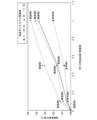
- FIG. 1 is a graph showing the relationship between spiral flow length and bending strength.
- the fluidity (value of spiral flow length) of Reference Example 4 at a weld bending strength of 43 MPa is 310 mm.
- Example 3 in which 0.1 part by mass of a fatty acid amide additive was added the value of the spiral flow length when showing the same weld bending strength of 43 MPa was improved to 343 mm (Table 1, Figure 1 reference).
- the weld bending strength is improved by blending the fatty acid amide additive.
- the value of the weld bending strength at the fluidity of Reference Example 4 (spiral flow length value of 310 mm) is 43 MPa.
- the weld bending strength value when showing the same fluidity (spiral flow length 296 mm) was improved to 58 MPa (Table 1, see Figure 1).
- FIG. 2 is a graph showing the relationship between the flow length elongation percentage values shown in Table 1 and the blending amounts of liquid crystal polyester and fatty acid amide additives. Even when focusing only on the fluidity improvement effect, Examples 1 to 9, in which both liquid crystal polyester and fatty acid amide additives were blended, were better than Reference Examples 5 to 7, in which fatty acid amide additives were not blended. It can be seen that the resin composition has significantly improved fluidity.
- aromatic polyether sulfone PES 3600P 100 parts by mass
- the additives shown in Table 2 (0 parts by mass or 0.3 parts by mass)
- glass fibers were added. (20 parts by mass) and put into a twin-screw extruder (manufactured by Ikegai Co., Ltd., PCM-30) and granulated at a cylinder temperature of 340°C to obtain resin compositions (pellets) of each example.
- the aromatic polysulfone according to the embodiment of the present invention contains an aromatic polysulfone, a liquid crystal polyester, and at least one fatty acid compound selected from the group consisting of fatty acids, fatty acid salts, and fatty acid derivatives.
- the composition achieved evaluation results with an excellent balance between fluidity, various strengths, and heat resistance, and was shown to be an extremely useful composition suitable as a molding material for injection molding.
- an aromatic polysulfone composition that has an excellent balance between fluidity and strength.
Landscapes
- Chemical & Material Sciences (AREA)
- Health & Medical Sciences (AREA)
- Chemical Kinetics & Catalysis (AREA)
- Medicinal Chemistry (AREA)
- Polymers & Plastics (AREA)
- Organic Chemistry (AREA)
- Engineering & Computer Science (AREA)
- Manufacturing & Machinery (AREA)
- Mechanical Engineering (AREA)
- Compositions Of Macromolecular Compounds (AREA)
- Manufacture Of Macromolecular Shaped Articles (AREA)
Abstract
Description
本願は、2022年7月14日に、日本に出願された特願2022-113183号に基づき優先権を主張し、その内容をここに援用する。
すなわち、本発明は以下の態様を有する。
液晶ポリエステルと、
脂肪酸、脂肪酸塩、及び脂肪酸誘導体からなる群から選択される少なくとも一種の脂肪酸化合物と、
を含有する、芳香族ポリスルホン組成物。
<2> 前記芳香族ポリスルホンと、前記液晶ポリエステルとの含有量の質量比が、前記芳香族ポリスルホン/前記液晶ポリエステル=95/5~70/30である、前記<1>に記載の芳香族ポリスルホン組成物。
<3> 前記芳香族ポリスルホン及び前記液晶ポリエステルの総質量100質量部に対して、前記脂肪酸化合物の含有量が、0.1質量部以上1質量部以下である、前記<1>又は<2>に記載の芳香族ポリスルホン組成物。
<4> 前記芳香族ポリスルホンを、前記芳香族ポリスルホン組成物の総質量100質量%に対して、30質量%以上95質量%以下含有する、前記<1>~<3>のいずれか1つに記載の芳香族ポリスルホン組成物。
<5> 前記脂肪酸誘導体を含有し、前記脂肪酸誘導体が脂肪酸アミドを含む、前記<1>~<4>のいずれか1つに記載の芳香族ポリスルホン組成物。
<6> 前記芳香族ポリスルホンが、下記式(S1)で表される繰返し単位を有する芳香族ポリエーテルスルホンである、前記<1>~<5>のいずれか1つに記載の芳香族ポリスルホン組成物。
(S1)-Ph1-SO2-Ph2-O-
[式中、Ph1及びPh2は、それぞれ独立に、フェニレン基を表す。前記フェニレン基にある水素原子は、それぞれ独立に、アルキル基、アリール基又はハロゲン原子で置換されていてもよい。]
<7> 前記液晶ポリエステルが、下記式(1)で表される繰返し単位(1)と、下記式(2)で表される繰返し単位(2)と、下記式(3)で表される繰返し単位(3)と、を有する液晶ポリエステルである、前記<1>~<6>のいずれか1つに記載の芳香族ポリスルホン組成物。
(1)-O-Ar1-CO-
(2)-CO-Ar2-CO-
(3)-X-Ar3-Y-
[式中、Ar1は、フェニレン基、ナフチレン基又はビフェニリレン基を表す。Ar2及びAr3は、それぞれ独立に、フェニレン基、ナフチレン基、ビフェニリレン基又は下記式(4)で表される基を表す。X及びYは、それぞれ独立に、酸素原子又はイミノ基(-NH-)を表す。Ar1、Ar2又はAr3で表される前記基にある水素原子は、それぞれ独立に、ハロゲン原子、アルキル基又はアリール基で置換されていてもよい。]
(4)-Ar4-Z-Ar5-
[式中、Ar4及びAr5は、それぞれ独立に、フェニレン基又はナフチレン基を表す。Zは、酸素原子、硫黄原子、カルボニル基、スルホニル基又はアルキリデン基を表す。]
<8> 更に、繊維状フィラーを含有する、前記<1>~<7>のいずれか1つに記載の芳香族ポリスルホン組成物。
<9> 前記<1>~<8>のいずれか1つに記載の芳香族ポリスルホン組成物を含む、成形体。
<10> 前記<1>~<8>のいずれか1つに記載の芳香族ポリスルホン組成物を射出成形することを含む、成形体の製造方法。
実施形態の芳香族ポリスルホン組成物は、芳香族ポリスルホンと、液晶ポリエステルと、脂肪酸、脂肪酸塩、及び脂肪酸誘導体からなる群から選択される少なくとも一種の脂肪酸化合物(以下、単に「脂肪酸化合物」ということがある。)と、を含有する。
実施形態の芳香族ポリスルホン組成物の強度は、後述の試験片(成形体)に対して測定される、ウエルド曲げ強度により評価される。
実施形態の芳香族ポリスルホン組成物の流動性は、後述の[流動性の評価]の記載に従って、特定のスパイラル形状の流路を有する金型を用い、所定の条件で前記芳香族ポリスルホン組成物を射出成形して得られる成形体の流動長によって評価される。
芳香族ポリスルホンと、液晶ポリエステルと、脂肪酸、脂肪酸塩、及び脂肪酸誘導体からなる群から選択される少なくとも一種の脂肪酸化合物との合計含有量は、芳香族ポリスルホン組成物の総質量100質量部に対して、50質量部以上100質量部以下であってよく、55質量部以上100質量部以下であってよい。
芳香族ポリスルホンは、典型的には、2価の芳香族基(芳香族化合物から、その芳香環に結合した水素原子を2個除いてなる残基)とスルホニル基(-SO2-)とを含む繰返し単位を有する樹脂である。
[式中、Ph1及びPh2は、それぞれ独立に、フェニレン基を表す。前記フェニレン基にある水素原子は、それぞれ独立に、アルキル基、アリール基又はハロゲン原子で置換されていてもよい。]
[式中、Ph3及びPh4は、それぞれ独立に、フェニレン基を表す。前記フェニレン基にある水素原子は、それぞれ独立に、アルキル基、アリール基又はハロゲン原子で置換されていてもよい。Rは、アルキリデン基、酸素原子又は硫黄原子を表す。]
[式中、Ph5は、フェニレン基を表す。前記フェニレン基にある水素原子は、それぞれ独立に、アルキル基、アリール基又はハロゲン原子で置換されていてもよい。nは、1以上3以下の整数を表す。nが2以上である場合、複数存在するPh5は、互いに同一であっても異なっていてもよい。]
上記の中でも、前記フェニレン基にある水素原子は置換されていないことが好ましい。
芳香族ポリスルホンは、それを構成する繰返し単位に対応するジハロゲノスルホン化合物とジヒドロキシ化合物とを重縮合させることにより、製造することができる。
[式中、X1は及びX2は、それぞれ独立に、ハロゲン原子を表す。Ph1及びPh2は、前記と同義である。]
[式中、Ph1及びPh2は、前記と同義である。]
[式中、Ph3、Ph4及びRは、前記と同義である。]
[式中、Ph5及びnは、前記と同義である。]
本実施形態の芳香族ポリスルホン組成物が含有する液晶ポリエステルは、溶融状態で液晶性を示すポリエステル樹脂であれば、特に限定されない。なお、液晶ポリエステルは、液晶ポリエステルアミド、液晶ポリエステルエーテル、液晶ポリエステルカーボネート、又は液晶ポリエステルイミド等であってもよい。
また、液晶ポリエステルの流動開始温度は、400℃以下であることが好ましく、360℃以下であることがより好ましく、340℃以下であることがさらに好ましい。
ここで、芳香族ヒドロキシカルボン酸、芳香族ジカルボン酸、芳香族ジオール、芳香族ヒドロキシアミン及び芳香族ジアミンは、それぞれ独立に、その一部又は全部に代えて、重合可能なそれらの誘導体であってもよい。
芳香族ヒドロキシアミン及び芳香族ジアミンのようなアミノ基を有する化合物の重合可能な誘導体の例としては、アミノ基をアシル化してアシルアミノ基に変換したもの(すなわち、アシル化物)等が挙げられる。
(2)-CO-Ar2-CO-
(3)-X-Ar3-Y-
[式中、Ar1は、フェニレン基、ナフチレン基又はビフェニリレン基を表す。Ar2及びAr3は、それぞれ独立に、フェニレン基、ナフチレン基、ビフェニリレン基又は下記式(4)で表される基を表す。X及びYは、それぞれ独立に、酸素原子又はイミノ基(-NH-)を表す。Ar1、Ar2又はAr3で表される前記基にある水素原子は、それぞれ独立に、ハロゲン原子、アルキル基又はアリール基で置換されていてもよい。]
[式中、Ar4及びAr5は、それぞれ独立に、フェニレン基又はナフチレン基を表す。Zは、酸素原子、硫黄原子、カルボニル基、スルホニル基又はアルキリデン基を表す。]
(1-1)-O-Ar1-1-CO-
(2-1)-CO-Ar2-1-CO-
(3-1)-O-Ar3-1-O-
Ar1-1としては、2,6-ナフチレン基、1,4-フェニレン基、又は4,4’-ビフェニリレン基を表す。
Ar2-1及びAr3-1としては、それぞれ独立に、2,6-ナフチレン基、2,7-ナフチレン基、1,4-フェニレン基、1,3-フェニレン基、又は4,4’-ビフェニリレン基を表す。
Ar1-1、Ar2-1又はAr3-1で表される前記基にある水素原子は、それぞれ独立に、ハロゲン原子、炭素数1以上10以下のアルキル基、又は炭素数6以上20以下のアリール基で置換されていてもよい。
具体的には、液晶ポリエステルを超臨界状態の低級アルコール(炭素数1~3のアルコール)と反応させて、前記液晶ポリエステルをその繰返し単位を誘導するモノマーまで解重合し、解重合生成物として得られる各繰返し単位を誘導するモノマーを液体クロマトグラフィーによって定量することで、各繰返し単位の数を算出することができる。
例えば、液晶ポリエステルが、繰返し単位(1)~(3)からなる場合の繰返し単位(1)の数は、繰返し単位(1)~(3)をそれぞれ誘導するモノマーのモル濃度を液体クロマトグラフィーによって算出し、繰返し単位(1)~(3)をそれぞれ誘導するモノマーのモル濃度の合計を100%とした際の繰返し単位(1)を誘導するモノマーのモル濃度の割合を算出することによって、求めることができる。
液晶ポリエステルは、それを構成する構造単位に対応する原料モノマーを溶融重合させて、製造することができる。例えば、日本国特許第6439027号に記載の方法に従って製造することができる。
本実施形態の芳香族ポリスルホン組成物が含有する脂肪酸化合物は、脂肪酸、脂肪酸塩、及び脂肪酸誘導体からなる群から選択される少なくとも一種の脂肪酸化合物である。
本実施形態の芳香族ポリスルホン組成物は、必要に応じて、フィラー、前記芳香族ポリスルホン及び前記液晶ポリエステル以外の樹脂、添加剤等の任意成分を1種以上含有してもよい。
本実施形態の芳香族ポリスルホン組成物は、フィラーを更に含んでよい。
フィラーは、繊維状フィラーや、板状フィラー、粒状フィラー等であってもよい。また、フィラーは、無機フィラーであってもよいし、有機フィラーであってもよい。
また、繊維状の無機フィラーとしては、チタン酸カリウムウイスカー、チタン酸バリウムウイスカー、ウォラストナイトウイスカー、ホウ酸アルミニウムウイスカー、窒化ケイ素ウイスカー、又は炭化ケイ素ウイスカー等のウイスカーも挙げられる。
ガラス繊維の種類は、特に制限はなく、公知のものを用いることができる。ガラス繊維の例としては、チョップドガラス繊維、又はミルドガラス繊維等、種々の方法で製造されたものが挙げられる。
また、Eガラス(すなわち、無アルカリガラス)、Cガラス(すなわち、耐酸用途向けガラス)、ARガラス(すなわち、耐アルカリ用途向けガラス)、Sガラス又はTガラス等を挙げることができる。
ガラス繊維の処理は、修飾剤、シランカップリング剤、又はホウ素化合物等で行うことができる。修飾剤としては、芳香族ウレタン系修飾剤、脂肪族ウレタン系修飾剤、又はアクリル系修飾剤等が挙げられる。
上記のガラス繊維の繊維径(単繊維径)の数値範囲の一例としては、5μm以上20μm以下であることが好ましく、5.5μm以上17μm以下であることがより好ましく、6μm以上15μm以下であることがさらに好ましく、8μm超15μm以下がとりわけ好ましく、10μm以上15μm以下が特に好ましい。
上記のガラス繊維の数平均繊維長の数値範囲の一例としては、20μm以上6000μm以下であることが好ましく、1000μm以上5000μm以下であることがより好ましく、2000μm以上4500μm以下あることがさらに好ましい。
炭素繊維の種類は、特に制限はなく、公知のものを用いることができ、例えば、PAN系、ピッチ系、レーヨン系、フェノール系、又はリグニン系の炭素繊維が好ましい。
また、導電性を付与する目的においては、ニッケルや銅やイッテルビウム等の金属を被覆した炭素繊維を用いることもできる。
実施形態の芳香族ポリスルホン組成物における、上記の繊維状フィラーの含有量の数値範囲の一例としては、芳香族ポリスルホン及び液晶ポリエステルの総質量100質量部に対し、1質量部以上100質量部以下が好ましく、10質量部以上85質量部以下がより好ましく、15質量部以上50質量部以下がさらに好ましい。
上記質量比の範囲内で、芳香族ポリスルホン及び液晶ポリエステルを含有することで、流動性と強度(例えば、後述のウエルド曲げ強度)と、のバランスに優れた芳香族ポリスルホン組成物を、容易に提供できる。
上記質量比の範囲内で、脂肪酸化合物を含有することで、流動性と耐熱性とのバランスに優れた芳香族ポリスルホン組成物を、容易に提供できる。
好ましくは、芳香族ポリスルホンの含有量の割合が40質量%以上90質量%以下であり、液晶ポリエステルの含有量の割合が3質量%以上40質量%以下であり、脂肪酸化合物の含有量の割合が0.01質量%以上1質量%以下であり、繊維状フィラー含有量の割合が1質量%以上50質量%以下である組成物を例示でき、
より好ましくは、芳香族ポリスルホンの含有量の割合が45質量%以上85質量%以下であり、液晶ポリエステルの含有量の割合が5質量%以上35質量%以下であり、脂肪酸化合物の含有量の割合が0.05質量%以上0.8質量%以下であり、繊維状フィラー含有量の割合が5質量%以上30質量%以下である組成物を例示でき、
より好ましくは、芳香族ポリスルホンの含有量の割合が50質量%以上75質量%以下であり、液晶ポリエステルの含有量の割合が5質量%以上30質量%以下であり、脂肪酸化合物の含有量の割合が0.05質量%以上0.8質量%以下であり、繊維状フィラー含有量の割合が15質量%以上25質量%以下である組成物を例示でき、
更に好ましくは、芳香族ポリスルホンの含有量の割合が60質量%以上75質量%以下であり、液晶ポリエステルの含有量の割合が5質量%以上20質量%以下であり、脂肪酸化合物の含有量の割合が0.05質量%以上0.8質量%以下であり、繊維状フィラー含有量の割合が15質量%以上25質量%以下である組成物を例示できる。
実施形態の芳香族ポリスルホン組成物は、上述した芳香族ポリスルホンと、液晶ポリエステルと、脂肪酸、脂肪酸塩、及び脂肪酸誘導体からなる群から選択される少なくとも一種の脂肪酸化合物と、必要に応じて用いられる任意成分とを、一括で又は適当な順序で混合して得ることができる。
実施形態の成形体は、本発明の一実施形態の芳香族ポリスルホン組成物を含む成形体である。
本実施形態の成形体として、実施形態の芳香族ポリスルホン組成物からなる成形体を例示できる。
射出成形機(例えば、住友重機械工業株式会社製、商品名「SE100EV-A」)を用い、試験対象の組成物を成形材料として、シリンダー温度380℃、金型温度150℃、射出速度50mm/秒の条件で、両端にゲート部を有したISO 3167:93に規定されるA型多目的試験片(ただし、厚さ3mm)の形状の金型を使用し、中心部にウエルドを有する、ウエルド試験用の試験片(成形体)を射出成形する。
得られた試験片(成形体)に対し、ISO 178に準拠し、23℃雰囲気下、試験速度2mm/分、支点間距離64mm、圧子の幅1mm圧子の先端の半径5mmにて曲げ試験を実施する。曲げ強度の値については、3本の試験片についての結果の平均値を採用する。
前記試験片のウエルド曲げ強度の上限値は、特に限定されるものではないが、一例として、200MPa以下であってよく、150MPa以下であってよく、100MPa以下であってよい。
前記試験片のウエルド曲げ強度の数値範囲の一例としては、30MPa以上200MPa以下であってもよく、35MPa以上150MPa以下であってもよく、40MPa以上100MPa以下であってもよい。
射出成形機(例えば、日精樹脂工業株式会社製、商品名「NEX50IV-5EG」)を用い、試験対象の組成物を成形材料として、シリンダー温度380℃、金型温度150℃、射出速度50mm/秒の条件で、ASTM4号ダンベル試験片を射出成形する。
得られた試験片(成形体)に対し、ASTM D638に準拠し、23℃雰囲気下、引張速度10mm/分にて、引張強度を測定する。引張強度の値については、5本の試験片についての結果の平均値を採用する。
前記試験片の引張強度の上限値は、特に限定されるものではないが、一例として、200MPa以下であってよく、175MPa以下であってよく、150MPa以下であってよい。
前記試験片の引張強度の数値範囲の一例としては、100MPa以上200MPa以下であってもよく、110MPa以上175MPa以下であってもよく、120MPa以上150MPa以下であってもよい。
射出成形機(例えば、日精樹脂工業株式会社製、商品名「NEX50IV-5EG」)を用いて、試験対象の組成物を成形材料として、シリンダー温度380℃、金型温度150℃、射出速度50mm/秒の条件で、幅12.7mm、長さ127mm、厚さ6.4mmの棒状試験片(成形体)を製造する。
得られた試験片(成形体)に対し、ASTM D648に準拠し、荷重1.82MPa、昇温速度2℃/分にて荷重たわみ温度(DTUL)を測定する。
前記試験片の荷重たわみ温度の上限値は、特に限定されるものではないが、一例として、250℃以下であってよく、240℃以下であってよく、230℃以下であってよい。 前記試験片の荷重たわみ温度の数値範囲の一例としては、180℃以上250℃以下であってよく、190℃以上240℃以下であってよく、200℃以上230℃以下であってよい。
本実施形態の成形体は、例えば、コネクター、ソケット、ICソケット、バーンインソケット、リレー部品、コイルボビン、光ピックアップ、発振子、プリント配線板、回路基板、半導体パッケージ、若しくはコンピュータ関連部品等の電気・電子部品;ICトレー若しくはウエハーキャリヤー等の半導体製造プロセス関連部品;VTR、テレビ、アイロン、エアコン、ステレオ、掃除機、冷蔵庫、炊飯器、若しくは照明器具等の家庭電気製品部品;ランプリフレクター若しくはランプホルダー等の照明器具部品;コンパクトディスク、レーザーディスク(登録商標)、若しくはスピーカー等の音響製品部品;光ケーブル用フェルール、電話機部品、ファクシミリ部品、若しくはモデム等の通信機器部品;分離爪若しくはヒータホルダー等の複写機若しくは印刷機関連部品;インペラー、ファン歯車、ギヤ、軸受け、モーター部品、若しくはケース等の機械部品;自動車用機構部品、エンジン部品、エンジンルーム内部品、電装部品、若しくは内装部品等の自動車部品;マイクロ波調理用鍋若しくは耐熱食器等の調理用器具;床材若しくは壁材等の断熱若しくは防音用材料、梁若しくは柱等の支持材料、若しくは屋根材等の建築資材、若しくは土木建築用材料;航空機、宇宙機、若しくは宇宙機器用部品;原子炉等の放射線施設部材;海洋施設部材、洗浄用治具、光学機器部品、バルブ類、パイプ類、ノズル類、フィルター類、膜、医療用機器部品若しくは医療用材料、センサー類部品、サニタリー備品、スポーツ用品、レジャー用品、又は結束バンド等が挙げられる。
成形体の製造方法としては、実施形態の芳香族ポリスルホン組成物を所望の形状に成形することを含む方法が挙げられる。当該製造方法としては、実施形態の芳香族ポリスルホン組成物を、所望の成形体の形状等に応じた成形方法を選択することができる。成形方法としては、溶融成形法が好ましい。
公知の射出成形機としては、例えば、日精樹脂工業株式会社製、商品名「NEX50IV-5EG」、住友重機械工業株式会社製、商品名「SE100EV-A」等が挙げられる。
攪拌装置、トルクメータ、窒素ガス導入管、温度計及び還流冷却器を備えた反応器に、6-ヒドロキシ-2-ナフトエ酸(1034.99g、5.5モル)、2,6-ナフタレンジカルボン酸(378.33g、1.75モル)、テレフタル酸(83.07g、0.5モル)、ヒドロキノン(272.52g、2.475モル、2,6-ナフタレンジカルボン酸及びテレフタル酸の合計モル量に対して0.225モル過剰)、無水酢酸(1226.87g、12モル)、及び触媒として1-メチルイミダゾール(0.17g)を入れた。反応器内のガスを窒素ガスで置換した後、窒素ガス気流下、攪拌しながら、室温から145℃まで15分間かけて昇温し、145℃で1時間還流させた。
次いで、副生した酢酸及び未反応の無水酢酸等を留去しながら、145℃から310℃まで3時間30分かけて昇温し、310℃で3時間保持した後、固形状のプレポリマー(反応混合物)を取り出し、このプレポリマーを室温まで冷却した。
次いで、粉砕機を用いて、冷却後のプレポリマーを、粒径が約0.1mm~1mmになるまで粉砕した。得られた粉砕物を窒素雰囲気下、室温から250℃まで1時間かけて昇温し、250℃から302℃まで8時間40分かけて昇温し、302℃で5時間保持することにより、固相重合を行った。固相重合物を冷却して、粉末状の液晶ポリエステルを得た。得られた液晶ポリエステルの流動開始温度は、320℃であった。
(材料)
・芳香族ポリエーテルスルホン:
住友化学株式会社製「スミカエクセル(登録商標)PES 3600P」、ポリエーテルスルホン、還元粘度0.36dL/g
・液晶ポリエステル:
上記で製造して得たもの
・脂肪酸アミド系添加剤:
共栄社化学株式会社製「ライトアマイドWH-510K」
・ガラス繊維:
日東紡績製、「CS3J260S」、繊維径11μm、数平均繊維長3.0mm
芳香族ポリエーテルスルホン、液晶ポリエステル、脂肪酸アミド系添加剤、ガラス繊維を、表1に示す量(質量部)で配合して2軸押出機(池貝社製、PCM-30)に投入し、シリンダー温度340℃で造粒し、各例の樹脂組成物(ペレット)を得た。
[流動性の評価]
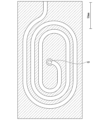
射出成形機(住友重機械工業株式会社製、商品名「SE100EV-A」)を用いて、金型内形状として、幅8mm、厚さ1mmのスパイラル形状の流路を有した金型を用い、流動長を評価した(流路形状は図3を参照)。図3中、Gは流路へと接続するゲートを表し、ゲートへの組成物の流入にはダイレクトゲート方式を採用した。各例の樹脂組成物を成形材料として用い、射出成形を行った。シリンダー温度380℃、金型温度150℃、射出速度50mm/秒、上記成形機での計量位置25mmの条件で、射出圧が150MPaに到達した段階で圧力制御に切替えを行い、射出時間2秒間にて150MPaをかけ続けることで成形体を得た。成形体の流動末端までの距離を10本測定し、平均値を流動長とした。
射出成形機(日精樹脂工業株式会社製、商品名「NEX50IV-5EG」)を用いて、各例の樹脂組成物を成形材料として、シリンダー温度380℃、金型温度150℃、射出速度50mm/秒の条件で、ASTM4号ダンベル試験片、及び、幅12.7mm、長さ127mm、厚さ6.4mmの棒状試験片をそれぞれ製造した。
射出成形機(住友重機械工業株式会社製、商品名「SE100EV-A」)を用いて、各例の樹脂組成物を成形材料として、シリンダー温度380℃、金型温度150℃、射出速度50mm/秒の条件で、両端にゲート部を有したISO 3167:93に規定されるA型多目的試験片(ただし、厚さ3mm)の形状の金型を使用し、中央部にウエルドを有する、ウエルド試験用の試験片を製造した。
各例の樹脂組成物を用いて作製したウエルド試験用の試験片について、ISO 178に準拠し、23℃雰囲気下、試験速度2mm/分、支点間距離64mm、圧子の幅1mm圧子の先端の半径5mmにて曲げ試験を実施した。曲げ強度の値については、3本の試験片についての結果の平均値を採用した。
各例の樹脂組成物を用いて作製したASTM4号ダンベル試験片について、ASTM D638に準拠し、23℃雰囲気下、引張速度10mm/分にて、引張強度を測定した。引張強度の値については、5本の試験片についての結果の平均値を採用した。
各例の樹脂組成物を用いて作製した棒状試験片について、ASTM D648に準拠し、荷重1.82MPa、昇温速度2℃/分にて荷重たわみ温度(DTUL)を測定した。
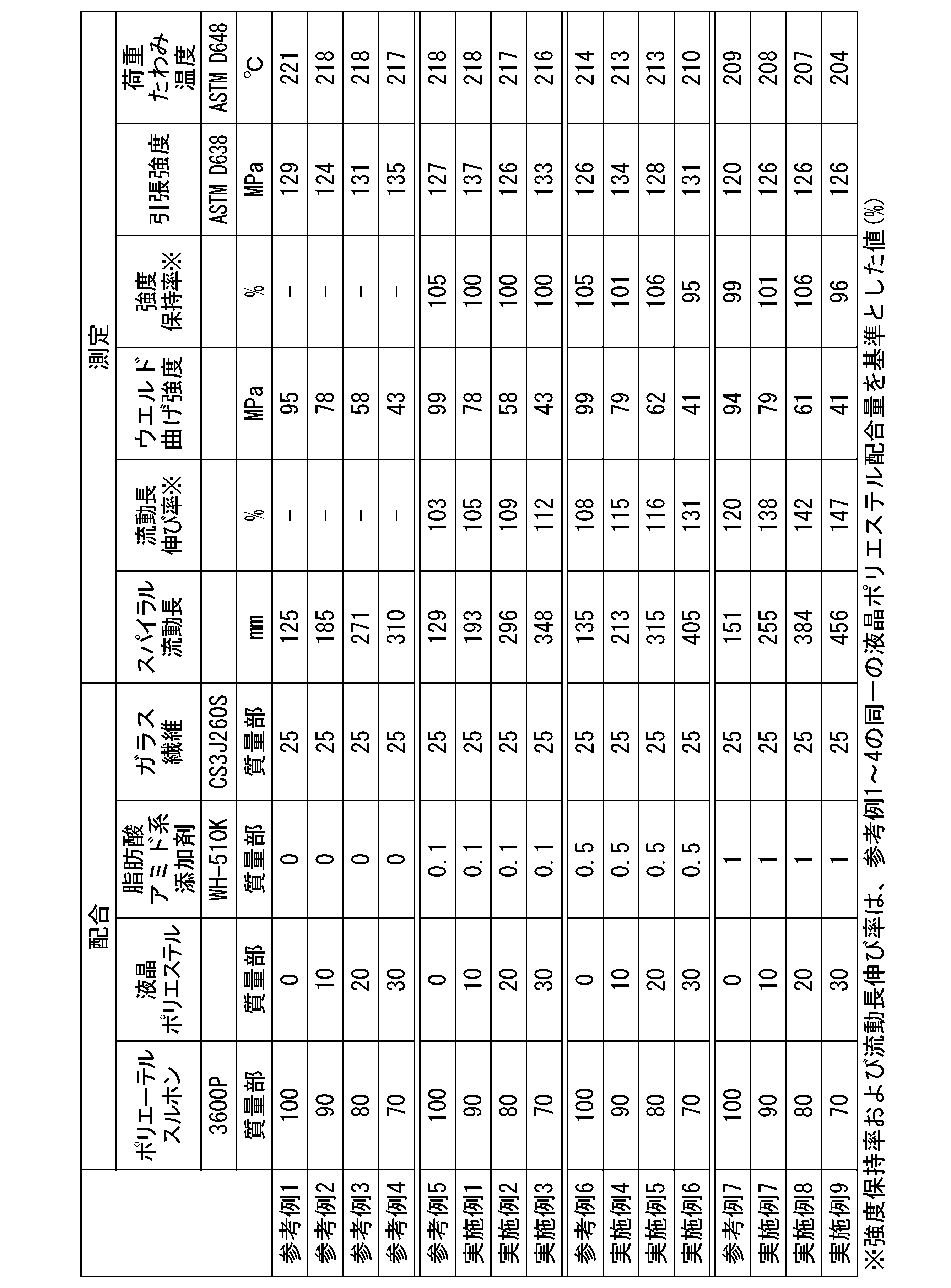
例えば、参考例4の流動性(スパイラル流動長の値310mm)での、ウエルド曲げ強度の値は43MPaである。対する、脂肪酸アミド系添加剤を0.1質量部配合した実施例2での、同等の流動性(スパイラル流動長296mm)を示す場合のウエルド曲げ強度の値は、58MPaに向上している(表1、図1参照)。
流動性の向上効果のみに着目した場合でも、脂肪酸アミド系添加剤が配合されていない参考例5~7よりも、液晶ポリエステル及び脂肪酸アミド系添加剤の両方が配合された実施例1~9の樹脂組成物で、顕著に流動性が向上していることがわかる。
[参考例8~15]
添加剤として、以下の種類の添加剤の検討を行った。
・ステアリン酸バリウム(堺化学工業株式会社製)
・ステアリン酸(新日本理化株式会社製、ステアリン酸5000)
・ポリオール脂肪酸エステル(エメリーオレオケミカルズジャパン株式会社製、ロキシオールG15)
・脂肪酸アミド系添加剤(共栄社化学株式会社製、ライトアマイドWH-510K)
・脂肪酸アミド系添加剤(共栄社化学株式会社製、ライトアマイドWH-255)
・ステアリン酸アミド(MCCトレーディング株式会社製、アマイドAP-1)
・エチレンビスステアリン酸アミド(MCCトレーディング株式会社製、スリパックスE)
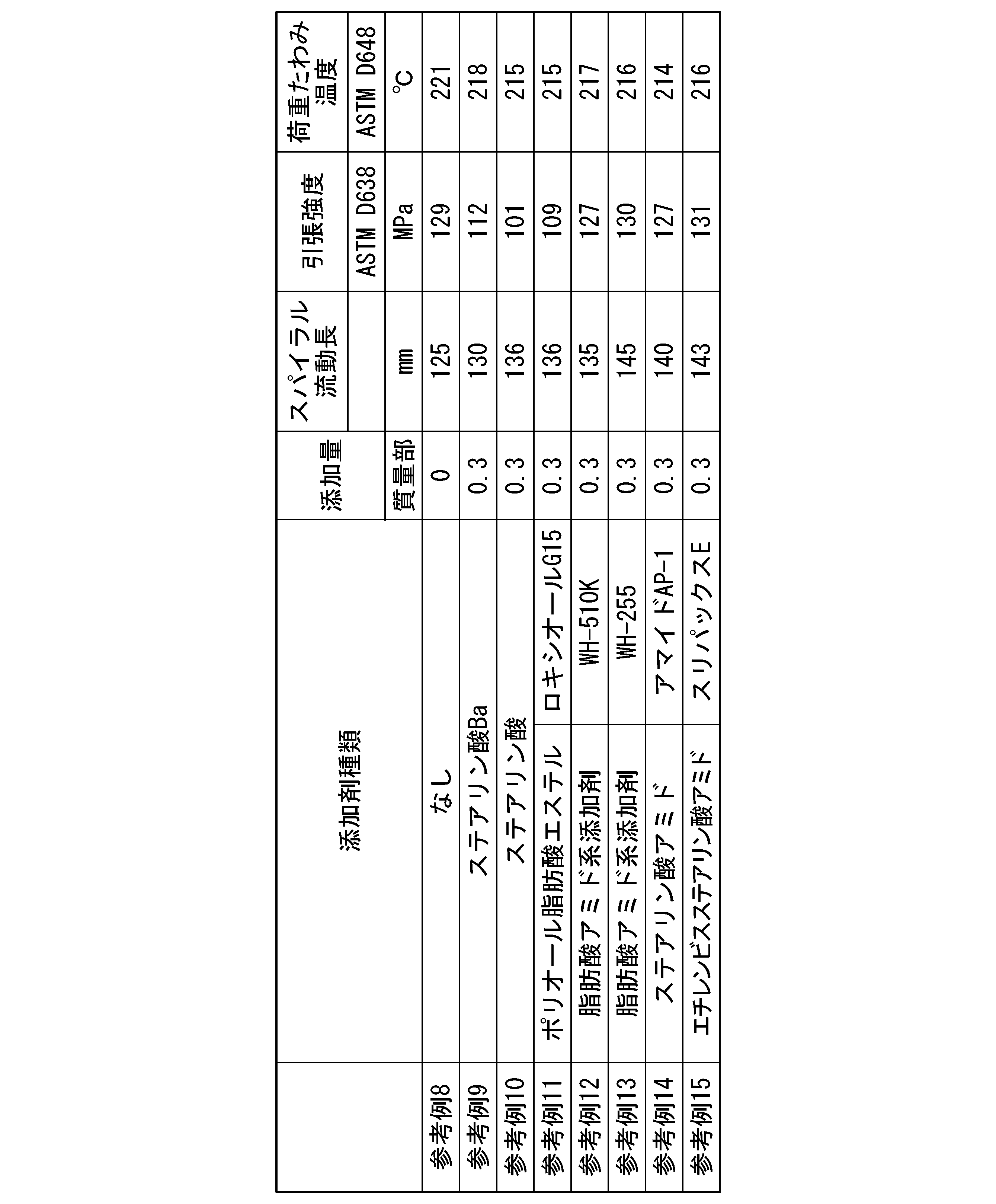
これらの脂肪酸、脂肪酸塩、及び脂肪酸誘導体の中でも、脂肪酸アミド又は脂肪酸ビスアミドに該当する脂肪酸アミド系添加剤を配合した場合(参考例12~15)で、流動性の向上効果がより高く、より良好な引張強度の値が示された。
Claims (10)
- 芳香族ポリスルホンと、
液晶ポリエステルと、
脂肪酸、脂肪酸塩、及び脂肪酸誘導体からなる群から選択される少なくとも一種の脂肪酸化合物と、
を含有する、芳香族ポリスルホン組成物。 - 前記芳香族ポリスルホンと、前記液晶ポリエステルとの含有量の質量比が、前記芳香族ポリスルホン/前記液晶ポリエステル=95/5~70/30である、請求項1に記載の芳香族ポリスルホン組成物。
- 前記芳香族ポリスルホン及び前記液晶ポリエステルの総質量100質量部に対して、前記脂肪酸化合物の含有量が、0.1質量部以上1質量部以下である、請求項1又は2に記載の芳香族ポリスルホン組成物。
- 前記芳香族ポリスルホンを、前記芳香族ポリスルホン組成物の総質量100質量%に対して、30質量%以上95質量%以下含有する、請求項1又は2に記載の芳香族ポリスルホン組成物。
- 前記脂肪酸誘導体を含有し、前記脂肪酸誘導体が脂肪酸アミドを含む、請求項1又は2に記載の芳香族ポリスルホン組成物。
- 前記芳香族ポリスルホンが、下記式(S1)で表される繰返し単位を有する芳香族ポリエーテルスルホンである、請求項1又は2に記載の芳香族ポリスルホン組成物。
(S1)-Ph1-SO2-Ph2-O-
[式中、Ph1及びPh2は、それぞれ独立に、フェニレン基を表し;前記フェニレン基にある水素原子は、それぞれ独立に、アルキル基、アリール基又はハロゲン原子で置換されていてもよい。] - 前記液晶ポリエステルが、下記式(1)で表される繰返し単位(1)と、下記式(2)で表される繰返し単位(2)と、下記式(3)で表される繰返し単位(3)と、を有する液晶ポリエステルである、請求項1又は2に記載の芳香族ポリスルホン組成物。
(1)-O-Ar1-CO-
(2)-CO-Ar2-CO-
(3)-X-Ar3-Y-
[式中、Ar1は、フェニレン基、ナフチレン基又はビフェニリレン基を表し;Ar2及びAr3は、それぞれ独立に、フェニレン基、ナフチレン基、ビフェニリレン基又は下記式(4)で表される基を表し;X及びYは、それぞれ独立に、酸素原子又はイミノ基(-NH-)を表し;Ar1、Ar2又はAr3で表される前記基にある水素原子は、それぞれ独立に、ハロゲン原子、アルキル基又はアリール基で置換されていてもよい。]
(4)-Ar4-Z-Ar5-
[式中、Ar4及びAr5は、それぞれ独立に、フェニレン基又はナフチレン基を表し;Zは、酸素原子、硫黄原子、カルボニル基、スルホニル基又はアルキリデン基を表す。] - 更に、繊維状フィラーを含有する、請求項1又は2に記載の芳香族ポリスルホン組成物。
- 請求項1又は2に記載の芳香族ポリスルホン組成物を含む、成形体。
- 請求項1又は2に記載の芳香族ポリスルホン組成物を射出成形することを含む、成形体の製造方法。
Priority Applications (2)
| Application Number | Priority Date | Filing Date | Title |
|---|---|---|---|
| KR1020257003800A KR20250036169A (ko) | 2022-07-14 | 2023-07-05 | 방향족 폴리술폰 조성물, 성형체 및 성형체의 제조 방법 |
| CN202380050078.1A CN119452040A (zh) | 2022-07-14 | 2023-07-05 | 芳香族聚砜组合物、成型体及成型体的制造方法 |
Applications Claiming Priority (2)
| Application Number | Priority Date | Filing Date | Title |
|---|---|---|---|
| JP2022-113183 | 2022-07-14 | ||
| JP2022113183A JP2024011292A (ja) | 2022-07-14 | 2022-07-14 | 芳香族ポリスルホン組成物、成形体、及び成形体の製造方法 |
Publications (1)
| Publication Number | Publication Date |
|---|---|
| WO2024014378A1 true WO2024014378A1 (ja) | 2024-01-18 |
Family
ID=89536692
Family Applications (1)
| Application Number | Title | Priority Date | Filing Date |
|---|---|---|---|
| PCT/JP2023/024943 Ceased WO2024014378A1 (ja) | 2022-07-14 | 2023-07-05 | 芳香族ポリスルホン組成物、成形体、及び成形体の製造方法 |
Country Status (5)
| Country | Link |
|---|---|
| JP (1) | JP2024011292A (ja) |
| KR (1) | KR20250036169A (ja) |
| CN (1) | CN119452040A (ja) |
| TW (1) | TW202409201A (ja) |
| WO (1) | WO2024014378A1 (ja) |
Citations (2)
| Publication number | Priority date | Publication date | Assignee | Title |
|---|---|---|---|---|
| JP2002020621A (ja) * | 2000-07-11 | 2002-01-23 | Sumitomo Chem Co Ltd | 芳香族ポリサルホン樹脂組成物およびその成形品 |
| JP2013209622A (ja) * | 2012-02-29 | 2013-10-10 | Sumitomo Chemical Co Ltd | 樹脂組成物および成形体 |
-
2022
- 2022-07-14 JP JP2022113183A patent/JP2024011292A/ja active Pending
-
2023
- 2023-07-05 WO PCT/JP2023/024943 patent/WO2024014378A1/ja not_active Ceased
- 2023-07-05 CN CN202380050078.1A patent/CN119452040A/zh active Pending
- 2023-07-05 KR KR1020257003800A patent/KR20250036169A/ko active Pending
- 2023-07-07 TW TW112125403A patent/TW202409201A/zh unknown
Patent Citations (2)
| Publication number | Priority date | Publication date | Assignee | Title |
|---|---|---|---|---|
| JP2002020621A (ja) * | 2000-07-11 | 2002-01-23 | Sumitomo Chem Co Ltd | 芳香族ポリサルホン樹脂組成物およびその成形品 |
| JP2013209622A (ja) * | 2012-02-29 | 2013-10-10 | Sumitomo Chemical Co Ltd | 樹脂組成物および成形体 |
Also Published As
| Publication number | Publication date |
|---|---|
| JP2024011292A (ja) | 2024-01-25 |
| TW202409201A (zh) | 2024-03-01 |
| KR20250036169A (ko) | 2025-03-13 |
| CN119452040A (zh) | 2025-02-14 |
Similar Documents
| Publication | Publication Date | Title |
|---|---|---|
| US11584850B2 (en) | Liquid crystal polyester resin composition and molded body | |
| CN102037620B (zh) | 平面状连接器 | |
| KR102597732B1 (ko) | 액정 폴리에스테르 수지 조성물 및 성형체 | |
| JP5721217B2 (ja) | 液晶ポリエステル樹脂組成物および成形体 | |
| KR102480531B1 (ko) | 액정 폴리에스테르 수지 조성물 및 성형체 | |
| JPWO2019098228A1 (ja) | 液晶ポリエステル組成物および樹脂成形体 | |
| JP6554792B2 (ja) | 炭素繊維強化樹脂組成物、ペレット、成形品および電子機器筐体 | |
| JP2019094489A (ja) | 液晶ポリエステル樹脂組成物および成形体 | |
| JP2019094497A (ja) | 液晶ポリエステル樹脂組成物および成形体 | |
| JP5447440B2 (ja) | 液晶ポリエステル樹脂組成物の製造方法 | |
| WO2013114787A1 (ja) | 樹脂組成物の製造方法 | |
| JP2008019428A (ja) | 液晶ポリマー組成物およびその用途 | |
| JP5197553B2 (ja) | 液晶性樹脂組成物及びその成形体 | |
| WO2013114763A1 (ja) | 樹脂組成物の製造方法 | |
| JP2024011292A (ja) | 芳香族ポリスルホン組成物、成形体、及び成形体の製造方法 | |
| TW202424106A (zh) | 液晶聚酯組合物、液晶聚酯組合物之製造方法以及成形體 | |
| JP5407988B2 (ja) | 液晶性樹脂組成物及びその成形体 | |
| JP2023130737A (ja) | 液晶ポリエステル樹脂組成物、成形体及び成形体の製造方法 | |
| JP2012193271A (ja) | 樹脂組成物および成形体 | |
| KR101779609B1 (ko) | 전방향족 액정 폴리에스테르 수지 컴파운드 및 그의 제조방법 | |
| JP2004182748A (ja) | 液晶ポリエステル樹脂混合物およびそれを用いた成形方法 | |
| JP2012193304A (ja) | 液晶ポリエステル樹脂組成物、成形体 |
Legal Events
| Date | Code | Title | Description |
|---|---|---|---|
| 121 | Ep: the epo has been informed by wipo that ep was designated in this application |
Ref document number: 23839550 Country of ref document: EP Kind code of ref document: A1 |
|
| WWE | Wipo information: entry into national phase |
Ref document number: 202380050078.1 Country of ref document: CN |
|
| ENP | Entry into the national phase |
Ref document number: 20257003800 Country of ref document: KR Kind code of ref document: A |
|
| WWE | Wipo information: entry into national phase |
Ref document number: 1020257003800 Country of ref document: KR |
|
| WWP | Wipo information: published in national office |
Ref document number: 202380050078.1 Country of ref document: CN |
|
| NENP | Non-entry into the national phase |
Ref country code: DE |
|
| WWP | Wipo information: published in national office |
Ref document number: 1020257003800 Country of ref document: KR |
|
| 122 | Ep: pct application non-entry in european phase |
Ref document number: 23839550 Country of ref document: EP Kind code of ref document: A1 |