WO2024014362A1 - 半導体装置 - Google Patents
半導体装置 Download PDFInfo
- Publication number
- WO2024014362A1 WO2024014362A1 PCT/JP2023/024812 JP2023024812W WO2024014362A1 WO 2024014362 A1 WO2024014362 A1 WO 2024014362A1 JP 2023024812 W JP2023024812 W JP 2023024812W WO 2024014362 A1 WO2024014362 A1 WO 2024014362A1
- Authority
- WO
- WIPO (PCT)
- Prior art keywords
- film
- electrode
- trench
- resistance
- region
- Prior art date
- Legal status (The legal status is an assumption and is not a legal conclusion. Google has not performed a legal analysis and makes no representation as to the accuracy of the status listed.)
- Ceased
Links
Images


















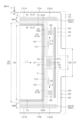

Classifications
-
- H—ELECTRICITY
- H10—SEMICONDUCTOR DEVICES; ELECTRIC SOLID-STATE DEVICES NOT OTHERWISE PROVIDED FOR
- H10W—GENERIC PACKAGES, INTERCONNECTIONS, CONNECTORS OR OTHER CONSTRUCTIONAL DETAILS OF DEVICES COVERED BY CLASS H10
- H10W20/00—Interconnections in chips, wafers or substrates
- H10W20/40—Interconnections external to wafers or substrates, e.g. back-end-of-line [BEOL] metallisations or vias connecting to gate electrodes
- H10W20/498—Resistive arrangements or effects of, or between, wiring layers
-
- H—ELECTRICITY
- H10—SEMICONDUCTOR DEVICES; ELECTRIC SOLID-STATE DEVICES NOT OTHERWISE PROVIDED FOR
- H10D—INORGANIC ELECTRIC SEMICONDUCTOR DEVICES
- H10D12/00—Bipolar devices controlled by the field effect, e.g. insulated-gate bipolar transistors [IGBT]
-
- H—ELECTRICITY
- H10—SEMICONDUCTOR DEVICES; ELECTRIC SOLID-STATE DEVICES NOT OTHERWISE PROVIDED FOR
- H10D—INORGANIC ELECTRIC SEMICONDUCTOR DEVICES
- H10D12/00—Bipolar devices controlled by the field effect, e.g. insulated-gate bipolar transistors [IGBT]
- H10D12/01—Manufacture or treatment
- H10D12/031—Manufacture or treatment of IGBTs
- H10D12/032—Manufacture or treatment of IGBTs of vertical IGBTs
- H10D12/038—Manufacture or treatment of IGBTs of vertical IGBTs having a recessed gate, e.g. trench-gate IGBTs
-
- H—ELECTRICITY
- H10—SEMICONDUCTOR DEVICES; ELECTRIC SOLID-STATE DEVICES NOT OTHERWISE PROVIDED FOR
- H10D—INORGANIC ELECTRIC SEMICONDUCTOR DEVICES
- H10D12/00—Bipolar devices controlled by the field effect, e.g. insulated-gate bipolar transistors [IGBT]
- H10D12/411—Insulated-gate bipolar transistors [IGBT]
- H10D12/441—Vertical IGBTs
- H10D12/461—Vertical IGBTs having non-planar surfaces, e.g. having trenches, recesses or pillars in the surfaces of the emitter, base or collector regions
- H10D12/481—Vertical IGBTs having non-planar surfaces, e.g. having trenches, recesses or pillars in the surfaces of the emitter, base or collector regions having gate structures on slanted surfaces, on vertical surfaces, or in grooves, e.g. trench gate IGBTs
-
- H—ELECTRICITY
- H10—SEMICONDUCTOR DEVICES; ELECTRIC SOLID-STATE DEVICES NOT OTHERWISE PROVIDED FOR
- H10D—INORGANIC ELECTRIC SEMICONDUCTOR DEVICES
- H10D30/00—Field-effect transistors [FET]
- H10D30/60—Insulated-gate field-effect transistors [IGFET]
-
- H—ELECTRICITY
- H10—SEMICONDUCTOR DEVICES; ELECTRIC SOLID-STATE DEVICES NOT OTHERWISE PROVIDED FOR
- H10D—INORGANIC ELECTRIC SEMICONDUCTOR DEVICES
- H10D62/00—Semiconductor bodies, or regions thereof, of devices having potential barriers
- H10D62/10—Shapes, relative sizes or dispositions of the regions of the semiconductor bodies; Shapes of the semiconductor bodies
- H10D62/129—Cathode regions of diodes
-
- H—ELECTRICITY
- H10—SEMICONDUCTOR DEVICES; ELECTRIC SOLID-STATE DEVICES NOT OTHERWISE PROVIDED FOR
- H10D—INORGANIC ELECTRIC SEMICONDUCTOR DEVICES
- H10D8/00—Diodes
- H10D8/50—PIN diodes
-
- H—ELECTRICITY
- H10—SEMICONDUCTOR DEVICES; ELECTRIC SOLID-STATE DEVICES NOT OTHERWISE PROVIDED FOR
- H10W—GENERIC PACKAGES, INTERCONNECTIONS, CONNECTORS OR OTHER CONSTRUCTIONAL DETAILS OF DEVICES COVERED BY CLASS H10
- H10W20/00—Interconnections in chips, wafers or substrates
- H10W20/40—Interconnections external to wafers or substrates, e.g. back-end-of-line [BEOL] metallisations or vias connecting to gate electrodes
- H10W20/41—Interconnections external to wafers or substrates, e.g. back-end-of-line [BEOL] metallisations or vias connecting to gate electrodes characterised by their conductive parts
- H10W20/435—Cross-sectional shapes or dispositions of interconnections
Definitions
- Patent Document 1 discloses a semiconductor device including a semiconductor substrate, a plurality of trench structures, and a gate pad portion. A plurality of trench structures are formed on a surface of a semiconductor substrate. The gate pad section is arranged on the semiconductor substrate so as to cover the plurality of trench structures.
- the present disclosure provides a semiconductor device with a novel layout.
- the present disclosure provides a chip having a main surface, a trench resistance structure formed on the main surface, a resistance film electrically connected to the trench resistance structure on the main surface, and a a gate terminal electrode having a resistance value and electrically connected to the trench resistance structure on the main surface via the resistance film; and a gate terminal electrode having a resistance value lower than the resistance film and on the main surface. and a gate wiring electrode electrically connected to the gate terminal electrode via the resistive film and the trench resistive structure.
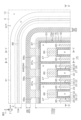
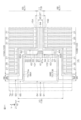
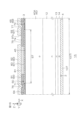
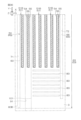
- FIG. 1 is a plan view showing a semiconductor device according to a first embodiment.
- FIG. 2 is a plan view showing the layout of the first main surface.
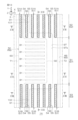
- FIG. 3 is an enlarged plan view showing the active region and the outer peripheral region.
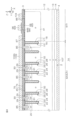
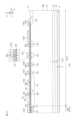
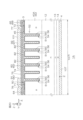
- FIG. 4 is a sectional view taken along the line IV-IV shown in FIG. 3.
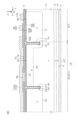
- FIG. 5 is a sectional view taken along the line V-V shown in FIG. 3.
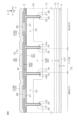
- FIG. 6 is a sectional view taken along the line VI-VI shown in FIG. 3.
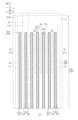
- FIG. 7 is an enlarged plan view showing the active region and boundary region.
- FIG. 8 is a sectional view taken along line VIII-VIII shown in FIG. 7.
- FIG. 9 is a sectional view taken along line IX-IX shown in FIG. 7.
- FIG. 10 is a cross-sectional view showing the structure of the outer peripheral region.
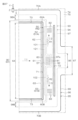
- FIG. 11 is an enlarged plan view showing the pad area.
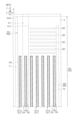
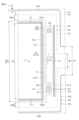
- FIG. 12 is an enlarged plan view showing the gate resistance structure shown in FIG. 11.
- FIG. 13 is an enlarged plan view showing the inner part of the gate resistance structure shown in FIG. 12.
- FIG. 14 is an enlarged plan view showing one end portion of the gate resistance structure shown in FIG. 12.
- FIG. 15 is an enlarged plan view showing the other end of the gate resistance structure shown in FIG. 12.
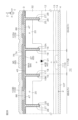
- FIG. 16 is a sectional view taken along the line XVI-XVI shown in FIG. 13.
- FIG. 17 is a sectional view taken along the line XVII-XVII shown in FIG. 13.
- FIG. 18 is a sectional view taken along the line XVIII-XVIII shown in FIG. 13.
- FIG. 19 is a sectional view taken along the line XIX-XIX shown in FIG. 13.
- FIG. 20 is a sectional view taken along the line XX-XX shown in FIG. 14.
- FIG. 21 is a sectional view taken along the line XXI-XXI shown in FIG. 15.
- FIG. 22 is a sectional view taken along the line XXII-XXII shown in FIG. 12.
- FIG. 23 is a plan view showing the layout of a resistive film, a gate electrode film, and a gate wiring film.
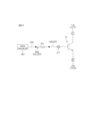
- FIG. 24 is an electric circuit diagram showing a gate resistance structure, a gate terminal electrode, and a gate wiring electrode.
- FIG. 25 is an enlarged plan view showing the layout of the first main surface of the semiconductor device according to the second embodiment.
- FIG. 26 is a sectional view taken along the line XXVI-XXVI shown in FIG. 25.
- FIG. 27 is a plan view showing the layout of the first main surface of the semiconductor device according to the third embodiment.
- FIG. 28 is a cross-sectional view showing the structure of the semiconductor device shown in FIG. 27 on the boundary region side.
- FIG. 29 is a cross-sectional view showing the structure of the outer peripheral region side of the semiconductor device shown in FIG. 27.
- FIG. 30 is an enlarged plan view showing a first resistance connection electrode according to a modification.
- FIG. 31 is a cross-sectional view showing the second resistance connection electrode according to the first modification.
- FIG. 32 is an enlarged plan view showing the second resistance connection electrode according to the second modification.
- FIG. 33 is an enlarged plan view showing the second resistance connection electrode according to the third modification.
- FIG. 34 is a sectional view showing the third resistance connection electrode according to the first modification.
- FIG. 35 is an enlarged plan view showing the third resistance connection electrode according to the second modification.
- FIG. 36 is an enlarged plan view showing a third resistance connection electrode according to a third modification.
- FIG. 37 is an enlarged plan view showing the gate resistance structure according to the first modification.
- FIG. 38 is an enlarged plan view showing the inner part of the gate resistance structure shown in FIG. 37.
- FIG. 39 is an enlarged plan view showing a gate resistance structure according to a second modification.
- FIG. 40 is an enlarged plan view showing a gate resistance structure according to a third modification.
- FIG. 41 is an electric circuit diagram showing a gate resistance structure, a gate terminal electrode, and a gate wiring electrode.
- FIG. 42 is a plan view showing a gate wiring electrode according to a modified example and an emitter terminal electrode according to a modified example.
- FIG. 43 is an enlarged plan view showing a gate connection electrode according to a modification.
- FIG. 44 is a sectional view taken along the line XLIV-XLIV shown in FIG. 43.
- this phrase includes a numerical value (form) that is equal to the numerical value (form) of the comparison target; It also includes a numerical error (form error) in the range of ⁇ 10% based on (form).
- a numerical value that is equal to the numerical value (form) of the comparison target
- a numerical error form error in the range of ⁇ 10% based on (form).
- words such as “first”, “second”, “third”, etc. are used, but these are symbols attached to the name of each structure to clarify the order of explanation; It is not given for the purpose of limiting the name.
- FIG. 1 is a plan view showing a semiconductor device 1A according to the first embodiment.
- FIG. 2 is a plan view showing the layout of the first main surface 3.
- FIG. 3 is an enlarged plan view showing the active region 6 and the outer peripheral region 9.
- FIG. 4 is a sectional view taken along the line IV-IV shown in FIG. 3.
- FIG. 5 is a sectional view taken along the line V-V shown in FIG. 3.
- FIG. 6 is a cross-sectional view taken along the line VI-VI shown in FIG. 3.
- FIG. 7 is an enlarged plan view showing active region 6 and boundary region 8.
- FIG. 8 is a sectional view taken along line VIII-VIII shown in FIG. 7.
- FIG. 9 is a sectional view taken along line IX-IX shown in FIG. 7.
- FIG. 10 is a cross-sectional view showing the structure of the outer peripheral region 9. As shown in FIG.
- the semiconductor device 1A is an IGBT semiconductor device including an IGBT (Insulated Gate Bipolar Transistor).
- a semiconductor device 1A includes a chip 2 having a hexahedral shape (specifically, a rectangular parallelepiped shape).
- Chip 2 may also be referred to as a "semiconductor chip.”
- the chip 2 has a single layer structure made of a silicon single crystal substrate (semiconductor substrate).
- the chip 2 has a first main surface 3 on one side, a second main surface 4 on the other side, and first to fourth side surfaces 5A to 5D connecting the first main surface 3 and the second main surface 4. ing.
- the first main surface 3 and the second main surface 4 are formed into a rectangular shape in a plan view (hereinafter simply referred to as "plan view") as seen from the normal direction Z thereof.
- the normal direction Z is also the thickness direction of the chip 2.
- the first side surface 5A and the second side surface 5B extend in a first direction X along the first main surface 3 and face in a second direction Y that intersects the first direction X along the first main surface 3.
- the second direction Y is orthogonal to the first direction X.
- the third side surface 5C and the fourth side surface 5D extend in the second direction Y and face the first direction X.
- the semiconductor device 1A includes a plurality of active regions 6 provided at intervals on the first main surface 3.
- the plurality of active regions 6 include a first active region 6A on one side and a second active region 6B on the other side.
- the first active region 6A is provided in a region on the first side surface 5A side with respect to a straight line that crosses the center of the first main surface 3 in the first direction X.
- the second active region 6B is provided in a region on the second side surface 5B side with respect to a straight line that crosses the center of the first main surface 3 in the first direction X.
- each active region 6 is formed into a polygonal shape having four sides parallel to the periphery of the chip 2 in plan view.
- the planar shape of each active region 6 is arbitrary.
- the semiconductor device 1A includes a non-active region 7 provided in a region outside the plurality of active regions 6 on the first main surface 3.
- Non-active region 7 includes a boundary region 8 and a peripheral region 9.
- the boundary region 8 is provided in a band shape extending in the first direction X in a region between the first active region 6A and the second active region 6B.
- the boundary region 8 is located on a straight line that crosses the center of the first main surface 3 in the first direction X.
- the boundary region 8 includes a pad region 10 having a relatively large width in the second direction Y, and a street region 11 having a width smaller than the width of the pad region 10 in the second direction Y.
- Pad region 10 may also be referred to as a "first border region” or a "wide region.”
- the street area 11 may be referred to as a "second boundary area,” a "line area,” or a "narrow area.”
- the pad region 10 is provided in a region on one side (third side surface 5C side) in the first direction X.
- the pad region 10 is located on a straight line that crosses the center of the first main surface 3 in the first direction X in a plan view, and is provided in a rectangular shape near the center of the third side surface 5C.
- the street region 11 is provided in a region on the other side (the fourth side surface 5D side) in the first direction X with respect to the pad region 10.
- the street region 11 is drawn out in a band shape from the pad region 10 toward the fourth side surface 5D, and is located on a straight line that crosses the center of the first main surface 3 in the first direction X.
- the outer peripheral region 9 is provided at the peripheral edge of the chip 2 so as to surround the plurality of active regions 6 all at once.
- the outer peripheral region 9 is provided in an annular shape (in this embodiment, a square annular shape) extending along the periphery of the chip 2 (first to fourth side surfaces 5A to 5D).
- the outer peripheral region 9 is connected to the pad region 10 on one side of the first main surface 3 (the third side surface 5C side), and is connected to the street region 11 on the other side of the first main surface 3 (the fourth side surface 5D side). ing.
- the semiconductor device 1A includes an n-type (first conductivity type) drift region 12 formed inside the chip 2.
- the drift region 12 is formed throughout the interior of the chip 2 .
- the chip 2 is made of an n-type semiconductor substrate (n-type semiconductor chip), and the drift region 12 is formed using the n-type chip 2.
- the semiconductor device 1A includes an n-type buffer region 13 formed in the surface layer portion of the second main surface 4.
- the buffer region 13 is formed in a layered manner extending along the second main surface 4 over the entire second main surface 4 .
- Buffer region 13 has a higher n-type impurity concentration than drift region 12.
- the presence or absence of the buffer area 13 is arbitrary, and a configuration without the buffer area 13 may be adopted.
- the semiconductor device 1A includes a p-type (second conductivity type) collector region 14 formed in the surface layer portion of the second main surface 4.
- the collector region 14 is formed in the surface layer portion of the buffer region 13 on the second main surface 4 side.
- the collector region 14 is formed in a layered shape extending along the second main surface 4 over the entire second main surface 4 .
- the collector region 14 is exposed from part of the second main surface 4 and the first to fourth side surfaces 5A to 5D.
- the semiconductor device 1A includes a plurality of trench isolation structures 15 formed on the first main surface 3 so as to partition a plurality of active regions 6.
- a gate potential is applied to the plurality of trench isolation structures 15 .
- Trench isolation structure 15 may also be referred to as a "trench gate isolation structure” or a "trench gate connection structure.”
- the plurality of trench isolation structures 15 include a first trench isolation structure 15A on the first active region 6A side and a second trench isolation structure 15B on the second active region 6B side.
- the first trench isolation structure 15A surrounds the first active region 6A and partitions the first active region 6A from the boundary region 8 and the outer peripheral region 9.
- the first trench isolation structure 15A is formed into a polygonal ring shape having four sides parallel to the periphery of the chip 2 in plan view.
- the first trench isolation structure 15A has a bent portion so as to partition the pad region 10 and the street region 11 of the boundary region 8 in plan view.
- the second trench isolation structure 15B surrounds the second active region 6B and partitions the second active region 6B from the boundary region 8 and the outer peripheral region 9.
- the second trench isolation structure 15B is formed into a polygonal ring shape having four sides parallel to the periphery of the chip 2 in plan view.
- the second trench isolation structure 15B has a bent portion so as to partition the pad region 10 and the street region 11 of the boundary region 8 in plan view.
- the trench isolation structure 15 has a width less than the width of the street region 11.
- the width of trench isolation structure 15 is the width in the direction perpendicular to the direction in which trench isolation structure 15 extends.
- the width of the trench isolation structure 15 may be 0.1 ⁇ m or more and 2.5 ⁇ m or less.
- the width of the trench isolation structure 15 is preferably 0.3 ⁇ m or more and 1 ⁇ m or less. It is particularly preferable that the width of the trench isolation structure 15 is 0.4 ⁇ m or more and 0.7 ⁇ m or less.
- Trench isolation structure 15 may have a depth of 1 ⁇ m or more and 20 ⁇ m or less. The depth of the trench isolation structure 15 is preferably 4 ⁇ m or more and 10 ⁇ m or less.
- Trench isolation structure 15 includes an isolation trench 16, an isolation insulating film 17, and an isolation buried electrode 18.
- Isolation trench 16 is formed in first main surface 3 and partitions the wall surface of trench isolation structure 15 .
- the isolation insulating film 17 covers the wall surface of the isolation trench 16 in the form of a film.
- Isolation insulating film 17 may include at least one of a silicon oxide film, a silicon nitride film, and an aluminum oxide film.
- the isolation insulating film 17 has a single layer structure consisting of a single insulating film. It is particularly preferable that the isolation insulating film 17 includes a silicon oxide film made of an oxide of the chip 2.
- the isolation buried electrode 18 is buried in the isolation trench 16 with the isolation insulating film 17 in between. Separate buried electrode 18 may include conductive polysilicon. A gate potential is applied to the separate buried electrode 18.
- the semiconductor device 1A includes an IGBT structure Tr (transistor structure) formed in each active region 6.
- the IGBT structure Tr is not formed in the non-active region 7. Since the configuration on the second active region 6B side (the configuration of the IGBT structure Tr) is almost the same as the configuration on the first active region 6A side (the configuration of the IGBT structure Tr), the configuration on the first active region 6A side will be explained below. be done.
- the configuration on the second active region 6B side is line-symmetrical with the configuration on the first active region 6A side with the boundary region 8 in between.
- the description of the structure on the second active region 6B side the description of the structure on the first active region 6A side is applied and will be omitted.
- the semiconductor device 1A includes a p-type base region 20 formed in the surface layer portion of the first main surface 3 in the first active region 6A.
- Base region 20 may be referred to as a "body region” or a "channel region.”
- Base region 20 extends in a layered manner along first main surface 3 and is connected to the inner peripheral wall of trench isolation structure 15 .
- Base region 20 is formed shallower than trench isolation structure 15 and has a bottom portion located closer to first main surface 3 than the bottom wall of trench isolation structure 15 .
- the bottom of the base region 20 is preferably located closer to the first main surface 3 than the middle part of the depth range of the trench isolation structure 15 .
- the semiconductor device 1A includes a plurality of first trench structures 21 formed on the first main surface 3 in the first active region 6A.
- a gate potential is applied to the plurality of first trench structures 21 .
- the first trench structure 21 may be referred to as a "trench gate structure".
- the plurality of first trench structures 21 penetrate the base region 20 to reach the drift region 12.
- the plurality of first trench structures 21 are arranged at intervals in the first direction X in a plan view, and are each formed in a band shape extending in the second direction Y. That is, the plurality of first trench structures 21 are arranged in stripes extending in the second direction Y.
- Each first trench structure 21 has one end on the boundary region 8 side and the other end on the outer peripheral region 9 side in the longitudinal direction (second direction Y). One end and the other end of the plurality of first trench structures 21 are mechanically and electrically connected to the trench isolation structure 15. That is, the plurality of first trench structures 21 together with the trench isolation structure 15 constitute one ladder-like trench structure.
- the connection between the first trench structure 21 and the trench isolation structure 15 may be considered part of the trench isolation structure 15 and/or part of the first trench structure 21 .
- the interval between the plurality of first trench structures 21 is preferably less than the width of the street region 11.
- the width of the first trench structure 21 is less than the width of the street region 11.
- the width of the first trench structure 21 is the width in the direction perpendicular to the direction in which the first trench structure 21 extends.
- the width of the first trench structure 21 may be 0.1 ⁇ m or more and 2.5 ⁇ m or less.
- the width of the first trench structure 21 is preferably 0.3 ⁇ m or more and 1 ⁇ m or less. It is particularly preferable that the width of the first trench structure 21 is 0.4 ⁇ m or more and 0.7 ⁇ m or less.
- the width of the first trench structure 21 is approximately equal to the width of the trench isolation structure 15.
- the first trench structure 21 may have a depth of 1 ⁇ m or more and 20 ⁇ m or less.
- the depth of the first trench structure 21 is preferably 4 ⁇ m or more and 10 ⁇ m or less.
- the depth of the first trench structure 21 is approximately equal to the depth of the trench isolation structure 15.
- the first trench structure 21 includes a first trench 22, a first insulating film 23, and a first buried electrode 24.
- the first trench 22 is formed on the first main surface 3 and partitions the wall surface of the first trench structure 21 .
- the first trench 22 communicates with the isolation trench 16 at both ends in the second direction Y.
- the side wall of the first trench 22 communicates with the side wall of the isolation trench 16, and the bottom wall of the first trench 22 communicates with the bottom wall of the isolation trench 16.
- the first insulating film 23 covers the wall surface of the first trench 22 in the form of a film.
- the first insulating film 23 may include at least one of a silicon oxide film, a silicon nitride film, and an aluminum oxide film. It is preferable that the first insulating film 23 has a single layer structure consisting of a single insulating film.
- the first insulating film 23 includes a silicon oxide film made of an oxide of the chip 2.
- the first insulating film 23 is made of the same insulating film as the isolation insulating film 17.
- the first insulating film 23 is connected to the isolation insulating film 17 at a communication portion between the isolation trench 16 and the first trench 22 .
- the first buried electrode 24 is buried in the first trench 22 with the first insulating film 23 in between.
- the first buried electrode 24 may include conductive polysilicon.
- a gate potential is applied to the first buried electrode 24.
- the first buried electrode 24 is mechanically and electrically connected to the separated buried electrode 18 at a communication portion between the separation trench 16 and the first trench 22 .
- the semiconductor device 1A includes a plurality of second trench structures 25 each formed in a region between a plurality of adjacent first trench structures 21 on the first main surface 3 of the first active region 6A.
- the second trench structure 25 may be referred to as an "emitter trench structure".
- Each second trench structure 25 is formed at intervals in the first direction X from the plurality of first trench structures 21 in a plan view, and is formed in a square ring shape extending in the second direction Y.
- the width of the second trench structure 25 is preferably less than the width of the street region 11.
- the width of the second trench structure 25 is the width in the direction perpendicular to the direction in which the second trench structure 25 extends.
- the width of the second trench structure 25 may be 0.1 ⁇ m or more and 2.5 ⁇ m or less.
- the width of the second trench structure 25 is preferably 0.3 ⁇ m or more and 1 ⁇ m or less. It is particularly preferable that the width of the second trench structure 25 is 0.4 ⁇ m or more and 0.7 ⁇ m or less.
- the width of the second trench structure 25 is approximately equal to the width of the first trench structure 21.
- the second trench structure 25 may have a depth of 1 ⁇ m or more and 20 ⁇ m or less.
- the depth of the second trench structure 25 is preferably 4 ⁇ m or more and 10 ⁇ m or less.
- the depth of the second trench structure 25 is approximately equal to the depth of the first trench structure 21.
- the second trench structure 25 includes a second trench 26, a second insulating film 27, and a second buried electrode 28.
- the second trench 26 is formed in the first main surface 3 and partitions the wall surface of the second trench structure 25.
- the second insulating film 27 covers the wall surface of the second trench 26 in the form of a film.
- the second insulating film 27 may include at least one of a silicon oxide film, a silicon nitride film, and an aluminum oxide film. It is preferable that the second insulating film 27 has a single layer structure consisting of a single insulating film. It is particularly preferable that the second insulating film 27 includes a silicon oxide film made of an oxide of the chip 2 . In this embodiment, the second insulating film 27 is made of the same insulating film as the first insulating film 23.
- the second buried electrode 28 is buried in the second trench 26 with the second insulating film 27 interposed therebetween.
- Second buried electrode 28 may include conductive polysilicon. An emitter potential is applied to the second buried electrode 28.
- the semiconductor device 1A includes a plurality of n-type emitter regions 29 formed in the surface layer of the base region 20 in the first active region 6A.
- Each of the plurality of emitter regions 29 has a higher n-type impurity concentration than the drift region 12.
- the plurality of emitter regions 29 are formed on both sides of the plurality of first trench structures 21, respectively.
- the plurality of emitter regions 29 are each formed in a band shape extending along the plurality of first trench structures 21 in plan view.
- the plurality of emitter regions 29 may be formed at intervals along the plurality of first trench structures 21 in plan view.
- the plurality of emitter regions 29 are formed in a region between the first trench structure 21 and the second trench structure 25 so as to be connected to the first trench structure 21 and the second trench structure 25.
- Emitter region 29 is preferably not formed in the region between trench isolation structure 15 and outermost first trench structure 21 .
- the semiconductor device 1A includes a plurality of contact holes 30 formed in the first main surface 3 to expose the emitter region 29 in the first active region 6A.
- the plurality of contact holes 30 are formed on both sides of the plurality of first trench structures 21 at intervals from the plurality of first trench structures 21 .
- the plurality of contact holes 30 may each be formed in a tapered shape in which the opening width narrows from the opening toward the bottom wall.
- the plurality of contact holes 30 may be spaced apart from the bottom of the emitter region 29 toward the first main surface 3 so as not to reach the base region 20. Of course, the plurality of contact holes 30 may extend through the emitter region 29 to reach the base region 20.
- the plurality of contact holes 30 are each formed in a band shape extending along the plurality of first trench structures 21 in plan view. It is preferable that the plurality of contact holes 30 are shorter than the plurality of first trench structures 21 in the longitudinal direction (second direction Y). It is particularly preferred that the plurality of contact holes 30 are shorter than the plurality of second trench structures 25 .
- the semiconductor device 1A includes a plurality of p-type contact regions 31 formed in a region different from the plurality of emitter regions 29 in the surface layer portion of the base region 20 of the first active region 6A.
- the plurality of contact regions 31 have a higher p-type impurity concentration than the base region 20.
- the plurality of contact regions 31 are each formed in a band shape extending along the corresponding contact hole 30 in plan view.
- the bottoms of the plurality of contact regions 31 are each formed in a region between the bottom wall of the corresponding contact hole 30 and the bottom of the base region 20 .
- the semiconductor device 1A includes a plurality of p-type floating regions 32 formed in regions surrounded by a plurality of second trench structures 25 in the surface layer portion of the first main surface 3 of the first active region 6A.
- the plurality of floating regions 32 are formed in an electrically floating state.
- an emitter potential may be applied to the plurality of floating regions 32.
- the plurality of floating regions 32 have a higher p-type impurity concentration than the base region 20.
- Each floating region 32 extends in a layered manner along the first main surface 3 and is connected to the inner peripheral wall of each second trench structure 25.
- Each floating region 32 is preferably formed deeper than the middle part of the depth range of the second trench structure 25. In this embodiment, each floating region 32 is formed deeper than the second trench structure 25 and has a portion that covers the bottom wall of the second trench structure 25 .
- the first active region 6A includes, as an IGBT structure Tr, a base region 20, a plurality of first trench structures 21, a plurality of second trench structures 25, a plurality of emitter regions 29, a plurality of contact holes 30, a plurality of A contact region 31 and a plurality of floating regions 32 are included.
- the second active region 6B includes a base region 20, a plurality of first trench structures 21, a plurality of second trench structures 25, a plurality of emitter regions 29, a plurality of , a contact hole 30 , a plurality of contact regions 31 , and a plurality of floating regions 32 .
- the semiconductor device 1A includes a p-type boundary well region 40 formed in the surface layer portion of the first main surface 3 in the boundary region 8.
- Boundary well region 40 has a higher p-type impurity concentration than base region 20 in this embodiment.
- the boundary well region 40 may have a lower p-type impurity concentration than the base region 20.
- the boundary well region 40 is formed in a band shape extending in the first direction X along the boundary region 8 in plan view. That is, the boundary well region 40 is formed in a layer shape extending along the first main surface 3 in a region sandwiched between the first trench isolation structure 15A and the second trench isolation structure 15B, and is exposed from the first main surface 3. There is. The boundary well region 40 is formed in a region sandwiched between the plurality of first trench structures 21 on the first active region 6A side and the plurality of first trench structures 21 on the second active region 6B side.
- the boundary well region 40 includes a first boundary well region 40A formed in the pad region 10 and a second boundary well region 40B formed in the street region 11.
- the first boundary well region 40A has a relatively large region width in the second direction Y.
- the first boundary well region 40A is formed in a polygonal shape (quadrangular in this form) in plan view. Preferably, the first boundary well region 40A is formed over the entire pad region 10.
- the second boundary well region 40B has a region width smaller than that of the first boundary well region 40A in the second direction Y, and is drawn out in a band shape from the first boundary well region 40A toward the street region 11. .
- the second boundary well region 40B is located on a straight line that crosses the center of the first main surface 3 in the first direction X.
- the second boundary well region 40B is a region on one side (the third side surface 5C side) in the first direction It extends in a band-like manner so as to be located in the area (side).
- the boundary well region 40 is formed deeper than the base region 20. It is particularly preferable that the boundary well region 40 is formed deeper than the plurality of trench isolation structures 15 (the plurality of first trench structures 21). In this embodiment, the boundary well region 40 has a width greater than the width of the boundary region 8 in the second direction Y, and is drawn out from the boundary region 8 into the plurality of active regions 6 .
- the boundary well region 40 is connected to a plurality of trench isolation structures 15 adjacent to each other in the second direction Y.
- Boundary well region 40 has a portion that covers the bottom walls of multiple trench isolation structures 15 .
- the boundary well region 40 has a portion that traverses the plurality of trench isolation structures 15 and covers the bottom walls of the plurality of first trench structures 21 .
- the boundary well region 40 covers the sidewalls of the trench isolation structure 15 and the sidewalls of the plurality of trench structures in the plurality of active regions 6 and is connected to each base region 20 in the surface layer portion of the first main surface 3.
- the depth of the boundary well region 40 may be greater than or equal to 1 ⁇ m and less than or equal to 20 ⁇ m.
- the depth of the boundary well region 40 is preferably 5 ⁇ m or more and 10 ⁇ m or less.
- the semiconductor device 1A includes a p-type outer peripheral well region 41 formed in the surface layer portion of the first main surface 3 in the outer peripheral region 9.
- the outer peripheral well region 41 has a higher p-type impurity concentration than the base region 20.
- the outer peripheral well region 41 may have a lower p-type impurity concentration than the base region 20.
- the p-type impurity concentration of the outer peripheral well region 41 is preferably approximately equal to the p-type impurity concentration of the boundary well region 40.
- the outer peripheral well region 41 is formed in a layered shape extending along the first main surface 3 and is exposed from the first main surface 3.
- the outer peripheral well region 41 is formed at a distance inward from the peripheral edge of the first main surface 3 (first to fourth side surfaces 5A to 5D).
- the outer peripheral well region 41 is formed in a band shape extending along the plurality of active regions 6 in plan view.
- the outer peripheral well region 41 is formed in an annular shape (in this embodiment, a square annular shape) that collectively surrounds the plurality of active regions 6 in plan view.
- the outer peripheral well region 41 is formed deeper than the base region 20. It is particularly preferable that the outer peripheral well region 41 is formed deeper than the plurality of trench isolation structures 15 (the plurality of first trench structures 21). Preferably, the peripheral well region 41 has approximately the same depth as the boundary well region 40.
- the outer peripheral well region 41 is connected to the plurality of trench isolation structures 15.
- the outer peripheral well region 41 has a portion that covers the bottom walls of the plurality of trench isolation structures 15 .
- the outer peripheral well region 41 is drawn out from the outer peripheral region 9 into the plurality of active regions 6 .
- the outer peripheral well region 41 has a portion that traverses the plurality of trench isolation structures 15 and covers the bottom walls of the plurality of first trench structures 21 .
- the outer peripheral well region 41 covers the sidewalls of the trench isolation structure 15 and the plurality of first trench structures 21 in each active region 6, and is connected to the plurality of base regions 20 in the surface layer portion of the first main surface 3. There is.
- the outer circumferential well region 41 is connected to the boundary well region 40 at the junction between the boundary region 8 and the outer circumferential region 9 . In other words, the outer peripheral well region 41 and the boundary well region 40 partition a plurality of active regions 6 .
- the semiconductor device 1A includes at least one (in this embodiment, a plurality of) p-type field regions 42 formed in the surface layer of the first main surface 3 in the outer peripheral region 9.
- the number of field regions 42 is arbitrary, and may be 1 or more and 20 or less (typically 3 or more and 10 or less).
- the plurality of field regions 42 may have a higher p-type impurity concentration than the base region 20.
- the plurality of field regions 42 may have a higher p-type impurity concentration than the outer peripheral well region 41.
- the plurality of field regions 42 may have a lower p-type impurity concentration than the outer peripheral well region 41.
- the plurality of field regions 42 may have approximately the same p-type impurity concentration as the outer peripheral well region 41.
- the plurality of field regions 42 are formed in an electrically floating state.
- the plurality of field regions 42 are formed in a region between the periphery of the chip 2 and the outer periphery well region 41 at intervals from the periphery of the chip 2 and the outer periphery well region 41 .
- the plurality of field regions 42 are formed in a band shape extending along the outer peripheral well region 41 in plan view.
- the plurality of field regions 42 are formed in an annular shape (quadrangular annular shape) surrounding the outer peripheral well region 41 in plan view.
- the plurality of field regions 42 are formed deeper than the base region 20.
- the plurality of field regions 42 may be formed to have approximately the same depth as the outer peripheral well region 41.
- the plurality of field regions 42 may be formed shallower than the outer peripheral well region 41.
- the plurality of field regions 42 may be formed with a constant depth.
- the spacing between the plurality of field regions 42 may gradually increase toward the periphery of the chip 2.
- Each of the plurality of field regions 42 has a width smaller than the width of the outer peripheral well region 41.
- the outermost field region 42 among the plurality of field regions 42 may be formed wider than the other field regions 42 .
- the semiconductor device 1A includes an n-type channel stop region 43 formed in the surface layer of the first main surface 3 at a distance from the plurality of field regions 42 toward the peripheral edge of the chip 2 in the outer peripheral region 9.
- Channel stop region 43 has a higher n-type impurity concentration than drift region 12 .
- the channel stop region 43 is formed in a band shape extending along the periphery of the chip 2 in plan view.
- the channel stop region 43 is formed in an annular shape (quadrangular annular shape) surrounding the plurality of field regions 42 in plan view.
- the channel stop region 43 may be exposed from the first to fourth side surfaces 5A to 5D.
- Channel stop region 43 is formed in an electrically floating state.
- the semiconductor device 1A includes a main surface insulating film 45 that selectively covers the first main surface 3.
- the main surface insulating film 45 selectively covers the first main surface 3 in the active region 6 , boundary region 8 , and outer peripheral region 9 .
- Main surface insulating film 45 may include at least one of a silicon oxide film, a silicon nitride film, and an aluminum oxide film.
- the main surface insulating film 45 has a single layer structure consisting of a single insulating film. It is particularly preferable that the main surface insulating film 45 includes a silicon oxide film made of an oxide of the chip 2 . In this embodiment, the main surface insulating film 45 is made of the same insulating film as the first insulating film 23 (isolation insulating film 17). The main surface insulating film 45 covers the first main surface 3 so as to expose the trench isolation structure 15, the first trench structure 21, and the second trench structure 25.
- the main surface insulating film 45 is connected to the isolation insulating film 17, the first insulating film 23, and the second insulating film 27, and exposes the separated buried electrode 18, the first buried electrode 24, and the second buried electrode 28. I'm letting you do it.
- the main surface insulating film 45 selectively covers the boundary well region 40 , the peripheral well region 41 , the field region 42 , and the channel stop region 43 in the boundary region 8 and the peripheral region 9 .
- the main surface insulating film 45 is formed at a distance inward from the periphery of the first main surface 3, and defines a removed portion 46 that exposes the periphery of the first main surface 3.
- the removed portion 46 exposes the channel stop region 43 at the peripheral edge of the first main surface 3 .
- the removed portion 46 is formed in a band shape extending along the periphery of the first main surface 3 (first to fourth side surfaces 5A to 5D). In this embodiment, the removal portion 46 is formed in an annular shape extending along the periphery of the first main surface 3 .
- semiconductor device 1A includes a plurality of emitter electrode films 47 disposed on first main surface 3 so as to cover a plurality of second trench structures 25 in active region 6. .
- the plurality of emitter electrode films 47 are arranged on the main surface insulating film 45.
- the plurality of emitter electrode films 47 may include conductive polysilicon.
- the plurality of emitter electrode films 47 cover both ends of the plurality of second trench structures 25 in the second direction Y, respectively.
- the plurality of emitter electrode films 47 are formed in a band shape extending in the second direction Y in a region between the corresponding second trench structure 25 and trench isolation structure 15.
- the plurality of emitter electrode films 47 are formed at intervals from the trench isolation structure 15 to the second trench structure 25 side.
- the plurality of emitter electrode films 47 face the base region 20 with the main surface insulating film 45 in between.
- the plurality of emitter electrode films 47 are each formed integrally with the second buried electrodes 28 of the plurality of second trench structures 25.
- each of the plurality of emitter electrode films 47 is formed by a portion of the second buried electrode 28 drawn out in a film shape onto the first main surface 3 (main surface insulating film 45).
- the plurality of emitter electrode films 47 may be formed separately from the second buried electrode 28.
- FIG. 11 is an enlarged plan view showing the pad region 10.
- FIG. 12 is an enlarged plan view showing the gate resistance structure 50 shown in FIG. 11.
- FIG. 13 is an enlarged plan view showing the inner part of the gate resistance structure 50 shown in FIG. 12.
- FIG. 14 is an enlarged plan view showing one end portion of the gate resistance structure 50 shown in FIG. 12.
- FIG. 15 is an enlarged plan view showing the other end of the gate resistance structure 50 shown in FIG. 12.
- FIG. 16 is a cross-sectional view taken along the line XVI-XVI shown in FIG. 13.
- FIG. 17 is a sectional view taken along the line XVII-XVII shown in FIG. 13.
- FIG. 18 is a sectional view taken along the line XVIII-XVIII shown in FIG. 13.
- FIG. 19 is a sectional view taken along the line XIX-XIX shown in FIG. 13.
- FIG. 20 is a sectional view taken along the line XX-XX shown in FIG. 14.
- FIG. 21 is a cross-sectional view taken along the line XXI-XXI shown in FIG. 15.
- FIG. 22 is a sectional view taken along the line XXII-XXII shown in FIG. 12.
- FIG. 23 is a plan view showing the layout of the resistive film 60, the gate electrode film 64, and the gate wiring film 65.
- FIG. 24 is an electrical circuit diagram showing the gate resistance structure 50, the gate terminal electrode 90, and the gate wiring electrode 93.
- semiconductor device 1A includes a gate resistance structure 50 formed in pad region 10.
- the gate resistance structure 50 constitutes a gate resistance RG for the gate of the IGBT (the first trench structure 21 of the IGBT structure Tr).
- the gate resistance RG (gate resistance structure 50) is effective in suppressing oscillation (noise) caused by parasitic inductance during turn-off.
- the gate resistance structure 50 includes a plurality of trench resistance structures 51 formed on the first main surface 3 in the pad region 10. Although a gate potential is applied to the plurality of trench resistance structures 51, the plurality of trench resistance structures 51 do not contribute to channel control.
- the plurality of gate resistance structures 50 constitute a first trench group 52 and a second trench group 53.
- the first trench group 52 includes a plurality of first trench resistance structures 51A that constitute a part of the plurality of trench resistance structures 51, and is provided on one side in the second direction Y (first side surface 5A side).
- the number of first trench resistance structures 51A is arbitrary and adjusted based on the resistance value to be achieved.
- the first trench group 52 may include 2 or more and 100 or less first trench resistance structures 51A.
- the number of first trench resistance structures 51A is preferably 50 or less.
- the number of first trench resistance structures 51A may be 25 or less.
- the number of first trench resistance structures 51A is preferably five or more.
- the gate resistance structure 50 may include a single first trench resistance structure 51A instead of the first trench group 52.
- the first trench group 52 is provided in a region on one side (first side surface 5A) in the second direction Y with respect to a straight line that crosses the center of the first main surface 3 in the first direction X. .
- the first trench group 52 is preferably arranged so as to be unevenly distributed on the active region 6 side (street region 11 side) rather than the outer peripheral region 9 in the pad region 10 .
- the first trench group 52 is arranged at intervals from the center of the pad region 10 toward the active region 6 side (street region 11 side). These configurations are effective in suppressing electric field concentration on the plurality of first trench resistance structures 51A.
- the plurality of first trench resistance structures 51A are formed on the first main surface 3 at intervals from the plurality of trench isolation structures 15 (the plurality of first trench structures 21).
- the plurality of first trench resistance structures 51A are arranged at intervals in the first direction X in a plan view, and are each formed in a band shape extending in the second direction Y.
- the plurality of first trench resistance structures 51A are arranged in stripes extending in the second direction Y.
- the plurality of first trench resistance structures 51A each have one end in the second direction Y (on the first side surface 5A side) and the other end on the other side in the second direction Y (on the second side surface 5B side). are doing.
- the plurality of first trench resistance structures 51A extend from the bottom of the boundary well region 40 (first boundary well region 40A) toward the first main surface 3 so as to be located within the boundary well region 40 (first boundary well region 40A). They are formed at intervals and face the drift region 12 with a part of the boundary well region 40 interposed therebetween. That is, the plurality of first trench resistance structures 51A do not penetrate the boundary well region 40 (first boundary well region 40A).
- the interval between the plurality of first trench resistance structures 51A is preferably less than the width of the street region 11.
- the spacing between the plurality of first trench resistance structures 51A is approximately equal to the spacing between the first trench structure 21 and the second trench structure 25.
- the interval between the plurality of first trench resistance structures 51A may be smaller than the interval between the first trench structure 21 and the second trench structure 25.
- the interval between the plurality of first trench resistance structures 51A may be larger than the interval between the first trench structure 21 and the second trench structure 25.
- the width of the first trench resistance structure 51A is preferably less than the width of the street region 11.
- the width of the first trench resistance structure 51A is the width in the direction perpendicular to the direction in which the first trench resistance structure 51A extends.
- the width of the first trench resistance structure 51A may be 0.1 ⁇ m or more and 2.5 ⁇ m or less.
- the width of the first trench resistance structure 51A is preferably 0.3 ⁇ m or more and 1 ⁇ m or less. It is particularly preferable that the width of the first trench resistance structure 51A is 0.4 ⁇ m or more and 0.7 ⁇ m or less.
- the width of the first trench resistance structure 51A is approximately equal to the width of the first trench structure 21.
- the first trench resistance structure 51A may have a depth of 1 ⁇ m or more and 20 ⁇ m or less.
- the depth of the first trench resistance structure 51A is preferably 4 ⁇ m or more and 10 ⁇ m or less.
- the depth of the first trench resistance structure 51A is approximately equal to the depth of the first trench structure 21.
- the second trench group 53 includes a plurality of second trench resistance structures 51B that constitute a part of the plurality of trench resistance structures 51, and is located on the other side in the second direction Y from the first trench group 52 (second side surface 5B side). are spaced apart.
- the number of second trench resistance structures 51B is arbitrary and adjusted based on the resistance value to be achieved. For example, if a resistance value that is approximately equal to the resistance value on the first trench group 52 side is achieved, even if the second trench group 53 includes the same number of second trench resistance structures 51B as the number of first trench resistance structures 51A. good.
- the second trench group 53 includes a different number of second trench resistance structures 51B than the number of first trench resistance structures 51A. You can stay there.
- the number of second trench resistance structures 51B may be smaller than the number of first trench resistance structures 51A.
- the number of second trench resistance structures 51B may be greater than the number of first trench resistance structures 51A.
- the second trench group 53 may include 2 or more and 100 or less second trench resistance structures 51B.
- the number of second trench resistance structures 51B is preferably 50 or less.
- the number of second trench resistance structures 51B may be 25 or less.
- the number of second trench resistance structures 51B is preferably five or more.
- the semiconductor device 1A may include a single second trench resistance structure 51B instead of the second trench group 53.
- the second trench group 53 is provided in a region on the other side (second side surface 5B) in the second direction Y with respect to a straight line that crosses the center of the first main surface 3 in the first direction X. .
- the second trench group 53 faces the first trench group 52 in the second direction Y.
- the second trench group 53 is preferably arranged so as to be unevenly distributed on the active region 6 side (street region 11 side) rather than the outer peripheral region 9 in the pad region 10.
- the second trench group 53 is arranged at intervals from the center of the pad region 10 toward the active region 6 side (street region 11 side).
- the plurality of second trench resistance structures 51B are formed on the first main surface 3 at intervals from the plurality of trench isolation structures 15 (the plurality of first trench structures 21).
- the plurality of second trench resistance structures 51B are arranged at intervals in the first direction X in a plan view, and are each formed in a band shape extending in the second direction Y.
- the plurality of second trench resistance structures 51B are arranged in stripes extending in the second direction Y.
- the plurality of second trench resistance structures 51B each face the plurality of first trench resistance structures 51A in a one-to-one correspondence in the second direction Y. That is, the plurality of second trench resistance structures 51B are arranged in the same straight line as the plurality of first trench resistance structures 51A.
- the plurality of second trench resistance structures 51B have one end portion on one side in the second direction Y (on the first side surface 5A side) and the other end portion on the other side in the second direction Y (on the second side surface 5B side). are doing.
- the plurality of second trench resistance structures 51B extend from the bottom of the boundary well region 40 (first boundary well region 40A) toward the first main surface 3 so as to be located within the boundary well region 40 (first boundary well region 40A). They are formed at intervals and face the drift region 12 with a part of the boundary well region 40 interposed therebetween. That is, the plurality of second trench resistance structures 51B do not penetrate the boundary well region 40 (first boundary well region 40A).
- the interval between the plurality of second trench resistance structures 51B is preferably less than the width of the street region 11.
- the spacing between the plurality of second trench resistance structures 51B is approximately equal to the spacing between adjacent first trench structures 21 and second trench structures 25.
- the spacing between the plurality of second trench resistance structures 51B may be smaller than the spacing between the first trench structure 21 and the second trench structure 25.
- the spacing between the plurality of second trench resistance structures 51B may be larger than the spacing between the first trench structure 21 and the second trench structure 25.
- the interval between the plurality of second trench resistance structures 51B may be smaller than the interval between the plurality of first trench resistance structures 51A.
- the spacing between the plurality of second trench resistance structures 51B may be larger than the spacing between the plurality of first trench resistance structures 51A.
- the spacing between the plurality of second trench resistance structures 51B is approximately equal to the spacing between the plurality of first trench resistance structures 51A.
- the width of the second trench resistance structure 51B is preferably less than the width of the street region 11.
- the width of the second trench resistance structure 51B is the width in the direction perpendicular to the direction in which the second trench resistance structure 51B extends.
- the width of the second trench resistance structure 51B may be 0.1 ⁇ m or more and 2.5 ⁇ m or less.
- the width of the second trench resistance structure 51B is preferably 0.3 ⁇ m or more and 1 ⁇ m or less. It is particularly preferable that the width of the second trench resistance structure 51B is 0.4 ⁇ m or more and 0.7 ⁇ m or less.
- the width of the second trench resistance structure 51B is approximately equal to the width of the first trench resistance structure 51A.
- the second trench resistance structure 51B has a length approximately equal to the length of the first trench resistance structure 51A in the second direction Y.
- the second trench resistance structure 51B may be longer than the first trench resistance structure 51A in the second direction Y.
- the second trench resistance structure 51B may be shorter than the first trench resistance structure 51A in the second direction Y. The length of first trench resistance structure 51A and second trench resistance structure 51B is adjusted depending on the resistance value to be achieved.
- the second trench resistance structure 51B may have a depth of 1 ⁇ m or more and 20 ⁇ m or less.
- the depth of the second trench resistance structure 51B is preferably 4 ⁇ m or more and 10 ⁇ m or less.
- the depth of the second trench resistance structure 51B is preferably approximately equal to the depth of the first trench resistance structure 51A (first trench structure 21).
- Trench resistance structure 51 includes a resistance trench 54, a resistance insulation film 55, and a resistance buried electrode 56.
- the resistance trench 54 is formed in the first main surface 3 and partitions the wall surface of the trench resistance structure 51.
- the resistance insulating film 55 covers the wall surface of the resistance trench 54 in the form of a film.
- the resistive insulating film 55 is connected to the main surface insulating film 45 on the first main surface 3 .
- the resistance insulating film 55 may include at least one of a silicon oxide film, a silicon nitride film, and an aluminum oxide film. It is preferable that the resistive insulating film 55 has a single layer structure consisting of a single insulating film. It is particularly preferable that the resistive insulating film 55 includes a silicon oxide film made of the oxide of the chip 2.
- the resistor buried electrode 56 is buried in the resistor trench 54 with the resistor insulating film 55 in between.
- Resistance embedded electrode 56 may include conductive polysilicon.
- a gate potential is applied to the resistor buried electrode 56.
- the gate resistance structure 50 includes a space region 57 defined in a region between the first trench group 52 and the second trench group 53 in the pad region 10.
- the space region 57 is formed by a flat portion of the first main surface 3 in a region between the other end portions of the plurality of first trench resistance structures 51A and one end portion of the plurality of second trench resistance structures 51B.
- the space region 57 is partitioned into a rectangular shape in plan view.
- the space region 57 exposes the boundary well region 40 from the first main surface 3 .
- the space region 57 is formed on a straight line that crosses the center of the first main surface 3 in the first direction X in plan view, and faces the street region 11 in the first direction X.
- the space region 57 has a space width along the second direction Y.
- the space width is larger than the width in the first direction X of the first trench resistance structure 51A (second trench resistance structure 51B).
- the space width is larger than the interval between two first trench resistance structures 51A (second trench resistance structures 51B) adjacent to each other in the first direction X.
- the space width is preferably larger than the width of the first trench group 52 (second trench group 53) in the first direction X.
- the space width may be smaller than the width of the first trench group 52 (second trench group 53) in the first direction X.
- the space width is preferably smaller than the length of the first trench group 52 (second trench group 53) in the second direction Y.
- the space width may be approximately equal to the width of the street area 11 in the second direction Y.
- the space width may be larger than the width of the street area 11 in the second direction Y.
- the space width may be smaller than the width of the street area 11 in the second direction Y.
- the gate resistance structure 50 includes a resistance film 60 disposed on the first main surface 3 so as to cover the plurality of trench resistance structures 51 in the pad region 10 .
- the resistive film 60 is placed on the main surface insulating film 45.
- Resistive film 60 includes at least one of a conductive polysilicon film and an alloy film.
- the alloy film may include alloy crystals composed of metal elements and non-metal elements.
- the alloy film may include at least one of a CrSi film, a CrSiN film, a CrSiO film, a TaN film, and a TiN film.
- resistive film 60 includes conductive polysilicon.
- the thickness of the resistive film 60 is adjusted as appropriate depending on the resistance value to be achieved.
- the thickness of the resistive film 60 is preferably equal to or less than the depth of the first trench resistive structure 51A (second trench resistive structure 51B). It is particularly preferable that the thickness of the resistive film 60 is less than the depth of the first trench resistive structure 51A (second trench resistive structure 51B).
- the thickness of the resistive film 60 is preferably at least 0.5 times the width of the first trench resistive structure 51A (second trench resistive structure 51B).
- the thickness of the resistive film 60 may be 0.05 ⁇ m or more and 2.5 ⁇ m or less.
- the thickness of the resistive film 60 is preferably 0.5 ⁇ m or more and 1.5 ⁇ m or less.
- the thickness of the resistive film 60 may be 0.1 nm or more and 100 nm or less.
- the resistive film 60 is formed in a band shape extending in the second direction Y, and has a first end 60A on one side in the second direction Y (the first side surface 5A side) and a first end portion 60A on the other side in the second direction Y (the second side surface 5B side). ) has a second end 60B.
- the resistive film 60 has a width in the first direction X that is larger than the width of the first trench group 52 (second trench group 53) in the first direction X.
- the width of the resistive film 60 may be less than the space width. Of course, the width of the resistive film 60 may be greater than or equal to the space width. It is preferable that the resistive film 60 has a uniform width in the first direction X.
- the resistive film 60 has a portion located on one side (the first side surface 5A side) in the second direction Y with respect to a straight line that crosses the center of the first main surface 3 in the first direction X, and a portion located on the other side (the second side surface 5B side). ).
- the resistive film 60 faces the first active region 6A, the second active region 6B, and the street region 11 in the first direction X. That is, the resistive film 60 faces the plurality of trench isolation structures 15, the plurality of first trench structures 21, and the plurality of second trench structures 25 in the first direction X.
- the resistive film 60 has a first covering part 61 that covers the space region 57, a second covering part 62 that covers the first trench group 52, and a third covering part 63 that covers the second trench group 53. There is.
- the first covering portion 61 covers the first main surface 3 in a region outside the first trench group 52 (the plurality of first trench resistance structures 51A) and the second trench group 53 (the plurality of second trench resistance structures 51B). It is a part.
- the first covering portion 61 is located at an intermediate portion between the first end portion 60A and the second end portion 60B, and faces the boundary well region 40 with the main surface insulating film 45 in between in the thickness direction.
- the second covering portion 62 forms the first end portion 60A of the resistive film 60 and covers all the first trench resistance structures 51A.
- the second covering portion 62 forms a first end portion 60A outside one end portion of the plurality of first trench resistance structures 51A (on the peripheral edge side of the pad region 10). That is, the first end portion 60A faces the first covering portion 61 with the first trench group 52 interposed therebetween in plan view.
- the second covering portion 62 is connected to the resistor buried electrodes 56 of the plurality of first trench resistance structures 51A, and faces the boundary well region 40 with the main surface insulating film 45 in between in the thickness direction.
- the third covering portion 63 forms the second end portion 60B of the resistive film 60 and covers all the second trench resistance structures 51B.
- the third covering portion 63 forms a second end portion 60B outside the other end portions of the plurality of second trench resistance structures 51B (on the peripheral edge side of the pad region 10). That is, the second end portion 60B faces the first covering portion 61 with the second trench group 53 interposed therebetween in plan view.
- the third covering portion 63 is connected to the resistor buried electrodes 56 of the plurality of second trench resistance structures 51B, and faces the boundary well region 40 with the main surface insulating film 45 in between in the thickness direction.
- the resistive film 60 is formed integrally with the buried resistance electrodes 56 of the plurality of first trench resistance structures 51A in the second covering part 62, and is formed integrally with the buried resistance electrodes 56 of the plurality of second trench resistance structures 51B in the third covering part 63. is integrally formed with. That is, the resistive film 60 consists of a portion in which a part of the resistive buried electrode 56 is drawn out onto the first main surface 3 (main surface insulating film 45) in a film shape. Of course, the resistive film 60 may be formed separately from the resistive buried electrode 56.
- the semiconductor device 1A includes a gate electrode film 64 disposed on the first main surface 3 so as to be adjacent to the resistive film 60. Specifically, the gate electrode film 64 is arranged on the main surface insulating film 45. Gate electrode film 64 includes at least one of a conductive polysilicon film and an alloy film. The alloy film may include alloy crystals made up of metal elements and non-metal elements.
- the alloy film may include at least one of a CrSi film, a CrSiN film, a CrSiO film, a TaN film, and a TiN film. It is preferable that the gate electrode film 64 is formed of the same resistance material as the resistance film 60. In this form, gate electrode film 64 includes conductive polysilicon. It is preferable that the gate electrode film 64 has a thickness substantially equal to the thickness of the resistive film 60.
- the gate electrode film 64 is disposed on the main surface insulating film 45 at a distance from the resistive film 60 toward the inner side of the pad region 10 (on the third side surface 5C side), and is physically separated from the resistive film 60. ing.
- the gate electrode film 64 is formed at a distance from the plurality of trench isolation structures 15 toward the inner side of the pad region 10 in a plan view.
- the gate electrode film 64 faces the boundary well region 40 (first boundary well region 40A) with the main surface insulating film 45 in between.
- the gate electrode film 64 is formed into a polygonal shape (quadrangular in this form) in plan view. In this embodiment, the gate electrode film 64 is formed in a rectangular shape extending in the second direction Y along the resistance film 60.
- semiconductor device 1A is arranged on first main surface 3 adjacent to resistive film 60 so as to face gate electrode film 64 with resistive film 60 in between.
- a gate wiring film 65 is included. Specifically, the gate wiring film 65 is arranged on the main surface insulating film 45.
- Gate wiring film 65 includes at least one of a conductive polysilicon film and an alloy film.
- the alloy film may include alloy crystals made up of metal elements and non-metal elements.
- the alloy film may include at least one of a CrSi film, a CrSiN film, a CrSiO film, a TaN film, and a TiN film. It is preferable that the gate wiring film 65 is formed of the same resistance material as the resistance film 60. In this form, gate wiring film 65 includes conductive polysilicon. It is preferable that the gate wiring film 65 has a thickness substantially equal to the thickness of the resistive film 60.
- the gate wiring film 65 is arranged on the main surface insulating film 45 at a distance from the gate electrode film 64 and is physically separated from the gate electrode film 64.
- the gate wiring film 65 has a first connection part connected to the first end 60A of the resistance film 60 and a second connection part connected to the second end 60B of the resistance film 60.
- the gate wiring film 65 is electrically connected to the plurality of trench resistance structures 51 via the resistance film 60. Specifically, the gate wiring film 65 is electrically connected to the plurality of first trench resistance structures 51A between the first covering part 61 and the second covering part 62 of the resistive film 60, and The plurality of second trench resistance structures 51B are electrically connected between the covering portion 61 and the third covering portion 63.
- the gate wiring film 65 includes a first lower wiring part 66, a second lower wiring part 67, and a third lower wiring part 68.
- the first lower wiring section 66 is routed around the pad region 10 .
- the first lower wiring section 66 surrounds the resistive film 60 and the gate electrode film 64 in the pad region 10 from a plurality of directions (three directions in this embodiment).
- the first lower wiring section 66 includes a first lower line section 69 and a plurality of second lower line sections 70A and 70B.
- the first lower line portion 69 is arranged on the street region 11 side with respect to the resistive film 60 in the pad region 10 .
- the first lower line portion 69 is disposed on the first main surface 3 adjacent to the resistive film 60 so as to face the gate electrode film 64 with the resistive film 60 in between in plan view.
- the first lower line portion 69 faces the boundary well region 40 (first boundary well region 40A) across the main surface insulating film 45 in the thickness direction.
- the first lower line portion 69 is formed in a band shape extending in the second direction Y along the resistive film 60.
- the first lower line portion 69 has a length larger than the length of the resistive film 60 and the length of the gate electrode film 64 in the second direction Y.
- the first lower line portion 69 has one end portion on one side in the second direction Y (on the first side surface 5A side) and the other end portion on the other side in the second direction Y (on the second side surface 5B side).
- the plurality of second underline portions 70A and 70B include a second underline portion 70A on one side and a second underline portion 70B on the other side.
- the second lower line portion 70A is arranged in a region on one side (first side surface 5A side) in the second direction Y with respect to the resistive film 60 and the gate electrode film 64 in the pad region 10.
- the second lower line portion 70B is arranged in a region on the other side (the second side surface 5B side) in the second direction Y with respect to the resistive film 60 and the gate electrode film 64 in the pad region 10.
- the second lower line portion 70A is formed in a band shape extending in the first direction The other end is located at the opposite end.
- the second lower line portion 70A is further connected to the first end portion 60A of the resistive film 60 and is spaced apart from the gate electrode film 64.
- the second lower line portion 70A constitutes a first connection portion to the first end portion 60A.
- the second lower line portion 70A faces the boundary well region 40 (first boundary well region 40A) across the main surface insulating film 45 in the thickness direction.
- the second lower line portion 70B is formed in a band shape extending in the first direction It has the other end located at.
- the second lower line portion 70B on the other side is further connected to the second end portion 60B of the resistive film 60 and is formed at a distance from the gate electrode film 64.
- the second lower line portion 70B constitutes a second connection portion to the first end portion 60A.
- the second lower line portion 70B on the other side faces the second lower line portion 70A on the one side with the gate electrode film 64 in between.
- the second lower line portion 70B on the other side faces the boundary well region 40 (first boundary well region 40A) with the main surface insulating film 45 in between in the thickness direction.
- the second lower wiring section 67 is routed around the street area 11. Specifically, the second lower wiring section 67 is drawn out from the first lower wiring section 66 to the street area 11 . More specifically, the second lower line part 67 is drawn out from the inner part (the central part in this form) of the first lower line part 69 to the street area 11 and is formed in a band shape extending in the first direction X. There is.
- the second lower wiring section 67 crosses the center of the chip 2.
- the second lower wiring portion 67 includes an area on one side (the third side surface 5C side) in the first direction X with respect to a straight line that crosses the center of the first main surface 3 in the second direction It extends in a band-like manner so as to be located in the area (side).
- the second lower wiring part 67 has one end connected to the first lower line part 69 (first lower wiring part 66) on one side in the first direction X, and the other end on the other side in the first direction have.
- the second lower wiring portion 67 faces the boundary well region 40 (second boundary well region 40B) with the main surface insulating film 45 in between in the thickness direction.
- the second lower wiring portion 67 has a width larger than the width of the street region 11 in the second direction Y, and is drawn out from the street region 11 to the plurality of active regions 6 .
- the second lower wiring portion 67 covers the plurality of trench isolation structures 15 in the plurality of active regions 6 .
- the second lower wiring portion 67 covers the ends of the plurality of first trench structures 21 in the plurality of active regions 6.
- the second lower wiring section 67 is electrically connected to the plurality of separated buried electrodes 18 and the plurality of first buried electrodes 24, and applies a gate potential to the plurality of separated buried electrodes 18 and the plurality of first buried electrodes 24. introduce.
- the second lower wiring portion 67 is formed integrally with the plurality of separate buried electrodes 18 and the plurality of first buried electrodes 24.
- the second lower wiring section 67 a part of the plurality of separated buried electrodes 18 and a part of the plurality of first buried electrodes 24 are drawn out in a film form on the first main surface 3 (main surface insulating film 45). It consists of parts that have been removed.
- the second lower wiring section 67 may be formed separately from the plurality of separate buried electrodes 18 and the plurality of first buried electrodes 24.
- the third lower wiring section 68 is routed around the outer peripheral region 9. Specifically, the third lower wiring section 68 is drawn out from the first lower wiring section 66 to the outer peripheral region 9 . More specifically, the third lower wiring part 68 extends from the other end of the plurality of second lower line parts 70A, 70B to one side (the first side surface 5A side) and the other side (the second side surface 5B side) of the outer peripheral region 9. side) and is formed in a band shape extending along the outer peripheral region 9.
- the third lower wiring part 68 and the second lower wiring part 67 sandwich the plurality of active regions 6 .
- the third lower interconnection section 68 extends along the periphery of the chip 2 (first side surfaces 5A to 5D) so as to surround the plurality of active regions 6 in a plan view, and the third lower interconnection section 68 extends along the periphery of the chip 2 (first side surfaces 5A to 5D). connected to the end.
- the third lower interconnection section 68 and the second lower interconnection section 67 surround the plurality of active regions 6 .
- the third lower wiring part 68 faces the inner part of the outer peripheral well region 41 with the main surface insulating film 45 in between. Specifically, the third lower wiring section 68 faces the inner part of the outer circumferential well region 41 at a distance inward from the inner and outer edges of the outer circumferential well region 41 in plan view.
- the third lower wiring section 68 has at least one (in this embodiment, a plurality of) leads drawn out from the outer peripheral region 9 to the adjacent active region 6 in a portion extending along the first side surface 5A. It has a section 68a.
- the plurality of lead-out portions 68a cover the first trench isolation structure 15A at intervals in the first direction X on the first active region 6A side, and extend at intervals in the first direction X on the second active region 6B side. It covers the two-trench isolation structure 15B.
- the plurality of lead-out portions 68a cover the ends of the plurality of first trench structures 21.
- the third lower wiring part 68 is electrically connected to the plurality of separated buried electrodes 18 and the plurality of first buried electrodes 24 in the first active region 6A, and is electrically connected to the plurality of separated buried electrodes 18 and the plurality of first buried electrodes 24.
- a gate potential is transmitted to the buried electrode 24.
- a single lead-out portion 68a extending in a strip shape along the first trench isolation structure 15A may be formed on the first active region 6A side.
- a single lead-out portion 68a may be formed that extends in a strip shape along the second trench isolation structure 15B.
- the third lower wiring section 68 is formed integrally with the plurality of separate buried electrodes 18 and the plurality of first buried electrodes 24.
- a part of the plurality of separated buried electrodes 18 and a part of the plurality of first buried electrodes 24 are drawn out in a film form on the first main surface 3 (main surface insulating film 45). It consists of parts that have been removed.
- the third lower wiring section 68 may be formed separately from the plurality of separate buried electrodes 18 and the plurality of first buried electrodes 24.
- semiconductor device 1A includes a first slit 71 defined in a region between resistive film 60 and gate electrode film 64.
- the first slit 71 is formed in a band shape extending in the second direction Y in plan view, and partitions the first to third covering portions 61 to 63 of the resistive film 60.
- the first slit 71 exposes the main surface insulating film 45.
- the first slit 71 is formed outward from the plurality of trench resistance structures 51 in plan view, and faces the boundary well region 40 (first boundary well region 40A) in the thickness direction. That is, the first slit 71 does not face the trench resistance structure 51 in the thickness direction.
- the first slit 71 has a first length in the second direction Y.
- the first slit 71 is formed to be narrower than the gate electrode film 64 in the first direction X. It is preferable that the first slit 71 is formed narrower than the resistive film 60 in the first direction X. It is preferable that the first slit 71 is formed narrower than the first trench group 52 in the first direction X. It is preferable that the first slit 71 is formed wider than the trench resistance structure 51 in the first direction X.
- the width of the first slit 71 may be 0.1 ⁇ m or more and 10 ⁇ m or less.
- the width of the first slit 71 is 0.1 ⁇ m or more and 0.5 ⁇ m or less, 0.5 ⁇ m or more and 1 ⁇ m or less, 1 ⁇ m or more and 2.5 ⁇ m or less, 2.5 ⁇ m or more and 5 ⁇ m or less, 5 ⁇ m or more and 7.5 ⁇ m or less, or 7.5 ⁇ m.
- the thickness may be greater than or equal to 10 ⁇ m.
- the width of the first slit 71 is preferably 3 ⁇ m or more and 7 ⁇ m or less.
- semiconductor device 1A includes a second slit 72 defined in a region between resistive film 60 and gate wiring film 65.
- the second slit 72 is defined in a region between the resistive film 60 and the first lower line portion 69.
- the second slit 72 faces the first slit 71 with the resistive film 60 in between.
- the second slit 72 is formed in a band shape extending in the second direction Y in plan view, and partitions the first to third covering portions 61 to 63 of the resistive film 60. That is, the second slit 72 extends parallel to the first slit 71 and partitions the resistive film 60 together with the first slit 71. The second slit 72 exposes the main surface insulating film 45.
- the second slit 72 is formed outward from the plurality of trench resistance structures 51 in plan view, and faces the boundary well region 40 (first boundary well region 40A) in the thickness direction. That is, the second slit 72 does not face the trench resistance structure 51 in the thickness direction.
- the second slit 72 faces the first slit 71 across the plurality of first trench resistance structures 51A and the plurality of second trench resistance structures 51B in plan view.
- the second slit 72 has a second length in the second direction Y.
- the second length may be different from the first length of the first slit 71.
- the second length is preferably equal to or less than the first length from the viewpoint of properly connecting the resistive film 60 and the gate wiring film 65.
- the second length is in this form less than the first length.
- the second length may be approximately equal to the first length.
- the second length may be larger than the first length.
- the second slit 72 is formed narrower than the gate electrode film 64 in the first direction X. It is preferable that the second slit 72 is formed narrower than the first lower line portion 69 in the first direction X. It is particularly preferable that the second slit 72 is formed narrower than the resistive film 60 in the first direction X. It is preferable that the second slit 72 is formed narrower than the first trench group 52 in the first direction X. It is preferable that the second slit 72 is formed wider than the trench resistance structure 51 .
- the width of the second slit 72 may be 0.1 ⁇ m or more and 10 ⁇ m or less.
- the width of the second slit 72 is 0.1 ⁇ m or more and 0.5 ⁇ m or less, 0.5 ⁇ m or more and 1 ⁇ m or less, 1 ⁇ m or more and 2.5 ⁇ m or less, 2.5 ⁇ m or more and 5 ⁇ m or less, 5 ⁇ m or more and 7.5 ⁇ m or less, or 7.5 ⁇ m.
- the thickness may be greater than or equal to 10 ⁇ m.
- the width of the second slit 72 is preferably 3 ⁇ m or more and 7 ⁇ m or less.
- the width of the second slit 72 may be greater than or equal to the width of the first slit 71.
- the width of the second slit 72 may be less than the width of the first slit 71.
- the width of the second slit 72 may be approximately equal to the width of the first slit 71.
- semiconductor device 1A includes a plurality of third slits 73 defined in a region between gate electrode film 64 and gate wiring film 65.
- the plurality of third slits 73 are each defined in a region between the gate electrode film 64 and the plurality of second lower line parts 70A and 70B.
- the plurality of third slits 73 are each formed in a band shape extending in the first direction X in plan view, and expose the main surface insulating film 45.
- the plurality of third slits 73 are connected to the first slit 71 and face each other in the second direction Y with the gate electrode film 64 in between. That is, the plurality of third slits 73 and the first slits 71 partition the gate electrode film 64. Further, the plurality of third slits 73 physically and electrically separate the gate electrode film 64 from the gate wiring film 65 together with the first slits 71 .
- the third slit 73 is formed narrower than the gate electrode film 64. It is preferable that the third slit 73 is formed narrower than the second lower line portions 70A and 70B. It is particularly preferable that the third slit 73 is formed narrower than the resistive film 60. It is preferable that the third slit 73 is formed narrower than the first trench group 52 (second trench group 53). It is preferable that the third slit 73 is formed wider than the trench resistance structure 51.
- the width of the third slit 73 may be 0.1 ⁇ m or more and 10 ⁇ m or less.
- the width of the third slit 73 is 0.1 ⁇ m or more and 0.5 ⁇ m or less, 0.5 ⁇ m or more and 1 ⁇ m or less, 1 ⁇ m or more and 2.5 ⁇ m or less, 2.5 ⁇ m or more and 5 ⁇ m or less, 5 ⁇ m or more and 7.5 ⁇ m or less, or 7.5 ⁇ m.
- the thickness may be greater than or equal to 10 ⁇ m.
- the width of the third slit 73 is preferably 3 ⁇ m or more and 7 ⁇ m or less.
- the width of the third slit 73 may be greater than or equal to the width of the first slit 71.
- the width of the third slit 73 may be less than the width of the first slit 71.
- the width of the third slit 73 may be approximately equal to the width of the first slit 71.
- the semiconductor device 1A includes an interlayer insulating film 74 that covers the main surface insulating film 45.
- Interlayer insulating film 74 is thicker than main surface insulating film 45 .
- the interlayer insulating film 74 may have a single layer structure consisting of a single insulating film or a laminated structure including a plurality of insulating films.
- Interlayer insulating film 74 may include at least one of a silicon oxide film, a silicon nitride film, and an aluminum oxide film.
- the interlayer insulating film 74 may have a stacked structure including a plurality of silicon oxide films.
- the interlayer insulating film 74 includes at least one of an NSG (Non-doped Silicate Glass) film, a PSG (Phosphor Silicate Glass) film, and a BPSG (Boron Phosphor Silicate Glass) film as an example of a silicon oxide film. It's okay to stay.
- the stacking order of the NSG film, PSG film, and BPSG film is arbitrary.
- the interlayer insulating film 74 covers the main surface insulating film 45 in the active region 6 , boundary region 8 , and outer peripheral region 9 .
- the interlayer insulating film 74 covers the plurality of trench isolation structures 15 , the plurality of first trench structures 21 , and the plurality of second trench structures 25 in the active region 6 .
- the interlayer insulating film 74 covers the plurality of trench resistance structures 51 (resistance buried electrodes 56), the resistance film 60, the gate electrode film 64, and the gate wiring film 65 in the pad region 10.
- the interlayer insulating film 74 covers the boundary well region 40 (first boundary well region 40A) in the pad region 10 with the main surface insulating film 45 interposed therebetween.
- the interlayer insulating film 74 selectively covers the outer peripheral well region 41, the field region 42, and the channel stop region 43 with the main surface insulating film 45 in between.
- the interlayer insulating film 74 enters the first slit 71 from above the resistive film 60 and the gate electrode film 64 and has a portion that covers the main surface insulating film 45 within the first slit 71 . That is, the interlayer insulating film 74 faces the boundary well region 40 (first boundary well region 40A) with the main surface insulating film 45 in between in the thickness direction within the first slit 71 . Interlayer insulating film 74 electrically insulates resistive film 60 and gate electrode film 64 within first slit 71 .
- the interlayer insulating film 74 enters the second slit 72 from above the resistive film 60 and the gate wiring film 65 (first lower line portion 69), and has a portion that covers the main surface insulating film 45 within the second slit 72. ing. That is, the interlayer insulating film 74 faces the boundary well region 40 (first boundary well region 40A) with the main surface insulating film 45 in between in the thickness direction within the second slit 72 .
- the interlayer insulating film 74 electrically insulates the resistive film 60 and the gate wiring film 65 (first lower line portion 69) within the second slit 72.
- the interlayer insulating film 74 enters the plurality of third slits 73 from above the gate electrode film 64 and the gate wiring film 65 (second lower line portions 70A, 70B), and the main surface insulating film 45 enters the plurality of third slits 73 within the plurality of third slits 73. It has a part that covers it. That is, the interlayer insulating film 74 faces the boundary well region 40 (first boundary well region 40A) with the main surface insulating film 45 in between in the thickness direction within the plurality of third slits 73 .
- the interlayer insulating film 74 electrically insulates the gate electrode film 64 and the gate wiring film 65 within the plurality of third slits 73.
- the interlayer insulating film 74 is formed at a distance inward from the periphery of the first main surface 3 , and is removed to expose the periphery of the first main surface 3 together with the main surface insulating film 45 at the periphery of the first main surface 3 .
- the section 46 is divided.
- the interlayer insulating film 74 has an insulating main surface 75 extending along the first main surface 3 (main surface insulating film 45).
- the insulating main surface 75 has a first recess 76, a second recess 77, and a plurality of third recesses 78 in the pad region 10 (see FIGS. 16 to 22).
- the first recess portion 76 is formed in a portion covering the first slit 71.
- the first recess portion 76 is recessed toward the first slit 71 and is formed in a band shape extending in the second direction Y along the first slit 71 in plan view.
- the second recess portion 77 is formed in a portion that covers the second slit 72.
- the second recess portion 77 is recessed toward the second slit 72 and is formed in a band shape extending in the second direction Y along the second slit 72 in plan view.
- the plurality of third recesses 78 are formed in portions covering the plurality of third slits 73, respectively.
- the plurality of third recesses 78 are each recessed toward the corresponding third slit 73 and are each formed in a band shape extending in the first direction X along the corresponding third slit 73 in plan view.
- semiconductor device 1A includes at least one (in this embodiment, a plurality of) first resistance connection electrodes embedded in interlayer insulating film 74 so as to be electrically connected to resistance film 60.
- Contains 81 The first resistance connection electrode 81 may be referred to as a "first resistance via electrode.”
- the first resistance connection electrode 81 may include at least one of a Ti film, a TiN film, a W film, an Al film, a Cu film, an Al alloy film, a Cu alloy film, and a conductive polysilicon film.
- the first resistance connection electrode 81 has a laminated structure including a Ti film and a W film.
- the plurality of first resistance connection electrodes 81 are connected to the first covering portion 61 of the resistance film 60.
- the plurality of first resistance connection electrodes 81 are connected to a portion of the resistance film 60 that covers a region outside the plurality of trench resistance structures 51.
- the plurality of first resistance connection electrodes 81 are connected to the first trench group 52 (the plurality of first trench resistance structures 51A) and the second trench group 53 (the plurality of second trench resistance structures 51B) in the resistance film 60. ) is connected to the part that covers the space area 57 between them.
- the plurality of first resistance connection electrodes 81 are formed in a region spaced apart from the plurality of trench resistance structures 51 in the second direction Y in a plan view, and do not face the plurality of trench resistance structures 51 in the first direction X. .
- the plurality of first resistance connection electrodes 81 are each formed in a band shape extending in the first direction X in a plan view, and are arranged at intervals in the second direction Y. That is, the plurality of first resistance connection electrodes 81 are arranged in a stripe shape extending in the first direction X in plan view.
- the plurality of first resistance connection electrodes 81 extend in a direction that intersects (orthogonally in this form) the extending direction of the resistance film 60 (the plurality of trench resistance structures 51). That is, the plurality of first resistance connection electrodes 81 intersect (orthogonal to) the current direction of the resistance film 60. Thereby, the current can be appropriately spread from the plurality of first resistance connection electrodes 81 to the resistance film 60. That is, current confinement caused by the layout of the plurality of first resistance connection electrodes 81 is suppressed, and undesired fluctuations (increases) in resistance value caused by the current confinement are suppressed.
- the plurality of first resistance connection electrodes 81 face only the flat portion of the first main surface 3 with the resistance film 60 in between, and do not face the trench resistance structure 51 with the resistance film 60 in between.
- the plurality of first resistance connection electrodes 81 face the boundary well region 40 (first boundary well region 40A) with the resistance film 60 and main surface insulating film 45 in between.
- the plurality of first resistance connection electrodes 81 are formed in a region sandwiched between the first slit 71 and the second slit 72 at intervals from the first slit 71 and the second slit 72 in plan view.
- the plurality of first resistance connection electrodes 81 are formed narrower than the resistance film 60 in the first direction X.
- the plurality of first resistance connection electrodes 81 face one or more first trench resistance structures 51A on one side (first side surface 5A side) in the second direction Y, and on the other side in the second direction Y, in a plan view. It faces one or more second trench resistance structures 51B (on the second side surface 5B side).
- the plurality of first resistance connection electrodes 81 only need to face at least two of the plurality of first trench resistance structures 51A in the second direction Y, and should face all the first trench resistance structures 51A. There's no need. In this form, the plurality of first resistance connection electrodes 81 are opposed to part of the plurality of first trench resistance structures 51A in the second direction Y. Of course, the plurality of first resistance connection electrodes 81 may face all the first trench resistance structures 51A in the second direction Y.
- the plurality of first resistance connection electrodes 81 only need to face at least two of the plurality of second trench resistance structures 51B in the second direction Y, and should face all the first trench resistance structures 51A. There is no need to do so.
- the plurality of first resistance connection electrodes 81 are opposed to part of the plurality of second trench resistance structures 51B in the second direction Y.
- the plurality of first resistance connection electrodes 81 may face all the second trench resistance structures 51B in the second direction Y.
- the plurality of first resistance connection electrodes 81 have a first connection area S1 with respect to the resistance film 60.
- the first connection area S1 is defined by the total planar area of the plurality of first resistance connection electrodes 81.
- the first connection area S1 is defined by the planar area of the single first resistance connection electrode 81.
- the first connection area S1 is adjusted according to the first current I1 flowing through the first resistance connection electrode 81 (see FIG. 12).
- semiconductor device 1A includes at least one electrode ( In this form, a plurality of second resistance connection electrodes 82 are included.
- the second resistance connection electrode 82 may be referred to as a "second resistance via electrode.”
- the second resistance connection electrode 82 may include at least one of a Ti film, a TiN film, a W film, an Al film, a Cu film, an Al alloy film, a Cu alloy film, and a conductive polysilicon film.
- the second resistance connection electrode 82 has a laminated structure including a Ti film and a W film.
- the plurality of second resistance connection electrodes 82 are connected to the second covering portion 62 of the resistance film 60. That is, the plurality of second resistance connection electrodes 82 are connected to the portion of the resistance film 60 that covers the first trench group 52 (the plurality of first trench resistance structures 51A).
- the plurality of second resistance connection electrodes 82 form a first gate resistance R1 with the plurality of first resistance connection electrodes 81.
- the first gate resistance R1 is constituted by a portion of the resistance film 60 and the plurality of first trench resistance structures 51A located in a region between the plurality of first resistance connection electrodes 81 and the plurality of second resistance connection electrodes 82. .
- the resistance value of the first gate resistor R1 is adjusted by the distance between the plurality of first resistance connection electrodes 81 and the plurality of second resistance connection electrodes 82.
- the plurality of second resistance connection electrodes 82 are formed in regions facing the plurality of first trench resistance structures 51A in the first direction X in plan view. In this form, the plurality of second resistance connection electrodes 82 extend in a different direction from the first resistance connection electrode 81 in plan view. Specifically, the plurality of second resistance connection electrodes 82 are each formed in a band shape extending in the second direction Y in plan view, and are arranged at intervals in the first direction X. That is, the plurality of second resistance connection electrodes 82 are arranged in a stripe shape extending in the second direction Y in plan view.
- the plurality of second resistance connection electrodes 82 are each arranged in a region between the plurality of first trench resistance structures 51A adjacent to each other and spaced apart from the plurality of first trench resistance structures 51A in a plan view. That is, the plurality of second resistance connection electrodes 82 are arranged alternately with the plurality of first trench resistance structures 51A in the first direction X.
- the plurality of second resistance connection electrodes 82 face only the flat portion of the first main surface 3 with the resistance film 60 in between, and do not face the trench resistance structure 51 with the resistance film 60 in between. .
- the plurality of second resistance connection electrodes 82 face the boundary well region 40 (first boundary well region 40A) with the resistance film 60 and main surface insulating film 45 in between.
- the plurality of second resistance connection electrodes 82 only need to be arranged in a part of the region between the plurality of first trench resistance structures 51A, and are not necessarily arranged in all the regions between the plurality of first trench resistance structures 51A. It doesn't have to be. It is sufficient that the plurality of second resistance connection electrodes 82 are arranged in at least one region located on the active region 6 side among the regions between the plurality of first trench resistance structures 51A, and the plurality of second resistance connection electrodes 82 are arranged on the gate electrode film 64 side. may not be located in at least one region where the
- At least one of the plurality of second resistance connection electrodes 82 preferably faces the plurality of first resistance connection electrodes 81 in the second direction Y in plan view. In this case, it is preferable that at least one of the plurality of second resistance connection electrodes 82 located on the gate electrode film 64 side faces the plurality of first resistance connection electrodes 81 in the second direction Y.
- At least one of the plurality of second resistance connection electrodes 82 located on the active region 6 side does not have to face the plurality of first resistance connection electrodes 81 in the second direction Y.
- all the second resistance connection electrodes 82 may be arranged so as to face the plurality of first resistance connection electrodes 81 in the second direction Y.
- the plurality of second resistance connection electrodes 82 have a length in the second direction Y that is less than the length of the plurality of first trench resistance structures 51A. It is preferable that the plurality of second resistance connection electrodes 82 are arranged in a region on the other end side of the plurality of first trench resistance structures 51A with respect to a longitudinally intermediate portion of the plurality of first trench resistance structures 51A.
- the length of the plurality of second resistance connection electrodes 82 is preferably 1/100 or more and 1/2 or less of the length of the plurality of first trench resistance structures 51A.
- the length of the plurality of second resistance connection electrodes 82 may be 1/20 or more and 1/4 or less of the length of the plurality of first trench resistance structures 51A.
- the plurality of second resistance connection electrodes 82 have a second connection area S2 with respect to the resistance film 60.
- the second connection area S2 is defined by the total planar area of the plurality of second resistance connection electrodes 82.
- the second connection area S2 is defined by the planar area of the single second resistance connection electrode 82.
- the second connection area S2 may be approximately equal to the first connection area S1.
- the second connection area S2 may be larger than the first connection area S1.
- the second connection area S2 may be less than the first connection area S1.
- the second connection area S2 is adjusted according to the current ratio I2/I1 (division ratio) of the second current I2 flowing through the second resistance connection electrode 82 to the first current I1 flowing through the first resistance connection electrode 81 (Fig. (see 12).
- the value of the area ratio S2/S1 of the second connection area S2 to the first connection area S1 is preferably set to be equal to or greater than the value of the current ratio I2/I1.
- the area ratio S2/S1 is preferably set to 1 or more.
- the area ratio S2/S1 is preferably set to 1/2 or more.
- the area ratio S2/S1 is preferably set to 1/4 or more.
- the current ratio I2/I1 is approximately 1/2
- the second connection area S2 is more than 1/2 times the first connection area S1.
- the second connection area S2 is preferably twice or less the first connection area S1.
- semiconductor device 1A includes interlayer insulating film 74 so as to be electrically connected to resistive film 60 at a location different from first resistive connecting electrode 81 and second resistive connecting electrode 82. It includes at least one (in this form, a plurality of) third resistance connection electrodes 83 buried therein.
- the third resistance connection electrode 83 may be referred to as a "third resistance via electrode.”
- the third resistance connection electrode 83 may include at least one of a Ti film, a TiN film, a W film, an Al film, a Cu film, an Al alloy film, a Cu alloy film, and a conductive polysilicon film.
- the third resistance connection electrode 83 has a laminated structure including a Ti film and a W film.
- the plurality of third resistance connection electrodes 83 are connected to the third covering portion 63 of the resistance film 60. That is, the plurality of third resistance connection electrodes 83 are connected to the portion of the resistance film 60 that covers the second trench group 53 (the plurality of second trench resistance structures 51B).
- the plurality of third resistance connection electrodes 83 form a second gate resistance R2 with the plurality of first resistance connection electrodes 81.
- the second gate resistance R2 is constituted by a portion of the resistance film 60 and the plurality of second trench resistance structures 51B located in a region between the plurality of first resistance connection electrodes 81 and the plurality of third resistance connection electrodes 83. .
- the resistance value of the second gate resistor R2 is adjusted by the distance between the plurality of first resistance connection electrodes 81 and the plurality of third resistance connection electrodes 83.
- the resistance value of the second gate resistor R2 is approximately equal to the resistance value of the first gate resistor R1.
- the distance between the plurality of first resistance connection electrodes 81 and the plurality of third resistance connection electrodes 83 is approximately equal to the distance between the plurality of first resistance connection electrodes 81 and the plurality of second resistance connection electrodes 82.
- the resistance value of the second gate resistor R2 may be different from the resistance value of the first gate resistor R1.
- the distance between the plurality of first resistance connection electrodes 81 and the plurality of third resistance connection electrodes 83 is different from the distance between the plurality of first resistance connection electrodes 81 and the plurality of second resistance connection electrodes 82. You can.
- the resistance value of the second gate resistor R2 may be less than the resistance value of the first gate resistor R1.
- the distance between the plurality of first resistance connection electrodes 81 and the plurality of third resistance connection electrodes 83 is set to be less than the distance between the plurality of first resistance connection electrodes 81 and the plurality of second resistance connection electrodes 82. may be done.
- the resistance value of the second gate resistor R2 may be greater than the resistance value of the first gate resistor R1.
- the distance between the plurality of first resistance connection electrodes 81 and the plurality of third resistance connection electrodes 83 is larger than the distance between the plurality of first resistance connection electrodes 81 and the plurality of second resistance connection electrodes 82. May be set.
- the plurality of third resistance connection electrodes 83 are formed in regions facing the plurality of second trench resistance structures 51B in the first direction X in plan view.
- the plurality of third resistance connection electrodes 83 extend in a direction different from that of the first resistance connection electrode 81 in plan view.
- the plurality of third resistance connection electrodes 83 are each formed in a band shape extending in the second direction Y in plan view, and are arranged at intervals in the first direction X. That is, the plurality of third resistance connection electrodes 83 are arranged in a stripe shape extending in the second direction Y in plan view.
- the plurality of third resistance connection electrodes 83 are each arranged in a region between the plurality of second trench resistance structures 51B adjacent to each other and spaced apart from the plurality of second trench resistance structures 51B in plan view. That is, the plurality of third resistance connection electrodes 83 are arranged alternately with the plurality of second trench resistance structures 51B in the first direction X.
- the plurality of third resistance connection electrodes 83 face only the flat portion of the first main surface 3 with the resistance film 60 in between, and do not face the trench resistance structure 51 with the resistance film 60 in between. .
- the plurality of third resistance connection electrodes 83 face the boundary well region 40 (first boundary well region 40A) with the resistance film 60 and main surface insulating film 45 in between.
- the plurality of third resistance connection electrodes 83 only need to be arranged in a part of the region between the plurality of second trench resistance structures 51B, and are not necessarily arranged in all the regions between the plurality of second trench resistance structures 51B. It doesn't have to be.
- the plurality of third resistance connection electrodes 83 only need to be arranged in at least one region located on the active region 6 side among the regions between the plurality of second trench resistance structures 51B, and the plurality of third resistance connection electrodes 83 are arranged on the gate electrode film 64 side. may not be located in at least one region where the
- At least one of the plurality of third resistance connection electrodes 83 preferably faces the plurality of first resistance connection electrodes 81 in the second direction Y in plan view. In this case, it is preferable that at least one of the plurality of third resistance connection electrodes 83 located on the gate electrode film 64 side faces the plurality of first resistance connection electrodes 81 in the second direction Y.
- At least one of the plurality of third resistance connection electrodes 83 located on the active region 6 side does not have to face the plurality of first resistance connection electrodes 81 in the second direction Y.
- all the third resistance connection electrodes 83 may be arranged so as to face the plurality of first resistance connection electrodes 81 in the second direction Y.
- At least one of the plurality of third resistance connection electrodes 83 preferably faces the plurality of second resistance connection electrodes 82 in the second direction Y in plan view.
- the number of the plurality of third resistance connection electrodes 83 is set equal to the number of the plurality of second resistance connection electrodes 82, and all the third resistance connection electrodes 83 are set to be equal to the number of the plurality of second resistance connection electrodes 82. It faces the resistance connection electrode 82 in a one-to-one correspondence.
- the number of third resistance connection electrodes 83 may be greater than the number of second resistance connection electrodes 82, or may be less than the number of second resistance connection electrodes 82.
- the plurality of third resistance connection electrodes 83 have a length less than the length of the plurality of second trench resistance structures 51B in the second direction Y. It is preferable that the plurality of third resistance connection electrodes 83 are arranged in a region on the other end side of the plurality of second trench resistance structures 51B with respect to a longitudinally intermediate portion of the plurality of second trench resistance structures 51B.
- the length of the plurality of third resistance connection electrodes 83 is preferably 1/100 or more and 1/2 or less of the length of the plurality of second trench resistance structures 51B.
- the length of the plurality of third resistance connection electrodes 83 may be 1/20 or more and 1/4 or less of the length of the plurality of second trench resistance structures 51B.
- the length of the third resistance connection electrode 83 may be approximately equal to the length of the second resistance connection electrode 82.
- the length of the third resistance connection electrode 83 may be greater than the length of the second resistance connection electrode 82.
- the length of the third resistance connection electrode 83 may be smaller than the length of the second resistance connection electrode 82.
- the plurality of third resistance connection electrodes 83 have a third connection area S3 with respect to the resistance film 60.
- the third connection area S3 is defined by the total planar area of the plurality of third resistance connection electrodes 83.
- the third connection area S3 is defined by the planar area of the single third resistance connection electrode 83.
- the third connection area S3 is adjusted according to the current ratio I3/I1 (division ratio) of the third current I3 flowing through the third resistance connection electrode 83 to the first current I1 flowing through the first resistance connection electrode 81 (Fig. 12).
- the value of the current ratio I3/I1 of the third connection area S3 to the first connection area S1 is preferably set to be equal to or greater than the value of the current ratio I3/I1.
- the current ratio I3/I1 is 1, it is preferable that the current ratio I3/I1 is set to 1 or more.
- the current ratio I3/I1 is 1/2, it is preferable that the current ratio I3/I1 is set to 1/2 or more.
- the current ratio I3/I1 is 1/4, it is preferable that the current ratio I3/I1 is set to 1/4 or more.
- the third current I3 is approximately equal to the second current I2, and the current ratio I3/I1 is approximately 1/2, so the third connection area S3 is set to 1/2 or more of the first connection area S1. has been done.
- the third connection area S3 is preferably twice or less the first connection area S1.
- the third current I3 may be larger than the second current I2 or may be smaller than the second current I2.
- semiconductor device 1A includes a plurality of gate connection electrodes 84 embedded in interlayer insulating film 74 so as to be electrically connected to gate wiring film 65 in non-active region 7.
- Gate connection electrode 84 may also be referred to as a "gate via electrode.”
- the plurality of gate connection electrodes 84 may include at least one of a Ti film, a TiN film, a W film, an Al film, a Cu film, an Al alloy film, a Cu alloy film, and a conductive polysilicon film.
- the plurality of gate connection electrodes 84 have a laminated structure including a Ti film and a W film.
- the plurality of gate connection electrodes 84 include at least one (in this form, a plurality) of first gate connection electrodes 84A and at least one (in this form, a plurality of) second gate connection electrodes 84B.
- the plurality of first gate connection electrodes 84A are buried in a portion of the interlayer insulating film 74 that covers the second lower wiring part 67 in the street region 11, and are electrically connected to the second lower wiring part 67 (see FIG. 7 to Figure 9).
- the plurality of first gate connection electrodes 84A are formed at intervals in the second direction Y, and are formed in a band shape extending in the first direction X.
- the plurality of second gate connection electrodes 84B are buried in a portion of the interlayer insulating film 74 that covers the third lower wiring part 68 in the outer peripheral region 9, and are electrically connected to the third lower wiring part 68 (see FIG. 3 to Figure 6).
- the plurality of second gate connection electrodes 84B are formed at intervals from the inner edge side to the outer edge side of the third lower wiring part 68, and are formed in a band shape extending along the third lower wiring part 68. .
- semiconductor device 1A is embedded in interlayer insulating film 74 through main surface insulating film 45 so as to be electrically connected to a plurality of emitter regions 29 in active region 6.
- a plurality of first emitter connection electrodes 85 are included.
- the first emitter connection electrode 85 may be referred to as a "first emitter via electrode.”
- the plurality of first emitter connection electrodes 85 may include at least one of a Ti film, a TiN film, a W film, an Al film, a Cu film, an Al alloy film, a Cu alloy film, and a conductive polysilicon film. . In this embodiment, the plurality of first emitter connection electrodes 85 have a laminated structure including a Ti film and a W film.
- the plurality of first emitter connection electrodes 85 are respectively embedded in the plurality of contact holes 30 and are each formed in a band shape extending in the second direction Y along the plurality of first trench structures 21 in plan view. That is, in this embodiment, the plurality of first emitter connection electrodes 85 extend in the same direction as the direction in which the plurality of second resistance connection electrodes 82 and the direction in which the plurality of third resistance connection electrodes 83 extend.
- the plurality of first emitter connection electrodes 85 are electrically connected to the emitter region 29 and the contact region 31 in the corresponding contact hole 30, respectively.
- the semiconductor device 1A is embedded in an interlayer insulating film 74 through main surface insulating film 45 so as to be electrically connected to a plurality of emitter electrode films 47 in active region 6. and a plurality of second emitter connection electrodes 86 .
- the second emitter connection electrode 86 may be referred to as a "second emitter via electrode.”
- the plurality of second emitter connection electrodes 86 may include at least one of a Ti film, a TiN film, a W film, an Al film, a Cu film, an Al alloy film, a Cu alloy film, and a conductive polysilicon film. .
- the plurality of second emitter connection electrodes 86 have a laminated structure including a Ti film and a W film.
- the plurality of second emitter connection electrodes 86 are electrically connected to the second buried electrode 28 via the plurality of emitter electrode films 47 .
- semiconductor device 1A includes at least one insulating film that penetrates main surface insulating film 45 and is embedded in interlayer insulating film 74 so as to be electrically connected to the inner edge of outer peripheral well region 41.
- first well connection electrodes 87 are included.
- the first well connection electrode 87 may be referred to as a "first well via electrode.”
- the plurality of first well connection electrodes 87 may include at least one of a Ti film, a TiN film, a W film, an Al film, a Cu film, an Al alloy film, a Cu alloy film, and a conductive polysilicon film. .
- the plurality of first well connection electrodes 87 have a laminated structure including a Ti film and a W film.
- the plurality of first well connection electrodes 87 are arranged at intervals from the inner edge side to the outer edge side of the outer peripheral well region 41.
- the plurality of first well connection electrodes 87 are arranged on the inner edge side of the outer circumferential well region 41 with respect to the widthwise middle part of the outer circumferential well region 41 and are electrically connected to the inner edge side region of the outer circumferential well region 41. .
- the plurality of first well connection electrodes 87 are arranged in a region between the inner edge of the outer peripheral well region 41 and the third lower wiring portion 68 of the gate wiring film 65.
- the plurality of first well connection electrodes 87 each extend in a band shape along the inner edge of the outer peripheral well region 41 .
- the plurality of first well connection electrodes 87 each have a plurality of segment portions 87a in the portion extending in the first direction X (see FIG. 3).
- the plurality of segment parts 87a are spaced apart from the plurality of lead-out parts 68a of the gate wiring film 65 (third lower wiring part 68), and are respectively arranged in regions between the plurality of lead-out parts 68a.
- the plurality of segment portions 87a are omitted.
- semiconductor device 1A includes at least one insulating film that penetrates main surface insulating film 45 and is embedded in interlayer insulating film 74 so as to be electrically connected to the outer edge of outer peripheral well region 41. It includes (in this form, a plurality of) second well connection electrodes 88 .
- the second well connection electrode 88 may be referred to as a "second well via electrode.”
- the plurality of second well connection electrodes 88 may include at least one of a Ti film, a TiN film, a W film, an Al film, a Cu film, an Al alloy film, a Cu alloy film, and a conductive polysilicon film. .
- the plurality of second well connection electrodes 88 have a laminated structure including a Ti film and a W film.
- the plurality of second well connection electrodes 88 are arranged at intervals from the inner edge side to the outer edge side of the outer peripheral well region 41.
- the plurality of second well connection electrodes 88 are arranged on the outer edge side of the outer circumferential well region 41 with respect to the widthwise middle part of the outer circumferential well region 41, and are electrically connected to the outer edge side region of the outer circumferential well region 41.
- the plurality of second well connection electrodes 88 are arranged in a region between the outer edge of the outer peripheral well region 41 and the third lower wiring portion 68 of the gate wiring film 65.
- the plurality of second well connection electrodes 88 each extend in a band shape along the outer edge of the outer peripheral well region 41 .
- semiconductor device 1A includes a plurality of field connection electrodes 89 that penetrate main surface insulating film 45 and are embedded in interlayer insulating film 74 so as to be electrically connected to corresponding field regions 42.
- a plurality of field connection electrodes 89 are connected to one field region 42.
- a single field connection electrode 89 may be connected to one field region 42.
- Field connection electrode 89 may also be referred to as a "field via electrode.”
- the plurality of field connection electrodes 89 may include at least one of a Ti film, a TiN film, a W film, an Al film, a Cu film, an Al alloy film, a Cu alloy film, and a conductive polysilicon film.
- the plurality of field connection electrodes 89 have a laminated structure including a Ti film and a W film.
- the plurality of field connection electrodes 89 are each formed in a band shape extending along the corresponding field region 42.
- the plurality of field connection electrodes 89 are each formed in an annular shape (quadrangular annular shape) extending along the corresponding field region 42 .
- the plurality of field connection electrodes 89 are formed in an electrically floating state.
- semiconductor device 1A is arranged on first main surface 3 so as to be electrically connected to gate resistance structure 50 in pad region 10 (inactive region 7).
- the gate terminal electrode 90 includes a gate terminal electrode 90. Specifically, the gate terminal electrode 90 is placed on the interlayer insulating film 74. Gate terminal electrode 90 may be referred to as a "gate pad” or “gate pad electrode.”
- the gate terminal electrode 90 is made of a conductive material different from that of the resistive film 60.
- the gate terminal electrode 90 is made of a conductive material different from that of the gate electrode film 64.
- Gate terminal electrode 90 has a lower resistance value than trench resistance structure 51 and resistance film 60 , and is electrically connected to trench resistance structure 51 via resistance film 60 .
- the gate terminal electrode 90 has a lower resistance value than the gate electrode film 64.
- the gate terminal electrode 90 is made of a metal film. Gate terminal electrode 90 may also be referred to as a "gate metal terminal.”
- the gate terminal electrode 90 may include at least one of a Ti film, a TiN film, a W film, an Al film, a Cu film, an Al alloy film, a Cu alloy film, and a conductive polysilicon film.
- the gate terminal electrode 90 is made of one of a pure Cu film (a Cu film with a purity of 99% or more), a pure Al film (an Al film with a purity of 99% or more), an AlCu alloy film, an AlSi alloy film, and an AlSiCu alloy film. It may contain at least one.
- the gate terminal electrode 90 has a stacked structure including a Ti film and an Al alloy film (AlCu alloy film in this embodiment) stacked in this order from the chip 2 side.
- the gate terminal electrode 90 has a thickness greater than the thickness of the resistive film 60 (thickness of the gate electrode film 64).
- the thickness of the gate terminal electrode 90 may be 1 ⁇ m or more and 10 ⁇ m or less.
- the gate terminal electrode 90 has a planar area of 1% or more and 30% or less of the planar area of the first main surface 3. It is particularly preferable that the planar area of the gate terminal electrode 90 is 25% or less of the planar area of the first main surface 3. The planar area of the gate terminal electrode 90 may be 10% or less of the planar area of the first main surface 3.
- the gate terminal electrode 90 is arranged on the interlayer insulating film 74 so as to cover the resistive film 60 and the gate electrode film 64 in the pad region 10 .
- the gate terminal electrode 90 covers the plurality of first resistance connection electrodes 81 in a portion covering the resistance film 60 and is electrically connected to the plurality of first resistance connection electrodes 81 . That is, the gate terminal electrode 90 is electrically connected to the resistive film 60 (first covering portion 61) via the plurality of first resistor connecting electrodes 81.
- gate terminal electrode 90 includes a first electrode portion 91 and a second electrode portion 92.
- the first electrode portion 91 has a relatively wide electrode width in the second direction Y.
- the first electrode portion 91 is a portion forming the terminal body of the gate terminal electrode 90, and is located in a region outside the first resistance connection electrode 81 in plan view.
- the first electrode portion 91 may be referred to as a “terminal body portion”.
- a bonding wire is connected to the first electrode part 91. Therefore, the first electrode portion 91 is formed wider than the bonding wire bonding portion.
- the first electrode portion 91 is formed in a polygonal shape (quadrilateral in this form) having four sides parallel to the periphery of the chip 2 (the periphery of the pad region 10) in plan view.
- the first electrode portion 91 is arranged in a region facing the gate electrode film 64 with the interlayer insulating film 74 in between.
- the first electrode portion 91 preferably covers 50% or more of the gate electrode film 64 in plan view. It is particularly preferable that the first electrode portion 91 covers 90% or more of the gate electrode film 64 in plan view. In this form, the first electrode section 91 has a wider electrode width than the gate electrode film 64 and covers the entire area of the gate electrode film 64.
- the flatness of the first electrode portion 91 is enhanced by the gate electrode film 64.
- the first electrode portion 91 may be electrically insulated from the gate electrode film 64 by the interlayer insulating film 74.
- the first electrode portion 91 may be electrically connected to the gate electrode film 64 via one or more gate connection electrodes 84 buried in the interlayer insulating film 74 .
- the first electrode portion 91 covers the first slit 71 with the interlayer insulating film 74 interposed therebetween, and backfills the first recess portion 76 of the interlayer insulating film 74 (main insulating surface 75).
- the gate terminal electrode 90 first electrode section 91
- the gate terminal electrode 90 (first electrode portion 91) may be electrically connected to another electrode via the electrode residue. Therefore, it is preferable that the gate terminal electrode 90 (first electrode portion 91) covers the entire area of the first slit 71 with the interlayer insulating film 74 interposed therebetween.
- the gate terminal electrode 90 (first electrode portion 91) fills the entire area of the first recess portion 76 of the interlayer insulating film 74 (main insulating surface 75). According to this configuration, a layout that avoids the problem of electrode residue in the first recess portion 76 is provided.
- the present disclosure does not exclude a configuration including the gate terminal electrode 90 (first electrode portion 91) that partially exposes the first recess portion 76.
- the first electrode portion 91 is drawn out from above the gate electrode film 64, across the first slit 71, and onto the resistive film 60 in plan view.
- the first electrode section 91 covers the edge of the resistive film 60 with the interlayer insulating film 74 interposed therebetween.
- the first electrode section 91 covers the edge of the resistive film 60 with an interval on the gate electrode film 64 side with respect to a straight line that crosses the center of the resistive film 60 in the second direction Y. .
- the first electrode part 91 may cover one or more trench resistance structures 51 with the resistance film 60 in between, in a portion covering the resistance film 60.
- the first electrode portion 91 may cover one or more first trench resistance structures 51A with the resistance film 60 interposed therebetween.
- the first electrode portion 91 may cover one or more second trench resistance structures 51B with the resistance film 60 interposed therebetween.
- the first electrode section 91 covers one first trench resistance structure 51A and one second trench resistance structure 51B with the resistance film 60 in between.
- the first electrode section 91 covers the plurality of third slits 73 with the interlayer insulating film 74 interposed therebetween, and backfills the plurality of third recesses 78 in the interlayer insulating film 74 (main insulating surface 75).
- the gate terminal electrode 90 first electrode section 91
- electrode residue generated during the process of forming the gate terminal electrode 90 may be exposed to the plurality of third recesses 78. There is a risk that it may remain.
- the gate terminal electrode 90 (first electrode portion 91) may be electrically connected to another electrode via the electrode residue. Therefore, it is preferable that the gate terminal electrode 90 (first electrode portion 91) covers the entire area of the plurality of third recess portions 78 with the interlayer insulating film 74 interposed therebetween.
- the gate terminal electrode 90 (first electrode portion 91) fills the entire third recess portion 78 of the interlayer insulating film 74 (main insulating surface 75). According to this configuration, a layout that avoids the problem of electrode residue in the plurality of third recesses 78 is provided.
- the present disclosure does not exclude a form including the gate terminal electrode 90 (first electrode part 91) that partially exposes the plurality of third recess parts 78.
- the first electrode part 91 is drawn out from above the gate electrode film 64 across the plurality of third slits 73 and onto the plurality of second lower line parts 70A and 70B in plan view.
- the first electrode section 91 covers the edges of the plurality of second lower line sections 70A and 70B with the interlayer insulating film 74 in between.
- the second electrode section 92 has an electrode width smaller than that of the first electrode section 91 in the second direction Y, and extends in the second direction so as to protrude from the first electrode section 91 toward the plurality of first resistance connection electrodes 81. It consists of a drawer section pulled out in a Y shape.
- the second electrode section 92 may be referred to as a "terminal extension section.” For example, no bonding wire is connected to the second electrode portion 92. Therefore, the second electrode portion 92 is formed to be narrower than the bonding wire bonding portion.
- the protruding direction of the second electrode portion 92 is the same as the extending direction of the plurality of first resistance connection electrodes 81.
- the second electrode section 92 is drawn out from the center of the first electrode section 91 and covers all the first resistance connection electrodes 81 .
- the second electrode part 92 is formed at a distance from the first slit 71 to the second slit 72 side in plan view, and does not intersect with the first slit 71. Further, the second electrode portion 92 is formed at a distance from the second slit 72 toward the first slit 71 in plan view, and does not intersect with the second slit 72 . That is, the second electrode portion 92 has a width smaller than the width of the resistive film 60 in the first direction X, and is disposed only in a region directly above the resistive film 60.
- the second electrode portion 92 faces the space region 57 with the main surface insulating film 45, the resistive film 60, and the interlayer insulating film 74 interposed therebetween. That is, the second electrode portion 92 faces the flat portion of the first main surface 3 in the thickness direction. Further, the second electrode portion 92 faces the boundary well region 40 (first boundary well region 40A) in the thickness direction.
- the second electrode portion 92 has a width in the first direction X that is larger than the width of the trench resistance structure 51 in the first direction X.
- the second electrode portion 92 has a width in the second direction Y that is smaller than the length of the trench resistance structure 51 in the second direction Y.
- the second electrode portion 92 preferably has a width smaller than the space width of the space region 57 in the second direction Y.
- the second electrode portion 92 is formed at a distance from the other end portion (first trench group 52) of the plurality of first trench resistance structures 51A toward the space region 57 side. Further, in this embodiment, the second electrode portion 92 is formed at a distance from one end portion (second trench group 53) of the plurality of second trench resistance structures 51B toward the space region 57 side. That is, the second electrode portion 92 faces only the space region 57 in the thickness direction, and does not face the plurality of trench resistance structures 51 in the thickness direction.
- the second electrode portion 92 may face the other end portion (first trench group 52) of the plurality of first trench resistance structures 51A in the thickness direction. Further, the second electrode portion 92 may face one end portion (second trench group 53) of the plurality of second trench resistance structures 51B in the thickness direction. In view of the flatness of the second electrode section 92, it is preferable that the second electrode section 92 be formed in a region outside the plurality of trench resistance structures 51 with an interval from the plurality of trench resistance structures 51 in plan view. .
- semiconductor device 1A includes a gate disposed on first main surface 3 so as to be electrically connected to gate resistance structure 50 in pad region 10 (inactive region 7). Includes a wiring electrode 93. Specifically, the gate wiring electrode 93 is arranged on the interlayer insulating film 74. The gate wiring electrode 93 may be referred to as a "gate finger” or “gate finger electrode.”
- the gate wiring electrode 93 is made of a conductive material different from that of the resistive film 60.
- the gate wiring electrode 93 is made of a conductive material different from that of the gate wiring film 65.
- Gate wiring electrode 93 has a lower resistance value than trench resistance structure 51 and resistance film 60 , and is electrically connected to gate terminal electrode 90 via trench resistance structure 51 and resistance film 60 .
- the gate wiring electrode 93 has a lower resistance value than the gate wiring film 65.
- the gate wiring electrode 93 is made of a metal film.
- the gate wiring electrode 93 may be referred to as a "gate metal wiring.”
- the gate wiring electrode 93 may include at least one of a Ti film, a TiN film, a W film, an Al film, a Cu film, an Al alloy film, a Cu alloy film, and a conductive polysilicon film.
- the gate wiring electrode 93 may include at least one of a pure Cu film, a pure Al film, an AlCu alloy film, an AlSi alloy film, and an AlSiCu alloy film.
- the gate wiring film 65 has a stacked structure including a Ti film and an Al alloy film (AlCu alloy film in this embodiment) stacked in this order from the chip 2 side. That is, the gate wiring film 65 has the same electrode configuration as the gate terminal electrode 90.
- the gate wiring electrode 93 has a thickness larger than the thickness of the resistive film 60 (thickness of the gate wiring film 65).
- the thickness of the gate wiring electrode 93 may be 1 ⁇ m or more and 10 ⁇ m or less.
- the thickness of the gate wiring electrode 93 is preferably approximately equal to the thickness of the gate terminal electrode 90.
- the gate wiring electrode 93 is routed between the active region 6 and the non-active region 7, is electrically connected to the first trench structure 21 (trench isolation structure 15) in the active region 6, and is electrically connected to the first trench structure 21 (trench isolation structure 15) in the non-active region 7. It is electrically connected to the resistive film 60. Specifically, the gate wiring electrode 93 is electrically connected to the first end 60A and the second end 60B of the resistive film 60 via the gate wiring film 65.
- the gate wiring electrode 93 forms a parallel resistance circuit PR including the first gate resistance R1 and the second gate resistance R2 with the gate terminal electrode 90 (see also FIG. 24).
- the parallel resistance circuit PR constitutes a gate resistance RG interposed between the gate terminal electrode 90 and the gate wiring electrode 93.
- the parallel resistance circuit PR is also established between the gate electrode film 64 and the gate wiring film 65.
- the gate wiring electrode 93 includes a first upper wiring part 94, a second upper wiring part 95, and a third upper wiring part 96.
- the first upper wiring part 94 is arranged in the pad region 10 so as to surround the gate terminal electrode 90 from multiple directions (three directions in this embodiment), and is a first lower wiring part of the gate wiring film 65 with the interlayer insulating film 74 in between. 66.
- the first upper wiring section 94 includes a first upper line section 97 and a plurality of second upper line sections 98A and 98B.
- the first upper line portion 97 is disposed in a region covering the first lower line portion 69 of the gate wiring film 65 with the interlayer insulating film 74 in between in the pad region 10, and is formed in a band shape extending in the second direction Y. .
- the first upper line portion 97 has one end portion on one side in the second direction Y (first side surface 5A side) and the other end portion on the other side in the second direction Y (second side surface 5B side).
- the first upper line portion 97 covers the second slit 72 with the interlayer insulating film 74 interposed therebetween, and backfills the second recess portion 77 of the interlayer insulating film 74 (main insulating surface 75).
- the gate terminal electrode 90 (the first electrode part 91 and/or the second electrode part 92) intersects the second recess part 77, and the gate wiring electrode 93 (first upper line) that partially exposes the second recess part 77. 97), there is a possibility that electrode residue generated during the process of forming the gate terminal electrode 90 may remain in the plurality of second recesses 77.
- the gate wiring electrode 93 (first upper line portion 97) may be electrically connected to the gate terminal electrode 90 via the electrode residue.
- the gate wiring electrode 93 (first upper line portion 97) forms a short circuit that does not involve the gate resistance structure 50, together with the gate terminal electrode 90 (first electrode portion 91). Therefore, it is preferable that the gate wiring electrode 93 (first upper line part 97) covers the entire area of the second slit 72 with the interlayer insulating film 74 interposed therebetween.
- the gate wiring electrode 93 (first upper line portion 97) fills the entire second recess portion 77 of the interlayer insulating film 74 (main insulating surface 75). According to this configuration, a layout that avoids the problem of electrode residue in the second recess portion 77 is provided.
- the present disclosure provides a gate terminal electrode 90 (a first electrode part 91 and/or a second electrode part 92) that intersects the second recess part 77, and a gate wiring electrode 93 (a first electrode part 91 and/or a second electrode part 92) that partially exposes the second recess part 77. This does not exclude forms including the first upper line portion 97).
- the first upper line part 97 is drawn out from above the gate wiring film 65 (first lower line part 69) across the second slit 72 and above the resistive film 60 in plan view.
- the first upper line portion 97 covers the edge of the resistive film 60 with the interlayer insulating film 74 interposed therebetween.
- the first upper line portion 97 further crosses a straight line that crosses the center of the resistive film 60 in the second direction Y, and is a portion of the resistive film 60 that is located in a region on the gate electrode film 64 side with respect to the straight line. It may be covered.
- the first upper line portion 97 is formed at a distance in the first direction X from the first electrode portion 91 and the second electrode portion 92 of the gate terminal electrode 90.
- the first upper line portion 97 has a recessed portion 97a that is depressed in the first direction X along the second electrode portion 92 in a portion along the second electrode portion 92 of the gate terminal electrode 90.
- the first upper line portion 97 includes a first connection area 101 and a second connection area 102.
- the first connection region 101 is formed in a region on one side (the first side surface 5A side) in the second direction Y with respect to the recessed portion 97a, and faces the second electrode portion 92 in the second direction Y.
- the first connection region 101 covers the second covering portion 62 of the resistive film 60 with the interlayer insulating film 74 interposed therebetween. That is, the first connection region 101 covers the first trench group 52 (the plurality of first trench resistance structures 51A) with the interlayer insulating film 74 and the second covering portion 62 of the resistance film 60 interposed therebetween.
- the first connection region 101 further covers the plurality of first resistance connection electrodes 81 and is electrically connected to the plurality of first resistance connection electrodes 81. Thereby, the first connection region 101 is electrically connected to the second covering portion 62 of the resistance film 60 and the first trench group 52 (the plurality of first trench resistance structures 51A) via the plurality of first resistance connection electrodes 81. It is connected.
- the first connection region 101 only needs to cover one or more first trench resistance structures 51A adjacent to one or more first resistance connection electrodes 81, and covers all the first trench resistance structures 51A. There is no need to do so. Of course, the first connection region 101 may cover all the first trench resistance structures 51A.
- the second connection region 102 is formed in a region on the other side (second side surface 5B side) in the second direction Y with respect to the recess 97a, and faces the second electrode portion 92 in the second direction Y.
- the second connection region 102 covers the third covering portion 63 of the resistive film 60 with the interlayer insulating film 74 interposed therebetween. That is, the second connection region 102 covers the second trench group 53 (the plurality of second trench resistance structures 51B) with the interlayer insulating film 74 and the third covering portion 63 of the resistance film 60 interposed therebetween.
- the second connection region 102 further covers the plurality of second resistance connection electrodes 82 and is electrically connected to the plurality of second resistance connection electrodes 82. Thereby, the second connection region 102 is electrically connected to the third covering portion 63 of the resistance film 60 and the second trench group 53 (the plurality of second trench resistance structures 51B) via the plurality of second resistance connection electrodes 82. It is connected.
- the second connection region 102 only needs to cover one or more second trench resistance structures 51B adjacent to one or more second resistance connection electrodes 82, and covers all the second trench resistance structures 51B. There is no need to do so. Of course, the second connection region 102 may cover all the second trench resistance structures 51B.
- the opposing area of the gate wiring electrode 93 (first upper line part 97) to the resistive film 60 may be larger than the opposing area of the gate terminal electrode 90 (first electrode part 91 and second electrode part 92) to the resistive film 60.
- the opposing area of the gate wiring electrode 93 may be smaller than the opposing area of the gate terminal electrode 90.
- the gate terminal electrode 90 (first electrode section 91) that partially exposes the first recess section 76 and the first upper line section 97 that intersects the first recess section 76 are formed, the gate terminal electrode 90 There is a possibility that electrode residue generated during the forming process remains in the plurality of first recesses 76.
- the gate wiring electrode 93 (first upper line part 97) may be electrically connected to the gate terminal electrode 90 (first electrode part 91) via the electrode residue.
- the gate wiring electrode 93 (first upper line portion 97) forms a short circuit that does not involve the gate resistance structure 50, together with the gate terminal electrode 90 (first electrode portion 91).
- the first upper line part 97 is formed with an interval from the first recess part 76 (first slit 71) to the second recess part 77 (second slit 72) side in plan view, and It is preferable that it does not intersect (the first slit 71).
- the gate terminal electrode 90 (first electrode section 91) covers the entire first recess section 76.
- the first upper line part 97 faces the first electrode part 91 and the second electrode part 92 of the gate terminal electrode 90 in the first direction X in the region above the resistive film 60.
- a layout that avoids the problem of electrode residue in the first recess portion 76 is provided.
- the present disclosure excludes a form including a gate terminal electrode 90 (first electrode portion 91) that partially exposes the first recess portion 76 and a first upper line portion 97 that intersects the first recess portion 76. isn't it.
- the first current I1 applied to the gate terminal electrode 90 (second electrode portion 92) is transmitted to the first covering portion 61 of the resistive film 60 via the plurality of first resistance connecting electrodes 81.
- the first current I1 transmitted to the first covering part 61 is a second current I2 on the second covering part 62 (first trench group 52) side of the resistive film 60, and a second current I2 on the second covering part 62 (first trench group 52) side of the resistive film 60, and a second current I2 on the second covering part 62 (first trench group 52) side of the resistive film 60
- the current is shunted to the third current I3 on the second trench group 53) side.
- the second current I2 is transmitted to the first connection region 101 of the first upper line portion 97 via the plurality of second resistance connection electrodes 82, and the third current I3 is transmitted to the first connection region 101 of the first upper line portion 97 via the plurality of third resistance connection electrodes 83.
- the signal is transmitted to the second connection region 102 of the upper line portion 97 .
- the gate wiring electrode 93 first upper line part 97
- the plurality of second upper line parts 98A and 98B include a second upper line part 98A on one side and a second upper line part 98B on the other side.
- the second upper line portion 98A is arranged in a region on one side (first side surface 5A side) in the second direction Y with respect to the gate terminal electrode 90 in the pad region 10.
- the second upper line portion 98B is disposed in the pad region 10 in a region on the other side (the second side surface 5B side) in the second direction Y with respect to the gate terminal electrode 90.
- the second upper line part 98A is formed in a band shape extending in the first direction The other end is located at the opposite end.
- the second upper line portion 98A covers the second lower line portion 70A of the gate wiring film 65 with the interlayer insulating film 74 in between.
- the second upper line portion 98A is formed at a distance from the first electrode portion 91 of the gate terminal electrode 90 on one side in the second direction Y.
- the second upper line part 98B is formed in a band shape extending in the first direction It has the other end located at.
- the second upper line portion 98B covers the second lower line portion 70B of the gate wiring film 65 with the interlayer insulating film 74 in between.
- the second upper line part 98B is formed at a distance from the first electrode part 91 of the gate terminal electrode 90 on the other side in the second direction Y, and faces the second upper line part 98A with the first electrode part 91 in between. are doing.
- the gate terminal electrode 90 (first electrode section 91) that partially exposes the first recess section 76 and the second upper line sections 98A and 98B intersecting the first recess section 76 are formed
- the gate terminal electrode There is a possibility that electrode residue generated during the forming step 90 may remain in the first recess portion 76 . If electrode residue exists, there is a possibility that the gate wiring electrode 93 (second upper line portions 98A, 98B) may be electrically connected to the gate terminal electrode 90 (first electrode portion 91) via the electrode residue.
- the gate wiring electrode 93 (second upper line portions 98A, 98B) together with the gate terminal electrode 90 (first electrode portion 91) forms a short circuit that does not involve the gate resistance structure 50. Therefore, the second upper line portions 98A and 98B are spaced apart from the first recess portion 76 and do not have a portion that covers the first recess portion 76 (a portion that intersects with the first recess portion 76). It is preferable.
- the present disclosure excludes a form including a gate terminal electrode 90 (first electrode portion 91) that partially exposes the first recess portion 76 and second upper line portions 98A and 98B that intersect the first recess portion 76. It's not something you do.
- a gate terminal electrode 90 (first electrode portion 91) that partially exposes the plurality of third recess portions 78, and second upper line portions 98A and 98B intersecting the plurality of third recess portions 78 are formed.
- the gate wiring electrode 93 (second upper line portions 98A, 98B) forms a short circuit that does not involve the gate resistance structure 50, together with the gate terminal electrode 90 (first electrode portion 91).
- the second upper line portions 98A, 98B are arranged at intervals from the plurality of third recesses 78, and portions that cover the plurality of third recesses 78 (portions that intersect with the plurality of third recesses 78) are arranged at intervals from the plurality of third recesses 78. ) is preferable. According to this configuration, a layout that avoids the problem of electrode residue in the plurality of third recesses 78 is provided. In this form, the gate terminal electrode 90 (first electrode portion 91) covers the entire area of the plurality of third recess portions 78.
- the second upper line portions 98A, 98B face the first electrode portion 91 of the gate terminal electrode 90 in the second direction Y in the region above the second lower line portions 70A, 70B.
- the present disclosure provides a gate terminal electrode 90 (first electrode portion 91) that partially exposes the plurality of third recess portions 78, and second upper line portions 98A and 98B that intersect the plurality of third recess portions 78. This does not exclude forms that include.
- the second upper line parts 98A, 98B cover the inner parts of the second lower line parts 70A, 70B at a distance from the periphery of the second lower line parts 70A, 70B in plan view.
- the second upper line parts 98A and 98B face only the second lower line parts 70A and 70B with the interlayer insulating film 74 in between, and do not face the main surface insulating film 45 with the interlayer insulating film 74 in between. is preferred.
- the second upper wiring part 95 is drawn out from the first upper wiring part 94 to the street region 11 and covers the second lower wiring part 67 of the gate wiring film 65 with the interlayer insulating film 74 in between. Specifically, the second upper wiring part 95 is drawn out from the inner part (the central part in this embodiment) of the first upper line part 97 and is formed in a band shape extending in the first direction X.
- the second upper wiring section 95 crosses the center of the chip 2.
- the second upper wiring portion 95 includes an area on one side (the third side surface 5C side) in the first direction X with respect to a straight line that crosses the center of the first main surface 3 in the second direction It extends in a band-like manner so as to be located in the area (side).
- the second upper wiring part 95 has one end part connected to the first upper wiring part 94 on one side in the first direction X, and the other end part on the other side in the first direction X.
- the other end of the second upper wiring section 95 is an open end.
- the second upper wiring part 95 covers the plurality of first gate connection electrodes 84A and is electrically connected to the second lower wiring part 67 via the plurality of first gate connection electrodes 84A.
- the second upper wiring portion 95 has a width smaller than the width of the street region 11 in the second direction Y, and is formed at a distance from the plurality of active regions 6 inward of the street region 11 . In other words, the second upper wiring portion 95 is formed at intervals from the plurality of trench isolation structures 15 (the plurality of first trench structures 21) in plan view.
- the third upper wiring part 96 is drawn out from the first upper wiring part 94 to the outer peripheral region 9 and covers the third lower wiring part 68 of the gate wiring film 65 with the interlayer insulating film 74 in between. Specifically, the third upper wiring section 96 extends from the other end of the plurality of second upper line sections 98A, 98B to one side (the first side surface 5A side) and the other side (the second side surface 5B side) of the outer peripheral region 9. ) and is formed in a band shape extending along the outer peripheral region 9.
- the third upper wiring part 96 and the second upper wiring part 95 sandwich the plurality of active regions 6.
- the third upper wiring portion 96 extends along the periphery of the chip 2 (first side surfaces 5A to 5D) so as to surround the plurality of active regions 6 in plan view.
- the third upper interconnection section 96 and the second upper interconnection section 95 surround the plurality of active regions 6 .
- the third upper wiring section 96 is formed at a distance from the second upper wiring section 95 .
- the third upper wiring section 96 may be connected to the second upper wiring section 95.
- the third upper wiring section 96 covers the plurality of second gate connection electrodes 84B and is electrically connected to the third lower wiring section 68 via the plurality of second gate connection electrodes 84B. It is preferable that the third upper wiring part 96 has a width smaller than the width of the third lower wiring part 68 in plan view. It is preferable that the third upper wiring part 96 covers the inner part of the third lower wiring part 68 at a distance from the periphery of the third lower wiring part 68 in plan view.
- semiconductor device 1A includes an emitter terminal electrode disposed on first main surface 3 at a distance from gate terminal electrode 90 and gate wiring electrode 93 in active region 6. 103 included. Specifically, emitter terminal electrode 103 is placed on interlayer insulating film 74 .
- the emitter terminal electrode 103 may be referred to as an "emitter pad” or “emitter pad electrode.”
- the emitter terminal electrode 103 is preferably made of a conductive material different from that of the resistive film 60. It is preferable that the emitter terminal electrode 103 is made of a conductive material different from that of the emitter electrode film 47.
- the emitter terminal electrode 103 has a lower resistance value than the trench resistance structure 51 and the resistance film 60.
- the emitter terminal electrode 103 is made of a metal film.
- Emitter terminal electrode 103 may be referred to as an "emitter metal terminal.”
- the emitter terminal electrode 103 may include at least one of a Ti film, a TiN film, a W film, an Al film, a Cu film, an Al alloy film, a Cu alloy film, and a conductive polysilicon film.
- the emitter terminal electrode 103 may include at least one of a pure Cu film, a pure Al film, an AlCu alloy film, an AlSi alloy film, and an AlSiCu alloy film.
- the emitter terminal electrode 103 has a stacked structure including a Ti film and an Al alloy film (AlCu alloy film in this embodiment) stacked in this order from the chip 2 side. That is, the emitter terminal electrode 103 has the same electrode configuration as the gate terminal electrode 90.
- the emitter terminal electrode 103 has a thickness greater than the thickness of the resistive film 60 (thickness of the gate electrode film 64).
- the thickness of the emitter terminal electrode 103 may be greater than or equal to 1 ⁇ m and less than or equal to 10 ⁇ m.
- the thickness of the emitter terminal electrode 103 is approximately equal to the thickness of the gate terminal electrode 90.
- the emitter terminal electrode 103 has a larger planar area than the gate terminal electrode 90.
- the planar area of the emitter terminal electrode 103 is preferably 50% or more and 90% or less of the planar area of the first main surface 3. It is particularly preferable that the planar area of the emitter terminal electrode 103 is 70% or more of the planar area of the first main surface 3.
- the emitter terminal electrode 103 includes a first emitter terminal electrode 103A and a second emitter terminal electrode 103B.
- the first emitter terminal electrode 103A is arranged in a region between the second upper interconnection section 95 and the third upper interconnection section 96 on the portion of the interlayer insulating film 74 that covers the first active region 6A.
- the first emitter terminal electrode 103A is drawn out from the first active region 6A to the outer peripheral region 9 in plan view.
- the first emitter terminal electrode 103A covers the plurality of first emitter connection electrodes 85 and the plurality of second emitter connection electrodes 86 in the first active region 6A, and covers the plurality of first well connection electrodes 87 in the outer peripheral region 9. ing.
- the first emitter terminal electrode 103A is electrically connected to the plurality of second trench structures 25, the plurality of emitter regions 29, and the plurality of contact regions 31 via the plurality of first emitter connection electrodes 85 and the plurality of second emitter connection electrodes 86. It is connected to the.
- the first emitter terminal electrode 103A is electrically connected to the inner edge of the outer peripheral well region 41 via a plurality of first well connection electrodes 87.
- the second emitter terminal electrode 103B is arranged in a region between the second upper wiring part 95 and the third upper wiring part 96 on the part of the interlayer insulating film 74 that covers the second active region 6B.
- the second emitter terminal electrode 103B is drawn out from the second active region 6B to the outer peripheral region 9 in plan view.
- the second emitter terminal electrode 103B covers the plurality of first emitter connection electrodes 85 and the plurality of second emitter connection electrodes 86 in the second active region 6B, and covers the plurality of first well connection electrodes 87 in the outer peripheral region 9. ing.
- the second emitter terminal electrode 103B is electrically connected to the plurality of second trench structures 25, the plurality of emitter regions 29, and the plurality of contact regions 31 via the plurality of first emitter connection electrodes 85 and the plurality of second emitter connection electrodes 86. It is connected to the.
- the second emitter terminal electrode 103B is electrically connected to the inner edge of the outer peripheral well region 41 via a plurality of first well connection electrodes 87.
- the semiconductor device 1A includes an emitter wiring electrode 104 extended from the emitter terminal electrode 103 to a region outside the gate wiring electrode 93 on the interlayer insulating film 74.
- Emitter wiring electrode 104 may be referred to as an "emitter finger” or “emitter finger electrode.” It is preferable that the emitter wiring electrode 104 is made of a conductive material different from that of the resistive film 60. It is preferable that the emitter wiring electrode 104 is made of a conductive material different from that of the emitter electrode film 47.
- the emitter wiring electrode 104 has a lower resistance value than the trench resistance structure 51 and the resistance film 60.
- the emitter wiring electrode 104 is made of a metal film.
- the emitter wiring electrode 104 may also be referred to as "emitter metal wiring.”
- the emitter wiring electrode 104 may include at least one of a Ti film, a TiN film, a W film, an Al film, a Cu film, an Al alloy film, a Cu alloy film, and a conductive polysilicon film.
- the emitter wiring electrode 104 may include at least one of a pure Cu film, a pure Al film, an AlCu alloy film, an AlSi alloy film, and an AlSiCu alloy film.
- the emitter wiring electrode 104 has a stacked structure including a Ti film and an Al alloy film (AlCu alloy film in this embodiment) stacked in this order from the chip 2 side. That is, the emitter wiring electrode 104 has the same electrode configuration as the emitter terminal electrode 103.
- the emitter wiring electrode 104 has a thickness greater than the thickness of the resistive film 60 (thickness of the gate electrode film 64).
- the thickness of the emitter wiring electrode 104 may be 1 ⁇ m or more and 10 ⁇ m or less.
- the thickness of the emitter wiring electrode 104 is preferably approximately equal to the thickness of the gate terminal electrode 90 (emitter terminal electrode 103).
- the emitter wiring electrode 104 is connected to both the first emitter terminal electrode 103A and the second emitter terminal electrode 103B, and is connected to the gate wiring electrode 93 (the third upper wiring part 96 ) is pulled out to the outer area.
- the emitter wiring electrode 104 is formed in a band shape extending along the periphery of the chip 2 so as to surround the gate terminal electrode 90, the gate wiring electrode 93, the first emitter terminal electrode 103A, and the second emitter terminal electrode 103B.
- the emitter wiring electrode 104 is formed in an annular shape (specifically, a square annular shape) extending along the periphery of the chip 2 (first to fourth side surfaces 5A to 5D), and the emitter wiring electrode 93, which collectively surrounds the first emitter terminal electrode 103A and the second emitter terminal electrode 103B.
- the emitter wiring electrode 104 is routed over a portion of the interlayer insulating film 74 that covers the outer edge of the outer peripheral well region 41.
- the emitter wiring electrode 104 covers the plurality of second well connection electrodes 88 and is electrically connected to the outer edge of the outer peripheral well region 41 via the plurality of second well connection electrodes 88 .
- the semiconductor device 1A includes a plurality of field electrodes 105 arranged on the interlayer insulating film 74 in the outer peripheral region 9.
- the plurality of field electrodes 105 may include at least one of a Ti film, a TiN film, a W film, an Al film, a Cu film, an Al alloy film, a Cu alloy film, and a conductive polysilicon film.
- the plurality of field electrodes 105 may include at least one of a pure Cu film, a pure Al film, an AlCu alloy film, an AlSi alloy film, and an AlSiCu alloy film.
- the plurality of field electrodes 105 have a stacked structure including a Ti film and an Al alloy film (AlCu alloy film in this embodiment) stacked in this order from the chip 2 side.
- the plurality of field electrodes 105 cover the corresponding field regions 42 in a one-to-one correspondence. Each field electrode 105 collectively covers a plurality of corresponding field connection electrodes 89 . Each field electrode 105 is electrically connected to the corresponding field region 42 via a plurality of corresponding field connection electrodes 89 . The plurality of field electrodes 105 are formed in an electrically floating state.
- the plurality of field electrodes 105 are formed in a band shape extending along the corresponding field region 42.
- the plurality of field electrodes 105 are formed in an annular shape (quadrangular annular shape) extending along the corresponding field region 42 .
- the outermost field electrode 105 includes a field extension portion 105a drawn out toward the peripheral edge of the chip 2, and may be formed wider than the other field electrodes 105.
- the semiconductor device 1A includes a channel stop electrode 106 disposed on the interlayer insulating film 74 in the outer peripheral region 9.
- Channel stop electrode 106 may include at least one of a Ti film, a TiN film, a W film, an Al film, a Cu film, an Al alloy film, a Cu alloy film, and a conductive polysilicon film.
- the channel stop electrode 106 may include at least one of a pure Cu film, a pure Al film, an AlCu alloy film, an AlSi alloy film, and an AlSiCu alloy film.
- the channel stop electrode 106 has a laminated structure including a Ti film and an Al alloy film (AlCu alloy film in this form) which are laminated in this order from the chip 2 side.
- the channel stop electrode 106 is formed in a band shape extending along the periphery of the first main surface 3.
- the channel stop electrode 106 is formed in an annular shape (quadrangular annular shape) extending along the periphery of the first main surface 3 .
- the channel stop electrode 106 enters the removed portion 46 of the interlayer insulating film 74 from above the interlayer insulating film 74 and is electrically connected to the channel stop region 43 .
- Channel stop electrode 106 is formed in an electrically floating state.
- the channel stop electrode 106 may be formed at a distance inward from the periphery of the chip 2 so as to expose the periphery (channel stop region 43) of the first main surface 3.
- the semiconductor device 1A includes a collector electrode 107 covering the second main surface 4.
- Collector electrode 107 is electrically connected to collector region 14 exposed from second main surface 4 .
- Collector electrode 107 forms ohmic contact with collector region 14 .
- the collector electrode 107 may cover the entire second main surface 4 so as to be continuous with the periphery of the chip 2 (first to fourth side surfaces 5A to 5D).
- the semiconductor device 1A includes the chip 2, the trench resistance structure 51, the resistance film 60, the gate terminal electrode 90, and the gate wiring electrode 93.
- the chip 2 has a first main surface 3 .
- Trench resistance structure 51 is formed on first main surface 3 .
- Resistance film 60 is electrically connected to trench resistance structure 51 on first main surface 3 .
- the gate terminal electrode 90 has a lower resistance value than the resistance film 60 and is electrically connected to the trench resistance structure 51 via the resistance film 60 on the first main surface 3.
- Gate wiring electrode 93 has a lower resistance value than resistive film 60 and is electrically connected to gate terminal electrode 90 on first main surface 3 via trench resistive structure 51 and resistive film 60 .
- the gate resistance RG including the trench resistance structure 51 and the resistance film 60 can be interposed between the gate terminal electrode 90 and the gate wiring electrode 93.
- the trench resistance structure 51 is incorporated into the chip 2 in the region between the gate terminal electrode 90 and the gate wiring electrode 93, the area occupied by the gate resistance RG with respect to the first main surface 3 is increased. It can be suppressed. Therefore, in the configuration including the gate resistor RG, it is possible to provide the semiconductor device 1A having a novel layout that contributes to miniaturization.
- the semiconductor device 1A includes a gate electrode film 64 and a gate wiring film 65.
- the gate electrode film 64 is disposed on the first main surface 3 adjacent to the resistive film 60 .
- the gate wiring film 65 is arranged on the first main surface 3 adjacent to the resistive film 60 so as to face the gate electrode film 64 with the resistive film 60 in between.
- the gate terminal electrode 90 covers the gate electrode film 64. Further, it is preferable that the gate wiring electrode 93 covers the gate wiring film 65. According to this configuration, it is possible to provide the semiconductor device 1A having a novel layout that contributes to miniaturization in a configuration in which the resistive film 60, the gate electrode film 64, and the gate wiring film 65 are provided on the first main surface 3.
- the resistive film 60 has a first end 60A on one side and a second end 60B on the other side.
- the gate wiring film 65 has a first connection part connected to the first end 60A of the resistance film 60 and a second connection part connected to the second end 60B of the resistance film 60.
- the gate wiring electrode 93 is preferably electrically connected to the resistive film 60 via the gate wiring film 65.
- the gate wiring electrode 93 can be electrically connected to the resistive film 60 via the gate wiring film 65, there is no need to directly connect the gate wiring electrode 93 to the resistive film 60. Thereby, the design rules for the gate wiring electrode 93 can be relaxed and the degree of freedom in designing the gate wiring electrode 93 can be improved.
- the semiconductor device 1A includes a first slit 71 defined between the resistive film 60 and the gate electrode film 64, and a second slit 72 defined between the resistive film 60 and the gate wiring film 65.
- the resistive film 60 can be appropriately separated (divided) from the gate electrode film 64 and the gate wiring film 65 by the first slit 71 and the second slit 72. Thereby, the accuracy of the resistance value of the resistive film 60 can be improved.
- the gate terminal electrode 90 covers the resistive film 60 and the gate electrode film 64 across the first slit 71 in plan view. It is preferable that the gate wiring film 65 covers the resistive film 60 and the gate electrode film 64 across the second slit 72 in plan view. It is preferable that the first slit 71 is formed narrower than the resistive film 60 . It is preferable that the second slit 72 is formed narrower than the resistive film 60.
- the trench resistance structure 51 extends in a band shape in the second direction Y (one direction) in plan view.
- the resistive film 60 extends in a strip shape in the second direction Y (one direction) in plan view.
- the first slit 71 extends in a band shape in the second direction Y (one direction) in plan view.
- the second slit 72 extends in a band shape in the second direction Y (one direction) in plan view.
- the first slit 71 has a first length in the second direction Y (one direction), and the second slit 72 has a second length smaller than the first length in the second direction Y (one direction). You can leave it there.
- the semiconductor device 1A includes a third slit 73 defined between the gate electrode film 64 and the gate wiring film 65.
- the gate wiring film 65 can be appropriately separated (divided) from the gate electrode film 64 by the third slit 73. This can prevent the gate wiring film 65 from forming a short circuit with the gate electrode film 64 that does not involve the resistive film 60 .
- the gate terminal electrode 90 covers the gate electrode film 64 and the gate wiring film 65 across the third slit 73 in plan view.
- a plurality of trench resistance structures 51 are formed on the first main surface 3 at intervals.
- the resistive film 60 preferably covers the plurality of trench resistive structures 51. According to this configuration, the resistance value of the gate resistor RG can be adjusted using the plurality of trench resistance structures 51.
- the resistive film 60 has a first covering part 61 that covers the first main surface 3 outside the trench resistance structure 51 and a second covering part 62 that covers the trench resistance structure 51.
- the gate terminal electrode 90 is electrically connected to the resistive film 60 at a portion that covers the first covering portion 61 .
- the gate wiring electrode 93 is electrically connected to the resistive film 60 at a portion that covers the second covering portion 62. According to this configuration, part of the resistance film 60 and part of the trench resistance structure 51 can be appropriately interposed in the region between the gate terminal electrode 90 and the gate wiring electrode 93.
- the semiconductor device 1A includes an interlayer insulating film 74, a first resistance connection electrode 81, and a second resistance connection electrode 82.
- the interlayer insulating film 74 covers the resistive film 60.
- the first resistance connection electrode 81 is embedded in the interlayer insulating film 74 so as to be electrically connected to the resistance film 60 .
- the second resistance connection electrode 82 is embedded in the interlayer insulating film 74 so as to be electrically connected to the resistance film 60 at a different position from the first resistance connection electrode 81 .
- the gate terminal electrode 90 is preferably placed on the interlayer insulating film 74 so as to be electrically connected to the resistive film 60 via the first resistance connecting electrode 81. Further, it is preferable that the gate wiring electrode 93 is disposed on the interlayer insulating film 74 so as to be electrically connected to the resistive film 60 via the second resistance connecting electrode 82 .
- the gate resistance RG can be configured in the region between the first resistance connection electrode 81 and the second resistance connection electrode 82. By adjusting the distance between the first resistance connection electrode 81 and the second resistance connection electrode 82, the resistance value of the gate resistance RG can be adjusted.
- the second resistance connection electrode 82 may extend in a different direction from the first resistance connection electrode 81.
- the first resistance connection electrode 81 extends in a first direction X (one direction) in a plan view
- the second resistance connection electrode 82 extends in a second direction Y that intersects the first direction (cross direction).
- the plurality of first resistance connection electrodes 81 are embedded in the interlayer insulating film 74.
- the plurality of second resistance connection electrodes 82 are embedded in the interlayer insulating film 74.
- the second connection area S2 of the second resistance connection electrode 82 to the resistance film 60 may be smaller than the first connection area S1 of the first resistance connection electrode 81 to the resistance film 60.
- the gate terminal electrode 90 has a first electrode portion 91 located outside the first resistance connection electrode 81 in a plan view, and a width larger than the first electrode portion 91 from the first electrode portion 91 toward the first resistance connection electrode 81. It is preferable to have a second electrode portion 92 that protrudes narrowly.
- the first electrode portion 91 is preferably formed as a terminal body portion of the gate terminal electrode 90.
- the second electrode part 92 is formed as a terminal extension part drawn out from the terminal main body part.
- a region to which a gate potential is applied can be secured by the first electrode section 91, and a region electrically connected to the resistive film 60 can be secured by the second electrode section 92.
- a conductive bonding material such as a bonding wire
- the conductive bonding material can be bonded to the first electrode portion 91.
- stress caused by the conductive bonding material can be suppressed from occurring in the resistive film 60 and the trench resistive structure 51. Therefore, deterioration of the electrical characteristics of the gate resistor RG can be suppressed.
- the semiconductor device 1A includes a p-type boundary well region 40 formed in the surface layer portion of the first main surface 3. According to this configuration, the breakdown voltage can be improved by the boundary well region 40.
- the trench resistance structures 51 are preferably formed at intervals from the bottom of the boundary well region 40 toward the first main surface 3 side. According to this configuration, electric field concentration on the bottom wall of the trench resistance structure 51 can be suppressed by the boundary well region 40. Therefore, the breakdown voltage can be appropriately improved.
- the semiconductor device 1A includes an active region 6 provided on the first main surface 3, an inactive region 7 provided outside the active region 6 on the first main surface 3, and a first trench structure formed in the active region 6. 21 (trench gate structure).
- trench resistance structure 51 is preferably formed in non-active region 7 .
- the resistive film 60 covers the trench resistive structure 51 in the non-active region 7 .
- the gate terminal electrode 90 is electrically connected to the resistive film 60 in the non-active region 7. Further, it is preferable that the gate wiring electrode 93 is electrically connected to the first trench structure 21 in the active region 6 and electrically connected to the resistive film 60 in the inactive region 7. According to these configurations, since the gate resistance RG is formed in the non-active region 7, reduction of the active region 6 can be suppressed.
- FIG. 25 is a plan view showing the layout of the first main surface 3 of the semiconductor device 1B according to the second embodiment.
- FIG. 26 is a sectional view taken along the line XXVI-XXVI shown in FIG. 25.
- the semiconductor device 1B is a device that provides the same effects as the semiconductor device 1A.
- the semiconductor device 1A according to the first embodiment had a second trench structure 25 and a floating region 32.
- the semiconductor device 1B does not have the second trench structure 25 and the floating region 32.
- the semiconductor device 1B has a plurality of active regions 6 arranged adjacent to each other at intervals in the first direction X, and extending in the second direction Y.
- the first trench structure 21 includes a plurality of first trench structures 21 formed in the first trench structure.
- the above-mentioned emitter regions 29 are each formed in a region between a plurality of first trench structures 21 adjacent to each other in the surface layer portion of the first main surface 3.
- the contact holes 30 described above are each formed in a region between a plurality of first trench structures 21 adjacent to each other in a plan view.
- the spacing between the plurality of trench resistance structures 51 may be approximately equal to the spacing between the plurality of first trench structures 21.
- the spacing between the plurality of trench resistance structures 51 may be larger than the spacing between the plurality of first trench structures 21.
- the interval between the plurality of trench resistance structures 51 may be smaller than the interval between the plurality of first trench structures 21.
- FIG. 27 is a plan view showing the layout of the first main surface 3 of the semiconductor device 1C according to the third embodiment.
- FIG. 28 is a cross-sectional view showing the structure of the semiconductor device 1C shown in FIG. 27 on the boundary region 8 side.
- FIG. 29 is a cross-sectional view showing the structure of the semiconductor device 1C shown in FIG. 27 on the outer peripheral region 9 side.
- the semiconductor device 1C is a device that provides the same effects as the semiconductor device 1A.
- the semiconductor device 1C is an RC-IGBT semiconductor device having an RC-IGBT (Reverse Conducting-IGBT) integrally equipped with an IGBT (Insulated Gate Bipolar Transistor) and a diode.
- the diode is a freewheeling diode for the IGBT.
- the semiconductor device 1C includes an n-type cathode region 110 formed in the surface layer portion of the second main surface 4.
- the cathode region 110 has an n-type impurity concentration higher than the p-type impurity concentration of the collector region 14, and consists of a region in which the conductivity type of a part of the collector region 14 is replaced from the p-type to the n-type.
- the cathode region 110 passes through the collector region 14 and is connected to the buffer region 13. If buffer region 13 is not formed, cathode region 110 is connected to drift region 12 .
- Cathode region 110 preferably has a higher n-type impurity concentration than drift region 12 and buffer region 13.
- the cathode region 110 includes a boundary cathode region 111 formed on the surface layer of the second main surface 4 in the boundary region 8 and an outer peripheral cathode region 111 formed on the surface layer of the second main surface 4 in the outer peripheral region 9. region 112 is included.
- the cathode region 110 only needs to include at least one of the boundary cathode region 111 and the outer circumferential cathode region 112, and does not necessarily need to include both the boundary cathode region 111 and the outer circumferential cathode region 112 at the same time.
- Cathode region 110 may include only boundary cathode region 111, or cathode region 110 may include only peripheral cathode region 112.
- the boundary cathode region 111 is formed in the surface layer portion of the second main surface 4 so as to face the boundary well region 40 in the thickness direction of the chip 2 in the boundary region 8 .
- Boundary cathode region 111 is formed in a region sandwiched between first trench isolation structure 15A and second trench isolation structure 15B in plan view.
- the boundary cathode region 111 is formed in a region sandwiched between the plurality of first trench structures 21 on the first active region 6A side and the plurality of first trench structures 21 on the second active region 6B side in plan view. .
- the boundary cathode region 111 is preferably formed at a distance from the base region 20 in the direction along the second main surface 4 so as not to face the base region 20 of each active region 6 in the thickness direction.
- the boundary cathode region 111 is formed at intervals from the plurality of first trench structures 21 in the direction along the second main surface 4 so as not to face the plurality of first trench structures 21 in the thickness direction of the chip 2. It is particularly preferable that In this embodiment, the boundary cathode region 111 is formed at intervals from the plurality of trench isolation structures 15 in the direction along the second main surface 4 .
- the boundary cathode region 111 has a width smaller than the width of the boundary region 8 in the second direction Y. Further, the boundary cathode region 111 is formed in the surface layer portion of the second main surface 4 so that a part of the collector region 14 remains within the boundary region 8 . That is, the semiconductor device 1C includes the collector region 14 formed in the street region 11.
- the boundary cathode region 111 is formed in one or both of the pad region 10 and the street region 11. That is, the boundary cathode region 111 may be formed in the street region 11 and not in the pad region 10. Furthermore, the boundary cathode region 111 may be formed in the pad region 10 and not in the street region 11. Boundary cathode region 111 is formed in both pad region 10 and street region 11 in this embodiment.
- the boundary cathode region 111 is formed in the pad region 10 in a polygonal shape (quadrangular shape) along the periphery of the pad region 10.
- the boundary cathode region 111 faces the first boundary well region 40A of the boundary well region 40 in the thickness direction of the chip 2 in the pad region 10 .
- the boundary cathode region 111 is located between the first trench group 52 (the plurality of first trench resistance structures 51A) and the second trench group 53 (the plurality of second trench resistance structures 51B) with the first boundary well region 40A in between. Either one or both may be opposed. Boundary cathode region 111 may face some or all of the plurality of first trench resistance structures 51A. Boundary cathode region 111 may face some or all of the plurality of second trench resistance structures 51B.
- the boundary cathode region 111 When the boundary cathode region 111 is formed in the street region 11, the boundary cathode region 111 is formed in a band shape extending in the second direction Y in the street region 11. The boundary cathode region 111 faces the second boundary well region 40B of the boundary well region 40 in the thickness direction of the chip 2 in the street region 11.
- the outer peripheral cathode region 112 is formed in the surface layer portion of the second main surface 4 so as to face the outer peripheral well region 41 in the thickness direction of the chip 2 in the outer peripheral region 9 .
- the outer peripheral cathode region 112 is formed in a ring shape (a square ring shape in this form) surrounding the plurality of active regions 6 in plan view.
- the outer cathode region 112 may be formed at intervals from the base region 20 of each active region 6 toward the periphery of the chip 2 so as not to face the base region 20 of each active region 6 at least in the thickness direction.
- the outer peripheral cathode region 112 is formed at intervals from the plurality of first trench structures 21 toward the periphery of the chip 2 so as not to face the plurality of first trench structures 21 in the thickness direction.
- the outer peripheral cathode region 112 is formed at a distance from the plurality of trench isolation structures 15 toward the periphery of the chip 2 so as not to face the plurality of trench isolation structures 15 in the thickness direction. That is, it is preferable that the outer peripheral cathode region 112 be formed only in the outer peripheral region 9 and not in the plurality of active regions 6.
- the outer circumferential cathode region 112 may be connected to the border cathode region 111 at the connection between the border region 8 and the outer circumferential region 9 .
- the collector electrode 107 described above is electrically connected to the collector region 14 and the cathode region 110.
- the semiconductor device 1C includes the IGBT structure Tr formed in each active region 6, the boundary diode D1 formed in the boundary region 8, and the outer diode D2 formed in the outer peripheral region 9.
- Each IGBT structure Tr includes a first trench structure 21 as a gate, an emitter region 29 as an emitter, and a collector region 14 as a collector.
- the boundary diode D1 includes a boundary well region 40 as an anode and a boundary cathode region 111 as a cathode.
- the anode of the boundary diode D1 is electrically connected to the emitter of each IGBT structure Tr, and the cathode of the boundary diode D1 is electrically connected to the collector of each IGBT structure Tr.
- the boundary diode D1 functions as a first freewheeling diode related to each IGBT structure Tr.
- the outer diode D2 includes an outer peripheral well region 41 as an anode and an outer peripheral cathode region 112 as a cathode.
- the anode of the outer diode D2 is electrically connected to the emitter of each IGBT structure Tr, and the cathode of the outer diode D2 is electrically connected to the collector of each IGBT structure Tr.
- the outer diode D2 is forward-connected in parallel to the boundary diode D1. Further, the outer diode D2 functions as a second freewheeling diode for each IGBT structure Tr.
- FIG. 30 is an enlarged plan view showing a first resistance connection electrode 81 according to a modification. Although a plurality of first resistance connection electrodes 81 are shown in FIG. 30, it is sufficient that at least one first resistance connection electrode 81 is formed.
- the plurality of first resistance connection electrodes 81 may be arranged at intervals in the first direction X in a plan view and each formed in a band shape extending in the second direction Y. That is, the plurality of first resistance connection electrodes 81 may be arranged in a stripe shape extending in the second direction Y in a plan view.
- the plurality of first resistance connection electrodes 81 may be opposed to the plurality of first trench resistance structures 51A in a one-to-one correspondence in the second direction Y, or may be opposed to the plurality of first trench resistance structures 51A in the second direction Y.
- the regions between the structures 51A may be opposed to each other in a one-to-one correspondence relationship.
- the second electrode part 92 is drawn out in the first direction X from the first electrode part 91, similar to the above-described embodiment.
- the protruding direction of the second electrode portion 92 is a direction intersecting the extending direction of the plurality of first resistance connection electrodes 81 .
- the second electrode portion 92 intersects (specifically, perpendicularly crosses) the plurality of first resistance connection electrodes 81 and covers the plurality of first resistance connection electrodes 81 . It is pulled out in the first direction X from.
- FIG. 31 is a cross-sectional view showing the second resistance connection electrode 82 according to the first modification.
- FIG. 32 is an enlarged plan view showing the second resistance connection electrode 82 according to the second modification.
- FIG. 33 is an enlarged plan view showing the second resistance connection electrode 82 according to the third modification. Although a plurality of second resistance connection electrodes 82 are shown in FIGS. 31 to 33, it is sufficient that at least one second resistance connection electrode 82 is formed.
- the plurality of second resistance connection electrodes 82 may be embedded in the interlayer insulating film 74 so as to face the plurality of first trench resistance structures 51A with the resistance film 60 in between.
- the plurality of second resistance connection electrodes 82 are each formed in a band shape extending in the first direction They may be arranged at intervals. That is, the plurality of second resistance connection electrodes 82 may be arranged in a stripe shape extending in the first direction X in a plan view.
- the plurality of second resistance connection electrodes 82 only need to intersect with at least one of the plurality of first trench resistance structures 51A, and do not need to intersect with all the first trench resistance structures 51A. In this form, the plurality of second resistance connection electrodes 82 intersect with part of the plurality of first trench resistance structures 51A. Of course, the plurality of second resistance connection electrodes 82 may face all the first trench resistance structures 51A in the second direction Y.
- the plurality of second resistance connection electrodes 82 may be connected to a region of the resistance film 60 between the first trench group 52 and the first end 60A of the resistance film 60 in a plan view. good.
- the plurality of second resistance connection electrodes 82 are arranged in a stripe shape extending in the first direction X.
- the plurality of second resistance connection electrodes 82 may face at least one of the plurality of first trench resistance structures 51A in the second direction Y. It is preferable that the plurality of second resistance connection electrodes 82 face at least two of the plurality of first trench resistance structures 51A in the second direction Y. Of course, the plurality of second resistance connection electrodes 82 may face all the first trench resistance structures 51A in the second direction Y.
- the plurality of second resistance connection electrodes 82 may be arranged in a stripe shape extending in the second direction Y.
- the plurality of second resistance connection electrodes 82 may face the plurality of first trench resistance structures 51A in the second direction Y in a one-to-one correspondence relationship, or the plurality of second resistance connection electrodes 82 may face the plurality of first trench resistance structures 51A in the second direction Y. They may be opposed in a one-to-one correspondence to the regions between the two trench resistance structures 51A.
- FIG. 34 is a cross-sectional view showing the third resistance connection electrode 83 according to the first modification.
- FIG. 35 is an enlarged plan view showing the third resistance connection electrode 83 according to the second modification.
- FIG. 36 is an enlarged plan view showing the third resistance connection electrode 83 according to the third modification. Although a plurality of third resistance connection electrodes 83 are shown in FIGS. 34 to 36, it is sufficient that at least one third resistance connection electrode 83 is formed.
- the plurality of third resistance connection electrodes 83 may be embedded in the interlayer insulating film 74 so as to face the plurality of second trench resistance structures 51B with the resistance film 60 in between.
- the plurality of third resistance connection electrodes 83 are each formed in a band shape extending in the first direction They may be arranged at intervals. That is, the plurality of third resistance connection electrodes 83 may be arranged in a stripe shape extending in the first direction X in plan view.
- the plurality of third resistance connection electrodes 83 only need to intersect with at least one of the plurality of second trench resistance structures 51B, and do not need to intersect with all the second trench resistance structures 51B. In this form, the plurality of third resistance connection electrodes 83 intersect with part of the plurality of second trench resistance structures 51B. Of course, the plurality of third resistance connection electrodes 83 may face all the second trench resistance structures 51B in the second direction Y.
- the plurality of third resistance connection electrodes 83 may be connected to a region of the resistance film 60 between the second trench group 53 and the second end 60B of the resistance film 60 in a plan view. good.
- the plurality of third resistance connection electrodes 83 are arranged in a stripe shape extending in the first direction X.
- the plurality of third resistance connection electrodes 83 may face at least one of the plurality of second trench resistance structures 51B in the second direction Y. It is preferable that the plurality of third resistance connection electrodes 83 face at least two of the plurality of second trench resistance structures 51B in the second direction Y. Of course, the plurality of third resistance connection electrodes 83 may face all the second trench resistance structures 51B in the second direction Y.
- the plurality of third resistance connection electrodes 83 may be arranged in a stripe shape extending in the second direction Y.
- the plurality of third resistance connection electrodes 83 may face the plurality of second trench resistance structures 51B in the second direction Y in a one-to-one correspondence relationship, or the plurality of third resistance connection electrodes 83 may face the plurality of second trench resistance structures 51B in the second direction Y. It may be opposed in a one-to-one correspondence to the region between the two trench resistance structures 51B.
- Any one of the third resistance connection electrodes 83 according to the first to third modifications is simultaneously connected to any one of the second resistance connection electrodes 82 according to the first to third modifications. It may also be applied to the form.
- the third resistance connection electrode 83 according to the first modification is applied at the same time as the second resistance connection electrode 82 according to the first modification.
- the third resistance connection electrode 83 according to the second modification is applied at the same time as the second resistance connection electrode 82 according to the second modification.
- the third resistance connection electrode 83 according to the third modification is applied at the same time as the second resistance connection electrode 82 according to the third modification.
- FIG. 37 is an enlarged plan view showing a gate resistance structure 50 according to a first modification.
- FIG. 38 is an enlarged plan view showing the inner part of gate resistance structure 50 shown in FIG. 37.
- the gate resistance structure 50 includes a first trench group 52 (a plurality of first trench resistance structures 51A) and a second trench group 53 (a plurality of second trench resistance structures 51B).
- the gate resistance structure 50 according to the modification includes a single trench group 121 in which the first trench group 52 and the second trench group 53 are integrated, and does not have the space region 57.
- a single trench group 121 includes multiple trench resistance structures 51.
- the plurality of trench resistance structures 51 are arranged at intervals in the first direction X, and are each formed in a band shape extending in the second direction Y. That is, the plurality of trench resistance structures 51 are arranged in a stripe shape extending in the second direction Y.
- the plurality of trench resistance structures 51 have one end portion on one side in the second direction Y (first side surface 5A side) and the other end portion on the other side in the second direction Y (second side surface 5B side). There is.
- One end of the plurality of trench resistance structures 51 faces the first active region 6A, and the other end of the plurality of trench resistance structures 51 faces the second active region 6B.
- a region on one side (first side surface 5A side) in the second direction Y with respect to the middle part of the single trench group 121 is considered to be the first trench group 52, and with respect to the middle part of the single trench group 121.
- the region on the other side (second side surface 5B side) in the second direction Y may be considered as the second trench group 53.
- the resistive film 60 collectively covers a single trench group 121 (a plurality of trench resistive structures 51).
- the resistive film 60 has a first end 60A on the one end side of the plurality of trench resistance structures 51, and a second end 60B on the other end side of the plurality of trench resistance structures 51.
- the plurality of first resistance connection electrodes 81 are connected to the inner part (intermediate part) of the resistance film 60 in plan view.
- the plurality of first resistance connection electrodes 81 are each formed in a band shape extending in the first direction X, and are arranged at intervals in the second direction Y. That is, the plurality of first resistance connection electrodes 81 are arranged in a stripe shape extending in the first direction X.
- the plurality of first resistance connection electrodes 81 intersect with the plurality of trench resistance structures 51.
- the plurality of first resistance connection electrodes 81 only need to intersect with at least one of the plurality of trench resistance structures 51, and do not need to intersect with all trench resistance structures 51.
- the plurality of first resistance connection electrodes 81 intersect with part of the plurality of trench resistance structures 51.
- the plurality of first resistance connection electrodes 81 may face all of the trench resistance structures 51 in the second direction Y.
- the plurality of second resistance connection electrodes 82 are located in a region on the first end 60A side of the resistance film 60 with respect to the plurality of first resistance connection electrodes 81 in plan view (a region on the one end side of the plurality of trench resistance structures 51). It is connected to the resistive film 60 at.
- the plurality of second resistance connection electrodes 82 are formed in the same layout as in the first embodiment. Of course, any one of the second resistance connection electrodes 82 according to the first to third modifications may be applied.
- the plurality of third resistance connection electrodes 83 are arranged in a region on the second end 60B side of the resistance film 60 with respect to the plurality of first resistance connection electrodes 81 in plan view (a region on the other end side of the plurality of trench resistance structures 51). ) is connected to the resistive film 60.
- the plurality of third resistance connection electrodes 83 are formed in the same layout as in the first embodiment. Of course, any one of the third resistance connection electrodes 83 according to the first to third modifications may be applied.
- FIG. 39 is an enlarged plan view showing the inner part of the gate resistance structure 50 according to the second modification.
- the gate resistance structure 50 according to the first modification the plurality of first resistance connection electrodes 81 intersect with the plurality of trench resistance structures 51.
- the gate resistance structure 50 according to the second modification includes a plurality of first resistance connection electrodes 81 that do not intersect the plurality of trench resistance structures 51.
- the plurality of first resistance connection electrodes 81 are formed in a region facing the plurality of trench resistance structures 51 in the first direction X in plan view.
- the plurality of first resistance connection electrodes 81 are each formed in a band shape extending in the second direction Y in a plan view, and are arranged at intervals in the first direction X. That is, the plurality of first resistance connection electrodes 81 are arranged in a stripe shape extending in the second direction Y in a plan view.
- the plurality of first resistance connection electrodes 81 are each arranged in a region between the plurality of trench resistance structures 51 adjacent to each other and spaced apart from the plurality of trench resistance structures 51 in a plan view. That is, the plurality of first resistance connection electrodes 81 are arranged alternately with the plurality of trench resistance structures 51 in the first direction X.
- the plurality of first resistance connection electrodes 81 face only the flat portion of the first main surface 3 with the resistance film 60 in between, and do not face the trench resistance structure 51 with the resistance film 60 in between. .
- the plurality of first resistance connection electrodes 81 face the boundary well region 40 with the resistance film 60 and main surface insulating film 45 interposed therebetween.
- the plurality of first resistance connection electrodes 81 only need to be arranged in a part of the region between the plurality of trench resistance structures 51, and do not necessarily need to be arranged in all the regions between the plurality of trench resistance structures 51. There isn't.
- the plurality of first resistance connection electrodes 81 may be disposed in at least one region located on the gate electrode film 64 side among the regions between the plurality of first trench resistance structures 51A; It is not necessary to arrange it in at least one region located on the active region 6 side among the regions between the trench resistance structures 51A.
- FIG. 40 is an enlarged plan view showing a gate resistance structure 50 according to a third modification.
- FIG. 41 is an electrical circuit diagram showing the gate terminal electrode 90, the gate wiring electrode 93, and the gate resistance structure 50.
- gate resistance structure 50 includes a first trench group 52 and does not have a second trench group 53 in this form.
- the space region 57 is provided on the other side of the first trench group 52 in the second direction Y (on the second side surface 5B side). That is, in this embodiment, the first covering part 61 of the resistive film 60 is provided in the region on the second end part 60B side of the resistive film 60, and the second covering part 62 of the resistive film 60 is provided in the region on the second end part 60B side of the resistive film 60. It is provided in the area on the 60A side.
- the plurality of first resistance connection electrodes 81 are formed in the same layout as in the first embodiment. Of course, the first resistance connection electrode 81 according to a modification may be applied.
- the plurality of second resistance connection electrodes 82 are formed in the same layout as in the first embodiment. Of course, any one of the second resistance connection electrodes 82 according to the first to third modifications may be applied. In this form, the plurality of third resistance connection electrodes 83 are not formed.
- the second current I2 flowing through the second resistance connection electrode 82 is approximately equal to the first current I1 flowing through the first resistance connection electrode 81.
- the current ratio I2/I1 division ratio
- the area ratio S2/S1 of the second connection area S2 of the plurality of second resistance connection electrodes 82 to the first connection area S1 of the plurality of first resistance connection electrodes 81 may be 1 or more. It is preferable that the area ratio S2/S1 is 2 or less.
- the gate wiring electrode 93 includes a first connection region 101 in the first upper line portion 97 and does not have a second connection region 102.
- the first connection region 101 is electrically connected to the plurality of first resistance connection electrodes 81, as in each of the above-described embodiments. Thereby, the first connection region 101 is electrically connected to the second covering portion 62 of the resistance film 60 and the first trench group 52 (the plurality of first trench resistance structures 51A) via the plurality of first resistance connection electrodes 81. It is connected.
- first upper line part 97 (gate wiring electrode 93) and the second electrode part 92 (gate terminal electrode 90) constitute a series resistance circuit SC including the first gate resistor R1 (See also Figure 41).
- a gate resistance structure 50 that includes a first trench group 52 and does not have a second trench group 53 is shown.
- a gate resistance structure 50 including the second trench group 53 and not having the first trench group 52 may be employed.
- the specific configuration in this case can be obtained by replacing the configuration on the first trench group 52 side with the configuration on the second trench group 53 side in the above description and the attached drawings.
- a gate resistance structure 50 with a space region 57 was shown.
- a gate resistance structure 50 that does not have the space region 57 like the gate resistance structure 50 according to the first and second modified examples may be adopted (see FIGS. 37 to 39).
- FIG. 42 is a plan view showing a gate wiring electrode 93 according to a modification and an emitter terminal electrode 103 according to a modification.
- a gate wiring electrode 93 without the second upper wiring part 95 may be employed.
- a single emitter terminal electrode 103 may be placed on the interlayer insulating film 74.
- a plurality of active regions 6 may be provided on the first main surface 3, or a single active region 6 may be provided on the first main surface 3.
- a single emitter terminal electrode 103 covers the plurality of active regions 6 across the boundary region 8 in plan view.
- the single emitter terminal electrode 103 covers the single active region 6 in plan view.
- a single active region 6 is defined by a single trench isolation structure 15 .
- the planar shape of the single active region 6 is different from the planar shape of the first active region 6A (second active region 6B)
- the internal configuration of the single active region 6 is different from that of the first active region 6A (second active region 6B).
- the internal configuration is similar to that of 6B).
- the description of the internal structure of a single active region 6 the description of the internal structure of the first active region 6A (second active region 6B) may be applied.
- FIG. 43 is an enlarged plan view showing a gate connection electrode 84 according to a modification.
- FIG. 44 is a sectional view taken along the line XLIV-XLIV shown in FIG. 43.
- the plurality of gate connection electrodes 84 include at least one (in this form, a plurality of) gate connection electrodes 84A and 84B. Includes 3 gate connection electrodes 84C.
- the plurality of third gate connection electrodes 84C include at least one (in this form, a plurality of) third gate connection electrodes 84CA on the second lower line portion 70A side, and at least one third gate connection electrode 84CA on the second lower line portion 70B side (this third gate connection electrode 84C) on the second lower line portion 70B side.
- a plurality of third gate connection electrodes 84CB are included.
- the plurality of third gate connection electrodes 84CA on one side are buried in a portion of the interlayer insulating film 74 that covers the second lower line portion 70A in the pad region 10, and are electrically connected to the second lower line portion 70A. There is.
- the plurality of third gate connection electrodes 84CA are formed at intervals in the second direction Y, and are formed in a band shape extending in the first direction X.
- the plurality of third gate connection electrodes 84CA each have a gate opposing portion 131A that faces the gate electrode film 64 in the second direction Y with the third slit 73 in between.
- the plurality of third gate connection electrodes 84CA are resistors drawn out from the gate facing portion 131A to the first lower line portion 69 side (resistance film 60 side) so as to face the resistance film 60 in the second direction Y.
- Each has a facing portion 132A.
- the resistor facing portion 132A faces the first slit 71 in the second direction Y.
- the resistor facing portion 132A is formed wider than the width of the resistive film 60 in the first direction X, and has a portion located above the first lower line portion 69.
- the resistor facing portion 132A faces the second slit 72 in the second direction Y.
- the resistor facing portion 132A faces the entire width of the resistive film 60 in the first direction X with respect to the second direction Y.
- the resistor facing portion 132A is formed to be shifted from the first lower line portion 69 to the second lower line portion 70A side so as not to cover the first lower line portion 69, and a portion of the resistive film 60 is formed in the second direction Y. Or they may be facing each other. In this case, the resistor facing portion 132A may face the second slit 72 in the second direction Y, or may not face the second slit 72 in the second direction Y.
- the plurality of third gate connection electrodes 84CA may have only the gate opposing portion 131A without the resistance opposing portion 132A.
- the gate facing portion 131A may face the first slit 71 in the second direction Y, or may not face the first slit 71 in the second direction Y.
- the plurality of third gate connection electrodes 84CB on the other side are buried in a portion of the interlayer insulating film 74 that covers the second lower line portion 70B in the pad region 10, and are electrically connected to the second lower line portion 70B. There is.
- the plurality of third gate connection electrodes 84CB are formed at intervals in the second direction Y, and are formed in a band shape extending in the first direction X.
- the plurality of third gate connection electrodes 84CB each have a gate opposing portion 131B that faces the gate electrode film 64 in the second direction Y with the third slit 73 in between.
- the gate opposing portion 131B faces the gate opposing portion 131A in the second direction Y with the gate electrode film 64 in between.
- the plurality of third gate connection electrodes 84CB are resistors drawn out from the gate facing portion 131B toward the first lower line portion 69 side (resistive film 60 side) so as to face the resistive film 60 in the second direction Y.
- Each has a facing portion 132B.
- the resistor facing portion 132B faces the first slit 71 in the second direction Y.
- the resistor facing portion 132B faces the resistor facing portion 132A in the second direction Y with the resistive film 60 and the first slit 71 in between.
- the resistor facing portion 132B is formed wider than the width of the resistive film 60 in the first direction X, and has a portion located above the first lower line portion 69.
- the resistor facing portion 132B faces the second slit 72 in the second direction Y.
- the resistor facing portion 132B faces the entire width of the resistive film 60 in the first direction X with respect to the second direction Y.
- the resistor facing part 132B is formed to be shifted from the first lower line part 69 to the second lower line part 70B side so as not to cover the first lower line part 69, and it covers a part of the resistive film 60 in the second direction Y. Or they may be facing each other. In this case, the resistor facing portion 132B may face the second slit 72 in the second direction Y, or may not face the second slit 72 in the second direction Y.
- the plurality of third gate connection electrodes 84CB may not have the resistor facing part 132B but only have the gate facing part 131B.
- the gate facing portion 131B may face the first slit 71 in the second direction Y, or may not face the first slit 71 in the second direction Y.
- the aforementioned second upper line portion 98A covers the plurality of third gate connection electrodes 84CA and is electrically connected to the second lower line portion 70A via the plurality of third gate connection electrodes 84CA.
- the aforementioned second upper line portion 98B covers the plurality of third gate connection electrodes 84CB and is electrically connected to the second lower line portion 70B via the plurality of third gate connection electrodes 84CB.
- the chip 2 is made of a silicon single crystal substrate.
- the chip 2 may also be made of a SiC (silicon carbide) single crystal substrate.
- the n-type semiconductor region may be replaced with a p-type semiconductor region
- the p-type semiconductor region may be replaced with an n-type semiconductor region.
- the p-type collector region 14 was shown. However, an n-type drain region may be used instead of the p-type collector region 14. In this case, the buffer area 13 is omitted.
- the n-type drain region may be formed by an n-type semiconductor substrate, and the n-type drift region 12 may be formed by an n-type epitaxial layer.
- the n-type impurity concentration of the drift region 12 is preferably lower than the n-type impurity concentration of the drain region.
- MISFET Metal Insulator Semiconductor Field Effect Transistor
- the first direction X and the second direction Y are defined by the extending directions of the first to fourth side surfaces 5A to 5D.
- the first direction X and the second direction Y may be any direction as long as they maintain a mutually intersecting (specifically orthogonal) relationship.
- the first direction X may be the direction in which the third side surface 5C (fourth side surface 5D) extends
- the second direction Y may be the direction in which the first side surface 5A (second side surface 5B) extends.
- the first direction X may be a direction intersecting the first to fourth side surfaces 5A to 5D
- the second direction Y may be a direction intersecting the first to fourth side surfaces 5A to 5D.
- semiconductor device in the following items may be replaced with “semiconductor switching device,” “IGBT semiconductor device,” “RC-IGBT semiconductor device,” or “MISFET semiconductor device.”
- a chip (2) having a main surface (3), a trench resistance structure (51, 51A, 51B) formed on the main surface (3), and a trench resistance structure (51, 51A, 51B) formed on the main surface (3).
- a resistive film (60) electrically connected to the structure (51, 51A, 51B), and a resistive film (60) having a lower resistance value than the resistive film (60)
- a gate terminal electrode (90) electrically connected to the trench resistance structure (51, 51A, 51B) via the resistance film (60); 3) a gate wiring electrode (93) electrically connected to the gate terminal electrode (90) via the resistive film (60) and the trench resistive structure (51, 51A, 51B); , semiconductor devices (1A, 1B, 1C).
- the gate terminal electrode (90) further includes a gate wiring film (65) disposed on the main surface (3) adjacent to the resistive film (60) so as to face each other, and the gate terminal electrode (90)
- the resistive film (60) has a first end (60A) on one side and a second end (60B) on the other side, and the gate wiring film (65) has a first end (60A) on one side and a second end (60B) on the other side. ), and a second connecting portion (70B) connected to the second end (60B) of the resistive film (60).
- the gate wiring film (65) covers the resistive film (60) and the gate electrode film (64) across the second slit (72) in plan view. semiconductor devices (1A, 1B, 1C).
- the first slit (71) is formed narrower than the resistive film (60), and the second slit (72) is formed narrower than the resistive film (60).
- A4 to A6 (1A, 1B, 1C).
- the trench resistance structure (51, 51A, 51B) extends in a strip shape in one direction (Y) in a plan view
- the resistive film (60) extends in a strip shape in the one direction (Y) in a plan view.
- the first slit (71) extends in a strip shape in the one direction (Y) in a plan view
- the second slit (72) extends in a strip shape in the one direction (Y) in a plan view.
- the semiconductor device (1A, 1B, 1C) according to any one of ⁇ A7.
- the first slit (71) has a first length in the one direction (Y), and the second slit (72) has a smaller length than the first length in the one direction (Y).
- the gate terminal electrode (90) covers the gate electrode film (64) and the gate wiring film (65) across the third slit (73) in plan view.
- a plurality of the trench resistance structures (51, 51A, 51B) are formed on the main surface (3) at intervals, and the resistance film (60) is formed between the plurality of trench resistance structures (51, 51A, , 51B), the semiconductor device (1A, 1B, 1C) according to any one of A1 to A11.
- the resistive film (60) includes a first covering portion (61) that covers the main surface (3) outside the trench resistive structure (51, 51A, 51B), and a first covering portion (61) that covers the main surface (3) outside the trench resistive structure (51, 51A, 51B); 51A, 51B), and the gate terminal electrode (90) has a second covering part (62, 63) that covers the first covering part (61), and the gate terminal electrode (90) is electrically connected to the resistive film (60) in the part that covers the first covering part (61). and the gate wiring electrode (93) is electrically connected to the resistive film (60) at a portion covering the second covering portion (62, 63).
- the gate wiring electrode (93) is arranged on the interlayer insulating film (74) so as to be electrically connected to the resistive film (60) via the second connection electrode (82, 83).
- the semiconductor device (1A, 1B, 1C) according to any one of A1 to A13.
- a plurality of the first connection electrodes (81) are embedded in the interlayer insulating film (74), and a plurality of the second connection electrodes (82, 83) are embedded in the interlayer insulating film (74). , A14 or A15 (1A, 1B, 1C).
- a connection area of the second connection electrode (82, 83) to the resistance film (60) is different from a connection area of the first connection electrode (81) to the resistance film (60).
- the semiconductor device (1A, 1B, 1C) according to any one of ⁇ A16.
- the gate terminal electrode (90) includes a first electrode part (91) located outside the first connection electrode (81) in plan view, and a first connection electrode from the first electrode part (91).
- the semiconductor device according to any one of A14 to A17 (1A , 1B, 1C).
- the main surface (3) further includes a p-type well region (40) formed in a surface layer, and the trench resistance structure (51, 51A, 51B) is located within the well region (40).
- the semiconductor device (1A, 1B, 1C) according to any one of A1 to A18, wherein the semiconductor device (1A, 1B, 1C) is formed at a distance from the bottom of the well region (40) toward the main surface (3).
- the resistive film (60) covers the trench resistive structure (51, 51A, 51B) in the non-active region (7)
- the gate terminal electrode (90) covers the trench resistive structure (51, 51A, 51B) in the non-active region (7).
- the gate wiring electrode (93) is electrically connected to the trench structure (15, 21) in the active region (6, 6A, 6B),
- the semiconductor device (1A, 1B, 1C) according to any one of A1 to A19, which is electrically connected to the resistive film (60) in the inactive region (7).
- a chip (2) having a main surface (3), a trench resistance structure (51, 51A, 51B) formed on the main surface (3), and a trench resistance structure (51, 51A, 51B) formed on the main surface (3).
- a gate terminal electrode (90) having a low resistance value and electrically connected to the trench resistance structure (51, 51A, 51B) on the main surface (3); 51A, 51B), and is electrically connected to the gate terminal electrode (90) via the trench resistance structure (51, 51A, 51B) on the main surface (3).
- a semiconductor device (1A, 1B, 1C) including a gate wiring electrode (93).
- a chip (2) having a main surface (3), a resistive film (60) formed on the main surface (3), and a resistance value lower than that of the resistive film (60), a gate terminal electrode (90) electrically connected to the resistive film (60) on the main surface (3); ) and a gate wiring electrode (93) electrically connected to the gate terminal electrode (90) via the resistive film (60).
Landscapes
- Electrodes Of Semiconductors (AREA)
- Insulated Gate Type Field-Effect Transistor (AREA)
Priority Applications (3)
| Application Number | Priority Date | Filing Date | Title |
|---|---|---|---|
| CN202380052558.1A CN119563385A (zh) | 2022-07-11 | 2023-07-04 | 半导体装置 |
| JP2024533663A JPWO2024014362A1 (https=) | 2022-07-11 | 2023-07-04 | |
| US19/015,702 US20250149441A1 (en) | 2022-07-11 | 2025-01-10 | Semiconductor device |
Applications Claiming Priority (2)
| Application Number | Priority Date | Filing Date | Title |
|---|---|---|---|
| JP2022111395 | 2022-07-11 | ||
| JP2022-111395 | 2022-07-11 |
Related Child Applications (1)
| Application Number | Title | Priority Date | Filing Date |
|---|---|---|---|
| US19/015,702 Continuation US20250149441A1 (en) | 2022-07-11 | 2025-01-10 | Semiconductor device |
Publications (1)
| Publication Number | Publication Date |
|---|---|
| WO2024014362A1 true WO2024014362A1 (ja) | 2024-01-18 |
Family
ID=89536624
Family Applications (1)
| Application Number | Title | Priority Date | Filing Date |
|---|---|---|---|
| PCT/JP2023/024812 Ceased WO2024014362A1 (ja) | 2022-07-11 | 2023-07-04 | 半導体装置 |
Country Status (4)
| Country | Link |
|---|---|
| US (1) | US20250149441A1 (https=) |
| JP (1) | JPWO2024014362A1 (https=) |
| CN (1) | CN119563385A (https=) |
| WO (1) | WO2024014362A1 (https=) |
Cited By (2)
| Publication number | Priority date | Publication date | Assignee | Title |
|---|---|---|---|---|
| DE102024201886A1 (de) | 2024-02-29 | 2025-09-04 | Infineon Technologies Ag | Halbleitervorrichtung, umfassend eine lastelektroden-verbindungsleitung |
| DE102024209378A1 (de) * | 2024-09-27 | 2026-04-02 | Infineon Technologies Ag | Halbleiterchip und verfahren zum herstellen desselben |
Citations (4)
| Publication number | Priority date | Publication date | Assignee | Title |
|---|---|---|---|---|
| JP2014150275A (ja) * | 2014-04-04 | 2014-08-21 | Mitsubishi Electric Corp | 半導体装置 |
| WO2016047438A1 (ja) * | 2014-09-26 | 2016-03-31 | 三菱電機株式会社 | 半導体装置 |
| JP2019057702A (ja) * | 2017-09-20 | 2019-04-11 | 株式会社東芝 | 半導体装置 |
| JP2020043241A (ja) * | 2018-09-11 | 2020-03-19 | 富士電機株式会社 | 半導体装置 |
-
2023
- 2023-07-04 CN CN202380052558.1A patent/CN119563385A/zh active Pending
- 2023-07-04 WO PCT/JP2023/024812 patent/WO2024014362A1/ja not_active Ceased
- 2023-07-04 JP JP2024533663A patent/JPWO2024014362A1/ja active Pending
-
2025
- 2025-01-10 US US19/015,702 patent/US20250149441A1/en active Pending
Patent Citations (4)
| Publication number | Priority date | Publication date | Assignee | Title |
|---|---|---|---|---|
| JP2014150275A (ja) * | 2014-04-04 | 2014-08-21 | Mitsubishi Electric Corp | 半導体装置 |
| WO2016047438A1 (ja) * | 2014-09-26 | 2016-03-31 | 三菱電機株式会社 | 半導体装置 |
| JP2019057702A (ja) * | 2017-09-20 | 2019-04-11 | 株式会社東芝 | 半導体装置 |
| JP2020043241A (ja) * | 2018-09-11 | 2020-03-19 | 富士電機株式会社 | 半導体装置 |
Cited By (2)
| Publication number | Priority date | Publication date | Assignee | Title |
|---|---|---|---|---|
| DE102024201886A1 (de) | 2024-02-29 | 2025-09-04 | Infineon Technologies Ag | Halbleitervorrichtung, umfassend eine lastelektroden-verbindungsleitung |
| DE102024209378A1 (de) * | 2024-09-27 | 2026-04-02 | Infineon Technologies Ag | Halbleiterchip und verfahren zum herstellen desselben |
Also Published As
| Publication number | Publication date |
|---|---|
| JPWO2024014362A1 (https=) | 2024-01-18 |
| CN119563385A (zh) | 2025-03-04 |
| US20250149441A1 (en) | 2025-05-08 |
Similar Documents
| Publication | Publication Date | Title |
|---|---|---|
| JP4097417B2 (ja) | 半導体装置 | |
| US11664448B2 (en) | Semiconductor device | |
| US20250149441A1 (en) | Semiconductor device | |
| WO2023189059A1 (ja) | 半導体装置 | |
| JP2012049562A (ja) | 半導体装置 | |
| US20220216313A1 (en) | Semiconductor device | |
| US20250261389A1 (en) | Semiconductor device | |
| WO2023157422A1 (ja) | 半導体装置 | |
| CN113614883A (zh) | 半导体装置 | |
| JP7424782B2 (ja) | 半導体装置 | |
| US20250015078A1 (en) | Semiconductor device | |
| US20240014313A1 (en) | Semiconductor device | |
| JP7463483B2 (ja) | 半導体装置 | |
| US12604491B2 (en) | Semiconductor device including auxiliary electrode that is electrically connected to a control electrode via a second electrode layer | |
| WO2023189754A1 (ja) | 半導体装置 | |
| WO2024203119A1 (ja) | 半導体装置 | |
| WO2024203121A1 (ja) | 半導体装置 | |
| US20260020294A1 (en) | Semiconductor device | |
| CN116018689A (zh) | 半导体装置 | |
| JP2023013277A (ja) | 半導体装置 | |
| WO2021060085A1 (ja) | 半導体装置 | |
| WO2022034828A1 (ja) | 半導体装置 | |
| US20250393287A1 (en) | Semiconductor device | |
| CN118974946A (zh) | 半导体装置 | |
| JP2025070838A (ja) | 半導体装置 |
Legal Events
| Date | Code | Title | Description |
|---|---|---|---|
| 121 | Ep: the epo has been informed by wipo that ep was designated in this application |
Ref document number: 23839534 Country of ref document: EP Kind code of ref document: A1 |
|
| WWE | Wipo information: entry into national phase |
Ref document number: 2024533663 Country of ref document: JP |
|
| WWE | Wipo information: entry into national phase |
Ref document number: 202380052558.1 Country of ref document: CN |
|
| NENP | Non-entry into the national phase |
Ref country code: DE |
|
| WWP | Wipo information: published in national office |
Ref document number: 202380052558.1 Country of ref document: CN |
|
| 122 | Ep: pct application non-entry in european phase |
Ref document number: 23839534 Country of ref document: EP Kind code of ref document: A1 |