WO2024004391A1 - 導電性ペースト - Google Patents
導電性ペースト Download PDFInfo
- Publication number
- WO2024004391A1 WO2024004391A1 PCT/JP2023/017693 JP2023017693W WO2024004391A1 WO 2024004391 A1 WO2024004391 A1 WO 2024004391A1 JP 2023017693 W JP2023017693 W JP 2023017693W WO 2024004391 A1 WO2024004391 A1 WO 2024004391A1
- Authority
- WO
- WIPO (PCT)
- Prior art keywords
- abo
- conductive paste
- ionic radius
- ceramic
- powder
- Prior art date
- Legal status (The legal status is an assumption and is not a legal conclusion. Google has not performed a legal analysis and makes no representation as to the accuracy of the status listed.)
- Ceased
Links
Images
Classifications
-
- H—ELECTRICITY
- H01—ELECTRIC ELEMENTS
- H01G—CAPACITORS; CAPACITORS, RECTIFIERS, DETECTORS, SWITCHING DEVICES, LIGHT-SENSITIVE OR TEMPERATURE-SENSITIVE DEVICES OF THE ELECTROLYTIC TYPE
- H01G4/00—Fixed capacitors; Processes of their manufacture
- H01G4/002—Details
- H01G4/005—Electrodes
- H01G4/008—Selection of materials
- H01G4/0085—Fried electrodes
-
- C—CHEMISTRY; METALLURGY
- C01—INORGANIC CHEMISTRY
- C01G—COMPOUNDS CONTAINING METALS NOT COVERED BY SUBCLASSES C01D OR C01F
- C01G23/00—Compounds of titanium
-
- C—CHEMISTRY; METALLURGY
- C01—INORGANIC CHEMISTRY
- C01G—COMPOUNDS CONTAINING METALS NOT COVERED BY SUBCLASSES C01D OR C01F
- C01G25/00—Compounds of zirconium
-
- C—CHEMISTRY; METALLURGY
- C01—INORGANIC CHEMISTRY
- C01G—COMPOUNDS CONTAINING METALS NOT COVERED BY SUBCLASSES C01D OR C01F
- C01G37/00—Compounds of chromium
-
- C—CHEMISTRY; METALLURGY
- C01—INORGANIC CHEMISTRY
- C01G—COMPOUNDS CONTAINING METALS NOT COVERED BY SUBCLASSES C01D OR C01F
- C01G51/00—Compounds of cobalt
-
- C—CHEMISTRY; METALLURGY
- C04—CEMENTS; CONCRETE; ARTIFICIAL STONE; CERAMICS; REFRACTORIES
- C04B—LIME, MAGNESIA; SLAG; CEMENTS; COMPOSITIONS THEREOF, e.g. MORTARS, CONCRETE OR LIKE BUILDING MATERIALS; ARTIFICIAL STONE; CERAMICS; REFRACTORIES; TREATMENT OF NATURAL STONE
- C04B35/00—Shaped ceramic products characterised by their composition; Ceramics compositions; Processing powders of inorganic compounds preparatory to the manufacturing of ceramic products
- C04B35/01—Shaped ceramic products characterised by their composition; Ceramics compositions; Processing powders of inorganic compounds preparatory to the manufacturing of ceramic products based on oxide ceramics
- C04B35/46—Shaped ceramic products characterised by their composition; Ceramics compositions; Processing powders of inorganic compounds preparatory to the manufacturing of ceramic products based on oxide ceramics based on titanium oxides or titanates
- C04B35/462—Shaped ceramic products characterised by their composition; Ceramics compositions; Processing powders of inorganic compounds preparatory to the manufacturing of ceramic products based on oxide ceramics based on titanium oxides or titanates based on titanates
-
- C—CHEMISTRY; METALLURGY
- C04—CEMENTS; CONCRETE; ARTIFICIAL STONE; CERAMICS; REFRACTORIES
- C04B—LIME, MAGNESIA; SLAG; CEMENTS; COMPOSITIONS THEREOF, e.g. MORTARS, CONCRETE OR LIKE BUILDING MATERIALS; ARTIFICIAL STONE; CERAMICS; REFRACTORIES; TREATMENT OF NATURAL STONE
- C04B35/00—Shaped ceramic products characterised by their composition; Ceramics compositions; Processing powders of inorganic compounds preparatory to the manufacturing of ceramic products
- C04B35/01—Shaped ceramic products characterised by their composition; Ceramics compositions; Processing powders of inorganic compounds preparatory to the manufacturing of ceramic products based on oxide ceramics
- C04B35/46—Shaped ceramic products characterised by their composition; Ceramics compositions; Processing powders of inorganic compounds preparatory to the manufacturing of ceramic products based on oxide ceramics based on titanium oxides or titanates
- C04B35/462—Shaped ceramic products characterised by their composition; Ceramics compositions; Processing powders of inorganic compounds preparatory to the manufacturing of ceramic products based on oxide ceramics based on titanium oxides or titanates based on titanates
- C04B35/465—Shaped ceramic products characterised by their composition; Ceramics compositions; Processing powders of inorganic compounds preparatory to the manufacturing of ceramic products based on oxide ceramics based on titanium oxides or titanates based on titanates based on alkaline earth metal titanates
-
- C—CHEMISTRY; METALLURGY
- C04—CEMENTS; CONCRETE; ARTIFICIAL STONE; CERAMICS; REFRACTORIES
- C04B—LIME, MAGNESIA; SLAG; CEMENTS; COMPOSITIONS THEREOF, e.g. MORTARS, CONCRETE OR LIKE BUILDING MATERIALS; ARTIFICIAL STONE; CERAMICS; REFRACTORIES; TREATMENT OF NATURAL STONE
- C04B35/00—Shaped ceramic products characterised by their composition; Ceramics compositions; Processing powders of inorganic compounds preparatory to the manufacturing of ceramic products
- C04B35/01—Shaped ceramic products characterised by their composition; Ceramics compositions; Processing powders of inorganic compounds preparatory to the manufacturing of ceramic products based on oxide ceramics
- C04B35/46—Shaped ceramic products characterised by their composition; Ceramics compositions; Processing powders of inorganic compounds preparatory to the manufacturing of ceramic products based on oxide ceramics based on titanium oxides or titanates
- C04B35/462—Shaped ceramic products characterised by their composition; Ceramics compositions; Processing powders of inorganic compounds preparatory to the manufacturing of ceramic products based on oxide ceramics based on titanium oxides or titanates based on titanates
- C04B35/465—Shaped ceramic products characterised by their composition; Ceramics compositions; Processing powders of inorganic compounds preparatory to the manufacturing of ceramic products based on oxide ceramics based on titanium oxides or titanates based on titanates based on alkaline earth metal titanates
- C04B35/468—Shaped ceramic products characterised by their composition; Ceramics compositions; Processing powders of inorganic compounds preparatory to the manufacturing of ceramic products based on oxide ceramics based on titanium oxides or titanates based on titanates based on alkaline earth metal titanates based on barium titanates
- C04B35/4682—Shaped ceramic products characterised by their composition; Ceramics compositions; Processing powders of inorganic compounds preparatory to the manufacturing of ceramic products based on oxide ceramics based on titanium oxides or titanates based on titanates based on alkaline earth metal titanates based on barium titanates based on BaTiO3 perovskite phase
-
- C—CHEMISTRY; METALLURGY
- C04—CEMENTS; CONCRETE; ARTIFICIAL STONE; CERAMICS; REFRACTORIES
- C04B—LIME, MAGNESIA; SLAG; CEMENTS; COMPOSITIONS THEREOF, e.g. MORTARS, CONCRETE OR LIKE BUILDING MATERIALS; ARTIFICIAL STONE; CERAMICS; REFRACTORIES; TREATMENT OF NATURAL STONE
- C04B35/00—Shaped ceramic products characterised by their composition; Ceramics compositions; Processing powders of inorganic compounds preparatory to the manufacturing of ceramic products
- C04B35/01—Shaped ceramic products characterised by their composition; Ceramics compositions; Processing powders of inorganic compounds preparatory to the manufacturing of ceramic products based on oxide ceramics
- C04B35/46—Shaped ceramic products characterised by their composition; Ceramics compositions; Processing powders of inorganic compounds preparatory to the manufacturing of ceramic products based on oxide ceramics based on titanium oxides or titanates
- C04B35/462—Shaped ceramic products characterised by their composition; Ceramics compositions; Processing powders of inorganic compounds preparatory to the manufacturing of ceramic products based on oxide ceramics based on titanium oxides or titanates based on titanates
- C04B35/465—Shaped ceramic products characterised by their composition; Ceramics compositions; Processing powders of inorganic compounds preparatory to the manufacturing of ceramic products based on oxide ceramics based on titanium oxides or titanates based on titanates based on alkaline earth metal titanates
- C04B35/47—Shaped ceramic products characterised by their composition; Ceramics compositions; Processing powders of inorganic compounds preparatory to the manufacturing of ceramic products based on oxide ceramics based on titanium oxides or titanates based on titanates based on alkaline earth metal titanates based on strontium titanates
-
- C—CHEMISTRY; METALLURGY
- C04—CEMENTS; CONCRETE; ARTIFICIAL STONE; CERAMICS; REFRACTORIES
- C04B—LIME, MAGNESIA; SLAG; CEMENTS; COMPOSITIONS THEREOF, e.g. MORTARS, CONCRETE OR LIKE BUILDING MATERIALS; ARTIFICIAL STONE; CERAMICS; REFRACTORIES; TREATMENT OF NATURAL STONE
- C04B35/00—Shaped ceramic products characterised by their composition; Ceramics compositions; Processing powders of inorganic compounds preparatory to the manufacturing of ceramic products
- C04B35/01—Shaped ceramic products characterised by their composition; Ceramics compositions; Processing powders of inorganic compounds preparatory to the manufacturing of ceramic products based on oxide ceramics
- C04B35/48—Shaped ceramic products characterised by their composition; Ceramics compositions; Processing powders of inorganic compounds preparatory to the manufacturing of ceramic products based on oxide ceramics based on zirconium or hafnium oxides, zirconates, zircon or hafnates
- C04B35/486—Fine ceramics
-
- C—CHEMISTRY; METALLURGY
- C04—CEMENTS; CONCRETE; ARTIFICIAL STONE; CERAMICS; REFRACTORIES
- C04B—LIME, MAGNESIA; SLAG; CEMENTS; COMPOSITIONS THEREOF, e.g. MORTARS, CONCRETE OR LIKE BUILDING MATERIALS; ARTIFICIAL STONE; CERAMICS; REFRACTORIES; TREATMENT OF NATURAL STONE
- C04B35/00—Shaped ceramic products characterised by their composition; Ceramics compositions; Processing powders of inorganic compounds preparatory to the manufacturing of ceramic products
- C04B35/01—Shaped ceramic products characterised by their composition; Ceramics compositions; Processing powders of inorganic compounds preparatory to the manufacturing of ceramic products based on oxide ceramics
- C04B35/48—Shaped ceramic products characterised by their composition; Ceramics compositions; Processing powders of inorganic compounds preparatory to the manufacturing of ceramic products based on oxide ceramics based on zirconium or hafnium oxides, zirconates, zircon or hafnates
- C04B35/49—Shaped ceramic products characterised by their composition; Ceramics compositions; Processing powders of inorganic compounds preparatory to the manufacturing of ceramic products based on oxide ceramics based on zirconium or hafnium oxides, zirconates, zircon or hafnates containing also titanium oxides or titanates
-
- C—CHEMISTRY; METALLURGY
- C04—CEMENTS; CONCRETE; ARTIFICIAL STONE; CERAMICS; REFRACTORIES
- C04B—LIME, MAGNESIA; SLAG; CEMENTS; COMPOSITIONS THEREOF, e.g. MORTARS, CONCRETE OR LIKE BUILDING MATERIALS; ARTIFICIAL STONE; CERAMICS; REFRACTORIES; TREATMENT OF NATURAL STONE
- C04B35/00—Shaped ceramic products characterised by their composition; Ceramics compositions; Processing powders of inorganic compounds preparatory to the manufacturing of ceramic products
- C04B35/622—Forming processes; Processing powders of inorganic compounds preparatory to the manufacturing of ceramic products
- C04B35/626—Preparing or treating the powders individually or as batches ; preparing or treating macroscopic reinforcing agents for ceramic products, e.g. fibres; mechanical aspects section B
- C04B35/63—Preparing or treating the powders individually or as batches ; preparing or treating macroscopic reinforcing agents for ceramic products, e.g. fibres; mechanical aspects section B using additives specially adapted for forming the products, e.g.. binder binders
- C04B35/632—Organic additives
- C04B35/636—Polysaccharides or derivatives thereof
- C04B35/6365—Cellulose or derivatives thereof
-
- H—ELECTRICITY
- H01—ELECTRIC ELEMENTS
- H01B—CABLES; CONDUCTORS; INSULATORS; SELECTION OF MATERIALS FOR THEIR CONDUCTIVE, INSULATING OR DIELECTRIC PROPERTIES
- H01B1/00—Conductors or conductive bodies characterised by the conductive materials; Selection of materials as conductors
- H01B1/20—Conductive material dispersed in non-conductive organic material
- H01B1/22—Conductive material dispersed in non-conductive organic material the conductive material comprising metals or alloys
-
- H—ELECTRICITY
- H01—ELECTRIC ELEMENTS
- H01G—CAPACITORS; CAPACITORS, RECTIFIERS, DETECTORS, SWITCHING DEVICES, LIGHT-SENSITIVE OR TEMPERATURE-SENSITIVE DEVICES OF THE ELECTROLYTIC TYPE
- H01G4/00—Fixed capacitors; Processes of their manufacture
- H01G4/002—Details
- H01G4/018—Dielectrics
- H01G4/06—Solid dielectrics
- H01G4/08—Inorganic dielectrics
- H01G4/12—Ceramic dielectrics
- H01G4/1209—Ceramic dielectrics characterised by the ceramic dielectric material
- H01G4/1218—Ceramic dielectrics characterised by the ceramic dielectric material based on titanium oxides or titanates
- H01G4/1227—Ceramic dielectrics characterised by the ceramic dielectric material based on titanium oxides or titanates based on alkaline earth titanates
-
- H—ELECTRICITY
- H01—ELECTRIC ELEMENTS
- H01G—CAPACITORS; CAPACITORS, RECTIFIERS, DETECTORS, SWITCHING DEVICES, LIGHT-SENSITIVE OR TEMPERATURE-SENSITIVE DEVICES OF THE ELECTROLYTIC TYPE
- H01G4/00—Fixed capacitors; Processes of their manufacture
- H01G4/30—Stacked capacitors
-
- C—CHEMISTRY; METALLURGY
- C04—CEMENTS; CONCRETE; ARTIFICIAL STONE; CERAMICS; REFRACTORIES
- C04B—LIME, MAGNESIA; SLAG; CEMENTS; COMPOSITIONS THEREOF, e.g. MORTARS, CONCRETE OR LIKE BUILDING MATERIALS; ARTIFICIAL STONE; CERAMICS; REFRACTORIES; TREATMENT OF NATURAL STONE
- C04B2235/00—Aspects relating to ceramic starting mixtures or sintered ceramic products
- C04B2235/02—Composition of constituents of the starting material or of secondary phases of the final product
- C04B2235/30—Constituents and secondary phases not being of a fibrous nature
- C04B2235/32—Metal oxides, mixed metal oxides, or oxide-forming salts thereof, e.g. carbonates, nitrates, (oxy)hydroxides, chlorides
- C04B2235/3205—Alkaline earth oxides or oxide forming salts thereof, e.g. beryllium oxide
- C04B2235/3206—Magnesium oxides or oxide-forming salts thereof
-
- C—CHEMISTRY; METALLURGY
- C04—CEMENTS; CONCRETE; ARTIFICIAL STONE; CERAMICS; REFRACTORIES
- C04B—LIME, MAGNESIA; SLAG; CEMENTS; COMPOSITIONS THEREOF, e.g. MORTARS, CONCRETE OR LIKE BUILDING MATERIALS; ARTIFICIAL STONE; CERAMICS; REFRACTORIES; TREATMENT OF NATURAL STONE
- C04B2235/00—Aspects relating to ceramic starting mixtures or sintered ceramic products
- C04B2235/02—Composition of constituents of the starting material or of secondary phases of the final product
- C04B2235/30—Constituents and secondary phases not being of a fibrous nature
- C04B2235/32—Metal oxides, mixed metal oxides, or oxide-forming salts thereof, e.g. carbonates, nitrates, (oxy)hydroxides, chlorides
- C04B2235/3205—Alkaline earth oxides or oxide forming salts thereof, e.g. beryllium oxide
- C04B2235/3208—Calcium oxide or oxide-forming salts thereof, e.g. lime
-
- C—CHEMISTRY; METALLURGY
- C04—CEMENTS; CONCRETE; ARTIFICIAL STONE; CERAMICS; REFRACTORIES
- C04B—LIME, MAGNESIA; SLAG; CEMENTS; COMPOSITIONS THEREOF, e.g. MORTARS, CONCRETE OR LIKE BUILDING MATERIALS; ARTIFICIAL STONE; CERAMICS; REFRACTORIES; TREATMENT OF NATURAL STONE
- C04B2235/00—Aspects relating to ceramic starting mixtures or sintered ceramic products
- C04B2235/02—Composition of constituents of the starting material or of secondary phases of the final product
- C04B2235/30—Constituents and secondary phases not being of a fibrous nature
- C04B2235/32—Metal oxides, mixed metal oxides, or oxide-forming salts thereof, e.g. carbonates, nitrates, (oxy)hydroxides, chlorides
- C04B2235/3224—Rare earth oxide or oxide forming salts thereof, e.g. scandium oxide
-
- C—CHEMISTRY; METALLURGY
- C04—CEMENTS; CONCRETE; ARTIFICIAL STONE; CERAMICS; REFRACTORIES
- C04B—LIME, MAGNESIA; SLAG; CEMENTS; COMPOSITIONS THEREOF, e.g. MORTARS, CONCRETE OR LIKE BUILDING MATERIALS; ARTIFICIAL STONE; CERAMICS; REFRACTORIES; TREATMENT OF NATURAL STONE
- C04B2235/00—Aspects relating to ceramic starting mixtures or sintered ceramic products
- C04B2235/02—Composition of constituents of the starting material or of secondary phases of the final product
- C04B2235/30—Constituents and secondary phases not being of a fibrous nature
- C04B2235/32—Metal oxides, mixed metal oxides, or oxide-forming salts thereof, e.g. carbonates, nitrates, (oxy)hydroxides, chlorides
- C04B2235/3231—Refractory metal oxides, their mixed metal oxides, or oxide-forming salts thereof
- C04B2235/3232—Titanium oxides or titanates, e.g. rutile or anatase
- C04B2235/3234—Titanates, not containing zirconia
-
- C—CHEMISTRY; METALLURGY
- C04—CEMENTS; CONCRETE; ARTIFICIAL STONE; CERAMICS; REFRACTORIES
- C04B—LIME, MAGNESIA; SLAG; CEMENTS; COMPOSITIONS THEREOF, e.g. MORTARS, CONCRETE OR LIKE BUILDING MATERIALS; ARTIFICIAL STONE; CERAMICS; REFRACTORIES; TREATMENT OF NATURAL STONE
- C04B2235/00—Aspects relating to ceramic starting mixtures or sintered ceramic products
- C04B2235/02—Composition of constituents of the starting material or of secondary phases of the final product
- C04B2235/30—Constituents and secondary phases not being of a fibrous nature
- C04B2235/32—Metal oxides, mixed metal oxides, or oxide-forming salts thereof, e.g. carbonates, nitrates, (oxy)hydroxides, chlorides
- C04B2235/3231—Refractory metal oxides, their mixed metal oxides, or oxide-forming salts thereof
- C04B2235/3232—Titanium oxides or titanates, e.g. rutile or anatase
- C04B2235/3234—Titanates, not containing zirconia
- C04B2235/3236—Alkaline earth titanates
-
- C—CHEMISTRY; METALLURGY
- C04—CEMENTS; CONCRETE; ARTIFICIAL STONE; CERAMICS; REFRACTORIES
- C04B—LIME, MAGNESIA; SLAG; CEMENTS; COMPOSITIONS THEREOF, e.g. MORTARS, CONCRETE OR LIKE BUILDING MATERIALS; ARTIFICIAL STONE; CERAMICS; REFRACTORIES; TREATMENT OF NATURAL STONE
- C04B2235/00—Aspects relating to ceramic starting mixtures or sintered ceramic products
- C04B2235/02—Composition of constituents of the starting material or of secondary phases of the final product
- C04B2235/30—Constituents and secondary phases not being of a fibrous nature
- C04B2235/32—Metal oxides, mixed metal oxides, or oxide-forming salts thereof, e.g. carbonates, nitrates, (oxy)hydroxides, chlorides
- C04B2235/3231—Refractory metal oxides, their mixed metal oxides, or oxide-forming salts thereof
- C04B2235/3241—Chromium oxides, chromates, or oxide-forming salts thereof
-
- C—CHEMISTRY; METALLURGY
- C04—CEMENTS; CONCRETE; ARTIFICIAL STONE; CERAMICS; REFRACTORIES
- C04B—LIME, MAGNESIA; SLAG; CEMENTS; COMPOSITIONS THEREOF, e.g. MORTARS, CONCRETE OR LIKE BUILDING MATERIALS; ARTIFICIAL STONE; CERAMICS; REFRACTORIES; TREATMENT OF NATURAL STONE
- C04B2235/00—Aspects relating to ceramic starting mixtures or sintered ceramic products
- C04B2235/02—Composition of constituents of the starting material or of secondary phases of the final product
- C04B2235/30—Constituents and secondary phases not being of a fibrous nature
- C04B2235/32—Metal oxides, mixed metal oxides, or oxide-forming salts thereof, e.g. carbonates, nitrates, (oxy)hydroxides, chlorides
- C04B2235/3231—Refractory metal oxides, their mixed metal oxides, or oxide-forming salts thereof
- C04B2235/3244—Zirconium oxides, zirconates, hafnium oxides, hafnates, or oxide-forming salts thereof
- C04B2235/3248—Zirconates or hafnates, e.g. zircon
-
- C—CHEMISTRY; METALLURGY
- C04—CEMENTS; CONCRETE; ARTIFICIAL STONE; CERAMICS; REFRACTORIES
- C04B—LIME, MAGNESIA; SLAG; CEMENTS; COMPOSITIONS THEREOF, e.g. MORTARS, CONCRETE OR LIKE BUILDING MATERIALS; ARTIFICIAL STONE; CERAMICS; REFRACTORIES; TREATMENT OF NATURAL STONE
- C04B2235/00—Aspects relating to ceramic starting mixtures or sintered ceramic products
- C04B2235/02—Composition of constituents of the starting material or of secondary phases of the final product
- C04B2235/30—Constituents and secondary phases not being of a fibrous nature
- C04B2235/32—Metal oxides, mixed metal oxides, or oxide-forming salts thereof, e.g. carbonates, nitrates, (oxy)hydroxides, chlorides
- C04B2235/3231—Refractory metal oxides, their mixed metal oxides, or oxide-forming salts thereof
- C04B2235/3244—Zirconium oxides, zirconates, hafnium oxides, hafnates, or oxide-forming salts thereof
- C04B2235/3248—Zirconates or hafnates, e.g. zircon
- C04B2235/3249—Zirconates or hafnates, e.g. zircon containing also titanium oxide or titanates, e.g. lead zirconate titanate (PZT)
-
- C—CHEMISTRY; METALLURGY
- C04—CEMENTS; CONCRETE; ARTIFICIAL STONE; CERAMICS; REFRACTORIES
- C04B—LIME, MAGNESIA; SLAG; CEMENTS; COMPOSITIONS THEREOF, e.g. MORTARS, CONCRETE OR LIKE BUILDING MATERIALS; ARTIFICIAL STONE; CERAMICS; REFRACTORIES; TREATMENT OF NATURAL STONE
- C04B2235/00—Aspects relating to ceramic starting mixtures or sintered ceramic products
- C04B2235/02—Composition of constituents of the starting material or of secondary phases of the final product
- C04B2235/30—Constituents and secondary phases not being of a fibrous nature
- C04B2235/32—Metal oxides, mixed metal oxides, or oxide-forming salts thereof, e.g. carbonates, nitrates, (oxy)hydroxides, chlorides
- C04B2235/3262—Manganese oxides, manganates, rhenium oxides or oxide-forming salts thereof, e.g. MnO
-
- C—CHEMISTRY; METALLURGY
- C04—CEMENTS; CONCRETE; ARTIFICIAL STONE; CERAMICS; REFRACTORIES
- C04B—LIME, MAGNESIA; SLAG; CEMENTS; COMPOSITIONS THEREOF, e.g. MORTARS, CONCRETE OR LIKE BUILDING MATERIALS; ARTIFICIAL STONE; CERAMICS; REFRACTORIES; TREATMENT OF NATURAL STONE
- C04B2235/00—Aspects relating to ceramic starting mixtures or sintered ceramic products
- C04B2235/02—Composition of constituents of the starting material or of secondary phases of the final product
- C04B2235/30—Constituents and secondary phases not being of a fibrous nature
- C04B2235/32—Metal oxides, mixed metal oxides, or oxide-forming salts thereof, e.g. carbonates, nitrates, (oxy)hydroxides, chlorides
- C04B2235/327—Iron group oxides, their mixed metal oxides, or oxide-forming salts thereof
- C04B2235/3275—Cobalt oxides, cobaltates or cobaltites or oxide forming salts thereof, e.g. bismuth cobaltate, zinc cobaltite
-
- C—CHEMISTRY; METALLURGY
- C04—CEMENTS; CONCRETE; ARTIFICIAL STONE; CERAMICS; REFRACTORIES
- C04B—LIME, MAGNESIA; SLAG; CEMENTS; COMPOSITIONS THEREOF, e.g. MORTARS, CONCRETE OR LIKE BUILDING MATERIALS; ARTIFICIAL STONE; CERAMICS; REFRACTORIES; TREATMENT OF NATURAL STONE
- C04B2235/00—Aspects relating to ceramic starting mixtures or sintered ceramic products
- C04B2235/02—Composition of constituents of the starting material or of secondary phases of the final product
- C04B2235/30—Constituents and secondary phases not being of a fibrous nature
- C04B2235/32—Metal oxides, mixed metal oxides, or oxide-forming salts thereof, e.g. carbonates, nitrates, (oxy)hydroxides, chlorides
- C04B2235/3281—Copper oxides, cuprates or oxide-forming salts thereof, e.g. CuO or Cu2O
-
- C—CHEMISTRY; METALLURGY
- C04—CEMENTS; CONCRETE; ARTIFICIAL STONE; CERAMICS; REFRACTORIES
- C04B—LIME, MAGNESIA; SLAG; CEMENTS; COMPOSITIONS THEREOF, e.g. MORTARS, CONCRETE OR LIKE BUILDING MATERIALS; ARTIFICIAL STONE; CERAMICS; REFRACTORIES; TREATMENT OF NATURAL STONE
- C04B2235/00—Aspects relating to ceramic starting mixtures or sintered ceramic products
- C04B2235/02—Composition of constituents of the starting material or of secondary phases of the final product
- C04B2235/30—Constituents and secondary phases not being of a fibrous nature
- C04B2235/34—Non-metal oxides, non-metal mixed oxides, or salts thereof that form the non-metal oxides upon heating, e.g. carbonates, nitrates, (oxy)hydroxides, chlorides
- C04B2235/3418—Silicon oxide, silicic acids or oxide forming salts thereof, e.g. silica sol, fused silica, silica fume, cristobalite, quartz or flint
-
- C—CHEMISTRY; METALLURGY
- C04—CEMENTS; CONCRETE; ARTIFICIAL STONE; CERAMICS; REFRACTORIES
- C04B—LIME, MAGNESIA; SLAG; CEMENTS; COMPOSITIONS THEREOF, e.g. MORTARS, CONCRETE OR LIKE BUILDING MATERIALS; ARTIFICIAL STONE; CERAMICS; REFRACTORIES; TREATMENT OF NATURAL STONE
- C04B2235/00—Aspects relating to ceramic starting mixtures or sintered ceramic products
- C04B2235/02—Composition of constituents of the starting material or of secondary phases of the final product
- C04B2235/30—Constituents and secondary phases not being of a fibrous nature
- C04B2235/40—Metallic constituents or additives not added as binding phase
- C04B2235/407—Copper
-
- C—CHEMISTRY; METALLURGY
- C04—CEMENTS; CONCRETE; ARTIFICIAL STONE; CERAMICS; REFRACTORIES
- C04B—LIME, MAGNESIA; SLAG; CEMENTS; COMPOSITIONS THEREOF, e.g. MORTARS, CONCRETE OR LIKE BUILDING MATERIALS; ARTIFICIAL STONE; CERAMICS; REFRACTORIES; TREATMENT OF NATURAL STONE
- C04B2235/00—Aspects relating to ceramic starting mixtures or sintered ceramic products
- C04B2235/60—Aspects relating to the preparation, properties or mechanical treatment of green bodies or pre-forms
- C04B2235/602—Making the green bodies or pre-forms by moulding
- C04B2235/6025—Tape casting, e.g. with a doctor blade
-
- C—CHEMISTRY; METALLURGY
- C04—CEMENTS; CONCRETE; ARTIFICIAL STONE; CERAMICS; REFRACTORIES
- C04B—LIME, MAGNESIA; SLAG; CEMENTS; COMPOSITIONS THEREOF, e.g. MORTARS, CONCRETE OR LIKE BUILDING MATERIALS; ARTIFICIAL STONE; CERAMICS; REFRACTORIES; TREATMENT OF NATURAL STONE
- C04B2235/00—Aspects relating to ceramic starting mixtures or sintered ceramic products
- C04B2235/70—Aspects relating to sintered or melt-casted ceramic products
- C04B2235/74—Physical characteristics
- C04B2235/76—Crystal structural characteristics, e.g. symmetry
- C04B2235/766—Trigonal symmetry, e.g. alpha-Si3N4 or alpha-Sialon
-
- C—CHEMISTRY; METALLURGY
- C04—CEMENTS; CONCRETE; ARTIFICIAL STONE; CERAMICS; REFRACTORIES
- C04B—LIME, MAGNESIA; SLAG; CEMENTS; COMPOSITIONS THEREOF, e.g. MORTARS, CONCRETE OR LIKE BUILDING MATERIALS; ARTIFICIAL STONE; CERAMICS; REFRACTORIES; TREATMENT OF NATURAL STONE
- C04B2235/00—Aspects relating to ceramic starting mixtures or sintered ceramic products
- C04B2235/70—Aspects relating to sintered or melt-casted ceramic products
- C04B2235/74—Physical characteristics
- C04B2235/76—Crystal structural characteristics, e.g. symmetry
- C04B2235/768—Perovskite structure ABO3
-
- H—ELECTRICITY
- H01—ELECTRIC ELEMENTS
- H01G—CAPACITORS; CAPACITORS, RECTIFIERS, DETECTORS, SWITCHING DEVICES, LIGHT-SENSITIVE OR TEMPERATURE-SENSITIVE DEVICES OF THE ELECTROLYTIC TYPE
- H01G4/00—Fixed capacitors; Processes of their manufacture
- H01G4/002—Details
- H01G4/018—Dielectrics
- H01G4/06—Solid dielectrics
- H01G4/08—Inorganic dielectrics
- H01G4/12—Ceramic dielectrics
- H01G4/1209—Ceramic dielectrics characterised by the ceramic dielectric material
- H01G4/1236—Ceramic dielectrics characterised by the ceramic dielectric material based on zirconium oxides or zirconates
-
- Y—GENERAL TAGGING OF NEW TECHNOLOGICAL DEVELOPMENTS; GENERAL TAGGING OF CROSS-SECTIONAL TECHNOLOGIES SPANNING OVER SEVERAL SECTIONS OF THE IPC; TECHNICAL SUBJECTS COVERED BY FORMER USPC CROSS-REFERENCE ART COLLECTIONS [XRACs] AND DIGESTS
- Y02—TECHNOLOGIES OR APPLICATIONS FOR MITIGATION OR ADAPTATION AGAINST CLIMATE CHANGE
- Y02E—REDUCTION OF GREENHOUSE GAS [GHG] EMISSIONS, RELATED TO ENERGY GENERATION, TRANSMISSION OR DISTRIBUTION
- Y02E60/00—Enabling technologies; Technologies with a potential or indirect contribution to GHG emissions mitigation
- Y02E60/13—Energy storage using capacitors
Definitions
- the present invention relates to a conductive paste, and particularly to a conductive paste for forming internal electrodes of a multilayer ceramic capacitor.
- a multilayer ceramic capacitor typically includes a multilayer body and a multilayer structure including a plurality of laminated dielectric layers made of ceramic and a plurality of internal electrodes each disposed along a plurality of interfaces between the dielectric layers.
- a plurality of external electrodes are provided on the outer surface and electrically connected to the internal electrodes.
- the internal electrode includes a plurality of first internal electrodes and a plurality of second internal electrodes arranged alternately in the stacking direction of the laminate, and the external electrode includes a first external electrode electrically connected to the first internal electrode. and a second external electrode electrically connected to the second internal electrode.
- the temperature at which the conductive metal particles contained in the conductive paste film that will become the internal electrodes is sintered is higher than the temperature at which the ceramic constituting the dielectric layer is sintered. Since the metal particles contained in the internal electrodes are low, the metal particles contained in the internal electrodes are sintered first. This causes a reduction in the coverage of the internal electrodes. Particularly, in the case of internal electrodes that are thin, such as having a thickness of 1 ⁇ m or less, the coverage tends to decrease, and such a decrease in coverage tends to hinder an increase in capacity.
- the temperature at which the conductive metal particles contained in the conductive paste film that will become the internal electrodes is sintered must be needs to be higher.
- the temperature at which the metal particles contained in the conductive paste film, which is to become the internal electrode, sinter can be brought closer to the temperature at which the ceramic forming the dielectric layer starts sintering, and the internal electrode and dielectric layer The shrinkage timing during sintering can be brought closer to each other. As a result, the coverage of the internal electrodes becomes high, and a large capacity can be achieved.
- Patent Document 1 Japanese Unexamined Patent Publication No. 2016-318057
- a ceramic material having a composition similar to that of the ceramic constituting the dielectric layer that is, a co-material.
- the co-material By adding the co-material, it is possible to shift the sintering timing of the metal particles contained in the conductive paste film that will become the internal electrode to a higher temperature side, and the metal particles contained in the conductive paste film are sintered.
- the temperature can be brought close to the temperature at which the ceramic forming the dielectric layer is sintered.
- the present invention was made in view of such problems, and an object thereof is to provide a conductive paste for forming internal electrodes that can maintain relatively high coverage even when the internal electrodes are made thinner. shall be.
- the present invention is a conductive paste for forming internal electrodes of a multilayer ceramic capacitor, which contains a conductive metal powder, a ceramic powder, an organic solvent, and an organic binder. contains copper, and at least a portion of the ceramic powder has a ratio of the ionic radius of the element at the A site in ABO 3 in the 6-coordination to the ionic radius of the 6-coordination of copper to be 0.96 or more and 1. It is characterized by being a powder made of an ABO 3 type oxide with a specific ionic radius of 0.04 or less.
- the coverage of the internal electrodes can be increased. Therefore, even if the internal electrodes are made thinner, the coverage of the internal electrodes can be maintained at a high level, so that increasing the capacity of the multilayer ceramic capacitor is not hindered.
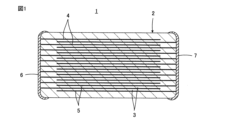
- FIG. 1 is a cross-sectional view schematically showing a multilayer ceramic capacitor 1 to which a conductive paste according to the present invention is applied.
- the multilayer ceramic capacitor 1 includes a multilayer body 2.
- the laminate 2 includes a plurality of laminated dielectric layers 3 made of ceramic, and a plurality of internal electrodes 4 and 5 arranged along the interface between the plurality of dielectric layers 3.
- the internal electrodes 4 and 5 are classified into a plurality of first internal electrodes 4 and a plurality of second internal electrodes 5, which are alternately arranged in the stacking direction of the laminate 3.
- a first external electrode 6 and a second external electrode 7 are provided on the outer surface of the laminate 2, more specifically, on each opposing end surface.
- the first external electrode 6 is electrically connected to the first internal electrode 4
- the second external electrode 7 is electrically connected to the second internal electrode 5 .
- the dielectric layer 3 is made of, for example, a ceramic whose main component is ABO 3 (A is at least one of Ba, Ca, and Sr, and B is at least one of Ti and Zr). Become. Further, the ceramic may have the above-mentioned ABO 3 as a main component, and may further contain at least one of Mn, Mg, Si, Y, Dy, and Gd as a subcomponent.
- Internal electrodes 4 and 5 contain copper as a conductive component. Further, as a characteristic composition, the internal electrodes 4 and 5 contain, for example, at least one selected from CuTiO 3 , CoTiO 3 and CrTiO 3 . CuTiO 3 , CoTiO 3 and CrTiO 3 have an illuminite crystal structure.
- the dielectric layer 3 is made of a ceramic whose main component is at least one selected from BaTiO 3 , SrTiO 3 and CaZrO 3 , and the internal electrodes 4 and 5 contains copper as a conductive component, contains at least one selected from CuTiO 3 , CoTiO 3 and CrTiO 3 as a ceramic material, and optionally contains BaTiO 3 , SrTiO 3 and CaZrO contained in the dielectric layer 3. It further contains at least one species selected from 3 .
- the external electrodes 6 and 7 are formed, for example, by applying a conductive paste containing Ag or Cu as a main conductive component to the end surface of the laminate 2 and baking it. If necessary, for example, Ni plating and Sn plating may be applied on the thick film formed by baking.
- the multilayer ceramic capacitor 1 is manufactured, for example, through the following steps. First, a ceramic slurry containing ceramic raw material powder having the composition as described above is prepared. Next, a suitable sheet forming method is applied to the ceramic slurry to form a ceramic green sheet. Next, a conductive paste to become each of the internal electrodes 4 and 5 is applied by printing or the like onto a predetermined ceramic green sheet among the plurality of ceramic green sheets. Next, a plurality of ceramic green sheets are laminated and pressed together to obtain a green laminate. The green laminate is then fired. In this firing step, the ceramic green sheet becomes the dielectric layer 3. Thereafter, external electrodes 6 and 7 are formed on the end faces of the laminate 3.
- the conductive paste to become the internal electrodes 4 and 5 used in manufacturing the multilayer ceramic capacitor 1 described above is preferably produced as follows.
- the first step is to prepare a ceramic powder slurry containing ceramic powder, an organic solvent, and a dispersant
- the second step is to prepare a metal powder slurry containing a conductive metal powder, an organic solvent, and a dispersant.
- a third step of preparing an organic vehicle containing an organic resin component and an organic solvent is to prepare a fourth step of mixing the ceramic powder slurry, metal powder slurry, and organic vehicle.
- a ceramic powder slurry is prepared by mixing ceramic powder and a dispersant into an organic solvent.
- the above-mentioned ceramic powder is made of, for example, at least one selected from CuTiO 3 , CoTiO 3 and CrTiO 3 as ABO 3 oxides, and in addition to this, BaTiO 3 and SrTiO 3 as co-materials are used. 3 and at least one selected from CaZrO 3 and CaZrO 3 may be used.
- the conductive metal powder contained in the metal powder slurry produced in the second step described below contains copper, CuTiO 3 , CoTiO 3 and CrTiO 3 as the above-mentioned ABO 3 oxides are 6-coordinates of copper.
- the ABO 3 type oxide has a specific ionic radius in which the ratio of the ionic radius in the 6-coordination of the A-site element in ABO 3 to the ionic radius is 0.96 or more and 1.04 or less.
- the ceramic powder made of at least one selected from CuTiO 3 , CoTiO 3 and CrTiO 3 as the ABO trioxide
- the ceramic powder has the above-mentioned ABO trioxide as a main component, and may further contain at least one of Mn, Mg, Si, Y, Dy, and Gd as a subcomponent. When such a subcomponent is contained, grain growth of ceramic particles is further suppressed, and sintering of metal particles may be suppressed more effectively.
- an anionic polymer dispersant for example, an anionic polymer dispersant can be used, and as the organic solvent, for example, dihydroterpineol can be used.
- a metal powder slurry is prepared by mixing conductive metal powder and a dispersant into an organic solvent.
- a conductive metal powder a powder made of copper or an alloy thereof is used.
- the dispersant and organic solvent used in the second step those similar to those used in the first step can be used.
- an organic vehicle is produced by mixing an organic resin component with an organic solvent.
- the organic resin component for example, ethyl cellulose resin can be used.
- the organic solvent used in the third step can also be the same as that used in the first step.
- the above-described ceramic powder slurry, metal powder slurry, and organic vehicle are mixed.
- a conductive paste to become the internal electrodes 4 and 5 is obtained.
- This conductive paste contains a ceramic powder slurry, and the ceramic powder slurry is a ceramic powder made of at least one selected from CuTiO 3 , CoTiO 3 and CrTiO 3 as an ABO 3 oxide with a specific ionic radius, as described above. Therefore, the internal electrodes 4 and 5 included in the multilayer ceramic capacitor 1 manufactured through the firing process contain at least one selected from CuTiO 3 , CoTiO 3 and CrTiO 3 .
- copper powder was prepared as the conductive metal powder contained in the conductive paste for forming internal electrodes.
- (Experimental example 1) Main component of ceramic constituting dielectric layer: BaTiO 3 1.
- the main component BaCO 3 and TiO 2 powders were weighed, mixed in a ball mill for 72 hours, and then heat treated at a top temperature of 1000°C for 2 hours. A heat-treated powder was obtained.
- MnO, Dy 2 O 3 , MgO, SiO 2 and BaCO 3 powders were prepared as subcomponents, and the subcomponent powders were 100BaTiO 3 +0.5Mn+1.0Dy+1.0Mg+1.0Si+2. The powder was weighed so as to have a composition ratio of 0Ba, and these subcomponent powders were added to the heat-treated powder, mixed for 24 hours in a ball mill, and then dried to obtain a BaTiO 3 ceramic raw material powder.
- the conductive paste for forming internal electrodes contained the "ABO trioxide " powder shown in Table 2 below and the BaTiO 3 ceramic raw material powder for the dielectric layer. It was used as a ceramic powder.
- ABO 3 oxide powders and BaTiO 3 -based ceramic raw material powder were weighed so as to have the "addition ratio" shown in Table 2, and these powders, dihydroterpineol as an organic solvent, and anion as a dispersant were weighed.
- a ceramic powder slurry was prepared by pre-mixing the mixture and the polymer dispersant using a medium-free stirring mill, and then performing a dispersion treatment using a medium-stirring mill (first step).
- copper powder as a conductive metal powder, dihydroterpineol as an organic solvent, and an anionic polymer dispersant as a dispersant were dispersed in a three-roll mill to prepare a metal powder slurry (second process).
- the metal powder slurry and the ceramic powder slurry were added to the organic vehicle and mixed and dispersed to produce a conductive paste for forming internal electrodes (fourth step).
- Table 2 shows the ratio of the 6-coordinate ionic radius of the A-site element to the 6-coordinate ionic radius of copper to be included in the internal electrode, i.e., "ionic radius ratio (A-site element/metallic copper)". "It is shown. For sample 7, the ratio of the ionic radius (1.35 ⁇ ) of Ba element in the 6-coordination shown in Table 1 to the ionic radius (0.77 ⁇ ) of copper in the 6-coordination is shown. .
- Multilayer Ceramic Capacitor A ceramic slurry containing the BaTiO 3 ceramic raw material powder prepared in 1 above was prepared, and then a doctor blade method was applied to the ceramic slurry to form a ceramic green sheet. Next, the conductive paste for forming internal electrodes prepared in 2 above was applied onto a predetermined ceramic green sheet among the plurality of ceramic green sheets by screen printing. Next, a plurality of ceramic green sheets were laminated and pressed together to obtain a raw laminate. The green laminate was then fired. Thereafter, external electrodes were formed on the end faces of the sintered laminate to produce a multilayer ceramic capacitor as a sample.
- the internal electrode and dielectric layer located at the center in the height direction of the laminate provided in the multilayer ceramic capacitor serving as a sample were peeled off from each other by electric field peeling.
- the vicinity of the exposed central part of the internal electrode was observed using a microscope at a magnification of 100 times. Then, by analyzing the obtained images, the ratio of the area occupied by the conductor film as the internal electrode in the exposed portion was determined as the "coverage” shown in Table 2. If the “coverage” is 80% or more, it is judged as good, and enter “ ⁇ ” in the “evaluation” column.If the "coverage” is lower than 80%, it is judged as poor, and in the "evaluation” column, write " ⁇ ". ⁇ ” was entered.
- Samples 1 to 6 in Table 2 have an “evaluation” of “ ⁇ ”.
- the internal electrode contains one of CuTiO 3 , CoTiO 3 and CrTiO 3 as the ABO 3 oxide. Further, the internal electrode contains copper as a conductive component.
- the ionic radius of copper in 6-coordination is 0.77 ⁇ .
- the ionic radius of the A-site element of each of CuTiO 3 , CoTiO 3 and CrTiO 3 as ABO 3 oxides contained in the internal electrodes in Samples 1 to 6 in the 6-coordination is as follows. , 0.77 ⁇ , 0.74 ⁇ and 0.80 ⁇ .
- the ratio of the ionic radius of the A-site element in ABO 3 in the 6-coordination to the ionic radius of the copper in the 6-coordination was It is 0.96 or more and 1.04 or less.
- CuTiO 3 , CoTiO 3 and CrTiO 3 as ABO 3 oxides in Samples 1 to 6 have an ionic radius in the 6-coordination of the A-site element in ABO 3 that is the conductivity that should be included in the internal electrode. Since the ionic radius is equal to or close to the 6-coordination ionic radius of copper as a metal, the energy difference with the copper in the internal electrode is 0 or small, so it remains without being expelled from the internal electrode, and the heat resistance of the internal electrode is improved. It acts to improve. As a result, it is estimated that the coverage for Samples 1 to 6 was as high as 84% or more.
- the addition ratio of CuTiO 3 , CoTiO 3 and CrTiO 3 is not necessarily 100%, but if it is 10% or more, none of CuTiO 3 , CoTiO 3 and CrTiO 3 is included.
- the effect of improving coverage was observed compared to the previous case.
- the coverage of samples 4 to 6 in which the addition ratio of CuTiO 3 , CoTiO 3 and CrTiO 3 was 10% was equal to the coverage of samples 1 to 3 in which the addition ratio was 100%. It is also noteworthy that there are
- the ratio of the ionic radius of Ba in 6-coordination to the ionic radius of copper in 6-coordination that is, the "ion radius ratio” is 1.75. Therefore, the "ion radius ratio” was outside the range of 0.96 or more and 1.04 or less, and the coverage was as low as 74%.
- the "ion radius ratio" was outside the range of 0.96 or more and 1.04 or less, and BaTiO3 was expelled from the internal electrode part, which did not improve the heat resistance of the internal electrode and resulted in low coverage. It is assumed that it was
- Example 2 Main component of ceramic constituting dielectric layer: CaZrO 3 1.
- CaZrO 3 -based ceramic raw material constituting the dielectric layer As starting materials, powders of main components CaCO 3 and ZrO 2 and powders of MnO, SiO 2 and MgO as subcomponents were weighed and heated in a ball mill for 72 hours. After mixing, the mixture was heat treated at a top temperature of 1000° C. for 2 hours to obtain a CaZrO 3 ceramic raw material powder.
- the conductive paste for forming internal electrodes contained the "ABO trioxide " powder shown in Table 3 below and the CaZrO 3 -based ceramic raw material powder for the dielectric layer. It was used as a ceramic powder.
- Table 3 shows "ion radius ratio (A site element/metallic copper)" as in Table 2.
- Table 3 shows "ion radius ratio (A site element/metallic copper)" as in Table 2.
- the ratio of the ionic radius (1.00 ⁇ ) of the Ca element in the 6-coordination shown in Table 1 to the ionic radius (0.77 ⁇ ) of copper in the 6-coordination is shown. .
- Multilayer Ceramic Capacitor A ceramic slurry containing the CaZrO 3 ceramic raw material powder prepared in 1 above was prepared, and then a doctor blade method was applied to the ceramic slurry to form a ceramic green sheet. Thereafter, a multilayer ceramic capacitor serving as a sample was manufactured through the same steps as in Experimental Example 1.
- Samples 11 to 16 in Table 3 have an “evaluation” of “ ⁇ ”.
- the internal electrode contains one of CuTiO 3 , CoTiO 3 and CrTiO 3 as the ABO 3 oxide. Further, the internal electrode contains copper as a conductive component.
- the ionic radius of copper in 6-coordination is 0.77 ⁇ .
- the ionic radii of the A-site elements of CuTiO 3 , CoTiO 3 and CrTiO 3 as the ABO 3 oxides contained in the internal electrodes of Samples 11 to 16 are as shown in Table 1. , 0.77 ⁇ , 0.74 ⁇ and 0.80 ⁇ .
- the ratio of the ionic radius of the element at the A site in ABO 3 in the 6-coordination to the ionic radius in the 6-coordination of copper, that is, the "ion radius ratio” was It is 0.96 or more and 1.04 or less.
- CuTiO 3 , CoTiO 3 and CrTiO 3 as ABO 3 oxides in Samples 11 to 16 have the ionic radius of the 6-coordination of the A-site element in ABO 3 as the conductivity that should be included in the internal electrode. Since the ionic radius is equal to or close to the 6-coordination ionic radius of copper as a metal, the energy difference with the copper in the internal electrode is 0 or small, so it remains without being expelled from the internal electrode, and the heat resistance of the internal electrode is improved. It is presumed that as a result, the coverage of Samples 11 to 16 was as high as 81% or more.
- the addition ratio of CuTiO 3 , CoTiO 3 and CrTiO 3 is not necessarily 100%, but if it is 10% or more, none of CuTiO 3 , CoTiO 3 and CrTiO 3 is included. The effect of improving coverage was observed compared to the previous case.
- SrTiO 3 Main component of ceramic constituting dielectric layer: SrTiO 3 1.
- SrTiO 3 -based ceramic raw material constituting the dielectric layer As starting materials, the main component SrCO 3 and TiO 2 powders and the subcomponent MnO, SiO 2 and MgO powders were weighed and heated in a ball mill for 72 hours. After mixing, the mixture was heat-treated at a top temperature of 1000° C. for 2 hours to obtain SrTiO 3 ceramic raw material powder.
- the conductive paste for forming internal electrodes contained the "ABO trioxide " powder shown in Table 4 below and the SrTiO 3 -based ceramic raw material powder for the dielectric layer. It was used as a ceramic powder.
- Table 4 shows "ion radius ratio (A site element/metallic copper)" as in Table 2.
- Table 4 shows "ion radius ratio (A site element/metallic copper)" as in Table 2.
- the ratio of the ionic radius (1.18 ⁇ ) of the Sr element in the 6-coordination shown in Table 1 to the ionic radius (0.77 ⁇ ) in the 6-coordination of copper is shown. .
- Multilayer Ceramic Capacitor A ceramic slurry containing the SrTiO 3 ceramic raw material powder prepared in 1 above was prepared, and then a doctor blade method was applied to the ceramic slurry to form a ceramic green sheet. Thereafter, a multilayer ceramic capacitor serving as a sample was manufactured through the same steps as in Experimental Example 1.
- Samples 21 to 26 in Table 4 have an “evaluation” of “ ⁇ ”.
- the internal electrode contains one of CuTiO 3 , CoTiO 3 and CrTiO 3 as the ABO 3 oxide. Further, the internal electrode contains copper as a conductive component.
- the ionic radius of copper in 6-coordination is 0.77 ⁇ .
- the ionic radii of the A-site elements of CuTiO 3 , CoTiO 3 and CrTiO 3 as the ABO 3 oxides contained in the internal electrodes of Samples 21 to 26 are as follows: , 0.77 ⁇ , 0.74 ⁇ and 0.80 ⁇ .
- CuTiO 3 , CoTiO 3 and CrTiO 3 as ABO 3 oxides in Samples 21 to 26 have an ionic radius of the 6-coordination of the A-site element in ABO 3 , which is the conductivity that should be included in the internal electrode. Since the ionic radius is equal to or close to the 6-coordination ionic radius of copper as a metal, the energy difference with the copper in the internal electrode is 0 or small, so it remains without being expelled from the internal electrode, and the heat resistance of the internal electrode is improved. It is presumed that as a result, the coverage of Samples 21 to 26 was as high as 80% or more.
- the addition ratio of CuTiO 3 , CoTiO 3 and CrTiO 3 is not necessarily 100%, but if it is 10% or more, none of CuTiO 3 , CoTiO 3 and CrTiO 3 is included. The effect of improving coverage was observed compared to the previous case.
- the ratio of the 6-coordinate ionic radius of Sr to the 6-coordinate ionic radius of copper that is, the "ion radius ratio” is 1.53. Therefore, the "ion radius ratio” was outside the range of 0.96 or more and 1.04 or less, and the coverage was as low as 70%.
- the "ion radius ratio" was outside the range of 0.96 or more and 1.04 or less, and SrTiO 3 was discharged from the internal electrode portion, which did not improve the heat resistance of the internal electrode and resulted in low coverage. It is assumed that it was
- the powder made of an ABO 3 type oxide with a specific ionic radius as at least a part of the ceramic powder contained in the conductive paste is selected from CuTiO 3 , CoTiO 3 and CrTiO 3 . Although at least one type was used, other types may be used. In other words, in an ABO 3 type oxide with a specific ionic radius, the ratio of the ionic radius of the A-site element in ABO 3 to the 6-coordination ionic radius of copper contained in the conductive paste is 0. Any ABO 3 type oxide may be used as long as it is .96 or more and 1.04 or less.
- Embodiments of this invention include the following.
- a conductive paste for forming internal electrodes of a multilayer ceramic capacitor comprising a conductive metal powder, a ceramic powder, an organic solvent and an organic binder,
- the conductive metal powder contains copper, At least a portion of the ceramic powder has a ratio of the ionic radius of the element at the A site in ABO 3 at the 6-coordination to the ionic radius at the 6-coordination of copper from 0.96 to 1.04.
- ⁇ 3> The conductive paste according to ⁇ 2>, wherein the ABO 3 type oxide having the specific ionic radius is at least one selected from CuTiO 3 , CoTiO 3 and CrTiO 3 .
- ⁇ 4> 10% by volume or more of the ceramic powder is a powder consisting of an ABO 3 type oxide having the specific ionic radius, and the remainder of the ceramic powder is mainly composed of at least one selected from BaTiO 3 , SrTiO 3 and CaZrO 3 .
Landscapes
- Chemical & Material Sciences (AREA)
- Engineering & Computer Science (AREA)
- Ceramic Engineering (AREA)
- Organic Chemistry (AREA)
- Manufacturing & Machinery (AREA)
- Materials Engineering (AREA)
- Power Engineering (AREA)
- Structural Engineering (AREA)
- Inorganic Chemistry (AREA)
- Microelectronics & Electronic Packaging (AREA)
- Dispersion Chemistry (AREA)
- Physics & Mathematics (AREA)
- Spectroscopy & Molecular Physics (AREA)
- Composite Materials (AREA)
- Life Sciences & Earth Sciences (AREA)
- Environmental & Geological Engineering (AREA)
- General Life Sciences & Earth Sciences (AREA)
- Geology (AREA)
- Ceramic Capacitors (AREA)
- Conductive Materials (AREA)
Priority Applications (5)
| Application Number | Priority Date | Filing Date | Title |
|---|---|---|---|
| JP2024530345A JP7635888B2 (ja) | 2022-06-26 | 2023-05-11 | 導電性ペースト |
| KR1020247036908A KR102935359B1 (ko) | 2022-06-26 | 2023-05-11 | 도전성 페이스트 |
| CN202380028706.6A CN118901111A (zh) | 2022-06-26 | 2023-05-11 | 导电性膏 |
| US18/609,022 US12476047B2 (en) | 2022-06-26 | 2024-03-19 | Conductive paste |
| US19/366,822 US20260051439A1 (en) | 2022-06-26 | 2025-10-23 | Conductive paste |
Applications Claiming Priority (2)
| Application Number | Priority Date | Filing Date | Title |
|---|---|---|---|
| JP2022102287 | 2022-06-26 | ||
| JP2022-102287 | 2022-06-26 |
Related Child Applications (1)
| Application Number | Title | Priority Date | Filing Date |
|---|---|---|---|
| US18/609,022 Continuation US12476047B2 (en) | 2022-06-26 | 2024-03-19 | Conductive paste |
Publications (1)
| Publication Number | Publication Date |
|---|---|
| WO2024004391A1 true WO2024004391A1 (ja) | 2024-01-04 |
Family
ID=89382605
Family Applications (1)
| Application Number | Title | Priority Date | Filing Date |
|---|---|---|---|
| PCT/JP2023/017693 Ceased WO2024004391A1 (ja) | 2022-06-26 | 2023-05-11 | 導電性ペースト |
Country Status (5)
| Country | Link |
|---|---|
| US (2) | US12476047B2 (https=) |
| JP (1) | JP7635888B2 (https=) |
| KR (1) | KR102935359B1 (https=) |
| CN (1) | CN118901111A (https=) |
| WO (1) | WO2024004391A1 (https=) |
Citations (4)
| Publication number | Priority date | Publication date | Assignee | Title |
|---|---|---|---|---|
| JPS4956822A (https=) * | 1972-06-30 | 1974-06-03 | ||
| JP2001284162A (ja) * | 2000-03-31 | 2001-10-12 | Kyocera Corp | 導電性ペーストおよび積層型電子部品並びにその製法 |
| JP2013214698A (ja) * | 2012-04-02 | 2013-10-17 | Samsung Electro-Mechanics Co Ltd | 内部電極用導電性ペースト組成物及びそれを含む積層セラミック電子部品 |
| JP2015083714A (ja) * | 2013-09-18 | 2015-04-30 | 株式会社村田製作所 | 複合粉末の製造方法およびこの製造方法により得られた複合粉末を用いた導電性厚膜ペーストおよび積層セラミック電子部品 |
Family Cites Families (7)
| Publication number | Priority date | Publication date | Assignee | Title |
|---|---|---|---|---|
| JP4100173B2 (ja) * | 2003-01-08 | 2008-06-11 | 株式会社村田製作所 | 誘電体セラミックおよび積層セラミックコンデンサ |
| US7544314B2 (en) * | 2004-09-01 | 2009-06-09 | Tdk Corporation | Glass composition for thick film resistor paste, thick film resistor paste, thick-film resistor, and electronic device |
| JP4622537B2 (ja) * | 2005-01-20 | 2011-02-02 | Tdk株式会社 | 誘電体磁器組成物および電子部品 |
| JP2016031807A (ja) | 2014-07-28 | 2016-03-07 | 住友金属鉱山株式会社 | 導電性ペースト及びその製造方法 |
| JP6437270B2 (ja) | 2014-10-21 | 2018-12-12 | 株式会社クラレ | ビニルアセタール系重合体樹脂組成物並びにそれを用いたフィルム、セラミックグリーンシート及び積層体 |
| JP6823976B2 (ja) | 2016-09-06 | 2021-02-03 | 太陽誘電株式会社 | 積層セラミックコンデンサおよびその製造方法 |
| US10692653B2 (en) * | 2017-10-27 | 2020-06-23 | Yageo Corporation | Ceramic sintered body and passive component including the same |
-
2023
- 2023-05-11 KR KR1020247036908A patent/KR102935359B1/ko active Active
- 2023-05-11 CN CN202380028706.6A patent/CN118901111A/zh active Pending
- 2023-05-11 WO PCT/JP2023/017693 patent/WO2024004391A1/ja not_active Ceased
- 2023-05-11 JP JP2024530345A patent/JP7635888B2/ja active Active
-
2024
- 2024-03-19 US US18/609,022 patent/US12476047B2/en active Active
-
2025
- 2025-10-23 US US19/366,822 patent/US20260051439A1/en active Pending
Patent Citations (4)
| Publication number | Priority date | Publication date | Assignee | Title |
|---|---|---|---|---|
| JPS4956822A (https=) * | 1972-06-30 | 1974-06-03 | ||
| JP2001284162A (ja) * | 2000-03-31 | 2001-10-12 | Kyocera Corp | 導電性ペーストおよび積層型電子部品並びにその製法 |
| JP2013214698A (ja) * | 2012-04-02 | 2013-10-17 | Samsung Electro-Mechanics Co Ltd | 内部電極用導電性ペースト組成物及びそれを含む積層セラミック電子部品 |
| JP2015083714A (ja) * | 2013-09-18 | 2015-04-30 | 株式会社村田製作所 | 複合粉末の製造方法およびこの製造方法により得られた複合粉末を用いた導電性厚膜ペーストおよび積層セラミック電子部品 |
Also Published As
| Publication number | Publication date |
|---|---|
| JP7635888B2 (ja) | 2025-02-26 |
| US12476047B2 (en) | 2025-11-18 |
| US20260051439A1 (en) | 2026-02-19 |
| KR102935359B1 (ko) | 2026-03-09 |
| JPWO2024004391A1 (https=) | 2024-01-04 |
| US20240222017A1 (en) | 2024-07-04 |
| CN118901111A (zh) | 2024-11-05 |
| KR20250002359A (ko) | 2025-01-07 |
Similar Documents
| Publication | Publication Date | Title |
|---|---|---|
| US12437919B2 (en) | Multilayer ceramic capacitor | |
| WO2024004391A1 (ja) | 導電性ペースト | |
| WO2024004394A1 (ja) | 積層セラミックコンデンサ | |
| JP2024003265A (ja) | 導電性ペースト | |
| JP7597236B2 (ja) | 導電性ペースト | |
| JP2024003266A (ja) | 導電性ペースト | |
| WO2024004392A1 (ja) | 積層セラミックコンデンサ | |
| WO2024004393A1 (ja) | 積層セラミックコンデンサ | |
| KR102955824B1 (ko) | 적층 세라믹 콘덴서 | |
| JP7272881B2 (ja) | 積層セラミックコンデンサ及びその製造方法 | |
| WO2024181021A1 (ja) | 積層セラミックコンデンサ |
Legal Events
| Date | Code | Title | Description |
|---|---|---|---|
| 121 | Ep: the epo has been informed by wipo that ep was designated in this application |
Ref document number: 23830843 Country of ref document: EP Kind code of ref document: A1 |
|
| ENP | Entry into the national phase |
Ref document number: 2024530345 Country of ref document: JP Kind code of ref document: A |
|
| WWE | Wipo information: entry into national phase |
Ref document number: 202380028706.6 Country of ref document: CN |
|
| WWE | Wipo information: entry into national phase |
Ref document number: 1020247036908 Country of ref document: KR |
|
| NENP | Non-entry into the national phase |
Ref country code: DE |
|
| 122 | Ep: pct application non-entry in european phase |
Ref document number: 23830843 Country of ref document: EP Kind code of ref document: A1 |