WO2024004003A1 - 情報処理装置、移動体制御システムおよび情報処理方法 - Google Patents
情報処理装置、移動体制御システムおよび情報処理方法 Download PDFInfo
- Publication number
- WO2024004003A1 WO2024004003A1 PCT/JP2022/025636 JP2022025636W WO2024004003A1 WO 2024004003 A1 WO2024004003 A1 WO 2024004003A1 JP 2022025636 W JP2022025636 W JP 2022025636W WO 2024004003 A1 WO2024004003 A1 WO 2024004003A1
- Authority
- WO
- WIPO (PCT)
- Prior art keywords
- vehicle
- information
- occupant
- unit
- information processing
- Prior art date
- Legal status (The legal status is an assumption and is not a legal conclusion. Google has not performed a legal analysis and makes no representation as to the accuracy of the status listed.)
- Ceased
Links
Images







Classifications
-
- G—PHYSICS
- G08—SIGNALLING
- G08G—TRAFFIC CONTROL SYSTEMS
- G08G1/00—Traffic control systems for road vehicles
-
- B—PERFORMING OPERATIONS; TRANSPORTING
- B60—VEHICLES IN GENERAL
- B60W—CONJOINT CONTROL OF VEHICLE SUB-UNITS OF DIFFERENT TYPE OR DIFFERENT FUNCTION; CONTROL SYSTEMS SPECIALLY ADAPTED FOR HYBRID VEHICLES; ROAD VEHICLE DRIVE CONTROL SYSTEMS FOR PURPOSES NOT RELATED TO THE CONTROL OF A PARTICULAR SUB-UNIT
- B60W50/00—Details of control systems for road vehicle drive control not related to the control of a particular sub-unit, e.g. process diagnostic or vehicle driver interfaces
- B60W50/08—Interaction between the driver and the control system
- B60W50/14—Means for informing the driver, warning the driver or prompting a driver intervention
-
- G—PHYSICS
- G06—COMPUTING OR CALCULATING; COUNTING
- G06Q—INFORMATION AND COMMUNICATION TECHNOLOGY [ICT] SPECIALLY ADAPTED FOR ADMINISTRATIVE, COMMERCIAL, FINANCIAL, MANAGERIAL OR SUPERVISORY PURPOSES; SYSTEMS OR METHODS SPECIALLY ADAPTED FOR ADMINISTRATIVE, COMMERCIAL, FINANCIAL, MANAGERIAL OR SUPERVISORY PURPOSES, NOT OTHERWISE PROVIDED FOR
- G06Q10/00—Administration; Management
- G06Q10/06—Resources, workflows, human or project management; Enterprise or organisation planning; Enterprise or organisation modelling
- G06Q10/063—Operations research, analysis or management
-
- G—PHYSICS
- G06—COMPUTING OR CALCULATING; COUNTING
- G06Q—INFORMATION AND COMMUNICATION TECHNOLOGY [ICT] SPECIALLY ADAPTED FOR ADMINISTRATIVE, COMMERCIAL, FINANCIAL, MANAGERIAL OR SUPERVISORY PURPOSES; SYSTEMS OR METHODS SPECIALLY ADAPTED FOR ADMINISTRATIVE, COMMERCIAL, FINANCIAL, MANAGERIAL OR SUPERVISORY PURPOSES, NOT OTHERWISE PROVIDED FOR
- G06Q50/00—Information and communication technology [ICT] specially adapted for implementation of business processes of specific business sectors, e.g. utilities or tourism
- G06Q50/40—Business processes related to the transportation industry
-
- G—PHYSICS
- G08—SIGNALLING
- G08G—TRAFFIC CONTROL SYSTEMS
- G08G1/00—Traffic control systems for road vehicles
- G08G1/09—Arrangements for giving variable traffic instructions
-
- G—PHYSICS
- G08—SIGNALLING
- G08G—TRAFFIC CONTROL SYSTEMS
- G08G1/00—Traffic control systems for road vehicles
- G08G1/22—Platooning, i.e. convoy of communicating vehicles
-
- B—PERFORMING OPERATIONS; TRANSPORTING
- B60—VEHICLES IN GENERAL
- B60W—CONJOINT CONTROL OF VEHICLE SUB-UNITS OF DIFFERENT TYPE OR DIFFERENT FUNCTION; CONTROL SYSTEMS SPECIALLY ADAPTED FOR HYBRID VEHICLES; ROAD VEHICLE DRIVE CONTROL SYSTEMS FOR PURPOSES NOT RELATED TO THE CONTROL OF A PARTICULAR SUB-UNIT
- B60W50/00—Details of control systems for road vehicle drive control not related to the control of a particular sub-unit, e.g. process diagnostic or vehicle driver interfaces
- B60W50/08—Interaction between the driver and the control system
- B60W50/14—Means for informing the driver, warning the driver or prompting a driver intervention
- B60W2050/146—Display means
-
- B—PERFORMING OPERATIONS; TRANSPORTING
- B60—VEHICLES IN GENERAL
- B60W—CONJOINT CONTROL OF VEHICLE SUB-UNITS OF DIFFERENT TYPE OR DIFFERENT FUNCTION; CONTROL SYSTEMS SPECIALLY ADAPTED FOR HYBRID VEHICLES; ROAD VEHICLE DRIVE CONTROL SYSTEMS FOR PURPOSES NOT RELATED TO THE CONTROL OF A PARTICULAR SUB-UNIT
- B60W2540/00—Input parameters relating to occupants
- B60W2540/215—Selection or confirmation of options
-
- B—PERFORMING OPERATIONS; TRANSPORTING
- B60—VEHICLES IN GENERAL
- B60W—CONJOINT CONTROL OF VEHICLE SUB-UNITS OF DIFFERENT TYPE OR DIFFERENT FUNCTION; CONTROL SYSTEMS SPECIALLY ADAPTED FOR HYBRID VEHICLES; ROAD VEHICLE DRIVE CONTROL SYSTEMS FOR PURPOSES NOT RELATED TO THE CONTROL OF A PARTICULAR SUB-UNIT
- B60W2540/00—Input parameters relating to occupants
- B60W2540/227—Position in the vehicle
Definitions
- the present disclosure relates to an information processing device, a mobile object control system, and an information processing method.
- Patent Document 1 discloses that a first moving body and a second moving body travel in synchronization to connect the entrance of the first moving body and the entrance of the second moving body. Transportation systems are described. Since the entrances and exits are connected, passengers can smoothly move or transfer between moving bodies.
- Patent Document 1 connects the entrances and exits for the purpose of moving or transferring passengers between moving bodies, and it is not possible for occupants to directly communicate with each other between moving bodies. .
- the present disclosure solves the above problems, and aims to provide an information processing device, a mobile object control system, and an information processing method that allow passengers to directly communicate with each other between mobile objects.
- An information processing device is an information processing device that controls connection between moving objects, and includes an information acquisition unit that obtains moving object position information of a moving object and occupant detection information about the state of an occupant of the moving object. , a determination unit that determines an occupant to communicate with based on occupant detection information; a movement planning unit that creates a movement plan in which moving objects are connected to each other in a position where it is easy for the occupants to communicate with each other; and a movement control unit that connects the movable bodies to each other by moving the movable bodies.
- mobile body position information and occupant detection information of a moving body are acquired, an occupant to be communicated with is determined based on the occupant detection information, and the moving bodies are connected to each other at a position where it is easy for the occupants to communicate with each other.
- the mobile objects are connected to each other by drawing up a movement plan to move the objects and moving the objects according to the movement plan.
- the position is such that it is easy for the occupants to communicate with each other, so the information processing device according to the present disclosure allows the occupants to communicate directly between the movable bodies.
- FIG. 1 is a block diagram showing a configuration example of a mobile object control system according to Embodiment 1.
- FIG. FIG. 2 is a block diagram showing a hardware configuration that implements the functions of the information processing device according to the first embodiment.
- FIG. 2 is an explanatory diagram showing an overview of vehicles to be connected.
- FIG. 2 is an explanatory diagram showing the internal situation of connected vehicles in the first embodiment.
- 3 is a flowchart showing an information processing method according to Embodiment 1.
- FIG. 5 is a flowchart showing a vehicle decoupling process in the first embodiment.
- FIG. 2 is a block diagram showing the configuration of a modification of the mobile object control system according to the first embodiment.
- FIG. 2 is a block diagram showing a configuration example of a mobile object control system according to Embodiment 2.
- FIG. 7 is a screen diagram showing a selection screen in Embodiment 2.
- FIG. 7 is an explanatory diagram showing an outline of connected vehicles in Embodiment 2.
- FIG. 7 is a flowchart showing an information processing method according to Embodiment 2.
- FIG. 12 is a flowchart showing a vehicle decoupling process in Embodiment 2.
- FIG. 3 is a block diagram showing a configuration example of a mobile object control system according to a third embodiment.
- FIG. 7 is a screen diagram showing a selection screen in Embodiment 3;
- FIG. 7 is an explanatory diagram showing the internal situation of connected vehicles in Embodiment 3;
- 7 is a flowchart showing an information processing method according to Embodiment 3.
- FIG. 12 is a flowchart showing a vehicle decoupling process in Embodiment 3.
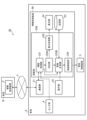
- FIG. 1 is a block diagram showing a configuration example of a mobile object control system 1 according to the first embodiment.
- a mobile object control system 1 is a system in which an information processing device 2 mounted on a vehicle A and an information processing device 2 mounted on a vehicle B are connected via a network 3.
- Network 3 is a telecommunications line including the Internet.
- the mobile body control system 1 provides a mobile body control service that connects the vehicle A and the vehicle B at a position where the occupants who are communication targets can easily communicate with each other based on the vehicle mobile body position information and the occupant detection information.
- the connection between vehicle A and vehicle B in the mobile object control service includes not only a physical connection between vehicle A and vehicle B but also an apparent connection due to vehicle A and vehicle B running side by side.
- positions where occupants can easily communicate with each other include a position between vehicle A and vehicle B where the occupants face each other directly in front of each other, and a position where the occupants face each other diagonally to the extent that communication is not hindered. Also includes location.
- Vehicle A is equipped with an information processing device 2, a sensor group 4, and a vehicle control device 5. Although only the information processing device 2 is shown in the vehicle B in FIG. 1, it is assumed that, like the vehicle A, a sensor group 4 and a vehicle control device 5 are mounted thereon.
- the sensor group 4 is composed of various sensors that detect conditions inside and outside the vehicle.
- the sensor group 4 includes an exterior camera that photographs the outside of the vehicle, an interior camera that photographs the interior of the vehicle, a positioning sensor that measures vehicle position information (mobile object position information), and a distance sensor that measures the distance to objects outside the vehicle. Contains sensors.
- a vehicle control device 5 mounted on vehicle A controls the running of vehicle A.
- a vehicle control device 5 mounted on vehicle B controls the running of vehicle B.
- the vehicle control device 5 controls the running of the vehicle according to driving operation information received through driving operations by the occupant. Further, the vehicle control device 5 controls the running of the vehicle according to mobile object control information input from an external device.
- the mobile object control information includes, for example, route information indicating a route on which the vehicle is scheduled to travel, and specified vehicle speed information specifying the speed of the vehicle moving on the route.
- Vehicle A and vehicle B may be vehicles that do not accept driving operations by occupants and travel automatically according only to mobile body control information input from an external device.
- the information processing device 2 includes a communication section 21, a calculation section 22, and a storage section 23.
- the communication unit 21 communicates with the information processing device 2 mounted on the vehicle to be connected via the network 3 .
- the communication unit 21 is capable of communicating via the network 3 with the information processing device 2 capable of mobile communication using a communication method such as LTE, 3G, 4G, or 5G.
- the calculation unit 22 controls the overall operation of the information processing device 2.
- the calculation unit 22 realizes various functions by executing an information processing application for connecting vehicle A and vehicle B at a position where occupants who are communication targets can easily communicate with each other.
- the storage unit 23 stores the information processing application described above and information used for calculation processing by the calculation unit 22.
- the storage unit 23 stores movement plan information for connecting vehicle A and vehicle B, and determination information about the occupant to be communicated with.
- the calculation unit 22 includes an information acquisition unit 221, a determination unit 222, a movement planning unit 223, and a movement control unit 224.
- the functions of the information acquisition unit 221, determination unit 222, movement planning unit 223, and movement control unit 224 are realized.
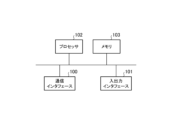
- FIG. 2 is a block diagram showing the hardware configuration that realizes the functions of the information processing device 2.
- the information processing device 2 includes a communication interface 100, an input/output interface 101, a processor 102, and a memory 103 as a hardware configuration.
- the functions of the information acquisition unit 221, determination unit 222, movement planning unit 223, and movement control unit 224 included in the information processing device 2 are realized by these hardware configurations.
- the communication interface 100 outputs data received from an external device via the network 3 to the processor 102, and outputs data generated by the processor 102 to the information processing device 2 mounted on the vehicle to be connected via the network 3. Send to.
- the processor 102 reads and writes data to and from the storage unit 23 via the input/output interface 101.
- the storage unit 23 is realized by a storage device that can be accessed by a computer functioning as the information processing device 2. Note that although FIG. 1 shows the information processing device 2 having the storage unit 23, the storage unit 23 may be any storage device that can be accessed by a computer functioning as the information processing device 2, and may be an external storage device of the information processing device 2. may exist in
- the information acquisition unit 221 acquires moving body position information and occupant detection information of vehicle A and vehicle B. For example, the information acquisition unit 221 acquires mobile body position information indicating the position of vehicle A from the sensor group 4, and further transmits mobile body position information indicating the position of vehicle B by the communication unit 21 via the network 3. get. Further, the information acquisition unit 221 transmits mobile body position information indicating the position of the vehicle A to the information processing device 2 mounted on the vehicle B via the network 3 through the communication unit 21. For example, the information acquisition unit 221 may acquire the mobile body position information at a time when the occupant to be communicated with between vehicle A and vehicle B is specified, at a cycle shorter than the cycle before this time. Thereby, the information processing device 2 can accurately grasp the positions of the vehicles to be connected.
- the occupant detection information is information about the occupants of vehicle A and vehicle B.
- the occupant detection information includes video data of the occupants of vehicle A photographed at a constant photographing rate by an in-vehicle camera in addition to photographed video data of the occupants of vehicle B photographed at a constant photographing rate by a camera outside the vehicle. included.
- the information acquisition unit 221 may acquire the occupant detection information at a shorter cycle than the cycle before this point at the time when the occupant to be communicated between vehicles A and B is specified, or Occupant detection information may be acquired in synchronization with acquisition of body position information. Thereby, the information processing device 2 can accurately grasp the condition of the passenger to be communicated with.
- the determination unit 222 determines the occupant to be communicated with based on the occupant detection information. For example, the determination unit 222 detects the occupant's position, face direction, or gesture by performing image analysis on each image forming the captured image data of the occupant. As the image analysis method, an existing analysis method such as head pose estimation may be used. If the position and face orientation of the occupants satisfy the determination conditions, the determination unit 222 determines that the occupants are the object of communication. For example, if the occupants are located near a connecting portion of the vehicle and the faces of the occupants are facing each other in the vehicles, the determining unit 222 determines that these occupants are the communication targets.
- the determination unit 222 determines that these occupants are the occupants with whom communication is to be performed. Gestures that request communication include, for example, pointing at the other party, raising a hand toward the other party, and waving. Further, vehicle A and vehicle B may be provided with microphones, and the information acquisition unit 221 may acquire voice information of the occupants collected by the microphones. If the determination unit 222 recognizes the voice information of the occupant acquired by the information acquisition unit 221 and determines that the occupant of the vehicle to be connected is addressed, the occupant who made the address is the communication target. It is determined that
- the determination unit 222 may determine the occupant to be communicated with using the learning model. For example, when the determination unit 222 receives photographed video data of the occupant, it determines the occupant to be communicated with using a learning model that outputs information indicating whether or not the occupant is to be communicated with. Thereby, the determining unit 222 can accurately determine the passenger to communicate with.
- the movement planning unit 223 creates a movement plan in which vehicle A and vehicle B are connected to each other at a position where the occupants who are communication targets can easily communicate with each other. For example, the movement planning unit 223 estimates the traveling states of vehicles A and B based on changes over time in the positions of vehicles A and B indicated by the respective moving body position information of vehicles A and B. The movement planning unit 223 then connects vehicles A and B at a position where the occupants to communicate with each other can easily communicate with each other (for example, a position where the occupants face each other) from the current traveling positions of vehicle A and vehicle B. Estimate the route that will be taken.
- the movement planning unit 223 specifies the vehicle speeds of vehicles A and B on the estimated route according to the running states of vehicles A and B. Information including route information indicating a route along which vehicles A and B are connected and the vehicle speed designation information is movement plan information.
- the movement planning unit 223 is output to the movement control unit 224 and stored in the storage unit 23.
- the information processing device 2 mounted on vehicle A calculates the movement plan information of vehicle B in addition to the movement plan information of vehicle A.
- the information processing device 2 mounted on vehicle B may calculate the movement plan information of vehicle A in addition to the movement plan information of vehicle B.
- the information processing device 2 mounted on vehicle A may calculate only the movement plan information of vehicle A
- the information processing device 2 mounted on vehicle B may calculate only the movement plan information of vehicle B. .
- the movement control unit 224 connects vehicle A and vehicle B by outputting mobile body control information for moving vehicle A and vehicle B to the mobile body according to the movement plan. For example, the movement control unit 224 generates mobile object control information for causing vehicle A and vehicle B to travel according to movement plan information.
- the movement control section 224 mounted on the vehicle A transmits the generated mobile object control information to the information processing device 2 mounted on the vehicle B via the network 3 using the communication section 21 .
- the movement control unit 224 outputs moving body control information for the vehicle A to the vehicle control device 5 mounted on the vehicle A. Vehicle A and vehicle B are connected by the vehicle control device 5 controlling travel according to the mobile object control information.
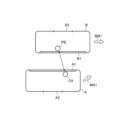
- FIG. 3 is an explanatory diagram showing an overview of vehicle A and vehicle B to be connected, and shows the arrangement of occupants inside the vehicles. It is assumed that the vehicle A is provided with a connecting portion A1 and an entrance/exit A2, and is traveling in the direction of an arrow MA1. Vehicle B includes a connecting portion B1 and an entrance/exit B2, and is traveling in the direction of arrow MB1.
- Connecting portion A1 and connecting portion B1 are portions where vehicle A and vehicle B are connected.
- the connecting portion A1 and the connecting portion B1 may be provided with a mechanism for physically connecting them, or may be mere side surfaces without a special connecting mechanism.
- the connecting portion A1 and the connecting portion B1 are open portions that are not provided with walls or the like that prevent direct communication between occupants. Further, seats such as benches may be provided near the connecting portion A1 and the connecting portion B1 so that the occupants of the vehicle A and the vehicle B can easily communicate with each other.
- the entrance A2 is a part where a passenger gets on or off the vehicle A
- the entrance B2 is a part where a passenger gets on or off the vehicle B. Furthermore, when transferring passengers between vehicle A and vehicle B, the portions of vehicle A and vehicle B where entrance A2 and entrance B2 are provided may be used as connecting portion A1 and connecting portion B1.
- the determining unit 222 determines that the occupant CA and the occupant PB are the occupants with whom communication is to be performed, based on the occupant detection information.
- the movement planning unit 223 creates a movement plan to connect vehicles A and B at a location where occupant CA and occupant PB can easily communicate. For example, a movement plan is created so that occupant CA and occupant PB are in opposing positions.
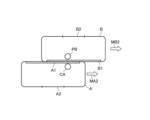
- FIG. 4 is an explanatory diagram showing the internal situation of the connected vehicles in the first embodiment, and shows the situation when vehicle A and vehicle B are connected from the state of FIG. 3.
- the movement control unit 224 generates moving body control information for moving vehicles A and B in accordance with a movement plan that connects vehicles A and B at positions where occupants CA and PB face each other. Then, the movement control unit 224 outputs the mobile object control information to the vehicle control device 5 provided in each of the vehicle A and the vehicle B.
- Vehicle control device 5 causes vehicle A to travel in the direction of arrow MA2 and vehicle B to travel in the direction of arrow MB2 in accordance with the mobile object control information.
- vehicle A and vehicle B enter a state in which they run parallel to each other.
- the connecting portion A1 and the connecting portion B1 may be physically connected, or the vehicle A and the vehicle B may be caused to run in parallel and be apparently connected.
- vehicles A and B are connected at a position where occupants CA and PB face each other, so that direct communication can occur between occupants CA and PB. Furthermore, even after vehicle A and vehicle B are coupled, movement control unit 224 may control the travel of vehicle A and vehicle B depending on the communication status between occupant CA and occupant PB.
- the information acquisition unit 221 sequentially acquires passenger detection information indicating the state of interaction between the passenger CA and the passenger PB.
- the determination unit 222 sequentially determines the state of interaction between the occupant CA and the occupant PB based on the occupant detection information.
- the movement planning unit 223 gradually decelerates the vehicles A and B running in parallel. Create a travel plan.
- the vehicle control device 5 controls the traveling of vehicles A and B according to the moving body control information based on the created travel plan, so that when occupants CA and PB are in a situation where they want to reduce vibration, vehicles A and B Vehicle B is gradually decelerated.
- crew member CA provides food and beverage services to crew member PB
- the position where crew member CA and crew member PB can easily communicate should be placed so that crew member CA can place cooking equipment and fixtures so that food can be easily provided from crew member CA to crew member PB. It may be in a position where it is easy to handle.
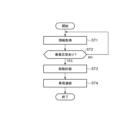
- FIG. 5 is a flowchart showing the information processing method according to the first embodiment.
- the information acquisition unit 221 acquires moving body position information of vehicles A and B, and occupant detection information of the states of the occupants of vehicles A and B (step ST1).
- the determining unit 222 determines whether or not there is an occupant who has responded to the communication request based on the occupant detection information (step ST2). If no occupant has responded here (step ST2; NO), the process returns to step ST1.
- the determination unit 222 determines that these occupants are the communication targets.
- occupant CA and occupant PB are determined to be communication targets.
- the movement planning unit 223 creates a movement plan for moving bodies that are connected at a position where the occupants who are communication targets can easily communicate with each other (step ST3).
- the movement control unit 224 connects vehicles A and B by outputting mobile body control information to vehicles A and B for moving vehicles A and B according to the movement plan (step ST4).
- FIG. 6 is a flowchart showing the vehicle connection release process in the first embodiment.
- the information acquisition unit 221 acquires moving body position information of vehicle A and vehicle B and occupant detection information of the states of the occupants of vehicle A and vehicle B (step ST1A).
- the determination unit 222 determines whether communication between the occupant CA and the occupant PB has ended based on the occupant detection information (step ST2A). For example, when it is detected that either occupant CA or PB moves away from the connection position, turns their back to the other person, or calls out to another occupant as the occupant detection information, the determination unit 222 , it is determined that the communication has ended.
- step ST2A If the communication between occupant CA and occupant PB has not been completed (step ST2A; NO), the process returns to step ST1A. If it is determined that the communication has ended (step ST2A; YES), the determination section 222 notifies the movement planning section 223 to that effect.
- the movement planning unit 223 When the movement planning unit 223 receives the notification of the end of communication, it creates a movement plan to disconnect the vehicle A and the vehicle B (step ST3A).
- the movement control unit 224 generates mobile body control information for releasing the connection according to the movement plan, and outputs the generated mobile body control information to the vehicle control devices 5 of vehicles A and B.
- Vehicle control device 5 controls traveling of vehicle A and vehicle B so that the connection between vehicle A and vehicle B is released based on the mobile object control information (step ST4A). Thereby, the connection between vehicle A and vehicle B can be released upon completion of communication.
- FIG. 7 is a block diagram showing the configuration of a mobile body control system 1A, which is a modification of the mobile body control system 1.
- the information processing device 2 is provided in vehicle A and vehicle B, but in the mobile object control system 1A, the information processing device 2A serves as a server that controls the running of vehicle A and vehicle B. Function.
- vehicles A and B do not include the information processing device 2, but only include a sensor group 4, a vehicle control device 5, and a communication device 6.
- the information processing device 2A includes a communication section 21, a calculation section 22A, and a storage section 23.
- the calculation unit 22A includes an information acquisition unit 221A, a determination unit 222, a movement planning unit 223, and a movement control unit 224A. When the calculation unit 22A executes the information processing application, the functions of the information acquisition unit 221A, determination unit 222, movement planning unit 223, and movement control unit 224A are realized.
- the information acquisition unit 221A acquires moving body position information and occupant detection information of vehicle A and vehicle B. For example, when the communication unit 21 and the communication device 6 communicate with each other via the network 3, the information acquisition unit 221A obtains mobile body position information indicating the positions of vehicles A and B, and information about the positions of vehicles A and B. Obtain occupant detection information.
- the movement control unit 224A allows the communication unit 21 and the communication device 6 to communicate with each other via the network 3 so that the vehicle A can receive mobile object control information for causing the vehicles A and B to travel according to the movement plan information. It is transmitted to the vehicle control device 5 included in the vehicle B, and also transmitted to the vehicle control device 5 included in the vehicle B. Vehicle control devices 5 mounted on vehicles A and B control the traveling of vehicles A and B in accordance with the received moving body control information, thereby connecting vehicles A and B. Even with this configuration, the information processing device 2A can connect the vehicle A and the vehicle B at a position where it is easy for the occupants to communicate with each other.
- the information processing device 2 may connect three or more vehicles depending on the shape of the vehicle and the number of connectable surfaces. Thereby, the information processing device 2 can connect three or more vehicles to each other at a position where the occupants to communicate with each other can easily communicate with each other.
- the information processing device 2 includes the information acquisition unit 221 that acquires moving body position information and occupant detection information, and the determination unit 222 that determines the occupant to be communicated with based on the occupant detection information. , a movement planning unit 223 that creates a movement plan in which vehicle A and vehicle B are connected at a position where it is easy for the occupants to communicate with each other; and mobile body control information for moving vehicle A and vehicle B according to the movement plan.
- a movement control unit 224 is provided that connects vehicle A and vehicle B by outputting the same to the moving body.
- the information processing device 2 allows the occupants of vehicle A and vehicle B to communicate directly with each other, since the vehicle is in a position where it is easy for the occupants to communicate with each other. be able to.
- the movement planning unit 223 creates a movement plan in which vehicles A and B are connected at a position where the occupants to be communicated with each other face each other.
- the occupants who are the targets of communication are in positions facing each other, so the information processing device 2 allows the occupants of vehicle A and vehicle B to communicate directly with each other. be able to.
- the information acquisition unit 221 detects at least one of detection information such as the positions of the occupants in vehicles A and B, the facial orientations of the occupants, or gestures by the occupants of vehicles A and B. get.
- the determining unit 222 determines the occupant to be communicated with based on at least one of the occupant's position in vehicle A and vehicle B, the occupant's facial orientation, or the occupant's gesture. Thereby, the determination unit 222 can accurately determine the passenger to communicate with.
- a mobile object control system 1 includes a vehicle A and a vehicle B that move based on mobile object control information, and an information processing device 2. It is possible to provide a mobile body control system 1 in which passengers can communicate directly with each other when vehicles A and B are connected.
- the information acquisition unit 221 acquires the mobile body position information of the mobile body and the occupant detection information of the state of the occupant of the mobile body, and the determination unit 222 acquires the occupant detection information a step in which the movement planning section 223 formulates a movement plan for a moving body connected at a position where the communication object occupants can easily communicate with each other; and a step in which the movement control section 224
- the method includes a step of connecting the moving bodies to each other by outputting moving body control information to the moving bodies for moving the moving bodies according to a plan.
- FIG. 8 is a block diagram showing a configuration example of a mobile object control system 1B according to the second embodiment.
- a mobile object control system 1B is a system in which an information processing device 2B mounted on a vehicle A and an information processing device 2 mounted on a vehicle B are connected via a network 3.
- the information processing device 2B includes a communication section 21, a calculation section 22B, a storage section 23, a display section 24, and an operation section 25.
- the calculation unit 22B controls the overall operation of the information processing device 2B.
- the calculation unit 22B realizes various functions by executing an information processing application for connecting vehicle A and vehicle B at a position where occupants who are communication targets can easily communicate with each other.
- the display unit 24 is a display device included in the information processing device 2B.
- the display unit 24 is, for example, an LCD (Liquid Crystal Display) or an organic EL (Electroluminescence) display device.
- the operation unit 25 is an input device that accepts operations on the selection screen displayed on the display unit 24 and the like.
- the operation unit 25 is, for example, a touch panel provided integrally with the screen of the display unit 24.
- the operation unit 25 is, for example, a mouse or a keyboard.
- the calculation unit 22B includes an information acquisition unit 221, a determination unit 222A, a movement planning unit 223B, a movement control unit 224, and a display processing unit 225.
- the functions of the information acquisition unit 221, determination unit 222A, movement planning unit 223B, movement control unit 224, and display processing unit 225 are realized.
- the display processing unit 225 outputs display control information to the display unit 24 for displaying a selection screen for selecting the passenger to communicate with.
- FIG. 9 is a screen diagram showing the selection screen 24A in the second embodiment.
- the selection screen 24A displays the occupant arrangement of vehicle B.
- the display processing unit 225 generates display control information for displaying the selection screen 24A that reflects the condition of the occupant of the vehicle B determined by the determination unit 222A.
- the occupants PB1, PB2, PB3, and PB4 of the vehicle B are located near the connecting portion. Therefore, the images showing the occupants PB1, PB2, and PB3 are displayed in a different manner from that of the occupant PB4 who is not near the connecting portion. It is assumed that occupants PB1 and PB3 face toward the vehicle A side from the coupling portion. At this time, the occupants PB1 and PB3 may become the occupants with whom the occupant of the vehicle A communicates. Therefore, the display form of the images showing the occupants PB1 and PB3 is changed so that they are distinguished from the images of the other occupants. For example, the color of the images showing occupants PB1 and PB3 is set to be a different color from the images of other occupants.
- the surrounding images 24A-1 can be set to positions surrounding the occupants PB1, PB2, PB3, and PB4 by sequentially pressing the button images 24A-3 labeled "Next" on the selection screen 24A using the operation unit 25. Move to.
- the surrounding image 24A-1 is positioned to surround the image of the occupant PB1.
- the operation unit 25 to press the button image 24A-4 labeled "Determine”
- the occupant surrounded by the encircled image 24A-1 is displayed. , is determined to be the communication target with the occupant of vehicle A.
- pressing the button image 24A-2 labeled "release” using the operation unit 25 the connection between the vehicle A and the vehicle B is released.
- the display processing unit 225 generates display control information for displaying a selection screen according to the condition of the occupant determined by the determination unit 222A.
- the determining unit 222A determines that the occupant selected using the selection screen displayed on the display unit 24 is the occupant with whom communication is to be performed.
- the movement planning unit 223B creates a movement plan in which vehicle A and vehicle B are connected at a position where the occupants who are communication targets can easily communicate with each other. For example, if the movement planning unit 223B uses the selection screen 24A to determine that the occupant who is to communicate with the occupant CA of the vehicle A is the occupant PB1 of the vehicle B, the movement planning unit 223B selects a location where the occupant CA and the occupant PB1 can easily communicate. A travel plan in which vehicle A and vehicle B are connected is drawn up.
- the movement control unit 224 connects vehicles A and B by outputting mobile body control information for moving vehicles A and B to the mobile body according to the movement plan drawn up by the movement planning unit 223B.
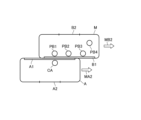
- FIG. 10 is an explanatory diagram showing an overview of connected vehicles A and B in the second embodiment. For example, as shown in FIG. 10, vehicles A and B are connected at a position where occupant CA and occupant PB1 face each other, so that direct communication can occur between occupant CA and occupant PB1.
- FIG. 11 is a flowchart showing an information processing method according to the second embodiment.
- the information acquisition unit 221 acquires moving object position information of vehicles A and B, and occupant detection information of the states of the occupants of vehicles A and B (step ST1B).
- the determination unit 222A determines the states of the occupants of vehicle A and vehicle B based on the occupant detection information (step ST2B).
- the display processing unit 225 displays the selection screen 24A on the display unit 24 based on the condition of the occupant of the vehicle B.
- the occupant of vehicle A selects an occupant from selection screen 24A using operation unit 25 (step ST3B).
- the determination unit 222A determines that the occupant selected from the selection screen 24A is a communication target.
- occupant PB1 is determined to be a communication target with occupant CA.
- the movement planning unit 223B creates a movement plan for moving bodies that are connected at a position where the occupants who are communication targets can easily communicate with each other (step ST4B).
- Movement control unit 224 connects vehicles A and B by outputting mobile body control information to vehicles A and B for moving vehicles A and B according to the movement plan (step ST5B). Thereby, when vehicle A and vehicle B are connected, the occupants who are the object of communication are located in a position where it is easy to communicate with each other, so that the occupants of vehicle A and vehicle B can communicate directly with each other.
- FIG. 12 is a flowchart illustrating a vehicle connection release process in the second embodiment.
- the display processing unit 225 displays the selection screen 24A on the display unit 24.
- the occupant of vehicle A uses the operation unit 25 to press the button image 24A-2 labeled "Release" on the selection screen 24A to request release of the connection between vehicle A and vehicle B (step ST1C). ).
- the movement planning unit 223B When the movement planning unit 223B receives the request to release the connection between vehicle A and vehicle B, it formulates a movement plan to release the connection between vehicle A and vehicle B (step ST2C).
- the movement control unit 224 generates mobile body control information for releasing the connection according to the movement plan, and outputs the generated mobile body control information to the vehicle control devices 5 of vehicles A and B.
- Vehicle control device 5 controls traveling of vehicle A and vehicle B so that the connection between vehicle A and vehicle B is released based on the mobile object control information (step ST3C). Thereby, the connection between vehicle A and vehicle B can be released in response to the connection release request.
- the information processing device 2B includes a display processing unit 225 that outputs display control information to the display unit 24 for displaying a selection screen 24A for selecting a passenger to communicate with.
- the determining unit 222A determines that the occupant selected using the selection screen 24A displayed on the display unit 24 is the occupant with whom communication is to be performed. Thereby, the information processing device 2B can select the passenger to communicate with using the selection screen 24A.
- the information processing device 2B is located in a position where it is easy for the occupants to communicate with each other to communicate with each other. can be taken.
- FIG. 13 is a block diagram showing a configuration example of a mobile object control system 1C according to the third embodiment.
- a mobile object control system 1C is a system in which an information processing device 2B mounted on a vehicle A, an information processing device 2 mounted on a vehicle B, and a service server 7 are connected via a network 3. be.
- the vehicle B there is a passenger who has an orderer terminal 8 for accessing a service server 7 that provides sales services, for example.
- the information processing device 2C includes a communication section 21, a calculation section 22C, a storage section 23, a display section 24, and an operation section 25.
- the calculation unit 22C controls the overall operation of the information processing device 2B.
- the calculation unit 22C realizes various functions by executing an information processing application for connecting vehicle A and vehicle B at a position where occupants who are communication targets can easily communicate with each other.
- the calculation unit 22C includes an information acquisition unit 221, a determination unit 222B, a movement planning unit 223C, a movement control unit 224, and a display processing unit 225A.
- the calculation unit 22C executes the information processing application, each function of the information acquisition unit 221, determination unit 222B, movement planning unit 223C, movement control unit 224, and display processing unit 225A is realized.
- the display processing unit 225A outputs display control information to the display unit 24 for displaying a selection screen 24B in which the occupant who requested the service is listed as a candidate for selection along with service information.
- FIG. 14 is a screen diagram showing the selection screen 24B in the third embodiment. In FIG. 14, the occupant arrangement of vehicle B is displayed on the selection screen 24B.
- the display processing unit 225A generates display control information for displaying the selection screen 24B that reflects the condition of the occupant of the vehicle B determined by the determination unit 222B.
- the occupants PB1, PB2, PB3, and PB4 of the vehicle B are located near the connecting portion. Therefore, the images showing the occupants PB1, PB2, and PB3 are displayed in a different manner from that of the occupant PB4 who is not near the connecting portion.
- the passenger PB2 is a passenger who receives services from the service server 7 using the orderer terminal 8. Therefore, an image 24B-2 of service information indicating the order number "A104" is written adjacent to the image indicating the passenger PB2. At this time, the passenger PB2 can become a passenger with whom the passenger of the vehicle A communicates.
- the display form of the image showing the occupant PB2 is changed so that it is further distinguished from the images showing the occupants PB1 and PB3.
- the color of the image showing occupant PB2 is set to be a different color from the image showing occupants PB1 and PB3.
- the enclosing image 24B-1 is located at a position surrounding the image of the occupant PB2.
- the boxed image 24B-1 surrounding the image of the occupant
- the button image 24B-4 labeled "Decide” using the operation unit 25
- the passenger surrounded by the boxed image 24B-1 is displayed.
- pressing the button image 24B-3 labeled "release” using the operation unit 25 the connection between the vehicle A and the vehicle B is released.
- the information acquisition unit 221 uses the orderer terminal 8 to acquire service information (for example, order number "A104") regarding a specific service that the passenger PB2 of the vehicle B requests the service server 7 to provide.
- the display processing unit 225A outputs to the display unit 24 display control information for displaying the occupant PB2 who requested the service on the selection screen 24B as a selection candidate together with service information.
- the determination unit 222B determines that the passenger PB2 selected using the selection screen 24B displayed on the display unit 24 is the passenger with whom communication is to be performed.
- the movement planning unit 223C creates a movement plan in which vehicles A and B are connected at a position where the occupants who are the communication targets can easily communicate with each other. For example, if the movement planning unit 223C uses the selection screen 24B to determine that the occupant with whom the occupant CA of the vehicle A is communicating is the occupant PB2 of the vehicle B, the movement planning unit 223C determines the location where the occupant CA and the occupant PB2 can easily communicate. A travel plan in which vehicle A and vehicle B are connected is drawn up.
- the movement control unit 224 connects vehicles A and B by outputting mobile body control information for moving vehicles A and B to the mobile body according to the movement plan drawn up by the movement planning unit 223C.
- FIG. 15 is an explanatory diagram showing an overview of connected vehicles A and B in the third embodiment. For example, as shown in FIG. 15, since vehicles A and B are coupled at a position where occupant CA and occupant PB2 face each other, direct communication can be established between occupant CA and occupant PB2.
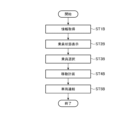
- FIG. 16 is a flowchart showing an information processing method according to the third embodiment.
- the information acquisition unit 221 acquires moving body position information of vehicles A and vehicle B and occupant detection information of the states of the occupants of vehicles A and vehicle B (step ST1D).
- the determining unit 222B determines the states of the occupants of vehicle A and vehicle B based on the occupant detection information (step ST2D). At this time, the determination unit 222B identifies, among the occupants of the vehicle B, the occupant who receives the service from the service server 7 based on the service information acquired by the information acquisition unit 221.
- the display processing unit 225A displays the selection screen 24B on the display unit 24 based on the condition of the occupant of the vehicle B.
- the occupant of vehicle A selects an occupant (orderer) from selection screen 24B using operation unit 25 (step ST3D).
- the determining unit 222B determines that the occupant selected from the selection screen 24B is a communication target.
- occupant PB2 is determined to be the object of communication with occupant CA.
- the movement planning unit 223C creates a movement plan for moving bodies that are connected at a position where it is easy for the occupants to communicate with each other (step ST4D).
- Movement control unit 224 connects vehicles A and B by outputting mobile body control information to vehicles A and B for moving vehicles A and B according to the movement plan (step ST5D). Thereby, when vehicle A and vehicle B are connected, the occupants who are the object of communication are located in a position where it is easy to communicate with each other, so that the occupants of vehicle A and vehicle B can communicate directly with each other.
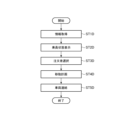
- FIG. 17 is a flowchart illustrating a vehicle connection release process in the third embodiment.
- the display processing unit 225 displays the selection screen 24B on the display unit 24.
- the occupant of vehicle A uses the operation unit 25 to press the button image 24B-3 labeled "release" on the selection screen 24B to request release of the connection between vehicle A and vehicle B (step ST1E). ).
- the movement planning unit 223C When the movement planning unit 223C receives the request to release the connection between vehicle A and vehicle B, it formulates a movement plan to release the connection between vehicle A and vehicle B (step ST2E).
- the movement control unit 224 generates mobile body control information for releasing the connection according to the movement plan, and outputs the generated mobile body control information to the vehicle control devices 5 of vehicles A and B.
- Vehicle control device 5 controls traveling of vehicle A and vehicle B so that the connection between vehicle A and vehicle B is released based on the mobile object control information (step ST3E). Thereby, the connection between vehicle A and vehicle B can be released in response to the connection release request.
- the information acquisition unit 221 acquires service information regarding a specific service requested by the passenger.
- the display processing unit 225A outputs to the display unit 24 display control information for displaying the passenger who requested the service on the selection screen as a candidate for selection together with the service information.
- the information processing device 2C can use the selection screen 24B to select the passenger who has requested provision of a specific service.
- the information processing device 2C is located in a position where it is easy for the occupants to communicate with each other to communicate with each other. can be taken.
- the information processing device can be used, for example, for a service in which passengers exchange goods between autonomous vehicles.
Landscapes
- Engineering & Computer Science (AREA)
- General Physics & Mathematics (AREA)
- Physics & Mathematics (AREA)
- Business, Economics & Management (AREA)
- Human Resources & Organizations (AREA)
- Strategic Management (AREA)
- Economics (AREA)
- Automation & Control Theory (AREA)
- Tourism & Hospitality (AREA)
- Entrepreneurship & Innovation (AREA)
- Marketing (AREA)
- Theoretical Computer Science (AREA)
- General Business, Economics & Management (AREA)
- Human Computer Interaction (AREA)
- Transportation (AREA)
- Mechanical Engineering (AREA)
- Health & Medical Sciences (AREA)
- Game Theory and Decision Science (AREA)
- General Health & Medical Sciences (AREA)
- Primary Health Care (AREA)
- Development Economics (AREA)
- Operations Research (AREA)
- Quality & Reliability (AREA)
- Educational Administration (AREA)
- Traffic Control Systems (AREA)
- Management, Administration, Business Operations System, And Electronic Commerce (AREA)
- Telephonic Communication Services (AREA)
Priority Applications (5)
| Application Number | Priority Date | Filing Date | Title |
|---|---|---|---|
| JP2022558385A JP7274058B1 (ja) | 2022-06-28 | 2022-06-28 | 情報処理装置、移動体制御システムおよび情報処理方法 |
| PCT/JP2022/025636 WO2024004003A1 (ja) | 2022-06-28 | 2022-06-28 | 情報処理装置、移動体制御システムおよび情報処理方法 |
| DE112022007179.6T DE112022007179T5 (de) | 2022-06-28 | 2022-06-28 | Informationsverarbeitungseinrichtung, mobiler-körper-steuerungssystem und informationsverarbeitungsverfahren |
| CN202280097276.9A CN119404235A (zh) | 2022-06-28 | 2022-06-28 | 信息处理装置、移动体控制系统以及信息处理方法 |
| US18/973,164 US20250104564A1 (en) | 2022-06-28 | 2024-12-09 | Information processing device, mobile body control system, and information processing method |
Applications Claiming Priority (1)
| Application Number | Priority Date | Filing Date | Title |
|---|---|---|---|
| PCT/JP2022/025636 WO2024004003A1 (ja) | 2022-06-28 | 2022-06-28 | 情報処理装置、移動体制御システムおよび情報処理方法 |
Related Child Applications (1)
| Application Number | Title | Priority Date | Filing Date |
|---|---|---|---|
| US18/973,164 Continuation US20250104564A1 (en) | 2022-06-28 | 2024-12-09 | Information processing device, mobile body control system, and information processing method |
Publications (1)
| Publication Number | Publication Date |
|---|---|
| WO2024004003A1 true WO2024004003A1 (ja) | 2024-01-04 |
Family
ID=86321969
Family Applications (1)
| Application Number | Title | Priority Date | Filing Date |
|---|---|---|---|
| PCT/JP2022/025636 Ceased WO2024004003A1 (ja) | 2022-06-28 | 2022-06-28 | 情報処理装置、移動体制御システムおよび情報処理方法 |
Country Status (5)
| Country | Link |
|---|---|
| US (1) | US20250104564A1 (https=) |
| JP (1) | JP7274058B1 (https=) |
| CN (1) | CN119404235A (https=) |
| DE (1) | DE112022007179T5 (https=) |
| WO (1) | WO2024004003A1 (https=) |
Citations (5)
| Publication number | Priority date | Publication date | Assignee | Title |
|---|---|---|---|---|
| JP2001216069A (ja) * | 2000-02-01 | 2001-08-10 | Toshiba Corp | 操作入力装置および方向検出方法 |
| JP2010146428A (ja) * | 2008-12-22 | 2010-07-01 | Nec Corp | 追従対象車検索システム、追従対象車検索方法および追従対象車検索用プログラム |
| JP2011060179A (ja) * | 2009-09-14 | 2011-03-24 | National Institute Of Advanced Industrial Science & Technology | 操舵制御方法 |
| WO2015068501A1 (ja) * | 2013-11-08 | 2015-05-14 | 本田技研工業株式会社 | 隊列走行制御装置 |
| JP2018094955A (ja) * | 2016-12-08 | 2018-06-21 | 公益財団法人鉄道総合技術研究所 | 交通システム |
Family Cites Families (4)
| Publication number | Priority date | Publication date | Assignee | Title |
|---|---|---|---|---|
| JP4907291B2 (ja) | 2006-10-12 | 2012-03-28 | 株式会社フジクラ | ゴムモールド材料及びゴムモールド品 |
| US20200117217A1 (en) * | 2017-06-13 | 2020-04-16 | Honda Motor Co., Ltd. | Delivery system and method, and delivery processing device |
| US12319142B2 (en) * | 2021-10-15 | 2025-06-03 | Hyundai Mobis Co., Ltd. | System for controlling vehicle display based on occupant's gaze departure |
| WO2024004004A1 (ja) * | 2022-06-28 | 2024-01-04 | 三菱電機株式会社 | 情報処理装置、スペース管理システムおよび情報処理方法 |
-
2022
- 2022-06-28 CN CN202280097276.9A patent/CN119404235A/zh active Pending
- 2022-06-28 WO PCT/JP2022/025636 patent/WO2024004003A1/ja not_active Ceased
- 2022-06-28 JP JP2022558385A patent/JP7274058B1/ja active Active
- 2022-06-28 DE DE112022007179.6T patent/DE112022007179T5/de active Granted
-
2024
- 2024-12-09 US US18/973,164 patent/US20250104564A1/en active Pending
Patent Citations (5)
| Publication number | Priority date | Publication date | Assignee | Title |
|---|---|---|---|---|
| JP2001216069A (ja) * | 2000-02-01 | 2001-08-10 | Toshiba Corp | 操作入力装置および方向検出方法 |
| JP2010146428A (ja) * | 2008-12-22 | 2010-07-01 | Nec Corp | 追従対象車検索システム、追従対象車検索方法および追従対象車検索用プログラム |
| JP2011060179A (ja) * | 2009-09-14 | 2011-03-24 | National Institute Of Advanced Industrial Science & Technology | 操舵制御方法 |
| WO2015068501A1 (ja) * | 2013-11-08 | 2015-05-14 | 本田技研工業株式会社 | 隊列走行制御装置 |
| JP2018094955A (ja) * | 2016-12-08 | 2018-06-21 | 公益財団法人鉄道総合技術研究所 | 交通システム |
Also Published As
| Publication number | Publication date |
|---|---|
| JPWO2024004003A1 (https=) | 2024-01-04 |
| CN119404235A (zh) | 2025-02-07 |
| JP7274058B1 (ja) | 2023-05-15 |
| US20250104564A1 (en) | 2025-03-27 |
| DE112022007179T5 (de) | 2025-03-06 |
Similar Documents
| Publication | Publication Date | Title |
|---|---|---|
| CN110235152B (zh) | 交通工具服务系统 | |
| JP6638994B2 (ja) | ユーザが要望する所定場所に車両を配車する配車装置、配車方法及びプログラム | |
| JPWO2017057054A1 (ja) | 情報処理装置、情報処理方法、およびプログラム | |
| JP7095220B2 (ja) | ロボット制御システム | |
| CN114851846B (zh) | 用于车辆座舱的方法、系统、车辆、存储介质及程序产品 | |
| CN107452220A (zh) | 一种车载终端及智能寻车系统 | |
| JPWO2019235245A1 (ja) | 情報処理装置、情報処理方法、及び、情報処理システム | |
| WO2021124654A1 (ja) | 作業支援サーバ、作業支援方法および作業支援システム | |
| US10889001B2 (en) | Service provision system | |
| JP7107596B2 (ja) | 駅監視システム及び駅監視方法 | |
| CN112238458A (zh) | 机器人管理装置、机器人管理方法以及机器人管理系统 | |
| CN115210729A (zh) | 在按需环境中协调交通工具的行程 | |
| JP7274058B1 (ja) | 情報処理装置、移動体制御システムおよび情報処理方法 | |
| JP2019185083A (ja) | 買物支援システム及び買物支援方法 | |
| JP2022142509A (ja) | 制御装置、制御方法、およびロボット制御システム | |
| EP3843431A1 (en) | Communication method and apparatus | |
| JP2016224302A (ja) | 視線誘導装置、視線誘導方法、および視線誘導プログラム | |
| JP2020086947A (ja) | 配車装置 | |
| CN104581122B (zh) | 三维图像的生成方法、装置、系统及移动终端 | |
| JP7107597B2 (ja) | 駅監視装置、駅監視方法及びプログラム | |
| JP6906484B2 (ja) | 案内ロボットシステム及びその制御方法 | |
| WO2021106281A1 (ja) | 作業支援サーバ、作業支援方法および作業支援システム | |
| US12122416B2 (en) | System and method for using virtual figures to support users of autonomous vehicles | |
| WO2021064367A1 (en) | A robot fleet and control system therefor | |
| JP2004242048A (ja) | 広視野角・高解像度映像撮影装置 |
Legal Events
| Date | Code | Title | Description |
|---|---|---|---|
| ENP | Entry into the national phase |
Ref document number: 2022558385 Country of ref document: JP Kind code of ref document: A |
|
| 121 | Ep: the epo has been informed by wipo that ep was designated in this application |
Ref document number: 22949282 Country of ref document: EP Kind code of ref document: A1 |
|
| WWE | Wipo information: entry into national phase |
Ref document number: 202280097276.9 Country of ref document: CN |
|
| WWE | Wipo information: entry into national phase |
Ref document number: 112022007179 Country of ref document: DE |
|
| WWP | Wipo information: published in national office |
Ref document number: 202280097276.9 Country of ref document: CN |
|
| WWP | Wipo information: published in national office |
Ref document number: 112022007179 Country of ref document: DE |
|
| 122 | Ep: pct application non-entry in european phase |
Ref document number: 22949282 Country of ref document: EP Kind code of ref document: A1 |