WO2023248902A1 - 断熱層と粘着層とを備えるシート - Google Patents
断熱層と粘着層とを備えるシート Download PDFInfo
- Publication number
- WO2023248902A1 WO2023248902A1 PCT/JP2023/022120 JP2023022120W WO2023248902A1 WO 2023248902 A1 WO2023248902 A1 WO 2023248902A1 JP 2023022120 W JP2023022120 W JP 2023022120W WO 2023248902 A1 WO2023248902 A1 WO 2023248902A1
- Authority
- WO
- WIPO (PCT)
- Prior art keywords
- meth
- acrylate
- hollow particles
- adhesive layer
- heat insulating
- Prior art date
- Legal status (The legal status is an assumption and is not a legal conclusion. Google has not performed a legal analysis and makes no representation as to the accuracy of the status listed.)
- Ceased
Links
Images

Classifications
-
- C—CHEMISTRY; METALLURGY
- C09—DYES; PAINTS; POLISHES; NATURAL RESINS; ADHESIVES; COMPOSITIONS NOT OTHERWISE PROVIDED FOR; APPLICATIONS OF MATERIALS NOT OTHERWISE PROVIDED FOR
- C09J—ADHESIVES; NON-MECHANICAL ASPECTS OF ADHESIVE PROCESSES IN GENERAL; ADHESIVE PROCESSES NOT PROVIDED FOR ELSEWHERE; USE OF MATERIALS AS ADHESIVES
- C09J7/00—Adhesives in the form of films or foils
- C09J7/20—Adhesives in the form of films or foils characterised by their carriers
- C09J7/22—Plastics; Metallised plastics
- C09J7/24—Plastics; Metallised plastics based on macromolecular compounds obtained by reactions involving only carbon-to-carbon unsaturated bonds
-
- B—PERFORMING OPERATIONS; TRANSPORTING
- B32—LAYERED PRODUCTS
- B32B—LAYERED PRODUCTS, i.e. PRODUCTS BUILT-UP OF STRATA OF FLAT OR NON-FLAT, e.g. CELLULAR OR HONEYCOMB, FORM
- B32B27/00—Layered products comprising a layer of synthetic resin
- B32B27/30—Layered products comprising a layer of synthetic resin comprising vinyl (co)polymers; comprising acrylic (co)polymers
- B32B27/308—Layered products comprising a layer of synthetic resin comprising vinyl (co)polymers; comprising acrylic (co)polymers comprising acrylic (co)polymers
-
- B—PERFORMING OPERATIONS; TRANSPORTING
- B32—LAYERED PRODUCTS
- B32B—LAYERED PRODUCTS, i.e. PRODUCTS BUILT-UP OF STRATA OF FLAT OR NON-FLAT, e.g. CELLULAR OR HONEYCOMB, FORM
- B32B27/00—Layered products comprising a layer of synthetic resin
-
- B—PERFORMING OPERATIONS; TRANSPORTING
- B32—LAYERED PRODUCTS
- B32B—LAYERED PRODUCTS, i.e. PRODUCTS BUILT-UP OF STRATA OF FLAT OR NON-FLAT, e.g. CELLULAR OR HONEYCOMB, FORM
- B32B27/00—Layered products comprising a layer of synthetic resin
- B32B27/30—Layered products comprising a layer of synthetic resin comprising vinyl (co)polymers; comprising acrylic (co)polymers
- B32B27/302—Layered products comprising a layer of synthetic resin comprising vinyl (co)polymers; comprising acrylic (co)polymers comprising aromatic vinyl (co)polymers, e.g. styrenic (co)polymers
-
- B—PERFORMING OPERATIONS; TRANSPORTING
- B32—LAYERED PRODUCTS
- B32B—LAYERED PRODUCTS, i.e. PRODUCTS BUILT-UP OF STRATA OF FLAT OR NON-FLAT, e.g. CELLULAR OR HONEYCOMB, FORM
- B32B27/00—Layered products comprising a layer of synthetic resin
- B32B27/30—Layered products comprising a layer of synthetic resin comprising vinyl (co)polymers; comprising acrylic (co)polymers
- B32B27/304—Layered products comprising a layer of synthetic resin comprising vinyl (co)polymers; comprising acrylic (co)polymers comprising vinyl halide (co)polymers, e.g. PVC, PVDC, PVF, PVDF
-
- B—PERFORMING OPERATIONS; TRANSPORTING
- B32—LAYERED PRODUCTS
- B32B—LAYERED PRODUCTS, i.e. PRODUCTS BUILT-UP OF STRATA OF FLAT OR NON-FLAT, e.g. CELLULAR OR HONEYCOMB, FORM
- B32B5/00—Layered products characterised by the non- homogeneity or physical structure, i.e. comprising a fibrous, filamentary, particulate or foam layer; Layered products characterised by having a layer differing constitutionally or physically in different parts
- B32B5/16—Layered products characterised by the non- homogeneity or physical structure, i.e. comprising a fibrous, filamentary, particulate or foam layer; Layered products characterised by having a layer differing constitutionally or physically in different parts characterised by features of a layer formed of particles, e.g. chips, powder or granules
-
- B—PERFORMING OPERATIONS; TRANSPORTING
- B32—LAYERED PRODUCTS
- B32B—LAYERED PRODUCTS, i.e. PRODUCTS BUILT-UP OF STRATA OF FLAT OR NON-FLAT, e.g. CELLULAR OR HONEYCOMB, FORM
- B32B5/00—Layered products characterised by the non- homogeneity or physical structure, i.e. comprising a fibrous, filamentary, particulate or foam layer; Layered products characterised by having a layer differing constitutionally or physically in different parts
- B32B5/18—Layered products characterised by the non- homogeneity or physical structure, i.e. comprising a fibrous, filamentary, particulate or foam layer; Layered products characterised by having a layer differing constitutionally or physically in different parts characterised by features of a layer of foamed material
-
- B—PERFORMING OPERATIONS; TRANSPORTING
- B32—LAYERED PRODUCTS
- B32B—LAYERED PRODUCTS, i.e. PRODUCTS BUILT-UP OF STRATA OF FLAT OR NON-FLAT, e.g. CELLULAR OR HONEYCOMB, FORM
- B32B7/00—Layered products characterised by the relation between layers; Layered products characterised by the relative orientation of features between layers, or by the relative values of a measurable parameter between layers, i.e. products comprising layers having different physical, chemical or physicochemical properties; Layered products characterised by the interconnection of layers
- B32B7/02—Physical, chemical or physicochemical properties
- B32B7/027—Thermal properties
-
- B—PERFORMING OPERATIONS; TRANSPORTING
- B32—LAYERED PRODUCTS
- B32B—LAYERED PRODUCTS, i.e. PRODUCTS BUILT-UP OF STRATA OF FLAT OR NON-FLAT, e.g. CELLULAR OR HONEYCOMB, FORM
- B32B7/00—Layered products characterised by the relation between layers; Layered products characterised by the relative orientation of features between layers, or by the relative values of a measurable parameter between layers, i.e. products comprising layers having different physical, chemical or physicochemical properties; Layered products characterised by the interconnection of layers
- B32B7/04—Interconnection of layers
- B32B7/12—Interconnection of layers using interposed adhesives or interposed materials with bonding properties
-
- C—CHEMISTRY; METALLURGY
- C08—ORGANIC MACROMOLECULAR COMPOUNDS; THEIR PREPARATION OR CHEMICAL WORKING-UP; COMPOSITIONS BASED THEREON
- C08K—Use of inorganic or non-macromolecular organic substances as compounding ingredients
- C08K7/00—Use of ingredients characterised by shape
- C08K7/22—Expanded, porous or hollow particles
-
- C—CHEMISTRY; METALLURGY
- C08—ORGANIC MACROMOLECULAR COMPOUNDS; THEIR PREPARATION OR CHEMICAL WORKING-UP; COMPOSITIONS BASED THEREON
- C08L—COMPOSITIONS OF MACROMOLECULAR COMPOUNDS
- C08L35/00—Compositions of homopolymers or copolymers of compounds having one or more unsaturated aliphatic radicals, each having only one carbon-to-carbon double bond, and at least one being terminated by a carboxyl radical, and containing at least one other carboxyl radical in the molecule, or of salts, anhydrides, esters, amides, imides or nitriles thereof; Compositions of derivatives of such polymers
- C08L35/02—Homopolymers or copolymers of esters
-
- C—CHEMISTRY; METALLURGY
- C09—DYES; PAINTS; POLISHES; NATURAL RESINS; ADHESIVES; COMPOSITIONS NOT OTHERWISE PROVIDED FOR; APPLICATIONS OF MATERIALS NOT OTHERWISE PROVIDED FOR
- C09J—ADHESIVES; NON-MECHANICAL ASPECTS OF ADHESIVE PROCESSES IN GENERAL; ADHESIVE PROCESSES NOT PROVIDED FOR ELSEWHERE; USE OF MATERIALS AS ADHESIVES
- C09J201/00—Adhesives based on unspecified macromolecular compounds
-
- C—CHEMISTRY; METALLURGY
- C09—DYES; PAINTS; POLISHES; NATURAL RESINS; ADHESIVES; COMPOSITIONS NOT OTHERWISE PROVIDED FOR; APPLICATIONS OF MATERIALS NOT OTHERWISE PROVIDED FOR
- C09J—ADHESIVES; NON-MECHANICAL ASPECTS OF ADHESIVE PROCESSES IN GENERAL; ADHESIVE PROCESSES NOT PROVIDED FOR ELSEWHERE; USE OF MATERIALS AS ADHESIVES
- C09J7/00—Adhesives in the form of films or foils
- C09J7/20—Adhesives in the form of films or foils characterised by their carriers
- C09J7/22—Plastics; Metallised plastics
- C09J7/26—Porous or cellular plastics
-
- C—CHEMISTRY; METALLURGY
- C09—DYES; PAINTS; POLISHES; NATURAL RESINS; ADHESIVES; COMPOSITIONS NOT OTHERWISE PROVIDED FOR; APPLICATIONS OF MATERIALS NOT OTHERWISE PROVIDED FOR
- C09J—ADHESIVES; NON-MECHANICAL ASPECTS OF ADHESIVE PROCESSES IN GENERAL; ADHESIVE PROCESSES NOT PROVIDED FOR ELSEWHERE; USE OF MATERIALS AS ADHESIVES
- C09J7/00—Adhesives in the form of films or foils
- C09J7/30—Adhesives in the form of films or foils characterised by the adhesive composition
- C09J7/38—Pressure-sensitive adhesives [PSA]
-
- F—MECHANICAL ENGINEERING; LIGHTING; HEATING; WEAPONS; BLASTING
- F16—ENGINEERING ELEMENTS AND UNITS; GENERAL MEASURES FOR PRODUCING AND MAINTAINING EFFECTIVE FUNCTIONING OF MACHINES OR INSTALLATIONS; THERMAL INSULATION IN GENERAL
- F16L—PIPES; JOINTS OR FITTINGS FOR PIPES; SUPPORTS FOR PIPES, CABLES OR PROTECTIVE TUBING; MEANS FOR THERMAL INSULATION IN GENERAL
- F16L59/00—Thermal insulation in general
- F16L59/02—Shape or form of insulating materials, with or without coverings integral with the insulating materials
-
- B—PERFORMING OPERATIONS; TRANSPORTING
- B32—LAYERED PRODUCTS
- B32B—LAYERED PRODUCTS, i.e. PRODUCTS BUILT-UP OF STRATA OF FLAT OR NON-FLAT, e.g. CELLULAR OR HONEYCOMB, FORM
- B32B2307/00—Properties of the layers or laminate
- B32B2307/30—Properties of the layers or laminate having particular thermal properties
- B32B2307/302—Conductive
-
- B—PERFORMING OPERATIONS; TRANSPORTING
- B32—LAYERED PRODUCTS
- B32B—LAYERED PRODUCTS, i.e. PRODUCTS BUILT-UP OF STRATA OF FLAT OR NON-FLAT, e.g. CELLULAR OR HONEYCOMB, FORM
- B32B2307/00—Properties of the layers or laminate
- B32B2307/30—Properties of the layers or laminate having particular thermal properties
- B32B2307/304—Insulating
Definitions
- the present invention relates to a sheet including a heat insulating layer and an adhesive layer.
- Nonvolatile memory which is characterized by low power consumption and high speed reading and writing, is attracting attention as a next-generation memory.
- PCM phase change memory
- MRAM magnetoresistive memory
- ReRAM resistance change memory
- Nonvolatile memory is sensitive to heat, and maintaining its quality when exposed to high temperature environments during the reflow process during packaging is an issue.
- Patent Document 1 discloses a first step of providing a heat insulating material on the surface of the magnetic recording device exposed in the reflow oven, and passing the magnetic recording device provided with the heat insulating material into the reflow oven.
- a method of manufacturing a magnetic recording device includes a reflow process that includes a second step of heating the magnetic recording device and a third step of removing the heat insulating material from the heated magnetic recording device.
- the present inventors designed a sheet that includes a heat insulating layer containing organic hollow particles and a matrix polymer and an adhesive layer as a heat insulating material used during the reflow process.
- a high temperature environment e.g. 180°C or higher
- the organic hollow particles contained in the sheet may shrink, and as a result, the heat insulation properties of the sheet may decrease. It became clear.
- one aspect of the present invention is to provide a sheet that can suppress a decrease in heat insulation properties when exposed to a high temperature environment.
- the present inventors found that in a sheet including a heat insulating layer and an adhesive layer, the heat insulating layer consists of both thermally expandable organic hollow particles and hollow particles other than the thermally expandable organic hollow particles. It has been found that by containing , it is possible to suppress a decrease in heat insulation properties when exposed to a high-temperature environment.
- the present invention provides the following [1] to [4].
- the heat insulating layer includes first hollow particles that are thermally expandable organic hollow particles and second hollow particles that are organic hollow particles other than the first hollow particles.
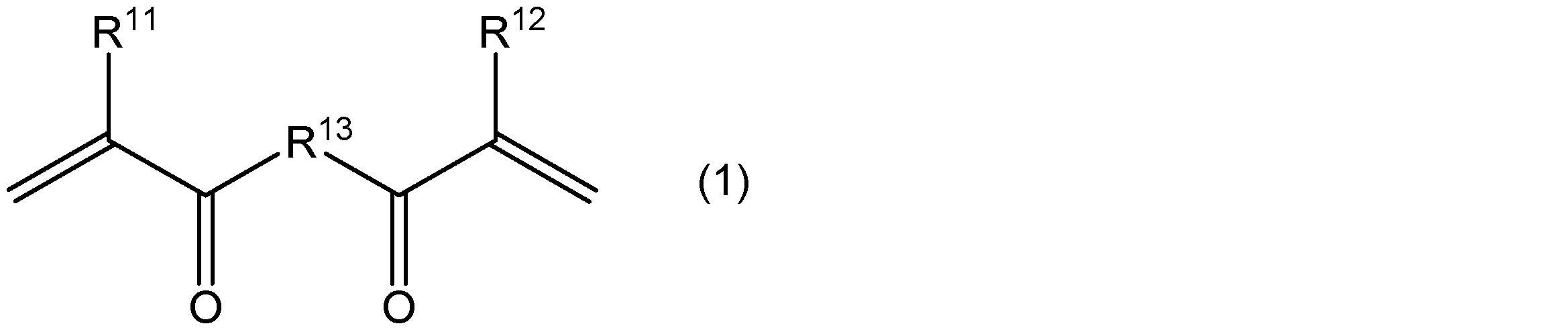
- a sheet containing particles and a matrix polymer. [2] The sheet according to [1], wherein the content of the first hollow particles is 1.5% by volume or more based on the total volume of the heat insulating layer. [3] The sheet according to [1] or [2], wherein the volume ratio of the content of the second hollow particles to the content of the first hollow particles is 45 or less. [4] The sheet according to any one of [1] to [3], wherein the matrix polymer contains a compound represented by the following formula (1) as a monomer unit. [In formula (1), R 11 and R 12 each independently represent a hydrogen atom or a methyl group, and R 13 represents a divalent group having a polyoxyalkylene chain. ]
- FIG. 1 is a schematic cross-sectional view showing one embodiment of a sheet.
- (meth)acryloyl means “acryloyl” and its corresponding “methacryloyl”, and the same applies to similar expressions such as “(meth)acrylate” and “(meth)acrylic”. .
- the weight average molecular weight (Mw) in this specification means a value determined using gel permeation chromatography (GPC) under the following conditions and using polystyrene as a standard substance.
- GPC gel permeation chromatography
- FIG. 1 is a schematic cross-sectional view showing one embodiment of the sheet.
- the sheet 10 shown in FIG. 1 includes a heat insulating layer 11 and an adhesive layer 12.
- the heat insulating layer 11 and the adhesive layer 12 may be laminated so as to be in contact with each other.
- the heat insulating layer 11 contains first hollow particles 111 that are thermally expandable organic hollow particles, second hollow particles 112 that are organic hollow particles other than the first hollow particles, and a matrix polymer 113. .
- the first hollow particle 111 has an outer shell and a hollow part.
- the first hollow particles 111 are organic hollow particles that expand due to heat (thermally expandable).
- thermalally expandable organic hollow particles refers to organic hollow particles having a maximum volumetric expansion ratio of 10 times or more relative to the volume at 25°C.
- the first hollow particles 111 will not absorb heat.
- the hollow part expands and the volume of the hollow part increases.
- the heat insulating layer 11 as a whole, it is possible to suppress a decrease in the volume of the hollow portions of the hollow particles that contribute to the heat insulating properties. As a result, a decrease in the heat insulation properties of the heat insulation layer 11 (sheet 10) can be suppressed.
- the maximum volumetric expansion ratio of the first hollow particles 111 is determined by thermomechanical analysis (TMA) as the maximum volume of the first hollow particles 111 when the temperature is increased at a temperature increase rate of 10°C/min and the volume at 25°C. (maximum volume/volume at 25°C).
- TMA thermomechanical analysis
- the maximum volume expansion magnification of the first hollow particles 111 may be, for example, 20 times or more, 30 times or more, or 40 times or more, or 120 times or less.
- the outer shell of the first hollow particle 111 is made of an organic material.
- the outer shell of the first hollow particle 111 is preferably made of a polymer, and more preferably made of a thermoplastic polymer. In this case, the outer shell becomes soft due to heating, so even if the liquid contained in the hollow part evaporates and the internal pressure increases, the hollow particle is difficult to break and easily expands.
- the thermoplastic polymer may be, for example, a polymer containing acrylonitrile, vinylidene chloride, etc. as a monomer unit.
- the thickness of the outer shell may be greater than or equal to 2 ⁇ m and less than or equal to 15 ⁇ m.
- the hollow portion of the first hollow particle 111 contains, for example, a liquid.
- the first hollow particles 111 for example, encapsulate a liquid at room temperature and normal pressure (for example, at least at atmospheric pressure and 30° C.).
- the liquid is appropriately selected depending on, for example, the heating temperature in the reflow process and the shrinkage start temperature of the second hollow particles 112, which will be described later.
- the liquid is, for example, a liquid that vaporizes at a temperature below the maximum heating temperature in the reflow process.
- the liquid may be a liquid that vaporizes at a temperature below the contraction start temperature of the second hollow particles 112.
- the liquid may be, for example, a hydrocarbon having a boiling point (under atmospheric pressure) of 50°C or higher, 100°C or higher, 150°C or higher, or 200°C or higher.
- the hollow portion of the first hollow particle 111 may further contain gas in addition to the above-mentioned liquid.
- Examples of the components contained in the hollow part of the first hollow particles 111 include propane, propylene, butene, normal butane, isobutane, normal pentane, isopentane, neopentane, normal hexane, isohexane, heptane, isooctane, normal octane, Examples include hydrocarbons such as isoalkanes (carbon number: 10 to 13) and petroleum ether; low-boiling compounds such as methane halides and tetraalkylsilane; and compounds that are gasified by thermal decomposition such as azodicarbonamide.
- the average particle diameter of the first hollow particles 111 may be 5 ⁇ m or more, or 10 ⁇ m or more, and may be 50 ⁇ m or less, 40 ⁇ m or less, or 30 ⁇ m or less.
- the average particle diameter of the first hollow particles 111 is measured by a laser diffraction/scattering method (eg, using "SALD-7500nano" manufactured by Shimadzu Corporation).
- the expansion start temperature of the first hollow particles 111 is set to the contraction temperature of the second hollow particles 112, which will be described later. It is preferably below the starting temperature.
- the expansion start temperature of the first hollow particles 111 is preferably 150°C or higher, or 180°C or higher, and preferably 260°C or lower, 240°C or lower, 220°C or lower, or 200°C or lower.
- the expansion start temperature of the first hollow particles 111 was determined by thermomechanical analysis (TMA) in the temperature (horizontal axis) - volume change (vertical axis) profile when the temperature was raised at a heating rate of 10°C/min. It means the temperature at the intersection of the tangent at the point where a volume change of 3 times or more/5° C. occurs and the straight line (horizontal axis) at which the volume change is zero (initial volume).
- TMA thermomechanical analysis
- the maximum expansion temperature of the first hollow particles 111 is preferably 100°C or higher, 150°C or higher, 200°C or higher, or 210°C or higher. , preferably 290°C or lower, 280°C or lower, or 270°C or lower.
- the maximum expansion temperature of the first hollow particles 111 means the temperature at which the first hollow particles 111 exhibit the maximum volume expansion magnification described above.
- the content of the first hollow particles 111 is preferably based on the total mass of the heat insulating layer 11 from the viewpoint of further suppressing the deterioration of the heat insulating property of the sheet 10. is 1% by mass or more, more preferably 2% by mass or more, still more preferably 4% by mass or more, particularly preferably 5% by mass or more, and may be 20% by mass or less, or 15% by mass or less.
- the content of the first hollow particles 111 is preferably 0.5% by volume or more, more preferably 1.0% by volume based on the total volume of the heat insulating layer 11, from the viewpoint of further suppressing the deterioration of the heat insulating properties of the sheet 10. % or more, more preferably 1.5 volume % or more. From the viewpoint of suppressing excessive expansion of the volume of the sheet 10, the content of the first hollow particles 111 is 10 volume% or less, 7 volume% or less, 5 volume% or less, or It may be 4% by volume or less.
- the second hollow particle 112 has an outer shell and a hollow part.
- the second hollow particles 112 are organic hollow particles other than the first hollow particles 111. That is, the second hollow particles 112 are organic hollow particles having a maximum volumetric expansion ratio of less than 10 times the volume at 25°C.
- the maximum volume expansion factor of the second hollow particles 112 is measured in the same manner as the maximum volume expansion factor of the first hollow particles.
- the outer shell of the second hollow particle 112 is made of an organic material.
- the outer shell of the second hollow particle 112 is preferably composed of a polymer, more preferably a thermoplastic polymer.
- the hollow particles are difficult to break even when pressurized and can maintain their hollow structure, making it easier to maintain the heat insulating properties of the sheet 10.
- the thermoplastic polymer may be, for example, a polymer containing acrylonitrile, vinylidene chloride, etc. as a monomer unit.
- the thickness of the outer shell may be greater than or equal to 0.005 ⁇ m and less than or equal to 15 ⁇ m.
- the hollow portion of the second hollow particle 112 contains, for example, gas.
- the second hollow particles 112 for example, contain gas at room temperature and normal pressure (for example, at least at atmospheric pressure and 30° C.).
- the hollow portion of the second hollow particle 112 may further contain a liquid in addition to gas.
- Examples of the components contained in the hollow part of the second hollow particles 112 include propane, propylene, butene, normal butane, isobutane, normal pentane, isopentane, neopentane, normal hexane, isohexane, heptane, isooctane, normal octane, Examples include hydrocarbons such as isoalkanes (carbon number: 10 to 13) and petroleum ether; low-boiling compounds such as methane halides and tetraalkylsilanes; decomposition products of compounds that gasify through thermal decomposition such as azodicarbonamide. .
- the component included in the hollow part of the second hollow particle 112 may be air.
- the average particle diameter of the second hollow particles 112 is preferably 150 ⁇ m or less, more preferably 120 ⁇ m or less, still more preferably 100 ⁇ m or less, for example, 5 ⁇ m or more, 10 ⁇ m or more, from the viewpoint of improving heat insulation. It may be 20 ⁇ m or more, or 30 ⁇ m or more.
- the average particle diameter of the second hollow particles is measured by a laser diffraction/scattering method (eg, using "SALD-7500nano" manufactured by Shimadzu Corporation).
- the density of the second hollow particles 112 may be 500 kg/m 3 or less, 300 kg/m 3 or less, 100 kg/m 3 or less, 50 kg/m 3 or less, or 40 kg/m 3 or less, and 10 kg/m 3 or more , or 20 kg/m 3 or more.
- the contraction start temperature of the second hollow particles 112 is preferably 150°C or higher and 170°C or higher. , or 180°C or higher, and 260°C or lower, 240°C or lower, 220°C or lower, or 200°C or lower.
- the shrinkage start temperature of the second hollow particles 112 was determined by thermomechanical analysis (TMA) in the temperature (horizontal axis) - volume change (vertical axis) profile when the temperature was raised at a heating rate of 10°C/min. It means the temperature at which the volume change reaches its maximum value.
- the content of the second hollow particles 112 (the content at atmospheric pressure and 30°C; the same applies hereinafter) is preferably 1 mass based on the total mass of the heat insulating layer 11 from the viewpoint of improving the heat insulation properties of the sheet 10. % or more, more preferably 3% by mass or more, still more preferably 5% by mass or more, and may be, for example, 20% by mass or less.
- the content of the second hollow particles 112 is preferably 50 volume% or more, more preferably 60 volume% or more, based on the total volume of the heat insulation layer 11, from the viewpoint of improving the heat insulation properties of the sheet 10. For example, it may be 95% by volume or less.
- the mass ratio of the content of the second hollow particles to the content of the first hollow particles is preferably 1 /5 or more, more preferably 1/3 or more.
- the mass ratio of the content of the second hollow particles to the content of the first hollow particles is preferably 3 or less, more preferably 2 or less, and still more preferably 1 or less.
- the volume ratio of the content of the second hollow particles to the content of the first hollow particles is preferably 10 or more, and more preferably 15 or more.
- the volume ratio of the content of the second hollow particles to the content of the first hollow particles is preferably 80 or less, more preferably 60 or less, and still more preferably 45 or less.
- the heat insulating layer 11 may further contain inorganic hollow particles.
- the inorganic hollow particles have an outer shell and a hollow part.
- the outer shell of the inorganic hollow particle is made of an inorganic material.
- the inorganic material may be, for example, an inorganic glass such as borosilicate glass (sodium borosilicate glass, etc.), aluminosilicate glass, or a composite glass thereof.
- gas is encapsulated in the hollow part of the inorganic hollow particles.
- the inorganic hollow particles for example, encapsulate gas at room temperature and normal pressure (eg, at least atmospheric pressure and 30° C.).
- the total content of hollow particles is the total mass of the sheet 10. As a standard, it may be, for example, 4% by mass or more, 8% by mass or more, or 10% by mass or more, and 40% by mass or less, 35% by mass or less, or 30% by mass or less.
- the total content of hollow particles may be, for example, 50 volume % or more, 60 volume % or more, or 70 volume % or more, and 95 volume % or less, based on the total volume of the sheet 10.
- the matrix polymer 113 is a polymer (binder polymer) that serves as a base (forms a continuous phase) for holding other materials included in the heat insulating layer 11.
- the first hollow particles 111 and the second hollow particles 112 are held in the matrix polymer 113 and may be dispersed in the matrix polymer 113.
- the matrix polymer 113 may contain a compound represented by the following formula (1) as a monomer unit.
- the matrix polymer 113 may be a polymer of a polymerizable compound containing a compound represented by the following formula (1).
- R 11 and R 12 each independently represent a hydrogen atom or a methyl group
- R 13 represents a divalent group having a polyoxyalkylene chain.
- the heat insulating layer 11 has low elasticity and excellent elongation, so the followability of the sheet 10 to the adherend can be improved.
- R 11 and R 12 may be a hydrogen atom, and the other may be a methyl group. In another embodiment, both R 11 and R 12 may be hydrogen atoms. In other embodiments, both R 11 and R 12 can be methyl groups.
- the polyoxyalkylene chain includes a structural unit represented by the following formula (2). Thereby, the strength of the heat insulating layer 11 can be increased.
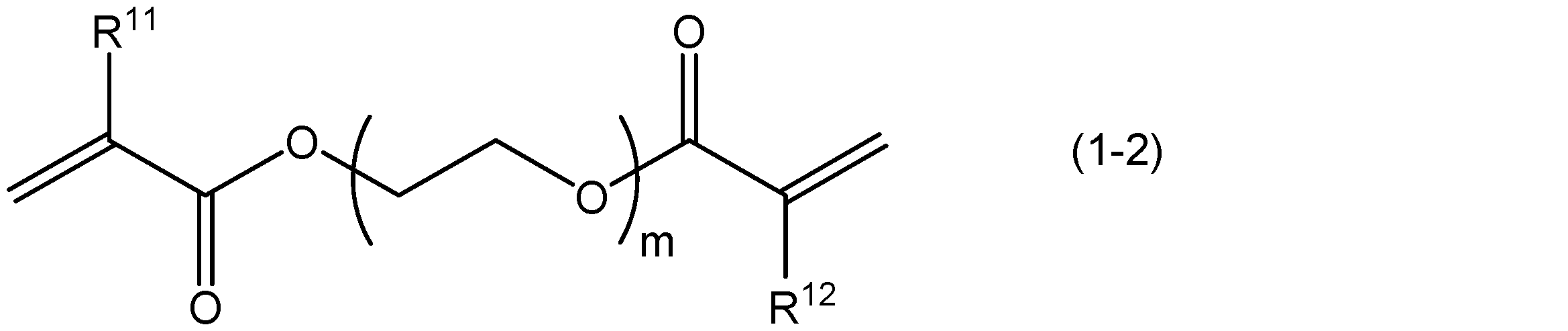
- R 13 may be a divalent group having a polyoxyethylene chain, and the compound represented by formula (1) is preferably a compound represented by formula (1-2) below (polyethylene glycol di (meth)acrylate).
- formula (1-2) polyethylene glycol di (meth)acrylate
- R 11 and R 12 have the same meanings as R 11 and R 12 in formula (1), respectively, and m is an integer of 2 or more.
- the polyoxyalkylene chain includes a structural unit represented by the following formula (3).
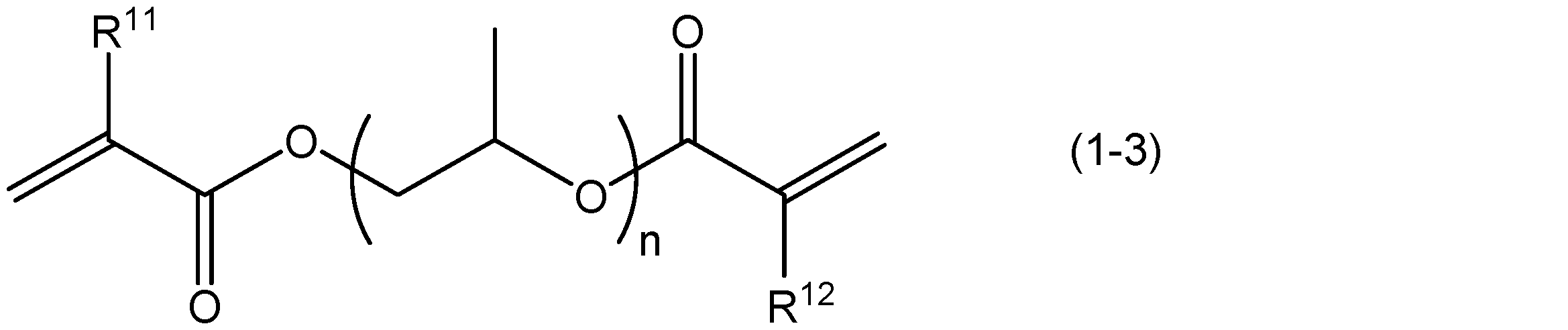
- R 13 may be a divalent group having a polyoxypropylene chain, and the compound represented by formula (1) is preferably a compound represented by the following formula (1-3) (polypropylene glycol di (meth)acrylate).
- formula (1-3) polypropylene glycol di (meth)acrylate.
- R 11 and R 12 have the same meanings as R 11 and R 12 in formula (1), respectively, and n is an integer of 2 or more.
- the polyoxyalkylene chain is preferably a copolymer chain containing the above-mentioned structural unit represented by formula (2) and the structural unit represented by formula (3).
- the copolymer chain may be an alternating copolymer chain, a block copolymer chain, or a random copolymer chain.
- the copolymer chain is preferably a random copolymer chain.
- the polyoxyalkylene chain includes an oxytetramethylene group, an oxybutylene group, an oxypentylene group, in addition to the structural unit represented by formula (2) and the structural unit represented by formula (3). It may have an oxyalkylene group having 4 to 5 carbon atoms as a structural unit.
- R 13 may be a divalent group further having another organic group.
- the other organic group may be a chain group other than a polyoxyalkylene chain, such as a methylene chain (a chain containing -CH 2 - as a structural unit), a polyester chain (a chain containing -COO- in the structural unit), and a polyester chain (a chain containing -COO- in the structural unit). chain), polyurethane chain (chain containing -OCON- in the structural unit), etc.
- the compound represented by formula (1) may be a compound represented by formula (1-4) below.
- R 11 and R 12 have the same meanings as R 11 and R 12 in formula (1), and R 14 and R 15 each independently represent an alkylene group having 2 to 5 carbon atoms.
- k1, k2 and k3 are each independently an integer of 2 or more.
- k2 may be an integer of 16 or less, for example.
- a plurality of R 14 and R 15 may be the same or different from each other.
- the plurality of R 14 and R 15 preferably include an ethylene group and a propylene group, respectively. That is, the polyoxyalkylene chain represented by (R 14 O) k1 and the polyoxyalkylene chain represented by (R 15 O) k3 are each preferably an oxyethylene group (represented by the above formula (2)). It is a copolymer chain containing a structural unit represented by the above formula (3)) and an oxypropylene group (a structural unit represented by the above formula (3)).
- the number of oxyalkylene groups in the polyoxyalkylene chain is preferably 100 or more.
- the main chain of the compound represented by formula (1) becomes longer, so that the elongation of the heat insulating layer 11 is further excellent, and the strength of the heat insulating layer 11 is also improved. can be increased.
- the number of oxyalkylene groups corresponds to m in formula (1-2), n in formula (1-3), and k1 and k3 in formula (1-4), respectively.
- the number of oxyalkylene groups in the polyoxyalkylene chain is more preferably 130 or more, 180 or more, 200 or more, 220 or more, 250 or more, 270 or more, 300 or more, or 320 or more.
- the number of oxyalkylene groups in the polyoxyalkylene chain may be 600 or less, 570 or less, or 530 or less.
- the weight average molecular weight of the compound represented by formula (1) is preferably 5,000 or more, 6,000 or more, 7,000 or more, 8,000 or more, 9,000 or more, 10,000 or more, or 11,000 or more, from the viewpoint that the heat insulating layer 11 has low elasticity and excellent elongation. 12,000 or more, 13,000 or more, 14,000 or more, or 15,000 or more.
- the weight average molecular weight of the compound represented by formula (1) is preferably 100,000 or less, 80,000 or less, 60,000 or less, 34,000 or less, 31,000 or less, or 28,000 or less.
- the matrix polymer 113 may contain only the compound represented by formula (1) as a monomer unit.
- the matrix polymer 113 may further contain other polymerizable compounds (details will be described later) other than the compound represented by formula (1) as a monomer unit.
- the content of the compound represented by formula (1) is the sum of the compound represented by formula (1) and other polymerizable compounds (hereinafter referred to as , "total monomer unit content") is preferably 20 parts by mass or more, 30 parts by mass or more, or 40 parts by mass or more.
- the content of the compound represented by formula (1) may be 80 parts by mass or less, 70 parts by mass or less, or 60 parts by mass or less, based on 100 parts by mass of the total content of monomer units.
- the other polymerizable compound (monomer unit) may be, for example, a compound having one (meth)acryloyl group.
- the compound may be, for example, an alkyl (meth)acrylate.
- Other polymerizable compounds include, in addition to one (meth)acryloyl group, an aromatic hydrocarbon group, a group containing a polyoxyalkylene chain, a group containing a heterocycle, an alkoxy group, a phenoxy group, a group containing a silane group, It may be a compound having a group containing a siloxane bond, a halogen atom, a hydroxyl group, a carboxyl group, an amino group, or an epoxy group.
- the matrix polymer 113 contains a compound having a hydroxyl group, a carboxyl group, an amino group, or an epoxy group in addition to a (meth)acryloyl group, the adhesion of the heat insulating layer 11 to other members is further improved. can.
- the alkyl group (the alkyl group moiety other than the (meth)acryloyl group) in the alkyl (meth)acrylate may be linear, branched, or cyclic.
- the alkyl group may have, for example, 1 to 30 carbon atoms.
- the number of carbon atoms in the alkyl group may be 1 to 11, 1 to 8, 1 to 6, or 1 to 4, 12 to 30, 12 to 28, 12 to 24, 12 to 22, 12 to 18, or 12 It may be between 14 and 14.
- alkyl (meth)acrylates having a linear alkyl group examples include alkyl (meth)acrylates having a linear alkyl group having 1 to 11 carbon atoms, and linear alkyl groups having 12 to 30 carbon atoms. Examples include alkyl (meth)acrylates having
- alkyl (meth)acrylates having a linear alkyl group having 1 to 11 carbon atoms include methyl (meth)acrylate, ethyl (meth)acrylate, propyl (meth)acrylate, butyl (meth)acrylate, and pentyl (meth)acrylate. , n-hexyl (meth)acrylate, n-heptyl (meth)acrylate, octyl (meth)acrylate, nonyl (meth)acrylate, decyl (meth)acrylate, or undecyl (meth)acrylate.
- Alkyl (meth)acrylates having a linear alkyl group having 12 to 30 carbon atoms include dodecyl (meth)acrylate (lauryl (meth)acrylate), tetradecyl (meth)acrylate, hexadecyl (meth)acrylate (cetyl (meth)acrylate), acrylate), octadecyl (meth)acrylate (stearyl (meth)acrylate), docosyl (meth)acrylate (behenyl (meth)acrylate), tetracosyl (meth)acrylate, hexacosyl (meth)acrylate, octacosyl (meth)acrylate, etc. .
- alkyl (meth)acrylates having a branched alkyl group examples include alkyl (meth)acrylates having a branched alkyl group having 1 to 11 carbon atoms, and alkyl (meth)acrylates having a branched alkyl group having 12 to 30 carbon atoms. Examples include meth)acrylates.
- alkyl (meth)acrylates having a branched alkyl group having 1 to 11 carbon atoms examples include s-butyl (meth)acrylate, t-butyl (meth)acrylate, isobutyl (meth)acrylate, isopentyl (meth)acrylate, isoamyl ( Examples include meth)acrylate, isooctyl(meth)acrylate, 2-ethylhexyl(meth)acrylate, isononyl(meth)acrylate, and isodecyl(meth)acrylate.
- alkyl (meth)acrylates having a branched alkyl group having 12 to 30 carbon atoms examples include isomyristyl (meth)acrylate, 2-propylheptyl (meth)acrylate, isoundecyl (meth)acrylate, isododecyl (meth)acrylate, isotridecyl ( Examples include meth)acrylate, isopentadecyl(meth)acrylate, isohexadecyl(meth)acrylate, isoheptadecyl(meth)acrylate, isostearyl(meth)acrylate, decyltetradecanyl(meth)acrylate, and the like.
- alkyl (meth)acrylates having an alicyclic (cyclic) alkyl group include cyclohexyl (meth)acrylate, 3,3,5-trimethylcyclohexyl (meth)acrylate, isobornyl (meth)acrylate, Examples include terpene (meth)acrylate, dicyclopentanyl (meth)acrylate, and the like.
- Examples of the compound having a (meth)acryloyl group and an aromatic hydrocarbon group include benzyl (meth)acrylate and the like.
- Examples of compounds having a (meth)acryloyl group and a group containing a polyoxyalkylene chain include polyethylene glycol (meth)acrylate, methoxypolyethylene glycol (meth)acrylate, polypropylene glycol (meth)acrylate, methoxypolypropylene glycol (meth)acrylate, Examples include polybutylene glycol (meth)acrylate, methoxypolybutylene glycol (meth)acrylate, and the like.
- Examples of compounds having a (meth)acryloyl group and a group containing a heterocycle include tetrahydrofurfuryl (meth)acrylate.
- Examples of the compound having a (meth)acryloyl group and an alkoxy group include 2-methoxyethyl acrylate.
- Examples of the compound having a (meth)acryloyl group and a phenoxy group include phenoxyethyl (meth)acrylate.
- Examples of compounds having a group containing a (meth)acryloyl group and a silane group include 3-acryloxypropyltriethoxysilane, 10-methacryloyloxydecyltrimethoxysilane, 10-acryloyloxydecyltrimethoxysilane, 10-methacryloyloxydecyl Examples include triethoxysilane and 10-acryloyloxydecyltriethoxysilane.
- Examples of the compound having a (meth)acryloyl group and a group containing a siloxane bond include silicone (meth)acrylate.
- Examples of compounds having a (meth)acryloyl group and a halogen atom include trifluoromethyl (meth)acrylate, 2,2,2-trifluoroethyl (meth)acrylate, 1,1,1,3,3,3-hexafluoro -2-Propyl (meth)acrylate, perfluoroethylmethyl (meth)acrylate, perfluoropropylmethyl (meth)acrylate, perfluorobutylmethyl (meth)acrylate, perfluoropentylmethyl (meth)acrylate, perfluorohexylmethyl ( meth)acrylate, perfluoroheptylmethyl(meth)acrylate, perfluorooctylmethyl(meth)acrylate, perfluorononylmethyl(meth)acrylate, perfluorodecylmethyl(meth)acrylate, perfluoroundecylmethyl(meth)acrylate, Perfluorododecylmethyl (meth)acrylate
- Examples of the compound having a (meth)acryloyl group and a hydroxyl group include hydroxyalkyl (meth)acrylate, hydroxyalkylcycloalkane (meth)acrylate, and the like.
- Examples of hydroxyalkyl (meth)acrylate include 2-hydroxyethyl (meth)acrylate, 2-hydroxypropyl (meth)acrylate, 3-hydroxypropyl (meth)acrylate, 2-hydroxybutyl (meth)acrylate, and 4-hydroxybutyl (meth)acrylate.
- Examples thereof include meth)acrylate, 6-hydroxyhexyl(meth)acrylate, 8-hydroxyoctyl(meth)acrylate, 10-hydroxydecyl(meth)acrylate, and 12-hydroxylauryl(meth)acrylate.
- Examples of the hydroxyalkylcycloalkane (meth)acrylate include (4-hydroxymethylcyclohexyl)methyl (meth)acrylate.
- Examples of compounds having a (meth)acryloyl group and a carboxyl group include (meth)acrylic acid, carboxyethyl (meth)acrylate, carboxypentyl (meth)acrylate, and monohydroxyethyl phthalate acrylate (for example, Toagosei Co., Ltd.) Aronix M5400''), and 2-acryloyloxyethyl succinate (for example, ⁇ NK Ester A-SA'' manufactured by Shin Nakamura Chemical Co., Ltd.).
- Examples of compounds having a (meth)acryloyl group and an amino group include N,N-dimethylaminoethyl (meth)acrylate, N,N-diethylaminoethyl (meth)acrylate, and N,N-dimethylaminopropyl (meth)acrylate. , N,N-diethylaminopropyl (meth)acrylate, and the like.
- Examples of compounds having a (meth)acryloyl group and an epoxy group include glycidyl (meth)acrylate, ⁇ -ethyl (meth)glycidyl acrylate, ⁇ -n-propyl (meth)glycidyl acrylate, ⁇ -n-butyl Glycidyl (meth)acrylate, 3,4-epoxybutyl (meth)acrylate, 4,5-epoxypentyl (meth)acrylate, 6,7-epoxyheptyl (meth)acrylate, ⁇ -ethyl ( 6,7-epoxyheptyl meth)acrylate, 3-methyl-3,4-epoxybutyl (meth)acrylate, 4-methyl-4,5-epoxypentyl (meth)acrylate, (meth)acrylic Examples include 5-methyl-5,6-epoxyhexyl acid, ⁇ -methylglycidyl (meth)acrylate, and ⁇ -methylglycidy
- the matrix polymer 113 may contain one type of the above-mentioned other polymerizable compounds as a monomer unit, or may contain two or more types thereof. Moreover, the compound represented by formula (1) may or may not be further contained.
- the content of the matrix polymer 113 may be, for example, 40% by mass or more, 50% by mass or more, 60% by mass or more, or 70% by mass or more, and 95% by mass or less, based on the total mass of the heat insulating layer 11. Or it may be 90% by mass or less.
- the heat insulating layer 11 can further contain other additives as necessary.
- Other additives include, for example, plasticizers, antioxidants (e.g. phenolic antioxidants), surface conditioners (e.g. silane coupling agents), dispersants, curing accelerators, colorants, crystal nucleating agents, thermal Stabilizers, foaming agents, flame retardants, vibration dampers, dehydrating agents, flame retardant aids (for example, metal oxides) and the like can be mentioned.
- the content of other additives may be 0.1% by mass or more and 30% by mass or less based on the total mass of the heat insulating layer 11.
- the thickness of the heat insulating layer 11 may be, for example, 100 ⁇ m or more, 200 ⁇ m or more, or 500 ⁇ m or more, and may be 10 mm or less, 5 mm or less, or 2 mm or less.
- the adhesive layer 12 may contain a known adhesive.
- the adhesive layer 12 may contain an acrylic adhesive, an epoxy adhesive, or the like.
- the acrylic adhesive may contain, for example, an acrylic copolymer and a crosslinking agent.
- An acrylic copolymer is a copolymer of two or more types of polymerizable compounds.
- the two or more polymerizable compounds include one or more compounds having a (meth)acryloyl group.
- the acrylic copolymer contains one or more types of compounds having (meth)acryloyl groups as monomer units, but may contain two or more types, three or more types, or four or more types.
- the compound having a (meth)acryloyl group may be, for example, an alkyl (meth)acrylate.
- the alkyl group (the alkyl group portion other than the (meth)acryloyl group) in the alkyl (meth)acrylate may be linear, branched, or cyclic.
- the alkyl group may have, for example, 1 to 30 carbon atoms.
- the number of carbon atoms in the alkyl group may be 2 or more, or 3 or more, and may be 25 or less, 20 or less, 15 or less, 10 or less, 7 or less, or 5 or less.
- Examples of compounds having a (meth)acryloyl group include alkyl (meth)acrylates having a linear alkyl group having 1 to 11 carbon atoms, alkyl (meth)acrylates having a branched alkyl group having 1 to 11 carbon atoms, Examples include compounds having a (meth)acryloyl group and a group containing a heterocycle, compounds having a (meth)acryloyl group and a hydroxyl group, and compounds having a (meth)acryloyl group and a carboxyl group.
- Examples of the alkyl (meth)acrylate having a linear alkyl group having 1 to 11 carbon atoms include methyl (meth)acrylate, butyl (meth)acrylate, and the like.
- Examples of the alkyl (meth)acrylate having a branched alkyl group having 1 to 11 carbon atoms include 2-ethylhexyl (meth)acrylate and the like.
- Examples of the compound having a (meth)acryloyl group and a group containing a heterocycle include N-acryloylmorpholine (ACMO) and the like.
- Examples of the compound having a (meth)acryloyl group and a hydroxyl group include 2-hydroxyethyl (meth)acrylate.
- Examples of the compound having a (meth)acryloyl group and a carboxyl group include (meth)acrylic acid.
- the acrylic copolymer may contain a polymerizable compound other than the compound having a (meth)acryloyl group as a monomer unit.
- examples of other polymerizable compounds (monomer units) in the acrylic copolymer include acrylonitrile.
- the weight average molecular weight (Mw) of the acrylic copolymer may be 100,000 or more, 200,000 or more, 400,000 or more, 500,000 or more, or 600,000 or more, and 1.2 million or less, 1.1 million or less, or 1 million or more. It may be the following.
- the content of the acrylic copolymer may be 70% by mass or more, or 80% by mass or more, and 98% by mass or less, or 95% by mass or less, based on the total mass of the adhesive layer 12.
- the crosslinking agent may be, for example, a crosslinking agent having an epoxy group, a crosslinking agent having an isocyanate group, or the like.
- the crosslinking agent having an epoxy group may have 2 or more, 3 or more, or 4 or more epoxy groups.
- Examples of crosslinking agents having four epoxy groups include N,N,N',N'-tetraglycidyl-1,3-bis(aminomethyl)cyclohexane and N,N,N',N'-tetraglycidyl -m-xylene diamine.
- the crosslinking agent having an isocyanate group may have two or more, or three or more isocyanate groups.
- An example of a crosslinking agent having three isocyanate groups is "Coronate L" (manufactured by Tosoh Corporation).
- the thickness of the adhesive layer 12 may be, for example, 5 ⁇ m or more, or 10 ⁇ m or more, and 200 ⁇ m or less, 100 ⁇ m or less, or 50 ⁇ m or less.
- the sheet 10 may consist only of a heat insulating layer 11 and an adhesive layer 12, as in the embodiment shown in FIG.
- the sheet may further include layers other than the heat insulating layer and the adhesive layer.
- the heat insulating layer and the adhesive layer may be in contact with each other (they may be laminated without intervening another layer), and the heat insulating layer and the adhesive layer may be laminated with another layer in between. good.
- other layers include a surface protection layer, an adhesive layer, and a support layer.
- the sheet including other layers includes a surface protection layer (first surface protection layer), a heat insulating layer, an adhesive layer (first adhesive layer), and a support layer (first support layer).
- the sheet may include an adhesive layer (second adhesive layer), a support layer (second support layer), an adhesive layer, and a surface protection layer (second surface protection layer).
- the surface protective layer may be composed of, for example, a resin film (such as a PET film) whose surface in contact with the heat insulating layer or the adhesive layer has been subjected to easy-peel treatment.
- the adhesive layer may contain, for example, an acrylic adhesive, an epoxy adhesive, or the like.
- the support layer may be made of, for example, a resin film (such as a polyimide film).
- the thickness of the sheet 10 may be, for example, 100 ⁇ m or more, 200 ⁇ m or more, or 500 ⁇ m or more, and may be 11 mm or less, 5 mm or less, 3 mm or less, or 2 mm or less.
- the sheet 10 can be produced, for example, by separately producing the heat insulating layer 11 and the adhesive layer 12, and then bonding the heat insulating layer 11 and the adhesive layer 12 together.
- a method for producing a sheet including the other layers described above includes a laminate A of a surface protection layer (first surface protection layer) and a heat insulating layer, an adhesive layer (first adhesive layer), a support layer (first A laminate B of a support layer (supporting layer) and an adhesive layer (second adhesive layer), and a laminate C of a support layer (second support layer), an adhesive layer, and a surface protection layer (second surface protection layer) a process of preparing the laminate A and the adhesive layer (first adhesive layer) of the laminate B, and bonding the adhesive layer (second adhesive layer) of the laminate B and the laminate It may also include a step of bonding the support layer (second support layer) of C.
- Laminated body A is produced, for example, by preparing a mixture containing the first hollow particles, second hollow particles, and a polymerizable compound described above, and then applying polymerization in the mixture on a surface protective layer (first surface protective layer). It is obtained by polymerizing a compound to form a matrix polymer.
- the laminate B includes, for example, a support layer (first support layer), and an adhesive layer (first adhesive layer) and an adhesive layer (second adhesive layer) provided on both surfaces of the support layer, respectively. Double-sided adhesive tape can be used.
- the laminate C is produced by coating a pressure-sensitive adhesive composition obtained by mixing materials such as an acrylic pressure-sensitive adhesive on a surface protective layer (second surface protective layer), drying the pressure-sensitive adhesive composition, and drying the pressure-sensitive adhesive composition.
- a support layer (second support layer).
- a roll laminator can be used, for example.
- ⁇ Insulating layer> The following components were used to create the heat insulating layer.
- first hollow particle A: "Matsumoto Microsphere FN-190SSD” manufactured by Matsumoto Yushi Pharmaceutical Co., Ltd. (average particle size: 10 to 15 ⁇ m, maximum volume expansion ratio: 50 times or more, expansion start temperature: 190 ° C., maximum expansion temperature: 210 to 220 °C)
- Second hollow particle B: "Expancel 920DE80d30” manufactured by Nippon Philite Co., Ltd. (average particle size 60 to 90 ⁇ m, density 30 ⁇ 3 kg/m 3 , maximum volume expansion ratio: less than 5 times, contraction start temperature: 200 ° C.)
- (Polymerizable compound) C-1 Compound represented by the following formula (1-5) synthesized by the procedure shown below (weight average molecular weight: 15000, m1 + m2 in formula (1-5) is approximately 252 ⁇ 5, n1 + n2 is approximately 63 An integer of ⁇ 5 (however, m1, m2, n1 and n2 are each an integer of 2 or more, and a mixture where m1+n1 ⁇ 100, m2+n2 ⁇ 100) [In formula (1-5), -r- is a code representing random copolymerization.
- C-2 Dicyclopentanyl acrylate (“Funkryl FA-513A” manufactured by Showa Denko Materials Co., Ltd.)
- C-3 4-hydroxybutyl acrylate (manufactured by Osaka Organic Chemical Industry Co., Ltd.)
- D Polymerization initiator (“Perbutyl O” manufactured by NOF Corporation)
- E Phenolic antioxidant (“Irganox1010” manufactured by BASF Japan Ltd.)
- F Surface conditioner (“BYK350” manufactured by BYK Co., Ltd.)
- the other molded plate was heated at 135° C. for 40 minutes after the mold release-treated surface was placed on the composition side and the top lid was placed. After that, one molded plate, the silicone rubber mold, and the glass plate of the other molded plate were removed, and a laminate (laminate) of a surface protection layer (polyester sheet) and a heat insulating layer (thickness 2.0 mm) was removed. A) was produced. Further, by peeling off the surface protective layer of the laminate A, a heat insulating layer was obtained.
- the thermal conductivity of the heat insulating layer used in each Example and Comparative Example was measured according to the following procedure.
- the heat insulating layer was cut into 8 cm x 13 cm x 2.0 mm, sandwiched between a reference plate and a measurement probe, and a quick thermal conductivity meter (Kyoto Electronics Co., Ltd. "QTM-710", measurement probe PD-11N, thin film measurement) was used.
- the thermal conductivity (initial thermal conductivity) was measured under the condition of 25° C. (mode).
- a test piece of the heat insulating layer was prepared by cutting the heat insulating layer into 20 mm width x 50 mm length.
- the thermal conductivity (thermal conductivity after heating) was measured in the same manner as above. Specifically, the thermal history was determined by raising the temperature from room temperature (25°C) to 200°C at a heating rate of 47°C/min in a reflow oven, and then from 200°C to 260°C at a heating rate of 38°C/min. Added by heating. Moreover, specifically, the cooling was performed by cooling to 60°C in a reflow oven, taking it out from the reflow oven, and cooling it to 25°C. The reference was measured by stacking two release-treated polyester sheets ("A31" manufactured by Toyobo Co., Ltd.) and sandwiching them between a reference plate and a measurement probe. The results are shown in Table 1.
- the prepared heat insulating layer was cut into a rectangular parallelepiped shape of 2 cm x 6 cm x 0.2 cm (volume: 2.4 cm 3 ) to prepare a test piece, and the test piece was subjected to the same procedure as in the above [Evaluation of heat insulation property]. Then, a heat history was applied using a reflow oven, and the product was allowed to cool. Thereafter, the thickness of the test piece at five points was measured with a micrometer to calculate the average thickness, and the width of the test piece at five points was measured with a caliper to calculate the average width. In addition, the length of one point on the test piece was measured using a caliper.
- volume after heating [cm 3 ] (average thickness) x (average width) x (measured length)
- volume change rate was determined using the following formula. The results are shown in Table 1.
- Volume change rate [%] ⁇ ((Volume after heating [cm 3 ])-2.4)/2.4 ⁇ 100
- the obtained adhesive composition was applied onto the easily peelable surface of a 38 ⁇ m thick polyester film (trade name: Purex A31, manufactured by Toyobo Co., Ltd.), which had been treated with a silicone release agent on one side for easy peeling. After coating, it was dried in a drying oven at 100° C. for 2 minutes, and the photocurable resin was cured by irradiating with ultraviolet light with a wavelength of 365 nm at 300 mJ/cm 2 to form an adhesive layer with a thickness of 10 ⁇ m.
- a 25 ⁇ m thick polyimide film base material (trade name: Kapton 100H, manufactured by DuPont Toray) is laminated on the exposed surface of the formed adhesive layer at room temperature (25° C.) to form a surface protective layer.
- (Polyester film), adhesive layer a, and support layer (polyimide film base material) were laminated in this order to produce a laminate (laminate C including adhesive layer a). Further, by peeling off the surface protective layer of the laminate C including the adhesive layer a, an adhesive layer with a support layer a was obtained.
- a laminate C including b and an adhesive layer b with a support layer were produced.
- a laminate C including an adhesive layer c and an adhesive layer c with a support layer were produced in the same manner as the adhesive layer b except that the amount of isocyanate as a crosslinking agent was changed to 2.4 parts by mass.
- peel strength of adhesive layer The peel strength of each adhesive layer a to e was measured according to the following procedure. A Si wafer with a length of 25 mm and a width of 70 mm and an adhesive layer with a support layer cut into a size of 20 mm in length and 60 mm in width were prepared. The adhesive layer with a support layer was placed on the Si wafer so that the adhesive layer and the Si wafer were in contact with each other and no air bubbles were present between the two.
- the Si wafer on which the adhesive layer with support layer has been installed is placed on a stainless steel plate measuring 380 mm long x 500 mm wide x 0.5 mm thick, and pressure is applied using a roll laminator (“VA-770H special laminator” manufactured by Taisei Laminator Co., Ltd.).
- a sample was prepared by pasting the adhesive layer and the Si wafer under the conditions of 6 kgf/cm 2 , rotation speed of 0.2 rpm, and temperature of 40°C.
- the adhesive layer with support layer of the obtained sample was cut to a width of 5 mm, 10 mm of one side in the length direction was peeled off from the Si wafer, and tested using a tensile tester ("Autograph EZ-TEST EZ-S" manufactured by Shimadzu Corporation). , 90° peel strength (initial 90° peel strength) was measured. The results are shown in Table 1.
Landscapes
- Chemical & Material Sciences (AREA)
- Organic Chemistry (AREA)
- Engineering & Computer Science (AREA)
- Chemical Kinetics & Catalysis (AREA)
- Health & Medical Sciences (AREA)
- Medicinal Chemistry (AREA)
- Polymers & Plastics (AREA)
- General Engineering & Computer Science (AREA)
- Wood Science & Technology (AREA)
- Life Sciences & Earth Sciences (AREA)
- Mechanical Engineering (AREA)
- Physics & Mathematics (AREA)
- Thermal Sciences (AREA)
- Laminated Bodies (AREA)
- Adhesive Tapes (AREA)
- Thermal Insulation (AREA)
- Adhesives Or Adhesive Processes (AREA)
Abstract
Description
[2]第一の中空粒子の含有量が、断熱層の全体積を基準として1.5体積%以上である、[1]に記載のシート。
[3]第一の中空粒子の含有量に対する第二の中空粒子の含有量の体積比が、45以下である、[1]又は[2]に記載のシート。
[4]マトリックスポリマーは、下記式(1)で表される化合物をモノマー単位として含む、[1]~[3]のいずれかに記載のシート。

・測定機器:HLC-8320GPC(製品名、東ソー(株)製)
・分析カラム:TSKgel SuperMultipore HZ-H(3本連結)(製品名、東ソー(株)製)
・ガードカラム:TSKguardcolumn SuperMP(HZ)-H(製品名、東ソー(株)製)
・溶離液:THF
・測定温度:25℃
密度=初期投入量(kg)/安定時体積(m3)



断熱層を作製するために、以下の各成分を用いた。
(第一の中空粒子)
A:松本油脂製薬(株)製「マツモトマイクロスフェアー FN-190SSD」(平均粒子径:10~15μm、最大体積膨張倍率:50倍以上、膨張開始温度:190℃、最大膨張温度:210~220℃)
(第二の中空粒子)
B:日本フィライト(株)製「Expancel 920DE80d30」(平均粒子径60~90μm、密度30±3kg/m3、最大体積膨張倍率:5倍未満、収縮開始温度:200℃)
C-1:下記に示す手順で合成された下記式(1-5)で表される化合物(重量平均分子量:15000、式(1-5)中のm1+m2が概ね252±5、n1+n2が概ね63±5の整数(ただし、m1、m2、n1及びn2はそれぞれ2以上の整数であり、m1+n1≧100、m2+n2≧100)である混合物)

C-2:ジシクロペンタニルアクリレ-ト(昭和電工マテリアルズ(株)製「ファンクリル FA-513A」)
C-3:4-ヒドロキシブチルアクリレート(大阪有機化学工業(株)製)
D:重合開始剤(日油(株)製「パーブチルO」)
E:フェノール系酸化防止剤(BASFジャパン(株)製「Irganox1010」)
F:表面調整剤(BYK(株)製「BYK350」)
撹拌機、温度計、窒素ガス導入管、排出管及び加熱ジャケットから構成された500mLフラスコを反応器とし、ポリオキシアルキレン鎖を有するグリコール(三洋化成(株)製「ニューポール75H-90000」)225g、トルエン300gを反応器に加え、45℃、撹拌回転数250回/分で撹拌し、窒素を100mL/分で流し、30分撹拌した。その後、25℃に降温し、降温完了後、塩化アクリロイル2.9gを反応器に滴下し、30分撹拌した。その後、トリエチルアミン3.8gを滴下し、2時間撹拌した。その後、45℃に昇温し、2時間反応させた。反応液を濾過し、濾液を脱溶し、式(1-5)で表される化合物を得た。
表1に示す量の各成分を混合し、断熱層作製用組成物を得た。縦200mm×横200mm×厚さ5mmのガラス板の上に、縦200mm×横200mm×厚さ0.1mmの離型処理されたポリエステルシート(東洋紡(株)製「A31」)の離型処理面を上向きにのせた成形板を2組準備した。一方の成形板の離型処理面上に、120mm×120mm×2.0mmの穴が形成されているシリコーンゴム製型枠(200mm×200mm)を設置し、当該型枠の内側に断熱層作製用組成物を充填した。さらに、他方の成形板の離型処理面を組成物側にして、上蓋をした後に、135℃の条件で40分間加熱した。その後、一方の成形板と、シリコーンゴム製型枠と、他方の成形板におけるガラス板とを取り除き、表面保護層(ポリエステルシート)と断熱層(厚さ2.0mm)との積層体(積層体A)を作製した。また、積層体Aの表面保護層を剥離することにより、断熱層を得た。
各実施例及び比較例で用いた断熱層の熱伝導率を、下記の手順で測定した。断熱層を、8cm×13cm×2.0mmに切断し、レファレンスプレートと測定プローブで挟み込み、迅速熱伝導率計(京都電子工業(株)製「QTM-710」、測定プローブPD-11N、薄膜測定モード)にて25℃の条件で熱伝導率(初期熱伝導率)を測定した。また、断熱層を幅20mm×長さ50mmに切断して断熱層の試験片を作製し、試験片をリフロー炉(タムラ製作所製TNP25-337EMシリーズ N2リフロー装置)に通して熱履歴を加え、放冷した後上記と同様に熱伝導率(加熱後熱伝導率)を測定した。熱履歴は、具体的には、リフロー炉において、昇温速度47℃/分で室温(25℃)から200℃まで昇温した後、昇温速度38℃/分で200℃から260℃まで昇温することにより加えられた。また、放冷は、具体的には、リフロー炉内で60℃まで冷却し、リフロー炉からとり出して25℃まで冷却するというものであった。レファレンスは、離型処理されたポリエステルシート(東洋紡(株)製「A31」)を2枚重ねてレファレンスプレートと測定プローブで挟みこみ測定した。結果を表1に示す。
作製した断熱層を、2cm×6cm×0.2cm(体積:2.4cm3)の直方体状に切断して試験片を作製し、該試験片に対し、上記[断熱性の評価]と同様にして、リフロー炉を用いて熱履歴を加え、放冷した。その後、試験片の5か所の厚みをマイクロメーターで測定して厚みの平均値を算出し、試験片の5か所の幅をノギスで測定して幅の平均値を算出した。また、試験片の1か所の長さをノギスで測定した。得られた値を用いて、下記式により加熱後の体積を算出した。
加熱後の体積[cm3]=(厚みの平均値)×(幅の平均値)×(長さの測定値)
さらに、下記式により、体積変化率を求めた。結果を表1に示す。
体積変化率[%]={((加熱後の体積[cm3])-2.4)/2.4}×100
各実施例及び比較例では、下記に示す手順で作製された粘着層a~eのいずれかを用いた。
モノマー単位として、2-エチルヘキシルアクリレート(EHA)、及び2-ヒドロキシエチルアクリレート(HEA)を、質量基準でEHA:HEA=65:35の割合で含むアクリル系共重合体(重量平均分子量:20万)を用いた。このアクリル系共重合体の酢酸エチル溶液(固形分35質量%)を100質量部と、架橋剤としてイソシアネート(商品名:コロネートL、東ソー(株)製)を5質量部と、光硬化性樹脂として10官能ウレタンアクリレート(商品名:U-10PPA、新中村化学工業社製)を7質量部と、光重合開始剤(商品名:Irgcure819、BASF社製)を0.21質量部とを、固形分が25質量%となるようにトルエン及びメチルエチルケトンの混合溶媒に溶解させた。次いで、自公転ミキサーにて回転数1000rpmで5分間撹拌した後、常温で気泡がなくなるまで放置することにより粘着剤組成物を得た。
上記のアクリル系共重合体に代えて、モノマー単位として、メチルアクリレート(MA)、2-エチルヘキシルアクリレート(EHA)、アクリル酸(AA)、2-ヒドロキシエチルアクリレート(HEA)を、質量基準でMA:EHA:AA:HEA=50:40:0.5:9.5の割合で含むアクリル系共重合体(重量平均分子量:20万)を用いた以外は、粘着層aと同様にして、粘着層bを備える積層体C及び支持層付き粘着層bを作製した。
架橋剤としてのイソシアネートの量を2.4質量部に変更した以外は、粘着層bと同様にして、粘着層cを備える積層体C及び支持層付き粘着層cを作製した。
モノマー単位として、ブチルアクリレート(BA)、アクリロニトリル(AN)、及びアクリル酸(AA)を、質量基準でBA:AN:AA=85:7.5:7.5の割合で含むアクリル系共重合体(重量平均分子量:67万~95万)を用意した。このアクリル系共重合体と、架橋剤としての三菱ガス化学(株)製「テトラッドX」と、酸化防止剤としての精工化学(株)製「ノンフレックスDCD」(4,4-ビス(α,α-ジメチルベンジル)ジフェニルアミン)と、溶媒としてのトルエン及びメチルエチルケトン(MEK)とを用いた。これらの成分を、質量基準で、アクリル系共重合体:架橋剤:酸化防止剤:トルエン:MEK=80.62:8.47:0.60:8.25:2.06の割合で混合し、自公転ミキサーにて回転数1000rpmで5分間撹拌した後、常温で気泡がなくなるまで放置することにより粘着剤組成物を得た。得られた粘着剤組成物を、片面にシリコーン系剥離剤による易剥離処理が施されている厚さ38μmのポリエステルフィルム(商品名:ピューレックスA31、東洋紡(株)製)の易剥離処理面上に塗工した後、乾燥オーブンにより100℃で2分間乾燥し、厚さ10μmの粘着層を形成した。次いで、室温(25℃)にて、形成した粘着層の露出面上に、厚さ25μmのポリイミドフィルム基材(商品名:カプトン100H、東レ・デュポン社製)をラミネートすることにより、表面保護層(ポリエステルフィルム)、粘着層d、及び支持層(ポリイミドフィルム基材)がこの順に積層された積層体(粘着層dを備える積層体C)を作製した。また、粘着層dを備える積層体Cの表面保護層を剥離することにより、支持層付き粘着層dを得た。
モノマー単位として、ブチルアクリレート(BA)、及びアクリロイルモルホリン(ACMO)を、質量基準でBA:ACMO=99.9:0.1の割合で含むアクリル系共重合体を用意した。このアクリル系共重合体と、架橋剤としての1,3-ビス(ジグリシジルアミノメチル)シクロヘキサンと、酸化防止剤としての精工化学(株)製「ノンフレックスDCD」(4,4-ビス(α,α-ジメチルベンジル)ジフェニルアミン)と、溶媒としての酢酸エチルを用いた。これらの成分を、質量基準で、アクリル系共重合体:架橋剤:酸化防止剤:酢酸エチル=43.41:1.18:0.59:54.82の割合で混合し自公転ミキサーにて回転数1000rpmで5分間撹拌した後、常温で気泡がなくなるまで放置することにより粘着剤組成物を得た。得られた粘着剤組成物を、片面にシリコーン系剥離剤による易剥離処理が施されている厚さ38μmのポリエステルフィルム(商品名:ピューレックスA31、東洋紡(株)製)の易剥離処理面上に塗工した後、乾燥オーブンにより100℃で2分間乾燥し、厚さ10μmの粘着層を形成した。次いで、室温(25℃)にて、形成した粘着層の露出面上に、厚さ25μmのポリイミドフィルム基材(商品名:カプトン100H、東レ・デュポン社製)をラミネートすることにより、表面保護層(ポリエステルフィルム)、粘着層e、及び支持層(ポリイミドフィルム基材)がこの順に積層された積層体(粘着層eを備える積層体C)を作製した。また、粘着層eを備える積層体Cの表面保護層を剥離することにより、支持層付き粘着層eを得た。
a~eの各粘着層のピール強度を、下記の手順で測定した。縦25mm×横70mmのSiウエハと縦20mm×横60mmにカットした支持層付き粘着層を準備した。粘着層とSiウエハとが接し、かつ両者の間に気泡が入らないように、Siウエハ上に支持層付き粘着層を設置した。支持層付き粘着層が設置されたSiウエハを縦380mm×横500mm×厚み0.5mmのステンレス板の上に乗せ、ロールラミネーター(大成ラミネーター(株)製「VA-770H特殊型ラミネーター」)により圧力6kgf/cm2、回転速度0.2rpm、温度40℃の条件で粘着層とSiウエハとを貼り付けて、サンプルを作製した。得られたサンプルの支持層付き粘着層を幅5mmでカットし、長さ方向の片側10mmをSiウエハから剥がし、引っ張り試験機((株)島津製作所製「Autograph EZ-TEST EZ-S」)により、90°ピール強度(初期90°ピール強度)を測定した。結果を表1に示す。
[シートの作製]
ロールラミネーター((株)ラミーコーポレーション製 ホットドック LMP-350EX)を用いて、各粘着層を備える積層体Cの支持層側に接着テープ(支持層と、該支持層の両面に設けられた接着層とを備えるテープ。昭和電工マテリアルズ(株)製、ハイボン11-652。)をラミネートした。さらに、上記ロールラミネーターを用いて、当該テープ上に、テープと断熱層とが接するように積層体Aをラミネートして、実施例1~8及び比較例1、2に係るシートを得た。シートの厚みは、2135μmであった。

Claims (4)
- 断熱層と、粘着層と、を備え、
前記断熱層が、熱膨張性の有機中空粒子である第一の中空粒子と、第一の中空粒子以外の有機中空粒子である第二の中空粒子と、マトリックスポリマーと、を含有する、シート。 - 前記第一の中空粒子の含有量が、前記断熱層の全体積を基準として1.5体積%以上である、請求項1に記載のシート。
- 前記第一の中空粒子の含有量に対する前記第二の中空粒子の含有量の体積比が、45以下である、請求項1又は2に記載のシート。
- 前記マトリックスポリマーは、下記式(1)で表される化合物をモノマー単位として含む、請求項1又は2に記載のシート。

Priority Applications (4)
| Application Number | Priority Date | Filing Date | Title |
|---|---|---|---|
| US18/859,951 US20250282116A1 (en) | 2022-06-21 | 2023-06-14 | Sheet comprising thermal insulation layer and adhesive layer |
| JP2024528921A JPWO2023248902A1 (ja) | 2022-06-21 | 2023-06-14 | |
| CN202380037099.XA CN119317537A (zh) | 2022-06-21 | 2023-06-14 | 具备绝热层和压敏胶黏层的片材 |
| KR1020247035949A KR20250025595A (ko) | 2022-06-21 | 2023-06-14 | 단열층과 점착층을 구비하는 시트 |
Applications Claiming Priority (2)
| Application Number | Priority Date | Filing Date | Title |
|---|---|---|---|
| JP2022099812 | 2022-06-21 | ||
| JP2022-099812 | 2022-06-21 |
Publications (1)
| Publication Number | Publication Date |
|---|---|
| WO2023248902A1 true WO2023248902A1 (ja) | 2023-12-28 |
Family
ID=89379837
Family Applications (1)
| Application Number | Title | Priority Date | Filing Date |
|---|---|---|---|
| PCT/JP2023/022120 Ceased WO2023248902A1 (ja) | 2022-06-21 | 2023-06-14 | 断熱層と粘着層とを備えるシート |
Country Status (6)
| Country | Link |
|---|---|
| US (1) | US20250282116A1 (ja) |
| JP (1) | JPWO2023248902A1 (ja) |
| KR (1) | KR20250025595A (ja) |
| CN (1) | CN119317537A (ja) |
| TW (1) | TW202408810A (ja) |
| WO (1) | WO2023248902A1 (ja) |
Citations (8)
| Publication number | Priority date | Publication date | Assignee | Title |
|---|---|---|---|---|
| JPH07113020A (ja) * | 1993-10-19 | 1995-05-02 | Matsumoto Yushi Seiyaku Co Ltd | 軽量化樹脂組成物 |
| JP2000031342A (ja) * | 1998-07-14 | 2000-01-28 | Nec Corp | Icパッケージ |
| JP2004026875A (ja) * | 2002-06-21 | 2004-01-29 | Shin Etsu Chem Co Ltd | シリコーンゴム組成物 |
| JP2009227867A (ja) * | 2008-03-24 | 2009-10-08 | Japan Aerospace Exploration Agency | 発泡シート及びその製造方法 |
| JP2010235699A (ja) * | 2009-03-30 | 2010-10-21 | Nippon Zeon Co Ltd | 高分子成形用配合液、高分子成形体、及び複合高分子成形体 |
| WO2020184545A1 (ja) * | 2019-03-11 | 2020-09-17 | 積水化学工業株式会社 | コーティング剤、および該コーティング剤を用いたモジュールの製造方法 |
| WO2022138590A1 (ja) * | 2020-12-22 | 2022-06-30 | 昭和電工マテリアルズ株式会社 | 組成物及びシート |
| WO2022138589A1 (ja) * | 2020-12-22 | 2022-06-30 | 昭和電工マテリアルズ株式会社 | 半導体装置の製造方法 |
Family Cites Families (5)
| Publication number | Priority date | Publication date | Assignee | Title |
|---|---|---|---|---|
| JP2008149623A (ja) * | 2006-12-19 | 2008-07-03 | Oji Paper Co Ltd | 感熱記録体 |
| EP3424744B1 (en) * | 2016-02-29 | 2021-03-31 | Toppan Printing Co., Ltd. | Thermal transfer recording medium |
| JP2017224663A (ja) | 2016-06-14 | 2017-12-21 | Tdk株式会社 | 磁気記録装置の製造方法および磁気記録装置 |
| JP2021126860A (ja) * | 2020-02-17 | 2021-09-02 | 三菱製紙株式会社 | 感熱記録ライナーレスラベル |
| CN116390958A (zh) * | 2020-10-30 | 2023-07-04 | 日本瑞翁株式会社 | 中空颗粒的制造方法以及中空颗粒 |
-
2023
- 2023-06-14 JP JP2024528921A patent/JPWO2023248902A1/ja active Pending
- 2023-06-14 KR KR1020247035949A patent/KR20250025595A/ko active Pending
- 2023-06-14 CN CN202380037099.XA patent/CN119317537A/zh active Pending
- 2023-06-14 US US18/859,951 patent/US20250282116A1/en active Pending
- 2023-06-14 WO PCT/JP2023/022120 patent/WO2023248902A1/ja not_active Ceased
- 2023-06-15 TW TW112122442A patent/TW202408810A/zh unknown
Patent Citations (8)
| Publication number | Priority date | Publication date | Assignee | Title |
|---|---|---|---|---|
| JPH07113020A (ja) * | 1993-10-19 | 1995-05-02 | Matsumoto Yushi Seiyaku Co Ltd | 軽量化樹脂組成物 |
| JP2000031342A (ja) * | 1998-07-14 | 2000-01-28 | Nec Corp | Icパッケージ |
| JP2004026875A (ja) * | 2002-06-21 | 2004-01-29 | Shin Etsu Chem Co Ltd | シリコーンゴム組成物 |
| JP2009227867A (ja) * | 2008-03-24 | 2009-10-08 | Japan Aerospace Exploration Agency | 発泡シート及びその製造方法 |
| JP2010235699A (ja) * | 2009-03-30 | 2010-10-21 | Nippon Zeon Co Ltd | 高分子成形用配合液、高分子成形体、及び複合高分子成形体 |
| WO2020184545A1 (ja) * | 2019-03-11 | 2020-09-17 | 積水化学工業株式会社 | コーティング剤、および該コーティング剤を用いたモジュールの製造方法 |
| WO2022138590A1 (ja) * | 2020-12-22 | 2022-06-30 | 昭和電工マテリアルズ株式会社 | 組成物及びシート |
| WO2022138589A1 (ja) * | 2020-12-22 | 2022-06-30 | 昭和電工マテリアルズ株式会社 | 半導体装置の製造方法 |
Also Published As
| Publication number | Publication date |
|---|---|
| TW202408810A (zh) | 2024-03-01 |
| US20250282116A1 (en) | 2025-09-11 |
| CN119317537A (zh) | 2025-01-14 |
| JPWO2023248902A1 (ja) | 2023-12-28 |
| KR20250025595A (ko) | 2025-02-24 |
Similar Documents
| Publication | Publication Date | Title |
|---|---|---|
| JP5404174B2 (ja) | 熱剥離性感圧接着テープ又はシート | |
| CN103507355A (zh) | 辐射热传导抑制片 | |
| JP6229222B2 (ja) | 硬化性樹脂フィルム及び第1保護膜形成用シート | |
| JPWO2017078052A1 (ja) | 第1保護膜形成用シート | |
| JP6304852B2 (ja) | 熱硬化性樹脂フィルムと第2保護膜形成フィルムのキット、熱硬化性樹脂フィルム、第1保護膜形成用シート及び半導体ウエハ用第1保護膜の形成方法 | |
| JP2013253239A (ja) | 金属面保護用粘着シート | |
| TWI907600B (zh) | 組成物及含有其硬化物的片材 | |
| JP7831312B2 (ja) | 半導体装置の製造方法 | |
| US20250282116A1 (en) | Sheet comprising thermal insulation layer and adhesive layer | |
| WO2023248906A1 (ja) | 断熱層と粘着層とを備えるシート | |
| TWI906436B (zh) | 組成物及片材 | |
| WO2023248905A1 (ja) | 断熱層と粘着層とを備えるシート | |
| JP6204132B2 (ja) | 剥離シートおよび粘着シート | |
| JP2015117293A (ja) | 熱拡散材および電子部品 | |
| JP7861633B2 (ja) | 組成物、及びその硬化物を含むシート | |
| KR20190003475A (ko) | 보호막 형성용 복합 시트 | |
| JP2022029725A (ja) | 粘着シート及び粘着剤組成物 | |
| TW202003218A (zh) | 保護膜形成用複合片及其製造方法 | |
| JP2014040595A (ja) | 熱剥離性感圧接着テープ又はシート |
Legal Events
| Date | Code | Title | Description |
|---|---|---|---|
| 121 | Ep: the epo has been informed by wipo that ep was designated in this application |
Ref document number: 23827088 Country of ref document: EP Kind code of ref document: A1 |
|
| WWE | Wipo information: entry into national phase |
Ref document number: 2024528921 Country of ref document: JP |
|
| WWE | Wipo information: entry into national phase |
Ref document number: 202380037099.X Country of ref document: CN |
|
| WWP | Wipo information: published in national office |
Ref document number: 202380037099.X Country of ref document: CN |
|
| NENP | Non-entry into the national phase |
Ref country code: DE |
|
| WWP | Wipo information: published in national office |
Ref document number: 1020247035949 Country of ref document: KR |
|
| 122 | Ep: pct application non-entry in european phase |
Ref document number: 23827088 Country of ref document: EP Kind code of ref document: A1 |
|
| WWP | Wipo information: published in national office |
Ref document number: 18859951 Country of ref document: US |