WO2023234205A1 - セラミックグリーンシート用樹脂組成物、セラミックグリーンシートの製造方法及び積層セラミック電子部品の製造方法 - Google Patents
セラミックグリーンシート用樹脂組成物、セラミックグリーンシートの製造方法及び積層セラミック電子部品の製造方法 Download PDFInfo
- Publication number
- WO2023234205A1 WO2023234205A1 PCT/JP2023/019700 JP2023019700W WO2023234205A1 WO 2023234205 A1 WO2023234205 A1 WO 2023234205A1 JP 2023019700 W JP2023019700 W JP 2023019700W WO 2023234205 A1 WO2023234205 A1 WO 2023234205A1
- Authority
- WO
- WIPO (PCT)
- Prior art keywords
- ceramic green
- ceramic
- weight
- parts
- green sheets
- Prior art date
- Legal status (The legal status is an assumption and is not a legal conclusion. Google has not performed a legal analysis and makes no representation as to the accuracy of the status listed.)
- Ceased
Links
Images



Classifications
-
- C—CHEMISTRY; METALLURGY
- C04—CEMENTS; CONCRETE; ARTIFICIAL STONE; CERAMICS; REFRACTORIES
- C04B—LIME, MAGNESIA; SLAG; CEMENTS; COMPOSITIONS THEREOF, e.g. MORTARS, CONCRETE OR LIKE BUILDING MATERIALS; ARTIFICIAL STONE; CERAMICS; REFRACTORIES; TREATMENT OF NATURAL STONE
- C04B35/00—Shaped ceramic products characterised by their composition; Ceramics compositions; Processing powders of inorganic compounds preparatory to the manufacturing of ceramic products
- C04B35/622—Forming processes; Processing powders of inorganic compounds preparatory to the manufacturing of ceramic products
- C04B35/626—Preparing or treating the powders individually or as batches ; preparing or treating macroscopic reinforcing agents for ceramic products, e.g. fibres; mechanical aspects section B
- C04B35/62605—Treating the starting powders individually or as mixtures
- C04B35/62625—Wet mixtures
- C04B35/6264—Mixing media, e.g. organic solvents
-
- C—CHEMISTRY; METALLURGY
- C04—CEMENTS; CONCRETE; ARTIFICIAL STONE; CERAMICS; REFRACTORIES
- C04B—LIME, MAGNESIA; SLAG; CEMENTS; COMPOSITIONS THEREOF, e.g. MORTARS, CONCRETE OR LIKE BUILDING MATERIALS; ARTIFICIAL STONE; CERAMICS; REFRACTORIES; TREATMENT OF NATURAL STONE
- C04B35/00—Shaped ceramic products characterised by their composition; Ceramics compositions; Processing powders of inorganic compounds preparatory to the manufacturing of ceramic products
- C04B35/622—Forming processes; Processing powders of inorganic compounds preparatory to the manufacturing of ceramic products
- C04B35/62218—Forming processes; Processing powders of inorganic compounds preparatory to the manufacturing of ceramic products obtaining ceramic films, e.g. by using temporary supports
-
- C—CHEMISTRY; METALLURGY
- C04—CEMENTS; CONCRETE; ARTIFICIAL STONE; CERAMICS; REFRACTORIES
- C04B—LIME, MAGNESIA; SLAG; CEMENTS; COMPOSITIONS THEREOF, e.g. MORTARS, CONCRETE OR LIKE BUILDING MATERIALS; ARTIFICIAL STONE; CERAMICS; REFRACTORIES; TREATMENT OF NATURAL STONE
- C04B35/00—Shaped ceramic products characterised by their composition; Ceramics compositions; Processing powders of inorganic compounds preparatory to the manufacturing of ceramic products
- C04B35/622—Forming processes; Processing powders of inorganic compounds preparatory to the manufacturing of ceramic products
- C04B35/626—Preparing or treating the powders individually or as batches ; preparing or treating macroscopic reinforcing agents for ceramic products, e.g. fibres; mechanical aspects section B
- C04B35/63—Preparing or treating the powders individually or as batches ; preparing or treating macroscopic reinforcing agents for ceramic products, e.g. fibres; mechanical aspects section B using additives specially adapted for forming the products, e.g.. binder binders
- C04B35/632—Organic additives
- C04B35/634—Polymers
-
- C—CHEMISTRY; METALLURGY
- C04—CEMENTS; CONCRETE; ARTIFICIAL STONE; CERAMICS; REFRACTORIES
- C04B—LIME, MAGNESIA; SLAG; CEMENTS; COMPOSITIONS THEREOF, e.g. MORTARS, CONCRETE OR LIKE BUILDING MATERIALS; ARTIFICIAL STONE; CERAMICS; REFRACTORIES; TREATMENT OF NATURAL STONE
- C04B35/00—Shaped ceramic products characterised by their composition; Ceramics compositions; Processing powders of inorganic compounds preparatory to the manufacturing of ceramic products
- C04B35/622—Forming processes; Processing powders of inorganic compounds preparatory to the manufacturing of ceramic products
- C04B35/626—Preparing or treating the powders individually or as batches ; preparing or treating macroscopic reinforcing agents for ceramic products, e.g. fibres; mechanical aspects section B
- C04B35/63—Preparing or treating the powders individually or as batches ; preparing or treating macroscopic reinforcing agents for ceramic products, e.g. fibres; mechanical aspects section B using additives specially adapted for forming the products, e.g.. binder binders
- C04B35/632—Organic additives
- C04B35/634—Polymers
- C04B35/63404—Polymers obtained by reactions only involving carbon-to-carbon unsaturated bonds
- C04B35/6342—Polyvinylacetals, e.g. polyvinylbutyral [PVB]
-
- H—ELECTRICITY
- H01—ELECTRIC ELEMENTS
- H01G—CAPACITORS; CAPACITORS, RECTIFIERS, DETECTORS, SWITCHING DEVICES, LIGHT-SENSITIVE OR TEMPERATURE-SENSITIVE DEVICES OF THE ELECTROLYTIC TYPE
- H01G4/00—Fixed capacitors; Processes of their manufacture
- H01G4/002—Details
- H01G4/018—Dielectrics
- H01G4/06—Solid dielectrics
- H01G4/08—Inorganic dielectrics
- H01G4/12—Ceramic dielectrics
- H01G4/1209—Ceramic dielectrics characterised by the ceramic dielectric material
-
- H—ELECTRICITY
- H01—ELECTRIC ELEMENTS
- H01G—CAPACITORS; CAPACITORS, RECTIFIERS, DETECTORS, SWITCHING DEVICES, LIGHT-SENSITIVE OR TEMPERATURE-SENSITIVE DEVICES OF THE ELECTROLYTIC TYPE
- H01G4/00—Fixed capacitors; Processes of their manufacture
- H01G4/30—Stacked capacitors
-
- H—ELECTRICITY
- H01—ELECTRIC ELEMENTS
- H01G—CAPACITORS; CAPACITORS, RECTIFIERS, DETECTORS, SWITCHING DEVICES, LIGHT-SENSITIVE OR TEMPERATURE-SENSITIVE DEVICES OF THE ELECTROLYTIC TYPE
- H01G4/00—Fixed capacitors; Processes of their manufacture
- H01G4/30—Stacked capacitors
- H01G4/306—Stacked capacitors made by thin film techniques
Definitions
- the present invention relates to a resin composition for ceramic green sheets, a method for manufacturing ceramic green sheets, and a method for manufacturing laminated ceramic electronic components.
- Multilayer ceramic electronic components such as multilayer ceramic capacitors are generally manufactured through the following steps. First, a resin composition for ceramic green sheets (ceramic slurry) in which ceramic powder is dispersed is prepared. Next, a ceramic green sheet is produced by applying a ceramic green sheet resin composition in the form of a sheet and drying it. After forming internal electrode patterns on the obtained ceramic green sheets, multiple ceramic green sheets with internal electrode patterns formed thereon are laminated, and if necessary, ceramic green sheets without internal electrode patterns are stacked. A laminate is produced by laminating on both main surfaces. A ceramic sintered body is produced by firing the obtained laminate. If necessary, external electrodes are formed on the outer surface of the ceramic sintered body. Through the above steps, a laminated ceramic electronic component is obtained.
- Patent Document 1 describes that the average degree of polymerization is more than 4,500 and 10,000 or less, the amount of acetal groups is 45 to 80 mol%, the amount of hydroxyl groups is 18 to 50 mol%, and the amount of acetyl groups is 0.5 to 20 mol%. Certain polyvinyl acetal resins are disclosed. Furthermore, Patent Document 1 discloses a ceramic green sheet composition containing the above polyvinyl acetal resin and an organic solvent, a ceramic green sheet using the above ceramic green sheet composition, and a multilayer ceramic capacitor using the above ceramic green sheet. Disclosed.
- Patent Document 2 describes a step of applying a coating slurry containing an organic solvent, a ceramic powder, and an organic resin binder in a sheet form, and continuously drying the slurry applied in a sheet form in a drying oven.
- the drying step consists of an initial drying step and a latter drying step, and in the initial drying step, the slurry applied in the sheet form is heated to an organic solvent content of 20 to 40% by mass.
- a method for producing a ceramic green sheet is disclosed, which is characterized by drying the ceramic green sheet until it becomes dry.
- Patent Document 3 describes a method for producing a ceramic green sheet, in which a ceramic powder and an organic binder resin are mixed and dispersed in an organic solvent to obtain a ceramic slurry, and the ceramic green sheet is formed using the ceramic slurry.
- a method for producing a ceramic green sheet is disclosed, which is characterized in that, prior to mixing the powders, the ceramic powders are subjected to a humidification treatment so that the moisture content is 0.2 to 1.5% by weight. Further, Patent Document 3 describes a step of humidifying ceramic powder so that the water content becomes 0.2 to 1.5% by weight, and adding the humidified ceramic powder and organic binder resin to an organic solvent.
- a method for manufacturing a multilayer ceramic electronic component comprising the steps of: obtaining a ceramic sintered body by firing the obtained laminate; and forming an external electrode on the outer surface of the ceramic sintered body.
- JP 2020-56015 Publication Japanese Patent Application Publication No. 2007-91526 Japanese Patent Application Publication No. 11-348015
- Patent Documents 1 to 3 manufacture multilayer ceramic electronic components with few structural defects such as peeling of internal electrode layers from ceramic layers and formation of voids at the boundaries between the ends of internal electrode layers and ceramic layers. There is room for improvement in this regard.
- An object of the present invention is to provide a resin composition for ceramic green sheets from which a laminated ceramic electronic component with reduced structural defects can be obtained. Furthermore, an object of the present invention is to provide a method for manufacturing a ceramic green sheet and a method for manufacturing a laminated ceramic electronic component using the above resin composition for ceramic green sheets.
- the resin composition for ceramic green sheets of the present invention includes ceramic powder, a binder, and an organic solvent, the binder being polyvinyl butyral, and the organic solvent being a mixed solvent containing methylcyclohexane and ethanol.
- the method for manufacturing a ceramic green sheet of the present invention includes a step of molding the resin composition for a ceramic green sheet of the present invention into a sheet shape.
- the method for manufacturing a laminated ceramic electronic component of the present invention includes a step of producing a ceramic green sheet by molding the resin composition for ceramic green sheets of the present invention into a sheet shape, and forming an internal electrode pattern on the ceramic green sheet. A step of laminating a plurality of the ceramic green sheets on which the internal electrode patterns are formed to produce a laminate, and firing the laminate to form internal electrode layers via the ceramic layer. and a step of producing a ceramic sintered body having a structure.
- the present invention it is possible to provide a resin composition for ceramic green sheets from which a laminated ceramic electronic component with reduced structural defects can be obtained. Furthermore, according to the present invention, it is possible to provide a method for manufacturing a ceramic green sheet and a method for manufacturing a laminated ceramic electronic component using the resin composition for ceramic green sheets.
- FIG. 1 is a cross-sectional view schematically showing an example of a multilayer ceramic capacitor.
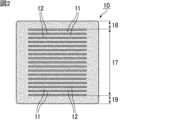
- FIG. 2 is a sectional view taken along line II-II of the laminate that constitutes the multilayer ceramic capacitor shown in FIG.
- FIG. 3 is a cross-sectional view schematically showing an example of a structural defect in which a gap occurs at the boundary between the end of the internal electrode layer and the ceramic layer.
- FIG. 4 is a cross-sectional view schematically showing an example of a structural defect in which an internal electrode layer is peeled off from a ceramic layer.
- the present invention is not limited to the following configuration, and may be modified as appropriate without changing the gist of the present invention. Furthermore, the present invention also includes a combination of a plurality of individual preferred configurations described below.
- the resin composition for ceramic green sheets of the present invention includes ceramic powder, a binder, and an organic solvent.
- the resin composition for ceramic green sheets of the present invention is characterized in that the binder is polyvinyl butyral, and the organic solvent is a mixed solvent containing methylcyclohexane and ethanol.
- the resin composition for ceramic green sheets of the present invention by using a mixed solvent containing methylcyclohexane and ethanol as an organic solvent, it is possible to produce ceramic green sheets from which high-quality chip components can be obtained. Specifically, by creating a ceramic green sheet with an appropriate amount of residual voids, the amount of plastic deformation of the ceramic green sheet can be increased, thereby reducing structural defects that occur during lamination and pressure bonding of the ceramic green sheets. As a result, high-quality chip components can be obtained.
- a toluene/ethanol mixed solvent has been used as the organic solvent.
- methylcyclohexane/ethanol mixed solvents have an azeotropic composition and have a low azeotropic point of 72°C (1 atm) (toluene/ethanol has a low azeotropic point of 78°C). (1 atm)), it is thought that the volatility of the organic solvent becomes higher than before, and as a result, a moderate amount of voids remain in the ceramic green sheet.
- methylcyclohexane is a less polar solvent than toluene, it has slightly poor compatibility with polyvinyl butyral used as a binder. As a result, it is thought that the tendency to form a methylcyclohexane-rich phase may affect the high porosity of the ceramic green sheet.
- the mixed solvent preferably further contains at least one solvent selected from the group consisting of isopropanol, methyl ethyl ketone, methyl propyl ketone, and methyl isobutyl ketone.
- the mixed solvent may further contain one type of solvent selected from the group consisting of isopropanol, methyl ethyl ketone, methyl propyl ketone, and methyl isobutyl ketone, or two or more types of solvents. It may further contain a solvent.
- the mixed solvent may contain isopropanol and methyl ethyl ketone in addition to methylcyclohexane and ethanol.
- the content of methylcyclohexane in the mixed solvent is not particularly limited, but if the content of methylcyclohexane is too small, it will be difficult to obtain the effect of reducing structural defects; If the content of methylcyclohexane is too large, it will be difficult to prepare a resin composition. Considering these points, it is preferable that the content of methylcyclohexane is 20 parts by weight or more and 80 parts by weight or less with respect to a total of 100 parts by weight of methylcyclohexane and ethanol.
- the content of ethanol in the mixed solvent is not particularly limited, but the content of ethanol is 20 parts by weight or more, It is preferable that it is not more than parts by weight.
- the content of methylcyclohexane is 20 parts by weight or more and 80 parts by weight based on a total of 100 parts by weight of methylcyclohexane and ethanol. and the content of isopropanol is preferably 0.4 parts by weight or more and 40 parts by weight or less.
- the content of methylcyclohexane is 20 parts by weight or more and 80 parts by weight based on a total of 100 parts by weight of methylcyclohexane and ethanol. and the content of methyl ethyl ketone is preferably 0.4 parts by weight or more and 40 parts by weight or less.
- the content of methylcyclohexane is 20 parts by weight or more and 80 parts by weight or less based on the total of 100 parts by weight of methylcyclohexane and ethanol, and the content of isopropanol is It is preferable that the content is 0.4 parts by weight or more and 40 parts by weight or less, and the content of methyl ethyl ketone is 0.4 parts by weight or more and 40 parts by weight or less.
- the content of methylcyclohexane is 20 parts by weight or more, 80 parts by weight or more based on a total of 100 parts by weight of methylcyclohexane and ethanol.
- the content of methyl propyl ketone is preferably 0.4 parts by weight or more and 40 parts by weight or less.
- the content of methylcyclohexane is 20 parts by weight or more, 80 parts by weight or more based on a total of 100 parts by weight of methylcyclohexane and ethanol.
- the content of methyl isobutyl ketone is preferably 0.4 parts by weight or more and 40 parts by weight or less.
- the mixed solvent may further contain toluene.
- the content of toluene is it is preferably 35 parts by weight or less.
- the content of toluene is, for example, 20 parts by weight or less, 10 parts by weight or less, 5 parts by weight or less, 2 parts by weight or less, based on a total of 100 parts by weight of methylcyclohexane and ethanol. It may be 0.1 part by weight or less.
- the mixed solvent preferably does not contain toluene.
- Does not contain toluene does not mean strictly not containing toluene, that is, the content of toluene is 0 parts by weight, but does not mean containing substantially no toluene, e.g. This expression means that it also includes cases where toluene is contained as an unavoidable impurity.
- the methylcyclohexane/ethanol mixed solvent contained in the resin composition for ceramic green sheets of the present invention is inferior to the conventional toluene/ethanol mixed solvent in cleaning equipment during dispersion or molding. It has no solubility and wipe-off properties. Therefore, the mixed solvent contained in the resin composition for ceramic green sheets of the present invention is also suitable for use as a cleaning liquid.
- the method for manufacturing a ceramic green sheet of the present invention includes a step of molding the resin composition for a ceramic green sheet of the present invention into a sheet shape.
- a ceramic green sheet can be produced by molding the resin composition for ceramic green sheets of the present invention into a sheet shape. Specifically, a ceramic green sheet can be produced by applying the resin composition for ceramic green sheets of the present invention in the form of a sheet and then drying it.
- the method for manufacturing a laminated ceramic electronic component of the present invention includes a step of producing a ceramic green sheet by molding the resin composition for ceramic green sheets of the present invention into a sheet shape, and forming an internal electrode pattern on the ceramic green sheet. A step of laminating a plurality of the ceramic green sheets on which the internal electrode patterns are formed to produce a laminate, and firing the laminate to form internal electrode layers via the ceramic layer. and a step of producing a ceramic sintered body having a structure.
- a multilayer ceramic electronic component such as a multilayer ceramic capacitor can be manufactured using a ceramic green sheet obtained by molding the resin composition for ceramic green sheets of the present invention into a sheet shape.
- FIG. 1 is a cross-sectional view schematically showing an example of a multilayer ceramic capacitor.
- FIG. 2 is a sectional view taken along line II-II of the laminate that constitutes the multilayer ceramic capacitor shown in FIG.
- a multilayer ceramic capacitor 1 shown in FIG. 1 includes a multilayer body 10 in which internal electrode layers 12 are stacked with ceramic layers 11 interposed therebetween.
- the internal electrode layers 12 are alternately exposed on the surface of the laminate 10 at end faces 15 and 16 of the laminate 10 .
- a pair of external electrodes 13 and 14 electrically connected to the internal electrode layer 12 are formed on end surfaces 15 and 16 of the laminate 10, respectively.
- a laminate is produced by laminating a plurality of ceramic green sheets on which internal electrode patterns are formed. At this time, as shown in FIG. 2, a plurality of ceramic green sheets on which an internal electrode pattern is formed are laminated to form the internal electrode holding layer 17, and a ceramic green sheet on which no internal electrode pattern is formed is stacked to form the internal electrode holding layer 17. It is preferable to produce the laminate 10 by laminating the protective layers 18 and 19 on both main surfaces of the holding layer 17.
- a ceramic sintered body having a structure in which internal electrode layers are laminated via ceramic layers is produced. If necessary, external electrodes are formed on the outer surface of the ceramic sintered body.
- a multilayer ceramic electronic component such as a multilayer ceramic capacitor is obtained.
- ⁇ 1> Contains ceramic powder, binder and organic solvent,
- the binder is polyvinyl butyral,
- a method for producing a ceramic green sheet comprising a step of molding the resin composition for a ceramic green sheet according to any one of ⁇ 1> to ⁇ 6> into a sheet shape.
- a method for manufacturing a laminated ceramic electronic component comprising the step of firing the laminated body to produce a ceramic sintered body having a structure in which internal electrode layers are laminated via ceramic layers.
- Example 1 [Preparation of ceramic slurry] A mixture of 32 parts by weight of ceramic powder (specific surface area (SSA) equivalent particle size: 0.3 ⁇ m) mainly composed of barium titanate, 4 parts by weight of polyvinyl butyral (PVB) as a binder, and methylcyclohexane/ethanol as an organic solvent. A ceramic slurry (resin composition for ceramic green sheets) in which ceramic powder was dispersed was prepared by mixing 64 parts by weight of a solvent.
- SSA specific surface area
- PVB polyvinyl butyral
- the polyvinyl butyral used had a polymerization degree of 1700 and a hydroxyl group content of 34 mol%.
- the ceramic powder was dispersed by mixing and grinding using a bead mill. To prevent foreign matter from entering the sample, the dispersion machine and media were cleaned with the same mixed solvent as above before and after use.
- a ceramic green sheet having a thickness of 1 ⁇ m was produced from the prepared ceramic slurry using a molding machine.
- An internal electrode pattern was formed on the obtained ceramic green sheet by screen printing a Ni paste containing an organic binder and then drying it. The thickness of the internal electrode pattern was adjusted so that the dry coating film had a thickness of 0.8 ⁇ m. Next, 300 ceramic green sheets on which internal electrode patterns were formed were laminated to form an internal electrode holding layer, and 20 plain ceramic green sheets on which no internal electrode patterns were formed were laminated on each of the front and back surfaces. A protective layer was formed.
- the surface roughness Ra of the ceramic green sheet was measured using an optical interference type shape measuring instrument Zygo NewView 7300 manufactured by Canon Marketing Japan.
- FIG. 3 is a cross-sectional view schematically showing an example of a structural defect in which a gap occurs at the boundary between the end of the internal electrode layer and the ceramic layer.
- FIG. 4 is a cross-sectional view schematically showing an example of a structural defect in which an internal electrode layer is peeled off from a ceramic layer.
- Cross-sectional polishing was performed on 100 chip components (multilayer ceramic capacitors) as shown in FIGS. 3 and 4, and it was evaluated whether there were any structural defects inside.
- the voids shown in FIG. 3 or the peelings shown in FIG. 4 were counted as structural defects.
- Example 2 A ceramic slurry was prepared in the same manner as in Example 1 except that a mixed solvent of methylcyclohexane/ethanol was used as the organic solvent and the composition ratio (weight ratio) was 80/20, and then a ceramic green sheet was prepared. And a multilayer ceramic capacitor was manufactured. The obtained ceramic green sheets and multilayer ceramic capacitors were evaluated in the same manner as in Example 1. The results of each evaluation are shown in Table 1.
- Example 3 A ceramic slurry was prepared in the same manner as in Example 1 except that a mixed solvent of methylcyclohexane/ethanol was used as the organic solvent and the composition ratio (weight ratio) was 20/80, and then a ceramic green sheet was prepared. And a multilayer ceramic capacitor was manufactured. The obtained ceramic green sheets and multilayer ceramic capacitors were evaluated in the same manner as in Example 1. The results of each evaluation are shown in Table 1.
- Example 4 A ceramic slurry was prepared in the same manner as in Example 1, except that a mixed solvent of methylcyclohexane/ethanol/isopropanol (IPA) was used as the organic solvent, and the composition ratio (weight ratio) was 50/50/20. After the preparation, a ceramic green sheet and a multilayer ceramic capacitor were produced. The obtained ceramic green sheets and multilayer ceramic capacitors were evaluated in the same manner as in Example 1. The results of each evaluation are shown in Table 1.
- Example 5 A ceramic slurry was prepared in the same manner as in Example 1, except that a mixed solvent of methylcyclohexane/ethanol/methyl ethyl ketone (MEK) was used as the organic solvent, and the composition ratio (weight ratio) was 50/50/20. After the preparation, a ceramic green sheet and a multilayer ceramic capacitor were produced. The obtained ceramic green sheets and multilayer ceramic capacitors were evaluated in the same manner as in Example 1. The results of each evaluation are shown in Table 1.
- Example 6 Ceramics were prepared in the same manner as in Example 1, except that a mixed solvent of methylcyclohexane/ethanol/methylpropylketone (MPK) was used as the organic solvent, and the composition ratio (weight ratio) was 50/50/20. After preparing the slurry, ceramic green sheets and multilayer ceramic capacitors were produced. The obtained ceramic green sheets and multilayer ceramic capacitors were evaluated in the same manner as in Example 1. The results of each evaluation are shown in Table 1.
- Example 7 Ceramics were prepared in the same manner as in Example 1, except that a mixed solvent of methylcyclohexane/ethanol/methyl isobutyl ketone (MIBK) was used as the organic solvent, and the composition ratio (weight ratio) was 50/50/20. After preparing the slurry, ceramic green sheets and multilayer ceramic capacitors were produced. The obtained ceramic green sheets and multilayer ceramic capacitors were evaluated in the same manner as in Example 1. The results of each evaluation are shown in Table 1.
- MIBK methylcyclohexane/ethanol/methyl isobutyl ketone
- Example 8 Example 1 was carried out in the same manner as in Example 1, except that a mixed solvent of methylcyclohexane/ethanol/IPA/MEK was used as the organic solvent, and the composition ratio (weight ratio) was 50/50/0.4/2. After preparing the ceramic slurry, a ceramic green sheet and a multilayer ceramic capacitor were produced. The obtained ceramic green sheets and multilayer ceramic capacitors were evaluated in the same manner as in Example 1. The results of each evaluation are shown in Table 1.
- Example 1 was carried out in the same manner as in Example 1, except that a mixed solvent of methylcyclohexane/ethanol/IPA/MEK was used as the organic solvent, and the composition ratio (weight ratio) was 80/20/6/0.4. After preparing the ceramic slurry, a ceramic green sheet and a multilayer ceramic capacitor were produced. The obtained ceramic green sheets and multilayer ceramic capacitors were evaluated in the same manner as in Example 1. The results of each evaluation are shown in Table 1.
- Example 10 A ceramic slurry was prepared in the same manner as in Example 1, except that a mixed solvent of methylcyclohexane/ethanol/IPA/MEK was used as the organic solvent, and the composition ratio (weight ratio) was 50/50/6/10. After preparing ceramic green sheets and multilayer ceramic capacitors. The obtained ceramic green sheets and multilayer ceramic capacitors were evaluated in the same manner as in Example 1. The results of each evaluation are shown in Table 1.
- Example 11 A ceramic slurry was prepared in the same manner as in Example 1, except that a mixed solvent of methylcyclohexane/ethanol/IPA/MEK was used as the organic solvent, and the composition ratio (weight ratio) was 50/50/6/20. After preparing ceramic green sheets and multilayer ceramic capacitors. The obtained ceramic green sheets and multilayer ceramic capacitors were evaluated in the same manner as in Example 1. The results of each evaluation are shown in Table 1.
- Example 12 Ceramic slurry was prepared in the same manner as in Example 1, except that a mixed solvent of methylcyclohexane/ethanol/IPA/MEK was used as the organic solvent, and the composition ratio (weight ratio) was 50/50/6/30. After preparing ceramic green sheets and multilayer ceramic capacitors. The obtained ceramic green sheets and multilayer ceramic capacitors were evaluated in the same manner as in Example 1. The results of each evaluation are shown in Table 1.
- Example 13 A ceramic slurry was prepared in the same manner as in Example 1, except that a mixed solvent of methylcyclohexane/ethanol/IPA/MEK was used as the organic solvent, and the composition ratio (weight ratio) was 50/50/6/40. After preparing ceramic green sheets and multilayer ceramic capacitors. The obtained ceramic green sheets and multilayer ceramic capacitors were evaluated in the same manner as in Example 1. The results of each evaluation are shown in Table 1.
- Example 14 Ceramic slurry was prepared in the same manner as in Example 1, except that a mixed solvent of methylcyclohexane/ethanol/IPA/MEK was used as the organic solvent, and the composition ratio (weight ratio) was 50/50/40/1. After preparing ceramic green sheets and multilayer ceramic capacitors. The obtained ceramic green sheets and multilayer ceramic capacitors were evaluated in the same manner as in Example 1. The results of each evaluation are shown in Table 1.
- Example 15 Ceramic slurry was prepared in the same manner as in Example 1, except that a mixed solvent of methylcyclohexane/ethanol/IPA/MEK was used as the organic solvent, and the composition ratio (weight ratio) was 70/30/4/1. After preparing ceramic green sheets and multilayer ceramic capacitors. The obtained ceramic green sheets and multilayer ceramic capacitors were evaluated in the same manner as in Example 1. The results of each evaluation are shown in Table 1.
- Example 16 Ceramic slurry was prepared in the same manner as in Example 1, except that a mixed solvent of methylcyclohexane/ethanol/IPA/MEK was used as the organic solvent, and the composition ratio (weight ratio) was 60/40/5/1. After preparing ceramic green sheets and multilayer ceramic capacitors. The obtained ceramic green sheets and multilayer ceramic capacitors were evaluated in the same manner as in Example 1. The results of each evaluation are shown in Table 1.
- Example 17 A ceramic slurry was prepared in the same manner as in Example 1, except that a mixed solvent of methylcyclohexane/ethanol/IPA/MEK was used as the organic solvent, and the composition ratio (weight ratio) was 50/50/6/1. After preparing ceramic green sheets and multilayer ceramic capacitors. The obtained ceramic green sheets and multilayer ceramic capacitors were evaluated in the same manner as in Example 1. The results of each evaluation are shown in Table 1.
- Example 18 A ceramic slurry was prepared in the same manner as in Example 1, except that a mixed solvent of methylcyclohexane/ethanol/IPA/MEK was used as the organic solvent, and the composition ratio (weight ratio) was 40/60/7/1. After preparing ceramic green sheets and multilayer ceramic capacitors. The obtained ceramic green sheets and multilayer ceramic capacitors were evaluated in the same manner as in Example 1. The results of each evaluation are shown in Table 1.
- Example 19 Ceramic slurry was prepared in the same manner as in Example 1, except that a mixed solvent of methylcyclohexane/ethanol/IPA/MEK was used as the organic solvent, and the composition ratio (weight ratio) was 30/70/8/1. After preparing ceramic green sheets and multilayer ceramic capacitors. The obtained ceramic green sheets and multilayer ceramic capacitors were evaluated in the same manner as in Example 1. The results of each evaluation are shown in Table 1.
- Example 20 A ceramic slurry was prepared in the same manner as in Example 1, except that a mixed solvent of methylcyclohexane/ethanol/IPA/MEK was used as the organic solvent, and the composition ratio (weight ratio) was 20/80/9/2. After preparing ceramic green sheets and multilayer ceramic capacitors. The obtained ceramic green sheets and multilayer ceramic capacitors were evaluated in the same manner as in Example 1. The results of each evaluation are shown in Table 1.
- Example 21 Same as Example 1 except that a mixed solvent of methylcyclohexane/ethanol/IPA/MEK/toluene was used as the organic solvent, and the composition ratio (weight ratio) was 29/71/8/1/35. After preparing a ceramic slurry, a ceramic green sheet and a multilayer ceramic capacitor were produced. The obtained ceramic green sheets and multilayer ceramic capacitors were evaluated in the same manner as in Example 1. The results of each evaluation are shown in Table 1.
- Example 1 A ceramic slurry was prepared in the same manner as in Example 1, except that a mixed solvent of ethanol/IPA/MEK/toluene was used as the organic solvent, and the composition ratio (weight ratio) was 50/6/1/50. After the preparation, a ceramic green sheet and a multilayer ceramic capacitor were produced. The obtained ceramic green sheets and multilayer ceramic capacitors were evaluated in the same manner as in Example 1. The results of each evaluation are shown in Table 1.
- Example 1 a multilayer ceramic capacitor with fewer internal structural defects than Comparative Example 1 was obtained. This is considered to be a result of the fact that a ceramic green sheet with higher plasticity and lower density was obtained than in Comparative Example 1.
- Example 2 Similar to Example 1, multilayer ceramic capacitors with fewer internal structural defects than Comparative Example 1 were obtained.
- Example 4 as in Example 1, a multilayer ceramic capacitor with fewer internal structural defects than in Comparative Example 1 was obtained. Furthermore, there are fewer short circuits than in Example 1. This is thought to be because the solubility of PVB increases by blending IPA into the mixed solvent.
- Example 5 similar to Example 1, a multilayer ceramic capacitor with fewer internal structural defects than Comparative Example 1 was obtained. Furthermore, there are fewer short circuits than in Example 1. This is thought to be because the solubility of PVB increases by blending MEK into the mixed solvent.
- Example 6 as in Example 1, a multilayer ceramic capacitor with fewer internal structural defects than in Comparative Example 1 was obtained. Furthermore, there are fewer short circuits than in Example 1. This is considered to be because the solubility of PVB increases by blending MPK into the mixed solvent.
- Example 7 as in Example 1, a multilayer ceramic capacitor with fewer internal structural defects than Comparative Example 1 was obtained. Furthermore, there are fewer short circuits than in Example 1. This is considered to be because the solubility of PVB increases by blending MIBK into the mixed solvent.
- Example 8 as in Example 1, a multilayer ceramic capacitor with fewer internal structural defects than in Comparative Example 1 was obtained. Furthermore, there are fewer short circuits than in Example 1. This is considered to be because the solubility of PVB increases by blending IPA and MEK into the mixed solvent.
- Example 21 although the mixed solvent contained toluene, it also contained methylcyclohexane, so a ceramic green sheet with a lower density was obtained than in Comparative Example 1, and there were fewer internal structural defects. A multilayer ceramic capacitor has been obtained.
Landscapes
- Engineering & Computer Science (AREA)
- Chemical & Material Sciences (AREA)
- Manufacturing & Machinery (AREA)
- Ceramic Engineering (AREA)
- Power Engineering (AREA)
- Inorganic Chemistry (AREA)
- Organic Chemistry (AREA)
- Materials Engineering (AREA)
- Structural Engineering (AREA)
- Microelectronics & Electronic Packaging (AREA)
- Chemical Kinetics & Catalysis (AREA)
- Compositions Of Oxide Ceramics (AREA)
- Ceramic Capacitors (AREA)
- Fixed Capacitors And Capacitor Manufacturing Machines (AREA)
- Compositions Of Macromolecular Compounds (AREA)
Priority Applications (3)
| Application Number | Priority Date | Filing Date | Title |
|---|---|---|---|
| KR1020247039169A KR20250006235A (ko) | 2022-05-31 | 2023-05-26 | 세라믹 그린시트용 수지 조성물, 세라믹 그린시트의 제조 방법 및 적층 세라믹 전자부품의 제조 방법 |
| CN202380040049.7A CN119183445A (zh) | 2022-05-31 | 2023-05-26 | 陶瓷生片用树脂组合物、陶瓷生片的制造方法和层叠陶瓷电子部件的制造方法 |
| JP2024524818A JP7776001B2 (ja) | 2022-05-31 | 2023-05-26 | セラミックグリーンシート用樹脂組成物、セラミックグリーンシートの製造方法及び積層セラミック電子部品の製造方法 |
Applications Claiming Priority (2)
| Application Number | Priority Date | Filing Date | Title |
|---|---|---|---|
| JP2022088773 | 2022-05-31 | ||
| JP2022-088773 | 2022-05-31 |
Publications (1)
| Publication Number | Publication Date |
|---|---|
| WO2023234205A1 true WO2023234205A1 (ja) | 2023-12-07 |
Family
ID=89024968
Family Applications (1)
| Application Number | Title | Priority Date | Filing Date |
|---|---|---|---|
| PCT/JP2023/019700 Ceased WO2023234205A1 (ja) | 2022-05-31 | 2023-05-26 | セラミックグリーンシート用樹脂組成物、セラミックグリーンシートの製造方法及び積層セラミック電子部品の製造方法 |
Country Status (5)
| Country | Link |
|---|---|
| JP (1) | JP7776001B2 (https=) |
| KR (1) | KR20250006235A (https=) |
| CN (1) | CN119183445A (https=) |
| TW (1) | TWI852578B (https=) |
| WO (1) | WO2023234205A1 (https=) |
Citations (5)
| Publication number | Priority date | Publication date | Assignee | Title |
|---|---|---|---|---|
| JP2003217965A (ja) * | 2002-01-28 | 2003-07-31 | Murata Mfg Co Ltd | 積層セラミック電子部品の製造方法 |
| JP2007091526A (ja) * | 2005-09-28 | 2007-04-12 | Nippon Shokubai Co Ltd | セラミックグリーンシートの製造方法 |
| CN102795865A (zh) * | 2011-05-25 | 2012-11-28 | 广州三则电子材料有限公司 | 陶瓷薄片流延用环保粘合剂及其制造方法 |
| JP2014047338A (ja) * | 2012-09-04 | 2014-03-17 | Kyoeisha Chem Co Ltd | 焼結用バインダー樹脂組成物 |
| JP2017165630A (ja) * | 2016-03-17 | 2017-09-21 | 藤倉化成株式会社 | セラミックグリーンシート成形用樹脂組成物およびセラミックグリーンシート成形用材料 |
Family Cites Families (3)
| Publication number | Priority date | Publication date | Assignee | Title |
|---|---|---|---|---|
| JPH11348015A (ja) | 1998-06-03 | 1999-12-21 | Murata Mfg Co Ltd | セラミックグリーンシートの製造方法及び積層セラミック電子部品の製造方法 |
| TWI557096B (zh) * | 2011-09-28 | 2016-11-11 | 可樂麗股份有限公司 | 漿料組成物、陶瓷坯片及積層陶瓷電容器 |
| JP7296836B2 (ja) | 2018-09-27 | 2023-06-23 | 積水化学工業株式会社 | ポリビニルアセタール樹脂、セラミックグリーンシート用組成物、セラミックグリーンシート及び積層セラミックコンデンサ |
-
2023
- 2023-05-23 TW TW112119115A patent/TWI852578B/zh active
- 2023-05-26 KR KR1020247039169A patent/KR20250006235A/ko active Pending
- 2023-05-26 JP JP2024524818A patent/JP7776001B2/ja active Active
- 2023-05-26 WO PCT/JP2023/019700 patent/WO2023234205A1/ja not_active Ceased
- 2023-05-26 CN CN202380040049.7A patent/CN119183445A/zh active Pending
Patent Citations (5)
| Publication number | Priority date | Publication date | Assignee | Title |
|---|---|---|---|---|
| JP2003217965A (ja) * | 2002-01-28 | 2003-07-31 | Murata Mfg Co Ltd | 積層セラミック電子部品の製造方法 |
| JP2007091526A (ja) * | 2005-09-28 | 2007-04-12 | Nippon Shokubai Co Ltd | セラミックグリーンシートの製造方法 |
| CN102795865A (zh) * | 2011-05-25 | 2012-11-28 | 广州三则电子材料有限公司 | 陶瓷薄片流延用环保粘合剂及其制造方法 |
| JP2014047338A (ja) * | 2012-09-04 | 2014-03-17 | Kyoeisha Chem Co Ltd | 焼結用バインダー樹脂組成物 |
| JP2017165630A (ja) * | 2016-03-17 | 2017-09-21 | 藤倉化成株式会社 | セラミックグリーンシート成形用樹脂組成物およびセラミックグリーンシート成形用材料 |
Also Published As
| Publication number | Publication date |
|---|---|
| KR20250006235A (ko) | 2025-01-10 |
| CN119183445A (zh) | 2024-12-24 |
| JP7776001B2 (ja) | 2025-11-26 |
| TWI852578B (zh) | 2024-08-11 |
| TW202407030A (zh) | 2024-02-16 |
| JPWO2023234205A1 (https=) | 2023-12-07 |
Similar Documents
| Publication | Publication Date | Title |
|---|---|---|
| JP5028514B2 (ja) | 内部電極用導電性ペースト組成物及びそれを用いた積層セラミックキャパシタの製造方法 | |
| JP5967193B2 (ja) | 導電性ペーストおよび積層セラミック電子部品の製造方法 | |
| JP7750318B2 (ja) | 導電性ペースト、電子部品、及び積層セラミックコンデンサ | |
| WO2004087608A1 (ja) | 電極段差吸収用印刷ペーストおよび電子部品の製造方法 | |
| JPH07211132A (ja) | 導電性ペーストおよびこれを用いた積層セラミックコンデンサの製造方法 | |
| JP3831748B2 (ja) | グリーンシート用塗料、グリーンシート、グリーンシート用塗料の製造方法、グリーンシートの製造方法および電子部品の製造方法 | |
| CN106575574B (zh) | 叠层陶瓷电容器内部电极用膏体及叠层陶瓷电容器 | |
| JP2002313672A (ja) | 積層型セラミック電子部品およびその製造方法ならびにセラミックペーストおよびその製造方法 | |
| JP5423977B2 (ja) | 積層セラミック電子部品の製造方法 | |
| JP2004186339A (ja) | 積層電子部品の内部電極用導体ペーストおよびそれを用いた積層電子部品 | |
| JP2009147359A (ja) | 積層電子部品の内部電極用導体ペーストおよびそれを用いた積層電子部品 | |
| JP4968411B2 (ja) | 積層セラミック電子部品の製造方法 | |
| WO2023234205A1 (ja) | セラミックグリーンシート用樹脂組成物、セラミックグリーンシートの製造方法及び積層セラミック電子部品の製造方法 | |
| KR100720799B1 (ko) | 그린 시트용 도료, 그린 시트, 그린 시트의 제조방법 및전자 부품의 제조방법 | |
| JP3320615B2 (ja) | セラミックグリーンシート用スラリー組成物 | |
| JP2001358036A (ja) | 積層型セラミック電子部品およびその製造方法 | |
| JP4821197B2 (ja) | 剥離層用ペースト及び積層型電子部品の製造方法 | |
| JP3102454B2 (ja) | 導電性ペーストおよびそれを用いた多層セラミック電子部品の製造方法 | |
| JP7400256B2 (ja) | 機能材料インク | |
| JPH09180959A (ja) | 積層セラミック電子部品の製造方法 | |
| JP4345324B2 (ja) | 積層セラミックコンデンサの製造方法 | |
| KR20130069680A (ko) | 내부전극용 도전성 페이스트 조성물 및 이를 이용한 적층 세라믹 전자부품 | |
| JP2002043163A (ja) | 積層型セラミック電子部品およびその製造方法 | |
| JP4946301B2 (ja) | 積層セラミックコンデンサの製造方法 | |
| JP2006080496A (ja) | 剥離層用ペースト及び積層型電子部品の製造方法 |
Legal Events
| Date | Code | Title | Description |
|---|---|---|---|
| 121 | Ep: the epo has been informed by wipo that ep was designated in this application |
Ref document number: 23815962 Country of ref document: EP Kind code of ref document: A1 |
|
| WWE | Wipo information: entry into national phase |
Ref document number: 2024524818 Country of ref document: JP |
|
| ENP | Entry into the national phase |
Ref document number: 20247039169 Country of ref document: KR Kind code of ref document: A |
|
| WWE | Wipo information: entry into national phase |
Ref document number: 1020247039169 Country of ref document: KR |
|
| NENP | Non-entry into the national phase |
Ref country code: DE |
|
| 122 | Ep: pct application non-entry in european phase |
Ref document number: 23815962 Country of ref document: EP Kind code of ref document: A1 |