WO2023233864A1 - 光学フィルム、着色層形成用組成物、ジピロメテンコバルト錯体及び表示装置 - Google Patents
光学フィルム、着色層形成用組成物、ジピロメテンコバルト錯体及び表示装置 Download PDFInfo
- Publication number
- WO2023233864A1 WO2023233864A1 PCT/JP2023/016111 JP2023016111W WO2023233864A1 WO 2023233864 A1 WO2023233864 A1 WO 2023233864A1 JP 2023016111 W JP2023016111 W JP 2023016111W WO 2023233864 A1 WO2023233864 A1 WO 2023233864A1
- Authority
- WO
- WIPO (PCT)
- Prior art keywords
- group
- dipyrromethene
- formula
- colored layer
- cobalt complex
- Prior art date
- Legal status (The legal status is an assumption and is not a legal conclusion. Google has not performed a legal analysis and makes no representation as to the accuracy of the status listed.)
- Ceased
Links
Images





Classifications
-
- B—PERFORMING OPERATIONS; TRANSPORTING
- B32—LAYERED PRODUCTS
- B32B—LAYERED PRODUCTS, i.e. PRODUCTS BUILT-UP OF STRATA OF FLAT OR NON-FLAT, e.g. CELLULAR OR HONEYCOMB, FORM
- B32B27/00—Layered products comprising a layer of synthetic resin
- B32B27/18—Layered products comprising a layer of synthetic resin characterised by the use of special additives
-
- B—PERFORMING OPERATIONS; TRANSPORTING
- B32—LAYERED PRODUCTS
- B32B—LAYERED PRODUCTS, i.e. PRODUCTS BUILT-UP OF STRATA OF FLAT OR NON-FLAT, e.g. CELLULAR OR HONEYCOMB, FORM
- B32B7/00—Layered products characterised by the relation between layers; Layered products characterised by the relative orientation of features between layers, or by the relative values of a measurable parameter between layers, i.e. products comprising layers having different physical, chemical or physicochemical properties; Layered products characterised by the interconnection of layers
- B32B7/02—Physical, chemical or physicochemical properties
- B32B7/023—Optical properties
-
- C—CHEMISTRY; METALLURGY
- C07—ORGANIC CHEMISTRY
- C07F—ACYCLIC, CARBOCYCLIC OR HETEROCYCLIC COMPOUNDS CONTAINING ELEMENTS OTHER THAN CARBON, HYDROGEN, HALOGEN, OXYGEN, NITROGEN, SULFUR, SELENIUM OR TELLURIUM
- C07F15/00—Compounds containing elements of Groups 8, 9, 10 or 18 of the Periodic Table
- C07F15/06—Cobalt compounds
-
- C—CHEMISTRY; METALLURGY
- C08—ORGANIC MACROMOLECULAR COMPOUNDS; THEIR PREPARATION OR CHEMICAL WORKING-UP; COMPOSITIONS BASED THEREON
- C08L—COMPOSITIONS OF MACROMOLECULAR COMPOUNDS
- C08L101/00—Compositions of unspecified macromolecular compounds
-
- C—CHEMISTRY; METALLURGY
- C08—ORGANIC MACROMOLECULAR COMPOUNDS; THEIR PREPARATION OR CHEMICAL WORKING-UP; COMPOSITIONS BASED THEREON
- C08L—COMPOSITIONS OF MACROMOLECULAR COMPOUNDS
- C08L33/00—Compositions of homopolymers or copolymers of compounds having one or more unsaturated aliphatic radicals, each having only one carbon-to-carbon double bond, and only one being terminated by only one carboxyl radical, or of salts, anhydrides, esters, amides, imides or nitriles thereof; Compositions of derivatives of such polymers
- C08L33/04—Homopolymers or copolymers of esters
-
- C—CHEMISTRY; METALLURGY
- C09—DYES; PAINTS; POLISHES; NATURAL RESINS; ADHESIVES; COMPOSITIONS NOT OTHERWISE PROVIDED FOR; APPLICATIONS OF MATERIALS NOT OTHERWISE PROVIDED FOR
- C09B—ORGANIC DYES OR CLOSELY-RELATED COMPOUNDS FOR PRODUCING DYES, e.g. PIGMENTS; MORDANTS; LAKES
- C09B23/00—Methine or polymethine dyes, e.g. cyanine dyes
- C09B23/02—Methine or polymethine dyes, e.g. cyanine dyes the polymethine chain containing an odd number of >CH- or >C[alkyl]- groups
- C09B23/04—Methine or polymethine dyes, e.g. cyanine dyes the polymethine chain containing an odd number of >CH- or >C[alkyl]- groups one >CH- group, e.g. cyanines, isocyanines, pseudocyanines
-
- C—CHEMISTRY; METALLURGY
- C09—DYES; PAINTS; POLISHES; NATURAL RESINS; ADHESIVES; COMPOSITIONS NOT OTHERWISE PROVIDED FOR; APPLICATIONS OF MATERIALS NOT OTHERWISE PROVIDED FOR
- C09B—ORGANIC DYES OR CLOSELY-RELATED COMPOUNDS FOR PRODUCING DYES, e.g. PIGMENTS; MORDANTS; LAKES
- C09B67/00—Influencing the physical, e.g. the dyeing or printing properties of dyestuffs without chemical reactions, e.g. by treating with solvents grinding or grinding assistants, coating of pigments or dyes; Process features in the making of dyestuff preparations; Dyestuff preparations of a special physical nature, e.g. tablets, films
- C09B67/006—Preparation of organic pigments
-
- G—PHYSICS
- G02—OPTICS
- G02B—OPTICAL ELEMENTS, SYSTEMS OR APPARATUS
- G02B5/00—Optical elements other than lenses
- G02B5/20—Filters
-
- G—PHYSICS
- G02—OPTICS
- G02B—OPTICAL ELEMENTS, SYSTEMS OR APPARATUS
- G02B5/00—Optical elements other than lenses
- G02B5/20—Filters
- G02B5/22—Absorbing filters
Definitions
- the present invention relates to an optical film, a composition for forming a colored layer, a dipyrromethene cobalt complex, and a display device.
- Display devices are often used in environments where external light is incident, whether indoors or outdoors. External light incident on the display device is reflected by the surface of the display device, causing deterioration in display quality such as deterioration in visibility.
- self-luminous display devices such as organic light emitting display devices
- electrodes and many other metal wirings strongly reflect external light, and display quality is likely to deteriorate.
- a circularly polarizing plate is sometimes placed on the display surface side of the display device.
- display devices are generally required to have high color purity.
- Color purity indicates the range of colors that can be displayed by a display device, and is also called color reproduction range. Therefore, high color purity means a wide color reproduction range and good color reproducibility.
- As means for improving color reproducibility for example, a method of separating colors using a color filter for a white light source of a display device, and a method of correcting a monochromatic light source with a color filter to narrow the half width are known.
- Patent Document 1 A color correction filter including a first coloring material having a specific structure and a second coloring material having an absorption maximum in a wavelength range of 420 to 480 nm
- Patent Document 2 A display filter having a resin layer containing a dipyrromethene dye, the resin being a polyester resin having a specific glass transition temperature
- Patent Document 1 attempts to improve the color purity of a white light source by combining specific coloring materials.
- color purity is improved by setting the maximum absorption wavelength of the dye to an appropriate value depending on the type of light source and selectively absorbing secondary light emitted from the light source.
- the light emitted from the display device is also absorbed by the circularly polarizing plate, resulting in a significant reduction in brightness.
- Increasing the light emission intensity to compensate for the decrease in brightness causes a decrease in the life of the light emitting element.
- the thickness of the circularly polarizing plate itself it may be difficult to make the display device thinner.
- the coloring material is required to have wavelength control in units of several nanometers and high reliability depending on the type of color filter.
- the present invention provides an optical film and a composition for forming a colored layer, which are effective in reducing reflectance, increasing brightness, reducing film thickness, and improving color reproducibility of display devices, and which enable wavelength control and are excellent in reliability.
- the present invention aims to provide a dipyrromethene cobalt complex and a display device.
- the present invention has the following aspects.
- the colored layer has a maximum absorption wavelength within a range of 480 to 500 nm
- the colored layer contains a dye (A)
- the dye (A) contains a coloring material containing a dipyrromethene cobalt complex having a structure represented by the following formula (I)
- the actual value of the absorption maximum wavelength of the dipyrromethene cobalt complex in an acetone solution with a concentration of 5.0 ⁇ 10 -6 M is y
- the calculated value of the maximum absorption wavelength of the dipyrromethene cobalt complex in an acetone solution calculated using the quantum chemical calculation program Gaussian 16 is x
- the correction value of the maximum absorption wavelength in an acetone solution is (a ⁇ x + b).
- R 1 to R 7 in the formula (I) each independently represent a hydrogen atom, a halogen atom, an aliphatic hydrocarbon group, an alkoxy group, an alkylthio group, an aromatic hydrocarbon group, a heterocyclic group, a hydroxyl group, Indicates a monovalent group selected from the group consisting of a mercapto group, a nitro group, a substituted amino group, an unsubstituted amino group, a cyano group, a sulfo group, an ester group, and an acyl group.
- the dipyrromethene cobalt complex has the following reaction formula (III) in which boron dipyrromethene having a structure represented by the following formula (II) and singlet oxygen react, Before and after the reaction calculated using the quantum chemical calculation program Gaussian 16, calculation method B3LYP, basis set 6-31G (d, p) (however, the basis function LanL2DZ is assigned to elements with an atomic number larger than Kr in the periodic table).
- R 1 to R 7 in formula (II) and formula (III) each represent the same monovalent group as R 1 to R 7 in formula (I).
- R 1 to R 4 in formula (II) and formula (III) each represent the same monovalent group as R 1 to R 7 in formula (I).
- R 1 to R 4 in formula (II) and formula (III) each represent the same monovalent group as R 1 to R 7 in formula (I).
- R 1 to R 4 are alkyl groups, the sum of the carbon numbers of R 1 and R 2 is 3 or more, and the sum of the carbon numbers of R 3 and R 4 is 3 or more.
- the dipyrromethene cobalt complex has a structure represented by the following formula (I-1), and has a molar extinction coefficient of 170000 L/(mol ⁇ cm) or more, the optical film according to any one of [1] to [4].
- R 1 to R 5 in formula (I-1) each represent the same monovalent group as R 1 to R 5 in formula (I), and R 8 and R 9 each independently have 1 to 1 carbon atoms.
- 6 shows the alkyl group.
- R 8 and R 9 are each independently a methyl group or an ethyl group.
- [7] Contains a dye (A), a photopolymerizable compound (B), and a photopolymerization initiator (C),
- the dye (A) contains a coloring material containing a dipyrromethene cobalt complex having a structure represented by the following formula (I),
- the actual value of the absorption maximum wavelength of the dipyrromethene cobalt complex in an acetone solution with a concentration of 5.0 ⁇ 10 -6 M is y
- the calculated value of the maximum absorption wavelength of the dipyrromethene cobalt complex in an acetone solution calculated using the quantum chemical calculation program Gaussian 16 is x
- the correction value of the maximum absorption wavelength in an acetone solution is (a ⁇ x + b).
- a composition for forming a colored layer wherein x and y satisfy the following formula (i) and the following formula (ii). (y-1) ⁇ (a ⁇ x+b) ⁇ (y+1)...(i) 480nm ⁇ y ⁇ 500nm...(ii)
- R 1 to R 7 in formula (I) each independently represent a hydrogen atom, a halogen atom, an aliphatic hydrocarbon group, an alkoxy group, an alkylthio group, an aromatic hydrocarbon group, a heterocyclic group, a hydroxyl group, a mercapto group. , a nitro group, a substituted amino group, an unsubstituted amino group, a cyano group, a sulfo group, an ester group, and an acyl group.
- the dipyrromethene cobalt complex has the following reaction formula (III) in which boron dipyrromethene having a structure represented by the following formula (II) and singlet oxygen react, Before and after the reaction calculated using the quantum chemical calculation program Gaussian 16, calculation method B3LYP, basis set 6-31G (d, p) (however, the basis function LanL2DZ is assigned to elements with an atomic number larger than Kr in the periodic table).
- R 1 to R 7 in formula (II) and formula (III) each represent the same monovalent group as R 1 to R 7 in formula (I).
- R 5 of the dipyrromethene cobalt complex is a hydrogen atom.
- R 1 to R 4 are alkyl groups, the sum of the carbon numbers of R 1 and R 2 is 3 or more, and the sum of the carbon numbers of R 3 and R 4 is 3 or more.
- the dipyrromethene cobalt complex has a structure represented by the following formula (I-1), and has a molar extinction coefficient of 170000 L/(mol ⁇ cm) or more, the composition for forming a colored layer according to any one of [7] to [10].
- R 1 to R 5 in formula (I-1) each represent the same monovalent group as R 1 to R 5 in formula (I), and R 8 and R 9 each independently have 1 to 1 carbon atoms. 6 shows the alkyl group.
- R 8 and R 9 are each independently a methyl group or an ethyl group.
- the colored layer is an optical film that is a cured product of the colored layer forming composition according to any one of [7] to [13].
- R 1 to R 5 in formula (I-1) each independently represent a hydrogen atom, a halogen atom, an aliphatic hydrocarbon group, an alkoxy group, an alkylthio group, an aromatic hydrocarbon group, a heterocyclic group, a hydroxyl group, Represents a monovalent group selected from the group consisting of a mercapto group, a nitro group, a substituted amino group, an unsubstituted amino group, a cyano group, a sulfo group, an ester group, and an acyl group, and R 8 and R 9 each independently represent a carbon Indicates an alkyl group of numbers 1 to 6.
- a display device comprising the optical film according to any one of [1] to [6] and [14].
- an optical film and a composition for forming a colored layer are effective for reducing reflectance, increasing brightness, reducing film thickness, and improving color reproducibility of display devices, are capable of wavelength control, and have excellent reliability.
- a dipyrromethene cobalt complex and a display device are capable of wavelength control, and have excellent reliability.
- FIG. 1 is a cross-sectional view of an optical film according to an embodiment of the present invention.
- FIG. 3 is a cross-sectional view of an optical film according to another embodiment of the present invention.
- FIG. 3 is a cross-sectional view of an optical film according to another embodiment of the present invention.
- FIG. 3 is a cross-sectional view of an optical film according to another embodiment of the present invention.
- FIG. 3 is a cross-sectional view of an optical film according to another embodiment of the present invention.
- FIG. 3 is a cross-sectional view of an optical film according to another embodiment of the present invention.
- FIG. 3 is a cross-sectional view of an optical film according to another embodiment of the present invention.
- FIG. 3 is a cross-sectional view of an optical film according to another embodiment of the present invention.
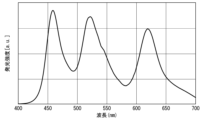
- This is a spectrum of a light source used for evaluating white luminance efficiency. This is the spectrum of the light source used to evaluate color purity.
- the optical film 1 includes a colored layer 10, a transparent base material 20, and a functional layer 30.
- the functional layer 30 includes a low refractive index layer 31 and a hard coat layer 32. That is, the optical film 1 has the transparent base material 20 located on one side of the colored layer 10, and the colored layer 10, the transparent base material 20, the hard coat layer 32, and the low refractive index layer 31 are arranged in this order. It is a laminated body.
- the thickness of the optical film 1 is, for example, preferably 10 to 140 ⁇ m, more preferably 15 to 120 ⁇ m, and even more preferably 20 to 100 ⁇ m.
- the thickness of the optical film 1 is at least the above lower limit, the strength of the optical film 1 can be further increased.
- the thickness of the optical film 1 is less than or equal to the above upper limit value, the optical film 1 can be made lighter, which is advantageous for making the display device thinner.
- the maximum absorption half width of the optical film 1 is preferably 30 nm or less, more preferably 28 nm or less, and even more preferably 25 nm or less.
- the lower limit of the half-value width of maximum absorption of the optical film 1 is not particularly limited, but is, for example, 10 nm.
- the half width of the maximum absorption of the optical film 1 is determined by measuring the absorption spectrum of the optical film 1. Each layer constituting the optical film 1 will be explained below.
- the colored layer 10 contains a dye (A).
- the colored layer 10 is a cured product of the colored layer forming composition of this embodiment.
- the composition for forming a colored layer of this embodiment contains a dye (A), a photopolymerizable compound (B), and a photopolymerization initiator (C).
- the colored layer 10 is a cured product of the composition for forming a colored layer of this embodiment, contains a dye (A) and a polymer of a photopolymerizable compound (B).
- the colored layer 10 and the colored layer forming composition of this embodiment may further contain a non-polymerizable additive (D).
- the colored layer forming composition of this embodiment may further contain a solvent (E).
- the colored layer 10 has a maximum absorption wavelength in the range of 480 to 500 nm, preferably in the range of 485 to 500 nm, and more preferably in the range of 490 to 500 nm.
- the absorption maximum wavelength is equal to or greater than the above lower limit value, it is difficult to reduce the brightness of blue light emission.
- the absorption maximum wavelength is below the above upper limit value, it is difficult to reduce the brightness of green light emission. Therefore, by controlling the absorption wavelength and absorption intensity, it is easy to achieve both color purity and luminance efficiency.
- the absorption maximum wavelength of the optical film 1 and the absorption maximum wavelength of the colored layer 10 are equivalent. That is, the absorption maximum wavelength of the colored layer 10 is determined by measuring the absorption spectrum of the optical film 1.
- the thickness of the colored layer 10 is preferably, for example, 0.5 to 10 ⁇ m.
- the thickness of the colored layer 10 is determined by observing a cross section of the optical film 1 in the thickness direction (a cross section viewed from a direction intersecting the thickness direction) using a microscope or the like.
- the dye (A) contains a coloring material (hereinafter also referred to as “first coloring material”) containing a specific dipyrromethene cobalt complex (hereinafter also referred to as “complex (I)”).
- Complex (I) has a structure represented by the following formula (I).
- R 1 to R 7 each independently represent a hydrogen atom, a halogen atom, an aliphatic hydrocarbon group, an alkoxy group, an alkylthio group, an aromatic hydrocarbon group, a heterocyclic group, a hydroxyl group, a mercapto group, a nitro group, a substituted A monovalent group selected from the group consisting of an amino group, an unsubstituted amino group, a cyano group, a sulfo group, an ester group, and an acyl group.
- the monovalent group has a carbon atom (i.e., an aliphatic hydrocarbon group, an alkoxy group, an alkylthio group, an aromatic hydrocarbon group, a heterocyclic group, a substituted amino group, an ester group, an acyl group, etc.),
- the monovalent group may have a substituent.
- examples of the halogen atom in R 1 to R 7 include a fluorine atom, a chlorine atom, a bromine atom, and an iodine atom.
- examples of the aliphatic hydrocarbon group for R 1 to R 7 include an alkyl group and an alkenyl group.
- alkyl group examples include methyl group, ethyl group, n-propyl group, iso-propyl group, n-butyl group, iso-butyl group, sec-butyl group, t-butyl group, n-pentyl group, iso- Pentyl group, 2-methylbutyl group, 1-methylbutyl group, neo-pentyl group, 1,2-dimethylpropyl group, 1,1-dimethylpropyl group, cyclo-pentyl group, n-hexyl group, 4-methylpentyl group, 3-methylpentyl group, 2-methylpentyl group, 1-methylpentyl group, 3,3-dimethylbutyl group, 2,3-dimethylbutyl group, 1,3-dimethylbutyl group, 2,2-dimethylbutyl group, 1,2-dimethylbutyl group, 1,1-dimethylbutyl group, 3-ethylbutyl group,
- One or more hydrogen atoms of these alkyl groups may be substituted with a substituent such as a halogen atom or an alkoxy group.
- the alkyl group may be linear, branched, or cyclic.
- the number of carbon atoms in the alkyl group is, for example, 1 to 20.
- alkenyl group examples include vinyl group, propenyl group, 1-butenyl group, iso-butenyl group, 1-pentenyl group, 2-pentenyl group, 2-methyl-1-butenyl group, and 3-methyl-1-butenyl group. , 2-methyl-2-butenyl group, 2,2-dicyanovinyl group, 2-cyano-2-methylcarboxyl vinyl group, and 2-cyano-2-methylsulfone vinyl group.
- the alkenyl group may be linear or branched.
- the alkenyl group has, for example, 2 to 20 carbon atoms.
- Examples of the alkoxy group in R 1 to R 7 include methoxy group, ethoxy group, n-propoxy group, iso-propoxy group, n-butoxy group, iso-butoxy group, sec-butoxy group, t-butoxy group, n Examples include -pentoxy group, iso-pentoxy group, neo-pentoxy group, n-hexyloxy group, and n-dodecyloxy group.
- the alkoxy group may be linear or branched. The number of carbon atoms in the alkoxy group is, for example, 1 to 20.
- Examples of the alkylthio group in R 1 to R 7 include methylthio group, ethylthio group, n-propylthio group, iso-propylthio group, n-butylthio group, iso-butylthio group, sec-butylthio group, t-butylthio group, n -pentylthio group, iso-pentylthio group, 2-methylbutylthio group, 1-methylbutylthio group, neo-pentylthio group, 1,2-dimethylpropylthio group, and 1,1-dimethylpropylthio group, etc. .
- the alkylthio group may be linear or branched. The number of carbon atoms in the alkylthio group is, for example, 1 to 20.
- Examples of the aromatic hydrocarbon group for R 1 to R 7 include an aralkyl group and an aryl group.
- One or more hydrogen atoms of the aromatic hydrocarbon group are a halogen atom, an aliphatic hydrocarbon group, an alkoxy group, an alkylthio group, an aromatic hydrocarbon group, a heterocyclic group, a hydroxyl group, a mercapto group, a nitro group, a substituted amino group, It may be substituted with a substituent such as an unsubstituted amino group, cyano group, sulfo group, ester group, or acyl group.
- aralkyl group examples include benzyl group, nitrobenzyl group, cyanobenzyl group, hydroxybenzyl group, methylbenzyl group, dimethylbenzyl group, trimethylbenzyl group, dichlorobenzyl group, methoxybenzyl group, ethoxybenzyl group, trifluoromethylbenzyl group. group, naphthylmethyl group, nitronaphthylmethyl group, cyanonaphthylmethyl group, hydroxynaphthylmethyl group, methylnaphthylmethyl group, trifluoromethylnaphthylmethyl group, and the like.
- the aralkyl group has, for example, 7 to 20 carbon atoms.
- aryl group examples include phenyl group, nitrophenyl group, cyanophenyl group, hydroxyphenyl group, methylphenyl group, dimethylphenyl group, trimethylphenyl group, dichlorophenyl group, methoxyphenyl group, ethoxyphenyl group, trifluoromethylphenyl group. , N,N-dimethylaminophenyl group, naphthyl group, nitronaphthyl group, cyanonaphthyl group, hydroxynaphthyl group, methylnaphthyl group, and trifluoromethylnaphthyl group.
- the aryl group has, for example, 6 to 20 carbon atoms.
- Examples of the heterocyclic group for R 1 to R 7 include a heteroaryl group.
- Examples of the heteroaryl group include a pyrrolyl group, thienyl group, furanyl group, oxazoyl group, isoxazoyl group, oxadiazoyl group, imidazoyl group, benzoxazoyl group, benzothiazoyl group, benzimidazoyl group, benzofuranyl group, and indoyl group. etc.
- the heteroaryl group has, for example, 4 to 20 carbon atoms.
- Examples of the substituted amino group for R 1 to R 7 include an alkylcarbonylamino group and an arylcarbonylamino group.
- Examples of the alkylcarbonylamino group include an acetylamino group, an ethylcarbonylamino group, and a butylcarbonylamino group.
- the number of carbon atoms in the alkylcarbonylamino group is, for example, 2 to 20.
- Examples of the arylcarbonylamino group include a phenylaminocarbonyl group, 4-methylphenylaminocarbonyl group, 2-methoxyphenylaminocarbonyl group, and 4-n-propylphenylaminocarbonyl group.
- the arylcarbonylamino group has, for example, 7 to 20 carbon atoms.
- ester group for R 1 to R 7 examples include an alkoxycarbonyl group, an alkenyloxycarbonyl group, and an aralkyloxycarbonyl group.
- alkoxycarbonyl group examples include methoxycarbonyl group, ethoxycarbonyl group, isopropyloxycarbonyl group, n-butoxycarbonyl group, t-butoxycarbonyl group, 2,2-dimethylpropyloxycarbonyl group, and 2,4-dimethylbutyl group.
- An example is an oxycarbonyl group.
- the alkoxycarbonyl group has, for example, 2 to 20 carbon atoms.
- alkenyloxycarbonyl group examples include an allyloxycarbonyl group and a 2-butenoxycarbonyl group.
- the alkenyloxycarbonyl group has, for example, 3 to 20 carbon atoms.
- Examples of the acyl group in R 1 to R 7 include formyl group, acetyl group, ethylcarbonyl group, n-propylcarbonyl group, iso-propylcarbonyl group, n-butylcarbonyl group, iso-butylcarbonyl group, sec-butyl group.
- Examples include carbonyl group, t-butylcarbonyl group, n-pentylcarbonyl group, iso-pentylcarbonyl group, neo-pentylcarbonyl group, 2-methylbutylcarbonyl group, and nitrobenzylcarbonyl group.
- the acyl group has, for example, 1 to 20 carbon atoms.
- the number of carbon atoms in the monovalent group is preferably 10 or less, more preferably 6 or less, and even more preferably 4 or less.
- the molecular weight of complex (I) will be relatively low. Therefore, even if the concentration of the dye (A) is low, it can sufficiently absorb light with a wavelength of 490 to 500 nm, and the light resistance can be further improved.
- the lower limit of the number of carbon atoms is the same as the lower limit of the range of carbon numbers shown in the explanation of each monovalent group described above.
- R 1 to R 4 are alkyl groups, and the sum of the carbon numbers of R 1 and R 2 is 3 or more and the sum of the carbon numbers of R 3 and R 4 is 3 or more. is preferred.
- the free energy change ⁇ G which will be described later, increases, and the light resistance tends to improve.
- the reason for this is thought to be that the steric hindrance caused by R 1 or R 2 and the steric hindrance caused by R 3 or R 4 suppress the attack by singlet oxygen on the meso position of the dipyrromethene structure.
- the compatibility with the resin constituting the coating film is improved, allowing it to exist stably in the coating film, and the light resistance is improved.
- the sum of the carbon numbers of R 1 and R 2 and the sum of the carbon numbers of R 3 and R 4 are each 4 or more.
- the upper limit of each of the sum of the carbon numbers of R 1 and R 2 and the sum of the carbon numbers of R 3 and R 4 is, for example, 12, or even 8.
- ⁇ G represents the free energy change before and after the reaction in the following reaction formula (III) in which boron dipyrromethene having a structure represented by the following formula (II) reacts with singlet oxygen.
- ⁇ G was calculated using the quantum chemical calculation program Gaussian 16, calculation method B3LYP, basis set 6-31G (d, p) (however, the basis function LanL2DZ is assigned to elements with an atomic number larger than Kr in the periodic table). It is a value.
- basis set 6-31G (d, p) (however, the basis function LanL2DZ is assigned to elements with an atomic number larger than Kr in the periodic table).
- the sum of the free energy value obtained as a result of the structural optimization calculation and vibrational calculation and the free energy value obtained as the result of the structural optimization calculation and vibrational calculation of singlet oxygen is calculated as the sum of the free energy value obtained as a result of the structural optimization calculation and vibrational calculation of singlet oxygen. It is calculated by subtracting from the free energy value obtained as a result of structural optimization calculation and vibration calculation.
- R 1 to R 7 in formula (II) and formula (III) each represent the same monovalent group as R 1 to R 7 in formula (I).
- ⁇ G means the change in free energy before and after the reaction in reaction formula (III) in which boron dipyrromethene having a monovalent group represented by R 1 to R 7 of complex (I) reacts with singlet oxygen.
- ⁇ G is preferably ⁇ 1.0 kcal/mol or more, more preferably 0.0 kcal/mol or more, and even more preferably 1.0 kcal/mol or more.
- the dipyrromethene cobalt complex has excellent light resistance, and the colored layer and optical film containing it also have excellent light resistance.
- ⁇ G differs depending on what kind of group or atom R 1 to R 7 in formula (I) are. Therefore, R 1 to R 7 in formula (I) are preferably selected such that ⁇ G is ⁇ 1.0 kcal/mol or more.
- R 1 to R 4 is a hydrogen atom or a halogen atom.
- ⁇ G tends to increase and light resistance tends to improve.
- R 1 and R 3 are each independently a hydrogen atom or a halogen atom
- R 2 and R 4 are each independently an alkyl group having 1 to 4 carbon atoms
- R 1 and R 3 are each More preferably, each of R 2 and R 4 is independently an alkyl group having 1 to 4 carbon atoms
- R 2 and R 4 are each independently a halogen atom.
- R 5 is preferably a hydrogen atom.
- ⁇ G tends to increase and light resistance tends to improve.
- R 6 and R 7 are each independently an ester group.
- ⁇ G tends to increase and light resistance tends to improve.
- the reason for this is thought to be that the bulky structures of R 6 and R 7 suppress the attack on the meso position of the dipyrromethene structure by singlet oxygen.
- ester groups alkoxycarbonyl groups having 2 to 7 carbon atoms are preferred, and alkoxycarbonyl groups having 2 to 3 carbon atoms are more preferred. In this case, the molecular weight of complex (I) becomes relatively low, and the concentration of dye (A) can be reduced.
- a preferable example of complex (I) is an acetone solution having a structure represented by the following formula (I-1) and having a concentration of 5.0 ⁇ 10 ⁇ 6 M (a solution obtained by dissolving complex (I) in acetone).
- ) is a dipyrromethene cobalt complex having a molar extinction coefficient of 170000 L/(mol ⁇ cm) or more.
- Such a dipyrromethene cobalt complex has excellent light resistance. Furthermore, since the molecular weight is relatively low, the concentration of the dye (A) can be lowered.
- R 1 to R 5 are as described above, and R 8 and R 9 each independently represent an alkyl group having 1 to 6 carbon atoms.
- R 8 and R 9 are each independently a methyl group or an ethyl group.
- the molar absorption coefficient is 170000 L/(mol ⁇ cm) or more, light resistance tends to be better.
- the molar absorption coefficient is preferably 180,000 L/(mol ⁇ cm) or more, more preferably 190,000 L/(mol ⁇ cm) or more.
- the upper limit of the molar absorption coefficient is not particularly limited, but is, for example, 300000 L/(mol ⁇ cm).
- the above molar extinction coefficient is measured by the method described in the Examples below. The above molar extinction coefficient differs depending on what kind of group or atom R 1 to R 5 , R 8 and R 9 in formula (I-1) are. Therefore, R 1 to R 5 , R 8 and R 9 in formula (I-1) are preferably selected such that the molar extinction coefficient is 170000 L/(mol ⁇ cm) or more.
- the actual value of the absorption maximum wavelength in an acetone solution with a concentration of 5.0 ⁇ 10 -6 M of complex (I) is y (nm), and the value in an acetone solution calculated using the quantum chemical calculation program Gaussian 16 for complex (I)
- x and y satisfy the following formula (i). (y-1) ⁇ (a ⁇ x+b) ⁇ (y+1)...(i)
- Equation (i) represents an index for wavelength control, and the closer the correction value in equation (i) is to the actual value y of the maximum absorption wavelength, the more accurately the maximum absorption wavelength of complex (I) can be controlled. means. That is, complex (I) satisfying formula (i) means that the correction value matches the measured value with good consistency, and wavelength control is possible. By controlling the maximum absorption wavelength of complex (I), the reliability of the optical film 1 can be further improved.
- x in formula (i) can be adjusted by the types of R 1 to R 7 in formula (I) and their combinations.
- the calculated value x (nm) of the maximum absorption wavelength in an acetone solution can be calculated using the following procedure.
- Literature “Symmetry-Breaking Charge Transfer of Visible Light Absorbing Systems: Zinc Dipyrrins, J.Phys.Chem.C 2014, 118, 21834-2184 Based on the chemical structure obtained from the X-ray crystal structure analysis data of the compound zDIP3 described in 5. A structure in which the central metal is changed from zinc to cobalt, and the substituents of dipyrromethene are changed to R 1 to R 7 in formula (I) is set as the initial structure.
- calculation method CAM-B3LYP unrestricted method
- basis set 6-31G(d) however, basis function LanL2DZ is assigned to Co and I
- solvent effect calculation method SMD Solvation Model Based on Density
- the excited state calculation is performed using time-dependent density functional theory, and the average value of the absorption wavelengths of the excited state with the highest oscillator strength and the excited state with the second highest oscillator strength is calculated as the absorption maximum wavelength x (nm).
- the method for producing complex (I) is not particularly limited, and it can be produced, for example, according to the method described in Japanese Patent Application Publication No. 2002-212456.
- R 1 to R 7 in formula (I) By appropriately selecting R 1 to R 7 in formula (I), the maximum absorption wavelength of complex (I) can be controlled.
- the content of the first coloring material in the pigment (A) is preferably, for example, 10 to 100% by mass based on the total mass of the pigment (A).
- the reliability of the optical film 1 can be further improved.
- the dye (A) may further contain a second colorant having a maximum absorption wavelength within the range of 560 to 620 nm in an acetone solution having a concentration of 5.0 ⁇ 10 ⁇ 6 M.
- a second colorant having a maximum absorption wavelength within the range of 560 to 620 nm in an acetone solution having a concentration of 5.0 ⁇ 10 ⁇ 6 M.
- the half width of maximum absorption of the second coloring material in an acetone solution having a concentration of 5.0 ⁇ 10 ⁇ 6 M is preferably 15 to 55 nm.
- the second coloring material examples include phthalocyanine dyes and porphyrin dyes.
- the content of the second coloring material in the pigment (A) is preferably, for example, 10 to 60% by mass based on the total mass of the pigment (A). .
- color purity can be further enhanced.
- the dye (A) may further contain a coloring material other than the first coloring material and the second coloring material.
- examples of other coloring materials include a third coloring material having the lowest transmittance in the wavelength range of 380 to 780 nm within the range of 650 to 780 nm.
- the third coloring material examples include squarylium dyes and phthalocyanine dyes.
- the content of the third coloring material in the dye (A) is preferably, for example, 10 to 60% by mass based on the total mass of the dye (A). .
- color purity can be further improved.
- the dye (A) is a compound having any of the following: a porphyrin structure, a merocyanine structure, a phthalocyanine structure, an azo structure, a cyanine structure, a squarylium structure, a coumarin structure, a polyene structure, a quinone structure, a tetradiporphyrin structure, a pyrromethene structure, or an indigo structure; or a metal complex thereof.
- the dye (A) may contain one kind of these compounds or metal complexes thereof, or may contain two or more kinds thereof. These compounds or metal complexes thereof may be contained in the first coloring material, in the second coloring material, in the third coloring material, or in the third coloring material. It may be included in two or more types of coloring materials.
- the content of the dye (A) is preferably 0.01 to 5.0% by mass, more preferably 0.01 to 2.0% by mass, based on the total mass of the solid content of the composition for forming a colored layer.
- the content of the dye (A) is at least the above lower limit, external light and secondary light emission from the light source of the display device can be effectively absorbed and reflectance can be reduced.
- the content of the dye (A) is below the above upper limit value, aggregation and association of the dye can be suppressed, and color reproducibility can be further improved.
- the solid content of the composition for forming a colored layer is the total of all components other than the solvent (E).
- the content of the dye (A) with respect to the solid content of the composition for forming a colored layer can be considered as the content of the dye (A) with respect to the total mass of the colored layer.
- the photopolymerizable compound (B) is a compound that polymerizes and hardens when irradiated with active energy rays such as ultraviolet rays.
- Examples of the photopolymerizable compound (B) include monofunctional (meth)acrylates, bifunctional (meth)acrylates, and trifunctional or more functional (meth)acrylates. It is preferable that the photopolymerizable compound (B) contains a difunctional or more functional (meth)acrylate.
- (meth)acrylate is a generic term for both acrylate and methacrylate
- (meth)acryloyl is a generic term for both acryloyl and methacryloyl.
- a monofunctional (meth)acrylate is a compound having one (meth)acryloyl.
- monofunctional (meth)acrylates include 2-hydroxyethyl (meth)acrylate, 2-hydroxypropyl (meth)acrylate, 2-hydroxybutyl (meth)acrylate, n-butyl (meth)acrylate, and isobutyl (meth)acrylate.
- acrylate t-butyl (meth)acrylate, glycidyl (meth)acrylate, acryloylmorpholine, N-vinylpyrrolidone, tetrahydrofurfuryl acrylate, cyclohexyl (meth)acrylate, 2-ethylhexyl (meth)acrylate, isobornyl (meth)acrylate Acrylate, isodecyl (meth)acrylate, lauryl (meth)acrylate, tridecyl (meth)acrylate, cetyl (meth)acrylate, stearyl (meth)acrylate, benzyl (meth)acrylate, 2-ethoxyethyl (meth)acrylate, 3-methoxy Butyl (meth)acrylate, ethyl carbitol (meth)acrylate, phosphoric acid (meth)acrylate, ethylene oxide modified phosphoric acid (meth)acrylate, phenoxy (meth)acryl
- a difunctional (meth)acrylate is a compound having two (meth)acryloyl groups.
- bifunctional (meth)acrylates include ethylene glycol di(meth)acrylate, diethylene glycol di(meth)acrylate, butanediol di(meth)acrylate, hexanediol di(meth)acrylate, and nonanediol di(meth)acrylate.
- ethoxylated hexanediol di(meth)acrylate propoxylated hexanediol di(meth)acrylate, triethylene glycol di(meth)acrylate, polyethylene glycol di(meth)acrylate, tripropylene glycol di(meth)acrylate, polypropylene glycol di(meth)acrylate
- Di(meth)acrylates such as (meth)acrylate, neopentyl glycol di(meth)acrylate, ethoxylated neopentyl glycol di(meth)acrylate, and neopentyl hydroxypivalic acid di(meth)acrylate are mentioned.
- a trifunctional or more functional (meth)acrylate is a compound having three or more (meth)acryloyl groups.
- Examples of trifunctional or higher functional (meth)acrylates include trimethylolpropane tri(meth)acrylate, ethoxylated trimethylolpropane tri(meth)acrylate, propoxylated trimethylolpropane tri(meth)acrylate, and tris-2-hydroxyethyl isocyanate.
- Trifunctional tri(meth)acrylates such as nurate tri(meth)acrylate, glycerin tri(meth)acrylate, pentaerythritol tri(meth)acrylate, dipentaerythritol tri(meth)acrylate, and ditrimethylolpropane tri(meth)acrylate (meth)acrylate compounds, pentaerythritol tetra(meth)acrylate, ditrimethylolpropane tetra(meth)acrylate, dipentaerythritol tetra(meth)acrylate, dipentaerythritol penta(meth)acrylate, ditrimethylolpropane penta(meth)acrylate Acrylate, dipentaerythritol hexa(meth)acrylate, ditrimethylolpropane hexa(meth)acrylate, and other trifunctional or higher functional polyfunctional (meth)acrylate compounds, and some of these (meth
- Urethane (meth)acrylate may be used as the photopolymerizable compound (B).
- urethane (meth)acrylate include those obtained by reacting a product obtained by reacting a polyester polyol with an isocyanate monomer or a prepolymer with a (meth)acrylate monomer having a hydroxyl group.
- urethane (meth)acrylates examples include pentaerythritol triacrylate hexamethylene diisocyanate urethane prepolymer, dipentaerythritol pentaacrylate hexamethylene diisocyanate urethane prepolymer, pentaerythritol triacrylate toluene diisocyanate urethane prepolymer, dipentaerythritol pentaacrylate toluene diisocyanate Examples include urethane prepolymers, pentaerythritol triacrylate isophorone diisocyanate urethane prepolymers, and dipentaerythritol pentaacrylate isophorone diisocyanate urethane prepolymers.
- the above-mentioned (meth)acrylate compounds may be used alone or in combination of two or more. Furthermore, the above-mentioned (meth)acrylate compound may be a monomer in the composition for forming a colored layer, or may be a partially polymerized oligomer.
- the content of the photopolymerizable compound (B) is preferably 50 to 99% by mass, more preferably 70 to 99% by mass, based on the total mass of the composition for forming a colored layer.
- the content of the photopolymerizable compound (B) is at least the above lower limit, the effect of inhibiting discoloration can be further enhanced.
- the content of the photopolymerizable compound (B) is below the above upper limit, the handleability of the colored layer forming composition can be further improved.
- Photopolymerization initiator (C) examples include those that generate radicals when irradiated with active energy rays such as ultraviolet rays.
- examples of the photopolymerization initiator (C) include benzoins (benzoin, benzoin alkyl ethers such as benzoin methyl ether, benzoin ethyl ether, and benzoin isopropyl ether), phenyl ketones [e.g., acetophenones (e.g., acetophenone, 2-hydroxy-2-methyl-1-phenylpropan-1-one, 2,2-dimethoxy-2-phenylacetophenone, 2,2-diethoxy-2-phenylacetophenone, 1,1-dichloroacetophenone, etc.), 2- Alkylphenyl ketones such as hydroxy-2-methylpropiophenone; cycloalkylphenyl ketones such as 1-hydroxycyclohexylphenyl ketone
- the content of the photopolymerization initiator (C) is preferably 0.01 to 20% by mass, more preferably 0.1 to 10% by mass, based on the total mass of the colored layer forming composition.
- the content of the photopolymerization initiator (C) is at least the above lower limit, the composition for forming a colored layer can be sufficiently cured.
- the content of the photopolymerization initiator (C) is below the above upper limit, unreacted photopolymerization initiator (C) is difficult to remain, and a decrease in reliability can be suppressed.
- Non-polymerizable additive (D) By containing the non-polymerizable additive (D) in the colored layer forming composition, various functions can be imparted to the colored layer 10.
- non-polymerizable additives (D) include radical scavengers, peroxide decomposers, singlet oxygen quenchers, leveling agents, antifoaming agents, antioxidants, photosensitizers, antifouling agents, and conductive materials.
- the non-polymerizable additive (D) may be used alone or in combination of two or more.
- the non-polymerizable additive (D) is selected from radical scavengers, peroxide decomposers, and singlet oxygen quenchers because it has the function of preventing the deterioration of the dye (A) due to light, heat, etc.
- One or more types are preferred.
- the radical scavenger has the function of capturing radicals when the dye (A) undergoes oxidative deterioration, suppressing autooxidation, and suppressing dye deterioration (fading).
- the radical scavenger include hindered amine light stabilizers, aromatic amine antioxidants, phenolic antioxidants, etc., and particularly preferred are hindered amine light stabilizers having a molecular weight of 2000 or more. When the molecular weight of the hindered amine light stabilizer is 2000 or more, a high fading suppressing effect can be obtained. This is considered to be because the hindered amine light stabilizer is difficult to volatilize, and many molecules remain within the colored layer 10, so that a sufficient effect of suppressing fading can be obtained.
- Examples of the hindered amine light stabilizer having a molecular weight of 2000 or more include Chimassorb 2020FDL, Chimassorb 944FDL, Tinuvin 622 manufactured by BASF, and ADEKA STAB LA-63P manufactured by ADEKA Corporation.
- a peroxide decomposer ionically decomposes hydroperoxide (ROOH; R is an alkyl group, O is an oxygen atom, and H is a hydrogen atom), converting it into an inert compound, and suppressing the generation of radicals. It is a type of antioxidant with functions.
- R hydroperoxide
- O oxygen atom
- H hydrogen atom
- D contains a peroxide decomposer
- oxidative deterioration of the dye (A) can be suppressed, and the life of the light emitting element having the colored layer 10 can be extended. Note that when the peroxide decomposer corresponds to the singlet oxygen quencher described below, the singlet oxygen quencher is excluded from the peroxide decomposer in this specification.
- peroxide decomposers examples include sulfur-based antioxidants and phosphorus-based antioxidants.
- sulfur-based antioxidant examples include didodecyl 3,3'-thiodipropionate and 2-mercaptobenzimidazole.
- phosphorus-based antioxidants include trihexyl phosphite, trioleyl phosphite, trioctyl phosphite, tris(2-ethylhexyl) phosphite, and tris(2,4-di-tert-butyl phosphite).
- phenyl tris phosphite (1,1,1,3,3,3-hexafluoro-2-propyl), triphenyl phosphite, tris phosphite (2-methylphenyl), tris phosphite ( 4-methylphenyl), and 3,9-bis(2,4-di-tert-butylphenoxy)-2,4,8,10-tetraoxa-3,9-diphosphaspiro[5,5]undecane. .
- a singlet oxygen quencher is a compound that suppresses oxidative deterioration of the dye (A) caused by singlet oxygen.
- the non-polymerizable additive (D) contains a singlet oxygen quencher, oxidative deterioration of the dye (A) can be suppressed and the life of the light emitting element having the colored layer 10 can be extended.
- singlet oxygen quenchers include transition metal complexes, dyes (excluding dye (A)), amines, phenols, and sulfides.
- Particularly preferably used materials as the singlet oxygen quencher are transition metal complexes of dialkyl phosphates, dialkyldithiocarbamates, benzenedithiols, or similar dithiols, and nickel, copper, or cobalt is preferably used as the central metal. It will be done.
- Examples of singlet oxygen quenchers include NKX1199 (bis[2'-chloro-3-methoxy-4-(2-methoxyethoxy)dithiobenzyl]nickel) and NKX113 (bis(dithiobenzyl) manufactured by Hayashibara Co., Ltd.).
- NKX114 bis[4-(dimethylamino)dithiobenzyl]nickel
- Tokyo Chemical Industry Co., Ltd. D1781 (nickel dibutyldithiocarbamate (II)), B1350 (bis(dithiobenzyl)nickel (II)) , B4360 (bis[4,4'-dimethoxy(dithiobenzyl)]nickel(II)), and T3204 (tetrabutylammonium bis(3,6-dichloro-1,2-benzenedithiolat) nickelate).
- the content of the non-polymerizable additive (D) is preferably 0.1 to 50% by mass, more preferably 5 to 30% by mass, based on the total mass of the solid content of the colored layer forming composition.
- the content of the non-polymerizable additive (D) is at least the above lower limit, various functions can be imparted to the colored layer 10.
- the content of the non-polymerizable additive (D) is below the above upper limit, curability is easily maintained.
- solvent (E) examples include ethers, ketones, esters, and cellosolves.
- the ethers include dibutyl ether, dimethoxymethane, dimethoxyethane, diethoxyethane, propylene oxide, 1,4-dioxane, 1,3-dioxolane, 1,3,5-trioxane, tetrahydrofuran, anisole, and phenetol. Can be mentioned.
- ketones include acetone, methyl ethyl ketone, diethyl ketone, dipropyl ketone, diisobutyl ketone, methyl isobutyl ketone, cyclopentanone, cyclohexanone, methylcyclohexanone, and ethylcyclohexanone.
- esters include ethyl formate, propyl formate, n-pentyl formate, methyl acetate, ethyl acetate, methyl propionate, ethyl propionate, n-pentyl acetate, and ⁇ -butyrolactone.
- cellosolves examples include methyl cellosolve, cellosolve (ethyl cellosolve), butyl cellosolve, and cellosolve acetate.
- One type of solvent (E) may be used alone, or two or more types may be used in combination.
- the content of the solvent (E) is preferably 40 to 70% by mass, more preferably 40 to 60% by mass, based on the total mass of the colored layer forming composition.
- the solubility of the dye (A) and the non-polymerizable additive (D) will be good, and the stability of the coating liquid (liquid stability) will be maintained. Good coating properties can be obtained.
- the colored layer 10 can improve color purity and luminance efficiency, achieve both color purity and luminance efficiency, and improve display quality. Therefore, it is effective in reducing the reflectance, increasing the brightness, making the film thinner, and improving the color reproducibility of the display device, enabling wavelength control, and having excellent reliability.
- the transparent base material 20 is a sheet-like member located on one surface of the colored layer 10 and forming the optical film 1.
- a resin film having translucency can be used as the material for forming the transparent base material 20.
- transparent resins such as polyolefins, polyesters, polyacrylates, polyamides, polyimides, polyarylates, polycarbonates, triacetylcellulose, polyvinyl alcohol, polyvinyl chloride, cycloolefin copolymers, norbornene-containing resins, polyethersulfones, and polysulfones, and inorganic Glass can be used.
- the polyolefin include polyethylene and polypropylene.
- polyester examples include polyethylene terephthalate, polybutylene terephthalate, and polyethylene naphthalate.
- polyacrylate examples include polymethyl methacrylate.
- polyamide examples include nylon 6 and nylon 66.
- a film made of polyethylene terephthalate (PET), a film made of triacetyl cellulose (TAC), a film made of polymethyl methacrylate (PMMA), or a film made of polyester other than PET can be suitably used.
- the transmittance of the transparent base material 20 is preferably 90% or more, for example.
- the transmittance of the transparent base material 20 can be measured using a spectrophotometer (manufactured by Hitachi, Ltd., U-4100).
- the transparent base material 20 may be provided with ultraviolet absorbing ability. By adding a UV absorber to the resin that is the raw material for the transparent base material 20, the transparent base material 20 can be given UV absorbing ability.
- ultraviolet absorber examples include salicylic acid ester ultraviolet absorbers, benzophenone ultraviolet absorbers, benzotriazole ultraviolet absorbers, and cyanoacrylate ultraviolet absorbers. These ultraviolet absorbers may be used alone or in combination of two or more.
- the ultraviolet shielding rate is preferably 85% or more.
- the ultraviolet shielding rate is a value measured in accordance with JIS L1925, and is calculated by the following formula (1).
- Ultraviolet shielding rate (%) 100 - (average transmittance of ultraviolet rays with a wavelength of 290 to 400 nm (%)) ... (1)
- the ultraviolet shielding rate is less than 85%, the fading suppressing effect on the light resistance of the dye (A) becomes low.
- the thickness of the transparent base material 20 is preferably, for example, 10 to 100 ⁇ m. When the thickness of the transparent base material 20 is at least the above lower limit, the strength of the optical film 1 can be further increased. When the thickness of the transparent base material 20 is below the above upper limit, the optical film 1 can be made thinner. The thickness of the transparent base material 20 is determined by measuring using a digital caliper or the like.
- the functional layer 30 is located on one or the other surface of the colored layer 10.
- the optical film 1 can exhibit various functions by having the functional layer 30.
- Functions of the functional layer 30 include antireflection function, antiglare function, oxygen barrier function, antistatic function, antifouling function, reinforcement function, and ultraviolet absorption function (ultraviolet absorption ability).
- the functional layer 30 may be a single layer or may be a plurality of layers.
- the functional layer 30 may have one type of function, or may have two or more types of functions.
- the functional layer 30 functions as an antireflection layer.
- the antireflection layer include a hard coat layer 32, an antiglare layer 34, and a low refractive index layer 31 having a lower refractive index than the transparent base material 20, which will be described later.
- the low refractive index layer 31 can be formed by using a material having a lower refractive index than the materials of the hard coat layer 32, the anti-glare layer 34, and the transparent base material 20 for the functional layer.
- silica particles it is effective to use particles having voids inside the particles, such as porous silica particles or hollow silica particles, to lower the refractive index of the low refractive index layer 31.
- composition for forming the low refractive index layer 31 includes the photopolymerization initiator (C) and non-polymerizable additive (D) described in the colored layer 10, and the solvent ( E) may be blended as appropriate.
- the refractive index of the low refractive index layer 31 is preferably 1.20 to 1.55.
- the thickness of the low refractive index layer 31 is not particularly limited, but is preferably 40 nm to 1 ⁇ m, for example.
- the functional layer 30 functions as an anti-glare layer 34.
- the anti-glare layer 34 has fine irregularities on its surface, and is a layer that uses the irregularities to scatter external light, suppress reflections, and improve display quality.
- the low refractive index layer 31 and the anti-glare layer 34 constitute an antireflection layer.
- the anti-glare layer 34 contains at least one kind selected from organic fine particles and inorganic fine particles as necessary.
- Organic fine particles are materials that form fine irregularities on the surface and provide the function of scattering external light.
- organic fine particles include translucent resins such as acrylic resins, polystyrene resins, styrene-(meth)acrylate copolymers, polyethylene resins, epoxy resins, silicone resins, polyvinylidene fluoride, and polyethylene fluoride resins.
- translucent resins such as acrylic resins, polystyrene resins, styrene-(meth)acrylate copolymers, polyethylene resins, epoxy resins, silicone resins, polyvinylidene fluoride, and polyethylene fluoride resins.
- resin particles made of the material In order to adjust the refractive index and the dispersibility of the resin particles, two or more types of resin particles having different materials (refractive indexes) may be mixed and used.
- Inorganic fine particles are materials that adjust sedimentation and aggregation of organic fine particles.
- silica fine particles for example, silica fine particles, metal oxide fine particles, various mineral fine particles, etc. can be used.
- silica fine particles for example, colloidal silica, silica fine particles surface-modified with a reactive functional group such as a (meth)acryloyl group, etc. can be used.
- metal oxide fine particles for example, alumina (aluminum oxide), zinc oxide, tin oxide, antimony oxide, indium oxide, titania (titanium dioxide), or zirconia (zirconium dioxide) can be used.
- mineral fine particles examples include mica, synthetic mica, vermiculite, montmorillonite, iron-montmorillonite, bentonite, beidellite, saponite, hectorite, stevensite, nontronite, magadiite, islarite, kanemite, layered titanate, smectite, or Synthetic smectite etc.
- the mineral fine particles may be either natural products or synthetic products (including substituted products and derivatives), and a mixture of both may be used.
- layered organic clay is more preferable.
- Layered organic clay refers to swellable clay with organic onium ions introduced between the layers.
- the organic onium ion is not limited as long as it can be organicized using the cation exchange properties of the swelling clay.
- synthetic smectite can be suitably used. Synthetic smectite has the function of increasing the viscosity of the coating liquid for forming the anti-glare layer, suppressing the sedimentation of resin particles and inorganic fine particles, and adjusting the uneven shape of the surface of the anti-glare layer 34 (functional layer 30).
- the functional layer 30 functions as an oxygen barrier layer 33.
- the oxygen permeability of the oxygen barrier layer 33 is 10 cm 3 /(m 2 ⁇ day ⁇ atm) or less, preferably 5 cm 3 /(m 2 ⁇ day ⁇ atm) or less, and 1 cm 3 /(m 2 ⁇ day ⁇ atm). ) The following are more preferable.
- the lower limit of the oxygen permeability of the oxygen barrier layer 33 is not particularly limited, and may be 0 cm 3 /(m 2 ⁇ day ⁇ atm).
- the oxygen permeability of the oxygen barrier layer 33 is a value measured using an oxygen permeability measuring device under conditions of 30° C. and 60% relative humidity.
- the functional layer 30 functions as an antistatic layer.
- the antistatic layer for example, metal oxide fine particles such as antimony-doped tin oxide (ATO) and tin-doped indium oxide (ITO), polymer type conductive compositions, and quaternary ammonium salts can be used.
- a layer containing an antistatic agent may be mentioned.
- the antistatic layer may be provided on the outermost surface of the functional layer 30 or may be provided between the functional layer 30 and the transparent base material 20. Alternatively, an antistatic layer may be formed by adding an antistatic agent to any layer constituting the functional layer 30 described above.
- the surface resistance value of the optical film is preferably 1.0 ⁇ 10 6 to 1.0 ⁇ 10 12 ( ⁇ /cm).
- the functional layer 30 functions as an antifouling layer.
- the antifouling layer improves antifouling properties by imparting water repellency and/or oil repellency.
- the antifouling layer includes a layer containing an antifouling agent such as silicon oxide, a fluorine-containing silane compound, a fluoroalkylsilazane, a fluoroalkylsilane, a fluorine-containing silicon compound, and a perfluoropolyether group-containing silane coupling agent. Can be mentioned.
- the antifouling layer may be provided on the outermost surface of the functional layer 30, or the antifouling layer may be formed by adding an antifouling agent to the outermost layer of the functional layer 30 described above. .
- the functional layer 30 functions as a reinforcing layer.
- the reinforcing layer is a layer that increases the strength of the optical film.
- An example of the reinforcing layer is the hard coat layer 32.
- the hard coat layer 32 include a layer formed with a hard coat agent containing monofunctional, bifunctional, trifunctional or more functional (meth)acrylate, and urethane (meth)acrylate.
- the functional layer 30 functions as an ultraviolet absorption layer.
- the ultraviolet absorbing layer for example, a triazine-based material such as 2-(4,6-diphenyl-1,3,5-triazin-2-yl)-5-hexyloxyphenol, or 2-(2H-benzotriazole-2 Examples include a layer containing a benzotriazole-based ultraviolet absorber such as -yl)-4-methylphenol.
- the content of the ultraviolet absorber is preferably 0.1 to 5% by weight based on the total weight of the materials forming the ultraviolet absorbing layer.
- the content of the ultraviolet absorber is at least the above lower limit, sufficient ultraviolet absorbing ability can be imparted to the functional layer 30.
- the content of the ultraviolet absorber is at most the above upper limit, it is possible to avoid insufficient hardness due to a decrease in the curing component.
- the ultraviolet shielding rate of one or both of the transparent base material 20 and the functional layer 30 is preferably 85% or more, preferably 90% or more, more preferably 95% or more, and may be 100%.
- the ultraviolet shielding rate is at least the above lower limit, light resistance can be improved.
- the ultraviolet shielding rate can be measured according to the method described in JIS L1925.
- the ultraviolet shielding rate can be adjusted by imparting ultraviolet absorption ability to one or both of the transparent base material 20 and the functional layer 30.
- the thickness of the functional layer 30 is, for example, preferably 0.04 to 25 ⁇ m, more preferably 0.1 to 20 ⁇ m, and even more preferably 0.2 to 15 ⁇ m.
- the thickness of the functional layer 30 is equal to or greater than the above lower limit, various functions can be easily imparted to the optical film 1.
- the thickness of the functional layer 30 is less than or equal to the above upper limit value, it is advantageous for making the display device thinner.
- the thickness of the functional layer 30 is determined by observing a cross section of the optical film 1 in the thickness direction using a microscope or the like.
- the optical film 1 of this embodiment can be manufactured by a conventionally known method.
- a composition for forming a colored layer is applied to one side of the transparent base material 20, dried if necessary (removal of the solvent (E)), and irradiated with active energy rays to form a colored layer.
- a colored layer 10 is obtained by curing.
- the light source for curing the colored layer forming composition by irradiating active energy rays to form the colored layer 10 can be any light source that generates active energy rays.
- optical energy rays such as radiation (gamma rays, X-rays, etc.), ultraviolet rays, visible light, or electron beams (EB) can be used, and usually ultraviolet rays or electron beams are used.
- a low-pressure mercury lamp, medium-pressure mercury lamp, high-pressure mercury lamp, carbon arc lamp, metal halide lamp, xenon lamp, or electrodeless discharge tube can be used as a lamp that emits ultraviolet rays.
- the amount of ultraviolet irradiation is usually 100 to 1000 mJ/cm 2 .
- a hard coat agent is applied to the other surface of the transparent base material 20, and similarly to the colored layer 10, the hard coat agent is cured by irradiation with active energy rays, thereby obtaining the hard coat layer 32.
- the optical film 1 in which the functional layer 30 is located on the other surface of the transparent base material 20 is obtained.
- the method of forming the low refractive index layer 31 includes a method of applying a composition for forming a low refractive index layer to the hard coat layer 32 and curing it by irradiating active energy rays, a vacuum evaporation method, a sputtering method, and an ion spray method.
- a method such as a heating method, an ion beam method, or a plasma vapor phase epitaxy method can be used.
- the optical film has a transparent base material 20 located on one side of the colored layer 10, and includes the colored layer 10, the transparent base material 20, the oxygen barrier layer 33, the hard coat layer 32, and the The optical film 2 may have the refractive index layer 31 laminated in this order.
- the oxygen barrier layer 33 , the hard coat layer 32 , and the low refractive index layer 31 constitute the functional layer 30 .
- the oxygen barrier layer 33 a layer similar to the above-mentioned oxygen barrier layer can be mentioned.
- the functional layer 30 and the transparent base material 20 have a UV shielding property with a UV shielding rate of 85% or more. Since the optical film 2 of this embodiment has the oxygen barrier layer 33, it has better oxygen barrier properties than the optical film 1.
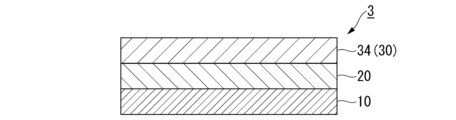
- the optical film has a transparent base material 20 located on one side of the colored layer 10, and the colored layer 10, the transparent base material 20, and the anti-glare layer 34 are laminated in this order.
- the optical film 3 may be used as an optical film 3.
- the antiglare layer 34 constitutes the functional layer 30.
- the functional layer 30 and the transparent base material 20 have a UV shielding property with a UV shielding rate of 85% or more. Since the optical film 3 of this embodiment has the anti-glare layer 34, the display quality is more excellent.
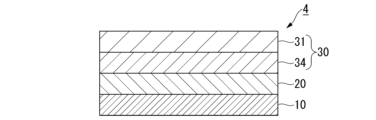
- the optical film has a transparent base material 20 located on one side of the colored layer 10, and the colored layer 10, the transparent base material 20, the anti-glare layer 34, and the low refractive index layer 31. , the optical film 4 may be laminated in this order.
- the anti-glare layer 34 and the low refractive index layer 31 constitute the functional layer 30.
- the functional layer 30 and the transparent base material 20 have a UV shielding property with a UV shielding rate of 85% or more. Since the optical film 4 of this embodiment has the low refractive index layer 31 and the anti-glare layer 34, the display quality is more excellent.
- the optical film has a transparent base material 20 located on one surface of the colored layer 10 and a functional layer 30 located on the other surface of the colored layer 10.
- the optical film 5 may have the colored layer 10, the hard coat layer 32, and the low refractive index layer 31 laminated in this order.
- the hard coat layer 32 and the low refractive index layer 31 constitute the functional layer 30 .
- the functional layer 30 has a UV shielding property with a UV shielding rate of 85% or more.
- the optical film 5 of this embodiment has the colored layer 10 and the functional layer 30 on one side of the transparent base material 20, and therefore has better display quality.
- the optical film has a transparent base material 20 located on one surface of the colored layer 10 and a functional layer 30 located on the other surface of the colored layer 10.
- the optical film 6 may have the colored layer 10, the oxygen barrier layer 33, the hard coat layer 32, and the low refractive index layer 31 laminated in this order.
- the oxygen barrier layer 33 , the hard coat layer 32 , and the low refractive index layer 31 constitute the functional layer 30 .
- the functional layer 30 has a UV shielding property with a UV shielding rate of 85% or more. Since the optical film 6 of this embodiment has the oxygen barrier layer 33, it has better oxygen barrier properties than the optical film 5.
- the optical film has a transparent base material 20 located on one surface of the colored layer 10 and a functional layer 30 located on the other surface of the colored layer 10.
- the optical film 7 may have the colored layer 10 and the anti-glare layer 34 laminated in this order.
- the antiglare layer 34 constitutes the functional layer 30 .
- the functional layer 30 has a UV shielding property with a UV shielding rate of 85% or more. Since the optical film 7 of this embodiment has the anti-glare layer 34, the display quality is more excellent.
- the optical film has a transparent base material 20 located on one surface of the colored layer 10 and a functional layer 30 located on the other surface of the colored layer 10.
- the optical film 8 may have the colored layer 10, the anti-glare layer 34, and the low refractive index layer 31 laminated in this order.
- the antiglare layer 34 and the low refractive index layer 31 constitute the functional layer 30 .
- the functional layer 30 has a UV shielding property with a UV shielding rate of 85% or more. Since the optical film 8 of this embodiment has the low refractive index layer 31 and the anti-glare layer 34, the display quality is more excellent.
- the embodiments of the optical film of the present invention have been described in detail with reference to the drawings, but the specific configuration is not limited to these embodiments, and the configuration may be changed without departing from the gist of the present invention. Also includes combinations.
- the optical film of the above embodiment has one colored layer 10, the number of colored layers may be two or more.
- the ultraviolet absorbing ability may be imparted to the transparent base material 20 or to the functional layer 30 such as the hard coat layer 32.
- the optical film of this embodiment includes a colored layer having a maximum absorption wavelength within the range of 480 to 500 nm. Therefore, light with a wavelength of around 500 nm can be selectively and efficiently absorbed. As a result, even if the optical film is thin or has a low coloring material concentration, it can sufficiently absorb light with a wavelength of around 500 nm.
- the measured value and the calculated value of the maximum absorption wavelength of the coloring material contained in the colored layer in the acetone solution match with high accuracy. Therefore, the structure of the coloring material can be designed to enable wavelength control, and the reliability of the optical film can be further improved. Therefore, according to the optical film of the present invention, it is possible to achieve lower reflectance, higher brightness, thinner film, and improved color reproducibility of a display device.
- a display device of the present invention includes the optical film of the embodiment described above.
- Specific examples of display devices include televisions, monitors, mobile phones, portable game devices, personal digital assistants, personal computers, electronic books, video cameras, digital still cameras, head-mounted displays, navigation systems, and sound playback devices ( (car audio, digital audio player, etc.), copying machines, facsimile machines, printers, multifunction printers, vending machines, automatic teller machines (ATMs), personal authentication devices, optical communication devices, and IC cards.
- the present invention is highly useful in cases where metal electrodes and wiring are easily affected by reflection of external light. Therefore, a display device including the optical film of the embodiment described above can be suitably used as a display device including a self-luminous element such as an LED, an organic EL, an inorganic phosphor, and a quantum dot.
- Tinuvin249 radical scavenger, hindered amine light stabilizer (HALS) (manufactured by BASF Japan, molecular weight 482).
- D1781 Singlet oxygen quencher, bis(dibutyldithiocarbamic acid) nickel (II), product code D1781 (manufactured by Tokyo Chemical Industry Co., Ltd.).
- Dipyrromethene cobalt complex 0.4% by mass based on the solid content of the coating liquid.
- Photopolymerizable compound (B) 94% by mass based on the solid content of the coating liquid.
- Photopolymerization initiator (C) 3% by mass based on the solid content of the coating liquid.
- Non-polymerizable additive (D) 2.6% by mass based on the solid content of the coating liquid.
- Solvent (E) 70% by mass based on the total mass of the coating liquid.
- the above coating liquid was spin-coated onto a glass substrate and dried in an oven at 80° C. for 60 seconds. Thereafter, the coating film was cured by irradiating ultraviolet rays with an irradiation dose of 150 mJ/cm 2 (manufactured by Fusion UV Systems Japan Co., Ltd., Light Source H Bulb) using an ultraviolet irradiation device, and the coating film had a film thickness of 5.0 ⁇ m after curing. A film (cured film) was formed.
- ⁇ Maximum absorption wavelength of acetone solution ( ⁇ max : actual value y)>
- An acetone solution of the dipyrromethene cobalt complex of each example with a concentration of 5.0 ⁇ 10 -6 M was prepared, and the absorption spectrum was measured using an ultraviolet-visible spectrophotometer (manufactured by Hitachi, Ltd., U-4100).
- the wavelength at which the absorbance is maximum in the wavelength range of 470 to 530 nm was defined as ⁇ max (actual value y (nm)). The results are shown in Table 2.
- ⁇ Molar extinction coefficient ( ⁇ ) of acetone solution> Regarding the dipyrromethene cobalt complex of each example, three acetone solutions with different concentrations (concentration 5.0 ⁇ 10 -6 M, concentration 7.5 ⁇ 10 -6 M, concentration 1.0 ⁇ 10 -5 M) were prepared. was prepared, and the absorption spectrum was measured using an ultraviolet-visible spectrophotometer (manufactured by Hitachi, Ltd., U-4100). In this absorption spectrum, the slope of the approximate straight line when the absorbance at the maximum absorption wavelength ( ⁇ max ) in the wavelength range of 470 to 530 nm was plotted for each concentration was defined as ⁇ (L/(mol ⁇ cm)). The results are shown in Table 2.
- ⁇ Maximum absorption wavelength of coating film ( ⁇ max )>
- the absorption spectrum of the coating film of each example was measured using a UV-visible spectrophotometer (manufactured by Hitachi, Ltd., U-4100), and the wavelength at which the absorbance was maximum in the wavelength range of 470 to 530 nm was determined as ⁇ max (nm ). The results are shown in Table 2.
- the transmittance of the evaluation board was measured using a UV-visible spectrophotometer (manufactured by Hitachi, Ltd., U-4100), and the transmittance of the evaluation board was measured using an organic EL display device (manufactured by ASUS, Ltd.) shown in FIG. ) was multiplied by the individual spectra at the time of white display to calculate the spectra after passing through the evaluation board.
- Calculate the Y value by multiplying the spectrum of the organic EL display device alone when displaying white and the spectrum after passing through the evaluation board by the relative luminous efficiency, and calculate the spectrum of the display device alone when displaying white.
- the white luminance efficiency was defined as the ratio when the Y value obtained from 100 was used as an index for reliability evaluation. The closer the White luminance efficiency is to 100, the better the luminance efficiency is. The results are shown in Table 2.
- the transmittance of the evaluation board was measured using a UV-visible spectrophotometer (manufactured by Hitachi, Ltd., U-4100), and the transmittance of the evaluation board was measured using an organic EL display device (manufactured by ASUS, Inc.) shown in FIG. ) by multiplying the individual spectra during red display, green display, and blue display to obtain the red, green, and blue single colors of the CIE (Commission international de l'eclairage) 1931 color system after passing through the evaluation board. The chromaticity (x, y) of was calculated.
- a coating film using the composition for a colored layer of the present invention is effective in reducing reflectance, increasing brightness, making a thin film, and improving color reproducibility of display devices, enables wavelength control, and has excellent reliability. That's what I found out. Being able to keep the concentration of the dipyrromethene metal complex in the coating film low is also useful in terms of manufacturing costs.
Landscapes
- Chemical & Material Sciences (AREA)
- Organic Chemistry (AREA)
- Physics & Mathematics (AREA)
- Chemical Kinetics & Catalysis (AREA)
- Health & Medical Sciences (AREA)
- Medicinal Chemistry (AREA)
- Polymers & Plastics (AREA)
- General Physics & Mathematics (AREA)
- Optics & Photonics (AREA)
- Optical Filters (AREA)
- Laminated Bodies (AREA)
Priority Applications (1)
| Application Number | Priority Date | Filing Date | Title |
|---|---|---|---|
| JP2024524235A JPWO2023233864A1 (https=) | 2022-05-30 | 2023-04-24 |
Applications Claiming Priority (2)
| Application Number | Priority Date | Filing Date | Title |
|---|---|---|---|
| JP2022087770 | 2022-05-30 | ||
| JP2022-087770 | 2022-05-30 |
Publications (1)
| Publication Number | Publication Date |
|---|---|
| WO2023233864A1 true WO2023233864A1 (ja) | 2023-12-07 |
Family
ID=89026239
Family Applications (1)
| Application Number | Title | Priority Date | Filing Date |
|---|---|---|---|
| PCT/JP2023/016111 Ceased WO2023233864A1 (ja) | 2022-05-30 | 2023-04-24 | 光学フィルム、着色層形成用組成物、ジピロメテンコバルト錯体及び表示装置 |
Country Status (3)
| Country | Link |
|---|---|
| JP (1) | JPWO2023233864A1 (https=) |
| TW (1) | TW202404989A (https=) |
| WO (1) | WO2023233864A1 (https=) |
Citations (4)
| Publication number | Priority date | Publication date | Assignee | Title |
|---|---|---|---|---|
| JPH10226172A (ja) * | 1996-07-29 | 1998-08-25 | Mitsui Chem Inc | 光記録媒体 |
| WO2021044802A1 (ja) * | 2019-09-04 | 2021-03-11 | 株式会社Adeka | 組成物、硬化物、光学フィルタ及び硬化物の製造方法 |
| JP2021038177A (ja) * | 2019-09-04 | 2021-03-11 | 山田化学工業株式会社 | 金属錯体化合物及び光学フィルタ |
| WO2021177748A1 (ko) * | 2020-03-04 | 2021-09-10 | 주식회사 엘지화학 | 화합물 및 이를 포함하는 광학 필름 |
-
2023
- 2023-04-24 JP JP2024524235A patent/JPWO2023233864A1/ja active Pending
- 2023-04-24 WO PCT/JP2023/016111 patent/WO2023233864A1/ja not_active Ceased
- 2023-05-29 TW TW112119852A patent/TW202404989A/zh unknown
Patent Citations (4)
| Publication number | Priority date | Publication date | Assignee | Title |
|---|---|---|---|---|
| JPH10226172A (ja) * | 1996-07-29 | 1998-08-25 | Mitsui Chem Inc | 光記録媒体 |
| WO2021044802A1 (ja) * | 2019-09-04 | 2021-03-11 | 株式会社Adeka | 組成物、硬化物、光学フィルタ及び硬化物の製造方法 |
| JP2021038177A (ja) * | 2019-09-04 | 2021-03-11 | 山田化学工業株式会社 | 金属錯体化合物及び光学フィルタ |
| WO2021177748A1 (ko) * | 2020-03-04 | 2021-09-10 | 주식회사 엘지화학 | 화합물 및 이를 포함하는 광학 필름 |
Non-Patent Citations (1)
| Title |
|---|
| FERGUSSON, J. E. ET AL.: "Dipyrromethene Complexes of Transition Metals. Part I. Tetrahedral Complexes of Cobalt(II), Nickel(II), Copper(II), and Zinc(II", JOURNAL OF THE CHEMICAL SOCIETY, 1965, pages 5222 - 5225, XP093078046, DOI: 10.1039/JR9650005222 * |
Also Published As
| Publication number | Publication date |
|---|---|
| TW202404989A (zh) | 2024-02-01 |
| JPWO2023233864A1 (https=) | 2023-12-07 |
Similar Documents
| Publication | Publication Date | Title |
|---|---|---|
| US20250172723A1 (en) | Optical film and display device | |
| JP7207598B1 (ja) | 光学フィルムおよび表示装置 | |
| JP6996656B1 (ja) | 着色層形成用組成物、光学フィルム及び表示装置 | |
| US20250089549A1 (en) | Optical film, composition for forming colored layer, dipyrromethene cobalt complex and display device | |
| JP7173394B1 (ja) | 光学フィルム、着色層形成用組成物、ジピロメテンコバルト錯体及び表示装置 | |
| JP7750110B2 (ja) | 着色層形成用組成物、光学フィルム及び表示装置 | |
| WO2023233864A1 (ja) | 光学フィルム、着色層形成用組成物、ジピロメテンコバルト錯体及び表示装置 | |
| JP2023175353A (ja) | 光学フィルム、着色層形成用組成物及び表示装置 | |
| JP7168051B1 (ja) | 着色層形成用組成物、光学フィルム及び表示装置 | |
| JP2023175349A (ja) | 光学フィルム、着色層形成用組成物、ジピロメテンコバルト錯体及び表示装置 | |
| JP2024072522A (ja) | 着色層形成用組成物、光学フィルム及び表示装置 | |
| CN117795385A (zh) | 着色层形成用组合物、光学膜以及显示装置 | |
| JP2023032001A (ja) | 着色層形成用組成物、光学フィルム及び表示装置 | |
| JP7103544B1 (ja) | 着色層形成用組成物、光学フィルム、および表示装置 | |
| US20240199889A1 (en) | Composition for forming colored layer, optical film, and display device | |
| JP7732614B1 (ja) | 光学フィルムおよび表示装置 | |
| JP2024013386A (ja) | 光学フィルムおよび表示装置 | |
| WO2026018752A1 (ja) | 着色層形成用組成物、光学フィルム及び表示装置 | |
| JP2024074549A (ja) | 光学フィルムおよび表示装置 | |
| WO2025263433A1 (ja) | 着色層形成用組成物、その製造方法、光学フィルムおよび表示装置 | |
| WO2024225226A1 (ja) | 光学フィルム、表示装置、および紫外線吸収層形成用組成物 | |
| TW202608299A (zh) | 著色層形成用組成物、其製造方法、光學薄膜及顯示裝置 |
Legal Events
| Date | Code | Title | Description |
|---|---|---|---|
| 121 | Ep: the epo has been informed by wipo that ep was designated in this application |
Ref document number: 23815625 Country of ref document: EP Kind code of ref document: A1 |
|
| ENP | Entry into the national phase |
Ref document number: 2024524235 Country of ref document: JP Kind code of ref document: A |
|
| NENP | Non-entry into the national phase |
Ref country code: DE |
|
| 122 | Ep: pct application non-entry in european phase |
Ref document number: 23815625 Country of ref document: EP Kind code of ref document: A1 |