WO2023229338A1 - 보디피 화합물 및 이를 포함하는 세포 소기관의 온도 감응용 형광 센서 - Google Patents
보디피 화합물 및 이를 포함하는 세포 소기관의 온도 감응용 형광 센서 Download PDFInfo
- Publication number
- WO2023229338A1 WO2023229338A1 PCT/KR2023/006990 KR2023006990W WO2023229338A1 WO 2023229338 A1 WO2023229338 A1 WO 2023229338A1 KR 2023006990 W KR2023006990 W KR 2023006990W WO 2023229338 A1 WO2023229338 A1 WO 2023229338A1
- Authority
- WO
- WIPO (PCT)
- Prior art keywords
- formula
- alkylene
- compound
- aryl
- alkyl
- Prior art date
- Legal status (The legal status is an assumption and is not a legal conclusion. Google has not performed a legal analysis and makes no representation as to the accuracy of the status listed.)
- Ceased
Links
Images
Classifications
-
- C—CHEMISTRY; METALLURGY
- C07—ORGANIC CHEMISTRY
- C07F—ACYCLIC, CARBOCYCLIC OR HETEROCYCLIC COMPOUNDS CONTAINING ELEMENTS OTHER THAN CARBON, HYDROGEN, HALOGEN, OXYGEN, NITROGEN, SULFUR, SELENIUM OR TELLURIUM
- C07F5/00—Compounds containing elements of Groups 3 or 13 of the Periodic Table
- C07F5/02—Boron compounds
-
- G—PHYSICS
- G01—MEASURING; TESTING
- G01K—MEASURING TEMPERATURE; MEASURING QUANTITY OF HEAT; THERMALLY-SENSITIVE ELEMENTS NOT OTHERWISE PROVIDED FOR
- G01K11/00—Measuring temperature based upon physical or chemical changes not covered by groups G01K3/00, G01K5/00, G01K7/00 or G01K9/00
- G01K11/12—Measuring temperature based upon physical or chemical changes not covered by groups G01K3/00, G01K5/00, G01K7/00 or G01K9/00 using changes in colour, translucency or reflectance
- G01K11/16—Measuring temperature based upon physical or chemical changes not covered by groups G01K3/00, G01K5/00, G01K7/00 or G01K9/00 using changes in colour, translucency or reflectance of organic materials
-
- G—PHYSICS
- G01—MEASURING; TESTING
- G01K—MEASURING TEMPERATURE; MEASURING QUANTITY OF HEAT; THERMALLY-SENSITIVE ELEMENTS NOT OTHERWISE PROVIDED FOR
- G01K11/00—Measuring temperature based upon physical or chemical changes not covered by groups G01K3/00, G01K5/00, G01K7/00 or G01K9/00
- G01K11/20—Measuring temperature based upon physical or chemical changes not covered by groups G01K3/00, G01K5/00, G01K7/00 or G01K9/00 using thermoluminescent materials
Definitions
- the present disclosure relates to a temperature-sensitive fluorescent sensor of a bodifi compound and a cell organelle containing the same.
- Intracellular temperature is closely related to cellular processes such as cell proliferation, metabolism, differentiation, and proliferation, and mapping the microscopic temperature of various cellular organelles for each organelle is very important in understanding various biological phenomena.
- thermometers Accordingly, various types of thermometers have been developed to investigate intracellular temperature, and among these, fluorescence thermometers using fluorescent substances that show changes in fluorescence signals such as fluorescence intensity, anisotropy, and lifetime depending on temperature are receiving attention. Fluorescent thermometers have excellent sensitivity to temperature changes, allowing them to detect minute temperature changes, and have the advantage of being able to distribute evenly to all types of cells derived from various species.
- organelle-specific thermometers In order to detect subtle temperature changes in different cell organelles, the development of organelle-specific thermometers is essential, but the fluorescence thermometers developed to date do not have organelle specificity or only one or two types of organelles, such as the endoplasmic reticulum (ER) or mitochondria. It can only be applied to cell organelles, and if it is attempted to provide specificity for various cell organelles, there are limitations such as decreased sensitivity or deteriorated cytotoxicity.
- ER endoplasmic reticulum
- One aspect of the present invention provides a novel structural BODIPY compound and a fluorescent sensor capable of detecting temperature for each cell organelle containing the same.
- Another aspect provides a method for measuring the temperature of a cell organelle using the fluorescence sensor.
- One aspect of the present invention provides a compound represented by the following formula (1).
- R 1 and R 2 are each independently (C1-C7)alkyl
- R 3 to R 5 are each independently hydrogen, (C1-C7)alkyl, or (C6-C12)aryl;
- L 2 is a single bond, (C1-C30)alkylene or (C1-C30)heteroalkylene;
- the alkylene and heteroalkylene of L 2 may be further substituted with a hydroxy group
- A is (C2-C30)alkyl, (C2-C30)alkenyl, (C6-C30)aryl, (C1-C7)alkyl(C6-C30)aryl, (C2-C30)heteroaryl, (C2-C30) heterocycloalkyl, , or ego;
- L 3 and L 4 are each independently (C2-C30)alkenylene, (C6-C30)arylene, or (C2-C30)heteroarylene;
- Ar 1 is (C6-C30)aryl, (C1-C7)alkoxy(C6-C30)aryl, (C2-C30)heteroaryl, (C3-C30)cycloalkyl or (C2-C30)heterocycloalkyl;
- Ar 2 is (C6-C30)aryl or (C2-C30)heteroaryl;
- R 6 and R 7 are each independently hydrogen, (C1-C20)alkyl, (C6-C20)aryl or ego;
- Ar 3 is (C6-C30)arylene or (C2-C30)heteroarylene;
- r and s are each independently integers from 1 to 5.
- A is (C2-C20)alkyl, (C2-C20)alkenyl, (C1-C7)alkyl (C6-C20)aryl, (C2-C20)heterocycloalkyl, , or ego;
- L 3 is (C6-C20)arylene or (C2-C20)heteroarylene;
- L 4 is (C2-C20)alkenylene or (C2-C20)heteroarylene;
- Ar 1 is (C1-C7)alkoxy(C6-C20)aryl or (C2-C20)heterocycloalkyl;
- Ar 2 is (C6-C20)aryl;
- Ar 3 is (C2-C20)heteroarylene;
- r and s may each independently be integers from 1 to 5.
- the compound according to one aspect may be represented by any one of the following formulas 2 to 7.
- R 1 and R 2 are each independently (C1-C7)alkyl
- R 11 is (C2-C20)alkyl, (C2-C20)alkenyl, (C6-C20)aryl or (C1-C7)alkyl(C6-C20)aryl;
- L 2 is a single bond, (C1-C20)alkylene or (C1-C20)heteroalkylene;
- the alkylene and heteroalkylene of L 2 may be further substituted with a hydroxy group.
- L 2 is a single bond, (C1-C10)alkylene, or ego;
- L 11 and L 12 are each independently (C1-C10)alkylene;
- L 13 is a single bond, (C1-C10)alkylene or ego;
- L 14 is (C1-C10)alkylene;
- L 2 And the alkylene of L 11 to L 13 may be further substituted with a hydroxy group;
- p and q are each independently integers of 0 or 1, and at least one of p and q may be 1.
- the compound according to one aspect may be represented by one of the following formulas 11 to 18.
- R 21 is (C2-C10)alkyl or ego
- L 21 is (C1-C4)alkylene or ego
- L 22 is a single bond or ego
- L 31 to L 33 are each independently (C1-C4) alkylene.
- the compound according to one aspect may be selected from the structures below.
- the compound according to one aspect may be characterized as targeting different cell organelles.
- the compound according to one embodiment is endoplasmic reticulum, lipid droplet, Golgi apparature, mitochondria, lysosome, nucleus, nucleolus and plasma membrane. ) may be targeting cellular organelles including.
- one aspect of the present invention provides a fluorescent sensor for temperature sensitivity of cellular organelles containing a compound represented by the following formula (1).
- R 1 , R 2 , L 1 , L 2 and A are the same as the above definitions.
- the cell organelles include the endoplasmic reticulum, lipid droplet, golgi apparatus, mitochondria, lysosome, nucleus, nucleolus, and plasma membrane. It may be.
- one aspect of the present invention provides a method for measuring the temperature of a cell organelle using the fluorescence sensor.
- a method of measuring the temperature of the cell organelle includes contacting the cell with a fluorescent sensor to stain the cell; Analyzing the fluorescence lifetime of the stained cells; and calculating the temperature of the cell organelle according to the analyzed fluorescence lifetime.
- the Bodifi compound according to one aspect can quickly detect minute temperature changes with high sensitivity.
- the Bodifi compound can accurately target each cell organelle, including the endoplasmic reticulum and mitochondria, as well as lipid droplets, Golgi apparatus, lysosomes, nuclei, nucleoli, and cell membranes, and is non-cytotoxic.
- the Bodifi compound according to one aspect can visualize subtle temperature changes for each cell organelle, and is expected to be useful as a temperature-sensitive fluorescent sensor for cell organelles.
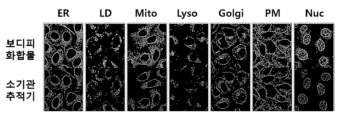
- Figure 1 shows the results of evaluating the organelle-specificity of the Bodifi compounds prepared in Examples 1 to 7.
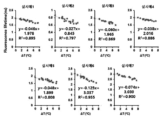
- Figure 2 is a graph showing the fluorescence lifetime of the Bodifi compounds prepared in Examples 1 to 7 according to temperature.
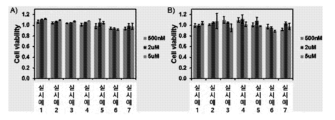
- Figure 3 shows the cell viability test results of the Bodifi compounds prepared in Examples 1 to 7.
- the numerical range used in this specification includes the lower limit and upper limit and all values within the range, increments logically derived from the shape and width of the defined range, all double-defined values, and the upper limit of the numerical range defined in different forms. and all possible combinations of the lower bounds. Unless otherwise specified herein, values outside the numerical range that may occur due to experimental error or rounding of values are also included in the defined numerical range.
- heteroalkylene refers to a radical having two bonding sites derived from heteroalkyl, and hetero means that carbon is one or more atoms selected from B, O, N, P, S, and Si atoms. It means substituted with a hetero atom.
- alkylaryl refers to an aryl radical substituted with at least one alkyl, and examples include, but are not limited to, tolyl, mesityl, etc.
- alkoxyaryl refers to an aryl radical substituted with at least one alkoxy.
- Bodifi compound capable of visualizing subtle temperature changes for each cell organelle
- the Bodip compound can be represented by the following formula (1).
- R 1 and R 2 are each independently (C1-C7)alkyl
- R 3 to R 5 are each independently hydrogen, (C1-C7)alkyl, or (C6-C12)aryl;
- L 2 is a single bond, (C1-C30)alkylene or (C1-C30)heteroalkylene;
- the alkylene and heteroalkylene of L 2 may be further substituted with a hydroxy group
- A is (C2-C30)alkyl, (C2-C30)alkenyl, (C6-C30)aryl, (C1-C7)alkyl(C6-C30)aryl, (C2-C30)heteroaryl, (C2-C30) heterocycloalkyl, , or ego;
- L 3 and L 4 are each independently (C2-C30)alkenylene, (C6-C30)arylene, or (C2-C30)heteroarylene;
- Ar 1 is (C6-C30)aryl, (C1-C7)alkoxy(C6-C30)aryl, (C2-C30)heteroaryl, (C3-C30)cycloalkyl or (C2-C30)heterocycloalkyl;
- Ar 2 is (C6-C30)aryl or (C2-C30)heteroaryl;
- R 6 and R 7 are each independently hydrogen, (C1-C20)alkyl, (C6-C20)aryl or ego;
- Ar 3 is (C6-C30)arylene or (C2-C30)heteroarylene;
- r and s are each independently integers from 1 to 5.
- R 1 and R 2 may each independently be (C1-C5) alkyl, (C1-C3) alkyl, (C1-C2) alkyl, or -CH 3 , and R 1 and R 2 are the same as each other. can do.
- the compound according to one aspect has the structural features described above, for example, a BodiP core structure in which alkyl groups (R 1 and R 2 ) are asymmetrically substituted, and a phenylene group directly connected to the BodiP core structure. Accordingly, sensitivity to temperature can be very excellent. For example, if it has a symmetrical body core or does not contain a phenylene linkage, the change in fluorescence lifetime depending on temperature is not significant, making temperature detection difficult.
- the Bodifi compound according to one embodiment can accurately target each cellular organelle, such as the endoplasmic reticulum, mitochondria, lipid droplets, Golgi apparatus, lysosomes, nucleus, nucleolus, and cell membrane, depending on the structure of the A substituent in Formula 1.
- each cellular organelle such as the endoplasmic reticulum, mitochondria, lipid droplets, Golgi apparatus, lysosomes, nucleus, nucleolus, and cell membrane, depending on the structure of the A substituent in Formula 1.
- A is (C2-C20)alkyl, (C2-C20)alkenyl, (C1-C7)alkyl (C6-C20)aryl, (C2-C20)heterocycloalkyl, , or may be; where L 3 is (C6-C20)arylene or (C2-C20)heteroarylene; L 4 is (C2-C20)alkenylene or (C2-C20)heteroarylene; Ar 1 is (C1-C7)alkoxy(C6-C20)aryl or (C2-C20)heterocycloalkyl; Ar 2 is (C6-C20)aryl; Ar 3 is (C2-C20)heteroarylene; r and s may each independently be integers from 1 to 5.
- L 3 is (C6-C12)arylene, phenylene, or (C2-C12)heteroarylene
- L 4 is (C2-C10)alkenylene, (C2-C7)alkenylene, (C2-C5)alkenylene, ethenylene or (C2-C20)heteroarylene
- Ar 1 is (C1-C3)alkoxy(C6-C12)aryl or (C2-C12)heterocycloalkyl
- Ar 2 is (C6-C12)aryl or phenyl
- Ar 3 may be (C2-C12)heteroarylene, or (C2-C6)heteroarylene.
- Bodifi compound according to one aspect may be represented by any one of the following formulas 2 to 7.
- R 1 and R 2 are each independently (C1-C7)alkyl
- R 11 is (C2-C20)alkyl, (C2-C20)alkenyl, (C6-C20)aryl or (C1-C7)alkyl(C6-C20)aryl;
- L 2 is a single bond, (C1-C20)alkylene or (C1-C20)heteroalkylene;
- the alkylene and heteroalkylene of L 2 may be further substituted with a hydroxy group.
- R 1 and R 2 may each independently be (C1-C5) alkyl, (C1-C3) alkyl, (C1-C2) alkyl, or -CH 3 , and R 1 and R 2 are the same as each other. can do.
- R 11 may be (C2-C10)alkyl, (C2-C15)alkenyl, or (C1-C3)alkyl(C6-C12)aryl.
- L 2 is a single bond, (C1-C10)alkylene, or ego; where L 11 and L 12 are each independently (C1-C10)alkylene; L 13 is a single bond, (C1-C10)alkylene or ego; L 14 is (C1-C10)alkylene; L 2 And the alkylene of L 11 to L 13 may be further substituted with a hydroxy group; p and q are each independently integers of 0 or 1, and at least one of p and q may be 1.
- L 2 is a single bond, (C1-C10)alkylene, (C1-C7)alkylene, (C1-C4)alkylene, , , or ego;
- L 40 to L 43 are each independently (C1-C10)alkylene, (C1-C7)alkylene, or (C1-C4)alkylene;
- L 44 is (C1-C10)alkylene, (C1-C7)alkylene, (C1-C4)alkylene, or ego;
- L 45 is (C1-C10)alkylene, (C1-C7)alkylene, or (C1-C4)alkylene.
- the Bodifi compounds represented by Formulas 2 to 7 may be characterized in that they target different cell organelles. Specifically, the Bodifi compounds represented by Formula 2 target the endoplasmic reticulum (ER) according to R 11 , can target lipid droplet (LD) or Golgi apparatus (golgi apparature, Golgi), the Bodifi compound represented by Formula 3 is mitochondria (mitochondria, Mito), the Bodip compound represented by Formula 4 is Lysosome (Lyso), the compound represented by Formula 5 is the nucleus (Nuc), the compound represented by Formula 6 is the nucleolus, and the compound represented by Formula 7 is the plasma membrane (PM) can be targeted accurately.
- LD lipid droplet
- Golgi apparatus golgi apparature, Golgi
- the Bodifi compound represented by Formula 3 is mitochondria (mitochondria, Mito)
- the Bodip compound represented by Formula 4 is Lysosome (Lyso)
- the bodifi compound represented by Formula 2 can target the Golgi apparatus when R 11 is (C2-C20) alkenyl, and when R 11 is (C2-C20) alkyl, the endoplasmic reticulum or lipid droplet, the R 11 If it is (C6-C20)aryl or (C1-C7)alkyl(C6-C20)aryl, it can target the endoplasmic reticulum.
- the Bodip compound where R 11 is (C2-C4) alkyl can target the endoplasmic reticulum, and the Bodip compound where R 11 is (C5-C20) alkyl can target lipid droplets.
- Bodifi compound according to one aspect may be represented by one of the following formulas 11 to 18.
- R 21 is (C2-C10)alkyl or ego
- L 21 is (C1-C4)alkylene or ego
- L 22 is a single bond or ego
- L 31 to L 33 are each independently (C1-C4) alkylene.
- the Bodifi compounds represented by Formulas 11 to 18 may be characterized in that they target different cellular organelles. Specifically, the Bodifi compounds represented by Formula 11 target the endoplasmic reticulum or lipids according to R 21 Can target droplets, the BodiP compound represented by Formula 12 is the endoplasmic reticulum, the BodiP compound represented by Formula 13 is the Golgi apparatus, the BodiP compound represented by Formula 14 is the mitochondria, and the BodiP compound represented by Formula 15 is the The compound represented by Formula 16 can accurately target the lysosome, the BodiP compound represented by Formula 16 can accurately target the nucleus, the BodiP compound represented by Formula 17 can accurately target the nucleolus, and the compound represented by Formula 18 can accurately target the cell membrane.
- the Bodifi compounds represented by Formula 11 target the endoplasmic reticulum or lipids according to R 21 Can target droplets
- the BodiP compound represented by Formula 12 is the endoplasmic reticulum
- the bodifi compound represented by Formula 11 is R 21 is (C2-C4) alkyl or In this case, it can target the endoplasmic reticulum, and if R 21 is (C5-C20) alkyl, it can target lipid droplets.
- Bodifi compound according to one aspect may be selected from the following structures, but is not limited thereto.
- one aspect provides a fluorescent sensor for temperature sensitivity of cellular organelles including a compound represented by the following formula (1).
- R 1 , R 2 , L 1 , L 2 and A are the same as defined in Formula 1 above.
- the compound according to one aspect shows a decrease in fluorescence lifetime as temperature increases, and shows a change in fluorescence lifetime even with slight temperature changes, so it can be used as a fluorescence sensor that can quickly detect temperature changes with high sensitivity.
- the compound according to one aspect can accurately target different cellular organelles depending on the structure of the A substituent, and the organelles include the endoplasmic reticulum, lipid droplet, Golgi apparatus, and mitochondria. It may include mitochondria, lysosome, nucleus, nucleolus, and plasma membrane.
- the compound according to one aspect can visualize subtle temperature changes for each cell organelle and can be used as a temperature-sensitive fluorescent sensor of the cell organelle.
- the compound according to one aspect can detect temperature changes in two or more organelles at a time by simultaneously treating cells with two or more Bodifi compounds of different structures.
- one aspect provides a method of measuring the temperature of a cell organelle using the fluorescence sensor.
- the method includes staining the cells by contacting a fluorescent sensor with the cells; Analyzing the fluorescence lifetime of the stained cells; And calculating the temperature of the cell organelle according to the analyzed fluorescence lifetime.
- the temperature of the organelle can be calculated from a calibration curve of the fluorescence lifetime of the fluorescent sensor depending on temperature, and the calibration curve measures the fluorescence lifetime at the standard temperature of the cell in which the fluorescent sensor is stained, and changes from the standard temperature. It can be calculated by measuring the fluorescence lifetime according to temperature.
- the standard temperature may mean the temperature at which cells maintain homeostasis, or the optimal temperature at which cells can be maintained in a state suitable for survival. For example, in the case of the human body, it may be 36.5°C.
- BDN compounds are Angew. Chem. Int. Ed. 2013 , 52 , 8557-8560. It was prepared according to the method described in. BDN compound (48.2 ⁇ mol) was dissolved in 5 mL dichloromethane (DCM) and cooled to 0°C, and then propionyl chloride (144.6 ⁇ mol) and triethylamine (289.2 ⁇ mol) were added. The reaction was performed at 0°C for 10 minutes and at room temperature for 1 hour, concentrated under vacuum, and the compound of Example 1 (Bodifi Compound 1) was obtained through HPLC purification.
- DCM dichloromethane
- BDN compound (48.2 ⁇ mol) was dissolved in 5 mL dichloromethane (DCM) and cooled to 0°C, and then undecanoyl chloride (144.6 ⁇ mol) and triethylamine (289.2 ⁇ mol) were added. It was reacted at 0°C for 10 minutes and at room temperature for 1 hour, concentrated under vacuum, and then purified by HPLC to obtain the compound of Example 2 (Bodifi Compound 2) (21.1 mg, 91.3%).
- DCM dichloromethane
- BDN compound (100 mg, 321.4 ⁇ mol) was dissolved in 50 mL acetonitrile (ACN), and succinic anhydride (35.4 mg, 353.5 ⁇ mol) was added. The mixed solution was refluxed for 12 hours, concentrated under vacuum, and purified by HPLC to obtain BDN-COOH compound (126.1 mg, 92.0 %).
- D-sphingosine (7.3 mg, 24.3 ⁇ mol) was dissolved in 5 mL DMF, and a solution of HATU (11.1 mg, 29.2 ⁇ mol) and diethylisopropylamine (10.2 ⁇ l, 58.4 ⁇ mol) in 1 mL DMF was added. After reacting at room temperature for 12 hours and concentrating under vacuum, the compound of Example 5 (BODIP Compound 5) was obtained through HPLC purification (10.6 mg, 63.0 %).
- BDN-COOH compound (11.3 mg, 27.5 ⁇ mol), N-hydroxysuccinimide (4.7 mg, 41.2 ⁇ mol) and N-(3-dimethylaminopropyl)-N'-ethylcarbodiimide hydrochloride (7.9 mg, 41.2 ⁇ mol) was dissolved in 3mL DMF. After reacting at room temperature for 12 hours, crude BDN-COOH-NHS was obtained.
- Compound A4 is Nat. Commun. It was prepared according to the method described in 2015, 6, 8497. Compound A4 (18.3 mg, 30.7 ⁇ mol) was dissolved in 20% trifluoroacetic acid (TFA)/DCM solution and stirred at room temperature for 2 hours. Afterwards, the reaction solution was concentrated under vacuum, dissolved again in 1 mL DMF, and the crude BDN-COOH-NHS and diethyl isopropylamine (47.9 ⁇ l, 275 ⁇ mol) obtained above were added. After reacting at room temperature for 12 hours and concentrating under vacuum, the compound of Example 7 (BODIP Compound 7) was obtained through HPLC purification (10.6 mg, 43.3 %).
- TFA trifluoroacetic acid
- the compound of Comparative Example 1 was obtained in the same manner as Example 1, except that Compound C was used instead of the BDN compound.
- the compound C is manufactured by Spectrochim. It was prepared according to the method described in Acta, Part A 2004, 60A, 987.
- Compound Example 2 was obtained in the same manner as Comparative Example 1, except that Compound D was used instead of Compound C.
- HeLa cells and murine brown adipocytes were cultured in Dulbecco's modified eagle's medium (DMEM) supplemented with fetal bovine serum (10%) and penicillin-streptomycin, respectively. and cultured in a 3.5cm glass-based dish at 37°C and 5% CO 2 conditions.
- DMEM Dulbecco's modified eagle's medium
- nM of the Bodifi compounds of Examples 1 and 3 to 7 and 500 nM of the corresponding organelle trackers were added to DMEM (HeLa cells), Cells were stained by culturing for 30 minutes at 37°C and 5% CO 2 conditions.
- the BODIP compound of Example 1 is an endoplasmic reticulum (ER), the BODIP compound of Example 2 is a lipid droplet (LD), and the BODIP compound of Example 3 is a mitochondrial (Mito) compound. ; mitochondria), the BodiP compound of Example 4 is a lysosome (Lyso; lysosome), the BodiP compound of Example 5 is a Golgi apparatus (Golgi; golgi apparature), and the BodiP compound of Example 6 is a plasma membrane (PM). , it was confirmed that the bodifi compound of Example 7 can target the nucleus (Nuc).
- ER endoplasmic reticulum
- LD lipid droplet
- Mito mitochondrial
- mitochondria mitochondria
- the BodiP compound of Example 4 is a lysosome (Lyso; lysosome)
- the BodiP compound of Example 5 is a Golgi apparatus (Golgi; gol
- Bodifi compounds of Examples and Comparative Examples were added to DMEM (HeLa cells or brown adipocytes) at a final concentration of 500 nM, and incubated for 30 minutes at 37°C in 5% CO 2 conditions to stain the cells. Afterwards, graphite flake powder (98mm, M199.95, NSC), a photothermal material, was placed in the center of a glass dish, and an 808 nm laser was irradiated to the graphite flake to induce an increase in the temperature of the stained cells.
- DMEM HeLa cells or brown adipocytes
- the fluorescence lifetime of the BodiP compound of the example significantly decreases as the temperature increases, and it can be seen that the fluorescence lifetime of the BodiP compound of the example shows an inverse correlation with the increase in temperature.
- ROIs with higher temperatures showed lower lifespan values than those located further away from the graphite flakes.
- the Bodifi compound according to the present invention can be used to detect intracellular temperature gradients at the micro scale.
- Example One 2 3 4 5 6 7 temperature sensitivity (ps/°C) 46 27 60 38 48 74 125
- the Bodifi compound according to this separate product has a very high temperature sensitivity.
- the Bodifi compound according to one aspect can visualize subtle temperature changes for each cell organelle, and is expected to be useful as a temperature-sensitive fluorescent sensor for cell organelles.
- the temperature sensitivity of the BodiP compounds of Comparative Examples 1 and 2 was reduced compared to the BodiP compounds according to the Examples.
- the compounds of Comparative Examples 1 and 2 can target ER like the compound of Example 1 of the present invention, but have a symmetrical body core (Comparative Example 1) or do not contain a phenylene linkage. As a result (Comparative Example 2), it was confirmed that the temperature sensitivity was significantly reduced compared to Example 1.
Landscapes
- Physics & Mathematics (AREA)
- General Physics & Mathematics (AREA)
- Chemical & Material Sciences (AREA)
- Organic Chemistry (AREA)
- Measuring Or Testing Involving Enzymes Or Micro-Organisms (AREA)
Abstract
본 개시는 보디피 화합물 및 이를 포함하는 세포 소기관의 온도 감응용 형광 센서에 관한 것으로, 일 양태에 따른 보디피 화합물은 미세한 온도 변화를 높은 감도로 신속하게 감지할 수 있으며, 상기 보디피 화합물은 다양한 세포 소기관을 정확하게 표적 할 수 있을 뿐만 아니라 세포 독성이 없다. 즉, 일 양태에 따른 보디피 화합물은 세포 소기관 별로 온도를 시각화 할 수 있으며, 세포 소기관의 온도 감응 형광 센서로 유용하게 활용될 수 있을 것으로 기대된다.
Description
본 개시는 보디피 화합물 및 이를 포함하는 세포 소기관의 온도 감응용 형광 센서에 관한 것이다.
세포 내 온도는 세포의 확산, 신진대사, 분화 및 증식 등 세포 과정과 밀접한 관련이 있으며, 다양한 세포 소기관의 미세 온도를 각 소기관 별로 매핑하는 것은 다양한 생물학적 현상을 이해하는 데 매우 중요하다.
이에 따라, 세포 내 온도를 조사하기 위한 다양한 유형의 온도계가 개발되어 왔으며, 이 중에서 온도에 따라 형광 강도, 이방성 및 수명과 같은 형광 신호의 변화를 나타내는 형광 물질을 이용하는 형광 온도계가 각광받고 있다. 형광 온도계는 온도 변화에 대한 감도가 우수하여 미세한 온도 변화를 감지할 수 있으며, 다양한 종에서 유래한 모든 유형의 세포에 고르게 분포할 수 있다는 장점이 있다.
각기 다른 세포 소기관의 미세한 온도 변화를 알기 위해선 세포 소기관별 온도계의 개발이 필수적이지만, 현재까지 개발된 형광 온도계는 세포 소기관 특이성(organelle specificity)를 가지지 못하거나 소포체(ER) 또는 미토콘드리아와 같은 한 두 종의 세포 소기관에만 적용할 수 있고, 다양한 세포 소기관에 대한 특이성을 부여하고자 하면 감도가 저하되거나 세포 독성이 열화되는 등의 한계가 있다.
본 발명의 일 양태는 신규한 구조의 보디피(BODIPY) 화합물 및 이를 포함하는 세포 소기관 별로 온도를 감지할 수 있는 형광 센서를 제공한다.
또 다른 양태는 상기 형광 센서를 이용하여 세포 소기관의 온도를 측정하는 방법을 제공한다.
본 발명의 일 양태는 하기 화학식 1로 표시되는 화합물을 제공한다.
[화학식 1]

상기 화학식 1에서,
R1 및 R2는 각각 독립적으로 (C1-C7)알킬이고;
L1은 -NR3C(=O)-, -C(=O)NR4- 또는 -NR5S(=O)2-이고;
R3 내지 R5는 각각 독립적으로 수소, (C1-C7)알킬 또는 (C6-C12)아릴이고;
L2는 단일결합, (C1-C30)알킬렌 또는 (C1-C30)헤테로알킬렌이고;
상기 L2의 알킬렌 및 헤테로알킬렌의 -CH2-는 -C(=O)- 및 -S(=O)2-에서 선택되는 하나 또는 둘 이상으로 대체될 수 있으며;
상기 L2의 알킬렌 및 헤테로알킬렌은 히드록시기로 더 치환될 수 있고;
A는 (C2-C30)알킬, (C2-C30)알케닐, (C6-C30)아릴, (C1-C7)알킬(C6-C30)아릴, (C2-C30)헤테로아릴, (C2-C30)헤테로시클로알킬,
 ,
 또는
 이고;
L3 및 L4는 각각 독립적으로 (C2-C30)알케닐렌, (C6-C30)아릴렌 또는 (C2-C30)헤테로아릴렌이고;
Ar1은 (C6-C30)아릴, (C1-C7)알콕시(C6-C30)아릴, (C2-C30)헤테로아릴, (C3-C30)시클로알킬 또는 (C2-C30)헤테로시클로알킬이고;
Ar2는 (C6-C30)아릴 또는 (C2-C30)헤테로아릴이고;
R6 및 R7는 각각 독립적으로 수소, (C1-C20)알킬, (C6-C20)아릴 또는  이고;
Ar3는 (C6-C30)아릴렌 또는 (C2-C30)헤테로아릴렌이고;
r 및 s는 각각 독립적으로 1 내지 5의 정수이다.
일 예로, 상기 A는 (C2-C20)알킬, (C2-C20)알케닐, (C1-C7)알킬(C6-C20)아릴, (C2-C20)헤테로시클로알킬,
 ,
 또는
 이고; L3는 (C6-C20)아릴렌 또는 (C2-C20)헤테로아릴렌이고; L4는 (C2-C20)알케닐렌 또는 (C2-C20)헤테로아릴렌이고; Ar1은 (C1-C7)알콕시(C6-C20)아릴 또는 (C2-C20)헤테로시클로알킬이고; Ar2는 (C6-C20)아릴이고; Ar3는 (C2-C20)헤테로아릴렌이고; r 및 s는 각각 독립적으로 1 내지 5의 정수일 수 있다.
일 양태에 따른 상기 화합물은 하기 화학식 2 내지 7 중 어느 하나로 표시되는 것일 수 있다.
[화학식 2]

[화학식 3]

[화학식 4]

[화학식 5]

[화학식 6]

[화학식 7]

상기 화학식 2 내지 7에서,
R1 및 R2는 각각 독립적으로 (C1-C7)알킬이고;
R11은 (C2-C20)알킬, (C2-C20)알케닐, (C6-C20)아릴 또는 (C1-C7)알킬(C6-C20)아릴이고;
L1은 -NHC(=O)-, -C(=O)NH- 또는 -NHS(=O)2-이고;
L2는 단일결합, (C1-C20)알킬렌 또는 (C1-C20)헤테로알킬렌이고;
상기 L2의 알킬렌 및 헤테로알킬렌의 -CH2-는 -C(=O)- 및 -S(=O)2-에서 선택되는 하나 또는 둘 이상으로 대체될 수 있으며;
상기 L2의 알킬렌 및 헤테로알킬렌은 히드록시기로 더 치환될 수 있다.
일 예로, 상기 L2는 단일결합, (C1-C10)알킬렌,  또는
 이고; L11 및 L12는 각각 독립적으로 (C1-C10)알킬렌이고; L13은 단일결합, (C1-C10)알킬렌 또는
 이고; L14는 (C1-C10)알킬렌이고; L2
및 L11 내지 L13의 알킬렌은 히드록시기로 더 치환될 수 있고; p 및 q는 각각 독립적으로 0 또는 1의 정수이며, p 및 q 중 적어도 하나는 1일 수 있다.
일 양태에 따른 상기 화합물은 하기 화학식 11 내지 18 중 하나로 표시되는 것일 수 있다.
[화학식 11]

[화학식 12]

[화학식 13]

[화학식 14]

[화학식 15]

[화학식 16]

[화학식 17]

[화학식 18]

상기 화학식 11 내지 18에서,
L1은 -NHC(=O)-, -C(=O)NH- 또는 -NHS(=O)2-이고;
R21은 (C2-C10)알킬 또는  이고;
L21은 (C1-C4)알킬렌 또는  이고;
L22는 단일결합 또는  이고;
L31 내지 L33은 각각 독립적으로 (C1-C4)알킬렌이다.
일 양태에 따른 상기 화합물은 하기 구조에서 선택되는 것일 수 있다.


일 양태에 따른 상기 화합물은 서로 다른 세포 소기관을 표적하는 것을 특징으로 할 수 있다.
일 양태에 따른 상기 화합물은 소포체(endoplasmic reticulum), 지질방울(lipid droplet), 골지체(golgi apparature), 미토콘드리아(mitochondria), 리소좀(lysosome), 핵(nucleus), 핵소체(nucleolus) 및 세포막(plasma membrane)을 포함하는 세포 소기관을 표적하는 것일 수 있다.
또한, 본 발명의 일 양태는 하기 화학식 1로 표시되는 화합물을 포함하는 세포 소기관의 온도 감응용 형광 센서를 제공한다.
[화학식 1]

상기 화학식 1에서,
R1, R2, L1, L2 및 A는 상기 정의와 동일하다.
상기 세포 소기관은 소포체(endoplasmic reticulum), 지질방울(lipid droplet), 골지체(golgi apparature), 미토콘드리아(mitochondria), 리소좀(lysosome), 핵(nucleus), 핵소체(nucleolus) 및 세포막(plasma membrane)을 포함하는 것일 수 있다.
또한, 본 발명의 일 양태는 상기 형광 센서를 이용하여 세포 소기관의 온도를 측정하는 방법을 제공한다.
일 양태에 다른 상기 세포 소기관의 온도를 측정하는 방법은, 형광 센서를 세포와 접촉시켜 세포를 염색시키는 단계; 상기 염색된 세포의 형광 수명을 분석하는 단계; 및 분석된 형광 수명에 따른 세포 소기관의 온도를 산출하는 단계;를 포함하는 것일 수 있다.
일 양태에 따른 보디피 화합물은 미세한 온도 변화를 높은 감도로 신속하게 감지할 수 있다. 또한, 상기 보디피 화합물은 소포체, 미토콘드리아 뿐만 아니라 지질방울, 골지체, 리소좀, 핵, 핵소체 및 세포막 등 각각의 세포 소기관을 정확하게 표적 할 수 있을 뿐만 아니라 세포 독성이 없다. 즉, 일 양태에 따른 보디피 화합물은 세포 소기관 별로 미세한 온도 변화를 시각화 할 수 있으며, 세포 소기관의 온도 감응 형광 센서로 유용하게 활용될 수 있을 것으로 기대된다.
도 1은 실시예 1 내지 7에서 제조된 보디피 화합물의 세포 소기관 특이성(organelle-specificity) 평가 결과이다.
도 2는 실시예 1 내지 7에서 제조된 보디피 화합물의 온도에 따른형광 수명을 도시한 그래프이다.
도 3은 실시예 1 내지 7에서 제조된 보디피 화합물의 세포 생존력 테스트 결과이다.
본 명세서에서 달리 정의되지 않는 한, 모든 기술적 용어 및 과학적 용어는 본 발명이 속하는 당업자에 의해 일반적으로 이해되는 의미와 동일한 의미를 갖는다. 본 명세서에서 설명에 사용되는 용어는 단지 특정 구체예를 효과적으로 기술하기 위함이고 본 발명을 제한하는 것으로 의도되지 않는다.
본 명세서에서 사용되는 단수 형태는 문맥에서 특별한 지시가 없는 한 복수 형태도 포함하는 것으로 의도할 수 있다.
또한, 본 명세서에서 사용되는 수치 범위는 하한치와 상한치와 그 범위 내에서의 모든 값, 정의되는 범위의 형태와 폭에서 논리적으로 유도되는 증분, 이중 한정된 모든 값 및 서로 다른 형태로 한정된 수치 범위의 상한 및 하한의 모든 가능한 조합을 포함한다. 본 명세서에서 특별한 정의가 없는 한 실험 오차 또는 값의 반올림으로 인해 발생할 가능성이 있는 수치범위 외의 값 역시 정의된 수치범위에 포함된다.
본 명세서의 용어, “포함한다”는 “구비한다”, “함유한다”, “가진다” 또는 “특징으로 한다” 등의 표현과 등가의 의미를 가지는 개방형 기재이며, 추가로 열거되어 있지 않은 요소, 재료 또는 공정을 배제하지 않는다.
본 명세서의 용어,“헤테로알킬렌”은 헤테로알킬로부터 유도되는 2개의 결합위치를 갖는 라디칼을 의미하며, 헤테로의 의미는 탄소가 B, O, N, P, S 및 Si원자로부터 선택되는 하나 이상의 헤테로 원자로 치환된 것을 의미한다.
본 명세서의 용어,“알킬아릴”은 적어도 하나의 알킬로 치환된 아릴 라디칼을 의미하며, 일 예로, 톨릴, 메시틸 등을 포함하지만, 이에 한정되지는 않는다.
본 명세서의 용어,“알콕시아릴”은 적어도 하나 이상의 알콕시로 치환된 아릴 라디칼을 의미한다.
일 양태는 세포 소기관 별로 미세한 온도 변화를 시각화 할 수 있는 보디피 화합물을 제공하며, 상기 보디피 화합물은 하기 화학식 1로 표시될 수 있다.
[화학식 1]

상기 화학식 1에서,
R1 및 R2는 각각 독립적으로 (C1-C7)알킬이고;
L1은 -NR3C(=O)-, -C(=O)NR4- 또는 -NR5S(=O)2-이고;
R3 내지 R5는 각각 독립적으로 수소, (C1-C7)알킬 또는 (C6-C12)아릴이고;
L2는 단일결합, (C1-C30)알킬렌 또는 (C1-C30)헤테로알킬렌이고;
상기 L2의 알킬렌 및 헤테로알킬렌의 -CH2-는 -C(=O)- 및 -S(=O)2-에서 선택되는 하나 또는 둘 이상으로 대체될 수 있으며;
상기 L2의 알킬렌 및 헤테로알킬렌은 히드록시기로 더 치환될 수 있고;
A는 (C2-C30)알킬, (C2-C30)알케닐, (C6-C30)아릴, (C1-C7)알킬(C6-C30)아릴, (C2-C30)헤테로아릴, (C2-C30)헤테로시클로알킬,  ,
 또는
 이고;
L3 및 L4는 각각 독립적으로 (C2-C30)알케닐렌, (C6-C30)아릴렌 또는 (C2-C30)헤테로아릴렌이고;
Ar1은 (C6-C30)아릴, (C1-C7)알콕시(C6-C30)아릴, (C2-C30)헤테로아릴, (C3-C30)시클로알킬 또는 (C2-C30)헤테로시클로알킬이고;
Ar2는 (C6-C30)아릴 또는 (C2-C30)헤테로아릴이고;
R6 및 R7는 각각 독립적으로 수소, (C1-C20)알킬, (C6-C20)아릴 또는  이고;
Ar3는 (C6-C30)아릴렌 또는 (C2-C30)헤테로아릴렌이고;
r 및 s는 각각 독립적으로 1 내지 5의 정수이다.
일 예로, 상기 R1 및 R2는 각각 독립적으로 (C1-C5)알킬, (C1-C3)알킬, (C1-C2)알킬 또는 -CH3일 수 있으며, 상기 R1 및 R2는 서로 동일할 수 있다.
일 예로, 상기 L2는 단일결합, (C1-C20)알킬렌 또는 (C1-C20)헤테로알킬렌이고; 상기 L2의 알킬렌 및 헤테로알킬렌의 -CH2-는 -C(=O)- 및 -S(=O)2-에서 선택되는 하나 또는 둘 이상으로 대체될 수 있으며; 상기 L2의 알킬렌 및 헤테로알킬렌은 히드록시기로 더 치환될 수 있다.
일 양태에 따른 상기 화합물은 상술한 바와 같은 구조적 특징, 예를 들어, 알킬기(R1 및 R2)가 비대칭적으로 치환된 보디피 모핵구조와 상기 보디피 모핵구조에 직접 연결된 페닐렌기를 가짐에 따라, 온도에 대한 감도가 매우 탁월할 수 있다. 일 예로, 대칭 구조의 보디피 모핵을 가지거나, 페닐렌 연결기를 포함하지 않을 경우 온도에 따른 형광 수명 변화가 현저하지 않아 온도 감지가 어려울 수 있다. 또한, 일 양태에 따른 보디피 화합물은 화학식 1의 A 치환기의 구조에 따라 소포체, 미토콘드리아, 지질방울, 골지체, 리소좀, 핵, 핵소체 및 세포막 등 각각의 세포 소기관을 정확하게 표적 할 수 있다.
일 예로, 상기 A는 (C2-C20)알킬, (C2-C20)알케닐, (C1-C7)알킬(C6-C20)아릴, (C2-C20)헤테로시클로알킬,  ,
 또는
 일 수 있으며; 여기서 L3는 (C6-C20)아릴렌 또는 (C2-C20)헤테로아릴렌이고; L4는 (C2-C20)알케닐렌 또는 (C2-C20)헤테로아릴렌이고; Ar1은 (C1-C7)알콕시(C6-C20)아릴 또는 (C2-C20)헤테로시클로알킬이고; Ar2는 (C6-C20)아릴이고; Ar3는 (C2-C20)헤테로아릴렌이고; r 및 s는 각각 독립적으로 1 내지 5의 정수일 수 있다.
일 예로, 상기 L3는 (C6-C12)아릴렌, 페닐렌, 또는 (C2-C12)헤테로아릴렌이고; L4는 (C2-C10)알케닐렌, (C2-C7)알케닐렌, (C2-C5)알케닐렌, 에테닐렌 또는 (C2-C20)헤테로아릴렌이고; Ar1은 (C1-C3)알콕시(C6-C12)아릴 또는 (C2-C12)헤테로시클로알킬이고; Ar2는 (C6-C12)아릴 또는 페닐이고; Ar3는 (C2-C12)헤테로아릴렌, 또는 (C2-C6)헤테로아릴렌일 수 있다.
일 예로, 일 양태에 따른 보디피 화합물은 하기 화학식 2 내지 7 중 어느 하나로 표시되는 것일 수 있다.
[화학식 2]

[화학식 3]

[화학식 4]

[화학식 5]

[화학식 6]

[화학식 7]

상기 화학식 2 내지 7에서,
R1 및 R2는 각각 독립적으로 (C1-C7)알킬이고;
R11은 (C2-C20)알킬, (C2-C20)알케닐, (C6-C20)아릴 또는 (C1-C7)알킬(C6-C20)아릴이고;
L1은 -NHC(=O)-, -C(=O)NH- 또는 -NHS(=O)2-이고;
L2는 단일결합, (C1-C20)알킬렌 또는 (C1-C20)헤테로알킬렌이고;
상기 L2의 알킬렌 및 헤테로알킬렌의 -CH2-는 -C(=O)- 및 -S(=O)2-에서 선택되는 하나 또는 둘 이상으로 대체될 수 있으며;
상기 L2의 알킬렌 및 헤테로알킬렌은 히드록시기로 더 치환될 수 있다.
일 예로, 상기 R1 및 R2는 각각 독립적으로 (C1-C5)알킬, (C1-C3)알킬, (C1-C2)알킬 또는 -CH3일 수 있으며, 상기 R1 및 R2는 서로 동일할 수 있다.
일 예로, 상기 R11은 (C2-C10)알킬, (C2-C15)알케닐 또는 (C1-C3)알킬(C6-C12)아릴일 수 있다.
일 예로, 상기 L2는 단일결합, (C1-C10)알킬렌,  또는
 이고; 여기서 L11 및 L12는 각각 독립적으로 (C1-C10)알킬렌이고; L13은 단일결합, (C1-C10)알킬렌 또는
 이고; L14는 (C1-C10)알킬렌이고; L2
및 L11 내지 L13의 알킬렌은 히드록시기로 더 치환될 수 있고; p 및 q는 각각 독립적으로 0 또는 1의 정수이며, p 및 q 중 적어도 하나는 1인 것일 수 있다.
일 예로, 상기 L2는 단일결합, (C1-C10)알킬렌, (C1-C7)알킬렌, (C1-C4)알킬렌,  ,
 ,
 또는
 이고; L40 내지 L43은 각각 독립적으로 (C1-C10)알킬렌, (C1-C7)알킬렌, 또는 (C1-C4)알킬렌이고; L44는 (C1-C10)알킬렌, (C1-C7)알킬렌, (C1-C4)알킬렌,
 또는
 이고; L45는 (C1-C10)알킬렌, (C1-C7)알킬렌, 또는 (C1-C4)알킬렌이다.
상기 화학식 2 내지 7로 표시되는 보디피 화합물은 서로 다른 세포 소기관을 표적하는 것을 특징으로 할 수 있으며, 구체적으로, 상기 화학식 2로 표시되는 보디피 화합물은 R11에 따라 소포체(endoplasmic reticulum, ER), 지질방울(lipid droplet, LD) 또는 골지체(golgi apparature, Golgi)를 표적할 수 있고, 상기 화학식 3으로 표시되는 보디피 화합물은 미토콘드리아(mitochondria, Mito), 상기 화학식 4로 표시되는 보디피 화합물은 리소좀(lysosome, Lyso), 상기 화학식 5로 표시되는 화합물은 핵(nucleus, Nuc), 상기 화학식 6으로 표시되는 화합물은 핵소체(nucleolus), 상기 화학식 7로 표시되는 화합물은 세포막(plasma membrane, PM)을 정확하게 표적할 수 있다.
구체적으로, 상기 화학식 2로 표시되는 보디피 화합물은 R11이 (C2-C20)알케닐일 경우 골지체를 표적할 수 있고, 상기 R11이 (C2-C20)알킬인 경우 소포체 또는 지질방울, 상기 R11이 (C6-C20)아릴 또는 (C1-C7)알킬(C6-C20)아릴인 경우 소포체를 표적할 수 있다.
구체적으로, 상기 R11이 알킬인 경우, R11이 (C2-C4)알킬인 보디피 화합물은 소포체를, R11이 (C5-C20)알킬인 보디피 화합물은 지질방울을 표적할 수 있다.
일 예로, 일 양태에 따른 보디피 화합물은 하기 화학식 11 내지 18 중 하나로 표시되는 것일 수 있다.
[화학식 11]

[화학식 12]

[화학식 13]

[화학식 14]

[화학식 15]

[화학식 16]

[화학식 17]

[화학식 18]

상기 화학식 11 내지 18에서,
L1은 -NHC(=O)-, -C(=O)NH- 또는 -NHS(=O)2-이고;
R21은 (C2-C10)알킬 또는  이고;
L21은 (C1-C4)알킬렌 또는  이고;
L22는 단일결합 또는  이고;
L31 내지 L33은 각각 독립적으로 (C1-C4)알킬렌이다.
일 양태에 따른 상기 화학식 11 내지 18로 표시되는 보디피 화합물은 서로 다른 세포 소기관을 표적하는 것을 특징으로 할 수 있으며, 구체적으로, 상기 화학식 11로 표시되는 보디피 화합물은 R21에 따라 소포체 또는 지질방울을 표적할 수 있고, 상기 화학식 12로 표시되는 보디피 화합물은 소포체, 상기 화학식 13으로 표시되는 보디피 화합물은 골지체, 상기 화학식 14로 표시되는 보디피 화합물은 미토콘드리아, 상기 화학식 15로 표시되는 보디피 화합물은 리소좀, 상기 화학식 16으로 표시되는 보디피 화합물은 핵, 상기 화학식 17로 표시되는 보디피 화합물은 핵소체, 상기 화학식 18로 표시되는 화합물은 세포막을 정확하게 표적할 수 있다.
구체적으로, 상기 화학식 11로 표시되는 보디피 화합물은 R21이 (C2-C4)알킬 또는  인 경우, 소포체를 표적할 수 있고, 상기 R21이 (C5-C20)알킬인 경우 지질방울을 표적할 수 있다.
일 양태에 따른 상기 보디피 화합물은 하기 구조에서 선택되는 것일 수 있으나, 이에 한정되는 것은 아니다.


또한, 일 양태는 하기 화학식 1로 표시되는 화합물을 포함하는 세포 소기관의 온도 감응용 형광 센서를 제공한다.
[화학식 1]

상기 화학식 1에서,
R1, R2, L1, L2 및 A는 상기 화학식 1에서의 정의와 동일하다.
일 양태에 따른 화합물은 온도가 증가함에 따라 형광 수명이 감소하는 양태를 보이며, 미세한 온도 변화에도 형광 수명에 변화를 보여 온도 변화를 높은 감도로 신속하게 감지할 수 있는 형광 센서로 활용될 수 있다. 또한, 일 양태에 따른 화합물은 상기 A 치환기의 구조에 따라 서로 다른 세포 소기관을 정확하게 표적할 수 있으며, 상기 세포 소기관은 소포체(endoplasmic reticulum), 지질방울(lipid droplet), 골지체(golgi apparature), 미토콘드리아(mitochondria), 리소좀(lysosome), 핵(nucleus), 핵소체(nucleolus) 및 세포막(plasma membrane)을 포함하는 것일 수 있다. 즉, 일 양태에 따른 화합물은 세포 소기관 별로 미세한 온도 변화를 시각화 할 수 있으며, 세포 소기관의 온도 감응 형광 센서로 활용될 수 있다. 또한, 일 양태에 따른 화합물은 세포에 서로 다른 구조의 보디피 화합물 2개 이상을 동시에 처리하여, 한 번에 2개 이상의 소기관의 온도 변화를 감지할 수 있다.
또한, 일 양태는 상기 형광 센서를 이용하여 세포 소기관의 온도를 측정하는 방법을 제공한다.
상기 방법은 형광 센서를 세포와 접촉시켜 세포를 염색시키는 단계; 상기 염색된 세포의 형광 수명을 분석하는 단계; 및 분석된 형광 수명에 따른 세포 소기관의 온도를 산출하는 단계;를 포함하는 것일 수 있다
구체적으로, 상기 소기관의 온도는, 온도에 따른 형광 센서의 형광 수명의 검량선으로부터 산출될 수 있으며, 상기 검량선은 형광 센서가 염색된 세포의 표준 온도에서의 형광 수명을 측정하고, 표준 온도로부터 변화하는 온도에 따른 형광 수명을 측정하여 산출될 수 있다. 여기서 표준 온도는 세포가 항상성(homeostasis)을 유지하는 온도, 또는 세포가 생존에 적합한 상태로 유지될 수 있는 최적 온도를 의미할 수 있으며, 예를 들어, 인체의 경우, 36.5 ℃일 수 있다.
이하, 실시예를 통하여 상술한 구현예를 보다 상세하게 설명한다. 다만 하기의 실시예는 단지 설명의 목적을 위한 것이며 권리범위를 제한하는 것은 아니다.
[실시예 1]

BDN 화합물은 Angew. Chem. Int. Ed.
2013, 52, 8557-8560. 에 기재된 방법에 따라 제조하였다. BDN 화합물(48.2 μmol)을 5 mL 디클로로메탄(DCM)에 용해하고 0℃로 냉각한 뒤, 프로피오닐 클로라이드 (144.6 μmol)와 트리에틸아민(289.2 μmol)을 투입하였다. 0℃에서 10분, 상온에서 1시간 동안 반응시키고, 진공 농축한 뒤 HPLC 정제를 통해 실시예 1 화합물(보디피 화합물 1)을 수득하였다.
[실시예 2]

(a): 운데카노일 클로라이드(undecanoyl chloride)
BDN 화합물(48.2 μmol)을 5 mL 디클로로메탄(DCM)에 용해하고 0℃로 냉각한 뒤, 운데카노일 클로라이드 (144.6 μmol)와 트리에틸아민(289.2 μmol)을 투입하였다. 0℃에서 10분, 상온에서 1시간 동안 반응시키고, 진공 농축한 뒤 HPLC 정제를 통해 실시예 2 화합물(보디피 화합물 2)를 수득하였다 (21.1 mg, 91.3 %).
1H NMR (850 MHz, Chloroform-d) δ 7.68 (d, J = 7.7 Hz, 3H), 7.48 (s, 1H), 7.31 (s, 2H), 6.44 (d, J = 2.9 Hz, 1H), 6.38 (s, 1H), 6.15 (s, 1H), 2.64 (s, 3H), 2.41 (t, J = 7.6 Hz, 2H), 1.77 (p, J = 7.5 Hz, 2H), 1.61 (s, 3H), 1.41 (p, J = 7.2 Hz, 2H), 1.38 - 1.34 (m, 2H), 1.31 (dd, J = 18.3, 11.6 Hz, 10H), 0.90 (t, J = 7.1 Hz, 3H).
13C NMR (214 MHz, Chloroform-d) δ 171.74, 161.94, 146.91, 143.01, 139.36, 138.56, 134.75, 133.60, 129.68, 129.31, 127.00, 123.26, 119.20, 116.08, 37.88, 31.89, 29.58, 29.50, 29.40, 29.31, 25.56, 22.68, 15.34, 15.16, 14.12.
LC-MS m/z, calculated for [M+H]+: 480.3. Found: 480.2.
[실시예 3]

A1 화합물은 J. Am. Chem. Soc. 2000, 122, 10027-10032. 에 기재된 방법에 따라 제조하였다. BDN 화합물 (14.3 mg, 45.9 μmol)을 5mL 디메틸포름아미드(DMF)에 용해하고, 1-[비스(디메틸아미노)메틸렌]-1H-1,2,3-트리아졸로[4,5-b]피리디니움 3-옥시드 헥사플루오로포스페이트(HATU) (12.8 mg, 33.7 μmol)와 디에틸아이소프로필아민(11.72 ㎕, 67.3 μmol)을 1mL DMF에 녹인 용액을 투입하였다. 상온에서 12시간 반응을 진행하고 진공 농축한 뒤 HPLC 정제를 통해 실시예 3 화합물(보디피 화합물 3)을 수득하였다(16.9 mg, 47.8 %).
1H NMR (850 MHz, Methanol-d4) δ 7.91 - 7.88 (m, 3H), 7.85 - 7.81 (m, 6H), 7.77 (td, J = 7.9, 3.5 Hz, 6H), 7.73 (d, J = 8.4 Hz, 2H), 7.63 (s, 1H), 7.36 (d, J = 8.5 Hz, 2H), 6.44 (d, J = 3.6 Hz, 1H), 6.42 (dd, J = 3.8, 2.0 Hz, 1H), 6.29 (s, 1H), 3.49 (td, J = 13.6, 8.3 Hz, 2H), 2.58 (s, 3H), 2.51 (t, J = 7.1 Hz, 2H), 1.98 (p, J = 7.2 Hz, 2H), 1.81 (h, J = 8.3 Hz, 2H), 1.64 (s, 3H).
13C NMR (214 MHz, Methanol-d4) δ 172.25, 162.15, 147.10, 143.28, 139.97, 138.01, 134.93, 134.92, 134.58, 133.43, 133.39, 130.18, 130.12, 129.37, 129.11, 126.36, 123.10, 119.31, 118.65, 118.25, 115.62, 35.28, 26.03, 25.94, 21.67, 21.65, 21.33, 21.08, 14.05, 13.67.
LC-MS m/z, calculated for [M]+: 656.3. Found: 656.2.
[실시예 4]


단계 1: BDN-C00H 화합물의 제조
BDN 화합물(100 mg, 321.4 μmol)을 50 mL 아세토나이트릴(ACN)에 용해하고, 무수숙신산(35.4 mg, 353.5 μmol)을 투입하였다. 상기 혼합 용액을 12시간 동안 reflux 하고, 진공 농축한 뒤 HPLC 정제를 통해 BDN-COOH 화합물을 수득하였다 (126.1 mg, 92.0 %).
1H NMR (850 MHz, Acetonitrile-d3) δ 8.68 (s, 1H), 7.76 (d, J = 8.1 Hz, 2H), 7.65 (s, 1H), 7.37 (d, J = 8.1 Hz, 2H), 6.49 (s, 1H), 6.43 (s, 1H), 6.30 (s, 1H), 2.67 (d, J = 11.9 Hz, 4H), 2.58 (s, 3H), 1.63 (s, 3H).
13C NMR (214 MHz, Acetonitrile-d3) δ 173.62, 170.80, 162.50, 147.70, 143.60, 140.37, 137.83, 134.56, 133.62, 129.70, 128.44, 126.66, 123.56, 118.75, 116.00, 31.21, 28.43, 14.56, 14.33.
LC-MS m/z, calculated for [M+H]+: 412.2. Found: 412.2.
단계 2: 실시예 4 화합물의 제조
4-(2-아미노에틸)모르폴린 (4.8 ㎕, 36.5 μmol)을 5 mL DMF에 용해하고, 상기 BDN-COOH 화합물 (10 mg, 24.3 μmol), HATU (9.2 mg, 24.3 μmol) 및 디에틸이소프로필아민 (8.5 ㎕, 48.6 μmol)을 1mL DMF에 녹인 용액을 투입하였다. 상온에서 12 시간 반응하고 진공 농축한 뒤 HPLC 정제를 통해 실시예 4 화합물(보디피 화합물 4)을 수득하였다 (7.4 mg, 58.0 %).
1H NMR (850 MHz, Chloroform-d) δ 8.63 (s, 1H), 8.16 (s, 1H), 7.69 (s, 1H), 7.66 (d, J = 7.9 Hz, 2H), 7.32 (d, J = 7.9 Hz, 2H), 6.42 (d, J = 2.8 Hz, 1H), 6.40 - 6.36 (m, 1H), 6.15 (s, 1H), 4.02 - 3.98 (m, 4H), 3.78 - 3.73 (m, 2H), 3.71 (d, J = 10.6 Hz, 2H), 3.34 - 3.28 (m, 2H), 2.94 (s, 2H), 2.84 - 2.78 (m, 2H), 2.72 - 2.67 (m, 2H), 2.64 (s, 3H), 1.60 (s, 3H).
13C NMR (214 MHz, Chloroform-d) δ 174.27, 171.09, 162.08, 161.57, 161.39, 146.87, 142.82, 139.08, 138.60, 134.70, 133.59, 129.72, 129.63, 126.85, 123.30, 119.68, 116.08, 63.59, 57.98, 53.03, 33.70, 32.62, 31.17, 15.25, 15.17.
LC-MS m/z, calculated for [M+H]+: 524.3. Found: 524.2.
[실시예 5]

(b): D-스핑고신(D-Sphingosine)
D-스핑고신(7.3 mg, 24.3 μmol)을 5mL DMF에 용해하고, HATU (11.1 mg, 29.2 μmol)와 디에틸이소프로필아민 (10.2 ㎕, 58.4 μmol)을 1mL DMF에 녹인 용액을 투입하였다. 상온에서 12 시간 반응하고 진공 농축한 뒤 HPLC 정제를 통해 실시예 5 화합물(보디피 화합물 5)을 수득하였다 (10.6 mg, 63.0 %).
1H NMR (850 MHz, Chloroform-d) δ 7.74 - 7.67 (m, 3H), 7.31 (d, J = 7.9 Hz, 2H), 6.42 (s, 1H), 6.38 (s, 1H), 6.14 (s, 1H), 5.87 - 5.79 (m, 1H), 5.55 (dd, J = 15.3, 5.7 Hz, 1H), 4.40 (s, 1H), 4.03 - 3.98 (m, 1H), 3.98 - 3.93 (m, 1H), 3.77 (d, J = 10.0 Hz, 1H), 2.85 (s, 2H), 2.75 (s, 2H), 2.64 (s, 3H), 2.07 (q, J = 6.8 Hz, 2H), 1.60 (s, 3H), 1.41 - 1.36 (m, 2H), 1.33 - 1.25 (m, 22H), 0.90 (t, J = 7.1 Hz, 3H).
13C NMR (214 MHz, Chloroform-d) δ 173.18, 171.23, 162.02, 146.81, 142.84, 139.13, 138.63, 134.70, 134.39, 133.57, 129.69, 128.30, 126.93, 123.26, 119.41, 116.07, 74.17, 61.81, 54.89, 32.84, 32.32, 31.93, 31.44, 29.70, 29.69, 29.66, 29.63, 29.50, 29.36, 29.25, 29.13, 22.69, 15.32, 15.16, 14.12.
LC-MS m/z, calculated for [M-F]+: 693.4. Found: 673.4.
[실시예 6]

단계 1: A2 화합물의 제조
N-Boc-에틸렌디아민(100 ㎕, 632 μmol), 5-클로로-1-펜틴(133.9 ㎕, 1264 μmol), 탄산 칼륨 (698.7 mg, 5056 μmol) 및 요오드화 칼륨 (419.6 mg, 2528 μmol)을 12mL DMF에 용하였다. 48시간 동안 reflux한 뒤, 반응 용액을 필터하고 진공 농축하여 A2 화합물을 수득하였다.
1H NMR (500 MHz, Chloroform-d) δ 4.97 (s, 1H), 3.12 (d, J = 5.5 Hz, 2H), 2.46 (q, J = 6.6 Hz, 6H), 2.19 (td, J = 7.0, 2.6 Hz, 4H), 1.92 (t, J = 2.6 Hz, 2H), 1.60 (p, J = 6.9 Hz, 4H), 1.40 (s, 9H).
13C NMR (126 MHz, Chloroform-d) δ 156.00, 84.07, 78.88, 68.61, 53.46, 52.38, 38.34, 28.39, 25.88, 16.07.
LC-MS m/z, calculated for [M+H]+: 293.2. Found: 293.2
단계2: BDN-Alkyne의 제조
A2 화합물 (30.6 mg, 104.6 μmol)을 20% TFA/DCM에 용해하고 상온에서 2시간 교반하였다. 이후 반응 용액을 진공 농축하고 5mL DMF에 다시 녹이고, BDN-COOH 화합물 (21.5 mg, 52.3 μmol), HATU (19.9 mg, 52.3 μmol) 및 디에틸이소프로필아민 (91.1 ㎕, 523 μmol)을 1mL DMF에 녹인 용액을 투입하였다. 상온에서 12 시간 반응하고 진공 농축한 뒤 HPLC 정제를 통해 BDN-Alkyne 화합물을 수득하였다 (15.7 mg, 51.2 %).
1H NMR (850 MHz, Chloroform-d) δ 8.58 (s, 1H), 8.03 (s, 1H), 7.69 (d, J = 8.8 Hz, 3H), 7.31 (d, J = 8.3 Hz, 2H), 6.43 (d, J = 3.6 Hz, 1H), 6.38 (dd, J = 3.8, 2.0 Hz, 1H), 6.15 (s, 1H), 3.70 (q, J = 5.4 Hz, 2H), 3.39 - 3.32 (m, 4H), 3.30 (s, 2H), 2.83 - 2.79 (m, 2H), 2.70 - 2.66 (m, 2H), 2.63 (s, 3H), 2.36 (td, J = 6.5, 2.5 Hz, 4H), 2.07 (t, J = 2.6 Hz, 2H), 1.98 (s, 4H), 1.60 (s, 3H).
13C NMR (214 MHz, Chloroform-d) δ 174.98, 170.96, 162.09, 146.92, 142.90, 139.22, 138.55, 134.69, 133.60, 129.63, 129.56, 126.89, 123.32, 119.55, 116.06, 81.04, 71.00, 55.34, 52.98, 35.30, 32.59, 31.21, 22.11, 15.77, 15.32, 15.17.
단계3: 실시예 6 화합물의 제조
A3 화합물은 Chem. Commun. 2015, 51, 17136-17139. 에 기재된 방법에 따라 제조하였다. CuSO4·5H2O (5 mg)와 아스코르브산나트륨 (5 mg)을 300㎕ H20에 용해하고 노란색이 되면, BDN-Alkyne 화합물(15.7 mg, 26.8 μmol)과 A3 화합물 (46.2 mg, 64.3 μmol)을 5mL DMF에 녹인 용액을 투입하였다. 60 ℃에서 12시간 동안 반응하고 진공 농축한 뒤 HPLC 정제를 통해 실시예 6 화합물(보디피 화합물 6)을 수득하였다 (24.6 mg, 65.7 %).
1H NMR (850 MHz, Chloroform-d) δ 10.20 (s, 1H), 8.12 (s, 1H), 7.94 (s, 2H), 7.85 (s, 2H), 7.63 (s, 1H), 7.22 (s, 2H), 6.41 - 6.29 (m, 2H), 6.13 (s, 1H), 4.49 (s, 4H), 3.65 (s, 4H), 3.46 (d, J = 54.2 Hz, 6H), 3.26 (s, 4H), 3.11 (s, 8H), 2.89 (d, J = 64.9 Hz, 8H), 2.73 (d, J = 50.5 Hz, 6H), 2.59 (s, 5H), 2.48 (s, 4H), 2.13 (d, J = 20.4 Hz, 4H), 1.96 (s, 4H), 1.67 (s, 4H), 1.56 (s, 3H), 1.31 - 1.26 (m, 12H), 1.23 (d, J = 12.3 Hz, 24H), 0.87 (t, J = 7.2 Hz, 6H).
LC-MS m/z, calculated for [(M+2H)/2]+: 698.0. Found: 698.0.
[실시예 7]

단계 1: BDN-COOH-NHS의 제조
BDN-COOH 화합물 (11.3 mg, 27.5 μmol), N-하이드록시석신이미드 (4.7 mg, 41.2 μmol) 및 N-(3-디메틸아미노프로필)-N'-에틸카르보디이미드 하이드로클로라이드 (7.9 mg, 41.2 μmol)을 3mL DMF에 용해하였다. 상온에서 12시간 동안 반응하고 얻어진 crude BDN-COOH-NHS를 수득하였다.
단계 2: 실시예 7 화합물의 제조
A4 화합물은 Nat. Commun. 2015, 6, 8497. 에 기재된 방법에 따라 제조하였다. A4 화합물 (18.3 mg, 30.7 μmol)을 20% 트리플루오로아세트산(TFA)/DCM 용액에 용해하고, 상온에서 2시간 교반하였다. 이후, 반응용액을 진공 농축하고, 다시 1mL DMF에 녹이고 상기에서 수득한 crude BDN-COOH-NHS와 디에틸이소프로필아민(47.9 ㎕, 275 μmol)을 투입하였다. 상온에서 12 시간 반응하고 진공 농축한 뒤 HPLC 정제를 통해 실시예 7 화합물(보디피 화합물 7)을 수득하였다 (10.6 mg, 43.3 %).
1H NMR (850 MHz, Methanol-d4) δ 8.33 (s, 1H), 8.26 (s, 1H), 8.07 (t, J = 5.5 Hz, 1H), 8.03 (d, J = 8.6 Hz, 2H), 7.98 - 7.94 (m, 1H), 7.73 (d, J = 8.3 Hz, 2H), 7.70 (d, J = 8.3 Hz, 1H), 7.58 (s, 1H), 7.55 (d, J = 8.6 Hz, 1H), 7.26 (d, J = 8.4 Hz, 2H), 7.24 - 7.19 (m, 1H), 7.10 (dd, J = 8.7, 2.0 Hz, 1H), 7.07 (d, J = 8.7 Hz, 2H), 6.40 (d, J = 3.4 Hz, 1H), 6.36 (dd, J = 3.5, 1.9 Hz, 1H), 6.13 (s, 1H), 4.06 (t, J = 6.4 Hz, 2H), 3.44 (s, 4H), 3.37 (d, J = 4.7 Hz, 4H), 3.30 (q, J = 6.6 Hz, 2H), 2.91 (s, 3H), 2.74 (t, J = 6.9 Hz, 2H), 2.60 (t, J = 6.9 Hz, 2H), 2.47 (s, 3H), 1.89 - 1.83 (m, 2H), 1.76 - 1.70 (m, 2H), 1.54 (s, 3H).
13C NMR (214 MHz, Methanol-d4) δ 174.64, 173.12, 167.22, 163.35, 162.62, 155.43, 154.09, 148.41, 148.40, 139.23, 135.93, 134.73, 130.69, 130.20, 129.61, 127.76, 125.16, 124.38, 122.77, 120.60, 116.93, 116.73, 116.13, 103.40, 68.88, 55.23, 50.13, 44.01, 40.05, 33.10, 31.88, 27.57, 27.03, 15.42, 14.99.
LC-MS m/z, calculated for [M+H]+: 889.4. Found: 889.4.
상기 실시예 1 내지 실시예 7 화합물을 하기 표 1에 정리하여 나타내었다.
| No. | 화학식 | No. | 화학식 |
| 1 |
 |
2 |
 |
| 3 |
 |
4 |
 |
| 5 |
 |
||
| 6 |
 |
||
| 7 |
 |
||
[비교예 1]

BDN 화합물 대신 화합물 C를 사용한 것을 제외하고는 상기 실시예 1과 동일하게 실시하여 비교예 1 화합물을 수득하였다. 상기 화합물 C는 Spectrochim. Acta, Part A 2004, 60A, 987에 기재된 방법에 따라 제조하였다.
[비교예 2]

화합물 C 대신에 화합물 D를 사용한 것을 제외하고는 상기 비교예 1과 동일하게 실시하여 비교예 2 화합물을 수득하였다.
세포 배양
헬라 세포(HeLa cell)와 갈색 지방 세포(murine brown adipocyte)는 각각 소태아혈청(10%)과 페니실린-스트렙토마이신을 첨가한 둘베코의 수정된 독수리 배지(Dulbecco's modified eagle's medium, 이하 DMEM)에서 배양했으며, 37℃, 5% CO2 조건에서 3.5cm 유리 기반 접시(glass-based dish)에서 배양하였다.
<평가예>
평가 1. 세포 소기관 특이성(organelle-specificity) 평가
상기 실시예에서 제조된 보디피 화합물의 세포 소기관 특이성을 확인하기 위하여, 공동 국재화(co-localization) 시험을 수행하였으며, 그 결과를 도 1에 도시하였다. 공동 국재화 시험은 실시예의 보디피 화합물과 상업적으로 판매되는 소기관 추적기(소포체: ER-Tracker쪠 Red, 골지체: BODIPY TR ceramide, 핵: SYTOTM61 red fluorescent nucleic acid, 미토콘드리아: MitoTracker Deep Red FM, 세포막: Cell Mask Orange, 리소좀: LysoTracker Red DND-99, 지질방울: Nile red)를 세포에 함께 염색하여 수행하였다. 구체적으로, 실시예 1, 실시예 3 내지 7의 보디피 화합물 800 nM, 그에 대응하는 소기관 추적기(소포체, 골지체, 핵, 미토콘드리아, 세포막 및 리소좀) 500 nM가 되도록 DMEM(HeLa 세포)에 첨가하고, 37℃, 5% CO2 조건에서 30 분간 배양하여 세포를 염색하였다. 이후, 공초점 현미경(confocal microscope, FV1200, Olympus)를 이용하여 실시예의 보디피 화합물에 의한 형광 이미지(방출파장: 490-540 nm, laser: 473 nm)와 소기관 추적기에 의한 형광 이미지(방출파장: 575-675 nm, laser: 561 nm)를 비교 분석하였다. 또한, 실시예 2의 보디피 화합물과 지질방울 추적기를 활용한 공동 국재화 시험은 갈색 지방 세포(murine brown adipocyte)를 이용하여 동일하게 수행하였다.
도 1을 참조하면, 실시예 1의 보디피 화합물은 소포체(ER; endoplasmic reticulum), 실시예 2의 보디피 화합물은 지질방울(LD; lipid droplet), 실시예 3의 보디피 화합물은 미토콘드리아(Mito; mitochondria), 실시예 4의 보디피 화합물은 리소좀(Lyso; lysosome), 실시예 5의 보디피 화합물은 골지체(Golgi; golgi apparature), 실시예 6의 보디피 화합물은 세포막(PM: plasma membrane), 실시예 7의 보디피 화합물은 핵(Nuc; nucleus)을 표적할 수 있음을 확인하였다.
평가 2. 세포에서의 온도 감도 평가
형광 수명 이미징 현미경(fluorescence lifetime imaging microscope; FLIM)을 이용하여 실시예 및 비교예에서 제조된 보디피 화합물의 세포 내에서의 온도 감도를 평가하였다.
구체적으로, 실시예 및 비교예의 보디피 화합물을 DMEM(HeLa 세포 또는 갈색 지방세포)에 최종농도 500 nM로 각각 첨가하고, 37℃, 5% CO2 조건에서 30 분간 배양하여 세포를 염색하였다. 이후, 광열 물질인 흑연 플레이크 분말(98mm, M199.95, NSC)을 유리 접시 위 중앙에 놓고, 흑연 플레이크에 808 nm 레이저를 조사하여 염색된 세포의 온도 상승을 유도하였다. 808 nm 레이저(100mW, 레이저 코어 크기: 50mm, FiberLabs Inc.)는 흑연 플레이크에 15초 동안 조사하고, 15초 동안 휴식을 취하는 과정을 세 번 반복하였다. 15초 동안 레이저를 조사하면 국부적인 열점이 증가하고, 생성된 열이 흑연에서 주변 셀로 전달되어 가열 중심(고온)에서 주변 영역(저온)으로 온도 구배가 발생한다. FLIM 이미지는 485 nm 펄스 레이저를 사용하여 1.66초 마다 촬영하고, 형광 수명에 대한 모든 데이터는 심포타임 64(PicoQuant)로 분석했으며, 가열 중 각 ROI(region of interest)에서의 형광 수명을 분석하였다. 실시예 및 비교예의 보디피 화합물의 온도 증가(△T)에 대한 형광 수명(fluorescent life time) 변화 그래프를 도 2에 도시하고, 온도 감도(ps/℃)를 계산하여 하기 표 2에 기재하였다.
도 2와 같이, 실시예의 보디피 화합물은 온도가 증가함에 따라 형광 수명이 현저히 감소하며, 실시예 보디피 화합물의 형광 수명은 온도 증가와 반비례하는 상관관계를 보이는 것을 알 수 있다. 또한, 온도가 더 높은 ROI에서는 흑연 플레이크와 멀리 떨어진 곳보다 더 낮은 수명 값을 보이는 것을 확인하였다. 즉, 본 발명에 따른 보디피 화합물은 마이크로 스케일에서 세포 내 온도 구배를 감지하는데 활용될 수 있을 것으로 기대된다.
| 실시예 | |||||||
| 1 | 2 | 3 | 4 | 5 | 6 | 7 | |
| 온도 감도 (ps/℃) |
46 | 27 | 60 | 38 | 48 | 74 | 125 |
또한, 상기 표 2와 같이 본 별망에 따른 보디피 화합물은 온도 감도가 매우 높은 것을 알 수 있다. 즉, 일 양태에 따른 보디피 화합물은 세포 소기관 별로 미세한 온도 변화를 시각화 할 수 있으며, 세포 소기관의 온도 감응 형광 센서로 유용하게 활용될 수 있을 것으로 기대된다. 또한, 상기 비교예 1 및 2의 보디피 화합물은 실시예에 따른 보디피 화합물 대비 온도 감도가 저하되는 것을 확인하였다. 구체적으로, 비교예 1 및 2의 화합물은 본 발명의 실시예 1 화합물과 마찬가지로 ER을 표적할 수는 있지만 대칭 구조의 보디피 모핵을 가짐에 따라(비교예 1), 또는 페닐렌 연결기를 포함하지 않음에 따라(비교예 2) 실시예 1 대비 온도 감도가 현저히 저하되었는 것을 확인하였다.
평가 3. 세포 독성 평가
세포 독성 평가를 위해, 세포 생존력(cell viability) 테스트를 진행하였으며 그 결과는 3에 도시하였다. 구체적으로, 96웰 플레이트에 실시예의 보디피 화합물을 다양한 농도(500nM, 2μM, 5μM)로 HeLa 세포에 첨가하고 배양기에서 6시간(도3-(A)) 및 12시간(도3-(B)) 동안 배양하였다. 각 웰에 10㎕의 CCK-8 용액을 추가하고 플레이트를 한 시간 더 배양한 후, 450nm에서 흡광도를 SpectraMax®M2e 플레이트 판독기를 사용하여 측정하여 세포 생존력을 분석하였다. 도 3을 참조하면, 발명에 따른 보디피 화합물은 세포에 독성을 야기하지 않는 것을 알 수 있다.
Claims (12)
- 하기 화학식 1로 표시되는 화합물:[화학식 1]
 상기 화학식 1에서,R1 및 R2는 각각 독립적으로 (C1-C7)알킬이고;L1은 -NR3C(=O)-, -C(=O)NR4- 또는 -NR5S(=O)2-이고;R3 내지 R5는 각각 독립적으로 수소, (C1-C7)알킬 또는 (C6-C12)아릴이고;L2는 단일결합, (C1-C30)알킬렌 또는 (C1-C30)헤테로알킬렌이고;상기 L2의 알킬렌 및 헤테로알킬렌의 -CH2-는 -C(=O)- 및 -S(=O)2-에서 선택되는 하나 또는 둘 이상으로 대체될 수 있으며;상기 L2의 알킬렌 및 헤테로알킬렌은 히드록시기로 더 치환될 수 있고;A는 (C2-C30)알킬, (C2-C30)알케닐, (C6-C30)아릴, (C1-C7)알킬(C6-C30)아릴, (C2-C30)헤테로아릴, (C2-C30)헤테로시클로알킬,,
 또는
 이고;
 L3 및 L4는 각각 독립적으로 (C2-C30)알케닐렌, (C6-C30)아릴렌 또는 (C2-C30)헤테로아릴렌이고;Ar1은 (C6-C30)아릴, (C1-C7)알콕시(C6-C30)아릴, (C2-C30)헤테로아릴, (C3-C30)시클로알킬 또는 (C2-C30)헤테로시클로알킬이고;Ar2는 (C6-C30)아릴 또는 (C2-C30)헤테로아릴이고;R6 및 R7는 각각 독립적으로 수소, (C1-C20)알킬, (C6-C20)아릴 또는이고;
 Ar3는 (C6-C30)아릴렌 또는 (C2-C30)헤테로아릴렌이고;r 및 s는 각각 독립적으로 1 내지 5의 정수이다.
- 제1항에 있어서,상기 A는 (C2-C20)알킬, (C2-C20)알케닐, (C1-C7)알킬(C6-C20)아릴, (C2-C20)헤테로시클로알킬,,
 또는
 이고;
 L3는 (C6-C20)아릴렌 또는 (C2-C20)헤테로아릴렌이고;L4는 (C2-C20)알케닐렌 또는 (C2-C20)헤테로아릴렌이고;Ar1은 (C1-C7)알콕시(C6-C20)아릴 또는 (C2-C20)헤테로시클로알킬이고;Ar2는 (C6-C20)아릴이고;Ar3는 (C2-C20)헤테로아릴렌이고;r 및 s는 각각 독립적으로 1 내지 5의 정수인, 화합물.
- 제1항에 있어서,상기 화합물은 하기 화학식 2 내지 7 중 어느 하나로 표시되는 것인, 화합물.[화학식 2]
 [화학식 3]
 [화학식 4]
 [화학식 5]
 [화학식 6]
 [화학식 7]
 상기 화학식 2 내지 7에서,R1 및 R2는 각각 독립적으로 (C1-C7)알킬이고;R11은 (C2-C20)알킬, (C2-C20)알케닐, (C6-C20)아릴 또는 (C1-C7)알킬(C6-C20)아릴이고;L1은 -NHC(=O)-, -C(=O)NH- 또는 -NHS(=O)2-이고;L2는 단일결합, (C1-C20)알킬렌 또는 (C1-C20)헤테로알킬렌이고;상기 L2의 알킬렌 및 헤테로알킬렌의 -CH2-는 -C(=O)- 및 -S(=O)2-에서 선택되는 하나 또는 둘 이상으로 대체될 수 있으며;상기 L2의 알킬렌 및 헤테로알킬렌은 히드록시기로 더 치환될 수 있다.
- 제1항에 잇어서,상기 L2는 단일결합, (C1-C10)알킬렌,또는
 이고;
 L11 및 L12는 각각 독립적으로 (C1-C10)알킬렌이고;L13은 단일결합, (C1-C10)알킬렌 또는이고;
 L14는 (C1-C10)알킬렌이고;L2 및 L11 내지 L13의 알킬렌은 히드록시기로 더 치환될 수 있고;p 및 q는 각각 독립적으로 0 또는 1의 정수이며, p 및 q 중 적어도 하나는 1인, 화합물.
- 제3항에 있어서,상기 화합물은 하기 화학식 11 내지 18 중 하나로 표시되는 것인, 화합물.[화학식 11]
 [화학식 12]
 [화학식 13]
 [화학식 14]
 [화학식 15]
 [화학식 16]
 [화학식 17]
 [화학식 18]
 상기 화학식 11 내지 18에서,L1은 -NHC(=O)-, -C(=O)NH- 또는 -NHS(=O)2-이고;R21은 (C2-C10)알킬 또는이고;
 L21은 (C1-C4)알킬렌 또는이고;
 L22는 단일결합 또는이고;
 L31 내지 L33은 각각 독립적으로 (C1-C4)알킬렌이다.
- 제1항에 있어서,상기 화합물은 하기 구조에서 선택되는 것인, 화합물.


- 제3항에 있어서,상기 화합물은 서로 다른 세포 소기관을 표적하는 것을 특징으로 하는, 화합물.
- 제7항에 있어서,상기 화합물은 소포체(endoplasmic reticulum), 지질방울(lipid droplet), 골지체(golgi apparature), 미토콘드리아(mitochondria), 리소좀(lysosome), 핵(nucleus), 핵소체(nucleolus) 및 세포막(plasma membrane)을 포함하는 세포 소기관을 표적하는 것인, 화합물.
- 하기 화학식 1로 표시되는 화합물을 포함하는 세포 소기관의 온도 감응용 형광 센서:[화학식 1]
 상기 화학식 1에서,R1, R2, L1, L2 및 A는 제 1항의 화학식 1에서의 정의와 동일하다.
- 제9항에 있어서,상기 세포 소기관은 소포체(endoplasmic reticulum), 지질방울(lipid droplet), 골지체(golgi apparature), 미토콘드리아(mitochondria), 리소좀(lysosome), 핵(nucleus), 핵소체(nucleolus) 및 세포막(plasma membrane)을 포함하는 것인, 세포 소기관의 온도 감응용 형광 센서.
- 제9항에 따른 형광 센서를 이용하여 세포 소기관의 온도를 측정하는 방법:
- 제11항에 있어서,형광 센서를 세포와 접촉시켜 세포를 염색시키는 단계;상기 염색된 세포의 형광 수명을 분석하는 단계; 및분석된 형광 수명에 따른 세포 소기관의 온도를 산출하는 단계;를 포함하는 세포 소기관의 온도를 측정하는 방법.
Applications Claiming Priority (2)
| Application Number | Priority Date | Filing Date | Title |
|---|---|---|---|
| US202263344861P | 2022-05-23 | 2022-05-23 | |
| US63/344,861 | 2022-05-23 |
Publications (1)
| Publication Number | Publication Date |
|---|---|
| WO2023229338A1 true WO2023229338A1 (ko) | 2023-11-30 |
Family
ID=88919688
Family Applications (1)
| Application Number | Title | Priority Date | Filing Date |
|---|---|---|---|
| PCT/KR2023/006990 Ceased WO2023229338A1 (ko) | 2022-05-23 | 2023-05-23 | 보디피 화합물 및 이를 포함하는 세포 소기관의 온도 감응용 형광 센서 |
Country Status (1)
| Country | Link |
|---|---|
| WO (1) | WO2023229338A1 (ko) |
Cited By (1)
| Publication number | Priority date | Publication date | Assignee | Title |
|---|---|---|---|---|
| KR102950752B1 (ko) | 2024-02-06 | 2026-04-08 | 경희대학교 산학협력단 | 프로브 화합물, 이의 제조 방법 및 프로브 화합물을 포함하는 센서 |
Citations (1)
| Publication number | Priority date | Publication date | Assignee | Title |
|---|---|---|---|---|
| JP2015218304A (ja) * | 2014-05-20 | 2015-12-07 | キリン株式会社 | 細胞内の温度を測定するためのレシオ型蛍光性プローブ |
-
2023
- 2023-05-23 WO PCT/KR2023/006990 patent/WO2023229338A1/ko not_active Ceased
Patent Citations (1)
| Publication number | Priority date | Publication date | Assignee | Title |
|---|---|---|---|---|
| JP2015218304A (ja) * | 2014-05-20 | 2015-12-07 | キリン株式会社 | 細胞内の温度を測定するためのレシオ型蛍光性プローブ |
Non-Patent Citations (4)
| Title |
|---|
| DATABASE Registry 4 March 2021 (2021-03-04), ANONYMOUS: "INDEX NAME NOT YET ASSIGNED", XP093112216, retrieved from STNext Database accession no. 2602662-20-2 * |
| RAMKUMAR KAVYA, SAMANTA SOMA, KYANI ANAHITA, YANG SUHUI, TAMURA SHUZO, ZIEMKE ELIZABETH, STUCKEY JEANNE A., LI SI, CHINNASWAMY KRI: "Mechanistic evaluation and transcriptional signature of a glutathione S-transferase omega 1 inhibitor", NATURE COMMUNICATIONS, NATURE PUBLISHING GROUP, UK, vol. 7, no. 1, 5 October 2016 (2016-10-05), UK, pages 13084, XP093112214, ISSN: 2041-1723, DOI: 10.1038/ncomms13084 * |
| TSUJI GENICHIRO, HATTORI TAKAYUKI, KATO MASASHI, HAKAMATA WATARU, INOUE HIDESHI, NAITO MIKIHIKO, KURIHARA MASAAKI, DEMIZU YOSUKE, : "Design and synthesis of cell-permeable fluorescent nitrilotriacetic acid derivatives", BIOORGANIC & MEDICINAL CHEMISTRY, ELSEVIER, AMSTERDAM, NL, vol. 26, no. 20, 1 November 2018 (2018-11-01), AMSTERDAM, NL, pages 5494 - 5498, XP093112210, ISSN: 0968-0896, DOI: 10.1016/j.bmc.2018.09.028 * |
| YUANJI XIAO, XINQIAN YANG, XINJIAN CHENG, SHUANGYU XIONG AND RONG CHEN: "Fluorescent macromolecular chemosensors for highly and selectively detecting of 2, 4, 6-trinitrophenol", MATERIALS RESEARCH EXPRESS, IOP PUBLISHING, GB, vol. 7, no. 10, 1 October 2020 (2020-10-01), GB , pages 105304 - 14, XP009550872, ISSN: 2053-1591, DOI: 10.1088/2053-1591/abbbab * |
Cited By (1)
| Publication number | Priority date | Publication date | Assignee | Title |
|---|---|---|---|---|
| KR102950752B1 (ko) | 2024-02-06 | 2026-04-08 | 경희대학교 산학협력단 | 프로브 화합물, 이의 제조 방법 및 프로브 화합물을 포함하는 센서 |
Similar Documents
| Publication | Publication Date | Title |
|---|---|---|
| IL294046A (en) | Methods for the preparation of n6-((2-azidoethoxy)carbonyl)lysine | |
| WO2013105747A1 (ko) | 유기전기 소자용 화합물, 이를 이용한 유기전기소자 및 그 전자 장치 | |
| WO2013081315A1 (ko) | 유기전기소자용 화합물, 이를 포함하는 유기전기소자 및 그 전자 장치 | |
| WO2021182893A1 (ko) | 유기 발광 소자 | |
| WO2022107992A1 (ko) | 표면 개질 2차원 맥신 및 이의 제조방법 | |
| WO2023282617A2 (ko) | 유기 광전자 소자용 조성물, 유기 광전자 소자 및 표시 장치 | |
| WO2018139903A1 (ko) | 피리미딘 화합물 및 그의 의약 용도 | |
| WO2013048177A2 (ko) | 셀레노펜-접합 방향족 화합물, 및 이의 제조 방법 | |
| WO2013069939A1 (ko) | 유기전기소자용 화합물, 이를 포함하는 유기전기소자 및 그 전자 장치 | |
| WO2019074241A1 (ko) | 페닐아세틸렌 유도체를 포함하는 pd-1과 pd-l1의 상호작용 억제제 | |
| WO2019013556A1 (ko) | 고효율을 갖는 유기 발광 소자 | |
| WO2023013994A1 (ko) | 신규한 인돌 유도체, 이를 포함하는 약학적 조성물, 및 이의 용도 | |
| WO2020080625A1 (ko) | 요오드를 포함한 다이아세틸렌계 유방성 액정 혼합물을 이용한 코팅형 편광필름 및 그 제조방법 | |
| WO2022146012A1 (ko) | 유기 광전자 소자용 조성물, 유기 광전자 소자 및 표시 장치 | |
| WO2025165072A1 (ko) | 유기전기 소자용 화합물, 이를 이용한 유기전기소자 및 그 전자장치 | |
| WO2024167268A1 (ko) | 유기전기소자용 화합물, 이를 이용한 유기전기소자 및 그 전자 장치 | |
| WO2022065938A1 (ko) | 응집유도발광용 화합물과 이를 이용한 세포이미징용 조성물 및 세포 영상조영제로서의 용도 | |
| WO2015102234A1 (ko) | 트리알킬 오르소에스테르를 이용한 무수 이온성 액체 직접 합성법 개발 | |
| WO2023085908A1 (ko) | 유기 발광 소자 | |
| WO2023055181A1 (ko) | PIKfyve 키나아제 억제제 | |
| WO2022098108A1 (ko) | Nlrp3 단백질 분해 유도 화합물 | |
| WO2020060266A1 (ko) | 프탈로니트릴 올리고머를 포함하는 3차원 프린팅용 잉크 | |
| WO2020040614A1 (ko) | (3r,5r)-7-[2-(4-플루오로페닐)-5-이소프로필-3-페닐-4-[(4-히드록시메틸페닐아미노)카보닐]-피롤-1-일]-3,5-디히드록시 헵탄산 헤미칼슘염의 제조방법, 이에 사용되는 중간체, 및 중간체의 제조방법 | |
| WO2022065949A1 (ko) | 인돌리진 골격체 기반 ph 측정용 형광 화합물 및 이의 용도 | |
| WO2021133144A1 (ko) | 신규한 유기 전자전달매개체 및 이를 포함하는 장치 |
Legal Events
| Date | Code | Title | Description |
|---|---|---|---|
| 121 | Ep: the epo has been informed by wipo that ep was designated in this application |
Ref document number: 23812112 Country of ref document: EP Kind code of ref document: A1 |
|
| WWE | Wipo information: entry into national phase |
Ref document number: 18868706 Country of ref document: US |
|
| NENP | Non-entry into the national phase |
Ref country code: DE |
|
| 122 | Ep: pct application non-entry in european phase |
Ref document number: 23812112 Country of ref document: EP Kind code of ref document: A1 |