WO2023209967A1 - 電流センサ装置、電流センサ装置アレイ、及び電力変換装置 - Google Patents
電流センサ装置、電流センサ装置アレイ、及び電力変換装置 Download PDFInfo
- Publication number
- WO2023209967A1 WO2023209967A1 PCT/JP2022/019328 JP2022019328W WO2023209967A1 WO 2023209967 A1 WO2023209967 A1 WO 2023209967A1 JP 2022019328 W JP2022019328 W JP 2022019328W WO 2023209967 A1 WO2023209967 A1 WO 2023209967A1
- Authority
- WO
- WIPO (PCT)
- Prior art keywords
- current sensor
- magnetic
- sensor device
- axis direction
- magnetic layer
- Prior art date
- Legal status (The legal status is an assumption and is not a legal conclusion. Google has not performed a legal analysis and makes no representation as to the accuracy of the status listed.)
- Ceased
Links
Images





Classifications
-
- G—PHYSICS
- G01—MEASURING; TESTING
- G01R—MEASURING ELECTRIC VARIABLES; MEASURING MAGNETIC VARIABLES
- G01R15/00—Details of measuring arrangements of the types provided for in groups G01R17/00 - G01R29/00, G01R33/00 - G01R33/26 or G01R35/00
- G01R15/14—Adaptations providing voltage or current isolation, e.g. for high-voltage or high-current networks
- G01R15/20—Adaptations providing voltage or current isolation, e.g. for high-voltage or high-current networks using galvano-magnetic devices, e.g. Hall-effect devices, i.e. measuring a magnetic field via the interaction between a current and a magnetic field, e.g. magneto resistive or Hall effect devices
-
- G—PHYSICS
- G01—MEASURING; TESTING
- G01R—MEASURING ELECTRIC VARIABLES; MEASURING MAGNETIC VARIABLES
- G01R19/00—Arrangements for measuring currents or voltages or for indicating presence or sign thereof
Definitions
- the present disclosure relates to a current sensor device, a current sensor device array, and a power conversion device.
- an electric vehicle such as a hybrid vehicle (HV) includes a battery, a drive motor, and a power conversion device.
- the power converter converts DC power of a battery into AC power for driving a drive motor.
- Patent Document 1 describes a current sensor for measuring the current flowing between a power converter and a motor, including a bus bar serving as a current path, and a bus bar arranged in the thickness direction of the bus bar (A first shield plate and a second shield plate are arranged to sandwich them from each other in the Z-axis direction (hereinafter referred to as the Z-axis direction) to absorb external magnetic fields, and a magnetic detection element is arranged between the first shield plate and the bus bar.
- a current sensor is disclosed.
- the extending direction of the bus bar (hereinafter referred to as the Y-axis direction) is the same as the extending direction of each of the first magnetic shield plate and the second magnetic shield plate (hereinafter referred to as the X-axis direction).
- the magnetic sensor detects the magnetic field component in the X-axis direction of the magnetic field generated by the current flowing through the bus bar.
- the generated magnetic field is concentrated on the magnetic shield. Therefore, between the magnetic shield where the magnetic sensor is placed and the bus bar, as it approaches the magnetic shield in the Z-axis direction, the direction of the magnetic flux points in the Z-axis direction, and the intensity of the magnetic field component that can be detected by the magnetic sensor increases. Attenuate. As a result, the current sensor having the above configuration has a low signal/noise ratio (hereinafter referred to as S/N ratio).
- the main object of the present disclosure is to provide a current sensor device and a current sensor device array that have a higher S/N ratio than the above-described current sensor, and a power conversion device that includes at least one of the current sensor device and the current sensor device array. It is in.
- a current sensor device includes a first magnetic shield and a second magnetic shield arranged to sandwich a bus bar extending in a first direction and through which a current to be measured flows, and a gap between the bus bar and the first magnetic shield. and a magnetic sensor located in the magnetic sensor.
- the first magnetic shield includes a laminate in which a first magnetic layer, a nonmagnetic layer, and a second magnetic layer are sequentially stacked in the second direction. The second magnetic layer is closer to the magnetic sensor than the first magnetic layer. Of the first magnetic layer and the second magnetic layer, only the second magnetic layer has a depletion portion that is magnetically depleted.
- a current sensor device array includes a plurality of the above current sensor devices.
- the plurality of current sensor devices are arranged in a third direction perpendicular to each of the first direction and the second direction.
- a power conversion device includes a main conversion circuit that converts and outputs input power, and a control circuit that controls the main conversion circuit.
- the control circuit includes at least one of the current sensor device and the current sensor device array, and controls the main conversion circuit based on the current value detected by the current sensor device or the current sensor device array.
- a current sensor device and a current sensor device array that have a higher S/N ratio than the above-described current sensor, and a power conversion device that includes at least one of the current sensor device and the current sensor device array.
- FIG. 1 is a perspective view of a current sensor device according to Embodiment 1.
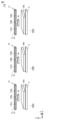
- FIG. FIG. 2 is a partial plan view of the current sensor device shown in FIG. 1; 2 is a sectional view taken along arrow III-III in FIG. 1.
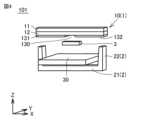
- FIG. FIG. 3 is a perspective view of a current sensor device according to a second embodiment.
- FIG. 3 is a perspective view of a current sensor device according to a third embodiment.
- FIG. 7 is a perspective view of a current sensor device array according to a fourth embodiment.
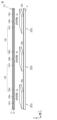
- FIG. 7 is a perspective view showing a first modification of the current sensor device array according to the fourth embodiment.
- FIG. 7 is a perspective view showing a second modification of the current sensor device array according to the fourth embodiment.
- FIG. 3 is a block diagram of a power conversion device according to a fifth embodiment.
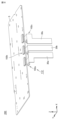
- FIG. 7 is a perspective view of a power conversion device according to a fifth embodiment.
- the magnetic field generated by the current to be measured by the current sensor device will be simply referred to as a magnetic field, and the other magnetic fields will be referred to as external magnetic fields.
- Embodiment 1 ⁇ Configuration of current sensor device> As shown in FIGS. 1 to 3, current sensor device 100 according to the first embodiment is for measuring the current flowing through bus bar 30 in the Y-axis direction.
- the current sensor device 100 includes a first magnetic shield 1, a second magnetic shield 2, and a magnetic sensor 3.
- the first magnetic shield 1 and the second magnetic shield 2 are arranged to sandwich the bus bar 30 and the magnetic sensor 3 in the Z-axis direction.
- the first magnetic shield 1 and the second magnetic shield 2 are provided to absorb external magnetic fields.
- Bus bar 30 extends in the Y-axis direction.
- the magnetic sensor 3 is arranged between the bus bar 30 and the first magnetic shield 1 in the Z-axis direction.
- the first magnetic shield 1 includes a stacked body 10 in which a first magnetic layer 11, a nonmagnetic layer 12, and a second magnetic layer 13 are stacked in order in the Z-axis direction.
- the first magnetic layer 11 has the upper surface of the first magnetic shield 1 .
- the upper surface of the first magnetic shield 1 is a surface facing away from the bus bar 30 in the Z-axis direction.
- the second magnetic layer 13 has a lower surface of the first magnetic shield 1 .
- the lower surface of the first magnetic shield 1 is a surface facing the bus bar 30 side in the Z-axis direction.
- the material constituting each of the first magnetic layer 11 and the second magnetic layer 13 may be any ferromagnetic material, but preferably a soft magnetic material.
- the material constituting each of the first magnetic layer 11 and the second magnetic layer 13 is, for example, selected from the group consisting of iron (Fe), nickel (Ni), cobalt (Co), permalloy (Ni-Fe alloy), and ferrite. Contains at least one of the selected items.
- the material constituting the non-magnetic layer 12 may be any non-magnetic material that does not exhibit ferromagnetism, and for example, at least one selected from the group consisting of aluminum (Al), copper (Cu), and epoxy resin. Including.
- the nonmagnetic layer 12 has a surface joined to a surface of the first magnetic layer 11 located on the opposite side to the above-mentioned upper surface of the first magnetic shield 1, and a surface joined to the surface of the first magnetic layer 11 located on the opposite side to the above-mentioned lower surface of the first magnetic shield 1. It has a surface that is joined to the surface of the second magnetic layer 13.
- the above-mentioned joining may be realized by any joining method, for example, joining by high-pressure press working, or joining by adhesive or solder.
- the material constituting the nonmagnetic layer 12 is a nonmagnetic metal material such as aluminum (Al)
- the stacked body of the first magnetic layer 11, the nonmagnetic layer 12, and the second magnetic layer 13 is By pressing, each of the first magnetic layer 11 and the second magnetic layer 13 and the nonmagnetic layer 12 can be directly bonded (different materials bonded).
- the second magnetic layer 13 has a depletion portion 130 that is magnetically depleted and does not exhibit ferromagnetism. ing.
- the depletion portion 130 is filled with air, for example. Note that the depletion portion 130 may be filled with a material forming the nonmagnetic layer 12.
- the second magnetic layer 13 has a first portion 131 and a second portion 132 that are arranged to sandwich a depletion portion 130 in the X-axis direction.
- the first portion 131 is, for example, separate from the second portion 132.
- the length of the depletion portion 130 in the Y-axis direction is, for example, equal to the length of the first magnetic layer 11 in the Y-axis direction.
- the length of the depletion portion 130 in the Z-axis direction is equal to the length (thickness) of the second magnetic layer 13 in the Z-axis direction.
- the length of the depletion portion 130 in the X-axis direction is shorter than the length of each of the first portion 131 and the second portion 132 in the X-axis direction.
- first portion 131 may be partially connected to the second portion 132.
- the length of the depletion portion 130 in the Y-axis direction may be shorter than the length of the first magnetic layer 11 in the Y-axis direction.
- the second magnetic layer 13 may have an annular shape surrounding the entire periphery of the depletion portion 130 when viewed from the Z-axis direction.
- the length of the depletion portion 130 in the X-axis direction is shorter than the length of the bus bar 30 in the X-axis direction.
- the center line C1 connecting the centers of the depletion portion 130 in the X-axis direction is, for example, a straight line.
- the center line C1 overlaps with the center line of the first magnetic shield 1 in the X-axis direction.
- each of the first magnetic layer 11, nonmagnetic layer 12, and second magnetic layer 13 has outer edge portions 11E, 12E, and 13E that overlap with each other. .
- the end faces of each of the first magnetic layer 11, the nonmagnetic layer 12, and the second magnetic layer 13 extending along the Z-axis direction are continuous so as to form the same plane.
- the lengths of the first magnetic layer 11, the nonmagnetic layer 12, and the second magnetic layer 13 in the X-axis direction are equal to each other.
- the length of the second magnetic layer 13 in the X-axis direction is the sum of the lengths of the first portion 131, the depletion portion 130, and the second portion 132 in the X-axis direction.
- the lengths of the first magnetic layer 11, the nonmagnetic layer 12, and the second magnetic layer 13 in the Y-axis direction are equal to each other.
- the length of each of the first magnetic layer 11, the nonmagnetic layer 12, and the second magnetic layer 13 in the X-axis direction is It is longer than the length of each of the magnetic layers 13 in the Y-axis direction.
- the first magnetic shield 1 when viewed from the Z-axis direction, has a longitudinal direction along the X-axis direction and a lateral direction along the Y-axis direction.
- the length of the second magnetic shield 2 in the X-axis direction is longer than the length of the second magnetic shield 2 in the Y-axis direction.
- the second magnetic shield 2 when viewed from the Z-axis direction, has a longitudinal direction along the X-axis direction and a lateral direction along the Y-axis direction.
- the longitudinal direction of the second magnetic shield 2 is parallel to the longitudinal direction of the first magnetic shield 1.
- the outer edge of the second magnetic shield 2 overlaps with the outer edge 1E of the first magnetic shield 1, for example, when viewed from the Z-axis direction.
- the length of the second magnetic shield 2 in the X-axis direction is, for example, equal to the length of the first magnetic shield 1 in the X-axis direction.
- the length of the second magnetic shield 2 in the Y-axis direction is, for example, equal to the length of the first magnetic shield 1 in the Y-axis direction.
- the length of each of the first magnetic shield 1 and the second magnetic shield 2 in the X-axis direction is longer than the length (width) of the bus bar 30 in the X-axis direction.
- the magnetic sensor 3 is provided to output a voltage output signal according to the strength (magnetic flux density) of the magnetic field component along the X-axis direction.
- the magnetic sensor 3 may have any configuration as long as it has the above configuration, and is, for example, a Hall element or a magnetoresistive (MR) element.
- the MR element uses, for example, an anisotropic magnetoresistive effect (AMR), a giant magnetoresistive effect (GMR), or a tunnel magnetoresistive effect (Tunnel magnetoresistive effect). Magnetic resistance such as Magneto Resistance Effect (TMR) This is an element that utilizes effects.
- the magnetic sensor 3 has a magnetically sensitive portion 4.
- the magnetically sensitive portion 4 is arranged such that, for example, the entirety thereof overlaps a part of the depletion portion 130.
- the magnetically sensitive portion 4 is arranged so as to overlap the center line C1 of the depletion portion 130 when viewed from the Z-axis direction.
- the center line passing through the center of the magnetically sensitive portion 4 in the X-axis direction is arranged to overlap with the center line C1 of the depletion portion 130 when viewed from the Z-axis direction. Note that it is sufficient that at least a portion of the magnetically sensitive portion 4 is arranged so as to overlap at least a portion of the depletion portion 130.
- the length of the depletion portion 130 in the X-axis direction is equal to or longer than the length of the magnetically sensitive portion 4 of the magnetic sensor 3 in the X-axis direction.
- the length of the depletion portion 130 in the X-axis direction is longer than, for example, the length of the magnetically sensitive portion 4 of the magnetic sensor 3 in the X-axis direction.
- the length of the depletion portion 130 in the Y-axis direction is equal to or longer than the length of the magnetically sensitive portion 4 of the magnetic sensor 3 in the Y-axis direction.
- the length of the depletion portion 130 in the Y-axis direction is longer than the length of the magnetically sensitive portion 4 of the magnetic sensor 3 in the Y-axis direction.
- the center of the depletion portion 130 in the X-axis direction and the center of the magnetically sensitive portion 4 of the magnetic sensor 3 are arranged on a virtual straight line C2 extending along the Z-axis direction.
- the virtual straight line C2 is perpendicular to the center line C1.
- the bus bar 30 is arranged, for example, closer to the second magnetic shield 2 than at an intermediate position between the first magnetic shield 1 and the second magnetic shield 2 in the Z-axis direction.
- the distance between the bus bar 30 and the first magnetic shield 1 in the Z-axis direction is longer than the distance between the bus bar 30 and the second magnetic shield 2 in the Z-axis direction, for example.
- the material constituting the bus bar 30 may be any conductive material, and includes, for example, at least one of Al and Cu.
- the magnetic sensing portion 4 of the magnetic sensor 3 is spaced from each of the first magnetic shield 1 and the bus bar 30 in the Z-axis direction.
- the distance in the Z-axis direction between the magnetically sensitive portion 4 of the magnetic sensor 3 and the first magnetic shield 1 is, for example, the distance in the Z-axis direction between the magnetically sensitive portion 4 of the magnetic sensor 3 and the bus bar 30. shorter than the axial distance.
- the magnetically sensitive portion 4 of the magnetic sensor 3 is arranged at an intermediate position between the first magnetic shield 1 and the second magnetic shield 2 in the Z-axis direction.
- the distance in the Z-axis direction between the magnetically sensitive portion 4 of the magnetic sensor 3 and the first magnetic shield 1 is equal to or equal to the distance in the Z-axis direction between the magnetically sensitive portion 4 of the magnetic sensor 3 and the bus bar 30. It may be longer.
- the magnetically sensitive portion 4 of the magnetic sensor 3 may be arranged closer to the first magnetic shield 1 than the intermediate position in the Z-axis direction. Further, the magnetically sensitive portion 4 of the magnetic sensor 3 may be arranged closer to the bus bar 30 than the intermediate position in the Z-axis direction.
- a first magnetic shield 1, a second magnetic shield 2, and a magnetic sensor 3 are prepared.
- the first magnetic shield 1 is constructed, for example, by forming an outer edge portion 1E on the laminate 10, and then removing a portion of the second magnetic layer 13 at a predetermined position with respect to the outer edge portion 1E to create a depletion portion 130. may be prepared by forming a.
- the first magnetic shield 1 , the second magnetic shield 2 , and the magnetic sensor 3 are positioned with respect to the bus bar 30 . In this way, current sensor device 100 can be manufactured.
- the first magnetic shield 1 includes a laminate in which the first magnetic layer 11, the nonmagnetic layer 12, and the second magnetic layer 13 are laminated in order in the Z-axis direction, and the second magnetic The layer 13 is closer to the magnetic sensor 3 than the first magnetic layer 11, and of the first magnetic layer 11 and the second magnetic layer 13, only the second magnetic layer 13 is magnetically depleted near the magnetic sensor. It has a depletion part. Therefore, the magnetic flux passing through the first portion 131 of the second magnetic layer 13 is caused by the difference in magnetic permeability between the magnetic material forming the first portion 131 and the non-magnetic material (air) forming the depletion portion 130.
- the magnetism leaks into the depletion portion 130 and is again concentrated in the second portion 132 of the second magnetic layer 13 . Therefore, in the current sensor device 100, the magnetic flux passing through the inside of the depletion part 130 and the region close to the depletion part 130 in the Z-axis direction is directed in the X-axis direction, so that the magnetic flux penetrating the magnetically sensitive part 4 of the magnetic sensor 3 is The magnetic flux passing between the first magnetic shield 1 and the bus bar 30 and the magnetic flux passing through each of the first portion 131 and the second portion 132 of the second magnetic layer 13 of the first magnetic shield 1 are superimposed. Become.
- the magnetic flux passing through the first portion 131, the depletion portion 130, and the second portion 132 of the second magnetic layer 13 compensates for the attenuation of the intensity of the magnetic field component in the X-axis direction.
- Ru the intensity change of the magnetic field component in the X-axis direction between the first magnetic shield 1 and the bus bar 30 of the current sensor device 100 becomes gentler than in the comparative example.
- the S/N ratio of such current sensor device 100 is higher than that of a conventional current sensor.
- the first magnetic shield 1 since the first magnetic shield 1 includes a laminate in which the first magnetic layer 11, the nonmagnetic layer 12, and the second magnetic layer 13 are laminated in order in the Z-axis direction, the second magnetic layer 13
- the first magnetic layer 11, which is magnetically separated from the first magnetic layer 11, can absorb an external magnetic field. Therefore, the S/N ratio of the current sensor device 100 is higher than that of a current sensor device including the first magnetic shield made of only the second magnetic layer 13.
- the depletion portion 130 is arranged so as to overlap the magnetically sensitive portion 4 of the magnetic sensor 3 when viewed from the Z-axis direction, the depletion portion 130 is arranged so as not to overlap the magnetically sensitive portion 4 of the magnetic sensor 3.
- the attenuation of the strength of the magnetic field component in the X-axis direction can be compensated for more effectively than when the magnetic field component is disposed in the X-axis direction. Therefore, the S/N ratio of the current sensor device 100 is higher than that of a current sensor device in which the depletion portion 130 is arranged so as not to overlap the magnetic sensing portion of the magnetic sensor 3.
- the S/N ratio of the current sensor device 100 is higher than that of a current sensor device in which the depletion portion 130 is arranged so as not to overlap the magnetic sensing portion of the magnetic sensor 3.
- the length (width) of the depletion portion 130 is longer than the length (width) of the magnetically sensitive portion 4 in the X-axis direction. Even if the relative position of the magnetically sensitive part 4 in the X-axis direction with respect to the depletion part 130 changes due to manufacturing errors, the S/N ratio will change due to the change in the relative position compared to the case where it is the same or shorter. Less affected by quantity.
- each of the first magnetic layer 11, the nonmagnetic layer 12, and the second magnetic layer 13 has outer edge portions 11E, 12E, and 13E (outer edge portion 1E) that overlap with each other. ing.
- Such outer edge portions 11E, 12E, and 13E may be formed at the same time by processing the laminate 10.
- depletion portions 130 may be formed at predetermined positions relative to outer edges 11E, 12E, and 13E. Therefore, in the current sensor device 100, the relative position of the depletion portion 130 with respect to the outer edge portions 11E, 12E, and 13E is unlikely to change due to manufacturing errors or the like.
- the current sensor device 101 according to the second embodiment has basically the same configuration as the current sensor device 100 according to the first embodiment, and has the same effects, but the second magnetic shield
- the current sensor device 2 is different from the current sensor device 100 in that the current sensor device 2 has a pair of opposing portions 22 that are arranged to face each other with a bus bar 30 in between in the X-axis direction.
- the differences between current sensor device 101 and current sensor device 100 will be mainly explained.
- the second magnetic shield 2 is disposed on the opposite side of the first magnetic shield 1 in the Z-axis direction with respect to the bus bar 30, and has an extension portion 21 extending along the X-axis direction. It further has.
- the extending portion 21 is provided, for example, so as to overlap the first magnetic shield 1 when viewed from the Z-axis direction.
- One end and the other end of the extending portion 21 in the X-axis direction are arranged outside the bus bar 30 in the X-axis direction.
- One of the pair of opposing portions 22 protrudes from one end of the extending portion 21 in the X-axis direction toward the first magnetic shield 1 side in the Z-axis direction.
- the other of the pair of opposing portions 22 protrudes from the other end of the extension portion 21 in the X-axis direction toward the first magnetic shield 1 side in the Z-axis direction.
- the second magnetic shield 2 is provided so as to surround the bus bar 30 on three sides when viewed from the Y-axis direction.
- the outer shape of the second magnetic shield 2 is approximately U-shaped when viewed from the Y-axis direction.
- each of the pair of opposing portions 22 in the X-axis direction is shorter than the length of each of the first portion 131 and second portion 132 of the second magnetic layer 13 in the X-axis direction.
- Each end portion (hereinafter referred to as an upper end portion) of the pair of opposing portions 22 located on the first magnetic shield 1 side in the Z-axis direction is connected to each of the first portion 131 and the second portion 132 of the second magnetic layer 13. It is arranged so as to overlap in the Z-axis direction with a portion located outside of the center in the X-axis direction.
- the length of the pair of opposing portions 22 in the Y-axis direction is, for example, equal to the length of the extending portion 21 in the Y-axis direction.
- each of the pair of opposing portions 22 protrudes toward the first magnetic shield 1 side relative to the bus bar 30 in the Z-axis direction, for example.
- the upper end portions of each of the pair of opposing portions 22 are arranged to sandwich the magnetic sensor 3, for example, in the X-axis direction.
- the magnetic flux passing through the second magnetic shield 2 side with respect to the bus bar 30 also passes through the pair of opposing portions 22, and passes through the first magnetic shield 2 side with respect to the bus bar 30. Guided to the 1st side. Therefore, the magnetic flux penetrating the magnetically sensitive portion of the magnetic sensor 3 of the current sensor device 101 is guided toward the first magnetic shield 1 side with respect to the bus bar 30 by the pair of opposing portions 22, in addition to what has been explained regarding the current sensor device 100. Includes magnetic flux.
- the strength of the magnetic field component along the X-axis direction between the first magnetic shield 1 of the current sensor device 101 and the bus bar 30 is larger than the intensity of the magnetic field component along the X-axis direction between the first magnetic shield 1 and the bus bar 30 of the current sensor device 101, and the magnetic flux that penetrates the magnetically sensitive portion of the magnetic sensor 3 of the current sensor device 101 is The density becomes higher than the magnetic flux density that penetrates the magnetically sensitive portion of the magnetic sensor 3 of the current sensor device 100. As a result, the S/N ratio of current sensor device 101 can be further increased than that of current sensor device 100.
- the current sensor device 102 according to the third embodiment has basically the same configuration as the current sensor device 100 according to the first embodiment, and has the same effect, but the first magnetic shield
- the current sensor device 100 differs from the current sensor device 100 in that it further includes a substrate 5 disposed between the magnetic sensor 1 and the magnetic sensor 3.
- the differences between the current sensor device 102 and the current sensor device 100 will be mainly explained.
- the substrate 5 has a first surface 5A on which the first magnetic shield 1 is mounted, and a second surface 5B located on the opposite side of the first surface 5A and on which the magnetic sensor 3 is mounted.
- the method of mounting each of the first magnetic shield 1 and the magnetic sensor 3 is not particularly limited.
- Each of the first magnetic shield 1 and the magnetic sensor 3 may be mounted on the substrate 5 using an adhesive or solder, or may be fitted into a through hole or a recess formed in the substrate 5 in advance. Good too.
- the material constituting the substrate 5 may be any non-magnetic material, including, for example, epoxy resin.
- the first magnetic shield 1 and the magnetic sensor 3 can be prepared as being mounted on the substrate 5, so it is assumed that the first magnetic shield 1 and the magnetic sensor 3 are separate members independent of each other. Compared to the case where the depletion portion 130 of the first magnetic shield 1 and the magnetically sensitive portion 4 of the magnetic sensor 3 are prepared and positioned as such, fluctuations in the relative positions of the depletion portion 130 of the first magnetic shield 1 and the magnetic sensing portion 4 of the magnetic sensor 3 can be suppressed.
- a mounting area for the first magnetic shield 1 or the magnetic sensor 3 is printed by silk printing or the like, or a counterbore is formed in the mounting area. It's okay. In this way, displacement in the relative positions of the first magnetic shield 1 and the magnetic sensor 3 can be suppressed.
- the attenuation of the strength of the magnetic field component in the X-axis direction can be compensated for as described above, but the degree of this effect depends on the relative position between the magnetic sensor 3 and the first magnetic shield 1. Increase or decrease depending on If the relative positional deviation between the first magnetic shield 1 and the magnetic sensor 3 is suppressed, variations in the above effects can be suppressed.
- the current sensor device according to the third embodiment may have the same configuration as the current sensor device 101 according to the second embodiment, except for including the substrate 5.
- the current sensor device array according to the fourth embodiment includes a plurality of current sensor devices according to the first embodiment.
- each current sensor device is the current sensor device 100 according to the first embodiment, the current sensor device 101 according to the second embodiment, or the current sensor device according to the third embodiment. It has the same configuration as 102.
- each current sensor device is provided to measure, for example, one alternating current in a multiphase alternating current.
- the current sensor device array 110 shown in FIG. 6 includes three current sensor devices 100a, 100b, and 100c.
- Each current sensor device 100a, 100b, 100c is provided to measure, for example, one phase of three-phase alternating current.
- Single-phase alternating current flows through each of the bus bar 30a of the current sensor device 100a, the bus bar 30b of the current sensor device 100b, and the bus bar 30c of the current sensor device 100c.
- the magnetic sensor 3a of the current sensor device 100a detects the magnetic field generated by the single-phase alternating current flowing through the bus bar 30a
- the magnetic sensor 3b of the current sensor device 100b detects the magnetic field generated by the single-phase alternating current flowing through the bus bar 30b.
- the sensors 3c each detect the magnetic field generated by the single-phase alternating current flowing through the bus bar 30c.
- the current sensor devices 100a, 100b, and 100c are arranged, for example, in line in the X-axis direction. Note that the direction in which the current sensor devices 100a, 100b, and 100c are arranged is not particularly limited, and may be along the Z-axis direction, for example.
- each of the current sensor devices 100a, 100b, and 100c has the same configuration as the current sensor device 100 according to the first embodiment.
- Each current sensor device 100a, 100b, 100c includes a first magnetic shield 1 having a depletion portion 130. Therefore, the current sensor device array 110 provides the same effects as the current sensor device 100.
- each current sensor device may be provided to measure single-layer alternating current flowing independently of each other.
- each current sensor device in the current sensor device array is arranged side by side in the X-axis direction.
- the first magnetic shield 1 has a plurality of depletion portions 130a, 130b, and 130c formed at intervals in the X-axis direction. Furthermore, the first magnetic shield 1 has a third portion 131a, a fourth portion 134, a fifth portion 135, and a sixth portion 132c.
- the third portion 131a, the depletion portion 130a, and the fourth portion 134 have the same configuration as the first portion 131, the depletion portion 130, and the second portion 132 in the current sensor device 100.
- the relationship between each of the third portion 131a and the fourth portion 134 and the depletion portion 130a is equivalent to the relationship between each of the first portion 131 and the second portion 132 and the depletion portion 130 in the current sensor device 100.
- the fourth portion 134, the depletion portion 130b, and the fifth portion 135 have the same configuration as the first portion 131, the depletion portion 130, and the second portion 132 in the current sensor device 100.
- the relationship between each of the fourth portion 134 and the fifth portion 135 and the depletion portion 130b is equivalent to the relationship between each of the first portion 131 and the second portion 132 and the depletion portion 130 in the current sensor device 100.
- the fourth portion 134 corresponds to a member in which the second portion 132a for the depletion portion 130a and the first portion 131b for the depletion portion 130b shown in FIG. 6 are integrated.
- the fifth portion 135, the depletion portion 130c, and the sixth portion 132c have the same configuration as the first portion 131, the depletion portion 130, and the second portion 132 in the current sensor device 100. That is, the relationship between each of the fifth portion 135 and the sixth portion 132c and the depletion portion 130c is equivalent to the relationship between each of the first portion 131 and the second portion 132 and the depletion portion 130 in the current sensor device 100. From a different perspective, the fifth portion 135 corresponds to a member in which the second portion 132b for the depletion portion 130c and the first portion 131c for the depletion portion 130c shown in FIG. 6 are integrated.
- the current sensor device array 111 shown in FIG. 7 includes one each of the first magnetic shield 1 and the second magnetic shield 2, the current sensor device array 111 shown in FIG. Compared to the sensor device array 110, the number of parts and manufacturing steps can be reduced.
- each current sensor device of the current sensor device array according to the fourth embodiment has the same configuration as the current sensor device 102 according to the third embodiment, and each current sensor device 102a , 102b, 102c may be configured as the same member.
- the current sensor device array 112 shown in FIG. 8 includes one substrate 5, the number of parts and manufacturing steps can be reduced compared to a current sensor device array including a plurality of substrates 5.
- each first magnetic shield 1 or magnetic sensor 3 may be printed on each of the first surface 5A and the second surface 5B of the substrate 5, or the mounting area may be printed on each of the first magnetic shield 1 or the magnetic sensor 3.
- a counterbore may be formed. In this way, the relative positional deviation between each first magnetic shield 1 and each magnetic sensor 3 can be suppressed.
- the attenuation of the strength of the magnetic field component in the X-axis direction can be compensated for as described above, but the degree of this effect depends on the relative position between the magnetic sensor 3 and the first magnetic shield 1. Increase or decrease depending on If the relative positional deviation between the first magnetic shield 1 and the magnetic sensor 3 is suppressed, variations in the above effects can be suppressed.
- a power conversion device 200 according to the fifth embodiment is a power conversion device in which at least one of the current sensor devices according to the first to third embodiments and the current sensor device array according to the fourth embodiment is applied.
- Power conversion device 200 according to Embodiment 5 includes a main conversion circuit that converts and outputs input power, and a control circuit that controls the main conversion circuit. The control circuit controls the main conversion circuit based on the current value detected by the current sensor device according to the first to third embodiments or the current sensor device array according to the fourth embodiment.
- Embodiment 5 is not limited to a specific power conversion device, a case will be described below as Embodiment 5 in which the present disclosure is applied to a three-phase inverter.
- FIG. 9 is a block diagram showing the configuration of a power conversion system to which the power conversion device according to Embodiment 5 is applied.
- the power conversion system shown in FIG. 9 is composed of a power source 300, a power conversion device 200, and a load 400.
- Power supply 300 is a DC power supply and supplies DC power to power conversion device 200.
- the power source 300 can be composed of various things, for example, it can be composed of a DC system, a solar battery, a storage battery, or it can be composed of a rectifier circuit or an AC/DC converter connected to an AC system. Good too.
- the power supply 300 may be configured with a DC/DC converter that converts DC power output from a DC system into predetermined power.
- the power conversion device 200 is a three-phase inverter connected between a power source 300 and a load 400, converts DC power supplied from the power source 300 into AC power, and supplies AC power to the load 400.
- the power conversion device 200 includes a main conversion circuit 201 that converts DC power into AC power and outputs it, and a control circuit that outputs a control signal for controlling the main conversion circuit 201 to the main conversion circuit 201.
- the main conversion circuit 201 includes a bus bar 30a, a bus bar 30b, and a bus bar 30c. Currents of each phase flow in the Y-axis direction through each of the bus bars 30a, 30b, and 30c.
- the load 400 is a three-phase electric motor driven by AC power supplied from the power converter 200.
- the load 400 is not limited to a specific application, but is a motor installed in various electrical devices, and is used, for example, as a motor for a hybrid vehicle, an electric vehicle, a railway vehicle, an elevator, or an air conditioner.
- Power conversion device 200 includes at least one of the current sensor devices according to Embodiments 1 to 3 and the current sensor device array according to Embodiments 4 and 5, which have a higher S/N ratio than conventional current sensor devices. Therefore, the control circuit can control the main conversion circuit based on highly accurate measurement results obtained by the current sensor device. As a result, the conversion accuracy of power conversion device 200 is higher than that of a power conversion device including a conventional current sensor device.
- the power conversion device 200 shown in FIG. 10 includes the current sensor device array 112 shown in FIG. 8. On the substrate 5, active elements and passive elements constituting a control circuit are mounted. In such a power conversion device 200, the current sensor device array 112 is formed integrally with the control circuit, so it can be made smaller compared to a case where the current sensor array is formed separately from the control circuit.
- Embodiments 1-5 disclosed this time should be considered to be illustrative in all respects and not restrictive. Unless there is a contradiction, at least two of the embodiments 1 to 5 disclosed herein may be combined.
- the scope of the present disclosure is indicated by the claims rather than the above description, and is intended to include meanings equivalent to the claims and all changes within the range.
Landscapes
- Physics & Mathematics (AREA)
- General Physics & Mathematics (AREA)
- Measuring Instrument Details And Bridges, And Automatic Balancing Devices (AREA)
Priority Applications (2)
| Application Number | Priority Date | Filing Date | Title |
|---|---|---|---|
| JP2022561564A JPWO2023209967A1 (https=) | 2022-04-28 | 2022-04-28 | |
| PCT/JP2022/019328 WO2023209967A1 (ja) | 2022-04-28 | 2022-04-28 | 電流センサ装置、電流センサ装置アレイ、及び電力変換装置 |
Applications Claiming Priority (1)
| Application Number | Priority Date | Filing Date | Title |
|---|---|---|---|
| PCT/JP2022/019328 WO2023209967A1 (ja) | 2022-04-28 | 2022-04-28 | 電流センサ装置、電流センサ装置アレイ、及び電力変換装置 |
Publications (1)
| Publication Number | Publication Date |
|---|---|
| WO2023209967A1 true WO2023209967A1 (ja) | 2023-11-02 |
Family
ID=88518173
Family Applications (1)
| Application Number | Title | Priority Date | Filing Date |
|---|---|---|---|
| PCT/JP2022/019328 Ceased WO2023209967A1 (ja) | 2022-04-28 | 2022-04-28 | 電流センサ装置、電流センサ装置アレイ、及び電力変換装置 |
Country Status (2)
| Country | Link |
|---|---|
| JP (1) | JPWO2023209967A1 (https=) |
| WO (1) | WO2023209967A1 (https=) |
Citations (14)
| Publication number | Priority date | Publication date | Assignee | Title |
|---|---|---|---|---|
| JP2008151743A (ja) * | 2006-12-20 | 2008-07-03 | Yazaki Corp | 電流センサ及びその成形方法 |
| JP2013113630A (ja) * | 2011-11-25 | 2013-06-10 | Yazaki Corp | 電流検出装置 |
| JP2014202480A (ja) * | 2013-04-01 | 2014-10-27 | 株式会社デンソー | 電流センサ用の磁気シールド体 |
| KR101497836B1 (ko) * | 2013-10-22 | 2015-03-02 | 대성전기공업 주식회사 | 전류 감지 유니트 |
| JP2015049184A (ja) * | 2013-09-03 | 2015-03-16 | Tdk株式会社 | インバータ装置 |
| JP2016173334A (ja) * | 2015-03-18 | 2016-09-29 | トヨタ自動車株式会社 | 電流センサ |
| JP2017187301A (ja) * | 2016-04-01 | 2017-10-12 | 日立金属株式会社 | 電流センサ |
| WO2017217267A1 (ja) * | 2016-06-15 | 2017-12-21 | 株式会社デンソー | 電流センサ |
| WO2018092404A1 (ja) * | 2016-11-17 | 2018-05-24 | 株式会社デンソー | 電流センサ装置 |
| WO2019117171A1 (ja) * | 2017-12-13 | 2019-06-20 | アルプスアルパイン株式会社 | 電流センサ及び電流センサのケースの製造方法 |
| JP2019109126A (ja) * | 2017-12-18 | 2019-07-04 | 日立金属株式会社 | 電流センサ |
| JP2021076468A (ja) * | 2019-11-08 | 2021-05-20 | Tdk株式会社 | 電流センサ |
| JP2021139799A (ja) * | 2020-03-06 | 2021-09-16 | 株式会社クボタ | 電流センサ |
| JP2021162416A (ja) * | 2020-03-31 | 2021-10-11 | 株式会社デンソー | 電流検出装置 |
Family Cites Families (3)
| Publication number | Priority date | Publication date | Assignee | Title |
|---|---|---|---|---|
| JP5505817B2 (ja) * | 2010-06-09 | 2014-05-28 | アルプス・グリーンデバイス株式会社 | 磁気平衡式電流センサ |
| WO2015156260A1 (ja) * | 2014-04-07 | 2015-10-15 | アルプス・グリーンデバイス株式会社 | 電流検知装置 |
| JP6967259B2 (ja) * | 2016-12-09 | 2021-11-17 | 国立研究開発法人物質・材料研究機構 | 高感度面直通電巨大磁気抵抗素子、及びその用途 |
-
2022
- 2022-04-28 WO PCT/JP2022/019328 patent/WO2023209967A1/ja not_active Ceased
- 2022-04-28 JP JP2022561564A patent/JPWO2023209967A1/ja active Pending
Patent Citations (14)
| Publication number | Priority date | Publication date | Assignee | Title |
|---|---|---|---|---|
| JP2008151743A (ja) * | 2006-12-20 | 2008-07-03 | Yazaki Corp | 電流センサ及びその成形方法 |
| JP2013113630A (ja) * | 2011-11-25 | 2013-06-10 | Yazaki Corp | 電流検出装置 |
| JP2014202480A (ja) * | 2013-04-01 | 2014-10-27 | 株式会社デンソー | 電流センサ用の磁気シールド体 |
| JP2015049184A (ja) * | 2013-09-03 | 2015-03-16 | Tdk株式会社 | インバータ装置 |
| KR101497836B1 (ko) * | 2013-10-22 | 2015-03-02 | 대성전기공업 주식회사 | 전류 감지 유니트 |
| JP2016173334A (ja) * | 2015-03-18 | 2016-09-29 | トヨタ自動車株式会社 | 電流センサ |
| JP2017187301A (ja) * | 2016-04-01 | 2017-10-12 | 日立金属株式会社 | 電流センサ |
| WO2017217267A1 (ja) * | 2016-06-15 | 2017-12-21 | 株式会社デンソー | 電流センサ |
| WO2018092404A1 (ja) * | 2016-11-17 | 2018-05-24 | 株式会社デンソー | 電流センサ装置 |
| WO2019117171A1 (ja) * | 2017-12-13 | 2019-06-20 | アルプスアルパイン株式会社 | 電流センサ及び電流センサのケースの製造方法 |
| JP2019109126A (ja) * | 2017-12-18 | 2019-07-04 | 日立金属株式会社 | 電流センサ |
| JP2021076468A (ja) * | 2019-11-08 | 2021-05-20 | Tdk株式会社 | 電流センサ |
| JP2021139799A (ja) * | 2020-03-06 | 2021-09-16 | 株式会社クボタ | 電流センサ |
| JP2021162416A (ja) * | 2020-03-31 | 2021-10-11 | 株式会社デンソー | 電流検出装置 |
Also Published As
| Publication number | Publication date |
|---|---|
| JPWO2023209967A1 (https=) | 2023-11-02 |
Similar Documents
| Publication | Publication Date | Title |
|---|---|---|
| US10948522B2 (en) | Current sensor and current sensor unit | |
| US10746821B2 (en) | Current sensor | |
| JP7215451B2 (ja) | 電流センサ及びその製造方法、電気制御装置、並びに電流センサの設計方法 | |
| EP2977777B1 (en) | Magnetic sensor | |
| JP6699532B2 (ja) | 電流センサ | |
| JP2013238580A (ja) | 電流センサ | |
| CN109085404B (zh) | 电流传感器 | |
| US9678177B2 (en) | Magnetic sensor device for suppressing magnetic saturation | |
| US20130057273A1 (en) | Current sensor | |
| JP2015049184A (ja) | インバータ装置 | |
| WO2013176271A1 (ja) | 電流センサ | |
| WO2013080557A1 (ja) | 電流センサ | |
| JP7070532B2 (ja) | 磁気センサ | |
| JP2002267692A (ja) | 電流センサ | |
| CN111693911A (zh) | 磁传感器装置 | |
| US11543469B2 (en) | Current sensor, and electric control apparatus including the current sensor | |
| EP4297112A1 (en) | Magnetic sensor | |
| EP4060360A1 (en) | Magnetic sensor | |
| JP7367657B2 (ja) | 電流センサ及び電気制御装置 | |
| WO2023209967A1 (ja) | 電流センサ装置、電流センサ装置アレイ、及び電力変換装置 | |
| JP2019007935A (ja) | 電流センサ | |
| JP2013047610A (ja) | 磁気平衡式電流センサ | |
| US20250172640A1 (en) | Magnetic sensor | |
| US20250271469A1 (en) | Current sensor and semiconductor-type current sensor | |
| US20260043874A1 (en) | Magnetic sensor |
Legal Events
| Date | Code | Title | Description |
|---|---|---|---|
| WWE | Wipo information: entry into national phase |
Ref document number: 2022561564 Country of ref document: JP |
|
| 121 | Ep: the epo has been informed by wipo that ep was designated in this application |
Ref document number: 22940241 Country of ref document: EP Kind code of ref document: A1 |
|
| NENP | Non-entry into the national phase |
Ref country code: DE |
|
| 122 | Ep: pct application non-entry in european phase |
Ref document number: 22940241 Country of ref document: EP Kind code of ref document: A1 |