WO2023199845A1 - 熱硬化性接着剤組成物、積層フィルム、接続体及びその製造方法 - Google Patents
熱硬化性接着剤組成物、積層フィルム、接続体及びその製造方法 Download PDFInfo
- Publication number
- WO2023199845A1 WO2023199845A1 PCT/JP2023/014292 JP2023014292W WO2023199845A1 WO 2023199845 A1 WO2023199845 A1 WO 2023199845A1 JP 2023014292 W JP2023014292 W JP 2023014292W WO 2023199845 A1 WO2023199845 A1 WO 2023199845A1
- Authority
- WO
- WIPO (PCT)
- Prior art keywords
- adhesive composition
- thermosetting
- thermosetting adhesive
- adhesive layer
- film
- Prior art date
- Legal status (The legal status is an assumption and is not a legal conclusion. Google has not performed a legal analysis and makes no representation as to the accuracy of the status listed.)
- Ceased
Links
Images




Classifications
-
- C—CHEMISTRY; METALLURGY
- C09—DYES; PAINTS; POLISHES; NATURAL RESINS; ADHESIVES; COMPOSITIONS NOT OTHERWISE PROVIDED FOR; APPLICATIONS OF MATERIALS NOT OTHERWISE PROVIDED FOR
- C09J—ADHESIVES; NON-MECHANICAL ASPECTS OF ADHESIVE PROCESSES IN GENERAL; ADHESIVE PROCESSES NOT PROVIDED FOR ELSEWHERE; USE OF MATERIALS AS ADHESIVES
- C09J7/00—Adhesives in the form of films or foils
- C09J7/30—Adhesives in the form of films or foils characterised by the adhesive composition
- C09J7/35—Heat-activated
-
- C—CHEMISTRY; METALLURGY
- C09—DYES; PAINTS; POLISHES; NATURAL RESINS; ADHESIVES; COMPOSITIONS NOT OTHERWISE PROVIDED FOR; APPLICATIONS OF MATERIALS NOT OTHERWISE PROVIDED FOR
- C09J—ADHESIVES; NON-MECHANICAL ASPECTS OF ADHESIVE PROCESSES IN GENERAL; ADHESIVE PROCESSES NOT PROVIDED FOR ELSEWHERE; USE OF MATERIALS AS ADHESIVES
- C09J163/00—Adhesives based on epoxy resins; Adhesives based on derivatives of epoxy resins
-
- C—CHEMISTRY; METALLURGY
- C08—ORGANIC MACROMOLECULAR COMPOUNDS; THEIR PREPARATION OR CHEMICAL WORKING-UP; COMPOSITIONS BASED THEREON
- C08K—Use of inorganic or non-macromolecular organic substances as compounding ingredients
- C08K3/00—Use of inorganic substances as compounding ingredients
- C08K3/01—Use of inorganic substances as compounding ingredients characterized by their specific function
- C08K3/013—Fillers, pigments or reinforcing additives
-
- C—CHEMISTRY; METALLURGY
- C08—ORGANIC MACROMOLECULAR COMPOUNDS; THEIR PREPARATION OR CHEMICAL WORKING-UP; COMPOSITIONS BASED THEREON
- C08K—Use of inorganic or non-macromolecular organic substances as compounding ingredients
- C08K5/00—Use of organic ingredients
- C08K5/16—Nitrogen-containing compounds
- C08K5/17—Amines; Quaternary ammonium compounds
-
- C—CHEMISTRY; METALLURGY
- C08—ORGANIC MACROMOLECULAR COMPOUNDS; THEIR PREPARATION OR CHEMICAL WORKING-UP; COMPOSITIONS BASED THEREON
- C08K—Use of inorganic or non-macromolecular organic substances as compounding ingredients
- C08K9/00—Use of pretreated ingredients
- C08K9/04—Ingredients treated with organic substances
- C08K9/06—Ingredients treated with organic substances with silicon-containing compounds
-
- C—CHEMISTRY; METALLURGY
- C08—ORGANIC MACROMOLECULAR COMPOUNDS; THEIR PREPARATION OR CHEMICAL WORKING-UP; COMPOSITIONS BASED THEREON
- C08L—COMPOSITIONS OF MACROMOLECULAR COMPOUNDS
- C08L33/00—Compositions of homopolymers or copolymers of compounds having one or more unsaturated aliphatic radicals, each having only one carbon-to-carbon double bond, and only one being terminated by only one carboxyl radical, or of salts, anhydrides, esters, amides, imides or nitriles thereof; Compositions of derivatives of such polymers
- C08L33/04—Homopolymers or copolymers of esters
-
- C—CHEMISTRY; METALLURGY
- C08—ORGANIC MACROMOLECULAR COMPOUNDS; THEIR PREPARATION OR CHEMICAL WORKING-UP; COMPOSITIONS BASED THEREON
- C08L—COMPOSITIONS OF MACROMOLECULAR COMPOUNDS
- C08L61/00—Compositions of condensation polymers of aldehydes or ketones; Compositions of derivatives of such polymers
- C08L61/04—Condensation polymers of aldehydes or ketones with phenols only
-
- C—CHEMISTRY; METALLURGY
- C08—ORGANIC MACROMOLECULAR COMPOUNDS; THEIR PREPARATION OR CHEMICAL WORKING-UP; COMPOSITIONS BASED THEREON
- C08L—COMPOSITIONS OF MACROMOLECULAR COMPOUNDS
- C08L63/00—Compositions of epoxy resins; Compositions of derivatives of epoxy resins
-
- C—CHEMISTRY; METALLURGY
- C09—DYES; PAINTS; POLISHES; NATURAL RESINS; ADHESIVES; COMPOSITIONS NOT OTHERWISE PROVIDED FOR; APPLICATIONS OF MATERIALS NOT OTHERWISE PROVIDED FOR
- C09J—ADHESIVES; NON-MECHANICAL ASPECTS OF ADHESIVE PROCESSES IN GENERAL; ADHESIVE PROCESSES NOT PROVIDED FOR ELSEWHERE; USE OF MATERIALS AS ADHESIVES
- C09J11/00—Features of adhesives not provided for in group C09J9/00, e.g. additives
- C09J11/02—Non-macromolecular additives
- C09J11/04—Non-macromolecular additives inorganic
-
- C—CHEMISTRY; METALLURGY
- C09—DYES; PAINTS; POLISHES; NATURAL RESINS; ADHESIVES; COMPOSITIONS NOT OTHERWISE PROVIDED FOR; APPLICATIONS OF MATERIALS NOT OTHERWISE PROVIDED FOR
- C09J—ADHESIVES; NON-MECHANICAL ASPECTS OF ADHESIVE PROCESSES IN GENERAL; ADHESIVE PROCESSES NOT PROVIDED FOR ELSEWHERE; USE OF MATERIALS AS ADHESIVES
- C09J11/00—Features of adhesives not provided for in group C09J9/00, e.g. additives
- C09J11/02—Non-macromolecular additives
- C09J11/06—Non-macromolecular additives organic
-
- C—CHEMISTRY; METALLURGY
- C09—DYES; PAINTS; POLISHES; NATURAL RESINS; ADHESIVES; COMPOSITIONS NOT OTHERWISE PROVIDED FOR; APPLICATIONS OF MATERIALS NOT OTHERWISE PROVIDED FOR
- C09J—ADHESIVES; NON-MECHANICAL ASPECTS OF ADHESIVE PROCESSES IN GENERAL; ADHESIVE PROCESSES NOT PROVIDED FOR ELSEWHERE; USE OF MATERIALS AS ADHESIVES
- C09J133/00—Adhesives based on homopolymers or copolymers of compounds having one or more unsaturated aliphatic radicals, each having only one carbon-to-carbon double bond, and at least one being terminated by only one carboxyl radical, or of salts, anhydrides, esters, amides, imides, or nitriles thereof; Adhesives based on derivatives of such polymers
- C09J133/04—Homopolymers or copolymers of esters
-
- C—CHEMISTRY; METALLURGY
- C09—DYES; PAINTS; POLISHES; NATURAL RESINS; ADHESIVES; COMPOSITIONS NOT OTHERWISE PROVIDED FOR; APPLICATIONS OF MATERIALS NOT OTHERWISE PROVIDED FOR
- C09J—ADHESIVES; NON-MECHANICAL ASPECTS OF ADHESIVE PROCESSES IN GENERAL; ADHESIVE PROCESSES NOT PROVIDED FOR ELSEWHERE; USE OF MATERIALS AS ADHESIVES
- C09J161/00—Adhesives based on condensation polymers of aldehydes or ketones; Adhesives based on derivatives of such polymers
- C09J161/04—Condensation polymers of aldehydes or ketones with phenols only
-
- C—CHEMISTRY; METALLURGY
- C09—DYES; PAINTS; POLISHES; NATURAL RESINS; ADHESIVES; COMPOSITIONS NOT OTHERWISE PROVIDED FOR; APPLICATIONS OF MATERIALS NOT OTHERWISE PROVIDED FOR
- C09J—ADHESIVES; NON-MECHANICAL ASPECTS OF ADHESIVE PROCESSES IN GENERAL; ADHESIVE PROCESSES NOT PROVIDED FOR ELSEWHERE; USE OF MATERIALS AS ADHESIVES
- C09J201/00—Adhesives based on unspecified macromolecular compounds
-
- C—CHEMISTRY; METALLURGY
- C09—DYES; PAINTS; POLISHES; NATURAL RESINS; ADHESIVES; COMPOSITIONS NOT OTHERWISE PROVIDED FOR; APPLICATIONS OF MATERIALS NOT OTHERWISE PROVIDED FOR
- C09J—ADHESIVES; NON-MECHANICAL ASPECTS OF ADHESIVE PROCESSES IN GENERAL; ADHESIVE PROCESSES NOT PROVIDED FOR ELSEWHERE; USE OF MATERIALS AS ADHESIVES
- C09J5/00—Adhesive processes in general; Adhesive processes not provided for elsewhere, e.g. relating to primers
-
- C—CHEMISTRY; METALLURGY
- C09—DYES; PAINTS; POLISHES; NATURAL RESINS; ADHESIVES; COMPOSITIONS NOT OTHERWISE PROVIDED FOR; APPLICATIONS OF MATERIALS NOT OTHERWISE PROVIDED FOR
- C09J—ADHESIVES; NON-MECHANICAL ASPECTS OF ADHESIVE PROCESSES IN GENERAL; ADHESIVE PROCESSES NOT PROVIDED FOR ELSEWHERE; USE OF MATERIALS AS ADHESIVES
- C09J5/00—Adhesive processes in general; Adhesive processes not provided for elsewhere, e.g. relating to primers
- C09J5/06—Adhesive processes in general; Adhesive processes not provided for elsewhere, e.g. relating to primers involving heating of the applied adhesive
-
- H—ELECTRICITY
- H10—SEMICONDUCTOR DEVICES; ELECTRIC SOLID-STATE DEVICES NOT OTHERWISE PROVIDED FOR
- H10W—GENERIC PACKAGES, INTERCONNECTIONS, CONNECTORS OR OTHER CONSTRUCTIONAL DETAILS OF DEVICES COVERED BY CLASS H10
- H10W72/00—Interconnections or connectors in packages
- H10W72/071—Connecting or disconnecting
-
- C—CHEMISTRY; METALLURGY
- C08—ORGANIC MACROMOLECULAR COMPOUNDS; THEIR PREPARATION OR CHEMICAL WORKING-UP; COMPOSITIONS BASED THEREON
- C08K—Use of inorganic or non-macromolecular organic substances as compounding ingredients
- C08K3/00—Use of inorganic substances as compounding ingredients
- C08K3/34—Silicon-containing compounds
- C08K3/36—Silica
-
- C—CHEMISTRY; METALLURGY
- C08—ORGANIC MACROMOLECULAR COMPOUNDS; THEIR PREPARATION OR CHEMICAL WORKING-UP; COMPOSITIONS BASED THEREON
- C08K—Use of inorganic or non-macromolecular organic substances as compounding ingredients
- C08K5/00—Use of organic ingredients
- C08K5/04—Oxygen-containing compounds
- C08K5/07—Aldehydes; Ketones
-
- C—CHEMISTRY; METALLURGY
- C09—DYES; PAINTS; POLISHES; NATURAL RESINS; ADHESIVES; COMPOSITIONS NOT OTHERWISE PROVIDED FOR; APPLICATIONS OF MATERIALS NOT OTHERWISE PROVIDED FOR
- C09J—ADHESIVES; NON-MECHANICAL ASPECTS OF ADHESIVE PROCESSES IN GENERAL; ADHESIVE PROCESSES NOT PROVIDED FOR ELSEWHERE; USE OF MATERIALS AS ADHESIVES
- C09J2203/00—Applications of adhesives in processes or use of adhesives in the form of films or foils
- C09J2203/326—Applications of adhesives in processes or use of adhesives in the form of films or foils for bonding electronic components such as wafers, chips or semiconductors
-
- C—CHEMISTRY; METALLURGY
- C09—DYES; PAINTS; POLISHES; NATURAL RESINS; ADHESIVES; COMPOSITIONS NOT OTHERWISE PROVIDED FOR; APPLICATIONS OF MATERIALS NOT OTHERWISE PROVIDED FOR
- C09J—ADHESIVES; NON-MECHANICAL ASPECTS OF ADHESIVE PROCESSES IN GENERAL; ADHESIVE PROCESSES NOT PROVIDED FOR ELSEWHERE; USE OF MATERIALS AS ADHESIVES
- C09J2301/00—Additional features of adhesives in the form of films or foils
- C09J2301/40—Additional features of adhesives in the form of films or foils characterized by the presence of essential components
- C09J2301/408—Additional features of adhesives in the form of films or foils characterized by the presence of essential components additives as essential feature of the adhesive layer
-
- C—CHEMISTRY; METALLURGY
- C09—DYES; PAINTS; POLISHES; NATURAL RESINS; ADHESIVES; COMPOSITIONS NOT OTHERWISE PROVIDED FOR; APPLICATIONS OF MATERIALS NOT OTHERWISE PROVIDED FOR
- C09J—ADHESIVES; NON-MECHANICAL ASPECTS OF ADHESIVE PROCESSES IN GENERAL; ADHESIVE PROCESSES NOT PROVIDED FOR ELSEWHERE; USE OF MATERIALS AS ADHESIVES
- C09J2301/00—Additional features of adhesives in the form of films or foils
- C09J2301/40—Additional features of adhesives in the form of films or foils characterized by the presence of essential components
- C09J2301/416—Additional features of adhesives in the form of films or foils characterized by the presence of essential components use of irradiation
-
- C—CHEMISTRY; METALLURGY
- C09—DYES; PAINTS; POLISHES; NATURAL RESINS; ADHESIVES; COMPOSITIONS NOT OTHERWISE PROVIDED FOR; APPLICATIONS OF MATERIALS NOT OTHERWISE PROVIDED FOR
- C09J—ADHESIVES; NON-MECHANICAL ASPECTS OF ADHESIVE PROCESSES IN GENERAL; ADHESIVE PROCESSES NOT PROVIDED FOR ELSEWHERE; USE OF MATERIALS AS ADHESIVES
- C09J2301/00—Additional features of adhesives in the form of films or foils
- C09J2301/50—Additional features of adhesives in the form of films or foils characterized by process specific features
- C09J2301/502—Additional features of adhesives in the form of films or foils characterized by process specific features process for debonding adherents
Definitions
- the present disclosure relates to a thermosetting adhesive composition, a laminated film, a connecting body, and a method for manufacturing the same.
- Patent Document 1 discloses an adhesive sheet (die bond dicing sheet) that has both the function of fixing a semiconductor wafer in a dicing process and the function of bonding a semiconductor chip to a substrate in a die bonding process.
- Patent Document 2 discloses an adhesive sheet that acts as a dicing tape in the dicing process, has excellent connection reliability in the bonding process between a semiconductor element and a support member, and maintains sufficient fluidity after the heat history of wire bonding. are doing.
- thermosetting adhesive composition with excellent low-temperature curability
- One aspect of the present disclosure is that the increase in shear viscosity over time is sufficiently suppressed, and as a result, it can be used for a relatively long period of time after preparation, and it can be heat-cured at a low temperature of 85°C or less.
- the present invention provides a thermosetting resin composition useful for realizing the present invention.
- One aspect of the present disclosure provides an adhesive film, a connector, and a method for manufacturing the same, including an adhesive layer made of this thermosetting adhesive composition.
- thermosetting adhesive composition includes a photocleavable compound that is cleaved by radiation irradiation to generate an amine compound, and a thermosetting resin that is cured by heating in the presence of the amine compound.
- radiation include ultraviolet rays, electron beams, and infrared rays.
- the above composition exhibits thermosetting properties upon irradiation with radiation. Therefore, even if the product is not used immediately after preparation and is stored for a period of time, the progress of the curing reaction during that period is sufficiently suppressed. Therefore, the increase in shear viscosity over time is sufficiently suppressed, and the usable state can be maintained for a relatively long period of time (for example, four weeks or more) after preparation. In other words, it is possible to have a sufficiently long work life.
- the above composition is also useful for realizing heat curing treatment at low temperatures of 85° C. or lower. That is, a thermosetting resin having excellent low-temperature curability tends to undergo a curing reaction when stored in a state mixed with a curing accelerator.
- the photocleavable compound exhibits its function by being irradiated with radiation during use, the curing reaction of the thermosetting resin is suppressed during storage. According to the above composition, it is possible to achieve both a long work life and low-temperature curability to a sufficiently high degree.
- This laminated film includes a base film and an adhesive layer provided on the surface of the base film, and the adhesive layer is made of the thermosetting adhesive composition.
- One aspect of the present disclosure relates to a method of manufacturing a connecting body.
- This manufacturing method includes the steps of: (A) preparing a laminate including a first circuit member, a second circuit member, and an adhesive layer disposed between the first and second circuit members; (B) heating the laminate at 65 to 85°C for 30 to 240 minutes, and (C) wire bonding the first circuit member and the second circuit member in this order.
- the adhesive layer is made of the thermosetting adhesive composition, and includes a step of irradiating the adhesive layer with radiation before the step (B).
- thermosetting resin composition After the thermosetting resin composition is made to exhibit thermosetting properties by irradiating it with radiation, this may be used to manufacture the connecting body.
- the composition after radiation irradiation contains an amine compound generated by cleavage of the photocleavable compound and a thermosetting resin that is cured by heating in the presence of the amine compound.
- steps (A), (B), and (C) may be performed in sequence.
- connection body includes a first circuit member, a second circuit member, and an adhesive layer disposed between the first and second circuit members, and the adhesive layer is made of the thermosetting adhesive. It is composed of a cured product of the composition.
- the first circuit member is one selected from the group consisting of a printed circuit board and a semiconductor chip
- the second circuit member is a flexible printed circuit board.
- the increase in shear viscosity over time is sufficiently suppressed, and as a result, it can be used for a relatively long period of time after preparation, and it can be thermally cured at a low temperature of 85° C. or lower.
- Thermoset resin compositions useful in implementing the process are provided.
- an adhesive film, a connecting body, and a method for manufacturing the same including an adhesive layer made of this thermosetting adhesive composition.
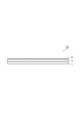
- FIG. 1 is a cross-sectional view schematically showing an embodiment of a laminated film according to the present disclosure.
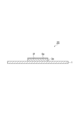
- FIG. 2 is a cross-sectional view schematically showing the state of the manufacturing process of the semiconductor module.
- FIG. 3 is a cross-sectional view schematically showing the state of the semiconductor module manufacturing process.
- FIG. 4 is a perspective view schematically showing an example of a punched product according to the present disclosure.
- FIG. 5 is a sectional view taken along the line VV shown in FIG. 4.
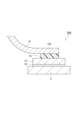
- FIG. 6 is a cross-sectional view schematically showing how an adhesive piece and a cover film covering it are picked up from a base film.
- FIG. 7 is a cross-sectional view schematically showing the state of the semiconductor module manufacturing process.
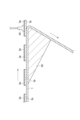
- FIG. 8 is a graph showing changes over time in shear viscosity of thermosetting resin compositions according to Examples and Comparative Examples.
- FIG. 1 is a cross-sectional view schematically showing a laminated film according to this embodiment.
- the laminated film 10 shown in this figure includes a base film 1, an adhesive layer 3, and a cover film 5 in this order.
- the laminated film 10 has a width of, for example, 300 mm to 500 mm, a total length of 10 m to 400 m, and is produced, for example, by being wound into a roll.
- the structure of the laminated film 10 will be explained.
- the base film 1 is not particularly limited as long as it can sufficiently withstand the tension applied in the manufacturing process of the adhesive layer 3 and the manufacturing process of the semiconductor module.
- the base film 1 is preferably transparent from the viewpoint of visibility of the adhesive layer 3 disposed thereon.
- the base film 1 includes polyester films such as polyethylene terephthalate film, polytetrafluoroethylene film, polyethylene film, polypropylene film, polymethylpentene film, polyvinyl acetate film, poly-4-methylpentene-1, and ethylene-vinyl acetate.
- Polyolefin films such as copolymers, homocopolymers or copolymers such as ethylene-ethyl acrylate copolymers, or mixtures thereof, plastic films such as polyvinyl chloride films, polyimide films, etc. can be used.
- the base film 1 may have a single layer structure or a multilayer structure.
- the thickness of the base film 1 may be appropriately selected within a range that does not impair workability, and is, for example, 10 to 200 ⁇ m, and may be 20 to 100 ⁇ m or 25 to 80 ⁇ m. These thickness ranges pose no practical problems and are economically effective ranges.
- the surface of the base film 1 may be subjected to chemical or Physical surface treatments may also be applied.
- a film with low surface energy made of fluororesin can also be used. Examples of such films include A-63 (mold release agent: modified silicone type) manufactured by Toyobo Film Solutions Co., Ltd., and A-31 (mold release agent: Pt type) manufactured by Toyobo Film Solutions Co., Ltd. silicone type), etc.
- a silicone release agent, a fluorine release agent, a long chain alkyl acrylate release agent, etc. are applied to the surface of the base film 1.
- a mold release layer composed of a mold release agent may be formed.
- the adhesion force between the base film 1 and the adhesive layer 3 is, for example, 0.5 N/m or more. By having this adhesion force of 0.5 N/m or more, it is easy to prevent the adhesive layer 3 from being accidentally peeled off from the base film 1 during the process of manufacturing the laminated film 10.
- the adhesion force between the adhesive layer 3 and the base film 1 means 90° peel strength, and specifically, it refers to a 20 mm wide sample in which the adhesive layer 3 is formed on the base film 1. It refers to the peel strength measured when the adhesive layer is prepared and peeled from the base film at an angle of 90° and at a peeling speed of 50 mm/min.
- the adhesive layer 3 is used for adhering circuit members to each other, for example, adhesion between a printed circuit board and the tip of a flexible printed circuit board (hereinafter referred to as "FPC board"), or adhesion between a semiconductor chip and an FPC board. It is suitably used for adhesion to the tip of the substrate.
- the module 50A (connection body) shown in FIG. 2 includes a semiconductor chip C, a printed circuit board 12 (first circuit member), an adhesive piece 3c, and an FPC board 15 (second circuit member).
- An adhesive piece 3c adheres the printed circuit board 12 and the tip portion 15a of the FPC board 15.
- the adhesive piece 3c is made of a cured adhesive piece 3p (see FIG. 4).
- the adhesive piece 3p is obtained by processing the adhesive layer 3 shown in FIG. 1 into a predetermined shape by die-cutting. Note that the adhesive layer 16 adheres the printed circuit board 12 and the semiconductor chip C.
- the adhesive layer 16 may have the same composition as the adhesive piece 3c, or may have a different composition.
- the module 50B shown in FIG. 3 is obtained by performing wire bonding on the module 50A shown in FIG.
- the wire W1 electrically connects the semiconductor chip C and the printed circuit board 12, and the wire W2 electrically connects the printed circuit board 12 and the FPC board 15.
- the semiconductor chip C is, for example, a sensor chip.
- the printed circuit board 12 is for processing signals from the semiconductor chip C. A signal from the printed circuit board 12 is transmitted to the tip 15a of the FPC board 15.
- the adhesive piece 3p is made of a thermosetting adhesive composition that exhibits thermosetting properties upon irradiation with radiation. That is, this composition includes a photocleavable compound that is cleaved by radiation irradiation to generate an amine compound, and a thermosetting resin that is cured by being heated in the presence of the amine compound.
- a photocleavable compound is a compound having an ⁇ -aminoacetophenone skeleton.
- the following compounds have an ⁇ -aminoacetophenone skeleton, and when irradiated with ultraviolet light, they are deblocked to produce amine compounds having radicals.
- the photocleavable compound may be one that generates radicals upon irradiation with ultraviolet rays.
- thermosetting adhesive composition satisfies Condition 1 below, for example.
- Condition 1 After being irradiated with ultraviolet rays at an illuminance of 80 mW/cm 2 and an integrated light amount of 600 mJ/cm 2 and then heated at 75° C. for 3 hours, the storage modulus at 75° C. is 3 MPa or more. .
- thermosetting adhesive composition that satisfies Condition 1 has excellent low-temperature curability. This has the advantage that components with relatively low heat resistance can be used as members constituting the module 50B.
- thermosetting adhesive composition that satisfies Condition 1 it is conceivable to use, for example, a phenol resin together with an epoxy resin as the thermosetting resin.
- phenolic resin contributes to improving low-temperature curability is that the reactivity between phenol resin and epoxy resin is higher than the reactivity between epoxy resins, and the use of phenolic resin makes it easier for the reaction to proceed. It is.
- the storage modulus according to Condition 1 is 3 MPa or more, and may be 10 MPa or more, 15 MPa or more, or 30 MPa or more.
- the upper limit of the storage modulus according to Condition 1 is, for example, 200 MPa. The higher the storage modulus under Condition 1, the easier it is to perform wire bonding.
- thermosetting adhesive composition may further satisfy Condition 2 below. ⁇ Condition 2 After being irradiated with ultraviolet rays at an illuminance of 80 mW/cm 2 and an integrated light amount of 600 mJ/cm 2 and then heated at 75° C. for 3 hours, the storage modulus at 35° C. is 700 MPa or less. .
- the storage modulus according to Condition 2 is 700 MPa or less, and may be 50 to 700 MPa, 100 to 500 MPa, or 150 to 300 MPa.
- thermosetting adhesive composition that satisfies Condition 2
- the following method can be considered, for example.
- -Method 1 The amount of thermoplastic resin (for example, acrylic rubber) contained in the thermosetting adhesive composition is relatively large.
- - Method 2 Use a thermoplastic resin with a relatively low glass transition temperature (Tg).
- -Method 3 Use a thermosetting resin with a flexible skeleton. According to the studies conducted by the present inventors, methods 1 and 2 are more effective than method 3.
- the thermosetting adhesive composition further contains a thermoplastic resin
- the content of the thermoplastic resin is, for example, The amount is 15 to 35 parts by weight, and may be 15 to 30 parts by weight.
- the Tg of the thermoplastic resin is, for example, -50°C to 20°C.
- thermosetting adhesive composition undergoes a curing reaction to some extent by heat treatment at 75° C. for 3 hours.
- the extent to which the reaction is progressing can be quantified by differential scanning calorimetry. That is, it can be quantified by the reaction rate calculated by the following formula, and the calorific value C1 and the calorific value C2 are each determined from a DSC curve obtained by differential scanning calorimetry at a heating rate of 10° C./min.
- the value of this reaction rate is, for example, 50% or more, and may be 60% or more or 70% or more.
- the calorific value C1 is the calorific value of the resin composition after irradiating the thermosetting adhesive composition with ultraviolet rays at an illuminance of 80 mW/cm 2 and an integrated light amount of 600 mJ/cm 2 .
- the calorific value C2 is determined by irradiating the thermosetting adhesive composition with ultraviolet rays at an illuminance of 80 mW/cm 2 and an integrated light amount of 600 mJ/cm 2 and then heating it at 75°C for 3 hours. is the calorific value of the resin composition. Note that the temperature range of differential scanning calorimetry is, for example, 30°C to 300°C.
- the temperature range in which the calorific values C1 and C2 are determined from the DSC curve obtained by measurement is 50°C to 200°C.
- the reaction rate is 50% or more, deterioration over time after the manufacturing process can be suppressed, resulting in excellent reliability.
- the melt viscosity of the thermosetting adhesive composition at 75° C. is, for example, 3,000 to 12,000 Pa ⁇ s, and may be 3,500 to 10,000 Pa ⁇ s or 4,000 to 8,000 Pa ⁇ s. Since the melt viscosity at 75° C. is within the above range, even if the tip 15a of the FPC board 15 has unevenness, heat can be maintained without any gap between the tip 15a and the member to be bonded (printed circuit board 12). A curable adhesive composition can be disposed. Even after the thermosetting adhesive composition is irradiated with radiation to develop thermosetting properties of the composition, the melt viscosity may be within the above range. Thereby, the tip portion 15a and the printed circuit board 12 can be bonded with high strength.
- the melt viscosity at 75°C is, for example, 20,000 Pa ⁇ s or less, and 3,000 to 16,000 Pa ⁇ s. Or it may be 4000 to 16000 Pa ⁇ s.
- the laminated film 10 is produced, for example, as follows. First, a coating liquid is prepared by dissolving the raw resin composition of the adhesive layer 3 in a solvent such as an organic solvent to form a varnish. After applying this coating liquid onto the base film 1, the solvent is removed to form the adhesive layer 3. Coating methods include knife coating, roll coating, spray coating, gravure coating, bar coating, curtain coating, and the like. Next, the cover film 5 is attached to the surface of the adhesive layer 3 at room temperature to 60°C. Thereby, the laminated film 10 can be obtained. In addition, after forming the adhesive layer 3 on a wide base film, a laminated film is produced by laminating the cover film 5 so as to cover this, and by cutting (slitting) this into a predetermined width. A laminated film 10 may be obtained.
- FIG. 4 is a perspective view schematically showing a punched product manufactured from the laminated film 10.
- FIG. 5 is a sectional view taken along the line VV shown in FIG. 4.
- the punched product 20 shown in these figures includes a strip-shaped base film 1 with a width of 100 mm or less, a plurality of adhesive pieces 3p, and a plurality of cover films 5p.
- the plurality of adhesive pieces 3p are arranged on the base film 1 so as to be lined up in the longitudinal direction (direction of arrow X shown in FIG. 4).
- the cover film 5p covers the upper surface 3f of the adhesive piece 3p and has the same shape as the adhesive piece 3p.
- the adhesive piece 3p is suitably applied to bond the circuit member (semiconductor chip or printed circuit board) to the tip of the FPC board.
- the area of the adhesive piece 3p in plan view is, for example, 1 to 100 mm 2 , and may be 3 to 50 mm 2 or 5 to 40 mm 2 .
- a plurality of adhesive pieces 3p arranged on the base film 1 are sequentially picked up (see FIG. 6), and then each adhesive piece 3p is placed in a predetermined area of the circuit member.
- the circuit member and the FPC member can be bonded together efficiently.
- the punched product 20 can be obtained, for example, through the following steps.
- thermosetting adhesive composition constituting the adhesive layer 3 and the adhesive piece 3p will be explained.
- the thermosetting adhesive composition includes a photocleavable compound that is cleaved by radiation irradiation to generate an amine compound, and a thermosetting resin that is cured by being heated in the presence of the amine compound. including.
- this composition may also contain, for example, a thermoplastic resin and a filler.
- Photocleavable compound A photocleavable compound is cleaved by radiation irradiation to generate an amine compound.
- photocleavable compounds include compounds having an ⁇ -aminoacetophenone skeleton.
- examples of such compounds include Omnirad 907 and Omnirad 379EG (both manufactured by IGM Resins BV).
- Omnirad 379EG has an aliphatic amine with a high degree of basicity, and it is thought that proton detachment from the phenol resin is likely to occur and the curing reaction is likely to proceed. Note that Omnirad is a registered trademark.
- a photoradical generator that generates radicals or a photobase generator that generates a base upon irradiation with radiation may be used.
- the photobase generator include the WPBG series manufactured by Fuji Film Co., Ltd., and more specifically, WPBG-027, WPBG-140, and WPBG-165.
- thermosetting resin any resin that can be cured by heat can be used without particular limitation.
- thermosetting resin include epoxy resin, acrylic resin, silicone resin, phenol resin, thermosetting polyimide resin, polyurethane resin, melamine resin, and urea resin. These can be used alone or in combination of two or more.
- the epoxy resin is not particularly limited as long as it hardens and has heat resistance.
- the epoxy resin bifunctional epoxy resins such as bisphenol A epoxy, phenol novolac epoxy resins, novolak epoxy resins such as cresol novolac epoxy resins, etc. can be used.
- the epoxy resin conventionally known ones such as a polyfunctional epoxy resin, a glycidylamine type epoxy resin, a heterocycle-containing epoxy resin, and an alicyclic epoxy resin can be used.
- bisphenol A epoxy resins examples include Epicote 807, Epicote 815, Epicote 825, Epicote 827, Epicote 828, Epicote 834, Epicote 1001, Epicote 1004, Epicote 1007, Epicote 1009 (all manufactured by Mitsubishi Chemical Corporation), DER-330. , DER-301, DER-361 (all manufactured by Dow Chemical Company), YD8125, YDF8170 (all manufactured by Toto Kasei Co., Ltd.), and the like.
- phenol novolac type epoxy resin examples include Epicote 152, Epicote 154 (all manufactured by Mitsubishi Chemical Corporation), EPPN-201 (manufactured by Nippon Kayaku Corporation), and DEN-438 (manufactured by Dow Chemical Corporation).
- Examples of o-cresol novolac type epoxy resins include YDCN-700-10 (manufactured by Nippon Steel Chemical & Materials Co., Ltd.), EOCN-102S, EOCN-103S, EOCN-104S, EOCN-1012, EOCN-1025, EOCN-1027 ( (all manufactured by Nippon Kayaku Co., Ltd.), YDCN701, YDCN702, YDCN703, YDCN704 (all manufactured by Toto Kasei Co., Ltd.), and N-500P-10 (manufactured by DIC Corporation).
- Examples of polyfunctional epoxy resins include Epon 1031S, 1032H60 (all manufactured by Mitsubishi Chemical Corporation), Araldite 0163 (manufactured by BASF Japan), Denacol EX-611, EX-614, EX-614B, EX-622, EX-512. , EX-521, EX-421, EX-411, EX-321 (all manufactured by Nagase ChemteX Corporation).
- Examples of amine-type epoxy resins include Epicoat 604 (manufactured by Mitsubishi Chemical Corporation), YH-434 (manufactured by Toto Kasei Corporation), TETRAD-X, TETRAD-C (all manufactured by Mitsubishi Gas Chemical Corporation), and ELM-120 (manufactured by Mitsubishi Gas Chemical Corporation).
- heterocycle-containing epoxy resin examples include Araldite PT810 (manufactured by BASF Japan), ERL4234, ERL4299, ERL4221, and ERL4206 (all manufactured by Union Carbide). These epoxy resins can be used alone or in combination of two or more.
- the epoxy resin it is preferable to use a polyfunctional epoxy resin with a small functional group equivalent.
- the storage elastic modulus at 130° C. after heat treatment of the adhesive film is improved, and wire bonding properties are excellent.
- Specific examples include HP-4710 (manufactured by DIC Corporation), Epon 1031S, and 1032H60 (all manufactured by Mitsubishi Chemical Corporation).
- epoxy resin curing agent that is part of the thermosetting resin component
- commonly used known resins can be used. Specifically, amines, polyamides, acid anhydrides, polysulfides, boron trifluoride, bisphenols having two or more phenolic hydroxyl groups in one molecule such as bisphenol A, bisphenol F, and bisphenol S, and phenol novolac resins. , bisphenol A novolac resin, cresol novolac resin, and other phenolic resins.
- phenol resins such as phenol novolac resin, bisphenol A novolac resin, and cresol novolac resin are particularly preferred from the viewpoint of excellent electrolytic corrosion resistance during moisture absorption.
- the epoxy curing agent may be used in combination with an epoxy resin, or may be used alone.
- the content of the thermosetting resin in the thermosetting adhesive composition is, for example, 20 to 60 parts by mass, or even 20 to 50 parts by mass, based on 100 parts by mass of the thermosetting adhesive composition. good.
- the content of the thermosetting resin is within the above range, shrinkage due to thermosetting of the adhesive layer 3 can be suppressed, and excellent adhesion after thermosetting can be easily achieved.
- thermoplastic resin a resin having thermoplasticity or a resin having thermoplasticity at least in an uncured state and forming a crosslinked structure after heating can be used.
- a thermoplastic resin a (meth)acrylic copolymer having a reactive group (hereinafter also referred to as a "reactive group-containing (meth)acrylic copolymer”) is used from the viewpoint of excellent shrinkage, heat resistance, and peelability. ) is preferred.
- the thermosetting adhesive composition may not contain the thermosetting resin. That is, an embodiment including a reactive group-containing (meth)acrylic copolymer, a curing accelerator, and a filler may be used.
- Thermoplastic resins can be used singly or in combination of two or more.
- the (meth)acrylic copolymer examples include (meth)acrylic ester copolymers such as acrylic glass and acrylic rubber, with acrylic rubber being preferred.
- the acrylic rubber contains an acrylic ester as a main component and is formed by copolymerizing monomers selected from (meth)acrylic esters and acrylonitrile.
- (Meth)acrylic acid esters include methyl acrylate, ethyl acrylate, propyl acrylate, isopropyl acrylate, butyl acrylate, isobutyl acrylate, hexyl acrylate, cyclohexyl acrylate, 2-ethylhexyl acrylate, lauryl acrylate, methyl methacrylate, ethyl methacrylate, propyl methacrylate, Examples include isopropyl methacrylate, butyl methacrylate, isobutyl methacrylate, hexyl methacrylate, cyclohexyl methacrylate, 2-ethylhexyl methacrylate, and lauryl methacrylate.
- the (meth)acrylic acid ester copolymer a copolymer containing butyl acrylate and acrylonitrile as a copolymerization component, and a copolymer containing ethyl acrylate and acrylonitrile as a copolymerization component are preferable.
- the reactive group-containing (meth)acrylic copolymer is preferably a reactive group-containing (meth)acrylic copolymer containing a (meth)acrylic monomer having a reactive group as a copolymerization component.
- a reactive group-containing (meth)acrylic copolymer can be obtained by copolymerizing a monomer composition containing a (meth)acrylic monomer having a reactive group and the above monomer. .
- epoxy group from the viewpoint of improving heat resistance, epoxy group, carboxyl group, acryloyl group, methacryloyl group, hydroxyl group, and episulfide group are preferable, and among them, from the viewpoint of crosslinking property, epoxy group and carboxyl group are more preferable.
- the reactive group-containing (meth)acrylic copolymer is preferably an epoxy group-containing (meth)acrylic copolymer containing a (meth)acrylic monomer having an epoxy group as a copolymerization component.
- the (meth)acrylic monomer having an epoxy group includes glycidyl acrylate, 4-hydroxybutyl acrylate glycidyl ether, 3,4-epoxycyclohexylmethyl acrylate, glycidyl methacrylate, 4-hydroxybutyl methacrylate glycidyl ether, 3,4- Examples include epoxycyclohexylmethyl methacrylate.
- the (meth)acrylic monomer having a reactive group is preferably glycidyl acrylate or glycidyl methacrylate from the viewpoint of heat resistance.
- the Tg of the thermoplastic resin is, for example, -50°C to 20°C, and may be -40°C to 10°C or -40°C to 0°C.
- the Tg of the thermoplastic resin is ⁇ 50° C. or higher, it is easy to prevent the adhesive layer 3 from becoming excessively soft, and excellent handleability and adhesiveness can be achieved.
- the Tg of the thermoplastic resin is 0° C. or less, flexibility of the adhesive layer 3 can be easily ensured and excellent adhesive strength can be achieved.
- the adhesive layer 3 can easily follow the irregularities and exhibit excellent adhesive properties.
- the Tg of a thermoplastic resin is the midpoint glass transition temperature value obtained by differential scanning calorimetry (DSC). Specifically, the Tg of the thermoplastic resin is the intermediate point calculated by measuring the change in calorific value under the conditions of a heating rate of 10°C/min and a measurement temperature of -80 to 80°C, and using a method based on JIS K7121:1987. It is the glass transition temperature. In addition, when the thermoplastic resin is a commercially available product, the values described in the catalog etc. may be adopted.
- the weight average molecular weight of the thermoplastic resin is preferably 100,000 or more and 2,000,000 or less. When the weight average molecular weight is 100,000 or more, heat resistance can be easily ensured. On the other hand, when the weight average molecular weight is 2,000,000 or less, it is easy to suppress a decrease in flow and a decrease in adhesion.
- the weight average molecular weight of the thermoplastic resin may be 400,000 or more and 2,000,000 or more, or 500,000 or more and 2,000,000 or less. Note that the weight average molecular weight is a polystyrene equivalent value obtained by gel permeation chromatography (GPC) using a standard polystyrene calibration curve.
- the content of the thermoplastic resin is 20 to 40 parts when the mass of the entire adhesive film is 100 parts by mass. Parts by mass are preferred. When the content is within the above range, it is easy to achieve higher levels of flexibility and adhesiveness of the adhesive layer 3.
- the (meth)acrylic copolymer having a reactive group as described above one obtained by a polymerization method such as pearl polymerization or solution polymerization may be used. Alternatively, a commercially available product such as SG-P3 (trade name, manufactured by Nagase ChemteX Corporation) may be used.
- the thermosetting adhesive composition may contain an inorganic filler.
- the inorganic filler include metal fillers such as silver powder, gold powder, and copper powder, and nonmetallic inorganic fillers such as silica, alumina, boron nitride, titania, glass, iron oxide, and ceramic.
- the inorganic filler can be selected depending on the desired function.
- the above inorganic filler may have an organic group on its surface.
- dispersibility in an organic solvent when preparing a varnish for forming the adhesive layer 3 can be improved.
- the inorganic filler having an organic group on its surface can be obtained, for example, by mixing a silane coupling agent represented by the following formula (B-1) and an inorganic filler and stirring at a temperature of 30° C. or higher. It can be confirmed by UV measurement, IR measurement, XPS measurement, etc. that the surface of the inorganic filler has been modified with an organic group.
- X represents an organic group selected from the group consisting of phenyl group, glycidoxy group, acryloyl group, methacryloyl group, mercapto group, amino group, vinyl group, isocyanate group and methacryloxy group, represents 0 or an integer of 1 to 10, and R 11 , R 12 and R 13 each independently represent an alkyl group having 1 to 10 carbon atoms.
- alkyl group having 1 to 10 carbon atoms examples include methyl group, ethyl group, propyl group, butyl group, pentyl group, hexyl group, heptyl group, octyl group, nonyl group, decyl group, isopropyl group, isobutyl group, etc. .
- the alkyl group having 1 to 10 carbon atoms is preferably a methyl group, an ethyl group, or a pentyl group from the viewpoint of easy availability.
- X is preferably an amino group, a glycidoxy group, a mercapto group, or an isocyanate group, and more preferably a glycidoxy group or a mercapto group.
- s is preferably 0 to 5, more preferably 0 to 4, from the viewpoint of suppressing film fluidity at high temperatures and improving heat resistance.
- silane coupling agent examples include trimethoxyphenylsilane, dimethyldimethoxyphenylsilane, triethoxyphenylsilane, dimethoxymethylphenylsilane, vinyltrimethoxysilane, vinyltriethoxysilane, vinyltris(2-methoxyethoxy)silane, N-(2-methoxyethoxy)silane, -aminoethyl)-3-aminopropylmethyldimethoxysilane, N-(2-aminoethyl)-3-aminopropyltrimethoxysilane, 3-aminopropyltriethoxysilane, 3-aminopropyltrimethoxysilane, 3-glyside Xypropyltrimethoxysilane, 3-glycidoxypropylmethyldimethoxysilane, 2-(3,4-epoxycyclohexyl)ethyltrimethoxysilane, 3-iso
- 3-aminopropyltriethoxysilane, 3-glycidoxypropyltrimethoxysilane, 3-isocyanatepropyltriethoxysilane, and 3-mercaptopropyltrimethoxysilane are preferred, and trimethoxyphenylsilane and 3-glycidoxysilane are preferred. More preferred are propyltrimethoxysilane and 3-mercaptopropyltrimethoxysilane.
- the silane coupling agents can be used alone or in combination of two or more.
- the content of the coupling agent is, for example, 0 to 10 parts by mass, and 0.1 parts by mass, based on 100 parts by mass of the thermosetting adhesive composition.
- the amount may be 5 parts by mass, and from the viewpoint of storage stability, the upper limit may be 3 parts by mass.
- the content of the inorganic filler is, for example, 20 to 35 parts by mass, and may be 25 to 35 parts by mass, based on 100 parts by mass of the thermosetting adhesive composition.
- the content of the inorganic filler in the thermosetting adhesive composition is, for example, 300 parts by mass or less, and may be 200 parts by mass or less, or 150 parts by mass or less, based on 100 parts by mass of the thermoplastic resin.
- the lower limit of the content of the inorganic filler is not particularly limited, it is, for example, 10 parts by mass or more, and may be 50 parts by mass or more, based on 100 parts by mass of the thermoplastic resin.
- the thermosetting adhesive composition may contain an organic filler.
- the organic filler include carbon, rubber filler, silicone fine particles, polyamide fine particles, and polyimide fine particles.
- the content of the organic filler is, for example, 450 parts by mass or less, and may be 400 parts by mass or less, or 350 parts by mass or less, based on 100 parts by mass of the thermoplastic resin.
- the lower limit of the content of the organic filler is not particularly limited, but is, for example, 10 parts by mass or more based on 100 parts by mass of the thermoplastic resin.
- the thermosetting adhesive composition may be diluted with an organic solvent, if necessary.
- the organic solvent is not particularly limited, but can be determined by considering volatility during film formation, etc. from the boiling point. Specifically, relatively low boiling point solvents such as methanol, ethanol, 2-methoxyethanol, 2-ethoxyethanol, 2-butoxyethanol, methyl ethyl ketone, acetone, methyl isobutyl ketone, toluene, and xylene are used to form films. It is preferable from the viewpoint that curing does not proceed easily.
- a relatively high boiling point solvent such as dimethylacetamide, dimethylformamide, N-methylpyrrolidone, or cyclohexanone. These solvents can be used alone or in combination of two or more.
- the thickness of the adhesive layer 3 may be appropriately selected within a range that does not impair workability, and may be, for example, 1 to 200 ⁇ m, 5 to 150 ⁇ m, or 10 to 150 ⁇ m.
- the thickness of the adhesive layer 3 is 1 ⁇ m or more, it is easy to ensure sufficient adhesion, while when the thickness is 200 ⁇ m or less, the thermosetting adhesive composition constituting the adhesive layer 3 can be used as the substrate film 1. Alternatively, protrusion from the cover film 5 can be easily suppressed.
- the cover film 5 may be any film as long as it can be easily peeled off from the adhesive layer 3.
- polyester films such as polyethylene terephthalate film, polytetrafluoroethylene film, polyethylene film, polypropylene film, polymethylpentene film, polyvinyl acetate film, poly-4-methylpentene-1, ethylene-vinyl acetate, etc.
- Polyolefin films such as polymers, homocopolymers or copolymers such as ethylene-ethyl acrylate copolymers, or mixtures thereof, and plastic films such as polyvinyl chloride films and polyimide films can be used.
- the cover film 5 may have a single layer structure or a multilayer structure.
- an adhesive film may be used, and specifically, an adhesive film for dicing (manufactured by Maxell Corporation) is preferable.
- the adhesive film may have an adhesive layer and a base layer.
- the adhesive layer may be configured to be in contact with the adhesive layer 3.
- a photocurable adhesive layer or a pressure-sensitive adhesive layer can be used, and as the base material layer, the above-mentioned plastic film or the like can be used.
- the adhesion between the adhesive layer 3 and the cover film 5 is, for example, 70 N/m or less, may be 50 N/m or less, or may be 20 N/m or less.
- the adhesive layer 3 is made of a thermosetting resin composition
- it is preferable that the adhesion of the cover film 5 to the adhesive layer 3 is within the above range after heat treatment at 75° C. for 1 second. With this adhesion force being 70 N/m or less, the adhesive layer 3 covered with the cover film 5 was temporarily pressed onto the adherend (for example, a substrate) at 75° C. for 0.5 seconds. Thereafter, the cover film 5 can be easily peeled off from the semi-cured adhesive layer 3 using an adhesive tape or the like.
- the adhesion force of the cover film 5 to the adhesive layer 3 means 90° peel strength, and specifically, the adhesion strength of the cover film 5 to the adhesive layer 3 means a 90° peel strength. This refers to the peel strength measured when a sample is prepared and the cover film is peeled from the adhesive layer at an angle of 90° and at a peeling speed of 50 mm/min.
- the adhesion strength may be the value after light irradiation.
- the thickness of the cover film 5 may be appropriately selected within a range that does not impair workability, and may be, for example, 10 to 200 ⁇ m, 10 to 180 ⁇ m, or 15 to 140 ⁇ m. These thickness ranges pose no practical problems and are economically effective ranges.
- FIG. 6 is a cross-sectional view schematically showing how the adhesive piece 3p and the cover film 5p covering it are picked up from the base film 1.
- the punched product 20 With a constant tension applied to the punched product 20, the punched product 20 is moved in the direction of the arrow shown in FIG. move it.
- the front portions of the adhesive piece 3p and the cover film 5p are lifted from the base film 1.
- the adhesive piece 3p and the cover film 5p are picked up by a pickup device 65 having a suction force.
- the adhesive piece 3p covered with the cover film 5p is placed on the surface of the printed circuit board 12 (see FIG. 7).
- the adhesive piece 3p is irradiated with ultraviolet rays.
- the illuminance of the ultraviolet rays may be, for example, 10 to 200 mW/cm 2 .
- the cumulative amount of ultraviolet light may be, for example, 300 to 900 mJ/cm 2 .
- the adhesive piece 3p is temporarily pressed onto the printed circuit board 12.
- the temporary pressure bonding may be performed, for example, at a temperature of 60 to 85° C. and a pressing force of 0.1 to 2 MPa for 0.1 to 10 seconds.
- the adhesive piece 3p Due to the temporary pressure bonding, the adhesive piece 3p is semi-cured, so that the adhesive strength to the surface of the printed circuit board 12 is improved. Thereafter, the cover film 5p is peeled off from the adhesive piece 3p using an adhesive tape or the like. This leaves the surface of the adhesive piece 3p exposed.
- Adhesion of the tip end 15a of the FPC board 15 to the printed circuit board 12 includes a step of press-bonding the tip end 15a to the adhesive piece 3p, and then a step of curing the adhesive piece 3p by heating. That is, first, the tip 15a of the FPC board 15 is placed on the upper surface 3f of the adhesive piece 3p, and then the tip 15a is pressed against the adhesive piece 3p. As a result, a laminate including the printed circuit board 12, the FPC board 15, and the adhesive piece 3p is obtained (step (A)).
- the pressure bonding may be performed, for example, at a temperature of 60 to 85° C. and a pressing force of 0.1 to 3 MPa for 0.1 to 10 seconds.
- the adhesive piece 3p is cured.
- the curing treatment may be performed, for example, at a temperature of 65 to 85° C. for 30 to 240 minutes.
- the module 50A shown in FIG. 2 is obtained (step (B)).
- the heating conditions in conditions 1 and 2 above are set at 75° C. for 3 hours.
- Wire bonding is performed on the module 50A (step (C)).
- a module 50B shown in FIG. 3 is obtained.
- the semiconductor module is completed through a process of protecting the wires W1 and W2 of the module 50B with a resin material, a heat treatment to progress the curing reaction of the adhesive piece 3c, and the like.
- adhesive pieces that have already been irradiated with radiation may be used for manufacturing the connection body.
- steps (A), (B), and (C) may be performed in sequence.
- the present disclosure is not limited to the above embodiments.
- the case where the adhesive piece 3p made of the adhesive composition is prepared in advance by die cutting is illustrated, but a coating liquid containing the adhesive composition is prepared and applied to the printed circuit board 12.
- An adhesive layer may be formed by coating on the surface.
- Example 1 An adhesive varnish was obtained by mixing the materials shown in Example 1 in Table 1 with a solvent and vacuum degassing. This adhesive varnish was coated on a 38 ⁇ m thick surface-release-treated PET film (base film). After a drying process, a film adhesive (adhesive layer) having a thickness of 25 ⁇ m was formed on one side of the PET film. A laminated film was obtained by pasting an adhesive film for dicing (manufactured by Maxell Corporation) on the surface of the film adhesive.
- Examples 2 to 5 and Comparative Examples 1 to 4 Laminated films were produced in the same manner as in Example 1, except that adhesive varnishes having the compositions shown in Examples 2 to 5 and Comparative Examples 1 to 4 in Tables 1 and 2 were used.
- the peel strength of the film adhesive was measured by the following method. First, the laminated film was punched out into a size of 3.2 mm x 3.2 mm. After peeling off the base film from the laminated film, a film adhesive was attached to the organic substrate, and temporary pressure bonded for 0.5 seconds at a pressure of 1.0 N on a stage at 75°C. Next, the cover film was peeled off from the film adhesive, and a polyimide film (Upilex 50S (trade name), manufactured by Ube Industries, Ltd.) with a size of 5 mm x 100 mm was attached to the film adhesive and placed on a stage at 75°C. Then, main pressure bonding was performed for 1 second with a force of 15N.
- a polyimide film Upilex 50S (trade name), manufactured by Ube Industries, Ltd.
- the film adhesive was cured by heating at 75° C. for 3 hours to obtain a measurement sample. Peel strength was measured using a 90 degree peel tester (manufactured by Tester Sangyo Co., Ltd.) at a test speed of 50 mm/min. The results are shown in Tables 1 and 2.
- the reaction rate of the film adhesive was measured by the following method. That is, the film adhesive was irradiated with ultraviolet rays at an illuminance of 80 mW/cm 2 and an integrated light amount of 600 mJ/cm 2 . 10 mg of the film adhesive after ultraviolet irradiation was weighed into an aluminum pan (manufactured by Epolead Service Co., Ltd.), an aluminum lid was placed on the pan, and the evaluation sample was sealed in the sample pan using a crimper.
- DSC differential scanning calorimeter
- a differential scanning calorimeter (Thermo plus DSC8235E, manufactured by Rigaku Co., Ltd.)
- DSC was measured in a nitrogen atmosphere at a temperature increase rate of 10° C./min and a measurement temperature range of 30 to 300° C.
- a partial area analysis method was used as a means of analyzing the calorific value.
- the total calorific value (unit: J/g) was calculated by specifying the baseline of the analysis temperature range and integrating the peak area. This was defined as the initial calorific value C1.
- the film adhesive was irradiated with ultraviolet rays at an illuminance of 80 mW/cm 2 and an integrated light amount of 600 mJ/cm 2 .
- the melt viscosity at 75° C. of the film adhesive (B stage state before heating at 75° C. for 3 hours) after UV irradiation was measured by the following method. That is, a sample was prepared by laminating a plurality of film-like adhesives each having a thickness of 25 ⁇ m to a thickness of approximately 300 ⁇ m, and punching this laminate with a punch having a diameter of 9 mm.
- a circular aluminum plate jig with a diameter of 8 mm was installed in a dynamic viscoelasticity device ARES (manufactured by TA instruments), and the above sample was further set therein. Thereafter, measurements were taken while increasing the temperature to 100°C at a rate of 5°C/min while applying 5% strain at 35°C. The frequency was kept constant at 1 Hz, the initial load was kept at 300 g, and the axial force was kept at 100 g.
- the melt viscosity values at 75°C are listed in Tables 1 and 2.
- the film adhesive was irradiated with ultraviolet rays at an illuminance of 80 mW/cm 2 and an integrated light amount of 600 mJ/cm 2 .
- the storage modulus of the film adhesive was measured by the following method. That is, a sample for measurement was obtained by laminating a plurality of film-like adhesives each having a thickness of 25 ⁇ m to a thickness of about 300 ⁇ m, making this into a size of 4 mm wide ⁇ 33 mm, and curing at 75° C. for 3 hours.
- the sample was set in a dynamic viscoelasticity device (product name: Rheogel E-4000, manufactured by UBM Co., Ltd.) with a distance between chucks of 20 mm, a tensile load was applied, and the measurement was performed at a frequency of 10 Hz and a heating rate of 3°C/min. , storage modulus at 35°C and 75°C was measured.
- a dynamic viscoelasticity device product name: Rheogel E-4000, manufactured by UBM Co., Ltd.
- the shear viscosity at 75° C. of the film adhesives according to Examples 1, 2, and 4 and Comparative Examples 1, 2, and 4 was measured every week. That is, eight test pieces having a predetermined size were prepared by cutting out the film adhesive. These were laminated using a rubber roll on a 70° C. hot plate to prepare a laminate having a thickness of 300 ⁇ m. This laminate was punched out with a punch having a diameter of 9 mm to prepare a sample. The sample was attached to a measurement jig of a rotational viscoelasticity measuring device (manufactured by TA Instruments Japan Co., Ltd., trade name: ARES-RDA).
- the film adhesive according to the example was stored in a state without being irradiated with ultraviolet rays until the measurement was carried out, and the film adhesive was irradiated with ultraviolet rays immediately before the measurement.
- the ultraviolet rays were irradiated under the conditions that the illumination intensity was 80 mW/cm 2 and the cumulative light amount was 600 mJ/cm 2 .
- SYMBOLS 1 Base film, 3... Adhesive layer, 3c, 3p... Adhesive piece, 5, 5p... Cover film, 10... Laminated film, 12... Printed circuit board, 15... Flexible printed circuit board, 15a... Tip part, 20...Punching product, 50A, 50B...Module (connection body), C...Semiconductor chip, W1, W2...Wire.
Landscapes
- Chemical & Material Sciences (AREA)
- Organic Chemistry (AREA)
- Health & Medical Sciences (AREA)
- Chemical Kinetics & Catalysis (AREA)
- Medicinal Chemistry (AREA)
- Polymers & Plastics (AREA)
- Inorganic Chemistry (AREA)
- Adhesives Or Adhesive Processes (AREA)
- Laminated Bodies (AREA)
- Adhesive Tapes (AREA)
- Die Bonding (AREA)
Abstract
Description
図1は本実施形態に係る積層フィルムを模式的に示す断面図である。この図に示す積層フィルム10は、基材フィルム1と、接着剤層3と、カバーフィルム5とをこの順序で備える。積層フィルム10は、例えば、幅が300mm~500mmであり、全長が10m~400mであり、例えば、ロール状に巻き取られて作製される。以下、積層フィルム10の構成について説明する。
基材フィルム1は、接着剤層3の製造プロセス及び半導体モジュールの製造プロセスにおいて加わる張力に十分に耐え得るものであれば、特に制限はない。基材フィルム1は、その上に配置される接着剤層3の視認性の観点から、透明であることが好ましい。基材フィルム1としては、ポリエチレンテレフタレートフィルム等のポリエステル系フィルム、ポリテトラフルオロエチレンフィルム、ポリエチレンフィルム、ポリプロピレンフィルム、ポリメチルペンテンフィルム、ポリビニルアセテートフィルム、ポリ-4-メチルペンテン-1、エチレン-酢酸ビニル共重合体、エチレン-アクリル酸エチル共重合体等の単独共重合体又は共重合体あるいはこれらの混合物等のポリオレフィン系フィルム、ポリ塩化ビニルフィルム、ポリイミドフィルム等のプラスチックフィルムなどを用いることができる。基材フィルム1は単層構造であっても、多層構造であってもよい。
接着剤層3は、回路部材同士の接着に用いられるものであり、例えば、プリント回路基板とフレキシブルプリント回路基板(以下「FPC基板」という。)の先端部との接着、あるいは、半導体チップとFPC基板の先端部との接着に好適に用いられるものである。図2に示すモジュール50A(接続体)は、半導体チップCと、プリント回路基板12(第一の回路部材)と、接着剤片3cと、FPC基板15(第二の回路部材)とを含む。接着剤片3cがプリント回路基板12とFPC基板15の先端部15aを接着している。接着剤片3cは接着剤片3p(図4参照)の硬化物によって構成されている。接着剤片3pは図1に示す接着剤層3を型抜きによって所定の形状に加工したものである。なお、接着剤層16は、プリント回路基板12と半導体チップCを接着している。接着剤層16は、接着剤片3cと同じ組成であってもよいし、異なる組成であってもよい。


・条件1
照度が80mW/cm2であり且つ積算光量が600mJ/cm2の条件で紫外線が照射された後、75℃で3時間にわたって加熱された後において、75℃における貯蔵弾性率が3MPa以上であること。
・条件2
照度が80mW/cm2であり且つ積算光量が600mJ/cm2の条件で紫外線が照射された後、75℃で3時間にわたって加熱された後において、35℃における貯蔵弾性率が700MPa以下であること。
・手法1:熱硬化性接着剤組成物に含まれる熱可塑性樹脂(例えば、アクリルゴム)の量を比較的多くする。
・手法2:ガラス転移温度(Tg)が比較的低い熱可塑性樹脂を使用する。
・手法3:柔軟骨格を有する熱硬化性樹脂を使用する。
本発明者らの検討によると、手法1,2が手法3よりも効果的である。手法1に関し、熱硬化性接着剤組成物が、熱可塑性樹脂を更に含む場合、当該熱硬化性接着剤組成物の全質量を100質量部としたとき、熱可塑性樹脂の含有量は、例えば、15~35質量部であり、15~30質量部であってもよい。手法2に関し、熱可塑性樹脂のTgは、例えば、-50℃~20℃である。
反応率(%)=(C1-C2)/C1×100
発熱量C1は、当該熱硬化性接着剤組成物に対し、照度が80mW/cm2であり且つ積算光量が600mJ/cm2の条件で紫外線を照射した後の樹脂組成物の発熱量である。発熱量C2は、当該熱硬化性接着剤組成物に対し、照度が80mW/cm2であり且つ積算光量が600mJ/cm2の条件で紫外線を照射した後、75℃で3時間にわたって加熱した後の樹脂組成物の発熱量である。なお、示差走査熱量測定の温度範囲は、例えば、30℃~300℃である。測定によって得られたDSC曲線から発熱量C1,C2を求める温度範囲は50℃~200℃である。反応率が50%以上であることで、製造工程後の経時劣化を抑制することができ、信頼性に優れる。
図4は積層フィルム10から製造された打ち抜き加工品を模式的に示す斜視図である。図5は図4に示すV-V線における断面図である。これらの図に示す打ち抜き加工品20は、幅100mm以下の帯状の基材フィルム1と、複数の接着剤片3pと、複数のカバーフィルム5pとを備える。複数の接着剤片3pは、基材フィルム1上に、その長手方向(図4に示す矢印Xの方向)に並ぶように配置されている。カバーフィルム5pは、接着剤片3pの上面3fを覆っており且つ接着剤片3pと同じ形状を有する。
(a)積層フィルム10を準備する工程。
(b)積層フィルム10における接着剤層3及びカバーフィルム5を型抜きすることによって、基材フィルム1の長手方向に並ぶように基材フィルム1上に配置された複数の接着剤片3pを得る工程。
接着剤層3及び接着剤片3pを構成する熱硬化性接着剤組成物について説明する。熱硬化性接着剤組成物は、上述のとおり、放射線の照射によって開裂し、アミン化合物を発生させる光開裂性化合物と、上記アミン化合物の存在下、加熱されることによって硬化する熱硬化性樹脂とを含む。この組成物は、これらの成分の他に、例えば、熱可塑性樹脂と、フィラーとを含んでもよい。
光開裂性化合物は、放射線の照射によって開裂し、アミン化合物を発生させるものである。光開裂性化合物として、上述のとおり、例えば、α-アミノアセトフェノン骨格を有する化合物が挙げられる。かかる化合物として、例えば、Omnirad907及びOmnirad379EG(いずれもIGM Resins B.V.製)が挙げられる。Omnirad379EGは、塩基性度の高い脂肪族アミンを有しており、フェノール樹脂からのプロトン脱離が起こりやすく、硬化反応が進行しやすいと考えられる。なお、Omniradは登録商標である。光開裂性化合物として、放射線の照射により、ラジカルを発生させる光ラジカル発生剤、あるいは、塩基を発生させる光塩基発生剤を使用してもよい。光塩基発生剤として、例えば、富士フィルム株式会社製のWPBGシリーズが挙げられ、より具体的にはWPBG-027、WPBG-140、WPBG-165が挙げられる。
熱硬化性樹脂としては、熱により硬化する樹脂であれば特に制限なく用いることができる。熱硬化性樹脂として、エポキシ樹脂、アクリル樹脂、シリコーン樹脂、フェノール樹脂、熱硬化型ポリイミド樹脂、ポリウレタン樹脂、メラミン樹脂、ユリア樹脂等が挙げられる。これらは、一種を単独で又は二種以上を組み合わせて用いることができる。
フェノールノボラック型エポキシ樹脂としては、エピコート152、エピコート154(いずれも三菱ケミカル株式会社製)、EPPN-201(日本化薬株式会社製)、DEN-438(ダウケミカル社製)等が挙げられる。
o-クレゾールノボラック型エポキシ樹脂としては、YDCN-700-10(日鉄ケミカル&マテリアル株式会社製)、EOCN-102S、EOCN-103S、EOCN-104S、EOCN-1012、EOCN-1025、EOCN-1027(いずれも日本化薬株式会社製)、YDCN701、YDCN702、YDCN703、YDCN704(いずれも東都化成株式会社製)、N―500P―10(DIC株式会社製)等が挙げられる。
多官能エポキシ樹脂としては、Epon 1031S、1032H60(いずれも三菱ケミカル株式会社製)、アラルダイト0163(BASFジャパン社製)、デナコールEX-611、EX-614、EX-614B、EX-622、EX-512、EX-521、EX-421、EX-411、EX-321(いずれもナガセケムテックス株式会社製)等が挙げられる。
アミン型エポキシ樹脂としては、エピコート604(三菱ケミカル株式会社製)、YH-434(東都化成株式会社製)、TETRAD-X、TETRAD-C(いずれも三菱ガス化学株式会社製)、ELM-120(住友化学株式会社製)等が挙げられる。
複素環含有エポキシ樹脂としては、アラルダイトPT810(BASFジャパン社製)、ERL4234、ERL4299、ERL4221、ERL4206(いずれもユニオンカーバイド社製)等が挙げられる。これらのエポキシ樹脂は、一種を単独で又は二種以上を組み合わせて用いることができる。
なお、エポキシ硬化剤は、エポキシ樹脂と組み合わせて用いてもよいし、単独で用いてもよい。
熱可塑性樹脂としては、熱可塑性を有する樹脂、又は少なくとも未硬化状態において熱可塑性を有し、加熱後に架橋構造を形成する樹脂を用いることができる。熱可塑性樹脂としては、収縮性、耐熱性及び剥離性に優れる観点から、反応性基を有する(メタ)アクリル共重合体(以下、「反応性基含有(メタ)アクリル共重合体」という場合もある)が好ましい。
熱硬化性接着剤組成物は、無機フィラーを含有してもよい。無機フィラーとしては、銀粉、金粉、銅粉等の金属フィラー、シリカ、アルミナ、窒化ホウ素、チタニア、ガラス、酸化鉄、セラミック等の非金属無機フィラーなどが挙げられる。無機フィラーは所望する機能に応じて選択することができる。

炭素数1~10のアルキル基としては、メチル基、エチル基、プロピル基、ブチル基、ペンチル基、ヘキシル基、ヘプチル基、オクチル基、ノニル基、デシル基、イソプロピル基、イソブチル基等が挙げられる。炭素数1~10のアルキル基は、入手が容易であるという観点から、メチル基、エチル基及びペンチル基が好ましい。
Xは、耐熱性の観点から、アミノ基、グリシドキシ基、メルカプト基及びイソシアネート基が好ましく、グリシドキシ基及びメルカプト基がより好ましい。式(B-1)中のsは、高熱時のフィルム流動性を抑制し、耐熱性を向上させる観点から、0~5が好ましく、0~4がより好ましい。
これらの中でも、3-アミノプロピルトリエトキシシラン、3-グリシドキシプロピルトリメトキシシラン、3-イソシアネートプロピルトリエトキシシラン、3-メルカプトプロピルトリメトキシシランが好ましく、トリメトキシフェニルシラン、3-グリシドキシプロピルトリメトキシシラン、3-メルカプトプロピルトリメトキシシランがより好ましい。シランカップリング剤は、一種を単独で又は二種以上を組み合わせて用いることができる。
熱硬化性接着剤組成物は、有機フィラーを含有してもよい。有機フィラーとしては、カーボン、ゴム系フィラー、シリコーン系微粒子、ポリアミド微粒子、ポリイミド微粒子等が挙げられる。有機フィラーの含有量は、熱可塑性樹脂100質量部に対し、例えば、450質量部以下であり、400質量部以下又は350質量部以下であってもよい。有機フィラーの含有量の下限は特に制限はないが、熱可塑性樹脂100質量部に対し、例えば、10質量部以上である。
熱硬化性接着剤組成物は、必要に応じて、有機溶剤を用いて希釈してもよい。有機溶剤は特に限定されないが、製膜時の揮発性等を沸点から考慮して決めることができる。具体的には、メタノール、エタノール、2-メトキシエタノール、2-エトキシエタノール、2-ブトキシエタノール、メチルエチルケトン、アセトン、メチルイソブチルケトン、トルエン、キシレン等の比較的低沸点の溶剤が、製膜時にフィルムの硬化が進みにくいという観点から好ましい。また、製膜性を向上させる等の目的では、ジメチルアセトアミド、ジメチルホルムアミド、N-メチルピロリドン、シクロヘキサノン等の比較的高沸点の溶剤を使用することが好ましい。これらの溶剤は、一種を単独で又は二種以上を組み合わせて用いることができる。
カバーフィルム5は接着剤層3から容易に剥離し得るものであればよい。カバーフィルム5としては、ポリエチレンテレフタレートフィルム等のポリエステル系フィルム、ポリテトラフルオロエチレンフィルム、ポリエチレンフィルム、ポリプロピレンフィルム、ポリメチルペンテンフィルム、ポリビニルアセテートフィルム、ポリ-4-メチルペンテン-1、エチレン-酢酸ビニル共重合体、エチレン-アクリル酸エチル共重合体等の単独共重合体又は共重合体あるいはこれらの混合物等のポリオレフィン系フィルム、ポリ塩化ビニルフィルム、ポリイミドフィルムなどのプラスチックフィルムなどを用いることができる。カバーフィルム5は単層構造であっても、多層構造であってもよい。多層構造である場合には、粘着フィルムであってもよく、具体的にはダイシング用粘着フィルム(マクセル株式会社製)が好ましい。粘着フィルムは、粘着層と、基材層とを有していてもよい。この場合、粘着層が接着剤層3と接するように構成されていてもよい。粘着層としては、光硬化型の粘着層又は感圧接着層を用いることができ、基材層としては前記プラスチックフィルムなどを用いることができる。
打ち抜き加工品20を使用し、図3に示すモジュール50B(接続体)を作製する方法について説明する。図6は基材フィルム1から接着剤片3p及びこれを覆うカバーフィルム5pがピックアップされる様子を模式的に示す断面図である。打ち抜き加工品20に一定の張力を付与した状態で、くさび状部材60に打ち抜き加工品20の基材フィルム1側の面を当接させながら、図6に示す矢印の方向に打ち抜き加工品20を移動させる。これにより、同図に示すように、接着剤片3p及びカバーフィルム5pの前方が基材フィルム1から浮いた状態となる。この状態のときに、例えば、吸引力を有するピックアップ装置65で接着剤片3p及びカバーフィルム5pをピックアップする。
<エポキシ樹脂(熱硬化性樹脂)>
・EXA-830CRP(商品名、DIC株式会社製、ビスフェノールF型エポキシ樹脂、エポキシ当量:160g/eq、液状)
<フェノール樹脂(熱硬化性樹脂)>
・MEH-7800-4S(商品名、明和化学株式会社製、キシリレン型フェノール樹脂、水酸基当量:170g/eq)
<熱可塑性樹脂>
・HTR-860P-3CSP(商品名、ナガセケムテックス株式会社製、アクリル樹脂、重量平均分子量:80万、Tg:12℃)
<光開裂性化合物>
・Omnirad379EG(商品名、IGM Resins B.V.製)
<硬化促進剤>
・キュアゾール2PZ-CN(商品名、四国化成工業株式会社製、1-シアノエチル-2-フェニルイミダゾール、「キュアゾール」は登録商標)
<フィラー>
・SC-2050-HLG(商品名、株式会社アドマテックス製、表面処理フィラー)
<溶剤>
・シクロヘキサノン
表1の実施例1に示す材料と溶剤とを混合するとともに真空脱気することによって接着剤ワニスを得た。この接着剤ワニスを、厚さ38μmの表面離型処理PETフィルム(基材フィルム)上に塗工した。乾燥工程を経て、上記PETフィルムの一方の面に、厚さ25μmのフィルム状接着剤(接着剤層)を形成した。フィルム状接着剤の表面にダイシング用粘着フィルム(マクセル株式会社製)を貼り付けることによって積層フィルムを得た。
表1及び表2の実施例2~5及び比較例1~4に示す組成の接着剤ワニスを使用したことの他は、実施例1と同様にして積層フィルムをそれぞれ作製した。
フィルム状接着剤のピール強度を次の方法で測定した。まず、積層フィルムを3.2mm×3.2mmのサイズに打ち抜いた。積層フィルムから基材フィルムを剥がした後、フィルム状接着剤を有機基板に貼り付け、75℃のステージ上にて1.0Nの圧力で0.5秒間仮圧着した。次に、フィルム状接着剤からカバーフィルムを剥離し、サイズ5mm×100mmのポリイミドフィルム(ユーピレックス50S(商品名)、宇部興産株式会社製)をフィルム状接着剤に貼り付け、75℃のステージ上にて15Nの力で1秒間にわたって本圧着した。その後、75℃3時間の加熱によってフィルム状接着剤を硬化させ、測定試料を得た。90度剥離試験機(テスター産業株式会社製)にて試験速度50mm/分でピール強度を測定した。表1,2に結果を示す。
フィルム状接着剤の反応率を次の方法で測定した。すなわち、フィルム状接着剤に対し、照度が80mW/cm2であり且つ積算光量が600mJ/cm2の条件で紫外線を照射した。アルミパン(株式会社エポリードサービス製)に紫外線照射後のフィルム状接着剤を10mg秤量し、アルミ蓋を被せ、クリンパを用いて評価サンプルをサンプルパン内に密閉した。示差走査熱量計(Thermo plus DSC8235E、株式会社リガク製)を使用し、窒素雰囲気下、昇温速度10℃/分、測定温度範囲30~300℃でDSCを測定した。発熱量の解析手段としては、部分面積の解析方法を用いた。DSC曲線の50℃~200℃の温度範囲で解析指示することにより、解析温度範囲のベースライン指定、及び、ピーク面積の積分を行うことで総発熱量(単位:J/g)を算出した。これを初期発熱量C1とした。
反応率(%)=(C1-C2)/C1×100
フィルム状接着剤に対し、照度が80mW/cm2であり且つ積算光量が600mJ/cm2の条件で紫外線を照射した。紫外線照射後のフィルム状接着剤(75℃3時間加熱前のBステージ状態)の75℃における溶融粘度は次の方法で測定した。すなわち、厚さ25μmのフィルム状接着剤を複数積層することによって厚さ約300μmとし、この積層体をφ9mmのパンチで打ち抜いて、試料を作製した。動的粘弾性装置ARES(TA instruments社製)に直径8mmの円形アルミプレート治具を設置し、更にここに上記試料をセットした。その後、35℃で5%の歪みを与えながら5℃/分の昇温速度で100℃まで昇温させながら測定した。周波数は1Hzで一定とし、初期荷重は300gに保持し、軸力は100gに保持した。75℃における溶融粘度の値を表1,2に記載した。
フィルム状接着剤に対し、照度が80mW/cm2であり且つ積算光量が600mJ/cm2の条件で紫外線を照射した。紫外線照射後のフィルム状接着剤を75℃で3時間にわたって加熱した後、フィルム状接着剤の貯蔵弾性率を次の方法で測定した。すなわち、厚さ25μmのフィルム状接着剤を複数積層することによって厚さ約300μmとし、これを幅4mm×33mmのサイズにし、75℃3時間硬化処理することによって測定用の試料を得た。試料を動的粘弾性装置(製品名:Rheogel E-4000、株式会社ユービーエム製)にチャック間距離20mmでセットし、引張荷重をかけて、周波数10Hz、昇温速度3℃/分で測定し、35℃及び75℃における貯蔵弾性率を測定した。表1,2に結果を示す。
実施例1,2,4及び比較例1,2,4に係るフィルム状接着剤について、75℃におけるずり粘度を一週間経過する毎に測定した。すなわち、フィルム接着剤から切り出された所定のサイズを有する8枚の試験片を準備した。それらを70℃のホットプレート上でゴムロールを用いて積層して、厚さ300μmの積層体を用意した。この積層体をφ9mmのパンチで打ち抜いて、試料を作製した。試料を、回転式粘弾性測定装置(ティー・エイ・インスツルメント・ジャパン株式会社製、商品名:ARES-RDA)の測定治具に装着した。この時点で試料にかかる荷重が10~15gとなるように測定治具のギャップを調節した。続いて試料の粘弾性を以下の条件で測定した。
測定条件:
ディスクプレート:アルミ製、円形(8mmφ)
測定周波数:1Hz
昇温速度:5℃/分
ひずみ:5%
測定温度:35~100℃
初期荷重:300g
測定は6週間経過するまでとし、また、ずり粘度が20000Pa・sに到達した時点で測定を終了した。図8に結果を示す。なお、実施例に係るフィルム状接着剤は、測定を実施するまで紫外線未照射の状態で保管し、測定直前のフィルム状接着剤に対して紫外線を照射した。紫外線は、照度が80mW/cm2であり且つ積算光量が600mJ/cm2の条件で照射した。
Claims (16)
- 放射線の照射によって開裂し、アミン化合物を発生させる光開裂性化合物と、
前記アミン化合物の存在下、加熱されることによって硬化する熱硬化性樹脂と、
を含む熱硬化性接着剤組成物。 - 前記光開裂性化合物はα-アミノアセトフェノン骨格を有する、請求項1に記載の熱硬化性接着剤組成物。
- 照度が80mW/cm2であり且つ積算光量が600mJ/cm2の条件で紫外線が照射された後、75℃で3時間にわたって加熱された後において、75℃における貯蔵弾性率が3MPa以上である、請求項1又は2に記載の熱硬化性接着剤組成物。
- 照度が80mW/cm2であり且つ積算光量が600mJ/cm2の条件で紫外線が照射された後、75℃で3時間にわたって加熱された後において、35℃における貯蔵弾性率が700MPa以下である、請求項1~3のいずれか一項に記載の熱硬化性接着剤組成物。
- 昇温速度10℃/分の示差走査熱量測定によって得られるDSC曲線からそれぞれ求められる温度範囲50~200℃の発熱量C1,C2を下記式に代入して算出される反応率が50%以上である、請求項1~4のいずれか一項に記載の熱硬化性接着剤組成物。
反応率(%)=(C1-C2)/C1×100
[式中、C1は当該熱硬化性接着剤組成物に対し、照度が80mW/cm2であり且つ積算光量が600mJ/cm2の条件で紫外線を照射した後の樹脂組成物の発熱量を示し、
C2は、当該熱硬化性接着剤組成物に対し、照度が80mW/cm2であり且つ積算光量が600mJ/cm2の条件で紫外線を照射した後、75℃で3時間にわたって加熱した後の樹脂組成物を測定対象とする発熱量を示す。] - 75℃における溶融粘度が3000~12000Pa・sである、請求項1~5のいずれか一項に記載の熱硬化性接着剤組成物。
- 温度25℃及び湿度55%の条件下で4週間保存した後において、75℃における溶融粘度が20000Pa・s以下である、請求項1~6のいずれか一項に記載の熱硬化性接着剤組成物。
- 熱可塑性樹脂を更に含み、
当該熱硬化性接着剤組成物の全質量を100質量部としたとき、前記熱可塑性樹脂の含有量が15~35質量部である、請求項1~7のいずれか一項に記載の熱硬化性接着剤組成物。 - 前記熱可塑性樹脂は-50℃~20℃の範囲にガラス転移温度を有する、請求項8に記載の熱硬化性接着剤組成物。
- 無機フィラーを更に含み、
当該熱硬化性接着剤組成物の全質量を100質量部としたとき、前記無機フィラーの含有量が20~35質量部である、請求項1~9のいずれか一項に記載の熱硬化性接着剤組成物。 - 請求項1~10のいずれか一項に記載の熱硬化性接着剤組成物に対して放射線が照射された熱硬化性接着剤組成物であって、前記アミン化合物と、前記熱硬化性樹脂とを含む、熱硬化性接着剤組成物。
- 基材フィルムと、
前記基材フィルムの表面上に設けられた接着剤層と、
を備え、
前記接着剤層が請求項1~11のいずれか一項に記載の熱硬化性接着剤組成物によって構成されている、積層フィルム。 - (A)第一の回路部材と、第二の回路部材と、前記第一及び第二の回路部材の間に配置された接着剤層とを備える積層体を準備する工程と、
(B)前記積層体を65~85℃で30~240分にわたって加熱する工程と、
(C)前記第一の回路部材と前記第二の回路部材とをワイヤボンディングする工程と、
をこの順序で含み、
前記接着剤層が請求項1~10のいずれか一項に記載の熱硬化性接着剤組成物によって構成されており、
(B)工程よりも前に、前記接着剤層に対して放射線を照射する工程を含む、接続体の製造方法。 - (A)第一の回路部材と、第二の回路部材と、前記第一及び第二の回路部材の間に配置された接着剤層とを備える積層体を準備する工程と、
(B)前記積層体を65~85℃で30~240分にわたって加熱する工程と、
(C)前記第一の回路部材と前記第二の回路部材とをワイヤボンディングする工程と、
をこの順序で含み、
前記接着剤層が請求項11に記載の熱硬化性接着剤組成物によって構成されている、接続体の製造方法。 - 前記第一の回路部材がプリント回路基板及び半導体チップからなる群から選ばれる一種であり、前記第二の回路部材がフレキシブルプリント回路基板である、請求項13又は14に記載の接続体の製造方法。
- 第一の回路部材と、
第二の回路部材と、
前記第一及び第二の回路部材の間に配置された接着剤層と、
を備え、
前記接着剤層が請求項1~11のいずれか一項に記載の熱硬化性接着剤組成物の硬化物によって構成されている、接続体。
Priority Applications (3)
| Application Number | Priority Date | Filing Date | Title |
|---|---|---|---|
| CN202380033618.5A CN119032147A (zh) | 2022-04-15 | 2023-04-06 | 热固性黏合剂组合物、层叠膜、连接体及其制造方法 |
| US18/856,061 US20250243393A1 (en) | 2022-04-15 | 2023-04-06 | Heat-curable adhesive composition, layered film, connected structure, and production method therefor |
| KR1020247035122A KR20250006851A (ko) | 2022-04-15 | 2023-04-06 | 열경화성 접착제 조성물, 적층 필름, 접속체 및 그 제조 방법 |
Applications Claiming Priority (2)
| Application Number | Priority Date | Filing Date | Title |
|---|---|---|---|
| JP2022067897A JP2023157777A (ja) | 2022-04-15 | 2022-04-15 | 熱硬化性接着剤組成物、積層フィルム、接続体及びその製造方法 |
| JP2022-067897 | 2022-04-15 |
Publications (1)
| Publication Number | Publication Date |
|---|---|
| WO2023199845A1 true WO2023199845A1 (ja) | 2023-10-19 |
Family
ID=88329647
Family Applications (1)
| Application Number | Title | Priority Date | Filing Date |
|---|---|---|---|
| PCT/JP2023/014292 Ceased WO2023199845A1 (ja) | 2022-04-15 | 2023-04-06 | 熱硬化性接着剤組成物、積層フィルム、接続体及びその製造方法 |
Country Status (6)
| Country | Link |
|---|---|
| US (1) | US20250243393A1 (ja) |
| JP (1) | JP2023157777A (ja) |
| KR (1) | KR20250006851A (ja) |
| CN (1) | CN119032147A (ja) |
| TW (1) | TW202348760A (ja) |
| WO (1) | WO2023199845A1 (ja) |
Cited By (2)
| Publication number | Priority date | Publication date | Assignee | Title |
|---|---|---|---|---|
| JP2023066010A (ja) * | 2021-10-28 | 2023-05-15 | キヤノン株式会社 | 微細構造体の製造方法、液体吐出ヘッドの製造方法、微細構造体及び液体吐出ヘッド |
| WO2025063250A1 (ja) * | 2023-09-20 | 2025-03-27 | 株式会社レゾナック | 熱硬化性接着剤組成物及びその紫外線照射物、積層フィルム、並びに接続体及びその製造方法 |
Families Citing this family (2)
| Publication number | Priority date | Publication date | Assignee | Title |
|---|---|---|---|---|
| US20230218026A1 (en) * | 2022-01-07 | 2023-07-13 | Mast Industries (Far East) Limited | Lower body garment for maternity |
| WO2026042672A1 (ja) * | 2024-08-21 | 2026-02-26 | 株式会社レゾナック | 熱硬化性接着剤組成物、積層フィルム、並びに接続体及びその製造方法 |
Citations (4)
| Publication number | Priority date | Publication date | Assignee | Title |
|---|---|---|---|---|
| WO2010041670A1 (ja) * | 2008-10-06 | 2010-04-15 | 日本化薬株式会社 | ジオレフィン化合物、エポキシ樹脂、硬化性樹脂組成物、および硬化物 |
| JP2011001422A (ja) * | 2009-06-17 | 2011-01-06 | Asahi Kasei Chemicals Corp | 感光性樹脂組成物、それを用いた感光性インクジェットインク、感光性接着剤、感光性コーティング剤、及び半導体封止材 |
| WO2018038221A1 (ja) * | 2016-08-24 | 2018-03-01 | 日立化成株式会社 | 硬化性樹脂組成物、画像表示装置及び画像表示装置の製造方法 |
| JP2021181406A (ja) * | 2020-05-18 | 2021-11-25 | 日本化薬株式会社 | 新規化合物、該化合物を含んでなる光重合開始剤及び該光重合開始剤を含有する感光性樹脂組成物 |
Family Cites Families (7)
| Publication number | Priority date | Publication date | Assignee | Title |
|---|---|---|---|---|
| JP4433556B2 (ja) * | 2000-03-29 | 2010-03-17 | 日立化成工業株式会社 | 接着剤組成物、回路接続材料及び接続体 |
| JP2002275446A (ja) * | 2001-03-21 | 2002-09-25 | Showa Denko Kk | 表面実装用接着剤組成物 |
| JP4892923B2 (ja) * | 2005-08-18 | 2012-03-07 | 日立化成工業株式会社 | 接着材組成物並びに回路端子の接続構造体及び回路端子の接続方法 |
| JP5157208B2 (ja) | 2006-03-20 | 2013-03-06 | 日立化成株式会社 | ダイボンドダイシングシート |
| JP2009209345A (ja) | 2008-02-06 | 2009-09-17 | Hitachi Chem Co Ltd | 粘接着シート |
| JP2015127356A (ja) * | 2013-12-27 | 2015-07-09 | 京セラケミカル株式会社 | 接着シート |
| JP6635258B2 (ja) * | 2015-11-17 | 2020-01-22 | 株式会社スリーボンド | 硬化性組成物 |
-
2022
- 2022-04-15 JP JP2022067897A patent/JP2023157777A/ja active Pending
-
2023
- 2023-04-06 KR KR1020247035122A patent/KR20250006851A/ko active Pending
- 2023-04-06 WO PCT/JP2023/014292 patent/WO2023199845A1/ja not_active Ceased
- 2023-04-06 CN CN202380033618.5A patent/CN119032147A/zh active Pending
- 2023-04-06 US US18/856,061 patent/US20250243393A1/en active Pending
- 2023-04-12 TW TW112113608A patent/TW202348760A/zh unknown
Patent Citations (4)
| Publication number | Priority date | Publication date | Assignee | Title |
|---|---|---|---|---|
| WO2010041670A1 (ja) * | 2008-10-06 | 2010-04-15 | 日本化薬株式会社 | ジオレフィン化合物、エポキシ樹脂、硬化性樹脂組成物、および硬化物 |
| JP2011001422A (ja) * | 2009-06-17 | 2011-01-06 | Asahi Kasei Chemicals Corp | 感光性樹脂組成物、それを用いた感光性インクジェットインク、感光性接着剤、感光性コーティング剤、及び半導体封止材 |
| WO2018038221A1 (ja) * | 2016-08-24 | 2018-03-01 | 日立化成株式会社 | 硬化性樹脂組成物、画像表示装置及び画像表示装置の製造方法 |
| JP2021181406A (ja) * | 2020-05-18 | 2021-11-25 | 日本化薬株式会社 | 新規化合物、該化合物を含んでなる光重合開始剤及び該光重合開始剤を含有する感光性樹脂組成物 |
Cited By (3)
| Publication number | Priority date | Publication date | Assignee | Title |
|---|---|---|---|---|
| JP2023066010A (ja) * | 2021-10-28 | 2023-05-15 | キヤノン株式会社 | 微細構造体の製造方法、液体吐出ヘッドの製造方法、微細構造体及び液体吐出ヘッド |
| JP7753054B2 (ja) | 2021-10-28 | 2025-10-14 | キヤノン株式会社 | 微細構造体の製造方法、液体吐出ヘッドの製造方法、微細構造体及び液体吐出ヘッド |
| WO2025063250A1 (ja) * | 2023-09-20 | 2025-03-27 | 株式会社レゾナック | 熱硬化性接着剤組成物及びその紫外線照射物、積層フィルム、並びに接続体及びその製造方法 |
Also Published As
| Publication number | Publication date |
|---|---|
| US20250243393A1 (en) | 2025-07-31 |
| CN119032147A (zh) | 2024-11-26 |
| TW202348760A (zh) | 2023-12-16 |
| KR20250006851A (ko) | 2025-01-13 |
| JP2023157777A (ja) | 2023-10-26 |
Similar Documents
| Publication | Publication Date | Title |
|---|---|---|
| JP2023157777A (ja) | 熱硬化性接着剤組成物、積層フィルム、接続体及びその製造方法 | |
| KR20080093079A (ko) | 적층체 부착 반도체 웨이퍼의 제조방법 및 적층체 첩부방법 | |
| JP2010129816A (ja) | 半導体チップ積層体および半導体チップ積層用接着剤組成物 | |
| KR102726591B1 (ko) | 가고정용 수지 조성물, 가고정용 수지 필름 및 가고정용 시트 및 반도체 장치의 제조 방법 | |
| KR102442278B1 (ko) | 반도체 가공용 테이프 | |
| JP5414256B2 (ja) | 接着剤組成物、接着シートおよび半導体装置の製造方法 | |
| JP7718447B2 (ja) | 接着フィルム | |
| WO2025063252A1 (ja) | 熱硬化性接着剤組成物、積層フィルム、並びに接続体及びその製造方法 | |
| KR102578510B1 (ko) | 반도체 장치 제조용 접착 필름 및 그 제조 방법, 그리고, 반도체 장치 및 그 제조 방법 | |
| WO2023085167A1 (ja) | 熱硬化性接着剤組成物、積層フィルム、接続体及びその製造方法 | |
| JP2024090177A (ja) | 熱硬化性接着剤組成物及びその紫外線照射物、積層フィルム、並びに接続体及びその製造方法 | |
| JP7338469B2 (ja) | 半導体装置製造用接着フィルム | |
| TWI923856B (zh) | 熱固性接著劑組成物、積層膜、連接體及其製造方法 | |
| WO2025063250A1 (ja) | 熱硬化性接着剤組成物及びその紫外線照射物、積層フィルム、並びに接続体及びその製造方法 | |
| WO2026042672A1 (ja) | 熱硬化性接着剤組成物、積層フィルム、並びに接続体及びその製造方法 | |
| WO2025263380A1 (ja) | 熱硬化性接着剤組成物、積層フィルム、並びに接続体及びその製造方法 |
Legal Events
| Date | Code | Title | Description |
|---|---|---|---|
| 121 | Ep: the epo has been informed by wipo that ep was designated in this application |
Ref document number: 23788264 Country of ref document: EP Kind code of ref document: A1 |
|
| WWE | Wipo information: entry into national phase |
Ref document number: 202380033618.5 Country of ref document: CN Ref document number: 18856061 Country of ref document: US |
|
| NENP | Non-entry into the national phase |
Ref country code: DE |
|
| 122 | Ep: pct application non-entry in european phase |
Ref document number: 23788264 Country of ref document: EP Kind code of ref document: A1 |
|
| WWP | Wipo information: published in national office |
Ref document number: 18856061 Country of ref document: US |