WO2023199718A1 - 共重合ポリイミド - Google Patents
共重合ポリイミド Download PDFInfo
- Publication number
- WO2023199718A1 WO2023199718A1 PCT/JP2023/011347 JP2023011347W WO2023199718A1 WO 2023199718 A1 WO2023199718 A1 WO 2023199718A1 JP 2023011347 W JP2023011347 W JP 2023011347W WO 2023199718 A1 WO2023199718 A1 WO 2023199718A1
- Authority
- WO
- WIPO (PCT)
- Prior art keywords
- structural unit
- diamine
- derived
- polyimide
- bis
- Prior art date
- Legal status (The legal status is an assumption and is not a legal conclusion. Google has not performed a legal analysis and makes no representation as to the accuracy of the status listed.)
- Ceased
Links
Classifications
-
- C—CHEMISTRY; METALLURGY
- C08—ORGANIC MACROMOLECULAR COMPOUNDS; THEIR PREPARATION OR CHEMICAL WORKING-UP; COMPOSITIONS BASED THEREON
- C08G—MACROMOLECULAR COMPOUNDS OBTAINED OTHERWISE THAN BY REACTIONS ONLY INVOLVING UNSATURATED CARBON-TO-CARBON BONDS
- C08G73/00—Macromolecular compounds obtained by reactions forming a linkage containing nitrogen with or without oxygen or carbon in the main chain of the macromolecule, not provided for in groups C08G12/00 - C08G71/00
- C08G73/06—Polycondensates having nitrogen-containing heterocyclic rings in the main chain of the macromolecule
- C08G73/10—Polyimides; Polyester-imides; Polyamide-imides; Polyamide acids or similar polyimide precursors
- C08G73/1042—Copolyimides derived from at least two different tetracarboxylic compounds or two different diamino compounds
-
- C—CHEMISTRY; METALLURGY
- C08—ORGANIC MACROMOLECULAR COMPOUNDS; THEIR PREPARATION OR CHEMICAL WORKING-UP; COMPOSITIONS BASED THEREON
- C08G—MACROMOLECULAR COMPOUNDS OBTAINED OTHERWISE THAN BY REACTIONS ONLY INVOLVING UNSATURATED CARBON-TO-CARBON BONDS
- C08G73/00—Macromolecular compounds obtained by reactions forming a linkage containing nitrogen with or without oxygen or carbon in the main chain of the macromolecule, not provided for in groups C08G12/00 - C08G71/00
- C08G73/06—Polycondensates having nitrogen-containing heterocyclic rings in the main chain of the macromolecule
- C08G73/10—Polyimides; Polyester-imides; Polyamide-imides; Polyamide acids or similar polyimide precursors
-
- C—CHEMISTRY; METALLURGY
- C08—ORGANIC MACROMOLECULAR COMPOUNDS; THEIR PREPARATION OR CHEMICAL WORKING-UP; COMPOSITIONS BASED THEREON
- C08G—MACROMOLECULAR COMPOUNDS OBTAINED OTHERWISE THAN BY REACTIONS ONLY INVOLVING UNSATURATED CARBON-TO-CARBON BONDS
- C08G73/00—Macromolecular compounds obtained by reactions forming a linkage containing nitrogen with or without oxygen or carbon in the main chain of the macromolecule, not provided for in groups C08G12/00 - C08G71/00
- C08G73/06—Polycondensates having nitrogen-containing heterocyclic rings in the main chain of the macromolecule
- C08G73/10—Polyimides; Polyester-imides; Polyamide-imides; Polyamide acids or similar polyimide precursors
- C08G73/1039—Polyimides; Polyester-imides; Polyamide-imides; Polyamide acids or similar polyimide precursors comprising halogen-containing substituents
-
- C—CHEMISTRY; METALLURGY
- C08—ORGANIC MACROMOLECULAR COMPOUNDS; THEIR PREPARATION OR CHEMICAL WORKING-UP; COMPOSITIONS BASED THEREON
- C08G—MACROMOLECULAR COMPOUNDS OBTAINED OTHERWISE THAN BY REACTIONS ONLY INVOLVING UNSATURATED CARBON-TO-CARBON BONDS
- C08G73/00—Macromolecular compounds obtained by reactions forming a linkage containing nitrogen with or without oxygen or carbon in the main chain of the macromolecule, not provided for in groups C08G12/00 - C08G71/00
- C08G73/06—Polycondensates having nitrogen-containing heterocyclic rings in the main chain of the macromolecule
- C08G73/10—Polyimides; Polyester-imides; Polyamide-imides; Polyamide acids or similar polyimide precursors
- C08G73/1046—Polyimides containing oxygen in the form of ether bonds in the main chain
-
- C—CHEMISTRY; METALLURGY
- C08—ORGANIC MACROMOLECULAR COMPOUNDS; THEIR PREPARATION OR CHEMICAL WORKING-UP; COMPOSITIONS BASED THEREON
- C08G—MACROMOLECULAR COMPOUNDS OBTAINED OTHERWISE THAN BY REACTIONS ONLY INVOLVING UNSATURATED CARBON-TO-CARBON BONDS
- C08G73/00—Macromolecular compounds obtained by reactions forming a linkage containing nitrogen with or without oxygen or carbon in the main chain of the macromolecule, not provided for in groups C08G12/00 - C08G71/00
- C08G73/06—Polycondensates having nitrogen-containing heterocyclic rings in the main chain of the macromolecule
- C08G73/10—Polyimides; Polyester-imides; Polyamide-imides; Polyamide acids or similar polyimide precursors
- C08G73/1057—Polyimides containing other atoms than carbon, hydrogen, nitrogen or oxygen in the main chain
- C08G73/1064—Polyimides containing other atoms than carbon, hydrogen, nitrogen or oxygen in the main chain containing sulfur
-
- C—CHEMISTRY; METALLURGY
- C08—ORGANIC MACROMOLECULAR COMPOUNDS; THEIR PREPARATION OR CHEMICAL WORKING-UP; COMPOSITIONS BASED THEREON
- C08J—WORKING-UP; GENERAL PROCESSES OF COMPOUNDING; AFTER-TREATMENT NOT COVERED BY SUBCLASSES C08B, C08C, C08F, C08G or C08H
- C08J5/00—Manufacture of articles or shaped materials containing macromolecular substances
- C08J5/18—Manufacture of films or sheets
-
- C—CHEMISTRY; METALLURGY
- C08—ORGANIC MACROMOLECULAR COMPOUNDS; THEIR PREPARATION OR CHEMICAL WORKING-UP; COMPOSITIONS BASED THEREON
- C08J—WORKING-UP; GENERAL PROCESSES OF COMPOUNDING; AFTER-TREATMENT NOT COVERED BY SUBCLASSES C08B, C08C, C08F, C08G or C08H
- C08J2379/00—Characterised by the use of macromolecular compounds obtained by reactions forming in the main chain of the macromolecule a linkage containing nitrogen with or without oxygen, or carbon only, not provided for in groups C08J2361/00 - C08J2377/00
- C08J2379/04—Polycondensates having nitrogen-containing heterocyclic rings in the main chain; Polyhydrazides; Polyamide acids or similar polyimide precursors
- C08J2379/08—Polyimides; Polyester-imides; Polyamide-imides; Polyamide acids or similar polyimide precursors
Definitions
- the present invention relates to copolymerized polyimides, varnishes, and polyimide films.
- optical materials that are both heat resistant and colorless and transparent are required in the field of optical communications such as optical fibers and optical waveguides, and in the field of display devices such as liquid crystal alignment films and color filters.
- display devices such as liquid crystal alignment films and color filters.
- lightweight and flexible plastic substrates are being studied as an alternative to glass substrates, and displays that can be bent or rolled are being actively developed.
- polyimide resins are being developed as high-performance optical materials that can be used in such applications.
- Patent Document 1 discloses that cyclohexanetetracarboxylic dianhydride is reacted with a diamine containing a phenylene group and an isopropylidene group in order to improve flexibility, heat resistance, transparency, and dimensional stability.
- a polyimide resin obtained by the above method is disclosed.
- Patent Document 2 in order to obtain a polyimide film having heat resistance, transparency, strength, and high resistance to methyl ethyl ketone, a biphenyltetracarboxylic acid compound-derived moiety and an aromatic tetracarboxylic acid compound having an ether group are disclosed.
- Patent Document 3 discloses a polyimide having a solvent resistance index of 2% or less and a yellowness of 10 or less, with the aim of obtaining a colorless and transparent film that does not change its external shape in polar solvents. A film is disclosed.
- the polyimide disclosed in Patent Document 1 exhibits solubility in various organic solvents due to its relaxed rigid structure, but it has particular resistance to ketone solvents used in the wet process essential for manufacturing flexible displays. There was a problem of low
- the polyimides disclosed in Patent Documents 2 and 3 are insoluble in various organic solvents, and cannot be used as a varnish by dissolving the polyimide resin in a solvent. Since polyimide varnish does not involve an imidization reaction during film formation, high temperatures are not required and quality control becomes easy. Therefore, there has been a need for a polyimide resin that is soluble in the solvent used in the varnish and has resistance to the solvent used in the wet process.
- the present invention was made in view of this situation, and the problem of the present invention is that although it has resistance to general-purpose organic solvents and has excellent chemical resistance, it is soluble in specific solvents. Therefore, it is an object of the present invention to provide a copolymerized polyimide that can be used as a varnish, a varnish containing the polyimide, and a polyimide film.
- the present inventors have discovered that a copolymerized polyimide having a specific structure and a predetermined value of the Hamaker constant corresponding to self-interaction with a specific solvent can solve the above problems, and have completed the invention. .
- [1] Contains a structural unit A derived from a tetracarboxylic dianhydride represented by the following general formula (1) and a structural unit B derived from a diamine represented by the following general formula (2), and the structural unit A and A copolymerized polyimide in which at least one of the structural units B is two or more types of structural units, and the Hamaker constant (A 131 ) corresponding to the self-interaction of the copolymerized polyimide represented by the following formula (3) is: A copolymerized polyimide having less than 6.65 ⁇ 10 ⁇ 21 J for ⁇ -butyrolactone and more than 5.80 ⁇ 10 ⁇ 21 J for methyl isobutyl ketone.
- R 1 is a tetravalent organic group excluding monocyclic aromatic groups and fused polycyclic aromatic groups
- R 2 is a divalent organic group excluding monocyclic aromatic groups and fused polycyclic aromatic groups
- It is an organic group.
- K B Boltzmann's constant
- T absolute temperature (298.15K)
- h Planck's constant
- n 1 refractive index of the copolymerized polyimide at 25°C
- n 3 refraction of ⁇ -butyrolactone or methyl isobutyl ketone at 25°C
- ⁇ 1 Dielectric constant of the copolyimide at 25°C
- ⁇ 3 Dielectric constant of ⁇ -butyrolactone or methyl isobutyl ketone at 25°C
- ⁇ e1 Principal electron absorption frequency (sec -1) of the copolyimide )
- ⁇ e3 Principal electron absorption frequency of ⁇ -butyrolactone or
- the structural unit A2 is a tetra in which two phthalic anhydrides are connected by a single bond, -O-, -CO-, -NHCO-, -S-, -SO 2 -, -COO- or -CR 2 - At least one selected from a structural unit derived from a carboxylic dianhydride, and a structural unit derived from a tetracarboxylic dianhydride in which two trimellitic anhydrides are linked to glycol, hydroquinone, or bisphenols via an ester bond.
- R is independently H or CH 3 , or a group in which R 2 is at least one selected from cyclopentylidene, cyclohexylidene, and 9-fluorenylidene, and the content of the structural unit A2 is the same as that of the structural unit.
- the total amount of the structural component derived from the fluorine-containing aromatic tetracarboxylic dianhydride in the structural unit A and the structural component derived from the fluorine-containing aromatic diamine in the structural unit B is 10% of the total amount of the structural unit.
- a method for producing the copolyimide according to any one of [1] to [6] above comprising: A method for producing a copolymerized polyimide, which comprises polymerizing a diamine and a tetracarboxylic dianhydride in the presence of an aprotic solvent having a refractive index of 1.42 or more at 25°C. [8] A varnish comprising the copolymerized polyimide according to any one of [1] to [6] above, and an aprotic solvent having a refractive index of 1.42 or more at 25°C.
- a copolymerized polyimide can be used as a varnish because it has resistance to general-purpose organic solvents and has excellent chemical resistance, but is soluble in specific solvents.
- Varnishes and polyimide films comprising:
- the copolymerized polyimide of the present invention includes a structural unit A derived from a tetracarboxylic dianhydride represented by the following general formula (1) and a structural unit B derived from a diamine represented by the following general formula (2). , a copolyimide in which at least one of the structural unit A and the structural unit B is two or more types of structural units, and the Hamaker constant ( A 131 ) is smaller than 6.65 ⁇ 10 ⁇ 21 J relative to ⁇ -butyrolactone and larger than 5.80 ⁇ 10 ⁇ 21 J relative to methyl isobutyl ketone.
- R 1 is a tetravalent organic group excluding monocyclic aromatic groups and fused polycyclic aromatic groups
- R 2 is a divalent organic group excluding monocyclic aromatic groups and fused polycyclic aromatic groups
- It is an organic group.
- K B Boltzmann's constant
- T absolute temperature (298.15K)
- h Planck's constant
- n 1 refractive index of the copolymerized polyimide at 25°C
- n 3 refraction of ⁇ -butyrolactone or methyl isobutyl ketone at 25°C
- ⁇ 1 Dielectric constant of the copolyimide at 25°C
- ⁇ 3 Dielectric constant of ⁇ -butyrolactone or methyl isobutyl ketone at 25°C
- ⁇ e1 Principal electron absorption frequency (sec -1) of the copolyimide )
- ⁇ e3 Principal electron absorption frequency of ⁇ -butyrolactone or
- the copolymerized polyimide of the present invention includes a structural unit A derived from a tetracarboxylic dianhydride represented by the above general formula (1) and a structural unit B derived from a diamine represented by the above general formula (2). , at least one of the structural unit A and the structural unit B is two or more types of structural units. Each structural unit will be explained below.
- Structural unit A is a structural unit derived from tetracarboxylic dianhydride represented by the following general formula (1).
- R 1 is a tetravalent organic group excluding monocyclic aromatic groups and fused polycyclic aromatic groups.
- R 1 is a tetravalent organic group excluding a monocyclic aromatic group and a condensed polycyclic aromatic group, and is a tetravalent organic group that is a tetravalent organic group excluding a monocyclic aromatic group and a fused polycyclic aromatic group, and is a tetravalent organic group that is selected from four carboxy groups from the tetracarboxylic dianhydride described below. It is preferable that (two acid anhydride groups) be removed.
- the structural unit A is not limited as long as it is a structural unit derived from the tetracarboxylic dianhydride represented by formula (1).
- the structural unit A is preferably at least one selected from alicyclic tetracarboxylic dianhydrides, fluorine group-containing aromatic tetracarboxylic dianhydrides, and fluorine-free aromatic tetracarboxylic dianhydrides.
- a structural unit derived from a tetracarboxylic dianhydride more preferably selected from a structural unit derived from an alicyclic tetracarboxylic dianhydride and a structural unit derived from a fluorine-containing aromatic tetracarboxylic dianhydride.
- It contains at least one structural unit A1 and a structural unit A2 derived from an aromatic tetracarboxylic dianhydride that does not contain fluorine.
- the structural unit A1 does not have only a monocyclic aromatic group and a fused polycyclic aromatic group as its main chain
- the structural unit A2 also does not have only a monocyclic aromatic group and a fused polycyclic aromatic group as its main chain. Not held as a chain.
- Examples of the alicyclic tetracarboxylic dianhydride providing structural unit A1 include cyclohexane-1,2,4,5-tetracarboxylic dianhydride (HPMDA), cyclohexane-1,2,3,4-tetracarboxylic acid dianhydride, norbornane-2-spiro- ⁇ -cyclopentanone- ⁇ '-spiro-2''-norbornane-5,5',6,6'-tetracarboxylic anhydride (CpODA), 1,2, 3,4-Cyclobutanetetracarboxylic dianhydride, 1,2,3,4-tetramethyl-1,2,3,4-cyclobutanetetracarboxylic dianhydride, 1,2,3,4-cyclopentanetetra Carboxylic dianhydride, 1,2,4,5-cyclopentanetetracarboxylic dianhydride, 3,3',4,4'-bicyclohexyltetracarboxylic
- cyclohexane-1,2,4,5-tetracarboxylic dianhydride HPMDA
- norbornane-2-spiro- ⁇ -cyclopentanone- ⁇ '-spiro-2''-norbornane-5,5 At least one selected from ',6,6'-tetracarboxylic anhydride (CpODA) is preferred, and cyclohexane-1,2,4,5-tetracarboxylic dianhydride (HPMDA) is more preferred.
- Examples of the fluorine-containing aromatic tetracarboxylic dianhydride that provides structural unit A1 include 2,2-bis(3,4-dicarboxyphenyl)hexafluoropropane dianhydride (6FDA), 9,9-bis(trifluoro methyl)-9H-xanthene-2,3,6,7-tetracarboxylic dianhydride (6FCDA) and 2,2-bis[4-(3,4-dicarboxyphenoxy)phenyl]hexafluoropropane dianhydride Among these, 2,2-bis(3,4-dicarboxyphenyl)hexafluoropropane dianhydride (6FDA) is preferred.
- the tetracarboxylic dianhydride providing the structural unit A1 does not have a monocyclic aromatic group or a condensed polycyclic aromatic group as its main chain (main skeleton).
- fluorine-free aromatic tetracarboxylic dianhydride that provides structural unit A2
- fluorine-free aromatic tetracarboxylic dianhydride that provides structural unit A2
- examples of the fluorine-free aromatic tetracarboxylic dianhydride that provides structural unit A2 include tetracarboxylic dianhydride in which two phthalic anhydrides are directly bonded; -NHCO-, -S-, -SO 2 -, -CO-O-, or -CR 2 - (R is independently selected from H or CH 3 or R 2 from cyclopentylidene, cyclohexylidene or 9-fluorenylidene
- fluorine-free aromatic tetracarboxylic dianhydride that provides the structural unit A2 include 4,4'-oxydiphthalic anhydride (ODPA), 3,3',4,4'-benzophenone tetra Carboxylic dianhydride (BTDA), 3,3',4,4'-diphenylsulfonetetracarboxylic dianhydride (DSDA), 2,2-bis(3,4-dicarboxyphenyl)-propane dianhydride , 3,3',4,4'-biphenyltetracarboxylic dianhydride (s-BPDA), 2,3,3',4'-biphenyltetracarboxylic dianhydride (a-BPDA), 9,9 '-Bis(3,4-dicarboxyphenyl)fluorene dianhydride (BPAF), hydroquinone diphthalic anhydride (HQDEA), ethylene glycol bis(trimellitate) dianhydride (TMEG), p
- 3, 3', 4, 4'-biphenyltetracarboxylic dianhydride (s-BPDA), 2,3,3',4'-biphenyltetracarboxylic dianhydride (a-BPDA), 4,4'-oxydiphthalic anhydride (ODPA) ), 9,9'-bis(3,4-dicarboxyphenyl)fluorene dianhydride (BPAF), and 3,3',4,4'-biphenyltetracarboxylic dianhydride is preferred.
- At least one selected from (s-BPDA), 4,4'-oxydiphthalic anhydride (ODPA), and 9,9'-bis(3,4-dicarboxyphenyl)fluorene dianhydride (BPAF) is more preferable.
- 3,3',4,4'-biphenyltetracarboxylic dianhydride (s-BPDA), and 4,4'-oxydiphthalic anhydride (ODPA) is more preferred; -Oxydiphthalic anhydride (ODPA) is even more preferred.
- the fluorine-free aromatic tetracarboxylic dianhydride providing the structural unit A2 does not have only a monocyclic aromatic group and a condensed polycyclic aromatic group as its main chain (main skeleton).
- the number of structural units contained in the structural unit A may be one type, or two or more types.
- the number of constituent units included in the constituent unit B is one type
- the number of constituent units included in the constituent unit A is two or more types, and preferably includes the constituent unit A1 and the constituent unit A2.
- the tetracarboxylic dianhydride that provides the structural units contained in structural unit A is preferably cyclohexane-1,2,4 , 5-tetracarboxylic dianhydride (HPMDA) and 3,3',4,4'-biphenyltetracarboxylic dianhydride (s-BPDA), cyclohexane-1,2,4,5-tetracarboxylic dianhydride anhydride (HPMDA) and 4,4'-oxydiphthalic anhydride (ODPA), cyclohexane-1,2,4,5-tetracarboxylic dianhydride (HPMDA) and 9,9'-bis(3,4- dicarboxyphenyl)fluorene dianhydride (BPAF), norbornane-2-spiro- ⁇ -cyclopentanone- ⁇ '-spiro-2''-norbornane-5,5',6,6'-t
- HPMDA 5-tetracarboxylic dianhydride
- the content of the structural unit A1 is preferably 30 to 100 mol%, more preferably 40 to 95% by mole, based on the total amount of the structural unit A. It is mol%, more preferably 60 to 95 mol%, even more preferably 60 to 90 mol%.
- the content of the structural unit A2 is preferably 5 to 70 mol%, more preferably 5 to 60 mol%, based on the total amount of the structural unit A. It is mol%, more preferably 5 to 40 mol%, even more preferably 10 to 40 mol%.
- the structural unit A may include structural units other than the structural unit A1 and the structural unit A2.
- Tetracarboxylic dianhydrides providing structural units other than structural unit A1 and structural unit A2 are not particularly limited, but include aliphatic tetracarboxylic dianhydrides such as 1,2,3,4-butanetetracarboxylic dianhydride. Examples include anhydrides. However, it is preferable that the tetracarboxylic dianhydride providing the structural unit A does not have only a monocyclic aromatic group and a condensed polycyclic aromatic group as its main chain (main skeleton).
- aromatic tetracarboxylic dianhydride means a tetracarboxylic dianhydride containing one or more aromatic rings
- alicyclic tetracarboxylic dianhydride means a tetracarboxylic dianhydride containing one or more alicyclic rings.
- aliphatic tetracarboxylic dianhydride refers to a tetracarboxylic dianhydride containing the above and not containing an aromatic ring
- aliphatic tetracarboxylic dianhydride refers to a tetracarboxylic dianhydride containing neither an aromatic ring nor an alicyclic ring.
- Structural unit B is a diamine-derived structural unit represented by the following general formula (2).
- R2 is a divalent organic group excluding monocyclic aromatic groups and fused polycyclic aromatic groups.
- R 2 is a divalent organic group excluding monocyclic aromatic groups and fused polycyclic aromatic groups, and is a diamine described below with two amino groups removed. It is preferable that there be.
- the structural unit B is not limited as long as it is a structural unit derived from the diamine represented by formula (2).
- the structural unit B is preferably a structural unit derived from at least one diamine selected from alicyclic diamines, fluorine group-containing aromatic diamines, polysiloxane diamines, and fluorine-free aromatic diamines, and more preferably is a structural unit B1 which is at least one selected from a structural unit derived from an alicyclic diamine, a structural unit derived from a fluorine-containing aromatic diamine, and a structural unit derived from a polysiloxane diamine, and a structural unit derived from an aromatic diamine that does not contain fluorine. Contains the constituent unit B2.
- the structural unit B1 does not have a monocyclic aromatic group or a fused polycyclic aromatic group as its main chain, and the structural unit B2 also does not have a monocyclic aromatic group or a fused polycyclic aromatic group as its main chain. Not as.
- Examples of the alicyclic diamine providing structural unit B1 include 1,3-bis(aminomethyl)cyclohexane (1,3-BAC), 1,4-bis(aminomethyl)cyclohexane, 1,3-cyclohexyldiamine, 1, Examples include 4-cyclohexyldiamine, isophoronediamine, bis(aminomethyl)norbornane, 4,4'-diaminodicyclohexylmethane, 4,4'-diaminodicyclohexyl ether, 2,2-bis(4-aminocyclohexyl)propane, etc. Among these, 1,3-bis(aminomethyl)cyclohexane (1,3-BAC) is preferred.
- Examples of the polysiloxane diamine providing structural unit B1 include 1,3-bis(3-aminopropyl)tetramethyldisiloxane, 1,3-bis(3-aminopropyl)dimethyldiphenyldisiloxane, and 1,3-bis(4-aminopropyl)dimethyldiphenyldisiloxane. -aminobutyl)tetramethyldisiloxane, and ⁇ , ⁇ -bis(3-aminopropyl)polymethylphenylsiloxane.
- fluorine-containing aromatic diamine providing structural unit B1 examples include 2,2'-bis(trifluoromethyl)-4,4'-diaminodiphenyl ether (6FODA), 2,2'-bis(trifluoromethyl)-4, 4'-diaminobiphenyl (2,2'-TFMB), 3,3'-bis(trifluoromethyl)-4,4'-diaminobiphenyl, 2,2'-bis(trifluoromethyl)-5,5' -diaminobiphenyl, 2,2-bis(4-aminophenyl)hexafluoropropane (HFDA), 2,2-bis(3-amino-4-methylphenyl)hexafluoropropane, and 2,2-bis(4- (4-aminophenoxy)phenyl)hexafluoropropane (HFBAPP), among these, 2,2'-bis(trifluoromethyl)-4,4'-diaminodiphenyl ether (6FODA)
- the total amount of the constituent component derived from the fluorine-containing aromatic tetracarboxylic dianhydride in the constituent unit A and the constituent component derived from the fluorine-containing aromatic diamine in the constituent unit B is preferably based on the total amount of the constituent units. is 10 to 80 mol%, more preferably 10 to 60 mol%, still more preferably 20 to 60 mol%, even more preferably 30 to 60 mol%.
- fluorine-free aromatic diamine providing structural unit B2 examples include 4,4'-diaminodiphenyl ether (4,4'-ODA), 3,4'-diaminodiphenyl ether, 4,4'-diaminodiphenylmethane (DDM), 4,4'-diaminodiphenylsulfone (4,4'-DDS), 3,3'-diaminodiphenylsulfone (3,3'-DDS), 4,4'-diamino-2,2'-dimethylbiphenyl (mTB ), 9,9-bis(4-aminophenyl)fluorene (BAFL), 4,4'-diaminobiphenyl (benzidine), 4,4'-diamino-3,3'-dimethylbiphenyl, 4,4'-diamino Diphenylsulfide, 4,4'-diaminobenzophenone, 2,2-bis(3-aminophen
- the fluorine-free aromatic diamine providing the structural unit B2 does not have only a monocyclic aromatic group and a condensed polycyclic aromatic group as its main chain (main skeleton).
- the number of structural units contained in the structural unit B may be one, or two or more types.
- the number of constituent units included in the constituent unit A is one type
- the number of constituent units included in the constituent unit B is two or more types, and preferably includes the constituent unit B1 and the constituent unit B2.
- the diamine providing the structural units contained in structural unit B is preferably 1,3-bis(aminomethyl)cyclohexane (1, 3-BAC) and 4,4'-diaminodiphenyl ether (4,4'-ODA), 2,2'-bis(trifluoromethyl)-4,4'-diaminodiphenyl ether (6FODA) and 4,4'-diamino Diphenylsulfone (4,4'-DDS), 2,2'-bis(trifluoromethyl)-4,4'-diaminodiphenyl ether (6FODA) and 4,4'-diaminodiphenyl ether (4,4'-ODA), 2,2'-bis(trifluoromethyl)-4,4'-diaminobiphenyl (2,2'-TFMB) and 4,4'-diaminodiphenylsulfone (4,4'-DDS), 1,3-bis(aminomethyl)cyclohexane (1, 3-BAC)
- tetracarboxylic dianhydride that provides the structural unit contained in structural unit A
- diamines that provide the structural unit contained in structural unit B.
- HPMDA cyclohexane-1,2,4,5-tetracarboxylic dianhydride
- ODPA 4,4'-oxydiphthalic anhydride
- 2,2'-bis(trifluoromethyl) A combination of -4,4'-diaminodiphenyl ether (6FODA) and 4,4'-diaminodiphenylsulfone (4,4'-DDS) is preferred.
- HPMDA cyclohexane-1,2,4,5-tetracarboxylic dianhydride
- BPAF 9,9'-bis(3,4-dicarboxyphenyl)fluorene dianhydride
- 2 , 2'-bis(trifluoromethyl)-4,4'-diaminodiphenyl ether (6FODA) and 4,4'-diaminodiphenyl ether (4,4'-ODA) are preferred.
- cyclohexane-1,2,4,5-tetracarboxylic dianhydride (HPMDA) and 3,3',4,4'-biphenyltetracarboxylic dianhydride (s-BPDA) 1 , 3-bis(aminomethyl)cyclohexane (1,3-BAC) and 4,4'-diaminodiphenyl ether (4,4'-ODA), or 2,2'-bis(trifluoromethyl)-4
- a combination of 4'-diaminodiphenyl ether (6FODA) and 4,4'-diaminodiphenyl ether (4,4'-ODA) is preferred, and a combination of 1,3-bis(aminomethyl)cyclohexane (1,3-BAC) and 4,4 A combination of '-diaminodiphenyl ether (4,4'-ODA) is more preferred.
- norbornane-2-spiro- ⁇ -cyclopentanone- ⁇ '-spiro-2''-norbornane-5,5',6,6'-tetracarboxylic anhydride CpODA
- 4,4'-oxydiphthal Combination of acid anhydride ODPA
- 1,3-bis(aminomethyl)cyclohexane (1,3-BAC)
- 4,4'-diamino-2,2'-dimethylbiphenyl mTB
- norbornane-2-spiro - ⁇ -cyclopentanone- ⁇ '-spiro-2''-norbornane-5,5',6,6'-tetracarboxylic anhydride CpODA
- 4,4'-oxydiphthalic anhydride ODPA
- the content of the structural unit B1 is preferably 5 to 70 mol%, more preferably 5 to 60 mol%, based on the total amount of the structural unit B. It is mol%, more preferably 5 to 40 mol%, even more preferably 10 to 40 mol%.
- the content of structural unit B2 is preferably 30 to 100 mol%, more preferably 40 to 95% by mole, based on the total amount of structural unit B. It is mol%, more preferably 60 to 95 mol%, even more preferably 60 to 90 mol%.
- the structural unit B may include structural units other than the structural unit B1 and the structural unit B2. However, it is preferable that the diamine providing the structural unit B does not have only a monocyclic aromatic group and a condensed polycyclic aromatic group as its main chain (main skeleton).
- Diamines that provide structural units other than structural unit B1 and structural unit B2 are not particularly limited, but include aliphatic diamines such as ethylenediamine and hexamethylene diamine.
- aromatic diamine means a diamine containing one or more aromatic rings
- alicyclic diamine means a diamine containing one or more alicyclic rings and no aromatic ring
- Group diamine means a diamine containing neither aromatic ring nor alicyclic ring.
- the diamine whose main chain is composed of polysiloxane is polysiloxane diamine.
- the copolymerized polyimide of the present invention has a Hamaker constant (A 131 ) corresponding to self-interaction of the copolymerized polyimide represented by the following formula (3) of 6.65 ⁇ 10 ⁇ 21 with respect to ⁇ -butyrolactone. J and greater than 5.80 ⁇ 10 ⁇ 21 J for methyl isobutyl ketone.
- the Hamaker constant (A 131 ) expressed by the following formula (3) will be explained below.
- n 1 refractive index of the copolymerized polyimide at 25°C
- n 3 refraction of ⁇ -butyrolactone or methyl isobutyl ketone at 25°C
- ⁇ 1 Dielectric constant of the copolyimide at 25°C
- ⁇ 3 Dielectric constant of ⁇ -butyrolactone or methyl isobutyl ketone at 25°C
- ⁇ e1 Principal electron absorption frequency (sec -1) of the copolyimide )
- ⁇ e3 Principal electron absorption frequency of ⁇ -butyrolactone or methyl isobutyl ketone (sec -1 )
- the van der Waals interaction energy between molecular assemblies forming a macroscopic aggregated phase can be formulated using the Hamaker constant as the sum of pairwise potentials between constituent elements, assuming non-retarding and additivity.
- the interaction energy between macroscopic aggregated phases considered as a continuous medium is the bulk of the dielectric constant, refractive index, and ionization energy (strictly speaking, the principal electron absorption frequency).
- K B Boltzmann's constant
- T absolute temperature (298.15K)
- h Planck's constant
- n 1 refractive index of the copolymerized polyimide at 25°C
- n 3 refraction of ⁇ -butyrolactone or methyl isobutyl ketone at 25°C
- ⁇ 1 Dielectric constant of the copolyimide at 25°C
- ⁇ 3 Dielectric constant of ⁇ -butyrolactone or methyl isobutyl ketone at 25°C
- ⁇ e1 Principal electron absorption frequency (sec -1) of the copolyimide )
- ⁇ e3 Principal electron absorption frequency of ⁇ -butyrolactone or methyl isobutyl ketone (sec -1 )
- a 131 is smaller than 6.65 ⁇ 10 -21 J with respect to ⁇ -butyrolactone, which is the solvent used in the varnish, and For a certain methyl isobutyl ketone, A 131 is larger than 5.80 ⁇ 10 -21 J, and it has resistance to general-purpose organic solvents in a wider range than the estimated value above, and has excellent chemical resistance. Regardless, it shows the effect of being soluble in a specific solvent.
- the copolymerized polyimide of the present invention has a Hamaker constant (A 131 ) corresponding to self-interaction of the copolymerized polyimide represented by the formula (3) of 6.65 ⁇ 10 ⁇ 21 with respect to ⁇ -butyrolactone.
- Hamaker constant (A 131 ) corresponding to the self-interaction of the copolymerized polyimide represented by the formula (3) is within the above range, it has higher resistance to general-purpose organic solvents and chemical resistance. Despite its superior properties, it can be easily dissolved in certain solvents used in varnishes.
- ⁇ -Butyrolactone is suitable for producing polyimide varnishes and films containing high molecular weight polyimides, and is suitable as a criterion for evaluating the solubility of the copolyimide of the present invention.
- methyl isobutyl ketone is an organic solvent that can be used in wet processes during film processing, and is suitable as an evaluation criterion for the organic solvent resistance of the copolymerized polyimide of the present invention.
- the dielectric constant ( ⁇ 1 ) of the copolymerized polyimide at 25°C requires consideration of the contribution of orientational polarization and ionic polarization, but in the case of polyimide, it is about 10% of the electronic polarization.
- the main electron absorption energies (hv e1 , hv e3 ) are determined as follows.
- the repeating unit was divided into structural unit A and structural unit B.
- the main electron absorption energy of the copolymerized polyimide is approximated by the energy gap between the LUMO of the structural unit A whose ends are end-capped with methyl groups and the HOMO of the structural unit B whose ends are end-capped with maleimide, and the average value is calculated using the following formula. did.
- mbj is the mole fraction of component j relative to the total of component B
- [LUMO Acap ] is the LUMO of component A capped with methyl groups at both ends.
- the energy, [HOMO Bcap ], is the HOMO energy of the structural unit B capped with maleimide groups at both ends.
- Table 1 The abbreviations in Table 1 are the names of the tetracarboxylic dianhydrides providing each structural unit or the names of diamines providing each structural unit. It is shown below.
- HPMDA 1,2,4,5-cyclohexanetetracarboxylic dianhydride
- CpODA norbornane-2-spiro- ⁇ -cyclopentanone- ⁇ '-spiro-2''-norbornane-5,5',6,6 '-Tetracarboxylic dianhydride
- 6FDA 2,2-bis(3,4-dicarboxyphenyl)hexafluoropropane dianhydride s-BPDA: 3,3',4,4'-biphenyltetracarboxylic dianhydride
- ODPA 4,4'-oxydiphthalic anhydride
- BPAF 9,9-bis(3,4-dicarboxyphenyl)fluorene dianhydride
- 6FODA 2,2'-bis(tri
- the HOMO-LUMO band gap energy was calculated from the molecular orbital of the stable structure determined by the above-mentioned GAMESS DFT method (LCBOP/6-31G(d)). I used it. The calculation results are shown in Table 2 along with other physical property values of ⁇ -butyrolactone and methyl isobutyl ketone.
- the production method of the copolyimide is not particularly limited as long as it satisfies the above configuration, but it is preferable to use the method shown below.
- the method for producing the copolymerized polyimide is preferably one in which diamine and tetracarboxylic dianhydride are polymerized, and the method is preferably one in which diamine and tetracarboxylic dianhydride are polymerized in the presence of an aprotic solvent.
- a diamine and a tetracarboxylic dianhydride are polymerized in the presence of an aprotic solvent having a refractive index of 1.42 or more at 25°C.
- an aprotic solvent having a refractive index of 1.42 or more at 25°C.
- reaction method is as follows: (1) A tetracarboxylic acid component, a diamine component, and a reaction solvent are placed in a reaction vessel, stirred at 10 to 110°C for 0.5 to 3 hours, and then heated to initiate the imidization reaction.
- Examples include a method of performing an imidization reaction by raising the temperature, and (3) a method of charging a tetracarboxylic acid component, a diamine component, and a reaction solvent into a reaction vessel, and immediately raising the temperature to perform an imidization reaction.
- the imidization reaction it is preferable to use a Dean-Stark apparatus or the like to conduct the reaction while removing water generated during production. By performing such an operation, the degree of polymerization and the imidization rate can be further increased.
- imidization catalysts include base catalysts and acid catalysts.
- Base catalysts include pyridine, quinoline, isoquinoline, ⁇ -picoline, ⁇ -picoline, 2,4-lutidine, 2,6-lutidine, trimethylamine, triethylamine, tripropylamine, tributylamine, triethylenediamine, imidazole, N,N
- organic base catalysts such as -dimethylaniline and N,N-diethylaniline
- inorganic base catalysts such as potassium hydroxide, sodium hydroxide, potassium carbonate, sodium carbonate, potassium hydrogen carbonate, and sodium hydrogen carbonate.
- examples of acid catalysts include crotonic acid, acrylic acid, trans-3-hexenoic acid, cinnamic acid, benzoic acid, methylbenzoic acid, oxybenzoic acid, terephthalic acid, benzenesulfonic acid, p-toluenesulfonic acid, naphthalenesulfonic acid, etc. can be mentioned.
- the above imidization catalysts may be used alone or in combination of two or more.
- base catalysts are preferred, organic base catalysts are more preferred, one or more selected from triethylamine and triethylenediamine are still more preferred, and triethylamine is even more preferred.
- the temperature of the imidization reaction is preferably 120 to 250°C, more preferably 160 to 200°C from the viewpoint of reaction rate and suppression of gelation and the like. Further, the reaction time is preferably 0.5 to 10 hours after the start of distillation of the produced water.
- the solid content concentration in the imidization reaction is preferably 30 to 60% by mass, more preferably 35 to 58% by mass, and still more preferably 40 to 56% by mass.
- the solid content concentration during the imidization reaction is a value calculated by the following formula.
- Solid content concentration (mass%) (total mass of tetracarboxylic acid component and diamine component) / (total mass of tetracarboxylic acid component, diamine component, and solvent) x 100
- Tetracarboxylic dianhydride (tetracarboxylic acid component)
- Tetracarboxylic dianhydride (hereinafter also referred to as tetracarboxylic acid component) used as a raw material in the method for producing copolymerized polyimide contains a tetracarboxylic dianhydride that provides the structural unit A.
- the tetracarboxylic dianhydride is the same as the tetracarboxylic dianhydride explained in the section of (structural unit A) above.
- the tetracarboxylic dianhydride providing the structural unit A is preferably an alicyclic tetracarboxylic dianhydride, a fluorine group-containing aromatic tetracarboxylic dianhydride, or an aromatic tetracarboxylic dianhydride that does not contain fluorine. At least one selected from acid dianhydrides, more preferably at least one selected from alicyclic tetracarboxylic dianhydrides and fluorine-containing aromatic tetracarboxylic dianhydrides, and fluorine-free. Contains aromatic tetracarboxylic dianhydride.
- tetracarboxylic dianhydride providing the structural unit A does not have only a monocyclic aromatic group and a condensed polycyclic aromatic group as its main chain.
- tetracarboxylic dianhydrides include acid dianhydrides, but are not limited thereto, and derivatives thereof may also be used. Such derivatives include tetracarboxylic acids (free acids) and alkyl esters of the tetracarboxylic acids. Among these, acid dianhydrides are preferred.
- the diamine (hereinafter also referred to as a diamine component) used as a raw material in the method for producing copolymerized polyimide includes a diamine that provides the structural unit B.
- the diamine is the same as the diamine explained in the section of (structural unit B) above.
- the diamine providing the structural unit B is preferably at least one diamine selected from alicyclic diamines, fluorine group-containing aromatic diamines, polysiloxane diamines, and fluorine-free aromatic diamines, and more preferably Preferably, it contains a diamine that is at least one selected from a structural unit derived from an alicyclic diamine, a structural unit derived from a fluorine-containing aromatic diamine, and a structural unit derived from a polysiloxane diamine, and an aromatic diamine that does not contain fluorine. . Note that the diamine providing structural unit B does not have only a monocyclic aromatic group and a condensed polycyclic aromatic group as its main chain.
- diamine examples include diamine, but the diamine is not limited thereto, and derivatives thereof may be used as long as they provide the structural unit B in the polymer.
- derivatives include salts such as diisocyanates, bisformamides, and carbonates corresponding to diamines. Among these, diamines are preferred.
- the solvent used in the method for producing copolymerized polyimide may be any solvent as long as it does not inhibit the imidization reaction and can dissolve the copolymerized polyimide produced, but is preferably an aprotic solvent, more preferably at 25°C. It is an aprotic solvent with a refractive index (n 25 ) of 1.42 or more, and more preferably a non-aromatic aprotic solvent with a refractive index of 1.42 or more at 25°C. Moreover, an aprotic polar solvent having a boiling point of 160° C. or higher is preferable.
- ⁇ -butyrolactone which is capable of dissolving high molecular weight copolyimides and is suitable for the production of varnishes and films.
- the above solvents may be used alone or in combination of two or more.
- the copolyimide varnish of the present invention is not particularly limited, but preferably contains an aprotic solvent having a refractive index of 1.42 or more at 25°C. That is, the varnish of the present invention preferably contains the copolymerized polyimide and an aprotic solvent having a refractive index of 1.42 or more at 25°C.
- the copolymerized polyimide of the present invention is a polyimide varnish dissolved in an aprotic solvent.
- the varnish of the present invention may be the copolymerized polyimide solution itself obtained by the above-mentioned method for producing copolymerized polyimide, or may have a solvent added thereto, or may have a reduced amount of solvent by concentration or the like. Often, a poor solvent may be added to the copolymerized polyimide solution obtained by the above-described method for producing copolymerized polyimide to form a powder, and after filtering, washing, and drying, it may be redissolved in the solvent.
- the solvent contained in the varnish may be any solvent as long as it can dissolve the copolymerized polyimide, but is preferably an aprotic solvent, more preferably a non-protic solvent with a refractive index (n 25 ) of 1.42 or more at 25°C. It is a protic solvent, more preferably a non-aromatic aprotic solvent having a refractive index of 1.42 or more at 25°C.
- ⁇ -butyrolactone which can dissolve high-molecular-weight copolyimides and is suitable for film production.
- the above solvents may be used alone or in combination of two or more. That is, the aprotic solvent having a refractive index of 1.42 or more at 25° C. contained in the varnish of the present invention contains ⁇ -butyrolactone.
- the varnish preferably contains 5 to 40% by mass, more preferably 10 to 30% by mass, of the copolyimide resin of the present invention.
- the viscosity of the varnish is preferably 1 to 200 Pa ⁇ s, more preferably 5 to 150 Pa ⁇ s.
- the viscosity of the varnish is a value measured at 25° C. using an E-type viscometer.
- the varnish may contain inorganic fillers, adhesion promoters, release agents, flame retardants, ultraviolet stabilizers, surfactants, leveling agents, antifoaming agents, optical brighteners, within a range that does not impair the required properties of the resulting polyimide film. It may also contain various additives such as a crosslinking agent, a polymerization initiator, and a photosensitizer.
- the polyimide film of the present invention is made of the above copolymerized polyimide.
- the method for producing the polyimide film of the present invention is not particularly limited, and any known method may be used, but a production method in which the varnish is applied onto a support and the aprotic solvent is removed is preferred. Specifically, the varnish is applied onto a smooth support such as a glass plate, a metal plate, or plastic, formed into a film, and then the aprotic solvent contained in the varnish is removed by heating. etc. A release agent may be applied to the surface of the support in advance, if necessary. As a method for removing the organic solvent contained in the varnish by heating, the following method is preferable.
- the self-supporting film is peeled from the support, the edges of the self-supporting film are fixed, and the organic solvent used is It is preferable to produce a polyimide film by drying at a temperature equal to or higher than the boiling point of the polyimide film. Moreover, it is preferable to dry under a nitrogen atmosphere. The pressure of the drying atmosphere may be reduced pressure, normal pressure, or increased pressure.
- the heating temperature when drying the self-supporting film to produce a polyimide film is not particularly limited, but is preferably 200 to 400°C.
- the heating temperature of the self-supporting film is preferably 100 to 180°C. Furthermore, it is preferable to perform an annealing treatment in which the polyimide film obtained by removing the low boiling point solvent is heated to a temperature equal to or higher than the glass transition temperature.
- the thickness of the polyimide film of the present invention can be appropriately selected depending on the intended use, but is preferably 1 to 250 ⁇ m, more preferably 5 to 100 ⁇ m, and still more preferably 5 to 50 ⁇ m. A thickness of 1 to 250 ⁇ m allows practical use as a self-supporting film.
- the thickness of the polyimide film can be easily controlled by adjusting the solid content concentration and viscosity of the varnish, and the amount of varnish used during application.
- the polyimide film of the present invention is suitably used as a film for various members such as color filters, flexible displays, semiconductor parts, and optical members.
- the polyimide film of the present invention is particularly suitably used as a substrate for image display devices such as liquid crystal displays and OLED displays.
- the Hamaker constant (A 131 ) is a Hamaker constant (A 131 ) corresponding to the self-interaction of the copolyimide (polyimide film) obtained in the Examples and Comparative Examples expressed by the above formula (3), and
- the Hamaker constant (A 1 (GBL) 1 ) for ⁇ -butyrolactone and the Hamaker constant (A 1 (MIBK) 1 ) for methyl isobutyl ketone calculated as follows are shown in Tables 3 to 5.
- GBL ( ⁇ -butyrolactone) solubility A polyimide film was immersed in GBL ( ⁇ -butyrolactone) and left at 23° C. for 24 hours. Thereafter, the state of the polyimide film in GBL after immersion was observed.
- the evaluation criteria for GBL solubility were as follows. The more the polyimide film is dissolved, the better the GBL ( ⁇ -butyrolactone) solubility is. A: The polyimide film was completely dissolved. B: The shape of the polyimide film was not maintained, but some undissolved parts were observed. C: There was no change in the surface of the polyimide film, and the film shape was maintained.
- MIBK (methyl isobutyl ketone) resistance A polyimide film was immersed in MIBK (methyl isobutyl ketone) and left at 23° C. for 24 hours. Thereafter, the state of the polyimide film in MIBK after immersion was observed.
- the evaluation criteria for MIBK resistance were as follows. The more the polyimide film does not dissolve and the film shape remains, the better the MIBK (methyl isobutyl ketone) resistance is. A: There was no change in the film surface and the film shape was maintained. B: The film shape was maintained, but cracks or cloudiness were observed on the surface. C: The film was completely dissolved.
- tetracarboxylic acid component and diamine component used in Examples and Comparative Examples, and their abbreviations are as follows.
- HPMDA 1,2,4,5-cyclohexanetetracarboxylic dianhydride (manufactured by Mitsubishi Gas Chemical Co., Ltd.)
- CpODA norbornane-2-spiro- ⁇ -cyclopentanone- ⁇ '-spiro-2''-norbornane-5,5',6,6'-tetracarboxylic dianhydride (manufactured by JFE Chemical Corporation) 6FDA: 2,2-bis(3,4-dicarboxyphenyl)hexafluoropropane dianhydride (manufactured by Daikin Industries, Ltd.)
- s-BPDA 3,3',4,4'-biphenyltetracarboxylic dianhydride (manufactured by Mitsubishi Chemical Corporation)
- ODPA 4,4'-oxyd
- solvents and catalysts used in Examples and Comparative Examples are as follows.
- GBL ⁇ -butyrolactone (manufactured by Mitsubishi Chemical Corporation, GBL)
- NMP N-methyl-2-pyrrolidone (manufactured by Tokyo Pure Chemical Industries, Ltd.)
- TEA Triethylamine (manufactured by Kanto Kagaku Co., Ltd.)
- Example 1 4,4'-DDS 8 as the diamine component was placed in a 300 mL five-necked round-bottomed flask equipped with a stainless steel half-moon stirring blade, a nitrogen inlet tube, a Dean-Stark apparatus equipped with a cooling tube, a thermometer, and a glass end cap. .730 g (0.0352 mol) and 6FODA 7.881 g (0.0234 mol), 20.7 g of GBL as an organic solvent, and 0.302 g of TEA as an imidization catalyst were introduced, and the system temperature was 70° C. under a nitrogen atmosphere. A solution was obtained by stirring at a rotation speed of 150 rpm.
- Comparative example 1 The amount of 4,4'-DDS of the diamine component was changed to 1.339 g (0.0054 mol), the amount of 6FODA was changed to 16.322 g (0.0485 mol), and the amount of HPMDA of the tetracarboxylic acid component was changed.
- the solid content concentration was 20.0% by mass in the same manner as in Example 1, except that the amount of ODPA was changed to 8.464g (0.0378mol) and the amount of ODPA was changed to 5.020g (0.0162mol).
- a polyimide varnish was obtained.
- a polyimide film was obtained in the same manner as in Example 1 using the obtained polyimide varnish. Table 3 shows the physical properties and evaluation results of the film.
- Comparative example 2 13. Add 4,4'-DDS as the diamine component to a 300 mL five-necked round-bottomed flask equipped with a stainless steel half-moon stirring blade, a nitrogen inlet tube, a Dean Stark equipped with a cooling tube, a thermometer, and a glass end cap. 587 g (0.0547 mol), 2.044 g (0.0061 mol) of 6FODA, and 40.9 g of NMP as an organic solvent were added, and the system was stirred at a rotation speed of 150 rpm under a nitrogen atmosphere at a system temperature of 50°C to obtain a solution. Ta.
- Example 2 4,4'-ODA 5 as a diamine component was placed in a 300 mL five-necked round-bottomed flask equipped with a stainless steel half-moon stirring blade, a nitrogen inlet tube, a Dean-Stark apparatus equipped with a cooling tube, a thermometer, and a glass end cap. .086 g (0.0254 mol) and 6FODA 8.540 g (0.0254 mol), 20.7 g of GBL as an organic solvent, and 0.304 g of TEA as an imidization catalyst were introduced, and the system temperature was 70° C. under a nitrogen atmosphere. A solution was obtained by stirring at a rotation speed of 150 rpm.
- Example 3 The amount of 4,4'-ODA of the diamine component was changed to 9.531 g (0.0476 mol), the amount of 6FODA was changed to 6.859 g (0.0204 mol), and the amount of HPMDA of the tetracarboxylic acid component was changed.
- a polyimide varnish with a solid content concentration of 20.0% by mass was obtained in the same manner as in Example 2, except that BPAF was changed to 15.244 g (0.0680 mol) and BPAF was not used.
- a polyimide film was obtained in the same manner as in Example 1 using the obtained polyimide varnish. Table 3 shows the physical properties and evaluation results of the film.
- Example 4 The amount of 4,4'-ODA of the diamine component was changed to 12.735 g (0.0636 mol), 6FODA was not used, and the amount of HPMDA of the tetracarboxylic acid component was changed to 9.980 g (0.0445 mol). However, a polyimide varnish with a solid content concentration of 20.0% by mass was obtained in the same manner as in Example 2, except that the amount of BPAF was changed to 8.747 g (0.0191 mol). A polyimide film was obtained in the same manner as in Example 1 using the obtained polyimide varnish. Table 3 shows the physical properties and evaluation results of the film.
- Comparative example 3 The amount of 4,4'-ODA of the diamine component was changed to 11.546 g (0.0577 mol), 6FODA was not used, and the amount of HPMDA of the tetracarboxylic acid component was changed to 6.463 g (0.0288 mol). However, a polyimide varnish with a solid content concentration of 20.0% by mass was obtained in the same manner as in Example 2, except that the amount of BPAF was changed to 13.216 g (0.0288 mol). A polyimide film was obtained in the same manner as in Example 1 using the obtained polyimide varnish. Table 3 shows the physical properties and evaluation results of the film.
- Example 5 4,4'-DDS 5 as the diamine component was placed in a 300 mL five-necked round-bottomed flask equipped with a stainless steel half-moon stirring blade, a nitrogen inlet tube, a Dean-Stark apparatus equipped with a cooling tube, a thermometer, and a glass end cap. .860 g (0.0236 mol), 7.558 g (0.0236 mol) of TFMB, 20.7 g of GBL as an organic solvent, and 0.234 g of TEA as an imidization catalyst were introduced, and the system temperature was 70° C. under a nitrogen atmosphere. A solution was obtained by stirring at a rotation speed of 150 rpm.
- Example 6 The amount of 4,4'-DDS of the diamine component was changed to 9.713 g (0.0391 mol), the amount of TFMB was changed to 3.132 g (0.0098 mol), and the amount of 6FDA of the tetracarboxylic acid component was changed.
- the solid content concentration was 20.0 in the same manner as in Example 5, except that the amount of s-BPDA was changed to 10.862 g (0.0245 mol) and the amount of s-BPDA was changed to 7.194 g (0.0245 mol).
- a polyimide varnish of % by mass was obtained.
- a polyimide film was obtained in the same manner as in Example 1 using the obtained polyimide varnish. Table 4 shows the physical properties and evaluation results of the film.
- Example 7 The amount of 4,4'-DDS of the diamine component was changed to 6.302 g (0.0254 mol), the amount of TFMB was changed to 5.418 g (0.0169 mol), and the amount of 6FDA of the tetracarboxylic acid component was changed. A solid content concentration of 20 A polyimide varnish containing .0% by mass was obtained. A polyimide film was obtained in the same manner as in Example 1 using the obtained polyimide varnish. Table 4 shows the physical properties and evaluation results of the film.
- Example 8 1,3-BAC as a diamine component was placed in a 300 mL five-necked round-bottomed flask equipped with a stainless steel half-moon stirring blade, a nitrogen introduction tube, a Dean-Stark apparatus equipped with a cooling tube, a thermometer, and a glass end cap.4. 246 g (0.0299 mol) and mTB 6.337 g (0.0299 mol), 20.7 g of GBL as an organic solvent, and 0.264 g of TEA as an imidization catalyst were charged, and the system was rotated at a temperature of 70°C under a nitrogen atmosphere. A solution was obtained by stirring at several 150 rpm.
- Example 9 The amount of 1,3-BAC as a diamine component was changed to 3.727 g (0.0262 mol), mTB was not used, BAFL was used as 9.129 g (0.0262 mol), and the amount of CpODA as a tetracarboxylic acid component was changed.
- the solid content concentration was 20.0% by mass in the same manner as in Example 8, except that the amount of ODPA was changed to 10.071g (0.0262mol) and the amount of ODPA was changed to 8.128g (0.0262mol).
- a polyimide varnish was obtained.
- a polyimide film was obtained in the same manner as in Example 1 using the obtained polyimide varnish. Table 4 shows the physical properties and evaluation results of the film.
- Example 10 The diamine component 1,3-BAC was not used, mTB was not used, BAFL was used at 15.401 g (0.0442 mol), and the amount of CpODA as the tetracarboxylic acid component was changed to 8.495 g (0.0221 mol).
- a polyimide varnish with a solid content concentration of 20.0% by mass was obtained in the same manner as in Example 8, except that the amount of ODPA was changed to 6.856 g (0.0221 mol).
- a polyimide film was obtained in the same manner as in Example 1 using the obtained polyimide varnish. Table 4 shows the physical properties and evaluation results of the film.
- Examples 11-14 A polyimide varnish with a solid content concentration of 20.0% by mass was obtained in the same manner as in Example 8, except that the types and proportions of the diamine component and the tetracarboxylic acid component were changed as shown in Table 5.
- a polyimide film was obtained in the same manner as in Example 1 using the obtained polyimide varnish. Table 5 shows the physical properties and evaluation results of the film.
- the polyimide film made of the copolymerized polyimide of the present invention has excellent resistance to methyl isobutyl ketone used in wet processes during film processing, and is suitable for producing polyimide varnishes and films. It can be seen that it has excellent solubility in ⁇ -butyrolactone.
- the copolymerized polyimide of the present invention has resistance to general-purpose organic solvents and has excellent chemical resistance, but is soluble in specific solvents, so it can be used as a varnish. It is.
Landscapes
- Chemical & Material Sciences (AREA)
- Health & Medical Sciences (AREA)
- Chemical Kinetics & Catalysis (AREA)
- Medicinal Chemistry (AREA)
- Polymers & Plastics (AREA)
- Organic Chemistry (AREA)
- Engineering & Computer Science (AREA)
- Manufacturing & Machinery (AREA)
- Materials Engineering (AREA)
- Macromolecular Compounds Obtained By Forming Nitrogen-Containing Linkages In General (AREA)
Abstract
Description
また、特許文献2には、耐熱性、透明性、強度を有し、メチルエチルケトンに対する耐性が高いポリイミド膜を得ることを目的として、ビフェニルテトラカルボン酸系化合物由来部位と、エーテル基を有する芳香族テトラカルボン酸系化合物由来部位とを含み、フッ素基を有する芳香族ジアミン由来部位と、スルホン基を有する芳香族ジアミン由来部位とを含むポリイミド樹脂からなるポリイミド膜が開示されている。
特許文献3には、極性溶媒中での外形変化が発生しない無色透明フィルムを得ることを目的として、耐溶剤性指数が2%以内であり、黄色度が10以下であることを特徴とするポリイミドフィルムが開示されている。
一方、特許文献2、3に開示されたポリイミドは、各種有機溶媒に不溶であり、ポリイミド樹脂を溶媒に溶解し、ワニスとして使用することができなかった。
ポリイミドワニスは、フィルム形成時にイミド化反応を伴わないため、高温が必要でなく、品質管理も容易となる。
そこで、ワニスに使用する溶媒に可溶であり、かつ前記ウエットプロセスに使用される溶媒に対する耐性を有するポリイミド樹脂が求められていた。
本発明はこのような状況に鑑みてなされたものであり、本発明の課題は、汎用有機溶媒への耐性を有し、耐薬品性に優れるにもかかわらず、特定の溶媒に可溶であることからワニスとして使用することができる、共重合ポリイミド、該ポリイミドを含むワニス及びポリイミドフィルムを提供することにある。
[1]下記一般式(1)で表されるテトラカルボン酸二無水物由来の構成単位Aと、下記一般式(2)で表されるジアミン由来の構成単位Bとを含み、構成単位A及び構成単位Bの少なくとも一方が2種類以上の構成単位である共重合ポリイミドであって、下記式(3)で表される前記共重合ポリイミドの自己相互作用に対応するHamaker定数(A131)が、γ-ブチロラクトンに対して、6.65×10⁻²¹Jより小さく、メチルイソブチルケトンに対して、5.80×10⁻²¹Jより大きい、共重合ポリイミド。
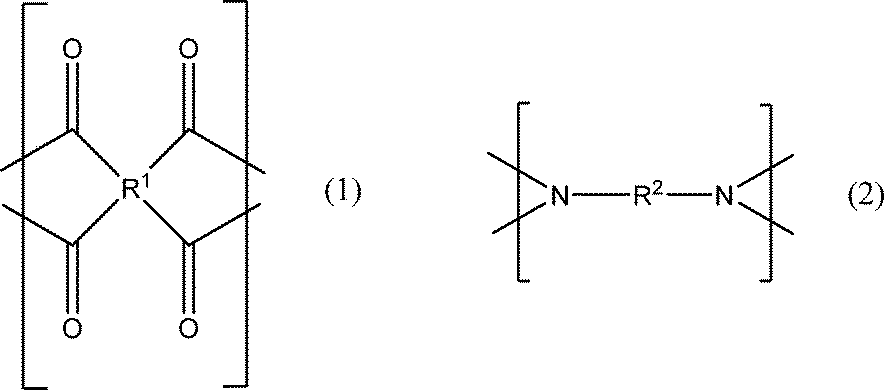
(R1は単環の芳香族基及び縮合多環の芳香族基を除く4価の有機基であり、R2は単環の芳香族基及び縮合多環の芳香族基を除く2価の有機基である。)

(ここで、
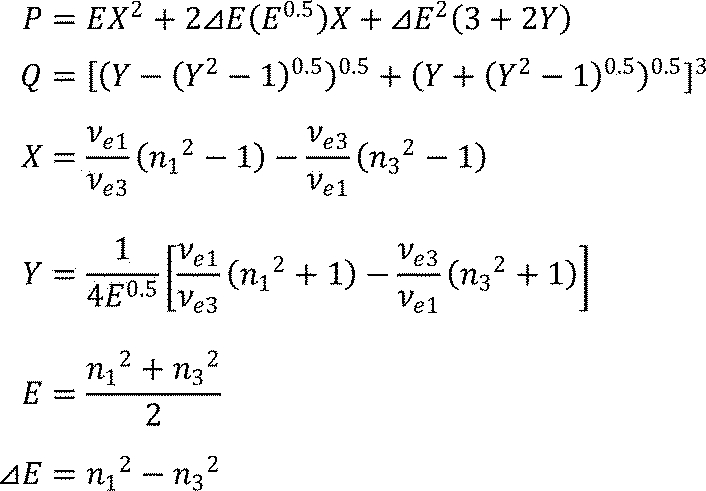
KB:ボルツマン定数、T:絶対温度(298.15K)、h:プランク定数、n1:25℃における前記共重合ポリイミドの屈折率、n3:25℃におけるγ-ブチロラクトン又はメチルイソブチルケトンの屈折率、ε1:25℃における前記共重合ポリイミドの誘電率、ε3:25℃におけるγ-ブチロラクトン又はメチルイソブチルケトンの誘電率、νe1:前記共重合ポリイミドの主電子吸収振動数(秒-1)、νe3:γ-ブチロラクトン又はメチルイソブチルケトンの主電子吸収振動数(秒-1))
[2]前記式(3)で表される前記共重合ポリイミドの自己相互作用に対応するHamaker定数(A131)が、γ-ブチロラクトンに対して、6.26×10⁻²¹Jより小さく、メチルイソブチルケトンに対して、6.20×10⁻²¹Jより大きい、前記[1]に記載の共重合ポリイミド。
[3]構成単位Aが2種類以上の構成単位であり、構成単位Bが2種類以上の構成単位である、前記[1]又は[2]に記載の共重合ポリイミド。
[4]構成単位Aが、脂環式テトラカルボン酸二無水物由来の構成単位及びフッ素含有芳香族テトラカルボン酸二無水物由来の構成単位から選択される少なくとも一つである構成単位A1と、フッ素を含有しない芳香族テトラカルボン酸二無水物由来の構成単位A2を含み、構成単位Bが、脂環式ジアミン由来の構成単位、フッ素含有芳香族ジアミン由来の構成単位及びポリシロキサンジアミン由来の構成単位から選択される少なくとも一つである構成単位B1と、フッ素を含有しない芳香族ジアミン由来の構成単位B2を含む、前記[3]に記載の共重合ポリイミド。
[5]構成単位A2が、二つの無水フタル酸を単結合、-O-、-CO-、-NHCO-、-S-、-SO2-、-COO-又は-CR2-で連結したテトラカルボン酸二無水物由来の構成単位、及び二つの無水トリメリット酸をグリコール、ハイドロキノン、又はビスフェノール類とエステル結合を介して連結したテトラカルボン酸二無水物由来の構成単位から選択された少なくとも一つであり、前記Rは独立にHもしくはCH3、又はR2としてシクロペンチリデン、シクロヘキシリデンもしくは9-フルオレニリデンから選択される少なくとも一つである基であり、構成単位A2の含有量が構成単位Aの全量に対して5~40モル%である、前記[4]に記載の共重合ポリイミド。
[6]構成単位A中のフッ素含有芳香族テトラカルボン酸二無水物由来の構成成分と構成単位B中のフッ素含有芳香族ジアミン由来の構成成分の合計量が、構成単位の全量に対して10~60モル%である、前記[4]又は[5]に記載の共重合ポリイミド。
[7]前記[1]~[6]のいずれか1つに記載の共重合ポリイミドを製造する方法であって、
ジアミンとテトラカルボン酸二無水物を、25℃における屈折率が1.42以上の非プロトン性溶媒存在下で重合させる、共重合ポリイミドの製造方法。
[8]前記[1]~[6]のいずれか1つに記載の共重合ポリイミドと、25℃における屈折率が1.42以上の非プロトン性溶媒とを含むワニス。
[9]25℃における屈折率が1.42以上の前記非プロトン性溶媒が、γ-ブチロラクトンを含む、前記[8]に記載のワニス。
[10]前記[1]~[6]のいずれか1つに記載の共重合ポリイミドからなるポリイミドフィルム。
[11]前記[8]又は[9]に記載のワニスを支持体上に塗布し、前記非プロトン性溶媒を除去する、ポリイミドフィルムの製造方法。
本発明の共重合ポリイミドは、下記一般式(1)で表されるテトラカルボン酸二無水物由来の構成単位Aと、下記一般式(2)で表されるジアミン由来の構成単位Bとを含み、構成単位A及び構成単位Bの少なくとも一方が2種類以上の構成単位である共重合ポリイミドであって、下記式(3)で表される前記共重合ポリイミドの自己相互作用に対応するHamaker定数(A131)が、γ-ブチロラクトンに対して、6.65×10⁻²¹Jより小さく、メチルイソブチルケトンに対して、5.80×10⁻²¹Jより大きい、共重合ポリイミドである。
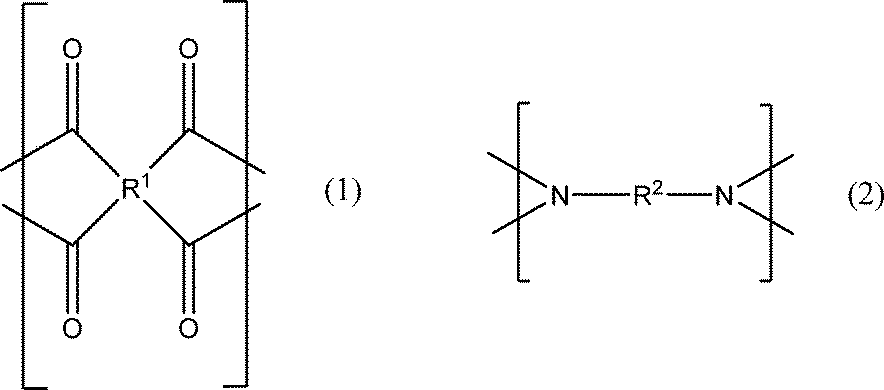
(R1は単環の芳香族基及び縮合多環の芳香族基を除く4価の有機基であり、R2は単環の芳香族基及び縮合多環の芳香族基を除く2価の有機基である。)

(ここで、

KB:ボルツマン定数、T:絶対温度(298.15K)、h:プランク定数、n1:25℃における前記共重合ポリイミドの屈折率、n3:25℃におけるγ-ブチロラクトン又はメチルイソブチルケトンの屈折率、ε1:25℃における前記共重合ポリイミドの誘電率、ε3:25℃におけるγ-ブチロラクトン又はメチルイソブチルケトンの誘電率、νe1:前記共重合ポリイミドの主電子吸収振動数(秒-1)、νe3:γ-ブチロラクトン又はメチルイソブチルケトンの主電子吸収振動数(秒-1))
本発明の共重合ポリイミドは、前記一般式(1)で表されるテトラカルボン酸二無水物由来の構成単位Aと、前記一般式(2)で表されるジアミン由来の構成単位Bとを含み、構成単位A及び構成単位Bの少なくとも一方が2種類以上の構成単位である。
以下に各構成単位について説明する。
構成単位Aは、下記一般式(1)で表されるテトラカルボン酸二無水物由来の構成単位である。

(R1は単環の芳香族基及び縮合多環の芳香族基を除く4価の有機基である。)
式(1)において、R1は、単環の芳香族基及び縮合多環の芳香族基を除く4価の有機基であって、以下に説明するテトラカルボン酸二無水物から4つのカルボキシ基(2つの酸無水物基)を除いたものであることが好ましい。
構成単位A1を与えるテトラカルボン酸二無水物は、単環の芳香族基及び縮合多環の芳香族基を主鎖(主骨格)として有さない。
構成単位A2を与えるフッ素を含有しない芳香族テトラカルボン酸二無水物としては、具体的には、4,4’-オキシジフタル酸無水物(ODPA)、3,3’,4,4’-ベンゾフェノンテトラカルボン酸二無水物(BTDA)、3,3’,4,4’-ジフェニルスルホンテトラカルボン酸二無水物(DSDA)、2,2-ビス(3,4-ジカルボキシフェニル)-プロパン二無水物、3,3’,4,4’-ビフェニルテトラカルボン酸二無水物(s-BPDA)、2,3,3’,4’-ビフェニルテトラカルボン酸二無水物(a-BPDA)、9,9’-ビス(3,4-ジカルボキシフェニル)フルオレン二無水物(BPAF)、ヒドロキノンジフタル酸無水物(HQDEA)、エチレングリコールビス(トリメリテート)二無水物(TMEG)、p-フェニレンビス(トリメリテート)二無水物(TAHQ);あるいはこれらの化合物の芳香族環の一部をアルキル基、アルコキシ基等で置換したテトラカルボン酸二無水物が挙げられ、これらのなかでも、3,3’,4,4’-ビフェニルテトラカルボン酸二無水物(s-BPDA)、2,3,3’,4’-ビフェニルテトラカルボン酸二無水物(a-BPDA)、4,4’-オキシジフタル酸無水物(ODPA)、9,9’-ビス(3,4-ジカルボキシフェニル)フルオレン二無水物(BPAF)から選択される少なくとも一つが好ましく、3,3’,4,4’-ビフェニルテトラカルボン酸二無水物(s-BPDA)、4,4’-オキシジフタル酸無水物(ODPA)、9,9’-ビス(3,4-ジカルボキシフェニル)フルオレン二無水物(BPAF)から選択される少なくとも一つがより好ましく、3,3’,4,4’-ビフェニルテトラカルボン酸二無水物(s-BPDA)、4,4’-オキシジフタル酸無水物(ODPA)から選択される少なくとも一つが更に好ましく、4,4’-オキシジフタル酸無水物(ODPA)がより更に好ましい。
構成単位A2を与えるフッ素を含有しない芳香族テトラカルボン酸二無水物は、単環の芳香族基及び縮合多環の芳香族基のみを主鎖(主骨格)として有さない。
構成単位Aに含まれる構成単位が、構成単位A1と構成単位A2を含む場合、構成単位Aに含まれる構成単位を与えるテトラカルボン酸二無水物としては、好ましくは、シクロヘキサン-1,2,4,5-テトラカルボン酸二無水物(HPMDA)と3,3’,4,4’-ビフェニルテトラカルボン酸二無水物(s-BPDA)、シクロヘキサン-1,2,4,5-テトラカルボン酸二無水物(HPMDA)と4,4’-オキシジフタル酸無水物(ODPA)、シクロヘキサン-1,2,4,5-テトラカルボン酸二無水物(HPMDA)と9,9’-ビス(3,4-ジカルボキシフェニル)フルオレン二無水物(BPAF)、ノルボルナン-2-スピロ-α-シクロペンタノン-α’-スピロ-2’’-ノルボルナン-5,5’,6,6’-テトラカルボン酸無水物(CpODA)と4,4’-オキシジフタル酸無水物(ODPA)、2,2-ビス(3,4-ジカルボキシフェニル)ヘキサフルオロプロパン二無水物(6FDA)と3,3’,4,4’-ビフェニルテトラカルボン酸二無水物(s-BPDA)、及び2,2-ビス(3,4-ジカルボキシフェニル)ヘキサフルオロプロパン二無水物(6FDA)と9,9’-ビス(3,4-ジカルボキシフェニル)フルオレン二無水物(BPAF)から選択される少なくとも一つの組合せである。
これらのなかでも、耐薬品性と溶媒可溶性のバランスを良好にする観点から、より好ましくは、シクロヘキサン-1,2,4,5-テトラカルボン酸二無水物(HPMDA)と3,3’,4,4’-ビフェニルテトラカルボン酸二無水物(s-BPDA)、ノルボルナン-2-スピロ-α-シクロペンタノン-α’-スピロ-2’’-ノルボルナン-5,5’,6,6’-テトラカルボン酸無水物(CpODA)と4,4’-オキシジフタル酸無水物(ODPA)から選択される少なくとも一つの組合せであり、更に好ましくはシクロヘキサン-1,2,4,5-テトラカルボン酸二無水物(HPMDA)と3,3’,4,4’-ビフェニルテトラカルボン酸二無水物(s-BPDA)の組合せである。
構成単位Aに含まれる構成単位が、構成単位A2を含む場合、構成単位A2の含有量は、構成単位Aの全量に対して、好ましくは5~70モル%であり、より好ましくは5~60モル%であり、更に好ましくは5~40モル%であり、より更に好ましくは10~40モル%である。
なお、本明細書において、芳香族テトラカルボン酸二無水物とは芳香環を1つ以上含むテトラカルボン酸二無水物を意味し、脂環式テトラカルボン酸二無水物とは脂環を1つ以上含み、かつ芳香環を含まないテトラカルボン酸二無水物を意味し、脂肪族テトラカルボン酸二無水物とは芳香環も脂環も含まないテトラカルボン酸二無水物を意味する。
構成単位Bは、下記一般式(2)で表されるジアミン由来の構成単位である。
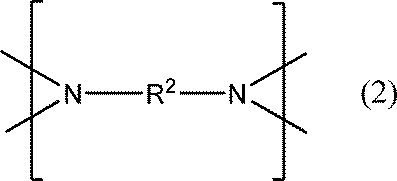
(R2は単環の芳香族基及び縮合多環の芳香族基を除く2価の有機基である。)
式(2)において、R2は、単環の芳香族基及び縮合多環の芳香族基を除く2価の有機基であって、以下に説明するジアミンから2つのアミノ基を除いたものであることが好ましい。
構成単位B1を与えるジアミンは、単環の芳香族基及び縮合多環の芳香族基のみを主鎖(主骨格)として有さない。
構成単位B2を与えるフッ素を含有しない芳香族ジアミンは、単環の芳香族基及び縮合多環の芳香族基のみを主鎖(主骨格)として有さない。
構成単位Bに含まれる構成単位が、構成単位B1と構成単位B2を含む場合、構成単位Bに含まれる構成単位を与えるジアミンは、好ましくは、1,3-ビス(アミノメチル)シクロヘキサン(1,3-BAC)と4,4’-ジアミノジフェニルエーテル(4,4’-ODA)、2,2’-ビス(トリフルオロメチル)-4,4’-ジアミノジフェニルエーテル(6FODA)と4,4’-ジアミノジフェニルスルホン(4,4’-DDS)、2,2’-ビス(トリフルオロメチル)-4,4’-ジアミノジフェニルエーテル(6FODA)と4,4’-ジアミノジフェニルエーテル(4,4’-ODA)、2,2’-ビス(トリフルオロメチル)-4,4’-ジアミノビフェニル(2,2’-TFMB)と4,4’-ジアミノジフェニルスルホン(4,4’-DDS)、1,3-ビス(アミノメチル)シクロヘキサン(1,3-BAC)と4,4’-ジアミノ-2,2’-ジメチルビフェニル(mTB)、及び1,3-ビス(アミノメチル)シクロヘキサン(1,3-BAC)と9,9-ビス(4-アミノフェニル)フルオレン(BAFL)から選択される少なくとも一つの組合せである。
これらのなかでも、耐薬品性と溶媒可溶性のバランスを良好にする観点から、より好ましくは、1,3-ビス(アミノメチル)シクロヘキサン(1,3-BAC)と4,4’-ジアミノジフェニルエーテル(4,4’-ODA)、2,2’-ビス(トリフルオロメチル)-4,4’-ジアミノジフェニルエーテル(6FODA)と4,4’-ジアミノジフェニルエーテル(4,4’-ODA)、1,3-ビス(アミノメチル)シクロヘキサン(1,3-BAC)と4,4’-ジアミノ-2,2’-ジメチルビフェニル(mTB)から選択される少なくとも一つの組合せであり、更に好ましくは、1,3-ビス(アミノメチル)シクロヘキサン(1,3-BAC)と4,4’-ジアミノジフェニルエーテル(4,4’-ODA)、2,2’-ビス(トリフルオロメチル)-4,4’-ジアミノジフェニルエーテル(6FODA)と4,4’-ジアミノジフェニルエーテル(4,4’-ODA)から選択される少なくとも一つの組合せであり、より更に好ましくは、1,3-ビス(アミノメチル)シクロヘキサン(1,3-BAC)と4,4’-ジアミノジフェニルエーテル(4,4’-ODA)の組合せである。
シクロヘキサン-1,2,4,5-テトラカルボン酸二無水物(HPMDA)と4,4’-オキシジフタル酸無水物(ODPA)の組合せに対しては、2,2’-ビス(トリフルオロメチル)-4,4’-ジアミノジフェニルエーテル(6FODA)と4,4’-ジアミノジフェニルスルホン(4,4’-DDS)の組合せが好ましい。
シクロヘキサン-1,2,4,5-テトラカルボン酸二無水物(HPMDA)と9,9’-ビス(3,4-ジカルボキシフェニル)フルオレン二無水物(BPAF)の組合せに対しては、2,2’-ビス(トリフルオロメチル)-4,4’-ジアミノジフェニルエーテル(6FODA)と4,4’-ジアミノジフェニルエーテル(4,4’-ODA)の組合せが好ましい。
2,2-ビス(3,4-ジカルボキシフェニル)ヘキサフルオロプロパン二無水物(6FDA)と3,3’,4,4’-ビフェニルテトラカルボン酸二無水物(s-BPDA)の組合せに対しては、2,2’-ビス(トリフルオロメチル)-4,4’-ジアミノビフェニル(2,2’-TFMB)と4,4’-ジアミノジフェニルスルホン(4,4’-DDS)の組合せが好ましい。
2,2-ビス(3,4-ジカルボキシフェニル)ヘキサフルオロプロパン二無水物(6FDA)と9,9’-ビス(3,4-ジカルボキシフェニル)フルオレン二無水物(BPAF)の組合せに対しては、2,2’-ビス(トリフルオロメチル)-4,4’-ジアミノビフェニル(2,2’-TFMB)と4,4’-ジアミノジフェニルスルホン(4,4’-DDS)の組合せが好ましい。
ノルボルナン-2-スピロ-α-シクロペンタノン-α’-スピロ-2’’-ノルボルナン-5,5’,6,6’-テトラカルボン酸無水物(CpODA)と4,4’-オキシジフタル酸無水物(ODPA)の組合せに対しては、1,3-ビス(アミノメチル)シクロヘキサン(1,3-BAC)と4,4’-ジアミノ-2,2’-ジメチルビフェニル(mTB)の組合せ、1,3-ビス(アミノメチル)シクロヘキサン(1,3-BAC)と9,9-ビス(4-アミノフェニル)フルオレン(BAFL)の組合せ、又は2,2’-ビス(トリフルオロメチル)-4,4’-ジアミノジフェニルエーテル(6FODA)と4,4’-ジアミノジフェニルエーテル(4,4’-ODA)の組合せが好ましく、1,3-ビス(アミノメチル)シクロヘキサン(1,3-BAC)と4,4’-ジアミノ-2,2’-ジメチルビフェニル(mTB)の組合せ、又は2,2’-ビス(トリフルオロメチル)-4,4’-ジアミノジフェニルエーテル(6FODA)と4,4’-ジアミノジフェニルエーテル(4,4’-ODA)の組合せがより好ましく、1,3-ビス(アミノメチル)シクロヘキサン(1,3-BAC)と4,4’-ジアミノ-2,2’-ジメチルビフェニル(mTB)の組合せが更に好ましい。
シクロヘキサン-1,2,4,5-テトラカルボン酸二無水物(HPMDA)と3,3’,4,4’-ビフェニルテトラカルボン酸二無水物(s-BPDA)の組合せに対しては、1,3-ビス(アミノメチル)シクロヘキサン(1,3-BAC)と4,4’-ジアミノジフェニルエーテル(4,4’-ODA)の組合せ、又は2,2’-ビス(トリフルオロメチル)-4,4’-ジアミノジフェニルエーテル(6FODA)と4,4’-ジアミノジフェニルエーテル(4,4’-ODA)の組合せが好ましく、1,3-ビス(アミノメチル)シクロヘキサン(1,3-BAC)と4,4’-ジアミノジフェニルエーテル(4,4’-ODA)の組合せがより好ましい。
すなわち、ノルボルナン-2-スピロ-α-シクロペンタノン-α’-スピロ-2’’-ノルボルナン-5,5’,6,6’-テトラカルボン酸無水物(CpODA)、4,4’-オキシジフタル酸無水物(ODPA)、1,3-ビス(アミノメチル)シクロヘキサン(1,3-BAC)及び4,4’-ジアミノ-2,2’-ジメチルビフェニル(mTB)の組合せ、ノルボルナン-2-スピロ-α-シクロペンタノン-α’-スピロ-2’’-ノルボルナン-5,5’,6,6’-テトラカルボン酸無水物(CpODA)、4,4’-オキシジフタル酸無水物(ODPA)、2,2’-ビス(トリフルオロメチル)-4,4’-ジアミノジフェニルエーテル(6FODA)及び4,4’-ジアミノジフェニルエーテル(4,4’-ODA)の組合せ、シクロヘキサン-1,2,4,5-テトラカルボン酸二無水物(HPMDA)、3,3’,4,4’-ビフェニルテトラカルボン酸二無水物(s-BPDA)、1,3-ビス(アミノメチル)シクロヘキサン(1,3-BAC)及び4,4’-ジアミノジフェニルエーテル(4,4’-ODA)の組合せ、シクロヘキサン-1,2,4,5-テトラカルボン酸二無水物(HPMDA)、3,3’,4,4’-ビフェニルテトラカルボン酸二無水物(s-BPDA)、2,2’-ビス(トリフルオロメチル)-4,4’-ジアミノジフェニルエーテル(6FODA)及び4,4’-ジアミノジフェニルエーテル(4,4’-ODA)の組合せがより好ましく、ノルボルナン-2-スピロ-α-シクロペンタノン-α’-スピロ-2’’-ノルボルナン-5,5’,6,6’-テトラカルボン酸無水物(CpODA)、4,4’-オキシジフタル酸無水物(ODPA)、1,3-ビス(アミノメチル)シクロヘキサン(1,3-BAC)及び4,4’-ジアミノ-2,2’-ジメチルビフェニル(mTB)の組合せ、シクロヘキサン-1,2,4,5-テトラカルボン酸二無水物(HPMDA)、3,3’,4,4’-ビフェニルテトラカルボン酸二無水物(s-BPDA)、1,3-ビス(アミノメチル)シクロヘキサン(1,3-BAC)及び4,4’-ジアミノジフェニルエーテル(4,4’-ODA)の組合せ、シクロヘキサン-1,2,4,5-テトラカルボン酸二無水物(HPMDA)、3,3’,4,4’-ビフェニルテトラカルボン酸二無水物(s-BPDA)、2,2’-ビス(トリフルオロメチル)-4,4’-ジアミノジフェニルエーテル(6FODA)及び4,4’-ジアミノジフェニルエーテル(4,4’-ODA)の組合せが更に好ましく、シクロヘキサン-1,2,4,5-テトラカルボン酸二無水物(HPMDA)、3,3’,4,4’-ビフェニルテトラカルボン酸二無水物(s-BPDA)、1,3-ビス(アミノメチル)シクロヘキサン(1,3-BAC)及び4,4’-ジアミノジフェニルエーテル(4,4’-ODA)の組合せ、シクロヘキサン-1,2,4,5-テトラカルボン酸二無水物(HPMDA)、3,3’,4,4’-ビフェニルテトラカルボン酸二無水物(s-BPDA)、2,2’-ビス(トリフルオロメチル)-4,4’-ジアミノジフェニルエーテル(6FODA)及び4,4’-ジアミノジフェニルエーテル(4,4’-ODA)の組合せがより更に好ましく、シクロヘキサン-1,2,4,5-テトラカルボン酸二無水物(HPMDA)、3,3’,4,4’-ビフェニルテトラカルボン酸二無水物(s-BPDA)、1,3-ビス(アミノメチル)シクロヘキサン(1,3-BAC)及び4,4’-ジアミノジフェニルエーテル(4,4’-ODA)の組合せがより更に好ましい。
構成単位Bに含まれる構成単位が、構成単位B2を含む場合、構成単位B2の含有量は、構成単位Bの全量に対して、好ましくは30~100モル%であり、より好ましくは40~95モル%であり、更に好ましくは60~95モル%であり、より更に好ましくは60~90モル%である。
なお、本明細書において、芳香族ジアミンとは芳香環を1つ以上含むジアミンを意味し、脂環式ジアミンとは脂環を1つ以上含み、かつ芳香環を含まないジアミンを意味し、脂肪族ジアミンとは芳香環も脂環も含まないジアミンを意味する。ただし、本明細書において、主鎖がポリシロキサンからなるジアミンは、ポリシロキサンジアミンである。
本発明の共重合ポリイミドは、下記式(3)で表される前記共重合ポリイミドの自己相互作用に対応するHamaker定数(A131)が、γ-ブチロラクトンに対して、6.65×10⁻²¹Jより小さく、メチルイソブチルケトンに対して、5.80×10⁻²¹Jより大きい。以下に、下記式(3)で表されるHamaker定数(A131)について説明する。

(ここで、

KB:ボルツマン定数、T:絶対温度(298.15K)、h:プランク定数、n1:25℃における前記共重合ポリイミドの屈折率、n3:25℃におけるγ-ブチロラクトン又はメチルイソブチルケトンの屈折率、ε1:25℃における前記共重合ポリイミドの誘電率、ε3:25℃におけるγ-ブチロラクトン又はメチルイソブチルケトンの誘電率、νe1:前記共重合ポリイミドの主電子吸収振動数(秒-1)、νe3:γ-ブチロラクトン又はメチルイソブチルケトンの主電子吸収振動数(秒-1))
特に、溶媒を「3」とし、巨視的相を「1」とした場合、溶媒3を隔てて二つの同一の巨視的相1が相互作用する場合であって、溶媒3と巨視的相1の主電子吸収振動数が異なる場合の厳密解は、下記式(3)で与えられ、その厳密解がHamaker定数(A131)である(L.Bergstroem,“Hamaker constants of inorganic materials”Advances in Colloid and Interface Science,第70巻、1997年、p.136を参照。)

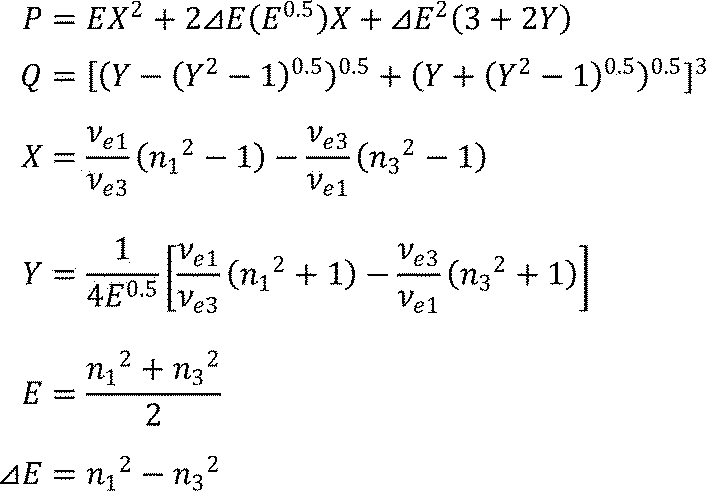
KB:ボルツマン定数、T:絶対温度(298.15K)、h:プランク定数、n1:25℃における前記共重合ポリイミドの屈折率、n3:25℃におけるγ-ブチロラクトン又はメチルイソブチルケトンの屈折率、ε1:25℃における前記共重合ポリイミドの誘電率、ε3:25℃におけるγ-ブチロラクトン又はメチルイソブチルケトンの誘電率、νe1:前記共重合ポリイミドの主電子吸収振動数(秒-1)、νe3:γ-ブチロラクトン又はメチルイソブチルケトンの主電子吸収振動数(秒-1)
本発明の共重合ポリイミドは、前記式(3)で表される前記共重合ポリイミドの自己相互作用に対応するHamaker定数(A131)が、γ-ブチロラクトンに対して、6.65×10⁻²¹Jより小さく、好ましくはγ-ブチロラクトンに対して、6.26×10⁻²¹Jより小さい。また、メチルイソブチルケトンに対して、5.80×10⁻²¹Jより大きく、好ましくはメチルイソブチルケトンに対して、6.20×10⁻²¹Jより大きい。
前記式(3)で表される前記共重合ポリイミドの自己相互作用に対応するHamaker定数(A131)が、前記の範囲であると、汎用有機溶媒へのより高い耐性を有し、耐薬品性に優れるにもかかわらず、ワニスに使用する特定の溶媒により容易に溶解することができる。
γ-ブチロラクトンは、高分子量ポリイミドを含むポリイミドワニスおよびフィルムの製造に好適であり、本発明の共重合ポリイミドの溶解性の評価基準として適している。また、メチルイソブチルケトンは、フィルム加工時のウエットプロセス等に使用可能な有機溶媒であり、本発明の共重合ポリイミドの耐有機溶媒性の評価基準として適している。
次に前記式に用いられる各物性値等について説明する。
25℃における前記共重合ポリイミドの誘電率(ε1)について、GHz帯の誘電率は、配向分極とイオン分極の寄与を考慮する必要があるが、ポリイミドの場合、電子分極の10%程度であり、本発明においては、半経験的な次式を用いて、誘電率(ε1)を求めた(松本利彦,高分子論文集,Vol.61,No.1,2004年,p.46を参照。)。
ε1=1.1×n1 2
なお、n1は25℃における前記共重合ポリイミドの屈折率である。
共重合ポリイミド、γ-ブチロラクトン及びメチルイソブチルケトンの主電子吸収振動数(νe1、νe3)は、これらの主電子吸収エネルギー(hνe1、hνe3)を求め、その値から求める。なお、hはプランク定数である。
共重合ポリイミドの主電子吸収エネルギーは、共重合比に応じた平均値を算出するために、繰り返し単位を構成単位Aと構成単位Bに分割した。共重合ポリイミドの主電子吸収エネルギーを、両端をメチル基でエンドキャップした構成単位AのLUMOと両端をマレイミドでエンドキャップした構成単位BのHOMOのエネルギーギャップで近似し、下式で平均値を算出した。

ただし、maiは構成成分Aの合計に対するi成分のモル分率、mbj:構成成分Bの合計に対するj成分モル分率であり、〔LUMOAcap〕は両末端メチル基でキャップした構成単位AのLUMOエネルギー、〔HOMOBcap〕は両末端マレイミド基でキャップした構成単位BのHOMOエネルギーである。
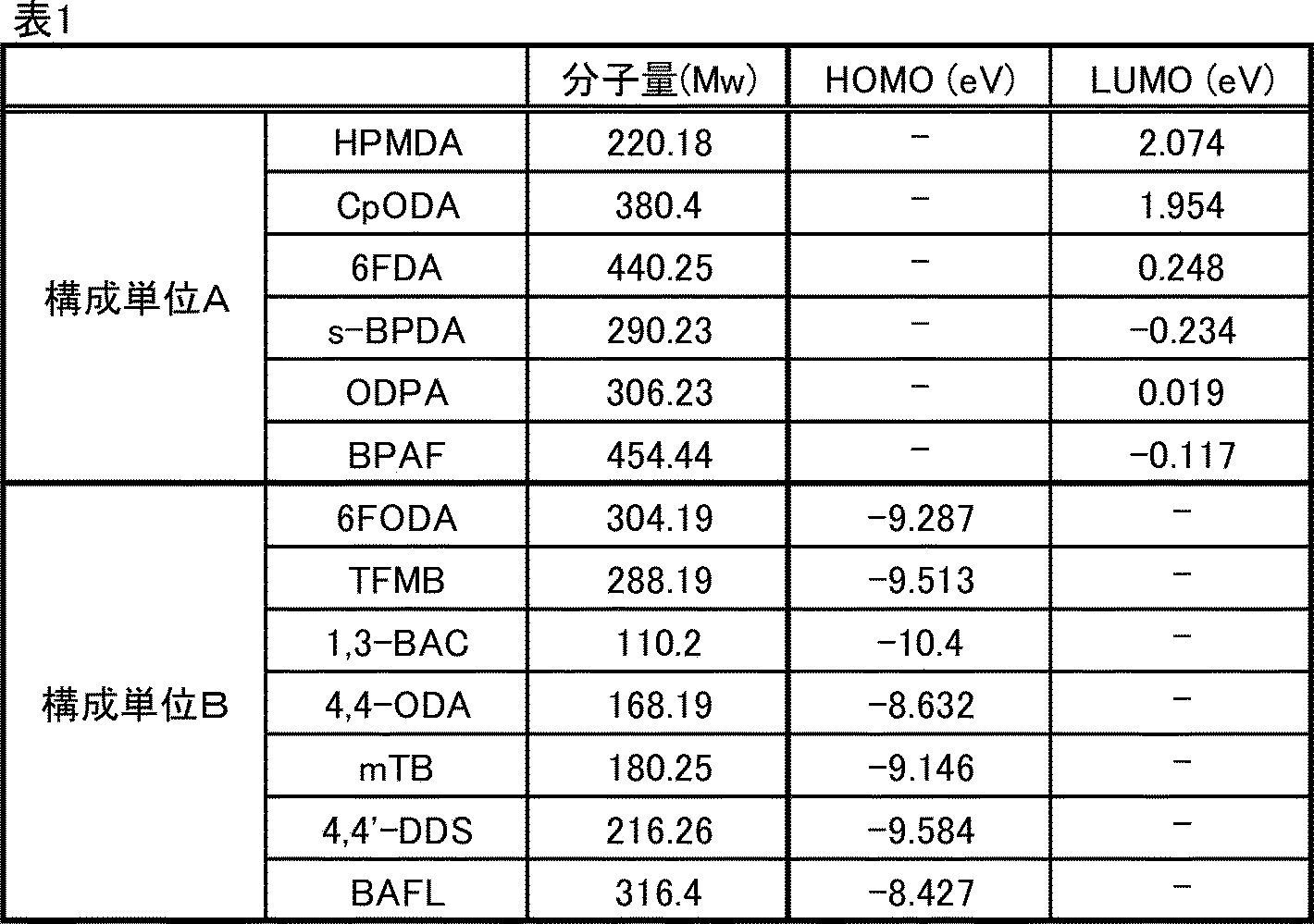
HPMDA:1,2,4,5-シクロヘキサンテトラカルボン酸二無水物
CpODA:ノルボルナン-2-スピロ-α-シクロペンタノン-α’-スピロ-2’’-ノルボルナン-5,5’,6,6’-テトラカルボン酸二無水物
6FDA:2,2-ビス(3,4-ジカルボキシフェニル)ヘキサフルオロプロパン二無水物
s-BPDA:3,3’,4,4’-ビフェニルテトラカルボン酸二無水物
ODPA:4,4’-オキシジフタル酸無水物
BPAF:9,9-ビス(3,4-ジカルボキシフェニル)フルオレン二無水物
6FODA:2,2’-ビス(トリフルオロメチル)-4,4’-ジアミノジフェニルエーテル
TFMB:2,2’-ビス(トリフルオロメチル)ベンジジン
1,3-BAC:1,3-ビス(アミノメチル)シクロヘキサン
4,4’-ODA:4,4’-オキシジアニリン
mTB:4,4’-ジアミノ-2,2’-ジメチルビフェニル
4,4’-DDS:4,4’-ジアミノジフェニルスルホン

前記共重合ポリイミドは、前記の構成を満たすものであれば、製造方法は特に限定されないが、以下に示す方法によることが好ましい。
共重合ポリイミドの製造方法は、ジアミンとテトラカルボン酸二無水物を重合させる製造方法であることが好ましく、ジアミンとテトラカルボン酸二無水物を非プロトン性溶媒存在下で重合させる製造方法であることがより好ましく、ジアミンとテトラカルボン酸二無水物を、25℃における屈折率が1.42以上の非プロトン性溶媒存在下で重合させる製造方法であることが更に好ましい。
ジアミンとテトラカルボン酸二無水物を、25℃における屈折率が1.42以上の非プロトン性溶媒存在下で重合させることで、汎用有機溶媒への耐性を有し、耐薬品性に優れるにもかかわらず、特定の溶媒に可溶である共重合ポリイミドを得ることができる。
具体的な反応方法としては、(1)テトラカルボン酸成分、ジアミン成分および反応溶媒を反応容器に仕込み、10~110℃で0.5~3時間撹拌し、その後に昇温してイミド化反応を行う方法、(2)ジアミン成分および反応溶媒を反応容器に仕込んで溶解させた後、テトラカルボン酸成分を仕込み、必要に応じて10~110℃で0.5~3時間撹拌し、その後に昇温してイミド化反応を行う方法、(3)テトラカルボン酸成分、ジアミン成分および反応溶媒を反応容器に仕込み、直ちに昇温してイミド化反応を行う方法等が挙げられる。
塩基触媒としては、ピリジン、キノリン、イソキノリン、α-ピコリン、β-ピコリン、2,4-ルチジン、2,6-ルチジン、トリメチルアミン、トリエチルアミン、トリプロピルアミン、トリブチルアミン、トリエチレンジアミン、イミダゾール、N,N-ジメチルアニリン、N,N-ジエチルアニリン等の有機塩基触媒、水酸化カリウムや水酸化ナトリウム、炭酸カリウム、炭酸ナトリウム、炭酸水素カリウム、炭酸水素ナトリウム等の無機塩基触媒が挙げられる。
また、酸触媒としては、クロトン酸、アクリル酸、トランス-3-ヘキセノイック酸、桂皮酸、安息香酸、メチル安息香酸、オキシ安息香酸、テレフタル酸、ベンゼンスルホン酸、パラトルエンスルホン酸、ナフタレンスルホン酸等が挙げられる。上記のイミド化触媒は単独で又は2種以上を組み合わせて用いてもよい。
上記のうち、取り扱い性の観点から、塩基触媒が好ましく、有機塩基触媒がより好ましく、トリエチルアミン及びトリエチレンジアミンから選ばれる1種以上が更に好ましく、トリエチルアミンがより更に好ましい。
イミド化反応の固形分濃度は、好ましくは30~60質量%であり、より好ましくは35~58質量%であり、更に好ましくは40~56質量%である。イミド化反応時の固形分濃度は、下記式により算出される値である。
固形分濃度(質量%)=(テトラカルボン酸成分及びジアミン成分の合計の質量)/(テトラカルボン酸成分、ジアミン成分及び溶媒の合計の質量)×100
次に共重合ポリイミドの製造方法で用いられる原料等について説明する。
共重合ポリイミドの製造方法において原料として用いられるテトラカルボン酸二無水物(以下、テトラカルボン酸成分ともいう。)は、前記構成単位Aを与えるテトラカルボン酸二無水物を含む。
前記テトラカルボン酸二無水物は、上述の(構成単位A)の項で説明したテトラカルボン酸二無水物と同様である。
なお、構成単位Aを与えるテトラカルボン酸二無水物としては、好ましくは、脂環式テトラカルボン酸二無水物、フッ素基含有芳香族テトラカルボン酸二無水物、及びフッ素を含有しない芳香族テトラカルボン酸二無水物から選択される少なくとも一つであり、より好ましくは、脂環式テトラカルボン酸二無水物及びフッ素含有芳香族テトラカルボン酸二無水物から選択される少なくとも一つと、フッ素を含有しない芳香族テトラカルボン酸二無水物を含む。なお、構成単位Aを与えるテトラカルボン酸二無水物は単環の芳香族基及び縮合多環の芳香族基のみを主鎖として有さない。
テトラカルボン酸二無水物として、酸二無水物が挙げられるが、それに限られず、その誘導体であってもよい。当該誘導体としては、テトラカルボン酸(遊離酸)及び当該テトラカルボン酸のアルキルエステルが挙げられる。これらのなかでも酸二無水物が好ましい。
共重合ポリイミドの製造方法において原料として用いられるジアミン(以下、ジアミン成分ともいう。)は、前記構成単位Bを与えるジアミンを含む。
前記ジアミンは、上述の(構成単位B)の項で説明したジアミンと同様である。
なお、構成単位Bを与えるジアミンとしては、好ましくは、脂環式ジアミン、フッ素基含有芳香族ジアミン、ポリシロキサンジアミン、及びフッ素を含有しない芳香族ジアミンから選択される少なくとも一つのジアミンであり、より好ましくは、脂環式ジアミン由来の構成単位、フッ素含有芳香族ジアミン由来の構成単位及びポリシロキサンジアミン由来の構成単位から選択される少なくとも一つであるジアミンと、フッ素を含有しない芳香族ジアミンを含む。なお、構成単位Bを与えるジアミンは単環の芳香族基及び縮合多環の芳香族基のみを主鎖として有さない。
ジアミンとして、ジアミンが挙げられるが、それに限られず、前記重合体における構成単位Bを与える範囲であればその誘導体であってもよい。当該誘導体としては、ジアミンに対応するジイソシアネート、ビスホルムアミド及び炭酸塩等の塩類が挙げられる。これらのなかでもジアミンが好ましい。
共重合ポリイミドの製造方法に用いられる溶媒は、イミド化反応を阻害せず、生成する共重合ポリイミドを溶解できるものであればよいが、好ましくは非プロトン性溶媒であり、より好ましくは25℃における屈折率(n25)が1.42以上の非プロトン性溶媒であり、更にこのましくは25℃における屈折率が1.42以上の非芳香族系の非プロトン性溶媒である。また、沸点160℃以上の非プロトン性極性溶媒が好ましい。
本発明の共重合ポリイミドのワニスは、特に限定されないが、25℃における屈折率が1.42以上の非プロトン性溶媒を含むことが好ましい。すなわち、本発明のワニスは、好ましくは前記共重合ポリイミドと、25℃における屈折率が1.42以上の非プロトン性溶媒とを含む。好ましくは本発明の共重合ポリイミドが、非プロトン性溶媒に溶解したポリイミドワニスである。
前記ワニスは、本発明の共重合ポリイミド樹脂を5~40質量%含むことが好ましく、10~30質量%含むことがより好ましい。前記ワニスの粘度は1~200Pa・sが好ましく、5~150Pa・sがより好ましい。前記ワニスの粘度は、E型粘度計を用いて25℃で測定される値である。
また、前記ワニスは、得られるポリイミドフィルムの要求特性を損なわない範囲で、無機フィラー、接着促進剤、剥離剤、難燃剤、紫外線安定剤、界面活性剤、レベリング剤、消泡剤、蛍光増白剤、架橋剤、重合開始剤、感光剤等各種添加剤を含んでもよい。
本発明のポリイミドフィルムは、前記共重合ポリイミドからなる。
また、本発明のポリイミドフィルムの製造方法には特に制限はなく、公知の方法を用いることができるが、前記ワニスを支持体上に塗布し、前記非プロトン性溶媒を除去する製造方法が好ましい。
具体的には、前記ワニスを、ガラス板、金属板、プラスチックなどの平滑な支持体上に塗布し、フィルム状に成形した後、該ワニス中に含まれる非プロトン性溶媒を加熱により除去する方法等が挙げられる。前記支持体の表面には、必要に応じて、予め離型剤を塗布しておいてもよい。
ワニス中に含まれる有機溶媒を加熱により除去する方法としては、以下の方法が好ましい。すなわち、120℃以下の温度で有機溶媒を蒸発させて自立支持性フィルムとした後、該自立支持性フィルムを支持体より剥離し、該自立支持性フィルムの端部を固定し、用いた有機溶媒の沸点以上の温度で乾燥してポリイミドフィルムを製造することが好ましい。また窒素雰囲気下で乾燥することが好ましい。乾燥雰囲気の圧力は、減圧、常圧、加圧のいずれでもよい。自立支持性フィルムを乾燥してポリイミドフィルムを製造する際の加熱温度は、特に限定されないが、200~400℃が好ましい。
前記ワニスに含まれる非プロトン性溶媒の沸点が130℃以下の低沸点溶媒である場合には、自立支持性フィルムの加熱温度は、100~180℃が好ましい。さらに、低沸点溶媒を除去して得られたポリイミドフィルムをガラス転移温度以上の温度に加熱するアニール処理を行うことが好ましい。
ポリイミドフィルムの厚さは、ワニスの固形分濃度や粘度、塗布する際のワニスの量を調整することにより、容易に制御することができる。
実施例及び比較例で得たポリイミドフィルムの物性及び評価は以下に示す方法によって行った。
メトリコン社製のプリズムカプラー式屈折率測定装置(モデル2010/M)を用い、実施例及び比較例で得られたポリイミドフィルムの594nmにおけるX軸、Y軸、Z軸各方向の屈折率(nx、ny、nz)を測定し、平均の屈折率(n)を下式により算出した。
n=(nx+ny+nz)/3
Hamaker定数(A131)は、前記式(3)で表される実施例及び比較例で得られた共重合ポリイミド(ポリイミドフィルム)の自己相互作用に対応するHamaker定数(A131)であり、上述のようにして算出されたγ-ブチロラクトンに対するHamaker定数(A1(GBL)1)及びメチルイソブチルケトンに対するHamaker定数(A1(MIBK)1)を表3~5に示す。
ポリイミドフィルムをGBL(γ-ブチロラクトン)に浸漬し、23℃で24時間放置した。その後、浸漬後のGBL中のポリイミドフィルムの状態を観察した。GBL溶解性の評価基準は以下の通りとした。ポリイミドフィルムが溶解しているほど、GBL(γ-ブチロラクトン)溶解性に優れる。
A:ポリイミドフィルムが完全に溶解した。
B:ポリイミドフィルム形状は維持していないが、一部溶け残りが観測された。
C:ポリイミドフィルム表面に変化がなく、フィルム形状を維持した。
ポリイミドフィルムをMIBK(メチルイソブチルケトン)に浸漬し、23℃で24時間放置した。その後、浸漬後のMIBK中のポリイミドフィルムの状態を観察した。MIBK耐性の評価基準は以下の通りとした。ポリイミドフィルムが溶解せず、フィルム形状が残っているほど、MIBK(メチルイソブチルケトン)耐性に優れる。
A:フィルム表面に変化がなく、フィルム形状を維持した。
B:フィルム形状は維持したが、表面にクラックあるいは白濁が観測された。
C:フィルムが完全に溶解した。
<テトラカルボン酸二無水物>
HPMDA:1,2,4,5-シクロヘキサンテトラカルボン酸二無水物(三菱ガス化学株式会社製)
CpODA:ノルボルナン-2-スピロ-α-シクロペンタノン-α’-スピロ-2’’-ノルボルナン-5,5’,6,6’-テトラカルボン酸二無水物(JFEケミカル株式会社製)
6FDA:2,2-ビス(3,4-ジカルボキシフェニル)ヘキサフルオロプロパン二無水物(ダイキン工業株式会社製)
s-BPDA:3,3’,4,4’-ビフェニルテトラカルボン酸二無水物(三菱ケミカル株式会社製)
ODPA:4,4’-オキシジフタル酸無水物(マナック株式会社製)
BPAF:9,9-ビス(3,4-ジカルボキシフェニル)フルオレン二無水物(JFEケミカル株式会社製)
<ジアミン>
6FODA:2,2’-ビス(トリフルオロメチル)-4,4’-ジアミノジフェニルエーテル(ChinaTech Chemical(Taijin)Co.,Ltd.製)
TFMB:2,2’-ビス(トリフルオロメチル)ベンジジン(和歌山精化工業株式会社製)
1,3-BAC:1,3-ビス(アミノメチル)シクロヘキサン(三菱ガス化学株式会社製)
4,4’-ODA:4,4’-オキシジアニリン(和歌山精化工業株式会社製)
mTB:4,4’-ジアミノ-2,2’-ジメチルビフェニル(和歌山精化工業株式会社製)
4,4’-DDS:4,4’-ジアミノジフェニルスルホン(和歌山精化工業株式会社製)
BAFL:9,9-ビス(4-アミノフェニル)フルオレン(田岡化学工業株式会社製)
GBL:γ-ブチロラクトン(三菱ケミカル株式会社製、GBL)
NMP:N-メチル-2-ピロリドン(東京純薬工業株式会社製)
TEA:トリエチルアミン(関東化学株式会社製)
実施例1
ステンレス製半月型撹拌翼、窒素導入管、冷却管を取り付けたディーンスターク装置、温度計、ガラス製エンドキャップを備えた300mLの5つ口丸底フラスコに、ジアミン成分として4,4’-DDS 8.730g(0.0352モル)及び6FODA 7.881g(0.0234モル)、有機溶媒としてGBL 20.7g、イミド化触媒としてTEA 0.302gを投入し、系内温度70℃、窒素雰囲気下、回転数150rpmで撹拌して溶液を得た。これにテトラカルボン酸成分としてHPMDA 9.195g(0.0410モル)及びODPA 5.453g(0.0176モル)、追加の有機溶媒としてGBL 23.0gを一括で添加した後、マントルヒーターで加熱し、20分かけて反応系内温度を190℃まで上げた。水分を留去し、回転数を粘度上昇に合わせて調整しつつ、反応系内温度を190℃に保持して2時間還流することでポリイミド溶液を得た。その後、反応系内温度を120℃まで冷却し、希釈用GBL 72.8g添加して、さらに3時間撹拌して、固形分濃度20.0質量%のポリイミドワニスを得た。
続いて、得られたポリイミドワニスをガラス基板上に塗布し、60℃で20分、80℃で20分、100℃で30分保持し、溶媒を揮発させることで自己支持性を有する透明な一次乾燥フィルムを得、さらに該フィルムをステンレス枠に固定し、220℃で空気雰囲気下、20分加熱することにより溶媒を除去し、ポリイミドフィルムを得た。フィルムの物性と評価結果を表3に示す。
ジアミン成分の4,4’-DDSの量を1.339g(0.0054モル)に変更し、6FODAの量を16.322g(0.0485モル)に変更し、テトラカルボン酸成分のHPMDAの量を8.464g(0.0378モル)に変更し、ODPAの量を5.020g(0.0162モル)に変更した以外は、実施例1と同様の方法により、固形分濃度20.0質量%のポリイミドワニスを得た。得られたポリイミドワニスを用いて、実施例1と同様の方法によりポリイミドフィルムを得た。フィルムの物性と評価結果を表3に示す。
ステンレス製半月型撹拌翼、窒素導入管、冷却管を取り付けたディーンスターク、温度計、ガラス製エンドキャップを備えた300mLの5つ口丸底フラスコに、ジアミン成分として4,4’-DDS 13.587g(0.0547モル)及び6FODA 2.044g(0.0061モル)、有機溶媒としてNMP 40.9gを投入し、系内温度50℃、窒素雰囲気下、回転数150rpmで撹拌して溶液を得た。
この溶液に、テトラカルボン酸成分としてHPMDA 9.541g(0.0426モル)及びODPA 5.658g(0.0182モル)、追加の有機溶媒としてNMP 30.0gを一括で投入し、マントルヒーターで50℃に保持したまま7時間撹拌した。その後、NMPを102.7g添加して、更に3時間撹拌して、固形分濃度15.0質量%のポリアミド酸ワニスを得た。
続いて得られたポリアミド酸組成物ワニスをガラス板上塗布し、60℃で20分、80℃で20分、100℃で30分保持した。その後、熱風乾燥機に移し、窒素雰囲気下、昇温速度5℃/minで420℃まで昇温し、更に420℃で60分加熱することにより、溶媒を除去し、熱イミド化させて、ポリイミドフィルムを得た。フィルムの物性と評価結果を表3に示す。
ステンレス製半月型撹拌翼、窒素導入管、冷却管を取り付けたディーンスターク装置、温度計、ガラス製エンドキャップを備えた300mLの5つ口丸底フラスコに、ジアミン成分として4,4’-ODA 5.086g(0.0254モル)及び6FODA 8.540g(0.0254モル)、有機溶媒としてGBL 20.7g、イミド化触媒としてTEA 0.304gを投入し、系内温度70℃、窒素雰囲気下、回転数150rpmで撹拌して溶液を得た。これにテトラカルボン酸成分としてHPMDA 5.694g(0.0254モル)及びBPAF 11.644g(0.0254モル)、追加の有機溶媒としてGBL 23.0gを一括で添加した後、マントルヒーターで加熱し、20分かけて反応系内温度を190℃まで上げた。水分を留去し、回転数を粘度上昇に合わせて調整しつつ、反応系内温度を190℃に保持して2時間還流することでポリイミド溶液を得た。その後、反応系内温度を120℃まで冷却し、希釈用GBL 72.8g添加して、さらに3時間撹拌して、固形分濃度20.0質量%のポリイミドワニスを得た。得られたポリイミドワニスを用いて、実施例1と同様の方法によりポリイミドフィルムを得た。フィルムの物性と評価結果を表3に示す。
ジアミン成分の4,4’-ODAの量を9.531g(0.0476モル)に変更し、6FODAの量を6.859g(0.0204モル)に変更し、テトラカルボン酸成分のHPMDAの量を15.244g(0.0680モル)に変更し、BPAFを用いなかった以外は、実施例2と同様の方法により、固形分濃度20.0質量%のポリイミドワニスを得た。得られたポリイミドワニスを用いて、実施例1と同様の方法によりポリイミドフィルムを得た。フィルムの物性と評価結果を表3に示す。
ジアミン成分の4,4’-ODAの量を12.735g(0.0636モル)に変更し、6FODAを用いず、テトラカルボン酸成分のHPMDAの量を9.980g(0.0445モル)に変更し、BPAFの量を8.747g(0.0191モル)に変更した以外は、実施例2と同様の方法により、固形分濃度20.0質量%のポリイミドワニスを得た。得られたポリイミドワニスを用いて、実施例1と同様の方法によりポリイミドフィルムを得た。フィルムの物性と評価結果を表3に示す。
ジアミン成分の4,4’-ODAの量を11.546g(0.0577モル)に変更し、6FODAを用いず、テトラカルボン酸成分のHPMDAの量を6.463g(0.0288モル)に変更し、BPAFの量を13.216g(0.0288モル)に変更した以外は、実施例2と同様の方法により、固形分濃度20.0質量%のポリイミドワニスを得た。得られたポリイミドワニスを用いて、実施例1と同様の方法によりポリイミドフィルムを得た。フィルムの物性と評価結果を表3に示す。
ステンレス製半月型撹拌翼、窒素導入管、冷却管を取り付けたディーンスターク装置、温度計、ガラス製エンドキャップを備えた300mLの5つ口丸底フラスコに、ジアミン成分として4,4’-DDS 5.860g(0.0236モル)及びTFMB 7.558g(0.0236モル)、有機溶媒としてGBL 20.7g、イミド化触媒としてTEA 0.234gを投入し、系内温度70℃、窒素雰囲気下、回転数150rpmで撹拌して溶液を得た。これにテトラカルボン酸成分として6FDA 10.484g(0.0236モル)及びs-BPDA 6.944g(0.0236モル)、追加の有機溶媒としてGBL 23.0gを一括で添加した後、マントルヒーターで加熱し、20分かけて反応系内温度を190℃まで上げた。水分を留去し、回転数を粘度上昇に合わせて調整しつつ、反応系内温度を190℃に保持して2時間還流することでポリイミド溶液を得た。その後、反応系内温度を120℃まで冷却し、希釈用GBL 16.3g添加して、さらに3時間撹拌して、固形分濃度20.0質量%のポリイミドワニスを得た。得られたポリイミドワニスを用いて、実施例1と同様の方法によりポリイミドフィルムを得た。フィルムの物性と評価結果を表4に示す。
ジアミン成分の4,4’-DDSの量を9.713g(0.0391モル)に変更し、TFMBの量を3.132g(0.0098モル)に変更し、テトラカルボン酸成分の6FDAの量を10.862g(0.0245モル)に変更し、s-BPDAの量を7.194g(0.0245モル)に変更した以外は、実施例5と同様の方法により、固形分濃度20.0質量%のポリイミドワニスを得た。得られたポリイミドワニスを用いて、実施例1と同様の方法によりポリイミドフィルムを得た。フィルムの物性と評価結果を表4に示す。
ジアミン成分の4,4’-DDSの量を6.302g(0.0254モル)に変更し、TFMBの量を5.418g(0.0169モル)に変更し、テトラカルボン酸成分の6FDAの量を13.154g(0.0296モル)に変更し、s-BPDAを用いず、BPAFを5.817g(0.0127モル)用いた以外は、実施例5と同様の方法により、固形分濃度20.0質量%のポリイミドワニスを得た。得られたポリイミドワニスを用いて、実施例1と同様の方法によりポリイミドフィルムを得た。フィルムの物性と評価結果を表4に示す。
ステンレス製半月型撹拌翼、窒素導入管、冷却管を取り付けたディーンスターク装置、温度計、ガラス製エンドキャップを備えた300mLの5つ口丸底フラスコに、ジアミン成分として1,3-BAC 4.246g(0.0299モル)及びmTB 6.337g(0.0299モル)、有機溶媒としてGBL 20.7g、イミド化触媒としてTEA 0.264gを投入し、系内温度70℃、窒素雰囲気下、回転数150rpmで撹拌して溶液を得た。これにテトラカルボン酸成分としてCpODA 11.474g(0.0299モル)及びODPA 9.260g(0.0299モル)、追加の有機溶媒としてGBL 23.0gを一括で添加した後、マントルヒーターで加熱し、20分かけて反応系内温度を190℃まで上げた。水分を留去し、回転数を粘度上昇に合わせて調整しつつ、反応系内温度を190℃に保持して2時間還流することでポリイミド溶液を得た。その後、反応系内温度を120℃まで冷却し、希釈用GBL 72.8g添加して、さらに3時間撹拌して、固形分濃度20.0質量%のポリイミドワニスを得た。得られたポリイミドワニスを用いて、実施例1と同様の方法によりポリイミドフィルムを得た。フィルムの物性と評価結果を表4に示す。
ジアミン成分の1,3-BACの量を3.727g(0.0262モル)に変更し、mTBを用いず、BAFLを9.129g(0.0262モル)用い、テトラカルボン酸成分のCpODAの量を10.071g(0.0262モル)に変更し、ODPAの量を8.128g(0.0262モル)に変更した以外は、実施例8と同様の方法により、固形分濃度20.0質量%のポリイミドワニスを得た。得られたポリイミドワニスを用いて、実施例1と同様の方法によりポリイミドフィルムを得た。フィルムの物性と評価結果を表4に示す。
ジアミン成分の1,3-BACを用いず、mTBを用いず、BAFLを15.401g(0.0442モル)用い、テトラカルボン酸成分のCpODAの量を8.495g(0.0221モル)に変更し、ODPAの量を6.856g(0.0221モル)に変更した以外は、実施例8と同様の方法により、固形分濃度20.0質量%のポリイミドワニスを得た。得られたポリイミドワニスを用いて、実施例1と同様の方法によりポリイミドフィルムを得た。フィルムの物性と評価結果を表4に示す。
ジアミン成分とテトラカルボン酸成分の種類と割合を表5に示すように変更した以外は、実施例8と同様の方法により、固形分濃度20.0質量%のポリイミドワニスを得た。得られたポリイミドワニスを用いて、実施例1と同様の方法によりポリイミドフィルムを得た。フィルムの物性と評価結果を表5に示す。
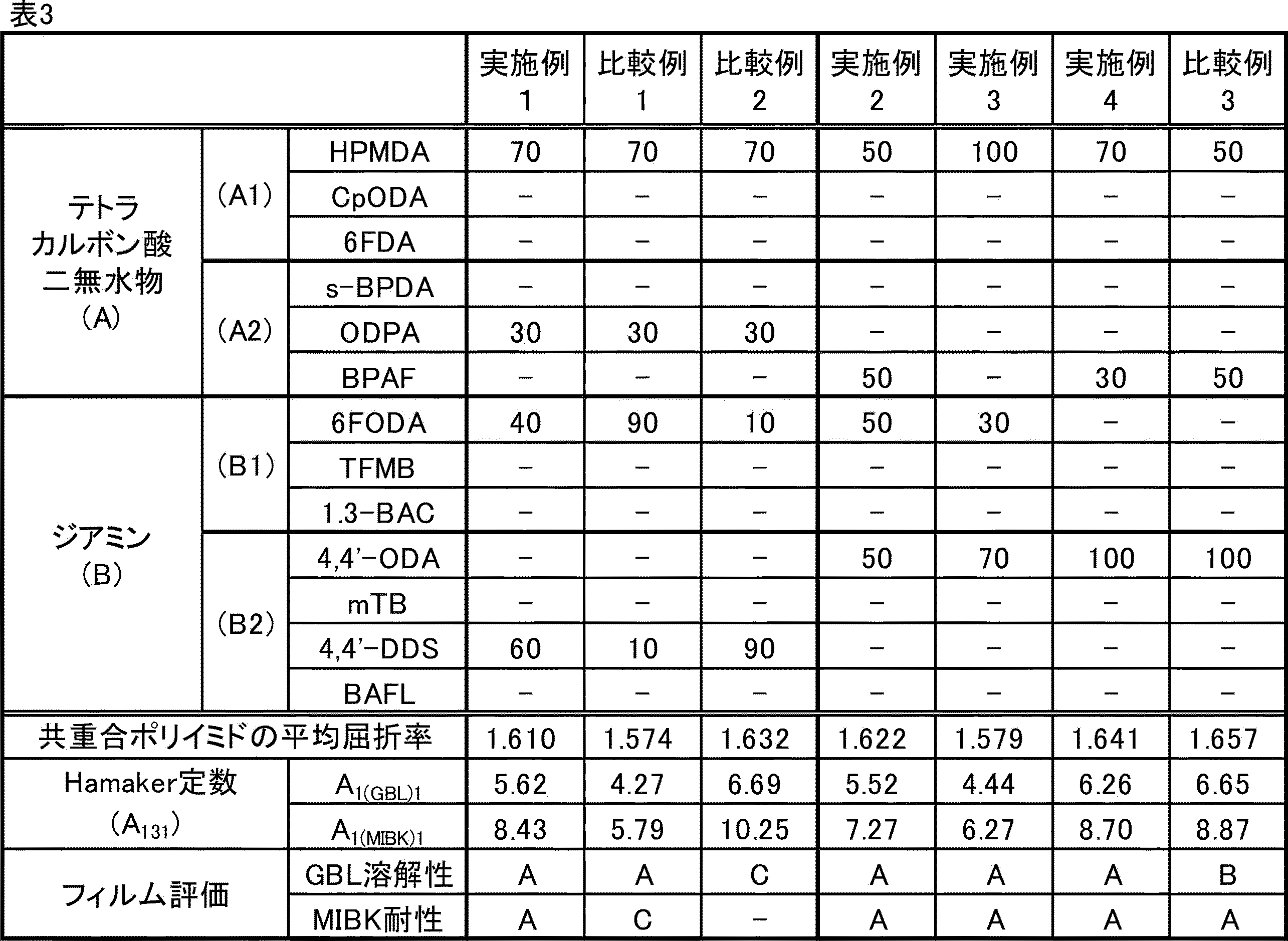

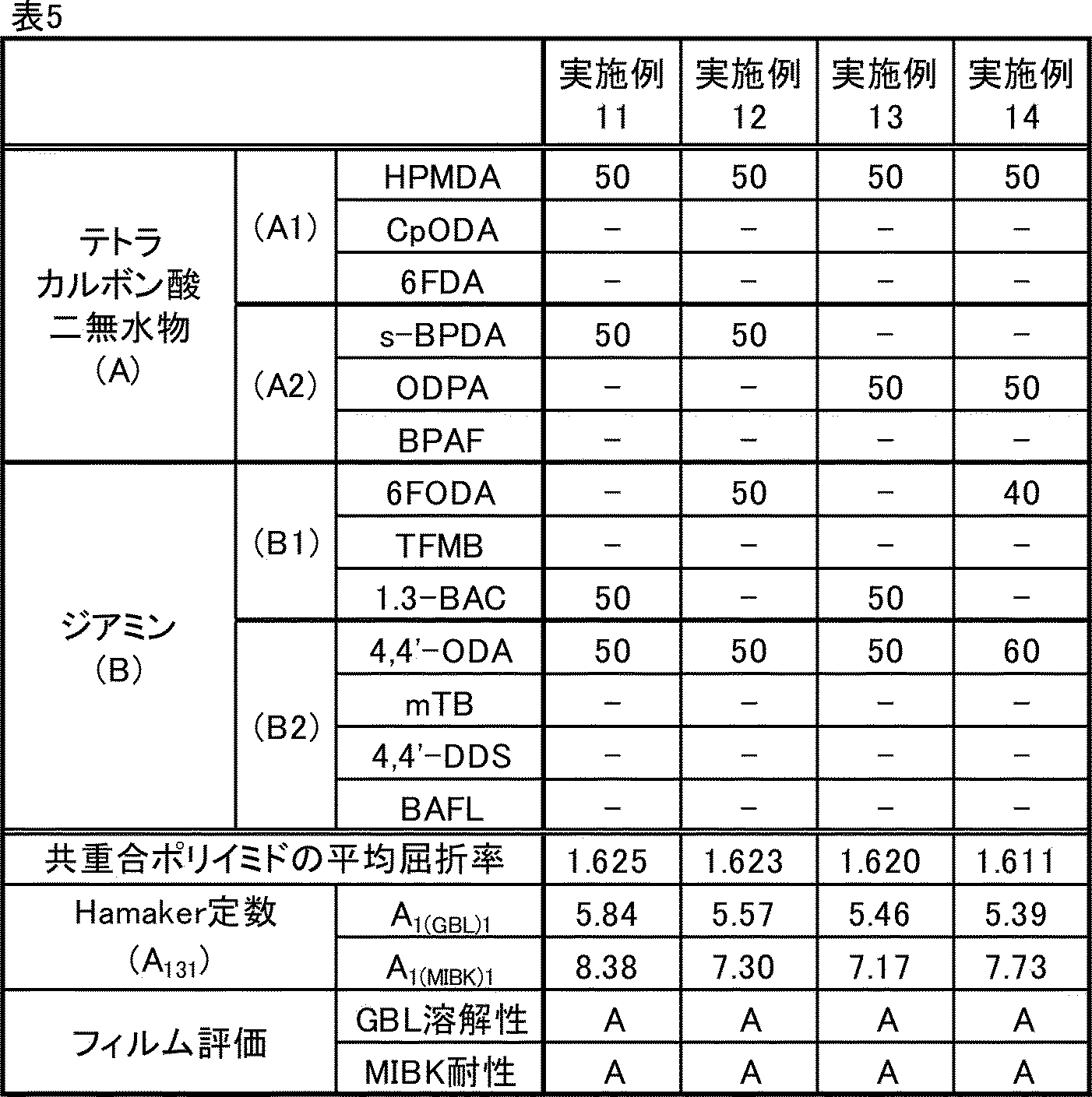
Claims (11)
- 下記一般式(1)で表されるテトラカルボン酸二無水物由来の構成単位Aと、下記一般式(2)で表されるジアミン由来の構成単位Bとを含み、構成単位A及び構成単位Bの少なくとも一方が2種類以上の構成単位である共重合ポリイミドであって、
下記式(3)で表される前記共重合ポリイミドの自己相互作用に対応するHamaker定数(A131)が、γ-ブチロラクトンに対して、6.65×10⁻²¹Jより小さく、メチルイソブチルケトンに対して、5.80×10⁻²¹Jより大きい、共重合ポリイミド。

(R1は単環の芳香族基及び縮合多環の芳香族基を除く4価の有機基であり、R2は単環の芳香族基及び縮合多環の芳香族基を除く2価の有機基である。)

(ここで、
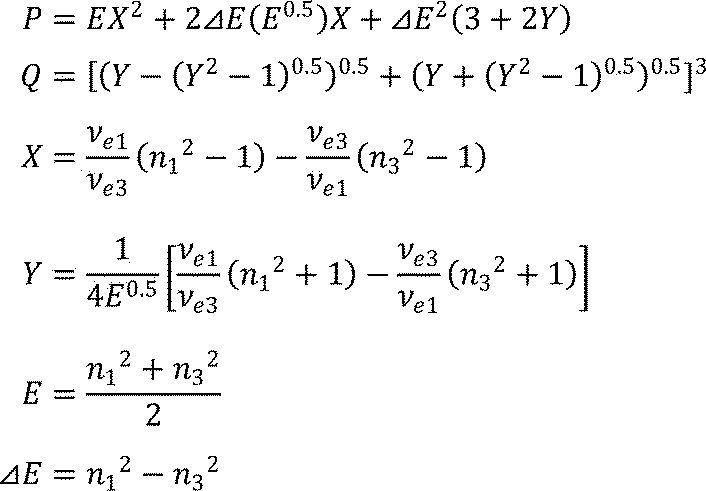
KB:ボルツマン定数、T:絶対温度(298.15K)、h:プランク定数、n1:25℃における前記共重合ポリイミドの屈折率、n3:25℃におけるγ-ブチロラクトン又はメチルイソブチルケトンの屈折率、ε1:25℃における前記共重合ポリイミドの誘電率、ε3:25℃におけるγ-ブチロラクトン又はメチルイソブチルケトンの誘電率、νe1:前記共重合ポリイミドの主電子吸収振動数(秒-1)、νe3:γ-ブチロラクトン又はメチルイソブチルケトンの主電子吸収振動数(秒-1)) - 前記式(3)で表される前記共重合ポリイミドの自己相互作用に対応するHamaker定数(A131)が、γ-ブチロラクトンに対して、6.26×10⁻²¹Jより小さく、メチルイソブチルケトンに対して、6.20×10⁻²¹Jより大きい、請求項1に記載の共重合ポリイミド。
- 構成単位Aが2種類以上の構成単位であり、構成単位Bが2種類以上の構成単位である、請求項1に記載の共重合ポリイミド。
- 構成単位Aが、脂環式テトラカルボン酸二無水物由来の構成単位及びフッ素含有芳香族テトラカルボン酸二無水物由来の構成単位から選択される少なくとも一つである構成単位A1と、フッ素を含有しない芳香族テトラカルボン酸二無水物由来の構成単位A2を含み、
構成単位Bが、脂環式ジアミン由来の構成単位、フッ素含有芳香族ジアミン由来の構成単位及びポリシロキサンジアミン由来の構成単位から選択される少なくとも一つである構成単位B1と、フッ素を含有しない芳香族ジアミン由来の構成単位B2を含む、請求項3に記載の共重合ポリイミド。 - 構成単位A2が、二つの無水フタル酸を単結合、-O-、-CO-、-NHCO-、-S-、-SO2-、-COO-又は-CR2-で連結したテトラカルボン酸二無水物由来の構成単位、及び二つの無水トリメリット酸をグリコール、ハイドロキノン、又はビスフェノール類とエステル結合を介して連結したテトラカルボン酸二無水物由来の構成単位から選択された少なくとも一つであり、前記Rは独立にHもしくはCH3、又はR2としてシクロペンチリデン、シクロヘキシリデンもしくは9-フルオレニリデンから選択される少なくとも一つである基であり、
構成単位A2の含有量が構成単位Aの全量に対して5~40モル%である、請求項4に記載の共重合ポリイミド。 - 構成単位A中のフッ素含有芳香族テトラカルボン酸二無水物由来の構成成分と構成単位B中のフッ素含有芳香族ジアミン由来の構成成分の合計量が、構成単位の全量に対して10~60モル%である、請求項4に記載の共重合ポリイミド。
- 請求項1~6のいずれか1つに記載の共重合ポリイミドを製造する方法であって、
ジアミンとテトラカルボン酸二無水物を、25℃における屈折率が1.42以上の非プロトン性溶媒存在下で重合させる、共重合ポリイミドの製造方法。 - 請求項1~6のいずれか1つに記載の共重合ポリイミドと、25℃における屈折率が1.42以上の非プロトン性溶媒とを含むワニス。
- 25℃における屈折率が1.42以上の前記非プロトン性溶媒が、γ-ブチロラクトンを含む、請求項8に記載のワニス。
- 請求項1~6のいずれか1つに記載の共重合ポリイミドからなるポリイミドフィルム。
- 請求項8に記載のワニスを支持体上に塗布し、前記非プロトン性溶媒を除去する、ポリイミドフィルムの製造方法。
Priority Applications (3)
| Application Number | Priority Date | Filing Date | Title |
|---|---|---|---|
| KR1020247029707A KR20250003495A (ko) | 2022-04-15 | 2023-03-23 | 공중합 폴리이미드 |
| JP2024514868A JPWO2023199718A1 (ja) | 2022-04-15 | 2023-03-23 | |
| CN202380033282.2A CN119032121A (zh) | 2022-04-15 | 2023-03-23 | 共聚聚酰亚胺 |
Applications Claiming Priority (2)
| Application Number | Priority Date | Filing Date | Title |
|---|---|---|---|
| JP2022067909 | 2022-04-15 | ||
| JP2022-067909 | 2022-04-15 |
Publications (1)
| Publication Number | Publication Date |
|---|---|
| WO2023199718A1 true WO2023199718A1 (ja) | 2023-10-19 |
Family
ID=88329457
Family Applications (1)
| Application Number | Title | Priority Date | Filing Date |
|---|---|---|---|
| PCT/JP2023/011347 Ceased WO2023199718A1 (ja) | 2022-04-15 | 2023-03-23 | 共重合ポリイミド |
Country Status (5)
| Country | Link |
|---|---|
| JP (1) | JPWO2023199718A1 (ja) |
| KR (1) | KR20250003495A (ja) |
| CN (1) | CN119032121A (ja) |
| TW (1) | TW202405056A (ja) |
| WO (1) | WO2023199718A1 (ja) |
Citations (11)
| Publication number | Priority date | Publication date | Assignee | Title |
|---|---|---|---|---|
| JP2001048983A (ja) * | 1999-08-05 | 2001-02-20 | New Japan Chem Co Ltd | ポリイミドフィルムの改質方法及びポリイミドフィルム |
| JP2004111152A (ja) * | 2002-09-17 | 2004-04-08 | Mitsubishi Gas Chem Co Inc | 透明導電性フィルム |
| KR20090051884A (ko) * | 2007-11-20 | 2009-05-25 | 주식회사 코오롱 | 폴리이미드 수지와 이를 이용한 액정 배향막 및 필름 |
| JP2009230076A (ja) * | 2008-03-25 | 2009-10-08 | Kaneka Corp | 新規な感光性樹脂組成物、それから得られる感光性樹脂組成物溶液、感光性フィルム、絶縁膜及び絶縁膜付きプリント配線板 |
| JP2016204568A (ja) * | 2015-04-27 | 2016-12-08 | 宇部興産株式会社 | ポリアミック酸溶液組成物およびポリイミドフィルム |
| JP2019006933A (ja) * | 2017-06-27 | 2019-01-17 | 旭化成株式会社 | ポリイミドフィルム及びその製造方法 |
| WO2019069723A1 (ja) * | 2017-10-04 | 2019-04-11 | 三菱瓦斯化学株式会社 | ポリイミド樹脂、ポリイミドワニス及びポリイミドフィルム |
| WO2020141614A2 (ja) * | 2019-05-10 | 2020-07-09 | Jxtgエネルギー株式会社 | ポリイミド、ポリアミド酸、樹脂溶液、コーティング剤及びポリイミドフィルム |
| WO2021132196A1 (ja) * | 2019-12-27 | 2021-07-01 | 三菱瓦斯化学株式会社 | ポリイミド樹脂、ポリイミドワニス及びポリイミドフィルム |
| JP2021176961A (ja) * | 2021-03-10 | 2021-11-11 | 晉一化工股▲ふん▼有限公司Chin Yee Chemical Industries Co., Ltd. | ベンゾシクロブテン含有ポリイミド樹脂およびその組成物、製造方法、再配線層、ポリイミドフィルム、および使用 |
| WO2022054766A1 (ja) * | 2020-09-10 | 2022-03-17 | 三菱瓦斯化学株式会社 | 重合体組成物、ワニス、及びポリイミドフィルム |
Family Cites Families (3)
| Publication number | Priority date | Publication date | Assignee | Title |
|---|---|---|---|---|
| JP2006199945A (ja) | 2004-12-24 | 2006-08-03 | Mitsubishi Gas Chem Co Inc | 低吸水性ポリイミド樹脂およびその製造方法 |
| KR101292886B1 (ko) | 2009-09-29 | 2013-08-02 | 코오롱인더스트리 주식회사 | 내용제성이 개선된 무색투명한 폴리이미드 필름 |
| WO2017073782A1 (ja) | 2015-10-30 | 2017-05-04 | 株式会社アイ.エス.テイ | ポリイミド膜 |
-
2023
- 2023-03-23 WO PCT/JP2023/011347 patent/WO2023199718A1/ja not_active Ceased
- 2023-03-23 KR KR1020247029707A patent/KR20250003495A/ko active Pending
- 2023-03-23 JP JP2024514868A patent/JPWO2023199718A1/ja active Pending
- 2023-03-23 CN CN202380033282.2A patent/CN119032121A/zh active Pending
- 2023-04-07 TW TW112112985A patent/TW202405056A/zh unknown
Patent Citations (11)
| Publication number | Priority date | Publication date | Assignee | Title |
|---|---|---|---|---|
| JP2001048983A (ja) * | 1999-08-05 | 2001-02-20 | New Japan Chem Co Ltd | ポリイミドフィルムの改質方法及びポリイミドフィルム |
| JP2004111152A (ja) * | 2002-09-17 | 2004-04-08 | Mitsubishi Gas Chem Co Inc | 透明導電性フィルム |
| KR20090051884A (ko) * | 2007-11-20 | 2009-05-25 | 주식회사 코오롱 | 폴리이미드 수지와 이를 이용한 액정 배향막 및 필름 |
| JP2009230076A (ja) * | 2008-03-25 | 2009-10-08 | Kaneka Corp | 新規な感光性樹脂組成物、それから得られる感光性樹脂組成物溶液、感光性フィルム、絶縁膜及び絶縁膜付きプリント配線板 |
| JP2016204568A (ja) * | 2015-04-27 | 2016-12-08 | 宇部興産株式会社 | ポリアミック酸溶液組成物およびポリイミドフィルム |
| JP2019006933A (ja) * | 2017-06-27 | 2019-01-17 | 旭化成株式会社 | ポリイミドフィルム及びその製造方法 |
| WO2019069723A1 (ja) * | 2017-10-04 | 2019-04-11 | 三菱瓦斯化学株式会社 | ポリイミド樹脂、ポリイミドワニス及びポリイミドフィルム |
| WO2020141614A2 (ja) * | 2019-05-10 | 2020-07-09 | Jxtgエネルギー株式会社 | ポリイミド、ポリアミド酸、樹脂溶液、コーティング剤及びポリイミドフィルム |
| WO2021132196A1 (ja) * | 2019-12-27 | 2021-07-01 | 三菱瓦斯化学株式会社 | ポリイミド樹脂、ポリイミドワニス及びポリイミドフィルム |
| WO2022054766A1 (ja) * | 2020-09-10 | 2022-03-17 | 三菱瓦斯化学株式会社 | 重合体組成物、ワニス、及びポリイミドフィルム |
| JP2021176961A (ja) * | 2021-03-10 | 2021-11-11 | 晉一化工股▲ふん▼有限公司Chin Yee Chemical Industries Co., Ltd. | ベンゾシクロブテン含有ポリイミド樹脂およびその組成物、製造方法、再配線層、ポリイミドフィルム、および使用 |
Also Published As
| Publication number | Publication date |
|---|---|
| CN119032121A (zh) | 2024-11-26 |
| JPWO2023199718A1 (ja) | 2023-10-19 |
| TW202405056A (zh) | 2024-02-01 |
| KR20250003495A (ko) | 2025-01-07 |
Similar Documents
| Publication | Publication Date | Title |
|---|---|---|
| JP7424284B2 (ja) | ポリイミド樹脂、ポリイミドワニス及びポリイミドフィルム | |
| JP7392660B2 (ja) | イミド-アミド酸共重合体及びその製造方法、ワニス、並びにポリイミドフィルム | |
| JP6996609B2 (ja) | ポリイミド樹脂、ポリイミドワニス及びポリイミドフィルム | |
| JP7314953B2 (ja) | ポリイミド樹脂、ワニス及びポリイミドフィルム | |
| JP7702249B2 (ja) | ポリイミド樹脂、ポリイミドワニス及びポリイミドフィルム | |
| JP7180617B2 (ja) | ポリイミド樹脂組成物及びポリイミドフィルム | |
| JP7384170B2 (ja) | ポリイミド樹脂、ポリイミドワニス及びポリイミドフィルム | |
| JP7666507B2 (ja) | イミド-アミド酸共重合体及びその製造方法、ワニス、並びにポリイミドフィルム | |
| JP7367699B2 (ja) | ポリイミド樹脂、ポリイミドワニス及びポリイミドフィルム | |
| JP7463964B2 (ja) | ポリイミド樹脂、ポリイミドワニス及びポリイミドフィルム | |
| JPWO2019069723A1 (ja) | ポリイミド樹脂、ポリイミドワニス及びポリイミドフィルム | |
| JPWO2019116940A1 (ja) | ポリイミド樹脂、ポリイミドワニス及びポリイミドフィルム | |
| JP7375749B2 (ja) | ポリアミド-イミド樹脂、ポリアミド-イミドワニス及びポリアミド-イミドフィルム | |
| JP7687213B2 (ja) | ポリイミド樹脂、ワニス及びポリイミドフィルム | |
| JP7827058B2 (ja) | ポリイミド樹脂組成物、ポリイミド前駆体組成物、ワニス、及びポリイミドフィルム | |
| JP7666506B2 (ja) | イミド-アミド酸共重合体及びその製造方法、ワニス、並びにポリイミドフィルム | |
| JP7647567B2 (ja) | ポリイミド樹脂、ポリイミドワニス及びポリイミドフィルム | |
| WO2021132196A1 (ja) | ポリイミド樹脂、ポリイミドワニス及びポリイミドフィルム | |
| JP7666330B2 (ja) | ポリイミド樹脂、ポリイミド樹脂組成物、ポリイミドワニス及びポリイミドフィルム | |
| KR102883095B1 (ko) | 폴리이미드 수지, 폴리이미드 바니시 및 폴리이미드 필름 | |
| WO2023199718A1 (ja) | 共重合ポリイミド | |
| JP7371621B2 (ja) | ポリイミド樹脂、ポリイミドワニス及びポリイミドフィルム | |
| WO2021153379A1 (ja) | ポリイミド樹脂、ポリイミドワニス及びポリイミドフィルム | |
| CN113557260A (zh) | 聚酰亚胺树脂、聚酰亚胺清漆及聚酰亚胺薄膜 | |
| JP7666500B2 (ja) | ポリイミド樹脂、ポリイミドワニス及びポリイミドフィルム |
Legal Events
| Date | Code | Title | Description |
|---|---|---|---|
| 121 | Ep: the epo has been informed by wipo that ep was designated in this application |
Ref document number: 23788138 Country of ref document: EP Kind code of ref document: A1 |
|
| ENP | Entry into the national phase |
Ref document number: 2024514868 Country of ref document: JP Kind code of ref document: A |
|
| WWE | Wipo information: entry into national phase |
Ref document number: 202380033282.2 Country of ref document: CN |
|
| NENP | Non-entry into the national phase |
Ref country code: DE |
|
| 122 | Ep: pct application non-entry in european phase |
Ref document number: 23788138 Country of ref document: EP Kind code of ref document: A1 |