WO2023188948A1 - カメラモジュール - Google Patents
カメラモジュール Download PDFInfo
- Publication number
- WO2023188948A1 WO2023188948A1 PCT/JP2023/005442 JP2023005442W WO2023188948A1 WO 2023188948 A1 WO2023188948 A1 WO 2023188948A1 JP 2023005442 W JP2023005442 W JP 2023005442W WO 2023188948 A1 WO2023188948 A1 WO 2023188948A1
- Authority
- WO
- WIPO (PCT)
- Prior art keywords
- liquid crystal
- opening
- camera module
- pad
- light
- Prior art date
- Legal status (The legal status is an assumption and is not a legal conclusion. Google has not performed a legal analysis and makes no representation as to the accuracy of the status listed.)
- Ceased
Links
Images





Classifications
-
- G—PHYSICS
- G02—OPTICS
- G02F—OPTICAL DEVICES OR ARRANGEMENTS FOR THE CONTROL OF LIGHT BY MODIFICATION OF THE OPTICAL PROPERTIES OF THE MEDIA OF THE ELEMENTS INVOLVED THEREIN; NON-LINEAR OPTICS; FREQUENCY-CHANGING OF LIGHT; OPTICAL LOGIC ELEMENTS; OPTICAL ANALOGUE/DIGITAL CONVERTERS
- G02F1/00—Devices or arrangements for the control of the intensity, colour, phase, polarisation or direction of light arriving from an independent light source, e.g. switching, gating or modulating; Non-linear optics
- G02F1/01—Devices or arrangements for the control of the intensity, colour, phase, polarisation or direction of light arriving from an independent light source, e.g. switching, gating or modulating; Non-linear optics for the control of the intensity, phase, polarisation or colour
- G02F1/13—Devices or arrangements for the control of the intensity, colour, phase, polarisation or direction of light arriving from an independent light source, e.g. switching, gating or modulating; Non-linear optics for the control of the intensity, phase, polarisation or colour based on liquid crystals, e.g. single liquid crystal display cells
- G02F1/133—Constructional arrangements; Operation of liquid crystal cells; Circuit arrangements
- G02F1/1333—Constructional arrangements; Manufacturing methods
- G02F1/1345—Conductors connecting electrodes to cell terminals
- G02F1/13458—Terminal pads
-
- G—PHYSICS
- G02—OPTICS
- G02F—OPTICAL DEVICES OR ARRANGEMENTS FOR THE CONTROL OF LIGHT BY MODIFICATION OF THE OPTICAL PROPERTIES OF THE MEDIA OF THE ELEMENTS INVOLVED THEREIN; NON-LINEAR OPTICS; FREQUENCY-CHANGING OF LIGHT; OPTICAL LOGIC ELEMENTS; OPTICAL ANALOGUE/DIGITAL CONVERTERS
- G02F1/00—Devices or arrangements for the control of the intensity, colour, phase, polarisation or direction of light arriving from an independent light source, e.g. switching, gating or modulating; Non-linear optics
- G02F1/01—Devices or arrangements for the control of the intensity, colour, phase, polarisation or direction of light arriving from an independent light source, e.g. switching, gating or modulating; Non-linear optics for the control of the intensity, phase, polarisation or colour
- G02F1/13—Devices or arrangements for the control of the intensity, colour, phase, polarisation or direction of light arriving from an independent light source, e.g. switching, gating or modulating; Non-linear optics for the control of the intensity, phase, polarisation or colour based on liquid crystals, e.g. single liquid crystal display cells
-
- G—PHYSICS
- G02—OPTICS
- G02F—OPTICAL DEVICES OR ARRANGEMENTS FOR THE CONTROL OF LIGHT BY MODIFICATION OF THE OPTICAL PROPERTIES OF THE MEDIA OF THE ELEMENTS INVOLVED THEREIN; NON-LINEAR OPTICS; FREQUENCY-CHANGING OF LIGHT; OPTICAL LOGIC ELEMENTS; OPTICAL ANALOGUE/DIGITAL CONVERTERS
- G02F1/00—Devices or arrangements for the control of the intensity, colour, phase, polarisation or direction of light arriving from an independent light source, e.g. switching, gating or modulating; Non-linear optics
- G02F1/01—Devices or arrangements for the control of the intensity, colour, phase, polarisation or direction of light arriving from an independent light source, e.g. switching, gating or modulating; Non-linear optics for the control of the intensity, phase, polarisation or colour
- G02F1/13—Devices or arrangements for the control of the intensity, colour, phase, polarisation or direction of light arriving from an independent light source, e.g. switching, gating or modulating; Non-linear optics for the control of the intensity, phase, polarisation or colour based on liquid crystals, e.g. single liquid crystal display cells
- G02F1/133—Constructional arrangements; Operation of liquid crystal cells; Circuit arrangements
- G02F1/1333—Constructional arrangements; Manufacturing methods
- G02F1/133388—Constructional arrangements; Manufacturing methods with constructional differences between the display region and the peripheral region
-
- G—PHYSICS
- G02—OPTICS
- G02F—OPTICAL DEVICES OR ARRANGEMENTS FOR THE CONTROL OF LIGHT BY MODIFICATION OF THE OPTICAL PROPERTIES OF THE MEDIA OF THE ELEMENTS INVOLVED THEREIN; NON-LINEAR OPTICS; FREQUENCY-CHANGING OF LIGHT; OPTICAL LOGIC ELEMENTS; OPTICAL ANALOGUE/DIGITAL CONVERTERS
- G02F1/00—Devices or arrangements for the control of the intensity, colour, phase, polarisation or direction of light arriving from an independent light source, e.g. switching, gating or modulating; Non-linear optics
- G02F1/01—Devices or arrangements for the control of the intensity, colour, phase, polarisation or direction of light arriving from an independent light source, e.g. switching, gating or modulating; Non-linear optics for the control of the intensity, phase, polarisation or colour
- G02F1/13—Devices or arrangements for the control of the intensity, colour, phase, polarisation or direction of light arriving from an independent light source, e.g. switching, gating or modulating; Non-linear optics for the control of the intensity, phase, polarisation or colour based on liquid crystals, e.g. single liquid crystal display cells
- G02F1/133—Constructional arrangements; Operation of liquid crystal cells; Circuit arrangements
- G02F1/1333—Constructional arrangements; Manufacturing methods
- G02F1/1343—Electrodes
- G02F1/134309—Electrodes characterised by their geometrical arrangement
-
- G—PHYSICS
- G02—OPTICS
- G02F—OPTICAL DEVICES OR ARRANGEMENTS FOR THE CONTROL OF LIGHT BY MODIFICATION OF THE OPTICAL PROPERTIES OF THE MEDIA OF THE ELEMENTS INVOLVED THEREIN; NON-LINEAR OPTICS; FREQUENCY-CHANGING OF LIGHT; OPTICAL LOGIC ELEMENTS; OPTICAL ANALOGUE/DIGITAL CONVERTERS
- G02F1/00—Devices or arrangements for the control of the intensity, colour, phase, polarisation or direction of light arriving from an independent light source, e.g. switching, gating or modulating; Non-linear optics
- G02F1/01—Devices or arrangements for the control of the intensity, colour, phase, polarisation or direction of light arriving from an independent light source, e.g. switching, gating or modulating; Non-linear optics for the control of the intensity, phase, polarisation or colour
- G02F1/13—Devices or arrangements for the control of the intensity, colour, phase, polarisation or direction of light arriving from an independent light source, e.g. switching, gating or modulating; Non-linear optics for the control of the intensity, phase, polarisation or colour based on liquid crystals, e.g. single liquid crystal display cells
- G02F1/133—Constructional arrangements; Operation of liquid crystal cells; Circuit arrangements
- G02F1/1333—Constructional arrangements; Manufacturing methods
- G02F1/1345—Conductors connecting electrodes to cell terminals
-
- G—PHYSICS
- G03—PHOTOGRAPHY; CINEMATOGRAPHY; ANALOGOUS TECHNIQUES USING WAVES OTHER THAN OPTICAL WAVES; ELECTROGRAPHY; HOLOGRAPHY
- G03B—APPARATUS OR ARRANGEMENTS FOR TAKING PHOTOGRAPHS OR FOR PROJECTING OR VIEWING THEM; APPARATUS OR ARRANGEMENTS EMPLOYING ANALOGOUS TECHNIQUES USING WAVES OTHER THAN OPTICAL WAVES; ACCESSORIES THEREFOR
- G03B15/00—Special procedures for taking photographs; Apparatus therefor
-
- G—PHYSICS
- G03—PHOTOGRAPHY; CINEMATOGRAPHY; ANALOGOUS TECHNIQUES USING WAVES OTHER THAN OPTICAL WAVES; ELECTROGRAPHY; HOLOGRAPHY
- G03B—APPARATUS OR ARRANGEMENTS FOR TAKING PHOTOGRAPHS OR FOR PROJECTING OR VIEWING THEM; APPARATUS OR ARRANGEMENTS EMPLOYING ANALOGOUS TECHNIQUES USING WAVES OTHER THAN OPTICAL WAVES; ACCESSORIES THEREFOR
- G03B9/00—Exposure-making shutters; Diaphragms
- G03B9/02—Diaphragms
-
- G—PHYSICS
- G03—PHOTOGRAPHY; CINEMATOGRAPHY; ANALOGOUS TECHNIQUES USING WAVES OTHER THAN OPTICAL WAVES; ELECTROGRAPHY; HOLOGRAPHY
- G03B—APPARATUS OR ARRANGEMENTS FOR TAKING PHOTOGRAPHS OR FOR PROJECTING OR VIEWING THEM; APPARATUS OR ARRANGEMENTS EMPLOYING ANALOGOUS TECHNIQUES USING WAVES OTHER THAN OPTICAL WAVES; ACCESSORIES THEREFOR
- G03B9/00—Exposure-making shutters; Diaphragms
- G03B9/08—Shutters
Definitions
- Embodiments of the present invention relate to a camera module.
- camera modules have been developed that include a liquid crystal panel and an image sensor (camera) provided on the back side of the liquid crystal panel.
- the problem to be solved by the present invention is to provide a camera module that can appropriately allow light to enter an image sensor.
- the camera module includes an image sensor and a liquid crystal panel.
- the liquid crystal panel includes an opening in which first and second regions are formed, which is arranged at a position where light is incident on the image sensor, a liquid crystal layer which is arranged at a position overlapping with the opening, and a liquid crystal layer which is arranged in a position overlapping with the opening.
- the liquid crystal layer by applying a voltage to each of the first and second electrodes, a first electrode disposed at a position overlapping with one region, a second electrode disposed at a position overlapping with the second region a driver for driving the opening, a non-opening portion surrounding the opening, a first pad and the second electrode arranged at a position overlapping the non-opening portion and electrically connecting the first electrode and the driver. and a second pad electrically connecting the driver and the driver.
- FIG. 1 is an exploded perspective view showing an example of the configuration of a camera module according to the first embodiment.
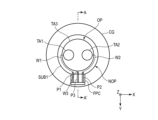
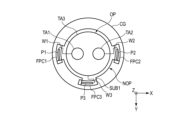
- FIG. 2 is a plan view schematically showing an example of a camera module.
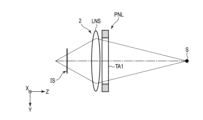
- FIG. 3 is a diagram for explaining the principle of calculating the distance to a subject using a camera module.
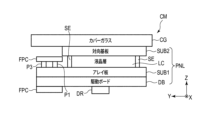
- FIG. 4 is a diagram schematically showing a cross section of the camera module along line AA' shown in FIG.
- FIG. 5 is a cross-sectional view showing a light transmitting area included in a liquid crystal panel included in a camera module.
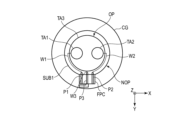
- FIG. 6 is a diagram for explaining a first modification of this embodiment.
- FIG. 7 is a diagram schematically showing a cross section of the camera module taken along line BB′ shown in FIG. FIG.
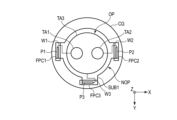
- FIG. 8 is a diagram for explaining an example of a second modification of the present embodiment.
- FIG. 9 is a diagram for explaining another example of the second modification of the present embodiment.
- FIG. 10 is a diagram showing an example of a configuration in which the shape of the flexible wiring board is changed.
- FIG. 11 is a plan view schematically showing an example of a camera module according to the second embodiment.
- FIG. 12 is a plan view schematically showing another example of the camera module according to this embodiment.
- FIG. 1 is an exploded perspective view showing an example of the configuration of a camera module according to this embodiment.
- FIG. 1 shows a three-dimensional space defined by a direction X, a direction Y perpendicular to the direction X, and a direction Z perpendicular to the directions X and Y.
- the direction X, the direction Y, and the direction Z are orthogonal to each other, they may intersect at an angle other than 90°.
- the direction Z is defined as upward, and the direction opposite to direction Z is defined as downward.
- the second member may be in contact with the first member, or may be located apart from the first member. You can leave it there.
- the camera module CM includes a liquid crystal panel PNL covered by a cover glass CG as a cover member, and an image sensor IS provided below (on the back side) of the liquid crystal panel PNL.
- the liquid crystal panel PNL includes an array substrate SUB1 and a counter substrate SUB2.
- the array substrate SUB1 has a keyhole in which a first portion 1a having a substantially circular shape and a second portion 1b having a substantially rectangular shape connected to the first portion 1a are combined in a planar view when viewing the camera module CM from the direction Z. It has a similar shape (outline).
- the counter substrate SUB2 has a shape that exposes the second portion 1b of the array substrate SUB1 in a plan view when placed in a position overlapping the first portion 1a of the array substrate SUB1.
- the liquid crystal panel PNL further includes a liquid crystal layer held between the array substrate SUB1 and the counter substrate SUB2.
- the image sensor IS constitutes a camera that captures images together with an optical system including at least one lens (not shown).
- FIG. 1 is a diagram for explaining the positional relationship in the direction Z of the cover glass CG, the liquid crystal panel PNL (array substrate SUB1 and counter substrate SUB2), and the image sensor IS (camera).
- the size, shape, etc. of the PNL and the image sensor IS are shown in a simplified manner in FIG.
- FIG. 2 is a plan view schematically showing the camera module CM.
- CM camera module
- FIG. 2 only the cover glass CG and the array substrate SUB1 are shown for convenience, but a counter substrate SUB2 is arranged between the cover glass CG and the array substrate SUB1. Further, an image sensor IS is arranged on the back side of the array substrate SUB1 (the direction opposite to the direction Z).
- the liquid crystal panel PNL includes an opening OP having, for example, a circular shape.
- the opening OP is a portion (region) that overlaps with the liquid crystal layer held between the above-described array substrate SUB1 and counter substrate SUB2.
- a plurality of regions are formed in the opening OP.
- the plurality of regions formed in the opening OP are regions that can transmit light by, for example, driving a liquid crystal (hereinafter referred to as light transmission regions), and in the example shown in FIG. It includes third light transmitting areas TA1 to TA3.
- the first light transmitting area TA1 has a circular shape and is formed, for example, at a position that does not include the center of the opening OP. Specifically, the first light transmitting area TA1 is formed at a position on the opposite side in the X direction from the center of the opening OP.
- the second light transmitting area TA2 has a circular shape and is formed, for example, at a position facing the first light transmitting area TA1 with the center of the opening OP interposed therebetween. That is, the second light transmitting area TA2 is formed at a position closer to the X direction from the center of the opening OP.
- the first light transmitting area TA1 and the second light transmitting area TA2 are formed to have approximately the same size.
- the third light transmitting area TA3 corresponds to the area excluding the first and second light transmitting areas TA1 and TA2 from the opening OP.
- first to third light transmitting areas TA1 to TA3 are defined by light blocking areas formed by, for example, a black matrix.
- the liquid crystal panel PNL includes a plurality of drive electrodes arranged at positions corresponding to each of the plurality of light transmission regions.
- the liquid crystal panel PNL includes a first drive electrode disposed at a position overlapping with the first light transmission area TA1, and a second drive electrode disposed at a position overlapping with the second light transmission area TA2. and a third drive electrode disposed at a position overlapping with the third light transmission area TA3.
- the liquid crystal layer PNL when a voltage is applied only to the first drive electrode, it is possible to drive the liquid crystal layer so as to transmit light to the image sensor IS via the first light transmission area TA1. can. Further, for example, when a voltage is applied only to the second drive electrode, the liquid crystal layer can be driven to transmit light to the image sensor IS via the second light transmission area TA2. Similarly, for example, when a voltage is applied only to the third drive electrode, the liquid crystal layer can be driven to transmit light to the image sensor IS via the third light transmission area TA3. Note that here, it is assumed that the liquid crystal panel PNL employs a normally black method in which light is transmitted while a voltage is applied to the drive electrode (that is, in an on state).
- an image based on the light that has passed through each of the first to third light transmission areas TA1 to TA3 and entered the image sensor IS that is, an image of the subject imaged by the camera module CM
- the camera module CM is used to calculate the distance from the camera module CM (image sensor IS) to the subject in the image (hereinafter simply referred to as the subject distance).
- a coded aperture technique can be used as a technique for calculating the distance of a subject from an image.
- the coded aperture technique is a technique that calculates the distance to a subject by analyzing blur that occurs in an image depending on the position of the subject.
- the camera module CM can be used for purposes such as calculating the distance to a subject based on an image and creating a depth map representing the distance to the subject.
- the process of calculating the distance to the subject and the process of creating a depth map are realized, for example, by a predetermined application program that runs on an electronic device connected to the camera module CM (an electronic device in which the camera module CM is installed). It is fine if it is done.
- FIG. 3 shows the positional relationship between the camera module CM and the subject.
- a lens LNS is disposed between the image sensor IS and the liquid crystal panel PNL.
- the distance to the subject S shown in FIG. 3 is calculated.
- a camera it is possible to photograph the subject S in focus by changing the distance between the lens LNS and the image sensor IS, but as shown in FIG. If the subject S is photographed with the subject S out of focus, there will be a shift between the focus position and the position of the imaging surface of the image sensor IS, so the image based on the light incident on the image sensor IS will Blur appears.
- the distance to the subject S is calculated based on the blur that occurs in the image in this way.
- FIG. 3 shows the case where light passes through the first light transmitting area TA1
- three light transmitting areas first to third light transmitting areas TA1 to TA3
- the distance of the subject is calculated using multiple images based on the light that has passed through each of the three light transmission areas (that is, multiple blur patterns based on the light that has passed through different light transmission areas). By calculating, the accuracy of the distance can be improved.
- the first drive electrode (that is, the drive electrode disposed at a position overlapping with the first light transmission area TA1) is electrically connected to the first pad P1 via the first wiring W1
- the first pad P1 is electrically connected to the driver via the flexible wiring board FPC.
- the second drive electrode (that is, the drive electrode disposed at a position overlapping with the second light transmission area TA2) is electrically connected to the second pad P2 via the second wiring W2, and the second drive electrode is electrically connected to the second pad P2 via the second wiring W2.
- the second pad P2 is electrically connected to the driver via the flexible wiring board FPC.
- the third drive electrode (that is, the drive electrode disposed at a position overlapping with the third light transmission area TA3) is electrically connected to the third pad P3 via the third wiring W3, and the third drive electrode is electrically connected to the third pad P3 via the third wiring W3.
- the third pad P3 is electrically connected to the driver via the flexible wiring board FPC.
- first to third pads P1 to P3 described above for example, OLB (Outer Lead Bonding) pads are used.
- the liquid crystal panel PNL includes a non-opening part NOP surrounding the opening OP, and the first to third pads P1 to P3 are arranged in the non-opening part NOP, as shown in FIG.
- the first to third pads P1 to P3 extend in the Y direction and are arranged side by side in the X direction.
- the first to third wirings W1 to W3 described above are connected to the ends of the first to third pads P1 to P3 on the opposite side in the direction Y.
- FIG. 4 is a diagram schematically showing a cross section of the camera module CM along the line AA' shown in FIG. 2.
- the liquid crystal panel PNL includes the above-described array substrate SUB1, a counter substrate SUB2, and a liquid crystal layer LC held between the array substrate SUB1 and the counter substrate SUB2.
- a drive board DB is arranged on the back side of the array substrate SUB1 (on the opposite side to the direction Z).
- the driver DR that drives the liquid crystal panel PNL (liquid crystal layer LC) is mounted on the drive board DB.
- the flexible wiring board FPC described above extends along the first to third pads P1 to P3 (that is, in the direction Y), and the first pad P1 shown in FIG. It is connected to the driver DR via a flexible wiring board FPC that is bent at the side end.
- the first pad P1 and the flexible wiring board FPC can be electrically connected, for example, by being pressure-bonded via an anisotropic conductive film (ACF).
- ACF anisotropic conductive film
- the liquid crystal panel PNL includes a sealing material SE located in the non-opening portion NOP, and the array substrate SUB1 and the counter substrate SUB2 are joined by the sealing material SE. Thereby, the liquid crystal layer LC can be formed in a space surrounded by the array substrate SUB1, the counter substrate SUB2, and the sealant SE.
- the image sensor IS is arranged, for example, between the array substrate SUB1 and the drive board DB.
- the light transmission area (that is, the opening OP) included in the liquid crystal panel PNL will be mainly described.
- the array substrate SUB1 includes an insulating layer 11, an insulating layer 12, an insulating layer 13, etc. between the insulating substrate 10 and the alignment film AL1. Furthermore, a polarizing plate PL1 is formed on the outside of the array substrate SUB1.
- the insulating layer 11 is provided on the insulating substrate 10. Further, the insulating layer 12 is provided on the insulating layer 11.
- the first drive electrode E1 is provided on the insulating layer 12 and covered with the insulating layer 13. Further, the first drive electrode E2 is provided on the insulating layer 13 and covered with the alignment film AL1. The alignment film AL1 is in contact with the liquid crystal layer LC.
- first drive electrodes E1 and E2 are formed of a transparent conductive material such as indium tin oxide (ITO) and indium zinc oxide (IZO). Further, in the example shown in FIG. 5, the insulating layer 13 is sandwiched between the first drive electrodes E1 and E2, but the first drive electrodes E1 and E2 may be formed in the same layer.
- ITO indium tin oxide
- IZO indium zinc oxide
- the counter substrate SUB2 includes a light shielding layer BM, a transparent layer OC, an alignment film AL2, etc. on the side of the insulating substrate 20 that faces the array substrate SUB1.
- the light shielding layer BM is formed on the inner surface of the insulating substrate 20 so as to form a light shielding area that partitions the first light transmitting area TA1 and the like described above.
- the transparent layer OC covers the insulating substrate 20 and the light shielding layer BM.
- the alignment film AL2 covers the transparent layer OC and is in contact with the liquid crystal layer LC.
- the liquid crystal layer LC is driven by applying a voltage between the first drive electrodes E1 and E2.
- a first voltage is applied to the first drive electrode E1 via the first pad P1 and the flexible wiring board FPC, which are arranged at a position overlapping with the non-opening part OP, and the first voltage is applied to the first drive electrode E2. is applied with a second voltage.
- one of the first and second voltages has, for example, a positive voltage level, and the other has a negative voltage level or the common voltage Vcom.
- the liquid crystal layer LC is driven to transmit light to the image sensor IS via the first light transmission area TA1.
- Such driving of the liquid crystal layer LC is realized by the driver DR.
- the liquid crystal molecules are aligned in a direction different from the initial alignment direction, and the liquid crystal layer Since a phase difference occurs in the LC, the light transmittance in the first light transmitting area TA1 increases (that is, light can pass through the first light transmitting area TA1).
- the light transmitted through the first light transmission area TA1 in this manner is incident on the image sensor IS, and the camera module CM can capture an image.
- the liquid crystal panel PNL employs a normally black method that does not allow light to pass through in the off state.
- a normally white method may be adopted.
- the first light transmitting area TA1 was mainly explained in FIGS. 4 and 5 above, the second and third light transmitting areas TA2 and TA3 are different from each other except for the position, size and shape in the opening OP. It is sufficient that the first light transmitting area TA1 is configured similarly to the first light transmitting area TA1.
- the camera module CM includes an image sensor IS and a liquid crystal panel PNL, and the liquid crystal panel PNL has an opening OP in which a plurality of light transmission areas are formed, and an opening OP that overlaps with the opening.
- the liquid crystal layer LC is arranged at a position to It includes a driver DR to be driven, a non-opening part NOP surrounding the opening OP, and a plurality of pads arranged at a position overlapping with the non-opening part NOP and electrically connecting the plurality of drive electrodes and the driver DR. .
- the above-described configuration allows light to be appropriately incident on the image sensor IS through each of the plurality of light transmission regions.
- each of the first to third drive electrodes and the driver DR which are arranged at positions overlapping with each of the first to third light transmission areas TA1 to TA3, are electrically connected.
- the explanation has been made assuming that the first to third pads P1 to P3, which are connected to each other, extend in the direction Y (second direction) and are arranged side by side in the direction X (first direction).
- the third pads P1 to P3 are arranged, the size (area) of the non-opening portion NOP in which the first to third pads P1 to P3 are arranged increases.
- the size of the camera module CM (cover glass CG) in plan view is determined by design, the size of the non-opening part NOP increases, so the opening part OP needs to be reduced.
- the amount of light incident on the image sensor IS via the OP decreases. Since information about light that does not enter the image sensor IS (blur) cannot be used to calculate the distance to the subject, increasing the size of the non-aperture NOP (in other words, reducing the aperture OP) means that the camera module CM This is likely to affect the accuracy of the distance to the subject calculated from the image captured by the image sensor IS.
- FIG. 6 is a diagram for explaining a first modification of this embodiment.
- the first pad P1 and the second pad P2 extend in the direction X and are arranged side by side in the direction X.
- the third pad P3 extends in the direction X and is arranged side by side with the first pad P1 in the direction Y.
- the mounting direction of the flexible wiring board FPC is rotated by 90 degrees compared to the flexible wiring board FPC described in this embodiment, and the flexible wiring board FPC is mounted along the first to third pads P1 to P3 (that is, in the direction ) has extended.
- the first pad P1 and the third pad P3 are electrically connected to the driver DR via the flexible wiring board FPC that is bent at the opposite end of the first pad P1 and the third pad P3 in the direction X. connected.
- the second pad P2 is electrically connected to the driver DR via a flexible wiring board FPC that is bent at the end of the second pad P2 on the direction X side.
- each of the first to third pads P1 to P3 is electrically connected to the first to third drive electrodes via the first to third wirings W1 to W3 is different from the present embodiment described above. The same is true.
- FIG. 7 is a diagram schematically showing a cross section of the camera module CM along the line BB′ shown in FIG. 6.
- a first pad P1 and a third pad P3 that extend in the direction X are arranged side by side in the direction Y, and extend in the direction X so as to cover the first pad P1 and the third pad P3 It is shown that the flexible wiring board FPC is pressure-bonded to the first pad P1 and the third pad P3.
- the flexible wiring board FPC is bent at the ends of the first to third pads P1 to P3 on the Y direction side, but in the first modification of the present embodiment, the flexible wiring board FPC is As described above, the first pad P1 and the third pad P3 are bent at the ends opposite to the X direction, and the second pad P2 is bent at the ends on the X direction side.
- the non-opening portion NOP can be reduced and the size of the opening portion OP can be increased compared to the present embodiment, so that images can be captured through the opening portion OP.
- the frame area (area other than the opening OP) in the camera module CM can be reduced, the appearance of (the electronic device equipped with) the camera module CM can be improved.
- FIG. 8 is a diagram for explaining a second modification of the present embodiment.
- the first to third pads P1 to P3 are arranged at dispersed positions around the opening OP.
- the first pad P1 and the second pad P2 are arranged at opposing positions with the opening OP in between.
- the third pad P3 is located along the periphery of the opening OP, and is arranged at a position corresponding to the middle between the first pad P1 and the second pad P2.
- the array substrate SUB1 has been described as having a keyhole shape, but the array substrate SUB1 in the second modified example of the present embodiment has a circular shape. It has a shape that is a combination of a portion and three portions for arranging each of the first to third pads P1 to P3.
- the first to third pads P1 to P3 are arranged at dispersed positions, so the first to third pads P1 to P3 are It is assumed that it is electrically connected to the driver DR via different FPC1 to FPC3. It is assumed that FPC1 to FPC3 extend in the direction along the first to third pads P1 to P3, respectively, and are bent at the longitudinal ends of the pads.
- the size of the opening OP can be increased, so that the incident light enters the image sensor IS through the opening OP.
- the accuracy of the object distance calculated from the light-based image can be improved.
- each pad may be arranged along the tangent line of the circular shape as in the first and second modified examples of the present embodiment. Accordingly, it is possible to reduce the non-opening portion NOP and secure a larger opening portion OP than in the configuration of this embodiment (that is, the configuration in which pads are arranged in a direction intersecting the tangent).
- FIG. It may be formed into a circular arc shape that follows the circular shape of the opening OP. According to such a configuration, it is possible to further reduce the non-opening portion NOP and allocate a large area to the opening portion OP.
- the camera module CM is miniaturized by electrically connecting a plurality of drive electrodes to the driver DR arranged on the back side of the array substrate SUB1 via a bendable flexible wiring board FPC.
- the flexible wiring board FPC the shape of the bending region
- the frame region may become large (that is, the opening OP must be reduced).
- the description is given assuming that three light transmitting regions (first to third light transmitting regions TA1 to TA3) are formed in the circular opening OP.
- the shape of the opening OP and the position, size, shape, and number of light-transmitting areas formed in the opening OP may vary depending on the subject for which the distance is calculated as described above (i.e., the image is captured). It may be changed as appropriate depending on the environment) etc. Further, in this embodiment and each modification of this embodiment, it is assumed that there are a plurality of light transmitting regions, but the number of light transmitting regions may be one.
- the size of the opening OP is increased by changing the arrangement of a plurality of pads for electrically connecting a plurality of drive electrodes to the driver DR. It is possible that the size of the opening OP can be increased by reducing the number of pads.
- first to third areas TA1 to TA3 a plurality of areas corresponding to the first to third light transmission areas TA1 to TA3 (hereinafter referred to as first to third areas TA1 to TA3) are formed in the opening OP
- the driver DR allows light to pass through some areas (first and second areas TA1 and TA2) of the plurality of areas (that is, first to third areas arranged at positions overlapping with the first to third areas).
- the liquid crystal layer LC is driven by applying a voltage to the first and second drive electrodes of the third drive electrodes.
- the third drive electrode is connected to the common electrode Vcom, the third pad P3 that connects the third drive electrode and the driver DR can be omitted.
- the third pad P3 is omitted, no voltage is applied to the third drive electrode located at a position overlapping the third area TA3.
- the third area TA3 is an area that does not always transmit light.
- a plurality of images based on light transmitted through each of a plurality of regions formed in the opening OP (a plurality of images generated based on light transmitted through the region)
- the accuracy of the distance can be improved by calculating the distance to the subject using the blurred pattern), but as mentioned above, if some of the multiple areas (for example, the third area) Even if the area does not always transmit light, the distance to the object is calculated by using a plurality of images based on the light that enters the image sensor IS through, for example, each of the first and second areas TA1 and TA2. is possible.
- the third area TA3 does not always transmit light as described above
- the first area TA1 can be transmitted.
- a plurality of images including an image based on the light transmitted through the second area TA2, an image based on the light transmitted through both the first and second areas TA1 and TA2, and an image based on the light transmitted through both the first and second areas TA1 and TA2 are used. Distance can be calculated.
- This embodiment is applicable to the first embodiment described above and each modification of the first embodiment.
- this embodiment when this embodiment is applied to the first modification of the first embodiment, for example, by arranging the first pad P1 and the second pad P2 as shown in FIG. 11, the number of signal lines (pads and wiring) is reduced from three to two compared to the first modification of the first embodiment. Therefore, the size of the opening OP can be further increased.
- the third drive electrode is arranged at a position overlapping with the third area TA3.
- the first pad P1 (and the first wiring W1) or the second pad P2 (and the second wiring W2) is omitted in place of the third pad P3.
- a configuration may also be used.
- the opening OP light transmission area
- the opening OP light transmission area
- the pad connected to the drive electrode may be omitted.
- the fourth area TA4 is an area that does not always transmit light. According to this, for example, even if the number of light-transmitting areas is increased in order to calculate the distance to a subject with high accuracy, the number of signal lines (pads and wiring) must be increased (in other words, if a non-aperture area is There is no need to expand NOP.
- the camera module CM includes an image sensor IS and a liquid crystal panel PNL, and the liquid crystal panel PNL has an opening OP having a plurality of regions arranged at a position where light is incident on the image sensor IS. , a liquid crystal layer LC disposed at a position overlapping with the opening, a plurality of drive electrodes disposed at a position overlapping with each of the plurality of regions, and a liquid crystal layer LC disposed at a position overlapping with each of the plurality of regions, and a liquid crystal layer LC disposed at a position overlapping with the plurality of regions, and a liquid crystal layer LC arranged at a position overlapping with the plurality of regions, and a liquid crystal layer LC arranged at a position overlapping with the plurality of regions, and a liquid crystal layer LC arranged at a position overlapping with the plurality of regions.
- the number of pads arranged in the non-opening part NOP can be reduced, so the non-opening part NOP can be reduced and the size of the opening part OP can be increased. It becomes possible.
- the liquid crystal panel PNL adopts a normally black method, but the liquid crystal panel PNL may also adopt a normally white method.
- the third pad P3 (and third wiring W3) is omitted (that is, connected to the common electrode Vcom)
- the third area TA3 becomes an area that always transmits light.
- an image based on light transmitted through the first to third areas TA1 to TA3 and an image based on the first and third areas can be calculated using a plurality of images including an image based on the light transmitted through TA1 and TA3 and an image based on the light transmitted through the second and third areas TA2 and TA3.
- the gist of the present invention may be obtained by adding, deleting, or changing the design of components, or adding, omitting, or changing conditions to the above-described embodiment as appropriate by a person skilled in the art. It is within the scope of the present invention as long as it has the following.
- CM...camera module CG...cover glass, SUB1...array substrate (first substrate), SUB2...counter substrate (second substrate), IS...imaging element, OP...opening, TA1...first light transmission area, TA2... Second light transmission area, TA3...Third light transmission area, P1...First pad, P2...Second pad, P3...Third pad, FPC, FPC1-FPC3...Flexible wiring board, W1...First wiring, W2... Second wiring, W3...third wiring, LNS...lens, LC...liquid crystal layer, DB...drive board, DR...driver, E1, E2...drive electrode.
Landscapes
- Physics & Mathematics (AREA)
- Nonlinear Science (AREA)
- General Physics & Mathematics (AREA)
- Chemical & Material Sciences (AREA)
- Crystallography & Structural Chemistry (AREA)
- Optics & Photonics (AREA)
- Mathematical Physics (AREA)
- Geometry (AREA)
- Studio Devices (AREA)
- Liquid Crystal (AREA)
Priority Applications (2)
| Application Number | Priority Date | Filing Date | Title |
|---|---|---|---|
| JP2024511404A JP7785916B2 (ja) | 2022-03-30 | 2023-02-16 | カメラモジュール |
| US18/898,776 US20250020976A1 (en) | 2022-03-30 | 2024-09-27 | Camera module |
Applications Claiming Priority (2)
| Application Number | Priority Date | Filing Date | Title |
|---|---|---|---|
| JP2022056356 | 2022-03-30 | ||
| JP2022-056356 | 2022-03-30 |
Related Child Applications (1)
| Application Number | Title | Priority Date | Filing Date |
|---|---|---|---|
| US18/898,776 Continuation US20250020976A1 (en) | 2022-03-30 | 2024-09-27 | Camera module |
Publications (1)
| Publication Number | Publication Date |
|---|---|
| WO2023188948A1 true WO2023188948A1 (ja) | 2023-10-05 |
Family
ID=88201081
Family Applications (1)
| Application Number | Title | Priority Date | Filing Date |
|---|---|---|---|
| PCT/JP2023/005442 Ceased WO2023188948A1 (ja) | 2022-03-30 | 2023-02-16 | カメラモジュール |
Country Status (3)
| Country | Link |
|---|---|
| US (1) | US20250020976A1 (https=) |
| JP (1) | JP7785916B2 (https=) |
| WO (1) | WO2023188948A1 (https=) |
Citations (3)
| Publication number | Priority date | Publication date | Assignee | Title |
|---|---|---|---|---|
| JP2006309011A (ja) * | 2005-04-28 | 2006-11-09 | Citizen Watch Co Ltd | 撮像レンズおよびカメラモジュール |
| WO2012099127A1 (ja) * | 2011-01-17 | 2012-07-26 | 株式会社オルタステクノロジー | 液晶レンズ、液晶レンズの駆動方法、レンズユニット、カメラモジュール、及びカプセル型医療機器 |
| WO2022059279A1 (ja) * | 2020-09-18 | 2022-03-24 | 株式会社ジャパンディスプレイ | カメラモジュール |
Family Cites Families (4)
| Publication number | Priority date | Publication date | Assignee | Title |
|---|---|---|---|---|
| JP2008216348A (ja) | 2007-02-28 | 2008-09-18 | Optrex Corp | 液晶表示素子およびその製造方法 |
| JP2018017792A (ja) | 2016-07-26 | 2018-02-01 | セイコーエプソン株式会社 | 電気光学装置、電子機器、および電気光学装置の駆動方法 |
| JP2018128487A (ja) | 2017-02-06 | 2018-08-16 | セイコーエプソン株式会社 | 電気光学パネル、電気光学装置および電子機器 |
| JP2021117379A (ja) * | 2020-01-27 | 2021-08-10 | 株式会社ジャパンディスプレイ | 電子機器 |
-
2023
- 2023-02-16 JP JP2024511404A patent/JP7785916B2/ja active Active
- 2023-02-16 WO PCT/JP2023/005442 patent/WO2023188948A1/ja not_active Ceased
-
2024
- 2024-09-27 US US18/898,776 patent/US20250020976A1/en active Pending
Patent Citations (3)
| Publication number | Priority date | Publication date | Assignee | Title |
|---|---|---|---|---|
| JP2006309011A (ja) * | 2005-04-28 | 2006-11-09 | Citizen Watch Co Ltd | 撮像レンズおよびカメラモジュール |
| WO2012099127A1 (ja) * | 2011-01-17 | 2012-07-26 | 株式会社オルタステクノロジー | 液晶レンズ、液晶レンズの駆動方法、レンズユニット、カメラモジュール、及びカプセル型医療機器 |
| WO2022059279A1 (ja) * | 2020-09-18 | 2022-03-24 | 株式会社ジャパンディスプレイ | カメラモジュール |
Also Published As
| Publication number | Publication date |
|---|---|
| US20250020976A1 (en) | 2025-01-16 |
| JP7785916B2 (ja) | 2025-12-15 |
| JPWO2023188948A1 (https=) | 2023-10-05 |
Similar Documents
| Publication | Publication Date | Title |
|---|---|---|
| CN206363696U (zh) | 显示装置 | |
| CN107870467B (zh) | 显示装置 | |
| CN112437898B (zh) | 显示装置及组装有显示装置的电子设备 | |
| US12124137B2 (en) | Display device | |
| CN113242994B (zh) | 嵌入有摄像头以及显示装置的电子设备 | |
| JP7109982B2 (ja) | 表示装置 | |
| CN113196156B (zh) | 电子设备 | |
| JP2018120018A (ja) | 表示装置 | |
| CN113348659A (zh) | 显示装置以及组装有显示装置的电子设备 | |
| JP4962043B2 (ja) | 電気光学装置、電気光学装置の製造方法、及び、電子機器 | |
| CN112074781B (zh) | 电光装置 | |
| JP7785916B2 (ja) | カメラモジュール | |
| JP7638794B2 (ja) | 表示装置 | |
| JP2023013119A (ja) | 表示装置 | |
| CN115116405B (zh) | 电平移位电路、显示面板及电子设备 | |
| JP7504731B2 (ja) | 視野角制御素子及び表示装置 | |
| CN117795399A (zh) | 显示面板及其制备方法、显示装置 | |
| JP2022186253A (ja) | 表示装置 | |
| JP7255003B2 (ja) | 表示装置 | |
| WO2023223660A1 (ja) | カメラモジュール | |
| WO2020003998A1 (ja) | 表示装置 | |
| JP6965412B2 (ja) | 表示装置 | |
| CN207676077U (zh) | 滤色器基板以及显示装置 | |
| CN210401940U (zh) | 显示装置 | |
| WO2023120210A1 (ja) | カメラモジュール |
Legal Events
| Date | Code | Title | Description |
|---|---|---|---|
| 121 | Ep: the epo has been informed by wipo that ep was designated in this application |
Ref document number: 23778978 Country of ref document: EP Kind code of ref document: A1 |
|
| ENP | Entry into the national phase |
Ref document number: 2024511404 Country of ref document: JP Kind code of ref document: A |
|
| NENP | Non-entry into the national phase |
Ref country code: DE |
|
| 122 | Ep: pct application non-entry in european phase |
Ref document number: 23778978 Country of ref document: EP Kind code of ref document: A1 |