WO2023188534A1 - 半導体レーザ装置 - Google Patents
半導体レーザ装置 Download PDFInfo
- Publication number
- WO2023188534A1 WO2023188534A1 PCT/JP2022/043314 JP2022043314W WO2023188534A1 WO 2023188534 A1 WO2023188534 A1 WO 2023188534A1 JP 2022043314 W JP2022043314 W JP 2022043314W WO 2023188534 A1 WO2023188534 A1 WO 2023188534A1
- Authority
- WO
- WIPO (PCT)
- Prior art keywords
- laser
- gas
- optical component
- exhaust
- intake port
- Prior art date
- Legal status (The legal status is an assumption and is not a legal conclusion. Google has not performed a legal analysis and makes no representation as to the accuracy of the status listed.)
- Ceased
Links
Images






Classifications
-
- H—ELECTRICITY
- H01—ELECTRIC ELEMENTS
- H01S—DEVICES USING THE PROCESS OF LIGHT AMPLIFICATION BY STIMULATED EMISSION OF RADIATION [LASER] TO AMPLIFY OR GENERATE LIGHT; DEVICES USING STIMULATED EMISSION OF ELECTROMAGNETIC RADIATION IN WAVE RANGES OTHER THAN OPTICAL
- H01S5/00—Semiconductor lasers
- H01S5/02—Structural details or components not essential to laser action
- H01S5/022—Mountings; Housings
- H01S5/02218—Material of the housings; Filling of the housings
- H01S5/0222—Gas-filled housings
-
- H—ELECTRICITY
- H01—ELECTRIC ELEMENTS
- H01S—DEVICES USING THE PROCESS OF LIGHT AMPLIFICATION BY STIMULATED EMISSION OF RADIATION [LASER] TO AMPLIFY OR GENERATE LIGHT; DEVICES USING STIMULATED EMISSION OF ELECTROMAGNETIC RADIATION IN WAVE RANGES OTHER THAN OPTICAL
- H01S5/00—Semiconductor lasers
- H01S5/02—Structural details or components not essential to laser action
- H01S5/022—Mountings; Housings
- H01S5/0225—Out-coupling of light
- H01S5/02253—Out-coupling of light using lenses
-
- H—ELECTRICITY
- H01—ELECTRIC ELEMENTS
- H01S—DEVICES USING THE PROCESS OF LIGHT AMPLIFICATION BY STIMULATED EMISSION OF RADIATION [LASER] TO AMPLIFY OR GENERATE LIGHT; DEVICES USING STIMULATED EMISSION OF ELECTROMAGNETIC RADIATION IN WAVE RANGES OTHER THAN OPTICAL
- H01S5/00—Semiconductor lasers
- H01S5/40—Arrangement of two or more semiconductor lasers, not provided for in groups H01S5/02 - H01S5/30
Definitions
- the present disclosure relates to a semiconductor laser device.
- This type of laser device is capable of emitting high-power laser light and has a semiconductor laser element as a light source.
- Patent Documents 1 to 3 propose techniques for improving the above-mentioned problems with deposits.
- Patent Document 3 discloses that a gas is sprayed onto a laser beam emitting end face of a semiconductor laser element to suppress the adhesion of contaminants and further the accumulation of deposits.
- a semiconductor laser device includes: at least one laser element that emits laser light; an accommodating part that accommodates the at least one laser element therein; a gas supply unit that supplies gas from outside the storage unit; a gas exhaust part that exhausts gas inside the housing part to the outside of the housing part; Equipped with The gas supply unit has at least one first intake port that supplies gas from a vertically lower side toward a space on a laser beam emission side around the at least one laser element, The gas exhaust section has at least one first exhaust port disposed at a position facing the at least one first intake port in the vertical direction.
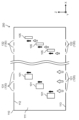
- FIG. 1 is a perspective view of a semiconductor laser device according to a first embodiment, and is a transparent view showing the inside of the semiconductor laser device.
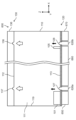
- FIG. 2 is a schematic side view showing the inside of the semiconductor laser device according to the first embodiment.
- FIG. 3 is a schematic side view showing the inside of the semiconductor laser device according to the second embodiment.
- FIG. 4 is a schematic side view showing the inside of the semiconductor laser device according to the third embodiment.
- FIG. 5 is a schematic side view showing the inside of the semiconductor laser device according to the fourth embodiment.
- FIG. 6 is a schematic side view showing the inside of the semiconductor laser device according to the fifth embodiment.
- FIG. 7 is a schematic plan view showing the inside of the semiconductor laser device according to the fifth embodiment.
- FIG. 1 is a perspective view of a semiconductor laser device according to a first embodiment, and is a transparent view showing the inside of the semiconductor laser device.
- FIG. 2 is a schematic side view showing the inside of the semiconductor laser device according to the first embodiment.
- FIG. 3
- FIG. 8 is a schematic side view showing the inside of the semiconductor laser device according to the sixth embodiment.
- FIG. 9 is a schematic side view showing the inside of a semiconductor laser device according to Modification Example 1.
- FIG. 10 is a schematic side view showing the inside of a semiconductor laser device according to Modification Example 2.
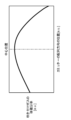
- FIG. 11 is a diagram showing the fluid analysis results, and is a graph showing the position dependence of the volume fraction of the blown gas.
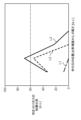
- FIG. 12 is a graph showing the relationship between the volume fraction of the blown gas, the position of the blowing port, and the gas flow rate.
- Patent Document 3 gas is blown onto the laser beam emitting end face of a semiconductor laser element to suppress the accumulation of deposits.
- laser light emission side space In the space on the laser light emission side (hereinafter referred to as "laser light emission side space"), an upward air current is generated due to heat generation of the semiconductor laser element due to laser oscillation.
- the blown gas may be blocked by the rising air current and may not be able to exert the desired suppressing effect. Therefore, in order to suppress the accumulation of deposits, a certain amount of spraying is required.
- the positional relationship between the exhaust port of the blown gas and the blowing port of the blown gas is not considered.
- contaminants cannot be smoothly exhausted to the outside of the laser device by the blown gas, and the arrangement is such that gas tends to stagnate inside the laser device.
- deposits will accumulate on the semiconductor laser element and other optical components in the laser device due to the retention of this gas.
- the inventors conducted fluid analysis regarding the effect of blowing dry gas on a semiconductor laser device having a multi-emitter structure. This fluid analysis was carried out using a semiconductor laser device as a model in which a blowing port was provided above the central part of the space on the laser light output side of the semiconductor laser element. As a result, it was found that the gas diffused from the blowing port, and the volume distribution of the gas became smaller as the distance from the center of the emission end surface increased in the space on the laser light emission side of the semiconductor laser element.
- FIG. 11 is a graph showing the fluid analysis results, and shows the position dependence of the volume fraction of the blown gas.
- the vertical axis in FIG. 11 indicates the volume fraction of the blown gas, and the horizontal axis indicates the position in the arrangement direction of the emitters included in the semiconductor laser element. Note that the center position means the center position of the laser light emitting end face of the semiconductor laser element.
- the volume fraction of the gas decreased as it moved away from the center, and the influence of the blown gas was relatively small at the ends. Furthermore, it has been found that the distribution of the volume fraction with respect to the center position becomes asymmetric depending on the position of the exhaust port of the laser device.
- the inventors determined that the volume fraction of the blown gas is determined by the height of the blowing port (i.e., the distance between the laser beam emitting end face and the blowing port), the gas flow rate, and the upward airflow caused by the heat generated by the semiconductor laser element. I thought it would be influenced by.
- FIG. 12 is a graph showing the relationship between the volume fraction of the blown gas, the position of the blowing port, and the gas flow rate.
- the horizontal axis represents the position of the nozzle (height from the laser beam emitting end face), and the vertical axis represents the volume fraction of the blown gas, and the volume fraction with respect to the position of the nozzle is shown.
- the rate is plotted.
- the analysis results are shown by a dashed-dotted line L1, a broken line L2, and a solid line L3 in descending order of gas flow rate.
- An object of the present disclosure is to provide a highly reliable semiconductor laser device that can suppress the accumulation of deposits derived from contaminants without deteriorating the optical characteristics of laser light.
- FIG. 1 is a perspective view of a semiconductor laser device 100 according to a first embodiment, and shows the inside of the semiconductor laser device 100 as seen through.
- FIG. 2 is a schematic side view showing the inside of the semiconductor laser device 100.
- the thick black arrows in FIG. 2 indicate rising air currents due to heat generation in each element or component, and the white arrows indicate the flow of supply gas or exhaust gas.
- the rising air current accompanying heat generation of each element or component may be simply referred to as "rising air current.”
- the semiconductor laser device 100 is, for example, an external resonance type laser processing device that combines a plurality of laser beams 1 and outputs the synthesized laser beams to the outside.
- the semiconductor laser device 100 includes a housing section 110, a laser module 101, an optical component 104, a gas supply section 120, and a gas exhaust section 130.
- the housing section 110 is a hollow body that houses the laser element 102 and the optical component 104, and is, for example, a housing.
- the internal space of the housing part 110 is surrounded by four side surfaces including a side surface 111 on the positive side in the Y-axis direction along the ZX plane (a vertical plane along the traveling direction of the laser beam 1), a top surface 112, and a bottom surface 113.
- a mounting board on which the laser element 102 and the optical component 104 are mounted is arranged on the side surface 111.
- the bottom surface 113 is provided with a first intake port 121 and a second intake port 122
- the top surface 112 is provided with a first exhaust port 131 and a second exhaust port 132.
- the semiconductor laser device 100 is used in a state where a line connecting opposing intake ports and exhaust ports is arranged along the Z-axis direction.
- the internal space of the accommodating part 110 is, for example, filled with the atmosphere and contains at least one of oxygen, hydrogen, nitrogen, argon, and halogen gas. Note that the internal space may be filled with dry air from which moisture has been removed from the atmosphere.
- the laser module 101 includes a semiconductor laser element (hereinafter sometimes simply referred to as a "laser element") 102, an optical component within the module 103, and the like.
- a semiconductor laser element hereinafter sometimes simply referred to as a "laser element”
- the laser element 102 is, for example, a semiconductor laser array in which a plurality of emitters are formed. Laser light 1 is emitted from each emitter.
- the laser element 102 is a nitride-based semiconductor laser element, and emits laser light in a wavelength band of 500 nm or less (from blue to ultraviolet band).
- the in-module optical component 103 is arranged on the emission side of the laser beam 1 of the laser element 102, and is connected to the laser element 102 via a block or adhesive (not shown).
- the in-module optical component 103 has the functions of collimating the laser beam 1 into parallel light, rotating the cross-sectional shape of the laser beam 1 in a plane perpendicular to the propagation direction of the laser beam 1, and separating the laser beams.
- the intra-module optical component 103 is, for example, a beam twister unit composed of a plurality of lenses.
- the laser module 101 includes a base material on which the laser element 102 is mounted, a plurality of electrodes for flowing current to the semiconductor laser element 102, a cooling block for cooling the laser element 102, and the like. .
- the optical component 104 is a component into which the plurality of laser beams 1 emitted from the laser module 101 enter during the process of being emitted to the outside of the semiconductor laser device 100.
- the optical component 104 is a component with high energy density, such as an external resonant mirror.
- the external resonant mirror is a component onto which the laser beam 1 after being focused on the diffraction grating is incident.
- the optical component 104 is shown as an optical component in FIGS. 1 and 2, in the semiconductor laser device 100, apart from the optical component 104, there is another optical component that emits more laser light 1 than the optical component 104. It may be arranged on the upstream side in the traveling direction.
- the other optical component is a diffraction grating or the like.
- the gas supply unit 120 has a first intake port 121 and a second intake port 122, and jets gas vertically upward (positive side in the Z-axis direction) toward a specific portion inside the storage unit 110.
- a gas supply pump is connected to the first intake port 121 and the second intake port 122, for example, via piping, and the gas sent out from the gas supply pump flows through the first intake port 121 and the second intake port 122.
- the liquid is supplied to the inside of the housing section 110 through the medium.
- the gas to be supplied (hereinafter sometimes referred to as "supply gas") is, for example, dry air from which moisture has been removed from the atmosphere, that is, a gas containing nitrogen and oxygen.
- the supply gas may be any gas containing at least one of nitrogen, hydrogen, helium, argon, halogen gas, and halogen compound gas in addition to oxygen.
- first intake ports 121 are arranged on the bottom surface 113 of the housing section 110, corresponding to the laser element 102 and the optical component 103 in the module, respectively.
- the first intake ports 121 are provided in the bottom surface 113 of the housing part 110 in the area below the laser beam emission side space of the laser element 102 and the laser beam emission side space of the intra-module optical component 103 in the vertical direction, respectively.
- gas is supplied from the lower side in the vertical direction toward the laser beam output side space of the laser element 102 and the laser beam output side space of the intra-module optical component 103.
- “partially provided” means that the intake port is provided as a hole with a relatively narrow area.
- the laser beam emitting side space may be simply referred to as "emitting side space.”
- two second air intake ports 122 are arranged on the bottom surface 113 of the housing portion 110 in correspondence with the optical components 104. Specifically, on the bottom surface 113 of the accommodating portion 110 , they are partially provided in regions below the laser beam incident side space and the laser beam output side space of the optical component 104 in the vertical direction. Therefore, gas is supplied from the vertically lower side toward the laser light incident side space and the laser light output side space of the optical component 104. Note that in the following description, the space on the laser beam incidence side may be simply referred to as the "incidence side space.”
- the gas exhaust section 130 has a first exhaust port 131 and a second exhaust port 132, and exhausts the gas inside the housing section 110.
- piping is connected to the first exhaust port 131 and the second exhaust port 132.
- a configuration may be adopted in which a gas exhaust pump is connected to the piping to forcibly suck up the gas in the housing section 110.
- first exhaust ports 131 are arranged on the top surface 112 of the housing section 110.
- the first exhaust port 131 is provided at a position facing the first intake port 121 in the Z-axis direction. More specifically, one first exhaust port 131 is provided so as to be connected to the opposing first intake port 121 in a straight line via the emission side space of the laser element 102 . Further, the other first exhaust port 131 is provided so as to be connected to the opposing first intake port 121 in a straight line via the exit side space of the optical component 103 in the module.
- two second exhaust ports 132 are arranged on the top surface 112 of the housing section 110.
- the second exhaust port 132 is provided at a position facing the second intake port 122 in the Z-axis direction. More specifically, one second exhaust port 132 is provided so as to be connected to the opposing second intake port 122 in a straight line via the incident side space of the optical component 104 . The other second exhaust port 132 is provided so as to be connected to the opposing second intake port 122 in a straight line via the exit side space of the optical component 104 .
- Contaminants contained in the gas in the internal space are decomposed by the laser beam 1, and the contaminants are distributed to the emission end face 102a of the laser element 102, the input end face and the output end face of the optical component 103 and the optical component 104 in the module. It adheres to the surface, undergoes a chemical change, and is deposited as a deposit.
- the contaminant is, for example, siloxane, and the deposit is, for example, a Si organic compound or a hydrocarbon compound.
- rising air currents are generated as each element and component generates heat at positions corresponding to the emission side space of the laser element 102, the in-module optical component 103, and the incident side space and output side space of the optical component 104, respectively. .
- the gas introduced into the housing section 110 to suppress the accumulation of deposits is exhausted to the outside of the housing section 110 so as not to be obstructed by the upward air current. ing.
- the intake ports 121, 122 and the exhaust ports 131, 132 are arranged to face each other in the vertical direction. Therefore, when the gas introduced by the gas supply section 120 passes through the emission side space of the laser element 102, the gas is smoothly exhausted from the exhaust port without being hindered by the rising air current. Therefore, deposition of deposits can be effectively suppressed.
- the second intake port 122 and the second exhaust port 132 may be provided at a position on the bottom surface 113 and the top surface 112 that corresponds to at least one of the entrance side space and the exit side space of the optical component 104.
- the second intake port 122 and the second exhaust port 132 are provided on the vertically lower side and the vertically upper side, respectively, of the end face side space where deposits tend to accumulate, of the incident end face and the output end face of the optical component 104. It's okay.
- the semiconductor laser device 100 includes the laser element 102 that emits the laser beam 1, the accommodating part 110 that accommodates the laser element 102, and the It includes a gas supply section 120 that supplies gas, and a gas exhaust section 130 that exhausts gas inside the accommodation section 110 to the outside of the accommodation section 110.
- the gas supply unit 120 has a first intake port 121 that supplies gas from the lower side in the vertical direction toward the space around the laser element 102 on the emission side of the laser beam 1 .
- the gas exhaust section 130 has a first exhaust port 131 located at a position facing the first intake port 121 in the vertical direction.
- the gas supplied from the vertically lower side to the emission side space of the laser element 102 via the first intake port 121 flows in a substantially straight line along the vertical direction to the first exhaust port 131 and is exhausted.
- the gas flow is not obstructed by the rising air current caused by the heat generated by the gas 102.
- the laser module and optical components will not vibrate due to the gas flow.
- the accumulation of deposits can be suppressed without deteriorating the optical characteristics of the laser beam 1, and the reliability of the semiconductor laser device 100 is significantly improved.
- the first intake port 121 and the first exhaust port 131 are provided in the housing portion 110.
- the first intake port 121 is partially provided in the lower vertical region of the housing portion 110 corresponding to the emission side space of the laser element 102.
- the area of the first intake port 121 is small compared to the case where the first intake port 121 is provided with a relatively large area such as a long hole shape extending in the traveling direction of the laser beam 1, the strength during gas supply is reduced. (Gas flow rate) becomes easier to secure above a certain level. Therefore, it is easy to keep contaminants away from the emission side space of the laser element 102. Furthermore, since the gas can be locally supplied to a specific position, it is possible to prevent the supply gas from colliding with each other and causing vibrations in the optical components 103 and the like within the module.
- the semiconductor laser device 100 includes an optical component 104 through which the laser beam 1 passes.
- the gas supply unit 120 has a second intake port 122 that supplies gas toward at least one of the entrance side space and the exit side space of the optical component 104 from the lower side in the vertical direction.
- the gas exhaust section 130 has a second exhaust port 132 arranged at a position facing the second intake port 122 in the vertical direction.
- the gas supplied to at least one of the incident side space and the incident side space of the optical component 104 from the vertically lower side via the second intake port 122 flows almost in a straight line along the vertical direction to the second intake port 122. It flows and is exhausted. Further, the gas flow is not obstructed by the rising air current caused by the heat generated by the optical component 104. Therefore, deposition of deposits on the optical component 104 can be suppressed. In addition, not only the contaminants generated around the laser element 102 but also the contaminants generated around the optical component 104 are smoothly exhausted, so that the accumulation of deposits on the emission end face 102a of the laser element 102 can be more effectively eliminated. can be suppressed to
- the laser element 102 has a plurality of emitters that emit laser beams 1, and the plurality of laser beams 1 from the plurality of emitters are focused on the optical component 104.
- the optical component 104 is a diffraction grating or an external resonant mirror on which a plurality of laser beams are focused, the energy density of the laser beam 1 becomes high in the optical component 104, so the amount of heat generated is large, and the optical component Deposits tend to accumulate on the incident end face and the outgoing end face of 104.
- the optical component 104 is a diffraction grating or an external resonant mirror, the effect of suppressing the deposition of deposits on the optical component 104 is significant.
- the wavelength of the laser beam 1 is 500 nm or less.
- Siloxane is easily decomposed by energy in a wavelength range of 500 nm or less. Therefore, when the laser element 102 emits the laser beam 1 having a wavelength of 500 nm or less, a SiO x film caused by siloxane is likely to be generated on the emission end face of each element.
- the laser element 102 is an element that emits the laser beam 1 having a wavelength of 500 nm or less, the effects of this embodiment are greatly beneficial.
- a gas supply pipe may be arranged inside the housing section 110, and the first intake port 121 may be provided on the gas supply pipe. good.
- first intake ports 121 and two second intake ports 122 are each provided, but three or more each may be provided.
- first intake port 121 and one second intake port 122 may be provided.
- the first intake port 121 is provided as a relatively large hole in a region of the bottom surface 113 extending from the vertically lower side of the emission side space of the laser element 102 to the vertically lower side of the emission side space of the optical component 103 in the module. You can leave it there.
- the second air intake port 122 may be provided as a relatively large hole in a region of the bottom surface 113 extending from the vertically lower side of the incident side space of the optical component 104 to the vertically lower side of the output side space.
- first exhaust port 131 and the second exhaust port 132 are also provided as relatively large holes so as to correspond to the first intake port 121 and the second intake port 122, which are formed as relatively large holes. Good too.
- the second intake port 122 and the second exhaust port 132 may be provided not only for the optical component 104 but also for other optical components described above.
- FIG. 3 is a schematic side view showing the inside of a semiconductor laser device 200 according to the second embodiment.
- the semiconductor laser device 200 is, for example, an external resonance type laser processing device that combines a plurality of laser beams 1 from a plurality of laser modules 101 and outputs the synthesized laser beams to the outside.
- the semiconductor laser device 200 includes a plurality of laser modules 101 and a plurality of optical components 105.
- a diffraction grating is arranged on the positive side of the optical component 105 in the X-axis direction (downstream side in the traveling direction of the laser beam 1).
- the diffraction grating is an element on which the laser beam 1 is focused after passing through the optical component 105.
- components corresponding to the optical component 104 according to the first embodiment such as an external resonant mirror, are arranged.
- the external resonant mirror is an element into which the laser beam 1 focused on the diffraction grating is incident.
- the laser module 101 has the same laser element as the first embodiment.
- the plurality of laser modules 101 are arranged along the side surface 111 so as not to overlap in the Z-axis direction and the X-axis direction.
- adjacent laser modules 101 are spaced apart from each other by a predetermined distance to allow gas flow to pass therethrough. Therefore, the upward airflow and the flow of gas supplied from the first intake port 121 are less likely to be obstructed by the laser module 101 on the side closer to the top surface 112.
- the three laser modules 101 are arranged closer to the top surface 112 on the positive side in the X-axis direction. Note that the plurality of laser modules 101 may be arranged closer to the top surface 112 on the negative side in the X-axis direction.
- the optical component 105 is placed on the negative side of the diffraction grating in the X-axis direction.
- the optical component 105 is, for example, a FAC (Fact Axis Collimation) lens that collimates the laser beam 1 in the fast direction.
- FAC Fract Axis Collimation
- three optical components 105 are provided corresponding to each of the three laser modules 101, and are arranged offset along the side surface 111 so as not to overlap in the Z-axis direction and the X-axis direction. . Similar to the laser module 101, adjacent optical components 105 are spaced apart from each other by a predetermined distance in the X-axis direction so that a gas flow can pass therethrough. Therefore, the upward airflow caused by heat generation of the optical component 105 and the flow of gas supplied from the second intake port 122 are less likely to be obstructed by the optical component 105 on the side closer to the top surface 112.
- three first intake ports 121 are provided on the bottom surface of the housing section 110, corresponding to each of the three laser modules 101. Specifically, the first intake ports 121 are partially provided in the bottom surface 113 of the accommodating portion 110 in a region below the emission side space of the laser module 101 in the vertical direction. Therefore, gas is supplied toward the emission side space of the laser module 101 from the vertically lower side.
- one first intake port 121 is provided for a set of the laser element 102 and the optical component 103 in the module, that is, one laser module 101.
- the gas supplied from the first intake port 121 is supplied at least toward the emission side space of the corresponding laser element 102 .
- the first intake port 121 may be provided corresponding to each of the laser element 102 and the in-module optical component 103 that constitute the laser module 101.
- three second air intake ports 122 are arranged on the bottom surface 113 of the housing portion 110, corresponding to each of the three optical components 105.
- the second intake ports 122 are partially provided in the bottom surface 113 of the accommodating portion 110 in a region below the incident side space of the laser module 101 in the vertical direction. Therefore, gas is supplied toward the incident side space of the optical component 105 from the vertically lower side.
- three first exhaust ports 131 are arranged on the top surface 112 of the housing portion 110 in correspondence to the three first intake ports 121. Specifically, the first exhaust ports 131 are provided at positions facing the first intake ports 121 in the Z-axis direction. More specifically, the first exhaust port 131 is provided so as to be connected to the opposing first intake port 121 in a straight line via the emission side space of the laser module 101 .
- the gas introduced into the accommodation section 110 to suppress the accumulation of deposits passes through the emission side space of each laser module 101 without being obstructed by the rising air current caused by the heat generation of the laser module 101, The air is exhausted to the outside of the section 110.
- three second exhaust ports 132 are arranged on the top surface 112 of the housing section 110 in correspondence with the three second intake ports 122. Specifically, the second exhaust ports 132 are provided at positions facing the second intake ports 122 in the Z-axis direction. More specifically, the second exhaust port 132 is provided so as to be connected to the opposing second intake port 122 in a straight line via the incident side space of the optical component 105 .
- the gas introduced into the storage section 110 to suppress the accumulation of deposits passes through the incident side space of each optical component 105 without being obstructed by the upward air current caused by the heat generation of the optical component 105, and the gas is contained in the storage section 110. The air is exhausted to the outside of the section 110.
- the gas supply unit 120 may have one first intake port 121 in the shape of a long hole with a relatively large area.
- the elongated hole-shaped first intake port 121 extends from the emission side space of the most positive side laser module 101 to the emission side space of the most negative side laser module 101 in the X-axis direction (progressing direction of the laser beam 1). It exists.
- the first intake port 121 is provided for each laser module 101, it is easier to ensure the strength of the gas at the time of supply above a certain level, and the gas can be locally supplied to a specific position.
- the second intake port 122 and the second exhaust port 132 may be provided not only for the optical component 105 but also for optical components such as a diffraction grating and an external resonant mirror. That is, the second intake port 122 may be provided at a position on the bottom surface 113 corresponding to at least one of the entrance side space and the output side space of an optical component such as a diffraction grating and an external resonant mirror. Similarly, the second exhaust port 132 may be provided on the top surface 112 at a position corresponding to at least one of the entrance side space and the exit side space of an optical component such as a diffraction grating and an external resonant mirror.
- the semiconductor laser device 200 includes a plurality of laser modules 101 including laser elements, and the first intake port 121 and the first exhaust port 131 are connected to the plurality of laser modules 101. It is set up accordingly.
- the gas introduced into the accommodation section 110 to suppress the accumulation of deposits passes through the laser beam emitting side space of each laser module 101 without being obstructed by the upward airflow near each laser module 101, and the gas enters the accommodation section 110. The air is exhausted to the outside of the section 110.
- the accumulation of deposits on each laser module 101 can be suppressed without deteriorating the optical characteristics of the laser beam 1, and the reliability of the semiconductor laser device 200 is improved. Much improved.
- the laser beam 1 emitted from one emitter has energy of about several watts.
- Semiconductor laser devices for processing are required to output several hundred watts or more of laser light. Therefore, the semiconductor laser device 200 needs to have a plurality of laser modules 101 with a multi-emitter structure and to combine the plurality of laser beams emitted from the plurality of laser modules 101.
- the housing part 110 has a vertical side surface 111 along the traveling direction of the laser beam 1, and the plurality of laser modules 101 are shifted along the side surface 111 so as not to overlap in the vertical direction and in the traveling direction of the laser beam. It is arranged as follows.
- the flow of gas supplied from each first intake port 121, passing near each laser module 101, and heading toward each first exhaust port 131 is not obstructed by the adjacent laser module 101. Further, after the supply gas passes through the emission side space of the laser module 101 closest to the first intake port 121, it does not go to the emission side space of the laser module 101 closest to the first exhaust port 131. In this way, contaminants can be prevented from being carried into the emission side space of another laser module 101, so that the deposition rate of deposits on the laser module 101 can be further reduced. As a result, deposition of deposits on the laser module 101 can be further suppressed.
- the second intake port 122 and the second exhaust port 132 are provided corresponding to the plurality of optical components 105. Therefore, the gas introduced into the housing part 110 to suppress the accumulation of deposits passes through the space on the laser beam incident side of each optical component 105 without being obstructed by the upward airflow near each optical component 105. The air is exhausted to the outside of the housing section 110. Therefore, the accumulation of deposits on each optical component 105 can be further suppressed, and contaminants generated in the vicinity of each optical component 105 can be smoothly exhausted, and the accumulation of deposits on each laser module 101 can be further suppressed. can be suppressed.
- the second intake port 122 and the second exhaust port 132 are arranged corresponding to optical components such as an external resonant mirror and a diffraction grating.
- optical components condense a plurality of laser beams 1 emitted from a plurality of laser modules 101, and thus have a high energy density and a large amount of heat generation. That is, contaminants are likely to be generated near the optical component, and deposits are likely to accumulate on the optical component.
- the laser module 101 has the first intake port 121 and the first exhaust port It may be arranged on a straight line connecting the mouth 131. In this case, the gas supplied from the first intake port 121 bypasses the laser module 101 and heads toward the first exhaust port 131.
- the laser module 101 may be arranged on a straight line connecting the exhaust port 132. In this case, the gas supplied from the second intake port 122 bypasses the optical components 105 and heads toward the second exhaust port 132.
- the optical component is It may be arranged on a straight line connecting the second intake port 122 and the second exhaust port 132.
- the laser module 101 may be arranged such that its emission end face faces the negative side (bottom face 113) in the Z-axis direction.
- the first intake port 121 and the first exhaust port 131 longer than the laser module 101 in the direction perpendicular to the traveling direction of the laser light emitted from the laser module 101 (X-axis direction)
- the intake ports 121 and 122 are formed on the side (lower side) in which gravity acts with respect to the laser module 101, and the exhaust ports 131 and 132 are formed at positions corresponding to the intake ports 121 and 122 in the vertical direction. This is because the supply gas is not hindered by the upward airflow caused by heat generation of the laser module 101.
- the laser module 101 may be arranged such that its emission end face is inclined at a predetermined angle with respect to the YZ plane (a vertical plane perpendicular to the traveling direction of the laser beam 1).
- the gas supplied from the first intake port 121 is , when it reaches the vicinity of the emission end face of the laser module 101, it bypasses the laser module 101 and heads toward the first exhaust port 131.
- FIG. 4 is a schematic side view showing the inside of a semiconductor laser device 300 according to the third embodiment.
- the three laser modules 101 are arranged closer to the top surface 112 on the negative side of the laser beam 1 in the X-axis direction.
- a gas supply pipe 123 is provided for each of the three laser modules 101.
- the gas supply pipe 123 is an auxiliary nozzle that supplies gas into the housing section 110.
- the gas supply pipe 123 is introduced into the housing section 110 from the side surface 119 of the housing section 110.
- the side surface 119 is a side surface of the housing part 110 on the negative side in the X-axis direction along the YZ plane (a vertical plane perpendicular to the traveling direction of the laser beam 1).
- the gas supply pipe 123 extends in the X-axis direction within the housing section 110, and the tip end 124 is directed toward the emission side space of the corresponding laser module 101.
- a first intake port 125 is provided at the distal end portion 124 of the gas supply pipe 123, and gas is supplied to the emission side space of the corresponding laser module 101 via the first intake port 125.
- a plurality of gas supply pipes 123 do not necessarily have to be provided.
- the gas supply pipe 123 may have a configuration in which a plurality of tip portions 124 are branched from the pipe main body, and each tip portion 124 may be directed toward the emission side space of the corresponding laser module 101.
- a plurality of first intake ports 125 may be formed on the circumferential surface of one gas supply pipe 123.
- the gas supply section 120 has the gas supply pipe 123 that introduces gas into the storage section 110, and the first intake port 125 is provided in the gas supply pipe 123. ing.
- the plurality of laser modules 101 having the laser elements 102 are arranged so that the higher the vertical direction, the more upstream in the traveling direction of the laser beam 1. Furthermore, the gas supply pipe 123 extends in the traveling direction of the laser beam 1, and the distal end portion 124 of the gas supply pipe 123 is located near the emission side space of the corresponding laser module 101, and the first intake port 125 is provided at the tip portion 124.
- a gas supply means separate from the first intake port 121 on the bottom surface 113 of the housing portion 110 is provided. Therefore, the amount of gas supplied to the emission side space of the laser module 101 can be increased, and contaminants can be exhausted more efficiently. Further, the plurality of laser modules 101 and gas supply pipes 123 are arranged so as not to impede the flow of gas passing through the emission side space of the laser module 101 toward the first exhaust port 131 and the upward airflow.
- the plurality of gas supply pipes 123 may be introduced into the housing section 110 from a side other than the side surface 119 of the housing section 110, for example, from a side surface opposite to the side surface 111 on which the mounting board is arranged. Alternatively, it may be introduced into the housing section 110 from the side surface 111. In this case, the distal end portion 124 of the gas supply pipe 123 is located on the negative side of the module 101 in the Z-axis direction, and supplies gas to the negative side of the module 101 in the Z-axis direction.
- the gas supply pipe 123 may be provided only for one laser module 101.
- the gas supply pipe 123 may be provided only for the laser module 101 located furthest upstream in the traveling direction of the laser beam 1.
- the first intake port 121 may not be provided on the bottom surface 113, and gas may be supplied to the emission side space of each laser module 101 only by the gas supply pipe 123.
- the semiconductor laser device 300 may be separately provided with a gas supply pipe that supplies gas toward at least one of the incident side space and the output side space of each optical component 105.
- FIG. 5 is a schematic side view showing the inside of a semiconductor laser device 400 according to the fourth embodiment.
- the accommodating portion 110 is a cylindrical body that does not have a top surface 112 and a bottom surface 113 and whose upper and lower parts are all open.
- the gas supply section 120 has an intake side hollow body 126, and a first intake port 127 and a second intake port 128 are provided in the upper part of the intake side hollow body 126.
- the intake-side hollow body 126 is arranged below the housing part 110 in the vertical direction, and its upper part is fitted into the housing part 110. That is, the lower opening of the housing portion 110 is closed by the upper surface of the intake-side hollow body 126.
- Gas supplied from outside the semiconductor laser device 400 flows into the intake-side hollow body 126.
- the supplied gas is supplied into the housing part 110 via the first intake port 127 and the second intake port 128.
- the first intake port 127 extends from the emission side space of the laser module 101 on the most negative side in the X-axis direction to the emission side space of the laser module 101 on the most positive side. Therefore, gas is supplied toward the emission side space of each laser module 101 from the vertically lower side.
- the second intake port 128 extends from the entrance side space of the optical component 105 on the most negative side in the X-axis direction to the entrance side space of the optical component 105 on the most positive side. Therefore, gas is supplied toward the incident side space of each optical component 105 from the vertically lower side.
- the first intake port 127 and the second intake port 128 are each a slit portion in which a plurality of slits extending in the Y-axis direction are spaced apart in the X-axis direction. Therefore, since the gas is supplied into the housing part 110 through the narrow-area slit, the gas can be supplied to the emission side space of the laser module 101 and the input side space of the optical component 105 with an intensity above a certain level. Can be done.
- the gas exhaust section 130 has an exhaust side hollow body 136, and a first exhaust port 137 and a second exhaust port 138 are provided at the lower part of the exhaust side hollow body 136.
- the exhaust-side hollow body 136 is arranged above the accommodating part 110 in the vertical direction, and its lower part is fitted into the accommodating part 110. In other words, the lower surface of the exhaust-side hollow body 136 closes the upper opening of the housing portion 110 .
- the gas in the housing part 110 is exhausted into the exhaust side hollow body 136 through the first exhaust port 137 and the second exhaust port 138.
- the first exhaust port 137 and the second exhaust port 138 are provided in regions facing the first intake port 127 and the second intake port 128, respectively, in the Z-axis direction. More specifically, the first exhaust port 137 extends from the emission side space of the laser module 101 on the most negative side in the X-axis direction to the emission side space of the laser module 101 on the most positive side. Further, the second exhaust port 138 extends from the entrance side space of the optical component 105 on the most negative side in the X-axis direction to the entrance side space of the optical component 105 on the most positive side.
- the first exhaust port 137 and the second exhaust port 138 are each a slit portion in which a plurality of slits extending in the Y-axis direction are spaced apart in the X-axis direction.
- first intake port 127 and the second intake port 128 of this embodiment may be disposed between the intake-side hollow body 126 and the accommodating portion 110. Therefore, for example, the housing portion 110 may have a bottom surface, and the first intake port 127 and the second intake port 128 may be provided on the bottom surface. Further, the first exhaust port 137 and the second exhaust port 138 only need to be arranged between the exhaust side hollow body 136 and the accommodating part 110. For example, if the accommodating part 110 has a top surface, A first exhaust port 137 and a second exhaust port 138 may be provided.
- the inlet may be formed continuously from the first inlet 127 to the second inlet 128.
- the exhaust port may be formed continuously from the first exhaust port 137 to the second exhaust port 138.
- the semiconductor laser device 400 may have only one laser module 101 and only one optical component 105.
- the gas supply section 120 has the intake side hollow body 126 disposed vertically below the housing section 110, and the first intake port 127 is located on the intake side. It is arranged between the hollow body 126 and the housing part 110. Further, the gas exhaust section 130 has an exhaust side hollow body 136 disposed above the accommodation section 110 in the vertical direction, and the first exhaust port 137 is disposed between the accommodation section 110 and the exhaust side hollow body 136. has been done.
- the gas supplied into the intake-side hollow body 126 from the outside of the semiconductor laser device 400 is supplied into the housing section 110 from the vertically lower side as a wide-ranging airflow in the XY plane.
- the gas supplied into the housing section 110 is supplied to the emission side space of each laser module 101 and the input side space of each optical component 105, and heads toward the first exhaust port 137 and the second exhaust port 138 almost in a straight line.
- the structures of the intake system (for example, piping, etc.) of the gas supply section 120 and the exhaust system of the gas exhaust section 130 can be simplified.
- FIG. 6 is a schematic side view showing the inside of a semiconductor laser device 500 according to the fifth embodiment.
- FIG. 7 is a schematic plan view showing the inside of a semiconductor laser device 500 according to the fifth embodiment.
- the accommodating portion 110 has a bottom surface 113 along the XY plane (that is, the horizontal plane).
- a mounting board on which the laser module 101 and the optical component 105 are mounted is arranged on the bottom surface 113.
- three laser modules 101 are arranged so as to overlap each other when viewed from the side along the ZX plane (vertical plane along the traveling direction of the laser beam 1). . Further, the three laser modules 101 are arranged shifted in the Y-axis direction so as not to overlap each other in the X-axis direction (see FIG. 7).
- Three optical components 105 are arranged corresponding to the three laser modules 101. Similar to the laser module 101, the three optical components 105 are arranged so as to overlap each other when viewed from the side along the ZX plane (a vertical plane along the traveling direction of the laser beam 1). Further, the three optical components 105 are arranged shifted in the Y-axis direction so as not to overlap each other in the X-axis direction (see FIG. 7).
- Three first intake ports 127 are provided on the bottom surface 113 of the accommodating portion 110 in correspondence with the three laser modules 101. Specifically, the first intake port 127 is provided below the emission side space of the corresponding laser module 101 in the vertical direction, and extends in the Y-axis direction (see FIG. 7). Therefore, gas is supplied from the intake-side hollow body 126 to the emission-side space of each laser module 101 via each first intake port 127 .
- three second air intake ports 128 are provided on the bottom surface 113 of the housing portion 110, corresponding to the three optical components 105. Specifically, the second air intake port 128 is provided below the exit side space of the corresponding optical component 105 in the vertical direction, and extends in the Y-axis direction (see FIG. 7). Therefore, gas is supplied from the intake-side hollow body 126 to the exit-side space of each optical component 105 via each first intake port 127 .
- the first intake port 127 and the second intake port 128 are each a slit portion in which a plurality of slits extending in the X-axis direction are spaced apart in the Y-axis direction.
- the emission side space of each laser module 101 and the emission side space of each optical component 105 are It is easy to ensure that the strength of the gas supplied to the side space is above a certain level, and the gas can be locally supplied to a specific position. Therefore, pollutants can be exhausted more efficiently than in the fourth embodiment.
- Three first exhaust ports 137 are arranged on the top surface 112 of the housing portion 110 in correspondence with the three first intake ports 127.
- the first exhaust port 137 is provided for each first intake port 127 at a position facing the first intake port 127 in the Z-axis direction, and extends in the Y-axis direction. Therefore, contaminants generated in the emission side space of each laser module 101 are exhausted to the exhaust side hollow body 136 via each first exhaust port 137.
- three second exhaust ports 138 are arranged on the top surface 112 of the housing portion 110 in correspondence with the three second air intake ports 128.
- the second exhaust port 138 is provided for each second intake port 128 at a position facing the second intake port 128 in the Z-axis direction, and extends in the Y-axis direction. Therefore, contaminants generated in the output side space of each optical component 105 are exhausted to the exhaust side hollow body 136 via each second exhaust port 138.
- the first exhaust port 137 and the second exhaust port 138 are each a slit portion in which a plurality of slits extending in the X-axis direction are spaced apart in the Y-axis direction.
- the housing section 110 has a horizontal bottom surface 113, and the plurality of laser modules 101 are arranged on the bottom surface 113 in the traveling direction (X-axis direction) of the laser beam 1. They are arranged shifted in the Y-axis direction so as not to overlap.
- the semiconductor laser device 500 may include only one laser module 101 and only one optical component 105.
- FIG. 8 is a schematic side view showing the inside of a semiconductor laser device 600 according to the sixth embodiment. Note that the semiconductor laser device 600 in FIG. 8 employs a method in which a cooling water channel is introduced from the bottom surface of the laser module 101.
- an intake side hollow body 626a On the lower side of the bottom surface 113, an intake side hollow body 626a, an intake side hollow body 626b, and an element cooling block 650 are arranged.
- the gas supply section 120 has an intake-side hollow body 626a and an intake-side hollow body 626b that are smaller than those in the fifth embodiment.
- the intake-side hollow body 626a and the intake-side hollow body 626b are arranged below the bottom surface 113.
- the intake side hollow body 626a is arranged vertically below the emission side space of the laser module 101, and extends from the emission side space of the most positive side laser module 101 to the most negative side laser module 101 in the Y-axis direction. It extends to the exit side space. Therefore, gas is supplied from the intake side hollow body 626a to the emission side space of each laser module 101 via each first intake port 127.
- the intake side hollow body 626b is arranged vertically below the output side space of the optical component 105, and extends from the output side space of the most positive side optical component 105 to the most negative side optical component 105 in the Y-axis direction. It extends to the exit side space. Therefore, gas is supplied from the intake side hollow body 626b to the output side space of each optical component 105 via each second intake port 128.
- the element cooling block 650 is a block that constitutes a water-cooled cooling system.
- the element cooling block 650 is disposed below the bottom surface 113 and directly below the plurality of laser modules 101 in the vertical direction. Since the element cooling block 650 is in contact with the bottom surface 113, it is possible to cool the plurality of laser modules 101 via the bottom surface 113.
- an active cooling method or a passive cooling method may be employed as the cooling system.
- the active cooling method is a cooling method in which a water channel is formed within the laser module 101.
- the passive cooling method is a cooling method in which no water channel is formed within the laser module 101.
- the semiconductor laser device 600 may have support blocks 660 and 670.
- the support block 660 is arranged between the intake side hollow body 626a and the intake side hollow body 626b.
- the support block 670 is arranged on the positive side of the intake-side hollow body 626b in the X-axis direction.
- the housing portion 110 is supported by support blocks 660 and 670.
- the semiconductor laser device 600 also includes an element cooling block 650.
- the element cooling block 650 is disposed on the lower side of the housing section 110 in the vertical direction and at a position different from the first intake port 127, and cools the plurality of laser modules 101 via the bottom surface 113.
- gas can be effectively supplied into the housing section 110 while cooling the plurality of laser modules 101 in a relatively narrow space. Therefore, it is possible to suppress the accumulation of deposits without deteriorating the optical characteristics of the laser beam 1 to the plurality of laser modules 101, and the reliability of the semiconductor laser device 100 is significantly improved.
- laser module 101 can be cooled.
- the water channel of the cooling system may be introduced into the interior of the housing section 110 from the side surface 119 of the housing section 110.
- the side surface 119 is a surface on the negative side in the X-axis direction along the YZ plane.
- FIG. 9 is a schematic side view showing the inside of a laser device 700 according to Modification 1.
- the housing section 110 of the laser device 700 has a plurality of internal spaces S1 and S2. Three laser modules 101 are arranged in the internal space S1 so as not to overlap in the Z-axis direction and the X-axis direction.
- Each laser module 101 emits laser light 1.
- the plurality of laser beams 1 are condensed by a condensing element such as a diffraction grating (not shown).
- the light generated by condensing the plurality of laser beams 1 is the condensed laser beam LC.
- three first intake ports 121 are provided on the bottom surface 113 of the housing section 110, corresponding to each of the three laser modules 101. Additionally, three first exhaust ports 131 are arranged on the top surface 112 of the housing portion 110 in correspondence with the three first intake ports 121 .
- an optical component 501 is arranged in the internal space S1.
- the optical component 501 is an optical component through which the condensed laser beam LC passes.
- an optical component 502 may be placed on a wall that partitions the interior space S1 and the interior space S2.
- the optical component 502 is an optical component that guides the focused laser beam LC into the internal space S2.
- optical components 503, 504, and 505 are arranged in the internal space S2.
- the condensed laser beam LC has its traveling direction changed by an optical component 503, passes through an optical component 504, and is further changed in its traveling direction by an optical component 505.
- the focused laser beam LC may be output to the outside of the housing section 110 by an optical component 506 provided on the positive side surface of the housing section 110 in the X-axis direction.
- the accommodating part 110 has the internal spaces S1 and S2, the optical components 501, 503 to 505 arranged in each internal space, and the optical components arranged at the boundary of the internal spaces S1 and S2. 502, the second intake port 122 and the second exhaust port 132 are arranged on the bottom surface 113 and the top surface 112.
- the second intake port 122 is arranged on the vertically lower side of the space on the incident end face side and the space on the output end face side of the optical component 501, and the second exhaust port 132 is arranged on the vertically upper side. Similarly, the second air intake port 122 is arranged vertically below the space on the incident end face side and the space on the exit end face side of the optical component 502, and the second exhaust port 132 is arranged above the space in the vertical direction.
- a second intake port 122 and a second exhaust port 132 are arranged vertically below and above the optical components 503 to 505, respectively.
- the gas supplied from the two second intake ports 122 bypasses the optical component 503 and is supplied to the space on the reflective end surface side of the optical component 503.
- the gas passes through the space on the incident end surface side of the optical component 504, detours around the optical component 504, and reaches the space on the output end surface side of the optical component 504.
- the gas then reaches the space on the reflective end surface side of the optical component 505, bypasses the optical component 505, heads toward the two second exhaust ports 132, and is exhausted to the outside of the housing section 110 from the two second exhaust ports 132. be done.
- a plurality of second intake ports 122 and a plurality of second exhaust ports 132 are provided for each of the optical components 503 to 505.
- the optical components 503 to 505 instead of the plurality of second intake ports 122, one intake port 122 extending in the X-axis direction is provided, and instead of the plurality of second exhaust ports 132, one One second exhaust port 132 extending in the axial direction may be provided.
- the second intake port 122 and the second exhaust port 132 are arranged such that the length of the second intake port 122 and the second exhaust port 132 in the X-axis direction is longer than the length of the projected portion of the optical components 503 to 505 with respect to the X-axis. It is sufficient if the second exhaust port 132 is formed.
- FIG. 10 is a schematic side view showing the inside of a semiconductor laser device 800 according to Modification Example 2.
- FIG. 10 is a schematic side view showing the inside of a semiconductor laser device 800 according to Modification Example 2.
- each laser module 101 is arranged such that the laser light emitting end face 101a is inclined with respect to a vertical plane (YZ plane). That is, in the semiconductor laser device 800, the laser beam 1 is emitted in a direction inclined at a predetermined angle with respect to the X-axis direction.
- the gas supply section 120 has an intake side hollow body 126, and a first intake port 127 is provided at the upper part of the intake side hollow body 126.
- the gas exhaust section 130 has an exhaust side hollow body 136, and a first exhaust port 137 is provided at the lower part of the exhaust side hollow body 136.
- the first intake port 127 and the first exhaust port 137 extend in the X-axis direction to the extent that they cover at least the projected portions of the three laser modules 101 with respect to the X-axis.
- the gas supply section 120 has a gas supply pipe 123. That is, in the second modification, gas is supplied to each laser module 101 not only from the first intake port 127 but also from the gas supply pipe 123.
- the gas supply section 120 has three gas supply pipes 123 corresponding to the three laser modules 101.
- Each gas supply pipe 123 supplies gas from the first intake port 125 of its tip 124 toward the space on the emission end surface 101a side of the laser module 101.
- the tip portion 124 extends parallel to the output end surface 101a, and the gas supplied from the gas supply pipe 123 is supplied so as to flow parallel to the output end surface 101a. Good too.
- the emission end surface 101a of the laser module 101 is arranged so as to be inclined with respect to the vertical plane (YZ plane), the first intake port 127 and the second exhaust port 138 By arranging them below and above the laser module 101 in the vertical direction, the accumulation of deposits on the laser module 101 can be suppressed.
- the semiconductor laser device 800 can further suppress the accumulation of deposits on the laser module 101.
- the semiconductor laser device 800 does not need to have the intake side hollow body 126 and the exhaust side hollow body 136. Instead, the first intake port 121 and the first exhaust port 131 may be provided as elongated holes extending in the X-axis direction on the bottom and top surfaces of the accommodating portion 110 of the semiconductor laser device 800.
- the second intake port 122 and the second exhaust port 132 are arranged vertically above and below at least one of the entrance side space and the exit side space of the optical component 105, respectively. All you have to do is stay there.
- the second intake port 122 and the second exhaust port 132 may be arranged vertically above and below, respectively, the space on the end surface where deposits tend to accumulate, of the entrance end surface and the exit end surface of the optical component 105. good.
- optical components such as a diffraction grating on which the laser beam 1 is focused and an external resonant mirror may be provided.
- the second intake port 122 and the second exhaust port 132 are arranged vertically above and below at least one of the incident side space and the output side space of the diffraction grating. Good too.
- the second intake port 122 and the second exhaust port 132 may be arranged vertically above and below at least one of the entrance side space and the exit side space of the external resonant mirror.
- the laser element 102 may be an element having only one emitter. Further, the laser element 102 may be an element that emits the laser beam 1 with a wavelength longer than 500 nm.
- the present disclosure can be suitably applied to a semiconductor laser device including a semiconductor laser element.
- the present invention can be suitably applied to a semiconductor laser device including a laser element that has an exposed end face structure and emits laser light of a short wavelength (blue band).
Landscapes
- Physics & Mathematics (AREA)
- Condensed Matter Physics & Semiconductors (AREA)
- General Physics & Mathematics (AREA)
- Electromagnetism (AREA)
- Optics & Photonics (AREA)
- Semiconductor Lasers (AREA)
Priority Applications (2)
| Application Number | Priority Date | Filing Date | Title |
|---|---|---|---|
| CN202280094007.7A CN118975073A (zh) | 2022-03-30 | 2022-11-24 | 半导体激光装置 |
| JP2024511205A JPWO2023188534A1 (https=) | 2022-03-30 | 2022-11-24 |
Applications Claiming Priority (2)
| Application Number | Priority Date | Filing Date | Title |
|---|---|---|---|
| JP2022-056327 | 2022-03-30 | ||
| JP2022056327 | 2022-03-30 |
Publications (1)
| Publication Number | Publication Date |
|---|---|
| WO2023188534A1 true WO2023188534A1 (ja) | 2023-10-05 |
Family
ID=88199941
Family Applications (1)
| Application Number | Title | Priority Date | Filing Date |
|---|---|---|---|
| PCT/JP2022/043314 Ceased WO2023188534A1 (ja) | 2022-03-30 | 2022-11-24 | 半導体レーザ装置 |
Country Status (3)
| Country | Link |
|---|---|
| JP (1) | JPWO2023188534A1 (https=) |
| CN (1) | CN118975073A (https=) |
| WO (1) | WO2023188534A1 (https=) |
Citations (13)
| Publication number | Priority date | Publication date | Assignee | Title |
|---|---|---|---|---|
| JPS54145492A (en) * | 1978-05-06 | 1979-11-13 | Toshiba Corp | Laser unit |
| JPH0366490A (ja) * | 1989-08-03 | 1991-03-22 | Topcon Corp | レーザ装置 |
| JP2000347234A (ja) * | 1999-06-08 | 2000-12-15 | Sony Corp | 紫外線光学装置 |
| US20020017514A1 (en) * | 2000-08-04 | 2002-02-14 | Martin Lambert | Laser processor with scavenging of optical element |
| JP2002329928A (ja) * | 2001-02-27 | 2002-11-15 | Ricoh Co Ltd | 光通信システム |
| JP2004126001A (ja) * | 2002-09-30 | 2004-04-22 | Fuji Photo Film Co Ltd | レーザ装置 |
| JP2007088066A (ja) * | 2005-09-20 | 2007-04-05 | Aisin Seiki Co Ltd | レーザ光源装置 |
| JP2012049315A (ja) * | 2010-08-26 | 2012-03-08 | Sae Magnetics(H.K.)Ltd | 回路基板 |
| WO2013042193A1 (ja) * | 2011-09-20 | 2013-03-28 | Necディスプレイソリューションズ株式会社 | 光源装置及び投写型表示装置 |
| JP2016157906A (ja) * | 2015-02-26 | 2016-09-01 | ファナック株式会社 | 放熱フィンを有するl字状熱伝導部材を備えた空冷式レーザ装置 |
| JP2016219779A (ja) * | 2015-05-20 | 2016-12-22 | 日亜化学工業株式会社 | 発光装置 |
| WO2020054593A1 (ja) * | 2018-09-13 | 2020-03-19 | パナソニック株式会社 | 光学装置 |
| US20210119411A1 (en) * | 2019-10-16 | 2021-04-22 | Panasonic intellectual property Management co., Ltd | Siloxane mitigation for laser systems |
-
2022
- 2022-11-24 JP JP2024511205A patent/JPWO2023188534A1/ja active Pending
- 2022-11-24 CN CN202280094007.7A patent/CN118975073A/zh active Pending
- 2022-11-24 WO PCT/JP2022/043314 patent/WO2023188534A1/ja not_active Ceased
Patent Citations (13)
| Publication number | Priority date | Publication date | Assignee | Title |
|---|---|---|---|---|
| JPS54145492A (en) * | 1978-05-06 | 1979-11-13 | Toshiba Corp | Laser unit |
| JPH0366490A (ja) * | 1989-08-03 | 1991-03-22 | Topcon Corp | レーザ装置 |
| JP2000347234A (ja) * | 1999-06-08 | 2000-12-15 | Sony Corp | 紫外線光学装置 |
| US20020017514A1 (en) * | 2000-08-04 | 2002-02-14 | Martin Lambert | Laser processor with scavenging of optical element |
| JP2002329928A (ja) * | 2001-02-27 | 2002-11-15 | Ricoh Co Ltd | 光通信システム |
| JP2004126001A (ja) * | 2002-09-30 | 2004-04-22 | Fuji Photo Film Co Ltd | レーザ装置 |
| JP2007088066A (ja) * | 2005-09-20 | 2007-04-05 | Aisin Seiki Co Ltd | レーザ光源装置 |
| JP2012049315A (ja) * | 2010-08-26 | 2012-03-08 | Sae Magnetics(H.K.)Ltd | 回路基板 |
| WO2013042193A1 (ja) * | 2011-09-20 | 2013-03-28 | Necディスプレイソリューションズ株式会社 | 光源装置及び投写型表示装置 |
| JP2016157906A (ja) * | 2015-02-26 | 2016-09-01 | ファナック株式会社 | 放熱フィンを有するl字状熱伝導部材を備えた空冷式レーザ装置 |
| JP2016219779A (ja) * | 2015-05-20 | 2016-12-22 | 日亜化学工業株式会社 | 発光装置 |
| WO2020054593A1 (ja) * | 2018-09-13 | 2020-03-19 | パナソニック株式会社 | 光学装置 |
| US20210119411A1 (en) * | 2019-10-16 | 2021-04-22 | Panasonic intellectual property Management co., Ltd | Siloxane mitigation for laser systems |
Also Published As
| Publication number | Publication date |
|---|---|
| CN118975073A (zh) | 2024-11-15 |
| JPWO2023188534A1 (https=) | 2023-10-05 |
Similar Documents
| Publication | Publication Date | Title |
|---|---|---|
| US7050149B2 (en) | Exposure apparatus and exposure method | |
| KR100333241B1 (ko) | 광학조사장치 | |
| CN1179817C (zh) | 光加工装置 | |
| US7061573B2 (en) | Contamination prevention in optical system | |
| US7423724B2 (en) | Exposure apparatus and device manufacturing method | |
| JP6660179B2 (ja) | 露光装置、および物品の製造方法 | |
| JP2022553942A (ja) | レーザシステム用シロキサン改善 | |
| KR20010053391A (ko) | 마이크로리소그래피-투사 조명 장치의 세정방법 | |
| JP2007005363A (ja) | 露光装置及びデバイス製造方法 | |
| WO2023188534A1 (ja) | 半導体レーザ装置 | |
| JP7494364B2 (ja) | 光学装置 | |
| JP2004235567A (ja) | レーザモジュール | |
| JP2004014820A (ja) | レーザモジュール | |
| JP2005150533A (ja) | 露光装置 | |
| US20080259303A1 (en) | Projection exposure apparatus for microlithography | |
| EP1536458A1 (en) | Exposure system and exposure method | |
| JP2009099917A (ja) | レーザーアニール装置 | |
| TWM637550U (zh) | 氣體雷射裝置 | |
| US10492284B2 (en) | EUV generating device | |
| CN103399464B (zh) | 一种动态气体锁 | |
| JP5648734B1 (ja) | 光照射装置 | |
| JP4380273B2 (ja) | 紫外線照射装置 | |
| JPH0899187A (ja) | レーザ加工装置用レンズカバー | |
| JP7282272B2 (ja) | レーザ加工装置 | |
| KR102865189B1 (ko) | 노광장치 및 물품의 제조방법 |
Legal Events
| Date | Code | Title | Description |
|---|---|---|---|
| 121 | Ep: the epo has been informed by wipo that ep was designated in this application |
Ref document number: 22935663 Country of ref document: EP Kind code of ref document: A1 |
|
| ENP | Entry into the national phase |
Ref document number: 2024511205 Country of ref document: JP Kind code of ref document: A |
|
| WWE | Wipo information: entry into national phase |
Ref document number: 202280094007.7 Country of ref document: CN |
|
| NENP | Non-entry into the national phase |
Ref country code: DE |
|
| 122 | Ep: pct application non-entry in european phase |
Ref document number: 22935663 Country of ref document: EP Kind code of ref document: A1 |