WO2023176177A1 - メモリーカードおよびホスト機器 - Google Patents
メモリーカードおよびホスト機器 Download PDFInfo
- Publication number
- WO2023176177A1 WO2023176177A1 PCT/JP2023/003075 JP2023003075W WO2023176177A1 WO 2023176177 A1 WO2023176177 A1 WO 2023176177A1 JP 2023003075 W JP2023003075 W JP 2023003075W WO 2023176177 A1 WO2023176177 A1 WO 2023176177A1
- Authority
- WO
- WIPO (PCT)
- Prior art keywords
- memory card
- heat
- information
- heat dissipation
- host device
- Prior art date
- Legal status (The legal status is an assumption and is not a legal conclusion. Google has not performed a legal analysis and makes no representation as to the accuracy of the status listed.)
- Ceased
Links
Images




Classifications
-
- G—PHYSICS
- G05—CONTROLLING; REGULATING
- G05B—CONTROL OR REGULATING SYSTEMS IN GENERAL; FUNCTIONAL ELEMENTS OF SUCH SYSTEMS; MONITORING OR TESTING ARRANGEMENTS FOR SUCH SYSTEMS OR ELEMENTS
- G05B19/00—Program-control systems
- G05B19/02—Program-control systems electric
- G05B19/18—Numerical control [NC], i.e. automatically operating machines, in particular machine tools, e.g. in a manufacturing environment, so as to execute positioning, movement or co-ordinated operations by means of program data in numerical form
- G05B19/4155—Numerical control [NC], i.e. automatically operating machines, in particular machine tools, e.g. in a manufacturing environment, so as to execute positioning, movement or co-ordinated operations by means of program data in numerical form characterised by program execution, i.e. part program or machine function execution, e.g. selection of a program
-
- G—PHYSICS
- G06—COMPUTING OR CALCULATING; COUNTING
- G06F—ELECTRIC DIGITAL DATA PROCESSING
- G06F1/00—Details not covered by groups G06F3/00 - G06F13/00 and G06F21/00
- G06F1/16—Constructional details or arrangements
- G06F1/20—Cooling means
-
- G—PHYSICS
- G06—COMPUTING OR CALCULATING; COUNTING
- G06F—ELECTRIC DIGITAL DATA PROCESSING
- G06F1/00—Details not covered by groups G06F3/00 - G06F13/00 and G06F21/00
- G06F1/16—Constructional details or arrangements
- G06F1/18—Packaging or power distribution
- G06F1/183—Internal mounting support structures, e.g. for supporting printed circuit boards
- G06F1/185—Mounting of expansion boards
-
- G—PHYSICS
- G06—COMPUTING OR CALCULATING; COUNTING
- G06F—ELECTRIC DIGITAL DATA PROCESSING
- G06F1/00—Details not covered by groups G06F3/00 - G06F13/00 and G06F21/00
- G06F1/16—Constructional details or arrangements
- G06F1/20—Cooling means
- G06F1/206—Cooling means comprising thermal management
-
- G—PHYSICS
- G06—COMPUTING OR CALCULATING; COUNTING
- G06F—ELECTRIC DIGITAL DATA PROCESSING
- G06F1/00—Details not covered by groups G06F3/00 - G06F13/00 and G06F21/00
- G06F1/26—Power supply means, e.g. regulation thereof
- G06F1/32—Means for saving power
- G06F1/3203—Power management, i.e. event-based initiation of a power-saving mode
- G06F1/3206—Monitoring of events, devices or parameters that trigger a change in power modality
- G06F1/3215—Monitoring of peripheral devices
- G06F1/3225—Monitoring of peripheral devices of memory devices
-
- G—PHYSICS
- G06—COMPUTING OR CALCULATING; COUNTING
- G06F—ELECTRIC DIGITAL DATA PROCESSING
- G06F1/00—Details not covered by groups G06F3/00 - G06F13/00 and G06F21/00
- G06F1/26—Power supply means, e.g. regulation thereof
- G06F1/32—Means for saving power
- G06F1/3203—Power management, i.e. event-based initiation of a power-saving mode
- G06F1/3234—Power saving characterised by the action undertaken
- G06F1/325—Power saving in peripheral device
- G06F1/3275—Power saving in memory, e.g. RAM, cache
-
- G—PHYSICS
- G06—COMPUTING OR CALCULATING; COUNTING
- G06F—ELECTRIC DIGITAL DATA PROCESSING
- G06F3/00—Input arrangements for transferring data to be processed into a form capable of being handled by the computer; Output arrangements for transferring data from processing unit to output unit, e.g. interface arrangements
- G06F3/06—Digital input from, or digital output to, record carriers, e.g. RAID, emulated record carriers or networked record carriers
- G06F3/0601—Interfaces specially adapted for storage systems
- G06F3/0668—Interfaces specially adapted for storage systems adopting a particular infrastructure
- G06F3/0671—In-line storage system
- G06F3/0673—Single storage device
- G06F3/0679—Non-volatile semiconductor memory device, e.g. flash memory, one time programmable memory [OTP]
-
- G—PHYSICS
- G06—COMPUTING OR CALCULATING; COUNTING
- G06K—GRAPHICAL DATA READING; PRESENTATION OF DATA; RECORD CARRIERS; HANDLING RECORD CARRIERS
- G06K19/00—Record carriers for use with machines and with at least a part designed to carry digital markings
- G06K19/06—Record carriers for use with machines and with at least a part designed to carry digital markings characterised by the kind of the digital marking, e.g. shape, nature, code
- G06K19/067—Record carriers with conductive marks, printed circuits or semiconductor circuit elements, e.g. credit or identity cards also with resonating or responding marks without active components
- G06K19/07—Record carriers with conductive marks, printed circuits or semiconductor circuit elements, e.g. credit or identity cards also with resonating or responding marks without active components with integrated circuit chips
-
- G—PHYSICS
- G05—CONTROLLING; REGULATING
- G05B—CONTROL OR REGULATING SYSTEMS IN GENERAL; FUNCTIONAL ELEMENTS OF SUCH SYSTEMS; MONITORING OR TESTING ARRANGEMENTS FOR SUCH SYSTEMS OR ELEMENTS
- G05B2219/00—Program-control systems
- G05B2219/30—Nc systems
- G05B2219/49—Nc machine tool, till multiple
- G05B2219/49216—Control of temperature of processor
Definitions
- the present disclosure relates to a memory card and host device with improved heat dissipation performance.
- WO 2006/000001 discloses an apparatus for managing heat dissipation from a plug-in functional module for a portable computer, and also a user-operable release means for releasing a docked module.
- the device includes a device with a heat sink structure that can be deformed to contact docked modules to extract waste heat. This allows wasteful heat to be absorbed from the functional module.
- the present disclosure provides a memory card that allows appropriate exchange between a host device in which the memory card is installed and the memory card, and that allows the host device to implement control that takes heat dissipation performance into consideration.
- One aspect of the present disclosure is a memory card that can be inserted into and removed from a connector included in a host device, the memory card including a memory that stores heat radiation section information regarding a heat radiation section of the memory card, and a memory that stores heat radiation performance information transmitted from the host device.
- the memory card equipped with a processor that returns a response including heat radiation part information in response to an inquiry command.
- the memory card of the present disclosure can implement control that takes heat dissipation performance into consideration during exchange with a host device.
- Schematic diagram showing a memory card and a connector mounted on a host device board in Embodiment 2 Schematic diagram showing a memory card and a connector mounted on a host device board in Embodiment 3
- Sequence diagram of host device and memory card in Embodiment 1 Sequence diagram of host device and memory card in Embodiment 2
- Sequence diagram of host device and memory card in Embodiment 3 Schematic diagram of a memory card in Embodiment 1
- Embodiment 1 will be described below with reference to FIGS. 1, 4, and 7 to 11.
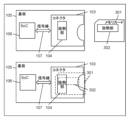
- FIG. 1 is a schematic diagram showing a memory card and a connector mounted on a board of a host device according to the first embodiment.
- the board 105 of the host device is equipped with a connector 103 into which the memory card 101 can be inserted and removed.
- the connector 103 includes a heat absorption section 104.
- the heat absorbing section 104 is made of a material with high thermal conductivity so as to efficiently conduct heat from the memory card 101 to the connector.
- the heat absorbing section 104 has a structure that comes into contact with the inserted memory card.
- a control unit capable of transmitting and receiving electrical signals is mounted on the board 105.
- SoC (System On Chip) 106 is an example of a control unit.
- the SoC 106 is connected to the connector 103 by a signal line 107, and an electrical signal from the SoC 106 can be transmitted to the connector 103.
- the SoC 106 can use the information.
- the host device further includes an air cooling fan 111. Note that the storage unit 110 and the air cooling fan 111 may not be shown in areas other than the upper part of FIG. 1 .
- a host device Normally, a host device requires a DRAM (Dynamic Random Access Memory) and other peripheral components, but these are omitted because they are not directly related to the content of this disclosure.
- DRAM Dynamic Random Access Memory
- the memory card 101 includes a heat dissipation section 102 for discharging heat within the memory card 101.
- the heat dissipation section 102 is made of a material with higher thermal conductivity than the casing of the memory card 101.
- the heat dissipation section 102 is located at a location where it contacts the heat absorption section 104 when inserted into the connector 103.
- Memory card 101 further includes a memory 108 and a processor 109.
- FIG. 1 shows a state in which the memory card 101 is inserted into the connector 103.
- the memory card 101 With the memory card 101 inserted into the connector 103 mounted on the board 105 of the host device, commands in the form of electrical signals from the SoC 106 are received by the memory card 101 via the connector 103.
- the memory card 101 is capable of analyzing the received electrical signal and transmitting an appropriate electrical signal response to the SoC 106.
- FIG. 11 shows a plan view and a sectional view of the connector 103 and the memory card 101.
- This sectional view is a diagram obtained by cutting the plan view along the AB plane.
- the cross section of the heat absorbing portion 104 is a semicylindrical shape in a spring state. That is, the shape of the heat absorbing portion 104 is a convex shape. This is to ensure that it is bonded to the heat dissipating portion 102 for heat dissipation.
- the signal terminal 1101 of the connector is arranged so as to be in contact with the signal terminal 1102 of the inserted memory card 101. Commands and responses are exchanged via this contact.
- FIG. 4 is a sequence diagram for explaining the operation of the host device and the memory card 101 inserted into the connector 103 of the board 105 of the host device.
- the memory card 101 is inserted into the connector 103 of the board 105 of the host device.
- the connector 103 is connected to the SoC 106 installed in the host device via a signal line 107, and notifies the SoC 106 of information that the memory card 101 has been inserted (S401).
- the SoC 106 detects insertion of the memory card 101 (S402). SoC 106 sends commands to memory card 101 via signal line 107. The memory card 101 analyzes the command and returns an appropriate response. Initialization processing is executed by repeating such commands and responses multiple times (S403). After the initialization process, the memory card 101 is in a state where data can be written, read, erased, etc.
- the SoC 106 issues a command to the memory card 101 to request heat dissipation section information (S404).
- the processor 109 of the memory card 101 returns a response including the heat dissipation section information stored in the memory 108 (S405).
- the SoC 106 calculates the heat dissipation performance from the heat dissipation section information included in the response and the heat absorption section information already held in the connector 103. For example, if the position of the heat radiating part 102 and the position of the heat absorbing part 104 match and the thermal conductivity of the materials of the heat radiating part 102 and the heat absorbing part 104 are high, it is calculated that the heat radiation performance is high (S406).
- the SoC 106 determines that it is possible to perform high-speed writing and high-speed reading that generate a large amount of heat (S407). Thereafter, the SoC 106 executes high-speed writing and high-speed reading to the memory card 101 as necessary (S408).
- FIG. 7 schematically shows the position of the heat dissipation section provided in the memory card.
- the heat dissipation section In the memory card 701 with the heat dissipation section at position A, the heat dissipation section is located at the front in the direction of insertion into the connector.
- the heat dissipation part In the memory card 702 with the heat dissipation part at position B, the heat dissipation part is located at the rear in the direction of insertion into the connector.
- the heat dissipation section In the memory card 703 at the heat dissipation section position C, the heat dissipation section is located over the entire surface.
- the heat dissipation part In the memory card 704 with the heat dissipation part located at position D, the heat dissipation part is located on the right side in the direction of insertion into the connector.
- the heat dissipation section In the memory card 705 with the heat dissipation section at position E, the
- FIG. 8 schematically shows the position of the heat absorbing part provided in the connector.
- the heat absorbing portion In the connector 801 having the heat absorbing portion at position A, the heat absorbing portion is located in front of the input direction of the memory card.
- the heat absorbing portion In the connector 802 at the heat absorbing portion position B, the heat absorbing portion is located at the rear in the input direction of the memory card.
- the heat absorbing portion In the connector 803 at the heat absorbing portion position C, the heat absorbing portion is positioned so as to cover the entire surface of the memory card.
- the heat absorbing part In the connector 804 at position D of the heat absorbing part, the heat absorbing part is located on the right side in the input direction of the memory card.
- the heat absorbing portion In the connector 805 at the heat absorbing portion position E, the heat absorbing portion is located on the left side in the input direction of the memory card.
- FIG. 9 is an example of how to represent information on the presence or absence of a heat radiating section (information indicating whether the memory card has a heat radiating section) and position information included in the response sent back by the memory card.
- the presence/absence and position information of the heat dissipation section represents the presence/absence and position information of the heat dissipation section provided in the memory card. If the value is "000”, the heat dissipation section is not provided, and if the value is "001", the heat dissipation section is provided, indicating that the memory card 701 is in the heat dissipation section position A.
- FIG. 10 is an example of how to represent material information included in the response sent back by the memory card.
- the name of the material of the heat dissipation section indicates the name of the material of the heat dissipation section provided in the memory card.
- a value of "000” indicates copper, and a value of "001" indicates aluminum.
- "010,” “011,” and “100” represent silver, gold, and epoxy resin, respectively.
- the thermal conductivity of the heat dissipation section represents the thermal conductivity of the heat dissipation section provided in the memory card. If the value is "000”, it means that it is 400 W/mK or more, and if it is "001", it means that it is 300 W/mK or more and less than 400 W/mK. Similarly, “010” and “011” represent 200 W/mK or more and less than 300 W/mK and less than 200 W/mK, respectively.
- the memory card 101 In response to a command from the SoC 106 requesting heat radiating part information, the memory card 101 returns a response including "001" indicating the presence or absence of the heat radiating part and its position information, and "000" indicating the material name of the heat radiating part. From this information, the SoC 106 can know that the memory card 701 is at the heat dissipation section position A and that its material is copper. The SoC 106 knows the information about the connector, and if the connector 801 is at the position A of the heat absorption part, it knows that the positions of the heat radiation part and the heat absorption part match. Furthermore, since the material is copper, it can be seen that it has high thermal conductivity. From this information, the SoC 106 can determine that the heat dissipation performance of the memory card 101 into which the connector is inserted is in a high state.
- the SoC 106 of the host device issues a command requesting heat dissipation section information to the inserted memory card 101.
- the memory card 101 replies to the SoC 106 with a response including heat dissipation section information.
- the SoC 106 of the host device can determine whether the inserted memory card 101 has high heat dissipation performance. Therefore, it becomes easier to determine the data writing speed and reading speed suitable for heat dissipation performance.
- Embodiment 2 Embodiment 2 will be described below with reference to FIGS. 2 and 5.
- FIG. 2 is a schematic diagram showing a memory card and a connector mounted on a host device board according to the second embodiment.
- the board 105 of the host device is equipped with a connector 103 into which a memory card 201 can be inserted and removed.
- the connector 103 includes a heat absorption section 104.
- the heat absorbing section 104 is made of a material with high thermal conductivity so as to efficiently conduct heat from the memory card 201 to the connector.
- the heat absorbing section 104 has a structure that comes into contact with the inserted memory card.
- a control unit capable of transmitting and receiving electrical signals is mounted on the board 105.
- SoC 106 is an example of a control unit.
- the SoC 106 is connected to the connector 103 by a signal line 107, and an electrical signal from the SoC 106 can be transmitted to the connector 103.
- Information such as the position and shape of the heat absorbing part 104 provided in the connector 103 is determined at the time of manufacture of the host device, so it is stored at the time of manufacture in a storage unit (not shown) such as a non-volatile memory installed separately in the host device.
- the SoC 106 can use this information.
- a host device Normally, a host device requires a DRAM and other peripheral components, but these are omitted because they are not directly related to the content of this disclosure.
- the memory card 201 does not include a heat radiating section for dissipating the heat inside the memory card 201.
- the memory card 201 With the memory card 201 inserted into the connector 103 mounted on the board 105 of the host device, commands in the form of electrical signals from the SoC 106 are received by the memory card 201 via the connector 103.
- the memory card 201 is capable of analyzing the received electrical signal and transmitting an appropriate electrical signal response to the SoC 106.
- FIG. 2 shows a state in which the memory card 201 is inserted into the connector 103.
- the shape of the connector 103 is the same as in Embodiment 1, so it will be omitted.
- FIG. 5 is a sequence diagram for explaining the operation of the host device and the memory card 201 inserted into the connector 103 of the board 105 of the host device.
- the memory card 201 is inserted into the connector 103 of the board 105 of the host device.
- the connector 103 is connected to the SoC 106 installed in the host device via a signal line 107, and notifies the SoC 106 of information that the memory card 201 has been inserted (S501).
- the SoC 106 detects insertion of the memory card 201 (S502).
- the SoC 106 installed in the host device sends commands to the memory card 201 via the signal line 107.
- the memory card 201 analyzes the command and returns an appropriate response.
- Initialization processing is executed by repeating such commands and responses multiple times (S503). After the initialization process, the memory card 201 is in a state where data can be written, read, erased, etc.
- the SoC 106 issues a command to the memory card 201 to request heat dissipation section information (S504).
- the memory card 201 returns a response including information on its own heat dissipation section (S505).
- the SoC 106 calculates the heat dissipation performance from the heat dissipation section information included in the response and the heat absorption section information already held in the connector 103. For example, if it is found that a heat dissipation section is not provided, the heat dissipation performance is calculated to be low (S506).
- the SoC 106 If it is determined that the heat dissipation performance is low, the SoC 106 gives up on high-speed writing and high-speed reading, which generate a large amount of heat, and determines that low-speed writing and low-speed reading can be executed continuously (S507). Thereafter, the SoC 106 executes low-speed writing and low-speed reading to the memory card 201 as necessary (S508).
- the information to be sent and received and the information used to calculate the heat dissipation performance are the same as in Embodiment 1, so only an example of determination will be shown. Let us take as an example a case where the material name shown in FIG. 10 is used as the material information of the heat dissipation part.
- the memory card 201 In response to the command requesting heat radiation part information from the SoC 106, the memory card 201 returns a response including "000" indicating the presence or absence of the heat radiation part and position information, and "100" the material name of the heat radiation part.
- the SoC 106 is a memory card that does not have a heat dissipation section, and that the material of the portion of the connector 103 that comes into contact with the heat absorption section is epoxy resin. Although the SoC 106 knows the information about the connector, since the memory card 201 does not have a heat dissipation section, it can be determined that the heat dissipation performance is low.
- the SoC 106 of the host device issues a command requesting heat dissipation section information to the inserted memory card 201.
- the memory card 201 replies to the SoC 106 a response that includes heat dissipation section information.
- the SoC 106 of the host device can determine whether the inserted memory card 201 has low heat dissipation performance. Therefore, it becomes easier to determine the data writing speed and reading speed suitable for heat dissipation performance.
- Embodiment 3 (Embodiment 3) Embodiment 3 will be described below with reference to FIGS. 3 and 6.
- FIG. 3 is a schematic diagram showing a memory card and a connector mounted on a host device board according to the third embodiment. The explanation will be based on the diagram shown in the upper part of FIG. 3 in which the memory card is removed.
- a board 105 of the host device is equipped with a connector 103 into which a memory card 301 can be inserted and removed.
- the connector 103 includes a heat absorption section 104.
- the heat absorbing section 104 is made of a material with high thermal conductivity so as to efficiently conduct heat from the memory card 301 to the connector.
- the heat absorbing portion 104 has a structure that comes into contact with the inserted memory card.
- a control unit capable of transmitting and receiving electrical signals is mounted on the board 105.
- SoC 106 is an example of a control unit.
- the SoC 106 is connected to the connector 103 by a signal line 107, and an electrical signal from the SoC 106 can be transmitted to the connector 103.
- Information such as the position and shape of the heat absorbing part 104 provided in the connector 103 is determined at the time of manufacture of the host device, so it is stored at the time of manufacture in a storage unit (not shown) such as a non-volatile memory installed separately in the host device.
- the SoC 106 can use this information.
- a host device requires a DRAM and other peripheral components, but these are omitted because they are not directly related to the content of this disclosure.
- the memory card 301 includes a heat radiating section 302 for discharging heat within the memory card 301.
- the heat dissipation section 302 is made of a material with higher thermal conductivity than the casing of the memory card 301.
- the position of the heat dissipation section 302 is such that it is in partial contact with the heat absorption section 104 when inserted into the connector 103.
- FIG. 3 shows a state in which the memory card 301 is inserted into the connector 103.
- the shape of connector 103 is the same as in Embodiment 1, so it will be omitted.
- FIG. 6 is a sequence diagram for explaining the operation of the host device and the memory card 301 inserted into the connector 103 of the board 105 of the host device.
- the memory card 301 is inserted into the connector 103 of the board 105 of the host device.
- the connector 103 is connected to the SoC 106 installed in the host device via a signal line 107, and notifies the SoC 106 of information that the memory card 301 has been inserted (S601).
- the SoC 106 detects insertion of the memory card 301 (S602).
- the SoC 106 installed in the host device transmits commands to the memory card 301 via the signal line 107.
- the memory card 301 analyzes the command and returns an appropriate response. This command/response is repeated multiple times to execute initialization processing (S603). After the initialization process, the memory card 301 is in a state where data can be written, read, erased, etc.
- the SoC 106 issues a command to the memory card 301 to request heat dissipation section information (S604).
- the memory card 301 returns a response including information on its own heat dissipation section (S605).
- the SoC 106 calculates the heat dissipation performance from the heat dissipation section information included in the response and the heat absorption section information already held in the connector 103. For example, if the position of the heat radiation part and the position of the heat absorption part partially match and the thermal conductivity of the materials of the heat radiation part and the heat absorption part are high, the heat radiation performance is calculated to be medium (S606).
- the SoC 106 determines that medium-speed writing and medium-speed reading with moderate heat generation are possible (S607). Thereafter, the SoC 106 executes medium-speed writing and medium-speed reading to the memory card 301 as necessary (S608).
- the information to be sent and received and the information used to calculate the heat dissipation performance are the same as in Embodiment 1, so only an example of determination will be shown.
- the memory card 301 In response to the command requesting heat radiation part information from the SoC 106, the memory card 301 returns a response that includes the presence/absence and position information of the heat radiation part as "100" and the material name of the heat radiation part "010". From this information, the SoC 106 can know that the memory card 701 is at the heat dissipation section position A and that its material is copper. The SoC 106 knows the information about the connector, and knows that if the connector 801 is at the heat absorption part position A, the positions of the heat radiation part and the heat absorption part partially match, and the heat radiation performance is medium.
- the SoC 106 can determine that the heat dissipation performance of the memory card 301 into which the connector is inserted is in a medium state.
- the SoC 106 of the host device issues a command requesting heat radiation part information to the inserted memory card 301.
- the memory card 301 replies to the SoC 106 a response that includes heat dissipation section information.
- the SoC 106 of the host device can determine whether the heat dissipation performance of the inserted memory card 301 is in a medium state. Therefore, it becomes easier to determine the data writing speed and reading speed suitable for heat dissipation performance.
- Embodiments 1 to 3 have been described as examples of the technology disclosed in this application.
- the technology in the present disclosure is not limited to this, and can also be applied to embodiments in which changes, replacements, additions, omissions, etc. are made.
- the position and material of the heat radiating part were explained as information for calculating the performance of the heat radiating part.
- the information for calculating the performance of the heat dissipation section may be any information that affects heat dissipation, and therefore, this information is not limited to the position and material of the heat dissipation section.
- the shape such as the length and width of the heat dissipation part, the shape of the memory card itself, the surface area of the memory card itself, whether the memory card is equipped with fins, and if so, the direction of the fins, etc. may be used.
- the connector may be any connector that can be used to attach and detach a non-volatile memory, and therefore is not limited to a shape that allows a memory card to be inserted.
- M M.
- a connector like 2 may also be used.
- the host device limited the write speed to the memory card and the read speed from the memory card based on the calculated heat dissipation performance. There is no problem with the actions that the host device performs based on the calculated heat dissipation performance, even if they are to compensate for the lack of heat dissipation performance.For example, opening the host device's casing door to lower the temperature around the memory card.
- the operation may be performed by operating the air cooling fan 111 installed in the host device, increasing the rotation speed of the air cooling fan 111, or the like. That is, the host device controls the air cooling fan 111 based on the calculated heat radiation performance as an operation to supplement the heat radiation performance of the memory card. Alternatively, a warning of insufficient heat dissipation performance may be notified to the host device user.
- the present disclosure is applicable to devices that write and read data while generating heat at high temperatures. Specifically, the present disclosure is applicable to digital cameras, movies, smartphones, drones, and the like.
Landscapes
- Engineering & Computer Science (AREA)
- Theoretical Computer Science (AREA)
- General Physics & Mathematics (AREA)
- Physics & Mathematics (AREA)
- General Engineering & Computer Science (AREA)
- Human Computer Interaction (AREA)
- Computer Hardware Design (AREA)
- Manufacturing & Machinery (AREA)
- Automation & Control Theory (AREA)
- Power Engineering (AREA)
- Microelectronics & Electronic Packaging (AREA)
- Cooling Or The Like Of Electrical Apparatus (AREA)
- Credit Cards Or The Like (AREA)
Priority Applications (4)
| Application Number | Priority Date | Filing Date | Title |
|---|---|---|---|
| EP23770139.6A EP4495786A4 (en) | 2022-03-16 | 2023-01-31 | Memory card and host device |
| JP2024507557A JP7766233B2 (ja) | 2022-03-16 | 2023-01-31 | メモリーカードおよびホスト機器 |
| CN202380026710.9A CN118805162A (zh) | 2022-03-16 | 2023-01-31 | 存储卡以及主机设备 |
| US18/883,383 US20250004448A1 (en) | 2022-03-16 | 2024-09-12 | Memory card and host device |
Applications Claiming Priority (2)
| Application Number | Priority Date | Filing Date | Title |
|---|---|---|---|
| JP2022-040888 | 2022-03-16 | ||
| JP2022040888 | 2022-03-16 |
Related Child Applications (1)
| Application Number | Title | Priority Date | Filing Date |
|---|---|---|---|
| US18/883,383 Continuation US20250004448A1 (en) | 2022-03-16 | 2024-09-12 | Memory card and host device |
Publications (1)
| Publication Number | Publication Date |
|---|---|
| WO2023176177A1 true WO2023176177A1 (ja) | 2023-09-21 |
Family
ID=88022784
Family Applications (1)
| Application Number | Title | Priority Date | Filing Date |
|---|---|---|---|
| PCT/JP2023/003075 Ceased WO2023176177A1 (ja) | 2022-03-16 | 2023-01-31 | メモリーカードおよびホスト機器 |
Country Status (5)
| Country | Link |
|---|---|
| US (1) | US20250004448A1 (https=) |
| EP (1) | EP4495786A4 (https=) |
| JP (1) | JP7766233B2 (https=) |
| CN (1) | CN118805162A (https=) |
| WO (1) | WO2023176177A1 (https=) |
Citations (2)
| Publication number | Priority date | Publication date | Assignee | Title |
|---|---|---|---|---|
| JPH10502755A (ja) | 1994-11-07 | 1998-03-10 | エロネックス・テクノロジーズ・インコーポレーテッド | モジュール式携帯用コンピュータ |
| WO2005015406A1 (ja) * | 2003-08-06 | 2005-02-17 | Matsushita Electric Industrial Co., Ltd. | 半導体メモリカード、アクセス装置及びアクセス方法 |
Family Cites Families (2)
| Publication number | Priority date | Publication date | Assignee | Title |
|---|---|---|---|---|
| JP2020161098A (ja) * | 2019-03-20 | 2020-10-01 | キオクシア株式会社 | 半導体記憶装置 |
| WO2021171639A1 (ja) * | 2020-02-28 | 2021-09-02 | キオクシア株式会社 | 半導体記憶装置 |
-
2023
- 2023-01-31 EP EP23770139.6A patent/EP4495786A4/en active Pending
- 2023-01-31 CN CN202380026710.9A patent/CN118805162A/zh active Pending
- 2023-01-31 WO PCT/JP2023/003075 patent/WO2023176177A1/ja not_active Ceased
- 2023-01-31 JP JP2024507557A patent/JP7766233B2/ja active Active
-
2024
- 2024-09-12 US US18/883,383 patent/US20250004448A1/en active Pending
Patent Citations (2)
| Publication number | Priority date | Publication date | Assignee | Title |
|---|---|---|---|---|
| JPH10502755A (ja) | 1994-11-07 | 1998-03-10 | エロネックス・テクノロジーズ・インコーポレーテッド | モジュール式携帯用コンピュータ |
| WO2005015406A1 (ja) * | 2003-08-06 | 2005-02-17 | Matsushita Electric Industrial Co., Ltd. | 半導体メモリカード、アクセス装置及びアクセス方法 |
Non-Patent Citations (1)
| Title |
|---|
| See also references of EP4495786A4 |
Also Published As
| Publication number | Publication date |
|---|---|
| EP4495786A4 (en) | 2025-07-02 |
| JP7766233B2 (ja) | 2025-11-10 |
| JPWO2023176177A1 (https=) | 2023-09-21 |
| EP4495786A1 (en) | 2025-01-22 |
| US20250004448A1 (en) | 2025-01-02 |
| CN118805162A (zh) | 2024-10-18 |
Similar Documents
| Publication | Publication Date | Title |
|---|---|---|
| KR101994931B1 (ko) | 기억 장치 | |
| CN201421869Y (zh) | 电池散热装置 | |
| CN102054196B (zh) | 卡式外围装置 | |
| JP4311538B2 (ja) | ディスク記憶装置の冷却構造 | |
| US20060056151A1 (en) | System for cooling interior and external housing surfaces of an electronic apparatus | |
| US10638625B2 (en) | Solid state drive apparatus and data storage system having the same | |
| CN104584131A (zh) | 具有散热器的存储系统 | |
| CN214852404U (zh) | 一种控制设备 | |
| CN209590500U (zh) | 摄像头散热模组及头戴设备 | |
| JP6726897B2 (ja) | 電子機器 | |
| JP6928821B1 (ja) | 撮像装置 | |
| GB2552591A (en) | Electronic device and electronic apparatus | |
| WO2023176177A1 (ja) | メモリーカードおよびホスト機器 | |
| JP2016071269A (ja) | 電子機器、及びシステム | |
| CN110060966A (zh) | 光模块 | |
| JP2001318738A (ja) | 電子機器 | |
| US11439001B2 (en) | System and method for heat removal using a thermal potting solution in an information handling system | |
| CN210295913U (zh) | 基于主动散热的ssd转接装置 | |
| US20240138082A1 (en) | System and method for thermal management of removable components | |
| US8027160B2 (en) | Heat sink including extended surfaces | |
| CN213904943U (zh) | 一种固态硬盘盒 | |
| TWM309314U (en) | Heat-dissipating mechanical housing | |
| TWM619333U (zh) | 熱傳輸支架以及電子部件系統 | |
| CN216595490U (zh) | 一种激光雷达散热结构及激光雷达 | |
| CN223666584U (zh) | 一种基于CFexpress Type B模组的封装结构 |
Legal Events
| Date | Code | Title | Description |
|---|---|---|---|
| 121 | Ep: the epo has been informed by wipo that ep was designated in this application |
Ref document number: 23770139 Country of ref document: EP Kind code of ref document: A1 |
|
| ENP | Entry into the national phase |
Ref document number: 2024507557 Country of ref document: JP Kind code of ref document: A |
|
| WWE | Wipo information: entry into national phase |
Ref document number: 202380026710.9 Country of ref document: CN |
|
| WWE | Wipo information: entry into national phase |
Ref document number: 2023770139 Country of ref document: EP |
|
| NENP | Non-entry into the national phase |
Ref country code: DE |
|
| ENP | Entry into the national phase |
Ref document number: 2023770139 Country of ref document: EP Effective date: 20241016 |