WO2023171763A1 - 静電噴出装置及び静電噴出装置用カートリッジ - Google Patents
静電噴出装置及び静電噴出装置用カートリッジ Download PDFInfo
- Publication number
- WO2023171763A1 WO2023171763A1 PCT/JP2023/009123 JP2023009123W WO2023171763A1 WO 2023171763 A1 WO2023171763 A1 WO 2023171763A1 JP 2023009123 W JP2023009123 W JP 2023009123W WO 2023171763 A1 WO2023171763 A1 WO 2023171763A1
- Authority
- WO
- WIPO (PCT)
- Prior art keywords
- nozzle
- electrostatic
- ejection
- liquid
- tip
- Prior art date
- Legal status (The legal status is an assumption and is not a legal conclusion. Google has not performed a legal analysis and makes no representation as to the accuracy of the status listed.)
- Ceased
Links
Images



Classifications
-
- B—PERFORMING OPERATIONS; TRANSPORTING
- B05—SPRAYING OR ATOMISING IN GENERAL; APPLYING FLUENT MATERIALS TO SURFACES, IN GENERAL
- B05B—SPRAYING APPARATUS; ATOMISING APPARATUS; NOZZLES
- B05B1/00—Nozzles, spray heads or other outlets, with or without auxiliary devices such as valves, heating means
- B05B1/30—Nozzles, spray heads or other outlets, with or without auxiliary devices such as valves, heating means designed to control volume of flow, e.g. with adjustable passages
- B05B1/3033—Nozzles, spray heads or other outlets, with or without auxiliary devices such as valves, heating means designed to control volume of flow, e.g. with adjustable passages the control being effected by relative coaxial longitudinal movement of the controlling element and the spray head
- B05B1/304—Nozzles, spray heads or other outlets, with or without auxiliary devices such as valves, heating means designed to control volume of flow, e.g. with adjustable passages the control being effected by relative coaxial longitudinal movement of the controlling element and the spray head the controlling element being a lift valve
- B05B1/3046—Nozzles, spray heads or other outlets, with or without auxiliary devices such as valves, heating means designed to control volume of flow, e.g. with adjustable passages the control being effected by relative coaxial longitudinal movement of the controlling element and the spray head the controlling element being a lift valve the valve element, e.g. a needle, co-operating with a valve seat located downstream of the valve element and its actuating means, generally in the proximity of the outlet orifice
-
- B—PERFORMING OPERATIONS; TRANSPORTING
- B05—SPRAYING OR ATOMISING IN GENERAL; APPLYING FLUENT MATERIALS TO SURFACES, IN GENERAL
- B05B—SPRAYING APPARATUS; ATOMISING APPARATUS; NOZZLES
- B05B5/00—Electrostatic spraying apparatus; Spraying apparatus with means for charging the spray electrically; Apparatus for spraying liquids or other fluent materials by other electric means
- B05B5/025—Discharge apparatus, e.g. electrostatic spray guns
- B05B5/035—Discharge apparatus, e.g. electrostatic spray guns characterised by gasless spraying, e.g. electrostatically assisted airless spraying
-
- B—PERFORMING OPERATIONS; TRANSPORTING
- B05—SPRAYING OR ATOMISING IN GENERAL; APPLYING FLUENT MATERIALS TO SURFACES, IN GENERAL
- B05B—SPRAYING APPARATUS; ATOMISING APPARATUS; NOZZLES
- B05B15/00—Details of spraying plant or spraying apparatus not otherwise provided for; Accessories
- B05B15/14—Arrangements for preventing or controlling structural damage to spraying apparatus or its outlets, e.g. for breaking at desired places; Arrangements for handling or replacing damaged parts
- B05B15/16—Arrangements for preventing or controlling structural damage to spraying apparatus or its outlets, e.g. for breaking at desired places; Arrangements for handling or replacing damaged parts for preventing non-intended contact between spray heads or nozzles and foreign bodies, e.g. nozzle guards
-
- B—PERFORMING OPERATIONS; TRANSPORTING
- B05—SPRAYING OR ATOMISING IN GENERAL; APPLYING FLUENT MATERIALS TO SURFACES, IN GENERAL
- B05B—SPRAYING APPARATUS; ATOMISING APPARATUS; NOZZLES
- B05B5/00—Electrostatic spraying apparatus; Spraying apparatus with means for charging the spray electrically; Apparatus for spraying liquids or other fluent materials by other electric means
- B05B5/025—Discharge apparatus, e.g. electrostatic spray guns
- B05B5/043—Discharge apparatus, e.g. electrostatic spray guns using induction-charging
-
- B—PERFORMING OPERATIONS; TRANSPORTING
- B05—SPRAYING OR ATOMISING IN GENERAL; APPLYING FLUENT MATERIALS TO SURFACES, IN GENERAL
- B05B—SPRAYING APPARATUS; ATOMISING APPARATUS; NOZZLES
- B05B5/00—Electrostatic spraying apparatus; Spraying apparatus with means for charging the spray electrically; Apparatus for spraying liquids or other fluent materials by other electric means
- B05B5/025—Discharge apparatus, e.g. electrostatic spray guns
- B05B5/053—Arrangements for supplying power, e.g. charging power
- B05B5/0533—Electrodes specially adapted therefor; Arrangements of electrodes
-
- B—PERFORMING OPERATIONS; TRANSPORTING
- B05—SPRAYING OR ATOMISING IN GENERAL; APPLYING FLUENT MATERIALS TO SURFACES, IN GENERAL
- B05B—SPRAYING APPARATUS; ATOMISING APPARATUS; NOZZLES
- B05B5/00—Electrostatic spraying apparatus; Spraying apparatus with means for charging the spray electrically; Apparatus for spraying liquids or other fluent materials by other electric means
- B05B5/16—Arrangements for supplying liquids or other fluent material
- B05B5/1608—Arrangements for supplying liquids or other fluent material the liquid or other fluent material being electrically conductive
- B05B5/1675—Arrangements for supplying liquids or other fluent material the liquid or other fluent material being electrically conductive the supply means comprising a piston, e.g. a piston pump
-
- B—PERFORMING OPERATIONS; TRANSPORTING
- B05—SPRAYING OR ATOMISING IN GENERAL; APPLYING FLUENT MATERIALS TO SURFACES, IN GENERAL
- B05B—SPRAYING APPARATUS; ATOMISING APPARATUS; NOZZLES
- B05B5/00—Electrostatic spraying apparatus; Spraying apparatus with means for charging the spray electrically; Apparatus for spraying liquids or other fluent materials by other electric means
- B05B5/16—Arrangements for supplying liquids or other fluent material
- B05B5/1691—Apparatus to be carried on or by a person or with a container fixed to the discharge device
-
- B—PERFORMING OPERATIONS; TRANSPORTING
- B05—SPRAYING OR ATOMISING IN GENERAL; APPLYING FLUENT MATERIALS TO SURFACES, IN GENERAL
- B05B—SPRAYING APPARATUS; ATOMISING APPARATUS; NOZZLES
- B05B9/00—Spraying apparatus for discharge of liquids or other fluent material, without essentially mixing with gas or vapour
- B05B9/03—Spraying apparatus for discharge of liquids or other fluent material, without essentially mixing with gas or vapour characterised by means for supplying liquid or other fluent material
- B05B9/04—Spraying apparatus for discharge of liquids or other fluent material, without essentially mixing with gas or vapour characterised by means for supplying liquid or other fluent material with pressurised or compressible container; with pump
- B05B9/08—Apparatus to be carried on or by a person, e.g. of knapsack type
- B05B9/0805—Apparatus to be carried on or by a person, e.g. of knapsack type comprising a pressurised or compressible container for liquid or other fluent material
- B05B9/0838—Apparatus to be carried on or by a person, e.g. of knapsack type comprising a pressurised or compressible container for liquid or other fluent material supply being effected by follower in container, e.g. membrane or floating piston, or by deformation of container
Definitions
- the present invention relates to an electrostatic ejection device and a cartridge for an electrostatic ejection device.
- Patent Document 1 discloses that an electrostatic ejection device is equipped with a motor, a high voltage generator, a battery, etc., and a liquid composition is electrostatically charged (electrostatically charged) by a high voltage from the high voltage generator.
- An electrostatic ejection device is described that ejects from a nozzle toward a target object.
- Patent Documents 2 and 3 describe electrostatic jetting devices that are provided with a needle valve or a mandrel in order to close the jetting hole of the nozzle.
- the electrostatic ejection device of Patent Document 1 the ejection hole of the nozzle is closed by a cap, so if the cap is forgotten to close, it is possible to prevent the liquid composition from dripping or from sticking inside the nozzle. The problem was that it was not possible.
- the electrostatic jetting devices of Patent Document 2 and Patent Document 3 are provided with a needle valve and a mandrel that close the nozzle tip, but the needle valve and mandrel are exposed from the nozzle ejection hole and are physically There was a problem that it was physically and electrically unsafe.
- the present invention relates to an electrostatic ejection device and a cartridge for an electrostatic ejection device, which can be used safely during use and can reliably seal the ejection hole of a nozzle when not in use.
- An electrostatic jetting device is an electrostatic jetting device including a jetting section that jets out a liquid, and the jetting section includes a nozzle for spouting the liquid, and a nozzle disposed at a tip of the nozzle.
- the shutoff pin is provided with a flow path for communicating with the nozzle hole, and a shutoff pin that is movable back and forth within the flow path and capable of sealing the nozzle hole, and the shutoff pin has a distal end when the nozzle hole is sealed. is not exposed from the nozzle.
- a cartridge for an electrostatic jetting device is a cartridge for an electrostatic jetting device including a jetting portion for jetting a liquid, the jetting portion including a nozzle for spouting the liquid, and a nozzle tip for spouting the liquid.
- a flow path for circulating to a jet hole provided in the part, and a shut-off pin that can move forward and backward in the flow path and seal the jet hole, and the shut-off pin is in a state where the jet hole is sealed. In this case, the tip portion is not exposed from the ejection hole.
- the electrostatic jetting device and the cartridge for the electrostatic jetting device of the present invention can be used safely, and the jetting hole of the nozzle can be reliably sealed when not in use.
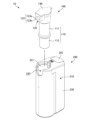
- FIG. 1 is a perspective view showing an electrostatic ejection device according to the present embodiment.
- FIG. 2 is an exploded perspective view showing a state in which the cartridge according to the present embodiment is removed from the electrostatic ejection main body. It is a left side sectional view showing an electrostatic ejection device concerning this embodiment.
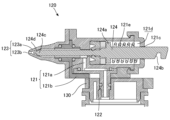
- FIG. 2 is a partially enlarged cross-sectional view showing a part of the cartridge according to the present embodiment.
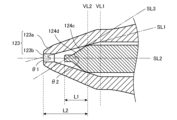
- FIG. 2 is a partially enlarged sectional view showing an enlarged view of a nozzle tip and a shutoff pin tip according to the present embodiment.
- FIG. 2 is a block configuration diagram showing a configuration provided in a housing of an electrostatic ejection device according to the present embodiment.
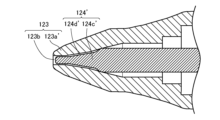
- FIG. 7 is a partially enlarged sectional view showing a modification of the nozzle tip and the shutoff pin tip according to the present invention.
- the electrostatic ejecting device 10 includes a cartridge 100 for an electrostatic ejecting device (hereinafter simply referred to as cartridge 100) that stores a liquid, and a cartridge 100 that can be inserted and removed. It is equipped with an electrostatic ejection main body 200 that can be used.
- cartridge 100 for convenience of explanation, the direction in which the cartridge 100 is inserted into the electrostatic ejection main body 200 will be described as a lower side, and the direction in which the cartridge 100 is removed from the electrostatic ejection main body 200 will be described as an upper side.
- the vertical direction here is not necessarily the vertical direction in actual usage conditions.
- the electrostatic spraying device 10 is a handheld type device that has a shape and size that can be held by a user with the hand, and uses an electrostatic spraying method to target a liquid composition (liquid). Spray at something.
- the electrostatic spraying method involves applying a high voltage (e.g., several kV to several tens of kV) to a liquid composition (e.g., a solution of a polymer compound dissolved in a volatile solvent). This is a method in which the liquid composition is charged (electrostatically charged) and ejected toward the object using electrostatic force based on the potential difference between the charged liquid composition and the object.
- a liquid composition ejected by electrostatic spraying is sent toward an object in the form of a mist or ultrafine threads.
- the ejected liquid composition forms a film on the surface of the object during the process of being ejected and being sent toward the object, and after adhering to the object, the solvent, which is a volatile substance, dries. can be formed.
- the electrostatic jetting device 10 according to the present embodiment can also be used as an electrostatic spinning device that jets a solution containing a raw material for electrospinning, that is, a spinning liquid, toward a target object.
- the user holds the electrostatic ejection device 10 in his hand and applies the liquid composition to the user's skin. By ejecting it towards the user, a film can be formed on the surface of the user's skin.
- the coating is a deposit containing fibers.
- the liquid composition or spinning liquid used in the electrostatic jetting device or the electrostatic spinning device includes, for example, a polymer compound capable of forming a film, more preferably a polymer compound capable of forming a fiber.
- a solution dissolved in a solvent can be used.
- a polymer compound either a water-soluble polymer compound or a water-insoluble polymer compound can be used.
- the fiber-formable polymer compound preferably includes a water-insoluble polymer compound.
- the liquid composition contains 50% by mass or more of a volatile liquid agent selected from alcohols and ketones.
- a volatile liquid agent is a substance that is volatile in a liquid state.
- the volatile liquid agent preferably has a vapor pressure of 0.01 kPa or more and 106.66 kPa or less, more preferably 0.13 kPa or more and 66.66 kPa or less, and 0.67 kPa or more and 40.00 kPa at 20°C. It is more preferably below, and even more preferably 1.33 kPa or more and 40.00 kPa or less.
- monovalent chain aliphatic alcohols include C 1 -C 6 alcohols
- monovalent cyclic alcohols include C 4 -C 6 cyclic alcohols
- monovalent aromatic alcohols include benzyl alcohol, phenylethyl alcohol, etc. Each can be mentioned. Specific examples thereof include ethanol, isopropyl alcohol, butyl alcohol, phenylethyl alcohol, n-propanol, n-pentanol, and the like. As these alcohols, one type or two or more types selected from these can be used.
- ketones include di-C 1 -C 4 alkyl ketones, such as acetone, methyl ethyl ketone, methyl isobutyl ketone, and the like. These ketones can be used alone or in combination of two or more.
- the volatile liquid agent more preferably contains one or more selected from ethanol, isopropyl alcohol, and butyl alcohol, and more preferably contains one or two selected from ethanol and butyl alcohol. From the viewpoint of the feel of the fibers, a volatile liquid agent containing ethanol is more preferable.
- the content of the volatile liquid agent in the volatile liquid agent is preferably 85% by mass or more, preferably 90% by mass or more, and preferably 100% by mass or less.
- the content of the volatile liquid agent in the liquid composition is preferably 50% by mass or more, more preferably 55% by mass or more, and even more preferably 60% by mass or more. Further, it is preferably 95% by mass or less, more preferably 94% by mass or less, and even more preferably 93% by mass or less.
- the content of the volatile liquid agent in the liquid composition is preferably 50% by mass or more and 95% by mass or less, more preferably 55% by mass or more and 94% by mass or less, and 60% by mass or more and 93% by mass or less. It is even more preferable that there be.
- ethanol is preferably 50% by mass or more, more preferably 65% by mass or more, based on the total amount of the volatile liquid agent. More preferably, it is 80% by mass or more. Further, it is preferably 100% by mass or less. Ethanol is preferably 50% by mass or more and 100% by mass or less, more preferably 65% by mass or more and 100% by mass or less, and 80% by mass or more and 100% by mass or less, based on the total amount of the volatile liquid agent. It is even more preferable.
- the liquid composition preferably contains a fiber-forming water-insoluble polymer.
- a fiber-forming water-insoluble polymer is a substance that can be dissolved in a volatile liquid.
- melting means being in a dispersed state at 20° C., and the dispersion state is visually uniform, preferably transparent or translucent when visually observed.
- the water-insoluble polymer for fiber formation is a polymer that is soluble in volatile substances and insoluble in water.
- water-soluble polymer refers to 1 g of polymer weighed in an environment of 1 atm and 23° C., immersed in 10 g of ion-exchanged water, and after 24 hours, 0% of the immersed polymer. Refers to substances that have the property of dissolving 5g or more in water.
- water-insoluble polymer refers to 1 g of polymer weighed in an environment of 1 atm and 23°C, immersed in 10 g of ion-exchanged water, and after 24 hours, the immersed polymer becomes 0% .5g or more is not dissolved, in other words, the amount dissolved is less than 0.5g.
- water-insoluble polymers with fiber-forming ability examples include fully saponified polyvinyl alcohol, which can be insolubilized after film formation, partially saponified polyvinyl alcohol, which can be crosslinked after film formation when used in combination with a crosslinking agent, and poly(N-propanoyl ethylene).
- oxazoline-modified silicone such as imine
- graft-dimethylsiloxane/ ⁇ -aminopropylmethylsiloxane copolymer polyvinyl acetal diethylaminoacetate, tzein (main component of corn protein), polyester, polylactic acid (PLA), polyacrylonitrile resin, polymethacrylate
- acrylic resins such as acid resins, polystyrene resins, polyvinyl butyral resins, polyethylene terephthalate resins, polybutylene terephthalate resins, polyurethane resins, polyamide resins, polyimide resins, and polyamideimide resins.
- water-insoluble polymers One type or a combination of two or more types selected from these water-insoluble polymers can be used.
- these water-insoluble polymers completely saponified polyvinyl alcohol that can be insolubilized after film formation, partially saponified polyvinyl alcohol that can be crosslinked after film formation when used in combination with a crosslinking agent, polyvinyl butyral resin, polyurethane resin, polymethacrylic acid resin, etc.
- water-insoluble polymers partially saponified polyvinyl alcohol, completely saponified polyvinyl alcohol, polyvinyl butyral resin, polymethacrylic resin, and polyurethane resin are more preferable from the viewpoint of dispersibility in alcohol solvents, fiber feel, etc.
- Partially saponified polyvinyl Alcohol, fully saponified polyvinyl alcohol, and polyvinyl butyral resin are more preferable, and they have the following properties: they can stably and efficiently form a film containing fibers on the surface of the skin or nails, the durability of the film, the formability of the film, and the ability to form a film on the skin.
- Polyvinyl butyral resin is particularly preferred from the viewpoint of both conformability and durability.
- the content of the fiber-forming water-insoluble polymer in the liquid composition is preferably 3% by mass or more, more preferably 4% by mass or more, and even more preferably 6% by mass or more. Moreover, it is preferably 30% by mass or less, more preferably 25% by mass or less, and even more preferably 20% by mass or less.
- the content of the water-insoluble polymer for fiber formation in the liquid composition is preferably 3% by mass or more and 30% by mass or less, more preferably 3% by mass or more and 25% by mass or less, and 5% by mass or more and 20% by mass. The following are more preferable.
- the liquid composition may contain water. Since water is ionized and charged compared to non-ionizing solvents such as ethanol, or dissolves ionic components and induces ionization, water can impart electrical conductivity to the liquid composition. Therefore, a fibrous film is stably formed on the surface of the skin and nails by electrostatic spraying. Water also contributes to improved adhesion of the film formed by electrostatic spraying to the skin and nails, improved durability, and appearance. In order to obtain these effects, water is preferably contained in the liquid composition in an amount of 0.2% by mass or more and 20% by mass or less, more preferably 0.3% by mass or more and 15% by mass or less. From the viewpoint of forming a fibrous film in the environment, it is more preferably 0.4% by mass or more and 10% by mass or less.
- the liquid composition may further contain other components.
- other components include polyols other than the above-mentioned volatile liquid agents, oils that are liquid at 25°C, plasticizers for water-insoluble polymers for fiber formation, conductivity control agents for liquid compositions, binders, coloring pigments, extender pigments, etc. powder, dyes, fragrances, repellents, antioxidants, stabilizers, preservatives, various vitamins, etc.
- the content of the other components is preferably 0.1% by mass or more and 30% by mass or less, and 0.5% by mass or more and 20% by mass or less. It is even more preferable.
- the viscosity of the liquid composition is set at 25°C from the viewpoint of stably forming a fibrous film, spinnability during electrostatic spraying, improving the durability of the film, and improving the feel of the film. is preferably 2 mPa ⁇ s or more and 3000 mPa ⁇ s or less, more preferably 10 mPa ⁇ s or more and 1500 mPa ⁇ s or less, even more preferably 15 mPa ⁇ s or more and 1000 mPa ⁇ s or less, even more preferably 15 mPa ⁇ s or more and 800 mPa ⁇ s or less.
- the viscosity of the liquid composition is measured at 25°C using an E-type viscometer.
- E-type viscometer for example, an E-type viscometer (VISCONICEMD) manufactured by Tokyo Keiki Co., Ltd. can be used. In that case, the measurement conditions were: 25°C, cone plate rotor No. 43. Appropriate rotational speed is selected according to the viscosity, 5 rpm for viscosity of 500 mPa.S or more, 10 rpm for viscosity of 150 mPa.S or more and less than 500 mPa.S, and 20 rpm for viscosity of less than 150 mPa.S.
- the electrostatic ejection main body 200 includes a housing 210 that includes components such as a power supply unit 243, which will be described later. ing.
- the housing 210 is made of an insulating material, that is, a material that does not easily conduct electricity.
- insulating or “hard to conduct electricity” as used herein means having a volume resistivity (ASTM D257, JIS K6911) exceeding, for example, 10 12 ⁇ m.
- the insulating material used for the housing 210 include insulating organic materials such as synthetic resins, and insulating inorganic materials such as glass and ceramics.
- the insulating organic material for example, polypropylene (PP), polyacetal, polyetheretherketone (PEEK), polytetrafluoroethylene (PTFE), monomer cast nylon, etc. can be used.
- a conductive material refers to a material that easily conducts electricity, that is, a material that has a volume resistivity of, for example, 10 ⁇ 2 ⁇ m or less.
- the cartridge 100 is a disposable container that is replaceably attached to a device to which liquid is to be supplied, and its usage is not particularly limited. This is a cartridge for spinning equipment. Specifically, as shown in FIGS. 2 and 3, the cartridge 100 includes a cylinder-shaped liquid storage section 110 that can accommodate a liquid composition, and is disposed above the liquid storage section 110 and has a cylinder-shaped liquid storage section 110 that can accommodate a liquid composition.
- a spouting part 120 that spouts out a liquid composition, a ring electrode 130 for supplying voltage to a nozzle 123 (described later) of the spouting part 120, and a cover 140 that covers the liquid storage part 110, the spouting part 120, and the ring electrode 130.
- the liquid storage section 110, the ejection section 120, the ring electrode 130, and the cover 140 may be integrally formed or may be made of separate members.
- the ejection part 120 or a part thereof may be disposable like the cartridge 100, or the liquid storage part 110 may be disposable and the ejection part 120 or a part thereof may be repeatedly used.
- the ejection part 120 includes a mounting body 121, a connecting body 122, a nozzle 123, and a shutoff pin 124.
- a part of the mounting body 121 is formed of conductive resin (for example, carbon-containing resin) in this embodiment.
- conductive resin refers to a resin that includes conductive materials such as metals and carbon, and has low electrical resistance and allows electricity to flow easily, for example, a resin that has a volume resistivity of 10 -2 ⁇ m or less.
- resins include PP (polypropylene) resin, PET (polyethylene terephthalate), PE (polyethylene) resin, PO ⁇ (polyacetal) resin, etc., which are resistant to solvents such as ethanol.
- a resin having solvent properties can be used. Note that the entire mounting body 121 or the mounting body 121 and the connecting body 122 may be made of conductive resin.
- the nozzle 123 and the shutoff pin 124 can be made of insulating resin.
- insulating resin refers to a general resin that does not contain conductive materials such as metals or carbon, and has high electrical resistance and does not allow electricity to easily flow. For example, it has a volume resistivity of 10 12 ⁇ m or more. It refers to a resin that has a certain ratio.
- the nozzle 123 and the shutoff pin 124 are made of, for example, polypropylene (PP), polyethylene (PE), polyacetal, polyetheretherketone (PEEK), polytetrafluoroethylene (PTFE), or the like. There is.
- the mounting body 121 has a flow path 121a, a small electrode 121b, a through hole 121c, and a storage chamber 121d.
- the channel 121a is a channel through which the liquid composition flows.
- the small electrode 121b is an electrode that additionally electrostatically charges the liquid composition flowing through the channel 121a, and is formed into a generally cylindrical shape having an insertion hole into which the shutoff pin 124 can be inserted. That is, the small electrodes 121b are arranged along the outer periphery of the shut-off pin 124 (surrounding the shut-off pin 124). Note that the insertion hole of the small electrode 121b also functions as the flow path 121a.
- the small electrode 121b is also arranged inside the nozzle 123. That is, the small electrodes 121b are arranged within the mounting body 121 and within the nozzle 123 from the mounting body 121 to the nozzle 123.
- the small electrode 121b is made of a separate member from the mounting body 121 and the nozzle 123, and is fixed within the mounting body 121 and the nozzle 123, but the small electrode 121b is not limited to this. It may also be formed integrally with the mounting body 121 and the nozzle 123.
- the through hole 121c is formed on the rear side of the nozzle 123 in the liquid ejection direction (on the right side in FIG. 4), and is configured to allow the shutoff pin 124 to be inserted therethrough.
- the through hole 121c is formed at the rear end of the mounting body 121.
- the accommodation chamber 121d is configured to accommodate an engagement piece 124a of a shutoff pin 124, which will be described later.
- a spring 121e having a winding that surrounds the outer periphery of a shut-off pin 124, which will be described later, is provided inside the storage chamber 121d, and the spring 121e is connected to an engagement piece, which will be described later, of the shut-off pin 124, which will be described later.
- 124a is configured to be pressed toward the nozzle 123 side.
- the connecting body 122 is connected to the liquid storage section 110 and communicates with the inside of the liquid storage section 110, and is configured to guide the liquid composition in the liquid storage section 110 to the flow path 121a of the mounting body 121. has been done.
- the nozzle 123 is connected to the mounting body 121 and has a jet hole 123b at the tip of the nozzle tip 123a, and a linear nozzle flow path connecting the jet hole 123b and the flow path 121a of the mounting body 121. are doing. That is, by connecting the flow path 121a of the mounting body 121 and the nozzle flow path, they function as one flow path that allows the liquid composition to flow through the ejection holes 123b.
- the nozzle 123 is configured to eject the liquid composition in the liquid storage section 110 through the ejection hole 123b.
- the mounting body 121 is configured separately from the connecting body 122, but the mounting body 121 and the connecting body 122 may be configured integrally.
- the nozzle 123 is constructed separately from the mounting body 121, the nozzle 123 and the mounting body 121 may be constructed integrally.
- the inner diameter of the portion of the nozzle 123 excluding the nozzle tip 123a and the inner diameter of the small electrode 121b are formed to be larger than the outer diameter of the shutoff pin 124.
- the inner surface of the nozzle 123 excluding the nozzle tip 123a and the inner surface of the small electrode 121b do not contact the outer surface of the shutoff pin 124, no friction occurs between them, allowing smooth forward and backward movement. In addition, deterioration and damage to the shutoff pin 124 due to friction can be prevented.
- the nozzle tip 123a ejects water with an imaginary line VL1 passing in the vertical direction from a starting point where the inner surface of the nozzle 123 parallel to the axial direction of the nozzle 123 slopes toward the ejection hole 123b.
- This is the portion located on the hole 123b side. That is, the inner diameter of the nozzle tip 123a gradually becomes smaller toward the ejection hole 123b, and there is a portion where the inner diameter of the nozzle tip 123a is smaller than the outer diameter of the shutoff pin 124.
- the axial direction of the nozzle 123 means an axis passing through the center of the ejection hole 123b of the nozzle 123 and along the ejection direction of the liquid.
- the nozzle tip 123a is connected to a straight line SL1 passing through both ends of the inner surface of the nozzle tip 123a (the starting point and the end point of the inclined surface), and the nozzle.
- the angle ⁇ 1 is preferably 1° or more and 40° or less from the viewpoint of maintaining the airtightness of the nozzle hole 123b. From the viewpoint of reducing the burden of forward and backward movement of the off pin 124, the angle is more preferably 5° or more and 35° or less.
- the inner surface of the nozzle tip 123a is a flat surface.
- the shutoff pin 124 is formed into a long rod shape that extends along the axial direction of the nozzle 123, and is held inside the spouting part 120. Specifically, the shutoff pin 124 is supported by the through hole 121c, the inner wall of the mounting body 121 located between the storage chamber 121d and the small electrode 121b, and the nozzle tip 123a, thereby shutting down the ejection part. 120.
- the shutoff pin 124 is configured to seal the ejection hole 123b of the nozzle 123. Specifically, the shutoff pin 124 closes the nozzle flow path of the nozzle 123 by contacting (locking) the inner surface of the nozzle tip 123a of the nozzle 123 and seals the ejection hole 123b of the nozzle 123. It is composed of
- the shutoff pin 124 includes an engaging piece 124a that contacts a spring 121e provided in the storage chamber 121d near the center of the nozzle 123 in the axial direction, and the engaging piece 124a is pressed by the spring 121e.
- the engaging piece 124a is configured to function as a retainer for the shutoff pin 124 to come off from the mounting body 121 by engaging with the inner surface of the storage chamber 121d of the mounting body 121.
- the engagement piece 124a is configured so as not to come into contact with the inner surface of the storage chamber 121d on the nozzle 123 side when the shutoff pin 124 seals the ejection hole 123b of the nozzle 123.
- the force with which the spring 121e presses the engagement piece 124a is completely converted into the force with which the shutoff pin 124 presses the inner surface of the nozzle tip 123a of the nozzle 123, effectively sealing the ejection hole 123b of the nozzle 123. can do.
- a notch 124b that opens toward the liquid storage portion 110 is formed on the base end side (opposite side to the liquid jetting direction) of the shutoff pin 124.
- the cutout 124b is connected to a connection piece 247 of the electrostatic ejection main body 200, which will be described later.
- the shutoff pin 124 is configured so that the tip portion 124c is not exposed from the ejection hole 123b of the nozzle 123 when the ejection hole 123b is sealed. Specifically, the shutoff pin 124 is configured such that the tip 124c is not exposed from the ejection hole 123b when the shutoff pin 124 is in contact with (locked to) the inner surface of the nozzle tip 123a of the nozzle 123.
- the tip 124c is connected to the inner surface of the nozzle tip 123a and the shutoff pin 124.
- the distal end portion 124c is a portion located on the side of the ejection hole 123b with the virtual line VL2 as a boundary, and is formed in a substantially conical shape that tapers from the base end to the distal end.
- the shutoff pin 124 has a distal end surface (a distal end surface of the distal end portion 124c) formed in a flat shape or an obtuse angle shape.
- the "flat shape” refers to a shape in which the tip end surface of the shutoff pin 124 is flat
- the "obtuse shape” refers to a shape in which the shutoff pin 124 is flat in cross-sectional view along the axis of the nozzle 123 (FIGS. 3 to 5). This refers to the shape in which the tip end surface of the pin 124 is formed at an obtuse angle.
- the end surface of the shutoff pin 124 has a flat shape.
- the tip portion 124c is not exposed from the ejection hole 123b of the nozzle 123 when the shutoff pin 124 is in contact with (latched to) the inner surface of the nozzle tip portion 123a of the nozzle 123. It is formed by length. Specifically, the length L1 from the imaginary line VL2 to the tip of the tip 124c (the end on the spout hole 123b side) is equal to the length L2 from the imaginary line VL2 to the tip of the nozzle tip 123a. It is designed to be shorter than.
- the length L1 is determined from the viewpoints of preventing the tip of the tip portion 124c from being exposed from the ejection hole 123b, reducing residual liquid in the nozzle flow path, and suppressing flow resistance of the nozzle flow path. Therefore, it is preferably 20 mm or less, and more preferably 10 mm or less. Further, from the viewpoint of ensuring a sufficient length of the contact point of the liquid seal, the length is preferably 1 mm or more, and more preferably 2 mm or more. Further, the length L2 is preferably 2 mm or more and 30 mm or less, and more preferably 3 mm or more and 20 mm or less.
- the length L1 is preferably such that the difference obtained by subtracting the length L1 from the length L2 is 0.5 mm or more from the viewpoint of preventing the tip of the tip portion 124c from being exposed from the jet hole 123b. Taking into consideration the deflection caused by this, it is more preferable that the deflection is 1 mm or more. Further, from the viewpoint of reducing residual liquid in the nozzle flow path, the length L1 is preferably 30% or more, and more preferably 50% or more, of the length L2.
- the tip 124c is formed by a straight line SL3 passing through both ends of the outer surface of the tip 124c (starting point and ending point of the inclined surface 124d) and a straight line SL2.
- the angle ⁇ 2 is configured to be larger than ⁇ 1.
- ⁇ 2 is preferably 2° or more and 45° or less from the viewpoint of improving the sealing performance of the ejection hole 123b, and from the viewpoint of shortening the retreating distance of the shutoff pin 124 and the tip of the tip portion 124c. It is more preferable that the angle is 10° or more and 40° or less from the viewpoint of not exposing from the jet hole 123b.
- the inclined surface 124d is a flat surface.
- the shutoff pin 124 is configured to be movable back and forth in the flow path (flow path 121a and nozzle flow path) along the axial direction of the nozzle 123, and is configured to open and close the ejection hole 123b of the nozzle 123. has been done. Specifically, the shutoff pin 124 is configured to operate in conjunction with an actuation operation section 242 of the electrostatic ejection main body 200, which will be described later, at the rear of the through hole 121c of the mounting body 121. More specifically, the shutoff pin 124 is connected to the actuation operation part 242 via a connecting piece 247, and when the actuation operation part 242 is operated, the shutoff pin 124 is moved against the tip of the nozzle 123.
- the ejection hole 123b of the nozzle 123 is opened. Further, when the operation of the actuation operation section 242 is completed, the shutoff pin 124 moves to the tip side of the nozzle 123 and is configured to seal the ejection hole 123b of the nozzle 123.
- the liquid storage section 110 includes a first cylindrical member 111 that can be connected to the ejection section 120, and a first cylindrical member 111 that is connectable to the first cylindrical member 111 and has a smaller diameter than the first cylindrical member 111. It has a cylindrical shape including a second cylindrical member 112.
- the first cylindrical member 111 is a cylindrical container made of plastic, and is configured to accommodate a liquid composition.
- the second cylindrical member 112 is a cylindrical container made of plastic, and is configured to rotate relative to the first cylindrical member 111 by a rotational force generated by driving a drive section 246, which will be described later. Further, inside the second cylindrical member 112, a piston rod 112a and a piston 112b provided at the end of the piston rod 112a on the spouting part 120 side are arranged.
- the piston rod 112a is configured to move forward in the axial direction (direction along the liquid storage section 110) due to the rotation of the second cylindrical member 112, and push the piston 112b toward the spouting section 120 side.
- screws (not shown) that can be screwed into each other are formed on the inner surface of the second cylindrical member 112 and the outer surface of the piston rod 112a, so that when the second cylindrical member 112 rotates, the piston rod 112a is configured to spiral toward the spouting portion 120 side.
- the piston 112b is configured to be movable back and forth in the axial direction (direction along the liquid storage section 110) by the piston rod 112a, and is pushed up toward the spouting section 120 by the piston rod 112a, thereby discharging the liquid composition into the spouting section 120. It is configured to push out.
- the ring electrode 130 is disposed at the outer edge of the end of the liquid storage section 110 on the spouting section 120 side, and the nozzle 123 side is electrically connected to the small electrode 121b of the attachment body 121.
- the side opposite to the nozzle 123 is configured to be electrically connected to an output terminal 245, which will be described later. That is, a voltage applied by a power supply unit 243 (described later) is connected to the small electrode 121b of the mounting body 121 from an output terminal 245 (described later) via the ring electrode 130.
- the cover 140 connects the end of the liquid storage section 110 on the side of the spouting section 120, the mounting body 121, the connecting body 122 and the shut-off pin 124 of the spouting section 120, and the ring electrode 130. It is a cover that covers. Further, the cover 140 is open at both ends in the direction along the axis of the nozzle 123, the nozzle 123 protrudes from one opening, and the ejection hole 123b is located on the outside of the cover 140. Further, the shutoff pin 124 can move forward and backward along the axial direction of the nozzle 123 through the other opening.
- the cover 140 is configured to allow the liquid composition to be ejected from the ejection part 120 even when the cover 140 is attached to the liquid storage part 110, the ejection part 120, and the ring electrode 130. Further, the cover 140 can be formed of an insulating resin. In this embodiment, the cover 140 is made of, for example, polypropylene (PP), polyethylene (PE), polyacetal, polyetheretherketone (PEEK), polytetrafluoroethylene (PTFE), or the like.
- PP polypropylene
- PE polyethylene
- PEEK polyetheretherketone
- PTFE polytetrafluoroethylene
- the housing 210 includes an accommodation space 220 that accommodates the liquid storage section 110, an insertion hole 221 for inserting the liquid storage section 110 into the accommodation space 220, and a housing that can be grasped by the user. It is equipped with a grip part 230, a main power operation part 241 that turns on/off the power supply from a power supply part 243, and an actuation operation part 242 that is operated to eject the liquid composition, and the user can use one hand as a whole. It has a shape and size that allows it to be held in the palm of your hand.
- the housing 210 has a box shape (cylindrical shape having an upper surface and a lower surface) having an internal space in which an accommodation space 220 and a space for accommodating each component such as the power supply unit 243 are isolated from each other.
- the cross section perpendicular to the axial direction (the first direction, the vertical direction in FIG. 3) has an elliptical shape having a long axis and a short axis.
- the length of the housing 210 in the direction along the axis of the nozzle 123 is, for example, 4 cm or more and 11 cm or less.
- an insertion hole 221 through which the liquid storage portion 110 can be inserted is formed at one end side of the housing 210 (upper end side in FIG. 2) in the direction along the axis of the nozzle 123.
- a storage space 220 that communicates with the insertion hole 221 and stores the liquid storage section 110 is formed therein.
- the insertion hole 221 and the accommodation space 220 are formed in a shape and size that allow the liquid storage section 110 to be inserted and removed.
- the accommodation space 220 is formed along the axial direction of the housing 210, and is an open space that opens upward and is formed by the inner wall of the housing 210 and a gear 246b of the drive unit 246, which will be described later. Therefore, the liquid storage section 110 is inserted into the storage space 220 from above (on the spouting section 120 side) to downward (on the liquid storage section 110 side).
- a grip section 230, a main power operation section 241, and an operation operation section 242 are arranged on the other end side of the housing 210.
- the grip section 230, the main power operation section 241, and the actuation operation section 242 are arranged on the rear side of the nozzle 123 in the liquid ejection direction.
- the main power operation section 241 and the actuation operation section 242 are attached to the housing 210 so as to be operable from outside.
- the actuation operation section 242 is arranged at the corner where the upper surface and the rear surface (the rear surface in the liquid ejection direction) of the housing 210 intersect, and the main power operation section 241 is arranged at the rear surface of the housing 210.
- the grip part 230 is arranged below the electrostatic ejection main body 200 than the actuation operation part 242.
- the grip part 230 has a shape and size that allows the user to hold it with one hand, and has a power supply part 243, a high voltage generation part 244, an output terminal 245, and a drive part 246, which will be described later, inside the grip part 230.
- a motor 246a and a connecting piece 247 are arranged.
- a power supply section 243 Inside the housing 210, a power supply section 243, a high voltage generation section 244, an output terminal 245, a driving section 246, and a connecting piece 247 are provided.
- the drive unit 246 includes a motor 246a that generates rotational force, and a gear 246b that transmits the rotation output from the motor 246a to the second cylindrical member 112.
- the motor 246a is a motor for pushing the liquid composition stored in the liquid storage section 110 upward (toward the nozzle 123 side), and generates rotational force when powered by the power supply section 243.
- the gear 246b is mechanically connected to the second cylindrical member 112 below the liquid storage portion 110 (on the opposite side from the nozzle 123), and transmits the rotational force generated by the motor 246a to the second cylindrical member 112. It is configured to rotate the second cylindrical member 112.
- the connecting piece 247 is a piece that extends along the axial direction of the nozzle 123, and a protruding piece that protrudes upward (upper side in FIG. 3) is formed at the end on the nozzle 123 side.
- the notch 124b of the shutoff pin 124 and the protruding piece of the connecting piece 247 are configured to engage with each other.
- the connecting piece 247 is configured to be located below the shut-off pin 124 when the liquid storage section 110 is inserted into the storage space 220.
- the connecting piece 247 may be located above the shutoff pin 124.
- an insertion portion 247a is formed at the end of the connection piece 247 on the opposite side from the nozzle 123, through which a protrusion 242a provided inside the actuation operation section 242 can be inserted.
- the insertion portion 247a and the protruding portion 242a have a shape that is inclined toward the nozzle 123 in a vertical direction perpendicular to the axial direction of the nozzle 123, that is, in the axial direction of the housing 210 (vertical direction in FIG. 3).
- the protruding section 242a moves along the axial direction of the housing 210 along the inclined surface of the insertion section 247a, thereby causing the connecting piece 247 to move backward (in the direction of liquid ejection). is configured to move in the opposite direction).
- the insertion part 247a and the protrusion part 242a have an inclination angle, that is, an angle ⁇ 3 between the straight line SL2 and the straight line SL4 passing through the axes of the insertion part 247a and the protrusion part 242a, which can be drawn with a simple configuration in a small device.
- the angle is preferably 45° or more, and more preferably 60° or more.
- the angle ⁇ 3 between the straight line SL2 and the straight line SL4 is preferably 80° or less, and more preferably 75° or less.
- the insertion portion 247a may be a through hole that can pass through the protrusion 242a, or may be a concave surface that can hold the protrusion 242a.
- the output terminal 245 is electrically connected to the small electrode 121b provided inside the mounting body 121 of the cartridge 100 via the ring electrode 130 provided in the cartridge 100. be done. Further, the gear 246b of the drive section 246 is mechanically connected to the second cylindrical member 112 provided in the cartridge 100.
- the operation unit 242 is configured, for example, by a switch that can switch between an ON state and an OFF state.
- the liquid composition is extruded to the ejection part 120 side.
- the high voltage generator 244 generates a positive high voltage (for example, several kV to several tens of kV) and sends the generated high voltage to the output terminal 245.
- the output terminal 245 sends a high voltage to the small electrode 121b provided in the cartridge 100 via the ring electrode 130 provided in the cartridge 100.
- a high voltage is applied to the small electrode 121b, the liquid composition flowing within the cartridge 100 is electrostatically charged.
- the electrostatic force based on the potential difference between the charged liquid composition and the target object causes The liquid composition is ejected from the ejection hole 123b of the nozzle 123 toward the object. Thereafter, when the actuating operation unit 242 is turned OFF, the ejection of the liquid composition is stopped.
- the housing 210 includes a changeover switch (not shown) that can adjust the ejection amount of the liquid composition in multiple stages (for example, two stages of large and small) and a high voltage switch.
- a switch may be provided to allow the liquid composition to reach the nozzle 123 without generating it.
- the electrostatic ejection device 10 is an electrostatic ejection device 10 that includes the ejection section 120 that ejects the liquid, and the ejection section 120 includes the nozzle 123 for ejecting the liquid, and the ejection section 120 that ejects the liquid.
- the shut-off pin 124 is equipped with a flow path for causing the water to flow through the jet hole 123b provided at the nozzle tip 123a, and a shut-off pin 124 that can move back and forth within the flow path and seal the jet hole 123b. In the state where the ejection hole 123b is sealed, the tip portion 124c is not exposed from the ejection hole 123b.
- the electrostatic ejection device 10 having such a configuration, the ejection hole 123b of the nozzle 123 is sealed by the shutoff pin 124, thereby preventing liquid dripping or the liquid composition from sticking inside the nozzle 123.
- the tip 124c of the shutoff pin 124 is not exposed from the ejection hole 123b of the nozzle 123, it is possible to prevent the user from coming into contact with the shutoff pin 124 and injuring himself.
- a significant advantage is that the electrostatic ejection device 10 can be used safely, and the risk of damaging the tip of the shutoff pin 124 due to unintentional contact or the risk of the shutoff pin 124 being pushed from the tip and reducing the liquid sealing property is avoided. It has the advantage of being able to
- the electrostatic ejection device 10 includes a cartridge 100 having a liquid storage section 110 and a ejection section 120 that contain liquid, and an electrostatic ejection main body 200 into which the liquid storage section 110 of the cartridge 100 can be inserted and removed. Equipped with According to the electrostatic ejection device 10 having such a configuration, since the liquid storage section 110 and the ejection section 120 are provided in the cartridge 100, the cartridge 100 can be easily attached to and removed from the electrostatic ejection main body 200. .
- the nozzle tip 123a has a portion whose inner diameter is smaller than the outer diameter of the shutoff pin 124, and the shutoff pin 124 is attached to the inner surface of the nozzle tip 123a.
- the ejection hole 123b is sealed.
- the electrostatic ejection device 10 having such a configuration the ejection hole 123b of the nozzle 123 can be reliably sealed, so that dripping or a situation where the liquid composition sticks inside the nozzle 123 can be easily prevented. It has the advantage of being able to
- the nozzle 123 and the shutoff pin 124 are made of insulating resin. According to the electrostatic jetting device 10 having such a configuration, since the nozzle 123 and the shutoff pin 124 are made of insulating resin, accidents and discomfort due to electric shock can be prevented, and the user can This has the advantage that the electrostatic ejection device 10 can be used safely.
- the tip surface of the shutoff pin 124 has a flat or obtuse shape. According to the electrostatic jetting device 10 having such a configuration, even if the shutoff pin 124 is exposed from the jetting hole 123b of the nozzle 123, the problem occurs when the user contacts the tip 124c of the shutoff pin 124. This has the advantage that injuries can be prevented and the user can use the electrostatic spray device 10 safely.
- the electrostatic ejection device 10 has an electrode (small electrode 121b) disposed in the nozzle 123 along the outer periphery of the shutoff pin 124. is fixed within the nozzle 123.
- the electrostatic jetting device 10 having such a configuration, it is possible to electrostatically charge the liquid at a position close to the jetting hole 123b of the nozzle 123, and it is possible to improve liquid jetting efficiency, for example, spinning performance. It has the advantage of
- the ejection part 120 has a through hole 121c, which allows the shutoff pin 124 to be inserted, on the rear side of the nozzle 123 in the liquid ejection direction.
- the electrostatic ejection device 10 according to the present embodiment includes an operation operation section 242 for controlling the ejection operation of the liquid, and the shutoff pin 124 is interlocked with the operation operation section 242 behind the through hole 121c. It is configured as follows.
- the through hole 121c can guide the forward and backward movement of the shutoff pin 124, and by interlocking with the operation operation section 242, the shutoff pin 124 can be moved forward and backward with one operation. It has the advantage of being able to turn on and off the switch and open and close the jet hole 123b.
- a straight line SL1 passing through both ends of the inner surface of the nozzle tip 123a and a straight line SL2 extending along the axis of the nozzle 123 are formed.
- the angle ⁇ 1 is 1° or more and 40° or less.
- the electrostatic ejection device according to the present invention is not limited to the embodiments described above, and various modifications can be made without departing from the technical idea of the present invention.
- the inclined surface 124d of the tip portion 124c of the shutoff pin 124 is described as being a flat surface, but the present invention is not limited to this.
- the inclined surface 124d' is formed between the outer surface of the shutoff pin 124' and the nozzle distal end portion 123a'.
- the distal end side may be recessed radially inward from the point of contact with the inner surface, and a step may be formed from the start point to the end point of the inclined surface 124d.
- the inner surface of the nozzle tip 123a is described as being a flat surface, but the invention is not limited to this, and as shown in FIG. It may be formed to bulge toward the 124 side.
- the nozzle tip 123a has a portion whose inner diameter is smaller than the outer diameter of the shutoff pin 124, and the shutoff pin 124 locks on the inner surface of the nozzle tip 123a.
- the ejection hole 123b has been described as being configured to be hermetically sealed, the ejection hole 123b is not limited to this. A configuration may be adopted in which the hole 123b is sealed.
- the shape of the tip end surface of the shutoff pin 124 is described as being flat or obtuse-angled, but the shape is not limited to this.
- the shape of the end surface of the shutoff pin 124 is Any shape that can prevent this is fine.
- the small electrode 121b was described as being arranged along the outer periphery of the shut-off pin 124, but is not limited to this.
- the small electrode 121b may be arranged only on the ring electrode 130 side. It's okay.
- shutoff pin 124 is explained as being linked to the actuation operation part 242 at the rear of the through hole 121c, but the invention is not limited to this.
- the shutoff pin 124 is connected to the actuation operation part It is also possible to provide a separate switch for opening and closing the ejection port 123b without interlocking with the ejection port 123b.
- the electrostatic ejection device cartridge 100 was described as being configured to be able to be inserted into and removed from the electrostatic ejection main body 200, but the present invention is not limited to this. Even if the ejection part 120, the ring electrode 130, and the cover 140 are fixed to the electrostatic ejection main body 200, and only the liquid storage part 110 that accommodates the liquid composition is removable from the electrostatic ejection main body 200, good.
- the output terminal 245 and the small electrode 121b are electrically connected via the ring electrode 130, and the small electrode 121b is connected from the high voltage generation section 244 to the output terminal 245 and the small electrode 121b via the ring electrode
- the small electrode 121b electrostatically charges the liquid composition flowing inside the cartridge 100 by supplying a high voltage to the small electrode 121b.
- the mounting body 121 of the ejection part 120 is configured as an electrode (integrated electrode) that can be electrically connected to the output terminal 245, and the high voltage generation part 244
- the mounting body 121 may be configured to electrostatically charge the liquid composition flowing in the cartridge 100 by supplying a high voltage to the mounting body 121 as an electrode through the output terminal 245.
- the mounting body 121 preferably has a portion disposed along the outer periphery of the shutoff pin 124 and is preferably fixed within the nozzle 123.
- the present invention further discloses the following electrostatic ejection device and cartridge for an electrostatic ejection device.
- An electrostatic jetting device including a jetting part that jets out liquid,
- the spouting section includes a nozzle for spouting the liquid, a flow channel for distributing the liquid to a spout hole provided at the tip of the nozzle, and is movable back and forth within the flow channel and capable of sealing the spout hole.
- the shut-off pin In the electrostatic ejection device, the shut-off pin has a tip portion that is not exposed from the ejection hole when the ejection hole is sealed.
- the electrostatic ejection device comprising: a cartridge having a liquid storage section that stores the liquid and the ejection section; and an electrostatic ejection main body into which the liquid storage section of the cartridge can be inserted and removed.
- the electrostatic ejection main body includes a housing space capable of housing the liquid housing portion of the cartridge, and a cylindrical housing having the housing space inside,
- the electrostatic ejection device according to ⁇ 2>, wherein the housing has a shape and size that allows the user to hold it with one hand.
- ⁇ 4> The electrostatic ejection device according to ⁇ 3>, wherein the housing has an elliptical shape in which a cross section perpendicular to the axial direction of the housing has a major axis and a minor axis.
- the nozzle tip has a portion whose inner diameter is smaller than the outer diameter of the shutoff pin,
- the electrostatic jet according to any one of ⁇ 1> to ⁇ 4>, wherein the shut-off pin is configured to seal the jet hole by locking onto the inner surface of the nozzle tip.
- the tip of the tip of the shut-off pin is measured from an imaginary line passing vertically through the contact point between the inner surface of the nozzle tip and the shut-off pin.
- the difference obtained by subtracting the length from the imaginary line to the tip of the tip of the shut-off pin from the length from the imaginary line to the tip of the nozzle tip is 0.5 mm or more.
- the length from the virtual line to the tip of the tip of the shut-off pin is 1 mm or more and 20 mm or less
- ⁇ 10> The electrostatic jetting device according to any one of ⁇ 1> to ⁇ 9>, wherein the nozzle and the shutoff pin are made of insulating resin.
- ⁇ 11> The electrostatic ejection device according to any one of ⁇ 1> to ⁇ 10>, wherein the shape of the tip end surface of the shutoff pin is flat or obtuse.
- ⁇ 12> an electrode disposed within the nozzle along the outer periphery of the shutoff pin; The electrostatic ejection device according to any one of ⁇ 1> to ⁇ 11>, wherein the electrode is fixed within the nozzle.
- ⁇ 13> The electrostatic ejection device according to any one of ⁇ 1> to ⁇ 12>, wherein the ejection part has a through hole through which the shutoff pin can be inserted, on the rear side of the nozzle in the liquid ejection direction.
- ⁇ 14> comprising an actuation operation section for controlling the ejection operation of the liquid,
- the shutoff pin is configured to move backward relative to the tip of the nozzle when the actuation operation section is operated, and to move toward the tip side of the nozzle when the operation of the operation operation section is finished.
- ⁇ 16> a connecting piece extending along the axial direction of the nozzle and connected to the shut-off pin and the actuation operation section;
- the shutoff pin has a notch formed on the proximal end side of the shutoff pin,
- the actuation operation part has a protrusion provided to protrude toward the inside of the actuation operation part,
- the connecting piece is a protruding piece provided at the end on the nozzle side and engaging with the notch of the shut-off pin;
- the electrostatic ejection device according to ⁇ 14> or ⁇ 15>, further comprising: an insertion portion provided at an end opposite to the nozzle and capable of being inserted through the protrusion of the actuation operation portion.
- the angle ⁇ between a straight line passing through both ends of the inner surface of the nozzle tip and a straight line extending along the axis of the nozzle is 1° or more and 40° or less.
- an angle ⁇ between a straight line passing through both ends of the outer surface of the tip of the shut-off pin and a straight line extending along the axis of the nozzle is equal to both ends of the inner surface of the tip of the nozzle.
- an angle ⁇ between a straight line passing through both ends of the outer surface of the tip of the shutoff pin and a straight line extending along the axis of the nozzle is 2° or more and 45° or less.
- the ejection part has a storage chamber formed on the rear side of the nozzle in the liquid ejection direction
- the shutoff pin has an engagement piece housed in the accommodation chamber,
- the electrostatic ejection device according to any one of ⁇ 1> to ⁇ 21>, wherein the engagement piece engages with an inner surface of the storage chamber on a side opposite to the nozzle side.
- ⁇ 23> The electrostatic ejection device according to ⁇ 22>, wherein the engagement piece is configured not to contact the inner surface of the storage chamber on the nozzle side when the shutoff pin seals the ejection hole.
- a spring surrounding the outer periphery of the shut-off pin is provided inside the storage chamber, The electrostatic ejection device according to ⁇ 22> or ⁇ 23>, wherein the spring is configured to press the engaging piece toward the nozzle side.
- ⁇ 25> The electrostatic ejection device according to any one of ⁇ 1> to ⁇ 24>, wherein the flow path is configured to have an inner diameter larger than an outer diameter of the shutoff pin.
- the liquid contains a volatile substance, a water-insoluble polymer for forming fibers, and water, and forms a film that is a deposit containing fibers on the surface of the user's skin.
- the electrostatic ejection device described in . ⁇ 27> A cartridge for an electrostatic jetting device comprising a jetting part that jets out a liquid, The spouting section includes a nozzle for spouting the liquid, a flow channel for distributing the liquid to a spout hole provided at the tip of the nozzle, and is movable back and forth within the flow channel and capable of sealing the spout hole. Equipped with a shut-off pin, In the cartridge for an electrostatic ejection device, the shut-off pin has a tip portion that is not exposed from the ejection hole when the ejection hole is sealed.
- Electrostatic ejection device 100 Cartridge for electrostatic ejection device 110: Liquid storage section 111: First cylindrical member 112: Second cylindrical member 112a: Piston rod 112b: Piston 120: Ejection portion 121: Mounting body 121a: Channel 121b: Small electrode 121c: Through hole 121d: Accommodation chamber 121e: Screw 122: Connection body 123: Nozzle 123a: Nozzle tip 123b: Spout hole 124: Shut-off pin 124a: Engagement piece 124b: Notch 124c: Tip 124d : Inclined surface 130 : Ring electrode 140 : Cover 200 : Electrostatic ejection main body 210 : Housing 220 : Accommodation space 221 : Insertion hole 230 : Grip part 241 : Main power operation part 242 : Operation operation part 242a : Projection part 243 : Power supply part 244: High voltage generation section 245: Output terminal 246: Drive section 246a: Motor 246b: Gear 247
Landscapes
- Electrostatic Spraying Apparatus (AREA)
- Seal Device For Vehicle (AREA)
Priority Applications (4)
| Application Number | Priority Date | Filing Date | Title |
|---|---|---|---|
| JP2024506407A JPWO2023171763A1 (https=) | 2022-03-11 | 2023-03-09 | |
| CN202380020939.1A CN118715064A (zh) | 2022-03-11 | 2023-03-09 | 静电喷出装置和静电喷出装置用盒 |
| EP23766939.5A EP4491284A4 (en) | 2022-03-11 | 2023-03-09 | ELECTROSTATIC SPRAYING DEVICE AND CARTRIDGE FOR ELECTROSTATIC SPRAYING DEVICE |
| US18/845,579 US20250187024A1 (en) | 2022-03-11 | 2023-03-09 | Electrostatic spraying device and cartridge for electrostatic spraying device |
Applications Claiming Priority (2)
| Application Number | Priority Date | Filing Date | Title |
|---|---|---|---|
| JP2022038307 | 2022-03-11 | ||
| JP2022-038307 | 2022-03-11 |
Publications (1)
| Publication Number | Publication Date |
|---|---|
| WO2023171763A1 true WO2023171763A1 (ja) | 2023-09-14 |
Family
ID=87935406
Family Applications (1)
| Application Number | Title | Priority Date | Filing Date |
|---|---|---|---|
| PCT/JP2023/009123 Ceased WO2023171763A1 (ja) | 2022-03-11 | 2023-03-09 | 静電噴出装置及び静電噴出装置用カートリッジ |
Country Status (6)
| Country | Link |
|---|---|
| US (1) | US20250187024A1 (https=) |
| EP (1) | EP4491284A4 (https=) |
| JP (1) | JPWO2023171763A1 (https=) |
| CN (1) | CN118715064A (https=) |
| TW (1) | TW202408664A (https=) |
| WO (1) | WO2023171763A1 (https=) |
Cited By (1)
| Publication number | Priority date | Publication date | Assignee | Title |
|---|---|---|---|---|
| WO2025038287A1 (en) * | 2023-08-17 | 2025-02-20 | Octet Medical, Inc. | Retention system and method for disposable cartridge for electrostatic applicator |
Citations (9)
| Publication number | Priority date | Publication date | Assignee | Title |
|---|---|---|---|---|
| JPH09136047A (ja) * | 1995-01-30 | 1997-05-27 | Abb Ind Kk | スプレーガン式静電塗装装置 |
| JP2005288212A (ja) | 2004-03-31 | 2005-10-20 | Ransburg Ind Kk | 静電ハンドガン式塗装機及びその塗料カートリッジ |
| JP2006102693A (ja) * | 2004-10-07 | 2006-04-20 | Asahi Sunac Corp | 静電塗装用ガン |
| JP2008296138A (ja) * | 2007-05-31 | 2008-12-11 | Daikin Ind Ltd | 静電噴霧装置 |
| JP2009018243A (ja) * | 2007-07-11 | 2009-01-29 | Daikin Ind Ltd | 静電噴霧装置 |
| JP2016131961A (ja) * | 2015-01-22 | 2016-07-25 | アネスト岩田株式会社 | 静電噴霧装置 |
| JP2016144786A (ja) | 2015-02-09 | 2016-08-12 | アネスト岩田株式会社 | 静電噴霧装置 |
| JP2020195957A (ja) | 2019-05-31 | 2020-12-10 | 花王株式会社 | 静電噴出装置 |
| JP2021138457A (ja) * | 2019-05-31 | 2021-09-16 | 花王株式会社 | 静電噴出装置用カートリッジ |
Family Cites Families (1)
| Publication number | Priority date | Publication date | Assignee | Title |
|---|---|---|---|---|
| US5765762A (en) * | 1995-01-30 | 1998-06-16 | Abb Industry K.K. | Spray gun type electrostatic paint coating machine |
-
2023
- 2023-03-09 JP JP2024506407A patent/JPWO2023171763A1/ja active Pending
- 2023-03-09 CN CN202380020939.1A patent/CN118715064A/zh active Pending
- 2023-03-09 EP EP23766939.5A patent/EP4491284A4/en active Pending
- 2023-03-09 WO PCT/JP2023/009123 patent/WO2023171763A1/ja not_active Ceased
- 2023-03-09 US US18/845,579 patent/US20250187024A1/en active Pending
- 2023-03-10 TW TW112108881A patent/TW202408664A/zh unknown
Patent Citations (9)
| Publication number | Priority date | Publication date | Assignee | Title |
|---|---|---|---|---|
| JPH09136047A (ja) * | 1995-01-30 | 1997-05-27 | Abb Ind Kk | スプレーガン式静電塗装装置 |
| JP2005288212A (ja) | 2004-03-31 | 2005-10-20 | Ransburg Ind Kk | 静電ハンドガン式塗装機及びその塗料カートリッジ |
| JP2006102693A (ja) * | 2004-10-07 | 2006-04-20 | Asahi Sunac Corp | 静電塗装用ガン |
| JP2008296138A (ja) * | 2007-05-31 | 2008-12-11 | Daikin Ind Ltd | 静電噴霧装置 |
| JP2009018243A (ja) * | 2007-07-11 | 2009-01-29 | Daikin Ind Ltd | 静電噴霧装置 |
| JP2016131961A (ja) * | 2015-01-22 | 2016-07-25 | アネスト岩田株式会社 | 静電噴霧装置 |
| JP2016144786A (ja) | 2015-02-09 | 2016-08-12 | アネスト岩田株式会社 | 静電噴霧装置 |
| JP2020195957A (ja) | 2019-05-31 | 2020-12-10 | 花王株式会社 | 静電噴出装置 |
| JP2021138457A (ja) * | 2019-05-31 | 2021-09-16 | 花王株式会社 | 静電噴出装置用カートリッジ |
Non-Patent Citations (1)
| Title |
|---|
| See also references of EP4491284A4 |
Cited By (1)
| Publication number | Priority date | Publication date | Assignee | Title |
|---|---|---|---|---|
| WO2025038287A1 (en) * | 2023-08-17 | 2025-02-20 | Octet Medical, Inc. | Retention system and method for disposable cartridge for electrostatic applicator |
Also Published As
| Publication number | Publication date |
|---|---|
| US20250187024A1 (en) | 2025-06-12 |
| EP4491284A1 (en) | 2025-01-15 |
| JPWO2023171763A1 (https=) | 2023-09-14 |
| CN118715064A (zh) | 2024-09-27 |
| TW202408664A (zh) | 2024-03-01 |
| EP4491284A4 (en) | 2026-04-01 |
Similar Documents
| Publication | Publication Date | Title |
|---|---|---|
| JP7367110B2 (ja) | 電界紡糸装置、電界紡糸システム及び電界紡糸方法 | |
| JP7430178B2 (ja) | 電界紡糸装置、電界紡糸システム及び電界紡糸方法 | |
| WO2023171763A1 (ja) | 静電噴出装置及び静電噴出装置用カートリッジ | |
| KR20030070104A (ko) | 정전 분사장치용 일회용 카트리지 | |
| JP7394595B2 (ja) | 静電噴出装置 | |
| JP2020056147A (ja) | 被膜の製造装置 | |
| JP6782871B1 (ja) | 静電噴出装置 | |
| WO2023171764A1 (ja) | 静電噴出装置 | |
| JP2023132780A (ja) | 静電噴出装置 | |
| JP2023173495A (ja) | 静電噴出装置 | |
| JP6967034B2 (ja) | 静電噴出装置 | |
| JP2021138457A (ja) | 静電噴出装置用カートリッジ | |
| JP6967035B2 (ja) | 静電噴出装置 | |
| JP2022039027A (ja) | 静電噴出装置 | |
| JP7303228B2 (ja) | 静電紡糸装置 | |
| JP6782872B1 (ja) | 静電スプレー装置、カートリッジおよびカバー | |
| JP6782817B1 (ja) | 静電スプレー装置およびカートリッジ |
Legal Events
| Date | Code | Title | Description |
|---|---|---|---|
| 121 | Ep: the epo has been informed by wipo that ep was designated in this application |
Ref document number: 23766939 Country of ref document: EP Kind code of ref document: A1 |
|
| ENP | Entry into the national phase |
Ref document number: 2024506407 Country of ref document: JP Kind code of ref document: A |
|
| WWE | Wipo information: entry into national phase |
Ref document number: 202380020939.1 Country of ref document: CN |
|
| WWE | Wipo information: entry into national phase |
Ref document number: 18845579 Country of ref document: US |
|
| WWE | Wipo information: entry into national phase |
Ref document number: 2023766939 Country of ref document: EP |
|
| NENP | Non-entry into the national phase |
Ref country code: DE |
|
| ENP | Entry into the national phase |
Ref document number: 2023766939 Country of ref document: EP Effective date: 20241011 |
|
| WWP | Wipo information: published in national office |
Ref document number: 18845579 Country of ref document: US |