WO2023149472A1 - 樹脂成形体及びその製造方法 - Google Patents
樹脂成形体及びその製造方法 Download PDFInfo
- Publication number
- WO2023149472A1 WO2023149472A1 PCT/JP2023/003211 JP2023003211W WO2023149472A1 WO 2023149472 A1 WO2023149472 A1 WO 2023149472A1 JP 2023003211 W JP2023003211 W JP 2023003211W WO 2023149472 A1 WO2023149472 A1 WO 2023149472A1
- Authority
- WO
- WIPO (PCT)
- Prior art keywords
- resin
- aln
- molded body
- resin molded
- whiskers
- Prior art date
- Legal status (The legal status is an assumption and is not a legal conclusion. Google has not performed a legal analysis and makes no representation as to the accuracy of the status listed.)
- Ceased
Links
Images


Classifications
-
- C—CHEMISTRY; METALLURGY
- C08—ORGANIC MACROMOLECULAR COMPOUNDS; THEIR PREPARATION OR CHEMICAL WORKING-UP; COMPOSITIONS BASED THEREON
- C08J—WORKING-UP; GENERAL PROCESSES OF COMPOUNDING; AFTER-TREATMENT NOT COVERED BY SUBCLASSES C08B, C08C, C08F, C08G or C08H
- C08J5/00—Manufacture of articles or shaped materials containing macromolecular substances
- C08J5/24—Impregnating materials with prepolymers which can be polymerised in situ, e.g. manufacture of prepregs
- C08J5/248—Impregnating materials with prepolymers which can be polymerised in situ, e.g. manufacture of prepregs using pre-treated fibres
-
- C—CHEMISTRY; METALLURGY
- C08—ORGANIC MACROMOLECULAR COMPOUNDS; THEIR PREPARATION OR CHEMICAL WORKING-UP; COMPOSITIONS BASED THEREON
- C08J—WORKING-UP; GENERAL PROCESSES OF COMPOUNDING; AFTER-TREATMENT NOT COVERED BY SUBCLASSES C08B, C08C, C08F, C08G or C08H
- C08J5/00—Manufacture of articles or shaped materials containing macromolecular substances
- C08J5/04—Reinforcing macromolecular compounds with loose or coherent fibrous material
- C08J5/06—Reinforcing macromolecular compounds with loose or coherent fibrous material using pretreated fibrous materials
-
- C—CHEMISTRY; METALLURGY
- C08—ORGANIC MACROMOLECULAR COMPOUNDS; THEIR PREPARATION OR CHEMICAL WORKING-UP; COMPOSITIONS BASED THEREON
- C08J—WORKING-UP; GENERAL PROCESSES OF COMPOUNDING; AFTER-TREATMENT NOT COVERED BY SUBCLASSES C08B, C08C, C08F, C08G or C08H
- C08J3/00—Processes of treating or compounding macromolecular substances
- C08J3/12—Powdering or granulating
- C08J3/128—Polymer particles coated by inorganic and non-macromolecular organic compounds
-
- C—CHEMISTRY; METALLURGY
- C08—ORGANIC MACROMOLECULAR COMPOUNDS; THEIR PREPARATION OR CHEMICAL WORKING-UP; COMPOSITIONS BASED THEREON
- C08J—WORKING-UP; GENERAL PROCESSES OF COMPOUNDING; AFTER-TREATMENT NOT COVERED BY SUBCLASSES C08B, C08C, C08F, C08G or C08H
- C08J5/00—Manufacture of articles or shaped materials containing macromolecular substances
-
- C—CHEMISTRY; METALLURGY
- C08—ORGANIC MACROMOLECULAR COMPOUNDS; THEIR PREPARATION OR CHEMICAL WORKING-UP; COMPOSITIONS BASED THEREON
- C08J—WORKING-UP; GENERAL PROCESSES OF COMPOUNDING; AFTER-TREATMENT NOT COVERED BY SUBCLASSES C08B, C08C, C08F, C08G or C08H
- C08J5/00—Manufacture of articles or shaped materials containing macromolecular substances
- C08J5/04—Reinforcing macromolecular compounds with loose or coherent fibrous material
- C08J5/0405—Reinforcing macromolecular compounds with loose or coherent fibrous material with inorganic fibres
-
- C—CHEMISTRY; METALLURGY
- C08—ORGANIC MACROMOLECULAR COMPOUNDS; THEIR PREPARATION OR CHEMICAL WORKING-UP; COMPOSITIONS BASED THEREON
- C08K—Use of inorganic or non-macromolecular organic substances as compounding ingredients
- C08K3/00—Use of inorganic substances as compounding ingredients
- C08K3/28—Nitrogen-containing compounds
-
- C—CHEMISTRY; METALLURGY
- C08—ORGANIC MACROMOLECULAR COMPOUNDS; THEIR PREPARATION OR CHEMICAL WORKING-UP; COMPOSITIONS BASED THEREON
- C08K—Use of inorganic or non-macromolecular organic substances as compounding ingredients
- C08K7/00—Use of ingredients characterised by shape
- C08K7/02—Fibres or whiskers
-
- C—CHEMISTRY; METALLURGY
- C08—ORGANIC MACROMOLECULAR COMPOUNDS; THEIR PREPARATION OR CHEMICAL WORKING-UP; COMPOSITIONS BASED THEREON
- C08K—Use of inorganic or non-macromolecular organic substances as compounding ingredients
- C08K9/00—Use of pretreated ingredients
- C08K9/02—Ingredients treated with inorganic substances
-
- C—CHEMISTRY; METALLURGY
- C08—ORGANIC MACROMOLECULAR COMPOUNDS; THEIR PREPARATION OR CHEMICAL WORKING-UP; COMPOSITIONS BASED THEREON
- C08L—COMPOSITIONS OF MACROMOLECULAR COMPOUNDS
- C08L101/00—Compositions of unspecified macromolecular compounds
-
- C—CHEMISTRY; METALLURGY
- C08—ORGANIC MACROMOLECULAR COMPOUNDS; THEIR PREPARATION OR CHEMICAL WORKING-UP; COMPOSITIONS BASED THEREON
- C08J—WORKING-UP; GENERAL PROCESSES OF COMPOUNDING; AFTER-TREATMENT NOT COVERED BY SUBCLASSES C08B, C08C, C08F, C08G or C08H
- C08J2361/00—Characterised by the use of condensation polymers of aldehydes or ketones; Derivatives of such polymers
- C08J2361/04—Condensation polymers of aldehydes or ketones with phenols only
-
- C—CHEMISTRY; METALLURGY
- C08—ORGANIC MACROMOLECULAR COMPOUNDS; THEIR PREPARATION OR CHEMICAL WORKING-UP; COMPOSITIONS BASED THEREON
- C08J—WORKING-UP; GENERAL PROCESSES OF COMPOUNDING; AFTER-TREATMENT NOT COVERED BY SUBCLASSES C08B, C08C, C08F, C08G or C08H
- C08J2363/00—Characterised by the use of epoxy resins; Derivatives of epoxy resins
-
- C—CHEMISTRY; METALLURGY
- C08—ORGANIC MACROMOLECULAR COMPOUNDS; THEIR PREPARATION OR CHEMICAL WORKING-UP; COMPOSITIONS BASED THEREON
- C08K—Use of inorganic or non-macromolecular organic substances as compounding ingredients
- C08K3/00—Use of inorganic substances as compounding ingredients
- C08K3/28—Nitrogen-containing compounds
- C08K2003/282—Binary compounds of nitrogen with aluminium
-
- C—CHEMISTRY; METALLURGY
- C08—ORGANIC MACROMOLECULAR COMPOUNDS; THEIR PREPARATION OR CHEMICAL WORKING-UP; COMPOSITIONS BASED THEREON
- C08K—Use of inorganic or non-macromolecular organic substances as compounding ingredients
- C08K2201/00—Specific properties of additives
- C08K2201/002—Physical properties
- C08K2201/003—Additives being defined by their diameter
-
- C—CHEMISTRY; METALLURGY
- C08—ORGANIC MACROMOLECULAR COMPOUNDS; THEIR PREPARATION OR CHEMICAL WORKING-UP; COMPOSITIONS BASED THEREON
- C08K—Use of inorganic or non-macromolecular organic substances as compounding ingredients
- C08K2201/00—Specific properties of additives
- C08K2201/014—Additives containing two or more different additives of the same subgroup in C08K
Definitions
- the present disclosure relates to a resin molded body having AlN whiskers and a method for manufacturing a resin molded body having AlN whiskers.
- Adding an insulating filler such as spherical ceramics is known as a method for improving the thermal conductivity of resin parts.
- spherical fillers When spherical fillers are used, it is common to fill (add) the resin material with spherical fillers in a weight ratio of 70 wt % to 90 wt % from the viewpoint of network formation.
- a high filling amount (weight ratio) causes problems such as an increase in the weight of the resin material (resin part) and a decrease in workability.
- the amount of filler that can be filled into a resin material is practically approaching its limit.
- Patent Documents 1 and 2 Some of the inventors of the present application have researched and developed fibrous AlN whiskers that have both high thermal conductivity and high insulation.
- an object of the present disclosure is to provide a resin molded body having AlN whiskers with excellent thermal conductivity and a method for manufacturing the same according to various embodiments.
- a resin molded body includes at least a fibrous AlN single crystal body, an AlN whisker having an oxygen-containing layer covering the surface of the AlN single crystal body, and a resin material.
- the weight ratio of AlN whiskers is 3.0 wt % or more and 65.0 wt % or less.
- the weight ratio of the AlN whiskers is 3.0 wt% or more and 20.0 wt% or less, or 50.0 wt% or more and 65.0 wt% or less.
- the AlN whisker has a diameter of 1.0 ⁇ m or more as a main component.
- the resin molded body according to one aspect is formed by impregnating a sheet-shaped molded article in which a plurality of the AlN whiskers are in contact with each other to form a network with the resin material.
- the resin material is spherical, and the resin molded body is formed by coating a surface of each of a plurality of the resin materials with a plurality of the AlN whiskers. It consists of a coating formation.
- the number of contact points which is the total number of points at which the AlN whiskers contact each other per unit volume, is in the range of 0.015/ ⁇ m 3 or more and 1/ ⁇ m 3 or less.
- the number of contact points is in the range of 0.016/ ⁇ m 3 or more and 1/ ⁇ m 3 or less.
- the number of contact points is in the range of 0.020/ ⁇ m 3 or more and 1/ ⁇ m 3 or less.
- the number of contact points is in the range of 0.023/ ⁇ m 3 or more and 1/ ⁇ m 3 or less.
- the AlN whiskers have a diameter in the range of 1.0 ⁇ m or more and 10 ⁇ m or less.
- the AlN whiskers have a diameter in the range of 5.0 ⁇ m or more and 10 ⁇ m or less.
- a method for manufacturing a resin molded body includes at least a fibrous AlN single crystal, an AlN whisker having an oxygen-containing layer covering the surface of the AlN single crystal, and a resin material.
- a method for producing a resin molded body comprising: forming a sheet-like formation in which a plurality of AlN whiskers are in contact with each other to form a network; impregnating the sheet-like formation with the resin material; includes.
- a method for manufacturing a resin molding according to another aspect includes: a fibrous AlN single crystal; an AlN whisker having an oxygen-containing layer covering the surface of the AlN single crystal; a spherical resin material; A method for manufacturing a resin molded body comprising at least and a step of pressing.
- the resin molding of the present disclosure has excellent thermal conductivity while containing AlN whiskers in a small weight ratio.
- FIG. 5 is a diagram showing results of thermal conductivity of resin moldings according to examples and comparative examples.
- FIG. 5 is a diagram showing results of thermal conductivity of resin moldings according to examples and comparative examples.
- FIG. 7 shows six samples of the resin molded body (FIG. 1) according to the above-described embodiment and seven samples of the resin molded body (FIG.
- FIG. 8 is a graph showing the relationship between the number of contact points and thermal conductivity for each of the resin molded body according to one embodiment and the resin molded body according to the third modification, based on the measurement results shown in FIG. is.
- FIG. 9 is a graph showing the relationship between the number of contact points and thermal conductivity for each of four types of average diameters (ranges) based on the measurement results shown in FIG.
- FIG. 1 is a schematic diagram schematically showing the configuration of a resin molded body 1 according to one embodiment.
- the term “resin molded body” refers to a molded body mainly composed of AlN whiskers and a resin material.
- a resin molded body 1 mainly includes a sheet-shaped molded article 10 in which a plurality (a large number) of AlN whiskers 11 are in contact with each other to form a network, and a resin material 20 .
- the resin molded body 1 according to one embodiment (and a resin molded body according to a modified example described later) may contain other additives such as a dispersing agent.
- the sheet-shaped product 10 formed in a network is a thin sheet-shaped product in which a plurality of (many) AlN whiskers 11 are entangled and contacted with each other to form a large number of heat dissipation paths by the plurality of AlN whiskers 11 . say.
- the resin molding 1 according to one embodiment is formed by impregnating the resin material 20 into the sheet-like molding 10 .
- Each of the plurality of AlN whiskers 11 mainly includes a fibrous AlN single crystal and an oxygen-containing layer that cylindrically covers the surface of the AlN single crystal. Further, each of the plurality of AlN whiskers 11 may include a hydrophobic layer that covers the oxygen-containing layer in a cylindrical shape outside the oxygen-containing layer.
- the length of each of the plurality of AlN whiskers 11 should be in the range of 1.0 ⁇ m to 5.0 cm, but is not limited to this range.
- the diameter of each of the plurality of AlN whiskers 11 may be in the range of 0.1 ⁇ m to 50.0 ⁇ m. ), it is preferably 1.0 ⁇ m or more, more preferably 2.0 ⁇ m to 50.0 ⁇ m. Since the details of the structure of the AlN whisker 11 used in the resin molded body 1, the details of the manufacturing method, etc. are already known (for example, see Patent Document 1 and Patent Document 2 above), the detailed description thereof will be omitted in the present disclosure. omitted.
- the plurality of AlN whiskers 11 are dispersed in a predetermined solvent and then subjected to a scraping operation so that the plurality of AlN whiskers 11 are uniform.
- a paper-like intermediate product which is more or less uniformly distributed is produced.
- the sheet-shaped product 10 can be formed by pressing the intermediate product with a predetermined pressure for a predetermined period of time.
- Water, organic solvents, and the like can be used without limitation as the predetermined solvent.
- polar solvents such as ethanol and propanol can be used.
- the aforementioned predetermined pressure may be a pressure of 10 kg/cm 2 to 100 kg/cm 2 , for example.
- the above-mentioned predetermined time may be, for example, 5 minutes to 60 minutes.
- the purpose of pressing the intermediate product with a press is to remove a predetermined solvent contained in the intermediate product. Therefore, when the content of the predetermined solvent contained in the intermediate product is small, the step of pressing the intermediate product with a press is omitted, and the intermediate product produced as described above is formed into a sheet. You may use it as the thing 10.
- a resin molding 1 according to the form can be formed.
- thermosetting resins such as silicone resin, epoxy resin, phenol resin, melamine resin, urea resin, thermosetting polyimide, unsaturated polyester resin, and polyurethane can be used without limitation. .
- the resin material 20 examples include polyethylene, polypropylene, polystyrene, polyvinyl chloride, polyvinylidene chloride, polyvinyl acetate, acrylonitrile-styrene copolymer, acrylonitrile-butadiene-styrene copolymer, acrylonitrile-ethylene-propylene-diene-styrene copolymer, methacrylic Thermoplastic resins such as resins can also be used without limitation.
- fluororesins such as polytetrafluoroethylene, polychlorotrifluoroethylene, polyvinylidene fluoride, and polyvinyl fluoride can be used without limitation.
- resin material 20 polycarbonate, polyamide resin, polyacetal, polyethylene terephthalate, polybutylene terephthalate, polyetheretherketone, polyphenylsulfide, polysulfone, polyetherimide, polyamideimide, thermoplastic polyimide, liquid crystal polymer, etc.
- resin material 20 polycarbonate, polyamide resin, polyacetal, polyethylene terephthalate, polybutylene terephthalate, polyetheretherketone, polyphenylsulfide, polysulfone, polyetherimide, polyamideimide, thermoplastic polyimide, liquid crystal polymer, etc.
- resin material 20 polycarbonate, polyamide resin, polyacetal, polyethylene terephthalate, polybutylene terephthalate, polyetheretherketone, polyphenylsulfide, polysulfone, polyetherimide, polyamideimide, thermoplastic polyimide, liquid crystal polymer, etc.
- the resin material 20 acrylonitrile styrene acrylate, atactic polypropylene, cellulose acetate, cellulose acetate butyrate, chlorinated vinyl chloride, chloroprene rubber, diallyl phthalate, ethylene ethyl acrylate, ethylene propylene diene terpolymer, ethylene tetra Fluoroethylene copolymers, ethylene vinyl acetate copolymers, ethyl vinyl ether, ethylene vinyl alcohol copolymers, perfluororubber, tetrafluoroethylene-hexafluoropropylene copolymers, soft urethane foams and the like can also be used without limitation.
- resin material 20 glass fiber reinforced plastic, glass fiber reinforced thermoplastic, butyl rubber, ionomer, isoprene rubber, melamine formaldehyde, methyl methacrylate, nitrile rubber, natural rubber, polyacrylic acid, polyaryl ether ketone, polyester alkyd. Resin, polyacrylonitrile, polyarylate, etc. can also be used without limitation.
- polyparaphenylene benzobisoxazole polybutadiene styrene, diallyl terephthalate, polydicyclopentadiene, polyethylene naphthalate, polyethylene oxide, polyether sulfone, phenol formaldehyde, tetrafluoroethylene perfluoroalkyl vinyl ether copolymer, Polyisobutylene, polymethylpentene, etc.
- resin material 20 polyparaphenylene benzobisoxazole, polybutadiene styrene, diallyl terephthalate, polydicyclopentadiene, polyethylene naphthalate, polyethylene oxide, polyether sulfone, phenol formaldehyde, tetrafluoroethylene perfluoroalkyl vinyl ether copolymer, Polyisobutylene, polymethylpentene, etc.
- polyparaphenylene benzobisoxazole polybutadiene styrene, dial
- polyphthalamide, polyphenylene ether, polyphenylene oxide, polytrimethylene terephthalate, reactive polyurethane, polyvinyl alcohol, polyvinyl butyral, acrylic modified polyvinyl chloride, polyvinyl dichloride, vinyl chloride vinyl acetate copolymer, Coalescing and the like can also be used without limitation.
- the filling amount of the AlN whiskers 11 (a plurality of AlN whiskers 11) in the resin molded body 1 is 3.0 wt% to 65.0 wt% in weight ratio from the viewpoint of the thermal conductivity and workability of the resin molded body 1. % range is preferred. In order to improve the thermal conductivity of the resin molded body 1, it is necessary to fill the resin molded body 1 with AlN whiskers 11 in an amount of at least 3.0 wt %. Further, when the weight ratio of the AlN whiskers 11 in the resin molded body 1 is 65.0 wt % or more, especially 70.0 wt % or more, the workability of the resin molded body 1 is deteriorated (the resin molded body 1 is difficult to mold).
- the filling amount of the AlN whiskers 11 (a plurality of AlN whiskers 11) in the resin molded body 1 is 3.0 wt % to 20.0 wt % in terms of weight ratio. A range of 0 wt% is more preferred, and a range of 5.0 wt% to 20.0 wt% is most preferred.
- the filling amount of the AlN whiskers 11 (a plurality of AlN whiskers 11) in the resin molded body 1 is 40.0 wt% to 65% by weight. A range of .0 wt% is more preferred, and a range of 50.0 wt% to 65.0 wt% is most preferred.
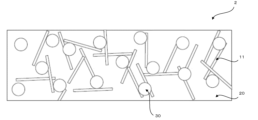
- FIG. 2 is a schematic diagram schematically showing the configuration of a resin molded body 2 according to the first modified example.
- the resin molding 2 according to the first modification mainly includes a plurality of AlN whiskers 11, the resin material 20 described above, and spherical AlN fillers 30. That is, it can be understood that the resin molded body 2 according to the first modified example is obtained by further adding a plurality of AlN whiskers 11 to the conventional resin material mainly including the resin material 20 and the spherical AlN filler 30. can.
- the sheet-shaped molded product 10 included in the resin molded body 1 according to the above-described embodiment does not exist. That is, the resin molded body 2 according to the first modified example is prepared in advance with a plurality (large number) of AlN whiskers 11 manufactured by a known method and a plurality of spherical AlN fillers 30 manufactured by a known method. , are placed in a predetermined mold so as to be uniformly dispersed, the mold is impregnated with a liquid resin material 20, and then the resin material 20 is solidified (cured).
- the plurality of AlN whiskers 11 and the resin material 20 included in the resin molded body 2 according to the first modified example can be the same as those used in the resin molded body 1 according to one embodiment. Further, as the spherical AlN filler 30 contained in the resin molded body 2 according to the first modified example, generally known ones can be used.
- the filling amount of the AlN whiskers 11 (a plurality of AlN whiskers 11) in the resin molded body 2 according to the first modification is such that the filling amount of the spherical AlN fillers 30 with respect to the resin molded body 2 is, for example, about 60 wt% to 70 wt% in weight ratio.
- the weight ratio is preferably in the range of 3.0 wt% to 20.0 wt%, more preferably in the range of 5.0 wt% to 20.0 wt%, and 5.0 wt% to 10 wt%.
- a range of 0.0 wt % is most preferred.
- the spherical AlN filler 30 When the spherical AlN filler 30 already contains about 60 wt % to 70 wt %, it is possible to improve the thermal conductivity of the resin molded body 2 by including AlN whiskers 11 of 3.0 wt % or more in weight ratio. becomes. On the other hand, when the spherical AlN filler 30 already contains about 60 wt % to 70 wt %, if the weight ratio of the AlN whisker 11 exceeds 20.0 wt %, the processability of the resin molded body 2 will deteriorate. Unfavorable from a sexual point of view.
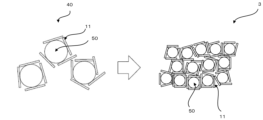
- FIG. 3 is a schematic diagram schematically showing the configuration of a resin molded body 3 according to a second modified example.
- the resin molded body 3 according to the second modified example mainly includes a plurality (many) of AlN whiskers 11 and a spherical resin material 50.
- a covering formation 40 is formed in which the surface of each of a plurality of resin materials 50 is covered with a plurality of AlN whiskers 11. . That is, the resin molding 3 according to the second modification includes the covering formation 40 as a substitute for the sheet-like formation 10 in the resin molding 1 according to the embodiment.
- the resin molded body 3 according to the second modification is obtained by preparing in advance a plurality (a large number) of AlN whiskers 11 manufactured by a known method and a plurality of spherical resin materials 50, and the surface of each of the plurality of resin materials 50 is coated with a plurality of AlN whiskers 11, the coating formation 40 is placed on a predetermined mold, and the coating formation 40 is pressed with a predetermined pressure and at a predetermined temperature It is formed by heat treatment.
- the plurality of AlN whiskers 11 included in the resin molded body 3 according to the second modification can be the same as those used in the resin molded body 1 according to one embodiment. Further, the resin material 50 contained in the resin molded body 3 according to the second modification is the same as the resin material 20 that can be used in the resin molded body 1 according to one embodiment, and is spherical. can be used without restriction.
- the second resin material 50 in the resin molded body 3 according to the second modified example one having a diameter of 1.0 ⁇ m to 200.0 ⁇ m can be used as an example, and more preferably 5.0 ⁇ m to 100.0 ⁇ m. can be used, most preferably 10.0 ⁇ m to 50.0 ⁇ m.
- the filling amount of the AlN whiskers 11 (a plurality of AlN whiskers 11) in the resin molded body 3 according to the second modification is determined from the viewpoint of the thermal conductivity and workability of the resin molded body 3, as in the above-described embodiment.
- the ratio is preferably in the range of 3.0 wt% to 65.0 wt%.
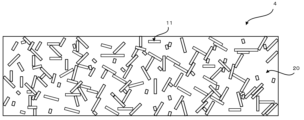
- FIG. 4 is a schematic diagram schematically showing the configuration of a resin molded body 4 according to a third modified example.
- the resin molded body 4 according to the third modified example mainly includes a plurality (many) of AlN whiskers 11 and the resin material 20 described above.
- the resin molded body 4 according to the third modification is similar to the resin molded body 1 according to the embodiment described above, it does not use the sheet-shaped molded body 10 in the resin molded body 1, but a plurality of (many) ) is crushed to shorten its length.
- the length of the plurality (a large number) of AlN whiskers 11 in the resin molded body 4 according to the third modification is generally in the range of 1.0 ⁇ m to 300.0 ⁇ m, but is not limited thereto. Anything shorter than the AlN whiskers used in the body 1 may be used.
- the resin molded body 4 according to the third modification is obtained by preparing in advance a plurality (a large number) of AlN whiskers 11 manufactured by a known method and then crushing them into a predetermined length. ) are dispersed in a liquid resin material 20, and the liquid resin material 20 in which a plurality of (many) AlN whiskers 11 are dispersed is placed in a predetermined mold, and then the resin material 20 is It is formed by solidifying (hardening).
- the plurality of AlN whiskers 11 and the resin material 20 included in the resin molded body 4 according to the third modification can be the same as those used in the resin molded body 1 according to one embodiment.
- the filling amount of the AlN whiskers 11 (a plurality of AlN whiskers 11) in the resin molded body 4 according to the third modification is determined from the viewpoint of the thermal conductivity and workability of the resin molded body 4, as in the above-described embodiment.
- the ratio is preferably in the range of 3.0 wt % to 65.0 wt %, more preferably in the range of 20.0 wt % to 40.0 wt %.
- Examples 1 to 3 After a large number of AlN whiskers produced by a known method were dispersed in water, a paper-like intermediate product in which a plurality of AlN whiskers were uniformly dispersed to a certain extent was obtained by performing a skiving operation for 10 minutes. After that, the obtained intermediate product was pressed with a press for 30 minutes at a pressure value of 40 kg/cm 2 to form a sheet-shaped product.
- a liquid epoxy resin is added to the mold, and the mold is heated at 80° C. for 3 hours and then heated at 150° C. for 1 hour.
- a resin molding was obtained by curing the epoxy resin through a curing step of heating for a period of time.
- the liquid epoxy resin was added so that the weight ratio (wt %) of the AlN whiskers contained in the sheet-shaped product to the resin molded product was the ratio shown in Table 1 below.
- the diameter of the AlN whiskers used in Example 1 was larger than the diameter of the AlN whiskers used in Examples 2 and 3.
- the resin molded bodies according to Examples 1 to 3 correspond to the resin molded body 1 according to the above-described embodiment.
- Examples 4 and 5 A plurality of spherical AlN fillers produced by a known method are added to and dispersed in a liquid epoxy resin, and then a large number of AlN whiskers produced by a known method are added to and dispersed in the epoxy resin.
- the slurry was adjusted by This slurry is uniformly placed in a predetermined mold, and the mold is heated at 80° C. for 3 hours and then further heated at 150° C. for 1 hour to cure the epoxy resin, thereby obtaining a resin molded body. rice field.
- the liquid epoxy resin was added so that the weight ratio (wt %) of the AlN whiskers contained in the resin molded body to the resin molded body became the ratio shown in Table 2 below.
- Examples 6 and 7 A large number of AlN whiskers manufactured by a known method and a large number of spherical (powder) phenolic resins were prepared. Then, each surface of a plurality of phenolic resins was coated with a plurality of AlN whiskers to form a coating formation.
- the coating formation was heated at 180°C for 5 minutes while pressurizing to cure the phenolic resin, thereby obtaining a resin molded body.
- the coating formation was formed so that the weight ratio (wt %) of the AlN whiskers contained in the resin molding with respect to the resin molding was as shown in Table 3 below.
- the resin molded bodies according to Examples 6 and 7 correspond to the resin molded body 3 according to the second modified example described above.
- Examples 8 to 11 A large number of AlN whiskers produced by a known method were crushed to a predetermined length. The length of the AlN whiskers ranged from 1.0 ⁇ m to 300.0 ⁇ m. Next, many crushed AlN whiskers were dispersed in a liquid epoxy resin. A liquid epoxy resin in which a large number of AlN whiskers are dispersed is placed in a predetermined mold, and the mold is heated at 80° C. for 3 hours and then heated at 150° C. for 1 hour to cure the epoxy resin. A resin molding was obtained by allowing the The AlN whiskers were dispersed in the liquid epoxy resin such that the weight ratio (wt%) of the AlN whiskers contained in the resin molded body to the resin molded body was the ratio shown in Table 4 below. The diameter of the AlN whiskers used in Example 11 was larger than the diameter of the AlN whiskers used in Examples 8-10. Further, the resin molded bodies according to Examples 8 to 11 correspond to the resin molded body 4 according to the third modified example described above.
- Comparative Example 1 and Comparative Example 2 As Comparative Examples 1 and 2, commercially available resin moldings to which only spherical AlN fillers were added were used. The resin material used in this commercial product was a silicone resin. The filling amount (weight ratio (wt%) to the resin molded body) of the spherical AlN filler contained in each of the resin molded bodies according to Comparative Examples 1 and 2 is as shown in Table 5 below.
- thermal conductivity was measured for each of the resin moldings according to Examples 1 to 11 and Comparative Examples 1 and 2 obtained as described above.
- the thermal conductivity of Examples 1 to 11 and Comparative Examples 1 and 2 was calculated from the product of thermal diffusivity, specific heat, and density.
- the thermal diffusivity of Examples 1 to 11 and Comparative Examples 1 and 2 was measured using a LaserPIT device manufactured by Advance Riko Co., Ltd., and the specific heat was measured using DSC-60A manufactured by Shimadzu Corporation. , the density was measured using AD-1653 manufactured by A&D.
- 5 and 6 are diagrams showing the results of thermal conductivity of resin moldings according to Examples 1 to 11 and Comparative Examples 1 and 2.
- the resin moldings according to Examples 1 to 11 contained AlN whiskers in a small weight ratio and had excellent thermal conductivity. Further, when comparing Example 5 and Comparative Example 1 (Example 5 can be understood that 5.0 wt % of AlN whiskers are additionally added to Comparative Example 1), Example 5's The thermal conductivity was higher than that of Comparative Example 1. Furthermore, the thermal conductivities of the resin moldings according to Examples 1 to 3 were higher than those of the other examples.
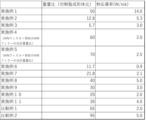
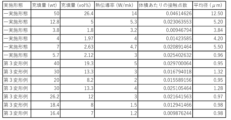
- FIG. 7 shows six samples as the resin molded body 1 (FIG. 1) according to the above-described embodiment and seven samples as the resin molded body 4 (FIG. 4) according to the third modification described above.
- 1 is a table showing the results of measurements performed on
- "filling amount (wt)” indicates the filling amount (unit: wt) of the AlN whiskers 11 filled in the resin molded body
- "filling amount (vol%)” indicates the amount filled in the resin molded body.
- thermal conductivity indicates the thermal conductivity of the resin molding.
- the “number of contact points per (unit) volume” indicates the total number of points at which the plurality of AlN whiskers 11 filled in the resin molded body contact each other per unit volume ( ⁇ m 3 ).
- the number of contact points of the AlN whiskers 11 in a volume of 500 ( ⁇ m) ⁇ 500 ( ⁇ m) ⁇ 500 ( ⁇ m) is measured, and the number of contact points thus measured is divided by 500 3 ( ⁇ m 3 ).
- the number of contact points per unit volume (that is, the “number of contact points”) is calculated.
- the number of contact points is measured by capturing an X-ray CT image of each sample and performing image analysis processing using a computer on the captured X-ray CT image. .
- the diameters of the plurality of AlN whiskers 11 filled in the resin molded body are not completely the same and have variations.
- a part of each sample is imaged using an electron microscope, and all the AlN whiskers contained in the image obtained by this imaging are Using.
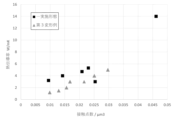
- FIG. 8 shows the relationship between the number of contact points and the thermal conductivity for each of the resin molded body 1 according to one embodiment and the resin molded body 4 according to the third modification, based on the measurement results shown in FIG. It is a graph showing.
- the thermal conductivity is 1.5 (W /mk), the thermal conductivity increases to 2 (W/mk) (along a quadratic curve) when the number of contact points is 0.015 (/ ⁇ m 3 ).
- the upper limit of the number of contact points is preferably 1.0. Specifically, when the number of contact points exceeds 1, the viscosity of the resin material increases, and as a result, it may become difficult to mold the resin molded body into a sheet shape. Therefore, the upper limit of the number of contact points is preferably 1.0.
- the number of contact points is more preferably 0.015 (/ ⁇ m 3 ) or more and 1.0 (/ ⁇ m 3 ) or less. Furthermore, as another upper limit, when the number of contact points is 0.029 (/ ⁇ m 3 ), the thermal conductivity is 5 (W/mk), and this thermal conductivity is 0.012 ( / ⁇ m 3 ), which is significantly higher than the thermal conductivity (1.5 (W/mk)). Therefore, the number of contact points is more preferably 0.015 (/ ⁇ m 3 ) or more and 0.029 (/ ⁇ m 3 ) or less.
- the number of contact points is more preferably 0.016 (/ ⁇ m 3 ) or more and 1.0 (/ ⁇ m 3 ) or less, and more preferably 0.016 (/ ⁇ m 3 ) or more and 0.029 (/ ⁇ m 3 ) or less. It is even more preferable to have
- the upper limit of the number of contact points is preferably 1.0. Specifically, if the number of contact points exceeds 1.0, it may be difficult to form a plurality of AlN whiskers into a nonwoven fabric, and/or It is conceivable that impregnation of the resin material into the voids may become difficult. Therefore, the upper limit of the number of contact points is preferably 1.0.
- the number of contact points is more preferably 0.020 (/ ⁇ m 3 ) or more and 1.0 (/ ⁇ m 3 ) or less. Furthermore, as another upper limit, when the number of contact points is 0.046 (/ ⁇ m 3 ), the thermal conductivity is 14 (W/mk). / ⁇ m 3 ), which is significantly higher than the thermal conductivity (4 (W/mk)). Therefore, the number of contact points is more preferably 0.020 (/ ⁇ m 3 ) or more and 0.046 (/ ⁇ m 3 ) or less.
- the number of contact points is 0.020 (/ ⁇ m 3 )
- the thermal conductivity is 4.7 (W/mk)
- the number of contact points is 0.023 (/ ⁇ m 3 ).
- the thermal conductivity increases (along a quadratic curve) to 5.3 (W/mk). Therefore, the number of contact points is more preferably 0.023 (/ ⁇ m 3 ) or more and 1.0 (/ ⁇ m 3 ) or less, and more preferably 0.023 (/ ⁇ m 3 ) or more and 0.046 (/ ⁇ m 3 ) or less. It is even more preferable to have
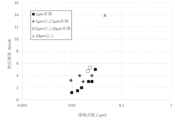
- FIG. 9 is a graph showing the relationship between the number of contact points and thermal conductivity for each of four types of average diameters (ranges) based on the measurement results shown in FIG.
- the four types of average diameters (ranges) include ranges of less than 1 ⁇ m, 1 ⁇ m or more and less than 5 ⁇ m, 5 ⁇ m or more and less than 10 ⁇ m, and 10 ⁇ m or more. These four types of average diameters do not distinguish between the resin molded body 1 according to the embodiment and the resin molded body 4 according to the third modified example. Also, in the graph shown in FIG. 9, the horizontal axis is expressed in logarithmic notation.
- the thermal conductivity when the average diameter is less than 1 ⁇ m is higher when the average diameter is 1 ⁇ m or more and 10 ⁇ m or less. rate is significantly higher. Therefore, the average diameter is preferably 1 ⁇ m or more and 10 ⁇ m or less. Further, the average diameter is more preferably 5 ⁇ m or more and 10 ⁇ m or less.
Landscapes
- Chemical & Material Sciences (AREA)
- Organic Chemistry (AREA)
- Health & Medical Sciences (AREA)
- Chemical Kinetics & Catalysis (AREA)
- Medicinal Chemistry (AREA)
- Polymers & Plastics (AREA)
- Engineering & Computer Science (AREA)
- Materials Engineering (AREA)
- Manufacturing & Machinery (AREA)
- Inorganic Chemistry (AREA)
- Casting Or Compression Moulding Of Plastics Or The Like (AREA)
- Reinforced Plastic Materials (AREA)
- Crystals, And After-Treatments Of Crystals (AREA)
- Compositions Of Macromolecular Compounds (AREA)
- Manufacture Of Macromolecular Shaped Articles (AREA)
Priority Applications (6)
| Application Number | Priority Date | Filing Date | Title |
|---|---|---|---|
| EP23749788.8A EP4474409A4 (en) | 2022-02-04 | 2023-02-01 | Resin molded product and method for producing the same |
| KR1020247027357A KR20240137035A (ko) | 2022-02-04 | 2023-02-01 | 수지 성형체 및 이의 제조방법 |
| US18/835,227 US20250215172A1 (en) | 2022-02-04 | 2023-02-01 | Resin molded body and method for producing the same |
| JP2023578594A JP7837515B2 (ja) | 2022-02-04 | 2023-02-01 | 樹脂成形体及びその製造方法 |
| CN202380019851.8A CN118632886A (zh) | 2022-02-04 | 2023-02-01 | 一种树脂成型体及其制造方法 |
| JP2026038346A JP2026102726A (ja) | 2022-02-04 | 2026-03-10 | 樹脂成形体 |
Applications Claiming Priority (2)
| Application Number | Priority Date | Filing Date | Title |
|---|---|---|---|
| JP2022016179 | 2022-02-04 | ||
| JP2022-016179 | 2022-02-04 |
Publications (1)
| Publication Number | Publication Date |
|---|---|
| WO2023149472A1 true WO2023149472A1 (ja) | 2023-08-10 |
Family
ID=87552498
Family Applications (1)
| Application Number | Title | Priority Date | Filing Date |
|---|---|---|---|
| PCT/JP2023/003211 Ceased WO2023149472A1 (ja) | 2022-02-04 | 2023-02-01 | 樹脂成形体及びその製造方法 |
Country Status (6)
| Country | Link |
|---|---|
| US (1) | US20250215172A1 (cg-RX-API-DMAC7.html) |
| EP (1) | EP4474409A4 (cg-RX-API-DMAC7.html) |
| JP (2) | JP7837515B2 (cg-RX-API-DMAC7.html) |
| KR (1) | KR20240137035A (cg-RX-API-DMAC7.html) |
| CN (1) | CN118632886A (cg-RX-API-DMAC7.html) |
| WO (1) | WO2023149472A1 (cg-RX-API-DMAC7.html) |
Citations (8)
| Publication number | Priority date | Publication date | Assignee | Title |
|---|---|---|---|---|
| JPH06219857A (ja) * | 1991-04-26 | 1994-08-09 | Dowa Mining Co Ltd | AlNウィスカー複合材料 |
| JP2010116455A (ja) * | 2008-11-12 | 2010-05-27 | Nitto Denko Corp | 有機−無機複合成形体 |
| JP2014073951A (ja) | 2012-09-11 | 2014-04-24 | Denso Corp | AlNウィスカー、樹脂組成物、油脂組成物及びAlNウィスカーの製造方法 |
| WO2015030098A1 (ja) * | 2013-08-29 | 2015-03-05 | 熊本県 | 熱伝導性複合粒子および樹脂成形体 |
| JP2018154534A (ja) | 2017-03-17 | 2018-10-04 | 国立大学法人名古屋大学 | AlNウィスカーおよび樹脂成形体とこれらの製造方法 |
| JP2020176222A (ja) * | 2019-04-19 | 2020-10-29 | 株式会社トクヤマ | 窒化アルミニウム複合フィラー |
| JP2021160987A (ja) * | 2020-03-31 | 2021-10-11 | 国立大学法人東海国立大学機構 | AlNウィスカーおよび樹脂成形体 |
| JP2022016179A (ja) | 2020-07-10 | 2022-01-21 | 株式会社ユニバーサルエンターテインメント | 遊技機 |
Family Cites Families (3)
| Publication number | Priority date | Publication date | Assignee | Title |
|---|---|---|---|---|
| JP6942331B2 (ja) * | 2017-03-17 | 2021-09-29 | 国立大学法人東海国立大学機構 | AlNウィスカーの製造方法および製造装置ならびにAlNウィスカー構造体 |
| WO2018169073A1 (ja) | 2017-03-17 | 2018-09-20 | 国立大学法人名古屋大学 | AlNウィスカーの製造方法および製造装置およびAlNウィスカー構造体およびAlNウィスカーならびに樹脂成形体とその製造方法 |
| JP7308636B2 (ja) * | 2019-03-27 | 2023-07-14 | 株式会社トクヤマ | 窒化アルミニウムからなる複合構造体 |
-
2023
- 2023-02-01 CN CN202380019851.8A patent/CN118632886A/zh active Pending
- 2023-02-01 KR KR1020247027357A patent/KR20240137035A/ko active Pending
- 2023-02-01 JP JP2023578594A patent/JP7837515B2/ja active Active
- 2023-02-01 US US18/835,227 patent/US20250215172A1/en active Pending
- 2023-02-01 EP EP23749788.8A patent/EP4474409A4/en not_active Withdrawn
- 2023-02-01 WO PCT/JP2023/003211 patent/WO2023149472A1/ja not_active Ceased
-
2026
- 2026-03-10 JP JP2026038346A patent/JP2026102726A/ja active Pending
Patent Citations (8)
| Publication number | Priority date | Publication date | Assignee | Title |
|---|---|---|---|---|
| JPH06219857A (ja) * | 1991-04-26 | 1994-08-09 | Dowa Mining Co Ltd | AlNウィスカー複合材料 |
| JP2010116455A (ja) * | 2008-11-12 | 2010-05-27 | Nitto Denko Corp | 有機−無機複合成形体 |
| JP2014073951A (ja) | 2012-09-11 | 2014-04-24 | Denso Corp | AlNウィスカー、樹脂組成物、油脂組成物及びAlNウィスカーの製造方法 |
| WO2015030098A1 (ja) * | 2013-08-29 | 2015-03-05 | 熊本県 | 熱伝導性複合粒子および樹脂成形体 |
| JP2018154534A (ja) | 2017-03-17 | 2018-10-04 | 国立大学法人名古屋大学 | AlNウィスカーおよび樹脂成形体とこれらの製造方法 |
| JP2020176222A (ja) * | 2019-04-19 | 2020-10-29 | 株式会社トクヤマ | 窒化アルミニウム複合フィラー |
| JP2021160987A (ja) * | 2020-03-31 | 2021-10-11 | 国立大学法人東海国立大学機構 | AlNウィスカーおよび樹脂成形体 |
| JP2022016179A (ja) | 2020-07-10 | 2022-01-21 | 株式会社ユニバーサルエンターテインメント | 遊技機 |
Non-Patent Citations (1)
| Title |
|---|
| See also references of EP4474409A4 |
Also Published As
| Publication number | Publication date |
|---|---|
| EP4474409A1 (en) | 2024-12-11 |
| US20250215172A1 (en) | 2025-07-03 |
| JPWO2023149472A1 (cg-RX-API-DMAC7.html) | 2023-08-10 |
| KR20240137035A (ko) | 2024-09-19 |
| JP7837515B2 (ja) | 2026-03-31 |
| JP2026102726A (ja) | 2026-06-23 |
| CN118632886A (zh) | 2024-09-10 |
| EP4474409A4 (en) | 2025-05-28 |
Similar Documents
| Publication | Publication Date | Title |
|---|---|---|
| Zha et al. | Low dielectric permittivity and high thermal conductivity silicone rubber composites with micro-nano-sized particles | |
| US12130095B2 (en) | Thermal interface materials | |
| JP6301978B2 (ja) | 熱伝導シート、熱伝導シートの製造方法、放熱部材及び半導体装置 | |
| JP5541399B2 (ja) | 熱伝導性シート | |
| KR101679698B1 (ko) | 방열특성이 향상된 섬유강화형 고분자 복합기판 및 그의 제조방법 | |
| CN106633891B (zh) | 一种硅橡胶基多孔介电弹性体复合材料及其制备方法 | |
| Wang et al. | Scalable, superelastic, and superhydrophobic MXene/silver nanowire/melamine hybrid sponges for high-performance electromagnetic interference shielding | |
| JP2003301048A (ja) | 熱伝導性成形体 | |
| US11180625B2 (en) | Thermally and/or electrically conductive materials and method for the production thereof | |
| CN115073793B (zh) | 一种石墨烯导热膜及其制备方法和导热垫片 | |
| CN114644908B (zh) | 一种强韧高导热薄膜及其制备方法 | |
| Gao et al. | Structure, thermal conductive, dielectric and electrical insulating properties of UHMWPE/BN composites with a segregated structure | |
| JPWO2017018493A1 (ja) | 混合グラファイトを用いた放熱材およびその製造方法 | |
| JP6393816B2 (ja) | 熱伝導シート、熱伝導シートの製造方法、放熱部材及び半導体装置 | |
| JP7837515B2 (ja) | 樹脂成形体及びその製造方法 | |
| JP7076871B1 (ja) | 熱伝導性シート | |
| JP5464948B2 (ja) | フッ素樹脂成形体の製造方法およびその製造方法で得られるフッ素樹脂成形体 | |
| WO2025023254A1 (ja) | 放熱フィラー、樹脂組成物および樹脂成形体 | |
| JP2025023831A (ja) | 樹脂組成物、樹脂成形体および樹脂成形体の製造方法 | |
| Lee et al. | Enhanced through‐plane thermal conductivity of polypropylene composite using boron nitride/SiO2/glass fiber | |
| WO2021220628A1 (ja) | 炭素繊維強化プラスチック構造体およびその製造方法 | |
| RU2765849C1 (ru) | Способ получения теплорассеивающего анизотропного конструкционного диэлектрического композиционного материала и теплорассеивающий анизотропный конструкционный диэлектрический композиционный материал | |
| Hegde et al. | Enhancement of thermal conductivity in silicone rubber nanocomposites via low loading of polydopamine-coated copper nanowires | |
| Sathian et al. | Unprecedented dielectric minimization in polymer composite: a novel ultra-low dielectric constant, polymer composite substrate for millimeter-wave circuit applications | |
| Arunkumar et al. | Enhancing mechanical and dielectric properties of luffa fiber-reinforced epoxy composites through varied SiC filler volumes |
Legal Events
| Date | Code | Title | Description |
|---|---|---|---|
| 121 | Ep: the epo has been informed by wipo that ep was designated in this application |
Ref document number: 23749788 Country of ref document: EP Kind code of ref document: A1 |
|
| WWE | Wipo information: entry into national phase |
Ref document number: 18835227 Country of ref document: US Ref document number: 202380019851.8 Country of ref document: CN |
|
| ENP | Entry into the national phase |
Ref document number: 2023578594 Country of ref document: JP Kind code of ref document: A |
|
| ENP | Entry into the national phase |
Ref document number: 20247027357 Country of ref document: KR Kind code of ref document: A |
|
| WWE | Wipo information: entry into national phase |
Ref document number: 2023749788 Country of ref document: EP |
|
| NENP | Non-entry into the national phase |
Ref country code: DE |
|
| ENP | Entry into the national phase |
Ref document number: 2023749788 Country of ref document: EP Effective date: 20240904 |
|
| WWP | Wipo information: published in national office |
Ref document number: 18835227 Country of ref document: US |
|
| WWW | Wipo information: withdrawn in national office |
Ref document number: 2023749788 Country of ref document: EP |