WO2023132319A1 - 重合体、架橋体、電線、ワイヤーハーネス、重合体の製造方法、および架橋体の製造方法 - Google Patents
重合体、架橋体、電線、ワイヤーハーネス、重合体の製造方法、および架橋体の製造方法 Download PDFInfo
- Publication number
- WO2023132319A1 WO2023132319A1 PCT/JP2022/048525 JP2022048525W WO2023132319A1 WO 2023132319 A1 WO2023132319 A1 WO 2023132319A1 JP 2022048525 W JP2022048525 W JP 2022048525W WO 2023132319 A1 WO2023132319 A1 WO 2023132319A1
- Authority
- WO
- WIPO (PCT)
- Prior art keywords
- polymer
- epoxy
- fatty acid
- acid salt
- polymerization
- Prior art date
- Legal status (The legal status is an assumption and is not a legal conclusion. Google has not performed a legal analysis and makes no representation as to the accuracy of the status listed.)
- Ceased
Links
Images


Classifications
-
- C—CHEMISTRY; METALLURGY
- C08—ORGANIC MACROMOLECULAR COMPOUNDS; THEIR PREPARATION OR CHEMICAL WORKING-UP; COMPOSITIONS BASED THEREON
- C08G—MACROMOLECULAR COMPOUNDS OBTAINED OTHERWISE THAN BY REACTIONS ONLY INVOLVING UNSATURATED CARBON-TO-CARBON BONDS
- C08G59/00—Polycondensates containing more than one epoxy group per molecule; Macromolecules obtained by polymerising compounds containing more than one epoxy group per molecule using curing agents or catalysts which react with the epoxy groups
- C08G59/18—Macromolecules obtained by polymerising compounds containing more than one epoxy group per molecule using curing agents or catalysts which react with the epoxy groups ; e.g. general methods of curing
- C08G59/20—Macromolecules obtained by polymerising compounds containing more than one epoxy group per molecule using curing agents or catalysts which react with the epoxy groups ; e.g. general methods of curing characterised by the epoxy compounds used
- C08G59/22—Di-epoxy compounds
- C08G59/24—Di-epoxy compounds carbocyclic
-
- C—CHEMISTRY; METALLURGY
- C08—ORGANIC MACROMOLECULAR COMPOUNDS; THEIR PREPARATION OR CHEMICAL WORKING-UP; COMPOSITIONS BASED THEREON
- C08F—MACROMOLECULAR COMPOUNDS OBTAINED BY REACTIONS ONLY INVOLVING CARBON-TO-CARBON UNSATURATED BONDS
- C08F220/00—Copolymers of compounds having one or more unsaturated aliphatic radicals, each having only one carbon-to-carbon double bond, and only one being terminated by only one carboxyl radical or a salt, anhydride ester, amide, imide or nitrile thereof
- C08F220/02—Monocarboxylic acids having less than ten carbon atoms; Derivatives thereof
- C08F220/10—Esters
- C08F220/26—Esters containing oxygen in addition to the carboxy oxygen
- C08F220/32—Esters containing oxygen in addition to the carboxy oxygen containing epoxy radicals
- C08F220/325—Esters containing oxygen in addition to the carboxy oxygen containing epoxy radicals containing glycidyl radical, e.g. glycidyl (meth)acrylate
-
- C—CHEMISTRY; METALLURGY
- C08—ORGANIC MACROMOLECULAR COMPOUNDS; THEIR PREPARATION OR CHEMICAL WORKING-UP; COMPOSITIONS BASED THEREON
- C08G—MACROMOLECULAR COMPOUNDS OBTAINED OTHERWISE THAN BY REACTIONS ONLY INVOLVING UNSATURATED CARBON-TO-CARBON BONDS
- C08G59/00—Polycondensates containing more than one epoxy group per molecule; Macromolecules obtained by polymerising compounds containing more than one epoxy group per molecule using curing agents or catalysts which react with the epoxy groups
- C08G59/18—Macromolecules obtained by polymerising compounds containing more than one epoxy group per molecule using curing agents or catalysts which react with the epoxy groups ; e.g. general methods of curing
- C08G59/20—Macromolecules obtained by polymerising compounds containing more than one epoxy group per molecule using curing agents or catalysts which react with the epoxy groups ; e.g. general methods of curing characterised by the epoxy compounds used
- C08G59/22—Di-epoxy compounds
- C08G59/223—Di-epoxy compounds together with monoepoxy compounds
-
- C—CHEMISTRY; METALLURGY
- C08—ORGANIC MACROMOLECULAR COMPOUNDS; THEIR PREPARATION OR CHEMICAL WORKING-UP; COMPOSITIONS BASED THEREON
- C08G—MACROMOLECULAR COMPOUNDS OBTAINED OTHERWISE THAN BY REACTIONS ONLY INVOLVING UNSATURATED CARBON-TO-CARBON BONDS
- C08G59/00—Polycondensates containing more than one epoxy group per molecule; Macromolecules obtained by polymerising compounds containing more than one epoxy group per molecule using curing agents or catalysts which react with the epoxy groups
- C08G59/18—Macromolecules obtained by polymerising compounds containing more than one epoxy group per molecule using curing agents or catalysts which react with the epoxy groups ; e.g. general methods of curing
- C08G59/40—Macromolecules obtained by polymerising compounds containing more than one epoxy group per molecule using curing agents or catalysts which react with the epoxy groups ; e.g. general methods of curing characterised by the curing agents used
- C08G59/42—Polycarboxylic acids; Anhydrides, halides or low molecular weight esters thereof
-
- C—CHEMISTRY; METALLURGY
- C08—ORGANIC MACROMOLECULAR COMPOUNDS; THEIR PREPARATION OR CHEMICAL WORKING-UP; COMPOSITIONS BASED THEREON
- C08G—MACROMOLECULAR COMPOUNDS OBTAINED OTHERWISE THAN BY REACTIONS ONLY INVOLVING UNSATURATED CARBON-TO-CARBON BONDS
- C08G59/00—Polycondensates containing more than one epoxy group per molecule; Macromolecules obtained by polymerising compounds containing more than one epoxy group per molecule using curing agents or catalysts which react with the epoxy groups
- C08G59/18—Macromolecules obtained by polymerising compounds containing more than one epoxy group per molecule using curing agents or catalysts which react with the epoxy groups ; e.g. general methods of curing
- C08G59/40—Macromolecules obtained by polymerising compounds containing more than one epoxy group per molecule using curing agents or catalysts which react with the epoxy groups ; e.g. general methods of curing characterised by the curing agents used
- C08G59/50—Amines
- C08G59/5006—Amines aliphatic
-
- C—CHEMISTRY; METALLURGY
- C08—ORGANIC MACROMOLECULAR COMPOUNDS; THEIR PREPARATION OR CHEMICAL WORKING-UP; COMPOSITIONS BASED THEREON
- C08G—MACROMOLECULAR COMPOUNDS OBTAINED OTHERWISE THAN BY REACTIONS ONLY INVOLVING UNSATURATED CARBON-TO-CARBON BONDS
- C08G65/00—Macromolecular compounds obtained by reactions forming an ether link in the main chain of the macromolecule
- C08G65/02—Macromolecular compounds obtained by reactions forming an ether link in the main chain of the macromolecule from cyclic ethers by opening of the heterocyclic ring
- C08G65/26—Macromolecular compounds obtained by reactions forming an ether link in the main chain of the macromolecule from cyclic ethers by opening of the heterocyclic ring from cyclic ethers and other compounds
- C08G65/2603—Macromolecular compounds obtained by reactions forming an ether link in the main chain of the macromolecule from cyclic ethers by opening of the heterocyclic ring from cyclic ethers and other compounds the other compounds containing oxygen
- C08G65/2615—Macromolecular compounds obtained by reactions forming an ether link in the main chain of the macromolecule from cyclic ethers by opening of the heterocyclic ring from cyclic ethers and other compounds the other compounds containing oxygen the other compounds containing carboxylic acid, ester or anhydride groups
-
- C—CHEMISTRY; METALLURGY
- C08—ORGANIC MACROMOLECULAR COMPOUNDS; THEIR PREPARATION OR CHEMICAL WORKING-UP; COMPOSITIONS BASED THEREON
- C08K—Use of inorganic or non-macromolecular organic substances as compounding ingredients
- C08K5/00—Use of organic ingredients
- C08K5/04—Oxygen-containing compounds
- C08K5/09—Carboxylic acids; Metal salts thereof; Anhydrides thereof
- C08K5/098—Metal salts of carboxylic acids
-
- C—CHEMISTRY; METALLURGY
- C08—ORGANIC MACROMOLECULAR COMPOUNDS; THEIR PREPARATION OR CHEMICAL WORKING-UP; COMPOSITIONS BASED THEREON
- C08L—COMPOSITIONS OF MACROMOLECULAR COMPOUNDS
- C08L63/00—Compositions of epoxy resins; Compositions of derivatives of epoxy resins
-
- C—CHEMISTRY; METALLURGY
- C08—ORGANIC MACROMOLECULAR COMPOUNDS; THEIR PREPARATION OR CHEMICAL WORKING-UP; COMPOSITIONS BASED THEREON
- C08L—COMPOSITIONS OF MACROMOLECULAR COMPOUNDS
- C08L2201/00—Properties
- C08L2201/08—Stabilised against heat, light or radiation or oxydation
-
- C—CHEMISTRY; METALLURGY
- C08—ORGANIC MACROMOLECULAR COMPOUNDS; THEIR PREPARATION OR CHEMICAL WORKING-UP; COMPOSITIONS BASED THEREON
- C08L—COMPOSITIONS OF MACROMOLECULAR COMPOUNDS
- C08L2203/00—Applications
- C08L2203/20—Applications use in electrical or conductive gadgets
- C08L2203/202—Applications use in electrical or conductive gadgets use in electrical wires or wirecoating
-
- C—CHEMISTRY; METALLURGY
- C08—ORGANIC MACROMOLECULAR COMPOUNDS; THEIR PREPARATION OR CHEMICAL WORKING-UP; COMPOSITIONS BASED THEREON
- C08L—COMPOSITIONS OF MACROMOLECULAR COMPOUNDS
- C08L2312/00—Crosslinking
Definitions
- the present disclosure relates to a polymer, a crosslinked product, an electric wire, a wire harness, a method for producing a polymer, and a method for producing a crosslinked product.
- thermoplastic polymer materials are often used as insulating coatings that cover the outer circumference of conductors.
- a molding technique such as extrusion molding is applied after making it into a fluid state by heating.
- the polymer material acquire fluidity without being heated to an extremely high temperature.
- polymer materials used for insulated wires and wire harnesses are required to be able to be relatively easily molded by heating and to have high heat resistance after molding.
- a method for achieving both of these characteristics a method is used in which an unpolymerized monomer material is placed at a predetermined position so as to form a predetermined shape, and then the monomer material is polymerized.
- a technique is used in which an uncrosslinked polymer material is formed into a desired shape by extrusion molding or the like, and then the molecular chains are crosslinked to improve heat resistance.
- epoxy monomers and epoxy-modified polymers can be given as examples of materials that constitute insulated wires and wire harnesses after being placed at predetermined positions and undergoing polymerization and cross-linking.
- the ring-opening polymerization reaction of epoxy groups promotes polymerization of epoxy monomers and cross-linking of epoxy-modified polymers.
- Patent Document 1 describes a form in which an epoxy resin composition is crosslinked and used for electric wire coating.
- polymerization proceeds by adding a curing agent such as an amine compound, a thiol-containing compound, a hydroxyl group-containing compound, or an acid anhydride to the epoxy group. do. Since hydroxyl groups are generated when this addition polymerization occurs, when addition polymerization is performed on the surface of a metal material such as a conductor, the epoxy polymer is adhered to the metal surface via the hydroxyl groups, making it difficult to peel off. As a result, it becomes difficult to apply to uses such as electric wire coating that require peeling. In addition, when addition polymerization is used, it is necessary to add a curing agent in an amount equivalent to or close to the molar amount of the epoxy group. Addition polymerization proceeds. Therefore, it requires preparation before use, and it is difficult to control the polymerization rate. Therefore, it cannot be said that the convenience of molding is excellent.
- a curing agent such as an amine compound, a thiol-containing compound, a hydroxyl group-containing compound, or an acid anhydr
- An object of the present invention is to provide a polymer and a crosslinked body suitable for , to provide an electric wire and wire harness using such a polymer and a crosslinked body, and to provide a method for producing such a polymer and a crosslinked body. .
- the polymer of the present disclosure contains the structure of the following formula (1), has a flow initiation temperature of 150 ° C. or higher, and is immersed in 10 times the amount of pure water at 120 ° C. for 24 hours. is pH 4 or more and 9 or less.
- R 1 is an organic group and n is an integer of 2 or more.
- the crosslinked body of the present disclosure includes the structure of the following formula (3), has a flow initiation temperature of 150 ° C. or higher, and is immersed in 10 times the amount of pure water at 120 ° C. for 24 hours. is pH 4 or more and 9 or less.
- R2 is a polymer chain and n is an integer of 2 or more.
- the electric wire of the present disclosure has a conductor made of metal and an insulating coating that includes the polymer or the crosslinked body and covers the outer circumference of the conductor.
- the wire harness of the present disclosure includes the polymer or the crosslinked body.
- a composition containing an epoxy monomer of formula (2) below and a fatty acid salt is heated to cause a polymerization reaction to produce the polymer.
- a composition containing an epoxy-modified polymer of the following formula (4) and a fatty acid salt is heated to cause a crosslinking reaction to produce the crosslinked body.
- the polymer and crosslinked product of the present disclosure are a polymer formed using an epoxy monomer and a crosslinked product formed using an epoxy-modified polymer, and are excellent in molding convenience and heat resistance, and can be peeled off. It makes the polymer and crosslinker suitable for coating metal surfaces.
- the electric wire, wire harness, method for producing a polymer, and method for producing a crosslinked product of the present disclosure are an electric wire and a wire harness using such a polymer and a crosslinked product, and furthermore, a polymer and a crosslinked product. manufacturing method.
- FIG. 1 is a diagram illustrating a polymer formation mechanism according to an embodiment of the present disclosure.
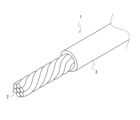
- FIG. 2 is a perspective view showing a structure of an electric wire according to an embodiment of the present disclosure;
- FIG. 3 is an infrared absorption spectrum of the material corresponding to sample A5, (i) is the state before heating with the epoxy compound (OD-ep) alone, (ii) is the state after heating, and (iii) is (iv) shows the state of the mixed solution with the fatty acid salt (st-Mg) before heating, and (iv) shows the state of the mixed solution after heating.
- the polymer of the present disclosure contains the structure of the following formula (1), has a flow initiation temperature of 150 ° C. or higher, and is immersed in 10 times the amount of pure water at 120 ° C. for 24 hours. is pH 4 or more and 9 or less.
- R 1 is an organic group and n is an integer of 2 or more.
- the structure of the above formula (1) can be formed by ring-opening polymerization of the epoxy monomer of the following formula (2) with a fatty acid salt.
- the crosslinked body of the present disclosure includes the structure of the following formula (3), has a flow initiation temperature of 150 ° C. or higher, and is immersed in 10 times the amount of pure water at 120 ° C. for 24 hours. is pH 4 or more and 9 or less.
- R2 is a polymer chain and n is an integer of 2 or more.
- the structure of the above formula (3) can be formed by ring-opening polymerization of the epoxy-modified polymer of the following formula (4) with a fatty acid salt.
- the epoxy monomer (2) and the epoxy-modified polymer (4) are in a highly fluid state or in a soft state. It can be arranged conveniently as if it were taken. Also, even if the epoxy monomer or epoxy-modified polymer is brought into contact with the fatty acid salt at a relatively low temperature such as room temperature, the ring-opening polymerization does not proceed. Therefore, the polymer and crosslinked product of the present disclosure, in the raw material state before heating, are excellent in convenience for molding. However, when the ring-opening polymerization reaction is caused by heating, a polymerized structure having the structure of (1) or a crosslinked structure having the structure of (3) is formed. It becomes a state having heat resistance.
- the polymer and crosslinked product of the present disclosure achieve both convenience in molding and heat resistance.
- the ring-opening polymerization of an epoxy compound with a fatty acid salt neither generates a hydroxyl group nor requires an acidic substance
- the obtained polymer and crosslinked product have an acidity of pH 4 or more in the extraction water. It is close to neutral as follows. Therefore, adhesion to the metal surface via hydroxyl groups and corrosion of the metal surface are less likely to occur, making the polymer and crosslinked body suitable for coating the metal surface in a releasable manner.
- the polymer does not contain a compound that causes ring-opening polymerization of an epoxy group, except for a fatty acid salt.
- the crosslinked product preferably does not contain a compound that causes ring-opening polymerization of an epoxy group, except for a fatty acid salt.
- the polymers and crosslinks of the present disclosure can be formed by ring-opening polymerization of epoxy compounds using fatty acid salts. Therefore, for the purpose of ring-opening polymerization of the epoxy group, it is not necessary to add a compound other than the fatty acid salt, such as a cross-linking agent for addition polymerization or an initiator for cationic polymerization. Since these compounds are not included, addition polymerization and cationic polymerization of epoxy compounds do not occur. can be suppressed.
- the compound for ring-opening polymerization of the epoxy group includes chemical species that remain after the ring-opening polymerization.
- the electric wire of the present disclosure has a conductor made of metal and an insulating coating that includes the polymer or the crosslinked body and covers the outer circumference of the conductor.
- the polymer and crosslinked product of the present disclosure are excellent in molding convenience and heat resistance, so that an insulating coating with a desired thickness can be easily formed on the outer periphery of the conductor, and the conductor Even if it is heated by electricity, it does not easily deform or degenerate.
- the polymer and crosslinked product of the present disclosure do not adhere to the metal surface, it is possible to easily perform the operation of peeling off the insulating coating when connecting the terminal to the end of the electric wire. can.
- the polymers and crosslinked products of the present disclosure are less likely to cause metal corrosion, corrosion of conductors in electric wires can be avoided.
- the wire harness of the present disclosure contains the polymer or the crosslinked product.
- the polymer and crosslinked product of the present disclosure are used as a constituent material of wire harnesses in various applications such as curable materials and molding materials that cover areas where conductors are exposed. sell.
- a composition containing an epoxy monomer of formula (2) below and a fatty acid salt is heated to cause a polymerization reaction to produce the polymer.
- a composition containing an epoxy-modified polymer of the following formula (4) and a fatty acid salt is heated to cause a crosslinking reaction to produce the crosslinked body.
- the polymer and the crosslinked body are obtained by ring-opening polymerization of the epoxy groups caused by the fatty acid salt during heating. Since this ring-opening polymerization does not proceed at a low temperature such as room temperature, the composition can be easily arranged in a desired position and in a desired shape before heating. Therefore, high convenience is obtained in molding. On the other hand, the polymer and crosslinked product obtained through heating have high heat resistance. In addition, the ring-opening polymerization of the epoxy group does not require the use of compounds that cause adhesion to metal surfaces or corrosion of metal surfaces. Suitable for covering surfaces.
- the initiation temperature of the polymerization reaction is preferably 100°C or higher.
- the initiation temperature of the cross-linking reaction is preferably 100° C. or higher.
- the polymer according to this embodiment includes the structure of formula (1) below.
- R 1 is an organic group and n is an integer of 2 or more.
- the polymer according to this embodiment has a flow initiation temperature of 150° C. or higher, and the acidity of the extraction water is pH 4 or higher and 9 or lower.
- the extraction water refers to a solution obtained by immersing an object, that is, a polymer in this case, in 10 times the amount (by mass) of pure water at 120°C for 24 hours (hereinafter, the same applies to extraction water). .
- R 1 can be any organic group.
- R 1 is preferably a hydrocarbon group, or a hydrocarbon group containing a heteroatom such as an oxygen atom in the middle or at the end thereof.
- the type of hydrocarbon group is not particularly limited, but it is preferably an alkyl group, an alkylene group, or an aromatic ring-containing group.
- the hydrocarbon group may have a branched structure or a substituent.
- a substituent a substituent that causes a polymerization reaction of the epoxy compound through a reaction route other than the ring-opening polymerization of the epoxy group by the fatty acid salt described later, or a substituent that causes bonding or reaction with the fatty acid salt.
- Substituents that should not be included include an amino group, a thiol group, an acid anhydride group, and the like.
- a structure containing a heteroatom in the middle or at the end of a hydrocarbon group refers to a structure in which carbon atoms are bonded via a heteroatom, such as an ester bond or an ether bond.
- R 1 has a structure that binds to the carbon atom adjacent to the epoxy group via an ether bond, or a glycidyl ester structure that bonds to the carbon atom adjacent to the epoxy group via an ester bond.
- the substituent when a substituent is bonded to a hydrocarbon group, the substituent may be bonded via a heteroatom-mediated structure such as an ester bond or an ether bond.
- the number of carbon atoms in R 1 is not particularly limited, but from the viewpoint of enhancing the heat resistance of the polymer, it is preferably 3 or more, more preferably 4 or more. On the other hand, from the viewpoint of ensuring high fluidity in the epoxy monomer before polymerization, the number of carbon atoms is preferably 30 or less, more preferably 22 or less.
- n indicates the degree of polymerization in the polymer.
- the numerical value of n is not particularly limited, but from the viewpoint of enhancing the heat resistance of the polymer, it is preferably 5 or more, more preferably 30 or more.
- n is preferably 500 or less, more preferably 200 or less, from the viewpoint of ensuring flexibility.
- a fatty acid ester structure derived from a fatty acid salt used in the polymerization reaction described below and an alkoxy metal structure may optionally remain at the terminal portion of the polymer (see (v) in FIG. 1).
- the polymer preferably consists of only the repeating unit of formula (1) except for the terminal part, but if necessary, the copolymer containing two or more kinds of repeating units having different structures of the R 1 portion in formula (1) It may be a polymer.
- the block composed of the repeating unit of formula (1) it may be a block copolymer having a block composed of other types of repeating units.
- the above polymer has a structure in which a skeleton containing an ether bond (...-O-C-C-O-C-C-O-...) constitutes the main chain, and the R 1 portion is bonded as a side chain. there is This main chain structure is thermally stable, and the polymer has high heat resistance.
- the flow initiation temperature of the polymer (the melting point or pour point of the material; the lower one if it has both) is a high temperature of 150° C. or higher.
- the flow initiation temperature of the polymer tends to increase as the number of carbon atoms used as R1 increases and as the degree of polymerization n increases.
- a flow initiation temperature of 150° C. or more can be easily achieved. More preferably, the flow initiation temperature is 200° C. or higher, or 230° C. or higher. Moreover, it is preferable that the flow initiation temperature is increased by 10° C. or more, preferably by 50° C. or more.
- the polymer of formula (1) above can be formed by ring-opening polymerization of an epoxy monomer of formula (2) below with a fatty acid salt. Specifically, a polymerization reaction is caused by heating a composition containing the epoxy monomer of formula (2) and a fatty acid salt.
- the configuration of R 1 is as described for formula (1) above.
- the epoxy equivalent of the epoxy monomer is preferably about 100 g/eq or more and about 500 g/eq or less.
- the epoxy monomer may be a monoepoxy compound containing only one epoxy group in the molecule or a polyepoxy compound containing two or more epoxy groups. If it is a polyepoxy compound, the R1 portion of formula (2) will also contain one or more epoxy groups.
- the polymer formed from such a polyepoxy compound contains a polymerization structure in which the R 1 portion of formula (1) is a ring-opening polymerized epoxy group (in this case, formula (1)
- the structure of the R 1 moiety of is obtained by combining multiple R 1 moieties of formula (2) via a ring-opening polymerization structure of an epoxy group).
- a fatty acid salt here, a metallic soap with -COO - M + at the end; M is a metal
- an epoxy compound here, a glycidyl ester
- the terminal carboxylate anion of the fatty acid salt first reacts with the epoxy group of the epoxy compound to form an ester structure and open the ring of the epoxy group. This produces an alkoxymetal intermediate, as in structure (ii).
- this alkoxymetal intermediate withdraws electrons from the epoxy group of the new epoxy compound molecule, as in structure (iii), and the epoxy group is ring-opened.
- the polymerization reaction proceeds by repeating the ring-opening and bonding of the epoxy group by the alkoxy metal intermediate.
- structure (v) a large number of ring-opened forms of epoxy compounds are bonded, and a heavy chain having a main chain containing . . . form coalescence. This corresponds to the polymer of formula (1).
- the type of fatty acid salt used in the polymerization reaction is not particularly limited, it is preferable to use a long-chain fatty acid metal salt called metal soap.
- Mixtures of fatty acid salts and epoxy compounds are generally stable at temperatures around room temperature.
- the reaction initiation temperature of the polymerization reaction is preferably 100° C. or higher, or 150° C. or higher. Then, if the temperature is less than 100° C. or less than 150° C., the mixture of the fatty acid salt and the epoxy compound can be stably maintained without reacting.
- a temperature equal to or higher than the reaction initiation temperature of the polymerization reaction such as 100° C. or higher, a polymer having the structure of formula (1) can be obtained.
- the fatty acid salt preferably has a melting point of 300° C. or lower, more preferably 250° C. or lower.
- a high reaction rate can be obtained with the epoxy compound. This is because it is preferable to react with
- the initiation temperature of the polymerization reaction can be controlled by the specific composition of the fatty acid salt and epoxy compound. For example, the higher the compatibility between the fatty acid salt and the epoxy compound, the lower the reaction initiation temperature because the dispersion and dissolution of the fatty acid salt in the epoxy compound occur at a lower temperature.
- epoxy compounds usually do not have a polar group such as a hydroxyl group, a carboxyl group, or an amino group.
- the salt-forming metal is preferably one capable of forming an ion belonging to a soft acid according to the HSAB rule (for example, transition metals including zinc, copper, etc.).
- a short chain e.g., carbon number of 8 or less
- a metal capable of forming an ion belonging to a hard acid e.g., typical metals including lithium, magnesium, etc.
- fatty acid salts it is preferred to use.
- the number of carbon atoms in the fatty acid salt is 4 or more, more preferably 6 or more. This is because the fatty acid salt has a strong organic character, the melting point of the fatty acid salt is lowered, and the compatibility with the epoxy compound is improved.
- the number of carbon atoms in the fatty acid salt is preferably 30 or less, more preferably 24 or less, from the viewpoint of easy availability and the maintenance of a high metal content in the molecule.
- Preferred examples of fatty acid salts include behenate, stearate, palmitate, myristate, laurate, caprate, caprylate, erucate, oleate, palmitoleate, and the like. can be done.
- the type of metal constituting the metal soap is not particularly limited, and may be monovalent or divalent or higher. Regardless of the valence, the alkoxymetal intermediate (ii) or (iii) in FIG. 1 can be stably formed. Suitable metals include alkali metals such as Li, alkaline earth metals such as Mg and Ca, and Zn.
- the amount of the fatty acid salt added is preferably 0.1% by mass or more, more preferably 1% by mass or more relative to the epoxy monomer.
- the amount of fatty acid salt to be added is preferably suppressed to 50% by mass or less, more preferably 30% by mass or less.
- a fatty acid salt in an amount equimolar or near that of the epoxy monomer to form the polymer.
- Addition of the amount equal to or less than the above upper limit allows the reaction to proceed sufficiently.
- the amount of the fatty acid salt is too small, the progress of the polymerization reaction will be slow, and the alkoxy metal intermediate may be deactivated before the polymerization proceeds sufficiently. It is preferable to set the amount to the lower limit or more. Addition of a large amount of fatty acid salt may deteriorate the physical properties of the polymer, and it is preferable to add the salt in an amount that is almost just enough for the polymerization reaction.
- the mixture of fatty acid salt and epoxy compound exists stably without causing a polymerization reaction from room temperature to a certain high temperature (for example, about 100°C). Therefore, during storage or preparation of the raw material for polymerization, the temperature is maintained within a range where the stability can be maintained. It may be heated to a temperature at which a ring-opening polymerization reaction occurs. Furthermore, it is preferable that the fatty acid salt is molten at that temperature. It is also possible to control the reaction rate by adjusting the heating temperature during the polymerization reaction. The higher the temperature, the faster the rate of the polymerization reaction.
- the epoxy compound may be decomposed, so it is preferable to keep the reaction temperature at 300° C. or lower, more preferably 250° C. or lower.
- the polymerization reaction may be carried out by heating the mixture in an organic solvent.
- the polymer according to this embodiment can be formed by heating a composition containing a fatty acid salt and an epoxy monomer, as described above. Before polymerization, the composition is in a highly fluid state or in a soft state. This composition before polymerization can be polymerized after it is placed in a predetermined position such as the outer periphery of a conductor of an electric wire to be described later by extrusion molding or application in a liquid state so as to take a desired shape. , the polymer has excellent moldability. In addition, since the polymerization reaction does not proceed at a low temperature such as room temperature, the polymerization reaction does not proceed unintentionally during the preparation or molding of the composition.
- the polymer according to the present embodiment has a stable polymer chain containing an ether bond after polymerization, and has high heat resistance with a flow initiation temperature of 150° C. or higher. Therefore, the polymer can be suitably applied to applications subject to heat such as insulating coating of electric wires. Thus, the polymer according to the present embodiment achieves both convenience in molding and heat resistance.
- the polymer according to the present embodiment proceeds through the formation of an alkoxymetal intermediate by electron abstraction from the epoxy group by a fatty acid salt, and an acid or base is added to the reaction. No need to use. In the course of the reaction, neither the fatty acid salt nor the epoxy monomer releases protons, hydroxyl groups or other by-products. Therefore, the polymer obtained is neutral or nearly neutral, and the extracted water exhibits an acidity of pH 4 or more and 9 or less. More preferably, the pH is 6 or more and 8 or less.
- the polymer according to the present embodiment is suitable for the application of releasably coating a metal surface because the polymer does not contain an acid or base derived from a polymerization raw material or a by-product during polymerization.
- the polymer does not contain an acid or base derived from a polymerization raw material or a by-product during polymerization.
- electrostatic interaction with the metal surface especially hydrogen bonding between the hydroxyl groups generated on the metal surface due to cleavage of water molecules, etc., will cause the polymer to adhere to the metal surface.
- the polymer according to the present embodiment does not substantially contain hydroxyl groups, the polymer does not exhibit adhesiveness to the metal surface and maintains a peelable state.
- the epoxy monomer is polymerized by addition polymerization using a curing agent such as an amine or a hydroxyl group-containing compound, and exhibits adhesiveness to the metal surface to the extent that it can be used as an adhesive.
- a curing agent such as an amine or a hydroxyl group-containing compound
- the polymer according to the present embodiment does not contain an acidic group or a basic group in the R 1 structure part of formula (1) or in the repeating unit when it contains a repeating unit other than formula (1). is preferred.
- the polymer according to the present embodiment may be used in a single state for purposes such as coating a metal surface, or may appropriately contain other components by adding to the composition before polymerization. good.
- Components that can be added in this manner include polymeric components other than the epoxy polymer of formula (1).
- Polymer components other than epoxy polymers include polyolefins, polyesters, polyurethanes, and the like.
- Additives other than the polymer component include flame retardants, copper damage inhibitors, antioxidants, colorants, and the like.
- the polymer according to the present embodiment it is better not to add a component having an acidic group or a basic group. It is preferable that the acidity of the extracted water is pH 4 or more and pH 9 or less for the polymer material as a whole including the additive components. Moreover, it is preferable that the polymer according to the present embodiment and the composition as a raw material thereof do not contain a compound that causes ring-opening polymerization of an epoxy group, except for the fatty acid salt described above. In the polymer according to the present embodiment, as described with reference to FIG. 1, the polymerization reaction can be sufficiently advanced only with the fatty acid salt, and it is not necessary to use other compounds for ring-opening polymerization of the epoxy groups. do not have. Also, the use of such compounds can produce acids and bases in the polymer material, which can compromise the suitability of the polymers of the present invention for releasably coating metal surfaces.
- Compounds that cause ring-opening polymerization of epoxy groups that should not be added include the following.
- ⁇ Curing agents that cause addition polymerization of epoxy compounds amine compounds, thiol compounds, hydroxyl group-containing compounds, acid anhydrides, isocyanates, isothiocyanates, etc.
- ⁇ Initiators that cause cationic polymerization of epoxy compounds iodonium compounds, sulfonium compounds, fluorophosphates compound, fluoroborate compound, fluorophenylborate compound, fluoroantimonate compound, fluoroarsenate compound, fluoromethanesulfonic acid compound, p-toluenesulfonic acid compound, etc.
- the above compounds and additives also include chemical species that remain in the material derived from the compounds and additives after undergoing reactions such as ring-opening polymerization of epoxy groups. is preferably not mixed in the polymer.
- the crosslinked body according to this embodiment includes the structure of formula (3) below.
- R2 is a polymer chain and n is an integer of 2 or more.
- the crosslinked body according to the present embodiment has a flow initiation temperature of 150° C. or higher, and the acidity of the extraction water is pH 4 or higher and 9 or lower.
- R2 can be any polymer chain.
- the polymer chain includes those having a relatively low degree of polymerization, such as oligomer chains.
- R 2 preferably contains a heteroatom in the form of an ester bond, an ether bond, or the like, in the polyolefin chain, or in the middle or end of the polyolefin chain.
- Those polyolefin chains may have branched structures and substituents.
- the substituents do not include functional groups that can react with the epoxy compound through a reaction route other than the ring-opening polymerization of the epoxy group by the fatty acid salt, or substituents that cause bonding or reaction with the fatty acid salt. is good. Also, it is better not to include acidic or basic substituents.
- the structure of formula (3) corresponds to a state in which a plurality of polymer chains R 2 are cross-linked through the —C—C—O— structure.
- n indicates the number of crosslinked polymer chains, and is not particularly limited, but may be, for example, 3 or more. Also, n is preferably 100 or less. Moreover, it is preferable that a plurality of cross-linked sites are present in one polymer chain. As the crosslinked polymer chain R2 , only one type may be included, or two or more different types may be mixed and crosslinked.
- the above crosslinked body has a structure in which polymer chains are crosslinked by a crosslinked portion having a structure of —C—C—O—.
- This crosslinked part is thermally stable, and the crosslinked body has high heat resistance.
- the flow initiation temperature of the crosslinked body is a high temperature of 150° C. or higher. More preferably, the flow initiation temperature is 200° C. or higher, or 270° C. or higher.
- the flow initiation temperature of the crosslinked body tends to increase as R2 having a higher flow initiation temperature is employed.
- an epoxy-modified polymer having a flow initiation temperature of 50° C. or higher, preferably 80° C. or higher before cross-linking, as shown in the following formula (4) may be used.
- it is preferable that the formation of the crosslinked structure raises the flow initiation temperature by 10° C. or higher, further 50° C. or higher.
- the polymer of the above formula (3) can be formed by ring-opening polymerization of the epoxy-modified polymer of the following formula (4) with a fatty acid salt. Specifically, a cross-linking reaction is caused by heating a composition containing the epoxy-modified polymer of formula (4) and a fatty acid salt.
- R 2 is as described for formula (3) above.
- the epoxy group may be contained in the main chain of the polymer chain R2 , but is preferably contained in the side chain in the form of glycidyl ether from the viewpoint of high reactivity. Moreover, it is preferable that one polymer chain has a plurality of epoxy groups.
- the epoxy equivalent of the epoxy-modified polymer is preferably about 100 g/eq or more and about 5000 g/eq or less.
- the cross-linking reaction proceeds via the same mechanism as described above with reference to FIG. Therefore, the epoxy-modified polymer before cross-linking and the fatty acid salt are mixed, placed at a predetermined position so as to take the desired shape, and then the cross-linking reaction accompanied by the ring-opening of the epoxy group is allowed to proceed by heating. .
- the reaction initiation temperature of the cross-linking reaction is preferably 100° C. or higher, or 150° C. or higher.
- the initiation temperature of the cross-linking reaction can be controlled by the specific composition of the fatty acid salt and the epoxy-modified polymer.
- the structure of the fatty acid salt for controlling the reaction initiation temperature to be low or high the same structures as mentioned above for the polymerization reaction can be applied.
- the flow initiation temperature of the epoxy-modified polymer is lower than the temperature at which the cross-linking reaction occurs, such as below 100°C, the epoxy-modified polymer and the fatty acid salt can be kneaded at a temperature lower than the temperature at which the cross-linking reaction occurs. , an uncrosslinked mixed material can be obtained.
- the flow initiation temperature of the epoxy-modified polymer is higher than the temperature at which the cross-linking reaction occurs, such as 100°C or higher, the epoxy-modified polymer and the fatty acid salt are dissolved in an organic solvent and the temperature is lower than the temperature at which the cross-linking reaction occurs. and then dried to obtain an uncrosslinked mixed material.
- the mixed material obtained by these methods is molded into a predetermined shape by extrusion molding or the like, and then heated to a temperature equal to or higher than the reaction initiation temperature of the cross-linking reaction, such as 100 ° C. or higher. can be obtained. At this time, if the temperature at which the mixed material is molded by extrusion molding or the like is set to a high temperature (for example, 150° C. or higher) at which a high crosslinking rate can be obtained, crosslinking can be performed at the same time as molding.
- a high temperature for example, 150° C. or higher
- the polymer of formula (1) and the crosslinked product of formula (3), and the epoxy monomer of formula (2) and the epoxy-modified polymer of formula (4), have the R 1 moiety is an organic group that is not a polymer chain, while the R 2 The only difference is that the part is a polymer chain. Therefore, also in the case of the cross-linking reaction, the mechanism of the reaction that occurs with the fatty acid salt is the same as that described with reference to FIG. also applies as is. Therefore, the matters described above regarding the structure and amount of the fatty acid salt to be added to the polymer, reaction conditions such as the reaction temperature, other components that can be added, other components that should not be added, uses, etc. If R 1 is replaced with R 2 and polymerization is replaced with cross-linking as appropriate, this also applies to the crosslinked product.
- Whether to use a polymer or a crosslinked product can be selected according to the application and application.
- the viscosity of the epoxy-modified polymer, which is the raw material of the crosslinked product is higher than that of the epoxy monomer, which is the raw material of the polymer.
- the crosslinked body is more suitable for molding by extrusion.
- FIG. 1 shows the structure of an example of an electric wire.
- the electric wire 1 has a conductor 2 made of a metal material and an insulating coating 3 covering the outer circumference of the conductor 2 .
- the insulating coating 3 includes a polymer or crosslinker according to embodiments of the present disclosure described above.
- the diameter and material of the conductor 2 of the electric wire 1 are not particularly limited, and can be appropriately selected according to the application of the electric wire 1 and the like. Metal materials such as copper, copper alloys, aluminum, and aluminum alloys can be suitably used as materials for the conductor 2 .
- the conductor 2 may be composed of a single wire, it is preferably composed of a twisted wire in which a plurality of strands are twisted together from the viewpoint of ensuring flexibility.
- the polymer and crosslinked body according to the embodiment of the present disclosure are excellent in molding convenience, so that the insulating coating 3 with a predetermined thickness can be easily formed on the outer circumference of the conductor 2 .
- the polymer and the crosslinked body have high heat resistance, even if the insulating coating 3 is heated by the electric current flowing through the conductor 2, the insulating coating 3 is unlikely to be deformed or deteriorated.
- the polymer and the crosslinked material are composed of a material that is close to neutral, the conductor 2 is less likely to be corroded by acid, and the insulation coating at the end of the wire 1 and the like is easily peeled off. .
- a wire harness according to an embodiment of the present disclosure includes a polymer or a crosslinked body according to an embodiment of the present disclosure.
- Application sites of these polymers or crosslinked materials are not particularly limited, and for example, the electric wire constituting the wire harness is the above electric wire 1 having the polymer or crosslinked material according to the embodiment of the present disclosure as the insulating coating 3
- a configuration composed of the following can be exemplified.
- curable materials that cover the surface of metal materials such as wire conductors and terminal materials at the connection between terminals and conductors, and the locations where exposed conductors and terminal materials are waterproofed.
- the above polymer or crosslinked product can be preferably used as the mold material.
- a polymer can be suitably used as the curable material, and a crosslinked body can be suitably used as the molding material. Utilizing the properties of the polymer and crosslinked material at each location, it has excellent characteristics such as convenience of molding, heat resistance against heating by electric current, suppression of corrosion of the coating metal material, and ease of peeling.
- a covering can be constructed.
- sample preparation and evaluation were performed at room temperature in air.
- a solid sample was produced using the material mixture solution described above.
- a mixed solution of each material in which a fatty acid salt or an amine curing agent is added to an epoxy compound (including the gelled product if it is gelled) is poured into a 30 mm ⁇ 30 mm ⁇ 30 mm Teflon frame (Teflon is a registered trademark; hereinafter the same), and air-dried. After that, it was further vacuum-dried to remove xylene. Further, the sample was left in an oven at 180° C. for 10 minutes to heat for reaction (polymerization reaction or cross-linking reaction), and then returned to room temperature. When the sample was solid, the sample was removed from the Teflon frame.
- the material mixed solution was irradiated with ultraviolet rays for 5 minutes with a UV lamp (manufactured by SEN Special Light Source Co., Ltd.; 100 mW/cm 2 ) to cause a reaction (polymerization reaction or cross-linking). reaction) was performed.
- Epoxy monomer CH-ep 3,4-epoxycyclohexylmethyl 3′,4′-epoxycyclohexanecarboxylate (molecular weight 252.3, normal temperature liquid, epoxy equivalent 126 g/eq; manufactured by Fujifilm Wako Pure Chemical Industries, Ltd.)
- ⁇ OD-ep 1,2-epoxy octadecane (molecular weight 268.5, flow initiation temperature 27 ° C., epoxy equivalent 269 g / eq; manufactured by Tokyo Kasei Co., Ltd.)
- Epoxy modified resin BF-E Bondfast BF-E (ethylene-glycidyl methacrylate copolymer; average molecular weight 2.2 ⁇ 10 5 , flow initiation temperature 110° C., epoxy equivalent 1185 g/eq; manufactured by Sumitomo Chemical Co., Ltd.)
- BF-7M Bondfast BF-7M (ethylene-glycidyl methacrylate copoly
- the test piece was placed on a temperature-variable hot plate, and a 2 mm ⁇ cylindrical indenter with a dial gauge attached to the top was pressed against the center of the test piece with a force of 1N.
- the distance that the indenter penetrated into the sample was recorded while the temperature of the hot plate was increased at a rate of 5° C./min.
- the temperature when the penetration of the indenter reached 2.0 mm (when it penetrated the sample piece) was recorded as the flow initiation temperature.
- a sample with a flow initiation temperature 10° C. or more higher than that of an epoxy compound containing no fatty acid salt, amine curing agent, or cationic curing agent can be considered to have undergone a polymerization reaction or a cross-linking reaction.
- FT-IR Infrared absorption spectroscopy
- Table 1 summarizes the results of various evaluations for Samples A1 to A9 and Samples B1 to B8 together with the compounding amount (unit: parts by mass) of each component.
- both samples A1 to A5 using a mixed solution of an epoxy monomer with a fatty acid salt added, and samples A6 to A9 using a mixed solution of an epoxy modified resin with a fatty acid salt added have a flow initiation temperature of exceeds 200°C, which is significantly higher than the flow initiation temperature of the epoxy compound alone. From this, it is considered that the epoxy compound causes a polymerization reaction or a cross-linking reaction and solidifies in each mixed solution after being heated at 180°C. Between samples A1 to A4 and sample A5, and between sample A6 and sample A7, the flow start temperature of the epoxy compound used is significantly different. The temperature remains almost the same.
- the acidity of the extraction water was pH 6.0 to 8.0, confirming that no acidic or basic product was produced. be.
- the metal peelability was also good, and it was confirmed that the polymer and the crosslinked body did not adhere to the metal surface via hydroxyl groups or the like.
- the flow start temperature after heating at 90° C. is almost unchanged from the flow start temperature of the raw material epoxy compound. This indicates that the polymerization reaction and cross-linking reaction confirmed by heating at 180°C did not occur at 90°C, and the material mixture solution was stably maintained at a temperature of 90°C without reaction. I can confirm.
- Sample B1 did not contain a fatty acid salt and various curing agents, so even after heating at 180°C, it remained liquid like the original epoxy monomer, and no polymerization reaction occurred.
- Sample B2 also did not contain a fatty acid salt and various curing agents, so even after heating at 180°C, the flow initiation temperature did not change from that of the original epoxy-modified resin, and the cross-linking reaction did not occur. I can say no. Incidentally, it is considered that the poor metal peelability of sample B2 is due to the generation of hydroxyl groups at the metal interface by the epoxy groups.
- samples B3 to B5 In samples B3 to B5, no fatty acid salt was added, and an amine curing agent was added instead.
- samples B3 and B5 in which the epoxy compound contains a plurality of epoxy groups in the molecule, were heated at 180° C., the temperature at which the flow started increased, and the polymerization reaction and cross-linking reaction of the epoxy compound proceeded, respectively. It is thought that However, these reactions are addition polymerizations with amine hardeners, with correspondingly lower metal release properties. This is believed to be due to the generation of hydrogen-bonding hydroxyl groups in the polymer and the crosslinked product during the addition polymerization.
- sample B3 has a lower flow initiation temperature than samples A1 to A4 is that the molecules of the amine curing agent are incorporated into the polymer chains of the epoxy monomer polymer, and the polymer chains are arranged with high uniformity. This is probably because it is no longer possible.
- the acidity of the extracted water is a high value of pH 10 or higher. This is due to the basicity of the amino group contained in the amine curing agent, polymer or crosslinked product.
- the flow start temperature after heating at 90°C is almost the same as when heated at 180°C, and the polymerization reaction and cross-linking reaction are almost completed at 90°C.
- sample B4 uses a monoepoxy compound that contains only one epoxy group in the epoxy monomer molecule, polymerization cannot occur with an amine curing agent that is a monoamine. Correspondingly, almost no increase in flow initiation temperature was observed. It should be noted that the metal peelability could not be evaluated due to the brittleness of the sample and the low melting point.
- FIG. 3 shows the FT-IR results measured on the material corresponding to sample A5.
- (i) is the state before heating only the epoxy monomer
- (ii) is the state after heating it at 150 ° C.
- (iii) is the state before heating the mixture to which the fatty acid salt is added
- (iv) is The state after heating it at 150° C. is shown.
Landscapes
- Chemical & Material Sciences (AREA)
- Health & Medical Sciences (AREA)
- Chemical Kinetics & Catalysis (AREA)
- Medicinal Chemistry (AREA)
- Polymers & Plastics (AREA)
- Organic Chemistry (AREA)
- Epoxy Resins (AREA)
Priority Applications (4)
| Application Number | Priority Date | Filing Date | Title |
|---|---|---|---|
| JP2023572466A JP7808132B2 (ja) | 2022-01-04 | 2022-12-28 | 重合体、架橋体、電線、ワイヤーハーネス、重合体の製造方法、および架橋体の製造方法 |
| US18/726,049 US20250197556A1 (en) | 2022-01-04 | 2022-12-28 | Polymer, crosslinked product, electric wire, wiring harness, method for producing polymer, and method for producing crosslinked product |
| DE112022005064.0T DE112022005064T5 (de) | 2022-01-04 | 2022-12-28 | Polymer, vernetztes Produkt, elektrischer Draht, Kabelbaum, Verfahren zur Herstellung des Polymers und Verfahren zur Herstellung eines vernetzten Produkts |
| CN202280085597.7A CN118451129A (zh) | 2022-01-04 | 2022-12-28 | 聚合物、交联体、电线、线束、聚合物的制造方法和交联体的制造方法 |
Applications Claiming Priority (2)
| Application Number | Priority Date | Filing Date | Title |
|---|---|---|---|
| JP2022000250 | 2022-01-04 | ||
| JP2022-000250 | 2022-01-04 |
Publications (1)
| Publication Number | Publication Date |
|---|---|
| WO2023132319A1 true WO2023132319A1 (ja) | 2023-07-13 |
Family
ID=87073739
Family Applications (1)
| Application Number | Title | Priority Date | Filing Date |
|---|---|---|---|
| PCT/JP2022/048525 Ceased WO2023132319A1 (ja) | 2022-01-04 | 2022-12-28 | 重合体、架橋体、電線、ワイヤーハーネス、重合体の製造方法、および架橋体の製造方法 |
Country Status (5)
| Country | Link |
|---|---|
| US (1) | US20250197556A1 (https=) |
| JP (1) | JP7808132B2 (https=) |
| CN (1) | CN118451129A (https=) |
| DE (1) | DE112022005064T5 (https=) |
| WO (1) | WO2023132319A1 (https=) |
Citations (5)
| Publication number | Priority date | Publication date | Assignee | Title |
|---|---|---|---|---|
| JPH03115426A (ja) * | 1989-08-03 | 1991-05-16 | General Electric Co <Ge> | 硬化可能な誘電性ポリフェニレンエーテル‐ポリエポキシド組成物 |
| JPH04132730A (ja) * | 1990-01-02 | 1992-05-07 | General Electric Co <Ge> | 硬化可能なポリフェニレンエ―テル‐ポリエポキシド組成物 |
| JPH06313097A (ja) * | 1993-04-30 | 1994-11-08 | Teijin Ltd | ポリエステル樹脂組成物 |
| JPH11171975A (ja) * | 1997-12-12 | 1999-06-29 | Taiyo Ink Mfg Ltd | 熱硬化性樹脂組成物 |
| JP2007308521A (ja) * | 2006-05-16 | 2007-11-29 | Toagosei Co Ltd | 熱可塑性樹脂組成物 |
Family Cites Families (6)
| Publication number | Priority date | Publication date | Assignee | Title |
|---|---|---|---|---|
| JPH11115025A (ja) * | 1997-07-28 | 1999-04-27 | Sekisui Jushi Co Ltd | バンド状物およびその製造方法 |
| JP4632152B2 (ja) * | 2004-08-25 | 2011-02-16 | ナガセケムテックス株式会社 | 重合性組成物 |
| JP2011179101A (ja) * | 2010-03-04 | 2011-09-15 | Autonetworks Technologies Ltd | 防食剤、端子付き被覆電線およびワイヤーハーネス |
| JP6433762B2 (ja) | 2014-11-07 | 2018-12-05 | 旭化成株式会社 | 電線被覆向け複合材料用エポキシ樹脂組成物 |
| JP2018090660A (ja) * | 2016-11-30 | 2018-06-14 | 株式会社オートネットワーク技術研究所 | 硬化性組成物、硬化物および端子付き被覆電線 |
| JP2021158176A (ja) * | 2020-03-26 | 2021-10-07 | 住友ベークライト株式会社 | 電子装置および封止用樹脂組成物 |
-
2022
- 2022-12-28 WO PCT/JP2022/048525 patent/WO2023132319A1/ja not_active Ceased
- 2022-12-28 CN CN202280085597.7A patent/CN118451129A/zh active Pending
- 2022-12-28 US US18/726,049 patent/US20250197556A1/en active Pending
- 2022-12-28 JP JP2023572466A patent/JP7808132B2/ja active Active
- 2022-12-28 DE DE112022005064.0T patent/DE112022005064T5/de active Pending
Patent Citations (5)
| Publication number | Priority date | Publication date | Assignee | Title |
|---|---|---|---|---|
| JPH03115426A (ja) * | 1989-08-03 | 1991-05-16 | General Electric Co <Ge> | 硬化可能な誘電性ポリフェニレンエーテル‐ポリエポキシド組成物 |
| JPH04132730A (ja) * | 1990-01-02 | 1992-05-07 | General Electric Co <Ge> | 硬化可能なポリフェニレンエ―テル‐ポリエポキシド組成物 |
| JPH06313097A (ja) * | 1993-04-30 | 1994-11-08 | Teijin Ltd | ポリエステル樹脂組成物 |
| JPH11171975A (ja) * | 1997-12-12 | 1999-06-29 | Taiyo Ink Mfg Ltd | 熱硬化性樹脂組成物 |
| JP2007308521A (ja) * | 2006-05-16 | 2007-11-29 | Toagosei Co Ltd | 熱可塑性樹脂組成物 |
Also Published As
| Publication number | Publication date |
|---|---|
| US20250197556A1 (en) | 2025-06-19 |
| CN118451129A (zh) | 2024-08-06 |
| DE112022005064T5 (de) | 2024-08-01 |
| JP7808132B2 (ja) | 2026-01-28 |
| JPWO2023132319A1 (https=) | 2023-07-13 |
Similar Documents
| Publication | Publication Date | Title |
|---|---|---|
| US8623253B2 (en) | Low-melt poly(amic acids) and polyimides and their uses | |
| CN102933749B (zh) | 防腐蚀剂、具有端子的包覆电线、以及线束 | |
| TWI548692B (zh) | 樹脂組成物、樹脂片、附有金屬箔的樹脂片、樹脂硬化物片、結構體以及動力用或光源用半導體元件 | |
| JP7461194B2 (ja) | 金属架橋性高分子組成物、金属架橋高分子材料、金属部材、ワイヤーハーネスならびに金属架橋高分子材料の製造方法 | |
| Bolon | Epoxy chemistry for electrical insulation | |
| TW201704336A (zh) | 用於製備戶外物品之熱固性環氧樹脂組成物及所得到的物品 | |
| JPS5949949B2 (ja) | マグネツトワイヤ−オヒフクスルタメノ スイセイエナメル | |
| CN105637044A (zh) | 阳离子水可稀释的粘结剂 | |
| US12580437B2 (en) | Powder coating formulation for an insulation system of an electric machine | |
| US9365756B1 (en) | Low-melt poly(amic acids) and polyimides and their uses | |
| WO2023132319A1 (ja) | 重合体、架橋体、電線、ワイヤーハーネス、重合体の製造方法、および架橋体の製造方法 | |
| US3931418A (en) | Process for the production of insulating coatings on electrical conductors | |
| JP2001504894A (ja) | ワニス組成物、製造方法およびそれから製造される部品 | |
| TW200838938A (en) | Resins of unsaturated polyesters functionalized by unsaturated cycloaliphatic imides, for coatings and moulding compositions | |
| CN109074899B (zh) | 用于发电机和马达的基于环氧树脂的电气绝缘系统 | |
| US4638021A (en) | Epoxy resin composition | |
| US3044900A (en) | Electrical apparatus having a coating consisting of resinous polymeric epoxide containing finely divided aluminum oxide trihydrate and resinous polyamide | |
| JP7708104B2 (ja) | 被覆電線シール用組成物及び被覆電線のシール方法 | |
| MXPA04006191A (es) | Composicion epoxidica en polvo. | |
| JP2013224341A (ja) | 熱硬化性樹脂組成物及び有機溶剤を含有する半導体コーティング材料ならびにそれを塗布した被膜を有する半導体素子 | |
| WO2026047322A1 (en) | Improvements relating to epoxy resin compositions | |
| RU2000307C1 (ru) | Шпатлевка | |
| JPS5919607B2 (ja) | ポリエステル系マグネツトワイヤの製造方法 | |
| CN118792004A (zh) | 一种环氧树脂胶粘剂、制备方法及热缩模缩套 | |
| WO2025117250A1 (en) | Poly(vinylformal) based resin and the use thereof for coating wires |
Legal Events
| Date | Code | Title | Description |
|---|---|---|---|
| 121 | Ep: the epo has been informed by wipo that ep was designated in this application |
Ref document number: 22918902 Country of ref document: EP Kind code of ref document: A1 |
|
| DPE2 | Request for preliminary examination filed before expiration of 19th month from priority date (pct application filed from 20040101) | ||
| WWE | Wipo information: entry into national phase |
Ref document number: 2023572466 Country of ref document: JP |
|
| WWE | Wipo information: entry into national phase |
Ref document number: 112022005064 Country of ref document: DE |
|
| WWE | Wipo information: entry into national phase |
Ref document number: 202280085597.7 Country of ref document: CN |
|
| WWE | Wipo information: entry into national phase |
Ref document number: 18726049 Country of ref document: US |
|
| 122 | Ep: pct application non-entry in european phase |
Ref document number: 22918902 Country of ref document: EP Kind code of ref document: A1 |
|
| WWP | Wipo information: published in national office |
Ref document number: 18726049 Country of ref document: US |