WO2023127976A2 - テープホルダー - Google Patents
テープホルダー Download PDFInfo
- Publication number
- WO2023127976A2 WO2023127976A2 PCT/JP2023/015620 JP2023015620W WO2023127976A2 WO 2023127976 A2 WO2023127976 A2 WO 2023127976A2 JP 2023015620 W JP2023015620 W JP 2023015620W WO 2023127976 A2 WO2023127976 A2 WO 2023127976A2
- Authority
- WO
- WIPO (PCT)
- Prior art keywords
- tape
- side plate
- tape holder
- plate portions
- holder
- Prior art date
- Legal status (The legal status is an assumption and is not a legal conclusion. Google has not performed a legal analysis and makes no representation as to the accuracy of the status listed.)
- Ceased
Links
Images












Classifications
-
- B—PERFORMING OPERATIONS; TRANSPORTING
- B65—CONVEYING; PACKING; STORING; HANDLING THIN OR FILAMENTARY MATERIAL
- B65H—HANDLING THIN OR FILAMENTARY MATERIAL, e.g. SHEETS, WEBS, CABLES
- B65H35/00—Delivering articles from cutting or line-perforating machines; Article or web delivery apparatus incorporating cutting or line-perforating devices, e.g. adhesive tape dispensers
- B65H35/0006—Article or web delivery apparatus incorporating cutting or line-perforating devices
Definitions
- the present invention relates to a tape holder for wound tape.
- the tape holder described in the document is a tape holder that rotatably holds a wound tape, and includes a pair of side plates (face plates). A pair of side plate portions covers the tape from both sides. In this tape holder, the tape is let out from the gap between the pair of side plate portions.
- the outer surface of the side plate By the way, it is normal for the outer surface of the side plate to have some kind of design.
- the user can select a product with a desired design.
- the design preference is not always constant because it depends on the mood of the user at that time.
- the conventional tape holder naturally cannot change the design applied to the outer surface of the side plate portion.
- the present invention has been made in view of the above problems, and an object of the present invention is to provide a tape holder capable of changing the design of the outer surface of the side plate portion.
- a tape holder according to the present invention is a tape holder that rotatably holds a wound tape, and includes first and second side plate portions covering the tape from both sides, wherein the first and second side plates Each of the portions has first and second surfaces, and a first state in which the first surfaces of the first and second side plate portions face each other; and a second state in which the second surfaces of the side plate portions face each other.
- This tape holder has a state in which the first surfaces of the first and second side plate portions face each other (first state), and a state in which the second surfaces of the first and second side plate portions face each other ( second state).
- first state the second surface constitutes the outer surface of each side plate portion
- second state the first surface constitutes the outer surface of each side plate portion. Therefore, if different designs are applied to the first and second surfaces, the design of the outer surface of each side plate portion can be changed by switching between the first and second states.
- a tape holder capable of changing the design of the outer surface of the side plate portion is realized.
- FIG. 1 is a perspective view showing a first embodiment of a tape holder according to the invention
- FIG. FIG. 2 is a side view of the tape holder of FIG. 1
- FIG. 2 is a side view of the tape holder of FIG. 1
- FIG. 2 is a front view showing the tape holder of FIG. 1
- Figure 2 is an end view of the tape holder of Figure 1
- 3 is a perspective view showing a sticking portion 50;
- FIG. 1 It is a figure for demonstrating an example of the manufacturing method of the tape holder of FIG. 1. It is a figure for demonstrating an example of the manufacturing method of the tape holder of FIG. 1. It is a figure for demonstrating an example of the manufacturing method of the tape holder of FIG. 1. It is a figure for demonstrating an example of the manufacturing method of the tape holder of FIG. FIG.
- FIG. 3 is a side view for explaining an example of how to use the tape holder of FIG. 1;
- FIG. 3 is a side view for explaining an example of how to use the tape holder of FIG. 1;
- FIG. 3 is a side view for explaining an example of how to use the tape holder of FIG. 1;
- FIG. 2 is a perspective view for explaining an example of how to use the tape holder of FIG. 1;
- Fig. 2 is a perspective view showing a second embodiment of a tape holder according to the invention;
- Figure 15 is a side view of the tape holder of Figure 14;
- Figure 15 is a side view of the tape holder of Figure 14;
- 15 is a front view of the tape holder of FIG. 14;
- FIG. 15 is a plan view showing the tape holder of FIG.
- FIG. 15 is an end view of the tape holder of Figure 14;
- 4 is a perspective view showing a guide portion 70;
- FIG. FIG. 15 is a diagram for explaining an example of a method of manufacturing the tape holder of FIG. 14;
- FIG. 15 is a diagram for explaining an example of a method of manufacturing the tape holder of FIG. 14;
- FIG. 15 is a diagram for explaining an example of a method of manufacturing the tape holder of FIG. 14;
- FIG. 15 is a diagram for explaining an example of a method of manufacturing the tape holder of FIG. 14;
- FIG. 15 is an end view for explaining an example of how to use the tape holder of FIG. 14;
- FIG. 15 is an end view for explaining an example of how to use the tape holder of FIG. 14;
- FIG. 15 is a perspective view for explaining an example of how to use the tape holder of FIG. 14;
- It is a perspective view which shows the guide part 70 which concerns on a modification.
- FIG. 11 is a perspective
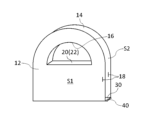
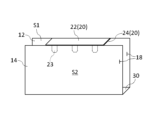
- FIG. 1 is a perspective view showing the first embodiment of the tape holder according to the present invention.
- 2 and 3 are side views showing the tape holder of FIG. 1.
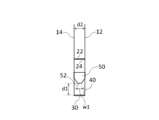
- FIG. 4 is a front view showing the tape holder of FIG. 1;
- FIG. FIG. 4 corresponds to a view of the tape holder in FIG. 1 viewed from the right side.
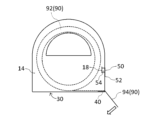
- 5 is an end view showing the tape holder of FIG. 1.
- the tape holder 1 is a tape holder that rotatably holds the wound tape 90 .
- the tape 90 is wound around an annular core.
- the tape 90 is an adhesive tape with an adhesive surface exposed on the back side.
- the tape 90 may be provided with an adhesive surface only on the back surface, or may be provided with an adhesive surface on both surfaces (front surface and back surface).
- Examples of the former include, for example, cellophane tape, medical tape, and masking tape.
- Examples of the latter include, for example, double-sided tape.
- the adhesive surface of the double-sided tape may be exposed only on the back surface, or may be exposed on both surfaces.
- the former double-sided tape has a release paper attached to its surface. 1 to 4, illustration of the tape 90 is omitted.
- the tape 90 consists of a winding portion 92 and a pull-out portion 94 (see FIG. 5).
- the wound portion 92 is a portion wound around the core of the tape 90 and has an annular shape as a whole.
- the back surface of each portion of the winding portion 92 is adhered to the surface of another portion of the winding portion 92 or to the core.
- the pull-out portion 94 is a portion of the tape 90 pulled out from the wound portion 92 . Therefore, the back surface of the lead-out portion 94 is attached neither to the surface of the winding portion 92 nor to the core.
- the tape holder 1 includes a side plate portion 12 (first side plate portion) and a side plate portion 14 (second side plate portion).
- the side plate portion 12 and the side plate portion 14 are provided so as to sandwich the tape 90 and cover the tape 90 from both sides.
- 2 and 3 correspond to views of the tape holder 1 viewed from the side plate portion 12 and the side plate portion 14, respectively.
- FIG. 5 also shows an end face that is parallel to the side plate portions 12 and 14 and positioned between the side plate portions 12 and 14 .
- the side plate portion 12 and the side plate portion 14 have congruent shapes and completely overlap each other in a side view.
- each side plate part 12, 14 (the part below a straight line including a connecting part 20, which will be described later, when viewed from the side) is rectangular.
- the upper portions of the side plate portions 12 and 14 (the portions above the straight line in side view) are semicircular.
- the side plate portion 12 and the side plate portion 14 cover the entire wound portion 92 of the tape 90 from the side. That is, the side plate portion 12 and the side plate portion 14 overlap the entire winding portion 92 in a side view.
- Each of the side plate portions 12 and 14 has a plate shape and has a surface S1 (first surface) and a surface S2 (second surface).
- the surface S2 of each of the side plate portions 12 and 14 is the surface opposite to the surface S1.
- the surfaces S1 and S2 have different designs.
- surface S1 may be colored yellow, pink, and blue, while surface S2 may be colored green, red, and orange.
- a character of Snow White may be drawn on the surface S1
- a character of a minion may be drawn on the surface S2.
- side S1 may be printed with travel photos of Spain
- side S2 may be printed with travel photos of France.
- Each of the side plate portions 12, 14 has a semicircular opening 16.
- An opening 16 is formed in the upper portion of each of the side plate portions 12 and 14 .
- the opening 16 is sized to allow insertion of a finger. Therefore, the tape holder 1 can be held in the hand and used while the finger is inserted into the opening 16.
- - ⁇ A notch 18 is formed in each of the side plate portions 12 and 14 to serve as an insertion port for a claw portion 54, which will be described later.
- the tape holder 1 has a state (first state) in which surfaces S1 of the side plate portions 12 and 14 face each other, and a state (second state) in which surfaces S2 of the side plate portions 12 and 14 face each other. is configured to switch between FIG. 1 shows the first state.
- the tape holder 1 can be repeatedly switched between the first state and the second state without damaging the tape holder 1 .
- the tape holder 1 has a reversible structure that can be used in either the first state or the second state.
- materials for the side plate portions 12 and 14 for example, paper, plastic, metal, or wood can be used. Papers also include processed papers and cellulose nanofibers (CNF).
- the plastic may be a biodegradable plastic.
- the tape holder 1 includes a connecting portion 20 , a bottom plate portion 30 , a cutting blade 40 and an adhering portion 50 .
- the connecting portion 20 connects the side plate portion 12 and the side plate portion 14 .
- the connecting portion 20 is inserted inside the winding portion 92 .
- the connecting portion 20 has a plate shape.
- the thickness direction of the connecting portion 20 is perpendicular to the thickness directions of the side plate portions 12 and 14 .
- the connecting portion 20 includes a plate-like portion 22 (first plate-like portion) and a plate-like portion 24 (second plate-like portion).
- the plate-like portion 22 and the plate-like portion 24 are connected to the side plate portion 12 and the side plate portion 14, respectively. Specifically, the plate-like portion 22 and the plate-like portion 24 are connected to the lower end of the opening 16 .
- the connecting portion 20 connects the side plate portion 12 and the side plate portion 14 by releasably fixing the plate-like portion 22 and the plate-like portion 24 while overlapping each other.
- “releasable” means that the state in which the plate-like portions 22 and 24 are fixed to each other can be released without damaging the tape holder 1 .
- the connecting portion 20 is preferably formed integrally with the side plate portions 12 and 14 .
- the material of the connecting portion 20 may be the same as or different from that of the side plate portions 12 and 14 .
- the bottom plate portion 30 is connected to the lower end 12 a of the side plate portion 12 and the lower end 14 a of the side plate portion 14 .
- the bottom plate portion 30 may be connected to the entire lower ends 12a and 14a, or may be connected to only a portion thereof.
- the bottom plate portion 30 has a plate shape.
- the thickness direction of the bottom plate portion 30 is perpendicular to the thickness direction of the side plate portions 12 and 14 and is equal to the thickness direction of the connecting portion 20 .
- the bottom plate portion 30 is preferably formed integrally with the side plate portions 12 and 14 .
- the material of the bottom plate portion 30 may be the same as or different from the material of the side plate portions 12 and 14 .
- the cutting blade 40 cuts the pull-out portion 94 of the tape 90 . Specifically, the cutting blade 40 cuts the lead-out portion 94 while in contact with the surface side of the tape 90 .
- the cutting blade 40 is attached to the bottom plate portion 30 . Specifically, the cutting blade 40 is attached to the end of the bottom plate portion 30 . The tip of the cutting blade 40 protrudes from the bottom plate portion 30 . The tip of the cutting blade 40 is separated from the winding portion 92 . Thereby, the cutting blade 40 cuts the tape 90 leaving a fixed length of the drawn-out portion 94 .
- the material of the cutting blade 40 may be the same as or different from the material of the side plate portions 12 and 14 .
- the cutting blade 40 may be formed integrally with the bottom plate portion 30 .
- the sticking part 50 is provided above the cutting blade 40 .
- the back surface of the tape 90 is attached to the attaching portion 50 with the end 90 a of the tape 90 floating from the cutting blade 40 .
- the back surface of the tape 90 is attached to the tip portion 52 of the attaching portion 50 .
- the tip portion 52 is equal to the lower end of the sticking portion 50 .
- the tip portion 52 (the portion with which the back surface of the tape 90 comes into contact) may be flat or uneven.
- the width of the adhering portion 50 monotonically decreases toward the tip portion 52 .
- the width w1 (see FIG. 4) of the tip portion 52 is smaller than the width of the tape 90.
- the width w1 is designed to be smaller than the width of the tape 90 expected to be used in the tape holder 1.
- the width w1 is preferably 50% or less of the width of the tape 90, more preferably 20% or less.
- the sticking portion 50 is connected to the side plate portion 12 and the side plate portion 14 .
- the sticking portion 50 is connected to the side edge 12 b of the side plate portion 12 and the side edge 14 b of the side plate portion 14 .
- the side end 12b is a portion of the peripheral edge of the side plate portion 12 other than the lower end 12a, which is positioned at the lower portion.
- the side end 14b is a portion of the peripheral edge of the side plate portion 14 other than the lower end 14a located at the lower portion.
- the side ends 12b, 14b are linear.
- the side end 12b of the side plate portion 12 and the side end 14b of the side plate portion 14 are connected by the sticking portion 50. As shown in FIG.
- the side end 12 b and the side end 14 b are connected only by the sticking portion 50 . Therefore, the side ends 12 b and 14 b are not connected on the opposite side of the sticking portion 50 . Also, the upper end 12c of the side plate portion 12 and the upper end 14c of the side plate portion 14 are not connected.
- the upper end 12c is a portion of the peripheral edge of the side plate portion 12 other than the lower end 12a, which is positioned at the upper portion.
- the upper end 14c is a portion of the peripheral edge of the side plate portion 14 other than the lower end 14a, which is positioned at the upper portion.
- Upper ends 12c and 14c are curved.
- the distance d1 (see FIG. 4) from the cutting blade 40 to the sticking portion 50 (tip portion 52) in the vertical direction is preferably equal to or greater than the interval d2 between the side plate portions 12 and 14.
- the vertical direction is equal to the thickness direction of the bottom plate portion 30 (the vertical direction in FIGS. 1 to 4).
- the distance d1 is preferably 10 mm or more, more preferably 15 mm or more.
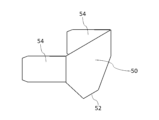
- FIG. 6 is a perspective view showing the sticking portion 50.
- FIG. A claw portion 54 is connected to the sticking portion 50 .
- the claw portion 54 is a portion for attaching the sticking portion 50 to the side plate portions 12 and 14 .
- the claw portions 54 extend toward the inside of the side plate portions 12 and 14 from each of both side ends of the sticking portion 50 .
- the sticking portion 50 can be attached to the side plate portions 12, 14.
- the claw portion 54 is inserted from the outer surface of each of the side plate portions 12 and 14 toward the inner surface.
- the sticking portion 50 can be removed from the side plate portions 12 and 14 by pulling out the claw portion 54 from the cutout 18 .
- the sticking portion 50 is detachable from the side plate portion 12 and the side plate portion 14 .
- detachable means that attachment and detachment of the sticking portion 50 to the side plate portions 12 and 14 can be repeatedly performed without damaging the tape holder 1 .
- the tip portion 52 is located on the side ends 12b and 14b.
- the tip portion 52 may or may not overlap the tip of the cutting blade 40 . That is, the tip portion 52 may be positioned directly above the tip of the cutting blade 40 or may be positioned obliquely above it. In the latter case, the distance (horizontal distance) from the tip of the cutting blade 40 to the tip 52 in plan view is preferably smaller than the distance d1.
- the sticking portion 50 has a plate shape.
- the thickness direction of the sticking portion 50 is perpendicular to both the thickness direction of the side plate portions 12 and 14 and the thickness direction of the bottom plate portion 30 .
- the material of the sticking portion 50 may be the same as or different from the material of the side plate portions 12 and 14 .
- each sheet 62, 64 is made of paper (cardboard).
- the sheet 62 is composed of a portion 12p to be the side plate portion 12, a portion 14p to be the side plate portion 14, a portion 22p to be the plate-like portion 22, a portion 24p to be the plate-like portion 24, and a portion 30p to be the bottom plate portion 30.
- a portion 16p to be the opening 16 and a notch 18 are formed in each of the portions 12p and 14p.
- the portion 22p has a claw portion 23.
- a notch 25 serving as an insertion opening for the claw portion 23 is formed in the portion 24p.
- a cutting blade 40 is attached to the portion 30p.
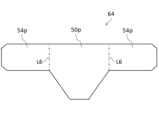
- the sheet 64 is composed of a portion 50p that becomes the sticking portion 50 and a portion 54p that becomes the claw portion 54. As shown in FIG.
- the sheet 62 is valley-folded at right angles along the fold L1, the fold L2, the fold L3, the fold L4, and the fold L5.
- Fold L1 is located at the boundary between portion 12p and portion 22p.
- Fold L2 is located at the boundary between portion 14p and portion 24p.
- Fold L3 is located at the boundary between portion 12p and portion 30p.
- Fold L4 is located at the boundary between portion 14p and portion 30p.
- the fold L5 is located at the base of the claw portion 23 .
- the tape 90 is arranged between the portions 12p and 14p so that the portions 22p and 24p are inserted inside the wound portion 92 . Thereafter, the portion 22p and the portion 24p are fixed such that the portion 22p overlaps the portion 24p.
- the side plate portion 12, the side plate portion 14, the connecting portion 20, and the bottom plate portion 30 are formed.
- the side plate portion 12 and the side plate portion 14 are in a state (first state) in which the surfaces S1 face each other.
- the connecting portion 20 is composed of a plate-like portion 22 having a claw portion 23 and a plate-like portion 24 having a notch 25 .
- the side plate portion 12, the side plate portion 14, the connecting portion 20, and the bottom plate portion 30 are formed from one sheet.
- the sheet 64 is valley-folded at right angles along the fold L6.
- Fold L6 is located at the boundary between portion 50p and portion 54p.
- the adhered portion 50 shown in FIG. 6 is formed.
- the sticking portion 50 is attached to the side plate portions 12 and 14 by inserting the claw portion 54 into the notch 18 .
- the tape holder 1 shown in FIGS. 1 to 5 is obtained.
- the tape 90 (pull-out portion 94 ) is pinched with fingers to peel off the tape 90 from the sticking portion 50 and then pulled along the bottom plate portion 30 . As a result, the tape 90 is let out from between the bottom plate portion 30 and the sticking portion 50 .
- the tape 90 is cut by pressing the surface of the tape 90 against the tip of the cutting blade 40 .
- the back surface of the tape 90 is adhered to the adhered portion 50 again. At this time, it is preferable that the end 90 a of the tape 90 protrudes from the tip portion 52 .
- the lead-out portion 94 is adhered only to the adhered portion 50 . That is, the tape holder 1 is configured so that the drawer portion 94 is not attached to a portion of the tape holder 1 other than the attached portion 50 . In this way, the tape 90 can be unwound from the tape holder 1 to obtain a cut piece of desired length.
- the claw portion 23 is pulled out from the notch 25, whereby the plate-like portion 22 and the plate-like portion 24 are separated. release their fixed state to each other.
- the sheet 62 is folded to the opposite side along the folds L1 to L5. Specifically, after returning the sheet 62 to the state shown in FIG. 7, the sheet 62 is mountain-folded along the folding lines L1 to L5 as shown in FIG. At this time, the tape 90 is placed between the portion 12p and the portion 14p. After that, by inserting the claw portion 23 into the notch 25, the portion 22p and the portion 24p are fixed again. As a result, the side plate portion 12 and the side plate portion 14 are brought into a state where the surfaces S2 face each other (second state).
- the tape holder 1 can be switched between a state (first state) in which surfaces S1 of the side plate portions 12 and 14 face each other and a state (second state) in which surfaces S2 of the side plate portions 12 and 14 face each other.
- first state the surface S2 constitutes the outer surface of each side plate portion 12,14
- second state the surface S1 constitutes the outer surface of each side plate portion 12,14. Therefore, by applying different designs to the surfaces S1 and S2, the design of the outer surfaces of the side plate portions 12 and 14 can be changed by switching between the first and second states. Therefore, the tape holder 1 is realized in which the design of the outer surfaces of the side plate portions 12 and 14 can be changed.
- the tape holder 1 By making the tape holder 1 reversible in this way, the user can also enjoy assembly play. That is, it is possible to enjoy switching between the first and second states as play. Therefore, the tape holder 1 is also suitable for use as a promotional product. Also, by using knowledge such as color psychology, it is possible to infer the psychological state of the user depending on which of the first state and the second state is selected. This is useful, for example, for adults to grasp the psychological state (mental state) of children and themselves.
- the tape holder 1 is provided with a connecting portion 20 that is inserted through the inside of the wound portion 92 of the tape 90 and connects the side plate portion 12 and the side plate portion 14 . This can prevent the tape 90 from falling off the tape holder 1 .
- the connecting portion 20 connects the side plate portion 12 and the side plate portion 14 by releasably fixing the plate-like portion 22 and the plate-like portion 24 while overlapping each other. Thereby, each state (first or second state) can be maintained while enabling switching between the first and second states.
- the plate-like portion 22 and the plate-like portion 24 are fixed to each other by inserting the claw portion 23 into the notch 25 . Accordingly, the plate-like portion 22 and the plate-like portion 24 can be stably fixed without using an adhesive, an adhesive tape, or the like.
- the side plate portion 12 and the side plate portion 14 cover the entire wound portion 92 of the tape 90 from the side. As a result, it is possible to prevent dust from adhering to the winding portion 92 .
- the side plate portion 12 and the side plate portion 14 may cover only part of the winding portion 92 from the side.
- the tape holder 1 is provided with a bottom plate portion 30 connected to the lower ends 12 a and 14 a of the side plate portions 12 and 14 . Thereby, the shape of the tape holder 1 (the shape in which the side plate portion 12 and the side plate portion 14 face each other at a constant interval) can be stably maintained.
- the tape holder 1 is provided with a cutting blade 40 for cutting the drawn-out portion 94 of the tape 90 .
- the tape holder 1 can be used not only to feed the tape 90 but also to cut it. That is, the tape holder 1 also functions as a tape cutter.
- the cutting blade 40 is attached to the bottom plate portion 30 . This makes it easier to stably fix the cutting blade 40 .
- a sticking portion 50 is provided above the cutting blade 40 .
- the back surface of the tape 90 is attached to the attaching portion 50 with the end 90 a of the tape 90 floating from the cutting blade 40 .
- a gap is secured between the end 90a of the tape 90 and the cutting blade 40, making it easier to pick up the tape 90 with fingers.
- the drawer portion 94 returns to the winding portion 92.
- the tape 90 can be picked up at a position away from the cutting blade 40, the fingers are less likely to touch the cutting blade 40 when the tape 90 is fed out. Therefore, the safety of the tape holder 1 can be enhanced.
- the distance d1 is preferably equal to or greater than the interval d2 between the side plate portions 12,14. From the same point of view, the distance d1 is preferably 10 mm or more, more preferably 15 mm or more. On the other hand, if the distance d1 is too large, it may become difficult to secure a place in the tape holder 1 for arranging the sticking portion 50 . From this point of view, the distance d1 is preferably 50 mm or less.
- the sticking portion 50 is connected to the side plate portion 12 and the side plate portion 14 .
- the sticking portion 50 is also useful for stably maintaining the shape of the tape holder 1 .
- the sticking portion 50 is connected to the side ends 12b, 14b of the side plate portions 12, 14. This makes it easier to align the tip portion 52 of the sticking portion 50 with the side ends 12b and 14b.
- the tip portion 52 is positioned above the side ends 12b and 14b in a side view. In this case, since the tip portion 52 does not enter the space sandwiched between the side plate portions 12 and 14, it is advantageous in making it easier to pick up the tape 90 stuck to the sticking portion 50 with fingers.
- the width w1 of the tip portion 52 is smaller than the width of the tape 90. In this case, by changing the width w1, it is possible to adjust the contact area between the tip portion 52 and the tape 90, and thus the adhesive force between the sticking portion 50 and the tape 90. FIG. As a result, it is possible to increase the options for the material of the sticking portion 50 .
- the width w1 is preferably 50% or less of the width of the tape 90, and more preferably 20% or less. On the other hand, if the width w1 is too small, the adhesion between the sticking portion 50 and the tape 90 may be insufficient. From this point of view, the width w1 is preferably 5% or more of the width of the tape 90 .
- the width of the sticking portion 50 monotonously decreases as it approaches the tip portion 52 .
- the width w1 of the tip portion 52 is smaller than the width of the tape 90 while being connected to the side plate portions 12 and 14 .
- the sticking portion 50 is detachable from the side plate portion 12 and the side plate portion 14 . In this case, it is possible to switch between the first state and the second state while the sticking portion 50 is removed from the side plate portion 12 and the side plate portion 14 . This allows smooth switching between the first and second states.
- the sticking portion 50 When the sticking portion 50 is made of paper, the weight of the sticking portion 50 and thus the tape holder 1 can be reduced.
- the tape holder 1 contains CNF as a material, it is advantageous for reducing the weight and increasing the strength of the tape holder 1 . Moreover, using CNF also contributes to reduction of environmental load.
- the side ends 12b and 14b of the side plate portions 12 and 14 are connected only by the sticking portion 50. In this case, in addition to the sticking portion 50, no member for connecting the side ends 12b and 14b is required. Thereby, the material of the tape holder 1 can be saved. This contributes to the reduction of manufacturing cost of the tape holder 1 .
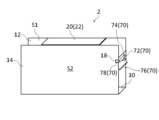
- FIG. 14 is a perspective view showing a second embodiment of the tape holder according to the invention.
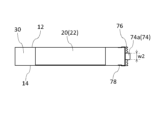
- 15 and 16 are side views showing the tape holder of FIG. 14.
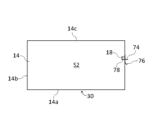
- FIG. 17 and 18 are front and top views, respectively, of the tape holder of FIG.
- FIG. 17 corresponds to a view of the tape holder in FIG. 14 viewed from the right side.
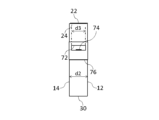
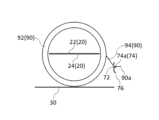
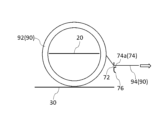
- 19 is an end view of the tape holder of FIG. 14.
- the tape holder 2 is a tape holder that rotatably holds the tape 90 . 14 to 18, illustration of the tape 90 is omitted.
- the tape holder 2 has a side plate portion 12 and a side plate portion 14 .
- the side plate portion 12 and the side plate portion 14 are provided so as to sandwich the tape 90 and cover the tape 90 from both sides.
- 15 and 16 correspond to views of the tape holder 2 viewed from the side plate portion 12 and the side plate portion 14, respectively.
- 19 shows an end face that is parallel to the side plate portions 12 and 14 and located between the side plate portions 12 and 14.
- the side plate portion 12 and the side plate portion 14 cover only a portion of the winding portion 92 of the tape 90 from the side. That is, the side plate portion 12 and the side plate portion 14 overlap only a part of the winding portion 92 in a side view.
- Each of the side plate portions 12 and 14 has a rectangular plate shape.
- Each of the side plate portions 12 and 14 is formed with a notch 18 serving as an insertion port for a claw portion 78, which will be described later.
- the tape holder 2 has a state (first state) in which surfaces S1 of the side plate portions 12 and 14 face each other, and a state (second state) in which surfaces S2 of the side plate portions 12 and 14 face each other. is configured to switch between FIG. 14 shows the first state.
- the tape holder 2 can be repeatedly switched between the first state and the second state without damaging the tape holder 2 . Thereby, the tape holder 2 has a reversible structure that can be used in either the first state or the second state.
- the tape holder 2 includes a connecting portion 20, a bottom plate portion 30, and a guide portion 70.
- the connecting portion 20 includes a plate-like portion 22 and a plate-like portion 24 .
- the plate-like portion 22 and the plate-like portion 24 are connected to the upper end 12c of the side plate portion 12 and the upper end 14c of the side plate portion 14, respectively.
- the upper end 12 c of the side plate portion 12 and the upper end 14 c of the side plate portion 14 are connected by the connecting portion 20 .
- Other configurations of the connecting portion 20 and the configuration of the bottom plate portion 30 are as described in the first embodiment.
- the guide portion 70 guides the draw-out portion 94 of the tape 90 within a predetermined range between the side edge 12b of the side plate portion 12 and the side edge 14b of the side plate portion 14. That is, the guide portion 70 guides the drawer portion 94 so that the drawer portion 94 intersects with the side ends 12b and 14b within a predetermined range when viewed from the side.
- the guide portion 70 is separated from the bottom plate portion 30 .
- the guide portion 70 is connected to the side plate portion 12 and the side plate portion 14 . Specifically, the guide portion 70 is connected to the side end 12 b of the side plate portion 12 and the side end 14 b of the side plate portion 14 .
- the side end 12b of the side plate portion 12 and the side end 14b of the side plate portion 14 are connected by the guide portion 70.
- the side end 12b and the side end 14b are connected only by the guide portion 70.
- the side ends 12b and 14b are not connected on the opposite side of the guide portion 70.
- the material of the guide portion 70 may be the same as or different from the material of the side plate portions 12 and 14 .
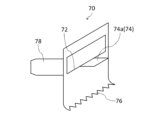
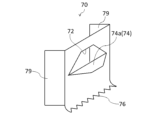
- FIG. 20 is a perspective view showing the guide portion 70.
- the guide portion 70 has an opening 72 , an adhering portion 74 , a cutting blade 76 and a claw portion 78 .
- the opening 72 is a portion through which the lead-out portion 94 of the tape 90 passes.
- the opening 72 is separated from the bottom plate portion 30 .
- the opening 72 overlaps the side ends 12b and 14b of the side plate portions 12 and 14 in a side view.
- a plane perpendicular to the entire opening 72 is perpendicular to both the thickness direction of the side plate portions 12 and 14 and the thickness direction of the bottom plate portion 30 .
- the “predetermined range” mentioned above is equal to the range of the opening 72 .
- the opening 72 has a horizontally long rectangular shape when viewed from the front.
- a length d3 (see FIG. 17) of the opening 72 in the left-right direction is smaller than the interval d2 between the side plate portions 12 and 14. As shown in FIG. Length d3 is greater than the width of tape 90 .
- the sticking part 74 is connected to the opening 72 . Specifically, the sticking portion 74 is connected to the lower end of the opening 72 . The sticking portion 74 protrudes outward from the side plate portions 12 and 14 from the opening 72 .
- a lead-out portion 94 of a tape 90 is adhered to the adhered portion 74 as shown in FIG. Specifically, the back surface of the lead-out portion 94 is attached to the attachment surface 74 a of the attachment portion 74 .
- the sticking surface 74 a is equal to the upper surface of the sticking portion 74 .
- the sticking surface 74a has a planar shape.
- the sticking surface 74 a is parallel to the bottom plate portion 30 .
- the width w2 see FIG.
- the width w2 is defined as the horizontal dimension of the sticking surface 74a.
- the width w2 is preferably 50% or less of the width of the tape 90, more preferably 20% or less.
- the cutting blade 76 cuts the drawn-out portion 94 that has passed through the opening 72 .
- the opening 72 and the sticking portion 74 described above are provided between the winding portion 92 and the cutting blade 76 along the drawer portion 94 .
- the tip of the cutting blade 76 is directed outward (away from the side ends 12b, 14b) so as to easily cut the drawn-out portion 94. As shown in FIG.
- the tip of the cutting blade 76 protrudes from the side ends 12b, 14b of the side plate portions 12, 14 in a side view. Also, the tip of the cutting blade 76 is located inside the adhering portion 74 in a side view. That is, the distance d4 (see FIG.
- the tip of the cutting blade 76 is smaller than the distance d5 from the tip of the sticking portion 74 to the side edges 12b, 14b.
- the tip of the cutting blade 76 is separated from the sticking portion 74 .
- the tip of the cutting blade 76 is also separated from the bottom plate portion 30 . That is, the tip of the cutting blade 76 is positioned between the sticking portion 74 and the bottom plate portion 30 in the vertical direction of each of the side plate portions 12 and 14 .
- a cutting blade 76 is provided at the lower end of the guide portion 70 .
- the width of the cutting blade 76 is equal to or greater than the width of the tape 90 .
- the material of the cutting blade 76 may be the same as or different from the material of the other portions of the guide portion 70. In the latter case, for example, it is conceivable to use metal as the material for the cutting blade 76 and paper as the material for the other parts. Moreover, the cutting blade 76 may be formed integrally with the other portion of the guide portion 70, or may be formed separately from the other portion and then attached to the portion.
- the claw portion 78 is a portion for attaching the guide portion 70 to the side plate portions 12 and 14 .
- the claw portions 78 extend toward the inside of the side plate portions 12 and 14 from each of both side ends of the guide portion 70 .
- illustration of one claw portion 78 of the two claw portions 78 is omitted.
- the guide portion 70 can be attached to the side plate portions 12 and 14 by inserting the claw portion 78 into the cutout 18 of each side plate portion 12 and 14 .
- the claw portion 78 is inserted from the outer surface toward the inner surface of each of the side plate portions 12 and 14 .
- the guide portion 70 can be removed from the side plate portions 12 and 14 by pulling out the claw portion 78 from the cutout 18 .
- the guide portion 70 is detachable from the side plate portion 12 and the side plate portion 14 .
- detachable means that the guide portion 70 can be repeatedly attached to and detached from the side plate portions 12 and 14 without damaging the tape holder 2 .
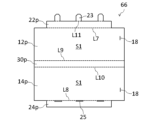
- each sheet 66, 68 is made of paper (cardboard).
- the sheet 66 is composed of a portion 12p to be the side plate portion 12, a portion 14p to be the side plate portion 14, a portion 22p to be the plate-like portion 22, a portion 24p to be the plate-like portion 24, and a portion 30p to be the bottom plate portion 30.
- a notch 18 is formed in each portion 12p, 14p.
- the portion 22p has a claw portion 23. As shown in FIG.
- a notch 25 serving as an insertion opening for the claw portion 23 is formed in the portion 24p.
- the sheet 68 is composed of a portion 72p that will become the opening 72, a portion 74p that will become the sticking portion 74, and a portion 78p that will become the claw portion 78. As shown in FIG.
- the sheet 66 is valley-folded at right angles along the fold L7, the fold L8, the fold L9, the fold L10, and the fold L11.
- Fold L7 is located at the boundary between portion 12p and portion 22p.
- Fold L8 is located at the boundary between portion 14p and portion 24p.
- Fold L9 is located at the boundary between portion 12p and portion 30p.
- Fold L10 is located at the boundary between portion 14p and portion 30p.
- the fold L11 is located at the base of the claw portion 23 .
- the tape 90 is arranged between the portions 12p and 14p so that the portions 22p and 24p are inserted inside the wound portion 92 .
- the portion 22p and the portion 24p are fixed such that the portion 22p overlaps the portion 24p.
- This fixation is performed by inserting the claw portion 23 into the notch 25 .
- the side plate portion 12 and the side plate portion 14 are in a state (first state) in which the surfaces S1 face each other.
- the connecting portion 20 is composed of a plate-like portion 22 having a claw portion 23 and a plate-like portion 24 having a notch 25 .
- the side plate portion 12, the side plate portion 14, the connecting portion 20, and the bottom plate portion 30 are formed from one sheet.
- the sheet 68 is valley-folded at right angles along the fold L12, and the sheet 68 is mountain-folded at right angles along the fold L13.
- the fold L12 is located at the lower end of the portion 74p.
- Fold L13 is located at the base of portion 78p.
- the guide portion 70 is formed by attaching a cutting blade 76 below the opening 72 . After that, the guide portion 70 is attached to the side plate portions 12 and 14 by inserting the claw portions 78 into the cutouts 18 .
- the tape holder 2 shown in FIGS. 14 to 19 is obtained.
- the pull-out portion 94 of the tape 90 is pinched with fingers to peel off the pull-out portion 94 from the sticking portion 74, and then the pull-out portion 94 is pulled outside the side plate portions 12 and 14.
- the tape 90 is fed through the opening 72 from the gap between the side ends 12b and 14b of the side plate portions 12 and 14.
- the back surface of the lead-out portion 94 is pressed against the tip of the cutting blade 76 to cut the lead-out portion 94 .
- the lead-out portion 94 is stuck to the sticking portion 74 again (see FIG. 19).
- the end 90 a of the tape 90 may remain on the tip of the cutting blade 76 or may be separated from the tip of the cutting blade 76 . In this manner, the tape 90 can be unwound from the tape holder 2 to obtain a cut piece of desired length.
- the claw portions 23 are pulled out from the cuts 25, whereby the plate-like portions 22 and 24 are separated. Release the fixed state with each other.
- the sheet 66 is folded to the opposite side along the folds L7 to L11. Specifically, after returning the sheet 66 to the state shown in FIG. 21, the sheet 66 is mountain-folded along the folding lines L7 to L11 as shown in FIG. At this time, the tape 90 is placed between the portion 12p and the portion 14p. After that, by inserting the claw portion 23 into the notch 25, the portion 22p and the portion 24p are fixed again. As a result, the side plate portion 12 and the side plate portion 14 are brought into a state where the surfaces S2 face each other (second state).
- the tape holder 2 can be switched between a state (first state) in which surfaces S1 of the side plate portions 12 and 14 face each other and a state (second state) in which surfaces S2 of the side plate portions 12 and 14 face each other.
- first state the surface S2 constitutes the outer surface of each side plate portion 12,14
- second state the surface S1 constitutes the outer surface of each side plate portion 12,14. Therefore, by applying different designs to the surfaces S1 and S2, the design of the outer surfaces of the side plate portions 12 and 14 can be changed by switching between the first and second states. Therefore, the tape holder 2 is realized in which the design of the outer surfaces of the side plate portions 12 and 14 can be changed.
- the side plate portion 12 and the side plate portion 14 cover only a part of the wound portion 92 of the tape 90 from the side. Thereby, the material for the side plate portions 12 and 14 can be saved. This contributes to the reduction of manufacturing cost of the tape holder 2 .
- the side plate portion 12 and the side plate portion 14 may cover the entire winding portion 92 from the sides.
- the tape holder 2 is provided with a guide portion 70 that guides the pull-out portion 94 of the tape 90 within a predetermined range between the side ends 12b and 14b of the side plate portions 12 and 14.
- the guide portion 70 has an opening 72 spaced apart from the bottom plate portion 30 .
- the lead-out portion 94 that has passed through the opening 72 is cut by the cutting blade 76 .
- the drawn-out portion 94 after being cut is adhered to the adhering portion 74 that is connected to the opening 72 .
- the state in which the drawer portion 94 has passed through the opening 72 is maintained, so that the drawer portion 94 can be picked up at a position spaced apart from the bottom plate portion 30 . Therefore, it becomes easier to pick up the pull-out portion 94 of the tape 90 when the tape 90 is fed out. Further, by attaching the tape 90 to the attaching portion 74 in this way, it is possible to prevent the tape 90 from being rewound.
- the sticking portion 74 protrudes from the opening 72 toward the outside of the side plate portions 12 and 14 . This makes it easier to pick up the drawer portion 94 adhered to the adhered portion 74 compared to the case where the adhered portion 74 protrudes toward the inside of the side plate portions 12 and 14 . However, the sticking portion 74 may protrude from the opening 72 toward the inside of the side plate portions 12 and 14 . In that case, the sticking portion 74 is sandwiched between the side plate portion 12 and the side plate portion 14 .
- the tip of the cutting blade 76 is positioned inside the adhering portion 74 in a side view. In this case, since the cutting blade 76 is retracted with respect to the sticking portion 74, the safety of the tape holder 2 can be enhanced. However, the tip of the cutting blade 76 may be positioned outside the adhering portion 74 in a side view.
- the tip of the cutting blade 76 is separated from the sticking portion 74 .
- the lead-out portion 94 adhered to the adhered portion 74 can be grasped at a position away from the cutting blade 76 , it is difficult for the fingers to touch the cutting blade 76 when the tape 90 is fed out. Therefore, the safety of the tape holder 2 can be enhanced.
- the width w2 of the sticking portion 74 is smaller than the width of the tape 90.
- the width w2 may be equal to the width of the tape 90 or may be greater than the width of the tape 90 .
- the width w2 may be equal to the length d3 of the opening 72 in the horizontal direction.
- the opening 72 overlaps the side ends 12b and 14b of the side plate portions 12 and 14 in a side view. By aligning the position of the opening 72 with the side edges 12b and 14b in this manner, the pull-out portion 94 of the tape 90 can be reliably guided within a predetermined range between the side edges 12b and 14b of the side plate portions 12 and 14. .
- the guide part 70 is connected to the side plate parts 12 and 14 .
- the guide portion 70 also helps to maintain the shape of the tape holder 2 stably.
- the guide portion 70 is connected to the side ends 12b and 14b of the side plate portions 12 and 14, respectively. This makes it easier to align the positions of the openings 72 with the side ends 12b and 14b.
- the guide part 70 is detachable from the side plate part 12 and the side plate part 14 . In this case, it is possible to switch between the first and second states with the guide portion 70 removed from the side plate portion 12 and the side plate portion 14 . This allows smooth switching between the first and second states.
- Other effects of the tape holder 2 are the same as those of the tape holder 1 .
- the present invention is not limited to the above embodiments, and various modifications are possible.
- the plate-like portion 22 and the plate-like portion 24 may be fixed by other means as long as they can be released.
- a double-sided tape it is preferable to cover the exposed portion of the adhesive surface with a release paper.
- the release paper may have a design.
- the attachment portion 50 or the guide portion 70 may be fixed to the side plate portions 12 and 14 using double-sided tape.
- the guide portion 70 may have the structure shown in FIG. 28 or 29. 28, the guide portion 70 has an opening 72, an adhering portion 74, a cutting blade 76, and an adhesive margin portion 79. As shown in FIG.
- the opening 72 and the sticking portion 74 have congruent trapezoidal shapes.
- the sticking portion 74 is continuously provided along the entire lower end of the opening 72 .
- the lateral dimension of the sticking surface 74 a gradually decreases toward the tip of the sticking portion 74 . This makes it easier to pick up the drawer portion 94 stuck to the sticking portion 74 .
- the width w2 of the sticking portion 74 is defined as the maximum value of the dimension.
- the glue margin portion 79 is a portion for attaching the guide portion 70 to the side plate portions 12 and 14 .
- the paste margin portions 79 extend toward the inside of the side plate portions 12 and 14 from each of both side ends of the guide portion 70 .
- the margin portions 79 are provided on the entire side ends of the guide portion 70 .
- the guide portion 70 can be attached to the side plate portions 12 and 14 by bonding the outer surface of the adhesive margin portion 79 to the inner surface of each of the side plate portions 12 and 14 via the above-described double-sided tape.
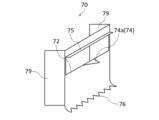
- the guide part 70 has an opening 72, an adhering part 74, an overhanging part 75, a cutting blade 76, and an adhesive margin part 79.
- the sticking portion 74 has a triangular shape.
- the sticking portion 74 is connected only to a portion of the lower end of the opening 72 .
- the lateral dimension of the sticking surface 74 a gradually decreases toward the tip of the sticking portion 74 .
- the protruding portion 75 extends over the entire upper end of the opening 72 .
- the protruding portion 75 protrudes outward from the side plate portions 12 and 14 from the opening 72 .
- the protruding portion 75 also functions as a sticking portion to which the lead-out portion 94 is stuck.
- a double-sided tape having adhesive surfaces exposed on both sides is used as the tape 90 .
- tape 90 is an adhesive tape
- tape 90 may be a non-adhesive tape that does not have an adhesive surface.
- non-adhesive tapes include paper tapes.
Landscapes
- Adhesive Tape Dispensing Devices (AREA)
Priority Applications (2)
| Application Number | Priority Date | Filing Date | Title |
|---|---|---|---|
| PCT/JP2023/015620 WO2023127976A2 (ja) | 2023-04-19 | 2023-04-19 | テープホルダー |
| JP2023524505A JP7370122B1 (ja) | 2023-04-19 | 2023-04-19 | テープホルダー |
Applications Claiming Priority (1)
| Application Number | Priority Date | Filing Date | Title |
|---|---|---|---|
| PCT/JP2023/015620 WO2023127976A2 (ja) | 2023-04-19 | 2023-04-19 | テープホルダー |
Publications (2)
| Publication Number | Publication Date |
|---|---|
| WO2023127976A2 true WO2023127976A2 (ja) | 2023-07-06 |
| WO2023127976A3 WO2023127976A3 (ja) | 2023-09-14 |
Family
ID=86999273
Family Applications (1)
| Application Number | Title | Priority Date | Filing Date |
|---|---|---|---|
| PCT/JP2023/015620 Ceased WO2023127976A2 (ja) | 2023-04-19 | 2023-04-19 | テープホルダー |
Country Status (2)
| Country | Link |
|---|---|
| JP (1) | JP7370122B1 (https=) |
| WO (1) | WO2023127976A2 (https=) |
Family Cites Families (4)
| Publication number | Priority date | Publication date | Assignee | Title |
|---|---|---|---|---|
| JPS49121989U (https=) * | 1973-02-14 | 1974-10-18 | ||
| JPS566853U (https=) * | 1979-06-26 | 1981-01-21 | ||
| US4978330A (en) * | 1989-07-31 | 1990-12-18 | Suhr Robert N | Tab forming tape dispenser with tape passing over cutter |
| JP2006151544A (ja) * | 2004-11-26 | 2006-06-15 | Seiwa Sangyo:Kk | 粘着テープの巻きテープ用ホルダー |
-
2023
- 2023-04-19 JP JP2023524505A patent/JP7370122B1/ja active Active
- 2023-04-19 WO PCT/JP2023/015620 patent/WO2023127976A2/ja not_active Ceased
Also Published As
| Publication number | Publication date |
|---|---|
| WO2023127976A3 (ja) | 2023-09-14 |
| JPWO2023127976A1 (https=) | 2023-07-06 |
| JP7370122B1 (ja) | 2023-10-27 |
Similar Documents
| Publication | Publication Date | Title |
|---|---|---|
| CA2489657A1 (en) | Dual-functioning mechanism for startup during winding of web material and for splicing during unwinding | |
| JP2010189008A (ja) | テープ連結具及びテープ連結方法 | |
| EP2628604A2 (en) | File | |
| JP7370122B1 (ja) | テープホルダー | |
| JP7604040B2 (ja) | 両面テープ及びテープカッター | |
| JP7412831B2 (ja) | テープカッター | |
| JP5713356B2 (ja) | 封緘セット | |
| JPH0741760B2 (ja) | 立方体に装飾シート体を貼着する方法 | |
| JP7519729B2 (ja) | 粘着テープ | |
| JP7350410B2 (ja) | テープカッター | |
| JP5980032B2 (ja) | 製本テープ | |
| JP5436156B2 (ja) | 封筒 | |
| JP2000238482A (ja) | インデックス作成用シート | |
| CN216513627U (zh) | 双面胶片及包含双面胶片的冷气滤网套组 | |
| CA3162323A1 (en) | Improvements in band-driven packaging | |
| CN218471489U (zh) | 一种易撕的标签 | |
| CN222070875U (zh) | 一种遮光纸结构 | |
| KR200240944Y1 (ko) | 포켓식 앨범 대지 | |
| JPH059324Y2 (https=) | ||
| JP4216963B2 (ja) | 隠蔽情報所持体 | |
| JP2817637B2 (ja) | 電動ホッチキス用ステープルのリフィルカートリッジ | |
| JPH0390393A (ja) | 書籍用の付箋セット | |
| JP2566621Y2 (ja) | 剥離紙付粘着テープの巻テープ容器 | |
| JP2002130243A (ja) | 清め塩等の粘着クリップ | |
| JPH0620250U (ja) | 袋 |
Legal Events
| Date | Code | Title | Description |
|---|---|---|---|
| ENP | Entry into the national phase |
Ref document number: 2023524505 Country of ref document: JP Kind code of ref document: A |
|
| 121 | Ep: the epo has been informed by wipo that ep was designated in this application |
Ref document number: 23735147 Country of ref document: EP Kind code of ref document: A2 |
|
| NENP | Non-entry into the national phase |
Ref country code: DE |