WO2023127874A1 - ポリビニルアルコールフィルム、及びポリビニルアルコールフィルムの製造方法 - Google Patents
ポリビニルアルコールフィルム、及びポリビニルアルコールフィルムの製造方法 Download PDFInfo
- Publication number
- WO2023127874A1 WO2023127874A1 PCT/JP2022/048148 JP2022048148W WO2023127874A1 WO 2023127874 A1 WO2023127874 A1 WO 2023127874A1 JP 2022048148 W JP2022048148 W JP 2022048148W WO 2023127874 A1 WO2023127874 A1 WO 2023127874A1
- Authority
- WO
- WIPO (PCT)
- Prior art keywords
- film
- mass
- pva
- roll
- drying
- Prior art date
- Legal status (The legal status is an assumption and is not a legal conclusion. Google has not performed a legal analysis and makes no representation as to the accuracy of the status listed.)
- Ceased
Links
Images
Classifications
-
- C—CHEMISTRY; METALLURGY
- C08—ORGANIC MACROMOLECULAR COMPOUNDS; THEIR PREPARATION OR CHEMICAL WORKING-UP; COMPOSITIONS BASED THEREON
- C08J—WORKING-UP; GENERAL PROCESSES OF COMPOUNDING; AFTER-TREATMENT NOT COVERED BY SUBCLASSES C08B, C08C, C08F, C08G or C08H
- C08J5/00—Manufacture of articles or shaped materials containing macromolecular substances
- C08J5/18—Manufacture of films or sheets
-
- G—PHYSICS
- G02—OPTICS
- G02B—OPTICAL ELEMENTS, SYSTEMS OR APPARATUS
- G02B5/00—Optical elements other than lenses
- G02B5/30—Polarising elements
-
- G—PHYSICS
- G02—OPTICS
- G02F—OPTICAL DEVICES OR ARRANGEMENTS FOR THE CONTROL OF LIGHT BY MODIFICATION OF THE OPTICAL PROPERTIES OF THE MEDIA OF THE ELEMENTS INVOLVED THEREIN; NON-LINEAR OPTICS; FREQUENCY-CHANGING OF LIGHT; OPTICAL LOGIC ELEMENTS; OPTICAL ANALOGUE/DIGITAL CONVERTERS
- G02F1/00—Devices or arrangements for the control of the intensity, colour, phase, polarisation or direction of light arriving from an independent light source, e.g. switching, gating or modulating; Non-linear optics
- G02F1/01—Devices or arrangements for the control of the intensity, colour, phase, polarisation or direction of light arriving from an independent light source, e.g. switching, gating or modulating; Non-linear optics for the control of the intensity, phase, polarisation or colour
- G02F1/13—Devices or arrangements for the control of the intensity, colour, phase, polarisation or direction of light arriving from an independent light source, e.g. switching, gating or modulating; Non-linear optics for the control of the intensity, phase, polarisation or colour based on liquid crystals, e.g. single liquid crystal display cells
- G02F1/133—Constructional arrangements; Operation of liquid crystal cells; Circuit arrangements
- G02F1/1333—Constructional arrangements; Manufacturing methods
- G02F1/1335—Structural association of cells with optical devices, e.g. polarisers or reflectors
-
- C—CHEMISTRY; METALLURGY
- C08—ORGANIC MACROMOLECULAR COMPOUNDS; THEIR PREPARATION OR CHEMICAL WORKING-UP; COMPOSITIONS BASED THEREON
- C08J—WORKING-UP; GENERAL PROCESSES OF COMPOUNDING; AFTER-TREATMENT NOT COVERED BY SUBCLASSES C08B, C08C, C08F, C08G or C08H
- C08J2329/00—Characterised by the use of homopolymers or copolymers of compounds having one or more unsaturated aliphatic radicals, each having only one carbon-to-carbon double bond, and at least one being terminated by an alcohol, ether, aldehydo, ketonic, acetal, or ketal radical; Hydrolysed polymers of esters of unsaturated alcohols with saturated carboxylic acids; Derivatives of such polymer
- C08J2329/02—Homopolymers or copolymers of unsaturated alcohols
- C08J2329/04—Polyvinyl alcohol; Partially hydrolysed homopolymers or copolymers of esters of unsaturated alcohols with saturated carboxylic acids
Definitions
- the present invention relates to a polyvinyl alcohol film with good stretchability in high-temperature water and a method for producing the same.
- LCDs Liquid crystal display devices
- LCDs are used in applications such as laptop computers, liquid crystal monitors, liquid crystal televisions, and smartphones.
- a liquid crystal having a light switching function and a polarizing plate having a light transmitting and blocking function are used as basic components of the LCD.
- the polarizing plate has a structure in which protective films such as cellulose triacetate (TAC) film, acrylic film, polyester film, etc. are attached to both sides or one side of the polarizing film.
- protective films such as cellulose triacetate (TAC) film, acrylic film, polyester film, etc.
- the polarizing film is made by uniaxially stretching a polyvinyl alcohol (hereinafter, "polyvinyl alcohol” may be abbreviated as "PVA") film into a matrix (stretched film uniaxially stretched and oriented) with an iodine dye ( I3 - , I 5 - , etc.) are mainly used.
- PVA polyvinyl alcohol
- Such a polarizing film can be produced by uniaxially stretching a PVA film containing a dichroic dye in advance, adsorbing a dichroic dye at the same time as the PVA film is uniaxially stretched, or dichroically stretching a PVA film after uniaxially stretching it. It is manufactured by, for example, adsorbing a dye.
- An object of the present invention is to provide a PVA film that can be stretched at a high draw ratio and a method for producing the PVA film.
- the present invention is the following [1] to [4].
- [1] A polyvinyl alcohol film having a dissolution end temperature of 93° C. or more and less than 96° C.
- Drying step C is a step of drying a polyvinyl alcohol film having a volatile content of 10% by mass or more and 20% by mass or less at 80 ° C. to 90 ° C.
- Drying step D is a step of drying a polyvinyl alcohol film having a volatile content of 5% by mass or more and 10% by mass or less at 70 ° C. to 80 ° C.
- the film forming process, the drying process B, the drying process C, and the drying process D are performed in this order.
- a method for producing a polyvinyl alcohol film is a step of drying a polyvinyl alcohol film having a volatile content of 10% by mass or more and 20% by mass or less at 80 ° C. to 90 ° C.
- Drying step D is a step of drying a polyvinyl alcohol film having a volatile content of 5% by mass or more and 10% by mass or less at 70 ° C. to 80 ° C.
- the present invention provides a PVA film that can be stretched at a high magnification and a method for producing the PVA film.
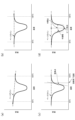
- FIG. 4 is a diagram for explaining a method of specifying a dissolution end temperature and a dissolution peak half width.
- the horizontal axis is temperature and the vertical axis is heat flow (unit: W / The DSC curve of g)) is obtained, and a pronounced dissolution peak usually appears with the dissolution of PVA in the analysis of hydrous PVA films.
- the dissolution end temperature in the present invention refers to the temperature of the higher temperature side of the two points of intersection between the baseline of the obtained DSC curve and the tangent line at the point of inflection of the DSC curve at the dissolution peak.
- the water-containing PVA film is defined by punching out the PVA film with a punch of 4 mm in diameter, filling 15 mg of the PVA film into a high-capacity pan for DSC made of stainless steel, further filling 75 mg of distilled water, closing the lid, It means a PVA film that has been held at 30°C for 10 minutes to absorb water.
- This hydrous PVA film contains 50 to 500 parts by mass of water with respect to 100 parts by mass of the PVA film.
- the PVA film of the present invention is a PVA film having a melting end temperature of 93°C or more and less than 96°C when the heat flow of the PVA film is measured in the presence of water. A method for specifying the melting end temperature will be described later.
- the melting end temperature is less than 93° C.
- the PVA film is likely to break when stretched at a high magnification at a high temperature. It is presumed that this is because the crystals in the PVA film melt at high temperatures and the strength of the film tends to decrease.
- the melting end temperature is preferably 93.5°C or higher, more preferably 94°C or higher, even more preferably 94.5°C or higher, and particularly preferably 95°C or higher.
- dissolution end temperature is 96° C. or higher, dissolution of the crystals in the PVA film becomes insufficient even when the film is stretched at a high temperature.
- the melting end temperature is preferably less than 95.8°C, more preferably less than 95.5°C, and even more preferably less than 95.3°C.
- a PVA solution having a volatile content of 90% by mass or less is used as a method for obtaining a PVA film having a dissolution end temperature of 93° C. or more and less than 96° C. when heat flow is measured with a differential scanning calorimeter in the presence of water. It is extruded into a film to form a film, dried at 90 ° C. to 95 ° C. when the volatile content of PVA is 20% by mass or more and 30% by mass or less, and the volatile content of PVA is 10% by mass or more and 20% by mass or less. and drying at 70° C. to 80° C. when the volatile content of PVA is 5% by mass or more and 10% by mass or less.
- the PVA film of the present invention preferably has a dissolution peak half width of 26.5°C or higher, more preferably 27.0°C or higher. It is considered that the half width of the dissolution peak has a certain degree of correlation with the distribution of crystal sizes, and the wider the half width of the dissolution peak, the wider the distribution of crystal sizes. A method for specifying the half width of the dissolution peak will be described later. The wider the half width of the dissolution peak, the easier it is for the tension during stretching to increase. Therefore, it is believed that the PVA molecules are more likely to be oriented during stretching, and the polarizing performance is likely to be improved. On the other hand, if the half width of the dissolution peak is too large, the dyeability of the dichroic dye may be lowered.
- a PVA solution having a volatile content of 90% by mass or less is discharged into a film, dried at 90 ° C. to 95 ° C. when the volatile content of PVA is 20% by mass or more and 30% by mass or less, and the volatile content of PVA is 10% by mass or more and 20% by mass.
- a method of drying at 80° C. to 90° C. under the following conditions and drying at 70° C. to 80° C. when the volatile content of PVA is 5% by mass or more and 10% by mass or less can be mentioned.
- the PVA that can be used is one produced by saponifying a vinyl ester polymer obtained by polymerizing a vinyl ester monomer.
- vinyl ester monomers include vinyl formate, vinyl acetate, vinyl propionate, vinyl valerate, vinyl laurate, vinyl stearate, vinyl benzoate, vinyl pivalate, vinyl versatate, and isopropenyl acetate.
- vinyl acetate is preferred from the viewpoints of ease of production of PVA, availability, cost, and the like.
- the above vinyl ester polymer is preferably obtained by using one or more vinyl ester monomers.
- vinyl ester monomers include, for example, ethylene; olefins having 3 to 30 carbon atoms such as propylene, 1-butene and isobutene; acrylic acid or salts thereof; methyl acrylate; ethyl acetate, n-propyl acrylate, i-propyl acrylate, n-butyl acrylate, i-butyl acrylate, t-butyl acrylate, 2-ethylhexyl acrylate, dodecyl acrylate, octadecyl acrylate, etc.
- Acrylic acid ester methacrylic acid or its salt; methyl methacrylate, ethyl methacrylate, n-propyl methacrylate, i-propyl methacrylate, n-butyl methacrylate, i-butyl methacrylate, t-butyl methacrylate, methacrylic acid methacrylic acid esters such as 2-ethylhexyl, dodecyl methacrylate, octadecyl methacrylate; acrylamide derivatives such as acrylamidopropyldimethylamine or its salts, N-methylolacrylamide or its derivatives; salts thereof, methacrylamide derivatives such as N-methylolmethacrylamide or derivatives thereof; N-vinylamides such as N-vinylformamide, N-vinylacetamide, N-vinylpyrrolidone; methyl vinyl ether, ethyl vinyl ether, n-propyl vinyl vinyl
- the proportion of structural units derived from other copolymerizable monomers in the above vinyl ester polymer is not necessarily limited as long as it does not interfere with the effects of the present invention. Based on the number, it is preferably 15 mol % or less, more preferably 5 mol % or less.
- PVA may or may not have some of its hydroxyl groups crosslinked. Part of the hydroxyl groups of the above PVA may react with aldehyde compounds such as acetaldehyde and butyraldehyde to form an acetal structure, or may form an acetal structure without reacting with these compounds. It doesn't have to be.
- the degree of polymerization of PVA is not particularly limited, but the lower limit of the degree of polymerization is preferably 800 or more, more preferably 1000 or more, more preferably 1500 or more from the viewpoint of film strength and optical performance. is more preferable.
- the upper limit of the degree of polymerization is preferably 10,000 or less, more preferably 5,000 or less, and even more preferably 4,000 or less from the viewpoint of PVA productivity and PVA film productivity.
- the degree of polymerization means the average degree of polymerization (P A ) measured according to the description of JIS K6726-1994.
- the degree of saponification of PVA is preferably 98 mol% or more, more preferably 99 mol% or more. If the degree of saponification is less than 98 mol%, the PVA film may have insufficient water resistance.
- the degree of saponification of PVA is the total number of moles of structural units (typically vinyl ester-based monomer units) that can be converted to vinyl alcohol units by saponification and vinyl alcohol units in PVA. refers to the ratio (mol%) occupied by the number of moles of The degree of saponification of PVA can be measured according to the description of JIS K6726-1994.
- the upper limit of the PVA content in the PVA film is preferably 100% by mass, more preferably 98% by mass, and even more preferably 96% by mass.
- the lower limit of the PVA content is preferably 50% by mass, more preferably 80% by mass, and even more preferably 85% by mass.
- the PVA film of the present invention can contain any component as long as it does not impair the effects of the present invention.
- Optional components include surfactants, antioxidants, plasticizers, ultraviolet absorbers, lubricants, pH adjusters, colorants, preservatives, antifungal agents, other polymer compounds than the above components, water, etc.
- other components of The PVA film can contain one or more of these optional components.
- the PVA film of the present invention it is one of preferred forms to further add a surfactant.
- a surfactant By blending the surfactant, it is possible to improve the handleability and the peelability from the film forming apparatus when producing the PVA film.
- an anionic surfactant or a nonionic surfactant can be used.
- anionic surfactants include carboxylic acid types such as potassium laurate; sulfuric acid ester types such as octyl sulfate; and sulfonic acid types such as dodecylbenzene sulfonate.
- nonionic surfactants include alkyl ether types such as polyoxyethylene lauryl ether and polyoxyethylene oleyl ether; alkylphenyl ether types such as polyoxyethylene octylphenyl ether; and alkyl ester types such as polyoxyethylene laurate.
- Alkylamine type such as polyoxyethylene laurylamino ether
- Alkylamide type such as polyoxyethylene lauric acid amide
- Polypropylene glycol ether type such as polyoxyethylene polyoxypropylene ether
- allylphenyl ether type such as polyoxyalkylene allylphenyl ether;
- One type of surfactant may be used alone, or two or more types may be used in combination.
- nonionic surfactants are preferred, and alkanolamide type surfactants are more preferred, since they are excellent in the effect of improving peelability during film formation.
- dialkanolamides eg, diethanolamide, etc.
- saturated or unsaturated aliphatic carboxylic acids having 8 to 30 carbon atoms.
- the content of the surfactant compounded in the PVA film of the present invention is preferably 0.01 parts by mass or more, more preferably 0.02 parts by mass or more, and 0.01 part by mass or more, based on 100 parts by mass of PVA. 05 parts by mass or more is more preferable. Also, it is preferably 1 part by mass or less, more preferably 0.5 parts by mass or less, and even more preferably 0.3 parts by mass or less. If the content is less than 0.01 part by mass, problems such as poor releasability from the film-forming apparatus during production of the PVA film or blocking between films tend to occur. On the other hand, when the content is more than 1 part by mass, problems such as bleeding out to the film surface and deterioration of the film appearance due to aggregation of the surfactant tend to occur.
- an antioxidant is preferably added in order to suppress coloring and deterioration due to oxidation of the surfactant.
- the type of antioxidant is not particularly limited, phenol-based, phosphite-based, thioester-based, benzotriazole-based, hindered amine-based, and other organic antioxidants are suitable examples.
- the antioxidant content in the PVA film of the present invention is preferably 0.01% by mass or more, more preferably 0.05% by mass or more, based on the mass of the surfactant.
- the antioxidant content is preferably 3% by mass or less, more preferably 1% by mass or less, based on the mass of the surfactant.
- the content of the antioxidant is less than 0.01% by mass based on the weight of the surfactant, the effect of suppressing oxidation may not be maintained for a longer period of time, and if it exceeds 3% by mass, oxidation
- the inhibitor can agglomerate and appear as defects on the PVA film, which can spoil the appearance.
- plasticizers include polyhydric alcohols such as ethylene glycol, glycerin, diglycerin, propylene glycol, diethylene glycol, triethylene glycol, tetraethylene glycol and trimethylolpropane. These plasticizers may be used alone or in combination of two or more. Among these plasticizers, glycerin is preferable from the viewpoint of the stretchability improvement effect when the PVA film of the present invention is stretched and used.
- the content of the plasticizer contained in the PVA film is preferably 1 part by mass or more, more preferably 3 parts by mass or more, and even more preferably 5 parts by mass or more with respect to 100 parts by mass of PVA. . Also, the content of the plasticizer is preferably 30 parts by mass or less, more preferably 20 parts by mass or less, and even more preferably 15 parts by mass or less with respect to 100 parts by mass of PVA. If the content of the plasticizer is less than 1 part by mass, the effect of improving mechanical properties such as impact strength and stretchability may be insufficient. On the other hand, if the content of the plasticizer exceeds 30 parts by mass, the film becomes too flexible, resulting in poor handleability, or the plasticizer bleeds out on the film surface, causing problems such as blocking between films. may occur.
- the thickness of the PVA film of the present invention is not particularly limited, and can be set to an appropriate thickness depending on the application. Specifically, when used as a raw material for a polarizing film, the average thickness is preferably in the range of 5 to 150 ⁇ m.
- the average thickness of the PVA film can be obtained by measuring the thickness at 10 arbitrary points (for example, 10 arbitrary points on a straight line drawn in the width direction of the PVA film) and calculating the average value thereof.
- the width of the PVA film of the present invention is not particularly limited, and can be appropriately set according to the use of the PVA film and the use of optical films such as polarizing films produced therefrom.
- the width of the PVA film is preferably 2 m or more, more preferably 3 m or more, further preferably 4 m or more, and is suitable for these applications.
- the width of the PVA film is preferably 7 m or less.
- the shape of the PVA film of the present invention is not particularly limited.
- a long film is preferred because it can be used as a film.
- a long film is preferably in the form of a film roll, for example, wound around a cylindrical core.
- the length of the PVA film (the length in the machine direction) is not particularly limited and can be appropriately set according to the application. The longer the film roll, the more loss can be reduced when switching film rolls. 8,000 m or more is particularly preferred.
- the upper limit of the length is not particularly limited, it can be, for example, 30,000 m or less.
- the form of the PVA film of the present invention is not particularly limited, and it may be in the form of a single layer (single layer film), or a laminate such as a PVA film formed on a thermoplastic resin film by a coating method or the like. may be in the form of
- the degree of swelling of the PVA film of the present invention is preferably in the range of 180 to 220% from the viewpoint of productivity and performance of the polarizing film.
- the degree of swelling of the PVA film is preferably 180% or higher, more preferably 190% or higher, even more preferably 195% or higher.
- the degree of swelling of the PVA film is preferably 220% or less, more preferably 210% or less, and even more preferably 205% or less.
- the degree of swelling of the PVA film can be adjusted to a smaller value, for example, by increasing the heat treatment temperature.
- the degree of swelling of the PVA film in the present invention refers to the degree of swelling determined by the following formula [I].
- the method for producing the PVA film of the present invention is not particularly limited, and it can be produced by a known method. For example, using a PVA solution obtained by dissolving PVA in a solvent as a film-forming stock solution, a casting film-forming method, a wet film-forming method (discharging into a poor solvent), a dry-wet film-forming method, a gel film-forming method (PVA A method of obtaining a PVA film by once cooling and gelling an aqueous solution and then removing the solvent by extraction), a method using a combination thereof, and a melt extrusion film-forming method in which a solvent-containing PVA is melted as a film-forming stock solution. Any method can be adopted. Among these, the casting film-forming method and the melt extrusion film-forming method are preferable because a PVA film having high transparency and little coloration can be obtained, and the casting film-forming method is more preferable.
- the method for producing a PVA film of the present invention is a method for producing a PVA film including a film forming process, a drying process B, a drying process C, and a drying process D.
- the film forming step in the method for producing a PVA film of the present invention is a step of forming a film by discharging a PVA solution having a volatile content of 90% by mass or less in the form of a film.
- a PVA solution is a solution in which PVA and each component are uniformly mixed with a solvent, and is prepared as a film-forming stock solution for forming a PVA film.
- a solvent for forming a PVA film.
- other components are added to homogenize the solution, or a mixture of PVA, a solvent, and a plasticizer. is supplied to an extruder and melted before adding other additives.
- Examples of the above solvent include water, dimethylsulfoxide, dimethylformamide, dimethylacetamide, N-methylpyrrolidone, ethylene glycol, glycerin, propylene glycol, diethylene glycol, triethylene glycol, tetraethylene glycol, trimethylolpropane, ethylenediamine, diethylenetriamine, and the like. mentioned. Among these, water is preferred from the viewpoints of low environmental load and recyclability. Only one of the above solvents may be used, or two or more thereof may be used in combination.
- the volatile content of the PVA solution is 90% by mass or less. If the volatile content of the PVA solution is higher than 90% by mass, the viscosity becomes too low, and the thickness uniformity of the PVA film tends to be impaired on the first drying roll.
- the lower limit of the volatile content of the PVA solution is not particularly limited. Since it may become difficult, it is preferable that it is 50 mass % or more. From the above viewpoints, the volatile content of the PVA solution is preferably 50% by mass or more, more preferably 55% by mass or more, and even more preferably 60% by mass or more. In view of the above, the volatile content of the PVA solution is preferably 90% by mass or less, more preferably 80% by mass or less, and even more preferably 75% by mass or less.
- the volatile content of the PVA solution mentioned above refers to the volatile content calculated by the following formula [II].
- Volatile content of PVA solution (% by mass) ⁇ (Wa-Wb)/Wa ⁇ x 100 [II]
- Wa represents the mass (g) of the PVA solution
- Wb represents the mass (g) after drying the PVA solution of Wa (g) in a dryer at 105 ° C. for 16 hours.
- a T-shaped slit die for example, a T-shaped slit die, a hopper plate, an I-shaped slit die, a lip coater die, or other known film-shaped ejection device (film-shaped casting device) is used to deposit the PVA. It is preferable to discharge (cast) the solution in the form of a film.
- the method for producing a PVA film of the present invention includes a drying step B in which a PVA film having a volatile content of 20% by mass or more and 30% by mass or less is dried at 90 ° C. to 95 ° C., and a volatile content of 10% by mass or more and 20% by mass. % or less of the PVA film at 80 ° C to 90 ° C, and a drying step D of drying the PVA film with a volatile content of 5 mass% or more and 10 mass% or less at 70 ° C to 80 ° C.
- the manufacturing method of the present invention includes a drying step A for reducing the volatile content to 30% by mass or less between the film forming step and the drying step B.
- the drying temperature in the drying step A is preferably 90°C or higher, more preferably 91°C or higher.
- the drying temperature in the drying step A is preferably 105°C or lower, more preferably 98°C or lower. If the temperature in the drying step A is too high, defects on the film surface tend to increase.
- the drying temperature in the drying step A refers to the surface temperature of the roll when the PVA film is dried on the roll.
- the drying temperature is preferably 90°C or higher, more preferably 92°C or higher.
- the drying temperature is preferably 95°C or less, more preferably 94°C or less.
- the drying temperature does not always need to be 90 to 95 ° C. when the volatile content is in the range, and the drying temperature is 90 to 95 ° C. even temporarily when the volatile content is in the range. If conditions exist, the PVA film of the present invention is obtained.
- the drying step B when the volatile content of the PVA film is 20% by mass or more and 30% by mass or less, the longer the drying temperature is 90 to 95° C., the easier it is to obtain the PVA film of the present invention.
- the time when the volatile content of the PVA film is 20% by mass or more and 30% by mass or less the time when the drying temperature is 90 to 95 ° C. is preferably 50% or more, and 70% or more. is more preferably 90% or more.
- the drying temperature in the drying step B refers to the surface temperature of the roll when the PVA film is dried on the roll.
- the drying temperature is preferably 80°C or higher, more preferably 82°C or higher.
- the drying temperature is preferably 90°C or less, more preferably 88°C or less.
- the drying temperature does not always need to be 80 to 90 ° C. when the volatile content is within the above range, and the drying temperature is set to 80 to 90 ° C. even temporarily when the volatile content is within the above range. If conditions exist, the PVA film of the present invention is obtained.
- the drying step C when the volatile content of the PVA film is 10% by mass or more and 20% by mass or less, the longer the drying temperature is 80 to 90° C., the easier it is to obtain the PVA film of the present invention.
- the time when the volatile content of the PVA film is 10% by mass or more and 20% by mass or less the time when the drying temperature is 80 to 90 ° C. is preferably 50% or more, and 70% or more. is more preferably 90% or more.
- the drying temperature in the drying step C refers to the surface temperature of the roll when the PVA film is dried on the roll.
- the drying temperature is preferably 70°C or higher, more preferably 72°C or higher, when the volatile content of the PVA film is 5% by mass or more and 10% by mass or less.
- the drying temperature is preferably 80° C. or less, more preferably 78° C. or less when the volatile content of the PVA film is 5% by mass or more and 10% by mass or less.
- the drying temperature does not always need to be 70 to 80 ° C. when the volatile content is within the range, and the drying temperature is set to 70 to 80 ° C. even temporarily when the volatile content is within the range. If conditions exist, the PVA film of the present invention is obtained.
- the drying step D when the volatile content of the PVA film is 5% by mass or more and 10% by mass or less, the longer the drying temperature is 70 to 80° C., the easier it is to obtain the PVA film of the present invention.
- the time when the volatile content of the PVA film is 5% by mass or more and 10% by mass or less is preferably 50% or more, preferably 70% or more. is more preferably 90% or more.
- the drying temperature in the drying step D refers to the surface temperature of the roll when the PVA film is dried on the roll.
- the method for drying the PVA solution discharged in the form of a film is not necessarily limited, but since it is easy to produce a uniform PVA film, it is preferable to use a plurality of units whose rotation axes are parallel to each other.
- a film-forming apparatus equipped with a drying roll the PVA solution is discharged in the form of a film onto the first roll of the film-forming apparatus to start drying, and the second roll and subsequent rolls downstream of the first roll are dried.
- a method of further drying with a roll to form a PVA film is preferred.
- the number of drying rolls is preferably 3 or more, more preferably 4 or more, and even more preferably 5 or more.
- the number of drying rolls is preferably 30 or less.
- the drying roll is preferably made of a metal such as iron or stainless steel, and more preferably the surface of the drying roll is made of a metallic material that is resistant to corrosion and has a specular gloss.
- first roll contact surface the film surface in contact with the first roll
- first roll non-contact surface the film surface in contact with the first roll
- the PVA solution discharged in the form of a film may be dried on the first roll only by heating from the first roll. Drying from both sides of the film is preferable from the viewpoint of uniformity of drying and drying rate.
- blow hot air to the first roll non-contact surface of the PVA film on the first roll it is preferable to blow hot air at a wind speed of 1 m / sec or more to the entire area of the first roll non-contact surface, and the wind speed is 2 m / It is more preferable to blow hot air at a speed of 3 m/second or more, and it is even more preferable to blow hot air at a wind speed of 3 m/second or more. It is preferable to blow hot air at a wind speed of 10 m/sec or less, more preferably at a wind speed of 8 m/sec or less, to the entire region of the first roll non-contact surface.
- the velocity of the hot air blown to the non-contact surface of the first roll is too low, condensation such as water vapor may occur on the surrounding equipment, which may drip onto the PVA film and cause defects in the PVA film.
- the velocity of the hot air blown to the non-contact surface of the first roll is too high, unevenness in thickness tends to occur in the PVA film.
- the temperature of the hot air blown to the first roll non-contact surface of the PVA film is preferably 50° C. or higher, more preferably 70° C. or higher, and 80° C. or higher from the viewpoint of drying efficiency, drying uniformity, etc. is more preferable.
- the temperature of the hot air blown to the first roll non-contact surface of the PVA film is preferably 150° C. or less, more preferably 120° C. or less, and 95° C. or less from the viewpoint of drying efficiency, drying uniformity, etc. is more preferable.
- the surface temperature of the first roll and the hot air temperature are 95 ° C. Lower temperatures are preferred.
- the control of the melting end temperature which is the object of the present invention, is strongly influenced by the temperature of the first roll contact surface.
- the method for blowing hot air to the non-contact surface of the first roll of the PVA film is not particularly limited, and hot air having a uniform wind speed or uniform temperature is blown uniformly to the non-contact surface of the first roll of the PVA film, preferably the entire surface. Any available method can be adopted. Among them, a nozzle system, a rectifying plate system, or a combination thereof is preferably employed.
- the direction in which the hot air is blown to the first roll non-contact surface of the PVA film is the direction substantially along the circumference of the first roll non-contact surface of the PVA film, even if it is the direction facing the first roll non-contact surface. (in a direction substantially along the circumference of the roll surface of the first roll) or in some other direction.
- the PVA film when the PVA film is dried on the first roll, it is preferable to exhaust the volatile matter generated from the PVA film and the hot air after blowing.
- the exhaust method is not particularly limited, it is preferable to employ an exhaust method that does not cause unevenness in wind speed and temperature of the hot air blown to the non-contact surface of the first roll of the PVA film.
- the PVA film dried on the first roll is peeled off from the first roll and then dried on the second roll. At this time, it is preferable to dry the PVA film with the second roll by making the first roll non-contact surface of the PVA film face and contact the second roll.
- the volatile content of the PVA film when peeled from the first roll is preferably 30% by mass or less. If the volatile content exceeds 30% by mass, the peeling may become uneven, resulting in problems such as uneven thickness.
- the volatile content of the PVA film when peeled from the first roll is more preferably 28% by mass or less, still more preferably 26% by mass or less, and particularly preferably 24% by mass or less.
- the PVA film dried on the second roll is peeled off from the second roll, and depending on the number of drying rolls provided in the film forming apparatus, etc., a plurality of rolls such as the third roll, the fourth roll, the fifth roll, etc. drying rolls in order.
- each drying roll from the second roll to the final roll must be controlled to the temperature specified in the present invention up to a volatile content of 5% by mass, depending on the volatile content of the PVA film.
- the PVA film dried to a volatile content of 5% by mass or less can be appropriately heat-treated according to the purpose.
- Heat treatment can be performed using heat treatment rolls or other known heat treatment equipment.
- the number of heat treatment rolls may be one or more, but in order to heat both sides of the film uniformly, heat treatment is preferably performed using two or more heat treatment rolls.
- the surface temperature of the heat treatment roll is preferably 90° C. or higher, more preferably 100° C. or higher, since the crystallization of PVA proceeds appropriately and a PVA film having excellent hot water resistance is obtained. ° C. or more is more preferable. Moreover, from the viewpoint of improving the stretchability of the obtained PVA film, the surface temperature of the heat treatment roll is preferably 150° C. or lower, more preferably 140° C. or lower, and even more preferably 130° C. or lower.
- the heat treatment time is not particularly limited, it is preferably 1 second or longer, more preferably 2 seconds or longer, so that the desired PVA film can be produced smoothly.
- the heat treatment time is not particularly limited, it is preferably 60 seconds or less, more preferably 10 seconds or less, so that the desired PVA film can be produced smoothly.
- the above film forming apparatus may have a hot air drying apparatus, a humidity control apparatus, etc., if necessary.
- the PVA film obtained as described above is subjected, if necessary, to hot-air drying and humidity control treatment, cutting of both ends (edges) of the PVA film, etc., and finally a roll of a predetermined length.
- the PVA film of the present invention can be obtained by winding the film into a shape.
- the volatile content of the PVA film finally obtained by the above series of treatments is preferably 1% by mass or more, more preferably 2% by mass or more.
- the volatile content of the finally obtained PVA film is preferably 5% by mass or less, more preferably 4% by mass or less.
- the polarizing film of the present invention can be obtained by using the PVA film of the present invention.
- the polarizing film has excellent polarizing performance.
- the method for producing a polarizing film using the PVA film of the present invention is not particularly limited, and any known method may be employed. Examples thereof include a method of dyeing a PVA film and then uniaxially stretching it, and a method of uniaxially stretching a PVA film containing a dye. Specific methods for producing the polarizing film include dyeing, uniaxial stretching, fixing treatment, drying treatment, and, if necessary, heat treatment of the PVA film of the present invention.
- the order of dyeing and uniaxial stretching is not particularly limited, and dyeing may be performed before uniaxial stretching, dyeing may be performed simultaneously with uniaxial stretching, or dyeing may be performed after uniaxial stretching.
- the steps such as uniaxial stretching and dyeing may be repeated multiple times. In particular, it is preferable to divide the uniaxial stretching into two or more times because it facilitates uniform stretching.
- dyes used for dyeing PVA films iodine or dichroic organic dyes (e.g., Direct Black 17, 19, 154; Direct Brown 44, 106, 195, 210, 223; Direct Red 2, 23, 28, 31, 37, 39 , 79, 81, 240, 242, 247; Direct Blue 1, 15, 22, 78, 90, 98, 151, 168, 202, 236, 249, 270; Direct Violet 9, 12, 51, 98; Direct Green 1, 85; Dichroic dyes such as Direct Yellow 8, 12, 44, 86, 87; Direct Orange 26, 39, 106, 107) can be used. These dyes can be used individually by 1 type or in combination of 2 or more types. Dyeing can be performed by immersing the PVA film in a solution containing the above dyes, but the treatment conditions and treatment method are not particularly limited.
- the uniaxial stretching of the PVA film may be performed by either a wet stretching method or a dry heat stretching method, but the wet stretching method is preferable from the viewpoint of the performance and quality stability of the resulting polarizing film.
- the wet stretching method includes stretching a PVA film in pure water, an aqueous solution containing various components such as additives and an aqueous medium, or a water dispersion in which various components are dispersed.
- Specific examples of the uniaxial stretching method by the wet stretching method include a method of uniaxial stretching in hot water containing boric acid, a method of uniaxial stretching in a solution containing the dye described above, and a method of uniaxial stretching in a fixing treatment bath described later.
- a PVA film containing water may be uniaxially stretched in the air, or may be uniaxially stretched by another method.
- the stretching temperature for uniaxial stretching is not particularly limited, but in the case of wet stretching, the temperature is preferably 20°C or higher, more preferably 25°C or higher, and still more preferably 30°C or higher. In wet stretching, the temperature is preferably 90° C. or lower, more preferably 70° C. or lower, and still more preferably 65° C. or lower. A temperature in the range of 50 to 180° C. is preferably employed for dry heat stretching.
- the stretch ratio for uniaxial stretching is preferably 4 times or more from the point of view of polarizing performance until just before the PVA film is cut. It is preferably 5 times or more, more preferably 5.5 times or more.
- the upper limit of the draw ratio is not particularly limited as long as the PVA film is not broken, but it is preferably 8.0 times or less for uniform drawing.
- the thickness of the PVA film after uniaxial stretching is preferably 1 ⁇ m or more, particularly preferably 3 ⁇ m or more.
- the thickness of the PVA film after uniaxial stretching is preferably 30 ⁇ m or less, particularly preferably 25 ⁇ m or less.
- the said thickness can measure the thickness of arbitrary five places, and can obtain
- fixing treatment is often carried out in order to strengthen the adsorption of the dye to the uniaxially stretched PVA film.
- a method of immersing the PVA film in a fixing treatment bath containing boric acid and/or a boron compound is generally widely adopted. At that time, if necessary, an iodine compound may be added to the treatment bath.
- the drying temperature is preferably 30° C. or higher, more preferably 50° C. or higher.
- the temperature of the drying treatment is preferably 150° C. or lower, and more preferably 140° C. or lower. If the drying temperature is too low, the dimensional stability of the obtained polarizing film tends to decrease.
- a protective film that is optically transparent and has mechanical strength can be attached to one or both sides of the polarizing film obtained as described above to form a polarizing plate.
- a protective film in that case, a cellulose triacetate (TAC) film, a cellulose acetate/butyrate (CAB) film, an acrylic film, a polyester film, or the like is used.
- the surface of the protective film is preferably modified by a known method such as corona treatment, plasma treatment, UV treatment, flame treatment, etc., as necessary, in order to improve the adhesive strength with the adhesive.
- a known method such as corona treatment, plasma treatment, UV treatment, flame treatment, etc.
- the polarizing plate obtained as described above can be used as a component of a liquid crystal display device by coating it with an acrylic adhesive or the like and then bonding it to a glass substrate. Before bonding the polarizing plate to the glass substrate, a retardation film, a viewing angle improving film, a luminance improving film, or the like may be attached.
- DSC differential scanning calorimeter
- the obtained DSC curve was baseline-corrected, and the dissolution peak temperature, the dissolution end temperature, and the half width of the dissolution peak were determined.
- the dissolution end temperature and the half width of the dissolution peak were obtained by the following procedure.
- (1) Dissolution end temperature As shown in FIG. 1(a), draw a straight line connecting points of 40° C. and 100° C. on the DSC curve, and use this as a baseline.
- (ii) As shown in FIG. 1(b), correct the DSC curve so that the baseline is parallel to the X-axis (temperature) of the DSC chart (baseline correction).
- baseline correction As shown in FIG.
- V (% by mass) ⁇ (Wc-Wd)/Wc ⁇ x 100 [IV]
- V is the volatile content (% by mass) of the PVA film
- Wc is the sample weight (g) of the PVA film
- Wd is the PVA film sample placed in a vacuum dryer at a temperature of 50 ° C. and a pressure of 0.1 kPa or less. The mass (g) after drying for 4 hours is shown.
- Example 1 100 parts by mass of PVA (degree of saponification 99.9 mol%, degree of polymerization 4000), 9 parts by mass of glycerin as a plasticizer, 0.1 part by mass of lauric acid diethanolamide as a surfactant, and 75% by mass of volatile content of water was prepared by heating and dissolving.
- the filtered PVA solution was discharged from a T-die onto a first roll having a surface temperature of 94° C. in the form of a film, and dried to a volatile content of 20% by mass (drying step A and drying step B). Hot air of 94° C. was blown at a speed of 5 m/sec over the entire film surface of the non-contact surface with the first roll to promote drying.
- the PVA film was peeled off from the first roll, and the non-contact surface of the first roll was opposed to the second roll having a surface temperature of 85° C. and dried until the volatile content reached 10% by mass (drying step C). Furthermore, the PVA film was peeled off from the second roll, and the non-contact surface of the second roll was opposed to the third roll having a surface temperature of 75 ° C. and dried until the volatile content reached 5% by mass (drying step D). . Then, after heat-treating with a heat-treating roll having a surface temperature of 110° C., the film was wound into a roll to obtain a PVA film (thickness: 30 ⁇ m, width: 3 m).
- a sample was cut from the central portion in the width direction of the obtained PVA film, and the differential scanning calorimeter (DSC) of the PVA film was measured in the presence of water. From the obtained dissolution curve, the dissolution peak temperature, the dissolution end temperature, and the half width of the dissolution peak were determined.
- DSC differential scanning calorimeter
- Example 2 100 parts by mass of PVA (degree of saponification 99.3 mol%, degree of polymerization 2400, modified with 2 mol% ethylene), 9 parts by mass of glycerin as a plasticizer, 0.1 parts by mass of lauric acid diethanolamide as a surfactant, and water
- a PVA solution having a volatile content of 70% by mass was prepared by heating and dissolving.
- the filtered PVA solution was discharged from a T-die onto a first roll having a surface temperature of 94° C. in the form of a film, and dried to a volatile content of 20% by mass (drying step A and drying step B). Hot air of 94° C.
- a sample was cut from the central portion in the width direction of the obtained PVA film, and the differential scanning calorimeter (DSC) of the PVA film was measured in the presence of water. From the obtained DSC curve, the dissolution peak temperature, the dissolution end temperature, and the half width of the dissolution peak were obtained.
- DSC differential scanning calorimeter
- Example 3 100 parts by mass of PVA (degree of saponification 99.9 mol%, degree of polymerization 2400), 9 parts by mass of glycerin as a plasticizer, 0.1 parts by mass of lauric acid diethanolamide as a surfactant, and a volatile content of 75% by mass consisting of water was prepared by heating and dissolving.
- the filtered PVA solution was discharged in a film form from a T-die onto a first roll having a surface temperature of 92° C. and dried to a volatile content of 20% by mass (drying step A and drying step B). Hot air of 92° C.
- the film was blown at a speed of 5 m/sec over the entire surface of the film, which was not in contact with the first roll, to promote drying.
- the PVA film was peeled off from the first roll, and the non-contact surface of the first roll was opposed to the second roll having a surface temperature of 80° C. and dried until the volatile content reached 10% by mass (drying step C).
- the PVA film was peeled off from the second roll, and the non-contact surface of the second roll was opposed to the third roll having a surface temperature of 75 ° C. and dried until the volatile content reached 5% by mass (drying step D).
- the film was wound into a roll to obtain a PVA film (thickness: 60 ⁇ m, width: 3 m).
- a sample was cut from the central portion in the width direction of the obtained PVA film, and the differential scanning calorimeter (DSC) of the PVA film was measured in the presence of water. From the obtained DSC curve, the dissolution peak temperature, the dissolution end temperature, and the half width of the dissolution peak were obtained.
- DSC differential scanning calorimeter
- Example 4 100 parts by mass of PVA (degree of saponification 99.9 mol%, degree of polymerization 2400), 9 parts by mass of glycerin as a plasticizer, 0.1 parts by mass of lauric acid diethanolamide as a surfactant, and a volatile content of 75% by mass consisting of water was prepared by heating and dissolving.
- the filtered PVA solution was discharged from a T-die onto a first roll having a surface temperature of 90° C. in the form of a film, and dried to a volatile content of 20% by mass (drying step A and drying step B). Hot air of 90° C. was blown at a speed of 5 m/sec over the entire film surface of the non-contact surface with the first roll to promote drying.
- the PVA film was peeled off from the first roll, and the non-contact surface of the first roll was opposed to the second roll having a surface temperature of 80° C. and dried until the volatile content reached 10% by mass (drying step C). Furthermore, the PVA film was peeled off from the second roll, and the non-contact surface of the second roll was opposed to the third roll having a surface temperature of 70 ° C. and dried until the volatile content reached 5% by mass (drying step D). . Then, after heat-treating with a heat-treating roll having a surface temperature of 110° C., the film was wound into a roll to obtain a PVA film (thickness: 60 ⁇ m, width: 3 m).
- a sample was cut from the central portion in the width direction of the obtained PVA film, and the differential scanning calorimeter (DSC) of the PVA film was measured in the presence of water. From the obtained DSC curve, the dissolution peak temperature, the dissolution end temperature, and the half width of the dissolution peak were determined.
- DSC differential scanning calorimeter
- the film was blown at a speed of 5 m/sec over the entire film surface of the non-contact surface with the first roll to promote drying.
- the PVA film was peeled off from the first roll, and the non-contact surface of the first roll was opposed to the second roll having a surface temperature of 80° C. and dried until the volatile content reached 10% by mass (drying step C).
- the PVA film was peeled off from the second roll, the non-contact surface of the second roll was opposed to a third dry roll having a surface temperature of 80 ° C., and dried until the volatile content reached 5% by mass (drying step D ).
- the film was wound into a roll to obtain a PVA film (thickness: 30 ⁇ m, width: 3 m).
- a sample was cut from the central portion in the width direction of the obtained PVA film, and the differential scanning calorimeter (DSC) of the PVA film was measured in the presence of water. From the obtained DSC curve, the dissolution peak temperature, the dissolution end temperature, and the half width of the dissolution peak were obtained.
- DSC differential scanning calorimeter
- the film was blown at a speed of 5 m/sec over the entire film surface of the non-contact surface with the first drying roll to promote drying.
- the PVA film was peeled off from the first drying roll, the non-contact surface of the first roll was opposed to the second drying roll having a surface temperature of 85 ° C., and dried until the volatile content reached 10% by mass (drying step C ).
- the PVA film was peeled off from the second drying roll, the second roll non-contact surface was opposed to the third drying roll having a surface temperature of 75 ° C., and dried until the volatile content reached 5% by mass (drying process D).
- the film was wound into a roll to obtain a PVA film (thickness: 30 ⁇ m, width: 3 m).
- a sample was cut from the central portion in the width direction of the obtained PVA film, and the differential scanning calorimeter (DSC) of the PVA film was measured in the presence of water. From the obtained DSC curve, the dissolution peak temperature, the dissolution end temperature, and the half width of the dissolution peak were determined.
- DSC differential scanning calorimeter
- a sample was cut from the central portion in the width direction of the obtained PVA film, and the differential scanning calorimeter (DSC) of the PVA film was measured in the presence of water. From the obtained DSC curve, the dissolution peak temperature, the dissolution end temperature, and the half width of the dissolution peak were determined.
- DSC differential scanning calorimeter
- the PVA film of the present invention was able to be stretched at a high magnification in hot water. More specifically, in Examples 1 to 4 having a dissolution end temperature of 93.2 to 95.3 ° C., the number of breaks when stretched 7 times in hot water at 70 ° C. was 0 to 1, and the stretching was performed at a high magnification. It can be seen that the occurrence of breakage at the time of bending is suppressed. Further, in Examples 1 to 4, the drying temperature in the drying step B was 90 to 94 ° C., the drying temperature in the drying step C was 80 to 85 ° C., and the drying temperature in the drying step D was 70 to 75 ° C.
Landscapes
- Physics & Mathematics (AREA)
- Chemical & Material Sciences (AREA)
- Manufacturing & Machinery (AREA)
- Engineering & Computer Science (AREA)
- Nonlinear Science (AREA)
- General Physics & Mathematics (AREA)
- Optics & Photonics (AREA)
- Materials Engineering (AREA)
- Mathematical Physics (AREA)
- Crystallography & Structural Chemistry (AREA)
- Health & Medical Sciences (AREA)
- Chemical Kinetics & Catalysis (AREA)
- Medicinal Chemistry (AREA)
- Polymers & Plastics (AREA)
- Organic Chemistry (AREA)
- Manufacture Of Macromolecular Shaped Articles (AREA)
- Shaping By String And By Release Of Stress In Plastics And The Like (AREA)
Priority Applications (3)
| Application Number | Priority Date | Filing Date | Title |
|---|---|---|---|
| CN202280086892.4A CN118574876A (zh) | 2021-12-28 | 2022-12-27 | 聚乙烯醇膜和聚乙烯醇膜的制造方法 |
| KR1020247007637A KR20240130071A (ko) | 2021-12-28 | 2022-12-27 | 폴리비닐알코올 필름 및 폴리비닐알코올 필름의 제조 방법 |
| JP2023571050A JPWO2023127874A1 (https=) | 2021-12-28 | 2022-12-27 |
Applications Claiming Priority (2)
| Application Number | Priority Date | Filing Date | Title |
|---|---|---|---|
| JP2021-214551 | 2021-12-28 | ||
| JP2021214551 | 2021-12-28 |
Publications (1)
| Publication Number | Publication Date |
|---|---|
| WO2023127874A1 true WO2023127874A1 (ja) | 2023-07-06 |
Family
ID=86999067
Family Applications (1)
| Application Number | Title | Priority Date | Filing Date |
|---|---|---|---|
| PCT/JP2022/048148 Ceased WO2023127874A1 (ja) | 2021-12-28 | 2022-12-27 | ポリビニルアルコールフィルム、及びポリビニルアルコールフィルムの製造方法 |
Country Status (5)
| Country | Link |
|---|---|
| JP (1) | JPWO2023127874A1 (https=) |
| KR (1) | KR20240130071A (https=) |
| CN (1) | CN118574876A (https=) |
| TW (1) | TW202342602A (https=) |
| WO (1) | WO2023127874A1 (https=) |
Cited By (1)
| Publication number | Priority date | Publication date | Assignee | Title |
|---|---|---|---|---|
| KR20250018943A (ko) * | 2023-07-31 | 2025-02-07 | 장 춘 페트로케미컬 컴퍼니 리미티드 | 폴리비닐알콜 필름, 그것으로 이루어진 광학 필름 및 그 제조 방법 |
Citations (5)
| Publication number | Priority date | Publication date | Assignee | Title |
|---|---|---|---|---|
| JPH10325905A (ja) * | 1997-05-23 | 1998-12-08 | Nippon Synthetic Chem Ind Co Ltd:The | ポリビニルアルコール系位相差フィルム |
| JP2012032789A (ja) * | 2010-07-02 | 2012-02-16 | Nippon Synthetic Chem Ind Co Ltd:The | ポリビニルアルコール系フィルム、ポリビニルアルコール系フィルムの製造方法、偏光フィルム及び偏光板 |
| WO2012132984A1 (ja) * | 2011-03-29 | 2012-10-04 | 株式会社クラレ | ポリビニルアルコール系重合体フィルムおよびその製造方法 |
| WO2013146147A1 (ja) * | 2012-03-30 | 2013-10-03 | 株式会社クラレ | ポリビニルアルコール系重合体フィルムおよびその製造方法 |
| WO2019054487A1 (ja) * | 2017-09-15 | 2019-03-21 | 株式会社クラレ | ポリビニルアルコールフィルム及びその製造方法 |
-
2022
- 2022-12-27 TW TW111150081A patent/TW202342602A/zh unknown
- 2022-12-27 CN CN202280086892.4A patent/CN118574876A/zh active Pending
- 2022-12-27 WO PCT/JP2022/048148 patent/WO2023127874A1/ja not_active Ceased
- 2022-12-27 KR KR1020247007637A patent/KR20240130071A/ko active Pending
- 2022-12-27 JP JP2023571050A patent/JPWO2023127874A1/ja active Pending
Patent Citations (5)
| Publication number | Priority date | Publication date | Assignee | Title |
|---|---|---|---|---|
| JPH10325905A (ja) * | 1997-05-23 | 1998-12-08 | Nippon Synthetic Chem Ind Co Ltd:The | ポリビニルアルコール系位相差フィルム |
| JP2012032789A (ja) * | 2010-07-02 | 2012-02-16 | Nippon Synthetic Chem Ind Co Ltd:The | ポリビニルアルコール系フィルム、ポリビニルアルコール系フィルムの製造方法、偏光フィルム及び偏光板 |
| WO2012132984A1 (ja) * | 2011-03-29 | 2012-10-04 | 株式会社クラレ | ポリビニルアルコール系重合体フィルムおよびその製造方法 |
| WO2013146147A1 (ja) * | 2012-03-30 | 2013-10-03 | 株式会社クラレ | ポリビニルアルコール系重合体フィルムおよびその製造方法 |
| WO2019054487A1 (ja) * | 2017-09-15 | 2019-03-21 | 株式会社クラレ | ポリビニルアルコールフィルム及びその製造方法 |
Cited By (2)
| Publication number | Priority date | Publication date | Assignee | Title |
|---|---|---|---|---|
| KR20250018943A (ko) * | 2023-07-31 | 2025-02-07 | 장 춘 페트로케미컬 컴퍼니 리미티드 | 폴리비닐알콜 필름, 그것으로 이루어진 광학 필름 및 그 제조 방법 |
| KR102898685B1 (ko) | 2023-07-31 | 2025-12-10 | 장 춘 페트로케미컬 컴퍼니 리미티드 | 폴리비닐알콜 필름, 그것으로 이루어진 광학 필름 및 그 제조 방법 |
Also Published As
| Publication number | Publication date |
|---|---|
| TW202342602A (zh) | 2023-11-01 |
| CN118574876A (zh) | 2024-08-30 |
| KR20240130071A (ko) | 2024-08-28 |
| JPWO2023127874A1 (https=) | 2023-07-06 |
Similar Documents
| Publication | Publication Date | Title |
|---|---|---|
| TWI711635B (zh) | 聚乙烯醇系聚合物薄膜及光學薄膜 | |
| CN106226858B (zh) | 聚乙烯醇系聚合物膜和偏光膜 | |
| TWI765093B (zh) | 聚乙烯醇薄膜及其製造方法 | |
| CN107614242A (zh) | 聚乙烯醇系聚合物膜和其制造方法 | |
| CN107000270B (zh) | 聚乙烯醇系聚合物膜及其制造方法 | |
| KR20150129861A (ko) | 폴리비닐알코올계 중합체 필름 및 그 제조 방법 | |
| CN107001671B (zh) | 聚乙烯醇膜 | |
| JP3476135B2 (ja) | 偏光フィルム用ポリビニルアルコールフィルムの製造法 | |
| EP4674899A1 (en) | Polyvinyl alcohol-based resin film, optical film, water-soluble film, and polyvinyl alcohol-based resin composition | |
| JP4149200B2 (ja) | 偏光フィルムの製造法 | |
| WO2023127874A1 (ja) | ポリビニルアルコールフィルム、及びポリビニルアルコールフィルムの製造方法 | |
| TWI837448B (zh) | 聚乙烯醇薄膜及使用其之偏光薄膜之製造方法 | |
| CN107406605A (zh) | 聚乙烯醇膜 | |
| JP3476137B2 (ja) | ポリビニルアルコール系重合体フィルムの製造法 | |
| CN112004881B (zh) | 聚乙烯醇膜和使用其而得的偏振膜的制备方法 | |
| TWI878407B (zh) | 光學用聚乙烯醇薄膜之製造方法 | |
| WO2020138286A1 (ja) | ポリビニルアルコールフィルム及びそれを用いた偏光フィルムの製造方法 | |
| CN112740085B (zh) | 聚乙烯醇膜和使用其的偏振膜的制造方法 | |
| JP6255300B2 (ja) | ポリビニルアルコール樹脂の製造方法 | |
| JP2004020636A (ja) | 偏光フィルムの製造法 |
Legal Events
| Date | Code | Title | Description |
|---|---|---|---|
| 121 | Ep: the epo has been informed by wipo that ep was designated in this application |
Ref document number: 22916096 Country of ref document: EP Kind code of ref document: A1 |
|
| WWE | Wipo information: entry into national phase |
Ref document number: 2023571050 Country of ref document: JP |
|
| WWE | Wipo information: entry into national phase |
Ref document number: 202280086892.4 Country of ref document: CN |
|
| NENP | Non-entry into the national phase |
Ref country code: DE |
|
| 122 | Ep: pct application non-entry in european phase |
Ref document number: 22916096 Country of ref document: EP Kind code of ref document: A1 |