WO2023127484A1 - 水中油型組成物 - Google Patents
水中油型組成物 Download PDFInfo
- Publication number
- WO2023127484A1 WO2023127484A1 PCT/JP2022/045828 JP2022045828W WO2023127484A1 WO 2023127484 A1 WO2023127484 A1 WO 2023127484A1 JP 2022045828 W JP2022045828 W JP 2022045828W WO 2023127484 A1 WO2023127484 A1 WO 2023127484A1
- Authority
- WO
- WIPO (PCT)
- Prior art keywords
- oil
- mass
- phase
- water composition
- water
- Prior art date
- Legal status (The legal status is an assumption and is not a legal conclusion. Google has not performed a legal analysis and makes no representation as to the accuracy of the status listed.)
- Ceased
Links
Classifications
-
- A—HUMAN NECESSITIES
- A61—MEDICAL OR VETERINARY SCIENCE; HYGIENE
- A61K—PREPARATIONS FOR MEDICAL, DENTAL OR TOILETRY PURPOSES
- A61K47/00—Medicinal preparations characterised by the non-active ingredients used, e.g. carriers or inert additives; Targeting or modifying agents chemically bound to the active ingredient
- A61K47/30—Macromolecular organic or inorganic compounds, e.g. inorganic polyphosphates
- A61K47/32—Macromolecular compounds obtained by reactions only involving carbon-to-carbon unsaturated bonds, e.g. carbomers, poly(meth)acrylates, or polyvinyl pyrrolidone
-
- A—HUMAN NECESSITIES
- A61—MEDICAL OR VETERINARY SCIENCE; HYGIENE
- A61K—PREPARATIONS FOR MEDICAL, DENTAL OR TOILETRY PURPOSES
- A61K47/00—Medicinal preparations characterised by the non-active ingredients used, e.g. carriers or inert additives; Targeting or modifying agents chemically bound to the active ingredient
- A61K47/30—Macromolecular organic or inorganic compounds, e.g. inorganic polyphosphates
- A61K47/34—Macromolecular compounds obtained otherwise than by reactions only involving carbon-to-carbon unsaturated bonds, e.g. polyesters, polyamino acids, polysiloxanes, polyphosphazines, copolymers of polyalkylene glycol or poloxamers
-
- A—HUMAN NECESSITIES
- A61—MEDICAL OR VETERINARY SCIENCE; HYGIENE
- A61K—PREPARATIONS FOR MEDICAL, DENTAL OR TOILETRY PURPOSES
- A61K8/00—Cosmetics or similar toiletry preparations
- A61K8/02—Cosmetics or similar toiletry preparations characterised by special physical form
- A61K8/04—Dispersions; Emulsions
- A61K8/06—Emulsions
-
- A—HUMAN NECESSITIES
- A61—MEDICAL OR VETERINARY SCIENCE; HYGIENE
- A61K—PREPARATIONS FOR MEDICAL, DENTAL OR TOILETRY PURPOSES
- A61K8/00—Cosmetics or similar toiletry preparations
- A61K8/18—Cosmetics or similar toiletry preparations characterised by the composition
- A61K8/72—Cosmetics or similar toiletry preparations characterised by the composition containing organic macromolecular compounds
- A61K8/81—Cosmetics or similar toiletry preparations characterised by the composition containing organic macromolecular compounds obtained by reactions involving only carbon-to-carbon unsaturated bonds
-
- A—HUMAN NECESSITIES
- A61—MEDICAL OR VETERINARY SCIENCE; HYGIENE
- A61K—PREPARATIONS FOR MEDICAL, DENTAL OR TOILETRY PURPOSES
- A61K9/00—Medicinal preparations characterised by special physical form
- A61K9/10—Dispersions; Emulsions
- A61K9/107—Emulsions ; Emulsion preconcentrates; Micelles
-
- A—HUMAN NECESSITIES
- A61—MEDICAL OR VETERINARY SCIENCE; HYGIENE
- A61P—SPECIFIC THERAPEUTIC ACTIVITY OF CHEMICAL COMPOUNDS OR MEDICINAL PREPARATIONS
- A61P17/00—Drugs for dermatological disorders
-
- A—HUMAN NECESSITIES
- A61—MEDICAL OR VETERINARY SCIENCE; HYGIENE
- A61Q—SPECIFIC USE OF COSMETICS OR SIMILAR TOILETRY PREPARATIONS
- A61Q19/00—Preparations for care of the skin
-
- A—HUMAN NECESSITIES
- A61—MEDICAL OR VETERINARY SCIENCE; HYGIENE
- A61Q—SPECIFIC USE OF COSMETICS OR SIMILAR TOILETRY PREPARATIONS
- A61Q19/00—Preparations for care of the skin
- A61Q19/10—Washing or bathing preparations
-
- B—PERFORMING OPERATIONS; TRANSPORTING
- B01—PHYSICAL OR CHEMICAL PROCESSES OR APPARATUS IN GENERAL
- B01J—CHEMICAL OR PHYSICAL PROCESSES, e.g. CATALYSIS OR COLLOID CHEMISTRY; THEIR RELEVANT APPARATUS
- B01J13/00—Colloid chemistry, e.g. the production of colloidal materials or their solutions, not otherwise provided for; Making microcapsules or microballoons
Definitions
- the present disclosure relates to an oil-in-water composition in which an oil phase is dispersed in an aqueous phase.
- the oil-in-water emulsion composition is applied, for example, to external skin preparations such as cosmetics.
- emulsification (dispersion) of the oil is generally performed using a surfactant.
- there are also techniques for dispersing particles of an oil phase in an aqueous phase without using a surfactant see, for example, Patent Documents 1 and 2).
- Patent Document 1 discloses a cosmetic composition in which a silicone composition comprising a high-viscosity silicone or organopolysiloxane resin and a low-viscosity silicone oil is dispersed in the form of small spheres in an aqueous phase containing a crosslinked polyacrylic thickener. things are described.
- an oil phase containing solid oil and liquid oil, and an aqueous phase containing a water-soluble thickener the oil phase consists of fine particles having an average maximum primary particle size of 0.1 to 30 ⁇ m.
- a finely dispersed composition of oil is described in which the solid oil is crystallized in the fine particles.
- An oil-in-water composition in which the oil phase has large particles can have a unique appearance, as multiple particles appear to be floating in the composition.
- oil-in-water compositions with large particles in the oil phase tend to have low dispersion stability of the oil phase.
- the oil phase particles may be fragmented into small particles.
- the appearance of the composition changes when the oil phase particles are subdivided. For example, in the case of a highly transparent oil-in-water composition in which a plurality of oil phase particles appear to float immediately after preparation, when the oil phase particles are divided into a plurality of small particles by an external force, they may become cloudy. .
- the oil phase particles are small, and it is not possible to produce an appearance in which the oil phase particles are floating.
- a first aspect of the present disclosure provides an oil-in-water composition
- an oil-in-water composition comprising 50% to 99% by weight of an aqueous phase and 1% to 50% by weight of an oil phase.
- the L * value in the L * a * b * color space is 45 or greater.
- the aqueous phase has a viscosity of 2,000 mPa ⁇ s to 10,000 mPa ⁇ s at 25°C.
- the oil phase contains olefin oligomers.
- the average particle size of the oil phase is 0.05mm to 4mm.
- the difference between the refractive index of the oil phase and the refractive index of the water phase is 0.1 or more.
- the surfactant is 0.1% by mass or less relative to the mass of the oil-in-water composition.
- the oil-in-water composition of the present disclosure it is possible to present a clean appearance as if the oil phase particles were floating in the composition. Even if a strong external force is applied to the oil-in-water composition, the change in appearance is suppressed.
- the oil phase contains 10% by mass or more of olefin oligomer relative to the mass of the oil phase.
- the oil phase further contains liquid silicone oil.
- the olefin oligomer is 0.5 parts by mass or more with respect to 1 part by mass of the liquid silicone oil.
- the oil phase further contains polar oil.
- the olefin oligomer is 0.2 parts by mass or more with respect to 1 part by mass of the polar oil.
- the liquid silicone oil is 10% by mass or less with respect to the mass of the oil-in-water composition.
- the aqueous phase contains 0.1% by mass to 10% by mass of the carboxyvinyl polymer and its neutralizer relative to the mass of the oil-in-water composition.
- the silicone resin is 0.1% by mass or less with respect to the mass of the oil-in-water composition.
- the oil phase particles having a particle diameter of less than 0.05 mm account for 20% or less of the total number of oil phase particles.
- the oil phase is dispersed in the aqueous phase by an in-line continuous method.
- POE is an abbreviation for polyoxyethylene
- POP is an abbreviation for polyoxypropylene
- the numbers in parentheses after POE or POP represent the average number of added moles of POE or POP groups in the compound.
- the term “substantial amount” refers to the amount in which the addition of the compound can produce an effect.
- the oil-in-water composition of the present disclosure will be described.
- the oil-in-water compositions of the present disclosure have an aqueous phase and an oil phase dispersed in the aqueous phase.
- the water phase can be, for example, 50% by mass or more, 60% by mass or more, 70% by mass or more, or 80% by mass or more with respect to the mass of the oil-in-water composition.
- the water phase is, for example, 99% by mass or less, 95% by mass or less, 90% by mass or less, 80% by mass or less, 70% by mass or less, or 60% by mass or less with respect to the mass of the oil-in-water composition. can be done.
- the oil phase is, for example, 1% by mass or more, 5% by mass or more, 10% by mass or more, 20% by mass or more, 30% by mass or more, or 40% by mass or more with respect to the mass of the oil-in-water composition. can be done.
- the oil phase can be, for example, 50% or less, 40% or less, 30% or less, or 20% or less by weight of the oil-in-water composition.
- liquid refers to a substance that is liquid at 25°C under atmospheric pressure and has fluidity.
- Solid or solid in the present disclosure refers to a solid at 25°C under atmospheric pressure.
- the aqueous phase is liquid at 25° C. under atmospheric pressure.
- the aqueous phase can contain water.
- water water used in cosmetics, quasi-drugs, etc. can be used, and for example, purified water, ion-exchanged water, tap water, etc. can be used.
- Water is, for example, 50% by mass or more, 60% by mass or more, 70% by mass or more, 80% by mass or more, 90% by mass or more, or 95% by mass or more with respect to the mass of the oil-in-water composition.
- Water is, for example, 98% by mass or less, 95% by mass or less, 90% by mass or less, 85% by mass or less, 80% by mass or less, 70% by mass or less, or 60% by mass with respect to the mass of the oil-in-water composition can be:
- the content of water can be appropriately set according to the use of the composition.
- the aqueous phase can further contain lower alcohols, liquid polyhydric alcohols, and the like.
- lower alcohols examples include ethanol, propanol, isopropanol, isobutyl alcohol, t-butyl alcohol and the like.
- liquid polyhydric alcohols examples include glycerin, 1,3-butylene glycol, polyethylene glycol, diglycerin, and dipropylene glycol.
- the aqueous phase alone preferably has a viscosity of 2,000 mPa ⁇ s or more at 25°C.
- the viscosity of the aqueous phase alone at 25° C. can be 3,000 mPa ⁇ s or more, 4,000 mPa ⁇ s or more, 6,000 mPa ⁇ s or more, or 8,000 mPa ⁇ s or more. If the viscosity of the aqueous phase is less than 2,000 mPa ⁇ s, the viscosity of the composition will be low, resulting in poor usability.
- the aqueous phase alone preferably has a viscosity of 10,000 mPa ⁇ s or less at 25°C.
- the viscosity of the aqueous phase alone at 25° C. can be 8,000 mPa s or less, 7,000 mPa s or less, 6,000 mPa s or less, 5,000 mPa s or less, or 4,000 mPa s or less. can. If the viscosity of the aqueous phase exceeds 10,000 mPa ⁇ s, the viscosity of the composition becomes so high that it cannot be applied. Viscosity can be measured with a Brookfield viscometer (spindle number 1, number of revolutions 60 rpm) at 25°C.
- the oil-in-water composition of the present disclosure can further contain a thickening agent.
- Thickeners include, for example, gum arabic, carrageenan, karaya gum, tragacanth gum, carob gum, quince seed (quince), casein, dextrin, gelatin, sodium pectate, sodium alginate, methylcellulose, ethylcellulose, carboxymethylcellulose (CMC), and hydroxyethylcellulose.
- hydroxypropylcellulose polyvinyl alcohol (PVA), polyvinyl methyl ether (PVM), PVP (polyvinylpyrrolidone), sodium polyacrylate, carboxyvinyl polymer, locust bean gum, guar gum, tamarind gum, dialkyldimethylammonium cellulose sulfate, xanthan gum, silica
- PVA polyvinyl alcohol
- PVM polyvinyl methyl ether
- PVP polyvinylpyrrolidone
- sodium polyacrylate sodium polyacrylate
- carboxyvinyl polymer locust bean gum, guar gum, tamarind gum, dialkyldimethylammonium cellulose sulfate, xanthan gum
- silica examples include magnesium aluminum oxide, bentonite, hectorite, magnesium aluminum silicate (Vegum), laponite, silicic anhydride, taurate-based synthetic polymer, and acrylate-based synthetic polymer.
- the thickener is more preferably carboxyvinyl polymer (carbomer).
- the oil-in-water composition can further include a neutralizing agent for the carboxyvinyl polymer, such as potassium hydroxide.
- the carboxyvinyl polymer and its neutralizing agent can be, for example, 0.1% by mass or more relative to the mass of the oil-in-water composition.
- the carboxyvinyl polymer and its neutralizing agent can be, for example, 10% by mass or less with respect to the mass of the oil-in-water composition.
- the water phase preferably has an L * value of 45 or more as measured according to JIS Z 8781-4. If the L * value is less than 45, the water phase will appear cloudy.
- the refractive index of the aqueous phase is preferably 1.33 or less.
- the refractive index of the aqueous phase can be measured in accordance with Standards for Quasi-drug Ingredients 2021-20 "Refractive Index Measurement Method".
- Oil phase The oil phase can be either liquid or gel at atmospheric pressure and 25°C.
- the oil phase preferably contains olefin oligomers.
- Olefin oligomers may also be referred to as alpha olefin oligomers.
- Olefin oligomer refers to a liquid oil obtained by hydrogenating a low-polymerization polymer obtained by polymerizing ⁇ -olefin.
- a linear aliphatic ⁇ -olefin having 8 to 12 carbon atoms, preferably 10 carbon atoms is polymerized at a polymerization degree of 3 to 6, and then hydrogenated, and has a side chain. Hydrocarbons may be mentioned.
- the olefin oligomer is preferably 10% by mass or more with respect to the mass of the oil phase.
- the olefin oligomer is, for example, 20% by mass or more, 30% by mass or more, 40% by mass or more, 50% by mass or more, 60% by mass or more, 70% by mass or more, 80% by mass or more, 90% by mass or more, relative to the mass of the oil phase. % by mass or more, or 100% by mass. If the olefin oligomer content is less than 10% by mass, the oil phase particles tend to split due to external force.
- the olefin oligomer is, for example, 95% by mass or less, 90% by mass or less, 80% by mass or less, 70% by mass or less, 60% by mass or less, 50% by mass or less, or 40% by mass or less with respect to the mass of the oil phase. can do.
- the olefin oligomer is 0.5 parts by mass or more, preferably 1 part by mass or more, preferably 1.5 parts by mass or more, preferably 2 parts by mass with respect to 1 part by mass of the liquid silicone oil. parts by mass or more, more preferably 2.5 parts by mass or more, more preferably 3 parts by mass or more, more preferably 3.5 parts by mass or more, more preferably 4 parts by mass or more, more preferably 4.5 parts by mass or more, More preferably, it is 5 parts by mass or more. If the amount of silicone oil is less than 0.5 parts by mass, the oil phase particles tend to split against external force.
- Liquid silicone oil is, for example, 10% by mass or less, 5% by mass or less, 3% by mass or less, 2% by mass or less, 1% by mass or less, 0.5% by mass or less, or 0% by mass with respect to the mass of the oil phase % (no content).
- the olefin oligomer is 0.2 parts by mass or more, preferably 0.5 parts by mass or more, preferably 0.8 parts by mass or more, preferably 1 part by mass with respect to 1 part by mass of the polar oil. .2 parts by mass or more, preferably 1.5 parts by mass or more, preferably 2 parts by mass or more, more preferably 2.5 parts by mass or more, more preferably 3 parts by mass or more, more preferably 3.5 parts by mass or more; More preferably 4 parts by mass or more, more preferably 4.5 parts by mass or more, and even more preferably 5 parts by mass or more. Since the polar oil has good compatibility with water, when the relative amount of the olefin oligomer to the polar oil is reduced, the oil phase particles are likely to split due to external force.
- polar oils referred to in this disclosure refer to ester oils, higher fatty acids, and higher alcohols.
- the oil phase can contain a thickening agent and/or a gelling agent.
- a thickening agent for example, (castor oil/IPID) copolymer, polyurethane-79, dextrin palmitate, etc. can be used.
- the storage modulus of the oil phase is higher than the loss modulus at 25°C.
- the storage modulus is higher than the loss modulus, the oil phase particles are less likely to split (fragmentate) when the oil-in-water composition receives a strong external force (impact), and the stability can be further enhanced.
- the storage modulus can be measured by vibration measurement using a rheometer.
- Loss modulus can be measured by vibration measurement using a rheometer.
- the oil phase can contain solid oil.
- a solid oil can be dispersed by dissolving it in a liquid oil, or by making it into a molten state at the time of dispersion.
- the solid oil content is preferably 2% by mass or less, more preferably 1% by mass or less, and more preferably not contained (0% by mass) relative to the mass of the oil-in-water composition. If the solid oil content exceeds 2% by mass, the transparency of the oil-in-water composition tends to decrease.
- the oil phase can contain, for example, oil-soluble ultraviolet absorbers, waxes, liquid oils, solid oils, waxes, hydrocarbons, higher fatty acids, higher alcohols, synthetic ester oils, silicone oils, and the like.
- oil-soluble UV absorbers examples include benzoic acid-based UV absorbers (e.g., para-aminobenzoic acid (hereinafter abbreviated as PABA), PABA monoglycerin ester, N,N-dipropoxy PABA ethyl ester, N,N-diethoxy PABA ethyl ester, N,N-dimethyl PABA ethyl ester, N,N-dimethyl PABA butyl ester, N,N-dimethyl PABA ethyl ester, diethylaminohydroxybenzoyl hexyl benzoate, etc.); N-acetylanthranilate, etc.); salicylic acid-based UV absorbers (e.g., ethylhexyl salicylate, amyl salicylate, menthyl salicylate, homomenthyl salicylate, octyl salicylate, phenyl salicylate, benzyl salicylate,
- Waxes include, for example, beeswax, candelilla wax, cotton wax, carnauba wax, bayberry wax, wart wax, whale wax, montan wax, bran wax, lanolin, kapok wax, lanolin acetate, liquid lanolin, sugar cane wax, isopropyl lanolin fatty acid, hexyl laurate, reduced lanolin, Jojoba wax, hard lanolin, shellac wax, POE lanolin alcohol ether, POE lanolin alcohol acetate, POE cholesterol ether, lanolin fatty acid polyethylene glycol, POE hydrogenated lanolin alcohol ether, such as liquid paraffin, ozokerite, squalane, pristane, paraffin, ceresin, squalene , vaseline, microcrystalline wax, Fischer-Tropsch wax, and the like.
- liquid oils examples include avocado oil, camellia oil, turtle oil, macadamia nut oil, corn oil, mink oil, olive oil, rapeseed oil, egg yolk oil, sesame oil, persic oil, wheat germ oil, sasanqua oil, castor oil, and linseed oil. , safflower oil, cottonseed oil, perilla oil, soybean oil, peanut oil, tea seed oil, kaya oil, rice bran oil, sinagiri oil, Japanese paulownia oil, jojoba oil, germ oil, triglycerin, and the like.
- solid fats and oils examples include cacao butter, coconut oil, horse fat, hydrogenated coconut oil, palm oil, beef tallow, mutton tallow, hydrogenated beef tallow, palm kernel oil, lard, beef bone fat, Japanese wax kernel oil, hydrogenated oil, beef leg fat, Japanese wax, hydrogenated castor oil and the like.
- Waxes include, for example, beeswax, candelilla wax, cotton wax, carnauba wax, bayberry wax, wart wax, whale wax, montan wax, bran wax, lanolin, kapok wax, lanolin acetate, liquid lanolin, sugar cane wax, isopropyl lanolin fatty acid, hexyl laurate, and reduced lanolin. , jojoba wax, hard lanolin, shellac wax, POE lanolin alcohol ether, POE lanolin alcohol acetate, POE cholesterol ether, lanolin fatty acid polyethylene glycol, POE hydrogenated lanolin alcohol ether, and the like.
- hydrocarbon oils examples include liquid paraffin, ozokerite, squalane, pristane, paraffin, ceresin, squalene, petrolatum, and microcrystalline wax.
- higher fatty acids examples include lauric acid, myristic acid, palmitic acid, stearic acid, behenic acid, oleic acid, undecylenic acid, toric acid, isostearic acid, linoleic acid, linoleic acid, eicosapentaenoic acid (EPA), docosahexaenoic acid ( DHA) and the like.
- Higher alcohols include, for example, straight-chain alcohols (eg, lauryl alcohol, cetyl alcohol, stearyl alcohol, behenyl alcohol, myristyl alcohol, oleyl alcohol, cetostearyl alcohol, etc.); branched-chain alcohols (eg, monostearyl glycerin ether (bacyl alcohol ), 2-decyltetradecinol, lanolin alcohol, cholesterol, phytosterol, hexyldodecanol, isostearyl alcohol, octyldodecanol, etc.) can be used.
- straight-chain alcohols eg, lauryl alcohol, cetyl alcohol, stearyl alcohol, behenyl alcohol, myristyl alcohol, oleyl alcohol, cetostearyl alcohol, etc.
- branched-chain alcohols eg, monostearyl glycerin ether (bacyl alcohol ), 2-decyltetradecinol, lanolin alcohol,
- Synthetic ester oils include isopropyl myristate, cetyl octanoate, octyldodecyl myristate, isopropyl palmitate, butyl stearate, hexyl laurate, myristyl myristate, decyl oleate, hexyldecyl dimethyloctanoate, cetyl lactate, and myristyl lactate.
- silicone oils include dimethylpolysiloxane, methylhydrogenpolysiloxane, methylphenylpolysiloxane, stearoxymethylpolysiloxane, polyether-modified organopolysiloxane, fluoroalkyl/polyoxyalkylene co-modified organopolysiloxane, and alkyl-modified organopolysiloxane.
- terminal-modified organopolysiloxane terminal-modified organopolysiloxane, fluorine-modified organopolysiloxane, amino-modified organopolysiloxane, silicone gel, acrylic silicone, trimethylsiloxysilicate, silicone RTV rubber, and silicone compounds such as cyclopentasiloxane.
- the oil phase preferably has an average particle size of 0.05 mm or more.
- the average particle size of the oil phase can be, for example, 1 mm or more, 1.5 mm or more, or 2 mm or more. If the average particle size of the oil droplets is less than 0.05 mm, the oil-in-water composition will appear cloudy.
- the oil phase preferably has an average particle size of 4 mm or less.
- the average particle size of the oil phase can be, for example, 3.5 mm or less, 3 mm or less, 2.5 mm or less, 2 mm or less, or 1.5 mm or less. When the average particle size of the oil phase exceeds 4 mm, it becomes difficult to stably disperse the oil phase in the water phase.
- the average particle size of the oil phase can be the average value of the particle sizes of arbitrary 100 oil phase particles measured by microscopic observation.
- the number of oil phase particles with a particle diameter of less than 0.05 mm is preferably 20% or less of the total number of oil phase particles. If the oil phase particles less than 0.05 mm exceed 20%, the oil-in-water composition appears cloudy.
- the percentage of oil phase particles less than 0.05 mm can be the percentage in any 100 oil phase particles measured by microscopic observation.
- the oil phase preferably has an L * value of 45 or more as measured according to JIS Z 8781-4. If the L * value is less than 45, the oil phase particles will appear cloudy.
- the refractive index of the oil phase is preferably 1.43 or higher.
- the refractive index of the oil phase can be measured in accordance with Standards for Quasi-drug Ingredients 2021-20 "Refractive Index Measurement Method".
- the oil phase particles can be visually recognized in the aqueous phase, and it is more preferable that the interface between the aqueous phase and the oil phase can be clearly visually recognized.
- the difference between the refractive index of the oil phase and the refractive index of the water phase is preferably 0.1 or more. When the difference between the refractive index of the oil phase and the refractive index of the water phase is small, the interface between the oil phase and the water phase becomes unclear, making it difficult to see the particles of the oil phase.
- the surfactant is 0.5% by mass or less, preferably 0.3% by mass or less, more preferably 0.1% by mass, based on the mass of the oil-in-water composition.
- the silicone resin is preferably contained in an amount of 0.1% by mass or less, and preferably not contained (0% by mass), based on the mass of the oil-in-water composition.
- the transparency of the oil-in-water composition can be enhanced by reducing or eliminating the silicone resin.
- the oil-in-water composition of the present disclosure includes other components, such as powders, water-soluble alcohols, thickeners, moisturizers, film agents, water-soluble ultraviolet absorbers, metal ions, as long as the effects of the present disclosure are not impaired.
- a sequestering agent, an amino acid, an organic amine, a polymer emulsion, a pH adjuster, a skin nutrient, a vitamin, an antioxidant, an antioxidant assistant, a fragrance, etc. can be appropriately contained as necessary.
- Powders include, for example, inorganic powders (e.g., talc, kaolin, mica, sericite (sericite), muscovite, phlogopite, synthetic mica, red mica, biotite, slithiamite, calcined mica, calcined talc, vermiculite, Magnesium carbonate, calcium carbonate, aluminum silicate, barium silicate, calcium silicate, magnesium silicate, strontium silicate, metal tungstate, magnesium, silica, fumed silica, zeolite, glass, barium sulfate, calcined calcium sulfate ( Calcined gypsum), calcium phosphate, fluorapatite, hydroxyapatite, ceramic powder, metal soap (e.g.
- inorganic powders e.g., talc, kaolin, mica, sericite (sericite), muscovite, phlogopite, synthetic mica, red
- organic powder e.g. polyamide resin powder (nylon powder) , polyethylene powder, polymethyl methacrylate powder, polystyrene powder, copolymer resin powder of styrene and acrylic acid, benzoguanamine resin powder, polytetrafluoroethylene powder, cellulose powder, silicone resin powder, silk powder, wool powder, urethane powder etc.
- inorganic white pigments e.g., titanium dioxide, zinc oxide, etc.
- inorganic red pigments e.g., iron oxide (red iron oxide), iron titanate, etc.
- inorganic brown pigments ⁇ -iron oxide, etc.
- inorganic yellow system pigments yellow iron oxide, ocher, etc.
- inorganic black pigments black iron oxide, carbon black, low order titanium oxide, etc.
- inorganic purple pigments e.g., manganese violet, cobalt violet, etc.
- inorganic purple pigments e.g., manganese violet, cobalt violet, etc
- Red No. 202 Organic pigments such as Red No. 204, Red No. 205, Red No. 220, Red No. 226, Red No. 228, Red No. 405, Orange No. 203, Orange No. 204, Yellow No. 205, Yellow No. 401, and Blue No. 404, red No. 3, Red No. 104, Red No. 106, Red No. 227, Red No. 230, Red No. 401, Red No. 505, Orange No. 205, Yellow No. 4, Yellow No. 5, Yellow No. 202, Yellow No. 203, Green No. 3 and Blue No.
- Natural pigments e.g., chlorophyll, ⁇ -carotene, etc.
- Wax powder e.g., carnauba wax powder, etc.
- Starch powder e.g., corn starch powder, rice starch powder, etc.
- water-soluble alcohols include lower alcohols, polyhydric alcohols, polyhydric alcohol polymers, dihydric alcohol alkyl ethers, dihydric alcohol alkyl ethers, dihydric alcohol ether esters, glycerin monoalkyl ethers, sugar alcohols, At least one selected from monosaccharides, oligosaccharides, polysaccharides, derivatives thereof, and the like can be mentioned.
- Polyhydric alcohols include, for example, dihydric alcohols (e.g., ethylene glycol, propylene glycol, trimethylene glycol, 1,2-butylene glycol, 1,3-butylene glycol, tetramethylene glycol, 2,3-butylene glycol, pentamethylene glycol, 2-butene-1,4-diol, hexylene glycol, octylene glycol, etc.); trihydric alcohols (e.g., glycerin, trimethylolpropane, etc.); tetrahydric alcohols (e.g., 1,2,6 -pentaerythritol such as hexanetriol); pentahydric alcohols (e.g., xylitol, etc.); hexahydric alcohols (e.g., sorbitol, mannitol, etc.); polyhydric alcohol polymers (e.g., diethylene glycol, dipropylene glycol, tri
- dihydric alcohol alkyl ethers e.g., diethylene glycol monomethyl ether, diethylene glycol monoethyl ether, diethylene glycol monobutyl ether, diethylene glycol dimethyl ether, diethylene glycol diethyl ether, diethylene glycol butyl ether, diethylene glycol methyl ethyl ether, triethylene glycol monomethyl ether, triethylene glycol monoethyl ether, propylene glycol monomethyl ether, propylene glycol monoethyl ether, propylene glycol monobutyl ether, propylene glycol isopropyl ether, dipropylene glycol methyl ether, dipropylene glycol ethyl ether, dipropylene glycol butyl ether, etc.); dihydric alcohol ether ester (e.g., Ethylene glycol monomethyl ether acetate, ethylene glycol monoethyl ether acetate, ethylene glycol monobutyl ether
- Monosaccharides include, for example, 3-carbon sugar (eg, D-glycerylaldehyde, dihydroxyacetone, etc.), 4-carbon sugar (eg, D-erythrose, D-erythrulose, D-threose, erythritol, etc.), Five carbon sugars (e.g., L-arabinose, D-xylose, L-lyxose, D-arabinose, D-ribose, D-ribulose, D-xylulose, L- xylulose, etc.), hexoses (e.g., D-glucose, D-talose, D-psicose, D-galactose, D-fructose, L-galactose, L- mannose, D-tagatose, etc.), heptose (e.g., aldoheptose, heptulose, etc.), heptose
- oligosaccharides include at least one selected from sucrose, guntianose, umbelliferose, lactose, planteose, isoliquinoses, ⁇ , ⁇ -trehalose, raffinose, lignoses, umbilicine, stachyose, verbascoses, and the like. can be mentioned.
- polysaccharides include cellulose, quince seed, chondroitin sulfate, starch, galactan, dermatan sulfate, glycogen, gum arabic, heparan sulfate, hyaluronic acid, tragacanth gum, keratan sulfate, chondroitin, xanthan gum, mucoitin sulfate, guar gum, dextran, and keratosulfate. , locust bean gum, succinoglucan, caroninic acid and the like.
- Examples of other polyols include at least one selected from polyoxyethylene methyl glucoside (glucum E-10), polyoxypropylene methyl glucoside (glucum P-10), and the like.
- natural water-soluble polymers include plant-based polymers (e.g., gum arabic, tragacanth gum, galactan, guar gum, carob gum, karaya gum, carrageenan, pectin, agar, quince seed (quince), algecolloid (cassou extract), starch ( rice, corn, potato, wheat), glycyrrhizic acid); microbial macromolecules (e.g., xanthan gum, dextran, succinoglucan, pullulan, etc.); mentioned.
- plant-based polymers e.g., gum arabic, tragacanth gum, galactan, guar gum, carob gum, karaya gum, carrageenan, pectin, agar, quince seed (quince), algecolloid (cassou extract), starch ( rice, corn, potato, wheat), glycyrrhizic acid
- microbial macromolecules e.g., xanthan gum,
- semi-synthetic water-soluble polymers include starch-based polymers (e.g., carboxymethyl starch, methylhydroxypropyl starch, etc.); cellulose-based polymers (methylcellulose, ethylcellulose, methylhydroxypropylcellulose, hydroxyethylcellulose, sodium cellulose sulfate, hydroxypropylcellulose, carboxymethylcellulose, sodium carboxymethylcellulose, crystalline cellulose, cellulose powder, etc.); alginate-based polymers (eg, sodium alginate, propylene glycol alginate, etc.);
- moisturizing agents include polyethylene glycol, propylene glycol, glycerin, 1,3-butylene glycol, xylitol, sorbitol, maltitol, chondroitin sulfate, hyaluronic acid, mucoitin sulfate, caroninic acid, atelocollagen, and cholesteryl-12-hydroxystearate. , sodium lactate, bile salts, dl-pyrrolidone carboxylate, alkylene oxide derivatives, short-chain soluble collagen, diglycerin (EO) PO adducts, rose barra extract, yarrow extract, melilot extract and the like.
- EO diglycerin
- film-forming agents examples include anionic film-forming agents (e.g., (meth)acrylic acid/(meth)acrylic acid ester copolymer, methyl vinyl ether/maleic anhydride high polymer, etc.), cationic film-forming agents (e.g., cationic cellulose, dimethyldiallylammonium chloride polymer, dimethyldiallylammonium chloride/acrylamide copolymer, etc.), nonionic film agents (e.g., polyvinyl alcohol, polyvinylpyrrolidone, polyvinyl acetate, polyacrylate copolymer, (meth) acrylamide, polymer silicone, silicone resin, trimethylsiloxysilicate, etc.).
- anionic film-forming agents e.g., (meth)acrylic acid/(meth)acrylic acid ester copolymer, methyl vinyl ether/maleic anhydride high polymer, etc.
- cationic film-forming agents e.g., cationic cellulose
- water-soluble UV absorbers examples include benzophenone UV absorbers (eg, 2-hydroxy-4-methoxybenzophenone-5-sulfonate), benzylidene camphor UV absorbers (benzylidene camphor sulfonic acid, terephthalyl camphor sulfonic acid, etc.), phenylbenzimidazole-based UV absorbers (phenylbenzimidazole sulfonic acid, etc.), and the like.
- benzophenone UV absorbers eg, 2-hydroxy-4-methoxybenzophenone-5-sulfonate
- benzylidene camphor UV absorbers benzylidene camphor sulfonic acid, terephthalyl camphor sulfonic acid, etc.
- phenylbenzimidazole-based UV absorbers phenylbenzimidazole sulfonic acid, etc.
- sequestering agents include 1-hydroxyethane-1,1-diphosphonic acid, 1-hydroxyethane-1,1-diphosphonic acid tetrasodium salt, disodium edetate, trisodium edetate, and tetrasodium edetate. , sodium citrate, sodium polyphosphate, sodium metaphosphate, gluconic acid, phosphoric acid, citric acid, ascorbic acid, succinic acid, edetic acid, trisodium ethylenediaminehydroxyethyl triacetate, and the like.
- Amino acids include, for example, neutral amino acids (eg, threonine, cysteine, etc.); basic amino acids (eg, hydroxylysine, etc.).
- amino acid derivatives include sodium acyl sarcosinate (sodium lauroyl sarcosinate), acyl glutamate, sodium acyl ⁇ -alanine, glutathione, pyrrolidone carboxylic acid and the like.
- organic amines examples include monoethanolamine, diethanolamine, triethanolamine, morpholine, triisopropanolamine, 2-amino-2-methyl-1,3-propanediol, 2-amino-2-methyl-1-propanol, and the like. is mentioned.
- polymer emulsions examples include acrylic resin emulsions, polyethyl acrylate emulsions, acrylic resin liquids, polyacrylic alkyl ester emulsions, polyvinyl acetate resin emulsions, and natural rubber latex.
- pH adjusters examples include buffers such as lactic acid-sodium lactate, citric acid-sodium citrate, and succinic acid-sodium succinate.
- vitamins examples include vitamins A, B1, B2, B6, C, E and their derivatives, pantothenic acid and its derivatives, biotin, and the like.
- antioxidants examples include tocopherols, dibutylhydroxytoluene, butylhydroxyanisole, and gallic acid esters.
- antioxidant aids include phosphoric acid, citric acid, ascorbic acid, maleic acid, malonic acid, succinic acid, fumaric acid, cephalin, hexametaphosphate, phytic acid, and ethylenediaminetetraacetic acid.
- ingredients that can be blended include, for example, preservatives (ethylparaben, butylparaben, chlorphenesin, phenoxyethanol, etc.); ); whitening agent (e.g., placenta extract, saxifrage extract, arbutin, etc.); , coix seed, loofah, lily, saffron, cnidium, ginger, hypericum, ononis, garlic, red pepper, chimp, angelica, seaweed, etc.), activator (e.g., royal jelly, photosensitizer, cholesterol derivative, etc.); blood circulation promoter (e.g., , Nonylic Acid Vanillylamide, Nicotinic Acid Benzyl Ester, Nicotinic Acid ⁇ -Butoxyethyl Ester, Capsaicin, Zingerone, Cantharis Tincture, Ictamol, Tannic Acid, ⁇ -Borneol, Tocopherol Nicotinate, Inositol
- composition of the present disclosure contains caffeine, tannin, verapamil, tranexamic acid and its derivatives, various crude drug extracts such as licorice, Chinese quince, and Ichiyakuso, tocopheryl acetate, glycyrrhizic acid, glycyrrhizic acid and its derivatives or salts thereof, and the like.
- Pharmaceutical agents, whitening agents such as vitamin C, magnesium ascorbyl phosphate, ascorbyl glucoside, arbutin and kojic acid, amino acids such as arginine and lysine and their derivatives may also be contained as appropriate.
- the oil-in-water composition of the present disclosure preferably has an L * value of 45 or more as measured according to JIS Z 8781-4. If the L * value is less than 45, the appearance will appear cloudy.
- the L * value is a value measured for an oil-in-water composition that has not been subjected to an external force (impact) such as when measuring the rate of decrease in transparency described below after the oil-in-water composition is produced.
- the L * value of the oil-in-water composition to which no external force (impact) is applied is referred to as the first L * value.
- half the volume of the oil-in-water composition was placed in a polyethylene terephthalate container, and the oil-in-water composition was stirred 5 times with an amplitude of 30 cm / 2 seconds to apply an external force. Measurement was performed based on JIS Z 8781-4.
- the L * value is denoted as the second L * value.
- the transparency decrease rate is preferably less than 30. If the transparency decrease rate is less than 30, it can be considered that the splitting of the oil phase particles due to external force is suppressed, and the decrease in transparency is suppressed.
- oil-in-water composition of the present disclosure it may be difficult or almost impractical to directly specify the phase structure, dispersion state, etc. by composition. In such cases, the oil-in-water composition of the present disclosure should be allowed to be identified by its manufacturing method, which will be described later.
- the oil-in-water composition of the present disclosure can be a composition in which the oil phase is dispersed by an in-line continuous method. According to the in-line continuous method, the particle size distribution of the oil phase particles can be narrowed. In addition, even oil phase particles with a large average particle size can be dispersed in the water phase.
- the boundary between the oil phase and the water phase that is, the outline of the oil phase particles, can be clearly seen.
- the oil-in-water composition can exhibit a clean appearance as if the oil phase particles were floating in the composition.
- the oil phase and water phase are highly transparent. Also, the oil-in-water composition of the present disclosure has an average particle size and particle size distribution of the oil phase particles that does not cloud the appearance. Thereby, the oil-in-water composition of the present disclosure has high transparency.
- the oil-in-water composition of the present disclosure suppresses the splitting of oil phase particles into small particles even when subjected to external force and/or impact. In other words, the decrease in the average particle size of the oil phase particles and the increase in the oil phase particles with small particle sizes are suppressed. This prevents the oil phase particles from lowering the transparency of the oil-in-water composition when subjected to an external force and/or impact.
- the oil-in-water composition of the present disclosure it is possible to present a clean appearance as if the oil phase particles were floating in the composition. Even if a strong external force is applied to the oil-in-water composition, the change in appearance is suppressed.
- oil-in-water composition of the present disclosure When used as an external preparation for skin, the user can feel good freshness when applying the composition to the skin. By not using a surfactant, irritation to the skin can be reduced, and stickiness can be suppressed when applied to the skin. In addition, it can be used as an external preparation for skin that does not require wiping.
- the aqueous phase can be thickened to a predetermined viscosity with a thickening agent such as carboxyvinyl polymer.
- the oil phase can then be dispersed in the water phase. Dispersion of the oil phase can use, for example, so-called in-line mixing.
- In-line mixing may be dynamic stirring using power, or static stirring using a static mixer or the like.
- the in-line mixing device may be a pump that also serves as a liquid feeder.
- the dispersing step includes a supply step of supplying the aqueous phase component and the oil phase component to an in-line mixing device at a target mass ratio of the aqueous phase and the oil phase of ⁇ 10%, and an in-line so that the oil phase has a desired average particle size.
- a dispersing step of dispersing the oil phase into the aqueous phase in the mixing device and a discharging step of discharging the aqueous and oil phases (ie, the oil-in-water compositions of the present disclosure) from the in-line mixing device can be included. It is preferable to carry out the feeding step, the dispersing step and the discharging step at the same time.
- the amount of oil phase and the amount of water phase can be determined based on the above-mentioned contents.
- the particle size distribution of the oil phase particles can be narrowed.
- even oil phase particles having a large average particle size can be dispersed.
- oil-in-water composition of the present disclosure will be described below with examples. However, the oil-in-water compositions of the present disclosure are not limited to the following examples.
- the unit of the content of each component shown in each table is % by mass.
- Viscosity Viscosity was measured with a Brookfield viscometer (spindle number 1, number of revolutions 60 rpm) at 25°C.
- the refractive index of the oil phase was 1.45.
- the refractive index of the aqueous phase was 1.33.
- the refractive indices of the oil phase and the water phase were each measured according to the Quasi-drug Ingredients Standard 2021-20 "Refractive Index Measurement Method".
- the L * value of the oil-in-water composition to which no external force is applied is referred to as the first L * value.
- the oil phase could be stably dispersed.
- Test Examples 3 and 4 the external force stability could not be improved.
- Test Examples 5 and 6 it was possible to obtain an oil-in-water composition having a clear oil-water interface, high external force stability, and a good appearance. It is considered preferable that the amount of the olefin oligomer is 0.5 parts by mass or more with respect to 1 part by mass of the liquid silicone oil.
- Test Example 10 It is believed that in Test Example 10, the external force impact resistance was lowered because the oil phase was only polar oil. In Test Examples 7 to 9, it was possible to obtain an oil-in-water composition with high external force stability and good appearance. It is considered preferable that the olefin oligomer is 0.2 parts by mass or more with respect to 1 part by mass of the polar oil.
- Oil-in-water compositions were prepared by varying the viscosity of the aqueous phase. Table 3 shows the composition and results.
- the oil-in-water composition of the present disclosure can be applied, for example, to external skin preparations, cosmetics, cleansers, foods and beverages, etc. applied to the skin.
- the oil-in-water composition of the present disclosure can be applied to base cosmetics, top cosmetics, makeup cosmetics, antiperspirants, deodorants, sunscreen cosmetics, skin care agents, cleansers, and the like. .
Landscapes
- Health & Medical Sciences (AREA)
- Chemical & Material Sciences (AREA)
- Life Sciences & Earth Sciences (AREA)
- Veterinary Medicine (AREA)
- Animal Behavior & Ethology (AREA)
- General Health & Medical Sciences (AREA)
- Public Health (AREA)
- Epidemiology (AREA)
- Pharmacology & Pharmacy (AREA)
- Medicinal Chemistry (AREA)
- Dermatology (AREA)
- Organic Chemistry (AREA)
- Dispersion Chemistry (AREA)
- Chemical Kinetics & Catalysis (AREA)
- Inorganic Chemistry (AREA)
- Birds (AREA)
- Engineering & Computer Science (AREA)
- Bioinformatics & Cheminformatics (AREA)
- General Chemical & Material Sciences (AREA)
- Nuclear Medicine, Radiotherapy & Molecular Imaging (AREA)
- Proteomics, Peptides & Aminoacids (AREA)
- Cosmetics (AREA)
- Lubricants (AREA)
Abstract
Description
水相は、大気圧下、25℃において液状である。水相は、水を含むことができる。水としては、化粧料、医薬部外品等に使用される水を使用することができ、例えば、精製水、イオン交換水、水道水等を使用することができる。
水相は、単独で(すなわち、油相が存在していない状態で)、25℃において、2,000mPa・s以上の粘度を有すると好ましい。水相単独の粘度は、25℃において、3,000mPa・s以上、4,000mPa・s以上、6,000mPa・s以上、又は8,000mPa・s以上とすることができる。水相の粘度が2,000mPa・s未満であると、組成物の粘度が低くなって使用性が低下してしまう。水相は、単独で、25℃において、10,000mPa・s以下の粘度を有すると好ましい。水相単独の粘度は、25℃において、8,000mPa・s以下、7,000mPa・s以下、6,000mPa・s以下、5,000mPa・s以下、又は4,000mPa・s以下とすることができる。水相の粘度が10,000mPa・sを超えると、組成物の粘度が高くなり、塗布できなくなってしまう。粘度は25℃におけるブルックフィールド型粘度計(スピンドル番号1、回転数60rpm)で測定することができる。
水相は、JIS Z 8781-4に基づいて測定したL*値が45以上であると好ましい。L*値が45未満であると水相が濁って見えてしまう。
水相の屈折率は、1.33以下であると好ましい。水相の屈折率は医薬部外品原料規格2021 20「屈折率測定方法」に準拠して測定することができる。
油相は、大気圧、25℃において、液状及びゲル状のうちのいずれかとすることができる。
油相(油滴)は、0.05mm以上の平均粒径を有すると好ましい。油相の平均粒径は、例えば、1mm以上、1.5mm以上、又は2mm以上とすることができる。油滴の平均粒径が0.05mm未満であると、水中油型組成物が白濁して見えてしまう。油相は、4mm以下の平均粒径を有すると好ましい。油相の平均粒径は、例えば、3.5mm以下、3mm以下、2.5mm以下、2mm以下、又は1.5mm以下とすることができる。油相の平均粒径が4mmを超えると、油相を安定に水相中に分散させることが困難となる。油相の平均粒径は、顕微鏡観察によって測定された任意の100個の油相粒子の粒径の平均値とすることができる。
油相は、JIS Z 8781-4に基づいて測定したL*値が45以上であると好ましい。L*値が45未満であると油相粒子が濁って見えてしまう。
油相の屈折率は、1.43以上であると好ましい。油相の屈折率は医薬部外品原料規格2021 20「屈折率測定方法」に準拠して測定することができる。
本開示の水中油型組成物において、界面活性剤は、水中油型組成物の質量に対して、0.5質量%以下、好ましくは0.3質量%以下、より好ましくは0.1質量%以下、さらに好ましくは含有しない(0質量%である)と好ましい。界面活性剤を少なくするないしは含ませないことにより、肌への刺激を低減することができる。
本開示の水中油型組成物において、シリコーン樹脂は、水中油型組成物の質量に対して、0.1質量%以下、好ましくは含有しない(0質量%である)と好ましい。シリコーン樹脂を少なくするないしは含ませないことにより、水中油型組成物の透明性を高めることができる。
本開示の水中油型組成物は、本開示の効果を阻害しない範囲において、他の成分、例えば、粉末、水溶性アルコール、増粘剤、保湿剤、皮膜剤、水溶性紫外線吸収剤、金属イオン封鎖剤、アミノ酸、有機アミン、高分子エマルジョン、pH調整剤、皮膚栄養剤、ビタミン、酸化防止剤、酸化防止助剤、香料等を必要に応じて適宜含有することができる。
本開示の水中油型組成物は、JIS Z 8781-4に基づいて測定したL*値が45以上であると好ましい。L*値が45未満であると外観が白濁して見えてしまう。L*値は、水中油型組成物を作製後、下記の透明度低下率測定時のような外力(衝撃)を加えていない水中油型組成物について測定した値である。
水中油型組成物を作製後、外力(衝撃)を加えていない水中油型組成物のL*値を第1のL*値と表記する。次に、水中油型組成物をポリエチレンテレフタレート容器に容量の半量入れ、振幅30cm/2秒で5回撹拌して外力を与えた水中油型組成物について、JIS Z 8781-4に基づいて測定したL*値を第2のL*値と表記する。以下の式に基づき、第1のL*値からの第2のL*値の低下率(透明度低下率)を算出したとき、透明度低下率は30未満であると好ましい。透明度低下率が30未満であると、外力による油相粒子の分裂が抑制されており、透明度の低下が抑制されているとみなすことができる。
本開示の水中油型組成物の製造方法について説明する。まず、カルボキシビニルポリマー等の増粘剤で水相を所定の粘度まで増粘することができる。次に、油相を水相に分散させることができる。油相の分散は、例えば、いわゆるインライン混合を使用することができる。インライン混合は、動力を用いた動的撹拌であってもよいし、スタティックミキサ等を用いた静的撹拌であってもよい。インライン混合装置は、送液を兼ねたポンプであってもよい。分散工程は、目的とする水相と油相の質量比±10%で水相成分及び油相成分をインライン混合装置へ供給する供給工程と、油相が所望の平均粒子径となるようにインライン混合装置で油相を水相に分散する分散工程と、インライン混合装置から水相及び油相(すなわち、本開示の水中油型組成物)を排出する排出工程と、含むことができる。供給工程、分散工程、及び排出工程は同時に行うと好ましい。油相の量及び水相の量は、上述の含有率に基づいて決定することができる。
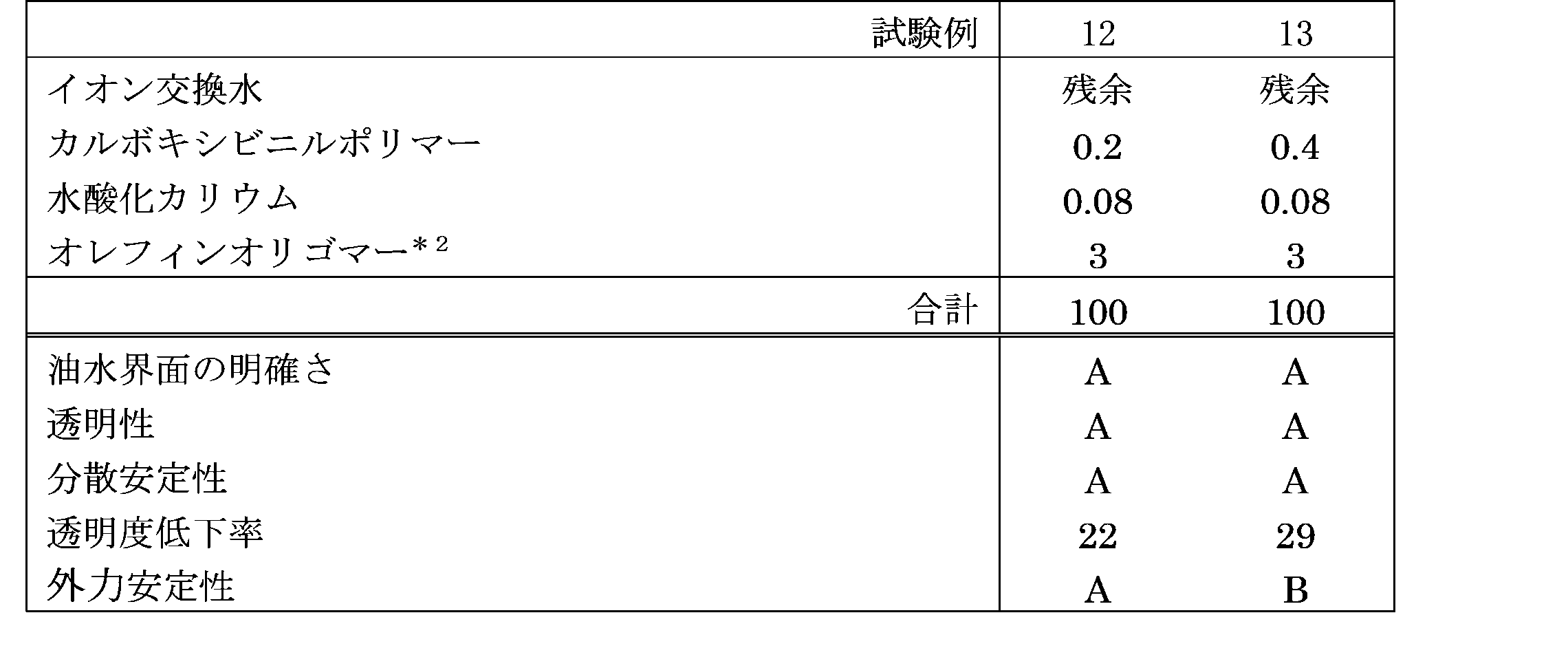
カルボキシビニルポリマーで増粘させて、4,000mPa・sの粘度を有する水相を作製した。次に、増粘させた水相、及び油相をダイナミックミキサに供給して、平均乳化粒子径が2mmとなるように、インライン乳化法を用いて油相を水相中に分散させた。作製した水中油型組成物について油水界面の明確さ、油相の透明性、分散安定性、及び外力(衝撃)を与えた時の透明性低下率を確認した。表1及び表2に組成及び結果を示す。
粘度は25℃におけるブルックフィールド型粘度計(スピンドル番号1、回転数60rpm)で測定した。
油相の屈折率は、1.45であった。水相の屈折率は、1.33であった。油相及び水相の屈折率は、それぞれ、医薬部外品原料規格2021 20「屈折率測定方法」に準拠して測定した。
透明な容器に入れた水中油型組成物の外観を目視で確認し、油相粒子の視認性について以下の基準で評価した。
A:油相と水相の界面が明確であり、油相の粒子が鮮明である;
B:油相と水相の界面が不明確であり、油相の粒子が不鮮明である。
作製後、外力を加えていない水中油型組成物の色空間をJIS Z 8781-4に基づいて測定し、以下の基準で外観を評価した。外力を与えていない水中油型組成物のL*値を第1のL*値と表記する。
A:第1のL*値が65以上であった;
B:第1のL*値が45以上65未満であった;
C:第1のL*値が45未満であった。
外力を加えていない水中油型組成物を60℃の環境に2週間静置した後、ボルテックスミキサーにて3,000rpmの振動を5分間掛けたときの油滴粒子の分散安定性を観察し、以下の基準で評価した。
A:油相粒子の合一、油相粒子の凝集、又は油浮きが観察されなかった;
B:油相粒子の合一、油相粒子の凝集、及び油浮きのいずれかが観察された。
水中油型組成物をポリエチレンテレフタレート容器に容量の半量入れ、振幅30cm/2秒で5回撹拌し、水中油型組成物に外力を与えた。外力を与えた後の水中油型組成物の色空間をJIS Z 8781-4に基づいて測定した。外力を与えた後の水中油型組成物のL*値を第2のL*値と表記する。以下の式に基づき、第1のL*値からの第2のL*値の低下率を算出して、以下の基準で透明度の低下を評価した。
A:L*値の低下が30未満であった;
B:L*値の低下が30以上であった。
水中油型組成物をポリエチレンテレフタレート容器に容量の半量入れ、振幅30cm/2秒で5回撹拌し、水中油型組成物に外力を与えた。外力を与える前と後の水中油型組成物の外観の変化を目視で確認した。
A:透明性に変化はなかった;
B:外力により透明性がやや低下した;
C:外力により白濁が生じた。


水相の粘度を変えて水中油型組成物を作製した。表3に組成及び結果を示す。
[付記1]
本開示の水中油型組成物を皮膚外用剤として使用する、水中油型組成物の使用方法。
[付記2]
本開示の水中油型組成物を化粧料として使用する、水中油型組成物の使用方法。
[付記3]
油相がインライン混合によって水相中に分散された、水中油型組成物。
Claims (9)
- 50質量%~99質量%の水相と、1質量%~50質量%の油相と、を含む水中油型組成物であり、
L*a*b*色空間におけるL*値が45以上であり、
前記水相は、25℃において2,000mPa・s~10,000mPa・sの粘度を有し、
前記油相はオレフィンオリゴマーを含み、
前記油相の平均粒子径は0.05mm~4mmであり、
前記油相の屈折率と前記水相の屈折率の差が0.1以上であり、
界面活性剤が水中油型組成物の質量に対して0.1質量%以下である、水中油型組成物。 - 前記油相は、前記油相の質量に対して10質量%以上のオレフィンオリゴマーを含む、請求項1に記載の水中油型組成物。
- 前記油相は、液状シリコーン油をさらに含み、
前記オレフィンオリゴマーは、前記液状シリコーン油1質量部に対して、0.5質量部以上である、請求項1又は2に記載の水中油型組成物。 - 前記油相は、極性油をさらに含み、
前記オレフィンオリゴマーは、前記極性油1質量部に対して、0.2質量部以上である、請求項1~3のいずれか一項に記載の水中油型組成物。 - 液状シリコーン油が水中油型組成物の質量に対して10質量%以下である、請求項1~4のいずれか一項に記載の水中油型組成物。
- 前記水相は、水中油型組成物の質量に対して、0.1質量%~10質量%のカルボキシビニルポリマー及びその中和剤を含む、請求項1~5のいずれか一項に記載の水中油型組成物。
- シリコーン樹脂が水中油型組成物の質量に対して0.1質量%以下である、請求項1~6のいずれか一項に記載の水中油型組成物。
- 粒子径0.05mm未満の前記油相の粒子が前記油相の総粒子数に対して20%以下である、請求項1~7のいずれか一項に記載の水中油型組成物。
- 前記油相は前記水相にインライン連続方式で分散された、請求項1~8のいずれか一項に記載の水中油型組成物。
Priority Applications (2)
| Application Number | Priority Date | Filing Date | Title |
|---|---|---|---|
| JP2023570812A JPWO2023127484A1 (ja) | 2021-12-27 | 2022-12-13 | |
| CN202280078599.3A CN118338957A (zh) | 2021-12-27 | 2022-12-13 | 水包油型组合物 |
Applications Claiming Priority (2)
| Application Number | Priority Date | Filing Date | Title |
|---|---|---|---|
| JP2021213238 | 2021-12-27 | ||
| JP2021-213238 | 2021-12-27 |
Publications (1)
| Publication Number | Publication Date |
|---|---|
| WO2023127484A1 true WO2023127484A1 (ja) | 2023-07-06 |
Family
ID=86998712
Family Applications (2)
| Application Number | Title | Priority Date | Filing Date |
|---|---|---|---|
| PCT/JP2022/045828 Ceased WO2023127484A1 (ja) | 2021-12-27 | 2022-12-13 | 水中油型組成物 |
| PCT/JP2022/046314 Ceased WO2023127536A1 (ja) | 2021-12-27 | 2022-12-16 | 水中油型組成物 |
Family Applications After (1)
| Application Number | Title | Priority Date | Filing Date |
|---|---|---|---|
| PCT/JP2022/046314 Ceased WO2023127536A1 (ja) | 2021-12-27 | 2022-12-16 | 水中油型組成物 |
Country Status (3)
| Country | Link |
|---|---|
| JP (2) | JPWO2023127484A1 (ja) |
| CN (1) | CN118338957A (ja) |
| WO (2) | WO2023127484A1 (ja) |
Citations (5)
| Publication number | Priority date | Publication date | Assignee | Title |
|---|---|---|---|---|
| JPH01250305A (ja) * | 1987-12-22 | 1989-10-05 | Kobayashi Kose Co Ltd | 化粧料用組成物 |
| JP2001220316A (ja) * | 2000-02-07 | 2001-08-14 | Shiseido Co Ltd | 化粧料組成物 |
| WO2012150705A1 (ja) * | 2011-05-04 | 2012-11-08 | 株式会社 資生堂 | 半透明フレグランス組成物 |
| JP2017200904A (ja) * | 2016-04-28 | 2017-11-09 | ロート製薬株式会社 | 外用組成物 |
| JP2020186227A (ja) * | 2019-05-07 | 2020-11-19 | 日光ケミカルズ株式会社 | 水中油型エマルション組成物 |
Family Cites Families (2)
| Publication number | Priority date | Publication date | Assignee | Title |
|---|---|---|---|---|
| JP6953476B2 (ja) * | 2013-12-18 | 2021-10-27 | ロレアル | 低量のアルコールを含むピッケリングエマルションの組成物 |
| JP6036874B2 (ja) * | 2014-02-21 | 2016-11-30 | 学校法人神奈川大学 | クレンジング組成物及びクレンジング用品 |
-
2022
- 2022-12-13 JP JP2023570812A patent/JPWO2023127484A1/ja active Pending
- 2022-12-13 WO PCT/JP2022/045828 patent/WO2023127484A1/ja not_active Ceased
- 2022-12-13 CN CN202280078599.3A patent/CN118338957A/zh active Pending
- 2022-12-16 WO PCT/JP2022/046314 patent/WO2023127536A1/ja not_active Ceased
- 2022-12-16 JP JP2023570849A patent/JPWO2023127536A1/ja active Pending
Patent Citations (5)
| Publication number | Priority date | Publication date | Assignee | Title |
|---|---|---|---|---|
| JPH01250305A (ja) * | 1987-12-22 | 1989-10-05 | Kobayashi Kose Co Ltd | 化粧料用組成物 |
| JP2001220316A (ja) * | 2000-02-07 | 2001-08-14 | Shiseido Co Ltd | 化粧料組成物 |
| WO2012150705A1 (ja) * | 2011-05-04 | 2012-11-08 | 株式会社 資生堂 | 半透明フレグランス組成物 |
| JP2017200904A (ja) * | 2016-04-28 | 2017-11-09 | ロート製薬株式会社 | 外用組成物 |
| JP2020186227A (ja) * | 2019-05-07 | 2020-11-19 | 日光ケミカルズ株式会社 | 水中油型エマルション組成物 |
Also Published As
| Publication number | Publication date |
|---|---|
| JPWO2023127484A1 (ja) | 2023-07-06 |
| CN118338957A (zh) | 2024-07-12 |
| JPWO2023127536A1 (ja) | 2023-07-06 |
| WO2023127536A1 (ja) | 2023-07-06 |
Similar Documents
| Publication | Publication Date | Title |
|---|---|---|
| KR101259529B1 (ko) | 액상 에스테르 조성물 및 이것을 함유하는 화장료 | |
| JP5972437B2 (ja) | 固形粉末化粧料の製造方法 | |
| US7956181B2 (en) | Trehalose fatty acid ester composition | |
| JP7198760B2 (ja) | 非水系用増粘剤及び増粘組成物 | |
| US20050118210A1 (en) | Water-in-oil emulsion preparation for external use on skin | |
| JP5477883B2 (ja) | 油中水型乳化組成物 | |
| KR20100017135A (ko) | 수중유형 유화 조성물과 그 제조 방법 | |
| JP5506130B2 (ja) | 水中油型エマルション | |
| JP2010024159A (ja) | 微細エマルション組成物、およびその製造方法 | |
| JP7114164B2 (ja) | 粉体含有水系組成物及び皮膚外用剤 | |
| EP4134067B1 (en) | Lamellar gel-containing composition, emulsified composition, and composition for agent for external use on skin | |
| WO2018088570A1 (ja) | 皮膚外用剤組成物 | |
| JP2008208046A (ja) | 油中水型乳化組成物 | |
| WO2022270350A1 (ja) | 透明洗浄料 | |
| JP7333711B2 (ja) | 水中油型乳化化粧料 | |
| JP7337842B2 (ja) | 洗浄剤組成物 | |
| JP2010024161A (ja) | 微細エマルション組成物、およびその製造方法 | |
| JP7595119B2 (ja) | 水中油型乳化組成物及びその製造方法 | |
| WO2023042687A1 (ja) | 水中油型洗浄料組成物 | |
| WO2023127536A1 (ja) | 水中油型組成物 | |
| WO2022196480A1 (ja) | 2層化粧料 | |
| JP2023023635A (ja) | 洗浄料 | |
| JP7316907B2 (ja) | 油性固形化粧料 | |
| JP2006045133A (ja) | 水中油型乳化組成物 | |
| WO2022259877A1 (ja) | 化粧料 |
Legal Events
| Date | Code | Title | Description |
|---|---|---|---|
| 121 | Ep: the epo has been informed by wipo that ep was designated in this application |
Ref document number: 22915708 Country of ref document: EP Kind code of ref document: A1 |
|
| ENP | Entry into the national phase |
Ref document number: 2023570812 Country of ref document: JP Kind code of ref document: A |
|
| WWE | Wipo information: entry into national phase |
Ref document number: 202280078599.3 Country of ref document: CN |
|
| NENP | Non-entry into the national phase |
Ref country code: DE |
|
| 122 | Ep: pct application non-entry in european phase |
Ref document number: 22915708 Country of ref document: EP Kind code of ref document: A1 |