WO2023120618A1 - シス型カロテノイド含有の乳化組成物及びシス型カロテノイド含有の乳化組成物の製造方法 - Google Patents
シス型カロテノイド含有の乳化組成物及びシス型カロテノイド含有の乳化組成物の製造方法 Download PDFInfo
- Publication number
- WO2023120618A1 WO2023120618A1 PCT/JP2022/047274 JP2022047274W WO2023120618A1 WO 2023120618 A1 WO2023120618 A1 WO 2023120618A1 JP 2022047274 W JP2022047274 W JP 2022047274W WO 2023120618 A1 WO2023120618 A1 WO 2023120618A1
- Authority
- WO
- WIPO (PCT)
- Prior art keywords
- cis
- carotenoid
- emulsified composition
- lycopene
- astaxanthin
- Prior art date
- Legal status (The legal status is an assumption and is not a legal conclusion. Google has not performed a legal analysis and makes no representation as to the accuracy of the status listed.)
- Ceased
Links
Images




















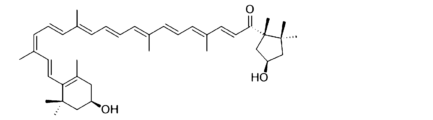

Classifications
-
- A—HUMAN NECESSITIES
- A23—FOODS OR FOODSTUFFS; TREATMENT THEREOF, NOT COVERED BY OTHER CLASSES
- A23L—FOODS, FOODSTUFFS OR NON-ALCOHOLIC BEVERAGES, NOT OTHERWISE PROVIDED FOR; PREPARATION OR TREATMENT THEREOF
- A23L33/00—Modifying nutritive qualities of foods; Dietetic products; Preparation or treatment thereof
- A23L33/10—Modifying nutritive qualities of foods; Dietetic products; Preparation or treatment thereof using additives
-
- A—HUMAN NECESSITIES
- A61—MEDICAL OR VETERINARY SCIENCE; HYGIENE
- A61K—PREPARATIONS FOR MEDICAL, DENTAL OR TOILETRY PURPOSES
- A61K31/00—Medicinal preparations containing organic active ingredients
- A61K31/01—Hydrocarbons
-
- A—HUMAN NECESSITIES
- A61—MEDICAL OR VETERINARY SCIENCE; HYGIENE
- A61K—PREPARATIONS FOR MEDICAL, DENTAL OR TOILETRY PURPOSES
- A61K31/00—Medicinal preparations containing organic active ingredients
- A61K31/12—Ketones
- A61K31/122—Ketones having the oxygen directly attached to a ring, e.g. quinones, vitamin K1, anthralin
-
- A—HUMAN NECESSITIES
- A61—MEDICAL OR VETERINARY SCIENCE; HYGIENE
- A61K—PREPARATIONS FOR MEDICAL, DENTAL OR TOILETRY PURPOSES
- A61K47/00—Medicinal preparations characterised by the non-active ingredients used, e.g. carriers or inert additives; Targeting or modifying agents chemically bound to the active ingredient
- A61K47/06—Organic compounds, e.g. natural or synthetic hydrocarbons, polyolefins, mineral oil, petrolatum or ozokerite
- A61K47/08—Organic compounds, e.g. natural or synthetic hydrocarbons, polyolefins, mineral oil, petrolatum or ozokerite containing oxygen, e.g. ethers, acetals, ketones, quinones, aldehydes, peroxides
- A61K47/14—Esters of carboxylic acids, e.g. fatty acid monoglycerides, medium-chain triglycerides, parabens or PEG fatty acid esters
-
- A—HUMAN NECESSITIES
- A61—MEDICAL OR VETERINARY SCIENCE; HYGIENE
- A61K—PREPARATIONS FOR MEDICAL, DENTAL OR TOILETRY PURPOSES
- A61K47/00—Medicinal preparations characterised by the non-active ingredients used, e.g. carriers or inert additives; Targeting or modifying agents chemically bound to the active ingredient
- A61K47/06—Organic compounds, e.g. natural or synthetic hydrocarbons, polyolefins, mineral oil, petrolatum or ozokerite
- A61K47/26—Carbohydrates, e.g. sugar alcohols, amino sugars, nucleic acids, mono-, di- or oligo-saccharides; Derivatives thereof, e.g. polysorbates, sorbitan fatty acid esters or glycyrrhizin
-
- A—HUMAN NECESSITIES
- A61—MEDICAL OR VETERINARY SCIENCE; HYGIENE
- A61K—PREPARATIONS FOR MEDICAL, DENTAL OR TOILETRY PURPOSES
- A61K8/00—Cosmetics or similar toiletry preparations
- A61K8/02—Cosmetics or similar toiletry preparations characterised by special physical form
- A61K8/04—Dispersions; Emulsions
- A61K8/06—Emulsions
-
- A—HUMAN NECESSITIES
- A61—MEDICAL OR VETERINARY SCIENCE; HYGIENE
- A61K—PREPARATIONS FOR MEDICAL, DENTAL OR TOILETRY PURPOSES
- A61K8/00—Cosmetics or similar toiletry preparations
- A61K8/18—Cosmetics or similar toiletry preparations characterised by the composition
- A61K8/30—Cosmetics or similar toiletry preparations characterised by the composition containing organic compounds
- A61K8/31—Hydrocarbons
-
- A—HUMAN NECESSITIES
- A61—MEDICAL OR VETERINARY SCIENCE; HYGIENE
- A61K—PREPARATIONS FOR MEDICAL, DENTAL OR TOILETRY PURPOSES
- A61K8/00—Cosmetics or similar toiletry preparations
- A61K8/18—Cosmetics or similar toiletry preparations characterised by the composition
- A61K8/30—Cosmetics or similar toiletry preparations characterised by the composition containing organic compounds
- A61K8/33—Cosmetics or similar toiletry preparations characterised by the composition containing organic compounds containing oxygen
- A61K8/37—Esters of carboxylic acids
-
- A—HUMAN NECESSITIES
- A61—MEDICAL OR VETERINARY SCIENCE; HYGIENE
- A61K—PREPARATIONS FOR MEDICAL, DENTAL OR TOILETRY PURPOSES
- A61K8/00—Cosmetics or similar toiletry preparations
- A61K8/18—Cosmetics or similar toiletry preparations characterised by the composition
- A61K8/30—Cosmetics or similar toiletry preparations characterised by the composition containing organic compounds
- A61K8/60—Sugars; Derivatives thereof
-
- A—HUMAN NECESSITIES
- A61—MEDICAL OR VETERINARY SCIENCE; HYGIENE
- A61K—PREPARATIONS FOR MEDICAL, DENTAL OR TOILETRY PURPOSES
- A61K8/00—Cosmetics or similar toiletry preparations
- A61K8/18—Cosmetics or similar toiletry preparations characterised by the composition
- A61K8/30—Cosmetics or similar toiletry preparations characterised by the composition containing organic compounds
- A61K8/67—Vitamins
-
- A—HUMAN NECESSITIES
- A61—MEDICAL OR VETERINARY SCIENCE; HYGIENE
- A61K—PREPARATIONS FOR MEDICAL, DENTAL OR TOILETRY PURPOSES
- A61K9/00—Medicinal preparations characterised by special physical form
- A61K9/10—Dispersions; Emulsions
- A61K9/107—Emulsions ; Emulsion preconcentrates; Micelles
-
- A—HUMAN NECESSITIES
- A61—MEDICAL OR VETERINARY SCIENCE; HYGIENE
- A61P—SPECIFIC THERAPEUTIC ACTIVITY OF CHEMICAL COMPOUNDS OR MEDICINAL PREPARATIONS
- A61P3/00—Drugs for disorders of the metabolism
- A61P3/04—Anorexiants; Antiobesity agents
-
- A—HUMAN NECESSITIES
- A61—MEDICAL OR VETERINARY SCIENCE; HYGIENE
- A61P—SPECIFIC THERAPEUTIC ACTIVITY OF CHEMICAL COMPOUNDS OR MEDICINAL PREPARATIONS
- A61P35/00—Antineoplastic agents
-
- A—HUMAN NECESSITIES
- A61—MEDICAL OR VETERINARY SCIENCE; HYGIENE
- A61P—SPECIFIC THERAPEUTIC ACTIVITY OF CHEMICAL COMPOUNDS OR MEDICINAL PREPARATIONS
- A61P39/00—General protective or antinoxious agents
- A61P39/06—Free radical scavengers or antioxidants
-
- A—HUMAN NECESSITIES
- A61—MEDICAL OR VETERINARY SCIENCE; HYGIENE
- A61Q—SPECIFIC USE OF COSMETICS OR SIMILAR TOILETRY PREPARATIONS
- A61Q19/00—Preparations for care of the skin
Definitions
- the present invention relates to a cis-carotenoid-containing emulsified composition and a cis-carotenoid-containing emulsified composition.
- Carotenoids which are widely present in nature, have a strong antioxidant effect and have a wide variety of color variations, so they are used in a wide range of applications such as health foods, cosmetics, and food coloring.
- Carotenoids have a structure consisting of a polyene moiety consisting of a conjugated double bond in which multiple carbons are continuous and end groups modified at both ends, and carotenes and molecules composed only of carbon and hydrogen atoms from the constituent atoms. They are classified as xanthophylls containing oxygen atoms such as alcohols, ketones, and epoxies.
- Patent Document 1 discloses a lutein-containing composition. By treating lutein, specific sucrose stearic acid monoester, decaglycerin stearic acid monoester, etc. under predetermined conditions, the dispersion stability of lutein in aqueous solvents and the long-term stability of the chemical structure of lutein It is said to improve performance.
- Patent Document 2 discloses an astaxanthin-containing cleansing cosmetic. It is described that in an oil sample (cleansing cosmetic) containing ethylhexyl palmitate or isopropyl palmitate and polyglyceryl-10 trilaurate, the solubility and stability of carotenoids are good, and the detergency is also excellent.
- Patent Document 3 discloses an anti-oxidative stress protective composition containing an astaxanthin emulsified composition as an active ingredient. It is described that an emulsified composition containing 20% oil of haematococcus algae pigment, decaglycerin monolaurate, sucrose stearate, etc. exhibits an excellent anti-oxidative stress protective effect.
- Patent Document 4 discloses an oily composition containing astaxanthin, lutein, or ⁇ -carotene.
- A a specific glycerin fatty acid ester or polyglycerin fatty acid ester having 1 to 2 glycerin units
- B a polyglycerin condensed ricinoleic acid ester
- C a specific poly having 5 to 10 glycerin units It is described that an oily composition containing a glycerol fatty acid ester has excellent dispersibility and excellent absorption of carotenoids into the body.
- JP 2020-048480 A JP 2011-241156 A JP 2020-138943 A JP 2020-015669 A
- Carotenoids have many conjugated double bonds in the molecule, and in general, all double bonds exist in the trans form of the trans form in nature. In recent years, it has become clear that cis-carotenoids have higher bioavailability and bioaccumulation than trans-carotenoids, as well as physiological activities (antioxidant, anticancer, anti-obesity, skin quality improvement, etc.). , its intake has attracted attention. In general, cis-carotenoids are obtained by heating trans-carotenoids, irradiating them with light, adding a catalyst, or the like. However, since cis carotenoids are unstable, their implementation is difficult.
- Patent Documents 1-4 are considered to mainly contain trans carotenoids as carotenoids. Moreover, in Patent Documents 1 and 2, although the stability of carotenoids as a whole is examined, changes in the ratio of cis-carotenoids in all carotenoids are not examined at all.
- the present invention has been made in view of the above circumstances, and provides a cis-carotenoid-containing emulsified composition in which the cis-carotenoid is stabilized and a method for producing the cis-carotenoid-containing emulsified composition. aim.
- the inventors of the present application have obtained new findings that when cis-carotenoids are stored in specific oils and fats or organic solvents, the ratio of cis-carotenoids in all carotenoids is reduced. When dissolved/suspended in a medium such as oil or organic solvent, cis-carotenoids are likely to easily return to the trans-form (isomerization). Therefore, product development of cis-astaxanthin was difficult.
- the inventor of the present application has set up a working hypothesis that the cis-structure is fixed in a state of being included in an emulsifier, making it difficult to return to the trans-type, and has made intensive studies on the relationship between cis-type carotenoids and emulsifiers to develop the technology of the present disclosure. reached.
- a cis-carotenoid-containing emulsified composition that is one aspect of the present invention is an emulsified composition containing a cis-carotenoid and at least one selected from the group consisting of polyglycerin fatty acid esters and sucrose fatty acid esters.
- the content of cis-carotenoids is 40% by mass or more relative to the total carotenoids.
- Another aspect of the present invention is a method for producing a cis-carotenoid-containing emulsified composition, in which a trans-carotenoid dissolved or suspended in a medium selected from organic solvents and fats and oils is cis-isomerized by heating to obtain cis-carotenoids for the entire carotenoid.
- a cis-carotenoid-containing solution having a carotenoid content of 40% by mass or more is obtained, and the cis-carotenoid-containing solution contains at least one selected from the group consisting of polyglycerol fatty acid esters and sucrose fatty acid esters.
- the solution is mixed and emulsified.
- a cis-carotenoid-containing emulsified composition in which cis-carotenoid is stabilized and a method for producing a cis-carotenoid-containing emulsified composition.
- FIG. 1 is a graph relating to encapsulation efficiency of a cis-lycopene-containing emulsified composition (No. 1).
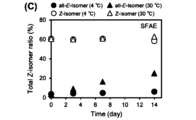
- 1 is a graph relating to the cis-carotenoid ratio of a cis-lycopene-containing emulsified composition (No. 1).
- 1 is a graph relating to the average particle size of a cis-lycopene-containing emulsified composition (No. 1).
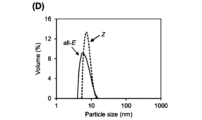
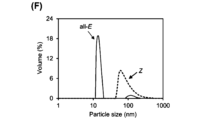
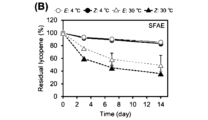
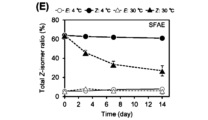
- 1 is a graph relating to the particle size distribution of polyoxyethylene sorbitan monolaurate. It is a graph regarding the particle size distribution of sucrose myristate. It is a graph regarding the particle size distribution of polyglycerin fatty acid ester. 1 is a graph relating to storage stability of a cis-lycopene-containing emulsified composition (No. 1). 1 is a graph relating to storage stability of a cis-lycopene-containing emulsified composition (No. 1). 1 is a graph relating to storage stability of a cis-lycopene-containing emulsified composition (No. 1).
- 1 is a graph relating to storage stability of a cis-lycopene-containing emulsified composition (No. 1).
- 1 is a graph relating to storage stability of a cis-lycopene-containing emulsified composition (No. 1).
- 1 is a graph relating to storage stability of a cis-lycopene-containing emulsified composition (No. 1).
- 1 is a graph relating to storage stability of a cis-lycopene-containing emulsified composition (No. 1).
- 1 is a graph relating to storage stability of a cis-lycopene-containing emulsified composition (No. 1).
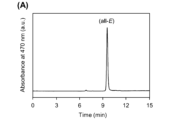
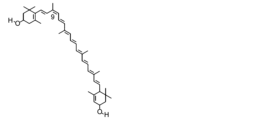
- 1 is a graph relating to storage stability of a cis-lycopene-containing emulsified composition (No. 1). It is the chemical structure of trans-astaxanthin. Chemical structure of 9-cis astaxanthin. 13 is the chemical structure of 13-cis astaxanthin. 1 is an HPLC chromatogram of astaxanthin contained in raw materials. HPLC chromatogram of astaxanthin after isomerization step. 4 is a graph relating to encapsulation efficiency of emulsified compositions containing cis-astaxanthin. 4 is a graph relating to the ratio of cis-carotenoids in emulsified compositions containing cis-astaxanthin.
- 1 is a graph relating to the average particle size of emulsified compositions containing cis-astaxanthin.
- 1 is a graph relating to the particle size distribution of polyoxyethylene sorbitan monolaurate. It is a graph regarding the particle size distribution of sucrose myristate. It is a graph regarding the particle size distribution of polyglycerin fatty acid ester.
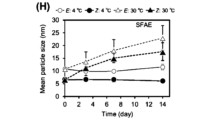
- 1 is a graph relating to storage stability of emulsified compositions containing cis-astaxanthin.
- 1 is a graph relating to storage stability of emulsified compositions containing cis-astaxanthin.
- 1 is a graph relating to storage stability of emulsified compositions containing cis-astaxanthin.
- 1 is a graph relating to storage stability of emulsified compositions containing cis-astaxanthin.
- 1 is a graph relating to storage stability of emulsified compositions containing cis-astaxanthin.
- 1 is a graph relating to storage stability of emulsified compositions containing cis-astaxanthin.
- 1 is a graph relating to storage stability of emulsified compositions containing cis-astaxanthin.
- 1 is a graph relating to storage stability of emulsified compositions containing cis-astaxanthin.
- 1 is a graph relating to storage stability of emulsified compositions containing cis-astaxanthin.
- 1 is a graph relating to storage stability of a cis-lycopene-containing emulsified composition (No. 2).
- 1 is a graph relating to storage stability of a cis-lycopene-containing emulsified composition (No. 2).
- It is an example of the chemical structure of cis ⁇ -carotene.
- It is an example of the chemical structure of cis- ⁇ -carotene.
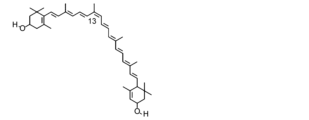
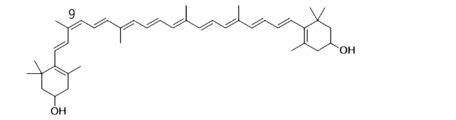
- Chemical structure of 9-cis lutein. 13 is the chemical structure of 13-cis lutein.
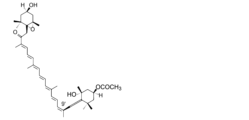
- It is the chemical structure of 9' cis-fucoxanthin.
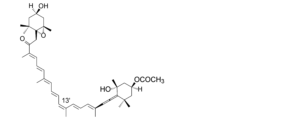
- 13' is the chemical structure of cis-fucoxanthin.
- 13 is the chemical structure of 13-cis fucoxanthin.
- the emulsified composition preferably has a volume-based average particle size of 120 nm or less as measured by a dynamic light scattering method.
- the content of cis-carotenoids relative to the total carotenoids in the emulsified composition is A (% by mass), and the emulsified composition is stored in a dark place at 30 ° C. for 14 days.
- the carotenoid content is B (% by mass)
- the cis-carotenoid-containing emulsified composition can be suitably stored at room temperature.
- the cis-carotenoid-containing emulsified composition described above is suitable for storage at room temperature.
- Cis-carotenoid-containing emulsified composition is an emulsified composition containing a cis-carotenoid and at least one selected from the group consisting of polyglycerol fatty acid esters and sucrose fatty acid esters. and the content of cis-carotenoids is 40% by mass or more relative to the total carotenoids.
- the cis-carotenoid-containing emulsified composition is also simply referred to as emulsified composition.
- the cis carotenoid may be a cis isomer of carotenes or a cis isomer of xanthophylls.
- Carotenes used in the present invention include ⁇ -carotene, ⁇ -carotene, ⁇ -carotene, toluene, lycopene and the like.
- Xanthophylls used in the present invention include astaxanthin, lutein, fucoxanthin, canthaxanthin, zeaxanthin, capsanthin, capsorubin, neoxanthin, violaxanthin, adonixanthin, adonirubin, 3-hydroxyechinenone, 3′.
- the cis carotenoid is preferably one or more cis isomers selected from the group consisting of lycopene, ⁇ -carotene, ⁇ -carotene, astaxanthin, lutein, fucoxanthin, canthaxanthin, zeaxanthin, capsanthin and capsorubin, Lycopene and astaxanthin are particularly preferred.
- cis-carotenoids are free forms and do not include ester forms.
- FIG. 10 is an example of the chemical structure of cis- ⁇ -carotene.
- FIG. 11 is an example of the chemical structure of cis- ⁇ -carotene.
- Figure 12A is the chemical structure of 9-cis lutein.
- Figure 12B is the chemical structure of 13-cis lutein.
- Figure 12C is the chemical structure of 15-cis lutein.
- Figure 13A is the chemical structure of 9' cis-fucoxanthin.
- Figure 13B is the chemical structure of 13' cis-fucoxanthin.
- Figure 13C is the chemical structure of 13-cis fucoxanthin.
- FIG. 14 is an example of the chemical structure of cis-zeaxanthin.
- FIG. 15 is an example of the chemical structure of cis-canthaxanthin.
- FIG. 16 is an example of the chemical structure of cis-capsanthin.
- FIG. 17 is an example of the chemical structure of cis-capsorubin.
- Raw materials used for the production of cis carotenoids include, for example, lycopene (chemical formula C40H56 , molecular weight 536.87 , manufacturer: Lycored Co., Ltd.), astaxanthin (chemical formula C40H52O4 , molecular weight 596.841, manufacturer: Fuji Film Wako Pure Chemical Industries, Ltd.), ⁇ -carotene (chemical formula C 40 H 56 , molecular weight 536.87 manufacturer: Fujifilm Wako Pure Chemical Industries, Ltd.), ⁇ -carotene (chemical formula C 40 H 56 , molecular weight 536.87 manufacturer) : FUJIFILM Wako Pure Chemical Industries, Ltd.), lutein (chemical formula C40H56O2 , molecular weight 568.87 , manufacturer: DHI Institute of Water and Environment (VKI)), fucoxanthin (chemical formula C42H58O6 , molecular
- the cis-carotenoid is more preferably cis-lycopene from the viewpoint of utilization in health foods, food dyes, and cosmetics.
- Cis-lycopene is an example of a cis-isomer of carotenes.
- Lycopene is a carotenoid represented by the chemical formula C 40 H 56 (molecular weight 536.87). Since lycopene has 11 conjugated double bonds, various cis isomers exist. In the present application, an isomer containing at least one of the 11 conjugated double bonds of lycopene in the cis form is referred to as cis-lycopene, and an isomer in which all are trans-lycopene is referred to as trans-lycopene.
- a simple term "lycopene” includes both cis-lycopene and trans-lycopene.
- carbon skeleton when the carbon skeleton is cis-type, its position is represented by a number.
- all-E represents trans-lycopene.
- 13Z represents 13-cis lycopene in which the carbon at position 13 is cis.
- 9Z represents 9-cis lycopene in which the 9-carbon is cis. Numbers 1-10 represent unidentified cis-lycopene.
- the cis-carotenoid is more preferably cis-astaxanthin from the viewpoint of utilization as health foods, food dyes, cosmetics, and coloring agents for animal feeds.
- Cis-astaxanthin is an example of a cis-isomer of xanthophylls.
- Astaxanthin is a type of carotenoid represented by the chemical formula C 40 H 52 O 4 (molecular weight 596.841). Astaxanthin, as shown in FIGS. 5A to 5C, is composed of a polyene chain consisting of nine conjugated double bonds and end groups (terminal groups) attached to both ends thereof.
- isomers containing at least one of the nine conjugated double bonds in the polyene chain in the cis form are referred to as cis-astaxanthin, and isomers in which all are trans-astaxanthin are referred to as trans-astaxanthin.
- the carbon skeleton is cis-type
- its position is represented by a number.
- all-E represents trans-astaxanthin.
- FIG. 6B shows that represents 13-cis astaxanthin in which the 9-carbon is cis.
- 13Z represents 13-cis astaxanthin in which the 13-position carbon is cis-type.
- xZ represents an unidentified cis-astaxanthin.
- the content of cis carotenoids relative to the total carotenoids is 40% by mass or more, preferably 45% by mass, from the viewpoint of bioavailability and accumulation, and physiological activity (antioxidant action, anticancer action, antiobesity action, etc.). % or more, more preferably 50 mass % or more, still more preferably 55 mass % or more, still more preferably 60 mass % or more.
- the above cis-carotenoid content is preferably 98% by mass or less, more preferably 95% by mass or less, and even more preferably 90% by mass or less, from the viewpoint of productivity.
- the above lower limit and upper limit of the cis-carotenoid content can be combined arbitrarily.
- the cis-carotenoid content is preferably 40% by mass or more and 98% by mass or less.
- the remainder of the cis-carotenoid content is the trans-carotenoid content.
- the content of cis-carotenoids (% by mass) based on the mass of carotenoids (100%) is also referred to simply as "ratio of cis-carotenoids (%)".
- the amount of carotenoids and the ratio (%) of cis carotenoids can be measured by HPLC (High Performance Liquid Chromatography) using a reversed-phase column or a normal-phase column. Quantitation is based on the peak area of each carotenoid isomer peak in the chromatogram.
- the cis-carotenoid ratio (%) can be determined by the following formula.
- the total carotenoid concentration in the emulsion composition is not particularly limited.
- Total carotenoid concentration is the total amount of cis carotenoids and trans carotenoids in the total emulsified composition.
- the total carotenoid concentration is preferably 0.001 mg/mL-100 mg/mL, more preferably 0.01 mg/mL-50 mg/mL, more preferably 0.1 mg/mL-20 mg/mL. preferable.
- the cis-carotenoid-containing emulsion composition contains, as an emulsifier (surfactant), at least one selected from the group consisting of polyglycerol fatty acid esters and sucrose fatty acid esters (hereinafter also referred to as a specific emulsifier). .
- emulsifier surfactant
- Polyglycerol fatty acid esters and sucrose fatty acid esters have been extensively used as food emulsifiers and are preferable from the viewpoint of safety.
- Polyglycerin fatty acid esters and sucrose fatty acid esters have a wider range of HLB (Hydrophilic-Lipophilic Balance) than other emulsifiers, and can be appropriately selected according to the type of carotenoid, the application of the emulsified composition, and the like.
- Polyglycerol fatty acid esters and sucrose fatty acid esters for example, preferably have HLB 11-19, more preferably 11-17.
- HLB is a numerical value representing the balance between hydrophobicity and hydrophilicity of an emulsifier, and can be obtained by emulsification experiments. When using a commercial product as an emulsifier, you may refer to a catalog value.
- Polyglycerin fatty acid ester is a nonionic surfactant composed of polyglycerin and fatty acid.
- the polyglycerin fatty acid ester can have desired properties by appropriately changing the degree of polymerization of polyglycerin, the type of fatty acid, the combination of polyglycerin and fatty acid, and the like.
- Polyglycerin which is a component of polyglycerol fatty acid ester, is not particularly limited.
- the average degree of polymerization of the constituent polyglycerin is preferably 5 or more, more preferably 6-14, still more preferably 8-12.
- a hydroxyl group terminal analysis method is generally used.
- the catalog value may be adopted as the average degree of polymerization of polyglycerin.
- the fatty acid that is a component of the polyglycerin fatty acid ester is not particularly limited.
- the constituent fatty acid is preferably a fatty acid having 8 or more carbon atoms, more preferably a fatty acid having 12-18 carbon atoms.
- Examples of fatty acids having 12-18 carbon atoms include lauric acid, myristic acid, palmitic acid, stearic acid and oleic acid. Among these, myristic acid is preferred.
- Polyglycerin fatty acid esters include decaglycerin myristate, decaglycerin laurate, decaglycerin palmitate, decaglycerin stearate, decaglycerin oleate, and the like. Among these, decaglycerin myristate is more preferred. Polyglycerol fatty acid esters may be used alone or in combination of two or more.
- the polyglycerol fatty acid ester is preferably used when the cis-carotenoid is a cis-isomer of carotenes, and more preferably when the cis-carotenoid is cis-lycopene.
- B/A which will be described later, can be 0.7 or more.
- polyglycerol fatty acid ester is preferably used when the cis-carotenoid is a cis-isomer of xanthophylls, and more preferably when the cis-carotenoid is cis-astaxanthin.
- B/A which will be described later, can be 0.8 or more.
- sucrose fatty acid ester is a nonionic surfactant composed of sucrose and fatty acid.
- the sucrose fatty acid ester can have desired properties by appropriately changing the type of fatty acid, monoester content, and the like.
- sucrose fatty acid esters have a particularly rich track record of use as food emulsifiers.
- the fatty acid that is a component of the sucrose fatty acid ester is not particularly limited.
- the constituent fatty acid is preferably a fatty acid having 8 or more carbon atoms, more preferably a fatty acid having 12-18 carbon atoms.
- Examples of fatty acids having 12 to 18 carbon atoms include myristic acid, palmitic acid, stearic acid, and oleic acid. Among these, myristic acid is preferred.
- the monoester content of the sucrose fatty acid ester is not particularly limited.
- the monoester content is preferably 50% by mass or more, more preferably 60% by mass or more, and still more preferably 70% by mass or more.
- the monoester content is preferably 95% by mass or less, more preferably 90% by mass or less.
- Sucrose fatty acid esters include sucrose myristate, sucrose stearate, sucrose palmitate, sucrose oleate and the like. Among these, sucrose myristate is more preferable. Sucrose fatty acid esters may be used alone or in combination of two or more.
- the sucrose fatty acid ester is preferably used when the cis-carotenoid is a cis-isomer of xanthophylls, and more preferably when the cis-carotenoid is cis-astaxanthin.
- B/A which will be described later, can be 0.9 or more.
- the content of the specific emulsifier in the emulsified composition is not particularly limited.
- the content of the specific emulsifier is preferably 0.05% by mass to 10% by mass, more preferably 0.1% by mass to 5% by mass, and still more preferably 0.2% by mass to 1% by mass of the entire emulsified composition. .
- the dispersion solvent for the emulsified composition is not particularly limited.
- the dispersion solvent is, for example, at least one selected from the group consisting of water, glycerin, propylene glycol, liquid sugar, reduced starch syrup, sugar alcohol, and the like, preferably water. These dispersion solvents may be used singly or in combination.
- the emulsified composition preferably contains an antioxidant as an optional component.
- Antioxidants selected from the group consisting of tocophenols, tocotrienols, polyphenols, glutathione, butylhydroxyanisole (BHA), dibutylhydroxytoluene (BHT), ascorbyl palmitate (PAVC), and ascorbic acid (VC) It is preferable that it is one or more kinds. Among these, tocophenols such as ⁇ -tocopherol are more preferable.
- the antioxidant is preferably used as a food additive.
- the concentration of antioxidant in the emulsified composition is preferably 0.01 mg/mL-10 mg/mL, more preferably 0.02 mg/mL-5 mg/mL, even more preferably 0.05 mg/mL-1 mg /mL.
- the emulsified composition also contains an isomerization-promoting catalyst that promotes cis-isomerization of carotenoids, a gelling agent that can be added to foods, a thickener, an excipient, a sugar, a protein, a salt, an acid, a flavor, Additives such as pigments may also be included.
- the emulsified composition may also contain other emulsifiers such as monoglycerin fatty acid esters and lecithin. As such optional ingredients, those that can be used in foods and drinks, cosmetics, and pharmaceuticals are suitable.
- Emulsified Particles in Emulsified Composition The emulsified composition is preferably an oil-in-water (o/w, w/o/w) emulsion composition from the viewpoint of inclusion of carotenoids.
- the diameter of the emulsion particles in the emulsion composition is not particularly limited.
- the volume-based average particle diameter measured using a dynamic light scattering method is preferably 120 nm or less, more preferably 100 nm or less, 80 nm or less, from the viewpoint of the stability of the cis-carotenoid. They are 60 nm or less, 45 nm or less, and 35 nm or less.
- the average particle size of emulsified particles in the emulsified composition is greater than 0 nm, for example 3 nm or more.
- the average particle size of emulsified particles in the emulsified composition is measured on a volume basis of dynamic light scattering. More specifically, for example, Ono, M., Hyundai, M., Wahyudiono, Yasuda, K., Kanda, H., & Goto, M. (2016). The Journal of Supercritical Fluids, 138, 124-131 , Zhang, Y., Murakami, K., Goto, M., & Nissan, M. (2021). ACS Food Science & Technology. 1(9), 1652-1660. .
- the average particle size of the emulsified particles in the emulsified composition can be controlled by, for example, using a gelling agent and a thickening agent, selecting a dispersing device (for example, using a swirl mixer), and the like.
- Emulsion composition WHEREIN Encapsulation efficiency of carotenoid is not specifically limited.
- the carotenoid encapsulation efficiency is preferably 35% or more, more preferably 40% or more, 50% or more, or 60% or more.
- the present inventor has separately obtained knowledge that, when the carotenoid is a carotene (for example, lycopene), the trans-carotenoid encapsulation efficiency is, for example, 30% or less. According to this embodiment, even if the carotenoid is a carotene (eg, lycopene), a high encapsulation efficiency (eg, 35% or more) can be achieved.
- the encapsulation efficiency of the carotenoid is preferably 80% or higher, and may be 85% or higher, 90% or higher, or 93% or higher.
- the amount of lycopene encapsulated in the cis-lycopene-containing emulsified composition is, for example, De Pazet al. (2012). Food Hydrocolloids, 26, 17-27, Ono et al. (2016) above, Tan, C. P., & Nakajima, M. (2005). Food Chemistry, 92, 661-671.
- the amount of astaxanthin encapsulated in the emulsified composition containing cis-astaxanthin can be measured, for example, by the methods described in Ono et al. (2016) above and Zhang et al. (2021) above.
- Other types of carotenoids can also be measured by methods similar to those described above.
- Encapsulation efficiency (%) can be determined by the following formula as the amount of total carotenoids encapsulated with respect to the amount of total carotenoids added.
- the emulsion composition has a content of cis-carotenoids with respect to the total carotenoids in the emulsion composition as A (% by mass), and the emulsion composition is stored in a dark place at 30 ° C.
- A % by mass
- B/A ⁇ 0.4 is preferably satisfied.
- the emulsion composition more preferably satisfies B/A ⁇ 0.5, B/A ⁇ 0.6, B/A ⁇ 0.7, B/A ⁇ 0.8, B/A ⁇ 0.9. is more preferably satisfied.
- the upper limit of B/A is not particularly limited, it is usually B/A ⁇ 1.2, and may be B/A ⁇ 1.1.
- B/A is the ratio of the cis-carotenoid ratio after storage to the cis-carotenoid ratio before storage when stored in the dark at 30°C for 14 days.
- Factors that reduce the amount of cis-carotenoids when stored at 30° C. include conversion of cis-carotenoids to trans-carotenoids, decomposition of cis-carotenoids and trans-carotenoids, and the like.
- a value close to 1.0 for B/A is an indicator that the cis-carotenoid is stably stored in a dark place at 30°C.
- the emulsion of this embodiment is suitable for storage at room temperature.
- "Normal temperature” is, for example, 5°C or higher and 35°C or lower.
- the emulsified composition for room temperature storage preferably has a carotenoid residual rate (%) of 35% or more after storage for 14 days in a dark place at 30 ° C., 40% or more, 50% or more, 60% or more. , 70% or more, more preferably 80% or more.
- Carotenoid residual rate (%) is usually 100% or less.
- the carotenoid residual rate (%) can be obtained by the following formula as the absorbance of the emulsion composition after storage relative to the absorbance of the emulsion composition before storage.
- the absorbance can be measured at the following measurement wavelengths using, for example, an ultraviolet-visible-near-infrared spectrophotometer (UV-1280, manufactured by Shimadzu Corporation).
- UV-1280 ultraviolet-visible-near-infrared spectrophotometer
- Emulsified composition containing cis-astaxanthin: 474 nm it is preferable to set the measurement wavelength to 472 nm for the emulsified composition containing trans-lycopene and the emulsified composition containing trans-astaxanthin, which are comparative examples to be described later, to 482 nm.
- the absorbance can be appropriately measured at a specific wavelength of, for example, 400 nm to 500 nm.
- a method for producing an emulsified composition comprises heating a trans-carotenoid dissolved or suspended in a medium selected from organic solvents and fats and oils to cis-isomerize the cis-carotenoid so that the content of the cis-carotenoid relative to the total carotenoids is 40% by mass or more.
- a carotenoid-containing solution (hereinafter also referred to as solution S1) is obtained, and a solution containing at least one selected from the group consisting of a cis-carotenoid-containing solution and polyglycerin fatty acid esters and sucrose fatty acid esters (hereinafter, solution S2 (also referred to as ) are mixed and emulsified.
- solution S1 a solution containing at least one selected from the group consisting of a cis-carotenoid-containing solution and polyglycerin fatty acid esters and sucrose fatty acid esters
- solution S2 also referred to as
- the process of obtaining the solution S1 will be referred to as the isomerization process
- the process of mixing and emulsifying the solutions S1 and S2 will be referred to as the emulsification process.
- the method for producing such an emulsified composition can be carried out in a continuous system (flow system).
- the isomerization step can be performed using a high-temperature, high-pressure apparatus 10 shown in FIG.
- the high-temperature and high-pressure apparatus 10 includes a raw material supply section 11 , a high-pressure pump 12 , a heating section 13 , a cooling section 14 , a back pressure valve 15 and a recovery section 16 .
- a mixture of trans-carotenoid and a medium (organic solvent or fat) flowing through the channel is heated, and after heating, the heated mixture flowing through the channel is cooled.
- the mixture preferably contains an antioxidant. That is, the resulting solution S1 contains a cis-carotenoid and an organic solvent or oil, and optionally contains an antioxidant.
- trans-carotenoids Commercially available products can be used for trans-carotenoids.
- the trans-carotenoid may be a chemically synthesized product, a carotenoid derived from a natural product, or a mixture thereof. From the viewpoint of safety, trans-carotenoids derived from natural products are more preferable for food and drink.
- Natural product-derived trans-carotenoids may be in the form contained in dry powder obtained by drying a natural product such as tomato and pulverizing it.
- Raw materials containing trans-carotenoids may contain cis-carotenoids in a predetermined proportion (for example, 10% by mass or less).
- the method for obtaining the cis-carotenoid is not particularly limited, and may be a cis-isomerization method other than the above (heating, light irradiation, addition of a catalyst, etc.), and the cis-carotenoid is separated from the carotenoid. , extraction, or the like.
- the emulsification step can be performed using, for example, the emulsification device 20 shown in FIG.
- the emulsification device 20 includes a raw material supply section (common with the recovery section of the high-temperature/high-pressure device 10 ) 16 , a first pump 22 , a second pump 23 , a heating chamber 24 , a dispersing device 25 and a back pressure valve 26 .
- the first pump 22 is provided in the channel through which the solution S1 flows.
- the second pump 23 is provided in the channel through which the solution S2 flows.
- the dispersing device 25 in FIG. 1 is a swirl mixer that generates a swirling flow in the mixing portion of the solutions S1 and S2.
- Conditions for emulsification processing in the dispersing device 25 are, for example, 20° C.-60° C. and 0.1 MPa-10 MPa.
- As the solution S2 an emulsifier solution with a concentration of 0.1% by mass to 1% by mass can be used.
- the mixing ratio of solution S1 and solution S2 (solution S1:solution S2, volume ratio) is, for example, 1:5-1:20.
- the dispersing device is not particularly limited, and may be a high-speed shearing emulsifier, an ultrasonic emulsifier, a high-pressure emulsifier, or the like.
- a step of removing the organic solvent from the solution obtained in the emulsification step may be further provided after the emulsification step.
- a method for removing the organic solvent is not particularly limited.
- the organic solvent may be evaporated under reduced pressure at a predetermined temperature range (eg, 4° C.-50° C.).
- the storage method of the emulsified composition is not particularly limited.
- the storage temperature of the emulsified composition can be 5° C. or higher and 50° C. or lower, 10° C. or higher and 40° C. or lower, or 20° C. or higher and 35° C. or lower.
- the storage temperature of the emulsified composition is not limited to the above range, and the emulsion composition may be stored at 4° C. or less for a long period of time and stored within the above temperature range at the consumer's hand or the like.
- the emulsified composition is preferably stored in a dark place.
- the emulsified composition may be stored in a closed container filled with nitrogen.
- the storage period of the emulsified composition may be 5 days or more, 7 days or more, or 14 days or more.
- the upper limit of the storage period of the emulsified composition is not particularly limited.
- the upper limit of the storage period may be calculated by experimentally calculating the period until the carotenoid residual rate reaches 10%.
- the emulsified composition of the present embodiment can suppress a decrease in the cis-carotenoid ratio even when stored at room temperature, and can stably store cis-carotenoids. More specifically, according to the emulsified composition of the present embodiment, the ratio of the cis-carotenoid ratio after storage to the cis-carotenoid ratio before storage when stored in a dark place at 30 ° C. for 14 days is B/ A can be 0.4 or more.
- the emulsified composition of the present embodiment effectively retains cis-carotenoids with higher bioactivity (antioxidant, anticancer, anti-obesity, etc.) in addition to higher bioavailability and accumulation than trans-carotenoids. can be made Therefore, it can be used for various purposes such as cosmetics and functional foods. That is, the emulsified composition of this embodiment is also useful as an emulsified composition for functional foods.
- carotenoids lycope was used as a typical example of carotenes, and astaxanthin was used as a typical example of xanthophylls.
- Part 1 Preparation of cis-lycopene-containing emulsified composition (Part 1) The isomerization step was performed according to the following procedure. As the trans-lycopene, lycopene purified from tomato oleoresin (Lyc-O-Mato (registered trademark) 15%, manufactured by Lycored Co., Ltd.) was used. The trans-lycopene ratio of this lycopene was 97.0% or more.
- FIG. 2A shows the chromatogram of this lycopene (raw material). Lycopene was dissolved in ethyl acetate such that the concentration of total lycopene was 0.1 mg/ml.
- FIG. 2B shows the lycopene chromatogram after cis isomerization.
- emulsifiers were used in the emulsification process. Each emulsifier was dissolved in distilled water to a concentration of 0.5% to obtain a solution S2.
- SFAE sucrose myristate, HLB16, manufactured by Mitsubishi Chemical Corporation, Ryoto (registered trademark) Sugar Ester M-1695
- PFAE Polyglycerin fatty acid ester
- PFAE Decaglycerin myristate, HLB16, Mitsubishi Chemical Corporation
- Ryoto registered trademark
- polyglyester M-7D the following emulsifiers were used as reference examples.
- Tween 20 polyoxyethylene sorbitan monolaurate, HLB 16.7, manufactured by Kanto Chemical Co., Ltd.
- the emulsification process was performed according to the following procedure.
- Solution S1 and solution S2 are mixed using a swirl mixer (manufactured by Sugiyama Shoji Co., Ltd., 4-1/16YSM-0.8-0.5-S), solution S1: solution S2 (volume ratio) 1:10, temperature 50 C. and a pressure of 5 MPa, and emulsified.
- the ethyl acetate was evaporated to obtain a cis-lycopene-containing emulsified composition (No. 1).
- lycopene not subjected to the cis-isomerization treatment (cis-lycopene ratio of 3.0% or less) was used as the solution S1, and trans An emulsified composition containing type lycopene was obtained.
- cis-astaxanthin-containing emulsified composition A cis-astaxanthin-containing emulsified composition was obtained in the same manner except that the cis-lycopene-containing emulsified composition (Part 1) was adjusted and the following points were changed.
- As the trans-astaxanthin astaxanthin manufactured by FUJIFILM Wako Pure Chemical Industries, Ltd. was used. The trans-astaxanthin ratio of this astaxanthin was 98.8%.
- FIG. 6A shows the chromatogram of this astaxanthin (raw material).
- the concentration of total astaxanthin in ethyl acetate was 0.05 mg/ml
- the conditions for the cis isomerization treatment were a heating temperature of 200°C, a pressure of 10 MPa, and 15 seconds, and an antioxidant concentration of 2.0 mg/ml. ml.
- the cis-astaxanthin ratio in the resulting cis-astaxanthin-containing solution (solution S1) was 61.0%.
- FIG. 6B shows the chromatogram of astaxanthin after cis isomerization. In the emulsification process, solution S1:solution S2 (volume ratio) was set to 1:5.
- an emulsion containing trans-astaxanthin was prepared in the same manner as the emulsified composition containing cis-astaxanthin, except that astaxanthin not subjected to cis-isomerization treatment (ratio of cis-astaxanthin: 1.2%) was used as solution S1.
- a composition was obtained.
- the extract was subjected to cis-isomerization treatment at a heating temperature of 160° C. and a pressure of 20 MPa to obtain a cis-lycopene-containing solution (solution S1).
- the cis-lycopene ratio in the obtained cis-lycopene-containing solution (solution S1) was 70.8%.
- PFAE polyglycerin fatty acid ester
- the oleoresin (extract containing cis-lycopene) obtained by drying the solution S1 was used as it was. That is, the comparative example is a dried tomato extract with a cis-lycopene ratio of 70.8%.
- Conditions for HPLC analysis (1) Conditions for normal-phase HPLC analysis of lycopene Apparatus: High performance liquid chromatograph Prominence system (SPD-M20A, manufactured by Shimadzu Corporation) Column: Nucleosil 300-5 (length: 250 mm ⁇ 3, inner diameter: 4.6 mm, particle size: 5 ⁇ m, manufactured by GL Sciences Inc.) Mobile phase: Hexane (containing 0.075% DIPEA (diisopropylethylamine)) Flow rate: 1.0 mL/min Detection wavelength: 460nm Column temperature: 40°C
- Fig. 3B shows the ratio of cis carotenoids.
- the cis-carotenoid ratio of the cis-lycopene-containing emulsified composition (Z-isomer-rich; Z) was 61.6% for Tween 20, 64.1% for SFAE, and 61.9% for PFAE.
- the trans-lycopene-containing emulsified composition (all-E-isomer-rich; all-E) has a cis-carotenoid ratio of 8.8% for Tween 20, 5.7% for SFAE, and 9.0% for PFAE. rice field.
- the average particle size is shown in FIG. 3C.
- the average particle size of emulsified particles in the cis-lycopene-containing emulsified composition (Z-isomer-rich; Z) was 7.8 nm for Tween 20, 6.5 nm for SFAE, and 103.7 nm for PFAE.
- the average particle size of emulsified particles in the emulsified composition containing trans-lycopene (all-E-isomer-rich; all-E) was 6.4 nm for Tween 20, 10.8 nm for SFAE, and 29.4 nm for PFAE. rice field.
- FIG. 3D shows the particle size distribution of Tween 20
- FIG. 3E shows the particle size distribution of SFAE
- FIG. 3F shows the particle size distribution of PFAE.
- FIG. 4A is the result of Tween 20
- FIG. 4B is the result of SFAE
- FIG. 4C is the result of PFAE.
- FIG. 4D is the Tween 20 result
- FIG. 4E is the SFAE result
- FIG. 4F is the PFAE result.
- the ratio B/A of the cis-lycopene ratio after storage to the cis-lycopene ratio before storage when stored in a dark place at 30° C. for 14 days is calculated and shown in Table 2.
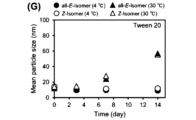
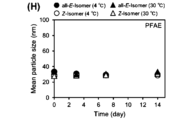
- FIGS. 4G-4I The average particle sizes after 3 days, 7 days, and 14 days are shown in FIGS. 4G-4I.
- FIG. 4G is the Tween 20 result
- FIG. 4H is the SFAE result
- FIG. 4I is the PFAE result.
- Emulsified Composition Containing Cis-Astaxanthin and Emulsified Composition Containing Trans-Astaxanthin (2-1) Encapsulation Efficiency, Cis-Astaxanthin Ratio, and Average Particle Size
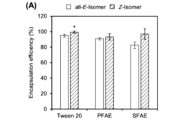
- the encapsulation efficiency is shown in FIG. 7A.
- the encapsulation efficiency of the cis-astaxanthin-containing emulsified composition (Z-isomer) was 99.3% for Tween 20, 93.3% for PFAE, and 97.2% for SFAE.
- the encapsulation efficiency of the trans-astaxanthin-containing emulsified composition (all-E-isomer) was 94.6% for Tween 20, 90.9% for PFAE, and 82.5% for SFAE.
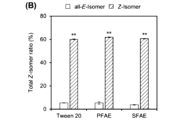
- Fig. 7B shows the ratio of cis-astaxanthin.
- the cis-astaxanthin ratio of the emulsified composition (Z-isomer) containing cis-astaxanthin was 60.1% for Tween 20, 61.8% for PFAE, and 60.7% for SFAE.
- the trans-astaxanthin-containing emulsified composition (all-E-isomer) had a cis-astaxanthin ratio of 5.2% for Tween 20, 5.2% for PFAE, and 3.7% for SFAE.
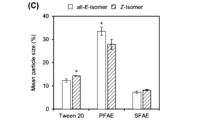
- the average particle size is shown in FIG. 7C.
- the average particle size of the cis-astaxanthin-containing emulsified composition (Z-isomer) was 14.3 nm for Tween 20, 27.9 nm for PFAE, and 8.2 nm for SFAE.
- the average particle size of the trans-astaxanthin-containing emulsified composition (all-E-isomer) was 12.3 nm for Tween 20, 33.5 nm for PFAE, and 7.2 nm for SFAE.
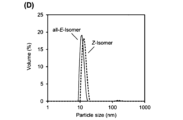
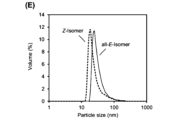
- 7D shows the particle size distribution of Tween 20
- FIG. 7E shows the particle size distribution of PFAE
- FIG. 7F shows the particle size distribution of SFAE.
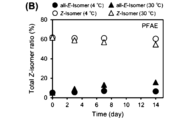
- FIG. 8A is the result of Tween 20
- FIG. 8B is the result of PFAE
- FIG. 8C is the result of SFAE.
- the ratio B/A of the cis-astaxanthin ratio after storage to the cis-astaxanthin ratio before storage when stored in a dark place at 30° C. for 14 days is calculated and shown in Table 3.
- Table 4 and Figures 8D to 8F show the residual astaxanthin rates after 3 days, 7 days, 14 days and 21 days.
- FIG. 8D is the Tween 20 result
- FIG. 8E is the PFAE result
- FIG. 8F is the SFAE result.
- FIGS. 8G-8I The average particle sizes after 3 days, 7 days, 14 days, and 21 days are shown in FIGS. 8G-8I.
- FIG. 8G is the Tween 20 result
- FIG. 8H is the PFAE result
- FIG. 8I is the SFAE result.
- the ratio B/A of the cis-lycopene ratio after storage to the cis-lycopene ratio before storage when stored in a dark place at 30° C. for 14 days is calculated and shown in Table 5.
- the lycopene residual rate after 3 days, 7 days, 14 days and 21 days is shown in Table 6 and FIG. 9B.
- the emulsifier of the cis-lycopene-containing emulsified composition (No. 2) is PFAE.
- polyglycerol fatty acid ester as an emulsifier can suitably suppress the decrease in the cis-lycopene ratio.
- B/A was 0.73 when stored in a dark place at 30°C for 14 days.
- B/A was 0.87 when stored in a dark place at 30°C for 14 days.
- polyglycerin fatty acid ester as an emulsifier can suitably suppress the decrease in the lycopene residual rate.
- the lycopene residual rate was 77.1% when stored in a dark place at 30°C for 14 days.
- the lycopene residual rate was 76.2% when stored in a dark place at 30°C for 14 days.
- sucrose fatty acid ester was used as an emulsifier, the decrease in the ratio of cis-astaxanthin could be suitably suppressed.
- the B/A was 1.04 when stored in a dark place at 30°C for 14 days.
- the decrease in the carotenoid residual rate when stored at 30°C is thought to be due to the decomposition of carotenoids and the collapse of the emulsified structure.
- Such a decrease in carotenoid residual rate can be suppressed by adding an antioxidant or thickening stabilizer. That is, it was suggested that the amount of cis-carotenoid in the emulsified composition can be ensured according to the technique of the present disclosure, which suppresses the decrease in the cis-carotenoid ratio by using a polyglycerol fatty acid ester or a sucrose fatty acid ester as an emulsifier. .
Landscapes
- Health & Medical Sciences (AREA)
- Life Sciences & Earth Sciences (AREA)
- Chemical & Material Sciences (AREA)
- Animal Behavior & Ethology (AREA)
- General Health & Medical Sciences (AREA)
- Public Health (AREA)
- Veterinary Medicine (AREA)
- Epidemiology (AREA)
- Medicinal Chemistry (AREA)
- Pharmacology & Pharmacy (AREA)
- Birds (AREA)
- General Chemical & Material Sciences (AREA)
- Chemical Kinetics & Catalysis (AREA)
- Engineering & Computer Science (AREA)
- Nuclear Medicine, Radiotherapy & Molecular Imaging (AREA)
- Organic Chemistry (AREA)
- Oil, Petroleum & Natural Gas (AREA)
- Biochemistry (AREA)
- Dispersion Chemistry (AREA)
- Child & Adolescent Psychology (AREA)
- Mycology (AREA)
- Hematology (AREA)
- Diabetes (AREA)
- Bioinformatics & Cheminformatics (AREA)
- Molecular Biology (AREA)
- Emergency Medicine (AREA)
- Obesity (AREA)
- Nutrition Science (AREA)
- Food Science & Technology (AREA)
- Polymers & Plastics (AREA)
- Toxicology (AREA)
- Dermatology (AREA)
- Acyclic And Carbocyclic Compounds In Medicinal Compositions (AREA)
- Coloring Foods And Improving Nutritive Qualities (AREA)
Priority Applications (1)
| Application Number | Priority Date | Filing Date | Title |
|---|---|---|---|
| JP2023569523A JPWO2023120618A1 (https=) | 2021-12-22 | 2022-12-22 |
Applications Claiming Priority (2)
| Application Number | Priority Date | Filing Date | Title |
|---|---|---|---|
| JP2021-207971 | 2021-12-22 | ||
| JP2021207971 | 2021-12-22 |
Publications (1)
| Publication Number | Publication Date |
|---|---|
| WO2023120618A1 true WO2023120618A1 (ja) | 2023-06-29 |
Family
ID=86902702
Family Applications (1)
| Application Number | Title | Priority Date | Filing Date |
|---|---|---|---|
| PCT/JP2022/047274 Ceased WO2023120618A1 (ja) | 2021-12-22 | 2022-12-22 | シス型カロテノイド含有の乳化組成物及びシス型カロテノイド含有の乳化組成物の製造方法 |
Country Status (2)
| Country | Link |
|---|---|
| JP (1) | JPWO2023120618A1 (https=) |
| WO (1) | WO2023120618A1 (https=) |
Cited By (1)
| Publication number | Priority date | Publication date | Assignee | Title |
|---|---|---|---|---|
| CN118048053A (zh) * | 2024-02-01 | 2024-05-17 | 武汉膳印科技有限公司 | 一种水溶性辣椒红及其制备方法 |
Citations (5)
| Publication number | Priority date | Publication date | Assignee | Title |
|---|---|---|---|---|
| JP2007522166A (ja) * | 2004-02-10 | 2007-08-09 | ネステク ソシエテ アノニム | カロテノイド化合物のシス異性体を含む組成物及び方法 |
| JP2009027958A (ja) * | 2007-07-26 | 2009-02-12 | Nof Corp | アスタキサンチン含有乳化物、および製造方法 |
| WO2010084789A1 (ja) * | 2009-01-20 | 2010-07-29 | 富士フイルム株式会社 | エマルション組成物、該エマルション組成物を含む食品及び化粧品 |
| WO2011145659A1 (ja) * | 2010-05-18 | 2011-11-24 | 富士フイルム株式会社 | カロチノイド含有組成物及びその製造方法 |
| WO2014051116A1 (ja) * | 2012-09-28 | 2014-04-03 | 富士フイルム株式会社 | リコピン含有水中油型エマルション組成物及びその製造方法 |
-
2022
- 2022-12-22 JP JP2023569523A patent/JPWO2023120618A1/ja active Pending
- 2022-12-22 WO PCT/JP2022/047274 patent/WO2023120618A1/ja not_active Ceased
Patent Citations (5)
| Publication number | Priority date | Publication date | Assignee | Title |
|---|---|---|---|---|
| JP2007522166A (ja) * | 2004-02-10 | 2007-08-09 | ネステク ソシエテ アノニム | カロテノイド化合物のシス異性体を含む組成物及び方法 |
| JP2009027958A (ja) * | 2007-07-26 | 2009-02-12 | Nof Corp | アスタキサンチン含有乳化物、および製造方法 |
| WO2010084789A1 (ja) * | 2009-01-20 | 2010-07-29 | 富士フイルム株式会社 | エマルション組成物、該エマルション組成物を含む食品及び化粧品 |
| WO2011145659A1 (ja) * | 2010-05-18 | 2011-11-24 | 富士フイルム株式会社 | カロチノイド含有組成物及びその製造方法 |
| WO2014051116A1 (ja) * | 2012-09-28 | 2014-04-03 | 富士フイルム株式会社 | リコピン含有水中油型エマルション組成物及びその製造方法 |
Non-Patent Citations (2)
| Title |
|---|
| HONDA, MASAKI: "A Study on Z- Isomerization of (all-E)-Carotenoids", REPORTS OF THE FACULTY OF SCIENCE AND TECHNOLOGY, vol. 59, no. 59, 30 November 2018 (2018-11-30), pages 41 - 46, XP009532040 * |
| MAMI HONDA, HARUKA SATO, MAIKO ONO: "1-10-4 Changes in physical properties of β-carotene by cis-trans isomerization and its application to emulsification technology", ABSTRACTS OF ANNUAL MEETING OF JAPAN SOCIETY FOR FOOD ENGINEERING, JP, vol. 19, 25 July 2018 (2018-07-25), JP, pages 26, XP009546512 * |
Cited By (1)
| Publication number | Priority date | Publication date | Assignee | Title |
|---|---|---|---|---|
| CN118048053A (zh) * | 2024-02-01 | 2024-05-17 | 武汉膳印科技有限公司 | 一种水溶性辣椒红及其制备方法 |
Also Published As
| Publication number | Publication date |
|---|---|
| JPWO2023120618A1 (https=) | 2023-06-29 |
Similar Documents
| Publication | Publication Date | Title |
|---|---|---|
| JP5680275B2 (ja) | エマルション組成物、該エマルション組成物を含む食品及び化粧品 | |
| JP4302159B2 (ja) | エマルション組成物、該エマルション組成物を含む食品及び化粧品 | |
| JP5459939B2 (ja) | カロチノイド含有エマルジョン組成物、その製造方法、それを含む食品及び化粧品 | |
| JP4398246B2 (ja) | 食品類に使用する細かに分散したカロチノイド懸濁液及びその調製方法 | |
| JP3921305B2 (ja) | カロチノイド−凝集体を含有する着色剤 | |
| US20080131515A1 (en) | Emulsion composition, and foods and cosmetics containing the emulsion composition | |
| JP7080818B2 (ja) | 低分子ガティガム | |
| da Silva et al. | Thermal and ultraviolet–visible light stability kinetics of co-nanoencapsulated carotenoids | |
| JP2015530076A (ja) | 乳化カロテノイドを含む水性の透明な水中油型エマルション | |
| JP5192356B2 (ja) | 飲料用乳化組成物 | |
| WO2023120618A1 (ja) | シス型カロテノイド含有の乳化組成物及びシス型カロテノイド含有の乳化組成物の製造方法 | |
| WO2011142241A1 (ja) | クレンジング化粧料 | |
| Honda et al. | Continuous production of Z-isomer-rich astaxanthin nanodispersions with stabilized Z-structures using selected ester-based nonionic emulsifiers | |
| JP6305414B2 (ja) | カロテノイドを含むビードレット | |
| JP2018512879A (ja) | ナノ粒子、ナノエマルション、及び混合室微粒子化によるそれらの形成 | |
| JP7153639B2 (ja) | 乳化組成物 | |
| JP6776175B2 (ja) | 水中油型乳化組成物、皮膚外用剤及び皮膚外用剤の製造方法 | |
| JP5196833B2 (ja) | 機能性食品素材とその製造方法 | |
| JP7674734B2 (ja) | シス型カロテノイド含有組成物の製造方法 | |
| JP5599649B2 (ja) | エマルション組成物及び粉末組成物 | |
| JP6651223B2 (ja) | ベシクル組成物およびそれを配合した毛髪化粧料 | |
| JP2013216650A (ja) | 皮膚外用剤及び紫外線によるカロテノイド含有油性成分の分解抑制方法 | |
| JP2019010106A (ja) | 乳化カロテノイドを含む水性の透明な水中油型エマルション | |
| JP6426902B2 (ja) | カロテノイド含有組成物、並びにカロテノイドの劣化抑制剤及びカロテノイドの劣化抑制方法 | |
| JP7785731B2 (ja) | 水性ゲル状組成物 |
Legal Events
| Date | Code | Title | Description |
|---|---|---|---|
| 121 | Ep: the epo has been informed by wipo that ep was designated in this application |
Ref document number: 22911320 Country of ref document: EP Kind code of ref document: A1 |
|
| WWE | Wipo information: entry into national phase |
Ref document number: 2023569523 Country of ref document: JP |
|
| NENP | Non-entry into the national phase |
Ref country code: DE |
|
| 122 | Ep: pct application non-entry in european phase |
Ref document number: 22911320 Country of ref document: EP Kind code of ref document: A1 |