WO2023112625A1 - 転がり軸受 - Google Patents
転がり軸受 Download PDFInfo
- Publication number
- WO2023112625A1 WO2023112625A1 PCT/JP2022/043309 JP2022043309W WO2023112625A1 WO 2023112625 A1 WO2023112625 A1 WO 2023112625A1 JP 2022043309 W JP2022043309 W JP 2022043309W WO 2023112625 A1 WO2023112625 A1 WO 2023112625A1
- Authority
- WO
- WIPO (PCT)
- Prior art keywords
- rolling bearing
- rolling
- spherical surface
- rolling elements
- circumferential direction
- Prior art date
- Legal status (The legal status is an assumption and is not a legal conclusion. Google has not performed a legal analysis and makes no representation as to the accuracy of the status listed.)
- Ceased
Links
Images





Classifications
-
- F—MECHANICAL ENGINEERING; LIGHTING; HEATING; WEAPONS; BLASTING
- F16—ENGINEERING ELEMENTS AND UNITS; GENERAL MEASURES FOR PRODUCING AND MAINTAINING EFFECTIVE FUNCTIONING OF MACHINES OR INSTALLATIONS; THERMAL INSULATION IN GENERAL
- F16C—SHAFTS; FLEXIBLE SHAFTS; ELEMENTS OR CRANKSHAFT MECHANISMS; ROTARY BODIES OTHER THAN GEARING ELEMENTS; BEARINGS
- F16C19/00—Bearings with rolling contact, for exclusively rotary movement
- F16C19/02—Bearings with rolling contact, for exclusively rotary movement with bearing balls essentially of the same size in one or more circular rows
- F16C19/14—Bearings with rolling contact, for exclusively rotary movement with bearing balls essentially of the same size in one or more circular rows for both radial and axial load
- F16C19/16—Bearings with rolling contact, for exclusively rotary movement with bearing balls essentially of the same size in one or more circular rows for both radial and axial load with a single row of balls
-
- F—MECHANICAL ENGINEERING; LIGHTING; HEATING; WEAPONS; BLASTING
- F16—ENGINEERING ELEMENTS AND UNITS; GENERAL MEASURES FOR PRODUCING AND MAINTAINING EFFECTIVE FUNCTIONING OF MACHINES OR INSTALLATIONS; THERMAL INSULATION IN GENERAL
- F16C—SHAFTS; FLEXIBLE SHAFTS; ELEMENTS OR CRANKSHAFT MECHANISMS; ROTARY BODIES OTHER THAN GEARING ELEMENTS; BEARINGS
- F16C33/00—Parts of bearings; Special methods for making bearings or parts thereof
- F16C33/30—Parts of ball or roller bearings
- F16C33/38—Ball cages
- F16C33/41—Ball cages comb-shaped
Definitions
- the present invention relates to rolling bearings.
- Rolling bearings such as deep groove ball bearings, angular contact ball bearings, and roller bearings are widely used as rolling bearings for supporting wheels, rotating shafts of machinery, etc.
- a rolling bearing mainly includes an outer ring, an inner ring positioned inside the outer ring, a plurality of rolling elements, and a retainer.
- a plurality of rolling elements are housed between raceway surfaces formed on the inner peripheral surface of the outer ring and the outer peripheral surface of the inner ring.
- the rolling bearing is rotatably held by a cage that holds a plurality of rolling elements at a constant pitch.
- Grease which is a lubricant, is sometimes sealed inside the rolling bearing to reduce friction and wear between the outer ring, inner ring, rolling elements and cage.
- Some cages for such rolling bearings have cylindrical surface portions (chamfered portions) at the radial end portions of the pocket portions that hold the rolling elements so that grease can be easily taken in. For example, it is like patent document 1.
- a retainer for a rolling bearing described in Patent Document 1 includes a spherical portion having a radius of curvature slightly larger than the radius of curvature of the rolling element on the inner surface of a pocket formed by a pair of elastic pieces and a concave portion of an annular member; A cylindrical surface portion continuing from the edge of the spherical surface portion is provided.
- the pocket covers part of the circumferential side surface, part of the radially outer side surface, and part of the radially inner side surface of the rolling element with the spherical surface portion. Since the retainer increases the radial opening area of the pocket due to the cylindrical surface portion, it is possible to smoothly take the lubricant into the pocket. As a result, the rolling bearing described in Patent Document 1 promotes smooth rotation between the rolling elements and the cage, and reduces collision noise between the rolling elements and the cage.
- the rolling surfaces of the rolling elements are in contact with the spherical portions of the inner surfaces of the pockets of the retainer.
- the spherical portion supports the rolling element through point contact.
- the relative speed at the support points increases as the rotational speed of the rolling elements increases.
- grease or lubricating oil which is a lubricant, is diffused from the pockets by centrifugal force.
- the rolling bearing described in Patent Literature 1 may cause wear, heat generation, etc. of the retainer during high-speed rotation.
- a rolling bearing according to the present invention comprises an outer ring having an outer ring raceway surface on its inner peripheral surface, an inner ring positioned inside the outer ring and having an inner ring raceway surface on its outer peripheral surface, the outer ring raceway surface and the inner ring raceway surface.
- a rolling bearing comprising: a retainer comprising a pocket portion comprising: The pocket portion of the retainer has a plurality of adjacent curved surfaces on an inner peripheral surface with which the rolling elements contact, and at least one of a curvature center position and a curvature radius of each of the adjacent curved surfaces is different, and the The distance in the axial direction between contact points with the rolling elements on adjacent curved surfaces is 20% or more and less than 40% of the diameter of the rolling elements.
- the peripheral speed of the outer surface of the rolling element is determined by the length of the perpendicular from an arbitrary position on the outer surface to the rotation axis.
- the rolling elements contact adjacent curved surfaces among the plurality of curved surfaces of the pocket portion.
- the retainer has curved surfaces positioned so that the distance between contact points on adjacent curved surfaces with which the rolling elements contact is 20% or more and less than 40% of the diameter of the rolling elements. Therefore, in the retainer, the raceways on the rolling elements that maximize the peripheral speed of the rolling elements are located between the contact points on the adjacent curved surfaces. Therefore, the trajectory that maximizes the peripheral speed of the rolling element does not pass through the contact point.
- the retainer has a maximum interval between the contact points so that the rolling elements do not run over the claws. Therefore, the retainer supports the rolling elements at a plurality of contact points, thereby reducing the surface pressure of the contact points and suppressing the peripheral speed of the rolling elements at the contact points. Furthermore, since the cage retains the rolling elements by the adjacent curved surfaces, a gap is formed between the cage and the rolling elements, so that the lubricant is not scraped out from around the contact points. As a result, the load from the rolling elements applied to the retainer during high-speed rotation can be reduced, and lubricity can be maintained.
- the rolling bearing of the present invention preferably includes the following configuration.
- the distance in the axial direction between contact points with the rolling elements on the plurality of adjacent curved surfaces is 20% or more and less than 40% of the diameter of the rolling elements. .
- the rolling elements when the rolling elements roll, the rolling elements come into contact with adjacent curved surfaces among the plurality of curved surfaces of the pocket portion.
- the retainer has curved surfaces positioned so that the distance between contact points on adjacent curved surfaces with which the rolling elements contact when they roll is 2620% or more and less than 40% of the diameter of the rolling elements. . Therefore, in the retainer, the raceways on the rolling elements that maximize the peripheral speed of the rolling elements are located between the contact points on the adjacent curved surfaces. As a result, the load from the rolling elements applied to the retainer during high-speed rotation can be reduced, and lubricity can be maintained.
- the rolling bearing of the present invention preferably includes the following configuration.
- the distance in the axial direction between contact points with the rolling elements on the plurality of adjacent curved surfaces with which the rolling elements come into contact when the outer ring or the inner ring rotates in the circumferential direction is The interval between the contact points with the rolling elements on the plurality of adjacent curved surfaces with which the rolling elements come into contact when the base portion is in contact with the rolling elements, and is wider than the interval in the circumferential direction of the base.
- the retainer of the rolling bearing according to the present invention has a distance between the contact points of the rolling elements on the plurality of adjacent curved surfaces with which the rolling elements come into contact when the rolling elements are stopped.
- the interval in the circumferential direction of the base portion narrower than the interval in the axial direction of the contact points of the rolling elements on the plurality of adjacent curved surfaces with which the rolling elements contact when the rolling elements roll.
- Larger axial spacing is possible.
- the peripheral speed of the rolling element at the contact point is further suppressed.
- the gap between the cage and the rolling elements between the contact points when the rolling elements roll is large, the lubricant is not scraped out from around the contact points during rotation. As a result, the load from the rolling elements applied to the retainer during high-speed rotation can be reduced, and lubricity can be maintained.
- the rolling bearing of the present invention preferably includes the following configuration.
- the curved surface includes at least one of a spherical surface, a cylindrical surface and an ellipsoidal surface.
- the rolling bearing of the present invention preferably includes the following configuration.
- the plurality of adjacent curved surfaces with which the rolling elements contact when the outer ring or the inner ring rotates in the circumferential direction are positioned adjacent to each other in the axial direction.
- the retainer of the rolling bearing is provided on the outer surface of the rolling element where the peripheral speed of the rolling element is maximized by the contact point of the curved surface with which the rolling element contacts when the rolling element rolls. It is easy to position the curved surface so as to sandwich the track. As a result, the load from the rolling elements applied to the retainer during high-speed rotation can be reduced, and lubricity can be maintained.
- the rolling bearing of the present invention preferably includes the following configuration.
- the pocket portion is formed at the tip of the pawl portion as the connecting line, which is the boundary between the plurality of adjacent curved surfaces with which the rolling elements come into contact when the outer ring or the inner ring rotates in the circumferential direction, extends radially outward. It extends in an approaching direction and has an angle of 1 degree or more and 30 degrees or less with respect to a plane perpendicular to the axis.
- the rolling elements when the rolling elements roll in the circumferential direction, the rolling elements come into contact with curved surfaces adjacent to each other across the rotation axis even if the rotation axis of the rolling elements is tilted. A force from the rolling elements is applied to the retainer in a distributed manner at the contact points. As a result, the load from the rolling elements applied to the retainer during high-speed rotation can be reduced, and lubricity can be maintained.
- the rolling bearing of the present invention preferably includes the following configuration.
- the plurality of adjacent curved surfaces with which the rolling elements come into contact when the outer ring or the inner ring rotates in the circumferential direction are positioned adjacent to each other in the radial direction.
- the retainer of the rolling bearing supports the rolling elements not only by the plurality of contact points aligned in the axial direction but also by the plurality of contact points aligned in the radial direction. do.
- the lubricant is less likely to be scraped out. As a result, the load from the rolling elements applied to the retainer during high-speed rotation can be reduced, and lubricity can be maintained.
- the rolling bearing of the present invention preferably includes the following configuration.
- the pocket portion has grooves extending along boundaries between the plurality of adjacent curved surfaces.
- a groove is formed between the contact points to form a space in which the lubricant is accumulated.
- the cage improves lubrication at the contact points by retaining lubricant in the vicinity of the contact points. As a result, the load from the rolling elements applied to the retainer during high-speed rotation can be reduced, and lubricity can be maintained.
- the rolling bearing of the present invention can reduce the load from the rolling elements applied to the retainer during high-speed rotation and maintain lubricity.
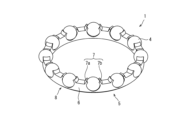
- FIG. 1 is an axial cross-sectional view showing the configuration of a rolling bearing according to Embodiment 1 of the present invention.
- FIG. 2 is a perspective view of a retainer that retains balls in the rolling bearing according to Embodiment 1 of the present invention.
- FIG. 3 is a partial perspective view of a retainer that retains balls in the rolling bearing according to Embodiment 1 of the present invention.
- 4 is a cross-sectional view taken along the arrow A in FIG. 3.
- FIG. FIG. 5 is a cross-sectional view at substantially the center of the radial thickness of the retainer that holds the balls when the rolling bearing according to the first embodiment of the present invention rotates to one side in the circumferential direction.
- FIG. 6 is an enlarged view of part B in FIG. FIG.
- FIG. 7 is a cross-sectional view at substantially the center of the radial thickness of the retainer in another embodiment of the retainer in the rolling bearing according to the first embodiment of the present invention.
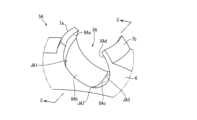
- FIG. 8 is a partial perspective view of a retainer that retains balls in a rolling bearing according to Embodiment 2 of the present invention.
- 9 is a cross-sectional view taken along line C in FIG. 8.
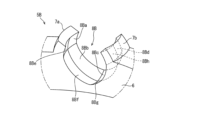
- FIG. 10 is a partial perspective view of a retainer that retains balls in a rolling bearing according to Embodiment 3 of the present invention.
- FIG. 11 is a partial plan cross-sectional view of claw portions of a retainer that retains balls in a rolling bearing according to Embodiment 3 of the present invention.
- FIG. 1 is an axial cross-sectional view showing the configuration of a rolling bearing 1 according to Embodiment 1 of the present invention.
- FIG. 2 is a perspective view of retainer 5 that retains balls 4 in rolling bearing 1 .
- the rolling bearing 1 is a deep groove ball bearing.
- a rolling bearing 1 has an outer ring 2, an inner ring 3, a retainer 5, and balls 4 which are a plurality of rolling elements.
- the axial direction indicates the direction along the rotation axis of the rolling bearing 1 or the axial direction of the base portion 6 of the retainer 5 .
- a radial direction represents a direction perpendicular to the axis of the rolling bearing 1 or the axis of the base 6 of the retainer 5 .
- Circumferential direction means a direction along the rotation direction of the rolling bearing 1 or the retainer 5 .
- the radially inner side represents the side closer to the axis in the radial direction than an arbitrary position.
- the radially outer side represents the side farther from the axis in the radial direction than an arbitrary position.
- the outer ring 2 is a member that rotates relative to the inner ring 3.
- the outer ring 2 is a cylindrical member.
- the outer ring 2 is made of, for example, bearing steel such as high-carbon chromium bearing steel SUJ2, carburized steel, or the like. Further, the outer ring 2 is hardened by heat treatment to a hardness of about 58 to 62 HRC.
- the inner peripheral surface of the outer ring 2 has an annular outer ring raceway surface 2a in the circumferential direction on which a plurality of rolling elements roll.
- the outer ring raceway surface 2a is a groove that is recessed in an arc radially outward in an axial cross-sectional view.
- the inner ring 3 is a member that rotates relative to the outer ring 2 .
- the inner ring 3 is a cylindrical member.
- the inner ring 3 is made of, for example, bearing steel such as high-carbon chromium bearing steel SUJ2, carburized steel, or the like. Further, the inner ring 3 is hardened by heat treatment to about 58 to 62 HRC.
- the outer peripheral surface of the inner ring 3 has an annular inner ring raceway surface 3a in the circumferential direction on which a plurality of rolling elements roll.
- the inner ring raceway surface 3a is a groove that is recessed in an arc radially inward in an axial cross-sectional view.
- the inner ring 3 is positioned radially inward of the outer ring 2 .
- the inner ring raceway surface 3 a of the inner ring 3 faces the outer ring raceway surface 2 a of the outer ring 2 .
- the balls 4, which are rolling elements, are members that rotatably support the outer ring 2 and the inner ring 3 relative to each other.
- Ball 4 is a sphere.
- the ball 4 is composed of, for example, a steel ball made of high-carbon chromium bearing steel SUJ2, a stainless steel ball (SUS440C), a ceramic ball (Si3N4), or the like.
- the ball 4 is hardened to about 60 to 64 HRC by heat treatment depending on the material.
- a plurality of balls 4 are housed side by side in the circumferential direction between the outer ring raceway surface 2 a of the outer ring 2 and the inner ring raceway surface 3 a of the inner ring 3 .
- the plurality of balls 4 are configured to roll on the outer ring raceway surface 2a and the inner ring raceway surface 3a. Therefore, the plurality of balls 4 support the outer ring 2 with respect to the inner ring 3 so as to be rotatable in the circumferential direction. Also, the plurality of balls 4 support the inner ring 3 so as to be rotatable in the circumferential direction with respect to the outer ring 2 .
- the retainer 5 is made of, for example, polyamide 46 (PA46), polyamide 66 (PA66), polyamide 9T (PA9T), polyetheretherketone (PEEK), polyphenylene, which are resin materials excellent in oil resistance, wear resistance, and lubricity. It is composed of sulfide (PPS) or the like. Further, as a reinforcing material, glass fiber (GF) or carbon fiber (CF) may be kneaded in the resin.
- the retainer 5 holds a plurality of balls 4 accommodated between the outer ring raceway surface 2a and the inner ring raceway surface 3a at regular intervals in the circumferential direction.
- the retainer 5 is held between the outer ring 2 and the inner ring 3 so as to be rotatable in the circumferential direction with the axis as the rotation axis by the rolling of the plurality of balls 4 .
- the axis of the retainer 5 coincides with the axis of the outer ring 2 or the inner ring 3 .
- Grease which is a lubricant, may be injected between the outer ring 2 and the inner ring 3 to reduce friction.
- the rolling bearing 1 configured in this way is configured so that one of the outer ring 2 and the inner ring 3 is a fixed ring, and the other is a rotating ring, thereby exhibiting the function of a bearing.
- the balls 4 interposed between the outer ring raceway surface 2a and the inner ring raceway surface 3a roll to cause the outer ring 2 and the inner ring 3 to rotate. rotates relative to the axis.
- the plurality of balls 4 and the retainer 5 rotate about the axis as the balls 4 move (so-called revolve) on the outer ring raceway surface 2a or the inner ring raceway surface 3a.
- the plurality of balls 4 rotate about a straight line passing through the center of the balls 4 that is perpendicular to a plane including the circumference passing through the contact points between the outer ring 2 and the balls 4 and the contact points between the balls 4 and the inner ring 3 as the axis of rotation. (so-called rotation).
- FIG. 3 is a partial perspective view of the cage 5 that holds the balls 4 in the rolling bearing 1.
- FIG. 4 is a cross-sectional view taken along the arrow A in FIG. 3.
- the retainer 5 is crown-shaped having a base portion 6, a plurality of pairs of claw portions 7, and a plurality of pocket portions 8 composed of the base portion 6 and the plurality of pairs of claw portions 7. is the retainer.
- Balls 4 are accommodated in a plurality of pocket portions 8 of retainer 5 .
- the retainer 5 retains the plurality of balls 4 at regular intervals in the circumferential direction.
- the base 6 supports the claw 7.
- the base 6 is an annular member.
- a plurality of pairs of claw portions 7 are positioned on a tip end face 6a (see FIG. 4), which is one end face of both end faces in the axial direction of the base portion 6.
- the pair of claw portions 7 protrude in the axial direction from the tip surface 6a.
- the pair of claw portions 7 has a claw portion 7a on one side in the circumferential direction and a claw portion 7b on the other side in the circumferential direction.
- the claw portion 7a on the one side in the circumferential direction goes to the other side in the circumferential direction toward the tip, and the claw portion 7b on the other side in the circumferential direction goes to the one side in the circumferential direction toward the tip.
- the plurality of pairs of claw portions 7 are positioned at regular intervals along the circumferential direction. Therefore, the tip surface 6 a of the base portion 6 is formed between the pair of claw portions 7 and the pair of claw portions 7 .
- the retainer 5 constitutes a plurality of pocket portions 8 that hold the balls 4 by a plurality of pairs of claw portions 7 and a base portion 6 between the plurality of pairs of claw portions 7 .
- the base portion 6 has a concave portion forming a part of the pocket portion between the pair of claw portions 7 .
- the recess of the base portion 6 is a semicircular recess when viewed in the radial direction.
- a pair of claw portions 7 extend axially from both circumferential ends of the concave portion of the base portion 6 .
- the pocket portion 8 holds the ball 4 with an inner peripheral surface composed of the concave portion of the base portion 6 and the side surfaces of the pair of claw portions 7 facing each other.
- the pocket portion 8 has a first spherical surface 8a, a second spherical surface 8b, a third spherical surface 8c, and a fourth spherical surface 8d, which are recessed curved surfaces that come into contact with the ball 4, on its inner peripheral surface.
- the plurality of pocket portions 8 restrain axial movement and circumferential movement with respect to the ball 4 by means of a pair of claw portions 7 .
- the first spherical surface 8a is a curved surface located on the side surface of the claw portion 7a on one side in the circumferential direction of the pair of claw portions 7 on the other side in the circumferential direction.
- the first spherical surface 8a is a portion of a spherical surface having a center of curvature Ca and a radius of curvature Da.
- the second spherical surface 8 b is a curved surface positioned on one circumferential side surface of the recess in the base portion 6 between the pair of claw portions 7 .
- the second spherical surface 8b is a portion of a spherical surface having a center of curvature Cb and a radius of curvature Db.
- the claw portion 7 side end of the second spherical surface 8b is connected to the base portion 6 side end of the first spherical surface 8a.
- the third spherical surface 8 c is a curved surface positioned on the other circumferential side surface of the base portion 6 between the pair of claw portions 7 .
- the third spherical surface 8c is a portion of a spherical surface having a center of curvature Cc and a radius of curvature Dc.
- the base 6 side end of the third spherical surface 8c is connected to the base 6 side end of the second spherical surface 8b.
- the fourth spherical surface 8 d is a curved surface on one side in the circumferential direction of the claw portion 7 a located on the side surface on the other side in the circumferential direction of the pair of claw portions 7 .
- the fourth spherical surface 8d is a portion of a spherical surface having a center of curvature Cd and a radius of curvature Dd.
- the base portion 6 side end of the fourth spherical surface 8d is connected to the claw portion 7 side end of the third spherical surface 8c.
- the pocket portion 8 has a first spherical surface 8a and a fourth spherical surface 8d as curved surfaces located on the claw portion 7 side in the axial direction.
- the pocket portion 8 has a second spherical surface 8b and a third spherical surface 8c as curved surfaces located on the base portion 6 side when viewed in the axial direction.
- a first spherical surface 8a and a second spherical surface 8b are located adjacent to each other in the axial direction on one side surface of the pocket portion 8 in the circumferential direction.
- a third spherical surface 8c and a fourth spherical surface 8d are located adjacent to each other in the axial direction on the side surface of the pocket portion 8 on the other side in the circumferential direction. Therefore, when the ball 4 in the pocket portion 8 rolls to one side in the circumferential direction, the first spherical surface 8a and the second spherical surface 8b, which are located adjacent to each other in the axial direction on the one side surface of the pocket portion 8 in the circumferential direction, come into contact with When the ball 4 in the pocket portion 8 rolls to the other side in the circumferential direction, the third spherical surface 8c and the fourth spherical surface 8d, which are positioned adjacent to each other in the axial direction on the side surface of the pocket portion 8 on the other side in the circumferential direction. come into contact with
- the center of curvature Ca of the first spherical surface 8a, the center of curvature Cb of the second spherical surface 8b, the center of curvature Cc of the third spherical surface 8c, and the center of curvature Cd of the fourth spherical surface 8d are all different positions. Accordingly, a first connection line J1 is formed at the connecting portion of each boundary between the first spherical surface 8a and the second spherical surface 8b. A second connection line J2 is formed at a connecting portion of each boundary between the second spherical surface 8b and the third spherical surface 8c.
- a third connection line J3 is formed at a connecting portion of each boundary between the third spherical surface 8c and the fourth spherical surface 8d.
- the radius of curvature Da of the first spherical surface 8a, the radius of curvature Db of the second spherical surface 8b, the radius of curvature Dc of the third spherical surface 8c, and the radius of curvature Dd of the fourth spherical surface 8d are all larger than the radius of curvature D of the ball 4.
- the first spherical surface 8 a , the second spherical surface 8 b , the third spherical surface 8 c and the fourth spherical surface 8 d do not match the curved surface of the outer surface of the ball 4 . That is, the first spherical surface 8a, the second spherical surface 8b, the third spherical surface 8c, and the fourth spherical surface 8d are in point contact with the outer surface of the ball 4 on each curved surface.
- FIG. 5 is a cross-sectional view at substantially the center of the radial thickness of the retainer 5 that holds the balls 4 when the rolling bearing 1 rotates to one side in the circumferential direction.
- FIG. 6 is an enlarged view of part B in FIG.
- FIG. 7 is a cross-sectional view at approximately the center of the radial thickness of the retainer 5 in another embodiment of the retainer 5 in the rolling bearing 1 .
- either the outer ring 2 or the inner ring 3 rotates to one side in the circumferential direction with the axis of the outer ring 2 or the inner ring 3 as the axis of rotation (see Fig. 1).
- the plurality of balls 4 roll to one side in the circumferential direction on the outer ring raceway surface 2a or the inner ring raceway surface 3a as the outer ring 2 or the inner ring 3 rotates to one side in the circumferential direction.
- the description of the state of the balls 4 and the retainer 5 when the rolling bearing 1 rotates to the other side in the circumferential direction is substantially the same as the case in which the rolling bearing 1 rotates to the one side in the circumferential direction. therefore omitted.
- the balls 4 housed in the pocket portion 8 of the retainer 5 roll in the pocket portion 8 to one side in the circumferential direction.
- the peripheral speed of the ball 4 rotating in the pocket portion 8 is the outer surface of the ball 4 at the intersection of the line passing through the center C of the ball 4 and perpendicular to the rotation axis R of the ball 4 and the outer surface of the ball 4. is maximum at the trajectory T passing through .
- the rotation axis R of the balls is substantially parallel to the axis of the retainer 5 .
- the rotation axis R of the balls 4 may be inclined by the first rotation axis angle ⁇ 1 with respect to the axis of the retainer 5 .
- the trajectory T at which the peripheral speed of the ball 4 is maximized is inclined by the first rotation axis angle ⁇ 1 with respect to the direction perpendicular to the axis.
- the ball 4 When rolling to one side in the circumferential direction, the ball 4 contacts the first spherical surface 8a and the second spherical surface 8b that are located on one side of the pocket portion 8 in the circumferential direction and are adjacent in the axial direction.
- the retainer 5 contacts the outer surface of the ball 4 at two points within the pocket portion 8, a first contact point P1 on the first spherical surface 8a and a second contact point P2 on the second spherical surface 8b.
- the axial length L1 which is the axial distance between the first contact point P1 and the second contact point P2, is the center of curvature Ca and the radius of curvature Da of the first spherical surface 8a and the center of curvature Cb and the radius of curvature Da of the second spherical surface 8b.
- Db is adjusted to be more than 20% and less than 40% of the diameter of the ball 4 (see FIG. 4).
- the axial length L1 is set to be less than the maximum distance L2, which is 40% of the diameter of the ball 4, so that the ball 4 does not run over the pawl portion 7. As shown in FIG.
- the axial length L1 between the first contact point P1 and the second contact point P2 when the outer ring 2 and the inner ring 3 roll to one side in the circumferential direction is the contact point of the ball 4 on the second spherical surface 8b and the third spherical surface. It is longer than the circumferential length L3, which is the circumferential distance from the contact point of the ball 4 at 8c. By making the circumferential length L3 shorter than the axial length L1, the axial length L1 can be made longer.
- the peripheral speed of the ball 4 at the contact point is further suppressed. Furthermore, since the gap G between the cage 5 and the balls 4 between the contact points when the balls 4 roll is large, the lubricant is not scraped out from around the contact points during rotation. As a result, the load from the balls 4 applied to the retainer 5 during high-speed rotation can be reduced, and lubricity can be maintained.
- the peripheral speed of the ball 4 at the first contact point P1 or the second contact point P2 is smaller than the maximum peripheral speed.
- the trajectory T is such that the rotation axis R of the ball 4 is positioned between the first contact point P1 and the second contact point P2. Therefore, the trajectory T does not overlap the first contact point P1 and the second contact point P2.
- the axial length L1 between the first contact point P1 and the second contact point P2 is less than the maximum distance L2, which is less than 40% of the diameter of the balls 4, the balls 4 are separated from each other by the cage 5. Do not ride on the claw portion 7.
- the pocket portion 8 is formed by adjusting the center of curvature Ca and the radius of curvature Da of the first spherical surface 8a and the center of curvature Cb and the radius of curvature Db of the second spherical surface 8b.
- the directional length L1 is more than 20% and less than 40% of the diameter of the ball 4, the peripheral speed of the rolling element at the first contact point P1 and the second contact point P2 is suppressed. .
- the pocket portion 8 has a first connection line J1 along the boundaries between the first contact point P1 and the second contact point P2 that support the ball 4 .
- a gap G is formed between the ball 4 and the first connection line J1.
- Grease or lubricating oil is held in the gap G between the ball 4 and the first connection line J1. Therefore, even if the ball 4 rotates at high speed, the grease or lubricating oil is not scraped out from the gap G between the ball 4 and the first connection line J1. As a result, the load from the balls 4 applied to the retainer 5 during high-speed rotation can be reduced, and lubricity can be maintained.
- the retainer 5 includes a connecting portion of each boundary between the first spherical surface 8a and the second spherical surface 8b, a connecting portion of each boundary between the second spherical surface 8b and the third spherical surface 8c, and a A groove 8e may be provided in each connecting portion of the boundary between the third spherical surface 8c and the fourth spherical surface 8d.
- the cage 5 holds grease in each groove 8e. Therefore, even if the ball 4 rotates at a high speed, the pocket portion 8 does not scrape out the grease from the groove 8e that is recessed from the first spherical surface 8a and the second spherical surface 8b. As a result, lubricity can be maintained during high-speed rotation.
- FIG. 8 is a partial perspective view of retainer 5A that retains balls 4 in rolling bearing 1A.
- 9 is a cross-sectional view taken along line C in FIG. 8.
- the same reference numerals are given to the same configurations as in the first embodiment, and the description thereof is omitted, and only the portions different from the first embodiment will be described.
- the rolling bearing 1A has a retainer 5A.
- the retainer 5A has a base portion 6, a plurality of pairs of claw portions 7, and a pocket portion 8A.
- the pocket portion 8A has a first spherical surface 8Aa which is a recessed curved surface for holding the ball 4 on the side surfaces of the pair of claw portions 7 facing each other and the concave portion of the base portion 6 located between the pair of claw portions 7, It has a second spherical surface 8Ab, a third spherical surface 8Ac and a fourth spherical surface 8Ad.
- the first spherical surface 8Aa is a curved surface located on the side surface on the other side in the circumferential direction of the claw portion 7a on the one side in the circumferential direction of the pair of claw portions 7 .
- the second spherical surface 8Ab is a curved surface positioned on one circumferential side surface of the recess in the base 6 between the pair of claws 7 .
- the claw portion 7 side end of the second spherical surface 8Ab is connected to the base portion 6 side end of the first spherical surface 8Aa.
- the third spherical surface 8Ac is a curved surface located on the side surface on the other side in the circumferential direction of the recess in the base portion 6 between the pair of claw portions 7 .
- the base 6 side end of the third spherical surface 8Ac is connected to the base 6 side end of the second spherical surface 8Ab.
- the fourth spherical surface 8Ad is a curved surface positioned on one circumferential side surface of the claw portion 7a on the other side in the circumferential direction of the pair of claw portions 7 .
- the base portion 6 side end of the fourth spherical surface 8Ad is connected to the claw portion 7 side end of the third spherical surface 8Ac.
- a first connection line JA1 is formed at a connecting portion of each boundary between the first spherical surface 8Aa and the second spherical surface 8Ab.
- a second connection line JA2 is formed at a connecting portion of each boundary between the second spherical surface 8Ab and the third spherical surface 8Ac.
- a third connection line JA3 is formed at a connecting portion of each boundary between the third spherical surface 8Ac and the fourth spherical surface 8Ad.
- the rotation axis R of the ball 4 is tilted at a second rotation axis angle ⁇ 2 from 1 degree to a maximum of 30 degrees with respect to the vertical line of the axis in the axial cross-sectional view.
- the pocket portion 8A has a first spherical surface 8Aa and a second spherical surface 8Ab such that the first connection line JA1 is along the rotation axis R of the ball 4. As shown in FIG.
- the first connection line JA1 extends toward the tip of the claw portion 7 as it extends radially outward along the rotation axis R of the second rotation axis angle ⁇ 2.
- a first spherical surface 8Aa and a second spherical surface 8Ab having different centers of curvature or different radii of curvature are located adjacent to each other in the axial direction on both sides of the rotation axis R of the ball 4 . Therefore, when the balls 4 roll to one side in the circumferential direction, the retainer 5A has the first spherical surface 8Aa and the second spherical surface adjacent to each other across the rotation axis R in the axial direction even if the rotation axis R of the ball 4 is tilted. 8Ab and ball 4 come into contact with each other.
- the force from the balls 4 is dispersedly applied to the retainer 5A at the contact points between the first spherical surface 8Aa and the second spherical surface 8Ab.
- the load from the balls 4 applied to the retainer 5A during high-speed rotation can be reduced, and lubricity can be maintained.
- FIG. 10 is a partial perspective view of retainer 5B that retains balls 4 in rolling bearing 1B.
- FIG. 11 is a partial plan cross-sectional view of claw portions 7 of retainer 5B that retains balls 4 in rolling bearing 1B.
- the rolling bearing 1B has a retainer 5B.
- the retainer 5B has a base portion 6, a plurality of pairs of claw portions 7, and a pocket portion 8B.
- the pocket portion 8B has a first spherical surface 8Ba which is a recessed curved surface for holding the ball 4 on the side surfaces of the pair of claw portions 7 facing each other and the concave portion of the base portion 6 located between the pair of claw portions 7, It has a second spherical surface 8Bb, a third spherical surface 8Bc, a fourth spherical surface 8Bd, a fifth spherical surface 8Be, a sixth spherical surface 8Bf, a seventh spherical surface 8Bg, and an eighth spherical surface 8Bh.
- the first spherical surface 8Ba is a curved surface located on the radially outer side surface on the other side in the circumferential direction of the claw portion 7a on the one circumferential side of the pair of claw portions 7 .
- the second spherical surface 8Bb is a curved surface located on one side in the circumferential direction of the recess in the base portion 6 between the pair of claw portions 7 and on the radially outer side surface.
- the third spherical surface 8 ⁇ /b>Bc is a curved surface located on the other side in the circumferential direction of the recess in the base 6 between the pair of claws 7 and on the radially outer side surface.
- the fourth spherical surface 8Bd is a curved surface positioned on the radially outer side surface of the claw portion 7a on the other circumferential side of the pair of claw portions 7 in the circumferential direction.
- the fifth spherical surface 8Be is a curved surface located on the radially inner side surface of the claw portion 7a on the one circumferential side of the pair of claw portions 7 on the other side in the circumferential direction.
- the sixth spherical surface 8Bf is a curved surface located on one side in the circumferential direction and radially inward of the recess in the base 6 between the pair of claws 7 .
- the seventh spherical surface 8Bg is a curved surface located on the other side in the circumferential direction of the recess in the base portion 6 between the pair of claw portions 7 and on the radially inner side surface.
- the eighth spherical surface 8Bh is a curved surface located on the radially inner side surface of the claw portion 7a on the other circumferential side of the pair of claw portions 7 in the circumferential direction.
- the first spherical surface 8Ba and the fifth spherical surface 8Be are located side by side in the radial direction on the claw portion 7a on one side in the circumferential direction.
- the second spherical surface 8Bb and the sixth spherical surface 8Bf are arranged radially on one side of the base portion 6 in the circumferential direction.
- the third spherical surface 8Bc and the seventh spherical surface 8Bg are located side by side in the radial direction on the other side of the base portion 6 in the circumferential direction.
- the fourth spherical surface 8Bd and the eighth spherical surface 8Bh are located side by side in the radial direction on the claw portion 7b on the other side in the circumferential direction.
- the ball 4 that rolls to the one side in the circumferential direction in the pocket portion 8B due to the rotation of the outer ring 2 or the inner ring 3 to the one side in the circumferential direction moves toward the first spherical surface 8Ba positioned on the pawl portion 7a on the one side in the circumferential direction of the pocket portion 8. and the fifth spherical surface 8Be and the second spherical surface 8Bb and the sixth spherical surface 8Bf located on one side of the base 6 in the circumferential direction.
- the cage 5 has a first contact point P1 on the first spherical surface 8Ba, a second contact point P2 on the second spherical surface 8Bb, a third contact point P3 on the fifth spherical surface 8Be, and a sixth spherical surface 8Bf.
- the position of the pocket portion 8B with respect to the ball 4 is determined by contacting the outer surface of the ball 4 at four upper fourth contact points P4.
- the retainer 5B has a first contact point P1 on the first spherical surface 8Ba on the claw portion 7 side and a second contact point P2 on the second spherical surface 8Bb on the base portion 6 side.
- the ball 4 is supported not only by the plurality of contact points aligned in the direction, but also by the first contact point P1 on the first spherical surface 8Ba and the third contact point P3 on the fifth spherical surface 8Be that are aligned in the radial direction. Therefore, the force from the balls 4 is dispersedly applied to the retainer 5B at a plurality of contact points in the axial direction and a plurality of contact points in the radial direction.
- the amount of grease held between the balls 4 and the connecting lines increases as the number of connecting lines between adjacent curved surfaces increases. As a result, the load from the balls 4 applied to the retainer 5 during high-speed rotation can be reduced, and lubricity can be maintained.
- the rolling bearings 1, 1A, 1B are configured as deep groove ball bearings.
- the rolling bearing may be a crown type rolling bearing in which a retainer holds a plurality of balls accommodated in the outer ring raceway surface and the inner ring raceway surface.
- the rolling bearing may be, for example, an angular contact ball bearing or a wheel bearing device.
- the retainers 5, 5A of the rolling bearings 1, 1A have four spherical surfaces within the pocket portions 8, 8A.
- the retainer 5B of the rolling bearing 1B has eight spherical surfaces in the pocket portion 8B.
- the rolling bearing retainer is not limited to the number of spherical or curved surfaces in the embodiment.
- the retainer of the rolling bearing may be configured to have adjacent spherical surfaces or curved surfaces with which the rolling elements come into contact when the rolling elements roll in the circumferential direction.
- the cages 5, 5A, 5B are made of resin. It is desirable that the resin forming the retainer is a synthetic resin having a glass transition temperature of 120° C. or higher. As a result, softening of the retainer due to temperature rise during rotation is suppressed. Therefore, the rolling bearing can suppress interference between the rolling elements and the cage even if the cage elastically deforms due to centrifugal force when the temperature rises.
- the cages 5, 5A, 5B are made of resin.
- the retainer may be formed by injection molding.
- the retainer is preferably injection molded such that the welds are located at the base.
- the welds are positioned at the base, which is stronger than the claws, so that the strength of the claws can be suppressed from being reduced by the welds.
- the pocket portions 8, 8A, 8B of the retainers 5, 5A, 5B hold the balls 4 with spherical surfaces having at least one different center of curvature position or different radius of curvature.
- the pocket portion may have a plurality of curved surfaces including at least one of a spherical surface, a cylindrical surface, and an elliptical surface, and the rolling elements may be held by the plurality of spherical surfaces.
- the pocket portion may have, for example, a pair of claw portions having cylindrical curved surfaces and a base portion having spherical curved surfaces.
Landscapes
- Engineering & Computer Science (AREA)
- General Engineering & Computer Science (AREA)
- Mechanical Engineering (AREA)
- Rolling Contact Bearings (AREA)
Applications Claiming Priority (2)
| Application Number | Priority Date | Filing Date | Title |
|---|---|---|---|
| JP2021203820A JP2023089366A (ja) | 2021-12-16 | 2021-12-16 | 転がり軸受 |
| JP2021-203820 | 2021-12-16 |
Publications (1)
| Publication Number | Publication Date |
|---|---|
| WO2023112625A1 true WO2023112625A1 (ja) | 2023-06-22 |
Family
ID=86774153
Family Applications (1)
| Application Number | Title | Priority Date | Filing Date |
|---|---|---|---|
| PCT/JP2022/043309 Ceased WO2023112625A1 (ja) | 2021-12-16 | 2022-11-24 | 転がり軸受 |
Country Status (2)
| Country | Link |
|---|---|
| JP (1) | JP2023089366A (https=) |
| WO (1) | WO2023112625A1 (https=) |
Citations (7)
| Publication number | Priority date | Publication date | Assignee | Title |
|---|---|---|---|---|
| JPS57124617U (https=) * | 1981-01-28 | 1982-08-03 | ||
| JP2005226738A (ja) * | 2004-02-13 | 2005-08-25 | Nsk Ltd | 転がり軸受用保持器およびそれを備えた転がり軸受並びにその転がり軸受を用いたファンモータ |
| JP2007120687A (ja) * | 2005-10-31 | 2007-05-17 | Nsk Ltd | 保持器付自動調心ころ軸受 |
| JP2007278406A (ja) * | 2006-04-07 | 2007-10-25 | Nsk Ltd | 保持器付ころ軸受 |
| JP2010071386A (ja) * | 2008-09-18 | 2010-04-02 | Ntn Corp | 転がり軸受用保持器およびこれを備える転がり軸受 |
| JP2013068249A (ja) * | 2011-09-21 | 2013-04-18 | Jtekt Corp | 玉軸受及び玉軸受用の保持器 |
| US20160160921A1 (en) * | 2014-12-09 | 2016-06-09 | Aktiebolaget Skf | Cage of a rolling bearing, rolling bearing comprising such a cage and apparatus comprising such a rolling bearing |
-
2021
- 2021-12-16 JP JP2021203820A patent/JP2023089366A/ja active Pending
-
2022
- 2022-11-24 WO PCT/JP2022/043309 patent/WO2023112625A1/ja not_active Ceased
Patent Citations (7)
| Publication number | Priority date | Publication date | Assignee | Title |
|---|---|---|---|---|
| JPS57124617U (https=) * | 1981-01-28 | 1982-08-03 | ||
| JP2005226738A (ja) * | 2004-02-13 | 2005-08-25 | Nsk Ltd | 転がり軸受用保持器およびそれを備えた転がり軸受並びにその転がり軸受を用いたファンモータ |
| JP2007120687A (ja) * | 2005-10-31 | 2007-05-17 | Nsk Ltd | 保持器付自動調心ころ軸受 |
| JP2007278406A (ja) * | 2006-04-07 | 2007-10-25 | Nsk Ltd | 保持器付ころ軸受 |
| JP2010071386A (ja) * | 2008-09-18 | 2010-04-02 | Ntn Corp | 転がり軸受用保持器およびこれを備える転がり軸受 |
| JP2013068249A (ja) * | 2011-09-21 | 2013-04-18 | Jtekt Corp | 玉軸受及び玉軸受用の保持器 |
| US20160160921A1 (en) * | 2014-12-09 | 2016-06-09 | Aktiebolaget Skf | Cage of a rolling bearing, rolling bearing comprising such a cage and apparatus comprising such a rolling bearing |
Also Published As
| Publication number | Publication date |
|---|---|
| JP2023089366A (ja) | 2023-06-28 |
Similar Documents
| Publication | Publication Date | Title |
|---|---|---|
| US8556519B2 (en) | Radial roller bearing, in particular single track ball roller bearing | |
| JP7434815B2 (ja) | 転がり軸受及び保持器 | |
| TW201819790A (zh) | 滾動軸承用保持器及滾動軸承 | |
| KR101379608B1 (ko) | 레이디얼 구름 베어링 | |
| JP2004245251A (ja) | 自動調心ころ軸受 | |
| WO2023105677A1 (ja) | 転がり軸受 | |
| CN213954169U (zh) | 滚珠轴承 | |
| JP2010048374A (ja) | 円筒ころ軸受 | |
| WO2023095639A1 (ja) | 転がり軸受 | |
| WO2023112625A1 (ja) | 転がり軸受 | |
| JP6141606B2 (ja) | 自動調心ころ軸受 | |
| JP2020041605A (ja) | 車輪用軸受装置 | |
| JP2008267400A (ja) | 玉軸受 | |
| JP2019173918A (ja) | 四点接触玉軸受およびそれに用いる玉軸受用保持器 | |
| JP2019066013A (ja) | 玉軸受 | |
| JP2021513036A (ja) | ボールベアリング保持器及びボールベアリング | |
| JP2008138841A (ja) | タンデム型複列アンギュラ玉軸受 | |
| JP2003120683A (ja) | スラストころ軸受 | |
| JP2010025191A (ja) | 自動調心ころ軸受 | |
| JP2021025613A (ja) | 深溝玉軸受 | |
| JP7766105B2 (ja) | スキュー制限軸受ケージ | |
| WO2020196172A1 (ja) | 自動調心ころ軸受 | |
| JP4424092B2 (ja) | 合成樹脂製の冠形保持器 | |
| JP4680169B2 (ja) | タンデム型複列アンギュラ玉軸受 | |
| JP7740514B2 (ja) | 転がり軸受、及び、転がり軸受用の保持器 |
Legal Events
| Date | Code | Title | Description |
|---|---|---|---|
| 121 | Ep: the epo has been informed by wipo that ep was designated in this application |
Ref document number: 22907156 Country of ref document: EP Kind code of ref document: A1 |
|
| NENP | Non-entry into the national phase |
Ref country code: DE |
|
| 122 | Ep: pct application non-entry in european phase |
Ref document number: 22907156 Country of ref document: EP Kind code of ref document: A1 |