WO2023112391A1 - 超電導線材接続構造 - Google Patents
超電導線材接続構造 Download PDFInfo
- Publication number
- WO2023112391A1 WO2023112391A1 PCT/JP2022/031395 JP2022031395W WO2023112391A1 WO 2023112391 A1 WO2023112391 A1 WO 2023112391A1 JP 2022031395 W JP2022031395 W JP 2022031395W WO 2023112391 A1 WO2023112391 A1 WO 2023112391A1
- Authority
- WO
- WIPO (PCT)
- Prior art keywords
- layer
- superconducting
- superconducting wire
- holding member
- connection structure
- Prior art date
- Legal status (The legal status is an assumption and is not a legal conclusion. Google has not performed a legal analysis and makes no representation as to the accuracy of the status listed.)
- Ceased
Links
Images




Classifications
-
- H—ELECTRICITY
- H01—ELECTRIC ELEMENTS
- H01B—CABLES; CONDUCTORS; INSULATORS; SELECTION OF MATERIALS FOR THEIR CONDUCTIVE, INSULATING OR DIELECTRIC PROPERTIES
- H01B12/00—Superconductive or hyperconductive conductors, cables, or transmission lines
- H01B12/02—Superconductive or hyperconductive conductors, cables, or transmission lines characterised by their form
- H01B12/06—Films or wires on bases or cores
-
- H—ELECTRICITY
- H01—ELECTRIC ELEMENTS
- H01R—ELECTRICALLY-CONDUCTIVE CONNECTIONS; STRUCTURAL ASSOCIATIONS OF A PLURALITY OF MUTUALLY-INSULATED ELECTRICAL CONNECTING ELEMENTS; COUPLING DEVICES; CURRENT COLLECTORS
- H01R4/00—Electrically-conductive connections between two or more conductive members in direct contact, i.e. touching one another; Means for effecting or maintaining such contact; Electrically-conductive connections having two or more spaced connecting locations for conductors and using contact members penetrating insulation
- H01R4/58—Electrically-conductive connections between two or more conductive members in direct contact, i.e. touching one another; Means for effecting or maintaining such contact; Electrically-conductive connections having two or more spaced connecting locations for conductors and using contact members penetrating insulation characterised by the form or material of the contacting members
- H01R4/68—Connections to or between superconductive connectors
-
- Y—GENERAL TAGGING OF NEW TECHNOLOGICAL DEVELOPMENTS; GENERAL TAGGING OF CROSS-SECTIONAL TECHNOLOGIES SPANNING OVER SEVERAL SECTIONS OF THE IPC; TECHNICAL SUBJECTS COVERED BY FORMER USPC CROSS-REFERENCE ART COLLECTIONS [XRACs] AND DIGESTS
- Y02—TECHNOLOGIES OR APPLICATIONS FOR MITIGATION OR ADAPTATION AGAINST CLIMATE CHANGE
- Y02E—REDUCTION OF GREENHOUSE GAS [GHG] EMISSIONS, RELATED TO ENERGY GENERATION, TRANSMISSION OR DISTRIBUTION
- Y02E40/00—Technologies for an efficient electrical power generation, transmission or distribution
- Y02E40/60—Superconducting electric elements or equipment; Power systems integrating superconducting elements or equipment
Definitions
- the present disclosure relates to a superconducting wire connection structure.
- This application claims priority from Japanese Patent Application No. 2021-203579 filed on December 15, 2021. All the contents described in the Japanese patent application are incorporated herein by reference.
- Patent Document 1 describes a superconducting wire connecting structure.
- the superconducting wire connection structure described in Patent Document 1 includes a first superconducting wire, a second superconducting wire, and a bonding layer.
- Each of the first superconducting wire and the second superconducting wire has a metal substrate, an intermediate layer, and a superconducting layer.
- the intermediate layer is arranged on the metal substrate.
- a superconducting layer is disposed on the intermediate layer.
- the first superconducting wire has a first end in the longitudinal direction of the first superconducting wire.
- the second superconducting wire has a second end in the longitudinal direction of the second superconducting wire.
- the superconducting layer at the first end and the superconducting layer at the second end are superconductively joined with a joining layer interposed therebetween.
- the superconducting wire connection structure of the present disclosure includes a first superconducting wire and a second superconducting wire.
- the first superconducting wire has a first end in the longitudinal direction of the first superconducting wire.
- the second superconducting wire has a second end in the longitudinal direction of the second superconducting wire.
- Each of the first superconducting wire and the second superconducting wire has a substrate, an intermediate layer disposed on the substrate, and a superconducting layer disposed on the intermediate layer.
- a connecting portion which is a portion of the superconducting wire connection structure where the superconducting layer at the first end and the superconducting layer at the second end are connected, has a first clamping member and a second clamping member.
- the superconducting layer at the first end and the superconducting layer at the second end are sandwiched between a first sandwiching member and a second sandwiching member.
- the thickness of the connecting portion is 2 mm or less.
- the coefficient of thermal expansion of the first holding member and the coefficient of thermal expansion of the second holding member are 0.95 times or more and 1.05 times or less of the coefficient of thermal expansion of the substrate.
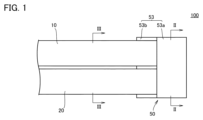
- FIG. 1 is a plan view of a superconducting wire connection structure 100.
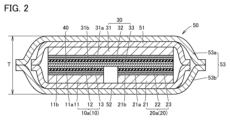
- FIG. FIG. 2 is a cross-sectional view along II-II in FIG.
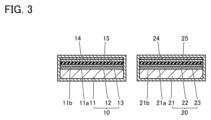
- FIG. 3 is a cross-sectional view along III-III in FIG.
- FIG. 4 is a manufacturing process diagram of the superconducting wire connecting structure 100 .
- FIG. 5 is a cross-sectional view of a superconducting wire connection structure 100 according to a second modification.
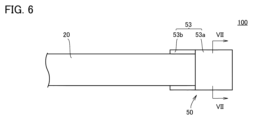
- FIG. 6 is a plan view of a superconducting wire connection structure 100 according to a third modification.
- FIG. 7 is a cross-sectional view along VII-VII in FIG.
- FIG. 8 is a cross-sectional view of a superconducting wire connection structure 100 according to a fourth modification.
- FIG. 9 is a cross-sectional view of a superconducting wire connection structure 100 according to a fifth modification.
- FIG. 10 is a cross-sectional view of a superconducting wire connection structure 100 according to
- the present disclosure has been made in view of the above problems. More specifically, the present disclosure provides a superconducting wire connecting structure capable of improving heat dissipation in the connecting portion while preventing breakage in the connecting portion.
- a superconducting wire connection structure includes a first superconducting wire and a second superconducting wire.
- the first superconducting wire has a first end in the longitudinal direction of the first superconducting wire.
- the second superconducting wire has a second end in the longitudinal direction of the second superconducting wire.
- Each of the first superconducting wire and the second superconducting wire has a substrate, an intermediate layer disposed on the substrate, and a superconducting layer disposed on the intermediate layer.
- a connecting portion which is a portion of the superconducting wire connection structure where the superconducting layer at the first end and the superconducting layer at the second end are connected, has a first clamping member and a second clamping member.
- the superconducting layer at the first end and the superconducting layer at the second end are sandwiched between a first sandwiching member and a second sandwiching member.
- the thickness of the connecting portion is 2 mm or less.
- the coefficient of thermal expansion of the first holding member and the coefficient of thermal expansion of the second holding member are 0.95 times or more and 1.05 times or less of the coefficient of thermal expansion of the substrate.
- the connecting portion may further have a cover member.
- the first holding member and the second holding member may be covered with a cover member.
- the thermal expansion coefficient of the cover member may be 0.95 times or more and 1.05 times or less that of the base material.
- the superconducting wire connection structure of (2) above may further include a third superconducting wire.
- the third superconducting wire may have a substrate, an intermediate layer, and a superconducting layer.
- the superconducting layer of the third superconducting wire may be arranged facing the superconducting layer at the first end and the superconducting layer at the second end.
- the first holding member and the second holding member may hold the first end, the second end and the third superconducting wire.
- the thermal conductivity of the first clamping member, the thermal conductivity of the second clamping member, and the thermal conductivity of the cover member are 0.1 ⁇ 10 2 . It may be W/m ⁇ ° C. or higher.
- the thickness of the first clamping member and the thickness of the second clamping member may be 0.2 mm or less.
- the thermal resistance of the connecting portion may be 16°C/W or more.
- the c-axis direction of the crystal grains of the oxide superconductor forming the superconducting layer may be along the thickness direction of the superconducting layer.
- a current density of 50 A/mm 2 or less in the c-axis direction of the superconducting layer in the connecting portion when a current of 200 A is flowing through the superconducting wire connecting structure may be 50 A/mm 2 or less.
- a superconducting wire connection structure according to an embodiment will be described below.
- a superconducting wire connection structure according to the embodiment is referred to as a superconducting wire connection structure 100 .
- FIG. 1 is a plan view of a superconducting wire connection structure 100.
- FIG. FIG. 2 is a cross-sectional view along II-II in FIG.
- FIG. 3 is a cross-sectional view along III-III in FIG.
- the superconducting wire connection structure 100 has a first superconducting wire 10 and a second superconducting wire 20 .
- the first superconducting wire 10 has a base material 11 , an intermediate layer 12 , a superconducting layer 13 , a protective layer 14 and a stabilizing layer 15 .
- the base material 11 is, for example, a tape made of stainless steel.
- the substrate 11 is clad with a copper layer 11a and a nickel layer 11b.
- the copper layer 11a is arranged on the substrate 11, and the nickel layer 11b is arranged on the copper layer 11a.
- the copper layer 11a and the nickel layer 11b are crystal-oriented.
- the base material 11 is not limited to this.
- the base material 11 may be made of Hastelloy (registered trademark). When the substrate 11 is made of Hastelloy, the copper layer 11a and the nickel layer 11b are not clad.
- the intermediate layer 12 is arranged on the substrate 11 .
- the base material 11 is a tape made of stainless steel
- a copper layer 11 a and a nickel layer 11 b are interposed between the intermediate layer 12 and the base material 11 .
- the intermediate layer 12 is configured by, for example, sequentially laminating a layer of stabilized zirconia (YSZ), a layer of yttrium oxide (Y 2 O 3 ) and a layer of cerium oxide (CeO 2 ).
- YSZ stabilized zirconia
- Y 2 O 3 yttrium oxide
- CeO 2 cerium oxide
- the intermediate layer 12 is formed by magnetron sputtering, for example.
- the substrate 11 is made of Hastelloy or the like
- the intermediate layer 12 with crystal orientation is formed by, for example, IBAD (Ion Beam Assisted Deposition).
- a superconducting layer 13 is arranged on the intermediate layer 12 .
- the superconducting layer 13 is made of REBCO.
- REBCO is REBaCu 3 O y
- RE is a rare earth element. Examples of rare earth elements include yttrium (Y), praseodymium (Pr), neodymium (Nd), samarium (Sm), eurobium (Eu), gadolinium (Gd), holmium (Ho), and ytterbium (Yb).
- the superconducting layer 13 is formed by PLD (Pulsed Laser Deposition), for example.
- the superconducting layer 13 may be formed by MOD (Metal Organic Deposition).
- the superconducting layer 13 thereon is also crystal-oriented. More specifically, the c-axes of REBCO crystal grains forming superconducting layer 13 extend along the thickness direction of superconducting layer 13 .
- the protective layer 14 is arranged on the superconducting layer 13 .
- the protective layer 14 is made of silver (Ag).
- Protective layer 14 may be formed of a silver alloy.
- the protective layer 14 is formed by sputtering, for example.
- the stabilizing layer 15 is arranged on the protective layer 14 .
- the stabilizing layer 15 is also on the surface of the substrate 11 opposite to the intermediate layer 12, on the side of the substrate 11, on the side of the intermediate layer 12, on the side of the superconducting layer 13 and also on the side of the protective layer 14. are placed.
- the stabilization layer 15 is made of copper.
- the stabilization layer 15 may be made of a copper alloy.
- the stabilization layer 15 is formed by plating, for example.
- the first superconducting wire 10 has a first end 10a.
- the first end 10a is the end of the first superconducting wire 10 in the longitudinal direction.
- the protective layer 14 and the stabilization layer 15 are removed. That is, the superconducting layer 13 is exposed at the first end portion 10a.
- the second superconducting wire 20 has a base material 21 , an intermediate layer 22 , a superconducting layer 23 , a protective layer 24 and a stabilizing layer 25 .
- the base material 21 is, for example, a tape made of stainless steel.
- the substrate 21 is clad with a copper layer 21a and a nickel layer 21b.
- a copper layer 21a is disposed on the substrate 21, and a nickel layer 21b is disposed on the copper layer 21a.
- the copper layer 21a and the nickel layer 21b are crystal-oriented.
- the base material 21 is not limited to this.
- the base material 21 may be made of Hastelloy. When the substrate 21 is made of Hastelloy, the copper layer 21a and the nickel layer 21b are not clad.
- the intermediate layer 22 is arranged on the base material 21 .
- the base material 21 is a tape made of stainless steel
- a copper layer 21 a and a nickel layer 21 b are interposed between the intermediate layer 22 and the base material 21 .
- the intermediate layer 22 is formed, for example, by sequentially laminating a stabilized zirconia layer, an yttrium oxide layer, and a cerium oxide layer.
- the intermediate layer 22 thereon is also crystalline.
- the intermediate layer 22 is formed by magnetron sputtering, for example.
- the substrate 21 is made of Hastelloy or the like
- the intermediate layer 22 having crystal orientation is formed by, for example, IBAD.
- the superconducting layer 23 is arranged on the intermediate layer 22 .
- the superconducting layer 23 is made of REBCO.
- the superconducting layer 23 is formed by PLD, for example.
- the superconducting layer 23 may be formed by MOD. Since the intermediate layer 22 is crystal-oriented as described above, the superconducting layer 23 thereon is also crystal-oriented. More specifically, the c-axis direction of the REBCO crystal grains forming the superconducting layer 23 is along the thickness direction of the superconducting layer 23 .
- the protective layer 24 is arranged on the superconducting layer 23 .
- the protective layer 24 is made of silver.
- Protective layer 24 may be formed of a silver alloy.
- the protective layer 24 is formed by sputtering, for example.
- the stabilizing layer 25 is arranged on the protective layer 24 .
- the stabilizing layer 25 is also on the surface of the substrate 21 opposite the intermediate layer 22, on the side of the substrate 21, on the side of the intermediate layer 22, on the side of the superconducting layer 23 and also on the side of the protective layer 24. are placed.
- the stabilization layer 25 is made of copper.
- the stabilization layer 25 may be made of a copper alloy.
- the stabilization layer 25 is formed by plating, for example.
- the second superconducting wire 20 has a second end 20a.
- the second end 20a is the end of the second superconducting wire 20 in the longitudinal direction.
- the protective layer 24 and the stabilizing layer 25 are removed. That is, the superconducting layer 23 is exposed at the second end 20a.
- the first superconducting wire 10 and the second superconducting wire 20 are arranged, for example, such that the first end 10a and the second end 20a are adjacent to each other.
- the superconducting layer 13 at the first end 10a is connected to the superconducting layer 23 at the second end 20a. This connection is made using, for example, the third superconducting wire 30 and the bonding layer 40 .
- the third superconducting wire 30 has a base material 31 , an intermediate layer 32 and a superconducting layer 33 .
- the base material 31 is, for example, a tape made of stainless steel.
- the substrate 31 is clad with a copper layer 31a and a nickel layer 31b.
- a copper layer 31a is disposed on the substrate 31, and a nickel layer 31b is disposed on the copper layer 31a.
- the copper layer 31a and the nickel layer 31b are crystal-oriented.
- the base material 31 is not limited to this.
- the base material 31 may be made of Hastelloy. When the substrate 31 is made of Hastelloy, the copper layer 31a and the nickel layer 31b are not clad.
- the intermediate layer 32 is arranged on the base material 31 .
- the base material 31 is a tape made of stainless steel
- a copper layer 31 a and a nickel layer 31 b are interposed between the intermediate layer 32 and the base material 31 .
- the intermediate layer 32 is formed, for example, by sequentially laminating a stabilized zirconia layer, an yttrium oxide layer, and a cerium oxide layer.
- the intermediate layer 32 thereon is also crystalline.
- the intermediate layer 32 is formed by magnetron sputtering, for example.
- the substrate 31 is made of Hastelloy or the like
- the intermediate layer 32 with crystal orientation is formed by, for example, IBAD.
- the superconducting layer 33 is arranged on the intermediate layer 32 .
- the superconducting layer 33 is made of REBCO.
- the superconducting layer 33 is formed by PLD, for example.
- the superconducting layer 33 may be formed by MOD. Since the intermediate layer 32 is crystal-oriented as described above, the superconducting layer 33 thereon is also crystal-oriented. More specifically, the c-axis direction of the REBCO crystal grains forming the superconducting layer 33 is along the thickness direction of the superconducting layer 33 .
- the third superconducting wire 30 is arranged so that the superconducting layer 33 faces the superconducting layer 13 at the first end 10a and the superconducting layer 23 at the second end 20a.
- the bonding layer 40 is arranged between the superconducting layer 33 and the superconducting layer 13 at the first end 10a and the superconducting layer 23 at the second end 20a.
- the bonding layer 40 is made of REBCO.
- the c-axis direction of the REBCO crystal grains forming the bonding layer 40 is aligned with the c-axis direction of the REBCO crystal grains forming the superconducting layer 13 at the first end 10a, and the superconducting layer 23 at the second end 20a. It is along the c-axis direction of REBCO forming the superconducting layer 33 and the c-axis direction of REBCO forming the superconducting layer 33 . Therefore, the superconducting layer 13 at the first end portion 10 a and the superconducting layer 23 at the second end portion 20 a are superconductively joined by the third superconducting wire 30 (superconducting layer 33 ) and the joining layer 40 .
- the portion of the superconducting wire connecting structure 100 where the superconducting layer 13 at the first end 10a and the superconducting layer 23 at the second end 20a are connected is referred to as a connecting portion 50 .
- the connecting portion 50 has a first holding member 51 , a second holding member 52 , and a cover member 53 . Note that the connecting portion 50 may not have the cover member 53 . Also, the connecting portion 50 may have the bonding layer 40 .
- the first holding member 51 and the second holding member 52 are sheet-shaped members.
- the first sandwiching member 51 and the second sandwiching member 52 sandwich the superconducting layer 13 at the first end 10 a and the superconducting layer 23 at the second end 20 a and the third superconducting wire 30 .
- the first holding member 51 and the second holding member 52 are fixed to each other, for example, by welding.
- the first clamping member 51 and the second clamping member 52 may be fixed together by soldering.
- the cover member 53 is a sheet-like member.
- the cover member 53 covers the first holding member 51 and the second holding member 52 . More specifically, the cover member 53 has a first portion 53a and a second portion 53b.
- the cover member 53 is folded back so that the first portion 53a and the second portion 53b face each other.
- a first holding member 51 and a second holding member 52 are arranged between the first portion 53a and the second portion 53b.
- the first portion 53a is fixed to the second portion 53b by soldering, for example. Thereby, the inside of the cover member 53 is sealed.
- thickness T be the thickness at the connection portion 50 .
- the thickness T is 2 mm or less.
- the thickness T may be 1.8 mm or less or 1.5 mm or less.
- the thickness T is, for example, 60 ⁇ m or more or 100 ⁇ m or more.
- the coefficient of thermal expansion of the first holding member 51, the coefficient of thermal expansion of the second holding member 52, and the coefficient of thermal expansion of the cover member 53 are the coefficients of thermal expansion of the base material 11, the coefficient of thermal expansion of the base material 21, and the coefficient of thermal expansion of the base material 31. It is 0.95 times or more and 1.05 times or less of the expansion rate.
- the constituent material of the first holding member 51 , the constituent material of the second holding member 52 , and the constituent material of the cover member 53 are preferably the same as the constituent materials of the base material 11 , the base material 21 , and the base material 31 .
- a first superconducting wire 10 a second superconducting wire 20, a third superconducting wire 30, a bonding layer 40, a first clamping member 51, a second clamping member 52, and a cover member 53 are laminated.
- Thickness T is the maximum thickness of the part.
- the thickness of the first holding member 51, the thickness of the second holding member 52, and the thickness of the cover member 53 are preferably 0.2 mm or less.
- the thickness of the first holding member 51, the thickness of the second holding member 52, and the thickness of the cover member 53 may be 150 ⁇ m (0.15 mm) or less.
- the thickness of the first holding member 51, the thickness of the second holding member 52, and the thickness of the cover member 53 are, for example, 30 ⁇ m or more or 50 ⁇ m or more.
- the thermal conductivity of the first holding member 51, the thermal conductivity of the second holding member 52, and the thermal conductivity of the cover member 53 are preferably 0.1 ⁇ 10 2 W/m ⁇ ° C. or higher.
- the thermal conductivity of the first holding member 51, the thermal conductivity of the second holding member 52, and the thermal conductivity of the cover member 53 are 0.3 ⁇ 10 2 W/m ⁇ ° C. or higher, or 0.5 ⁇ 10 2 W/ It may be above m ⁇ °C.
- the thermal resistance of the connecting portion 50 is, for example, 16°C/W or higher.
- the thermal resistance of the connecting portion 50 is measured according to the JEDEC standard (JESD51-2A).
- the connection portion 50 is separated from the superconducting wire connection structure 100 .
- the lengths of the first superconducting wire 10 and the second superconducting wire 20 extending from the connection portion 50 are set to 100 mm or less.
- the thermal resistance of the connection portion 50 may be 18° C./W or more or 20° C./W or more.
- the current density in the c-axis direction of the superconducting layer in the connection portion 50 when a current of 200 A is flowing through the superconducting wire connection structure 100 is preferably 50 A/mm 2 or less.
- the current density in the c-axis direction of the superconducting layer at the connecting portion 50 is determined by the bonding area between the superconducting layer 13 at the first end portion 10a and the bonding layer 40 (or the second end portion). It is obtained by dividing by the bonding area between the superconducting layer 23 and the bonding layer 40 at 20a.
- the current density in the c-axis direction of the superconducting layer in the connection portion 50 when a current of 200 A is flowing through the superconducting wire connection structure 100 may be 45 A/mm 2 or less.
- the current density in the c-axis direction of the superconducting layer in the connection portion 50 when a current of 200 A is flowing through the superconducting wire connection structure 100 is, for example, 10 A/mm 2 or more.
- FIG. 4 is a manufacturing process diagram of the superconducting wire connection structure 100.
- the method for manufacturing the superconducting wire connection structure 100 includes a preparation step S1, a microcrystalline layer formation step S2, a connection step S3, an oxygen introduction step S4, and a cover member attachment step S5. are doing.
- the preparation step S1 the first superconducting wire 10, the second superconducting wire 20 and the third superconducting wire 30 are prepared.
- a microcrystalline layer is formed on the superconducting layer 33 in the microcrystalline layer forming step S2.
- the microcrystalline layer may be arranged on the superconducting layer 13 on the first end 10a and on the superconducting layer 23 on the second end 20a.
- the microcrystalline layer is formed of polycrystalline REBCO.
- an organic compound film is formed on the superconducting layer 33 by, for example, spin coating.
- This organic compound film contains constituent elements of REBCO.
- calcination is performed on the organic compound film.
- the organic compound film becomes a precursor of REBCO.
- the organic compound film that has undergone calcination is referred to as a calcined film.
- heat treatment is performed on the calcined film after the calcination. As a result, the carbide contained in the calcined film is decomposed to form a microcrystalline layer containing REBCO microcrystals.
- the superconducting layer 13 at the first end portion 10a and the superconducting layer 23 and the superconducting layer 33 at the second end portion 20a are connected using a microcrystalline layer.
- the first superconducting wire 10 and the second superconducting wire are arranged such that the first end 10a and the second end 20a are adjacent to each other, and the microcrystalline layer is interposed to form the second superconducting wire.
- the third superconducting wire 30 is arranged such that the superconducting layer 13 at the first end 10a and the superconducting layer 23 at the second end 20a face each other.
- the first end portion 10a, the second end portion 20a and the third superconducting wire 30 are held between the first holding member 51 and the second holding member 52. With the first end portion 10a, the second end portion 20a and the third superconducting wire 30 held between the first holding member 51 and the second holding member 52, the first holding member 51 and the second holding member 52 are welded. etc. are fixed to each other. Third, heating the superconducting layer 13 at the first end 10a, the superconducting layer 23 at the second end 20a, the superconducting layer 33, and the microcrystalline layer via the first holding member 51 and the second holding member 52. and pressurization.
- REBCO microcrystals contained in the microcrystalline layer are oriented and crystallized (epitaxially grown from the superconducting layer 13 at the first end 10a, the superconducting layer 23 and the superconducting layer 33 at the second end 20a), and the bonding layer 40.
- Oxygen is desorbed from the superconducting layer 13 at the first end 10a, the superconducting layer 23 at the second end 20a, the superconducting layer 33 and the bonding layer 40 due to the heating performed in the connecting step S3. Therefore, in the oxygen introduction step S4, the superconducting layer 13 at the first end portion 10a, the superconducting layer 23 at the second end portion 20a, the superconducting layer 33 and the joint are heated and held in an atmosphere containing oxygen. Oxygen is introduced into layer 40 .
- the cover member 53 is mounted.
- the cover member 53 is folded back so that the first holding member 51 and the second holding member 52 are sandwiched between the first portion 53a and the second portion 53b, and the first portion 53a and the second portion 53b are folded. Attached by soldering.
- the superconducting wire connection structure 100 having the structure shown in FIGS. 1 to 3 is manufactured.
- the thickness T is set to 2 mm or less, so the heat dissipation in the connection portion 50 is improved.
- the breakage at the connecting portion 50 is caused by thermal stress caused by the difference in thermal expansion coefficient between the base material 11, base material 21 and base material 31 and the first holding member 51, second holding member 52 and cover member 53.
- the coefficient of thermal expansion of the first clamping member 51, the coefficient of thermal expansion of the second clamping member 52, and the coefficient of thermal expansion of the cover member 53 are equal to the coefficient of thermal expansion of the substrate 11 and the coefficient of thermal expansion of the substrate 21. and 0.95 to 1.05 times the thermal expansion coefficient of the base material 31 .
- the first clamping member 51, the second clamping member 52, and the cover member 53 similarly thermally expand and contract with the thermal expansion and contraction of the base material 11, the base material 21, and the base material 31, and the above thermal stress is reduced. unlikely to occur.
- the superconducting wire connection structure 100 it is possible to suppress breakage in the connection portion 50 even if the thickness T is reduced.
- the inside of the cover member 53 is hermetically sealed, and intrusion of moisture into the inside of the cover member 53 is suppressed. Therefore, according to the superconducting wire connection structure 100, deterioration of the superconducting properties of the superconducting layer 13 at the first end 10a, the superconducting layer 23 at the second end 20a, the superconducting layer 33, and the bonding layer 40 due to moisture is suppressed. It is
- the thickness of the first holding member 51, the thickness of the second holding member 52, and the thickness of the cover member 53 are 0.2 mm or less.
- the thermal conductivity and the thermal conductivity of the cover member 53 are 0.1 ⁇ 10 2 W/m ⁇ ° C. or more, the heat dissipation in the connection portion 50 is further improved.
- the thermal resistance of the connecting portion 50 is 16° C./W or more, the heat dissipation in the connecting portion 50 is further improved.
- the bonding area between the superconducting layer 13 and the bonding layer 40 at the first end 10a (or the superconducting layer 23 and the bonding layer 40 at the second end 20a) It is preferable to reduce the junction area with the superconducting layer 50 , that is, to increase the current density in the c-axis direction of the superconducting layer in the connection portion 50 .
- the current density in the c-axis direction of the superconducting layer in the connection portion 50 is reduced, the amount of heat generated in the connection portion 50 is reduced.
- the amount of heat generated in the connection portion 50 is reduced.
- the superconducting layer 13 at the first end 10a, the superconducting layer 23 at the second end 20a, the superconducting layer 33, and the bonding layer 40 are less likely to be quenched.
- the cover member 53 is composed of one member, but the cover member 53 may be composed of two members (hereinafter referred to as "first member” and “second member”). .
- first member and second member forming the cover member 53 are fixed to each other by soldering or the like while sandwiching the first holding member 51 and the second holding member 52 .
- FIG. 5 is a cross-sectional view of a superconducting wire connection structure 100 according to a second modification.
- FIG. 5 shows a cross section at a position corresponding to II-II in FIG.
- the base material 11 at the first end 10 a and the base material 21 at the second end 20 a may be the second clamping member 52 .
- the intermediate layer 12 and the superconducting layer 13 at the first end 10a and the intermediate layer 22 and the superconducting layer 23 at the second end 20a are partially removed, and then the first holding member 51 is removed from the base material. It is fixed to 11 and base material 21 by welding or the like.
- FIG. 5 shows a cross-sectional view of a superconducting wire connection structure 100 according to a second modification.
- FIG. 5 shows a cross section at a position corresponding to II-II in FIG.
- the base material 11 at the first end 10 a and the base material 21 at the second end 20 a may be the second clamping member 52 .
- the first superconducting wire 10, the second superconducting wire 20, the third superconducting wire 30, the bonding layer 40, the first sandwiching member 51, and the cover member 53 are laminated.
- the maximum thickness is the thickness T. Also in this case, since the thickness T is set to 2 mm or less, the heat dissipation of the connection portion 50 is improved, and the thermal expansion coefficient of the first holding member 51 and the thermal expansion coefficient of the second holding member 52 (base material 21) And the thermal expansion coefficient of the cover member 53 is 0.95 times or more and 1.05 times or less the thermal expansion coefficient of the base material 11, the thermal expansion coefficient of the base material 21, and the thermal expansion coefficient of the base material 31. Breakage of the connecting portion 50 due to stress can be suppressed.
- the base material 31 may be the first holding member 51 .
- the intermediate layer 32 and the superconducting layer 33 are partially removed, and then the second holding member 52 is fixed to the base material 31 by welding or the like.
- FIG. 6 is a plan view of a superconducting wire connection structure 100 according to a third modification.
- FIG. 7 is a cross-sectional view along VII-VII in FIG.
- the first superconducting wire 10 and the second superconducting wire 20 are arranged such that the superconducting layer 13 at the first end 10 a and the superconducting layer 23 at the second end 20 a overlap the joining layer 40 . They may be overlapped and arranged so as to face each other with intervening. In this case, the superconducting wire connection structure 100 does not use the third superconducting wire 30 .
- connection mode of the first superconducting wire 10 and the second superconducting wire 20 is not limited to the examples shown in FIGS.
- the portion where the first superconducting wire 10, the second superconducting wire 20, the bonding layer 40, the first holding member 51, the second holding member 52, and the cover member 53 are laminated
- the maximum thickness of is the thickness T.
- the thickness T is set to 2 mm or less, the heat dissipation of the connecting portion 50 is improved, and the thermal expansion coefficient of the first holding member 51, the thermal expansion coefficient of the second holding member 52, and the thermal expansion coefficient of the cover member 53 are Since the thermal expansion coefficient is 0.95 times or more and 1.05 times or less of the thermal expansion coefficient of the base material 11 and the thermal expansion coefficient of the base material 21, the damage of the connection part 50 due to thermal stress is suppressed. can be done.
- FIG. 8 is a cross-sectional view of a superconducting wire connection structure 100 according to a fourth modification.
- FIG. 8 shows a cross section at a position corresponding to VII-VII in FIG.
- the superconducting layer 13 at the first end 10a and the superconducting layer 23 at the second end 20a are arranged to face each other with the bonding layer 40 interposed therebetween.
- the third superconducting wire 30 and the cover member 53 may not be used. In the example shown in FIG.
- the maximum thickness of the portion where the first superconducting wire 10, the second superconducting wire 20, the bonding layer 40, the first sandwiching member 51 and the second sandwiching member 52 are laminated is It becomes thickness T. Also in this case, since the thickness T is set to 2 mm or less, the heat dissipation of the connecting portion 50 is improved, and the coefficient of thermal expansion of the first holding member 51 and the coefficient of thermal expansion of the second holding member 52 are equal to those of the substrate 11. Since the coefficient of thermal expansion is 0.95 times or more and 1.05 times or less of the coefficient of thermal expansion of the base material 21, it is possible to suppress breakage of the connecting portion 50 due to thermal stress.
- FIG. 9 is a cross-sectional view of a superconducting wire connection structure 100 according to a fifth modification.
- FIG. 9 shows a cross section at a position corresponding to VII-VII in FIG.
- the superconducting wire connecting structure 100 may not have the third superconducting wire 30, and the superconducting layer 13 at the first end 10a and the superconducting layer 23 at the second end 20a
- the first superconducting wire 10 and the second superconducting wire 20 may be arranged so as to face each other with the bonding layer 40 interposed therebetween.
- the base material 11 may serve as the second holding member 52 and the base material 21 may serve as the first holding member 51 .
- the substrate 11 and the substrate 21 are They are fixed together by welding or the like.
- the portion where the first superconducting wire 10, the second superconducting wire 20, the bonding layer 40, the first holding member 51, the second holding member 52, and the cover member 53 are laminated
- the maximum thickness of is the thickness T.
- the thickness T is set to 2 mm or less, the heat dissipation of the connecting portion 50 is improved, and the thermal expansion coefficient of the first holding member 51 (base material 11) ) and the thermal expansion coefficient of the cover member 53 are 0.95 times or more and 1.05 times or less the thermal expansion coefficients of the substrate 11 and the thermal expansion coefficient of the substrate 21. It is possible to suppress breakage of the connecting portion 50 to be connected.
- FIG. 10 is a cross-sectional view of a superconducting wire connection structure 100 according to a sixth modification. A cross section at a position corresponding to VII-VII in FIG. 6 is shown in FIG.
- the superconducting layer 13 at the first end 10a and the superconducting layer 23 at the second end 20a face each other with the bonding layer 40 therebetween.
- the wire 10 and the second superconducting wire 20 may be overlapped.
- the base material 11 is the second holding member 52 and the base material 21 is the first holding member 51, and the base material 11 and the base material 21 are fixed to each other. good too.
- the superconducting wire connection structure 100 may not have the third superconducting wire 30 and the cover member 53 .
- the thickness T is the maximum thickness of the portion where the first superconducting wire 10, the second superconducting wire 20, and the bonding layer 40 are laminated.
- the thermal expansion coefficient of the first holding member 51 (base material 11) ) has a coefficient of thermal expansion of 0.95 times or more and 1.05 times or less of the coefficient of thermal expansion of the base material 11 and the coefficient of thermal expansion of the base material 21. Therefore, the damage of the connection part 50 due to thermal stress is suppressed. can do.
Landscapes
- Physics & Mathematics (AREA)
- Condensed Matter Physics & Semiconductors (AREA)
- General Physics & Mathematics (AREA)
- Superconductors And Manufacturing Methods Therefor (AREA)
Priority Applications (4)
| Application Number | Priority Date | Filing Date | Title |
|---|---|---|---|
| US18/718,307 US20250046495A1 (en) | 2021-12-15 | 2022-08-19 | Superconducting wire connection structure |
| JP2023567536A JPWO2023112391A1 (https=) | 2021-12-15 | 2022-08-19 | |
| KR1020247018909A KR20240122760A (ko) | 2021-12-15 | 2022-08-19 | 초전도 선재 접속 구조 |
| DE112022005971.0T DE112022005971T5 (de) | 2021-12-15 | 2022-08-19 | Supraleitfähige Drahtverbindungsstruktur |
Applications Claiming Priority (2)
| Application Number | Priority Date | Filing Date | Title |
|---|---|---|---|
| JP2021203579 | 2021-12-15 | ||
| JP2021-203579 | 2021-12-15 |
Publications (1)
| Publication Number | Publication Date |
|---|---|
| WO2023112391A1 true WO2023112391A1 (ja) | 2023-06-22 |
Family
ID=86774172
Family Applications (1)
| Application Number | Title | Priority Date | Filing Date |
|---|---|---|---|
| PCT/JP2022/031395 Ceased WO2023112391A1 (ja) | 2021-12-15 | 2022-08-19 | 超電導線材接続構造 |
Country Status (5)
| Country | Link |
|---|---|
| US (1) | US20250046495A1 (https=) |
| JP (1) | JPWO2023112391A1 (https=) |
| KR (1) | KR20240122760A (https=) |
| DE (1) | DE112022005971T5 (https=) |
| WO (1) | WO2023112391A1 (https=) |
Citations (4)
| Publication number | Priority date | Publication date | Assignee | Title |
|---|---|---|---|---|
| JPH02276180A (ja) * | 1989-04-17 | 1990-11-13 | Mitsubishi Electric Corp | 超電導線の接続方法 |
| JP2013235699A (ja) * | 2012-05-08 | 2013-11-21 | Sumitomo Electric Ind Ltd | 高温超電導薄膜線材の接合方法および高温超電導薄膜線材 |
| JP2014167887A (ja) * | 2013-02-28 | 2014-09-11 | Fujikura Ltd | 酸化物超電導線材の接続構造体及びその製造方法 |
| JP2018170173A (ja) * | 2017-03-30 | 2018-11-01 | 古河電気工業株式会社 | 接続構造体 |
Family Cites Families (4)
| Publication number | Priority date | Publication date | Assignee | Title |
|---|---|---|---|---|
| US5108985A (en) * | 1989-11-27 | 1992-04-28 | Kyocera Corporation | Bi-Pb-Sr-Ca-Cu oxide superconductor containing alkali metal and process for preparation thereof |
| JP6178779B2 (ja) * | 2014-12-05 | 2017-08-09 | 株式会社フジクラ | 超電導線材の接続構造体および超電導線材の接続構造体の製造方法 |
| JP2016129469A (ja) | 2015-01-09 | 2016-07-14 | 日本農水電力株式会社 | サーバ装置およびバッテリ管理方法 |
| US10706991B2 (en) | 2015-02-12 | 2020-07-07 | Sumitomo Electric Industries, Ltd. | Method for producing a superconducting wire material lengthened |
-
2022
- 2022-08-19 DE DE112022005971.0T patent/DE112022005971T5/de active Pending
- 2022-08-19 WO PCT/JP2022/031395 patent/WO2023112391A1/ja not_active Ceased
- 2022-08-19 JP JP2023567536A patent/JPWO2023112391A1/ja active Pending
- 2022-08-19 KR KR1020247018909A patent/KR20240122760A/ko active Pending
- 2022-08-19 US US18/718,307 patent/US20250046495A1/en active Pending
Patent Citations (4)
| Publication number | Priority date | Publication date | Assignee | Title |
|---|---|---|---|---|
| JPH02276180A (ja) * | 1989-04-17 | 1990-11-13 | Mitsubishi Electric Corp | 超電導線の接続方法 |
| JP2013235699A (ja) * | 2012-05-08 | 2013-11-21 | Sumitomo Electric Ind Ltd | 高温超電導薄膜線材の接合方法および高温超電導薄膜線材 |
| JP2014167887A (ja) * | 2013-02-28 | 2014-09-11 | Fujikura Ltd | 酸化物超電導線材の接続構造体及びその製造方法 |
| JP2018170173A (ja) * | 2017-03-30 | 2018-11-01 | 古河電気工業株式会社 | 接続構造体 |
Also Published As
| Publication number | Publication date |
|---|---|
| DE112022005971T5 (de) | 2024-10-02 |
| JPWO2023112391A1 (https=) | 2023-06-22 |
| US20250046495A1 (en) | 2025-02-06 |
| KR20240122760A (ko) | 2024-08-13 |
Similar Documents
| Publication | Publication Date | Title |
|---|---|---|
| JP5697845B2 (ja) | 高温超電導体ワイヤのためのアーキテクチャ | |
| JP6998667B2 (ja) | 接続構造体 | |
| JP4810268B2 (ja) | 超電導線材の接続方法及び超電導線材 | |
| JP5568361B2 (ja) | 超電導線材の電極部接合構造、超電導線材、及び超電導コイル | |
| JP4697128B2 (ja) | 超電導コイル | |
| EP0584410A1 (en) | Superconducting electronic structures and methods of preparing same | |
| JP2009507358A (ja) | 高温超電導ワイヤ及びコイル | |
| JP5548441B2 (ja) | 超電導接続構造体および超電導線材の接続方法、超電導コイル装置 | |
| WO2013165001A1 (ja) | 超電導線材、超電導線材の接続構造、超電導線材の接続方法及び超電導線材の端末処理方法 | |
| KR20200085773A (ko) | 결합된 초전도 테이프 | |
| JP4182832B2 (ja) | 超電導板状体の接続方法及びその接続部 | |
| WO2023112391A1 (ja) | 超電導線材接続構造 | |
| JP5775785B2 (ja) | 酸化物超電導線材及びその製造方法 | |
| WO2012039444A1 (ja) | 酸化物超電導線材およびその製造方法 | |
| JP5677116B2 (ja) | 高温超電導コイル | |
| JP7651933B2 (ja) | 高温超電導線材の接続構造 | |
| KR20240164912A (ko) | 밀폐된 고온 초전도 테이프 도체 | |
| JP5775808B2 (ja) | 酸化物超電導線材とその製造方法 | |
| JP6106789B1 (ja) | 酸化物超電導線材およびその製造方法、ならびに超電導コイル | |
| JP6707164B1 (ja) | 超電導線材の接続構造体及び超電導線材 | |
| CN111183493A (zh) | 氧化物超导线材的连接结构体 | |
| JP2016184678A (ja) | 超電導コイル | |
| JP2013131397A (ja) | 酸化物超電導線材及びその製造方法 | |
| JP2017069008A (ja) | 超電導線材 | |
| JPH0415966A (ja) | 超伝導トンネル接合素子及びその製法 |
Legal Events
| Date | Code | Title | Description |
|---|---|---|---|
| 121 | Ep: the epo has been informed by wipo that ep was designated in this application |
Ref document number: 22906927 Country of ref document: EP Kind code of ref document: A1 |
|
| ENP | Entry into the national phase |
Ref document number: 2023567536 Country of ref document: JP Kind code of ref document: A |
|
| WWE | Wipo information: entry into national phase |
Ref document number: 18718307 Country of ref document: US |
|
| 122 | Ep: pct application non-entry in european phase |
Ref document number: 22906927 Country of ref document: EP Kind code of ref document: A1 |