WO2023106034A1 - 食品販売促進制御装置、食品販売促進システム、および食品販売促進方法 - Google Patents
食品販売促進制御装置、食品販売促進システム、および食品販売促進方法 Download PDFInfo
- Publication number
- WO2023106034A1 WO2023106034A1 PCT/JP2022/042018 JP2022042018W WO2023106034A1 WO 2023106034 A1 WO2023106034 A1 WO 2023106034A1 JP 2022042018 W JP2022042018 W JP 2022042018W WO 2023106034 A1 WO2023106034 A1 WO 2023106034A1
- Authority
- WO
- WIPO (PCT)
- Prior art keywords
- food
- sales promotion
- fried food
- displayed
- time
- Prior art date
- Legal status (The legal status is an assumption and is not a legal conclusion. Google has not performed a legal analysis and makes no representation as to the accuracy of the status listed.)
- Ceased
Links
Images

















Classifications
-
- G—PHYSICS
- G06—COMPUTING OR CALCULATING; COUNTING
- G06Q—INFORMATION AND COMMUNICATION TECHNOLOGY [ICT] SPECIALLY ADAPTED FOR ADMINISTRATIVE, COMMERCIAL, FINANCIAL, MANAGERIAL OR SUPERVISORY PURPOSES; SYSTEMS OR METHODS SPECIALLY ADAPTED FOR ADMINISTRATIVE, COMMERCIAL, FINANCIAL, MANAGERIAL OR SUPERVISORY PURPOSES, NOT OTHERWISE PROVIDED FOR
- G06Q10/00—Administration; Management
- G06Q10/04—Forecasting or optimisation specially adapted for administrative or management purposes, e.g. linear programming or "cutting stock problem"
-
- G—PHYSICS
- G06—COMPUTING OR CALCULATING; COUNTING
- G06Q—INFORMATION AND COMMUNICATION TECHNOLOGY [ICT] SPECIALLY ADAPTED FOR ADMINISTRATIVE, COMMERCIAL, FINANCIAL, MANAGERIAL OR SUPERVISORY PURPOSES; SYSTEMS OR METHODS SPECIALLY ADAPTED FOR ADMINISTRATIVE, COMMERCIAL, FINANCIAL, MANAGERIAL OR SUPERVISORY PURPOSES, NOT OTHERWISE PROVIDED FOR
- G06Q30/00—Commerce
- G06Q30/02—Marketing; Price estimation or determination; Fundraising
- G06Q30/0207—Discounts or incentives, e.g. coupons or rebates
Definitions
- the present invention relates to a food sales promotion control device, a food sales promotion system, and a food sales promotion method.
- the sales promotion system described in Patent Document 1 is a system for promoting sales of products that can be discarded over time, and the closer the current time is to the point of discarding (the more the deterioration progresses), the more the price is reduced.
- By issuing coupons with increasing amounts it is possible to promote sales of products that must be discarded at a predetermined disposal point before the disposal point.
- Patent Document 1 Assume that the sales promotion system described in Patent Document 1 is applied to the sales promotion of cooked foods such as side dishes that are cooked in a store and displayed on display shelves. For example, if fried food fried in a fryer installed in a store is displayed and sold in a hot showcase, which is a display shelf equipped with a heat retention function, the discount amount of the coupon will be applied when the cooking is completed. It will be calculated based on the elapsed time from time.
- the accuracy of the "elapsed time from the time of frying" is important.
- the elapsed time after cooking is affected by the accuracy of the employee's recording and measurement because the store employee records the time when the cooking is completed and measures the elapsed time thereafter. Therefore, there is a possibility that the employee will record the time of unloading incorrectly, or make a mistake in measuring the elapsed time from the time of unloading, or make a number of mistakes. Discount amounts may be imprecise.
- the fried foods displayed on the display shelves are of various types and fried in various ways, and the disposal point differs depending on the type. Manual time management by store employees for each of these wide variety of fried foods is cumbersome and easily leads to mistakes when calculating discount amounts.
- the object of the present invention is a food sales promotion control device that can easily and accurately calculate the discount rate according to the remaining time until the point of disposal for the cooked food displayed on the display shelf.
- the present invention provides a food sales promotion control device for controlling sales promotion of cooked food displayed on a display shelf, in which changes over time of the food displayed on the display shelf are controlled.
- a food sales promotion control device for controlling sales promotion of cooked food displayed on a display shelf, in which changes over time of the food displayed on the display shelf are controlled.
- a data acquisition unit that acquires the time-dependent change data shown, the time-dependent change data acquired by the data acquisition unit, and a disposal criterion preset as a criterion for determining the point of disposal of the food
- a remaining time prediction unit for predicting the remaining time until the point of disposal of the food displayed on the display shelf
- a discount rate calculation unit that calculates a discount rate
- a notification unit that outputs a notification signal for notification of information including the discount rate calculated by the discount rate calculation unit to a notification device.
- FIG. 1 is an external perspective view showing a configuration example of a hot showcase;
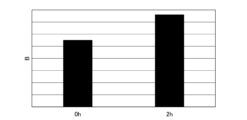
- FIG. It is a graph which shows the transition of the deteriorated flavor with respect to time obtained by the sensory evaluation.
- FIG. 4 is a configuration diagram showing an example of a hardware configuration of a controller installed in a store; It is a figure which shows the example of a display on a monitor. It is a figure which shows the example of a display with a portable terminal.
- FIG. 1 is a plan view of the inside of a hot showcase to which the fried food sales promotion system according to the first embodiment is applied, viewed from the back side;
- FIG. It is a graph which shows transition of the deep-fried color with respect to the elapsed time obtained by the sensory evaluation.
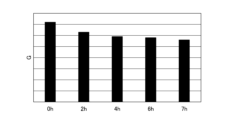
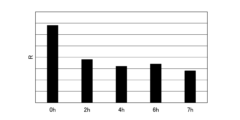
- 10 is a graph showing the transition of the color component R value with respect to the elapsed time obtained by photographing the fried chicken displayed in the hot showcase as a still image and analyzing the image.
- FIG. 10 is a graph showing transition of color component G value with respect to elapsed time obtained by photographing fried chicken displayed in a hot showcase as a still image and analyzing the image;
- FIG. 10 is a graph showing transition of color component B value with respect to elapsed time obtained by photographing fried chicken displayed in a hot showcase as a still image and analyzing the image;
- FIG. 10 is a graph showing the transition of the color component R value with respect to the elapsed time obtained when the fried chicken displayed in the hot showcase is photographed as a moving image and the image is analyzed.
- 10 is a graph showing the transition of the color component G value with respect to the elapsed time obtained when the fried chicken displayed in the hot showcase is photographed as a moving image and the image is analyzed.
- 10 is a graph showing the transition of the color component B value with respect to the elapsed time obtained when the fried chicken displayed in the hot showcase is photographed as a moving image and the image is analyzed.
- 10 is a graph showing the transition of the color component R value with respect to the elapsed time obtained by photographing the croquettes displayed in the hot showcase as a still image and analyzing the image.
- 10 is a graph showing the transition of the color component G value with respect to the elapsed time obtained by photographing the croquettes displayed in the hot showcase as a still image and analyzing the image.
- 10 is a graph showing the transition of the color component B value with respect to the elapsed time obtained by photographing the croquettes displayed in the hot showcase as a still image and analyzing the image.
- 10 is a graph showing the transition of the color component R value with respect to the elapsed time obtained when the croquettes displayed in the hot showcase are photographed as a moving image and the image is analyzed.
- 10 is a graph showing the transition of the color component G value with respect to the elapsed time obtained when the croquettes displayed in the hot showcase are photographed as a moving image and the image is analyzed.
- 10 is a graph showing the transition of the color component B value with respect to the elapsed time obtained when the croquettes displayed in the hot showcase are photographed as a moving image and the image is analyzed.
- 10 is a graph showing the transition of the color component R value with respect to elapsed time obtained by photographing hash potatoes displayed in a hot showcase as a still image and analyzing the image.
- 10 is a graph showing the transition of the color component G value with respect to the elapsed time obtained by photographing hash potatoes displayed in a hot showcase as a still image and analyzing the image.
- FIG. 10 is a graph showing the transition of the color component B value with respect to the elapsed time obtained by photographing hash potatoes displayed in a hot showcase as a still image and analyzing the image. It is a functional block diagram which shows the function which the fried food sales promotion control apparatus which concerns on 1st Embodiment has. It is a flowchart which shows the flow of the process performed with the fried food sales promotion control apparatus which concerns on 1st Embodiment. It is a graph which shows transition of the average area with respect to elapsed time obtained when three fried chicken displayed in the hot showcase are image
- FIG. 4 is a graph showing changes in weight change rate with respect to elapsed time for fried chicken displayed in a hot showcase.
- FIG. 4 is a top view of the bottom surface of a predetermined stage in the hot showcase, showing a plurality of weight measurement sensors laid out on each tray. It is a graph which shows the transition of the stickiness of the batter of fried food with respect to the elapsed time obtained by sensory evaluation. It is a graph which shows the time change of the water content contained in the coating of the surface side of the fried chicken displayed in the hot showcase. It is a graph which shows the time change of the water content contained in the coating of the back side of the fried chicken displayed in the hot showcase.
- FIG. 4 is a graph showing changes over time in the stickiness of batter of fried chicken displayed in a hot showcase.
- FIG. 4 is a plan view of a portion corresponding to the top surface of a predetermined stage in the hot showcase as viewed from below, showing a plurality of near-infrared sensors attached to the top surface portion;
- Fig. 10 is a graph showing the transition of the intensity of the odor of fried food with respect to the elapsed time obtained by sensory evaluation.
- FIG. 4 is a plan view of a portion corresponding to the top surface of a predetermined stage in the hot showcase as viewed from below, showing a plurality of odor sensors attached to the top surface portion; It is a functional block diagram which shows the function which the fried food sales promotion control apparatus which concerns on 2nd Embodiment has. It is a flowchart which shows the flow of the process performed with the fried food sales promotion control apparatus which concerns on 2nd Embodiment. It is a functional block diagram which shows the function which the fried food sales promotion system which concerns on 3rd Embodiment has. It is the top view which looked at the inside of the hot showcase to which the fried food sales promotion system based on 4th Embodiment is applied from the back side.
- the fried food sales promotion system is installed, for example, in a hot showcase installed near the accounting place of a small store such as a convenience store, or in a delicatessen section (food section) such as a supermarket.
- This system manages the point of disposal of cooked foods displayed on display shelves such as showcases, especially fried foods (for example, fried chicken, croquettes, French fries, etc.).
- the "disposal point" of cooked food refers to a state in which the flavor of the cooked food has deteriorated due to the passage of a predetermined time from the time cooking was completed, making it unsuitable for sale to customers. means the point in time when The "disposal point” is arbitrarily set by the manufacturer or retail store according to the type of cooked food. Therefore, the "time of disposal” includes not only the so-called “expiration date” but also the "best before date”.
- processing for food includes processing for changing the display environment of the food to be managed so as to shift the time when the food is to be discarded into the future.
- FIG. 1 is a perspective view showing one configuration example of the hot showcase 1.
- FIG. 1 is a perspective view showing one configuration example of the hot showcase 1.
- the hot showcase 1 is an example of a display shelf for fried foods that is installed in a retail store such as a convenience store, and on which fried foods X cooked in the store are displayed.
- the internal space of the hot showcase 1, that is, the display space in which the fried food X is displayed is kept at an appropriate temperature so that the display environment of the fried food X can be maintained under suitable conditions, and the fried food X in a more suitable state is sold to the customer. managed to make it possible.
- FIG. 1 three shelves 11, 12, 13 are provided in the hot showcase 1, and several kinds of fried foods X are displayed on each shelf 11, 12, 13. A plurality of fried foods X are arranged on the same tray 2 by type.
- three trays 2 are placed on each shelf 11, 12, and 13, respectively.
- the upper shelf of the hot showcase 1 is the first shelf 11
- the middle shelf is the second shelf 12
- the lower shelf is is the third shelf 13 .
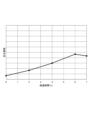
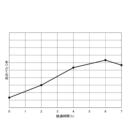
- Fig. 2 is a graph showing the transition of the deteriorated flavor of fried food X over time obtained by sensory evaluation.
- the horizontal axis indicates the elapsed time from the time when the fried food to be evaluated is fried
- the vertical axis converts the flavor of the fried food X into a predetermined evaluation point
- the cumulative value of the points is the deterioration of the flavor.
- the fried food X has an increased deteriorated flavor (the deterioration of the flavor becomes stronger) as the time elapsed from the time of completion of frying, which is the time at which cooking is completed, increases. That is, based on FIG. 2, it can be said that the flavor of fried food deteriorates with the passage of time. Therefore, among the plurality of fried foods X displayed in the hot showcase 1, those that have passed a predetermined time from the time of frying are said to have a reduced flavor and are not suitable for sale to customers. Since it can be estimated, the fried food X that has reached the predetermined elapsed time is subject to disposal (subject to suspension of sales).
- a fried food sales promotion system 3 according to the first embodiment of the present invention will be described with reference to FIGS. (Hardware configuration of fried food sales promotion system 3) First, the hardware configuration of the fried food sales promotion system 3 will be described with reference to FIGS.
- FIG. 3 is a system configuration diagram showing one configuration example of the fried food sales promotion system 3 according to the first embodiment of the present invention.
- FIG. 4 is a configuration diagram showing an example of the hardware configuration of the controller 311 installed in the store 31.
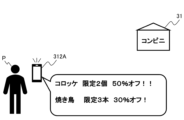
- FIG. 5A is a diagram showing a display example on the monitor 312.
- FIG. 5B is a diagram showing a display example on the mobile terminal 312A.
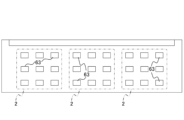
- FIG. 6 is a plan view of the inside of the hot showcase 1 to which the fried food sales promotion system 3 according to the first embodiment is applied, viewed from the rear side.
- the fried food sales promotion system 3 is, as shown in FIG. and a management server 320 configured as described above.
- Each controller 311 and the management server 320 are directly or indirectly connected to each other so that information can be communicated via a communication network N such as an Internet line.
- Each controller 311 controls the fried food sales promotion control device 4 that controls the sales promotion of the fried food X displayed in the hot showcase 1 (that is, the food sales promotion control device that controls the sales promotion of the cooked food displayed on the display shelf). control device).
- each controller 311 has a function related to the sales promotion of the fried food X that the fried food sales promotion control device 4 has, for example, a function for performing environmental management such as temperature and humidity in the hot showcase 1, It may have a function related to state management of various devices provided in the store 31 .
- the management server 320 executes, for example, processing related to sales management of each store 31 .
- each hot showcase 1 is communicably connected to each controller 311.
- the communication means may be wired or wireless.
- the hot showcase 1 transmits detection data obtained by detecting the state of the fried food X displayed on each shelf 11, 12, 13 (see FIG. 1) to the management server 320 via the controller 311. It is sufficient to have a function for Note that the function of transmitting detection data to the management server 320 may be implemented without the controller 311 . For example, if the hot showcase 1 has a configuration that enables direct communication with the management server 320 , detection data can be directly transmitted to the management server 320 without going through the controller 311 .
- each controller 311 includes a CPU (Central Processing Unit) 301, a RAM (Random Access Memory) 302, a ROM (Read Only Memory) 303, an HDD (Hard Disk Drive) 304, and an I/F (Interface) 305 . These configurations are connected to each other via a common bus 306 .
- CPU Central Processing Unit
- RAM Random Access Memory
- ROM Read Only Memory
- HDD Hard Disk Drive
- I/F Interface
- the CPU 301 is computing means and controls the operation of the controller 311 as a whole.
- a RAM 302 is a volatile storage medium from which information can be read and written at high speed, and is used as a work area when the CPU 301 processes image information, for example.
- the ROM 303 is a read-only non-volatile storage medium and stores programs such as firmware.
- the HDD 304 is a non-volatile storage medium that can read and write information and has a large storage capacity, and stores an OS (Operating System), control programs and application programs for executing various types of information processing described later. .
- OS Operating System
- the HDD 304 can be replaced by, for example, an SSD (Solid State Drive) regardless of the type of device as long as it implements the functions of storing and managing information as a non-volatile storage medium.
- the camera 5 for photographing the inside of the hot showcase 1, the monitor 312 for displaying the user interface, and the communication module 313 for realizing information communication with devices other than the controller 311.
- the communication module 313 configures a communication connection interface for enabling communication via the communication network N with the controller 311 . That is, the controller 311 can communicate information with the management server 320, the mobile terminal 312A, and the like via the communication module 313 connected to the I/F 305. FIG. The communication module 313 also realizes information communication between the controller 311 and other devices such as sensors installed in the hot showcase 1 .
- Each controller 311 having such a hardware configuration implements a processing function of the control program stored in the ROM 303 and the control program and application program loaded from the storage medium such as the HDD 304 to the RAM 302 by the arithmetic function of the CPU 301. It is an information processing device that By executing these information processes, a software control section including various functional modules in each controller 311 is configured. A functional block that implements the function of each controller 311 is configured by a combination of the software control unit configured in this way and the hardware resources including the configuration described above.
- management server 320 shown in FIG. 3 also has the same hardware configuration as each controller 311, and each configuration executes the control program and application program stored in the respective storage media to control the management server.
- a functional block that implements the functions of H.320 is configured.
- Specific information processing for controlling the discounted sales promotion of the fried food X displayed in the hot showcase 1 is executed by the fried food sales promotion control device 4, which will be described later.
- All of the functions of the fried food sales promotion control device 4 may be implemented in the store software on the controller 311 side or the headquarters software on the management server 320 side, or the functions may be distributed between the store software and the headquarters software. may be
- the monitor 312 is installed, for example, near the hot showcase 1 or in a conspicuous place in the store 31, and displays product information including information such as product discounts and other campaign information to customers visiting the store 31. do. Specifically, as shown in FIG. 5A, product names and quantities that are subject to discounts at the store 31, such as "50% off for limited 2 croquettes!" and “30% off for 3 yakitori only! , and information on products to be discounted, including the discount rate (hereinafter sometimes simply referred to as “discount information”).
- the discount information is displayed not only on the monitor 312 installed in the store 31, but also on the mobile terminal 312A (smartphone, tablet, etc.) possessed by the customer P who can use the store 31, as shown in FIG. 5B. You can receive it as a notification.
- the customer P installs a dedicated application on the mobile terminal 312A in advance, and registers the store 31 from among the multiple stores 31 at which he or she wishes to receive discount information.
- the customer P can receive discount information from any store 31 as a notification by performing such a setting operation in advance.
- the customer P installs a dedicated application on the mobile terminal 312A in advance and makes settings so that discount information can be received. Then, when the customer P approaches within a radius of, for example, 100 m from a certain shop 31, if the discount target product is displayed in the hot showcase 1, the shop 31 sends the portable terminal 312A the target discount. Information is sent.
- the discount information sent to the mobile terminal 312A does not necessarily have to be the information after the discount on the product to be discounted. product discount schedule.
- the monitor 312 and the mobile terminal 312A are one aspect of a notification device that notifies information (discount information) including the discount rate of the fried foods X displayed in the hot showcase 1.
- the notification means of the discount information on the monitor 312 and the mobile terminal 312A does not necessarily have to be only characters, and may be at least one of notification means including voice, characters, color, and light. Therefore, for example, in place of the display on the monitor 312, an in-store announcement may be made by voice, or the tray 2 on which the fried food X to be discounted may be illuminated in red.
- the monitor 312 In addition to displaying product discount information and campaign information, the monitor 312 also displays setting information input to the controller 311 by an employee of the store 31 in which the hot showcase 1 is installed, and information about the hot showcase 1 . You may display the operation information etc. which were performed. In this case, the monitor 312 preferably has separate display screens for customers and employees, for example.
- the angle of view and focus of the camera 5 are adjusted so that all of the plurality of fried foods X displayed on each shelf 11, 12, 13 can be acquired as images of the individual fried foods X, as shown in FIG.
- a plurality of such devices are installed in the hot showcase 1 in this state.
- a plurality of cameras 5 are installed on the top surface above the center of each tray 2 .
- the camera 5 uses a camera capable of capturing still images and moving images, but it may not necessarily be a camera capable of capturing both still images and moving images. , a still camera, or the like, capable of capturing only still images.
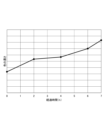
- Fig. 7 is a graph showing the transition of the deep-fried color against the elapsed time obtained by the sensory evaluation.
- the horizontal axis in FIG. 7 indicates the elapsed time from the time when the fried food to be evaluated is fried, and the vertical axis in FIG.
- the index indicating the color depth of the surface generally increases as the elapsed time from the time of frying increases. That is, fried foods tend to darken in color over time.
- the color of the surface of the fried food is state data indicating the state of the fried food and also corresponds to temporal change data that indicates the temporal change of the fried food.
- the value of the "degraded flavor" shown in FIG. 2 also increases as the elapsed time from the frying time increases. Therefore, there is a correlation between the color intensity of the surface of the fried food and the deterioration of the flavor of the fried food.
- the color of the fried food X displayed in the hot showcase 1 is used as an index indicating the state of the fried food X, and the fried food X is displayed based on the change in the color of the fried food X. Predict the remaining time until the point of disposal of
- the hot showcase 1 corresponds to a data detection device that detects temporal change data indicating the temporal change of the fried food X displayed in the hot showcase 1, and the hot showcase 1 as a state sensor that detects the state of the fried food X. It utilizes a plurality of cameras 5 (see FIG. 6) mounted within. Then, the fried food sales promotion control device 4 identifies the surface image of the individual fried food X from the still image or moving image taken by each camera 5, calculates the RGB value of the pixel (each pixel) constituting the surface image, These RGB values are analyzed as color components of each fried food X.
- the method of analyzing the color of each fried food X does not necessarily have to be the RGB method, and as another analysis method, for example, wavelength analysis of still images or moving images captured by each camera 5 may be performed.
- a moving image a still image is extracted from the moving image at a predetermined sampling time, and the color component of each fried food X corresponding to a predetermined elapsed time is analyzed using the still image as an analysis target.
- the RGB value is used as an index indicating the color of the fried food X, but it is not limited to this, for example, it is expressed by the three elements of hue (Hue), saturation (Saturation), and lightness (Value). Other color indices such as HSV may be used.
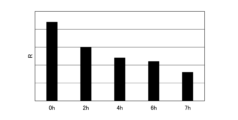
- FIG. 8A is a graph showing the transition of the color component R value with respect to the elapsed time obtained when the fried chicken displayed in the hot showcase 1 is photographed as a still image and the image is analyzed.
- FIG. 8B is a graph showing the transition of the color component G value with respect to the elapsed time obtained by photographing the fried chicken displayed in the hot showcase 1 as a still image and analyzing the image.
- FIG. 8C is a graph showing the transition of the color component B value with respect to the elapsed time obtained by photographing the fried chicken displayed in the hot showcase 1 as a still image and analyzing the image.
- FIG. 9A is a graph showing the transition of the color component R value with respect to the elapsed time obtained when the fried chicken displayed in the hot showcase 1 is photographed as a moving image and the image is analyzed.
- FIG. 9B is a graph showing the transition of the color component G value with respect to the elapsed time obtained when the fried chicken displayed in the hot showcase 1 is photographed as a moving image and the image is analyzed.
- FIG. 9C is a graph showing the transition of the color component B value with respect to the elapsed time obtained when the fried chicken displayed in the hot showcase 1 is photographed as a moving image and the image is analyzed.
- the R component tends to decrease as a whole as 4 hours, 6 hours, and 7 hours pass from the time of frying, as in the case of analyzing the color component from the still image of fried chicken.
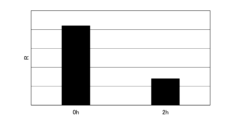
- the content of the G component decreased 4 hours after the frying compared to the contents at the time of the frying and after 2 hours, and further decreased 7 hours after the frying.
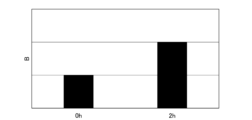
- the component B tends to slightly increase as the time passes from the time of frying to 4 hours, 6 hours, and 7 hours.
- FIG. 10A is a graph showing the transition of the color component R value with respect to the elapsed time obtained when the croquettes displayed in the hot showcase 1 are photographed as still images and the images are analyzed.
- FIG. 10B is a graph showing the transition of the color component G value with respect to the elapsed time obtained by photographing the croquettes displayed in the hot showcase 1 as a still image and analyzing the image.
- FIG. 10C is a graph showing the transition of the color component B value with respect to the elapsed time obtained by photographing the croquettes displayed in the hot showcase 1 as a still image and analyzing the image.
- FIG. 11A is a graph showing the transition of the color component R value with respect to the elapsed time obtained when the croquettes displayed in the hot showcase 1 are photographed as a moving image and the image is analyzed.
- FIG. 11B is a graph showing the transition of the color component G value with respect to the elapsed time obtained when the croquettes displayed in the hot showcase 1 are photographed as a moving image and the image is analyzed.
- FIG. 11C is a graph showing the transition of the color component B value with respect to the elapsed time obtained when the croquettes displayed in the hot showcase 1 are photographed as a moving image and the image is analyzed.
- FIG. 12A is a graph showing the transition of the color component R value with respect to the elapsed time obtained when hash potatoes displayed in the hot showcase 1 are photographed as still images and the images are analyzed.
- FIG. 12B is a graph showing the transition of the color component G value with respect to elapsed time obtained by photographing hash potatoes displayed in the hot showcase 1 as a still image and analyzing the image.
- FIG. 12C is a graph showing the transition of the color component B value with respect to the elapsed time obtained by photographing hash potatoes displayed in the hot showcase 1 as a still image and analyzing the image.
- the fried food X displayed in the hot showcase 1 tends to change color over time from the time of frying (experimentally confirmed fried chicken, croquettes, and hash potatoes, especially, It is possible to set in advance a discarding reference value (reference RGB value) that serves as a discarding criterion for judging the discarding point of the fried food X.
- a discarding reference value reference RGB value
- the discard standard value may be set uniformly to a predetermined value regardless of the type of fried food X, or may be set to a different value for each type of fried food X.
- the same trend is observed for fried chicken and croquettes (the R component decreases, and the G and B components increase.
- the tendency is different between fried chicken and croquette (in fried chicken, all the R, G, and B components are reduced, In the croquettes, there is no change in the R component, and increases in the G and B components).
- the discard reference value may be set to a predetermined value regardless of the type of fried food X. Further, when the color component is analyzed from the moving image, by setting the disposal reference value to a different value for each type of fried food X, the fried food sales promotion control device 4 can more accurately predict the remaining time until the time of disposal. It can be done with precision.
- the method of setting the discard reference value may be dynamically changed depending on whether the format of the data input to the fried food sales promotion control device 4 is a still image or a moving image.
- 9A to C and FIGS. 11A to 11C are mainly due to differences in shooting conditions such as the angle of view of each camera 5, exposure time, and lighting in the hot showcase 1. Therefore, the method of setting the discard reference value may be changed according to the imaging conditions.
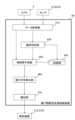
- FIG. 13 is a functional block diagram showing the functions of the fried food sales promotion control device 4. As shown in FIG.
- the fried food sales promotion control device 4 includes, for example, a data acquisition unit 41, a type identification unit 42, an analysis unit 43, a remaining time prediction unit 44, a storage unit 45, a discount rate calculation unit 46, and a notification unit 47. , and a learning unit 48 .
- the data acquisition unit 41 acquires surface images (still images or moving images) of a plurality of fried foods X for each tray 2 photographed by each camera 5 as data regarding the color of each fried food X.
- the image area of each fried food X is specified by executing image processing for extracting the outline of each fried food X included in the image captured by the camera 5 .
- an analysis region forming a predetermined pixel group is specified from the specified image region.
- the “predetermined pixel group” includes pixels adjacent to the pixels extracted as the outline of the fried food X, for example, includes pixels specified as the image area of the fried food X, and has a certain range around it. It refers to the part including the pixels expanded to That is, the number of pixels in the analysis area is greater than the number of pixels in the image area of the fried food X.
- the data acquisition unit 41 acquires the R component, the G component, and the B component of each pixel included in the specified analysis area, and transfers them to the analysis unit 43 .
- the R component, G component, and B component of each pixel may be acquired by the analysis unit 43 .
- the analysis area may not only be set according to the size of the image area of the fried food X, but may also be set with a predetermined number of pixels regardless of this size. Alternatively, the analysis area may be specified by pixels sampled at a constant rate with respect to the number of pixels included in the image area.
- the type identifying unit 42 identifies the type of each fried food X from the individual image of each fried food X extracted from each surface image acquired by the data acquisition unit 41 .
- the type identification unit 42 identifies the type of fried food X by comparing it with a reference sample image. Note that the sample image is stored in the storage unit 45 .
- the identification of the type of fried food X in the type identification unit 42 is performed by, for example, an employee of the store 31 manually specifying the type of fried food X via an input terminal (for example, a touch panel, a keyboard, etc.) installed in the store 31. It is also possible to input
- the fried food sales promotion control device 4 does not necessarily include the type specifying unit 42, and the discard reference value for determining when to discard the fried food X is set to a predetermined value regardless of the type of the fried food X. If there is, the type identification unit 42 is unnecessary.
- the analysis unit 43 analyzes the color components (RGB values) of each fried food X from each individual image.
- the remaining time prediction unit 44 is based on the color component of each fried food X analyzed by the analysis unit 43, the type of each fried food X, and the disposal standard value set for each type of each fried food X. , the remaining time (hereinafter sometimes simply referred to as “remaining time”) until the time of disposal of each fried food X is predicted.
- the discard reference value is stored in the storage unit 45 .
- the color component (color) of the surface of the fried food X is used as an index used to set the point of disposal of the fried food X.
- the reference value is set to a discard reference value for color components.
- the index used to set the point of disposal should be an index that has been confirmed to function in grasping the state of fried food X. Therefore, in addition to optical indicators such as the color of the fried food X, physical indicators such as the size, weight, moisture content, and volatile content of the fried food X, and Chemical indices such as volatile component composition, acid value, anisidine value, carbonyl value, peroxide value, iodine value, and amount of polar compounds are included. Therefore, there are various indicators other than the color of the fried food X that are used for setting the point of disposal. Therefore, the remaining time prediction unit 44 predicts the remaining time using the discard reference value for each index used for setting the discard point.
- the remaining time prediction unit 44 calculates the color component of each fried food X analyzed by the analysis unit 43 and the storage unit Based on the discard reference value stored in 45, the remaining time until the point of discard of each fried food X is predicted.
- the discount rate calculation unit 46 calculates the discount rate for the fixed price of each fried food X based on the remaining time of each fried food X predicted by the remaining time prediction unit 44 .
- the discount rate calculation unit 46 holds in advance a reference table in which discount rates are set for a certain remaining time. In this reference table, for example, when the remaining time is 2 hours, the discount rate is 10% of the list price, when the remaining time is 1 hour, the discount rate is 20% of the list price, and when the remaining time is 30 minutes, the discount rate is set.
- a predetermined discount rate is associated with a predetermined remaining time, such as 50% of the list price.
- the discount rate calculating unit 46 calculates the discount rate corresponding to the remaining time of the fried food X Decide as a discount rate to
- the fried food X is calculated based on the discount rate associated with the approximate remaining time. Calculate the discount rate of For example, if the remaining time predicted by the remaining time prediction unit 44 is 1 hour and 30 minutes, the discount rate calculation unit 46 calculates the discount rate (10%) for the remaining time of 2 hours and the remaining time "15%" calculated by adding the discount rate (20%) for 1 hour and proportionally dividing it is calculated as the discount rate.
- the discount rate for the fixed price of the fried food X increases. do.
- the selling price of the fried food X decreases as the remaining time suitable for selling the fried food X decreases, and the customer P who uses the store 31 is more motivated to buy.
- the notification unit 47 transmits a notification signal for notifying information including the discount rate calculated by the discount rate calculation unit 46 and the type of fried food X to which the calculated discount rate is applied to the monitor 312 or the mobile terminal 312A ( notification device).
- the notification unit 47 not only outputs the notification signal to the monitor 312 and the portable terminal 312A that notify the customer P, but also displays the display terminal (for example, a business monitor or output to a tablet for business use, etc.). As a result, the employee of the store 31 can grasp which fried foods X among the plurality of fried foods X displayed in the hot showcase 1 are discounted. In addition, the notification unit 47 outputs, as a notification signal to the display terminal used by the employee of the store 31, the remaining time until the point of disposal of the fried food X, etc., in addition to the discount information related to the fried food X to be discounted. may contain information about
- the information (notification signal) output by the notification unit 47 is not limited in its type, expression format, and notification format as long as it is information capable of prompting the customer P to purchase the fried food X to be discounted. do not have.
- the fried food sales promotion control device 4 creates a learned model capable of predicting the remaining time until the fried food X is discarded by machine learning or regression analysis. It includes a learning unit 48 that performs transfer learning on the finished model.
- the learning unit 48 generates a learned model by performing machine learning and regression analysis using teacher data including color component data (data indicating the tendency of change over time up to the discard reference value). do. Then, the learning unit 48 updates the discard reference value stored in the storage unit 45 based on the generated trained model, and also performs transfer learning. In this way, the discard reference value, which is the basis of the remaining time predicted by the remaining time prediction unit 44, is updated at any time by machine learning or regression analysis, thereby improving the remaining time prediction accuracy of the remaining time prediction unit 44. .
- the learning unit 48 uses, for example, linear regression, support vector machine (SVM), bagging, boosting, etc., from the data (explanatory variables) of the discard criterion value already stored in the storage unit 45. , Adaboost, decision tree, random forest, logistic regression, neural network, deep learning, convolutional neural network (CNN), Recurrent Neural Network (RNN)), LSTM (Long Short-Term Memory), etc. Create a calibration curve (model formula).
- Types of linear regression include simple regression, multiple regression, partial least squares (PLS: Partial Least Squares) regression, orthogonal projection partial least squares (OPLS: Orthogonal Partial Least Squares) regression, etc.
- PLS Partial Least Squares
- OPLS orthogonal Partial Least Squares
- Simple regression is a method of predicting one objective variable with one explanatory variable
- multiple regression is a method of predicting one objective variable with multiple explanatory variables.
- (orthogonal projection) partial least squares regression is a method of extracting principal components so that the covariance between principal components, which are a small number of feature quantities (obtained by principal component analysis of only explanatory variables) and the objective variable, is maximized. is.
- (Orthogonal projection) partial least squares regression is a suitable technique when the number of explanatory variables is greater than the number of samples and when the correlation between the explanatory variables is high.
- the standard curve obtained by machine learning and regression analysis in the learning unit 48 is applied to the discard reference value stored in the storage unit 45 to update the discard reference value, and the update result is used to predict the remaining time. It becomes possible to provide to the unit 44.
- the generation of a trained model in the learning unit 48 may be executed for each user who creates and inputs data.
- each user uses only the learned model generated by providing his or her own data. This makes it possible to predict the remaining time specific to the environment within the hot showcase 1 of each user.
- the generation of trained models and transfer learning in the learning unit 48 may be performed without distinguishing between users who create and input data.
- a trained model can be generated using a larger amount of data.
- the remaining time of the fried food X is predicted using characteristics (type of fried food X, etc.) and color components predetermined for each user as input data.
- the learning unit 48 can create not only a learned model capable of predicting the remaining time of fried food X, but also a learned model capable of specifying the type of fried food X. . In this case, the accuracy of specifying the type of fried food X in the type specifying unit 42 is further improved.
- the fried food sales promotion control device 4 does not necessarily include the learning unit 48 . , or acquire the discard reference value updated by a learning device that is different from the fried food sales promotion control device 4 and executes the same processing as the processing in the learning unit 48, Predict the remaining time of fried food X.
- the remaining time prediction unit 44 predicts the remaining time of the fried food X by continuously using the predetermined disposal reference value stored in the storage unit 45 as follows in the third embodiment.
- a case where the remaining time prediction unit 44 predicts the remaining time of the fried food X by acquiring the discard reference value updated by a learning device different from the fried food sales promotion control device 4 will be described.
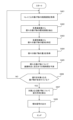
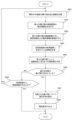
- FIG. 14 is a flowchart showing the flow of processing executed by the fried food sales promotion control device 4.
- FIG. 14 is a flowchart showing the flow of processing executed by the fried food sales promotion control device 4.
- the data acquisition unit 41 acquires the surface image of the fried food X for each tray 2 detected and output by each camera 5 in the data detection step (the image of the fried food X displayed on the tray 2). state) is acquired (step S401).
- the fried food sales promotion control device 4 extracts an individual image of each fried food X from each surface image acquired in step S401 (step S402).
- the type of X is specified (step S403; type specifying step).
- the analysis unit 43 analyzes the color components (RGB values) of each fried food X from each individual image extracted in step S402 (step S404). Subsequently, the remaining time prediction unit 44 compares the color components analyzed in step S404 with the discard reference value for the type specified in step S403 for each fried food X, and determines the remaining time until the time of discarding. Time is predicted (step S405; remaining time prediction step).
- step S406/YES If it is determined that the discounted fried food X is included in the hot showcase 1 based on each remaining time predicted in step S405 (step S406/YES), the discount rate calculation unit 46 A discount rate corresponding to the remaining time is calculated for the target fried food X (step S407; discount rate calculation step).
- the notification unit 47 outputs a notification signal for notifying information including the discount rate calculated in step S407 to the monitor 312 or the mobile terminal 312A (step S408).
- the monitor 312 and the portable terminal 312A notify the discount information about the fried food X to be discounted (notification step).
- step S406 determines whether the discounted fried food X is included in the hot showcase 1 (step S406/NO). If it is determined in step S406 that the discounted fried food X is not included in the hot showcase 1 (step S406/NO), the process returns to step S401 to repeat the process.
- the learning unit 48 uses a pre-generated learned model to calculate the color components analyzed in step S404. Transfer learning is performed using teacher data including (step S410).
- step S411 discard determination criterion updating step.
- the discount rate of the fried food X according to the remaining time can be easily and accurately calculated as compared with the case where the staff of the store 31 manually calculates the remaining time of the fried food X. can do.
- the fried food sales promotion control device 4 acquires the surface image of the fried food X photographed by each camera 5 as data related to the color of the fried food X, but is not limited to this. You may acquire the detected data as data regarding the color of the fried food X.
- FIG. 1 A block diagram illustrating an exemplary computing environment in accordance with the present embodiment.
- the color component of each fried food X is analyzed from the surface image of the fried food X, and the color component is used as the state data (time change data) of the fried food X.
- the fried food X The state data of may be other than the color component of the fried food X, and may be, for example, the area, which is an index indicating the size of the fried food X.
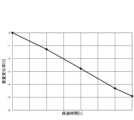
- FIG. 15 is a graph showing the transition of the average area with respect to the elapsed time obtained when three fried chickens displayed in the hot showcase 1 are photographed as still images and the images are analyzed.
- the horizontal axis indicates the elapsed time from the fried chicken to be evaluated, and the vertical axis indicates the average area of each of the three fried chickens calculated by image analysis. ” is an indexed value.
- the fried chicken's area (average area), which is an indicator of size, decreases as the elapsed time from frying increases. That is, fried chicken tends to decrease in size over time.
- the value of the "degraded flavor" shown in FIG. 2 increases as the elapsed time increases. Also, as described above, the average area decreases as the elapsed time increases. Therefore, there is a correlation between the reduction in fried food area (average area) and the reduced flavor of fried food. Therefore, the fried food sales promotion control device 4 uses the area, that is, the size, of the fried food X displayed in the hot showcase 1 as an index (state data) indicating the state of the fried food X to determine the size of the fried food X. The remaining time of fried food X can also be predicted based on the change in .
- the data acquisition unit 41 acquires the surface image of the fried food X photographed by each camera 5, and then the analysis unit 43 acquires the individual extracted from each surface image.
- the area of each fried food X is calculated by analyzing the individual images of the fried food X.
- FIG. 16 to 25 a fried food sales promotion control device 4A according to a second embodiment of the present invention will be described with reference to FIGS. 16 to 25.
- FIG. 16 to 25 the same reference numerals are assigned to the same components as those described in the fried food sales promotion system 3 and the fried food sales promotion control device 4 according to the first embodiment, and the description thereof will be omitted.
- the color (color component) of the fried food X is mainly used as the state data to predict the remaining time of the fried food X, but the fried food sales promotion control according to the present embodiment
- the device 4A a case will be described in which an index indicating the state of the fried food X other than the color is used as the state data.
- FIG. 16 is a graph showing changes in the rate of change in weight of the displayed fried chicken with respect to elapsed time when fried chicken is displayed as an example of the fried food X in the hot showcase 1 .
- the fried chicken being displayed in the hot showcase 1 increases in the total weight of the fried chicken as the elapsed time from the time of frying (storage time in the hot showcase 1) increases.
- the rate of change (%) has decreased.
- the weight change rate (%) is a negative change rate. That is, FIG. 16 shows that the weight of the whole fried chicken decreases as time passes. That is, according to the graph of FIG. 16, the moisture contained in the fried chicken evaporates over time, reducing the total amount of moisture contained in the fried chicken, resulting in a change in the weight of the fried chicken.
- the rate is negative.
- the value of the "degraded flavor" shown in FIG. 2 increases as the elapsed time increases. Also, as described above, the weight of the fried food decreases as the elapsed time increases. Therefore, there is a correlation between the overall weight reduction of the fried food and the reduced flavor of the fried food. Therefore, the fried food sales promotion control device 4 uses the weight (total weight) of the fried food X displayed in the hot showcase 1 as the state data of the fried food X, so that based on the change in the weight of the fried food X It is also possible to predict the remaining time of the fried food X.
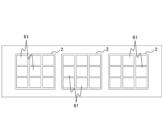
- FIG. 17 is a top plan view of the bottom surface of a predetermined stage in the hot showcase 1, showing a plurality of weight measurement sensors 61 spread over each tray 2.
- FIG. 17 is a top plan view of the bottom surface of a predetermined stage in the hot showcase 1, showing a plurality of weight measurement sensors 61 spread over each tray 2.
- the weight measurement sensor 61 may be a sensor that detects the weight of the fried food X itself, or may be a sensor that detects the total amount of water contained in the fried food X by detecting a change in dielectric constant. .
- a plurality of weight measurement sensors 61 are attached so as to correspond to the position of each fried food X displayed in the hot showcase 1 .
- nine weight measurement sensors 61 are laid out in a matrix on each tray 2, and a maximum of nine fried foods X can be displayed on one tray 2 at one time. It is possible to measure the thickness individually.
- Fig. 18 is a graph showing changes in the stickiness of fried food batter versus elapsed time obtained by sensory evaluation.
- the horizontal axis indicates the elapsed time from the rising time of the fried food to be evaluated, and the vertical axis indicates the index value of the "stickiness of the batter" of the fried food.
- the index indicating the stickiness of the batter generally increases as the time elapsed from the time of frying increases. In other words, fried food tends to become more sticky as time passes. This "stickiness of the batter” is caused by the amount of water contained in the batter of the fried food, and when the amount of water increases, the batter becomes sticky.
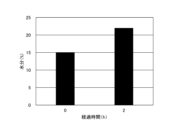
- FIG. 19A is a graph showing temporal changes in the amount of moisture contained in the batter on the surface side of fried chicken being displayed in the hot showcase 1
- FIG. It is a graph which shows the time change of the water content contained in the coating of the back side of fried chicken.
- the “back side” of the fried chicken is the side that contacts the tray 2
- the “front side” is the opposite side, that is, the upper side when displayed in the hot showcase 1 .
- the percentage (%) of moisture content in the batter increases.
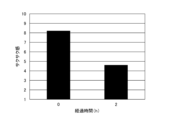
- FIG. 20A is a graph showing changes over time in the crispness of the fried chicken being displayed in the hot showcase 1, and FIG. It is a graph which shows a change.
- the crispness in FIG. 20A tends to be crispier as the sensory evaluation score shown on the vertical axis increases, and the stickiness of the coating in FIG. The higher the sensory evaluation score, the stronger the stickiness tends to be.
- the index indicating crispness decreases.
- the index indicating the stickiness of the clothes is increased. That is, the fried chicken batter becomes less crispy and more sticky as the time elapsed after frying increases.
- fried chicken For fried chicken, the moisture contained in the ingredients inside (chicken) moves to the batter until the specified time has passed since the time of frying. Due to this movement of water, the amount of water contained in the batter increases according to the elapsed time from the time of frying. Therefore, fried chicken is not suitable for sale as a food, such as losing a suitable texture (decreased crispness) and becoming an unsuitable texture (increased stickiness of clothes). It can be said that this is due to the amount of moisture contained in the chicken batter.
- the "degraded flavor" shown in FIG. 2 also increases as the elapsed time increases. Also, as described above, the moisture content of the batter increases as the elapsed time increases. Therefore, there is a correlation between an increase in the moisture content of the batter and a decrease in the flavor of the fried food. Therefore, the fried food sales promotion control device 4 uses the moisture content of the batter of the fried food X displayed in the hot showcase 1 as the state data of the fried food X, so that based on the change in the moisture content of the batter of the fried food X The remaining time of fried food X can also be predicted.
- FIG. 21 is a top view of a portion corresponding to the top surface of a predetermined stage in the hot showcase 1 as seen from below, showing a plurality of near-infrared sensors 63 attached to the top surface portion. .
- the amount of water contained in the batter of fried food X can be detected using, for example, the near-infrared sensor 63 shown in FIG.
- the near-infrared sensor 63 reflects near-infrared light on the fried food X and detects a change in absorptance at a specific wavelength corresponding to the amount of water contained in the fried food X. can be measured. Therefore, by reflecting the near-infrared light emitted from the near-infrared sensor 63 on the batter of the fried food X, the amount of moisture contained in the batter of the fried food X can be measured. It should be noted that the overall moisture content in the fried food X described above can also be measured using this near-infrared sensor 63 in addition to the weight measurement sensor 61 (see FIG. 17).
- the near-infrared sensor 63 can reflect near-infrared light on the fried food X and detect changes in absorptance of a specific wavelength depending on the content of the component contained in the fried food X.
- the acid value, anisidine value, carbonyl value, peroxide value, iodine value, and polar compound amount of the fried food X can be measured.
- the near-infrared sensor 63 is also installed so as to correspond to the positions of the fried foods X displayed in the hot showcase 1, and measures the moisture content of the batter of each fried food X and It is installed so that the positional relationship is such that the acid value can be detected.
- FIG. 22 is a graph showing the transition of the odor intensity of fried food with respect to the elapsed time obtained by sensory evaluation.
- the horizontal axis indicates the elapsed time from the rising time of the fried food to be evaluated, and the vertical axis indicates the indexed value of the "strength of odor" of the fried food.
- smell includes, in a general sense, the pleasant odor of fried food and the unfavorable odor of fried food.
- the desirable odor of fried food is referred to as "aroma”
- the undesirable odor of fried food is referred to as "odor”. Therefore, FIG. 22 shows the change over time of the odor containing both fragrance and odor (the odor as a whole in which the fragrance and odor are not distinguished).
- fried foods generally have a lower odor intensity, which is an indicator of odor strength, as the time elapsed from the time of frying increases. In other words, fried foods tend to have less odor as time passes. This means that the overall volatile content of the fried food is reduced.
- the value of the "degraded flavor" shown in FIG. 2 increases as the elapsed time increases.
- the odor intensity of the fried food decreases and the ratio of the odor to the fried food increases, it can be said that the flavor of the fried food has decreased. Therefore, there is a correlation between a decrease in the volatile components of the fried food, or an increase in the ratio of substances such as aldehydes or ketones due to changes in the volatile component composition of the fried food, and a decrease in the flavor of the fried food.
- the fried food sales promotion control device 4A uses the volatile component or the volatile component composition of the fried food X displayed in the hot showcase 1 as the state data of the fried food X to obtain the volatile component or the volatile component composition of the fried food X.
- the remaining time of the fried food X can also be predicted based on the change in the component composition.
- FIG. 23 is a top view of a portion corresponding to the top surface of a predetermined stage in the hot showcase 1, as viewed from below, showing a plurality of odor sensors 62 attached to the top surface portion.
- the outer frame of the tray 2 is indicated by a two-dot chain line.
- the odor sensor 62 is installed so as to correspond to the positions of the fried foods X displayed in the hot showcase 1, and is capable of detecting the odor of each fried food X. It is attached so as to have a positional relationship.
- the odor sensor 62 may be a sensor capable of detecting both the aroma and odor (odor) of the fried food X, a sensor capable of detecting the aroma of the fried food X, or a sensor capable of detecting the odor of the fried food X. There may be.
- the fried food sales promotion control device 4A discards odors containing components such as aldehydes or ketones when predicting the remaining time of the fried food X. Use the reference value. Then, the relationship between the elapsed time from the time of frying the fried food X and the strength of the odor shows that the longer the time elapsed from the time of frying the fried food X, the more the strength of the odor tends to increase. is reversed.
- the sensor specifications of the odor sensor 62 are not particularly limited.
- a semiconductor gas sensor that detects a gas concentration by changing the resistance value of a semiconductor, an infrared gas sensor, an electrochemical gas sensor, a catalytic combustion gas sensor, a biosensor, or the like can be applied.
- the fried food sales promotion control device 4A uses the moisture content of the fried food X as the state data.
- the composition, acid value, anisidine value, carbonyl value, peroxide value, iodine value, and amount of polar compounds are used as state data, the explanation thereof is omitted.
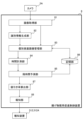
- FIG. 24 is a functional block diagram showing the functions of the fried food sales promotion control device 4A according to the second embodiment.
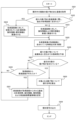
- FIG. 25 is a flow chart showing the flow of processing executed by the fried food sales promotion control device 4A according to the second embodiment.
- the fried food sales promotion control device 4A includes, for example, a data acquisition unit 41A, a type identification unit 42A, a remaining time prediction unit 44A, a storage unit 45A, and a discount rate calculation unit. 46A and a notification unit 47A.
- the data acquisition unit 41A acquires surface images of a plurality of fried foods X for each tray 2 photographed by each camera 5, and acquires the weight of each fried food X detected by the weight measurement sensor 61.
- the type identifying unit 42A identifies the type of each fried food X from the extracted individual image of each fried food X, similar to the type identifying unit 42 in the first embodiment.
- the remaining time prediction unit 44A is based on the weight of each fried food X acquired by the data acquisition unit 41A, the type of each fried food X, and the discard standard value set for each type of each fried food X. , to predict the remaining time of each fried item X.
- the discard standard value in this embodiment is a discard standard value related to the weight of the fried food X, and is preset and stored in the storage unit 45A.
- the discount rate calculation unit 46A calculates the discount rate for the fried food X to be discounted based on the remaining time predicted by the remaining time prediction unit 44A, like the discount rate calculation unit 46 in the first embodiment.
- the notification unit 47A transmits a notification signal for notifying the discount information of the fried food X including the discount rate calculated by the discount rate calculation unit 46A to the monitor 312 or the mobile terminal. 312A (notification device).
- the data acquisition unit 41A acquires the surface image of the fried food X for each tray 2 output from each camera 5 (step S421).
- step S422 an individual image of each fried food X is extracted from each surface image acquired in step S421 (step S422), and the type specifying unit 42 determines the type of each fried food X from each individual image extracted in step S422. is specified (step S423).
- the fried food sales promotion control device 4A does not necessarily include the type specifying step (step S423) for specifying the type of each fried food X. In that case, steps S421 and The processing in step S422 may be omitted.
- the data acquisition unit 41A acquires the weight of each fried food X output from each weight measurement sensor 61 as state data (step S424).
- the remaining time prediction unit 44A compares the weight acquired in step S424 with the discarding standard value related to the type specified in step S423 for each piece of fried food X, and determines the remaining time until the point of discarding. Predict (step S425).
- step S427 If it is determined that the discounted fried food X is included in the hot showcase 1 based on each remaining time predicted in step S425 (step S426/YES), the discount rate calculation unit 46A A discount rate corresponding to the remaining time is calculated for the target fried food X (step S427).
- the notification unit 47A outputs a notification signal for notifying information including the discount rate calculated in step S427 to the monitor 312 or the mobile terminal 312A (step S428), and the processing in the fried food sales promotion control device 4A is completed. finish.
- step S426 determines whether the discounted fried food X is included in the hot showcase 1 (step S426/NO). If it is determined in step S426 that the discounted fried food X is not included in the hot showcase 1 (step S426/NO), the process returns to step S421 to repeat the process.
- the fried food sales promotion control device 4A does not need to include an "analyzer", and can predict the remaining time of fried food X using the state data acquired by the data acquisition unit 41A. , the number of operations to be performed can be reduced.
- FIG. 26 is a functional block diagram showing the functions of the fried food sales promotion system 3A according to the third embodiment.
- a fried food sales promotion system 3A includes a fried food sales promotion control device 4B that controls the sales promotion of fried food X, and a learning device 7 that generates a learned model capable of predicting the remaining time of fried food X.
- a learning device 7 that generates a learned model capable of predicting the remaining time of fried food X.
- the learning device 7, which is a device different from the .
- the fried food sales promotion control device 4B has the same configuration as the fried food sales promotion control device 4A according to the second embodiment described above, and includes a data acquisition unit 41B, a type identification unit 42B, a remaining time prediction unit 44B, and a storage unit. 45B, a discount rate calculation unit 46B, a notification unit 47B, and a communication unit 40 are further included.
- the data acquisition unit 41B, the type identification unit 42B, the remaining time prediction unit 44B, the storage unit 45B, the discount rate calculation unit 46B, and the notification unit 47B all have the same functions as in the fried food sales promotion control device 4A. has the function of Therefore, the fried food sales promotion control device 4B can realize the same processing flow as the processing flow in the fried food sales promotion control device 4A.
- the learning device 7 includes a communication unit 70, a data acquisition unit 71, a learned model generation unit 73, and an update unit 74.
- the communication unit 40 of the fried food sales promotion control device 4B and the communication unit 70 of the learning device 7 provide functions including an interface for mutual information communication via the communication network N.
- the data acquisition unit 71 of the learning device 7 obtains the remaining time of the fried food X predicted by the remaining time prediction unit 44B of the fried food sales promotion control device 4B and the data acquisition unit 41 of the fried food sales promotion control device 4B.
- Temporal change data (state data), that is, data indicating the tendency of temporal change until the fried food X is discarded, is acquired via the communication unit 70 .
- the learned model generation unit 73 performs machine learning and regression analysis using teacher data including time-varying data acquired by the data acquisition unit 71 to generate a learned model.
- the updating unit 74 updates the fried food X disposal criteria stored in the storage unit 45B of the fried food sales promotion control device 4B.
- FIG. 27 is a plan view of the inside of the hot showcase 1A to which the fried food sales promotion system according to the fourth embodiment is applied, viewed from the rear side.
- three cameras 5A are provided as photographing devices for photographing images including a plurality of fried foods X displayed on each shelf 11, 12, 13 in the hot showcase 1A.
- the camera 5A is arranged on one end side of the top surface of each shelf 11, 12, 13, but it is possible to photograph an image including all of the plurality of fried foods X displayed in the hot showcase 1A. If possible, there are no particular restrictions on the number of cameras 5A and their mounting positions.
- a plurality of cameras 5A are installed as shown in FIG. By doing so, it is sufficient that an overall image including all of the plurality of fried foods X and surface images of the individual fried foods X can be photographed. Also, for example, by varying the angle of view setting with one camera 5A, similarly, the entire image including all of the plurality of fried foods X and the surface image of each fried food X can be photographed. You may
- a video camera capable of capturing moving images is used as the camera 5A, and images including individual movements of the fried foods X in the hot showcase 1A are captured. Individual fried foods X displayed in the hot showcase 1A are not always placed in the same position as they were placed immediately after being fried.
- the fried food X is placed on the tray 2 arranged on one of the shelves 11, 12, 13 in the hot showcase 1A.
- the position of the fried food X may be changed in the tray 2 of the tray 2, or the fried food X may be moved to a tray 2 different from the tray 2 on which the fried food X was initially placed.
- the camera 5A shoots the state of each shelf 11, 12, 13 as a moving image, thereby shooting an image including the movement (positional movement, etc.) of each fried food X included in the moving image as a whole image.
- the camera 5A executes the processing in the fried food sales promotion control device 8, which will be described later, even if the individual fried food X placed on each shelf 11, 12, 13 is moved, the individual fried food X can be identified. By tracking, the passage of time can be obtained individually.
- the camera 5A does not necessarily have to be a video camera capable of shooting moving images, and may be any camera capable of acquiring images of the fried food X continuously over time.
- it may be a camera such as a still camera that can take only still images. In that case, it is sufficient to be able to continuously shoot to the extent that individual movements of the fried foods X in the hot showcase 1A can be acquired as image data.
- FIG. 28 the functions of the fried food sales promotion control device 8 according to this embodiment will be described with reference to FIGS. 28 and 29.
- FIG. 28 the functions of the fried food sales promotion control device 8 according to this embodiment will be described with reference to FIGS. 28 and 29.
- FIG. 28 is a functional block diagram showing the functions of the fried food sales promotion control device 8 according to the fourth embodiment.
- FIG. 29 is a flow chart showing the flow of processing executed by the fried food sales promotion control device 8 according to the fourth embodiment.
- the fried food sales promotion control device 8 includes, for example, an image acquisition unit 81, an identification information generation unit 82, an individual surface image management unit 83, a time measurement unit 84, a remaining time prediction unit 85, and a storage A unit 86 , a discount rate calculation unit 87 , and a notification unit 88 are included.
- the image acquisition unit 81 is a data acquisition unit (the data acquisition units 41, 41A, 41B), an image including a plurality of deep-fried foods X displayed in the hot showcase 1A captured by the camera 5A is acquired as temporal change data.
- the identification information generation unit 82 generates identification information that individually identifies the surface images of the plurality of fried foods X displayed in the hot showcase 1A. Note that the identification information generated by the identification information generating section 82 may be stored in the storage section 86 .
- the individual surface image management unit 83 manages the identification information generated by the identification information generation unit 82 in association with the surface image of each fried food X included in the image acquired by the image acquisition unit 81 .
- the individual surface image management unit 83 associates, in addition to the identification information generated by the identification information generation unit 82, type information specifying the type of the fried food X with the surface image of each fried food X. to manage. Note that the type information of the fried food X is stored in the storage unit 86 .
- the time measurement unit 84 measures the time that the surface image associated with the identification information by the individual surface image management unit 83 is included in the image acquired by the image acquisition unit 81 .
- the remaining time prediction unit 85 calculates the time measured by the time measurement unit 84 and the elapsed time (hereinafter referred to as “reference time”) for discarding the fried food X set in advance as a criterion for determining the discarding of the fried food X. , the remaining time of each fried food X is predicted. Note that the reference time is stored in the storage unit 86 .
- the discount rate calculation unit 87 has the same function as the discount rate calculation units 46, 46A, and 46B already described, and based on the remaining time of each fried food X predicted by the remaining time prediction unit 85, A discount rate for the fixed price of fried food X is calculated.
- the notification unit 88 has the same function as the already described notification units 47, 47A, and 47B, and provides information including the discount rate calculated by the discount rate calculation unit 87 (discount information related to the discounted fried food X).
- a notification signal for notification is output to the monitor 312 and the portable terminal 312A (notification device).
- the image acquisition unit 81 acquires images (displayed in the hot showcase 1) captured by each camera 5 in a capturing step (corresponding to a detecting step). image including a plurality of fried foods X of (step S801).
- the identification information generation unit 82 generates identification information for individually identifying the surface images of the plurality of fried foods X included in the image acquired in step S801 (step S802; identification information generation step).
- the individual surface image management unit 83 generates identification information of each fried food X, extracts a surface image of each fried food X from the image acquired in step S801, and for the extracted surface image,
- the identification information generated in step S802 and the type information read from the storage unit 86 are associated and managed (step S803; individual surface image management step).
- the time measurement unit 84 measures the time during which each surface image associated with the identification information and type information in step S803 is included in the image acquired in step S801 (step S804; time measurement step). .
- the remaining time prediction unit 85 compares the time measured in step S804 with the reference time stored in the storage unit 86, and predicts the remaining time of each fried food X (step S805; remaining time prediction step).
- step S806/YES If it is determined that the discounted fried food X is included in the hot showcase 1A based on each remaining time predicted in step S805 (step S806/YES), the discount rate calculation unit 87 A discount rate corresponding to the remaining time is calculated for the target fried food X (step S807; discount rate calculation step).
- the notification unit 88 outputs a notification signal for notifying information including the discount rate calculated in step S807 to the monitor 312 and the mobile terminal 312A (step S808).
- the monitor 312 and the portable terminal 312A notify the discount information about the fried food X to be discounted (notification step).
- step S806 determines whether or not there is X (step S809).
- step S809/YES For the fried food X whose surface image is out of the acquired image in step S809 (step S809/YES), the processing in the fried food sales promotion control device 8 ends.
- step S809 / NO the fried food X whose surface image is not out of the acquired image in step S809 (step S809 / NO), that is, the fried food that is continuously displayed in the hot showcase 1 and has not reached the remaining time to be discounted For X, return to step S801 and repeat the process.
- a plurality of fried foods X displayed in the hot showcase 1A are continuously or intermittently photographed by the camera 5A, and individual fried foods X are identified based on the photographed images. Therefore, even if the fried foods X move within the hot showcase 1A, it is possible to accurately determine the disposal point of each fried foods X and accurately predict the remaining time until the disposal point. Become. As a result, the burden on the employees of the store 31 who have been manually recording the time is reduced, and sales promotion can be easily performed by discounting the plurality of fried foods X in the hot showcase 1A.
- FIG. 30 is a flow chart showing the flow of processing executed by the fried food sales promotion control device according to the fifth embodiment.
- the fried food X is once taken out from the hot showcase 1A and returned to the hot showcase 1A. Including case handling.
- the image acquisition unit 81 acquires an image including a plurality of fried foods X displayed in the hot showcase 1A (step S821), similar to step S801 in the fourth embodiment.
- the fried food sales promotion control device 8 already stores the surface images of the individual fried foods X included in the image acquired this time in the storage unit 86. In other words, it is determined whether it is included in the image acquired in the past step S821 (step S822).
- the "surface image related information” is information that can be acquired from the surface image of each fried food X extracted from the image taken by the camera 5A. Specifically, the color tone (color composition), size, and shape. Therefore, the "surface image-related information” may include the surface image itself, or may include information in which information such as feature points included in the surface image is structured. In any case, the "surface image related information” is an information group that can determine whether or not the elapsed time was measured in the past for the fried food X included in the image (acquired image) acquired in step S821. If it is
- step S822 If it is determined in step S822 that the surface image to be determined is not associated with the surface image-related information stored in the storage unit 86 (step S822/NO), the identification information and type information are newly associated (step S823). Note that there may be a plurality of surface images to be determined in step S822. In that case, the determination in step S822 is performed for each of the plurality of surface images.
- step S822 the surface image to be determined is associated with the surface image-related information stored in the storage unit 86. If it is the surface image of the fried food X determined to be included in the acquired image in step S821 (step S822 / YES), the identification information and type information stored in the storage unit 86 for the corresponding surface image are associated (step S824).
- the time measurement unit 84 measures the time during which the surface image is included in the acquired image from the measurement time serving as the starting point (step S825). ). Specifically, when the process proceeds from step S823 to step S825, the time measurement unit 84 newly measures the time during which the surface image is included in the acquired image starting from the current time. On the other hand, when the process proceeds from step S824 to step S825, the time measuring unit 84 measures the time during which the surface image is included in the acquired image, starting from the measurement time immediately before the surface image is removed from the acquired screen in the previous time. to resume. That is, for the fried food X once taken out of the hot showcase 1A and returned to the hot showcase 1A again, the measurement of the time during which the surface image is included in the acquired image is restarted.
- the remaining time prediction unit 85 predicts the remaining time of each fried food X based on the time measured in step S825 and the reference time stored in the storage unit 86 (step S826).
- step S827/YES the discount rate calculation unit 87 calculates the discount rate according to the remaining time for the target fried food X, as in S807 in the fourth embodiment (step S828).
- the notification unit 88 outputs a notification signal for notifying information including the discount rate calculated in step S828 to the monitor 312 or the portable terminal 312A (step S829). ).
- step S827/NO if it is determined in step S827 that the discounted fried food X is not included in the hot showcase 1 (step S827/NO), the fried food whose surface image is out of the image acquired in step S821. It is determined whether or not there is X (step S830).
- step S830/YES the timing at which it is determined that the surface image of the fried food X is not included in the acquired image, that is, "YES" in step S830.
- the measurement time up to the determined timing, the identification information, the type information, and the surface image-related information assigned to the surface image of the fried food X are stored (step S831), and the process returns to step S821.
- step S822 the surface image-related information used in step S822, the identification information and type information associated with each surface image in step S824, and the measurement time immediately before the surface image is removed from the acquisition screen used in step S825 are all This is the information stored in the storage unit 86 in step S831.
- step S830 / NO the fried food X whose surface image is not out of the acquired image in step S830 (step S830 / NO), that is, the fried food that is continuously displayed in the hot showcase 1 and has not reached the remaining time to be discounted For X, the process returns to step S821 to repeat the process.
- the hot It is possible to accurately set the disposal times of the plurality of fried foods X displayed in the showcase 1A, and to predict the remaining time of the fried foods X in the remaining time prediction unit 85 more accurately.
- the fried food sales promotion control device automatically processes the case where the fried food X is taken out of the hot showcase 1 and returned to the hot showcase 1 again. For example, when the fried food X is taken out from the hot showcase 1, the store employee manually inputs the identification information of the fried food X to the input terminal or the like, and the fried food sales promotion control device It may be determined whether or not the fried food X is new using the input identification information.
- the present invention has been described above.
- the present invention is not limited to the above-described embodiments, and includes various modifications.
- the above-described embodiments have been described in detail in order to explain the present invention in an easy-to-understand manner, and are not necessarily limited to those having all the configurations described.
- part of the configuration of this embodiment can be replaced with the configuration of another embodiment, and it is also possible to add the configuration of another embodiment to the configuration of this embodiment.
- the hot showcase 1, 1A provided with three shelves 11, 12, 13 is described as one aspect of the display shelf on which the fried foods X are displayed.
- a single tray is also included, and the form is not limited as long as the fried food X can be displayed.
- a system for promoting sales of fried foods X displayed in the hot showcases 1 and 1A has been described as the fried foods sales promotion system. Any system that promotes sales of cooked foods, such as a system that promotes sales of steamed Chinese buns, may be used.
Landscapes
- Business, Economics & Management (AREA)
- Engineering & Computer Science (AREA)
- Strategic Management (AREA)
- Development Economics (AREA)
- Economics (AREA)
- Marketing (AREA)
- Theoretical Computer Science (AREA)
- Entrepreneurship & Innovation (AREA)
- Game Theory and Decision Science (AREA)
- Finance (AREA)
- Accounting & Taxation (AREA)
- Human Resources & Organizations (AREA)
- Physics & Mathematics (AREA)
- General Business, Economics & Management (AREA)
- General Physics & Mathematics (AREA)
- Tourism & Hospitality (AREA)
- Quality & Reliability (AREA)
- Operations Research (AREA)
- Management, Administration, Business Operations System, And Electronic Commerce (AREA)
Priority Applications (1)
| Application Number | Priority Date | Filing Date | Title |
|---|---|---|---|
| JP2023566182A JPWO2023106034A1 (https=) | 2021-12-08 | 2022-11-11 |
Applications Claiming Priority (2)
| Application Number | Priority Date | Filing Date | Title |
|---|---|---|---|
| JP2021-199530 | 2021-12-08 | ||
| JP2021199530 | 2021-12-08 |
Publications (1)
| Publication Number | Publication Date |
|---|---|
| WO2023106034A1 true WO2023106034A1 (ja) | 2023-06-15 |
Family
ID=86730385
Family Applications (1)
| Application Number | Title | Priority Date | Filing Date |
|---|---|---|---|
| PCT/JP2022/042018 Ceased WO2023106034A1 (ja) | 2021-12-08 | 2022-11-11 | 食品販売促進制御装置、食品販売促進システム、および食品販売促進方法 |
Country Status (2)
| Country | Link |
|---|---|
| JP (1) | JPWO2023106034A1 (https=) |
| WO (1) | WO2023106034A1 (https=) |
Citations (5)
| Publication number | Priority date | Publication date | Assignee | Title |
|---|---|---|---|---|
| JP2007086861A (ja) * | 2005-09-20 | 2007-04-05 | Ishida Co Ltd | 精算処理システム及びラベル記録装置 |
| JP2020024081A (ja) * | 2018-07-27 | 2020-02-13 | ダイキン工業株式会社 | 貯蔵条件情報の作成装置および庫内環境制御システム |
| JP2020107028A (ja) * | 2018-12-27 | 2020-07-09 | 株式会社ロイヤリティマーケティング | 取引支援装置、取引支援方法およびプログラム |
| JP2021136026A (ja) * | 2020-02-26 | 2021-09-13 | 株式会社カネカ | 生鮮食品現状情報記録更新装置、生鮮食品現状情報記録更新システム、生鮮食品現状情報記録更新方法、及び生鮮食品現状情報記録更新プログラム |
| WO2021240772A1 (ja) * | 2020-05-29 | 2021-12-02 | 日本電気株式会社 | 処理装置、処理方法及びプログラム |
-
2022
- 2022-11-11 JP JP2023566182A patent/JPWO2023106034A1/ja active Pending
- 2022-11-11 WO PCT/JP2022/042018 patent/WO2023106034A1/ja not_active Ceased
Patent Citations (5)
| Publication number | Priority date | Publication date | Assignee | Title |
|---|---|---|---|---|
| JP2007086861A (ja) * | 2005-09-20 | 2007-04-05 | Ishida Co Ltd | 精算処理システム及びラベル記録装置 |
| JP2020024081A (ja) * | 2018-07-27 | 2020-02-13 | ダイキン工業株式会社 | 貯蔵条件情報の作成装置および庫内環境制御システム |
| JP2020107028A (ja) * | 2018-12-27 | 2020-07-09 | 株式会社ロイヤリティマーケティング | 取引支援装置、取引支援方法およびプログラム |
| JP2021136026A (ja) * | 2020-02-26 | 2021-09-13 | 株式会社カネカ | 生鮮食品現状情報記録更新装置、生鮮食品現状情報記録更新システム、生鮮食品現状情報記録更新方法、及び生鮮食品現状情報記録更新プログラム |
| WO2021240772A1 (ja) * | 2020-05-29 | 2021-12-02 | 日本電気株式会社 | 処理装置、処理方法及びプログラム |
Also Published As
| Publication number | Publication date |
|---|---|
| JPWO2023106034A1 (https=) | 2023-06-15 |
Similar Documents
| Publication | Publication Date | Title |
|---|---|---|
| US10417878B2 (en) | Method, computer program product, and system for providing a sensor-based environment | |
| US20230140684A1 (en) | Edible oil deterioration level determination device, edible oil deterioration level determination system, edible oil deterioration level determination method, edible oil deterioration level determination program, edible oil deterioration level learning device, learned model for use in edible oil deterioration level determination, and edible oil exchange system | |
| JP2018049393A (ja) | 健康管理装置、健康管理システム、及び健康管理方法 | |
| US20150379463A1 (en) | Systems and Methods for a Receptacle and Related Devices | |
| US20240159659A1 (en) | Determination device, learning device, determination system, determination method, learning method, and program | |
| JP7585589B2 (ja) | 生鮮食品現状情報記録更新装置、生鮮食品現状情報記録更新システム、生鮮食品現状情報記録更新方法、及び生鮮食品現状情報記録更新プログラム | |
| JP2019152934A (ja) | 在庫監視システム | |
| US20240386538A1 (en) | Edible oil deterioration degree determination device, edible oil deterioration degree determination system, edible oil deterioration degree determination method, edible oil deterioration degree learning device, and learned model for use in edible oil deterioration degree determination | |
| JP2023021124A (ja) | 揚げ物廃棄時期管理装置、揚げ物廃棄時期管理システム、および揚げ物廃棄時期管理方法 | |
| JP6170058B2 (ja) | 情報提供方法、及び情報提供システム | |
| JP6565639B2 (ja) | 情報表示プログラム、情報表示方法、及び情報表示装置 | |
| JP2019144951A (ja) | 推奨情報特定装置、推奨情報特定システム、推奨情報特定方法、及びプログラム | |
| TW202124956A (zh) | 油炸油劣化判定裝置及油炸油劣化判定方法 | |
| CN108182757A (zh) | 无人售货机及其控制方法 | |
| US20250166148A1 (en) | Learning device, prediction device, learning method, program, and learning system | |
| JP2023054824A (ja) | 食品廃棄時期管理装置、食品廃棄時期管理システム、および食品廃棄時期管理方法 | |
| JP2017102564A (ja) | 表示制御プログラム、表示制御方法、及び表示制御装置 | |
| WO2023106034A1 (ja) | 食品販売促進制御装置、食品販売促進システム、および食品販売促進方法 | |
| US20250107662A1 (en) | Determination device, learning device, determination system, determination method, learning method, and program | |
| US20250200647A1 (en) | Goods display assistance system, goods display assistance method, and recording medium | |
| JP7266157B1 (ja) | 食品廃棄時点管理制御装置、食品廃棄時点管理システム、および食品廃棄時点管理方法 | |
| US20200309757A1 (en) | Chemical detection using a sensor environment | |
| WO2023106035A1 (ja) | 食品廃棄時点管理制御装置、食品廃棄時点管理システム、および食品廃棄時点管理方法 | |
| WO2023145686A1 (ja) | 食品廃棄量管理制御装置、食品廃棄量管理システム、および食品廃棄量管理方法 | |
| KR20230130968A (ko) | 조리 상태를 제공하는 조리 장치 및 방법 |
Legal Events
| Date | Code | Title | Description |
|---|---|---|---|
| 121 | Ep: the epo has been informed by wipo that ep was designated in this application |
Ref document number: 22903965 Country of ref document: EP Kind code of ref document: A1 |
|
| WWE | Wipo information: entry into national phase |
Ref document number: 2023566182 Country of ref document: JP |
|
| NENP | Non-entry into the national phase |
Ref country code: DE |
|
| 122 | Ep: pct application non-entry in european phase |
Ref document number: 22903965 Country of ref document: EP Kind code of ref document: A1 |