WO2023105753A1 - 活性ガス生成装置 - Google Patents
活性ガス生成装置 Download PDFInfo
- Publication number
- WO2023105753A1 WO2023105753A1 PCT/JP2021/045536 JP2021045536W WO2023105753A1 WO 2023105753 A1 WO2023105753 A1 WO 2023105753A1 JP 2021045536 W JP2021045536 W JP 2021045536W WO 2023105753 A1 WO2023105753 A1 WO 2023105753A1
- Authority
- WO
- WIPO (PCT)
- Prior art keywords
- electrode
- film
- discharge
- metal electrode
- active gas
- Prior art date
- Legal status (The legal status is an assumption and is not a legal conclusion. Google has not performed a legal analysis and makes no representation as to the accuracy of the status listed.)
- Ceased
Links
Images










Classifications
-
- B—PERFORMING OPERATIONS; TRANSPORTING
- B01—PHYSICAL OR CHEMICAL PROCESSES OR APPARATUS IN GENERAL
- B01J—CHEMICAL OR PHYSICAL PROCESSES, e.g. CATALYSIS OR COLLOID CHEMISTRY; THEIR RELEVANT APPARATUS
- B01J19/00—Chemical, physical or physico-chemical processes in general; Their relevant apparatus
- B01J19/08—Processes employing the direct application of electric or wave energy, or particle radiation; Apparatus therefor
-
- H—ELECTRICITY
- H05—ELECTRIC TECHNIQUES NOT OTHERWISE PROVIDED FOR
- H05H—PLASMA TECHNIQUE; PRODUCTION OF ACCELERATED ELECTRICALLY-CHARGED PARTICLES OR OF NEUTRONS; PRODUCTION OR ACCELERATION OF NEUTRAL MOLECULAR OR ATOMIC BEAMS
- H05H1/00—Generating plasma; Handling plasma
- H05H1/24—Generating plasma
Definitions
- the present disclosure relates to an active gas generator that has a parallel plate type electrode structure and uses dielectric barrier discharge to generate active gas.
- a conventional active gas generator that has a parallel plate electrode structure and employs a dielectric barrier discharge has a gap between a conductive metal electrode and a dielectric film facing each other, or a gap between the dielectric films facing each other. becomes the discharge space.
- a conventional active gas generator employs a parallel plate type dielectric barrier discharge in which a dielectric barrier discharge is generated in a discharge space, and the raw material gas introduced into the discharge space is activated to generate an active gas.
- Patent Document 1 there is an active gas generator disclosed in Patent Document 1 as a conventional active gas generator that employs a parallel plate type dielectric barrier discharge.
- FIG. 21 is an explanatory diagram showing an example of the discharge space.
- FIG. 21 shows a cylindrical discharge space 80 .
- FIG. 21 shows an XYZ orthogonal coordinate system.
- the first method is to increase the discharge area
- the second method is to increase the gap length.
- the "gap length" corresponds to the distance between the facing metal electrode and the dielectric film or the distance between the facing dielectric films.
- the first method is to increase the area of the bottom surface of the discharge space 80 with the radius r.
- the second method is to increase the height d (gap length d) of the discharge space 80 .
- the gap length d is about several millimeters, so the relationship is generally ⁇ r>>d ⁇ . Therefore, when the first method is adopted, there is a first problem that if the discharge area is increased, the size of the device itself is increased.
- the gap length d is only set to 4 mm, so the device only needs to be increased by 3 mm in the height direction. That is, the second method does not increase the formation area of the device, and the variation of the discharge space 80 can be made relatively small.
- the active gas generator disclosed in Patent Document 1 intentionally provides a convex portion near the discharge space.
- this convex portion is provided in a region that is not the discharge space, and the convex portion does not exist in the discharge space.
- the discharge space has a structure in which the gap length d is constant, as in the conventional case.
- An object of the present disclosure is to solve the above-described problems and to provide an active gas generator that increases the volume of the discharge space without increasing the required applied voltage.
- An active gas generating apparatus of the present disclosure is an active gas generating apparatus that generates an active gas obtained by activating a raw material gas supplied to a discharge space, and has a first electrode configuration having a first discharge field forming surface. and a second electrode configuration portion having a second discharge field formation surface, wherein the first and second electrode configuration portions are arranged such that the first and second discharge field formation surfaces face each other.
- the first electrode configuration portion has a laminated structure of a first metal electrode and an electrode dielectric film, and in the first electrode configuration portion, the exposed surface on the side of the electrode dielectric film is the
- the second electrode configuration portion has a laminated structure of a second metal electrode and a discharge field adjustment film, and the discharge field adjustment film side of the second electrode configuration portion serves as a first discharge field formation surface.
- the exposed surface of becomes the second discharge field forming surface an alternating voltage is applied to one of the first and second metal electrodes, and the other metal electrode is set to a reference potential.
- An electrode-facing space is defined between the dielectric film and the discharge field adjusting film, and in the electrode-facing space, there is a region where the first metal electrode and the second metal electrode overlap when viewed in plan.
- the distance between the first and second discharge field forming surfaces in the discharge space is defined as the gap length, and the discharge field adjustment film is arranged in the discharge space in the direction in which the gap length becomes shorter. It is characterized by having at least one projecting protrusion.
- the discharge field adjustment film has at least one projecting portion projecting in the direction in which the gap length is shortened, the gap between the at least one projecting portion and the electrode dielectric film In addition, a special discharge space with a relatively short gap length can be provided.
- dielectric barrier discharge is more likely to occur than in a discharge space with a relatively long gap length only.
- the active gas generator of the present disclosure can have a low-voltage discharge generation function capable of generating a dielectric barrier discharge with a lower applied voltage than in the past.
- the active gas generator of the present disclosure has the low-voltage discharge generating function, it is possible to increase the volume of the discharge space without increasing the required applied voltage, and to improve the concentration of generated active gas. .
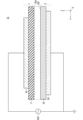
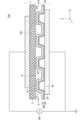
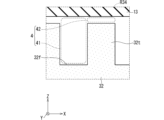
- FIG. 1 is a cross-sectional view showing a basic cross-sectional structure of an active gas generator according to Embodiment 1.
- FIG. FIG. 2 is a cross-sectional view showing a detailed cross-sectional structure of the region of interest in FIG. 1;
- 2 is a plan view showing a planar structure of the high-voltage applying electrode portion shown in FIG. 1 as viewed from above;
- FIG. 2 is a plan view showing a planar structure of the ground potential electrode portion shown in FIG. 1 as viewed from above;
- FIG. FIG. 2 is a plan view showing a planar structure of the active gas generator of Embodiment 1 as viewed from above;
- FIG. 6 is a cross-sectional view showing the cross-sectional structure of the BB cross section of FIG. 5;
- FIG. 4 is a cross-sectional view showing a basic cross-sectional structure of a modified example of Embodiment 1;
- FIG. 8 is a cross-sectional view showing a detailed cross-sectional structure of the region of interest in FIG. 7;
- FIG. 4 is a cross-sectional view showing a basic cross-sectional structure of an active gas generator according to Embodiment 2;
- FIG. 10 is a cross-sectional view showing a detailed cross-sectional structure of the region of interest in FIG. 9;
- FIG. 10 is a plan view showing a planar structure of a high-voltage applying electrode section of the first aspect of the second embodiment, viewed from above;
- FIG. 10 is a plan view showing a planar structure of the ground potential electrode portion of the first mode of the second embodiment, viewed from above;
- FIG. 10 is a plan view showing a planar structure of a high-voltage applying electrode section of a second aspect of Embodiment 2, viewed from above;
- FIG. 11 is a plan view showing a planar structure of a ground potential electrode portion of a second aspect of Embodiment 2 as viewed from above;
- FIG. 11 is a cross-sectional view showing a basic cross-sectional structure of a modified example of the second embodiment;
- FIG. 16 is a cross-sectional view showing a detailed cross-sectional structure of the region of interest in FIG. 15;
- FIG. 10 is a cross-sectional view showing a basic cross-sectional structure of an active gas generator according to Embodiment 3;
- FIG. 18 is a cross-sectional view showing a detailed cross-sectional structure of the region of interest in FIG. 17;
- FIG. 11 is a cross-sectional view showing a basic cross-sectional structure of a modified example of Embodiment 3;
- FIG. 20 is a cross-sectional view showing a detailed cross-sectional structure of the region of interest in FIG. 19;
- FIG. 4 is an explanatory diagram showing an example of a discharge space;
- FIG. 1 is a cross-sectional view schematically showing a basic cross-sectional structure of an active gas generator 51 according to Embodiment 1 of the present disclosure.
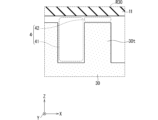
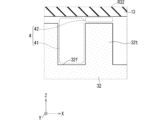
- FIG. 2 is a cross-sectional view showing a detailed cross-sectional structure of the region of interest R30 in FIG. An XYZ orthogonal coordinate system is shown in each of FIGS.
- the active gas generator 51 of Embodiment 1 generates the active gas 6 obtained by activating the raw material gas 5 supplied to the discharge space 4 .
- the raw material gas 5 for example, nitrogen gas, oxygen gas, or hydrogen gas can be considered. Also, a gas obtained by mixing a rare gas such as argon with any of the three gases described above as the raw material gas 5 is also conceivable. moreover. Argon gas itself is also conceivable as source gas 5 .
- the active gas generator 51 includes a high voltage applying electrode section 1, a ground potential electrode section 2, and an AC power supply 100 as main components. As shown in FIGS. 1 and 2, a high-voltage applying electrode portion 1, which is an upper electrode constituent portion, is arranged above a ground potential electrode portion 2, which is a lower electrode constituent portion.
- FIG. 3 is a plan view showing the planar structure of the high voltage applying electrode section 1 viewed from above (+Z direction).
- FIG. 4 is a plan view showing the planar structure of the ground potential electrode portion 2 viewed from above.
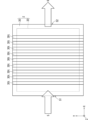
- FIG. 5 is a plan view showing the planar structure of the active gas generator 51 viewed from above.
- FIG. 6 is a cross-sectional view showing a cross-sectional structure taken along line BB of FIG. 1 shows a cross-sectional structure taken along the line AA of FIG.
- An XYZ orthogonal coordinate system is shown in each of FIGS.
- FIG. 1 The electrode structure of the active gas generator 51 of Embodiment 1 will be mainly described below with reference to FIGS. 1 to 6.
- FIG. 1 The electrode structure of the active gas generator 51 of Embodiment 1 will be mainly described below with reference to FIGS. 1 to 6.
- the high-voltage applying electrode section 1 which is the first electrode-forming section, has a laminated structure of an electrode dielectric film 11 and a metal electrode 10, and the metal electrode 10 is provided on the upper surface of the electrode dielectric film 11. .
- the constituent material of the metal electrode 10 is a metal
- the constituent material of the electrode dielectric film 11 is an insulating dielectric.
- the metal electrode 10 becomes the first metal electrode and the upper metal electrode.
- the electrode dielectric film 11 becomes an upper formation film, and the lower surface of the electrode dielectric film 11 becomes an exposed surface on the electrode dielectric film 11 side.
- the high voltage applying electrode portion 1, which is the upper electrode forming portion the lower surface of the electrode dielectric film 11 serves as the first discharge field forming surface.
- each of the metal electrode 10 and the electrode dielectric film 11 has a rectangular shape (substantially square shape) in plan view.
- the electrode dielectric film 11 includes the entire metal electrode 10 in plan view and has a planar shape wider than the metal electrode 10 .
- the ground potential electrode section 2 which is the second electrode configuration section, has a laminated structure of the discharge field adjustment film 30 and the metal electrode 20, and the metal electrode 20 is provided on the lower surface of the discharge field adjustment film 30.
- the constituent material of the metal electrode 20 is metal, and the constituent material of the discharge field adjustment film 30 can be a first constituent material having insulating properties or a second constituent material having conductivity.
- each of the metal electrode 20 and the discharge field adjustment film 30 has a rectangular shape (substantially square shape) in plan view.
- the discharge field adjustment film 30 includes the entire metal electrode 20 in plan view and has a planar shape wider than the metal electrode 20 .
- the metal electrode 20 becomes the second metal electrode and the lower metal electrode.
- the upper surface of the discharge field adjustment film 30 is the exposed surface on the discharge field adjustment film 30 side.
- the upper surface of the discharge field adjustment film 30 becomes the second discharge field forming surface.
- the high voltage applying electrode section 1 and the ground potential electrode section 2 are arranged so that the first and second discharge field forming surfaces face each other.
- the electrode dielectric film 11 and the discharge field adjustment film 30 have rectangular shapes of the same size in plan view, and as shown in FIG. are arranged so that the
- An AC voltage is applied as an applied voltage from an AC power supply 100, which is a high-frequency power supply, to the metal electrode 10, which is one of the first and second metal electrodes, and the metal electrode 20, which is the other metal electrode, has a reference potential. ground potential.
- the metal electrode 20 includes the entire metal electrode 10 in plan view and has a planar shape slightly wider than the metal electrode 10 .
- the space between the electrode dielectric film 11 of the high voltage applying electrode portion 1 and the discharge field adjusting film 30 of the ground potential electrode portion 2 is defined as the electrode facing space.
- a region where the metal electrode 10 and the metal electrode 20 overlap in plan view becomes the discharge space 4, and the lower surface of the electrode dielectric film 11 in the discharge space 4 (first discharge field forming surface). and the upper surface (second discharge field forming surface) of the discharge field adjustment film 30 is defined as the gap length.
- the pressure in the discharge space 4 is set to about 1 kPa to atmospheric pressure.
- the discharge field adjustment film 30 is characterized by having a plurality of protrusions 30t (protrusions) that protrude upward (in the +Z direction) so as to shorten the gap length in the discharge space 4.
- the discharge field adjustment film 30 has a plurality of protrusions 30t as at least one protrusion.
- a region of the discharge field adjusting film 30 in which the plurality of convex portions 30t are not formed is referred to as a "concave region".
- the concave region 30f is provided extending in the Y direction.
- a plurality of protrusions 30t are also provided extending in the Y direction.
- the discharge space 4 includes partial discharge spaces 41 and 42 .
- the partial discharge space 41 is the space between the surface of the recessed region 30f of the discharge field adjustment film 30 and the lower surface of the electrode dielectric film 11
- the partial discharge space 42 is the space between the upper surface of the projection 30t of the discharge field adjustment film 30 and the electrode. It becomes a space between the lower surface of the dielectric film 11 for the device.
- the partial discharge space 41 has the same long gap length G1 as the normal discharge space when the plurality of convex portions 30t are not formed.
- the partial discharge space 42 is a special discharge space having a short gap length G2 that is shorter than the long gap length G1.
- the long gap length G1 may be about 2 mm
- the short gap length G2 may be about 0.5 mm.
- the long gap length G1 and the short gap length G2 are appropriately set within the range of 0.1 mm to 1 cm.
- the electrode dielectric film 11 and the discharge field adjustment film 30 each have a dielectric constant of "10" and a film thickness of 1 mm.
- the film thickness of the concave region 30f is 1 mm.
- the long gap length G1 of the partial discharge space 41 is 2.5 mm, and the short gap length G2 of the partial discharge space 42 is 0.5 mm. Therefore, the film thickness of the convex portion 30t is 3 mm.
- the partial discharge space 41 and the partial discharge space 42 are each kept at the atmospheric pressure, and the raw material gas 5 filling the partial discharge spaces 41 and 42 is argon (Ar) gas having a dielectric constant of "1".
- the voltage applied between the metal electrode 10 and the metal electrode 20 is 4000V.
- the voltage applied to the partial discharge space 41 and the partial discharge space 42 is 3703 V in the partial discharge space 41 and 2222 V in the partial discharge space 42 .
- the breakdown threshold voltage of the partial discharge space 41 is 4900V, and the breakdown threshold voltage of the partial discharge space 42 is 1400V.
- the "dielectric breakdown threshold voltage” indicates the threshold voltage value of the applied voltage for generating the dielectric barrier discharge.
- the voltage applied to the partial discharge space 42 will be higher than the dielectric breakdown threshold voltage, and a discharge phenomenon will occur within the partial discharge space 42 .
- the partial discharge is caused by charged particles and ultraviolet rays generated in the partial discharge space 42 adjacent to the partial discharge space 41 by the low voltage discharge generation function described later. A discharge also occurs in the space 41 .
- the electrode facing space has a rectangular shape in plan view.
- the electrode facing space has side faces S1 and S2 facing each other.
- the side surface S1, which is the first side surface, is the side surface on the -X direction side
- the side surface S2, which is the second side surface is the side surface on the + direction side. Therefore, a discharge space 4 is provided between the side surfaces S1 and S2.
- a dielectric barrier discharge is generated in the discharge space 4 by applying a high AC voltage from the AC power supply 100 to the metal electrode 10 . can be generated.
- the raw material gas 5 is supplied from the side surface S1, which is the first side surface of the electrode facing space, and is activated by passing through the discharge space 4 to become the active gas 6.
- the active gas 6 serves as the second side surface of the electrode facing space. It is ejected from the side surface S2.
- the direction from side S1 to side S2 (+X direction) is defined as the gas flow direction.
- the plurality of projections 30t are each provided in a rectangular shape with the Y direction as the longitudinal direction in plan view, and are provided separately from each other along the gas flow direction.
- the plurality of recessed regions 30f are each provided in a rectangular shape with the Y direction as the longitudinal direction in plan view, and are provided separately from each other along the gas flow direction.
- the plurality of partial discharge spaces 42 are provided separately from each other along the direction of gas flow.
- the area ratio between the plurality of convex portions 30t and the plurality of concave regions 30f is set to approximately 1:1, for example.
- the discharge field adjustment film 30 when the discharge field adjustment film 30 is formed only of the second constituent material having conductivity, it may be formed integrally with the metal electrode 20 .
- a functional film may be separately formed on the lower surface of the electrode dielectric film 11 and the upper surface of the discharge field adjusting film 30 by sputtering, thermal spraying, or the like.
- As the functional film a photocatalyst film, a silicon film that easily emits photoelectrons, or the like can be considered.
- the surface of the functional film becomes the exposed surface of the electrode dielectric film 11 side in the high voltage applying electrode section 1 .
- the surface of the functional film becomes the exposed surface of the ground potential electrode portion 2 on the side of the discharge field adjustment film 30 .
- the discharge field adjustment film 30 has a plurality of projections 30t protruding in the direction in which the gap length is shortened.
- a partial discharge space 42 having a relatively short gap length G2 can be provided between the body film 11 and the lower surface of the body film 11 as a special discharge space.
- the active gas generator 51 of Embodiment 1 does not have a partial discharge space 42 with only a relatively long long gap length G1 by providing a plurality of partial discharge spaces 42 in a part of the discharge space 4. Dielectric barrier discharge is more likely to occur than in the conventional discharge space.
- the active gas generator 51 of Embodiment 1 can have a low-voltage discharge generation function capable of generating a dielectric barrier discharge with a lower applied voltage than in the conventional art.
- the active gas generator 51 of the first embodiment has the low-voltage discharge generating function, so that the volume of the discharge space 4 can be increased without increasing the required applied voltage, and the generated concentration of the active gas 6 can be increased. can be improved.
- dielectric barrier discharge is first generated in a partial discharge space 42, which is a special discharge space. Due to the discharge in the partial discharge space 42, charged particles such as ions and electrons of the source gas 5 are generated and flow into the adjacent partial discharge space 41 along the gas flow direction (+X direction) in which the source gas 5 flows. .
- the discharge field adjustment film 30 Photoelectrons are emitted from the electrode dielectric film 11 and supplied to the partial discharge space 41 .
- the dielectric breakdown threshold voltage of the partial discharge space 41 is lowered and, as a result, discharge is also generated within the partial discharge space 41 .
- the low-voltage discharge generating function is exhibited by these chain phenomena.
- a functional film such as a photocatalyst film is formed on the lower surface of the electrode dielectric film 11 or the upper surface of the discharge field adjusting film 30, the light generated by the discharge in the partial discharge space 42 will not reach the functional film. When irradiated, photoelectrons are emitted from the functional film.
- the active gas generator 51 of Embodiment 1 can exhibit a low-voltage discharge generation function, so that a discharge phenomenon can be generated even in the discharge space 4 having the long gap length G1 with a relatively small applied voltage. can be generated.
- the active gas generating device 51 of the first embodiment operates the above-described low-voltage discharge generating function. can be kept low.
- the active gas generator 51 of Embodiment 1 supplies the raw material gas 5 from the side surface S1, which is the first side surface of the electrode facing space, and ejects the active gas 6 from the side surface S2, which is the second side surface. It is possible to improve the generated concentration of the active gas 6 with a relatively simple structure.
- the plurality of protrusions 30t are formed separately along the gas flow direction (+X direction), so that each of the protrusions 30t has a short gap along the gas flow direction. Since a plurality of long partial discharge spaces 42 can be provided, the low voltage discharge generating function can be improved.
- FIG. 7 is a cross-sectional view showing a basic cross-sectional structure of an active gas generator 51X that is a modification of Embodiment 1 of the present disclosure.
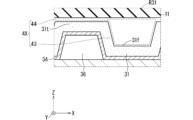
- FIG. 8 is a cross-sectional view showing the detailed cross-sectional structure of the region of interest R31 in FIG.
- An XYZ orthogonal coordinate system is shown in FIGS. 7 and 8, respectively.
- the active gas generator 51X of the modification replaces the ground potential electrode section 2 of the active gas generator 51 with the ground potential electrode section 2X, and discharge field adjustment is performed in the ground potential electrode section 2X. It is characterized in that the film 30 is replaced with a discharge field adjusting film 30X.
- the ground potential electrode section 2X which is the second electrode configuration section, has a laminated structure of the discharge field adjustment film 30X and the metal electrode 20, and the metal electrode 20 is provided on the lower surface of the discharge field adjustment film 32.
- the discharge field adjustment film 30X includes a layered structure of the discharge field adjustment insulating film 31 and the discharge field adjustment conductive film 34 .
- the constituent material of the discharge field adjusting insulating film 31 is a first constituent material having insulating properties
- the constituent material of the discharge field adjusting conductive film 34 is a second constituent material having conductivity.
- the discharge field adjusting conductive film 34 is provided on the metal electrode 20, and the discharge field adjusting insulating film 31 is provided on the discharge field adjusting conductive film 34. Therefore, the discharge field adjusting conductive film 34 is in contact with the metal electrode 20 .
- the discharge field adjustment film 30X is characterized by having a plurality of protrusions 31t (protrusions) that protrude upward (in the +Z direction) so as to shorten the gap length in the discharge space 4. there is thus, the discharge field adjustment film 30X has a plurality of protrusions 31t as at least one protrusion.
- each of the plurality of projections 31t in the discharge field adjustment film 30X has a hollow region 36 on the metal electrode 20 side.
- the discharge space 4 includes partial discharge spaces 43 and 44.
- the partial discharge space 43 is the space between the surface of the recessed region 31f of the discharge field adjustment film 30X and the lower surface of the electrode dielectric film 11, and the partial discharge space 44 is the space between the upper surface of the protrusion 31t of the discharge field adjustment film 30X and the electrode. It becomes a space between the lower surface of the dielectric film 11 for the device.
- the partial discharge space 43 has a relatively long long gap length G3, which is the same as the normal discharge space when the plurality of projections 31t are not formed.
- the partial discharge space 44 becomes a special discharge space having a short gap length G4 that is shorter than the long gap length G3.
- the long gap length G3 may be about 2 mm
- the short gap length G4 may be about 0.5 mm.
- the long gap length G3 and the short gap length G4 are appropriately set within the range of 0.1 mm to 1 cm.
- the discharge field adjustment film 32X has a plurality of projections 32t projecting in the direction of shortening the gap length, like the active gas generator 51.
- the active gas generator 51X of the modified example can increase the volume of the discharge space 4 without increasing the required applied voltage and improve the generated concentration of the active gas 6, similarly to the active gas generator 51. can be done.
- each of the plurality of projections 31t of the discharge field adjustment film 30X has the hollow region 36 on the side of the metal electrode 20 serving as the second metal electrode.
- the special discharge voltage applied to the special discharge space in can be increased.
- the constituent material of the discharge field adjustment film 30 of the active gas generator 51 is the first constituent material having insulating properties
- the film thickness of the convex portion 30t is relatively thick.
- the special discharge voltage applied to the partial discharge space 42 decreases as the film thickness of the projection 30t increases.
- the film thickness of the projections 31t of the discharge field adjusting insulating film 31 can be reduced by the amount of the formation of the cavity region 36.
- the special discharge voltage applied to the partial discharge space 44 can be increased as the film thickness of the convex portion 31t is reduced.
- the special discharge voltage applied to the partial discharge space 44 of the modified example can be made higher than the special discharge voltage applied to the partial discharge space 42 of the active gas generator 51. can.
- the modified active gas generator 51X can further enhance the low-voltage discharge generating function described above.
- the modified active gas generator 51X uses the discharge field adjustment film 30X having a laminated structure of the discharge field adjustment insulating film 31 and the discharge field adjustment conductive film 34, thereby reducing the film thickness of the convex portion 31t. It is possible to further enhance the low-voltage discharge generating function described above.
- Embodiment 1 (extended configuration)
- the high voltage applying electrode section 1 has the electrode dielectric film 11
- the ground potential electrode section 2 has the discharge field adjustment film 30 (30 ⁇ ) are shown.
- the first electrode configuration portion having the electrode dielectric film 11 is limited to the high voltage application electrode portion 1 which is the upper electrode configuration portion, and the second electrode configuration portion having the discharge field adjustment film 30 is the lower electrode configuration. It is limited to the ground potential electrode portion 2 which is the portion.
- the first electrode configuration portion having the electrode dielectric film 11 is the ground potential electrode portion 2, which is the lower electrode configuration portion
- the second electrode configuration portion having the discharge field adjustment film 30 is the upper electrode configuration portion.
- An extended configuration using the high voltage applying electrode section 1 is conceivable.
- the discharge field adjustment film 30 is characterized by having a plurality of protrusions that protrude downward (-Z direction) so that the gap length in the discharge space 4 is shortened.
- the at least one protrusion has a plurality of downwardly projecting protrusions.
- Embodiment 1 also has the same effects as those of the active gas generator 51 and the active gas generator 51X.
- FIG. 9 is a cross-sectional view showing a basic cross-sectional structure of an active gas generator 52 according to Embodiment 2 of the present disclosure.
- FIG. 10 is a cross-sectional view showing the detailed cross-sectional structure of the region of interest R32 in FIG. An XYZ orthogonal coordinate system is shown in FIGS. 9 and 10, respectively.
- Embodiment 2 the same components as those of the active gas generator 51 of Embodiment 1 are assigned the same reference numerals, and the description thereof is omitted as appropriate, and the description will focus on the features of Embodiment 2.
- the basic structure of the active gas generator 52 of the second embodiment generates the active gas 6 obtained by activating the raw material gas 5 supplied from the outer peripheral surface of the discharge space 4. ing.
- the active gas generator 52 includes a high voltage applying electrode section 1B, a ground potential electrode section 2B, and an AC power supply 100 as main components. As shown in FIGS. 9 and 10, a high-voltage applying electrode portion 1B, which is an upper electrode forming portion, is arranged above a ground potential electrode portion 2B, which is a lower electrode forming portion.
- the high-voltage applying electrode portion 1B which is the first electrode-forming portion, has a laminated structure of the electrode dielectric film 13 and the metal electrode 12, and the metal electrode 12 is provided on the upper surface of the electrode dielectric film 13. .
- the constituent material of the metal electrode 12 is a metal
- the constituent material of the electrode dielectric film 13 is a dielectric having insulating properties.
- the metal electrode 12 becomes the first metal electrode and the upper metal electrode, and the electrode dielectric film 13 becomes the upper forming film.
- the lower surface of the electrode dielectric film 13 is the exposed surface on the electrode dielectric film 13 side.
- the lower surface of the electrode dielectric film 13 becomes the first discharge field forming surface.
- the metal electrode 12 has an opening 18 in its center.
- the ground potential electrode section 2B which is the second electrode configuration section and the lower electrode configuration section, has a laminated structure of the discharge field adjustment film 32 and the metal electrode 22.
- a metal electrode 22 is provided on the lower surface of the discharge field adjusting film 32 that serves as the lower forming film.
- the constituent material of the metal electrode 22 is metal, and the constituent material of the discharge field adjustment film 32 may be a first constituent material having insulating properties or a second constituent material having conductivity.
- the metal electrode 22 becomes the second metal electrode and the lower metal electrode.
- the discharge field adjustment film 320 becomes a lower formation film, and the upper surface of the discharge field adjustment film 32 becomes an exposed surface on the discharge field adjustment film 32 side in the ground potential electrode portion 2B.
- the lower surface of the discharge field adjustment film 32 becomes the second discharge field forming surface.
- the high voltage applying electrode portion 1B and the ground potential electrode portion 2B are arranged so that the first and second discharge field forming surfaces face each other.
- An AC voltage is applied as an applied voltage from an AC power source 100 to the metal electrode 12, which is one of the first and second metal electrodes, and the metal electrode 22, which is the other metal electrode, is at a ground potential, which is a reference potential. set.
- the space between the electrode dielectric film 13 of the high voltage applying electrode portion 1B and the discharge field adjusting film 32 of the ground potential electrode portion 2B is defined as the electrode facing space.
- a region where the metal electrode 12 and the metal electrode 22 overlap in plan view becomes the discharge space 4, and the lower surface of the electrode dielectric film 13 in the discharge space 4 (first discharge field forming surface). and the upper surface (second discharge field forming surface) of the discharge field adjustment film 32 is defined as the gap length.
- the pressure in the discharge space 4 is set to about 1 kPa to atmospheric pressure.
- the discharge field adjustment film 32 is characterized by having a plurality of protrusions 32t (protrusions) that protrude upward (in the +Z direction) so as to shorten the gap length in the discharge space 4. there is thus, the discharge field adjustment film 32 has a plurality of protrusions 32t as at least one protrusion.
- the concave region 32f is provided extending in the Y direction.
- a plurality of protrusions 32t are also provided extending in the Y direction.
- the discharge field adjustment film 32 has a gas ejection hole 38 in the center, and the metal electrode 22 has an opening area 28 in the center.
- a gas ejection hole 38 serving as at least one gas ejection hole is provided through the discharge field adjustment film 32 .
- the opening region 28 includes the gas ejection holes 38 in plan view, and has a planar shape wider than the gas ejection holes 38 .
- the opening 18 of the metal electrode 12 includes the gas ejection hole 38 and the opening region 28 in plan view, and has a planar shape wider than the gas ejection hole 38 . Therefore, the metal electrode 14 does not overlap with the gas ejection holes 38 and the opening regions 28 in plan view.
- the discharge space 4 includes partial discharge spaces 41 and 42 .
- the partial discharge space 41 is a space between the surface of the recessed region 32f of the discharge field adjustment film 32 and the lower surface of the electrode dielectric film 13, and the partial discharge space 42 is formed between the upper surface of the projection 32t of the discharge field adjustment film 32 and the electrode. It becomes a space between the lower surface of the dielectric film 13 for the substrate.
- the partial discharge space 41 has the same relatively long long gap length G1 as the normal discharge space when the plurality of projections 32t are not formed.
- the partial discharge space 42 is a special discharge space having a short gap length G2 that is shorter than the long gap length G1.
- the discharge field adjustment film 32 when the discharge field adjustment film 32 is formed only of the second constituent material having conductivity, it may be formed integrally with the metal electrode 22 .
- a functional film may be separately formed on the lower surface of the electrode dielectric film 13 and the upper surface of the discharge field adjusting film 32 by sputtering, thermal spraying, or the like.
- the surface of the functional film becomes the exposed surface on the electrode dielectric film 13 side of the high voltage applying electrode section 1B.
- a functional film is formed on the upper surface of the discharge field adjustment film 32, the surface of the functional film becomes the exposed surface on the discharge field adjustment film 32 side of the ground potential electrode portion 2B.
- the source gas 5 is supplied from the outer peripheral surface of the electrode facing space and is activated by passing through the discharge space 4 to become the active gas 6.
- the active gas 6 is jetted below the metal electrode 22 in the ground potential electrode portion 2B through the gas jetting holes 38 and the opening regions 28 .
- the direction from the outer peripheral surface of the electrode facing space toward the gas ejection holes 38 is defined as the gas flow direction.
- the plurality of protrusions 32t are formed separately from each other along the direction of gas flow.
- a first aspect of the second embodiment employs a high voltage applying electrode portion 1B1 as the high voltage applying electrode portion 1B and a ground potential electrode portion 2B1 as the ground potential electrode portion 2B.
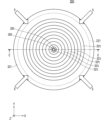
- FIG. 11 is a plan view showing the planar structure of the high-voltage applying electrode section 1B1 of the first mode as viewed from above (+Z direction).
- FIG. 12 is a plan view showing the planar structure of the ground potential electrode portion 2B1 of the first mode as viewed from above.
- An XYZ orthogonal coordinate system is shown in each of FIGS. 11 and 12 .
- FIG. 11 and 12 is the cross-sectional structure of the basic structure shown in FIG.
- the high-voltage applying electrode section 1B1 uses a metal electrode 121 as the metal electrode 12 and uses an electrode dielectric film 131 as the electrode dielectric film 13 .
- the metal electrode 121 has an opening 181 as the opening 18 .
- the metal electrode 121 and the electrode dielectric film 131 each have a circular shape in plan view.
- the electrode dielectric film 131 includes the entire metal electrode 121 in plan view and has a planar shape wider than the metal electrode 121 . As shown in FIG. 11, the metal electrode 121 has a circular opening 181 in its center.
- the ground potential electrode portion 2B1 uses a metal electrode 221 as the metal electrode 22 and a discharge field adjustment film 321 as the discharge field adjustment film 32.
- the metal electrode 221 has an opening area 281 as the opening area 28
- the discharge field adjustment film 321 has a gas ejection hole 381 as the gas ejection hole 38 .
- the metal electrode 221 and the discharge field adjustment film 321 each have a circular shape in plan view.
- the discharge field adjustment film 321 includes the entire metal electrode 221 in plan view and has a planar shape wider than the metal electrode 221 .
- the electrode dielectric film 131 of the high voltage applying electrode portion 1B1 and the discharge field adjustment film 321 of the ground potential electrode portion 2B1 have circular shapes of the same size in plan view, and the electrode dielectric film in plan view. 131 and the discharge field adjustment film 321 are arranged so as to coincide with each other.
- the electrode facing space is circular in plan view.
- the discharge field adjustment film 321 which is circular in plan view, has a gas ejection hole 381 (central gas ejection hole) at its center, and the metal electrode 221 has an opening region 281 at its center. are doing.
- the opening region 281 includes the gas ejection holes 381 in plan view and has a shape wider than the gas ejection holes 381 .
- the opening 181 shown in FIG. 11 includes the opening area 281 and the gas ejection holes 381 in plan view, and has a shape wider than the opening area 281 and the gas ejection holes 381 . Therefore, the metal electrode 121 does not overlap the opening area 281 and the gas ejection holes 381 in plan view.
- the electrode facing space has a circular outer peripheral surface on the side surface. Therefore, in the first mode, the discharge space 4 is provided within the circular outer peripheral surface.
- the raw material gas 5 is supplied from the entire outer peripheral surface of the electrode-facing space and is activated by passing through the discharge space 4 to become the active gas 6 .
- the active gas 6 is ejected below the metal electrode 221 in the ground potential electrode portion 2B1 through the gas ejection hole 381 and the opening region 281.
- the gas flow direction is defined as the direction from the entire outer peripheral surface of the electrode facing space toward the gas ejection holes 381. As shown in FIG. That is, the direction of gas flow is the radial direction toward the gas ejection holes 381 in the circular electrode facing space.
- the plurality of convex portions 32t are each provided in an annular shape and are provided separately from each other along the direction of gas flow. Therefore, the ring size (diameter) of the plurality of protrusions 32t becomes smaller as the gas ejection hole 381 is approached.
- the plurality of convex portions 32t and the plurality of concave regions 32f are alternately provided along the gas flow direction, thereby forming the plurality of partial discharge spaces 42 discretely along the gas flow direction. and will be provided.
- the area ratio between the plurality of protrusions 32t and the plurality of recessed regions 32f is set to approximately 1:1, for example.
- a second aspect of the second embodiment employs a high voltage applying electrode portion 1B2 as the high voltage applying electrode portion 1B and a ground potential electrode portion 2B2 as the ground potential electrode portion 2B.
- FIG. 13 is a plan view showing the planar structure of the high-voltage applying electrode section 1B2 of the second mode as viewed from above (+Z direction).
- FIG. 14 is a plan view showing a planar structure of the ground potential electrode portion 2B2 of the second embodiment as viewed from above.
- An XYZ orthogonal coordinate system is shown in each of FIGS. 13 and 14 .
- FIG. 13 and 14 has a cross-sectional structure shown in FIG.
- the high voltage applying electrode section 1B2 uses a pair of metal electrodes 122 as the metal electrodes 12 and uses an electrode dielectric film 132 as the electrode dielectric film 13 .
- the pair of metal electrodes 122 has an opening 182 as the opening 18 .
- the pair of metal electrodes 122 are provided separately from each other, and the area on the metal electrode 122 between the pair of metal electrodes 122 and 122 becomes the opening 182 .
- the opening 182 is provided extending in the Y direction.
- Each of the pair of metal electrodes 122 has a rectangular shape in plan view.
- the electrode dielectric film 132 has a rectangular shape (substantially square shape) in plan view.
- the electrode dielectric film 132 includes all of the pair of metal electrodes 122 in plan view and has a planar shape wider than the pair of metal electrodes 122 .
- the ground potential electrode portion 2B2 uses a pair of metal electrodes 222 as the metal electrodes 22, and uses a discharge field adjustment film 322 as the discharge field adjustment film 32.
- the metal electrode 222 has an opening region 282 as the opening region 28, and the opening region 282 is provided between the pair of metal electrodes 222,222.
- the opening region 282 is formed extending in the Y direction.
- the discharge field adjusting film 322 has a plurality of gas ejection holes 381 as the gas ejection holes 38 .
- a plurality of gas ejection holes 382 are provided separately from each other along the Y direction.
- the Y direction is the ejection hole forming direction.
- Each of the pair of metal electrodes 222 has a rectangular shape in plan view.
- the discharge field adjustment film 322 has a rectangular shape (square shape) in plan view.
- the discharge field adjustment film 322 includes all of the pair of metal electrodes 222 in plan view and has a planar shape wider than the pair of metal electrodes 222 .
- the electrode dielectric film 132 of the high voltage applying electrode portion 1B2 and the discharge field adjustment film 322 of the ground potential electrode portion 2B2 have rectangular shapes of the same size in plan view, and the electrode dielectric film in plan view. 132 and the discharge field adjustment film 322 are arranged to coincide with each other.
- the electrode facing space has a rectangular shape in plan view.
- the discharge field adjustment film 322 has a plurality of gas ejection holes 381 in the center, and the metal electrode 222 has an opening area 282 in the center.
- the opening region 282 includes all of the plurality of gas ejection holes 381 in plan view and has a shape wider than the plurality of gas ejection holes 381 .
- the opening 182 shown in FIG. 13 includes an opening region 282 and a plurality of gas ejection holes 381 in plan view, and has a shape wider than the opening region 282 and the plurality of gas ejection holes 381 . Therefore, the pair of metal electrodes 122 do not overlap the opening region 282 and the plurality of gas ejection holes 381 in plan view.
- the electrode facing space has side faces S1 and S2 facing each other as part of the outer peripheral face.
- the side surface S1 which is the first side surface, is the side surface on the -X direction side
- the side surface S2, which is the second side surface is the side surface on the + direction side. Therefore, a discharge space 4 is provided between the side surfaces S1 and S2.
- the X direction in which the side surfaces S1 and S2 face each other is defined as the side facing direction. Therefore, the direction of formation of the side surface (X direction) is a direction perpendicular to the direction of formation of the ejection holes (Y direction).
- dielectric barrier discharge is generated in the discharge space 4 by applying an AC voltage from the AC power supply 100 to the pair of metal electrodes 122 . can be generated.
- the raw material gas 5 is supplied from the side surfaces S1 and S2 of the electrode facing space, and is activated by passing through the discharge space 4 to become the active gas 6.
- the active gas 6 is ejected below the metal electrode 222 in the ground potential electrode portion 2B2 through the plurality of gas ejection holes 381 and the opening area 282.
- the directions ( ⁇ X directions) from the side surfaces S1 and S2 of the electrode facing space toward the plurality of gas ejection holes 381 are defined as the gas flow directions.
- the plurality of projections 32t are each provided in a rectangular shape with the Y direction as the longitudinal direction in plan view, and are provided separately from each other along the gas flow direction (X direction).
- the plurality of convex portions 32t and the plurality of concave regions 32f are alternately provided along the gas flow direction, thereby forming the plurality of partial discharge spaces 42 separated from each other along the gas flow direction. and will be provided.
- the area ratio between the plurality of protrusions 32t and the plurality of recessed regions 32f is set to approximately 1:1, for example.
- the first gas flow distance along the gas flow direction (+X direction) from the side surface S1, which is the first side surface, to the gas ejection hole 381 is the gas flow distance D1.
- a second gas flow distance along the gas flow direction (-X direction) from the side surface S2, which is the second side surface, to the gas ejection hole 381 is the gas flow distance D2.
- the gas circulation distance D1 and the gas circulation distance D2 are set to be equal.
- the discharge field adjustment film 32 has a plurality of protrusions 32t protruding in the direction in which the gap length is shortened.
- the active gas generator 52 of Embodiment 2 increases the volume of the discharge space 4 without increasing the required applied voltage, and improves the generated concentration of the active gas 6, as in the case of Embodiment 1. be able to.
- the active gas generator 52 of Embodiment 2 supplies the raw material gas 5 from the outer peripheral surface of the electrode-facing space and ejects the active gas 6 downward from the gas ejection holes 38 (at least one gas ejection hole).
- a substrate to be processed such as a wafer can be placed directly below the ejection holes 38 .
- the gas ejection hole 38 is the gas ejection hole 381, which is one central gas ejection hole, in the first mode, and becomes a plurality of gas ejection holes 382 in the second mode.
- the active gas generator 52 of Embodiment 2 can be provided relatively close to the substrate to be processed, the active gas 6 can be efficiently ejected without deteriorating the radical concentration.
- the active gas 6 is deactivated in a relatively short period of time. Therefore, in order to effectively utilize the active gas 6, the generated active gas 6 is supplied in a short period of time to the active gas utilization space containing the substrate to be processed. Because there is a need.
- the active gas generating device 52 of Embodiment 2 since the plurality of projections 32t are formed discretely along the gas flow direction, a plurality of projections 32t each having a short gap length along the gas flow direction are formed. Since the special discharge space can be provided, the low-voltage discharge generating function can be improved.
- the metal electrodes 12 (a pair of metal The electrode 121 and the pair of metal electrodes 122) have a partially open electrode structure in which they are not provided. That is, the metal electrode 12 exhibits a partially open electrode structure that does not overlap the gas ejection holes 38 and the open area 28 in plan view.
- abnormal discharge means that when the metal electrode 12 is formed to cover the gas ejection hole 38, the area near the gas ejection hole 38 and the opening area 28, for example, the area around the metal electrode 22. means a discharge that can
- the constituent elements of the metal electrode 22 made of metal are more easily ionized by electric discharge compared to insulators.
- the constituent elements of the metal electrode 22 are ionized, there arise problems such as mixing into the active gas 6 as metal contaminants and peeling of the metal electrode 22 itself from the discharge field adjustment film 32 .
- the metal electrodes 12 (121, 122) should not overlap with the opening regions 28 (281, 282) and the gas ejection holes 38 (381, 382) in plan view.
- the electrode dielectric film 131 and the discharge field adjustment film 321 having a circular planar shape are used to efficiently The active gas 6 can be jetted out.
- a gas ejection hole 381 (central gas ejection hole) is formed at the center position of the discharge field adjustment film 321 which is circular in plan view. Therefore, the distance from the entire outer peripheral surface of the electrode facing space to the gas ejection holes 38 can be made uniform, and the active gas 6 with a stable radical concentration can be ejected from the gas ejection holes 38 .
- the electrode dielectric film 132 and the discharge field adjusting film 322 having a rectangular planar shape are used to efficiently eject the active gas 6 without deteriorating the radical concentration. be able to.
- a gas flow distance D1 (first gas flow distance) from the side surface S1, which is the first side surface, to the plurality of gas ejection holes 382, and a plurality of gas flow distances from the side surface S2, which is the second side surface.
- a plurality of gas ejection holes 381 are provided so that the gas circulation distance D2 (second gas circulation distance) to the gas ejection holes 382 is equal.
- the gas flow distances D1 and D2 from the side surfaces S1 and S2 to the plurality of gas ejection holes 38 can be made uniform, and the same radical concentration can be obtained from each of the plurality of gas ejection holes.
- Active gas 6 can be ejected.
- FIG. 15 is a cross-sectional view showing a basic cross-sectional structure of an active gas generator 52X that is a modification of the second embodiment of the present disclosure.
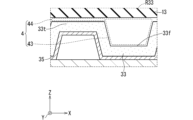
- FIG. 16 is a cross-sectional view showing the detailed cross-sectional structure of the region of interest R33 in FIG. An XYZ orthogonal coordinate system is shown in each of FIGS. 15 and 16 .
- the modified active gas generator 52X replaces the ground potential electrode section 2B of the active gas generator 52 with a ground potential electrode section 2Y, and adjusts the discharge field in the ground potential electrode section 2Y. It is characterized by replacing the film 32 with a discharge field adjusting film 32X.
- the ground potential electrode section 2Y which is the second electrode configuration section, has a laminated structure of the discharge field adjustment film 32X and the metal electrode 22, and the metal electrode 20 is provided on the lower surface of the discharge field adjustment film 32X.
- the discharge field adjustment film 32X includes a laminated structure of the discharge field adjustment insulating film 33 and the discharge field adjustment conductive film 35.
- the constituent material of the discharge field adjusting insulating film 33 is a first insulating constituent material
- the constituent material of the discharge field adjusting conductive film 35 is a second constituent material having conductivity.
- a discharge field adjusting conductive film 35 is provided on the metal electrode 22, and a discharge field adjusting insulating film 33 is provided on the discharge field adjusting conductive film 35. Therefore, the discharge field adjusting conductive film 35 is in contact with the metal electrode 22 .
- the discharge field adjustment film 32X is characterized by having a plurality of protrusions 33t (protrusions) that protrude upward (in the +Z direction) so as to shorten the gap length in the discharge space 4. there is thus, the discharge field adjustment film 32X has a plurality of protrusions 33t as at least one protrusion.
- a plurality of protrusions 33t in the discharge field adjustment film 32X each have a hollow region 36 on the metal electrode 22 side. Furthermore, the discharge field adjustment film 32X has gas ejection holes 48 similar to the gas ejection holes 38 of the discharge field adjustment film 32 .
- the discharge field adjustment film 32X in the ground potential electrode portion 2Y1 which is the first aspect of the ground potential electrode portion 2Y, has the same planar shape as the discharge field adjustment film 321 shown in FIG. It has ejection holes 481 as gas ejection holes 48 .
- the discharge field adjustment film 32X of the ground potential electrode portion 2Y1 has a plurality of projections 33t similar to the plurality of projections 32t shown in FIG. provided in
- the discharge field adjustment film 32X in the ground potential electrode portion 2Y2, which is the second aspect of the ground potential electrode portion 2Y, has the same planar shape as the discharge field adjustment film 322 shown in FIG. It has ejection holes 482 as gas ejection holes 48 .
- the discharge field adjustment film 32X of the ground potential electrode portion 2Y2 has a plurality of protrusions 33t similar to the plurality of protrusions 32t shown in FIG. is provided in a rectangular shape with .
- the discharge space 4 includes partial discharge spaces 43 and 44.
- the partial discharge space 43 is a space between the surface of the concave region 33f of the discharge field adjustment film 32X and the lower surface of the electrode dielectric film 13
- the partial discharge space 44 is a space between the upper surface of the convex portion 33t of the discharge field adjustment film 32X and the electrode. It becomes a space between the lower surface of the dielectric film 13 for the substrate.
- the partial discharge space 43 has the same relatively long long gap length G3 as the normal discharge space when the plurality of convex portions 33t are not formed.
- the partial discharge space 44 becomes a special discharge space having a short gap length G4 that is shorter than the long gap length G3.
- the discharge field adjustment film 32X has a plurality of projections 33t projecting in the direction of shortening the gap length, like the active gas generator 52.
- the active gas generator 52X of the modified example can increase the volume of the discharge space 4 without increasing the required applied voltage and improve the generated concentration of the active gas 6, similarly to the active gas generator 52. can be done.
- each of the plurality of protrusions 33t of the discharge field adjustment film 32X has a hollow region 36 on the side of the metal electrode 22 serving as the second metal electrode, so that in FIGS.
- the special discharge voltage applied to the special discharge space can be increased when the same applied voltage is applied.
- the active gas generator 52X which is a modification of the second embodiment, can further enhance the above-described low-voltage discharge generating function.
- the active gas generator 52X of the modification uses the discharge field adjustment film 32X having a laminated structure of the discharge field adjustment insulating film 33 and the discharge field adjustment conductive film 35, thereby reducing the film thickness of the convex portion 33t. It is possible to further enhance the low-voltage discharge generating function described above.
- the high voltage applying electrode portion 1B has the electrode dielectric film 13
- the ground potential electrode portion 2B (2Y) has the discharge field adjusting film.
- a structure with 32 (32X) was shown.
- the first electrode configuration portion having the electrode dielectric film 13 is limited to the high voltage applying electrode portion 1B which is the upper electrode configuration portion, and the second electrode configuration portion having the discharge field adjustment film 32 is the lower electrode configuration. It was limited to the ground potential electrode portion 2B, which is a portion.
- an extended configuration in which the electrode dielectric film 13 and the discharge field adjustment film 32 are reversed in vertical relation is conceivable. That is, the first electrode configuration portion having the electrode dielectric film 13 is used as the ground potential electrode portion 2B (2Y) which is the lower electrode configuration portion, and the second electrode configuration portion having the discharge field adjustment film 32 is used as the upper electrode configuration.
- An extended configuration is conceivable in which the high-voltage applying electrode section 1B is used as a section.
- the discharge field adjustment film 32 (32X) is characterized by having a plurality of protrusions that protrude downward (-Z direction) so that the gap length in the discharge space 4 is shortened.
- the at least one protrusion has a plurality of downwardly projecting protrusions.
- gas ejection holes corresponding to the gas ejection holes 38 (48) provided in the discharge field adjustment film 32 (32X) are formed. .
- the diffusion structure of the second embodiment described above also has the same effect as the active gas generator 52 and the active gas generator 52X.
- FIG. 17 is a cross-sectional view showing a basic cross-sectional structure of an active gas generator 53 according to Embodiment 3 of the present disclosure.
- FIG. 18 is a cross-sectional view showing the detailed cross-sectional structure of the region of interest R34 in FIG. An XYZ orthogonal coordinate system is shown in each of FIGS. 17 and 18 .
- the basic structure of the active gas generator 53 of Embodiment 3 generates the active gas 6 obtained by activating the raw material gas 5 supplied from the outer peripheral surface of the discharge space 4. ing.
- the active gas generator 53 includes a high voltage applying electrode section 1C, a ground potential electrode section 2B, and an AC power supply 100 as main components. As shown in FIGS. 17 and 18, a high-voltage applying electrode portion 1C, which is an upper electrode forming portion, is arranged above a ground potential electrode portion 2B, which is a lower electrode forming portion.
- the high-voltage applying electrode section 1C which is the first electrode configuration section, has a laminated structure of the electrode dielectric film 13, the metal electrode 14, and the high-voltage side grounding metal electrode 17.
- a metal electrode 14 and a high voltage side grounding metal electrode 17 are provided on the upper surface of the electrode dielectric film 13 .
- the constituent material of the metal electrode 14 and the high voltage side grounding metal electrode 17 is metal, and the constituent material of the electrode dielectric film 13 is a dielectric.
- the metal electrode 14 becomes the upper metal electrode and the first metal electrode, and the electrode dielectric film 13 becomes the upper formation film.
- the lower surface of the electrode dielectric film 13 is the exposed surface on the electrode dielectric film 13 side.
- the lower surface of the electrode dielectric film 13 serves as the first discharge field forming surface.
- the metal electrode 14 has an opening 19 in its central portion.
- the ground potential electrode portion 2B which is the second electrode configuration portion, has a laminated structure of the discharge field adjustment film 32 and the metal electrode 22.
- a metal electrode 22 is provided on the lower surface of the discharge field adjusting film 32 that serves as the lower forming film.
- the constituent material of the metal electrode 22 is metal, and the constituent material of the discharge field adjustment film 32 may be a first constituent material having insulating properties or a second constituent material having conductivity.
- the metal electrode 22 becomes the second metal electrode and the lower metal electrode.
- the discharge field adjustment film 32 becomes a lower formation film.
- the upper surface of the discharge field adjustment film 32 is the exposed surface on the discharge field adjustment film 32 side.
- the lower surface of the discharge field adjustment film 32 becomes the second discharge field forming surface.
- the high voltage applying electrode portion 1C and the ground potential electrode portion 2B are arranged so that the first and second discharge field forming surfaces face each other.
- An AC voltage (applied voltage) is applied from an AC power supply 100 to the metal electrode 14, which is one of the first and second metal electrodes, and the ground potential, which is the reference potential, is the metal electrode 22, which is the other metal electrode. is set to Furthermore, the high voltage side grounding metal electrode 17 is set to the ground potential.
- the space between the electrode dielectric film 13 of the high voltage applying electrode portion 1C and the discharge field adjusting film 32 of the ground potential electrode portion 2B is defined as the electrode facing space.
- the area where the metal electrode 14 and the metal electrode 22 overlap in plan view becomes the discharge space 4, and the lower surface of the electrode dielectric film 13 in the discharge space 4 (first discharge field forming surface). and the upper surface (second discharge field forming surface) of the discharge field adjustment film 32 is defined as the gap length.
- the pressure in the discharge space 4 is set to about 1 kPa to atmospheric pressure.
- the discharge field adjustment film 32 is characterized by having a plurality of protrusions 32t (protrusions) that protrude upward (in the +Z direction) so as to shorten the gap length in the discharge space 4. there is thus, the discharge field adjustment film 32 has a plurality of protrusions 32t as at least one protrusion.
- the concave region 32f is provided extending in the Y direction.
- a plurality of protrusions 32t are also provided extending in the Y direction.
- the discharge field adjusting film 32 has a gas ejection hole 38 in its central portion, and an opening region 28 in the center of the metal electrode 22 .
- the gas ejection hole 38 becomes at least one gas ejection hole.
- the opening region 28 includes the gas ejection holes 38 in plan view, and has a planar shape wider than the gas ejection holes 38 .
- the opening 19 of the metal electrode 14 includes the gas ejection hole 38 and the opening area 28 in plan view, and has a planar shape wider than the gas ejection hole 38 . Therefore, the metal electrode 14 does not overlap with the gas ejection holes 38 and the opening regions 28 in plan view.
- the high voltage side grounding metal electrode 17 includes the gas ejection holes 38 and the opening regions 28 in plan view, and has a planar shape wider than the gas ejection holes 38 . That is, the high-voltage side grounding metal electrode 17 overlaps the gas ejection hole 38 and the opening region 28 in plan view. Therefore, the high-voltage-side grounding metal electrode 17 exists on the active gas distribution path through which the active gas 6 passes.
- the discharge space 4 includes partial discharge spaces 41 and 42 .
- the partial discharge space 41 is a space between the surface of the recessed region 32f of the discharge field adjustment film 32 and the lower surface of the electrode dielectric film 13, and the partial discharge space 42 is formed between the upper surface of the projection 32t of the discharge field adjustment film 32 and the electrode. It becomes a space between the lower surface of the dielectric film 13 for the substrate.
- the partial discharge space 41 has the same relatively long long gap length G1 as the normal discharge space when the plurality of projections 32t are not formed.
- the partial discharge space 42 is a special discharge space having a short gap length G2 that is shorter than the long gap length G1.
- discharge field adjustment film 32 when the discharge field adjustment film 32 is formed of the second constituent material having conductivity, it may be formed integrally with the metal electrode 22 .
- a functional film may be separately formed on the lower surface of the electrode dielectric film 13 and the upper surface of the discharge field adjusting film 32 by sputtering, thermal spraying, or the like.
- the source gas 5 is supplied from the outer peripheral surface of the electrode facing space and is activated by passing through the discharge space 4 to become the active gas 6.
- the active gas 6 is jetted below the metal electrode 22 in the ground potential electrode portion 2B through the gas jetting holes 38 and the opening regions 28 .
- the direction from the outer peripheral surface of the electrode facing space toward the gas ejection holes 38 is defined as the gas flow direction.
- the plurality of protrusions 32t are formed separately from each other along the direction of gas flow.
- the metal electrode 14 of the high-voltage applying electrode portion 1C is formed in a circular shape in plan view, similarly to the metal electrode 121 of the first mode of the second embodiment, and the opening 19 is formed in the center like the opening 181. It may be formed in a circular shape in plan view. However, since it is necessary to provide the high voltage side grounding metal electrode 17 in the opening 19 , it is desirable to have a shape wider than the opening 181 .
- the electrode dielectric film 13 may be formed in a circular shape in plan view, like the electrode dielectric film 131 of the first aspect of the second embodiment.
- the electrode dielectric film 13 includes all of the metal electrodes 14 in plan view and has a circular planar shape wider than the metal electrodes 14 .
- the first mode of the ground potential electrode portion 2B a configuration similar to the first mode of the second embodiment shown in FIG. 12 may be adopted.
- the electrode dielectric film 13 of the high-voltage applying electrode portion 1C and the discharge field adjusting film 32 of the ground potential electrode portion 2B have circular shapes of the same size in plan view. Then, the electrode dielectric film 13 and the discharge field adjustment film 32 are arranged so as to match each other.
- a dielectric barrier discharge can be generated in the discharge space 4 by applying a high AC voltage (applied voltage) from the AC power supply 100 to the metal electrode 14 . .
- the raw material gas 5 is supplied from the entire outer peripheral surface of the electrode-facing space and is activated by passing through the discharge space 4 to become the active gas 6 .
- the active gas 6 is jetted below the metal electrode 22 in the ground potential electrode portion 2B through the gas jetting holes 38 and the opening regions 28 .
- the gas flow direction is defined as the direction from the entire outer peripheral surface of the electrode facing space toward the gas ejection holes 38. As shown in FIG.
- the metal electrodes 14 of the high-voltage applying electrode portion 1C may each be formed in a rectangular shape in plan view, similarly to the pair of metal electrodes 122 of the second aspect of the second embodiment. It may be provided extending in the Y direction like the opening 182 of the second aspect of the second aspect. However, since it is necessary to provide the high voltage side grounding metal electrode 17 in the opening 19, it is desirable to have a shape wider than the opening 182.
- FIG. 1C The metal electrodes 14 of the high-voltage applying electrode portion 1C may each be formed in a rectangular shape in plan view, similarly to the pair of metal electrodes 122 of the second aspect of the second embodiment. It may be provided extending in the Y direction like the opening 182 of the second aspect of the second aspect. However, since it is necessary to provide the high voltage side grounding metal electrode 17 in the opening 19, it is desirable to have a shape wider than the opening 182.
- the electrode dielectric film 13 may be formed in a rectangular shape (substantially square shape) in plan view, similarly to the electrode dielectric film 132 of the second aspect of the second embodiment.
- the electrode dielectric film 13 includes all of the metal electrodes 14 in plan view and has a rectangular planar shape wider than the metal electrodes 14 .
- a configuration similar to the second mode of the second embodiment shown in FIG. 14 may be adopted.
- the electrode dielectric film 13 of the high-voltage applying electrode portion 1C and the discharge field adjusting film 32 of the ground potential electrode portion 2B have rectangular shapes of the same size in plan view. Then, the electrode dielectric film 13 and the discharge field adjustment film 32 are arranged so as to match each other.
- dielectric barrier discharge can be generated in the discharge space 4 by applying an AC voltage from the AC power supply 100 to the metal electrode 14 .
- the raw material gas 5 is supplied from the first and second side surfaces (side surfaces S1 and S2) of the electrode facing space, respectively, and is activated by passing through the discharge space 4, as in the second mode of the second embodiment. It becomes active gas 6.
- the active gas 6 is jetted below the metal electrode 22 in the ground potential electrode portion 2B through the gas jetting holes 38 and the opening regions 28 .
- the directions ( ⁇ X directions) toward the gas ejection holes 38 on the first and second side surfaces of the electrode facing space are defined as the gas flow directions.
- the discharge field adjustment film 32 has a plurality of protrusions 32t protruding in the direction in which the gap length is shortened.
- the active gas generator 53 of the third embodiment can increase the volume of the discharge space 4 without increasing the required applied voltage, as in the first and second embodiments.
- the product concentration can be improved.
- the raw material gas 5 is supplied from the outer peripheral surface of the electrode facing space, and the gas ejection holes 38 (at least one gas ejection hole ), a substrate to be processed such as a wafer can be placed directly below the gas ejection hole 38 .
- the active gas generator 53 of the third embodiment can be provided relatively close to the substrate to be processed, the active gas 6 can be efficiently ejected without degrading the radical concentration, as in the second embodiment. can do.
- the high voltage applying electrode section 1C which is the first electrode constituting section, is formed on the upper surface of the electrode dielectric film 13, that is, the metal electrode which is the first metal electrode.
- a high-voltage side grounding metal electrode 17 serving as an auxiliary conductive film is further provided on the formation surface of 14 .
- the high voltage side grounding metal electrode 17 is provided electrically independently of the metal electrode 14 and is set to the ground potential.
- the high voltage side grounding metal electrode 17 is provided so as to overlap with the gas ejection hole 38 and the opening region 28 in plan view.
- the electric field strength in the active gas flow path through which the active gas 6 flows above the gas ejection holes 38 is reduced by the high voltage side grounding metal electrode 17 set to the ground potential. can be mitigated.
- the active gas generator 53 of Embodiment 3 can prevent dielectric breakdown of gases other than the active gas 6 by significantly reducing the electric field strength in the vicinity of the gas ejection holes 38 .
- a gas serving as a raw material for film formation (a gas called a precursor) other than the active gas 6 exists below the gas ejection holes 38 .
- a precursor for example, silane (SiH 4 ) or the like can be considered.
- SiH 4 silane
- precursors (gases) other than the active gas 6 may cause dielectric breakdown.
- the active gas generator 53 of Embodiment 3 since the electric field intensity of the active gas flow path is relaxed by the high voltage side grounding metal electrode 17, dielectric breakdown of gases other than the active gas 6 such as precursors can be prevented. can be done.
- FIG. 19 is a cross-sectional view showing a basic cross-sectional structure of an active gas generator 53X that is a modification of Embodiment 3 of the present disclosure.
- FIG. 20 is a cross-sectional view showing the detailed cross-sectional structure of the region of interest R33 in FIG. The XYZ orthogonal coordinate system is shown in each of FIGS. 19 and 20.
- FIG. 19 is a cross-sectional view showing a basic cross-sectional structure of an active gas generator 53X that is a modification of Embodiment 3 of the present disclosure.
- FIG. 20 is a cross-sectional view showing the detailed cross-sectional structure of the region of interest R33 in FIG.
- the XYZ orthogonal coordinate system is shown in each of FIGS. 19 and 20.
- an active gas generator 53X which is a modification of the third embodiment, replaces the ground potential electrode section 2B of the active gas generator 53 with a ground potential electrode section 2Y, It is characterized in that the discharge field adjustment film 32 is replaced with a discharge field adjustment film 32X in 2Y.
- the ground potential electrode section 2Y which is the second electrode configuration section, has a laminated structure of the discharge field adjustment film 32X and the metal electrode 22, and the metal electrode 20 is provided on the lower surface of the discharge field adjustment film 32X.
- the discharge field adjustment film 32X includes a laminated structure of the discharge field adjustment insulating film 33 and the discharge field adjustment conductive film 35, as in the modification of the second embodiment.
- the discharge space 4 includes partial discharge spaces 43 and 44, similar to the modification of the second embodiment shown in FIG.
- the partial discharge space 43 has a relatively long long gap length G3, which is the same as the normal discharge space when the plurality of projections 33t are not formed.
- the partial discharge space 44 becomes a special discharge space having a short gap length G4 that is shorter than the long gap length G3.
- the discharge field adjustment film 32X has a plurality of projections 33t protruding in the direction of shortening the gap length.
- the active gas generator 53X of the modified example can increase the volume of the discharge space 4 without increasing the required applied voltage and improve the generated concentration of the active gas 6, similarly to the active gas generator 53. can be done.
- each of the plurality of protrusions 33t of the discharge field adjustment film 32X has a cavity region 36 on the side of the metal electrode 22 serving as the second metal electrode.
- the active gas generator 53X which is a modified example of Embodiment 3, can further enhance the above-described low-voltage discharge generating function.
- the modified active gas generator 53X uses the discharge field adjustment film 32X having a laminated structure of the discharge field adjustment insulating film 33 and the discharge field adjustment conductive film 35, thereby reducing the film thickness of the convex portion 33t. It is possible to further enhance the low-voltage discharge generating function described above.
- the high voltage applying electrode section 1C has the electrode dielectric film 13
- the ground potential electrode section 2B (2Y) has the discharge field adjusting film.
- a structure with 32 (32X) was shown.
- the first electrode configuration portion having the electrode dielectric film 13 is limited to the high voltage applying electrode portion 1C, which is the upper electrode configuration portion, and the second electrode configuration portion having the discharge field adjustment film 32 is the lower electrode configuration. However, it is limited to the ground potential electrode portion 2B (2Y).
- an extended configuration in which the electrode dielectric film 13 and the discharge field adjustment film 32 are reversed in vertical relation is conceivable. That is, the first electrode configuration portion having the electrode dielectric film 13 is used as the ground potential electrode portion 2B (2Y) which is the lower electrode configuration portion, and the second electrode configuration portion having the discharge field adjustment film 32 is used as the upper electrode configuration.
- An extended configuration is conceivable in which a high voltage applying electrode section 1C is used.
- the discharge field adjustment film 32 (32X) is characterized by having a plurality of protrusions that protrude downward (-Z direction) so that the gap length in the discharge space 4 is shortened.
- the at least one protrusion has a plurality of downwardly projecting protrusions.
- gas ejection holes corresponding to the gas ejection holes 38 are formed in the electrode dielectric film 13 provided in the lower electrode configuration portion.
- Embodiment 3 also has the same effects as those of the active gas generator 53 and the active gas generator 53X.
Landscapes
- Chemical & Material Sciences (AREA)
- Physics & Mathematics (AREA)
- Engineering & Computer Science (AREA)
- Plasma & Fusion (AREA)
- Health & Medical Sciences (AREA)
- General Health & Medical Sciences (AREA)
- Toxicology (AREA)
- Organic Chemistry (AREA)
- Chemical Kinetics & Catalysis (AREA)
- Spectroscopy & Molecular Physics (AREA)
- Plasma Technology (AREA)
- Physical Or Chemical Processes And Apparatus (AREA)
Priority Applications (2)
| Application Number | Priority Date | Filing Date | Title |
|---|---|---|---|
| JP2022548153A JP7289608B1 (ja) | 2021-12-10 | 2021-12-10 | 活性ガス生成装置 |
| PCT/JP2021/045536 WO2023105753A1 (ja) | 2021-12-10 | 2021-12-10 | 活性ガス生成装置 |
Applications Claiming Priority (1)
| Application Number | Priority Date | Filing Date | Title |
|---|---|---|---|
| PCT/JP2021/045536 WO2023105753A1 (ja) | 2021-12-10 | 2021-12-10 | 活性ガス生成装置 |
Publications (1)
| Publication Number | Publication Date |
|---|---|
| WO2023105753A1 true WO2023105753A1 (ja) | 2023-06-15 |
Family
ID=86721439
Family Applications (1)
| Application Number | Title | Priority Date | Filing Date |
|---|---|---|---|
| PCT/JP2021/045536 Ceased WO2023105753A1 (ja) | 2021-12-10 | 2021-12-10 | 活性ガス生成装置 |
Country Status (2)
| Country | Link |
|---|---|
| JP (1) | JP7289608B1 (https=) |
| WO (1) | WO2023105753A1 (https=) |
Citations (2)
| Publication number | Priority date | Publication date | Assignee | Title |
|---|---|---|---|---|
| WO2005055678A1 (ja) * | 2003-12-08 | 2005-06-16 | Ngk Insulators, Ltd. | プラズマ発生電極及びその製造方法、並びにプラズマ反応器 |
| WO2019229873A1 (ja) * | 2018-05-30 | 2019-12-05 | 東芝三菱電機産業システム株式会社 | 活性ガス生成装置 |
-
2021
- 2021-12-10 WO PCT/JP2021/045536 patent/WO2023105753A1/ja not_active Ceased
- 2021-12-10 JP JP2022548153A patent/JP7289608B1/ja active Active
Patent Citations (2)
| Publication number | Priority date | Publication date | Assignee | Title |
|---|---|---|---|---|
| WO2005055678A1 (ja) * | 2003-12-08 | 2005-06-16 | Ngk Insulators, Ltd. | プラズマ発生電極及びその製造方法、並びにプラズマ反応器 |
| WO2019229873A1 (ja) * | 2018-05-30 | 2019-12-05 | 東芝三菱電機産業システム株式会社 | 活性ガス生成装置 |
Also Published As
| Publication number | Publication date |
|---|---|
| JP7289608B1 (ja) | 2023-06-12 |
| JPWO2023105753A1 (https=) | 2023-06-15 |
Similar Documents
| Publication | Publication Date | Title |
|---|---|---|
| TWI750819B (zh) | 活性氣體生成裝置 | |
| JP6851706B2 (ja) | 活性ガス生成装置 | |
| JP6858477B1 (ja) | 活性ガス生成装置 | |
| JP6728502B2 (ja) | 活性ガス生成装置 | |
| US12463014B2 (en) | Active gas generator | |
| CN117426143A (zh) | 活性气体生成装置 | |
| JP7289608B1 (ja) | 活性ガス生成装置 | |
| CN118285158A (zh) | 活性气体生成装置 | |
| US6559580B1 (en) | Compact multistage spark gap switch | |
| JP7305863B1 (ja) | ガス生成装置 | |
| WO2024135507A1 (ja) | ガス生成装置 | |
| TWI533397B (zh) | A placing table of the plasma processing apparatus, and a corresponding plasma processing apparatus | |
| JP2006092788A (ja) | 二次元アレー型誘電体バリア放電装置およびそのランプ | |
| JP2006092787A (ja) | 二次元アレー型誘電体バリア放電装置 | |
| CN105993070A (zh) | 耐等离子静电夹 | |
| JP2024089179A (ja) | ガス生成装置 | |
| JP4021696B2 (ja) | ガスレーザ発振器 | |
| JP2004234956A (ja) | 二次元アレー型誘電体バリア放電装置 | |
| CN113277479A (zh) | 应用于半导体的高纯度、高浓度、小型化臭氧发生器 | |
| TW200400781A (en) | Atmospheric pressure plasma generator | |
| JP2017010659A (ja) | プラズマ発生装置 | |
| JP2015118766A (ja) | プラズマ発生装置 | |
| JPS59196546A (ja) | 電子ビ−ム装置 |
Legal Events
| Date | Code | Title | Description |
|---|---|---|---|
| WWE | Wipo information: entry into national phase |
Ref document number: 2022548153 Country of ref document: JP |
|
| 121 | Ep: the epo has been informed by wipo that ep was designated in this application |
Ref document number: 21967247 Country of ref document: EP Kind code of ref document: A1 |
|
| NENP | Non-entry into the national phase |
Ref country code: DE |
|
| 122 | Ep: pct application non-entry in european phase |
Ref document number: 21967247 Country of ref document: EP Kind code of ref document: A1 |