WO2023090261A1 - 半導体装置 - Google Patents
半導体装置 Download PDFInfo
- Publication number
- WO2023090261A1 WO2023090261A1 PCT/JP2022/042025 JP2022042025W WO2023090261A1 WO 2023090261 A1 WO2023090261 A1 WO 2023090261A1 JP 2022042025 W JP2022042025 W JP 2022042025W WO 2023090261 A1 WO2023090261 A1 WO 2023090261A1
- Authority
- WO
- WIPO (PCT)
- Prior art keywords
- pillar
- resin
- semiconductor device
- wiring
- viewed
- Prior art date
- Legal status (The legal status is an assumption and is not a legal conclusion. Google has not performed a legal analysis and makes no representation as to the accuracy of the status listed.)
- Ceased
Links
Images






Classifications
-
- H—ELECTRICITY
- H10—SEMICONDUCTOR DEVICES; ELECTRIC SOLID-STATE DEVICES NOT OTHERWISE PROVIDED FOR
- H10W—GENERIC PACKAGES, INTERCONNECTIONS, CONNECTORS OR OTHER CONSTRUCTIONAL DETAILS OF DEVICES COVERED BY CLASS H10
- H10W72/00—Interconnections or connectors in packages
- H10W72/20—Bump connectors, e.g. solder bumps or copper pillars; Dummy bumps; Thermal bumps
-
- H—ELECTRICITY
- H10—SEMICONDUCTOR DEVICES; ELECTRIC SOLID-STATE DEVICES NOT OTHERWISE PROVIDED FOR
- H10W—GENERIC PACKAGES, INTERCONNECTIONS, CONNECTORS OR OTHER CONSTRUCTIONAL DETAILS OF DEVICES COVERED BY CLASS H10
- H10W40/00—Arrangements for thermal protection or thermal control
- H10W40/10—Arrangements for heating
-
- H—ELECTRICITY
- H10—SEMICONDUCTOR DEVICES; ELECTRIC SOLID-STATE DEVICES NOT OTHERWISE PROVIDED FOR
- H10W—GENERIC PACKAGES, INTERCONNECTIONS, CONNECTORS OR OTHER CONSTRUCTIONAL DETAILS OF DEVICES COVERED BY CLASS H10
- H10W70/00—Package substrates; Interposers; Redistribution layers [RDL]
- H10W70/60—Insulating or insulated package substrates; Interposers; Redistribution layers
-
- H—ELECTRICITY
- H10—SEMICONDUCTOR DEVICES; ELECTRIC SOLID-STATE DEVICES NOT OTHERWISE PROVIDED FOR
- H10W—GENERIC PACKAGES, INTERCONNECTIONS, CONNECTORS OR OTHER CONSTRUCTIONAL DETAILS OF DEVICES COVERED BY CLASS H10
- H10W70/00—Package substrates; Interposers; Redistribution layers [RDL]
- H10W70/60—Insulating or insulated package substrates; Interposers; Redistribution layers
- H10W70/62—Insulating or insulated package substrates; Interposers; Redistribution layers characterised by their interconnections
- H10W70/63—Vias, e.g. via plugs
- H10W70/635—Through-vias
-
- H—ELECTRICITY
- H10—SEMICONDUCTOR DEVICES; ELECTRIC SOLID-STATE DEVICES NOT OTHERWISE PROVIDED FOR
- H10W—GENERIC PACKAGES, INTERCONNECTIONS, CONNECTORS OR OTHER CONSTRUCTIONAL DETAILS OF DEVICES COVERED BY CLASS H10
- H10W74/00—Encapsulations, e.g. protective coatings
-
- H—ELECTRICITY
- H10—SEMICONDUCTOR DEVICES; ELECTRIC SOLID-STATE DEVICES NOT OTHERWISE PROVIDED FOR
- H10W—GENERIC PACKAGES, INTERCONNECTIONS, CONNECTORS OR OTHER CONSTRUCTIONAL DETAILS OF DEVICES COVERED BY CLASS H10
- H10W74/00—Encapsulations, e.g. protective coatings
- H10W74/10—Encapsulations, e.g. protective coatings characterised by their shape or disposition
- H10W74/111—Encapsulations, e.g. protective coatings characterised by their shape or disposition the semiconductor body being completely enclosed
-
- H—ELECTRICITY
- H10—SEMICONDUCTOR DEVICES; ELECTRIC SOLID-STATE DEVICES NOT OTHERWISE PROVIDED FOR
- H10W—GENERIC PACKAGES, INTERCONNECTIONS, CONNECTORS OR OTHER CONSTRUCTIONAL DETAILS OF DEVICES COVERED BY CLASS H10
- H10W74/00—Encapsulations, e.g. protective coatings
- H10W74/10—Encapsulations, e.g. protective coatings characterised by their shape or disposition
- H10W74/111—Encapsulations, e.g. protective coatings characterised by their shape or disposition the semiconductor body being completely enclosed
- H10W74/114—Encapsulations, e.g. protective coatings characterised by their shape or disposition the semiconductor body being completely enclosed by a substrate and the encapsulations
-
- H—ELECTRICITY
- H10—SEMICONDUCTOR DEVICES; ELECTRIC SOLID-STATE DEVICES NOT OTHERWISE PROVIDED FOR
- H10W—GENERIC PACKAGES, INTERCONNECTIONS, CONNECTORS OR OTHER CONSTRUCTIONAL DETAILS OF DEVICES COVERED BY CLASS H10
- H10W90/00—Package configurations
- H10W90/701—Package configurations characterised by the relative positions of pads or connectors relative to package parts
- H10W90/721—Package configurations characterised by the relative positions of pads or connectors relative to package parts of bump connectors
- H10W90/724—Package configurations characterised by the relative positions of pads or connectors relative to package parts of bump connectors between a chip and a stacked insulating package substrate, interposer or RDL
Definitions
- the present disclosure relates to semiconductor devices.
- An example of such a semiconductor device includes a sealing resin that seals a conductive portion and a semiconductor element, and a heat dissipation pad provided at a position overlapping the semiconductor element when viewed from the thickness direction of the sealing resin. The heat dissipation pad is exposed from the back surface of the sealing resin.
- the conductive part and the heat dissipation pad are made of metal, and have a different coefficient of thermal expansion from the sealing resin. Therefore, when the semiconductor device is used in an environment with large temperature changes, cracks may occur in the sealing resin.
- a semiconductor device includes a semiconductor element having an element front surface and an element back surface, a wiring portion electrically connected to the semiconductor element, a resin surface facing the same side as the element surface, and the resin It has a resin back surface opposite to the front surface and a resin side surface, is electrically connected to the sealing resin that seals the semiconductor element and the wiring portion, and is exposed from the resin back surface. and a pillar portion, wherein at least a part of a portion of the pillar portion that contacts the sealing resin has a curved portion protruding toward the sealing resin when viewed from the thickness direction of the sealing resin. have.
- FIG. 1 is a plan view schematically showing sealing resin and wiring portions in the semiconductor device of the first embodiment.
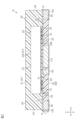
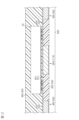
- FIG. 2 is a schematic cross-sectional view of the semiconductor device taken along line F2-F2 in FIG.
- FIG. 3 is an enlarged view of part of FIG.
- FIG. 4 is a schematic back view of the semiconductor device.
- FIG. 5 is a schematic plan view showing the positional relationship between the pillar portion and the wiring portion.
- FIG. 6 is an explanatory diagram schematically showing an example of the manufacturing process of the semiconductor device of the first embodiment.
- FIG. 7 is an explanatory diagram schematically showing an example of the manufacturing process of the semiconductor device continued from FIG.
- FIG. 8 is an explanatory diagram schematically showing an example of the manufacturing process of the semiconductor device continued from FIG. FIG.
- FIG. 9 is an explanatory diagram schematically showing an example of the manufacturing process of the semiconductor device continued from FIG.
- FIG. 10 is an explanatory diagram schematically showing an example of the manufacturing process of the semiconductor device continued from FIG. 11A and 11B are explanatory diagrams schematically showing an example of the manufacturing process of the semiconductor device continued from FIG. 12A and 12B are explanatory diagrams schematically showing an example of the manufacturing process of the semiconductor device continued from FIG. 13A and 13B are explanatory diagrams schematically showing an example of the manufacturing process of the semiconductor device continued from FIG.
- FIG. 14 is a back view schematically showing the positional relationship between the sealing resin and the bonding layer in the semiconductor device of the second embodiment.
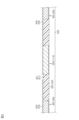
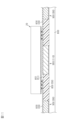
- FIG. 15 is a cross-sectional view schematically showing a part of the cross-sectional structure of the semiconductor device taken along line F15-F15 of FIG. 14.
- FIG. 16 is a cross-sectional view schematically showing the cross-sectional structure of the semiconductor device taken along line F16-F16 of FIG.
- FIG. 17 is a back view of the semiconductor device of the third embodiment.
- FIG. 18 is a back view of the semiconductor device of the modification.
- FIG. 1 is an enlarged view of bonding layer 70 and its periphery in FIG.
- FIG. 5 shows the pillar section 110 as seen through in order to match the positional relationship between the wiring section 30 and the pillar section 110, which will be described later, and also shows the pillar section 110 with a solid line. 4 and 5, the conductive film 120, which will be described later, is omitted for the sake of convenience.
- the semiconductor device 10 includes a semiconductor element 20, a wiring portion 30 electrically connected to the semiconductor element 20, and a sealing resin 40 sealing the semiconductor element 20 and the wiring portion 30. and have.
- the semiconductor device 10 is a device surface-mounted on a circuit board (not shown) of various electronic devices. In other words, the semiconductor device 10 has a surface mount type package structure.
- the sealing resin 40 constitutes the outer surface of the semiconductor device 10 .
- the shape of the sealing resin 40 is a substantially rectangular plate shape. That is, the shape of the semiconductor device 10 is a substantially rectangular plate shape.
- the thickness direction of the sealing resin 40 is defined as the z direction.
- a direction along one side of the semiconductor device 10 orthogonal to the z direction when viewed from the z direction is defined as the x direction, and a direction orthogonal to both the x direction and the z direction is defined as the y direction.
- the y direction is also a direction along one side of the semiconductor device 10 when viewed from the z direction.
- the shape of the sealing resin 40 viewed from the z direction is square. That is, the shape of the semiconductor device 10 viewed from the z-direction is a square.
- the shape of the sealing resin 40 (the shape of the semiconductor device 10) can be changed arbitrarily.
- the shape of the sealing resin 40 (the shape of the semiconductor device 10) viewed from the z direction may be a rectangular shape with a longer side in the x direction than the side in the y direction, or a rectangular shape with a longer side in the y direction than the side in the y direction. It may have a rectangular shape longer than the direction side.
- the sealing resin 40 has a resin surface 41 and a resin back surface 42 opposite to the resin surface 41 .
- the sealing resin 40 has four resin side surfaces connecting the resin front surface 41 and the resin back surface 42 in the z-direction. (both see FIG. 1).
- the sealing resin 40 has a flat substrate portion 50 and a sealing portion 60 formed on the substrate portion 50 .
- the substrate portion 50 is a portion on which the semiconductor element 20 is mounted, and is a supporting member serving as a base of the semiconductor device 10 .
- the substrate section 50 is made of an insulating material.
- the substrate portion 50 is made of, for example, black epoxy resin.
- the material forming the substrate portion 50 is arbitrary within the range of insulating materials.
- the substrate portion 50 constitutes a portion of the sealing resin 40 closer to the resin back surface 42 .
- the substrate portion 50 has a substrate front surface 51 facing the same side as the resin surface 41 and a substrate rear surface 52 forming a resin rear surface 42 .
- the substrate portion 50 has substrate side surfaces that form part of the first to fourth resin side surfaces 43 to 46 .
- the sealing portion 60 is a sealing member that seals the semiconductor element 20 .
- the sealing portion 60 is made of an insulating material.
- the sealing portion 60 is made of, for example, black epoxy resin.
- the material forming the sealing portion 60 is arbitrary within the range of insulating materials.
- the material forming the substrate portion 50 and the sealing portion 60 may contain, for example, a filler that improves heat dissipation performance.
- both the substrate portion 50 and the sealing portion 60 are made of black epoxy resin.
- the content ratio of the filler contained in the epoxy resin forming the substrate portion 50 and the sealing portion 60 is different from each other. Thereby, an interface is formed at the boundary between the substrate portion 50 and the sealing portion 60 .
- the sealing portion 60 constitutes a portion of the sealing resin 40 near the resin surface 41 .
- the sealing portion 60 has a sealing surface 61 forming the resin surface 41 and a sealing back surface 62 opposite to the sealing surface 61 .
- the sealing back surface 62 is in contact with the substrate front surface 51 of the substrate section 50 . Therefore, the interface between the substrate portion 50 and the sealing portion 60 is formed by the sealing back surface 62 of the sealing portion 60 and the substrate surface 51 of the substrate portion 50 .
- the sealing portion 60 has a resin side surface that constitutes part of the first to fourth resin side surfaces 43 to 46 .
- the thickness of the substrate portion 50 is thinner than the thickness of the sealing portion 60 .
- the thickness of the substrate portion 50 is thinner than the thickness of the semiconductor element 20 .
- the thickness of the substrate portion 50 is 40 ⁇ m or more and 70 ⁇ m or less.
- the thickness of the substrate portion 50 can be defined by the size between the substrate front surface 51 and the substrate back surface 52 in the z direction.
- the thickness of the encapsulation 60 can be defined by the dimension between the encapsulation surface 61 and the encapsulation back surface 62 in the z-direction.
- the thickness of the semiconductor element 20 can be defined by the size between the element front surface 21 and the element back surface 22 in the z direction.
- the semiconductor element 20 sealed in the sealing portion 60 is an integrated circuit (IC: Integrated Circuit) such as LSI (Large Scale Integration). Also, the semiconductor element 20 may be a discrete semiconductor element such as a voltage control element such as an LDO (Low Drop Out), an amplification element such as an operational amplifier, a diode, and various sensors.
- IC integrated circuit
- LDO Low Drop Out
- amplification element such as an operational amplifier
- diode a diode
- the semiconductor element 20 is formed in a flat plate shape.
- the shape of the semiconductor element 20 viewed from the z-direction is a square.
- the shape of the semiconductor element 20 viewed from the z-direction can be arbitrarily changed.
- the shape of the semiconductor element 20 viewed from the z direction may be a rectangular shape with a longer side in the x direction than a side in the y direction, or a rectangular shape with a longer side in the y direction than the side in the x direction. may be
- the semiconductor element 20 has an element front surface 21 and an element back surface 22 opposite to the element front surface 21 .
- the element surface 21 faces the same side as the resin surface 41 .
- the resin surface 41 faces the same side as the element surface 21 .
- the element back surface 22 faces the same side as the resin back surface 42 . It can also be said that the element back surface 22 faces the substrate front surface 51 of the substrate portion 50 .
- the semiconductor element 20 has four element side surfaces connecting the element front surface 21 and the element back surface 22 in the z-direction.
- the semiconductor element 20 is entirely covered with a sealing resin 40 (sealing portion 60).
- a plurality of wiring portions 30 are provided. As shown in FIG. 2 , the wiring section 30 is formed on the substrate section 50 . More specifically, the wiring portion 30 is formed on the substrate surface 51 of the substrate portion 50 . Since the substrate surface 51 of the substrate portion 50 is a plane orthogonal to the z-direction, it can be said that the wiring portion 30 extends in a direction orthogonal to the z-direction.
- Each wiring part 30 is provided at a position facing the element back surface 22 of the semiconductor element 20 .
- Each wiring part 30 extends outside the semiconductor element 20 from a position facing the element back surface 22 of the semiconductor element 20 when viewed in the z-direction. In other words, it can be said that each wiring part 30 has a protruding part protruding from the semiconductor element 20 when viewed in the z direction.
- each wiring section 30 has a metal layer and a main wiring layer.
- the metal layer is formed as a seed layer forming the main wiring layer.
- the metal layer is made of a material containing titanium (Ti), for example.
- the metal layer includes a Ti layer and a copper (Cu) layer in contact with the Ti layer.
- the metal layer is formed on the substrate surface 51 of the substrate portion 50 . More specifically, a Ti layer is formed on the substrate surface 51 . A Cu layer is laminated on the Ti layer. Thereby, a metal layer is formed on the substrate surface 51 .
- the main wiring layer is laminated on the metal layer. More specifically, the main wiring layer is laminated on the Cu layer of the metal layer. That is, it can be said that each wiring part 30 is configured by a laminated structure of a metal layer and a main wiring layer.
- the main wiring layer is made of, for example, Cu or an alloy containing Cu.
- each wiring part 30 extends from a position overlapping with the semiconductor element 20 toward one of the first to fourth resin side surfaces 43 to 46 when viewed in the z direction.
- Each wiring part 30 is exposed from the resin side surface corresponding to each wiring part 30 . That is, as shown in FIG. 2 , each wiring portion 30 has a wiring exposed side surface 31 exposed from the resin side surface corresponding to each wiring portion 30 .
- the wiring exposed side surface 31 is formed so as to be flush with the resin side surface.
- the resin side surface corresponding to the wiring portion 30 is the resin side surface closest to the wiring portion 30 . It can also be said that the resin side surface corresponding to the wiring portion 30 is the resin side surface on which the wiring exposed side surface 31 of the wiring portion 30 is formed.
- FIG. 3 shows an example of a connection structure between the semiconductor element 20 and the wiring portion 30.
- the semiconductor element 20 has an element substrate 23 , a plurality of connection terminals 24 , an insulating film 25 and connection wirings 26 . Both the connection wiring 26 and the insulating film 25 are provided on the element substrate 23 .
- the element substrate 23 is a semiconductor substrate, and is made of a material containing silicon (Si), for example.
- the element substrate 23 is a Si substrate.
- the element substrate 23 has a front surface 23A and a back surface 23B.
- the front surface 23A of the element substrate 23 faces the same side as the element front surface 21 of the semiconductor element 20
- the back surface 23B faces the same side as the element back surface 22 of the semiconductor element 20 .
- the surface 23A of the element substrate 23 constitutes the element surface 21 of the semiconductor element 20 .
- the back surface 23B indicates the surface on which the functional elements (such as transistors) of the semiconductor element 20 are built.
- each connection terminal 24 is provided closer to the wiring portion 30 than the rear surface 23B of the element substrate 23 .
- Each connection terminal 24 has a conductor portion 24A and a barrier layer 24B.
- the conductor portion 24A is made of a material containing Cu, for example.
- the conductor portion 24A constitutes a portion of the connection terminal 24 closer to the element substrate 23 .
- Barrier layer 24B includes, for example, a Ni layer.
- the barrier layer 24B is laminated on the conductor portion 24A so as to cover the tip surface of the conductor portion 24A.
- the barrier layer 24B can prevent the conductor portion 24A from penetrating into the bonding layer 70, which will be described later. Note that the configuration of the barrier layer 24B can be arbitrarily changed.
- the barrier layer 24B may be composed of a Ni layer, a Pd layer, and an Au layer stacked together.
- the connection terminal 24 is formed in a cylindrical shape. That is, the shape of the connection terminal 24 viewed from the z-direction is circular.
- the insulating film 25 is provided so as to cover the back surface 23B of the element substrate 23 while exposing the plurality of connection terminals 24 .
- Connection wires 26 for connecting the element substrate 23 and each connection terminal 24 are provided on the insulating film 25 . More specifically, the insulating film 25 is provided with an opening 25A that exposes the back surface 23B of the element substrate 23 .
- the connection wiring 26 is provided in the opening 25A and extends outward from the opening 25A.
- a connection terminal 24 is provided on a portion of the connection wiring 26 extending outward from the opening 25A. That is, each connection terminal 24 is provided at a position different from the opening 25A of the insulating film 25 .
- the connection wiring 26 electrically connects the element substrate 23 and the connection terminal 24 . As shown in FIG. 1, the wiring portion 30 faces each connection terminal 24 in the z direction.
- the insulating film 25 is made of a material containing polyimide resin, for example. Note that the material forming the insulating film 25 can be arbitrarily changed. In one example, the insulating film 25 may be made of a material containing silicon nitride (SiN).
- the semiconductor element 20 is connected to the wiring section 30 by a conductive bonding layer 70 .
- the bonding layer 70 is provided between the semiconductor element 20 and the wiring portion 30 .
- the bonding layer 70 electrically connects the semiconductor element 20 and the wiring portion 30 .
- the bonding layer 70 bonds the connection terminal 24 of the semiconductor element 20 and the wiring portion 30 .
- the joining layer 70 has a solder layer.
- the bonding layer 70 is made of tin (Sn) or an alloy containing Sn. Alloys containing Sn include, for example, tin-silver (Ag) alloys and tin-antimony (Sb) alloys.
- the bonding layer 70 is in contact with the barrier layer 24B of the connection terminal 24 of the semiconductor element 20 . Thereby, the bonding layer 70 and the connection terminal 24 are bonded.
- a plurality of bonding layers 70 may be provided in one wiring section 30 , or one bonding layer 70 may be provided in one wiring section 30 .
- the relationship between the number of bonding layers 70 and wiring portion 30 is set according to the amount of current flowing through wiring portion 30, for example.
- a protective layer 80 is provided between the bonding layer 70 and the wiring portion 30 .
- the semiconductor device 10 has the protective layer 80 interposed between the wiring portion 30 and the bonding layer 70 .
- the protective layer 80 is made of a material containing Ni.
- a protective layer 80 is formed on the wiring portion 30 .
- the protective layer 80 is formed at a position of the wiring portion 30 facing the connection terminal 24 of the semiconductor element 20 in the z-direction.
- the thickness of the protective layer 80 (dimension of the protective layer 80 in the z direction) is, for example, 3 ⁇ m or more and 5 ⁇ m or less.
- the protective layer 80 is circular when viewed from the z-direction.
- the diameter of the protective layer 80 is larger than the diameter of the connection terminal 24 .
- the bonding layer 70 is laminated on the protective layer 80 .
- the bonding layer 70 is thicker than the protective layer 80 .
- the connection terminals 24 of the semiconductor element 20 are electrically connected to the wiring portion 30 via the bonding layer 70 and the protective layer 80 .
- the semiconductor element 20 is mounted on the wiring portion 30 .
- the bonding layer 70 is formed in a circular shape when viewed from the z direction. As shown in FIG. 3, since the diameter of the protective layer 80 is larger than the diameter of the connection terminal 24, the bonding layer 70 is formed in a truncated cone shape.
- the semiconductor device 10 has a plurality of external connection terminals 90 electrically connected to the semiconductor element 20 via the wiring section 30 (see FIG. 1).
- a plurality of external connection terminals 90 are arranged on the outermost periphery of the resin back surface 42 . That is, the plurality of external connection terminals 90 are located outside the semiconductor element 20 .
- Each external connection terminal 90 is made of, for example, Cu or an alloy containing Cu.
- Each external connection terminal 90 is formed by electrolytic plating, for example.
- the plurality of external connection terminals 90 are provided at positions adjacent to the first to fourth resin side surfaces 43 to 46 when viewed from the z direction. More specifically, a plurality of external connection terminals 90 are provided at positions adjacent to the first resin side surface 43 . The plurality of external connection terminals 90 are arranged at intervals in the direction along the first resin side surface 43 when viewed from the z direction. A plurality of external connection terminals 90 are provided at positions adjacent to the second resin side surface 44 . The plurality of external connection terminals 90 are arranged at intervals in the direction along the second resin side surface 44 when viewed from the z direction. A plurality of external connection terminals 90 are provided at positions adjacent to the third resin side surface 45 .
- the plurality of external connection terminals 90 are arranged at intervals in the direction along the third resin side surface 45 when viewed from the z direction.
- a plurality of external connection terminals 90 are provided at positions adjacent to the fourth resin side surface 46 .
- the plurality of external connection terminals 90 are arranged at intervals in the direction along the fourth resin side surface 46 when viewed from the z direction.
- the plurality of external connection terminals 90 are provided outside the semiconductor element 20 when viewed in the z direction.
- the semiconductor device 10 of the present embodiment is a Fan-Out type semiconductor device in which the plurality of external connection terminals 90 are positioned outside the semiconductor element 20 .
- the shape of the external connection terminal 90 viewed from the z-direction is a rectangular shape having long sides and short sides.
- the external connection terminals 90 have short sides in the direction in which the plurality of external connection terminals 90 are arranged, and long sides in directions orthogonal to the arrangement direction when viewed from the z-direction.
- each external connection terminal 90 is exposed from both the resin back surface 42 and one of the first to fourth resin side surfaces 43 to 46.
- the external connection terminal 90 provided at a position adjacent to the first resin side surface 43 when viewed in the z direction is exposed from the resin rear surface 42 and the first resin side surface 43 .
- the external connection terminal 90 provided at a position adjacent to the second resin side surface 44 when viewed in the z direction is exposed from the resin rear surface 42 and the second resin side surface 44 .
- the external connection terminal 90 provided at a position adjacent to the third resin side surface 45 when viewed in the z direction is exposed from the resin rear surface 42 and the third resin side surface 45 .
- External connection terminals 90 provided at positions adjacent to the fourth resin side surface 46 when viewed in the z-direction are exposed from the resin rear surface 42 and the fourth resin side surface 46 .
- the external connection terminal 90 is connected to the wiring section 30 .
- the external connection terminal 90 is provided on the substrate portion 50 and extends from the wiring portion 30 toward the resin back surface 42 .
- the external connection terminal 90 is provided so as to penetrate the substrate portion 50 in the z direction. Since the external connection terminal 90 is covered with the wiring portion 30 in the z direction, the external connection terminal 90 does not protrude from the substrate surface 51 of the substrate portion 50 toward the resin surface 41 . In addition, the external connection terminals 90 do not protrude from the substrate rear surface 52 (resin rear surface 42 ) of the substrate portion 50 to the side opposite to the substrate front surface 51 . Therefore, it can be said that the thickness T of the external connection terminal 90 is equal to the thickness TB of the substrate portion 50 .
- corner terminal portions 100 are provided at four corner portions of the resin back surface 42 .
- the corner terminal portion 100 is made of the same material as the external connection terminal 90 .
- the corner terminal portion 100 is exposed from the resin rear surface 42 and the two resin side surfaces forming the corner portion.
- the corner terminal portion 100 is not electrically connected to the wiring portion 30 .
- the corner terminal portion 100 is provided on the substrate portion 50 so as to pass through the substrate portion 50 in the z-direction. Therefore, the thickness of the corner terminal portion 100 is equal to the thickness T of the external connection terminal 90 .
- a corner wiring portion 101 is provided at a position overlapping the corner terminal portion 100 (see FIG. 4) on the substrate surface 51 of the substrate portion 50 when viewed from the z direction. Unlike the wiring portion 30 , the corner wiring portion 101 is not electrically connected to the semiconductor element 20 . Corner wiring portion 101 is made of the same material as wiring portion 30, for example. The corner wiring portion 101 may be configured with a laminated structure of a metal layer and a main wiring layer, similarly to the wiring portion 30 .
- the semiconductor device 10 has pillar portions 110 exposed from the resin back surface 42 .
- the pillar portion 110 is provided at a position overlapping the semiconductor element 20 when viewed in the z direction. As shown in FIG. 4 , in this embodiment, the pillar portion 110 is provided in the center of the resin back surface 42 .
- the pillar portion 110 is made of the same material as the external connection terminal 90 .
- the pillar portion 110 is a heat dissipation pad that releases the heat of the semiconductor element 20 to the outside of the sealing resin 40 .
- the pillar section 110 is provided on the substrate section 50 so as to pass through the substrate section 50 . Since the pillar portion 110 is covered with the wiring portion 30 in the z direction, the pillar portion 110 does not protrude from the substrate surface 51 of the substrate portion 50 toward the resin surface 41 . Further, the pillar portion 110 does not protrude from the substrate rear surface 52 (resin rear surface 42 ) of the substrate portion 50 to the side opposite to the substrate front surface 51 . Therefore, the thickness TP of the pillar section 110 is equal to the thickness TB of the substrate section 50 . In other words, the thickness TP of the pillar portion 110 is equal to the thickness T of the external connection terminal 90 .
- the pillar portion 110 is connected to the wiring portion 32 of the wiring portion 30 that extends from the second resin side surface 44 to the center of the resin back surface 42 . Thereby, the pillar portion 110 is electrically connected to the wiring portion 32 .
- the wiring portion 32 is a wiring portion that is wider than the other wiring portions 30 .
- the wiring portion 32 includes an outer portion 32A closer to the second resin side surface 44, an inner portion 32B closer to the center of the substrate surface 51, and a connection portion 32C connecting the outer portion 32A and the inner portion 32B. can be distinguished.
- the outer portion 32A extends from the second resin side surface 44 toward the center of the substrate surface 51 in the x direction.
- the outer portion 32A can be divided into a first portion that overlaps the semiconductor element 20 when viewed in the z direction, and a second portion that protrudes outward from the semiconductor element 20 from the first portion.
- Two external connection terminals 90 are connected to the second portion.
- the width dimension of the outer portion 32A is equal to the width dimension of the wiring portions 33 and 34 adjacent to the outer portion 32A in the y direction.
- the width dimension of the wiring portions 33 and 34 is larger than the width dimension of the wiring portion 30 other than the wiring portions 32-34.
- Two external connection terminals 90 are connected to each of the wiring portions 32 to 34 .
- Each of the wiring portions 32 to 34 is provided with more bonding layers 70 than the other wiring portions 30 .
- One external connection terminal 90 is connected to the wiring portion 30 other than the wiring portions 32-34.
- the width dimension of the inner portion 32B is larger than the width dimension of the outer portion 32A.
- the inner portion 32B has portions overlapping the wiring portions 33 and 34 when viewed in the x direction. Of the four corner portions of the inner portion 32B, corner portions near the first resin side surface 43 and the third resin side surface 45 are provided with chamfered inclined portions 32BA.
- the connecting portion 32C is provided between the outer portion 32A and the inner portion 32B in the x direction.
- the connection portion 32C is formed in a tapered shape that widens from the outer portion 32A toward the inner portion 32B.
- the pillar part 110 is provided at a position overlapping the inner part 32B when viewed from the z direction. Pillar portion 110 is connected to inner portion 32B.
- the width dimension WP of the pillar portion 110 is slightly smaller than the width dimension W of the inner portion 32B.
- the length LP of the pillar portion 110 in the x-direction is equal to the length L of the inner portion 32B in the x-direction.
- the width dimension WP of the pillar portion 110 is larger than the width dimension of the outer portion 32A (see FIG. 1).
- the width dimension WP (see FIG. 5) of the pillar portion 110 is larger than the width dimension of the external connection terminal 90 (the length of the short side of the external connection terminal 90).
- the width dimension WP of the pillar portion 110 is greater than the length of the long side of the external connection terminal 90 . Also, the length LP (see FIG. 5) of the pillar portion 110 is longer than the length of the long side of the external connection terminal 90 .
- the plurality of bonding layers 70 are provided in the outer portion 32A, and the pillar portions 110 are provided in the inner portion 32B.
- the pillar portions 110 are provided at positions that do not overlap each other in the z direction. More specifically, the plurality of bonding layers 70 are provided between the pillar section 110 and the external connection terminals 90 connected to the wiring section 32 in the x direction.
- the shape of the pillar portion 110 viewed from the z-direction is substantially square (substantially rectangular).
- the pillar portion 110 has a curved portion 111 that relieves stress from the sealing resin 40 .
- the curved portion 111 is formed on at least part of the portion of the pillar portion 110 that contacts the sealing resin 40 .
- the curved portions 111 are provided at three of the four corner portions of the pillar portion 110 . Therefore, it can be said that the pillar portion 110 is formed in a polygonal shape having curved and chamfered corner portions as the curved portions 111 when viewed from the z direction.
- the pillar portion 110 is formed in a rectangular shape having three corner portions chamfered in a curved shape as the curved portion 111 when viewed from the z direction.
- the curved portion 111 is formed in an arc shape.
- the curved portion 111 is formed in a quarter circle shape.
- the radius of curved portion 111 is, for example, greater than or equal to the maximum diameter of bonding layer 70 (see FIG. 1). In this manner, the curved portion 111 is formed to protrude toward the sealing resin 40 when viewed from the z direction.
- each curved portion 111 When viewed from the z-direction, each curved portion 111 is provided at a position overlapping the wiring portion 32 (inner portion 32B).
- the wiring portion 32 has a portion that overlaps the curved portion 111 when viewed from the z direction. It can be said that the wiring portion 32 (the inner portion 32B) has a portion protruding from each curved portion 111 when viewed from the z direction.
- a chamfered inclined portion 112 is provided at a corner portion where the curved portion 111 is not provided among the four corner portions of the pillar portion 110 .
- the inclined portion 112 is provided at a corner portion near the first resin side surface 43 and the third resin side surface 45 among the four corner portions of the pillar portion 110 . Therefore, the inclined portion 112 is provided at a position corresponding to the inclined portion 32BA of the wiring portion 32 when viewed from the z direction.
- a conductive film 120 is provided on the portion of the external connection terminal 90 exposed from the sealing resin 40 .
- the conductive film 120 also covers the wiring exposed side surface 31 of the wiring portion 30 together with the external connection terminal 90 .
- a conductive film 120 is provided on the portion of the pillar portion 110 exposed from the resin back surface 42 .
- Each conductive film 120 is formed by electroless plating, for example.
- the conductive film 120 is also provided on a portion of the corner terminal portion 100 exposed from the sealing resin 40 .
- Method for manufacturing semiconductor device An example of a method for manufacturing the semiconductor device 10 will be described with reference to FIGS. As shown in FIG. 6, in the method of manufacturing the semiconductor device 10, a plurality of metal pillars 900 are formed on a semiconductor wafer 800 made of, for example, a Si single crystal material.
- the plurality of metal pillars 900 constitute the plurality of external connection terminals 90, the plurality of corner terminal portions 100 (see FIG. 4), and the pillar portion 110. That is, the plurality of external connection terminals 90, the plurality of corner terminal portions 100, and the pillar portions 110 are formed at the same time.
- Each metal pillar 900 is thicker than each of the plurality of external connection terminals 90 , the plurality of corner terminal portions 100 and the pillar portion 110 .
- Each metal pillar 900 is formed by electrolytic plating, for example. More specifically, after the seed layer 901 is formed on the semiconductor wafer 800, a mask (not shown) is formed on the seed layer 901 by photolithography. Subsequently, after forming a plating metal 902 in contact with the seed layer 901, the mask is removed. In this way, each metal pillar 900 is composed of a layered structure of the seed layer 901 and the plated metal 902 .
- a seed layer 901 is formed on the semiconductor wafer 800 by sputtering, for example. Subsequently, the seed layer 901 is covered with, for example, a photosensitive resist layer, and the resist layer is exposed and developed to form a mask having openings. Subsequently, a plating metal 902 is deposited on the surface of the seed layer 901 exposed from the mask by electroplating using the seed layer 901 as a conductive path. Through these steps, the metal pillar 900 is formed. After forming the metal pillars 900, the mask is removed.
- a substrate layer 850 is formed on the semiconductor wafer 800.
- the substrate layer 850 is a resin layer forming the substrate portion 50 of the semiconductor device 10 and seals each metal pillar 900 between itself and the semiconductor wafer 800 .
- the substrate layer 850 is made of black epoxy resin, for example.
- the thickness of the substrate layer 850 shown in FIG. 7 is thicker than the thickness of the substrate portion 50 .
- both the substrate layer 850 and each metal pillar 900 are ground.
- portions of the substrate layer 850 and each metal pillar 900 on the side opposite to the semiconductor wafer 800 are ground.
- each metal pillar 900 is exposed from the substrate layer 850 in the thickness direction of the substrate layer 850 .
- the thickness of the substrate layer 850 is preferably 90 ⁇ m or less.
- a wiring layer 830 is formed.
- the wiring layer 830 is a metal layer forming the wiring portion 30 and the corner wiring portion 101 (see FIG. 1) of the semiconductor device 10, and is formed on the surface 851 of the substrate layer 850 after grinding and on the metal pillar 900 after grinding. be done.
- a surface 851 of the substrate layer 850 constitutes the substrate surface 51 of the substrate section 50 .
- the wiring layer 830 has a metal layer and a main wiring layer.
- a metal layer is formed, for example, by sputtering on surface 851 of substrate layer 850 after grinding and on some metal pillars 900 after grinding.
- a metal layer includes, for example, a Ti layer and a Cu layer. In one example of a specific formation method, a Ti layer is formed both on the surface 851 of the substrate layer 850 and on some of the metal pillars 900, and a Cu layer is formed in contact with the Ti layer.
- a mask is formed on the metal layer by photolithography.
- the metal layer is covered with a resist layer having photosensitivity, and the resist layer is exposed and developed to form a mask having openings.
- the openings of the mask correspond to the locations where the wiring portion 30 and the corner wiring portion 101 (see FIG. 4) are formed.
- the main wiring layer is formed by, for example, depositing plated metal on the surface of the metal layer exposed through the openings of the mask by electroplating using the metal layer as a conductive path. After that, the mask is removed.
- the portion of the metal layer that does not overlap with the main wiring layer is removed.
- a mask is formed by photolithography on the main wiring layer and the metal layer.
- a portion of the metal layer not overlapped with the main wiring layer is opened.
- the metal layer exposed through the openings in the mask is removed.
- the mask is then removed.
- the wiring layer 830 forming the wiring portion 30 and the corner wiring portion 101 is formed.
- the thicknesses of the substrate layer 850 and the metal pillars 900 are reduced before forming the wiring layer 830, warping of the semiconductor wafer 800 can be reduced after the wiring layer 830 is formed. Therefore, the semiconductor wafer 800 can be easily transferred to the process after the wiring layer 830 is formed.
- a protective layer 880 and a bonding layer 870 are formed.
- Protective layer 880 is formed, for example, by electroplating using wiring layer 830 as a conductive path.
- Protective layer 880 is formed of Ni, for example.
- the shape of the protective layer 880 viewed from the thickness direction of the substrate layer 850 is circular.
- an alloy containing Sn is deposited as a plating metal on the protective layer 880 by electrolytic plating.
- a bonding layer 870 is formed.
- the surface of the bonding layer 870 having roughness is smoothed by melting the bonding layer 870 by reflow processing. This smoothing can suppress the generation of voids when the bonding layer 870 and the solder layer of the semiconductor element 20 are bonded.
- the bonding layer 870 shown in FIG. 10 shows a state after reflow treatment.
- the bonding layer 870 has a circular shape when viewed from the thickness direction of the substrate layer 850 .
- the semiconductor element 20 is mounted on the wiring layer 830 .
- the mounting of the semiconductor element 20 is performed by flip chip bonding (FCB).
- an alloy containing Sn is deposited as a plating metal on the barrier layer 24B (both shown in FIG. 3) of each connection terminal 24 of the semiconductor element 20 by, for example, electrolytic plating. abbreviated).
- This solder layer is made of the same material as the bonding layer 870 (see FIG. 10), for example.
- the solder layer of the semiconductor element 20 is also smoothed by reflow treatment. The shape of the solder layer viewed from the thickness direction of the substrate layer 850 is circular.
- the semiconductor element 20 is mounted on the bonding layer 870 using, for example, a flip chip bonder. Thereby, the semiconductor element 20 is temporarily attached to the bonding layer 870 . After that, the bonding layer 870 and the solder layer of the semiconductor element 20 are brought into a liquid state by reflow treatment, and then the bonding layer 870 and the solder layer of the semiconductor element 20 are solidified by cooling. As a result, the semiconductor element 20 is bonded to the bonding layer 870 . Therefore, the bonding layer 70 (see FIG. 3) is composed of the bonding layer 870 and the solder layer of the semiconductor element 20 . Thereby, the bonding layer 70 is formed in a truncated cone shape.
- a sealing layer 860 for sealing the semiconductor element 20 is formed.
- the sealing layer 860 constitutes the sealing portion 60 (see FIG. 2) of the sealing resin 40 .
- the sealing layer 860 is made of black epoxy resin.
- the sealing resin 40 is composed of the substrate layer 850 and the sealing layer 860 .
- Sealing layer 860 is formed, for example, by compression molding.
- the semiconductor wafer 800 (see FIG. 12) is removed. Note that FIG. 13 is shown upside down with respect to FIG.
- Semiconductor wafer 800 is removed from substrate layer 850 by, for example, grinding.
- both the substrate layer 850 and the metal pillars 900 are partially removed in the thickness direction of the substrate layer 850 . This removes the seed layer 901 (see FIG. 6) of the metal pillar 900 .
- the metal pillars 900 are exposed from the side of the substrate layer 850 opposite to the sealing layer 860 .
- the back surface 852 of the substrate layer 850 constitutes the substrate back surface 52 of the substrate section 50 .
- the thickness of the substrate layer 850 becomes equal to the thickness of the substrate portion 50, and the thickness of the metal pillars 900 is the same as the thickness of the plurality of external connection terminals 90, the plurality of corner terminal portions 100 (see FIG. 4), and the pillar portions. equal to the thickness of each of 110 .
- the thickness of substrate layer 850 is between 40 ⁇ m and 70 ⁇ m.
- the method for removing the semiconductor wafer 800 can be changed arbitrarily.
- a separation film may be formed in advance and the semiconductor wafer 800 may be removed by a separation method.
- both the substrate layer 850 and the metal pillars 900 may be ground.
- a step of cutting the substrate layer 850 and the sealing layer 860 into individual pieces, and a step of forming a conductive film are performed.
- the side surface of the metal pillar 900 is exposed from the substrate layer 850 and the side surface of the wiring layer 830 is exposed from the sealing layer 860 .
- a conductive film is formed on the surface of the metal pillar 900 exposed from the substrate layer 850 and the sealing layer 860 and the side surface of the wiring layer 830 .
- the conductive film is formed, for example, by electroless plating.
- the inventors of the present application have found that when the pillar section 110 has a corner portion that is not chamfered, stress increases in the substrate section 50 adjacent to the pillar section 110, and as a result, cracks occur in the substrate section 50. I found it easy.
- a crack in the substrate portion 50 is formed from the substrate back surface 52 toward the substrate front surface 51 . That is, the crack extends in the thickness direction of the substrate portion 50 . If the crack extends to the wiring portion 30 , there is a possibility that foreign matter (for example, moisture) outside the semiconductor device 10 may come into contact with the wiring portion 30 .
- both the substrate layer 850 and the metal pillars 900 are cut to reduce the thickness of both the substrate layer 850 and the metal pillars 900. .
- a portion of the substrate layer 850 is cut so as to reliably expose the metal pillars 900 from the substrate layer 850 .
- the substrate layer 850 after cutting has the same thickness as the substrate portion 50 of the semiconductor device 10 .
- the metal pillar 900 constitutes the pillar portion 110 and the external connection terminal 90 .
- the substrate portion 50 it is difficult to make the substrate portion 50 excessively thick.
- the strength of the substrate portion 50 decreases, and cracks are likely to occur due to the stress generated in the substrate portion 50 .
- the corner portion of the pillar portion 110 is provided with the curved portion 111 . Accordingly, even if the temperature of the semiconductor device 10 changes, the stress in the substrate portion 50 adjacent to the pillar portion 110 is reduced. Therefore, it is possible to suppress the occurrence of cracks in the substrate portion 50 .
- the bonding layer 70 is provided so that the shape of the bonding layer 70 when viewed from the z direction is circular. Thereby, even if the temperature of the semiconductor device 10 changes, the stress in the bonding layer 70 is reduced. Therefore, it is possible to suppress the occurrence of cracks in the bonding layer 70 .
- the semiconductor device 10 includes a semiconductor element 20 having an element surface 21 and an element back surface 22, a wiring portion 30 electrically connected to the semiconductor element 20, and a resin surface 41 facing the same side as the element surface 21. , a resin back surface 42 opposite to the resin surface 41, and first to fourth resin side surfaces 43 to 46 as resin side surfaces, and a sealing resin 40 for sealing the semiconductor element 20 and the wiring portion 30. and a pillar portion 110 electrically connected to the wiring portion 30 and exposed from the resin back surface 42 . At least part of the portion of the pillar portion 110 that contacts the sealing resin 40 has a curved portion 111 that protrudes toward the sealing resin 40 when viewed in the z direction.
- the stress from the sealing resin 40 to the pillar section 110 is relieved by the curved section 111 .
- the stress (reaction force) from the pillar portion 110 to the sealing resin 40 can be reduced. Therefore, even if the temperature of the semiconductor device 10 changes, cracks in the sealing resin 40 caused by the pillar portion 110 can be suppressed.
- the pillar portion 110 is formed in a polygonal shape (quadrilateral shape) having curved and chamfered corner portions as the curved portions 111 when viewed from the thickness direction (z direction) of the sealing resin 40 .
- the wiring portion 32 (30) has a portion overlapping the curved portion 111 when viewed from the thickness direction (z direction) of the sealing resin 40 .
- the wiring portion 32 has a protruding portion protruding from the curved portion 111 when viewed from the z direction.
- the stress from the pillar portion 110 to the sealing resin 40 can be reduced. Therefore, even with a configuration in which the sealing resin 40 is surrounded by the wiring portion 32 and the pillar portion 110, the occurrence of cracks in the sealing resin 40 can be suppressed.
- the pillar portion 110 is a heat dissipation pad. With this configuration, the heat of the semiconductor element 20 can be released to the outside of the semiconductor device 10 through the pillar portion 110 .
- Each external connection terminal 90 is exposed from one of the first to fourth resin side surfaces 43 to 46 and the resin back surface 42 of the sealing resin 40 .
- the semiconductor device 10 includes a conductive film 120 that covers portions of the external connection terminals 90 that are exposed from the sealing resin 40 .
- the solder when the semiconductor device 10 is mounted on the circuit board using, for example, solder, the solder is exposed from any one of the first to fourth resin side surfaces 43 to 46 among the external connection terminals 90. Attach to the part to be As a result, the mounting state of the semiconductor device 10 on the circuit board by soldering can be visually recognized, so that the mounting state of the semiconductor device 10 on the circuit board can be easily confirmed.
- the semiconductor device 10 includes the conductive film 120 covering the portion of the pillar portion 110 exposed from the resin back surface 42 . According to this configuration, when the semiconductor device 10 is mounted on the circuit board, the conductive film 120 joins the pillar section 110 to the circuit board. Therefore, the heat of the semiconductor element 20 can be easily released to the circuit board through the pillar portion 110 and the conductive film 120 .
- the semiconductor element 20 has connection terminals 24 electrically connected to the wiring portion 30 .
- the wiring portion 30 faces both the connection terminal 24 and the pillar portion 110 .
- the semiconductor device 10 has a bonding layer 70 that bonds the connection terminal 24 and the wiring portion 30 .
- the shape of the bonding layer 70 viewed from the thickness direction (z direction) of the sealing resin 40 is circular.
- the stress from the sealing resin 40 (sealing portion 60) to the bonding layer 70 is reduced, so cracks in the bonding layer 70 are suppressed. can.
- the semiconductor device 10 has the protective layer 80 interposed between the wiring portion 30 and the bonding layer 70 .
- the protective layer 80 has a circular shape when viewed from the thickness direction of the sealing resin 40 . According to this configuration, since the shape of the bonding layer 70 provided on the protective layer 80 tends to depend on the shape of the protective layer 80, the shape of the bonding layer 70 can be made circular by making the shape of the protective layer 80 circular. easier.
- the sealing resin 40 includes a substrate portion 50 on which the semiconductor element 20 is mounted and a sealing portion 60 that seals the semiconductor element 20 .
- the wiring portion 30 is provided on the substrate portion 50 .
- the pillar portion 110 is provided so as to penetrate the substrate portion 50 in the thickness direction (z direction) of the sealing resin 40 .
- the thickness of the substrate portion 50 is thinner than the thickness of the sealing portion 60 .
- the pillar section 110 is provided on the thin substrate section 50 , cracks are more likely to occur in the substrate section 50 than in the sealing section 60 .
- the curved portions 111 are provided at the corner portions of the pillar portions 110, the stress from the pillar portions 110 to the substrate portion 50 is reduced. Thereby, the occurrence of cracks in the substrate portion 50 can be suppressed.
- FIG. 14 A semiconductor device 10 according to the second embodiment will be described with reference to FIGS. 14 to 16.
- FIG. 14 the configuration of the external connection terminals 90 is mainly different from that of the first embodiment.
- the same reference numerals are given to the components common to the semiconductor device 10 of the first embodiment, and the description thereof may be omitted.
- the conductive film 120 is omitted in FIG. 14 for convenience.
- 14 schematically shows wiring portions 35 connected to pillar portions 130, which will be described later, among the wiring portions 30, and the remaining wiring portions 30 are omitted.
- FIG. 14 is a back view of the semiconductor device 10 of this embodiment.
- the plurality of external connection terminals 90 are provided on the outermost periphery of the sealing resin 40 when viewed from the z direction, as in the first embodiment.
- the plurality of external connection terminals 90 includes two types of external connection terminals, an external connection terminal 90A and an external connection terminal 90B.
- the external connection terminal 90A has the same configuration as the external connection terminal 90 of the first embodiment.
- the external connection terminal 90B is an external connection terminal configured from the pillar portion 130 .
- the semiconductor device 10 since the semiconductor device 10 includes four pillar portions 130, four external connection terminals 90B are provided.
- the plurality of external connection terminals 90 include terminals configured from the pillar portions 130 .
- Each pillar portion 130 (external connection terminal 90B) is a heat dissipation pad that releases the heat of the semiconductor element 20 to the outside of the sealing resin 40 .
- Each pillar portion 130 extends along the y-direction. That is, in this embodiment, the y direction corresponds to the "extending direction of the pillar portion". Note that each pillar portion 130 may extend along the x direction.
- the multiple (four) pillar portions 130 include two first pillar portions 130A and two second pillar portions 130B.
- the first pillar portion 130A extends from the fourth resin side surface 46 toward the third resin side surface 45 .
- the second pillar portion 130 ⁇ /b>B extends from the third resin side surface 45 toward the fourth resin side surface 46 .
- the fourth resin side surface 46 corresponds to "one first end in the first direction along the resin back surface”
- the third resin side surface 45 corresponds to "the first end opposite to the first end.” side second end”.
- the third resin side surface 45 corresponds to "one first end in the first direction along the resin back surface”
- the fourth resin side surface 46 corresponds to "the first end opposite to the first end.” 2 ends”.
- the y direction corresponds to the "first direction along the back surface of the resin”
- the x direction corresponds to the "second direction”.
- the two first pillar portions 130A are arranged closer to the center in the x direction than the two second pillar portions 130B.
- the distance between the first pillar portion 130A and the second pillar portion 130B arranged near the first pillar portion 130A in the x direction is smaller than the distance between the two first pillar portions 130A in the x direction. .
- the first pillar portion 130A extends from the fourth resin side surface 46 to the side of the third resin side surface 45 from the center of the resin back surface 42 in the y direction.
- the second pillar portion 130B extends from the third resin side surface 45 to a position closer to the fourth resin side surface 46 than the center of the resin back surface 42 in the y direction.
- the y-direction length of the second pillar portion 130B is longer than the y-direction length of the first pillar portion 130A. Note that the lengths in the y direction of the first pillar portion 130A and the second pillar portion 130B can be arbitrarily changed.
- the y-direction length of the second pillar portion 130B may be equal to the y-direction length of the first pillar portion 130A.
- the y-direction length of the second pillar portion 130B may be shorter than the y-direction length of the first pillar portion 130A.
- the width dimension of the first pillar portion 130A is equal to the width dimension of the second pillar portion 130B.
- the width dimensions of the first pillar portion 130A and the second pillar portion 130B can be changed arbitrarily.
- the width dimension of the first pillar portion 130A may be larger than the width dimension of the second pillar portion 130B.
- the width dimension of the first pillar portion 130A may be smaller than the width dimension of the second pillar portion 130B.
- both the first pillar portion 130A and the second pillar portion 130B constitute the external connection terminals 90B. That is, both the first pillar portion 130A and the second pillar portion 130B constitute external connection terminals that are electrically connected to the circuit board while the semiconductor device 10 is mounted on the circuit board.
- a curved portion 131 is formed on the tip surface of the first pillar portion 130A, which is the portion farthest from the fourth resin side surface 46. As shown in FIG. The curved portion 131 of the first pillar portion 130A is curved so as to protrude toward the third resin side surface 45 on the tip surface of the first pillar portion 130A. A curved portion 131 is formed on the distal end surface of the second pillar portion 130B, which is the portion farthest from the third resin side surface 45. As shown in FIG. The curved portion 131 of the second pillar portion 130B is curved so as to protrude toward the fourth resin side surface 46 at the tip surface of the second pillar portion 130B.
- the curved portion 131 is formed in a part of the portion of each of the pillar portions 130A and 130B that is in contact with the sealing resin 40 . Further, it can be said that the curved portion 131 is formed so as to protrude toward the sealing resin 40 when viewed from the z direction.
- the curved portion 131 of the first pillar portion 130A is provided over the entire tip surface of the first pillar portion 130A.
- the curved portion 131 of the second pillar portion 130B is provided over the entire tip surface of the second pillar portion 130B.
- the shape of the curved portion 131 viewed from the z-direction is semicircular. In other words, the shape of the tip surface of the first pillar portion 130A and the shape of the tip surface of the second pillar portion 130B when viewed in the z-direction are semicircular.
- the radius of the semicircular curved portion 131 is larger than the diameter of the bonding layer 70 .
- the radius of the curved portion 131 and the diameter of the bonding layer 70 can be changed arbitrarily. For example, the radius of curved portion 131 and the diameter of bonding layer 70 may be equal to each other, or the radius of curved portion 131 may be smaller than the diameter of bonding layer 70 .
- both the first pillar portion 130A and the second pillar portion 130B are provided so as to penetrate the substrate portion 50. As shown in FIG. The thicknesses of the first pillar portion 130A and the second pillar portion 130B are equal to the thickness of the substrate portion 50 .
- the first pillar portion 130A is exposed from both the resin back surface 42 and the fourth resin side surface 46.
- a conductive film 120 is provided on the surface exposed from both the resin back surface 42 and the fourth resin side surface 46 of the first pillar portion 130A.
- the conductive film 120 is the same as the conductive film 120 of the first embodiment.
- the second pillar portion 130B is exposed from both the resin back surface 42 and the third resin side surface 45 .
- the conductive film 120 is provided on the surfaces of the second pillar portion 130B exposed from both the resin back surface 42 and the third resin side surface 45 .
- the wiring portion 35 indicated by the dashed line is wiring connected to the first pillar portion 130A, and has a portion that overlaps the first pillar portion 130A when viewed from the z direction. More specifically, the wiring portion 35 has a portion that overlaps the curved portion 131 of the first pillar portion 130A when viewed in the z direction.
- a wiring portion 36 indicated by a dashed line is a wiring connected to the second pillar portion 130B, and has a portion overlapping the second pillar portion 130B when viewed from the z direction. More specifically, the wiring portion 36 has a portion that overlaps the curved portion 131 of the second pillar portion 130B when viewed in the z direction.
- the bonding layer 70 is positioned on the side opposite to the second pillar section 130B with respect to the first pillar section 130A and on the side opposite to the first pillar section 130A with respect to the second pillar section 130B. are arranged side by side in the y direction. In other words, the bonding layer 70 is not provided between the first pillar portion 130A and the second pillar portion 130B adjacent in the x direction in the first pillar portion 130A.
- the plurality of bonding layers 70 arranged side by side in the y-direction at the position opposite to the second pillar portion 130B with respect to the first pillar portion 130A is referred to as the "plurality of first bonding layers 70A.
- the plurality of bonding layers 70 arranged side by side in the y direction on the opposite side of the second pillar portion 130B from the first pillar portion 130A are referred to as "a plurality of second bonding layers 70B.”
- the wiring portion 35 is provided so as to face both the first pillar portion 130A and the plurality of first bonding layers 70A when viewed from the z-direction.
- the first pillar portion 130A and the plurality of first bonding layers 70A are provided at positions that do not overlap each other when viewed in the z direction.
- the plurality of first bonding layers 70A are arranged near the center of the resin back surface 42 in the x direction with respect to the first pillar portion 130A. Some of the first bonding layers 70A among the plurality of first bonding layers 70A are arranged closer to the third resin side surface 45 than the first pillar portion 130A in the y direction.
- the multiple first bonding layers 70A are provided in the wiring portion 35 . It can be said that a plurality of first bonding layers 70A are arranged along the extending direction (y direction) of the first pillar portion 130A.
- the wiring portion 36 is provided so as to face both the second pillar portion 130B and the plurality of second bonding layers 70B when viewed from the z-direction.
- the second pillar portion 130B and the plurality of second bonding layers 70B are provided at positions that do not overlap each other when viewed in the z direction.
- the plurality of second bonding layers 70B are arranged outside the resin back surface 42 in the x direction with respect to the second pillar portion 130B. All of the plurality of second bonding layers 70B are arranged at positions overlapping the second pillar portions 130B when viewed in the x direction. A plurality of second bonding layers 70B are provided in the wiring portion 36 . It can be said that a plurality of second bonding layers 70B are arranged along the extending direction (y direction) of the second pillar portion 130B.
- the wiring portion 35 has protruding portions 35a and 35b protruding on both sides in the x direction with respect to the first pillar portion 130A.
- the protruding portion 35a is a portion protruding in the x direction from the first pillar portion 130A toward the plurality of first bonding layers 70A.
- the multiple first bonding layers 70A are provided in the protruding portion 35a.
- the protruding portion 35b is a portion protruding in the x direction from the first pillar portion 130A toward the second pillar portion 130B.
- the length of the protruding portion 35a in the x direction is longer than the length of the protruding portion 35b in the x direction.
- the wiring portion 36 has protruding portions 36a and 36b protruding on both sides in the x direction with respect to the second pillar portion 130B.
- the protruding portion 36a is a portion protruding in the x direction from the second pillar portion 130B toward the plurality of second bonding layers 70B.
- the plurality of second bonding layers 70B are provided in the protruding portion 36a.
- the protruding portion 36b is a portion protruding in the x direction from the second pillar portion 130B toward the first pillar portion 130A.
- the length of the protruding portion 36a in the x direction is longer than the length of the protruding portion 36b in the x direction.
- the wiring portions 35 and 36 are provided so that the distance between the wiring portions 35 and 36 in the x direction is not excessively small.
- the resin back surface 42 of the sealing resin 40 is one first end in the first direction (y direction) along the resin back surface 42 when viewed from the thickness direction (z direction) of the sealing resin 40. and a second end opposite the first end.
- the pillar portion 130 extends in the first direction from the first end of the resin back surface 42 as viewed from the thickness direction of the sealing resin 40 toward the second end of the resin back surface 42 from the base end.
- the curved portion 131 is curved so as to be convex toward the second end on the tip surface of the pillar portion 130 .
- the stress generated in the sealing resin 40 at the front end surface of the pillar portion 130 in the first direction (y direction) due to the temperature change of the semiconductor device 10 is applied to the sealing resin 40 at other portions of the pillar portion 130 . greater than the stress that occurs. Therefore, cracks are likely to occur in a portion of the sealing resin 40 that is adjacent to the front end surface of the pillar portion 130 in the first direction (y direction).
- a curved portion 131 that curves convexly toward the second end is provided on the tip surface of the pillar portion 130 .
- the stress generated in the sealing resin 40 on the front end surface of the pillar section 130 in the first direction (y direction) can be reduced compared to the pillar section where the curved section 131 is not provided. Therefore, it is possible to suppress the occurrence of cracks in the portion of the sealing resin 40 that is adjacent to the front end surface of the pillar portion 130 in the first direction (y direction).
- the curved portion 131 has a semicircular shape when viewed from the thickness direction (z direction) of the sealing resin 40 . According to this configuration, the stress generated in the sealing resin 40 on the front end surface of the pillar portion 130 in the first direction (y direction) can be further reduced.
- a plurality of bonding layers 70 are arranged along the extending direction of the pillar section 130 . According to this configuration, a plurality of bonding layers 70 are bonded to the wiring portion 35 bonded to the pillar portion 130 . Therefore, the heat of the semiconductor element 20 is released to the outside of the semiconductor device 10 through the bonding layers 70 , the wiring portions 35 and the pillar portions 130 . Thus, the heat of the semiconductor element 20 can be efficiently released to the outside of the semiconductor device 10 .
- the pillar portion 130 is separated from the first pillar portion 130A extending in the first direction (y direction) in the second direction (x direction) orthogonal to the first direction with respect to the first pillar portion 130A. and a second pillar portion 130B disposed at a position where the second pillar portion 130B.
- the bonding layer 70 is provided at a position of the first pillar portion 130A opposite to the second pillar portion 130B and a position of the second pillar portion 130B opposite to the first pillar portion 130A. They are arranged side by side in multiple directions.
- the bonding layers 70A and 70B are not provided between the first pillar portion 130A and the second pillar portion 130B in the x direction.
- the wiring portion 35 connected to the first pillar portion 130A and the wiring portion 36 connected to the second pillar portion 130B are separated in the x direction. It is possible to prevent the distance between directions from becoming excessively small. Therefore, it is possible to suppress the occurrence of cracks in the sealing resin 40 (substrate portion 50) between the first pillar portion 130A and the second pillar portion 130B in the x direction.
- the first pillar portion 130A is exposed from both the resin back surface 42 and the fourth resin side surface 46 of the sealing resin 40 .
- the second pillar portion 130B is exposed from both the resin rear surface 42 and the third resin side surface 45 of the sealing resin 40 .
- the semiconductor device 10 includes the conductive film 120 covering the portions exposed from the sealing resin 40 of the first pillar portions 130A and the second pillar portions 130B. According to this configuration, when the semiconductor device 10 is mounted on the circuit board, the conductive film 120 joins the first pillar portions 130A and the second pillar portions 130B to the circuit board. Therefore, the heat of the semiconductor element 20 can be easily released to the circuit board through the first pillar portions 130A and the second pillar portions 130B and the conductive film 120.
- a semiconductor device 10 according to the third embodiment will be described with reference to FIG. This embodiment differs from the first embodiment mainly in the formation of the pillar portions.
- the same reference numerals are given to the components common to the semiconductor device 10 of the first embodiment, and the description thereof may be omitted.
- the semiconductor device 10 has four pillar portions 140 .
- the pillar portions 140 are provided corresponding to four corner portions of the resin back surface 42 .
- the pillar portion 140 is arranged closer to the center of the resin back surface 42 than the corner terminal portion 100 .
- the pillar portion 140 is arranged closer to the center of the resin back surface 42 than the plurality of external connection terminals 90 .
- the pillar portion 140 is provided at a position closer to the plurality of external connection terminals 90 with respect to the center of the resin back surface 42 .
- Each pillar portion 140 is a heat dissipation pad that releases heat from the semiconductor element 20 (see FIG. 2) to the outside of the sealing resin 40 .
- the shape of the pillar portion 140 viewed from the z-direction is substantially square (substantially rectangular).
- the pillar portion 140 has a curved portion 141 that relieves stress from the sealing resin 40 .
- the curved portion 141 is formed on at least part of the portion of the pillar portion 140 that contacts the sealing resin 40 .
- the curved portions 141 are provided at four corner portions of the pillar portion 140 . Therefore, it can be said that the pillar portion 140 is formed in a polygonal shape having curved and chamfered corner portions as the curved portions 141 when viewed from the z direction.
- the pillar portion 140 is formed in a quadrangular shape having four curved and chamfered corner portions as the curved portion 141 when viewed from the z direction.
- the curved portion 141 is formed in an arc shape.
- the curved portion 141 is formed to protrude toward the sealing resin 40 when viewed from the z direction.
- the length in the x direction and the length in the y direction of the pillar portion 140 are equal to each other.
- the x-direction length (y-direction length) of the pillar portion 140 may be equal to the length of the long side of the external connection terminal 90 .
- the length in the x direction and the length in the y direction of the pillar portion 140 can be arbitrarily changed.
- the x-direction length of the pillar portion 140 may be longer than the y-direction length
- the y-direction length of the pillar portion 140 may be longer than the x-direction length.
- the length in the x direction of the pillar portion 140 may be longer than the length of the long side of the external connection terminal 90 , or the length in the x direction may be shorter than the length of the long side of the external connection terminal 90 .
- the length of the pillar portion 140 in the y direction may be longer than the length of the long side of the external connection terminal 90 or the length of the y direction may be shorter than the length of the long side of the external connection terminal 90 .
- the conductive film 120 provided on the pillar portion 110 may be omitted. Also, the conductive film 120 provided on the corner terminal portion 100 may be omitted.
- the pillar portion 110 may be provided with a curved portion 111 instead of the inclined portion 112 . That is, the curved portion 111 may be provided at each of the four corner portions of the pillar portion 110 .
- the shape of the pillar portion 110 viewed from the z direction can be arbitrarily changed.
- the pillar portion 110 may have a circular shape when viewed in the z direction.
- the curved portion 111 is formed over the entire portion of the pillar portion 110 that is in contact with the sealing resin 40 .
- the stress from the outer peripheral surface of the pillar section 110 to the sealing resin 40 tends to be uniform over the entire circumferential direction of the pillar section 110 .
- the occurrence of stress concentration in the sealing resin 40 can be suppressed. Therefore, the occurrence of cracks in the sealing resin 40 can be further suppressed.
- the first pillar portion 130A does not have to be formed integrally with the external connection terminal 90 .
- the entire first pillar portion 130A may be located inside the external connection terminal 90 (90B) in the y direction.
- the second pillar portion 130B does not have to be formed integrally with the external connection terminal 90 .
- the second pillar portion 130B may be entirely located inside the external connection terminal 90 (90B) in the y direction.
- the shape of the tip surface of the first pillar portion 130A as viewed in the z-direction was semicircular, but the shape is not limited to this.
- the shape of the tip surface of the first pillar portion 130A as viewed in the z-direction may be a shape having a curved chamfered corner portion as the curved portion 131 . That is, the curved portion 131 may be provided on a part of the tip surface of the first pillar portion 130A when viewed from the z direction.
- the tip end surface of the first pillar portion 130A as viewed in the z-direction includes a flat surface extending in a direction (x-direction) perpendicular to the direction (y-direction) in which the first pillar portion 130A extends, and an x-axis of the flat surface. and a corner portion (bend) that is curvedly chamfered on both sides in the direction.
- the shape of the tip surface of the second pillar portion 130B viewed from the z direction may be similarly changed.
- the first pillar portion 130A may be configured so as not to be exposed from the fourth resin side surface 46 of the sealing resin 40 .
- the end portion of the first pillar portion 130A near the fourth resin side surface 46 into a semi-circular shape that protrudes toward the fourth resin side surface 46, the occurrence of cracks in the sealing resin 40 can be suppressed.
- the second pillar portion 130 ⁇ /b>B may be configured so as not to be exposed from the third resin side surface 45 of the sealing resin 40 .
- the number of first pillar portions 130A and the number of second pillar portions 130B can be changed arbitrarily. - Either one of the first pillar portion 130A and the second pillar portion 130B may be omitted in the second embodiment.
- the conductive film 120 may not be formed on the surfaces exposed from the fourth resin side surface 46 and the resin back surface 42 of the first pillar portion 130A that do not function as external connection terminals. Further, the conductive film 120 may not be formed on the surfaces exposed from the third resin side surface 45 and the resin back surface 42 of the second pillar portion 130B that does not function as an external connection terminal.
- a bonding layer 70 may be provided between the first pillar portion 130A and the second pillar portion 130B.
- You may add the pillar part 140 of 3rd Embodiment to either 1st Embodiment or 2nd Embodiment.
- the shape of the pillar portion 140 viewed from the z-direction is not limited to the shape shown in FIG. It is possible. In one example, the shape of the pillar portion 140 as viewed in the z-direction may be circular.
- the diameter of the protective layer 80 can be changed arbitrarily.
- the diameter of protective layer 80 may be equal to the diameter of barrier layer 24B of connection terminal 24 .
- the bonding layer 70 is formed in a cylindrical or barrel shape.
- the shape of the protective layer 80 viewed from the z direction may be a shape other than a circle. In one example, the shape of the protective layer 80 viewed in the z-direction may be rectangular.
- the shape of the connection terminal 24 viewed from the z direction may be a shape other than a circle. In one example, the shape of the connection terminal 24 viewed from the z direction may be rectangular.
- the shape of the bonding layer 70 viewed from the z direction may be a shape other than a circle.
- the bonding layer 70 may have a rectangular shape when viewed in the z direction.
- at least one of the four corner terminal portions 100 may be omitted.
- the number of external connection terminals 90 can be changed arbitrarily.
- the plurality of external connection terminals 90 corresponding to the third resin side surface 45 and the fourth resin side surface 46 may be omitted.
- the external connection terminal 90 may be configured not to be exposed from any of the first to fourth resin side surfaces 43 to 46 of the sealing resin 40 . That is, the external connection terminals 90 may be configured to be exposed only from the resin rear surface 42 .
- the corner portion of the external connection terminal 90 may also be provided with a curved portion.
- the external connection terminal 90 corresponds to the "pillar portion".
- the pillar portions 110 , 130 , 140 may not be connected to the wiring portion 30 .
- the pillar portions 110 , 130 , 140 do not have to be electrically connected to the semiconductor element 20 .
- the corner portion of the wiring portion 30 may also be provided with a curved portion. Thereby, it is possible to suppress the occurrence of cracks in the sealing resin 40 due to the difference between the thermal expansion coefficient of the wiring portion 30 and the sealing resin 40 .
- a first member is formed on a second member means that in some embodiments the first member may be placed directly on the second member in contact with the second member, but in other implementations the first member may be disposed directly on the second member. It is contemplated that the configuration allows the first member to be positioned over the second member without contacting the second member. That is, the term “on” does not exclude structures in which another member is formed between the first member and the second member.
- the z-direction used in the present disclosure does not necessarily have to be the vertical direction, nor does it have to match the vertical direction perfectly.
- the various structures according to this disclosure are not limited to the z-direction "top” and “bottom” described herein being the vertical “top” and “bottom”.
- the x-direction may be vertical, or the y-direction may be vertical.
- references herein to "at least one of A and B” should be understood to mean “A only, or B only, or both A and B.”
- Appendix Technical ideas that can be grasped from the above embodiment and modifications are described below. It should be noted that for the purpose of aid in understanding and not for the purpose of limitation, the corresponding reference numerals in the embodiments are shown in parentheses for the configurations described in the appendix. Reference numerals are shown as examples to aid understanding, and the components described in each appendix should not be limited to the components indicated by the reference numerals.
- the pillar portion (110) When viewed from the thickness direction (z direction) of the sealing resin (40), the pillar portion (110) is formed in a polygonal shape having a curved chamfered corner portion as the curved portion (111).
- the resin back surface (42) is one first end in a first direction (y direction) along the resin back surface (42) when viewed from the thickness direction (z direction) of the sealing resin (40). , and a second end opposite the first end,
- the pillar portion (130) extends in the first direction from the first end to the second end of the resin back surface (42) when viewed from the thickness direction (z direction) of the sealing resin (40).
- the curved portion (131) is curved so as to be convex toward the second end on the tip surface of the pillar portion (130) when viewed from the thickness direction (z direction) of the sealing resin (40).
- the curved portion (130) is provided on the entire tip surface,
- the wiring portion (30) has a portion overlapping with the curved portion (111/131) when viewed from the thickness direction (z direction) of the sealing resin (40). 1.
- the semiconductor element (20) has a connection terminal (24) electrically connected to the wiring part (30), The connection terminal (24) faces the wiring portion (30), a bonding layer (70) for bonding the connection terminal (24) and the wiring portion (30); 6.
- the resin back surface (42) is one first end in a first direction (y direction) along the resin back surface (42) when viewed from the thickness direction (z direction) of the sealing resin (40). , and a second end opposite the first end,
- the pillar portion (130) extends in the first direction from the first end to the second end of the resin back surface (42) when viewed from the thickness direction (z direction) of the sealing resin (40). extends to 8.
- the pillar part (130) is a first pillar portion (130A) extending in the first direction; a second pillar portion (130B) arranged at a position spaced apart from the first pillar portion (130A) in a second direction (x direction) orthogonal to the first direction (y direction); including
- the bonding layers (70A, 70B) are positioned on the opposite side of the first pillar section (130A) to the second pillar section (130B) and on the side of the second pillar section (130B).
- the semiconductor device according to appendix 8 wherein a plurality of the pillars are arranged side by side in the first direction (y direction) at a position opposite to the first pillar portion (130A).
- Appendix 10 The semiconductor device according to any one of Appendices 1 to 9, wherein the pillar portion (110/130/140) is a heat dissipation pad.
- a semiconductor element (20) having an element front surface (21) and an element back surface (22); a wiring portion (30) electrically connected to the semiconductor element (20); a resin surface (41) facing the same side as the element surface (21), a resin back surface (42) opposite to the resin surface (41), and resin side surfaces (43 to 46); a sealing resin (40) for sealing the semiconductor element (20) and the wiring portion (30); a pillar portion (110) provided at a position overlapping with the semiconductor element (20) when viewed from the thickness direction (z direction) of the sealing resin (40) and exposed from the resin rear surface (42); with At least a portion of the pillar portion (110) in contact with the sealing resin (40) has a A semiconductor device having a curved portion (111) that protrudes toward.
- the sealing resin (40) is a substrate portion (50) on which the semiconductor element (20) is mounted; a sealing portion (60) for sealing the semiconductor element (20); including The wiring portion (30) is provided on the substrate portion (50), The pillar portion (110) is provided so as to penetrate the substrate portion (50) in the thickness direction (z direction) of the sealing resin (40). semiconductor equipment.
- Substrate surface 52 ... Substrate back surface 60... Sealing part 61 Sealing surface 62 Sealing back surface 70 Bonding layer 70A First bonding layer 70B Second bonding layer 80
- Protective layer 90, 90A, 90B External connection terminal 100 Corner terminal portion 101 Corner wiring portion 110 Pillar part 111... Curved part 112... Inclined part 120... Conductive film 130... Pillar part 130A... First pillar part 130B... Second pillar part 131... Curved part 140... Pillar part 141... Curved part 800... Semiconductor wafer 830... Wiring layer 850... Substrate layer 851... Surface 860... Sealing layer 870... Bonding layer 880... Protective layer 900... Metal pillar 901... Seed layer 902... Plating metal T...
- Thickness of external connection terminal L... Length of inner part in x direction W...Width of inner portion TB...Thickness of substrate LP...Length of pillar WP...Width of pillar TP...Thickness of pillar
Landscapes
- Structures Or Materials For Encapsulating Or Coating Semiconductor Devices Or Solid State Devices (AREA)
- Engineering & Computer Science (AREA)
- Microelectronics & Electronic Packaging (AREA)
Priority Applications (4)
| Application Number | Priority Date | Filing Date | Title |
|---|---|---|---|
| CN202280075919.XA CN118235240A (zh) | 2021-11-19 | 2022-11-11 | 半导体装置 |
| DE112022005523.5T DE112022005523T5 (de) | 2021-11-19 | 2022-11-11 | Halbleiterbauelement |
| JP2023561567A JPWO2023090261A1 (https=) | 2021-11-19 | 2022-11-11 | |
| US18/663,675 US20240297107A1 (en) | 2021-11-19 | 2024-05-14 | Semiconductor device |
Applications Claiming Priority (2)
| Application Number | Priority Date | Filing Date | Title |
|---|---|---|---|
| JP2021-188396 | 2021-11-19 | ||
| JP2021188396 | 2021-11-19 |
Related Child Applications (1)
| Application Number | Title | Priority Date | Filing Date |
|---|---|---|---|
| US18/663,675 Continuation US20240297107A1 (en) | 2021-11-19 | 2024-05-14 | Semiconductor device |
Publications (1)
| Publication Number | Publication Date |
|---|---|
| WO2023090261A1 true WO2023090261A1 (ja) | 2023-05-25 |
Family
ID=86396931
Family Applications (1)
| Application Number | Title | Priority Date | Filing Date |
|---|---|---|---|
| PCT/JP2022/042025 Ceased WO2023090261A1 (ja) | 2021-11-19 | 2022-11-11 | 半導体装置 |
Country Status (5)
| Country | Link |
|---|---|
| US (1) | US20240297107A1 (https=) |
| JP (1) | JPWO2023090261A1 (https=) |
| CN (1) | CN118235240A (https=) |
| DE (1) | DE112022005523T5 (https=) |
| WO (1) | WO2023090261A1 (https=) |
Citations (5)
| Publication number | Priority date | Publication date | Assignee | Title |
|---|---|---|---|---|
| JPH08316376A (ja) * | 1995-05-19 | 1996-11-29 | Shinko Electric Ind Co Ltd | 放熱部材及び該放熱部材を備えた半導体装置 |
| WO2013118478A1 (ja) * | 2012-02-09 | 2013-08-15 | 富士電機株式会社 | 半導体装置 |
| JP2014049590A (ja) * | 2012-08-31 | 2014-03-17 | Kyocera Corp | 配線基板および電子装置 |
| JP2021093454A (ja) * | 2019-12-11 | 2021-06-17 | ローム株式会社 | 半導体装置 |
| JP2021125569A (ja) * | 2020-02-05 | 2021-08-30 | ローム株式会社 | 半導体装置および半導体装置の製造方法 |
-
2022
- 2022-11-11 CN CN202280075919.XA patent/CN118235240A/zh active Pending
- 2022-11-11 JP JP2023561567A patent/JPWO2023090261A1/ja active Pending
- 2022-11-11 DE DE112022005523.5T patent/DE112022005523T5/de active Pending
- 2022-11-11 WO PCT/JP2022/042025 patent/WO2023090261A1/ja not_active Ceased
-
2024
- 2024-05-14 US US18/663,675 patent/US20240297107A1/en active Pending
Patent Citations (5)
| Publication number | Priority date | Publication date | Assignee | Title |
|---|---|---|---|---|
| JPH08316376A (ja) * | 1995-05-19 | 1996-11-29 | Shinko Electric Ind Co Ltd | 放熱部材及び該放熱部材を備えた半導体装置 |
| WO2013118478A1 (ja) * | 2012-02-09 | 2013-08-15 | 富士電機株式会社 | 半導体装置 |
| JP2014049590A (ja) * | 2012-08-31 | 2014-03-17 | Kyocera Corp | 配線基板および電子装置 |
| JP2021093454A (ja) * | 2019-12-11 | 2021-06-17 | ローム株式会社 | 半導体装置 |
| JP2021125569A (ja) * | 2020-02-05 | 2021-08-30 | ローム株式会社 | 半導体装置および半導体装置の製造方法 |
Also Published As
| Publication number | Publication date |
|---|---|
| JPWO2023090261A1 (https=) | 2023-05-25 |
| CN118235240A (zh) | 2024-06-21 |
| US20240297107A1 (en) | 2024-09-05 |
| DE112022005523T5 (de) | 2024-09-12 |
Similar Documents
| Publication | Publication Date | Title |
|---|---|---|
| JP7524244B2 (ja) | 半導体装置 | |
| US20170250153A1 (en) | Electronic part, electronic device, and electronic apparatus | |
| CN101276809B (zh) | 半导体器件及其制造方法 | |
| CN101145545A (zh) | 包括元件安装表面被树脂层涂覆的布线基板的半导体装置 | |
| TWI493671B (zh) | 具有支撐體的封裝基板及其製法、具有支撐體的封裝結構及其製法 | |
| US20250343199A1 (en) | Electronic device and manufacturing method thereof | |
| JP2021093454A (ja) | 半導体装置 | |
| JP2023045461A (ja) | 半導体装置、および半導体装置の製造方法 | |
| JP2019050302A (ja) | 半導体装置 | |
| TWI614861B (zh) | 電子封裝結構及其製法 | |
| KR102633431B1 (ko) | 반도체 장치 및 이의 제조 방법 | |
| WO2023090261A1 (ja) | 半導体装置 | |
| JP2023060343A (ja) | 半導体モジュール | |
| JP4631223B2 (ja) | 半導体実装体およびそれを用いた半導体装置 | |
| JP7154818B2 (ja) | 半導体装置および半導体装置の製造方法 | |
| JP2010157544A (ja) | 半導体装置及びその製造方法、並びに電子機器 | |
| US12610836B2 (en) | Semiconductor device | |
| TWI604542B (zh) | 封裝基板及其製法 | |
| JP7729841B2 (ja) | 半導体装置 | |
| CN107170715B (zh) | 半导体封装结构及其制作方法 | |
| JP4728079B2 (ja) | 半導体装置用基板および半導体装置 | |
| US20250372485A1 (en) | Semiconductor device | |
| JP7416607B2 (ja) | 半導体装置 | |
| WO2023054389A1 (ja) | 半導体装置および半導体装置の製造方法 | |
| JP7269756B2 (ja) | 半導体装置および半導体装置の製造方法 |
Legal Events
| Date | Code | Title | Description |
|---|---|---|---|
| 121 | Ep: the epo has been informed by wipo that ep was designated in this application |
Ref document number: 22895543 Country of ref document: EP Kind code of ref document: A1 |
|
| ENP | Entry into the national phase |
Ref document number: 2023561567 Country of ref document: JP Kind code of ref document: A |
|
| WWE | Wipo information: entry into national phase |
Ref document number: 202280075919.X Country of ref document: CN |
|
| 122 | Ep: pct application non-entry in european phase |
Ref document number: 22895543 Country of ref document: EP Kind code of ref document: A1 |