WO2023080014A1 - 研磨剤、添加液および研磨方法 - Google Patents
研磨剤、添加液および研磨方法 Download PDFInfo
- Publication number
- WO2023080014A1 WO2023080014A1 PCT/JP2022/039682 JP2022039682W WO2023080014A1 WO 2023080014 A1 WO2023080014 A1 WO 2023080014A1 JP 2022039682 W JP2022039682 W JP 2022039682W WO 2023080014 A1 WO2023080014 A1 WO 2023080014A1
- Authority
- WO
- WIPO (PCT)
- Prior art keywords
- polishing
- abrasive
- metal salt
- metal
- water
- Prior art date
- Legal status (The legal status is an assumption and is not a legal conclusion. Google has not performed a legal analysis and makes no representation as to the accuracy of the status listed.)
- Ceased
Links
Images




Classifications
-
- B—PERFORMING OPERATIONS; TRANSPORTING
- B24—GRINDING; POLISHING
- B24B—MACHINES, DEVICES, OR PROCESSES FOR GRINDING OR POLISHING; DRESSING OR CONDITIONING OF ABRADING SURFACES; FEEDING OF GRINDING, POLISHING, OR LAPPING AGENTS
- B24B37/00—Lapping machines or devices; Accessories
-
- C—CHEMISTRY; METALLURGY
- C09—DYES; PAINTS; POLISHES; NATURAL RESINS; ADHESIVES; COMPOSITIONS NOT OTHERWISE PROVIDED FOR; APPLICATIONS OF MATERIALS NOT OTHERWISE PROVIDED FOR
- C09G—POLISHING COMPOSITIONS; SKI WAXES
- C09G1/00—Polishing compositions
- C09G1/02—Polishing compositions containing abrasives or grinding agents
-
- C—CHEMISTRY; METALLURGY
- C09—DYES; PAINTS; POLISHES; NATURAL RESINS; ADHESIVES; COMPOSITIONS NOT OTHERWISE PROVIDED FOR; APPLICATIONS OF MATERIALS NOT OTHERWISE PROVIDED FOR
- C09K—MATERIALS FOR MISCELLANEOUS APPLICATIONS, NOT PROVIDED FOR ELSEWHERE
- C09K3/00—Materials not provided for elsewhere
- C09K3/14—Anti-slip materials; Abrasives
-
- H—ELECTRICITY
- H10—SEMICONDUCTOR DEVICES; ELECTRIC SOLID-STATE DEVICES NOT OTHERWISE PROVIDED FOR
- H10P—GENERIC PROCESSES OR APPARATUS FOR THE MANUFACTURE OR TREATMENT OF DEVICES COVERED BY CLASS H10
- H10P52/00—Grinding, lapping or polishing of wafers, substrates or parts of devices
Definitions
- the present invention relates to an abrasive, an additive liquid, and a polishing method.
- CMP chemical mechanical polishing
- STI shallow trench isolation
- FIGS. 1A and 1B An example of STI will be described with reference to FIGS. 1A and 1B.
- FIGS. 1A and 1B first, as shown in FIG. 1A, after masking the device region of the silicon substrate 1 with a silicon nitride film 2 or the like, trenches 3 are formed in the silicon substrate 1 and filled in.
- An insulating film such as a silicon oxide film 4 is deposited. Next, by CMP, the silicon oxide film 4 on the silicon nitride film 2, which is a convex portion, is polished and removed while leaving the silicon oxide film 4 in the trench 3, which is a concave portion. An element isolation structure is obtained in which the silicon oxide film 4 is embedded in the silicon oxide film 3 .
- Patent Document 1 discloses a polishing agent containing a specific water-soluble polymer, cerium oxide particles, and water and having a pH of 4-9. According to the polishing agent of Patent Document 1, the polishing rate for a silicon nitride film can be kept low while maintaining a high polishing rate for a silicon oxide film. In the examples of FIGS. 1A and 1B, the silicon nitride film 2 serves as a polishing stopper film, so that a good flat surface can be obtained.
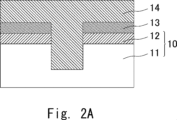
- FIGS. 2A-2C Another example of STI is described with reference to FIGS. 2A-2C.
- a laminated body in which a silicon nitride film 13 and a silicon oxide film 14 are laminated on an element region of a silicon substrate 10 is to be polished.
- the silicon substrate 10 is divided into crystalline silicon 11 and amorphous silicon 12 for the sake of convenience, but the configuration is not limited to this. Also, the boundary between the crystalline silicon 11 and the amorphous silicon 12 may not be clear.
- a silicon nitride film can be polished at a high speed in order to uniformly polish a silicon oxide film and a silicon nitride film while maintaining a sufficiently high polishing rate, and also from the viewpoint of polishing a silicon nitride film alone. Abrasives were required.
- the present invention has been made in view of the above circumstances, and an object of the present invention is to provide a polishing agent containing cerium oxide and a metal salt capable of polishing a silicon nitride film at high speed.
- the abrasive according to the present invention contains abrasive grains (A), a sparingly water-soluble metal salt (B), and water.
- the metal salt (B) contains at least one metal salt selected from the group consisting of metal carbonate, metal sulfate, metal phosphate, metal acetate and metal oxalate. You can
- the metal carbonate may contain at least one metal salt selected from the group consisting of barium carbonate and strontium carbonate.
- the metal sulfate may contain at least one metal salt selected from the group consisting of barium sulfate and strontium sulfate.
- the content of the metal salt (B) in the abrasive may be 0.1% by mass or more and 5% by mass or less with respect to the total mass of the abrasive.
- the content of the metal salt (B) may be 0.1 to 20 in mass ratio (B/A) to the abrasive grains (A).
- the abrasive grains (A) may contain at least one selected from the group consisting of cerium oxide and colloidal silica.
- the additive liquid according to the present invention contains a sparingly water-soluble metal salt (B), a dispersant (C), and water.
- the polishing method according to the present invention is a polishing method in which a surface to be polished and a polishing pad are brought into contact with each other while a polishing agent is supplied, and polishing is performed by relative movement of the two, and the polishing agent according to the present invention is used as the polishing agent. Then, the surface to be polished containing silicon oxide and/or silicon nitride of the semiconductor substrate is polished.
- the present invention provides a polishing agent containing cerium oxide capable of polishing a silicon nitride film at high speed.
- the term "surface to be polished” refers to a surface to be polished of an object to be polished, and means, for example, a surface.
- the "surface to be polished” includes an intermediate stage surface appearing on the semiconductor substrate in the process of manufacturing a semiconductor device.
- silicon oxide is mainly silicon dioxide, but is not limited thereto and may contain silicon oxides other than silicon dioxide.
- "-" indicating a numerical range includes the numerical values described before and after it as a lower limit and an upper limit. For clarity of explanation, the following description and drawings have been simplified where appropriate. Also, for the sake of explanation, the scale of each member in the drawings may differ greatly.
- the abrasive according to the present invention (hereinafter also referred to as the present abrasive) comprises abrasive grains (A), a sparingly water-soluble metal salt (B) (simply referred to as metal salt (B)), and water. It may contain other components as long as the effect of the present invention is exhibited.
- This abrasive contains abrasive grains (A).
- Abrasive grains can be appropriately selected and used from those used as abrasive grains for CMP.
- the abrasive grains are preferably metal oxide particles from the viewpoint of excellent polishing rate for silicon nitride and silicon oxide.
- Metal oxides include metal oxides selected from the group consisting of cerium oxide (ceria), alumina, silica, titania, and zirconia. Among them, cerium oxide or colloidal silica is preferable from the viewpoint of excellent polishing rate of silicon nitride or silicon oxide.
- the abrasive grains (A) can be used singly or in combination of two or more.
- Cerium oxide particles for abrasive grains can be appropriately selected from known ones and used. Examples thereof include cerium oxide particles produced by the methods described in JP-A-11-12561, JP-A-2001-35818, and JP-A-2010-505735. Specifically, cerium oxide particles obtained by adding an alkali to an aqueous solution of cerium(IV) ammonium nitrate to prepare a cerium hydroxide gel, filtering, washing and calcining the gel; , cerium oxide particles obtained by pulverization and classification; and cerium oxide particles obtained by chemically oxidizing cerium (III) salt in liquid.
- the average particle size of the abrasive grains (A) is preferably 0.01-0.5 ⁇ m, more preferably 0.03-0.3 ⁇ m. If the average particle size is 0.5 ⁇ m or less, the occurrence of polishing flaws such as scratches on the surface to be polished is suppressed. Further, when the average particle diameter is 0.01 ⁇ m or more, coarse agglomeration of the abrasive grains (A) is suppressed, the storage stability of the abrasive is excellent, and the polishing rate is also excellent. Since the abrasive grains (A) exist as aggregated particles (secondary particles) in which the primary particles are aggregated in the liquid, the preferred particle size of the abrasive grains (A) is represented by the average secondary particle size.
- the average particle size indicated in the above numerical range is usually the average secondary particle size.
- the average secondary particle size is measured using a particle size distribution meter such as a laser diffraction/scattering type using a dispersion liquid dispersed in a dispersion medium such as pure water.
- the content (concentration) of the abrasive grains (A) is preferably 0.05 to 2.0% by mass, more preferably 0.1 to 0.5% by mass, relative to the total abrasive. If the content of abrasive grains is at least the above lower limit, an excellent polishing rate can be obtained. On the other hand, if the content of the abrasive grains is equal to or less than the above upper limit, the increase in viscosity of the present polishing agent is suppressed, and the handleability is excellent.
- ⁇ Metal salt (B)> This abrasive is characterized by containing a metal salt (B) that is sparingly soluble in water.
- the inventor presumes as follows about the effect of increasing the polishing rate of the silicon nitride film by containing the metal salt (B).
- 5A and 5B are schematic cross-sectional views for explaining the action of the metal salt (B).
- This abrasive contains abrasive grains (A) 31 and metal salt (B) 32 dispersed in water, which is a solvent. In the example of FIG.
- the surface of the silicon nitride film 13, which is the surface to be polished, is hydrated by contact with water, and it is presumed that part of the silicon nitride is changed to silicon oxide 13a (FIG. 5B).
- the presence of the metal salt (B) 32 near the surface of the silicon nitride film 13 accelerates the hydration.
- the exposed outermost surface of the silicon nitride film 13 is sequentially changed into silicon oxide having a high polishing speed due to the action of the metal salt (B), thereby increasing the polishing speed of the abrasive grains (A). be done.
- the metal salt (B) and the sparingly water-soluble metal salt can be appropriately selected and used in the abrasive of the present invention.
- "sparingly soluble in water” means that the solubility at 25°C is less than 1 g, preferably 0.5 g or less, more preferably 0.1 g or less.
- the sparingly water-soluble metal salt (B) metal carbonate, metal sulfate, metal phosphate, metal oxalate, metal acetate, and the like are mentioned from the viewpoint of further improving the polishing rate of the silicon nitride film.
- the metal constituting the metal salt (B) is preferably an alkaline earth metal or a lanthanide from the viewpoint of further improving the polishing rate of the silicon nitride film. Strontium is more preferred.
- sparingly water-soluble metal salt (B) examples include barium carbonate, strontium carbonate, lanthanum carbonate, cerium carbonate, barium sulfate, strontium sulfate, lanthanum sulfate, cerium sulfate, barium phosphate, strontium phosphate, and phosphoric acid.
- metal salt (B) can be used individually by 1 type or in combination of 2 or more types.
- the average particle size of the metal salt (B) is not particularly limited, but may be, for example, 5 nm to 3 ⁇ m, preferably 10 nm to 2 ⁇ m.
- the average particle size of the metal salt (B) is equal to or less than the above upper limit, the occurrence of polishing flaws such as scratches on the surface to be polished is suppressed.
- the content is at least the above lower limit, coarse agglomeration of the metal salt (B) is suppressed, and the storage stability of the polishing agent is excellent, and the polishing rate is also excellent.
- the method for measuring the average particle size of the metal salt (B) is the same as that for the abrasive grains (A).
- the content of the metal salt (B) is preferably 0.1% by mass or more and 5% by mass or less with respect to the total mass of the polishing agent, from the viewpoint of further improving the polishing rate of the silicon nitride film. Further, the content of the metal salt (B) is preferably 0.1 to 20 in mass ratio (B/A) to the abrasive grains (A) from the viewpoint of further improving the polishing rate of the silicon nitride film. .
- the abrasive of the present invention contains water as a medium for dispersing the abrasive grains (A) and the metal salt (B).
- the type of water is not particularly limited, it is preferable to use pure water, ultrapure water, ion-exchanged water, etc. in consideration of effects on water-soluble polymers, etc., prevention of contamination by impurities, effects on pH, etc. .
- the polishing agent may further contain other components within the range in which the effects of the present invention are exhibited.
- Other ingredients include dispersants, pH modifiers, lubricants, polymers, and the like.
- a dispersant (C) is optionally used to improve the dispersibility and dispersion stability of the abrasive grains (A) and/or the metal salt (B).
- the dispersing agent it can be used by appropriately selecting from known ones used for abrasive applications. Examples include ionic, nonionic, and amphoteric polymer compounds, and one or more of these can be used.
- a water-soluble organic polymer or an anionic surfactant is preferred.
- a polymer having a carboxyl group or a carboxylate ammonium salt or the like is preferable, and polyacrylic acid or polyacrylic acid salt is particularly preferable.
- the content ratio is the total of the abrasive grains (A) and the metal salt (B) from the viewpoint of the dispersibility and dispersion stability of the abrasive grains (A) and/or the metal salt (B). It is preferably 0.0001 to 10 parts by mass, more preferably 0.0001 to 5 parts by mass, even more preferably 0.001 to 1 part by mass, based on 100 parts by mass.
- a pH adjuster may be used to adjust the pH of the abrasive.
- As the pH adjuster it is possible to appropriately select and use water-soluble inorganic acids, organic acids, basic compounds, amphoteric compounds such as amino acids, and salts thereof.
- inorganic acids include nitric acid, sulfuric acid, hydrochloric acid, phosphoric acid, etc., and their ammonium salts, sodium salts, potassium salts, etc. may be used.
- examples of organic acids include carboxylic acids, organic sulfonic acids, organic phosphoric acids and the like, and their ammonium salts, sodium salts, potassium salts and the like may be used.
- carboxylic acids include acetic acid, propionic acid, lactic acid, tartaric acid, oxalic acid, and maleic acid.
- organic sulfonic acids include benzenesulfonic acid and tosylic acid.
- organic phosphoric acids include methylphosphonic acid and dimethylphosphinic acid.
- Basic compounds include ammonia, potassium hydroxide, tetramethylammonium hydroxide, ethylenediamine, and the like.
- Amphoteric compounds include glycine, alanine, phenylalanine, and the like.
- the pH of the polishing agent is preferably 3 or more and 12 or less. When the pH of the polishing agent is within this range, the effect of polishing the silicon nitride film at high speed while polishing the silicon oxide film at high speed is sufficiently obtained.
- the pH of the polishing agent is more preferably 4 or more and 11 or less, and particularly preferably 4.5 or more and 10 or less, from the viewpoint of further improving the polishing rate of the silicon nitride film.
- the content of the pH adjuster may be appropriately adjusted so as to achieve the above pH. As an example, it can be 0.005 to 2.0% by mass, preferably 0.01 to 1.5% by mass, more preferably 0.01 to 0.3% by mass, based on the entire polishing agent.
- the lubricant is used as necessary to improve the lubricity of the polishing agent and improve the in-plane uniformity of the polishing rate.
- examples of lubricants include water-soluble polymers such as polyethylene glycol and polyglycerin.
- the absolute value of the .zeta.-potential of the abrasive is preferably 30 mV or more. When the .zeta.-potential of the polishing agent is within this range, the effect of polishing the silicon nitride film at high speed while maintaining the dispersion stability is sufficiently obtained.
- the ⁇ potential of the abrasive is more preferably 40 mV or more in absolute value, and particularly preferably 50 mV or more in absolute value. Note that the .zeta.-potential can be adjusted by selecting the above dispersant or the like.
- the preparation method of this polishing agent is selected from among the methods of uniformly dispersing or dissolving the abrasive grains (A), the sparingly water-soluble metal salt (B), and optional components in water, which is a medium. It can be selected as appropriate.
- a polishing liquid containing a sparingly water-soluble metal salt (B), a dispersant (C), and water, and a slurry containing abrasive grains (A) are separately prepared, and these are mixed to perform the main polishing. Preparation of agents is preferred.
- the polishing agent may be prepared just before use by carrying out the above-described mixing in a polishing apparatus.
- the abrasive of the present invention comprises a dispersion of abrasive grains (hereinafter also referred to as dispersion ⁇ ), a sparingly water-soluble metal salt (B), a dispersant (C), and a water-containing dispersion (hereinafter also referred to as dispersion ⁇ ) may be separately prepared and mixed at the time of use.
- This dispersion ⁇ is the additive liquid for polishing described below.
- the (polishing) additive liquid of the present invention is an additive liquid for preparing a polishing agent by mixing with a dispersion liquid of abrasive grains (dispersion liquid ⁇ described above), and comprises a sparingly water-soluble metal salt (B) , dispersant (C) and water.
- a dispersion liquid of abrasive grains dispersion liquid ⁇ described above
- a sparingly water-soluble metal salt (B) , dispersant (C) and water By using this additive liquid for polishing in the preparation of a polishing agent, the convenience of storing and transporting the polishing agent can be improved.
- the sparingly water-soluble metal salt (B), dispersant (C), and water are the same as those described for each component contained in the polishing agent and the pH of the solution. is.
- the content (concentration) of the sparingly water-soluble metal salt (B) is not particularly limited. From the viewpoint of ease of application, it is preferably 0.1% by mass or more and 10% by mass or less with respect to the total amount of the additive liquid.
- the content ratio (concentration) of the dispersant (C) is not particularly limited, but from the viewpoint of ease of handling of the additive liquid and ease of mixing with the dispersion liquid of abrasive grains. Therefore, it is preferably 0.1% by mass or more and 10% by mass or less with respect to the total amount of the additive liquid.
- the content ratio (concentration) of the abrasive grains in the liquid is determined from the viewpoint of dispersibility of the abrasive grains and ease of handling of the dispersion liquid. 0.01 mass % or more and 40 mass % or less are preferable. 0.01% by mass or more and 20% by mass or less is more preferable, and 0.01% by mass or more and 10% by mass or less is particularly preferable.
- the above-described polishing agent that polishes both the silicon oxide film and the silicon nitride at a high speed while maintaining sufficiently high flatness of the silicon oxide film is obtained.
- the polishing additive liquid may be added to the abrasive grain dispersion liquid and mixed, or the abrasive grain dispersion liquid may be added to the polishing additive liquid. You may add and mix.
- the mixing ratio of the polishing additive liquid and the dispersion liquid of abrasive grains is not particularly limited. (Concentration) is preferably 0.1% by mass or more and 5% by mass or less and 0.0002% by mass or more and 2% by mass or less with respect to the total mass of the abrasive. From the standpoint of ease of mixing the additive liquid for polishing and the dispersion liquid of abrasive grains, it is preferable to mix the additive liquid for polishing and the dispersion liquid of abrasive grains at a mass ratio of 130:1 to 1:130.
- the abrasive of the present invention does not necessarily have to be supplied to the polishing site as a mixture of all constituent polishing components in advance.
- the polishing components When supplied to the polishing station, the polishing components may be mixed into the composition of the abrasive.
- the abrasive of the present invention is prepared separately as two liquids, a dispersion of abrasive grains (dispersion ⁇ ) and the above polishing additive liquid (dispersion ⁇ ). May be mixed.
- the sparingly water-soluble metal salt (B) and the dispersing agent ( The concentration of C) and water may be concentrated to, for example, about 10 times the concentration of the abrasive when used, and after mixing, diluted with water to a predetermined concentration before use.
- polishing method using the present abrasive there is a method in which the surface to be polished of the object to be polished and the polishing pad are brought into contact while supplying the present polishing agent, and polishing is performed by relative movement of the two.
- the surface to be polished includes, for example, a blanket wafer in which a silicon nitride film and a silicon oxide film are laminated on the surface of a semiconductor substrate, a pattern wafer in which these film types are arranged in a pattern, and the like. mentioned. According to this polishing method, for example, as shown in FIG.
- a laminate obtained by laminating a silicon nitride film 13 and a silicon oxide film 14 on an element region of a silicon substrate 10 is to be polished.
- a so-called PE-TEOS film which is formed by plasma CVD using tetraethoxysilane (TEOS) as a raw material, can be used as the silicon oxide film on the STI substrate.
- TEOS tetraethoxysilane
- a silicon oxide film a so-called HDP film formed by a high-density plasma CVD method can be mentioned.
- a HARP film or FCVD film formed by other CVD methods, or an SOD film formed by spin coating can also be used.
- Examples of the silicon nitride film include those formed by low-pressure CVD, plasma CVD, and ALD using silane or dichlorosilane and ammonia as raw materials.
- FIG. 4 is a schematic diagram showing an example of a polishing apparatus.
- the polishing apparatus 20 shown in the example of FIG. 4 includes a polishing head 22 holding a semiconductor substrate 21 such as an STI substrate, a polishing surface plate 23, a polishing pad 24 attached to the surface of the polishing surface plate 23, and a polishing surface. and an abrasive supply pipe 26 for supplying an abrasive 25 to the pad 24 .
- the surface to be polished of the semiconductor substrate 21 held by the polishing head 22 is brought into contact with the polishing pad 24 while the polishing agent 25 is being supplied from the polishing agent supply pipe 26, and the polishing head 22 and the polishing platen 23 are relatively rotated. It is configured to be moved and polished.
- the polishing head 22 may perform linear motion as well as rotational motion.
- the polishing surface plate 23 and the polishing pad 24 may be of the same size as or smaller than the semiconductor substrate 21 . In that case, it is preferable to polish the entire surface of the semiconductor substrate 21 to be polished by relatively moving the polishing head 22 and the polishing platen 23 .
- the polishing platen 23 and the polishing pad 24 may not be rotating, and may be belt-type and move in one direction.
- the polishing conditions of the polishing apparatus 20 are not particularly limited, but by applying a load to the polishing head 22 and pressing it against the polishing pad 24, the polishing pressure can be increased and the polishing speed can be improved.
- the polishing pressure is preferably about 0.5 to 50 kPa, and more preferably about 3 to 40 kPa from the viewpoint of uniformity and flatness of the polishing rate in the surface to be polished of the semiconductor substrate 21, and prevention of polishing defects such as scratches.
- the number of revolutions of the polishing surface plate 23 and the polishing head 22 is preferably about 50 to 500 rpm. Further, the supply amount of the polishing agent 25 is appropriately adjusted depending on the composition of the polishing agent, the above polishing conditions, and the like.
- the polishing pad 24 one made of non-woven fabric, foamed polyurethane, porous resin, non-porous resin, or the like can be used.
- the surface of the polishing pad 24 is grooved in a lattice, concentric, spiral, or the like. may be applied. If necessary, a pad conditioner may be brought into contact with the surface of the polishing pad 24 to condition the surface of the polishing pad 24 while polishing.
- Polishing characteristics were evaluated by performing the following polishing using a fully automatic CMP polishing apparatus (manufactured by Applied Materials, apparatus name: Mirra). A two-layer polyurethane pad (with a Shore D value of 65) was used as the polishing pad, and a CVD diamond pad conditioner (manufactured by Kinik, trade name: Pyradia 179B) was used for conditioning the polishing pad.
- the polishing conditions were a polishing pressure of 21 kPa, a polishing platen rotation speed of 77 rpm, and a polishing head rotation speed of 73 rpm. Also, the supply rate of the abrasive was set to 200 ml/min.
- polishing speed measuring device A film thickness meter UV-1280SE manufactured by KLA-Tencor was used to measure the film thickness of each film, and the polishing speed (polishing rate) was calculated from changes in polishing time and film thickness.
- Example 1 Preparation of abrasive
- About 30 g of cerium oxide having an average particle size of 100 nm was placed in a container containing 270 mL of pure water, and irradiated with an ultrasonic homogenizer for 5 minutes to be pulverized and dispersed.
- the injection collision treatment was repeated five times, followed by pulverization and dispersion treatment to obtain slurry in which cerium oxide was dispersed.
- US-600TCVP Appatus name
- NIHONSEIKI KAISHA was used as an ultrasonic homogenizer
- Starburst Mini manufactured by Sugino Machine was used as a wet jet mill.
- the resulting 10% cerium oxide slurry was diluted to form the Example 1 abrasive.
- Example 2 Preparation of abrasive
- barium carbonate manufactured by Kanto Kagaku Co., Ltd.
- a dispersant ammonium polyacrylate
- the injection collision treatment was repeated five times, followed by pulverization and dispersion treatment to obtain a slurry in which barium carbonate was dispersed.
- the resulting 10% barium carbonate slurry was diluted to form the Example 2 abrasive.
- the metal salts (B) of Examples 3 to 12 were also subjected to the same dispersion treatment.
- Example 3 Preparation of abrasive
- a slurry was prepared by adding 3.0 g of lanthanum carbonate octahydrate (manufactured by Kanto Kagaku Co., Ltd.) to the polishing agent of Example 1.
- the resulting cerium oxide slurry was diluted to form the polishing agent of Example 3.
- Example 4 Preparation of abrasive
- a slurry was prepared by adding cerium carbonate octahydrate (manufactured by Kanto Kagaku Co., Ltd.) to the abrasive of Example 1 so that the amount of cerium carbonate was 3.0 g.
- the obtained cerium oxide slurry was diluted to obtain the polishing agent of Example 4.
- Example 5 Preparation of abrasive
- a slurry was prepared by adding 3.0 g of barium carbonate (manufactured by Kanto Kagaku Co., Ltd.) to the polishing agent of Example 1.
- the obtained cerium oxide slurry was diluted to obtain the polishing agent of Example 5.
- Example 6 Preparation of abrasive
- a slurry was prepared by adding 1.5 g of barium carbonate (manufactured by Kanto Kagaku Co., Ltd.) to the abrasive of Example 1.
- the obtained cerium oxide slurry was diluted to obtain the polishing agent of Example 6.
- Example 7 Preparation of abrasive
- a slurry was prepared by adding 0.3 g of barium carbonate (manufactured by Kanto Kagaku Co., Ltd.) to the polishing agent of Example 1.
- the obtained cerium oxide slurry was diluted to obtain the polishing agent of Example 7.
- Example 8 Preparation of abrasive
- a slurry was prepared by adding 3.0 g of barium carbonate BW-KH30 (manufactured by Sakai Chemical Industry Co., Ltd.) to the abrasive of Example 1.
- the resulting cerium oxide slurry was diluted to obtain the polishing agent of Example 8.
- Example 9 Preparation of abrasive
- a slurry was prepared by adding 3.0 g of strontium carbonate SW-K40 (manufactured by Sakai Chemical Industry Co., Ltd.) to the abrasive of Example 1.
- the obtained cerium oxide slurry was diluted to obtain the polishing agent of Example 9.
- Example 10 Preparation of abrasive
- a slurry was prepared by adding an appropriate amount of an aqueous nitric acid solution to the polishing agent of Example 8 and adjusting the pH to 4.5.
- the resulting cerium oxide slurry was diluted to form the polishing agent of Example 10.
- Example 11 Preparation of abrasive
- a slurry was prepared by adjusting the pH to 10 by adding an appropriate amount of an aqueous potassium hydroxide solution to the polishing agent of Example 8.
- the resulting cerium oxide slurry was diluted to form the polishing agent of Example 11.
- Example 12 Preparation of abrasive
- a slurry was prepared by adding 3.0 g of strontium sulfate (manufactured by Kanto Kagaku Co., Ltd.) to the polishing agent of Example 1.
- the obtained cerium oxide slurry was diluted to obtain the polishing agent of Example 12.
- Example 13 Preparation of abrasive
- a slurry was prepared by adding 3.0 g of strontium oxalate (manufactured by Kanto Kagaku Co., Ltd.) to the abrasive of Example 1.
- the obtained cerium oxide slurry was used as the polishing agent of Example 13.
- Example 14 Preparation of abrasive
- a slurry was prepared by adding 3.0 g of barium oxalate (manufactured by Kanto Kagaku Co., Ltd.) to the polishing agent of Example 1.
- the resulting cerium oxide slurry was used as the polishing agent of Example 14.
- Example 15 Preparation of abrasive
- a slurry was prepared by adding 3.0 g of barium phosphate (manufactured by Kanto Kagaku Co., Ltd.) to the abrasive of Example 1.
- the resulting cerium oxide slurry was used as the polishing agent of Example 15.
- All of the metal salts (B) of Examples 2 to 12 and Examples 13 to 15 are sparingly water-soluble metal salts.
- the abrasive of Example 2 which did not contain abrasive grains (A), did not show abrasiveness even though the metal salt (B) was in the form of particles.
- a silicon oxide film was formed. It was shown to improve the polishing rate of silicon nitride films while keeping the polishing rate approximately constant.
- the cerium oxide of the present invention has a high polishing rate not only for silicon oxide films but also for silicon nitride films. Therefore, for example, in CMP of a surface to be polished on which silicon oxide and silicon nitride are arranged in a pattern, the polishing rate is sufficiently high. While maintaining the above, the silicon oxide film and the silicon nitride can be polished at a uniform speed or adjusted to a desired selectivity. Therefore, the cerium oxide of the present invention is suitable for planarization of insulating films for STI in semiconductor device manufacturing.
Landscapes
- Chemical & Material Sciences (AREA)
- Organic Chemistry (AREA)
- Engineering & Computer Science (AREA)
- Materials Engineering (AREA)
- Mechanical Engineering (AREA)
- Mechanical Treatment Of Semiconductor (AREA)
Priority Applications (1)
| Application Number | Priority Date | Filing Date | Title |
|---|---|---|---|
| JP2023557962A JPWO2023080014A1 (https=) | 2021-11-04 | 2022-10-25 |
Applications Claiming Priority (2)
| Application Number | Priority Date | Filing Date | Title |
|---|---|---|---|
| JP2021-180049 | 2021-11-04 | ||
| JP2021180049 | 2021-11-04 |
Publications (1)
| Publication Number | Publication Date |
|---|---|
| WO2023080014A1 true WO2023080014A1 (ja) | 2023-05-11 |
Family
ID=86240948
Family Applications (1)
| Application Number | Title | Priority Date | Filing Date |
|---|---|---|---|
| PCT/JP2022/039682 Ceased WO2023080014A1 (ja) | 2021-11-04 | 2022-10-25 | 研磨剤、添加液および研磨方法 |
Country Status (3)
| Country | Link |
|---|---|
| JP (1) | JPWO2023080014A1 (https=) |
| TW (1) | TW202334342A (https=) |
| WO (1) | WO2023080014A1 (https=) |
Citations (5)
| Publication number | Priority date | Publication date | Assignee | Title |
|---|---|---|---|---|
| JPH0922887A (ja) * | 1995-07-04 | 1997-01-21 | Fujitsu Ltd | 研磨剤、研磨方法および半導体装置の製造方法 |
| JP2003059868A (ja) * | 2001-08-10 | 2003-02-28 | Hitachi Chem Co Ltd | Cmp研磨剤及び基板の研磨方法 |
| JP2005503678A (ja) * | 2001-09-24 | 2005-02-03 | キャボット マイクロエレクトロニクス コーポレイション | 希土類塩/酸化剤に基づいたcmp法 |
| WO2018179062A1 (ja) * | 2017-03-27 | 2018-10-04 | 日立化成株式会社 | 研磨液、研磨液セット、添加液及び研磨方法 |
| JP2021158278A (ja) * | 2020-03-27 | 2021-10-07 | 株式会社フジミインコーポレーテッド | 研磨用組成物、研磨用組成物の製造方法、研磨方法および半導体基板の製造方法 |
-
2022
- 2022-10-25 WO PCT/JP2022/039682 patent/WO2023080014A1/ja not_active Ceased
- 2022-10-25 JP JP2023557962A patent/JPWO2023080014A1/ja active Pending
- 2022-10-27 TW TW111140826A patent/TW202334342A/zh unknown
Patent Citations (5)
| Publication number | Priority date | Publication date | Assignee | Title |
|---|---|---|---|---|
| JPH0922887A (ja) * | 1995-07-04 | 1997-01-21 | Fujitsu Ltd | 研磨剤、研磨方法および半導体装置の製造方法 |
| JP2003059868A (ja) * | 2001-08-10 | 2003-02-28 | Hitachi Chem Co Ltd | Cmp研磨剤及び基板の研磨方法 |
| JP2005503678A (ja) * | 2001-09-24 | 2005-02-03 | キャボット マイクロエレクトロニクス コーポレイション | 希土類塩/酸化剤に基づいたcmp法 |
| WO2018179062A1 (ja) * | 2017-03-27 | 2018-10-04 | 日立化成株式会社 | 研磨液、研磨液セット、添加液及び研磨方法 |
| JP2021158278A (ja) * | 2020-03-27 | 2021-10-07 | 株式会社フジミインコーポレーテッド | 研磨用組成物、研磨用組成物の製造方法、研磨方法および半導体基板の製造方法 |
Also Published As
| Publication number | Publication date |
|---|---|
| JPWO2023080014A1 (https=) | 2023-05-11 |
| TW202334342A (zh) | 2023-09-01 |
Similar Documents
| Publication | Publication Date | Title |
|---|---|---|
| KR102387640B1 (ko) | 연마제와 연마 방법, 및 연마용 첨가액 | |
| US8030213B2 (en) | Polishing compound for semiconductor integrated circuit device, polishing method and method for producing semiconductor integrated circuit device | |
| TWI384059B (zh) | A method for manufacturing an abrasive, a polishing method, and a semiconductor integrated circuit device for a semiconductor integrated circuit device | |
| US8906252B1 (en) | CMP compositions selective for oxide and nitride with high removal rate and low defectivity | |
| JP2016154208A (ja) | 研磨剤、研磨方法および半導体集積回路装置の製造方法 | |
| TW200815288A (en) | Cerium oxide powder, method for preparing the same, and CMP slurry comprising the same | |
| TW201943810A (zh) | 研磨用組成物 | |
| CN110139907A (zh) | 氧化铈研磨粒 | |
| KR102778918B1 (ko) | 저-k 기재의 연마 방법 | |
| JP7236270B2 (ja) | 研磨液組成物 | |
| US10640679B2 (en) | CMP compositions selective for oxide and nitride with improved dishing and pattern selectivity | |
| JPWO2008032680A1 (ja) | 半導体集積回路装置用研磨剤、研磨方法および半導体集積回路装置の製造方法 | |
| TWI902835B (zh) | 研磨劑及研磨方法 | |
| EP3149101B1 (en) | Cmp compositions selective for oxide over polysilicon and nitride with high removal rate and low defectivity | |
| JP7518824B2 (ja) | 研磨液及び研磨方法 | |
| TW201527507A (zh) | 研磨劑及研磨方法 | |
| WO2023080014A1 (ja) | 研磨剤、添加液および研磨方法 | |
| JP2023142077A (ja) | 酸化珪素膜用研磨液組成物 | |
| TW201522599A (zh) | 研磨用組合物及研磨方法 | |
| JP2015074707A (ja) | 研磨組成物、該研磨組成物の製造方法及び研磨方法 | |
| KR20150053048A (ko) | 연마 슬러리용 첨가제 및 이를 포함하는 슬러리 조성물 | |
| CN110168040A (zh) | 氧化铈研磨粒 | |
| JP2001002415A (ja) | Cmp研磨剤及び基板の研磨方法 | |
| JP2024058420A (ja) | 酸化珪素膜用研磨液組成物 | |
| WO2025013603A1 (ja) | 研磨剤、研磨方法、半導体部品の製造方法、研磨剤用添加液、及び研磨剤用添加液の製造方法 |
Legal Events
| Date | Code | Title | Description |
|---|---|---|---|
| 121 | Ep: the epo has been informed by wipo that ep was designated in this application |
Ref document number: 22889834 Country of ref document: EP Kind code of ref document: A1 |
|
| ENP | Entry into the national phase |
Ref document number: 2023557962 Country of ref document: JP Kind code of ref document: A |
|
| NENP | Non-entry into the national phase |
Ref country code: DE |
|
| 122 | Ep: pct application non-entry in european phase |
Ref document number: 22889834 Country of ref document: EP Kind code of ref document: A1 |