WO2023074261A1 - 電子機器 - Google Patents
電子機器 Download PDFInfo
- Publication number
- WO2023074261A1 WO2023074261A1 PCT/JP2022/036888 JP2022036888W WO2023074261A1 WO 2023074261 A1 WO2023074261 A1 WO 2023074261A1 JP 2022036888 W JP2022036888 W JP 2022036888W WO 2023074261 A1 WO2023074261 A1 WO 2023074261A1
- Authority
- WO
- WIPO (PCT)
- Prior art keywords
- recess
- electronic device
- communication module
- module
- housing
- Prior art date
- Legal status (The legal status is an assumption and is not a legal conclusion. Google has not performed a legal analysis and makes no representation as to the accuracy of the status listed.)
- Ceased
Links
Images




Classifications
-
- H—ELECTRICITY
- H05—ELECTRIC TECHNIQUES NOT OTHERWISE PROVIDED FOR
- H05K—PRINTED CIRCUITS; CASINGS OR CONSTRUCTIONAL DETAILS OF ELECTRIC APPARATUS; MANUFACTURE OF ASSEMBLAGES OF ELECTRICAL COMPONENTS
- H05K7/00—Constructional details common to different types of electric apparatus
- H05K7/20—Modifications to facilitate cooling, ventilating, or heating
- H05K7/2039—Modifications to facilitate cooling, ventilating, or heating characterised by the heat transfer by conduction from the heat generating element to a dissipating body
- H05K7/20436—Inner thermal coupling elements in heat dissipating housings, e.g. protrusions or depressions integrally formed in the housing
- H05K7/20445—Inner thermal coupling elements in heat dissipating housings, e.g. protrusions or depressions integrally formed in the housing the coupling element being an additional piece, e.g. thermal standoff
- H05K7/20472—Sheet interfaces
-
- G—PHYSICS
- G06—COMPUTING OR CALCULATING; COUNTING
- G06F—ELECTRIC DIGITAL DATA PROCESSING
- G06F1/00—Details not covered by groups G06F3/00 - G06F13/00 and G06F21/00
- G06F1/16—Constructional details or arrangements
- G06F1/20—Cooling means
-
- G—PHYSICS
- G06—COMPUTING OR CALCULATING; COUNTING
- G06F—ELECTRIC DIGITAL DATA PROCESSING
- G06F1/00—Details not covered by groups G06F3/00 - G06F13/00 and G06F21/00
- G06F1/16—Constructional details or arrangements
-
- G—PHYSICS
- G06—COMPUTING OR CALCULATING; COUNTING
- G06F—ELECTRIC DIGITAL DATA PROCESSING
- G06F1/00—Details not covered by groups G06F3/00 - G06F13/00 and G06F21/00
- G06F1/16—Constructional details or arrangements
- G06F1/1613—Constructional details or arrangements for portable computers
- G06F1/1633—Constructional details or arrangements of portable computers not specific to the type of enclosures covered by groups G06F1/1615 - G06F1/1626
- G06F1/1656—Details related to functional adaptations of the enclosure, e.g. to provide protection against EMI, shock, water, or to host detachable peripherals like a mouse or removable expansions units like PCMCIA cards, or to provide access to internal components for maintenance or to removable storage supports like CDs or DVDs, or to mechanically mount accessories
-
- G—PHYSICS
- G06—COMPUTING OR CALCULATING; COUNTING
- G06F—ELECTRIC DIGITAL DATA PROCESSING
- G06F1/00—Details not covered by groups G06F3/00 - G06F13/00 and G06F21/00
- G06F1/16—Constructional details or arrangements
- G06F1/20—Cooling means
- G06F1/203—Cooling means for portable computers, e.g. for laptops
-
- H—ELECTRICITY
- H05—ELECTRIC TECHNIQUES NOT OTHERWISE PROVIDED FOR
- H05K—PRINTED CIRCUITS; CASINGS OR CONSTRUCTIONAL DETAILS OF ELECTRIC APPARATUS; MANUFACTURE OF ASSEMBLAGES OF ELECTRICAL COMPONENTS
- H05K5/00—Casings, cabinets or drawers for electric apparatus
- H05K5/02—Details
- H05K5/03—Covers
-
- H—ELECTRICITY
- H05—ELECTRIC TECHNIQUES NOT OTHERWISE PROVIDED FOR
- H05K—PRINTED CIRCUITS; CASINGS OR CONSTRUCTIONAL DETAILS OF ELECTRIC APPARATUS; MANUFACTURE OF ASSEMBLAGES OF ELECTRICAL COMPONENTS
- H05K7/00—Constructional details common to different types of electric apparatus
- H05K7/20—Modifications to facilitate cooling, ventilating, or heating
- H05K7/2039—Modifications to facilitate cooling, ventilating, or heating characterised by the heat transfer by conduction from the heat generating element to a dissipating body
- H05K7/20409—Outer radiating structures on heat dissipating housings, e.g. fins integrated with the housing
Definitions
- This disclosure relates to electronic equipment.
- Patent Document 1 discloses a communication module that includes a heating element mounted on a circuit board and a heat dissipation member held between the housing and the heating element.
- the electronic device equipped with the communication module described in Patent Document 1 still has room for improvement in terms of improving the heat dissipation function.
- the present disclosure provides an electronic device with improved heat dissipation function.
- An electronic device includes a communication module having a communication function and having a first module surface and a second module surface facing the first module surface; an input interface operated by a user; a first surface that houses a communication module and faces the first module surface; and a second surface that is provided with the input interface and faces the first surface. And prepare.
- the first surface of the housing has a first recess recessed toward the second surface, and the first recess has a first wall portion that contacts the first heat dissipation material.
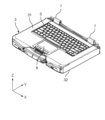
- FIG. 1 is a perspective view showing an example of an electronic device according to a first embodiment
- FIG. FIG. 2 is a diagram showing a second surface of a second housing of the electronic device of FIG. 1
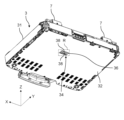
- FIG. 2 is a diagram showing a first surface of a second housing of the electronic device of FIG. 1
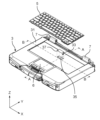
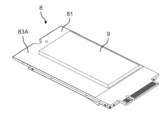
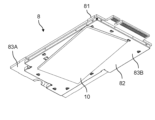
- Exploded perspective view of FIG. Diagram showing arrangement of communication modules Perspective view of communication module Perspective view of communication module Perspective cross-sectional view of the electronic device along line AA shown in FIG.
- Enlarged view of Fig. 3 Cross-sectional view of the first recess along line CC shown in FIG. 8A
- the present inventors have found a configuration in which a recess is provided on the surface opposite to the surface on which the input interface is arranged in the housing of the electronic device, and heat is dissipated through the recess. Arrived.
- An electronic device includes a communication module having a communication function and having a first module surface and a second module surface facing the first module surface;
- a housing having a heat dissipating material, an input interface operated by a user, a first surface that houses a communication module and faces the first module surface, and a second surface that is provided with the input interface and faces the first surface.
- a body wherein the first surface of the housing is formed with a first recess recessed toward the second surface, the first recess being formed by a first wall portion in contact with the first heat dissipating material; .
- the first concave portion is provided with one or more fins that rise in the thickness direction from the second surface toward the first surface.
- the first wall has a bottom perpendicular to the thickness direction, the bottom is in contact with the first heat dissipation material, and the one or more fins extend from the bottom to the thickness. get up in the direction
- the first recess when viewed from the thickness direction, forms a rectangular shape, and the first wall has two side walls extending along the thickness direction and facing each other. , a plurality of fins extending parallel to each other between the two side walls in the first recess.
- the plurality of fins are provided at regular intervals.
- Such a configuration makes it easier for air to enter around the fins, thereby promoting heat exchange between the fins and the air, making it possible to provide an electronic device with a further improved heat dissipation function.
- the electronic device further includes a second heat dissipating member disposed on the second module surface, and the second surface of the housing has a second recess recessed toward the first surface.
- a second recess is formed by a second wall contacting the second heat dissipating material.
- the second recess, the communication module, and the first recess are arranged side by side in the thickness direction from the second surface to the first surface.
- the communication module has a control section, and the second recess, the control section, and the first recess are arranged side by side in the thickness direction.
- the second recess is covered with the input interface.
- the electronic device further includes a lid that covers the second recess.
- Such a configuration prevents water or the like that has flowed between the housing and the input interface from flowing into the second concave portion.
- first and second are used for descriptive purposes only and are understood to indicate or imply relative importance or order of technical features. shouldn't.
- a feature that is qualified as “first” and “second” expressly or implicitly includes one or more of such features.
- FIG. 1 is a schematic perspective view of an example of an electronic device 1 according to Embodiment 1 of the present disclosure.
- the X, Y, and Z directions in the drawing indicate the width direction, depth direction, and thickness direction of the electronic device 1, respectively.
- the electronic device 1 is a notebook personal computer (laptop PC).
- An electronic device 1 includes a first housing 2 and a second housing 3 .
- the first housing 2 and the second housing 3 have thin box-shaped outer shells and have rectangular shapes.
- the first housing 2 houses the display section 4.
- the display unit 4 is, for example, liquid crystal. A display surface of the display unit 4 is exposed from the first housing 2 . Also, the first housing 2 houses an array microphone, an imaging unit, an antenna, and the like.
- the second housing 3 houses the input interface.
- Input interfaces are, for example, a keyboard 5 and a touchpad 6 .
- the input interface is exposed from the second housing 3 .
- the keyboard 5 and the touch pad 6 may be referred to as input interfaces 5 and 6 in this specification.
- circuits such as a CPU and memory, a battery, and the like are housed inside the second housing 3 .
- the first housing 2 and the second housing 3 are connected via a hinge portion 7.
- the hinge portion 7 rotatably connects the first housing 2 and the second housing 3 .
- the hinge portion 7 rotates the first housing 2 and/or the second housing 3, and allows the electronic device 1 to be in an open state and a closed state.
- the “open state” means a state in which the first housing 2 and the second housing 3 are separated from each other and the display section 4 and the input interfaces 5 and 6 are exposed.
- the “closed state” means that the first housing 2 and the second housing 3 are arranged to face each other, the display section 4 and the input interfaces 5 and 6 face each other, and the display section 4 and the input interfaces 5 and 6 face each other. 6 means the state in which it is not exposed.
- the first housing 2 and the second housing 3 are made of metal material.
- the first housing 2 and the second housing 3 are made of magnesium alloy.
- the thickness of the magnesium alloy forming the first housing 2 and the second housing 3 is, for example, 1.2 mm or more and 1.5 mm or less.
- FIG. 2 is a diagram showing the second surface of the second housing 3 of the electronic device 1.
- FIG. 3 is a diagram showing the first surface of the second housing 3 of the electronic device 1.
- FIG. 4 is an exploded perspective view of FIG. 2.
- the second housing 3 has a first surface 32 and a second surface 31.
- the first surface 32 corresponds to the lower surface
- the second surface 31 corresponds to the upper surface.
- the first surface 32 and the second surface 31 are arranged in the thickness direction Z so as to face each other.
- the second surface 31 is the surface on which the keyboard 5 is arranged.
- the first surface 32 is the surface opposite to the first surface 32, and is a surface that is rarely touched by the user of the electronic device 1 when the electronic device 1 is in use. good.
- the first surface 32 is, for example, a surface that is placed on a top board such as a table, a counter, or a workbench when the electronic device 1 is in use.
- the first surface 32 and the second surface 31 are in contact with the outside air.
- the first surface 32 may be exposed to the atmosphere so as to be in direct contact with the atmosphere.
- the first surface 32 is, for example, exposed to the outside air over its entire surface.
- the second surface 31 may form a gap between the keyboard 5 and the outside air.
- the first surface 32 is formed with a first concave portion 34 recessed toward the second surface 31 .
- the first concave portion 34 is formed by a first wall portion 36 recessed from the first surface 32 toward the second surface 31 .
- the first concave portion 34 has a plurality of fins 38 that rise in the thickness direction Z.
- the fins 38 are thin plate-like members.
- the fins 38 are made of metal.
- the fins 38 are made of magnesium alloy.
- a second concave portion 33 recessed toward the first surface 32 is formed on the second surface 31 on which the keyboard 5 is arranged.
- the second recessed portion 33 is formed by a second wall portion 35 recessed from the second surface 31 toward the first surface 32 .
- the second recess 33 is covered with a lid 37 .
- the second recess 33 may be sealed with a lid 37 .
- the lid 37 is covered with the keyboard 5. As shown in FIG.
- the first recess 34 and the second recess 33 may have a polygonal shape.
- the first recess 34 has, for example, a rectangular shape.
- the second concave portion 33 has, for example, a trapezoidal shape.
- first recess 34 and the second recess 33 will be described later.
- FIG. 5 is a diagram showing the arrangement of the communication modules 8 with part of the second surface 31 of the second housing 3 omitted.
- 6A and 6B are perspective views of the communication module 8.
- FIG. 5 is a diagram showing the arrangement of the communication modules 8 with part of the second surface 31 of the second housing 3 omitted.
- 6A and 6B are perspective views of the communication module 8.
- FIG. 5 is a diagram showing the arrangement of the communication modules 8 with part of the second surface 31 of the second housing 3 omitted.
- 6A and 6B are perspective views of the communication module 8.
- the communication module 8 is accommodated inside the second housing 3 .
- the communication module 8 is a circuit having a communication function. More specifically, the communication module 8 is an integrated circuit for enabling communication with external devices via a network, and includes Wi-Fi, IEEE802.2, IEEE802.3, third generation mobile communication system (3G ), 4th generation mobile communication system (4G), 5th generation mobile communication system (5G), Long Term Evolution (LTE), and other standards.
- the network may be a wide area network (WAN), a local area network (LAN), or the like.
- the communication module 8 communicates via a wireless WAN, for example, according to the 5G standard using frequencies of 28 GHz or higher.
- the communication module 8 has a first module side 82 facing the first side 32 and a second module side 81 facing the second side 31 (FIGS. 6A, 6B).
- a communication module 8 is arranged below the keyboard 5 (FIG. 4). When viewed from the thickness direction Z, the communication module 8 may be covered with the keyboard 5 . Also, the communication module 8 may be arranged away from the outer periphery of the second housing 3 .
- the communication module 8 is arranged, for example, under the keyboard 5 near the center.
- the communication module 8 is electrically connected to the electronic board 18 .
- a processor that executes control of the electronic device 1 is mounted on the electronic board 18 .
- the communication module 8 is electrically connected to the connector 18A of the electronic board 18 at one end and fixed to the electronic board 18 at the other end. The other end of the communication module 8 is fixed by a screw 19, for example.
- the communication module 8 includes a communication module board 83A, a control section 84 (FIGS. 7A and 7B) mounted on the communication module board 83A, and a control section 84 and a case 83B that covers the .
- the communication module board 83A forms the second module side 81 and the case 83B forms the first module side 82.
- Control unit 84 includes a processor that performs a communication function.
- the controller 84 may include multiple electronic components. When the communication module 8 operates, the controller 84 generates heat.
- the case 83B may be made of metal and can diffuse the heat generated from the control section 84 to the entire case 83B.
- Heat dissipation material As shown in FIG. 6A , the second heat dissipation material 9 is arranged on the second module surface 81 . As shown in FIG. 6B, the first heat dissipation material 10 is arranged on the first module surface 82 .
- the heat dissipating materials 9 and 10 are heat dissipating rubber sheets having a heat dissipating function.
- the heat dissipation materials 9 and 10 physically contact the first module side 82 and the second module side 81, respectively.
- the heat dissipating materials 9 and 10 may be arranged on a part of the second module side 81 and the first module side 82 or over the entire surface thereof, respectively.
- the heat dissipating members 9 and 10 are arranged, for example, so as to sandwich the control section 84 .
- the heat dissipation materials 9 and 10 may contain silicone rubber.
- the heat dissipation materials 9 and 10 are a mixed material of silicone polymer and ceramics.
- the heat dissipation materials 9 and 10 may be made of the same material and may have the same thickness and size.
- the heat dissipation materials 9 and 10 have the function of softening the impact when the electronic device 1 falls, in addition to the heat dissipation function.
- FIG. 7A is a perspective cross-sectional view of the electronic device 1 along line AA shown in FIG. 7B is a perspective cross-sectional view of the electronic device 1 taken along line BB shown in FIG.
- the second recess 33, the communication module 8 and the first recess 34 are arranged side by side in the thickness direction Z.
- the arrangement in which the second concave portion 33, the communication module 8 and the first concave portion 34 are arranged in the thickness direction Z means that the respective structures partially overlap each other when viewed from the thickness direction Z.
- the second recess 33 may be arranged to be shifted with respect to the first recess 34, or the first recess 34 and the second recess 33 may be arranged so as to overlap on the entire surface.
- the second recess 33, the control section 84 of the communication module 8, and the first recess 34 are arranged side by side in the thickness direction Z.
- the control portion 84 may be arranged inside the first wall portion 36 that defines the first recess portion 34 .
- the second wall portion 35 of the second concave portion 33 has a bottom portion 39 perpendicular to the thickness direction Z and side walls 41 extending from the outer circumference of the bottom portion 39 in the thickness direction Z.
- the first wall portion 36 of the first concave portion 34 has a bottom portion 40 orthogonal to the thickness direction Z and side walls 42 extending in the thickness direction Z from the outer periphery of the bottom portion 40 .
- the bottom portion 40 extends in directions (X direction and Y direction) orthogonal to the thickness direction Z. As shown in FIGS.
- the second wall portion 35 physically contacts the second heat dissipating member 9
- the first wall portion 36 physically contacts the first heat dissipating member 10 .
- the surface of the bottom portion 39 on the side of the first surface 32 physically contacts the second heat dissipating member 9
- the surface of the bottom portion 40 on the side of the second surface 31 physically contacts the first heat dissipating member 10 . do. Therefore, the bottoms 39 and 40 are in contact with the communication module 8 via the heat dissipation materials 9 and 10. As shown in FIG.
- the other surface of the bottom portion 39 and the other surface of the bottom portion 40 are in contact with the outside air.
- the bottom portion 39 When viewed from the thickness direction Z, the bottom portion 39 has an area smaller than that of the second heat dissipating member 9 and may be arranged inside the outer periphery of the second heat dissipating member 9 .
- the bottom portion 40 When viewed from the thickness direction Z, the bottom portion 40 may have an area substantially equal to that of the first heat dissipation material 10 . Also, the area of the bottom portion 40 in contact with the first heat dissipating member 10 may be larger than the area of the bottom portion 39 in contact with the second heat dissipating member 9 . With such a structure, heat can be preferentially dissipated through the first surface 32 . Therefore, the heat of the electronic device 1 can be dissipated away from the user.
- the bottom portion 39, the second heat radiation member 9, the communication module 8, the first heat radiation member 10, and the bottom portion 40 are arranged side by side in the thickness direction Z.
- the communication module 8 is sandwiched between the bottom portion 39 and the second heat radiation member 9 and the bottom portion 40 and the first heat radiation member 10 .
- the depth D1 of the second recess 33 from the opening to the bottom 39 along the thickness direction Z is greater than the depth D2 of the first recess 34 from the opening to the bottom 40.
- the opening area of the second concave portion 33 decreases from the second surface 31 toward the first surface 32 .
- the opening area means the area of the opening in the cross section along the XY plane.
- FIG. 8A is an enlarged view of region R in FIG.
- FIG. 8B is a cross-sectional view of the first recess 34 taken along line CC shown in FIG. 8A.
- the first recess 34 has four sidewalls 42A-42D.
- the sidewalls 42A, 42B face each other in the X direction.
- Side walls 42C and 42D face each other in the Y direction.
- the side wall 42 is a general term for the side walls 42A to 42D.
- a plurality of fins 38 provided in the first concave portion 34 extend from the bottom portion 40 in the thickness direction Z, and the surface extending in the thickness direction Z contacts the outside air.
- the fins 38 may be arranged parallel to each other. Specifically, fins 38 extend from sidewall 42C toward sidewall 42D between sidewalls 42A and 42B. Therefore, the fins 38 divide the first recess 34 into a plurality of recesses.
- the thickness T1 of the fins 38 is 0.5 mm or more and 2.0 mm or less.
- a thickness T1 of the fins 38 is, for example, 1.0 mm.
- the interval W1 between adjacent fins 38 is 3.0 mm or more and 8.00 mm or less.
- a space W1 between the fins 38 is, for example, 5.0 mm.
- the thickness and spacing of the fins 38 may be constant or may vary in a tapered shape. When the thickness of the fins 38 increases toward the second surface 31, the first recesses 34 can be easily formed using a mold. When the thickness and spacing of fins 38 vary, thickness T1 and spacing W1 are the minimum thickness and spacing of fins 38, respectively.
- the fins 38 may be formed integrally with the first wall portion 36 .
- the fins 38 are formed integrally with the first surface 32 of the second housing 3, for example.
- the first concave portion 34 As a comparative example of the first concave portion 34, a first concave portion without the fins 38 was examined. As a result of thermal analysis under the condition that the communication module 8 is in operation, the maximum temperature in the first recess 34 was lower than the maximum temperature in the first recess. Therefore, it is shown that the heat dissipation function of the electronic device 1 can be improved by providing the fins 38 in the first concave portion 34 .
- the electronic device 1 of Embodiment 1 includes a communication module 8, a first heat dissipation material 10, a keyboard 5, and a second housing 3.
- the communication module 8 has a communication function and has a first module surface 82 and a second module surface 81 facing the first module surface 82 .
- the first heat dissipation material 10 is placed on the first module surface 82 .
- the keyboard 5 is operated by the user.
- the second housing 3 houses the communication module 8 and has a first surface 32 facing the first module surface 82 and a second surface 31 on which the keyboard 5 is provided and which faces the first surface 32 .
- a first recess 34 recessed toward the second surface 31 is formed on the first surface 32 of the second housing 3 . It is formed.
- heat exchange between the second housing 3 and the first heat dissipation material 10 improves the heat dissipation function of the communication module 8 .
- the first heat dissipation member 10 can be kept thin by forming the first concave portion 34 . Therefore, the heat dissipation function of the communication module 8 is further improved.
- the first concave portion 34 is provided with a plurality of fins 38 rising in the thickness direction Z from the second surface 31 toward the first surface 32 .
- the fins 38 With such a configuration, by providing the fins 38, the surface area capable of exchanging heat with the outside air can be increased. Therefore, the heat dissipation function of the communication module 8 is further improved.
- the first wall portion 36 has a bottom portion 40 orthogonal to the thickness direction Z.
- the bottom part 40 contacts the first heat dissipation material 10 .
- a plurality of fins 38 rise in the thickness direction Z from the bottom portion 40 .
- the first concave portion 34 when viewed from the thickness direction Z, forms a rectangular shape.
- the first wall portion 36 has two side walls 42 extending along the thickness direction Z and facing each other.
- a plurality of fins 38 are provided between the two side walls 42 in the first recess 34 and extend parallel to each other.
- the heat dissipation function of the communication module 8 is further improved by increasing the surface area of the fin 38 compared to the case where a single fin 38 is provided. Also, by arranging the plurality of fins 38 one another, more fins 38 can be arranged in the first recess 34 .
- the plurality of fins 38 are provided at regular intervals.
- Such a configuration makes it easier for air to enter around the fins 38, promotes heat exchange between the fins 38 and the air, and further improves the heat dissipation function of the communication module 8.
- the electronic device 1 of Embodiment 1 further has a second heat dissipation member 9 arranged on the second module surface 81 .
- a second recess 33 recessed toward the first surface 32 is formed on the second surface 31 of the second housing 3 , and is formed by the second recess 33 and a second wall portion 35 in contact with the second heat dissipating material 9 . be done.
- the heat dissipation function of the communication module 8 is further improved.
- the thickness of the second housing 3 on the first surface 32 and the second surface 31 is maintained substantially constant, and the bottom portions 39 and 40 are separated from the heat dissipating materials 9 and 10. can be contacted. Therefore, manufacturing of the second housing 3 is facilitated.
- the second recess 33 , the communication module 8 , and the first recess 34 are arranged side by side in the thickness direction Z from the second surface 31 toward the first surface 32 .
- the communication module 8 has a control section 84 .
- the second concave portion 33, the control portion 84, and the first concave portion 34 are arranged side by side in the thickness direction Z. As shown in FIG.
- the second recessed portion 33 is covered with the keyboard 5 .
- the layout of the keyboard 5 can prevent the heat radiated from the communication module 8 through the second concave portion 33 from being directly transmitted to the user of the electronic device 1 .
- the second recessed portion 33 is located under the keyboard 5, it is possible to suppress the temperature rise at the position where the user of the electronic device 1 directly touches.
- the electronic device 1 of Embodiment 1 further has a lid 37 that covers the second recess 33 .
- Such a configuration prevents foreign matter, water, etc., which have flowed into the gap between the second housing 3 and the keyboard 5, from flowing into the second concave portion 33.
- the electronic device 1 is a laptop PC
- the present invention is not limited to this.
- the electronic device 1 may be a tablet PC, smart phone, or other information processing device.
- the first recess 34 may have no fins 38 or may have one fin 38 .
- the present invention is not limited to this.
- the fins 38 may be arranged in a grid pattern, for example.
- the present disclosure is applicable to, for example, electronic devices (eg, laptop PCs, tablet PCs, etc.) because it can improve the heat dissipation function of electronic devices.
- electronic devices eg, laptop PCs, tablet PCs, etc.
Landscapes
- Engineering & Computer Science (AREA)
- Theoretical Computer Science (AREA)
- Physics & Mathematics (AREA)
- General Engineering & Computer Science (AREA)
- Computer Hardware Design (AREA)
- Human Computer Interaction (AREA)
- General Physics & Mathematics (AREA)
- Microelectronics & Electronic Packaging (AREA)
- Thermal Sciences (AREA)
- Cooling Or The Like Of Electrical Apparatus (AREA)
Priority Applications (3)
| Application Number | Priority Date | Filing Date | Title |
|---|---|---|---|
| JP2023556238A JPWO2023074261A1 (https=) | 2021-10-27 | 2022-10-03 | |
| CN202280071302.0A CN118140195A (zh) | 2021-10-27 | 2022-10-03 | 电子设备 |
| US18/629,721 US20240260236A1 (en) | 2021-10-27 | 2024-04-08 | Electronic device |
Applications Claiming Priority (2)
| Application Number | Priority Date | Filing Date | Title |
|---|---|---|---|
| JP2021175720 | 2021-10-27 | ||
| JP2021-175720 | 2021-10-27 |
Related Child Applications (1)
| Application Number | Title | Priority Date | Filing Date |
|---|---|---|---|
| US18/629,721 Continuation US20240260236A1 (en) | 2021-10-27 | 2024-04-08 | Electronic device |
Publications (1)
| Publication Number | Publication Date |
|---|---|
| WO2023074261A1 true WO2023074261A1 (ja) | 2023-05-04 |
Family
ID=86157822
Family Applications (1)
| Application Number | Title | Priority Date | Filing Date |
|---|---|---|---|
| PCT/JP2022/036888 Ceased WO2023074261A1 (ja) | 2021-10-27 | 2022-10-03 | 電子機器 |
Country Status (4)
| Country | Link |
|---|---|
| US (1) | US20240260236A1 (https=) |
| JP (1) | JPWO2023074261A1 (https=) |
| CN (1) | CN118140195A (https=) |
| WO (1) | WO2023074261A1 (https=) |
Citations (11)
| Publication number | Priority date | Publication date | Assignee | Title |
|---|---|---|---|---|
| JPH1065385A (ja) * | 1996-08-21 | 1998-03-06 | Mitsubishi Electric Corp | 基板ケース構造体 |
| JP2001125683A (ja) * | 1999-10-28 | 2001-05-11 | Inoac Corp | 情報機器用ハウジング |
| JP2002299873A (ja) * | 2001-04-04 | 2002-10-11 | Denso Corp | 電子制御装置 |
| JP2004214401A (ja) * | 2002-12-27 | 2004-07-29 | Matsushita Electric Ind Co Ltd | 電子部品の放熱装置 |
| JP2007124079A (ja) * | 2005-10-26 | 2007-05-17 | Matsushita Electric Ind Co Ltd | 携帯電話装置 |
| JP2011176096A (ja) * | 2010-02-24 | 2011-09-08 | Mitsumi Electric Co Ltd | 電子機器 |
| JP2012069902A (ja) * | 2010-08-27 | 2012-04-05 | Sony Corp | 放熱構造及び電子機器 |
| WO2014155685A1 (ja) * | 2013-03-29 | 2014-10-02 | 株式会社 東芝 | 表示装置および電子機器 |
| JP2017199770A (ja) * | 2016-04-27 | 2017-11-02 | 株式会社コンテック | ヒートシンクおよび筐体 |
| JP2019212832A (ja) * | 2018-06-07 | 2019-12-12 | レノボ・シンガポール・プライベート・リミテッド | 電子機器 |
| JP6934093B1 (ja) * | 2020-07-13 | 2021-09-08 | レノボ・シンガポール・プライベート・リミテッド | 電子機器及び冷却モジュール |
Family Cites Families (4)
| Publication number | Priority date | Publication date | Assignee | Title |
|---|---|---|---|---|
| DE60139533D1 (de) * | 2000-08-01 | 2009-09-24 | Mitsubishi Electric Corp | Elektronisches Gerät mit einem Substrat für die Schaltung |
| TW201118543A (en) * | 2009-11-26 | 2011-06-01 | Hon Hai Prec Ind Co Ltd | Electronic device and heat dissipation module thereof |
| DE102009054517B4 (de) * | 2009-12-10 | 2011-12-29 | Robert Bosch Gmbh | Elektronisches Steuergerät |
| JP5842118B2 (ja) * | 2010-06-24 | 2016-01-13 | パナソニックIpマネジメント株式会社 | 赤外線センサ |
-
2022
- 2022-10-03 WO PCT/JP2022/036888 patent/WO2023074261A1/ja not_active Ceased
- 2022-10-03 JP JP2023556238A patent/JPWO2023074261A1/ja active Pending
- 2022-10-03 CN CN202280071302.0A patent/CN118140195A/zh active Pending
-
2024
- 2024-04-08 US US18/629,721 patent/US20240260236A1/en active Pending
Patent Citations (11)
| Publication number | Priority date | Publication date | Assignee | Title |
|---|---|---|---|---|
| JPH1065385A (ja) * | 1996-08-21 | 1998-03-06 | Mitsubishi Electric Corp | 基板ケース構造体 |
| JP2001125683A (ja) * | 1999-10-28 | 2001-05-11 | Inoac Corp | 情報機器用ハウジング |
| JP2002299873A (ja) * | 2001-04-04 | 2002-10-11 | Denso Corp | 電子制御装置 |
| JP2004214401A (ja) * | 2002-12-27 | 2004-07-29 | Matsushita Electric Ind Co Ltd | 電子部品の放熱装置 |
| JP2007124079A (ja) * | 2005-10-26 | 2007-05-17 | Matsushita Electric Ind Co Ltd | 携帯電話装置 |
| JP2011176096A (ja) * | 2010-02-24 | 2011-09-08 | Mitsumi Electric Co Ltd | 電子機器 |
| JP2012069902A (ja) * | 2010-08-27 | 2012-04-05 | Sony Corp | 放熱構造及び電子機器 |
| WO2014155685A1 (ja) * | 2013-03-29 | 2014-10-02 | 株式会社 東芝 | 表示装置および電子機器 |
| JP2017199770A (ja) * | 2016-04-27 | 2017-11-02 | 株式会社コンテック | ヒートシンクおよび筐体 |
| JP2019212832A (ja) * | 2018-06-07 | 2019-12-12 | レノボ・シンガポール・プライベート・リミテッド | 電子機器 |
| JP6934093B1 (ja) * | 2020-07-13 | 2021-09-08 | レノボ・シンガポール・プライベート・リミテッド | 電子機器及び冷却モジュール |
Also Published As
| Publication number | Publication date |
|---|---|
| US20240260236A1 (en) | 2024-08-01 |
| CN118140195A (zh) | 2024-06-04 |
| JPWO2023074261A1 (https=) | 2023-05-04 |
Similar Documents
| Publication | Publication Date | Title |
|---|---|---|
| JP4498419B2 (ja) | 電子機器 | |
| JP4144983B2 (ja) | 熱拡散プレートを有する薄型電磁妨害シールド | |
| US20230069684A1 (en) | Electronic apparatus and cooling module | |
| JP2011081437A (ja) | 電子機器 | |
| US20110075369A1 (en) | Electronic device | |
| US7072181B2 (en) | Heat dissipating device and electronic apparatus including the same | |
| CN107643806B (zh) | 电子设备 | |
| CN103914108A (zh) | 便携设备和电子装置的框架结构 | |
| JP6578616B1 (ja) | 電子機器 | |
| CN102077152A (zh) | 消散电气部件的外壳内的热量 | |
| US9277676B2 (en) | Electronic apparatus | |
| AU2022200661A1 (en) | Control device | |
| JP2010055642A (ja) | 電子機器 | |
| WO2023074261A1 (ja) | 電子機器 | |
| CN108633213B (zh) | 电子装置 | |
| CN107580449A (zh) | 屏蔽罩、散热组件及电子设备 | |
| CN221930542U (zh) | 电子设备 | |
| CN222532069U (zh) | 密封仪器内部散热结构 | |
| JP7633455B1 (ja) | 電子機器 | |
| CN115986452B (zh) | 输入输出接口支架及电子设备 | |
| JPH08286783A (ja) | 情報機器における電子部品の放熱構造 | |
| JP7855097B1 (ja) | 電子機器及びファン | |
| CN1093652C (zh) | 信息处理单元的机械结构 | |
| JP7496863B2 (ja) | 電子機器 | |
| CN220173259U (zh) | 一种散热型路由器 |
Legal Events
| Date | Code | Title | Description |
|---|---|---|---|
| 121 | Ep: the epo has been informed by wipo that ep was designated in this application |
Ref document number: 22886593 Country of ref document: EP Kind code of ref document: A1 |
|
| WWE | Wipo information: entry into national phase |
Ref document number: 2023556238 Country of ref document: JP |
|
| WWE | Wipo information: entry into national phase |
Ref document number: 202280071302.0 Country of ref document: CN |
|
| NENP | Non-entry into the national phase |
Ref country code: DE |
|
| 122 | Ep: pct application non-entry in european phase |
Ref document number: 22886593 Country of ref document: EP Kind code of ref document: A1 |