WO2023063387A1 - 粉末化粧料 - Google Patents
粉末化粧料 Download PDFInfo
- Publication number
- WO2023063387A1 WO2023063387A1 PCT/JP2022/038206 JP2022038206W WO2023063387A1 WO 2023063387 A1 WO2023063387 A1 WO 2023063387A1 JP 2022038206 W JP2022038206 W JP 2022038206W WO 2023063387 A1 WO2023063387 A1 WO 2023063387A1
- Authority
- WO
- WIPO (PCT)
- Prior art keywords
- powder
- cosmetic
- metal oxide
- treated
- metal
- Prior art date
- Legal status (The legal status is an assumption and is not a legal conclusion. Google has not performed a legal analysis and makes no representation as to the accuracy of the status listed.)
- Ceased
Links
Images


Classifications
-
- A—HUMAN NECESSITIES
- A61—MEDICAL OR VETERINARY SCIENCE; HYGIENE
- A61K—PREPARATIONS FOR MEDICAL, DENTAL OR TOILETRY PURPOSES
- A61K8/00—Cosmetics or similar toiletry preparations
- A61K8/18—Cosmetics or similar toiletry preparations characterised by the composition
- A61K8/19—Cosmetics or similar toiletry preparations characterised by the composition containing inorganic ingredients
- A61K8/25—Silicon; Compounds thereof
-
- A—HUMAN NECESSITIES
- A61—MEDICAL OR VETERINARY SCIENCE; HYGIENE
- A61K—PREPARATIONS FOR MEDICAL, DENTAL OR TOILETRY PURPOSES
- A61K8/00—Cosmetics or similar toiletry preparations
- A61K8/02—Cosmetics or similar toiletry preparations characterised by special physical form
- A61K8/0216—Solid or semisolid forms
- A61K8/022—Powders; Compacted Powders
-
- A—HUMAN NECESSITIES
- A61—MEDICAL OR VETERINARY SCIENCE; HYGIENE
- A61K—PREPARATIONS FOR MEDICAL, DENTAL OR TOILETRY PURPOSES
- A61K8/00—Cosmetics or similar toiletry preparations
- A61K8/02—Cosmetics or similar toiletry preparations characterised by special physical form
- A61K8/0241—Containing particulates characterized by their shape and/or structure
-
- A—HUMAN NECESSITIES
- A61—MEDICAL OR VETERINARY SCIENCE; HYGIENE
- A61K—PREPARATIONS FOR MEDICAL, DENTAL OR TOILETRY PURPOSES
- A61K8/00—Cosmetics or similar toiletry preparations
- A61K8/18—Cosmetics or similar toiletry preparations characterised by the composition
- A61K8/19—Cosmetics or similar toiletry preparations characterised by the composition containing inorganic ingredients
- A61K8/26—Aluminium; Compounds thereof
-
- A—HUMAN NECESSITIES
- A61—MEDICAL OR VETERINARY SCIENCE; HYGIENE
- A61K—PREPARATIONS FOR MEDICAL, DENTAL OR TOILETRY PURPOSES
- A61K8/00—Cosmetics or similar toiletry preparations
- A61K8/18—Cosmetics or similar toiletry preparations characterised by the composition
- A61K8/19—Cosmetics or similar toiletry preparations characterised by the composition containing inorganic ingredients
- A61K8/27—Zinc; Compounds thereof
-
- A—HUMAN NECESSITIES
- A61—MEDICAL OR VETERINARY SCIENCE; HYGIENE
- A61K—PREPARATIONS FOR MEDICAL, DENTAL OR TOILETRY PURPOSES
- A61K8/00—Cosmetics or similar toiletry preparations
- A61K8/18—Cosmetics or similar toiletry preparations characterised by the composition
- A61K8/19—Cosmetics or similar toiletry preparations characterised by the composition containing inorganic ingredients
- A61K8/29—Titanium; Compounds thereof
-
- A—HUMAN NECESSITIES
- A61—MEDICAL OR VETERINARY SCIENCE; HYGIENE
- A61Q—SPECIFIC USE OF COSMETICS OR SIMILAR TOILETRY PREPARATIONS
- A61Q1/00—Make-up preparations; Body powders; Preparations for removing make-up
- A61Q1/02—Preparations containing skin colorants, e.g. pigments
-
- A—HUMAN NECESSITIES
- A61—MEDICAL OR VETERINARY SCIENCE; HYGIENE
- A61Q—SPECIFIC USE OF COSMETICS OR SIMILAR TOILETRY PREPARATIONS
- A61Q1/00—Make-up preparations; Body powders; Preparations for removing make-up
- A61Q1/12—Face or body powders for grooming, adorning or absorbing
-
- A—HUMAN NECESSITIES
- A61—MEDICAL OR VETERINARY SCIENCE; HYGIENE
- A61Q—SPECIFIC USE OF COSMETICS OR SIMILAR TOILETRY PREPARATIONS
- A61Q17/00—Barrier preparations; Preparations brought into direct contact with the skin for affording protection against external influences, e.g. sunlight, X-rays or other harmful rays, corrosive materials, bacteria or insect stings
- A61Q17/04—Topical preparations for affording protection against sunlight or other radiation; Topical sun tanning preparations
-
- A—HUMAN NECESSITIES
- A61—MEDICAL OR VETERINARY SCIENCE; HYGIENE
- A61K—PREPARATIONS FOR MEDICAL, DENTAL OR TOILETRY PURPOSES
- A61K2800/00—Properties of cosmetic compositions or active ingredients thereof or formulation aids used therein and process related aspects
- A61K2800/40—Chemical, physico-chemical or functional or structural properties of particular ingredients
- A61K2800/41—Particular ingredients further characterized by their size
- A61K2800/412—Microsized, i.e. having sizes between 0.1 and 100 microns
-
- A—HUMAN NECESSITIES
- A61—MEDICAL OR VETERINARY SCIENCE; HYGIENE
- A61K—PREPARATIONS FOR MEDICAL, DENTAL OR TOILETRY PURPOSES
- A61K2800/00—Properties of cosmetic compositions or active ingredients thereof or formulation aids used therein and process related aspects
- A61K2800/40—Chemical, physico-chemical or functional or structural properties of particular ingredients
- A61K2800/42—Colour properties
- A61K2800/43—Pigments; Dyes
-
- A—HUMAN NECESSITIES
- A61—MEDICAL OR VETERINARY SCIENCE; HYGIENE
- A61K—PREPARATIONS FOR MEDICAL, DENTAL OR TOILETRY PURPOSES
- A61K2800/00—Properties of cosmetic compositions or active ingredients thereof or formulation aids used therein and process related aspects
- A61K2800/40—Chemical, physico-chemical or functional or structural properties of particular ingredients
- A61K2800/60—Particulates further characterized by their structure or composition
- A61K2800/65—Characterized by the composition of the particulate/core
- A61K2800/651—The particulate/core comprising inorganic material
Definitions
- the present invention relates to powder cosmetics. More particularly, the present invention relates to a powdery cosmetic that has high UV protection ability based on an UV scattering agent such as titanium oxide, and is excellent in usability with no squeaky feeling during application.
- an UV scattering agent such as titanium oxide
- UV absorbers and UV scattering agents In order to improve the UV protection ability of powder cosmetics such as white powder, it is necessary to increase the amount of UV absorbers and UV scattering agents. However, when a large amount of UV absorber, which is mostly an oily substance, is blended, powder aggregation may be induced and the uniformity and usability of the cosmetic may be impaired.
- UV scattering agents such as titanium oxide, zinc oxide, or cerium oxide causes a squeaky feeling. SPF) was difficult to achieve.
- the powder cosmetic described in Patent Document 1 comprises (a) amino-modified silicone-treated powder, and (b) plate-like zinc oxide having an average particle size of 30 nm or more and less than 1000 nm and an aspect ratio of 3.0 or more. and a predetermined mass ratio, it is said that there is no squeaky feeling and the UV blocking effect is excellent.
- Patent Document 2 (A) the surface of a plate-like powder to be the mother powder is coated with (a) an ultraviolet scattering agent having an average particle size of 0.1 to 1 ⁇ m, (b) iron oxide, and (c) an amino acid or Composite powder having an average particle size of 0.5 to 200 ⁇ m coated with a derivative thereof, and (B) a solid powder cosmetic containing hydrogenated castor oil or its ester are free from squeaky feeling and dullness when applied. It is described that the skin is finished with a feeling of bare skin.
- the present invention provides a powdery cosmetic having excellent usability, exhibiting a high UV-protecting ability by incorporating a large amount of metal oxide powder such as titanium oxide as an UV-scattering agent, and causing no squeaky feeling when applied.
- the challenge is to
- the inventors of the present invention have made intensive studies to solve the above problems, and as a result, a metal oxide powder such as titanium oxide, which is an ultraviolet scattering agent, and a powder cosmetic containing it.
- a metal oxide powder such as titanium oxide, which is an ultraviolet scattering agent
- a powder cosmetic containing it By treating the surface of the extender pigment with a metallic soap, even if a large amount of metal oxide powder such as titanium oxide is blended, excellent usability can be achieved without causing creaking. Arrived.
- the present invention (a) a metal oxide powder made of at least one selected from titanium oxide, zinc oxide, and cerium oxide, and (b) an extender pigment, including (a) the metal oxide powder and (b) the extender are both powders surface-treated with a metal soap,
- a cosmetic powder wherein the content of the metal oxide powder (a) is 10% by mass or more relative to the total amount of the cosmetic.
- the powder cosmetic of the present invention has a high UV protection effect based on the addition of 10% by mass or more of metal oxide powder (that is, UV scattering agent) such as titanium oxide, and is excellent in usability with no squeaky feeling. Furthermore, by unifying the surface treatment of the UV scattering agent and the extender with a metal soap treatment, an unexpected effect of further improving the UV protection effect (hereinafter also referred to as "boost effect”) is exhibited.
- metal oxide powder that is, UV scattering agent
- boost effect an unexpected effect of further improving the UV protection effect
- FIG. 1 is a graph showing the absorbance in the ultraviolet region of compositions containing metallic soap-treated titanium oxide together with metallic soap-treated talc (solid line) or silicone-treated talc (broken line).
- Ultraviolet range of compositions prepared by combining metallic soap-treated titanium oxide/metallic soap-treated mica ( ⁇ ), metallic soap-treated titanium oxide/silicone-treated mica ( ⁇ ), or silicone-treated titanium oxide/silicone-treated mica ( ⁇ ). is a graph plotting the integral value of absorbance at , against the amount of blended titanium oxide.
- 4 is a graph showing the absorbance in the ultraviolet region of the cosmetics of Example 4 and Comparative Example 2.
- the powder cosmetic of the present invention (hereinafter sometimes simply referred to as "cosmetics") contains (a) a metal oxide powder and (b) an extender, and the (a) metal oxide powder and (b) an extender
- the pigments are characterized in that they are both surface-treated with a metallic soap.
- the (a) metal oxide powder (hereinafter also referred to as "(a) component") blended in the cosmetic of the present invention is at least one selected from titanium oxide, zinc oxide, and cerium oxide. It is a particulate metal oxide powder that consists of 1 type and is used as an "ultraviolet scattering agent" in cosmetics.
- the metal oxide powder (component a) usually has an average particle size of 200 nm or less, preferably 100 nm or less.
- metal oxide powder having an average particle size of 200 nm or less is referred to as "metal oxide powder (titanium oxide, zinc oxide or cerium oxide)" or “ultraviolet scattering agent”, and a metal having an average particle size exceeding 200 nm Oxide powders are referred to as “pigment-grade metal oxide powders" for distinction.
- titanium oxide among metal oxide powders.
- the metal oxide powder (component a) in the present invention is not particularly limited as long as it is conventionally blended in cosmetics and the like. Fine or ultrafine metal oxide powders of 20 nm or less, or 10 nm or less, are preferably used. In particular, when the average primary particle size is small, the synergistic improvement of the UV protection effect due to the co-blending of the extender pigment, which will be described later, is remarkable. Although the lower limit of the average primary particle size of the metal oxide powder (component a) is not particularly limited, it is usually 1 nm or more, preferably 5 nm or more.
- the average primary particle size as used herein means the arithmetic average size of the primary particles of the powder measured by a commonly used method.
- the Feret diameter of the powder particles measured by microscopy is defined as the primary particle size of the particles, and the arithmetic mean value calculated from the primary particle size distribution (particle size distribution) obtained for a plurality of particles. is the average primary particle size (or average particle size).
- the Feret diameter is the distance between two parallel lines extending in a given direction and sandwiching the projected image of the particle.
- the particle shape of the metal oxide powder such as titanium oxide is not particularly limited, and includes spherical, elliptical, and crushed shapes.
- the amount of the (a) metal oxide powder in the cosmetic of the present invention is the total amount of the cosmetic as the metal oxide powder containing the surface treatment agent or as the pure metal oxide powder (the portion excluding the surface treatment agent). is preferably 10% by mass or more, more preferably 15% by mass or more. (a) If the content of the metal oxide powder is less than 10% by mass, a sufficient UV protection effect may not be obtained.
- the upper limit of the amount of the metal oxide powder (a) is not particularly limited, but is usually 40% by mass or less, preferably 30% by mass or less.
- Extender pigment in cosmetics is an inorganic pigment used to maintain the dosage form of powdered cosmetics. Specific examples include powders of talc, mica, sericite, kaolin, calcium carbonate, magnesium carbonate, silicic anhydride, aluminum oxide, barium sulfate, and the like.
- the amount of the (b) extender pigment in the cosmetic composition of the present invention is not particularly limited, but it is usually used as an extender pigment containing a surface treatment agent or as a pure extender pigment (part excluding the surface treatment agent). It is 30 to 60% by mass, preferably 35 to 50% by mass, based on the total amount of the material.
- the cosmetic of the present invention is characterized in that (a) the metal oxide powder and (b) the extender are both surface-treated with a "metal soap". That is, the "component (a)” of the present invention is “(a) a metal oxide powder surface-treated with a metallic soap", and the “component (b)” is “(b) an extender pigment surface-treated with a metallic soap”. can be rephrased.
- Metal soap is a salt of saturated or unsaturated higher fatty acid metals (other than alkali metals).
- higher fatty acids constituting the metal soap include saturated and/or unsaturated higher fatty acids having 8 to 24 carbon atoms, particularly 12 to 18 carbon atoms, such as stearic acid, isostearic acid, myristic acid, lauric acid and the like. Salts of aluminum, calcium, magnesium, zinc, or the like are preferable as the metal constituting the metal soap.
- the "metal soap-treated powder (metal oxide powder or extender pigment)" in the present invention is a powder obtained by surface-treating a base (mother core) powder with a treating agent containing a component that constitutes a metal soap.
- the surface treatment with a metal soap may be performed by a method of surface treatment with a preformed metal soap.
- the surface treatment can be performed by dissolving a metallic soap in a volatile solvent such as isoparaffin or isopropyl alcohol, mixing it with the base powder, and volatilizing the volatile solvent.
- the surface treatment can also be carried out simply by mixing the base powder and the metallic soap.
- the surface may be treated by a method of composite treatment with a higher fatty acid (eg, stearic acid) constituting the metal soap and a metal (eg, aluminum) hydroxide.
- a wet method using a solvent, a vapor phase method, a mechanochemical method, or the like can be used, and is not particularly limited.
- the amount of metal soap attached to the powder surface by surface treatment of (a) metal oxide powder or (b) extender pigment is not particularly limited, but is preferably 10 to 40% by mass of the powder serving as the substrate (mother core). degree.
- the type of metal soap (combination of higher fatty acid and metal) adhered to the powder surface by the surface treatment of (a) metal oxide powder and (b) extender is not particularly limited.
- the metal soap adhering to the surface of the metal oxide powder and (b) the metal soap adhering to the surface of the extender may be the same or different.
- a metal oxide (preferably titanium oxide) surface-treated with a metal soap containing aluminum stearate and an extender pigment (preferably talc or mica) surface-treated with a metal soap containing calcium stearate are combined and blended. preferably.
- the cosmetic of the present invention is a powder cosmetic containing (a) a metallic soap-treated metal oxide powder and (b) an extender pigment surface-treated with a metallic soap.
- Optional components can be appropriately blended within a range that does not impair the effects of the present invention.
- silica anhydrous silicic acid; also referred to as “component (c)"
- component (c) anhydrous silicic acid
- boost effect boost effect
- Silica as component (c) is preferably spherical silica.
- Spherical does not necessarily mean that the shape is a true sphere, but the ratio of the major axis to the minor axis of the particle is 1.5 or less, preferably 1.2 or less.
- Silica (component (c)) may be nonporous or porous.
- Silica (component (c)) is not particularly limited, but is spherical powder having an average particle size of 1 to 30 ⁇ m, preferably 1 to 20 ⁇ m, more preferably 2 to 15 ⁇ m.
- the average particle size of silica is an arithmetic average value of particle sizes measured according to a laser diffraction/scattering method.
- spherical silica having a specific surface area of 160 m 2 /g or more, preferably 300 m 2 /g or more, more preferably 500 m 2 /g or more.
- the specific surface area of silica can be calculated by measuring the amount of nitrogen adsorbed to the powder at 77K and analyzing it by the BET method.
- silica is untreated silica that has not been surface-treated, or silica that has been surface-treated with a treatment agent other than metallic soap, and silica that has been surface-treated with metallic soap (corresponding to component (b) items) are not included.
- Other optional components include (a) a metal oxide powder surface-treated with a metal soap, (b) an extender pigment surface-treated with a metal soap, and (c) a powder component other than silica, an oily component, an aqueous component, and the like. is mentioned.
- powder components other than silica include colored pigments such as iron oxide; pigment-grade titanium oxide white pigments such as pigment-grade zinc oxide; pearlescent pigments; and spherical powders such as boron nitride. These optional powder ingredients may or may not be surface treated.
- oily components include oils such as hydrocarbon oils, fats and oils, higher alcohols, waxes, hydrogenated oils, ester oils, fatty acids, silicone oils, fluorine oils, lanolin derivatives, oily gelling agents, and oily UV absorbers. be done.
- the blending amount of oil is preferably 10% by mass or less, more preferably 5% by mass, based on the total amount of the cosmetic. % by mass or less, more preferably 3% by mass or less, and most preferably 2% by mass or less.
- the amount of oil to be blended is suppressed, the amount of the oily UV absorber is also small (for example, 2% by mass or less), but the UV protection effect based on the UV scattering agent is improved (boosted). Therefore, high SPF can be achieved. Therefore, it is also possible to make a powder cosmetic that does not contain an oily ultraviolet absorber (so-called "non-chemical").
- aqueous components include water and water affinity components, such as lower alcohols such as ethanol, polyhydric alcohols such as glycerin, and water-soluble polymers.
- the cosmetic composition of the present invention is a powder cosmetic composition excellent in UV protection effect and usability, and can be provided in the form of loose powder that is not compression-molded or pressed powder that is compression-molded.
- the product form provided is not limited, it is particularly suitable for products such as foundation, eye shadow, blush, and sunscreen.
- the blending amount represents mass % with respect to the total amount of the cosmetic.
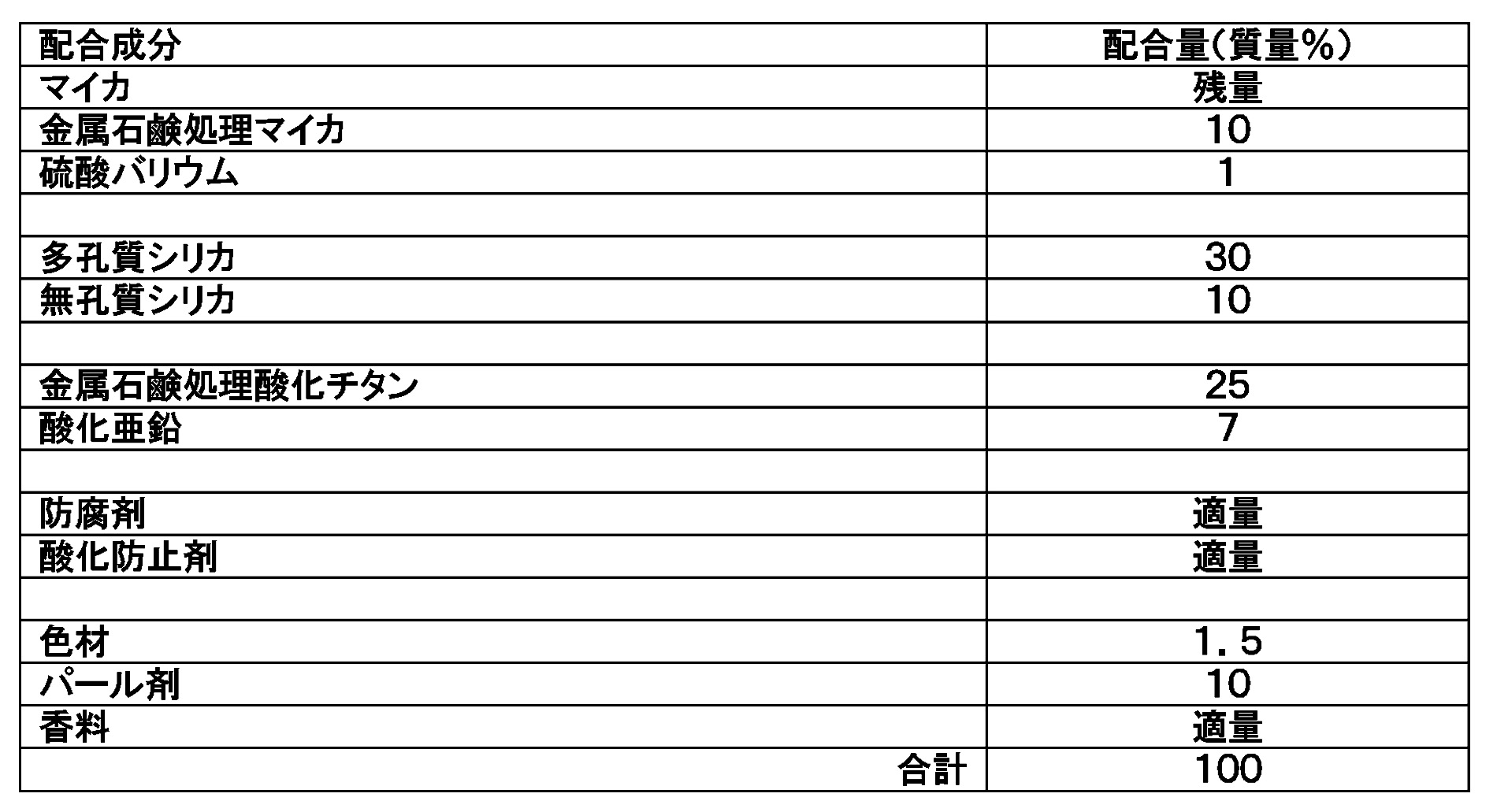
- Samples A1 and A2 were prepared according to the formulations listed in Table 1 below. Each sample (10 mg) was applied to a PMMA plate, and the absorbance against light in the ultraviolet wavelength region (280-400 nm) was measured. The measurement results are shown in FIG.
- sample A1 solid line in which the same amount of metal soap-treated titanium oxide (15% by mass) was dispersed in metal soap-treated talc was mixed with sample A2 (broken line) in which the same amount of metal soap-treated talc was dispersed.
- the absorbance in the ultraviolet wavelength region was improved.
- the absorbance curve was similar to that of Sample A2. Equivalent to the curve (dashed line). That is, it was confirmed that by unifying the surface treatment of titanium oxide and extender with metal soap, the effect of improving the UV protection ability (boost effect) based on titanium oxide can be obtained.
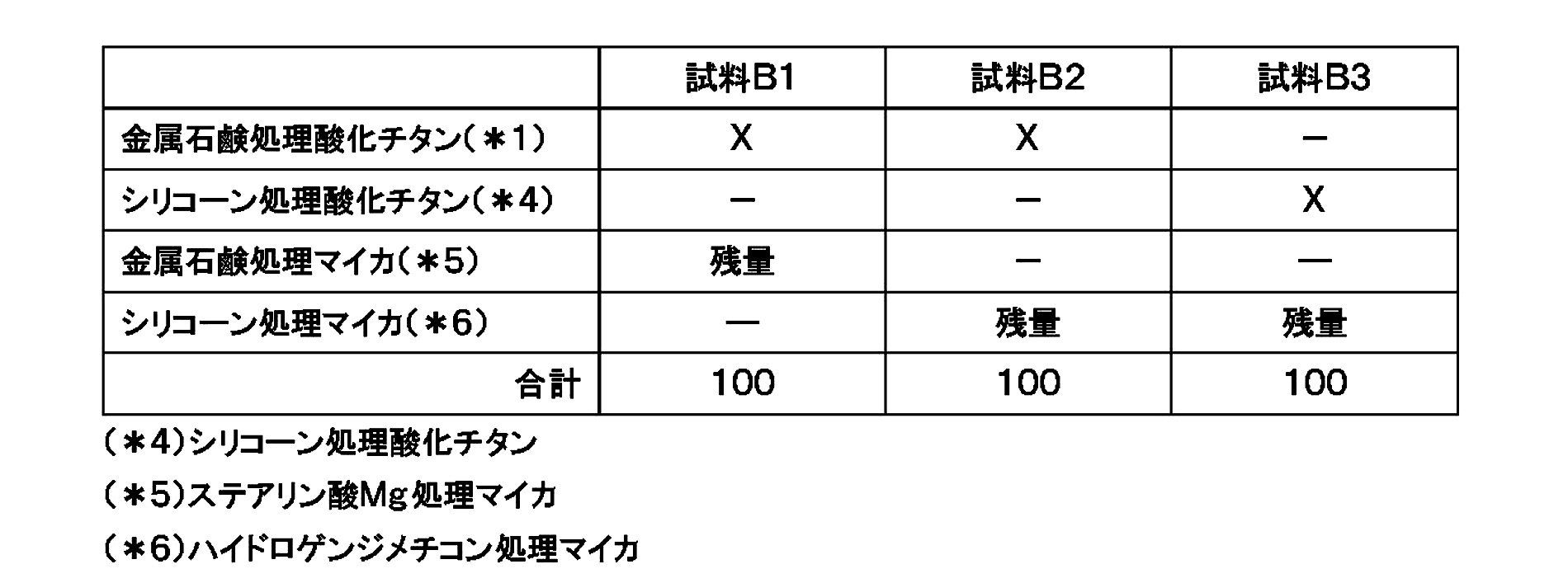
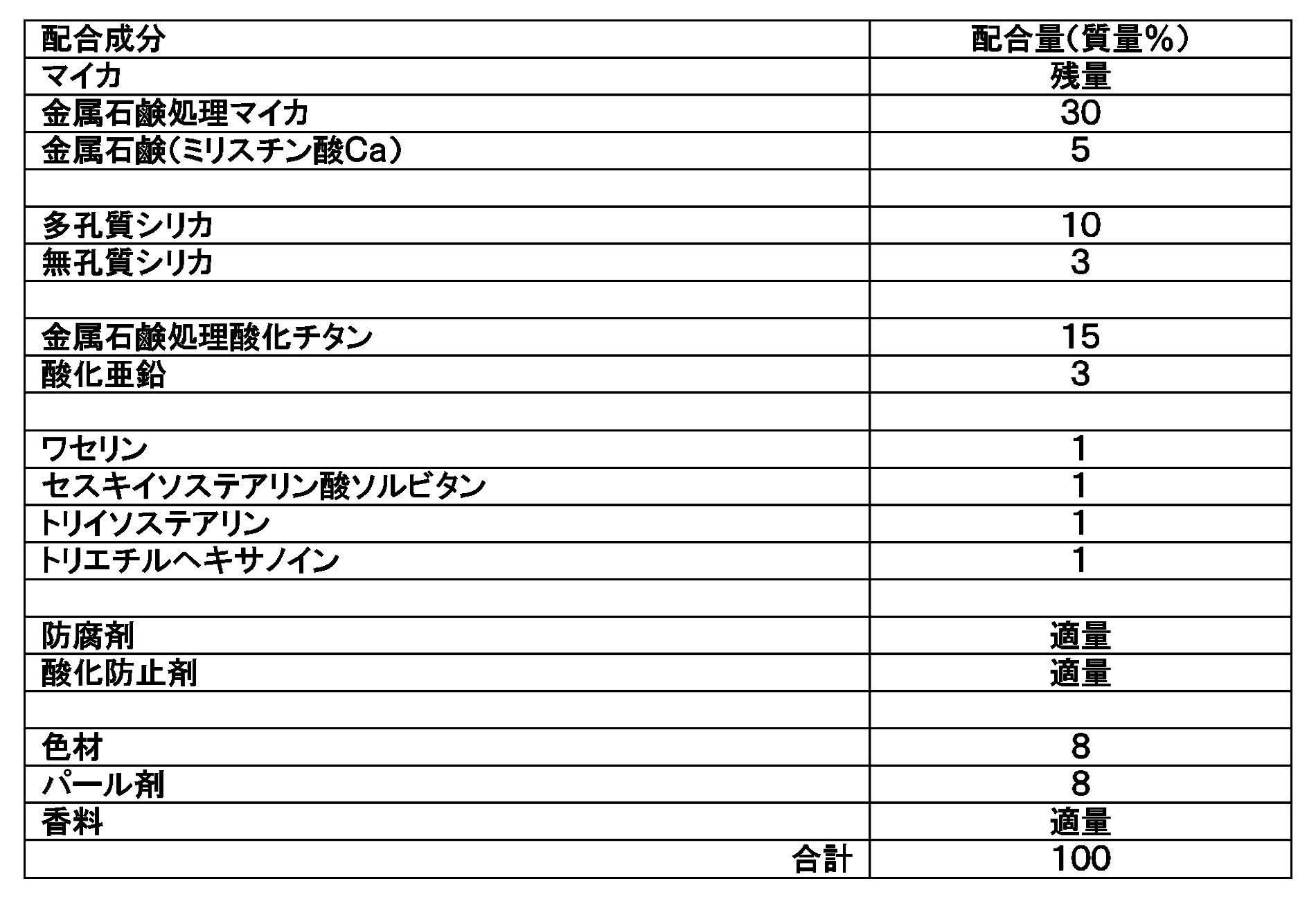
- Samples B1-B3 were prepared according to the formulations listed in Table 2 below.
- "X" in Table 2 represents the compounding amount (% by mass) of titanium oxide, and the compounding amount (X) was changed to 5, 15, and 25% by mass.
- Each sample (10 mg) was applied to a PMMA plate, the absorbance for light in the ultraviolet wavelength region (280 to 400 nm) was measured, the absorbance curve in the measured wavelength region was integrated, and the obtained results are shown in FIG. plotted on a graph.
- sample B1 in which metallic soap-treated titanium oxide was dispersed in metallic soap-treated mica, continued to increase in absorbance integral value even when the amount of titanium oxide was increased to 25% by mass.
- sample B2 in which metal soap-treated titanium oxide is dispersed in silicone-treated mica
- sample B3 in which the surface treatment of extender pigment (mica) and titanium oxide is unified with silicone, has an integrated absorbance value of The absolute value of is smaller than that of sample B1, and the increase in integrated absorbance value with increasing amount of titanium oxide tended to plateau.
- Powdery cosmetics were prepared according to a conventional method according to the formulations shown in Table 3 below, and the ultraviolet protection ability and usability (absence of squeakiness) were evaluated for the cosmetics of each example. These results are also shown in Table 3.
- the cosmetic material (10 mg) of each example was applied to a PMMA plate, and the absorbance for light in the ultraviolet wavelength region (280 to 400 nm) was measured, and the absorbance in the ultraviolet wavelength region was measured. integrated.
- Boost rate (measured integrated value/reference integrated value) x 100
- cosmetics with a "boost rate" of more than 100 have improved UV protection by unifying the surface treatments of titanium oxide and extender pigments with metallic soap, compared to the case where the two have different surface treatments (the boost effect is improved). The higher the value, the greater the boost effect.
- Example A1 in Table 1; hereinafter In "Example X"
- Example A1 a composition containing a titanium oxide surface-treated with a metallic soap (metallic soap-treated titanium oxide) and an extender pigment surface-treated with a metallic soap (metallic soap-treated extender pigment)
- Example A1 in Table 1; hereinafter In "Example X”
- changes in the UV protection effect of compositions (Examples 5 to 7) in which a portion of the metal soap-treated talc was replaced with silica (spherical silica) were measured.
- a composition (Comparative Example 3) was prepared with 30% by mass of metallic soap-treated titanium oxide and the remaining amount of untreated mica (Comparative Example 3), and a portion (10% by weight) of the untreated mica was replaced with metallic soap-treated mica.
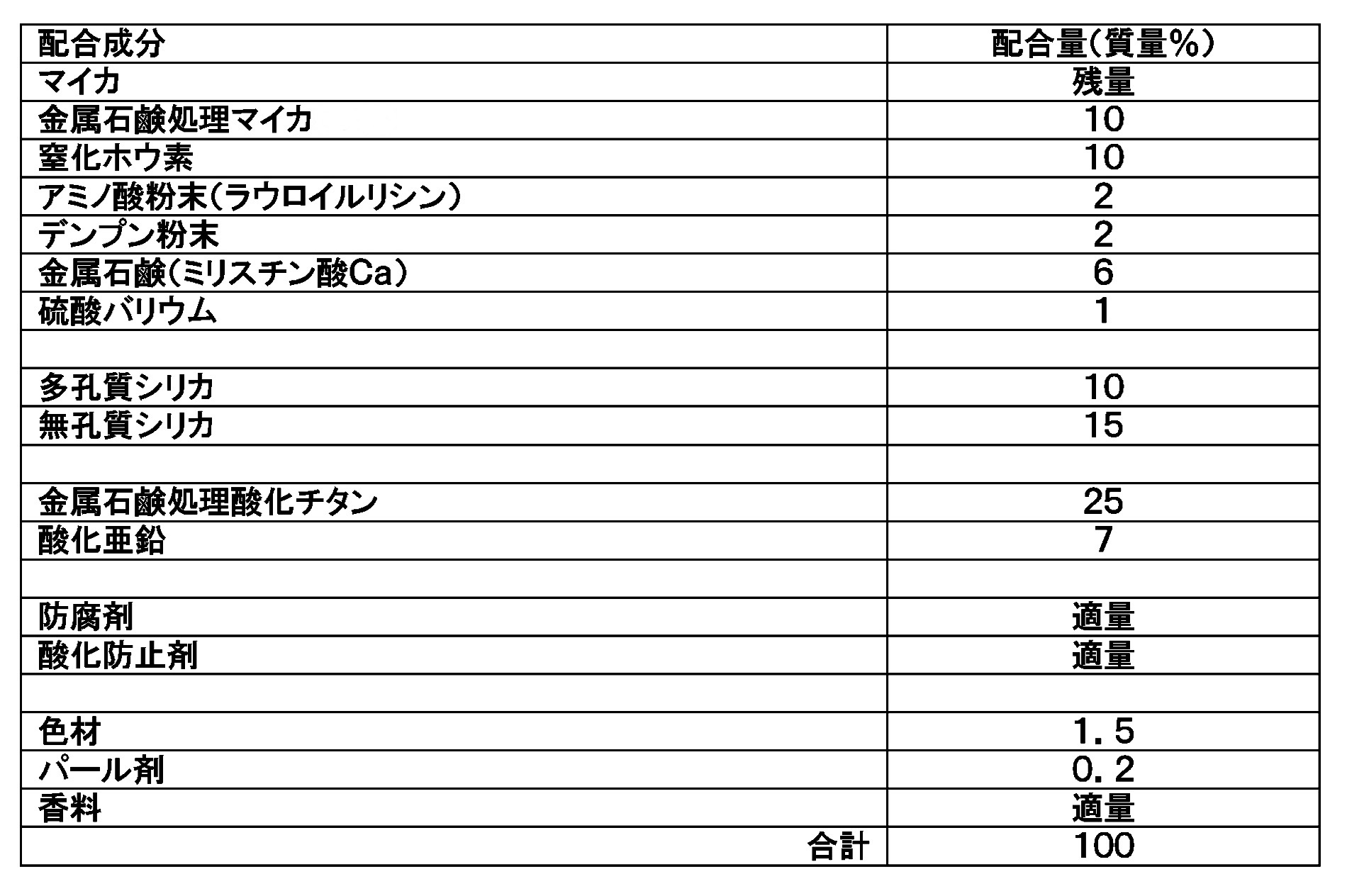
- powdered cosmetics were prepared according to the formulations shown in Tables 4 and 5 below.
- the cosmetic material (10 mg) of each example was applied to a PMMA plate, and the absorbance for light in the ultraviolet wavelength region (280 to 400 nm) was measured, and the absorbance in the ultraviolet wavelength region was measured. integrated.
- the integral value of the absorbance curve obtained with the composition (cosmetics) of “Example X” is the “reference integral value", and the absorbance curves obtained with the compositions (cosmetics) of Examples 5-7.
- the value (boost rate) calculated by the formula described in paragraph 0046 was calculated using the integrated value of as the "measured integrated value”.
- the integrated value of the absorbance curve obtained from the composition (cosmetics) of "Comparative Example 3" in which "metallic soap-treated titanium oxide” was dispersed in "untreated mica” was defined as the “reference integrated value”.
- the value (boost rate) calculated by the formula described in paragraph 0046 was calculated.
Landscapes
- Health & Medical Sciences (AREA)
- Life Sciences & Earth Sciences (AREA)
- Animal Behavior & Ethology (AREA)
- General Health & Medical Sciences (AREA)
- Public Health (AREA)
- Veterinary Medicine (AREA)
- Birds (AREA)
- Epidemiology (AREA)
- Chemical & Material Sciences (AREA)
- Inorganic Chemistry (AREA)
- Dermatology (AREA)
- Cosmetics (AREA)
Abstract
Description
(a)酸化チタン、酸化亜鉛、及び酸化セリウムから選択される少なくとも1種からなる金属酸化物粉末、及び
(b)体質顔料、
を含み、
前記(a)金属酸化物粉末及び(b)体質顔料が、ともに金属石鹸で表面処理された粉末であり、
前記(a)金属酸化物粉末の配合量が、化粧料全量に対して10質量%以上であることを特徴とする、粉末化粧料を提供する。
本発明の化粧料に配合される(a)金属酸化物粉末(以下「(a)成分」ともいう)は、酸化チタン、酸化亜鉛、及び酸化セリウムから選択される少なくとも1種からなり、化粧料において「紫外線散乱剤」として使用されている微粒子状の金属酸化物粉末である。当該金属酸化物粉末(a成分)は、通常は200nm以下、好ましくは100nm以下の平均粒子径を有する。本明細書では、平均粒子径が200nm以下の金属酸化物粉末を「金属酸化物粉末(酸化チタン、酸化亜鉛または酸化セリウム)」あるいは「紫外線散乱剤」と呼び、平均粒子径が200nmを超える金属酸化物粉末を「顔料級の金属酸化物粉末」と呼んで区別することにする。本発明では、金属酸化物粉体の中でも、酸化チタンを用いるのが特に好ましい。
また、酸化チタン等の金属酸化物粉末の粒子形態は特に限定されるものでなく、球状、楕円形状、破砕状等が含まれる。
化粧料における「体質顔料」は、粉末化粧料の剤形を保つために用いられる無機顔料である。具体例としては、タルク、マイカ、セリサイト、カオリン、炭酸カルシウム、炭酸マグネシウム、無水ケイ酸、酸化アルミニウム、硫酸バリウム等の粉末が挙げられる。
金属石鹸による表面処理は、予め生成した金属石鹸で表面処理する方法によって施してもよい。例えば、金属石鹸をイソパラフィン、イソプロピルアルコールなどの揮発性溶媒に溶解し、基体粉末と混合した後、揮発性溶媒を揮散させることによって表面処理することができる。また単に基体粉末と金属石鹸とを混合するだけでも表面処理することが可能である。あるいは、金属石鹸を構成する高級脂肪酸(例えば、ステアリン酸)と、金属(例えば、アルミニウム)の水酸化物とで複合処理する方法で表面処理してもよい。表面処理方法としては、溶媒を使用する湿式法、気相法、メカノケミカル法等を用いることができ、特に限定されない。
(c)成分としてのシリカは、球状シリカが好ましい。「球状」とは、形状が真球である必要はないが、粒子の長径/短径の比が1.5以下、好ましくは1.2以下のものである。
シリカの比表面積は、77Kにおける粉末への窒素吸着量を測定して、BET法で解析して算出することができる。
これら任意の粉末成分は、表面処理されていてもされていなくてもよい。
本発明の粉末化粧料では、配合する油分量が抑制されるため、油性紫外線吸収剤も少量(例えば、2質量%以下)となるが、紫外線散乱剤に基づく紫外線防御効果が向上(ブースト)されるので高SPFが達成できる。よって、油性紫外線吸収剤を含まない(いわゆる「ノンケミカル」の)粉末化粧料とすることも可能である。
下記の表1に掲げた処方で試料A1及びA2の組成物を調製した。各試料(10mg)を、PMMA製板に塗布し、紫外線波長領域(280~400nm)の光に対する吸光度を測定した。測定結果を図1に示す。

なお、体質顔料(タルク)と混合せず、試料A1及びA2と同量の金属石鹸処理酸化チタンを上記のPMMA製板に塗布して同様の測定をした場合、その吸光度曲線は、試料A2の曲線(破線)と同等であった。すなわち、酸化チタンと体質顔料の表面処理を金属石鹸に統一することにより、酸化チタンに基づく紫外線防御能の向上効果(ブースト効果)が得られることが確認された。
下記の表2に掲げた処方の試料B1~B3の組成物を調製した。表2における「X」は、酸化チタンの配合量(質量%)を表し、この配合量(X)を5、15、及び25質量%に変化させた。各試料(10mg)を、PMMA製板に塗布し、紫外線波長領域(280~400nm)の光に対する吸光度を測定し、測定した波長領域の吸光度曲線を積分して、得られた結果を図2のグラフにプロットした。
下記の表3に示す処方で、粉末化粧料を常法に従って調製した、各例の化粧料について、紫外線防御能及び使用性(きしみのなさ)を評価した。それらの結果を表3に併せて示す。
ブースト率 =(実測積分値/基準積分値)×100
すなわち、「ブースト率」が100を超える化粧料は、酸化チタンと体質顔料の表面処理を金属石鹸に統一することにより、両者の表面処理が異なる場合より紫外線防御能が向上したこと(ブースト効果を有すること)を意味し、その値が大きいほどブースト効果が大きいことを示している。
A:きしみをほぼ感じない又は感じても僅かである。
B:明らかなきしみを感じる。
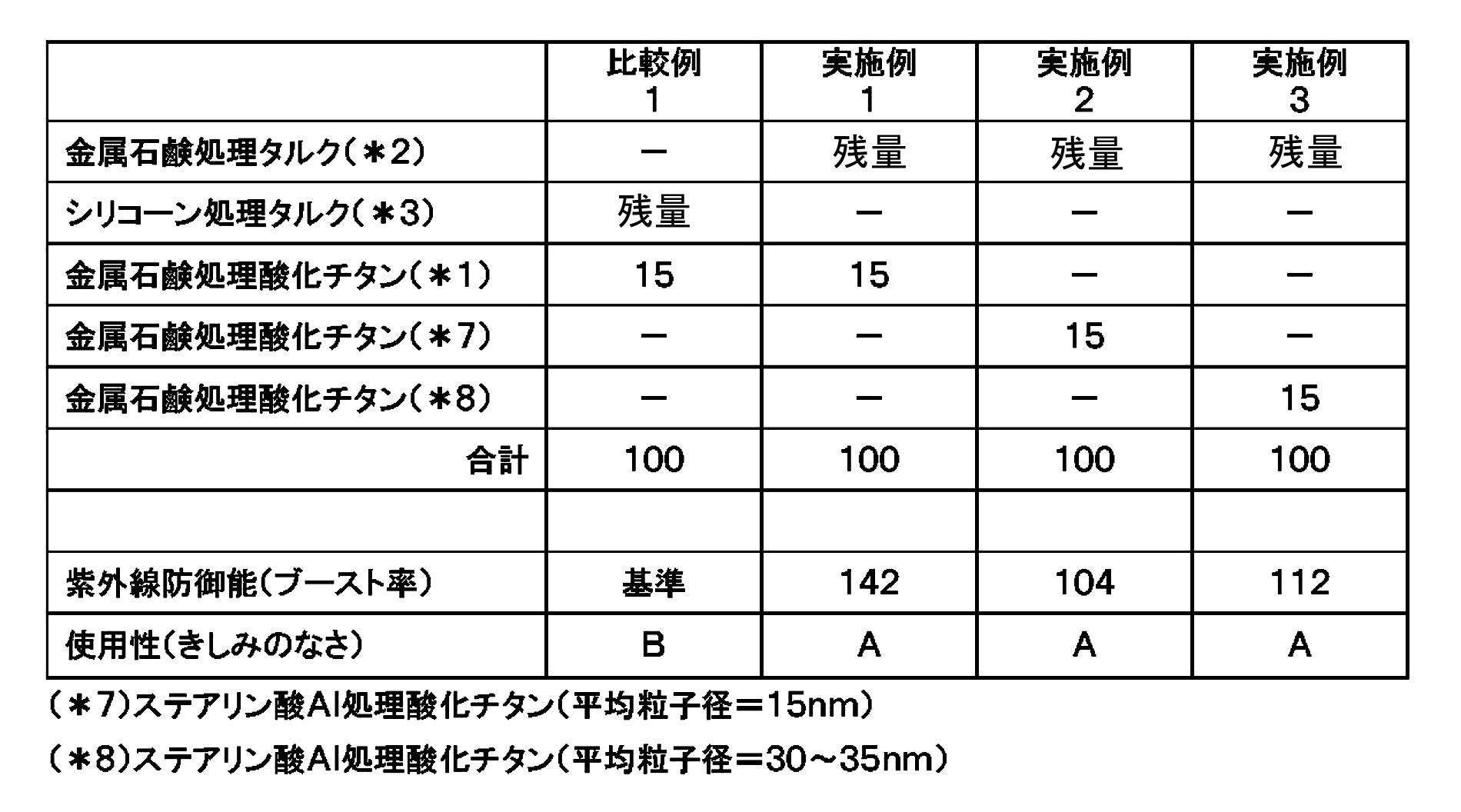
表5では、「未処理マイカ」に「金属石鹸処理酸化チタン」を分散させた「比較例3」の組成物(化粧料)で得られた吸光度曲線の積分値を「基準積分値」とし、実施例8~11の組成物(化粧料)で得られた吸光度曲線の積分値を「実測積分値」として、段落0046に記載した式で算出される値(ブースト率)を算出した。
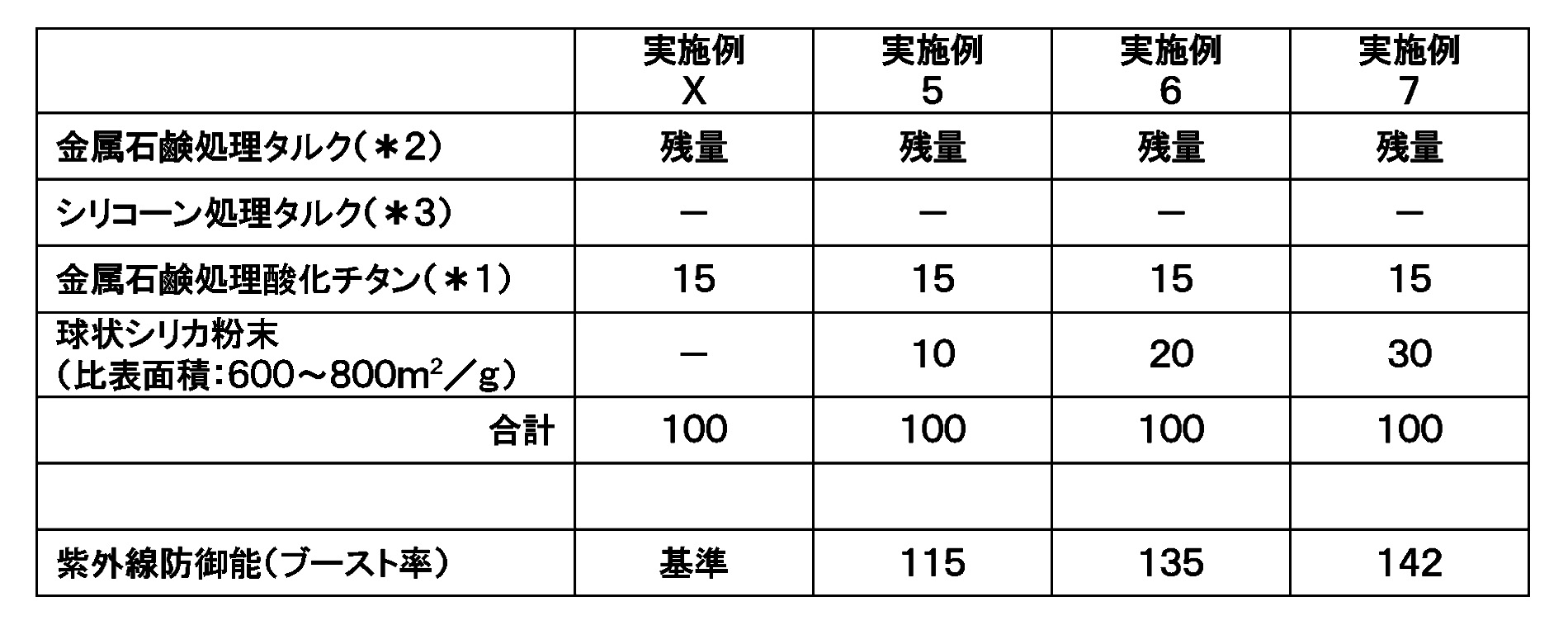

また、球状のシリカを配合したことにより、使用性(きしみのなさ)も更に改善された。
Claims (6)
- (a)酸化チタン、酸化亜鉛、及び酸化セリウムから選択される少なくとも1種からなる金属酸化物粉末、及び
(b)体質顔料、
を含み、
前記(a)金属酸化物粉末及び(b)体質顔料が、ともに金属石鹸で表面処理された粉末であり、
前記(a)金属酸化物粉末の配合量が、化粧料全量に対して10質量%以上であることを特徴とする、粉末化粧料。 - 前記(a)金属酸化物粉末の平均粒子径が100nm以下である、請求項1に記載の粉末化粧料。
- 金属石鹸がステアリン酸アルミニウムを含む、請求項1に記載の粉末化粧料。
- (c)シリカ(但し、前記(b)に該当するものを除く)を更に含有する、請求項1に記載の粉末化粧料。
- 前記(c)シリカの比表面積が160m2/g以上である、請求項4に記載の粉末化粧料。
- 油分の配合量が、化粧料全量に対して10質量%以下である、請求項1に記載の粉末化粧料。
Priority Applications (3)
| Application Number | Priority Date | Filing Date | Title |
|---|---|---|---|
| CN202280061264.0A CN117956969A (zh) | 2021-10-14 | 2022-10-13 | 粉末化妆品 |
| US18/692,081 US20240382397A1 (en) | 2021-10-14 | 2022-10-13 | Powder cosmetic |
| JP2023554614A JPWO2023063387A1 (ja) | 2021-10-14 | 2022-10-13 |
Applications Claiming Priority (2)
| Application Number | Priority Date | Filing Date | Title |
|---|---|---|---|
| JP2021168820 | 2021-10-14 | ||
| JP2021-168820 | 2021-10-14 |
Publications (1)
| Publication Number | Publication Date |
|---|---|
| WO2023063387A1 true WO2023063387A1 (ja) | 2023-04-20 |
Family
ID=85988711
Family Applications (1)
| Application Number | Title | Priority Date | Filing Date |
|---|---|---|---|
| PCT/JP2022/038206 Ceased WO2023063387A1 (ja) | 2021-10-14 | 2022-10-13 | 粉末化粧料 |
Country Status (4)
| Country | Link |
|---|---|
| US (1) | US20240382397A1 (ja) |
| JP (1) | JPWO2023063387A1 (ja) |
| CN (1) | CN117956969A (ja) |
| WO (1) | WO2023063387A1 (ja) |
Cited By (1)
| Publication number | Priority date | Publication date | Assignee | Title |
|---|---|---|---|---|
| US12180414B2 (en) | 2022-12-12 | 2024-12-31 | Bmic Llc | Downstream uses for briquettes and other forms of powder from asphalt shingle waste |
Citations (8)
| Publication number | Priority date | Publication date | Assignee | Title |
|---|---|---|---|---|
| JPH08165219A (ja) * | 1994-12-09 | 1996-06-25 | Procter & Gamble Co:The | 固型化粧料 |
| JPH10212223A (ja) * | 1997-01-29 | 1998-08-11 | Shiseido Co Ltd | 化粧料 |
| JP2000327517A (ja) * | 1999-05-24 | 2000-11-28 | Kanebo Ltd | 化粧料 |
| JP2005112823A (ja) * | 2003-10-10 | 2005-04-28 | Nisshin Oillio Group Ltd | 紫外線防御製剤及び紫外線防御製剤を含有する化粧料 |
| JP2007217361A (ja) * | 2006-02-17 | 2007-08-30 | Shiseido Co Ltd | 化粧料組成物 |
| JP2017081858A (ja) * | 2015-10-29 | 2017-05-18 | 花王株式会社 | 固型粉末化粧料 |
| JP2018177620A (ja) * | 2017-04-21 | 2018-11-15 | 株式会社トクヤマ | シリカエアロゲル粉体及びその製造方法 |
| JP2020111601A (ja) * | 2015-10-29 | 2020-07-27 | 花王株式会社 | 固型粉末化粧料 |
Family Cites Families (2)
| Publication number | Priority date | Publication date | Assignee | Title |
|---|---|---|---|---|
| JP4076948B2 (ja) * | 2001-08-10 | 2008-04-16 | 花王株式会社 | 化粧料および化粧方法 |
| JP6758663B2 (ja) * | 2018-08-18 | 2020-09-23 | ジェイオーコスメティックス株式会社 | 油性固形クレンジング化粧料 |
-
2022
- 2022-10-13 WO PCT/JP2022/038206 patent/WO2023063387A1/ja not_active Ceased
- 2022-10-13 US US18/692,081 patent/US20240382397A1/en active Pending
- 2022-10-13 JP JP2023554614A patent/JPWO2023063387A1/ja active Pending
- 2022-10-13 CN CN202280061264.0A patent/CN117956969A/zh active Pending
Patent Citations (8)
| Publication number | Priority date | Publication date | Assignee | Title |
|---|---|---|---|---|
| JPH08165219A (ja) * | 1994-12-09 | 1996-06-25 | Procter & Gamble Co:The | 固型化粧料 |
| JPH10212223A (ja) * | 1997-01-29 | 1998-08-11 | Shiseido Co Ltd | 化粧料 |
| JP2000327517A (ja) * | 1999-05-24 | 2000-11-28 | Kanebo Ltd | 化粧料 |
| JP2005112823A (ja) * | 2003-10-10 | 2005-04-28 | Nisshin Oillio Group Ltd | 紫外線防御製剤及び紫外線防御製剤を含有する化粧料 |
| JP2007217361A (ja) * | 2006-02-17 | 2007-08-30 | Shiseido Co Ltd | 化粧料組成物 |
| JP2017081858A (ja) * | 2015-10-29 | 2017-05-18 | 花王株式会社 | 固型粉末化粧料 |
| JP2020111601A (ja) * | 2015-10-29 | 2020-07-27 | 花王株式会社 | 固型粉末化粧料 |
| JP2018177620A (ja) * | 2017-04-21 | 2018-11-15 | 株式会社トクヤマ | シリカエアロゲル粉体及びその製造方法 |
Cited By (1)
| Publication number | Priority date | Publication date | Assignee | Title |
|---|---|---|---|---|
| US12180414B2 (en) | 2022-12-12 | 2024-12-31 | Bmic Llc | Downstream uses for briquettes and other forms of powder from asphalt shingle waste |
Also Published As
| Publication number | Publication date |
|---|---|
| JPWO2023063387A1 (ja) | 2023-04-20 |
| US20240382397A1 (en) | 2024-11-21 |
| CN117956969A (zh) | 2024-04-30 |
Similar Documents
| Publication | Publication Date | Title |
|---|---|---|
| JP5174789B2 (ja) | O/w型乳化化粧料 | |
| TW482683B (en) | Sunscreen compositions | |
| WO2011065438A1 (ja) | W/o型乳化化粧料 | |
| JP4994640B2 (ja) | 紫外線吸収性複合粉体 | |
| WO2016076350A1 (ja) | 酸化ケイ素被覆酸化亜鉛とその製造方法および酸化ケイ素被覆酸化亜鉛含有組成物並びに化粧料 | |
| JP4880078B1 (ja) | 粉体化粧料 | |
| WO2011024364A1 (ja) | 紫外線遮蔽効果と皮脂固化能を有する化粧料用組成物及び化粧料 | |
| JP4011799B2 (ja) | 日焼け止め化粧料 | |
| JP6037899B2 (ja) | 水中油型乳化化粧料 | |
| US20090148481A1 (en) | Method of formulating zinc oxide powder blends for balanced uva/uvb attenuation | |
| US20240382397A1 (en) | Powder cosmetic | |
| WO2015072540A1 (ja) | テアニンを用いた表面処理粉体及びそれを含有する化粧料 | |
| JP3264392B2 (ja) | 複合樹脂粉末及びそれを含有する化粧料 | |
| JP4859044B2 (ja) | 化粧料 | |
| WO2024080157A1 (ja) | 粉末化粧料 | |
| JP3794214B2 (ja) | 水中油系乳化型メーキャップ化粧料 | |
| JP6598491B2 (ja) | 粉末化粧料 | |
| JP2007291090A (ja) | 粉末化粧料 | |
| JP6433802B2 (ja) | 油中水乳化型紫外線防御用化粧料 | |
| JP2007197431A (ja) | 紫外線遮蔽性無機粒子含有分散体 | |
| WO2010140470A1 (ja) | 複合化粉体及びそれを配合したメーキャップ化粧料 | |
| JP3792843B2 (ja) | 化粧料 | |
| JPH1135440A (ja) | 化粧料 | |
| JP3566050B2 (ja) | 皮膚外用剤 | |
| JP2004269482A (ja) | 微粒子二酸化チタン被覆粉体及びそれを含有する化粧料 |
Legal Events
| Date | Code | Title | Description |
|---|---|---|---|
| 121 | Ep: the epo has been informed by wipo that ep was designated in this application |
Ref document number: 22881082 Country of ref document: EP Kind code of ref document: A1 |
|
| WWE | Wipo information: entry into national phase |
Ref document number: 202280061264.0 Country of ref document: CN |
|
| WWE | Wipo information: entry into national phase |
Ref document number: 18692081 Country of ref document: US Ref document number: 2023554614 Country of ref document: JP |
|
| NENP | Non-entry into the national phase |
Ref country code: DE |
|
| 122 | Ep: pct application non-entry in european phase |
Ref document number: 22881082 Country of ref document: EP Kind code of ref document: A1 |