WO2023058723A1 - プレフィルドシリンジ製剤の調製方法 - Google Patents
プレフィルドシリンジ製剤の調製方法 Download PDFInfo
- Publication number
- WO2023058723A1 WO2023058723A1 PCT/JP2022/037469 JP2022037469W WO2023058723A1 WO 2023058723 A1 WO2023058723 A1 WO 2023058723A1 JP 2022037469 W JP2022037469 W JP 2022037469W WO 2023058723 A1 WO2023058723 A1 WO 2023058723A1
- Authority
- WO
- WIPO (PCT)
- Prior art keywords
- protein
- solution
- antibody
- particles
- container
- Prior art date
- Legal status (The legal status is an assumption and is not a legal conclusion. Google has not performed a legal analysis and makes no representation as to the accuracy of the status listed.)
- Ceased
Links
Images

Classifications
-
- G—PHYSICS
- G16—INFORMATION AND COMMUNICATION TECHNOLOGY [ICT] SPECIALLY ADAPTED FOR SPECIFIC APPLICATION FIELDS
- G16B—BIOINFORMATICS, i.e. INFORMATION AND COMMUNICATION TECHNOLOGY [ICT] SPECIALLY ADAPTED FOR GENETIC OR PROTEIN-RELATED DATA PROCESSING IN COMPUTATIONAL MOLECULAR BIOLOGY
- G16B15/00—ICT specially adapted for analysing two-dimensional [2D] or three-dimensional [3D] molecular structures, e.g. structural or functional relations or structure alignment
- G16B15/30—Drug targeting using structural data; Docking or binding prediction
-
- A—HUMAN NECESSITIES
- A61—MEDICAL OR VETERINARY SCIENCE; HYGIENE
- A61K—PREPARATIONS FOR MEDICAL, DENTAL OR TOILETRY PURPOSES
- A61K38/00—Medicinal preparations containing peptides
-
- A—HUMAN NECESSITIES
- A61—MEDICAL OR VETERINARY SCIENCE; HYGIENE
- A61K—PREPARATIONS FOR MEDICAL, DENTAL OR TOILETRY PURPOSES
- A61K39/00—Medicinal preparations containing antigens or antibodies
-
- A—HUMAN NECESSITIES
- A61—MEDICAL OR VETERINARY SCIENCE; HYGIENE
- A61K—PREPARATIONS FOR MEDICAL, DENTAL OR TOILETRY PURPOSES
- A61K39/00—Medicinal preparations containing antigens or antibodies
- A61K39/395—Antibodies; Immunoglobulins; Immune serum, e.g. antilymphocytic serum
-
- A—HUMAN NECESSITIES
- A61—MEDICAL OR VETERINARY SCIENCE; HYGIENE
- A61K—PREPARATIONS FOR MEDICAL, DENTAL OR TOILETRY PURPOSES
- A61K39/00—Medicinal preparations containing antigens or antibodies
- A61K39/395—Antibodies; Immunoglobulins; Immune serum, e.g. antilymphocytic serum
- A61K39/39591—Stabilisation, fragmentation
-
- A—HUMAN NECESSITIES
- A61—MEDICAL OR VETERINARY SCIENCE; HYGIENE
- A61K—PREPARATIONS FOR MEDICAL, DENTAL OR TOILETRY PURPOSES
- A61K47/00—Medicinal preparations characterised by the non-active ingredients used, e.g. carriers or inert additives; Targeting or modifying agents chemically bound to the active ingredient
- A61K47/06—Organic compounds, e.g. natural or synthetic hydrocarbons, polyolefins, mineral oil, petrolatum or ozokerite
- A61K47/08—Organic compounds, e.g. natural or synthetic hydrocarbons, polyolefins, mineral oil, petrolatum or ozokerite containing oxygen, e.g. ethers, acetals, ketones, quinones, aldehydes, peroxides
- A61K47/10—Alcohols; Phenols; Salts thereof, e.g. glycerol; Polyethylene glycols [PEG]; Poloxamers; PEG/POE alkyl ethers
-
- A—HUMAN NECESSITIES
- A61—MEDICAL OR VETERINARY SCIENCE; HYGIENE
- A61K—PREPARATIONS FOR MEDICAL, DENTAL OR TOILETRY PURPOSES
- A61K47/00—Medicinal preparations characterised by the non-active ingredients used, e.g. carriers or inert additives; Targeting or modifying agents chemically bound to the active ingredient
- A61K47/06—Organic compounds, e.g. natural or synthetic hydrocarbons, polyolefins, mineral oil, petrolatum or ozokerite
- A61K47/16—Organic compounds, e.g. natural or synthetic hydrocarbons, polyolefins, mineral oil, petrolatum or ozokerite containing nitrogen, e.g. nitro-, nitroso-, azo-compounds, nitriles, cyanates
- A61K47/18—Amines; Amides; Ureas; Quaternary ammonium compounds; Amino acids; Oligopeptides having up to five amino acids
- A61K47/183—Amino acids, e.g. glycine, EDTA or aspartame
-
- A—HUMAN NECESSITIES
- A61—MEDICAL OR VETERINARY SCIENCE; HYGIENE
- A61K—PREPARATIONS FOR MEDICAL, DENTAL OR TOILETRY PURPOSES
- A61K47/00—Medicinal preparations characterised by the non-active ingredients used, e.g. carriers or inert additives; Targeting or modifying agents chemically bound to the active ingredient
- A61K47/06—Organic compounds, e.g. natural or synthetic hydrocarbons, polyolefins, mineral oil, petrolatum or ozokerite
- A61K47/20—Organic compounds, e.g. natural or synthetic hydrocarbons, polyolefins, mineral oil, petrolatum or ozokerite containing sulfur, e.g. dimethyl sulfoxide [DMSO], docusate, sodium lauryl sulfate or aminosulfonic acids
-
- A—HUMAN NECESSITIES
- A61—MEDICAL OR VETERINARY SCIENCE; HYGIENE
- A61K—PREPARATIONS FOR MEDICAL, DENTAL OR TOILETRY PURPOSES
- A61K47/00—Medicinal preparations characterised by the non-active ingredients used, e.g. carriers or inert additives; Targeting or modifying agents chemically bound to the active ingredient
- A61K47/06—Organic compounds, e.g. natural or synthetic hydrocarbons, polyolefins, mineral oil, petrolatum or ozokerite
- A61K47/26—Carbohydrates, e.g. sugar alcohols, amino sugars, nucleic acids, mono-, di- or oligo-saccharides; Derivatives thereof, e.g. polysorbates, sorbitan fatty acid esters or glycyrrhizin
-
- A—HUMAN NECESSITIES
- A61—MEDICAL OR VETERINARY SCIENCE; HYGIENE
- A61K—PREPARATIONS FOR MEDICAL, DENTAL OR TOILETRY PURPOSES
- A61K47/00—Medicinal preparations characterised by the non-active ingredients used, e.g. carriers or inert additives; Targeting or modifying agents chemically bound to the active ingredient
- A61K47/30—Macromolecular organic or inorganic compounds, e.g. inorganic polyphosphates
- A61K47/32—Macromolecular compounds obtained by reactions only involving carbon-to-carbon unsaturated bonds, e.g. carbomers, poly(meth)acrylates, or polyvinyl pyrrolidone
-
- A—HUMAN NECESSITIES
- A61—MEDICAL OR VETERINARY SCIENCE; HYGIENE
- A61K—PREPARATIONS FOR MEDICAL, DENTAL OR TOILETRY PURPOSES
- A61K47/00—Medicinal preparations characterised by the non-active ingredients used, e.g. carriers or inert additives; Targeting or modifying agents chemically bound to the active ingredient
- A61K47/30—Macromolecular organic or inorganic compounds, e.g. inorganic polyphosphates
- A61K47/34—Macromolecular compounds obtained otherwise than by reactions only involving carbon-to-carbon unsaturated bonds, e.g. polyesters, polyamino acids, polysiloxanes, polyphosphazines, copolymers of polyalkylene glycol or poloxamers
-
- A—HUMAN NECESSITIES
- A61—MEDICAL OR VETERINARY SCIENCE; HYGIENE
- A61K—PREPARATIONS FOR MEDICAL, DENTAL OR TOILETRY PURPOSES
- A61K9/00—Medicinal preparations characterised by special physical form
- A61K9/0012—Galenical forms characterised by the site of application
- A61K9/0019—Injectable compositions; Intramuscular, intravenous, arterial, subcutaneous administration; Compositions to be administered through the skin in an invasive manner
-
- A—HUMAN NECESSITIES
- A61—MEDICAL OR VETERINARY SCIENCE; HYGIENE
- A61K—PREPARATIONS FOR MEDICAL, DENTAL OR TOILETRY PURPOSES
- A61K9/00—Medicinal preparations characterised by special physical form
- A61K9/08—Solutions
-
- A—HUMAN NECESSITIES
- A61—MEDICAL OR VETERINARY SCIENCE; HYGIENE
- A61M—DEVICES FOR INTRODUCING MEDIA INTO, OR ONTO, THE BODY; DEVICES FOR TRANSDUCING BODY MEDIA OR FOR TAKING MEDIA FROM THE BODY; DEVICES FOR PRODUCING OR ENDING SLEEP OR STUPOR
- A61M5/00—Devices for bringing media into the body in a subcutaneous, intra-vascular or intramuscular way; Accessories therefor, e.g. filling or cleaning devices, arm-rests
-
- A—HUMAN NECESSITIES
- A61—MEDICAL OR VETERINARY SCIENCE; HYGIENE
- A61M—DEVICES FOR INTRODUCING MEDIA INTO, OR ONTO, THE BODY; DEVICES FOR TRANSDUCING BODY MEDIA OR FOR TAKING MEDIA FROM THE BODY; DEVICES FOR PRODUCING OR ENDING SLEEP OR STUPOR
- A61M5/00—Devices for bringing media into the body in a subcutaneous, intra-vascular or intramuscular way; Accessories therefor, e.g. filling or cleaning devices, arm-rests
- A61M5/36—Devices for bringing media into the body in a subcutaneous, intra-vascular or intramuscular way; Accessories therefor, e.g. filling or cleaning devices, arm-rests with means for eliminating or preventing injection or infusion of air into body
-
- A—HUMAN NECESSITIES
- A61—MEDICAL OR VETERINARY SCIENCE; HYGIENE
- A61P—SPECIFIC THERAPEUTIC ACTIVITY OF CHEMICAL COMPOUNDS OR MEDICINAL PREPARATIONS
- A61P1/00—Drugs for disorders of the alimentary tract or the digestive system
-
- A—HUMAN NECESSITIES
- A61—MEDICAL OR VETERINARY SCIENCE; HYGIENE
- A61P—SPECIFIC THERAPEUTIC ACTIVITY OF CHEMICAL COMPOUNDS OR MEDICINAL PREPARATIONS
- A61P1/00—Drugs for disorders of the alimentary tract or the digestive system
- A61P1/04—Drugs for disorders of the alimentary tract or the digestive system for ulcers, gastritis or reflux esophagitis, e.g. antacids, inhibitors of acid secretion, mucosal protectants
-
- A—HUMAN NECESSITIES
- A61—MEDICAL OR VETERINARY SCIENCE; HYGIENE
- A61P—SPECIFIC THERAPEUTIC ACTIVITY OF CHEMICAL COMPOUNDS OR MEDICINAL PREPARATIONS
- A61P1/00—Drugs for disorders of the alimentary tract or the digestive system
- A61P1/14—Prodigestives, e.g. acids, enzymes, appetite stimulants, antidyspeptics, tonics, antiflatulents
-
- A—HUMAN NECESSITIES
- A61—MEDICAL OR VETERINARY SCIENCE; HYGIENE
- A61P—SPECIFIC THERAPEUTIC ACTIVITY OF CHEMICAL COMPOUNDS OR MEDICINAL PREPARATIONS
- A61P37/00—Drugs for immunological or allergic disorders
- A61P37/02—Immunomodulators
- A61P37/06—Immunosuppressants, e.g. drugs for graft rejection
-
- C—CHEMISTRY; METALLURGY
- C07—ORGANIC CHEMISTRY
- C07K—PEPTIDES
- C07K16/00—Immunoglobulins [IG], e.g. monoclonal or polyclonal antibodies
-
- C—CHEMISTRY; METALLURGY
- C07—ORGANIC CHEMISTRY
- C07K—PEPTIDES
- C07K16/00—Immunoglobulins [IG], e.g. monoclonal or polyclonal antibodies
- C07K16/18—Immunoglobulins [IG], e.g. monoclonal or polyclonal antibodies against material from animals or humans
- C07K16/22—Immunoglobulins [IG], e.g. monoclonal or polyclonal antibodies against material from animals or humans against growth factors ; against growth regulators
-
- C—CHEMISTRY; METALLURGY
- C07—ORGANIC CHEMISTRY
- C07K—PEPTIDES
- C07K16/00—Immunoglobulins [IG], e.g. monoclonal or polyclonal antibodies
- C07K16/18—Immunoglobulins [IG], e.g. monoclonal or polyclonal antibodies against material from animals or humans
- C07K16/28—Immunoglobulins [IG], e.g. monoclonal or polyclonal antibodies against material from animals or humans against receptors, cell surface antigens or cell surface determinants
-
- C—CHEMISTRY; METALLURGY
- C07—ORGANIC CHEMISTRY
- C07K—PEPTIDES
- C07K16/00—Immunoglobulins [IG], e.g. monoclonal or polyclonal antibodies
- C07K16/18—Immunoglobulins [IG], e.g. monoclonal or polyclonal antibodies against material from animals or humans
- C07K16/28—Immunoglobulins [IG], e.g. monoclonal or polyclonal antibodies against material from animals or humans against receptors, cell surface antigens or cell surface determinants
- C07K16/2803—Immunoglobulins [IG], e.g. monoclonal or polyclonal antibodies against material from animals or humans against receptors, cell surface antigens or cell surface determinants against the immunoglobulin superfamily
- C07K16/2827—Immunoglobulins [IG], e.g. monoclonal or polyclonal antibodies against material from animals or humans against receptors, cell surface antigens or cell surface determinants against the immunoglobulin superfamily against B7 molecules, e.g. CD80, CD86
-
- C—CHEMISTRY; METALLURGY
- C07—ORGANIC CHEMISTRY
- C07K—PEPTIDES
- C07K16/00—Immunoglobulins [IG], e.g. monoclonal or polyclonal antibodies
- C07K16/18—Immunoglobulins [IG], e.g. monoclonal or polyclonal antibodies against material from animals or humans
- C07K16/28—Immunoglobulins [IG], e.g. monoclonal or polyclonal antibodies against material from animals or humans against receptors, cell surface antigens or cell surface determinants
- C07K16/2866—Immunoglobulins [IG], e.g. monoclonal or polyclonal antibodies against material from animals or humans against receptors, cell surface antigens or cell surface determinants against receptors for cytokines, lymphokines, interferons
-
- C—CHEMISTRY; METALLURGY
- C07—ORGANIC CHEMISTRY
- C07K—PEPTIDES
- C07K16/00—Immunoglobulins [IG], e.g. monoclonal or polyclonal antibodies
- C07K16/18—Immunoglobulins [IG], e.g. monoclonal or polyclonal antibodies against material from animals or humans
- C07K16/36—Immunoglobulins [IG], e.g. monoclonal or polyclonal antibodies against material from animals or humans against blood coagulation factors
-
- G—PHYSICS
- G16—INFORMATION AND COMMUNICATION TECHNOLOGY [ICT] SPECIALLY ADAPTED FOR SPECIFIC APPLICATION FIELDS
- G16B—BIOINFORMATICS, i.e. INFORMATION AND COMMUNICATION TECHNOLOGY [ICT] SPECIALLY ADAPTED FOR GENETIC OR PROTEIN-RELATED DATA PROCESSING IN COMPUTATIONAL MOLECULAR BIOLOGY
- G16B15/00—ICT specially adapted for analysing two-dimensional [2D] or three-dimensional [3D] molecular structures, e.g. structural or functional relations or structure alignment
- G16B15/20—Protein or domain folding
-
- G—PHYSICS
- G16—INFORMATION AND COMMUNICATION TECHNOLOGY [ICT] SPECIALLY ADAPTED FOR SPECIFIC APPLICATION FIELDS
- G16B—BIOINFORMATICS, i.e. INFORMATION AND COMMUNICATION TECHNOLOGY [ICT] SPECIALLY ADAPTED FOR GENETIC OR PROTEIN-RELATED DATA PROCESSING IN COMPUTATIONAL MOLECULAR BIOLOGY
- G16B40/00—ICT specially adapted for biostatistics; ICT specially adapted for bioinformatics-related machine learning or data mining, e.g. knowledge discovery or pattern finding
-
- G—PHYSICS
- G16—INFORMATION AND COMMUNICATION TECHNOLOGY [ICT] SPECIALLY ADAPTED FOR SPECIFIC APPLICATION FIELDS
- G16H—HEALTHCARE INFORMATICS, i.e. INFORMATION AND COMMUNICATION TECHNOLOGY [ICT] SPECIALLY ADAPTED FOR THE HANDLING OR PROCESSING OF MEDICAL OR HEALTHCARE DATA
- G16H70/00—ICT specially adapted for the handling or processing of medical references
- G16H70/40—ICT specially adapted for the handling or processing of medical references relating to drugs, e.g. their side effects or intended usage
-
- A—HUMAN NECESSITIES
- A61—MEDICAL OR VETERINARY SCIENCE; HYGIENE
- A61M—DEVICES FOR INTRODUCING MEDIA INTO, OR ONTO, THE BODY; DEVICES FOR TRANSDUCING BODY MEDIA OR FOR TAKING MEDIA FROM THE BODY; DEVICES FOR PRODUCING OR ENDING SLEEP OR STUPOR
- A61M2209/00—Ancillary equipment
- A61M2209/04—Tools for specific apparatus
- A61M2209/045—Tools for specific apparatus for filling, e.g. for filling reservoirs
-
- A—HUMAN NECESSITIES
- A61—MEDICAL OR VETERINARY SCIENCE; HYGIENE
- A61M—DEVICES FOR INTRODUCING MEDIA INTO, OR ONTO, THE BODY; DEVICES FOR TRANSDUCING BODY MEDIA OR FOR TAKING MEDIA FROM THE BODY; DEVICES FOR PRODUCING OR ENDING SLEEP OR STUPOR
- A61M5/00—Devices for bringing media into the body in a subcutaneous, intra-vascular or intramuscular way; Accessories therefor, e.g. filling or cleaning devices, arm-rests
- A61M5/178—Syringes
- A61M5/28—Syringe ampoules or carpules, i.e. ampoules or carpules provided with a needle
-
- C—CHEMISTRY; METALLURGY
- C07—ORGANIC CHEMISTRY
- C07K—PEPTIDES
- C07K2317/00—Immunoglobulins specific features
- C07K2317/20—Immunoglobulins specific features characterized by taxonomic origin
- C07K2317/24—Immunoglobulins specific features characterized by taxonomic origin containing regions, domains or residues from different species, e.g. chimeric, humanized or veneered
-
- C—CHEMISTRY; METALLURGY
- C07—ORGANIC CHEMISTRY
- C07K—PEPTIDES
- C07K2317/00—Immunoglobulins specific features
- C07K2317/30—Immunoglobulins specific features characterized by aspects of specificity or valency
- C07K2317/31—Immunoglobulins specific features characterized by aspects of specificity or valency multispecific
-
- C—CHEMISTRY; METALLURGY
- C07—ORGANIC CHEMISTRY
- C07K—PEPTIDES
- C07K2317/00—Immunoglobulins specific features
- C07K2317/90—Immunoglobulins specific features characterized by (pharmaco)kinetic aspects or by stability of the immunoglobulin
- C07K2317/94—Stability, e.g. half-life, pH, temperature or enzyme-resistance
Definitions
- the present invention relates to a pharmaceutical preparation filled in a container containing protein as an active ingredient in solution.
- subcutaneous injection When designing an antibody-containing preparation for subcutaneous injection, while the antibody dose per injection is large (approximately 80 to 200 mg), subcutaneous injection generally limits the volume of injection. It is essential to increase the concentration of the antibody in the liquid.
- a cylindrical syringe body filled with a drug inside an injection needle attached to the tip of the syringe body, and a detachably attached syringe cap covering the injection needle and a plunger that is inserted into the syringe body and is slidable in the axial direction of the syringe body.
- the inner wall of the prefilled syringe and the plunger are coated with a lubricant such as silicone oil.
- the particles to be formed are aggregates larger than multimers such as dimers and trimers, but fine particles with a particle size of 1.5 ⁇ m to less than 50 ⁇ m, which are generally difficult to see with the naked eye.
- Sub-visible particles (SVP) and visible particles (visible particles: VP, larger than 100 ⁇ m) that can be detected visually with standard illumination (about 2,000-3,000 lx) are known.
- the visual detection rate of visible particles in pharmaceutical preparations varies greatly among practitioners, but particles with a particle size of 100 ⁇ m can be detected under the standard illuminance (approximately 2,000-3,000 lx) specified in the pharmacopoeia.
- Non-Patent Document 1 Non-Patent Document 1
- Particles having a particle size of 40 ⁇ m or more are particles that can be visually detected under high illumination, and are referred to as visually detectable particles.
- Non-Patent Document 2 The antibody solution filled in the syringe forms an air-liquid interface due to the presence of air bubbles, and forms a solid-liquid interface when it comes into contact with the plunger and syringe barrel.
- Non-Patent Document 3 the proteins adsorbed to the solid-liquid interface and aggregated fall off in the liquid due to air movement in the prefilled syringe and appear as visible particles.
- One way to reduce the stress received at various interfaces is to reduce the amount of air bubbles in the prefilled syringe. By reducing the amount of air bubbles, it is possible to reduce the amount of air moving in the prefilled syringe, and as a result, it is thought that adsorption to the gas-liquid interface and solid-liquid interface and desorption of aggregates can be suppressed. .
- Patent Documents 1 and 2 Previously, prefilled syringes containing specific antibodies have been reported to reduce the amount of subvisible and visible particles in surfactant-free solutions by reducing the amount of air bubbles in the solution. However, all of them are molecularly specific results and evaluation results under extremely unstable conditions (Patent Documents 1 and 2).
- Amino acid residues which are the building blocks of proteins, have different physical properties depending on the functional groups contained in the side chains.
- the physical properties of the side chains can be broadly classified into two types according to whether the side chains have a charged functional group and how hydrophobic the side chains are.
- computational chemistry software can be used to construct a three-dimensional structural model of the protein in a computer by inputting amino acid sequence information.
- partial charges at the atomic level can be calculated using a parameter called molecular force field.
- Molecular Operating Environment MOE; Chemical Computing Group Inc. (CCG)
- CCG Chemical Computing Group Inc.
- Amber10:EHT. assigned by version ff10 of the Amber force field (Non-Patent Document 4), which has been continuously refined since its publication in .
- Non-Patent Document 5 As an index of the hydrophobicity of amino acid residues, a hydrophobicity index that correlates with the experimentally measurable water octanol partition coefficient logP was established in the 1990s, and the index developed by Crippen et al. (Non-Patent Document 5).
- Non-Patent Document 6 A method for detecting the localization (patches) of charged/hydrophobic amino acid residues above a certain level in the three-dimensional structure of a protein based on the indices of charge and hydrophobicity of individual amino acid residues as described above. It was proposed in the 1990s (Non-Patent Document 6), and it was reported in 2018 that it can be detected by the above-mentioned computational chemistry software MOE as a charge patch and a hydrophobic patch, respectively, and that it correlates to some extent with experimental data in drug discovery. (Non-Patent Document 7).
- Non-Patent Document 8 As an example of applying the computational chemistry software MOE to formulation development, it has been reported that there is a certain correlation between the area of hydrophobic patches of antibodies calculated by MOE and the incidence of visible particles (Non-Patent Document 8).
- the present inventors have found that, especially for biopharmaceuticals with many modifications in the molecule and increased hydrophobicity and charge bias, even after adding an appropriate amount of surfactant, formation of visually detectable particles It has been found that it is difficult to completely suppress the
- the present inventors have found that antibodies with a numerical value calculated from the area of the hydrophobic patch and the area of the charged patch are above a certain level, and by reducing the bubble volume, even after the addition of a surfactant, they cannot be suppressed. It was found that the formation of visually detectable particles in the prefilled syringe formulation can be greatly suppressed.
- This specification includes the disclosure of the following inventions.
- a method for determining a protein with a high risk of forming particles in a solution in a pharmaceutical formulation containing a protein as an active ingredient in a solution comprising: creating a three-dimensional structural model of a protein from the amino acid sequence of the protein by homology modeling or antibody modeling; On the surface of the obtained model, a portion where hydrophobic residues are clustered and a portion where charged residues are clustered are specified as a hydrophobic patch and a charged patch, respectively.
- X + Y x 1.5 is 1700 or more, including determining proteins with a high risk of forming particles in solution, The above method, wherein the particles have a particle size of 40 ⁇ m or greater.
- [1-2] The method according to [1-1], wherein the charge is positive.
- [1-3] The method of [1-1], wherein the charge is negative.
- [1-4] The method according to any one of [1-1] to [1-3], wherein a protein with X + Y x 1.5 of 2000 or more is determined as a protein with a high risk of forming particles in solution. .
- [1-5] The method according to any one of [1-1] to [1-4], wherein Amber10: EHT is used as a molecular force field in homology modeling or antibody modeling.
- [1-6] The method according to any one of [1-1] to [1-5], wherein the particles have a particle size higher than 100 ⁇ m.
- [1-7] The method according to any one of [1-1] to [1-6], wherein the solution is an aqueous solution.
- [1-8] The method of any one of [1-1] to [1-7], wherein the protein is a monoclonal antibody, fusion protein, hormone, cytokine, enzyme or vaccine.
- [1-13] The method according to any one of [1-1] to [1-12], wherein homology modeling or antibody modeling is performed using Molecular Operating Environment (MOE) software.
- MOE Molecular Operating Environment
- a method for determining a protein with a high risk of forming particles in a solution in a pharmaceutical formulation containing a protein as an active ingredient in a solution comprising: creating a three-dimensional model of a protein from the amino acid sequence of the protein by homology modeling or antibody modeling; A portion corresponding to a cluster of residues having a charge on the surface of the obtained model is specified as a charge patch, and the total area of the charge patch (Y ( ⁇ 2 )) is calculated; as a protein with a high risk of forming particles in solution,
- [2-2] The method of [2-1], wherein the charge is positive.
- [2-3] The method of [2-1], wherein the charge is negative.
- [2-4] The method according to any one of [2-1] to [2-3], wherein a protein with Y of 700 or more is determined as a protein with a high risk of forming particles in solution.
- [2-7] The method according to any one of [2-1] to [2-6], wherein the solution is an aqueous solution.
- [2-8] The method of any one of [2-1] to [2-7], wherein the protein is a monoclonal antibody, fusion protein, hormone, cytokine, enzyme, vaccine.
- [2-13] The method according to any one of [2-1] to [2-12], wherein homology modeling or antibody modeling is performed using Molecular Operating Environment (MOE) software.
- MOE Molecular Operating Environment
- a method for reducing the generation of particles in a solution containing a protein as an active ingredient in an injection preparation filled in a container comprising: including making the volume of air bubbles in the container 40 ⁇ L or less, the container is a syringe or cartridge,
- the protein is determined to have a high risk of forming particles in solution by the method according to any one of [1-1] to [1-13] and [2-1] to [2-13]. there is a way.
- [3-2] The method according to [3-1], including setting the volume of bubbles in the container to 10 ⁇ L or less.
- [3-3] The method according to [3-1] or [3-2], wherein the container is a syringe.
- [3-4] The method of [3-3], wherein the syringe is capped by a vacuum stopper arrangement method or a mechanical stopper arrangement method.
- [3-5] The method according to any one of [3-1] to [3-4], wherein the particles have a particle size of 100 ⁇ m or more.
- [3-8] The method of any one of [3-1] to [3-7], wherein the protein is a monoclonal antibody.
- [3-9] The method of [3-8], wherein the monoclonal antibody is either a monospecific antibody or a bispecific antibody.
- the monoclonal antibody is selected from antibodies having H chains of SEQ ID NOS: 3 and 4 and L chains of SEQ ID NO: 5, or antibodies having H chains of SEQ ID NO: 6 and L chains of SEQ ID NO: 7, [ 3-8].
- the monoclonal antibody is an antibody having a combination of the H chain of SEQ ID NO: 8 and the L chain of SEQ ID NO: 9 and the combination of the H chain of SEQ ID NO: 11 and the L chain of SEQ ID NO: 10 [3- 8].
- [4-1] A method for preparing an injectable preparation in which a container is filled with a solution containing a protein as an active ingredient, Filling the container with the solution so that the volume of air bubbles in the container is 40 ⁇ L or less in the obtained preparation for injection, the container is a syringe or cartridge,
- the protein is determined to have a high risk of forming particles in solution by the method according to any one of [1-1] to [1-13] and [2-1] to [2-13]. there is a way.
- [4-2] The method of [4-1], which comprises filling the container with the solution so that the volume of air bubbles in the container is 10 ⁇ L or less in the obtained preparation for injection.
- [4-3] The method according to [4-1] or [4-2], wherein the container is a syringe.
- [4-4] The method according to [4-3], wherein the container is capped by a vacuum stopper arrangement method or a mechanical stopper arrangement method in filling the solution into the container.
- [4-5] The method according to any one of [4-1] to [4-4], wherein the particles have a particle size of 100 ⁇ m or more.
- the monoclonal antibody is selected from antibodies having H chains of SEQ ID NOS: 3 and 4 and L chains of SEQ ID NO: 5, or antibodies having H chains of SEQ ID NO: 6 and L chains of SEQ ID NO: 7, [ 4-7].
- the monoclonal antibody is an antibody having a combination of the H chain of SEQ ID NO: 8 and the L chain of SEQ ID NO: 9 and the combination of the H chain of SEQ ID NO: 11 and the L chain of SEQ ID NO: 10, [4- 7].
- the container is a syringe or cartridge
- a formulation for injection, wherein the volume of bubbles in the container is 40 ⁇ L or less.
- [5-4] The injectable preparation of any one of [5-1] to [5-3], wherein the protein concentration in the solution is 0.1 mg/mL or higher.
- [5-5] The injectable preparation according to any one of [5-1] to [5-4], wherein the protein concentration in the solution is in the range of 0.1 to 300 mg/mL.
- the solution contained in a 1 mL syringe ranges from 0.2 to 1.1 mL, or the solution contained in a 2.25 mL syringe ranges from 0.3 to 2.3 mL, [5 -1] to [5-7].
- An injectable preparation in which a container is filled with a solution containing a protein as an active ingredient includes a syringe or cartridge containing a pharmaceutical preparation inside and a stopper, and the syringe or cartridge is made of glass or cycloolefin resin
- [5-10] The injectable preparation of [5-9], wherein the cycloolefin resin is cycloolefin polymer (COP) or cycloolefin copolymer (COC).
- COP cycloolefin polymer
- COC cycloolefin copolymer
- [5-11] The injection preparation of any one of [5-1] to [5-10], wherein the particles have a particle size of 100 ⁇ m or more.
- [5-12] The method according to any one of [5-1] to [5-11], wherein the solution is an aqueous solution.
- [5-13] The injectable preparation of any one of [5-1] to [5-12], wherein the protein is a monoclonal antibody.
- the monoclonal antibody is selected from antibodies having H chains of SEQ ID NOS: 3 and 4 and L chains of SEQ ID NO: 5, or antibodies having H chains of SEQ ID NO: 6 and L chains of SEQ ID NO: 7, [ 5-13].
- the solution contains sugars, sugar alcohols, buffers, preservatives, carriers, antioxidants, chelating agents, natural polymers, synthetic polymers, cryoprotectants, surfactants, extenders, stabilizers, or
- [5-27] The average number of particles of an injectable formulation containing 0.01 mg/mL of surfactant after storage at 5°C for 1 day compared to the case where the volume of air bubbles in the injectable formulation was 120 ⁇ L.
- the monoclonal antibody is an antibody having a combination of the H chain of SEQ ID NO: 8 and the L chain of SEQ ID NO: 9 and the combination of the H chain of SEQ ID NO: 11 and the L chain of SEQ ID NO: 10, [5- 13], [5-14], or the injectable preparation according to any one of [5-17] to [5-26].
- a system for determining a protein with a high risk of forming particles in a solution in a pharmaceutical formulation containing a protein as an active ingredient in a solution means for creating a three-dimensional structural model of a protein from the amino acid sequence of the protein by homology modeling or antibody modeling; On the surface of the obtained model, a portion where hydrophobic residues are clustered and a portion where charged residues are clustered are specified as a hydrophobic patch and a charged patch, respectively.
- a means for calculating the area of each Means for calculating the sum of the areas of the top five hydrophobic patches (X ( ⁇ 2 )) and the total area of the charge patches (Y ( ⁇ 2 )) in ranking by area size, and X + Y x 1.5 is 1700 or more, including means for determining that the protein has a high risk of forming particles in solution, The above system, wherein the particles have a particle size of 40 ⁇ m or greater.
- [6-5] The system according to any one of [6-1] to [6-4], wherein Amber10: EHT is used as a molecular force field in homology modeling or antibody modeling.
- [6-6] The system according to any one of [6-1] to [6-5], wherein the particles have a particle size higher than 100 ⁇ m.
- [6-9] The system according to any one of [6-1] to [6-8], wherein the protein is a monoclonal antibody.
- [6-10] The system of [6-9], wherein the monoclonal antibody is either a monospecific antibody or a bispecific antibody.
- [6-11] The system of [6-9], wherein the monoclonal antibody is any one of IgG1, IgG2 and IgG4.
- [6-12] The system according to any one of [6-1] to [6-11], wherein the three-dimensional structure model of the protein is created by antibody modeling.
- [6-13] A program characterized by causing a computer to operate each means in the system according to any one of [6-1] to [6-12].
- [6-14] A storage medium storing the program according to [6-13].
- a device for determining a protein with a high risk of forming particles in a solution in a pharmaceutical formulation containing a protein as an active ingredient in a solution in which the program described in [6-15] [6-13] is installed.
- a system for determining a protein with a high risk of forming particles in a solution in a pharmaceutical formulation containing a protein as an active ingredient in a solution means for creating a three-dimensional structural model of a protein from the amino acid sequence of the protein by homology modeling or antibody modeling;
- [7-2] The system according to [7-1], wherein the charge is positive.
- [7-3] The system according to [7-1], wherein the charge is a negative charge.
- [7-4] The system according to any one of [7-1] to [7-3], wherein proteins with Y of 700 or more are determined as proteins with a high risk of forming particles in solution.
- [7-5] The system according to any one of [7-1] to [7-4], wherein Amber10: EHT is used as a molecular force field in homology modeling or antibody modeling.
- [7-6] The system according to any one of [7-1] to [7-5], wherein the particles have a particle size higher than 100 ⁇ m.
- [7-7] The system according to any one of [7-1] to [7-6], wherein the solution is an aqueous solution.
- the protein is a monoclonal antibody, fusion protein, hormone, cytokine, enzyme, vaccine.
- [7-13] A program characterized by causing a computer to operate each means in the system according to any one of [7-1] to [7-12].
- [7-14] A storage medium storing the program described in [7-13].
- a device for determining a protein with a high risk of forming particles in a solution in a pharmaceutical formulation containing a protein as an active ingredient in a solution in which the program described in [7-15] [7-13] is installed.
- a protein with a high risk of forming visually detectable particles in the solution of the prefilled syringe formulation can be determined.
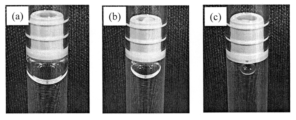
- FIG. 1 shows photographs when the amount of bubbles in the syringe is (a) 120 ⁇ L, (b) 40 ⁇ L, and (c) 10 ⁇ L.
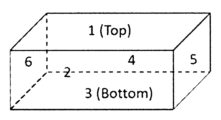
- FIG. 2 is a schematic diagram of a corrugated cardboard box used for the drop test.
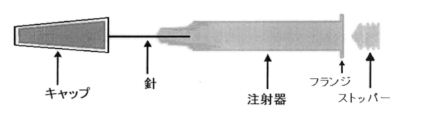
- FIG. 3 is an example of a configuration diagram of a syringe.
- 4 is a histogram of the visually detectable particle sizes of the proteinaceous identified in Example 3.
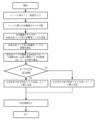
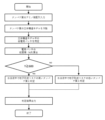
- FIG. FIG. 5 shows the flow of processing when executing a program for a device that determines proteins with a high risk of forming particles in solution based on hydrophobic patches and charge patches.
- FIG. 6 shows the flow of processing when executing a program for a device that determines proteins with a high risk of forming particles in solution based on charge patches.
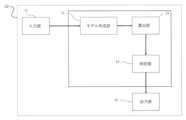
- FIG. 7 shows a schematic block diagram of an apparatus for determining proteins with a high risk of forming particles in solution.
- visually detectable particles are particles that are visually detectable under high illumination and have a particle size of 40 ⁇ m or more.
- particles that can be visually detected under the standard illuminance (approximately 2,000 to 3,000 lx) specified in the Pharmacopoeia are called “visible particles” or "insoluble visible particles.”
- Visible particles generally have a particle size greater than 100 ⁇ m [1]. They are smaller than visible particles and cannot be seen with the naked eye under the standard illumination (approximately 2,000-3,000 lx) specified in the Pharmacopoeia.
- Possible particles are "visually detectable particles only in high illumination” and have a particle size of 40 ⁇ m to 100 ⁇ m. Visible particles are confirmed by visual inspection with the naked eye for 5 seconds or more by gently turning or overturning the container in front of a black or white background under standard illumination (approximately 2,000 to 3,000 lx). be done. Particles that are visually detectable only at high illuminance can be visually inspected with the naked eye under high illuminance (6,000 lx or more) under illumination for at least 30 seconds by gently turning or inverting the container in front of a black background. It is confirmed. Visible particles can also be seen when inspected in high light.
- Microscopic Raman spectroscopy can confirm that the visually detectable particles are protein molecules. Only the active pharmaceutical ingredient (API) is contained as protein in solution, and the visually detectable particles originate from the API.
- the size and number of visually detectable particles can be determined by light shielding particle counting, microscopic particle counting, flow-site particle image analysis, visual inspection, isolated particles followed by infrared spectroscopy (IR). It can be measured by measurement or microscopic Raman spectrometry, preferably by a combination of visual inspection and microscopic infrared spectroscopy or microscopic Raman spectrometry.
- high risk of forming particles in a solution of a pharmaceutical preparation means that protein molecules in the solution tend to aggregate and form visually detectable particles.
- proteins with a high risk of forming particles include proteins that form visually detectable particles even after addition of an appropriate amount of surfactant.
- bubble refers to a gas space between the liquid in the container and the wall surface of the container or in the liquid. It is of such size that it can be seen with the naked eye or by optical microscopy.
- Inside the container for example, in the case of a prefilled syringe with a needle, includes the entire space plugged with a rigid needle shield (RNS) and a stopper, and specifically refers to the space inside the needle and inside the barrel. Less than the entire diameter of the container is in contact with the bottom surface of the lid (eg, stopper) of the container when the container is in a vertical position, but not all of the liquid.
- the bubbles are spherical. In some embodiments, the bubbles are not spherical. In some such embodiments, the bubbles are oval.
- the bubble volume is 120 ⁇ L or less, 110 ⁇ L or less, 100 ⁇ L or less, 90 ⁇ L or less, 80 ⁇ L or less, 70 ⁇ L or less, 60 ⁇ L or less, 50 ⁇ L or less, 40 ⁇ L or less, 30 ⁇ L or less, 20 ⁇ L or less, 10 ⁇ L or less. you can In one aspect of the invention, the bubble volume is measured as the combined bubble volume of all the bubbles contained in the container.
- the volume of air bubbles can be determined by ⁇ actually measuring the volume of air bubbles by expelling the gas and then the solution from the tip of the needle into an appropriate graduated container such as a pipette already containing a solution,'' or ⁇ obtaining an image and measuring the area of the air bubbles. It can be measured by methods such as "calculate the bubble volume” and “calculate the bubble volume from the height of the bubble portion based on the known barrel inner diameter information".
- homology modeling is used to determine proteins with a high risk of forming particles in solution.
- Homology modeling is a method of estimating the three-dimensional structure of a protein having a particular sequence based on sequence similarity to one or more proteins having a known three-dimensional structure. Homology modeling for a particular amino acid sequence typically involves the following steps. 1) identify homologues of known structures in the Protein Data Bank, 2) align the sequence of interest to the template structure, 3) build a model based on that alignment, 4) model evaluation and refinement. (Xiang, Curr Protein Pept Sci. 2006 June; 7(3):217-227). Molecular Operating Environment (MOE; Chemical Computing Group Inc.
- antibody modeling is a three-dimensional structure estimation function and database specialized for monoclonal antibodies.
- the overall structure can be assembled based on the structures of the fragments.
- an antibody Fab fragment can be added to an Fc fragment crystal structure, or a Fab fragment can be formed as a putative protein structure and added to an Fc fragment crystal structure.
- it can be implemented using the functions installed in the MOE.
- a "patch” refers to a surface region of residue clusters that exhibit specific physicochemical properties in the three-dimensional structure of a protein or antibody.
- Patches include hydrophobic patches and charged patches.
- Hydrophobic patches are surface areas where hydrophobic residues are clustered together.
- the portion where hydrophobic residues are clustered may also contain residues other than hydrophobic residues.
- a charge patch is a surface area where charged residues are clustered together.
- the portion where charged residues are clustered may also contain uncharged residues.
- the protein properties function of MOE can calculate the feature amount related to the patch area of the protein, and the area of the patch on the surface of the specific protein is ranked by the area of the hydrophobic patch.
- the risk of protein particle formation is determined based on X+Y ⁇ 1.5.
- a protein having a value of X+Y ⁇ 1.5 of 1700 or more is determined as a protein with a high risk of particle formation.
- proteins with a value of X+Y ⁇ 1.5 of 2000 or more, 2500 or more, 3000 or more, 3500 or more, or 4000 or more are determined to be proteins with a high risk of particle formation.
- the protein properties function of MOE can calculate the feature value for the patch area of the protein, and the area of the patch on the surface of the specific protein can be calculated based on the total charge patch area Y ( ⁇ 2 )
- the particle formation risk of proteins is determined.
- a protein with a Y value of 600 or more is determined as a protein with a high risk of particle formation.
- proteins with a Y value of 700 or more, 800 or more, 900 or more, 1000 or more, 1500 or more, 2000 or more, 2500 or more, 3000 or more, or 4000 or more are determined to be proteins with a high risk of particle formation. .
- the ranking by area of hydrophobic patches is a list of hydrophobic patches observed on the protein surface arranged in order of area.
- a hydrophobic patch consisting of clusters of hydrophobic residues.
- the sum of the areas ( ⁇ 2 ) of the top five hydrophobic patches in the ranking is calculated as X.
- the sum of the areas of the top five hydrophobic patches refers to the total area of the top five hydrophobic patches.
- the number of hydrophobic patches in the molecule is 4 or less, it refers to the total area of all existing hydrophobic patches.
- Total charge patch area means the sum of the areas ( ⁇ 2 ) of all positively or negatively charged charge patches present on the protein surface.
- a "molecular force field” is a parameterized function of what kind of force each atom in a molecule receives.
- the forces acting between atoms are variables that represent the bonds between atoms (bond distance, bond angle, etc.), and the potential determined by the type and bonding mode of atoms. Expressed as a number in a function.
- the forces acting between atoms are variables that represent the bonds between atoms (bond distance, bond angle, etc.), and the potential determined by the type and bonding mode of atoms. Expressed as a number in a function.
- the molecular force field that can be used is not particularly limited and can be appropriately selected according to the purpose.
- the molecular force field of Amber-based molecular force fields include, for example, Amber10/14:EHT, Amber ff99SB-ILDN, and Amber 12SB.
- Examples of the CHARMm-based molecular force field include CHARMm36.
- Amber10:EHT is preferable when using MOE.
- “reduce particle formation” refers to the volume of air bubbles in a solution of a pharmaceutical formulation in which visually detectable particles are formed under predetermined conditions. It refers to preventing the formation of visually detectable particles or reducing the number of particles formed by adjusting the . The reduction in visually detectable particle formation can be confirmed by counting the number of particles before and after adjustment of the bubble volume. The size and number of particles can be determined by light obscuration particle counting, microscopic particle counting, flow site particle image analysis, visual inspection, isolated spectroscopy (IR) or micro Raman spectroscopy after particle isolation. Preferably, it is measured by a combination of visual inspection and microscopic infrared spectroscopy or microscopic Raman spectroscopy.
- the pharmaceutical formulation is a solution containing protein as an active ingredient.
- the pharmaceutical formulation may be an injectable formulation.
- an injectable preparation is a pharmaceutical preparation containing a protein as an active ingredient in a solution, which is filled in an injection container for administration by injection.
- the “obtained injectable formulation” refers to the injectable formulation obtained as the final product after adjusting the bubble volume.
- the pharmaceutical formulation is stored at -30°C to 25°C, preferably the freezing point of the solution to 25°C, more preferably 1°C to 10°C, more preferably 1°C to 10°C, more preferably without freezing the solution in the container.
- proteins used in solution formulations include, but are not limited to, antibodies, fusion proteins, enzymes, hormones, cytokines, vaccines. More specifically, monoclonal antibodies, granular colony-stimulating factor (G-CSF), granular macrophage colony-stimulating factor (GM-CSF), erythropoietin (EPO), interferon, interleukins such as IL-1 and IL-6 , tissue plasminogen activator (TPA), thrombopoietin, urokinase, serum albumin, blood coagulation factor VIII, leptin, stem cell growth factor (SCF), and the like.
- G-CSF granular colony-stimulating factor
- GM-CSF granular macrophage colony-stimulating factor
- EPO erythropoietin
- interferon interleukins such as IL-1 and IL-6
- TPA tissue plasminogen activator
- proteins used in pharmaceutical formulations have substantially the same biological activity as physiologically active proteins of mammals, particularly humans, and are naturally occurring and genetically modified.
- proteins obtained by Proteins obtained by genetic recombination include those that have the same amino acid sequence as the natural protein, or those that have one or more of the amino acid sequences deleted, substituted, or added and have the biological activity described above.
- the concentration of protein in the solution may be greater than or equal to 0.1 mg/mL, in the range of 0.1-300 mg/mL, in the range of 1-200 mg/mL.
- the antibody to be used is not particularly limited as long as it binds to the desired antigen, and may be a polyclonal antibody or a monoclonal antibody, but homogeneous antibodies can be stably produced. Monoclonal antibodies are preferred.
- the antibody used may be a monospecific antibody, a bispecific antibody, or a multispecific antibody having three or more antigen recognition sites in the molecule. may be
- monoclonal antibodies to be used include not only animal-derived monoclonal antibodies such as humans, mice, rats, hamsters, rabbits, sheep, camels, and monkeys, but also chimeric antibodies, humanized antibodies, and biological antibodies. Genetically modified antibodies such as specific antibodies are also included. Furthermore, in order to modify the physical properties of antibody molecules (specifically, isoelectric point (p1) modification, Fc receptor affinity modification, etc.) for the purpose of improving blood retention and pharmacokinetics, antibody It also includes genetically engineered antibodies with artificially modified constant regions and the like.
- the immunoglobulin class of the antibody to be used is not particularly limited, and any class such as IgG such as IgG1, IgG2, IgG3, and IgG4, IgA, IgD, IgE, and IgM can be used.
- IgG is preferred, and IgG1, IgG2 and IgG4 are particularly preferred.
- the antibodies to be used include not only antibodies having a constant region and a variable region (full-length antibodies), but also antibody fragments such as Fv, Fab, F(ab) 2 , antibody variable Single-chain Fv (scFv, sc(Fv) 2 ) with 1 or 2 sites bound by a linker such as a peptide linker and low-molecular-weight antibodies such as bispecific antibodies such as scFv dimers are also included.
- full-length antibodies are preferred.
- the antibodies used can be produced by known methods.
- a hybridoma that produces a monoclonal antibody can be produced basically using a known technique as follows. That is, a desired antigen or cells expressing the desired antigen are used as a sensitizing antigen, immunized according to a conventional immunization method, and the obtained immune cells are fused with known parent cells by a conventional cell fusion method. and screening for monoclonal antibody-producing cells (hybridoma) by a conventional screening method.
- Hybridomas can be produced, for example, according to the method of Milstein et al. (Kohler. G. and Milstein, C., Methods Enzymol. (1981) 73: 3-46).
- immunization may be performed by binding it to an immunogenic macromolecule such as albumin.
- a recombinant antibody produced by cloning an antibody gene from a hybridoma, inserting it into an appropriate vector, introducing it into a host, and producing it using genetic recombination technology can be used (e.g., Carl, A. See K. Borrebaeck, James, W. Larrick, THERAPEUTIC MONOCLONAL ANTIBODIES, Published in the United Kingdom by MACMILLAN PUBLISHERS LTD, 1990).
- V region an antibody variable region is synthesized from hybridoma mRNA using reverse transcriptase.
- the DNA encoding the V region of the antibody of interest is obtained, it is ligated with the DNA encoding the desired antibody constant region (C region) and incorporated into an expression vector.
- the DNA encoding the antibody V region may be incorporated into an expression vector containing the antibody C region DNA. It is incorporated into an expression vector so that it is expressed under the control of an expression control region such as an enhancer or promoter. This expression vector can then be used to transform a host cell to express the antibody.
- artificially modified genetically modified antibodies such as chimeric antibodies and humanized antibodies
- modified antibodies can be produced using known methods.
- a chimeric antibody is an antibody consisting of a non-human mammal, for example, a mouse antibody heavy chain and light chain variable regions and a human antibody heavy chain and light chain constant regions, and a DNA encoding the mouse antibody variable region.
- Humanized antibodies also called reshaped human antibodies, are obtained by grafting the complementarity determining regions (CDRs) of mammals other than humans, such as mouse antibodies, into the complementarity determining regions of human antibodies. and its general gene recombination technique is also known. Specifically, a DNA sequence designed to link the CDRs of a mouse antibody and the framework region (FR) of a human antibody was prepared with several oligos having overlapping portions at the ends. It is synthesized from nucleotides by the PCR method. The resulting DNA is ligated with DNA encoding a human antibody constant region, then incorporated into an expression vector, and introduced into a host for production (see European Patent Application Publication No. 239400, WO 96/02576). ).
- CDRs complementarity determining regions
- the FRs of the human antibody linked via the CDRs are selected such that the complementarity determining regions form good antigen-binding sites. If necessary, amino acids in the framework region of the variable region of the antibody may be substituted so that the complementarity-determining region of the reshaped human antibody forms a suitable antigen-binding site (Sato, K. et al., Cancer Res. (1993) 53, 851-856).
- variable regions of IgG antibodies include humanization (Tsurushita N, Hinton PR, Kumar S., Design of humanized antibodies: from anti-Tac to Zenapax., Methods. 2005 May;36(1):69 -83.), affinity maturation (Rajpal A, Beyaz N, Haber L, Cappuccilli G, Yee H, Bhatt RR, Takeuchi T, by amino acid substitution of complementarity determining regions (CDRs) to enhance binding activity.
- CDRs complementarity determining regions
- human lymphocytes are sensitized in vitro with the desired antigen or cells expressing the desired antigen, the sensitized lymphocytes are fused with human myeloma cells such as U266, and the desired human antibody having antigen-binding activity is obtained. can also be obtained (see Japanese Patent Publication No. 1-59878).
- a desired human antibody can be obtained by immunizing a transgenic animal having an entire repertoire of human antibody genes with an antigen (WO 93/12227, WO 92/03918, WO 94/02602, WO 94/ 25585, WO 96/34096, WO 96/33735).
- variable region of a human antibody can be expressed on the surface of phage as a single chain antibody (scFv) by the phage display method, and phage that bind to the antigen can be selected. Genetic analysis of the selected phage allows determination of the DNA sequence encoding the variable region of the human antibody that binds to the antigen. Once the DNA sequence of the scFv that binds to the antigen is revealed, a suitable expression vector containing the sequence can be constructed to obtain a human antibody.
- scFv single chain antibody
- the antibodies used also include such human antibodies.
- animal cells When antibody genes are isolated once and introduced into a suitable host to produce an antibody, a combination of a suitable host and an expression vector can be used.
- animal cells include (1) mammalian cells such as CHO, COS, myeloma, BHK (baby hamster kidney), HeLa, Vero, (2) amphibian cells such as Xenopus laevis oocytes, or (3) insect cells. , for example, sf9, sf21, Tn5, etc. are known.
- plant cells cells derived from the genus Nicotiana, for example, Nicotiana tabacum, are known, and callus culture of these cells can be performed.
- yeasts such as the genus Saccharomyces, such as Saccharomyces cerevisiae, filamentous fungi such as the genus Aspergillus, such as Aspergillus niger.
- prokaryotic cells there are production systems using bacterial cells.
- bacterial cells E. coli and Bacillus subtilis are known.
- Antibodies can be obtained by introducing the desired antibody gene into these cells by transformation and culturing the transformed cells in vitro.
- antibodies used in pharmaceutical formulations include modified antibodies.
- antibodies conjugated to various molecules such as polyethylene glycol (PEG) and cytotoxic agents can also be used (Farmaco. 1999 Aug 30;54(8): 497-516. Cancer J. 2008 May-Jun 14(3):154-69).
- modified antibodies can be obtained by chemically modifying antibodies. These methods are already established in this field.
- the antibodies in the present disclosure may be chimeric antibodies.
- Chimeric antibodies are described, for example, in US Patent No. 4,816,567 and Morrison et al., Proc. Natl. Acad. Sci. USA, 81:6851-6855 (1984).
- a chimeric antibody may comprise a non-human variable region (eg, a variable region derived from a non-human primate such as a monkey, or a mouse, rat, hamster, rabbit, etc.) and a human constant region.
- the antibodies in the present disclosure may be humanized antibodies.
- non-human antibodies are humanized to reduce immunogenicity in humans while maintaining the specificity and affinity of the parent non-human antibody.
- a humanized antibody comprises one or more variable regions, including CDRs (or portions thereof) derived from HVRs, e.g., non-human antibodies, and FRs (or portions thereof) derived from human antibody sequences (or part) exists.
- a humanized antibody optionally can also comprise at least a portion of a human constant region.
- the amino acid residues of the FRs in the humanized antibody are modified from those of a non-human antibody (e.g., the antibody from which the HVR residues are derived), e.g., to maintain or improve antibody specificity and affinity. It may be substituted with the corresponding amino acid residue.
- a non-human antibody e.g., the antibody from which the HVR residues are derived
- human frameworks that would be used for humanization were selected using, for example, the "best fit” method (Sims et al. J. Immunol. 151:2296 (1993)).
- Frameworks frameworks derived from the consensus sequences of certain subgroups of human antibodies of the heavy or light chain variable region (Carter et al. Proc. Natl. Acad. Sci. USA, 89:4285 (1992) and Presta et al. J. Immunol., 151:2623 (1993)), which may include framework regions derived from screening of FR libraries (Baca et al., J. Biol. Chem. 272:10678-10684 (1997) and Rosok et al., J. Biol. Chem. 271:22611-22618 (1996)).
- the antibodies in the present disclosure may be human antibodies.
- Human antibodies can be produced by a variety of techniques. Human antibodies are reviewed, for example, in van Dijk and van de Winkel, Curr. Opin. Pharmacol. 5: 368-374 (2001) and Lonberg, Curr. Opin. Immunol. 20:450-459 (2008). Human antibodies may be prepared by administering an immunogen to transgenic animals that have been modified to produce fully human antibodies or fully antibodies with human variable regions in response to an antigen.
- Such animals typically contain all or part of a human immunoglobulin locus, wherein all or part of the human immunoglobulin locus replaces the endogenous immunoglobulin locus, or is extrachromosomally or It exists in a state of being randomly incorporated into the chromosome of the animal.
- the endogenous immunoglobulin loci are usually inactivated.
- human antibodies can also be produced by hybridoma-based methods.
- Human myeloma cells and mouse-human heteromyeloma cell lines for the production of human monoclonal antibodies are described in (e.g., Kozbor J. Immunol., 133: 3001 (1984); Brodeur et al., Monoclonal Antibody Production Techniques and Applications, pp.51-63 (Marcel Dekker, Inc., New York, 1987); and Boerner et al., J. Immunol., 147: 86 (1991)).
- Human antibodies generated via human B-cell hybridoma technology are described in Li et al., Proc. Natl. Acad. Sci.
- human antibodies can also be generated by isolating Fv clone variable domain sequences selected from human-derived phage display libraries. Such variable region sequences can then be combined with the desired human constant region. See below for methods of selecting human antibodies from antibody libraries.
- antibodies in the present disclosure may be isolated by screening combinatorial libraries for antibodies having the desired activity or activities.
- methods for making phage display libraries and screening such libraries for antibodies with desired binding properties are known in the art. Such methods are reviewed in Hoogenboom et al. in Methods in Molecular Biology 178:1-37 (O'Brien et al., ed., Human Press, Totowa, NJ, 2001) and also, for example, McCafferty et al., Nature 348:552-554; Clackson et al., Nature 352: 624-628 (1991); Marks et al., J. Mol. Biol.
- the VH and VL repertoires can be separately cloned by polymerase chain reaction (PCR) and randomly recombined in a phage library to form the phage Libraries may be screened for antigen-binding phage as described in Winter et al., Ann. Rev. Immunol., 12: 433-455 (1994). Phage display antibody fragments such as scFv and Fab. Libraries from immunized sources can provide high affinity antibodies to the immunogen without the need to construct hybridomas.
- PCR polymerase chain reaction
- a naive repertoire (e.g., from humans) is cloned without immunization to provide a broad spectrum of Antibodies from a single source can also be provided to any non-self or self antigen.
- naive libraries are cloned pre-rearranged V-gene segments from stem cells as described in Hoogenboom and Winter, J. Mol. Biol., 227: 381-388 (1992). , can also be made synthetically by using PCR primers that encode the hypervariable region CDR3 and contain randomized sequences to achieve rearrangement in vitro. ⁇ US Patent No.
- Antibodies or antibody fragments isolated from human antibody libraries are considered human antibodies or human antibody fragments herein.
- the antibodies in this disclosure are multispecific antibodies (eg, bispecific antibodies).
- Multispecific antibodies are antibodies (eg, monoclonal antibodies) that have binding specificities for at least two different sites.
- one of the binding specificities is for an antigen and the other is for a different antigen.
- bispecific antibodies may bind to two different epitopes of an antigen.
- Bispecific antibodies may be used to localize cytotoxic agents to cells which express the antigen.
- Bispecific antibodies can be prepared as full length antibodies or as antibody fragments.
- Multispecific antibodies include, but are not limited to, recombinant co-expression of two immunoglobulin heavy chain-light chain pairs with different specificities (eg, Milstein and Cuello, Nature 305: 537 (1983), WO93 /08829, and Traunecker et al., EMBO J. 10:3655 (1991)), and knob-in-hole technology (eg US Patent No. 5,731,168).
- Multispecific antibodies are engineered by electrostatic steering effects to create Fc heterodimeric molecules (e.g. WO2009/089004A1); bridging two or more antibodies or antibody fragments ( US Patent No.
- antibodies may be engineered to have more than two functional antigen binding sites, including "octopus antibodies” (eg US2006/0025576).
- the antibody or antibody fragment thereof in the present disclosure is a "dual-acting Fab” or “DAF” that contains one antigen-binding site that binds an antigen and another, different antigen (eg US2008/0069820).
- the antibody amino acid sequence variants (mutants) of the present disclosure are prepared by introducing appropriate modifications into nucleic acids encoding antibody molecules or by synthesizing peptides. obtain. Such modifications may be carried out by appropriately combining one or more arbitrary deletions, insertions and substitutions of arbitrary amino acids (residues) in the amino acid sequence. Any combination of deletion, insertion, substitution can be used so long as the final construct possesses the desired characteristics (eg, antigen binding).
- target sites for substitutional mutagenesis may include HVR and FR.
- Antibodies used in pharmaceutical formulations include anti-tissue factor antibodies, anti-IL-6 receptor antibodies, anti-IL-6 antibodies, anti-glypican-3 antibodies, anti-CD3 antibodies, anti-CD20 antibodies, anti-GPIIb/IIIa antibodies, anti-TNF Antibody, anti-CD25 antibody, anti-EGFR antibody, anti-Her2/neu antibody, anti-RSV antibody, anti-CD33 antibody, anti-CD52 antibody, anti-IgE antibody, anti-CD11a antibody, anti-VEGF antibody, anti-VLA4 antibody, anti-HM1.24 antigen antibody , anti-parathyroid hormone-related peptide antibody (anti-PTHrP antibody), anti-ganglioside GM3 antibody, anti-TPO receptor agonist antibody, coagulation factor VIII surrogate antibody, anti-IL31 receptor antibody, anti-HLA antibody, anti-AXL
- Preferred reshaped humanized antibodies for use in pharmaceutical formulations include humanized anti-interleukin 6 (IL-6) receptor antibodies (tocilizumab, hPM-1 or MRA, see WO92/19759), humanized anti-HM1.24 antigen monoclonal.
- IL-6 interleukin 6
- hPM-1 or MRA humanized anti-HM1.24 antigen monoclonal.
- pharmaceutical formulations can be prepared by mixing with appropriate pharmaceutically acceptable carriers, vehicles, etc., as necessary, to form solution formulations.
- the solvent for solution formulations is water or a pharmaceutically acceptable organic solvent.
- organic solvents include propylene glycol (1,2-propanediol), polyethylene glycol 300, polyethylene glycol 400, ethanol, glycerol, acetic acid and the like.
- Suitable pharmaceutically acceptable carriers and media include, for example, sterile water, physiological saline, stabilizers, antioxidants (ascorbic acid, etc.), buffers (phosphoric acid, citric acid, histidine, other organic acids, etc.), preservatives, surfactants (PEG, Tween, etc.), chelating agents (EDTA, etc.), binders and the like.
- low molecular weight polypeptides proteins such as serum albumin, gelatin and immunoglobulins, amino acids such as glycine, glutamine, asparagine, glutamic acid, aspartic acid, methionine, arginine and lysine, sugars and carbohydrates such as polysaccharides and monosaccharides , sugar alcohols such as mannitol and sorbitol.
- Injection solutions include, for example, physiological saline, isotonic solutions containing glucose and other adjuvants, such as D-sorbitol, D-mannose, D-mannitol and sodium chloride.
- Adjuvants such as alcohols (ethanol, etc.), polyalcohols (propylene glycol, PEG, etc.), nonionic surfactants (polysorbate 80, polysorbate 20, poloxamer 188, HCO-50) and the like may be used in combination.
- buffers used in solution formulations are prepared using substances to maintain the pH of the solution.
- the pH of the solution in the high-concentration antibody-containing solution formulation, is preferably 4.5 to 7.5, more preferably 5.0 to 7.0. More preferably 5 to 6.5.
- the buffering agents that can be used are those that can adjust the pH in this range and are pharmaceutically acceptable.
- buffers are known to those skilled in the art of solution formulation and include inorganic salts such as phosphate (sodium or potassium), sodium bicarbonate; citrate (sodium or potassium), sodium acetate, succinate Organic acid salts such as sodium phosphate; or acids such as phosphoric acid, carbonic acid, citric acid, succinic acid, malic acid, gluconic acid and the like can be used.
- inorganic salts such as phosphate (sodium or potassium), sodium bicarbonate; citrate (sodium or potassium), sodium acetate, succinate Organic acid salts such as sodium phosphate; or acids such as phosphoric acid, carbonic acid, citric acid, succinic acid, malic acid, gluconic acid and the like can be used.
- Tris and Good's buffers such as MES, MOPS, HEPES, histidine (eg histidine hydrochloride), glycine and the like may be used.
- the concentration of the buffering agent is generally 1-500 mmol/L, preferably 5-100 mmol/L, more preferably 10-20 mmol/L.
- the buffer preferably contains 5-25 mmol/L histidine, more preferably 10-20 mmol/L histidine.
- the high-concentration antibody-containing solution formulation is preferably stabilized by adding a suitable stabilizer for the antibody, which is the active ingredient.
- the "stable" high-concentration antibody-containing solution formulations are stored at refrigerated temperatures (2-8°C) for at least 12 months, preferably 2 years, more preferably 3 years; °C) for at least 3 months, preferably 6 months, more preferably 1 year, no significant changes are observed.
- the total amount of dimers and degradation products after storage at 5 ° C. for 2 years is 5.0% or less, preferably 2% or less, more preferably 1.5% or less, or after storage at 25 ° C. for 6 months
- the total amount of dimers and degradation products is 5.0% or less, preferably 2% or less, more preferably 1.5% or less.
- surfactants include nonionic surfactants such as sorbitan fatty acid esters such as sorbitan monocaprylate, sorbitan monolaurate, sorbitan monopalmitate; glycerin monocaprylate, glycerin monomyritate.
- nonionic surfactants such as sorbitan fatty acid esters such as sorbitan monocaprylate, sorbitan monolaurate, sorbitan monopalmitate; glycerin monocaprylate, glycerin monomyritate.
- glycerin fatty acid esters such as glycerin monostearate; polyglycerin fatty acid esters such as decaglyceryl monostearate, decaglyceryl distearate, decaglyceryl monolinoleate; polyoxyethylene sorbitan monolaurate, polyoxyethylene sorbitan monooleate , polyoxyethylene sorbitan monostearate, polyoxyethylene sorbitan monopalmitate, polyoxyethylene sorbitan trioleate, polyoxyethylene sorbitan fatty acid esters such as polyoxyethylene sorbitan tristearate; polyoxyethylene sorbitan tetrastearate, polyoxy polyoxyethylene sorbitol fatty acid esters such as ethylene sorbitol tetraoleate; polyoxyethylene glycerin fatty acid esters such as polyoxyethylene glyceryl monostearate; polyethylene glycol fatty acid esters such as polyethylene glycol distearate; Oxyethylene alky
- polyoxyethylene alkylphenyl ether polyoxyethylene hydrogenated castor oil such as polyoxyethylene castor oil, polyoxyethylene hydrogenated castor oil (polyoxyethylene hydrogenated castor oil); polyoxyethylene beeswax derivatives such as polyoxyethylene sorbitol beeswax; Polyoxyethylene lanolin derivatives such as polyoxyethylene lanolin; polyoxyethylene fatty acid amides such as polyoxyethylene stearamide having HLB 6-18; anionic surfactants such as sodium cetyl sulfate, sodium lauryl sulfate, oleyl Alkyl sulfates having an alkyl group of 10 to 18 carbon atoms, such as sodium sulfate; sodium polyoxyethylene lauryl sulfate, etc., having an average number of added moles of ethylene oxide of 2 to 4 and an alkyl group having 10 to 18 carbon atoms; certain polyoxyethylene alkyl ether sulfates; alkyl sulfosuccinate salts
- Preferred surfactants are polyoxyethylene sorbitan fatty acid esters and polyoxyethylene polyoxypropylene alkyl ethers, particularly preferred are polysorbates 20, 21, 40, 60, 65, 80, 81, 85 and Pluronic type Surfactants, most preferred are Polysorbate 20, 80 and Pluronic® F-68 (Poloxamer 188).
- the amount of surfactant added to the antibody formulation is generally 0.0001 to 10% (mg/mL), preferably 0.001 to 5%, more preferably is 0.005 to 3%.
- the formulation of the present invention may optionally contain a cryoprotectant, a suspending agent, a solubilizing agent, a tonicity agent, a preservative, an antiadsorption agent, a diluent, an excipient, a pH adjuster, and a soothing agent.
- a cryoprotectant e.g., a cryoprotectant, a suspending agent, a solubilizing agent, a tonicity agent, a preservative, an antiadsorption agent, a diluent, an excipient, a pH adjuster, and a soothing agent.
- a cryoprotectant e.g., a suspending agent, e.g., a solubilizing agent, e.glycerin, glycerin, glycerin, glycerin, a glycerin, a glycerin, a glycerin, a glycerin, a glycer
- cryoprotectants include saccharides such as trehalose, sucrose and sorbitol.
- solution adjuvants include polyoxyethylene hydrogenated castor oil, polysorbate 80, nicotinic acid amide, polyoxyethylene sorbitan monolaurate, tuna gol, and castor oil fatty acid ethyl ester.
- isotonizing agents include sodium chloride, potassium chloride, calcium chloride and the like.
- preservatives include methyl parahydroxybenzoate, ethyl parahydroxybenzoate, sorbic acid, phenol, cresol, and chlorocresol.
- antiadsorption agents examples include human serum albumin, lecithin, dextran, ethylene oxide/propylene oxide copolymer, hydroxypropyl cellulose, methyl cellulose, polyoxyethylene hydrogenated castor oil, and polyethylene glycol.
- Sulfur-containing reducing agents such as N-acetylcysteine, N-acetylhomocysteine, thioctic acid, thiodiglycol, thioethanolamine, thioglycerol, thiosorbitol, thioglycolic acid and salts thereof, sodium thiosulfate, glutathione, carbon atoms Those having a sulfhydryl group such as thioalkanoic acids of numbers 1 to 7 can be mentioned.
- Antioxidants such as erythorbic acid, dibutylhydroxytoluene, butylhydroxyanisole, ⁇ -tocopherol, tocopherol acetate, L-ascorbic acid and its salts, L-ascorbic acid palmitate, L-ascorbic acid stearate, sodium bisulfite, sulfurous acid
- Chelating agents such as sodium, triamyl gallate, propyl gallate or disodium ethylenediaminetetraacetate (EDTA), sodium pyrophosphate, sodium metaphosphate and the like are included.
- the pharmaceutical formulation is for the treatment of autoimmune diseases, immune diseases, infectious diseases, inflammatory diseases, nervous system diseases, and tumor and neoplastic diseases, including cancer.
- the use of the medicament is for congestive heart failure (CHF), ischemia-induced severe arrhythmia, hypercholesterolemia, vasculitis, rosacea, acne, eczema, myocarditis and other conditions of the heart muscle.
- CHF congestive heart failure
- ischemia-induced severe arrhythmia hypercholesterolemia
- vasculitis vasculitis
- rosacea rosacea
- acne eczema
- myocarditis myocarditis and other conditions of the heart muscle.
- Kawasaki disease systemic lupus erythematosus, diabetes, spondylosis, synovial fibroblasts, and bone marrow stroma; bone loss; Paget's disease, giant cell tumor of bone; breast cancer; , Gaucher's disease, Langerhans cell histiocytosis, spinal cord injury, acute suppurative arthritis, osteomalacia, Cushing's syndrome, fibrous dysplasia monoskeletal, fibrous dysplasia multiosteal fibrosis, periodontal ligament remodeling, and Fractures; sarcoidosis; melanoma, prostate cancer, pancreatic cancer, osteolytic bone cancer, breast cancer, lung cancer, gastric cancer, renal cancer, and rectal cancer; bone metastases, bone pain management, and humoral malignant hypercalcemia, ankylosis spondylitis, as well as other spondyloarthropathies; transplant rejection, viral infections, hematologic neoplasms, and neoplastic-
- Cervical cancer ovarian cancer, primary liver cancer, or endometrial cancer, as well as tumors of the vascular system (angiosarcoma and hemangiopericytoma), osteoporosis, hepatitis, HIV, AIDS, spondyloarthritis, rheumatoid arthritis, inflammatory bowel disease ( IBD), sepsis and septic shock, Crohn's disease, psoriasis, scleroderma, graft-versus-host disease (GVHD), allogeneic islet graft rejection, multiple myeloma (MM), myelodysplastic syndrome (MDS) , and hematological malignancies such as acute myelogenous leukemia (AML), tumor-associated inflammation, peripheral nerve injury, or demyelinating diseases.
- vascular system angiosarcoma and hemangiopericytoma
- osteoporosis hepatitis
- HIV AIDS
- the medicament is used for psoriasis vulgaris, pancreatitis, ulcerative colitis, non-Hodgkin's lymphoma, breast cancer, colorectal cancer, mesothelioma, soft tissue sarcoma, juvenile idiopathic arthritis, macular degeneration, respiratory Organ syncytial virus, Crohn's disease, rheumatoid arthritis, psoriatic arthritis, Castleman's disease, ankylosing spondylitis, osteoporosis, treatment-induced bone loss, bone metastases, multiple myeloma, Alzheimer's disease, glaucoma, Sjögren's disease, For the treatment of Still's disease, multiple sclerosis, hyperimmunoglobulinemia, anemia, mesangial proliferative nephritis, and asthma.
- the antigen to which the antibody has specific binding properties can be a transmembrane molecule (eg, receptor) or a ligand such as a growth factor.
- exemplary antigens include molecules such as renin; growth hormones, including human growth hormone and bovine growth hormone; growth hormone releasing factor; parathyroid hormone; calcitonin; luteinizing hormone; glucagon; coagulation factors such as factor VIIIC, factor IX, tissue factor (TF) and von Willebrand factor; anticoagulant factors such as protein C; pulmonary surfactant; plasminogen activators such as urokinase or human urinary or tissue-type plasminogen activator (t-PA); bombesin; thrombin; ⁇ and - ⁇ ; enkephalinase; RANTES (regulated on activation normally T-cell expressed and secreted); human macrophage inflammatory protein (MIP-1- ⁇ ); serum albumin such as human serum albumin; mouse gonadotropin-related peptid
- exemplary molecular targets for antibodies encompassed include CD proteins such as CD3, CD4, CD8, CD19, CD20, CD22, CD34 and CD40; EGF receptor, HER2, HER3 or HER4 members of the ErbB receptor family, such as receptors; B cell surface antigens such as CD20 or BR3; members of the tumor necrosis receptor superfamily, including DR5; prostate stem cell antigen (PSCA); LFA-1, Mac1, p150.95, Cell adhesion molecules such as VLA-4, ICAM-1, VCAM, ⁇ 4/ ⁇ 7 integrins, and ⁇ v/ ⁇ 3 integrins containing either their ⁇ or ⁇ subunits (e.g.
- anti-CD11a, anti-CD18 or anti-CD11b antibodies growth factors such as VEGF and its receptors; tissue factor (TF); tumor necrosis factors (TNF) such as TNF-alpha or TNF-beta, alpha-interferon (alpha-IFN); interleukins such as IL-8; IgE; blood group antigen; flk2/flk3 receptor; obesity (OB) receptor; mp1 receptor; CTLA-4;
- containers filled with pharmaceutical formulations include syringes and cartridges.
- a "prefilled syringe” means a syringe in which a syringe as a container is filled with a liquid composition.
- the pre-filled syringe is filled with a pharmaceutical composition for administration to a patient.
- the syringe may be capped by a syringe closure, such as, but not limited to, a stopper.
- the composition is filled into syringes at a manufacturing filling facility.
- the syringe is sterilized prior to filling the composition into the syringe.
- the prefilled syringe is administered 1 day, or at least 7 days, or at least 14 days, or at least 1 month, or at least 6 months, or at least 1 year, or at least 2 years prior to administration of the composition to the patient. has a retention period of In some embodiments, the pre-filled syringe is exposed to storage and/or shipping conditions.
- prefilled syringes are exposed to mechanical stress.
- Mechanical stress includes, but is not limited to, drop stress, vibration stress, and rotational stress.
- the pre-filled syringe is 1, 2, 3, 4, 5, 6, 7, 8, 9, 10, 11, 12, 13 times , 14, 15, 16, 17, 18, 19, 20, 21, 22, 23, 24, 25, 25 or more, 30 or more, or 40 or more exposed to fall stress.
- the stress applied to the prefilled syringe when dropped varies depending on the height, orientation, etc., in addition to the number of drops.
- the drop height is, for example, but not limited to, 38.1 cm as described in American Society for Testing and Materials (ASTM) D4169.
- the prefilled syringe may be properly packed so that the orientation of the prefilled syringe does not change during the drop.
- packing include "put into a tray and stack the trays", "pack the stacked trays in cardboard numbered as shown in Fig. 2, and pack the stacked trays in the cardboard so that the needle tip of the prefilled syringe faces surface 2". but not limited to this.
- a prefilled syringe as shown in FIG. 3, includes a syringe for administering a drug. Also, the prefilled syringe has a stopper that is inserted into the syringe. Additionally, the prefilled syringe includes an injection needle connected to the syringe. A prefilled syringe has a cap that caps the injection needle.
- a drug is a liquid drug, for example, a protein formulation.
- the syringe includes a cylindrically-shaped barrel having a distal end and a proximal end. Also, the syringe is substantially cylindrical.
- a barrel is a member that contains a drug inside.
- the barrel of this embodiment includes a distal end and a proximal end, as well as a cylindrical portion connecting the distal end and the proximal end (see FIG. 3). Further, the barrel has a flange portion extending outward (diametrically outward direction of the tubular portion) from the entire outer circumference of the other end of the tubular portion in the axial direction of the tubular portion.
- the barrel is transparent and made of a material that can withstand the internal pressure applied when administering the drug.
- the material of the barrel is a resin that simply includes repeating cyclic olefins such as norbornene.
- the material of the barrel is a transparent resin such as COP (cycloolefin polymer), which is a homopolymer of cyclic olefin, or COC (cycloolefin copolymer), which is a copolymer of cyclic olefin and ethylene.
- COP cyclolefin polymer
- COC cycloolefin copolymer
- the barrel may be made of PP (polypropylene) or glass.
- the inner surface of the barrel (for example, the inner surface of the cylindrical portion) may be coated with silicone oil as a lubricant in order to suppress the sliding resistance of the piston against the inner surface of the barrel.
- the silicone oil is polydimethylsiloxane.
- Some exemplary polydimethylsiloxanes include, for example, Dow Corning® 360 Medical Fluid with a viscosity of 350 centistokes; Dow Corning® 360 Medical Fluid with a viscosity of 1000 centistokes; Dow Corning® 360 Medical Fluid, including but not limited to Dow Corning® 360 Medical Fluid that is 12,500 centistokes and Dow Corning® MDX4-4159 fluid .
- the size (standard) of the capacity of the syringe is not particularly limited. Specifically, in one aspect of the present invention, the advantageous effect is remarkable in the case of a small size syringe with a capacity of 0.5 mL to 5.0 mL, preferably 1 mL. Also, the volume of the solution contained within a 1 mL standard syringe is in the range of 0.1 to 1.2 mL, preferably in the range of 0.2 to 1.1 mL. The volume of solution contained within a 2.5 mL standard syringe is in the range of 0.1-2.5 mL, preferably in the range of 0.3-2.3 mL.
- the volume of the aqueous solution contained within a 1 mL standard syringe is in the range of 0.1 to 1.2 mL, preferably in the range of 0.2 to 1.1 mL.
- the volume of aqueous solution contained within a 2.5 mL standard syringe is in the range of 0.1-2.5 mL, preferably in the range of 0.3-2.3 mL.
- the size (standard) of the cartridge capacity is not particularly limited.
- the volume may be from 0.5 mL to 20.0 mL, such as 1.0 mL, 1.5 mL, 1.8 mL, 2.0 mL, 2.2 mL, 3.0 mL, 5.0 mL, 10. It may be 0 mL, 15.0 mL, 20.0 mL, but is not limited to these amounts.
- the cartridge used is a standard injection cartridge made of plastic or glass.
- the dimensions and tolerances of glass injection cartridges are specified in the international standard ISO 13926-1. Stoppers and seals (caps and discs) are described in standard international standards ISO 13926-2 and 3. Dimensions and tolerances for ready-filled or pre-filled syringes are defined in international standard ISO 11040-4.
- the cartridge used is a plastic or glass injection cartridge that meets one or more of the above international standards.
- the cartridges used are plastic or glass injection cartridges that do not meet international standards such as ISO.
- the system comprises means for creating a three-dimensional structural model of a protein from the amino acid sequence of the protein by homology modeling or antibody modeling, a portion of the surface of the obtained model where hydrophobic residues are accumulated in clusters, and , the portions where charged residues are accumulated in clusters are specified as hydrophobic patches and charged patches, respectively, and a means for calculating the area of each, and the top five hydrophobicity rankings according to the size of the area
- the system is a system for implementing a method for determining a protein with a high risk of forming particles in a solution, and the program described below is implemented by an apparatus for determination, a computer It can be implemented by installing it in the etc.
- the program is a program that causes a computer to operate each means in the system, and in a pharmaceutical formulation containing a protein in solution as an active ingredient, a protein with a high risk of forming particles in solution
- the computer program can be used as the determination device by installing it in the general-purpose device.
- the computer program does not necessarily need to be installed in the determination device, and can be provided by being stored in a recording medium, for example.
- the "recording medium” is a medium capable of carrying a program that cannot occupy space by itself. ), DVD-R, DVD-RW, flash memory, and the like.
- a computer program can also be transmitted from a computer storing the computer program to another computer or device through a communication line.
- computer programs include computer programs stored on such computers and computer programs in transmission.
- the present invention determines proteins with a high risk of forming particles in solution based on hydrophobic patches and charge patches in pharmaceutical formulations containing proteins in solution as active ingredients.
- the present invention relates to a program used in a device or stored in a recording medium.
- the program includes means for creating a three-dimensional structural model of a protein from the amino acid sequence of the protein by homology modeling or antibody modeling, a portion of the surface of the obtained model where hydrophobic residues are clustered, and , the portions where charged residues are accumulated in clusters are specified as hydrophobic patches and charged patches, respectively, and a means for calculating the area of each, and the top five hydrophobicity rankings according to the size of the area
- the apparatus or computer is caused to execute a means for determining a high-risk protein.
- This computer program cannot occupy space by itself, but can be stored in an information recording medium and distributed.
- the "information recording medium” includes, for example, a flexible disk, hard disk, CD-ROM, CD-R, CD-RW, MO (magneto-optical disk), MD, DVD-R, DVD-RW, flash memory, Such as an IC card.
- the computer program can be installed in a memory such as an HDD in the device. It is also possible to transmit the computer program from another computer storing this computer program to the device through a communication line and install it in a memory such as an internal HDD.
- FIG. 5 shows the flow of processing performed by the apparatus when executing the computer program for the apparatus for determining proteins with a high risk of forming particles in solution.
- the CPU of the device reads the computer program for the device stored in the memory such as the HDD of the device, and creates a three-dimensional model of the protein from the amino acid sequence of the protein by homology modeling or antibody modeling. Next, the CPU reads the computer program, and from the created model, a portion where hydrophobic residues are clustered and a portion where charged residues are clustered are identified.
- Identify the hydrophobic patch and the charged patch calculate the area of each, and sum the area of the top five hydrophobic patches (X ( ⁇ 2 )) in ranking by area size, and the total area of the charged patch ( Y( ⁇ 2 )) is calculated.
- the CPU reads the computer program, and determines proteins with X+Y ⁇ 1.5 equal to or greater than 1700 as proteins with a high risk of forming particles in solution.
- a device or recording for determining a protein with a high risk of forming particles in solution based on an electric charge patch. It relates to a program stored in a medium and used.
- the program comprises a means for creating a three-dimensional structural model of a protein from the amino acid sequence of the protein by homology modeling or antibody modeling, and a portion of the surface of the obtained model where charged residues are accumulated in clusters.
- the means for creating the model described above is executed by the model creation unit.
- Means for identifying the charge patches and calculating the total charge patch area (Y( ⁇ 2 )) are implemented in the calculator.
- Means for judging a protein with a Y value of 600 or more as a protein with a high risk of forming particles in a solution is carried out in the judging section. Each of these procedures is executed by the CPU reading a computer program stored in the HDD, for example.
- This computer program cannot occupy space by itself, but can be stored in an information recording medium and distributed.
- the "information recording medium” includes, for example, a flexible disk, hard disk, CD-ROM, CD-R, CD-RW, MO (magneto-optical disk), MD, DVD-R, DVD-RW, flash memory, Such as an IC card.
- These information recording media can be connected to a data input/output unit of an apparatus for determining proteins with a high risk of forming particles in solution, and a computer program can be installed in a memory such as an HDD in the apparatus. It is also possible to transfer the computer program from another computer storing this computer program to the above via a communication line and install it in a memory such as an internal HDD.
- FIG. 6 shows the flow of processing performed by the apparatus when executing the computer program for the apparatus for determining proteins with a high risk of forming particles in solution.
- the CPU of the device reads the computer program for the device stored in the memory such as the HDD of the device, and creates a three-dimensional model of the protein from the amino acid sequence of the protein by homology modeling or antibody modeling.
- the CPU reads the computer program, identifies portions where charged residues are clustered from the created model as charge patches, and charges patch total area (Y ( ⁇ 2 )) Calculate Next, proteins with a Y value of 600 or more are determined as proteins with a high risk of forming particles in solution.
- Example 1 Counting Visually Detectable Particles mAb1 (H Chain/SEQ ID NO: 1, L Chain/SEQ ID NO: 2; Tocilizumab), mAb2 (H Chain/SEQ ID NOS: 3 and 4: Common L Chain: SEQ ID NO: 5 ), mAb3 (H chain/SEQ ID NO: 6, L chain/SEQ ID NO: 7) and mAb4 (humanized bispecific antibody with blood coagulation factor VIII (FVIII) cofactor function-substituting activity), mAb5 (anti latent myostatin sweeping humanized antibody), mAb6 (H chain/SEQ ID NO:8 and L chain/SEQ ID NO:9 combination, and H chain/SEQ ID NO:11 and L chain/SEQ ID NO:10 combination; anti-HLA-DQ2.5 Humanized bispecific antibody), antibody-containing solution (mAb1-6: 50 mg/mL, buffer: 20 mmol/L histidine, stabilizer: 150 mmol/L arginine and 162
- Visually detectable particle evaluation 1 was performed on the filled and capped samples immediately after capping, and samples judged to contain visually detectable particles in the syringe were excluded. Ten samples were tested for each antibody, but mAb-6 had a higher degree of instability than other antibodies, and the frequency of particles that could be visually detected immediately after filling was extremely high. was tested. Samples with bubble volumes of 120 ⁇ L and 10 ⁇ L were prepared by adjusting the stopper position of the syringe based on the calibration curve created by the following bubble volume measurement and setting method. Visually Detectable Particle Rating 2 was performed on each bubble volume sample after 1 day storage at 5°C.
- [Visually detectable particle evaluation 1] Clean the outer surface of the sample syringe container and perform a visual inspection with the naked eye for about 30 seconds by gently swirling or overturning the syringe in front of a black background at a brightness of about 10000 lx directly below a white light source. The presence or absence of visually detectable particles in the solution filled in the syringe was examined by performing a test.
- [Visually detectable particle evaluation 2] Clean the outer surface of the sample syringe container and perform a visual inspection for approximately 30 seconds by gently swirling or tipping the syringe in front of a black background at a brightness of approximately 8000 lx directly below a white light source. was examined for the presence or absence of visually detectable particles in the solution filled in the syringe. For samples in which the presence of visually detectable particles was observed, gently swirl or tip over in front of a black background at a brightness of approximately 8000 lx directly below a white light source, and visually inspect the inside of the syringe with the naked eye. The number of detectable particles was counted.
- Example 2 Determination of conditions with high risk of forming particles 1 .
- Chains VL, VH options are used for monospecific antibodies, Chains: bispecific options are used for some bispecific antibodies, and Ig Immunoglobulin is used for Model type.
- Residues that were not included in the mAb2 and mAb3 antibody sequences but were automatically complemented by MOE were deleted, and energy minimization was performed for the deleted peripheral residues. For mAb1, no particular residue deletion was performed.
- the unit for expressing the area of any feature quantity is ⁇ 2 .
- Example 1 Table 4 shows the relationship between the average number of visually detectable particles per syringe and "Patch_hyd_5+(Patch_ion*1.5)" for the sample with a bubble volume of 120 ⁇ L shown in Table 2.
- the degree of reduction in the average number of visually detectable particles (visually detectable particle reduction rate) It has been shown.
- Example 3 Visually detectable particle formation confirmation test for mAb2 Solution containing mAb2 (mAb2: 150 mg / mL, buffer: 20 mmol / L histidine, stabilizer: 150 mmol / L arginine and about 162 mmol / L After filtering aspartic acid, surfactant: 0.5 mg/mL poloxamer 188, pH 6.0) with a 0.22 ⁇ m filter, 1.0 mL of The solution was filled and capped with a stopper. Visually detectable particle evaluation 1 was performed on the filled and capped samples immediately after capping, and samples judged to contain visually detectable particles in the syringe were excluded.
- Example 2 Based on the calibration curve obtained in Example 1, the position of the stopper of the syringe was adjusted to obtain the desired bubble volume shown in Table 5. Samples of each bubble volume were stored at 5°C for about 7 months, then stored at 25°C, and then stored at 25°C for 6 weeks. During the storage period at 25° C., mechanical stress described below was applied three times, and visually detectable particle evaluation 2 was performed after 6 weeks had passed. For samples in which the presence of visually detectable particles was observed, identification of visually detectable particles was performed by Raman spectroscopy using a Raman Imaging Microscope (DXR2xi) to confirm that the particles were derived from mAb2. bottom.
- DXR2xi Raman Imaging Microscope
- a histogram of the visually detectable particle sizes of the identified proteins is shown in Figure 4.
- the size range of the proteinaceous visually detectable particles was 46.0-279 ⁇ m.
- Example 4 mAb3 visible particle formation confirmation test mAb3-containing solution (mAb3: 120 mg / mL, buffer: 20 mmol / L histidine, stabilizer: 150 mmol / L arginine and about 162 mmol / L aspartic acid, interface Active agent: 0.5 mg/mL poloxamer 188, pH 6.0) was filtered through a 0.22 ⁇ m filter, and 1.0 mL was filled into a 27G needle-equipped COP syringe (1 mL standard) sterilized by radiation (25 kGy), It was plugged with a stopper.
- the filled and capped samples were subjected to visible particle evaluation 1 immediately after capping, and samples judged to contain visible particles in the syringe were excluded. Based on the calibration curve obtained in Example 1, the target bubble volume shown in Table 7 was obtained by adjusting the stopper position of the syringe. For each bubble volume sample, a mechanical stress was applied at the start of the test, and after storage at 40° C. for 60 days, visible particle evaluation 2 was performed under the same conditions as visible particle evaluation 1 in this example.
- Vibration stress A syringe sample was placed in the tub and the tub was positioned so that the barrel of the syringe was perpendicular to the ground. Vibrational stress was applied to the tab at the intensity of Truck Low 40 min, Truck Middle 15 min, Truck High 5 min, and Air level II 120 min.
- Example 5 Visually Detectable Particle Formation Test for mAb3 mAb3-containing solution (mAb3: 120 mg/mL, buffer: 20 mmol/L histidine, stabilizer: 150 mmol/L arginine and 162 mmol/L asparagine Acid, surfactant: 0.5 mg/mL poloxamer 188, pH 6.0) was filtered through a 0.22 ⁇ m filter, and then 2.0 mL of solution was placed in a 27G COP syringe with a needle (2.25 mL standard) sterilized by radiation (25 kGy). was filled and capped with a stopper.
- Visually detectable particle evaluation 1 was performed on the filled and capped samples immediately after capping, and samples judged to contain visually detectable particles in the syringe were excluded.
- the desired bubble volume shown in Table 9 was adjusted by adjusting the stopper position of the syringe based on the calibration curve prepared by the following bubble volume measurement/setting method.
- Visually Detectable Particle Rating 2 was performed on samples of each bubble volume after approximately 3 months of storage at 25°C. During storage, mechanical stress was applied three times in total, at the start of storage, two weeks after the start of storage, and three weeks after the start of storage.
Landscapes
- Health & Medical Sciences (AREA)
- Chemical & Material Sciences (AREA)
- Life Sciences & Earth Sciences (AREA)
- General Health & Medical Sciences (AREA)
- Medicinal Chemistry (AREA)
- Engineering & Computer Science (AREA)
- Public Health (AREA)
- Pharmacology & Pharmacy (AREA)
- Animal Behavior & Ethology (AREA)
- Veterinary Medicine (AREA)
- Bioinformatics & Cheminformatics (AREA)
- Immunology (AREA)
- Epidemiology (AREA)
- Organic Chemistry (AREA)
- Chemical Kinetics & Catalysis (AREA)
- General Chemical & Material Sciences (AREA)
- Biophysics (AREA)
- Proteomics, Peptides & Aminoacids (AREA)
- Nuclear Medicine, Radiotherapy & Molecular Imaging (AREA)
- Physics & Mathematics (AREA)
- Biochemistry (AREA)
- Molecular Biology (AREA)
- Spectroscopy & Molecular Physics (AREA)
- Medical Informatics (AREA)
- Oil, Petroleum & Natural Gas (AREA)
- Genetics & Genomics (AREA)
- Hematology (AREA)
- Microbiology (AREA)
- Mycology (AREA)
- Bioinformatics & Computational Biology (AREA)
- Biotechnology (AREA)
- Evolutionary Biology (AREA)
- Theoretical Computer Science (AREA)
- Heart & Thoracic Surgery (AREA)
- Vascular Medicine (AREA)
- Anesthesiology (AREA)
- Biomedical Technology (AREA)
- Inorganic Chemistry (AREA)
- Crystallography & Structural Chemistry (AREA)
- Dermatology (AREA)
Priority Applications (10)
| Application Number | Priority Date | Filing Date | Title |
|---|---|---|---|
| MX2024004117A MX2024004117A (es) | 2021-10-08 | 2022-10-06 | Metodo para preparar formulacion de jeringa precargada. |
| US18/698,507 US20240404622A1 (en) | 2021-10-08 | 2022-10-06 | Method for preparing prefilled syringe formulation |
| IL311956A IL311956A (en) | 2021-10-08 | 2022-10-06 | Method for preparing a prefilled syringe formulation |
| JP2023552944A JPWO2023058723A1 (https=) | 2021-10-08 | 2022-10-06 | |
| CA3233924A CA3233924A1 (en) | 2021-10-08 | 2022-10-06 | Method for preparing prefilled syringe formulation |
| AU2022361184A AU2022361184A1 (en) | 2021-10-08 | 2022-10-06 | Method for preparing prefilled syringe formulation |
| CN202280065093.9A CN118019549A (zh) | 2021-10-08 | 2022-10-06 | 预灌封注射器制剂的制备方法 |
| EP22878590.3A EP4413998A4 (en) | 2021-10-08 | 2022-10-06 | METHOD FOR PREPARING A PRE-FILLED SYRINGE FORMULATION |
| KR1020247014321A KR20240082388A (ko) | 2021-10-08 | 2022-10-06 | 프리필드 시린지 제제의 조제 방법 |
| JP2025017506A JP2025072514A (ja) | 2021-10-08 | 2025-02-05 | プレフィルドシリンジ製剤の調製方法 |
Applications Claiming Priority (4)
| Application Number | Priority Date | Filing Date | Title |
|---|---|---|---|
| JP2021-166336 | 2021-10-08 | ||
| JP2021166336 | 2021-10-08 | ||
| JP2022042112 | 2022-03-17 | ||
| JP2022-042112 | 2022-03-17 |
Publications (1)
| Publication Number | Publication Date |
|---|---|
| WO2023058723A1 true WO2023058723A1 (ja) | 2023-04-13 |
Family
ID=85804301
Family Applications (2)
| Application Number | Title | Priority Date | Filing Date |
|---|---|---|---|
| PCT/JP2022/037469 Ceased WO2023058723A1 (ja) | 2021-10-08 | 2022-10-06 | プレフィルドシリンジ製剤の調製方法 |
| PCT/JP2022/037375 Ceased WO2023058705A1 (ja) | 2021-10-08 | 2022-10-06 | 抗hla-dq2.5抗体の製剤 |
Family Applications After (1)
| Application Number | Title | Priority Date | Filing Date |
|---|---|---|---|
| PCT/JP2022/037375 Ceased WO2023058705A1 (ja) | 2021-10-08 | 2022-10-06 | 抗hla-dq2.5抗体の製剤 |
Country Status (11)
| Country | Link |
|---|---|
| US (1) | US20240404622A1 (https=) |
| EP (1) | EP4413998A4 (https=) |
| JP (2) | JPWO2023058723A1 (https=) |
| KR (1) | KR20240082388A (https=) |
| AR (1) | AR127269A1 (https=) |
| AU (1) | AU2022361184A1 (https=) |
| CA (1) | CA3233924A1 (https=) |
| IL (1) | IL311956A (https=) |
| MX (1) | MX2024004117A (https=) |
| TW (2) | TW202323810A (https=) |
| WO (2) | WO2023058723A1 (https=) |
Cited By (1)
| Publication number | Priority date | Publication date | Assignee | Title |
|---|---|---|---|---|
| WO2024248119A1 (ja) * | 2023-05-31 | 2024-12-05 | 富士フイルム株式会社 | 生産物の生産方法 |
Citations (54)
| Publication number | Priority date | Publication date | Assignee | Title |
|---|---|---|---|---|
| US4676980A (en) | 1985-09-23 | 1987-06-30 | The United States Of America As Represented By The Secretary Of The Department Of Health And Human Services | Target specific cross-linked heteroantibodies |
| EP0239400A2 (en) | 1986-03-27 | 1987-09-30 | Medical Research Council | Recombinant antibodies and methods for their production |
| JPS6459878A (en) | 1987-08-31 | 1989-03-07 | Matsushita Electric Industrial Co Ltd | Semiconductor laser protective circuit |
| US4816567A (en) | 1983-04-08 | 1989-03-28 | Genentech, Inc. | Recombinant immunoglobin preparations |
| WO1992001047A1 (en) | 1990-07-10 | 1992-01-23 | Cambridge Antibody Technology Limited | Methods for producing members of specific binding pairs |
| WO1992003918A1 (en) | 1990-08-29 | 1992-03-19 | Genpharm International, Inc. | Transgenic non-human animals capable of producing heterologous antibodies |
| WO1992019759A1 (fr) | 1991-04-25 | 1992-11-12 | Chugai Seiyaku Kabushiki Kaisha | Anticorps humains reconstitues diriges contre un recepteur de l'interleukine 6 humaine |
| WO1992020791A1 (en) | 1990-07-10 | 1992-11-26 | Cambridge Antibody Technology Limited | Methods for producing members of specific binding pairs |
| WO1993006213A1 (en) | 1991-09-23 | 1993-04-01 | Medical Research Council | Production of chimeric antibodies - a combinatorial approach |
| WO1993008829A1 (en) | 1991-11-04 | 1993-05-13 | The Regents Of The University Of California | Compositions that mediate killing of hiv-infected cells |
| WO1993011236A1 (en) | 1991-12-02 | 1993-06-10 | Medical Research Council | Production of anti-self antibodies from antibody segment repertoires and displayed on phage |
| WO1993012227A1 (en) | 1991-12-17 | 1993-06-24 | Genpharm International, Inc. | Transgenic non-human animals capable of producing heterologous antibodies |
| WO1993019172A1 (en) | 1992-03-24 | 1993-09-30 | Cambridge Antibody Technology Limited | Methods for producing members of specific binding pairs |
| WO1994002602A1 (en) | 1992-07-24 | 1994-02-03 | Cell Genesys, Inc. | Generation of xenogeneic antibodies |
| WO1994025585A1 (en) | 1993-04-26 | 1994-11-10 | Genpharm International, Inc. | Transgenic non-human animals capable of producing heterologous antibodies |
| WO1995001438A1 (en) | 1993-06-30 | 1995-01-12 | Medical Research Council | Sbp members with a chemical moiety covalently bound within the binding site; production and selection thereof |
| WO1995015388A1 (en) | 1993-12-03 | 1995-06-08 | Medical Research Council | Recombinant binding proteins and peptides |
| WO1996002576A1 (en) | 1994-07-13 | 1996-02-01 | Chugai Seiyaku Kabushiki Kaisha | Reconstituted human antibody against human interleukin-8 |
| WO1996033735A1 (en) | 1995-04-27 | 1996-10-31 | Abgenix, Inc. | Human antibodies derived from immunized xenomice |
| WO1996034096A1 (en) | 1995-04-28 | 1996-10-31 | Abgenix, Inc. | Human antibodies derived from immunized xenomice |
| US5731168A (en) | 1995-03-01 | 1998-03-24 | Genentech, Inc. | Method for making heteromultimeric polypeptides |
| WO1998013388A1 (en) | 1996-09-26 | 1998-04-02 | Chugai Seiyaku Kabushiki Kaisha | Antibody against human parathormone related peptides |
| WO1998014580A1 (en) | 1996-10-04 | 1998-04-09 | Chugai Seiyaku Kabushiki Kaisha | Reconstituted human anti-hm1.24 antibody |
| US5750373A (en) | 1990-12-03 | 1998-05-12 | Genentech, Inc. | Enrichment method for variant proteins having altered binding properties, M13 phagemids, and growth hormone variants |
| US5770429A (en) | 1990-08-29 | 1998-06-23 | Genpharm International, Inc. | Transgenic non-human animals capable of producing heterologous antibodies |
| US5821337A (en) | 1991-06-14 | 1998-10-13 | Genentech, Inc. | Immunoglobulin variants |
| WO1999051743A1 (en) | 1998-04-03 | 1999-10-14 | Chugai Seiyaku Kabushiki Kaisha | Humanized antibody against human tissue factor (tf) and process for constructing humanized antibody |
| US6075181A (en) | 1990-01-12 | 2000-06-13 | Abgenix, Inc. | Human antibodies derived from immunized xenomice |
| US6150584A (en) | 1990-01-12 | 2000-11-21 | Abgenix, Inc. | Human antibodies derived from immunized xenomice |
| US20050079574A1 (en) | 2003-01-16 | 2005-04-14 | Genentech, Inc. | Synthetic antibody phage libraries |
| US20050119455A1 (en) | 2002-06-03 | 2005-06-02 | Genentech, Inc. | Synthetic antibody phage libraries |
| US20050266000A1 (en) | 2004-04-09 | 2005-12-01 | Genentech, Inc. | Variable domain library and uses |
| US6982321B2 (en) | 1986-03-27 | 2006-01-03 | Medical Research Council | Altered antibodies |
| WO2006006693A1 (ja) | 2004-07-09 | 2006-01-19 | Chugai Seiyaku Kabushiki Kaisha | 抗グリピカン3抗体 |
| US20060025576A1 (en) | 2000-04-11 | 2006-02-02 | Genentech, Inc. | Multivalent antibodies and uses therefor |
| US7041870B2 (en) | 2000-11-30 | 2006-05-09 | Medarex, Inc. | Transgenic transchromosomal rodents for making human antibodies |
| US7087409B2 (en) | 1997-12-05 | 2006-08-08 | The Scripps Research Institute | Humanization of murine antibody |
| US7189826B2 (en) | 1997-11-24 | 2007-03-13 | Institute For Human Genetics And Biochemistry | Monoclonal human natural antibodies |
| US20070061900A1 (en) | 2000-10-31 | 2007-03-15 | Murphy Andrew J | Methods of modifying eukaryotic cells |
| US20070117126A1 (en) | 1999-12-15 | 2007-05-24 | Genentech, Inc. | Shotgun scanning |
| US20070160598A1 (en) | 2005-11-07 | 2007-07-12 | Dennis Mark S | Binding polypeptides with diversified and consensus vh/vl hypervariable sequences |
| US20070237764A1 (en) | 2005-12-02 | 2007-10-11 | Genentech, Inc. | Binding polypeptides with restricted diversity sequences |
| US20070292936A1 (en) | 2006-05-09 | 2007-12-20 | Genentech, Inc. | Binding polypeptides with optimized scaffolds |
| US20080069820A1 (en) | 2006-08-30 | 2008-03-20 | Genentech, Inc. | Multispecific antibodies |
| US20090002360A1 (en) | 2007-05-25 | 2009-01-01 | Innolux Display Corp. | Liquid crystal display device and method for driving same |
| WO2009041613A1 (ja) | 2007-09-26 | 2009-04-02 | Chugai Seiyaku Kabushiki Kaisha | 抗体定常領域改変体 |
| US7527791B2 (en) | 2004-03-31 | 2009-05-05 | Genentech, Inc. | Humanized anti-TGF-beta antibodies |
| WO2009072604A1 (ja) | 2007-12-05 | 2009-06-11 | Chugai Seiyaku Kabushiki Kaisha | 抗nr10抗体、およびその利用 |
| WO2009089004A1 (en) | 2008-01-07 | 2009-07-16 | Amgen Inc. | Method for making antibody fc-heterodimeric molecules using electrostatic steering effects |
| JP2011519347A (ja) * | 2008-02-07 | 2011-07-07 | アムジエン・インコーポレーテツド | 安定化されたタンパク質組成物 |
| WO2012067176A1 (ja) | 2010-11-17 | 2012-05-24 | 中外製薬株式会社 | 血液凝固第viii因子の機能を代替する機能を有する多重特異性抗原結合分子 |
| US20170304445A1 (en) * | 2016-04-20 | 2017-10-26 | Coherus Biosciences, Inc. | Method of filling a container with no headspace |
| WO2017188356A1 (ja) * | 2016-04-28 | 2017-11-02 | 中外製薬株式会社 | 抗体含有製剤 |
| WO2020202839A1 (ja) * | 2019-03-29 | 2020-10-08 | 中外製薬株式会社 | 抗il-6受容体抗体を含有するbbb機能低下の抑制剤 |
Family Cites Families (88)
| Publication number | Priority date | Publication date | Assignee | Title |
|---|---|---|---|---|
| JP3101690B2 (ja) | 1987-03-18 | 2000-10-23 | エス・ビィ・2・インコーポレイテッド | 変性抗体の、または変性抗体に関する改良 |
| US5606040A (en) | 1987-10-30 | 1997-02-25 | American Cyanamid Company | Antitumor and antibacterial substituted disulfide derivatives prepared from compounds possessing a methyl-trithio group |
| US5770701A (en) | 1987-10-30 | 1998-06-23 | American Cyanamid Company | Process for preparing targeted forms of methyltrithio antitumor agents |
| EP0368684B2 (en) | 1988-11-11 | 2004-09-29 | Medical Research Council | Cloning immunoglobulin variable domain sequences. |
| DE3920358A1 (de) | 1989-06-22 | 1991-01-17 | Behringwerke Ag | Bispezifische und oligospezifische, mono- und oligovalente antikoerperkonstrukte, ihre herstellung und verwendung |
| CA2026147C (en) | 1989-10-25 | 2006-02-07 | Ravi J. Chari | Cytotoxic agents comprising maytansinoids and their therapeutic use |
| US5208020A (en) | 1989-10-25 | 1993-05-04 | Immunogen Inc. | Cytotoxic agents comprising maytansinoids and their therapeutic use |
| US5959177A (en) | 1989-10-27 | 1999-09-28 | The Scripps Research Institute | Transgenic plants expressing assembled secretory antibodies |
| US5571894A (en) | 1991-02-05 | 1996-11-05 | Ciba-Geigy Corporation | Recombinant antibodies specific for a growth factor receptor |
| GB9114948D0 (en) | 1991-07-11 | 1991-08-28 | Pfizer Ltd | Process for preparing sertraline intermediates |
| US7018809B1 (en) | 1991-09-19 | 2006-03-28 | Genentech, Inc. | Expression of functional antibody fragments |
| FI941572A7 (fi) | 1991-10-07 | 1994-05-27 | Oncologix Inc | Anti-erbB-2-monoklonaalisten vasta-aineiden yhdistelmä ja käyttömenete lmä |
| CA2372813A1 (en) | 1992-02-06 | 1993-08-19 | L.L. Houston | Biosynthetic binding protein for cancer marker |
| DK0752248T3 (da) | 1992-11-13 | 2000-11-13 | Idec Pharma Corp | Terapeutisk anvendelse af kimæriske og radioaktivt mærkede antistoffer mod humant B-lymfocytbegrænset differentieringsantig |
| US5635483A (en) | 1992-12-03 | 1997-06-03 | Arizona Board Of Regents Acting On Behalf Of Arizona State University | Tumor inhibiting tetrapeptide bearing modified phenethyl amides |
| US5780588A (en) | 1993-01-26 | 1998-07-14 | Arizona Board Of Regents | Elucidation and synthesis of selected pentapeptides |
| AU691811B2 (en) | 1993-06-16 | 1998-05-28 | Celltech Therapeutics Limited | Antibodies |
| DE122009000068I2 (de) | 1994-06-03 | 2011-06-16 | Ascenion Gmbh | Verfahren zur Herstellung von heterologen bispezifischen Antikörpern |
| US5773001A (en) | 1994-06-03 | 1998-06-30 | American Cyanamid Company | Conjugates of methyltrithio antitumor agents and intermediates for their synthesis |
| US5789199A (en) | 1994-11-03 | 1998-08-04 | Genentech, Inc. | Process for bacterial production of polypeptides |
| US5840523A (en) | 1995-03-01 | 1998-11-24 | Genetech, Inc. | Methods and compositions for secretion of heterologous polypeptides |
| US5869046A (en) | 1995-04-14 | 1999-02-09 | Genentech, Inc. | Altered polypeptides with increased half-life |
| US5714586A (en) | 1995-06-07 | 1998-02-03 | American Cyanamid Company | Methods for the preparation of monomeric calicheamicin derivative/carrier conjugates |
| US5712374A (en) | 1995-06-07 | 1998-01-27 | American Cyanamid Company | Method for the preparation of substantiallly monomeric calicheamicin derivative/carrier conjugates |
| US6267958B1 (en) | 1995-07-27 | 2001-07-31 | Genentech, Inc. | Protein formulation |
| GB9603256D0 (en) | 1996-02-16 | 1996-04-17 | Wellcome Found | Antibodies |
| ATE299938T1 (de) | 1997-05-02 | 2005-08-15 | Genentech Inc | Ein verfahren zur herstellung multispezifischer antikörper die heteromultimere und gemeinsame komponenten besitzen |
| US6171586B1 (en) | 1997-06-13 | 2001-01-09 | Genentech, Inc. | Antibody formulation |
| ES2244066T3 (es) | 1997-06-24 | 2005-12-01 | Genentech, Inc. | Procedimiento y composiciones de glicoproteinas galactosiladas. |
| US6040498A (en) | 1998-08-11 | 2000-03-21 | North Caroline State University | Genetically engineered duckweed |
| AU759779B2 (en) | 1997-10-31 | 2003-05-01 | Genentech Inc. | Methods and compositions comprising glycoprotein glycoforms |
| DK1071700T3 (da) | 1998-04-20 | 2010-06-07 | Glycart Biotechnology Ag | Glykosylerings-modifikation af antistoffer til forbedring af antistofafhængig cellulær cytotoksicitet |
| PL209392B1 (pl) | 1999-01-15 | 2011-08-31 | Genentech Inc | Przeciwciało, komórka gospodarza, sposób wytwarzania przeciwciała oraz zastosowanie przeciwciała |
| CA2704600C (en) | 1999-04-09 | 2016-10-25 | Kyowa Kirin Co., Ltd. | A method for producing antibodies with increased adcc activity |
| ES2248127T3 (es) | 1999-10-04 | 2006-03-16 | Medicago Inc. | Metodo para regular la transcripcion de genes foraneos en presencia de nigtrogeno. |
| US7125978B1 (en) | 1999-10-04 | 2006-10-24 | Medicago Inc. | Promoter for regulating expression of foreign genes |
| EP1229125A4 (en) | 1999-10-19 | 2005-06-01 | Kyowa Hakko Kogyo Kk | PROCESS FOR PREPARING A POLYPEPTIDE |
| AU767394C (en) | 1999-12-29 | 2005-04-21 | Immunogen, Inc. | Cytotoxic agents comprising modified doxorubicins and daunorubicins and their therapeutic use |
| US6946292B2 (en) | 2000-10-06 | 2005-09-20 | Kyowa Hakko Kogyo Co., Ltd. | Cells producing antibody compositions with increased antibody dependent cytotoxic activity |
| US7064191B2 (en) | 2000-10-06 | 2006-06-20 | Kyowa Hakko Kogyo Co., Ltd. | Process for purifying antibody |
| CA2953239A1 (en) | 2000-10-06 | 2002-04-18 | Kyowa Hakko Kirin Co., Ltd. | Antibody composition-producing cell |
| NZ571596A (en) | 2001-08-03 | 2010-11-26 | Glycart Biotechnology Ag | Antibody glycosylation variants having increased antibody-dependent cellular cytotoxicity |
| CA2463879C (en) | 2001-10-25 | 2012-12-04 | Genentech, Inc. | Glycoprotein compositions |
| US20040093621A1 (en) | 2001-12-25 | 2004-05-13 | Kyowa Hakko Kogyo Co., Ltd | Antibody composition which specifically binds to CD20 |
| EP1500400A4 (en) | 2002-04-09 | 2006-10-11 | Kyowa Hakko Kogyo Kk | MEDICAMENT WITH ANTIBODY COMPOSITION |
| CA2481925A1 (en) | 2002-04-09 | 2003-10-16 | Kyowa Hakko Kogyo Co., Ltd. | Therapeutic agent for patients having human fc.gamma.riiia |
| ATE503829T1 (de) | 2002-04-09 | 2011-04-15 | Kyowa Hakko Kirin Co Ltd | Zelle mit erniedrigter oder deletierter aktivität eines am gdp-fucosetransport beteiligten proteins |
| EP1498490A4 (en) | 2002-04-09 | 2006-11-29 | Kyowa Hakko Kogyo Kk | PROCESS FOR PREPARING ANTIBODY COMPOSITION |
| BR0309145A (pt) | 2002-04-09 | 2005-02-01 | Kyowa Hakko Kogyo Kk | Células das quais o genoma é modificado |
| CA2481658A1 (en) | 2002-04-09 | 2003-10-16 | Kyowa Hakko Kogyo Co., Ltd. | Method of enhancing of binding activity of antibody composition to fcy receptor iiia |
| US7217797B2 (en) | 2002-10-15 | 2007-05-15 | Pdl Biopharma, Inc. | Alteration of FcRn binding affinities or serum half-lives of antibodies by mutagenesis |
| US7361740B2 (en) | 2002-10-15 | 2008-04-22 | Pdl Biopharma, Inc. | Alteration of FcRn binding affinities or serum half-lives of antibodies by mutagenesis |
| TWI335821B (en) | 2002-12-16 | 2011-01-11 | Genentech Inc | Immunoglobulin variants and uses thereof |
| US20060104968A1 (en) | 2003-03-05 | 2006-05-18 | Halozyme, Inc. | Soluble glycosaminoglycanases and methods of preparing and using soluble glycosaminogly ycanases |
| US7871607B2 (en) | 2003-03-05 | 2011-01-18 | Halozyme, Inc. | Soluble glycosaminoglycanases and methods of preparing and using soluble glycosaminoglycanases |
| JPWO2005035586A1 (ja) | 2003-10-08 | 2007-11-22 | 協和醗酵工業株式会社 | 融合蛋白質組成物 |
| JPWO2005035778A1 (ja) | 2003-10-09 | 2006-12-21 | 協和醗酵工業株式会社 | α1,6−フコシルトランスフェラーゼの機能を抑制するRNAを用いた抗体組成物の製造法 |
| US9296820B2 (en) | 2003-11-05 | 2016-03-29 | Roche Glycart Ag | Polynucleotides encoding anti-CD20 antigen binding molecules with increased Fc receptor binding affinity and effector function |
| EP2478912B1 (en) | 2003-11-06 | 2016-08-31 | Seattle Genetics, Inc. | Auristatin conjugates with anti-HER2 or anti-CD22 antibodies and their use in therapy |
| WO2005053742A1 (ja) | 2003-12-04 | 2005-06-16 | Kyowa Hakko Kogyo Co., Ltd. | 抗体組成物を含有する医薬 |
| DK1791565T3 (en) | 2004-09-23 | 2016-08-01 | Genentech Inc | Cysteingensplejsede antibodies and conjugates |
| JO3000B1 (ar) | 2004-10-20 | 2016-09-05 | Genentech Inc | مركبات أجسام مضادة . |
| AU2006232287B2 (en) | 2005-03-31 | 2011-10-06 | Chugai Seiyaku Kabushiki Kaisha | Methods for producing polypeptides by regulating polypeptide association |
| EP2009101B1 (en) | 2006-03-31 | 2017-10-25 | Chugai Seiyaku Kabushiki Kaisha | Antibody modification method for purifying bispecific antibody |
| CN104761637B (zh) | 2006-03-31 | 2021-10-15 | 中外制药株式会社 | 调控抗体血液动力学的方法 |
| US20080226635A1 (en) | 2006-12-22 | 2008-09-18 | Hans Koll | Antibodies against insulin-like growth factor I receptor and uses thereof |
| DE102007001370A1 (de) | 2007-01-09 | 2008-07-10 | Curevac Gmbh | RNA-kodierte Antikörper |
| ES2593484T3 (es) | 2007-03-29 | 2016-12-09 | Genmab A/S | Anticuerpos biespecíficos y métodos de producción de los mismos |
| EP2144931A2 (en) | 2007-04-04 | 2010-01-20 | The Government Of The U.S.A, As Represented By The Secretary, Dept. Of Health And Human Services | Monoclonal antibodies against dengue and other viruses with deletion in fc region |
| JP5545814B2 (ja) | 2007-06-18 | 2014-07-09 | 中外製薬株式会社 | 抗体依存性細胞障害活性を模擬する抗体の結合活性測定法 |
| US8227577B2 (en) | 2007-12-21 | 2012-07-24 | Hoffman-La Roche Inc. | Bivalent, bispecific antibodies |
| WO2011028952A1 (en) | 2009-09-02 | 2011-03-10 | Xencor, Inc. | Compositions and methods for simultaneous bivalent and monovalent co-engagement of antigens |
| HRP20241208T1 (hr) | 2010-04-20 | 2024-11-22 | Genmab A/S | Heterodimerni proteini koji sadrže fc fragment protutijela i postupci za njihovu proizvodnju |
| CN103261220B (zh) | 2010-08-16 | 2016-06-15 | 诺夫免疫股份有限公司 | 用于生成多特异性和多价抗体的方法 |
| ES2758994T3 (es) | 2010-11-05 | 2020-05-07 | Zymeworks Inc | Diseño anticuerpo heterodimérico estable con mutaciones en el dominio Fc |
| WO2012093704A1 (ja) | 2011-01-07 | 2012-07-12 | 中外製薬株式会社 | 抗体の物性を改善させる方法 |
| CN109134658B (zh) | 2011-10-31 | 2022-10-14 | 中外制药株式会社 | 控制了重链与轻链的缔合的抗原结合分子 |
| BR112014010580B1 (pt) | 2011-11-04 | 2021-01-12 | Zymeworks, Inc. | constructo de fc heteromultimérico isolado, composição, uso de um constructo de fc heteromultimérico isolado, composição de ácido nucléico e método para expressar o constructo de fc heteromultimérico isolado |
| IN2015DN01299A (https=) | 2012-07-23 | 2015-07-03 | Zymeworks Inc | |
| CA2972393A1 (en) * | 2015-02-27 | 2016-09-01 | Chugai Seiyaku Kabushiki Kaisha | Composition for treating il-6-related diseases |
| JP7082484B2 (ja) | 2015-04-01 | 2022-06-08 | 中外製薬株式会社 | ポリペプチド異種多量体の製造方法 |
| US20200040085A1 (en) | 2017-02-27 | 2020-02-06 | Chugai Seiyaku Kabushiki Kaisha | Anti-hla-dq2.5/8 antibody and its use for the treatment of celiac disease |
| PE20210005A1 (es) | 2017-09-29 | 2021-01-05 | Chugai Pharmaceutical Co Ltd | Molecula de union al antigeno multiespecifica que tiene actividad de sustitucion de la funcion de cofactor del factor viii de coagulacion de sangre (fviii) y formulacion farmaceutica que contiene tal molecula como ingrediente activo |
| CN117777294A (zh) | 2017-10-03 | 2024-03-29 | 中外制药株式会社 | 抗hla-dq2.5抗体 |
| GB201809341D0 (en) * | 2018-06-07 | 2018-07-25 | Ucb Biopharma Sprl | Multi-domain proteins with increased native state colloidal stability |
| HRP20240488T1 (hr) * | 2018-07-27 | 2024-07-05 | F. Hoffmann - La Roche Ag | Postupak punjenja barem jednog otplinjenog gotovog lijeka u spremnike i uređaj za punjenje gotovog lijeka |
| WO2020204054A1 (en) * | 2019-04-01 | 2020-10-08 | Chugai Seiyaku Kabushiki Kaisha | Anti-hla-dq2.5 antibody |
| KR20230116942A (ko) * | 2020-09-18 | 2023-08-04 | 추가이 세이야쿠 가부시키가이샤 | 항hla-dq2.5 항체 및 셀리악병의 치료를 위한 그의사용 |
-
2022
- 2022-10-06 EP EP22878590.3A patent/EP4413998A4/en active Pending
- 2022-10-06 JP JP2023552944A patent/JPWO2023058723A1/ja active Pending
- 2022-10-06 WO PCT/JP2022/037469 patent/WO2023058723A1/ja not_active Ceased
- 2022-10-06 KR KR1020247014321A patent/KR20240082388A/ko active Pending
- 2022-10-06 IL IL311956A patent/IL311956A/en unknown
- 2022-10-06 MX MX2024004117A patent/MX2024004117A/es unknown
- 2022-10-06 TW TW111137979A patent/TW202323810A/zh unknown
- 2022-10-06 AU AU2022361184A patent/AU2022361184A1/en active Pending
- 2022-10-06 CA CA3233924A patent/CA3233924A1/en active Pending
- 2022-10-06 US US18/698,507 patent/US20240404622A1/en active Pending
- 2022-10-06 AR ARP220102706A patent/AR127269A1/es unknown
- 2022-10-06 WO PCT/JP2022/037375 patent/WO2023058705A1/ja not_active Ceased
- 2022-10-06 TW TW111137980A patent/TW202333781A/zh unknown
-
2025
- 2025-02-05 JP JP2025017506A patent/JP2025072514A/ja active Pending
Patent Citations (56)
| Publication number | Priority date | Publication date | Assignee | Title |
|---|---|---|---|---|
| US4816567A (en) | 1983-04-08 | 1989-03-28 | Genentech, Inc. | Recombinant immunoglobin preparations |
| US4676980A (en) | 1985-09-23 | 1987-06-30 | The United States Of America As Represented By The Secretary Of The Department Of Health And Human Services | Target specific cross-linked heteroantibodies |
| EP0239400A2 (en) | 1986-03-27 | 1987-09-30 | Medical Research Council | Recombinant antibodies and methods for their production |
| US6982321B2 (en) | 1986-03-27 | 2006-01-03 | Medical Research Council | Altered antibodies |
| JPS6459878A (en) | 1987-08-31 | 1989-03-07 | Matsushita Electric Industrial Co Ltd | Semiconductor laser protective circuit |
| US6075181A (en) | 1990-01-12 | 2000-06-13 | Abgenix, Inc. | Human antibodies derived from immunized xenomice |
| US6150584A (en) | 1990-01-12 | 2000-11-21 | Abgenix, Inc. | Human antibodies derived from immunized xenomice |
| WO1992001047A1 (en) | 1990-07-10 | 1992-01-23 | Cambridge Antibody Technology Limited | Methods for producing members of specific binding pairs |
| WO1992020791A1 (en) | 1990-07-10 | 1992-11-26 | Cambridge Antibody Technology Limited | Methods for producing members of specific binding pairs |
| WO1992003918A1 (en) | 1990-08-29 | 1992-03-19 | Genpharm International, Inc. | Transgenic non-human animals capable of producing heterologous antibodies |
| US5770429A (en) | 1990-08-29 | 1998-06-23 | Genpharm International, Inc. | Transgenic non-human animals capable of producing heterologous antibodies |
| US5750373A (en) | 1990-12-03 | 1998-05-12 | Genentech, Inc. | Enrichment method for variant proteins having altered binding properties, M13 phagemids, and growth hormone variants |
| WO1992019759A1 (fr) | 1991-04-25 | 1992-11-12 | Chugai Seiyaku Kabushiki Kaisha | Anticorps humains reconstitues diriges contre un recepteur de l'interleukine 6 humaine |
| US5821337A (en) | 1991-06-14 | 1998-10-13 | Genentech, Inc. | Immunoglobulin variants |
| WO1993006213A1 (en) | 1991-09-23 | 1993-04-01 | Medical Research Council | Production of chimeric antibodies - a combinatorial approach |
| WO1993008829A1 (en) | 1991-11-04 | 1993-05-13 | The Regents Of The University Of California | Compositions that mediate killing of hiv-infected cells |
| WO1993011236A1 (en) | 1991-12-02 | 1993-06-10 | Medical Research Council | Production of anti-self antibodies from antibody segment repertoires and displayed on phage |
| WO1993012227A1 (en) | 1991-12-17 | 1993-06-24 | Genpharm International, Inc. | Transgenic non-human animals capable of producing heterologous antibodies |
| WO1993019172A1 (en) | 1992-03-24 | 1993-09-30 | Cambridge Antibody Technology Limited | Methods for producing members of specific binding pairs |
| WO1994002602A1 (en) | 1992-07-24 | 1994-02-03 | Cell Genesys, Inc. | Generation of xenogeneic antibodies |
| WO1994025585A1 (en) | 1993-04-26 | 1994-11-10 | Genpharm International, Inc. | Transgenic non-human animals capable of producing heterologous antibodies |
| WO1995001438A1 (en) | 1993-06-30 | 1995-01-12 | Medical Research Council | Sbp members with a chemical moiety covalently bound within the binding site; production and selection thereof |
| WO1995015388A1 (en) | 1993-12-03 | 1995-06-08 | Medical Research Council | Recombinant binding proteins and peptides |
| WO1996002576A1 (en) | 1994-07-13 | 1996-02-01 | Chugai Seiyaku Kabushiki Kaisha | Reconstituted human antibody against human interleukin-8 |
| US5731168A (en) | 1995-03-01 | 1998-03-24 | Genentech, Inc. | Method for making heteromultimeric polypeptides |
| WO1996033735A1 (en) | 1995-04-27 | 1996-10-31 | Abgenix, Inc. | Human antibodies derived from immunized xenomice |
| WO1996034096A1 (en) | 1995-04-28 | 1996-10-31 | Abgenix, Inc. | Human antibodies derived from immunized xenomice |
| WO1998013388A1 (en) | 1996-09-26 | 1998-04-02 | Chugai Seiyaku Kabushiki Kaisha | Antibody against human parathormone related peptides |
| WO1998014580A1 (en) | 1996-10-04 | 1998-04-09 | Chugai Seiyaku Kabushiki Kaisha | Reconstituted human anti-hm1.24 antibody |
| US7189826B2 (en) | 1997-11-24 | 2007-03-13 | Institute For Human Genetics And Biochemistry | Monoclonal human natural antibodies |
| US7087409B2 (en) | 1997-12-05 | 2006-08-08 | The Scripps Research Institute | Humanization of murine antibody |
| WO1999051743A1 (en) | 1998-04-03 | 1999-10-14 | Chugai Seiyaku Kabushiki Kaisha | Humanized antibody against human tissue factor (tf) and process for constructing humanized antibody |
| US20070117126A1 (en) | 1999-12-15 | 2007-05-24 | Genentech, Inc. | Shotgun scanning |
| US20060025576A1 (en) | 2000-04-11 | 2006-02-02 | Genentech, Inc. | Multivalent antibodies and uses therefor |
| US20070061900A1 (en) | 2000-10-31 | 2007-03-15 | Murphy Andrew J | Methods of modifying eukaryotic cells |
| US7041870B2 (en) | 2000-11-30 | 2006-05-09 | Medarex, Inc. | Transgenic transchromosomal rodents for making human antibodies |
| US20050119455A1 (en) | 2002-06-03 | 2005-06-02 | Genentech, Inc. | Synthetic antibody phage libraries |
| US20050079574A1 (en) | 2003-01-16 | 2005-04-14 | Genentech, Inc. | Synthetic antibody phage libraries |
| US7527791B2 (en) | 2004-03-31 | 2009-05-05 | Genentech, Inc. | Humanized anti-TGF-beta antibodies |
| US20050266000A1 (en) | 2004-04-09 | 2005-12-01 | Genentech, Inc. | Variable domain library and uses |
| WO2006006693A1 (ja) | 2004-07-09 | 2006-01-19 | Chugai Seiyaku Kabushiki Kaisha | 抗グリピカン3抗体 |
| US20070160598A1 (en) | 2005-11-07 | 2007-07-12 | Dennis Mark S | Binding polypeptides with diversified and consensus vh/vl hypervariable sequences |
| US20070237764A1 (en) | 2005-12-02 | 2007-10-11 | Genentech, Inc. | Binding polypeptides with restricted diversity sequences |
| US20070292936A1 (en) | 2006-05-09 | 2007-12-20 | Genentech, Inc. | Binding polypeptides with optimized scaffolds |
| US20080069820A1 (en) | 2006-08-30 | 2008-03-20 | Genentech, Inc. | Multispecific antibodies |
| US20090002360A1 (en) | 2007-05-25 | 2009-01-01 | Innolux Display Corp. | Liquid crystal display device and method for driving same |
| WO2009041613A1 (ja) | 2007-09-26 | 2009-04-02 | Chugai Seiyaku Kabushiki Kaisha | 抗体定常領域改変体 |
| WO2009072604A1 (ja) | 2007-12-05 | 2009-06-11 | Chugai Seiyaku Kabushiki Kaisha | 抗nr10抗体、およびその利用 |
| WO2009089004A1 (en) | 2008-01-07 | 2009-07-16 | Amgen Inc. | Method for making antibody fc-heterodimeric molecules using electrostatic steering effects |
| JP2011519347A (ja) * | 2008-02-07 | 2011-07-07 | アムジエン・インコーポレーテツド | 安定化されたタンパク質組成物 |
| JP2015042638A (ja) | 2008-02-07 | 2015-03-05 | アムジエン・インコーポレーテツド | 安定化されたタンパク質組成物 |
| WO2012067176A1 (ja) | 2010-11-17 | 2012-05-24 | 中外製薬株式会社 | 血液凝固第viii因子の機能を代替する機能を有する多重特異性抗原結合分子 |
| US20170304445A1 (en) * | 2016-04-20 | 2017-10-26 | Coherus Biosciences, Inc. | Method of filling a container with no headspace |
| WO2017184880A1 (en) | 2016-04-20 | 2017-10-26 | Coherus Biosciences, Inc. | A method of filling a container with no headspace |
| WO2017188356A1 (ja) * | 2016-04-28 | 2017-11-02 | 中外製薬株式会社 | 抗体含有製剤 |
| WO2020202839A1 (ja) * | 2019-03-29 | 2020-10-08 | 中外製薬株式会社 | 抗il-6受容体抗体を含有するbbb機能低下の抑制剤 |
Non-Patent Citations (66)
| Title |
|---|
| "Totowa, NJ", 2003, HUMAN PRESS |
| ALMAGROFRANSSON, FRONT. BIOSCI., vol. 13, 2008, pages 1619 - 1633 |
| BACA ET AL., J. BIOL. CHEM., vol. 272, 1997, pages 10678 - 10684 |
| BATES ET AL., PROTEINS: STRUCTURE, FUNCTION AND GENETICS, vol. 5, 2001, pages 39 - 46 |
| BOERNER ET AL., J. IMMUNOL., vol. 147, 1991, pages 60 |
| BRENNAN ET AL., SCIENCE, vol. 229, 1985, pages 81 |
| BRODEUR ET AL.: "Monoclonal Antibody Production Techniques and Applications", 1987, MARCEL DEKKER, INC., pages: 51 - 63 |
| CANCER J., vol. 14, no. 3, May 2008 (2008-05-01), pages 154 - 69 |
| CARL, A. K. BORREBAECKJAMES, W. LARRICK: "THERAPEUTIC MONOCLONAL ANTIBODIES", 1990, MACMILLAN PUBLISHERS LTD. |
| CARTER ET AL., PROC. NATL. ACAD. SCI. USA, vol. 89, 1992, pages 4285 |
| CORNELL ET AL., J. AM. CHEM. SOC., vol. 117, 1995, pages 5179 - 5197 |
| DALL'ACQUA ET AL., METHODS, vol. 36, 2005, pages 61 - 68 |
| EWERT S.HONEGGER A.PLUCKTHUN A.: "Stability improvement of antibodies for extracellular and intracellular applications: CDR grafting to stable frameworks and structure-based framework engineering", METHODS, vol. 34, no. 2, October 2004 (2004-10-01), pages 184 - 99, XP004526805, DOI: 10.1016/j.ymeth.2004.04.007 |
| FARMACO, vol. 54, no. 8, 30 August 1999 (1999-08-30), pages 497 - 516 |
| FELLOUSE, PROC. NATL. ACAD. SCI. USA, vol. 101, no. 34, 2004, pages 12467 - 12472 |
| FUKUDA, MASAKAZU: "Approaches to Issues on Aggregates and High Viscosity in Development of Highly Concentrated Antibody Drug Products ", JOURNAL OF PHARMACEUTICAL MACHINERY AND ENGINEERING, vol. 27, no. 2, 1 January 2018 (2018-01-01), pages 83 - 92, XP009546255, ISSN: 2186-3237 * |
| GERHARDT ALANA, NGUYEN BAO H., LEWUS RACHAEL, CARPENTER JOHN F., RANDOLPH THEODORE W.: "Effect of the Siliconization Method on Particle Generation in a Monoclonal Antibody Formulation in Pre-filled Syringes", JOURNAL OF PHARMACEUTICAL SCIENCES, AMERICAN CHEMICAL SOCIETY AND AMERICAN PHARMACEUTICAL ASSOCIATION, US, vol. 104, no. 5, 1 May 2015 (2015-05-01), US , pages 1601 - 1609, XP093055422, ISSN: 0022-3549, DOI: 10.1002/jps.24387 * |
| GERHARDT ET AL., J. PHARM. SCI., vol. 103, 2014, pages 1601 - 1612 |
| GHETIE V.POPOV S.BORVAK J.RADU C.MATESOI D.MEDESAN C.OBER R.J.WARD E.S.: "Increasing the serum persistence of an IgG fragment by random mutagenesis", NAT BIOTECHNOL., vol. 15, no. 7, July 1997 (1997-07-01), pages 637 - 40, XP000876642, DOI: 10.1038/nbt0797-637 |
| GIANNOS STEVEN A.; KRAFT EDWARD R.; ZHAO ZHEN-YANG; MERKLEY KEVIN H.; CAI JIYANG: "Formulation Stabilization and Disaggregation of Bevacizumab, Ranibizumab and Aflibercept in Dilute Solutions", ENVIRONMENTAL SCIENCE AND POLLUTION RESEARCH, SPRINGER BERLIN HEIDELBERG, BERLIN/HEIDELBERG, vol. 35, no. 4, 28 February 2018 (2018-02-28), Berlin/Heidelberg, pages 1 - 15, XP036443450, ISSN: 0724-8741, DOI: 10.1007/s11095-018-2368-7 * |
| GRAPENTIN CHRISTOPH, MÜLLER CLAUDIA, KISHORE RAVURI S.K., ADLER MICHAEL, ELBIALY INAS, FRIESS WOLFGANG, HUWYLER JÖRG, KHAN TARIK A: "Protein-Polydimethylsiloxane Particles in Liquid Vial Monoclonal Antibody Formulations Containing Poloxamer 188", JOURNAL OF PHARMACEUTICAL SCIENCES, AMERICAN CHEMICAL SOCIETY AND AMERICAN PHARMACEUTICAL ASSOCIATION, US, vol. 109, no. 8, 1 August 2020 (2020-08-01), US , pages 2393 - 2404, XP093055428, ISSN: 0022-3549, DOI: 10.1016/j.xphs.2020.03.010 * |
| GRAPENTIN ET AL., J. PHARM. SCI., vol. 109, 2020, pages 2393 - 2404 |
| GRIFFITHS ET AL., EMBO J, vol. 12, 1993, pages 725 - 734 |
| GRUBER ET AL., J. IMMUNOL., vol. 152, 1994, pages 5368 |
| HINTON P.R.XIONG J.M.JOHLFS M.G.TANG M.T.KELLER S.TSURUSHITA N.: "An engineered human IgG 1 antibody with longer serum half-life", J IMMUNOL., vol. 176, no. 1, 1 January 2006 (2006-01-01), pages 346 - 56 |
| HOLLINGER ET AL., PROC. NATL. ACAD. SCI. USA, vol. 90, 1993, pages 6444 - 6448 |
| HOOGENBOOM ET AL., METHODS IN MOLECULAR BIOLOGY, vol. 178, pages 1 - 37 |
| HOOGENBOOMWINTER, J. MOL. BIOL., vol. 227, 1992, pages 381 - 388 |
| JAMES A. MELCHORE, AAPS PHARMSCITECH, vol. 12, no. 1, 2011, pages 215 - 221 |
| JETHA ET AL., MABS, vol. 10, no. 6, 2018, pages 890 - 900 |
| JONES ET AL., J. MOL. BIOL., vol. 272, 1997, pages 133 - 143 |
| KIM S.J.PARK Y.HONG H.J.: "Antibody engineering for the development of therapeutic antibodies", MOL CELLS, vol. 20, no. 1, 31 August 2005 (2005-08-31), pages 17 - 29 |
| KLIMKA ET AL., BR. J. CANCER, vol. 83, 2000, pages 252 - 260 |
| KOEHLDELARUE, CURR OPIN STRUCT BIOL, vol. 6, no. 2, 1996, pages 222 - 226 |
| KOSTELNY ET AL., J. IMMUNOL., vol. 148, no. 5, 1992, pages 1547 - 1553 |
| KOZBOR, J. IMMUNOL., vol. 133, 1984, pages 3001 |
| LEE ET AL., J. IMMUNOL. METHODS, vol. 284, no. 1-2, 2004, pages 119 - 132 |
| LEVITT M., J MOL BIOL, vol. 226, 1992, pages 507 - 533 |
| LI ET AL., PROC. NATL. ACAD. SCI. USA, vol. 103, 2006, pages 3557 - 3562 |
| LONBERG, CURR. OPIN. IMMUNOL., vol. 20, 2008, pages 450 - 459 |
| LONBERG, NAT. BIOTECH., vol. 23, 2005, pages 1117 - 1125 |
| MARKSBRADBURY, MOLECULAR BIOLOGY, vol. 248, pages 161 - 175 |
| MCCAFFERTY ET AL., NATURE, vol. 352, 1991, pages 624 - 628 |
| MILSTEINCUELLO, NATURE, vol. 305, 1983, pages 537 |
| MILSTEINKOHLER, G.MILSTEIN, C. ET AL., METHODS ENZYMOL., vol. 73, 1981, pages 3 - 46 |
| MORRISON ET AL., PROC. NATL. ACAD. SCI. USA, vol. 81, 1984, pages 6851 - 6855 |
| NI, XIANDAI MIANYIXUE, vol. 26, no. 4, 2006, pages 265 - 268 |
| PADLAN, MOL. IMMUNOL., vol. 28, 1991, pages 489 - 498 |
| PREST ET AL., J. IMMUNOL., vol. 151, 1993, pages 2623 |
| QUEEN ET AL., PROC. NAT'L ACAD. SCI. USA, vol. 86, 1989, pages 10029 - 10033 |
| RAJPAL A.BEYAZ N.HABER L.CAPPUCCILLI G.YEE H.BHATT R.R.TAKEUCHI T.LERNER R.A.CREA R.: "A general method for greatly improving the affinity of antibodies by using combinatorial libraries", PROC NATL ACAD SCI USA, vol. 102, no. 24, 14 June 2005 (2005-06-14), pages 8466 - 71, XP055727599, DOI: 10.1073/pnas.0503543102 |
| RIECHMANN ET AL., NATURE, vol. 332, 1988, pages 323 - 329 |
| ROSOK ET AL., J. BIOL. CHEM., vol. 271, 1996, pages 22611 - 22618 |
| SATO, K. ET AL., CANCER RES., vol. 53, 1993, pages 851 - 856 |
| SCHWEDE T.KOPP J.GUEX N.PEITSCH M. C., NUCLEIC ACIDS RESEARCH, vol. 31, 2003, pages 3381 - 3385 |
| See also references of EP4413998A4 |
| SIDHU ET AL., J. MOL. BIOL., vol. 340, no. 5, 2004, pages 1073 - 1093 |
| TORISU ET AL., J. PHARM. SCI., vol. 106, 2017, pages 2966 - 2978 |
| TRAUNECKER ET AL., EMBO J., vol. 10, 1991, pages 3655 |
| TSURUSHITA N.HINTON P.R.KUMAR S.: "Design of humanized antibodies: from anti-Tac to Zenapax.", METHODS, vol. 36, no. 1, May 2005 (2005-05-01), pages 69 - 83, XP004852554, DOI: 10.1016/j.ymeth.2005.01.007 |
| VAN DIJKVAN DE WINKEL, CURR. OPIN. PHARMACOL., vol. 5, 2001, pages 368 - 374 |
| VOLLMERSBRANDLEIN, HISTOLOGY AND HISTOPATHOLOGY, vol. 20, no. 3, 2005, pages 927 - 937 |
| VOLLMERSBRANDLEIN, METHODS AND FINDINGS IN EXPERIMENTAL AND CLINICAL PHARMACOLOGY, vol. 27, no. 3, 2005, pages 185 - 91 |
| WILDMAN ET AL., J. CHEM. INF. COMPUT. SCI., vol. 39, 1999, pages 868 - 873 |
| WINTER ET AL., ANN. REV. IMMUNOL., vol. 12, 1994, pages 433 - 455 |
| XIANG, CURR PROTEIN PEPT SCI., vol. 7, no. 3, pages 217 - 227 |
Cited By (1)
| Publication number | Priority date | Publication date | Assignee | Title |
|---|---|---|---|---|
| WO2024248119A1 (ja) * | 2023-05-31 | 2024-12-05 | 富士フイルム株式会社 | 生産物の生産方法 |
Also Published As
| Publication number | Publication date |
|---|---|
| AU2022361184A1 (en) | 2024-05-09 |
| JPWO2023058723A1 (https=) | 2023-04-13 |
| IL311956A (en) | 2024-06-01 |
| AR127269A1 (es) | 2024-01-03 |
| EP4413998A1 (en) | 2024-08-14 |
| JP2025072514A (ja) | 2025-05-09 |
| WO2023058705A1 (ja) | 2023-04-13 |
| US20240404622A1 (en) | 2024-12-05 |
| MX2024004117A (es) | 2024-04-19 |
| CA3233924A1 (en) | 2023-04-13 |
| EP4413998A4 (en) | 2026-02-25 |
| KR20240082388A (ko) | 2024-06-10 |
| TW202323810A (zh) | 2023-06-16 |
| TW202333781A (zh) | 2023-09-01 |
Similar Documents
| Publication | Publication Date | Title |
|---|---|---|
| JP6921148B2 (ja) | 抗体製剤 | |
| JP7835827B2 (ja) | 粒子の形成が低減された製剤および医薬品 | |
| TWI741969B (zh) | 具備注射器蓋之附針預填充注射器製劑 | |
| WO2007074880A1 (ja) | 抗体含有安定化製剤 | |
| JP2015131832A (ja) | 生物薬剤を含む医薬製剤 | |
| WO2020016417A1 (en) | Liquid antibody formulation | |
| JP2025072514A (ja) | プレフィルドシリンジ製剤の調製方法 | |
| EP3797752A1 (en) | Lyophilized formulation sealed in glass vial | |
| HK40105826A (zh) | 预灌封注射器制剂的制备方法 | |
| JP7367262B1 (ja) | 抗体含有製剤の調製方法 | |
| JP7544986B2 (ja) | 医薬製剤含有フィルター内蔵シリンジ | |
| CN118019549A (zh) | 预灌封注射器制剂的制备方法 | |
| EA052356B1 (ru) | Описание способа приготовления состава для предварительного наполнения шприцов | |
| WO2024214811A1 (ja) | タンパク質含有医薬製剤の安定化方法 | |
| HK40129420A (zh) | 用於稳定含蛋白质药物制剂的方法 | |
| HK40117811A (zh) | 含有药物制剂的内置过滤器的注射器 | |
| HK40107537A (zh) | 含有抗体的制剂的制备方法 |
Legal Events
| Date | Code | Title | Description |
|---|---|---|---|
| 121 | Ep: the epo has been informed by wipo that ep was designated in this application |
Ref document number: 22878590 Country of ref document: EP Kind code of ref document: A1 |
|
| REG | Reference to national code |
Ref country code: BR Ref legal event code: B01A Ref document number: 112024002952 Country of ref document: BR |
|
| WWE | Wipo information: entry into national phase |
Ref document number: 202280065093.9 Country of ref document: CN |
|
| WWE | Wipo information: entry into national phase |
Ref document number: MX/A/2024/004117 Country of ref document: MX |
|
| WWE | Wipo information: entry into national phase |
Ref document number: 311956 Country of ref document: IL Ref document number: 3233924 Country of ref document: CA |
|
| ENP | Entry into the national phase |
Ref document number: 2023552944 Country of ref document: JP Kind code of ref document: A |
|
| WWE | Wipo information: entry into national phase |
Ref document number: AU2022361184 Country of ref document: AU |
|
| WWE | Wipo information: entry into national phase |
Ref document number: 202490877 Country of ref document: EA |
|
| ENP | Entry into the national phase |
Ref document number: 20247014321 Country of ref document: KR Kind code of ref document: A |
|
| WWE | Wipo information: entry into national phase |
Ref document number: 2022878590 Country of ref document: EP |
|
| ENP | Entry into the national phase |
Ref document number: 2022361184 Country of ref document: AU Date of ref document: 20221006 Kind code of ref document: A |
|
| NENP | Non-entry into the national phase |
Ref country code: DE |
|
| ENP | Entry into the national phase |
Ref document number: 2022878590 Country of ref document: EP Effective date: 20240508 |
|
| ENP | Entry into the national phase |
Ref document number: 112024002952 Country of ref document: BR Kind code of ref document: A2 Effective date: 20240215 |