WO2023058415A1 - サーマルプリントヘッドおよびサーマルプリンタ - Google Patents
サーマルプリントヘッドおよびサーマルプリンタ Download PDFInfo
- Publication number
- WO2023058415A1 WO2023058415A1 PCT/JP2022/034202 JP2022034202W WO2023058415A1 WO 2023058415 A1 WO2023058415 A1 WO 2023058415A1 JP 2022034202 W JP2022034202 W JP 2022034202W WO 2023058415 A1 WO2023058415 A1 WO 2023058415A1
- Authority
- WO
- WIPO (PCT)
- Prior art keywords
- resistor
- capacitor
- terminal
- electrically connected
- switch
- Prior art date
- Legal status (The legal status is an assumption and is not a legal conclusion. Google has not performed a legal analysis and makes no representation as to the accuracy of the status listed.)
- Ceased
Links
Images









Classifications
-
- B—PERFORMING OPERATIONS; TRANSPORTING
- B41—PRINTING; LINING MACHINES; TYPEWRITERS; STAMPS
- B41J—TYPEWRITERS; SELECTIVE PRINTING MECHANISMS, i.e. MECHANISMS PRINTING OTHERWISE THAN FROM A FORME; CORRECTION OF TYPOGRAPHICAL ERRORS
- B41J2/00—Typewriters or selective printing mechanisms characterised by the printing or marking process for which they are designed
- B41J2/315—Typewriters or selective printing mechanisms characterised by the printing or marking process for which they are designed characterised by selective application of heat to a heat sensitive printing or impression-transfer material
- B41J2/32—Typewriters or selective printing mechanisms characterised by the printing or marking process for which they are designed characterised by selective application of heat to a heat sensitive printing or impression-transfer material using thermal heads
- B41J2/335—Structure of thermal heads
-
- B—PERFORMING OPERATIONS; TRANSPORTING
- B41—PRINTING; LINING MACHINES; TYPEWRITERS; STAMPS
- B41J—TYPEWRITERS; SELECTIVE PRINTING MECHANISMS, i.e. MECHANISMS PRINTING OTHERWISE THAN FROM A FORME; CORRECTION OF TYPOGRAPHICAL ERRORS
- B41J2/00—Typewriters or selective printing mechanisms characterised by the printing or marking process for which they are designed
- B41J2/315—Typewriters or selective printing mechanisms characterised by the printing or marking process for which they are designed characterised by selective application of heat to a heat sensitive printing or impression-transfer material
- B41J2/32—Typewriters or selective printing mechanisms characterised by the printing or marking process for which they are designed characterised by selective application of heat to a heat sensitive printing or impression-transfer material using thermal heads
- B41J2/345—Typewriters or selective printing mechanisms characterised by the printing or marking process for which they are designed characterised by selective application of heat to a heat sensitive printing or impression-transfer material using thermal heads characterised by the arrangement of resistors or conductors
-
- B—PERFORMING OPERATIONS; TRANSPORTING
- B41—PRINTING; LINING MACHINES; TYPEWRITERS; STAMPS
- B41J—TYPEWRITERS; SELECTIVE PRINTING MECHANISMS, i.e. MECHANISMS PRINTING OTHERWISE THAN FROM A FORME; CORRECTION OF TYPOGRAPHICAL ERRORS
- B41J2/00—Typewriters or selective printing mechanisms characterised by the printing or marking process for which they are designed
- B41J2/315—Typewriters or selective printing mechanisms characterised by the printing or marking process for which they are designed characterised by selective application of heat to a heat sensitive printing or impression-transfer material
- B41J2/32—Typewriters or selective printing mechanisms characterised by the printing or marking process for which they are designed characterised by selective application of heat to a heat sensitive printing or impression-transfer material using thermal heads
- B41J2/35—Typewriters or selective printing mechanisms characterised by the printing or marking process for which they are designed characterised by selective application of heat to a heat sensitive printing or impression-transfer material using thermal heads providing current or voltage to the thermal head
-
- B—PERFORMING OPERATIONS; TRANSPORTING
- B41—PRINTING; LINING MACHINES; TYPEWRITERS; STAMPS
- B41J—TYPEWRITERS; SELECTIVE PRINTING MECHANISMS, i.e. MECHANISMS PRINTING OTHERWISE THAN FROM A FORME; CORRECTION OF TYPOGRAPHICAL ERRORS
- B41J2/00—Typewriters or selective printing mechanisms characterised by the printing or marking process for which they are designed
- B41J2/315—Typewriters or selective printing mechanisms characterised by the printing or marking process for which they are designed characterised by selective application of heat to a heat sensitive printing or impression-transfer material
- B41J2/32—Typewriters or selective printing mechanisms characterised by the printing or marking process for which they are designed characterised by selective application of heat to a heat sensitive printing or impression-transfer material using thermal heads
- B41J2/35—Typewriters or selective printing mechanisms characterised by the printing or marking process for which they are designed characterised by selective application of heat to a heat sensitive printing or impression-transfer material using thermal heads providing current or voltage to the thermal head
- B41J2/355—Control circuits for heating-element selection
-
- H—ELECTRICITY
- H01—ELECTRIC ELEMENTS
- H01C—RESISTORS
- H01C1/00—Details
- H01C1/16—Resistor networks not otherwise provided for
-
- H—ELECTRICITY
- H05—ELECTRIC TECHNIQUES NOT OTHERWISE PROVIDED FOR
- H05B—ELECTRIC HEATING; ELECTRIC LIGHT SOURCES NOT OTHERWISE PROVIDED FOR; CIRCUIT ARRANGEMENTS FOR ELECTRIC LIGHT SOURCES, IN GENERAL
- H05B1/00—Details of electric heating devices
- H05B1/02—Automatic switching arrangements specially adapted to apparatus ; Control of heating devices
- H05B1/0227—Applications
- H05B1/023—Industrial applications
- H05B1/0241—For photocopiers
-
- B—PERFORMING OPERATIONS; TRANSPORTING
- B41—PRINTING; LINING MACHINES; TYPEWRITERS; STAMPS
- B41J—TYPEWRITERS; SELECTIVE PRINTING MECHANISMS, i.e. MECHANISMS PRINTING OTHERWISE THAN FROM A FORME; CORRECTION OF TYPOGRAPHICAL ERRORS
- B41J2/00—Typewriters or selective printing mechanisms characterised by the printing or marking process for which they are designed
- B41J2/315—Typewriters or selective printing mechanisms characterised by the printing or marking process for which they are designed characterised by selective application of heat to a heat sensitive printing or impression-transfer material
- B41J2/32—Typewriters or selective printing mechanisms characterised by the printing or marking process for which they are designed characterised by selective application of heat to a heat sensitive printing or impression-transfer material using thermal heads
- B41J2/335—Structure of thermal heads
- B41J2/33505—Constructional details
- B41J2/3351—Electrode layers
-
- H—ELECTRICITY
- H05—ELECTRIC TECHNIQUES NOT OTHERWISE PROVIDED FOR
- H05B—ELECTRIC HEATING; ELECTRIC LIGHT SOURCES NOT OTHERWISE PROVIDED FOR; CIRCUIT ARRANGEMENTS FOR ELECTRIC LIGHT SOURCES, IN GENERAL
- H05B2203/00—Aspects relating to Ohmic resistive heating covered by group H05B3/00
- H05B2203/002—Heaters using a particular layout for the resistive material or resistive elements
- H05B2203/007—Heaters using a particular layout for the resistive material or resistive elements using multiple electrically connected resistive elements or resistive zones
Definitions
- the present disclosure relates to thermal printheads and thermal printers.
- thermal print heads are used in thermal printers.
- the thermal print head has a plurality of heating resistors arranged along the main scanning direction. Printing is performed on the print medium by transferring the heat generated by the plurality of heating resistors to the print medium.
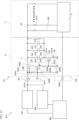
- a thermal printhead provided by a first aspect of the present disclosure includes: a plurality of heating resistors electrically connected in parallel with each other; a first capacitor electrically connected in parallel to the plurality of heating resistors; A switch unit electrically connected in series with the first capacitor, and a first resistor electrically connected in parallel with the first capacitor.
- a thermal printer provided by the first aspect of the present disclosure includes a thermal print head provided by the first aspect of the present disclosure, a main power supply circuit applying a first potential to a first connector terminal, the first a measurement circuit that applies a second potential to the connector terminal.
- the resistance value of the heating resistor can be measured more accurately.
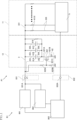
- FIG. 1 is a circuit diagram showing the configuration of the thermal printer of the first embodiment.
- FIG. 2 is a partial cross-sectional view of the thermal printer of the first embodiment.
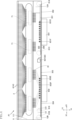
- FIG. 3 is a plan view (partially omitted) of the thermal print head of the first embodiment.
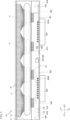
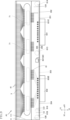
- FIG. 4 is an enlarged view of the thermal printhead shown in FIG. 5 is a back view of the thermal print head shown in FIG. 4.
- FIG. 6 is a graph schematically showing the measurement result of the resistance value of each heating resistor portion by the measurement circuit.
- FIG. 7 is a plan view showing another configuration example of the thermal print head.
- FIG. 8 is a back view showing another configuration example of the thermal print head.
- FIG. 9 is a plan view showing another configuration example of the thermal print head.
- FIG. 1 is a circuit diagram showing the configuration of the thermal printer of the first embodiment.
- FIG. 2 is a partial cross-sectional view of the thermal printer of the first embodiment.
- FIG. 3 is a plan view (parti
- FIG. 10 is a back view showing another configuration example of the thermal print head.
- FIG. 11 is a plan view showing another configuration example of the thermal print head.
- FIG. 12 is a back view showing another configuration example of the thermal print head.
- FIG. 13 is a circuit diagram showing a first modification of the thermal print head of the first embodiment.
- FIG. 14 is a circuit diagram showing the thermal print head of the second embodiment.
- FIG. 15 is a circuit diagram showing a first modification of the thermal printhead of the second embodiment.
- FIG. 16 is a circuit diagram showing the thermal printhead of the third embodiment.
- FIG. 1 is a circuit diagram showing the configuration of the thermal printer of the first embodiment.
- FIG. 2 is a partial cross-sectional view of the thermal printer of the first embodiment.
- the thermal printer B ⁇ b>1 shown in these figures prints on a print medium 801 .
- Examples of the print medium 801 include a barcode sheet and thermal paper for creating receipts.
- the thermal printer B1 includes a thermal print head A1, a platen roller 802, a main power supply circuit 861, a measurement circuit 862, and a control section 863.
- a platen roller 802 faces the thermal printhead A1.
- the main power supply circuit 861 supplies power to the plurality of heating resistors 41 in the thermal print head A1.
- the measuring circuit 862 measures the resistance value of each of the plurality of heating resistors 41 .
- the measurement circuit 862 measures the resistance value of each of the plurality of heating resistors 41 when printing on the print medium 801 is not performed, for example. As a result, it is possible to check the life of the heat generating resistor 41 and the presence or absence of a malfunctioning heat generating resistor 41 .
- the control unit 863 controls driving states of the main power supply circuit 861 and the measurement circuit 862 .
- the control unit 863 controls the energization state of each of the plurality of heating resistor units 41 .
- FIG. 3 is a plan view (partially omitted) of the thermal print head of the first embodiment.
- the thermal print head A1 shown in FIGS. 1 to 3 includes a first substrate 11, a second substrate 12, a radiator plate 13, wirings 3, a resistor layer 4, a first capacitor 61A, and a second capacitor 61B. , a third capacitor 61C, a first resistor 619, a switch section 62, a drive IC 71, a cover 72, a wire 81, a sealing resin 82, and connectors 831 and 832.
- the first substrate 11 is made of an insulating material, for example. Such an insulating material is for example ceramic (for example alumina). As shown in FIG. 3, the first substrate 11 has a long rectangular shape extending in the main scanning direction X1. First substrate 11 has front surface 111 and back surface 112 . Front surface 111 and back surface 112 face in opposite directions.
- the second substrate 12 is made of an insulating material, for example. A wiring pattern is formed on the second substrate 12 .
- Such an insulating material is, for example, resin (for example, glass epoxy resin).
- the second substrate 12 has a long rectangular shape extending in the main scanning direction X1.
- the second substrate 12 is arranged at a position shifted from the first substrate 11 in the sub-scanning direction Y1 perpendicular to the main scanning direction X1.
- the second substrate 12 includes a first end region 12A and a second end region 12B. The first end region 12A and the second end region 12B are separated from each other in the main scanning direction X1.
- Second substrate 12 has front surface 121 and back surface 122 . Front surface 121 and back surface 122 face in opposite directions.
- the radiator plate 13 shown in FIG. Radiator plate 13 is made of, for example, aluminum.
- the heat sink 13 is arranged on the rear surface 112 of the first substrate 11 .
- a plurality of heating resistor portions 41 in the resistor layer 4 shown in FIGS. 1 and 2 are arranged on the first substrate 11 respectively.
- a plurality of heating resistor portions 41 are arranged along the main scanning direction X1.
- the plurality of heating resistors 41 are electrically connected in parallel with each other.
- the number of heat generating resistors 41 is, for example, 1000 to 10000.
- the plurality of heating resistors 41 are made of, for example, ruthenium oxide, which has a higher resistivity than the material forming the wirings 3 .
- the wiring 3 is made of a conductive material.
- the wiring 3 constitutes a path for energizing the plurality of heating resistors 41 in the resistor layer 4 .
- a part of the wiring 3 is arranged on the first substrate 11 and the second substrate 12 .
- a portion of the wiring 3 shown in FIG. 2 and the like formed on the first substrate 11 is made of resinate Au to which rhodium, vanadium, bismuth, silicon, or the like is added as an additive element, for example.
- a portion of the wiring 3 disposed on the first substrate 11 has a common electrode 331 and a plurality of individual electrodes 335 (see also FIG. 1).
- the plurality of individual electrodes 335 are for partially energizing the resistor layer 4 .
- a plurality of individual electrodes 335 is a portion having a reverse polarity with respect to the common electrode 331 .
- the connectors 831 and 832 shown in FIGS. 1 to 3 are arranged on the second substrate 12.
- FIG. Connectors 831 and 832 are used to communicate with devices outside the thermal printhead A1.
- the thermal print head A1 is electrically connected to the main power supply circuit 861 and the measuring circuit 862 via the connector 831.
- the thermal print head A1 is electrically connected to the controller 863 via the connector 832 .
- the connector 831 and the connector 832 are separate bodies, but unlike this embodiment, they may be integrated.
- FIG. 4 is an enlarged view of the thermal print head shown in FIG. 5 is a back view of the thermal print head shown in FIG. 4.
- FIG. 4 is an enlarged view of the thermal print head shown in FIG. 5 is a back view of the thermal print head shown in FIG. 4.
- the connector 831 includes multiple connector electrodes 831E.
- the plurality of connector electrodes 831E extend like rods and are inserted through insertion holes formed in the second substrate 12 .
- Each of the plurality of connector electrodes 831E includes a joint portion 831F joined to the second substrate 12.
- the joint portion 831F is a portion of the connector electrode 831E that comes into contact with a conductive material (for example, solder) filled in the insertion hole of the second substrate 12 .
- connector 832 includes a plurality of connector electrodes 832E and joints 832F. A description of the plurality of connector electrodes 832E and the joint portions 832F in the connector 832 is omitted because the description of the connector electrodes 831E and the joint portions 831F in the connector 831 can be applied.
- the connector 831 includes a first connector terminal 831A.
- the first connector terminal 831A is electrically connected to the main power supply circuit 861 and the measuring circuit 862 .
- a predetermined potential V1 is applied to the first connector terminal 831A from the main power supply circuit 861 and the measurement circuit 862 .
- the first connector terminal 831A is electrically connected to at least one of the plurality of connector electrodes 831E.
- the first connector terminal 831A is electrically connected to each of the plurality of heating resistors 41, the first capacitor 61A, the second capacitor 61B, the third capacitor 61C, and the first resistor 619.
- FIG. In this embodiment, connector 831 includes a ground terminal (not shown).
- Connector 832 includes a second connector terminal 832A.
- the second connector terminal 832A electrically connects the control section 863 and the drive IC.
- the drive IC 71 shown in FIGS. 1 to 3 and the like is arranged on the first substrate 11.
- FIG. The drive IC 71 may be arranged on the second substrate 12 unlike the present embodiment.
- Drive IC 71 receives a signal from control section 863 via connector 832 . Based on the signal received from the control section 863 , the drive IC 71 controls the energization state of each of the plurality of heating resistor sections 41 . Specifically, the drive IC 71 selectively energizes the plurality of individual electrodes 335 to arbitrarily generate heat in any one of the plurality of heat generating resistor portions 41 .
- a plurality of wires 81 are electrically connected to the driving IC 71 .
- a plurality of wires 81 are bonded to the second substrate 12 .
- Electrode pads (not shown) in the drive IC 71 are electrically connected to the individual electrodes 335 via the wires 73 .
- the first capacitor 61A, the second capacitor 61B, the third capacitor 61C and the first resistor 619 are each electrically connected in parallel to the plurality of heating resistors 41.
- Each of the first capacitor 61A, the second capacitor 61B, the third capacitor 61C, the first resistor 619, and the plurality of heating resistors 41 is connected between the first connector terminal 831A and the second connector terminal 832A. electrically arranged. Even if the potential V1 (first potential v11) applied from the main power supply circuit 861 transiently differs from the desired value for some reason, the first capacitor 61A, the second capacitor 61B, and the third capacitor 61C each have a plurality of capacitors. , the amount of heat generated by each of the heating resistors 41 is prevented from greatly deviating from a desired value.
- the first capacitor 61A, the second capacitor 61B, the third capacitor 61C and the first resistor 619 are arranged on the second substrate 12 respectively.
- the first capacitor 61A, the second capacitor 61B, the third capacitor 61C and the first resistor 619 are arranged on the rear surface 122 of the second substrate 12.
- the first capacitor 61A, the second capacitor 61B, the third capacitor 61C and the first resistor 619 are arranged apart from each other in the main scanning direction X1.
- the first capacitor 61A is arranged in the first end region 12A of the second substrate 12 .
- the second capacitor 61B is arranged in the second end region 12B of the second substrate 12 .
- a third capacitor 61C and a first resistor 619 are arranged between the first capacitor 61A and the second capacitor 61B.
- the thermal print head A1 may not include either or both of the second capacitor 61B and the third capacitor 61C.
- the first resistor 619 is electrically connected in parallel with the first capacitor 61A. Also, the first resistor 619 is electrically connected in series with the first transistor 621 of the switch section 62 . Furthermore, in this embodiment, the first resistor 619 is electrically connected in parallel to the second capacitor 61B and the third capacitor 61C.
- the switch section 62 is electrically connected in series with the first capacitor 61A.
- the switch section 62 is also electrically connected in series to the second capacitor 61B and the third capacitor 61C.
- the switch section 62 is electrically connected in series with the first resistor 619 .
- the switch section 62 is driven based on the potential V1 at the first connector terminal 831A.
- the switch section 62 includes a first switch terminal 621A and a second switch terminal 621B.
- the switch section 62 controls the conducting state of the current I1 that can flow between the first switch terminal 621A and the second switch terminal 621B based on the potential V1 at the first connector terminal 831A.
- a first potential v11 is applied from the main power supply circuit 861 to the first connector terminal 831A as the potential V1.
- a second potential v12 is applied as the potential V1 from the measurement circuit 862 to the first connector terminal 831A.
- the first connector terminal 831A is at the first potential v11
- the current value of the current I1 that can flow between the first switch terminal 621A and the second switch terminal 621B is the first current value.
- the first connector terminal 831A is at the second potential v12
- the current value of the current I1 that can flow between the first switch terminal 621A and the second switch terminal 621B is the second current value.
- the second potential v12 is less than the first potential v11 and greater than zero.
- the first potential v11 is, for example, 24V
- the second potential v12 is, for example, 3 to 10V.
- the second current value is less than the first current value and substantially zero. That is, when the first potential v11 is applied from the main power supply circuit 861 to the first connector terminal 831A, the first capacitor 61A (or the second capacitor 61B, the third capacitor 61C, or the first resistor 619) generates a plurality of heats. An energization path to each of the resistance portions 41 is ensured.
- the first capacitor 61A (or the second capacitor 61B, the third capacitor 61C, or the first resistor 619) generates a plurality of heats. An energization path to each of the resistance portions 41 is substantially cut off.
- the terms voltage value and current value in this disclosure refer to the absolute value of the voltage value and the absolute value of the current value, respectively.
- the switch section 62 includes a first transistor 621, a second resistor 625A, and a third resistor 625B. Unlike this embodiment, the switch section 62 may include a relay element.
- the first transistor 621 is, for example, a MOSFET (metal oxide semiconductor field effect transistor).
- the first transistor 621 includes a first switch terminal 621A, a second switch terminal 621B, and a first control terminal 621C.
- the first transistor 621 is preferably an N-channel MOSFET, but may be a P-channel MOSFET.
- the first switch terminal 621A may be, for example, one of the drain electrode and the source electrode of the MOSFET, and the second switch terminal 621B may be the other of the drain electrode and the source electrode.
- the first control terminal 621C controls the conducting state of the current I1 that can flow between the first switch terminal 621A and the second switch terminal 621B.
- the first control terminal 621C is preferably the gate electrode of the MOSFET.
- the first control terminal 621C is electrically arranged between the second resistor 625A and the third resistor 625B.
- the resistance values of the second resistor 625A and the third resistor 625B are the same.
- the potential V1 if the first potential v11 applied from the main power supply circuit 861 to the first connector terminal 831A is, for example, 24V, the potential applied to the first control terminal 621C is 12V.
- the second potential v12 applied from the measuring circuit 862 to the first connector terminal 831A is, for example, 6V, the potential applied to the first control terminal 621C is 3V.
- the first control terminal 621C is connected to the contact between the second resistor 625A and the third resistor 625B, the second resistor 625A and the third resistor 625B function as voltage dividing resistors.
- the first transistor 621 in the switch section 62 is arranged on the second substrate 12 . More specifically, the first transistor 621 is arranged on the surface 121 of the second substrate 12 . In this embodiment, the first transistor 621 is arranged between the first capacitor 61A and the second capacitor 61B in the main scanning direction X1. In the figure, a connector 831 is arranged between the first transistor 621 and the first capacitor 61A in the main scanning direction X1. The first transistor 621 overlaps the junction 831F of each of the plurality of connector electrodes 831E when viewed along the main scanning direction X1.
- the second resistor 625A and the third resistor 625B are electrically connected in series with each other.
- Second resistor 625A and third resistor 625B are electrically connected in parallel to first capacitor 61A, second capacitor 61B, third capacitor 61C and first resistor 619, respectively.
- the switch section 62 may not include either or both of the second resistor 625A and the third resistor 625B.
- the wiring 3 includes a first wiring element 351 and a second wiring element 352.
- the first wiring element 351 electrically connects the first connector terminal 831A of the connector 831 and either one of the first capacitor 61A and the first transistor 621 .
- the first wiring element 351 electrically connects the first connector terminal 831A and the first capacitor 61A.
- the first wiring element 351 may electrically connect the first connector terminal 831A and the first transistor 621 .
- a second wiring element 352 electrically connects the first capacitor 61A and the first transistor 621 .
- the first wiring element 351 and the second wiring element 352 are arranged on the second substrate 12 .
- both the first wiring element 351 and the second wiring element 352 are arranged on the surface 121 of the second substrate 12 .
- the first wiring element 351 and the second wiring element 352 are part of the wiring pattern formed on the second substrate 12 .
- the first wiring element 351 is arranged between the second wiring element 352 and the first substrate 11 in plan view. At least part of the second wiring element 352 extends along the sub-scanning direction Y1 in a region opposite to the first substrate 11 across the joint 831F.
- the first transistor 621 is located on the side opposite to the first substrate 11 with the plurality of wires 81 interposed therebetween in the sub-scanning direction Y1.
- the wiring 3 includes a third wiring element 353 and a fourth wiring element 354.
- the third wiring element 353 electrically connects the first connector terminal 831A of the connector 831 to either one of the second capacitor 61B and the first transistor 621.
- the third wiring element 353 electrically connects the first connector terminal 831A and the second capacitor 61B.
- the third wiring element 353 may electrically connect the first connector terminal 831A and the first transistor 621 .
- a fourth wiring element 354 electrically connects the second capacitor 61B and the first transistor 621 .
- the third wiring element 353 and the fourth wiring element 354 are arranged on the second substrate 12 .
- both the third wiring element 353 and the fourth wiring element 354 are arranged on the surface 121 of the second substrate 12 .
- the third wiring element 353 and the fourth wiring element 354 are part of the wiring pattern formed on the second substrate 12 .
- the third wiring element 353 is arranged between the fourth wiring element 354 and the first substrate 11 in plan view. At least part of the fourth wiring element 354 extends along the sub-scanning direction Y1 in a region opposite to the first substrate 11 with the joint 832F interposed therebetween.
- the wiring 3 includes a fifth wiring element 355 and a sixth wiring element 356.
- the fifth wiring element 355 electrically connects the first connector terminal 831A of the connector 831 and either one of the third capacitor 61C and the first transistor 621 .
- the fifth wiring element 355 electrically connects the first connector terminal 831A and the third capacitor 61C.
- the fifth wiring element 355 may electrically connect the first connector terminal 831A and the first transistor 621 .
- a sixth wiring element 356 electrically connects the third capacitor 61C and the first transistor 621 .
- the fifth wiring element 355 may share a part of each other with the third wiring element 353, for example.
- the sixth wiring element 356 may be configured to share a part of each other with the fourth wiring element 354, for example.
- the fifth wiring element 355 and the sixth wiring element 356 are arranged on the second substrate 12 .
- both the fifth wiring element 355 and the sixth wiring element 356 are arranged on the surface 121 of the second substrate 12 .
- the fifth wiring element 355 and the sixth wiring element 356 are part of the wiring pattern formed on the second substrate 12 .
- the fifth wiring element 355 is arranged between the sixth wiring element 356 and the first substrate 11 in plan view. At least part of the sixth wiring element 356 extends along the sub-scanning direction Y1 in a region opposite to the first substrate 11 across the joint 832F.
- the cover 72 shown in FIG. 2 is fixed to the second substrate 12 by screws (not shown), for example.
- the cover 72 may be made of a conductive material or an insulating material.
- Cover 72 includes cover portion 721 and side portion 722 .
- the covering portion 721 overlaps the first transistor 621 in plan view.
- the covering portion 721 includes an inclined surface 721A.
- the inclined surface 721A faces the side opposite to the side where the second substrate 12 is located.
- the inclined surface 721A approaches the second substrate 12 in the thickness direction Z1 of the second substrate 12 as it approaches the first substrate 11 in the sub-scanning direction Y1.
- the side portion 722 extends from the second substrate 12 toward the covering portion 721 and is arranged on the side opposite to the first substrate 11 with the first transistor 621 interposed therebetween in plan view.
- at least a portion of the second wiring element 352 overlaps the side portion 722 of the cover 72 in plan view.
- the sealing resin 82 covers the driving IC 71.
- the sealing resin 82 is made of, for example, a black soft resin.
- the first connector terminal 831A When printing on the print medium 801, the first connector terminal 831A is applied with the first potential v11 as the potential V1 from the main power supply circuit 861. In this case, under the control of the drive IC 71, the plurality of heating resistors 41 are selectively energized and generate heat. By transferring the heat to the print medium 801 , printing is performed on the print medium 801 .
- the first potential v11 is applied from the main power supply circuit 861 to the first connector terminal 831A as the potential V1
- the first capacitor 61A, the second capacitor 61B, and the third capacitor 61C are connected to the plurality of heating resistors. An energization path to each of the portions 41 is secured.
- No potential is applied from the main power supply circuit 861 to the connector 831 when measuring the resistance value of each heating resistor portion 41 .
- the second potential v12 is applied as the potential V1 from the measurement circuit 862 to the first connector terminal 831A.
- the plurality of heating resistors 41 are energized in order (for example, starting from the heating resistor 41 located at the end in the main scanning direction X1) under the control of the drive IC 71 .
- the measuring circuit 862 measures the resistance value of each heating resistor 41 based on the value of the current flowing through the heating resistor 41 and the second potential v12.
- the first capacitor 61A, the second capacitor 61B, the third capacitor 61C, and the first resistor do not function in energizing the heating resistor 41 when the resistance value of each heating resistor 41 is measured.
- FIG. 6 schematically shows the measurement result of the resistance value of each heating resistor section 41 by the measuring circuit 862.
- FIG. The horizontal axis is the position of the heating resistor portion 41 in the main scanning direction X1.
- the vertical axis is the resistance value.
- the schematic measurement results in the comparative example are shown on the left side, and the schematic measurement results in the present embodiment are shown on the right side.
- the comparative example has the same circuit configuration as the present embodiment except that the switch section 62 is not provided.
- the resistance value of each heating resistor portion 41 is measured by passing a current through each heating resistor portion 41 in order from the heating resistor portion 41 located at the end in the main scanning direction X1. do.
- the resistance value of the heating resistor portion 41 located at the end in the main scanning direction X1 is measured as an unreasonably high value (see P1 in FIG. 6). Also, the resistance values of a plurality of heat generating resistor portions 41 near the faulty heat generating resistor portion 41 are measured as values different from the original values (see P2 in FIG. 6). These improper values are considered to be due to the effects of the first capacitor 61A, the second capacitor 61B, the third capacitor 61C, and the like.
- the thermal print head A1 includes a switch section 62 electrically connected in series with the first capacitor 61A.
- the measurement circuit 862 can more accurately measure the resistance value of each heating resistor portion 41 .
- the first potential v11 When the first potential v11 is applied to the first connector terminal 831A, the plurality of heating resistors 41 and the first capacitor 61A are energized, and electric charge is accumulated in the first capacitor 61A.
- the second potential v12 is applied to the first connector terminal 831A, the first capacitor 61A is electrically cut off from the plurality of heating resistors 41. As shown in FIG. At this time, the charge accumulated during the energization remains in the first capacitor 61A. If the time until this charge is sufficiently discharged is long, there is concern that the switching of the first transistor 621 from the print mode to the measurement mode will be delayed.
- the first resistor 619 is electrically connected in parallel with the first capacitor 61A. Therefore, the charge remaining in the first capacitor 61 A is consumed by the first resistor 619 . Therefore, it is possible to shorten the time until the first capacitor 61A is sufficiently discharged, and it is possible to switch the thermal print head A1 more quickly.
- the first resistor 619 is electrically connected in series with the first transistor 621 of the switch section 62 . Therefore, by switching the connection state of the first capacitor 61A by the switch section 62, the switching of the first resistor 619 can be performed at the same time.
- the first resistor 619 is electrically connected in parallel to the second capacitor 61B and the third capacitor 61C. Therefore, the electric charges accumulated in the second capacitor 61B and the third capacitor 61C as well as the first capacitor 61A can be discharged more quickly.
- the thermal print head A1 includes a first capacitor 61A, a second capacitor 61B and a third capacitor 61C. For this reason, the height (dimension in the thickness direction Z1 of the second substrate 12 of the second substrate 12) for providing the first capacitor 61A, the second capacitor 61B, and the third capacitor 61C is larger than in the case of securing the required capacitance with one capacitor. ) can be reduced. Therefore, it is advantageous to reduce the thickness of the thermal print head A1, and for example, interference of the thermal print head A1 with the print medium 801 and the platen roller 802 can be suppressed.
- the switch section 62 includes a second resistor 625A and a third resistor 625B electrically connected in series with each other.
- the second resistor 625A and the third resistor 625B are each electrically connected in parallel with the first capacitor 61A.
- the first control terminal 621C is electrically arranged between the second resistor 625A and the third resistor 625B. According to such a configuration, the potential applied to the first control terminal 621C can be adjusted by adjusting the resistance values of the second resistor 625A and the third resistor 625B. Therefore, a first transistor 621 having a desired threshold voltage can be used.
- the first capacitor 61A, the second capacitor 61B and the third capacitor 61C are arranged in the first end region 12A of the second substrate 12.
- the length of the portion of the wiring 3 from the first capacitor 61A to the common electrode 331 can be shortened as much as possible.
- the second capacitor 61B is arranged in the second end region 12B of the second substrate 12 . Similar advantages may be enjoyed with such a configuration.
- the first transistor 621 is arranged between the first capacitor 61A and the second capacitor 61B in the main scanning direction X1. According to such a configuration, the length of the portion of the wiring 3 from the first transistor 621 to the first capacitor 61A and the length of the portion of the wiring 3 from the first transistor 621 to the second capacitor 61B are , can be prevented from being extremely long. As a result, it is possible to suppress the occurrence of noise that may occur in the current flowing through the heating resistor portion 41 .
- the first transistor 621 overlaps the junction of each of the plurality of connector electrodes 831E in the sub-scanning direction Y1. With such a configuration, the first transistor 621 can be further removed from the feeding path of the print medium 801 .
- the covering portion 721 further includes an inclined surface 721A facing away from the side on which the second substrate 12 is located. The inclined surface 721A approaches the second substrate 12 in the thickness direction Z1 of the second substrate 12 as it approaches the first substrate 11 in the sub-scanning direction Y1. With such a configuration, the cover 72 can be moved further away from the cover 72 in the feeding path of the print medium 801 .
- FIG. 7-12 show the physical layout of the first wiring element 351, the second wiring element 352, the third wiring element 353, the fourth wiring element 354, the fifth wiring element 355 and the sixth wiring element 356 of the thermal printhead. shows a modification of 7 and 8, the first wiring element 351, the third wiring element 353 and the fifth wiring element 355 are arranged on the surface 121 of the second substrate 12, the second wiring element 352, the fourth wiring element 354 and the The sixth wiring element 356 is arranged on the back surface 122 of the second substrate 12 .
- the first wiring element 351, the third wiring element 353 and the fifth wiring element 355 are arranged on the back surface 122 of the second substrate 12, and the second wiring element 352, the fourth wiring element 354 and the The sixth wiring element 356 is arranged on the surface 121 of the second substrate 12 .
- the first wiring element 351, the second wiring element 352, the third wiring element 353, the fourth wiring element 354, the fifth wiring element 355 and the sixth wiring element 356 are connected to the back surface 122 of the second substrate 12.
- FIG. 13 shows a thermal print head A11, which is a first modification of the thermal print head A1, and a thermal printer B11 having the same.
- the switch section 62 of the thermal printhead A11 of this modification includes a second transistor 623, a second resistor 625A, a third resistor 625B, a fourth resistor 625C and a fifth resistor 625D.
- the second transistor 623 is electrically connected in series with the second resistor 625A.
- the second transistor 623 is electrically arranged between the first connector terminal 831 A and the first control terminal 621 C of the first transistor 621 .
- the second transistor 623 includes a third switch terminal 623A, a fourth switch terminal 623B, and a second control terminal 623C.
- the second transistor 623 is preferably a P-channel MOSFET, but may be an N-channel MOSFET.
- the third switch terminal 623A may be, for example, one of the drain electrode and the source electrode of the MOSFET, and the fourth switch terminal 623B may be the other of the drain electrode and the source electrode.
- the second control terminal 623C controls the conducting state of the current I2 that can flow between the third switch terminal 623A and the fourth switch terminal 623B.
- the second control terminal 623C is preferably the gate electrode of the MOSFET.
- a second control terminal 623C is electrically disposed between a fourth resistor 625C and a fifth resistor 625D.
- the resistance value of the fourth resistor 625C and the resistance value of the fifth resistor 625D may be the same or different.
- the fourth resistor 625C and the fifth resistor 625D function as voltage dividing resistors.
- the resistance values of the second resistor 625A and the third resistor 625B are the same, and the fourth resistor 625C and the fifth resistor 625D are the same.
- the potential V1 if the first potential v11 applied from the main power supply circuit 861 to the first connector terminal 831A is, for example, 24V, the potential applied to the second control terminal 623C is 12V. At this time, the current I2 sufficiently flows, and the potential applied to the first control terminal 621C becomes 12V. At this time, the current I1 sufficiently flows.
- the second potential v12 applied from the measurement circuit 862 to the first connector terminal 831A is, for example, 6V
- the potential applied to the second control terminal 623C is 3V.
- the current value of the current I2 is substantially 0, but it may be too large to ignore.
- the second transistor 623 functions as a relatively large resistor
- the potential applied to the first control terminal 621C is less than 1.5V, for example 0.5V. Therefore, the current value of the current I1 can be made smaller.
- the second potential v12 is applied from the measuring circuit 862 to the first connector terminal 831A and the resistance value of each heating resistor portion 41 is measured, the value of the current I1 can be made smaller.
- the measurement circuit 862 can more accurately measure the resistance value of each heating resistor portion 41 .
- the connector 831 includes a first measurement terminal 831C electrically arranged between the fourth resistor 625C and the fifth resistor 625D.
- a desired potential can be applied to the first measurement terminal 831C. Therefore, the resistance value of each heating resistor portion 41 can be measured using a power supply that applies a smaller potential.
- either one or both of the fourth resistor 625C and the fifth resistor 625D may be omitted.
- the fifth resistor 625D may not be provided.
- FIG. 14 shows a thermal print head A2 and a thermal printer B2 having the same according to the second embodiment of the present disclosure.
- the thermal print head A2 of this embodiment differs from the embodiment described above in the configuration of the switch section 62 .
- the switch section 62 of this embodiment further includes a third transistor 622 and a capacitor 629 in addition to the configuration of the switch section 62 of the thermal print head A1 described above.
- the third transistor 622 is electrically connected in series with the first capacitor 61A, the second capacitor 61B, the third capacitor 61C and the first resistor 619. Also, the third transistor 622 is electrically connected in parallel with the first transistor 621 . In this embodiment, the current I1a flows through the first transistor 621 and the current I1b flows through the third transistor 622 . A current value obtained by summing the current I1a and the current I1b is equivalent to the current I1 in the above-described embodiment.
- the third transistor 622 includes a fifth switch terminal 622A, a sixth switch terminal 622B, and a third control terminal 622C.
- third transistor 622 is preferably a P-channel MOSFET, but may be an N-channel MOSFET.
- the fifth switch terminal 622A may be, for example, one of the drain electrode and the source electrode of the MOSFET, and the sixth switch terminal 622B may be the other of the drain electrode and the source electrode.
- the third control terminal 622C controls the conducting state of the current I1b that can flow between the fifth switch terminal 622A and the sixth switch terminal 622B.
- the third control terminal 622C is preferably the gate electrode of the MOSFET.
- the third control terminal 622C is electrically connected to the first control terminal 621C.
- the capacitor 629 is electrically connected in series between the first control terminal 621C and the third control terminal 622C and the ground terminal.
- the switch section 62 when the first capacitor 61A, the second capacitor 61B, and the third capacitor 61C are switched ON by the switch section 62, the current flowing through the first transistor 621 (so-called inrush current) is transferred to the third transistor. 622 can be divided and streamed. Therefore, it is possible to suppress the first transistor 621 from being damaged by the rush current.
- FIG. 15 shows a thermal print head A21, which is a first modification of the thermal print head A2, and a thermal printer B21 having the same.
- the switch section 62 includes the second transistor 623, the fourth resistor 625C and the fifth resistor described in the thermal print head A11 in addition to the configuration of the switch section 62 of the thermal print head A2. 625D.
- the effects described for the thermal print head A11 can be further achieved.
- the specific configuration of the switch section 62 can be changed as appropriate.
- FIG. 16 shows a thermal print head A3 and a thermal printer B3 including the same according to the third embodiment of the present disclosure.
- the first resistor 619 is electrically connected in parallel with the first capacitor 61A, the second capacitor 61B and the third capacitor 61C, while the first transistor 621 and the third capacitor 61C are electrically connected in parallel. It is not electrically connected in series with the transistor 622 .
- the switch section 62 of this embodiment includes a fourth transistor 624 .
- a fourth transistor 624 is electrically connected in series with the first resistor 619 .
- the fourth transistor 624 is not electrically connected in series with the first capacitor 61A, the second capacitor 61B and the third capacitor 61C.
- the first transistor 621 and the third transistor 622 are electrically connected in parallel with each other. Also, the first transistor 621 and the third transistor 622 are electrically connected in series with the first capacitor 61A, the second capacitor 61B and the third capacitor 61C, and are electrically connected in series with the first resistor 619. Not connected.
- the fourth transistor 624 includes a seventh switch terminal 624A, an eighth switch terminal 624B, and a fourth control terminal 624C.
- fourth transistor 624 is preferably a P-channel MOSFET, but may be an N-channel MOSFET.
- the seventh switch terminal 624A may be, for example, one of the drain and source electrodes of the MOSFET, and the eighth switch terminal 624B may be the other of the drain and source electrodes.
- the fourth control terminal 624C controls the conducting state of the current that can flow between the seventh switch terminal 624A and the eighth switch terminal 624B.
- the fourth control terminal 624C is preferably the gate electrode of the MOSFET.
- the fourth control terminal 624C is electrically connected to the second measurement terminal 831D.
- the connector 831 of this embodiment includes a first connector terminal 831A, a first measurement terminal 831C and a second measurement terminal 831D.
- the second measurement terminal 831D is a terminal provided separately from the first measurement terminal 831C.
- a desired potential can be applied to the second measurement terminal 831D separately from the first connector terminal 831A and the first measurement terminal 831C.
- the resistance value of the heating resistor can be measured more accurately, and the same effects as those of the above-described embodiment can be obtained.
- the fourth transistor 624 is electrically connected in series with the first resistor 619, and is not electrically connected in series with the first capacitor 61A, the second capacitor 61B, and the third capacitor 61C. .
- the first resistor 619 can be electrically cut off from the plurality of heating resistors 41 . Therefore, unintended power consumption can be suppressed.
- thermal print head and thermal printer according to the present disclosure are not limited to the embodiments described above.
- the specific configuration of each part of the thermal print head and thermal printer according to the present disclosure can be modified in various ways.
- the present disclosure includes embodiments set forth in the following appendices.
- Appendix 1 a plurality of heating resistors electrically connected in parallel with each other; a first capacitor electrically connected in parallel to the plurality of heating resistors; a switch unit electrically connected in series with the first capacitor; a first resistor electrically connected in parallel with the first capacitor; a thermal printhead.
- Appendix 2. The thermal printhead according to Appendix 1, wherein the first resistor is electrically connected in series with the switch section.
- Appendix 3. further comprising a connector including a first connector terminal; The first connector terminal is electrically connected to each of the plurality of heating resistors and the first capacitor, 3.
- the switch section includes a first switch terminal and a second switch terminal, when the first connector terminal is at the first potential, the current value of the current that can flow between the first switch terminal and the second switch terminal is the first current value; when the first connector terminal is at a second potential, the current value of the current that can flow between the first switch terminal and the second switch terminal is a second current value; 3.
- Appendix 5 includes a first transistor, the first transistor includes the first switch terminal, the second switch terminal, and a first control terminal for controlling a conduction state of the current that can flow between the first switch terminal and the second switch terminal; 5.
- the thermal printhead of clause 4 comprising: Appendix 6.
- the switch section includes a second resistor and a third resistor electrically connected in series with each other, and the second resistor and the third resistor are each electrically connected in parallel with the first capacitor. cage, 6.
- the thermal printhead of Clause 5 wherein the first control terminal is electrically positioned between the second resistor and the third resistor.
- the switch section includes a second transistor electrically connected in series with the second resistor, 7.
- the thermal printhead of Claim 6, wherein the second transistor is electrically disposed between the first connector terminal and the first control terminal of the first transistor.
- the second transistor includes a third switch terminal, a fourth switch terminal, and a second control terminal for controlling a conduction state of a current that can flow between the third switch terminal and the fourth switch terminal;
- the switch section includes a fourth resistor and a fifth resistor electrically connected in series with each other, and the fourth resistor and the fifth resistor are electrically connected in parallel to the first capacitor.
- Appendix 9. The thermal printhead of Claim 8, wherein the connector includes a first measurement terminal electrically disposed between the fourth resistor and the fifth resistor. Appendix 10.
- the thermal printhead according to appendix 12 wherein the switch section includes a fourth capacitor electrically connected in series to the first control terminal and the third control terminal.
- the switch section includes a fourth transistor electrically connected in series with the first resistor, 2.
- Appendix 15. the fourth transistor includes a fourth control terminal; 15.
- thermo printhead of any one of appendices 3-13 wherein the thermal printhead comprises: Appendix 17. a thermal printhead according to any one of Appendices 4 to 13; a main power supply circuit that applies the first potential to the first connector terminal; and a measurement circuit that applies the second potential to the first connector terminal.
- A1, A11, A2, A21, A3 Thermal print head B, B1, B11, B2, B21, B3: Thermal printer 3: Wiring 4: Resistor layer 11: First substrate 12: Second substrate 12A: First end Region 12B: Second end region 13: Radiator plate 41: Heating resistor section 61A: First capacitor 61B: Second capacitor 61C: Third capacitor 62: Switch section 71: Drive IC 72: Cover 73: Wire 81: Wire 82: Sealing resin 111: Front surface 112: Back surface 121: Front surface 122: Back surface 331: Common electrode 335: Individual electrode 351: First wiring element 352: Second wiring element 353: Third wiring element 354: Fourth wiring element 355: Third wiring element 5 wiring element 356: sixth wiring element 619: first resistor 621: first transistor 621A: first switch terminal 621B: second switch terminal 621C: first control terminal 622: third transistor 622A: fifth switch terminal 622B : sixth switch terminal 622C: third control terminal 623: second transistor
Landscapes
- Engineering & Computer Science (AREA)
- Microelectronics & Electronic Packaging (AREA)
- Particle Formation And Scattering Control In Inkjet Printers (AREA)
- Electronic Switches (AREA)
Priority Applications (2)
| Application Number | Priority Date | Filing Date | Title |
|---|---|---|---|
| JP2023552774A JPWO2023058415A1 (https=) | 2021-10-04 | 2022-09-13 | |
| US18/618,758 US20240239111A1 (en) | 2021-10-04 | 2024-03-27 | Thermal print head and thermal printer |
Applications Claiming Priority (2)
| Application Number | Priority Date | Filing Date | Title |
|---|---|---|---|
| JP2021-163448 | 2021-10-04 | ||
| JP2021163448 | 2021-10-04 |
Related Child Applications (1)
| Application Number | Title | Priority Date | Filing Date |
|---|---|---|---|
| US18/618,758 Continuation US20240239111A1 (en) | 2021-10-04 | 2024-03-27 | Thermal print head and thermal printer |
Publications (1)
| Publication Number | Publication Date |
|---|---|
| WO2023058415A1 true WO2023058415A1 (ja) | 2023-04-13 |
Family
ID=85804166
Family Applications (1)
| Application Number | Title | Priority Date | Filing Date |
|---|---|---|---|
| PCT/JP2022/034202 Ceased WO2023058415A1 (ja) | 2021-10-04 | 2022-09-13 | サーマルプリントヘッドおよびサーマルプリンタ |
Country Status (3)
| Country | Link |
|---|---|
| US (1) | US20240239111A1 (https=) |
| JP (1) | JPWO2023058415A1 (https=) |
| WO (1) | WO2023058415A1 (https=) |
Cited By (1)
| Publication number | Priority date | Publication date | Assignee | Title |
|---|---|---|---|---|
| WO2025068989A1 (en) | 2023-09-29 | 2025-04-03 | Enzyvant Therapeutics Gmbh | Device for cultivating and transporting biological tissue |
Citations (5)
| Publication number | Priority date | Publication date | Assignee | Title |
|---|---|---|---|---|
| JPH05330094A (ja) * | 1991-10-18 | 1993-12-14 | Pfu Ltd | プリントヘッド駆動回路の疑似負荷装置 |
| JP2001038943A (ja) * | 1999-08-02 | 2001-02-13 | Sato Corp | サーマルヘッドの断線自己診断回路及びその断線自己診断方法 |
| US20080204035A1 (en) * | 2007-02-23 | 2008-08-28 | International Business Machines Corporation | Fault detection circuit for printers with multiple print heads |
| JP2011005751A (ja) * | 2009-06-26 | 2011-01-13 | Seiko Epson Corp | サーマルヘッド用電源回路および印刷装置 |
| JP2018176489A (ja) * | 2017-04-07 | 2018-11-15 | ローム株式会社 | サーマルプリントヘッド、サーマルプリンタ |
-
2022
- 2022-09-13 JP JP2023552774A patent/JPWO2023058415A1/ja active Pending
- 2022-09-13 WO PCT/JP2022/034202 patent/WO2023058415A1/ja not_active Ceased
-
2024
- 2024-03-27 US US18/618,758 patent/US20240239111A1/en active Pending
Patent Citations (5)
| Publication number | Priority date | Publication date | Assignee | Title |
|---|---|---|---|---|
| JPH05330094A (ja) * | 1991-10-18 | 1993-12-14 | Pfu Ltd | プリントヘッド駆動回路の疑似負荷装置 |
| JP2001038943A (ja) * | 1999-08-02 | 2001-02-13 | Sato Corp | サーマルヘッドの断線自己診断回路及びその断線自己診断方法 |
| US20080204035A1 (en) * | 2007-02-23 | 2008-08-28 | International Business Machines Corporation | Fault detection circuit for printers with multiple print heads |
| JP2011005751A (ja) * | 2009-06-26 | 2011-01-13 | Seiko Epson Corp | サーマルヘッド用電源回路および印刷装置 |
| JP2018176489A (ja) * | 2017-04-07 | 2018-11-15 | ローム株式会社 | サーマルプリントヘッド、サーマルプリンタ |
Cited By (1)
| Publication number | Priority date | Publication date | Assignee | Title |
|---|---|---|---|---|
| WO2025068989A1 (en) | 2023-09-29 | 2025-04-03 | Enzyvant Therapeutics Gmbh | Device for cultivating and transporting biological tissue |
Also Published As
| Publication number | Publication date |
|---|---|
| US20240239111A1 (en) | 2024-07-18 |
| JPWO2023058415A1 (https=) | 2023-04-13 |
Similar Documents
| Publication | Publication Date | Title |
|---|---|---|
| US8194413B2 (en) | Head substrate and thermal head substrate | |
| US6945629B2 (en) | Substrate for ink jet head, ink jet head, and ink jet recording apparatus having ink jet head | |
| WO2023058415A1 (ja) | サーマルプリントヘッドおよびサーマルプリンタ | |
| US7441877B2 (en) | Substrate having a plurality of common power supply wires and a plurality of common ground wires for inkjet recording head and inkjet recording head using the same | |
| US7841685B2 (en) | Printing apparatus and driver IC having a dummy drive circuit | |
| US10596816B2 (en) | Liquid ejection head substrate and liquid ejection head | |
| JP4861684B2 (ja) | 液滴イジェクタ及び液滴イジェクタ形成方法 | |
| CN114604003A (zh) | 热敏打印头及其制造方法和热敏打印机 | |
| JP4363632B2 (ja) | フレキシブルプリント基板 | |
| CN112428696B (zh) | 热敏打印头用驱动器ic、以及热敏打印头 | |
| JP5765924B2 (ja) | 液体吐出ヘッドの駆動方法、液体吐出ヘッド、及び液体吐出装置 | |
| US10994532B2 (en) | Liquid discharge apparatus and control method thereof | |
| JP6977299B2 (ja) | サーマルプリントヘッド、サーマルプリンタ | |
| US7810911B2 (en) | Thermal inkjet printhead | |
| US8066347B2 (en) | Recording element substrate, recording head, and ink jet recording apparatus having the recording head | |
| US9302479B2 (en) | Liquid ejection head substrate, liquid ejection head, and recording apparatus | |
| JP7581000B2 (ja) | サーマルプリントヘッド及びその製造方法、並びにサーマルプリンタ | |
| JPH0647943A (ja) | サーマルプリントヘッド | |
| US9168741B2 (en) | Substrate for liquid ejecting head, liquid ejecting head, and recording apparatus | |
| JP2023114780A (ja) | サーマルプリントヘッド及びサーマルプリンタ | |
| US8678554B2 (en) | Liquid discharge head substrate | |
| JP2003154647A (ja) | インクジェットヘッドドライバおよびそれを用いたインクジェット記録装置 | |
| US5988796A (en) | Recording head and recording apparatus using such recording head | |
| US20240375398A1 (en) | Printing head substrate | |
| JP2001232814A (ja) | インクジェットヘッド用基板、インクジェットヘッド、インクジェットカートリッジおよびインクジェット記録装置 |
Legal Events
| Date | Code | Title | Description |
|---|---|---|---|
| 121 | Ep: the epo has been informed by wipo that ep was designated in this application |
Ref document number: 22878286 Country of ref document: EP Kind code of ref document: A1 |
|
| WWE | Wipo information: entry into national phase |
Ref document number: 2023552774 Country of ref document: JP |
|
| NENP | Non-entry into the national phase |
Ref country code: DE |
|
| 122 | Ep: pct application non-entry in european phase |
Ref document number: 22878286 Country of ref document: EP Kind code of ref document: A1 |