WO2023054118A1 - 感光性組成物、硬化物および有機el表示装置 - Google Patents
感光性組成物、硬化物および有機el表示装置 Download PDFInfo
- Publication number
- WO2023054118A1 WO2023054118A1 PCT/JP2022/035171 JP2022035171W WO2023054118A1 WO 2023054118 A1 WO2023054118 A1 WO 2023054118A1 JP 2022035171 W JP2022035171 W JP 2022035171W WO 2023054118 A1 WO2023054118 A1 WO 2023054118A1
- Authority
- WO
- WIPO (PCT)
- Prior art keywords
- component
- carbon atoms
- group
- photosensitive composition
- formula
- Prior art date
- Legal status (The legal status is an assumption and is not a legal conclusion. Google has not performed a legal analysis and makes no representation as to the accuracy of the status listed.)
- Ceased
Links
Images
Classifications
-
- G—PHYSICS
- G03—PHOTOGRAPHY; CINEMATOGRAPHY; ANALOGOUS TECHNIQUES USING WAVES OTHER THAN OPTICAL WAVES; ELECTROGRAPHY; HOLOGRAPHY
- G03F—PHOTOMECHANICAL PRODUCTION OF TEXTURED OR PATTERNED SURFACES, e.g. FOR PRINTING, FOR PROCESSING OF SEMICONDUCTOR DEVICES; MATERIALS THEREFOR; ORIGINALS THEREFOR; APPARATUS SPECIALLY ADAPTED THEREFOR
- G03F7/00—Photomechanical, e.g. photolithographic, production of textured or patterned surfaces, e.g. printing surfaces; Materials therefor, e.g. comprising photoresists; Apparatus specially adapted therefor
- G03F7/004—Photosensitive materials
-
- C—CHEMISTRY; METALLURGY
- C08—ORGANIC MACROMOLECULAR COMPOUNDS; THEIR PREPARATION OR CHEMICAL WORKING-UP; COMPOSITIONS BASED THEREON
- C08F—MACROMOLECULAR COMPOUNDS OBTAINED BY REACTIONS ONLY INVOLVING CARBON-TO-CARBON UNSATURATED BONDS
- C08F2/00—Processes of polymerisation
- C08F2/44—Polymerisation in the presence of compounding ingredients, e.g. plasticisers, dyestuffs, fillers
-
- C—CHEMISTRY; METALLURGY
- C08—ORGANIC MACROMOLECULAR COMPOUNDS; THEIR PREPARATION OR CHEMICAL WORKING-UP; COMPOSITIONS BASED THEREON
- C08F—MACROMOLECULAR COMPOUNDS OBTAINED BY REACTIONS ONLY INVOLVING CARBON-TO-CARBON UNSATURATED BONDS
- C08F2/00—Processes of polymerisation
- C08F2/46—Polymerisation initiated by wave energy or particle radiation
- C08F2/48—Polymerisation initiated by wave energy or particle radiation by ultraviolet or visible light
- C08F2/50—Polymerisation initiated by wave energy or particle radiation by ultraviolet or visible light with sensitising agents
-
- C—CHEMISTRY; METALLURGY
- C08—ORGANIC MACROMOLECULAR COMPOUNDS; THEIR PREPARATION OR CHEMICAL WORKING-UP; COMPOSITIONS BASED THEREON
- C08F—MACROMOLECULAR COMPOUNDS OBTAINED BY REACTIONS ONLY INVOLVING CARBON-TO-CARBON UNSATURATED BONDS
- C08F220/00—Copolymers of compounds having one or more unsaturated aliphatic radicals, each having only one carbon-to-carbon double bond, and only one being terminated by only one carboxyl radical or a salt, anhydride ester, amide, imide or nitrile thereof
- C08F220/02—Monocarboxylic acids having less than ten carbon atoms; Derivatives thereof
- C08F220/10—Esters
- C08F220/34—Esters containing nitrogen, e.g. N,N-dimethylaminoethyl (meth)acrylate
-
- C—CHEMISTRY; METALLURGY
- C08—ORGANIC MACROMOLECULAR COMPOUNDS; THEIR PREPARATION OR CHEMICAL WORKING-UP; COMPOSITIONS BASED THEREON
- C08F—MACROMOLECULAR COMPOUNDS OBTAINED BY REACTIONS ONLY INVOLVING CARBON-TO-CARBON UNSATURATED BONDS
- C08F290/00—Macromolecular compounds obtained by polymerising monomers on to polymers modified by introduction of aliphatic unsaturated end or side groups
- C08F290/08—Macromolecular compounds obtained by polymerising monomers on to polymers modified by introduction of aliphatic unsaturated end or side groups on to polymers modified by introduction of unsaturated side groups
- C08F290/12—Polymers provided for in subclasses C08C or C08F
-
- G—PHYSICS
- G03—PHOTOGRAPHY; CINEMATOGRAPHY; ANALOGOUS TECHNIQUES USING WAVES OTHER THAN OPTICAL WAVES; ELECTROGRAPHY; HOLOGRAPHY
- G03F—PHOTOMECHANICAL PRODUCTION OF TEXTURED OR PATTERNED SURFACES, e.g. FOR PRINTING, FOR PROCESSING OF SEMICONDUCTOR DEVICES; MATERIALS THEREFOR; ORIGINALS THEREFOR; APPARATUS SPECIALLY ADAPTED THEREFOR
- G03F7/00—Photomechanical, e.g. photolithographic, production of textured or patterned surfaces, e.g. printing surfaces; Materials therefor, e.g. comprising photoresists; Apparatus specially adapted therefor
- G03F7/004—Photosensitive materials
- G03F7/0042—Photosensitive materials with inorganic or organometallic light-sensitive compounds not otherwise provided for, e.g. inorganic resists
-
- G—PHYSICS
- G03—PHOTOGRAPHY; CINEMATOGRAPHY; ANALOGOUS TECHNIQUES USING WAVES OTHER THAN OPTICAL WAVES; ELECTROGRAPHY; HOLOGRAPHY
- G03F—PHOTOMECHANICAL PRODUCTION OF TEXTURED OR PATTERNED SURFACES, e.g. FOR PRINTING, FOR PROCESSING OF SEMICONDUCTOR DEVICES; MATERIALS THEREFOR; ORIGINALS THEREFOR; APPARATUS SPECIALLY ADAPTED THEREFOR
- G03F7/00—Photomechanical, e.g. photolithographic, production of textured or patterned surfaces, e.g. printing surfaces; Materials therefor, e.g. comprising photoresists; Apparatus specially adapted therefor
- G03F7/004—Photosensitive materials
- G03F7/027—Non-macromolecular photopolymerisable compounds having carbon-to-carbon double bonds, e.g. ethylenic compounds
-
- G—PHYSICS
- G03—PHOTOGRAPHY; CINEMATOGRAPHY; ANALOGOUS TECHNIQUES USING WAVES OTHER THAN OPTICAL WAVES; ELECTROGRAPHY; HOLOGRAPHY
- G03F—PHOTOMECHANICAL PRODUCTION OF TEXTURED OR PATTERNED SURFACES, e.g. FOR PRINTING, FOR PROCESSING OF SEMICONDUCTOR DEVICES; MATERIALS THEREFOR; ORIGINALS THEREFOR; APPARATUS SPECIALLY ADAPTED THEREFOR
- G03F7/00—Photomechanical, e.g. photolithographic, production of textured or patterned surfaces, e.g. printing surfaces; Materials therefor, e.g. comprising photoresists; Apparatus specially adapted therefor
- G03F7/004—Photosensitive materials
- G03F7/027—Non-macromolecular photopolymerisable compounds having carbon-to-carbon double bonds, e.g. ethylenic compounds
- G03F7/028—Non-macromolecular photopolymerisable compounds having carbon-to-carbon double bonds, e.g. ethylenic compounds with photosensitivity-increasing substances, e.g. photoinitiators
- G03F7/031—Organic compounds not covered by group G03F7/029
-
- G—PHYSICS
- G03—PHOTOGRAPHY; CINEMATOGRAPHY; ANALOGOUS TECHNIQUES USING WAVES OTHER THAN OPTICAL WAVES; ELECTROGRAPHY; HOLOGRAPHY
- G03F—PHOTOMECHANICAL PRODUCTION OF TEXTURED OR PATTERNED SURFACES, e.g. FOR PRINTING, FOR PROCESSING OF SEMICONDUCTOR DEVICES; MATERIALS THEREFOR; ORIGINALS THEREFOR; APPARATUS SPECIALLY ADAPTED THEREFOR
- G03F7/00—Photomechanical, e.g. photolithographic, production of textured or patterned surfaces, e.g. printing surfaces; Materials therefor, e.g. comprising photoresists; Apparatus specially adapted therefor
- G03F7/004—Photosensitive materials
- G03F7/038—Macromolecular compounds which are rendered insoluble or differentially wettable
-
- G—PHYSICS
- G03—PHOTOGRAPHY; CINEMATOGRAPHY; ANALOGOUS TECHNIQUES USING WAVES OTHER THAN OPTICAL WAVES; ELECTROGRAPHY; HOLOGRAPHY
- G03F—PHOTOMECHANICAL PRODUCTION OF TEXTURED OR PATTERNED SURFACES, e.g. FOR PRINTING, FOR PROCESSING OF SEMICONDUCTOR DEVICES; MATERIALS THEREFOR; ORIGINALS THEREFOR; APPARATUS SPECIALLY ADAPTED THEREFOR
- G03F7/00—Photomechanical, e.g. photolithographic, production of textured or patterned surfaces, e.g. printing surfaces; Materials therefor, e.g. comprising photoresists; Apparatus specially adapted therefor
- G03F7/004—Photosensitive materials
- G03F7/09—Photosensitive materials characterised by structural details, e.g. supports, auxiliary layers
- G03F7/105—Photosensitive materials characterised by structural details, e.g. supports, auxiliary layers having substances, e.g. indicators, for forming visible images
-
- G—PHYSICS
- G09—EDUCATION; CRYPTOGRAPHY; DISPLAY; ADVERTISING; SEALS
- G09F—DISPLAYING; ADVERTISING; SIGNS; LABELS OR NAME-PLATES; SEALS
- G09F9/00—Indicating arrangements for variable information in which the information is built-up on a support by selection or combination of individual elements
- G09F9/30—Indicating arrangements for variable information in which the information is built-up on a support by selection or combination of individual elements in which the desired character or characters are formed by combining individual elements
-
- H—ELECTRICITY
- H05—ELECTRIC TECHNIQUES NOT OTHERWISE PROVIDED FOR
- H05B—ELECTRIC HEATING; ELECTRIC LIGHT SOURCES NOT OTHERWISE PROVIDED FOR; CIRCUIT ARRANGEMENTS FOR ELECTRIC LIGHT SOURCES, IN GENERAL
- H05B33/00—Electroluminescent light sources
- H05B33/12—Light sources with substantially two-dimensional [2D] radiating surfaces
-
- H—ELECTRICITY
- H05—ELECTRIC TECHNIQUES NOT OTHERWISE PROVIDED FOR
- H05B—ELECTRIC HEATING; ELECTRIC LIGHT SOURCES NOT OTHERWISE PROVIDED FOR; CIRCUIT ARRANGEMENTS FOR ELECTRIC LIGHT SOURCES, IN GENERAL
- H05B33/00—Electroluminescent light sources
- H05B33/12—Light sources with substantially two-dimensional [2D] radiating surfaces
- H05B33/22—Light sources with substantially two-dimensional [2D] radiating surfaces characterised by the chemical or physical composition or the arrangement of auxiliary dielectric or reflective layers
-
- H—ELECTRICITY
- H10—SEMICONDUCTOR DEVICES; ELECTRIC SOLID-STATE DEVICES NOT OTHERWISE PROVIDED FOR
- H10K—ORGANIC ELECTRIC SOLID-STATE DEVICES
- H10K50/00—Organic light-emitting devices
-
- H—ELECTRICITY
- H10—SEMICONDUCTOR DEVICES; ELECTRIC SOLID-STATE DEVICES NOT OTHERWISE PROVIDED FOR
- H10K—ORGANIC ELECTRIC SOLID-STATE DEVICES
- H10K59/00—Integrated devices, or assemblies of multiple devices, comprising at least one organic light-emitting element covered by group H10K50/00
-
- H—ELECTRICITY
- H10—SEMICONDUCTOR DEVICES; ELECTRIC SOLID-STATE DEVICES NOT OTHERWISE PROVIDED FOR
- H10K—ORGANIC ELECTRIC SOLID-STATE DEVICES
- H10K59/00—Integrated devices, or assemblies of multiple devices, comprising at least one organic light-emitting element covered by group H10K50/00
- H10K59/10—OLED displays
- H10K59/12—Active-matrix OLED [AMOLED] displays
- H10K59/124—Insulating layers formed between TFT elements and OLED elements
Definitions
- the present invention relates to a photosensitive composition, a cured product, and an organic EL display device.
- EL organic electroluminescence
- an organic EL display device has a transparent electrode such as indium tin oxide (hereinafter referred to as "ITO") on the light extraction side of the light emitting element, and a metal electrode such as a magnesium-silver alloy on the non-light extraction side of the light emitting element.
- ITO indium tin oxide
- metal electrode such as a magnesium-silver alloy
- an insulating layer called a pixel dividing layer is formed between the transparent electrode and the metal electrode in order to divide the pixels of the light emitting element.
- the present invention has the following configurations. i.e. (1) A photosensitive composition containing all of the following components (a) to (d), wherein the solid content in the photosensitive composition has a double bond equivalent of 1000 to 3500 g/mol. thing.
- component black pigment
- component alkali-soluble resin
- component radically polymerizable compound
- component photopolymerization initiator
- the above component (c) is the following (c-1) component
- the photosensitive composition according to (1) above comprising: Component (c-1): A radically polymerizable compound having two ethylenically unsaturated bonds in the molecule and having a double bond equivalent weight of 200 to 600 g/mol (3) Content of component (c-1) is 60 to 100% by weight of the component (c).
- the photosensitive composition according to any one of (1) to (3) above, wherein the component (b) contains the following component (b-1).
- (b-1) component an alkali-soluble resin having an amine value of 2.0 to 10.0 mgKOH/g (5) the component (b-1) is a structural unit represented by formula (1) and/or The photosensitive composition as described in (4) above, which has a structural unit represented by (2) and a structural unit represented by formula (3).
- R 1 is a hydrogen atom or a methyl group
- R 2 is an alkylene group having 1 to 4 carbon atoms, a divalent alkyleneoxyalkylene group having 2 to 4 carbon atoms, a divalent and divalent aromatic hydrocarbon groups having 6 to 10 carbon atoms
- R 3 and R 4 are each independently an alkyl group having 1 to 4 carbon atoms, and 2 to 4 carbon atoms. 4 alkoxyalkyl group, alicyclic hydrocarbon group having 3 to 6 carbon atoms and aromatic hydrocarbon group having 6 to 10 carbon atoms.
- R 5 is a hydrogen atom or a methyl group
- R 6 is an alkylene group having 1 to 4 carbon atoms, a divalent alkyleneoxyalkylene group having 2 to 4 carbon atoms, a divalent alkyleneoxyalkylene group having 3 to 6 carbon atoms, any one selected from an alicyclic hydrocarbon group and a divalent aromatic hydrocarbon group having 6 to 10 carbon atoms
- R 7 , R 8 and R 9 each independently being an alkyl group having 1 to 4 carbon atoms
- X is a bromine atom, a chlorine atom, an iodine atom, sulfuric acid; Represents either a hydrogen salt or a hydroxide.
- R 10 and R 11 are each independently a hydrogen atom or a methyl group
- R 12 is an alkylene group having 1 to 4 carbon atoms
- a divalent alicyclic hydrocarbon group having 3 to 6 carbon atoms and a carbon represents any one selected from divalent aromatic hydrocarbon groups of numbers 6 to 10;
- (6) The photosensitive composition according to any one of (1) to (5) above, wherein the component (b) contains the following component (b-2).
- Component (b-2) Resin having no structural unit represented by formula (1) or structural unit represented by formula (2) and having a hydroxyl value of 60 mgKOH/g or more (7) above (b- 1)
- R 13 and R 18 each independently represent a hydrogen atom, CH 3 , CF 3 or a fluorine atom.
- R 14 , R 15 , R 16 , R 17 , R 19 , R 20 , R 21 and R 22 are each independently a hydrogen atom, a halogen atom, an alkyl group having 1 to 12 carbon atoms, a cycloalkyl group having 1 to 12 carbon atoms, an alkenyl group having 1 to 12 carbon atoms group, cycloalkenyl group having 1 to 12 carbon atoms, alkynyl group having 1 to 12 carbon atoms, COOH, COOR 23 , COO ⁇ , CONH 2 , CONHR 23 , CONR 23 R 24 , CN, OH, OR 23 , OCOR 23 , OCONH 2 , OCONHR 23 , OCONR 23 R 24.
- R 23 and R 24 each independently represent an alkyl group having 1 to 12 carbon atoms, a cycloalkyl group having 1 to 12 carbon atoms, or a cycloalkyl group having 1 to 12 carbon atoms. represents an alkenyl group, a cycloalkenyl group having 1 to 12 carbon atoms or an alkynyl group having 1 to 12 carbon atoms.) (10) The above (1) to (9), wherein the 50% cumulative diameter in the volume-based particle size distribution of the particle components in the photosensitive composition measured by a dynamic light scattering method is 20 to 60 nm. A photosensitive composition according to any one of the above. (11) The photosensitive composition as described in any one of (1) to (10) above, further comprising the following component (e).
- (e) component silica particles
- a cured product obtained by curing the photosensitive composition according to any one of (1) to (14) above.
- An organic EL display device comprising the cured product according to (15) above.
- a pattern having excellent linearity can be formed according to the mask dimensions while having high light-shielding properties and sensitivity while leaving little residue at the pattern edge. It is possible to obtain a photosensitive composition with less unlit pixels when used in a device.
- the photosensitive composition of the present invention is a photosensitive composition containing all of the following components (a) to (d), wherein the solid content in the photosensitive composition has a double bond equivalent of 1000 to 3500 g/ mol.
- component black pigment
- component alkali-soluble resin
- component radically polymerizable compound
- component photopolymerization initiator.
- the photosensitive composition of the present invention contains component (a): a black pigment.
- component (a) Component: Black in the black pigment means that the Color Index Generic Number (hereinafter referred to as “C.I. number”) includes “BLACK”. If it is a mixture or C.I. I. Those not given a number are black when cured.
- the black color in the case of a cured product refers to the transmittance per 1.0 ⁇ m film thickness at a wavelength of 550 nm in the transmission spectrum of the cured product of the composition containing the component (a), based on the Lambert-Beer formula, When the film thickness is converted within the range of 0.1 to 1.5 ⁇ m so that the transmittance at a wavelength of 550 nm is 10%, the transmittance at a wavelength of 450 to 650 nm in the converted transmission spectrum is 25% or less. It means that As the component (a), black organic pigments and black inorganic pigments can be used.
- Black organic pigments include, for example, perylene black, aniline black, or benzofuranone pigments (described in JP-T-2012-515233).
- black inorganic pigments include carbon black, titanium nitride, titanium oxynitride, titanium carbide, zirconium nitride, zirconium oxynitride, and black iron oxide.
- the component (a) preferably contains a benzofuranone pigment from the viewpoint of visible light shielding properties and insulating properties per unit weight.
- component (a) is at least one compound selected from the group consisting of compounds represented by formula (4), compounds represented by formula (5), and isomers thereof. It is preferable to contain
- R 13 and R 18 each independently represent a hydrogen atom, CH 3 , CF 3 or a fluorine atom.
- R 14 , R 15 , R 16 , R 17 , R 19 , R 20 , R 21 and R 22 each independently represents a hydrogen atom, a halogen atom, an alkyl group having 1 to 12 carbon atoms, or an alkyl group having 3 to 12 carbon atoms.
- cycloalkyl group alkenyl group having 2 to 12 carbon atoms, cycloalkenyl group having 3 to 12 carbon atoms, alkynyl group having 2 to 12 carbon atoms, COOH, COOR 23 , COO ⁇ , CONH 2 , CONHR 23 , CONR 23 R 24 , CN, OH, OR23 , OCOR23 , OCONH2 , OCONHR23 , OCONR23R24 .
- R 23 and R 24 are each independently an alkyl group having 1 to 12 carbon atoms, a cycloalkyl group having 3 to 12 carbon atoms, an alkenyl group having 2 to 12 carbon atoms, a cycloalkenyl group having 3 to 12 carbon atoms, or It represents an alkynyl group having 2 to 12 carbon atoms.
- the compound represented by Formula (4), the compound represented by Formula (5), and isomers thereof are all benzofuranone pigments.
- the content of component (a) in the photosensitive composition is preferably 5% by weight or more, preferably 10% by weight or more, based on 100% by weight of the solid content of the photosensitive composition, from the viewpoint of light-shielding properties per unit film thickness. is more preferred.
- the content of component (a) is preferably 50% by weight or less, more preferably 40% by weight or less, based on 100% by weight of the photosensitive composition, from the viewpoints of sensitivity improvement during exposure and fine line workability.
- the solid content refers to components other than the organic solvent in the photosensitive composition.
- the photosensitive composition of the present invention contains component (b): an alkali-soluble resin.
- component (b) include epoxy resins, acrylic resins, phenol resins, siloxane polymer resins, and polyimide resins. Among them, it is preferable that the component (b) contains an acrylic resin from the viewpoint of the storage stability of the photosensitive composition and the excellent photosensitive properties.
- an acrylic resin having a carboxyl group is preferable.
- a copolymer of an unsaturated carboxylic acid and an ethylenically unsaturated compound is preferable as the acrylic resin having a carboxyl group.
- unsaturated carboxylic acids include acrylic acid, methacrylic acid, itaconic acid, crotonic acid, maleic acid, fumaric acid and vinylacetic acid. These may be used alone or in combination with a copolymerizable ethylenically unsaturated compound.
- Examples of copolymerizable ethylenically unsaturated compounds include methyl acrylate, methyl methacrylate, ethyl acrylate, ethyl methacrylate, n-propyl acrylate, isopropyl acrylate, n-propyl methacrylate, isopropyl methacrylate, n-butyl acrylate, n-butyl methacrylate, sec-butyl acrylate, sec-butyl methacrylate, iso-butyl acrylate, iso-butyl methacrylate, tert-butyl acrylate, tert-butyl methacrylate, acrylic acid Unsaturated carboxylic acid alkyl esters such as n-pentyl, n-pentyl methacrylate, benzyl acrylate or benzyl methacrylate, aromatic vinyls such as styrene, p-methylstyrene, o
- Unsaturated carboxylic acid or ethylenically unsaturated carboxylic acid whose component (b) is selected from the group consisting of methacrylic acid, acrylic acid, methyl methacrylate, 2-hydroxyethyl methacrylate, benzyl methacrylate and styrene, from the viewpoint of solubility in an alkaline developer It is preferably a two- to four-element copolymer having a structure obtained by copolymerizing compounds and containing an acrylic resin having an acid value of 70 to 150 (mgKOH/g).
- an appropriate ethylenically unsaturated compound to form a 2- to 4-element copolymer, heat resistance can be further improved, and solvent solubility can be further improved. Further, by setting the acid value within this range, it becomes easy to set the dissolution rate in the high-concentration alkaline developer to an appropriate range.
- the weight average molecular weight (Mw) of component (b) is preferably 2,000 to 100,000, more preferably 10,000 to 50,000. Within this range, the dissolution rate of the component (b) in an alkaline developer can be easily adjusted to an appropriate range, and the formation of a low taper angle can be facilitated by controlling the reflow property during thermosetting.
- the weight average molecular weight (Mw) is obtained by measuring the polystyrene equivalent weight average molecular weight (Mw) using a GPC analyzer. Specifically, the weight average molecular weight of component (b) is measured under the following conditions.
- Measuring device Waters 2695 (manufactured by Waters) Column temperature: 50°C Flow rate: 0.4 mL/min Detector: 2489 UV/Vis Detector (measurement wavelength 260 nm) Developing solvent: NMP (containing 0.21% by weight of lithium chloride and 0.48% by weight of phosphoric acid) Guard column: TOSOH TSK guard column (manufactured by Tosoh Corporation) Column: TOSOH TSK-GEL a-2500, TOSOH TSK-GEL a-4000 series (both manufactured by Tosoh Corporation) Number of measurements: 2 times (the average value is taken as the weight average molecular weight of the component (b)).
- the component (b) preferably contains an acrylic resin having an ethylenically unsaturated group in its side chain.
- an acrylic resin having an ethylenically unsaturated group in its side chain.
- the sensitivity during exposure and development is likely to be improved.
- an acrylic resin is preferred.
- Such an acrylic resin can be obtained, for example, by adding an ethylenically unsaturated compound having a glycidyl group or an alicyclic epoxy group to a carboxyl group of an acrylic (co)polymer having a carboxyl group.
- the component (b) preferably contains the following component (b-1).
- Component (b-1) Alkali-soluble resin having an amine value of 2.0 to 10.0 mgKOH/g
- the amine value of component (b-1) is set to 2.0 mgKOH/g or more, resulting in a high-concentration alkaline developer. It is easy to exhibit the dissolution inhibitory effect against, and it becomes easy to improve the workability of fine patterns.
- the amine value of the component (b-1) By setting the amine value of the component (b-1) to 10.0 mgKOH/g or less, the affinity with the developer is improved, and the unexposed area is uniform even in a high-concentration developer that does not contain a surfactant. As a result, it becomes easy to obtain a cured product having excellent pattern linearity.
- the component (b-1) is a structural unit represented by formula (1) and/or a structural unit represented by formula (2), and a structural unit represented by formula (3). It is preferable to have a structural unit with
- R 1 is a hydrogen atom or a methyl group
- R 2 is an alkylene group having 1 to 4 carbon atoms, a divalent alkyleneoxyalkylene group having 2 to 4 carbon atoms, a divalent alkyleneoxyalkylene group having 3 to 6 carbon atoms, any one selected from an alicyclic hydrocarbon group and a divalent aromatic hydrocarbon group having 6 to 10 carbon atoms
- R 3 and R 4 each independently being an alkyl group having 1 to 4 carbon atoms and 2 to 4 carbon atoms is selected from an alkoxyalkyl group, an alicyclic hydrocarbon group having 3 to 6 carbon atoms and an aromatic hydrocarbon group having 6 to 10 carbon atoms.
- the structural unit represented by formula (1) is a (meth)acrylic unit having a tertiary amino group.
- the (meth)acrylic unit include 2-dimethylaminoethyl acrylate, 2-diethylaminoethyl acrylate, 2-dipropylaminoethyl acrylate, 2-diphenylaminoethyl acrylate, acrylate- 2-dibenzylaminoethyl, 2-dimethylaminoethyl methacrylate, 2-diethylaminoethyl methacrylate, 2-dipropylaminoethyl methacrylate, 2-diphenylaminoethyl methacrylate, 2-benzylamino methacrylate
- a (meth)acrylic unit obtained by polymerizing ethyl or the like may be mentioned, but is not particularly limited. These (meth)acrylic units may be contained singly or in combination of two or more.
- the structural unit represented by formula (1) can be introduced, for example, by copolymerizing an unsaturated monomer having a tertiary amino group.
- R 5 is a hydrogen atom or a methyl group
- R 6 is an alkylene group having 1 to 4 carbon atoms, a divalent alkyleneoxyalkylene group having 2 to 4 carbon atoms, a divalent alkyleneoxyalkylene group having 3 to 6 carbon atoms, any one selected from an alicyclic hydrocarbon group and a divalent aromatic hydrocarbon group having 6 to 10 carbon atoms
- R 7 , R 8 and R 9 each independently being an alkyl group having 1 to 4 carbon atoms
- X is a bromine atom, a chlorine atom, an iodine atom, sulfuric acid; Represents either a hydrogen salt or a hydroxide.
- the structural unit represented by formula (2) is a (meth)acrylic unit having a quaternary ammonium salt.
- the (meth)acrylic unit include acrylic acid-dimethylaminoethylmethyl chloride salt, dimethylaminoethylbenzyl acrylate chloride salt, methacrylic acid-dimethylaminoethylmethyl chloride salt, methacrylic acid dimethylaminoethylbenzyl chloride salt, and the like.
- Examples include (meth)acrylic units obtainable by polymerization, but are not particularly limited. These (meth)acrylic units may be contained singly or in combination of two or more.
- the structural unit represented by formula (2) can be introduced, for example, by copolymerizing an unsaturated monomer having a quaternary ammonium salt.
- the structural unit represented by the formula (2) is preferably 50 mol % or less, preferably 20 mol % or less, relative to the total of formula (1) and formula (2). Further, the structural unit represented by formula (1) is preferably a tertiary amine, more preferably 2-dimethylaminoethyl methacrylate.
- R 10 and R 11 are each independently a hydrogen atom or a methyl group
- R 12 is an alkylene group having 1 to 4 carbon atoms
- a divalent alicyclic hydrocarbon group having 3 to 6 carbon atoms and a carbon represents any one selected from divalent aromatic hydrocarbon groups of numbers 6 to 10;
- the method for introducing the structural unit represented by formula (3) is not particularly limited, and can be introduced by a known method.
- a method of adding a glycidyl group-containing polymerizable unsaturated monomer to a (meth)acrylic copolymer obtained by copolymerizing a carboxyl group-containing unsaturated monomer can be used.
- carboxyl group-containing unsaturated monomers to be copolymerized include acrylic acid and methacrylic acid.
- Examples of glycidyl-containing unsaturated monomers include glycidyl acrylate and glycidyl methacrylate.
- the component (b) preferably contains the following component (b-2).
- Component (b-2) Resin having no structural unit represented by formula (1) or structural unit represented by formula (2) and having a hydroxyl value of 60 mgKOH/g or more of component (b-2)
- the hydroxyl value is 60 mgKOH/g or more, more preferably 80 mgKOH/g or more.
- the upper limit of the hydroxyl value is not particularly limited, it is usually about 450 mgKOH/g.
- a hydroxyl value is measured as follows.
- component (b-2) is dried using a vacuum dryer at 80° C. for 10 hours or longer to prepare a dried sample. Then 2 g of the dry sample is dissolved in 5 ml of a 250 g/L solution of acetic anhydride in pyridine. Furthermore, after adding 1 mL of water to decompose acetic anhydride, the hydroxyl value can be calculated by titrating with an ethanol solution of potassium hydroxide having a concentration of 0.5 mol/L. In addition, when a certain resin can correspond to both the (b-1) component and the (b-2) component, the resin is regarded as the (b-1) component.
- the (b-2) component has a hydroxyl group.
- the hydroxyl group of component (b-2) is preferably a phenolic hydroxyl group. Since component (b-2) has a phenolic hydroxyl group, excessive radical reaction due to exposure is suppressed, and mask bias can be reduced.
- resins having hydroxyl groups which are component (b-2), include hydroxyl-containing epoxy acrylate resins, hydroxyl-containing acrylic resins, phenol resins, hydroxyl-containing siloxane polymer resins, and hydroxyl-containing polyimide resins.
- a phenol resin or a hydroxyl group-containing acrylic resin is preferable from the viewpoint of the storage stability of the photosensitive composition and the pattern workability.
- a phenolic resin is a resin having a phenolic hydroxyl group obtained by reacting a phenolic compound with an aldehyde compound or a ketone compound, and has an aromatic structure derived from the phenolic compound.
- the aldehyde compound and/or ketone compound have an aromatic structure, they also have an aromatic structure derived from them. Therefore, by including a phenol resin in the composition, the heat resistance of the resulting cured product can be improved. Therefore, it is suitable for applications where the cured product is required to have heat resistance.
- phenolic compounds include phenol, o-cresol, m-cresol, p-cresol, 2,5-xylenol, 3,5-xylenol, 2-ethylphenol, 3-ethylphenol, 4-ethylphenol, 4- n-propylphenol, 4-n-butylphenol, 4-t-butylphenol, 1-naphthol, 2-naphthol, 4,4'-dihydroxybiphenyl, 2,2-bis(4-hydroxyphenyl)propane, catechol, resorcinol, 1,4-hydroquinone, pyrogallol, 1,2,4-benzenetriol, phloroglucinol and the like.
- Aldehyde compounds include, for example, formaldehyde, paraformaldehyde, acetaldehyde, paraldehyde, propionaldehyde, benzaldehyde and salicylaldehyde.
- Ketone compounds include, for example, acetone, methyl ethyl ketone, methyl isobutyl ketone, acetophenone, benzophenone, and the like.
- the phenolic resin is preferably a novolak resin obtained by reacting a phenolic compound with an aldehyde compound and/or a ketone compound in the presence of an acid catalyst.
- the reaction between the phenol compound and the aldehyde compound and/or ketone compound can be carried out in a solvent or without solvent.
- the phenol resin may be a resole resin obtained by the same reaction except that a base catalyst is used instead of an acid catalyst.
- acid catalysts include hydrochloric acid, nitric acid, sulfuric acid, hydrofluoric acid, phosphoric acid, acetic acid, trifluoroacetic acid, formic acid, polyvalent carboxylic acids, anhydrides thereof, ion exchange resins, and the like.
- Examples of basic catalysts include triethylamine, tri-n-propylamine, tri-n-butylamine, tri-n-pentylamine, tri-n-hexylamine, tri-n-heptylamine, tri-n-octylamine, diethylamine, triethanolamine, diethanolamine, N,N-dimethyl-4-aminopyridine, sodium hydroxide, potassium hydroxide, ion exchange resins, and the like.
- the hydroxyl group-containing acrylic resin can be obtained, for example, by using a copolymerizable hydroxyl group-containing or phenolic hydroxyl group-containing ethylenically unsaturated compound in the same manner as the acrylic resin.
- Examples of copolymerizable hydroxyl group-containing ethylenically unsaturated compounds include 2-hydroxyethyl acrylate, 2-hydroxyethyl methacrylate, 2-hydroxypropyl acrylate, 2-hydroxypropyl methacrylate, 4-hydroxybutyl acrylate, and 4-hydroxybutyl methacrylate. , 6-hydroxyhexyl acrylate, 6-hydroxyhexyl methacrylate, and the like.
- Examples of copolymerizable phenolic hydroxyl group-containing ethylenically unsaturated compounds include 4-hydroxyphenyl methacrylate (hereinafter referred to as PQMA), (4-hydroxyphenyl) methyl methacrylate, (4-hydroxyphenyl) ethyl methacrylate, (4-hydroxy phenyl)propyl methacrylate, 2-hydroxystyrene, 3-hydroxystyrene, 4-hydroxystyrene, 2,4-dihydroxystyrene, 2,6-dihydroxystyrene, 2,4,6-trihydroxystyrene, 2,3,4, 5-tetrahydroxystyrene, pentahydroxystyrene, 2-hydroxy- ⁇ -methylstyrene, 3-hydroxy- ⁇ -methylstyrene, 4-hydroxy- ⁇ -methylstyrene, 1-(2-hydroxyphenyl)propylene, 1-3 -hydroxyphenyl)propylene or 1-(4-hydroxyphenyl)propylene
- the photosensitive composition of the present invention contains the components (b-1) and (b-2), and the weight ratio of the components (b-1) and (b-2) is W b-1 /W b -2 is preferably 0.2 to 1.5, more preferably 0.3 to 1.2.
- W b-1 /W b-2 is preferably 0.2 to 1.5, more preferably 0.3 to 1.2.
- the content of the component (b) in the photosensitive composition of the present invention is preferably 60% by weight or less, preferably 50% by weight, based on 100% by weight of the solid content of the photosensitive composition, from the viewpoint of improving sensitivity during exposure. The following are preferred. Further, the content of the component (b) is preferably 10% by weight or more, preferably 20% by weight or more, based on 100% by weight of the solid content of the photosensitive composition, from the viewpoint of improving the flexibility of the cured film and reducing cracks. preferable.
- the content of component (b-1) in the photosensitive composition of the present invention is 2% by weight or more in 100% by weight of the solid content of the photosensitive composition from the viewpoint of storage stability of the photosensitive composition. Preferably, 5% by weight or more is preferable. Further, the content of component (b-1) is preferably 40% by weight or less, preferably 30% by weight or less, based on 100% by weight of the solid content of the photosensitive composition, from the viewpoint of reducing residue in pattern openings.
- the content of the component (b-2) in the photosensitive composition of the present invention improves the compatibility with the developer and improves the pattern linearity, in 100% by weight of the solid content of the photosensitive composition. In addition, 10% by weight or more is preferable, and 20% by weight or more is preferable.
- the content of the component (b-2) is preferably 50% by weight or less, preferably 40% by weight or less, based on 100% by weight of the solid content of the photosensitive composition, from the viewpoint of improving the sensitivity during exposure.
- the photosensitive composition of the present invention contains component (c): a radically polymerizable compound.
- a radically polymerizable compound refers to a component having a radically polymerizable group in the molecule, and a radically polymerizable group is a group to which a methyl radical can be added at room temperature, and when the methyl radical is added, another A group that generates a radical.
- a method of generating methyl radicals at room temperature includes a method of irradiating a photopolymerization initiator having an acetyloxime ester structure with actinic rays (radiation). Another method for detecting radicals generated when methyl radicals are added is electron spin resonance analysis.
- a composition in which a compound having a radically polymerizable group and a photopolymerization initiator having an acetyloxime ester structure are dissolved in a solvent is irradiated with actinic rays, and the presence or absence of changes in appearance such as increase in viscosity or gelation or film formation before and after irradiation with actinic rays is mentioned.
- Actinic rays include, for example, visible light, ultraviolet rays, electron beams, and X-rays.
- another radical generated when the methyl radical is added to the radically polymerizable group is preferably capable of being added to another radically polymerizable group.
- Another radical generated when a methyl radical is added to a radically polymerizable group is preferably a carbon radical, an oxygen radical, a nitrogen radical, or a sulfur radical, more preferably a carbon radical.
- the radically polymerizable group of the component (c) is preferably an ethylenically unsaturated bond, more preferably an acrylic group or a methacrylic group, from the viewpoint of improving sensitivity during exposure.
- the component (c) may have two or more radically polymerizable groups.
- the component (c) preferably contains a compound having two or more radically polymerizable groups.
- examples of such component (c) include bisphenol A diglycidyl ether (meth)acrylate, poly(meth)acrylate carbamate, modified bisphenol A epoxy (meth)acrylate, and 1,6-hexanediol (meth)acrylate adipic acid.
- propylene oxide (meth)acrylate phthalate anhydride diethylene glycol (meth)acrylate trimellitate, rosin-modified epoxy di(meth)acrylate, alkyd-modified (meth)acrylate, fluorenediacrylate oligomer, tripropylene glycol di( meth)acrylate, 1,6-hexanediol di(meth)acrylate, bisphenol A diglycidyl ether di(meth)acrylate, trimethylolpropane tri(meth)acrylate, pentaerythritol tri(meth)acrylate, triacryl formal, pentaerythritol Tetra(meth)acrylate, dipentaerythritol hexa(meth)acrylate, dipentaerythritol penta(meth)acrylate, 2,2-bis[4-(3-acryloxy-2-hydroxypropoxy)phenyl]propane, bis[4- (3-acryloxy-2-hydroxypropoxy)pheny
- the component (c) is the following (c -1) It is preferable to contain a component.
- Component (c-1) A radically polymerizable compound having two ethylenically unsaturated bonds in its molecule and having a double bond equivalent weight of 200 to 600 g/mol.
- the double bond equivalent of the component (c-1) is preferably 200 g/mol or more in order to suppress over-curing of the exposed portion and the edge portion of the exposed pattern and generation of residue on the pattern edge. From the viewpoint of improving fine line workability and exposure sensitivity, it is preferably 600 g/mol or less, more preferably 400 g/mol or less.
- the double bond equivalent of the radically polymerizable compound as used herein refers to the weight of the radically polymerizable compound per 1 mol of the ethylenically unsaturated double bond group.
- the unit of double bond equivalent is g/mol.
- the number of ethylenically unsaturated double bond groups in the radically polymerizable compound can be determined from the value of the double bond equivalent.
- the double bond equivalent can be calculated from the iodine number.
- the iodine value here refers to the value obtained by converting the amount of halogen that reacts with 100 g of the sample into the weight of iodine.
- the unit of iodine value is gI/100g. After reacting 100 g of a sample with iodine monochloride, unreacted iodine is captured with an aqueous potassium iodide solution, and the unreacted iodine can be determined by titration with an aqueous sodium thiosulfate solution.
- the content of component (c-1) is preferably 60 to 100% by weight of component (c).
- the content of the component (c-1) is preferably 60 to 100% by weight of component (c).
- the content of component (c) in the photosensitive composition of the present invention is 10% by weight or more in 100% by weight of the total content of components (b) and (c) from the viewpoint of improving sensitivity during exposure. is preferred, and 15% by weight or more is more preferred.
- the content of component (c) is preferably 80% by weight or less, preferably 60% by weight, based on 100% by weight of the total content of components (b) and (c) from the viewpoint of reflowability in the heating and baking process. The following are preferred.
- the solid content in the photosensitive composition has a double bond equivalent of 1000 to 3500 g/mol.
- the double bond equivalent By setting the double bond equivalent to 1000 g/mol or more, excessive photocuring during exposure can be suppressed, pattern linearity can be improved, and residues at pattern edge portions can be suppressed. Further, by setting the double bond equivalent to 1000 g/mol or more, the hardness and chemical resistance of the cured film can be improved.
- the double bond equivalent to 3500 g/mol or less high sensitivity can be maintained even in a film with high light-shielding properties. Further, by setting the double bond equivalent to 3500 g/mol or less, the flexibility of the cured film is improved, and it becomes possible to apply it to a folding type organic EL display device.
- the double bond equivalent of the solid content here refers to the weight of the solid content per 1 mol of the ethylenically unsaturated double bond group.
- the unit of double bond equivalent of solid content is g/mol. From the double bond equivalent value, the number of ethylenically unsaturated double bond groups in the solid content can be determined. The double bond equivalent can be calculated from the iodine value.
- the photosensitive composition of the present invention contains component (d): a photopolymerization initiator.
- the (d) component refers to a compound that cleaves bonds and/or reacts with exposure to generate radicals.
- component (d) include carbazole-based photopolymerization initiators, acylphosphine oxide-based photopolymerization initiators, oxime ester-based photopolymerization initiators, and ⁇ -aminoalkylphenone-based photopolymerization initiators.
- the component (d) may contain two or more of these.
- the sensitivity to a mixed line consisting of i-line (365 nm), h-line (405 nm), and g-line (436 nm) is high, so the component (d) is an oxime ester photopolymerization initiator. preferably included.
- oxime ester photopolymerization initiators include 1-phenyl-1,2-butanedione-2-(o-methoxycarbonyl)oxime, 1-phenyl-1,2-propanedione-2-(o-methoxycarbonyl ) oxime, 1-phenyl-1,2-propanedione-2-(o-ethoxycarbonyl)oxime, 1-phenyl-1,2-propanedione-2-(o-benzoyl)oxime, bis( ⁇ -isonitroso Propiophenone oxime) isophthal, 1,2-octanedione-1-[4-(phenylthio)phenyl]-2-(o-benzoyloxime)], IRGACURE (registered trademark, hereinafter the same) OXE01, IRGACURE OXE02 (above, Trade name, manufactured by BASF Corporation), N-1818, N-1919, NCI-831 (trade name, manufactured by ADEKA Corporation, etc.).
- component (d) more preferably contains an oxime ester photopolymerization initiator having a fluorine atom in the molecule.
- an oxime ester photopolymerization initiator having a fluorine atom in the molecule By having a fluorine atom in the molecule, the hydrophobicity of the coating film can be improved, and the dissolution rate in a high-concentration alkaline developer can be slowed down.
- a photopolymerization initiator represented by formula (6) can be mentioned.
- R23 represents a fluoroalkyl group.
- R 23 are 2,2,3,3-tetrafluoropropyl group, 2,2,2-trifluoroethyl group, 2,2,3,3,4,4,5,5-octafluoropentyl and the like.
- the component (d) preferably contains IRGACURE OXE03, in which R 23 is a 2,2,3,3-tetrafluoropropyl group.
- the content of component (d) in the photosensitive composition is preferably 1 part by weight or more with respect to 100 parts by weight of the total amount of components (b) and (c), from the viewpoint of improving sensitivity to exposure. Part by weight or more is more preferable.
- the content of component (d) is preferably 60 parts by weight or less, more preferably 40 parts by weight or less, with respect to 100 parts by weight of the total amount of components (b) and (c), from the viewpoint of fine wire workability. preferable.
- the photosensitive composition of the invention may contain an organic solvent.
- organic solvents include ethers, acetates, esters, ketones, aromatic hydrocarbons, amides, and alcohols.
- ethers include ethylene glycol monomethyl ether, ethylene glycol monoethyl ether, diethylene glycol monomethyl ether, diethylene glycol monoethyl ether, propylene glycol monomethyl ether, propylene glycol monoethyl ether, dipropylene glycol monomethyl ether, and dipropylene glycol monoethyl ether. , tetrahydrofuran and the like.
- Acetates include, for example, ethylene glycol monomethyl ether acetate, ethylene glycol monoethyl ether acetate, 3-methoxybutyl acetate, diethylene glycol monomethyl ether acetate, propylene glycol monomethyl ether acetate (hereinafter referred to as "PGMEA”), propylene glycol monoethyl ether acetate. , dipropylene glycol methyl ether acetate and the like.
- PGMEA propylene glycol monomethyl ether acetate
- esters include methyl 2-hydroxypropionate, ethyl 2-hydroxypropionate, ethyl 2-hydroxy-2-methylpropionate, methyl 3-methoxypropionate, ethyl 3-methoxypropionate, and 3-methoxybutyl.
- ketones include methyl ethyl ketone, cyclohexanone, 2-heptanone, 3-heptanone and the like.
- aromatic hydrocarbons examples include toluene and xylene.
- amides include N-methylpyrrolidone, N,N-dimethylformamide, N,N-dimethylacetamide and the like.
- alcohols examples include butyl alcohol, isobutyl alcohol, pentanol, 4-methyl-2-pentanol, 3-methyl-2-butanol, 3-methyl-3-methoxybutanol, diacetone alcohol and the like. .
- the photosensitive composition of the present invention may contain two or more of these organic solvents. Further, the boiling point of the organic solvent at 1 atm is preferably 170° C. or lower, more preferably 150° C. or lower, because the solvent easily volatilizes even when low-temperature baking is performed after patterning.
- the photosensitive composition of the present invention may optionally contain a surfactant from the viewpoint of improving the wettability with the substrate and improving the uniformity of the film thickness of the coating film.
- a surfactant from the viewpoint of improving the wettability with the substrate and improving the uniformity of the film thickness of the coating film.
- Commercially available compounds can be used as surfactants.
- silicone-based surfactants include SH series, SD series, and ST series manufactured by Toray Dow Corning Silicone Co., Ltd., BYK series manufactured by BYK Chemie Japan
- examples include the KP series of Shin-Etsu Silicone Co., Ltd., the Disform series of NOF Corporation, the TSF series of Toshiba Silicone Co., Ltd., and the like.
- fluorine-based surfactants Dainippon Ink Mfg.
- surfactants composed of acrylic and/or methacrylic polymers include Polyflow series from Kyoeisha Chemical Co., Ltd., and "Disparon (registered trademark)” series from Kusumoto Kasei Co., Ltd., and the like. Surfactants that can be contained in the photosensitive composition of the present invention are not limited to the above examples.
- the photosensitive composition of the present invention may contain a polymer dispersant.
- a polymer dispersant is one that has both an affinity group having chemical bonding or adsorption action to the surface of a black pigment and a polymer chain or group having solvent affinity. Since the polymer dispersant does not have an ethylenically unsaturated group, there is a concern that adding a large amount may deteriorate the desired photosensitivity performance. desirable.
- the polymer dispersant improves the wettability of the black pigment to the dispersion medium, promotes deaggregation of the black pigment, and controls the particle size and viscosity through steric hindrance and/or electrostatic repulsion effects. It has the effect of stabilizing and further suppressing the occurrence of color separation during storage or coating of the photosensitive composition.
- polymeric dispersants examples include polyester-based polymeric dispersants, acrylic polymeric dispersants, polyurethane-based polymeric dispersants, polyallylamine-based polymeric dispersants, and carbodiimide-based dispersants. From the viewpoint of improving the long-term storage stability of the black pigment dispersion, the polymeric dispersant preferably has an amino group.
- the method of producing the photosensitive composition of the present invention includes, for example, a method of dispersing component (a) directly in components (b), (c), (d) and an organic solvent using a disperser, A method of dispersing component (a) in component (b) and an organic solvent using a disperser to prepare a black dispersion, and then mixing the black dispersion with component (c) and component (d). be done.
- Dispersers include, for example, bead mills, ball mills, sand grinders, three-roll mills, and high-speed impact mills.
- a bead mill is preferable from the viewpoint of dispersion efficiency and fine dispersion.
- examples of bead mills include coball mills, basket mills, pin mills, and dyno mills.
- Bead mill beads include, for example, titania beads, zirconia beads, zircon beads, and the like.
- the bead diameter of the bead mill is preferably 0.03 to 1.0 mm.
- beads with a bead diameter of 0.10 mm or more are preferable because sufficient crushing force can be obtained.
- the bead diameter can be calculated by measuring the equivalent circle diameters of 100 beads randomly selected by microscopic observation and calculating the number average value.
- the 50% cumulative diameter in the volume-based particle size distribution of the particle components in the photosensitive composition measured by the dynamic light scattering method is preferably 20 to 60 nm.
- the 50% cumulative diameter mentioned above may be referred to as a median diameter D50.
- the median diameter D50 is 60 nm or less, the viscosity stability of the pigment dispersion is likely to be improved, the finally obtained cured product is likely to have high pattern linearity, and an organic EL display device having the cured product. It becomes easy to avoid occurrence of non-lighting of pixels due to wiring short circuit.
- the median diameter D50 is 20 nm or more, more preferably 40 nm or more, the light shielding property per unit weight can be easily improved.
- the median diameter D50 is calculated using a dynamic light scattering particle size measuring device "nanoPartica SZ-100 (manufactured by Horiba, Ltd.)" as a cumulative volume average diameter with the small particle size side as the base point (0%). .
- the photosensitive composition of the present invention may further contain the following component (e).
- the silica particles referred to here are particles with a pure content of SiO2 of 90% by weight or more in the weight excluding water, particles made of silicon dioxide (anhydrous silicic acid), silicon dioxide hydrate (hydrous silicic acid, white It means particles made of carbon) or particles made of quartz glass. Also included are particles of orthosilicic acid, metasilicic acid and/or metadisilicic acid.
- the structure of the particles is not particularly limited, and they may have internal voids.
- Aggregated forms controlled by the manufacturing method include beaded silica, chain silica, associated silica, and marimo-like silica. These silicas are regarded as secondary or tertiary particles composed of multiple primary particles.
- the average primary particle size of the component (e) is 10 to 30 nm.
- the average primary particle diameter is 10 nm or more and 30 nm or less, the interaction between silica particles becomes the strongest, reflow during curing is suppressed, and pattern linearity and mask bias can be improved.
- the average primary particle size of component (e) is the BET size and is calculated by the following method.
- BET diameter 6/ ⁇ S ⁇ : silica density (2.65 g/cm 3 )
- S BET specific surface area
- Silica sol or silica particle-containing dispersion is dried by heating at 200 ° C. for 1 hour, and the resulting dried sample is subjected to a high-precision fully automatic gas adsorption device "BELSORP (registered trademark)" 36 manufactured by Bell Nippon Bell Co., Ltd. can be used to measure the adsorption isotherm of N 2 gas at liquid nitrogen temperature (77 K) after vacuum degassing at 100° C., and the specific surface area S can be obtained by analyzing this isotherm by the BET method.
- BELSORP registered trademark
- the photosensitive composition of the present invention contains the component (b-1), and the weight ratio W e /W b-1 of the component (e) to the component (b-1) is 0.5 to 2.0. 0 is preferred.
- the weight ratio W e /W b ⁇ 1 is 0.5 or more, reflow property during curing can be suppressed, and pattern linearity and mask bias can be easily improved.
- the weight ratio W e /W b ⁇ 1 to 2.0 or less, pattern peeling can be easily suppressed.
- the photosensitive composition of the present invention contains the component (b-2), and the weight ratio W e /W b -2 of the component (e) to the component (b-2) is 0.15 to 1.0. 0 is preferred.
- the weight ratio W e /W b ⁇ 2 is 0.15 or more, reflow property during curing can be suppressed, and pattern linearity and mask bias can be easily improved.
- the weight ratio W e /W b ⁇ 2 to 1.0 or less, it is possible to exhibit appropriate reflow properties during curing and to easily suppress deterioration of pattern linearity.
- the cured product of the present invention is obtained by curing the photosensitive composition of the present invention.
- the method for producing a cured product includes, for example, a step of applying a photosensitive composition, a step of drying the coating film, a step of exposing the coating film, a step of developing the exposed coating film, and a heat curing step.
- a photosensitive composition for example, a photosensitive composition, a step of drying the coating film, a step of exposing the coating film, a step of developing the exposed coating film, and a heat curing step.
- the film between after coating the photosensitive composition on the substrate and before heat curing is referred to as a coating film, and the film after heat curing is cured. It's called a thing.
- the photosensitive composition of the present invention is applied to a substrate by a spin coating method, a slit coating method, a dip coating method, a spray coating method, a printing method, or the like to obtain a coating film.
- the slit coating method is preferably used.
- the coating speed in the slit coating method is generally in the range of 10 mm/sec to 400 mm/sec.
- the film thickness of the coating film varies depending on the solid content concentration and viscosity of the photosensitive composition, but it is usually applied so that the film thickness after drying is 0.1 to 10 ⁇ m, preferably 1.0 to 5.0 ⁇ m. be done.
- substrates include glass, quartz, silicon, ceramics, plastics, and those having electrodes such as ITO, Cu, and Ag partially formed thereon.
- the substrate to be coated with the photosensitive composition may be pretreated with the adhesion improver described above.
- a solution obtained by dissolving 0.5 to 20% by weight of an adhesion improver in a solvent such as isopropanol, ethanol, methanol, water, tetrahydrofuran, propylene glycol monomethyl ether acetate, propylene glycol monomethyl ether, ethyl lactate, and diethyl adipate is used. and a method of treating the substrate surface.
- Methods for treating the substrate surface include spin coating, slit die coating, bar coating, dip coating, spray coating, vapor treatment, and the like.
- drying in this step represents drying under reduced pressure or drying by heating. Both vacuum drying and heating drying may be carried out, or only one of them may be carried out.
- This step is also called pre-baking. Drying usually uses hot plates, ovens, infrared rays, and the like.
- the heating temperature varies depending on the type and purpose of the coating film, and is preferably carried out at a temperature of 50° C. to 180° C. for 1 minute to several hours.
- Actinic rays used for exposure include ultraviolet rays, visible rays, electron beams, X-rays, etc.
- TMAH tetramethylammonium hydroxide
- diethanolamine diethylaminoethanol
- sodium hydroxide potassium hydroxide
- sodium carbonate potassium carbonate
- triethylamine diethylamine
- methylamine dimethylamine, dimethylaminoethyl acetate
- alkaline compounds such as dimethylaminoethanol, dimethylaminoethyl methacrylate, cyclohexylamine, ethylenediamine and hexamethylenediamine are preferred.
- these alkaline aqueous solutions are added with a polar solvent such as N-methyl-2-pyrrolidone, N,N-dimethylformamide, N,N-dimethylacetamide, dimethylsulfoxide, ⁇ -butyrolactone, dimethylacrylamide, methanol, ethanol, Alcohols such as isopropanol, esters such as ethyl lactate and propylene glycol monomethyl ether acetate, and ketones such as cyclopentanone, cyclohexanone, isobutyl ketone and methyl isobutyl ketone may be added alone or in combination. good.
- a polar solvent such as N-methyl-2-pyrrolidone, N,N-dimethylformamide, N,N-dimethylacetamide, dimethylsulfoxide, ⁇ -butyrolactone, dimethylacrylamide, methanol, ethanol, Alcohols such as isopropanol, esters such as ethyl lac
- the photocuring of the bottom portion is difficult to progress, and for example, when developed using a high-concentration alkaline developer such as 2.38 wt% TMAH, processing of fine patterns is difficult. is difficult.
- a high-concentration alkaline developer such as 2.38 wt% TMAH
- processing of fine patterns is difficult. is difficult.
- the photosensitive composition of the present invention has a double bond equivalent of solid content in the photosensitive composition in the range of 1000 g/mol to 3500 g/mol, so that excessive curing by light can be prevented while maintaining a certain sensitivity. can be suppressed, the pattern linearity can be improved, and the residue at the edge portion can be reduced.
- alcohols such as ethanol and isopropyl alcohol
- esters such as ethyl lactate and propylene glycol monomethyl ether acetate may be added to the distilled water for rinsing.
- the heat curing step will be described.
- the reaction of the radically polymerizable group can be further promoted by heat curing when photocuring alone is insufficient, so that the heat resistance can be improved.
- the heating temperature is preferably 150-300°C.
- the heating time is preferably 0.25 to 5 hours.
- the heating temperature may be changed continuously or stepwise.
- the organic EL display device of the present invention comprises the cured product of the present invention.
- An organic EL display device has at least a substrate, a first electrode, a second electrode, a light-emitting pixel, a planarizing layer and a pixel dividing layer.
- An active matrix type organic EL display device having a plurality of pixels formed in a matrix is preferable.
- An active matrix type organic EL display device has light-emitting pixels on a substrate such as glass, and has a planarization layer provided to cover the lower portion of the light-emitting pixels and portions other than the light-emitting pixels.
- an active matrix type organic EL display device has an insulating pixel dividing layer for dividing light emitting pixels, and the cured product of the present invention can be suitably used for the pixel dividing layer.
- the photosensitive composition of the present invention can form a high-definition pattern that does not cause residue in the openings, it can be It can also be used for black matrixes and black column spacers used in color filters.
- Methyl methacrylate Methacrylic acid (MAA) Styrene (St) 2-dimethylaminoethyl methacrylate (MLDA) 2-dimethylaminoethyl methacrylate hydrochloride (MLDA-Cl) 2-ethylhexyl methacrylate (2EHMA) 2-hydroxyethyl methacrylate (HEMA) Glycidyl methacrylate (GMA) Azobisisobutyronitrile (AIBN) Normal dodecyl mercaptan (MDM) 4-hydroxyphenyl methacrylate (PQMA).
- MAA Styrene
- MLDA 2-dimethylaminoethyl methacrylate
- MLDA-Cl 2-ethylhexyl methacrylate
- EHMA 2-ethylhexyl methacrylate
- HEMA 2-hydroxyethyl methacrylate
- Glycidyl methacrylate Glycidy
- Measurement device Dynamic light scattering method Particle size distribution measurement device “nanoPartica SZ-100 (manufactured by Horiba, Ltd.)”
- Light source wavelength 532 nm/10 mW (semiconductor pumped solid-state laser)
- Liquid temperature of measurement sample 25 ⁇ 1 ° C (under atmospheric pressure)
- Calculation method The cumulative 50% diameter was determined based on the light scattering intensity, the average value for three measurements was calculated, and the value rounded to the first decimal place was taken as the median diameter D50.
- the photosensitive composition obtained in each example and comparative example was coated on an ITO substrate using a spinner (MS-A150) manufactured by Mikasa Co., Ltd. so as to have a predetermined film thickness. It was dried by heating on a hot plate for 2 minutes.
- a mask aligner (PEM-6M) manufactured by Union Optical Co., Ltd. was used, and a negative mask 1 manufactured by HOYA Co., Ltd. (a minimum line and space of 1 ⁇ m and a maximum of 50 ⁇ m was used to form a pattern in increments of 1 ⁇ m.
- a high-pressure mercury lamp is used as the light source, and the maximum exposure amount is set to 500 mJ/ cm2 , and the exposure amount is decreased in increments of 10 mJ/ cm2.
- a patterned substrate was obtained by developing for 60 seconds. Next, the resulting patterned substrate was baked in a hot air oven at 230° C. for 60 minutes to obtain a cured product. The minimum exposure amount at which the undeveloped residual film ratio ((T DEV )/(T PB ) ⁇ 100) is 70% or more at (T PB ) ⁇ m after prebaking and (T DEV ) ⁇ m after development. was taken as the sensitivity.
- Evaluation A Less than 50 mJ/cm 2 B: 50 mJ/cm 2 or more and less than 100 mJ/cm 2 C: 100 mJ/cm 2 or more and less than 200 mJ/cm 2 D: 200 mJ/cm 2 or more.
- the difference W between the maximum width and the minimum width is less than 0.3 ⁇ m
- B: The difference W between the maximum width and the minimum width is 0.5 ⁇ m
- C: The difference W between the maximum width and the minimum width is 1.0 ⁇ m or more and less than 2.0 ⁇ m
- the patterned substrates obtained in each example and comparative example were observed with an optical microscope, and the number of development residues having a major diameter of 0.1 ⁇ m or more and less than 3.0 ⁇ m in each opening was counted. The average number of development residues observed per 50 ⁇ m opening was evaluated based on the following criteria.
- Evaluation A No development residue observed B: Less than 5 residues observed C: 5 or more and less than 10 development residues observed D: 10 or more and less than 20 development residues observed E: 20 or more development residues are observed.
- Evaluation S Mask bias less than 0.6 ⁇ m A: Mask bias 0.6 ⁇ m or more and less than 1.0 ⁇ m B: Mask bias 1.0 ⁇ m or more and less than 2.0 ⁇ m C: Mask bias 2.0 ⁇ m or more and less than 3.0 ⁇ m D: Mask bias 3 0 ⁇ m or more.
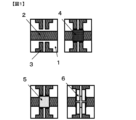
- FIG. 1 shows a schematic diagram of the procedure for producing an organic EL display device using the photosensitive composition obtained in each example and comparative example.
- an ITO transparent conductive film of 10 nm was formed on the entire surface of the substrate by sputtering, and etched as a first electrode (transparent electrode) 2 .
- an auxiliary electrode 3 for taking out the second electrode was also formed.
- the obtained substrate was ultrasonically cleaned for 10 minutes with Semico Clean 56 (trade name, manufactured by Furuuchi Chemical Co., Ltd.) and then cleaned with ultrapure water.
- the photosensitive composition obtained in each example and comparative example was applied to the entire surface of the substrate by spin coating, and prebaked on a hot plate at 100° C. for 2 minutes.
- This film was exposed through a photomask to the minimum exposure amount of each photosensitive composition using a high-pressure mercury lamp as a light source, then developed with a 2.38% by weight TMAH aqueous solution, unnecessary portions were dissolved, and rinsed with pure water. .
- the resulting resin pattern was heat-treated in a hot air oven at 230° C. for 60 minutes.
- the insulating layer 4 having a width of 70 ⁇ m and a length of 260 ⁇ m is arranged at a pitch of 155 ⁇ m in the width direction and a pitch of 465 ⁇ m in the length direction, and each opening exposes the first electrode. Formed only in the effective area.
- an insulating layer having an insulating layer aperture ratio of 25% was formed in a square substrate effective area of 16 mm on a side. The thickness of the insulating layer was about 1.5 ⁇ m.
- an organic EL layer 5 including a light-emitting layer was formed by a vacuum vapor deposition method.
- the degree of vacuum during vapor deposition was 1 ⁇ 10 ⁇ 3 Pa or less, and the substrate was rotated with respect to the vapor deposition source during vapor deposition.
- 10 nm of compound (HT-1) was deposited as a hole injection layer, and 50 nm of compound (HT-2) was deposited as a hole transport layer.
- a compound (GH-1) as a host material and a compound (GD-1) as a dopant material were deposited on the light-emitting layer to a thickness of 40 nm with a doping concentration of 10%.
- the compound (ET-1) and the compound (LiQ) as electron transport materials were laminated at a volume ratio of 1:1 to a thickness of 40 nm. Structures of compounds used in the organic EL layer are shown below.
- a compound (LiQ) LiQ
- Mg and Ag were vapor-deposited to a thickness of 10 nm at a volume ratio of 10:1 to form a second electrode (non-transparent electrode) 6 .
- a cap-shaped glass plate was sealed by bonding with an epoxy resin adhesive, and a top-emission type organic compound having a square shape with a side of 5 mm was placed on a single substrate.
- Four EL display devices were produced. Incidentally, the film thickness referred to here is a value displayed on a crystal oscillation type film thickness monitor.
- Evaluation A All pixels lighted B: 1 to 4 non-lighted devices C: 5 or more non-lighted devices.
- the obtained pre-dispersion liquid was supplied to a dispersing machine Ultra Apex Mill manufactured by Hiroshima Metal & Machinery Co., Ltd. equipped with a centrifugal separator filled with 70% by volume of 0.10 mm ⁇ zirconia beads, and the obtained pre-dispersion liquid was supplied at a rotation speed of 10 m / s for 3 hours. Dispersion was carried out to obtain a black pigment dispersion liquid (DB-1) having a solid content concentration of 25% by weight and a black pigment/resin (weight) ratio of 80/20.
- DB-1 black pigment dispersion liquid having a solid content concentration of 25% by weight and a black pigment/resin (weight) ratio of 80/20.
- Example 1 120.00 g of black pigment dispersion (DB-1), 37.50 g of 20 wt% PGMEA solution of alkali-soluble resin (P-1), 112.50 g of hydroxyl group-containing resin (H-1), photopolymerization start 3.68 g of Irgacure OXE-03 (manufactured by BASF Corporation) as an agent, 11.25 g of HX-220 (manufactured by Nippon Kayaku Co., Ltd.) as a radically polymerizable compound, silicone surfactant "BYK” ( A photosensitive composition (PB-1) with a solid content concentration of 15% by weight and a black pigment/resin (weight ratio) of 20/80 by adding 0.08 g of registered trademark) 333 (manufactured by BYK-Chemie) and 215.00 g of PGMEA. got Furthermore, a cured product of the obtained photosensitive composition and an organic EL display device comprising the cured product were produced according to the method described
- Example 2 In the same manner as in Example 1, 5.63 g of HX-220 and 5.63 g of dipentaerythritol hexaacrylate (manufactured by Nippon Kayaku Co., Ltd.) (hereinafter sometimes referred to as DPHA) are charged as the radically polymerizable compound. 0.63 g of the photosensitive composition (PB-2), a cured product thereof, and an organic EL display device comprising the cured product were obtained.
- PB-2 photosensitive composition
- PB-2 photosensitive composition
- organic EL display device comprising the cured product
- Example 3 In the same manner as in Example 1, 37.50 g of the alkali-soluble resin (P-1), 131.25 g of the hydroxyl group-containing resin (H-1), and 37 of the radically polymerizable compound HX-220 were added. 0.50 g of the photosensitive composition (PB-3), a cured product thereof, and an organic EL display device comprising the cured product were obtained.
- Example 4 In the same manner as in Example 1, BPE-900 (manufactured by Shin-Nakamura Chemical Co., Ltd.) is used as the type of radically polymerizable compound to be introduced into the photosensitive composition (PB-4), its cured product, and its curing. An organic EL display device was obtained.
- BPE-900 manufactured by Shin-Nakamura Chemical Co., Ltd.
- Example 5 In the same manner as in Example 1, the alkali-soluble resin (P-1) was not added, the amount of the hydroxyl group-containing resin (H-1) to be added was 150.00 g, and the type of the radically polymerizable compound to be added was BPE. -900 to obtain a photosensitive composition (PB-5), a cured product thereof, and an organic EL display device comprising the cured product.
- Examples 6 to 11 In the same manner as in Example 1, photosensitive compositions (PB-6) to (PB-11) and their curing are obtained by using black pigment dispersions (DB-2) to (DB-7), respectively. An organic EL display device comprising the product and its cured product was obtained.
- Example 12 In the same manner as in Example 1, by using Adeka Arcles (registered trademark) NCI-831 as the photopolymerization initiator to be introduced (PB-12), its cured product, and an organic EL display device comprising the cured product got
- Example 13 In the same manner as in Example 1, 120.0 g of black pigment dispersion (DB-8), 168.75 g of hydroxyl group-containing resin (H-1), 37.50 g of HX-220, and 3 of NCI-831 were prepared. By using 0.08 g of BYK333 and 0.08 g of BYK333, (PB-13), a cured product thereof, and an organic EL display device comprising the cured product were obtained.
- Example 14 In the same manner as in Example 13, (DB-1) was used as a black pigment dispersion to obtain (PB-14), a cured product thereof, and an organic EL display device comprising the cured product.
- Example 15 In the same manner as in Example 1, 120.0 g of the black pigment dispersion (DB-1), 18.75 g of the alkali-soluble resin (P-1), 150.00 g of the hydroxyl group-containing resin (H-1), By using 37.50 g of HX-220, 3.68 g of NCI-831, and 0.08 g of BYK333, (PB-15), its cured product, and an organic EL display device comprising the cured product were obtained.
- DB-1 black pigment dispersion
- P-1 alkali-soluble resin
- H-1 hydroxyl group-containing resin
- Example 16 In the same manner as in Example 1, 120.0 g of the black pigment dispersion (DB-1), 56.25 g of the alkali-soluble resin (P-1), 112.50 g of the hydroxyl group-containing resin (H-1), By using 37.50 g of HX-220, 3.68 g of NCI-831, and 0.08 g of BYK333, (PB-16), its cured product, and an organic EL display device comprising the cured product were obtained.
- DB-1 black pigment dispersion
- P-1 alkali-soluble resin
- H-1 hydroxyl group-containing resin
- Example 17 In the same manner as in Example 1, 120.0 g of the black pigment dispersion (DB-1), 75.00 g of the alkali-soluble resin (P-1), 93.75 g of the hydroxyl group-containing resin (H-1), By using 37.50 g of HX-220, 3.68 g of NCI-831, and 0.08 g of BYK333, (PB-17), its cured product, and an organic EL display device comprising the cured product were obtained.
- DB-1 black pigment dispersion
- P-1 alkali-soluble resin
- H-1 hydroxyl group-containing resin
- Example 18 In the same manner as in Example 1, 120.0 g of the black pigment dispersion (DB-1), 86.25 g of the alkali-soluble resin (P-1), 82.50 g of the hydroxyl group-containing resin (H-1), By using 37.50 g of HX-220, 3.68 g of NCI-831, and 0.08 g of BYK333, (PB-18), its cured product, and an organic EL display device comprising the cured product were obtained.
- DB-1 black pigment dispersion
- P-1 alkali-soluble resin
- H-1 82.50 g of the hydroxyl group-containing resin
- Example 19 In the same manner as in Example 1, 120.0 g of (DB-1), 93.75 g of (P-1), 75.00 g of (H-1), and 37.0 g of HX-220 were prepared as a black pigment dispersion. By using 50 g, 3.68 g of NCI-831, and 0.08 g of BYK333, (PB-19), its cured product, and an organic EL display device comprising the cured product were obtained.
- Examples 20-23 In the same manner as in Example 19, the hydroxyl group-containing resins to be introduced are (H-2) to (H-5) (PB-20) to (PB-23), their cured products, and their cured products. An organic EL display device was obtained.
- Examples 24-31 In the same manner as in Example 19, the pigment dispersions to be charged are (DB-9) to (DB-16), the alkali-soluble resins are (P-2) to (P-9), and the hydroxyl group-containing resin is ( H-5), respectively (PB-24) to (PB-31), their cured products, and organic EL display devices having their cured products were obtained.
- Example 32 By the same method as in Example 31, the radically polymerizable compound to be charged was 30.00 g of HX-220 and 7.50 g of DPHA (PB-32), its cured product, and its cured product. An organic EL display device was obtained.
- Example 33 In the same manner as in Example 31, the radically polymerizable compound to be charged was 22.50 g of HX-220 and 15.00 g of DPHA (PB-33), its cured product, and its cured product. An organic EL display device was obtained.
- Example 34 In the same manner as in Example 31, 18.75 g of HX-220 and 18.75 g of DPHA were added as the radically polymerizable compound (PB-34), its cured product, and its cured product. An organic EL display device was obtained.
- Example 35 In the same manner as in Example 31, the radically polymerizable compound to be introduced is 37.50 g of A-9300 (manufactured by Shin-Nakamura Chemical Co., Ltd.) (PB-35) and its cured product and its cured product.
- An organic EL display device comprising
- Example 36 By the same method as in Example 31, the radical polymerizable compound to be charged was 18.75 g of A-BPE-10 (manufactured by Shin-Nakamura Chemical Co., Ltd.) and 18.75 g of DPHA (PB-36). and a cured product thereof, and an organic EL display device provided with the cured product were obtained.
- A-BPE-10 manufactured by Shin-Nakamura Chemical Co., Ltd.
- DPHA DPHA
- Example 37 In the same manner as in Example 31, the radically polymerizable compound to be charged was 18.75 g of BPE-900 and 18.75 g of DPHA (PB-37), its cured product, and its cured product. An organic EL display device was obtained.
- Example 38 In the same manner as in Example 31, 18.75 g of BPE-1300N (manufactured by Shin-Nakamura Chemical Co., Ltd.) and 18.75 g of DPHA were added as the radically polymerizable compound (PB-38) and its A cured product and an organic EL display device comprising the cured product were obtained.
- BPE-1300N manufactured by Shin-Nakamura Chemical Co., Ltd.
- DPHA radically polymerizable compound
- Example 39 In the same manner as in Example 1, 120.00 g of (DB-1), 18.75 g of 20 wt% PGMEA solution of (P-1), 93.75 g of hydroxyl group-containing resin (H-1), Irgacure 3.68 g of OXE-03, 11.25 g of HX-220, 0.08 g of “BYK” (registered trademark) 333, “Snowtex” (registered trademark) ST-XS (manufactured by Nissan Chemical Industries, Ltd.) as silica particles 37.5 g and 214.99 g of PGMEA were added to obtain a photosensitive composition (PB-39), a cured product thereof, and an organic EL display device comprising the cured product.
- PB-39 photosensitive composition
- a cured product thereof a cured product thereof
- organic EL display device comprising the cured product.
- Example 40 In the same manner as in Example 39, 25.00 g of "Organo Silica Sol” (registered trademark) MIBK-ST (manufactured by Nissan Chemical Industries, Ltd.) and 227.49 g of PGMEA were added as silica particles to prepare a photosensitive composition (PB-40 ), a cured product thereof, and an organic EL display device comprising the cured product were obtained.
- PB-40 photosensitive composition
- Example 41 In the same manner as in Example 40, by changing the type of silica particles to be added to "Organo Silica Sol” (registered trademark) CHO-ST-M (manufactured by Nissan Chemical Industries, Ltd.), a photosensitive composition (PB-41) and A cured product and an organic EL display device provided with the cured product were obtained.
- "Organo Silica Sol” registered trademark
- CHO-ST-M manufactured by Nissan Chemical Industries, Ltd.
- Example 42 In the same manner as in Example 40, by changing the type of silica particles to be added to "Organo Silica Sol” (registered trademark) MIBK-ST-L (manufactured by Nissan Chemical Industries, Ltd.), a photosensitive composition (PB-42) and A cured product and an organic EL display device provided with the cured product were obtained.
- "Organo Silica Sol” registered trademark
- MIBK-ST-L manufactured by Nissan Chemical Industries, Ltd.
- Example 43 In the same manner as in Example 40, 33.75 g of (P-1), 105.00 g of (H-1), 7.50 g of MIBK-ST, and 218.74 g of PGMEA are added (PB -43), a cured product thereof, and an organic EL display device comprising the cured product.
- Example 44 In the same manner as in Example 40, 30.00 g of (P-1), 101.25 g of (H-1), 12.50 g of MIBK-ST, and 221.24 g of PGMEA are added (PB -44), a cured product thereof, and an organic EL display device comprising the cured product.
- Example 45 By the same method as in Example 40, 75.00 g of (H-1), 7.500 g of HX-220, 50.00 g of MIBK-ST, and 224.99 g of PGMEA are added (PB-45 ), a cured product thereof, and an organic EL display device comprising the cured product were obtained.
- Example 46 In the same manner as in Example 40, 56.25 g of (H-1), 7.500 g of HX-220, 62.50 g of MIBK-ST, and 231.24 g of PGMEA were added (PB-46 ), a cured product thereof, and an organic EL display device comprising the cured product were obtained.
- Table 1 shows the composition of the black pigment dispersion.
- Tables 2 and 4 show the composition of each example and comparative example, and Tables 3 and 5 show the evaluation results thereof.
- the photosensitive compositions described in the examples exhibit both high light-shielding properties and sensitivity, excellent pattern linearity, small residue at the edge, and small mask bias. As a result, the frequency of occurrence of unlit pixels in the display device was low.
- the photosensitive composition of Comparative Example 1 has a small double bond equivalent in the solid content, and the photocuring of the exposed portion proceeds excessively, so the linearity of the pattern edge portion is reduced. was deteriorated, and the excessively hardened layer on the surface of the film was peeled off by development, resulting in the generation of residue at the pattern edge portion. Further, in the photosensitive composition described in Comparative Example 2, the double bond equivalent in the solid content was large, and the cross-linking density in the exposed area was insufficient. became.
- non-alkali glass substrate 2 first electrode (transparent electrode) 3: auxiliary electrode 4: insulating layer 5: organic EL layer 6: second electrode (non-transparent electrode)
Landscapes
- Physics & Mathematics (AREA)
- General Physics & Mathematics (AREA)
- Chemical & Material Sciences (AREA)
- Spectroscopy & Molecular Physics (AREA)
- Organic Chemistry (AREA)
- Health & Medical Sciences (AREA)
- Chemical Kinetics & Catalysis (AREA)
- Medicinal Chemistry (AREA)
- Polymers & Plastics (AREA)
- Engineering & Computer Science (AREA)
- Microelectronics & Electronic Packaging (AREA)
- Architecture (AREA)
- Structural Engineering (AREA)
- Theoretical Computer Science (AREA)
- Optics & Photonics (AREA)
- Materials For Photolithography (AREA)
Priority Applications (3)
| Application Number | Priority Date | Filing Date | Title |
|---|---|---|---|
| JP2022562028A JP7831306B2 (ja) | 2021-09-29 | 2022-09-21 | 感光性組成物、硬化物および有機el表示装置 |
| CN202280058174.6A CN117916664A (zh) | 2021-09-29 | 2022-09-21 | 感光性组合物、固化物及有机el显示装置 |
| KR1020247000924A KR20240063852A (ko) | 2021-09-29 | 2022-09-21 | 감광성 조성물, 경화물 및 유기 el 표시 장치 |
Applications Claiming Priority (2)
| Application Number | Priority Date | Filing Date | Title |
|---|---|---|---|
| JP2021-158864 | 2021-09-29 | ||
| JP2021158864 | 2021-09-29 |
Publications (1)
| Publication Number | Publication Date |
|---|---|
| WO2023054118A1 true WO2023054118A1 (ja) | 2023-04-06 |
Family
ID=85780663
Family Applications (1)
| Application Number | Title | Priority Date | Filing Date |
|---|---|---|---|
| PCT/JP2022/035171 Ceased WO2023054118A1 (ja) | 2021-09-29 | 2022-09-21 | 感光性組成物、硬化物および有機el表示装置 |
Country Status (4)
| Country | Link |
|---|---|
| JP (1) | JP7831306B2 (https=) |
| KR (1) | KR20240063852A (https=) |
| CN (1) | CN117916664A (https=) |
| WO (1) | WO2023054118A1 (https=) |
Citations (6)
| Publication number | Priority date | Publication date | Assignee | Title |
|---|---|---|---|---|
| JP2007093811A (ja) * | 2005-09-27 | 2007-04-12 | Tokyo Ohka Kogyo Co Ltd | 機能性パターン形成用感光性樹脂組成物および機能性パターン形成方法 |
| WO2015046178A1 (ja) * | 2013-09-25 | 2015-04-02 | 三菱化学株式会社 | 感光性着色組成物、ブラックマトリクス、着色スペーサー、画像表示装置及び顔料分散液 |
| JP2015151530A (ja) * | 2014-02-19 | 2015-08-24 | 富士フイルム株式会社 | 複合体およびその製造方法、着色組成物、硬化膜、カラーフィルタ、カラーフィルタの製造方法、固体撮像素子および画像表示装置、ならびに、積層体よび積層体 |
| WO2018173570A1 (ja) * | 2017-03-24 | 2018-09-27 | 富士フイルム株式会社 | 感光性着色組成物、硬化膜、カラーフィルタ、固体撮像素子および画像表示装置 |
| WO2021059977A1 (ja) * | 2019-09-26 | 2021-04-01 | 富士フイルム株式会社 | 硬化性組成物、硬化膜、カラーフィルタ、固体撮像素子及び画像表示装置 |
| JP2021119368A (ja) * | 2020-01-30 | 2021-08-12 | 株式会社Dnpファインケミカル | 感光性着色樹脂組成物、硬化物、カラーフィルタ、表示装置 |
Family Cites Families (2)
| Publication number | Priority date | Publication date | Assignee | Title |
|---|---|---|---|---|
| WO2018061525A1 (ja) | 2016-09-30 | 2018-04-05 | 東レ株式会社 | ネガ型感光性樹脂組成物、硬化膜、硬化膜を具備する素子及び表示装置、並びにその製造方法 |
| CN118151488A (zh) | 2016-12-02 | 2024-06-07 | 三菱化学株式会社 | 着色感光性树脂组合物、颜料分散液、间隔壁、有机场致发光元件、图像显示装置及照明 |
-
2022
- 2022-09-21 CN CN202280058174.6A patent/CN117916664A/zh active Pending
- 2022-09-21 WO PCT/JP2022/035171 patent/WO2023054118A1/ja not_active Ceased
- 2022-09-21 JP JP2022562028A patent/JP7831306B2/ja active Active
- 2022-09-21 KR KR1020247000924A patent/KR20240063852A/ko active Pending
Patent Citations (6)
| Publication number | Priority date | Publication date | Assignee | Title |
|---|---|---|---|---|
| JP2007093811A (ja) * | 2005-09-27 | 2007-04-12 | Tokyo Ohka Kogyo Co Ltd | 機能性パターン形成用感光性樹脂組成物および機能性パターン形成方法 |
| WO2015046178A1 (ja) * | 2013-09-25 | 2015-04-02 | 三菱化学株式会社 | 感光性着色組成物、ブラックマトリクス、着色スペーサー、画像表示装置及び顔料分散液 |
| JP2015151530A (ja) * | 2014-02-19 | 2015-08-24 | 富士フイルム株式会社 | 複合体およびその製造方法、着色組成物、硬化膜、カラーフィルタ、カラーフィルタの製造方法、固体撮像素子および画像表示装置、ならびに、積層体よび積層体 |
| WO2018173570A1 (ja) * | 2017-03-24 | 2018-09-27 | 富士フイルム株式会社 | 感光性着色組成物、硬化膜、カラーフィルタ、固体撮像素子および画像表示装置 |
| WO2021059977A1 (ja) * | 2019-09-26 | 2021-04-01 | 富士フイルム株式会社 | 硬化性組成物、硬化膜、カラーフィルタ、固体撮像素子及び画像表示装置 |
| JP2021119368A (ja) * | 2020-01-30 | 2021-08-12 | 株式会社Dnpファインケミカル | 感光性着色樹脂組成物、硬化物、カラーフィルタ、表示装置 |
Also Published As
| Publication number | Publication date |
|---|---|
| KR20240063852A (ko) | 2024-05-10 |
| JPWO2023054118A1 (https=) | 2023-04-06 |
| CN117916664A (zh) | 2024-04-19 |
| JP7831306B2 (ja) | 2026-03-17 |
Similar Documents
| Publication | Publication Date | Title |
|---|---|---|
| US20210011381A1 (en) | Negative-type photosensitive resin composition, cured film, element and display apparatus that include cured film, production method for the same | |
| TWI705304B (zh) | 負型感光性樹脂組成物、硬化膜、具備硬化膜之有機el顯示器、及其製造方法 | |
| TWI757457B (zh) | 感光性樹脂組成物、硬化膜、具備硬化膜之元件、具備硬化膜之有機el顯示裝置、硬化膜之製造方法、及有機el顯示裝置之製造方法 | |
| CN103946747B (zh) | 负型感光性树脂组合物、分隔壁、黑色矩阵以及光学元件 | |
| TWI470354B (zh) | 使用具有茀骨架之光聚合性聚合物的感光性組成物 | |
| WO2019065902A1 (ja) | 感光性樹脂組成物、硬化膜、硬化膜を具備する素子及び有機elディスプレイ、並びに有機elディスプレイの製造方法 | |
| CN103765314B (zh) | 负型感光性树脂组合物、分隔壁以及光学元件 | |
| JP5441542B2 (ja) | ポジ型感光性樹脂組成物、硬化膜、層間絶縁膜、有機el表示装置、及び液晶表示装置 | |
| KR102373040B1 (ko) | 감광성 수지 조성물, 유기 el 소자 격벽, 및 유기 el 소자 | |
| CN104271642B (zh) | 部分水解缩合物、拒墨剂、负型感光性树脂组合物、固化膜、分隔壁和光学元件 | |
| JPWO2018003808A1 (ja) | ネガ型感光性樹脂組成物、硬化膜、硬化膜を具備する素子、素子を具備する表示装置、及び有機elディスプレイ | |
| CN103838083A (zh) | 感光性树脂组合物、其所形成的彩色滤光片及其液晶显示元件 | |
| JP7574576B2 (ja) | ネガ型感光性樹脂組成物、硬化膜および有機el表示装置 | |
| CN110888300A (zh) | 感光性树脂组合物、有机el元件间隔壁及有机el元件 | |
| JP7831306B2 (ja) | 感光性組成物、硬化物および有機el表示装置 | |
| JP7794120B2 (ja) | ネガ型感光性組成物、硬化膜、有機el表示装置および硬化膜の製造方法 | |
| JP2024077069A (ja) | 感光性組成物、硬化物および有機el表示装置 | |
| CN114303097A (zh) | 感光性树脂组合物及有机el元件间隔壁 | |
| TWI921462B (zh) | 負型感光性樹脂組成物、硬化膜及有機el顯示裝置 | |
| JP2011053246A (ja) | 感光性樹脂組成物、硬化膜の形成方法、硬化膜、有機el表示装置、及び、液晶表示装置 | |
| CN121241076A (zh) | 共聚物、感光性组合物、固化物及有机el显示装置 | |
| TW202239774A (zh) | 負型感光性樹脂組成物、硬化膜及有機el顯示裝置 | |
| WO2024122200A1 (ja) | 感光性樹脂組成物、樹脂硬化膜、及び画像表示装置 | |
| WO2025182759A1 (ja) | ポジ型感光性樹脂組成物およびその硬化物を含む硬化膜ならびに有機el表示装置、電子機器 | |
| JP2025129026A (ja) | 硬化性組成物、硬化膜、有機el装置、及び硬化樹脂層の形成方法 |
Legal Events
| Date | Code | Title | Description |
|---|---|---|---|
| WWE | Wipo information: entry into national phase |
Ref document number: 2022562028 Country of ref document: JP |
|
| 121 | Ep: the epo has been informed by wipo that ep was designated in this application |
Ref document number: 22875985 Country of ref document: EP Kind code of ref document: A1 |
|
| WWE | Wipo information: entry into national phase |
Ref document number: 202280058174.6 Country of ref document: CN |
|
| NENP | Non-entry into the national phase |
Ref country code: DE |
|
| 122 | Ep: pct application non-entry in european phase |
Ref document number: 22875985 Country of ref document: EP Kind code of ref document: A1 |