WO2023053612A1 - 情報出力方法、情報出力装置及びプログラム - Google Patents
情報出力方法、情報出力装置及びプログラム Download PDFInfo
- Publication number
- WO2023053612A1 WO2023053612A1 PCT/JP2022/024594 JP2022024594W WO2023053612A1 WO 2023053612 A1 WO2023053612 A1 WO 2023053612A1 JP 2022024594 W JP2022024594 W JP 2022024594W WO 2023053612 A1 WO2023053612 A1 WO 2023053612A1
- Authority
- WO
- WIPO (PCT)
- Prior art keywords
- information
- recommended
- devices
- user
- recommendation
- Prior art date
- Legal status (The legal status is an assumption and is not a legal conclusion. Google has not performed a legal analysis and makes no representation as to the accuracy of the status listed.)
- Ceased
Links
Images





Classifications
-
- G—PHYSICS
- G06—COMPUTING OR CALCULATING; COUNTING
- G06Q—INFORMATION AND COMMUNICATION TECHNOLOGY [ICT] SPECIALLY ADAPTED FOR ADMINISTRATIVE, COMMERCIAL, FINANCIAL, MANAGERIAL OR SUPERVISORY PURPOSES; SYSTEMS OR METHODS SPECIALLY ADAPTED FOR ADMINISTRATIVE, COMMERCIAL, FINANCIAL, MANAGERIAL OR SUPERVISORY PURPOSES, NOT OTHERWISE PROVIDED FOR
- G06Q30/00—Commerce
- G06Q30/06—Buying, selling or leasing transactions
- G06Q30/0601—Electronic shopping [e-shopping]
- G06Q30/0631—Recommending goods or services
-
- G—PHYSICS
- G06—COMPUTING OR CALCULATING; COUNTING
- G06Q—INFORMATION AND COMMUNICATION TECHNOLOGY [ICT] SPECIALLY ADAPTED FOR ADMINISTRATIVE, COMMERCIAL, FINANCIAL, MANAGERIAL OR SUPERVISORY PURPOSES; SYSTEMS OR METHODS SPECIALLY ADAPTED FOR ADMINISTRATIVE, COMMERCIAL, FINANCIAL, MANAGERIAL OR SUPERVISORY PURPOSES, NOT OTHERWISE PROVIDED FOR
- G06Q30/00—Commerce
- G06Q30/02—Marketing; Price estimation or determination; Fundraising
Definitions
- This disclosure relates to technology for recommending devices to users.
- Patent Literature 1 discloses extracting multiple pieces of information about the peripheral positions of a terminal device and generating display data for displaying the multiple pieces of information about the peripheral positions of the terminal device on the terminal device.
- Patent Document 1 does not consider selecting an externally available device group based on the device used by the user and providing information for recommending the device group. Therefore, there is a problem that it is not possible to recommend a group of devices installed outside the facility that can replace the devices installed in the facility used by the user.
- the present disclosure has been made to solve the above problems, and an information output method that can recommend a group of devices installed outside the facility that can replace the devices installed in the facility used by the user. It aims at presenting an information output device and a program.
- a computer obtains first information about a first device installed in a facility used by a user, and outputs a plurality of second devices installed outside the facility. obtaining second information about the first device, determining one or more recommended devices that can replace the first device from among the plurality of second devices based on the first information and the second information; Recommendation information for recommending the above recommended devices to the user is output.
- FIG. 1 is a diagram illustrating an example of the overall configuration of a device recommendation system according to an embodiment of the present disclosure
- FIG. It is a figure which shows an example of the information which a 1st database memorize
- FIG. 2 is a diagram showing an example of information stored in a memory of a server;
- FIG. 8 is a flowchart illustrating an example of candidate device list creation processing; 9 is a flowchart showing an example of recommendation information output processing;
- Patent Literature 1 discloses extracting multiple pieces of information about the peripheral positions of a terminal device and generating display data for displaying the multiple pieces of information about the peripheral positions of the terminal device on the terminal device.
- Patent Document 1 does not consider selecting an externally available device group based on the device used by the user and providing information for recommending the device group. For this reason, in the technique disclosed in Patent Document 1, even if it is possible to display information about a group of devices installed in facilities around the facility used by the user, it is possible to select the device installed in the facility used by the user from the group of devices. It is difficult to recommend a group of devices that can be substituted for the devices that have been tested.
- equipment that is difficult for users to install themselves such as toilets and baths, and has a long service life, tends to be used for a long time, making it difficult to get users interested in new products. If a new product installed outside the facility used by the user can be recommended as a substitute for such equipment, the user may try the new product and become interested in purchasing a new equipment. Be expected.
- the present inventors have made intensive studies on techniques for recommending to the user a group of devices installed outside the facility that can replace the devices installed in the facility used by the user. reached an equivalent.
- a computer obtains first information about a first device installed in a facility used by a user, and outputs a plurality of second devices installed outside the facility. obtaining second information about the first device, determining one or more recommended devices that can replace the first device from among the plurality of second devices based on the first information and the second information; Recommendation information for recommending the above recommended devices to the user is output.
- the plurality of second One or more recommended devices that can replace the first device can be appropriately determined from among the devices.
- the recommendation information for recommending the one or more recommended devices to the user the one or more recommended devices installed outside the facility can be recommended to the user who referred to the recommendation information.
- the first information includes the date and time of manufacture, the period of use, and the life of the first device
- the second information includes the date and time of manufacture of each of the plurality of second devices
- the In the determination of one or more recommended devices if the ratio of the usage period of the first device to the life of the first device is greater than a predetermined ratio, among the plurality of second devices, the date and time of manufacture is the first device.
- One or more second devices that are newer than the date and time of manufacture of the one device may be determined as the one or more recommended devices.
- the one or more second devices whose date and time of manufacture are newer than the date and time of manufacture of the first device is output. Therefore, when the first device is nearing the end of its service life, it is possible to recommend to the user a device newer than the first device among the plurality of devices installed outside the facility used by the user. can.
- the first information includes a function group possessed by the first device
- the second information includes a function group possessed by each of the plurality of second devices
- the one or more In determining the recommended devices one or more second devices having a function that the first device does not have among the plurality of second devices may be determined as the one or more recommended devices.
- recommendation information for recommending one or more second devices having functions that the first device does not have is output. Therefore, among the plurality of devices installed outside the facility used by the user, it is possible to recommend to the user the device having the function that the first device does not have.
- the first information includes a group of functions possessed by the first device
- the second information comprises a group of functions possessed by each of the plurality of second devices and a group of functions possessed by each of the plurality of second devices.
- One or more predetermined characteristic functions possessed by each of the devices are included, and in the determination of the one or more recommended devices, among the plurality of second devices, the first device does not have and the one or more may be determined as the one or more recommended devices.
- recommendation information for recommending one or more second devices having predetermined characteristic functions that the first device does not have is output. Therefore, among the plurality of devices installed outside the facility used by the user, it is possible to recommend to the user a device having a characteristic function that the first device does not have.
- the first information includes a group of functions possessed by the first device and attributes of each of the one or more users who use the facility
- the second information includes the plurality of a function group possessed by each of the second devices
- a beneficial function group which is a predetermined function group beneficial to each attribute of the one or more users possessed by each of the plurality of second devices.
- the one or more second devices having a function that the first device does not have among the one or more second devices having a function that the first device does not have, the one or more users who use the facilities used by the users have predetermined Recommendation information for recommending at least one second device having the function is output. For this reason, one or more second devices having functions that the first device does not have are limited to at least one second device having useful functions for each attribute of the one or more users. can be recommended to the user.
- the one or more recommended devices in determining the one or more recommended devices, information indicating a rule set based on the first information and the second information is acquired, and the plurality of second devices are selected according to the rule.
- the one or more recommended devices may be determined from among them.
- recommendation information for recommending one or more recommended devices determined according to a rule set based on the first information and the second information from among the plurality of second devices is output. Therefore, among the plurality of devices installed outside the facility used by the user, it is possible to recommend to the user the device that follows the rule set based on the first information and the second information.
- a rule set by the user based on the first information and the second information is received, and according to the rule, the plurality of second devices are selected from among the plurality of devices.
- the one or more recommended devices may be determined.
- recommendation information for recommending one or more recommended devices determined from among a plurality of second devices according to rules based on the first information and the second information set by the user is output. Therefore, among the plurality of devices installed outside the facility used by the user, it is possible to recommend to the user the device that follows the rule set by the user based on the first information and the second information.
- the recommended information when it is detected that the user's current position is within a predetermined distance from the installation position of at least one of the one or more recommended devices, the recommended information is output.
- Information for recommending at least one recommended device may be output as the recommendation information.
- At least one of the recommended devices is recommended. Recommendation information is output. Therefore, when the user approaches the at least one recommended device, the at least one recommended device can be recommended to the user. As a result, it is possible to improve the possibility that the user will use the recommended device that exists nearby.
- the output of the recommendation information in the output of the recommendation information, information indicating the position of a predetermined group of facilities that encourages replacement of equipment is further obtained, and further, the current position of the user is at least one of the facilities recommending at least one recommended device installed within a predetermined second distance from the at least one facility among the one or more recommended devices when it is detected that the device is within a predetermined first distance from the facility. You may output the information which does as said recommendation information.
- recommendation information for recommending at least one recommended device installed within a second distance from the at least one facility is output.
- At least one recommended device among the one or more recommended devices installed near the at least one facility is presented to the user. can recommend.
- history information indicating a history of the use of the first device by the user is further obtained,
- the recommendation information may be output when it is detected that the frequency of use of the first device by the user in the second period has changed by a predetermined frequency or more from a second period preceding the first period.
- one or more Recommendation information for recommending a recommended device is output. Therefore, when the usage frequency of the first device changes significantly, one or more recommended devices installed outside the facility can be recommended to the user. This can improve the possibility that the user will consider replacing the first device.
- a notification indicating that the user has requested from an external device information about at least one recommended device among the one or more recommended devices is received;
- Information for recommending the at least one recommended device may be output as the recommendation information when the notification is received.
- recommendation information for recommending the at least one recommended device is output. Therefore, when the user requests information on at least one recommended device from the external device, it is possible to recommend to the user the recommendation information for recommending the at least one recommended device.
- the recommendation information in outputting the recommendation information, price information indicating prices of the one or more recommended devices is periodically acquired, and further, price information of the one or more recommended devices indicated by the price information is obtained.
- Information for recommending the at least one recommended device may be output as the recommendation information when at least one recommended device whose price is reduced by a predetermined rate or more from the price indicated by the price information obtained last time is detected. good.
- recommendation information recommending the at least one recommended device is output. Therefore, when the price of the at least one recommended device is greatly reduced, the at least one recommended device can be recommended to the user. This motivates the user to purchase at least one recommended device with a reduced price.
- the recommendation information may be output periodically.
- one or more recommended devices can be regularly recommended to the user. This can improve the possibility that the user will consider replacing the first device.
- the recommended information for recommending one or more recommended devices is output. Therefore, the user can input the information requesting the output of the recommendation information at the intended timing and immediately grasp the recommendation information.
- the Information for recommending a group of functions to be recommended may be output.
- the information output method in the output of the recommendation information, information indicating a group of related products related to each of the group of recommended devices recommended by the recommendation information is further acquired, and together with the group of recommendation information, the group of related products is acquired. You may output the information which recommends .
- the information indicating the related product group related to each of the recommended device groups recommended by the recommendation information is output. Therefore, it is possible to recommend to the user not only the recommended device group recommended by the recommendation information, but also the related product group related to each of the recommended device groups.
- the first information includes a period of use of the first device
- the second information includes installation positions of each of the plurality of second devices
- the user's current Acquiring movement history information indicating a history of positions and log information indicating an operation state of each of the plurality of second devices
- obtaining the first information, the second information, the movement history information, and the log information Information relating to at least one of usage and purchase by the user of each of the recommended device groups recommended by the output recommendation information may be stored.
- information about at least one of usage and purchase by each user of the recommended device group recommended by the output recommendation information is stored. Therefore, by referring to the stored at least one, it is possible to grasp information regarding at least one of usage and purchase by each user of the recommended device group recommended by the recommendation information. As a result, it is possible to grasp the influence of the recommendation of the recommended device based on the recommendation information on at least one of the usage and purchase of the device by the user.
- the first information includes the period of use of the first device
- the second information includes information on the installation location and purchase of each of the plurality of second devices, and obtaining movement history information indicating a history of the user's current location and log information indicating an operating state of each of the plurality of second devices;
- An information output device includes a first acquisition unit that acquires first information about a first device installed in a facility used by a user; a second acquisition unit that acquires second information about a second device; and one or more of the plurality of second devices that can be replaced with the first device based on the first information and the second information and an output unit for outputting recommendation information for recommending the one or more recommended devices to the user.
- a program according to another aspect of the present disclosure is a program that causes a computer to function, the computer being a first acquisition unit that acquires first information about a first device installed in a facility used by a user. , a second acquisition unit that acquires second information about a plurality of second devices installed outside the facility; and an output unit for outputting recommendation information for recommending the one or more recommended devices to the user.
- the present disclosure can also be implemented as a system operated by such a program. It goes without saying that such a computer program can be distributed via a computer-readable non-temporary recording medium such as a CD-ROM or a communication network such as the Internet.
- a computer-readable non-temporary recording medium such as a CD-ROM or a communication network such as the Internet.
- FIG. 1 is a diagram showing an example of the overall configuration of a device recommendation system 1 according to an embodiment of the present disclosure.
- the device recommendation system 1 includes at least one device 20 and sensor 21 installed in a facility 2 used by a user, a user terminal 30, a first database (hereinafter referred to as first DB) 41, a second database (hereinafter referred to as second 2DB) 42, a log database (hereinafter referred to as log DB) 43, a WEB server 50 (an example of an external device), and a server 10 (an example of an information output device).
- first DB first database
- second 2DB second database
- log database hereinafter referred to as log DB
- WEB server 50 an example of an external device
- server 10 an example of an information output device.
- the device 20, the sensor 21, the user terminal 30, the first DB 41, the second DB 42, the log DB 43, the WEB server 50 and the server 10 are communicably connected to each other via the communication network 90.
- Communication network 90 is, for example, a public communication line such as the Internet.
- the device 20 and the sensor 21 may be communicatively connected to other devices 20, other sensors 21 and user terminals 30 via a local network within the facility 2.
- Facility 2 is, for example, a residence.
- a residence may be an apartment complex or a detached house.
- facility 2 may be an office. If facility 2 is a residence, the user of equipment 20 is a resident. If the facility 2 is an office, the user of the equipment 20 is the user of the office.
- residents and users of the facility 2 are hereinafter referred to as users.
- the devices 20 include electronic devices that are installed in the facility 2 such as toilets, baths, and electronic locks, that are difficult for users to replace by themselves, and that have a long service life (e.g., 10 years, 5 years, etc.). .
- the device 20 periodically transmits log information indicating its operating state to the server 10 .
- the server 10 stores log information acquired from the device 20 in the log DB 43 .
- the log information transmitted by the device 20 includes the transmission date and time of the log information, the identification information of the device 20 (hereinafter referred to as device ID), the operating state of the device 20, and the like.
- the operating state of the device 20 includes an idle state in which the device 20 is waiting to be operated, a state in which the device 20 is in use, a state in which the device 20 has an abnormality, and the like.
- the device 20 is a toilet, and an example in which one device 20 (toilet) is installed in the facility 2 used by a specific user will be described.
- the sensor 21 periodically detects information about the space in which the sensor 21 is installed.
- the sensor 21 periodically transmits sensor information including detected information (hereinafter referred to as detection information) to the server 10 .
- detection information includes detected information (hereinafter referred to as detection information)
- the server 10 stores sensor information acquired from the sensor 21 in the log DB 43 .
- the sensor information transmitted by the sensor 21 includes detection information, the date and time when the detection information was detected (hereinafter, detection date and time), and identification information of the sensor 21 (hereinafter, sensor ID).
- the sensors 21 include surveillance cameras, motion sensors, and the like.
- the surveillance camera captures an image of the space in which the surveillance camera is installed, and transmits sensor information including image data representing the captured image as detection information.
- the human sensor detects whether or not a person exists in the space in which the human sensor is installed. When detecting that a person exists in the space, the human sensor transmits sensor information including information indicating the position of the person as detection information.
- the user terminal 30 is an information communication terminal such as a laptop computer, a smart phone, or a tablet terminal used by the user who uses the facility 2.
- the user terminal 30 includes a liquid crystal display for displaying various text information and images, a speaker for outputting sounds indicated by various audio data, and a touch panel for performing various operations of the user terminal 30 such as inputting information. and operating devices such as hard keys.
- the user terminal 30 also includes a GPS sensor for detecting the position of the user terminal 30 and a communication circuit for communicating with an external device such as the server 10 via the communication network 90 .
- the user terminal 30 When the communication circuit receives the text information and image data transmitted to the destination when notifying the user of the user terminal 30 of the information, the user terminal 30 transmits the image indicated by the text information and the image data to the liquid crystal display. display on the display. Further, when the communication circuit receives voice data transmitted to a destination when notifying the user of the user terminal 30 of information, the user terminal 30 causes the speaker to output the voice indicated by the voice data.
- the user terminal 30 periodically transmits information regarding the current location of the user of the user terminal 30 (hereinafter referred to as movement history information) to the server 10 .
- the movement history information includes identification information of the user of the user terminal 30 (hereinafter referred to as user ID), the current date and time when the GPS sensor detected the position of the user terminal 30, the current position of the user, and the like.
- the current position of the user is the position of the user terminal 30 detected by the GPS sensor.
- the first DB 41 is composed of one or more storage devices such as HDD (Hard Disk Drive) and SSD (Solid State Drive).
- the first DB 41 stores information (hereinafter referred to as first information) about the equipment 20 installed in the facility 2 used by the user.
- FIG. 2 is a diagram showing an example of the first information stored in the first DB 41.
- the first information stored in the first DB 41 includes user information 411 for each of one or more users of the facility 2 used by the user, and device management information 412 for managing the device 20. and specification information 413 indicating the specifications of the device 20 .
- the first information further includes matching information 414 for identifying each of the one or more users of the facility 2 that the user uses.
- the user information 411 includes identification information of the facility 2 used by the user (hereinafter referred to as facility ID), user IDs of each of one or more users of the facility 2, attribute information indicating attributes of users corresponding to the user IDs, and Destination information indicating a destination when notifying information to the user corresponding to the user ID is included.
- the attribute information includes the user's gender, age, and the like.
- the destination information includes, for example, the IP address of the user terminal 30 used by the user.
- the device management information 412 includes the facility ID of the facility 2 where the device 20 is installed, the device ID, the model number information indicating the model number of the device 20, the installation position information indicating the position where the device 20 is installed, and the use of the device 20. Usage period information indicating a period is included.
- the device management information 412 further includes purchase price information indicating the purchase price of the device 20, installation price information indicating the cost required to install the device 20 in the facility 2, and the like.
- the usage period of the device 20 is the period from the date and time when the usage of the device 20 was started to the present.
- the usage period information may be, for example, information indicating only the date and time when the usage of the device 20 was started.
- the usage period of the device 20 is the period from the date and time when the usage of the device 20 indicated by the usage period information is started to the present.
- the date and time when the use of the device 20 was started may be the date and time when the device 20 was installed in the facility 2 .
- the spec information 413 includes model number information, manufacturing date information indicating the date and time when the device 20 having the model number indicated by the model number information was manufactured, function group information indicating the function group of the device 20 having the model number indicated by the model number information, and model number information. Life information and the like indicating the life of the device 20 with the indicated model number are included.
- the function group includes, for example, the foam washing function, the automatic toilet seat opening/closing function, etc.
- the function group is not limited to this, and the function group may individually include functions of the same type with different capabilities (for example, a semi-automatic foam cleaning function, a fully automatic foam cleaning function, etc.). The same applies to the function groups described in the following description.
- the verification information 414 includes the user ID and verification data of each of one or more users of the facility 2 used by the user.
- Verification data is data used for verification with sensor information for the purpose of recognizing each of the one or more users.
- the collation data includes various data indicating features of the user, such as image data indicating a photographed image of the user's face or whole body, voice data indicating the user's voice, and the like.
- the second DB 42 is composed of one or more storage devices such as HDD and SSD.
- the second DB 42 stores information (hereinafter referred to as second information) about the equipment 20 installed outside the facility 2 used by the user.
- the outside of the facility 2 used by the user includes, for example, public facilities such as public institutions, commercial facilities, parks, model rooms, and empty hotel rooms.
- the outside of the facility 2 used by the user may include the facility 2 used by an individual such as a residence.
- FIG. 3 is a diagram showing an example of second information stored in the second DB 42.
- the second information stored in the second DB 42 includes device management information 421 for managing the device 20 and specification information 422 indicating the specifications of the device 20 .
- the second information further includes characteristic function information 423 indicating a group of characteristic functions possessed by the device 20, useful function information 424 indicating a group of useful functions possessed by the device 20, and related products related to the device 20.
- Information 425 and the like are included.
- the device management information 421 includes the facility ID of the external facility 2 where the device 20 is installed, the device ID, model number information, installation position information, usage period information, Purchase price information, installation price information, etc. are included.
- the spec information 422 includes model number information, manufacturing date and time information, function group information, and lifespan information.
- the characteristic function information 423 includes model number information and characteristic function group information indicating a predetermined characteristic function group among the function groups of the device 20 having the model number indicated by the model number information.
- the characteristic function group includes, for example, functions that have been significantly improved over the past, functions that have been newly added, and the like.
- the useful function information 424 includes model number information, attribute information, useful function group information, and the like.
- the useful function group information is information indicating a useful function group, which is a predetermined function group beneficial to the user of the attribute indicated by the attribute information, among the function groups of the device 20 having the model number indicated by the model number information.
- useful function information 424 including attribute information indicating that the user is elderly includes useful function group information indicating a useful function group for the elderly user.
- the related product information 425 includes model number information, identification information (hereinafter referred to as related product ID) of the related product of the device 20 with the model number indicated by the model number information, and the URL of the website where information related to the related product is posted.
- related product ID identification information
- related products include toilet cleaning implements and detergents, fragrances, and the like.
- the log DB 43 is composed of one or more storage devices such as HDD and SSD.
- FIG. 4 is a diagram showing an example of information stored in the log DB 43. As shown in FIG. Log information 431 received from the device 20 , sensor information 432 received from the sensor 21 , and movement history information 433 received from the user terminal 30 are stored in the log DB 43 by the server 10 .
- the log information 431 includes the device ID, the transmission date and time of the log information 431, the operating state of the device 20, and the like.
- the sensor information 432 includes a sensor ID, detection date and time, detection information, and the like.
- the movement history information 433 includes the user ID, the current date and time, the user's current position, and the like.
- the WEB server 50 is composed of a single server device or cloud server. WEB server 50 returns a WEB page corresponding to a request issued from an external device via communication network 90 to the external device. For example, the WEB server 50 returns the WEB page corresponding to the URL instructed by the external device to the external device. Also, the WEB server 50 searches for a WEB page containing a search key specified by the external device, and returns the relevant WEB page to the external device.
- the server 10 is composed of a single server device or a cloud server.
- FIG. 5 is a block diagram showing an example of the configuration of the server 10. As shown in FIG.
- the server 10 has a communication circuit 120 , a processor 100 (an example of a computer) and a memory 110 .
- the communication circuit 120 is a communication circuit compatible with a communication method using a communication network 90 such as Ethernet (registered trademark), and connects the server 10 to the communication network 90 .
- Communication circuit 120 outputs various types of information received from an external device via communication network 90 to processor 100 .
- communication circuit 120 transmits various types of information via communication network 90 to external devices connected to communication network 90 .
- the processor 100 is composed of, for example, a CPU.
- the processor 100 controls the server 10 .
- the processor 100 functions as a first acquisition unit 101, a second acquisition unit 102, a determination unit 103, and an output unit 104, as indicated by solid-line rectangular portions in FIG.
- the first acquisition unit 101 to the output unit 104 may be implemented by the processor 100 executing a predetermined program, or may be configured by a dedicated hardware circuit.
- the first acquisition unit 101 acquires the first information about the device 20 installed in the facility 2 used by the user from the first DB 41 .
- the device 20 installed in the facility 2 used by the user will be referred to as the first device 20 .
- the second acquisition unit 102 acquires, from the second DB 42, second information regarding the plurality of devices 20 installed outside the facility 2 used by the user.
- the device 20 installed outside the facility 2 used by the user will be referred to as the second device 20 .
- the determination unit 103 determines one or more recommended devices that can replace the first device 20 from among the plurality of second devices 20 based on the first information and the second information.
- a recommended device that can replace the first device 20 indicates a second device 20 that can be installed in the facility 2 where the first device 20 is installed instead of the first device 20 .
- the output unit 104 outputs recommendation information for recommending one or more recommended devices to the user.
- the memory 110 is composed of nonvolatile rewritable semiconductor memory such as flash memory, HDD, SSD, and the like.
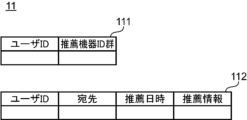
- FIG. 6 is a diagram showing an example of information stored in the memory 110 of the server 10. As shown in FIG. The memory 110 stores a candidate device list 111, recommendation history information 112, and the like.
- the candidate device list 111 is information about one or more recommended devices determined by the determining unit 103. Specifically, the candidate device list 111 includes user IDs, identification information of one or more recommended devices determined by the determining unit 103 (hereinafter referred to as recommended device ID group), and the like.
- the recommendation history information 112 is information related to the history of outputting recommendation information. Specifically, the recommendation history information 112 includes a user ID, destination information, recommendation date and time information indicating the date and time when the recommendation information was output (hereinafter referred to as recommendation date and time), the recommendation information, and the like.
- FIG. 7 is a flowchart illustrating an example of candidate device list creation processing.
- the candidate device list creation process is periodically executed, for example, once a day.
- the first acquisition unit 101 acquires the first information (FIG. 2) regarding the first device 20 from the first DB 41 (step S11).
- the second acquisition unit 102 acquires second information ( FIG. 3 ) regarding the plurality of second devices 20 from the second DB 42 (step S12).
- the determining unit 103 creates the candidate device list 111 (FIG. 6) based on the first information acquired in step S11 and the second information acquired in step S12 (step S13).
- step S13 when the device 20 installed in the facility 2 used by the user is near the end of its life, the determination unit 103 selects one or more second devices 20 manufactured more recently than the device 20 as the first device. determined as one or more recommended devices that can be substituted for the device 20 of .
- the determination unit 103 determines that the date and time of manufacture (for example, September 15, 2021) of the plurality of second devices 20 is later than the date and time of manufacture (for example, August 1, 2021) of the first device 20.
- One or more second devices 20 are determined as one or more recommended devices.
- the determination unit 103 creates a candidate device list 111 ( FIG. 6 ) including the user ID and identification information of one or more recommended devices (recommended device ID group), and stores the candidate device list 111 in the memory 110 . do.
- FIG. 8 is a flowchart showing an example of recommendation information output processing.
- the recommended information output process is started at an arbitrary timing after the candidate device list creation process is executed at least once.
- the output unit 104 waits until a predetermined timing for outputting the recommended information (NO in step S21). At a predetermined timing (YES in step S21), the output unit 104 generates recommendation information for recommending one or more recommended devices indicated by the candidate device list 111 to the user (step S22). Next, the output unit 104 outputs the recommendation information created in step S22 (step S23). After that, the process after step S21 is repeated.
- step S21 when the output unit 104 detects that the current position of the user is within a predetermined distance from the installation position of at least one recommended device among the one or more recommended devices indicated by the candidate device list 111, , it is determined that a predetermined timing has come.
- step S21 the output unit 104 acquires the movement history information 433 (FIG. 4) including the most recent current date and time from the log DB 43 as the movement history information 433 indicating the user's current position.
- the output unit 104 refers to the movement history information 433 and the device management information 421 (FIG. 3) included in the second information acquired in the most recent candidate device list creation process. Then, the output unit 104 selects one or more second devices 20 determined as one or more recommended devices indicated by the recommended device ID group in the candidate device list 111 (FIG. 6), and the installation position is from the user's current position. Determine whether there is at least one second device 20 within a predetermined distance.
- the output unit 104 determines that the at least one second device 20 exists, the current position of the user is shifted from the installation position of at least one recommended device among the one or more recommended devices indicated by the candidate device list 111 to a predetermined position. Detect within range. In this case, the output unit 104 determines that the predetermined timing has come, and generates recommendation information for recommending the at least one second device 20 in step S22 (FIG. 8).
- the recommendation information is, for example, text information, image data, and/or voice data that encourage trial use of the device group recommended by the recommendation information.
- the recommendation information is not limited to this, and may be, for example, text information, image data, and/or audio data that guide purchase of a device group recommended by the recommendation information.
- the method of detecting whether or not the current position of the user is within a predetermined distance from the installation position of at least one recommended device by the output unit 104 is not limited to this.
- an external device within a predetermined distance is within a short distance.
- the user terminal 30 has a similar wireless communication circuit. Then, the user carrying the user terminal 30 approaches within the range of short-range wireless communication with the second device 20, and the user terminal 30 and the second device 20 are enabled for short-range wireless communication with each other. Suppose we detect that
- the user terminal 30 or the second device 20 transmits the device ID of the second device 20 to the server 10 together with information indicating that the external device has approached (hereinafter referred to as approach information).
- approach information information indicating that the external device has approached
- step S21 when the approach information is received by the communication circuit 120, the output unit 104 recommends the device ID received together with the approach information to the candidate device list 111 (FIG. 6). It may be determined whether or not the device is included in the device ID group. Then, when the output unit 104 determines that the device ID is included in the recommended device ID group, the user's current position is within a predetermined distance from the installation position of the recommended device indicated by the device ID. It may be detected and determined that a predetermined timing has come.
- step S22 the output unit 104 determines that the second device 20 indicated by the device ID received together with the proximity information is a recommended device included in one or more recommended devices indicated by the candidate device list 111. Assuming that there is such a device, recommendation information for recommending the recommended device may be created.
- step S23 the output unit 104 refers to the first information (FIG. 2) acquired in the most recent candidate device list creation process, and sends the destination indicated by the destination information included in the user information 411 to step S22 (FIG. 8).
- the recommendation information generated in FIG. 8) is transmitted.
- the output unit 104 generates recommendation history information 112 (FIG. 6) including the user ID, destination information indicating the destination of the recommendation information, the recommendation date and time when the recommendation information was output, and the recommendation information, Store in memory 110 .
- the user terminal 30 that has received the recommendation information displays the image indicated by the text information and image data included in the recommendation information on its own liquid crystal display, and the user terminal 30 itself displays the voice indicated by the audio data included in the recommendation information. output to the speakers you have.
- One or more recommended devices that can replace the first device 20 can be appropriately determined from among the plurality of second devices 20 based on the second information ( FIG. 3 ) regarding the first device 20 .
- the recommendation information for recommending the one or more recommended devices to the user By outputting the recommendation information for recommending the one or more recommended devices to the user, the one or more recommended devices installed outside the facility 2 can be recommended to the user who referred to the recommendation information. .
- the ratio of the usage period of the first device 20 to the life of the first device 20 is greater than the predetermined ratio
- the date and time of manufacture is greater than the date and time of manufacture of the first device 20.
- Recommendation information for recommending one or more new second devices 20 is output. For this reason, when the first device 20 is nearing the end of its life, among the plurality of devices 20 installed outside the facility 2 used by the user, the device 20 newer than the first device 20 is selected by the user. can be recommended to
- the at least one recommendation information for recommending the recommended device is output. Therefore, when the user approaches the at least one recommended device, the at least one recommended device can be recommended to the user. As a result, it is possible to improve the possibility that the user will use the recommended device 20 that exists nearby.
- step S13 the determination unit 103 refers to the first information (FIG. 2) and the second information (FIG. 3) acquired in steps S11 and S12 (FIG. 7), and performs the following At least one of the methods (1-1) to (1-5) may be used to determine one or more recommended devices to be included in the candidate device list 111 (FIG. 6).
- the determination unit 103 determines, from among the plurality of second devices 20, one or more second devices 20 having functions that the first device 20 does not have as the one or more recommended devices. You may make it
- the determination unit 103 refers to the device management information 412 and the specification information 413 included in the first information (FIG. 2) to grasp the function group that the first device 20 has. Then, the determination unit 103 refers to the device management information 421 and the specification information 422 included in the second information ( FIG. 3 ), and selects the functions that the first device 20 does not have among the plurality of second devices 20 . is determined as the one or more recommended devices.
- the second device 20 having functions that the first device 20 does not have can be recommended to the user. Therefore, the degree of interest of the user in the second device 20 can be improved.
- the determining unit 103 selects one or more second devices 20 having a predetermined characteristic function that the first device 20 does not have among the plurality of second devices 20 as the one.
- the above recommended devices may be determined.
- the determination unit 103 refers to the device management information 412 and the specification information 413 included in the first information (FIG. 2) to grasp the function group that the first device 20 has. Then, the determination unit 103 refers to the device management information 421, the spec information 422, and the characteristic function information 423 included in the second information (FIG. 3), and selects the first device 20 among the plurality of second devices 20. one or more second devices 20 that do not have the function and that have the function included in the characteristic function group information are determined as the one or more recommended devices.
- the method (1-2) it is possible to recommend to the user the second device 20 that has a characteristic function that the first device 20 does not have. Therefore, the degree of user's interest in the second device 20 can be further improved.
- At least one second device 20 having a function included in a beneficial function group beneficial to each attribute of one or more users of the facility 2 used by the user is determined as the one or more recommended devices.
- the determination unit 103 refers to the device management information 421 and the specification information 422 included in the second information (FIG. 3) to refer to the above embodiment, (1-1) or (1-1).
- the function group of each of the one or more second devices 20 determined as one or more recommended devices by the method of 2) is grasped.
- the determination unit 103 refers to the user information 411 included in the first information (FIG. 2) and the useful function information 424 included in the second information (FIG. 3) to determine useful functions for each attribute of one or more users. Understand useful function groups.
- the determining unit 103 grasps one or more of the second devices 20 determined as one or more recommended devices by the above embodiment, method (1-1) or method (1-2) above. At least one second device 20 having functions included in the useful function group is determined as the one or more recommended devices.
- the one or more recommended devices determined by the method (1-1) or (1-2) are beneficial to the attributes of the one or more users. It can be recommended to users by restricting to those with functions. Therefore, the user's interest in the recommended second device 20 can be further improved.
- the determination unit 103 acquires information indicating rules set based on the first information (FIG. 2) and the second information (FIG. 3), and determines the plurality of second devices 20 according to the rules. One or more recommended devices may be determined from among them.
- the information indicating the rule is set by the manufacturer of the second device 20 and stored in advance in the memory 110, the second DB 42, or the like.
- the second information FIG. 3
- one or more devices having the function B A rule may be set to determine the second device 20 as one or more recommended devices.
- Information indicating the rule may be stored in advance in the memory 110, the second DB 42, or the like.
- the determining unit 103 acquires information indicating the rule from the memory 110, the second DB 42, or the like, and refers to the device management information 412 and the specification information 413 included in the first information (FIG. 2) according to the rule. , determines whether the first device 20 has the function A or not. Then, when the first device 20 has the function A, the determination unit 103 refers to the device management information 421 and the specification information 422 included in the second information (FIG. 3) to determine one or more first devices having the function B. The second device 20 is determined as one or more recommended devices.
- rules for determining the second device 20 to be recommended to the user are flexibly set in advance based on the first information (FIG. 2) and the second information (FIG. 3). be able to.
- the determination unit 103 accepts the setting of rules based on the first information (FIG. 2) and the second information (FIG. 3) by the user, and similar to (1-4), according to the accepted rules, a plurality of One or more recommended devices may be determined from among the second devices 20 of .
- This configuration can be realized, for example, as follows. Assume that the user has performed a predetermined operation of setting information indicating a rule based on the first information (FIG. 2) and the second information (FIG. 3) on the user terminal 30 . In this case, the user terminal 30 transmits to the server 10 information indicating the rule set by the user and information requesting setting of the rule (hereinafter referred to as setting request information).
- the predetermined operation may be an operation of selecting and setting one rule from a plurality of rules set by the manufacturer of the second device 20, or a user setting the first information and the second information. It may be an operation of arbitrarily editing and setting information indicating a rule to be based.
- the determination unit 103 accepts the setting of the rule by acquiring the information indicating the rule received by the communication circuit 120 together with the setting request information.
- the method (1-5) it is possible to recommend to the user the second device 20 that follows the rule set by the user based on the first information (FIG. 2) and the second information (FIG. 3). Therefore, the user's interest in the recommended second device 20 can be further improved.
- step S21 the output unit 104 further determines that a predetermined timing for outputting recommendation information has come, using the methods shown in (2-1) to (2-6) below. You may make it
- the output unit 104 acquires information indicating the location of a group of facilities that encourage replacement of the device 20, and the current location of the user is within a predetermined first distance from at least one facility 2 in the group of facilities. It may be determined that the predetermined timing has come when it is detected.
- the facility 2 that encourages replacement of the device 20 includes, for example, a consumer electronics retail store where new products of the device 20 are exhibited, a model room, a housing exhibition hall, and the like.
- the output unit 104 requests the WEB server 50 to transmit information indicating the location of a group of facilities that encourage replacement of the device 20 .
- the output unit 104 acquires the information indicating the location of the facility group returned from the WEB server 50 in response to the request.
- the output unit 104 acquires the movement history information 433 (FIG. 4) including the latest current date and time from the log DB 43 as the movement history information 433 indicating the user's current position.
- the output unit 104 refers to the acquired movement history information 433 and the information indicating the location of the facility group, and determines whether the current location of the user is from at least one of the facilities 2 in the facility group prompting replacement of the device 20 by a predetermined number. is within a first distance of.
- step S22 the output unit 104 refers to the device management information 421 (FIG. 3) included in the second information acquired in the most recent candidate device list creation process. Then, the output unit 104 selects one or more second devices 20 set as one or more recommended devices indicated by the candidate device list 111 and installed within a predetermined second distance from the at least one facility 2 . Information for recommending at least one second device 20 that is present is generated as recommendation information. Then, the output unit 104 outputs the recommendation information in step S23 (FIG. 8).
- At least one recommended device installed nearby can be recommended to the user.
- step S21 the output unit 104 may acquire history information indicating the history of the use of the first device 20 by the user. Then, the output unit 104 refers to the history information, and confirms that the frequency of use of the first device 20 by the user in the most recent first period has changed by a predetermined frequency or more compared to the second period preceding the first period. is detected, it may be determined that the predetermined timing has come.
- the output unit 104 acquires log information 431 and movement history information 433 (FIG. 4) from the log DB 43 as the history information.
- the output unit 104 refers to the log information 431, the movement history information 433, and the device management information 421 (FIG. 3) included in the second information acquired in the past candidate device list creation process, and
- the operating state of the first device 20 is grasped when the first device 20 is present at the installation position. If the operating state indicates that the device 20 is in use, the output unit 104 determines that the user is using the first device 20 at that time.
- the output unit 104 outputs the number of times the user used the first device 20 in the most recent first period (eg, one month) and the number of times the user used the first device 20 in the second period (eg, one month) before the first period.
- the number of times the first device 20 is used is calculated.
- the output unit 104 detects that the number of uses of the first device 20 by the user in the most recent first period has changed by a predetermined number or more from the second period preceding the first period, the output unit 104 Decide that the time has come.
- the output unit 104 may calculate the average number of times the user uses the first device 20 per day in each of the most recent first period and the second period preceding the first period. good too. Then, the output unit 104 detects that the average value of the number of daily uses of the first device 20 by the user in the most recent first period has changed by a predetermined amount or more from the second period preceding the first period. Then, it may be determined that the predetermined timing has come.
- the frequency of use of the first device 20 changes significantly due to, for example, an increase in the number of users of the facility 2 used by the users or a change in the user's lifestyle
- One or more recommended devices installed outside the facility 2 can be recommended to the user. This can improve the possibility that the user will consider replacing the first device 20 .
- step S21 the output unit 104 sends information about at least one recommended device out of one or more recommended devices indicated by the candidate device list 111 (FIG. 6) to the WEB server 50. You may make it accept the notification which shows having requested
- This configuration can be realized, for example, as follows. It is assumed that the WEB server 50 responds to a request from the user terminal 30 and sends back to the user terminal 30 a WEB page containing information about one or more second devices 20 among the plurality of second devices 20. . In this case, the WEB server 50 transmits to the server 10 device IDs of one or more second devices 20 included in the returned WEB page together with information indicating that the request has been accepted (hereinafter referred to as response information).
- the output unit 104 acquires the device IDs of the one or more second devices 20 that the communication circuit 120 has received together with the response information. If at least one device ID among the acquired device IDs of the one or more second devices 20 is included in the group of recommended device IDs in the candidate device list 111 (FIG. 6), the output unit 104 outputs the notification. It is determined that it is accepted and the predetermined timing has come.
- step S22 the output unit 104 recommends at least one second device 20 indicated by the at least one device ID included in the group of recommended device IDs in the candidate device list 111 (FIG. 6).
- the information is generated as recommended information, and the recommended information is output in step S23 (FIG. 8).
- the at least one recommended device can be recommended to the user.
- step S22 the output unit 104 further determines whether the user has used any of the at least one second device 20 recommended by the recommendation information in the past.
- the recommendation information may include information indicating that any one of the device groups was used when the device group was used.
- the output unit 104 may refer to the second information (FIG. 3) stored in the second DB 42 and the log information 431 and movement history information 433 (FIG. 4) stored in the log DB 43. Then, the output unit 104 determines whether or not the operating state of each device 20 is in use at the time when the user is present at the installation position of each device 20 included in the at least one second device 20. It may be determined whether or not the device 20 has been used by the user.
- step S21 the output unit 104 may periodically acquire price information indicating prices of one or more recommended devices indicated by the candidate device list 111 (FIG. 6). . Then, the output unit 104 detects at least one recommended device whose price indicated by the price information is reduced by a predetermined rate or more from the price indicated by the previously acquired price information, among the one or more recommended devices indicated by the candidate device list 111 . It may be determined that the predetermined timing has come when the time is reached.
- the output unit 104 periodically requests the WEB server 50 to transmit price information indicating prices of one or more recommended devices indicated by the candidate device list 111 (FIG. 6).
- the output unit 104 acquires the price information returned from the WEB server 50 in response to the request.
- the output unit 104 selects at least one recommended device whose price indicated by the acquired price information is reduced by a predetermined rate or more from the price indicated by the previously acquired price information, among the one or more recommended devices indicated by the candidate device list 111. When it is detected, it is determined that the predetermined timing has come.
- step S22 the output unit 104 generates, as recommendation information, information for recommending at least one recommended device whose price is reduced by a predetermined rate or more, and outputs the recommendation information in step S23 (FIG. 8).
- the at least one recommended device when the price of at least one recommended device among the one or more recommended devices shown in the candidate device list 111 (FIG. 6) has greatly decreased, the at least one recommended device is recommended to the user. can be done. This motivates the user to purchase at least one recommended device with a reduced price.
- step S21 the output unit 104 may periodically determine that a predetermined timing has come, such as once a year.
- one or more recommended devices can be regularly recommended to the user. This can improve the possibility that the user will consider replacing the first device 20 .
- step S22 the output unit 104 may limit the number of recommended devices recommended in the recommendation information to a predetermined upper limit or less.
- step S21 the output unit 104 may receive input of information requesting output of recommendation information by the user (hereinafter referred to as output request information). Then, the output unit 104 may determine that the predetermined timing has come when the output request information is received.
- the user terminal 30 transmits the output request information to the server 10 when the user performs a predetermined operation of inputting the output request information.
- the output unit 104 accepts the output request information and determines that a predetermined timing has come.
- the user can perform a predetermined operation of inputting the output request information at the intended timing on the user terminal 30, and immediately grasp the recommendation information.
- the output request information may include information on the upper limit of the number of recommended devices and the order of recommendation in the recommendation information. Accordingly, in step S22 (FIG. 8), the output unit 104 limits the number of recommended devices recommended by the recommendation information to be equal to or less than the upper limit value according to the upper limit value and the order of recommendation included in the output request information, and , the recommendation information may include information indicating the order in which each of the recommended devices is displayed or notified by voice. In this case, the user terminal 30 that has received the recommendation information output in step S23 (FIG. 8) displays or outputs information recommending each of the recommended devices in the order indicated by the recommendation information. good too.
- step S22 the output unit 104 acquires information (hereinafter referred to as recommendation-related information) to be output together with the recommendation information.
- recommendation-related information may be output together with the recommendation information.
- step S22 (FIG. 8)
- the output unit 104 outputs information indicating a predetermined recommended function group possessed by each of the recommended device groups recommended by the recommendation information. You may acquire it as related information.
- This configuration can be realized, for example, as follows. After the output unit 104 generates recommendation information by the method shown in the above embodiment and modifications (2-1) to (2-6), the device management information included in the second information (FIG. 3) 421 and feature function information 423 are referred to. Then, the output unit 104 acquires information indicating a predetermined feature function group possessed by each of the recommended devices recommended by the recommendation information as information indicating a predetermined recommendation target function group possessed by each of the recommended device group. , is recommended-related information.
- the output unit 104 may refer to the user information 411 included in the first information (FIG. 2) and the useful function information 424 included in the second information (FIG. 3). Then, the output unit 104 outputs information indicating a useful function group useful to each attribute of one or more users of the facility 2 used by the user, which each of the recommended equipment groups recommended by the recommendation information has, to the recommended equipment. Information indicating a predetermined recommended function group possessed by each of the groups may be obtained and used as recommendation-related information.
- a predetermined function group (hereinafter referred to as a recommendation) may be stored in the second DB 42 in advance.
- the recommendation function group includes, for example, a function of lighting or blinking a predetermined LED of the device 20 .
- step S22 the output unit 104 generates recommendation information by the method shown in the above embodiment and modifications (2-1) to (2-6), The device management information 421 and recommended function information included in the second information (FIG. 3) may be referred to. Then, the output unit 104 acquires information indicating the recommended function group of each of the recommended devices recommended by the recommendation information as information indicating the predetermined recommended function group of each of the recommended device group, may be used as recommendation-related information.
- step S23 the output unit 104 transmits the recommendation-related information together with the recommendation information to the destination indicated by the destination information included in the user information 411 (FIG. 2).
- the output unit 104 may further transmit a control command instructing execution of a recommended function group indicated by the recommendation-related information to each of the recommended device groups recommended by the recommendation information.
- step S22 (3-2)
- the output unit 104 outputs the information indicating the related product group related to each of the recommended device groups recommended by the recommendation information as recommendation related information. may be obtained.
- This configuration can be realized, for example, as follows. After the output unit 104 generates the recommendation information by the method shown in the above embodiment and modifications (2-1) to (2-6), the device management information included in the second information (FIG. 3) 421 and related product information 425. Then, the output unit 104 acquires the related product information 425 related to each of the recommended device group recommended by the recommendation information as information indicating the related product group related to each of the recommended device group, and converts this information into the recommended related information. and
- step S23 the output unit 104 transmits the recommendation-related information together with the recommendation information to the destination indicated by the destination information included in the user information 411 (FIG. 2).
- the related product information 425 related to each of the recommended device groups recommended by the recommendation information is output together with the recommendation information. Therefore, it is possible to recommend to the user not only the recommended device group recommended by the recommendation information, but also the related product group related to each of the recommended device groups.
- the processor 100 further provides information on at least one of usage and purchase by each user of the group of recommended devices recommended by the recommendation information output by the output unit 104. You may make it function as the management part 105 which memorize
- Management unit 105 periodically performs the following processes.
- Management unit 105 stores recommendation history information 112 stored in memory 110 (FIG. 6), first information (FIG. 2) stored in first DB 41, and second information (FIG. 3) stored in second DB 42.
- the log information 431 and the movement history information 433 (FIG. 4) stored in the log DB 43 are referred to.
- the management unit 105 grasps the operation state of the recommended device group when the user is present at the installation position of the recommended device group recommended by the recommendation information after the recommendation date and time when the recommendation information is output. If the operation status of any of the recommended devices in the group of recommended devices indicates that they are in use, the management unit 105 determines that the user is using any of the recommended devices recommended by the recommendation information. do. In this way, the management unit 105 ascertains the number of times each user uses the group of recommended devices recommended by the recommendation information output by the output unit 104 . Then, the management unit 105 sends recommended device usage information in which the user ID, the device ID and usage count of the recommended device used by the user, and the recommendation information for recommending the recommended device are associated with each other. stored in memory 110 as information relating to use by
- the management unit 105 determines that the device 20 having the same model number as the first device 20 is included in the recommended device group recommended by the recommendation information output before the usage period of the first device 20. In this case, it is determined that the user has purchased the device 20 having the same model number as the first device 20 recommended by the recommendation information. In this case, the management unit 105 stores recommended device purchase information in which the user ID, the device ID of the device 20 having the same model number as that of the first device 20, and the recommendation information are associated with each other. This information is stored in the memory 110 as information related to purchase by the user of the device 20 having the same model number as the device 20 .
- management unit 105 may not store the recommended device usage information or recommended device purchase information in the memory 110 .
- the use and purchase by each user of the group of recommended devices recommended by the recommendation information Information about at least one can be grasped.
- the maker of the recommended device will provide the management company of the facility 2 where the recommended device is installed, according to the number of times the recommended device is used by the user or according to the number of purchases of the recommended device. You can pay the refund.
- the processor 100 may function as a sales promotion unit 106 that outputs information regarding purchase of any of the recommended devices.
- the spec information 422 (FIG. 4) stored in the second DB 42 further includes purchase-related information regarding the purchase of the device 20 having the model number indicated by the model number information.
- the purchase-related information is, for example, a URL indicating a WEB page on which a method for purchasing the device 20 is posted, or a URL indicating a WEB page where the device 20 can be purchased.
- the sales promotion department 106 periodically performs the following processes.
- the sales promotion unit 106 stores the recommendation history information 112 stored in the memory 110 (FIG. 6), the first information (FIG. 2) stored in the first DB 41, and the second information (FIG. 3) stored in the second DB 42. And the log information 431 and the movement history information 433 (FIG. 4) stored in the log DB 43 are referred to.
- the sales promotion unit 106 grasps the operating state of the recommended device group when the user is present at the installation position of the recommended device group recommended by the recommendation information after the recommendation date and time when the recommendation information is output.
- the sales promotion unit 106 detects that the user is using any of the recommended devices when the operation status of any of the recommended devices in the group of recommended devices indicates that they are in use. In this case, the sales promotion unit 106 outputs information regarding the purchase of any of the recommended devices in the same manner as in step S23 (FIG. 8).
- a user who used any one of the recommended devices recommended by the recommendation information can quickly refer to the information regarding the purchase of any of the recommended devices. As a result, it is possible to increase the willingness of the user to purchase any of the recommended devices.
- step S22 the output unit 104 refers to the device management information 421 included in the second information (FIG. 3), and adds the recommended device group recommended by the recommendation information to the recommendation information.
- the position and map information indicating a map of the area including the installation position of the recommended device group may be included.
- the output unit 104 may request transmission of the map information from an external device such as the WEB server 50, and acquire the map information returned from the external device in response to this request.
- the user terminal 30 that has received the recommendation information output in step S23 (FIG. 8) displays the map indicated by the map information included in the recommendation information, and displays the recommendation information recommended by the recommendation information on the map.
- a predetermined mark may be displayed at the installation position of the device group.
- the output unit 104 uses the sensor information 432 stored in the log DB 43 (FIG. 4) and the matching information 414 included in the first information (FIG. 3). , the time when a particular user is present at the installation position of the first device 20 and the second device 20 may be grasped.
- the first information (FIG. 2) and the second information (FIG. 3) include the device management information 412 (FIG. 2) and the device management information 421 (FIG. 3) regarding the devices 20 installed in the facility 2, respectively. ) as well as device management information 412 and device management information 421 related to the sensors 21 installed in the facility 2 are stored.
- the output unit 104 acquires the sensor information 432 and the movement history information 433 from the log DB 43 (FIG. 4), the device management information 412 and the verification information 414 included in the first information (FIG. 2), and the second information ( The device management information 421 included in FIG. 3) and the acquired sensor information 432 and movement history information 433 are referred to. Then, the output unit 104 detects the user specified based on the detection information detected by the sensor 21 installed within a predetermined distance from the first device 20 and the information for verification 414, and the user specified on the detection date and time of the detection information. It grasps that it exists in the installation position of the 1 apparatus 20. FIG.
- the output unit 104 causes the user specified based on the detection information detected by the sensor 21 installed within a predetermined distance from the second device 20 and the verification information 414 to It grasps that it exists in the installation position of the 2nd apparatus 20.
- the data structures of the first DB 41, the second DB 42, the log DB 43, and the memory 110 are merely examples, and may be different data structures.
- the processor 100 may refer to the spec information 422 included in the second information (FIG. 3) stored in the second DB 42 instead of the spec information 413 included in the first information (FIG. 2) stored in the first DB 41.
- the spec information 413 may not be included in the first information ( FIG. 2 ) stored in the first DB 41 .
- the present disclosure can recommend to the user a group of devices installed outside the facility that can replace the device installed in the facility used by the user. This is useful for promoting replacement of old devices.
Landscapes
- Business, Economics & Management (AREA)
- Accounting & Taxation (AREA)
- Finance (AREA)
- Strategic Management (AREA)
- Development Economics (AREA)
- Engineering & Computer Science (AREA)
- Economics (AREA)
- Marketing (AREA)
- Physics & Mathematics (AREA)
- General Business, Economics & Management (AREA)
- General Physics & Mathematics (AREA)
- Theoretical Computer Science (AREA)
- Entrepreneurship & Innovation (AREA)
- Game Theory and Decision Science (AREA)
- Management, Administration, Business Operations System, And Electronic Commerce (AREA)
Priority Applications (3)
| Application Number | Priority Date | Filing Date | Title |
|---|---|---|---|
| JP2023550363A JPWO2023053612A1 (https=) | 2021-09-29 | 2022-06-20 | |
| CN202280065942.0A CN118020089A (zh) | 2021-09-29 | 2022-06-20 | 信息输出方法、信息输出装置以及程序 |
| US18/610,525 US20240221058A1 (en) | 2021-09-29 | 2024-03-20 | Information output method, information output apparatus, and non-transitory computer readable storage medium |
Applications Claiming Priority (2)
| Application Number | Priority Date | Filing Date | Title |
|---|---|---|---|
| JP2021159913 | 2021-09-29 | ||
| JP2021-159913 | 2021-09-29 |
Related Child Applications (1)
| Application Number | Title | Priority Date | Filing Date |
|---|---|---|---|
| US18/610,525 Continuation US20240221058A1 (en) | 2021-09-29 | 2024-03-20 | Information output method, information output apparatus, and non-transitory computer readable storage medium |
Publications (1)
| Publication Number | Publication Date |
|---|---|
| WO2023053612A1 true WO2023053612A1 (ja) | 2023-04-06 |
Family
ID=85780583
Family Applications (1)
| Application Number | Title | Priority Date | Filing Date |
|---|---|---|---|
| PCT/JP2022/024594 Ceased WO2023053612A1 (ja) | 2021-09-29 | 2022-06-20 | 情報出力方法、情報出力装置及びプログラム |
Country Status (4)
| Country | Link |
|---|---|
| US (1) | US20240221058A1 (https=) |
| JP (1) | JPWO2023053612A1 (https=) |
| CN (1) | CN118020089A (https=) |
| WO (1) | WO2023053612A1 (https=) |
Citations (6)
| Publication number | Priority date | Publication date | Assignee | Title |
|---|---|---|---|---|
| JP2003303244A (ja) * | 2002-02-07 | 2003-10-24 | Osaka Gas Co Ltd | 故障情報システム |
| JP2006277750A (ja) * | 2006-03-31 | 2006-10-12 | Sharp Corp | 情報提示装置および情報提示方法 |
| JP2014132506A (ja) * | 2014-04-17 | 2014-07-17 | Yahoo Japan Corp | 広告配信システム、広告配信方法、端末装置及び通知プログラム |
| JP2015191449A (ja) * | 2014-03-28 | 2015-11-02 | パナソニック インテレクチュアル プロパティ コーポレーション オブアメリカPanasonic Intellectual Property Corporation of America | 情報提供方法、情報提供装置、情報通信機器、情報通信機器の表示方法、並びにプログラム |
| JP2019197472A (ja) * | 2018-05-11 | 2019-11-14 | 株式会社日本総合研究所 | 買換時期通知装置、買換時期通知方法、およびプログラム |
| JP2021081968A (ja) * | 2019-11-19 | 2021-05-27 | シャープ株式会社 | ネットワークシステム |
Family Cites Families (1)
| Publication number | Priority date | Publication date | Assignee | Title |
|---|---|---|---|---|
| JP6359304B2 (ja) * | 2013-06-27 | 2018-07-18 | 東芝ライフスタイル株式会社 | 家電機器およびネットワークシステム |
-
2022
- 2022-06-20 WO PCT/JP2022/024594 patent/WO2023053612A1/ja not_active Ceased
- 2022-06-20 JP JP2023550363A patent/JPWO2023053612A1/ja active Pending
- 2022-06-20 CN CN202280065942.0A patent/CN118020089A/zh active Pending
-
2024
- 2024-03-20 US US18/610,525 patent/US20240221058A1/en active Pending
Patent Citations (6)
| Publication number | Priority date | Publication date | Assignee | Title |
|---|---|---|---|---|
| JP2003303244A (ja) * | 2002-02-07 | 2003-10-24 | Osaka Gas Co Ltd | 故障情報システム |
| JP2006277750A (ja) * | 2006-03-31 | 2006-10-12 | Sharp Corp | 情報提示装置および情報提示方法 |
| JP2015191449A (ja) * | 2014-03-28 | 2015-11-02 | パナソニック インテレクチュアル プロパティ コーポレーション オブアメリカPanasonic Intellectual Property Corporation of America | 情報提供方法、情報提供装置、情報通信機器、情報通信機器の表示方法、並びにプログラム |
| JP2014132506A (ja) * | 2014-04-17 | 2014-07-17 | Yahoo Japan Corp | 広告配信システム、広告配信方法、端末装置及び通知プログラム |
| JP2019197472A (ja) * | 2018-05-11 | 2019-11-14 | 株式会社日本総合研究所 | 買換時期通知装置、買換時期通知方法、およびプログラム |
| JP2021081968A (ja) * | 2019-11-19 | 2021-05-27 | シャープ株式会社 | ネットワークシステム |
Also Published As
| Publication number | Publication date |
|---|---|
| JPWO2023053612A1 (https=) | 2023-04-06 |
| CN118020089A (zh) | 2024-05-10 |
| US20240221058A1 (en) | 2024-07-04 |
Similar Documents
| Publication | Publication Date | Title |
|---|---|---|
| US20210350279A1 (en) | Situation forecast mechanisms for internet of things integration platform | |
| CN109074607B (zh) | 学得模型提供方法和学得模型提供装置 | |
| US10353939B2 (en) | Interoperability mechanisms for internet of things integration platform | |
| EP3469496B1 (en) | Situation forecast mechanisms for internet of things integration platform | |
| US12524715B2 (en) | Wait time prediction | |
| CN105869015A (zh) | 一种信息处理方法及系统 | |
| US20180040046A1 (en) | Sales management device, sales management system, and sales management method | |
| US20110117537A1 (en) | Usage estimation device | |
| JP2016095741A (ja) | 情報提供装置、情報提供システム、情報提供プログラム | |
| JP6452571B2 (ja) | 情報出力装置及び情報出力方法及び情報出力プログラム | |
| WO2015186393A1 (ja) | 情報処理装置、情報提示方法、プログラム、およびシステム | |
| CN110225407A (zh) | 一种播放数据的获取方法和装置及计算机可读存储介质 | |
| US11769160B2 (en) | Consumer goods procurement assisting system | |
| JP6700146B2 (ja) | 評価値に基づいて推奨するコンテンツを決定するシステム | |
| US10885499B2 (en) | Apparatus, system, and method for managing presentation, and recording medium | |
| JP6003422B2 (ja) | 情報処理システム、情報処理方法 | |
| JP7476881B2 (ja) | 情報処理装置、情報処理方法およびプログラム | |
| WO2023053612A1 (ja) | 情報出力方法、情報出力装置及びプログラム | |
| JP5476571B2 (ja) | コメント評価装置、コメント評価方法及びプログラム | |
| JP6399948B2 (ja) | 情報処理装置及び情報処理方法 | |
| WO2018034034A1 (ja) | 情報処理装置、情報処理方法、およびプログラム | |
| CN110487016B (zh) | 一种向智能冰箱进行信息精准推送的方法、装置及系统 | |
| CN114861033A (zh) | 直播推荐方法、装置、设备及计算机可读存储介质 | |
| JP2015219765A (ja) | 情報提供装置、情報提供方法、及び情報提供プログラム | |
| CN112950303A (zh) | 订单处理方法、装置、电子设备及存储介质 |
Legal Events
| Date | Code | Title | Description |
|---|---|---|---|
| 121 | Ep: the epo has been informed by wipo that ep was designated in this application |
Ref document number: 22875491 Country of ref document: EP Kind code of ref document: A1 |
|
| WWE | Wipo information: entry into national phase |
Ref document number: 2023550363 Country of ref document: JP |
|
| WWE | Wipo information: entry into national phase |
Ref document number: 202280065942.0 Country of ref document: CN |
|
| NENP | Non-entry into the national phase |
Ref country code: DE |
|
| 122 | Ep: pct application non-entry in european phase |
Ref document number: 22875491 Country of ref document: EP Kind code of ref document: A1 |