WO2023042305A1 - 半導体パッケージ用基板材料を製造する方法、プリプレグ、及びプリプレグの応用 - Google Patents
半導体パッケージ用基板材料を製造する方法、プリプレグ、及びプリプレグの応用 Download PDFInfo
- Publication number
- WO2023042305A1 WO2023042305A1 PCT/JP2021/033952 JP2021033952W WO2023042305A1 WO 2023042305 A1 WO2023042305 A1 WO 2023042305A1 JP 2021033952 W JP2021033952 W JP 2021033952W WO 2023042305 A1 WO2023042305 A1 WO 2023042305A1
- Authority
- WO
- WIPO (PCT)
- Prior art keywords
- prepreg
- melt viscosity
- mass
- thermosetting resin
- resin composition
- Prior art date
- Legal status (The legal status is an assumption and is not a legal conclusion. Google has not performed a legal analysis and makes no representation as to the accuracy of the status listed.)
- Ceased
Links
Images


Classifications
-
- C—CHEMISTRY; METALLURGY
- C08—ORGANIC MACROMOLECULAR COMPOUNDS; THEIR PREPARATION OR CHEMICAL WORKING-UP; COMPOSITIONS BASED THEREON
- C08J—WORKING-UP; GENERAL PROCESSES OF COMPOUNDING; AFTER-TREATMENT NOT COVERED BY SUBCLASSES C08B, C08C, C08F, C08G or C08H
- C08J5/00—Manufacture of articles or shaped materials containing macromolecular substances
- C08J5/24—Impregnating materials with prepolymers which can be polymerised in situ, e.g. manufacture of prepregs
- C08J5/241—Impregnating materials with prepolymers which can be polymerised in situ, e.g. manufacture of prepregs using inorganic fibres
- C08J5/244—Impregnating materials with prepolymers which can be polymerised in situ, e.g. manufacture of prepregs using inorganic fibres using glass fibres
-
- H—ELECTRICITY
- H05—ELECTRIC TECHNIQUES NOT OTHERWISE PROVIDED FOR
- H05K—PRINTED CIRCUITS; CASINGS OR CONSTRUCTIONAL DETAILS OF ELECTRIC APPARATUS; MANUFACTURE OF ASSEMBLAGES OF ELECTRICAL COMPONENTS
- H05K1/00—Printed circuits
- H05K1/02—Details
- H05K1/03—Use of materials for the substrate
-
- H—ELECTRICITY
- H05—ELECTRIC TECHNIQUES NOT OTHERWISE PROVIDED FOR
- H05K—PRINTED CIRCUITS; CASINGS OR CONSTRUCTIONAL DETAILS OF ELECTRIC APPARATUS; MANUFACTURE OF ASSEMBLAGES OF ELECTRICAL COMPONENTS
- H05K1/00—Printed circuits
- H05K1/02—Details
- H05K1/03—Use of materials for the substrate
- H05K1/0313—Organic insulating material
- H05K1/0353—Organic insulating material consisting of two or more materials, e.g. two or more polymers, polymer + filler, + reinforcement
- H05K1/0366—Organic insulating material consisting of two or more materials, e.g. two or more polymers, polymer + filler, + reinforcement reinforced, e.g. by fibres, fabrics
-
- H—ELECTRICITY
- H05—ELECTRIC TECHNIQUES NOT OTHERWISE PROVIDED FOR
- H05K—PRINTED CIRCUITS; CASINGS OR CONSTRUCTIONAL DETAILS OF ELECTRIC APPARATUS; MANUFACTURE OF ASSEMBLAGES OF ELECTRICAL COMPONENTS
- H05K1/00—Printed circuits
- H05K1/02—Details
- H05K1/03—Use of materials for the substrate
- H05K1/0313—Organic insulating material
- H05K1/0353—Organic insulating material consisting of two or more materials, e.g. two or more polymers, polymer + filler, + reinforcement
- H05K1/0373—Organic insulating material consisting of two or more materials, e.g. two or more polymers, polymer + filler, + reinforcement containing additives, e.g. fillers
-
- H—ELECTRICITY
- H05—ELECTRIC TECHNIQUES NOT OTHERWISE PROVIDED FOR
- H05K—PRINTED CIRCUITS; CASINGS OR CONSTRUCTIONAL DETAILS OF ELECTRIC APPARATUS; MANUFACTURE OF ASSEMBLAGES OF ELECTRICAL COMPONENTS
- H05K3/00—Apparatus or processes for manufacturing printed circuits
- H05K3/46—Manufacturing multilayer circuits
- H05K3/4644—Manufacturing multilayer circuits by building the multilayer layer by layer, i.e. build-up multilayer circuits
-
- H—ELECTRICITY
- H10—SEMICONDUCTOR DEVICES; ELECTRIC SOLID-STATE DEVICES NOT OTHERWISE PROVIDED FOR
- H10W—GENERIC PACKAGES, INTERCONNECTIONS, CONNECTORS OR OTHER CONSTRUCTIONAL DETAILS OF DEVICES COVERED BY CLASS H10
- H10W70/00—Package substrates; Interposers; Redistribution layers [RDL]
- H10W70/60—Insulating or insulated package substrates; Interposers; Redistribution layers
-
- H—ELECTRICITY
- H10—SEMICONDUCTOR DEVICES; ELECTRIC SOLID-STATE DEVICES NOT OTHERWISE PROVIDED FOR
- H10W—GENERIC PACKAGES, INTERCONNECTIONS, CONNECTORS OR OTHER CONSTRUCTIONAL DETAILS OF DEVICES COVERED BY CLASS H10
- H10W70/00—Package substrates; Interposers; Redistribution layers [RDL]
- H10W70/60—Insulating or insulated package substrates; Interposers; Redistribution layers
- H10W70/67—Insulating or insulated package substrates; Interposers; Redistribution layers characterised by their insulating layers or insulating parts
- H10W70/69—Insulating materials thereof
-
- H—ELECTRICITY
- H10—SEMICONDUCTOR DEVICES; ELECTRIC SOLID-STATE DEVICES NOT OTHERWISE PROVIDED FOR
- H10W—GENERIC PACKAGES, INTERCONNECTIONS, CONNECTORS OR OTHER CONSTRUCTIONAL DETAILS OF DEVICES COVERED BY CLASS H10
- H10W70/00—Package substrates; Interposers; Redistribution layers [RDL]
- H10W70/60—Insulating or insulated package substrates; Interposers; Redistribution layers
- H10W70/67—Insulating or insulated package substrates; Interposers; Redistribution layers characterised by their insulating layers or insulating parts
- H10W70/69—Insulating materials thereof
- H10W70/695—Organic materials
-
- H—ELECTRICITY
- H05—ELECTRIC TECHNIQUES NOT OTHERWISE PROVIDED FOR
- H05K—PRINTED CIRCUITS; CASINGS OR CONSTRUCTIONAL DETAILS OF ELECTRIC APPARATUS; MANUFACTURE OF ASSEMBLAGES OF ELECTRICAL COMPONENTS
- H05K2201/00—Indexing scheme relating to printed circuits covered by H05K1/00
- H05K2201/01—Dielectrics
- H05K2201/0104—Properties and characteristics in general
- H05K2201/0133—Elastomeric or compliant polymer
-
- H—ELECTRICITY
- H05—ELECTRIC TECHNIQUES NOT OTHERWISE PROVIDED FOR
- H05K—PRINTED CIRCUITS; CASINGS OR CONSTRUCTIONAL DETAILS OF ELECTRIC APPARATUS; MANUFACTURE OF ASSEMBLAGES OF ELECTRICAL COMPONENTS
- H05K2201/00—Indexing scheme relating to printed circuits covered by H05K1/00
- H05K2201/02—Fillers; Particles; Fibers; Reinforcement materials
- H05K2201/0203—Fillers and particles
- H05K2201/0206—Materials
- H05K2201/0209—Inorganic, non-metallic particles
Definitions
- the present disclosure relates to a method of manufacturing a semiconductor package substrate material having an insulating substrate, a prepreg, and an application of the prepreg for manufacturing a semiconductor package substrate material.
- a semiconductor package wiring board on which a semiconductor chip is mounted is often manufactured by forming wiring on an insulating substrate made of a semiconductor package substrate material.
- Substrate materials for semiconductor packages are generally manufactured by a method involving heating and pressurizing a laminate including several laminated prepregs.
- wiring substrates for semiconductor packages are sometimes required to have fine wiring with a width of 10 ⁇ m or less.
- minute variations in the width of the wiring may manifest as a problem that cannot be ignored.
- One aspect of the present disclosure relates to a semiconductor package substrate material that enables stable formation of fine wiring while suppressing variations in wiring width.
- One aspect of the present disclosure includes forming an insulating substrate from the prepregs by a molding process that includes increasing the temperature of a laminate including two or more laminated prepregs while pressurizing the laminate. , relates to a method of manufacturing a substrate material for a semiconductor package having an insulating substrate.
- the prepreg contains an inorganic fiber base material and a thermosetting resin composition impregnated in the inorganic fiber base material, and the content of the thermosetting resin composition is 40% by mass based on the mass of the prepreg. It is more than 80 mass % or less.
- the molding process raises the temperature of the laminate to 1000 ⁇ 10 3 Pa s at a rate of 55 ⁇ 10 3 Pa s/min or more from the time when the melt viscosity of the prepreg exhibits the lowest melt viscosity. Including rising under heating conditions.
- melt viscosity of a prepreg decreases as the temperature rises, exhibits a minimum value (minimum melt viscosity), and then increases.
- the rate of increase in melt viscosity varies depending on heating conditions and the like.
- a laminate containing prepregs with a specific resin content is processed from the point at which the rate of increase in the melt viscosity of the prepreg shows the lowest melt viscosity. Heating at a rate of 55 ⁇ 10 3 Pa ⁇ s/min or more under heating conditions up to 1000 ⁇ 10 3 Pa ⁇ s forms a substrate material with extremely small variations in thickness. Further, when wiring is formed using a substrate material with small variations in thickness, variations in wiring width are suppressed more than in the past.
- thermosetting resin composition impregnated in the inorganic fiber base material.
- the content of the thermosetting resin composition is 40 to 80% by mass based on the mass of the prepreg.
- the melt viscosity of the prepreg which is measured at a heating rate of 4°C/min, rises to 1000x103 Pa ⁇ s at a rate of 55x103 Pa ⁇ s/min or more from the time when the lowest melt viscosity is exhibited.
- a semiconductor package substrate material that enables stable formation of fine wiring while suppressing variations in wiring width. Since the variation in wiring width is small, high-density fine wiring can be easily formed.
- the semiconductor package substrate material according to one aspect of the present disclosure is also excellent in reducing warpage.
- a wiring substrate formed from a substrate material for a semiconductor package according to one aspect of the present disclosure enables semiconductor chips having fine bumps to be mounted with high reliability and good productivity.
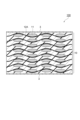
- FIG. 1 is a cross-sectional view showing an example of a prepreg.
- a prepreg 1 shown in FIG. 1 includes an inorganic fiber base material 11 and a thermosetting resin composition 12 with which the inorganic fiber base material 11 is impregnated.
- the inorganic fiber base material 11 can be, for example, a woven or nonwoven fabric containing inorganic fibers.
- the inorganic fibers that make up the inorganic fiber base material 11 may be glass fibers, carbon fibers, or a combination thereof.
- the inorganic fiber base material 11 may be a glass cloth made of glass fiber.
- the proportion of glass fibers in the inorganic fibers constituting the inorganic fiber base material may be 80 to 100% by mass, 90 to 100% by mass, 95 to 100% by mass, or 99 to 100% by mass.
- the glass fibers may be, for example, E-glass, S-glass, or quartz glass.
- the thickness of the inorganic fiber base material 11 may be 0.01 to 0.20 ⁇ m.
- melt viscosity increase rate Melt that rises from the point at which prepreg 1 exhibits the lowest melt viscosity to 1000 ⁇ 10 3 Pa s at a rate of 55 ⁇ 10 3 Pa s/min or more when measured at a heating rate of 4° C./min. Viscosity may be indicated.
- the speed here is the average value of the rate of increase in melt viscosity per minute from the time when the melt viscosity exhibits the lowest melt viscosity until it increases to 1000 ⁇ 10 3 Pa s. In books, it is sometimes called "melt viscosity increase rate".
- melt viscosity increase rate [Pa s/min] (1000 ⁇ 10 3 - minimum melt viscosity)/T
- the rate of increase in melt viscosity is 60 ⁇ 10 3 Pa s/min or more, 65 ⁇ 10 3 Pa s/min or more, 70 ⁇ 10 3 Pa s/min or more, 75 ⁇ 10 3 Pa ⁇ s/min or more, 80 ⁇ 10 3 Pa ⁇ s/min or more, 85 ⁇ 10 3 Pa ⁇ s/min or more, 90 ⁇ 10 3 Pa ⁇ s/min or more, 95 ⁇ 10 3 Pa ⁇ s / min or more, 100 ⁇ 10 3 Pa s/min or more, 105 ⁇ 10 3 Pa s/min or more, or 110 ⁇ 10 3 Pa s/min or more, or 200 ⁇ 10 3 Pa s / min or less, 190 ⁇ 10 3 Pa s/min or less, 180 ⁇ 10 3 Pa s/min or less, 170 ⁇ 10 3 Pa s/min or less, or 160 ⁇ 10 3 Pa s/min or less.
- the melt viscosity of the prepreg was measured by sandwiching a prepreg test piece between two parallel plates with a diameter of 8 mm and increasing the temperature from 20 ° C. to 200 ° C. or higher at a predetermined heating rate (for example, 4 ° C./min). , is the value of the complex viscosity measured by the method of measuring dynamic viscoelasticity at a frequency of 10 Hz in shear mode.
- the thickness of the test piece for measurement is 10 to 400 ⁇ m, and the test piece is produced by laminating two or more prepregs if necessary.
- a viscoelasticity measuring device ARES manufactured by Rheometrics Scientific FE Co., Ltd.
- the minimum melt viscosity of the prepreg 1 measured at a heating rate of 4° C./min is 10 ⁇ 10 3 Pa ⁇ s or less, 9.0 ⁇ 10 3 Pa ⁇ s or less, 8.0 ⁇ 10 3 Pas or less, 7.0 ⁇ 10 3 Pas or less, 6.0 ⁇ 10 3 Pas or less, 5.0 ⁇ 10 3 Pas or less, or 4.0 ⁇ 10 It may be 3 Pa ⁇ s or less, or may be 1.0 ⁇ 10 3 Pa ⁇ s or more.
- the temperature at which the prepreg 1 exhibits the lowest melt viscosity may be 80°C or higher from the viewpoint of handling of the prepreg, or may be 120°C or higher from the viewpoint of storage stability.
- the temperature at which the prepreg 1 exhibits the lowest melt viscosity may be 200° C. or lower from the viewpoint of productivity, or may be 180° C. or lower from the viewpoint of warpage reduction.
- the content of the thermosetting resin composition 12 in the prepreg 1 may be 40-80% by mass. Using a prepreg containing 40 to 80% by mass of the thermosetting resin composition 12, a substrate material for a semiconductor package with small variations in thickness can be easily manufactured by the method described later.
- the content of the thermosetting resin composition 12 can be adjusted, for example, by adjusting the amount of the curable resin composition applied according to the thickness of the inorganic fiber base material 11 .
- the content of the thermosetting resin composition 12 in the prepreg 1 is determined, for example, by dividing a region of the inorganic fiber base material 11 and a region of the thermosetting resin composition 12 by a binarization process in a cross-sectional photograph of the prepreg 1. , can be determined by a method including calculating the area of each. In that case, it may be considered that the density of the inorganic fiber base material 11 and the density of the thermosetting resin composition 12 are the same.
- the thermosetting resin composition 12 may contain inorganic components in addition to thermosetting resin components.
- the ratio of the resin component in the thermosetting resin composition 12 may be 20 to 100% by mass with respect to the mass of the thermosetting resin composition 12, and from the viewpoint of reducing the coefficient of linear expansion, it is 20 to 80% by mass. From the viewpoint of void reduction after lamination, it may be from 30 to 100% by mass, and from the viewpoint of further improving the flatness of the substrate material, it may be from 40 to 100% by mass.
- the ratio of the resin component in the thermosetting resin composition 12 may be 40 to 80% by mass with respect to the mass of the thermosetting resin composition 12. That is, the ratio of the resin component in the prepreg 1 may be 16-64% by mass.
- the proportion of the resin component contained in the thermosetting resin composition 12 can be calculated by a method such as ash measurement.
- the ash content measurement is a method of calculating the ratio of the resin component by carbonizing the resin component at a high temperature.
- thermosetting resin composition 12 components other than inorganic components may be regarded as resin components.
- inorganic components are inorganic fillers.
- thermosetting resin composition 12 components other than the inorganic filler may be regarded as resin components.
- the melt viscosity increase rate and minimum melt viscosity of the prepreg 1 can be controlled, for example, by the content of the thermosetting resin composition in the prepreg 1 and the configuration of the resin components. By adjusting the ratio of the inorganic component in the resin component, the molecular weight and glass transition temperature of the high molecular weight component contained in the resin component, the type of thermosetting resin and its blending ratio, and the type and blending ratio of the curing accelerator, the prepreg 1 can be obtained. Melt viscosity rise rate and minimum melt viscosity can be controlled. When the content of the thermosetting resin composition is large, the rate of increase in melt viscosity tends to increase.
- the molecular weight and glass transition temperature of the high-molecular-weight component contained in the resin component, as well as the type and blending ratio of the curing accelerator, can greatly affect the melt viscosity behavior of the prepreg.
- the glass transition temperature of the high molecular weight component may be lower than the temperature at which the curing reaction of the thermosetting resin composition is activated.
- the glass transition temperature of the high-molecular-weight component was obtained by measuring the dynamic viscoelasticity of the strip-shaped molded body of the high-molecular-weight component in the temperature range of 40 to 350°C under the conditions of a chuck distance of 20 mm, a frequency of 10 Hz, and a heating rate of 5°C/min.
- a dynamic viscoelasticity measuring device manufactured by UBM can be used.
- the temperature at which the curing reaction of the thermosetting resin composition is activated is, for example, when differential scanning calorimetry of the thermosetting resin composition is performed in a temperature range of 40 to 350 ° C. at a temperature increase rate of 5 ° C./min.
- the temperature may be the temperature at which the amount of heat generated by the curing reaction reaches its maximum value.
- a differential scanning calorimetry for example, a differential scanning calorimeter from PerkinElmer can be used.
- the glass transition temperature of the high molecular weight component may be 10 to 80°C lower than the temperature at which the curing reaction of the thermosetting resin composition is activated. From the viewpoint of reducing the influence of temperature variations when laminating prepregs, the glass transition temperature of the high molecular weight component may be 20 to 80° C. lower than the temperature at which the curing reaction of the thermosetting resin composition is activated. From the viewpoint of suppressing voids when laminating prepregs, the glass transition temperature of the high molecular weight component may be 10 to 60° C. lower than the temperature at which the curing reaction of the thermosetting resin composition is activated. As described above, the glass transition temperature of the high molecular weight component may be 20 to 60° C. lower than the temperature at which the curing reaction of the thermosetting resin composition is activated.
- the thermosetting resin composition 12 may contain a thermoplastic resin as a high molecular weight component.
- the thermoplastic resin is not particularly limited as long as it is a resin that softens when heated, and may have one or more reactive functional groups at the molecular ends or in the molecular chain.
- reactive functional groups include epoxy groups, hydroxyl groups, carboxyl groups, amino groups, amide groups, isocyanato groups, acryloyl groups, methacryloyl groups, vinyl groups, and maleic anhydride groups.
- the thermoplastic resin may be, for example, at least one selected from acrylic resins, polyamide resins, polyimide resins, and polyurethane resins.
- the content of the thermoplastic resin may be, for example, 20 to 80% by mass based on the total mass of the components other than the inorganic filler in the thermosetting resin composition 12.
- the thermoplastic resin may contain a resin having a siloxane group.
- a resin having a siloxane group acrylic resins, polyamide resins, polyimide resins, or polyurethane resins may have siloxane groups.
- the resin having a siloxane group may be a silicone resin.
- the thermoplastic resin may contain a polyimide resin having a siloxane group from the viewpoint of outgassing suppression and adhesion during heating.
- the polyimide resin having a siloxane group may be, for example, a polymer produced by reaction of siloxane diamine and tetracarboxylic dianhydride, or a polymer produced by reaction of siloxane diamine and bismaleimide.
- the siloxane diamine may be, for example, a compound represented by the following general formula (5).
- Q 4 and Q 9 each independently represents an alkylene group having 1 to 5 carbon atoms or an optionally substituted phenylene group
- Q 5 , Q 6 , Q 7 and Q 8 each independently , an alkyl group having 1 to 5 carbon atoms, a phenyl group or a phenoxy group
- d is an integer of 1 to 5.
- siloxane diamines represented by formula (5) in which d is 1 include 1,1,3,3-tetramethyl-1,3-bis(4-aminophenyl)disiloxane, 1,1,3, 3-tetraphenoxy-1,3-bis(4-aminoethyl)disiloxane, 1,1,3,3-tetraphenyl-1,3-bis(2-aminoethyl)disiloxane, 1,1,3, 3-tetraphenyl-1,3-bis(3-aminopropyl)disiloxane, 1,1,3,3-tetramethyl-1,3-bis(2-aminoethyl)disiloxane, 1,1,3, 3-tetramethyl-1,3-bis(3-aminopropyl)disiloxane, 1,1,3,3-tetramethyl-1,3-bis(3-aminobutyl)disiloxane, and 1,3-dimethyl -1,3-dime
- siloxane diamines represented by formula (5) in which d is 2 include 1,1,3,3,5,5-hexamethyl-1,5-bis(4-aminophenyl)trisiloxane, 1,1 ,5,5-tetraphenyl-3,3-dimethyl-1,5-bis(3-aminopropyl)trisiloxane, 1,1,5,5-tetraphenyl-3,3-dimethoxy-1,5-bis (4-aminobutyl)trisiloxane, 1,1,5,5-tetraphenyl-3,3-dimethoxy-1,5-bis(5-aminopentyl)trisiloxane, 1,1,5,5-tetramethyl -3,3-dimethoxy-1,5-bis(2-aminoethyl)trisiloxane, 1,1,5,5-tetramethyl-3,3-dimethoxy-1,5-bis(4-aminobutyl)trisiloxane
- siloxane diamines examples include "PAM-E” (amino group equivalent weight: 130 g/mol), “KF-8010” (amino group equivalent weight: 430 g/mol), “X-22- 161A” (amino group equivalent weight 800 g/mol), “X-22-161B” (amino group equivalent weight 1500 g/mol), “KF-8012” (amino group equivalent weight 2200 g/mol), “KF-8008” (amino group equivalent weight 5700 g/mol), "X-22-9409” (amino group equivalent weight 700 g/mol, side chain phenyl type), “X-22-1660B-3” (amino group equivalent weight 2200 g/mol, side chain phenyl type) (above , manufactured by Shin-Etsu Chemical Co., Ltd.), "BY-16-853U” (amino group equivalent 460 g / mol), “BY-16-853” (amino group equivalent 650 ).
- siloxane diamine may be selected from “PAM-E”, “KF-8010”, “X-22-161A”, “BY-16-853U”, “BY-16-853".
- a siloxane diamine may be selected from “KF-8010”, “X-22-161A” and “BY-16-853” in terms of varnish compatibility.
- the content of siloxane groups in the polyimide resin having siloxane groups is not particularly limited, but from the viewpoint of reactivity and compatibility, it may be 5 to 50% by mass based on the mass of the polyimide resin.
- the content of the siloxane group may be 5 to 30% by mass from the viewpoint of heat resistance, or 10 to 30% by mass from the viewpoint of further reducing moisture absorption.
- the polyimide resin may be a polymer synthesized from diamines other than siloxane diamine, or may be a polymer synthesized from a combination of siloxane diamine and other diamines.
- diamines used as raw materials for the polyimide resin are not particularly limited, and examples thereof include o-phenylenediamine, m-phenylenediamine, p-phenylenediamine, 3,3'-diaminodiphenyl ether, 3,4'- Diaminodiphenyl ether, 4,4'-diaminodiphenyl ether, 3,3'-diaminodiphenylmethane, 3,4'-diaminodiphenylmethane, 4,4'-diaminodiphenylethermethane, bis(4-amino-3,5-dimethylphenyl)methane , bis(4-amino-3,5-diisopropylphenyl)methane, 3,3′-diaminodiphenyldifluoromethane, 3,4′-diaminodiphenyldifluoromethane, 4,4′-diaminodiphenyl
- Examples of the aliphatic ether diamine represented by the above general formula (4) include the following general formula; and an aliphatic ether diamine represented by the following general formula (12).
- e represents an integer of 0-80.
- Examples of the aliphatic diamine represented by the general formula (11) include 1,2-diaminoethane, 1,3-diaminopropane, 1,4-diaminobutane, 1,5-diaminopentane, 1,6- Diaminohexane, 1,7-diaminoheptane, 1,8-diaminooctane, 1,9-diaminononane, 1,10-diaminodecane, 1,11-diaminoundecane, 1,12-diaminododecane, and 1,2-diamino Cyclohexane may be mentioned.
- the diamines exemplified above can be used singly or in combination of two or more.
- a tetracarboxylic dianhydride can be used as a raw material for the polyimide resin.
- tetracarboxylic dianhydrides include pyromellitic dianhydride, 3,3′,4,4′-biphenyltetracarboxylic dianhydride, 2,2′,3,3′-biphenyltetracarboxylic acid dianhydride, 2,2-bis(3,4-dicarboxyphenyl)propane dianhydride, 2,2-bis(2,3-dicarboxyphenyl)propane dianhydride, 1,1-bis(2, 3-dicarboxyphenyl)ethane dianhydride, 1,1-bis(3,4-dicarboxyphenyl)ethane dianhydride, bis(2,3-dicarboxyphenyl)methane dianhydride, bis(3,4 -dicarboxyphenyl)methane dianhydride, bis(3,4-dicarboxyphenyl)
- Examples of the tetracarboxylic dianhydride represented by the above general formula (7) can be synthesized from trimellitic anhydride monochloride and the corresponding diol, specifically 1,2-(ethylene)bis (trimellitate anhydride), 1,3-(trimethylene)bis(trimellitate anhydride), 1,4-(tetramethylene)bis(trimellitate anhydride), 1,5-(pentamethylene)bis(trimellitate anhydride), 1,6-(hexamethylene)bis(trimellitate anhydride), 1,7-(heptamethylene)bis(trimellitate anhydride), 1,8-(octamethylene)bis(trimellitate anhydride), 1,9-( Nonamethylene)bis(trimellitate anhydride), 1,10-(decamethylene)bis(trimellitate anhydride), 1,12-(dodecamethylene)bis(trimellitate anhydride), 1,16-(hexadecamethylene)bis(trimellitate) anhydride
- the tetracarboxylic dianhydride can contain a tetracarboxylic dianhydride represented by the following general formula (6) or (8) from the viewpoint of imparting good solubility in a solvent and moisture resistance reliability. .
- the above tetracarboxylic dianhydrides can be used singly or in combination of two or more.
- Bismaleimide can be used as a raw material for polyimide resin.
- Bismaleimides include, but are not limited to, bis(4-maleimidophenyl)methane, polyphenylmethanemaleimide, bis(4-maleimidophenyl)ether, bis(4-maleimidophenyl)sulfone, 3,3- dimethyl-5,5-diethyl-4,4-diphenylmethanebismaleimide, 4-methyl-1,3-phenylenebismaleimide, m-phenylenebismaleimide, and 2,2-bis(4-(4-maleimidophenoxy)phenyl ) propane. These can be used singly or in combination of two or more.
- Bismaleimide has high reactivity and can further improve dielectric properties and wiring properties. It may be selected from 4-diphenylmethanebismaleimide and 2,2-bis(4-(4-maleimidophenoxy)phenyl)propane, and from the viewpoint of solubility in solvents, 3,3-dimethyl-5,5- may be selected from diethyl-4,4-diphenylmethanebismaleimide, bis(4-maleimidophenyl)methane, and 2,2-bis(4-(4-maleimidophenoxy)phenyl)propane; (4-Maleimidophenyl)methane may be selected, and 2,2-bis(4-(4-maleimidophenoxy)phenyl)propane and Designner Molecules Inc. BMI-3000 ( product name) may be selected.
- the thermosetting resin composition 12 contains a thermosetting resin that is a compound that forms a crosslinked polymer when heated.
- Thermosetting resins usually have reactive functional groups that undergo cross-linking reactions.
- Reactive functional groups can be, for example, epoxy groups, hydroxyl groups, carboxyl groups, amino groups, amide groups, isocyanato groups, acryloyl groups, methacryloyl groups, vinyl groups, maleic anhydride groups, or combinations thereof.
- the content of the thermosetting resin may be, for example, 20 to 80% by mass based on the total mass of the components of the thermosetting resin composition 12 other than the inorganic filler.
- the thermosetting resin composition 12 may contain an epoxy resin as a thermosetting resin.
- Epoxy resins may be compounds containing two or more epoxy groups.
- the epoxy resin may be a phenolic glycidyl ether type epoxy resin in terms of curability and cured product properties.
- phenolic glycidyl ether type epoxy resins include biphenyl aralkyl type epoxy resins, bisphenol A type (or AD type, S type, F type) glycidyl ethers, hydrogenated bisphenol A type glycidyl ethers, ethylene oxide adduct bisphenols.
- epoxy resins include glycidyl esters of dimer acids, trifunctional (or tetrafunctional) glycidylamines, and glycidylamines of naphthalene resins. These are used alone or in combination of two or more.
- the thermosetting resin composition 12 may contain an acrylate compound as a thermosetting resin.
- the acrylate compound may have two or more (meth)acryloyl groups.
- Examples of acrylate compounds include diethylene glycol diacrylate, triethylene glycol diacrylate, tetraethylene glycol diacrylate, diethylene glycol dimethacrylate, triethylene glycol dimethacrylate, tetraethylene glycol dimethacrylate, trimethylolpropane diacrylate, trimethylolpropane triacrylate.
- R 41 and R 42 each independently represent a hydrogen atom or a methyl group
- f and g each independently represent an integer of 1 or more.
- a radiation-polymerizable compound having a glycol skeleton such as that represented by formula (13), can impart solvent resistance after curing.
- Urethane acrylates, urethane methacrylates, isocyanuric acid-modified di/triacrylates and methacrylates can impart high adhesiveness after curing.
- the thermosetting resin composition 12 is a thermosetting elastomer selected from styrene-based elastomers, olefin-based elastomers, urethane-based elastomers, polyester-based elastomers, polyamide-based elastomers, acrylic-based elastomers, and silicone-based elastomers.
- a thermosetting elastomer is composed of a hard segment component and a soft segment component. Generally, the hard segment component contributes to heat resistance and strength, and the soft segment component contributes to flexibility and toughness. These thermosetting elastomers can be used singly or in combination of two or more.
- thermosetting elastomer may be selected from styrene elastomers, olefin elastomers, polyamide elastomers, and silicone elastomers in terms of heat resistance and insulation reliability, and styrene elastomers and olefin elastomers in terms of dielectric properties. may be selected from a range of elastomers.
- thermosetting elastomer has a reactive functional group at the molecular end or in the molecular chain.
- reactive functional groups include epoxy groups, hydroxyl groups, carboxyl groups, amino groups, amide groups, isocyanato groups, acryloyl groups, methacryloyl groups, vinyl groups, and maleic anhydride groups.
- the reactive functional group of the thermosetting elastomer may be an epoxy group, an amino group, an acryloyl group, a methacryloyl group, a vinyl group, or a maleic anhydride group from the viewpoint of compatibility and wiring properties. It may be an amino group or a maleic anhydride group.
- the content of the thermosetting elastomer may be 10 to 70 mass % based on the mass of the thermosetting resin composition, and from the viewpoint of dielectric properties and varnish compatibility, it is 20 to 60 mass %. good too.
- the thermosetting resin composition may, if necessary, contain a curing accelerator that accelerates the curing reaction of the thermosetting resin.
- curing accelerators include peroxides, imidazole compounds, organophosphorus compounds, secondary amines, tertiary amines, and quaternary ammonium salts. These can be used individually by 1 type or in combination of 2 or more types.
- the curing accelerator may be, for example, an imidazole compound.
- the content of the curing accelerator may be 0.1 to 10% by mass based on the total mass of the components other than the inorganic filler in the thermosetting resin composition, and the dielectric properties and handling of the prepreg from 0.5 to 5% by mass, or from 0.75 to 3% by mass.
- the thermosetting resin composition 12 may contain an adhesion aid.
- adhesion aids include silane coupling agents, triazole compounds, and tetrazole compounds.
- the silane coupling agent may be a compound having a nitrogen atom in order to improve adhesion with metal.
- Examples of silane coupling agents include N-2-(aminoethyl)-3-aminopropylmethyldimethoxysilane, N-2-(aminoethyl)-3-aminopropyltrimethoxysilane, 3-aminopropyltrimethoxysilane.
- 3-aminopropyltriethoxysilane 3-triethoxysilyl-N-(1,3-dimethyl-butylidene)propylamine, N-phenyl-3-aminopropyltrimethoxysilane, tris-(trimethoxysilylpropyl) Isocyanurate, 3-ureidopropyltrialkoxysilane, and 3-isocyanatopropyltriethoxysilane.
- the content of the silane coupling agent is 0.1 to 20 mass based on the total mass of the components other than the inorganic filler in the thermosetting resin composition 12 from the viewpoint of the effect of addition, heat resistance, manufacturing cost, etc. %.
- triazole compounds examples include 2-(2′-hydroxy-5′-methylphenyl)benzotriazole, 2-(2′-hydroxy-3′-tert-butyl-5′-methylphenyl)-5-chlorobenzo triazole, 2-(2′-hydroxy-3′,5′-di-tert-amylphenyl)benzotriazole, 2-(2′-hydroxy-5′-tert-octylphenyl)benzotriazole, 2,2′- methylenebis[6-(2H-benzotriazol-2-yl)-4-tert-octylphenol], 6-(2-benzotriazolyl)-4-tert-octyl-6'-tert-butyl-4'-methyl -2,2′-methylenebisphenol, 1,2,3-benzotriazole, 1-[N,N-bis(2-ethylhexyl)aminomethyl]benzotriazole, carboxybenzotriazole, 1-[N,N-bis(
- tetrazole compounds include 1H-tetrazole, 5-amino-1H-tetrazole, 5-methyl-1H-tetrazole, 5-phenyl-1H-tetrazole, 1-methyl-5-ethyl-1H-tetrazole, 1-methyl -5-mercapto-1H-tetrazole, 1-phenyl-5-mercapto-1H-tetrazole, 1-(2-dimethylaminoethyl)-5-mercapto-1H-tetrazole, 2-methoxy-5-(5-trifluoro methyl-1H-tetrazol-1-yl)-benzaldehyde, 4,5-di(5-tetrazolyl)-[1,2,3]triazole, and 1-methyl-5-benzoyl-1H-tetrazole.
- the content of the triazole compound and the tetrazole compound is 0.1 to 20 mass based on the total mass of the components other than the inorganic filler in the thermosetting resin composition 12 from the viewpoint of the effect of addition, heat resistance and production cost. %.
- silane coupling agent triazole compound, and tetrazole compound may be used alone or in combination.
- the thermosetting resin composition 12 may contain an ion trapping agent.
- an ion trapping agent By adsorbing the ionic impurities in the organic insulating layer with the ion scavenger, the insulation reliability during moisture absorption can be improved.
- ion scavengers include triazine thiol compounds and phenolic reducing agents known as copper damage inhibitors for preventing copper from ionizing and leaching out, and bismuth-based, antimony-based, and magnesium-based compounds. , aluminum-based, zirconium-based, calcium-based, titanium-based, tin-based, or mixed inorganic compounds thereof.
- Examples of commercially available ion scavengers include inorganic ion scavengers manufactured by Toagosei Co., Ltd. (trade names: IXE-300 (antimony system), IXE-500 (bismuth system), IXE-600 (antimony, bismuth mixed system ), IXE-700 (magnesium, aluminum mixed system), IXE-800 (zirconium system), and IXE-1100 (calcium system)). These may be used individually by 1 type, and may be used in mixture of 2 or more types.
- the content of the ion trapping agent is 0.01 to 10% by mass based on the total mass of the components other than the inorganic filler in the thermosetting resin composition 12 from the viewpoint of the effect of addition, heat resistance, manufacturing cost, etc. may be
- the thermosetting resin composition 12 may contain a filler in order to impart low hygroscopicity and low moisture permeability.
- the fillers may be inorganic fillers, organic fillers, or combinations thereof.
- the inorganic filler can be added for the purpose of imparting thermal conductivity, low thermal expansion, low hygroscopicity, etc. to the insulating substrate.
- the organic filler can be added for the purpose of imparting toughness and the like to the insulating substrate.
- thermosetting resin composition 12 may contain silica filler and/or alumina filler.
- the average particle size of the filler may be 10 ⁇ m or less or 5 ⁇ m or less.
- the maximum particle size of the filler may be 30 ⁇ m or less, or 20 ⁇ m or less. When the average particle size exceeds 10 ⁇ m and the maximum particle size exceeds 30 ⁇ m, it tends to be difficult to obtain the effect of improving fracture toughness. Although the lower limits of the average particle size and the maximum particle size are not particularly limited, they are usually 0.001 ⁇ m.
- the filler may satisfy both the average particle size of 10 ⁇ m or less and the maximum particle size of 30 ⁇ m or less.
- a filler with a maximum particle size of 30 ⁇ m or less but an average particle size of more than 10 ⁇ m tends to relatively decrease the adhesive strength.
- a filler having an average particle size of 10 ⁇ m or less but a maximum particle size of more than 30 ⁇ m tends to increase the variation in adhesive strength.
- the average particle size and maximum particle size of the filler can be measured, for example, by using a scanning electron microscope (SEM) to measure the particle size of the filler on the order of 1.
- SEM scanning electron microscope
- a cured product obtained by heating and curing a thermosetting resin composition may be prepared, and the cross section of the central portion of the cured product may be observed with an SEM.
- the existence probability of fillers having a particle diameter of 30 ⁇ m or less may be 80% or more of all fillers.
- the content of the filler (especially inorganic filler) may be, for example, 40 to 300% by mass based on the total mass of the components other than the filler in the thermosetting resin composition 12.
- the thermosetting resin composition may contain an antioxidant for storage stability, electromigration prevention, and corrosion prevention of metal conductor circuits.
- antioxidants include benzophenone, benzoate, hindered amine, benzotriazole, or phenolic antioxidants.
- the content of the antioxidant is 0.01 to 10% by mass based on the total mass of the components other than the inorganic filler in the thermosetting resin composition 12 from the viewpoint of the effect of addition, heat resistance, cost, etc. There may be.
- the dielectric constant of the cured product of the thermosetting resin composition 12 at 10 GHz may be 3.0 or less, or may be 2.8 or less in terms of improving the reliability of electrical signals.
- the cured product of the thermosetting resin composition 12 may have a dielectric loss tangent of 0.005 or less at 10 GHz.
- the dielectric constant can be measured using a test piece having a length of 60 mm, a width of 2 mm, and a thickness of 300 ⁇ m, which is a cured product of the thermosetting resin composition. Specimens may be vacuum dried at 30° C. for 6 hours prior to measurement.
- the dielectric loss tangent can be calculated from the resonance frequency obtained at 10 GHz and the unloaded Q value.
- the measurement equipment may be Keysight Technologies vector network analyzer E8364B, Kanto Denshi Applied Development CP531 (10 GHz resonator) and CPMAV2 (program).
- the measurement temperature may be 25°C.
- the glass transition temperature of the cured product formed by thermal curing of the thermosetting resin composition 12 may be 120° C. or higher from the viewpoint of suppressing cracks during temperature cycles, and the stress on the wiring can be relaxed. It may be 140° C. or higher.
- the glass transition temperature of the cured product may be 240° C. or lower from the viewpoint of enabling lamination at a low temperature, or may be 220° C. or lower from the viewpoint of suppressing curing shrinkage.
- the width of the prepreg 1 may be, for example, 200-1,300 mm.
- the thickness of the prepreg 1 may be, for example, 15-300 ⁇ m. When the thickness of the prepreg 1 is less than 15 ⁇ m, unevenness derived from the inorganic fiber base material 11 tends to remain and the flatness tends to be relatively lowered. If the thickness of the prepreg 1 exceeds 300 ⁇ m, there is a tendency for warpage to increase.
- the prepreg 1 can be obtained, for example, by a method including impregnating the inorganic fiber base material 11 with a resin varnish containing the thermosetting resin composition 12 and a solvent, and removing the solvent from the resin varnish.
- FIGS. 2 and 3 are cross-sectional views showing an example of a method of manufacturing a substrate material for semiconductor packages.
- the method shown in FIGS. 2 and 3 has a metal foil 3, two or more prepregs 1, and a metal foil 3, and the temperature of the laminate 5 in which these are laminated in this order is increased.
- a semiconductor package substrate having an insulating substrate 10 formed by integrating two or more prepregs 1 by a molding process including lifting while pressing, and a metal foil 3 provided on both sides of the insulating substrate 10.
- Forming material 100 is included.
- An insulating resin layer may be provided between the metal foil 3 and the laminate 5 .
- the melt viscosity of the prepreg 1 shows the lowest melt viscosity at a rate of 55 ⁇ 10 3 Pa ⁇ s/min or more to 1000 ⁇ 10 3 Pa ⁇ s.
- the laminate 5 is heated and pressurized under increasing heating conditions. According to the molding process under such heating conditions, the semiconductor package substrate material 100 with small variations in thickness can be easily manufactured.
- the semiconductor package substrate material 100 it is possible to manufacture with high reliability and productivity a semiconductor device that transmits high-frequency signals, in which fine wiring is formed and chips having fine bumps are connected. .
- the resulting semiconductor package substrate material 100 is also excellent in reducing warpage.
- the rate of increase in melt viscosity exhibited by the prepreg 1 under the heating conditions of the molding process for forming the semiconductor package substrate material 100 is 60 ⁇ 10 3 Pa ⁇ s/min or more. ⁇ 10 3 Pa ⁇ s/min or more, 70 ⁇ 10 3 Pa ⁇ s/min or more, 75 ⁇ 10 3 Pa ⁇ s/min or more, 80 ⁇ 10 3 Pa ⁇ s/min or more, 85 ⁇ 10 3 Pa ⁇ s /min or more, 90 ⁇ 10 3 Pa ⁇ s/min or more, 95 ⁇ 10 3 Pa ⁇ s/min or more, 100 ⁇ 10 3 Pa ⁇ s/min or more, 105 ⁇ 10 3 Pa ⁇ s/min or more, or 110 ⁇ 10 3 Pa ⁇ s/min or more, 200 ⁇ 10 3 Pa ⁇ s/min or less, 190 ⁇ 10 3 Pa ⁇ s/min or less, 180 ⁇ 10 3 Pa ⁇ s/min or less, 170 ⁇ It may be 10 3 Pa ⁇ s/min or less, or 160 ⁇ 10 3 Pa
- the minimum melt viscosity exhibited by the prepreg 1 under the heating conditions of the molding process for forming the semiconductor package substrate material 100 is 10 ⁇ 10 3 Pa ⁇ s or less, 9.0 ⁇ . 10 3 Pa ⁇ s or less, 8.0 ⁇ 10 3 Pa ⁇ s or less, 7.0 ⁇ 10 3 Pa ⁇ s or less, 6.0 ⁇ 10 3 Pa ⁇ s or less, 5.0 ⁇ 10 3 Pa ⁇ s or less , or 4.0 ⁇ 10 3 Pa ⁇ s or less, or 1.0 ⁇ 10 3 Pa ⁇ s or more.
- the temperature at which the prepreg 1 exhibits the lowest melt viscosity in the molding process may be 80°C or higher or 120°C or higher, or may be 200°C or lower or 180°C or lower.
- the two or more prepregs 1 may be the same or different.
- the rate of increase in melt viscosity and the minimum melt viscosity of at least the outermost prepreg 1 (on the metal foil 3 side) may be within the above ranges.
- the melt viscosity of the prepreg 1 decreases to the lowest melt viscosity and then increases as the curing reaction progresses.
- the heating rate may be, for example, 2°C/min or more, 3°C/min or more, or 4°C/min or more, and may be 8°C/min or less, 7°C/min or less, or 6°C/min or less. good too.
- the heating rate may be constant or variable.
- the temperature of the laminate 5 may be increased, for example, starting from a temperature in the range 20-120°C.
- the heating conditions for the molding process for forming the semiconductor package substrate material 100 are that the temperature of the laminate 5 is raised to the molding temperature at a predetermined heating rate and the temperature of the laminate 5 is maintained at the molding temperature. and may include The molding temperature in this case may be, for example, 100-250°C, or 150-00°C. The time of heating and pressing at the molding temperature may be, for example, 0.1 to 5 hours.
- the laminate 5 is normally continuously pressurized.
- the pressure applied to the laminate 5 during the molding process may be, for example, 0.2-10 MPa.
- the metal foil 3 is copper, gold, silver, nickel, platinum, molybdenum, ruthenium, aluminum, tungsten, iron, titanium, chromium, or an alloy containing at least one of these metal elements. may contain.
- the metal foil 3 may be copper foil, aluminum foil, or copper foil.
- An insulating resin layer may be provided on the surface of the metal foil 3 on the prepreg 1 side.
- a device for molding that heats and pressurizes the laminate 5 can be a hot press device, for example, a multistage press, a multistage vacuum press, a continuous molding machine, or an autoclave molding machine.
- the inorganic fiber base material 11 constituting the prepreg 1 is a woven fabric containing inorganic fibers
- two or more prepregs may be laminated in a direction in which the directions of the inorganic fibers are aligned, or the directions of the inorganic fibers are perpendicular. You may laminate
- a metal plate may be placed on the surface of the metal foil 3 opposite to the prepreg 1 .
- the thickness of the metal plate may be 0.5 mm to 7 mm. If the metal plate is thinner than 0.5 mm, the metal plate may move easily. If the metal plate is thicker than 7 mm, the handleability may deteriorate.
- the metal plate may be, for example, a stainless steel plate.
- the standard deviation of the thickness measured at any number of points in any size area within the metal plate may be 4 ⁇ m or less.
- the standard deviation of the thickness of the metal plate is , for example, T 1 , T 2 , .
- T 1 , T 2 When the average thickness is T, it can be obtained from the following formula.
- a cushioning material may be placed on the surface of the metal foil 3 opposite to the prepreg 1 in the heat press for forming the semiconductor package substrate material.
- the cushion material may be, for example, a paper material having a thickness of about 0.2 mm. Both the cushion material and the metal plate may be used.
- the molding process for forming the semiconductor package substrate material may be performed in multiple steps.
- a method of manufacturing a substrate material for a semiconductor package includes laminating one or more additional prepregs onto an insulating substrate formed by a first molding process to form a second laminate; forming an insulating substrate after two laminations, including portions formed from additional prepregs, by a molding process that includes increasing the temperature of the laminate while pressurizing the second laminate.
- the additional prepreg may also contain the inorganic fiber base material and the thermosetting resin composition impregnated in the inorganic fiber base material.
- the content of the thermosetting resin composition may be 40% by mass or more and 80% by mass or less based on the mass of the additional prepreg.
- the additional prepregs may be the same or different than the prepregs that make up the laminate in the first molding process.
- the temperature of the second laminate was increased to 55 ⁇ 10 3 Pa ⁇ s/from the time when the melt viscosity of the additional prepreg exhibited the lowest melt viscosity.
- the temperature is increased to 1000 ⁇ 10 3 Pa ⁇ s at a rate of 1000 ⁇ 10 3 Pa ⁇ s.
- the metal foil is removed from the first laminate before additional prepregs are laminated to the insulating substrate.
- the width of the semiconductor package substrate material 100 may be 200 to 1,300 mm from the viewpoint of productivity.
- the thickness of the semiconductor package substrate material 100 may be 200 to 1500 ⁇ m.
- the semiconductor package substrate material 100 can have a thickness with small variations.
- the standard deviation of the thickness of the semiconductor package substrate material may be 4 ⁇ m or less, 3.5 ⁇ m or less, 3 ⁇ m or less, 2.5 ⁇ m or less, 2 ⁇ m or less, or 0.1 ⁇ m or more.
- the standard deviation of the thickness of the semiconductor package substrate material 100 is obtained by dividing the entire main surface of the semiconductor package substrate material into a plurality of square areas of 50 mm on each side, and measuring the position of 2 mm inward from the four corners of each area.
- the thickness is measured using a micrometer, for example.
- the semiconductor package substrate material 100 can be used, for example, as a core material for forming a semiconductor package wiring board on which a semiconductor chip is mounted. Manufacturing a semiconductor package wiring board having fine wiring by using the metal foil 3 of the semiconductor package substrate material 100 or by removing the metal foil 3 and forming wiring on the exposed insulating substrate. can be done.
- a semiconductor package wiring substrate is formed by, for example, a method including forming wiring on the metal foil 3 by a subtractive method, or a method including removing the metal foil 3 as necessary and then forming wiring by a semi-additive method. method can be obtained. If necessary, through holes may be formed through the insulating substrate 10 and conductive vias may be formed to fill the through holes.
- a semiconductor package is manufactured by mounting a semiconductor chip, memory, etc. on a predetermined position of a semiconductor package wiring board.
- a semiconductor package wiring board obtained using the semiconductor package substrate material according to the present disclosure has a small variation in thickness, and therefore tends to improve the yield in the step of mounting a semiconductor chip. Also, a semiconductor chip having minute solder bumps can be more easily mounted on a wiring substrate.
- a buildup layer may be formed on the semiconductor package wiring board.
- wiring connected to the semiconductor chip can be formed on the buildup layer.
- the method of forming the buildup layer is, for example, a subtractive method, a full additive method, a semi-additive method (SAP: semi-additive process), a modified semi-additive method (m-SAP: modified semi-additive process), or a trench method. good too.
- the trench method is a method including forming a buildup material or a photosensitive insulating material layer having a pattern including grooves on a wiring substrate, and filling the grooves with a conductive material.
- the conductive material formed outside the groove is removed by a method such as CMP or fly-cutting. If the variation in thickness of the semiconductor package substrate material is small, the conductive material formed outside the groove can be easily removed while the conductive material filled in the groove remains.
- the present invention is not limited to the following examples.
- the resulting resin varnish is impregnated into a glass cloth (thickness 0.1 mm) made of E glass fiber, and dried by heating at 150 ° C. for 10 minutes to determine the resin content (content of the thermosetting resin composition).
- a prepreg A having a content of 50% by mass was obtained.
- Prepreg B A prepreg B was produced in the same manner as the prepreg A except that the resin content was changed to 70% by mass.
- Prepreg C In a flask equipped with stirrer, thermometer, and nitrogen purge, 10.3 g of 2,2-bis(4-(4-aminophenoxy)phenyl)propane, 1,4-butanediol bis(3-aminopropyl) 4.1 g of ether (trade name “B-12”, manufactured by Tokyo Chemical Industry Co., Ltd.) and 101 g of N-methylpyrrolidone were added. 20.5 g of 1,2-(ethylene)bis(trimellitate anhydride) was then added. After stirring the formed reaction at room temperature for 1 hour, the flask was fitted with a reflux condenser with a moisture receptor. The temperature of the reaction solution was raised to 180° C. while blowing in nitrogen gas, and the temperature was maintained for 5 hours to allow the reaction to proceed while removing water, thereby producing polyimide resin 2 . The polyimide resin solution was cooled to room temperature.
- a curing accelerator imidazole compound, trade name “2P4MHZ-PW”, manufactured by Shikoku Kasei
- silica slurry containing 40 g of silica filler trade name “SC2050-KNK”, manufactured by Admatechs
- the total concentration of polyimide resin and epoxy resin in the resin varnish was 65% by mass.
- a glass cloth (thickness: 0.1 mm) made of E-glass fibers was impregnated with the obtained resin varnish, and dried by heating at 150° C. for 10 minutes to obtain a prepreg C having a resin content of 50% by mass.
- Prepreg D A prepreg D was produced in the same manner as the prepreg C, except that the resin content was changed to 70% by mass.
- Prepreg E A prepreg E was produced in the same manner as the prepreg A, except that the resin content was changed to 35% by mass.
- Prepreg F An epoxy resin solution in which a polyimide solution containing polyimide resin 1 (polyimide content: 50 g) and 60 g of biphenyl aralkyl epoxy resin (trade name “NC-3000-H” manufactured by Nippon Kayaku Co., Ltd.) were dissolved in propylene glycol monomethyl ether. And, 1.5 g of a curing accelerator (imidazole compound, trade name “2P4MZ”, manufactured by Shikoku Kasei), silica slurry containing 50 g of silica filler (trade name “SC2050-KNK”, manufactured by Admatechs), and N- with methylpyrrolidone and the mixture was stirred for 30 minutes to obtain a resin varnish.
- a curing accelerator imidazole compound, trade name “2P4MZ”, manufactured by Shikoku Kasei
- silica slurry containing 50 g of silica filler trade name “SC2050-KNK”, manufactured by Admatechs
- the total concentration of polyimide resin and epoxy resin in the resin varnish was 65% by mass.
- a glass cloth (thickness: 0.1 mm) made of E glass fiber was impregnated with the obtained resin varnish, and dried by heating at 150° C. for 10 minutes to obtain a prepreg F having a resin content of 50% by mass.
- Prepreg G A prepreg G was produced in the same manner as the prepreg A except that the resin content was changed to 40% by mass.
- prepreg H was produced in the same manner as the prepreg A except that the resin content was changed to 80% by mass.
- condition A Temperature increase from 20°C to 250°C at a temperature increase rate of 4°C/min
- Condition B Temperature increase from 20°C to 250°C at a temperature increase rate of 6°C/min The temperature at which prepreg A exhibited the lowest melt viscosity was It was 135° C. for condition A and 145° C. for condition B.
- the temperature of the hot press was raised to a molding temperature of 230° C. under the following condition A or B, and then the laminate was heated and pressed for 2 hours while maintaining the temperature at 230° C. After that, the 25 mm-wide ends along the four sides of the laminate were cut off using a cut saw, and the insulating substrate and the copper foil laminated on both sides thereof were formed to obtain a substrate material having a square main surface of 200 mm on each side. rice field.
- Table 2 shows combinations of prepregs and heating conditions applied in each example or comparative example.
- Condition A Temperature rise from room temperature (about 25°C) to 230°C at a temperature increase rate of 4°C/min
- Condition B Temperature increase from room temperature (about 25°C) to 230°C at a temperature increase rate of 6°C/min
- the main surface of the substrate material is divided into 16 square areas with a side of 50 mm, and the thickness of 4 points at 2 mm inward from the four corners of each area is measured with a micrometer (Mitsutoyo, ID-C112X). was measured using Calculate the difference between the maximum and minimum values of the thickness measured at four locations in each of the 16 areas, and the average value of the difference between the maximum and minimum values of the thickness in the 16 areas (average difference in thickness) was calculated. The standard deviation of the thickness was calculated using the values of the thickness measured at four points in each of the 16 areas as a population. The maximum standard deviation of thickness in each of the 16 areas was recorded as the standard deviation of the substrate material.
- Warp The substrate material was placed on a horizontal table, and the distance between the four sides of the 200 mm square substrate material and the surface of the table was measured. The maximum value of the four distances measured was recorded as the warpage value of the substrate material.
- a test substrate material having a square main surface of 50 mm on a side was cut out from the substrate material by dicing.
- the substrate material was immersed in an aqueous sulfuric acid solution having a concentration of 10% by mass for 1 minute.
- a flux agent SPARKLE FLUX WF-6317 manufactured by Senju Metal Industry Co., Ltd.
- a semiconductor chip having solder bumps is placed on the surface of a substrate material coated with a flux agent, and heated in a reflow device (SNR-1065GT, manufactured by Senju Metal Industry Co., Ltd.) with a maximum temperature of 260° C. in a nitrogen atmosphere. , a semiconductor chip mounted on a substrate material.
- the semiconductor chip used here has copper pillars with a diameter of 75 ⁇ m and a height of 45 ⁇ m, solder bumps (SnAg) with a height of 15 ⁇ m provided thereon, and connection terminals arranged at a pitch of 150 ⁇ m.
- the semiconductor chip has a 25 mm square main surface obtained by dicing a 725 ⁇ m thick silicon wafer (FBW150-00SnAg01JY manufactured by Waltz).
- the substrate material and the chip mounted thereon were cleaned with an ultrasonic cleaner at a frequency of 45 kHz for a cleaning time of 10 minutes to remove the flux agent, and then dried by heating at 100° C. for 30 minutes. .
- an underfill was injected between the substrate material and the semiconductor chip on a hot plate heated to 110° C., and further heated at 150° C. for 2 hours to obtain a semiconductor package for evaluation.
- the cross section of each solder bump located at the four corners of the semiconductor chip in the obtained semiconductor package was observed with a scanning electron microscope at 10 locations to confirm the connection between the solder bump and the copper foil of the substrate material. A total of 120 locations were observed for three semiconductor packages fabricated in the same procedure. Among them, the ratio of locations where connection between the solder bumps and the copper foil of the substrate material was confirmed was calculated. When this ratio was 90% or more, it was judged as "A", and when this ratio was less than 90%, it was judged as "B".
- a test substrate material having a square main surface of 50 mm on a side was cut out from the substrate material by dicing.
- the copper foil was removed from the substrate material by etching in an aqueous ammonium persulfate solution.
- a photosensitive insulating material (AR5100, manufactured by Hitachi Chemical Co., Ltd.) was applied to the exposed insulating substrate with a slit coater, and the coating film was dried by heating at 120°C for 1 minute, followed by heating at 230°C for 2 hours in a nitrogen atmosphere. was cured by heating to form an insulating resin layer having a thickness of 5 ⁇ m.
- a layer of photoresist (RY-5107UT, manufactured by Hitachi Chemical Co., Ltd.) is formed on the seed layer, and a projection exposure apparatus (S6Ck exposure apparatus, manufactured by Therma Precision Co., Ltd.) is used to expose a 70 mm square range of the photoresist with UV. exposed.
- the exposed photoresist was developed by spraying a 1% by mass sodium carbonate aqueous solution using a spin developer (manufactured by Blue Ocean Technology Co., Ltd., ultra-high pressure spin developer).
- the photoresist was stripped using a 2.38 mass % tetramethylammonium hydroxide aqueous solution.
- the exposed seed layer was washed at 23° C. for 30 seconds with an aqueous solution prepared by mixing copper etchant (Mitsubishi Gas Chemical, WLC-C2) and pure water at a mass ratio of 1:1. .
- copper etchant Mitsubishi Gas Chemical, WLC-C2
- WLC-T titanium etching solution
- the copper and titanium layers were removed.
- the ratio of straight portions of 400 formed wirings in which collapse was confirmed was calculated. "A” if this ratio is 80% or more and 100% or less, “B” if this ratio is 50% or more and less than 80%, and if this ratio is 0% or more and less than 50% It was judged as "C”.
- Substrate material for semiconductor package 1... Prepreg, 3... Metal foil, 5... Laminate, 10... Insulating substrate, 11... Inorganic fiber base material, 12... Thermosetting resin composition, 100... Substrate material for semiconductor package.
Landscapes
- Engineering & Computer Science (AREA)
- Microelectronics & Electronic Packaging (AREA)
- Chemical & Material Sciences (AREA)
- Manufacturing & Machinery (AREA)
- Materials Engineering (AREA)
- Health & Medical Sciences (AREA)
- Inorganic Chemistry (AREA)
- Chemical Kinetics & Catalysis (AREA)
- Medicinal Chemistry (AREA)
- Polymers & Plastics (AREA)
- Organic Chemistry (AREA)
- Reinforced Plastic Materials (AREA)
- Production Of Multi-Layered Print Wiring Board (AREA)
Priority Applications (5)
| Application Number | Priority Date | Filing Date | Title |
|---|---|---|---|
| PCT/JP2021/033952 WO2023042305A1 (ja) | 2021-09-15 | 2021-09-15 | 半導体パッケージ用基板材料を製造する方法、プリプレグ、及びプリプレグの応用 |
| JP2022534399A JP7239064B1 (ja) | 2021-09-15 | 2021-09-15 | 半導体パッケージ用基板材料を製造する方法、プリプレグ、及びプリプレグの応用 |
| US18/691,691 US20240381529A1 (en) | 2021-09-15 | 2021-09-15 | Method for manufacturing substrate material for semiconductor package, prepreg, and application for prepreg |
| KR1020247010582A KR20240053065A (ko) | 2021-09-15 | 2021-09-15 | 반도체 패키지용 기판 재료를 제조하는 방법, 프리프레그, 및 프리프레그의 응용 |
| JP2023031146A JP7794149B2 (ja) | 2021-09-15 | 2023-03-01 | 半導体パッケージ用基板材料を製造する方法、プリプレグ、及びプリプレグの応用 |
Applications Claiming Priority (1)
| Application Number | Priority Date | Filing Date | Title |
|---|---|---|---|
| PCT/JP2021/033952 WO2023042305A1 (ja) | 2021-09-15 | 2021-09-15 | 半導体パッケージ用基板材料を製造する方法、プリプレグ、及びプリプレグの応用 |
Publications (1)
| Publication Number | Publication Date |
|---|---|
| WO2023042305A1 true WO2023042305A1 (ja) | 2023-03-23 |
Family
ID=85556191
Family Applications (1)
| Application Number | Title | Priority Date | Filing Date |
|---|---|---|---|
| PCT/JP2021/033952 Ceased WO2023042305A1 (ja) | 2021-09-15 | 2021-09-15 | 半導体パッケージ用基板材料を製造する方法、プリプレグ、及びプリプレグの応用 |
Country Status (4)
| Country | Link |
|---|---|
| US (1) | US20240381529A1 (https=) |
| JP (2) | JP7239064B1 (https=) |
| KR (1) | KR20240053065A (https=) |
| WO (1) | WO2023042305A1 (https=) |
Families Citing this family (2)
| Publication number | Priority date | Publication date | Assignee | Title |
|---|---|---|---|---|
| WO2023042305A1 (ja) * | 2021-09-15 | 2023-03-23 | 株式会社レゾナック | 半導体パッケージ用基板材料を製造する方法、プリプレグ、及びプリプレグの応用 |
| US20230317592A1 (en) * | 2022-04-01 | 2023-10-05 | Intel Corporation | Substrate with low-permittivity core and buildup layers |
Citations (7)
| Publication number | Priority date | Publication date | Assignee | Title |
|---|---|---|---|---|
| JPH09117987A (ja) * | 1995-10-25 | 1997-05-06 | Matsushita Electric Works Ltd | 金属箔張り積層板の製造方法 |
| JP2004063991A (ja) * | 2002-07-31 | 2004-02-26 | Hitachi Chem Co Ltd | 多層プリント配線板の製造方法 |
| JP2006049616A (ja) * | 2004-08-05 | 2006-02-16 | Hitachi Chem Co Ltd | 多層プリント配線板の製造方法 |
| JP2016060870A (ja) * | 2014-09-19 | 2016-04-25 | 日立化成株式会社 | 熱硬化性樹脂組成物及びその製造方法、並びにこれを用いたプリプレグ、積層板及びプリント配線板 |
| JP2016069389A (ja) * | 2014-09-26 | 2016-05-09 | パナソニックIpマネジメント株式会社 | プリプレグ、金属張積層板及びプリント配線板 |
| JP2017008174A (ja) * | 2015-06-19 | 2017-01-12 | 日立化成株式会社 | 熱硬化性樹脂組成物、プリプレグ、積層板及び多層プリント配線板 |
| JP2021088654A (ja) * | 2019-12-04 | 2021-06-10 | 住友ベークライト株式会社 | プリプレグ、プリント配線基板および半導体装置 |
Family Cites Families (4)
| Publication number | Priority date | Publication date | Assignee | Title |
|---|---|---|---|---|
| JPH08198982A (ja) | 1995-01-24 | 1996-08-06 | Matsushita Electric Works Ltd | 積層板の製造方法 |
| JPH11126978A (ja) | 1997-10-24 | 1999-05-11 | Kyocera Corp | 多層配線基板 |
| WO2022059167A1 (ja) * | 2020-09-18 | 2022-03-24 | 昭和電工マテリアルズ株式会社 | 半導体パッケージ用基板材料を製造する方法、プリプレグ、及び半導体パッケージ用基板材料 |
| WO2023042305A1 (ja) | 2021-09-15 | 2023-03-23 | 株式会社レゾナック | 半導体パッケージ用基板材料を製造する方法、プリプレグ、及びプリプレグの応用 |
-
2021
- 2021-09-15 WO PCT/JP2021/033952 patent/WO2023042305A1/ja not_active Ceased
- 2021-09-15 KR KR1020247010582A patent/KR20240053065A/ko active Pending
- 2021-09-15 JP JP2022534399A patent/JP7239064B1/ja active Active
- 2021-09-15 US US18/691,691 patent/US20240381529A1/en active Pending
-
2023
- 2023-03-01 JP JP2023031146A patent/JP7794149B2/ja active Active
Patent Citations (7)
| Publication number | Priority date | Publication date | Assignee | Title |
|---|---|---|---|---|
| JPH09117987A (ja) * | 1995-10-25 | 1997-05-06 | Matsushita Electric Works Ltd | 金属箔張り積層板の製造方法 |
| JP2004063991A (ja) * | 2002-07-31 | 2004-02-26 | Hitachi Chem Co Ltd | 多層プリント配線板の製造方法 |
| JP2006049616A (ja) * | 2004-08-05 | 2006-02-16 | Hitachi Chem Co Ltd | 多層プリント配線板の製造方法 |
| JP2016060870A (ja) * | 2014-09-19 | 2016-04-25 | 日立化成株式会社 | 熱硬化性樹脂組成物及びその製造方法、並びにこれを用いたプリプレグ、積層板及びプリント配線板 |
| JP2016069389A (ja) * | 2014-09-26 | 2016-05-09 | パナソニックIpマネジメント株式会社 | プリプレグ、金属張積層板及びプリント配線板 |
| JP2017008174A (ja) * | 2015-06-19 | 2017-01-12 | 日立化成株式会社 | 熱硬化性樹脂組成物、プリプレグ、積層板及び多層プリント配線板 |
| JP2021088654A (ja) * | 2019-12-04 | 2021-06-10 | 住友ベークライト株式会社 | プリプレグ、プリント配線基板および半導体装置 |
Also Published As
| Publication number | Publication date |
|---|---|
| US20240381529A1 (en) | 2024-11-14 |
| KR20240053065A (ko) | 2024-04-23 |
| JPWO2023042305A1 (https=) | 2023-03-23 |
| JP7794149B2 (ja) | 2026-01-06 |
| JP7239064B1 (ja) | 2023-03-14 |
| JP2023067929A (ja) | 2023-05-16 |
Similar Documents
| Publication | Publication Date | Title |
|---|---|---|
| JP7239065B2 (ja) | 半導体パッケージ用基板材料を製造する方法、プリプレグ、及び半導体パッケージ用基板材料 | |
| JP7306543B2 (ja) | 樹脂組成物、半導体用配線層積層体及び半導体装置 | |
| KR101184527B1 (ko) | 감광성 접착제 조성물, 필름상 접착제, 접착 시트, 접착제 패턴의 형성방법, 접착제층 부착 반도체 웨이퍼, 반도체 장치, 및, 반도체 장치의 제조방법 | |
| JP6436081B2 (ja) | 感光性樹脂組成物、フィルム状接着剤、接着シート、接着剤パターン、接着剤層付半導体ウェハ及び半導体装置 | |
| JP5663826B2 (ja) | 接着シート、接着剤層付半導体ウェハ、並びに半導体装置及びその製造方法 | |
| KR20120080634A (ko) | 반도체 장치, 반도체 장치의 제조 방법 및 접착제층 부착 반도체 웨이퍼 | |
| KR20120024723A (ko) | 감광성 접착제, 및 그것을 이용한 필름상 접착제, 접착 시트, 접착제 패턴, 접착제층 부착 반도체 웨이퍼 및 반도체 장치 | |
| KR20120066672A (ko) | 접착제 조성물, 그것을 사용한 반도체 장치 및 그 제조 방법 | |
| JP7794149B2 (ja) | 半導体パッケージ用基板材料を製造する方法、プリプレグ、及びプリプレグの応用 | |
| WO2010032529A1 (ja) | 半導体装置及びその製造方法 | |
| JP2020095111A (ja) | 感光性樹脂組成物、並びにこれを用いた半導体用配線層及び半導体基板 | |
| JP5994266B2 (ja) | 感光性樹脂組成物、フィルム状接着剤、接着シート、接着剤パターン、接着剤層付半導体ウェハ、及び半導体装置 | |
| JP2016180929A (ja) | 感光性樹脂組成物、感光性フィルム、感光性シート、樹脂パターン、樹脂層付半導体ウェハ及び半導体装置。 | |
| TWI918719B (zh) | 製造半導體封裝用基板材料之方法、預浸體及半導體封裝用基板材料 | |
| TW202313809A (zh) | 製造半導體封裝用基板材料之方法、預浸體及預浸體的應用 | |
| JP2016088958A (ja) | 感光性接着剤組成物、接着フィルム、接着剤パターン、接着剤層付半導体ウェハ及び半導体装置 | |
| JP2012238700A (ja) | 接着剤層付き半導体ウェハの製造方法、半導体装置の製造方法及び半導体装置 |
Legal Events
| Date | Code | Title | Description |
|---|---|---|---|
| WWE | Wipo information: entry into national phase |
Ref document number: 2022534399 Country of ref document: JP |
|
| 121 | Ep: the epo has been informed by wipo that ep was designated in this application |
Ref document number: 21957487 Country of ref document: EP Kind code of ref document: A1 |
|
| WWE | Wipo information: entry into national phase |
Ref document number: 18691691 Country of ref document: US |
|
| ENP | Entry into the national phase |
Ref document number: 20247010582 Country of ref document: KR Kind code of ref document: A |
|
| NENP | Non-entry into the national phase |
Ref country code: DE |
|
| 122 | Ep: pct application non-entry in european phase |
Ref document number: 21957487 Country of ref document: EP Kind code of ref document: A1 |