WO2023008552A1 - セルロース系樹脂組成物およびこれを用いた成形体 - Google Patents
セルロース系樹脂組成物およびこれを用いた成形体 Download PDFInfo
- Publication number
- WO2023008552A1 WO2023008552A1 PCT/JP2022/029269 JP2022029269W WO2023008552A1 WO 2023008552 A1 WO2023008552 A1 WO 2023008552A1 JP 2022029269 W JP2022029269 W JP 2022029269W WO 2023008552 A1 WO2023008552 A1 WO 2023008552A1
- Authority
- WO
- WIPO (PCT)
- Prior art keywords
- component
- resin composition
- mass
- cellulose
- less
- Prior art date
- Legal status (The legal status is an assumption and is not a legal conclusion. Google has not performed a legal analysis and makes no representation as to the accuracy of the status listed.)
- Ceased
Links
Classifications
-
- C—CHEMISTRY; METALLURGY
- C08—ORGANIC MACROMOLECULAR COMPOUNDS; THEIR PREPARATION OR CHEMICAL WORKING-UP; COMPOSITIONS BASED THEREON
- C08L—COMPOSITIONS OF MACROMOLECULAR COMPOUNDS
- C08L1/00—Compositions of cellulose, modified cellulose or cellulose derivatives
- C08L1/08—Cellulose derivatives
- C08L1/10—Esters of organic acids, i.e. acylates
- C08L1/12—Cellulose acetate
-
- C—CHEMISTRY; METALLURGY
- C08—ORGANIC MACROMOLECULAR COMPOUNDS; THEIR PREPARATION OR CHEMICAL WORKING-UP; COMPOSITIONS BASED THEREON
- C08K—Use of inorganic or non-macromolecular organic substances as compounding ingredients
- C08K5/00—Use of organic ingredients
- C08K5/49—Phosphorus-containing compounds
- C08K5/51—Phosphorus bound to oxygen
- C08K5/52—Phosphorus bound to oxygen only
- C08K5/521—Esters of phosphoric acids, e.g. of H3PO4
-
- C—CHEMISTRY; METALLURGY
- C08—ORGANIC MACROMOLECULAR COMPOUNDS; THEIR PREPARATION OR CHEMICAL WORKING-UP; COMPOSITIONS BASED THEREON
- C08L—COMPOSITIONS OF MACROMOLECULAR COMPOUNDS
- C08L27/00—Compositions of homopolymers or copolymers of compounds having one or more unsaturated aliphatic radicals, each having only one carbon-to-carbon double bond, and at least one being terminated by a halogen; Compositions of derivatives of such polymers
- C08L27/02—Compositions of homopolymers or copolymers of compounds having one or more unsaturated aliphatic radicals, each having only one carbon-to-carbon double bond, and at least one being terminated by a halogen; Compositions of derivatives of such polymers not modified by chemical after-treatment
- C08L27/12—Compositions of homopolymers or copolymers of compounds having one or more unsaturated aliphatic radicals, each having only one carbon-to-carbon double bond, and at least one being terminated by a halogen; Compositions of derivatives of such polymers not modified by chemical after-treatment containing fluorine atoms
- C08L27/18—Homopolymers or copolymers or tetrafluoroethene
Definitions
- the present invention relates to a cellulose resin composition and a molded article using the same.
- Bioplastics which are made from plant ingredients, can contribute to measures against oil depletion and global warming. Therefore, in addition to general products such as packaging, containers, and textiles, they have started to be used in durable products such as electronic devices and automobiles. .
- Cellulose which is a major component of wood and plants, is a typical raw material for non-edible parts, and various bioplastics using this have been developed and commercialized.
- Patent Document 1 discloses a resin composition containing a polylactic acid resin, a cellulose ester, an aromatic polycarbonate resin, a compatibilizer and a flame retardant.
- Patent Document 2 discloses a resin composition containing a cellulose ester and a cyclic phosphorus compound having a specific structure.
- Patent Document 3 discloses a resin composition containing a cellulose ester, a polycarbonate resin, a plasticizer containing a polymer with a predetermined number average molecular weight, and a phosphorus-containing flame retardant.
- Patent Document 4 discloses a cellulose ester-based resin composition containing a cellulose ester-based resin, a phosphoric acid ester having a specific structure, and polytetrafluoroethylene in predetermined contents, respectively.
- Patent Documents 1 to 4 were insufficiently studied for cellulose-based resin compositions that are excellent in flame retardancy and design.
- An object of the present embodiment is to provide a cellulose-based resin composition that is excellent in flame retardancy and capable of forming a highly designed molded article, and a molded article formed using the same.
- One aspect of this embodiment relates to the following matters.
- Component (A) cellulose acetate
- Component (B) one or more phosphate esters selected from the group consisting of triphenyl phosphate, triethyl phosphate, tributyl phosphate, and tricresyl phosphate
- Component (C) an anti-drip agent; including The content of component (B) is 25% by mass or more and 30% by mass or less with respect to the total content of 100% by mass of component (A) and component (B), A cellulose-based resin composition in which the content of component (C) is 0.01% by mass or more and 1% by mass or less with respect to the total content of 100% by mass of component (A), component (B), and component (C). thing.
- a cellulose-based resin composition capable of forming a molded article having high flame retardancy and excellent design properties, and a molded article molded using the same.
- cellulose-based resin composition of the present embodiment is Component (A): cellulose acetate; Component (B): one or more phosphate esters selected from the group consisting of triphenyl phosphate, triethyl phosphate, tributyl phosphate, and tricresyl phosphate; Component (C): an anti-drip agent; including The content of component (B) is 25% by mass or more and 30% by mass or less with respect to the total content of 100% by mass of component (A) and component (B), The content of component (C) is 0.01% by mass or more and 1% by mass or less with respect to 100% by mass of the total content of components (A), (B) and (C).
- the resin composition of the present embodiment has high flame retardancy and processing stability, and can form a molded article with excellent design. Each component will be described below.
- the cellulose-based resin composition of the present embodiment contains cellulose acetate (also referred to as “CA”) as component (A).
- cellulose acetate also referred to as “CA”
- cellulose is used as a raw material, and acetyl groups are introduced into at least part of the hydroxy groups thereof.
- Cellulose is a linear polymer in which ⁇ -D-glucose molecules ( ⁇ -D-glucopyranose) represented by the following formula (1) are polymerized through ⁇ (1 ⁇ 4) glycosidic bonds.
- ⁇ -D-glucose molecules ⁇ -D-glucopyranose
- Each glucose unit that constitutes cellulose has three hydroxy groups (n in the formula represents a natural number).
- acetyl groups are introduced into such cellulose using these hydroxy groups.
- Cellulose is the main component of plants and can be obtained by separating other components such as lignin from plants.
- cotton eg, cotton linters
- pulp eg, wood pulp
- shape, size, and form of cellulose or its derivative used as a raw material it is preferable to use a powder form having an appropriate particle size and shape from the viewpoints of reactivity, solid-liquid separation, and handleability.
- a fibrous material or powdery material having a diameter of 1 to 100 ⁇ m (preferably 10 to 50 ⁇ m) and a length of 10 ⁇ m to 100 mm (preferably 100 ⁇ m to 10 mm) can be used.
- the degree of polymerization of cellulose is preferably in the range of 50 to 5000, more preferably 100 to 3000, even more preferably 100 to 1000, as the degree of polymerization of glucose (average degree of polymerization). If the degree of polymerization is too low, the strength and heat resistance of the produced resin may not be sufficient. Conversely, if the degree of polymerization is too high, the melt viscosity of the produced resin becomes too high, which may interfere with molding.
- Cellulose acetate in the present embodiment can be obtained by introducing acetyl groups using the hydroxyl groups of cellulose.
- the above acetyl group can be introduced by reacting a hydroxyl group in cellulose with an acylating agent.
- This acetyl group corresponds to the organic group portion introduced in place of the hydrogen atom of the hydroxy group of cellulose.
- This acylating agent is a compound having at least one functional group capable of reacting with a hydroxyl group in cellulose, and examples thereof include compounds having a carboxyl group, a carboxylic acid halide group, and a carboxylic acid anhydride group. Specific examples include aliphatic monocarboxylic acids (acetic acid), acid halides thereof, and acid anhydrides (acetic anhydride) thereof.
- the average number of acetyl groups introduced per glucose unit of cellulose (DS AC ) (acetyl group introduction ratio), that is, the average number of hydroxy groups substituted with acetyl groups per glucose unit (hydroxy group substitution degree) was 0. It can be set in the range of 1 to 3.0.
- DS AC is preferably 2.0 or more, more preferably 2.2 or more, and even more preferably 2.4 or more, from the viewpoint of sufficiently obtaining the effect of introducing an acetyl group, particularly from the viewpoint of water resistance, fluidity, and the like.
- DS AC is preferably 2.9 or less, more preferably 2.8 or less, from the viewpoint of sufficiently obtaining the effects of other groups (such as a hydroxy group) while obtaining the effect of introducing an acetyl group.
- the intermolecular force (intermolecular bond) of cellulose can be reduced, and the plasticity of the cellulose acetate resin composition can be improved.
- the conversion rate (degree of substitution) of hydroxy groups increases, the water absorbency tends to decrease and the plasticity and breaking strain tend to increase, while the maximum strength and heat resistance tend to decrease. Considering these tendencies and the like, the conversion rate of the hydroxy group can be appropriately set.
- the average number of hydroxy groups remaining per glucose unit of cellulose acetate can be set in the range of 0 to 2.9. From the viewpoint of the maximum strength and heat resistance of the cellulose acetate resin composition, the hydroxyl group may remain. may In particular, from the viewpoint of fluidity of the cellulose acetate resin composition, the residual degree of hydroxyl groups in the final cellulose acetate product is preferably 1.0 or less, more preferably 0.8 or less, and even more preferably 0.6 or less.
- the weight-average molecular weight of cellulose acetate is preferably in the range of 10,000 to 400,000, more preferably in the range of 50,000 to 350,000, still more preferably in the range of 100,000 to 300,000, and even more preferably in the range of 150,000 to 250,000. If the molecular weight is too large, the fluidity of the cellulose acetate resin composition becomes low, making processing difficult, and in addition, uniform mixing may become difficult. Conversely, if the molecular weight is too small, physical properties such as impact resistance of the cellulose acetate resin composition may deteriorate.
- This weight average molecular weight can be determined by gel permeation chromatography (GPC) (commercial standard polystyrene can be used as a standard sample).
- the cellulose-based resin composition of the present embodiment contains, as the component (B), one or more selected from the group consisting of triphenyl phosphate (also described as “TPP”), triethyl phosphate, tributyl phosphate, and tricresyl phosphate. Contains phosphate ester.
- Component (B) functions as a flame retardant and a plasticizer, and can impart flame retardancy and moldability to the resin composition.
- these predetermined phosphate esters have high compatibility with cellulose acetate, and even when mixed with cellulose acetate, they do not become cloudy, and a highly transparent resin composition can be obtained.
- component (B) preferably contains triphenyl phosphate (TPP).
- TPP triphenyl phosphate
- the content of TPP in the total amount of component (B) is preferably 80% by mass or more, more preferably 90% by mass or more, and may be 100% by mass.
- TPP is less volatile and highly compatible with component (A).
- the use of TPP enables formation of a resin composition having high mechanical strength.
- the component (B) may be used alone or in combination of two or more.
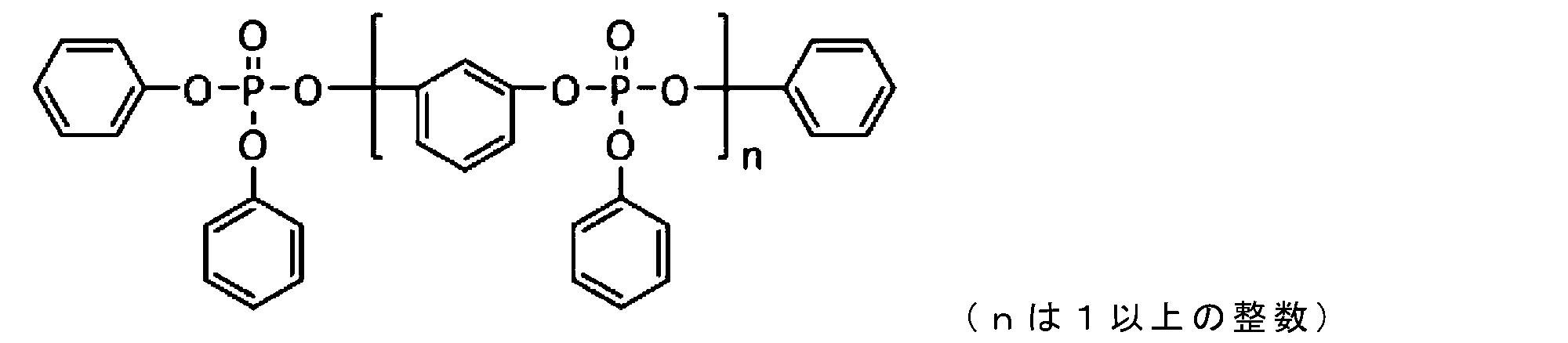
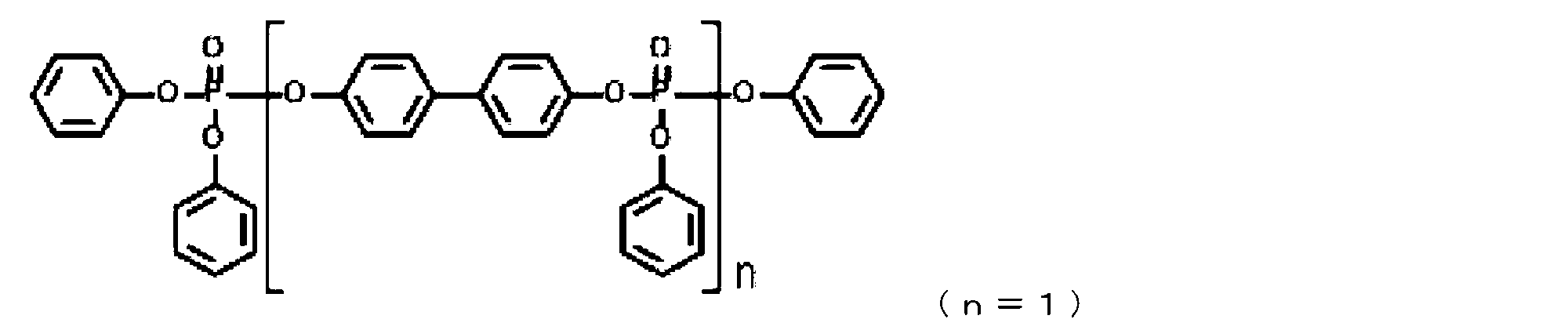
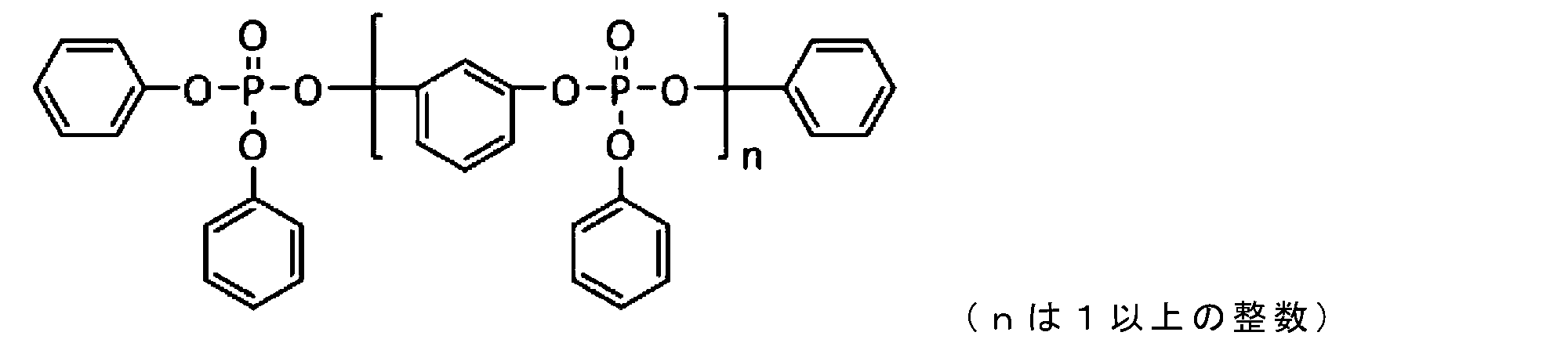
- the content of the phosphate ester (referred to as "phosphate ester (b')") having low compatibility with the component (A) is Small is preferred.
- the phosphate ester (b′) include the following formula:
- the content of the phosphate ester (b') in the resin composition is preferably 3% by mass or less, more preferably 1% by mass or less, and even more preferably 0% by mass.
- the content of component (A) is preferably at least 70% by mass, more preferably at least 72% by mass, relative to the total content of component (A) and component (B) of 100% by mass. Yes, and preferably 75% by mass or less.
- the content of component (B) is preferably 25% by mass or more, and preferably 30% by mass, relative to the total content of components (A) and (B) of 100% by mass. % or less, more preferably 28 mass % or less.
- the resin composition can be made excellent in processing stability and flame retardancy, and suppressed in bleeding out. If the content of component (B) is too high, bleeding may occur. On the other hand, if the content of component (B) is too small, processing stability and flame retardancy may become insufficient. Processing stability can be evaluated by the method described in Examples.
- the total content of component (A) and component (B) is preferably 70% by mass or more, more preferably 80% by mass or more, still more preferably 90% by mass or more, relative to 100% by mass of the total amount of the cellulose resin composition. It is more preferably 95% by mass or more, preferably less than 99.8% by mass, more preferably 99.5% by mass or less, even more preferably 99% by mass or less, and even more preferably 98% by mass or less.
- the cellulose-based resin composition of the present embodiment contains an anti-dripping agent as component (C).
- the anti-drip agent is preferably a fluorine-based anti-drip agent (fluoropolymer), and more preferably contains a fluoropolymer that forms a fibrous structure (fibril-like structure) in the resin composition.
- Anti-drip agents include, for example, polytetrafluoroethylene (PTFE), tetrafluoroethylene-based copolymers (e.g., tetrafluoroethylene/hexafluoropropylene copolymer, etc.), polytetrafluoroethylene acrylic-modified resins, Fluorinated resins such as polyvinylidene fluoride and polyhexafluoropropylene, sodium perfluoromethanesulfonate, potassium perfluoro-n-butanesulfonate, potassium perfluoro-t-butanesulfonate, sodium perfluorooctane sulfonate salts, perfluoroalkanesulfonic acid alkali metal salt compounds such as perfluoro-2-ethylhexanesulfonic acid calcium salt, perfluoroalkanesulfonic acid alkaline earth metal salts, and the like.
- PTFE polytetrafluoroethylene
- the fluorine-containing polymer a fine powder fluoropolymer, an aqueous dispersion of fluoropolymer, a mixture of powdery fluoropolymer and acrylonitrile-styrene copolymer, and a mixture of powdery fluoropolymer and polymethyl methacrylate.
- fluoropolymers such as can also be used.
- silicone compounds such as silicone rubbers and layered silicates such as talc may be blended. These may be used individually by 1 type, and may be used in mixture of 2 or more types.
- fluorine-based anti-drip agents having fibril-forming ability are preferred, and polytetrafluoroethylene (PTFE) is particularly preferred.
- the molecular weight of the fluorine-based anti-dripping agent (especially PTFE) is preferably 1 million to 10 million, more preferably 2 million to 9 million in terms of number average molecular weight determined from standard specific gravity.
- PTFE may be in solid form or in aqueous dispersion form.
- the content of PTFE in the total amount of component (C) is preferably 80% by mass or more, more preferably 90% by mass or more, and may be 100% by mass.
- the content of component (C) is preferably 0.01% by mass or more, relative to the total content of component (A), component (B) and component (C) of 100% by mass.
- the cellulose-based resin composition according to the present embodiment may contain other components within a range that does not impair the desired appearance and properties when formed into a molded body.
- the total amount of component (A), component (B), and component (C) is preferably set in the range of 75 to 100% by mass with respect to the entire cellulosic resin composition. , more preferably 80% by mass or more, more preferably 90% by mass or more, preferably 95% by mass or more, more preferably 98% by mass or more, and even more preferably 99% by mass or more.
- the resin composition of the present embodiment may contain a coloring agent as described later, it is preferable that the composition does not contain a coloring agent and has high transparency. It may be colorless or colored, but is preferably colorless and transparent. Due to the high transparency, good color development can be obtained when a coloring agent or the like is added, and a molded article with a high-quality appearance, that is, an excellent design can be formed.
- the haze value of a 500 ⁇ m-thick molded body formed from a resin composition containing no colorant is preferably 35% or less, more preferably 10% or less.
- the resin composition of this embodiment may contain a colorant in addition to components (A), (B) and (C).
- the cellulose-based resin composition of the present embodiment may contain a coloring agent such as a black coloring agent.
- the content of a colorant such as a black colorant is not limited, but is 0.01 to 10 phr (100 parts by mass of the total mass of components other than the colorant of the cellulose-based resin composition) relative to the total mass of the components other than the colorant.
- the content of the colorant is 0.01 to 10 parts by mass.The same applies hereinafter.) can be set.
- the content of the colorant is preferably 0.05 phr or more, preferably 0.09 phr or more, and preferably 0.1 phr or more relative to the total mass of the components other than the colorant. It is preferably 5 phr or less, more preferably 3 phr or less, even more preferably 2 phr or less, from the viewpoint of suppressing the surplus amount of the coloring agent while obtaining a sufficient coloring effect.
- the content of the colorant is preferably 1 phr or less, more preferably 0.3 phr or less, even more preferably 0.2 phr or less, and particularly preferably 0.1 phr or less.
- Carbon black is preferred as the black colorant.
- the average particle size of this carbon black is preferably 1 to 20 nm, more preferably 5 to 20 nm, and even more preferably 8 to 18 nm.
- This average particle diameter is the arithmetic mean diameter of the particles obtained by observing the carbon black particles with an electron microscope.
- the specific surface area of the carbon black is not limited, but is preferably 140 m 2 /g or more, more preferably 180 m 2 /g or more, from the viewpoint of the jet-blackness of the molded article. From the viewpoint of dispersibility and the like, those having a density of 1000 m 2 /g or less can be used, those having a density of 700 m 2 /g or less can be used, and those having a density of 500 m 2 /g or less can be used. Regarding the relationship between the particle size and the specific surface area, the smaller the particle size, the larger the specific surface area.
- carbon black having a BET specific surface area within the above range.
- This specific surface area is the BET specific surface area (JISK6217) calculated from the nitrogen adsorption amount by the S-BET formula.
- the carbon black is preferably acidic, specifically preferably pH 5 or less, more preferably pH 4 or less, and even more preferably pH 3.5 or less.
- acidic (low pH value) carbon black By using such acidic (low pH value) carbon black, the brightness of the molded product can be lowered.
- carbon black having a pH of preferably 2.5 to 4, more preferably pH 2.5 to 3.5 can be suitably used.
- This pH value is the value obtained by measuring a mixture of carbon black and distilled water with a glass electrode pH meter.
- a specific measuring method is as follows. Add 100 ml of boiled and degassed pure water to 10 g of the sample, boil for 15 minutes on a hot plate, cool to room temperature, remove the supernatant, and measure the pH of the muddy substance obtained with a glass electrode pH meter. do.
- Such interaction or bonding between the acidic group (e.g., carboxylic acid group) on the surface of the acidic carbon black and the polar group (e.g., hydroxy group) of cellulose acetate improves the affinity, resulting in highly dispersed carbon black. This is considered to contribute to the decrease in brightness.
- the acidic group e.g., carboxylic acid group
- the polar group e.g., hydroxy group
- An organic or inorganic pigment or dye can be used as a coloring agent other than the black coloring agent.
- the resin composition may contain additives that are commonly used in ordinary resin materials for molding, as long as they do not impair the purpose of the present embodiment.
- additives include phenolic and phosphorus antioxidants, light stabilizers, ultraviolet absorbers, antistatic agents, antibacterial/antifungal agents, fillers, and the like.
- it may contain additives generally used for ordinary cellulose resins.
- Inorganic or organic particulate or fibrous fillers can be added to the resin composition of the present embodiment, if necessary, in consideration of maintaining transparency. By adding a filler, the strength and rigidity can be further improved.
- fillers include mineral particles (talc, mica, calcined siliceous earth, kaolin, sericite, bentonite, smectite, clay, silica, quartz powder, glass beads, glass powder, glass flakes, milled fiber, wollastonite, night (or wollastonite), etc.), boron-containing compounds (boron nitride, boron carbide, titanium boride, etc.), metal carbonates (magnesium carbonate, ground calcium carbonate, light calcium carbonate, etc.), metal silicates (calcium silicate , aluminum silicate, magnesium silicate, magnesium aluminosilicate, etc.), metal oxides (magnesium oxide, etc.), metal sulfates (calcium sulfate, barium sulf
- Fibrous fillers include organic fibers (natural fibers, papers, etc.), inorganic fibers (glass fiber, asbestos fiber, carbon fiber, silica fiber, silica/alumina fiber, wollastonite, zirconia fiber, potassium titanate fiber, etc.), metal fibers and the like. These fillers can be used alone or in combination of two or more.
- the resin composition may contain glass fibers.
- the strength of the molded article is improved.
- the glass fiber is not particularly limited, but the fiber length of the glass fiber before melt-kneading is preferably 0.5 mm or more, preferably 30 mm or less, and more preferably 10 mm or less.
- the cross-sectional shape of the glass fiber is not particularly limited, and examples thereof include circular, elliptical, oval and non-circular.
- the fiber diameter of the glass fiber may be, for example, 3 to 20 ⁇ m when the cross-sectional area is converted into a perfect circle.
- the glass fiber content relative to the total mass of the resin composition may be 0% by mass, but is preferably 0.5% by mass or more, more preferably 1% by mass or more. , more preferably 3% by mass or more, preferably 20% by mass or less, more preferably 10% by mass or less, and even more preferably 8% by mass or less.
- the resin composition of the present embodiment preferably has a low content of polylactic acid resin and aromatic polycarbonate resin. If polylactic acid resin or aromatic polycarbonate resin is contained, the compatibility with cellulose acetate is low, so cloudiness occurs, making it difficult to obtain a molded product with excellent design.
- the content of these components is preferably 3% by mass or less, more preferably 1% by mass or less, and even more preferably 0% by mass, relative to the total mass of the resin composition.
- the resin composition of the present embodiment preferably has a low content of inorganic flame retardants such as metal hydroxides (aluminum hydroxide, calcium hydroxide, magnesium hydroxide, etc.). If the resin composition contains an inorganic flame retardant, the resin composition becomes cloudy, making it difficult to obtain a molded product with excellent design. Also, when the content of the inorganic flame retardant is small, it becomes easier to obtain a molded article having high impact resistance.
- the content of the inorganic flame retardant is preferably 3% by mass or less, more preferably 1% by mass or less, and even more preferably 0% by mass, relative to the total mass of the resin composition.
- the method for producing the cellulose-based resin composition is not particularly limited.
- the components (A), (B) and (C) and, if necessary, other components are melt-mixed using a conventional mixer.
- a cellulose resin composition can be obtained.
- a compounding device such as a tumbler mixer, a ribbon blender, a single-screw or multi-screw mixing extruder, a kneading kneader, and a kneading roll can be used.
- granulation into an appropriate shape can be performed as necessary, and for example, pelletization can be performed using a pelletizer.
- a molded article formed using the cellulose resin composition according to the present embodiment can be formed into a desired shape by a normal molding method, and the shape and thickness of the molded article are not limited.
- the thickness is preferably 0.5 mm or more, more preferably 0.8 mm or more.
- the thickness is preferably 1.0 mm or more, more preferably 1.6 mm or more, more preferably 2.0 mm or more, and even more preferably 3.2 mm or more.
- the upper limit of the thickness of the molded body is not particularly limited, and can be appropriately set according to the required shape, strength, etc. However, even if the thickness is set to, for example, 10 mm or less, or even 5 mm or less, sufficient physical properties can be obtained. Obtainable.
- each component is distributed over the entirety of the molded article of the present embodiment (entirely in any direction including the thickness direction), a high-quality appearance can be obtained in any shape without providing a coating or a decorative film. be able to.
- the cellulose-based resin composition according to the present embodiment can be formed into a molded body according to the purpose of use by ordinary molding methods such as injection molding, injection compression molding, extrusion molding, and hot press molding.
- Molded articles formed using the cellulose-based resin composition according to the present embodiment are excellent in flame retardancy and design, and therefore can be applied to housings, exteriors, decorative boards, and decorative sheets. It can be used in place of building materials, furniture, and members used in automobiles. For example, it can be used for housings and exterior parts of electronic equipment and home electric appliances, interior materials for building materials, and interior materials for automobiles.
- Applications for electronic equipment or home appliances include personal computers, fixed phones, mobile phone terminals, smartphones, tablets, POS terminals, routers, projectors, speakers, lighting fixtures, copiers, multifunction machines, calculators, remote controls, refrigerators, washing machines, Humidifiers, dehumidifiers, video recorders/players, vacuum cleaners, air conditioners, rice cookers, electric shavers, electric toothbrushes, dishwashers, housings for broadcasting equipment, dials and exteriors of watches, cases for mobile devices such as smartphones types are mentioned.
- Automotive applications include interior instrument panels, dashboards, cup holders, door trims, armrests, door handles, door locks, handles, brake levers, ventilators, and shift levers.
- Component (B)> (b1) Triphenyl phosphate (TPP) (manufactured by Daihachi Chemical Industry, product name: TPP)
- ⁇ Component (C)> (c1) Polytetrafluoroethylene (PTFE) (manufactured by Daikin Industries, Ltd., product name: Polyflon MPA FA-500H)
- Carbon black (acidic carbon black (average particle size: 13 nm, pH 3) (manufactured by Mitsubishi Chemical Corporation, product name: Mitsubishi carbon black #2650))
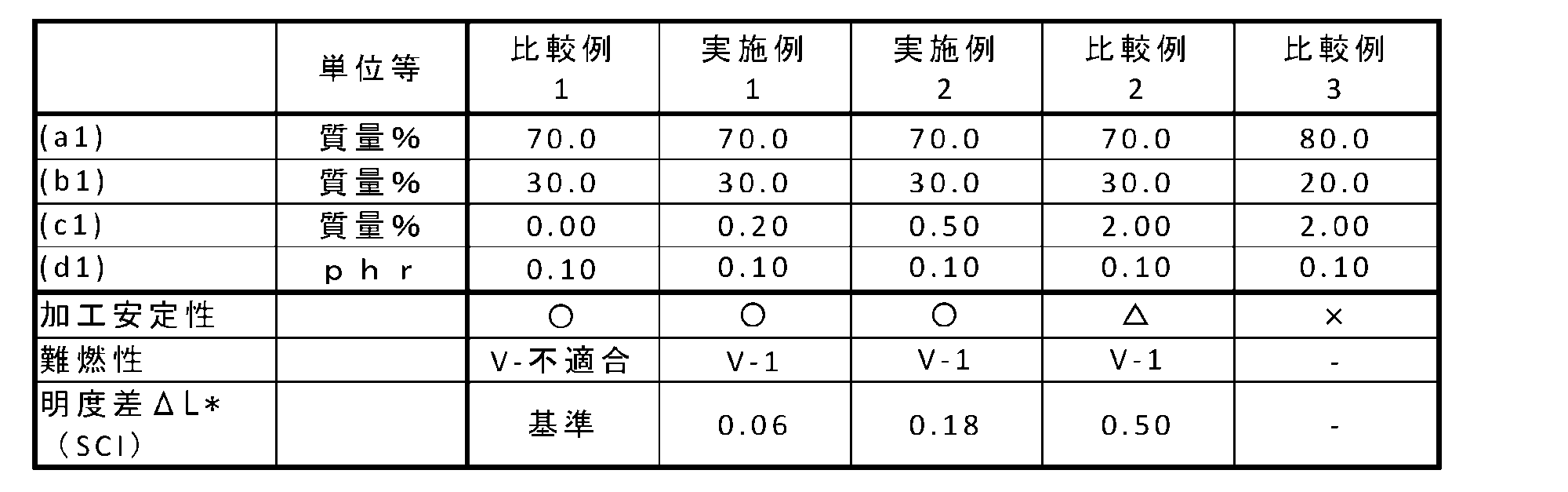
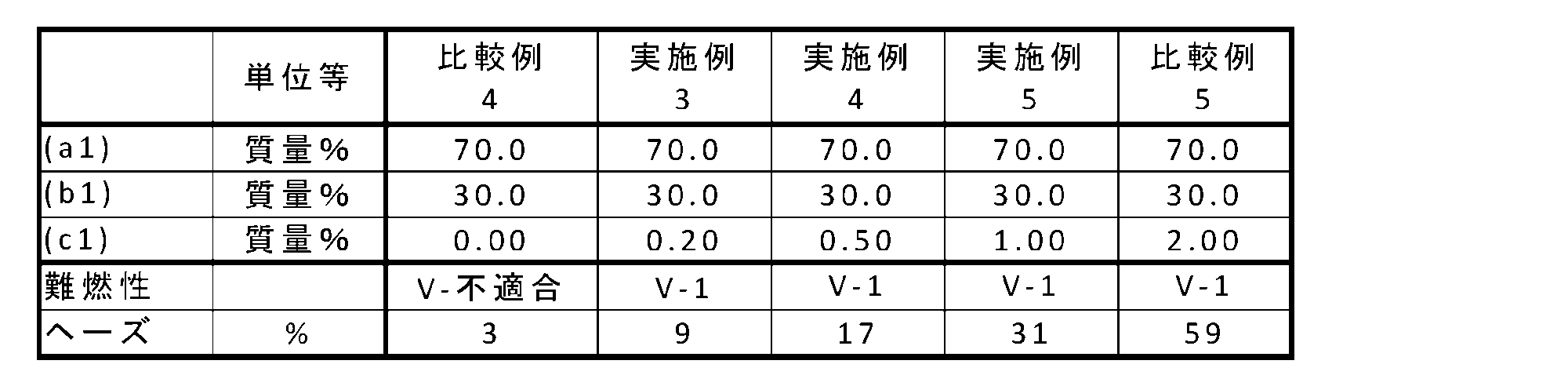
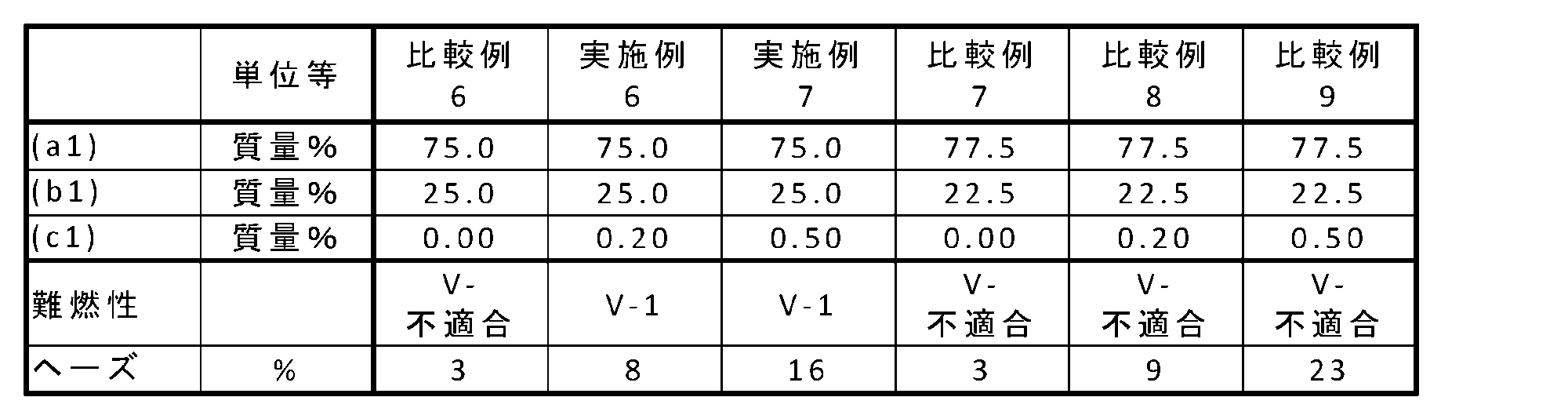
- Examples 1 to 7 Materials shown in Tables 2 to 4 were prepared as constituent materials of the desired cellulose-based resin composition. Next, the constituent materials were thoroughly mixed by hand mixing at the compounding ratios shown in Tables 2 to 4. The resin material was previously dried at 80° C. for 5 hours.
- the ratio of the component (a1) and the component (b1) is the ratio (% by mass) to the total 100% by mass of the component (a1) and the component (b1).
- the content of component (c1) is the ratio (% by mass) to the total 100% by mass of components (a1), (b1) and (c1).
- the blending amount of the component (d1) is a ratio based on 100 parts by mass of components other than the colorant, and the unit is phr.
- Evaluation criteria are as follows. ⁇ : Strands are stably discharged. ⁇ : Strands are ejected but pulsate. x: A strand is discharged, but the pulsation is large and it cannot be collected.
- evaluation sample 1 Preparation of combustion test sample: evaluation sample 1
- evaluation sample 1 The obtained pellets were dried again at 80° C. for 5 hours immediately before molding and used to produce a molded body (evaluation sample 1) having the following shape with an injection molding machine (manufactured by Toshiba Machine, product name: EC20P).
- Molded body length 125 mm, width 13 mm, thickness 3.2 mm, At that time, the molding conditions were set as follows. Molding machine cylinder temperature: 190-230°C Mold temperature: 60-70°C Holding pressure: 60-100MPa
- UL94V test Combustibility test (UL94V test)> The flammability test is performed by leaving a test piece for flammability test (evaluation sample 1) obtained by injection molding in a constant temperature room at a temperature of 23 ° C and a humidity of 50% for 48 hours, and then underwriters laboratories.
- UL94 test (combustibility test of plastic materials for equipment parts).
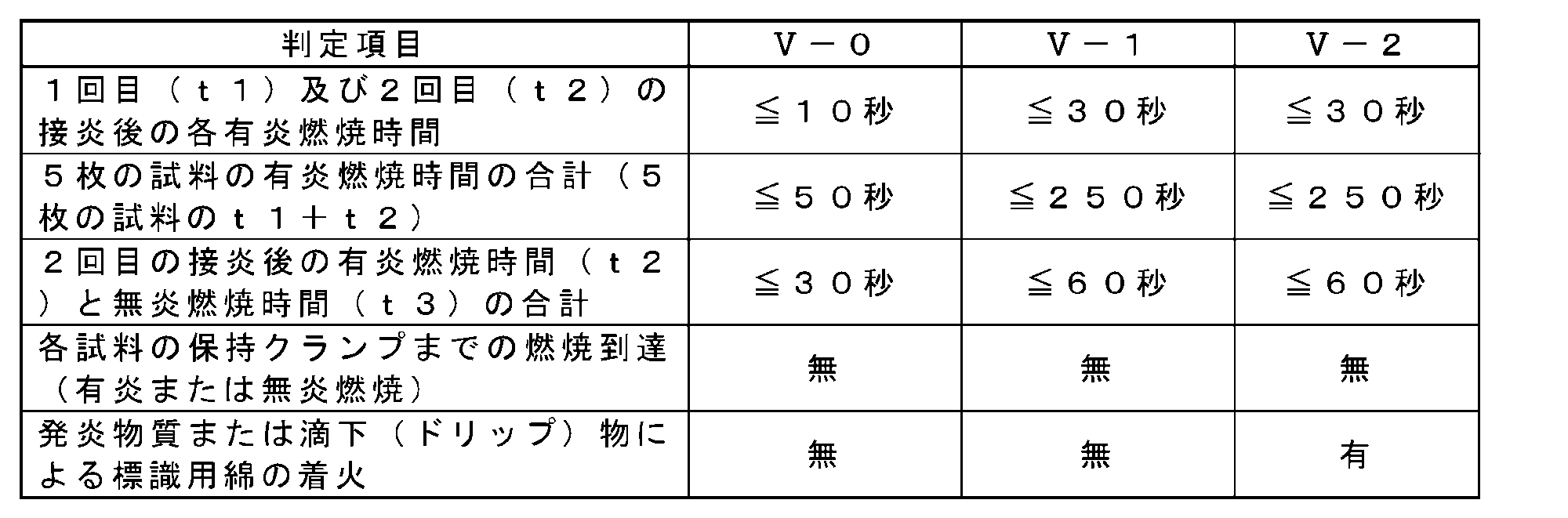
- UL94V is a method for evaluating flame retardancy from the burning time and drip properties after 10 seconds of indirect flame of a burner (20 ⁇ 1 mm flame) at the lower end of a test piece of a predetermined size held vertically. They are classified into the classes shown in Table 1 below.
- V-0, V-1, and V-2 When lined up in ascending order of flame retardancy, V-0, V-1, and V-2. However, those that did not correspond to any of the ranks of V-0 to V-2 (low flame retardancy) were classified as V-unsuitable.
- the flaming combustion time is the length of time that the test piece continues flaming combustion after the ignition source (burner) is moved away.
- the combustion time after the second flame application, t3, is the afterglow (flameless combustion) time after the second flame application.
- the second flame application is carried out by directly applying an indirect flame of a burner to the test piece for 10 seconds when the flame is extinguished after the first flame application. Ignition of the cotton by the drip is determined by whether or not the marking cotton located 300 ⁇ 10 mm below the lower end of the test piece is ignited by drips from the test piece.
- the brightness of the obtained evaluation sample 1 was measured by reflection measurement by the SCI method (including specular reflection light), using a spectrophotometer (manufactured by Konica Minolta, product name: spectrophotometer CM-3700A, JIS Z 8722 condition c, ISO 7724 /1, CIE No. 15, ASTM E1164, DIN5033 Part7).
- the measurement diameter/illumination diameter was SAV: 3 ⁇ 5 mm/5 ⁇ 7 mm. Reflection measurement conditions were di: 8°, de: 8° (diffuse illumination, 8° direction light reception), a field of view of 10°, a light source of D65 light source, and a UV condition of 100% full.
- Molded object Disc-shaped molded object having a diameter of 50 mm and a thickness of 500 ⁇ m At that time, the molding conditions were set as follows. Set temperature: 210°C Pressure: 10MPa
- ⁇ Measurement of haze> The haze (cloudiness value) of the obtained evaluation sample 2 was measured with a haze meter (manufactured by Murakami Color Research Laboratory, product name: HM-65W type, conforming to JIS K 7136). A D65 light source was used as the light source.
- Comparative Example 3 had low processing stability, and it was not possible to prepare an evaluation sample for measuring flame retardancy and brightness.
- Component (A) cellulose acetate
- Component (B) one or more phosphate esters selected from the group consisting of triphenyl phosphate, triethyl phosphate, tributyl phosphate, and tricresyl phosphate
- Component (C) an anti-drip agent; including The content of component (B) is 25% by mass or more and 30% by mass or less with respect to the total content of 100% by mass of component (A) and component (B), The content of component (C) is 0.01% by mass or more, preferably 0.1% by mass or more, relative to the total content of 100% by mass of component (A), component (B), and component (C). % or less, the cellulose-based resin composition.
- Appendix 2 The cellulose-based resin composition according to Appendix 1, wherein the component (B) contains triphenyl phosphate.
- Appendix 4 The cellulose resin composition according to any one of Appendices 1 to 3, wherein the component (C) contains polytetrafluoroethylene.
- Appendix 5 The cellulosic resin composition according to any one of Appendices 1 to 4, wherein a molded article having a thickness of 500 ⁇ m formed from the resin composition containing no colorant has a haze value of 35% or less.
- Appendix 6 The cellulose resin composition according to any one of Appendices 1 to 5, further comprising a coloring agent.
- Appendix 7 The cellulose resin composition according to Appendix 6, wherein the colorant is carbon black.
- Appendix 8 The cellulose-based resin composition according to Appendix 7, wherein the carbon black is acidic carbon black.
- Appendix 9 A molded article formed using the cellulose resin composition according to any one of Appendices 1 to 8.
Landscapes
- Chemical & Material Sciences (AREA)
- Health & Medical Sciences (AREA)
- Chemical Kinetics & Catalysis (AREA)
- Medicinal Chemistry (AREA)
- Polymers & Plastics (AREA)
- Organic Chemistry (AREA)
- Compositions Of Macromolecular Compounds (AREA)
Abstract
Description
成分(B):リン酸トリフェニル、リン酸トリエチル、リン酸トリブチル、およびリン酸トリクレジルからなる群から選ばれる一種以上のリン酸エステルと、
成分(C):ドリップ防止剤と、
を含み、
成分(A)および成分(B)の合計含有量100質量%に対し、成分(B)の含有量が25質量%以上30質量%以下であり、
前記成分(A)、成分(B)および成分(C)の合計含有量100質量%に対し、成分(C)の含有量が0.01質量%以上1質量%以下である、セルロース系樹脂組成物。
成分(A):酢酸セルロースと、
成分(B):リン酸トリフェニル、リン酸トリエチル、リン酸トリブチル、およびリン酸トリクレジルからなる群から選ばれる一種以上のリン酸エステルと、
成分(C):ドリップ防止剤と、
を含み、
成分(A)および成分(B)の合計含有量100質量%に対し、成分(B)の含有量が25質量%以上30質量%以下であり、
前記成分(A)、成分(B)および成分(C)の合計含有量100質量%に対し、成分(C)の含有量が0.01質量%以上1質量%以下である。
本実施形態のセルロース系樹脂組成物は、成分(A)として、酢酸セルロース(「CA」とも記載)を含む。酢酸セルロースとして、セルロースを原料としてそのヒドロキシ基の少なくとも一部にアセチル基が導入されたものを用いることができる。

本実施形態のセルロース系樹脂組成物は、成分(B)として、リン酸トリフェニル(「TPP」とも記載)、リン酸トリエチル、リン酸トリブチル、およびリン酸トリクレジルからなる群から選ばれる一種以上のリン酸エステルを含む。成分(B)は、難燃剤および可塑剤として機能し、樹脂組成物に、難燃性および成形性を付与することができる。また、これら所定のリン酸エステルは、酢酸セルロースとの相溶性が高く、酢酸セルロースと混合しても白濁せず、透明性の高い樹脂組成物が得られる。

本実施形態のセルロース系樹脂組成物は、成分(C)として、ドリップ防止剤を含む。成分(C)を含むことにより、セルロース系樹脂組成物が加熱された時に収縮し、溶融した樹脂が滴下(ドリップ)して燃焼が広がるのを防ぐことができる。ドリップ防止剤としては、フッ素系のドリップ防止剤(含フッ素ポリマー)が好ましく、樹脂組成物中で繊維構造(フィブリル状構造)を形成する含フッ素ポリマーを含むことがより好ましい。含フッ素ポリマーを配合することにより、燃焼時のドリップ現象の抑制効果を高めることができる。
一態様において、本実施形態のセルロース系樹脂組成物は、黒色着色剤等の着色剤を含んでもよい。
セルロース系樹脂組成物の製造方法は、特に限定はなく、例えば成分(A)、成分(B)および成分(C)と、必要に応じて他の成分とを、通常の混合機で溶融混合することでセルロース系樹脂組成物を得ることができる。混合機としては、例えばタンブラーミキサー、リボンブレンダー、単軸や多軸混合押出機、混練ニーダー、混練ロール等のコンパウンディング装置を用いることができる。溶融混合後は、必要に応じて適当な形状に造粒を行うことができ、例えばペレタイザーを用いてペレット化することができる。
本実施形態によるセルロース系樹脂組成物を用いて形成された成形体は、通常の成形方法により所望の形状にすることができ、その形状は限定されず、その成形体の厚みも制限されない。成形体の強度の観点からは、厚みは、0.5mm以上が好ましく、0.8mm以上がより好ましい。さらに、難燃性の観点からは、厚みは、1.0mm以上が好ましく、1.6mm以上がより好ましく、2.0mm以上がより好ましく、3.2mm以上がさらに好ましい。一方、成形体の厚みの上限も特に制限されず、求められる形状や強度等に応じて適宜設定することができるが、例えば10mm以下、さらに5mm以下の厚みに設定しても、十分な物性を得ることができる。
(a1)酢酸セルロース(CA)(ダイセル社製、製品名:L-50、アセチル基の導入比率(置換度)DS=2.4、酢化度55%、6%粘度に基づく重合度180)
<成分(B)>
(b1)リン酸トリフェニル(TPP) (大八化学工業製、製品名:TPP)
(b1’)下記式:

(b2’)下記式:

(b3’)下記式:
(b5’)[(CH3)2C6H3O]2P(O)OC6H4OP(O)[OC6H3(CH3)2]2(大八化学工業株式会社製、商品名:PX-200)
(c1)ポリテトラフルオロエチレン(PTFE)(ダイキン工業(株)製、製品名:ポリフロン MPA FA-500H)
(d1)カーボンブラック(酸性カーボンブラック(平均粒径:13nm、pH3)(三菱ケミカル(株)製、製品名:三菱カーボンブラック♯2650))
成分(a1)と各リン酸エステルとの相溶性を確認するため、質量比が、成分(a1):リン酸エステル=80:20となるように混合して、後述の混練方法と同様の方法で混練りして外観を観察した。
目的のセルロース系樹脂組成物の構成材料として、表2~表4に示す材料を用意した。次いで、表2~表4に示す配合比率で、構成材料をハンドミキシングにより十分に混合した。なお、樹脂材料は予め80℃で5時間乾燥した。成分(a1)および成分(b1)の比率は、成分(a1)と成分(b1)の合計100質量%に対する割合(質量%)である。成分(c1)の含有量は、成分(a1)、(b1)および(c1)の合計100質量%に対する割合(質量%)である。成分(d1)の配合量は、着色剤以外の成分を100質量部とした割合で、単位はphrである。
得られた混合物を、同方向回転二軸押出機(STEER社製、製品名:Omega30H[φ30、L/D=60])に投入し、混練温度200℃、回転数120rpmで混練し、水冷回収してペレット化した。得られたペレットは80℃で5時間乾燥した。
押出機の吐出口から吐出される樹脂組成物のストランドについて、その安定性を評価した。
〇:ストランドが安定して吐出される。
△:ストランドが吐出されるが脈動する。
×:ストランドが吐出されるが脈動が大きく、引取ることができない。
得られたペレットを成形直前に再度80℃で5時間乾燥して使用し、射出成形機(東芝機械製、製品名:EC20P)により、下記形状の成形体(評価用試料1)を作製した。
その際、成形条件を次の通りに設定した。
成形機のシリンダー温度:190-230℃
金型温度:60-70℃
保圧:60-100MPa
燃焼性試験は、射出成形により得た燃焼性試験用の試験片(評価用試料1)を温度23℃、湿度50%の恒温室中に48時間放置した後、アンダーライターズ・ラボラトリーズが定めているUL94試験(機器の部品用プラスチック材料の燃焼性試験)に準拠して行った。UL94Vとは、鉛直に保持した所定の大きさの試験片の下端にバーナーの炎(20±1mm炎)を10秒間接炎した後の燃焼時間およびドリップ性等から難燃性を評価する方法であり、下記表1に示すクラスに分けられる。
得られた評価用試料1のSCI方式(正反射光含む)よる反射測定で明度を、分光測色計(コニカミノルタ製、製品名:分光測色計CM-3700A、JIS Z 8722 条件c、ISO7724/1、CIE No.15、ASTM E1164、DIN5033 Teil7に準拠)で測定した。測定径/照明径は、SAV:3x5mm/5x7mmとした。反射測定条件は、di:8°,de:8°(拡散照明・8°方向受光)とし、視野は10°とし、光源はD65光源を使用し、UV条件は100%Fullとした。ここで、明度とは、CIE1976L*a*b*色空間のL*を指す。明度の値が低いほど漆黒性に優れる。明度は着色剤(d1)を含む試料について測定した(表2)。比較例1を基準とした値を表2に記載する。
得られたペレットを成形直前に再度80℃で5時間乾燥して使用し、熱プレス成型機(テスター産業製、製品名:SA-303-II-S)により下記形状の成形体(評価用試料2)を作製した。
その際、成形条件を次の通りに設定した。
設定温度:210℃
圧力:10MPa
得られた評価用試料2のヘーズ(曇り価)を、ヘーズメーター(村上色彩技術研究所製、製品名:HM-65W型、JIS K 7136に準拠)で測定した。光源はD65光源を使用した。
成分(A):酢酸セルロースと、
成分(B):リン酸トリフェニル、リン酸トリエチル、リン酸トリブチル、およびリン酸トリクレジルからなる群から選ばれる一種以上のリン酸エステルと、
成分(C):ドリップ防止剤と、
を含み、
成分(A)および成分(B)の合計含有量100質量%に対し、成分(B)の含有量が25質量%以上30質量%以下であり、
前記成分(A)、成分(B)および成分(C)の合計含有量100質量%に対し、成分(C)の含有量が0.01質量%以上、好ましくは0.1質量%以上1質量%以下である、セルロース系樹脂組成物。
前記成分(B)が、リン酸トリフェニルを含む、付記1に記載のセルロース系樹脂組成物。
前記成分(C)が、フッ素系ドリップ防止剤を含む、付記1または2に記載のセルロース系樹脂組成物。
前記成分(C)がポリテトラフルオロエチレンを含む、付記1~3のいずれか一項に記載のセルロース系樹脂組成物。
着色剤を含まない樹脂組成物で形成した厚み500μmの成形体のヘーズ値が35%以下である、付記1~4のいずれか一項に記載のセルロース系樹脂組成物。
さらに着色剤を含む、付記1~5のいずれか一項に記載のセルロース系樹脂組成物。
前記着色剤がカーボンブラックである、付記6に記載のセルロース系樹脂組成物。
前記カーボンブラックが、酸性カーボンブラックである、付記7に記載のセルロース系樹脂組成物。
付記1~8のいずれか一項に記載のセルロース系樹脂組成物を用いて形成された成形体。
Claims (9)
- 成分(A):酢酸セルロースと、
成分(B):リン酸トリフェニル、リン酸トリエチル、リン酸トリブチル、およびリン酸トリクレジルからなる群から選ばれる一種以上のリン酸エステルと、
成分(C):ドリップ防止剤と、
を含み、
成分(A)および成分(B)の合計含有量100質量%に対し、成分(B)の含有量が25質量%以上30質量%以下であり、
前記成分(A)、成分(B)および成分(C)の合計含有量100質量%に対し、成分(C)の含有量が0.01質量%以上1質量%以下である、セルロース系樹脂組成物。 - 前記成分(B)が、リン酸トリフェニルを含む、請求項1に記載のセルロース系樹脂組成物。
- 前記成分(C)が、フッ素系ドリップ防止剤を含む、請求項1または2に記載のセルロース系樹脂組成物。
- 前記成分(C)がポリテトラフルオロエチレンを含む、請求項1または2に記載のセルロース系樹脂組成物。
- 着色剤を含まない樹脂組成物で形成した厚み500μmの成形体のヘーズ値が35%以下である、請求項1または2に記載のセルロース系樹脂組成物。
- さらに着色剤を含む、請求項1または2に記載のセルロース系樹脂組成物。
- 前記着色剤がカーボンブラックである、請求項6に記載のセルロース系樹脂組成物。
- 前記カーボンブラックが、酸性カーボンブラックである、請求項7に記載のセルロース系樹脂組成物。
- 請求項1または2に記載のセルロース系樹脂組成物を用いて形成された成形体。
Priority Applications (2)
| Application Number | Priority Date | Filing Date | Title |
|---|---|---|---|
| US18/291,977 US20250353997A1 (en) | 2021-07-29 | 2022-07-29 | Cellulose-based resin composition and molded body using same |
| JP2023538635A JP7670388B2 (ja) | 2021-07-29 | 2022-07-29 | セルロース系樹脂組成物およびこれを用いた成形体 |
Applications Claiming Priority (2)
| Application Number | Priority Date | Filing Date | Title |
|---|---|---|---|
| JP2021124854 | 2021-07-29 | ||
| JP2021-124854 | 2021-07-29 |
Publications (1)
| Publication Number | Publication Date |
|---|---|
| WO2023008552A1 true WO2023008552A1 (ja) | 2023-02-02 |
Family
ID=85086138
Family Applications (1)
| Application Number | Title | Priority Date | Filing Date |
|---|---|---|---|
| PCT/JP2022/029269 Ceased WO2023008552A1 (ja) | 2021-07-29 | 2022-07-29 | セルロース系樹脂組成物およびこれを用いた成形体 |
Country Status (3)
| Country | Link |
|---|---|
| US (1) | US20250353997A1 (ja) |
| JP (1) | JP7670388B2 (ja) |
| WO (1) | WO2023008552A1 (ja) |
Citations (4)
| Publication number | Priority date | Publication date | Assignee | Title |
|---|---|---|---|---|
| JP2005162871A (ja) * | 2003-12-02 | 2005-06-23 | Sony Corp | 樹脂組成物、成形品、電気製品、樹脂組成物の製造方法 |
| JP2011225845A (ja) * | 2010-03-30 | 2011-11-10 | Fujifilm Corp | 樹脂組成物、成形体、及び電気電子機器用筐体 |
| JP2011241236A (ja) * | 2010-05-13 | 2011-12-01 | Fujifilm Corp | 樹脂組成物、射出成形用樹脂組成物、及び電気電子機器用筐体 |
| JP2012041435A (ja) * | 2010-08-18 | 2012-03-01 | Fujifilm Corp | 樹脂組成物、及び電気電子機器用筐体 |
Family Cites Families (1)
| Publication number | Priority date | Publication date | Assignee | Title |
|---|---|---|---|---|
| CN108359138B (zh) * | 2018-03-12 | 2020-01-14 | 武汉理工大学 | 一种高透明阻燃纤维素材料及其制备方法 |
-
2022
- 2022-07-29 JP JP2023538635A patent/JP7670388B2/ja active Active
- 2022-07-29 US US18/291,977 patent/US20250353997A1/en active Pending
- 2022-07-29 WO PCT/JP2022/029269 patent/WO2023008552A1/ja not_active Ceased
Patent Citations (4)
| Publication number | Priority date | Publication date | Assignee | Title |
|---|---|---|---|---|
| JP2005162871A (ja) * | 2003-12-02 | 2005-06-23 | Sony Corp | 樹脂組成物、成形品、電気製品、樹脂組成物の製造方法 |
| JP2011225845A (ja) * | 2010-03-30 | 2011-11-10 | Fujifilm Corp | 樹脂組成物、成形体、及び電気電子機器用筐体 |
| JP2011241236A (ja) * | 2010-05-13 | 2011-12-01 | Fujifilm Corp | 樹脂組成物、射出成形用樹脂組成物、及び電気電子機器用筐体 |
| JP2012041435A (ja) * | 2010-08-18 | 2012-03-01 | Fujifilm Corp | 樹脂組成物、及び電気電子機器用筐体 |
Also Published As
| Publication number | Publication date |
|---|---|
| JP7670388B2 (ja) | 2025-04-30 |
| US20250353997A1 (en) | 2025-11-20 |
| JPWO2023008552A1 (ja) | 2023-02-02 |
Similar Documents
| Publication | Publication Date | Title |
|---|---|---|
| JP7143860B2 (ja) | セルロース系樹脂組成物、成形体及びこれを用いた製品、並びにセルロース系樹脂組成物の製造方法 | |
| CN107501887B (zh) | 含特殊结构sag相容剂的高性能聚碳酸酯组合物及其制备方法 | |
| EP3725835B1 (en) | Cellulose resin composition, molded body and product using same | |
| WO2012165352A1 (ja) | ポリカーボネート樹脂組成物及び成形体 | |
| JP6896997B2 (ja) | 樹脂組成物、樹脂成形体、及び樹脂組成物の製造方法 | |
| CN1294152A (zh) | 阻燃热塑性树脂组合物 | |
| JP7670387B2 (ja) | セルロース系樹脂組成物およびこれを用いた成形体 | |
| JP6940162B2 (ja) | セルロース系樹脂組成物、成形体及びこれを用いた製品 | |
| JP7670388B2 (ja) | セルロース系樹脂組成物およびこれを用いた成形体 | |
| CN104861583A (zh) | 一种高性能阻燃ptt/petg复合材料 | |
| WO2024106426A1 (ja) | セルロース系樹脂組成物及びこれを用いた成形体 | |
| WO2014069489A1 (ja) | ポリブチレンテレフタレート樹脂組成物 | |
| WO2024210176A1 (ja) | セルロース系樹脂組成物及びこれを用いた成形体 | |
| JP2018188539A (ja) | 難燃性ポリカーボネート樹脂組成物の製造方法 | |
| WO2013057994A1 (ja) | 難燃性樹脂組成物および溶融成形体 | |
| US20160280885A1 (en) | Resin composition and resin molded article | |
| JP2023153332A (ja) | ポリカーボネート樹脂組成物及びその成形品 | |
| JP2025154684A (ja) | セルロース系樹脂組成物及びこれを用いた成形体 | |
| JP7838355B2 (ja) | 難燃性樹脂組成物及び難燃性樹脂筐体 | |
| JP7146453B2 (ja) | 難燃性ポリカーボネート樹脂組成物 | |
| JP5915252B2 (ja) | 樹脂組成物および樹脂成形体 | |
| WO2024106419A1 (ja) | セルロース系樹脂組成物およびこれを用いた成形体 | |
| WO2024106436A1 (ja) | セルロース系樹脂組成物及びこれを用いた成形体 | |
| JPWO2019235505A1 (ja) | 難燃性ポリブチレンテレフタレート樹脂組成物 | |
| WO2025053208A1 (ja) | 多糖類系樹脂組成物およびこれを用いた成形体 |
Legal Events
| Date | Code | Title | Description |
|---|---|---|---|
| 121 | Ep: the epo has been informed by wipo that ep was designated in this application |
Ref document number: 22849612 Country of ref document: EP Kind code of ref document: A1 |
|
| WWE | Wipo information: entry into national phase |
Ref document number: 2023538635 Country of ref document: JP |
|
| NENP | Non-entry into the national phase |
Ref country code: DE |
|
| 122 | Ep: pct application non-entry in european phase |
Ref document number: 22849612 Country of ref document: EP Kind code of ref document: A1 |
|
| WWP | Wipo information: published in national office |
Ref document number: 18291977 Country of ref document: US |