WO2023008112A1 - 水晶素子及び水晶デバイス - Google Patents
水晶素子及び水晶デバイス Download PDFInfo
- Publication number
- WO2023008112A1 WO2023008112A1 PCT/JP2022/026705 JP2022026705W WO2023008112A1 WO 2023008112 A1 WO2023008112 A1 WO 2023008112A1 JP 2022026705 W JP2022026705 W JP 2022026705W WO 2023008112 A1 WO2023008112 A1 WO 2023008112A1
- Authority
- WO
- WIPO (PCT)
- Prior art keywords
- crystal
- crystal element
- thickness
- holding portion
- frequency
- Prior art date
- Legal status (The legal status is an assumption and is not a legal conclusion. Google has not performed a legal analysis and makes no representation as to the accuracy of the status listed.)
- Ceased
Links
Images




Classifications
-
- H—ELECTRICITY
- H03—ELECTRONIC CIRCUITRY
- H03H—IMPEDANCE NETWORKS, e.g. RESONANT CIRCUITS; RESONATORS
- H03H9/00—Networks comprising electromechanical or electro-acoustic elements; Electromechanical resonators
- H03H9/15—Constructional features of resonators consisting of piezoelectric or electrostrictive material
- H03H9/17—Constructional features of resonators consisting of piezoelectric or electrostrictive material having a single resonator
- H03H9/19—Constructional features of resonators consisting of piezoelectric or electrostrictive material having a single resonator consisting of quartz
Definitions
- the present disclosure relates to a thickness-shear vibration mode crystal element and a crystal device including this crystal element.
- Crystal devices include, for example, crystal resonators and crystal oscillators.
- the thickness-shear vibration mode crystal element is an AT-cut crystal piece with excitation electrodes made of metal film patterns formed on both main surfaces.
- Crystal devices utilize the piezoelectric and inverse piezoelectric effects of crystal elements to generate specific oscillation frequencies.
- a typical crystal device has a structure in which a crystal element is accommodated in a package and hermetically sealed with a lid (for example, Patent Document 1).
- a crystal element according to the present disclosure includes an AT-cut crystal piece having a first surface and a second surface in a front-back relationship, and excitation electrodes positioned on the first surface and the second surface, respectively.
- the density of the excitation electrode is 9.63 to 11.55 g/cm when the thickness of the crystal piece is 3 to 16 ⁇ m, where the dimension in the direction perpendicular to the first and second surfaces is the thickness. 3 .
- a crystal device includes a crystal element according to the present disclosure, an element mounting member on which the crystal element is positioned, and a lid that hermetically seals the crystal element together with the element mounting member. .
- FIG. 2 is a plan view showing the crystal element of Embodiment 1.
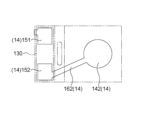
- FIG. 2 is a plan view of the back side of the crystal element of FIG. 1 seen through from the front side;
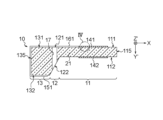
- FIG. FIG. 2 is a cross-sectional view taken along line III-III in FIG. 1;
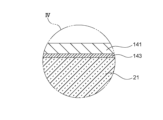
- 4 is an enlarged view of part IV in FIG. 3.
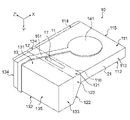
- FIG. 1 is a perspective view showing a crystal element of Embodiment 1.
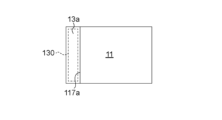
- FIG. 4 is a schematic plan view showing a first example of a holding portion in Embodiment 1.
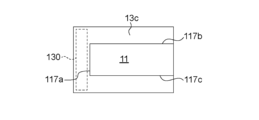
- FIG. 4 is a schematic plan view showing a second example of a holding portion in Embodiment 1.
- FIG. FIG. 10 is a schematic plan view showing a third example of a holding portion according to Embodiment 1;
- FIG. 10 is a schematic plan view showing a fourth example of a holding portion according to Embodiment 1;
- FIG. 10 is a perspective view showing a crystal device of Embodiment 2;
- FIG. 11 is a cross-sectional view taken along line XI-XI in FIG. 10;
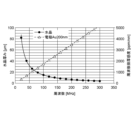
- 4 is a graph showing the relationship between the frequency of a crystal element, the thickness of a crystal piece, and the frequency film thickness sensitivity.
- the thicker (or thinner) the excitation electrode the lower (or higher) the frequency of the crystal element.
- the frequency is adjusted by scraping the excitation electrode with an ion beam, laser light, or the like.
- the frequency change of the crystal element due to the film thickness change of the excitation electrode is defined as the frequency film thickness sensitivity [ppm/nm].
- the frequency film thickness sensitivity increases as the frequency change of the crystal element increases. Note that simply "thick” has the same meaning as “thickness is large”, and simply “thin” has the same meaning as “thickness is small”.
- the frequency film thickness sensitivity can be reduced compared to the case of using an excitation electrode made of a high-density material such as Au, so the accuracy of frequency adjustment Decrease can be suppressed.
- Embodiment 1 a form for carrying out the present disclosure (hereinafter referred to as “embodiment") will be described with reference to the accompanying drawings.
- Embodiment 2 substantially the same components are denoted by the same reference numerals, and the description thereof is omitted as appropriate.
- the shapes depicted in the drawings are drawn so that those skilled in the art can easily understand them, so they do not necessarily match the actual dimensions and proportions.
- An example of the crystal element according to the present disclosure will be referred to as Embodiment 1
- Embodiment 2 an example of the crystal device according to the present disclosure
- FIG. 1 is a plan view showing the crystal element of Embodiment 1
- FIG. 2 is a plan view of the back side of the crystal element of FIG. is an enlarged view of part IV in FIG. 3
- FIG. 5 is a perspective view showing the crystal element of the first embodiment. Description will be made below based on these drawings.
- the first embodiment relates to a crystal element.
- a surface sandwiched between the first surface and the second surface, which are in front-back relationship, is defined as a "side surface".
- an orthogonal coordinate system XYZ consisting of X, Y and Z axes, which are the crystal axes of crystal, is rotated around the X axis by 30° or more and 50° or less to define an orthogonal coordinate system XY'Z'.
- the crystal element 10 of Embodiment 1 has a vibrating portion 11 as an AT-cut crystal piece having a first surface 111 and a second surface 112 that are in a front-back relationship, and the first surface 111 and the second surface 112 are positioned respectively. and excitation electrodes 141 and 142 .
- the density of the excitation electrodes 141 and 142 is 9.63 to 11.0 ⁇ m when the thickness of the vibrating portion 11 is 3 to 16 ⁇ m. 55 g/cm 3 .
- Materials that achieve such a density include, for example, alloys of two or more selected from gold, silver, palladium, and copper.
- the crystal element 10 may have the following ⁇ 1> to ⁇ 3>.
- the excitation electrodes 141 and 142 are made of an alloy of silver (Ag), palladium (Pd) and copper (Cu). For example, an alloy containing 1 to 2 wt % of palladium, 1 wt % or less of copper, and the balance of silver can be mentioned.
- an underlying layer 143 is further provided between the first surface 111 and the second surface 112 and the excitation electrodes 141 and 142, and the underlying layer 143 is chromium (Cr) or titanium (Ti). ). Although only the underlayer 143 between the first surface 111 and the excitation electrode 141 is shown in FIG.
- the crystal blank 21 has a first surface 111 and a second surface 112, and is positioned on at least one side 116 side of the vibrating portion 11, which is substantially rectangular in plan view, and vibrates. and a holding portion 13 having a thickness greater than that of the portion 11 .
- the crystal piece 21 is the same hatched portion in FIG.
- the crystal element 10 includes a vibrating portion 11, a holding portion 13 and an electrode portion 14.
- the vibrating portion 11 has a first surface 111 and a second surface 112 .
- the holding portion 13 is integrated with the vibrating portion 11 at the outer edge of the vibrating portion 11 and has a pair of holding portion main surfaces 131 and 132 and holding portion side surfaces 133 , 134 and 135 .
- the electrode portion 14 is provided on the first surface 111, the second surface 112, and the like.
- the vibrating portion 11 has a planar first surface 111 and a second surface 112, and vibrating portion side surfaces 113, 114, and 115 sandwiched between the first surface 111 and the second surface 112.
- the holding portion 13 has a pair of planar holding portion main surfaces 131 and 132 and holding portion side surfaces 133 , 134 and 135 sandwiched between the pair of holding portion main surfaces 131 and 132 . hold.
- the electrode section 14 applies a voltage to the first surface 111 and the second surface 112 to cause the vibrating section 11 to generate main vibration.
- the holding portion 13 has a fixing portion 130 (FIG. 2) including a portion in contact with a substrate 61 (described later) as an element mounting member.
- the electrode section 14 includes excitation electrodes 141 and 142 located on the first surface 111 and the second surface 112, mounting electrodes 151 and 152 located on the fixed portion 130, and the excitation electrodes 141 and 142 and the mounting electrodes 151 and 152. It has wiring electrodes 161 and 162 that are electrically connected.
- the crystal element 10 has a first surface 111, a second surface 112, and side surfaces 113, 114, and 115 of the vibrating portion.
- a holding portion 13 having holding portion side surfaces 133, 134, and 135 and positioned on at least one side 116 side of the vibrating portion 11 in plan view, and excitation electrodes 141 and 142 positioned on the first surface 111 and the second surface 112. , mounting electrodes 151 and 152 positioned on at least one of the main surfaces 131 and 132 of the holding portion, and wiring electrodes 161 and 162 electrically connecting the excitation electrodes 141 and 142 and the mounting electrodes 151 and 152.
- substantially rectangular includes squares, rectangles (rectangles), rectangles with rounded corners, and the like.
- the mounting electrodes 151 and 152 are positioned on the main surface 132 of the holding portion, which is the fixed portion 130 .
- the holding portion 13 may surround not only the one side 116 side of the vibrating portion 11 but also two sides, three sides, or all sides of the vibrating portion 11 . Specific examples thereof will be described with reference to FIGS. 6 to 9.
- the holding portion 13a of the first example shown in FIG. 6 has a substantially I-shaped planar shape and is located on the first side 117a side of the vibrating portion 11, as in the first embodiment.
- the holding portion 13b of the second example shown in FIG. 7 has a substantially L-shaped planar shape and is positioned on the first side 117a side and the second side 117b side of the vibrating portion 11 .
- the holding portion 13c of the third example shown in FIG. 8 has a substantially U-shaped planar shape and is positioned on the first side 117a side, the second side 117b side, and the third side 117c side of the vibrating portion 11 .
- the holding portion 13d of the fourth example shown in FIG. 9 has a substantially square-shaped planar shape, and the first side 117a side, the second side 117b side, the third side 117c side, and the fourth side 117d side of the vibrating portion 11. Located in The thickness of the holding portions 13a, 13b, 13c, and 13d is larger than the thickness of the vibrating portion 11 (so-called inverted mesa type).
- the fixing portions 130 of the holding portions 13a, 13b, 13c, and 13d are all at the same position, but may be at different positions. That is, the fixing portion 130 may be located at any position on each of the holding portions 13a, 13b, 13c, and 13d.
- the first surface 111 and the holding portion main surface 131 are on the same plane, and the thickness of the holding portion 13 is greater than the thickness of the vibrating portion 11 .
- the holding portion 13 has two holding portion side surfaces 133, 134 along the XY' plane and one holding portion side surface 135 along the Y'Z' plane.
- the inclined portion 12 having inclined portion main surfaces 121 and 122 and inclined portion side surfaces 123 and 124 is positioned between the vibrating portion 11 and the holding portion 13 .
- the inclined portion main surface 121 is on the same plane as the first surface 111 and the holding portion main surface 131
- the inclined portion main surface 122 is an inclined surface so as to connect the second surface 112 and the holding portion main surface 132 .
- a through-hole 17 is formed in the inclined portion 12 so as to penetrate the main surfaces 121 and 122 of the inclined portion in the thickness direction. If the crystal axis of the crystal blank 21 is set as shown in the drawing, the inclined portion main surface 122 is formed by wet etching. Since the inclined portion 12 is part of the holding portion 13, the inclined portion side surfaces 123 and 124 are also part of the holding portion side surfaces 133 and . That is, retainer side 133 includes ramp side 123 and retainer side 134 includes ramp side 124 .
- the crystal element 10 operates in a thickness-shear vibration mode, and the thickness of the vibrating portion 11 is 5 to 16 ⁇ m, so the oscillation frequency (fundamental wave) is 100 to 330 MHz.
- the vibrating portion 11 , the inclined portion 12 and the holding portion 13 are composed of one crystal piece 21 .
- the excitation electrodes 141, 142, the mounting electrodes 151, 152, and the wiring electrodes 161, 162 are made of metal patterns of the same material.
- the crystal piece 21 is an AT-cut crystal plate. That is, in crystal, the orthogonal coordinate system XYZ consisting of the X-axis (electrical axis), Y-axis (mechanical axis), and Z-axis (optical axis) is 30° or more and 50° or less (for example, 35° 15')
- XY'Z' is defined by rotation
- a wafer cut out parallel to the XZ' plane becomes the raw material of the crystal piece 21.
- the longitudinal direction of the crystal piece 21 is parallel to the X-axis
- the lateral direction is parallel to the Z'-axis
- the thickness direction is parallel to the Y'-axis.
- the crystal blank 21 has a length (X-axis direction) of 750 to 950 ⁇ m and a width (Z′-axis direction) of 600 to 800 ⁇ m.
- the thickness (Y'-axis direction) of the holding portion 13 is 30-50 ⁇ m
- the thickness (Y'-axis direction) of the vibrating portion 11 is approximately 6.8 ⁇ m
- the diameter of the excitation electrodes 141 and 142 is 250-400 ⁇ m.
- the oscillation frequency at this time is approximately 245 MHz.
- the thickness of the excitation electrodes 141 and 142 is 100-400 nm
- the thickness of the base layer 143 is 10-20 nm.
- the inclined portion main surface 121 is flush with the first surface 111 and the holding portion main surface 131, but the inclined portion main surface 122 is inclined so as to connect the first surface 112 and the holding portion main surface 132. . That is, the thickness of the inclined portion 12 becomes thinner as the distance from the holding portion 13 increases. Therefore, the stress transmitted from the holding portion 13 side to the vibrating portion 11 side is absorbed or dispersed by the inclined portion 12 (gentle step). Further, since the secondary vibration generated in the vibrating portion 11 is gradually attenuated toward the holding portion 13, the influence of the secondary vibration reflected by the holding portion 13 on the vibrating portion 11 is reduced. Therefore, the slope portion 12 can reduce the equivalent series resistance value.
- the through hole 17 penetrates between the mounting electrodes 151 and 152 and the vibrating portion 11 in the thickness direction. Therefore, the stress transmitted from the holding portion 13 side to the vibrating portion 11 side is absorbed or dispersed by the through holes 17 . In other words, when the holding portion 13 is connected to the package, the distortion that occurs in the vibrating portion 11 can be reduced. Also, the through hole 17 functions to confine the vibration energy of the vibrating portion 11 . Therefore, the through hole 17 can reduce the equivalent series resistance value. Furthermore, by forming the through hole 17 in the inclined portion 12, these effects are increased in conjunction with the action of the inclined portion 12. As shown in FIG.
- the pair of excitation electrodes 141 and 142 are substantially circular in plan view, and are provided substantially in the center of the first surface 111 and the second surface 112 of the vibrating section 11, respectively.
- Wiring electrodes 161 and 162 for connection that do not contribute to excitation extend from the excitation electrodes 141 and 142 to mounting electrodes 151 and 152 .
- the excitation electrode 141 is electrically connected to the mounting electrode 151 via the wiring electrode 161
- the excitation electrode 142 is electrically connected to the mounting electrode 152 via the wiring electrode 162 .
- the excitation electrodes 141 and 142 are not limited to a substantially circular shape, and may be substantially elliptical or substantially rectangular, for example.
- Wiring electrodes 161 and 162 may be made wider than shown to reduce the equivalent series resistance.
- Both of the mounting electrodes 151 and 152 are positioned on the main surface 132 of the holding portion, but at least one of them may be positioned on the main surface 131 of the holding portion. In this case, the mounting electrodes 151 and 152 may be electrically connected to the package or the like by wires.
- the metal patterns forming the excitation electrodes 141, 142, etc. form a laminate together with the base layer 143 made of chromium or titanium. That is, the base layer 143 is positioned on the crystal piece 21, and the excitation electrodes 141, 142, etc. are positioned on the base layer 143.
- FIG. The underlying layer 143 mainly plays the role of obtaining adhesion to the crystal piece 21 .
- the excitation electrodes 141, 142, etc. are conductor layers that provide electrical continuity.
- Forming a metal film means forming a metal film.
- the metal pattern manufacturing process includes a method of forming a photoresist pattern on a crystal piece and then etching it, and a method of forming a photoresist pattern on the crystal piece and then forming a film and then lifting off the film. or a method of forming a film by covering the crystal piece with a metal mask. Sputtering, vapor deposition, or the like is used for film formation.
- the crystal element 10 can be manufactured as follows using, for example, photolithography technology and etching technology.
- a corrosion-resistant film is provided on the entire surface of an AT-cut crystal wafer, and a photoresist is provided on it. Subsequently, a mask having a pattern of the outline of the crystal piece 21 (including the through hole 17) and the vibrating portion 11 (only one side) is overlaid on the photoresist, and exposed and developed to partially The corrosion resistant film is exposed and wet etching is performed on the corrosion resistant film in this state. Thereafter, the remaining corrosion-resistant film is used as a mask to wet-etch the crystal wafer, thereby forming the outer shape of the crystal piece 21 and the vibrating portion 11 . The outer shape of the crystal piece 21 is etched on both sides, and the vibrating portion 11 is etched on one side. The slope main surface 122 is also formed by this wet etching.
- the remaining corrosion-resistant film is removed from the crystal wafer, and a metal film, which will become the underlying layer 143 and the excitation electrodes 141 and 142, etc., is provided on the entire surface of the crystal wafer.
- a photoresist mask having a pattern of the excitation electrodes 141, 142 and the like is formed on the metal film, and unnecessary metal films are removed by etching to form the excitation electrodes 141 and 142 and the like.
- a plurality of crystal elements 10 are formed on the crystal wafer.
- the individual crystal elements 10 are obtained by singulating the crystal wafer into individual crystal elements 10 .
- the operation of the crystal element 10 is as follows. An alternating voltage is applied to the crystal piece 21 via the excitation electrodes 141 and 142 . Then, the crystal piece 21 causes thickness-shear vibration such that the first surface 111 and the second surface 112 are displaced from each other, and generates a specific oscillation frequency. Thus, the crystal element 10 operates to output a signal with a constant oscillation frequency using the piezoelectric effect and the inverse piezoelectric effect of the crystal element 21 . At this time, the thinner the plate thickness of the crystal blank 21 (that is, the vibrating portion 11) between the excitation electrodes 141, 141, the higher the oscillation frequency.
- the minimum amount (volume) that can be scraped is substantially constant regardless of the material. Therefore, the smaller the density of the excitation electrodes 141 and 142 is, the more the mass can be removed little by little, so fine frequency adjustment becomes possible.
- the mass of the excitation electrodes 141 and 142 affects the frequency. Therefore, if the thickness of the vibrating portion 11 is constant, the mass of the excitation electrodes 141 and 142 is usually constant regardless of the material. Therefore, the lower the density of the excitation electrodes 141 and 142, the thicker the excitation electrodes 141 and 142 can be, so that the range of frequency adjustment can be expanded.
- the entire surfaces of the excitation electrodes 141 and 142 can be uniformly removed little by little during frequency adjustment. Thickness variation can be reduced. As a result, it is possible to suppress deterioration in electrical characteristics due to variations in the thickness of the excitation electrodes 141 and 142 .
- the density of the excitation electrodes 141 and 142 exceeds 11.55 g/cm 3 , the frequency film thickness sensitivity at a frequency of 100 MHz becomes about 1000 ppm/nm or more, and the above effect is insufficient. becomes. If the density of the excitation electrodes 141 and 142 is set to a value less than 9.63 g/cm 3 , the excitation electrodes 141 and 142 become too thick, which may lead to abnormalities such as frequency temperature characteristics.
- the density of the excitation electrodes 141 and 142 is about half that of gold, so the above effect (1) can be reliably realized.
- the excitation electrode is made of only silver, it is possible to reduce "aggregation” due to heat and "discoloration” due to oxidation.
- the thermal expansion coefficient of chromium or titanium is close to that of quartz, so the adhesion to the quartz piece 21 can be improved.
- chromium has a lower resistivity than nickel (Ni) or the like, it can contribute to the reduction of the equivalent series resistance value.
- titanium does not produce harmful substances such as hexavalent chromium when used, so it has less environmental impact and is more productive.
- the crystal piece 21 includes the vibrating portion 11 and the holding portion 13, a structure in which the thin vibrating portion 11 is supported by the thick holding portion 13 can be realized.
- the mechanical strength of the crystal element 10 can be maintained.
- FIG. 11 is a cross-sectional view taken along line XI-XI in FIG.
- a crystal device including the crystal element of Embodiment 1 will be described as a crystal device 60 of Embodiment 2 based on these drawings.
- the crystal device 60 of Embodiment 2 includes the crystal element 10 of Embodiment 1, a base 61 on which the crystal element 10 is positioned, and the crystal element 10 is hermetically sealed together with the base 61.
- a lid 62 is provided.
- the mounting electrodes 151 and 152 of the crystal element 10 are connected to the substrate 61 by a conductive adhesive 61e.
- the base 61 is also called an element mounting member or package, and consists of a substrate 61a and a frame 61b.
- a space surrounded by the upper surface of the substrate 61 a , the inner surface of the frame 61 b , and the lower surface of the lid 62 serves as the housing portion 63 for the crystal element 10 .
- the crystal element 10 outputs, for example, a reference signal used in electronic equipment and the like.
- the crystal device 60 includes a substrate 61a having a pair of electrode pads 61d on the upper surface and four external terminals 61c on the lower surface, a frame 61b positioned along the outer periphery of the upper surface of the substrate 61a, and a pair of electrode pads.
- a crystal element 10 is mounted on 61d via a conductive adhesive 61e, and a lid 62 hermetically seals the crystal element 10 together with the frame 61b.
- the substrate 61a and the frame 61b are made of a ceramic material such as alumina ceramics or glass ceramics, and integrally formed to form the base 61.
- the base 61 and the lid 62 are substantially rectangular in plan view.
- the external terminal 61c, the electrode pad 61d, and the lid 62 are electrically connected via a conductor formed inside or on the side surface of the base 61. As shown in FIG. Specifically, the external terminals 61c are positioned at the four corners of the lower surface of the substrate 61a. Two of these external terminals 61 c are electrically connected to the crystal element 10 , and the remaining two external terminals 61 c are electrically connected to the lid 62 .
- the external terminal 61c is used for mounting on a printed wiring board of an electronic device or the like.
- the crystal element 10 has the crystal piece 21, the excitation electrode 141 formed on the upper surface of the crystal piece 21, and the excitation electrode 142 formed on the lower surface of the crystal piece 21, as described above.
- the crystal element 10 is bonded onto the electrode pad 61d via a conductive adhesive 61e, and plays a role of oscillating a reference signal for electronic equipment or the like by stable mechanical vibration and piezoelectric effect.
- the electrode pads 61d are for mounting the crystal element 10 on the substrate 61, and are positioned adjacent to each other along one side of the substrate 61a.
- the pair of electrode pads 61d connects the mounting electrodes 151 and 152, respectively, and has one end of the crystal element 10 as a fixed end, and the other end of the crystal element 10 as a free end separated from the upper surface of the substrate 61a.
- the crystal element 10 is fixed on the substrate 61a with a cantilever support structure.
- the conductive adhesive 61e is, for example, a binder such as silicone resin containing conductive powder as a conductive filler.
- the lid body 62 is made of an alloy containing at least one of iron, nickel, and cobalt, for example, and is joined to the frame body 61b by seam welding or the like, so that the housing part 63 is in a vacuum state or filled with nitrogen gas or the like. hermetically sealed.
- the crystal device 60 by including the crystal element 10 with a highly accurate frequency, high-performance electrical characteristics can be exhibited. Note that the crystal device 60 is not limited to the crystal element 10 of the first embodiment, and may include crystal elements of other examples.
- the present disclosure can be used as crystal elements and crystal devices.
- crystal element 11 vibrating part (crystal piece) 111 first surface 112 second surface 113, 114, 115 side surface of vibration portion 116 one side 117a first side 117b second side 117c third side 117d fourth side 12 inclined portion 121, 122 main surface of inclined portion 123, 124 side surface of inclined portion Reference Signs List 13, 13a, 13b, 13c, 13d holding portion 130 fixing portion 131, 132 main surface of holding portion 133, 134, 135 side surface of holding portion 136 surface parallel to XY' plane 14 electrode portion 141, 142 excitation electrode 143 base layer 151, 152 mounting electrode 161, 162 wiring electrode 17 through hole 21 crystal piece 60 crystal device 61 substrate (element mounting member) 61a substrate 61b frame 61c external terminal 61d electrode pad 61e conductive adhesive 62 lid 63 housing
Landscapes
- Physics & Mathematics (AREA)
- Acoustics & Sound (AREA)
- Piezo-Electric Or Mechanical Vibrators, Or Delay Or Filter Circuits (AREA)
Priority Applications (1)
| Application Number | Priority Date | Filing Date | Title |
|---|---|---|---|
| JP2023538376A JPWO2023008112A1 (https=) | 2021-07-28 | 2022-07-05 |
Applications Claiming Priority (2)
| Application Number | Priority Date | Filing Date | Title |
|---|---|---|---|
| JP2021122973 | 2021-07-28 | ||
| JP2021-122973 | 2021-07-28 |
Publications (1)
| Publication Number | Publication Date |
|---|---|
| WO2023008112A1 true WO2023008112A1 (ja) | 2023-02-02 |
Family
ID=85086695
Family Applications (1)
| Application Number | Title | Priority Date | Filing Date |
|---|---|---|---|
| PCT/JP2022/026705 Ceased WO2023008112A1 (ja) | 2021-07-28 | 2022-07-05 | 水晶素子及び水晶デバイス |
Country Status (2)
| Country | Link |
|---|---|
| JP (1) | JPWO2023008112A1 (https=) |
| WO (1) | WO2023008112A1 (https=) |
Citations (2)
| Publication number | Priority date | Publication date | Assignee | Title |
|---|---|---|---|---|
| JP2001044785A (ja) * | 1999-07-26 | 2001-02-16 | Toyo Commun Equip Co Ltd | 圧電振動子 |
| JP2015109633A (ja) * | 2013-10-22 | 2015-06-11 | 株式会社大真空 | 圧電振動素子と当該圧電振動素子を用いた圧電デバイスおよび、前記圧電振動素子の製造方法と当該圧電振動素子を用いた圧電デバイスの製造方法 |
-
2022
- 2022-07-05 WO PCT/JP2022/026705 patent/WO2023008112A1/ja not_active Ceased
- 2022-07-05 JP JP2023538376A patent/JPWO2023008112A1/ja active Pending
Patent Citations (2)
| Publication number | Priority date | Publication date | Assignee | Title |
|---|---|---|---|---|
| JP2001044785A (ja) * | 1999-07-26 | 2001-02-16 | Toyo Commun Equip Co Ltd | 圧電振動子 |
| JP2015109633A (ja) * | 2013-10-22 | 2015-06-11 | 株式会社大真空 | 圧電振動素子と当該圧電振動素子を用いた圧電デバイスおよび、前記圧電振動素子の製造方法と当該圧電振動素子を用いた圧電デバイスの製造方法 |
Also Published As
| Publication number | Publication date |
|---|---|
| JPWO2023008112A1 (https=) | 2023-02-02 |
Similar Documents
| Publication | Publication Date | Title |
|---|---|---|
| JP4329492B2 (ja) | 圧電振動片と圧電デバイスおよびこれらの製造方法、ならびに圧電デバイスを利用した携帯電話装置および圧電デバイスを利用した電子機器 | |
| JP2011193436A (ja) | 音叉型水晶振動片、音叉型水晶振動子、および音叉型水晶振動片の製造方法 | |
| CN107241078B (zh) | 晶体元件和晶体器件 | |
| JP6756564B2 (ja) | 水晶素子、水晶デバイスおよび水晶素子の製造方法 | |
| WO2023008112A1 (ja) | 水晶素子及び水晶デバイス | |
| JP6787735B2 (ja) | 水晶素子および水晶デバイス | |
| JP2017200093A (ja) | 水晶デバイス | |
| JP7466568B2 (ja) | 水晶素子の製造方法 | |
| JP7329592B2 (ja) | 水晶素子及び水晶デバイス | |
| JP2017152994A (ja) | 水晶素子および水晶デバイス | |
| JP6901383B2 (ja) | 音叉型水晶素子及びその音叉型水晶素子を用いた水晶デバイス | |
| JP2018125579A (ja) | 音叉型水晶素子及び音叉型水晶素子が実装された水晶デバイス並びに音叉型水晶素子の製造方法 | |
| JP6927768B2 (ja) | 水晶デバイス | |
| US20230402994A1 (en) | Peizoelectric element and piezoelectric device | |
| JP6841892B2 (ja) | 水晶素子および水晶デバイス | |
| JP6687471B2 (ja) | 水晶素子および水晶デバイス | |
| JP2021029013A (ja) | 水晶素子、水晶デバイス及び電子機器 | |
| JP5800591B2 (ja) | 表面実装水晶振動子 | |
| JP2019117991A (ja) | 水晶デバイス | |
| JP2018074344A (ja) | 水晶素子および水晶デバイス | |
| JP2018101920A (ja) | 水晶デバイス | |
| JP2017216495A (ja) | 音叉型水晶片、音叉型水晶素子、水晶デバイスおよび音叉型水晶素子の製造方法 | |
| JP2025116060A (ja) | 圧電振動片、圧電振動子及び発振器 | |
| JP2019062252A (ja) | 水晶素子、水晶デバイスおよび水晶素子の製造方法 | |
| JP2020136998A (ja) | 水晶素子、水晶デバイス及び電子機器 |
Legal Events
| Date | Code | Title | Description |
|---|---|---|---|
| 121 | Ep: the epo has been informed by wipo that ep was designated in this application |
Ref document number: 22849177 Country of ref document: EP Kind code of ref document: A1 |
|
| WWE | Wipo information: entry into national phase |
Ref document number: 2023538376 Country of ref document: JP |
|
| NENP | Non-entry into the national phase |
Ref country code: DE |
|
| 122 | Ep: pct application non-entry in european phase |
Ref document number: 22849177 Country of ref document: EP Kind code of ref document: A1 |