WO2022270212A1 - ユニット - Google Patents
ユニット Download PDFInfo
- Publication number
- WO2022270212A1 WO2022270212A1 PCT/JP2022/021494 JP2022021494W WO2022270212A1 WO 2022270212 A1 WO2022270212 A1 WO 2022270212A1 JP 2022021494 W JP2022021494 W JP 2022021494W WO 2022270212 A1 WO2022270212 A1 WO 2022270212A1
- Authority
- WO
- WIPO (PCT)
- Prior art keywords
- gear
- oil
- case
- motor
- wall portion
- Prior art date
- Legal status (The legal status is an assumption and is not a legal conclusion. Google has not performed a legal analysis and makes no representation as to the accuracy of the status listed.)
- Ceased
Links
Images




Classifications
-
- B—PERFORMING OPERATIONS; TRANSPORTING
- B60—VEHICLES IN GENERAL
- B60K—ARRANGEMENT OR MOUNTING OF PROPULSION UNITS OR OF TRANSMISSIONS IN VEHICLES; ARRANGEMENT OR MOUNTING OF PLURAL DIVERSE PRIME-MOVERS IN VEHICLES; AUXILIARY DRIVES FOR VEHICLES; INSTRUMENTATION OR DASHBOARDS FOR VEHICLES; ARRANGEMENTS IN CONNECTION WITH COOLING, AIR INTAKE, GAS EXHAUST OR FUEL SUPPLY OF PROPULSION UNITS IN VEHICLES
- B60K1/00—Arrangement or mounting of electrical propulsion units
-
- B—PERFORMING OPERATIONS; TRANSPORTING
- B60—VEHICLES IN GENERAL
- B60K—ARRANGEMENT OR MOUNTING OF PROPULSION UNITS OR OF TRANSMISSIONS IN VEHICLES; ARRANGEMENT OR MOUNTING OF PLURAL DIVERSE PRIME-MOVERS IN VEHICLES; AUXILIARY DRIVES FOR VEHICLES; INSTRUMENTATION OR DASHBOARDS FOR VEHICLES; ARRANGEMENTS IN CONNECTION WITH COOLING, AIR INTAKE, GAS EXHAUST OR FUEL SUPPLY OF PROPULSION UNITS IN VEHICLES
- B60K17/00—Arrangement or mounting of transmissions in vehicles
- B60K17/04—Arrangement or mounting of transmissions in vehicles characterised by arrangement, location or kind of gearing
- B60K17/16—Arrangement or mounting of transmissions in vehicles characterised by arrangement, location or kind of gearing of differential gearing
-
- B—PERFORMING OPERATIONS; TRANSPORTING
- B60—VEHICLES IN GENERAL
- B60K—ARRANGEMENT OR MOUNTING OF PROPULSION UNITS OR OF TRANSMISSIONS IN VEHICLES; ARRANGEMENT OR MOUNTING OF PLURAL DIVERSE PRIME-MOVERS IN VEHICLES; AUXILIARY DRIVES FOR VEHICLES; INSTRUMENTATION OR DASHBOARDS FOR VEHICLES; ARRANGEMENTS IN CONNECTION WITH COOLING, AIR INTAKE, GAS EXHAUST OR FUEL SUPPLY OF PROPULSION UNITS IN VEHICLES
- B60K11/00—Arrangement in connection with cooling of propulsion units
-
- F—MECHANICAL ENGINEERING; LIGHTING; HEATING; WEAPONS; BLASTING
- F16—ENGINEERING ELEMENTS AND UNITS; GENERAL MEASURES FOR PRODUCING AND MAINTAINING EFFECTIVE FUNCTIONING OF MACHINES OR INSTALLATIONS; THERMAL INSULATION IN GENERAL
- F16H—GEARING
- F16H57/00—General details of gearing
- F16H57/04—Features relating to lubrication or cooling or heating
- F16H57/0412—Cooling or heating; Control of temperature
- F16H57/0415—Air cooling or ventilation; Heat exchangers; Thermal insulations
- F16H57/0417—Heat exchangers adapted or integrated in the gearing
-
- F—MECHANICAL ENGINEERING; LIGHTING; HEATING; WEAPONS; BLASTING
- F16—ENGINEERING ELEMENTS AND UNITS; GENERAL MEASURES FOR PRODUCING AND MAINTAINING EFFECTIVE FUNCTIONING OF MACHINES OR INSTALLATIONS; THERMAL INSULATION IN GENERAL
- F16H—GEARING
- F16H57/00—General details of gearing
- F16H57/04—Features relating to lubrication or cooling or heating
- F16H57/042—Guidance of lubricant
- F16H57/0421—Guidance of lubricant on or within the casing, e.g. shields or baffles for collecting lubricant, tubes, pipes, grooves, channels or the like
- F16H57/0424—Lubricant guiding means in the wall of or integrated with the casing, e.g. grooves, channels, holes
-
- F—MECHANICAL ENGINEERING; LIGHTING; HEATING; WEAPONS; BLASTING
- F16—ENGINEERING ELEMENTS AND UNITS; GENERAL MEASURES FOR PRODUCING AND MAINTAINING EFFECTIVE FUNCTIONING OF MACHINES OR INSTALLATIONS; THERMAL INSULATION IN GENERAL
- F16H—GEARING
- F16H57/00—General details of gearing
- F16H57/04—Features relating to lubrication or cooling or heating
- F16H57/0467—Elements of gearings to be lubricated, cooled or heated
- F16H57/0476—Electric machines and gearing, i.e. joint lubrication or cooling or heating thereof
-
- F—MECHANICAL ENGINEERING; LIGHTING; HEATING; WEAPONS; BLASTING
- F16—ENGINEERING ELEMENTS AND UNITS; GENERAL MEASURES FOR PRODUCING AND MAINTAINING EFFECTIVE FUNCTIONING OF MACHINES OR INSTALLATIONS; THERMAL INSULATION IN GENERAL
- F16H—GEARING
- F16H57/00—General details of gearing
- F16H57/04—Features relating to lubrication or cooling or heating
- F16H57/048—Type of gearings to be lubricated, cooled or heated
- F16H57/0482—Gearings with gears having orbital motion
- F16H57/0483—Axle or inter-axle differentials
-
- B—PERFORMING OPERATIONS; TRANSPORTING
- B60—VEHICLES IN GENERAL
- B60K—ARRANGEMENT OR MOUNTING OF PROPULSION UNITS OR OF TRANSMISSIONS IN VEHICLES; ARRANGEMENT OR MOUNTING OF PLURAL DIVERSE PRIME-MOVERS IN VEHICLES; AUXILIARY DRIVES FOR VEHICLES; INSTRUMENTATION OR DASHBOARDS FOR VEHICLES; ARRANGEMENTS IN CONNECTION WITH COOLING, AIR INTAKE, GAS EXHAUST OR FUEL SUPPLY OF PROPULSION UNITS IN VEHICLES
- B60K11/00—Arrangement in connection with cooling of propulsion units
- B60K11/02—Arrangement in connection with cooling of propulsion units with liquid cooling
-
- B—PERFORMING OPERATIONS; TRANSPORTING
- B60—VEHICLES IN GENERAL
- B60K—ARRANGEMENT OR MOUNTING OF PROPULSION UNITS OR OF TRANSMISSIONS IN VEHICLES; ARRANGEMENT OR MOUNTING OF PLURAL DIVERSE PRIME-MOVERS IN VEHICLES; AUXILIARY DRIVES FOR VEHICLES; INSTRUMENTATION OR DASHBOARDS FOR VEHICLES; ARRANGEMENTS IN CONNECTION WITH COOLING, AIR INTAKE, GAS EXHAUST OR FUEL SUPPLY OF PROPULSION UNITS IN VEHICLES
- B60K1/00—Arrangement or mounting of electrical propulsion units
- B60K2001/001—Arrangement or mounting of electrical propulsion units one motor mounted on a propulsion axle for rotating right and left wheels of this axle
-
- B—PERFORMING OPERATIONS; TRANSPORTING
- B60—VEHICLES IN GENERAL
- B60K—ARRANGEMENT OR MOUNTING OF PROPULSION UNITS OR OF TRANSMISSIONS IN VEHICLES; ARRANGEMENT OR MOUNTING OF PLURAL DIVERSE PRIME-MOVERS IN VEHICLES; AUXILIARY DRIVES FOR VEHICLES; INSTRUMENTATION OR DASHBOARDS FOR VEHICLES; ARRANGEMENTS IN CONNECTION WITH COOLING, AIR INTAKE, GAS EXHAUST OR FUEL SUPPLY OF PROPULSION UNITS IN VEHICLES
- B60K1/00—Arrangement or mounting of electrical propulsion units
- B60K2001/003—Arrangement or mounting of electrical propulsion units with means for cooling the electrical propulsion units
-
- B—PERFORMING OPERATIONS; TRANSPORTING
- B60—VEHICLES IN GENERAL
- B60K—ARRANGEMENT OR MOUNTING OF PROPULSION UNITS OR OF TRANSMISSIONS IN VEHICLES; ARRANGEMENT OR MOUNTING OF PLURAL DIVERSE PRIME-MOVERS IN VEHICLES; AUXILIARY DRIVES FOR VEHICLES; INSTRUMENTATION OR DASHBOARDS FOR VEHICLES; ARRANGEMENTS IN CONNECTION WITH COOLING, AIR INTAKE, GAS EXHAUST OR FUEL SUPPLY OF PROPULSION UNITS IN VEHICLES
- B60K1/00—Arrangement or mounting of electrical propulsion units
- B60K2001/003—Arrangement or mounting of electrical propulsion units with means for cooling the electrical propulsion units
- B60K2001/006—Arrangement or mounting of electrical propulsion units with means for cooling the electrical propulsion units the electric motors
-
- B—PERFORMING OPERATIONS; TRANSPORTING
- B60—VEHICLES IN GENERAL
- B60Y—INDEXING SCHEME RELATING TO ASPECTS CROSS-CUTTING VEHICLE TECHNOLOGY
- B60Y2200/00—Type of vehicle
- B60Y2200/90—Vehicles comprising electric prime movers
- B60Y2200/91—Electric vehicles
-
- B—PERFORMING OPERATIONS; TRANSPORTING
- B60—VEHICLES IN GENERAL
- B60Y—INDEXING SCHEME RELATING TO ASPECTS CROSS-CUTTING VEHICLE TECHNOLOGY
- B60Y2400/00—Special features of vehicle units
- B60Y2400/61—Arrangements of controllers for electric machines, e.g. inverters
-
- B—PERFORMING OPERATIONS; TRANSPORTING
- B60—VEHICLES IN GENERAL
- B60Y—INDEXING SCHEME RELATING TO ASPECTS CROSS-CUTTING VEHICLE TECHNOLOGY
- B60Y2400/00—Special features of vehicle units
- B60Y2400/70—Gearings
- B60Y2400/73—Planetary gearings
-
- B—PERFORMING OPERATIONS; TRANSPORTING
- B60—VEHICLES IN GENERAL
- B60Y—INDEXING SCHEME RELATING TO ASPECTS CROSS-CUTTING VEHICLE TECHNOLOGY
- B60Y2410/00—Constructional features of vehicle sub-units
- B60Y2410/10—Housings
-
- F—MECHANICAL ENGINEERING; LIGHTING; HEATING; WEAPONS; BLASTING
- F16—ENGINEERING ELEMENTS AND UNITS; GENERAL MEASURES FOR PRODUCING AND MAINTAINING EFFECTIVE FUNCTIONING OF MACHINES OR INSTALLATIONS; THERMAL INSULATION IN GENERAL
- F16H—GEARING
- F16H37/00—Combinations of mechanical gearings, not provided for in groups F16H1/00 - F16H35/00
- F16H37/02—Combinations of mechanical gearings, not provided for in groups F16H1/00 - F16H35/00 comprising essentially only toothed or friction gearings
- F16H37/06—Combinations of mechanical gearings, not provided for in groups F16H1/00 - F16H35/00 comprising essentially only toothed or friction gearings with a plurality of driving or driven shafts; with arrangements for dividing torque between two or more intermediate shafts
- F16H37/08—Combinations of mechanical gearings, not provided for in groups F16H1/00 - F16H35/00 comprising essentially only toothed or friction gearings with a plurality of driving or driven shafts; with arrangements for dividing torque between two or more intermediate shafts with differential gearing
- F16H37/0806—Combinations of mechanical gearings, not provided for in groups F16H1/00 - F16H35/00 comprising essentially only toothed or friction gearings with a plurality of driving or driven shafts; with arrangements for dividing torque between two or more intermediate shafts with differential gearing with a plurality of driving or driven shafts
- F16H37/0813—Combinations of mechanical gearings, not provided for in groups F16H1/00 - F16H35/00 comprising essentially only toothed or friction gearings with a plurality of driving or driven shafts; with arrangements for dividing torque between two or more intermediate shafts with differential gearing with a plurality of driving or driven shafts with only one input shaft
- F16H37/082—Combinations of mechanical gearings, not provided for in groups F16H1/00 - F16H35/00 comprising essentially only toothed or friction gearings with a plurality of driving or driven shafts; with arrangements for dividing torque between two or more intermediate shafts with differential gearing with a plurality of driving or driven shafts with only one input shaft and additional planetary reduction gears
-
- F—MECHANICAL ENGINEERING; LIGHTING; HEATING; WEAPONS; BLASTING
- F16—ENGINEERING ELEMENTS AND UNITS; GENERAL MEASURES FOR PRODUCING AND MAINTAINING EFFECTIVE FUNCTIONING OF MACHINES OR INSTALLATIONS; THERMAL INSULATION IN GENERAL
- F16H—GEARING
- F16H57/00—General details of gearing
- F16H57/04—Features relating to lubrication or cooling or heating
- F16H57/045—Lubricant storage reservoirs, e.g. reservoirs in addition to a gear sump for collecting lubricant in the upper part of a gear case
- F16H57/0454—Sealings between different partitions of a gearing or to a reservoir
Definitions
- the present invention relates to units.
- Patent Document 1 discloses a unit having a motor and a power transmission mechanism.
- oil is used for lubrication and cooling of rotating parts.
- the unit is equipped with a heat exchanger for oil cooling.
- the heat exchanger cools the oil by exchanging heat between a coolant such as cooling water and the oil.
- the unit in one aspect of the invention comprises: a heat exchanger; a housing containing the differential gear mechanism; the housing has a portion having an inclined surface surrounding the differential gear mechanism in a radial direction; When viewed in the axial direction, the heat exchanger has a portion that overlaps the inclined surface.
- the unit in one aspect of the invention comprises: a heat exchanger; a housing containing the differential gear mechanism;
- the differential gear mechanism has a portion that overlaps with the motor when viewed in the axial direction,
- the heat exchanger has a portion that overlaps the housing when viewed in the axial direction,
- the heat exchanger is positioned above the differential gear mechanism in the direction of gravity.
- a unit equipped with a heat exchanger contributes to size reduction in at least one direction.
- FIG. 1 is a skeleton diagram for explaining units mounted on a vehicle.
- FIG. 2 is an external view of the unit.
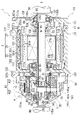
- FIG. 3 is a schematic cross-sectional view of the unit.
- FIG. 4 is an enlarged view around the planetary reduction gear.
- FIG. 5 is a top view of the motor case with the second case member removed.
- FIG. 6 is a diagram for explaining the flow of cooling water in the unit.
- FIG. 7 is a diagram for explaining how the differential case rakes up the oil.
- FIG. 8 is a view of the gear case as seen from the rotation axis direction.
- FIG. 9 is a cross-sectional view of the main body of the oil cooler cut along line AA in FIG.
- FIG. 10 is a diagram illustrating an oil flow path and a cooling water flow path within the oil cooler.
- FIG. 11 is a schematic diagram of the AA section of FIG.
- FIG. 12 is a schematic diagram of the BB section of FIG.
- a “unit” is also called a “motor unit”, a “power transmission device”, or the like.
- a motor unit is a unit having at least a motor.
- a power transmission device is a device having at least a power transmission mechanism, and the power transmission device is, for example, a gear mechanism and/or a differential gear mechanism.
- a unit that is a device comprising a motor and a power transmission belongs to the concept of both a motor unit and a power transmission.
- a “housing” contains a motor, a gear, and an inverter.
- a housing consists of one or more cases.
- 3in1 means a form in which a part of the motor case that houses the motor and a part of the inverter case that houses the inverter are integrally formed.
- the cover and the case constitute one case
- the case accommodating the motor and the case accommodating the inverter are integrally formed.
- a "motor” is a rotating electric machine that has a motor function and/or a generator function.
- a second element (part, portion, etc.) connected to the first element (part, portion, etc.); a second element (part, portion, etc.) connected downstream of the first element (part, portion, etc.);
- a second element (part, section, etc.) connected upstream of an element (part, section, etc.)
- the first element and the second element are power-transmittably connected.
- the power input side is upstream, and the power output side is downstream.
- the first element and the second element may be connected via another element (clutch, other gear mechanism, etc.).
- “Overlapping when viewed from a predetermined direction” means that a plurality of elements are arranged in a predetermined direction, and has the same meaning as “overlapping in a predetermined direction”.
- the "predetermined direction” is, for example, an axial direction, a radial direction, a gravitational direction, a vehicle running direction (vehicle forward direction, vehicle backward direction), or the like. If a drawing shows that multiple elements (parts, parts, etc.) are lined up in a predetermined direction, there is a sentence in the description explaining that they overlap when viewed in a predetermined direction. can be regarded as
- not overlapped when viewed from a predetermined direction and “offset when viewed from a predetermined direction” mean that a plurality of elements are not aligned in a predetermined direction, and "not overlapped in a predetermined direction”. , is synonymous with the description of "offset in a predetermined direction".
- the "predetermined direction” is, for example, an axial direction, a radial direction, a gravitational direction, a vehicle running direction (vehicle forward direction, vehicle backward direction), or the like. If a drawing shows that multiple elements (parts, parts, etc.) are not aligned in a predetermined direction, the description of the specification includes a sentence explaining that they do not overlap when viewed in a predetermined direction. can be regarded as
- the first element is located between the second element (part, portion, etc.) and the third element (part, portion, etc.) when viewed from a predetermined direction" In the case it means that the first element can be observed to be between the second and third elements.
- the "predetermined direction” includes an axial direction, a radial direction, a gravity direction, a vehicle running direction (vehicle forward direction, vehicle backward direction), and the like. For example, when the second element, the first element, and the third element are arranged in this order along the axial direction, the first element is between the second element and the third element when viewed in the radial direction.
- the drawing shows that the first element is between the second element and the third element when viewed from a predetermined direction
- the first element is the second element when viewed from a predetermined direction in the description of the specification. It can be considered that there is a sentence explaining what is between the third element.
- Axial direction means the axial direction of the rotation axis of the parts that make up the unit.
- Rotary direction means a direction perpendicular to the rotation axis of the parts that make up the unit.
- the parts are, for example, motors, gear mechanisms, differential gear mechanisms, and the like.
- a rotating element of a planetary gear mechanism (for example, a sun gear, a carrier, a ring gear, etc.) is "fixed" to another element, which means that it may be directly fixed or fixed via another member. good.
- the downstream side in the rotational direction means the downstream side in the rotational direction when the vehicle moves forward or the rotational direction when the vehicle moves backward. It is preferable to set it to the downstream side in the rotational direction when the vehicle moves forward, which occurs frequently.
- the downstream side in the rotational direction of the planetary gear mechanism means the downstream side in the revolution direction of the pinion gear.
- a "catch tank” is an element (part, part, etc.) that has the function of a tank (container) into which oil is introduced.
- the term “catch” refers to the fact that oil is supplied to the tank from the outside of the tank.
- the catch tank is provided, for example, using at least part of the housing, or is provided separately from the housing. Integrally forming the catch tank and the housing contributes to a reduction in the number of parts.
- Coolant is a refrigerant and a type of heat exchange medium.
- coolant may be liquid (such as cooling water), gas (such as air), or the like. Coolant is a concept that includes oil, but when both oil and coolant are used in this specification, it means that coolant is composed of a material different from that of oil.
- a "heat exchange part” is an element (part, part, etc.) that exchanges heat between two different heat exchange media. Combinations of two heat exchange media are, for example, oil and cooling water, cooling water and air, air and oil, and the like.
- the heat exchange unit includes, for example, a heat exchanger (oil cooler), a flow path through which coolant flows, a heat pipe, and the like. In this case, it is preferable to use a heat exchanger (oil cooler) as the heat exchange section. By using a heat exchanger, it is possible to contribute to an improvement in heat exchange efficiency.
- the heat exchanger (oil cooler) is a separate part from the housing.
- the heat exchanger exchanges heat between oil and cooling water, for example.
- a "cabin” means a room in a vehicle where passengers board.
- FIG. 1 is a skeleton diagram for explaining units mounted on a vehicle.
- FIG. 2 is an external view of the unit.
- FIG. 3 is a schematic cross-sectional view of the unit.
- FIG. 3 shows the state in which the inverter case is removed.
- FIG. 4 is an enlarged view around the planetary reduction gear.
- FIG. 5 is a top view of the motor case with the second case member removed.
- FIG. 6 is a diagram showing a cooling water circulation system in the unit.
- FIG. 7 is a diagram illustrating the catch tank of the gear case.
- the unit 1 as a 3-in-1 unit, includes a motor 2, a power transmission mechanism 3 that transmits the power output from the motor 2 to the drive wheels K, K of the vehicle, and a power conversion device for the motor 2. It has an inverter 7 (see FIG. 2).
- the unit 1 includes a power transmission mechanism 3, a planetary reduction gear 4 (reduction gear mechanism, planetary gear mechanism), a differential mechanism 5 (differential gear mechanism), and an output shaft. It has certain drive shafts DA, DB.
- a planetary reduction gear 4 reduction gear mechanism, planetary gear mechanism
- a differential mechanism 5 differential gear mechanism
- an output shaft It has certain drive shafts DA, DB.
- a planetary reduction gear 4 a differential mechanism 5, and drive shafts DA and DB are provided along a transmission path for output rotation of the motor 2 around the rotation axis X.
- Axes of the drive shafts DA and DB are coaxial with the rotation axis X of the motor 2
- the differential mechanism 5 is coaxial with the motor 2 .
- the output rotation of the motor 2 is decelerated by the planetary reduction gear 4 and input to the differential mechanism 5, and then transmitted through the drive shafts DA and DB to the left and right drive wheels of the vehicle on which the unit 1 is mounted. K, K is transmitted.
- the planetary reduction gear 4 is connected downstream of the motor 2 .
- a differential mechanism 5 is connected downstream of the motor 2 via a planetary reduction gear 4 .
- the drive shafts DA, DB are connected downstream of the differential mechanism 5 .
- the unit 1 has a housing HS that accommodates the motor 2, power transmission mechanism 3 and inverter 7 as a 3-in-1 type housing.
- the housing HS is composed of one or more cases.
- the housing HS has, for example, a motor case 10 that houses the motor 2 , a gear case 14 that houses the power transmission mechanism 3 , and an inverter case 17 that houses the inverter 7 .
- a gear case 14 is joined to one end side of the motor case 10 in the rotation axis X direction.
- the inverter case 17 is joined above the motor case 10 in the direction of gravity when the unit 1 is mounted on the vehicle.
- the inverter 7 is an electronic component including a smoothing capacitor, a power semiconductor element, a driver board, and the like.
- the inverter 7 is electrically connected to the motor 2 inside the motor case 10 by wiring (not shown).
- a cooling path CP2 through which cooling water CL (see FIG. 6) for cooling the inverter 7 flows is formed in the inverter case 17 .
- the motor 2 has a portion that overlaps the differential mechanism 5 (differential gear mechanism) when viewed in the axial direction (see FIG. 3).
- differential mechanism 5 differential gear mechanism
- “when viewed in the axial direction” means when viewed from the rotation axis X direction.
- “when viewed in the radial direction” means when viewed from the radial direction of the rotation axis X direction.
- the motor 2 has a portion that overlaps the planetary reduction gear 4 (reduction gear mechanism).
- the planetary reduction gear 4 (reduction gear mechanism) has a portion that overlaps the differential mechanism 5 (differential gear mechanism).
- the planetary reduction gear 4 (reduction gear mechanism) has a portion that overlaps the motor 2 .
- the differential mechanism 5 (differential gear mechanism) has a portion that overlaps the planetary reduction gear 4 (reduction gear mechanism).
- the differential mechanism 5 (differential gear mechanism) has a portion that overlaps the motor 2 when viewed in the axial direction.
- the motor 2 has a portion that overlaps the differential mechanism 5 (differential gear mechanism).
- the motor case 10 includes a first case member 11, a second case member 12 fitted around the first case member 11, and a cover member 13 joined to one end of the first case member 11.
- the first case member 11 has a cylindrical support wall portion 111 and a flange-like joint portion 112 provided at one end 111 a of the support wall portion 111 .
- the support wall portion 111 is provided along the rotation axis X of the motor 2 .
- the motor 2 is accommodated inside the support wall portion 111 .
- the second case member 12 includes a cylindrical peripheral wall portion 121, a flange-shaped joint portion 122 provided at one end 121a of the peripheral wall portion 121, and a flange-shaped joint portion 123 provided at the other end 121b of the peripheral wall portion 121. and have The peripheral wall portion 121 of the second case member 12 is formed with an inner diameter that allows it to be externally inserted into the support wall portion 111 of the first case member 11 .
- the first case member 11 and the second case member 12 are assembled together by externally inserting the peripheral wall portion 121 of the second case member 12 into the supporting wall portion 111 of the first case member 11 .
- the joint portion 122 on the one end 121a side of the peripheral wall portion 121 abuts the joint portion 112 of the first case member 11 from the rotation axis X direction.
- These joints 122 and 112 are connected to each other by bolts (not shown).
- a projection 111b is provided on the outer circumference of the support wall portion 111 of the first case member 11.
- the protrusion 111b is one wall that surrounds the rotation axis X at intervals.
- the protrusions 111b are spirally provided on the support wall portion 111 with a phase shift from one end to the other end in the direction of the rotation axis X.
- the projection 111b surrounds the outer circumference of the support wall portion 111 over the entire circumference of the support wall portion 111 .
- the peripheral wall portion 121 of the second case member 12 is fitted onto the support wall portion 111 of the first case member 11 .
- the inner periphery of the peripheral wall portion 121 is in contact with the outer periphery of the spiral projection 111b of the support wall portion 111, so that a space is formed between the peripheral wall portion 121 and the support wall portion 111.
- FIG. This space surrounds the rotation axis X at intervals and is formed in a helical shape continuous in the rotation axis X direction.
- This spiral space forms a cooling passage CP1 through which cooling water CL (see FIG. 6), which is a coolant, flows.
- the spiral cooling path CP1 is simplified and shown in a straight line.
- Ring grooves 111c, 111c are formed on both sides of the region where the projection 111b is provided on the outer periphery of the support wall portion 111 of the first case member 11. As shown in FIG. Seal rings 113, 113 are fitted in the ring grooves 111c, 111c. These seal rings 113 are pressed against the inner periphery of the peripheral wall portion 121 fitted on the support wall portion 111 to seal the gap between the outer periphery of the support wall portion 111 and the inner periphery of the peripheral wall portion 121 .
- the other end 121b of the second case member 12 is provided with a wall portion 120 (cover) extending radially inward.
- the wall portion 120 is provided in a direction perpendicular to the rotation axis X.
- An opening 120a through which the drive shaft DA is inserted is formed in a region of the wall portion 120 that intersects with the rotation axis X.
- a cylindrical motor support portion 125 that surrounds the opening 120a and extends toward the motor 2 is provided on the surface of the wall portion 120 on the motor 2 side (right side in the figure).
- the motor support portion 125 is inserted inside a coil end 253b, which will be described later.
- the motor support portion 125 faces the end portion 21b of the rotor core 21 with a gap in the rotation axis X direction.
- a bearing B ⁇ b>1 is supported on the inner circumference of the motor support portion 125 .
- the outer circumference of the motor shaft 20 is supported by a motor support portion 125 via a bearing B1.
- a cylindrical wall portion 126 extending toward the differential mechanism 5 is provided on the surface of the wall portion 120 on the side of the differential mechanism 5 (on the left side in the figure).
- the cylindrical wall portion 126 has a cylindrical shape surrounding the opening 120a, and the inner circumference of the cylindrical wall portion 126 supports a bearing B2.
- the bearing B2 supports a tubular wall portion 61 of the differential case 50, which will be described later.
- the cover member 13 has a wall portion 130 perpendicular to the rotation axis X and a joint portion 132 .
- the cover member 13 When viewed from the first case member 11, the cover member 13 is located on the side opposite to the differential mechanism 5 (on the right side in the drawing).
- the joint portion 132 of the cover member 13 is joined to the joint portion 112 of the first case member 11 from the rotation axis X direction.
- the cover member 13 and the first case member 11 are connected to each other with bolts (not shown). In this state, the cover member 13 closes the opening of the support wall portion 111 on the joint portion 122 side (right side in the drawing) of the first case member 11 .
- an insertion hole 130a for the drive shaft DA is provided in the central portion of the wall portion 130.
- a lip seal RS is provided on the inner circumference of the insertion hole 130a.
- the lip seal RS brings the lip portion (not shown) into elastic contact with the outer circumference of the drive shaft DA.
- a gap between the inner periphery of the insertion hole 130a and the outer periphery of the drive shaft DA is sealed with a lip seal RS.
- a peripheral wall portion 131 surrounding the insertion hole 130a is provided on the surface of the wall portion 130 on the side of the first case member 11 (left side in the figure).
- a drive shaft DA is supported on the inner periphery of the peripheral wall portion 131 via a bearing B4.
- a motor support portion 135 and a connection wall 136 are provided on the inner diameter side of the joint portion 132 .
- the motor support portion 135 is provided on the motor 2 side (left side in the figure) when viewed from the peripheral wall portion 131 .
- the motor support portion 135 has a tubular shape surrounding the rotation axis X with a space therebetween.
- a cylindrical connection wall 136 is connected to the outer periphery of the motor support portion 135 .
- the connection wall 136 is formed with a larger outer diameter than the peripheral wall portion 131 on the wall portion 130 side (right side in the drawing).
- the connection wall 136 is oriented along the rotation axis X and extends away from the motor 2 .
- the connection wall 136 connects the motor support portion 135 and the joint portion 132 .
- One end 20a side of the motor shaft 20 penetrates the inside of the motor support portion 135 from the motor 2 side to the peripheral wall portion 131 side.
- a bearing B ⁇ b>1 is supported on the inner periphery of the motor support portion 135 .
- the outer circumference of the motor shaft 20 is supported by a motor support portion 135 via a bearing B1.
- a lip seal RS is provided at a position adjacent to the bearing B1.
- Oil holes 136 a and 136 b are opened on the inner periphery of the connection wall 136 .
- the oil OL flows into the space (internal space Sc) surrounded by the connection wall 136 through the oil hole 136a.
- the oil OL that has flowed into the internal space Sc is discharged from the oil hole 136b.
- the lip seal RS is provided to prevent the oil OL in the connection wall 136 from flowing into the motor 2 side.
- the gear case 14 has a peripheral wall portion 141 and a flange-like joint portion 142 provided at the end portion of the peripheral wall portion 141 on the motor case 10 side.
- a support portion 145 for a bearing B2 which will be described later, is provided at an end portion of the peripheral wall portion 141 on the side opposite to the joint portion 142 (on the left side in the drawing).
- the peripheral wall portion 141 includes a cylindrical wall portion 141a connected to the joint portion 142, an inclined portion 141c (inclined surface) connected to the support portion 145, and a connecting wall portion 141b connecting the cylindrical wall portion 141a and the inclined portion 141c.
- the tubular wall portion 141a and the connecting wall portion 141b are gradually reduced in diameter from the joint portion 142 and connected to the inclined portion 141c.
- the inclined portion 141c is inclined radially inward from the connecting wall portion 141b toward the support portion 145 .
- the planetary reduction gear 4 and the differential mechanism 5 which are the power transmission mechanism 3 are housed inside the peripheral wall portion 141 .
- the gear case 14 is positioned on the differential mechanism 5 side (left side in the figure) when viewed from the motor case 10 .
- the joint portion 142 of the gear case 14 is joined to the joint portion 123 of the second case member 12 of the motor case 10 from the rotation axis X direction.
- the gear case 14 and the second case member 12 are connected to each other by bolts (not shown).
- the space formed inside the joined motor case 10 and gear case 14 is partitioned into two by the wall portion 120 (cover) of the second case member 12 .
- the wall portion 120 on the motor case 10 side is the motor chamber Sa that houses the motor 2
- the gear case 14 side is the gear chamber Sb that houses the power transmission mechanism 3 .
- a wall portion 120 as a cover is sandwiched between the motor 2 and the differential mechanism 5 inside the housing HS.
- the cover may have a portion housed within the housing HS, and may be wholly housed in the housing HS like the wall section 120 . Also, the cover may be separate from the second case member 12, for example. In this case, the cover may be sandwiched between the motor case 10 and the gear case 14 and fixed. A part of the cover may be exposed outside the housing HS.
- the motor 2 has a cylindrical motor shaft 20, a cylindrical rotor core 21 fitted onto the motor shaft 20, and a stator core 25 surrounding the outer circumference of the rotor core 21 with a gap.
- bearings B ⁇ b>1 and B ⁇ b>1 are externally inserted and fixed on both sides of the rotor core 21 .
- a bearing B ⁇ b>1 positioned on the one end 20 a side (right side in the drawing) of the motor shaft 20 when viewed from the rotor core 21 is supported on the inner periphery of the motor support portion 135 of the cover member 13 .
- a bearing B ⁇ b>1 located on the other end 20 b side (left side in the drawing) is supported on the inner circumference of a cylindrical motor support portion 125 of the second case member 12 .
- the motor support portions 135 and 125 are arranged to face one end portion 21a and the other end portion 21b of the rotor core 21 with a gap in the rotation axis X direction on the inner diameter side of coil ends 253a and 253b, which will be described later. ing.
- the rotor core 21 is formed by laminating a plurality of silicon steel plates. Each of the silicon steel plates is fitted over the motor shaft 20 in a state where relative rotation with the motor shaft 20 is restricted.
- the silicon steel plate has a ring shape when viewed from the rotation axis X direction of the motor shaft 20 .
- N-pole and S-pole magnets are provided alternately in the circumferential direction around the rotation axis X on the outer peripheral side of the silicon steel plate.
- a stator core 25 surrounding the outer periphery of the rotor core 21 is formed by laminating a plurality of electromagnetic steel sheets.
- the stator core 25 is fixed to the inner periphery of the cylindrical support wall portion 111 of the first case member 11 .
- Each of the electromagnetic steel sheets has a ring-shaped yoke portion 251 fixed to the inner periphery of the support wall portion 111 and tooth portions 252 protruding from the inner periphery of the yoke portion 251 toward the rotor core 21 side.
- stator core 25 having a configuration in which the windings 253 are distributed over a plurality of teeth 252 is adopted.
- the stator core 25 is longer than the rotor core 21 in the direction of the rotation axis X by the coil ends 253a and 253b projecting in the direction of the rotation axis X. As shown in FIG.
- a stator core in which windings are concentratedly wound may be employed for each of the plurality of tooth portions 252 protruding toward the rotor core 21 side.
- the wall portion 120 (motor support portion 125) of the second case member 12 is provided with an opening 120a.
- the other end 20b side of the motor shaft 20 passes through the opening 120a to the differential mechanism 5 side (left side in the figure) and is positioned inside the gear case 14 .
- the other end 20b of the motor shaft 20 faces a side gear 54A, which will be described later, with a gap in the rotation axis X direction.
- a lip seal RS is inserted between the motor shaft 20 and the opening 120 a of the wall portion 120 .
- Oil OL for lubricating the planetary reduction gear 4 and the differential mechanism 5 is enclosed in the inner diameter side of the gear case 14 .
- Lip seal RS is provided to prevent oil OL in gear case 14 from flowing into motor case 10 .
- the sun gear 41 of the planetary reduction gear 4 is spline-fitted to the region of the motor shaft 20 located within the gear case 14 .
- a toothed portion 41a is formed on the outer periphery of the sun gear 41, and a large-diameter gear portion 431 of the stepped pinion gear 43 is meshed with the toothed portion 41a.
- the stepped pinion gear 43 has a large-diameter gear portion 431 (large pinion) that meshes with the sun gear 41 and a small-diameter gear portion 432 (small pinion) having a smaller diameter than the large-diameter gear portion 431 .
- the large-diameter gear portion 431 and the small-diameter gear portion 432 are integral gear components arranged side by side in the direction of the axis X1 parallel to the rotation axis X. As shown in FIG.
- the outer circumference of the small diameter gear portion 432 meshes with the inner circumference of the ring gear 42 .
- the ring gear 42 has a ring shape surrounding the rotation axis X with a space therebetween. Engagement teeth are provided on the outer periphery of the ring gear 42, and the engagement teeth are spline-fitted to tooth portions 146a provided on the inner periphery of the connection wall portion 141b. The rotation of the ring gear 42 around the rotation axis X is restricted.
- the pinion shaft 44 passes through the inner diameter side of the large-diameter gear portion 431 and the small-diameter gear portion 432 .
- the stepped pinion gear 43 is rotatably supported on the outer circumference of the pinion shaft 44 via needle bearings NB, NB.
- the differential mechanism 5 has a differential case 50 (differential case) as an input element, drive shafts DA and DB (output shafts) as output elements, and a differential gear set as a differential element.
- the differential case 50 may be composed of two case members assembled in the rotation axis direction.
- the differential case 50 also functions as a carrier that supports the stepped pinion gear 43 of the planetary reduction gear 4.
- the stepped pinion gear 43 is rotatably supported by the differential case 50 via the pinion shaft 44 .
- the three stepped pinion gears 43 are circumferentially spaced around the rotation axis X. As shown in FIG.
- a pinion mate gear 52 which is a bevel gear type differential gear, and side gears 54A and 54B are provided as a differential gear set.
- the pinion mate gear 52 is supported by the pinion mate shaft 51 .
- the pinion mate shaft 51 has a central member 510 arranged on the rotation axis X and a shaft member 511 connected to the outer diameter side of the central member 510 .
- a plurality of shaft members 511 are provided in the circumferential direction around the rotation axis X at equal intervals.
- the shaft member 511 is inserted through a radially extending support hole 69 of the differential case 50 and supported.
- the pinion mate gears 52 are fitted one by one onto each of the shaft members 511 and are rotatably supported.
- the side gear 54A is positioned on one side of the central member 510 in the direction of the rotation axis X, and the side gear 54B is positioned on the other side.
- the side gears 54A, 54B are rotatably supported by the differential case 50, respectively.
- the side gear 54A meshes with the pinion mate gear 52 from one side in the rotation axis X direction.
- the side gear 54B meshes with the pinion mate gear 52 from the other side in the rotation axis X direction.
- An opening 60 and a cylindrical wall portion 61 surrounding the opening 60 and extending toward the motor case 10 are provided in the central portion of one end side (right side in the figure) of the differential case 50 .
- the outer circumference of the cylinder wall portion 61 is supported by the wall portion 120 of the second case member 12 via the bearing B2.
- a drive shaft DA passing through an opening 60 is inserted into the differential case 50 from the rotation axis X direction.
- the drive shaft DA passes through the insertion hole 130a of the wall portion 130 of the cover member 13, and is provided across the inner diameter side of the motor shaft 20 of the motor 2 and the sun gear 41 of the planetary reduction gear 4 in the rotation axis X direction. .
- a through hole 65 and a cylindrical wall portion 66 surrounding the through hole 65 are formed in the center of the other end side (left side in the drawing) of the differential case 50 .
- a bearing B ⁇ b>2 is fitted on the cylindrical wall portion 66 .
- the bearing B ⁇ b>2 externally inserted into the cylinder wall portion 66 is held by the support portion 145 of the gear case 14 .
- a tubular wall portion 66 of the differential case 50 is rotatably supported by the gear case 14 via a bearing B2.
- a drive shaft DB passing through an opening 145a of the gear case 14 is inserted into the support portion 145 from the rotation axis X direction.
- Drive shaft DB is rotatably supported by support portion 145 .
- the cylinder wall portion 66 functions as a shaft support portion that supports the outer circumference of the drive shaft DB.
- a lip seal RS is fixed to the inner circumference of the opening 145a.
- a lip portion (not shown) of the lip seal RS is in elastic contact with the outer circumference of the cylinder wall portion 540 of the side gear 54B externally fitted on the drive shaft DB. As a result, the gap between the outer circumference of the cylindrical wall portion 540 of the side gear 54B and the inner circumference of the opening 145a is sealed.
- the side gears 54A and 54B are arranged opposite to each other with a gap in the rotation axis X direction.
- a central member 510 of the pinion mate shaft 51 is positioned between the side gears 54A, 54B.
- the pinion mate gear 52 is assembled to a side gear 54A positioned on one side in the direction of the rotation axis X and a side gear 54B positioned on the other side in such a manner that the teeth thereof are meshed with each other.
- a support hole 62 on the one end 44a side of the pinion shaft 44 is formed on the outer diameter side of the opening 60 on the one end side (right side in the drawing) of the differential case 50 .
- a support hole 68 on the side of the other end 44b of the pinion shaft 44 is formed in the other end side of the differential case 50 (left side in the drawing).
- the support holes 62 and 68 are formed at overlapping positions in the rotation axis X direction.
- the support holes 62 and 68 are formed at intervals in the circumferential direction around the rotation axis X so as to match the position where the stepped pinion gear 43 is arranged.
- One end 44 a of the pinion shaft 44 is inserted into the support hole 62 and the other end 44 b is inserted into the support hole 68 .
- the other end 44 b of the pinion shaft 44 is press-fitted into the support hole 68 so that the pinion shaft 44 is fixed to the differential case 50 so as not to rotate relative to it.
- a stepped pinion gear 43 externally fitted on the pinion shaft 44 is rotatably supported around an axis X1 parallel to the rotation axis X. As shown in FIG.
- lubricating oil OL is stored inside the gear case 14 .
- the differential case 50 rotates around the rotation axis X, the oil OL is scraped up by the differential case 50 .
- the differential case 50, the pinion shaft 44, and the like are provided with oil passages, oil holes, and the like for introducing the oil OL that has been raked up by the differential case 50. As shown in FIG. This makes it easier for the oil OL to be introduced into rotating members such as the bearing B2 and the needle bearing NB.
- a catch tank 15 is provided above the differential case 50 inside the gear case 14 .
- the catch tank 15 is positioned on one side (left side in the drawing) of a vertical line VL perpendicular to the rotation axis X.
- the catch tank 15 and the accommodation portion 140 of the differential case 50 communicate with each other through a communication port 147 . Some of the oil OL that has been scraped up and scattered by the differential case 50 flows into the catch tank 15 from the communication port 147 and is collected.
- the differential case 50 rotates about the rotation axis X in the counterclockwise direction CCW when viewed from the motor case 10 side.
- the small diameter gear portion 432 of the stepped pinion gear 43 meshes with the ring gear 42 fixed to the inner circumference of the gear case 14 . Therefore, the large-diameter gear portion 431 of the stepped pinion gear 43 revolves around the rotation axis X in the counterclockwise direction CCW while rotating clockwise around the axis X1, as shown in FIG.
- the catch tank 15 is located on the left side of the vertical line VL, that is, on the downstream side in the rotational direction of the differential case 50 . As a result, most of the oil OL that has been raked up by the differential case 50 rotating around the rotation axis X can flow into the catch tank 15 .
- the catch tank 15 is connected to the space Rx between the lip seal RS and the bearing B2 via an oil passage 151a.
- the catch tank 15 is connected to an oil cooler 83 (see FIG. 6) via an oil passage, piping, etc., not shown.
- the oil cooler 83 is connected to an oil hole 136a (see FIG. 3) formed in the connection wall 136 via a pipe, an oil passage and the like (not shown).
- An oil hole Ha is formed in the peripheral wall portion 141 of the gear case 14 .
- the oil hole Ha is connected via a pipe (not shown) to an oil hole 136b formed in the internal space Sc.
- the oil OL discharged from the internal space Sc through the oil hole 136b is re-supplied into the gear chamber Sb through the oil hole Ha.
- the unit 1 is provided with a circulation system 80 for cooling water CL.
- the circulation system 80 circulates the cooling water CL between the cooling path CP ⁇ b>1 of the motor case 10 and the cooling path CP ⁇ b>2 of the inverter case 17 .
- the circulation system 80 further includes an oil cooler 83, a water pump WP, and a radiator 82 between the cooling paths CP1 and CP2, which are connected by piping or the like through which the cooling water CL flows.
- the water pump WP pumps the cooling water CL through the circulation system 80 .
- the radiator 82 is a device that dissipates the heat of the cooling water CL to cool it.
- the oil cooler 83 is a heat exchanger that exchanges heat between the cooling water CL and the oil OL.
- the oil cooler 83 is provided with flow paths through which the cooling water CL and the oil OL flow. It should be noted that the oil cooler 83 is illustrated in a simplified manner in FIG.
- the oil OL collected by the catch tank 15 provided in the gear chamber Sb of the gear case 14 is introduced into the oil cooler 83 .
- Oil OL is cooled by heat exchange with cooling water CL.
- the cooled oil OL is supplied from the oil hole 136a of the motor case 10 to the internal space Sc.
- the oil OL to be supplied to the oil cooler 83 is not limited to the oil OL collected by the catch tank 15, and may be supplied from another oil passage appropriately provided in the housing HS. Also, the oil OL discharged from the oil cooler 83 may be supplied to a location other than the internal space Sc.
- the cooling water CL is supplied to the oil cooler 83 after flowing through the cooling path CP2 within the inverter case 17 and the cooling path CP1 within the motor case 10 . After the cooling water CL is heat-exchanged with the oil OL in the oil cooler 83, it is cooled by the radiator 82 and supplied to the cooling path CP2 of the inverter case 17 again.
- the oil cooler 83 heat exchanger
- the inclined portion 141c has a truncated cone shape that decreases in diameter in a direction away from the motor case 10 .
- the space around the inclined portion 141c is larger than the space around the motor case 10 of the unit 1, etc., because the diameter of the gear case 14 is reduced.
- the oil cooler 83 is arranged in the space around the inclined portion 141c. The configuration of the oil cooler 83 will be described below.
- FIG. 8 is a diagram of the gear case 14 viewed from the rotation axis X direction.
- FIG. 9 is a cross-sectional view of the body portion 830 of the oil cooler 83 cut along line AA in FIG. Note that in FIG. 9, the gear case 14 and the drive shaft DB are indicated by phantom lines for convenience of explanation.
- FIG. 10 is a diagram of the oil cooler 83 viewed from the rotation axis X direction.
- FIG. 11 is a schematic diagram of the AA section of FIG.
- FIG. 12 is a schematic diagram of the BB section of FIG. In FIGS. 11 and 12, the gear case 14 is simply shown in order to explain the flow of the oil OL between the gear case 14 and the oil cooler 83.
- FIG. 11 is a schematic diagram of the gear case 14 viewed from the rotation axis X direction.
- the oil cooler 83 is arranged adjacent to the catch tank 15 provided on the top of the gear case 14 .
- the oil cooler 83 has a main body portion 830 (arcuate portion) formed in an arc shape when viewed from the rotation axis X direction.
- Body portion 830 is arranged in the circumferential direction around rotation axis X so as to surround drive shaft DB. Although illustration is omitted, the body portion 830 is fixed to the inclined portion 141c via bolts or the like.
- One end in the longitudinal direction of the main body portion 830 is positioned on one side (right side in the drawing) of the vertical line VL, and the other end is positioned on the other side (left side in the drawing) of the vertical line VL.
- the body portion 830 has a portion positioned above and a portion positioned below a horizontal plane S passing through the rotation axis X and perpendicular to the vertical line VL.
- the body portion 830 has a triangular shape in a cross-sectional view.
- the body portion 830 has a first wall portion 831 , a second wall portion 832 and a third wall portion 833 .
- the first wall portion 831 is arranged to face the outer circumference of the inclined portion 141c when the oil cooler 83 is attached to the gear case 14, and is provided along the rotation axis X.
- One end 831a of the first wall 831 in the rotation axis X direction is located on the inner diameter side (rotation axis X side) of the other end 831b. placed at an angle to the
- the first wall portion 831 is inclined radially outward from one end portion 831a toward the other end portion 831b.
- the second wall portion 832 extends from the end portion 831b of the first wall portion 831 in the rotation axis X direction.
- the third wall portion 833 extends radially outward of the rotation axis X from the end portion 831 a of the first wall portion 831 .
- the third wall portion 833 is provided in a direction substantially orthogonal to the rotation axis X with the oil cooler 83 attached to the gear case 14 .
- the third wall portion 833 connects the end portion 831 a of the first wall portion 831 and one end portion 832 a of the second wall portion 832 . As shown in FIG. 10, one longitudinal end and the other longitudinal end of the body portion 830 are closed by fourth wall portions 834, 834, respectively.
- the fourth wall portions 834 , 834 are connected across the first wall portion 831 , the second wall portion 832 and the third wall portion 833 .
- An internal space Sd surrounded by a first wall portion 831, a second wall portion 832, a third wall portion 833 and a fourth wall portion 834 is formed in the main body portion 830.
- Flow paths for oil OL and cooling water CL are provided in the internal space Sd.
- the channel can be configured by stacking a plurality of plates each having a passage hole, for example. As the oil OL and the cooling water CL flow through their respective flow paths, heat exchange is performed.
- the internal space Sd is cross-hatched and detailed illustration is omitted.
- the arrows of the oil OL and the cooling water CL shown in FIG. 10 indicate rough flow directions, not actual flow paths.
- the inclined portion 141c constitutes part of the wall surface of the catch tank 15 formed on the upper portion of the gear case 14. As shown in FIG. That is, the internal space Sd of the oil cooler 83 and the catch tank 15 are adjacent to each other with the inclined portion 141c and the first wall portion 831 interposed therebetween.
- the second wall portion 832 has an arc shape surrounding the rotation axis X with a space therebetween when viewed from the rotation axis X direction.
- An end portion 831 a of the first wall portion 831 surrounds the rotation axis X with a gap therebetween and has an arc shape with an outer diameter smaller than that of the second wall portion 832 when viewed from the rotation axis X direction.
- An introduction portion 836 and a discharge portion 837 for the cooling water CL are provided above the main body portion 830 in the vertical line VL direction.
- the introduction portion 836 is provided on one longitudinal end side (right side in the figure) of the body portion 830, and the discharge portion 837 is provided on the other end side (left side in the figure).
- the introduction portion 836 has an opening portion 836a provided through the second wall portion 832 of the main body portion 830, and a peripheral wall portion 836b surrounding the opening portion 836a and extending upward in the direction of the vertical line VL.
- the introduction part 836 communicates with a cooling water CL flow path (not shown) provided in the internal space Sd of the main body part 830 through an opening 836a.
- the discharge portion 837 is composed of an opening portion 837a provided through the second wall portion 832 of the main body portion 830, and a peripheral wall portion 837b surrounding the opening portion 837a and extending upward in the direction of the vertical line VL.
- the discharge portion 837 communicates with a cooling water CL flow path (not shown) provided in the internal space Sd of the main body portion 830 via an opening 837a.
- the introduction part 836 and the discharge part 837 are positioned above the horizontal plane S.
- the body portion 830 has a portion positioned above the horizontal plane S and connected to the introduction portion 836 and the discharge portion 837 and a portion positioned below.
- the introduction portion 836 is connected to the discharge portion 837 via a portion of the body portion 830 located below the horizontal plane S.
- the cooling water CL introduced from the introduction portion 836 into the internal space Sd of the main body portion 830 flows from one longitudinal end side (the right side in the drawing) of the main body portion 830 toward the other end side (the left side in the drawing). , is discharged from the discharge portion 837 .
- a peripheral wall portion 836b of the introduction portion 836 is connected to the cooling path CP1 (see FIG. 6) of the motor case 10 via a pipe or the like (not shown).
- a peripheral wall portion 837b of the discharge portion 837 is connected to the radiator 82 (see FIG. 6) via a pipe or the like (not shown).
- the catch tank 15 is located on one side (right side in the drawing) of the vertical line VL where the introduction portion 836 is arranged when viewed from the rotation axis X direction.
- the body portion 830 has an oil inlet 838.
- the oil inlet 838 has a hole portion 838a passing through the first wall portion 831 in the rotation axis X direction, and a peripheral wall portion 838b surrounding the hole portion 838a and extending toward the gear case 14 in the rotation axis direction.
- the body portion 830 has an oil outlet 839.
- the oil outlet 839 has a hole portion 839a passing through the first wall portion 831 in the rotation axis X direction, and a peripheral wall portion 839b surrounding the hole portion 839a.
- the hole portion 838a is provided on one longitudinal end side (right side in the figure) of the main body portion 830, and the hole portion 839a is provided on the other end side (left side in the figure). That is, the oil inlet 838a is positioned on the introduction portion 836 side of the cooling water CL, and the oil outlet 839a is positioned on the discharge portion 837 side.
- the hole portion 838a and the hole portion 839a are positioned above the horizontal plane S.
- the hole portion 838a is connected to the hole portion 839a through a portion of the main body portion 830 located below the horizontal plane S.
- the oil OL introduced into the internal space Sd of the body portion 830 through the hole portion 838a flows from one end side (right side in the drawing) to the other end side (left side in the drawing) in the longitudinal direction of the body portion 830, similarly to the cooling water CL. ) and discharged from the hole 839a.
- the inclined portion 141c of the gear case 14 is provided with an opening 141d at a position overlapping the hole 838a in the direction of the rotation axis X.
- the opening 141d is provided so as to penetrate the inclined portion 141c in the rotation axis X direction.
- a peripheral wall portion 838b of the oil inlet 838 is inserted through the opening 141d and inserted into the gear chamber Sb.
- the peripheral wall portion 838b is connected to the catch tank 15 in the gear chamber Sb via an electric oil pump OP, an oil passage (not shown), piping, and the like.
- an electric oil pump OP an oil passage (not shown), piping, and the like.
- part of the oil OL collected by the catch tank 15 is pressure-fed by the electric oil pump OP and introduced into the internal space Sd of the main body portion 830 .
- a seal ring may be provided between the peripheral wall portion 838b and the opening portion 141d to prevent oil leakage.
- a filter for filtering contaminants contained in the oil OL may be provided in the hole 839a.
- the inclined portion 141c of the gear case 14 is provided with an opening 141e at a position that overlaps the hole 839a in the X direction of the rotation axis.
- the opening 141e is provided so as to penetrate the inclined portion 141c in the rotation axis X direction.
- a peripheral wall portion 839b of the oil outlet 839 is inserted through the opening 141e and inserted into the gear chamber Sb.
- the peripheral wall portion 839b is connected to an oil hole 136a (see FIG. 3) formed in the connection wall 136 via an oil passage, piping, etc. (not shown). As a result, the oil OL discharged from the internal space Sd of the main body portion 830 is introduced into the internal space Sc (see FIG. 3) formed in the connection wall 136 .
- a seal ring may be provided between the peripheral wall portion 839b and the opening portion 141e to prevent oil leakage.
- the peripheral wall portion 839b may be connected to the internal space Sc via a pipe or the like provided outside the housing HS without being inserted into the gear chamber Sb.
- a planetary reduction gear 4 As shown in FIG. 1 , in the unit 1 , a planetary reduction gear 4 , a differential mechanism 5 , and drive shafts DA and DB are provided along the output rotation transmission path of the motor 2 .
- the sun gear 41 serves as an input portion for the output rotation of the motor 2
- the differential case 50 that supports the stepped pinion gear 43 serves as an output portion for the input rotation.
- the stepped pinion gear 43 (the large-diameter gear portion 431 and the small-diameter gear portion 432) is rotated by the rotation input from the sun gear 41 side. , and rotates around the axis X1.
- the small diameter gear portion 432 of the stepped pinion gear 43 meshes with the ring gear 42 fixed to the inner circumference of the gear case 14 . Therefore, the stepped pinion gear 43 revolves around the rotation axis X while rotating around the axis X1.
- the outer diameter of the small-diameter gear portion 432 is smaller than the outer diameter of the large-diameter gear portion 431 .
- the differential case 50 supporting the stepped pinion gear 43 rotates around the rotation axis X at a rotation speed lower than the rotation input from the motor 2 side. Therefore, the rotation input to the sun gear 41 of the planetary reduction gear 4 is greatly reduced by the stepped pinion gear 43 and then output to the differential case 50 (differential mechanism 5).
- lubricating oil OL is stored inside the gear chamber Sb.
- the stored oil OL is scooped up by the differential case 50 rotating around the rotation axis X when the output rotation of the motor 2 is transmitted.
- the raking oil OL causes the meshing portion between the sun gear 41 and the large-diameter gear portion 431 , the meshing portion between the small-diameter gear portion 432 and the ring gear 42 , and the pinion mate gear 52 . and the meshing portions with the side gears 54A and 54B are lubricated.
- the differential case 50 rotates about the rotation axis X in the counterclockwise direction CCW.
- a catch tank 15 is provided above the gear case 14 .
- the catch tank 15 is located downstream of the differential case 50 in the rotation direction, and part of the oil OL that has been scraped up by the differential case 50 flows into the catch tank 15 .
- part of the oil OL that has flowed into the catch tank 15 is supplied to the space Rx between the lip seal RS and the bearing B2 via the oil passage 151a to lubricate the bearing B2.
- a portion of the oil OL that has flowed into the catch tank 15 is pressure-fed to the electric oil pump OP and introduced into the peripheral wall portion 838b (see FIG. 11) of the oil inlet 838 of the oil cooler 83 .
- the oil OL introduced into the peripheral wall portion 838b is introduced into the internal space Sd of the main body portion 830 through the hole portion 838a.
- the oil OL introduced to one end side (right side in the figure) in the longitudinal direction of the body portion 830 flows through a flow path (not shown) formed in the internal space Sd through a hole on the other end side. It flows toward portion 839a.
- the cooling water CL that has flowed through the cooling passage CP1 (see FIG. 6) is introduced into the internal space Sd of the oil cooler 83 via the introduction portion 836.
- the cooling water CL introduced to one end in the longitudinal direction of the main body 830 flows through a channel (not shown) formed in the internal space Sd toward the discharge portion 837 on the other end. .
- the oil OL introduced into the oil cooler 83 has been raked up by the differential case 50 (see FIG. 7) and has flowed into the catch tank 15, and the temperature has risen.
- the oil OL whose temperature has risen is cooled by exchanging heat with the cooling water CL whose temperature is lower than that of the oil OL in the internal space Sd.
- the oil OL cooled by heat exchange with the cooling water CL is discharged from the internal space Sd through the hole 839a of the oil outlet 839.
- the oil OL is returned into the gear chamber Sb from the peripheral wall portion 839b of the oil outlet 839.
- it is supplied to the internal space Sc (see FIG. 3) formed in the connection wall 136 via oil passages, pipes, etc. (not shown).
- the oil OL supplied to the internal space Sc lubricates the bearing B4 and is discharged from the oil hole 136b.
- the oil OL discharged from the oil hole 136b is supplied from the oil hole Ha into the gear chamber Sb via a pipe or the like (not shown).
- the housing HS has an inclined portion 141c as an inclined surface surrounding the radial direction of the rotation axis X of the differential mechanism 5.
- the oil cooler 83 is arranged at a position overlapping the inclined portion 141c when viewed in the rotation axis X direction. Arranging the oil cooler 83 by making use of the space around the inclined portion 141c contributes to reducing the dimension of the unit 1 in the radial direction of the rotation axis X.
- the oil cooler 83 arranged to surround the inclined portion 141c overlaps the inclined portion 141c when viewed in the radial direction of the rotation axis X. This also contributes to reduction of the dimension of the unit 1 in the direction of the rotation axis X.
- the body portion 830 of the oil cooler 83 has a portion located above a horizontal plane S passing through the rotation axis X and perpendicular to the vertical line VL direction. Further, as shown in FIG. 2, the oil cooler 83 has a portion positioned above the differential mechanism 5 in the vertical line VL direction. Furthermore, the oil cooler 83 has a portion that overlaps the stepped pinion gear 43 in the rotation axis X direction. Thus, the oil cooler 83 has a portion positioned above the unit 1 in the direction of the vertical line VL.
- the motor 2 and the differential mechanism 5 are coaxial, and the differential mechanism 5 has a portion that overlaps the motor 2 when viewed in the rotation axis X direction.
- layout restrictions are looser above the vertical line VL direction (vehicle height direction) than below the vertical line VL direction (vehicle height direction).
- the surface area of the oil cooler 83 can be increased by having a portion of the oil cooler 83 positioned above the vertical line VL direction of the unit 1 having loose layout restrictions. The larger the surface area of the oil cooler 83, the higher the heat exchange rate, so the oil OL can be efficiently cooled.
- An introduction portion 836 for cooling water CL positioned above the horizontal plane S is connected to a discharge portion 837 via a body portion 830 having a portion positioned below the horizontal surface S.
- the cooling water CL introduced from the introduction portion 836 into the internal space Sd of the main body portion 830 can flow to the discharge portion 837 using gravity.
- the circulation system 80 (see FIG. 6) is provided with the water pump WP for pressure-feeding the cooling water CL. By utilizing gravity, the cooling water CL can be circulated more smoothly. .
- the hole 838a of the oil inlet 838 positioned above the horizontal plane S is connected to the hole 839a of the oil outlet 839 via the main body 830 having a portion positioned below the horizontal plane S. be done.
- the oil OL introduced from the hole 838a into the internal space Sd of the main body 830 can flow to the hole 839a using gravity.
- the oil OL from the catch tank 15 is pressure-fed by the oil pump OP, and by using gravity, the oil OL can be made to flow more smoothly.
- the internal space Sd of the oil cooler 83 is arranged adjacent to the catch tank 15 . Therefore, the cooling water CL introduced into the internal space Sd exchanges heat with the oil OL in the catch tank 15 in addition to the oil OL introduced into the internal space Sd. Furthermore, the catch tank 15 is positioned on the side of the introducing portion 836 for the cooling water CL. Low-temperature cooling water CL before heat exchange with the oil OL flows through the introduction portion 836 . Since the oil OL in the catch tank 15 undergoes heat exchange with the low-temperature cooling water CL flowing through the introduction portion 836, heat exchange efficiency can be improved.
- the unit 1 may be placed on the rear side of the vehicle where it is less likely to be affected by the running wind of the vehicle. As shown in FIG. 8, when the unit 1 is mounted on the vehicle, a vehicle interior VR is arranged above the space SP in which the unit 1 is arranged. The vehicle is provided with a vent VP that communicates the space SP in which the unit 1 is arranged and the vehicle interior VR.
- the air Air in the vehicle interior VR is discharged from the vent VP and flows into the space SP.
- the temperature of the air Air in the vehicle interior VR is adjusted according to the outside air temperature. For example, air conditioning is used in vehicles or windows are opened when the outside temperature is high. Also, for example, heating is used when the outside temperature is low.
- the air Air whose temperature is adjusted according to the outside air temperature flows into the space SP, it exchanges heat with the housing HS arranged in the space SP.
- the oil cooler 83 attached to the housing HS can also exchange heat with the air Air.
- the temperature rise of the oil cooler 83 can be reduced, and as a result, the heat exchange efficiency between the oil OL and the cooling water CL in the oil cooler 83 is improved.
- the size of the oil cooler 83 can be reduced, which contributes to the reduction of the size of the entire housing HS.
- a fan or the like may be provided so that the air Air in the vehicle interior VR can easily flow into the space SP.
- the unit 1 has the following configuration.
- the unit 1 has an oil cooler 83 (heat exchanger) and a housing HS that accommodates the differential mechanism 5 (differential gear mechanism).
- the housing HS has a portion having an inclined portion 141c (inclined surface) surrounding the differential mechanism 5 in the radial direction.
- the oil cooler 83 When viewed in the direction of the rotation axis X (axially), the oil cooler 83 has a portion that overlaps the inclined portion 141c.
- This configuration contributes to the reduction of the dimensions of the unit 1 in at least one direction.
- the inclined portion 141c of the gear case 14 is shaped such that the outer diameter thereof decreases with distance from the motor case 10 .
- the oil cooler 83 When viewed from the radial direction of the rotation axis X (radial direction), the oil cooler 83 has a portion that overlaps the inclined portion 141c.
- the oil cooler 83 By arranging the oil cooler 83 in this way, the oil cooler 83 does not protrude greatly in the direction of the rotation axis X of the housing HS. Contributes to size reduction.
- the unit 1 has a portion where the differential mechanism 5 overlaps the motor 2 when viewed in the X direction of the rotation axis.
- the oil cooler 83 has a portion positioned above a horizontal plane S passing through the axis of the drive shaft DB, which is the output shaft of the differential mechanism 5, and perpendicular to the vertical line VL direction (gravitational direction).
- the unit 1 includes an oil cooler 83, and a housing HS that houses the differential mechanism 5 .
- the differential mechanism 5 has a portion that overlaps the motor 2 when viewed in the X direction of the rotation axis.
- the oil cooler 83 has a portion that overlaps the housing HS when viewed in the direction of the rotation axis X. As shown in FIG. The oil cooler 83 is positioned above the differential mechanism 5 in the vertical line VL direction.
- Arranging the oil cooler 83 at a position where it overlaps the inclined portion 141c of the gear case 14 as viewed in the direction of the rotation axis X contributes to reducing the size of the unit 1 at least in the radial direction.
- layout restrictions are looser in the upper part in the vehicle height direction than in the lower part in the vehicle height direction. Therefore, by disposing the oil cooler 83 upward in the vehicle height direction, the surface area of the oil cooler 83 can be increased. The larger the surface area of the oil cooler 83, the higher the heat exchange rate, so the oil OL can be efficiently cooled.
- the oil cooler 83 When viewed in the direction of the rotation axis X, the oil cooler 83 has a shape including an arcuate portion arranged so as to surround the rotation axis X, which is the center of the drive shaft DB that is the output shaft of the differential mechanism 5 .
- the oil cooler 83 has a body portion 830 that is an arcuate portion. By forming the oil cooler 83 in an annular shape surrounding the drive shaft DB, the oil cooler 83 can be arranged along the shape of the unit 1, which contributes to the size reduction of the unit 1.
- the body portion 830 of the oil cooler 83 is configured to have the first wall portion 831 along the inclined portion 141c of the gear case 14, but the configuration is not limited to this.
- the first wall portion 81 of the oil cooler 83 may be removed, and the second wall portion 832, the third wall portion 833 and the fourth wall portion 834 may be directly joined to the inclined portion 141c.
- the space surrounded by the second wall portion 832, the third wall portion 833, the fourth wall portion 834, and the inclined portion 141c becomes the internal space Sd.
- a passage through which the cooling water CL and the oil OL flow may be provided in the internal space Sd, as in the embodiment.
- the power transmission mechanism 3 has, for example, a gear mechanism, an annular mechanism, or the like.
- the gear mechanism includes, for example, a reduction gear mechanism, an increase gear mechanism, a differential gear mechanism (differential mechanism), and the like.
- the reduction gear mechanism and the acceleration gear mechanism have, for example, a planetary gear mechanism, a parallel gear mechanism, and the like.
- the annular mechanism has, for example, an endless annular component or the like. Endless annular parts and the like include, for example, chain sprockets, belts and pulleys, and the like.
- the differential mechanism 5 is, for example, a bevel gear type differential gear, a planetary gear type differential gear, or the like.
- the differential mechanism 5 has a differential case that is an input element, two output shafts that are output elements, and a differential gear set that is a differential element.
- the differential gear set In a bevel gear type differential gear, the differential gear set has bevel gears.
- the differential gear set In a planetary gear type differential gear, the differential gear set has planetary gears.
- the unit 1 has a gear that rotates integrally with the differential case.
- a final gear (differential ring gear) of the parallel gear mechanism rotates integrally with the differential case.
- the pinion gear rotates (revolves) integrally with the differential case.
- a reduction gear mechanism is connected downstream of the motor 2 .
- a differential gear mechanism is connected downstream of the reduction gear mechanism. That is, a differential gear mechanism is connected downstream of the motor 2 via a reduction gear mechanism.
- a speed increasing gear mechanism may be used instead of the speed reducing gear mechanism.
- a single-pinion planetary gear mechanism can use, for example, a sun gear as an input element, a ring gear as a fixed element, and a carrier as an output element.
- a double-pinion planetary gear mechanism can have, for example, a sun gear as an input element, a ring gear as an output element, and a carrier as a fixed element.
- a stepped pinion gear, a non-stepped pinion gear, or the like can be used as the pinion gear of the single pinion type or double pinion type planetary gear mechanism.
- a stepped pinion gear has a large pinion and a small pinion. For example, it is preferable to mesh the large pinion with the sun gear. For example, it is preferable to fit the small pinion to the ring gear.
- a non-stepped pinion gear is a type that is not a stepped pinion gear.
- unit 2 motor 5: differential mechanism (differential gear mechanism) 14: gear case 141c: inclined portion (inclined surface) 83: Oil cooler (heat exchanger) 830: main body (arcuate portion) HS: Housing DA, DB: Drive shaft (output shaft) X: Rotational axis (axis center)
Landscapes
- Engineering & Computer Science (AREA)
- General Engineering & Computer Science (AREA)
- Mechanical Engineering (AREA)
- Chemical & Material Sciences (AREA)
- Combustion & Propulsion (AREA)
- Transportation (AREA)
- General Details Of Gearings (AREA)
- Heat-Exchange Devices With Radiators And Conduit Assemblies (AREA)
- Retarders (AREA)
Priority Applications (5)
| Application Number | Priority Date | Filing Date | Title |
|---|---|---|---|
| EP25156766.5A EP4530107A3 (en) | 2021-06-24 | 2022-05-26 | Unit |
| CN202280044968.7A CN117545947A (zh) | 2021-06-24 | 2022-05-26 | 组件 |
| US18/561,415 US20240227548A1 (en) | 2021-06-24 | 2022-05-26 | Unit |
| EP22828131.7A EP4361467A4 (en) | 2021-06-24 | 2022-05-26 | UNIT |
| JP2023529730A JP7527751B2 (ja) | 2021-06-24 | 2022-05-26 | ユニット |
Applications Claiming Priority (2)
| Application Number | Priority Date | Filing Date | Title |
|---|---|---|---|
| JP2021-105240 | 2021-06-24 | ||
| JP2021105240 | 2021-06-24 |
Publications (1)
| Publication Number | Publication Date |
|---|---|
| WO2022270212A1 true WO2022270212A1 (ja) | 2022-12-29 |
Family
ID=84544465
Family Applications (1)
| Application Number | Title | Priority Date | Filing Date |
|---|---|---|---|
| PCT/JP2022/021494 Ceased WO2022270212A1 (ja) | 2021-06-24 | 2022-05-26 | ユニット |
Country Status (5)
| Country | Link |
|---|---|
| US (1) | US20240227548A1 (https=) |
| EP (2) | EP4361467A4 (https=) |
| JP (1) | JP7527751B2 (https=) |
| CN (1) | CN117545947A (https=) |
| WO (1) | WO2022270212A1 (https=) |
Cited By (1)
| Publication number | Priority date | Publication date | Assignee | Title |
|---|---|---|---|---|
| WO2025196998A1 (ja) * | 2024-03-21 | 2025-09-25 | 三菱自動車工業株式会社 | 車両用駆動装置 |
Families Citing this family (3)
| Publication number | Priority date | Publication date | Assignee | Title |
|---|---|---|---|---|
| WO2022270214A1 (ja) * | 2021-06-24 | 2022-12-29 | ジヤトコ株式会社 | ユニット |
| DE102022000141A1 (de) * | 2022-01-17 | 2023-07-20 | Mercedes-Benz Group AG | Elektrisches Antriebssystem für ein Kraftfahrzeug |
| DE102024001738B3 (de) * | 2024-05-29 | 2025-09-11 | Mercedes-Benz Group AG | Achsgetriebe für ein Kraftfahrzeug, insbesondere für einen Kraftwagen, sowie Kraftfahrzeug |
Citations (6)
| Publication number | Priority date | Publication date | Assignee | Title |
|---|---|---|---|---|
| JP2000152563A (ja) * | 1998-11-09 | 2000-05-30 | Railway Technical Res Inst | 全閉冷却型回転電機 |
| JP2004260898A (ja) * | 2003-02-25 | 2004-09-16 | Nissan Motor Co Ltd | 電気自動車の駆動ユニット |
| JP2008185078A (ja) | 2007-01-29 | 2008-08-14 | Honda Motor Co Ltd | 車両駆動装置の油圧回路 |
| JP2009281446A (ja) * | 2008-05-20 | 2009-12-03 | Dana Automotive Systems Group Llc | 車軸温度制御装置 |
| JP2019198208A (ja) * | 2018-05-11 | 2019-11-14 | 日本電産株式会社 | モータユニット |
| WO2020161979A1 (ja) * | 2019-02-08 | 2020-08-13 | ジヤトコ株式会社 | 動力伝達装置 |
Family Cites Families (11)
| Publication number | Priority date | Publication date | Assignee | Title |
|---|---|---|---|---|
| JP6014599B2 (ja) * | 2011-11-09 | 2016-10-25 | 日立オートモティブシステムズ株式会社 | 電気自動車の駆動装置 |
| WO2014045707A1 (ja) * | 2012-09-21 | 2014-03-27 | 日立オートモティブシステムズ株式会社 | 車両用駆動装置 |
| JPWO2018030372A1 (ja) * | 2016-08-09 | 2019-06-13 | 日本電産株式会社 | モータユニット |
| US11201523B2 (en) * | 2016-08-09 | 2021-12-14 | Nidec Corporation | Motor unit |
| US10738667B2 (en) * | 2017-11-03 | 2020-08-11 | Dana Heavy Vehicle Systems Group, Llc | Heat transfer system |
| DE112018006046T5 (de) * | 2017-11-28 | 2020-08-13 | Dana Canada Corporation | Dualfunktionelles achsenwärmemanagementsystem |
| US10272767B1 (en) * | 2018-03-23 | 2019-04-30 | Sf Motors, Inc. | Dual loop liquid cooling of integrated electric drivetrain |
| CN112840147B (zh) * | 2018-09-28 | 2022-08-09 | 日本电产株式会社 | 马达单元 |
| CN113765300B (zh) * | 2018-09-28 | 2025-02-11 | 日本电产株式会社 | 马达单元 |
| US10704597B2 (en) * | 2018-11-30 | 2020-07-07 | Arvinmeritor Technology, Llc | Axle assembly having a bearing preload module |
| US11326687B1 (en) * | 2020-12-15 | 2022-05-10 | Arvinmeritor Technology, Llc | Axle assembly having lubricant distribution features |
-
2022
- 2022-05-26 US US18/561,415 patent/US20240227548A1/en active Pending
- 2022-05-26 EP EP22828131.7A patent/EP4361467A4/en active Pending
- 2022-05-26 EP EP25156766.5A patent/EP4530107A3/en active Pending
- 2022-05-26 JP JP2023529730A patent/JP7527751B2/ja active Active
- 2022-05-26 WO PCT/JP2022/021494 patent/WO2022270212A1/ja not_active Ceased
- 2022-05-26 CN CN202280044968.7A patent/CN117545947A/zh active Pending
Patent Citations (6)
| Publication number | Priority date | Publication date | Assignee | Title |
|---|---|---|---|---|
| JP2000152563A (ja) * | 1998-11-09 | 2000-05-30 | Railway Technical Res Inst | 全閉冷却型回転電機 |
| JP2004260898A (ja) * | 2003-02-25 | 2004-09-16 | Nissan Motor Co Ltd | 電気自動車の駆動ユニット |
| JP2008185078A (ja) | 2007-01-29 | 2008-08-14 | Honda Motor Co Ltd | 車両駆動装置の油圧回路 |
| JP2009281446A (ja) * | 2008-05-20 | 2009-12-03 | Dana Automotive Systems Group Llc | 車軸温度制御装置 |
| JP2019198208A (ja) * | 2018-05-11 | 2019-11-14 | 日本電産株式会社 | モータユニット |
| WO2020161979A1 (ja) * | 2019-02-08 | 2020-08-13 | ジヤトコ株式会社 | 動力伝達装置 |
Non-Patent Citations (1)
| Title |
|---|
| See also references of EP4361467A4 |
Cited By (1)
| Publication number | Priority date | Publication date | Assignee | Title |
|---|---|---|---|---|
| WO2025196998A1 (ja) * | 2024-03-21 | 2025-09-25 | 三菱自動車工業株式会社 | 車両用駆動装置 |
Also Published As
| Publication number | Publication date |
|---|---|
| JPWO2022270212A1 (https=) | 2022-12-29 |
| JP7527751B2 (ja) | 2024-08-05 |
| EP4361467A4 (en) | 2024-09-25 |
| US20240227548A1 (en) | 2024-07-11 |
| EP4361467A1 (en) | 2024-05-01 |
| EP4530107A2 (en) | 2025-04-02 |
| EP4530107A3 (en) | 2025-07-09 |
| CN117545947A (zh) | 2024-02-09 |
Similar Documents
| Publication | Publication Date | Title |
|---|---|---|
| WO2022270217A1 (ja) | ユニット | |
| WO2022270212A1 (ja) | ユニット | |
| JP7399602B2 (ja) | ユニット | |
| JP7451069B2 (ja) | ユニット | |
| US12473968B2 (en) | Motor unit | |
| JP7399603B2 (ja) | ユニット | |
| JP7456382B2 (ja) | モータユニット | |
| WO2022074997A1 (ja) | 動力伝達装置 | |
| WO2022270215A1 (ja) | 車両 | |
| JP2020022344A (ja) | 回転電機の冷却構造及び車両用駆動装置 | |
| JP7321950B2 (ja) | 動力伝達装置 | |
| WO2022270101A1 (ja) | ユニット | |
| WO2022270102A1 (ja) | ユニット | |
| JP2024093094A (ja) | 車両用駆動装置 |
Legal Events
| Date | Code | Title | Description |
|---|---|---|---|
| 121 | Ep: the epo has been informed by wipo that ep was designated in this application |
Ref document number: 22828131 Country of ref document: EP Kind code of ref document: A1 |
|
| DPE1 | Request for preliminary examination filed after expiration of 19th month from priority date (pct application filed from 20040101) | ||
| WWE | Wipo information: entry into national phase |
Ref document number: 18561415 Country of ref document: US |
|
| WWE | Wipo information: entry into national phase |
Ref document number: 2023529730 Country of ref document: JP |
|
| WWE | Wipo information: entry into national phase |
Ref document number: 202280044968.7 Country of ref document: CN |
|
| WWE | Wipo information: entry into national phase |
Ref document number: 2022828131 Country of ref document: EP |
|
| NENP | Non-entry into the national phase |
Ref country code: DE |
|
| ENP | Entry into the national phase |
Ref document number: 2022828131 Country of ref document: EP Effective date: 20240124 |