WO2022264857A1 - 有機発光素子およびその製造方法 - Google Patents
有機発光素子およびその製造方法 Download PDFInfo
- Publication number
- WO2022264857A1 WO2022264857A1 PCT/JP2022/022823 JP2022022823W WO2022264857A1 WO 2022264857 A1 WO2022264857 A1 WO 2022264857A1 JP 2022022823 W JP2022022823 W JP 2022022823W WO 2022264857 A1 WO2022264857 A1 WO 2022264857A1
- Authority
- WO
- WIPO (PCT)
- Prior art keywords
- group
- light
- organic
- substituted
- organic compound
- Prior art date
- Legal status (The legal status is an assumption and is not a legal conclusion. Google has not performed a legal analysis and makes no representation as to the accuracy of the status listed.)
- Ceased
Links
Images
Classifications
-
- H—ELECTRICITY
- H10—SEMICONDUCTOR DEVICES; ELECTRIC SOLID-STATE DEVICES NOT OTHERWISE PROVIDED FOR
- H10K—ORGANIC ELECTRIC SOLID-STATE DEVICES
- H10K85/00—Organic materials used in the body or electrodes of devices covered by this subclass
- H10K85/60—Organic compounds having low molecular weight
- H10K85/649—Aromatic compounds comprising a hetero atom
- H10K85/657—Polycyclic condensed heteroaromatic hydrocarbons
- H10K85/6574—Polycyclic condensed heteroaromatic hydrocarbons comprising only oxygen in the heteroaromatic polycondensed ring system, e.g. cumarine dyes
-
- C—CHEMISTRY; METALLURGY
- C09—DYES; PAINTS; POLISHES; NATURAL RESINS; ADHESIVES; COMPOSITIONS NOT OTHERWISE PROVIDED FOR; APPLICATIONS OF MATERIALS NOT OTHERWISE PROVIDED FOR
- C09K—MATERIALS FOR MISCELLANEOUS APPLICATIONS, NOT PROVIDED FOR ELSEWHERE
- C09K11/00—Luminescent materials, e.g. electroluminescent or chemiluminescent
- C09K11/06—Luminescent materials, e.g. electroluminescent or chemiluminescent containing organic luminescent materials
-
- H—ELECTRICITY
- H05—ELECTRIC TECHNIQUES NOT OTHERWISE PROVIDED FOR
- H05B—ELECTRIC HEATING; ELECTRIC LIGHT SOURCES NOT OTHERWISE PROVIDED FOR; CIRCUIT ARRANGEMENTS FOR ELECTRIC LIGHT SOURCES, IN GENERAL
- H05B33/00—Electroluminescent light sources
- H05B33/10—Apparatus or processes specially adapted to the manufacture of electroluminescent light sources
-
- H—ELECTRICITY
- H10—SEMICONDUCTOR DEVICES; ELECTRIC SOLID-STATE DEVICES NOT OTHERWISE PROVIDED FOR
- H10K—ORGANIC ELECTRIC SOLID-STATE DEVICES
- H10K50/00—Organic light-emitting devices
-
- H—ELECTRICITY
- H10—SEMICONDUCTOR DEVICES; ELECTRIC SOLID-STATE DEVICES NOT OTHERWISE PROVIDED FOR
- H10K—ORGANIC ELECTRIC SOLID-STATE DEVICES
- H10K71/00—Manufacture or treatment specially adapted for the organic devices covered by this subclass
- H10K71/10—Deposition of organic active material
-
- H—ELECTRICITY
- H10—SEMICONDUCTOR DEVICES; ELECTRIC SOLID-STATE DEVICES NOT OTHERWISE PROVIDED FOR
- H10K—ORGANIC ELECTRIC SOLID-STATE DEVICES
- H10K85/00—Organic materials used in the body or electrodes of devices covered by this subclass
- H10K85/60—Organic compounds having low molecular weight
- H10K85/649—Aromatic compounds comprising a hetero atom
- H10K85/654—Aromatic compounds comprising a hetero atom comprising only nitrogen as heteroatom
-
- H—ELECTRICITY
- H10—SEMICONDUCTOR DEVICES; ELECTRIC SOLID-STATE DEVICES NOT OTHERWISE PROVIDED FOR
- H10K—ORGANIC ELECTRIC SOLID-STATE DEVICES
- H10K85/00—Organic materials used in the body or electrodes of devices covered by this subclass
- H10K85/60—Organic compounds having low molecular weight
- H10K85/649—Aromatic compounds comprising a hetero atom
- H10K85/657—Polycyclic condensed heteroaromatic hydrocarbons
-
- H—ELECTRICITY
- H10—SEMICONDUCTOR DEVICES; ELECTRIC SOLID-STATE DEVICES NOT OTHERWISE PROVIDED FOR
- H10K—ORGANIC ELECTRIC SOLID-STATE DEVICES
- H10K85/00—Organic materials used in the body or electrodes of devices covered by this subclass
- H10K85/60—Organic compounds having low molecular weight
- H10K85/649—Aromatic compounds comprising a hetero atom
- H10K85/657—Polycyclic condensed heteroaromatic hydrocarbons
- H10K85/6572—Polycyclic condensed heteroaromatic hydrocarbons comprising only nitrogen in the heteroaromatic polycondensed ring system, e.g. phenanthroline or carbazole
-
- H—ELECTRICITY
- H10—SEMICONDUCTOR DEVICES; ELECTRIC SOLID-STATE DEVICES NOT OTHERWISE PROVIDED FOR
- H10K—ORGANIC ELECTRIC SOLID-STATE DEVICES
- H10K85/00—Organic materials used in the body or electrodes of devices covered by this subclass
- H10K85/60—Organic compounds having low molecular weight
- H10K85/658—Organoboranes
-
- C—CHEMISTRY; METALLURGY
- C07—ORGANIC CHEMISTRY
- C07B—GENERAL METHODS OF ORGANIC CHEMISTRY; APPARATUS THEREFOR
- C07B2200/00—Indexing scheme relating to specific properties of organic compounds
- C07B2200/05—Isotopically modified compounds, e.g. labelled
-
- C—CHEMISTRY; METALLURGY
- C09—DYES; PAINTS; POLISHES; NATURAL RESINS; ADHESIVES; COMPOSITIONS NOT OTHERWISE PROVIDED FOR; APPLICATIONS OF MATERIALS NOT OTHERWISE PROVIDED FOR
- C09K—MATERIALS FOR MISCELLANEOUS APPLICATIONS, NOT PROVIDED FOR ELSEWHERE
- C09K2211/00—Chemical nature of organic luminescent or tenebrescent compounds
- C09K2211/10—Non-macromolecular compounds
- C09K2211/1018—Heterocyclic compounds
-
- H—ELECTRICITY
- H10—SEMICONDUCTOR DEVICES; ELECTRIC SOLID-STATE DEVICES NOT OTHERWISE PROVIDED FOR
- H10K—ORGANIC ELECTRIC SOLID-STATE DEVICES
- H10K2101/00—Properties of the organic materials covered by group H10K85/00
- H10K2101/20—Delayed fluorescence emission
-
- H—ELECTRICITY
- H10—SEMICONDUCTOR DEVICES; ELECTRIC SOLID-STATE DEVICES NOT OTHERWISE PROVIDED FOR
- H10K—ORGANIC ELECTRIC SOLID-STATE DEVICES
- H10K50/00—Organic light-emitting devices
- H10K50/10—OLEDs or polymer light-emitting diodes [PLED]
- H10K50/11—OLEDs or polymer light-emitting diodes [PLED] characterised by the electroluminescent [EL] layers
-
- H—ELECTRICITY
- H10—SEMICONDUCTOR DEVICES; ELECTRIC SOLID-STATE DEVICES NOT OTHERWISE PROVIDED FOR
- H10K—ORGANIC ELECTRIC SOLID-STATE DEVICES
- H10K50/00—Organic light-emitting devices
- H10K50/10—OLEDs or polymer light-emitting diodes [PLED]
- H10K50/18—Carrier blocking layers
- H10K50/181—Electron blocking layers
Definitions
- the present invention relates to an organic light-emitting device using a delayed fluorescence material and a manufacturing method thereof.
- organic light-emitting elements such as organic electroluminescence elements (organic EL elements)
- organic electroluminescence elements organic electroluminescence elements
- various studies have been made to improve the luminous efficiency by newly developing and combining electron transporting materials, hole transporting materials, host materials, luminescent materials, etc., which constitute organic electroluminescence devices.
- research on organic light-emitting devices using delayed fluorescence materials can also be seen.
- a delayed fluorescence material is a compound that emits fluorescence when returning from the excited singlet state to the ground state after reverse intersystem crossing from the excited triplet state to the excited singlet state occurs in the excited state. Fluorescence by such a pathway is called delayed fluorescence because it is observed later than the fluorescence from the excited singlet state directly generated from the ground state (ordinary fluorescence).
- the probability of occurrence of an excited singlet state and an excited triplet state is statistically 25%:75%.
- the delayed fluorescence material not only the excited singlet state but also the excited triplet state can be used for fluorescence emission through the above-mentioned reverse intersystem crossing pathway. Luminous efficiency is obtained.
- a benzene derivative having a heteroaryl group such as a carbazolyl group or a diphenylamino group and at least two cyano groups has been proposed, and high luminous efficiency can be obtained in an organic EL device using the benzene derivative in the light emitting layer.
- a carbazolyldicyanobenzene derivative (4CzTPN) is a thermally activated delayed fluorescence material, and an organic electroluminescence device using this carbazolyldicyanobenzene derivative has a high internal EL quantum. Efficiencies have been reported to be achieved.
- the present inventors have made intensive studies with the aim of improving the orientation of the light-emitting layer in an organic light-emitting device having a light-emitting layer containing a delayed fluorescence material.
- a light-emitting layer containing a delayed fluorescence material is formed on the surface of an underlayer containing a compound having a specific structure, whereby a light-emitting layer can improve the orientation of the luminescent material.
- the present invention has been proposed based on such findings, and specifically has the following configurations.
- An organic light-emitting device having an underlayer and a light-emitting layer laminated on the surface of the underlayer, the light-emitting layer includes a first organic compound and a second organic compound; The second organic compound is a delayed fluorescence material having a lowest excited singlet energy lower than that of the first organic compound,
- General formula (1) [In the general formula (1), X represents O, S or N(R 9 ). Each of R 1 to R 8 independently represents a hydrogen atom, a deuterium atom or a substituent. R9 represents a substituent.
- R 1 and R 2 , R 2 and R 3 , R 3 and R 4 , R 5 and R 6 , R 6 and R 7 , R 7 and R 8 may combine with each other to form a hydrocarbon ring.
- the hydrogen atoms of the hydrocarbon ring may be substituted. however, R 1 and R 2 , R 2 and R 3 , or R 3 and R 4 are bonded to each other to form a substituted or unsubstituted benzofuro structure, a substituted or unsubstituted benzothieno structure, or a substituted or unsubstituted indolo structure.
- R6 is a substituted or unsubstituted carbazolyl group, a substituted or unsubstituted dibenzofuryl group, or a substituted or unsubstituted dibenzothienyl group.
- [2] The organic light-emitting device according to [1], wherein all of the condensed ring structures contained in the compound are five rings or less.
- [3] The organic light-emitting device according to [1] or [2], wherein all of the condensed ring structures contained in the compound are 3 rings or less.
- the carbazolyl group is a substituted or unsubstituted carbazol-9-yl group, [1]- The organic light-emitting device according to any one of [5].
- the first organic compound is a compound represented by the general formula (1), which may be the same as or different from the compound contained in the underlayer, [1] to [7].
- the organic light-emitting device according to any one of the above.
- the organic light emitting device according to any one of [1] to [8], wherein the second organic compound has a carbazole structure, a dibenzofuran structure or a dibenzothiophene structure.
- the second organic compound has an energy difference ⁇ EST between the lowest excited singlet state and the lowest excited triplet state at 77K of 0.3 eV or less. 3.
- the second organic compound is a compound consisting of atoms selected from the group consisting of carbon atoms, hydrogen atoms, deuterium atoms, nitrogen atoms, oxygen atoms and sulfur atoms;
- the organic light-emitting device according to any one of the above.
- the light-emitting layer further includes a third organic compound having a lowest excited singlet energy lower than that of the first organic compound and the second organic compound; The described organic light-emitting device.
- the organic light-emitting device according to [13], wherein the concentration of the third organic compound in the light-emitting layer is 3% by weight or less.
- the third organic compound is a compound consisting of an atom selected from the group consisting of a carbon atom, a hydrogen atom, a deuterium atom, a nitrogen atom, a boron atom, a fluorine atom, an oxygen atom and a sulfur atom, [13 ] or the organic light emitting device according to [14].
- the organic light-emitting device according to any one of [1] to [15], which is an organic electroluminescent device.
- a method for manufacturing an organic light-emitting device comprising the step of forming a light-emitting layer on the surface of an underlayer, the light-emitting layer includes a first organic compound and a second organic compound; The second organic compound is a delayed fluorescence material having a lowest excited singlet energy lower than that of the first organic compound, A method for producing an organic light-emitting device, wherein the underlayer contains the compound represented by the general formula (1).
- the light-emitting material in the light-emitting layer containing the delayed fluorescence material has high orientation. Therefore, the organic light-emitting device of the present invention has high luminous efficiency.
- an organic light-emitting device in which the light-emitting material of the light-emitting layer is highly oriented can be easily manufactured.
- substituted means an atom or group of atoms other than a hydrogen atom and a deuterium atom.
- substituted or unsubstituted means that hydrogen atoms may be replaced with deuterium atoms or substituents.
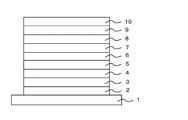
- the organic light-emitting device of the present invention has an underlayer containing the compound represented by formula (1) and a light-emitting layer laminated on the surface of the underlayer.
- the light-emitting layer includes a first organic compound and a second organic compound.
- the second organic compound is a delayed fluorescence material having a lowest excited singlet energy lower than that of the first organic compound.
- the light-emitting layer may be laminated so as to directly cover all of one surface of the underlying layer (one surface of the underlying layer), or may be laminated so as to directly cover a part thereof.
- a light-emitting layer containing a second organic compound which is a delayed fluorescence material, is formed on the surface of an underlayer containing a compound represented by general formula (1). Orientation can be improved. For example, compared to the case where the underlayer is not formed and the case where the underlayer is composed of the first organic compound of the light-emitting layer (in this case, the first organic compound is not the compound represented by the general formula (1)).
- the orientation of the light-emitting layer formed on its surface can be improved.
- the orientation of the light-emitting layer can be further improved by employing the compound represented by general formula (1) as the first organic compound.
- the light-emitting layer may contain, in addition to the first organic compound and the second organic compound, a third organic compound having a lowest excited singlet energy lower than those of these compounds.
- the third organic compound which is a light-emitting material, exhibits high orientation along with the second organic compound.
- the present invention includes not only an organic electroluminescence device having a two-component light-emitting layer containing a first organic compound and a second organic compound, but also a first organic compound, a second organic compound and a third organic compound. It can also be effectively applied to an organic electroluminescence device having a three-component light-emitting layer. Furthermore, it can also be applied to an organic electroluminescence element having a light-emitting layer of four or more components containing a plurality of third organic compounds.
- the orientation can be evaluated by the S value, which is an orientation parameter.
- the S value is also called an orientation value, and is an index indicating the degree of orientation of the light-emitting material in the light-emitting layer. A larger negative value (a smaller value) means a higher orientation.
- S-values are from Scientific Reports 2017, 7, 8405.
- X represents O, S or N(R 9 ).
- X may be O.
- X may be S.
- S may be N(R 9 ), where R 9 represents a substituent.
- R 9 is preferably a substituted or unsubstituted aryl group, a substituted or unsubstituted heteroaryl group, or a substituted or unsubstituted alkyl group, a substituted or unsubstituted aryl group, or a substituted or unsubstituted heteroaryl A group is more preferred, and a group bonded via a benzene ring is even more preferred.
- substituents when the aryl group, heteroaryl group, and alkyl group are substituted include the following Substituent Group D.
- Preferred R 9 include, for example, a phenyl group substituted with Substituent Group D and a naphthyl group substituted with Substituent Group D, and an unsubstituted phenyl group and an unsubstituted naphthyl group. can be mentioned.
- R 1 to R 8 each independently represent a hydrogen atom, a deuterium atom or a substituent.
- R 1 and R 2 , R 2 and R 3 , R 3 and R 4 , R 5 and R 6 , R 6 and R 7 , R 7 and R 8 may combine with each other to form a hydrocarbon ring.
- the hydrogen atoms of the hydrocarbon ring may be substituted.
- the hydrocarbon ring referred to here may be either an aliphatic hydrocarbon ring or an aromatic hydrocarbon ring. These aliphatic hydrocarbon ring and aromatic hydrocarbon ring may or may not be condensed with another ring.
- the aliphatic hydrocarbon ring is preferably a 5- to 7-membered ring, preferably a 5- or 6-membered ring.
- An aromatic hydrocarbon ring is a benzene ring.
- Preferred substituents for the hydrocarbon ring include Substituent Group D below. Compounds in which none of R 1 and R 2 , R 2 and R 3 , R 3 and R 4 , R 5 and R 6 , R 6 and R 7 , R 7 and R 8 are bonded to each other are also preferably employed. can be done.
- General formula ( 1 ) has a substituted or unsubstituted benzofuro structure , a substituted or unsubstituted benzothieno structure , or a substituted or forms an unsubstituted indolo structure (first condition), or R 6 is a substituted or unsubstituted carbazolyl group, a substituted or unsubstituted dibenzofuryl group, or a substituted or unsubstituted dibenzothienyl group Yes (second condition). Both the first condition and the second condition may be satisfied.
- X may be either O or S, but is preferably N(R 9 ).
- R 1 and R 2 , R 2 and R 3 , or R 3 and R 4 are linked together to form a substituted or unsubstituted benzofuro structure, the skeleton below is formed.
- a compound having one of the following skeletons is selected.
- R 1 and R 2 , R 2 and R 3 , or R 3 and R 4 are linked together to form a substituted or unsubstituted benzothieno structure, the skeleton below is formed.
- a compound having one of the following skeletons is selected.
- R 1 and R 2 , R 2 and R 3 , or R 3 and R 4 are linked together to form a substituted or unsubstituted indolo structure
- the scaffold below is formed.
- R represents a substituent, and the description and preferred range thereof can be referred to the description and preferred range of R 9 above.
- a compound having one of the following skeletons is selected.
- the hydrogen atoms bonded to the above skeletons may be substituted, and preferred substituents include the following Substituent Group D.
- R 6 may be a substituted or unsubstituted carbazolyl group, R 6 may be a substituted or unsubstituted dibenzofuryl group, R 6 may be a substituted or unsubstituted It may be a substituted dibenzothienyl group.
- R 6 is a substituted or unsubstituted carbazolyl group, it is preferably a substituted or unsubstituted carbazol-9-yl group. It may be a substituted or unsubstituted carbazol-1-yl group, a substituted or unsubstituted carbazol-2-yl group, or a substituted or unsubstituted carbazol-3-yl group.
- a preferred embodiment of the present invention is a substituted or unsubstituted carbazol-9-yl group or a substituted or unsubstituted carbazol-9-yl group.
- X is N(R 9 )
- it is preferably a substituted or unsubstituted carbazol-9-yl group.
- R 6 is a substituted or unsubstituted dibenzofuryl group, it may be a dibenzofuryl-1-yl group, a dibenzofuryl-2-yl group, or a dibenzofuryl-3-yl group.
- R 6 is a substituted or unsubstituted dibenzothienyl group, it may be a dibenzothienyl-1-yl group, a dibenzothienyl-2-yl group, or a dibenzothienyl-3-yl group. may be a dibenzothienyl-4-yl group.
- a preferred embodiment of the present invention is a substituted or unsubstituted dibenzothienyl-3-yl group.
- Preferred substituents for the carbazolyl group, dibenzofuryl group, and dibenzothienyl group include Substituent Group D below.
- X represents O, S or N(R 9 ).
- R 1 to R 8 and R 10 to R 16 in general formula (2) each independently represent a hydrogen atom, a deuterium atom or a substituent.
- R1 and R2 , R2 and R3 , R3 and R4 , R7 and R8 , R10 and R11 , R11 and R12 , R12 and R13 , R14 and R15 , R15 and R 16 , R 16 and R 17 may combine with each other to form a hydrocarbon ring, and the hydrogen atom of the hydrocarbon ring may be substituted.
- R1 and R2 , R2 and R3 , R3 and R4 , R7 and R8 , R10 and R11 , R11 and R12 , R12 and R13 , R14 and R15 , R15 and R 16 , R 16 and R 17 are preferably not bonded to each other.
- Substituents that R 1 to R 8 and R 10 to R 16 can take are preferably Substituent Group D below. Examples include a substituted or unsubstituted carbazolyl group and a substituted or unsubstituted aryl group. Substituent group D below can be mentioned as a substituent.
- 1 to 3 selected from the group consisting of R 3 , R 12 and R 15 are preferably substituents.
- R 1 to R 8 and R 10 to R 16 only 1 to 3 selected from the group consisting of R 3 , R 12 and R 15 are substituted.
- X and X' each independently represent O, S or N(R 9 ).
- X and X' are preferably O or S when X is N(R 9 ).
- R 1 to R 8 and R 21 to R 27 in general formula (3) each independently represent a hydrogen atom, a deuterium atom or a substituent.
- R 1 and R 2 , R 2 and R 3 , R 3 and R 4 , R 7 and R 8 , R 21 and R 22 , R 23 and R 24 , R 24 and R 25 , R 25 and R 26 are bonded to each other may form a hydrocarbon ring, and the hydrogen atoms of the hydrocarbon ring may be substituted.
- R 1 and R 2 , R 2 and R 3 , R 3 and R 4 , R 7 and R 8 , R 21 and R 22 , R 23 and R 24 , R 24 and R 25 , R 25 and R 26 are Compounds that are not bound to each other can also be preferably employed.
- Substituents that R 1 to R 8 and R 21 to R 27 can take are preferably Substituent Group D below. Examples include a substituted or unsubstituted carbazolyl group and a substituted or unsubstituted aryl group. Substituent group D below can be mentioned as a substituent.
- 1 to 2 selected from the group consisting of R 3 and R 25 are preferably substituents. In a preferred embodiment of the present invention, among R 1 to R 8 and R 21 to R 27 only 1 to 2 selected from the group consisting of R 3 and R 25 are substituted.
- the condensed ring structures contained in the compound represented by the general formula (1) have five or less rings. That is, it is preferable that the compound represented by the general formula (1) does not contain a condensed ring structure with 6 or more rings. Any condensed ring structure contained in the compound represented by the general formula (1) may be 3 or less rings. In addition, the compound represented by the general formula (1) may contain at least one five-ring condensed ring structure. In addition, the compound represented by the general formula (1) includes at least one five-ring condensed ring structure and at least one three-ring condensed ring structure, and includes condensed ring structures with other numbers of rings.
- the compound represented by the general formula (1) contains one five-ring condensed ring structure and one three-ring condensed ring structure, and does not contain other condensed ring structures. not present. In a preferred embodiment of the present invention, the compound represented by the general formula (1) contains two five-ring condensed ring structures and one tri-ring condensed ring structure, and does not contain other condensed ring structures. not present. In a preferred embodiment of the present invention, the compound represented by general formula (1) contains three tricyclic condensed ring structures and does not contain other condensed ring structures.
- the underlayer preferably consists of only the compound represented by the general formula (1), but it may be a layer mainly containing the compound represented by the general formula (1).
- the concentration of the compound represented by general formula (1) in the underlayer is preferably 90% by weight or more, more preferably 99% by weight or more, for example 99.9% by weight or more, or 99.99% by weight. % or more.
- the lowest excited singlet energy (E S1 ) and the lowest excited triplet energy (E T1 ) are represented by the general formula (1).
- the energy close means that the energy difference is less than 0.1 eV, preferably less than 0.05 eV, more preferably less than 0.03 eV, and less than 0.01 eV. is more preferred.
- the thickness of the underlayer is preferably 1 nm or more, more preferably 3 nm or more, and can be, for example, 5 nm or more or 10 nm or more.
- the thickness of the adjacent layer is preferably less than 30 nm, more preferably less than 20 nm, and can be, for example, 10 nm or less.
- the thickness of the underlayer is preferably smaller than the thickness of the light-emitting layer.
- the thickness of the underlayer is preferably one-half or less, more preferably one-third or less, and can be, for example, one-fourth or less of the thickness of the light-emitting layer. Moreover, it is preferably 1/20 or more, and can be, for example, 1/10 or more.
- the light-emitting layer includes a first organic compound and a second organic compound.
- the second organic compound is a delayed fluorescence material having a lowest excited singlet energy lower than that of the first organic compound.
- the light-emitting layer may additionally contain a third organic compound having a lowest excited singlet energy lower than that of the first organic compound and the second organic compound.
- the difference E S1 (1) ⁇ E S1 (2) between the lowest excited singlet energies of the first organic compound and the second compound is in the range of 0.3 eV or more, 0.5 eV or more, or 0 .7 eV or more, 1.6 eV or less, 1.3 eV or less, or 0.9 eV or less.
- the difference E S1 (2) ⁇ E S1 (3) in the lowest excited singlet energy between the second organic compound and the third compound is set to be in the range of 0.03 eV or more, or 0.06 eV.
- the first organic compound preferably has a higher minimum excited triplet energy of 77 K (Kelvin) than the second organic compound and the third organic compound.
- the lowest excited triplet energy at 77K (Kelvin) is preferably higher than that of the second organic compound and the third organic compound, but may be lower.
- the concentration of the first organic compound contained in the light-emitting layer is preferably higher than the concentration of the second organic compound.
- the content concentration of the second organic compound in the light-emitting layer is preferably 5 to 50% by weight.
- the concentrations of the first organic compound, the second organic compound and the third organic compound in the light emitting layer preferably satisfy the relationship of the following formula.
- Conc(1)>Conc(2)>Conc(3) Conc(1) represents the concentration of the first organic compound in the light-emitting layer
- Conc(2) represents the concentration of the second organic compound in the light-emitting layer
- Conc(3) represents the concentration of the third organic compound in the light-emitting layer.
- % by weight is adopted as a unit.
- Conc (1) is preferably 30% by weight or more, and can be in the range of 50% by weight or more, or in the range of 65% by weight or more. It can be in the range of weight percent or less, or in the range of 85 weight percent or less, or in the range of 75 weight percent or less.
- Conc (2) is preferably 5% by weight or more, and can be in the range of 20% by weight or more, or in the range of 30% by weight or more. It can be in the range of weight % or less, or in the range of 40 weight % or less, or in the range of 35 weight % or less.
- Conc(3) is preferably 5% by weight or less, more preferably 3% by weight or less.
- Conc(3) can be in the range of 1% by weight or less, or in the range of 0.5% by weight or less, and in the range of 0.01% by weight or more, or 0.1% by weight. It can be within the above range, or within the range of 0.3% by weight or more.
- Conc(2)/Conc(3) can be in the range of 10 or more, in the range of 30 or more, or in the range of 50 or more, and in the range of 500 or less, or in the range of 300 or less. , or 100 or less.
- the first organic compound used in the light-emitting layer of the organic light-emitting device of the present invention is selected from compounds having the lowest excited singlet energy higher than that of the second organic compound. If the emissive layer also contains a third organic compound, the first organic compound is selected from compounds having the lowest excited singlet energy greater than the second and third organic compounds.
- the first organic compound preferably functions as a host material that transports carriers.
- the first organic compound preferably has a function of confining the energy of the compound that mainly emits light in the light-emitting layer in the compound. As a result, the compound that emits light can efficiently convert the energy generated by recombination of holes and electrons in the molecule and the energy received from the first organic compound into light emission.
- the first organic compound is preferably an organic compound that has a hole-transporting ability and an electron-transporting ability, prevents emission from having a longer wavelength, and has a high glass transition temperature.
- the first organic compound is selected from compounds that do not emit delayed fluorescence. Emission from the first organic compound is preferably less than 1% of the light emission from the organic light-emitting device of the present invention, more preferably less than 0.1%, for example less than 0.01%, below the detection limit. may be Preferably, the first organic compound does not contain metal atoms.
- a compound consisting of atoms selected from the group consisting of carbon atoms, hydrogen atoms, nitrogen atoms, oxygen atoms and sulfur atoms can be selected.
- a compound consisting of atoms selected from the group consisting of carbon atoms, hydrogen atoms, nitrogen atoms and oxygen atoms can be selected.
- a compound consisting of carbon atoms, hydrogen atoms and nitrogen atoms can be selected as the first organic compound.
- a compound containing a carbazole structure can be preferably selected as the first organic compound.
- a compound containing a dibenzofuran structure can also be preferably selected as the first organic compound.
- a compound containing a dibenzothiophene structure can also be preferably selected as the first organic compound.
- the first organic compound contains two or more structures selected from the group consisting of a carbazole structure, a dibenzofuran structure and a dibenzothiophene structure, for example a compound containing two structures, or a compound containing three structures. can be selected.
- a compound containing a 1,3-phenylene structure can be selected as the first organic compound.
- a compound containing a biphenylene structure can be selected as the first organic compound.
- a compound having 5 to 8 benzene rings contained in the molecule can be selected.
- the first organic compound may be a compound represented by general formula (1) or a compound not represented by general formula (1).
- the first organic compound is a compound represented by general formula (1), but has a structure different from that of the compound contained in the underlayer.
- the molecular weight of the first organic compound is smaller than that of the compound represented by general formula (1) contained in the underlayer, for example, 50 or more.
- the number of dibenzofuran structures contained in the first organic compound is greater than the number of compounds represented by General Formula (1) contained in the base layer.
- the number of carbazole structures contained in the first organic compound is smaller than that of the compound represented by General Formula (1) contained in the base layer.
- Preferred compounds that can be used as the first organic compound are listed below.
- the second organic compound used in the light-emitting layer of the organic light-emitting device of the present invention is a delayed fluorescence material having a lowest excited singlet energy lower than that of the first organic compound.
- the second organic compound is a delayed fluorescence material having a lowest excited singlet energy higher than that of the third organic compound.
- a delayed fluorescence material in the present invention means that in an excited state, a reverse intersystem crossing occurs from an excited triplet state to an excited singlet state, and fluorescence (delayed fluorescence) when returning from the excited singlet state to the ground state is an organic compound that emits
- a delayed fluorescence material is defined as a material that emits fluorescence with an emission lifetime of 100 ns (nanoseconds) or more when measured by a fluorescence lifetime measurement system (such as a streak camera system manufactured by Hamamatsu Photonics).
- the second organic compound is a material capable of emitting delayed fluorescence, it is not essential to emit delayed fluorescence derived from the second organic compound when used in the organic light-emitting device of the present invention.
- the light emission from the second organic compound is preferably less than 10% of the light emission from the organic light-emitting device of the present invention, for example, less than 1%, less than 0.1%, less than 0.01%, and less than the detection limit.
- the second organic compound receives energy from the first organic compound in an excited singlet state and transitions to an excited singlet state.
- the second organic compound may receive energy from the first organic compound in the excited triplet state and transition to the excited triplet state.
- the second organic compound in the excited triplet state undergoes reverse intersystem crossing to the second organic compound in the excited singlet state.
- the excited singlet state of the second organic compound produced by these pathways emits fluorescence when returning to the ground state.
- the third organic compound in the excited singlet state gives energy to the third organic compound, causing the third organic compound to transition to the excited singlet state.
- the difference ⁇ E ST between the lowest excited singlet energy and the lowest excited triplet energy at 77 K is preferably 0.3 eV or less, more preferably 0.25 eV or less, and 0.2 eV or less. is more preferably 0.15 eV or less, more preferably 0.1 eV or less, even more preferably 0.07 eV or less, and still more preferably 0.05 eV or less It is preferably 0.03 eV or less, more preferably 0.01 eV or less, and particularly preferably 0.01 eV or less.
- thermally activated delayed fluorescence material absorbs the heat emitted by the device and relatively easily undergoes reverse intersystem crossing from the excited triplet state to the excited singlet state, and efficiently contributes the excited triplet energy to light emission. can be done.
- the lowest excited singlet energy (E S1 ) and the lowest excited triplet energy (E T1 ) of the compound in the present invention are values determined by the following procedure.
- ⁇ E ST is a value obtained by calculating E S1 -E T1 .
- (2) Lowest excited singlet energy (E S1 ) A thin film or a toluene solution (concentration 10 ⁇ 5 mol/L) of the compound to be measured is prepared and used as a sample. The fluorescence spectrum of this sample is measured at room temperature (300K). In the fluorescence spectrum, the vertical axis is light emission and the horizontal axis is wavelength.
- the maximum point with a peak intensity of 10% or less of the maximum peak intensity of the spectrum is not included in the maximum value on the shortest wavelength side described above, and is closest to the maximum value on the short wavelength side.
- the tangent line drawn at the point where the value is taken is taken as the tangent line to the rise on the short wavelength side of the phosphorescence spectrum.
- the second organic compound does not contain metal atoms.
- a compound consisting of atoms selected from the group consisting of carbon atoms, hydrogen atoms, deuterium atoms, nitrogen atoms, oxygen atoms and sulfur atoms can be selected.
- a compound consisting of atoms selected from the group consisting of carbon atoms, hydrogen atoms, deuterium atoms, nitrogen atoms and oxygen atoms can be selected as the second organic compound.
- a compound consisting of carbon, hydrogen, deuterium and nitrogen atoms can be selected as the second organic compound.
- a compound consisting of carbon atoms, hydrogen atoms and nitrogen atoms can be selected as the second organic compound.
- a compound containing a carbazole structure can be preferably selected as the second organic compound.
- a compound containing a dibenzofuran structure can also be preferably selected as the second organic compound.
- a compound containing a dibenzothiophene structure can also be preferably selected as the second organic compound.
- a typical second organic compound is a compound having a structure in which one or two acceptor groups and at least one donor group are bonded to a benzene ring.
- Preferred examples of the acceptor group include groups containing a heteroaryl ring containing a nitrogen atom as a ring skeleton-constituting atom, such as a cyano group and a triazinyl ring.
- a preferred example of the donor group is a substituted or unsubstituted carbazol-9-yl group.
- a benzofuran ring, a substituted or unsubstituted benzothiophene ring, a substituted or unsubstituted indole ring, a substituted or unsubstituted indene ring, a substituted or unsubstituted silaindene ring, and the like. be able to.
- the acceptor group is a group having a property of attracting electrons to the ring to which the acceptor group is bonded, and can be selected, for example, from groups having a positive Hammett's ⁇ p value.
- the donor group is a group having the property of donating electrons to the ring to which the donor group is bonded, and can be selected, for example, from groups having a negative Hammett's ⁇ p value.
- Hammet's ⁇ p value is defined by L.P. P. Proposed by Hammett, it quantifies the effect of substituents on the reaction rate or equilibrium of para-substituted benzene derivatives.
- k0 is the rate constant of a benzene derivative without a substituent
- k is the rate constant of a benzene derivative substituted with a substituent
- K0 is the equilibrium constant of a benzene derivative without a substituent
- K is a substituent.
- the equilibrium constant of the benzene derivative substituted with ⁇ represents the reaction constant determined by the type and conditions of the reaction.
- acceptor group examples include the following groups in addition to the cyano group.
- * represents a bonding position
- "D" represents a deuterium atom.
- hydrogen atoms may be substituted, for example, with alkyl groups.
- a substituted or unsubstituted benzene ring may be further condensed.
- some or all of the hydrogen atoms may be replaced with deuterium atoms.
- the donor group include the following groups. * represents a bonding position, and "D" represents a deuterium atom.
- hydrogen atoms may be substituted, for example, with alkyl groups. Also, a substituted or unsubstituted benzene ring may be further condensed. Also, some or all of the hydrogen atoms may be replaced with deuterium atoms.
- a compound that is represented by the following general formula (4) and emits delayed fluorescence can be preferably used as the second organic compound.
- X 1 to X 5 represent N or CR.
- R represents a hydrogen atom, a deuterium atom or a substituent.
- X 1 to X 5 represent C—R
- those C—R may be the same or different.
- at least one of X 1 to X 5 is CD (wherein D represents a donor group).
- Z represents an acceptor group.
- a compound represented by the following general formula (5) is particularly preferable among the compounds represented by the general formula (4).
- General formula (5) is particularly preferable among the compounds represented by the general formula (4).
- X 1 to X 5 represent N or CR.
- R represents a hydrogen atom, a deuterium atom or a substituent.
- X 1 to X 5 represent C—R
- those C—R may be the same or different.
- at least one of X 1 to X 5 is CD (wherein D represents a donor group).
- none of X 1 to X 5 are C—CN. That is, it is a compound having a structure in which one cyano group and at least one donor group are bonded to a benzene ring.
- only X 2 represents C-CN and X 1 , X 3 -X 5 are not C-CN.
- X 3 represents C-CN and X 1 , X 2 , X 4 , X 5 are not C-CN. That is, it is a compound having a structure in which at least one donor group is bonded to the benzene ring of terephthalonitrile.
- X 1 to X 5 represent N or CR, at least one of which is CD.
- the number of N in X 1 to X 5 is 0 to 4, for example, X 1 and X 3 and X 5 , X 1 and X 3 , X 1 and X 4 , X 2 and X 3 , X 1 and X 5 , X 2 and X 4 , X 1 only, X 2 only, and X 3 only are N.
- the number of CDs is 1 to 5, preferably 2 to 5.
- X 1 and X 2 and X 3 and X 4 and X 5 , X 1 and X 2 and X 4 and X 5 , X 1 and X 2 and X 3 and X 4 , X 1 and X 3 and X 4 and X 5 , X 1 and X 3 and X 5 , X 1 and X 2 and X 5 , X 1 and X 2 and X 4 , X 1 and X 3 and X 4 , X 1 and X 3 and X 4 , X 1 and X 3 , X 1 and X 4 , X 2 and X 3 , X 1 and X 5 , X 2 and X 4 , X 1 only, X 2 only, and X 3 only are CD.
- At least one of X 1 to X 5 may be CA.
- a here represents an acceptor group.
- the number of CAs is preferably 0 to 2, more preferably 0 or 1.
- a of CA preferably includes a cyano group and a heterocyclic aromatic group having an unsaturated nitrogen atom.
- X 1 to X 5 may each independently be CD or CA.
- the two R's may be bonded together to form a cyclic structure.
- the cyclic structure formed by bonding to each other may be an aromatic ring or an alicyclic ring, or may contain a heteroatom, and the cyclic structure may be a condensed ring of two or more rings. .
- heteroatoms referred to here are preferably those selected from the group consisting of nitrogen atoms, oxygen atoms and sulfur atoms.
- cyclic structures formed include benzene ring, naphthalene ring, pyridine ring, pyridazine ring, pyrimidine ring, pyrazine ring, pyrrole ring, imidazole ring, pyrazole ring, imidazoline ring, oxazole ring, isoxazole ring, thiazole ring, iso thiazole ring, cyclohexadiene ring, cyclohexene ring, cyclopentaene ring, cycloheptatriene ring, cycloheptadiene ring, cycloheptaene ring, furan ring, thiophene ring, naphthyridine ring, quinoxaline ring, quinoline ring and the like. .
- the donor group D in general formulas (4) and (5) is preferably, for example, a group represented by general formula (6) below.
- general formula (6)
- R 31 and R 32 each independently represent a substituted or unsubstituted alkyl group, a substituted or unsubstituted alkenyl group, a substituted or unsubstituted aryl group, or a substituted or unsubstituted heteroaryl group.
- R 31 and R 32 may combine with each other to form a cyclic structure.
- L represents a single bond, a substituted or unsubstituted arylene group, or a substituted or unsubstituted heteroarylene group.
- a substituent that can be introduced into the arylene group or heteroarylene group of L may be a group containing a structure represented by general formula (4) or general formula (5), or general formulas (7) to It may be a group represented by (9). These groups may be introduced into L up to the maximum number of substituents that can be introduced. Also, when a plurality of substituents are introduced, the substituents thereof may be the same or different.
- * represents the bonding position to the carbon atom (C) constituting the ring skeleton of the ring in general formula (4) or general formula (5).
- Substituent means a monovalent group capable of substituting a hydrogen atom, for example, selected from substituent group A described later, selected from substituent group B described later, or selected from substituent group C described later can be selected or can be selected from Substituent Group D described later.
- the compound represented by the general formula (6) is preferably a compound represented by any one of the following general formulas (7) to (9).
- general formula (7) general formula (8)
- R 51 to R 60 , R 61 to R 68 and R 71 to R 78 each independently represent a hydrogen atom, a deuterium atom or a substituent.
- R 51 to R 60 , R 61 to R 68 and R 71 to R 78 is independently a group represented by any one of the general formulas (7) to (9).
- the number of substituents in general formulas (7) to (9) is not particularly limited. It is also preferred if all are unsubstituted (ie hydrogen or deuterium atoms).
- substituents in each of the general formulas (7) to (9) may be the same or different.
- the substituent is preferably any one of R 52 to R 59 in general formula (7), and general formula (8) Any one of R 62 to R 67 is preferred in the case of general formula (9), and any one of R 72 to R 77 is preferred in the case of general formula (9).
- X is a divalent oxygen atom, a sulfur atom, a substituted or unsubstituted nitrogen atom, a substituted or unsubstituted carbon atom, a substituted or unsubstituted silicon atom, a carbonyl having a linked chain length of 1 atom. or a divalent substituted or unsubstituted ethylene group, a substituted or unsubstituted vinylene group, a substituted or unsubstituted o-arylene group, or a substituted or unsubstituted o-hetero represents an arylene group.
- Substituents are selected, for example, from substituent group A described below, selected from substituent group B described later, selected from substituent group C described later, or selected from substituent group D described later. can be done.
- L 12 to L 14 each represent a single bond, a substituted or unsubstituted arylene group, or a substituted or unsubstituted heteroarylene group.
- L 12 to L 14 are preferably single bonds or substituted or unsubstituted arylene groups.
- the substituents of the arylene group and heteroarylene group referred to herein may be groups represented by general formulas (7) to (9).
- the groups represented by general formulas (7) to (9) may be introduced into L 11 to L 14 up to the maximum number of substituents that can be introduced. Further, when a plurality of groups represented by formulas (7) to (9) are introduced, the substituents thereof may be the same or different.
- * represents the bonding position to the carbon atom (C) constituting the ring skeleton of the ring in general formula (4) or general formula (5).
- R 51 and R 52 , R 52 and R 53 , R 53 and R 54 , R 54 and R 55 , R 55 and R 56 , R 56 and R 57 , R 57 and R58 , R58 and R59 , R59 and R60 , R61 and R62 , R62 and R63 , R63 and R64 , R65 and R66 , R66 and R67 , R67 and R68 , R 71 and R 72 , R 72 and R 73 , R 73 and R 74 , R 75 and R 76 , R 76 and R 77 , R 77 and R 78 may be bonded to each other to form a cyclic structure. good.
- the description and preferred examples of the cyclic structure the description and preferred examples of the cyclic structure for X 1 to X 5 in general formulas (4) and (5) can be referred to.
- Preferred among the cyclic structures are a substituted or unsubstituted benzofuran ring, a substituted or unsubstituted benzothiophene ring, a substituted or unsubstituted indole ring, a substituted or unsubstituted indene ring, and a substituted or unsubstituted silaindene ring, It is a structure fused to at least one benzene ring of general formulas (7) to (9). More preferred are groups represented by the following general formulas (8a) to (8f) condensed with general formula (8).
- L 11 and L 21 to L 26 each represent a single bond or a divalent linking group.
- the description and preferred ranges of L 11 and L 21 to L 26 can be referred to the description and preferred ranges of L 2 above.
- R 41 to R 110 each independently represent a hydrogen atom or a substituent.
- the cyclic structure formed by bonding to each other may be an aromatic ring or an alicyclic ring, or may contain a heteroatom, and the cyclic structure may be a condensed ring of two or more rings.
- the heteroatoms referred to here are preferably those selected from the group consisting of nitrogen atoms, oxygen atoms and sulfur atoms.
- Examples of cyclic structures formed include benzene ring, naphthalene ring, pyridine ring, pyridazine ring, pyrimidine ring, pyrazine ring, pyrrole ring, imidazole ring, pyrazole ring, imidazoline ring, oxazole ring, isoxazole ring, thiazole ring, iso thiazole ring, cyclohexadiene ring, cyclohexene ring, cyclopentaene ring, cycloheptatriene ring, cycloheptadiene ring, cycloheptaene ring, furan ring, thiophene ring, naphthyridine ring, quinoxaline ring, quinoline ring and the like.
- a ring formed by condensing a large number of rings such as a phenanthrene ring or a triphenylene ring may be formed.
- the number of rings contained in the group represented by general formula (9) may be selected from the range of 3-5, or may be selected from the range of 5-7.
- the number of rings contained in the groups represented by general formulas (8a) to (8f) may be selected from within the range of 5 to 7, and may be 5.
- R 41 to R 110 it is possible to select a group of the following substituent group B, select a group of the following substituent group C, or select a group of the following substituent group D. can.
- R 41 to R 110 are hydrogen atoms or unsubstituted alkyl groups having 1 to 10 carbon atoms.
- R 41 to R 110 are hydrogen atoms or unsubstituted aryl groups having 6 to 10 carbon atoms.
- all of R 41 to R 110 are hydrogen atoms.
- the carbon atoms (ring skeleton-constituting carbon atoms) to which R 41 to R 110 are bonded in general formulas (8a) to (8f) may each independently be substituted with a nitrogen atom. That is, C—R 41 to C—R 110 in general formulas (8a) to (8f) may each independently be substituted with N.
- the number of nitrogen atoms substituted is preferably 0 to 4, more preferably 1 to 2 in the groups represented by formulas (8a) to (8f). In one aspect of the present invention, the number of nitrogen atoms substituted is 0. Moreover, when two or more are substituted with nitrogen atoms, the number of nitrogen atoms substituted in one ring is preferably one.
- X 1 to X 6 represent an oxygen atom, a sulfur atom or NR.
- X 1 -X 6 are oxygen atoms.
- X 1 -X 6 are sulfur atoms.
- X 1 -X 6 are NR.
- R represents a hydrogen atom or a substituent, preferably a substituent. As the substituent, a group of the following substituent group A is selected, a group of the following substituent group B is selected, a group of the following substituent group C is selected, or a group of the substituent group D is selected.
- a compound that is represented by the following general formula (10) and emits delayed fluorescence can be particularly preferably used as the delayed fluorescence material.
- a compound represented by general formula (10) can be employed as the second organic compound.
- R 1 to R 5 represent a cyano group
- at least one of R 1 to R 5 represents a substituted amino group
- the remaining R 1 to R 5 represent hydrogen atoms
- It represents a deuterium atom or a substituent other than a cyano group and a substituted amino group.
- the substituted amino group here is preferably a substituted or unsubstituted diarylamino group, and two aryl groups constituting the substituted or unsubstituted diarylamino group may be linked to each other.
- the linkage may be a single bond (in which case a carbazole ring is formed), -O-, -S-, -N(R 6 )-, -C(R 7 )(R 8 )-, -Si(R 9 )(R 10 )- or the like.
- R 6 to R 10 each represent a hydrogen atom, a deuterium atom or a substituent
- R 7 and R 8 and R 9 and R 10 may be linked together to form a cyclic structure.
- Substituted amino groups can be any of R 1 to R 5 , for example R 1 and R 2 , R 1 and R 3 , R 1 and R 4 , R 1 and R 5 , R 2 and R 3 , R 2 and R 4 , R 1 and R 2 and R 3 , R 1 and R 2 and R 4 , R 1 and R 2 and R 5 , R 1 and R 3 and R 4 , R 1 and R 3 and R 5 , R 2 and R 3 and R 4 , R 1 and R 2 and R 3 and R 4 , R 1 and R 2 and R 3 and R 4 , R 1 and R 2 and R 3 and R 5 , R 1 and R 2 and R 4 and R 5 , R 1 and R 2 and
- R 3 , R 4 and R 5 can be substituted amino groups.
- Cyano groups may also be any of R 1 to R 5 , for example R 1 , R 2 , R 3 , R 1 and R 2 , R 1 and R 3 , R 1 and R 4 , R 1 and R 5 , R 2 and R 3 , R 2 and R 4 , R 1 and R 2 and R 3 , R 1 and R 2 and R 4 , R 1 and R 2 and R 5 , R 1 and R 3 and R 4 , R 1 and R 3 and R 5 , R 2 and R 3 and R 4 can be cyano groups.
- R 1 to R 5 which are neither a cyano group nor a substituted amino group represent a hydrogen atom, a deuterium atom or a substituent.
- substituents referred to here include the following substituent group A.
- substituent group A Preferable examples of the substituent when the aryl group of the above diarylamino group is substituted include the substituents of the following substituent group A, and further include a cyano group and a substituted amino group.
- substituent group B it is also possible to select from the substituent group B, select from the substituent group C, or select from the substituent group D.
- Specific examples of the compound group and compounds encompassed by the general formula (10) are referred to here as part of the present specification, paragraphs 0008 to 0048 of WO2013/154064, and paragraphs 0009 to WO2015/080183. 0030, paragraphs 0006 to 0019 of WO2015/129715, paragraphs 0013 to 0025 of JP-A-2017-119663, and paragraphs 0013-0026 of JP-A-2017-119664.
- any two of Y 1 , Y 2 and Y 3 represent a nitrogen atom and the remaining one represents a methine group, or all of Y 1 , Y 2 and Y 3 represent a nitrogen atom.
- Z 1 and Z 2 each independently represent a hydrogen atom, a deuterium atom or a substituent.
- R 11 to R 18 each independently represent a hydrogen atom, a deuterium atom or a substituent, and at least one of R 11 to R 18 is a substituted or unsubstituted arylamino group or a substituted or unsubstituted carbazolyl group is preferably
- the benzene ring constituting the arylamino group and the benzene ring constituting the carbazolyl group may each form a single bond or a linking group together with R 11 to R 18 .
- the compound represented by general formula (11) contains at least two carbazole structures in its molecule.
- Substituents that Z 1 and Z 2 can take are, for example, selected from the following substituent group A, selected from the following substituent group B, selected from the following substituent group C, and selected from the following substituent group D.
- You can Specific examples of the substituents that R 11 to R 18 , the arylamino group, and the carbazolyl group can take include the following substituent group A, cyano group, substituted arylamino group, and substituted alkylamino group. can be done.
- R 11 and R 12 , R 12 and R 13 , R 13 and R 14 , R 15 and R 16 , R 16 and R 17 , R 17 and R 18 are bonded to each other to form a cyclic structure. good too.
- compounds represented by general formula (12) are particularly useful.
- any two of Y 1 , Y 2 and Y 3 represent a nitrogen atom and the remaining one represents a methine group, or all of Y 1 , Y 2 and Y 3 represent a nitrogen atom.
- Z2 represents a hydrogen atom, a deuterium atom or a substituent.
- R 11 to R 18 and R 21 to R 28 each independently represent a hydrogen atom, a deuterium atom or a substituent. At least one of R 11 to R 18 and/or at least one of R 21 to R 28 preferably represents a substituted or unsubstituted arylamino group or a substituted or unsubstituted carbazolyl group.
- the benzene ring constituting the arylamino group and the benzene ring constituting the carbazolyl group may be combined with R 11 to R 18 or R 21 to R 28 to form a single bond or a linking group.
- substituents that Z 2 can take include substituents of the following substituent group A, substituents of the following substituent group B, substituents of the following substituent group C, and substituents of the following substituent group D. can be done.
- R 11 to R 18 , R 21 to R 28 , the above arylamino group and carbazolyl group can take include substituents of the following substituent group A, cyano group, substituted arylamino group, substituted Alkylamino groups may be mentioned.
- R 11 and R 12 , R 12 and R 13 , R 13 and R 14 , R 15 and R 16 , R 16 and R 17 , R 17 and R 18 , R 21 and R 22 , R 22 and R 23 , R 23 and R 24 , R 25 and R 26 , R 26 and R 27 , R 27 and R 28 may combine with each other to form a cyclic structure.
- a compound that is represented by the following general formula (13) and emits delayed fluorescence can also be particularly preferably used as the delayed fluorescence material of the present invention.
- R 91 to R 96 each independently represent a hydrogen atom, a deuterium atom, a donor group, or an acceptor group, at least one of which is the donor group, and at least two One is the acceptor group.
- Substitution positions of at least two acceptor groups are not particularly limited, but two acceptor groups in a meta-position relationship with each other are preferably included.
- R 91 is a donor group
- a structure in which at least R 92 and R 94 are acceptor groups and a structure in which at least R 92 and R 96 are acceptor groups can be preferably exemplified.
- Acceptor groups present in the molecule may all be the same or different from each other, but for example, it is possible to select a structure in which all are the same.
- the number of acceptor groups is preferably 2-3, and for example 2 can be selected.
- two or more donor groups may be present, and the donor groups in that case may all be the same or different from each other.
- the number of donor groups is preferably 1 to 3, and may be, for example, only 1 or 2.
- the corresponding explanation and preferred range of general formula (4) can be referred to.
- the donor group is preferably represented by the general formula (6)
- the acceptor group is preferably represented by a cyano group or the following general formula (14).
- Y 4 to Y 6 represent a nitrogen atom or a methine group, at least one of which represents a nitrogen atom, preferably all of which represent a nitrogen atom.
- Each of R 101 to R 110 independently represents a hydrogen atom, a deuterium atom, or a substituent, and at least one is preferably an alkyl group.
- L 15 represents a single bond or a linking group, and the description and preferred range of L in general formula (6) can be referred to.
- L15 in general formula ( 14 ) is a single bond. * represents the bonding position to the carbon atom (C) constituting the ring skeleton of the ring in general formula (13).
- t-Bu represents a tertiary butyl group.
- a known delayed fluorescence material other than those described above can be used in appropriate combination. Moreover, even unknown delayed fluorescence materials can be used.
- the delayed fluorescence material paragraphs 0008 to 0048 and 0095 to 0133 of WO2013/154064, paragraphs 0007 to 0047 and 0073 to 0085 of WO2013/011954, paragraphs 0007 to 0033 and 0059 to 0066 of WO2013/011955, Paragraphs 0008 to 0071 and 0118 to 0133 of WO2013/081088, paragraphs 0009 to 0046 and 0093 to 0134 of JP 2013-256490, paragraphs 0008 to 0020 and 0038 to 0040 of JP 2013-116975, WO2013 / Paragraphs 0007 to 0032 and 0079 to 0084 of 133359, paragraphs 0008 to 0054 and 0101 to 0121 of WO2013/161437, paragraphs 0007 to 0041 and 0060 to 0069 of
- JP 2013-253121, WO2013/133359, WO2014/034535, WO2014/115743, WO2014/122895, WO2014/126200, WO2014/136758, WO2014/133121 Publications, WO2014/136860, WO2014/196585, WO2014/189122, WO2014/168101, WO2015/008580, WO2014/203840, WO2015/002213, WO2010/01620 WO2015/019725, WO2015/072470, WO2015/108049, WO2015/080182, WO2015/072537, WO2015/080183, JP 2015-129240, WO2015/129714, WO2015/129715, WO2015/133501, WO2015/136880, WO2015/137244, WO2015/137202, WO2015/137136, WO2015/146541, WO2015/159541
- a luminescent material that emits delayed fluorescence can also be employed.
- the light-emitting layer of the organic light-emitting device of the present invention may contain a third organic compound.
- the third organic compound is a fluorescent material having a lowest excited singlet energy lower than those of the first organic compound and the second organic compound.
- the third organic compound is a fluorescent material having a lowest excited triplet energy lower than those of the first organic compound and the second organic compound.
- the third organic compound may be a delayed fluorescence material or may not emit delayed fluorescence. When it is a delayed fluorescence material, the lowest excited triplet energy of the third organic compound may be higher than the lowest excited triplet energy of the second organic compound.
- the third organic compound a compound having a HOMO energy higher or lower than that of the second organic compound can be used.
- the third organic compound can be a compound having a higher or lower LUMO energy than the second organic compound.
- the third organic compound has a lower HOMO energy and a lower LUMO energy than the second organic compound.
- An organic light-emitting device using the third organic compound emits fluorescence derived from the third organic compound. Emission from the third organic compound usually includes delayed fluorescence.
- the largest component of light emission from the organic light-emitting device of the present invention is light emission from the third organic compound.
- the amount of light emitted from the third organic compound is the largest among the light emitted from the organic light-emitting device of the present invention. 70% or more of light emitted from the organic light-emitting element may be light emitted from the third organic compound, 90% or more may be light emitted from the third organic compound, and 99% or more may be light emitted from the third organic compound. may be emitted.
- the third organic compound receives energy from the first organic compound in the excited singlet state, the second organic compound in the excited singlet state, and the second organic compound in the excited singlet state through inverse intersystem crossing from the excited triplet state. and transits to the excited singlet state.
- the third organic compound receives energy from the second organic compound in the excited singlet state and the second organic compound in the excited singlet state through reverse intersystem crossing from the excited triplet state. It receives and transits to an excited singlet state. The resulting excited singlet state of the third organic compound then emits fluorescence when returning to the ground state.
- the fluorescent material used as the third organic compound is not particularly limited as long as it can receive energy from the first organic compound or the second organic compound and emit light. It does not matter which one is included.
- the emitted light includes fluorescence or delayed fluorescence, and more preferably, the maximum component of the emitted light from the third organic compound is fluorescence.
- the organic light-emitting device does not emit phosphorescence, or emits less than 1% of the fluorescence.
- Two or more of the third organic compounds may be used as long as they satisfy the conditions of the present invention. For example, by using together two or more third organic compounds having different emission colors, it is possible to emit light of a desired color. Moreover, monochromatic light may be emitted from the third organic compound by using one type of the third organic compound.
- the maximum emission wavelength of the compound that can be used as the third organic compound is not particularly limited.
- a luminescent material having a maximum emission wavelength in the visible region (380 to 780 nm), a luminescent material having a maximum emission wavelength in the infrared region (780 nm to 1 mm), or a luminescent material having a maximum emission wavelength in the ultraviolet region (for example, 280 to 380 nm)
- a compound or the like can be appropriately selected and used.
- fluorescent materials having emission maxima in the visible region For example, a luminescent material with a maximum emission wavelength in the range of 380 to 780 nm is selected and used, or a luminescent material with a maximum emission wavelength in the range of 570 to 650 nm is selected and used.
- a luminescent material having a maximum emission wavelength in the range of 650 to 700 nm may be selected and used, or a luminescent material having a maximum emission wavelength in the range of 700 to 780 nm may be selected and used.
- the compounds are selected and combined such that there is overlap between the emission wavelength range of the second organic compound and the absorption wavelength range of the third organic compound.
- the third organic compound does not contain metal atoms other than boron atoms.
- the third organic compound may be a compound containing both boron and fluorine atoms. Moreover, it may be a compound containing a boron atom but not containing a fluorine atom. It may also contain no metal atoms at all.
- a compound consisting of atoms selected from the group consisting of carbon atoms, hydrogen atoms, deuterium atoms, nitrogen atoms, oxygen atoms, sulfur atoms, fluorine atoms and boron atoms can be selected.
- a compound consisting of atoms selected from the group consisting of carbon atoms, hydrogen atoms, deuterium atoms, nitrogen atoms, oxygen atoms, fluorine atoms and boron atoms can be selected.
- a compound consisting of atoms selected from the group consisting of carbon atoms, hydrogen atoms, deuterium atoms, nitrogen atoms, oxygen atoms, sulfur atoms and boron atoms can be selected.
- a compound consisting of atoms selected from the group consisting of carbon atoms, hydrogen atoms, deuterium atoms, nitrogen atoms and boron atoms can be selected.
- a compound consisting of atoms selected from the group consisting of carbon atoms, hydrogen atoms, deuterium atoms, nitrogen atoms, oxygen atoms and sulfur atoms can be selected.
- a compound consisting of atoms selected from the group consisting of carbon atoms, hydrogen atoms, deuterium atoms, nitrogen atoms and oxygen atoms can be selected.
- a compound consisting of carbon atoms and hydrogen atoms can be selected as the third organic compound.
- Examples of the third organic compound include compounds having a multiple resonance effect of boron atoms and nitrogen atoms, and compounds containing condensed aromatic ring structures such as anthracene, pyrene, and perylene.
- a compound represented by the following general formula (15) is used as the third organic compound.
- Ar 1 to Ar 3 are each independently an aryl ring or a heteroaryl ring, and at least one hydrogen atom in these rings may be substituted, or the rings may be condensed.
- a hydrogen atom is substituted, it is preferably substituted with one or a combination of two or more groups selected from the group consisting of deuterium atoms, aryl groups, heteroaryl groups and alkyl groups.
- a benzene ring or a heteroaromatic ring for example, a furan ring, a thiophene ring, a pyrrole ring, etc.
- R a and R a ' each independently represent a substituent, preferably one or a combination of two or more selected from the group consisting of a deuterium atom, an aryl group, a heteroaryl group and an alkyl group.
- Ra and Ar 1 , Ar 1 and Ar 2 , Ar 2 and Ra′, Ra ′ and Ar 3 , and Ar 3 and Ra may combine with each other to form a cyclic structure.
- the compound represented by general formula (15) preferably contains at least one carbazole structure.
- one benzene ring constituting the carbazole structure may be a ring represented by Ar 1
- one benzene ring constituting the carbazole structure may be a ring represented by Ar 2
- the carbazole structure may be a ring represented by Ar 3 .
- a carbazolyl group may be bonded to one or more of Ar 1 to Ar 3 .
- a substituted or unsubstituted carbazol-9-yl group may be attached to the ring represented by Ar 3 .
- a condensed aromatic ring structure such as anthracene, pyrene, or perylene may be bonded to Ar 1 to Ar 3 .
- the rings represented by Ar 1 to Ar 3 may be one ring constituting a condensed aromatic ring structure.
- at least one of R a and R a ′ may be a group having a condensed aromatic ring structure.
- a plurality of skeletons represented by general formula (15) may be present in the compound.
- it may have a structure in which skeletons represented by general formula (15) are bonded to each other via a single bond or a linking group.
- the skeleton represented by the general formula (15) may be added with a structure exhibiting a multiple resonance effect in which benzene rings are linked to each other by a boron atom, a nitrogen atom, an oxygen atom, or a sulfur atom.
- a compound containing a BODIPY (4,4-difluoro-4-bora-3a,4a-diaza-s-indacene) structure is used as the third organic compound.
- a compound represented by the following general formula (16) is used.
- R 1 to R 7 are each independently a hydrogen atom, a deuterium atom or a substituent. At least one of R 1 to R 7 is preferably a group represented by the following general formula (17).
- general formula (17) In general formula (17), R 11 to R 15 each independently represent a hydrogen atom, a deuterium atom or a substituent, and * represents a bonding position.
- the group represented by general formula (17) may be one, two, or three of R 1 to R 7 in general formula (16). Also, it may be at least four, for example four or five. In a preferred embodiment of the present invention, one of R 1 to R 7 is a group represented by general formula (17).
- R 1 , R 3 , R 5 and R 7 are groups represented by general formula (17). In a preferred embodiment of the present invention, only R 1 , R 3 , R 4 , R 5 and R 7 are groups represented by general formula (17). In a preferred embodiment of the present invention, R 1 , R 3 , R 4 , R 5 and R 7 are groups represented by general formula (17), R 2 and R 4 are hydrogen atoms, deuterium atoms, A substituted alkyl group (eg, 1 to 10 carbon atoms) or an unsubstituted aryl group (eg, 6 to 14 carbon atoms). In one aspect of the present invention, all of R 1 to R 7 are groups represented by general formula (17).
- R 1 and R 7 are the same. In one preferred aspect of the invention, R 3 and R 5 are the same. In one preferred aspect of the invention, R 2 and R 6 are the same. In a preferred embodiment of the present invention, R 1 and R 7 are the same, R 3 and R 5 are the same, and R 1 and R 3 are different from each other. In one preferred aspect of the invention, R 1 , R 3 , R 5 and R 7 are identical. In one preferred embodiment of the invention, R 1 , R 4 and R 7 are the same and different from R 3 and R 5 . In a preferred embodiment of the invention, R3 , R4 and R5 are the same and different from R1 and R7 . In one preferred aspect of the invention, R 1 , R 3 , R 5 and R 7 are all different from R 4 .
- Substituents that can be taken by R 11 to R 15 in general formula (17) are, for example, selected from the following substituent group A, selected from the following substituent group B, or selected from the following substituent group C. , or the following substituent group D.
- a substituted amino group is selected as a substituent, a disubstituted amino group is preferred, and the two substituents for the amino group are each independently a substituted or unsubstituted aryl group, a substituted or unsubstituted heteroaryl group, or a substituted Alternatively, it is preferably an unsubstituted alkyl group, and particularly preferably a substituted or unsubstituted aryl group (diarylamino group).
- Substituents that can be taken by the two aryl groups of the diarylamino group are, for example, selected from the following substituent group A, selected from the following substituent group B, selected from the following substituent group C, and the following substituents You can choose from group D.
- the two aryl groups of the diarylamino group may be bonded to each other via a single bond or a linking group, and the linking group referred to here can be referred to the description of the linking group for R 33 and R 34 .
- a specific example of the diarylamino group is, for example, a substituted or unsubstituted carbazol-9-yl group.
- Examples of substituted or unsubstituted carbazol-9-yl groups include groups in which L 11 in the general formula (9) is a single bond.
- R 13 in general formula (17) is a substituent
- R 11 , R 12 , R 14 and R 15 are hydrogen atoms.
- R 11 in general formula (17) is a substituent
- R 12 , R 13 , R 14 and R 15 are hydrogen atoms.
- R 11 and R 13 in general formula (17) are substituents
- R 12 , R 14 and R 15 are hydrogen atoms.
- R 1 to R 7 of general formula (16) may include a group in which all of R 11 to R 15 of general formula (17) are hydrogen atoms (ie, phenyl group).
- R2 , R4 , R6 may be phenyl groups.
- R 8 and R 9 each independently represent a hydrogen atom, a deuterium atom, a halogen atom, an alkyl group (eg, 1 to 40 carbon atoms), an alkoxy group (eg, 1 to 40 carbon atoms), an aryloxy It is preferably one or a combination of two or more groups selected from the group consisting of a group (for example, 6 to 30 carbon atoms) and a cyano group.
- R8 and R9 are the same .
- R 8 and R 9 are halogen atoms, particularly preferably fluorine atoms.
- the total number of substituted or unsubstituted alkoxy groups, substituted or unsubstituted aryloxy groups, and substituted or unsubstituted amino groups present in R 1 to R 9 of general formula (16) is The number is preferably three or more, and for example, three compounds or four compounds can be employed. More preferably, the total number of substituted or unsubstituted alkoxy groups, substituted or unsubstituted aryloxy groups, and substituted or unsubstituted amino groups present in R 1 to R 7 of general formula (16) is 3 or more. is preferable, and for example, a compound with three or a compound with four can be used.
- an alkoxy group, an aryloxy group, or an amino group may not exist in R8 and R9. More preferably, substituted or unsubstituted alkoxy group , substituted or unsubstituted aryloxy group, substituted or unsubstituted amino
- the total number of groups is preferably 3 or more, and for example, a compound with 3 or a compound with 4 can be used.
- R 2 , R 6 , R 8 and R 9 may be free of an alkoxy group, an aryloxy group and an amino group. In a preferred embodiment of the invention, there are 3 or more substituted or unsubstituted alkoxy groups.
- each of R 1 , R 4 and R 7 is a substituted or unsubstituted alkoxy group or a substituted or unsubstituted aryloxy. In a preferred embodiment of the present invention, each of R 1 , R 4 and R 7 has a substituted or unsubstituted alkoxy group.
- the total number of substituents having a Hammett's ⁇ p value of less than ⁇ 0.2 in R 1 to R 9 of the general formula (16) is 3 or more.
- Hammett's ⁇ p value is less than -0.2 substituents, for example, methoxy group (-0.27), ethoxy group (-0.24), n-propoxy group (-0.25), isopropoxy group (- 0.45) and the n-butoxy group (-0.32).
- a fluorine atom (0.06), a methyl group (-0.17), an ethyl group (-0.15), a tert-butyl group (-0.20), an n-hexyl group (-0.15), A cyclohexyl group (-0.15) is not a substituent having a Hammett's ⁇ p value of less than -0.2.
- a compound in which the number of substituents having a Hammett's ⁇ p value of less than ⁇ 0.2 in R 1 to R 9 of the general formula (16) is three, or four can be employed.
- the number of substituents having a Hammett's ⁇ p value of less than ⁇ 0.2 in R 1 to R 7 of the general formula (16) is preferably 3 or more, for example, a compound having 3 can be employed, or a compound that is four. At this time, a substituent having a Hammett's ⁇ p value of less than ⁇ 0.2 may not be present in R 8 and R 9 . More preferably, the number of substituents having a Hammett's ⁇ p value of less than ⁇ 0.2 in R 1 , R 3 , R 4 , R 5 and R 7 of the general formula (16) is 3 or more. Preferably, for example, three compounds can be employed, or four compounds can be employed.
- each of R 1 , R 4 and R 7 has a Hammett's ⁇ p value of less than ⁇ 0.2.
- a compound containing a carbazole structure may be selected as the third organic compound. Also, as the third organic compound, a compound that does not contain any of the carbazole structure, the dibenzofuran structure, and the dibenzothiophene structure may be selected.
- t-Bu represents a tertiary butyl group.
- Derivatives of the above-exemplified compounds include compounds in which at least one hydrogen atom is replaced with a deuterium atom, an alkyl group, an aryl group, a heteroaryl group, or a diarylamino group.
- Compounds described in paragraphs 0220 to 0239 of WO2015/022974 can also be particularly preferably used as the third organic compound of the present invention.
- the "alkyl group” may be linear, branched, or cyclic. Moreover, two or more of the linear portion, the cyclic portion and the branched portion may be mixed.
- the number of carbon atoms in the alkyl group can be, for example, 1 or more, 2 or more, or 4 or more. Also, the number of carbon atoms can be 30 or less, 20 or less, 10 or less, 6 or less, or 4 or less.
- alkyl groups include methyl group, ethyl group, n-propyl group, isopropyl group, n-butyl group, isobutyl group, tert-butyl group, n-pentyl group, isopentyl group, n-hexyl group, isohexyl group, 2-ethylhexyl group, n-heptyl group, isoheptyl group, n-octyl group, isooctyl group, n-nonyl group, isononyl group, n-decanyl group, isodecanyl group, cyclopentyl group, cyclohexyl group, cycloheptyl group.
- alkyl group as a substituent may be further substituted with an aryl group.
- An "alkenyl group” may be linear, branched, or cyclic. Moreover, two or more of the linear portion, the cyclic portion and the branched portion may be mixed.
- the number of carbon atoms in the alkenyl group can be, for example, 2 or more and 4 or more. Also, the number of carbon atoms can be 30 or less, 20 or less, 10 or less, 6 or less, or 4 or less.
- alkenyl groups include ethenyl, n-propenyl, isopropenyl, n-butenyl, isobutenyl, n-pentenyl, isopentenyl, n-hexenyl, isohexenyl, and 2-ethylhexenyl groups. can be mentioned.
- the alkenyl group as a substituent may be further substituted with a substituent.
- the "aryl group” and “heteroaryl group” may be monocyclic or condensed rings in which two or more rings are condensed. In the case of condensed rings, the number of condensed rings is preferably 2 to 6, and can be selected from 2 to 4, for example.
- rings include benzene ring, pyridine ring, pyrimidine ring, triazine ring, naphthalene ring, anthracene ring, phenanthrene ring, triphenylene ring, quinoline ring, pyrazine ring, quinoxaline ring, and naphthyridine ring.
- aryl or heteroaryl groups include phenyl, 1-naphthyl, 2-naphthyl, 1-anthracenyl, 2-anthracenyl, 9-anthracenyl, 2-pyridyl, 3-pyridyl, 4 - pyridyl group.
- “Arylene group” and “heteroaryl group” can be read by changing the valence number from 1 to 2 in the description of the aryl group and heteroaryl group.
- substituted group A refers to a hydroxyl group, a halogen atom (e.g., fluorine atom, chlorine atom, bromine atom, iodine atom), an alkyl group (e.g., 1 to 40 carbon atoms), an alkoxy group (e.g., 1 to 40), alkylthio groups (eg, 1 to 40 carbon atoms), aryl groups (eg, 6 to 30 carbon atoms), aryloxy groups (eg, 6 to 30 carbon atoms), arylthio groups (eg, 6 to 30 carbon atoms), Heteroaryl group (eg, 5 to 30 ring atoms), heteroaryloxy group (eg, 5 to 30 ring atoms), heteroarylthio group (eg, 5 to 30 ring atoms), acyl group ( For example, 1 to 40 carbon atoms), alkenyl groups (eg, 1 to 40 carbon atoms), alkenyl groups (eg, 1 to 40
- substituted group B means an alkyl group (eg, 1 to 40 carbon atoms), an alkoxy group (eg, 1 to 40 carbon atoms), an aryl group (eg, 6 to 30 carbon atoms), an aryloxy group (eg for example, 6 to 30 carbon atoms), heteroaryl groups (eg, 5 to 30 ring atoms), heteroaryloxy groups (eg, 5 to 30 ring atoms), diarylaminoamino groups (eg, 0 to 30 carbon atoms).
- substituted group C refers to an alkyl group (eg, 1 to 20 carbon atoms), an aryl group (eg, 6 to 22 carbon atoms), a heteroaryl group (eg, 5 to 20 ring skeleton atoms), It means one group or a combination of two or more groups selected from the group consisting of diarylamino groups (eg, 12 to 20 carbon atoms).
- substituted group D refers to an alkyl group (eg, 1 to 20 carbon atoms), an aryl group (eg, 6 to 22 carbon atoms) and a heteroaryl group (eg, 5 to 20 ring skeleton atoms). It means one group selected from the group consisting of or a combination of two or more groups.
- the light-emitting layer of the organic light-emitting device of the present invention includes a first organic compound and a second organic compound.
- the light-emitting layer may contain a third organic compound in addition to the first organic compound and the second organic compound.
- the light-emitting layer may have a structure that does not contain compounds that transfer charge or energy, or metal elements other than boron.
- the light-emitting layer can also be composed only of compounds consisting of atoms selected from the group consisting of carbon atoms, hydrogen atoms, deuterium atoms, nitrogen atoms, boron atoms, fluorine atoms, oxygen atoms and sulfur atoms.
- the light-emitting layer can consist only of compounds consisting of atoms selected from the group consisting of carbon atoms, hydrogen atoms, deuterium atoms, nitrogen atoms, boron atoms, fluorine atoms and oxygen atoms.
- the light-emitting layer can consist only of compounds consisting of atoms selected from the group consisting of carbon atoms, hydrogen atoms, deuterium atoms, nitrogen atoms, boron atoms, fluorine atoms and sulfur atoms.
- the light-emitting layer can consist only of compounds consisting of atoms selected from the group consisting of carbon atoms, hydrogen atoms, deuterium atoms, nitrogen atoms and boron atoms.
- the light-emitting layer can consist only of compounds consisting of atoms selected from the group consisting of carbon atoms, hydrogen atoms, deuterium atoms, nitrogen atoms, oxygen atoms and sulfur atoms.
- the light-emitting layer can consist only of compounds consisting of atoms selected from the group consisting of carbon atoms, hydrogen atoms, deuterium atoms and nitrogen atoms.
- the light emitting layer comprises a first organic compound composed of atoms selected from the group consisting of carbon atoms, hydrogen atoms, nitrogen atoms, oxygen atoms and sulfur atoms, and carbon atoms, hydrogen atoms, deuterium atoms, nitrogen atoms and oxygen atoms.
- a second organic compound composed of atoms selected from the group consisting of atoms and sulfur atoms, and from the group consisting of carbon atoms, hydrogen atoms, deuterium atoms, nitrogen atoms, boron atoms, fluorine atoms, oxygen atoms and sulfur atoms It may also include a third organic compound composed of selected atoms.
- the light-emitting layer comprises a first organic compound composed of atoms selected from the group consisting of carbon atoms, hydrogen atoms, nitrogen atoms and oxygen atoms, and a group consisting of carbon atoms, hydrogen atoms, deuterium atoms and nitrogen atoms. and a third organic compound composed of atoms selected from the group consisting of carbon atoms, hydrogen atoms, deuterium atoms, nitrogen atoms and boron atoms. There may be.
- the light-emitting layer may be formed by co-evaporating the first organic compound, the second organic compound and optionally the third organic compound, or by co-evaporating the first organic compound, the second organic compound and optionally the third organic compound.
- the light emitting layer is formed by co-evaporation of the first organic compound, the second organic compound and the third organic compound, two or more of the first organic compound, the second organic compound and the third organic compound are mixed in advance.
- a crucible or the like may be put into a vapor deposition source, and the light emitting layer may be formed by co-deposition using the vapor deposition source.
- the first organic compound and the second organic compound are mixed in advance to form one vapor deposition source, and the vapor deposition source and the third organic compound vapor deposition source are used to co-evaporate to form the light-emitting layer.
- the organic light-emitting device of the present invention has an underlayer and a light-emitting layer laminated on the surface of the underlayer.
- the thickness of the light-emitting layer can be, for example, 5 nm or more, 10 nm or more, 20 nm or more, or 40 nm or more, and can be 80 nm or less or 60 nm or less.
- Examples of the organic light-emitting device of the present invention include an organic photoluminescence device (organic PL device) and an organic electroluminescence device (organic EL device).
- An organic photoluminescence element has a structure including, on a substrate, at least an underlayer and a light-emitting layer laminated on the surface of the underlayer.
- the organic electroluminescence element has a structure in which at least an anode, a cathode, and an organic layer are formed between the anode and the cathode.
- the organic layer includes at least an underlayer and a light-emitting layer laminated on the surface of the underlayer, and may consist of only the underlayer and the light-emitting layer adjacent thereto, or may consist of the underlayer and the light-emitting layer adjacent thereto. It may have one or more organic layers in addition to the light-emitting layer.
- organic layers other than the light-emitting layer examples include a hole transport layer, a hole injection layer, an electron blocking layer, a hole blocking layer, an electron injection layer, an electron transport layer, an exciton blocking layer, and the like.
- the hole transport layer may be a hole injection transport layer having a hole injection function
- the electron transport layer may be an electron injection transport layer having an electron injection function.
- the present invention has a structure in which a light-emitting layer is laminated on the cathode-side surface of the underlying layer.
- the underlayer may also serve as an electron barrier layer.
- a structural example of a specific organic electroluminescence element is shown in FIG. In FIG.
- the organic light-emitting device of the present invention is a multi-wavelength light-emitting organic light-emitting device
- the emission with the shortest wavelength may include delayed fluorescence.
- the emission with the shortest wavelength does not contain delayed fluorescence.
- the organic light-emitting device of the present invention can be produced by laminating a light-emitting layer on the surface of a base layer.
- a compound represented by the general formula (1) is placed on the anode or on the organic layer formed on the anode.
- a light-emitting layer comprising a first organic compound and a second organic compound can be formed to form a stratum and overlie its adjacent layers.
- the means for forming the underlayer and the light-emitting layer is not particularly limited.
- a vapor deposition method can be mentioned as a preferable forming means. Alternatively, it may be formed by a coating method.
- the underlying layer and the light-emitting layer adjacent to each other may be formed continuously or intermittently. Continuous formation is preferred.
- the organic light-emitting device of the present invention can be easily manufactured using a normal production line (manufacturing equipment) for organic light-emitting devices. That is, in a normal production line, the material used for forming the underlayer is the compound represented by the general formula (1), and the material used for forming the light-emitting layer is changed to contain the first organic compound and the second organic compound.
- the organic light-emitting device of the present invention can be easily manufactured. Therefore, the organic light-emitting device of the present invention has the advantage that it can be manufactured without changing or installing a new manufacturing line. Also, after manufacturing the organic light-emitting device of the present invention, it is possible to return to the production line of the organic light-emitting device other than the present invention by changing the materials to be used. Therefore, the organic light-emitting device of the present invention has high industrial applicability because it can be economically implemented and diverted in a short period of time.
- the method of forming other layers and structures is not particularly limited.
- it may further include a step of forming an electrode such as an anode or a cathode, or may further include a step of forming a layer other than the underlying layer and the light-emitting layer.
- the manufacturing method of the present invention is used for manufacturing an organic electroluminescence element, for example, one or more organic layers are sequentially formed on an anode, a base layer is formed thereon, and a light-emitting layer is formed thereon. , forming one or more organic layers thereon, and forming a cathode thereon.
- the organic electroluminescent device of the present invention is held by a substrate, which is not particularly limited and commonly used in organic electroluminescent devices such as glass, transparent plastic, quartz and silicon. Any material formed by
- the anode of the organic electroluminescent device is made from metals, alloys, conductive compounds, or combinations thereof.
- the metal, alloy or conductive compound has a high work function (4 eV or greater).
- the metal is Au.
- the conductive transparent material is selected from CuI, indium tin oxide ( ITO), SnO2 and ZnO. Some embodiments use amorphous materials that can form transparent conductive films, such as IDIXO (In 2 O 3 —ZnO).
- the anode is a thin film. In some embodiments, the thin film is made by evaporation or sputtering.
- the film is patterned by photolithographic methods. In some embodiments, if the pattern does not need to be highly precise (eg, about 100 ⁇ m or greater), the pattern may be formed using a mask with a shape suitable for vapor deposition or sputtering onto the electrode material. In some embodiments, wet film forming methods such as printing and coating methods are used when coating materials such as organic conductive compounds can be applied.
- the anode has a transmittance of greater than 10% when emitted light passes through the anode, and the anode has a sheet resistance of several hundred ohms per unit area or less. In some embodiments, the thickness of the anode is 10-1,000 nm. In some embodiments, the thickness of the anode is 10-200 nm. In some embodiments, the thickness of the anode varies depending on the materials used.
- the cathode is made of electrode materials such as metals with a low work function (4 eV or less) (referred to as electron-injecting metals), alloys, conductive compounds, or combinations thereof.
- the electrode material is sodium, sodium-potassium alloys, magnesium, lithium, magnesium-copper mixtures, magnesium-silver mixtures, magnesium-aluminum mixtures, magnesium-indium mixtures, aluminum - aluminum oxide (Al2 O 3 ) mixtures, indium, lithium-aluminum mixtures and rare earth elements.
- a mixture of an electron-injecting metal and a second metal that is a stable metal with a higher work function than the electron-injecting metal is used.
- the mixture is selected from magnesium-silver mixtures, magnesium-aluminum mixtures, magnesium-indium mixtures, aluminum-aluminum oxide (Al 2 O 3 ) mixtures, lithium-aluminum mixtures and aluminum. In some embodiments, the mixture improves electron injection properties and resistance to oxidation.
- the cathode is manufactured by depositing or sputtering the electrode material as a thin film. In some embodiments, the cathode has a sheet resistance of no more than several hundred ohms per unit area. In some embodiments, the thickness of said cathode is between 10 nm and 5 ⁇ m. In some embodiments, the thickness of the cathode is 50-200 nm.
- either one of the anode and cathode of the organic electroluminescent device is transparent or translucent to allow transmission of emitted light.
- transparent or translucent electroluminescent elements enhance light radiance.
- the cathode is formed of a conductive transparent material as described above for the anode, thereby forming a transparent or translucent cathode.
- the device includes an anode and a cathode, both transparent or translucent.
- the injection layer is the layer between the electrode and the organic layer. In some embodiments, the injection layer reduces drive voltage and enhances light radiance. In some embodiments, the injection layer comprises a hole injection layer and an electron injection layer. The injection layer can be placed between the anode and the light-emitting layer or hole-transporting layer and between the cathode and the light-emitting layer or electron-transporting layer. In some embodiments, an injection layer is present. In some embodiments, there is no injection layer. Preferred examples of compounds that can be used as the hole injection material are given below.
- a barrier layer is a layer that can prevent charges (electrons or holes) and/or excitons present in the light-emitting layer from diffusing out of the light-emitting layer.
- an electron blocking layer is between the light-emitting layer and the hole-transporting layer to block electrons from passing through the light-emitting layer to the hole-transporting layer.
- a hole blocking layer is between the emissive layer and the electron transport layer and blocks holes from passing through the emissive layer to the electron transport layer.
- the barrier layer prevents excitons from diffusing out of the emissive layer.
- the electron blocking layer and the hole blocking layer constitute an exciton blocking layer.
- the terms "electron blocking layer” or “exciton blocking layer” include layers that have both the functionality of an electron blocking layer and an exciton blocking layer.
- Hole blocking layer functions as an electron transport layer. In some embodiments, the hole blocking layer blocks holes from reaching the electron transport layer during electron transport. In some embodiments, the hole blocking layer increases the probability of recombination of electrons and holes in the emissive layer.
- the materials used for the hole blocking layer can be the same materials as described above for the electron transport layer. Preferred examples of compounds that can be used in the hole blocking layer are given below.
- Electron barrier layer The electron blocking layer transports holes. In some embodiments, the electron blocking layer prevents electrons from reaching the hole transport layer during hole transport. In some embodiments, the electron blocking layer increases the probability of recombination of electrons and holes in the emissive layer.
- the materials used for the electron blocking layer may be the same materials as described above for the hole transport layer. Specific examples of compounds that can be used as electron barrier materials are given below.
- Exciton barrier layer The exciton blocking layer prevents diffusion of excitons generated through recombination of holes and electrons in the light emitting layer to the charge transport layer. In some embodiments, the exciton blocking layer allows effective confinement of excitons in the emissive layer. In some embodiments, the light emission efficiency of the device is improved. In some embodiments, an exciton blocking layer is adjacent to the emissive layer on either the anode side or the cathode side, and on both sides thereof. In some embodiments, when an exciton blocking layer is present on the anode side, it may be present between and adjacent to the hole-transporting layer and the light-emitting layer.
- an exciton blocking layer when an exciton blocking layer is present on the cathode side, it may be between and adjacent to the emissive layer and the cathode. In some embodiments, a hole-injection layer, electron-blocking layer, or similar layer is present between the anode and an exciton-blocking layer adjacent to the light-emitting layer on the anode side. In some embodiments, a hole injection layer, electron blocking layer, hole blocking layer or similar layer is present between the cathode and an exciton blocking layer adjacent to the emissive layer on the cathode side. In some embodiments, the exciton blocking layer comprises an excited singlet energy and an excited triplet energy, at least one of which is higher than the excited singlet energy and triplet energy, respectively, of the emissive material.
- the hole-transporting layer comprises a hole-transporting material.
- the hole transport layer is a single layer.
- the hole transport layer has multiple layers.
- the hole transport material has one property of a hole injection or transport property and an electron barrier property.
- the hole transport material is an organic material.
- the hole transport material is an inorganic material. Examples of known hole transport materials that can be used in the present invention include, but are not limited to, triazole derivatives, oxadiazole derivatives, imidazole derivatives, carbazole derivatives, indolocarbazole derivatives, polyarylalkane derivatives, pyrazoline derivatives, pyrazolones.
- the hole transport material is selected from porphyrin compounds, aromatic tertiary amine compounds and styrylamine compounds. In some embodiments, the hole transport material is an aromatic tertiary amine compound. Specific examples of preferred compounds that can be used as the hole-transporting material are given below.
- the electron transport layer includes an electron transport material.
- the electron transport layer is a single layer.
- the electron transport layer has multiple layers.
- the electron-transporting material need only function to transport electrons injected from the cathode to the emissive layer.
- the electron transport material also functions as a hole blocking material.
- electron-transporting layers examples include, but are not limited to, nitro-substituted fluorene derivatives, diphenylquinone derivatives, thiopyran dioxide derivatives, carbodiimides, fluorenylidene methane derivatives, anthraquinodimethanes, anthrone derivatives, oxazide Azole derivatives, azole derivatives, azine derivatives or combinations thereof, or polymers thereof.
- the electron transport material is a thiadiazole derivative or a quinoxaline derivative.
- the electron transport material is a polymeric material. Specific examples of preferred compounds that can be used as the electron-transporting material are given below.
- examples of preferred compounds as materials that can be added to each organic layer are given.
- it may be added as a stabilizing material.
- Preferred materials that can be used in organic electroluminescence elements are specifically exemplified, but materials that can be used in the present invention are not limitedly interpreted by the following exemplified compounds. Moreover, even compounds exemplified as materials having specific functions can be used as materials having other functions.
- the emissive layer is incorporated into the device.
- devices include, but are not limited to, OLED bulbs, OLED lamps, television displays, computer monitors, mobile phones and tablets.
- an electronic device includes an OLED having at least one organic layer including an anode, a cathode, and a light-emitting layer between the anode and the cathode.
- compositions described herein can be incorporated into various photosensitive or photoactivated devices, such as OLEDs or optoelectronic devices.
- the composition may be useful in facilitating charge or energy transfer within a device and/or as a hole transport material.
- OLEDs organic light emitting diodes
- OICs organic integrated circuits
- O-FETs organic field effect transistors
- O-TFTs organic thin film transistors
- O-LETs organic light emitting transistors
- O-SC organic solar cells.
- O-SC organic optical detectors
- O-FQD organic field-quench devices
- LOC luminescent fuel cells
- O-lasers organic laser diodes
- an electronic device includes an OLED including at least one organic layer including an anode, a cathode, and a light-emitting layer between the anode and the cathode.
- the device includes OLEDs of different colors.
- the device includes an array including combinations of OLEDs.
- said combination of OLEDs is a combination of three colors (eg RGB).
- the combination of OLEDs is a combination of colors other than red, green, and blue (eg, orange and yellow-green).
- said combination of OLEDs is a combination of two, four or more colors.
- the device a circuit board having a first side with a mounting surface and a second opposite side and defining at least one opening; at least one OLED on the mounting surface, wherein the at least one OLED is configured to emit light, wherein the at least one OLED includes at least one organic layer including an anode, a cathode, and a light-emitting layer between the anode and the cathode; at least one OLED comprising a housing for the circuit board; at least one connector located at an end of said housing, said housing and said connector defining a package suitable for attachment to a lighting fixture.
- the OLED light comprises multiple OLEDs mounted on a circuit board such that light is emitted in multiple directions. In some embodiments, some light emitted in the first direction is polarized and emitted in the second direction. In some embodiments, a reflector is used to polarize light emitted in the first direction.
- the emissive layers of the invention can be used in screens or displays.
- the compounds of the present invention are deposited onto a substrate using processes such as, but not limited to, vacuum evaporation, deposition, evaporation or chemical vapor deposition (CVD).
- the substrate is a photoplate structure useful in two-sided etching to provide unique aspect ratio pixels.
- Said screens also called masks
- the corresponding artwork pattern design allows placement of very steep narrow tie-bars between pixels in the vertical direction as well as large and wide beveled openings in the horizontal direction.
- the internal patterning of the pixels makes it possible to construct three-dimensional pixel openings with various aspect ratios in the horizontal and vertical directions. Further, the use of imaged "stripes" or halftone circles in pixel areas protects etching in specific areas until these specific patterns are undercut and removed from the substrate. All pixel areas are then treated with a similar etch rate, but their depth varies with the halftone pattern. Varying the size and spacing of the halftone patterns allows etching with varying degrees of protection within the pixel, allowing for the localized deep etching necessary to form steep vertical bevels. . A preferred material for the evaporation mask is Invar.
- Invar is a metal alloy that is cold rolled into long thin sheets in steel mills. Invar cannot be electrodeposited onto a spin mandrel as a nickel mask.
- a suitable and low-cost method for forming the open areas in the deposition mask is by wet chemical etching.
- the screen or display pattern is a matrix of pixels on a substrate.
- screen or display patterns are fabricated using lithography (eg, photolithography and e-beam lithography).
- the screen or display pattern is processed using wet chemical etching.
- the screen or display pattern is fabricated using plasma etching.
- An OLED display is generally manufactured by forming a large mother panel and then cutting the mother panel into cell panels.
- each cell panel on the mother panel forms a thin film transistor (TFT) having an active layer and source/drain electrodes on a base substrate, and the TFT is coated with a planarization film, a pixel electrode, a light emitting layer , a counter electrode and an encapsulation layer, are sequentially formed and cut from the mother panel.
- TFT thin film transistor
- An OLED display is generally manufactured by forming a large mother panel and then cutting the mother panel into cell panels.
- each cell panel on the mother panel forms a thin film transistor (TFT) having an active layer and source/drain electrodes on a base substrate, and the TFT is coated with a planarization film, a pixel electrode, a light emitting layer , a counter electrode and an encapsulation layer, are sequentially formed and cut from the mother panel.
- TFT thin film transistor
- an organic light emitting diode (OLED) display comprising: forming a barrier layer on the base substrate of the mother panel; forming a plurality of display units on the barrier layer in cell panel units; forming an encapsulation layer over each of the display units of the cell panel; and applying an organic film to the interfaces between the cell panels.
- the barrier layer is an inorganic film, eg, made of SiNx, and the edges of the barrier layer are covered with an organic film, made of polyimide or acrylic.
- the organic film helps the mother panel to be softly cut into cell panels.
- a thin film transistor (TFT) layer has an emissive layer, a gate electrode, and source/drain electrodes.
- Each of the plurality of display units may have a thin film transistor (TFT) layer, a planarization film formed on the TFT layer, and a light-emitting unit formed on the planarization film;
- the applied organic film is made of the same material as the material of the planarizing film and is formed at the same time as the planarizing film is formed.
- the light-emitting unit is coupled with the TFT layer by a passivation layer, a planarizing film therebetween, and an encapsulation layer that covers and protects the light-emitting unit.
- the organic film is not connected to the display unit or encapsulation layer.
- each of the organic film and the planarizing film may include one of polyimide and acrylic.
- the barrier layer may be an inorganic film.
- the base substrate may be formed of polyimide. The method further comprises attaching a carrier substrate made of a glass material to one surface of a base substrate made of polyimide before forming a barrier layer on another surface of the base substrate; separating the carrier substrate from the base substrate prior to cutting along the interface.
- the OLED display is a flexible display.
- the passivation layer is an organic film placed on the TFT layer to cover the TFT layer.
- the planarizing film is an organic film formed over a passivation layer.
- the planarizing film is formed of polyimide or acrylic, as is the organic film formed on the edge of the barrier layer. In some embodiments, the planarizing film and the organic film are formed simultaneously during the manufacture of the OLED display. In some embodiments, the organic film may be formed on the edge of the barrier layer such that a portion of the organic film is in direct contact with the base substrate and the remainder of the organic film is in contact with the base substrate. , in contact with the barrier layer while surrounding the edges of the barrier layer.
- the emissive layer comprises a pixel electrode, a counter electrode, and an organic emissive layer disposed between the pixel electrode and the counter electrode.
- the pixel electrodes are connected to source/drain electrodes of the TFT layer.
- a suitable voltage is formed between the pixel electrode and the counter electrode, causing the organic light emitting layer to emit light, thereby displaying an image. is formed.
- An image forming unit having a TFT layer and a light emitting unit is hereinafter referred to as a display unit.
- the encapsulation layer that covers the display unit and prevents the penetration of external moisture may be formed into a thin encapsulation structure in which organic films and inorganic films are alternately laminated.
- the encapsulation layer has a thin film-like encapsulation structure in which multiple thin films are stacked.
- the organic film applied to the interface portion is spaced apart from each of the plurality of display units.
- the organic film is formed such that a portion of the organic film is in direct contact with the base substrate and the remaining portion of the organic film is in contact with the barrier layer while surrounding the edges of the barrier layer. be done.
- the OLED display is flexible and uses a flexible base substrate made of polyimide.
- the base substrate is formed on a carrier substrate made of glass material, and then the carrier substrate is separated.
- a barrier layer is formed on the surface of the base substrate opposite the carrier substrate.
- the barrier layer is patterned according to the size of each cell panel. For example, a base substrate is formed on all surfaces of a mother panel, while barrier layers are formed according to the size of each cell panel, thereby forming grooves at the interfaces between the barrier layers of the cell panels. Each cell panel can be cut along the groove.
- the manufacturing method further comprises cutting along the interface, wherein a groove is formed in the barrier layer, at least a portion of the organic film is formed with the groove, and the groove is Does not penetrate the base substrate.
- a TFT layer of each cell panel is formed, and a passivation layer, which is an inorganic film, and a planarization film, which is an organic film, are placed on and cover the TFT layer.
- the planarizing film eg made of polyimide or acrylic
- the interface grooves are covered with an organic film, eg made of polyimide or acrylic. This prevents cracking by having the organic film absorb the impact that occurs when each cell panel is cut along the groove at the interface.
- the grooves at the interfaces between the barrier layers are coated with an organic film to absorb shocks that might otherwise be transmitted to the barrier layers, so that each cell panel is softly cut and the barrier layers It may prevent cracks from forming.
- the organic film covering the groove of the interface and the planarizing film are spaced apart from each other. For example, when the organic film and the planarizing film are connected to each other as a single layer, external moisture may enter the display unit through the planarizing film and the portion where the organic film remains. The organic film and planarizing film are spaced from each other such that the organic film is spaced from the display unit.
- the display unit is formed by forming a light emitting unit and an encapsulating layer is placed over the display unit to cover the display unit.
- the carrier substrate carrying the base substrate is separated from the base substrate.
- the carrier substrate separates from the base substrate due to the difference in coefficient of thermal expansion between the carrier substrate and the base substrate.
- the mother panel is cut into cell panels.
- the mother panel is cut along the interfaces between the cell panels using a cutter.
- the interface groove along which the mother panel is cut is coated with an organic film so that the organic film absorbs impact during cutting.
- the barrier layer can be prevented from cracking during cutting.
- the method reduces the reject rate of the product and stabilizes its quality.
- Another embodiment includes a barrier layer formed on a base substrate, a display unit formed on the barrier layer, an encapsulation layer formed on the display unit, and an organic layer applied to the edges of the barrier layer.
- An OLED display comprising a film.
- Example 1 In Example 1, it was examined how the S value of the light-emitting layer changes depending on the material of the underlayer.
- U1 to U5 or comparative compound (H1) were deposited on a glass substrate to form an underlayer having a thickness of 10 nm.
- H1 and T60 were co-deposited from different deposition sources at a weight ratio of 65:35 to form a 40 nm thick light-emitting layer.
- the S value of T60 in the formed light-emitting layer was measured.
- Table 1 shows the results. The results in Table 1 show that the compound represented by the general formula (1) is lower than the comparative example using the underlayer of the same material (H1) as the first organic compound contained in the light-emitting layer at 65% by weight.
- Example 2 In Example 2, it was examined how the S value of the light-emitting layer would change by changing the combination of the material of the underlying layer and the first organic compound of the light-emitting layer.
- An underlayer and a light-emitting layer were formed on a glass substrate in the same manner as in Example 1 except that the combination of the material of the underlayer and the first organic compound of the light-emitting layer was changed as shown in Table 2.
- the S value of T60 in the formed light-emitting layer was measured.
- Table 2 shows the results. The results in Table 2 show that not only the underlayer is composed of the compound represented by the general formula (1), but also the first organic compound contained in the light-emitting layer is the compound represented by the general formula (1). This indicates that the orientation of the second organic compound in the light-emitting layer can be further enhanced.
- Example 3 In Example 3, the relationship between the material of the underlying layer and the S value of the light emitting layer was examined when the second organic compound of the light emitting layer was changed.
- the second organic compound in the light-emitting layer was changed from T60 to T3, and the combination of the material of the underlying layer and the first organic compound in the light-emitting layer was changed as shown in Tables 3 and 4, in the same manner as in Example 1.
- a base layer and a light-emitting layer were formed on a glass substrate. However, the weight ratio of the first organic compound and the second organic compound in the light-emitting layer was 70:30.
- the S value of T3 in the formed light-emitting layer was measured. The results are shown in Tables 3 and 4.
- Example 4 organic electroluminescence devices with different underlayers were fabricated and evaluated. Each thin film was laminated at a degree of vacuum of 1 ⁇ 10 ⁇ 6 Pa by a vacuum deposition method on a glass substrate on which an anode made of indium tin oxide (ITO) with a thickness of 100 nm was formed. First, HATCN was formed to a thickness of 10 nm on ITO, and NPD was formed thereon to a thickness of 35 nm.
- ITO indium tin oxide
- U4 was formed thereon to a thickness of 10 nm to form a base layer, and H1 and T3 were co-deposited thereon from different vapor deposition sources at a weight ratio of 70:30, respectively, to form a light-emitting layer of 40 nm thickness. formed.
- HB1 was formed to a thickness of 10 nm, and HB1 and Liq were co-deposited thereon from different vapor deposition sources at a weight ratio of 70:30 to form a 20 nm thick film.
- Liq was formed to a thickness of 2 nm, and then aluminum (Al) was deposited to a thickness of 100 nm to form a cathode.
- the organic electroluminescence device of the present invention was produced by the above procedure.
- a comparative organic electroluminescence device was also produced in which the underlying layer was composed of H1.
- Table 5 shows the results of measuring the external quantum efficiency (EQE) and the initial driving voltage of each device.
- the results in Table 5 show that the use of the compound represented by the general formula (1) in the underlayer increases the orientation of the second organic compound in the light-emitting layer, improves the luminous efficiency of the device, and suppresses the initial driving voltage. This indicates that the
- Example 5 organic electroluminescence devices with different first organic compounds in the light-emitting layer were produced and evaluated.
- An organic electroluminescence device was produced in the same manner as in Example 4, except that the underlying layer was made of U4, and the first compound of the light-emitting layer was made of H1 and U5.
- Table 6 shows the results of measuring the S value, the external quantum efficiency (EQE), and the initial driving voltage of each of the manufactured devices in the same manner as in Example 4.
- the results in Table 6 show that not only the underlayer is composed of the compound represented by the general formula (1), but also the first organic compound contained in the light-emitting layer is the compound represented by the general formula (1). This indicates that the orientation of the second organic compound in the light-emitting layer can be further enhanced, the luminous efficiency of the device can be improved, and the initial driving voltage can be suppressed.
- Example 6 an organic electroluminescence device was fabricated in which the light-emitting layer further contained a third organic compound having a lower lowest excited singlet energy than the first organic compound and the second organic compound.
- Organic electroluminescence was performed in the same manner as in Example 4, except that 0.5% by weight of F1 was added as a third organic compound to the light-emitting layer and the concentration of the first organic compound was changed to 69.5% by weight.
- a device was produced.
- the S value of each manufactured element was measured in the same manner as in Example 4, the element using H1 as the underlayer was -0.293, and the element using U4 as the underlayer was -0.344. rice field.
- the initial driving voltage was lower in the element using U4 as the underlying layer. This result shows that the orientation of the second organic compound in the light-emitting layer can be enhanced and the initial driving voltage can be suppressed by forming the underlying layer from the compound represented by the general formula (1).
- the present invention if the compound represented by general formula (1) is used for the underlying layer, the orientation of the luminescent material of the luminescent layer formed thereon can be improved. Therefore, it is possible to provide an organic electroluminescence device with high luminous efficiency.
- an organic light-emitting device in which the light-emitting material of the light-emitting layer is highly oriented can be easily manufactured. Therefore, the present invention has high industrial applicability.
Landscapes
- Chemical & Material Sciences (AREA)
- Engineering & Computer Science (AREA)
- Physics & Mathematics (AREA)
- Materials Engineering (AREA)
- Spectroscopy & Molecular Physics (AREA)
- Optics & Photonics (AREA)
- Organic Chemistry (AREA)
- Manufacturing & Machinery (AREA)
- Electroluminescent Light Sources (AREA)
Priority Applications (4)
| Application Number | Priority Date | Filing Date | Title |
|---|---|---|---|
| JP2023529794A JPWO2022264857A1 (https=) | 2021-06-15 | 2022-06-06 | |
| KR1020237044675A KR20240022512A (ko) | 2021-06-15 | 2022-06-06 | 유기 발광 소자 및 그 제조 방법 |
| US18/569,767 US20240315133A1 (en) | 2021-06-15 | 2022-06-06 | Organic light emitting device and method of producing same |
| CN202280042608.3A CN117529978A (zh) | 2021-06-15 | 2022-06-06 | 有机发光元件及其制造方法 |
Applications Claiming Priority (2)
| Application Number | Priority Date | Filing Date | Title |
|---|---|---|---|
| JP2021099117 | 2021-06-15 | ||
| JP2021-099117 | 2021-06-15 |
Publications (1)
| Publication Number | Publication Date |
|---|---|
| WO2022264857A1 true WO2022264857A1 (ja) | 2022-12-22 |
Family
ID=84526404
Family Applications (1)
| Application Number | Title | Priority Date | Filing Date |
|---|---|---|---|
| PCT/JP2022/022823 Ceased WO2022264857A1 (ja) | 2021-06-15 | 2022-06-06 | 有機発光素子およびその製造方法 |
Country Status (5)
| Country | Link |
|---|---|
| US (1) | US20240315133A1 (https=) |
| JP (1) | JPWO2022264857A1 (https=) |
| KR (1) | KR20240022512A (https=) |
| CN (1) | CN117529978A (https=) |
| WO (1) | WO2022264857A1 (https=) |
Families Citing this family (1)
| Publication number | Priority date | Publication date | Assignee | Title |
|---|---|---|---|---|
| WO2023276918A1 (ja) * | 2021-06-29 | 2023-01-05 | 株式会社Kyulux | 化合物、電子障壁材料、有機半導体素子および化合物 |
Citations (8)
| Publication number | Priority date | Publication date | Assignee | Title |
|---|---|---|---|---|
| WO2013179645A1 (ja) * | 2012-05-30 | 2013-12-05 | 出光興産株式会社 | 有機エレクトロルミネッセンス素子用材料及びそれを用いた有機エレクトロルミネッセンス素子 |
| WO2014057685A1 (ja) * | 2012-10-11 | 2014-04-17 | 出光興産株式会社 | 有機エレクトロルミネッセンス素子 |
| JP2016027605A (ja) * | 2014-06-26 | 2016-02-18 | 出光興産株式会社 | 有機エレクトロルミネッセンス素子、有機エレクトロルミネッセンス素子用材料、および電子機器 |
| WO2018074529A1 (ja) * | 2016-10-19 | 2018-04-26 | 保土谷化学工業株式会社 | インデノカルバゾール化合物および有機エレクトロルミネッセンス素子 |
| JP2019112572A (ja) * | 2017-12-26 | 2019-07-11 | 株式会社Kyulux | 配向制御剤、膜および有機発光素子 |
| WO2020057480A1 (zh) * | 2018-09-18 | 2020-03-26 | 江苏三月光电科技有限公司 | 一种以苯并[1,2-b:5,4-b']二苯并呋喃为核心的化合物及其应用 |
| US20200216475A1 (en) * | 2017-12-26 | 2020-07-09 | Lg Chem, Ltd. | Compound and organic light emitting element comprising same |
| JP2020132636A (ja) * | 2019-02-13 | 2020-08-31 | 学校法人関西学院 | 多環芳香族化合物およびその多量体 |
Family Cites Families (2)
| Publication number | Priority date | Publication date | Assignee | Title |
|---|---|---|---|---|
| JP5366106B1 (ja) | 2012-04-09 | 2013-12-11 | 国立大学法人九州大学 | 有機発光素子ならびにそれに用いる発光材料および化合物 |
| KR102543775B1 (ko) | 2013-08-14 | 2023-06-14 | 가부시키가이샤 큐럭스 | 유기 일렉트로루미네선스 소자 |
-
2022
- 2022-06-06 KR KR1020237044675A patent/KR20240022512A/ko active Pending
- 2022-06-06 WO PCT/JP2022/022823 patent/WO2022264857A1/ja not_active Ceased
- 2022-06-06 US US18/569,767 patent/US20240315133A1/en active Pending
- 2022-06-06 CN CN202280042608.3A patent/CN117529978A/zh active Pending
- 2022-06-06 JP JP2023529794A patent/JPWO2022264857A1/ja active Pending
Patent Citations (8)
| Publication number | Priority date | Publication date | Assignee | Title |
|---|---|---|---|---|
| WO2013179645A1 (ja) * | 2012-05-30 | 2013-12-05 | 出光興産株式会社 | 有機エレクトロルミネッセンス素子用材料及びそれを用いた有機エレクトロルミネッセンス素子 |
| WO2014057685A1 (ja) * | 2012-10-11 | 2014-04-17 | 出光興産株式会社 | 有機エレクトロルミネッセンス素子 |
| JP2016027605A (ja) * | 2014-06-26 | 2016-02-18 | 出光興産株式会社 | 有機エレクトロルミネッセンス素子、有機エレクトロルミネッセンス素子用材料、および電子機器 |
| WO2018074529A1 (ja) * | 2016-10-19 | 2018-04-26 | 保土谷化学工業株式会社 | インデノカルバゾール化合物および有機エレクトロルミネッセンス素子 |
| JP2019112572A (ja) * | 2017-12-26 | 2019-07-11 | 株式会社Kyulux | 配向制御剤、膜および有機発光素子 |
| US20200216475A1 (en) * | 2017-12-26 | 2020-07-09 | Lg Chem, Ltd. | Compound and organic light emitting element comprising same |
| WO2020057480A1 (zh) * | 2018-09-18 | 2020-03-26 | 江苏三月光电科技有限公司 | 一种以苯并[1,2-b:5,4-b']二苯并呋喃为核心的化合物及其应用 |
| JP2020132636A (ja) * | 2019-02-13 | 2020-08-31 | 学校法人関西学院 | 多環芳香族化合物およびその多量体 |
Also Published As
| Publication number | Publication date |
|---|---|
| KR20240022512A (ko) | 2024-02-20 |
| JPWO2022264857A1 (https=) | 2022-12-22 |
| US20240315133A1 (en) | 2024-09-19 |
| CN117529978A (zh) | 2024-02-06 |
Similar Documents
| Publication | Publication Date | Title |
|---|---|---|
| JP7418794B2 (ja) | 有機発光素子 | |
| JP7728589B2 (ja) | 有機発光素子 | |
| WO2021157642A1 (ja) | ホスト材料、組成物および有機発光素子 | |
| WO2023282224A1 (ja) | 有機発光素子およびその設計方法 | |
| WO2023167273A1 (ja) | 有機発光素子、遅延蛍光材料の評価方法、遅延蛍光材料の設計方法、有機発光素子の設計方法、およびプログラム | |
| WO2022264857A1 (ja) | 有機発光素子およびその製造方法 | |
| JP7152805B1 (ja) | 化合物、組成物、ホスト材料、電子障壁材料および有機発光素子 | |
| JP2022119744A (ja) | 有機エレクトロルミネッセンス素子、発光組成物の設計方法およびプログラム | |
| WO2023053835A1 (ja) | 化合物、組成物、ホスト材料、電子障壁材料および有機発光素子 | |
| WO2022230574A1 (ja) | 電荷輸送材料、組成物および有機発光素子 | |
| WO2022107798A1 (ja) | 有機エレクトロルミネッセンス素子、発光組成物の設計方法およびプログラム | |
| WO2022009790A1 (ja) | 有機発光素子 | |
| WO2022270113A1 (ja) | 有機エレクトロルミネッセンス素子 | |
| JP7461095B1 (ja) | 有機発光素子、その設計方法およびプログラム | |
| JP7630160B2 (ja) | 有機発光素子 | |
| JP7838780B2 (ja) | 有機発光素子 | |
| JP7780190B2 (ja) | 有機発光素子、遅延蛍光材料の評価方法、遅延蛍光材料の設計方法、有機発光素子の設計方法、およびプログラム | |
| WO2022230573A1 (ja) | 有機発光素子およびその製造方法 | |
| WO2023167271A1 (ja) | 有機発光素子、遅延蛍光材料の評価方法、遅延蛍光材料の設計方法、有機発光素子の設計方法、およびプログラム | |
| WO2022249750A1 (ja) | トップエミッション方式の有機エレクトロルミネッセンス素子およびその設計方法 | |
| WO2023276918A1 (ja) | 化合物、電子障壁材料、有機半導体素子および化合物 | |
| WO2024247998A1 (ja) | 有機エレクトロルミネッセンス素子、有機エレクトロルミネッセンス素子の設計方法およびプログラム | |
| JP2022168813A (ja) | 電荷輸送材料、組成物および有機発光素子 | |
| JP2022182933A (ja) | トップエミッション方式の有機エレクトロルミネッセンス素子およびその設計方法 | |
| JP2023159034A (ja) | 化合物、ホスト材料、組成物および有機発光素子 |
Legal Events
| Date | Code | Title | Description |
|---|---|---|---|
| 121 | Ep: the epo has been informed by wipo that ep was designated in this application |
Ref document number: 22824849 Country of ref document: EP Kind code of ref document: A1 |
|
| WWE | Wipo information: entry into national phase |
Ref document number: 2023529794 Country of ref document: JP |
|
| WWE | Wipo information: entry into national phase |
Ref document number: 18569767 Country of ref document: US |
|
| WWE | Wipo information: entry into national phase |
Ref document number: 202280042608.3 Country of ref document: CN |
|
| ENP | Entry into the national phase |
Ref document number: 20237044675 Country of ref document: KR Kind code of ref document: A |
|
| NENP | Non-entry into the national phase |
Ref country code: DE |
|
| 122 | Ep: pct application non-entry in european phase |
Ref document number: 22824849 Country of ref document: EP Kind code of ref document: A1 |