WO2022260083A1 - 樹脂フィルム、合わせガラス、及びスクリーン - Google Patents
樹脂フィルム、合わせガラス、及びスクリーン Download PDFInfo
- Publication number
- WO2022260083A1 WO2022260083A1 PCT/JP2022/023130 JP2022023130W WO2022260083A1 WO 2022260083 A1 WO2022260083 A1 WO 2022260083A1 JP 2022023130 W JP2022023130 W JP 2022023130W WO 2022260083 A1 WO2022260083 A1 WO 2022260083A1
- Authority
- WO
- WIPO (PCT)
- Prior art keywords
- resin
- light diffusion
- resin film
- layer
- diffusion layer
- Prior art date
- Legal status (The legal status is an assumption and is not a legal conclusion. Google has not performed a legal analysis and makes no representation as to the accuracy of the status listed.)
- Ceased
Links
Images



Classifications
-
- B—PERFORMING OPERATIONS; TRANSPORTING
- B32—LAYERED PRODUCTS
- B32B—LAYERED PRODUCTS, i.e. PRODUCTS BUILT-UP OF STRATA OF FLAT OR NON-FLAT, e.g. CELLULAR OR HONEYCOMB, FORM
- B32B7/00—Layered products characterised by the relation between layers; Layered products characterised by the relative orientation of features between layers, or by the relative values of a measurable parameter between layers, i.e. products comprising layers having different physical, chemical or physicochemical properties; Layered products characterised by the interconnection of layers
- B32B7/02—Physical, chemical or physicochemical properties
- B32B7/023—Optical properties
-
- B—PERFORMING OPERATIONS; TRANSPORTING
- B32—LAYERED PRODUCTS
- B32B—LAYERED PRODUCTS, i.e. PRODUCTS BUILT-UP OF STRATA OF FLAT OR NON-FLAT, e.g. CELLULAR OR HONEYCOMB, FORM
- B32B17/00—Layered products essentially comprising sheet glass, or glass, slag, or like fibres
- B32B17/06—Layered products essentially comprising sheet glass, or glass, slag, or like fibres comprising glass as the main or only constituent of a layer, next to another layer of a specific material
- B32B17/10—Layered products essentially comprising sheet glass, or glass, slag, or like fibres comprising glass as the main or only constituent of a layer, next to another layer of a specific material of synthetic resin
- B32B17/10005—Layered products essentially comprising sheet glass, or glass, slag, or like fibres comprising glass as the main or only constituent of a layer, next to another layer of a specific material of synthetic resin laminated safety glass or glazing
- B32B17/1055—Layered products essentially comprising sheet glass, or glass, slag, or like fibres comprising glass as the main or only constituent of a layer, next to another layer of a specific material of synthetic resin laminated safety glass or glazing characterized by the resin layer, i.e. interlayer
- B32B17/10614—Layered products essentially comprising sheet glass, or glass, slag, or like fibres comprising glass as the main or only constituent of a layer, next to another layer of a specific material of synthetic resin laminated safety glass or glazing characterized by the resin layer, i.e. interlayer comprising particles for purposes other than dyeing
-
- B—PERFORMING OPERATIONS; TRANSPORTING
- B32—LAYERED PRODUCTS
- B32B—LAYERED PRODUCTS, i.e. PRODUCTS BUILT-UP OF STRATA OF FLAT OR NON-FLAT, e.g. CELLULAR OR HONEYCOMB, FORM
- B32B17/00—Layered products essentially comprising sheet glass, or glass, slag, or like fibres
- B32B17/06—Layered products essentially comprising sheet glass, or glass, slag, or like fibres comprising glass as the main or only constituent of a layer, next to another layer of a specific material
- B32B17/10—Layered products essentially comprising sheet glass, or glass, slag, or like fibres comprising glass as the main or only constituent of a layer, next to another layer of a specific material of synthetic resin
- B32B17/10005—Layered products essentially comprising sheet glass, or glass, slag, or like fibres comprising glass as the main or only constituent of a layer, next to another layer of a specific material of synthetic resin laminated safety glass or glazing
- B32B17/10009—Layered products essentially comprising sheet glass, or glass, slag, or like fibres comprising glass as the main or only constituent of a layer, next to another layer of a specific material of synthetic resin laminated safety glass or glazing characterized by the number, the constitution or treatment of glass sheets
- B32B17/10036—Layered products essentially comprising sheet glass, or glass, slag, or like fibres comprising glass as the main or only constituent of a layer, next to another layer of a specific material of synthetic resin laminated safety glass or glazing characterized by the number, the constitution or treatment of glass sheets comprising two outer glass sheets
-
- B—PERFORMING OPERATIONS; TRANSPORTING
- B32—LAYERED PRODUCTS
- B32B—LAYERED PRODUCTS, i.e. PRODUCTS BUILT-UP OF STRATA OF FLAT OR NON-FLAT, e.g. CELLULAR OR HONEYCOMB, FORM
- B32B17/00—Layered products essentially comprising sheet glass, or glass, slag, or like fibres
- B32B17/06—Layered products essentially comprising sheet glass, or glass, slag, or like fibres comprising glass as the main or only constituent of a layer, next to another layer of a specific material
- B32B17/10—Layered products essentially comprising sheet glass, or glass, slag, or like fibres comprising glass as the main or only constituent of a layer, next to another layer of a specific material of synthetic resin
- B32B17/10005—Layered products essentially comprising sheet glass, or glass, slag, or like fibres comprising glass as the main or only constituent of a layer, next to another layer of a specific material of synthetic resin laminated safety glass or glazing
- B32B17/1055—Layered products essentially comprising sheet glass, or glass, slag, or like fibres comprising glass as the main or only constituent of a layer, next to another layer of a specific material of synthetic resin laminated safety glass or glazing characterized by the resin layer, i.e. interlayer
- B32B17/10559—Shape of the cross-section
- B32B17/10568—Shape of the cross-section varying in thickness
-
- B—PERFORMING OPERATIONS; TRANSPORTING
- B32—LAYERED PRODUCTS
- B32B—LAYERED PRODUCTS, i.e. PRODUCTS BUILT-UP OF STRATA OF FLAT OR NON-FLAT, e.g. CELLULAR OR HONEYCOMB, FORM
- B32B17/00—Layered products essentially comprising sheet glass, or glass, slag, or like fibres
- B32B17/06—Layered products essentially comprising sheet glass, or glass, slag, or like fibres comprising glass as the main or only constituent of a layer, next to another layer of a specific material
- B32B17/10—Layered products essentially comprising sheet glass, or glass, slag, or like fibres comprising glass as the main or only constituent of a layer, next to another layer of a specific material of synthetic resin
- B32B17/10005—Layered products essentially comprising sheet glass, or glass, slag, or like fibres comprising glass as the main or only constituent of a layer, next to another layer of a specific material of synthetic resin laminated safety glass or glazing
- B32B17/1055—Layered products essentially comprising sheet glass, or glass, slag, or like fibres comprising glass as the main or only constituent of a layer, next to another layer of a specific material of synthetic resin laminated safety glass or glazing characterized by the resin layer, i.e. interlayer
- B32B17/10605—Type of plasticiser
-
- B—PERFORMING OPERATIONS; TRANSPORTING
- B32—LAYERED PRODUCTS
- B32B—LAYERED PRODUCTS, i.e. PRODUCTS BUILT-UP OF STRATA OF FLAT OR NON-FLAT, e.g. CELLULAR OR HONEYCOMB, FORM
- B32B17/00—Layered products essentially comprising sheet glass, or glass, slag, or like fibres
- B32B17/06—Layered products essentially comprising sheet glass, or glass, slag, or like fibres comprising glass as the main or only constituent of a layer, next to another layer of a specific material
- B32B17/10—Layered products essentially comprising sheet glass, or glass, slag, or like fibres comprising glass as the main or only constituent of a layer, next to another layer of a specific material of synthetic resin
- B32B17/10005—Layered products essentially comprising sheet glass, or glass, slag, or like fibres comprising glass as the main or only constituent of a layer, next to another layer of a specific material of synthetic resin laminated safety glass or glazing
- B32B17/1055—Layered products essentially comprising sheet glass, or glass, slag, or like fibres comprising glass as the main or only constituent of a layer, next to another layer of a specific material of synthetic resin laminated safety glass or glazing characterized by the resin layer, i.e. interlayer
- B32B17/10761—Layered products essentially comprising sheet glass, or glass, slag, or like fibres comprising glass as the main or only constituent of a layer, next to another layer of a specific material of synthetic resin laminated safety glass or glazing characterized by the resin layer, i.e. interlayer containing vinyl acetal
-
- B—PERFORMING OPERATIONS; TRANSPORTING
- B32—LAYERED PRODUCTS
- B32B—LAYERED PRODUCTS, i.e. PRODUCTS BUILT-UP OF STRATA OF FLAT OR NON-FLAT, e.g. CELLULAR OR HONEYCOMB, FORM
- B32B3/00—Layered products comprising a layer with external or internal discontinuities or unevennesses, or a layer of non-planar shape; Layered products comprising a layer having particular features of form
- B32B3/02—Layered products comprising a layer with external or internal discontinuities or unevennesses, or a layer of non-planar shape; Layered products comprising a layer having particular features of form characterised by features of form at particular places, e.g. in edge regions
- B32B3/04—Layered products comprising a layer with external or internal discontinuities or unevennesses, or a layer of non-planar shape; Layered products comprising a layer having particular features of form characterised by features of form at particular places, e.g. in edge regions characterised by at least one layer folded at the edge, e.g. over another layer ; characterised by at least one layer enveloping or enclosing a material
-
- B—PERFORMING OPERATIONS; TRANSPORTING
- B32—LAYERED PRODUCTS
- B32B—LAYERED PRODUCTS, i.e. PRODUCTS BUILT-UP OF STRATA OF FLAT OR NON-FLAT, e.g. CELLULAR OR HONEYCOMB, FORM
- B32B3/00—Layered products comprising a layer with external or internal discontinuities or unevennesses, or a layer of non-planar shape; Layered products comprising a layer having particular features of form
- B32B3/10—Layered products comprising a layer with external or internal discontinuities or unevennesses, or a layer of non-planar shape; Layered products comprising a layer having particular features of form characterised by a discontinuous layer, i.e. formed of separate pieces of material
- B32B3/18—Layered products comprising a layer with external or internal discontinuities or unevennesses, or a layer of non-planar shape; Layered products comprising a layer having particular features of form characterised by a discontinuous layer, i.e. formed of separate pieces of material characterised by an internal layer formed of separate pieces of material which are juxtaposed side-by-side
-
- B—PERFORMING OPERATIONS; TRANSPORTING
- B32—LAYERED PRODUCTS
- B32B—LAYERED PRODUCTS, i.e. PRODUCTS BUILT-UP OF STRATA OF FLAT OR NON-FLAT, e.g. CELLULAR OR HONEYCOMB, FORM
- B32B3/00—Layered products comprising a layer with external or internal discontinuities or unevennesses, or a layer of non-planar shape; Layered products comprising a layer having particular features of form
- B32B3/26—Layered products comprising a layer with external or internal discontinuities or unevennesses, or a layer of non-planar shape; Layered products comprising a layer having particular features of form characterised by a particular shape of the outline of the cross-section of a continuous layer; characterised by a layer with cavities or internal voids ; characterised by an apertured layer
- B32B3/263—Layered products comprising a layer with external or internal discontinuities or unevennesses, or a layer of non-planar shape; Layered products comprising a layer having particular features of form characterised by a particular shape of the outline of the cross-section of a continuous layer; characterised by a layer with cavities or internal voids ; characterised by an apertured layer characterised by a layer having non-uniform thickness
-
- G—PHYSICS
- G02—OPTICS
- G02B—OPTICAL ELEMENTS, SYSTEMS OR APPARATUS
- G02B1/00—Optical elements characterised by the material of which they are made; Optical coatings for optical elements
- G02B1/04—Optical elements characterised by the material of which they are made; Optical coatings for optical elements made of organic materials, e.g. plastics
-
- G—PHYSICS
- G02—OPTICS
- G02B—OPTICAL ELEMENTS, SYSTEMS OR APPARATUS
- G02B5/00—Optical elements other than lenses
- G02B5/02—Diffusing elements; Afocal elements
-
- G—PHYSICS
- G02—OPTICS
- G02B—OPTICAL ELEMENTS, SYSTEMS OR APPARATUS
- G02B5/00—Optical elements other than lenses
- G02B5/02—Diffusing elements; Afocal elements
- G02B5/0205—Diffusing elements; Afocal elements characterised by the diffusing properties
- G02B5/0236—Diffusing elements; Afocal elements characterised by the diffusing properties the diffusion taking place within the volume of the element
- G02B5/0242—Diffusing elements; Afocal elements characterised by the diffusing properties the diffusion taking place within the volume of the element by means of dispersed particles
-
- B—PERFORMING OPERATIONS; TRANSPORTING
- B32—LAYERED PRODUCTS
- B32B—LAYERED PRODUCTS, i.e. PRODUCTS BUILT-UP OF STRATA OF FLAT OR NON-FLAT, e.g. CELLULAR OR HONEYCOMB, FORM
- B32B2264/00—Composition or properties of particles which form a particulate layer or are present as additives
- B32B2264/10—Inorganic particles
- B32B2264/102—Oxide or hydroxide
- B32B2264/1022—Titania
-
- B—PERFORMING OPERATIONS; TRANSPORTING
- B32—LAYERED PRODUCTS
- B32B—LAYERED PRODUCTS, i.e. PRODUCTS BUILT-UP OF STRATA OF FLAT OR NON-FLAT, e.g. CELLULAR OR HONEYCOMB, FORM
- B32B2264/00—Composition or properties of particles which form a particulate layer or are present as additives
- B32B2264/10—Inorganic particles
- B32B2264/105—Metal
- B32B2264/1051—Silver or gold
-
- B—PERFORMING OPERATIONS; TRANSPORTING
- B32—LAYERED PRODUCTS
- B32B—LAYERED PRODUCTS, i.e. PRODUCTS BUILT-UP OF STRATA OF FLAT OR NON-FLAT, e.g. CELLULAR OR HONEYCOMB, FORM
- B32B2307/00—Properties of the layers or laminate
- B32B2307/40—Properties of the layers or laminate having particular optical properties
- B32B2307/414—Translucent
-
- B—PERFORMING OPERATIONS; TRANSPORTING
- B32—LAYERED PRODUCTS
- B32B—LAYERED PRODUCTS, i.e. PRODUCTS BUILT-UP OF STRATA OF FLAT OR NON-FLAT, e.g. CELLULAR OR HONEYCOMB, FORM
- B32B2307/00—Properties of the layers or laminate
- B32B2307/70—Other properties
- B32B2307/732—Dimensional properties
- B32B2307/737—Dimensions, e.g. volume or area
- B32B2307/7375—Linear, e.g. length, distance or width
- B32B2307/7376—Thickness
-
- B—PERFORMING OPERATIONS; TRANSPORTING
- B32—LAYERED PRODUCTS
- B32B—LAYERED PRODUCTS, i.e. PRODUCTS BUILT-UP OF STRATA OF FLAT OR NON-FLAT, e.g. CELLULAR OR HONEYCOMB, FORM
- B32B2419/00—Buildings or parts thereof
-
- B—PERFORMING OPERATIONS; TRANSPORTING
- B32—LAYERED PRODUCTS
- B32B—LAYERED PRODUCTS, i.e. PRODUCTS BUILT-UP OF STRATA OF FLAT OR NON-FLAT, e.g. CELLULAR OR HONEYCOMB, FORM
- B32B2457/00—Electrical equipment
- B32B2457/20—Displays, e.g. liquid crystal displays, plasma displays
-
- B—PERFORMING OPERATIONS; TRANSPORTING
- B32—LAYERED PRODUCTS
- B32B—LAYERED PRODUCTS, i.e. PRODUCTS BUILT-UP OF STRATA OF FLAT OR NON-FLAT, e.g. CELLULAR OR HONEYCOMB, FORM
- B32B2605/00—Vehicles
- B32B2605/08—Cars
-
- B—PERFORMING OPERATIONS; TRANSPORTING
- B32—LAYERED PRODUCTS
- B32B—LAYERED PRODUCTS, i.e. PRODUCTS BUILT-UP OF STRATA OF FLAT OR NON-FLAT, e.g. CELLULAR OR HONEYCOMB, FORM
- B32B2605/00—Vehicles
- B32B2605/10—Trains
-
- B—PERFORMING OPERATIONS; TRANSPORTING
- B32—LAYERED PRODUCTS
- B32B—LAYERED PRODUCTS, i.e. PRODUCTS BUILT-UP OF STRATA OF FLAT OR NON-FLAT, e.g. CELLULAR OR HONEYCOMB, FORM
- B32B2605/00—Vehicles
- B32B2605/12—Ships
-
- B—PERFORMING OPERATIONS; TRANSPORTING
- B32—LAYERED PRODUCTS
- B32B—LAYERED PRODUCTS, i.e. PRODUCTS BUILT-UP OF STRATA OF FLAT OR NON-FLAT, e.g. CELLULAR OR HONEYCOMB, FORM
- B32B2605/00—Vehicles
- B32B2605/18—Aircraft
-
- G—PHYSICS
- G02—OPTICS
- G02B—OPTICAL ELEMENTS, SYSTEMS OR APPARATUS
- G02B2207/00—Coding scheme for general features or characteristics of optical elements and systems of subclass G02B, but not including elements and systems which would be classified in G02B6/00 and subgroups
- G02B2207/101—Nanooptics
-
- G—PHYSICS
- G03—PHOTOGRAPHY; CINEMATOGRAPHY; ANALOGOUS TECHNIQUES USING WAVES OTHER THAN OPTICAL WAVES; ELECTROGRAPHY; HOLOGRAPHY
- G03B—APPARATUS OR ARRANGEMENTS FOR TAKING PHOTOGRAPHS OR FOR PROJECTING OR VIEWING THEM; APPARATUS OR ARRANGEMENTS EMPLOYING ANALOGOUS TECHNIQUES USING WAVES OTHER THAN OPTICAL WAVES; ACCESSORIES THEREFOR
- G03B21/00—Projectors or projection-type viewers; Accessories therefor
- G03B21/54—Accessories
- G03B21/56—Projection screens
- G03B21/60—Projection screens characterised by the nature of the surface
- G03B21/62—Translucent screens
Definitions
- the present invention relates to a resin film, laminated glass, and screen that can be suitably used for image display screens, for example.
- Laminated glass is safe because it does not scatter glass fragments even if it is damaged by an external impact. Widely used.
- Laminated glass is generally widely known as one in which an interlayer film for laminated glass composed of a thermoplastic resin or the like is interposed between a pair of glasses to integrate them.
- the present invention contains light diffusing particles to prevent unnecessary light scattering at the boundary between the display area and the other area even if the display area for displaying an image is a part of the area.
- An object of the present invention is to provide a resin film, a laminated glass including the resin film, and a screen, which can improve visibility.
- the gist of the present invention is as follows. [1] A resin film comprising a transparent resin layer containing a thermoplastic resin and a light diffusion layer containing a thermoplastic resin and light diffusion particles, The light diffusion layer is arranged inside the transparent resin layer, The light diffusion layer has a thickness that decreases from one end of the light diffusion layer to the other end opposite to the one end in one direction perpendicular to the thickness direction of the resin film, and from the one end to the other end.
- the resin film wherein the thickness gradient of the light diffusion layer is 0.9 mrad or less in a region of 10% from the other end when the distance to the end is 100%.
- the area where the light diffusion layer of the laminated glass obtained by bonding two sheets of clear glass with a thickness of 2.5 mm through the resin film was provided was irradiated with simulated sunlight using a solar simulator.
- the transparent resin layer comprises a first resin layer and a second resin layer, and the light diffusion layer is arranged between the first and second resin layers.
- the transparent resin layer, the light diffusion layer, and the third and fourth resin layers all contain a plasticizer,
- the content of the plasticizer with respect to 100 parts by mass of the thermoplastic resin in the third resin layer is the amount of the plasticizer with respect to 100 parts by mass of the thermoplastic resin in each of the transparent resin layer, the light diffusion layer, and the fourth resin layer.
- the thermoplastic resin contained in each of the third and fourth resin layers is selected from the group consisting of polyvinyl acetal resin, ethylene-vinyl acetate copolymer resin, ionomer resin, polyurethane resin, and thermoplastic elastomer.
- thermoplastic resin contained in the transparent resin layer and the light diffusion layer is selected from the group consisting of polyvinyl acetal resin, ethylene-vinyl acetate copolymer resin, ionomer resin, polyurethane resin, and thermoplastic elastomer.
- the light diffusing particles are at least one selected from the group consisting of semimetal or metal oxide particles, metal particles, diamond particles, calcium carbonate, glass flakes, and mica, above [1] to The resin film according to any one of [23].
- the resin film according to any one of [1] to [24] above which is an interlayer film for laminated glass.
- a laminated glass comprising the resin film according to any one of [1] to [25] above and a pair of glass members, wherein the resin film is disposed between the pair of glass members.
- a screen comprising the resin film according to any one of [1] to [26] above.
- a window glass comprising the resin film according to any one of [1] to [25] above, the laminated glass according to [26] above, or the screen according to [27] above.
- An image display system comprising the laminated glass described in [26] above or the screen described in [27] above, and a light source device.
- the display area for displaying an image is part of the display area containing the light diffusing fine particles, unnecessary light scattering can be prevented at the boundary between the display area and the other area.
- a resin film, a laminated glass, and a screen that can improve visibility can be provided.
- BRIEF DESCRIPTION OF THE DRAWINGS It is typical sectional drawing which shows the resin film of this invention, and one Embodiment of a laminated glass.
- BRIEF DESCRIPTION OF THE DRAWINGS It is typical sectional drawing which shows the resin film of this invention, and one Embodiment of a laminated glass.
- BRIEF DESCRIPTION OF THE DRAWINGS It is typical sectional drawing which shows the resin film of this invention, and one Embodiment of a laminated glass.
- BRIEF DESCRIPTION OF THE DRAWINGS It is typical sectional drawing which shows the resin film of this invention, and one Embodiment of a laminated glass.
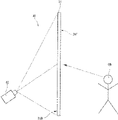
- 1 is a schematic diagram showing an image display system according to an embodiment of the present invention
- FIG. 4 is a schematic diagram showing a method of measuring maximum intensities A, B, and C
- FIG. 1 is a schematic diagram showing an image display system according to an embodiment of the present invention
- FIG. 4 is a schematic diagram showing
- the resin film of the present invention comprises a light diffusion layer containing light diffusion particles and a thermoplastic resin, and a transparent resin layer containing a thermoplastic resin.
- the resin film of the present invention is preferably used for image display screens. Since the resin film of the present invention includes a light diffusion layer containing light diffusion particles, the light irradiated to the resin film is diffused by the light diffusion layer. can be displayed on a screen with the film.
- the resin film is preferably an intermediate film for laminated glass, and more preferably used for an image display screen made of laminated glass.
- the resin film 10 includes the transparent resin layer 11 and the light diffusion layer 12 , and the light diffusion layer 12 is arranged inside the transparent resin layer 11 .
- the light diffusion layer 12 is provided in a partial region of the resin film 10, and the region provided with the resin film 10 is used as a screen for image display. , become display areas (areas X and Y) for displaying images, and in this specification, the area other than the display area is assumed to be area Z (also referred to as transparent area Z). Since the resin film 10 has a display area and a transparent area Z other than the display area, it is possible to achieve both excellent transparency and displayability.
- the thickness of the light diffusion layer 12 decreases from one end 12A of the light diffusion layer 12 to the other end 12B on the opposite side of the one end 12A in one direction OD (horizontal direction in FIG. 1) perpendicular to the thickness direction of the resin film. ing.
- the thickness may be continuously gradually reduced, thereby tapering the light diffusion layer 12 along one direction OD.
- the unidirectional OD is typically the MD (Machine direction) of the film, but may be the TD (Traverse direction) perpendicular to the MD, or may be a direction other than the MD and TD.
- the gradient of the thickness of the light diffusion layer 12 is 0.9 mrad or less in the region X from the other end 12B to 10%. If the inclination of the light diffusion layer 12 is greater than 0.9 mrad, when the screen having the resin film 10 is irradiated with light for image display, light scattering occurs at the boundary between the display area and the transparent area Z, resulting in, for example, There is a risk that a white linear pattern will be generated and the visibility will be reduced. It should be noted that the linear pattern tends to occur particularly when light with high luminance is irradiated.
- the inclination of the thickness of the light diffusion layer 12 means that, as shown in FIG. is an angle ⁇ formed by connecting and intersecting two sides constituting
- the angle ⁇ formed by the two sides forming both surfaces 12X and 12Y may be a constant angle in the region X of the light diffusion layer 12.
- the angle may change depending on the position, in which case the other end 12B of the light diffusion layer 12 and a point 10% from the other end 12B should be connected by a straight line, and the angle formed by the line should be ⁇ .
- the 10% here is 10% when the distance from the one end 12A to the other end 12B is 100%.
- the inclination of the thickness in the region X of the light diffusion layer 12 is preferably 0.05 mrad or more, more preferably 0.1 mrad or more, and still more preferably 0.1 mrad or more, from the viewpoint of making it easier to keep the display region and the area of the entire resin film below a certain value. is greater than or equal to 0.2 mrad.
- area Y the area other than the area X in the display area will be referred to as area Y (see FIG. 1).
- the thickness of the light diffusion layer 12 is continuously decreased from the region Y to the region X.
- the thickness of the light diffusing layer 12 should be reduced not only in the region X but also in the region Y. From the viewpoint of visibility, the smaller the thickness gradient in the region where the thickness of the region Y is reduced, the better.
- the gradient of the thickness is not particularly limited, and may be 0.9 mrad or less like the region X, but does not necessarily have to be 0.9 mrad or less.
- the transparent resin layer 11 comprises a first resin layer 11A and a second resin layer 11B
- the light diffusion layer 12 comprises these first and second resin layers. It is arranged between 11A and 11B and has a structure embedded between the resin layers 11A and 11B.
- the light diffusion layer 12 has a tapered shape as described above, and the first resin layers 11A and 11B are directly laminated in a region beyond the tip of the tapered shape (that is, the region Z), and these are integrally formed. , which is substantially composed of one resin layer (integral layer 11C).
- the region Z becomes a transparent region by being composed of the first and second resin layers 11A and 11B having high transparency.
- the display area that is, the areas X and Y
- Z is a transparent area. Z).
- the light diffusion layer 12 having a tapered shape preferably has, for example, a trapezoidal cross-section as shown in FIG.
- the tip thickness (also referred to as thickness D1) is, for example, 100 ⁇ m or less, preferably 80 ⁇ m or less, and more preferably 60 ⁇ m or less. By setting the thickness of the tip to be equal to or less than the above upper limit, when the resin film is irradiated with light for image display, unnecessary light scattering is less likely to occur at the tip of the light diffusion layer 12, and visibility tends to be good. .
- the thickness D1 is preferably as small as possible.
- the tip surface forming the tip of the other end 12B side of the light diffusion layer 12 is generally a surface along the thickness direction, but the thickness direction is moderate (for example, 60° to the thickness direction). ), may be a surface connected to the surfaces 12X and 12Y via a curved surface, or may be a curved surface.
- the width E of the light diffusion layer (that is, the distance from one end 12A to the other end 12B) is changed depending on the application, and is not particularly limited and is arbitrary. Yes, more preferably 50 mm or more and 1 m or less.
- the resin film 10 may consist of a transparent resin layer 11 and a light diffusion layer 12 .
- the resin film 10 may consist of a transparent resin layer 11 and a light diffusion layer 12 .
- the glass members 21 and 22 for example, when used for laminated glass, as shown in FIG. It is preferable to adhere to the glass members 21 and 22 for
- the resin film 10 may have resin layers other than the transparent resin layer 11 and the light diffusion layer 12 .
- the resin layers other than these one resin layer may be provided, or two or more resin layers may be provided.
- one or more resin layers may be provided on one surface of the transparent resin layer 11, or one or more resin layers may be provided on each of both surfaces of the transparent resin layer 11.
- At least two resin layers are preferably provided on at least one surface of the layer 11.
- third and fourth resin layers 13 and 14 are preferably provided in this order.
- the transparent resin layer 11 (first resin layer 11A) and the fourth resin layer 14 may be adhered to the glass members 21 and 22 for forming the laminated glass 25, for example.
- Various performances can be imparted to the resin film 10 by providing a resin layer other than the transparent resin layer 11 and the light diffusion layer 12 .
- a resin layer other than the transparent resin layer 11 and the light diffusion layer 12 For example, by providing two resin layers (third and fourth resin layers 13 and 14) on one surface of the transparent resin layer 11, the amount of plasticizer in each resin layer can be adjusted, and each resin layer can be Sound insulation performance can be imparted to the resin film by appropriately adjusting the amount of hydroxyl groups by using a polyvinyl acetal resin as the constituent resin.
- Resin layers other than the transparent resin layer 11 and the light diffusion layer 12 are transparent resin layers, thereby ensuring transparency in the transparent area Z and the display area. can.
- the resin film may have layers other than the resin layers described above, and for example, other layers such as an adhesive layer and a barrier layer may be arranged between the resin layers. Further, another layer such as an adhesive layer may be arranged between each glass member and the resin layer.
- the light diffusion layer 12 is not limited to the configuration shown in FIGS. 1 and 2, and may have another configuration.
- the light diffusion layer 12 consists of a region (thickness changing region) in which the thickness changes from one end 12A to the other end 12B, but it may have regions other than the thickness changing region.
- a portion having a thickness D2 on the one end 12A side of the thickness change region (that is, a portion having the largest thickness) may be provided with a constant length L as shown in FIG.
- the light diffusion layer 12 may have a tapered shape, such as a triangular shape or a trapezoidal shape, as described above, on the other end 12B side.
- the light diffusion layer 12 is provided only at one end of the resin film 10 in one direction OD, it may be provided at both ends as shown in FIG. In this case, display regions (regions X and Y) formed by the light diffusion layer 12 are provided on both ends of the resin film 10, and a transparent region Z in which the light diffusion layer 12 is not provided is provided between them. .
- the portion having the thickness D2 may be provided with a constant length L as shown in FIG.
- one end 12A of the light diffusion layer 12 is arranged at the end of the film 10, but it is not necessarily arranged at the end of the film 10. , may be arranged inside the end of the film 10 .
- the thickness of the resin film (that is, the thickness of the entire resin film) is not particularly limited, but is preferably 100 ⁇ m or more and 3.0 mm or less.
- the thickness of the resin film is more preferably 200 ⁇ m or more, still more preferably 400 ⁇ m or more.
- it is more preferably 2.0 mm or less, and still more preferably 1.5 mm or less.
- the thickness of the resin film and the thickness of the resin layers other than the light diffusion layer e.g., the thickness D3 of the transparent resin layer, the thickness of the third and fourth resin layers
- the average thickness may be obtained by averaging 10 points using a microscope.
- the thickness of the light diffusion layer is preferably 20 ⁇ m or more and 500 ⁇ m or less.
- the thickness of the light diffusion layer is more preferably 40 ⁇ m or more, still more preferably 60 ⁇ m or more, and more preferably 400 ⁇ m or less, still more preferably 300 ⁇ m or less.
- the thickness of the light diffusion layer is the thickness D2 (see FIGS. 1 to 4) of the portion where the thickness of the light diffusion layer 12 is the largest, and is usually the thickness of the portion on the one end 12A side of the light diffusion layer 12. be.
- the thickness D3 of the transparent resin layer is not particularly limited, it is preferably larger than the thickness of the light scattering layer described above, and is preferably 80 ⁇ m or more and 2.5 mm or less.
- the thickness is 80 ⁇ m or more, the adhesion of the resin film and the penetration resistance of the laminated glass when used as an intermediate film for laminated glass can be improved.
- the thickness is 2.5 mm or less, it is possible to prevent the thickness of the resin film from increasing more than necessary, and to easily ensure transparency.
- each resin layer other than the light diffusion layer is more preferably 200 ⁇ m or more, more preferably 300 ⁇ m or more, more preferably 1.8 mm or less, and even more preferably 1.3 mm or less.
- the thickness D3 of the transparent resin layer 11 is the distance from one surface of the transparent resin layer 11 to the other surface as shown in FIG.
- the thickness of the resin layers other than the transparent resin layer and the light diffusion layer is not particularly limited.
- the third and fourth resin layers 13 and 14 when the third and fourth resin layers 13 and 14 are provided, from the viewpoint of improving various performances such as sound insulation without increasing the thickness of the resin film more than necessary, the third The resin layer preferably has a thickness of 20 ⁇ m or more and 300 ⁇ m or less, more preferably 50 ⁇ m or more and 250 ⁇ m or less, and still more preferably 75 ⁇ m or more and 200 ⁇ m or less.
- the thickness of the fourth resin layer is preferably 100 ⁇ m or more and 600 ⁇ m or less, more preferably 150 ⁇ m or more and 500 ⁇ m or less, and still more preferably 200 ⁇ m or more and 400 ⁇ m or less.
- the resin film of the present invention is a laminated glass prepared by adhering two sheets of reference glass via the resin film.
- the ratio of the maximum intensity A at 430 to 460 nm and the maximum intensity B at 530 to 560 nm (maximum intensity A/maximum intensity B) is preferably 1.0 or less.
- the reference glass is a clear glass with a thickness of 2.5 mm, more specifically, a clear glass with a thickness of 2.5 mm conforming to JIS R 3211 (1998) and having a visible light transmittance of 90.4. % should be used. Pseudo sunlight is irradiated by a solar simulator.
- a wavelength of 430 to 460 nm is a wavelength at which blue light appears
- a wavelength of 530 to 560 nm is a wavelength at which green light appears. Therefore, by setting the maximum intensity A/maximum intensity B to 1.0 or less, it is possible to suppress excessive diffusion of blue light by the light diffusion particles as compared with green light. Therefore, by using the resin film for the screen, it is possible to improve the color reproducibility when an image is displayed in the display area. From the viewpoint of improving color reproducibility, maximum intensity A/maximum intensity B is more preferably 0.9 or less, and even more preferably 0.8 or less.
- the maximum intensity A/maximum intensity B is preferably 0.1 or more, and more preferably 0.3 or more. Preferably, 0.5 or more is even more preferable.
- the resin film of the present invention is a laminated glass prepared by bonding two sheets of reference glass via a resin film.
- the ratio of the maximum intensity A at 430 to 460 nm to the maximum intensity C at 560 to 600 nm is preferably 1.2 or less.
- a wavelength of 430 to 460 nm is a wavelength at which blue light appears, and a wavelength of 560 to 600 nm is a wavelength at which red light appears. Therefore, by setting the maximum intensity A/maximum intensity C to 1.2 or less, it is possible to suppress excessive diffusion of blue light by the light diffusion particles as compared with red light.
- maximum intensity A/maximum intensity C is more preferably 1.1 or less, and even more preferably 1.05 or less.
- the maximum intensity A/maximum intensity C is preferably 0.2 or more, and more preferably 0.4 or more. Preferably, 0.6 or more is even more preferable.
- the maximum intensities A, B, and C are the maximum intensity values in the wavelength range of 430 to 460 nm, the wavelength range of 530 to 560 nm, and the wavelength range of 560 to 600 nm, respectively.
- the values of the maximum intensities A, B, and C are preferably obtained by irradiating simulated sunlight from one surface of the laminated glass and measuring it on the other surface. , the maximum intensity should be measured at the position irradiated with the simulated sunlight.
- the maximum intensity ratio described above can be adjusted within the predetermined range described above by appropriately selecting the type, particle size, particle size distribution, etc. of the light diffusion particles contained in the resin film. For example, as will be described later, the use of a combination of light diffusing particles, the control of the particle size distribution of the light diffusing particles, and the like can be mentioned.
- the resin film of the present invention preferably has a transmittance of 70% or more in the region Y in a laminated glass prepared by bonding two sheets of reference glass via a resin film.
- the transmittance means visible light transmittance, and can be obtained by measuring according to JIS R3212 (2015).
- the transmittance of the region Y is 70% or more, a certain degree of transparency can be ensured even in the display region, and it can be suitably used for various types of window glass, such as the windshield of an automobile. can be done. From the viewpoint of ensuring higher transparency, the transmittance is more preferably 75% or higher, and even more preferably 80% or higher.
- the transmittance of the region Y may vary from position to position due to changes in the thickness of the light diffusion layer. good.
- the resin film of the present invention is a laminated glass produced by bonding two sheets of reference glass via a resin film, in which the transmittance of the region Z (that is, the transparent region) is higher than the transmittance of the region Y described above. Specifically, it is preferably 75% or more.
- the transmittance means visible light transmittance, and can be obtained by measuring according to JIS R3212 (2015).
- the transmittance of the region Z is 75% or more, excellent transparency can be secured in the transparent region Z, and it can be suitably used for various window glasses, for example, it can also be used for automobile windshields. can be done. From the viewpoint of ensuring higher transparency, the transmittance is more preferably 80% or higher, and even more preferably 85% or higher. From the viewpoint of ensuring the transparency of the resin film, the higher the transmittance, the better, but practically it is 99% or less.
- the resin film of the present invention preferably has a haze value of region Y of 15% or less in a laminated glass produced by bonding two sheets of reference glass via a resin film.
- the haze value is more preferably 10% or less, even more preferably 6% or less, and even more preferably 4% or less, from the viewpoint of increasing transparency.
- the haze value is, for example, 0.5% or more, preferably 1% or more, and more preferably 2% or more, from the viewpoint of appropriately displaying an image by diffusing a certain amount of light with the light diffusion particles.
- the haze value can be measured according to JIS K6714. As described above, the haze value of the region Y may differ from position to position due to changes in the thickness of the light diffusion layer. .
- the resin film of the present invention is a laminated glass produced by bonding two sheets of reference glass via a resin film, and the haze value of the region Z (that is, the transparent region) is preferably lower than that of the display region. is 12% or less.
- the haze value is more preferably 8% or less, even more preferably 5% or less, and even more preferably 3% or less, from the viewpoint of increasing transparency and visibility.
- the haze value in the region Z should be 0% or more.
- Light diffusing particles used in the resin film of the present invention include silicon oxide such as silica, zirconium oxide, titanium oxide, aluminum oxide such as alumina, magnesium oxide, semimetal or metal oxide particles such as cerium oxide, aluminum, Metal particles such as silver, platinum, gold, titanium, nickel, tin, indium, and tin-cobalt alloys, diamond particles, calcium carbonate, glass flakes, mica, and the like.
- silicon oxide such as silica, zirconium oxide, titanium oxide, aluminum oxide such as alumina, magnesium oxide, semimetal or metal oxide particles such as cerium oxide, aluminum
- Metal particles such as silver, platinum, gold, titanium, nickel, tin, indium, and tin-cobalt alloys, diamond particles, calcium carbonate, glass flakes, mica, and the like.
- semi-metal or metal oxide particles, metal particles, and diamond particles are preferable from the viewpoint of easily improving light diffusibility, color reproducibility, etc. while ensuring the transparency of the resin film.
- More preferred are metal
- the light diffusing particles may be core-shell particles.
- the light diffusing particles are preferably core-shell particles in which any one of the semimetal or metal oxide particles, metal particles, diamond particles, or the like described above is used as a core and coated with a different material.
- metal particles (core-shell particles) having the metal particle as a core and the above semimetal or metal oxide, or a composite of a semimetal or metal oxide and a polymer as a shell. may Further, metal particles (core-shell particles) having the above metal oxide particles as the core and the above semimetal or metal oxide, or a composite of the semimetal or metal oxide and the polymer as the shell, etc. good.
- particles containing metal and metal oxide may be used as cores. It may also be a core-shell particle having a semimetal or metal oxide as the core and a metal as the shell.
- the light diffusing particles may be core-shell particles whose shell is silica, alumina or a mixture thereof, or core-shell particles whose shell is a composite of silica, alumina or a mixture thereof and a polymer. may be Further, the light diffusing particles may include core-shell particles having the mixture as a shell and core-shell particles having the composite as a shell. Among these, metal particles having a metal particle as a core (core-shell particles) are preferred.
- Metal oxide particles having a metal oxide particle as a core are also preferred. Further, it may be a core-shell particle having a particle containing both a metal and a metal oxide as a core. More specifically, the light diffusing particles may be core-shell particles whose core is a particle containing a silver element such as silver, or core-shell particles whose core is a particle containing a titanium element such as titanium oxide. It may be a particle, or a core-shell particle having a core of a particle containing both silver element and titanium element.
- silver particles are composed of silver particles as a core, silica, alumina or a mixture thereof, silica, alumina or a mixture thereof, and a polymer such as polyvinylpyrrolidone as a shell. It may be a particle that Also, the core-shell particles may be particles having silica as the core and silver or other metal as the shell.
- the light diffusing particles may be used singly or in combination of two or more.
- the average particle size of the light diffusing particles is preferably 1 nm or more and 100 ⁇ m or less, for example. Within the above range, visible light is appropriately diffused by the light diffusing particles, and for example, color reproducibility when displaying an image can be improved.
- the average particle size of the light diffusing particles is preferably 3 nm or more and 50 ⁇ m or less, preferably 5 nm or more, from the viewpoint of improving the light diffusing property, for example, making it easier to set the above intensity ratio to the above range, and improving the color reproducibility. It is more preferably 20 ⁇ m or less, and preferably 10 nm or more and 5 ⁇ m or less.
- the average particle size of the light diffusing particles can be measured by a laser diffraction/scattering method.
- the light diffusing particles are preferably so-called nanoparticles from the viewpoint of appropriately diffusing visible light and improving color reproducibility. Therefore, the light diffusion particles are more preferably nanoparticles containing at least one of elemental silver and elemental titanium, more preferably silver nanoparticles, titanium oxide nanoparticles, and nanodiamonds, and particularly preferably silver nanoparticles.
- the nanoparticles are particles having an average particle size of 1 ⁇ m or less (1000 nm or less), and the average particle size of the nanoparticles is preferably 900 nm or less. Although the lower limit of the average particle size of the nanoparticles is as described above for the light diffusion particles, the average particle size of the nanoparticles may be 50 nm or more, or may be 110 nm or more.
- the above intensity ratio can be easily set within the above range, and from the viewpoint of improving color reproducibility, two or more types of particles with different compositions, preferably at least three types of particles with different compositions are used. good.
- the above-mentioned core-shell particles it is preferable to use at least two, preferably at least three kinds of particles in which the core and shell are made of the same material and the mass ratio of the shell to each particle is different from each other.
- the particle size distribution of the light diffusing particles may be appropriately adjusted so that the intensity ratio is within the desired range.
- the content of particles with small particle diameters should be small, and the content of particles with a diameter of 10 nm or less should be particularly small.
- the content of particles with a diameter of 10 nm or less should be particularly small.
- light on the short wavelength side is more easily dispersed.
- two or more kinds of light-scattering particles having different average particle diameters may be mixed.
- the shape of the light diffusing particles is not particularly limited, and may be a flaky shape such as a plate shape or a scale shape, a spherical shape or a shape approximating a sphere (substantially spherical), a polyhedral shape, or a shape approximating a polyhedron (e.g. , a partially curved polyhedron, a substantially polyhedron), an irregular shape, and the like.
- the light diffusing particles may, for example, have an aspect ratio of less than 3, preferably 2 or less. By reducing the aspect ratio of the light diffusing particles, it becomes easier to improve the light diffusibility while reducing the haze value.
- Spherical or substantially spherical light diffusion particles generally have an aspect ratio of 2 or less, which is close to 1.
- the aspect ratio it is preferable to obtain the ratio of the major axis and the minor axis of the particle, and in the case of flaky light diffusing particles, it is preferable to measure the major axis/thickness.
- the aspect ratio may be measured by microscopic observation such as SEM, for example, 50 particles may be measured and the average value thereof may be taken as the aspect ratio.
- the content of the light diffusing particles in the area of the resin film where the light diffusion layer is provided is preferably 0.00001% by mass or more and 1% by mass or less with respect to 100% by mass of the resin film. .
- the content of the light diffusing particles is at least the above lower limit, light can be diffused appropriately in the display area, and images can be displayed appropriately.
- the value to the above upper limit or less it is possible to ensure transparency in the display area without excessive light shielding by the light diffusion particles, and to adjust the haze value and the transmittance in the display area within a desired range. easier.
- the content of the light diffusing particles in 100% by mass of the resin film is more preferably 0.00005% by mass or more, still more preferably 0.0001% by mass or more, and even more preferably 0.0008% by mass. % or more, more preferably 0.5% by mass or less, still more preferably 0.1% by mass or less, even more preferably 0.09% by mass or less, still more preferably 0.05% by mass or less, especially Preferably, it is 0.01% by mass or less.
- the content ratio of the light diffusion particles in the display area changes accordingly. It represents the ratio of the content of the particles to the entire layer of the resin film.
- the content of the light diffusion particles in the light diffusion layer is preferably 0.00005% by mass or more and 2% by mass or less in 100% by mass of the light diffusion layer.
- the content of the light diffusing particles in the light diffusing layer is equal to or higher than the above lower limit, the light can be diffused moderately in the light diffusing layer, and an image can be appropriately displayed.
- the content of the light diffusion particles in 100% by mass of the light diffusion layer is more preferably 0.0001% by mass or more, still more preferably 0.0005% by mass or more, and even more preferably 0.005% by mass. % or more, more preferably 1% by mass or less, still more preferably 0.5% by mass or less, even more preferably 0.1% by mass or less, even more preferably 0.09% by mass or less, particularly preferably 0 .03% by mass or less.
- the light diffusing layer contains the thermoplastic resin as described above, and the light diffusing particles are dispersed in the thermoplastic resin.
- the transparent resin layers that is, the first and second resin layers
- the transparent resin layers also contain a thermoplastic resin.
- the thermoplastic resin used for the light diffusion layer is sometimes described as the thermoplastic resin (A)
- the thermoplastic resin used for the transparent resin layer is described as the thermoplastic resin (B).
- thermoplastic resins (A) and (B) used for the light diffusion layer and the transparent resin layer are not particularly limited, but examples include polyvinyl acetal resins, ethylene-vinyl acetate copolymer resins, ionomer resins, polyurethane resins, and thermoplastic elastomers. By using these resins, the adhesiveness to the glass member is increased, and it can be suitably used as an interlayer film for laminated glass. Among the above, polyvinyl acetal resins are preferred as the thermoplastic resins (A) and (B).
- thermoplastic resins (A) and (B) may be used alone or in combination of two or more. Details of the thermoplastic resin will be described later.
- the light diffusion layer of the invention preferably further contains a plasticizer.
- the transparent resin layers also contain a plasticizer.
- the plasticizer contained in the light diffusion layer may be referred to as plasticizer (A), and the plasticizer contained in the transparent resin layer may be referred to as plasticizer (B).
- the light diffusion layer and transparent resin layer become flexible by containing a plasticizer.
- the light diffusion layer contains light diffusion particles and a plasticizer, so that when the resin film is used for an image display screen, the contrast of the displayed image can be further enhanced.
- plasticizer increases the difference in refractive index between the light diffusing layer and the light diffusing particles.
- plasticizers (A) and (B) are particularly effective when the polyvinyl acetal resin (A) is used as the thermoplastic resins (A) and (B). Details of the plasticizers (A) and (B) will be described later.
- the content of the plasticizer (A) with respect to 100 parts by mass of the thermoplastic resin (A) is preferably 10 parts by mass or more.
- the content of the plasticizer (B) with respect to 100 parts by mass of the thermoplastic resin (B) is preferably 10 parts by mass or more.
- each of the plasticizer contents (A) and (B) is more preferably 15 parts by mass or more, still more preferably 20 parts by mass or more, and particularly preferably 24 parts by mass or more.
- Each of the contents (A) and (B) is preferably 60 parts by mass or less, more preferably 50 parts by mass or less, and even more preferably 45 parts by mass or less. When each of these contents is equal to or less than the above upper limit, mechanical properties such as flexural rigidity of the resin film are improved.
- thermoplastic resins used for the thermoplastic resins (A) and (B) may be different types of resins, but preferably the same type of resin. Therefore, both thermoplastic resins (A) and (B) are preferably polyvinyl acetal resins. Also, the compositions of the first and second resin layers constituting the transparent resin layer may be the same or different, but are preferably the same. That is, the thermoplastic resins used for the first and second resin layers may be different types of resins, but are preferably of the same type. Therefore, the thermoplastic resin (B) used for each of the first and second resin layers is preferably a polyvinyl acetal resin.
- Both the light diffusion layer and the transparent resin layer preferably contain a plasticizer, and both the first and second resin layers preferably contain a plasticizer.
- the types of plasticizers used in the light diffusion layer and the transparent resin layer may be different or the same.
- the content (A) and the content (B) described above may be the same or different.
- the contents of the plasticizer for 100 parts by mass of the thermoplastic resin in the first and second resin layers constituting the transparent resin layer may be different, but are preferably the same.
- the preferable range of the content of the plasticizer with respect to 100 parts by mass of the thermoplastic resin in the first and second resin layers constituting the transparent resin layer is as described in the above content (B).
- the types of plasticizers used in the first and second resin layers constituting the transparent resin layer may be different from each other, but are preferably the same.
- each of the light diffusion layer and the transparent resin layer is mainly composed of a thermoplastic resin, or a thermoplastic resin and a plasticizer, and the total of the thermoplastic resin and the plasticizer is The amount is preferably 70% by mass or more, more preferably 80% by mass or more, and still more preferably 90% by mass or more based on the total amount of the light diffusion layer or transparent resin layer.
- each resin layer (for example, the third and fourth resin layers) other than the light diffusion layer and the transparent resin layer is a layer containing a thermoplastic resin.
- a thermoplastic resin used as the resin for each resin layer other than the light diffusion layer and the transparent resin layer, it becomes easier to bond each resin layer to another resin layer or glass member.
- thermoplastic resins used for the third and fourth resin layers may be referred to as thermoplastic resin (C) and thermoplastic resin (D), respectively.
- thermoplastic resin (e.g., thermoplastic resins (C) and (D)) used for each resin layer other than the light diffusion layer and the transparent resin layer is not particularly limited, but for example, thermoplastic resin (A) , (B) can be appropriately selected from those listed as resins that can be used as (B).
- polyvinyl acetal resin is preferred.
- a polyvinyl acetal resin it is easy to improve the adhesion to a glass member, especially when the glass member is inorganic glass, and it can be suitably used as an interlayer film for laminated glass.
- properties required for an interlayer film for laminated glass such as penetration resistance and sound insulation, can be easily obtained.
- thermoplastic resin used for the resin layers other than the light diffusion layer may be used singly or in combination of two or more in each resin layer.
- the thermoplastic resin used for each resin layer other than the light diffusion layer is preferably the same resin as the thermoplastic resins (A) and (B) from the viewpoint of improving adhesion. Therefore, when the resin film has the third and fourth resin layers and the thermoplastic resins (A) and (B) are polyvinyl acetal resins, both the thermoplastic resins (C) and (D) are polyvinyl An acetal resin is preferred.
- the details of the thermoplastic resin used for the resin layers other than the light diffusion layer and the transparent resin layer will be described later.
- each resin layer other than a light-diffusion layer also contains a plasticizer. That is, the third resin layer in the resin film preferably contains a plasticizer. Also, the fourth resin layer preferably contains a plasticizer. Therefore, when the resin film has the third and fourth resin layers, it is preferable that the light diffusion layer, the transparent resin layer, and the third and fourth resin layers all contain a plasticizer.
- the plasticizer contained in each of the third and fourth resin layers may be referred to as plasticizer (C) and plasticizer (D).
- the content of the plasticizer (C) with respect to 100 parts by mass of the thermoplastic resin (C) in the third resin layer may be described as content (C)
- the thermoplastic resin (D ) The content of the plasticizer (D) with respect to 100 parts by mass may be described as content (D).
- each resin layer other than the light diffusion layer and the transparent resin layer described above becomes flexible by containing a plasticizer.
- a plasticizer is particularly effective to incorporate a plasticizer into each of the resin layers other than the light diffusion layer and the transparent resin layer when polyvinyl acetal resin is used as the thermoplastic resin.
- plasticizers (e.g., plasticizers (C) and (D)) used in the resin layers other than the light diffusion layer and the transparent resin layer may be of the same type as the plasticizers (A) and (B). and may be of different types.
- Plasticizers (e.g., plasticizers (C) and (D)) used in resin layers other than the light diffusion layer and the transparent resin layer may be of the same type or different types. .
- only one type of plasticizer may be used for each resin layer other than the light diffusion layer and the transparent resin layer, or two or more types may be used in combination.
- the content of the plasticizer in each of the resin layers other than the light diffusion layer is, for example, 10 parts by mass or more with respect to 100 parts by mass of the thermoplastic resin.
- the content of the plasticizer is equal to or higher than the above lower limit, the flexibility of the resin film is increased and the handling of the resin film is facilitated.
- the content of the plasticizer with respect to 100 parts by mass of the thermoplastic resin in the third resin layer (hereinafter sometimes referred to as content (C)) is greater than the contents (A) and (B), and further the content of the plasticizer with respect to 100 parts by mass of the thermoplastic resin in the fourth resin layer (hereinafter sometimes referred to as content (D)) is preferred.
- the plasticizer content in the third resin layer is increased as described above, and the resin film is used as an interlayer film for laminated glass. performance is enhanced.
- the content (C) is preferably 20 parts by mass or more, more preferably 30 parts by mass or more, still more preferably 40 parts by mass or more, and more preferably 50 parts by mass or more. . Also, the content (C) is preferably 100 parts by mass or less, more preferably 90 parts by mass or less, even more preferably 85 parts by mass or less, and particularly preferably 80 parts by mass or less. If the content (C) is not more than the above upper limit, the penetration resistance of the laminated glass when the resin film is used in the laminated glass tends to be high.
- the content (D) is preferably 10 parts by mass or more, more preferably 15 parts by mass or more, still more preferably 20 parts by mass or more, and particularly preferably 24 parts by mass, from the viewpoint of handleability and flexibility of the resin film. Department or above. Also, the content (D) is preferably 60 parts by mass or less, more preferably 50 parts by mass or less, and even more preferably 45 parts by mass or less from the viewpoint of mechanical properties such as bending rigidity.
- each resin layer other than the light diffusion layer contains a thermoplastic resin or a thermoplastic resin and a plasticizer as main components, and the thermoplastic resin and the plasticizer is preferably 70% by mass or more, more preferably 80% by mass or more, and still more preferably 90% by mass or more, based on the total amount of each resin layer.
- Each resin layer other than the light diffusion layer contains the light diffusion particles described above.
- the content of the light diffusing particles with respect to the resin film in the display area is designed to be within the above range. Even if each resin layer other than the light diffusion layer contains the above-described light diffusion particles, the content thereof is small, or it is preferable that the resin layers do not contain light diffusion particles. is more preferred.
- each resin layer other than the light diffusion layer does not contain light diffusion particles, or if it is contained, it is contained in a small amount (at least the content is less than that of the light diffusion layer), so that each resin layer can scatter light. becomes almost non-existent.
- the content of the light diffusion particles in each resin layer other than the light diffusion layer is particularly Although not limited, it is, for example, less than 0.1% by mass, preferably less than 0.0005% by mass, more preferably less than 0.00001% by mass, still more preferably 0% by mass.
- polyvinyl acetal resin Details of the polyvinyl acetal resin used for each resin layer will be described below. In the following description, the common structure of the polyvinyl acetal resin used for each resin layer is simply referred to as "polyvinyl acetal resin". In addition, regarding individual configurations of the polyvinyl acetal resin used for each of the light diffusion layer, the transparent resin layer, the third resin layer, and the fourth resin layer, "Polyvinyl acetal resin (A)”, “Polyvinyl acetal resin (B)”, “polyvinyl acetal resin (C)”, and “polyvinyl acetal resin (D)”.
- Polyvinyl acetal resin is obtained by acetalizing polyvinyl alcohol (PVA) with aldehyde. That is, the polyvinyl acetal resin is preferably an acetalized product of polyvinyl alcohol (PVA).
- Polyvinyl alcohol (PVA) is obtained, for example, by saponifying a polyvinyl ester such as polyvinyl acetate. The degree of saponification of polyvinyl alcohol is generally 70-99.9 mol %.
- Polyvinyl acetal resin may be used individually by 1 type, and may use 2 or more types together.
- the average degree of polymerization of the polyvinyl acetal resin is preferably 200 or higher, more preferably 500 or higher, still more preferably 1000 or higher, and even more preferably 1500 or higher. When the average degree of polymerization is equal to or higher than the above lower limit, the penetration resistance of the laminated glass increases. Also, the average degree of polymerization of the polyvinyl acetal resin is preferably 5,000 or less, more preferably 4,000 or less, and even more preferably 3,500 or less. When the average degree of polymerization is equal to or less than the upper limit, molding of the resin film becomes easier.
- the average degree of polymerization of the polyvinyl acetal resin used for each resin layer may be the same or different.
- the third resin layer for example, when the content (C) of the plasticizer is 55 parts by mass or more, it is also preferable to set the average degree of polymerization of the polyvinyl acetal resin (C) to 2000 or more. , 2500 or more.
- the average degree of polymerization of the polyvinyl acetal resin (C) is lower than the average degree of polymerization of each of the polyvinyl acetal resins (for example, the polyvinyl acetal resins (A), (B), and (D)) in the resin layers other than the third resin layer.
- the average degree of polymerization of the polyvinyl acetal resin (C) is preferably higher than the average degree of polymerization of the polyvinyl acetal resin in the resin layers other than the third resin layer.
- the average degree of polymerization of the polyvinyl acetal resin (C) is increased, various performances can be easily maintained in the third resin layer even if the content of the plasticizer is increased, for example.
- the average degree of polymerization of polyvinyl acetal resin is the same as the average degree of polymerization of PVA, which is the raw material of polyvinyl acetal resin, and the average degree of polymerization of PVA is determined by a method based on JIS K6726 "Polyvinyl alcohol test method". .
- the aldehyde used for acetalization is not particularly limited, but an aldehyde having 1 to 10 carbon atoms is preferably used, more preferably an aldehyde having 3 to 5 carbon atoms, more preferably an aldehyde having 4 or 5 carbon atoms, Aldehydes having 4 carbon atoms are particularly preferred.
- the aldehyde having 1 to 10 carbon atoms is not particularly limited, and examples thereof include formaldehyde, acetaldehyde, propionaldehyde, n-butyraldehyde, isobutyraldehyde, n-valeraldehyde, 2-ethylbutyraldehyde, n-hexylaldehyde, n- octylaldehyde, n-nonylaldehyde, n-decylaldehyde, benzaldehyde and the like.
- acetaldehyde, propionaldehyde, n-butyraldehyde, isobutyraldehyde, n-hexylaldehyde and n-valeraldehyde are preferred, propionaldehyde, n-butyraldehyde, isobutyraldehyde and n-valeraldehyde are more preferred, and n-butyl More preferred are aldehydes or n-valeraldehyde, most preferred is n-butyraldehyde. Only one kind of the aldehyde may be used, or two or more kinds thereof may be used in combination.
- the number of carbon atoms in the acetal group contained in the polyvinyl acetal resin is not particularly limited, it is preferably 1-10, more preferably 3-5, still more preferably 4 or 5, and particularly preferably 4.
- the acetal group is particularly preferably a butyral group, and therefore, the polyvinyl acetal resin is preferably a polyvinyl butyral resin. That is, in the present invention, both the thermoplastic resins (A) and (B) in the light diffusion layer and the transparent resin layer are preferably polyvinyl butyral resins.
- thermoplastic resins (A), (B), and (C) in the third and fourth resin layers , (D) are preferably polyvinyl butyral resins. That is, when the resin film has a plurality of resin layers, the thermoplastic resin in all the resin layers is preferably polyvinyl butyral resin.
- each hydroxyl group content (hydroxyl group amount) of the polyvinyl acetal resin (D) is, for example, 20 mol% or more, It is preferably 25 mol % or more, more preferably 28 mol % or more.
- the content of hydroxyl groups is at least the lower limit, the adhesive strength of the resin film is improved, and the flexural rigidity can be increased while maintaining sound insulation.
- Each hydroxyl group content of the polyvinyl acetal resins (A), (B) and (D) is preferably 38 mol % or less, more preferably 36 mol % or less, still more preferably 34 mol % or less.
- the polyvinyl acetal resin tends to precipitate during synthesis of the polyvinyl acetal resin.
- the contents of hydroxyl groups in the polyvinyl acetal resins (A), (B), and (D) may be the same or different.
- the hydroxyl content (hydroxyl group amount) of the polyvinyl acetal resin (C) is preferably 17 mol% or more, more preferably 20 mol% or more, and is, for example, 38 mol% or less, preferably 34 mol% or less. be.
- the content of hydroxyl groups is equal to or higher than the above lower limit, the adhesive strength of the resin film is further increased.
- the content is more preferably 30 mol % or less, and still more preferably 27 mol % or less. Further, when the hydroxyl content of the polyvinyl acetal resin (C) is 20 mol % or more, the reaction efficiency is high and the productivity is excellent.
- the hydroxyl content of the polyvinyl acetal resin (C) is preferably lower than the hydroxyl content of the polyvinyl acetal resin used in the resin layers other than the third resin layer. . Therefore, the hydroxyl group content of the polyvinyl acetal resin (C) is preferably lower than the hydroxyl group contents of the polyvinyl acetal resins (A), (B) and (D).
- the absolute value of the difference in the content is preferably It is 1 mol % or more. Thereby, sound insulation can be further improved. From this point of view, the absolute value of the difference in hydroxyl group content is more preferably 5 mol % or more. Moreover, the absolute value of the difference in each content of the hydroxyl group is preferably 20 mol % or less.
- the content of hydroxyl groups in the polyvinyl acetal resin is the molar fraction obtained by dividing the amount of ethylene groups to which hydroxyl groups are bonded by the total amount of ethylene groups in the main chain, expressed as a percentage.
- the amount of ethylene groups to which the hydroxyl groups are bonded can be measured according to, for example, JIS K6728 "Polyvinyl butyral test method".
- Polyvinyl acetal resins (A) and (B), and when a fourth resin layer is provided, each degree of acetalization (degree of butyralization in the case of polyvinyl butyral resin) of polyvinyl acetal resin (D) is It is preferably 55 mol % or more, more preferably 60 mol % or more, and still more preferably 63 mol % or more. Also, it is preferably 85 mol % or less, more preferably 80 mol % or less, and still more preferably 75 mol % or less.
- the degree of acetalization is at least the lower limit, the compatibility between the polyvinyl acetal resin and the plasticizer is enhanced.
- the degree of acetalization of the polyvinyl acetal resins (A), (B) and (D) may be the same or different.
- the degree of acetalization of the polyvinyl acetal resin (C) is preferably 47 mol% or more, more preferably 55 mol% or more, still more preferably 60 mol% or more, and more preferably 85 mol% or less, more preferably is 80 mol % or less, more preferably 75 mol % or less.
- the degree of acetalization means the degree of butyralization when the acetal group is a butyral group and the polyvinyl acetal resin (C) is a polyvinyl butyral resin.
- the degree of acetalization is the total amount of ethylene groups in the main chain minus the amount of ethylene groups to which hydroxyl groups are bonded and the amount of ethylene groups to which acetyl groups are bonded. It is a value showing the mole fraction obtained by dividing by the percentage.
- the degree of acetalization (degree of butyralization) may be calculated from the results measured by a method conforming to JIS K6728 "Polyvinyl butyral test method".
- each degree of acetylation of the polyvinyl acetal resin (D) is preferably 10 mol % or less, more preferably 2 mol. % or less.
- the degree of acetylation is equal to or less than the upper limit, the moisture resistance of the resin film increases.
- the content is preferably 0.01 mol % or more, more preferably 0.1 mol % or more.
- the acetylation degrees of the polyvinyl acetal resins (A), (B) and (D) may be the same or different.
- the degree of acetylation (acetyl group content) of the polyvinyl acetal resin (C) is preferably 0.01 mol% or more, more preferably 0.1 mol% or more.
- the degree of acetylation is more preferably 7 mol % or more, particularly preferably 9 mol % or more, from the viewpoint of increasing the compatibility between the polyvinyl acetal resin and the plasticizer and facilitating the blending of a large amount of the plasticizer. be.
- the degree of acetylation of the polyvinyl acetal resin (C) is preferably 30 mol% or less, more preferably 25 mol% or less, even more preferably 24 mol% or less, and particularly preferably 20 mol% or less. When the degree of acetylation is equal to or less than the upper limit, the moisture resistance of the resin film increases.
- the degree of acetylation is a value expressed as a percentage of the mole fraction obtained by dividing the amount of ethylene groups to which acetyl groups are bonded by the total amount of ethylene groups in the main chain.
- the amount of ethylene groups to which the acetyl groups are bonded can be measured according to, for example, JIS K6728 "Polyvinyl butyral test method".
- the polyvinyl acetal resin (B) in the first and second resin layers constituting the transparent resin layer are preferably the same as each other, but may be different from each other. Therefore, the average degree of polymerization, the amount of hydroxyl groups, the degree of acetalization, and the degree of acetylation are preferably the same, but may be different.
- the ethylene-vinyl acetate copolymer resin may be a non-crosslinked ethylene-vinyl acetate copolymer resin or a high-temperature crosslinked ethylene-vinyl acetate copolymer resin.
- ethylene-vinyl acetate copolymer resin ethylene-vinyl acetate modified resins such as saponified ethylene-vinyl acetate copolymer and ethylene-vinyl acetate hydrolyzate can also be used.
- the ethylene-vinyl acetate copolymer resin preferably has a vinyl acetate content of 10 to 50% by mass, more preferably 20 to 40% by mass, as measured according to JIS K 6730 "Ethylene-vinyl acetate resin test method". .
- a vinyl acetate content 10 to 50% by mass, more preferably 20 to 40% by mass, as measured according to JIS K 6730 "Ethylene-vinyl acetate resin test method".
- the ionomer resin is not particularly limited, and various ionomer resins can be used. Specific examples include ethylene ionomers, styrene ionomers, perfluorocarbon ionomers, telechelic ionomers, polyurethane ionomers, and the like. Among these, ethylene-based ionomers are preferable because they improve the mechanical strength, durability, transparency, etc. of the screen, and because they have excellent adhesion to the glass plate when the glass plate is made of inorganic glass.
- an ethylene/unsaturated carboxylic acid copolymer ionomer is preferably used because of its excellent transparency and toughness.
- the ethylene/unsaturated carboxylic acid copolymer is a copolymer having at least structural units derived from ethylene and structural units derived from unsaturated carboxylic acid, and may have structural units derived from other monomers.
- unsaturated carboxylic acids include acrylic acid, methacrylic acid, maleic acid, etc. Acrylic acid and methacrylic acid are preferred.
- Other monomers include acrylic acid esters, methacrylic acid esters, 1-butene, and the like.
- the ethylene/unsaturated carboxylic acid copolymer preferably has 75 to 99 mol% of ethylene-derived structural units when the total structural units of the copolymer are 100 mol%, and unsaturated carboxylic acid-derived It preferably has 1 to 25 mol % of structural units.
- the ionomer of the ethylene/unsaturated carboxylic acid copolymer is an ionomer resin obtained by neutralizing or crosslinking at least part of the carboxyl groups of the ethylene/unsaturated carboxylic acid copolymer with metal ions.
- the degree of neutralization of carboxyl groups is usually 1-90%, preferably 5-85%.
- Ion sources for ionomer resins include alkali metals such as lithium, sodium, potassium, rubidium and cesium, and polyvalent metals such as magnesium, calcium and zinc, with sodium and zinc being preferred.
- the method for producing the ionomer resin is not particularly limited, and it can be produced by a conventionally known production method.
- an ionomer of an ethylene/unsaturated carboxylic acid copolymer for example, ethylene and an unsaturated carboxylic acid are subjected to radical copolymerization at high temperature and high pressure to form an ethylene/unsaturated carboxylic acid. to produce a copolymer;
- an ionomer of the ethylene/unsaturated carboxylic acid copolymer can be produced.
- polyurethane resin examples include polyurethanes obtained by reacting an isocyanate compound with a diol compound, polyurethanes obtained by reacting an isocyanate compound with a diol compound, and a chain extender such as polyamine. Moreover, the polyurethane resin may contain a sulfur atom. In that case, part or all of the diols may be selected from polythiols and sulfur-containing polyols. Polyurethane resin can improve adhesion to organic glass. Therefore, it is preferably used when the glass plate is organic glass.
- thermoplastic elastomer examples include styrene-based thermoplastic elastomers and aliphatic polyolefins.
- the styrene-based thermoplastic elastomer is not particularly limited, and known ones can be used.
- a styrenic thermoplastic elastomer generally has a styrene monomer polymer block as a hard segment and a conjugated diene compound polymer block or a hydrogenated block thereof as a soft segment.
- styrene-based thermoplastic elastomers include styrene-isoprene diblock copolymers, styrene-butadiene diblock copolymers, styrene-isoprene-styrene triblock copolymers, styrene-butadiene/isoprene-styrene triblock copolymers. polymers, styrene-butadiene-styrene triblock copolymers, and hydrogenated forms thereof.
- the aliphatic polyolefin may be saturated aliphatic polyolefin or unsaturated aliphatic polyolefin.
- the aliphatic polyolefin may be a polyolefin containing a chain olefin as a monomer, or a polyolefin containing a cyclic olefin as a monomer. From the viewpoint of effectively improving the storage stability and sound insulation of the resin film, the aliphatic polyolefin is preferably saturated aliphatic polyolefin.
- Materials for the aliphatic polyolefin include ethylene, propylene, 1-butene, trans-2-butene, cis-2-butene, 1-pentene, trans-2-pentene, cis-2-pentene, 1-hexene, trans -2-hexene, cis-2-hexene, trans-3-hexene, cis-3-hexene, 1-heptene, trans-2-heptene, cis-2-heptene, trans-3-heptene, cis-3-heptene , 1-octene, trans-2-octene, cis-2-octene, trans-3-octene, cis-3-octene, trans-4-octene, cis-4-octene, 1-nonene, trans-2-nonene , cis-2-nonene, trans-3-nonene, cis-3-nonene, trans-4-
- plasticizer for example, plasticizers (A), (B), (C), and (D)
- plasticizers used in each resin layer
- examples of plasticizers used in each resin layer include organic ester plasticizers such as monobasic organic acid esters and polybasic organic acid esters, organic phosphate plasticizers, and organic phosphite plasticizers. and phosphorus-based plasticizers.
- organic ester plasticizers are preferred.
- the plasticizer is a liquid plasticizer.
- the liquid plasticizer is a plasticizer that becomes liquid at normal temperature (23° C.) and normal pressure (1 atm).
- Monobasic organic acid esters include esters of glycols with monobasic organic acids.
- Glycols include polyalkylene glycols in which each alkylene unit has 2 to 4 carbon atoms, preferably 2 or 3 carbon atoms, and the number of repeating alkylene units is 2 to 10, preferably 2 to 4.
- the glycol may also be a monoalkylene glycol having 2 to 4 carbon atoms, preferably 2 or 3 carbon atoms, and having 1 repeating unit.
- Specific examples of glycols include ethylene glycol, diethylene glycol, triethylene glycol, tetraethylene glycol, propylene glycol, dipropylene glycol, tripropylene glycol, tetrapropylene glycol, and butylene glycol.
- Examples of monobasic organic acids include organic acids having 3 to 10 carbon atoms, and specific examples include butyric acid, isobutyric acid, caproic acid, 2-ethylbutyric acid, 2-ethylpentanoic acid, heptyl acid, and n-octyl. acid, 2-ethylhexylic acid, n-nonylic acid and decylic acid.
- Preferred monobasic organic acid esters include compounds represented by the following formula (1).
- R1 and R2 each represent an organic group having 2 to 10 carbon atoms
- R3 represents an ethylene group, isopropylene group or n-propylene group
- p represents an integer of 3 to 10.
- Each of R1 and R2 in the above formula (1) preferably has 5 to 10 carbon atoms, more preferably 6 to 10 carbon atoms.
- the organic groups of R1 and R2 are preferably hydrocarbon groups, more preferably alkyl groups.
- glycol esters include ethylene glycol di-2-ethyl butyrate, 1,2-propylene glycol di-2-ethyl butyrate, 1,3-propylene glycol di-2-ethyl butyrate, 1, 4-butylene glycol di-2-ethylbutyrate, 1,2-butylene glycol di-2-ethylbutyrate, diethylene glycol di-2-ethylbutyrate, diethylene glycol dicapriate, diethylene glycol di-2-ethylhexanoate, Dipropylene glycol di-2-ethylbutyrate, triethylene glycol di-2-ethylhexanoate, triethylene glycol dicaprylate, triethylene glycol di-2-ethylpentanoate, triethylene glycol di-n-heptanoate , triethylene glycol di-2-ethylbutyrate, triethylene glycol di-2-ethylpropanoate, tetraethylene glycol di-n-h
- polybasic organic acid esters examples include ester compounds of dibasic organic acids having 4 to 12 carbon atoms such as adipic acid, sebacic acid and azelaic acid and alcohols having 4 to 10 carbon atoms. .
- the alcohol having 4 to 10 carbon atoms may be linear, branched, or cyclic.
- oil-modified alkyd sebacic acid may be used.
- Mixed adipates include adipates prepared from two or more alcohols selected from alkyl alcohols having 4 to 9 carbon atoms and cyclic alcohols having 4 to 9 carbon atoms.
- Organic phosphorus plasticizers include phosphoric acid esters such as tributoxyethyl phosphate, isodecylphenyl phosphate and triisopropyl phosphate.
- a plasticizer may be used individually by 1 type, and may use 2 or more types together.
- di-(2-butoxyethyl) adipate DBEA
- triethylene glycol di-2-ethylhexanoate 3GO
- triethylene glycol di-2-ethylbutyrate 3GH
- triethylene glycol di-2-ethylpropanoate 3GO
- triethylene glycol di-2-ethylhexanoate 3GO
- triethylene glycol di-2-ethylbutyrate 3GH
- triethylene glycol di-2-ethylbutyrate (3GH) triethylene glycol di-2-ethylbutyrate
- Triethylene glycol di-2-ethylhexanoate is particularly preferred.
- the resin film of the present invention preferably contains at least one additive selected from the group consisting of ultraviolet absorbers, antioxidants and light stabilizers.
- the resin film of the present invention is improved in durability, and image display is improved even after being used for a long period of time under a light irradiation environment such as sunlight.
- the resin film more preferably contains at least an ultraviolet absorber and an antioxidant, and more preferably contains all of the ultraviolet absorber, antioxidant and light stabilizer.
- the above additive is preferably contained in at least the light diffusion layer, but in addition to the light diffusion layer, other resin layers (for example, the transparent resin layer, or the transparent resin layer and the third and fourth resin layers) It is also preferable to contain
- the light diffusion layer more preferably contains an ultraviolet absorber and an antioxidant among the above, and more preferably contains all of the ultraviolet absorber, the antioxidant, and the light stabilizer.
- other resin layers for example, the transparent resin layer, or the transparent resin layer and the third and fourth resin layers
- UV absorbers include compounds having a malonate skeleton, compounds having an anilide oxalate skeleton, compounds having a benzotriazole skeleton, compounds having a benzophenone skeleton, compounds having a triazine skeleton, compounds having a benzoate skeleton, and hindered amines.
- a compound or the like having a skeleton can be used.
- compounds having a benzotriazole skeleton (benzotriazole compounds) are preferred.
- the ultraviolet absorber absorbs ultraviolet rays contained in sunlight or the like, prevents deterioration of the resin film due to irradiation of sunlight or the like, and improves durability.
- Preferred specific examples of benzotriazole compounds include compounds represented by the following general formula (2).
- R 1 represents a hydrogen atom, an alkyl group having 1 to 8 carbon atoms, or an alkoxycarbonylalkyl group having 4 to 20 carbon atoms
- R 2 represents a hydrogen atom or a represents an alkyl group of ⁇ 8
- X is a halogen atom or a hydrogen atom
- Y 1 and Y 2 are each independently a hydroxyl group or a hydrogen atom, and at least one of Y 1 and Y 2 is a hydroxyl group.
- the alkyl groups of R 1 and R 2 may have a linear structure or a branched structure.
- the alkoxycarbonylalkyl group may have a linear structure or a branched structure.
- R 1 and R 2 include hydrogen atom, methyl group, ethyl group, n-propyl group, iso-propyl group, n-butyl group, tert-butyl group, pentyl group, hexyl group and octyl group.
- R 1 includes a methoxycarbonylpropyl group, an octyloxycarbonylpropyl group, and the like.
- R 1 is preferably a hydrogen atom or an alkyl group, particularly a hydrogen atom, a methyl group, a tert-butyl group, a pentyl group or an octyl group.
- R 1 and R 2 may be the same or different.
- the halogen atom of X includes a fluorine atom, a chlorine atom, a bromine atom and an iodine atom, preferably a chlorine atom.
- Either one of Y 1 and Y 2 may be a hydroxyl group, or both of them may be a hydroxyl group.
- Y2 is at least a hydroxyl group.
- specific examples of the compound represented by formula (1) include 2-(3-t-butyl-5-methyl-2-hydroxyphenyl)-5-chlorobenzotriazole, 2-(3,5-di- t-Butyl-2-hydroxyphenyl)-5-chlorobenzotriazole, Octyl 3-[3-tert-butyl-5-(5-chloro-2H-benzotriazol-2-yl)-4-hydroxyphenyl]propionate , 3-(5-chloro-2H-benzotriazol-2-yl)-5-(1,1-dimethylethyl)-4-hydroxyphenylpropionate methyl, 2-(3,5-di-tert-amyl- 2-hydroxyphenyl)benzotriazole, 2-(2,4-dihydroxyphenyl)-2H-benzotriazole and the like.
- Ultraviolet absorbers may be used singly or in combination of two or more.
- the content of the ultraviolet absorber in each resin layer is 100 mass of the thermoplastic resin. It is preferably 0.01 parts by mass or more and 2 parts by mass or less per part. When the content is 0.01 part by mass or more, deterioration of each resin layer due to ultraviolet rays contained in sunlight can be appropriately prevented, and durability can be enhanced. Moreover, by making it 2 parts by mass or less, it is possible to prevent the resin layer from being colored by the ultraviolet absorber, and it becomes easy to exhibit an effect commensurate with the content.
- the content of the ultraviolet absorber is more preferably 0.05 parts by mass or more and 1.5 parts by mass or less, and 0.1 parts by mass or more and 1.1 parts by mass or less with respect to 100 parts by mass of the thermoplastic resin. is more preferred.
- Antioxidant include phenol compounds, phosphoric compounds, sulfur compounds, and the like.
- the antioxidant prevents the resin film from being oxidatively deteriorated and improves the durability.
- phenolic compounds are preferable from the viewpoint of improving durability.
- phenolic compounds examples include 2,6-di-t-butyl-p-cresol (BHT), butylated hydroxyanisole (BHA), 2,6-di-t-butyl-4-ethylphenol, stearyl- ⁇ -(3,5-di-t-butyl-4-hydroxyphenyl)propionate, 2,2′-methylenebis-(4-methyl-6-butylphenol), 2,2′-methylenebis-(4-ethyl-6 -t-butylphenol), 4,4′-butylidene-bis-(3-methyl-6-t-butylphenol), 1,1,3-tris-(2-methyl-hydroxy-5-t-butylphenyl)butane , tetrakis[methylene-3-(3′,5′-butyl-4-hydroxyphenyl)propionate]methane, 1,3,3-tris-(2-methyl-4-hydroxy-5-t-butylphenol)butane, 1,3,5-trimethyl
- Examples of the phosphoric acid compound include trisnonylphenyl phosphite, tridecyl phosphite, 2-ethyl-2-butylpropylene-4,6-tri-tert-butylphenol phosphite, 9,10-dihydro-9-oxa- 10-phosphaphenanthrene, tetra(tridecyl)isopropylidenediphenol diphosphite, tris[2-tert-butyl-4-(3-tert-hydroxy-5-methylphenylthio)-5-methylphenyl]phosph fight and the like.
- Examples of the above sulfur compounds include dialkylthiodipropionates such as dilauryl thiodipropionate, dimyristyl thiodipropionate, and distearyl thiodipropionate, and pentaerythritol tetra( ⁇ -dodecylmercaptopropionate), etc. ⁇ -alkylmercaptopropionate esters of polyols and the like are included. Antioxidants may be used singly or in combination of two or more.
- the content of the antioxidant in each resin layer is 100 mass of the thermoplastic resin. It is preferably 0.01 parts by mass or more and 2 parts by mass or less per part. By making it 0.01 mass part or more, it is possible to appropriately prevent oxidation deterioration of the resin film and improve durability. Moreover, by making it 2 mass parts or less, it becomes easy to exhibit the effect commensurate with content.
- the content of the ultraviolet absorber is more preferably 0.04 parts by mass or more and 1.5 parts by mass or less, and 0.06 parts by mass or more and 1.1 parts by mass or less with respect to 100 parts by mass of the thermoplastic resin. is more preferred.
- the light stabilizer is preferably a hindered amine light stabilizer.
- the light stabilizer prevents deterioration of the resin film due to irradiation with ultraviolet rays contained in sunlight.
- the hindered amine light stabilizer include hindered amine light stabilizers in which an alkyl group, an alkoxy group, or a hydrogen atom is bonded to the nitrogen atom of the piperidine structure. From the viewpoint of further suppressing deterioration, a hindered amine light stabilizer in which an alkyl group or an alkoxy group is bonded to the nitrogen atom of the piperidine structure is preferred.
- the hindered amine light stabilizer is preferably a hindered amine light stabilizer in which an alkyl group is bonded to the nitrogen atom of the piperidine structure, and is a hindered amine light stabilizer in which an alkoxy group is bonded to the nitrogen atom of the piperidine structure. is also preferred. Only one kind of light stabilizer may be used, or two or more kinds thereof may be used in combination.
- Examples of the hindered amine light stabilizer having an alkyl group bonded to the nitrogen atom of the piperidine structure include “Tinuvin 765" and “Tinuvin 622SF” manufactured by BASF, and “ADEKA STAB LA-52" manufactured by ADEKA. Further, as the hindered amine light stabilizer having an alkoxy group bonded to the nitrogen atom of the piperidine structure, BASF's “TinuvinXT-850FF" and “TinuvinXT-855FF", and ADEKA's "ADEKA STAB LA-81", etc. mentioned. Examples of the hindered amine light stabilizer in which a hydrogen atom is bonded to the nitrogen atom of the piperidine structure include “Tinuvin770DF” manufactured by BASF and "Hostavin N24" manufactured by Clariant.
- the content of the light stabilizer in each resin layer is 100 mass of the thermoplastic resin. It is preferably 0.001 parts by mass or more and 0.5 parts by mass or less per part. When the content is 0.001 parts by mass or more, deterioration of the resin film due to ultraviolet rays or the like can be appropriately prevented, and durability can be enhanced. Moreover, by making it 0.5 mass part or less, it becomes easy to exhibit the effect commensurate with content.
- the content of the light stabilizer is preferably 0.005 parts by mass or more and 0.4 parts by mass or less relative to 100 parts by mass of the thermoplastic resin, and 0.01 parts by mass or more and 0.2 parts by mass or less. more preferred.
- Each resin layer constituting the resin film may optionally contain, in addition to the above additives, an infrared absorbing agent, a fluorescent brightening agent, a crystal nucleating agent, a metal carboxylate, a heat shielding material, and the like. good.
- the resin film is obtained by obtaining a resin composition for forming each layer, and forming each layer (the first resin layer, the light diffusion layer, and the second resin layer, or the first A resin layer, a light diffusion layer, a second resin layer, a third resin layer, a fourth resin layer, etc.) are molded, and the respective layers are laminated and integrated as necessary. Further, the resin film is formed by forming each layer constituting the resin film by coextrusion or the like while forming each layer (first resin layer, light diffusion layer, and second resin layer, or first resin layer, light diffusion layer , a second resin layer, a third resin layer, and a fourth resin layer) may be laminated and integrated.
- Co-extrusion can be carried out by attaching a multi-layer feed block, for example.
- a multi-layer feed block for example.
- the resin composition for forming each layer is prepared by a kneading device using a known method to combine a thermoplastic resin, light diffusing particles, plasticizers, other additives, and other components constituting the resin composition, which are blended as necessary. It is preferable to obtain by mixing such as.
- the components constituting the resin composition are preferably mixed in the extruder.
- the present invention further provides a laminated glass.
- the laminated glass of the present invention includes a pair of glass members and a resin film arranged between the pair of glass members.
- the resin film is preferably used as an intermediate film for laminated glass, and the pair of glass members may be bonded via the resin film. Since the structure of the resin film in the laminated glass is as described above, the description thereof will be omitted.
- Laminated glass is typically used as a screen as described below.
- each glass member is laminated on both surfaces of the resin film 10 respectively.
- a resin film 10 composed of a transparent resin layer 11 and a light diffusion layer 12 glass members 21 and 22 are preferably laminated on both surfaces of the transparent resin layer 11, respectively.
- the surface of the transparent resin layer 11 it is preferable that one glass member 21 is laminated on the surface of the fourth resin layer 14 and the other glass member 22 is laminated on the surface of the fourth resin layer 14 .
- a glass plate may be used as the glass member used in the laminated glass.
- the glass plate may be inorganic glass or organic glass, but inorganic glass is preferred.
- inorganic glass include, but are not limited to, clear glass, clear float glass, float plate glass, tempered glass, colored glass, polished plate glass, figured glass, wired plate glass, lined plate glass, ultraviolet absorbing plate glass, infrared reflecting plate glass, and infrared absorbing plate glass. Plate glass, green glass, etc. are mentioned.
- the organic glass what is generally called resin glass is used, and it is not particularly limited, but examples thereof include organic glass composed of a polycarbonate plate, a polymethylmethacrylate plate, a polyester plate, or the like.
- the two glass members may be made of the same material, or may be made of different materials.
- one may be inorganic glass and the other may be organic glass, but it is preferable that both of the two glass members are inorganic glass or organic glass.
- the thickness of each glass member is not particularly limited, but is preferably 0.5 mm or more and 5 mm or less, more preferably 0.7 mm or more and 3 mm or less.
- the manufacturing method of laminated glass is not particularly limited.
- a resin film is sandwiched between two glass members and passed through a pressing roll, or put in a rubber bag and vacuum-sucked to remain between the two glass members and the resin film. Deaerate the air. After that, pre-bonding is performed at about 70 to 110° C. to obtain a laminate.
- the laminate is put into an autoclave or pressed to crimp at a pressure of about 120-150° C. and 1-1.5 MPa.
- a laminated glass can be obtained.
- a plurality of resin layers may be laminated and integrated, and the laminated glass may be manufactured while forming a resin film.
- the resin film is used for screens.
- the screen is an image display screen. Specifically, one surface of the laminated glass is irradiated with light from a light source device that constitutes a projector or the like, and the irradiated light is diffused by the resin film and displayed as an image on the screen. Good.
- the screen is preferably the laminated glass described above, but need not be the laminated glass as long as it has the resin film described above.
- the screen may be, for example, a so-called external screen in which a resin film is adhered to one surface of a glass member and the resin film is not adhered to another glass member. Screens other than laminated glass may also use the same glass member as the glass member described above.
- the image display screen may be of the rear projection type or the front projection type, but is preferably of the rear projection type. By using it as a rear projection type, it becomes easier to realize a high-contrast image display.
- the rear projection type image display screen is a screen in which one surface of the laminated glass is irradiated with light from a light source device and an image is observed from the other surface of the laminated glass. Further, in the front projection type image display screen, one surface of the laminated glass is irradiated with light from the light source device, and from one surface of the laminated glass (that is, the surface irradiated with the light from the light source device), This is the screen for image observation.
- the screen of the present invention is the preferred value of maximum intensity A/maximum intensity B and the preferred value of maximum intensity A/maximum intensity C of transmitted light when irradiated with simulated sunlight by a solar simulator, and the above two screens is the same as the value described for the laminated glass produced by bonding the reference glass of No. 1 through the resin film.
- the maximum intensity of the screen may be measured by irradiating simulated sunlight from one side of the screen and measuring the other side. The details of the method for measuring the maximum intensity are as described in Examples.
- the preferred values for the transmittance and haze value of the screen of the present invention are also the same as the values described for the laminated glass produced by bonding the above two sheets of reference glass via a resin film. omitted.
- the transmittance of the screen can be obtained by measuring according to JIS R3212 (2015), and the haze value can be measured according to JIS K6714.
- the present invention also provides an image display system using the laminated glass as an image display screen as described above.
- An image display system includes the above-described laminated glass and a light source device that irradiates light on one surface of the laminated glass, and displays an image on the laminated glass by the light from the light source device.
- the image display system may be of either the rear projection type or the front projection type, but the rear projection type is preferred. An embodiment of the rear projection type image display system will be described in detail below with reference to FIG.
- An image display system 30 includes laminated glass 31 and a light source device 32 .
- the laminated glass 31 may have any structure of the laminated glasses described above.
- the light source device 32 irradiates light onto one surface (back surface 31B) of the laminated glass 31, and an image is displayed from the other surface (front surface 31F) of the laminated glass 31 by the irradiated light.
- An observer OB in front of the laminated glass 31 visually recognizes the image displayed on the front surface 31 ⁇ /b>F side.
- the image displayed from the front surface 31F may be a video image such as a moving image, or may be a still image, a message or a logo made up of characters, icons, trademarks, etc., and is not particularly limited.
- the light source device 32 can use a light source conventionally used in a rear projection type image display system, and uses, for example, a projector capable of projecting various images such as video.
- a projector capable of projecting various images such as video.
- the projector it is preferable to use a video display system using a digital mirror device known as a so-called DLP (registered trademark) projector.
- DLP registered trademark
- the light applied to the laminated glass 31 is light corresponding to an image that is left-right reversed with respect to the display image.
- the method of irradiating the light corresponding to the horizontally inverted image is not particularly limited, and the image signal may be horizontally inverted by adjusting the image signal, or a reversing mirror or the like may be used.
- the light emitted from the light source device 32 may be directly applied to the laminated glass 31, or may be applied to the laminated glass 31 via an optical member such as a reflecting mirror or a reversing mirror. Further, in the image display system 30, a screen other than laminated glass may be used instead of laminated glass.
- the resin film, laminated glass and screen of the present invention can be used in various fields, such as various window glasses. More specifically, it can be used as window glass for vehicles such as automobiles, railroad vehicles, aircraft, and ships, or as window glass for construction. Resin films, laminated glass and screens can be used for various types of window glass to display various images such as images, messages and logos on the window glass. Also, it may be used as a display for various electrical appliances such as household electrical appliances. Among these, it is more preferable to use it for automobile window glass. As window glass for automobiles, as described above, it can be used for any of windshields, side glasses, and rear glasses because of its high transmittance.
- a light source device when it is used for architectural window glass, a light source device is installed inside a building, the inner surface of the window glass is irradiated with light from the light source device, and various types of light are applied to the outer surface of the window glass. An image should be displayed.
- the light source device when it is used as a window glass for a vehicle, it is preferable to install the light source device inside the vehicle and display various images on the outer surface of the window glass.
- an image may be displayed on the inner surface of the window glass by irradiating the outer surface of the window glass for buildings or vehicles with light from the light source device.
- a light source device may be installed on the hood, trunk, or the like of an automobile to irradiate the windshield, side glass, rear glass, or the like with light from the outside, and an image may be displayed on the inner surfaces of these glasses.
- the angle ⁇ representing the gradient of the thickness of the light diffusion layer is the angle formed by connecting the other end of the light diffusion layer and a point 10% from the other end with a straight line in the cross section along the OD and thickness directions. .
- Total thickness of film The total thickness of the film was measured by averaging 10 points using a microscope "DSX500” manufactured by Olympus Corporation. In addition, in the present examples and comparative examples, the total thickness of the film is the thickness D3 of the transparent resin layer.
- the thickness of the light diffusion layer was measured using an Olympus microscope "DSX500" to measure the thicknesses D1 and D2 of the light diffusion layer.
- Average particle diameter of light diffusion particles The average particle size of the light diffusing particles was measured by a laser diffraction/scattering method using “LA-960” manufactured by Horiba, Ltd.
- Maximum intensities A, B, and C were defined as the maximum intensities in each wavelength range for the measurement results.
- the simulated sunlight was applied to the edge of the laminated glass where the light scattering layer in the region Y had the maximum thickness and its vicinity, and the measurement position was also the edge of the glass. Further, the intensity at each wavelength was measured by the luminance meter 52 from a position where the angle ⁇ with respect to the vertical direction of the other surface 51B was 45°, as shown in FIG.
- the output of the solar simulator was the maximum output (100%) of the solar simulator.
- PVB polyvinyl butyral resin
- PEG polyvinyl butyral resin
- average degree of polymerization 1700 amount of hydroxyl groups 30.5 mol%, degree of acetylation 1 mol%, degree of acetalization 68.5 mol%
- Plasticizer 3GO triethylene glycol-di-2-ethylhexanoate (light diffusion particles)
- Silver nanoparticles Particles having a core-shell structure with silver particles as the core (Lux Labs, Inc.
- Nanodiamonds “DINNOVARE” manufactured by Daicel, nanodiamond particles
- Titanium oxide particles Particles having a core-shell structure with titanium oxide particles as the core (“Titanium oxide nanospheres” manufactured by Lux Labs, Inc.)
- Example 1 (Production of resin film)
- 100 parts by mass of PVB as a polyvinyl acetal resin, 40 parts by mass of 3GO as a plasticizer, and silver nanoparticles as light diffusion particles are kneaded to form a resin composition for a light diffusion layer. got Silver nanoparticles were added so that the content of silver nanoparticles with respect to the light diffusion layer was 0.0057% by mass.
- 100 parts by mass of PVB as a polyvinyl acetal resin and 40 parts by mass of 3GO as a plasticizer are kneaded to obtain resin compositions for the first and second resin layers (transparent resin layers).
- the obtained resin compositions for the first resin layer, the light diffusion layer, and the second resin layer are stacked in this order, and the thickness of the light diffusion layer is increased from one end to the other end.
- Each dimension of the resin film was as shown in Table 1. Note that the lateral direction is the direction in which the thickness gradually decreases, and is the direction that coincides with the OD in FIG. The same applies to the following.
- Examples 2 to 6 Comparative Examples 1 and 2
- the content of the plasticizer used in each resin composition, and the type and content of the light diffusion particles are changed as shown in Tables 1 and 2, and the width E of the light diffusion layer is changed. , 2, was carried out in the same manner as in Example 1.
- the gradient of the thickness of the light diffusion layer is set to 0.9 mrad or less in the region X from the other end to 10%. Therefore, even if strong light was irradiated, light scattering did not occur more than necessary at the boundary between the region X and the transparent region Z where no light diffusion layer was provided, and the visibility was improved.
- the gradient of the thickness of the light diffusion layer which decreases from one end to the other end, is made larger than 0.9 mrad. Therefore, when strong light was irradiated, light scattering occurred at the boundary between the region X and the transparent region Z where no light diffusion layer was provided, and a linear white line was seen, making it difficult to improve the visibility.
Landscapes
- Physics & Mathematics (AREA)
- General Physics & Mathematics (AREA)
- Optics & Photonics (AREA)
- Chemical & Material Sciences (AREA)
- Dispersion Chemistry (AREA)
- Laminated Bodies (AREA)
- Optical Elements Other Than Lenses (AREA)
Priority Applications (5)
| Application Number | Priority Date | Filing Date | Title |
|---|---|---|---|
| US18/568,508 US20240286387A1 (en) | 2021-06-11 | 2022-06-08 | Resin film, laminated glass and screen |
| KR1020237042118A KR20240019122A (ko) | 2021-06-11 | 2022-06-08 | 수지 필름, 접합 유리, 및 스크린 |
| CN202280039133.2A CN117480138A (zh) | 2021-06-11 | 2022-06-08 | 树脂膜、夹层玻璃和屏幕 |
| JP2022539314A JPWO2022260083A1 (https=) | 2021-06-11 | 2022-06-08 | |
| EP22820262.8A EP4353696A4 (en) | 2021-06-11 | 2022-06-08 | RESIN FILM, LAMINATED GLASS AND SCREEN |
Applications Claiming Priority (2)
| Application Number | Priority Date | Filing Date | Title |
|---|---|---|---|
| JP2021098355 | 2021-06-11 | ||
| JP2021-098355 | 2021-06-11 |
Publications (1)
| Publication Number | Publication Date |
|---|---|
| WO2022260083A1 true WO2022260083A1 (ja) | 2022-12-15 |
Family
ID=84426057
Family Applications (1)
| Application Number | Title | Priority Date | Filing Date |
|---|---|---|---|
| PCT/JP2022/023130 Ceased WO2022260083A1 (ja) | 2021-06-11 | 2022-06-08 | 樹脂フィルム、合わせガラス、及びスクリーン |
Country Status (7)
| Country | Link |
|---|---|
| US (1) | US20240286387A1 (https=) |
| EP (1) | EP4353696A4 (https=) |
| JP (1) | JPWO2022260083A1 (https=) |
| KR (1) | KR20240019122A (https=) |
| CN (1) | CN117480138A (https=) |
| TW (1) | TW202313354A (https=) |
| WO (1) | WO2022260083A1 (https=) |
Citations (5)
| Publication number | Priority date | Publication date | Assignee | Title |
|---|---|---|---|---|
| JPH03115142A (ja) * | 1989-09-29 | 1991-05-16 | Nissan Motor Co Ltd | フォトクロミック感光着色領域を有する合わせガラス |
| WO2015072538A1 (ja) * | 2013-11-14 | 2015-05-21 | 積水化学工業株式会社 | 合わせガラス用中間膜及び合わせガラス |
| JP2017198807A (ja) * | 2016-04-26 | 2017-11-02 | 旭硝子株式会社 | 透過型透明スクリーン、映像表示システムおよび映像表示方法 |
| WO2021107061A1 (ja) * | 2019-11-28 | 2021-06-03 | 積水化学工業株式会社 | 合わせガラス用中間膜、合わせガラス、及び画像表示システム |
| WO2021107062A1 (ja) * | 2019-11-28 | 2021-06-03 | 積水化学工業株式会社 | 合わせガラス用中間膜、合わせガラス、及び画像表示システム |
Family Cites Families (3)
| Publication number | Priority date | Publication date | Assignee | Title |
|---|---|---|---|---|
| KR20120048536A (ko) * | 2009-08-12 | 2012-05-15 | 아사히 가라스 가부시키가이샤 | 차량용 합판 유리 |
| JP6069596B1 (ja) | 2015-03-06 | 2017-02-01 | Jxエネルギー株式会社 | 透視可能な積層体、それを備えた透明スクリーン、およびそれを備えた画像投影装置 |
| CN112585102B (zh) * | 2018-08-23 | 2023-06-20 | 积水化学工业株式会社 | 夹层玻璃用中间膜、夹层玻璃及玻璃结构体 |
-
2022
- 2022-06-08 CN CN202280039133.2A patent/CN117480138A/zh active Pending
- 2022-06-08 JP JP2022539314A patent/JPWO2022260083A1/ja active Pending
- 2022-06-08 KR KR1020237042118A patent/KR20240019122A/ko active Pending
- 2022-06-08 WO PCT/JP2022/023130 patent/WO2022260083A1/ja not_active Ceased
- 2022-06-08 US US18/568,508 patent/US20240286387A1/en active Pending
- 2022-06-08 EP EP22820262.8A patent/EP4353696A4/en not_active Withdrawn
- 2022-06-09 TW TW111121459A patent/TW202313354A/zh unknown
Patent Citations (5)
| Publication number | Priority date | Publication date | Assignee | Title |
|---|---|---|---|---|
| JPH03115142A (ja) * | 1989-09-29 | 1991-05-16 | Nissan Motor Co Ltd | フォトクロミック感光着色領域を有する合わせガラス |
| WO2015072538A1 (ja) * | 2013-11-14 | 2015-05-21 | 積水化学工業株式会社 | 合わせガラス用中間膜及び合わせガラス |
| JP2017198807A (ja) * | 2016-04-26 | 2017-11-02 | 旭硝子株式会社 | 透過型透明スクリーン、映像表示システムおよび映像表示方法 |
| WO2021107061A1 (ja) * | 2019-11-28 | 2021-06-03 | 積水化学工業株式会社 | 合わせガラス用中間膜、合わせガラス、及び画像表示システム |
| WO2021107062A1 (ja) * | 2019-11-28 | 2021-06-03 | 積水化学工業株式会社 | 合わせガラス用中間膜、合わせガラス、及び画像表示システム |
Non-Patent Citations (1)
| Title |
|---|
| See also references of EP4353696A4 * |
Also Published As
| Publication number | Publication date |
|---|---|
| KR20240019122A (ko) | 2024-02-14 |
| TW202313354A (zh) | 2023-04-01 |
| US20240286387A1 (en) | 2024-08-29 |
| CN117480138A (zh) | 2024-01-30 |
| EP4353696A4 (en) | 2025-05-21 |
| JPWO2022260083A1 (https=) | 2022-12-15 |
| EP4353696A1 (en) | 2024-04-17 |
Similar Documents
| Publication | Publication Date | Title |
|---|---|---|
| US20210170719A1 (en) | Image display system and image display method | |
| JP2022003009A (ja) | 合わせガラス用中間膜及び合わせガラス | |
| US20240316905A1 (en) | Interlayer film for laminated glass, and laminated glass | |
| WO2022260084A1 (ja) | 樹脂フィルム、合わせガラス、及びスクリーン | |
| JP2022060240A (ja) | 合わせガラス用中間膜及び合わせガラス | |
| JP2022184685A (ja) | 樹脂フィルム、合わせガラス、及びスクリーン | |
| WO2022260083A1 (ja) | 樹脂フィルム、合わせガラス、及びスクリーン | |
| WO2022255393A1 (ja) | 樹脂フィルム、合わせガラス及びスクリーン | |
| WO2020067083A1 (ja) | 積層フィルム | |
| JP2022189700A (ja) | 樹脂フィルム、合わせガラス及びスクリーン | |
| WO2021200961A1 (ja) | 合わせガラス用中間膜及び合わせガラス | |
| WO2022054849A1 (ja) | 合わせガラス用中間膜、合わせガラス、及び合わせガラス用積層体 | |
| WO2020250939A1 (ja) | 合わせガラス用中間膜、ロール体及び合わせガラス | |
| US20250091327A1 (en) | Interlayer film for laminated glass, and laminated glass | |
| US20260102987A1 (en) | Intermediate film for laminated glass and laminated glass | |
| US20250083420A1 (en) | Interlayer film for laminated glass, and laminated glass | |
| TW202430487A (zh) | 層合玻璃用中間膜、其製造方法、及層合玻璃 | |
| WO2022024981A1 (ja) | 合わせガラス用中間膜及び合わせガラス |
Legal Events
| Date | Code | Title | Description |
|---|---|---|---|
| ENP | Entry into the national phase |
Ref document number: 2022539314 Country of ref document: JP Kind code of ref document: A |
|
| 121 | Ep: the epo has been informed by wipo that ep was designated in this application |
Ref document number: 22820262 Country of ref document: EP Kind code of ref document: A1 |
|
| WWE | Wipo information: entry into national phase |
Ref document number: 202280039133.2 Country of ref document: CN |
|
| WWE | Wipo information: entry into national phase |
Ref document number: 18568508 Country of ref document: US |
|
| WWE | Wipo information: entry into national phase |
Ref document number: 2022820262 Country of ref document: EP |
|
| NENP | Non-entry into the national phase |
Ref country code: DE |
|
| ENP | Entry into the national phase |
Ref document number: 2022820262 Country of ref document: EP Effective date: 20240111 |
|
| WWW | Wipo information: withdrawn in national office |
Ref document number: 2022820262 Country of ref document: EP |