WO2022260064A1 - ジヒドロピリダジン-3,5-ジオン誘導体を含有する製剤 - Google Patents
ジヒドロピリダジン-3,5-ジオン誘導体を含有する製剤 Download PDFInfo
- Publication number
- WO2022260064A1 WO2022260064A1 PCT/JP2022/023076 JP2022023076W WO2022260064A1 WO 2022260064 A1 WO2022260064 A1 WO 2022260064A1 JP 2022023076 W JP2022023076 W JP 2022023076W WO 2022260064 A1 WO2022260064 A1 WO 2022260064A1
- Authority
- WO
- WIPO (PCT)
- Prior art keywords
- pharmaceutical composition
- weight
- less
- formula
- compound represented
- Prior art date
- Legal status (The legal status is an assumption and is not a legal conclusion. Google has not performed a legal analysis and makes no representation as to the accuracy of the status listed.)
- Ceased
Links
Images



Classifications
-
- A—HUMAN NECESSITIES
- A61—MEDICAL OR VETERINARY SCIENCE; HYGIENE
- A61K—PREPARATIONS FOR MEDICAL, DENTAL OR TOILETRY PURPOSES
- A61K31/00—Medicinal preparations containing organic active ingredients
- A61K31/33—Heterocyclic compounds
- A61K31/395—Heterocyclic compounds having nitrogen as a ring hetero atom, e.g. guanethidine or rifamycins
- A61K31/495—Heterocyclic compounds having nitrogen as a ring hetero atom, e.g. guanethidine or rifamycins having six-membered rings with two or more nitrogen atoms as the only ring heteroatoms, e.g. piperazine or tetrazines
- A61K31/505—Pyrimidines; Hydrogenated pyrimidines, e.g. trimethoprim
- A61K31/506—Pyrimidines; Hydrogenated pyrimidines, e.g. trimethoprim not condensed and containing further heterocyclic rings
-
- A—HUMAN NECESSITIES
- A61—MEDICAL OR VETERINARY SCIENCE; HYGIENE
- A61K—PREPARATIONS FOR MEDICAL, DENTAL OR TOILETRY PURPOSES
- A61K9/00—Medicinal preparations characterised by special physical form
- A61K9/14—Particulate form, e.g. powders, Processes for size reducing of pure drugs or the resulting products, Pure drug nanoparticles
- A61K9/16—Agglomerates; Granulates; Microbeadlets ; Microspheres; Pellets; Solid products obtained by spray drying, spray freeze drying, spray congealing,(multiple) emulsion solvent evaporation or extraction
- A61K9/1605—Excipients; Inactive ingredients
- A61K9/1617—Organic compounds, e.g. phospholipids, fats
- A61K9/1623—Sugars or sugar alcohols, e.g. lactose; Derivatives thereof; Homeopathic globules
-
- A—HUMAN NECESSITIES
- A61—MEDICAL OR VETERINARY SCIENCE; HYGIENE
- A61K—PREPARATIONS FOR MEDICAL, DENTAL OR TOILETRY PURPOSES
- A61K9/00—Medicinal preparations characterised by special physical form
- A61K9/14—Particulate form, e.g. powders, Processes for size reducing of pure drugs or the resulting products, Pure drug nanoparticles
- A61K9/16—Agglomerates; Granulates; Microbeadlets ; Microspheres; Pellets; Solid products obtained by spray drying, spray freeze drying, spray congealing,(multiple) emulsion solvent evaporation or extraction
- A61K9/1605—Excipients; Inactive ingredients
- A61K9/1629—Organic macromolecular compounds
- A61K9/1652—Polysaccharides, e.g. alginate, cellulose derivatives; Cyclodextrin
-
- A—HUMAN NECESSITIES
- A61—MEDICAL OR VETERINARY SCIENCE; HYGIENE
- A61K—PREPARATIONS FOR MEDICAL, DENTAL OR TOILETRY PURPOSES
- A61K9/00—Medicinal preparations characterised by special physical form
- A61K9/20—Pills, tablets, discs, rods
- A61K9/2004—Excipients; Inactive ingredients
- A61K9/2022—Organic macromolecular compounds
- A61K9/205—Polysaccharides, e.g. alginate, gums; Cyclodextrin
- A61K9/2054—Cellulose; Cellulose derivatives, e.g. hydroxypropyl methylcellulose
-
- A—HUMAN NECESSITIES
- A61—MEDICAL OR VETERINARY SCIENCE; HYGIENE
- A61K—PREPARATIONS FOR MEDICAL, DENTAL OR TOILETRY PURPOSES
- A61K9/00—Medicinal preparations characterised by special physical form
- A61K9/48—Preparations in capsules, e.g. of gelatin, of chocolate
-
- A—HUMAN NECESSITIES
- A61—MEDICAL OR VETERINARY SCIENCE; HYGIENE
- A61K—PREPARATIONS FOR MEDICAL, DENTAL OR TOILETRY PURPOSES
- A61K9/00—Medicinal preparations characterised by special physical form
- A61K9/48—Preparations in capsules, e.g. of gelatin, of chocolate
- A61K9/4841—Filling excipients; Inactive ingredients
- A61K9/4858—Organic compounds
-
- A—HUMAN NECESSITIES
- A61—MEDICAL OR VETERINARY SCIENCE; HYGIENE
- A61K—PREPARATIONS FOR MEDICAL, DENTAL OR TOILETRY PURPOSES
- A61K9/00—Medicinal preparations characterised by special physical form
- A61K9/48—Preparations in capsules, e.g. of gelatin, of chocolate
- A61K9/4841—Filling excipients; Inactive ingredients
- A61K9/4866—Organic macromolecular compounds
-
- A—HUMAN NECESSITIES
- A61—MEDICAL OR VETERINARY SCIENCE; HYGIENE
- A61P—SPECIFIC THERAPEUTIC ACTIVITY OF CHEMICAL COMPOUNDS OR MEDICINAL PREPARATIONS
- A61P3/00—Drugs for disorders of the metabolism
-
- A—HUMAN NECESSITIES
- A61—MEDICAL OR VETERINARY SCIENCE; HYGIENE
- A61P—SPECIFIC THERAPEUTIC ACTIVITY OF CHEMICAL COMPOUNDS OR MEDICINAL PREPARATIONS
- A61P43/00—Drugs for specific purposes, not provided for in groups A61P1/00-A61P41/00
Definitions
- the present invention relates to formulations containing dihydropyridazine-3,5-dione derivatives.
- Non-Patent Document 1 It is known that in patients with renal dysfunction such as chronic kidney disease (CKD) and end-stage renal disease (ESKD), phosphorus accumulates in the body and causes hyperphosphatemia. Vascular calcification due to hyperphosphatemia can cause cardiovascular dysfunction. It also results in hypersecretion of parathyroid hormone and causes bone lesions. Thus, hyperphosphatemia can be a factor that worsens the prognosis and QOL of end-stage renal failure patients and dialysis patients (Non-Patent Document 1).
- CKD chronic kidney disease
- EKD end-stage renal disease
- Non-Patent Document 2 Blood phosphorus levels in patients with CKD stages 3 and 4 are associated with cardiovascular morbidity and mortality, and suppression of blood phosphorus levels in these patients may contribute to the reduction or prevention of cardiovascular disease. may be connected. Furthermore, controlling a patient's phosphate load earlier may reduce and/or prevent disease progression in early CDK patients (Non-Patent Document 4).
- Phosphorus binders aimed at suppressing phosphate absorption in the gastrointestinal tract are used in the current treatment of hyperphosphatemia.
- phosphorus adsorbents non-metallic polymer adsorbents typified by sevelamer hydrochloride, calcium salt preparations typified by precipitated calcium carbonate, and metallic adsorbents typified by lanthanum carbonate are used. Poor drug compliance due to the need to take several grams per dose, and side effects due to calcium accumulation in the body have been reported. Therefore, it is strongly desired to develop a new treatment for hyperphosphatemia that overcomes these problems of phosphorus adsorbents (Non-Patent Document 4).
- NaPi-I, NaPi-II, and NaPi-III Three families of sodium-dependent phosphate transporters, NaPi-I, NaPi-II, and NaPi-III, are known. These families are further divided into isotypes, and in the case of the NaPi-II family, NaPi-IIa, NaPi-IIb, and NaPi-IIc are known.
- phosphate transporters such as NaPi-IIb, PiT-1, and PiT-2 are known to be responsible for phosphorus absorption in the gastrointestinal tract. By selectively inhibiting only the transporter, it can be expected to bring about a strong inhibitory effect on phosphorus absorption in the digestive tract and reduce blood phosphorus levels (Non-Patent Documents 5 to 8).
- NTX1942 Patent Document 1
- condensed thiophene derivatives Patent Documents 2 to 5
- Patent Documents 2 to 5 have been reported as NaPi-IIb inhibitors.
- Representative dihydropyridazine-3,5-dione derivatives have been reported to exhibit inhibitory effects on NaPi-IIb, PiT-1, and PiT-2 (Patent Documents 6 and 7 and Non-Patent Document 9).
- solid preparations are preferably used as the dosage form when the active ingredient is contained as a solid, and examples of solid preparations include powders, powders, granules, tablets, and capsules.
- active ingredient drug substance
- capsule formulations the active ingredient (drug substance) is enclosed in a small space for administration.
- the drug substance is dispersed by
- optimized drug substance particle shape and drug substance particle size are used in pharmaceutical formulations because the surface area of the drug substance is appropriate from the viewpoint of solubility, and it can be dissolved efficiently and easily absorbed from the gastrointestinal tract.
- the drug substance preferably uses optimized drug substance particles.
- the drug substance with controlled particle size is easily mixed with excipients, the drug substance is stable in the pharmaceutical composition and in the pharmaceutical formulation, and the pharmaceutical composition is highly homogenized. , and pharmaceutical formulations can be obtained (Patent Document 8).
- the filling powder is efficiently dispersed in the gastrointestinal tract after dissolution of the capsule, promoting absorption of the active ingredient.
- it is essential for the quality control of pharmaceutical preparations to maintain the uniformity of the mixed filling powder at a certain level or higher.
- a pharmaceutical composition and pharmaceutical formulation capable of Specifically, 7-[[2,3-difluoro-4-[2-[2-methoxyethyl(methyl)amino]ethoxy]phenyl]methyl]-10-hydroxy-6-methyl-8-oxo-N p of -[4-(trifluoromethyl)-2-[6-(trifluoromethyl)pyrimidin-4-yl]phenyl]-6,7-diazaspiro[4,5]dec-9-ene-9-carboxamide -
- toluenesulfonate compound I
- the pharmaceutical composition of the pharmaceutical drug substance containing compound I that is, the powder mixture (bulk powder) is stirred during stirring. It was confirmed that the bulk powder to which the activator was added became highly viscous and was poorly stirred, resulting in insufficient homogeneity of the bulk powder to be obtained.
- the inventors have conducted extensive studies to solve these problems. It was found that the use of specific excipients and drug substances with specific particle sizes improved the elution delay of the active ingredient. Further, the inventors have found that by using a specific lubricant as an additive, the raw powder can be well mixed without increasing the viscosity and causing poor stirring. Furthermore, by additionally using one or more additives selected from specific excipients and disintegrants, the bulk powder has a uniformity of a certain level or more without increasing the viscosity of the bulk powder and causing poor stirring. can be stably produced. In addition, they have found a pharmaceutical composition and a pharmaceutical preparation in which the active ingredient is efficiently eluted from the bulk powder thus obtained. Specifically, the inventors have found that capsules in which a bulk powder containing Compound I as an active ingredient is enclosed as a filler efficiently elutes the active ingredient, and have completed the invention.
- a pharmaceutical composition comprising a compound represented by or a salt or solvate thereof, and a lubricant.
- the pharmaceutical composition of [1-1] further comprising an excipient and a disintegrant.
- composition according to any one of [1-2] to [1-9], containing 21% by weight or more of the excipient with respect to the entire pharmaceutical composition.
- excipient according to any one of [1-2] to [1-10], which contains the excipient in the range of 21% by weight or more and 72% by weight or less with respect to the entire pharmaceutical composition. pharmaceutical composition.
- [1-12] The excipient according to any one of [1-2] to [1-11], which contains the excipient in the range of 27% by weight or more and 66% by weight or less with respect to the entire pharmaceutical composition.
- pharmaceutical composition [1-13] The pharmaceutical composition according to any one of [1-2] to [1-12], containing 10% by weight or more of the disintegrant with respect to the entire pharmaceutical composition.
- a lubricant selected from the group consisting of sodium stearyl fumarate, zinc stearate, aluminum stearate, calcium stearate, magnesium stearate, talc, and sucrose fatty acid ester
- the pharmaceutical composition according to any one of [1-1] to [1-15], containing one.
- [1-17] The pharmaceutical composition according to any one of [1-1] to [1-16], which contains sodium stearyl fumarate, magnesium stearate, calcium stearate, or talc as the lubricant.
- excipient at least one excipient selected from the group consisting of mannitol, lactose hydrate, fructose, glucose, sorbitol, corn starch, potato starch, wheat starch, and rice starch
- excipient selected from the group consisting of mannitol, lactose hydrate, fructose, glucose, sorbitol, corn starch, potato starch, wheat starch, and rice starch
- the disintegrant selected from the group consisting of croscarmellose sodium, carmellose sodium, hydroxypropylcellulose, carmellose, carmellose calcium, methylcellulose, crystalline cellulose, sodium lauryl sulfate, povidone, and polysorbate.
- the pharmaceutical composition according to any one of [1-2] to [1-21], comprising at least one agent.
- [1-31] The pharmaceutical composition of [1-30], wherein the p-toluenesulfonate of the compound represented by Formula 1 is crystalline.
- [1-32] The pharmaceutical composition of [1-30] or [1-31], wherein the p-toluenesulfonate of the compound represented by formula 1 is a type 1 crystal.
- the powder X-ray diffraction pattern of the [1-33] crystal is 4.9°, 9.4°, 9.9°, 15.2°, 15.8°, 18.9°, and 22.6° ( ⁇ 0.2°), having a peak at at least one diffraction angle (2 ⁇ ) selected from the group consisting of [1-31] or [1-32].
- the powder X-ray diffraction pattern of the [1-34] crystal is 4.9°, 9.4°, 9.9°, 15.2°, 15.8°, 18.9°, and 22.6° ( ⁇ 0.2°), having peaks at at least two diffraction angles (2 ⁇ ) selected from the group consisting of [1-31] to [1-33].
- the powder X-ray diffraction pattern of the crystal is 4.9° and 9.4° ( ⁇ 0.2°), 4.9° and 9.9° ( ⁇ 0.2°), 4.9° and 15.2° ( ⁇ 0.2°), 4.9° and 15.8° ( ⁇ 0.2°), 4.9° and 18.9° ( ⁇ 0.2°), 4.9° and 22.6° ( ⁇ 0.2°), 9.4° and 9.9° ( ⁇ 0.2°), 9.4° and 15.2° ( ⁇ 0.2°), 9.4° and 15.8° ( ⁇ 0.2°), 9.4° and 18.9° ( ⁇ 0.2°), 9.4° and 22.6° ( ⁇ 0.2°), 9.9° and 15.2° ( ⁇ 0.2°), 9.9° and 15.8° ( ⁇ 0.2°), 9.9° and 18.9° ( ⁇ 0.2°), 9.9° and 22.6° ( ⁇ 0.2°), 15.2° and 15.8° ( ⁇ 0.2°), 15.2° and 18.9° ( ⁇ 0.2°), 15.2° and 22.6° ( ⁇ 0.2°), 15.8° and 18.9° ( ⁇ 0.2°), [1-34 ]
- the pharmaceutical composition is
- the powder X-ray diffraction pattern of the [1-36] crystal is 4.9°, 9.4°, 9.9°, 15.2°, 15.8°, 18.9°, and 22.6° ( ⁇ 0.2°), having peaks at at least three diffraction angles (2 ⁇ ) selected from the group consisting of [1-31] to [1-35].
- the powder X-ray diffraction pattern of the crystal is 4.9°, 9.4° and 9.9° ( ⁇ 0.2°), 4.9°, 9.4° and 15.2° ( ⁇ 0.2°), 4.9°, 9.4° and 15.8° ( ⁇ 0.2°), 4.9°, 9.4° and 18.9° ( ⁇ 0.2°), 4.9°, 9.4° and 22.6° ( ⁇ 0.2°), 4.9°, 9.9° and 15.2° ( ⁇ 0.2°), 4.9°, 9.9° and 15.8° ( ⁇ 0.2°), 4.9°, 9.9° and 18.9° ( ⁇ 0.2°), 4.9°, 9.9° and 22.6° ( ⁇ 0.2°), 4.9°, 15.2° and 15.8° ( ⁇ 0.2°), 4.9°, 15.2° and 18.9° ( ⁇ 0.2°), 4.9°, 15.2° and 22.6° ( ⁇ 0.2°), 4.9°, 15.8° and 18.9° ( ⁇ 0.2°), 4.9°, 15.2° and 22.6° ( ⁇ 0.2°), 4.9°, 15.8° and 18.9° ( ⁇ 0.2°
- the powder X-ray diffraction pattern of the [1-38] crystal is 4.9°, 9.4°, 9.9°, 15.2°, 15.8°, 18.9°, and 22.6° ( ⁇ 0.2°), having peaks at at least four diffraction angles (2 ⁇ ) selected from the group consisting of [1-31] to [1-37].
- the powder X-ray diffraction pattern of the crystal is 4.9°, 9.4°, 9.9° and 15.2° ( ⁇ 0.2°), 4.9°, 9.4°, 9.9° and 15.8° ( ⁇ 0.2°), 4.9°, 9.4°, 9.9° and 18.9° ( ⁇ 0.2°), 4.9°, 9.4°, 9.9° and 22.6° ( ⁇ 0.2°), 4.9°, 9.4°, 15.2° and 15.8° ( ⁇ 0.2°), 4.9°, 9.4°, 15.2° and 18.9° ( ⁇ 0.2°), 4.9°, 9.4°, 15.2° and 22.6° ( ⁇ 0.2°), 4.9°, 9.4°, 15.8° and 18.9° ( ⁇ 0.2°), 4.9°, 9.4°, 15.8° and 22.6° ( ⁇ 0.2°), 4.9°, 9.4°, 18.9° and 22.6° ( ⁇ 0.2°), 4.9°, 9.9°, 15.2° and 15.8° ( ⁇ 0.2°), 4.9°, 9.9°, 15.2° and 18.9° ( ⁇ 0.2°
- the powder X-ray diffraction pattern of the [1-40] crystal is 4.9°, 9.4°, 9.9°, 15.2°, 15.8°, 18.9°, and 22.6° ( ⁇ 0.2°), having peaks at at least five diffraction angles (2 ⁇ ) selected from the group consisting of [1-31] to [1-39].
- the powder X-ray diffraction pattern of the crystal is 4.9°, 9.4°, 9.9°, 15.2° and 15.8° ( ⁇ 0.2°), 4.9°, 9.4°, 9.9°, 15.2° and 18.9° ( ⁇ 0.2°), 4.9°, 9.4°, 9.9°, 15.2° and 22.6° ( ⁇ 0.2°), 4.9°, 9.4°, 9.9°, 15.8° and 18.9° ( ⁇ 0.2°), 4.9°, 9.4°, 9.9°, 15.8° and 22.6° ( ⁇ 0.2°), 4.9°, 9.4°, 9.9°, 18.9° and 22.6° ( ⁇ 0.2°), 4.9°, 9.4°, 15.2°, 15.8° and 18.9° ( ⁇ 0.2°), 4.9°, 9.4°, 15.2°, 15.8° and 18.9° ( ⁇ 0.2°), 4.9°, 9.4°, 15.2°, 15.8° and 22.6° ( ⁇ 0.2°), 4.9°, 9.4°, 15.2°, 15.8° and 18.9° ( ⁇ 0.2°
- the powder X-ray diffraction pattern of the [1-42] crystal is 4.9°, 9.4°, 9.9°, 15.2°, 15.8°, 18.9°, and 22.6° ( ⁇ 0.2°), having peaks at at least six diffraction angles (2 ⁇ ) selected from the group consisting of [1-31] to [1-41].
- the powder X-ray diffraction pattern of the crystal is 4.9°, 9.4°, 9.9°, 15.2°, 15.8° and 18.9° ( ⁇ 0.2°), 4.9°, 9.4°, 9.9°, 15.2°, 15.8° and 22.6° ( ⁇ 0.2°), 4.9°, 9.4°, 9.9°, 15.2°, 18.9° and 22.6° ( ⁇ 0.2°), 4.9°, 9.4°, 9.9°, 15.8°, 18.9° and 22.6° ( ⁇ 0.2°), 4.9°, 9.4°, 15.2°, 15.8°, 18.9° and 22.6° ( ⁇ 0.2°), 4.9°, 9.9°, 15.2°, 15.8°, 18.9° and 22.6° ( ⁇ 0.2°), 4.9°, 9.9°, 15.2°, 15.8°, 18.9° and 22.6° ( ⁇ 0.2°) or 9.4°, 9.9°, 15.
- the pharmaceutical composition of [1-42] which has peaks at diffraction angles (2 ⁇ ) of 2°, 15.8°, 18.9
- the powder X-ray diffraction pattern of the [1-44] crystal is 4.9°, 9.4°, 9.9°, 15.2°, 15.8°, 18.9°, and 22.6° (
- d10 is less than 5.76 ⁇ m
- d50 is less than 8.81 ⁇ m
- d90 is 13.0 ⁇ m.
- d10 is 5.00 ⁇ m or less
- d50 is 8.00 ⁇ m or less
- d90 is 12.0 ⁇ m. 00 ⁇ m or less
- the pharmaceutical composition according to any one of [1-31] to [1-45].
- d10 is 4.00 ⁇ m or less
- d50 is 6.00 ⁇ m or less
- d90 is 11.0 ⁇ m. 00 ⁇ m or less
- the pharmaceutical composition according to any one of [1-31] to [1-46].
- d10 is 3.00 ⁇ m or less
- d50 is 5.00 ⁇ m or less
- d90 is 8.0 ⁇ m. 00 ⁇ m or less
- the pharmaceutical composition according to any one of [1-31] to [1-47].
- d10 is in the range of 1.50 ⁇ m or more and less than 5.76 ⁇ m, and d50 is 2.60 ⁇ m or more.
- d10 is in the range of 1.90 ⁇ m or more and less than 5.76 ⁇ m, and d50 is 3.40 ⁇ m or more.
- d10 is in the range of 2.00 ⁇ m or more and less than 5.76 ⁇ m
- d50 is 3.50 ⁇ m or more.
- d10 is less than 5.76 ⁇ m
- d50 is less than 8.81 ⁇ m
- d90 is 13.0 ⁇ m.
- d10 is 5.00 ⁇ m or less
- d50 is 8.00 ⁇ m or less
- d90 is 12.0 ⁇ m. 00 ⁇ m or less
- d10 is 4.00 ⁇ m or less
- d50 is 6.00 ⁇ m or less
- d90 is 11.0 ⁇ m. 00 ⁇ m or less
- the pharmaceutical composition according to any one of [1-31] to [1-53].
- d10 is 3.00 ⁇ m or less
- d50 is 5.00 ⁇ m or less
- d90 is 8.0 ⁇ m. 00 ⁇ m or less
- d10 is in the range of 1.00 ⁇ m or more and less than 5.76 ⁇ m
- d50 is 2.30 ⁇ m or more.
- d10 is in the range of 1.20 ⁇ m or more and less than 5.76 ⁇ m
- d50 is 2.40 ⁇ m or more.
- d10 is in the range of 1.30 ⁇ m or more and less than 5.76 ⁇ m
- d50 is 2.50 ⁇ m or more.
- a powder containing p-toluenesulfonate of the compound represented by formula 1, which is an active ingredient, as type 1 crystals, and further containing mannitol, croscarmellose sodium, and sodium stearyl fumarate A pharmaceutical composition according to any one of [1-1] to [1-58].
- [1-60] A pharmaceutical formulation containing the pharmaceutical composition according to any one of [1-1] to [1-59]. [1-61] The pharmaceutical formulation of [1-60], wherein the dosage form of the pharmaceutical formulation is selected from the group consisting of powders, powders, granules, tablets, and capsules.
- [1-62] The pharmaceutical preparation of any one of [1-60] or [1-61], wherein the dosage form of the pharmaceutical preparation is powder or capsule.
- [1-63] Capsules containing p-toluenesulfonate of the compound represented by formula 1, which is an active ingredient, as type 1 crystals, and further containing mannitol, croscarmellose sodium, and sodium stearyl fumarate.
- a pharmaceutical formulation comprising a p-toluenesulfonate salt of a compound represented by and a pharmaceutical composition comprising a lubricant.
- [2-6] The pharmaceutical formulation of any one of [2-1] to [2-5], wherein the capsule contains a powdery pharmaceutical composition.
- [2-7] The pharmaceutical preparation according to any one of [2-1] to [2-6], containing 0.5% by weight or more of the lubricant with respect to the entire pharmaceutical composition.
- [2-12] The medicament according to any one of [2-1] to [2-11], which contains the lubricant in the range of 6% by weight or more and 11% by weight or less with respect to the entire pharmaceutical composition.
- pharmaceutical formulation [2-13] The pharmaceutical preparation according to any one of [2-2] to [2-12], containing 21% by weight or more of the excipient with respect to the entire pharmaceutical composition.
- the disintegrant selected from the group consisting of croscarmellose sodium, carmellose sodium, hydroxypropylcellulose, carmellose, carmellose calcium, methylcellulose, crystalline cellulose, sodium lauryl sulfate, povidone, and polysorbate.
- the pharmaceutical preparation according to any one of [2-2] to [2-24], containing at least one agent.
- the powder X-ray diffraction pattern of the [2-36] crystal is 4.9°, 9.4°, 9.9°, 15.2°, 15.8°, 18.9°, and 22.6° ( ⁇ 0.2°).
- the powder X-ray diffraction pattern of the [2-37] crystal is 4.9°, 9.4°, 9.9°, 15.2°, 15.8°, 18.9°, and 22.6° ( ⁇ 0.2°), having peaks at at least two diffraction angles (2 ⁇ ) selected from the group consisting of [2-34] to [2-36].
- the powder X-ray diffraction pattern of the crystal is 4.9° and 9.4° ( ⁇ 0.2°), 4.9° and 9.9° ( ⁇ 0.2°), 4.9° and 15.2° ( ⁇ 0.2°), 4.9° and 15.8° ( ⁇ 0.2°), 4.9° and 18.9° ( ⁇ 0.2°), 4.9° and 22.6° ( ⁇ 0.2°), 9.4° and 9.9° ( ⁇ 0.2°), 9.4° and 15.2° ( ⁇ 0.2°), 9.4° and 15.8° ( ⁇ 0.2°), 9.4° and 18.9° ( ⁇ 0.2°), 9.4° and 22.6° ( ⁇ 0.2°), 9.9° and 15.2° ( ⁇ 0.2°), 9.9° and 15.8° ( ⁇ 0.2°), 9.9° and 18.9° ( ⁇ 0.2°), 9.9° and 22.6° ( ⁇ 0.2°), 15.2° and 15.8° ( ⁇ 0.2°), 15.2° and 18.9° ( ⁇ 0.2°), 15.2° and 22.6° ( ⁇ 0.2°), 15.8° and 18.9° ( ⁇ 0.2°), with peaks at diffraction
- the powder X-ray diffraction pattern of the crystal is 4.9°, 9.4°, 9.9°, 15.2°, 15.8°, 18.9°, and 22.6° ( ⁇ 0.2°), having peaks at at least three diffraction angles (2 ⁇ ) selected from the group consisting of [2-33] to [2-38].
- the powder X-ray diffraction pattern of the crystal is 4.9°, 9.4° and 9.9° ( ⁇ 0.2°), 4.9°, 9.4° and 15.2° ( ⁇ 0.2°), 4.9°, 9.4° and 15.8° ( ⁇ 0.2°), 4.9°, 9.4° and 18.9° ( ⁇ 0.2°), 4.9°, 9.4° and 22.6° ( ⁇ 0.2°), 4.9°, 9.9° and 15.2° ( ⁇ 0.2°), 4.9°, 9.9° and 15.8° ( ⁇ 0.2°), 4.9°, 9.9° and 18.9° ( ⁇ 0.2°), 4.9°, 9.9° and 22.6° ( ⁇ 0.2°), 4.9°, 15.2° and 15.8° ( ⁇ 0.2°), 4.9°, 15.2° and 18.9° ( ⁇ 0.2°), 4.9°, 15.2° and 22.6° ( ⁇ 0.2°), 4.9°, 15.8° and 18.9° ( ⁇ 0.2°), 4.9°, 15.2° and 22.6° ( ⁇ 0.2°), 4.9°, 15.8° and 18.9° ( ⁇ 0.2°
- the powder X-ray diffraction pattern of the [2-41] crystal is 4.9°, 9.4°, 9.9°, 15.2°, 15.8°, 18.9°, and 22.6° ( ⁇ 0.2°), having peaks at at least four diffraction angles (2 ⁇ ) selected from the group consisting of [2-33] to [2-40].
- the powder X-ray diffraction pattern of the crystal is 4.9°, 9.4°, 9.9° and 15.2° ( ⁇ 0.2°), 4.9°, 9.4°, 9.9° and 15.8° ( ⁇ 0.2°), 4.9°, 9.4°, 9.9° and 18.9° ( ⁇ 0.2°), 4.9°, 9.4°, 9.9° and 22.6° ( ⁇ 0.2°), 4.9°, 9.4°, 15.2° and 15.8° ( ⁇ 0.2°), 4.9°, 9.4°, 15.2° and 18.9° ( ⁇ 0.2°), 4.9°, 9.4°, 15.2° and 22.6° ( ⁇ 0.2°), 4.9°, 9.4°, 15.8° and 18.9° ( ⁇ 0.2°), 4.9°, 9.4°, 15.8° and 22.6° ( ⁇ 0.2°), 4.9°, 9.4°, 18.9° and 22.6° ( ⁇ 0.2°), 4.9°, 9.9°, 15.2° and 15.8° ( ⁇ 0.2°), 4.9°, 9.9°, 15.2° and 18.9° ( ⁇ 0.2°
- the powder X-ray diffraction pattern of the [2-43] crystal is 4.9°, 9.4°, 9.9°, 15.2°, 15.8°, 18.9°, and 22.6° ( ⁇ 0.2°), having peaks at at least five diffraction angles (2 ⁇ ) selected from the group consisting of [2-33] to [2-42].
- the powder X-ray diffraction pattern of the crystal is 4.9°, 9.4°, 9.9°, 15.2° and 15.8° ( ⁇ 0.2°), 4.9°, 9.4°, 9.9°, 15.2° and 18.9° ( ⁇ 0.2°), 4.9°, 9.4°, 9.9°, 15.2° and 22.6° ( ⁇ 0.2°), 4.9°, 9.4°, 9.9°, 15.8° and 18.9° ( ⁇ 0.2°), 4.9°, 9.4°, 9.9°, 15.8° and 22.6° ( ⁇ 0.2°), 4.9°, 9.4°, 9.9°, 18.9° and 22.6° ( ⁇ 0.2°), 4.9°, 9.4°, 15.2°, 15.8° and 18.9° ( ⁇ 0.2°), 4.9°, 9.4°, 15.2°, 15.8° and 18.9° ( ⁇ 0.2°), 4.9°, 9.4°, 15.2°, 15.8° and 22.6° ( ⁇ 0.2°), 4.9°, 9.4°, 15.2°, 15.8° and 18.9° ( ⁇ 0.2°
- the powder X-ray diffraction pattern of the [2-45] crystal is 4.9°, 9.4°, 9.9°, 15.2°, 15.8°, 18.9°, and 22.6° ( ⁇ 0.2°), having peaks at at least six diffraction angles (2 ⁇ ) selected from the group consisting of [2-33] to [2-44].
- the powder X-ray diffraction pattern of the crystal is 4.9°, 9.4°, 9.9°, 15.2°, 15.8° and 18.9° ( ⁇ 0.2°), 4.9°, 9.4°, 9.9°, 15.2°, 15.8° and 22.6° ( ⁇ 0.2°), 4.9°, 9.4°, 9.9°, 15.2°, 18.9° and 22.6° ( ⁇ 0.2°), 4.9°, 9.4°, 9.9°, 15.8°, 18.9° and 22.6° ( ⁇ 0.2°), 4.9°, 9.4°, 15.2°, 15.8°, 18.9° and 22.6° ( ⁇ 0.2°), 4.9°, 9.9°, 15.2°, 15.8°, 18.9° and 22.6° ( ⁇ 0.2°), 4.9°, 9.9°, 15.2°, 15.8°, 18.9° and 22.6° ( ⁇ 0.2°) or 9.4°, 9.9°, 15.
- the pharmaceutical formulation of [2-45] having peaks at diffraction angles (2 ⁇ ) of 2°, 15.8°, 18.9°
- the powder X-ray diffraction pattern of the [2-47] crystal is 4.9°, 9.4°, 9.9°, 15.2°, 15.8°, 18.9°, and 22.6° (The pharmaceutical preparation according to any one of [2-33] to [2-46], which has a peak at a diffraction angle (2 ⁇ ) of ⁇ 0.2°).
- the volume-based particle size of p-toluenesulfonate crystals of the compound represented by Formula 1 has a d10 of less than 5.76 ⁇ m, a d50 of less than 8.81 ⁇ m, or a d90 of 13.0 ⁇ m.
- the volume-based particle size of p-toluenesulfonate crystals of the compound represented by formula 1 is 5.00 ⁇ m or less in d10 , 8.00 ⁇ m or less in d50, or 12.0 ⁇ m in d90 . 00 ⁇ m or less, the pharmaceutical preparation according to any one of [2-33] to [2-48].
- the volume-based particle size of p-toluenesulfonate crystals of the compound represented by Formula 1 is 4.00 ⁇ m or less in d10 , 6.00 ⁇ m or less in d50, or 11.0 ⁇ m in d90 . 00 ⁇ m or less, the pharmaceutical preparation according to any one of [2-33] to [2-49].
- the p-toluenesulfonate crystal of the compound represented by Formula 1 has a volume-based particle size of d10 of 3.00 ⁇ m or less, d50 of 5.00 ⁇ m or less, or d90 of 8.0 ⁇ m or less. 00 ⁇ m or less, the pharmaceutical preparation according to any one of [2-33] to [2-50].
- the volume-based particle size of p-toluenesulfonate crystals of the compound represented by Formula 1 has a d10 range of 1.00 ⁇ m or more and less than 5.76 ⁇ m, and a d50 range of 2.30 ⁇ m or more and 8
- the p-toluenesulfonate crystal of the compound represented by formula 1 has a volume-based particle size of d10 in the range of 1.20 ⁇ m or more and less than 5.76 ⁇ m, and d50 of 2.40 ⁇ m or more in the range of 8
- the p-toluenesulfonate crystal of the compound represented by formula 1 has a volume-based particle size of d10 in the range of 1.30 ⁇ m or more and less than 5.76 ⁇ m, and d50 of 2.50 ⁇ m or more and 8
- the volume-based particle size of p-toluenesulfonate crystals of the compound represented by Formula 1 has a d10 of less than 5.76 ⁇ m, a d50 of less than 8.81 ⁇ m, and a d90 of 13.0 ⁇ m.
- the p-toluenesulfonate crystal of the compound represented by Formula 1 has a volume-based particle size of d10 of 5.00 ⁇ m or less, d50 of 8.00 ⁇ m or less, and d90 of 12.0 ⁇ m or less. 00 ⁇ m or less, the pharmaceutical preparation according to any one of [2-33] to [2-55].
- the volume-based particle size of p-toluenesulfonate crystals of the compound represented by formula 1 is 4.00 ⁇ m or less in d10, 6.00 ⁇ m or less in d50 , and 11.0 ⁇ m in d90 . 00 ⁇ m or less, the pharmaceutical preparation according to any one of [2-33] to [2-56].
- the p-toluenesulfonate crystal of the compound represented by Formula 1 has a volume-based particle size of d10 of 3.00 ⁇ m or less, d50 of 5.00 ⁇ m or less, and d90 of 8.0 ⁇ m or less . 00 ⁇ m or less, the pharmaceutical preparation according to any one of [2-33] to [2-57].
- the volume-based particle size of p-toluenesulfonate crystals of the compound represented by formula 1 has a d10 range of 1.00 ⁇ m or more and less than 5.76 ⁇ m, and a d50 range of 2.30 ⁇ m or more and 8
- the volume-based particle size of p-toluenesulfonate crystals of the compound represented by Formula 1 has a d10 of 1.20 ⁇ m or more and less than 5.76 ⁇ m, and a d50 of 2.40 ⁇ m or more and 8
- the p-toluenesulfonate crystal of the compound represented by formula 1 has a volume-based particle size of d10 in the range of 1.30 ⁇ m or more and less than 5.76 ⁇ m, and d50 of 2.50 ⁇ m or more in the range of 8
- [4-1] A method for producing a pharmaceutical composition, comprising the step of mixing p-toluenesulfonate of the compound represented by Formula 1 and a lubricant to obtain a mixture.
- [4-2] A method for producing a pharmaceutical composition, comprising the step of mixing p-toluenesulfonate of the compound represented by Formula 1, an excipient, a disintegrant, and a lubricant to obtain a mixture.
- [4-3] The production method according to [4-1] or [4-2], wherein the lubricant is contained in the range of 5.3% by weight or more and 15% by weight or less with respect to the entire pharmaceutical composition. .
- [4-4] Any one of [4-1] to [4-3], wherein the lubricant is contained in the range of 7.0% by weight or more and 11% by weight or less with respect to the entire pharmaceutical composition. manufacturing method.
- [4-7] The production method according to any one of [4-2] to [4-6], wherein the disintegrant is contained in the range of 10% by weight or more and 30% by weight or less with respect to the entire pharmaceutical composition.
- [4-8] The production method according to any one of [4-2] to [4-7], wherein the disintegrant is contained in the range of 18% by weight or more and 22% by weight or less with respect to the entire pharmaceutical composition. .
- d10 is less than 5.76 ⁇ m, d50 is less than 8.81 ⁇ m, or d90 is 13.0 ⁇ m.
- d10 is 4.00 ⁇ m or less, d50 is 6.00 ⁇ m or less, or d90 is 11.0 ⁇ m. 00 ⁇ m or less, the manufacturing method according to any one of [4-17] to [4-19].
- d10 is less than 5.76 ⁇ m
- d50 is less than 8.81 ⁇ m
- d90 is 13.0 ⁇ m.
- d10 is 4.00 ⁇ m or less
- d50 is 6.00 ⁇ m or less
- d90 is 11.0 ⁇ m. 00 ⁇ m or less, the manufacturing method according to any one of [4-17] to [4-21].
- a powder containing p-toluenesulfonate of the compound represented by formula 1, which is an active ingredient, as type 1 crystals, and further containing mannitol, croscarmellose sodium, and sodium stearyl fumarate The production method according to any one of [4-1] to [4-22].
- the present invention has a strong inhibitory effect on NaPi-IIb, PiT-1, and PiT-2, and compound I, which is a poorly water-soluble compound, is formulated to improve the solubility in the gastrointestinal tract. to enable. Furthermore, the present invention makes it possible to stably produce formulations having a certain level of uniformity in the production of formulations of Compound I.
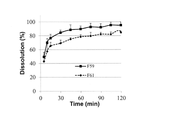
- FIG. 1 is a graph showing the dissolution test results of Compound I for the formulations of Example 1 (F59) and Example 2 (F61).
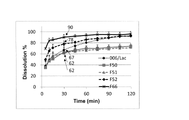
- Figure 2 is a graph showing the dissolution test results for Compound I for the formulations of Example 3 (F50), Example 4 (F51), Example 5 (F52) and Example 2 (F66).
- FIG. 3 is a graph showing the dissolution test results of compound I for the capsule of Example 12 (R4L02).
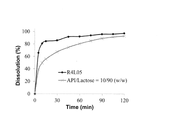
- FIG. 4 is a graph showing the dissolution test results of Compound I for the capsule of Example 13 (R4L05).
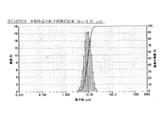
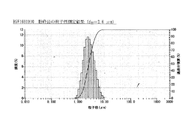
- 5 is a diagram showing the measurement results of the particle size distribution of Compound I.
- FIG. 6 is a diagram showing the measurement results of the particle size distribution of Compound I.
- FIG. 7 is a diagram showing the measurement results of the particle size distribution of Compound I.
- FIG. FIG. 8 is a graph showing the results of a dissolution test of compound I for formulations using pulverized drug substance of compound I.
- FIG. 1 is
- the above compound I can be produced by converting the compound obtained by the method described in Example 14 of Patent Document 6 into p-toluenesulfonate. More specifically, compound I can be produced by the method described in Non-Patent Document 9.
- a salt of the compound of formula 1 is referred to in this specification, it is not particularly limited as long as it is a pharmaceutically acceptable salt formed with an acid or base that is acceptable for ingestion accompanying administration of a drug.
- examples include organic, inorganic, organic or inorganic base salts, in particular carboxylates such as acetate, citrate, malate, tartrate, succinate; Sulfonates such as methanesulfonate, benzenesulfonate, p-toluenesulfonate; hydrochloride; hydrobromide; hydroiodide; sulfate; , alkali metal salts such as potassium salts; alkaline earth metal salts such as magnesium salts and calcium salts; ammonium salts such as ammonium salts, alkylammonium salts, dialkylammonium salts, trialkylammonium salts and tetraalkylammonium salts. .
- These salts are produced, for example
- the solvate refers to a compound formed with a solvent to form a single molecular mass formed by a solvent that is acceptable for ingestion following administration of a pharmaceutical agent.
- a pharmaceutically acceptable solvate examples include hydrates, alcoholates (ethanolates, methanolates, 1-propanolates, 2-pronolates, etc.), solvates with a single solvent such as dimethylsulfoxide, as well as , solvates formed with a plurality of solvents for one molecule of the compound, and solvates formed with a plurality of types of solvents for one molecule of the compound.
- Powdered crystals of compound I can be used in the production of pharmaceutical compositions or pharmaceutical preparations containing compound I.
- powdered crystals obtained by the method described in Non-Patent Document 9 specifically can be powdered crystals obtained by precipitating from a solution using acetone, ethyl acetate, ethanol, heptane, or a mixture of these solvents as a solvent.
- the compounds used herein may contain unnatural proportions of atomic isotopes at one or more of the atoms that constitute such compounds.
- Abundance ratio of isotopes in nature by replacing any atom in a compound with another isotopic atom with the same atomic number (number of protons) but different mass number (sum of number of protons and neutrons)
- Also included in the present invention are compounds substituted with isotopes having different abundance ratios, ie, isotopically labeled compounds.
- Examples of isotopic elements included in the compounds herein include hydrogen, carbon, nitrogen, oxygen, phosphorus, sulfur, fluorine, and chlorine atoms, respectively 2 H, 3 H , 13 C, 14 C, 15 N, 17 O, 18 O, 32 P, 35 S, 18 F, 36 Cl and the like.
- Isotopically-labeled compounds are useful as therapeutic or prophylactic agents, research reagents (eg, assay reagents), and diagnostic agents (eg, in vivo imaging agents).
- Compounds herein containing all proportions of radioactive or non-radioactive isotopes are included within the scope of this invention.
- a compound labeled with an isotope atom can be produced by using a reagent or solvent containing the corresponding isotope atom in a manner similar to that for producing an unlabeled compound.
- a "pharmaceutical composition” as used herein refers to additives, carriers, diluents generally accepted in the art for delivering the pharmacologically active compounds herein to a mammal, e.g., a human.
- a formulation with a vehicle such as an agent.
- formulation and "pharmaceutical formulation” as used herein refer to products that have been processed into the optimum shape or properties according to the method and purpose of use of the active ingredients used in pharmaceuticals. Additives can be added, if necessary, depending on the method of use, purpose of use, and properties of the active ingredient.
- Types of pharmaceutical formulations that is, “dosage forms” include liquid pharmaceutical formulations (liquid formulations) such as injections, suspensions, emulsions, eye drops, tablets, powders, fine granules, granules, coated tablets, Solid pharmaceutical preparations (solid preparations) such as capsules, dry syrups, troches, and suppositories are exemplified, but not limited to these.
- Forms and “pharmaceutical formulations” herein refer to excipients, disintegrants, lubricants, binders, lubricating agents, flavoring agents, stabilizers, emulsifiers, absorption enhancers, surfactants , pH adjusters, preservatives, anti-oxidants and other additives by known methods.
- Solid formulation refers to dosage forms such as tablets, powders, fine granules, granules, coated tablets, capsules, dry syrups, troches, and suppositories.
- a dosage form means the form itself, such as a shaped pharmaceutical.
- the solid preparation according to the present specification is preferably a capsule or a tablet, more preferably a capsule. These are not particularly limited as long as they have ingredients, shapes, and sizes that are commonly used in the pharmaceutical field.
- excipient refers to an additive that is added for the purpose of molding, increasing, or diluting a solid preparation, and is not particularly limited. ), sugar alcohols (e.g., mannitol, etc.), starches (corn starch, potato starch, wheat starch, rice starch, partially pregelatinized starch, pregelatinized starch, etc.), cellulose (e.g., crystalline cellulose), inorganic salts (e.g., silica calcium acid, anhydrous calcium hydrogen phosphate, precipitated calcium carbonate, etc.).
- sugar alcohols e.g., mannitol, etc.
- starches corn starch, potato starch, wheat starch, rice starch, partially pregelatinized starch, pregelatinized starch, etc.
- cellulose e.g., crystalline cellulose
- inorganic salts e.g., silica calcium acid, anhydrous calcium hydrogen phosphate, precipitated calcium carbonate, etc.
- the term "disintegrant” refers to an additive added for the purpose of accelerating the disintegration of a solid formulation administered into the body and increasing the release rate of an active ingredient from the formulation, and is not particularly limited. Examples thereof include croscarmellose sodium, carmellose sodium, hydroxypropylcellulose, carmellose, carmellose calcium, methylcellulose, crystalline cellulose, sodium lauryl sulfate, povidone, polysorbate and the like. Croscarmellose sodium, carmellose sodium and the like are preferred.
- lubricant refers to an agent that is used in the manufacturing process of a solid preparation for the purpose of increasing the fluidity so that the mixture containing the active ingredient is uniformly mixed, or to facilitate compression molding of the solid preparation.
- examples thereof include magnesium stearate, calcium stearate, talc, sucrose fatty acid ester and sodium stearyl fumarate, and hydrogenated oil.
- Preferred are sodium stearyl fumarate, magnesium stearate and hydrogenated oil, more preferred are sodium stearyl fumarate, magnesium stearate and most preferred is sodium stearyl fumarate.
- % by weight indicates the ratio of the weight of a specific substance to the weight of the entire component.
- amount of an ingredient in a pharmaceutical composition, pharmaceutical formulation, or solid formulation it means the ratio of the weight of a particular ingredient to the weight of all ingredients in the pharmaceutical composition, pharmaceutical formulation, or solid formulation. do.
- Packaging containers such as ampules, plastic bottles, or boxes, and capsules used for the purpose of preventing the scattering of pharmaceutical compositions, pharmaceutical preparations, or solid preparations during transportation, storage, or handling during administration. capsules and the like are not included in the weight of the total ingredients unless otherwise specified.
- % by weight means a drug consisting of an active ingredient and an additive added to the active ingredient. It represents the ratio of the weight of the additive to the weight of the entire composition. If the pharmaceutical formulation is pre-enclosed in a container, the container is not included in the weight of the total pharmaceutical formulation.
- Pharmaceutical preparations sealed in containers refer to pills sealed in bottles, tablets sealed in aluminum sheets, injections sealed in syringes, etc., and the contents are used for administration after opening the container.
- capsule-shaped containers containing fillers are enclosed.
- the pharmaceutical composition is a filler that is the content of a capsule, the filler is preferably a powder, and the powder may be used as a pharmaceutical formulation in encapsulated form. Often it can be administered as a capsule.
- the capsules used in capsule formulations are those commonly used, for example, those described in the Japanese Pharmacopoeia (17th or 18th revision). be able to.
- the type of capsule is not particularly limited, and those commonly used in this technical field can be used.
- types of capsules include hard capsules and soft capsules.
- raw materials for hard capsules for example, those containing gelatin, hydroxypropylmethylcellulose, pullulan, or mixtures thereof can be preferably used, and gelatin capsules are preferred.
- Materials used for soft capsules include, for example, gelatin, starch, carrageenan, agar, glycerin, sorbitol, or mixtures thereof, and preferably gelatin capsules.
- the effective It expresses the ratio of the weight of the component, that is, the content.
- the content of compound I, which is an active ingredient, relative to the entire pharmaceutical composition is exemplified by 1% by weight, 3% by weight, 5% by weight, 7% by weight, or 8% by weight as an upper limit. , 65 wt%, 60 wt%, 55 wt%, 50 wt%, or 45 wt%.
- the lower limit is preferably 8% by weight
- the upper limit is preferably 45% by weight.
- Preferred content ranges are 1% to 65% by weight, 3% to 60% by weight, 5% to 55% by weight, and 7% to 50% by weight. is exemplified, more preferably in the range of 8% to 45% by weight.
- an excipient can be used as an additive.
- the content of excipients is expressed in % by weight with respect to the entire pharmaceutical composition, the weight of the entire pharmaceutical composition consisting of the active ingredient and additives added to the active ingredient, It represents the weight ratio of excipients, that is, the content.
- the content of excipients relative to the entire pharmaceutical composition is exemplified by 21% by weight, 23% by weight, 25% by weight, 26% by weight, or 27% by weight as the lower limit, and 72% by weight as the upper limit. %, 70% by weight, 68% by weight, 67% by weight, or 66% by weight.
- the lower limit is preferably 27% by weight and the upper limit is preferably 66% by weight.
- Preferred content ranges are 21% to 72% by weight, 23% to 70% by weight, 25% to 68% by weight, and 26% to 67% by weight. is exemplified, more preferably in the range of 27% by weight or more and 66% by weight or less.
- Examples of preferred excipients include mannitol.
- a disintegrant can be used as an additive.
- the content of the disintegrant when expressed in % by weight with respect to the entire pharmaceutical composition, disintegration with respect to the weight of the entire pharmaceutical composition consisting of the active ingredient and additives It represents the ratio of the weight of the agent, that is, the content.
- the content of the disintegrant relative to the entire pharmaceutical composition is exemplified by 10% by weight, 12% by weight, 14% by weight, 16% by weight, or 18% by weight as the lower limit, and 30% by weight as the upper limit.
- Preferred content ranges are 10% to 30% by weight, 12% to 28% by weight, 14% to 26% by weight, and 16% to 24% by weight. is exemplified, more preferably in the range of 18% by weight or more and 22% by weight or less.
- Examples of preferred disintegrants include croscarmellose sodium and/or carmellose sodium.
- a lubricant can be used as an additive.
- the content of the lubricant when expressed in % by weight with respect to the entire pharmaceutical composition, the weight of the entire pharmaceutical composition consisting of the active ingredient and additives added to the active ingredient, It represents the weight ratio of the lubricant, that is, the content.
- the content of the lubricant with respect to the entire pharmaceutical composition is 5.3% by weight, 5.6% by weight, 6.0% by weight, 6.3% by weight, 6.5% by weight as a lower limit, 6.8% by weight or 7.0% by weight is exemplified, and the upper limit is exemplified by 15% by weight, 14% by weight, 13% by weight, 12% by weight, 11% by weight, or 10% by weight.
- the lower limit is preferably 7.0% by weight
- the upper limit is preferably 10% by weight.
- Preferred content ranges are 5.3 wt% to 15 wt%, 5.6 wt% to 14 wt%, 6.0 wt% to 13 wt%, more preferably 6 .3 wt% or more and 12 wt% or less, 6.5 wt% or more and 11 wt% or less, 6.8 wt% or more and 11 wt% or less, 7.0 wt% or more and 11 wt% or less , and most preferably in the range of 7.0% by weight or more and 10% by weight or less.
- the ratio of the lubricant to 1 part by weight of compound I is exemplified by 0.10 parts by weight, 0.13 parts by weight, or 0.15 parts by weight as a lower limit, and as an upper limit, 0.90 parts by weight.
- Parts by weight, 0.87 parts by weight, or 0.85 parts by weight are exemplified.
- the lower limit is preferably 0.15 parts by weight
- the upper limit is preferably 0.85 parts by weight.
- a preferable ratio range is exemplified by a range of 0.10 parts by weight or more and 0.90 parts by weight or less, a range of 0.13 parts by weight or more and 0.87 parts by weight or less, and more preferably 0.15 parts by weight or more and 0 0.85 parts by weight or less.
- preferred lubricants include sodium stearyl fumarate or magnesium stearate, and examples of more preferred lubricants include sodium stearyl fumarate. is mentioned.
- compositions containing Compound I and additives contained in pharmaceutical formulations are not particularly limited as long as they are formulations used in pharmaceutical compositions and pharmaceutical formulations. agents, binders, lubricating coloring agents, flavoring agents, stabilizers, emulsifiers, absorption promoters, surfactants, pH adjusters, preservatives, antioxidants and the like.
- the types and amounts of additives used in pharmaceutical compositions and pharmaceutical preparations can be arbitrarily selected and optimized according to the physicochemical properties of the pharmaceutical compositions and active ingredients contained therein. .
- volume-based particle size is a value of the particle size distribution weighted by volume among the particle sizes of the powder, and represents the particle size in the volume that occupies a predetermined ratio in the powder sample.
- volume - based particle size d10 (abbreviated as d10)
- volume-based particle size d50 (abbreviated as d50 )
- volume-based particle size d90 (abbreviated as d90 )
- d 10 , d 50 , or d 90 is the point corresponding to 10%, 50%, or 90% of each sample volume when the cumulative frequency distribution curve by particle size is obtained with the total volume of particles as 100%. It means particle size.
- a person skilled in the art can use a commercially available particle size measuring instrument and follow its instruction manual.
- the powder to be measured is dispersed in a solvent (dispersion medium) for dispersing the powder, and the dispersion medium in which the powder is dispersed is irradiated with a laser beam.
- the dispersion medium in which the powder is dispersed is irradiated with a laser beam.
- it can be carried out according to a conventional method such as the "particle size measurement method" described in the Japanese Pharmacopoeia (17th or 18th revision).
- the volume-based particle size of compound I can also be determined according to the following method.
- (1) Weigh SPAN80 (about 3 g) and add n-hexane (3000 mL) to make a 0.1 wt% SPAN80 n-hexane solution.
- (2) About 50 mg of compound I is weighed, 2000 mL of 0.1 wt% SPAN80 n-hexane solution is added and stirred to prepare a saturated solution.
- About 30 mg of compound I is accurately weighed and a dispersion medium (2 mL) is added to prepare a measurement sample.
- (5) The test by the laser diffraction method is performed three times under the following conditions, and the average value is adopted.
- Refractive index sample: 1.6900, imaginary part: 0.0100, dispersion medium (hexane): 1.3760 Number of iterations: 15 Particle size standard: Volume Number of data acquisition: 5000 Transmittance (appropriate range) Red semiconductor laser: 90-80% Blue LED: 90-70% As a measuring instrument, LA-950V2 manufactured by HORIBA can be used.
- the volume-based particle size of the compound I crystals in the present specification is a particle that can increase the dissolution rate in order for the solid active ingredient to dissolve in the body and be efficiently absorbed.
- a small diameter is preferred.
- the solid of the active ingredient has a certain degree of particle size distribution so that the content of the active ingredient in the pharmaceutical composition and pharmaceutical preparation becomes uniform.
- the volume-based particle size of the compound I crystals is exemplified by values smaller than 4.00 ⁇ m, 5.00 ⁇ m, or 5.76 ⁇ m as the upper limit of d10 .
- the lower limit of d10 is exemplified by 1.30 ⁇ m, 1.20 ⁇ m, or 1.00 ⁇ m, the upper limit is preferably less than 5.76 ⁇ m, and the lower limit is preferably 1.00 ⁇ m.
- the range of d10 is exemplified by the range of 1.00 ⁇ m or more and less than 5.76 ⁇ m, the range of 1.20 ⁇ m or more and 5.00 ⁇ m or less, and more preferably the range of 1.30 ⁇ m or more and 4.00 ⁇ m or less.
- the volume-based particle size of the compound I crystals is exemplified by values smaller than 5.00 ⁇ m, 8.00 ⁇ m, or 8.81 ⁇ m as the upper limit of d50.
- the lower limit of d50 is exemplified by 2.50 ⁇ m, 2.40 ⁇ m or 2.30 ⁇ m, the upper limit is preferably less than 8.81 ⁇ m, and the lower limit is preferably 2.30 ⁇ m.
- the range of d50 is exemplified by the range of 2.30 ⁇ m or more and less than 8.81 ⁇ m, the range of 2.40 ⁇ m or more and 8.00 ⁇ m or less, and more preferably the range of 2.50 ⁇ m or more and 5.00 ⁇ m or less.
- the volume-based particle size of the compound I crystals is exemplified by values smaller than 8.00 ⁇ m, 10.00 ⁇ m, 12.00 ⁇ m, or 13.08 ⁇ m as the upper limit of d90 .
- the lower limit of d90 is exemplified by 4.70 ⁇ m, 4.60 ⁇ m, 4.50 ⁇ m or 4.30 ⁇ m, the upper limit is preferably less than 13.08 ⁇ m, and the lower limit is preferably 2.30 ⁇ m.
- the range of d90 is exemplified by a range of 4.30 ⁇ m or more and less than 13.08 ⁇ m, a range of 4.50 ⁇ m or more and 12.00 ⁇ m or less, a range of 4.60 ⁇ m or more and 10.00 ⁇ m or less, more preferably 4.70 ⁇ m or more. It is in the range of 8.00 ⁇ m or less.
- the volume-based particle size of a crystal of Compound I is less than 5.76 ⁇ m in d10 , less than 8.81 ⁇ m in d50, or less than 13.08 ⁇ m in d90 .
- the volume-based particle size of the crystals of compound I is d10 in the range of 1.00 ⁇ m or more and 5.76 ⁇ m or less, 1.30 ⁇ m or more and 4.00 ⁇ m or less, or 1.20 ⁇ m or more and 5.00 ⁇ m or less.
- d50 is 2.30 ⁇ m or more and less than 8.81 ⁇ m, 2.40 ⁇ m or more and 8.00 ⁇ m or less, or 2.50 ⁇ m or more and 5.00 ⁇ m or less
- d90 is 4.30 ⁇ m or more 4.50 ⁇ m to 12.00 ⁇ m, 4.60 ⁇ m to 10.00 ⁇ m, or 4.70 ⁇ m to 8.00 ⁇ m.
- the volume - based particle sizes of the crystals of Compound I are d10 less than 5.76 ⁇ m, d50 less than 8.81 ⁇ m, and d90 less than 13.08 ⁇ m.
- the volume-based particle size of the crystal of Compound I is d10 in the range of 1.00 ⁇ m or more and less than 5.76 ⁇ m, in the range of 1.30 ⁇ m or more and 4.00 ⁇ m or less, or 1.20 ⁇ m or more and 5.00 ⁇ m or less.
- the range of d50 is 2.30 ⁇ m or more and less than 8.81 ⁇ m, the range of 2.40 ⁇ m or more and 8.00 ⁇ m or less, or the range of 2.50 ⁇ m or more and 5.00 ⁇ m or less, and d90 is 4.30 ⁇ m or more 4.50 ⁇ m to 12.00 ⁇ m, 4.60 ⁇ m to 10.00 ⁇ m, or 4.70 ⁇ m to 8.00 ⁇ m.
- Powder X-ray diffraction in this specification is a numerical value that can be obtained using the X-ray diffraction phenomenon, which is used for identification and structural analysis of crystalline substances, and is a value unique to any crystal. This value is usually expressed in one or more 2-theta values.
- a person skilled in the art can use a commercially available instrument for powder X-ray diffraction measurement and follow its instruction manual. More specifically, the 2 ⁇ value can be measured by irradiating a sample to be measured with CuK ⁇ X-rays and measuring diffracted X-rays with respect to the incident X-rays. For example, it can be carried out according to a conventional method such as the "powder X-ray diffraction measurement method" described in the Japanese Pharmacopoeia (17th or 18th revision).
- the peak value (2 ⁇ value) in the powder X-ray diffraction spectrum may have some errors depending on the measurement equipment or measurement conditions such as peak reading conditions. Peak values herein may have a measurement error of ⁇ 0.2°, or in the range of ⁇ 0.2°, for example ⁇ 0.5°.
- the Japanese Pharmacopoeia (17th or 18th revision) states that the diffraction angles 2 ⁇ usually match within a range of ⁇ 0.2° for the same crystal form. Therefore, the present invention includes not only crystals in which the diffraction angles of peaks in X-ray powder diffraction match perfectly, but also crystals in which the diffraction angles of peaks match with an error of about ⁇ 0.2°.
- powder X-ray diffraction pattern means a diffraction peak value (also referred to as a diffraction angle, 2 ⁇ value, or 2 ⁇ ) obtained by measurement of a powder X-ray diffraction spectrum, and its intensity is indicated on the horizontal axis and the vertical axis, respectively. Represents what is plotted on the axis.
- a person skilled in the art can use a commercially available instrument for powder X-ray diffraction measurement and plot according to its instruction manual.
- the analysis by powder X-ray diffraction can be performed according to a conventional method such as the method described in the Japanese Pharmacopoeia (17th or 18th revision) "Powder X-ray diffraction measurement method". .
- the "type 1 crystal” of compound I in this specification is one of the crystals of p-toluenesulfonate (compound I) of the compound represented by formula (I), and the type 1 crystal of compound I is , diffraction angles (2 ⁇ ) near 4.9°, 9.4°, 9.9°, 15.2°, 15.8°, 18.9°, and 22.6° in the powder X-ray diffraction pattern It is described that it is characterized by having a peak at (Non-Patent Document 9).
- the powder X-ray diffraction pattern of the "type 1 crystal" of Compound I herein is 4.9°, 9.4°, 9.9°, 15.2°, 15.8°, 18° It has a peak at at least one diffraction angle (2 ⁇ ) selected from the group consisting of 0.9° and 22.6° ( ⁇ 0.2°).
- the powder X-ray diffraction pattern of the "type 1 crystal" of Compound I herein is 4.9°, 9.4°, 9.9°, 15.2°, 15.8°, 18° It has peaks at at least two diffraction angles (2 ⁇ ) selected from the group consisting of 0.9° and 22.6° ( ⁇ 0.2°). Two diffraction angles are 4.9° and 9.4° ( ⁇ 0.2°), 4.9° and 15.2° ( ⁇ 0.2°), 4.9° and 18.9° ( ⁇ 0.2°), 4.9° and 22.6° ( ⁇ 0.2°), 15.2° and 18.9° ( ⁇ 0.2°), or 15.2° and 22.6° ° ( ⁇ 0.2°) is preferably exemplified.
- the powder X-ray diffraction pattern of the "type 1 crystal" of Compound I herein is 4.9°, 9.4°, 9.9°, 15.2°, 15.8°, 18° It has peaks at at least three diffraction angles (2 ⁇ ) selected from the group consisting of 0.9° and 22.6° ( ⁇ 0.2°). Three diffraction angle combinations of 4.9°, 9.4° and 15.2° ( ⁇ 0.2°), 4.9°, 15.2° and 18.9° ( ⁇ 0.2°) ), 4.9°, 15.2° and 22.6° ( ⁇ 0.2°), 9.4°, 15.2° and 18.9° ( ⁇ 0.2°), or 15.2° °, 18.9° and 22.6° ( ⁇ 0.2°) are preferably exemplified.
- the 2 ⁇ values by powder X-ray diffraction are 4.9°, 9.4°, 9.9°, 15.0°, 9.4°, 9.9°, and 15.0°. It has peaks at at least four diffraction angles (2 ⁇ ) selected from the group consisting of 2°, 15.8°, 18.9°, and 22.6° ( ⁇ 0.2°).
- the powder X-ray diffraction pattern of the “type 1 crystal” of compound I in this specification is 4.9°, 9.4°, 9.9°, 15.2°, 15.8°, 18° It has peaks at at least five diffraction angles (2 ⁇ ) selected from the group consisting of 0.9° and 22.6° ( ⁇ 0.2°). 4.9°, 9.4°, 15.2°, 18.9° and 22.6° ( ⁇ 0.2°) or 4.9°, 9.9° as a combination of diffraction angle peaks , 15.2°, 18.9° and 22.6° ( ⁇ 0.2°) are preferably exemplified.
- the powder X-ray diffraction pattern of the "type 1 crystal" of Compound I herein is 4.9°, 9.4°, 9.9°, 15.2°, 15.8°, 18° It has peaks at at least six diffraction angles (2 ⁇ ) selected from the group consisting of 0.9° and 22.6° ( ⁇ 0.2°). 4.9°, 9.4°, 9.9°, 15.8°, 18.9° and 22.6° ( ⁇ 0.2°) or 4.9° as a combination of six diffraction angles , 9.4°, 15.2°, 15.8°, 18.9° and 22.6° ( ⁇ 0.2°) are preferably exemplified.
- the 2 ⁇ values by powder X-ray diffraction are 4.9°, 9.4°, 9.9°, 15.2°, and 15°. It has peaks at all diffraction angles (2 ⁇ ) of 0.8°, 18.9°, and 22.6° ( ⁇ 0.2°).
- Thermogravimetric analysis in this specification is a technique for thermally analyzing changes in the physical and chemical properties of a sample, and is an analytical means for measuring changes in weight due to heating the sample.
- a person skilled in the art can use a commercially available instrument for thermogravimetric analysis and follow its instruction manual.
- “Differential thermal analysis” in this specification is an analytical means for detecting and measuring heat generation or endothermic heat generated by heating a sample.
- a person skilled in the art can use a commercially available instrument for differential thermal analysis measurement and follow its instruction manual.
- “Thermogravimetric analysis” and/or “differential thermal analysis” can be used to obtain information about physical phenomena such as sublimation, melting, solidification, condensation, evaporation, decomposition, adsorption, or desorption of a sample. If a "thermogravimetric analysis” and/or a “differential thermal analysis” is performed on multiple samples and, for example, the melting points of the solids are matched, the data can suggest that the multiple samples have the same crystalline form.
- the data can suggest that a solid sample with a high melting point is more stable against heat than a sample with a low melting point.
- Thermogravimetric analysis and differential thermal analysis can be performed according to a conventional method such as the method described in "Thermal analysis method" of Japanese Pharmacopoeia (17th revision).
- the "dissolution test” in this specification can be performed, for example, according to the method described in the "dissolution test method" of the Japanese Pharmacopoeia (17th or 18th revision).
- the test solution used for the dissolution test the dissolution test fluid No. 1 and dissolution test fluid No. 2 of the Japanese Pharmacopoeia (17th or 18th revision), or solutions with additives added thereto can be used.
- additives used herein include surfactants such as Tween80. It is done by the paddle method.
- the pharmaceutical composition has a drug dissolution rate of 75% or more after 15 minutes in a dissolution test (paddle method, 75 rpm, 37°C) using 900 mL of a pH 1.2 test solution, 80% or more, or 85% or more.
- the “content uniformity test” in this specification can be performed, for example, according to the method of content uniformity test described in the Japanese Pharmacopoeia (17th or 18th revision).
- the pharmaceutical composition is a hard capsule, the content uniformity test described in the Japanese Pharmacopoeia (17th or 18th revision) is performed, and the judgment value is calculated Meet the criteria (judgment value does not exceed L1% (15.0%)).
- the pharmaceutical compositions and pharmaceutical formulations herein can be produced by a general-purpose production method after the step of pulverizing the p-toluenesulfonate of the compound represented by Formula 1 above.
- the step of pulverizing the p-toluenesulfonate of the compound represented by Formula 1 is performed by, for example, using a jet mill pulverizer and performing one-cycle pulverization in a pulverization chamber according to the instruction manual of the pulverizer. can be done.
- the pharmaceutical composition and pharmaceutical preparation in the present specification are generally It can be manufactured by a manufacturing method.
- the step of mixing the p-toluenesulfonate of the compound of Formula 1, an excipient, a disintegrant, and a lubricant is, for example, the p-toluenesulfonate of the compound of Formula 1. , excipients, disintegrant, and lubricant in a mixer at 60 rpm for 90 minutes.
- the pharmaceutical composition and pharmaceutical formulation herein are the steps of pulverizing the p-toluenesulfonate of the compound represented by Formula 1 above, or p-toluenesulfone of the compound represented by Formula 1 above.
- the mixed p-toluenesulfonate salt of the compound represented by Formula 1, excipients, disintegrant, and lubricant can be produced by a production method further comprising the step of filling capsules.
- the step of mixing the p-toluenesulfonate salt of the compound represented by Formula 1, excipients, disintegrant, and lubricant is, for example, filling gelatin capsules (No. 1) with a capsule filling machine. can be done by
- the compound represented by Formula 1, or a salt thereof or a solvate thereof exhibits excellent NaPi-IIb, PiT-1, and PiT-2 inhibitory activity, stability in the body, and absorption from the gastrointestinal tract. It is useful as a prophylactic or therapeutic agent for chronic diseases such as hyperphosphatemia, and is particularly useful as a therapeutic agent.
- the compound represented by Formula 1, or a salt thereof or a solvate thereof is effective for hyperphosphatemia, secondary hyperparathyroidism, chronic kidney disease, chronic renal failure, and arteriosclerosis accompanied by vascular calcification. It is useful as a preventive or therapeutic agent for various diseases caused by elevated phosphorus levels in the body, such as
- compositions of the present invention are inhibitors of NaPi-IIb, PiT-1, and PiT-2, hyperphosphatemia, secondary hyperparathyroidism, chronic kidney disease, chronic renal failure, and vascular calcification.
- the dose of the active ingredient represented by formula 1, or a salt thereof or a solvate thereof varies depending on the condition, age, body weight, other drugs It may differ depending on whether it is used in combination with
- the amount of active ingredient per administration is 50 to 500 mg, preferably 50 to 200 mg, in terms of the compound represented by Formula 1, or a salt thereof, or a solvate thereof.
- the administration frequency per day is exemplified by 1 to 3 times. That is, administration every 24 hours, every 12 hours, or every 8 hours is exemplified, and exemplified before meals, between meals, after meals, or before bedtime.
- A, B, and/or C includes any combination in which “and” and “or” are appropriately combined.
- A, B, and/or C includes the following seven variations: (i) A, (ii) B, (iii) C, (iv) A and B, (v) A and C, (vi) B and C, (vii) A, B, and C.
- AV Acceptable value
- CMC-Na Croscarmellose sodium
- CMC-Ca Carmellose calcium
- Lac Lactose monohydrate
- MAN Mannitol
- MCC Microcrystalline cellulose
- Mg-st Magnesium stearate rpm: Revolutions per minute
- SSF Fumar sodium stearyl acid
- mannitol is Pearitol 300DC (manufactured by ROQUETTE)
- cCMC-Na is ND-2HS (manufactured by Asahi Kasei Chemicals)
- CMC-Ca is ECG-505 (manufactured by Gotoku Yakuhin Co.), Mg-st.
- Powdered crystals of compound I produced by the method described in International Publication No. WO 2014/142273 and JPJ Technical Report No. 2017-501666 were used as the API.
- the drug substance (1345.4 mg, lot number SGL1407010 product) shall be pulverized for one cycle in the pulverization chamber using a jet mill pulverizer (MC-ONE, manufactured by Dietrich Engineering Consultants sa) according to the instruction manual of the pulverizer. to obtain a pulverized product (1029.0 mg).
- the lot number RGW1503010 product and the lot number RGW1601010 product shown in Table 7 were also pulverized in the same manner.
- a sample was prepared by rotating the mighty vial for 60 minutes or more at a rotation speed of 100 rpm with MIX-ROTER VMR-5 (AS ONE) to mix the contents.
- Solution volume 900 mL
- Liquid temperature 37°C ⁇ 0.2°C
- Dissolution test solution 2.0 g of sodium chloride dissolved in 7.0 mL of hydrochloric acid and water to make 1000 mL, and a solution containing 0.05% Tween80 solution containing Sampling: fraction method Stirring device: paddle Stirring speed: 75 rpm Presence of precipitate: Yes UV detection wavelength: 293 nm
- Fig. 2 compares the dissolution properties of compound I when the blending ratio of cCMC-Na is changed from 0% to 30%.
- the dissolution of compound I in the filling powder with cCMC-Na of 20% by weight or more was compared with a control lactose dispersant (Compound I: lactose and water
- the dissolution property was superior to that of 1:9 (006/Lac), suggesting that a packed powder containing 20% by weight or more of cCMC-Na is preferable.
- Adhesion test The filling powder was placed in a glass container, and adhesion to the inner wall was visually observed to conduct an adhesion test. Details of the sample preparation are given below. Compound I and additives were weighed and added to a mighty vial (No. 7, transparent, Maruem) so that the total weight of the filling powder was 10 g. A sample was prepared by rotating the mighty vial for 60 minutes or more at 100 rpm with a MIX-ROTER VMR-5 (AS ONE) to mix the contents.
- the SSF was changed from 0.5 to 9% by weight, and the adhesion to the glass vial when compound I and additives were mixed was compared. Adhesion to the glass wall surface was visually observed.
- SSF should preferably be added in excess of 5 wt%, for example 6 wt% or more, or 7 wt% or more.
- capsule formulations containing 25 mg or 100 mg, respectively. Mixing was performed for 90 minutes at a rotation speed of 60 rpm in a mixer (Rocking mixer: model number RMC-10(S)MC, manufactured by Aichi Electric Co., Ltd.) to produce a filling powder.
- a capsule filling apparatus (model number MODEL 300A, manufactured by Accurex) was used to fill gelatin capsules (No. 1), 25 mg capsule formulation (Example 12 (R4L02)), and 100 mg capsule formulation (Example 13). (R4L05)) was produced.
- Example 12 Example 12
- Example 13 Example 13
- Dissolution solvent 1,000 water and 1,000 mL of acetonitrile are measured with a graduated cylinder, mixed, and then mixed with 1 mL of trifluoroacetic acid (water/acetonitrile/trifluoroacetic acid mixture (1000: 1000: 1)).
- the sample was placed in a flask (Table 4) and shaken at 100 rpm for 30 minutes using a shaker (AS ONE, Model ASCM-01) to disintegrate the sample.
- the dissolving solvent was added to the volumetric flask, further mixed, and sonicated for 15 minutes (the volumetric flask was shaken about every 5 minutes after the start of sonication). After that, a dissolving solvent was added to make up the volume. Filtration was performed with a membrane filter (ADVANTEC, Model 25HP020AN, DISMIC-25HP PTFE 0.20 ⁇ m HYDROPHILIC), the first filtrate (1 mL) was removed, and the next filtrate was used as the sample solution.
- ADVANTEC Model 25HP020AN, DISMIC-25HP PTFE 0.20 ⁇ m HYDROPHILIC
- a standard solution was prepared by the following method.
- Compound I (12 mg) prepared separately as a standard substance was accurately weighed and dissolved by adding a dissolution solvent to make exactly 20 mL. When it was not dissolved sufficiently, it was dissolved by ultrasonic treatment (for about 1 minute). Accurately adjust the appropriate amount with the dissolution solvent and use it as a standard solution.
- the content uniformity of the 25 mg capsule formulation (R4L02) and the 100 mg capsule formulation (R4L05) was determined to be the target value (AV) (the maximum allowable limit (L1) of the judgment value should be 15 or less). It was confirmed that the content was satisfied and that excellent content uniformity was exhibited.
- Particle Size Distribution of Compound I The particle size distribution of the pulverized product and the unpulverized product obtained by the pulverization method for the crystalline powder of Compound I was measured by laser diffraction method, and the volume-based particle diameters d 10 , d 50 , and d 90 ( ⁇ m) were calculated. Sample preparation for the light scattering method was performed as follows.
- the present invention can provide a pharmaceutical composition used for treating hyperphosphatemia in patients with renal dysfunction such as chronic kidney disease (CKD) and end-stage renal disease (ESKD), and a method for producing the same.
- CKD chronic kidney disease
- EKD end-stage renal disease
Landscapes
- Health & Medical Sciences (AREA)
- Life Sciences & Earth Sciences (AREA)
- Public Health (AREA)
- Chemical & Material Sciences (AREA)
- Medicinal Chemistry (AREA)
- Pharmacology & Pharmacy (AREA)
- Veterinary Medicine (AREA)
- General Health & Medical Sciences (AREA)
- Animal Behavior & Ethology (AREA)
- Epidemiology (AREA)
- Bioinformatics & Cheminformatics (AREA)
- Engineering & Computer Science (AREA)
- Nuclear Medicine, Radiotherapy & Molecular Imaging (AREA)
- Organic Chemistry (AREA)
- Chemical Kinetics & Catalysis (AREA)
- General Chemical & Material Sciences (AREA)
- Diabetes (AREA)
- Hematology (AREA)
- Obesity (AREA)
- Molecular Biology (AREA)
- Biophysics (AREA)
- Pharmaceuticals Containing Other Organic And Inorganic Compounds (AREA)
- Medicinal Preparation (AREA)
Priority Applications (10)
| Application Number | Priority Date | Filing Date | Title |
|---|---|---|---|
| AU2022288895A AU2022288895A1 (en) | 2021-06-08 | 2022-06-08 | Formulation containing dihydropyridazine-3,5-dione derivative |
| CN202280041019.3A CN117460511A (zh) | 2021-06-08 | 2022-06-08 | 含有二氢哒嗪-3,5-二酮衍生物的制剂 |
| BR112023023708A BR112023023708A2 (pt) | 2021-06-08 | 2022-06-08 | Formulação contendo derivado de di-hidropiridazino-3,5-diona |
| EP22820243.8A EP4353233A4 (en) | 2021-06-08 | 2022-06-08 | PREPARATION CONTAINING A DIHYDROPYRIDAZINE-3,5-DIONE DERIVATIVE |
| CA3221186A CA3221186A1 (en) | 2021-06-08 | 2022-06-08 | Formulation containing dihydropyridazine-3,5-dione derivative |
| MX2023014507A MX2023014507A (es) | 2021-06-08 | 2022-06-08 | Formulacion que contiene un derivado de dihidropiridazina-3,5-dion a. |
| KR1020237045200A KR20240018523A (ko) | 2021-06-08 | 2022-06-08 | 다이하이드로피리다진-3,5-다이온 유도체를 함유하는 제제 |
| JP2023527886A JPWO2022260064A1 (cg-RX-API-DMAC7.html) | 2021-06-08 | 2022-06-08 | |
| US18/567,435 US20240293402A1 (en) | 2021-06-08 | 2022-06-08 | FORMULATION CONTAINING DIHYDROPYRIDAZINE-3,5-DIONE DERIVATIVE (as amended) |
| IL309056A IL309056A (en) | 2021-06-08 | 2022-06-08 | A preparation containing a DIHYDROPYRIDAZINE-3,5-DIONE derivative |
Applications Claiming Priority (2)
| Application Number | Priority Date | Filing Date | Title |
|---|---|---|---|
| JP2021-096206 | 2021-06-08 | ||
| JP2021096206 | 2021-06-08 |
Publications (1)
| Publication Number | Publication Date |
|---|---|
| WO2022260064A1 true WO2022260064A1 (ja) | 2022-12-15 |
Family
ID=84426023
Family Applications (1)
| Application Number | Title | Priority Date | Filing Date |
|---|---|---|---|
| PCT/JP2022/023076 Ceased WO2022260064A1 (ja) | 2021-06-08 | 2022-06-08 | ジヒドロピリダジン-3,5-ジオン誘導体を含有する製剤 |
Country Status (12)
Citations (8)
| Publication number | Priority date | Publication date | Assignee | Title |
|---|---|---|---|---|
| WO2011136269A1 (ja) | 2010-04-28 | 2011-11-03 | アステラス製薬株式会社 | テトラヒドロベンゾチオフェン化合物 |
| WO2012006475A1 (en) | 2010-07-07 | 2012-01-12 | Ardelyx, Inc. | Compounds and methods for inhibiting phosphate transport |
| WO2013062065A1 (ja) | 2011-10-27 | 2013-05-02 | アステラス製薬株式会社 | アミノアルキル置換n-チエニルベンズアミド誘導体 |
| WO2014003153A1 (ja) | 2012-06-28 | 2014-01-03 | 協和発酵キリン株式会社 | 置換アミド化合物 |
| WO2014142273A1 (ja) | 2013-03-13 | 2014-09-18 | 中外製薬株式会社 | ジヒドロピリダジン-3,5-ジオン誘導体 |
| WO2016026822A1 (en) | 2014-08-18 | 2016-02-25 | Alkermes Pharma Ireland Limited | Aripiprazole prodrug compositions |
| WO2016039458A1 (ja) | 2014-09-12 | 2016-03-17 | 中外製薬株式会社 | ナトリウム依存性リン酸トランスポーター阻害剤を含有する医薬 |
| WO2018034883A1 (en) | 2016-08-15 | 2018-02-22 | Eli Lilly And Company | Condensed thiophene derivatives useful as napi-iib inhibitors |
Family Cites Families (3)
| Publication number | Priority date | Publication date | Assignee | Title |
|---|---|---|---|---|
| US9499553B2 (en) * | 2013-03-13 | 2016-11-22 | Chugai Seiyaku Kabushiki Kaisha | Dihydropyridazine-3,5-dione derivative and pharmaceuticals containing the same |
| WO2019060604A1 (en) * | 2017-09-20 | 2019-03-28 | Teva Branded Pharmaceutical Products R&D, Inc. | INHALABLE MEDICINE |
| US12097204B2 (en) * | 2018-09-03 | 2024-09-24 | Chia Tai Tianqing Pharmaceutical Group Co., Ltd. | Solid pharmaceutical composition containing 1,3,5-triazine derivative or salt thereof |
-
2022
- 2022-06-08 WO PCT/JP2022/023076 patent/WO2022260064A1/ja not_active Ceased
- 2022-06-08 KR KR1020237045200A patent/KR20240018523A/ko active Pending
- 2022-06-08 US US18/567,435 patent/US20240293402A1/en active Pending
- 2022-06-08 AU AU2022288895A patent/AU2022288895A1/en active Pending
- 2022-06-08 CA CA3221186A patent/CA3221186A1/en active Pending
- 2022-06-08 IL IL309056A patent/IL309056A/en unknown
- 2022-06-08 EP EP22820243.8A patent/EP4353233A4/en active Pending
- 2022-06-08 MX MX2023014507A patent/MX2023014507A/es unknown
- 2022-06-08 CN CN202280041019.3A patent/CN117460511A/zh active Pending
- 2022-06-08 TW TW111121208A patent/TW202317118A/zh unknown
- 2022-06-08 JP JP2023527886A patent/JPWO2022260064A1/ja active Pending
- 2022-06-08 BR BR112023023708A patent/BR112023023708A2/pt unknown
Patent Citations (8)
| Publication number | Priority date | Publication date | Assignee | Title |
|---|---|---|---|---|
| WO2011136269A1 (ja) | 2010-04-28 | 2011-11-03 | アステラス製薬株式会社 | テトラヒドロベンゾチオフェン化合物 |
| WO2012006475A1 (en) | 2010-07-07 | 2012-01-12 | Ardelyx, Inc. | Compounds and methods for inhibiting phosphate transport |
| WO2013062065A1 (ja) | 2011-10-27 | 2013-05-02 | アステラス製薬株式会社 | アミノアルキル置換n-チエニルベンズアミド誘導体 |
| WO2014003153A1 (ja) | 2012-06-28 | 2014-01-03 | 協和発酵キリン株式会社 | 置換アミド化合物 |
| WO2014142273A1 (ja) | 2013-03-13 | 2014-09-18 | 中外製薬株式会社 | ジヒドロピリダジン-3,5-ジオン誘導体 |
| WO2016026822A1 (en) | 2014-08-18 | 2016-02-25 | Alkermes Pharma Ireland Limited | Aripiprazole prodrug compositions |
| WO2016039458A1 (ja) | 2014-09-12 | 2016-03-17 | 中外製薬株式会社 | ナトリウム依存性リン酸トランスポーター阻害剤を含有する医薬 |
| WO2018034883A1 (en) | 2016-08-15 | 2018-02-22 | Eli Lilly And Company | Condensed thiophene derivatives useful as napi-iib inhibitors |
Non-Patent Citations (13)
| Title |
|---|
| "Definition and classification of CKD", KIDNEY INT. SUPPL., vol. 3, no. 1, 2013, pages 19 - 62 |
| "Japanese Pharmacopoeia", article "X-ray Powder Diffractometry" |
| FORSTER IC ET AL., MOL ASPECTS MED., vol. 34, no. 2-3, 2013, pages 386 - 395 |
| HRUSKA, KA ET AL., KIDNEY INT., vol. 74, no. 2, 2008, pages 148 - 157 |
| JAPAN INSTITUTE FOR PROMOTING INVENTION AND INNOVATION, JOURNAL OF TECHNICAL DISCLOSURE |
| KATHLEEN M HILL GALLANT, ELIZABETH R STREMKE, LAURIE L TREVINO, RANJANI N MOORTHI, SIMIT DOSHI, MERYL E WASTNEY, NOZOMI HISADA, JO: "EOS789, a broad-spectrum inhibitor of phosphate transport, is safe with an indication of efficacy in a phase 1b randomized crossover trial in hemodialysis patients", KIDNEY INTERNATIONAL, NATURE PUBLISHING GROUP, LONDON, GB, vol. 99, no. 5, 1 May 2021 (2021-05-01), GB , pages 1225 - 1233, XP009541827, ISSN: 0085-2538, DOI: 10.1016/j.kint.2020.09.035 * |
| LEDERER E ET AL., EUR. J. PHYSIOL., vol. 471, no. 1, 2019, pages 137 - 148 |
| LEVEY, AS ET AL., KIDNEY INT., vol. 67, no. 6, 2005, pages 2089 - 2100 |
| MIYAMOTO, K ET AL., J. PHARM. SCI., vol. 100, no. 9, 2011, pages 3719 - 3730 |
| RITTER, CS ET AL., CLIN. J.AM.SOC.NEPHROL., vol. 11, no. 6, 2016, pages 1088 - 1100 |
| SABBAGH, Y ET AL., J. AM. SOC. NEPHROL., vol. 20, no. 11, 2009, pages 2348 - 2358 |
| See also references of EP4353233A4 |
| TSUBOI YOSHINORI, OHTOMO SHUICHI, ICHIDA YASUHIRO, HAGITA HITOSHI, OZAWA KAZUHARU, IIDA MANAMI, NAGAO SHUNSUKE, IKEGAMI HISASHI, T: "EOS789, a novel pan-phosphate transporter inhibitor, is effective for the treatment of chronic kidney disease–mineral bone disorder", KIDNEY INTERNATIONAL, NATURE PUBLISHING GROUP, LONDON, GB, vol. 98, no. 2, 1 August 2020 (2020-08-01), GB , pages 343 - 354, XP093014106, ISSN: 0085-2538, DOI: 10.1016/j.kint.2020.02.040 * |
Also Published As
| Publication number | Publication date |
|---|---|
| KR20240018523A (ko) | 2024-02-13 |
| CN117460511A (zh) | 2024-01-26 |
| MX2023014507A (es) | 2024-01-26 |
| EP4353233A1 (en) | 2024-04-17 |
| BR112023023708A2 (pt) | 2024-01-30 |
| AU2022288895A1 (en) | 2024-01-18 |
| US20240293402A1 (en) | 2024-09-05 |
| IL309056A (en) | 2024-02-01 |
| TW202317118A (zh) | 2023-05-01 |
| JPWO2022260064A1 (cg-RX-API-DMAC7.html) | 2022-12-15 |
| EP4353233A4 (en) | 2025-06-25 |
| CA3221186A1 (en) | 2022-12-15 |
Similar Documents
| Publication | Publication Date | Title |
|---|---|---|
| BG64691B1 (bg) | Зипрасидонови препарати | |
| TW201328725A (zh) | N-甲基-2-[3-((e)-2-吡啶-2-基-乙烯基)-1h-吲唑-6-基硫烷基]苯甲醯胺之藥學組成物 | |
| SA517390473B1 (ar) | أشكال جرعة صلبة من بالبوسيكليب | |
| TWI325318B (en) | Capsule and method of manufacturing the same | |
| TR201903195T4 (tr) | Apiksaban formülasyonları. | |
| JP2009542647A (ja) | メマンチン医薬組成物 | |
| EP3290037A1 (en) | Pharmaceutical composition for oral administration | |
| JP4805234B2 (ja) | 経口固形医薬 | |
| EP3958841A1 (en) | Meloxicam co-crystal compositions | |
| JP6367042B2 (ja) | ボリコナゾールを含む医薬組成物 | |
| WO2021216545A1 (en) | Oral solid meloxicam formulations for the treatment of acute pain | |
| EP4353233A1 (en) | Preparation containing dihydropyridazine-3,5-dione derivative | |
| HK40104119A (en) | Formulation containing dihydropyridazine-3,5-dione derivative | |
| LUDHIANI et al. | Novel Application of Mixed Solvency Concept to Develop and Formulate Liquisolid System of a Poorly Water-Soluble Drug, Furosemide and Their Evaluations | |
| Munnangi | Advancing Pharmaceutical Manufacturing: Innovative Applications of Hot Melt Extrusion for the Preparation of Drug Complexes and Fixed Dose Combination Immediate Release Formulation with Diverse Crystalline Properties | |
| EP4721739A1 (en) | Csf-1r inhibitor pharmaceutical composition, preparation method therefor and pharmaceutical use thereof | |
| EP4059504A1 (en) | Drug substance of lemborexant and medicinal composition comprising same | |
| TWI749204B (zh) | 一種可提高口服他汀類藥物生體可用率之醫藥組合物及其用途 | |
| CA3166050A1 (en) | Stable immediate release tablet and capsule formulations of 1-((2s,5r)-5-((7h-pyrrolo[2,3-d]pyrimidin-4-yl)amino)-2-methylpiperidin-1-yl)prop-2-en-1-one | |
| TW202135827A (zh) | 醫藥用製劑原料月桂基硫酸鈉或含有月桂基硫酸鈉之製劑等的篩選、評估或製造方法 | |
| Audu et al. | Quantitative analysis of ten (10) different brands of chlorpheniramine tablet marketed in Maiduguri metropolitan council (MMC) | |
| CN107137374A (zh) | 帕洛诺司琼的固体药物组合物 | |
| MXPA99005524A (en) | Ziprasid formulations | |
| HK1196063A (en) | Pharmaceutical compositions of n-methyl-2-[3-((e)-2-pyridin-2-yl-vinyl)-1h-indazol-6-yl-sulfanyl]-benzamide | |
| BRPI0719394B1 (pt) | Preparação medicinal sólida |
Legal Events
| Date | Code | Title | Description |
|---|---|---|---|
| 121 | Ep: the epo has been informed by wipo that ep was designated in this application |
Ref document number: 22820243 Country of ref document: EP Kind code of ref document: A1 |
|
| REG | Reference to national code |
Ref country code: BR Ref legal event code: B01A Ref document number: 112023023708 Country of ref document: BR |
|
| WWE | Wipo information: entry into national phase |
Ref document number: 3221186 Country of ref document: CA |
|
| WWE | Wipo information: entry into national phase |
Ref document number: 309056 Country of ref document: IL |
|
| WWE | Wipo information: entry into national phase |
Ref document number: MX/A/2023/014507 Country of ref document: MX |
|
| WWE | Wipo information: entry into national phase |
Ref document number: 202280041019.3 Country of ref document: CN |
|
| WWE | Wipo information: entry into national phase |
Ref document number: 2023527886 Country of ref document: JP |
|
| WWE | Wipo information: entry into national phase |
Ref document number: 202393302 Country of ref document: EA |
|
| WWE | Wipo information: entry into national phase |
Ref document number: 2022288895 Country of ref document: AU Ref document number: AU2022288895 Country of ref document: AU |
|
| ENP | Entry into the national phase |
Ref document number: 20237045200 Country of ref document: KR Kind code of ref document: A |
|
| WWE | Wipo information: entry into national phase |
Ref document number: 202447000153 Country of ref document: IN |
|
| WWE | Wipo information: entry into national phase |
Ref document number: 2022820243 Country of ref document: EP |
|
| NENP | Non-entry into the national phase |
Ref country code: DE |
|
| ENP | Entry into the national phase |
Ref document number: 2022820243 Country of ref document: EP Effective date: 20240108 |
|
| ENP | Entry into the national phase |
Ref document number: 2022288895 Country of ref document: AU Date of ref document: 20220608 Kind code of ref document: A |
|
| ENP | Entry into the national phase |
Ref document number: 112023023708 Country of ref document: BR Kind code of ref document: A2 Effective date: 20231113 |