WO2022259990A1 - 糞便検体の検査方法及びそのためのイムノクロマト試験片 - Google Patents
糞便検体の検査方法及びそのためのイムノクロマト試験片 Download PDFInfo
- Publication number
- WO2022259990A1 WO2022259990A1 PCT/JP2022/022712 JP2022022712W WO2022259990A1 WO 2022259990 A1 WO2022259990 A1 WO 2022259990A1 JP 2022022712 W JP2022022712 W JP 2022022712W WO 2022259990 A1 WO2022259990 A1 WO 2022259990A1
- Authority
- WO
- WIPO (PCT)
- Prior art keywords
- antibody
- specimen
- immunochromatographic
- sample
- norovirus
- Prior art date
- Legal status (The legal status is an assumption and is not a legal conclusion. Google has not performed a legal analysis and makes no representation as to the accuracy of the status listed.)
- Ceased
Links
Images
Classifications
-
- G—PHYSICS
- G01—MEASURING; TESTING
- G01N—INVESTIGATING OR ANALYSING MATERIALS BY DETERMINING THEIR CHEMICAL OR PHYSICAL PROPERTIES
- G01N33/00—Investigating or analysing materials by specific methods not covered by groups G01N1/00 - G01N31/00
- G01N33/48—Biological material, e.g. blood, urine; Haemocytometers
- G01N33/50—Chemical analysis of biological material, e.g. blood, urine; Testing involving biospecific ligand binding methods; Immunological testing
- G01N33/53—Immunoassay; Biospecific binding assay; Materials therefor
- G01N33/558—Immunoassay; Biospecific binding assay; Materials therefor using diffusion or migration of antigen or antibody
-
- G—PHYSICS
- G01—MEASURING; TESTING
- G01N—INVESTIGATING OR ANALYSING MATERIALS BY DETERMINING THEIR CHEMICAL OR PHYSICAL PROPERTIES
- G01N33/00—Investigating or analysing materials by specific methods not covered by groups G01N1/00 - G01N31/00
- G01N33/48—Biological material, e.g. blood, urine; Haemocytometers
- G01N33/50—Chemical analysis of biological material, e.g. blood, urine; Testing involving biospecific ligand binding methods; Immunological testing
- G01N33/53—Immunoassay; Biospecific binding assay; Materials therefor
- G01N33/569—Immunoassay; Biospecific binding assay; Materials therefor for microorganisms, e.g. protozoa, bacteria, viruses
- G01N33/56983—Viruses
-
- G—PHYSICS
- G01—MEASURING; TESTING
- G01N—INVESTIGATING OR ANALYSING MATERIALS BY DETERMINING THEIR CHEMICAL OR PHYSICAL PROPERTIES
- G01N33/00—Investigating or analysing materials by specific methods not covered by groups G01N1/00 - G01N31/00
- G01N33/48—Biological material, e.g. blood, urine; Haemocytometers
- G01N33/50—Chemical analysis of biological material, e.g. blood, urine; Testing involving biospecific ligand binding methods; Immunological testing
- G01N33/53—Immunoassay; Biospecific binding assay; Materials therefor
- G01N33/5308—Immunoassay; Biospecific binding assay; Materials therefor for analytes not provided for elsewhere, e.g. nucleic acids, uric acid, worms, mites
-
- G—PHYSICS
- G01—MEASURING; TESTING
- G01N—INVESTIGATING OR ANALYSING MATERIALS BY DETERMINING THEIR CHEMICAL OR PHYSICAL PROPERTIES
- G01N33/00—Investigating or analysing materials by specific methods not covered by groups G01N1/00 - G01N31/00
- G01N33/48—Biological material, e.g. blood, urine; Haemocytometers
- G01N33/50—Chemical analysis of biological material, e.g. blood, urine; Testing involving biospecific ligand binding methods; Immunological testing
- G01N33/53—Immunoassay; Biospecific binding assay; Materials therefor
- G01N33/543—Immunoassay; Biospecific binding assay; Materials therefor with an insoluble carrier for immobilising immunochemicals
- G01N33/54366—Apparatus specially adapted for solid-phase testing
- G01N33/54386—Analytical elements
-
- G—PHYSICS
- G01—MEASURING; TESTING
- G01N—INVESTIGATING OR ANALYSING MATERIALS BY DETERMINING THEIR CHEMICAL OR PHYSICAL PROPERTIES
- G01N33/00—Investigating or analysing materials by specific methods not covered by groups G01N1/00 - G01N31/00
- G01N33/48—Biological material, e.g. blood, urine; Haemocytometers
- G01N33/50—Chemical analysis of biological material, e.g. blood, urine; Testing involving biospecific ligand binding methods; Immunological testing
- G01N33/53—Immunoassay; Biospecific binding assay; Materials therefor
- G01N33/543—Immunoassay; Biospecific binding assay; Materials therefor with an insoluble carrier for immobilising immunochemicals
- G01N33/54366—Apparatus specially adapted for solid-phase testing
- G01N33/54386—Analytical elements
- G01N33/54387—Immunochromatographic test strips
- G01N33/54388—Immunochromatographic test strips based on lateral flow
-
- G—PHYSICS
- G01—MEASURING; TESTING
- G01N—INVESTIGATING OR ANALYSING MATERIALS BY DETERMINING THEIR CHEMICAL OR PHYSICAL PROPERTIES
- G01N33/00—Investigating or analysing materials by specific methods not covered by groups G01N1/00 - G01N31/00
- G01N33/48—Biological material, e.g. blood, urine; Haemocytometers
- G01N33/50—Chemical analysis of biological material, e.g. blood, urine; Testing involving biospecific ligand binding methods; Immunological testing
- G01N33/53—Immunoassay; Biospecific binding assay; Materials therefor
- G01N33/543—Immunoassay; Biospecific binding assay; Materials therefor with an insoluble carrier for immobilising immunochemicals
- G01N33/54393—Improving reaction conditions or stability, e.g. by coating or irradiation of surface, by reduction of non-specific binding, by promotion of specific binding
-
- G—PHYSICS
- G01—MEASURING; TESTING
- G01N—INVESTIGATING OR ANALYSING MATERIALS BY DETERMINING THEIR CHEMICAL OR PHYSICAL PROPERTIES
- G01N33/00—Investigating or analysing materials by specific methods not covered by groups G01N1/00 - G01N31/00
- G01N33/48—Biological material, e.g. blood, urine; Haemocytometers
- G01N33/50—Chemical analysis of biological material, e.g. blood, urine; Testing involving biospecific ligand binding methods; Immunological testing
- G01N33/53—Immunoassay; Biospecific binding assay; Materials therefor
- G01N33/569—Immunoassay; Biospecific binding assay; Materials therefor for microorganisms, e.g. protozoa, bacteria, viruses
-
- G—PHYSICS
- G01—MEASURING; TESTING
- G01N—INVESTIGATING OR ANALYSING MATERIALS BY DETERMINING THEIR CHEMICAL OR PHYSICAL PROPERTIES
- G01N2333/00—Assays involving biological materials from specific organisms or of a specific nature
- G01N2333/005—Assays involving biological materials from specific organisms or of a specific nature from viruses
- G01N2333/08—RNA viruses
- G01N2333/085—Picornaviridae, e.g. coxsackie virus, echovirus, enterovirus
-
- G—PHYSICS
- G01—MEASURING; TESTING
- G01N—INVESTIGATING OR ANALYSING MATERIALS BY DETERMINING THEIR CHEMICAL OR PHYSICAL PROPERTIES
- G01N2440/00—Post-translational modifications [PTMs] in chemical analysis of biological material
-
- G—PHYSICS
- G01—MEASURING; TESTING
- G01N—INVESTIGATING OR ANALYSING MATERIALS BY DETERMINING THEIR CHEMICAL OR PHYSICAL PROPERTIES
- G01N2469/00—Immunoassays for the detection of microorganisms
- G01N2469/10—Detection of antigens from microorganism in sample from host
Definitions
- the present invention relates to a fecal specimen testing method and an immunochromatographic test strip therefor.
- immunoassays using antigen-antibody reactions are generally known as simple test methods.
- a complex of a capture substance (capture substance) that specifically binds to the analyte and a label that specifically binds to the analyte is formed on the membrane, and the label is detected/quantified. , to detect (measure or quantify) the object to be detected.
- Immunochromatography is widely used for the detection of a wide variety of substances to be detected because the measurement apparatus is simple and the method is excellent in terms of cost.
- a detection unit in which an antibody that specifically binds to the substance to be detected is immobilized as a capture substance on a membrane strip such as nitrocellulose, and a label that specifically binds to the substance to be detected.
- a test sample containing the analyte is added dropwise to a test device having a labeled body portion containing to detect or quantify the label (for example, Patent Documents 1 and 2).
- JP 2008-268043 A Japanese Patent Application Laid-Open No. 2008-203135
- An object of the present invention is to suppress the influence of interfering substances in immunochromatography contained in stool samples, and to enable accurate and specific measurement of substances to be detected in test samples. It is to provide a method and an immunochromatography test piece therefor.
- the inventors of the present application have found that by performing immunochromatography in the presence of taurodeoxycholic acid, the effects of interfering substances can be suppressed, and the substances to be detected in stool specimens can be tested.
- the inventors have found that it is possible to measure accurately and specifically regardless of the amount to be measured, and completed the present invention.
- the present invention provides the following.
- a method for testing a stool sample including testing a stool sample by immunochromatography in the presence of taurodeoxycholic acid or a salt thereof.
- the influence of interfering substances in a stool sample is suppressed, and the substance to be detected in the stool sample is accurately and specifically measured regardless of the amount of the stool sample subjected to the test. It is possible.
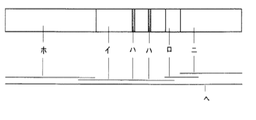
- FIG. 1 shows a preferred form of a typical immunochromatographic test strip.
- the present invention relates to an inspection method that prevents false negatives occurring in fecal specimens and enables accurate measurement of a substance to be detected, and an immunochromatographic test strip therefor.
- false negative means that no positive signal is generated in the assay even though the sample contains the substance to be detected.
- the immunochromatographic method immunochromatographic method
- signal generation is inhibited due to reasons such as the above complexes not being formed.
- the immunochromatographic test strip consists of a support having a detection region on which an antibody (antibody 1) that captures an object to be measured (antigen, etc.) is immobilized, a labeled region having a movable labeled antibody (antibody 2), and a sample drop. It comprises a sample pad to be applied, an absorbent band for absorbing the developed specimen liquid, and a backing sheet for bonding these members together.
- the number of detection regions and the type of labeled antibody contained in the labeled region are not limited to one. It can be measured in strips.
- FIG. 1 is a diagram showing a preferred form of a typical immunochromatographic test strip. Note that the immunochromatographic test piece is not limited to that shown in FIG. In FIG. 1, a indicates a support, b indicates a label region, c indicates a detection region, d indicates a sample pad, e indicates an absorption band, and f indicates a backing sheet.
- FIG. 1 The upper part of FIG. 1 is a top view, and the lower part is a cross-sectional view.
- a support having two detection regions formed on a backing sheet, an absorption band, a marker region, a sample pad, and the like are laminated. Then, as shown, one end of the absorption band and one end of the support, the other end of the support and one end of the label area, the other end of the label area and the sample pad. are overlapped to form a continuous lateral flow channel.
- the support is a material that has the ability to immobilize the antibody that captures the test substance (antigen), and has the ability to prevent the horizontal passage of liquids.
- it is a porous thin film with capillary action and a material capable of transporting liquids and components dispersed therein by absorption.
- the material forming the support is not particularly limited, and examples thereof include cellulose, nitrocellulose, cellulose acetate, polyvinylidene difluoride (PVDF), glass fiber, nylon, and polyketone. Among them, a thin film made of nitrocellulose is more preferable.
- the labeled body region consists of a porous substrate containing a labeled antibody, and the material of the substrate can be commonly used glass fiber, non-woven fabric, or the like.
- the substrate is preferably in the form of a pad with a thickness of about 0.3 mm to 0.6 mm in order to be impregnated with a large amount of labeled antibody.
- the detection area refers to a partial area of the support on which the antibody that captures the test substance (antigen) is immobilized.
- the detection region provides at least one antibody-immobilized region for capturing an antigen.
- the sample pad is a part where the specimen or a sample prepared using the specimen is added dropwise, and is a porous material with water absorption.
- the material commonly used cellulose, glass fiber, non-woven fabric, and the like can be used.
- it is preferably in the form of a pad with a thickness of about 0.3 mm to 1 mm. Note that the sample pad and the marker region described above are purely functional distinctions, and do not necessarily need to be separate materials. That is, it is also possible for a partial area of the material placed as the sample pad to have the function of the marker area.
- the absorption band is a member for absorbing components supplied to the support and not involved in the reaction in the detection area.
- As the material filter papers, sponges, and the like having high water retention properties made of general natural polymer compounds, synthetic polymer compounds, etc. can be used. .
- the backing sheet is a member for attaching and fixing all the above-mentioned materials, ie, the support, sample pad, marker area, absorption band, etc., with partial overlap.
- a backing sheet is not absolutely necessary as long as these materials are arranged and fixed at optimum intervals, but it is generally preferable to use it from the standpoint of convenience in terms of manufacturing or use.
- the specimen passes through a porous channel formed by a series of connections of the sample pad, label region, support, detection region, absorption band, and others. Therefore, in the present embodiment, all of these are sample moving regions.
- a porous channel formed by a series of connections of the sample pad, label region, support, detection region, absorption band, and others. Therefore, in the present embodiment, all of these are sample moving regions.
- there may be a form in which the specimen passes through the interface without penetrating the interior of the material. is also included in the scope of the present specification.
- the present invention includes taurodeoxycholic acid or a salt thereof on a specimen suspension or specimen extract, or on an immunochromatographic test strip.
- Preferred salts of taurodeoxycholic acid are sodium and potassium salts.
- taurodeoxycholic acid or a salt thereof may be simply referred to as “taurodeoxycholic acid” or “TDOC” unless otherwise clearly indicated by the context.
- the concentration of taurodeoxycholic acid in the sample suspension buffer or extraction buffer is usually 0.005% to 10% by mass, preferably 0.05% to 5% by mass.
- a solution of taurodeoxycholic acid preferably an aqueous solution using water or an aqueous buffer as a solvent, is preferably added by impregnation or dropwise addition.
- the amount of taurodeoxycholic acid added to the immunochromatographic test piece is usually about 0.01 mg to 10 mg, preferably about 0.05 mg to 5 mg.
- the fecal specimen can be diluted with a buffer solution or used as is without dilution.
- the substance to be detected is not limited at all, and may be any substance to be detected. Specific examples include virus antigens such as influenza virus, adenovirus, respiratory syncytial virus, HAV, HBs, HIV, and norovirus; bacterial antigens such as MRSA, group A streptococcus, group B streptococcus, and Legionella spp.; toxins produced by bacteria; Antigens such as mycoplasma, Chlamydia trachomatis, hormones such as human chorionic gonadotropin, C-reactive protein, myoglobin, cardiac troponin, various tumor markers, pesticides, and endocrine disruptors. Antibodies can be mentioned.
- the present invention also provides an immunochromatographic test strip formed as described above.
- the configuration of the test device itself may be a known one, except that the above surfactant is added to the specimen suspension/extraction buffer.
- a schematic diagram of a specific example of the immunochromatographic test strip of the present invention is shown in FIG. 1, but the test strip of the present invention is not limited thereto.
- a specimen sample is prepared by suspending or extracting a fecal specimen in a buffer for specimen suspension or extraction.
- a nitrocellulose membrane (a) laminated on a plastic plate (f) includes a stabilized dry label pad formed by the method described above, in which an antibody that reacts with an antigen-antibody reaction with a substance to be detected is labeled with colored latex particles.
- the test device is equipped with a label portion (b) and a detection portion (c) in which an antibody that reacts with an antigen-antibody reaction with the substance to be detected is immobilized in a linear form as a capture substance.
- the detection part (c) is an antibody or an antigen-binding antibody thereof capable of antigen-antibody reaction with the substance to be detected and simultaneously binding to the substance to be detected or the antibody or antigen-binding fragment thereof on the colored latex particles. This is a region in which the sex fragments are solid-phased in a line.
- the absorbent pad (e) there are two detectors (c), which are intended to capture two types of detection targets, such as influenza A virus and influenza B virus. is. By providing a plurality of such detectors (c), it is possible to simultaneously perform immunoassays for a plurality of types of analytes.
- the immunochromatographic test strip of the present invention which uses, as a stabilized dry label, latex particles bound with an antibody that reacts with an antigen-antibody reaction with a substance to be detected or an antigen-binding fragment thereof, the substance to be detected can be measured quickly and easily. .
- Example 1 Addition to TDOC specimen suspension 1 . Immobilization of anti-norovirus antibody to nitrocellulose membrane
- Anti-norovirus antibody diluted with purified water to 1.0 mg/mL and anti-mouse IgG antibody were prepared, and a nitrocellulose membrane sample pad lined with PET film was prepared.
- An anti-norovirus antibody was applied linearly on one side, and an anti-mouse IgG antibody was linearly applied on the absorber side. Thereafter, the nitrocellulose membrane was dried at 45°C for 30 minutes to obtain an anti-norovirus antibody-immobilized membrane.
- This membrane is called an "antibody-immobilized membrane" in this example.
- Immobilization of anti-norovirus antibody to colored polystyrene particles Dilute anti-norovirus antibody with purified water to 0.5 mg/mL, add colored polystyrene particles to 0.1%, stir, and add 1% carbodiimide. and stir further. The supernatant was removed by centrifugation and resuspended in 50 mM Tris (pH 9.0) and 3.0% BSA to obtain anti-norovirus antibody-bound colored polystyrene particles. These particles are referred to as "antibody-immobilized particles" in this example.
- test piece The antibody-immobilized membrane prepared in 1 and the dry pad prepared in 3 were adhered to other members (sample pad, backing sheet, absorbent band) and cut to a width of 5 mm to obtain a norovirus test piece.
- the test piece has, from upstream along the sample flow, a sample pad, a dry pad (label region), an antibody-immobilized membrane (detection region), and an absorption band.
- Specimen suspension TDOC sodium taurodeoxycholate in the examples and comparative examples
- Examples 2 and 3 Comparative Example 2 Tests using fecal specimens 1. Immobilization of anti-norovirus antibody to nitrocellulose membrane Anti-norovirus antibody diluted with purified water to 1.0 mg/mL and anti-mouse IgG antibody were prepared, and a nitrocellulose membrane sample pad lined with PET film was prepared. An anti-norovirus antibody was applied linearly on one side, and an anti-mouse IgG antibody was linearly applied on the absorber side. Thereafter, the nitrocellulose membrane was dried at 45°C for 30 minutes to obtain an anti-norovirus antibody-immobilized membrane. This membrane is called an "antibody-immobilized membrane" in this example.
- Immobilization of anti-norovirus antibody to colored polystyrene particles Dilute anti-norovirus antibody with purified water to 0.5 mg/mL, add colored polystyrene particles to 0.1%, stir, and add 1% carbodiimide. and stir further. The supernatant was removed by centrifugation and resuspended in 50 mM Tris (pH 9.0) and 3.0% BSA to obtain anti-norovirus antibody-bound colored polystyrene particles. These particles are referred to as "antibody-immobilized particles" in this example.
- norovirus test piece The antibody-immobilized membrane prepared in 1, the dry pad prepared in 3, and the impregnated nonwoven fabric prepared in 4 were laminated with other members (backing sheet, absorbent band), cut into 5 mm width, and cut into a norovirus test piece. and A test piece using the impregnated nonwoven fabric as a sample pad is referred to as an "improved test piece" in this example.
- the test piece has, from upstream along the sample flow, a sample pad, a dry pad (label region), an antibody-immobilized membrane (detection region), and an absorption band.
- TDOC suppresses the effects of interfering substances in stool specimens, and accurately and specifically measures detectable substances in stool specimens regardless of the amount of the stool specimen used in the test. was possible.
Landscapes
- Health & Medical Sciences (AREA)
- Life Sciences & Earth Sciences (AREA)
- Immunology (AREA)
- Engineering & Computer Science (AREA)
- Molecular Biology (AREA)
- Chemical & Material Sciences (AREA)
- Biomedical Technology (AREA)
- Hematology (AREA)
- Urology & Nephrology (AREA)
- Physics & Mathematics (AREA)
- Analytical Chemistry (AREA)
- Cell Biology (AREA)
- Pathology (AREA)
- Food Science & Technology (AREA)
- Medicinal Chemistry (AREA)
- Biotechnology (AREA)
- Microbiology (AREA)
- Biochemistry (AREA)
- General Health & Medical Sciences (AREA)
- General Physics & Mathematics (AREA)
- Virology (AREA)
- Tropical Medicine & Parasitology (AREA)
- Chemical Kinetics & Catalysis (AREA)
- Investigating Or Analysing Biological Materials (AREA)
Priority Applications (4)
| Application Number | Priority Date | Filing Date | Title |
|---|---|---|---|
| US18/566,740 US20240272158A1 (en) | 2021-06-07 | 2022-06-06 | Fecal sample test method and immunochromatographic test piece therefor |
| EP22820171.1A EP4350353A4 (en) | 2021-06-07 | 2022-06-06 | FECAL SAMPLE TEST METHOD AND ASSOCIATED IMMUNOCHROMATOGRAPHIC TEST PIECE |
| JP2023527842A JPWO2022259990A1 (https=) | 2021-06-07 | 2022-06-06 | |
| KR1020237038259A KR20240019074A (ko) | 2021-06-07 | 2022-06-06 | 분변 검체의 검사 방법 및 그것을 위한 이뮤노크로마토그래피 시험편 |
Applications Claiming Priority (2)
| Application Number | Priority Date | Filing Date | Title |
|---|---|---|---|
| JP2021-095332 | 2021-06-07 | ||
| JP2021095332 | 2021-06-07 |
Publications (1)
| Publication Number | Publication Date |
|---|---|
| WO2022259990A1 true WO2022259990A1 (ja) | 2022-12-15 |
Family
ID=84425012
Family Applications (1)
| Application Number | Title | Priority Date | Filing Date |
|---|---|---|---|
| PCT/JP2022/022712 Ceased WO2022259990A1 (ja) | 2021-06-07 | 2022-06-06 | 糞便検体の検査方法及びそのためのイムノクロマト試験片 |
Country Status (6)
| Country | Link |
|---|---|
| US (1) | US20240272158A1 (https=) |
| EP (1) | EP4350353A4 (https=) |
| JP (1) | JPWO2022259990A1 (https=) |
| KR (1) | KR20240019074A (https=) |
| TW (1) | TWI878683B (https=) |
| WO (1) | WO2022259990A1 (https=) |
Citations (7)
| Publication number | Priority date | Publication date | Assignee | Title |
|---|---|---|---|---|
| JP2008203135A (ja) | 2007-02-21 | 2008-09-04 | Denka Seiken Co Ltd | 検査デバイスの標識体部の形成方法及びラテラルフロー免疫測定用検査デバイス |
| JP2008268043A (ja) | 2007-04-23 | 2008-11-06 | Denka Seiken Co Ltd | 検査デバイスの検出部の形成方法及びラテラルフロー免疫測定用検査デバイス |
| JP2012050391A (ja) * | 2010-09-02 | 2012-03-15 | Life:Kk | 便検体から細菌類を検出する方法 |
| JP2012211849A (ja) * | 2011-03-31 | 2012-11-01 | Fujifilm Corp | 高感度なイムノクロマトグラフ方法 |
| WO2017163341A1 (ja) * | 2016-03-23 | 2017-09-28 | デンカ生研株式会社 | イムノクロマト法検査デバイスの試料添加部の形成方法及びイムノクロマト法検査デバイス |
| WO2018066588A1 (ja) * | 2016-10-05 | 2018-04-12 | デンカ生研株式会社 | 赤血球の凝集方法及び分離方法並びに赤血球凝集用試薬 |
| WO2019138899A1 (ja) * | 2018-01-11 | 2019-07-18 | 東洋紡株式会社 | 測定試料希釈液およびキットおよび測定方法 |
Family Cites Families (3)
| Publication number | Priority date | Publication date | Assignee | Title |
|---|---|---|---|---|
| ES2526137B1 (es) * | 2013-07-02 | 2015-12-02 | Certest Biotec, S.L. | Dispositivo para el diagnóstico de infección por Clostridium difficile |
| ES2538597B1 (es) * | 2013-12-20 | 2016-05-12 | Certest Biotec, S.L. | Dispositivo para la detección de Shigella dysenteriae serotipo 1 |
| WO2018012517A1 (ja) * | 2016-07-13 | 2018-01-18 | 積水メディカル株式会社 | イムノクロマトグラフィーを利用した検出方法 |
-
2022
- 2022-06-06 JP JP2023527842A patent/JPWO2022259990A1/ja active Pending
- 2022-06-06 US US18/566,740 patent/US20240272158A1/en active Pending
- 2022-06-06 WO PCT/JP2022/022712 patent/WO2022259990A1/ja not_active Ceased
- 2022-06-06 KR KR1020237038259A patent/KR20240019074A/ko active Pending
- 2022-06-06 EP EP22820171.1A patent/EP4350353A4/en active Pending
- 2022-06-06 TW TW111120811A patent/TWI878683B/zh active
Patent Citations (7)
| Publication number | Priority date | Publication date | Assignee | Title |
|---|---|---|---|---|
| JP2008203135A (ja) | 2007-02-21 | 2008-09-04 | Denka Seiken Co Ltd | 検査デバイスの標識体部の形成方法及びラテラルフロー免疫測定用検査デバイス |
| JP2008268043A (ja) | 2007-04-23 | 2008-11-06 | Denka Seiken Co Ltd | 検査デバイスの検出部の形成方法及びラテラルフロー免疫測定用検査デバイス |
| JP2012050391A (ja) * | 2010-09-02 | 2012-03-15 | Life:Kk | 便検体から細菌類を検出する方法 |
| JP2012211849A (ja) * | 2011-03-31 | 2012-11-01 | Fujifilm Corp | 高感度なイムノクロマトグラフ方法 |
| WO2017163341A1 (ja) * | 2016-03-23 | 2017-09-28 | デンカ生研株式会社 | イムノクロマト法検査デバイスの試料添加部の形成方法及びイムノクロマト法検査デバイス |
| WO2018066588A1 (ja) * | 2016-10-05 | 2018-04-12 | デンカ生研株式会社 | 赤血球の凝集方法及び分離方法並びに赤血球凝集用試薬 |
| WO2019138899A1 (ja) * | 2018-01-11 | 2019-07-18 | 東洋紡株式会社 | 測定試料希釈液およびキットおよび測定方法 |
Non-Patent Citations (1)
| Title |
|---|
| See also references of EP4350353A4 |
Also Published As
| Publication number | Publication date |
|---|---|
| TWI878683B (zh) | 2025-04-01 |
| JPWO2022259990A1 (https=) | 2022-12-15 |
| EP4350353A1 (en) | 2024-04-10 |
| US20240272158A1 (en) | 2024-08-15 |
| EP4350353A4 (en) | 2024-06-19 |
| TW202314243A (zh) | 2023-04-01 |
| KR20240019074A (ko) | 2024-02-14 |
Similar Documents
| Publication | Publication Date | Title |
|---|---|---|
| KR102209489B1 (ko) | 바이러스 및 박테리아 감염의 복합 검출을 위한 방법 및 장치 | |
| JP5340575B2 (ja) | イムノクロマトグラフィー用試験具 | |
| EP3486654B1 (en) | Detection method using immunochromatography | |
| US20070059682A1 (en) | Method to increase specificity and/or accuracy of lateral flow immunoassays | |
| US20140322724A1 (en) | Homogeneous competitive lateral flow assay | |
| EP2290367A1 (en) | Method for detecting objective substance and kit for detecting objective substance | |
| CN110418965A (zh) | 可防止非特异反应的、用于提取并测定糖链抗原的免疫色谱试验片 | |
| WO2016186188A1 (ja) | イムノクロマト試験片及びそれを用いたイムノクロマト法 | |
| JP6452491B2 (ja) | イムノクロマト法検査デバイスの試料添加部の形成方法及びイムノクロマト法検査デバイス | |
| US20190101532A1 (en) | Method for forming sample addition part of immunochromatographic test device and immunochromatographic test device | |
| WO2005062052A1 (ja) | 簡易メンブレンアッセイ法及びキット | |
| JP7773850B2 (ja) | シグナルの低下を改善した検査試薬 | |
| WO2022259991A1 (ja) | 糞便検体の検査方法及びそのためのイムノクロマト試験片 | |
| WO2022259990A1 (ja) | 糞便検体の検査方法及びそのためのイムノクロマト試験片 | |
| TWI906362B (zh) | 藉由抑制偽陰性而改善特異性之檢查試劑 | |
| JP2023078370A (ja) | 疎水性素材に亜硝酸塩又は固形状酸性試薬を含浸させることにより、検体の展開を制御し得る、糖鎖抗原を抽出し測定するためのイムノクロマト試験片 | |
| JP2012137326A (ja) | 検体分析用具 | |
| WO2006073153A1 (ja) | 複数の被検出物を検出する簡易アッセイ法 | |
| KR20230062805A (ko) | 위양성의 억제에 의해 특이성을 개선한 검사 키트 | |
| TW202438889A (zh) | 免疫層析法檢查裝置的樣品展開部的形成方法及免疫層析法檢查裝置 | |
| JP7313830B2 (ja) | 検体の展開を制御し得る、糖鎖抗原を抽出し測定するためのイムノクロマト試験キット | |
| JP7250538B2 (ja) | 親水性素材に亜硝酸塩又は固形状酸性試薬を含浸させることにより、検体の展開を制御し得る、糖鎖抗原を抽出し測定するためのイムノクロマト試験片 | |
| Jesadiya | In vitro Diagnosis in SR BIOERA |
Legal Events
| Date | Code | Title | Description |
|---|---|---|---|
| 121 | Ep: the epo has been informed by wipo that ep was designated in this application |
Ref document number: 22820171 Country of ref document: EP Kind code of ref document: A1 |
|
| WWE | Wipo information: entry into national phase |
Ref document number: 2023527842 Country of ref document: JP |
|
| WWE | Wipo information: entry into national phase |
Ref document number: 2022820171 Country of ref document: EP |
|
| NENP | Non-entry into the national phase |
Ref country code: DE |
|
| ENP | Entry into the national phase |
Ref document number: 2022820171 Country of ref document: EP Effective date: 20240104 |
|
| WWE | Wipo information: entry into national phase |
Ref document number: 18566740 Country of ref document: US |