WO2022230643A1 - 多環芳香族化合物、色変換組成物、色変換シート、光源ユニット、ディスプレイおよび照明装置 - Google Patents
多環芳香族化合物、色変換組成物、色変換シート、光源ユニット、ディスプレイおよび照明装置 Download PDFInfo
- Publication number
- WO2022230643A1 WO2022230643A1 PCT/JP2022/017461 JP2022017461W WO2022230643A1 WO 2022230643 A1 WO2022230643 A1 WO 2022230643A1 JP 2022017461 W JP2022017461 W JP 2022017461W WO 2022230643 A1 WO2022230643 A1 WO 2022230643A1
- Authority
- WO
- WIPO (PCT)
- Prior art keywords
- group
- ring
- polycyclic aromatic
- aromatic compound
- color conversion
- Prior art date
- Legal status (The legal status is an assumption and is not a legal conclusion. Google has not performed a legal analysis and makes no representation as to the accuracy of the status listed.)
- Ceased
Links
Images


Classifications
-
- C—CHEMISTRY; METALLURGY
- C07—ORGANIC CHEMISTRY
- C07F—ACYCLIC, CARBOCYCLIC OR HETEROCYCLIC COMPOUNDS CONTAINING ELEMENTS OTHER THAN CARBON, HYDROGEN, HALOGEN, OXYGEN, NITROGEN, SULFUR, SELENIUM OR TELLURIUM
- C07F5/00—Compounds containing elements of Groups 3 or 13 of the Periodic Table
- C07F5/02—Boron compounds
- C07F5/027—Organoboranes and organoborohydrides
-
- C—CHEMISTRY; METALLURGY
- C09—DYES; PAINTS; POLISHES; NATURAL RESINS; ADHESIVES; COMPOSITIONS NOT OTHERWISE PROVIDED FOR; APPLICATIONS OF MATERIALS NOT OTHERWISE PROVIDED FOR
- C09K—MATERIALS FOR MISCELLANEOUS APPLICATIONS, NOT PROVIDED FOR ELSEWHERE
- C09K11/00—Luminescent materials, e.g. electroluminescent or chemiluminescent
- C09K11/06—Luminescent materials, e.g. electroluminescent or chemiluminescent containing organic luminescent materials
-
- C—CHEMISTRY; METALLURGY
- C07—ORGANIC CHEMISTRY
- C07F—ACYCLIC, CARBOCYCLIC OR HETEROCYCLIC COMPOUNDS CONTAINING ELEMENTS OTHER THAN CARBON, HYDROGEN, HALOGEN, OXYGEN, NITROGEN, SULFUR, SELENIUM OR TELLURIUM
- C07F5/00—Compounds containing elements of Groups 3 or 13 of the Periodic Table
- C07F5/02—Boron compounds
-
- F—MECHANICAL ENGINEERING; LIGHTING; HEATING; WEAPONS; BLASTING
- F21—LIGHTING
- F21S—NON-PORTABLE LIGHTING DEVICES; SYSTEMS THEREOF; VEHICLE LIGHTING DEVICES SPECIALLY ADAPTED FOR VEHICLE EXTERIORS
- F21S2/00—Systems of lighting devices, not provided for in main groups F21S4/00 - F21S10/00 or F21S19/00, e.g. of modular construction
-
- F—MECHANICAL ENGINEERING; LIGHTING; HEATING; WEAPONS; BLASTING
- F21—LIGHTING
- F21V—FUNCTIONAL FEATURES OR DETAILS OF LIGHTING DEVICES OR SYSTEMS THEREOF; STRUCTURAL COMBINATIONS OF LIGHTING DEVICES WITH OTHER ARTICLES, NOT OTHERWISE PROVIDED FOR
- F21V9/00—Elements for modifying spectral properties, polarisation or intensity of the light emitted, e.g. filters
- F21V9/30—Elements containing photoluminescent material distinct from or spaced from the light source
- F21V9/32—Elements containing photoluminescent material distinct from or spaced from the light source characterised by the arrangement of the photoluminescent material
-
- G—PHYSICS
- G02—OPTICS
- G02B—OPTICAL ELEMENTS, SYSTEMS OR APPARATUS
- G02B5/00—Optical elements other than lenses
- G02B5/20—Filters
-
- G—PHYSICS
- G09—EDUCATION; CRYPTOGRAPHY; DISPLAY; ADVERTISING; SEALS
- G09F—DISPLAYING; ADVERTISING; SIGNS; LABELS OR NAME-PLATES; SEALS
- G09F9/00—Indicating arrangements for variable information in which the information is built-up on a support by selection or combination of individual elements
-
- H—ELECTRICITY
- H10—SEMICONDUCTOR DEVICES; ELECTRIC SOLID-STATE DEVICES NOT OTHERWISE PROVIDED FOR
- H10K—ORGANIC ELECTRIC SOLID-STATE DEVICES
- H10K50/00—Organic light-emitting devices
-
- H—ELECTRICITY
- H10—SEMICONDUCTOR DEVICES; ELECTRIC SOLID-STATE DEVICES NOT OTHERWISE PROVIDED FOR
- H10K—ORGANIC ELECTRIC SOLID-STATE DEVICES
- H10K59/00—Integrated devices, or assemblies of multiple devices, comprising at least one organic light-emitting element covered by group H10K50/00
- H10K59/30—Devices specially adapted for multicolour light emission
- H10K59/38—Devices specially adapted for multicolour light emission comprising colour filters or colour changing media [CCM]
-
- C—CHEMISTRY; METALLURGY
- C09—DYES; PAINTS; POLISHES; NATURAL RESINS; ADHESIVES; COMPOSITIONS NOT OTHERWISE PROVIDED FOR; APPLICATIONS OF MATERIALS NOT OTHERWISE PROVIDED FOR
- C09K—MATERIALS FOR MISCELLANEOUS APPLICATIONS, NOT PROVIDED FOR ELSEWHERE
- C09K2211/00—Chemical nature of organic luminescent or tenebrescent compounds
- C09K2211/10—Non-macromolecular compounds
- C09K2211/1018—Heterocyclic compounds
- C09K2211/1025—Heterocyclic compounds characterised by ligands
- C09K2211/1029—Heterocyclic compounds characterised by ligands containing one nitrogen atom as the heteroatom
- C09K2211/104—Heterocyclic compounds characterised by ligands containing one nitrogen atom as the heteroatom with other heteroatoms
-
- F—MECHANICAL ENGINEERING; LIGHTING; HEATING; WEAPONS; BLASTING
- F21—LIGHTING
- F21Y—INDEXING SCHEME ASSOCIATED WITH SUBCLASSES F21K, F21L, F21S and F21V, RELATING TO THE FORM OR THE KIND OF THE LIGHT SOURCES OR OF THE COLOUR OF THE LIGHT EMITTED
- F21Y2115/00—Light-generating elements of semiconductor light sources
- F21Y2115/10—Light-emitting diodes [LED]
-
- H—ELECTRICITY
- H10—SEMICONDUCTOR DEVICES; ELECTRIC SOLID-STATE DEVICES NOT OTHERWISE PROVIDED FOR
- H10K—ORGANIC ELECTRIC SOLID-STATE DEVICES
- H10K2101/00—Properties of the organic materials covered by group H10K85/00
- H10K2101/40—Interrelation of parameters between multiple constituent active layers or sublayers, e.g. HOMO values in adjacent layers
Definitions
- the present invention relates to polycyclic aromatic compounds, color conversion compositions, color conversion sheets, light source units, displays and lighting devices.
- Color conversion is conversion of light emitted from a light-emitting body into light with a longer wavelength, for example, conversion of blue light emission into green light emission or red light emission.
- the composition having this color conversion function (hereinafter referred to as "color conversion composition”) is formed into a sheet and combined with, for example, a blue light source to extract the three primary colors of blue, green, and red from the blue light source, i.e., white light. can be extracted.
- a light source unit is a white light source that combines such a blue light source and a sheet having a color conversion function (hereinafter referred to as a "color conversion sheet”). It enables the production of full-color displays. Moreover, if there is no liquid crystal drive part, it can be used as a white light source as it is, and can be applied as a white light source such as LED illumination.
- a technique has also been proposed that uses an organic luminescent material instead of quantum dots as a component of a color conversion composition.
- an organic luminescent material instead of quantum dots
- a technique using an organic light-emitting material as a component of a color conversion composition a technique using a pyrromethene derivative is disclosed (see, for example, Patent Documents 1 and 2).
- the problem to be solved by the present invention is to provide an organic light-emitting material suitable as a color conversion material used in displays such as liquid crystal displays and lighting devices such as LED lighting, and to achieve both improved color reproducibility and high durability. It is to let
- the polycyclic aromatic compound according to the present invention emits light having a peak wavelength in the range of 500 nm or more and 750 nm or less by using excitation light, It is characterized by being a compound that has a HOMO level of ⁇ 5.7 eV or less and emits delayed fluorescence.
- the polycyclic aromatic compound according to the present invention is characterized in that, in the above invention, the HOMO level of the polycyclic aromatic compound is -6.0 eV or less.
- the polycyclic aromatic compound according to the present invention is characterized in that, in the above invention, the HOMO level of the polycyclic aromatic compound is -6.2 eV or less.
- the polycyclic aromatic compound according to the present invention is characterized in that, in the above invention, the HOMO level of the polycyclic aromatic compound is -6.5 eV or less.
- the polycyclic aromatic compound according to the present invention is characterized in that, in the above invention, the half width of the emission spectrum at the emission peak wavelength of the polycyclic aromatic compound is 40 nm or less.
- polycyclic aromatic compound according to the present invention is characterized in that, in the above invention, the polycyclic aromatic compound is a compound represented by general formula (1) or general formula (2). .
- Ring Za, ring Zb and ring Zc are each independently a substituted or unsubstituted aryl ring having 6 to 30 ring carbon atoms or a substituted or unsubstituted heteroaryl ring having 6 to 30 ring carbon atoms.
- Z 1 and Z 2 are each independently oxygen atom, NRa (nitrogen atom having substituent Ra) or sulfur atom
- substituent Ra is bonded to ring Za or ring Zb
- the substituent Ra may combine with ring Za or ring Zc to form a ring.
- the compound represented by the general formula (1) or the general formula (2) has at least one electron-withdrawing group. Characterized by
- the compound represented by the general formula (1) or the general formula (2) has two or more electron-withdrawing groups. characterized by
- the electron withdrawing group is a cyano group, an acyl group, an ester group, an amide group, a sulfonyl group, a sulfonate ester group, or a sulfonamide group. , characterized in that
- the polycyclic aromatic compound according to the present invention is characterized in that, in the above invention, the electron-withdrawing group is an ester group.
- the polycyclic aromatic compound according to the present invention is characterized in that, in the above invention, Z 1 and Z 2 are oxygen atoms or NRa.
- the polycyclic aromatic compound according to the present invention is characterized in that, in the above invention, E is a boron atom, and E 1 and E 2 are BRa.
- polycyclic aromatic compound according to the present invention is characterized in that, in the above invention, the ring Za, the ring Zb and the ring Zc are benzene rings.
- the polycyclic aromatic compound according to the present invention exhibits luminescence having a peak wavelength of 500 nm or more and less than 580 nm when excited light is used. characterized by
- the polycyclic aromatic compound according to the present invention is characterized in that, in the above invention, the polycyclic aromatic compound emits light having a peak wavelength observed in a region of 580 nm or more and 750 nm or less by using excitation light. characterized by
- a color conversion composition according to the present invention is a color conversion composition that converts incident light into light different from the incident light, and comprises any one of the polycyclic aromatic compounds described above; and a binder resin.
- a color conversion sheet according to the present invention is a color conversion sheet that converts incident light into light different from the incident light, wherein the polycyclic aromatic compound according to any one of the above and a binder resin and
- the color conversion sheet according to the present invention is characterized by further comprising a barrier film in the above invention.
- a light source unit according to the present invention is characterized by comprising a light source and any one of the color conversion sheets described above.
- the light source unit according to the present invention is characterized in that, in the above invention, the light source is a light emitting diode having a maximum light emission in a wavelength range of 430 nm or more and 500 nm or less.
- a display according to the present invention is characterized by comprising the color conversion sheet according to any one of the above.
- a lighting device is characterized by comprising the color conversion sheet according to any one of the above.
- the present invention there is an effect that it is possible to realize a polycyclic aromatic compound and a color conversion composition suitable as a color conversion material capable of achieving both improved color reproducibility and high durability. Since the color conversion sheet according to the present invention uses such a polycyclic aromatic compound or the like, it is possible to achieve both improved color reproducibility and high durability. Since the light source unit, the display, and the lighting device according to the present invention use such a color conversion sheet, it is possible to achieve both improved color reproducibility and high durability.
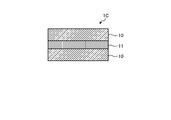
- FIG. 1 is a schematic cross-sectional view showing a first example of a color conversion sheet according to an embodiment of the invention.
- FIG. 2 is a schematic cross-sectional view showing a second example of the color conversion sheet according to the embodiment of the invention.
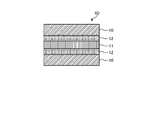
- FIG. 3 is a schematic cross-sectional view showing a third example of the color conversion sheet according to the embodiment of the invention.
- FIG. 4 is a schematic cross-sectional view showing a fourth example of the color conversion sheet according to the embodiment of the invention.
- a polycyclic aromatic compound according to an embodiment of the present invention is a color conversion material that constitutes a color conversion composition, a color conversion sheet, or the like. Specifically, the polycyclic aromatic compound exhibits luminescence observed in a region having a peak wavelength of 500 nm or more and 750 nm or less by using excitation light, has a HOMO level of ⁇ 5.7 eV or less, and emits delayed fluorescence. It is a releasing compound.
- the polycyclic aromatic compound according to the embodiment of the present invention may be abbreviated as "the polycyclic aromatic compound of the present invention”.
- the polycyclic aromatic compound of the present invention is a compound that emits light with a peak wavelength of 500 nm or more and 750 nm or less by using excitation light.
- the polycyclic aromatic compound of the present invention preferably emits light having a peak wavelength of 500 nm or more and less than 580 nm by using excitation light.
- luminescence observed in a region with a peak wavelength of 500 nm or more and less than 580 nm is referred to as "green luminescence”.
- the polycyclic aromatic compound of the present invention preferably emits green light by using excitation light with a wavelength of 430 nm or more and 500 nm or less.
- excitation light with a wavelength in the range of 430 nm or more and 500 nm or less has relatively small excitation energy. Therefore, decomposition of the light-emitting material in the color conversion composition is suppressed, and green light emission with good color purity can be obtained.
- the polycyclic aromatic compound of the present invention preferably emits light having a peak wavelength of 580 nm or more and 750 nm or less by using excitation light.
- luminescence observed in a region with a peak wavelength of 580 nm or more and 750 nm or less will be referred to as "red luminescence”.
- the polycyclic aromatic compound of the present invention preferably emits red light by using excitation light with a wavelength of 430 nm or more and 500 nm or less.
- excitation light with a wavelength in the range of 430 nm or more and 500 nm or less has relatively small excitation energy. Therefore, decomposition of the light-emitting material in the color conversion composition is suppressed, and red light emission with good color purity can be obtained.
- delayed fluorescence A compound that emits delayed fluorescence is characterized in that its triplet excited state is quickly converted to a singlet excited state, and singlet oxygen is less likely to be generated. It was found that this feature prevents deterioration of the light-emitting material, suppresses changes in chromaticity over time, and improves durability. This mechanism will be explained in order.
- the chromaticity change of the color conversion composition is caused by the deterioration of the luminescent material.
- This degradation of the luminescent material is caused by singlet oxygen.
- Singlet oxygen is a singlet state in which the two electrons in the ⁇ * orbital (antibonding ⁇ orbital) of the molecular orbital of the oxygen molecule have different spin directions, that is, the excitation in which the total spin quantum number is 0 is the oxygen molecule in the state
- Such excited states include the ⁇ 1 state in which each of the two ⁇ * orbitals is occupied by electrons with different spin directions, and the There are ⁇ 1 states occupied by two different electrons.
- Singlet oxygen has a strong electrophilicity due to its vacant electron orbit in the ⁇ 1 state, and has a strong oxidizing power. Therefore, it is considered that singlet oxygen causes deterioration due to oxidation of the light-emitting material.
- Singlet oxygen is thought to be unlikely to be generated by direct photoexcitation of ground-state triplet oxygen. This is because the transition from triplet oxygen in the ground state to singlet oxygen in the excited state is a spin-forbidden transition, and the transition probability is very low.
- singlet oxygen is considered to be generated by the exchange of electrons and energy between the triplet excited state of the light-emitting material and the triplet oxygen molecule in the ground state.
- the generation mechanism is considered as follows.
- the light-emitting material changes from the singlet ground state to the singlet excited state by photoexcitation, and further, a part of the light-emitting material changes from the singlet excited state to the triplet excited state due to intersystem crossing. Since the transition from the triplet excited state of the generated luminescent material to the singlet ground state is a spin-forbidden transition, the transition probability is usually low and the triplet excited state has a long lifetime. However, when triplet oxygen in the ground state coexists, the spin inhibition is lifted by the excitation of the triplet oxygen in the ground state to the singlet oxygen in the excited state. It can be rapidly deactivated to the ground state. This mechanism is called the Dexter mechanism (electronic exchange mechanism).
- the Dexter mechanism In order for the Dexter mechanism to proceed, it is necessary to exchange electrons through wave function overlap between molecules. Therefore, it is considered necessary to directly collide the energy donor molecule (in this case, the triplet excited light-emitting material) and the energy acceptor molecule (in this case, ground state triplet oxygen).
- the energy donor molecule in this case, the triplet excited light-emitting material
- the energy acceptor molecule in this case, ground state triplet oxygen
- compounds that emit delayed fluorescence have the property that the triplet excited state quickly converts to the singlet excited state, that is, the triplet excited state has a short lifetime. Therefore, the probability of direct collision between the triplet excited state of the light-emitting material and triplet oxygen in the ground state is reduced, and singlet oxygen is less likely to occur.
- the polycyclic aromatic compound of the present invention is a compound that emits delayed fluorescence, generation of singlet oxygen can be suppressed, and durability of the color conversion composition can be improved. can.
- the polycyclic aromatic compound of the present invention is a light-emitting material whose HOMO level is -5.7 eV or less.
- the HOMO level of the light-emitting material is higher than ⁇ 5.7 eV, the light-emitting material is oxidized due to the interaction with oxygen contained in the composition containing the light-emitting material when the excitation-light emission cycle is repeated. Since it is quenched, it causes deterioration of durability.
- the HOMO level of the light-emitting material is ⁇ 5.7 eV or less, the electron density of the light-emitting material is lowered. As a result, the stability of the light-emitting material against oxygen can be improved, and the durability can be improved.
- the HOMO level of the polycyclic aromatic compound of the present invention is preferably -6.0 eV or less.
- the electron density of the compound can be further reduced. Therefore, the stability of the polycyclic aromatic compound of the present invention against oxygen is improved, and the durability of the polycyclic aromatic compound can be improved.
- the HOMO level of the polycyclic aromatic compound of the present invention is more preferably ⁇ 6.2 eV or less, and even more preferably ⁇ 6.5 eV or less.
- the HOMO level of a compound can be calculated by calculation.
- the general-purpose quantum chemistry calculation program "Gaussian 16" program package (manufactured by Gaussian) uses B3LYP density functional theory to perform structural optimization on the 6-31G(d) basis set. It is a value calculated by calculating with the 6-311++G(d, p) basis set using the B3LYP density functional theory based on the converted structure.
- the half width of the emission spectrum at the emission peak wavelength of the polycyclic aromatic compound of the present invention is 40 nm from the viewpoint of obtaining light emission with high color purity and achieving a wide color gamut of the display when used in a liquid crystal display. It is preferably 30 nm or less, more preferably 25 nm or less.
- the polycyclic aromatic compound of the present invention is not particularly limited, but a compound having a structure represented by the following general formula (1) or general formula (2) is preferable.
- ring Za, ring Zb and ring Zc are each independently a substituted or unsubstituted aryl ring having 6 to 30 ring carbon atoms, or a substituted or unsubstituted ring It is a heteroaryl ring having 6 to 30 carbon atoms.
- Z 1 and Z 2 are each independently an oxygen atom, NRa (a nitrogen atom having a substituent Ra) or a sulfur atom.
- substituent Ra may combine with ring Za or ring Zb to form a ring.
- substituent Ra may combine with ring Za or ring Zc to form a ring.
- E 1 is BRa
- E 2 is BRa
- substituent Ra may combine with ring Za or ring Zc to form a ring.
- the above substituents Ra are each independently a substituted or unsubstituted aryl group, a substituted or unsubstituted heteroaryl group, or a substituted or unsubstituted alkyl group.
- hydrogen may be deuterium.
- all the above groups may be substituted or unsubstituted groups.
- the compounds or partial structures thereof described below may be substituted or unsubstituted compounds or partial structures thereof.
- a substituted or unsubstituted aryl group having 6 to 40 carbon atoms means an aryl group having 6 to 40 carbon atoms including the number of carbon atoms contained in the substituents substituted on the aryl group. is. The same applies to other substituents defining the number of carbon atoms.
- substituents when substituted include alkyl groups, cycloalkyl groups, heterocyclic groups, alkenyl groups, cycloalkenyl groups, alkynyl groups, hydroxyl groups, thiol groups, alkoxy groups, and alkylthio groups.
- aryl ether group arylthioether group, aryl group, heteroaryl group, halogen, cyano group, aldehyde group, carbonyl group, acyl group, ester group, amide group, carboxyl group, oxycarbonyl group, carbamoyl group, amino group, nitro A group, a silyl group, a siloxanyl group, a boryl group, and a phosphine oxide group are preferred, and more preferred are specific substituents that are preferred in the description of each substituent. In addition, these substituents may be further substituted with the above substituents.
- the alkyl group is, for example, a saturated aliphatic hydrocarbon such as methyl group, ethyl group, n-propyl group, isopropyl group, n-butyl group, sec-butyl group, tert-butyl group, etc.
- the number of carbon atoms in the alkyl group is not particularly limited, but is preferably in the range of 1 to 20, more preferably 1 to 8, from the viewpoint of availability and cost.
- alkylene group refers to a divalent or higher group derived from a saturated aliphatic hydrocarbon group such as a methyl group and an ethyl group, and these may or may not have a substituent.
- Preferred alkylene groups include methylene, ethylene, n-propylene, isopropylene, n-butylene, pentylene and hexylene groups.
- the number of carbon atoms in the alkylene group portion is not particularly limited, but is preferably in the range of 1 to 20, and more preferably in the range of 1 to 6.
- a cycloalkyl group is, for example, a saturated alicyclic hydrocarbon group such as a cyclopropyl group, a cyclohexyl group, a norbornyl group, and an adamantyl group, which may or may not have a substituent.
- the number of carbon atoms in the alkyl group portion is not particularly limited, but is preferably in the range of 3 or more and 20 or less.
- a cycloalkylene group refers to a divalent or higher group derived from a saturated alicyclic hydrocarbon group such as a cyclopropyl group and a cyclohexyl group, which may or may not have a substituent.
- Preferred cycloalkylene groups include saturated alicyclic hydrocarbon groups such as cyclopropylene, cyclohexylene, norbornylene and adamantylene groups.
- the number of carbon atoms in the cycloalkylene group portion is not particularly limited, but is preferably in the range of 3 or more and 20 or less.
- the heterocyclic group is, for example, a pyran ring, a piperidine ring, an aliphatic ring having a non-carbon atom in the ring such as a cyclic amide, which may or may not have a substituent. good.
- the number of carbon atoms in the heterocyclic group is not particularly limited, it is preferably in the range of 2 or more and 20 or less.
- the alkenyl group is, for example, a vinyl group, an allyl group, an unsaturated aliphatic hydrocarbon group containing a double bond such as a butadienyl group, which may or may not have a substituent.
- the number of carbon atoms in the alkenyl group is not particularly limited, it is preferably in the range of 2 or more and 20 or less.
- a cycloalkenyl group is, for example, an unsaturated alicyclic hydrocarbon group containing a double bond such as a cyclopentenyl group, a cyclopentadienyl group, a cyclohexenyl group, and the like, even if it has a substituent. It does not have to be.
- the number of carbon atoms in the cycloalkenyl group is not particularly limited, it is preferably in the range of 3 or more and 20 or less.
- An alkynyl group is, for example, an unsaturated aliphatic hydrocarbon group containing a triple bond such as an ethynyl group, which may or may not have a substituent.
- the number of carbon atoms in the alkynyl group is not particularly limited, it is preferably in the range of 2 or more and 20 or less.
- An alkoxy group is, for example, a functional group in which an aliphatic hydrocarbon group is bonded via an ether bond such as a methoxy group, an ethoxy group, a propoxy group, and the aliphatic hydrocarbon group has a substituent. does not have to be
- the number of carbon atoms in the alkoxy group is not particularly limited, but is preferably in the range of 1 to 20.
- An alkylthio group is an alkoxy group in which the oxygen atom of the ether bond is substituted with a sulfur atom.
- the hydrocarbon group of the alkylthio group may or may not have a substituent.
- the number of carbon atoms in the alkylthio group is not particularly limited, but is preferably in the range of 1 to 20.
- An aryl ether group is a functional group in which an aromatic hydrocarbon group is bonded via an ether bond, such as a phenoxy group, and the aromatic hydrocarbon group may or may not have a substituent. good too.
- the number of carbon atoms in the aryl ether group is not particularly limited, it is preferably in the range of 6 or more and 40 or less.
- An arylthioether group is an arylether group in which the oxygen atom of the ether bond is substituted with a sulfur atom.
- the aromatic hydrocarbon group in the arylthioether group may or may not have a substituent.
- the number of carbon atoms in the arylthioether group is not particularly limited, it is preferably in the range of 6 or more and 40 or less.
- An aryl group includes, for example, a phenyl group, a biphenyl group, a terphenyl group, a naphthyl group, a fluorenyl group, a benzofluorenyl group, a dibenzofluorenyl group, a phenanthryl group, anthracenyl group, a benzophenanthryl group, and a benzoanthracene.
- aromatic hydrocarbon group such as a nyl group, a chrysenyl group, a pyrenyl group, a fluoranthenyl group, a triphenylenyl group, a benzofluoranthenyl group, a dibenzoanthracenyl group, a perylenyl group, and a helicenyl group.
- the aryl group may or may not have a substituent.
- the substituents may form a cyclic structure.
- Examples of the aryl group in which the substituents form a cyclic structure include a spirofluorenyl group.
- the number of carbon atoms in the aryl group is not particularly limited, but is preferably in the range of 6 to 100, more preferably 6 to 50, and more preferably 6 to 30.
- the aryl group is preferably a phenyl group, biphenyl group, terphenyl group, naphthyl group, fluorenyl group, phenanthryl group or anthracenyl group.
- a phenyl group and a naphthyl group are more preferable.
- a phenyl group is particularly preferred.
- the heteroaryl group includes, for example, pyridyl group, furanyl group, thienyl group, quinolinyl group, isoquinolinyl group, pyrazinyl group, pyrimidyl group, pyridazinyl group, triazinyl group, napthyridinyl group, cinnolinyl group, phthalazinyl group, quinoxalinyl group, quinazolinyl group, benzofuranyl group, benzothienyl group, indolyl group, dibenzofuranyl group, dibenzothienyl group, carbazolyl group, benzocarbazolyl group, carbolinyl group, indolocarbazolyl group, benzofurocarbazolyl group, benzothienocarbazolyl non-carbon atoms such as dihydroindenocarbazolyl, benzoquinolinyl, acridinyl, dibenzoacridinyl
- the naphthyridinyl group is any of a 1,5-naphthyridinyl group, a 1,6-naphthyridinyl group, a 1,7-naphthyridinyl group, a 1,8-naphthyridinyl group, a 2,6-naphthyridinyl group and a 2,7-naphthyridinyl group.
- a heteroaryl group may or may not have a substituent.
- the number of carbon atoms in the heteroaryl group is not particularly limited, but is preferably in the range of 2 to 40, more preferably in the range of 2 to 30.
- the heteroaryl group includes pyridyl, furanyl, thienyl, quinolinyl, pyrimidyl, triazinyl, benzofuranyl, benzothienyl, indolyl, dibenzo Furanyl group, dibenzothienyl group, carbazolyl group, benzimidazolyl group, imidazopyridyl group, benzoxazolyl group, benzothiazolyl group and phenanthrolinyl group are preferred, and pyridyl group, furanyl group, thienyl group and quinolinyl group are more preferred.
- a pyridyl group is particularly preferred.
- Halogen means an atom selected from fluorine, chlorine, bromine and iodine.
- a carbonyl group, a carboxyl group, an oxycarbonyl group, and a carbamoyl group may or may not have a substituent.
- substituents include alkyl groups, cycloalkyl groups, aryl groups, heteroaryl groups, and the like, and these substituents may be further substituted.
- the number of carbon atoms in the carbonyl group is not particularly limited, it is preferably in the range of 6 or more and 40 or less.
- An ester group refers to a functional group in which, for example, an alkyl group, a cycloalkyl group, an aryl group, a heteroaryl group, or the like is bonded via an ester bond, and this substituent may be further substituted.
- the number of carbon atoms in the ester group is not particularly limited, but is preferably in the range of 1 to 200, more preferably in the range of 1 to 100.
- the ester group includes, for example, a methyl ester group such as a methoxycarbonyl group, an ethyl ester group such as an ethoxycarbonyl group, a propyl ester group such as a propoxycarbonyl group, a butyl ester group such as a butoxycarbonyl group, an isopropoxy
- a methyl ester group such as a methoxycarbonyl group
- an ethyl ester group such as an ethoxycarbonyl group
- a propyl ester group such as a propoxycarbonyl group
- a butyl ester group such as a butoxycarbonyl group
- isopropyl ester groups such as methoxycarbonyl group
- hexyl ester groups such as hexyloxycarbonyl group
- phenyl ester groups such as phenoxycarbonyl group.
- An amide group is, for example, a functional group in which a substituent such as an alkyl group, a cycloalkyl group, an aryl group, or a heteroaryl group is bonded via an amide bond, and this substituent may be further substituted.
- the number of carbon atoms in the amide group is not particularly limited, but is preferably in the range of 1 or more and 20 or less. More specifically, the amide group includes a methylamide group, an ethylamide group, a propylamide group, a butylamide group, an isopropylamide group, a hexylamide group, a phenylamide group, and the like.
- An amino group is a substituted or unsubstituted amino group.
- the amino group may or may not have a substituent, and examples of the substituent when substituted include an aryl group, a heteroaryl group, a linear alkyl group, and a branched alkyl group.
- a substituent when substituted include an aryl group, a heteroaryl group, a linear alkyl group, and a branched alkyl group.
- a phenyl group, a naphthyl group, a pyridyl group and a quinolinyl group are preferable. These substituents may be further substituted.
- the number of carbon atoms is not particularly limited, but is preferably 2 or more and 50 or less, more preferably 6 or more and 40 or less, and particularly preferably 6 or more and 30 or less.
- the silyl group is, for example, a trimethylsilyl group, a triethylsilyl group, a tert-butyldimethylsilyl group, a propyldimethylsilyl group, an alkylsilyl group such as a vinyldimethylsilyl group, a phenyldimethylsilyl group, a tert-butyldiphenylsilyl group, a tri It represents an arylsilyl group such as a phenylsilyl group and a trinaphthylsilyl group. Substituents on silicon may be further substituted.
- the number of carbon atoms in the silyl group is not particularly limited, it is preferably in the range of 1 or more and 30 or less.
- a siloxanyl group is, for example, a silicon compound group through an ether bond such as a trimethylsiloxanyl group. Substituents on silicon may be further substituted. Although the number of carbon atoms in the siloxanyl group is not particularly limited, it is preferably in the range of 1 or more and 30 or less.
- a boryl group is a substituted or unsubstituted boryl group. The boryl group may or may not have a substituent, and examples of substituents when substituted include an aryl group, a heteroaryl group, a linear alkyl group, a branched alkyl group, and an aryl ether group. , an alkoxy group, and a hydroxyl group. Among them, an aryl group and an aryl ether group are preferred. The number of carbon atoms in the boryl group is not particularly limited, but is preferably in the range of 1 or more and 30 or less.
- An acyl group is, for example, a functional group in which a substituent such as an alkyl group, a cycloalkyl group, an aryl group, or a heteroaryl group is bonded via a carbonyl bond, and this substituent may be further substituted.
- the number of carbon atoms in the acyl group is not particularly limited, but is preferably in the range of 1 or more and 20 or less. More specifically, the acyl group includes acetyl group, propionyl group, benzoyl group, acrylyl group and the like.
- the number of carbon atoms in the sulfonyl group is not particularly limited, but is preferably in the range of 1 or more and 30 or less.
- the number of carbon atoms in the sulfoxide group is not particularly limited, but is preferably in the range of 1 or more and 30 or less.
- R 10 and R 11 of the phosphine oxide group are selected similarly to the substituent Ra described above.
- the number of carbon atoms in the phosphine oxide group is not particularly limited, but preferably ranges from 1 to 30.
- aryl rings having 6 to 30 ring carbon atoms include benzene ring, naphthalene ring, fluorene ring, benzofluorene ring, dibenzofluorene ring, phenanthrene ring, anthracene ring, benzophenanthrene ring, benzanthracene ring, chrysene ring, pyrene ring, fluoranthene ring, triphenylene ring, benzofluoranthene ring, dibenzoanthracene ring, perylene ring, helicene ring and the like.
- Heteroaryl rings having 6 to 30 ring carbon atoms include pyridine ring, furan group, thiophene ring, quinoline ring, isoquinoline ring, pyrazine ring, pyrimidine ring, pyridazine ring, naphthyridine ring, cinnoline ring, phthalazine ring, quinoxaline ring, quinazoline ring, benzofuran ring, benzothiophene ring, indole ring, dibenzofuran ring, dibenzothiophene ring, carbazole ring, benzocarbazole ring, carboline ring, indolocarbazole ring, benzoflocarbazole ring, benzothienocarbazole ring, dihydroindenocarbazole ring , benzoquinoline ring, acridine ring, dibenzoacridine ring, imidazole ring, ox
- the compound represented by general formula (1) or general formula (2) has a rigid and highly planar skeleton. Therefore, the compound represented by general formula (1) or general formula (2) exhibits a high emission quantum yield, and the emission spectrum of the compound represented by general formula (1) or general formula (2) is The half width of the peak is small. Therefore, the compound represented by general formula (1) or general formula (2) can achieve highly efficient color conversion and high color purity.
- the compound represented by general formula (1) or general formula (2) localizes HOMO and LUMO in the molecule using an electron-donating substituent and an electron-accepting substituent.
- reverse intersystem crossing occurs efficiently from the triplet excited state to the singlet excited state, resulting in a compound that emits delayed fluorescence. Therefore, the durability of the compound represented by general formula (1) or general formula (2) can be improved.
- the compound represented by general formula (1) or general formula (2) has at least one electron-withdrawing group, compared with the case where the compound does not have an electron-withdrawing group, general formula (1) or general formula ( The electron density of the compound represented by 2) is lowered. This improves the stability of the compound represented by general formula (1) or general formula (2) against singlet oxygen, and as a result, further improves the durability of the compound. Therefore, the compound represented by general formula (1) or general formula (2) preferably has at least one electron-withdrawing group.
- the compound represented by general formula (1) or general formula (2) has at least one electron withdrawing group as a substituent of ring Za, ring Zb or ring Zc, or those rings are adjacent groups and rings It is preferable to have as a substituent on the ring when forming As an example of the latter, for example, when Z 1 is NRa and the substituent Ra is bonded to the ring Zb to form a ring, the ring has an electron withdrawing group as a substituent. be done.
- the compound represented by general formula (1) or general formula (2) preferably has two or more electron-withdrawing groups. As a result, the stability of the compound represented by general formula (1) or general formula (2) against singlet oxygen is further improved, and as a result, the durability of the compound is further improved.
- An electron-withdrawing group also called an electron-accepting group
- an electron-withdrawing group is an atomic group that attracts electrons from a substituted atomic group due to an inductive effect or resonance effect in organic electron theory.
- Examples of the electron-withdrawing group include those having a positive value as the substituent constant ( ⁇ p (para)) of Hammett's rule.
- Hammett's rule substituent constant ( ⁇ p (para)) can be quoted from Kagaku Handan Basic Edition 5th Revised Edition (page II-380).
- the electron-withdrawing group include a cyano group, an acyl group, an ester group, an amide group, a sulfonyl group, a sulfonate group, or a sulfonamide group.
- These groups can effectively reduce the electron density of the basic skeleton.
- these groups have moderate polarity, the solubility of the compound represented by general formula (1) or general formula (2) in solvents, resins, etc., is improved when the color conversion composition is produced. Therefore, it is preferable.
- the stability of the compound represented by general formula (1) or general formula (2) against singlet oxygen is further improved, and as a result, the durability of the compound is further improved.
- a particularly preferred example of the electron-withdrawing group is an ester group.
- the electron-withdrawing group is an ester group, the electron density of the basic skeleton can be moderately reduced without widening the conjugation of the basic skeleton. Therefore, the durability of the compound represented by the general formula (1) or (2) can be further improved without impairing the luminous efficiency and color purity.
- ester groups fluorine-containing ester groups (ester groups containing fluorine atoms) are particularly preferred.
- the alkyl ester group such as the methyl ester group and the aryl ester group such as the phenyl ester group described above are preferably substituted with a fluorine atom or a group containing a fluorine atom.
- a trifluoromethyl ester group etc. are mentioned as an example in case the methyl ester group is substituted by the fluorine atom.
- the phenyl ester group substituted with a fluorine atom-containing group include a trifluoromethylphenyl group and a (3,5-bistrifluoromethylphenyl)phenyl ester group.
- the electron-withdrawing group is preferably sterically bulky. If the electron-withdrawing group is bulky, due to its structure, the degree of freedom of molecular motion of the compound represented by general formula (1) or general formula (2) is reduced, and molecular movement within the resin is suppressed. be. In addition, the electron-withdrawing group acts as a steric hindrance group, so that the compounds represented by general formula (1) or (2) do not interact with each other, thereby further improving the stability. In this way, the sterically bulky electron-withdrawing group can suppress the aggregation of molecules and improve the durability of the compound represented by the general formula (1) or (2).
- the number of carbon atoms constituting the electron-withdrawing group is not particularly limited, but is preferably in the range of 2 to 200, more preferably 6 to 200, and particularly preferably 20 to 200.
- Z 1 and Z 2 are preferably oxygen atoms or NRa. This is because the ⁇ -conjugated system of the compound represented by the general formula (1) expands efficiently, and reverse intersystem crossing occurs more efficiently from the triplet excited state to the singlet excited state, so that the durability of the compound is improved. This is because the properties can be further improved.
- E is preferably a boron atom, and E 1 and E 2 are preferably BRa. This is because the ⁇ -conjugated system of the compound represented by the general formula (1) or general formula (2) is efficiently expanded, and the reverse intersystem crossing occurs more efficiently from the triplet excited state to the singlet excited state. Therefore, the durability of the compound can be further improved.
- ring Za, ring Zb and ring Zc are preferably benzene rings. This is because the ⁇ -conjugated system of the compound represented by the general formula (1) or general formula (2) is efficiently expanded, and the reverse intersystem crossing occurs more efficiently from the triplet excited state to the singlet excited state. Therefore, the durability of the compound can be further improved.
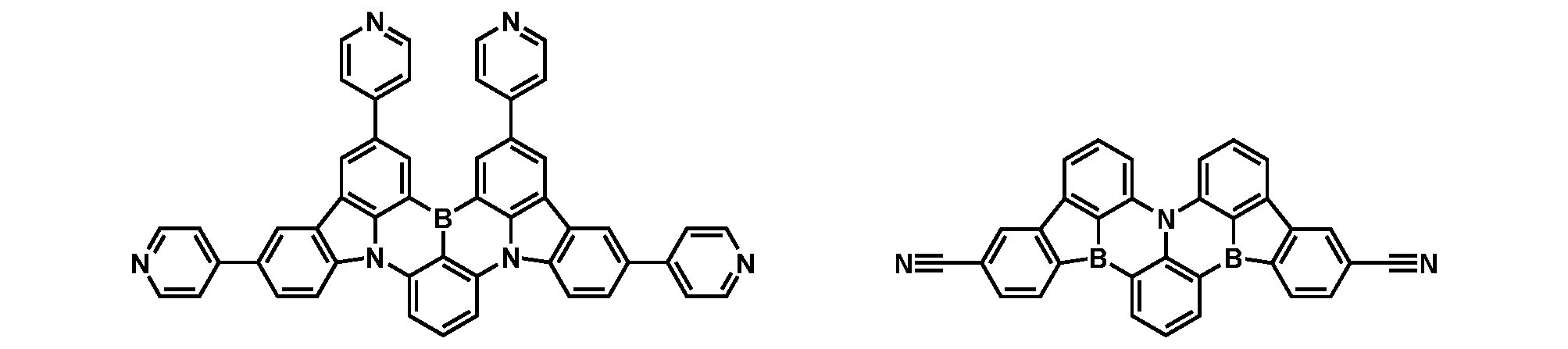
- polycyclic aromatic compound of the present invention examples are shown below, but the polycyclic aromatic compound of the present invention is not limited to these.
- the polycyclic aromatic compound of the present invention can be produced, for example, by referring to the methods described in JP-A-2020-097561, WO2015/102118 and WO2019/164340. That is, the desired polycyclic aromatic compound can be obtained by reacting the halogen compound and the boron raw material in the coexistence of butyllithium.
- the invention is not limited to this.
- a method of forming a carbon-carbon bond using a coupling reaction between a halogenated derivative and a boronic acid or boronic acid ester derivative can be mentioned. , but not limited to.
- a halogenated derivative previously substituted with an electron-withdrawing group may be used as a starting material, or a method of introducing the electron-withdrawing group by various reactions after forming the skeleton may be mentioned.
- the present invention is not limited to this.
- a polycyclic aromatic compound according to another aspect of the present invention is a compound represented by general formula (11) or general formula (12) and having at least one electron-withdrawing group.
- ring Za, ring Zb and ring Zc are each independently a substituted or unsubstituted aryl ring having 6 to 30 ring-forming carbon atoms, or a substituted or unsubstituted ring It is a heteroaryl ring having 6 to 30 carbon atoms.
- Z 1 and Z 2 are each independently an oxygen atom, NRa (a nitrogen atom having a substituent Ra) or a sulfur atom.
- substituent Ra may combine with ring Za or ring Zb to form a ring.
- substituent Ra may combine with ring Za or ring Zc to form a ring.
- E 1 is BRa
- E 2 is BRa
- substituent Ra may combine with ring Za or ring Zc to form a ring.
- the above substituents Ra are each independently a substituted or unsubstituted aryl group, a substituted or unsubstituted heteroaryl group, or a substituted or unsubstituted alkyl group.
- the compound represented by general formula (11) or general formula (12) has at least one electron-withdrawing group.
- the compound represented by general formula (11) has at least one electron-withdrawing group in the compound represented by general formula (1) above.
- the compound represented by general formula (12) has at least one electron-withdrawing group in the compound represented by general formula (2) above.
- the explanation of each group in the compound represented by general formula (11) or general formula (12) is the same as in the compound represented by general formula (1) or general formula (2) above.
- the compound represented by general formula (11) or general formula (12) has at least one electron-withdrawing group, the compound represented by general formula (11) or general formula (12) is more ), the electron density of the compound is reduced. This improves the stability of the compound represented by the general formula (11) or (12) against singlet oxygen, and as a result, the durability of the compound is particularly improved. Therefore, in the case of the compound represented by general formula (11) or general formula (12), regardless of whether the HOMO level is ⁇ 5.7 eV or less, color reproducibility is improved and durability is high. It is possible to realize a polycyclic aromatic compound and a color conversion composition that are suitable as a color conversion material that is compatible with the above.
- a color conversion composition according to an embodiment of the present invention converts incident light from a light-emitting body such as a light source into light having a wavelength different from that of the incident light, and is composed of the above-described polycyclic aromatic compound of the present invention. It preferably contains a compound and a binder resin.
- "converting into light having a wavelength different from that of the incident light” preferably means converting into light having a longer wavelength than the incident light.
- the color conversion composition according to the embodiment of the present invention can appropriately contain other compounds as necessary.
- an assist dopant such as rubrene may be contained.
- a desired organic luminescent material for example, an organic luminescent material such as a coumarin derivative or a rhodamine derivative can be added.
- organic light-emitting materials it is also possible to combine and add known light-emitting materials such as inorganic phosphors, fluorescent pigments, fluorescent dyes, and quantum dots.
- organic light-emitting materials other than the polycyclic aromatic compound of the present invention are shown below, but the present invention is not particularly limited to these.
- the color conversion composition preferably emits green light by using excitation light. Moreover, the color conversion composition preferably emits red light when excited light is used.
- binder resin forms a continuous phase and may be any material as long as it is excellent in moldability, transparency, heat resistance, and the like.
- binder resins include photocurable resist materials having reactive vinyl groups such as acrylic acid, methacrylic acid, polyvinyl cinnamate, ring rubber, epoxy resins, silicone resins (silicone rubber, silicone Organopolysiloxane cured products (crosslinked products such as gels), urea resins, fluororesins, polycarbonate resins, acrylic resins, urethane resins, melamine resins, polyvinyl resins, polyamide resins, phenol resins, polyvinyl alcohol resins, cellulose resins, Known resins such as aliphatic ester resins, aromatic ester resins, aliphatic polyolefin resins and aromatic polyolefin resins can be used.
- these copolymer resins may be used as the binder resin.
- a binder resin useful for the color conversion composition and color conversion sheet according to the embodiment of the present invention can be obtained.
- thermoplastic resins are more preferable because the process of forming a sheet is easy.
- thermoplastic resins epoxy resins, silicone resins, acrylic resins, ester resins, olefin resins, or mixtures thereof can be preferably used from the viewpoint of transparency, heat resistance, and the like. From the standpoint of durability, particularly preferred thermoplastic resins are acrylic resins, ester resins, and cycloolefin resins.
- Suitable specific examples of the binder resin include, for example, International Publication No. 2016/190283, International Publication No. 2017/61337, International Publication No. 2018/43237, International Publication No. 2019/21813 and International Publication No. 2019/188019. and the like.
- additives such as dispersants and leveling agents may be added to the binder resin to stabilize the coating film, and adhesion aids such as silane coupling agents may be added as modifiers for the sheet surface. It is also possible to Inorganic particles such as silica particles and silicone fine particles can also be added to the binder resin as a color conversion material sedimentation inhibitor.
- the binder resin contains, as other components, hydrosilylation of acetylene alcohol or the like in order to suppress hardening at room temperature and prolong the pot life. It is preferable to incorporate a reaction retardant.
- the binder resin may contain fine particles such as fumed silica, glass powder, quartz powder, etc., titanium oxide, zirconia oxide, barium titanate, zinc oxide, etc., if necessary, as long as the effects of the present invention are not impaired.
- Inorganic fillers, pigments, flame retardants, heat-resistant agents, antioxidants, dispersants, solvents, adhesion-imparting agents such as silane coupling agents and titanium coupling agents, and the like may be blended.
- a color conversion composition according to an embodiment of the present invention may contain a solvent.
- the solvent is not particularly limited as long as it can adjust the viscosity of the resin in a fluid state and does not excessively affect the light emission and durability of the light-emitting substance.
- examples of such solvents include toluene, methyl ethyl ketone, methyl isobutyl ketone, hexane, acetone, terpineol, texanol, methyl cellosolve, butyl carbitol, butyl carbitol acetate, propylene glycol monomethyl ether acetate and the like. It is also possible to use a mixture of two or more of these solvents.
- toluene is particularly preferred because it does not affect the deterioration of the polycyclic aromatic compound of the present invention and leaves little residual solvent after drying.
- the color conversion composition according to the embodiment of the present invention contains, in addition to the above-described polycyclic aromatic compound and binder resin of the present invention, a light stabilizer, an antioxidant, a processing and heat stabilizer, an ultraviolet absorber, and the like.
- a light stabilizer such as light resistance stabilizers, scattering particles, silicone fine particles and silane coupling agents may be contained.
- Examples of light stabilizers include tertiary amines, catechol derivatives, nickel compounds, and at least one selected from the group consisting of Sc, V, Mn, Fe, Co, Cu, Y, Zr, Mo, Ag, and lanthanoids. Examples include complexes containing transition metals and salts with organic acids, but are not particularly limited. Moreover, these light stabilizers may be used alone or in combination.
- antioxidants examples include phenolic antioxidants such as 2,6-di-tert-butyl-p-cresol and 2,6-di-tert-butyl-4-ethylphenol. It is not particularly limited to these. Moreover, these antioxidants may be used alone or in combination.
- processing and heat stabilizers include phosphorus-based stabilizers such as tributylphosphite, tricyclohexylphosphite, triethylphosphine, and diphenylbutylphosphine, but are not particularly limited thereto. Moreover, these stabilizers may be used alone or in combination.
- light stabilizers examples include 2-(5-methyl-2-hydroxyphenyl)benzotriazole, 2-[2-hydroxy-3,5-bis( ⁇ , ⁇ -dimethylbenzyl)phenyl]-2H- Benzotriazoles such as benzotriazole can be mentioned, but are not particularly limited to these. Moreover, these light resistance stabilizers may be used alone or in combination.
- inorganic particles having a refractive index of 1.7 to 2.8 are preferable.
- the inorganic particles include titania, zirconia, alumina, ceria, tin oxide, indium oxide, iron oxide, zinc oxide, aluminum nitride, aluminum, tin, sulfides of titanium or zirconium, and hydroxides of titanium or zirconium. are mentioned.
- the content of these additives depends on the molar absorption coefficient, emission quantum yield and absorption intensity at the excitation wavelength of the compound, and the thickness and transmittance of the color conversion sheet to be produced. Although it depends on the situation, it is generally preferable that the amount is 1.0 ⁇ 10 ⁇ 3 to 30 parts by weight with respect to 100 parts by weight of the binder resin. Further, the content of these additives is more preferably 1.0 ⁇ 10 -2 parts by weight or more and 15 parts by weight or less with respect to 100 parts by weight of the binder resin. Part or more and 10 parts by weight or less is particularly preferable.
- ⁇ Method for producing color conversion composition An example of a method for producing a color conversion composition according to an embodiment of the invention will be described below.
- predetermined amounts of the polycyclic aromatic compound of the present invention, the binder resin, the solvent, and the like are mixed. After mixing the above components to a predetermined composition, they are uniformly mixed and dispersed using a stirring/kneading machine such as a homogenizer, a revolving stirrer, three rollers, a ball mill, a planetary ball mill, and a bead mill to obtain a color-changing composition. you get something.
- a stirring/kneading machine such as a homogenizer, a revolving stirrer, three rollers, a ball mill, a planetary ball mill, and a bead mill to obtain a color-changing composition. you get something.
- defoaming under vacuum or reduced pressure conditions is also preferably carried out.
- a color conversion sheet converts incident light from a light-emitting body such as a light source into light having a wavelength different from that of the incident light, and comprises the polycyclic aromatic compound of the present invention described above. and a binder resin.
- converting into light having a wavelength different from that of the incident light preferably means converting into light having a longer wavelength than the incident light.
- the color conversion sheet preferably includes a color conversion layer, which is a layer made of the above-described color conversion composition or a cured product obtained by curing it.
- the cured product of the color conversion composition is preferably included in the color conversion sheet as a layer obtained by curing the color conversion composition (a layer made of the cured product of the color conversion composition).
- the color conversion sheet there are, for example, the following four types.
- FIG. 1 is a schematic cross-sectional view showing a first example of a color conversion sheet according to an embodiment of the invention.
- the color conversion sheet 1A of this first example is a single-layer film composed of a color conversion layer 11.
- the color conversion layer 11 is a layer made of a cured product of the color conversion composition described above.
- FIG. 2 is a schematic cross-sectional view showing a second example of the color conversion sheet according to the embodiment of the invention.
- the color conversion sheet 1B of this second example is a laminate of a substrate layer 10 and a color conversion layer 11.
- the color conversion layer 11 is laminated on the base material layer 10 .
- FIG. 3 is a schematic cross-sectional view showing a third example of the color conversion sheet according to the embodiment of the invention.
- the color conversion sheet 1C of this third example is a laminate of a plurality of base material layers 10 and a color conversion layer 11.
- a color conversion layer 11 is sandwiched between a plurality of base layers 10 .
- FIG. 4 is a schematic cross-sectional view showing a fourth example of the color conversion sheet according to the embodiment of the invention.
- the color conversion sheet 1D of this fourth example is a laminate of a plurality of base layers 10, a color conversion layer 11, and a plurality of barrier films 12.
- a color conversion layer 11 is sandwiched between a plurality of barrier films 12, and a laminate of these color conversion layers 11 and a plurality of barrier films 12 is composed of a plurality of base layers 10.
- the color conversion sheet 1D may have a barrier film 12 as shown in FIG. 4 in order to prevent deterioration of the color conversion layer 11 due to oxygen, moisture and heat.
- the substrate layer for example, the substrate layer 10 shown in FIGS. 2 to 4
- known metals, films, glass, ceramics, paper, and the like can be used without particular limitation.
- glass and resin film are preferably used because of the ease of production of the color conversion sheet and the ease of molding the color conversion sheet.
- a film having high strength is preferable so that there is no risk of breakage or the like when the film-like base layer is handled.
- Resin films are preferred from the viewpoints of these required properties and economy, and plastic films selected from the group consisting of polyethylene terephthalate (PET), polyphenylene sulfide, polycarbonate and polypropylene are particularly preferred from the viewpoints of economy and handling.
- a polyimide film is preferable in terms of heat resistance.
- the surface of the base material layer may be subjected to a release treatment in advance so that the film can be easily peeled off.
- the thickness of the base material layer is not particularly limited, but the lower limit is preferably 25 ⁇ m or more, more preferably 38 ⁇ m or more. Moreover, as an upper limit, 5000 micrometers or less are preferable and 3000 micrometers or less are more preferable.
- the color conversion layer (for example, the color conversion layer 11 shown in FIGS. 1 to 4) is formed by applying the color conversion composition prepared by the method described above onto a substrate such as a base layer or a barrier film and drying the composition. can do.
- the thickness of the color conversion layer is not particularly limited, it is preferably 10 ⁇ m to 1000 ⁇ m.
- the lower limit of the thickness of the color conversion layer is more preferably 30 ⁇ m or more.
- the upper limit of the thickness of the color conversion layer is more preferably 200 ⁇ m or less, further preferably 100 ⁇ m or less, and particularly preferably 50 ⁇ m or less.
- the film thickness of the color conversion sheet in the present invention is the film thickness (average film thickness ).
- the color conversion layer may be one layer, or two or more layers.
- the color conversion layer has two or more layers, at least one of them preferably contains the polycyclic aromatic compound of the present invention.
- the color conversion layer contains a light stabilizer, an antioxidant, a processing and heat stabilizer, a light resistance stabilizer such as an ultraviolet absorber, and scattering particles. , silicone fine particles and a silane coupling agent, and other components (additives).
- a barrier film (for example, the barrier film 12 shown in FIG. 4) is appropriately used for improving the gas barrier properties of the color conversion layer.
- the barrier film include inorganic oxides such as silicon oxide, aluminum oxide, titanium oxide, tantalum oxide, zinc oxide, tin oxide, indium oxide, yttrium oxide, magnesium oxide, silicon nitride, aluminum nitride, titanium nitride, Inorganic nitrides such as silicon carbide nitride, mixtures thereof, metal oxide thin films and metal nitride thin films added with other elements, polyvinylidene chloride, acrylic resins, silicon resins, melamine resins, Films made of various resins such as urethane-based resins, fluorine-based resins, and polyvinyl alcohol-based resins such as saponified vinyl acetate can be used.
- barrier films having a barrier function against moisture examples include polyethylene, polypropylene, nylon, polyvinylidene chloride, copolymers of vinylidene chloride and vinyl chloride, copolymers of vinylidene chloride and acrylonitrile, fluorine-based Films made of various resins such as resins, polyvinyl alcohol-based resins such as saponified products of vinyl acetate can be used.
- the barrier film may be provided on both sides of the color conversion layer 11 like the barrier film 12 illustrated in FIG. 4, or may be provided on only one side of the color conversion layer 11.
- anti-reflection, anti-glare, anti-reflection and anti-glare hard coat (friction resistance), anti-static, anti-fouling, electromagnetic wave shielding, infrared
- An auxiliary layer having a blocking function, an ultraviolet blocking function, a polarizing function, and a toning function may be further provided.
- the color conversion sheet according to embodiments of the present invention may further comprise a dual brightness enhancement film (DBEF), a diffusion sheet, a prism sheet, a wavelength selective reflection film, or the like.
- DBEF dual brightness enhancement film
- Preferred specific examples of the wavelength-selective reflective film include those described in International Publication No. 2017/164155 and Japanese Patent Application Laid-Open No. 2018-81250.
- a light source unit includes at least a light source and the color conversion sheet described above.
- the light source included in the light source unit according to the embodiment of the present invention is the source of the excitation light described above.
- the method of arranging the light source and the color conversion sheet is not particularly limited, and a configuration in which the light source and the color conversion sheet are in close contact with each other may be adopted, or a remote phosphor type in which the light source and the color conversion sheet are separated from each other may be adopted. good too.
- the light source unit may further include a color filter for the purpose of increasing color purity.
- any type of excitation light can be used from the light source as long as it emits light in a wavelength region that can be absorbed by the mixed light-emitting substance such as the polycyclic aromatic compound of the present invention.
- any excitation light such as a hot cathode tube, a cold cathode tube, a fluorescent light source such as inorganic electroluminescence (EL), an organic EL element light source, an LED light source, an incandescent light source, or sunlight can be used.
- EL inorganic electroluminescence
- LED light source an incandescent light source
- sunlight can be used.
- light from an LED light source is a suitable excitation light.
- the excitation light may have one type of emission peak, or may have two or more types of emission peaks, but preferably has one type of emission peak in order to increase color purity. It is also possible to arbitrarily combine a plurality of excitation light sources with different types of emission peaks.
- the light source of the excitation light is preferably a light-emitting diode that emits maximum light in the wavelength range of 430 nm or more and 500 nm or less, in order to increase the color purity of blue light. Furthermore, it is preferable that this light source has a maximum emission in the wavelength range of 440 nm or more and 470 nm or less.
- the excitation light in the wavelength range of 430 nm to 500 nm has relatively low excitation energy and can prevent decomposition of the light-emitting substance such as the polycyclic aromatic compound of the present invention.
- the light source unit according to the present invention can be used for applications such as displays, lighting, interiors, signs, signboards, etc., and is particularly suitable for display and lighting applications.
- a display according to an embodiment of the present invention includes at least the color conversion sheet described above.
- a display such as a liquid crystal display
- a light source unit having the above-described light source, color conversion sheet, and the like is used as a backlight unit.
- a lighting device according to an embodiment of the present invention includes at least the color conversion sheet described above.
- this illumination device combines a blue LED light source as a light source unit and a color conversion sheet that converts the blue light from the blue LED light source into light with a longer wavelength to emit white light. Configured.
- a light emitting device comprises an anode, a cathode, and an organic layer interposed between the anode and the cathode.
- the organic layer of this light-emitting device emits light by electric energy.
- the polycyclic aromatic compound of the present invention may be used in any layer of the light-emitting device, but is preferably used in the light-emitting layer of the light-emitting device because of its high fluorescence quantum yield. In particular, since the polycyclic aromatic compound has an excellent fluorescence quantum yield, it is preferably used as a dopant material for the light-emitting layer.
- the fluorescence spectrum of the compound was measured using an F-2500 spectrofluorophotometer (manufactured by Hitachi, Ltd.), the compound was dissolved in toluene at a concentration of 1 ⁇ 10 ⁇ 5 mol/L, and excited at a wavelength of 460 nm. was measured.
- HOMO level In the calculation of the HOMO level of the compound, the compound of each example and comparative example was subjected to 6-31G ( d) Optimization of the structure was performed on the basis set. Based on the optimized structure, HOMO levels were calculated in the 6-311++G(d,p) basis set using B3LYP density functional theory.
- Compounds G-2, G-101 to G-103 other than the above can also be synthesized by changing various raw materials.
- a backlight unit comprising each color conversion sheet, a blue LED element (emission peak wavelength: 445 nm), and a light guide plate was laminated with a color conversion sheet on one surface of the light guide plate and After laminating a prism sheet thereon, an electric current was applied to turn on the blue LED element, and the initial emission characteristics were measured using a spectral radiance meter (CS-1000, manufactured by Konica Minolta). Note that the initial value was set so that the brightness of the light from the blue LED element was 800 cd/m 2 without inserting the color conversion sheet when measuring the initial light emission characteristics. After that, the light from the blue LED element was continuously irradiated at room temperature, and the light durability was evaluated by observing the time until the brightness decreased by 5%.
- CS-1000 spectral radiance meter
- Example 1-1 of the present invention is an example in which the polycyclic aromatic compound according to the embodiment described above is used as a light-emitting material (color conversion material).
- an acrylic resin was used as the binder resin, and 0.25 parts by weight of the compound G-1 as the light-emitting material and 400 parts by weight of toluene as the solvent were mixed with 100 parts by weight of the acrylic resin. did. Thereafter, these mixtures were stirred and defoamed at 300 rpm for 20 minutes using a planetary stirring and defoaming device "Mazerustar KK-400" (manufactured by Kurabo Industries), thereby obtaining a color conversion composition.
- a polyester resin was used as a binder resin, and 300 parts by weight of toluene was mixed as a solvent with 100 parts by weight of this polyester resin. Thereafter, this solution was stirred and defoamed at 300 rpm for 20 minutes using a planetary stirring and defoaming device "Mazerustar KK-400" (manufactured by Kurabo Industries, Ltd.), thereby obtaining an adhesive composition.
- the color conversion composition obtained as described above was applied onto the first substrate layer "Lumirror” U48 (manufactured by Toray Industries, Inc., thickness 50 ⁇ m) using a slit die coater, and heated at 100°C. and dried for 20 minutes to form a layer (A) having an average thickness of 16 ⁇ m.
- the adhesive composition obtained as described above was applied to the PET base of the light diffusion film "Chemical Mat” 125PW (manufactured by Kimoto Co., Ltd., thickness 138 ⁇ m), which is the second base layer, using a slit die coater. It was applied to the material layer side, heated at 100° C. for 20 minutes, and dried to form a layer (B) having an average film thickness of 48 ⁇ m.
- Example 1-1 The luminescent material and evaluation results of Example 1-1 are shown in Table 1 below.
- Example 1-2 and Comparative Examples 1-1 to 1-3 In Example 1-2 of the present invention and Comparative Examples 1-1 to 1-3 for the present invention, the compounds (compounds G-2, G-101 to G-103) described in Table 1 below were used as light-emitting materials as appropriate. A color conversion sheet was produced and evaluated in the same manner as in Example 1-1, except that it was used. Table 1 shows the luminescent materials and evaluation results of Example 1-2 and Comparative Examples 1-1 to 1-3. The longer the light durability, the better. Specifically, it is preferably 500 hours or longer.
- the fluorescence spectrum of the compound was measured using an F-2500 spectrofluorophotometer (manufactured by Hitachi, Ltd.), the compound was dissolved in toluene at a concentration of 1 ⁇ 10 ⁇ 5 mol/L, and excited at a wavelength of 460 nm. was measured.
- a backlight unit comprising each color conversion sheet, a blue LED element (emission peak wavelength: 445 nm), and a light guide plate was laminated with a color conversion sheet on one surface of the light guide plate and After laminating a prism sheet thereon, an electric current was applied to turn on the blue LED element, and the initial emission characteristics were measured using a spectral radiance meter (CS-1000, manufactured by Konica Minolta). Note that the initial value was set so that the brightness of the light from the blue LED element was 800 cd/m 2 without inserting the color conversion sheet when measuring the initial light emission characteristics. After that, the light from the blue LED element was continuously irradiated at room temperature, and the light durability was evaluated by observing the time until the brightness decreased by 5%.
- CS-1000 spectral radiance meter
- Example 2-1 of the present invention is an example in which the polycyclic aromatic compound according to the embodiment described above is used as a light-emitting material (color conversion material).
- an acrylic resin was used as the binder resin, and 0.25 parts by weight of the compound G-3 as the light-emitting material and 400 parts by weight of toluene as the solvent were mixed with 100 parts by weight of the acrylic resin. did. Thereafter, these mixtures were stirred and defoamed at 300 rpm for 20 minutes using a planetary stirring and defoaming device "Mazerustar KK-400" (manufactured by Kurabo Industries), thereby obtaining a color conversion composition.
- a polyester resin was used as a binder resin, and 300 parts by weight of toluene was mixed as a solvent with 100 parts by weight of this polyester resin. Thereafter, this solution was stirred and defoamed at 300 rpm for 20 minutes using a planetary stirring and defoaming device "Mazerustar KK-400" (manufactured by Kurabo Industries, Ltd.), thereby obtaining an adhesive composition.
- the color conversion composition obtained as described above was applied onto the first substrate layer "Lumirror” U48 (manufactured by Toray Industries, Inc., thickness 50 ⁇ m) using a slit die coater, and heated at 100°C. and dried for 20 minutes to form a layer (A) having an average thickness of 16 ⁇ m.
- the adhesive composition obtained as described above was applied to the PET base of the light diffusion film "Chemical Mat” 125PW (manufactured by Kimoto Co., Ltd., thickness 138 ⁇ m), which is the second base layer, using a slit die coater. It was applied to the material layer side, heated at 100° C. for 20 minutes, and dried to form a layer (B) having an average film thickness of 48 ⁇ m.
- Example 2-2 to 2-6 and Comparative Examples 2-1 to 2-4 In Examples 2-2 to 2-6 of the present invention and Comparative Examples 2-1 to 2-4 for the present invention, the compounds (compounds G-4 to G-8, G- 104 to G-107) were used as appropriate, a color conversion sheet was produced and evaluated in the same manner as in Example 2-1.
- Table 2 shows the luminescent materials and evaluation results of Examples 2-2 to 2-6 and Comparative Examples 2-1 to 2-4. The longer the light durability, the better. Specifically, it is preferably 800 hours or more.
- the polycyclic aromatic compound, color conversion composition, color conversion sheet, light source unit, display, and lighting device according to the present invention are suitable for achieving both improved color reproducibility and high durability.
- Color Conversion Sheet 10 Base Layer 11 Color Conversion Layer 12 Barrier Film
Landscapes
- Physics & Mathematics (AREA)
- Chemical & Material Sciences (AREA)
- Engineering & Computer Science (AREA)
- Organic Chemistry (AREA)
- General Physics & Mathematics (AREA)
- General Engineering & Computer Science (AREA)
- Spectroscopy & Molecular Physics (AREA)
- Materials Engineering (AREA)
- Optics & Photonics (AREA)
- Theoretical Computer Science (AREA)
- Electroluminescent Light Sources (AREA)
- Devices For Indicating Variable Information By Combining Individual Elements (AREA)
- Organic Low-Molecular-Weight Compounds And Preparation Thereof (AREA)
Abstract
Description

本発明の実施形態に係る多環芳香族化合物は、色変換組成物や色変換シートなどを構成する色変換材料である。詳細には、この多環芳香族化合物は、励起光を用いることによってピーク波長が500nm以上750nm以下の領域に観測される発光を呈し、HOMO準位が-5.7eV以下であり、遅延蛍光を放出する化合物である。以下、本発明の実施形態に係る多環芳香族化合物を「本発明の多環芳香族化合物」と略記する場合がある。
本発明の多環芳香族化合物は、励起光を用いることによってピーク波長が500nm以上750nm以下の領域に観測される発光を呈する化合物である。例えば、本発明の多環芳香族化合物は、励起光を用いることにより、ピーク波長が500nm以上580nm未満の領域に観測される発光を呈することが好ましい。以後、ピーク波長が500nm以上580nm未満の領域に観測される発光は、「緑色の発光」という。
遅延蛍光を放出する化合物は、その三重項励起状態が速やかに一重項励起状態に変換するため、一重項酸素を発生させにくいという特徴を有している。そして、この特徴により、発光材料の劣化を防ぎ、色度の経時的な変化を抑制して耐久性を向上させられることが見出されたのである。本メカニズムについて順次解説する。
本発明の多環芳香族化合物は、そのHOMO準位が-5.7eV以下の発光材料である。発光材料のHOMO準位が-5.7eVより高い場合、励起-発光のサイクルが繰り返されると、その発光材料を含む組成物中に含まれる酸素との相互作用により、発光材料が酸化されてしまい消光するため、耐久性悪化の原因になる。発光材料のHOMO準位が-5.7eV以下であることで、発光材料の電子密度が下がる。これにより、発光材料の酸素に対する安定性が向上し、耐久性を向上させることができる。
本発明の多環芳香族化合物の発光ピーク波長における発光スペクトルの半値幅は、高い色純度の発光が得られ、液晶ディスプレイに用いた場合にディスプレイの高色域化を達成するという観点から、40nm以下であることが好ましく、30nm以下であることがより好ましく、25nm以下であることがさらに好ましい。
本発明の多環芳香族化合物としては、特に限定はないが、下記の一般式(1)または一般式(2)で表される構造を有する化合物が好ましい。


また、本発明の他の側面に係る多環芳香族化合物は、一般式(11)または一般式(12)で表される化合物であって、少なくとも一つの電子求引基を有する化合物である。

本発明の実施形態に係る色変換組成物は、光源等の発光体からの入射光を、その入射光とは異なる波長の光に変換するものであって、上述した本発明の多環芳香族化合物およびバインダー樹脂を含むことが好ましい。ここで、「入射光とは異なる波長の光に変換する」とは、入射光よりも長波長の光に変換することが好ましい。
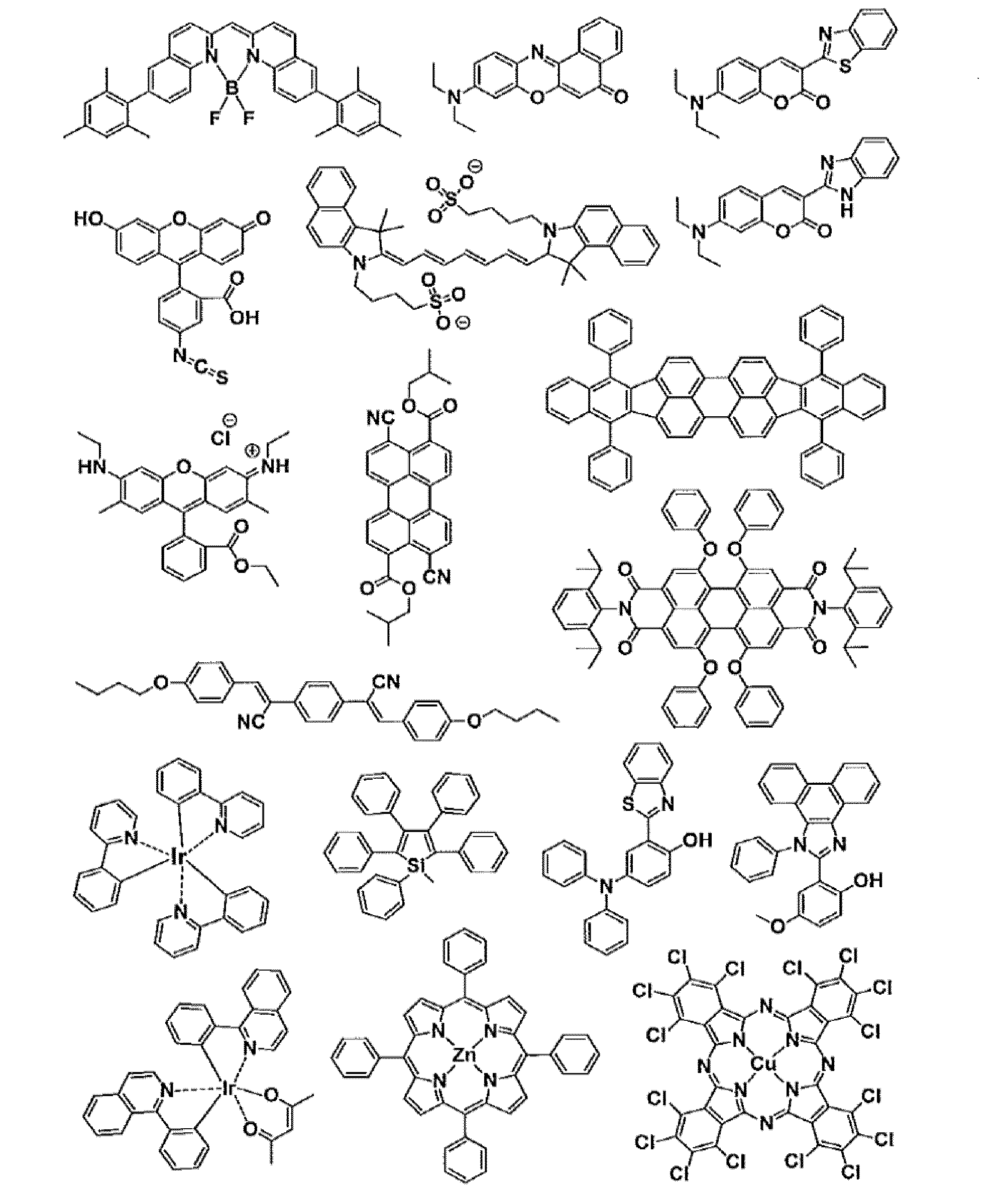
バインダー樹脂は、連続相を形成するものであり、成型加工性、透明性、耐熱性等に優れる材料であればよい。バインダー樹脂の例としては、例えば、アクリル酸系、メタクリル酸系、ポリケイ皮酸ビニル系、環ゴム系等の反応性ビニル基を有する光硬化型レジスト材料、エポキシ樹脂、シリコーン樹脂(シリコーンゴム、シリコーンゲル等のオルガノポリシロキサン硬化物(架橋物)を含む)、ウレア樹脂、フッ素樹脂、ポリカーボネート樹脂、アクリル樹脂、ウレタン樹脂、メラミン樹脂、ポリビニル樹脂、ポリアミド樹脂、フェノール樹脂、ポリビニルアルコール樹脂、セルロース樹脂、脂肪族エステル樹脂、芳香族エステル樹脂、脂肪族ポリオレフィン樹脂、芳香族ポリオレフィン樹脂等の公知のものが挙げられる。また、バインダー樹脂としては、これらの共重合樹脂を用いても構わない。これらの樹脂を適宜設計することで、本発明の実施形態に係る色変換組成物および色変換シートに有用なバインダー樹脂が得られる。これらの樹脂の中でも、シート化のプロセスが容易であることから、熱可塑性樹脂がさらに好ましい。熱可塑性樹脂の中でも、透明性、耐熱性等の観点から、エポキシ樹脂、シリコーン樹脂、アクリル樹脂、エステル樹脂、オレフィン樹脂またはこれらの混合物を好適に用いることができる。また、耐久性の観点から特に好ましい熱可塑性樹脂は、アクリル樹脂、エステル樹脂、シクロオレフィン樹脂である。
本発明の実施形態に係る色変換組成物は、溶剤を含んでいてもよい。溶剤は、流動状態の樹脂の粘度を調整でき、発光物質の発光および耐久性に過度な影響を与えないものであれば、特に限定されない。このような溶媒として、例えば、トルエン、メチルエチルケトン、メチルイソブチルケトン、ヘキサン、アセトン、テルピネオール、テキサノール、メチルセルソルブ、ブチルカルビトール、ブチルカルビトールアセテート、プロピレングリコールモノメチルエーテルアセテート等が挙げられる。これらの溶剤を2種類以上混合して使用することも可能である。これらの溶剤の中で特にトルエンは、本発明の多環芳香族化合物の劣化に影響を与えず、乾燥後の残存溶媒が少ない点で好適に用いられる。
本発明の実施形態に係る色変換組成物は、上述した本発明の多環芳香族化合物およびバインダー樹脂以外に、光安定化剤、酸化防止剤、加工および熱安定化剤、紫外線吸収剤等の耐光性安定化剤、散乱粒子、シリコーン微粒子およびシランカップリング剤等、その他の成分(添加剤)を含有してもよい。
以下に、本発明の実施形態に係る色変換組成物の製造方法の一例を説明する。この製造方法では、前述した本発明の多環芳香族化合物、バインダー樹脂、溶剤等を所定量混合する。上記の成分を所定の組成になるよう混合した後、ホモジナイザー、自公転型攪拌機、3本ローラー、ボールミル、遊星式ボールミル、ビーズミル等の撹拌・混練機で均質に混合分散することで、色変換組成物が得られる。混合分散後、もしくは混合分散の過程で、真空もしくは減圧条件下で脱泡することも好ましく行われる。また、ある特定の成分を事前に混合することや、エージング等の処理をしても構わない。エバポレーターによって溶剤を除去して所望の固形分濃度にすることも可能である。
本発明の実施形態に係る色変換シートは、光源等の発光体からの入射光を、その入射光とは異なる波長の光に変換するものであって、上述した本発明の多環芳香族化合物およびバインダー樹脂を含むことが好ましい。ここで、「入射光とは異なる波長の光に変換する」とは、入射光よりも長波長の光に変換することが好ましい。
基材層(例えば図2~4に示す基材層10)としては、特に制限無く公知の金属、フィルム、ガラス、セラミック、紙等を使用することができる。中でも、色変換シートの作製のし易さや色変換シートの成形のし易さから、ガラスや樹脂フィルムが好ましく用いられる。また、フィルム状の基材層を取り扱う際に破断等の恐れがないように、強度が高いフィルムが好ましい。それらの要求特性や経済性の面で樹脂フィルムが好ましく、特に、経済性、取り扱い性の面で、ポリエチレンテレフタレート(PET)、ポリフェニレンサルファイド、ポリカーボネート、ポリプロピレンからなる群より選ばれるプラスチックフィルムが好ましい。また、色変換シートを乾燥させる場合や色変換シートを押し出し機により200℃以上の高温で圧着成形する場合は、耐熱性の面でポリイミドフィルムが好ましい。フィルムの剥離のし易さから、基材層は、予め表面が離型処理されていてもよい。
色変換層(例えば図1~4に示す色変換層11)は、上述した方法で作製した色変換組成物を、基材層やバリアフィルム等の下地上に塗布し、乾燥させることで、形成することができる。
バリアフィルム(例えば図4に示すバリアフィルム12)は、色変換層に対してガスバリア性を向上させる場合等において適宜用いられる。このバリアフィルムとしては、例えば、酸化ケイ素、酸化アルミニウム、酸化チタン、酸化タンタル、酸化亜鉛、酸化スズ、酸化インジウム、酸化イットリウム、酸化マグネシウム等の無機酸化物や、窒化ケイ素、窒化アルミニウム、窒化チタン、炭化窒化ケイ素等の無機窒化物、またはこれらの混合物、またはこれらに他の元素を添加した金属酸化物薄膜や金属窒化物薄膜、あるいはポリ塩化ビニリデン、アクリル系樹脂、シリコン系樹脂、メラミン系樹脂、ウレタン系樹脂、フッ素系樹脂、酢酸ビニルのケン化物等のポリビニルアルコール系樹脂等の各種樹脂から成る膜を挙げることができる。また、水分に対してバリア機能を有するバリアフィルムとしては、例えば、ポリエチレン、ポリプロピレン、ナイロン、ポリ塩化ビニリデン、塩化ビニリデンと塩化ビニルとの共重合物、塩化ビニリデンとアクリロニトリルとの共重合物、フッ素系樹脂、酢酸ビニルのケン化物等のポリビニルアルコール系樹脂等の各種樹脂から成る膜を挙げることができる。
本発明の実施形態に係る色変換シートは、二重輝度向上フィルム(DBEF)、拡散シート、プリズムシート、波長選択反射フィルム等をさらに備えていてもよい。波長選択反射フィルムの好適な具体例としては、例えば、国際公開第2017/164155号、特開2018-81250号公報に記載されているものが挙げられる。
本発明の実施形態に係る光源ユニットは、少なくとも光源および上述の色変換シートを備える構成である。本発明の実施形態に係る光源ユニットに含まれる光源は、上述の励起光の発生源となるものである。光源と色変換シートとの配置方法については特に限定されず、光源と色変換シートとを密着させた構成を取ってもよいし、光源と色変換シートとを離したリモートフォスファー形式を取ってもよい。また、光源ユニットは、色純度を高める目的で、さらにカラーフィルターを備える構成を取ってもよい。
光源からの励起光の種類は、本発明の多環芳香族化合物等の混合する発光物質が吸収可能な波長領域に発光を示すものであれば、いずれの励起光でも用いることができる。例えば、熱陰極管や冷陰極管、無機エレクトロルミネッセンス(EL)等の蛍光性光源、有機EL素子光源、LED光源、白熱光源、あるいは太陽光等、いずれの励起光でも原理的には利用可能である。特に、LED光源からの光が好適な励起光である。
本発明の実施形態に係るディスプレイは、少なくとも、上述した色変換シートを備える。例えば、液晶ディスプレイ等のディスプレイには、バックライトユニットとして、上述した光源および色変換シート等を有する光源ユニットが用いられる。また、本発明の実施形態に係る照明装置は、少なくとも、上述した色変換シートを備える。例えば、この照明装置は、光源ユニットとしての青色LED光源と、この青色LED光源からの青色光をこれよりも長波長の光に変換する色変換シートとを組み合わせて、白色光を発光するように構成される。
本発明の実施形態において、発光素子は、陽極および陰極と、これら陽極と陰極との間に介在する有機層と、を備える。この発光素子の有機層は、電気エネルギーによって発光する。本発明の多環芳香族化合物は、この発光素子において、いずれの層に用いられてもよいが、高い蛍光量子収率を有しているため、この発光素子の発光層に用いることが好ましい。特に、当該多環芳香族化合物は、優れた蛍光量子収率を有していることから、上記発光層のドーパント材料として用いることが好ましい。
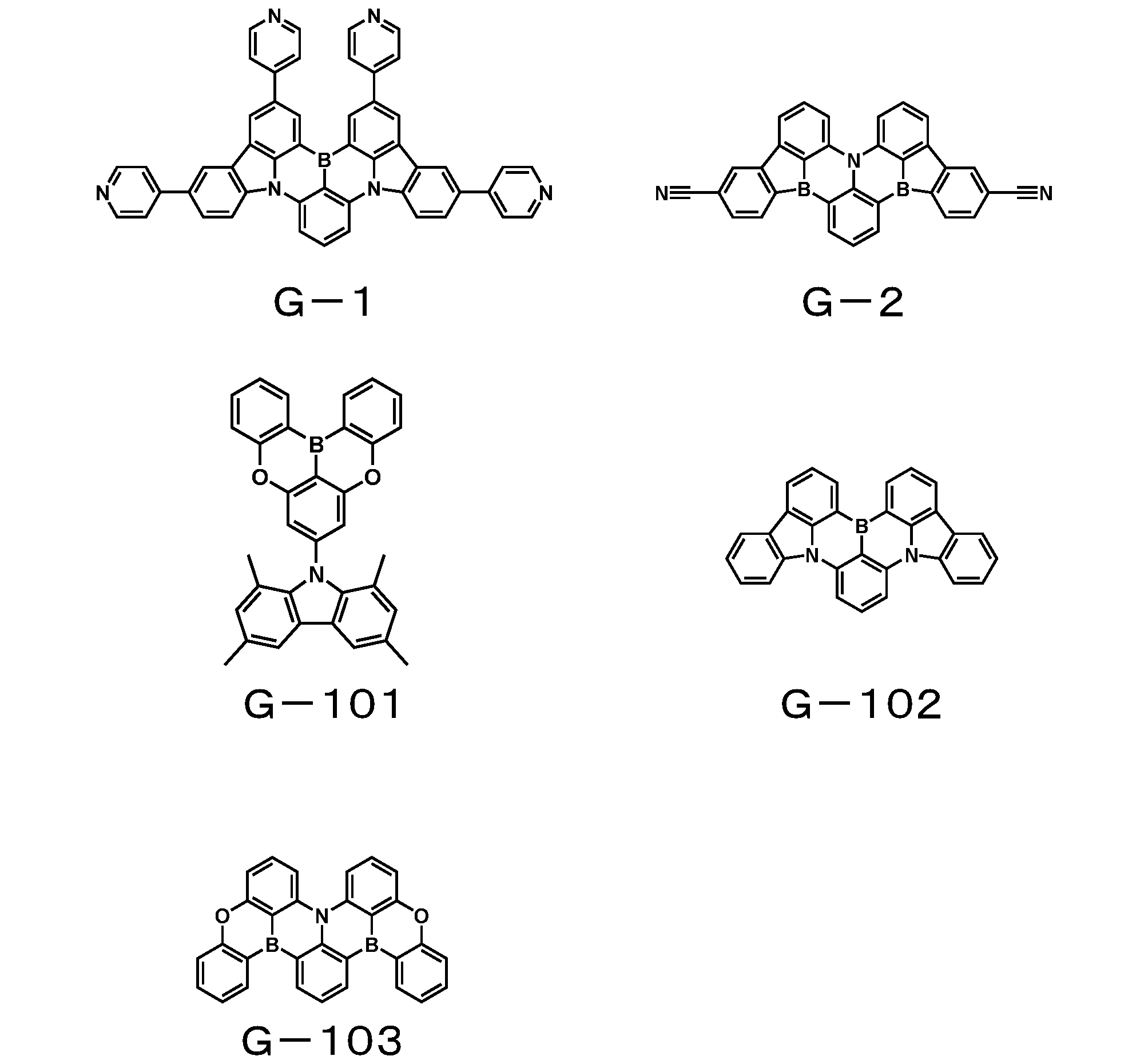
化合物の蛍光スペクトルの測定では、F-2500形分光蛍光光度計(日立製作所社製)を用い、化合物をトルエンに1×10⁻⁵mol/Lの濃度で溶解させ、波長460nmで励起させた際の蛍光スペクトルを測定した。
化合物の発光量子収率の測定では、絶対PL量子収率測定装置(Quantaurus-QY、浜松ホトニクス社製)を用い、化合物をトルエンに1×10⁻⁵mol/Lの濃度で溶解させ、波長460nmで励起させた際の発光量子収率を測定した。
化合物のHOMO準位の算出では、各実施例および比較例の化合物について、汎用量子化学計算プログラム「Gaussian 16」プログラムパッケージ(Gaussian社製)で、B3LYP密度汎関数理論を用いて、6-31G(d)基底系にて、構造の最適化を行った。最適化された構造をもとに、B3LYP密度汎関数理論を用いて、6-311++G(d,p)基底系にて、HOMO準位の計算を行った。
以下に、本発明における合成例1の化合物G-1の合成方法について説明する。
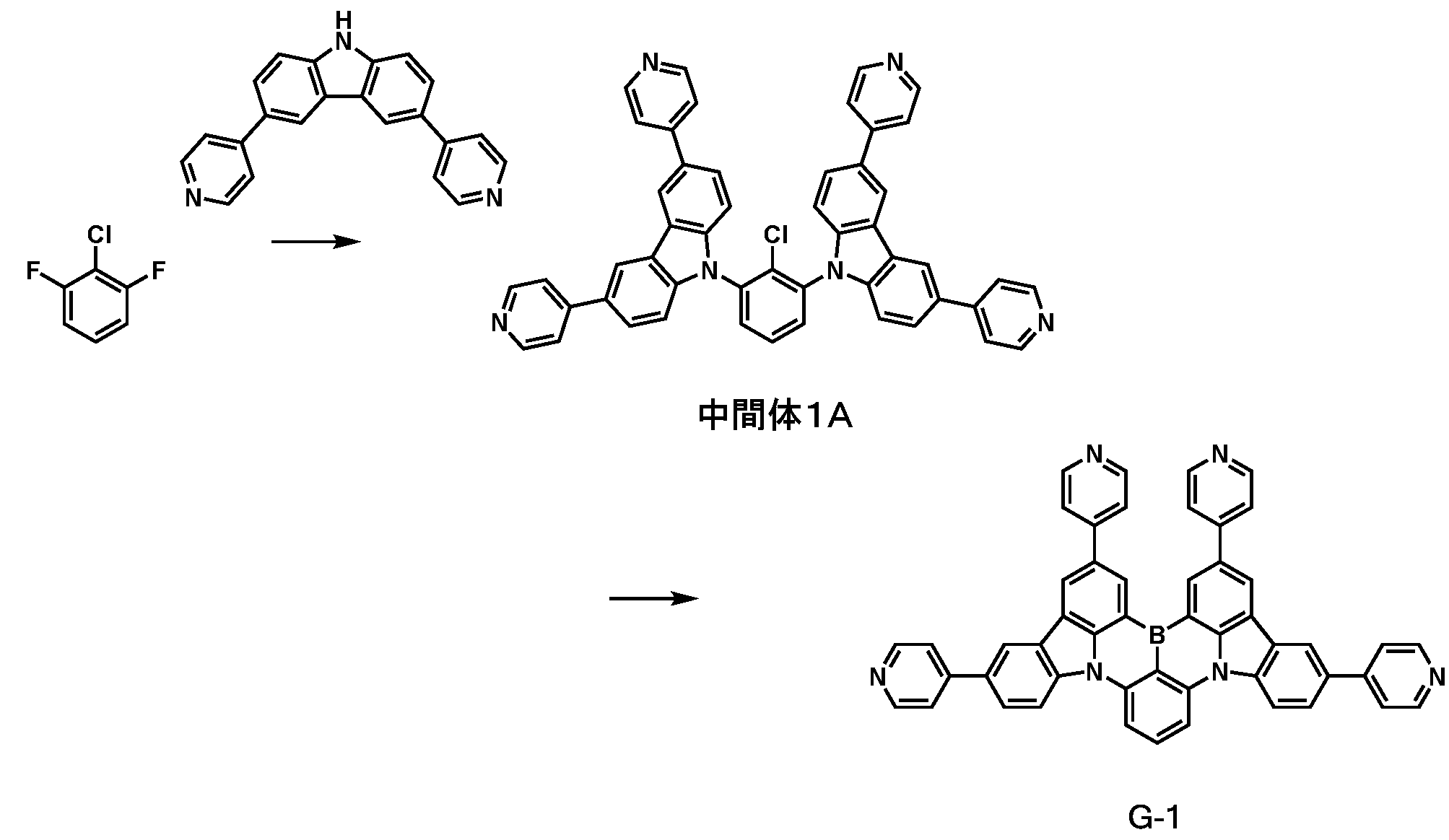
本発明の実施例1-1は、上述した実施形態に係る多環芳香族化合物を発光材料(色変換材料)として用いた場合の実施例である。この実施例1-1では、バインダー樹脂としてアクリル樹脂を用い、このアクリル樹脂の100重量部に対して、発光材料として化合物G-1を0.25重量部、溶剤としてトルエンを400重量部、混合した。その後、これらの混合物を、遊星式撹拌・脱泡装置“マゼルスターKK-400”(クラボウ社製)を用いて300rpmで20分間撹拌・脱泡し、これにより、色変換組成物を得た。
本発明の実施例1-2および本発明に対する比較例1-1~1-3では、発光材料として後述の表1に記載した化合物(化合物G-2、G-101~G-103)を適宜用いたこと以外は、実施例1-1と同様にして、色変換シートを作製して評価した。実施例1-2、比較例1-1~1-3の発光材料および評価結果は、表1に示す。光耐久性は、長時間であればあるほど好ましく、具体的には500時間以上であることが好ましい。
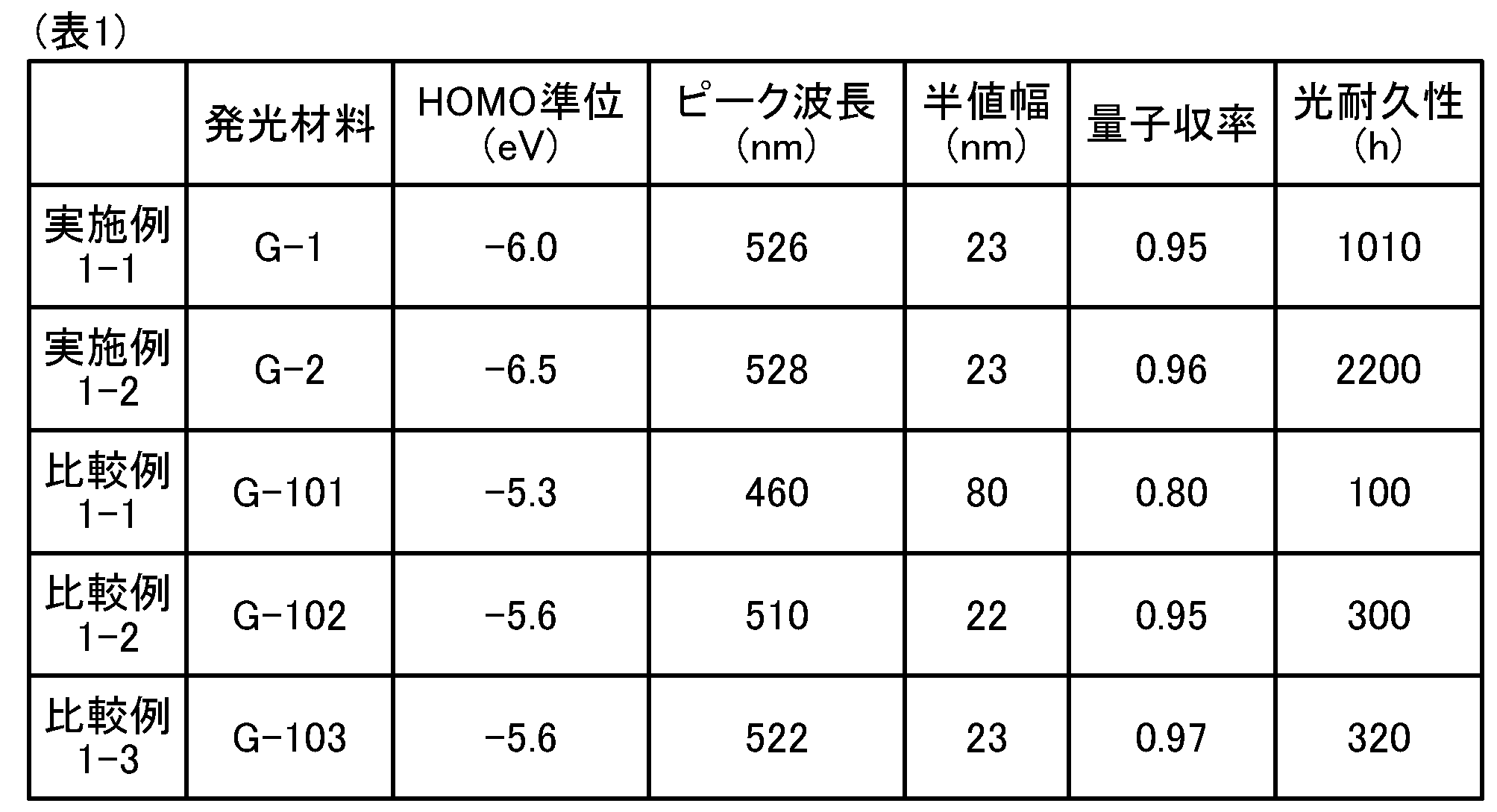

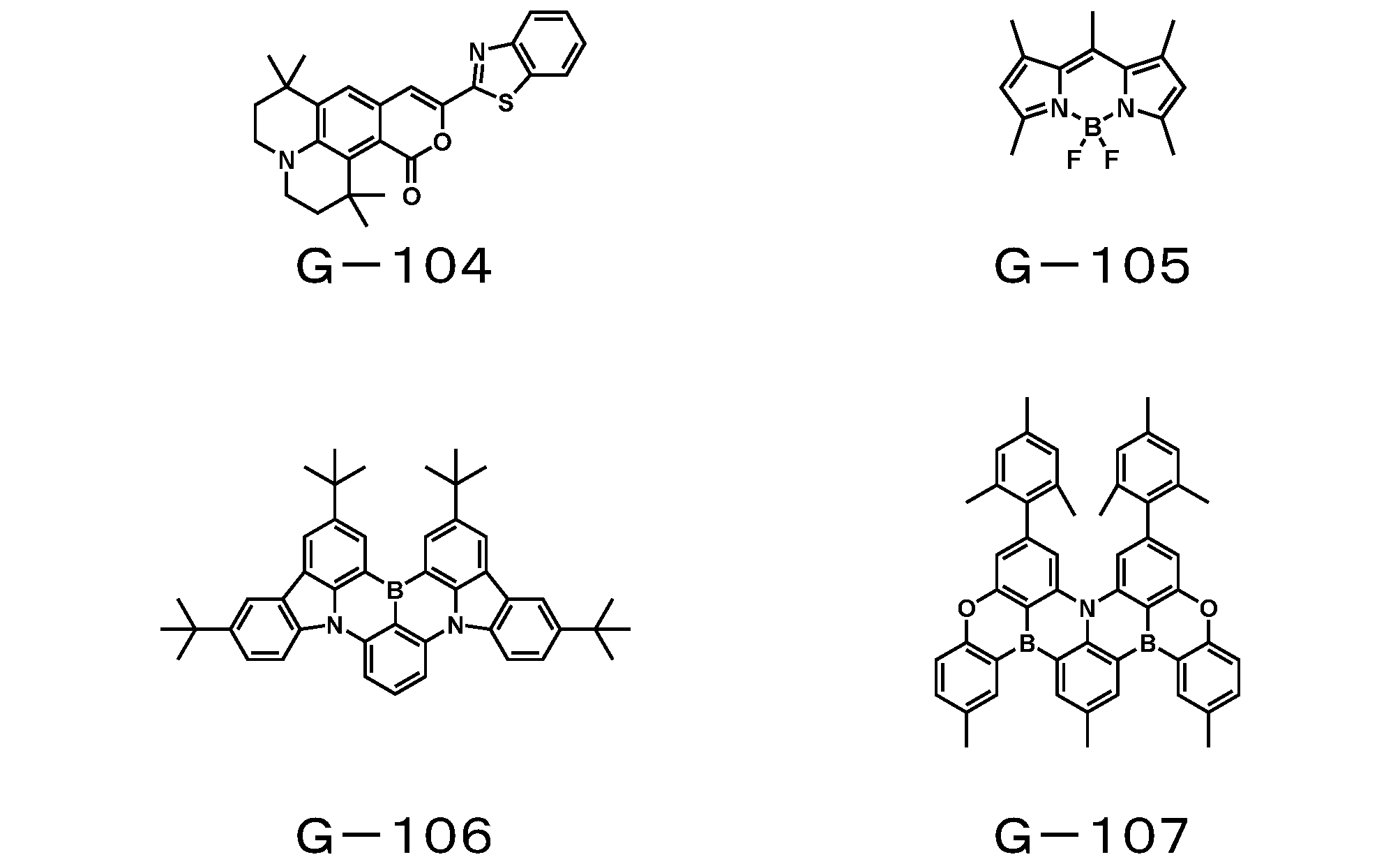
化合物の蛍光スペクトルの測定では、F-2500形分光蛍光光度計(日立製作所社製)を用い、化合物をトルエンに1×10⁻⁵mol/Lの濃度で溶解させ、波長460nmで励起させた際の蛍光スペクトルを測定した。
化合物の発光量子収率の測定では、絶対PL量子収率測定装置(Quantaurus-QY、浜松ホトニクス社製)を用い、化合物をトルエンに1×10⁻⁵mol/Lの濃度で溶解させ、波長460nmで励起させた際の発光量子収率を測定した。
以下に、本発明における合成例2の化合物G-3の合成方法について説明する。
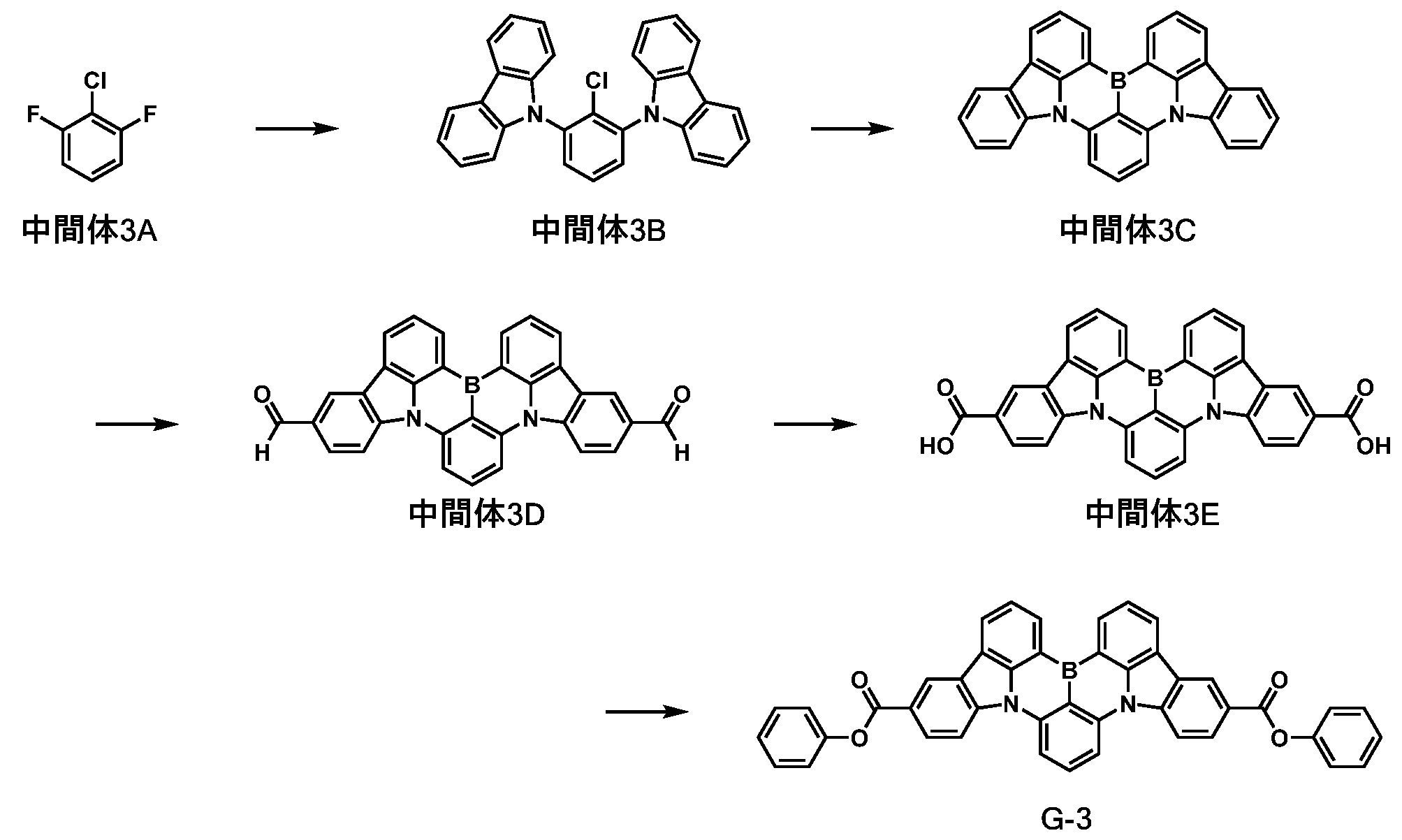
本発明の実施例2-1は、上述した実施形態に係る多環芳香族化合物を発光材料(色変換材料)として用いた場合の実施例である。この実施例2-1では、バインダー樹脂としてアクリル樹脂を用い、このアクリル樹脂の100重量部に対して、発光材料として化合物G-3を0.25重量部、溶剤としてトルエンを400重量部、混合した。その後、これらの混合物を、遊星式撹拌・脱泡装置“マゼルスターKK-400”(クラボウ社製)を用いて300rpmで20分間撹拌・脱泡し、これにより、色変換組成物を得た。
本発明の実施例2-2~2-6および本発明に対する比較例2-1~2-4では、発光材料として後述の表2に記載した化合物(化合物G-4~G-8、G-104~G-107)を適宜用いたこと以外は、実施例2-1と同様にして、色変換シートを作製して評価した。実施例2-2~2-6、比較例2-1~2-4の発光材料および評価結果は、表2に示す。光耐久性は、長時間であればあるほど好ましく、具体的には800時間以上であることが好ましい。
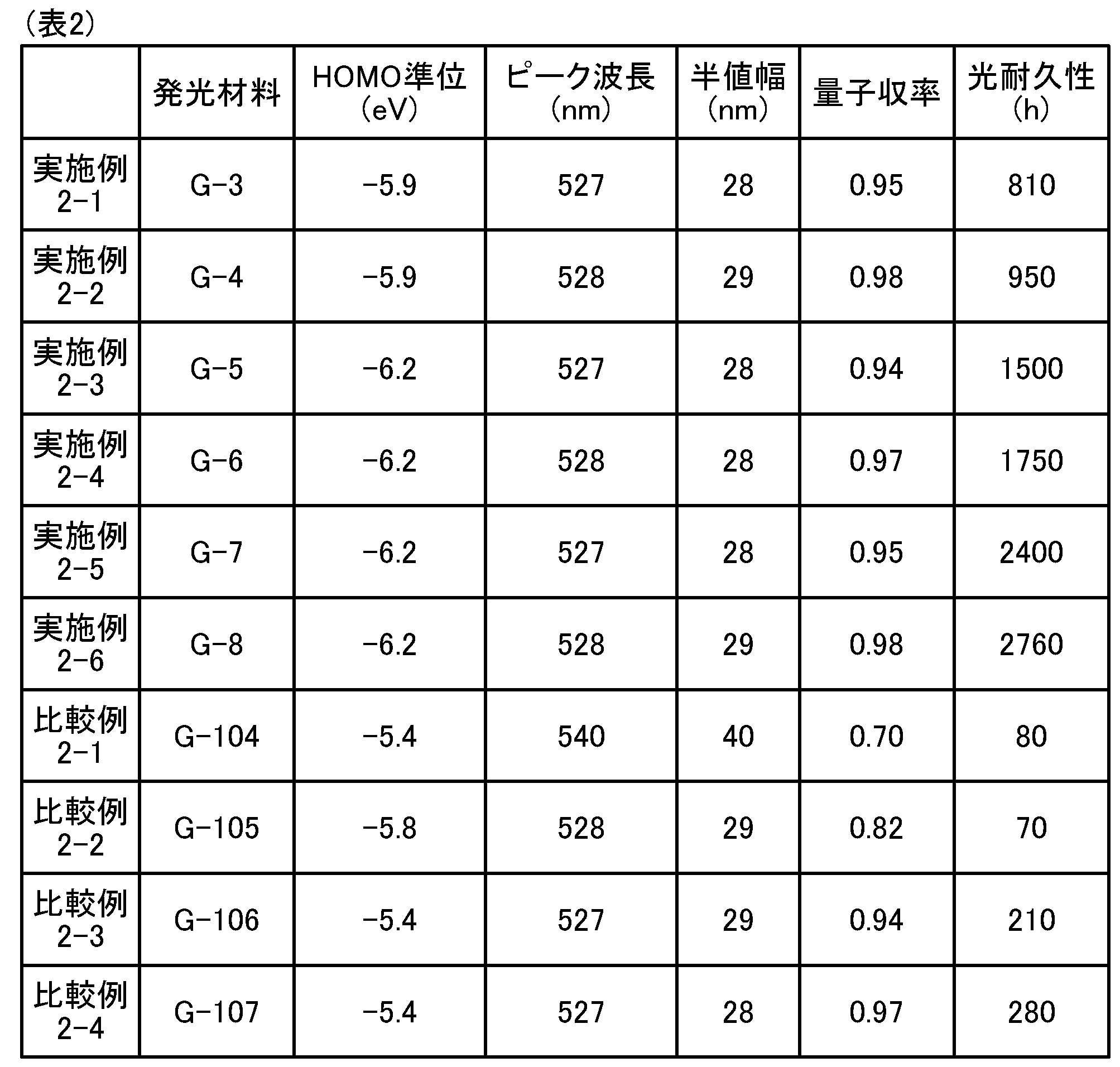
10 基材層
11 色変換層
12 バリアフィルム
Claims (22)
- 励起光を用いることによってピーク波長が500nm以上750nm以下の領域に観測される発光を呈し、HOMO準位が-5.7eV以下であり、遅延蛍光を放出する化合物である、
ことを特徴とする多環芳香族化合物。 - 前記多環芳香族化合物のHOMO準位が-6.0eV以下である、
ことを特徴とする請求項1に記載の多環芳香族化合物。 - 前記多環芳香族化合物のHOMO準位が-6.2eV以下である、
ことを特徴とする請求項1に記載の多環芳香族化合物。 - 前記多環芳香族化合物のHOMO準位が-6.5eV以下である、
ことを特徴とする請求項1に記載の多環芳香族化合物。 - 前記多環芳香族化合物の発光ピーク波長における発光スペクトルの半値幅が40nm以下である、
ことを特徴とする請求項1~4のいずれか一つに記載の多環芳香族化合物。 - 前記多環芳香族化合物が、一般式(1)または一般式(2)で表される化合物である、
ことを特徴とする請求項1~5のいずれか一つに記載の多環芳香族化合物。

- 前記一般式(1)または前記一般式(2)で表される化合物は、少なくとも一つの電子求引基を有する、
ことを特徴とする請求項6に記載の多環芳香族化合物。 - 前記一般式(1)または前記一般式(2)で表される化合物は、二つ以上の電子求引基を有する、
ことを特徴とする請求項7に記載の多環芳香族化合物。 - 前記電子求引基は、シアノ基、アシル基、エステル基、アミド基、スルホニル基、スルホン酸エステル基またはスルホンアミド基である、
ことを特徴とする請求項7または8に記載の多環芳香族化合物。 - 前記電子求引基はエステル基である、
ことを特徴とする請求項7~9のいずれか一つに記載の多環芳香族化合物。 - 前記Z1および前記Z2は、酸素原子またはNRaである、
ことを特徴とする請求項6~10のいずれか一つに記載の多環芳香族化合物。 - 前記Eはホウ素原子であり、
前記E1および前記E2はBRaである、
ことを特徴とする請求項6~11のいずれか一つに記載の多環芳香族化合物。 - 前記環Za、前記環Zbおよび前記環Zcはベンゼン環である、
ことを特徴とする請求項6~12のいずれか一つに記載の多環芳香族化合物。 - 前記多環芳香族化合物が、励起光を用いることによってピーク波長が500nm以上580nm未満の領域に観測される発光を呈する、
ことを特徴とする請求項1~13のいずれか一つに記載の多環芳香族化合物。 - 前記多環芳香族化合物が、励起光を用いることによってピーク波長が580nm以上750nm以下の領域に観測される発光を呈する、
ことを特徴とする請求項1~13のいずれか一つに記載の多環芳香族化合物。 - 入射光を、当該入射光とは異なる光に変換する色変換組成物であって、
請求項1~15のいずれか一つに記載の多環芳香族化合物と、
バインダー樹脂と、
を含むことを特徴とする色変換組成物。 - 入射光を、当該入射光とは異なる光に変換する色変換シートであって、
請求項1~15のいずれか一つに記載の多環芳香族化合物と、
バインダー樹脂と、
を含むことを特徴とする色変換シート。 - さらにバリアフィルムを有する、
ことを特徴とする請求項17に記載の色変換シート。 - 光源と、
請求項17または18に記載の色変換シートと、
を備えることを特徴とする光源ユニット。 - 前記光源は、波長430nm以上500nm以下の範囲に極大発光を有する発光ダイオードである、
ことを特徴とする請求項19に記載の光源ユニット。 - 請求項17または18に記載の色変換シートを備える、
ことを特徴とするディスプレイ。 - 請求項17または18に記載の色変換シートを備える、
ことを特徴とする照明装置。
Priority Applications (4)
| Application Number | Priority Date | Filing Date | Title |
|---|---|---|---|
| CN202280019133.6A CN116917300A (zh) | 2021-04-28 | 2022-04-11 | 多环芳香族化合物、颜色转换组合物、颜色转换片、光源单元、显示器及照明装置 |
| US18/281,638 US20240301282A1 (en) | 2021-04-28 | 2022-04-11 | Polycyclic aromatic compound, color conversion composition, color conversion sheet, light source unit, display and lighting device |
| KR1020237028402A KR20240001114A (ko) | 2021-04-28 | 2022-04-11 | 다환 방향족 화합물, 색변환 조성물, 색변환 시트, 광원 유닛, 디스플레이 및 조명 장치 |
| JP2022525656A JPWO2022230643A1 (ja) | 2021-04-28 | 2022-04-11 |
Applications Claiming Priority (4)
| Application Number | Priority Date | Filing Date | Title |
|---|---|---|---|
| JP2021-075673 | 2021-04-28 | ||
| JP2021075673 | 2021-04-28 | ||
| JP2021-082082 | 2021-05-14 | ||
| JP2021082082 | 2021-05-14 |
Publications (1)
| Publication Number | Publication Date |
|---|---|
| WO2022230643A1 true WO2022230643A1 (ja) | 2022-11-03 |
Family
ID=83848110
Family Applications (1)
| Application Number | Title | Priority Date | Filing Date |
|---|---|---|---|
| PCT/JP2022/017461 Ceased WO2022230643A1 (ja) | 2021-04-28 | 2022-04-11 | 多環芳香族化合物、色変換組成物、色変換シート、光源ユニット、ディスプレイおよび照明装置 |
Country Status (5)
| Country | Link |
|---|---|
| US (1) | US20240301282A1 (ja) |
| JP (1) | JPWO2022230643A1 (ja) |
| KR (1) | KR20240001114A (ja) |
| TW (1) | TW202309057A (ja) |
| WO (1) | WO2022230643A1 (ja) |
Citations (7)
| Publication number | Priority date | Publication date | Assignee | Title |
|---|---|---|---|---|
| WO2018047639A1 (ja) * | 2016-09-07 | 2018-03-15 | 学校法人関西学院 | 多環芳香族化合物 |
| WO2019198699A1 (ja) * | 2018-04-12 | 2019-10-17 | 学校法人関西学院 | シクロアルキル置換多環芳香族化合物 |
| WO2020135687A1 (zh) * | 2018-12-29 | 2020-07-02 | 江苏三月光电科技有限公司 | 一种含硼化合物及其制备方法和其应用 |
| CN111377953A (zh) * | 2018-12-29 | 2020-07-07 | 江苏三月光电科技有限公司 | 一种含硼的有机化合物及其在有机电致发光器件上的应用 |
| CN111377954A (zh) * | 2018-12-29 | 2020-07-07 | 江苏三月光电科技有限公司 | 一种含硼的有机化合物及其在有机电致发光器件上的应用 |
| JP2020147563A (ja) * | 2019-03-07 | 2020-09-17 | 学校法人関西学院 | 多環芳香族化合物およびその多量体 |
| JP2020161834A (ja) * | 2018-12-28 | 2020-10-01 | 日亜化学工業株式会社 | 発光装置の製造方法 |
Family Cites Families (5)
| Publication number | Priority date | Publication date | Assignee | Title |
|---|---|---|---|---|
| JP2011241160A (ja) | 2010-05-17 | 2011-12-01 | Yamamoto Chem Inc | 色変換材料、該材料を含む組成物、該組成物を使用した色変換光学部品および該色変換光学部品を使用した発光素子 |
| JP6279209B2 (ja) | 2013-01-17 | 2018-02-14 | 山本化成株式会社 | 波長変換層、及びこれを用いた波長変換フィルタ |
| TWI636056B (zh) * | 2014-02-18 | 2018-09-21 | 學校法人關西學院 | 多環芳香族化合物及其製造方法、有機元件用材料及其應用 |
| JP6432697B2 (ja) * | 2016-11-30 | 2018-12-05 | 東レ株式会社 | ピロメテンホウ素錯体、色変換組成物、色変換フィルム、光源ユニット、ディスプレイおよび照明装置 |
| KR102719524B1 (ko) * | 2018-12-10 | 2024-10-22 | 삼성디스플레이 주식회사 | 유기 전계 발광 소자 및 유기 전계 발광 소자용 다환 화합물 |
-
2022
- 2022-04-11 WO PCT/JP2022/017461 patent/WO2022230643A1/ja not_active Ceased
- 2022-04-11 JP JP2022525656A patent/JPWO2022230643A1/ja active Pending
- 2022-04-11 KR KR1020237028402A patent/KR20240001114A/ko active Pending
- 2022-04-11 US US18/281,638 patent/US20240301282A1/en active Pending
- 2022-04-20 TW TW111114909A patent/TW202309057A/zh unknown
Patent Citations (7)
| Publication number | Priority date | Publication date | Assignee | Title |
|---|---|---|---|---|
| WO2018047639A1 (ja) * | 2016-09-07 | 2018-03-15 | 学校法人関西学院 | 多環芳香族化合物 |
| WO2019198699A1 (ja) * | 2018-04-12 | 2019-10-17 | 学校法人関西学院 | シクロアルキル置換多環芳香族化合物 |
| JP2020161834A (ja) * | 2018-12-28 | 2020-10-01 | 日亜化学工業株式会社 | 発光装置の製造方法 |
| WO2020135687A1 (zh) * | 2018-12-29 | 2020-07-02 | 江苏三月光电科技有限公司 | 一种含硼化合物及其制备方法和其应用 |
| CN111377953A (zh) * | 2018-12-29 | 2020-07-07 | 江苏三月光电科技有限公司 | 一种含硼的有机化合物及其在有机电致发光器件上的应用 |
| CN111377954A (zh) * | 2018-12-29 | 2020-07-07 | 江苏三月光电科技有限公司 | 一种含硼的有机化合物及其在有机电致发光器件上的应用 |
| JP2020147563A (ja) * | 2019-03-07 | 2020-09-17 | 学校法人関西学院 | 多環芳香族化合物およびその多量体 |
Also Published As
| Publication number | Publication date |
|---|---|
| JPWO2022230643A1 (ja) | 2022-11-03 |
| TW202309057A (zh) | 2023-03-01 |
| KR20240001114A (ko) | 2024-01-03 |
| US20240301282A1 (en) | 2024-09-12 |
Similar Documents
| Publication | Publication Date | Title |
|---|---|---|
| KR102070833B1 (ko) | 피로메텐 붕소 착체, 색 변환 조성물, 색 변환 필름, 및 그것을 포함하는 광원 유닛, 디스플레이 및 조명 | |
| CN109996802B (zh) | 亚甲基吡咯硼络合物、颜色转换组合物、颜色转换膜、光源单元、显示器及照明装置 | |
| JP6693578B2 (ja) | ピロメテンホウ素錯体、色変換組成物、色変換フィルム、光源ユニット、ディスプレイ、照明装置および発光素子 | |
| JP6380653B2 (ja) | 色変換シート、それを含む光源ユニット、ディスプレイおよび照明装置 | |
| JP7632277B2 (ja) | 色変換組成物、色変換フィルム、それを含む光源ユニット、ディスプレイおよび照明ならびに化合物 | |
| WO2018221216A1 (ja) | 色変換シート、それを含む光源ユニット、ディスプレイおよび照明装置 | |
| KR102677298B1 (ko) | 피로메텐붕소 착체, 색변환 조성물, 색변환 필름, 광원 유닛, 디스플레이 및 조명 장치 | |
| KR102772042B1 (ko) | 색 변환 시트 및 그것을 포함하는 광원 유닛, 디스플레이 및 조명 장치 | |
| WO2022255173A1 (ja) | 色変換組成物、色変換シート、それを含む光源ユニット、ディスプレイおよび照明装置 | |
| WO2023042751A1 (ja) | 色変換部材、それを含む光源ユニット、ディスプレイおよび照明装置 | |
| KR20240032848A (ko) | 색변환 시트, 그것을 포함하는 광원 유닛, 디스플레이 및 조명 장치 | |
| WO2022230643A1 (ja) | 多環芳香族化合物、色変換組成物、色変換シート、光源ユニット、ディスプレイおよび照明装置 | |
| JP2021162665A (ja) | ピロメテンホウ素錯体、色変換組成物、色変換フィルムならびにそれを含む光源ユニット、ディスプレイおよび照明装置 | |
| JP2023104057A (ja) | 色変換組成物、色変換シートならびにそれを含む光源ユニット、ディスプレイおよび照明装置 | |
| JP2023061532A (ja) | 色変換組成物、色変換シート、光源ユニット、ディスプレイおよび照明装置 | |
| CN116917300A (zh) | 多环芳香族化合物、颜色转换组合物、颜色转换片、光源单元、显示器及照明装置 | |
| JP2023061533A (ja) | 化合物、色変換組成物、色変換シート、光源ユニット、発光素子、ディスプレイおよび照明装置 | |
| WO2024057867A1 (ja) | 色変換組成物、色変換シート、光源ユニット、表示装置および照明装置 | |
| WO2025205226A1 (ja) | ピロメテンホウ素錯体、色変換組成物、色変換部材、光源ユニット、ディスプレイおよび照明装置 | |
| WO2024075649A1 (ja) | ピロメテンホウ素錯体、色変換組成物、色変換シート、色変換基板、光源ユニット、表示装置および照明装置 |
Legal Events
| Date | Code | Title | Description |
|---|---|---|---|
| ENP | Entry into the national phase |
Ref document number: 2022525656 Country of ref document: JP Kind code of ref document: A |
|
| 121 | Ep: the epo has been informed by wipo that ep was designated in this application |
Ref document number: 22795558 Country of ref document: EP Kind code of ref document: A1 |
|
| WWE | Wipo information: entry into national phase |
Ref document number: 202280019133.6 Country of ref document: CN |
|
| WWE | Wipo information: entry into national phase |
Ref document number: 18281638 Country of ref document: US |
|
| NENP | Non-entry into the national phase |
Ref country code: DE |
|
| 122 | Ep: pct application non-entry in european phase |
Ref document number: 22795558 Country of ref document: EP Kind code of ref document: A1 |