WO2022224477A1 - 吸収性物品 - Google Patents
吸収性物品 Download PDFInfo
- Publication number
- WO2022224477A1 WO2022224477A1 PCT/JP2021/042447 JP2021042447W WO2022224477A1 WO 2022224477 A1 WO2022224477 A1 WO 2022224477A1 JP 2021042447 W JP2021042447 W JP 2021042447W WO 2022224477 A1 WO2022224477 A1 WO 2022224477A1
- Authority
- WO
- WIPO (PCT)
- Prior art keywords
- width direction
- absorbent article
- slits
- region
- outermost
- Prior art date
- Legal status (The legal status is an assumption and is not a legal conclusion. Google has not performed a legal analysis and makes no representation as to the accuracy of the status listed.)
- Ceased
Links
Images




Classifications
-
- A—HUMAN NECESSITIES
- A61—MEDICAL OR VETERINARY SCIENCE; HYGIENE
- A61F—FILTERS IMPLANTABLE INTO BLOOD VESSELS; PROSTHESES; DEVICES PROVIDING PATENCY TO, OR PREVENTING COLLAPSING OF, TUBULAR STRUCTURES OF THE BODY, e.g. STENTS; ORTHOPAEDIC, NURSING OR CONTRACEPTIVE DEVICES; FOMENTATION; TREATMENT OR PROTECTION OF EYES OR EARS; BANDAGES, DRESSINGS OR ABSORBENT PADS; FIRST-AID KITS
- A61F13/00—Bandages or dressings; Absorbent pads
- A61F13/15—Absorbent pads, e.g. sanitary towels, swabs or tampons for external or internal application to the body; Supporting or fastening means therefor; Tampon applicators
- A61F13/53—Absorbent pads, e.g. sanitary towels, swabs or tampons for external or internal application to the body; Supporting or fastening means therefor; Tampon applicators characterised by the absorbing medium
- A61F13/531—Absorbent pads, e.g. sanitary towels, swabs or tampons for external or internal application to the body; Supporting or fastening means therefor; Tampon applicators characterised by the absorbing medium having a homogeneous composition through the thickness of the pad
- A61F13/532—Absorbent pads, e.g. sanitary towels, swabs or tampons for external or internal application to the body; Supporting or fastening means therefor; Tampon applicators characterised by the absorbing medium having a homogeneous composition through the thickness of the pad inhomogeneous in the plane of the pad
-
- A—HUMAN NECESSITIES
- A61—MEDICAL OR VETERINARY SCIENCE; HYGIENE
- A61F—FILTERS IMPLANTABLE INTO BLOOD VESSELS; PROSTHESES; DEVICES PROVIDING PATENCY TO, OR PREVENTING COLLAPSING OF, TUBULAR STRUCTURES OF THE BODY, e.g. STENTS; ORTHOPAEDIC, NURSING OR CONTRACEPTIVE DEVICES; FOMENTATION; TREATMENT OR PROTECTION OF EYES OR EARS; BANDAGES, DRESSINGS OR ABSORBENT PADS; FIRST-AID KITS
- A61F13/00—Bandages or dressings; Absorbent pads
- A61F13/15—Absorbent pads, e.g. sanitary towels, swabs or tampons for external or internal application to the body; Supporting or fastening means therefor; Tampon applicators
- A61F13/53—Absorbent pads, e.g. sanitary towels, swabs or tampons for external or internal application to the body; Supporting or fastening means therefor; Tampon applicators characterised by the absorbing medium
- A61F13/534—Absorbent pads, e.g. sanitary towels, swabs or tampons for external or internal application to the body; Supporting or fastening means therefor; Tampon applicators characterised by the absorbing medium having an inhomogeneous composition through the thickness of the pad
- A61F13/535—Absorbent pads, e.g. sanitary towels, swabs or tampons for external or internal application to the body; Supporting or fastening means therefor; Tampon applicators characterised by the absorbing medium having an inhomogeneous composition through the thickness of the pad inhomogeneous in the plane of the pad, e.g. core absorbent layers being of different sizes
Definitions
- the present invention relates to absorbent articles.
- An absorbent article is known in which slits are provided in the crotch part of the absorbent body in order to control the diffusibility of absorbed body fluids (see, for example, Patent Document 1).
- an absorbent article is known in which a thin absorbent body has grooves, and the grooves are easily bent and deformed, so that a good fit is maintained before and after liquid absorption (for example, See Patent Document 2).
- the front portion of the slit is curved inward in the width direction, the central portion extends in the longitudinal direction, and the rear portion is directed outward in the width direction. curved.
- the wearer walks or closes his/her legs after wearing, force is applied to the inside of the absorbent body from both sides, and the absorbent body located outside the slit in the width direction moves toward the center.
- the central and rear portions of the slit will collapse and the physical space will be lost. This may reduce the diffusion of absorbed urine to the rear side and cause leakage.
- a pair of curved grooves curved inward in the width direction along the longitudinal direction is provided in a region corresponding to the groin of the wearer.
- force is applied inward from both sides of the absorbent body due to the wearer walking or closing the legs after wearing, so that the spaces of the pair of grooves cannot be held.
- the absorbed body fluid is not sufficiently diffused, and the body fluid accumulated on the surface of the absorbent body may leak from the side.
- the present invention has been made in view of the above-mentioned problems, and its object is to diffuse body fluids through slits provided in the absorbent body during wear, thereby making it difficult for leakage to occur.
- An object of the present invention is to provide an absorbent article.
- the main invention for achieving the above object is an absorbent article having a front-rear direction, a width direction, and a thickness direction that intersect each other in an unfolded and stretched state, and having a liquid-absorbing absorbent core. At least a pair of slits extending in the front-rear direction is provided in the absorptive core at the crotch portion located at the wearer's crotch, and the pair of slits is located at the front end portion in the front-rear direction.
- the intermediate outermost end is located outside the front outermost end and the rear outermost end in the width direction when the outer ends are defined as outer ends.
- an absorbent article that diffuses body fluids through the slits provided in the absorbent body and prevents leakage during wear.
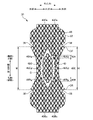
- FIG. 1 is a plan view of an absorbent article 10 in an unfolded and stretched state in this embodiment.
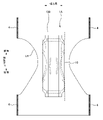
- FIG. 2 is a cross-sectional view of absorbent pad 10 taken along line S1-S1 of FIG. 1;
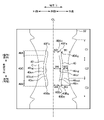
- FIG. Fig. 2 is a plan view of the absorbent body 30 in the unfolded and stretched state provided in the absorbent pad 10;
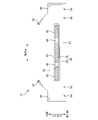
- It is a schematic perspective view of the disposable diaper 1 which concerns on this embodiment.
- Fig. 2 is a plan view showing absorbent pad 10 attached to unfolded disposable diaper 1;
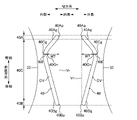
- FIG. 6A is a diagram illustrating a pair of slits 40 according to this embodiment and a slit 40' of a comparative example.
- FIG. 6B is a diagram for explaining the state of the pair of slits 40 of the present embodiment and the state of the slit 40' of the comparative example when the absorbent pad 10 is attached and pulled up.
- 4 is a partially enlarged view of the absorbent core 32.
- FIG. 4 is a partially enlarged view of the absorbent core 32.
- FIG. It is a figure which shows the modification of a pair of slit 40 which concerns on this embodiment.
- An absorbent article having a front-rear direction, a width direction, and a thickness direction that intersect with each other in an unfolded and stretched state, and having a liquid-absorbing absorbent core, in a crotch portion positioned at the wearer's crotch when worn.
- the absorbent core is provided with at least a pair of slits extending in the front-rear direction, and the pair of slits are formed in a front end region, a rear end region, and the front end region in the front-rear direction.
- It has an intermediate region sandwiched between the end region and the rear end region, and the outermost portion in the width direction of the front end region is defined as the front outermost end, and the rear end region
- the outermost portion in the width direction of the region is defined as the rear outermost end, and the portion positioned on the outermost side in the width direction of the intermediate region is defined as the intermediate outermost end.
- the middle outermost portion is located outside the front outermost end and the rear outermost end in the width direction, the absorbent article is pulled up when worn.
- the intermediate outermost portion will receive force from the wearer's leg at an early stage.
- the range where the force of the leg is applied to the slit is narrower, and the middle outermost part is deformed inward in the width direction. , a space tends to remain on the center side in the width direction.
- the front and rear end regions of the slit are located inside the intermediate outermost end portion in the width direction, so that they receive the force. It is difficult and the space of the slit is easily retained.
- the front and rear slits serve as flow channels to diffuse body fluids such as urine, making it difficult for leakage to occur. be able to.
- the absorbent core has a constricted portion constricted inward in the width direction at least in the crotch portion, and both ends of the pair of slits in the front-rear direction are the constricted portion. or inside the both ends of the constricted portion.
- the absorbent core is not easily displaced from the constricted portion when worn. It becomes difficult to apply force from the legs. Also, when force is applied from the leg, the constricted portion tends to receive force on the surface along the shape of the leg.
- the constricted part in the crotch part is the part that first receives urination, and by arranging both ends of the slit in the front-rear direction within the range in which such a constricted part is provided, the shape of the pair of slits is maintained. becomes easier. Thereby, the body fluid diffusion effect can be improved.
- the constricted portion has a front constricted region, a central constricted region, and a rear constricted region obtained by dividing the constricted portion into three equal parts in the front-rear direction. is located in the front constricted region, and rear ends of the pair of slits in the front-rear direction are preferably located in the rear constricted region.
- the central constricted area is likely to receive force from the legs.
- the front and rear end portions of the slit are less likely to be crushed, and the liquid diffusion effect can be maintained.
- each of the pair of slits has an inner edge and an outer edge that are continuous in the front-rear direction with a predetermined interval in the width direction, and the slit corresponding to the front outermost end.
- a position on the inner edge along the width direction is a front inner edge
- a position on the inner edge along the width direction corresponding to the rear outermost edge is a rear inner edge
- the length from the front outermost end to the outer end of the absorbent core is longer than the length from the center line in the width direction of the absorbent article to the front inner end
- the length to the outer end of the absorbent core is preferably longer than the length from the center line in the width direction of the absorbent article to the rear inner end.
- the width (length) of the absorbent core on the width direction outer side is wider than the slit, so that the leg that hangs from the width direction outer side with respect to the slit
- the force of is caused to interfere with the absorbent body (absorbent core) on the outer side in the width direction of the slit. This makes it easier to maintain the space for the pair of slits. Since the spaces in the front and rear end regions of the slit are less likely to be crushed, the liquid diffusion effect can be easily maintained.
- the absorbent core located inside the slit in the width direction is the region that first receives the body fluid. If the area defined by the length from the center line in the width direction of the article to the middle inner end of the slit) becomes narrower, it becomes difficult to secure a sufficient absorption amount. While providing a wider length of the absorbent core on the outer side in the width direction than the slit in the front and rear end regions of the slit, by maintaining a so-called opposite relationship at the same time, it is possible to prevent the slit from being crushed and to It is possible to achieve both collateral for absorbability.
- the pair of slits has linear portions along the front-rear direction in the front end region and the rear end region, and the middle outermost end is the vertex. It is desirable to have a curved portion curved outward in the width direction.
- an absorbent article by providing a curved portion directed outward in the width direction, it becomes easier to secure a space between the pair of slits, and it becomes easier to receive urination firmly. Further, even if the curved portion is deformed by force from the legs, the absorbed body fluid can be diffused in the front-rear direction along the straight portions of the front end region and the rear end region of the slit.
- the length of the curved portion in the front-rear direction is longer than the sum of the lengths in the front-rear direction of the straight portions of the front end region and the rear end region. is desirable.
- the length of the curved portion is longer than the length of the curved portion compared to the case where the total length of the straight portions of the front and rear end regions is longer than the length of the curved portion. If the total length of the linear portions of the side end regions is longer than the total length, it is possible to ensure a wider space between the slits in the curved portion that receives urination first, thereby reducing the risk of leakage.
- each of the pair of slits has an inner edge and an outer edge that are continuous in the front-rear direction with a predetermined interval in the width direction, and the slit corresponding to the intermediate outermost end
- the inner edge has a curved portion that curves outward in the width direction with the intermediate inner edge as a vertex.
- the innermost portion of the front end region in the width direction is defined as the front innermost end
- the width of the rear end region is defined as the front innermost end.
- the innermost part in the direction is defined as the rear innermost end, and when a virtual line connecting the front innermost end to the rear innermost end is drawn, the distance from the intermediate inner end to the virtual line is
- the length in the width direction is preferably longer than the length in the width direction of the pair of slits at the positions of the intermediate inner ends.
- the curved portion is curved compared to the case where the curved width (that is, the length from the intermediate inner end to the imaginary line) is smaller than the width of the slit itself. Since the width of the slit is large, the space between the pair of slits can be easily maintained. As a result, it becomes easier to receive the urination firmly, and by diffusing the absorbed urine through the slits, it becomes easier to reduce the occurrence of leakage.
- the middle inner end is positioned inside the width direction of the front outermost end and the rear outermost end.
- the degree of curvature of the curved portion increases as the intermediate inner end is positioned further outward in the width direction than the front outermost end (rear outermost end). It becomes difficult to receive the force from the leg. By not bending the bending portion excessively, the force from the leg is received by the surface of the bending portion, and the space between the slits can be easily maintained.
- An absorbent article having a front-rear direction, a width direction, and a thickness direction that intersect with each other in an unfolded and stretched state, and having a liquid-absorbing absorbent core, in a crotch portion positioned at the wearer's crotch when worn.
- the absorbent core is provided with at least a pair of slits extending in the front-rear direction, and the pair of slits has a convex portion projecting outward in the width direction in the crotch portion.
- the protrusions protruding outward in the width direction receive force from the wearer's legs at an early stage.
- the range in which the force of the leg is applied to the slit becomes narrower, and the convex portion deforms inward in the width direction, but the width is reduced. Space tends to remain on the central side of the direction. This makes it easier to catch urination firmly.
- the space of the slit can be easily maintained in the portion of the slit that is located inside the convex portion in the width direction. Therefore, the part of the slit where the space is maintained serves as a flow path, and body fluids such as urine can be diffused, making it difficult for leakage to occur.
- an absorbent article according to the present invention an embodiment will be described by taking an absorbent pad to be attached inside a disposable diaper as an example.
- the absorbent article according to the present invention is not limited to the above, and can also be applied to pants-type disposable diapers for adults and infants, tape-type disposable diapers, sanitary napkins, and the like.
- FIG. 1 is a plan view of an absorbent article 10 (hereinafter referred to as "absorbent pad 10") in an unfolded and stretched state according to this embodiment.
- FIG. 2 is a cross-sectional view of absorbent pad 10 taken along line S1-S1 in FIG.
- FIG. 3 is a plan view of the absorbent body 30 provided in the absorbent pad 10 in an unfolded and stretched state.
- the absorbent pad 10 is a vertically elongated member in an unfolded and stretched state, and has "front-rear direction", “width direction”, and “thickness direction” that intersect with each other.
- front-back direction refers to the longitudinal direction of the product of the absorbent pad 10
- the direction of the abdomen of the wearer when wearing the absorbent pad 10 is defined as the “front side”, and the direction of the dorsal side of the wearer. is the “rear side”.
- the "thickness direction” refers to the thickness direction of the product of the absorbent pad 10
- the “width direction” refers to the longitudinal direction and the lateral direction orthogonal to the thickness direction.
- the center side of the paper surface is defined as the inner side, and both sides are defined as the outer side.
- the thickness direction has a “skin side” which is the side in contact with the wearer's skin when the absorbent pad 10 is used, and a “non-skin side” which is the opposite side.
- the absorbent pad 10 as a product is folded so that the top sheet 20, which will be described later, is on the inner side at approximately the center in the front-rear direction
- the above-mentioned "unfolded state” means that the absorbent pad 10 is opened in the front-rear direction.
- the “stretched state” means that each elastic member (for example, elastic members 52 and 54 to be described later) provided in the absorbent pad 10 is stretched so that the members shown in the plan view are stretched without wrinkles, and the absorbent pad 10 is stretched.
- the absorbent pad 10 has a topsheet 20 , a backsheet 22 and an absorbent body 30 .
- the topsheet 20 faces the wearer's skin and covers the absorbent body 30 when the absorbent pad 10 is worn.
- the top sheet 20 may be composed of a liquid-permeable sheet. Each material such as the top sheet 20 and the absorbent body 30 constituting the absorbent pad 10 is bonded to adjacent members in the thickness direction with an adhesive such as a hot-melt adhesive.
- the back sheet 22 is directed toward the non-skin side in the thickness direction when the absorbent pad 10 is worn, and faces the disposable diaper (see FIG. 2).
- the backsheet 22 may be composed of a liquid-impermeable sheet.
- it may be a resin film of polyethylene or polypropylene.
- the back sheet 22 prevents body fluids such as urine absorbed by the absorbent body 30 from penetrating from the skin side to the non-skin side.
- urine or the like absorbed by the absorbent pad 10 can be prevented from penetrating into the non-skin side disposable diaper.
- the back sheet 22 has a plane size in the width direction larger than that of the top sheet 20 and the absorbent body 30, and the skin side surface of the back sheet 22 and the non-skin side surface of the top sheet 20 are joined at both ends in the width direction. After that, as shown in FIG. 2, the both ends are folded inside in the width direction and on the skin side in the thickness direction.
- the ends of the backsheet 22 that are larger than the widthwise plane size of the topsheet 20 are joined to the skin side surface of the topsheet 20, but the present invention is not limited to this.
- the plane size in the width direction of the top sheet 20 and the back sheet 22 may be the same, and after the skin side of the back sheet 22 and the non-skin side of the top sheet 20 are joined, both sheets are Both 20 and 22 may be folded back inward in the width direction and on the skin side in the thickness direction.
- the absorbent body 30 is provided between the top sheet 20 and the back sheet 22 .
- the absorbent body 30 is a member that absorbs and retains excreted fluid, and has an absorbent core 32 made of an absorbent material.
- the absorbent material that constitutes the absorbent core 32 can be formed from, for example, pulp fibers that are liquid-absorbent fibers, cellulose-based absorbent fibers, and liquid-absorbent granules such as superabsorbent polymers (so-called SAP).
- SAP superabsorbent polymers
- the absorbent core 32 is covered with a liquid-permeable core wrap sheet 34, but the core wrap sheet 34 may not necessarily be provided.
- the core wrap sheet 34 can be composed of, for example, a nonwoven or tissue sheet.
- Notch portions 38 are provided at the front and rear sides in the front-rear direction of the absorbent body 30 by partially notching the side edges in the width direction ( FIG. 3 ).
- the absorbent pad 10 may have another liquid-permeable sheet member between the absorbent body 30 and the top sheet 20 in the thickness direction.
- the absorbent pad 10 has locking portions 25 on the non-skin side of the back sheet 22 to lock onto the disposable diaper.
- the locking portion 25 is shown transparently in FIG. When attaching the absorbent pad 10 to a disposable diaper, the engagement portion 25 can prevent the absorbent pad 10 from slipping.
- the absorbent pad 10 of this embodiment further has side sheets 50 and elastic members 52 and 54, as shown in FIGS.
- the elastic member 54 extends along the front-rear direction and is provided on the non-skin surface side of the back sheet 22 .
- the side sheet 50 covers the elastic member 54 on the non-skin surface side of the back sheet 22 .
- the elastic member 54 is attached to the back sheet 22 while being stretched in the front-rear direction, and the elastic member 54 causes the peripheral edge portion in the width direction of the absorbent pad 10 to contract in the front-rear direction in a natural state.
- the side sheet 50 extends from the non-skin surface side of the back sheet 22 toward the top sheet 20 through the widthwise outer edge of the absorbent pad 10 .
- the widthwise end of the side sheet 50 on the side of the top sheet 20 is folded inward and wraps the elastic member 52 .
- the elastic member 52 is attached to the side seat 50 while being stretched in the front-rear direction.
- the elastic member 52 is in a contracted state (so-called natural state) in which no external force is applied, and thereby the side sheet 50 on the side of the top sheet 20 is formed with upright gathers. Side leakage of the liquid can be suppressed by the upright gathers.
- the absorbent pad 10 as shown in FIG. 1, has a crotch portion M that is positioned under the wearer's crotch when worn.
- the absorbent core 32 of the absorbent body 30 is provided with a pair of slits 40 extending in the front-rear direction at the crotch portion M.
- a pair of slits 40 are regions substantially free of absorbent core 32 . That is, the pair of slits 40 are regions where the basis weight of the absorbent core 32 is zero.
- the region that does not substantially contain the absorbent core 32 means a region that does not contain the absorbent material that constitutes the absorbent core 32 by design, in other words, the region that does not substantially contain the absorbent core 32 , is a concept that includes areas where minute amounts of absorbent material are mixed in during manufacture.
- a pair of slits 40 are provided as slits, but at least one pair of slits may be provided, and the absorbent core 32 may further have a plurality of slits 40 . A specific configuration of the slit 40 will be described later.
- the absorbent body 30 is provided with a plurality of pressing portions 45 (see FIGS. 2 and 3).
- the compressing portion 45 is provided entirely in the absorbent body 30, but may be provided only in a part of the region.
- the pressing part 45 of this embodiment is formed in a grid pattern from the non-skin surface side of the absorbent body 30 . More specifically, the pressing part 45 applies pressure to the absorbent body 30 from the non-skin surface side in the thickness direction, so that the thickness of the absorbent body 30 is reduced and the density is higher than that of the surroundings. It has become.
- the lattice shape of the compressed portion 45 may be formed linearly along a first direction and a second direction intersecting the first direction. may be inclined with respect to the front-rear direction.
- the pressing part 45 is not limited to the shape of this embodiment, and may be formed by a pattern capable of increasing the rigidity of the absorbent body 30 . Not only does the compression part 45 impart rigidity to the entire product, but the arrangement pattern of the compression part 45 allows the absorbent body 30 to follow the movement of the wearer and deform in oblique directions other than the longitudinal direction and the width direction. easier.
- the pressing part 45 may be formed by applying pressure from the skin surface side of the absorbent body 30 .
- the compressed portion 45 may be formed by compressing not only the absorbent body 30 but also the absorbent body 30 and the top sheet 20 .
- FIG. 4 is a schematic perspective view of the disposable diaper 1 according to this embodiment.
- FIG. 5 is a plan view showing the absorbent pad 10 attached to the unfolded disposable diaper 1.
- FIG. 5 shows the disposable diaper 1 and absorbent pad 10 in a stretched state.
- the disposable diaper 1 is not limited to a pants type as shown in FIG. 4, but may be a tape type diaper, an adult diaper, an infant diaper, or a shorts type napkin. .
- the disposable diaper 1 has a waist area that fits around the wearer's waist and a crotch area that fits the wearer's crotch.
- the front waistline ends 4, 4 positioned on the widthwise outer side of the front waistline part positioned on the abdomen side of the wearer when worn are positioned on the widthwise outer side of the rear waistline part positioned on the back side of the wearer when worn.
- the disposable diaper 1 is formed into a pants shape by being joined to the rear waistline ends 6, 6, respectively.
- the disposable diaper 1 has a pair of leg openings LH surrounding the wearer's legs in a pants-like shape.
- the crotch region is a region between a pair of leg openings LH.
- the disposable diaper 1 includes an absorbent main body 1A.
- the absorbent body 1A may include a topsheet, a backsheet, and an absorbent body 130 between the topsheet and the backsheet.
- the absorber 130 is provided at least in the crotch region.
- Absorbent body 130 may be formed of mixed powder such as pulverized pulp or superabsorbent polymer.
- the absorbent pad 10 described above is attached to the crotch region of the disposable diaper 1 . Only the absorbent pad 10 can be replaced after the wearer has excreted. By exchanging only the absorbent pad 10 a plurality of times, the frequency of exchanging the disposable diaper 1 itself can be reduced, and the disposable diaper 1 can be extended for a long time.
- the pair of slits 40 of the present embodiment are sandwiched between the front end region 40A, the rear end region 40B, and the front end region 40A and the rear end region 40B in the front-rear direction. It has an intermediate region 40C.
- the front end region 40A may be a 1/10 front region when the pair of slits 40 are divided into 10 equal parts in the front-rear direction
- the rear end region 40B may be equal to 10 equal parts. It may be the 1/10 area on the rear side.
- the slit generally has a portion where a constant width continues in the front-rear direction (longitudinal direction) and a narrow portion where the width narrows toward the front end or the rear end. may be the front (rear) end region 40A (40B).
- FIG. 6A is a diagram illustrating a pair of slits 40 according to this embodiment and a slit 40' of a comparative example, and FIG. It is a figure explaining the state of 40 and the state of slit 40' of a comparative example.
- the slit 40' has a linear shape in plan view.
- the absorbent pad 10 receives a force (lateral pressure) directed inward in the width direction from the legs of the wearer at the crotch portion M.
- a force lateral pressure
- the portion of the absorbent body 30 (absorbent core 32) outside the pair of slits 40 in the width direction moves toward the center in the width direction.
- the slit 40 of the present embodiment has a convex portion T (FIG. 6A) that protrudes outward in the width direction at the crotch portion M.
- the widthwise outermost portion of the front end region 40A is the front outermost end 40Ag
- the widthwise outermost portion of the rear end region 40B is the rearmost portion.
- the outer edge 40Bg is the outermost portion in the width direction of the intermediate region 40C
- the intermediate outermost edge 40Cg is the intermediate outermost edge 40Cg
- the intermediate outermost edge 40Cg is larger than the front outermost edge 40Ag and the rear outermost edge 40Bg. It is positioned on the outside in the width direction (see FIGS. 3 and 6A).
- the middle outermost end 40Cg is located outside the front outermost end 40Ag and the rear outermost end 40Bg in the width direction.
- the middle outermost end 40Cg receives force from the leg at an early stage.
- the range X1 (shaded portion) where the force of the leg is applied to the slit 40' is the range X2 (shaded portion) where the force is applied to the slit 40 of the present embodiment. That is, the area where the slit 40' begins to deform is widened.
- the slit 40' of the comparative example is almost crushed, and there is a possibility that the space of the slit 40' disappears (see the comparative example of FIG. 6B).
- the middle outermost end 40Cg portion is deformed inward in the width direction, but a space is created on the center side in the width direction. It becomes easy to remain. Further, even if the portion of the middle outermost end 40Cg of the slit 40 is crushed, the front end region 40A and the rear end region 40B are positioned inside the middle outermost end 40Cg in the width direction.
- the space of the front end region 40A and the rear end region 40B is likely to be retained (see FIG. 6B).
- the front portion (front end region 40A) and the rear portion (rear end region 40B) of the slit 40 without crushing the entire slit 40, the front end region 40A and the rear end region 40B are maintained. serves as a flow path to diffuse body fluid such as urine, making it difficult for leakage to occur.
- the slit as a whole has a linear shape, but the same is true even if the slit is curved inward in the width direction in the center region of the slit in the front-rear direction. . That is, if the center of the slit in the front-rear direction is curved inward in the width direction, the slit is more likely to collapse when force is applied from the legs when the absorbent pad 10 is worn. Therefore, in the case of such slits, it would be difficult to diffuse body fluids through the slits.
- the absorbent core 32 has a constricted portion C constricted inward in the width direction at least in the crotch portion M.
- the front end position of the constricted portion C in the front-rear direction is the front end CF
- the rear end position is the rear end CB.
- the front end 40Fe and the rear end 40Be which are both ends of the pair of slits 40, are arranged inside the both ends of the constricted portion C (the front end CF and the rear end CB).
- the positions of the front end 40Fe and the rear end 40Be of the pair of slits 40 are not limited to this, and may be the positions of both ends (front end CF, rear end CB) of the constricted portion C in the front-rear direction.
- the constricted portion C the physical distance from both ends of the absorbent pad 10 in the width direction to the absorbent core 32 is long. Therefore, when wearing, the force from the wearer's legs is less likely to be applied to the constricted portion C. Further, even when force is applied from the leg, the constricted portion C tends to receive the force on the surface along the shape of the leg.
- the shape of the pair of slits 40 can be easily maintained in the central portion (crotch portion M) of the absorbent pad 10 in the front-rear direction where urination is first received, and the diffusibility of the absorbed body fluid can be improved.
- the length from the front end 40Fe (rear end 40Be) of the slit 40 to the front end (rear end) of the absorbent core 32 is preferably 50 mm or more. Thereby, even if absorbed body fluid diffuses through the slit 40, it becomes difficult to reach the front and rear end portions of the absorbent core 32, and leakage can be prevented.
- FIG. 7 is a partially enlarged view of the absorbent core 32.
- the constricted portion C of the absorbent core 32 has a front constricted region C1, a central constricted region C2, and a rear constricted region C3, which are obtained by dividing the constricted portion C into three equal parts in the front-rear direction.
- the front ends 40Fe of the pair of slits 40 are positioned in the front constricted region C1
- the rear ends 40Be of the pair of slits 40 are positioned in the rear constricted region C3.
- the constricted portion C When worn, the constricted portion C is likely to receive force (lateral pressure) from the wearer's legs around the central constricted region C2.
- the front end 40Fe and the rear end 40Be of the pair of slits 40 do not extend to the front constricted region C1 or the rear constricted region C3, respectively.
- the portions near the front end 40Fe and the rear end Be of the slit 40 are less likely to be crushed.
- the liquid diffusion effect can be maintained by the portions near the front end 40Fe and the rear end Be where the space is maintained without being crushed, and the absorbed body fluid can be diffused in the front-rear direction.
- each of the pair of slits 40 has an inner edge 40in and an outer edge 40out that are continuous in the front-rear direction with a predetermined interval in the width direction.
- the position on the inner edge 40in along the width direction corresponding to the front outermost edge 40Ag of the slit 40 is the front inner edge 40An
- the inner edge along the width direction corresponding to the rear outermost edge 40Bg of the slit 40 Assuming that the position above 40 inches is the rear inner end 40Bn, the length W1 from the front outermost end Ag to the outer end of the absorbent core 32 in the width direction is the front inner end 40Bn from the center line CL in the width direction of the absorbent pad 10.
- the length W3 from the rear outermost end Bg to the outer end of the absorbent core 32 is longer than the length W4 from the center line CL in the width direction of the absorbent pad 10 to the rear inner end 40Bn (W3> W4).
- the force applied to the slit 40 from the outside in the width direction interferes with the portion of the absorbent core 32 outside the slit 40 in the width direction. Thereby, it becomes easy to hold the space of the slit 40 . Since the spaces of the front end region 40A and the rear end region 40B of the slit 40 are less likely to collapse, the liquid diffusion effect can be easily maintained.
- the position on the inner edge 40in along the width direction corresponding to the middle outermost end 40Cg of the slit 40 is defined as the middle inner end 40Cn, in the width direction, from the middle outermost end 40Cg to the absorbent core
- the length W5 to the outer end of the absorbent pad 10 is shorter than the length W6 from the center line CL in the width direction of the absorbent pad 10 to the intermediate inner end 40Cn (W5 ⁇ W6).
- a portion near the intermediate outermost end 40Cg of the slit 40 is a region where the absorbent core 32 located inside the slit 40 in the width direction first receives bodily fluids. defined region) becomes narrower, it becomes difficult to secure a sufficient amount of absorption.
- FIG. 8 is a partially enlarged view of the absorbent core 32.
- the pressing portion 45 is omitted so that the pair of slits 40 can be easily seen.
- the pair of slits 40 of this embodiment has straight portions ST along the front-rear direction in the front end region 40A and the rear end region 40B.
- the slit 40 has a curved portion CV curved outward in the width direction with the middle outermost end 40Cg as the apex.
- a portion of the absorbent core 32 that is located on the inner side of the curved portion CV in the width direction is a portion that receives urination first. Makes it easier to find space.
- the curved portion CV receives force from the wearer's legs and is deformed during wearing, it is absorbed along the straight portions ST of the front end region 40A and the rear end region 40B of the slit 40. Body fluids can be diffused in the front-rear direction.
- the length of the curved portion CV of the slit 40 in the front-rear direction is L1
- the length of the straight portion ST in the front end region 40A is length L2
- the length of the straight portion ST in the rear end region 40B is L2.
- L3 is L3
- the length L1 is longer than the sum of the length L2 and the length L3 of the straight portion ST in the longitudinal direction (L1>L2+L3).
- the length L1 of the bending portion CV is the space of the curved portion CV where urination is first received (by the pair of curved portions CV and CV It is possible to secure a wide space between As a result, the risk of leakage can be reduced.
- the inner edge 40in is also similarly positioned in the width direction with the intermediate inner edge 40Cn as the vertex. preferably has a curved portion CV' that curves outwardly from the .
- the absorbent core 32 between the pair of slits 40 tends to be convex toward the wearer with the slit 40 as a starting point.
- the space of the curved portion CV (CV') that first absorbs urination (the space sandwiched between the pair of curved portions CV and CV) is likely to come into close contact with the skin.
- the part that absorbs urine first is in close contact with the skin, so urine can be absorbed more firmly and the occurrence of leakage can be reduced.
- the position on the inner edge 40in along the width direction corresponding to the front outermost end 40Ag of the slit 40 is the front inner end 40An, and the rear outermost end 40Bg of the slit 40.
- the position on the inner edge 40in along the width direction corresponding to is defined as the rear inner end 40Bn.
- the innermost portion in the width direction of the front end region 40A of the slit 40 is the front inner end 40An
- the innermost portion in the width direction of the rear end region 40B is , the rear inner end 40Bn.
- the length W7 in the width direction from the intermediate inner end 40Cn to the virtual line Vr is the slit at the position of the intermediate inner end 40Cn. It is preferably longer than the length W8 in the width direction of 40 (see partially enlarged view in FIG. 8).
- the curved width (W7) of the curved portion CV' is larger than when the curved width (here, length W7) of the curved portion CV' is smaller than the width (length W8) of the slit 40.
- the middle inner end 40Cn of the slit 40 is located inside the front outermost end 40Ag and the rear outermost end 40Bg in the width direction.
- the intermediate inner end 40Cn of the slit 40 is positioned further outside in the width direction than the front outermost end 40Ag (rear outermost end 40Bg)
- the degree of curvature of the curved portion CV (CV') increases, and the curved portion CV becomes larger. It becomes difficult to receive the force from the leg on the surface. Since the curved portion CV (CV') is not excessively curved, the curved portion CV receives the force on its surface even after the absorbent pad 10 is pulled up, and the space for the pair of slits 40 can be easily secured.
- FIG. 9 is a diagram showing a modification of the pair of slits 40 according to this embodiment.
- symbol is attached
- the pair of slits 40 of the present embodiment protrude outward in the width direction at substantially the center in the front-rear direction of the intermediate region 40C, the present invention is not limited to this.
- the portion of the slit 40 that curves outward in the width direction may be on the front side of the center in the front-rear direction.
- the widthwise innermost portion of the front end region 40A is defined as the front innermost end 40Ap, and the widthwise innermost portion of the rear end region 40B is positioned. Let the part to carry out be rear side innermost end 40Bp. Then, when a virtual line Vr connecting the front innermost end 40Ap to the rear innermost end 40Bp is drawn, the length W7 in the width direction from the middle inner end 40Cn of the slit 40 to the virtual line Vr is the middle inner end It is preferably longer than the widthwise length W8 of the pair of slits 40 at the position 40Cn.
Landscapes
- Health & Medical Sciences (AREA)
- Epidemiology (AREA)
- Engineering & Computer Science (AREA)
- Biomedical Technology (AREA)
- Heart & Thoracic Surgery (AREA)
- Vascular Medicine (AREA)
- Life Sciences & Earth Sciences (AREA)
- Animal Behavior & Ethology (AREA)
- General Health & Medical Sciences (AREA)
- Public Health (AREA)
- Veterinary Medicine (AREA)
- Absorbent Articles And Supports Therefor (AREA)
Abstract
吸収性コア(32)を有する吸収性物品(10)であって、股下部(M)において、吸収性コア(32)には前後方向に延在する少なくとも一対のスリット(40)が設けられており、一対のスリット(40)は、前後方向において、前側端部領域(40A)、後側端部領域(40B)、及び中間領域(40C)を有し、前側端部領域(40A)のうち幅方向の最も外側に位置する部位を前側最外端(40Ag)とし、後側端部領域(40B)のうち幅方向の最も外側に位置する部位を後側最外端(40Bg)とし、中間領域(40C)のうち幅方向の最も外側に位置する部位を中間最外端(40Cg)としたとき、中間最外端(40Cg)は、前側最外端(40Ag)及び後側最外端(40Bg)よりも幅方向の外側に位置している。
Description
本発明は、吸収性物品に関する。
吸収した体液等の液拡散性をコントロールするために、吸収体の股下部にスリットを設けた吸収性物品が知られている(例えば、特許文献1参照)。また、薄型の吸収体が溝部を有し、該溝部が折曲変形し易いことで、吸液前及び吸液後においても良好なフィット性を保持する吸収性物品が知られている(例えば、特許文献2参照)。
特許文献1に開示された吸収性物品においては、スリットの前方部が幅方向の内側に向かうように湾曲し、中央部が長手方向に沿って延び、後方部が幅方向の外側に向かうように湾曲している。このようなスリットの場合、装着後の着用者の歩行や脚を閉じる動作等により、吸収体の両側部から内側に力が加わり、スリットよりも幅方向外側にある吸収体が中央側に移動することで、スリットの中央部及び後方部が潰れて物理的空間がなくなる虞がある。それにより、吸収された尿の後側への拡散性が低下し、漏れが発生する可能性がある。
また、特許文献2に開示された吸収性物品においては、着用者の鼠径部に対応する領域に、長手方向に沿う幅方向の内側に湾曲した一対の曲線状の溝部が設けられている。このような溝部の場合、同様に、装着後の着用者の歩行や脚を閉じる動作等によって吸収体の両側部から内側に力が加わることで、一対の溝部のそれぞれの空間が保持できずに潰れてしまう虞がある。その結果、吸収された体液の拡散が十分に行われず、吸収体表面に溜まった体液がサイドから漏れる虞がある。
本発明は、上記のような問題を鑑みてなされたものであって、その目的とするところは、着用中に、吸収体に設けられたスリットを伝って体液が拡散され、漏れを生じにくくする吸収性物品を提供することにある。
上記目的を達成するための主たる発明は、展開かつ伸長状態において互いに交差する前後方向と幅方向と厚さ方向とを有し、液吸収性の吸収性コアを有する吸収性物品であって、着用時に着用者の股下に位置する股下部において、前記吸収性コアには、前記前後方向に延在する少なくとも一対のスリットが設けられており、前記一対のスリットは、前記前後方向において、前側端部領域、後側端部領域、及び前記前側端部領域と前記後側端部領域とに挟まれた中間領域を有し、前記前側端部領域のうち前記幅方向の最も外側に位置する部位を前側最外端とし、前記後側端部領域のうち前記幅方向の最も外側に位置する部位を後側最外端とし、前記中間領域のうち前記幅方向の最も外側に位置する部位を中間最外端としたとき、前記中間最外端は、前記前側最外端及び前記後側最外端よりも前記幅方向の外側に位置していることを特徴とする吸収性物品である。
本発明の他の特徴については、本明細書及び添付図面の記載により明らかにする。
本発明の他の特徴については、本明細書及び添付図面の記載により明らかにする。
本発明によれば、着用中に、吸収体に設けられたスリットを伝って体液が拡散され、漏れを生じにくくする吸収性物品を提供することが可能となる。
本明細書及び添付図面の記載により、少なくとも以下の事項が明らかとなる。
展開かつ伸長状態において互いに交差する前後方向と幅方向と厚さ方向とを有し、液吸収性の吸収性コアを有する吸収性物品であって、着用時に着用者の股下に位置する股下部において、前記吸収性コアには、前記前後方向に延在する少なくとも一対のスリットが設けられており、前記一対のスリットは、前記前後方向において、前側端部領域、後側端部領域、及び前記前側端部領域と前記後側端部領域とに挟まれた中間領域を有し、前記前側端部領域のうち前記幅方向の最も外側に位置する部位を前側最外端とし、前記後側端部領域のうち前記幅方向の最も外側に位置する部位を後側最外端とし、前記中間領域のうち前記幅方向の最も外側に位置する部位を中間最外端としたとき、前記中間最外端は、前記前側最外端及び前記後側最外端よりも前記幅方向の外側に位置していることを特徴とする吸収性物品である。
展開かつ伸長状態において互いに交差する前後方向と幅方向と厚さ方向とを有し、液吸収性の吸収性コアを有する吸収性物品であって、着用時に着用者の股下に位置する股下部において、前記吸収性コアには、前記前後方向に延在する少なくとも一対のスリットが設けられており、前記一対のスリットは、前記前後方向において、前側端部領域、後側端部領域、及び前記前側端部領域と前記後側端部領域とに挟まれた中間領域を有し、前記前側端部領域のうち前記幅方向の最も外側に位置する部位を前側最外端とし、前記後側端部領域のうち前記幅方向の最も外側に位置する部位を後側最外端とし、前記中間領域のうち前記幅方向の最も外側に位置する部位を中間最外端としたとき、前記中間最外端は、前記前側最外端及び前記後側最外端よりも前記幅方向の外側に位置していることを特徴とする吸収性物品である。
このような吸収性物品によれば、当該中間最外端の部分が前側最外端及び後側最外端よりも幅方向の外側に位置していることから、着用時に吸収性物品を引き上げた際に、当該中間最外端の部分が早い段階で着用者の脚からの力を受けることになる。またその際、スリットが直線や幅方向内側に湾曲している場合と比較して、脚の力がスリットにかかる範囲が狭くなり、中間最外端部分が幅方向内側に向かって変形しつつも、幅方向の中央側に空間が残りやすくなる。また、脚からの力によって中間最外端部分が潰れてしまっても、スリットの前側及び後側端部領域は、中間最外端部分よりも幅方向の内側に位置しているため力を受けにくく、スリットの空間が保持されやすい。スリット全体が潰れずに前側及び後側端部領域のスリットが維持されることで、当該前方及び後方のスリットが流路となって尿等の体液を拡散させることができ、漏れを生じにくくすることができる。
かかる吸収性物品であって、前記吸収性コアは、少なくとも前記股下部において、前記幅方向の内側に括れた括れ部を有し、前記前後方向において、前記一対のスリットの両端は、前記括れ部の両端の位置、又は前記括れ部の前記両端よりも内側に配置されていることが望ましい。
このような吸収性物品によれば、吸収性コアの括れ部では、吸収性物品の幅方向の両端から吸収性コアまでの物理的な距離が離れているため、着用時に、当該括れ部に対しては脚からの力がかかりにくくなる。また、脚からの力がかかる際にも、括れ部は脚の形状に沿って面で力を受け易い。股下部における括れ部は、排尿を最初に受ける部分であり、そのような括れ部が設けられている範囲内にスリットの前後方向の両端が配置されていることで、一対のスリットの形状を保持し易くなる。それにより、体液拡散効果を向上させることができる。
かかる吸収性物品であって、前記括れ部は、前記括れ部を前記前後方向において3等分した前方括れ領域、中央括れ領域、及び、後方括れ領域を有し、前記一対のスリットの前記前後方向の前端は、前記前方括れ領域に位置し、前記一対のスリットの前記前後方向の後端は、前記後方括れ領域に位置していることが望ましい。
このような吸収性物品によれば、括れ部では、中央括れ領域を中心に脚からの力を受けやすいが、中央括れ領域にあるスリットが変形しても、スリットの前後端が前方括れ領域及び後方括れ領域まで延在していることで、スリットの前後端部分は潰れにくくなり、液拡散効果を維持することができる。
かかる吸収性物品であって、前記一対のスリットはそれぞれ、前記幅方向に所定の間隔をおいて前記前後方向に連続する内側縁と外側縁とを有し、前記前側最外端に対応する前記幅方向に沿った前記内側縁上の位置を前側内端、前記後側最外端に対応する前記幅方向に沿った前記内側縁上の位置を後側内端とすると、前記幅方向において、前記前側最外端から前記吸収性コアの外端までの長さは、前記吸収性物品の前記幅方向の中心線から前記前側内端までの長さよりも長く、前記後側最外端から前記吸収性コアの外端までの長さは、前記吸収性物品の前記幅方向の中心線から前記後側内端までの長さよりも長いことが望ましい。
このような吸収性物品によれば、スリットの前方及び後方では、スリットよりも幅方向外側の吸収性コアの幅(長さ)を広く設けることで、スリットに対して幅方向外側からかかる脚からの力を、スリットよりも幅方向外側の吸収体(吸収性コア)で干渉させる。それにより、一対のスリットの空間を保持しやすくなる。スリットの前側及び後側端部領域の空間が潰れにくくなることで、液拡散効果を維持しやすくなる。
かかる吸収性物品であって、前記中間最外端に対応する前記幅方向に沿った前記内側縁上の位置を中間内端とすると、前記幅方向において、前記中間最外端から前記吸収性コアの外端までの長さは、前記吸収性物品の前記幅方向の中心線から前記中間内端までの長さよりも短いことが望ましい。
このような吸収性物品によれば、スリットの中間最外端の位置においては、スリットよりも幅方向内側にある吸収性コアが体液を最初に受ける領域であるため、当該領域(すなわち、吸収性物品の幅方向中心線からスリットの中間内端までの長さで定義される領域)が狭くなると、十分な吸収量が担保しにくくなる。スリットの前側及び後側端部領域でスリットよりも幅方向外側の吸収性コアの長さを広く設けつつ、所謂、同時に逆の関係を維持することで、スリットの潰れにくさと、排尿初期の吸収性の担保の両立を図ることができる。
かかる吸収性物品であって、前記一対のスリットは、前記前側端部領域及び前記後側端部領域に、前記前後方向に沿った直線部分を有しており、前記中間最外端を頂点とする前記幅方向の外側に湾曲した湾曲部を有していることが望ましい。
このような吸収性物品によれば、幅方向外側に向かう湾曲部を設けることで一対のスリット間の空間を確保しやすくなり、排尿をしっかりと受け止め易くなる。また、湾曲部が脚からの力によって変形した場合でも、吸収した体液を、スリットの前側端部領域及び後側端部領域の直線部分を伝って前後方向に拡散させることができる。
かかる吸収性物品であって、前記湾曲部の前記前後方向における長さは、前記前側端部領域及び前記後側端部領域のそれぞれの前記直線部分の前記前後方向の長さの合計よりも長いことが望ましい。
このような吸収性物品によれば、前側及び後側端部領域の直線部分の長さの合計が湾曲部の長さよりも長い場合と比較して、湾曲部の長さの方が前側及び後側端部領域の直線部分の長さの合計よりも長い方が、排尿を最初に受ける湾曲部におけるスリットの間の空間を広く確保でき、漏れが発生する虞を低減できる。
かかる吸収性物品であって、前記一対のスリットはそれぞれ、前記幅方向に所定の間隔をおいて前記前後方向に連続する内側縁と外側縁とを有し、前記中間最外端に対応する前記幅方向に沿った前記内側縁上の位置を中間内端としたとき、前記内側縁は、前記中間内端を頂点とする前記幅方向の外側に湾曲した湾曲部を有していることが望ましい。
このような吸収性物品によれば、着用時に脚からの力を受けて、スリットよりも幅方向外側の吸収性コアがスリットよりも幅方向内側の吸収性コアにぶつかった際に、スリットの内側縁が当該湾曲部を有することで、スリットの部位が起点となって一対のスリットの間の空間部分が着用者側に凸状になりやすくなる。それにより、排尿を最初に吸収する湾曲部の空間が肌に密着しやすくなる。
かかる吸収性物品であって、前記一対のスリットのそれぞれにおいて、前記前側端部領域のうち前記幅方向の最も内側に位置する部位を前側最内端とし、前記後側端部領域のうち前記幅方向の最も内側に位置する部位を後側最内端とし、前記前側最内端から前記後側最内端までを結ぶ仮想線を引いた際に、前記中間内端から前記仮想線までの前記幅方向の長さは、前記中間内端の位置における前記一対のスリットの前記幅方向の長さよりも長いことが望ましい。
このような吸収性物品によれば、湾曲部が湾曲している幅(すなわち、中間内端から仮想線までの長さ)がスリット自体の幅よりも小さい場合と比べて、湾曲部が湾曲している幅が大きいことで、一対のスリット間の空間が保持されやすい。それにより、排尿をしっかりと受けとめやすくなり、吸収した尿をスリットによって拡散することで、漏れの発生を低減しやすくなる。
かかる吸収性物品であって、前記中間内端は、前記前側最外端及び前記後側最外端よりも前記幅方向の内側に位置していることが望ましい。
このような吸収性物品によれば、中間内端が前側最外端(後側最外端)よりも幅方向の外側に位置するほど、湾曲部の湾曲の程度は大きくなり、湾曲部において面で脚からの力を受けにくくなる。湾曲部を過度に湾曲させないことで、湾曲部において脚からの力を面で受けて、スリットの間の空間を保持しやすくする。
展開かつ伸長状態において互いに交差する前後方向と幅方向と厚さ方向とを有し、液吸収性の吸収性コアを有する吸収性物品であって、着用時に着用者の股下に位置する股下部において、前記吸収性コアには、前記前後方向に延在する少なくとも一対のスリットが設けられており、前記一対のスリットは、前記股下部において、前記幅方向の外側に突出する凸部を有することを特徴とする吸収性物品である。
このような吸収性物品によれば、着用時に吸収性物品を引き上げた際に、幅方向の外側に突出している凸部が早い段階で着用者の脚からの力を受けることになる。またその際、スリットが直線や幅方向内側に湾曲している場合と比較して、脚の力がスリットにかかる範囲が狭くなり、該凸部が幅方向内側に向かって変形しつつも、幅方向の中央側に空間が残りやすくなる。それにより、排尿をしっかりと受けとめやすくなる。また、脚からの力によって凸部が潰れてしまっても、スリットのうち、凸部よりも幅方向の内側に位置している部分はスリットの空間が保持されやすい。よって、空間が維持されているスリットの部分が流路となって尿等の体液を拡散させることができ、漏れを生じにくくすることができる。
===実施形態===
以下、本発明に係る吸収性物品として、使い捨ておむつの内側に装着する吸収パッドを例に挙げて実施形態を説明する。ただし、本発明に係る吸収性物品は、上記に限らず、大人用及び乳幼児用のパンツ型使い捨ておむつや、テープ型の使い捨ておむつ、生理用ナプキン等にも適用できる。
以下、本発明に係る吸収性物品として、使い捨ておむつの内側に装着する吸収パッドを例に挙げて実施形態を説明する。ただし、本発明に係る吸収性物品は、上記に限らず、大人用及び乳幼児用のパンツ型使い捨ておむつや、テープ型の使い捨ておむつ、生理用ナプキン等にも適用できる。
<吸収パッド10の基本構成>
図1は、本実施形態における、展開かつ伸長状態の吸収性物品10(以下、「吸収パッド10」)の平面図である。図2は、図1のS1-S1線に沿った吸収パッド10の断面図である。図3は、吸収パッド10に備えられた、展開且つ伸長状態の吸収体30の平面図である。
図1は、本実施形態における、展開かつ伸長状態の吸収性物品10(以下、「吸収パッド10」)の平面図である。図2は、図1のS1-S1線に沿った吸収パッド10の断面図である。図3は、吸収パッド10に備えられた、展開且つ伸長状態の吸収体30の平面図である。
吸収パッド10は、図1に示すように、展開かつ伸長状態において平面視縦長形状の部材であり、互いに交差する「前後方向」、「幅方向」、及び「厚さ方向」を有している。
以下の説明において、「前後方向」とは、吸収パッド10の製品の長手方向を示し、吸収パッド10の着用時における着用者の腹側の方向を「前側」とし、着用者の背側の方向を「後側」とする。「厚さ方向」とは、吸収パッド10の製品が有する厚みの方向を示し、「幅方向」とは、前後方向及び厚さ方向に直交する短手方向を示す。また、「幅方向」においては、紙面の中央側を内側、両側を外側とする。また、厚さ方向は、吸収パッド10の使用時において着用者の肌と接する側となる「肌側」と、その反対側となる「非肌側」とを有する。
以下の説明において、「前後方向」とは、吸収パッド10の製品の長手方向を示し、吸収パッド10の着用時における着用者の腹側の方向を「前側」とし、着用者の背側の方向を「後側」とする。「厚さ方向」とは、吸収パッド10の製品が有する厚みの方向を示し、「幅方向」とは、前後方向及び厚さ方向に直交する短手方向を示す。また、「幅方向」においては、紙面の中央側を内側、両側を外側とする。また、厚さ方向は、吸収パッド10の使用時において着用者の肌と接する側となる「肌側」と、その反対側となる「非肌側」とを有する。
なお、製品としての吸収パッド10は、前後方向の略中央において後述するトップシート20が内側となるように折り畳まれており、上述の「展開状態」とは、吸収パッド10を前後方向に開くことで、吸収パッド10を平面上に展開した状態のことである。また、「伸長状態」とは、吸収パッド10が備える各弾性部材(例えば、後述する弾性部材52、54等)を伸長させることにより、平面図に示す部材を皺なく伸長させ、吸収パッド10を構成する各部材の寸法がその部材単体の寸法と一致又はそれに近い寸法になるまで伸長させた状態のことをいう。そして、非伸長状態であって、各弾性部材が自然に収縮して平面図に示す部材等に皺等が生じている状態のことを「自然状態」という。
吸収パッド10は、トップシート20、バックシート22、及び吸収体30を有する。
トップシート20は、吸収パッド10の着用時に、着用者の肌に面し、吸収体30を覆っている。トップシート20は、液透過性のシートから構成されていてよい。また、吸収パッド10を構成するトップシート20,吸収体30等の各資材はそれぞれ、厚さ方向に隣り合う部材とホットメルト接着剤等の接着剤で接合されている。
トップシート20は、吸収パッド10の着用時に、着用者の肌に面し、吸収体30を覆っている。トップシート20は、液透過性のシートから構成されていてよい。また、吸収パッド10を構成するトップシート20,吸収体30等の各資材はそれぞれ、厚さ方向に隣り合う部材とホットメルト接着剤等の接着剤で接合されている。
バックシート22は、吸収パッド10の着用時に厚さ方向において非肌側に向けられ、使い捨ておむつに面する(図2参照)。バックシート22は、液不透過性のシートから構成されていてよい。例えば、ポリエチレンやポリプロピレンの樹脂フィルム等であってもよい。バックシート22により、吸収体30によって吸収された尿等体液が、肌側から非肌側に浸透してしまうことが抑制され、即ち、吸収パッド10を使い捨ておむつの肌側に重ねて使用する際に、吸収パッド10によって吸収された尿等が、非肌側の使い捨ておむつに浸透してしまうことを抑制できる。また、バックシート22は、幅方向における平面サイズがトップシート20及び吸収体30よりも大きく、幅方向の両端部では、バックシート22の肌側面とトップシート20の非肌側面とが接合された後、図2に示すように、該両端部が幅方向の内側且つ厚さ方向の肌側に折り返される。ここでは、トップシート20の幅方向の平面サイズよりも大きいバックシート22の端部がトップシート20の肌側面に接合されているが、これに限られない。トップシート20とバックシート22の幅方向における平面サイズは同じであってもよく、バックシート22の肌側面とトップシート20の非肌側面とが接合された後、幅方向の両端部において両シート20、22を共に幅方向の内側且つ厚さ方向の肌側に折り返す構成であってもよい。
吸収体30は、トップシート20とバックシート22との間に設けられている。吸収体30は、排泄液を吸収して内部に保持する部材であり、吸収材料からなる吸収性コア32を備えている。吸収性コア32を構成する吸収材料は、例えば、液体吸収性繊維であるパルプ繊維や、セルロース系吸収性繊維、高吸収性ポリマー(所謂SAP)等の液体吸収性粒状物から形成できる。吸収性コア32は、液透過性のコアラップシート34で覆われているが、コアラップシート34は必ずしも設けられてなくても良い。コアラップシート34は、例えば不織布又はティッシュシートから構成することができる。また、吸収体30の前後方向の前側及び後側には、幅方向の側縁において一部が切り欠かれた切り欠き部38が設けられている(図3)。
また、吸収パッド10は、厚さ方向において吸収体30とトップシート20との間に別の液透過性のシート部材を有していてもよい。
また、吸収パッド10は、バックシート22の非肌側面に、使い捨ておむつに係止する係止部25を有する。係止部25は、図1において透視的に示している。吸収パッド10を使い捨ておむつに装着する際に、係止部25によって吸収パッド10をずれにくくすることができる。
本実施形態の吸収パッド10は、図1及び図2に示すように、サイドシート50及び弾性部材52,54をさらに有している。弾性部材54は、前後方向に沿って延在しており、バックシート22の非肌面側に設けられている。サイドシート50は、バックシート22の非肌面側で弾性部材54を覆っている。弾性部材54は、前後方向に伸長した状態でバックシート22に取り付けられ、当該弾性部材54により、吸収パッド10の幅方向の周縁部は、自然状態において前後方向に収縮した状態になる。
サイドシート50は、図2に示すように、バックシート22の非肌面側から、吸収パッド10の幅方向の外側縁を通って、トップシート20側へ延びている。サイドシート50のトップシート20側における幅方向の端部は、内側に折り返されており、弾性部材52を包んでいる。弾性部材52は、前後方向に伸長した状態でサイドシート50に取り付けられる。弾性部材52は外力が働いていない状態(所謂、自然状態)で収縮した状態になり、これによって、サイドシート50のトップシート20側に、起立性のギャザーが構成される。この起立性のギャザーによって液体の横漏れを抑制することができる。
吸収パッド10は、図1に示すように、着用時に着用者の股下に位置する股下部Mを有する。そして、吸収体30の吸収性コア32には、当該股下部Mにおいて、前後方向に延在する一対のスリット40が設けられている。一対のスリット40は、実質的に吸収性コア32を含まない領域である。すなわち、一対のスリット40は、吸収性コア32の坪量がゼロの領域である。ここで、実質的に吸収性コア32を含まない領域は、吸収性コア32を構成する吸収材料を設計上含まない領域を意味し、換言すると、実質的に吸収性コア32を含まない領域は、製造時に微量の吸収材料が混入した領域を含む概念である。本実施形態では、スリットとして一対のスリット40を設けているが、少なくとも一対設けられていればよく、吸収性コア32は、さらに複数のスリット40を有していてもよい。なお、スリット40の具体的な構成については、後述する。
また、吸収体30の剛性を高めるために、吸収体30に複数の圧搾部45が設けられていることが好ましい(図2及び図3参照)。本実施形態においては、圧搾部45は、吸収体30において全体的に設けられているが、一部の領域のみに設けられていてもよい。また、本実施形態の圧搾部45は、吸収体30の非肌面側から格子状に形成されている。より具体的には、圧搾部45は、吸収体30に対して非肌面側から厚さ方向に圧力を加えることによって、吸収体30の厚みが薄くなっており、密度が周囲よりも高い状態となっている。また、圧搾部45の格子形状は、第1の方向と、第1の方向に交差する第2の方向等に沿って直線状に形成されていてよく、該第1の方向及び第2の方向は、前後方向に対して傾斜した方向であってもよい。圧搾部45は、本実施形態の形状に限らず、吸収体30の剛性を高めることができるパターンによって形成されていればよい。圧搾部45によって製品全体に剛性を付与するだけでなく、圧搾部45の配置パターンによって、吸収体30が、着用者の動きに追従して長手方向や幅方向以外の斜めの方向にも変形しやすくなる。なお、圧搾部45は、吸収体30の肌面側から圧力を加えて形成されていてもよい。
また、圧搾部45は、吸収体30のみならず、吸収体30とトップシート20に対して圧搾を行うことで形成されていてもよい。
また、圧搾部45は、吸収体30のみならず、吸収体30とトップシート20に対して圧搾を行うことで形成されていてもよい。
<使い捨ておむつ1の基本構成>
続いて、吸収パッド10の取り付け対象であるおむつの一例として、使い捨ておむつ1について説明する。図4は、本実施形態に係る使い捨ておむつ1の概略斜視図である。図5は、展開した使い捨ておむつ1に装着した吸収パッド10を示す平面図である。図5は、伸長させた状態の使い捨ておむつ1及び吸収パッド10を示している。使い捨ておむつ1は、図4に示すようなパンツ型に限らず、テープ式のおむつであってもよく、また、大人用のおむつ、乳幼児用のおむつ、或いは、ショーツ型ナプキン等であってもよい。
続いて、吸収パッド10の取り付け対象であるおむつの一例として、使い捨ておむつ1について説明する。図4は、本実施形態に係る使い捨ておむつ1の概略斜視図である。図5は、展開した使い捨ておむつ1に装着した吸収パッド10を示す平面図である。図5は、伸長させた状態の使い捨ておむつ1及び吸収パッド10を示している。使い捨ておむつ1は、図4に示すようなパンツ型に限らず、テープ式のおむつであってもよく、また、大人用のおむつ、乳幼児用のおむつ、或いは、ショーツ型ナプキン等であってもよい。
使い捨ておむつ1は、着用者の胴回りに当てられる胴回り領域と、着用者の股下に当てられる股下域と、を有する。着用時に着用者の腹側に位置する前胴回り部の幅方向外側に位置する前胴回り端部4,4が、着用時に着用者の背側に位置する後胴回り部の幅方向の外側に位置する後胴回り端部6,6とそれぞれ接合されることによって、使い捨ておむつ1がパンツ型に形成される。使い捨ておむつ1は、パンツ型に形成された状態で、着用者の脚回りを囲む一対の脚回り開口部LHを有する。股下域は、一対の脚回り開口部LH間の領域である。
使い捨ておむつ1は、吸収性本体1Aを含む。吸収性本体1Aは、表面シート、裏面シート、及び表面シートと裏面シートとの間の吸収体130を含んでいてよい。吸収体130は、少なくとも股下域に設けられている。吸収体130は、粉砕パルプや高吸収性ポリマーなどの混合粉体で形成されていてよい。
上述した吸収パッド10は、使い捨ておむつ1の股下域に装着される。着用者が排泄を行った後、吸収パッド10のみを取り換えることができる。吸収パッド10のみを複数回交換することによって、使い捨ておむつ1自体の交換頻度が少なくなり、使い捨ておむつ1を長持ちさせることができる。
<スリット40>
本実施形態の一対のスリット40は、図3に示すように、前後方向において、前側端部領域40A、後側端部領域40B、及び前側端部領域40Aと後側端部領域40Bとに挟まれた中間領域40Cを有している。ここで、前側端部領域40Aは、前後方向において一対のスリット40を10等分したときの前側の1/10の領域としてもよく、後側端部領域40Bは、同10等分したときの後側の1/10の領域としてもよい。あるいは、一般的にスリットは、一定の幅が前後方向(長手方向)に連続する部分と、前端又は後端に向かって幅が狭くなる幅狭部を有しており、当該幅狭部を上述の前側(後側)端部領域40A(40B)としてもよい。
本実施形態の一対のスリット40は、図3に示すように、前後方向において、前側端部領域40A、後側端部領域40B、及び前側端部領域40Aと後側端部領域40Bとに挟まれた中間領域40Cを有している。ここで、前側端部領域40Aは、前後方向において一対のスリット40を10等分したときの前側の1/10の領域としてもよく、後側端部領域40Bは、同10等分したときの後側の1/10の領域としてもよい。あるいは、一般的にスリットは、一定の幅が前後方向(長手方向)に連続する部分と、前端又は後端に向かって幅が狭くなる幅狭部を有しており、当該幅狭部を上述の前側(後側)端部領域40A(40B)としてもよい。
従来、本発明の吸収パッド10のように、おむつの内側に装着して使用する吸収パッドや、その他の吸収性物品においても、液拡散性の確保や変形しやすくするために、吸収性コアの股下領域に、平面視で直線、或いは、幅方向の内側に向かって湾曲するスリットや溝部が設けられることがある。図6Aは、本実施形態に係る一対のスリット40と比較例のスリット40’とを説明する図であり、図6Bは、吸収パッド10を装着して引き上げた際の本実施例の一対のスリット40の状態と比較例のスリット40’の状態とを説明する図である。比較例では、一例として、スリット40’が平面視で直線形状である場合を示している。
まず、装着時に吸収パッドを使い捨ておむつに取り付けて引き上げた際、おむつ及び吸収パッドに対してどのように力がかかるかについて、実施例を用いて説明する。吸収パッド10を取り付けた使い捨ておむつを引き上げると、吸収パッド10は、股下部Mにおいて、着用者の脚からの幅方向内側に向かう力(側圧)を受けることとなる。脚からの力を受けると、一対のスリット40よりも幅方向外側の吸収体30(吸収性コア32)の部分が幅方向の中央側に移動する。
同様に、比較例においても、吸収パッドをおむつに取り付けて引き上げた際、股下部Mにおいては、着用者の脚からの力が吸収パッドにかかる。一対のスリット40’は、直線かつ平行であるため、前後方向に沿って力を受けてスリット全体が潰れやすくなり、一対のスリット40’それぞれの物理的空間が保持されにくくなる(図6B参照。スリット40’の空間を点線で図示)。その結果、尿等の体液がスリット40’を経由して拡散されにくくなり、吸収体の表面に溜まった体液が幅方向の縁部から流れて漏れが生じる虞がある。
この点、本実施例のスリット40は、股下部Mにおいて、幅方向の外側に突出する凸部T(図6A)を有している。具体的には、前側端部領域40Aのうち幅方向の最も外側に位置する部位を前側最外端40Agとし、後側端部領域40Bのうち幅方向の最も外側に位置する部位を後側最外端40Bgとし、中間領域40Cのうち幅方向の最も外側に位置する部位を中間最外端40Cgとしたとき、中間最外端40Cgは、前側最外端40Ag及び後側最外端40Bgよりも幅方向の外側に位置している(図3及び図6A参照)。
一対のスリット40のうち、中間最外端40Cgの部分が前側最外端40Ag及び後側最外端40Bgよりも幅方向の外側に位置していることから、図6Aに示すように、着用時に吸収パッド10を引き上げる際に、当該中間最外端40Cgの部分が早い段階で脚からの力を受けることになる。図6Aの比較例を見ると、スリット40’が直線であるため、スリット40’に脚の力が掛かる範囲X1(斜線部分)が本実施形態のスリット40に力がかかる範囲X2(斜線部分)よりも広くなっており、すなわち、スリット40’が変形し始める面積が広くなっている。そして、引き上げによって股間の幅が狭くなるにつれて比較例のスリット40’はほぼ潰れてしまい、スリット40’の空間はなくなる可能性がある(図6Bの比較例参照)。本実施例のように、スリット40に力がかかる範囲(X2)が狭くなることで、中間最外端40Cgの部分が幅方向内側に向かって変形しつつも、幅方向の中央側に空間が残りやすくなる。また、スリット40のうち中間最外端40Cgの部分が潰れてしまっても、前側端部領域40A及び後側端部領域40Bは中間最外端40Cgよりも幅方向の内側に位置しているため、前側端部領域40A及び後側端部領域40Bの空間が保持されやすい(図6B参照)。スリット40全体が潰れずにスリット40の前方部分(前側端部領域40A)及び後方部分(後側端部領域40B)が維持されることで、当該前側端部領域40A及び後側端部領域40Bが流路となって尿等の体液を拡散させることができ、漏れを生じにくくすることができる。
なお、図6Aの比較例では、スリット全体が直線形状であったが、例えば、スリットの前後方向の中央領域においてスリットが幅方向内側に湾曲している場合であっても、同様であると考える。すなわち、スリットの前後方向の中央が幅方向の内側に湾曲していると、吸収パッド10の着用時に脚からの力が加わった際にスリットがより潰れやすくなる。
故に、そのようなスリットの場合、スリットを通じて体液を拡散させるのは困難であると考える。
故に、そのようなスリットの場合、スリットを通じて体液を拡散させるのは困難であると考える。
図3に示すように、吸収性コア32は、少なくとも股下部Mにおいて、幅方向の内側に括れた括れ部Cを有している。括れ部Cの前後方向における前側の終端位置は前端CFであり、後側の終端位置は後端CBである。そして、前後方向において、一対のスリット40の両端である前端40Fe及び後端40Beは、括れ部Cの両端(前端CF、後端CB)よりも内側に配置されている。なお、一対のスリット40の前端40Fe及び後端40Beの位置はこれに限らず、前後方向において、括れ部Cの両端(前端CF、後端CB)の位置であってもよい。括れ部Cでは、吸収パッド10の幅方向の両端から吸収性コア32までの物理的な距離が離れている。そのため、着用の際、当該括れ部Cに対しては着用者の脚からの力がかかりにくくなる。また、脚からの力がかかる際にも、括れ部Cは脚の形状に沿って面で力を受け易い。結果的に、吸収パッド10のうち排尿を最初に受ける前後方向の中央部(股下部M)において一対のスリット40の形状を保ち易くなり、吸収された体液の拡散性を向上させることができる。
また、スリット40の前端40Fe(後端40Be)から吸収性コア32の前端(後端)までの長さは、50mm以上であることが好ましい。それにより、吸収された体液がスリット40を通じて拡散しても、吸収性コア32の前後端部までには到達しにくくなり、漏れを防ぐことができる。
図7は、吸収性コア32の一部拡大図である。図7では、一対のスリット40を見えやすくするために、圧搾部45を省略している。吸収性コア32の括れ部Cは、括れ部Cを前後方向において3等分した前方括れ領域C1、中央括れ領域C2、及び、後方括れ領域C3を有する。本実施形態において、一対のスリット40の前端40Feは、前方括れ領域C1に位置し、一対のスリット40の後端40Beは、後方括れ領域C3に位置している。着用時において、括れ部Cでは、中央括れ領域C2を中心に着用者の脚からの力(側圧)を受けやすい。しかし、そのような側圧によって中央括れ領域C2にある一対のスリット40が変形しても、一対のスリット40の前端40Fe及び後端40Beが、それぞれ前方括れ領域C1又は後方括れ領域C3まで延在していることで、スリット40の前端40Fe及び後端Be付近の部分は潰れにくくなる。潰れずに空間が維持されている前端40Fe及び後端Be付近の部分により液拡散効果を維持することができ、吸収された体液が前後方向に拡散され得る。
また、図7に示すように、一対のスリット40はそれぞれ、幅方向に所定の間隔をおいて前後方向に連続する内側縁40inと外側縁40outとを有している。ここで、スリット40の前側最外端40Agに対応する幅方向に沿った内側縁40in上の位置を前側内端40An、スリット40の後側最外端40Bgに対応する幅方向に沿った内側縁40in上の位置を後側内端40Bnとすると、幅方向において、前側最外端Agから吸収性コア32の外端までの長さW1は、吸収パッド10の幅方向の中心線CLから前側内端40Anまでの長さW2よりも長い(W1>W2)。また、後側最外端Bgから吸収性コア32の外端までの長さW3は、吸収パッド10の幅方向の中心線CLから後側内端40Bnまでの長さW4よりも長い(W3>W4)。一対のスリット40の前側端部領域40A及び後側端部領域40Bでは、スリット40よりも幅方向外側の吸収性コア32の幅(長さ)を広く設けることで、(即ち、長さW1及び長さW3を広く設けることで)、スリット40に対して幅方向外側からかかる力を、スリット40よりも幅方向外側にある吸収性コア32の部分で干渉させる。それにより、スリット40の空間を保持しやすくなる。スリット40の前側端部領域40A及び後側端部領域40Bの空間がつぶれにくくなることで、液拡散効果を維持しやすくなる。
また、本実施形態では、スリット40の中間最外端に40Cg対応する幅方向に沿った内側縁40in上の位置を中間内端40Cnとすると、幅方向において、中間最外端40Cgから吸収性コア32の外端までの長さW5は、吸収パッド10の幅方向の中心線CLから中間内端40Cnまでの長さW6よりも短くなっている(W5<W6)。スリット40の中間最外端40Cg付近の部分は、スリット40よりも幅方向の内側部分にある吸収性コア32が体液を最初に受ける領域であり、当該領域(すなわち、図7の長さW6で定義される領域)が狭くなると、十分な吸収量が担保しにくくなる。吸収パッド10の幅方向の中心線CLから中間内端40Cnまでの長さW6を長くすることで、一対のスリット40の間の幅方向の間隔を広く確保でき、しっかりと吸収できる。そして、上述のように、スリット40の前側端部領域40A及び後側端部領域40Bにおいては、逆の関係(長さW1>長さW2、及び、長さW3>W4)を維持することで、スリット40の潰れにくさと、初期の吸収性の担保の両立を図ることができる。
図8は、吸収性コア32の一部拡大図である。図8においても、一対のスリット40を見えやすくするために、圧搾部45を省略している。同図に示すように、本実施形態の一対のスリット40は、前側端部領域40A及び後側端部領域40Bに、前後方向に沿った直線部分STをそれぞれ有している。そして、スリット40は、中間最外端40Cgを頂点とする幅方向の外側に湾曲した湾曲部CVを有している。吸収性コア32のうち、湾曲部CVよりも幅方向内側の部分は、排尿を最初に受ける部分であり、そのような排尿を受ける部分に湾曲部CVを有することで、一対のスリット40間の空間を確保しやすくなる。また、着用中に湾曲部CVが着用者の脚からの力を受けて変形した場合でも、スリット40の前側端部領域40A及び後側端部領域40Bの直線部分STを伝って、吸収された体液を前後方向に拡散することができる。
また、スリット40の湾曲部CVの前後方向における長さを長さL1とし、前側端部領域40Aにおける直線部分STの長さを長さL2、後側端部領域40Bにおける直線部分STの長さをL3とすると、長さL1は、直線部分STの前後方向の長さL2と長さL3との合計よりも長い(L1>L2+L3)。前側端部領域40A及び後側端部領域40Bのそれぞれの直線部分STの長さの合計(L2+L3)が湾曲部CVの長さL1よりも長い場合と比較して、湾曲部CVの長さL1の方が前側及び後側端部領域40A、40Bの直線部分STの長さの合計(L2+L3)よりも長い方が、排尿を最初に受ける湾曲部CVの空間(一対の湾曲部CV、CVによって挟まれる空間)を広く確保できる。それにより、漏れが発生する虞を低減できる。
また、スリット40の中間最外端40Cgに対応する幅方向に沿った内側縁40in上の位置を中間内端40Cnとしたとき、内側縁40inも同様に、中間内端40Cnを頂点とする幅方向の外側に湾曲した湾曲部CV’を有していることが好ましい。吸収パッド10の着用時に、着用者の脚からの力を受けてスリット40よりも幅方向外側の吸収性コア32が、スリット40よりも幅方向内側の吸収性コア32にぶつかった際に、スリット40の内側縁40inが当該湾曲部CV’を有することで、スリット40の部位が起点となって一対のスリット40の間にある吸収性コア32が着用者側に凸状になりやすくなる。それにより、排尿を最初に吸収する湾曲部CV(CV’)の空間(一対の湾曲部CV、CVによって挟まれる空間)が肌に密着しやすくなる。排尿を最初に吸収する部分が肌に密着することでよりしっかりと尿を吸収し、漏れの発生を低減できる。
また、図8においても、図7と同様に、スリット40の前側最外端40Agに対応する幅方向に沿った内側縁40in上の位置を前側内端40An、スリット40の後側最外端40Bgに対応する幅方向に沿った内側縁40in上の位置を後側内端40Bnとしている。本実施形態では、スリット40の前側端部領域40Aのうち幅方向の最も内側に位置する部位は前側内端40Anであり、後側端部領域40Bのうち幅方向の最も内側に位置する部位は、後側内端40Bnである。そして、前側内端40Anから後側内端40Bnまでを結ぶ仮想線Vrを引いた際に、中間内端40Cnから仮想線Vrまでの幅方向の長さW7は、中間内端40Cnの位置におけるスリット40の幅方向の長さW8よりも長いことが好ましい(図8中の一部拡大図参照)。湾曲部CV’が湾曲している幅(ここでは長さW7)がスリット40の幅(長さW8)よりも小さい場合と比べて、湾曲部CV’が湾曲している幅(W7)が大きいことで、一対のスリット40間の空間が保持されやすい。一対のスリット40間の空間を確保することで、尿をしっかりと吸収及び拡散し、漏れが発生する虞を低減しやすくなる。
また、本実施形態において、スリット40の中間内端40Cnは、前側最外端40Ag及び後側最外端40Bgよりも幅方向の内側に位置している。スリット40の中間内端40Cnが前側最外端40Ag(後側最外端40Bg)よりも幅方向の外側に位置するほど、湾曲部CV(CV’)の湾曲の程度が大きくなり、湾曲部CVにおいて面で脚からの力を受けにくくなる。湾曲部CV(CV’)が過度に湾曲しないことで、吸収パッド10の引き上げ後においても湾曲部CVにおいて面で力を受けとめて、一対のスリット40の空間を確保しやすくなる。
図9は、本実施形態に係る一対のスリット40の変形例を示す図である。なお、当該変形例において、本実施形態と同様の構成については同一の符号を付し、説明を省略する。
本実施形態の一対のスリット40は、中間領域40Cの前後方向の略中央において幅方向の外側に凸状になっていたが、これに限定されない。図9に示す変形例のように、例えば、スリット40のうち幅方向の外側に湾曲する部分が前後方向の中央よりも前側であってもよい。変形例の一対のスリット40のそれぞれにおいて、前側端部領域40Aのうち幅方向の最も内側に位置する部位を前側最内端40Apとし、後側端部領域40Bのうち幅方向の最も内側に位置する部位を後側最内端40Bpとする。そして、前側最内端40Apから後側最内端40Bpまでを結ぶ仮想線Vrを引いた際に、スリット40の中間内端40Cnから仮想線Vrまでの幅方向の長さW7は、中間内端40Cnの位置における一対のスリット40の幅方向の長さW8よりも長いことが好ましい。湾曲部CVが湾曲している幅(W7)がスリット40の幅(W8)よりも小さい場合と比べて、湾曲部CVが湾曲している幅(W7)が大きいことで、吸収パッド10の着用後に一対のスリット40の間の空間が保持されやすい。それにより、体液をしっかりと吸収した後にスリット40を伝って液が拡散され、漏れの発生を低減しやすくなる。
===その他の実施形態===
上記の実施形態は、本発明の理解を容易にするためのものであり、本発明を限定して解釈するためのものではない。本発明は、その趣旨を逸脱することなく、変更・改良され得ると共に、本発明には、その等価物が含まれることは言うまでもない。
1 使い捨ておむつ
1A 吸収性本体
4 前胴回り端部
6 後胴回り端部
10 吸収パッド(吸収性物品)
20トップシート
22 バックシート
25 係止部
30 吸収体
32 吸収性コア
34 コアラップシート
40 スリット
40A 前側端部領域、40Ag 前側最外端
40An 前側内端、
40Ap 前側最内端
40B 後側端部領域、40Bg 後側最外端
40Bn 後側内端
40Bp 後側最内端
40C 中間領域、40Cg 中間最外端
40Cn 中間内端
40Fe 前端、40Be 後端、
40in 内側縁、40out 外側縁
45 圧搾部
50 サイドシート
52、54 弾性部材
130 吸収体
C 括れ部、CF 前端、
CB 後端、CV 湾曲部
C1 前方括れ領域、C2 中央括れ領域、C3 後方括れ領域
M 股下部
LH 脚回り開口部
ST 直線部分
Vr 仮想線
Claims (11)
- 展開かつ伸長状態において互いに交差する前後方向と幅方向と厚さ方向とを有し、
液吸収性の吸収性コアを有する吸収性物品であって、
着用時に着用者の股下に位置する股下部において、前記吸収性コアには、前記前後方向に延在する少なくとも一対のスリットが設けられており、
前記一対のスリットは、前記前後方向において、前側端部領域、後側端部領域、及び前記前側端部領域と前記後側端部領域とに挟まれた中間領域を有し、
前記前側端部領域のうち前記幅方向の最も外側に位置する部位を前側最外端とし、前記後側端部領域のうち前記幅方向の最も外側に位置する部位を後側最外端とし、前記中間領域のうち前記幅方向の最も外側に位置する部位を中間最外端としたとき、
前記中間最外端は、前記前側最外端及び前記後側最外端よりも前記幅方向の外側に位置している
ことを特徴とする吸収性物品。 - 請求項1に記載の吸収性物品であって、
前記吸収性コアは、少なくとも前記股下部において、前記幅方向の内側に括れた括れ部を有し、
前記前後方向において、前記一対のスリットの両端は、前記括れ部の両端の位置、又は前記括れ部の前記両端よりも内側に配置されている
ことを特徴とする吸収性物品。 - 請求項2に記載の吸収性物品であって、
前記括れ部は、前記括れ部を前記前後方向において3等分した前方括れ領域、中央括れ領域、及び、後方括れ領域を有し、
前記一対のスリットの前記前後方向の前端は、前記前方括れ領域に位置し、
前記一対のスリットの前記前後方向の後端は、前記後方括れ領域に位置している
ことを特徴とする吸収性物品。 - 請求項1から3の何れか1項に記載の吸収性物品であって、
前記一対のスリットはそれぞれ、前記幅方向に所定の間隔をおいて前記前後方向に連続する内側縁と外側縁とを有し、
前記前側最外端に対応する前記幅方向に沿った前記内側縁上の位置を前側内端、前記後側最外端に対応する前記幅方向に沿った前記内側縁上の位置を後側内端とすると、
前記幅方向において、
前記前側最外端から前記吸収性コアの外端までの長さは、前記吸収性物品の前記幅方向の中心線から前記前側内端までの長さよりも長く、
前記後側最外端から前記吸収性コアの外端までの長さは、前記吸収性物品の前記幅方向の中心線から前記後側内端までの長さよりも長い
ことを特徴とする吸収性物品。 - 請求項4に記載の吸収性物品であって、
前記中間最外端に対応する前記幅方向に沿った前記内側縁上の位置を中間内端とすると、 前記幅方向において、前記中間最外端から前記吸収性コアの外端までの長さは、前記吸収性物品の前記幅方向の中心線から前記中間内端までの長さよりも短い
ことを特徴とする吸収性物品。 - 請求項1から5の何れか1項に記載の吸収性物品であって、
前記一対のスリットは、
前記前側端部領域及び前記後側端部領域に、前記前後方向に沿った直線部分を有しており、
前記中間最外端を頂点とする前記幅方向の外側に湾曲した湾曲部を有している
ことを特徴とする吸収性物品。 - 請求項6に記載の吸収性物品であって、
前記湾曲部の前記前後方向における長さは、前記前側端部領域及び前記後側端部領域のそれぞれの前記直線部分の前記前後方向の長さの合計よりも長い
ことを特徴とする吸収性物品。 - 請求項6又は7に記載の吸収性物品であって、
前記一対のスリットはそれぞれ、前記幅方向に所定の間隔をおいて前記前後方向に連続する内側縁と外側縁とを有し、
前記中間最外端に対応する前記幅方向に沿った前記内側縁上の位置を中間内端としたとき、
前記内側縁は、前記中間内端を頂点とする前記幅方向の外側に湾曲した湾曲部を有している
ことを特徴とする吸収性物品。 - 請求項8に記載の吸収性物品であって、
前記一対のスリットのそれぞれにおいて、前記前側端部領域のうち前記幅方向の最も内側に位置する部位を前側最内端とし、前記後側端部領域のうち前記幅方向の最も内側に位置する部位を後側最内端とし、前記前側最内端から前記後側最内端までを結ぶ仮想線を引いた際に、
前記中間内端から前記仮想線までの前記幅方向の長さは、前記中間内端の位置における前記一対のスリットの前記幅方向の長さよりも長い
ことを特徴とする吸収性物品。 - 請求項8又は9に記載の吸収性物品であって、
前記中間内端は、前記前側最外端及び前記後側最外端よりも前記幅方向の内側に位置している
ことを特徴とする吸収性物品。 - 展開かつ伸長状態において互いに交差する前後方向と幅方向と厚さ方向とを有し、
液吸収性の吸収性コアを有する吸収性物品であって、
着用時に着用者の股下に位置する股下部において、前記吸収性コアには、前記前後方向に延在する少なくとも一対のスリットが設けられており、
前記一対のスリットは、前記股下部において、前記幅方向の外側に突出する凸部を有する
ことを特徴とする吸収性物品。
Applications Claiming Priority (2)
| Application Number | Priority Date | Filing Date | Title |
|---|---|---|---|
| JP2021071323A JP7884917B2 (ja) | 2021-04-20 | 2021-04-20 | 吸収性物品 |
| JP2021-071323 | 2021-04-20 |
Publications (1)
| Publication Number | Publication Date |
|---|---|
| WO2022224477A1 true WO2022224477A1 (ja) | 2022-10-27 |
Family
ID=83723465
Family Applications (1)
| Application Number | Title | Priority Date | Filing Date |
|---|---|---|---|
| PCT/JP2021/042447 Ceased WO2022224477A1 (ja) | 2021-04-20 | 2021-11-18 | 吸収性物品 |
Country Status (2)
| Country | Link |
|---|---|
| JP (2) | JP7884917B2 (ja) |
| WO (1) | WO2022224477A1 (ja) |
Cited By (2)
| Publication number | Priority date | Publication date | Assignee | Title |
|---|---|---|---|---|
| WO2025205597A1 (ja) * | 2024-03-25 | 2025-10-02 | ユニ・チャーム株式会社 | パンツ型吸収性物品 |
| WO2026113976A1 (zh) * | 2024-11-27 | 2026-06-04 | 金佰利(中国)有限公司 | 短裤型一次性吸收制品 |
Families Citing this family (1)
| Publication number | Priority date | Publication date | Assignee | Title |
|---|---|---|---|---|
| JP7672564B1 (ja) * | 2024-10-31 | 2025-05-07 | ユニ・チャーム株式会社 | 吸収性パッド |
Citations (3)
| Publication number | Priority date | Publication date | Assignee | Title |
|---|---|---|---|---|
| JP2009125485A (ja) * | 2007-11-27 | 2009-06-11 | Kao Corp | 吸収性物品 |
| JP2017153699A (ja) * | 2016-03-01 | 2017-09-07 | 花王株式会社 | 吸収性物品 |
| JP2020044251A (ja) * | 2018-09-21 | 2020-03-26 | 大王製紙株式会社 | 吸収性物品 |
Family Cites Families (1)
| Publication number | Priority date | Publication date | Assignee | Title |
|---|---|---|---|---|
| JP7315375B2 (ja) * | 2019-05-22 | 2023-07-26 | 花王株式会社 | 吸収性物品 |
-
2021
- 2021-04-20 JP JP2021071323A patent/JP7884917B2/ja active Active
- 2021-11-18 WO PCT/JP2021/042447 patent/WO2022224477A1/ja not_active Ceased
-
2025
- 2025-02-07 JP JP2025018906A patent/JP2025062140A/ja active Pending
Patent Citations (3)
| Publication number | Priority date | Publication date | Assignee | Title |
|---|---|---|---|---|
| JP2009125485A (ja) * | 2007-11-27 | 2009-06-11 | Kao Corp | 吸収性物品 |
| JP2017153699A (ja) * | 2016-03-01 | 2017-09-07 | 花王株式会社 | 吸収性物品 |
| JP2020044251A (ja) * | 2018-09-21 | 2020-03-26 | 大王製紙株式会社 | 吸収性物品 |
Cited By (2)
| Publication number | Priority date | Publication date | Assignee | Title |
|---|---|---|---|---|
| WO2025205597A1 (ja) * | 2024-03-25 | 2025-10-02 | ユニ・チャーム株式会社 | パンツ型吸収性物品 |
| WO2026113976A1 (zh) * | 2024-11-27 | 2026-06-04 | 金佰利(中国)有限公司 | 短裤型一次性吸收制品 |
Also Published As
| Publication number | Publication date |
|---|---|
| JP2025062140A (ja) | 2025-04-11 |
| JP7884917B2 (ja) | 2026-07-06 |
| JP2022165810A (ja) | 2022-11-01 |
Similar Documents
| Publication | Publication Date | Title |
|---|---|---|
| JP5486347B2 (ja) | 使い捨て着用物品 | |
| JP5144539B2 (ja) | 吸収性物品 | |
| JP5486348B2 (ja) | 使い捨て着用物品 | |
| JP4246413B2 (ja) | シート状吸収体及びこれを用いた吸収体製品 | |
| JP5945423B2 (ja) | 使い捨て着用物品 | |
| JP2025062140A (ja) | 吸収性物品 | |
| JP6412834B2 (ja) | 吸収性物品 | |
| JP7322089B2 (ja) | 吸収性物品 | |
| JP7452976B2 (ja) | 吸収性物品 | |
| JP5750148B2 (ja) | 使い捨て着用物品 | |
| CN114667124A (zh) | 吸收性物品 | |
| TWI778254B (zh) | 吸收性物品 | |
| JP6761238B2 (ja) | 吸収性物品 | |
| EP3494942B1 (en) | Disposable wearable article | |
| JP2019216956A (ja) | 吸収性物品 | |
| JP2011177427A (ja) | おむつ | |
| KR102674151B1 (ko) | 흡수성 물품 | |
| JP7353999B2 (ja) | 吸収性物品 | |
| JP5919082B2 (ja) | 吸収性物品 | |
| CN118354747A (zh) | 吸收性物品 | |
| JP6520809B2 (ja) | 吸収性物品 | |
| CN217660461U (zh) | 吸收性物品 | |
| JP2025181468A (ja) | 吸収性物品 | |
| JP2023111752A (ja) | 吸収性物品 | |
| JP2019041875A (ja) | 吸収体および吸収性物品 |
Legal Events
| Date | Code | Title | Description |
|---|---|---|---|
| 121 | Ep: the epo has been informed by wipo that ep was designated in this application |
Ref document number: 21937967 Country of ref document: EP Kind code of ref document: A1 |
|
| NENP | Non-entry into the national phase |
Ref country code: DE |
|
| 122 | Ep: pct application non-entry in european phase |
Ref document number: 21937967 Country of ref document: EP Kind code of ref document: A1 |