WO2022210045A1 - シーラントシート - Google Patents
シーラントシート Download PDFInfo
- Publication number
- WO2022210045A1 WO2022210045A1 PCT/JP2022/012754 JP2022012754W WO2022210045A1 WO 2022210045 A1 WO2022210045 A1 WO 2022210045A1 JP 2022012754 W JP2022012754 W JP 2022012754W WO 2022210045 A1 WO2022210045 A1 WO 2022210045A1
- Authority
- WO
- WIPO (PCT)
- Prior art keywords
- thiol
- sealant sheet
- less
- sealant
- compound
- Prior art date
- Legal status (The legal status is an assumption and is not a legal conclusion. Google has not performed a legal analysis and makes no representation as to the accuracy of the status listed.)
- Ceased
Links
Images

Classifications
-
- C—CHEMISTRY; METALLURGY
- C09—DYES; PAINTS; POLISHES; NATURAL RESINS; ADHESIVES; COMPOSITIONS NOT OTHERWISE PROVIDED FOR; APPLICATIONS OF MATERIALS NOT OTHERWISE PROVIDED FOR
- C09K—MATERIALS FOR MISCELLANEOUS APPLICATIONS, NOT PROVIDED FOR ELSEWHERE
- C09K3/00—Materials not provided for elsewhere
- C09K3/10—Materials in mouldable or extrudable form for sealing or packing joints or covers
- C09K3/1006—Materials in mouldable or extrudable form for sealing or packing joints or covers characterised by the chemical nature of one of its constituents
- C09K3/1012—Sulfur-containing polymers, e.g. polysulfides
-
- C—CHEMISTRY; METALLURGY
- C08—ORGANIC MACROMOLECULAR COMPOUNDS; THEIR PREPARATION OR CHEMICAL WORKING-UP; COMPOSITIONS BASED THEREON
- C08G—MACROMOLECULAR COMPOUNDS OBTAINED OTHERWISE THAN BY REACTIONS ONLY INVOLVING UNSATURATED CARBON-TO-CARBON BONDS
- C08G75/00—Macromolecular compounds obtained by reactions forming a linkage containing sulfur with or without nitrogen, oxygen, or carbon in the main chain of the macromolecule
- C08G75/02—Polythioethers
-
- C—CHEMISTRY; METALLURGY
- C08—ORGANIC MACROMOLECULAR COMPOUNDS; THEIR PREPARATION OR CHEMICAL WORKING-UP; COMPOSITIONS BASED THEREON
- C08G—MACROMOLECULAR COMPOUNDS OBTAINED OTHERWISE THAN BY REACTIONS ONLY INVOLVING UNSATURATED CARBON-TO-CARBON BONDS
- C08G75/00—Macromolecular compounds obtained by reactions forming a linkage containing sulfur with or without nitrogen, oxygen, or carbon in the main chain of the macromolecule
- C08G75/02—Polythioethers
- C08G75/0204—Polyarylenethioethers
-
- C—CHEMISTRY; METALLURGY
- C08—ORGANIC MACROMOLECULAR COMPOUNDS; THEIR PREPARATION OR CHEMICAL WORKING-UP; COMPOSITIONS BASED THEREON
- C08G—MACROMOLECULAR COMPOUNDS OBTAINED OTHERWISE THAN BY REACTIONS ONLY INVOLVING UNSATURATED CARBON-TO-CARBON BONDS
- C08G75/00—Macromolecular compounds obtained by reactions forming a linkage containing sulfur with or without nitrogen, oxygen, or carbon in the main chain of the macromolecule
- C08G75/02—Polythioethers
- C08G75/0204—Polyarylenethioethers
- C08G75/0209—Polyarylenethioethers derived from monomers containing one aromatic ring
-
- C—CHEMISTRY; METALLURGY
- C08—ORGANIC MACROMOLECULAR COMPOUNDS; THEIR PREPARATION OR CHEMICAL WORKING-UP; COMPOSITIONS BASED THEREON
- C08G—MACROMOLECULAR COMPOUNDS OBTAINED OTHERWISE THAN BY REACTIONS ONLY INVOLVING UNSATURATED CARBON-TO-CARBON BONDS
- C08G75/00—Macromolecular compounds obtained by reactions forming a linkage containing sulfur with or without nitrogen, oxygen, or carbon in the main chain of the macromolecule
- C08G75/02—Polythioethers
- C08G75/04—Polythioethers from mercapto compounds or metallic derivatives thereof
- C08G75/045—Polythioethers from mercapto compounds or metallic derivatives thereof from mercapto compounds and unsaturated compounds
-
- C—CHEMISTRY; METALLURGY
- C08—ORGANIC MACROMOLECULAR COMPOUNDS; THEIR PREPARATION OR CHEMICAL WORKING-UP; COMPOSITIONS BASED THEREON
- C08L—COMPOSITIONS OF MACROMOLECULAR COMPOUNDS
- C08L81/00—Compositions of macromolecular compounds obtained by reactions forming in the main chain of the macromolecule a linkage containing sulfur with or without nitrogen, oxygen or carbon only; Compositions of polysulfones; Compositions of derivatives of such polymers
- C08L81/02—Polythioethers; Polythioether-ethers
-
- C—CHEMISTRY; METALLURGY
- C09—DYES; PAINTS; POLISHES; NATURAL RESINS; ADHESIVES; COMPOSITIONS NOT OTHERWISE PROVIDED FOR; APPLICATIONS OF MATERIALS NOT OTHERWISE PROVIDED FOR
- C09D—COATING COMPOSITIONS, e.g. PAINTS, VARNISHES OR LACQUERS; FILLING PASTES; CHEMICAL PAINT OR INK REMOVERS; INKS; CORRECTING FLUIDS; WOODSTAINS; PASTES OR SOLIDS FOR COLOURING OR PRINTING; USE OF MATERIALS THEREFOR
- C09D181/00—Coating compositions based on macromolecular compounds obtained by reactions forming in the main chain of the macromolecule a linkage containing sulfur, with or without nitrogen, oxygen, or carbon only; Coating compositions based on polysulfones; Coating compositions based on derivatives of such polymers
- C09D181/02—Polythioethers; Polythioether-ethers
-
- C—CHEMISTRY; METALLURGY
- C09—DYES; PAINTS; POLISHES; NATURAL RESINS; ADHESIVES; COMPOSITIONS NOT OTHERWISE PROVIDED FOR; APPLICATIONS OF MATERIALS NOT OTHERWISE PROVIDED FOR
- C09J—ADHESIVES; NON-MECHANICAL ASPECTS OF ADHESIVE PROCESSES IN GENERAL; ADHESIVE PROCESSES NOT PROVIDED FOR ELSEWHERE; USE OF MATERIALS AS ADHESIVES
- C09J7/00—Adhesives in the form of films or foils
- C09J7/10—Adhesives in the form of films or foils without carriers
-
- C—CHEMISTRY; METALLURGY
- C09—DYES; PAINTS; POLISHES; NATURAL RESINS; ADHESIVES; COMPOSITIONS NOT OTHERWISE PROVIDED FOR; APPLICATIONS OF MATERIALS NOT OTHERWISE PROVIDED FOR
- C09J—ADHESIVES; NON-MECHANICAL ASPECTS OF ADHESIVE PROCESSES IN GENERAL; ADHESIVE PROCESSES NOT PROVIDED FOR ELSEWHERE; USE OF MATERIALS AS ADHESIVES
- C09J2203/00—Applications of adhesives in processes or use of adhesives in the form of films or foils
- C09J2203/35—Applications of adhesives in processes or use of adhesives in the form of films or foils for aeronautic or naval applications
-
- C—CHEMISTRY; METALLURGY
- C09—DYES; PAINTS; POLISHES; NATURAL RESINS; ADHESIVES; COMPOSITIONS NOT OTHERWISE PROVIDED FOR; APPLICATIONS OF MATERIALS NOT OTHERWISE PROVIDED FOR
- C09J—ADHESIVES; NON-MECHANICAL ASPECTS OF ADHESIVE PROCESSES IN GENERAL; ADHESIVE PROCESSES NOT PROVIDED FOR ELSEWHERE; USE OF MATERIALS AS ADHESIVES
- C09J2301/00—Additional features of adhesives in the form of films or foils
- C09J2301/40—Additional features of adhesives in the form of films or foils characterized by the presence of essential components
- C09J2301/416—Additional features of adhesives in the form of films or foils characterized by the presence of essential components use of irradiation
-
- C—CHEMISTRY; METALLURGY
- C09—DYES; PAINTS; POLISHES; NATURAL RESINS; ADHESIVES; COMPOSITIONS NOT OTHERWISE PROVIDED FOR; APPLICATIONS OF MATERIALS NOT OTHERWISE PROVIDED FOR
- C09J—ADHESIVES; NON-MECHANICAL ASPECTS OF ADHESIVE PROCESSES IN GENERAL; ADHESIVE PROCESSES NOT PROVIDED FOR ELSEWHERE; USE OF MATERIALS AS ADHESIVES
- C09J2481/00—Presence of sulfur containing polymers
-
- C—CHEMISTRY; METALLURGY
- C09—DYES; PAINTS; POLISHES; NATURAL RESINS; ADHESIVES; COMPOSITIONS NOT OTHERWISE PROVIDED FOR; APPLICATIONS OF MATERIALS NOT OTHERWISE PROVIDED FOR
- C09K—MATERIALS FOR MISCELLANEOUS APPLICATIONS, NOT PROVIDED FOR ELSEWHERE
- C09K2200/00—Chemical nature of materials in mouldable or extrudable form for sealing or packing joints or covers
- C09K2200/06—Macromolecular organic compounds, e.g. prepolymers
- C09K2200/068—Containing also other elements than carbon, oxygen or nitrogen in the polymer main chain
- C09K2200/0682—Containing sulfur
Definitions
- the present invention relates to a sheet-shaped sealant, that is, a sealant sheet.
- liquid polysulfide polymers contains -S-S- bonds in the molecule, by curing this, it forms a rubber-like hardened product with excellent resistance to oils such as jet fuel and hydraulic oil (oil resistance). can. Therefore, liquid polysulfide polymers are used as raw materials for sealants used in aircraft, for example.
- Technical documents relating to liquid polysulfide polymers include Patent Documents 1 to 3.
- a sealant using a liquid polysulfide polymer is generally carried out by mixing a liquid A containing the liquid polysulfide polymer and a liquid B containing a curing agent for the polysulfide polymer immediately before application to prepare a liquid sealant. to an object and then curing the liquid sealant on the object.
- a strong oxidizing agent such as dichromic acid is often used because the curing reaction can easily proceed at room temperature.
- air bubbles may be generated inside the sealant due to outgassing caused by the curing reaction. Such air bubbles grow inside the sealant, and in some cases, the curing reaction proceeds as they are and remain in the cured product. The presence of air bubbles remaining inside the sealant may cause a decrease in the reliability of the cured sealant, and is a matter of concern from the viewpoint of a decrease in sealing quality.
- an object of the present invention is to provide a polysulfide-based sealant that suppresses the generation and growth of air bubbles and allows obtaining a highly reliable molded product (cured product).
- the sealant sheet disclosed herein comprises a polysulfide polymer (A), a thiol compound (B) having two or more thiol groups in one molecule, and an allyl group having two or more allyl groups in one molecule. It contains a compound (C) and a photoradical generator (D).
- the sealant sheet having the above structure can be cured in a state where it is placed at a desired location through a radical addition reaction (thiolene reaction) between a thiol group and an allyl group, thereby improving its strength.
- a radical addition reaction thiolene reaction
- the sealant sheet before curing is in a state of having suitable elasticity to the extent that the sheet shape can be stably maintained, even if there is outgassing due to the radical addition reaction, the sealant sheet The generation and growth of air bubbles inside can be suppressed.
- the cured sealant that is formed tends to contain no air bubbles, or even if it does contain air bubbles, the size of the air bubbles is suppressed.
- the photo-radical generator (D) is considered to be an outgassing source, it is significant to apply the technology of the present invention to a system containing the photo-radical generator (D).
- the formed hardened sealant can exhibit excellent oil resistance due to the contribution of the polysulfide structure. Furthermore, since the thickness of the cured product can be controlled by the thickness of the sealant sheet to be used, there is no need to adjust the coating thickness during construction, unlike when applying a liquid sealant. Therefore, according to the sealant sheet, the polysulfide sealant can be applied easily and accurately. Furthermore, since the sealant sheet is configured to be capable of promoting the addition reaction by generating radicals from the photoradical generator (D) upon irradiation with light, the radicals from the photoradical generator (D) Good preservability can be exhibited by storing in an environment that suppresses generation.
- thiol compound (B) one having a thiol equivalent weight of 45 g/eq or more and 450 g/eq or less can be preferably used in consideration of the balance between preservability before use and curability during use.
- the sealant sheet contains at least one selected from the group consisting of bifunctional allyl compounds and trifunctional allyl compounds as the allyl compound (C). According to the composition containing such an allyl compound (C), the preservability before use and the curability at the time of use are likely to be improved in a well-balanced manner.
- the photoradical generator (D) for example, at least one selected from the group consisting of alkylphenone-based photopolymerization initiators, acylphosphine oxide-based photopolymerization initiators and titanocene compound-based photopolymerization initiators can be preferably employed.
- a sealant sheet that achieves both good preservability before use and good curability (radical photocurability) during use can be suitably realized.
- the sealant sheet disclosed here can contain a filler.
- the use of fillers can improve one or both of the strength and elongation of the cured sealant.
- the sealant sheet preferably has a storage modulus of 0.005 MPa or more and 0.8 MPa or less at 25°C.
- a sealant sheet having a storage elastic modulus within this range tends to favorably balance the adhesion to an object and the ability to maintain the shape of the sheet.
- the sealant sheet disclosed herein is a sheet-shaped sealant sheet comprising a thiol group-containing polysulfide polymer (AB) having two or more thiol groups in one molecule, and one molecule It contains an allyl compound (C) having two or more allyl groups therein and a photoradical generator (D).
- a sealant sheet having such a structure can also be cured in a state where it is placed at a desired location through a radical addition reaction between a thiol group and an allyl group, thereby improving its strength.
- the sealant sheet before curing is in a state of having a suitable elasticity that can stably maintain the sheet shape, even if there is outgassing due to the above radical addition reaction, the inside of the sealant sheet The generation and growth of bubbles in can be suppressed. For this reason, the cured sealant that is formed tends to contain no air bubbles, or even if it does contain air bubbles, the size of the air bubbles is suppressed.
- the sealant sheet before use (that is, before placement at a desired location) is in the form of a sealant sheet with a release liner, which includes the sealant sheet and a release liner having a release surface in contact with at least one surface thereof.
- a sealant sheet having such a form is preferable from the viewpoint of storage stability of the sealant sheet, and handleability during transportation, processing, placement at a desired location, and the like.
- a cured sealant that is a cured polysulfide sealant.
- the cured product contains a disulfide structure, a structure derived from a radical addition reaction between a thiol group and an allyl group, and a compound derived from a photoradical generator.
- a cured sealant is preferable because it can be formed by promoting a radical addition reaction (thiolene reaction) between a thiol group and an allyl group triggered by radicals generated from a photo-radical generator.
- FIG. 4 is a cross-sectional view schematically showing another configuration example of a sealant sheet
- the sealant sheet disclosed herein is preliminarily formed into a sheet shape, and can be placed in the seal target location in such a sheet shape.
- the sealant sheet is prepared by mixing a liquid sealant (for example, a liquid A containing a liquid polysulfide polymer and a liquid B containing a curing agent for the polysulfide polymer) that is applied to a sealing target area in a liquid form immediately before application. liquid sealants prepared together).
- a liquid sealant for example, a liquid A containing a liquid polysulfide polymer and a liquid B containing a curing agent for the polysulfide polymer
- liquid sealants prepared together liquid sealants prepared together.
- the sealant sheet disclosed herein can be cured using an addition reaction (thiolene reaction) between a thiol group and an allyl group.
- the sealant sheet disclosed herein is clearly distinguished from the cured sealant (cured sealant).
- the sealant sheet disclosed herein can be understood as a semi-cured sealant sheet that can be further cured after being placed at the location to be sealed.
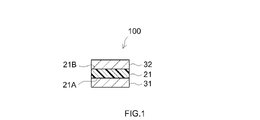
- the sealant sheet 21 shown in FIG. 1 has one surface (first surface) 21A and the other surface (second surface) 21B formed by release liners 31 and 32, at least the sealant sheet 21 side of which is a release surface. each protected.
- the sealant sheet 21 having such a form can be grasped as a component of the sealant sheet 100 with a release liner including the sealant sheet 21 and the release liners 31 and 32 .
- the sealant sheet 21 shown in FIG. 2 has one surface 21A protected by a release liner 31 having release surfaces on both sides. is in contact with the back surface of the release liner 31, so that the surface 21B is also protected by the release liner 31.
- the sealant sheet 21 having such a form can be grasped as a constituent element of the sealant sheet 200 with a release liner including the sealant sheet 21 and the release liner 31 .
- the sealant sheet disclosed herein has shape retention to the extent that it can stably maintain the sheet shape at room temperature (for example, about 25°C).
- the shape retention can also be understood as resistance to plastic deformation such as flow.
- the storage elastic modulus of the sealant sheet at 25° C. (hereinafter also simply referred to as “storage elastic modulus”) may be, for example, 0.005 MPa or more (for example, more than 0.005 MPa), and may be more than 0.01 MPa. preferable.
- storage elastic modulus of the sealant sheet increases, the sealant sheet tends to be improved in handleability and workability (for example, cuttability, antiblocking property, reworkability, etc.).
- the sealant sheet may have a storage modulus of, for example, 0.05 MPa or greater, 0.1 MPa or greater, or 0.2 MPa or greater.
- the upper limit of the storage modulus is not particularly limited.
- the storage modulus of the sealant sheet may be, for example, 2 MPa or less, 1 MPa or less, 0.8 MPa or less, 0.6 MPa or less, 0.5 MPa or less, or 0.5 MPa or less. It may be 4 MPa or less, or 0.3 MPa or less.
- the storage elastic modulus is measured using a viscoelasticity tester under conditions of a frequency of 1 Hz and a strain of 0.5%.
- As the viscoelasticity tester model name "ARES G2" manufactured by TA Instruments Japan Co., Ltd. or its equivalent can be used. More specifically, the storage modulus is measured by the method described in Examples below.
- the storage elastic modulus of the sealant sheet means the storage elastic modulus of the sealant sheet before curing, and is distinguished from the storage elastic modulus of the sealant sheet after curing (cured sealant). be done.
- the storage elastic modulus of the sealant sheet typically means the storage elastic modulus before the sealant sheet is used, that is, before it is placed on a sealing target site by attachment or the like.
- the thickness of the sealant sheet is not particularly limited, and can be selected according to the desired thickness of the cured sealant. From the viewpoint of sealing reliability and the like, in some embodiments, the thickness of the sealant sheet may be, for example, 0.01 mm or more, 0.03 mm or more, 0.05 mm or more, or 0.1 mm or more. , or 0.15 mm or more. Sealant sheets disclosed herein may also suitably be implemented in embodiments where the thickness is, for example, greater than 0.3 mm, greater than 0.5 mm, greater than 1 mm, or greater than 1.5 mm.
- the thickness of the sealant sheet may be, for example, 10 mm or less, 5 mm or less, 3 mm or less, 2 mm or less, 1 mm or less, or 0.5 mm or less, It may be 0.3 mm or less. As the thickness of the sealant sheet becomes smaller, the photocurability tends to improve. Reducing the thickness of the sealant sheet can be advantageous from the viewpoint of conformability to the surface shape of the sealing target location, weight reduction, and the like.
- the sealant sheet disclosed herein comprises a polysulfide polymer (A).
- the polysulfide polymer (A) is a polymer having a repeating unit containing a disulfide structure represented by -SS- and contributes to improving the oil resistance of the cured product formed from the sealant sheet.
- the number of disulfide structures contained in one molecule of polysulfide polymer (A) may be one, or two or more. From the viewpoint of oil resistance of the cured product, a polysulfide polymer (A) containing an average of 3 or more disulfide structures per molecule can be preferably employed.
- the average value of the number of disulfide structures per molecule of the polysulfide polymer (A) (hereinafter also referred to as the average number of disulfide groups) may be, for example, 5 or more, 10 or more, 15 or more, 20 It can be more than that.
- the upper limit of the average number of disulfide groups is not particularly limited, it may be, for example, 100 or less, 70 or less, or 50 or less from the viewpoint of ease of production of the sealant sheet (e.g., easiness of forming into a sheet shape). good.
- the disulfide structure is preferably contained in the main chain of the polysulfide polymer (A). Including a disulfide structure in the main chain tends to form a cured product with good elongation.
- the polysulfide polymer (A) preferably contains repeating units represented by the following general formula (1).
- R 1 , R 2 and R 3 are each independently an alkylene group having 1 to 4 carbon atoms, preferably an alkylene group having 1 to 3 carbon atoms, More preferably, it is an alkylene group having 1 to 2 carbon atoms.
- the repeating unit (1) has a structure in which an ether structure and a disulfide structure are linked. A polysulfide polymer (A) having such a repeating unit (1) tends to form a cured product having excellent oil resistance and flexibility.
- the average number of repeating units (1) contained in one molecule of polysulfide polymer (A) may be, for example, 5 or more, 10 or more, 15 or more, or 20 or more. Further, the average value may be, for example, 100 or less, 70 or less, or 50 or less.
- the polysulfide polymer (A) may have only one region in which the repeating units (1) are continuous, or may have two or more regions in one molecule.
- the polysulfide polymer (A) may contain at least one of a structure represented by general formula (2a) and a structure represented by general formula (2b) below.
- —CH 2 —S—CH 2 CHOH—R′ (2a) —CH 2 —S—CH(CH 2 OH)—R′ (2b)
- R' in general formulas (2a) and (2b) is an organic group having at least one (for example, about 1 to 5) epoxy group.
- the structures of general formulas (2a) and (2b) are formed by an addition reaction of, for example, a thiol having a structural moiety represented by —CH 2 —SH and an epoxy compound having a substituent R′ on the epoxy ring.
- the number of structures represented by general formula (2a) or (2b) (when both the structure represented by general formula (2a) and the structure represented by general formula (2b) are included, the total number of them ) may be, for example, 1.1 or more, 1.3 or more, 1.5 or more, or 1.8 or more, as an average value per molecule of the polysulfide polymer (A). It may be 0 or more, or may be greater than 2.0. Further, the average value may be, for example, 15 or less, 10 or less, 7.0 or less, or 5.0 or less.
- the structures represented by the above general formulas (2a) and (2b) can be formed by an addition reaction between a thiol group and an epoxy group.
- the polysulfide polymer (A) containing the structures represented by the general formulas (2a) and (2b) includes, for example, a thiol group-containing polysulfide having a disulfide structure and a thiol group in one molecule, and two It may be a reaction product or a modified product thereof with an epoxy compound having an epoxy group as described above.
- the weight average molecular weight (Mw) of the thiol group-containing polysulfide as a precursor of the polysulfide polymer (A) is not particularly limited, and may be, for example, 500 or more, 800 or more, 1000 or more, or even more than 1000. Well, it can be over 2000. A thiol group-containing polysulfide with a higher Mw tends to form a sealant sheet that gives a cured product with better elongation. In some embodiments, the Mw of the thiol group-containing polysulfide can be greater than 2500, greater than 3000, greater than 3500, for example.
- the Mw of the thiol group-containing polysulfide may be, for example, 30,000 or less, or may be 10,000 or less. From the viewpoint of handleability and reactivity with the epoxy compound, in some embodiments, the Mw of the thiol group-containing polysulfide may be, for example, less than 9000, less than 8000, less than 7500, or less than 7000. Well, even less than 6500.
- Mw of a polymer such as a thiol group-containing polysulfide, an epoxy group-containing polysulfide described later, or a polysulfide polymer (A) is determined by gel permeation chromatography (GPC) using tetrahydrofuran (THF) as a mobile phase. , can be obtained by converting to polyethylene glycol. Alternatively, nominal values described in catalogs, literature, etc. may be used.
- the thiol group-containing polysulfide preferably contains the disulfide structure in its main chain.
- a sealant sheet containing a polysulfide polymer (A) which is a reaction product of a thiol group-containing polysulfide containing a disulfide structure in the main chain and an epoxy compound having two or more epoxy groups in one molecule or a modified product thereof, It tends to form a cured product with good elongation.
- the number of disulfide structures contained in one molecule of thiol group-containing polysulfide may be, for example, 3 or more, 5 or more, or 10 or more as an average value (average number of disulfide groups) of the entire thiol group-containing polysulfide used. , 15 or more, or 20 or more.
- the upper limit of the average number of disulfide groups is not particularly limited, it may be, for example, 100 or less, 70 or less, or 50 or less from the viewpoint of ease of production of the sealant sheet (e.g., easiness of forming into a sheet shape). good.
- the number of thiol groups contained in the thiol group-containing polysulfide as a precursor of the polysulfide polymer (A) may be 1 or 2 or more per molecule of the thiol group-containing polysulfide. .
- a thiol group-containing polysulfide having an average number of thiol groups contained in one molecule of more than 1 is preferable from the viewpoint of easily realizing a sealant sheet suitable for improving the strength of the cured product and shortening the curing time.
- the average number of thiol groups per molecule of the thiol group-containing polysulfide used may be, for example, 1.1 or more, 1.3 or more, or 1.5 or more.
- a polysulfide having an average number of thiol groups of 2 or more can also be understood as a thiol compound (B) having 2 or more thiol groups in one molecule.
- the thiol group is preferably arranged at the end of the thiol group-containing polysulfide.
- an epoxy group-containing polysulfide polymer having terminal epoxy groups can be suitably formed.
- the thiol group-containing polysulfide used may have a thiol group at one end of the main chain, or may have a thiol group at both ends of the main chain. may further have a thiol group, or may be a mixture of any combination thereof.
- thiol group-containing polysulfides having thiol groups at both ends of the main chain that is, both terminal thiol polysulfides is particularly preferred.
- a sealant sheet containing a polysulfide polymer (A) synthesized using thiol-terminated polysulfide at both ends tends to form a cured product having both strength and elongation in a well-balanced manner.
- the proportion of both terminal thiol polysulfides may be, for example, greater than 50%, greater than 70%, or greater than 90% by weight, It may be greater than 95%, it may be greater than 98%, or it may be substantially 100%.
- Both terminal thiol polysulfides are preferably represented by the following general formula (3).
- R 1 , R 2 and R 3 are each independently an alkylene group having 1 to 4 carbon atoms, preferably an alkylene group having 1 to 3 carbon atoms, more preferably It is an alkylene group having 1 to 2 carbon atoms.
- n in the general formula (3) is, for example, the formula weight of the compound of the general formula (3) is 500 or more and 10000 or less, or 800 or more and less than 9000, or 1000 or more and less than 8000, or more than 1000 and less than 8000, or 2000 may be an integer selected to range from greater than 7500 to less than 7500.
- the compound represented by general formula (3) includes, for example, a thiol group in which R 1 is C 2 H 4 , R 2 is CH 2 and R 3 is C 2 H 4 Containing polysulfide can be preferably employed.
- n in general formula (3) may be, for example, 3-70, 5-60, 7-50, or 10-50.
- the sealant sheet includes an epoxy group-containing polysulfide polymer (AA) having two or more epoxy groups in one molecule as the polysulfide polymer (A), and two or more epoxy groups in one molecule. It contains a thiol compound (B) having a thiol group, an allyl compound (C) having two or more allyl groups in one molecule, and a photoradical generator (D).
- the sealant sheet of this aspect may or may not further contain a polysulfide polymer (A) that does not correspond to the epoxy group-containing polysulfide polymer (AA).
- the average number of epoxy groups per molecule of the epoxy group-containing polysulfide polymer (AA) (hereinafter also referred to as the average number of epoxy groups) can be, for example, about 2 or more and 20 or less. From the viewpoint of flexibility of the cured product, the average number of epoxy groups may be, for example, 15 or less, 10 or less, 7 or less, or 5 or less. In some aspects, the average number of epoxy groups may be 4 or less, or 3 or less. The average number of epoxy groups is typically 2 or more, and may be more than 2 or 2.5 or more from the viewpoint of curability and strength of the cured product. In some aspects, the average number of epoxy groups may be, for example, 3 or more, or 4 or more.
- the epoxy groups contained in the epoxy group-containing polysulfide polymer (AA) are preferably arranged at the ends of the epoxy group-containing polysulfide polymer (AA). Such an epoxy group-containing polysulfide polymer (AA) tends to form a cured product with good elongation.
- the sealant sheet disclosed herein may contain an epoxy group-containing polysulfide polymer (AA) having two or more epoxy groups at one end of the main chain as the polysulfide polymer (A), and Epoxy group-containing polysulfide polymers (AA) each having one or more epoxy groups may be included, or both of these may be included.
- the epoxy group-containing polysulfide polymer (AA) having an epoxy group at one end of the main chain may have a functional group other than the epoxy group at a terminal different from the terminal having the epoxy group.
- Functional groups other than the epoxy group may be, for example, thiol groups, amino groups, hydroxyl groups, and the like.
- the sealant sheet disclosed herein preferably contains at least an epoxy group-containing polysulfide polymer (AA) having epoxy groups at both ends of the main chain.
- the epoxy group-containing polysulfide polymer (AA) having such a structure there is a tendency to form a cured product having both strength and elongation in a well-balanced manner.
- an epoxy group-containing polysulfide polymer (AA) having one epoxy group at each end of the main chain (AA) can be preferably employed.
- Epoxy-group-containing polysulfide polymer (AA) is obtained, for example, by reacting a thiol-group-containing polysulfide as described above with an epoxy compound having two or more epoxy groups in one molecule such that the amount of epoxy groups is excessive.
- the epoxy compound may be a bifunctional epoxy compound having two epoxy groups in one molecule, or a polyfunctional epoxy compound having three or more epoxy groups in one molecule.
- An epoxy compound can be used individually by 1 type or in combination of 2 or more types.
- an epoxy compound that is liquid at room temperature can be preferably used from the viewpoint of operability when reacting with a thiol group-containing polysulfide.
- Bifunctional epoxy compounds include bisphenol A type epoxy resin, bisphenol F type epoxy resin, and hydrogenated bisphenol A type epoxy resin (that is, a structure in which the aromatic ring of bisphenol A type epoxy resin is converted to a cycloalkyl ring by hydrogenation. corresponding epoxy compounds), hydrogenated bisphenol F type epoxy resins, biphenyl type epoxy resins, aliphatic type epoxy resins (e.g., polypropylene glycol type epoxy resins, etc.), 1,6-hexanediol diglycidyl ether, polyethylene glycol diglycidyl ether , etc., but are not limited to these.
- polyfunctional epoxy compounds include novolac type epoxy resins, glycidylamine type epoxy resins, biphenyl type epoxy resins, triphenylmethane type epoxy resins, dicyclopentadiene type epoxy resins, glycerin type epoxy resins, trimethylolpropane type epoxy resins, N , N,N′,N′-tetraglycidyl-m-xylylenediamine, 1,3-bis(N,N-diglycidylaminomethyl)cyclohexane, polyglycerol polyglycidyl ether, and the like, but are not limited thereto. .
- the number of epoxy groups contained in one molecule of the polyfunctional epoxy compound is at least 3 or more, may be 4 or more, or may be 5 or more.
- the number of epoxy groups contained in one molecule of the polyfunctional epoxy compound is usually suitably 10 or less, may be 8 or less, or may be 6 or less.
- a bifunctional epoxy compound can be preferably used as the epoxy compound.
- the use of difunctional epoxy compounds can be advantageous for obtaining sealant sheets that give cured products that exhibit suitable elongation.
- a bifunctional epoxy compound can be used individually by 1 type or in combination of 2 or more types.
- an epoxy compound containing a 5- or more-membered carbon ring structure in the molecule can be preferably employed as the bifunctional epoxy compound.
- a sealant sheet using a bifunctional epoxy compound having such a structure tends to form a cured product having high strength and good elongation.
- the 5- or more-membered carbocyclic structure may be, for example, a benzene ring, a naphthalene ring, a cyclohexyl ring, or the like.
- epoxy compounds containing such a carbocyclic structure include bisphenol A type epoxy resins, bisphenol F type epoxy resins, hydrogenated bisphenol A type epoxy resins, hydrogenated bisphenol F type epoxy resins, biphenyl type epoxy resins, and the like.
- a bisphenol F type epoxy resin can be used as the bifunctional epoxy compound.
- one or more polyfunctional epoxy compounds can be used in combination with a bifunctional epoxy compound or in place of a bifunctional epoxy resin.
- Use of a polyfunctional epoxy compound can improve the strength of the cured product.
- a polyfunctional epoxy compound having a repeating unit containing an epoxy group can be used as the polyfunctional epoxy compound, and for example, a novolak type epoxy resin can be preferably used.
- the novolak type epoxy resins include phenol novolak type epoxy resins and o-cresol novolak type epoxy resins.
- Using a novolak type epoxy resin can be advantageous for obtaining a sealant sheet that gives a cured product having high strength and good elongation. Elongation of the cured product tends to be improved by using a novolak type epoxy resin having a lower molecular weight.
- a phenol novolac type epoxy resin that is liquid at room temperature can be preferably used.
- any suitable catalyst can be used as long as it does not significantly impair the effects obtained by the techniques disclosed herein.
- a known basic catalyst such as 2,4,6-triaminomethylphenol, triethylamine, 1,8-diazabicyclo[5.4.0]undec-7-ene can be appropriately selected and used.
- the amount used is not particularly limited, and is set so that the catalytic function is appropriately exhibited. can do.
- the amount of the basic catalyst used is, for example, 1 part by weight or less with respect to 100 parts by weight of the total amount of the thiol group-containing polysulfide and the epoxy compound having two or more epoxy groups in one molecule. It is usually appropriate to make it 0.5 parts by weight or less, and it may be 0.2 parts by weight or less, 0.1 parts by weight or less, or 0.08 parts by weight or less.
- the amount of the basic catalyst used with respect to the total amount of 100 parts by weight may be, for example, 0.07 parts by weight or less, may be 0.05 parts by weight or less, or may be 0.03 parts by weight or less, It may be 0.02 parts by weight or less.
- the lower limit of the amount of the basic catalyst to be used with respect to the total amount of 100 parts by weight is not particularly limited.
- the above reaction can proceed by mixing a thiol group-containing polysulfide, an epoxy compound having two or more epoxy groups in one molecule, and an optional catalyst in a suitable reaction vessel.
- a thiol group-containing polysulfide, a difunctional epoxy compound, a multifunctional epoxy compound, and a catalyst are mixed in a suitable reaction vessel.
- the method of supplying each material to the reaction vessel and the order of mixing are not particularly limited, and can be selected so as to form an appropriate reaction product.
- the conditions for the above reaction can be appropriately set within a range that does not significantly impair the effects obtained by the techniques disclosed herein.
- the reaction can proceed at a reaction temperature of, for example, 0°C to 120°C, preferably 5°C to 120°C, more preferably 10°C to 120°C.
- the reaction temperature may be, for example, 20°C to 100°C, 30°C to 100°C, or 40°C to 100°C, It may be 60°C to 100°C.
- the reaction time is not particularly limited, and can be selected, for example, from the range of 10 minutes to 720 hours (preferably 1 hour to 240 hours).
- the reaction comprises a first heating step carried out at a temperature of, for example, 60°C to 120°C (preferably 70°C to 110°C) and a and a second heating step performed at a temperature of , in this order.
- a first heating step carried out at a temperature of, for example, 60°C to 120°C (preferably 70°C to 110°C) and a and a second heating step performed at a temperature of , in this order.
- the second heating step is preferably performed at a temperature lower than that of the first heating step.
- the heating time in the first heating step can be, for example, 10 minutes or longer, usually 30 minutes or longer, and may be 1 hour or longer.
- the heating time in the first heating step can be selected, for example, from the range of 10 minutes to 24 hours (preferably 30 minutes to 12 hours, more preferably 1 hour to 6 hours).
- the heating time in the second heating step can be, for example, 3 hours or longer, usually 6 hours or longer, and may be 24 hours or longer.
- the heating time in the second heating step can be selected, for example, from the range of 3 hours to 720 hours (preferably 48 hours to 500 hours, more preferably 72 hours to 300 hours).
- the heating time in the second heating step is preferably longer than the heating time in the first heating step. Note that the heating process may be divided into three or more stages and performed stepwise.
- the ratio of the thiol group-containing polysulfide used and the epoxy compound is included in the epoxy compound with respect to the total number of thiol groups contained in the thiol group-containing polysulfide.
- the ratio of the total number of epoxy groups that is, the equivalent ratio of epoxy groups/thiol groups (hereinafter also referred to as epoxy/thiol ratio) can be set to a value greater than one.
- the epoxy/thiol ratio can be, for example, 1.05 or greater, and can be 1.1 or greater.
- the epoxy/thiol ratio may be, for example, greater than 1.2, greater than 1.4, greater than 1.5, or greater than 1.7. It's okay. Also, the epoxy/thiol ratio can be, for example, less than 7.0, it can be less than 5.0, it can be less than 4.5, it can be less than 4.0. In some embodiments, the epoxy/thiol ratio may be, for example, less than 3.5, may be less than 3.2, may be less than 3.0, may be less than 2.5, from the viewpoint of elongation improvement of the cured product, etc. , less than 2.0, or less than 1.8.
- the amount of the epoxy compound having two or more epoxy groups in one molecule is not particularly limited.
- the amount of the epoxy compound used can be set, for example, so as to achieve any of the epoxy/thiol ratios described above.
- the amount of the epoxy compound used can be, for example, 1 part by weight or more, and usually 3 parts by weight or more, per 100 parts by weight of the thiol group-containing polysulfide. It may be 5 parts by weight or more, or may be 7 parts by weight or more.
- the amount of the epoxy compound used relative to 100 parts by weight of the thiol group-containing polysulfide can be, for example, 50 parts by weight or less, usually 30 parts by weight or less, or even 20 parts by weight or less. It may be 15 parts by weight or less.
- the sealant sheet disclosed herein comprises a thiol group-containing polysulfide polymer (AB) having two or more thiol groups in one molecule as the polysulfide polymer (A), and two or more allyl groups in one molecule. and an allyl compound (C) having and a photoradical generator (D).
- the sealant sheet of this aspect may or may not further contain a polysulfide polymer (A) that does not correspond to the thiol group-containing polysulfide polymer (AB).
- the sealant sheet of the above aspect may or may not further contain a thiol compound (B) that does not correspond to the thiol group-containing polysulfide polymer (AB).
- the sealant sheet disclosed herein includes a thiol group-containing polysulfide polymer (AB) having two or more thiol groups in one molecule as the polysulfide polymer (A), and It contains a thiol compound (B) having two or more thiol groups, an allyl compound (C) having two or more allyl groups in one molecule, and a photoradical generator (D).
- the average number of thiol groups in the thiol group-containing polysulfide polymer (AB) is typically 2 or more, and may be greater than 2.
- the upper limit of the average number of thiol groups is not particularly limited, but from the viewpoint of the flexibility of the cured product, it is usually suitable to be 10 or less, 7 or less, 5 or less, 4 or less, 3 or less, 2 .8 or less or 2.4 or less.
- the thiol group contained in the thiol group-containing polysulfide polymer (AB) is preferably arranged at the end of the thiol group-containing polysulfide polymer (AB).
- Such a thiol group-containing polysulfide polymer (AB) tends to form a cured product with good elongation.
- a thiol group-containing polysulfide polymer (AB) having one or more thiol groups at both ends of the main chain is preferred, and a thiol group-containing polysulfide polymer (AB) having one thiol group at both ends of the main chain is more preferred. preferable.
- the thiol group-containing polysulfide polymer (AB) having such a structure there is a tendency to form a cured product having both strength and elongation in a well-balanced manner.
- the thiol group-containing polysulfide polymer (AB) for example, the above-mentioned epoxy group-containing polysulfide polymer (AA) and a thiol compound having two or more thiol groups in one molecule are mixed together so that the amount of thiol groups is excessive. It is possible to use those obtained by reacting as follows.
- the thiol compound may be a bifunctional thiol compound having two thiol groups in one molecule, or a polyfunctional thiol compound having three or more thiol groups in one molecule.
- a thiol compound can be used individually by 1 type or in combination of 2 or more types.
- a bifunctional thiol compound can be preferably used from the viewpoint of obtaining a sealant sheet that gives a cured product exhibiting suitable elongation.
- 50% by weight or more, 70% by weight or more, or 90% by weight or more of the thiol compounds to be reacted with the epoxy groups of the epoxy group-containing polysulfide polymer (AA) can be bifunctional thiol compounds.
- a bifunctional thiol compound alone may be used as the thiol compound.
- the thiol compound to be reacted with the epoxy group-containing polysulfide polymer (AA) for example, one or more selected from materials that can be used as the thiol compound (B) described later can be used.
- the reaction between the epoxy group-containing polysulfide polymer (AA) and the thiol compound can proceed in the same manner as the reaction between the thiol group-containing polysulfide and the epoxy compound described above.
- the ratio of the epoxy group-containing polysulfide used and the thiol compound used is included in the thiol compound with respect to the total number of epoxy groups contained in the epoxy group-containing polysulfide.
- the ratio of the total number of thiol groups can be set to be less than one.
- the epoxy/thiol ratio can be, for example, 0.95 or less, 0.9 or less, or 0.85 or less.
- the epoxy/thiol ratio may be, for example, 0.1 or more, and usually 0.2 or more is suitable.
- the epoxy/thiol ratio may be, for example, 0.3 or more, 0.5 or more, 0.6 or more, or 0.7 or more from the viewpoint of elongation improvement of the cured product. .
- the amount of the thiol compound having two or more thiol groups in one molecule is not particularly limited.
- the amount of the thiol compound used can be set, for example, so as to achieve any of the epoxy/thiol ratios described above.
- the amount of the thiol compound used can be, for example, 1 part by weight or more, and usually 3 parts by weight or more, per 100 parts by weight of the epoxy group-containing polysulfide. It may be 5 parts by weight or more, or may be 7 parts by weight or more.
- the amount of the thiol compound used relative to 100 parts by weight of the epoxy group-containing polysulfide can be, for example, 50 parts by weight or less, usually 30 parts by weight or less, or even 20 parts by weight or less. It may be 15 parts by weight or less.
- the thiol group-containing polysulfide polymer (AB) for example, the thiol group-containing polysulfide (preferably both terminal thiol polysulfides) described above as a material that can be used as a precursor of the polysulfide polymer (A) may be used.
- thiol compound (B) contained in the sealant sheet disclosed herein a compound having two or more thiol groups in one molecule can be used without particular limitation.
- trimethylolpropane tristhiopropionate also known as trimethylolpropane tris(3-mercaptopropionate)
- pentaerythritol tetrakisthiopropionate ethylene glycol bisthioglycolate, 1,4-butanediol bis Thioglycolate
- trimethylolpropane tristhioglycolate pentaerythrol tetrakisthioglycolate
- di(2-mercaptoethyl) ether 1,4-butanedithiol
- 1,5-dimercapto-3-thiapentane 1,8- dimercapto-3,6-dioxaoctane (alias: 3,6-dioxa
- Examples of commercially available thiol compounds (B) include jER Mate QX11, QX12, jER Cure (registered trademark) QX30, QX40, QX60, QX900 and Capcure CP3-800 manufactured by Mitsubishi Chemical Corporation; Yodo Chemical Co., Ltd. OTG, EGTG, TMTG, PETG, 3-MPA, TMTP, PETP; TEMPIC, TMMP, PEMP, PEMP-II-20P, DPMP manufactured by Sakai Chemical Co., Ltd.; Karenz MT (registered trademark) PE1 manufactured by Showa Denko K.K.
- the average number of thiol groups of the thiol compound (B) contained in the sealant sheet can be, for example, about 2 or more and 10 or less. From the viewpoint of flexibility of the cured product, the average number of thiol groups may be, for example, 7 or less, 5 or less, 4 or less, or less than 4. In some aspects, the average number of thiol groups may be 3 or less, 2.5 or less, or 2.2 or less.
- the thiol compound (B) only one or two or more bifunctional thiol compounds may be used. With such a configuration, it is easy to obtain a sealant sheet that gives a cured product exhibiting suitable elongation.
- Examples of the thiol compound (B) include a compound having a primary thiol group (hereinafter also referred to as a primary thiol compound), a compound having a secondary thiol group (secondary thiol compound), a compound having a tertiary thiol group (3 class thiol compounds) can be used.
- a primary thiol compound can be preferably employed from the viewpoint of curability when the sealant sheet is used.
- a secondary or higher thiol compound that is, a secondary thiol compound and/or a tertiary thiol compound
- a secondary or higher thiol compound that is, a secondary thiol compound and/or a tertiary thiol compound
- a thiol compound having two primary thiol groups in one molecule may be referred to as a primary bifunctional thiol compound, and a thiol compound having two secondary thiol groups in one molecule is a secondary bifunctional They are sometimes called thiol compounds.
- a primary thiol compound and a secondary or higher thiol compound can be used in combination as the thiol compound (B).
- the weight ratio of the primary thiol compound to the total weight of the primary thiol compound and the secondary or higher thiol compound is not particularly limited, and may be, for example, 5% by weight or more, preferably 15% by weight or more, or more. It is preferably 25% by weight or more, and may be 35% by weight or more, and may be, for example, 95% by weight or less, preferably 75% by weight or less, and may be 60% by weight or less. , 45% by weight or less.
- the thiol compound (B) one having a thiol equivalent in the range of 45 g/eq to 450 g/eq is preferably used in consideration of the balance between the preservability of the sealant sheet before use and the curability at the time of use. obtain.
- the thiol equivalent may be, for example, 60 g/eq or more, 70 g/eq or more, or 80 g/eq or more, and may be, for example, 350 g/eq or less, 250 g/eq or less, or 200 g/eq. eq or less, or 150 g/eq or less.
- the storage stability before use tends to improve, but the curability during use tends to decrease.
- the sum of the products of the thiol equivalents and weight fractions of each thiol compound (B) is preferably within the above range.
- the thiol equivalent means the number of grams of a compound containing one equivalent of a thiol group, and can be measured by an iodometric titration method. Alternatively, nominal values described in catalogs, literature, etc. may be used.
- allyl compound (C) contained in the sealant sheet disclosed herein any compound having two or more allyl groups in one molecule can be used without particular limitation.
- allyl compound (C) disclosed herein allyl ether, allyl ester, and the like can be preferably used.
- allyl compounds (C) disclosed herein include diallyl phthalate, diallyl isophthalate, diallyl terephthalate, diallyl fumarate, diallyl adipate, diallyl hexahydrophthalate, 1,3-diallyloxy-2- bifunctional allyl compounds such as propanol; trifunctional allyl compounds such as triallyl isocyanurate, triallyl cyanurate, triallyl citrate, and triallyl trimellitate; and tetrafunctional allyl compounds such as pentaerythritol tetraallyl ether. Not limited.
- the ratio of allyl group equivalents to thiol group equivalents contained in the sealant sheet is not particularly limited.
- the allyl/thiol ratio of the sealant sheet may be, for example, approximately 0.1 or more and 10 or less, 0.2 or more and 5 or less, 0.3 or more and 3 or less, or 0.5 or more and 2 or less. good.
- the allyl/thiol ratio is equal to or more than the lower limit and equal to or less than the upper limit, a cured product having both strength and elongation in a well-balanced manner tends to be formed.
- the allyl/thiol ratio can be, for example, greater than or equal to 0.6, greater than or equal to 0.7, or greater than or equal to 0.8, and less than or equal to 1.7, less than or equal to 1.5, or less than or equal to 1.2. you can
- the amount of the thiol compound (B) contained in the sealant sheet is not particularly limited.
- the amount of the thiol compound (B) contained in the sealant sheet can be set, for example, so as to achieve any of the allyl/thiol ratios described above.
- the amount of the thiol compound (B) that does not correspond to the thiol group-containing polysulfide polymer (AB) relative to 100 parts by weight of the polysulfide polymer (A) can be, for example, 0.05 parts by weight or more.
- the amount of the allyl compound (C) contained in the sealant sheet is not particularly limited.
- the amount of the allyl compound (C) contained in the sealant sheet can be set, for example, so as to achieve any of the allyl/thiol ratios described above.
- the amount of the allyl compound (C) relative to 100 parts by weight of the polysulfide polymer (A) may be, for example, 0.05 parts by weight or more, may be 0.1 parts by weight or more, or may be 0.3 parts by weight or more. It may be 0.5 parts by weight or more, may be 10 parts by weight or less, may be 5 parts by weight or less, may be 3 parts by weight or less, or may be 2 parts by weight or less. .
- Photoradical generator (D) As the photoradical generator (D), one that generates radicals by light irradiation is used. In some preferred embodiments, the photoradical generator (D) is an intramolecularly cleavable photoinitiator. Examples of photoradical generators (D) include alkylphenone-based photopolymerization initiators, acylphosphine oxide-based photopolymerization initiators, titanocene compound-based photopolymerization initiators, acetophenone-based photopolymerization initiators, and benzoin ether-based photopolymerization initiators. agents and the like. A photoradical generator can be used individually by 1 type or in combination of 2 or more types.
- alkylphenone-based photopolymerization initiators include 2-methyl-1-[4-(methylthio)phenyl]-2-morpholinopropan-1-one (eg, trade name "Omnirad 907" manufactured by IGM Resins). ), 2,2-dimethoxy-2-phenylacetophenone (eg, trade name “Omnirad 651” manufactured by IGM Resins), and the like.
- acylphosphine oxide-based photopolymerization initiators include bis(2,4,6-trimethylbenzoyl)phenylphosphine oxide (eg, trade name “Irgacure 819” manufactured by BASF), bis(2,4,6 -trimethylbenzoyl)-2,4-di-n-butoxyphenylphosphine oxide, 2,4,6-trimethylbenzoyldiphenylphosphine oxide (for example, trade name "Lucirin TPO" manufactured by BASF), bis(2,6- dimethoxybenzoyl)-2,4,4-trimethylpentylphosphine oxide and the like.
- bis(2,4,6-trimethylbenzoyl)phenylphosphine oxide eg, trade name “Irgacure 819” manufactured by BASF
- bis(2,4,6 -trimethylbenzoyl)-2,4-di-n-butoxyphenylphosphine oxide 2,4,6-trimethylbenzoyl
- titanocene compound-based photopolymerization initiators include bis(2,4-cyclopentadienyl)bis[2,6-difluoro-3-(1-pyryl)phenyl]titanium (IV) (eg, BASF product name “Irgacure 784”), etc.
- acetophenone-based photopolymerization initiators include 1-hydroxycyclohexyl-phenyl-ketone (eg, trade name “Irgacure 184” manufactured by BASF), 4-phenoxydichloroacetophenone, 4-t-butyl-dichloroacetophenone, 1-[4-(2-hydroxyethoxy)-phenyl]-2-hydroxy-2-methyl-1-propan-1-one (for example, trade name "Irgacure 2959” manufactured by BASF), 2-hydroxy-2 -methyl-1-phenyl-propan-1-one (eg, trade name "Darocure 1173” manufactured by BASF), methoxyacetophenone, and the like.
- 1-hydroxycyclohexyl-phenyl-ketone eg, trade name “Irgacure 184” manufactured by BASF
- 4-phenoxydichloroacetophenone 4-t-butyl-dichloroacetophenone
- benzoin ether photoinitiators include benzoin ethers such as benzoin methyl ether, benzoin ethyl ether, benzoin propyl ether, benzoin isopropyl ether, and benzoin isobutyl ether, and substituted benzoin ethers such as anisole methyl ether.
- alkylphenone-based photopolymerization initiators acylphosphine oxide-based photopolymerization initiators and titanocene compounds can effectively promote radical addition reactions between thiol groups and allyl groups by radicals generated by light irradiation.
- Systemic photoinitiators are preferred.
- the usage amount of the photoradical generator (D) can be set so as to obtain the desired usage effect.
- the amount of the photoradical generator (D) used is, for example, 0.01 with respect to 100 parts by weight of the total amount of the polysulfide polymer (A), the thiol compound (B) and the allyl compound (C). It can be 0.1 part by weight or more from the viewpoint of enhancing the curability of the sealant sheet, and may be 0.5 parts by weight or more, 1 part by weight or more, or 1.5 parts by weight. It can be more than part.
- the amount of the photoradical generator (D) used is usually preferably 10 parts by weight or less, preferably 7 parts by weight or less, with respect to the total amount of 100 parts by weight, from the viewpoint of raw material costs and the like. More preferably, it may be 5 parts by weight or less, 4 parts by weight or less, 3 parts by weight or less, or 2.5 parts by weight or less.
- the sealant sheets disclosed herein may contain a sensitizer.
- a sensitizer By using a sensitizer, it is possible to increase the utilization efficiency of the irradiated light and improve the sensitivity of the photo-radical generator (D).
- the photosensitizer can be appropriately selected from known materials and used.
- Non-limiting examples of photosensitizers include benzophenone, 4-methylbenzophenone, 3-benzoylbiphenyl, 4-(4-methylphenylthio)benzophenone, methyl 2-benzoylbenzoate, 4-phenylbenzophenone, 4,4 '-bis(dimethoxy)benzophenone, 4,4'-bis(dimethylamino)benzophenone, 4,4'-bis(diethylamino)benzophenone, 2-benzoylbenzoic acid methyl ester, 2-methylbenzophenone, 3-methylbenzophenone, 3 ,3'-dimethyl-4-methoxybenzophenone, benzophenone derivatives such as 2,4,6-trimethylbenzophenone; Thioxanthone derivatives such as 4-dimethylthioxanthone, 2,4-diethylthioxanthone, 1-chloro-4-propoxythioxanthone, and 2,4-diethylthioxanthen-9
- the amount used when using a photosensitizer can be set so as to obtain the desired sensitization effect.
- the amount of the photosensitizer used is For example, it may be 0.001 parts by weight or more, 0.005 parts by weight or more, 0.01 parts by weight or more, or 0.05 parts by weight or more.
- the amount of the photosensitizer used is, for example, 0.002 parts by weight with respect to 100 parts by weight of the allyl compound (C).
- the upper limit of the amount of the photosensitizer used is not particularly limited, but from the viewpoint of the storage stability of the sealant sheet, when the sealant sheet contains the thiol compound (B) and the allyl compound (C), the thiol compound (B) and 10 parts by weight or less is usually suitable for 100 parts by weight of the total amount with the allyl compound (C), and it may be 5 parts by weight or less, 1 part by weight or less, or 0.5 parts by weight or less, It may be 0.3 parts by weight or less.
- the amount of the photosensitizer used is usually 20 parts by weight or less with respect to 100 parts by weight of the allyl compound (C). It may be 10 parts by weight or less, 2 parts by weight or less, 1 part by weight or less, or 0.6 parts by weight or less.
- the sealant sheet disclosed herein does not contain a photosensitizer in a preferred embodiment.
- the sealant sheet disclosed herein may further contain any compound that can help suppress radical addition reactions between thiol groups and allyl groups as long as other properties are not significantly impaired. Use of such a compound can enhance the shelf life of the sealant sheet before use.
- the storage stabilizers can be, for example, organic acids, inorganic acids, and oligomers, polymers, borate esters, phosphate esters containing acidic groups in the molecule, which are liquid or solid at room temperature, and which contain functional groups other than acidic groups. You may have a group.
- Examples include, but are not limited to, sulfuric acid, acetic acid, adipic acid, tartaric acid, fumaric acid, barbituric acid, boric acid, pyrogallol, phenolic resins, carboxylic acid anhydrides, and the like.
- the storage stabilizers may be used singly or in appropriate combination of two or more.
- the amount of the storage stabilizer to be used is not particularly limited, and can be set so as to obtain the desired effect.
- Suitable examples of storage stabilizers include borate esters and phosphate esters.
- Borate esters are borate esters that are liquid or solid at room temperature.
- phosphates include but are not limited to: Examples of phosphates include ethyl phosphate, butyl phosphate, propyl phosphate, 2-ethylhexyl phosphate, dibutyl phosphate, di(2-ethylhexyl) phosphate, oleyl phosphate, and ethyl diethyl phosphate. include, but are not limited to.
- the sealant sheet disclosed herein, in one preferred embodiment, does not contain a storage stabilizer.
- the sealant sheet disclosed herein may optionally contain a filler. This can improve one or both of the breaking strength and elongation at break of the cured product. Fillers can also help adjust the storage modulus of the sealant sheet. In addition, appropriate use of fillers can improve the shape retention and workability of the sealant sheet.
- the filler to be used is not particularly limited, and any appropriate filler can be used as long as it does not significantly impair the effects obtained by the technology disclosed herein.
- a filler can be used individually by 1 type or in combination of 2 or more types.
- filler materials include talc, silica, glass, carbon black, alumina, clay, mica, aluminum hydroxide, magnesium hydroxide, calcium carbonate, magnesium carbonate, barium sulfate, titanium dioxide, barium titanate, and titanium.
- filler materials include, but are not limited to, strontium oxide, calcium titanate, magnesium titanate, bismuth titanate, boron nitride, aluminum borate, barium zirconate, calcium zirconate, and the like.
- Preferred examples include talc, silica, glass and calcium carbonate.
- the content of the filler is not particularly limited, and can be selected so as to obtain suitable properties.
- the content of the filler may be, for example, 1% by weight or more, or 5% by weight or more, of the entire sealant sheet, or may be 10% by weight or more, or may be 15% by weight or more from the viewpoint of obtaining a higher effect of use. It may be 20% by weight or more, or 25% by weight or more.
- the content of the filler can be, for example, less than 50% by weight of the entire sealant sheet, and from the viewpoint of improving the moldability into the sheet shape and the elongation of the cured product, it is usually less than 40% by weight. suitable and may be less than 35% by weight.
- the filler content may be less than 30 wt%, or less than 25 wt%.
- the average particle size of the filler is not particularly limited.
- the average particle size is usually suitably 100 ⁇ m or less, preferably 50 ⁇ m or less. A smaller average particle size tends to improve the effect of improving one or both of the breaking strength and elongation at break of the cured product.
- the average particle size of the filler may be, for example, 30 ⁇ m or less, 20 ⁇ m or less, 15 ⁇ m or less, 10 ⁇ m or less, or 5 ⁇ m or less.
- the average particle size of the filler may be, for example, 0.1 ⁇ m or more, 0.2 ⁇ m or more, 0.5 ⁇ m or more, or 1 ⁇ m or more. A not-too-small average particle size can be advantageous from the viewpoint of handling and dispersibility of the filler.
- the average particle size of the filler means the particle size at which the volume-based cumulative particle size is 50% in the particle size distribution obtained by the measurement based on the laser diffraction/scattering method, that is, the 50% volume average particle size. (50% median diameter).
- a filler made of a material having a refractive index in the range of 1.56 or more and less than 1.62 can be preferably used.
- a glass filler having a refractive index within the above range can be used.
- the above refractive index range is a range that is equal to or approximates the refractive index of the polysulfide polymer (A) (typically about 1.60). Therefore, a filler having a refractive index within the above range tends to suppress a decrease in the transmittance of the sealant sheet due to blending the filler, compared to a filler having a refractive index outside the above range.
- the transmittance of the sealant sheets disclosed herein may be, for example, greater than 5%, greater than 10%, greater than 15%, or greater than 20%.
- the upper limit of transmittance is not particularly limited.
- the transmittance of the sealant sheet disclosed herein may be 100%, or may be 80% or less, 60% or less, or 40% or less from a practical standpoint.
- the sealant sheet disclosed herein can also be preferably implemented in a mode in which the transmittance is 30% or less, 20% or less, or 15% or less.
- the transmittance of the sealant sheet can be obtained by measuring the spectrum of the sealant sheet with a thickness of 0.2 mm using a UV-vis spectrum measuring device (Shimadzu Corporation, UV-2550) or its equivalent.
- the transmittance for example, the transmittance at a wavelength of 365 nm can be adopted.
- the sealant sheet disclosed herein is a combination of a filler having a refractive index in the range of 1.56 or more and less than 1.62 (for example, glass filler) and a filler having a refractive index outside the above range (for example, talc).
- the ratio of the filler having a refractive index within the above range to the total amount of filler contained in the sealant sheet may be, for example, 10% by weight or more, may be 25% by weight or more, and preferably 45% by weight or more. It may be 60% by weight or more, 85% by weight or more, or 100% by weight.
- a filler made of a material having a refractive index in the range of 1.56 to 1.61 or in the range of 1.57 to 1.60 can be more preferably employed.
- the refractive index can be measured using generally known techniques such as the minimum deflection angle method, the critical angle method, and the V-block method. The measurement can be performed using, for example, a multi-wavelength Abbe refractometer DR-M4 (manufactured by ATAGO). Alternatively, nominal values described in catalogs, literature, etc. may be used.
- the sealant sheet disclosed here may contain other optional components within the range that does not significantly impair the effects obtained by the technology disclosed here.
- optional components include colorants such as dyes and pigments, dispersants, plasticizers, softeners, flame retardants, antioxidants, ultraviolet absorbers, antioxidants, light stabilizers, and the like. , but not limited to.
- the sealant sheet disclosed herein may further contain a polymer or oligomer (hereinafter also referred to as an arbitrary polymer) other than the above, for the purpose of improving adhesion to the sealing target area, for example.
- a polymer or oligomer hereinafter also referred to as an arbitrary polymer
- the content of the optional polymer is preferably 10 parts by weight or less, more preferably 5 parts by weight or less, relative to 100 parts by weight of the polysulfide polymer (A). It is more preferably 1 part by weight or less.
- the sealant sheet may be substantially free of such optional polymers. In the present specification, “substantially free of a certain component” means that the component is at least intentionally not contained unless otherwise specified.
- the content of the organic solvent based on the weight of the sealant sheet may be, for example, 5% or less, 2% or less, 1% or less, or 0.5% or less. It may be substantially free of organic solvents.
- the content of the organic solvent may be 0%.
- the organic solvent is intended to react with other components in the sealant sheet (in particular, epoxy group-containing polysulfide and a curing agent that can be used as necessary), such as toluene, cyclohexanone, trichloroethane, and the like. It refers to ingredients that are not
- the sealant sheet disclosed herein may contain a thiol compound (B) (hereinafter also referred to as a low-molecular-weight thiol compound) having an Mw of 1000 or less, preferably 600 or less, more preferably 400 or less.
- the content of the low-molecular-weight thiol compound may be 0.1% by weight or more, or 0.3% by weight or more, based on the weight of the total amount of the thiol compound (B) and the polysulfide polymer (A). , or 0.5% by weight or more.
- the low molecular weight thiol compound can serve to increase the tackiness of the sealant sheets disclosed herein.
- the term "temporary fixability" refers to the property of preventing the sealant sheet from being lifted from the sealing target area or being displaced until the sealant sheet placed at the sealing target area is cured.
- the low-molecular-weight thiol compound reacts with light irradiation and is incorporated into the cured product.
- the content of the low molecular weight thiol compound may be less than 0.1% by weight of the total amount of the thiol compound (B) and the polysulfide polymer (A), based on weight. It may be less than 05% by weight, and may be substantially free.
- the sealant sheet disclosed here can have a tack on the surface and can be temporarily fixed to the sealing target part even in such an aspect.
- a release liner can be used in the preparation of the sealant sheet disclosed herein (for example, molding into a sheet shape), storage of the sealant sheet before use, distribution, shape processing, placement at a sealing target site, and the like. .
- the release liner is not particularly limited.
- a release liner or the like made of a low-adhesion material such as polypropylene can be used.
- the release treatment layer may be formed by surface-treating the liner base material with a release treatment agent such as a silicone-based, long-chain alkyl-based, fluorine-based, or molybdenum sulfide release agent.
- the sealant sheet disclosed herein contains a polysulfide polymer (A), a thiol compound (B) (for example, the low-molecular-weight thiol compound described above), and an allyl compound (C) in combination.
- a polysulfide polymer (A) is prepared; a thiol compound (B), an allyl compound (C), a photoradical generator (D) and a filler are added to the polysulfide polymer (A). and mixing the resulting mixture into a sheet shape.
- the polysulfide polymer (A) is a reaction product of a thiol group-containing polysulfide, a bifunctional epoxy compound, and a polyfunctional epoxy compound
- preparing the mixture includes the thiol group-containing polysulfide and the bifunctional epoxy compound. and a polyfunctional epoxy compound; and adding and mixing a thiol compound (B), an allyl compound (C), a photoradical generator (D) and a filler to the reaction product ; in that order.
- fillers may be mixed together during preparation of the reaction product.
- the above description regarding the reaction between the thiol group-containing polysulfide and the epoxy compound having two or more epoxy groups in one molecule can be applied, so redundant description will be omitted.
- Examples of devices that can be used for mixing the reaction product and the additive components include, for example, Banbury Mixers, kneaders, closed kneaders such as two-roll mills and three-roll mills or batch kneaders; and continuous kneaders such as single-screw extruders and twin-screw extruders, but are not limited thereto.
- known sheet forming methods such as press molding, calendar molding, and melt extrusion molding can be used alone or in combination as appropriate.
- the above press molding may be normal pressure press or vacuum press.
- vacuum press molding or calender molding can be preferably applied from the viewpoints of preventing entrainment of air bubbles into the sheet and suppressing thermal denaturation of the mixture.
- the obtained sealant sheet is stored and processed (for example, slitting to a predetermined width, processing from a roll to a sheet, or a predetermined shape in the form of a sealant sheet with a release liner as shown in FIG. 1 or 2). punching, etc.), transportation, etc. can be performed.
- the sealant sheet disclosed here contains a combination of a thiol group-containing polysulfide polymer (AB) and an allyl compound (C).
- a thiol group-containing polysulfide polymer (AB) is prepared; an allyl compound (C), a photoradical generator (D) and a filler are added to the thiol group-containing polysulfide polymer (AB). and mixing the resulting mixture into a sheet shape.
- thiol group-containing polysulfide polymer (AB) is a thiol-modified epoxy group-containing polysulfide polymer
- preparing the mixture is performed by replacing the thiol group of a compound having two or more thiol groups in one molecule with the epoxy group.
- Preparing a thiol group-containing polysulfide polymer (AB) by reacting with the epoxy group of the containing polysulfide polymer; adding and mixing; in that order.
- fillers may be mixed together during preparation of the reaction product.
- the material of the portion to be sealed using the sealant sheet disclosed herein is not particularly limited.
- the material may be, for example, metal, resin, composite material thereof, etc. More specifically, iron, iron alloy (carbon steel, stainless steel, chromium steel, nickel steel, etc.), aluminum, aluminum alloy, nickel , tungsten, copper, copper alloys, titanium, titanium alloys, silicon and other metal or semi-metal materials; polyolefin resins, polycarbonate resins, acrylic resins, acrylonitrile resins (PAN) and other resin materials; alumina, silica, sapphire, silicon nitride, ceramic materials such as tantalum nitride, titanium carbide, silicon carbide, gallium nitride, and gypsum; glass materials such as aluminosilicate glass, soda lime glass, soda aluminosilicate glass, and quartz glass; laminates and composites thereof; .
- Suitable examples of the metal or semimetal material include light metals such as aluminum and titanium, and alloys containing such light metals as main components.
- Examples of aluminum alloys include duralumin (eg, duralumin A2024, duralumin A2017, etc.).
- Examples of the composite include carbon fiber reinforced plastic (CFRP) and glass fiber reinforced plastic (FRP).
- the sealant sheet disclosed herein takes the form of a non-liquid (i.e., solid) sheet in a temperature range of about 25°C. no need to control
- the sealant sheet can be cut into a desired outer shape in advance and placed on the sealing target (typically, it can be attached using the tack of the sealant sheet). is.
- a roll-shaped sealing sheet may be unwound and applied to the target location, and the surplus sealing sheet may be cut off.
- the radical addition reaction between the thiol group and the allyl group contained in the sealant sheet is accelerated by irradiating with light to generate radicals from the photoradical generator (D). hardening proceeds.
- Light irradiation can be performed using a known appropriate light source such as a chemical lamp, a black light (for example, a black light manufactured by Toshiba Lighting & Technology Co., Ltd.), a metal halide lamp, and the like.
- a light source with a spectral distribution in the wavelength region of 250 nm to 450 nm can be preferably used.
- a sensitizer By including a sensitizer in the sealant sheet, the utilization efficiency of the light emitted from the light source can be increased.
- use of a sensitizer is particularly effective when using a light source having a spectral distribution in the wavelength range of 350 nm to 450 nm.
- the sealant sheet disclosed here can be used in a manner in which light irradiation is performed while being placed on a seal target location. Since the radical addition reaction between a thiol group and an allyl group (thiolene addition reaction) progresses faster than anionic polymerization or the like, curing of the sealant sheet disclosed herein tends to progress rapidly after light irradiation. According to the technology disclosed herein, even with a sealant sheet that cures in a shorter time than the time required for air bubbles to fully escape from the sealant after light irradiation, the generation and growth of air bubbles can be suppressed. Therefore, it can be suitably used for applications that require shortened sealing time and high sealing quality.
- the cured product formed from the sealant sheet disclosed herein or the cured sealant suitably has a tensile strength at break of 0.7 MPa or more, preferably 0.9 MPa or more, more preferably 1 0 MPa, and may be 1.1 MPa or more, or 1.15 MPa or more. In some embodiments, the tensile strength at break may be 1.2 MPa or higher, or 1.3 MPa or higher.
- the upper limit of the tensile strength at break is not particularly limited, but from the viewpoint of facilitating compatibility with other physical properties, it may be, for example, 3 MPa or less.
- the cured product formed from the sealant sheet disclosed herein or the cured sealant suitably has an elongation at break of 100% or more, preferably 120% or more, and may be 150% or more. It may be 200% or more, or 250% or more.
- the upper limit of the elongation at break is not particularly limited, but from the viewpoint of facilitating compatibility with other physical properties, it may be, for example, 600% or less, or 400% or less.
- the above tensile strength at break and elongation at break are measured by the following methods.
- Measurement of tensile strength at break and elongation at break One surface of a sealant sheet having a thickness of 0.2 mm is irradiated with light of 2000 mJ/cm 2 using a black light manufactured by Toshiba Lighting & Technology Corporation. After the irradiated sealant sheet is held in an environment of 25° C. for 14 days, the resulting cured product (cured sealant) is cut into a rectangular shape having a width of 10 mm and a length of 50 mm to prepare a sample piece.
- a sealant sheet molded into a sheet shape Ingredients for: polysulfide polymer (A); Thiol compound (B) having two or more thiol groups in one molecule; an allyl compound (C) having two or more allyl groups in one molecule; and a photoradical generator (D); Including sealant sheet.
- the above-mentioned epoxy group-containing polysulfide polymer (AA) is produced by reaction of both terminal thiol polysulfide having Mw 500 to 10000 having a disulfide structure in the main chain and an epoxy compound having two or more epoxy groups in one molecule.
- the sealant sheet according to (2) or (3) above which is a product.
- the bifunctional epoxy compound includes an epoxy compound containing a 5- or more-membered carbon ring structure in the molecule.
- the above-mentioned thiol group-containing polysulfide polymer (AB) is produced by reaction of both terminal epoxy polysulfide having Mw of 500 to 10000 having a disulfide structure in the main chain and a thiol compound having two or more thiol groups in one molecule.
- (12) The sealant sheet according to any one of (1) to (11) above, wherein the thiol compound (B) has a thiol equivalent of 45 g/eq to 450 g/eq.
- the allyl compound (C) is at least one selected from the group consisting of bifunctional allyl compounds and trifunctional allyl compounds.
- the photoradical generator (D) is at least one selected from the group consisting of alkylphenone-based photopolymerization initiators, acylphosphine oxide-based photopolymerization initiators, and titanocene compound-based photopolymerization initiators.
- (16) The sealant sheet according to (15) above, wherein the content of the filler is 1% by weight or more and less than 40% by weight of the entire sealant sheet.
- the sealant sheet according to (15) or (16) above, wherein the filler has an average particle size of 0.1 ⁇ m or more and 30 ⁇ m or less.
- sealant sheet according to any one of (1) to (17) above which has a storage modulus at 25° C. of 0.005 MPa or more and 0.8 MPa or less.
- the sealant sheet according to any one of (1) to (18) above having a thickness of 0.01 mm or more and 10 mm or less.
- a sealant sheet molded into a sheet shape Ingredients for: Thiol group-containing polysulfide polymer (AB) having two or more thiol groups; an allyl compound (C) having two or more allyl groups in one molecule; and a photoradical generator (D); Including sealant sheet.
- a sealant sheet with a release liner comprising: (22) preparing a polysulfide polymer (A); In the polysulfide polymer (A), a thiol compound (B) having two or more thiol groups in one molecule, an allyl compound (C) having two or more allyl groups in one molecule, a photoradical generator (D) and adding and mixing a filler; and forming the resulting mixture into a sheet form; A method of manufacturing a sealant sheet, comprising: (23) preparing a thiol group-containing polysulfide polymer (AB) having two or more thiol groups in one molecule; adding and mixing an allyl compound (C) having two or more allyl groups in one molecule, a photoradical generator (D) and a filler to the thiol group-containing poly
- Example 1 ⁇ Preparation of epoxy polysulfide polymer at both ends> Using a reaction vessel equipped with a stirrer, 90 parts of a liquid polysulfide polymer (both thiol-terminated polysulfide polymer), 7.5 parts of a bifunctional epoxy compound, 2 parts of a polyfunctional epoxy compound, and 0.08 parts of a basic catalyst are stirred. while heating at 90° C. for 3 hours. Thus, a double-ended epoxy polysulfide polymer was synthesized.
- the liquid polysulfide polymer (both thiol-terminated polysulfide polymer) is a product name Thiocol LP-55 (Mw 4000, thiol equivalent 2000 g / eq) manufactured by Toray Fine Chemicals Co., Ltd.
- the bifunctional epoxy compound is bisphenol F type manufactured by Mitsubishi Chemical Corporation.
- Epoxy resin product name jER806, epoxy equivalent 169 g / eq
- Mitsubishi Chemical Corporation phenolborac type epoxy resin product name jER152, epoxy equivalent 177 g / eq
- ⁇ Preparation of sealant sheet> After taking out the contents of the reaction vessel and allowing it to cool to room temperature, 0.5 parts of the secondary bifunctional thiol compound and 0.6 parts of the trifunctional allyl compound shown in Table 1 are added to 50 parts of the epoxy polysulfide polymer at both ends. , 1.0 part of photoradical generator A, and 20 parts of talc as a filler were added and kneaded uniformly using a two-roll mill.
- a sealant sheet according to this example was obtained by forming the resulting mixture into a sheet using a vacuum press. At that time, two types, a sheet with a thickness of 0.2 mm and a sheet with a thickness of 1 mm, were produced.
- the allyl/thiol ratio of the sealant sheet according to this example is 1.0. That is, the sum of the thiol groups (unreacted) contained in the epoxy polysulfide polymer at both ends used to prepare the sealant sheet according to this example and the thiol groups (unreacted) contained in the secondary bifunctional thiol compound added to this polymer The number is almost the same as the number of allyl groups (unreacted) contained in the trifunctional allyl compound added to the polymer.
- the number of thiol groups contained in the epoxy polysulfide polymer at both ends is calculated from the number of thiol groups NT calculated from the thiol equivalent of the liquid polysulfide polymer used in the synthesis of the polymer and the amount used, the bifunctional epoxy compound used and It is obtained by subtracting the number of epoxy groups, NE , calculated from the epoxy equivalent weight and amount used of each polyfunctional epoxy compound.
- Example 2 ⁇ Preparation of thiol-terminated polysulfide polymer> Using a reaction vessel equipped with a stirrer, 90 parts of a liquid polysulfide polymer (both thiol-terminated polysulfide polymer), 10 parts of a bifunctional epoxy compound, 2 parts of a polyfunctional epoxy compound, and 0.08 parts of a basic catalyst are stirred. Heated at 90° C. for 3 hours. Then, 4 parts of a bifunctional thiol compound was added, and the mixture was heated at 90° C. for 1.5 hours while stirring. Thus, a polysulfide polymer with thiol ends at both ends was synthesized.
- a liquid polysulfide polymer both thiol-terminated polysulfide polymer
- 10 parts of a bifunctional epoxy compound 2 parts of a polyfunctional epoxy compound
- 0.08 parts of a basic catalyst 0.08 parts
- liquid polysulfide polymer (both thiol-terminated polysulfide polymer) is a product name Thiocol LP-55 (Mw 4000, thiol equivalent 2000 g / eq) manufactured by Toray Fine Chemicals Co., Ltd., and the bifunctional epoxy compound is bisphenol F type manufactured by Mitsubishi Chemical Corporation.
- Epoxy resin product name jER806, epoxy equivalent 169 g / eq
- Mitsubishi Chemical Corporation phenolborac type epoxy resin product name jER152, epoxy equivalent 177 g / eq
- a polyfunctional epoxy compound Tokyo Kasei as a basic catalyst 2,4,6-triaminomethylphenol manufactured by Tokyo Kasei Co., Ltd.
- ⁇ Preparation of sealant sheet> After taking out the contents of the reaction vessel and allowing it to cool to room temperature, 0.5 parts of secondary bifunctional thiol shown in Table 1, 0.6 parts of trifunctional allyl compound, and 50 parts of epoxy polysulfide polymer at both ends are added. 1.0 part of photo-radical generator A and 20 parts of talc as a filler were added and uniformly kneaded using a two-roll mill. A sealant sheet according to this example was obtained by forming the resulting mixture into a sheet using a vacuum press. At that time, two types, a sheet with a thickness of 0.2 mm and a sheet with a thickness of 1 mm, were produced.
- the sealant sheets of Examples 1 and 2 were measured or evaluated as follows. (Measurement of storage modulus) A sealant sheet with a thickness of 1 mm is punched into a disk shape with a diameter of 8 mm, sandwiched between parallel plates, and a viscoelasticity tester (manufactured by TA Instruments Japan, model name "ARES G2") is used to measure the temperature. Storage modulus G' was measured under conditions of 25°C, frequency of 1 Hz, and strain of 0.5%. As a result, the storage elastic moduli G' of the sealant sheets according to Examples 1 and 2 were both in the range of 0.005 MPa to 0.8 MPa.
- the sealants of Comparative Examples 1 to 4 were evaluated as follows. About 1 g of the sealant was sampled and dropped onto a 38 ⁇ m thick transparent PET film (Mitsubishi Polyester, Diafoil MRF38), and a 38 ⁇ m thick transparent PET film (Mitsubishi Polyester, Diafoil MRF38) was further placed thereon. I covered it and sandwiched the sealant. Next, light irradiation of 2000 mJ/cm 2 was performed from one side of the sealant using a black light manufactured by Toshiba Lighting & Technology Co., Ltd. After that, the tester visually observed the appearance of the sealant from above the transparent PET film to confirm whether or not air bubbles were present inside the sealant.
- a 38 ⁇ m thick transparent PET film Mitsubishi Polyester, Diafoil MRF38
- the sealant sheets according to Examples 1 and 2 were both formed into a flexible sheet shape before light irradiation, and the sheet shape was stably maintained.
- the sealant sheets of Examples 1 and 2 exhibited good curability when irradiated with light, and no air bubbles were observed inside the sheets after curing.
- a sealant sheet was prepared in the same manner as in Examples 1 and 2, except that the photoradical generator A was changed to the photoradical generator B, C or D. It was confirmed that the cured sheet showed good curability and no air bubbles were observed in the cured sheet.
- the sealants according to Comparative Examples 1 to 4 exhibited good curability when irradiated with light, but air bubbles were observed in the sealants after curing.
Landscapes
- Chemical & Material Sciences (AREA)
- Organic Chemistry (AREA)
- Chemical Kinetics & Catalysis (AREA)
- Health & Medical Sciences (AREA)
- Medicinal Chemistry (AREA)
- Polymers & Plastics (AREA)
- Engineering & Computer Science (AREA)
- Materials Engineering (AREA)
- Life Sciences & Earth Sciences (AREA)
- Wood Science & Technology (AREA)
- Sealing Material Composition (AREA)
- Polymers With Sulfur, Phosphorus Or Metals In The Main Chain (AREA)
Priority Applications (3)
| Application Number | Priority Date | Filing Date | Title |
|---|---|---|---|
| US18/284,957 US20240191114A1 (en) | 2021-03-30 | 2022-03-18 | Sealant sheet |
| JP2023510988A JP7828954B2 (ja) | 2021-03-30 | 2022-03-18 | シーラントシート |
| EP22780260.0A EP4317352A4 (en) | 2021-03-30 | 2022-03-18 | SEALING FILM |
Applications Claiming Priority (2)
| Application Number | Priority Date | Filing Date | Title |
|---|---|---|---|
| JP2021-056892 | 2021-03-30 | ||
| JP2021056892 | 2021-03-30 |
Publications (1)
| Publication Number | Publication Date |
|---|---|
| WO2022210045A1 true WO2022210045A1 (ja) | 2022-10-06 |
Family
ID=83456124
Family Applications (1)
| Application Number | Title | Priority Date | Filing Date |
|---|---|---|---|
| PCT/JP2022/012754 Ceased WO2022210045A1 (ja) | 2021-03-30 | 2022-03-18 | シーラントシート |
Country Status (4)
| Country | Link |
|---|---|
| US (1) | US20240191114A1 (https=) |
| EP (1) | EP4317352A4 (https=) |
| JP (1) | JP7828954B2 (https=) |
| WO (1) | WO2022210045A1 (https=) |
Cited By (1)
| Publication number | Priority date | Publication date | Assignee | Title |
|---|---|---|---|---|
| WO2024005154A1 (ja) * | 2022-06-30 | 2024-01-04 | 株式会社レゾナック | 組成物、光融解性組成物及び化合物 |
Citations (5)
| Publication number | Priority date | Publication date | Assignee | Title |
|---|---|---|---|---|
| JPH1017852A (ja) * | 1996-07-04 | 1998-01-20 | Yokohama Rubber Co Ltd:The | 2液型ポリサルファイド系シーリング材組成物 |
| WO2019107486A1 (ja) * | 2017-11-29 | 2019-06-06 | 日東電工株式会社 | シーラントシート |
| WO2019146421A1 (ja) * | 2018-01-23 | 2019-08-01 | ボスティック・ニッタ株式会社 | 光硬化性シーリング用材料 |
| WO2020004487A1 (ja) * | 2018-06-26 | 2020-01-02 | 日東電工株式会社 | シーラントシート |
| JP2021056892A (ja) | 2019-09-30 | 2021-04-08 | シスメックス株式会社 | 専門家会議をコンピュータを用いて支援する方法、支援装置、専門家会議を支援するためのコンピュータプログラム、支援システム。 |
Family Cites Families (6)
| Publication number | Priority date | Publication date | Assignee | Title |
|---|---|---|---|---|
| JP6699145B2 (ja) * | 2015-11-30 | 2020-05-27 | 味の素株式会社 | 光および熱硬化性樹脂組成物 |
| JP2017117651A (ja) * | 2015-12-24 | 2017-06-29 | 積水化学工業株式会社 | 表示素子用封止剤 |
| WO2018005416A1 (en) * | 2016-06-30 | 2018-01-04 | 3M Innovative Properties Company | Dual curable thiol-ene composition, comprising a polythiol, an unsaturated compound, a photoinitiator and an organic hydroperoxide, as well as a cross-linked polymer sealant prepared therefrom for use in aerospace |
| WO2018034223A1 (ja) * | 2016-08-17 | 2018-02-22 | シャープ株式会社 | 走査アンテナ用液晶セル、及び走査アンテナ用液晶セルの製造方法 |
| CN107603642B (zh) * | 2017-08-30 | 2020-05-19 | 华中科技大学 | 一种高衍射效率低驱动电压的全息聚合物分散液晶及其制备 |
| JP7035728B2 (ja) * | 2018-03-30 | 2022-03-15 | 日油株式会社 | 液晶パネル封止材樹脂組成物、および該液晶パネル封止材樹脂組成物で端部を封止したフィルム液晶パネル |
-
2022
- 2022-03-18 JP JP2023510988A patent/JP7828954B2/ja active Active
- 2022-03-18 WO PCT/JP2022/012754 patent/WO2022210045A1/ja not_active Ceased
- 2022-03-18 EP EP22780260.0A patent/EP4317352A4/en active Pending
- 2022-03-18 US US18/284,957 patent/US20240191114A1/en active Pending
Patent Citations (5)
| Publication number | Priority date | Publication date | Assignee | Title |
|---|---|---|---|---|
| JPH1017852A (ja) * | 1996-07-04 | 1998-01-20 | Yokohama Rubber Co Ltd:The | 2液型ポリサルファイド系シーリング材組成物 |
| WO2019107486A1 (ja) * | 2017-11-29 | 2019-06-06 | 日東電工株式会社 | シーラントシート |
| WO2019146421A1 (ja) * | 2018-01-23 | 2019-08-01 | ボスティック・ニッタ株式会社 | 光硬化性シーリング用材料 |
| WO2020004487A1 (ja) * | 2018-06-26 | 2020-01-02 | 日東電工株式会社 | シーラントシート |
| JP2021056892A (ja) | 2019-09-30 | 2021-04-08 | シスメックス株式会社 | 専門家会議をコンピュータを用いて支援する方法、支援装置、専門家会議を支援するためのコンピュータプログラム、支援システム。 |
Non-Patent Citations (1)
| Title |
|---|
| See also references of EP4317352A4 |
Cited By (1)
| Publication number | Priority date | Publication date | Assignee | Title |
|---|---|---|---|---|
| WO2024005154A1 (ja) * | 2022-06-30 | 2024-01-04 | 株式会社レゾナック | 組成物、光融解性組成物及び化合物 |
Also Published As
| Publication number | Publication date |
|---|---|
| US20240191114A1 (en) | 2024-06-13 |
| JPWO2022210045A1 (https=) | 2022-10-06 |
| EP4317352A4 (en) | 2025-06-18 |
| EP4317352A1 (en) | 2024-02-07 |
| JP7828954B2 (ja) | 2026-03-12 |
Similar Documents
| Publication | Publication Date | Title |
|---|---|---|
| JP7262459B2 (ja) | シーラントシート | |
| JP4973868B2 (ja) | 硬化性樹脂組成物および硬化方法 | |
| JP7273724B2 (ja) | シーラントシート | |
| KR20090023642A (ko) | 활성 에너지선의 조사에 의해 활성화되는 아민이미드 화합물, 그것을 이용한 조성물 및 그의 경화 방법 | |
| KR101111372B1 (ko) | 자외선 경화형 조성물 | |
| TW201923017A (zh) | 顯示器用封裝劑 | |
| WO2022210045A1 (ja) | シーラントシート | |
| JP2009007404A (ja) | カチオン重合性組成物および該組成物を硬化して得られる硬化物 | |
| JP2005336349A (ja) | カチオン重合型組成物 | |
| JP7458778B2 (ja) | 剥離ライナー付きシーラントシート | |
| CN100462385C (zh) | 紫外线固化型组合物 | |
| JP7764251B2 (ja) | 積層体 | |
| JP7485511B2 (ja) | シーリング方法 | |
| JP6880809B2 (ja) | 活性エネルギー線硬化型封止剤用組成物 | |
| JP2023039242A (ja) | 液晶滴下工法用液晶シール剤及びそれを用いた液晶表示パネル |
Legal Events
| Date | Code | Title | Description |
|---|---|---|---|
| 121 | Ep: the epo has been informed by wipo that ep was designated in this application |
Ref document number: 22780260 Country of ref document: EP Kind code of ref document: A1 |
|
| WWE | Wipo information: entry into national phase |
Ref document number: 2023510988 Country of ref document: JP |
|
| WWE | Wipo information: entry into national phase |
Ref document number: 18284957 Country of ref document: US |
|
| WWE | Wipo information: entry into national phase |
Ref document number: 2022780260 Country of ref document: EP |
|
| NENP | Non-entry into the national phase |
Ref country code: DE |
|
| ENP | Entry into the national phase |
Ref document number: 2022780260 Country of ref document: EP Effective date: 20231030 |