WO2022202471A1 - 塗料、塗膜、積層体、及びフレキシブルフラットケーブル - Google Patents
塗料、塗膜、積層体、及びフレキシブルフラットケーブル Download PDFInfo
- Publication number
- WO2022202471A1 WO2022202471A1 PCT/JP2022/011523 JP2022011523W WO2022202471A1 WO 2022202471 A1 WO2022202471 A1 WO 2022202471A1 JP 2022011523 W JP2022011523 W JP 2022011523W WO 2022202471 A1 WO2022202471 A1 WO 2022202471A1
- Authority
- WO
- WIPO (PCT)
- Prior art keywords
- mass
- acid
- component
- paint
- coating film
- Prior art date
- Legal status (The legal status is an assumption and is not a legal conclusion. Google has not performed a legal analysis and makes no representation as to the accuracy of the status listed.)
- Ceased
Links
Images
Classifications
-
- C—CHEMISTRY; METALLURGY
- C09—DYES; PAINTS; POLISHES; NATURAL RESINS; ADHESIVES; COMPOSITIONS NOT OTHERWISE PROVIDED FOR; APPLICATIONS OF MATERIALS NOT OTHERWISE PROVIDED FOR
- C09D—COATING COMPOSITIONS, e.g. PAINTS, VARNISHES OR LACQUERS; FILLING PASTES; CHEMICAL PAINT OR INK REMOVERS; INKS; CORRECTING FLUIDS; WOODSTAINS; PASTES OR SOLIDS FOR COLOURING OR PRINTING; USE OF MATERIALS THEREFOR
- C09D123/00—Coating compositions based on homopolymers or copolymers of unsaturated aliphatic hydrocarbons having only one carbon-to-carbon double bond; Coating compositions based on derivatives of such polymers
- C09D123/02—Coating compositions based on homopolymers or copolymers of unsaturated aliphatic hydrocarbons having only one carbon-to-carbon double bond; Coating compositions based on derivatives of such polymers not modified by chemical after-treatment
- C09D123/10—Homopolymers or copolymers of propene
- C09D123/12—Polypropene
-
- C—CHEMISTRY; METALLURGY
- C09—DYES; PAINTS; POLISHES; NATURAL RESINS; ADHESIVES; COMPOSITIONS NOT OTHERWISE PROVIDED FOR; APPLICATIONS OF MATERIALS NOT OTHERWISE PROVIDED FOR
- C09D—COATING COMPOSITIONS, e.g. PAINTS, VARNISHES OR LACQUERS; FILLING PASTES; CHEMICAL PAINT OR INK REMOVERS; INKS; CORRECTING FLUIDS; WOODSTAINS; PASTES OR SOLIDS FOR COLOURING OR PRINTING; USE OF MATERIALS THEREFOR
- C09D123/00—Coating compositions based on homopolymers or copolymers of unsaturated aliphatic hydrocarbons having only one carbon-to-carbon double bond; Coating compositions based on derivatives of such polymers
- C09D123/26—Coating compositions based on homopolymers or copolymers of unsaturated aliphatic hydrocarbons having only one carbon-to-carbon double bond; Coating compositions based on derivatives of such polymers modified by chemical after-treatment
-
- B—PERFORMING OPERATIONS; TRANSPORTING
- B05—SPRAYING OR ATOMISING IN GENERAL; APPLYING FLUENT MATERIALS TO SURFACES, IN GENERAL
- B05D—PROCESSES FOR APPLYING FLUENT MATERIALS TO SURFACES, IN GENERAL
- B05D7/00—Processes, other than flocking, specially adapted for applying liquids or other fluent materials to particular surfaces or for applying particular liquids or other fluent materials
- B05D7/50—Multilayers
- B05D7/52—Two layers
- B05D7/54—No clear coat specified
-
- C—CHEMISTRY; METALLURGY
- C09—DYES; PAINTS; POLISHES; NATURAL RESINS; ADHESIVES; COMPOSITIONS NOT OTHERWISE PROVIDED FOR; APPLICATIONS OF MATERIALS NOT OTHERWISE PROVIDED FOR
- C09D—COATING COMPOSITIONS, e.g. PAINTS, VARNISHES OR LACQUERS; FILLING PASTES; CHEMICAL PAINT OR INK REMOVERS; INKS; CORRECTING FLUIDS; WOODSTAINS; PASTES OR SOLIDS FOR COLOURING OR PRINTING; USE OF MATERIALS THEREFOR
- C09D151/00—Coating compositions based on graft polymers in which the grafted component is obtained by reactions only involving carbon-to-carbon unsaturated bonds; Coating compositions based on derivatives of such polymers
-
- C—CHEMISTRY; METALLURGY
- C09—DYES; PAINTS; POLISHES; NATURAL RESINS; ADHESIVES; COMPOSITIONS NOT OTHERWISE PROVIDED FOR; APPLICATIONS OF MATERIALS NOT OTHERWISE PROVIDED FOR
- C09D—COATING COMPOSITIONS, e.g. PAINTS, VARNISHES OR LACQUERS; FILLING PASTES; CHEMICAL PAINT OR INK REMOVERS; INKS; CORRECTING FLUIDS; WOODSTAINS; PASTES OR SOLIDS FOR COLOURING OR PRINTING; USE OF MATERIALS THEREFOR
- C09D151/00—Coating compositions based on graft polymers in which the grafted component is obtained by reactions only involving carbon-to-carbon unsaturated bonds; Coating compositions based on derivatives of such polymers
- C09D151/06—Coating compositions based on graft polymers in which the grafted component is obtained by reactions only involving carbon-to-carbon unsaturated bonds; Coating compositions based on derivatives of such polymers grafted on to homopolymers or copolymers of aliphatic hydrocarbons containing only one carbon-to-carbon double bond
-
- C—CHEMISTRY; METALLURGY
- C09—DYES; PAINTS; POLISHES; NATURAL RESINS; ADHESIVES; COMPOSITIONS NOT OTHERWISE PROVIDED FOR; APPLICATIONS OF MATERIALS NOT OTHERWISE PROVIDED FOR
- C09D—COATING COMPOSITIONS, e.g. PAINTS, VARNISHES OR LACQUERS; FILLING PASTES; CHEMICAL PAINT OR INK REMOVERS; INKS; CORRECTING FLUIDS; WOODSTAINS; PASTES OR SOLIDS FOR COLOURING OR PRINTING; USE OF MATERIALS THEREFOR
- C09D5/00—Coating compositions, e.g. paints, varnishes or lacquers, characterised by their physical nature or the effects produced; Filling pastes
-
- C—CHEMISTRY; METALLURGY
- C09—DYES; PAINTS; POLISHES; NATURAL RESINS; ADHESIVES; COMPOSITIONS NOT OTHERWISE PROVIDED FOR; APPLICATIONS OF MATERIALS NOT OTHERWISE PROVIDED FOR
- C09D—COATING COMPOSITIONS, e.g. PAINTS, VARNISHES OR LACQUERS; FILLING PASTES; CHEMICAL PAINT OR INK REMOVERS; INKS; CORRECTING FLUIDS; WOODSTAINS; PASTES OR SOLIDS FOR COLOURING OR PRINTING; USE OF MATERIALS THEREFOR
- C09D7/00—Features of coating compositions, not provided for in group C09D5/00; Processes for incorporating ingredients in coating compositions
- C09D7/20—Diluents or solvents
-
- C—CHEMISTRY; METALLURGY
- C09—DYES; PAINTS; POLISHES; NATURAL RESINS; ADHESIVES; COMPOSITIONS NOT OTHERWISE PROVIDED FOR; APPLICATIONS OF MATERIALS NOT OTHERWISE PROVIDED FOR
- C09J—ADHESIVES; NON-MECHANICAL ASPECTS OF ADHESIVE PROCESSES IN GENERAL; ADHESIVE PROCESSES NOT PROVIDED FOR ELSEWHERE; USE OF MATERIALS AS ADHESIVES
- C09J123/00—Adhesives based on homopolymers or copolymers of unsaturated aliphatic hydrocarbons having only one carbon-to-carbon double bond; Adhesives based on derivatives of such polymers
- C09J123/26—Adhesives based on homopolymers or copolymers of unsaturated aliphatic hydrocarbons having only one carbon-to-carbon double bond; Adhesives based on derivatives of such polymers modified by chemical after-treatment
-
- C—CHEMISTRY; METALLURGY
- C09—DYES; PAINTS; POLISHES; NATURAL RESINS; ADHESIVES; COMPOSITIONS NOT OTHERWISE PROVIDED FOR; APPLICATIONS OF MATERIALS NOT OTHERWISE PROVIDED FOR
- C09J—ADHESIVES; NON-MECHANICAL ASPECTS OF ADHESIVE PROCESSES IN GENERAL; ADHESIVE PROCESSES NOT PROVIDED FOR ELSEWHERE; USE OF MATERIALS AS ADHESIVES
- C09J7/00—Adhesives in the form of films or foils
- C09J7/20—Adhesives in the form of films or foils characterised by their carriers
- C09J7/29—Laminated material
-
- H—ELECTRICITY
- H01—ELECTRIC ELEMENTS
- H01B—CABLES; CONDUCTORS; INSULATORS; SELECTION OF MATERIALS FOR THEIR CONDUCTIVE, INSULATING OR DIELECTRIC PROPERTIES
- H01B7/00—Insulated conductors or cables characterised by their form
- H01B7/08—Flat or ribbon cables
-
- B—PERFORMING OPERATIONS; TRANSPORTING
- B05—SPRAYING OR ATOMISING IN GENERAL; APPLYING FLUENT MATERIALS TO SURFACES, IN GENERAL
- B05D—PROCESSES FOR APPLYING FLUENT MATERIALS TO SURFACES, IN GENERAL
- B05D2201/00—Polymeric substrate or laminate
- B05D2201/02—Polymeric substrate
-
- B—PERFORMING OPERATIONS; TRANSPORTING
- B05—SPRAYING OR ATOMISING IN GENERAL; APPLYING FLUENT MATERIALS TO SURFACES, IN GENERAL
- B05D—PROCESSES FOR APPLYING FLUENT MATERIALS TO SURFACES, IN GENERAL
- B05D2507/00—Polyolefins
- B05D2507/02—Polypropylene
-
- C—CHEMISTRY; METALLURGY
- C08—ORGANIC MACROMOLECULAR COMPOUNDS; THEIR PREPARATION OR CHEMICAL WORKING-UP; COMPOSITIONS BASED THEREON
- C08K—Use of inorganic or non-macromolecular organic substances as compounding ingredients
- C08K5/00—Use of organic ingredients
- C08K5/04—Oxygen-containing compounds
- C08K5/05—Alcohols; Metal alcoholates
-
- C—CHEMISTRY; METALLURGY
- C08—ORGANIC MACROMOLECULAR COMPOUNDS; THEIR PREPARATION OR CHEMICAL WORKING-UP; COMPOSITIONS BASED THEREON
- C08K—Use of inorganic or non-macromolecular organic substances as compounding ingredients
- C08K5/00—Use of organic ingredients
- C08K5/04—Oxygen-containing compounds
- C08K5/07—Aldehydes; Ketones
-
- C—CHEMISTRY; METALLURGY
- C08—ORGANIC MACROMOLECULAR COMPOUNDS; THEIR PREPARATION OR CHEMICAL WORKING-UP; COMPOSITIONS BASED THEREON
- C08K—Use of inorganic or non-macromolecular organic substances as compounding ingredients
- C08K5/00—Use of organic ingredients
- C08K5/04—Oxygen-containing compounds
- C08K5/10—Esters; Ether-esters
-
- C—CHEMISTRY; METALLURGY
- C09—DYES; PAINTS; POLISHES; NATURAL RESINS; ADHESIVES; COMPOSITIONS NOT OTHERWISE PROVIDED FOR; APPLICATIONS OF MATERIALS NOT OTHERWISE PROVIDED FOR
- C09J—ADHESIVES; NON-MECHANICAL ASPECTS OF ADHESIVE PROCESSES IN GENERAL; ADHESIVE PROCESSES NOT PROVIDED FOR ELSEWHERE; USE OF MATERIALS AS ADHESIVES
- C09J2203/00—Applications of adhesives in processes or use of adhesives in the form of films or foils
- C09J2203/302—Applications of adhesives in processes or use of adhesives in the form of films or foils for bundling cables
-
- C—CHEMISTRY; METALLURGY
- C09—DYES; PAINTS; POLISHES; NATURAL RESINS; ADHESIVES; COMPOSITIONS NOT OTHERWISE PROVIDED FOR; APPLICATIONS OF MATERIALS NOT OTHERWISE PROVIDED FOR
- C09J—ADHESIVES; NON-MECHANICAL ASPECTS OF ADHESIVE PROCESSES IN GENERAL; ADHESIVE PROCESSES NOT PROVIDED FOR ELSEWHERE; USE OF MATERIALS AS ADHESIVES
- C09J2301/00—Additional features of adhesives in the form of films or foils
- C09J2301/10—Additional features of adhesives in the form of films or foils characterized by the structural features of the adhesive tape or sheet
- C09J2301/12—Additional features of adhesives in the form of films or foils characterized by the structural features of the adhesive tape or sheet by the arrangement of layers
- C09J2301/122—Additional features of adhesives in the form of films or foils characterized by the structural features of the adhesive tape or sheet by the arrangement of layers the adhesive layer being present only on one side of the carrier, e.g. single-sided adhesive tape
-
- C—CHEMISTRY; METALLURGY
- C09—DYES; PAINTS; POLISHES; NATURAL RESINS; ADHESIVES; COMPOSITIONS NOT OTHERWISE PROVIDED FOR; APPLICATIONS OF MATERIALS NOT OTHERWISE PROVIDED FOR
- C09J—ADHESIVES; NON-MECHANICAL ASPECTS OF ADHESIVE PROCESSES IN GENERAL; ADHESIVE PROCESSES NOT PROVIDED FOR ELSEWHERE; USE OF MATERIALS AS ADHESIVES
- C09J2301/00—Additional features of adhesives in the form of films or foils
- C09J2301/10—Additional features of adhesives in the form of films or foils characterized by the structural features of the adhesive tape or sheet
- C09J2301/16—Additional features of adhesives in the form of films or foils characterized by the structural features of the adhesive tape or sheet by the structure of the carrier layer
- C09J2301/162—Additional features of adhesives in the form of films or foils characterized by the structural features of the adhesive tape or sheet by the structure of the carrier layer the carrier being a laminate constituted by plastic layers only
-
- C—CHEMISTRY; METALLURGY
- C09—DYES; PAINTS; POLISHES; NATURAL RESINS; ADHESIVES; COMPOSITIONS NOT OTHERWISE PROVIDED FOR; APPLICATIONS OF MATERIALS NOT OTHERWISE PROVIDED FOR
- C09J—ADHESIVES; NON-MECHANICAL ASPECTS OF ADHESIVE PROCESSES IN GENERAL; ADHESIVE PROCESSES NOT PROVIDED FOR ELSEWHERE; USE OF MATERIALS AS ADHESIVES
- C09J2301/00—Additional features of adhesives in the form of films or foils
- C09J2301/30—Additional features of adhesives in the form of films or foils characterized by the chemical, physicochemical or physical properties of the adhesive or the carrier
- C09J2301/304—Additional features of adhesives in the form of films or foils characterized by the chemical, physicochemical or physical properties of the adhesive or the carrier the adhesive being heat-activatable, i.e. not tacky at temperatures inferior to 30°C
-
- C—CHEMISTRY; METALLURGY
- C09—DYES; PAINTS; POLISHES; NATURAL RESINS; ADHESIVES; COMPOSITIONS NOT OTHERWISE PROVIDED FOR; APPLICATIONS OF MATERIALS NOT OTHERWISE PROVIDED FOR
- C09J—ADHESIVES; NON-MECHANICAL ASPECTS OF ADHESIVE PROCESSES IN GENERAL; ADHESIVE PROCESSES NOT PROVIDED FOR ELSEWHERE; USE OF MATERIALS AS ADHESIVES
- C09J2423/00—Presence of polyolefin
-
- C—CHEMISTRY; METALLURGY
- C09—DYES; PAINTS; POLISHES; NATURAL RESINS; ADHESIVES; COMPOSITIONS NOT OTHERWISE PROVIDED FOR; APPLICATIONS OF MATERIALS NOT OTHERWISE PROVIDED FOR
- C09J—ADHESIVES; NON-MECHANICAL ASPECTS OF ADHESIVE PROCESSES IN GENERAL; ADHESIVE PROCESSES NOT PROVIDED FOR ELSEWHERE; USE OF MATERIALS AS ADHESIVES
- C09J2451/00—Presence of graft polymer
- C09J2451/006—Presence of graft polymer in the substrate
-
- C—CHEMISTRY; METALLURGY
- C09—DYES; PAINTS; POLISHES; NATURAL RESINS; ADHESIVES; COMPOSITIONS NOT OTHERWISE PROVIDED FOR; APPLICATIONS OF MATERIALS NOT OTHERWISE PROVIDED FOR
- C09J—ADHESIVES; NON-MECHANICAL ASPECTS OF ADHESIVE PROCESSES IN GENERAL; ADHESIVE PROCESSES NOT PROVIDED FOR ELSEWHERE; USE OF MATERIALS AS ADHESIVES
- C09J2467/00—Presence of polyester
- C09J2467/006—Presence of polyester in the substrate
-
- C—CHEMISTRY; METALLURGY
- C09—DYES; PAINTS; POLISHES; NATURAL RESINS; ADHESIVES; COMPOSITIONS NOT OTHERWISE PROVIDED FOR; APPLICATIONS OF MATERIALS NOT OTHERWISE PROVIDED FOR
- C09J—ADHESIVES; NON-MECHANICAL ASPECTS OF ADHESIVE PROCESSES IN GENERAL; ADHESIVE PROCESSES NOT PROVIDED FOR ELSEWHERE; USE OF MATERIALS AS ADHESIVES
- C09J2479/00—Presence of polyamine or polyimide
- C09J2479/08—Presence of polyamine or polyimide polyimide
- C09J2479/086—Presence of polyamine or polyimide polyimide in the substrate
-
- C—CHEMISTRY; METALLURGY
- C09—DYES; PAINTS; POLISHES; NATURAL RESINS; ADHESIVES; COMPOSITIONS NOT OTHERWISE PROVIDED FOR; APPLICATIONS OF MATERIALS NOT OTHERWISE PROVIDED FOR
- C09J—ADHESIVES; NON-MECHANICAL ASPECTS OF ADHESIVE PROCESSES IN GENERAL; ADHESIVE PROCESSES NOT PROVIDED FOR ELSEWHERE; USE OF MATERIALS AS ADHESIVES
- C09J2481/00—Presence of sulfur containing polymers
- C09J2481/006—Presence of sulfur containing polymers in the substrate
Definitions
- the present invention relates to paints, coating films, laminates, and flexible flat cables.
- a flexible flat cable has a plurality of arranged conductors sandwiched by an insulating adhesive laminate having an adhesive resin composition layer, typically a polyester-based hot-melt adhesive layer, on one side of an insulating base film. It is a cable having a sheathed structure.
- An object of the present invention is to provide a novel paint that is not available in the prior art, as well as a coating film, a laminate, and a flexible flat cable formed from this paint.
- a further object of the present invention is to provide a paint capable of forming a coating film suitable as an anchor coat, and a coating film, laminate, and flexible flat cable formed from this paint.
- the (B) organic solvent is selected from the group consisting of (B1) 92 to 99% by mass of an aromatic hydrocarbon solvent; and (B2) an ester solvent, a ketone solvent and an alcohol solvent.
- a coating film having a thickness of 0.05 ⁇ m or more and less than 5 ⁇ m.
- the base film is a polyethylene naphthalate resin film, a polyimide resin film, or a polyphenylene sulfide resin film.
- a flexible flat cable comprising the laminate according to any one of [12] to [15].
- a novel paint that is not found in prior art, and a coating film, laminate, and flexible flat cable formed from this paint.
- Preferred paints of the present invention may also have excellent storage stability.
- a preferred coating film of the present invention can exhibit excellent adhesive strength to any of an adhesive resin composition layer of a polyolefin resin composition, a polyethylene naphthalate resin film, a polyimide resin film, and a polyphenylene sulfide resin film. .
- the preferred coating film of the present invention is applied to any of the adhesive resin composition layer of the polyolefin resin composition, the polyethylene naphthalate resin film, the polyimide resin film, and the polyphenylene sulfide resin film under a high-temperature and high-humidity environment.
- Good adhesive strength can be expressed in
- the paint of the present invention can be suitable as a paint for forming an anchor coat.
- a preferable coating material of the present invention is particularly a coating material for forming an anchor coat for increasing the interlayer adhesive strength between the adhesive resin composition layer of the polyolefin resin composition of the flexible flat cable and the polyethylene naphthalate resin film or the like. can be suitably used as
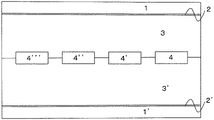
- FIG. 1 is a schematic cross-sectional view showing one embodiment of the flexible flat cable of the present invention.
- resin is used as a term encompassing resin mixtures containing two or more resins and resin compositions containing components other than resins.
- film is used interchangeably or interchangeably with “sheet”.
- sheet As used herein, the terms “film” and “sheet” are used for those that can be industrially wound into rolls.
- plate is used for those that cannot be industrially wound into rolls.
- laminating a certain layer and another layer in order means directly laminating those layers, and interposing one or more layers such as an anchor coat between those layers. and lamination.
- the term "greater than or equal to” related to a numerical range is used to mean a certain numerical value or more than a certain numerical value. For example, 20% or more means 20% or more than 20%.
- the term “up to” relating to a numerical range is used to mean a certain numerical value or less than a certain numerical value. For example, 20% or less means 20% or less than 20%.
- the symbol “ ⁇ ” relating to numerical ranges is used to mean a certain numerical value, greater than a certain numerical value and less than another numerical value, or other numerical value.
- another certain numerical value is assumed to be a larger numerical value than the certain numerical value. For example, 10-90% means 10%, greater than 10% and less than 90%, or 90%.
- the upper limit and the lower limit of the numerical range can be arbitrarily combined, and embodiments in which they are arbitrarily combined can be read.
- the numerical range of a certain characteristic "usually 10% or more, preferably 20% or more. On the other hand, it is usually 40% or less, preferably 30% or less.” ⁇ 30%.”, it should be read that the numerical range for that certain property is 10-40%, 20-30%, 10-30%, or 20-40% in one embodiment. do.
- Paint The paint of the present invention contains (A) acid-modified polypropylene.
- the paint of the present invention contains (A) acid-modified polypropylene and (B) an organic solvent.
- the component (B) organic solvent is one or more selected from the group consisting of (B1) an aromatic hydrocarbon-based solvent and (B2) an ester-based solvent, a ketone-based solvent, and an alcohol-based solvent. consists of
- the paint of the present invention comprises (A) an acid-modified polypropylene, (B1) an aromatic hydrocarbon solvent, and (B2) an ester solvent, a ketone solvent and an alcohol solvent.
- the paint of the present invention contains (A) acid-modified polypropylene in an amount of 70% by mass or more as a solid content.
- the paint of the present invention is selected from the group consisting of (A) acid-modified polypropylene, (B1) aromatic hydrocarbon solvent, and (B2) ester solvent, ketone solvent and alcohol solvent.
- the paint of the present invention further contains (C) a curing agent (preferably a compound having two or more functional groups in one molecule capable of forming a chemical bond with a carboxyl group).
- a curing agent preferably a compound having two or more functional groups in one molecule capable of forming a chemical bond with a carboxyl group.
- the paint of the present invention is selected from the group consisting of (A) acid-modified polypropylene, (B1) aromatic hydrocarbon solvent, and (B2) ester solvent, ketone solvent and alcohol solvent. and (C) a curing agent (preferably a compound having two or more functional groups in one molecule capable of forming a chemical bond with a carboxyl group) .
- the paint of the present invention comprises (A) an acid-modified polypropylene, (B1) an aromatic hydrocarbon-based solvent, and (B2) an ester-based solvent, a ketone-based solvent and an alcohol-based solvent. (B) an organic solvent consisting of one or more selected from the group, and (C) a curing agent (preferably a compound having two or more functional groups capable of forming a chemical bond with a carboxyl group in one molecule. ), and contains 70% by mass or more of (A) acid-modified polypropylene as a solid content.
- a curing agent preferably a compound having two or more functional groups capable of forming a chemical bond with a carboxyl group in one molecule.
- the paint of the present invention contains the component (A) acid-modified polypropylene.
- the component (A) acid-modified polypropylene is a polypropylene-based resin in which an unsaturated carboxylic acid or an unsaturated carboxylic acid derivative is copolymerized, usually graft-copolymerized (hereinafter sometimes referred to as "acid-modified"). be. Since the component (A) acid-modified polypropylene is copolymerized with an unsaturated carboxylic acid or an unsaturated carboxylic acid derivative, it is suitable for any of polyethylene naphthalate resin film, polyimide resin film, and polyphenylene sulfide resin film. It works to develop excellent adhesive strength. Further, since the component (A) acid-modified polypropylene is a polypropylene-based resin, it functions to exhibit excellent adhesive strength to the adhesive resin composition layer of the polyolefin-based resin composition.
- the melting point of the component (A) acid-modified polypropylene is appropriately selected from the viewpoint of the solubility when preparing the paint and the adhesive strength of the paint film in a high-temperature, high-humidity environment.
- the melting point of the component (A), acid-modified polypropylene is usually 90° C. or lower, preferably 85° C. or lower, more preferably 82° C. or lower, from the viewpoint of solubility during coating preparation.
- the melting point may be preferably 60° C. or higher, more preferably 68° C. or higher, and even more preferably 70° C. or higher, from the viewpoint of adhesive strength of the coating film in a high-temperature and high-humidity environment.
- the melting point is determined in accordance with JIS K7121-1987 using a differential scanning calorimeter (DSC measuring device), held at 30°C for 5 minutes, and then measured at 20°C/min. and held at 240°C for 5 minutes, then lowered to -50°C at -10°C/min, held at -50°C for 5 minutes, and then raised to 240°C at 10°C/min. It is calculated from the second melting curve (melting curve measured in the last heating process) measured by the program that At this time, the melting point is the peak top temperature of the melting peak appearing on the second melting curve. When two or more melting peaks are observed, the peak top temperature of the melting peak with the maximum peak top height is taken as the melting point.
- DSC measuring device differential scanning calorimeter
- the acid-modified amount of the component (A) acid-modified polypropylene (the content of structural units derived from copolymerized unsaturated carboxylic acids and unsaturated carboxylic acid derivatives with respect to 100% by mass of the total weight of the acid-modified polypropylene) is Considering the type of unsaturated carboxylic acid or unsaturated carboxylic acid derivative that is copolymerized, and the type of other components contained in the paint, it can be appropriately determined from the viewpoint of the adhesive strength of the paint film and the storage stability of the paint. .
- the amount of acid-modified component (A) acid-modified polypropylene is generally 0.1% by mass or more and 5.0% by mass or less, preferably 0.1% by mass or more and 3.5% by mass or less, and 0.1% by mass or more and 5.0% by mass or less. 1% by mass or more and 3.0% by mass or less, 0.5% by mass or more and 5.0% by mass or less, 0.5% by mass or more and 3.5% by mass or less, 0.5% by mass or more and 3.0% by mass or less, It may be 1.0% by mass or more and 5.0% by mass or less, 1.0% by mass or more and 3.5% by mass or less, or 1.0% by mass or more and 3.0% by mass or less.
- the amount of acid modification of the component (A) acid-modified polypropylene is such that the copolymerized unsaturated carboxylic acid derivative is maleic anhydride, and the component (C) curing agent has two or more epoxy groups in one molecule. When it contains a compound having a % by mass or more.
- the amount of acid-modified component (A) acid-modified polypropylene in this case is usually 5.0% by mass or less, preferably 3.5% by mass or less, more preferably 2.5% by mass or less, from the viewpoint of the storage stability of the paint. It may be 8% by mass or less, more preferably 2.5% by mass or less.
- the acid-modified amount of the mixture should be within the above range.
- one or a mixture of component (A) acid-modified polypropylene is used in a small amount (usually less than 50% by mass, preferably 20% by mass or less, more preferably 10% by mass or less), the acid-modified polypropylene It may be mixed with a system resin (acid-modified amount: 0% by mass). Also in this case, the amount of acid modification as a mixture should be within the above range.
- the amount of acid modification of the component (A) acid-modified polypropylene can be determined using 13 C-NMR spectrum.
- a 13 C-NMR spectrum can be measured, for example, using a nuclear magnetic resonance apparatus under the following conditions.
- Sample concentration 60 mg/0.6 mL of NMR solvent
- NMR solvent mixed solvent of 1,2,4-trichlorobenzene/benzene-d6 (90% by volume/10% by volume)
- the method for producing the component (A) acid-modified polypropylene is not particularly limited, and can be produced by a known method.
- a method for producing the component (A) acid-modified polypropylene for example, (p) a polypropylene resin, (q) one or more selected from the group consisting of unsaturated carboxylic acids and unsaturated carboxylic acid derivatives, and (r) A method of producing by melt-kneading a resin composition containing an organic peroxide and grafting the component (q) onto the component (p).
- the melt-kneading is preferable from the viewpoint that the component (q) and the component (r) are completely reacted and do not remain unreacted in the component (A) acid-modified polypropylene to be produced.
- the 1-minute half-life temperature is the temperature at which the half-life is 1 minute. This means that the time required for the concentration to become half of the initial concentration is 1 minute.
- component (p) polypropylene-based resin examples include propylene homopolymer; -pentene, etc.) (including block copolymers and random copolymers).
- the melting point of the component (p) polypropylene resin is preferably 60 to 90° C., more preferably 68 to 90° C. or 68 to 85° C., from the viewpoint of setting the melting point of the component (A) acid-modified polypropylene to the preferred range described above. °C, even more preferably 70-85°C or 70-82°C.
- Such polypropylene resins have low stereoregularity of the propylene chain (the mm fraction is usually about 50 to 80 mol%), or have a relatively large amount of ⁇ -olefin as a comonomer (depending on the type of ⁇ -olefin , Usually about 5 to 35 mol%) is random copolymerized, contains a relatively large amount of abnormal insertion of propylene (2-1 insertion or 1-3 insertion) (usually about 5 to 35 mol%), or these may have a structure of a combination of The definition of the melting point and the method of measurement are given above.
- component (p) polypropylene-based resin one or a mixture of two or more of these can be used.
- Examples of the unsaturated carboxylic acid of component (q) include maleic acid, itaconic acid, fumaric acid, acrylic acid, and methacrylic acid.
- Examples of unsaturated carboxylic acid derivatives of component (q) include esters of unsaturated polycarboxylic acids such as maleic acid monoesters, itaconic acid monoesters, and fumaric acid monoesters, which have one or more carboxyl groups.
- unsaturated carboxylic acids such as maleic anhydride, itaconic anhydride and fumaric anhydride
- unsaturated carboxylic diesters such as maleic acid diesters, itaconic acid diesters and fumaric acid diesters
- acrylic acid alkyl acrylates such as methyl
- alkyl methacrylates such as methyl methacrylate.
- unsaturated carboxylic acids, unsaturated polyvalent carboxylic acids with one or more carboxyl groups and anhydrides of unsaturated carboxylic acids are preferred.
- Unsaturated carboxylic acids and acid anhydrides of unsaturated carboxylic acids are more preferred, and maleic anhydride is even more preferred.
- component (q) one or more selected from the group consisting of unsaturated carboxylic acids and unsaturated carboxylic acid derivatives, one or a mixture of two or more thereof can be used.
- the amount of one or more selected from the group consisting of unsaturated carboxylic acids and unsaturated carboxylic acid derivatives of the component (q) is such that the component (q) is completely reacted during melt kneading and produced. From the viewpoint of not remaining unreacted in the component (A) acid-modified polypropylene, and from the viewpoint of setting the acid modification amount of the component (A) acid-modified polypropylene to the preferred range described above, it is possible to appropriately determine can.
- the amount of one or more selected from the group consisting of the unsaturated carboxylic acid and the unsaturated carboxylic acid derivative of the component (q) is usually 0.00 per 100 parts by mass of the component (p) polypropylene resin. It may be 1 to 5 parts by mass, preferably 0.5 to 3.5 parts by mass, more preferably 1 to 2.8 parts by mass, still more preferably 1.5 to 2.5 parts by mass.
- component (r) organic peroxide examples include dicumyl peroxide, di-tert-butyl peroxide, 2,5-dimethyl-2,5-di-(tert-butylperoxy)hexane, 2, 5-dimethyl-2,5-di(tert-butylperoxy)hexyne-3, 1,3-bis(tert-butylperoxyisopropyl)benzene, 1,1-bis(tert-butylperoxy)-3, 3,5-trimethylcyclohexane, n-butyl-4,4-bis(tert-butylperoxy)valerate, benzoyl peroxide, p-chlorobenzoyl peroxide, 2,4-dichlorobenzoyl peroxide, tert-butylperoxy Benzoate, tert-butyl peroxyisopropyl carbonate, diacetyl peroxide, lauroyl peroxide, and tert-butyl
- component (r) organic peroxide from the viewpoint of adhesive strength, 2,5-dimethyl-2,5-di-(tert-butylperoxy)hexane, 2,5-dimethyl-2,5-di -(tert-butylperoxy)hexyne-3 is preferred.
- component (r) organic peroxide one or a mixture of two or more thereof can be used.
- the amount of the component (r) organic peroxide is such that the component (q) and the component (r) react completely and do not remain unreacted in the component (A) acid-modified polypropylene produced. It can be determined as appropriate from the viewpoint of ensuring that the above-mentioned component (p) polypropylene-based resin is prevented from decreasing in molecular weight.
- the amount of the component (r) organic peroxide is usually 0.05 to 1.5 parts by mass, preferably 0.2 to 1.3 parts by mass, per 100 parts by mass of the component (p) polypropylene resin. parts, more preferably 0.5 to 1.0 parts by mass.
- the coating material of the present invention preferably contains 70% by mass or more, more preferably 80% by mass or more, and still more preferably 90% by mass or more of the component (A) acid-modified polypropylene as a solid content.
- the coating material of the present invention preferably contains 70% by mass or more, more preferably 80% by mass or more, and still more preferably 90% by mass or more of the component (A) acid-modified polypropylene as a solid content.
- a coating film can be formed.
- the paint of the present invention contains the component (B) organic solvent in addition to the component (A) acid-modified polypropylene.
- the component (B) organic solvent is not particularly limited as long as it contributes to the dissolution of the component (A) acid-modified polypropylene.
- Examples of the component (B) organic solvent include aromatic hydrocarbon solvents, aliphatic hydrocarbon solvents, alicyclic hydrocarbon solvents, alcohol solvents, ketone solvents, ester solvents, and these solvents. and halogen-based solvents in which at least one of the hydrogen atoms in is substituted with a halogen atom such as a chlorine atom.
- component (B) organic solvent one or a mixture of two or more thereof can be used.
- the component (B) organic solvent is selected from the group consisting of (B1) an aromatic hydrocarbon solvent, and (B2) an ester solvent, a ketone solvent, and an alcohol solvent. (hereinafter sometimes abbreviated as "ester-based solvent, etc.”).
- the content of the organic solvent other than (B1) and (B2) in the component (B) organic solvent is preferably 10% by mass or less, more preferably 4% by mass. % by mass or less, more preferably 1% by mass or less, and most preferably 0% by mass (that is, the component (B) organic solvent does not contain any organic solvent other than the above (B1) and (B2)).
- the above component (B1) aromatic hydrocarbon-based solvent can dissolve the above component (A) acid-modified polypropylene, but has the disadvantage of low storage stability (easy gelation).
- the component (B2) ester solvent or the like can hardly dissolve the component (A) acid-modified polypropylene. That is, the component (B2) ester solvent and the like are poor solvents for the component (A) acid-modified polypropylene.
- it is common technical knowledge to use a good solvent. is surprising.
- the acid-modified portion of the component (A) acid-modified polypropylene has low compatibility with the component (B1) aromatic hydrocarbon solvent, and is therefore acid-modified.
- the moieties can come together to increase interaction and promote gelation.
- ester group, ketone group, and hydroxyl group of the component (B2) gather around the acid-modified portion of the component (A), and the acid It is considered that the gelation can be suppressed by widening the distance between the denatured portions.
- the component (B1) aromatic hydrocarbon solvent is a hydrocarbon solvent having an aromatic ring.
- the component (B1) aromatic hydrocarbon solvent include, but are not limited to, toluene, xylene, ortho-xylene, and benzene.
- the component (B1) is a hydrocarbon solvent having an aromatic ring.
- It preferably has neither an ester group, a ketone group nor a hydroxyl group (including both an alcoholic hydroxyl group and a phenolic hydroxyl group), more preferably toluene, xylene and ortho-xylene, and still more preferably toluene.
- component (B1) aromatic hydrocarbon-based solvent one or a mixture of two or more thereof can be used.
- the ester-based solvent of component (B2) is an aliphatic (having no aromatic ring) hydrocarbon compound having one or more ester groups in one molecule, and , the same) and is a liquid compound.
- the ester solvent include methyl acetate, ethyl acetate, n-propyl acetate, 1-methylethyl acetate, n-butyl acetate, 2-methylpropyl acetate, 1-methylpropyl acetate, and tert-butyl acetate. and lactate esters such as methyl lactate (methyl 2-hydroxypropionate), ethyl lactate (ethyl 2-hydroxypropionate), and butyl lactate (n-butyl 2-hydroxypropionate). .
- the ketone-based solvent of component (B2) is an aliphatic (having no aromatic ring) hydrocarbon compound having one or more ketone groups in one molecule, and is a liquid compound under standard conditions.
- the ketone solvent include acetone, methyl ethyl ketone, methyl propyl ketone, methyl isobutyl ketone, diisobutyl ketone, cyclohexanone, and diacetone alcohol.
- the alcohol-based solvent of component (B2) is an aliphatic (having no aromatic ring) hydrocarbon compound having one or more alcoholic hydroxyl groups in one molecule and is liquid under normal conditions.
- the alcohol solvent include methanol, ethanol, 1-propanol, 2-propanol (isopropyl alcohol), 1-butanol, 2-methyl-1-propanol (isobutyl alcohol), 2-butanol, 2-methyl-2 -propanol (tert-butyl alcohol), 1-methoxy-2-propanol, 1-ethoxy-2-propanol, 1,3-butanediol, 1,4-butanediol, 2-ethylhexanol, ethylene glycol, propylene glycol, Examples include methyl cellosolve, butyl cellosolve, and propylene glycol monomethyl ether.
- ester solvents having an alcoholic hydroxyl group such as methyl lactate, ethyl lactate, and butyl lactate
- ketone solvents having an alcoholic hydroxyl group such as diacetone alcohol
- the water solubility of the component (B2) ester-based solvent may be preferably 5 g or more, more preferably 8 g or more.
- the component (B2) ester solvent and the like may be water-soluble from the viewpoint of the storage stability of the paint.
- the water solubility is the mass (unit: g) that dissolves in 100 mL of pure water at a temperature of 20° C. (the mixed liquid can maintain a uniform appearance).
- water-soluble means that it can be mixed with pure water at a temperature of 20° C. in an arbitrary ratio (the mixture maintains a uniform appearance).
- component (B2) ester-based solvents examples include methyl acetate (water solubility: 24.4 g), ethyl acetate (water solubility: 8.3 g), acetone (water solubility), methyl ethyl ketone (water solubility: 27.5 g).
- component (B2) ester-based solvent etc., one or a mixture of two or more thereof can be used.
- the component (B) organic solvent consists of the component (B1) aromatic hydrocarbon-based solvent and the component (B2) ester-based solvent, etc.
- the blending ratio of the component (B1) aromatic hydrocarbon solvent can be appropriately determined from the viewpoint of dissolving the component (A) acid-modified polypropylene and the storage stability of the paint.
- the blending ratio of the component (B1) aromatic hydrocarbon solvent in the component (B) organic solvent is, from the viewpoint of dissolving the component (A) acid-modified polypropylene, the blending ratio of the component (B1) and the above component.
- the sum of the blending ratio of (B2) is 100% by mass, it may be usually 80% by mass or more, preferably 86% by mass or more, more preferably 92% by mass or more. That is, the blending ratio of the component (B2) ester solvent or the like in the component (B) organic solvent is usually 20% by mass or less, preferably 14% by mass, from the viewpoint of dissolving the component (A) acid-modified polypropylene. It may be 8% by mass or less, more preferably 8% by mass or less.
- the blending ratio of the component (B1) aromatic hydrocarbon solvent in the component (B) organic solvent is usually 99% by mass or less, preferably 98% by mass or less, from the viewpoint of the storage stability of the paint. you can That is, the blending ratio of the component (B2) ester solvent, etc. in the component (B) organic solvent is usually 1% by mass or more, preferably 2% by mass or more, from the viewpoint of the storage stability of the paint. .
- the blending amount of the component (B) organic solvent is selected from the viewpoint of dissolving the component (A) acid-modified polypropylene, the viewpoint of the storage stability of the paint, the viewpoint of the coating property when forming a thin coating film, and It can be appropriately determined from the viewpoint of workability in the drying process when forming a coating film.
- the blending amount of the component (B) organic solvent is determined from the viewpoint of dissolving the component (A) acid-modified polypropylene, the viewpoint of the storage stability of the paint, and the viewpoint of the coating properties when forming a thin coating film. It may be usually 450 parts by mass or more, preferably 500 parts by mass or more, and more preferably 550 parts by mass or more relative to 100 parts by mass of component (A).
- the blending amount may be preferably 2000 parts by mass or less, more preferably 1200 parts by mass or less, and even more preferably 800 parts by mass or less.
- the paint of the present invention contains the component (C) curing agent.
- the component (C) curing agent is a compound having two or more functional groups in one molecule capable of forming a chemical bond with a carboxyl group.
- the component (C) curing agent forms a chemical bond with the carboxyl group in the component (A) to provide an appropriate hardness to the coating film. and works to suppress the deterioration of the adhesive strength of the coating film in a high temperature and high humidity environment. That is, this embodiment is particularly effective when the component (A) acid-modified polypropylene has a carboxyl group or is modified with an acid anhydride of an unsaturated carboxylic acid such as maleic anhydride.
- Examples of functional groups capable of forming chemical bonds with the carboxyl groups include epoxy groups, isocyanate groups, and amino groups.
- the functional group capable of forming a chemical bond with the carboxyl group is preferably an epoxy group and an isocyanate group, more preferably an epoxy group, from the viewpoint of the storage stability of the paint and the adhesive strength of the coating film.
- component (C) curing agent examples include 1,3-bis(N,N'-diglycidylaminomethyl)cyclohexane, N,N,N',N'-tetraglycidyl-m-xylylenediamine, di glycidylaniline, diglycidylamine, bisphenol A-epichlorohydrin type epoxy resin, ethylene glycol diglycidyl ether, polyethylene glycol diglycidyl ether, glycerol diglycidyl ether, glycerin triglycidyl ether, 1,6-hexanediol diglycidyl ether, and tri Compounds having two or more epoxy groups in one molecule such as methylolpropane triglycidyl ether can be mentioned.
- component (C) curing agent for example, compounds having two isocyanate groups in one molecule such as hexamethylene diisocyanate, isophorone diisocyanate, tolylene diisocyanate, and methylenebis-4-cyclohexyl isocyanate; trimethylolpropane adduct, hexamethylene diisocyanate trimethylolpropane adduct, isophorone diisocyanate trimethylolpropane adduct, tolylene diisocyanate isocyanurate, hexamethylene diisocyanate isocyanurate, isophorone diisocyanate isocyanurate, and hexamethylene diisocyanate
- Polyisocyanates having two or more isocyanate groups per molecule such as biuret form of methylene diisocyanate
- urethane cross-linking agents such as blocked isocyanates of the above polyisocyanates having two or more isocyanate groups per
- the component (C) curing agent preferably does not have a hydrolyzable group from the viewpoint of the adhesive strength of the coating film in a high-temperature and high-humidity environment.
- the hydrolyzable group include alkoxy groups such as methoxy group, ethoxy group, propoxy group and isopropoxy group; acyloxy groups such as acetoxy group; and halogen groups such as chloro group.
- the number of functional groups that can form a chemical bond with the carboxyl group in one molecule of the component (C) curing agent is determined by considering the type of functional group, from the viewpoint of storage stability of the paint, high temperature and high humidity environment. It can be determined as appropriate from the viewpoint of suppressing a decrease in the adhesive strength of the coating film underneath and from the viewpoint of keeping the hardness of the coating film from increasing within an appropriate range.
- the number of functional groups capable of forming a chemical bond with the carboxyl group in one molecule of the component (C) curing agent is usually 2 to 20, preferably 2 to 20 when the functional group is an epoxy group. It may be 3-12.
- the number of functional groups capable of forming a chemical bond with the carboxyl group in one molecule of the component (C) curing agent is usually 2 to 20, preferably 2 to 20, when the functional group is an isocyanate group. It may be 3-12.
- component (C) curing agent one or a mixture of two or more of these can be used.
- the amount of the above-mentioned component (C) curing agent is determined in consideration of its type, from the viewpoint of ensuring that the effect of use as a curing agent is obtained, from the viewpoint of limiting the increase in hardness of the coating film to an appropriate range, and from the viewpoint of maintaining the above-mentioned component (C). can be determined as appropriate from the viewpoint of preventing gelation from occurring after mixing until the paint is applied.
- the amount of the component (C) curing agent compounded is usually 0.1 parts by mass or more, preferably 0.1 part by mass or more per 100 parts by mass of the component (A) acid-modified polypropylene, from the viewpoint of reliably obtaining the effect of use as a curing agent.
- this blending amount is from the viewpoint of keeping the hardness of the coating film within an appropriate range, and from the viewpoint of preventing gelation from occurring during the period from the mixing of the component (C) curing agent to the coating of the coating material. From a viewpoint, it may be usually 20 parts by mass or less, preferably 15 parts by mass or less, and more preferably 10 parts by mass or less.
- the paint of the present invention may optionally contain optional components other than the component (A) the acid-modified polypropylene, the component (B) the organic solvent, and the component (C) the curing agent, as long as the object of the present invention is not compromised.
- optional components include thermoplastic resins other than component (A) acid-modified polypropylene; pigments, inorganic fillers, organic fillers, and resin fillers; and lubricants, antioxidants, weather stabilizers, and heat stabilizers. , release agents, antistatic agents, and additives such as surfactants.
- the paint of the present invention does not contain any optional components other than the component (A) acid-modified polypropylene, the component (B) the organic solvent, and the component (C) the curing agent.
- the paint of the present invention contains the component (A) a thermoplastic resin other than acid-modified polypropylene; a pigment, an inorganic filler, an organic filler, and a resin filler; It does not contain any one or more additives selected from agents, heat stabilizers, release agents, antistatic agents, and surfactants.
- thermoplastic resins other than component (A) acid-modified polypropylene include alkyl methacrylates such as methyl methacrylate, ethyl methacrylate, and butyl methacrylate; methyl acrylate, ethyl acrylate, and butyl acrylate; Alkyl acrylates; and copolymers of ethylene with comonomers such as vinyl acetate.
- the amount of the optional component is usually 0 parts by mass or more and 20 parts by mass or less, preferably 0 parts by mass or more and 10 parts by mass or less, or 0.01 to 10 parts by mass, based on 100 parts by mass of the component (A) acid-modified polypropylene. It may be about parts by mass.
- the paint of the present invention can be obtained by mixing and stirring these components.
- the paint of the present invention is prepared by adding the above-mentioned component (C) curing agent immediately before coating after mixing and stirring the components other than the above-mentioned component (C). It is preferable to obtain by mixing and stirring. It is possible to prevent troubles such as gelation occurring before the coating is applied.
- the coating film of the present invention is formed using the paint of the present invention. Any of the embodiments of the paint described in item 1 above can be used to form the coating of the present invention.
- the coating film of the present invention comprises the component (A) acid-modified polypropylene and the component (B) an organic solvent, wherein the component (B) organic solvent is the component (B1) aromatic It is formed using a coating material comprising a hydrocarbon-based solvent and one or more selected from the group consisting of component (B2) ester-based solvent, ketone-based solvent and alcohol-based solvent.
- the coating film of the present invention is a paint containing 70% by mass or more of the component (A) acid-modified polypropylene as a solid content (that is, 70% by mass or more of the total solid content contained in the paint is It is formed using a paint that is acid-modified polypropylene.
- the coating film of the present invention is formed using a coating material containing 80% by mass or more of the component (A) acid-modified polypropylene as a solid content.
- the coating film of the present invention is formed on the surface of any substrate using the paint of the present invention.
- the coating of the present invention in one exemplary embodiment, is formed directly on the surface of any substrate using the coating of the present invention.
- the paint of the present invention is described above in “1. Paint”.
- the substrate will be described later in "3. Laminate”.
- the method of forming the coating film of the present invention on the surface of any substrate using the paint of the present invention is not particularly limited, and known methods can be used. Examples of the method include rod coating, roll coating, gravure coating, reverse coating, kiss reverse coating, roll brushing, spray coating, air knife coating, solution casting, and die coating.
- a base film is used as the substrate, from the viewpoint of applying the paint with good productivity by a roll-to-roll method, for example, rod coating, roll coating, gravure coating, reverse coating, kiss reverse coating, and die coating and other methods are preferred.
- the thickness of the coating film of the present invention is appropriately determined in consideration of the application, from the viewpoint of adhesive strength, and from the viewpoint of productivity when forming the coating film.
- the thickness of the coating film of the present invention is usually 0.05 to 30 ⁇ m, preferably 0.05 to 10 ⁇ m, 0.05 to 5 ⁇ m, 0.1 to 30 ⁇ m, 0.1 to 10 ⁇ m, or 0.1 to 5 ⁇ m. you can
- the thickness of the coating film of the present invention is particularly determined by the adhesive resin composition layer of the polyolefin resin composition and the polyethylene naphthalate resin film, polyimide resin film, polyphenylene sulfide resin film, or the like.
- the thickness is usually less than 5 ⁇ m, preferably 4 ⁇ m or less, more preferably 2 ⁇ m or less, and still more preferably 1.5 ⁇ m or less, from the viewpoint of adhesive strength.
- the thickness is usually 0.05 ⁇ m or more, preferably 0.1 ⁇ m or more, and more preferably 0.3 ⁇ m or more.
- the coating film when used as an anchor coat, if the thickness of the coating film is thin (within the range described above), the adhesive resin composition layer of the polyolefin resin composition and the polyethylene nano It is considered that the phthalate resin film and the like are integrated and the interlaminar adhesive strength increases. In addition, from the viewpoint of integrating both, it is preferable that the thickness of the coating film is highly uniform. .
- the laminate of the present invention comprises any substrate and the coating of the present invention formed on the surface of the substrate. Any of the embodiments of the coating described in item 2 above can be used to form the laminate of the present invention.
- the laminate of the present invention has the coating film of the present invention on at least one side, usually one side, of a base film as an arbitrary base.
- the laminate of the present invention in a typical embodiment, has the coating film of the present invention on the surface of any substrate, and the coating film is formed directly on the surface of the substrate.
- the coating film of the present invention and the method of forming the coating film of the present invention on the surface of the substrate are described above in "2. Coating Film".
- the substrate examples include substrate films such as resin films, resin plates, glass films, glass plates, metal foils, metal plates, resin-made, glass-made, or metal-made moldings having arbitrary shapes. be able to.
- the base film examples include polyvinyl chloride-based resins; aromatic polyesters such as polyethylene terephthalate resin films and polyethylene naphthalate resin films; polyester-based resins such as aliphatic polyesters; polyethylene, polypropylene, and polymethylpentene.
- Polyolefin resin acrylic resin; polycarbonate resin; poly(meth)acrylimide resin; polystyrene, acrylonitrile-butadiene-styrene copolymer resin (ABS resin), styrene-ethylene-butadiene-styrene copolymer, styrene-ethylene Styrene-based resins such as propylene/styrene copolymers and styrene/ethylene/ethylene/propylene/styrene copolymers; cellulose-based resins such as cellophane, triacetylcellulose, diacetylcellulose, and acetylcellulose butyrate; polyvinylidene chloride -based resin; fluorine-containing resin such as polyvinylidene fluoride; other, such as polyvinyl alcohol, ethylene vinyl alcohol, polyether ether ketone, nylon, polyamide, polyimide, polyphenylene sulfide, polyurethane,
- the substrate film may be a polyethylene terephthalate resin film, a polyethylene naphthalate resin film, or a polyimide resin film (typically aromatic tetrabasic acid or a derivative thereof and an aromatic polycondensates with polyamines) and polyphenylene sulfide resin films are preferred.
- the base film is preferably a polyethylene naphthalate resin film, a polyimide resin film, and a polyphenylene sulfide resin film.
- a polyphenylene sulfide resin film is more preferred.
- the thickness of the base film can be appropriately determined in consideration of the intended use of the laminate of the present invention and the required properties.
- the thickness of the base film is determined from the viewpoint of ensuring the flexibility of the flexible flat cable, the strength of the flexible flat cable, and the thickness of the flexible flat cable. It can be determined as appropriate from the viewpoint of workability when producing flat cables.
- the thickness of the base film is determined from the viewpoint of the strength of the flexible flat cable and from the viewpoint of workability when producing the flexible flat cable. Therefore, it may be usually 10 ⁇ m or more, preferably 15 ⁇ m or more, and more preferably 20 ⁇ m or more. On the other hand, the thickness of the base film in this case may be usually 200 ⁇ m or less, preferably 100 ⁇ m or less, more preferably 50 ⁇ m or less, from the viewpoint of ensuring the flexibility of the flexible flat cable.
- the thickness of the base film can be appropriately determined from the viewpoint of imparting rigidity and strength suitable for connector connection, and from the viewpoint of workability when cutting the reinforcing tape into a size and shape suitable for connector connection.
- the thickness of the base film is usually 100 ⁇ m or more, preferably 125 ⁇ m or more, from the viewpoint of imparting rigidity and strength suitable for connector connection. Preferably, it may be 150 ⁇ m or more.
- the thickness of the base film in this case may be usually 500 ⁇ m or less, preferably 250 ⁇ m or less, from the viewpoint of workability when cutting the reinforcing tape into a size and shape suitable for connector connection.
- the laminate of the present invention When the laminate of the present invention is used as an insulating adhesive laminate for a flexible flat cable, the laminate of the present invention comprises the base film and the coating of the present invention formed on one surface of the base film. a layer of adhesive resin, preferably a layer of hot-melt adhesive, more preferably a layer of flame-retardant hot-melt adhesive, formed on the surface of the coating; good.
- the thickness of the hot-melt adhesive layer or the flame-retardant hot-melt adhesive layer is not particularly limited, but may be generally 1 ⁇ m to 300 ⁇ m, preferably 2 ⁇ m to 200 ⁇ m.
- hot melt adhesive known hot melt adhesives such as polyester hot melt adhesives (thermoplastic polyester resin) and polyolefin hot melt adhesives (thermoplastic polyolefin resin) can be used.
- flame-retardant hot-melt adhesive examples include known flame-retardant hot-melt adhesives such as flame-retardant polyester-based hot-melt adhesives (compositions containing a thermoplastic polyester-based resin and a flame retardant) and flame-retardant adhesives.
- a polyolefin hot melt adhesive (a composition containing a thermoplastic polyolefin resin and a flame retardant) or the like can be used.
- the polyolefin hot-melt adhesive or the flame-retardant polyolefin hot-melt adhesive is preferable.
- these adhesives are not particularly limited.
- the specification, claims, abstract and drawings of WO2016/181880 and WO2018/042995 are hereby incorporated by reference in their entireties.
- the flexible flat cable of the present invention comprises the coating of the present invention. Any of the embodiments of the coating described in item 2 above may be used to form the flexible flat cable of the present invention.
- the flexible flat cable of the invention comprises the laminate of the invention. Any embodiment of the laminate described in item 3 above may be used to form the flexible flat cable of the present invention.
- the flexible flat cable of the present invention comprises the base film, the coating film of the present invention formed on one surface of the base film, and the surface of the coating film. Produced using an insulating adhesive laminate comprising a layer of said hot melt adhesive, preferably said flame retardant hot melt adhesive, formed thereon.
- the method for producing the flexible flat cable of the present invention is not particularly limited, and can be produced by a known method. Examples of the above method include the following methods.
- the insulating adhesive laminate typically, the substrate film, the coating film of the present invention formed on one side of the substrate film, and further formed on the coating film surface
- Two rolls of the hot melt adhesive, preferably a laminate containing a layer of the flame retardant hot melt adhesive are used, and a known flexible flat cable manufacturing apparatus is used to bond the insulating adhesive laminate to the hot melt adhesive.
- the layers of the hot-melt adhesive are sent out so that they face each other, and the conductive rectangular wires arranged parallel to each other are sandwiched between them, and the hot-melt adhesive layers are fused to each other by hot-pressing with the hot-press rolls of the above-mentioned device. can be done.
- a hole is punched in the insulating adhesive laminate before the rectangular wire of the conductor is sandwiched therebetween. (ie, the laminate of the present invention may be employed, or alternatively, laminates other than the laminate of the present invention may be used as the reinforcing tape).
- both side ends are slit to a predetermined finished width, and the cable is cut at the holes and the reinforcing tapes to complete a flexible flat cable in which the conductor ends are reinforced by the reinforcing tapes.
- the rectangular wire of the conductor is not particularly limited, and any wire can be used.
- the flat wire of the conductor is an annealed copper wire, a hard copper wire, and a tin-plated wire or nickel-plated wire of these with a thickness of 12 to 50 ⁇ m and a width of 0.2 to 2 mm. It's okay.
- FIG. 1 is a cross-sectional conceptual diagram showing one embodiment of the flexible flat cable of the present invention.
- a coating 2 or 2' of the present invention as an anchor coat, and on that side a layer 3 or 3 of a flame-retardant hot-melt adhesive.
- the conductor flat wires 4, 4', 4'' and 4''' are sandwiched between two insulating adhesive laminates having '.
- A Acid-Modified Polypropylene
- A-1 Maleic anhydride-modified polypropylene “Toyotac PMA-KH” (trade name) manufactured by Toyobo Co., Ltd., melting point 77° C., amount of maleic acid modification 1.8% by mass.
- A-2) Maleic anhydride-modified polypropylene “Toyotac PMA-LE” (trade name) manufactured by Toyobo Co., Ltd., melting point 69° C., amount of maleic acid modification 3.0% by mass.
- a compound consisting of 3.0 parts by mass is fed all at once from the screw root inlet, melted and kneaded under the conditions of a die outlet resin temperature of 200 ° C. and a residence time of 3 minutes (calculated value), melting point 75 ° C., malein A maleic anhydride-modified polypropylene with an acid modification amount of 1.0% by mass was obtained.
- B organic solvent (B1-1) toluene.
- B2-1 Ethyl acetate (water solubility 8.3 g).
- B2-2 Methyl ethyl ketone (water solubility 27.5 g).
- B2-3) 2-propanol (water soluble).
- Curing agent (C-1) "Hardren LAE-004" (trade name) of methyl ethyl ketone diluted solution of a compound having two or more epoxy groups in one molecule manufactured by Toyobo Co., Ltd.; Solid content (content of the compound) 65% by mass.
- C-2) "Takenate D-170” (trade name), a compound having two or more isocyanate groups in one molecule, manufactured by Mitsui Chemicals, Inc.;
- P Base film
- P-1 Polyethylene naphthalate resin film “Teonex Q83C” (trade name) with a thickness of 25 ⁇ m and corona discharge treatment on one side, manufactured by Teijin Limited.
- P-2) Polyphenylene sulfide resin film “Torelina #25-3030” (trade name) manufactured by Toray Industries, Inc. and having a thickness of 25 ⁇ m and having one side subjected to corona discharge treatment.
- P-3) Polyimide resin film “Kapton 100H” (trade name) manufactured by DuPont-Toray Co., Ltd., having a thickness of 25 ⁇ m and having one side subjected to corona discharge treatment.
- P-4) A polyethylene terephthalate resin film with a thickness of 25 ⁇ m and corona discharge treatment on one side, “EMBRET S25” (trade name) manufactured by Unitika Ltd.;
- None of the above base films (P-1) to (P-4) has an anchor coat. That is, if a coating film is formed directly on either the corona discharge-treated surface or the non-treated surface, the substrate film and the coating film will come into direct contact with each other and be laminated. .
- paints (S-2) to (S-14) were prepared in the same manner as the paint (S-1) except that the formulation of the mixture was changed as shown in Table 1. S-14) was obtained. The following tests (i) solubility and (ii) storage stability 1 were performed. Table 1 shows the results. Incidentally, in Table 1 and the following description, paints ( S-1) to (S-14) may be collectively referred to as paint (S).
- the storage stability 1 evaluation rank of the paint is more preferably B or higher, and most preferably A.
- A The viscosity was 500 mPa ⁇ s or less even after standing still for 3 weeks.
- B The viscosity after standing for 48 hours was 500 mPa ⁇ s or less, but the viscosity after standing for 3 weeks was over 500 mPa ⁇ s.
- Paints (T-2) to (T-11) The type of the paint (S), the type of the component (C), and the component (C) are adjusted so that the formulation of the paint is as shown in Table 2. Paints (T-2) to (T-11) were obtained in the same manner as the above paint (T-1) except that at least one of the blending amounts of was changed. The following test (iii) storage stability 2 was performed. Table 2 shows the results. For the above components (C-1) and (C-2), the amounts in terms of solid content are shown in the table.
- A The viscosity was 500 mPa ⁇ s or less even after standing still for 24 hours.
- B The viscosity after standing for 3 hours was 500 mPa ⁇ s or less, but the viscosity after standing for 24 hours was more than 500 mPa ⁇ s.
- C The viscosity after standing still for 3 hours was also over 500 mPa ⁇ s.
- Example 1 On the corona discharge-treated surface of the base film (P-1), the coating material (T-1) was applied using a rod coating method so that the thickness after drying was 1 ⁇ m, and the temperature was 100°C. to form a coating film.
- the adhesive resin film obtained in the above step (4) is overlaid on the surface of the coating film, thermally laminated using a dielectric heating laminator, and the substrate film, the coating film, and the adhesive resin film are laminated. A laminate having (flame-retardant polyolefin-based hot-melt adhesive layer) in this order was obtained.
- the thermal lamination conditions were a pressure roll preheating temperature of 110° C., a backing roll preheating temperature of 110° C., a pressure of 0.4 MPa, and a speed of 1.0 m/min.
- the following tests (iv) and (v) were performed. Table 3 shows the results.
- Examples 2-11 A laminate was obtained in the same manner as in Example 1, except that each of the paints (T-2) to (T-11) was used instead of the paint (T-1). The following tests (iv) and (v) were performed. Table 3 shows the results.
- Examples 12-15 A laminate was obtained in the same manner as in Example 1, except that the thickness of the coating film was changed to the thickness shown in Table 3 (thickness after drying). The following tests (iv) and (v) were performed. Table 3 shows the results.
- Examples 16-18 A laminate was obtained in the same manner as in Example 1, except that each of the base films (P-2) to (P-4) was used instead of the base film (P-1). The following tests (iv) and (v) were performed. Table 3 shows the results.
- Examples 19, 20 The thickness of the coating film was changed to the thickness (thickness after drying) shown in Table 3, and the base film (P-2) or (P-3) was used instead of the base film (P-1). A laminate was obtained in the same manner as in Example 1 except for the above. The following tests (iv) and (v) were performed. Table 3 shows the results.
- example 21 A laminate was obtained in the same manner as in Example 1, except that the paint (S-1) (not containing the curing agent) was used instead of the paint (T-1) (containing the curing agent). The following tests (iv) and (v) were performed. Table 3 shows the results.
- Adhesion strength 1 Adhesion strength under standard conditions
- Two strips with a width of 50 mm and a length of 150 mm are cut out from the laminate so that the machine direction is the length direction, and the adhesive resin films (flame-retardant polyolefin hot-melt adhesive layers) face each other.
- the two strips were superimposed on each other so as to form a circle, and both were heat-sealed by pressing with a metal plate preheated to 190° C. and a silicone rubber sheet under conditions of a pressure of 0.3 MPa and a time of 8 seconds.
- the adhesive strength 1 (adhesive strength under standard conditions) may be preferably 10 N/inch or higher, more preferably 12 N/inch or higher, still more preferably 13 N/inch or higher, and even more preferably 15 N/inch or higher.
- Adhesive strength 2 (wet heat resistant adhesive strength) Adhesion strength was measured using a tensile tester equipped with a constant temperature and humidity bath. Specifically, after stabilizing the inside of the constant temperature and humidity chamber at a temperature of 105 ° C. and a relative humidity of 50%, a test piece obtained in the same manner as in the above test (iv) adhesive strength 1 was placed in the constant temperature and humidity chamber. After 10 minutes have passed since the temperature in the constant temperature and humidity chamber reached 105° C. again, the adhesive strength was measured under the conditions of T-shaped peeling (peeling angle of 180°) at a test speed of 100 mm/min. did. In addition, the separation interfaces were visually observed to investigate which interface caused the breakage (breakage mode). The meaning of each symbol in the table is the same as in test (iv) adhesive strength 1 above.
- the adhesive strength 2 (wet heat resistant adhesive strength) is preferably 1 N/inch or more, more preferably 2 N/inch or more, still more preferably 3 N/inch or more, and even more preferably 4 N/inch or more.
- a coating film suitable as an anchor coat can be formed by using the coating material of the present invention.
- the preferred paints of the present invention also had excellent storage stability.
- the coating film of the present invention exhibits excellent adhesion to any of the adhesive resin composition layer of the polyolefin resin composition, the polyethylene naphthalate resin film, the polyimide resin film, and the polyphenylene sulfide resin film. developed strength.
- the preferred coating film of the present invention is applied to any of the adhesive resin composition layer of the polyolefin resin composition, the polyethylene naphthalate resin film, the polyimide resin film, and the polyphenylene sulfide resin film under a high-temperature and high-humidity environment.
- Good adhesive strength was expressed in From the demonstration results in the above examples, the paint of the present invention is suitable as a paint for forming an anchor coat, particularly an adhesive resin composition layer of a polyolefin resin composition of a flexible flat cable cable and a polyethylene naphthalate resin film. It was considered that it can be suitably used as a paint for forming an anchor coat for increasing the interlayer adhesion strength.
Landscapes
- Chemical & Material Sciences (AREA)
- Organic Chemistry (AREA)
- Life Sciences & Earth Sciences (AREA)
- Engineering & Computer Science (AREA)
- Wood Science & Technology (AREA)
- Materials Engineering (AREA)
- Chemical Kinetics & Catalysis (AREA)
- General Chemical & Material Sciences (AREA)
- Paints Or Removers (AREA)
- Laminated Bodies (AREA)
- Insulated Conductors (AREA)
Priority Applications (5)
| Application Number | Priority Date | Filing Date | Title |
|---|---|---|---|
| KR1020237031147A KR102936780B1 (ko) | 2021-03-23 | 2022-03-15 | 도료, 도막, 적층체, 및 플렉시블 플랫 케이블 |
| JP2023509044A JP7482315B2 (ja) | 2021-03-23 | 2022-03-15 | 塗料、塗膜、積層体、及びフレキシブルフラットケーブル |
| EP22775261.5A EP4317332A4 (en) | 2021-03-23 | 2022-03-15 | COATING MATERIAL, COATING FILM, LAYER PRODUCT AND FLEXIBLE FLAT CABLE |
| US18/546,014 US20240228814A9 (en) | 2021-03-23 | 2022-03-15 | Coating material, coating film, layered product, and flexible flat cable |
| CN202280013548.2A CN116917425B (zh) | 2021-03-23 | 2022-03-15 | 涂料、涂膜、层积体以及柔性扁平电缆 |
Applications Claiming Priority (2)
| Application Number | Priority Date | Filing Date | Title |
|---|---|---|---|
| JP2021-048049 | 2021-03-23 | ||
| JP2021048049 | 2021-03-23 |
Publications (1)
| Publication Number | Publication Date |
|---|---|
| WO2022202471A1 true WO2022202471A1 (ja) | 2022-09-29 |
Family
ID=83397182
Family Applications (1)
| Application Number | Title | Priority Date | Filing Date |
|---|---|---|---|
| PCT/JP2022/011523 Ceased WO2022202471A1 (ja) | 2021-03-23 | 2022-03-15 | 塗料、塗膜、積層体、及びフレキシブルフラットケーブル |
Country Status (6)
| Country | Link |
|---|---|
| US (1) | US20240228814A9 (https=) |
| EP (1) | EP4317332A4 (https=) |
| JP (1) | JP7482315B2 (https=) |
| KR (1) | KR102936780B1 (https=) |
| CN (1) | CN116917425B (https=) |
| WO (1) | WO2022202471A1 (https=) |
Citations (9)
| Publication number | Priority date | Publication date | Assignee | Title |
|---|---|---|---|---|
| JP2009272083A (ja) * | 2008-05-01 | 2009-11-19 | Sumitomo Electric Ind Ltd | 絶縁フィルムおよびそれを備えたフラットケーブル |
| WO2014185332A1 (ja) | 2013-05-17 | 2014-11-20 | 東洋紡株式会社 | 含窒素複素環式化合物変性ポリオレフィンおよびこれを含有する接着剤組成物 |
| WO2016047289A1 (ja) | 2014-09-24 | 2016-03-31 | 東亞合成株式会社 | 接着剤組成物及びこれを用いた接着剤層付き積層体 |
| WO2016181880A1 (ja) | 2015-05-08 | 2016-11-17 | リケンテクノス株式会社 | 接着性樹脂組成物、及びこれを用いた積層体 |
| JP2017008189A (ja) * | 2015-06-22 | 2017-01-12 | 株式会社寺岡製作所 | 粘着テープ |
| JP2017197651A (ja) * | 2016-04-27 | 2017-11-02 | 出光興産株式会社 | 変性オレフィン系重合体及びその製造方法 |
| WO2018042995A1 (ja) | 2016-09-01 | 2018-03-08 | リケンテクノス株式会社 | 樹脂組成物、及びこれを用いた積層体 |
| WO2019171709A1 (ja) | 2018-03-06 | 2019-09-12 | 東洋紡株式会社 | ポリオレフィン系接着剤組成物 |
| JP2020015278A (ja) * | 2018-07-27 | 2020-01-30 | 大日本印刷株式会社 | 耐内容物性エージングレス積層体、およびそれを用いた包装材料 |
Family Cites Families (3)
| Publication number | Priority date | Publication date | Assignee | Title |
|---|---|---|---|---|
| JP6023827B2 (ja) * | 2015-01-29 | 2016-11-09 | 日新製鋼株式会社 | 塗装金属帯の製造方法 |
| JP6902827B2 (ja) * | 2016-02-08 | 2021-07-14 | 藤森工業株式会社 | 接着性樹脂組成物、被着体接着方法、及び接着性樹脂フィルム |
| JP7094671B2 (ja) * | 2017-08-23 | 2022-07-04 | 藤森工業株式会社 | 接着性樹脂組成物及び積層体 |
-
2022
- 2022-03-15 EP EP22775261.5A patent/EP4317332A4/en active Pending
- 2022-03-15 WO PCT/JP2022/011523 patent/WO2022202471A1/ja not_active Ceased
- 2022-03-15 US US18/546,014 patent/US20240228814A9/en active Pending
- 2022-03-15 JP JP2023509044A patent/JP7482315B2/ja active Active
- 2022-03-15 CN CN202280013548.2A patent/CN116917425B/zh active Active
- 2022-03-15 KR KR1020237031147A patent/KR102936780B1/ko active Active
Patent Citations (9)
| Publication number | Priority date | Publication date | Assignee | Title |
|---|---|---|---|---|
| JP2009272083A (ja) * | 2008-05-01 | 2009-11-19 | Sumitomo Electric Ind Ltd | 絶縁フィルムおよびそれを備えたフラットケーブル |
| WO2014185332A1 (ja) | 2013-05-17 | 2014-11-20 | 東洋紡株式会社 | 含窒素複素環式化合物変性ポリオレフィンおよびこれを含有する接着剤組成物 |
| WO2016047289A1 (ja) | 2014-09-24 | 2016-03-31 | 東亞合成株式会社 | 接着剤組成物及びこれを用いた接着剤層付き積層体 |
| WO2016181880A1 (ja) | 2015-05-08 | 2016-11-17 | リケンテクノス株式会社 | 接着性樹脂組成物、及びこれを用いた積層体 |
| JP2017008189A (ja) * | 2015-06-22 | 2017-01-12 | 株式会社寺岡製作所 | 粘着テープ |
| JP2017197651A (ja) * | 2016-04-27 | 2017-11-02 | 出光興産株式会社 | 変性オレフィン系重合体及びその製造方法 |
| WO2018042995A1 (ja) | 2016-09-01 | 2018-03-08 | リケンテクノス株式会社 | 樹脂組成物、及びこれを用いた積層体 |
| WO2019171709A1 (ja) | 2018-03-06 | 2019-09-12 | 東洋紡株式会社 | ポリオレフィン系接着剤組成物 |
| JP2020015278A (ja) * | 2018-07-27 | 2020-01-30 | 大日本印刷株式会社 | 耐内容物性エージングレス積層体、およびそれを用いた包装材料 |
Non-Patent Citations (1)
| Title |
|---|
| See also references of EP4317332A4 |
Also Published As
| Publication number | Publication date |
|---|---|
| US20240228814A9 (en) | 2024-07-11 |
| CN116917425B (zh) | 2025-03-18 |
| EP4317332A4 (en) | 2025-04-30 |
| JP7482315B2 (ja) | 2024-05-13 |
| KR20230145158A (ko) | 2023-10-17 |
| JPWO2022202471A1 (https=) | 2022-09-29 |
| EP4317332A1 (en) | 2024-02-07 |
| US20240132742A1 (en) | 2024-04-25 |
| KR102936780B1 (ko) | 2026-03-09 |
| TW202239885A (zh) | 2022-10-16 |
| CN116917425A (zh) | 2023-10-20 |
Similar Documents
| Publication | Publication Date | Title |
|---|---|---|
| CN100584915C (zh) | 粘合剂及使用该粘合剂的电气材料用包覆膜 | |
| KR102267540B1 (ko) | 수지 조성물 및 이것을 이용한 적층체 | |
| JP4608422B2 (ja) | 粘接着フィルム | |
| JP6953578B2 (ja) | 接着性樹脂組成物、及びこれを用いた積層体 | |
| EP2594610B1 (en) | Electrically insulating resin composition, and laminate sheet | |
| US20110244227A1 (en) | Pressure-sensitive adhesive tape | |
| TW201204560A (en) | Cover tape | |
| US20110287240A1 (en) | Pressure-sensitive adhesive tape | |
| KR101460479B1 (ko) | 연신 적층체, 박형 편광자의 제조 방법, 이를 이용하여 제조되는 박형 편광자 및 이를 포함하는 편광판 | |
| CN103906817A (zh) | 受控剥离的层合物粘合膜 | |
| US20110244221A1 (en) | Pressure-sensitive adhesive tape | |
| US20130309483A1 (en) | Foam laminated body for electrical or electronic equipment | |
| WO2022202471A1 (ja) | 塗料、塗膜、積層体、及びフレキシブルフラットケーブル | |
| JP6064378B2 (ja) | フラットケーブル用被覆材およびそれを用いたフラットケーブル | |
| JP2010229377A (ja) | 表面保護フィルム | |
| TWI918894B (zh) | 塗料、塗層、積層體以及柔性扁平電纜 | |
| CN108314882A (zh) | 一种用于光伏电池背板的薄膜及其制备方法和使用方法 | |
| JP4539030B2 (ja) | 接着性フィルム | |
| JP3077847B2 (ja) | 熱可塑性樹脂積層フィルム | |
| JP3984469B2 (ja) | 補強シート、及びそれを用いたフラットケーブル | |
| JP2000142788A (ja) | カバーテープとその製造方法 | |
| JPH09255935A (ja) | 絶縁テープ用難燃化熱可塑性接着剤 | |
| JPH0516303A (ja) | 熱可塑性樹脂積層フイルム | |
| KR20150061363A (ko) | 점착제 조성물 |
Legal Events
| Date | Code | Title | Description |
|---|---|---|---|
| 121 | Ep: the epo has been informed by wipo that ep was designated in this application |
Ref document number: 22775261 Country of ref document: EP Kind code of ref document: A1 |
|
| ENP | Entry into the national phase |
Ref document number: 2023509044 Country of ref document: JP Kind code of ref document: A |
|
| WWE | Wipo information: entry into national phase |
Ref document number: 202280013548.2 Country of ref document: CN |
|
| WWE | Wipo information: entry into national phase |
Ref document number: 18546014 Country of ref document: US |
|
| ENP | Entry into the national phase |
Ref document number: 20237031147 Country of ref document: KR Kind code of ref document: A |
|
| WWE | Wipo information: entry into national phase |
Ref document number: 1020237031147 Country of ref document: KR |
|
| WWE | Wipo information: entry into national phase |
Ref document number: 2022775261 Country of ref document: EP |
|
| NENP | Non-entry into the national phase |
Ref country code: DE |
|
| ENP | Entry into the national phase |
Ref document number: 2022775261 Country of ref document: EP Effective date: 20231023 |
|
| WWG | Wipo information: grant in national office |
Ref document number: 202280013548.2 Country of ref document: CN |