WO2022196485A1 - 半導体基板の製造方法及びレジスト下層膜形成用組成物 - Google Patents
半導体基板の製造方法及びレジスト下層膜形成用組成物 Download PDFInfo
- Publication number
- WO2022196485A1 WO2022196485A1 PCT/JP2022/010261 JP2022010261W WO2022196485A1 WO 2022196485 A1 WO2022196485 A1 WO 2022196485A1 JP 2022010261 W JP2022010261 W JP 2022010261W WO 2022196485 A1 WO2022196485 A1 WO 2022196485A1
- Authority
- WO
- WIPO (PCT)
- Prior art keywords
- resist underlayer
- underlayer film
- composition
- forming
- film
- Prior art date
- Legal status (The legal status is an assumption and is not a legal conclusion. Google has not performed a legal analysis and makes no representation as to the accuracy of the status listed.)
- Ceased
Links
Classifications
-
- G—PHYSICS
- G03—PHOTOGRAPHY; CINEMATOGRAPHY; ANALOGOUS TECHNIQUES USING WAVES OTHER THAN OPTICAL WAVES; ELECTROGRAPHY; HOLOGRAPHY
- G03F—PHOTOMECHANICAL PRODUCTION OF TEXTURED OR PATTERNED SURFACES, e.g. FOR PRINTING, FOR PROCESSING OF SEMICONDUCTOR DEVICES; MATERIALS THEREFOR; ORIGINALS THEREFOR; APPARATUS SPECIALLY ADAPTED THEREFOR
- G03F7/00—Photomechanical, e.g. photolithographic, production of textured or patterned surfaces, e.g. printing surfaces; Materials therefor, e.g. comprising photoresists; Apparatus specially adapted therefor
- G03F7/004—Photosensitive materials
- G03F7/09—Photosensitive materials characterised by structural details, e.g. supports, auxiliary layers
- G03F7/11—Photosensitive materials characterised by structural details, e.g. supports, auxiliary layers having cover layers or intermediate layers, e.g. subbing layers
-
- G—PHYSICS
- G03—PHOTOGRAPHY; CINEMATOGRAPHY; ANALOGOUS TECHNIQUES USING WAVES OTHER THAN OPTICAL WAVES; ELECTROGRAPHY; HOLOGRAPHY
- G03F—PHOTOMECHANICAL PRODUCTION OF TEXTURED OR PATTERNED SURFACES, e.g. FOR PRINTING, FOR PROCESSING OF SEMICONDUCTOR DEVICES; MATERIALS THEREFOR; ORIGINALS THEREFOR; APPARATUS SPECIALLY ADAPTED THEREFOR
- G03F7/00—Photomechanical, e.g. photolithographic, production of textured or patterned surfaces, e.g. printing surfaces; Materials therefor, e.g. comprising photoresists; Apparatus specially adapted therefor
- G03F7/20—Exposure; Apparatus therefor
-
- G—PHYSICS
- G03—PHOTOGRAPHY; CINEMATOGRAPHY; ANALOGOUS TECHNIQUES USING WAVES OTHER THAN OPTICAL WAVES; ELECTROGRAPHY; HOLOGRAPHY
- G03F—PHOTOMECHANICAL PRODUCTION OF TEXTURED OR PATTERNED SURFACES, e.g. FOR PRINTING, FOR PROCESSING OF SEMICONDUCTOR DEVICES; MATERIALS THEREFOR; ORIGINALS THEREFOR; APPARATUS SPECIALLY ADAPTED THEREFOR
- G03F7/00—Photomechanical, e.g. photolithographic, production of textured or patterned surfaces, e.g. printing surfaces; Materials therefor, e.g. comprising photoresists; Apparatus specially adapted therefor
- G03F7/26—Processing photosensitive materials; Apparatus therefor
-
- G—PHYSICS
- G03—PHOTOGRAPHY; CINEMATOGRAPHY; ANALOGOUS TECHNIQUES USING WAVES OTHER THAN OPTICAL WAVES; ELECTROGRAPHY; HOLOGRAPHY
- G03F—PHOTOMECHANICAL PRODUCTION OF TEXTURED OR PATTERNED SURFACES, e.g. FOR PRINTING, FOR PROCESSING OF SEMICONDUCTOR DEVICES; MATERIALS THEREFOR; ORIGINALS THEREFOR; APPARATUS SPECIALLY ADAPTED THEREFOR
- G03F7/00—Photomechanical, e.g. photolithographic, production of textured or patterned surfaces, e.g. printing surfaces; Materials therefor, e.g. comprising photoresists; Apparatus specially adapted therefor
- G03F7/26—Processing photosensitive materials; Apparatus therefor
- G03F7/30—Imagewise removal using liquid means
-
- G—PHYSICS
- G03—PHOTOGRAPHY; CINEMATOGRAPHY; ANALOGOUS TECHNIQUES USING WAVES OTHER THAN OPTICAL WAVES; ELECTROGRAPHY; HOLOGRAPHY
- G03F—PHOTOMECHANICAL PRODUCTION OF TEXTURED OR PATTERNED SURFACES, e.g. FOR PRINTING, FOR PROCESSING OF SEMICONDUCTOR DEVICES; MATERIALS THEREFOR; ORIGINALS THEREFOR; APPARATUS SPECIALLY ADAPTED THEREFOR
- G03F7/00—Photomechanical, e.g. photolithographic, production of textured or patterned surfaces, e.g. printing surfaces; Materials therefor, e.g. comprising photoresists; Apparatus specially adapted therefor
- G03F7/26—Processing photosensitive materials; Apparatus therefor
- G03F7/30—Imagewise removal using liquid means
- G03F7/32—Liquid compositions therefor, e.g. developers
Definitions
- the present invention relates to a method for manufacturing a semiconductor substrate and a composition for forming a resist underlayer film.
- a multilayer resist process is used in which a resist pattern is formed by exposing and developing a resist film laminated on a substrate via a resist underlayer film such as an organic underlayer film or a silicon-containing film. It is In this process, the resist underlayer film is etched using this resist pattern as a mask, and the substrate is further etched using the obtained resist underlayer film pattern as a mask, thereby forming a desired pattern on the semiconductor substrate.
- a resist underlayer film such as an organic underlayer film or a silicon-containing film.
- the resist underlayer film has a solvent resistance to the solvent of the resist composition and a resist film bottom.
- pattern rectangularity ensures the rectangularity of the resist pattern by suppressing the skirting of the pattern at the edge.
- the present invention has been made based on the above circumstances, and its object is to manufacture a semiconductor substrate using a composition for forming a resist underlayer film capable of forming a resist underlayer film having excellent solvent resistance and pattern rectangularity.
- An object of the present invention is to provide a method and a composition for forming a resist underlayer film.
- the present invention in one embodiment, a step of directly or indirectly applying a composition for forming a resist underlayer film onto a substrate; a step of applying a composition for forming a resist film to the resist underlayer film formed by the step of applying the composition for forming a resist underlayer film; a step of exposing the resist film formed by the step of applying the composition for forming a resist film to radiation; and developing at least the exposed resist film,
- the composition for forming a resist underlayer film is a polymer having a repeating unit containing a sulfonic acid group (hereinafter also referred to as "[A] polymer”);
- the present invention relates to a method for manufacturing a semiconductor substrate containing a solvent (hereinafter also referred to as "[C] solvent").
- the present invention in another embodiment, a polymer containing sulfonic acid groups;
- the present invention relates to a composition for forming a resist underlayer film containing a solvent and
- a semiconductor substrate can be efficiently manufactured because a composition for forming a resist underlayer film capable of forming a resist underlayer film having excellent solvent resistance and pattern rectangularity is used.
- a film having excellent solvent resistance and pattern rectangularity can be formed.
- the resist underlayer film can be removed together with the resist film in the development process in the manufacturing process of semiconductor substrates and the like, so that a film having excellent removability can be formed. can. Therefore, these can be suitably used for the manufacture of semiconductor devices, which are expected to be further miniaturized in the future.
- the method for producing a semiconductor substrate includes a step of directly or indirectly coating a substrate with a composition for forming a resist underlayer film (hereinafter also referred to as “coating step (I)”), and the composition for forming a resist underlayer film.
- a step of applying a resist film-forming composition to the resist underlayer film formed by the product coating step (hereinafter also referred to as “coating step (II)”), and the resist film-forming composition coating step A step of exposing the resist film formed by using radiation (hereinafter also referred to as an “exposure step”) and a step of developing at least the exposed resist film (hereinafter also referred to as a “developing step”). .
- a resist underlayer film having excellent solvent resistance and pattern rectangularity can be formed by using a predetermined composition for forming a resist underlayer film in the coating step (I). Therefore, a semiconductor substrate having a favorable pattern shape can be manufactured.
- the method for manufacturing a semiconductor substrate may optionally include a step of directly or indirectly forming a silicon-containing film on the substrate prior to the coating step (I) (hereinafter also referred to as a “silicon-containing film forming step”. ) may be further provided.
- composition for forming a resist underlayer film used in the method for manufacturing the semiconductor substrate and each step in the case where the step of forming the silicon-containing film, which is an optional step, is provided will be described.
- composition for forming a resist underlayer film contains [A] polymer and [C] solvent.
- the composition may contain optional ingredients as long as the effects of the present invention are not impaired.
- the composition for forming a resist underlayer film can form a resist underlayer film excellent in solvent resistance and pattern rectangularity.
- the reason is not clear, it is presumed as follows. Since a polymer containing a sulfonic acid group (that is, the [A] polymer) is used as the main component of the composition for forming a resist underlayer film, the polarity of the resist underlayer film is increased and the solubility in organic solvents is reduced. can be done.
- the acid generated from the sulfonic acid group in the resist underlayer film suppresses the acid deficiency at the bottom of the resist film in the exposed area, thereby increasing the solubility in the developer at the bottom of the resist film and exhibiting the pattern rectangularity. can.
- the polymer contains a sulfonic acid group.
- the composition may contain one or more [A] polymers.
- the polymer [A] as long as it contains a sulfonic acid group, a known polymer used for forming a resist underlayer film can be suitably employed. Among them, acrylic polymers are preferable from the viewpoints of ease of introduction of sulfonic acid groups, adhesion to resist films, and the like.
- the polymer when it is an acrylic polymer, it preferably has a repeating unit represented by the following formula (1) (hereinafter also referred to as “repeating unit (1)”).
- R 1 is a hydrogen atom or a substituted or unsubstituted monovalent hydrocarbon group having 1 to 20 carbon atoms.
- L 1 is a single bond or a divalent linking group.
- Examples of the monovalent hydrocarbon group having 1 to 20 carbon atoms represented by R 1 include a monovalent chain hydrocarbon group having 1 to 20 carbon atoms and a monovalent alicyclic hydrocarbon group having 3 to 20 carbon atoms. Examples include a hydrocarbon group, a monovalent aromatic hydrocarbon group having 6 to 20 carbon atoms, or a combination thereof.
- hydrocarbon group includes chain hydrocarbon groups, alicyclic hydrocarbon groups and aromatic hydrocarbon groups. This "hydrocarbon group” includes a saturated hydrocarbon group and an unsaturated hydrocarbon group.
- a “chain hydrocarbon group” means a hydrocarbon group composed only of a chain structure without a ring structure, and includes both a straight chain hydrocarbon group and a branched chain hydrocarbon group.
- alicyclic hydrocarbon group means a hydrocarbon group that contains only an alicyclic structure as a ring structure and does not contain an aromatic ring structure, and includes monocyclic alicyclic hydrocarbon groups and polycyclic alicyclic (However, it does not have to consist only of an alicyclic structure, and a part of it may contain a chain structure.).
- Aromatic hydrocarbon group means a hydrocarbon group containing an aromatic ring structure as a ring structure (however, it need not consist only of an aromatic ring structure; structure).
- Examples of monovalent chain hydrocarbon groups having 1 to 20 carbon atoms include methyl group, ethyl group, n-propyl group, i-propyl group, n-butyl group, sec-butyl group and tert-butyl group.
- Examples of monovalent alicyclic hydrocarbon groups having 3 to 20 carbon atoms include cycloalkyl groups such as cyclopentyl group and cyclohexyl group; cycloalkenyl groups such as cyclopropenyl group, cyclopentenyl group and cyclohexenyl group; norbornyl group; bridging ring saturated hydrocarbon groups such as adamantyl group and tricyclodecyl group; and bridging ring unsaturated hydrocarbon groups such as norbornenyl group and tricyclodecenyl group.
- Examples of monovalent aromatic hydrocarbon groups having 6 to 20 carbon atoms include phenyl group, tolyl group, naphthyl group, anthracenyl group and pyrenyl group.
- R 1 has a substituent
- substituents include a monovalent chain hydrocarbon group having 1 to 10 carbon atoms, a halogen atom such as a fluorine atom, a chlorine atom, a bromine atom and an iodine atom, a methoxy group, an ethoxy alkoxy groups such as propoxy groups, alkoxycarbonyl groups such as methoxycarbonyl groups and ethoxycarbonyl groups, alkoxycarbonyloxy groups such as methoxycarbonyloxy groups and ethoxycarbonyloxy groups, formyl groups, acetyl groups, propionyl groups, butyryl groups, etc. an acyl group, a cyano group, a nitro group, and the like.
- R 1 is preferably a hydrogen atom or a methyl group from the viewpoint of copolymerizability of the monomer that gives the repeating unit (1).
- the divalent linking group represented by L 1 is a divalent hydrocarbon group, a carbonyl group, an oxygen atom (-O-), an imino group (-NH-) or a combination thereof.
- L 1 is a divalent hydrocarbon group, a carbonyl group, an oxygen atom (-O-), an imino group (-NH-) or a combination thereof.
- -O- oxygen atom
- -NH- imino group
- Examples of the divalent hydrocarbon group for L 1 include groups obtained by removing one hydrogen atom from the above monovalent hydrocarbon group having 1 to 20 carbon atoms for R 1 .
- L 1 is a single bond, an alkanediyl group obtained by removing one hydrogen atom from an alkyl group having 1 to 10 carbon atoms, or one hydrogen atom from a monovalent aromatic hydrocarbon group having 6 to 20 carbon atoms.
- An arylene group, a carbonyl group, an oxygen atom, an imino group, or a combination thereof excluding atoms is preferable, and a single bond, an alkanediyl group having 1 to 5 carbon atoms, a phenylene group, a carbonyl group, an oxygen atom, an imino group, or a combination thereof is more preferred.
- repeating unit (1) include repeating units represented by the following formulas (1-1) to (1-10).
- R 1 has the same definition as in formula (1) above. Among them, repeating units represented by the above formulas (1-1), (1-5) and (1-9) are preferable.
- the lower limit of the content of repeating units containing a sulfonic acid group in all repeating units constituting the polymer is preferably 1 mol%, more preferably 5 mol%, further preferably 10 mol%, and 20 mol%. Especially preferred.
- the upper limit of the content is preferably 100 mol%, more preferably 70 mol%, still more preferably 40 mol%, and particularly preferably 30 mol%.
- the polymer preferably further has a repeating unit represented by the following formula (2) (hereinafter also referred to as “repeating unit (2)”).
- repeating unit (2) By including the repeating unit (2) in the polymer, solvent resistance and pattern rectangularity can be further improved.
- R 2 is a hydrogen atom or a substituted or unsubstituted monovalent hydrocarbon group having 1 to 20 carbon atoms.
- L 2 is a single bond or a divalent linking group.
- the substituted or unsubstituted monovalent hydrocarbon group having 1 to 20 carbon atoms represented by R 2 includes the substituted or unsubstituted C 1 to R 1 of the above formula (1).
- a group shown as a monovalent hydrocarbon group having 1 to 20 carbon atoms can be preferably employed.
- R 2 is preferably a hydrogen atom or a methyl group from the viewpoint of copolymerizability of the monomer that gives the repeating unit (2).
- R 2 has a substituent
- preferred examples of the substituent include the substituents that R 1 of the above formula (1) may have.
- L2 is a single bond, an alkanediyl group obtained by removing one hydrogen atom from an alkyl group having 1 to 10 carbon atoms, or a cycloalkylene group obtained by removing one hydrogen atom from a cycloalkyl group having 5 to 10 carbon atoms.
- an arylene group obtained by removing one hydrogen atom from a monovalent aromatic hydrocarbon group having 6 to 20 carbon atoms, a carbonyl group, an oxygen atom, or a combination thereof, a single bond, and an alkanediyl having 1 to 5 carbon atoms.
- a group, a cycloalkylene group having 5 to 7 carbon atoms, a phenylene group, a carbonyl group, an oxygen atom, or a combination thereof is more preferred.
- repeating unit (2) include repeating units represented by the following formulas (2-1) to (2-8).
- R 2 has the same definition as in formula (2) above.
- the lower limit of the content of the repeating unit (2) in the total repeating units constituting the [A] polymer is preferably 1 mol%, and 3 mol%. More preferably, 5 mol % is even more preferable.
- the upper limit of the content is preferably 99 mol%, more preferably 90 mol%, and even more preferably 80 mol%.
- the polymer further has a repeating unit represented by the following formula (3) (excluding the case of the above formula (2)) (hereinafter also referred to as “repeating unit (3)”).
- R 3 is a hydrogen atom or a substituted or unsubstituted monovalent hydrocarbon group having 1 to 20 carbon atoms.
- L 3 is a single bond or a divalent linking group.
- R 4 is a substituted or unsubstituted monovalent hydrocarbon group having 1 to 20 carbon atoms.
- the substituted or unsubstituted monovalent hydrocarbon groups having 1 to 20 carbon atoms represented by R 3 and R 4 are respectively substituted groups represented by R 1 in the above formula (1).
- a group shown as an unsubstituted monovalent hydrocarbon group having 1 to 20 carbon atoms can be preferably employed.
- R 3 is preferably a hydrogen atom or a methyl group from the viewpoint of copolymerizability of the monomer that gives the repeating unit (3).
- R 4 is preferably a monovalent chain hydrocarbon group having 1 to 15 carbon atoms, more preferably a monovalent branched chain alkyl group having 1 to 10 carbon atoms.
- preferred examples of the substituent include the substituents that R 1 in the above formula (1) can have.
- L3 is a single bond, an alkanediyl group obtained by removing one hydrogen atom from an alkyl group having 1 to 10 carbon atoms, or a cycloalkylene group obtained by removing one hydrogen atom from a cycloalkyl group having 5 to 10 carbon atoms.
- a carbonyl group, an oxygen atom or a combination thereof are preferred, a single bond, an alkanediyl group having 1 to 5 carbon atoms, a cycloalkylene group having 5 to 7 carbon atoms, a carbonyl group, an oxygen atom or a combination thereof are more preferred, and a single Bonding is even more preferred.
- repeating unit (3) include repeating units represented by the following formulas (3-1) to (3-15).
- R 3 has the same definition as in formula (3) above.
- the lower limit of the content of the repeating unit (3) in the total repeating units constituting the [A] polymer is preferably 10 mol%, and 15 mol%. More preferably, 20 mol % is even more preferable.
- the upper limit of the content is preferably 90 mol%, more preferably 85 mol%, and even more preferably 80 mol%.
- the polymer is a repeating unit represented by the following formula (4) (excluding the case where the above formula (1), the above formula (2) and the above formula (3)) (hereinafter referred to as "repeating unit ( 4)”).
- R 5 is a hydrogen atom or a substituted or unsubstituted monovalent hydrocarbon group having 1 to 20 carbon atoms.
- L 4 is a single bond or a divalent linking group.
- Ar 1 is a monovalent group having an aromatic ring with 6 to 20 ring members.
- the term "number of ring members” refers to the number of atoms forming a ring.
- the biphenyl ring has 12 ring members
- the naphthalene ring has 10 ring members
- the fluorene ring has 13 ring members.
- the substituted or unsubstituted monovalent hydrocarbon group having 1 to 20 carbon atoms represented by R 5 includes the substituted or unsubstituted C 1 to R 1 of the above formula (1).
- a group shown as a monovalent hydrocarbon group having 1 to 20 carbon atoms can be preferably employed.
- R 5 is preferably a hydrogen atom or a methyl group from the viewpoint of copolymerizability of the monomer that gives the repeating unit (4).
- R 5 has a substituent
- preferred examples of the substituent include the substituents that R 1 in the above formula (1) can have.
- L 4 is a single bond, an alkanediyl group obtained by removing one hydrogen atom from an alkyl group having 1 to 10 carbon atoms, or a cycloalkylene group obtained by removing one hydrogen atom from a cycloalkyl group having 5 to 10 carbon atoms.
- a carbonyl group, an oxygen atom or a combination thereof are preferred, a single bond, an alkanediyl group having 1 to 5 carbon atoms, a cycloalkylene group having 5 to 7 carbon atoms, a carbonyl group, an oxygen atom or a combination thereof are more preferred, and a single Bonding is even more preferred.
- the aromatic ring having 6 to 20 ring members in Ar 1 includes, for example, aromatic hydrocarbon rings such as benzene ring, naphthalene ring, anthracene ring, indene ring and pyrene ring, pyridine ring, pyrazine ring, An aromatic heterocyclic ring such as a pyrimidine ring, a pyridazine ring, a triazine ring, or a combination thereof can be used.
- the aromatic ring of Ar 1 is at least one aromatic hydrocarbon ring selected from the group consisting of benzene ring, naphthalene ring, anthracene ring, phenalene ring, phenanthrene ring, pyrene ring, fluorene ring, perylene ring and coronene ring. is preferred, and a benzene ring, naphthalene ring or pyrene ring is more preferred.
- the monovalent group having an aromatic ring with 6 to 20 ring members represented by Ar 1 is the aromatic ring with 6 to 20 ring members in Ar 1 above, with one hydrogen atom removed. and the like are preferably mentioned.
- repeating unit (4) include repeating units represented by the following formulas (4-1) to (4-8).
- R 5 has the same definition as in formula (4) above. Among them, repeating units represented by the above formula (4-1) are preferable.
- the lower limit of the content of the repeating unit (4) in the total repeating units constituting the [A] polymer is preferably 10 mol%, and 20 mol%. More preferably, 30 mol % is even more preferable.
- the upper limit of the content is preferably 95 mol%, more preferably 90 mol%, and even more preferably 80 mol%.
- the lower limit of the weight average molecular weight of the polymer is preferably 500, more preferably 1000, even more preferably 1500, and particularly preferably 2000.
- the upper limit of the molecular weight is preferably 10,000, more preferably 9,000, even more preferably 8,000, and particularly preferably 7,000.
- the method for measuring the weight average molecular weight is described in Examples.
- the lower limit of the content of the [A] polymer in the resist underlayer film-forming composition is preferably 1% by mass, more preferably 2% by mass, based on the total mass of the [A] polymer and [C] solvent. 3% by mass is more preferred, and 4% by mass is particularly preferred.
- the upper limit of the content ratio is preferably 20% by mass, more preferably 15% by mass, still more preferably 12% by mass, and particularly preferably 10% by mass in the total mass of the [A] polymer and [C] solvent.
- the lower limit of the content of the [A] polymer in the components other than the [C] solvent in the resist underlayer film-forming composition is preferably 1% by mass, more preferably 5% by mass, and further 10% by mass. 15% by weight is particularly preferred.
- As an upper limit of the said content rate 100 mass % is preferable.
- [[A] polymer synthesis method] [A] The polymer can be synthesized by performing radical polymerization, ionic polymerization, polycondensation, polyaddition, addition condensation, etc. depending on the type of monomer. For example, when synthesizing the [A] polymer by radical polymerization, it can be synthesized by polymerizing monomers that give each structural unit in an appropriate solvent using a radical polymerization initiator or the like.
- radical polymerization initiator examples include azobisisobutyronitrile (AIBN), 2,2′-azobis(4-methoxy-2,4-dimethylvaleronitrile), 2,2′-azobis(2-cyclopropylpropyl pionitrile), 2,2'-azobis (2,4-dimethylvaleronitrile), azo radical initiators such as dimethyl 2,2'-azobis isobutyrate; benzoyl peroxide, t-butyl hydroperoxide, Examples include peroxide-based radical initiators such as cumene hydroperoxide. These radical initiators can be used individually by 1 type or in mixture of 2 or more types.
- the [C] solvent described later can be suitably employed.
- the solvents used for these polymerizations may be used singly or in combination of two or more.
- the reaction temperature in the above polymerization is usually 40°C to 150°C, preferably 50°C to 120°C.
- the reaction time is generally 1 hour to 48 hours, preferably 1 hour to 24 hours.
- the [C] solvent is not particularly limited as long as it can dissolve or disperse the [A] polymer and optionally contained optional components.
- Solvents include, for example, hydrocarbon solvents, ester solvents, alcohol solvents, ketone solvents, ether solvents, nitrogen-containing solvents, and the like.
- a solvent can be used individually by 1 type or in combination of 2 or more types.
- hydrocarbon solvents examples include aliphatic hydrocarbon solvents such as n-pentane, n-hexane and cyclohexane, and aromatic hydrocarbon solvents such as benzene, toluene and xylene.
- ester solvents include carbonate solvents such as diethyl carbonate, acetic acid monoester solvents such as methyl acetate and ethyl acetate, lactone solvents such as ⁇ -butyrolactone, diethylene glycol monomethyl ether acetate, and propylene glycol monomethyl ether acetate.
- carbonate solvents such as diethyl carbonate
- acetic acid monoester solvents such as methyl acetate and ethyl acetate
- lactone solvents such as ⁇ -butyrolactone
- diethylene glycol monomethyl ether acetate diethylene glycol monomethyl ether acetate
- propylene glycol monomethyl ether acetate propylene glycol monomethyl ether acetate.
- Valued alcohol partial ether carboxylate solvents such as methyl lactate and ethyl lactate, and the like are included.
- alcohol solvents examples include monoalcohol solvents such as methanol, ethanol, n-propanol and 4-methyl-2-pentanol, and polyhydric alcohol solvents such as ethylene glycol and 1,2-propylene glycol. .
- ketone solvents examples include chain ketone solvents such as methyl ethyl ketone and methyl isobutyl ketone, and cyclic ketone solvents such as cyclohexanone.
- ether solvents examples include linear ether solvents such as n-butyl ether, polyhydric alcohol ether solvents such as cyclic ether solvents such as tetrahydrofuran, and polyhydric alcohol partial ether solvents such as diethylene glycol monomethyl ether and propylene glycol monomethyl ether. Solvents and the like are included.
- nitrogen-containing solvents examples include linear nitrogen-containing solvents such as N,N-dimethylacetamide and cyclic nitrogen-containing solvents such as N-methylpyrrolidone.
- the solvent is preferably an alcohol solvent, an ether solvent or an ester solvent, more preferably a monoalcohol solvent, a polyhydric alcohol partial ether solvent or a polyhydric alcohol partial ether carboxylate solvent, and 4-methyl -2-Pentanol, propylene glycol monomethyl ether or propylene glycol monomethyl ether acetate are more preferred.
- the lower limit of the content of the [C] solvent in the composition for forming a resist underlayer film is preferably 50% by mass, more preferably 60% by mass, and even more preferably 70% by mass.
- the upper limit of the content ratio is preferably 99.9% by mass, more preferably 99% by mass, and even more preferably 95% by mass.
- the composition for forming a resist underlayer film may contain arbitrary components as long as the effects of the present invention are not impaired.
- optional components include a polymer having no sulfonic acid group, an acid generator, a cross-linking agent, a surfactant, and the like.
- An arbitrary component can be used individually by 1 type or in combination of 2 or more types.
- the content of the optional component in the composition for forming a resist underlayer film can be appropriately determined according to the type of the optional component.
- a polymer having one or a combination of two or more of the repeating units (2) to (4), and a polymer contained in the resist composition (acid dissociable group A repeating unit a having a lactone ring, a repeating unit b having a lactone ring, a repeating unit c having a polar group such as a hydroxy group (except for cases corresponding to repeating units a and b.), etc.).
- a polymer having one or a combination of two or more of the repeating units (2) to (4), and a polymer contained in the resist composition (acid dissociable group A repeating unit a having a lactone ring, a repeating unit b having a lactone ring, a repeating unit c having a polar group such as a hydroxy group (except for cases corresponding to repeating units a and b.), etc.).
- composition for forming a resist underlayer film is prepared by mixing [A] a polymer, [C] a solvent, and optionally optional components in a predetermined ratio, and preferably applying the resulting mixture to a membrane having a pore size of 0.5 ⁇ m or less. It can be prepared by filtering with a filter or the like.
- Silicon-containing film forming step In this step performed prior to the coating step (I), a silicon-containing film is formed directly or indirectly on the substrate.
- the substrate examples include metal or semi-metal substrates such as silicon substrates, aluminum substrates, nickel substrates, chromium substrates, molybdenum substrates, tungsten substrates, copper substrates, tantalum substrates, and titanium substrates, among which silicon substrates are preferred.
- the substrate may be a substrate on which a silicon nitride film, an alumina film, a silicon dioxide film, a tantalum nitride film, a titanium nitride film, or the like is formed.
- a silicon-containing film can be formed by coating a silicon-containing film-forming composition, chemical vapor deposition (CVD), atomic layer deposition (ALD), or the like.
- CVD chemical vapor deposition
- ALD atomic layer deposition
- a method for forming a silicon-containing film by coating a silicon-containing film-forming composition for example, a coating film formed by directly or indirectly coating a substrate with a silicon-containing film-forming composition is subjected to exposure and / Or the method of hardening by heating, etc. are mentioned.
- Commercially available products of the silicon-containing film-forming composition include, for example, "NFC SOG01", “NFC SOG04", and "NFC SOG080" (manufactured by JSR Corporation).
- Silicon oxide films, silicon nitride films, silicon oxynitride films, and amorphous silicon films can be formed by chemical vapor deposition (CVD) or atomic layer deposition (ALD).
- Examples of the radiation used for the exposure include visible light, ultraviolet rays, far ultraviolet rays, X-rays, electromagnetic waves such as ⁇ -rays, and particle beams such as electron beams, molecular beams, and ion beams.
- the lower limit of the temperature when heating the coating film is preferably 90°C, more preferably 150°C, and even more preferably 200°C.
- the upper limit of the temperature is preferably 550°C, more preferably 450°C, and even more preferably 300°C.
- the lower limit of the average thickness of the silicon-containing film is preferably 1 nm, more preferably 10 nm, and even more preferably 15 nm.
- the upper limit is preferably 20,000 nm, more preferably 1,000 nm, even more preferably 100 nm.
- the average thickness of the silicon-containing film can be measured in the same manner as the average thickness of the resist underlayer film.
- Forming a silicon-containing film indirectly on a substrate includes, for example, forming a silicon-containing film on a low dielectric insulating film or an organic underlayer film formed on a substrate.
- the composition for forming a resist underlayer film is applied onto the silicon-containing film formed on the substrate.
- the method of coating the composition for forming a resist underlayer film is not particularly limited, and can be carried out by an appropriate method such as spin coating, casting coating, roll coating, or the like. As a result, a coating film is formed, and [C] a resist underlayer film is formed by volatilization of the solvent.
- the silicon-containing film forming step may be omitted.
- the coating film formed by the coating is heated.
- the heating of the coating promotes the formation of the resist underlayer film. More specifically, heating the coating film promotes volatilization of the [C] solvent.
- the coating film may be heated in an air atmosphere or in a nitrogen atmosphere.
- the lower limit of the heating temperature is preferably 100°C, more preferably 150°C, and even more preferably 200°C.
- the upper limit of the heating temperature is preferably 400°C, more preferably 350°C, and even more preferably 280°C.
- the lower limit of the heating time is preferably 15 seconds, more preferably 30 seconds.
- the upper limit of the time is preferably 1,200 seconds, more preferably 600 seconds.
- the lower limit to the average thickness of the resist underlayer film to be formed is preferably 0.5 nm, more preferably 1 nm, and even more preferably 2 nm.
- the upper limit of the average thickness is preferably 50 nm, more preferably 20 nm, still more preferably 10 nm, and particularly preferably 7 nm.
- the method for measuring the average thickness is described in Examples.
- step (II) the composition for forming a resist film is applied to the resist underlayer film formed in the step of applying the composition for forming a resist underlayer film.
- the method of applying the composition for forming a resist film is not particularly limited, and examples thereof include a spin coating method.
- pre-baking (hereinafter also referred to as “PB”) is performed.
- a resist film is formed by volatilizing the solvent.
- the PB temperature and PB time can be appropriately determined according to the type of resist film forming composition used.
- the lower limit of the PB temperature is preferably 30°C, more preferably 50°C.
- the upper limit of the PB temperature is preferably 200°C, more preferably 150°C.
- the lower limit of the PB time is preferably 10 seconds, more preferably 30 seconds.
- the upper limit of the PB time is preferably 600 seconds, more preferably 300 seconds.
- the resist film-forming composition used in this step it is preferable to use a so-called positive resist film-forming composition for alkali development.
- the sulfonic acid group of the [A] polymer increases the solubility in a basic developing solution, and during development, the resist underlayer film can be removed together with the formation of a resist pattern.
- Such a composition for forming a resist film contains, for example, a resin having an acid-labile group and a radiation-sensitive acid generator, and is used for exposure with ArF excimer laser light (for ArF exposure) or exposure with extreme ultraviolet rays.
- a composition for forming a positive resist film for EUV exposure is preferred.
- the resist film formed in the resist film-forming composition coating step is exposed to radiation.
- This step causes a difference in solubility in a basic liquid, which is a developer, between an exposed portion and an unexposed portion of the resist film. More specifically, the solubility of the exposed portion of the resist film in a basic liquid increases.
- the radiation used for exposure can be appropriately selected depending on the type of resist film-forming composition used.
- Examples thereof include electromagnetic waves such as visible light, ultraviolet rays, deep ultraviolet rays, X-rays and ⁇ -rays, and particle beams such as electron beams, molecular beams and ion beams.
- far ultraviolet rays are preferable, and KrF excimer laser light (wavelength 248 nm), ArF excimer laser light (wavelength 193 nm), F2 excimer laser light (wavelength 157 nm), Kr2 excimer laser light ( wavelength 147 nm), ArKr excimer laser.
- Exposure conditions can be appropriately determined according to the type of the resist film-forming composition to be used.
- PEB post-exposure bake
- the PEB temperature and PEB time can be appropriately determined according to the type of resist film-forming composition used.
- the lower limit of the PEB temperature is preferably 50°C, more preferably 70°C.
- the upper limit of the PEB temperature is preferably 200°C, more preferably 150°C.
- the lower limit of the PEB time is preferably 10 seconds, more preferably 30 seconds.
- the upper limit of the PEB time is preferably 600 seconds, more preferably 300 seconds.
- This step is preferably alkali development in which the developer used is a basic liquid. Due to the above exposure process, a difference in solubility in a basic liquid, which is a developer, occurs between the exposed area and the unexposed area of the resist film. A resist pattern is formed by removing the exposed portion where the resistance is relatively high.
- the resist underlayer film contains a polymer containing a sulfonic acid group, the solubility in a basic liquid, which is a developer, is increased, and the polymer can be removed together with the resist film in the developing step of the resist film.
- the resist underlayer film may be partially developed in the thickness direction from the outermost surface of the resist underlayer film, the entire thickness direction is developed (that is, the resist underlayer film is completely removed in the exposed portion). is more preferable.
- a part of the resist underlayer film in the plane direction may be used, and the etching process of the resist underlayer film, which is conventionally required, can be omitted by continuously developing the resist underlayer film following the resist film with a basic solution. It is possible to efficiently form a good resist pattern by reducing the number of steps and suppressing the influence on other films.
- the basic liquid for alkaline development is not particularly limited, and known basic liquids can be used.
- Basic solutions for alkali development include, for example, sodium hydroxide, potassium hydroxide, sodium carbonate, sodium silicate, sodium metasilicate, aqueous ammonia, ethylamine, n-propylamine, diethylamine, di-n-propylamine, triethylamine, methyldiethylamine, ethyldimethylamine, triethanolamine, tetramethylammonium hydroxide (TMAH), pyrrole, piperidine, choline, 1,8-diazabicyclo-[5.4.0]-7-undecene, 1,5-
- TMAH aqueous solution in which at least one alkaline compound such as diazabicyclo-[4.3.0]-5-nonene is dissolved can be mentioned.
- a TMAH aqueous solution is preferable, and a 2.38% by mass TMAH aque
- Examples of the developer used for organic solvent development include the same ones as those exemplified as the [C] solvent described above.
- washing and/or drying may be performed after the development.
- etching is performed using the resist pattern (and the resist underlayer film pattern) as a mask. Etching may be performed once or multiple times, that is, etching may be performed sequentially using a pattern obtained by etching as a mask. Multiple times are preferable from the viewpoint of obtaining a pattern with a better shape. When etching is performed multiple times, for example, the silicon-containing film and the substrate are sequentially etched. Etching methods include dry etching, wet etching, and the like. Dry etching is preferable from the viewpoint of improving the pattern shape of the substrate. For this dry etching, gas plasma such as oxygen plasma is used. A semiconductor substrate having a predetermined pattern is obtained by the etching.
- Dry etching can be performed using, for example, a known dry etching apparatus.
- the etching gas used for dry etching can be appropriately selected according to the mask pattern, the elemental composition of the film to be etched, etc. Examples include CHF 3 , CF 4 , C 2 F 6 , C 3 F 8 and SF 6 .
- Fluorine-based gases chlorine-based gases such as Cl 2 and BCl 3 , oxygen-based gases such as O 2 , O 3 and H 2 O, H 2 , NH 3 , CO, CO 2 , CH 4 , C 2 H 2 , C 2H4 , C2H6 , C3H4 , C3H6 , C3H8 , HF, HI , HBr , HCl, NO, NH3 , reducing gases such as BCl3 , He, N2 , Inert gas, such as Ar, etc. are mentioned. These gases can also be mixed and used. When etching a substrate using the pattern of the resist underlayer film as a mask, a fluorine-based gas is usually used.
- the silicon-containing film can be removed by performing the removal step described below.
- Removal step In this step, the silicon-containing film pattern is removed with a basic liquid. This step removes the silicon-containing film from the substrate. Also, the silicon-containing film residue after etching can be removed.
- Examples of basic liquids include basic liquids for alkaline development in the development process. Among these, ammonia is preferable from the viewpoint of avoiding damage to the substrate.
- the method for removing the silicon-containing film is not particularly limited as long as it is a method that allows the silicon-containing film and the basic liquid to come into contact with each other. , a method of applying a basic liquid, and the like.
- washing and/or drying may be performed after removing the silicon-containing film.
- composition for forming a resist underlayer film contains [A] polymer and [C] solvent.
- a composition for forming a resist underlayer film used in the method for manufacturing a semiconductor substrate can be suitably employed.
- Mw Weight average molecular weight
- Average thickness of film The average thickness of the film is measured using a spectroscopic ellipsometer ("M2000D" by JA WOOLLAM) at arbitrary 9 points at intervals of 5 cm including the center of the resist underlayer film. The average thickness was obtained as a calculated value.
- the start of dropping was defined as the start time of the polymerization reaction, and after the polymerization reaction was carried out for 6 hours, the mixture was cooled to 30°C or less. 300 g of 4-methyl-2-pentanol was added to the reaction solution, and isopropyl alcohol was removed by concentration under reduced pressure to obtain a 4-methyl-2-pentanol solution of polymer (A-2). The Mw of polymer (A-2) was 6,500.
- the start of dropping was defined as the start time of the polymerization reaction, and after the polymerization reaction was carried out for 6 hours, the mixture was cooled to 30°C or less. 300 g of 4-methyl-2-pentanol was added to the reaction solution, and isopropyl alcohol was removed by concentration under reduced pressure to obtain a 4-methyl-2-pentanol solution of polymer (A-3). The Mw of polymer (A-3) was 5,500.
- the start of dropping was defined as the start time of the polymerization reaction, and after the polymerization reaction was carried out for 6 hours, the mixture was cooled to 30°C or less. 300 g of propylene glycol monomethyl ether acetate was added to the reaction solution, and methyl isobutyl ketone was removed by concentration under reduced pressure to obtain a propylene glycol monomethyl ether acetate solution of polymer (B-5). The Mw of polymer (B-5) was 6,600.
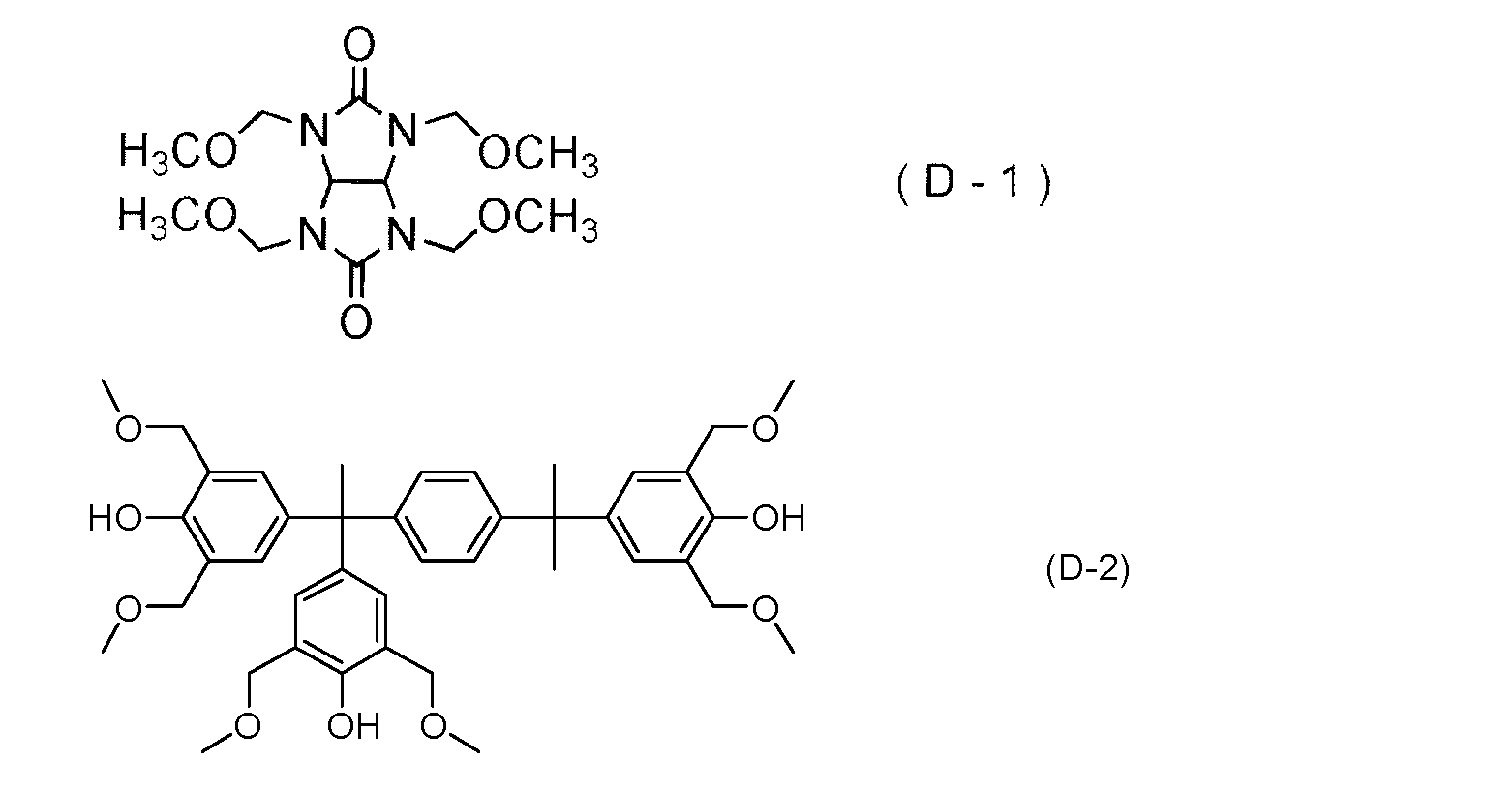
- D-1 compound represented by the following formula (D-1)
- D-2 compound represented by the following formula (D-2)
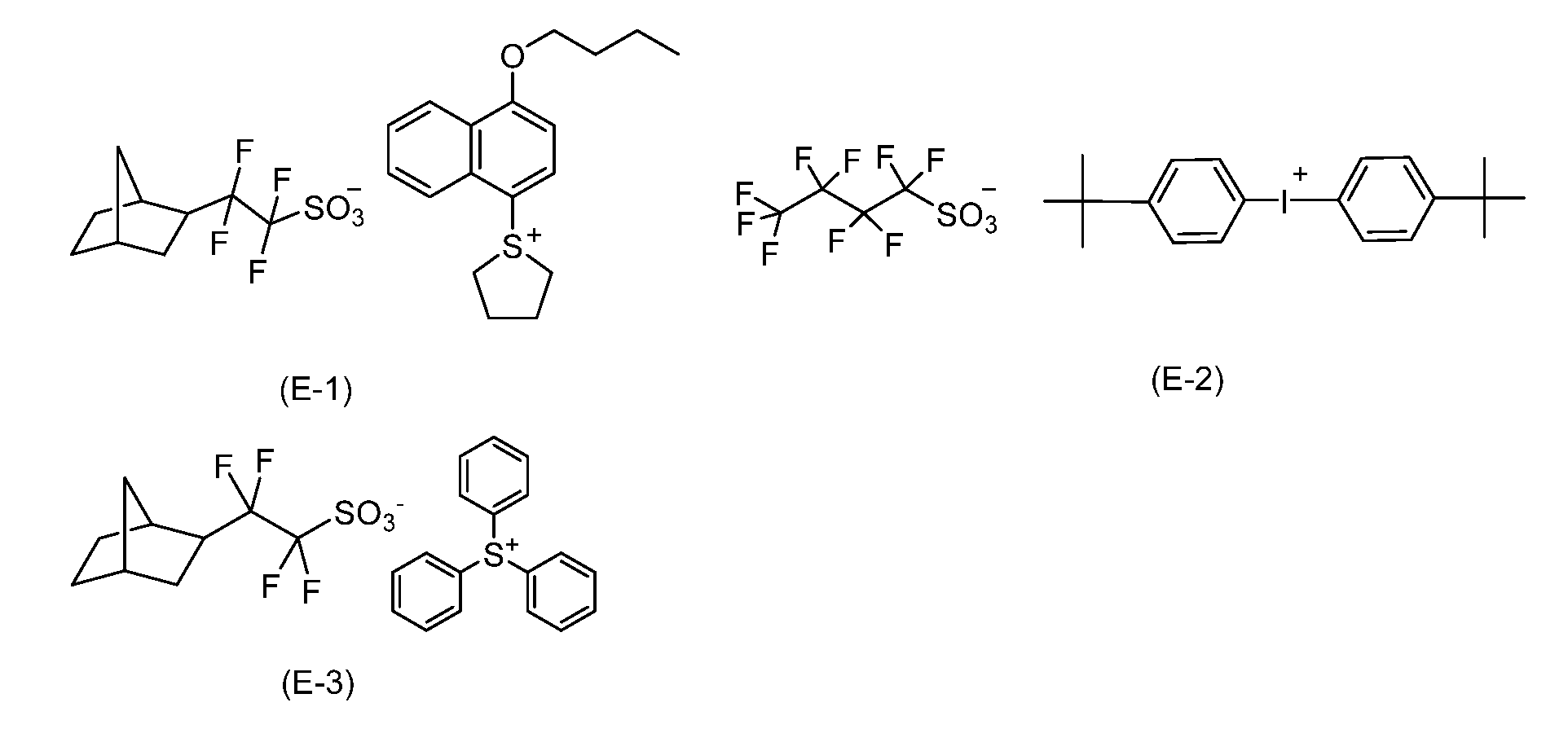
- E-1 compound represented by the following formula (E-1)
- E-2 compound represented by the following formula (E-2)
- E-3 compound represented by the following formula (E-3)
- composition (J-1) 100 parts by mass of (A-1) as a polymer, [C] 1100 parts by mass of (C-2) as a solvent, (C-3) 200 parts by mass (polymer (A-1) of 4- 4-methyl-2-pentanol contained in the methyl-2-pentanol solution is also included.).
- the resulting solution was filtered through a polytetrafluoroethylene (PTFE) membrane filter with a pore size of 0.45 ⁇ m to prepare composition (J-1).
- PTFE polytetrafluoroethylene
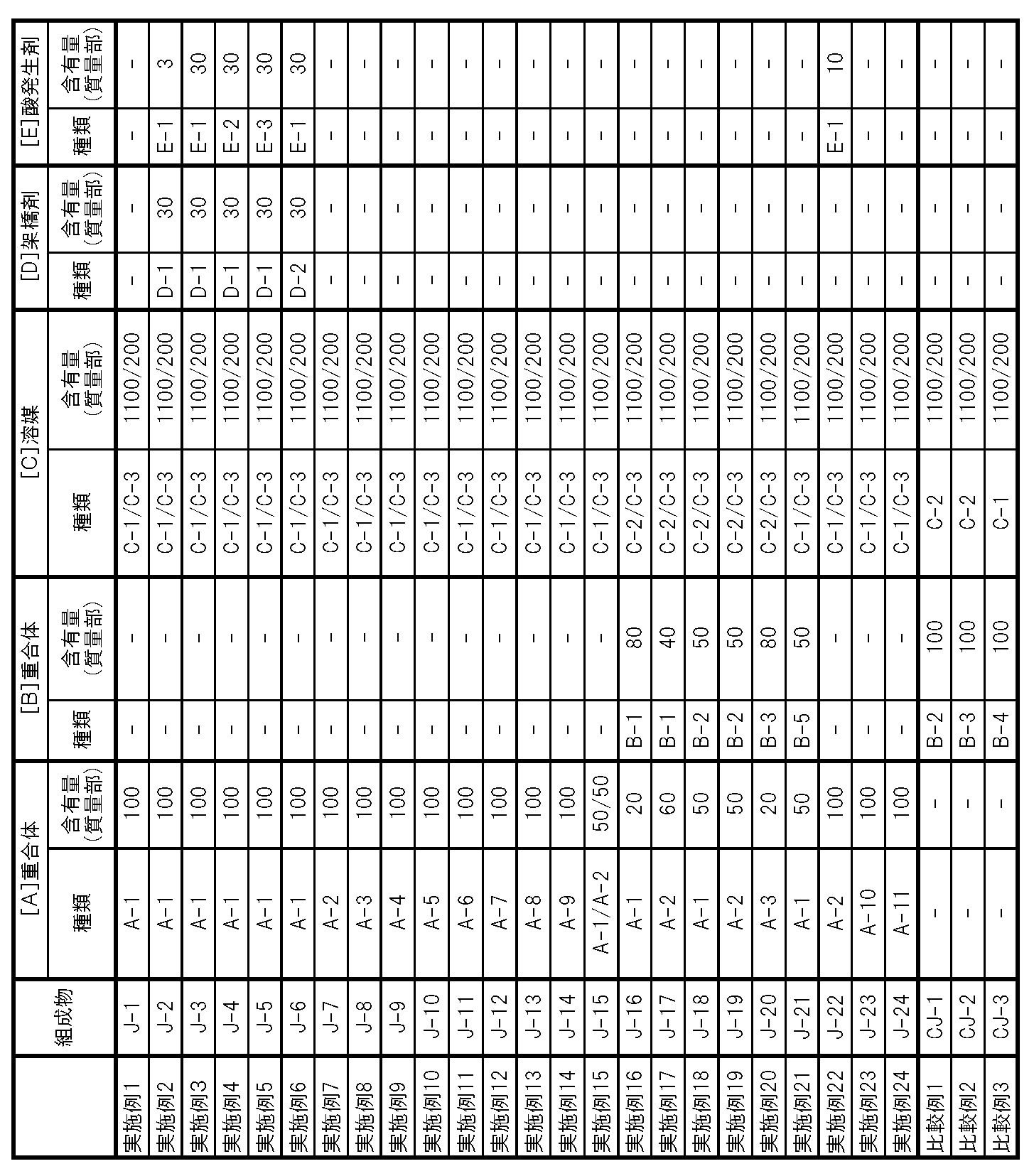
- Example 2 to 24 and Comparative Examples 1 to 3 Compositions (J-2) to (J-24) and (CJ-1) to (CJ-3) in the same manner as in Example 1, except that the types and contents of each component shown in Table 1 below were used. ) was prepared. "-" in the column “A, B, D, E” in Table 1 indicates that the corresponding component was not used.
- Solvent resistance is "A” (good) when the film thickness change rate is less than 1%, “B” (fairly good) when it is 1% or more and less than 10%, and "C” when it is 10% or more. (bad).
- the composition prepared above was applied onto a 12-inch silicon wafer by a spin coating method using a spin coater ("CLEAN TRACK ACT 12" available from Tokyo Electron Co., Ltd.). Next, in an air atmosphere, after heating at 250 ° C. for 60 seconds, by cooling at 23 ° C. for 60 seconds, a resist underlayer film having an average thickness of 5 nm is formed, and the resist with the resist underlayer film formed on the substrate A substrate with an underlayer film was obtained.
- the substrate with the resist underlayer film obtained above was immersed in a 2.38% by mass tetramethylammonium hydroxide aqueous solution (20° C. to 25° C.) for 60 seconds, washed with water, and dried to obtain a substrate for evaluation.
- the EUV exposure resist composition (R-1) comprises a structural unit (1) derived from 4-hydroxystyrene, a structural unit (2) derived from styrene, and a structural unit (3) derived from 4-t-butoxystyrene.
- 100 parts by mass of a polymer and triphenyl as a radiation-sensitive acid generator 1.0 parts by mass of sulfonium trifluoromethanesulfonate, 4,400 parts by mass of ethyl lactate and 1,900 parts by mass of propylene glycol monomethyl ether acetate as solvents are mixed, and the resulting solution is passed through a filter with a pore size of 0.2 ⁇ m. Obtained by filtration.
- An organic underlayer film forming material (“HM8006” from JSR Corporation) was applied onto a 12-inch silicon wafer by a spin coating method using a spin coater (“CLEAN TRACK ACT12” from Tokyo Electron Ltd.). C. for 60 seconds to form an organic underlayer film having an average thickness of 100 nm.
- a composition for forming a silicon-containing film (“NFC SOG080” manufactured by JSR Corporation) was applied onto the organic underlayer film, heated at 220°C for 60 seconds, and then cooled at 23°C for 30 seconds to obtain an average thickness. A 20 nm silicon-containing film was formed. The composition prepared above was applied onto the silicon-containing film formed above, heated at 250° C.
- the EUV exposure resist composition (R-1) is applied onto the resist underlayer film formed above, heated at 130° C. for 60 seconds, and then cooled at 23° C. for 30 seconds to form a resist film having an average thickness of 50 nm. formed.
- an EUV scanner ASML "TWINSCAN NXE: 3300B" (NA 0.3, sigma 0.9, quadruple pole illumination, 1:1 line and space mask with a line width of 16 nm on the wafer) was used to create a resist film. After the extreme ultraviolet irradiation, the substrate was heated at 110° C.
- the resist underlayer films formed from the compositions of Examples have better solvent resistance, ease of removal, and pattern rectangularity than the resist underlayer films formed from the compositions of Comparative Examples. was excellent in character.
- a semiconductor substrate can be efficiently manufactured because a composition for forming a resist underlayer film capable of forming a resist underlayer film having excellent solvent resistance and pattern rectangularity is used. .
- a film excellent in solvent resistance and pattern rectangularity can be formed.
- the resist underlayer film can be removed together with the resist film in the development process in the manufacturing process of semiconductor substrates and the like, so that a film having excellent removability can be formed. be able to. Therefore, these can be suitably used for the manufacture of semiconductor devices, etc., which are expected to be further miniaturized in the future.
Landscapes
- Physics & Mathematics (AREA)
- General Physics & Mathematics (AREA)
- Engineering & Computer Science (AREA)
- Architecture (AREA)
- Structural Engineering (AREA)
- Materials For Photolithography (AREA)
- Photosensitive Polymer And Photoresist Processing (AREA)
- Exposure Of Semiconductors, Excluding Electron Or Ion Beam Exposure (AREA)
Abstract
耐溶媒性及びパターン矩形性に優れるレジスト下層膜を形成可能なレジスト下層膜形成用組成物を用いる半導体基板の製造方法及びレジスト下層膜形成用組成物を提供することを目的とする。基板に直接又は間接にレジスト下層膜形成用組成物を塗工する工程と、上記レジスト下層膜形成用組成物塗工工程により形成されたレジスト下層膜にレジスト膜形成用組成物を塗工する工程と、上記レジスト膜形成用組成物塗工工程により形成されたレジスト膜を放射線により露光する工程と、少なくとも上記露光されたレジスト膜を現像する工程とを備え、上記レジスト下層膜形成用組成物が、スルホン酸基を含む重合体と、溶媒とを含有する、半導体基板の製造方法。
Description
本発明は、半導体基板の製造方法及びレジスト下層膜形成用組成物に関する。
半導体デバイスの製造にあっては、例えば、基板上に有機下層膜、ケイ素含有膜などのレジスト下層膜を介して積層されたレジスト膜を露光及び現像してレジストパターンを形成する多層レジストプロセスが用いられている。このプロセスでは、このレジストパターンをマスクとしてレジスト下層膜をエッチングし、得られたレジスト下層膜パターンをマスクとしてさらに基板をエッチングすることで、半導体基板に所望のパターンを形成することができる。
近年、半導体デバイスの高集積化がさらに進んでおり、使用する露光光がKrFエキシマレーザー(248nm)、ArFエキシマレーザー(193nm)から、極端紫外線(13.5nm、以下、「EUV」ともいう。)へと短波長化される傾向にある。このようなEUV露光におけるレジスト下層膜形成用組成物について、種々の検討が行われている(国際公開第2013/141015号参照)。
極端紫外線の露光、現像により形成されるレジストパターンの線幅が20nm以下のレベルにまで微細化が進展している中、レジスト下層膜にはレジスト組成物の溶媒に対する耐溶媒性や、レジスト膜底部でのパターンの裾引きを抑制してレジストパターンの矩形性を確保するパターン矩形性が要求されている。
本発明は以上のような事情に基づいてなされたものであり、その目的は、耐溶媒性及びパターン矩形性に優れるレジスト下層膜を形成可能なレジスト下層膜形成用組成物を用いる半導体基板の製造方法及びレジスト下層膜形成用組成物を提供することにある。
本発明は、一実施形態において、
基板に直接又は間接にレジスト下層膜形成用組成物を塗工する工程と、
上記レジスト下層膜形成用組成物塗工工程により形成されたレジスト下層膜にレジスト膜形成用組成物を塗工する工程と、
上記レジスト膜形成用組成物塗工工程により形成されたレジスト膜を放射線により露光する工程と、
少なくとも上記露光されたレジスト膜を現像する工程と
を備え、
上記レジスト下層膜形成用組成物が、
スルホン酸基を含む繰り返し単位を有する重合体(以下、「[A]重合体」ともいう。)と、
溶媒(以下、「[C]溶媒」ともいう。)と
を含有する、半導体基板の製造方法に関する。
基板に直接又は間接にレジスト下層膜形成用組成物を塗工する工程と、
上記レジスト下層膜形成用組成物塗工工程により形成されたレジスト下層膜にレジスト膜形成用組成物を塗工する工程と、
上記レジスト膜形成用組成物塗工工程により形成されたレジスト膜を放射線により露光する工程と、
少なくとも上記露光されたレジスト膜を現像する工程と
を備え、
上記レジスト下層膜形成用組成物が、
スルホン酸基を含む繰り返し単位を有する重合体(以下、「[A]重合体」ともいう。)と、
溶媒(以下、「[C]溶媒」ともいう。)と
を含有する、半導体基板の製造方法に関する。
本発明は、他の実施形態において、
スルホン酸基を含む重合体と、
溶媒と
を含有する、レジスト下層膜形成用組成物に関する。
スルホン酸基を含む重合体と、
溶媒と
を含有する、レジスト下層膜形成用組成物に関する。
当該半導体基板の製造方法によれば、耐溶媒性及びパターン矩形性に優れるレジスト下層膜を形成可能なレジスト下層膜形成用組成物を用いるため、半導体基板を効率的に製造することができる。当該レジスト下層膜形成用組成物によれば、耐溶媒性及びパターン矩形性に優れる膜を形成することができる。また、当該レジスト下層膜形成用組成物によれば、半導体基板等の製造工程における現像プロセスにおいて、レジスト膜とともにレジスト下層膜を除去することもできるため、除去容易性に優れる膜を形成することができる。従って、これらは、今後さらに微細化が進行すると予想される半導体デバイスの製造等に好適に用いることができる。
以下、本発明の各実施形態に係る半導体基板の製造方法及びレジスト下層膜形成用組成物について詳説する。
《半導体基板の製造方法》
当該半導体基板の製造方法は、基板に直接又は間接にレジスト下層膜形成用組成物を塗工する工程(以下、「塗工工程(I)」ともいう。)と、上記レジスト下層膜形成用組成物塗工工程により形成されたレジスト下層膜にレジスト膜形成用組成物を塗工する工程(以下、「塗工工程(II)」ともいう。)と、上記レジスト膜形成用組成物塗工工程により形成されたレジスト膜を放射線により露光する工程(以下、「露光工程」ともいう。)と、少なくとも上記露光されたレジスト膜を現像する工程(以下、「現像工程」ともいう。)とを備える。
当該半導体基板の製造方法は、基板に直接又は間接にレジスト下層膜形成用組成物を塗工する工程(以下、「塗工工程(I)」ともいう。)と、上記レジスト下層膜形成用組成物塗工工程により形成されたレジスト下層膜にレジスト膜形成用組成物を塗工する工程(以下、「塗工工程(II)」ともいう。)と、上記レジスト膜形成用組成物塗工工程により形成されたレジスト膜を放射線により露光する工程(以下、「露光工程」ともいう。)と、少なくとも上記露光されたレジスト膜を現像する工程(以下、「現像工程」ともいう。)とを備える。
当該半導体基板の製造方法によれば、上記塗工工程(I)において所定のレジスト下層膜形成用組成物を用いることにより、耐溶媒性及びパターン矩形性に優れたレジスト下層膜を形成することができるため、良好なパターン形状を有する半導体基板を製造することができる。
当該半導体基板の製造方法は、必要に応じて、上記塗工工程(I)より前に、基板に直接又は間接にケイ素含有膜を形成する工程(以下、「ケイ素含有膜形成工程」ともいう。)をさらに備えていてもよい。
以下、当該半導体基板の製造方法に用いるレジスト下層膜形成用組成物及び任意工程であるケイ素含有膜形成工程を備える場合の各工程について説明する。
<レジスト下層膜形成用組成物>
レジスト下層膜形成用組成物は、[A]重合体と[C]溶媒とを含有する。当該組成物は、本発明の効果を損なわない範囲において、任意成分を含有していてもよい。当該レジスト下層膜形成用組成物は、[A]重合体と[C]溶媒とを含有することにより、耐溶媒性及びパターン矩形性に優れるレジスト下層膜を形成することができる。その理由は定かではないものの、以下のように推察される。レジスト下層膜形成用組成物の主要成分としてスルホン酸基を含む重合体(すなわち、[A]重合体)を用いているので、レジスト下層膜の極性が高まり、有機溶媒に対する溶解性を低減させることができる。また、レジスト下層膜中のスルホン酸基から発生した酸が露光部におけるレジスト膜底部の酸欠乏を抑制し、レジスト膜底部での現像液への溶解性を高めてパターン矩形性を発揮することができる。
レジスト下層膜形成用組成物は、[A]重合体と[C]溶媒とを含有する。当該組成物は、本発明の効果を損なわない範囲において、任意成分を含有していてもよい。当該レジスト下層膜形成用組成物は、[A]重合体と[C]溶媒とを含有することにより、耐溶媒性及びパターン矩形性に優れるレジスト下層膜を形成することができる。その理由は定かではないものの、以下のように推察される。レジスト下層膜形成用組成物の主要成分としてスルホン酸基を含む重合体(すなわち、[A]重合体)を用いているので、レジスト下層膜の極性が高まり、有機溶媒に対する溶解性を低減させることができる。また、レジスト下層膜中のスルホン酸基から発生した酸が露光部におけるレジスト膜底部の酸欠乏を抑制し、レジスト膜底部での現像液への溶解性を高めてパターン矩形性を発揮することができる。
<[A]重合体>
[A]重合体は、スルホン酸基を含む。当該組成物は、1種又は2種以上の[A]重合体を含有することができる。[A]重合体としては、スルホン酸基を含む限り、レジスト下層膜の形成に用いられる公知の重合体を好適に採用することができる。中でも、スルホン酸基の導入の容易性やレジスト膜との密着性等の点から、アクリル系重合体が好ましい。
[A]重合体は、スルホン酸基を含む。当該組成物は、1種又は2種以上の[A]重合体を含有することができる。[A]重合体としては、スルホン酸基を含む限り、レジスト下層膜の形成に用いられる公知の重合体を好適に採用することができる。中でも、スルホン酸基の導入の容易性やレジスト膜との密着性等の点から、アクリル系重合体が好ましい。
[A]重合体がアクリル系重合体である場合、下記式(1)で表される繰り返し単位(以下、「繰り返し単位(1)」ともいう。)を有することが好ましい。

(式(1)中、R1は、水素原子又は置換若しくは非置換の炭素数1~20の1価の炭化水素基である。L1は、単結合又は2価の連結基である。)
R1で表される炭素数1~20の1価の炭化水素基としては、例えば、炭素数1~20の1価の鎖状炭化水素基、炭素数3~20の1価の脂環式炭化水素基、炭素数6~20の1価の芳香族炭化水素基又はこれらの組み合わせ等が挙げられる。
本明細書において、「炭化水素基」には、鎖状炭化水素基、脂環式炭化水素基及び芳香族炭化水素基が含まれる。この「炭化水素基」には、飽和炭化水素基及び不飽和炭化水素基が含まれる。「鎖状炭化水素基」とは、環構造を含まず、鎖状構造のみで構成された炭化水素基を意味し、直鎖状炭化水素基及び分岐鎖状炭化水素基の両方を含む。「脂環式炭化水素基」とは、環構造としては脂環構造のみを含み、芳香環構造を含まない炭化水素基を意味し、単環の脂環式炭化水素基及び多環の脂環式炭化水素基の両方を含む(ただし、脂環構造のみで構成されている必要はなく、その一部に鎖状構造を含んでいてもよい)。「芳香族炭化水素基」とは、環構造として芳香環構造を含む炭化水素基を意味する(ただし、芳香環構造のみで構成されている必要はなく、その一部に脂環構造や鎖状構造を含んでいてもよい)。
炭素数1~20の1価の鎖状炭化水素基としては、例えばメチル基、エチル基、n-プロピル基、i-プロピル基、n-ブチル基、sec-ブチル基、tert-ブチル基等のアルキル基;エテニル基、プロペニル基、ブテニル基等のアルケニル基;エチニル基、プロピニル基、ブチニル基等のアルキニル基などが挙げられる。
炭素数3~20の1価の脂環式炭化水素基としては、例えばシクロペンチル基、シクロヘキシル基等のシクロアルキル基;シクロプロペニル基、シクロペンテニル基、シクロヘキセニル基等のシクロアルケニル基;ノルボルニル基、アダマンチル基、トリシクロデシル基等の橋かけ環飽和炭化水素基;ノルボルネニル基、トリシクロデセニル基等の橋かけ環不飽和炭化水素基などが挙げられる。
炭素数6~20の1価の芳香族炭化水素基としては、フェニル基、トリル基、ナフチル基、アントラセニル基、ピレニル基等が挙げられる。
R1が置換基を有する場合、置換基としては、例えば炭素数1~10の1価の鎖状炭化水素基、フッ素原子、塩素原子、臭素原子、ヨウ素原子等のハロゲン原子、メトキシ基、エトキシ基、プロポキシ基等のアルコキシ基、メトキシカルボニル基、エトキシカルボニル基等のアルコキシカルボニル基、メトキシカルボニルオキシ基、エトキシカルボニルオキシ基等のアルコキシカルボニルオキシ基、ホルミル基、アセチル基、プロピオニル基、ブチリル基等のアシル基、シアノ基、ニトロ基などが挙げられる。
中でも、R1としては、繰り返し単位(1)を与える単量体の共重合性の点から、水素原子又はメチル基が好ましい。
上記式(1)中、L1で表される2価の連結基は、2価の炭化水素基、カルボニル基、酸素原子(-O-)、イミノ基(-NH-)又はこれらの組み合わせであることが好ましい。
L1における2価の炭化水素基としては、上記R1における炭素数1~20の1価の炭化水素基から1個の水素原子を除いた基等が挙げられる。
中でも、L1としては、単結合、炭素数1~10のアルキル基から1個の水素原子を除いたアルカンジイル基、炭素数6~20の1価の芳香族炭化水素基から1個の水素原子を除いたアリーレン基、カルボニル基、酸素原子、イミノ基又はこれらの組み合わせが好ましく、単結合、炭素数1~5のアルカンジイル基、フェニレン基、カルボニル基、酸素原子、イミノ基又はこれらの組み合わせがより好ましい。
繰り返し単位(1)の具体例としては、例えば下記式(1-1)~(1-10)で表される繰り返し単位等が挙げられる。
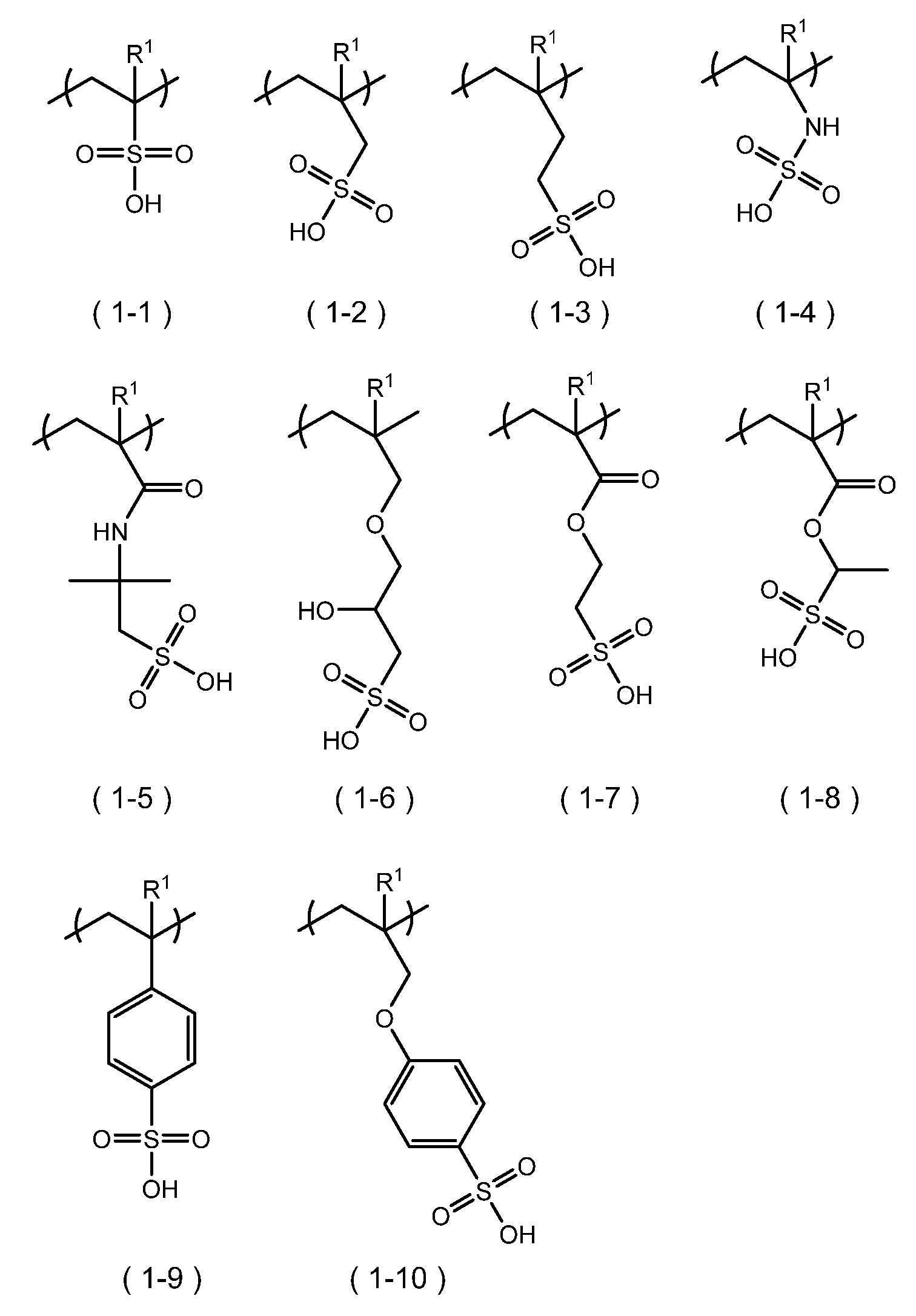
上記式(1-1)~(1-10)中、R1は上記式(1)と同義である。中でも、上記式(1-1)、(1-5)、(1-9)で表される繰り返し単位が好ましい。
上記重合体を構成する全繰り返し単位に占める上記スルホン酸基を含む繰り返し単位の含有割合の下限は、1モル%が好ましく、5モル%がより好ましく、10モル%がさらに好ましく、20モル%が特に好ましい。上記含有量の上限は、100モル%が好ましく、70モル%がより好ましく、40モル%がさらに好ましく、30モル%が特に好ましい。繰り返し単位(1)の含有割合を上記範囲とすることで、耐溶媒性及びパターン矩形性を高いレベルで発揮することができる。また、上記範囲により、レジスト膜の現像工程において現像液として塩基性液を用いる場合、レジスト膜とともにレジスト下層膜も併せて除去することができる。
[A]重合体は、下記式(2)で表される繰り返し単位(以下、「繰り返し単位(2)」ともいう。)をさらに有することが好ましい。[A]重合体が繰り返し単位(2)を含むことで、耐溶媒性及びパターン矩形性をより向上させることができる。
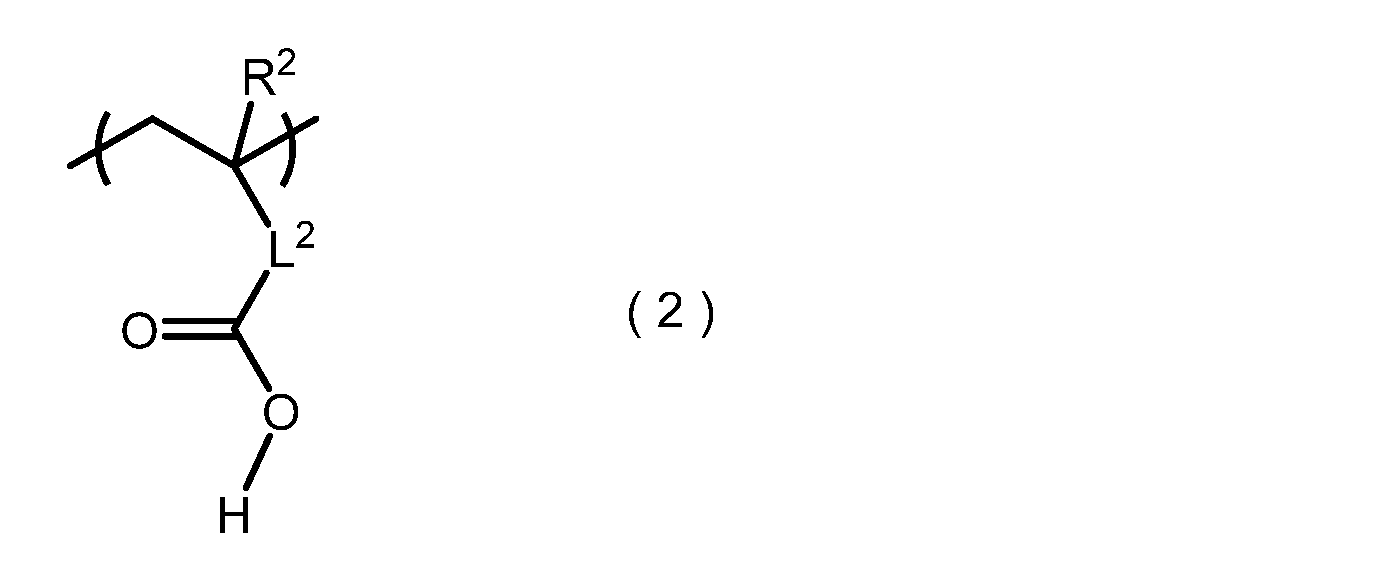
(式(2)中、R2は、水素原子又は置換若しくは非置換の炭素数1~20の1価の炭化水素基である。L2は、単結合又は2価の連結基である。)
上記式(2)中、R2で表される置換若しくは非置換の炭素数1~20の1価の炭化水素基としては、上記式(1)のR1で表される置換若しくは非置換の炭素数1~20の1価の炭化水素基として示した基を好適に採用することができる。R2としては、繰り返し単位(2)を与える単量体の共重合性の点から、水素原子又はメチル基が好ましい。R2が置換基を有する場合、置換基としては上記式(1)のR1が有し得る置換基が好適に挙げられる。
上記式(2)中、L2で表される2価の連結基としては、上記式(1)のL1で表される2価の連結基として示した基を好適に採用することができる。L2としては、単結合、炭素数1~10のアルキル基から1個の水素原子を除いたアルカンジイル基、炭素数5~10のシクロアルキル基から1個の水素原子を除いたシクロアルキレン基、炭素数6~20の1価の芳香族炭化水素基から1個の水素原子を除いたアリーレン基、カルボニル基、酸素原子又はこれらの組み合わせが好ましく、単結合、炭素数1~5のアルカンジイル基、炭素数5~7のシクロアルキレン基、フェニレン基、カルボニル基、酸素原子又はこれらの組み合わせがより好ましい。
繰り返し単位(2)の具体例としては、例えば下記式(2-1)~(2-8)で表される繰り返し単位等が挙げられる。

上記式(2-1)~(2-8)中、R2は上記式(2)と同義である。
[A]重合体が繰り返し単位(2)を有する場合、[A]重合体を構成する全繰り返し単位に占める繰り返し単位(2)の含有割合の下限は、1モル%が好ましく、3モル%がより好ましく、5モル%がさらに好ましい。上記含有量の上限は、99モル%が好ましく、90モル%がより好ましく、80モル%がさらに好ましい。繰り返し単位(1)の含有割合を上記範囲とすることで、耐溶媒性及びパターン矩形性を高いレベルで発揮することができる。
[A]重合体は、下記式(3)で表される繰り返し単位(上記式(2)である場合を除く。)(以下、「繰り返し単位(3)」ともいう。)をさらに有していてもよい。

(式(3)中、R3は、水素原子又は置換若しくは非置換の炭素数1~20の1価の炭化水素基である。L3は、単結合又は2価の連結基である。R4は、置換又は非置換の炭素数1~20の1価の炭化水素基である。)
上記式(3)中、R3及びR4で表される置換若しくは非置換の炭素数1~20の1価の炭化水素基としては、それぞれ上記式(1)のR1で表される置換若しくは非置換の炭素数1~20の1価の炭化水素基として示した基を好適に採用することができる。R3としては、繰り返し単位(3)を与える単量体の共重合性の点から、水素原子又はメチル基が好ましい。R4としては、炭素数1~15の1価の鎖状炭化水素基が好ましく、炭素数1~10の1価の分岐鎖状アルキル基がより好ましい。R3及びR4が置換基を有する場合、置換基としては上記式(1)のR1が有し得る置換基が好適に挙げられる。
上記式(3)中、L3で表される2価の連結基としては、上記式(1)のL1で表される2価の連結基として示した基を好適に採用することができる。L3としては、単結合、炭素数1~10のアルキル基から1個の水素原子を除いたアルカンジイル基、炭素数5~10のシクロアルキル基から1個の水素原子を除いたシクロアルキレン基、カルボニル基、酸素原子又はこれらの組み合わせが好ましく、単結合、炭素数1~5のアルカンジイル基、炭素数5~7のシクロアルキレン基、カルボニル基、酸素原子又はこれらの組み合わせがより好ましく、単結合がさらに好ましい。
繰り返し単位(3)の具体例としては、例えば下記式(3-1)~(3-15)で表される繰り返し単位等が挙げられる。
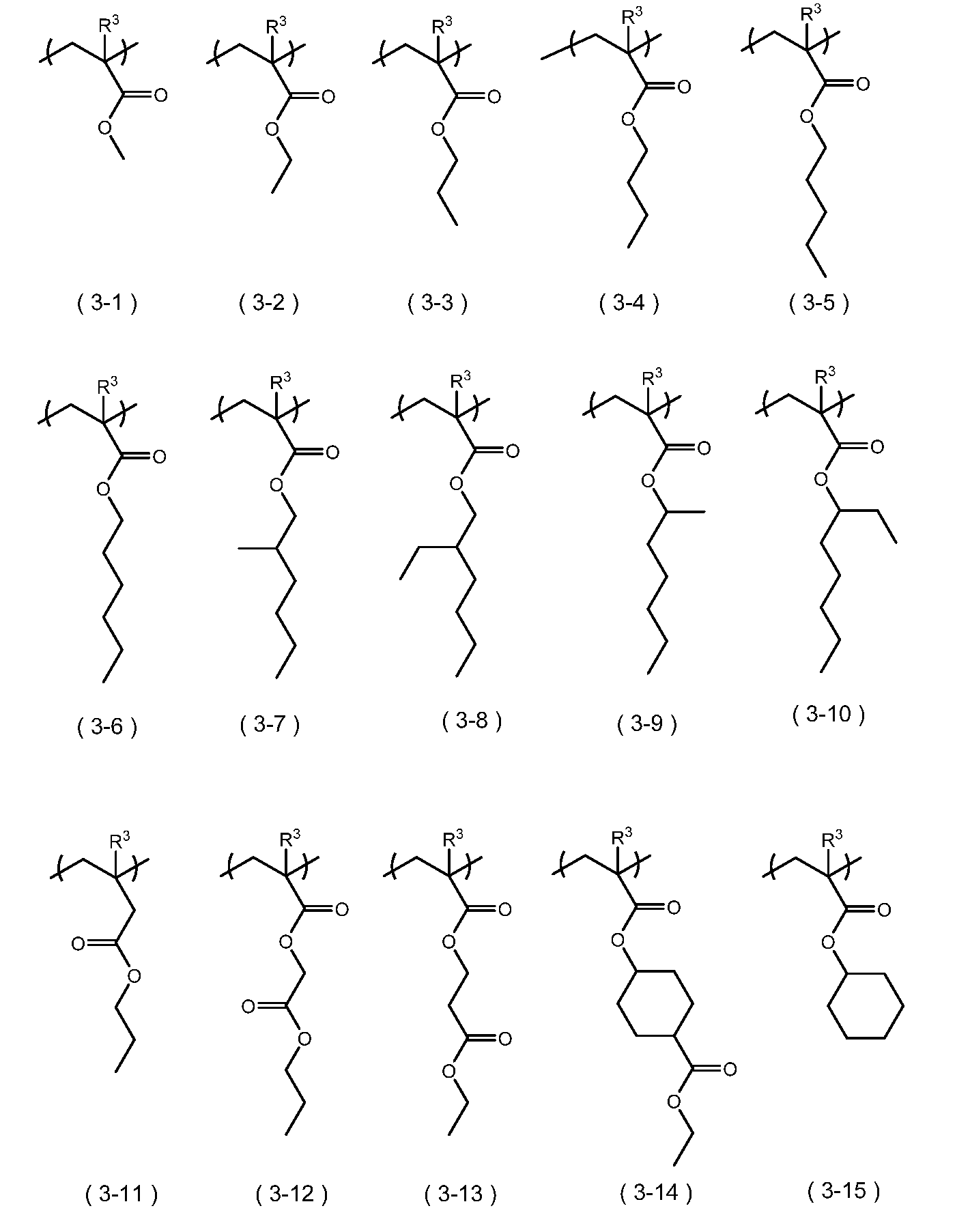
上記式(3-1)~(3-15)中、R3は上記式(3)と同義である。
[A]重合体が繰り返し単位(3)を有する場合、[A]重合体を構成する全繰り返し単位に占める繰り返し単位(3)の含有割合の下限は、10モル%が好ましく、15モル%がより好ましく、20モル%がさらに好ましい。上記含有量の上限は、90モル%が好ましく、85モル%がより好ましく、80モル%がさらに好ましい。繰り返し単位(3)の含有割合を上記範囲とすることで、レジスト膜との良好な密着性を発揮することができる。
[A]重合体が、下記式(4)で表される繰り返し単位(上記式(1)、上記式(2)及び上記式(3)である場合を除く。)(以下、「繰り返し単位(4)」ともいう。)をさらに有していてもよい。

(式(4)中、R5は、水素原子又は置換若しくは非置換の炭素数1~20の1価の炭化水素基である。L4は、単結合又は2価の連結基である。Ar1は、環員数6~20の芳香環を有する1価の基である。)
本明細書において、「環員数」とは、環を構成する原子の数をいう。例えば、ビフェニル環の環員数は12であり、ナフタレン環の環員数は10であり、フルオレン環の環員数は13である。
上記式(4)中、R5で表される置換若しくは非置換の炭素数1~20の1価の炭化水素基としては、上記式(1)のR1で表される置換若しくは非置換の炭素数1~20の1価の炭化水素基として示した基を好適に採用することができる。R5としては、繰り返し単位(4)を与える単量体の共重合性の点から、水素原子又はメチル基が好ましい。R5が置換基を有する場合、置換基としては上記式(1)のR1が有し得る置換基が好適に挙げられる。
上記式(4)中、L4で表される2価の連結基としては、上記式(1)のL1で表される2価の連結基として示した基を好適に採用することができる。L4としては、単結合、炭素数1~10のアルキル基から1個の水素原子を除いたアルカンジイル基、炭素数5~10のシクロアルキル基から1個の水素原子を除いたシクロアルキレン基、カルボニル基、酸素原子又はこれらの組み合わせが好ましく、単結合、炭素数1~5のアルカンジイル基、炭素数5~7のシクロアルキレン基、カルボニル基、酸素原子又はこれらの組み合わせがより好ましく、単結合がさらに好ましい。
上記式(4)中、Ar1における環員数6~20の芳香環としては、例えばベンゼン環、ナフタレン環、アントラセン環、インデン環、ピレン環等の芳香族炭化水素環、ピリジン環、ピラジン環、ピリミジン環、ピリダジン環、トリアジン環等の芳香族複素環、又はこれらの組み合わせ等が挙げられる。上記Ar1の芳香環は、ベンゼン環、ナフタレン環、アントラセン環、フェナレン環、フェナントレン環、ピレン環、フルオレン環、ペリレン環及びコロネン環からなる群より選ばれる少なくとも1つの芳香族炭化水素環であることが好ましく、ベンゼン環、ナフタレン環又はピレン環であることがより好ましい。
上記式(4)中、Ar1で表される環員数6~20の芳香環を有する1価の基としては、上記Ar1における環員数6~20の芳香環から1個の水素原子を除いた基等が好適に挙げられる。
繰り返し単位(4)の具体例としては、例えば下記式(4-1)~(4-8)で表される繰り返し単位等が挙げられる。

上記式(4-1)~(4-8)中、R5は上記式(4)と同義である。中でも、上記式(4-1)で表される繰り返し単位が好ましい。
[A]重合体が繰り返し単位(4)を有する場合、[A]重合体を構成する全繰り返し単位に占める繰り返し単位(4)の含有割合の下限は、10モル%が好ましく、20モル%がより好ましく、30モル%がさらに好ましい。上記含有量の上限は、95モル%が好ましく、90モル%がより好ましく、80モル%がさらに好ましい。繰り返し単位(4)の含有割合を上記範囲とすることで、レジスト膜との良好な密着性を発揮することができる。
[A]重合体の重量平均分子量の下限としては、500が好ましく、1000がより好ましく、1500がさらに好ましく、2000が特に好ましい。上記分子量の上限としては、10000が好ましく、9000がより好ましく、8000がさらに好ましく、7000が特に好ましい。なお、重量平均分子量の測定方法は、実施例の記載による。
当該レジスト下層膜形成用組成物における[A]重合体の含有割合の下限としては、[A]重合体及び[C]溶媒の合計質量中、1質量%が好ましく、2質量%がより好ましく、3質量%がさらに好ましく、4質量%が特に好ましい。上記含有割合の上限としては、[A]重合体及び[C]溶媒の合計質量中、20質量%が好ましく、15質量%がより好ましく、12質量%がさらに好ましく、10質量%が特に好ましい。
当該レジスト下層膜形成用組成物中の[C]溶媒以外の成分に占める[A]重合体の含有割合の下限としては、1質量%が好ましく、5質量%がより好ましく、10質量%がさらに好ましく、15質量%が特に好ましい。上記含有割合の上限としては、100質量%が好ましい。
[[A]重合体の合成方法]
[A]重合体は、単量体の種類に応じてラジカル重合、イオン重合、重縮合、重付加、付加縮合等を行うことで合成することができる。例えば、[A]重合体をラジカル重合で合成する場合、各構造単位を与える単量体を、ラジカル重合開始剤等を用い、適当な溶剤中で重合することにより合成できる。
[A]重合体は、単量体の種類に応じてラジカル重合、イオン重合、重縮合、重付加、付加縮合等を行うことで合成することができる。例えば、[A]重合体をラジカル重合で合成する場合、各構造単位を与える単量体を、ラジカル重合開始剤等を用い、適当な溶剤中で重合することにより合成できる。
上記ラジカル重合開始剤としては、アゾビスイソブチロニトリル(AIBN)、2,2’-アゾビス(4-メトキシ-2,4-ジメチルバレロニトリル)、2,2’-アゾビス(2-シクロプロピルプロピオニトリル)、2,2’-アゾビス(2,4-ジメチルバレロニトリル)、ジメチル2,2’-アゾビスイソブチレート等のアゾ系ラジカル開始剤;ベンゾイルパーオキサイド、t-ブチルハイドロパーオキサイド、クメンハイドロパーオキサイド等の過酸化物系ラジカル開始剤等が挙げられる。これらのラジカル開始剤は1種単独で又は2種以上を混合して用いることができる。
上記重合に使用される溶剤としては、後述の[C]溶媒を好適に採用することができる。これらの重合に使用される溶剤は、1種単独で又は2種以上を併用してもよい。
上記重合における反応温度としては、通常40℃~150℃であり、50℃~120℃が好ましい。反応時間としては、通常1時間~48時間であり、1時間~24時間が好ましい。
<[C]溶媒>
[C]溶媒は、[A]重合体及び必要に応じて含有する任意成分を溶解又は分散することができれば特に限定されない。
[C]溶媒は、[A]重合体及び必要に応じて含有する任意成分を溶解又は分散することができれば特に限定されない。
[C]溶媒としては、例えば炭化水素系溶媒、エステル系溶媒、アルコール系溶媒、ケトン系溶媒、エーテル系溶媒、含窒素系溶媒などが挙げられる。[C]溶媒は、1種単独で又は2種以上を組み合わせて用いることができる。
炭化水素系溶媒としては、例えばn-ペンタン、n-ヘキサン、シクロヘキサン等の脂肪族炭化水素系溶媒、ベンゼン、トルエン、キシレン等の芳香族炭化水素系溶媒などが挙げられる。
エステル系溶媒としては、例えばジエチルカーボネート等のカーボネート系溶媒、酢酸メチル、酢酸エチル等の酢酸モノエステル系溶媒、γ-ブチロラクトン等のラクトン系溶媒、酢酸ジエチレングリコールモノメチルエーテル、酢酸プロピレングリコールモノメチルエーテル等の多価アルコール部分エーテルカルボキシレート系溶媒、乳酸メチル、乳酸エチル等の乳酸エステル系溶媒などが挙げられる。
アルコール系溶媒としては、例えばメタノール、エタノール、n-プロパノール、4-メチル-2-ペンタノール等のモノアルコール系溶媒、エチレングリコール、1,2-プロピレングリコール等の多価アルコール系溶媒などが挙げられる。
ケトン系溶媒としては、例えばメチルエチルケトン、メチルイソブチルケトン等の鎖状ケトン系溶媒、シクロヘキサノン等の環状ケトン系溶媒などが挙げられる。
エーテル系溶媒としては、例えばn-ブチルエーテル等の鎖状エーテル系溶媒、テトラヒドロフラン等の環状エーテル系溶媒等の多価アルコールエーテル系溶媒、ジエチレングリコールモノメチルエーテル、プロピレングリコールモノメチルエーテル等の多価アルコール部分エーテル系溶媒などが挙げられる。
含窒素系溶媒としては、例えばN,N-ジメチルアセトアミド等の鎖状含窒素系溶媒、N-メチルピロリドン等の環状含窒素系溶媒などが挙げられる。
[C]溶媒としては、アルコール系溶媒、エーテル系溶媒又はエステル系溶媒が好ましく、モノアルコール系溶媒、多価アルコール部分エーテル系溶媒又は多価アルコール部分エーテルカルボキシレート系溶媒がより好ましく、4-メチル-2-ペンタノール、プロピレングリコールモノメチルエーテル又は酢酸プロピレングリコールモノメチルエーテルがさらに好ましい。
当該レジスト下層膜形成用組成物における[C]溶媒の含有割合の下限としては、50質量%が好ましく、60質量%がより好ましく、70質量%がさらに好ましい。上記含有割合の上限としては、99.9質量%が好ましく、99質量%がより好ましく、95質量%がさらに好ましい。
[任意成分]
当該レジスト下層膜形成用組成物は、本発明の効果を損なわない範囲において任意成分を含有していてもよい。任意成分としては、例えばスルホン酸基を有しない重合体、酸発生剤、架橋剤、界面活性剤等が挙げられる。任意成分は、1種単独で又は2種以上を組み合わせて用いることができる。当該レジスト下層膜形成用組成物における任意成分の含有割合は任意成分の種類等に応じて適宜決定することができる。スルホン酸基を有しない重合体としては、繰り返し単位(2)~(4)のうちの1種又は2種以上を組み合わせて有する重合体や、レジスト組成物に含まれる重合体(酸解離性基を有する繰り返し単位a、ラクトン環を有する繰り返し単位b、ヒドロキシ基等の極性基を有する繰り返し単位c(ただし、繰り返し単位a、bに該当する場合を除く。)等を含む重合体)等を好適に用いることができる。
当該レジスト下層膜形成用組成物は、本発明の効果を損なわない範囲において任意成分を含有していてもよい。任意成分としては、例えばスルホン酸基を有しない重合体、酸発生剤、架橋剤、界面活性剤等が挙げられる。任意成分は、1種単独で又は2種以上を組み合わせて用いることができる。当該レジスト下層膜形成用組成物における任意成分の含有割合は任意成分の種類等に応じて適宜決定することができる。スルホン酸基を有しない重合体としては、繰り返し単位(2)~(4)のうちの1種又は2種以上を組み合わせて有する重合体や、レジスト組成物に含まれる重合体(酸解離性基を有する繰り返し単位a、ラクトン環を有する繰り返し単位b、ヒドロキシ基等の極性基を有する繰り返し単位c(ただし、繰り返し単位a、bに該当する場合を除く。)等を含む重合体)等を好適に用いることができる。
[レジスト下層膜形成用組成物の調製方法]
当該レジスト下層膜形成用組成物は、[A]重合体、[C]溶媒、及び必要に応じて任意成分を所定の割合で混合し、好ましくは得られた混合物を孔径0.5μm以下のメンブランフィルター等でろ過することにより調製できる。
当該レジスト下層膜形成用組成物は、[A]重合体、[C]溶媒、及び必要に応じて任意成分を所定の割合で混合し、好ましくは得られた混合物を孔径0.5μm以下のメンブランフィルター等でろ過することにより調製できる。
[ケイ素含有膜形成工程]
上記塗工工程(I)より前に行う本工程では、基板に直接又は間接にケイ素含有膜を形成する。
上記塗工工程(I)より前に行う本工程では、基板に直接又は間接にケイ素含有膜を形成する。
基板としては、例えばシリコン基板、アルミニウム基板、ニッケル基板、クロム基板、モリブデン基板、タングステン基板、銅基板、タンタル基板、チタン基板等の金属又は半金属基板などが挙げられ、これらの中でもシリコン基板が好ましい。上記基板は、窒化ケイ素膜、アルミナ膜、二酸化ケイ素膜、窒化タンタル膜、窒化チタン膜などが形成された基板でもよい。
ケイ素含有膜は、ケイ素含有膜形成用組成物の塗工、化学蒸着(CVD)法、原子層堆積(ALD)などにより形成することができる。ケイ素含有膜をケイ素含有膜形成用組成物の塗工により形成する方法としては、例えばケイ素含有膜形成用組成物を基板に直接又は間接に塗工して形成された塗工膜を、露光及び/又は加熱することにより硬化等させる方法などが挙げられる。上記ケイ素含有膜形成用組成物の市販品としては、例えば「NFC SOG01」、「NFC SOG04」、「NFC SOG080」(以上、JSR(株))等を用いることができる。化学蒸着(CVD)法又は原子層堆積(ALD)により、酸化ケイ素膜、窒化ケイ素膜、酸化窒化ケイ素膜、アモルファスケイ素膜を形成することができる。
上記露光に用いられる放射線としては、例えば可視光線、紫外線、遠紫外線、X線、γ線等の電磁波、電子線、分子線、イオンビーム等の粒子線などが挙げられる。
塗工膜を加熱する際の温度の下限としては、90℃が好ましく、150℃がより好ましく、200℃がさらに好ましい。上記温度の上限としては、550℃が好ましく、450℃がより好ましく、300℃がさらに好ましい。
ケイ素含有膜の平均厚みの下限としては、1nmが好ましく、10nmがより好ましく、15nmがさらに好ましい。上記上限としては、20,000nmが好ましく、1,000nmがより好ましく、100nmがさらに好ましい。ケイ素含有膜の平均厚みは、レジスト下層膜の平均厚みと同様に測定することができる。
基板に間接にケイ素含有膜を形成する場合としては、例えば基板上に形成された低誘電絶縁膜や有機下層膜上にケイ素含有膜を形成する場合等が挙げられる。
[塗工工程(I)]
本工程では、上記基板に形成された上述のケイ素含有膜上にレジスト下層膜形成用組成物を塗工する。レジスト下層膜形成用組成物の塗工方法としては特に限定されず、例えば回転塗工、流延塗工、ロール塗工などの適宜の方法で実施することができる。これにより塗工膜が形成され、[C]溶媒の揮発などが起こることによりレジスト下層膜が形成される。
本工程では、上記基板に形成された上述のケイ素含有膜上にレジスト下層膜形成用組成物を塗工する。レジスト下層膜形成用組成物の塗工方法としては特に限定されず、例えば回転塗工、流延塗工、ロール塗工などの適宜の方法で実施することができる。これにより塗工膜が形成され、[C]溶媒の揮発などが起こることによりレジスト下層膜が形成される。
なお、基板に直接レジスト下層膜形成用組成物を塗工する場合は、上記ケイ素含有膜形成工程を省略すればよい。
次に、上記塗工により形成された塗工膜を加熱する。塗工膜の加熱によりレジスト下層膜の形成が促進される。より詳細には、塗工膜の加熱により[C]溶媒の揮発等が促進される。
上記塗工膜の加熱は、大気雰囲気下で行ってもよいし、窒素雰囲気下で行ってもよい。加熱温度の下限としては、100℃が好ましく、150℃がより好ましく、200℃がさらに好ましい。上記加熱温度の上限としては、400℃が好ましく、350℃がより好ましく、280℃がさらに好ましい。加熱における時間の下限としては、15秒が好ましく、30秒がより好ましい。上記時間の上限としては、1,200秒が好ましく、600秒がより好ましい。
形成されるレジスト下層膜の平均厚みとの下限としては、0.5nmが好ましく、1nmがより好ましく、2nmがさらに好ましい。上記平均厚みの上限としては、50nmが好ましく、20nmがより好ましく、10nmがさらに好ましく、7nmが特に好ましい。なお、平均厚みの測定方法は実施例の記載による。
[塗工工程(II)]
本工程では、上記レジスト下層膜形成用組成物塗工工程により形成されたレジスト下層膜にレジスト膜形成用組成物を塗工する。レジスト膜形成用組成物の塗工方法としては特に制限されず、例えば回転塗工法等が挙げられる。
本工程では、上記レジスト下層膜形成用組成物塗工工程により形成されたレジスト下層膜にレジスト膜形成用組成物を塗工する。レジスト膜形成用組成物の塗工方法としては特に制限されず、例えば回転塗工法等が挙げられる。
本工程をより詳細に説明すると、例えば形成されるレジスト膜が所定の厚みとなるようにレジスト組成物を塗工した後、プレベーク(以下、「PB」ともいう。)することによって塗工膜中の溶媒を揮発させることにより、レジスト膜を形成する。
PB温度及びPB時間は、使用されるレジスト膜形成用組成物の種類等に応じて適宜決定することができる。PB温度の下限としては、30℃が好ましく、50℃がより好ましい。PB温度の上限としては、200℃が好ましく、150℃がより好ましい。PB時間の下限としては、10秒が好ましく、30秒がより好ましい。PB時間の上限としては、600秒が好ましく、300秒がより好ましい。
本工程において用いるレジスト膜形成用組成物としては、アルカリ現像用のいわゆるポジ型のレジスト膜形成用組成物を用いることが好ましい。上記で形成されたレジスト下層膜においては、[A]重合体が有するスルホン酸基により現像用の塩基性液に対する溶解性が高まり、現像時にレジストパターンの形成とともにレジスト下層膜の除去が可能となる。そのようなレジスト膜形成用組成物としては、例えば、酸解離性基を有する樹脂や感放射線性酸発生剤を含有するとともに、ArFエキシマレーザー光による露光用(ArF露光用)又は極端紫外線による露光用(EUV露光用)のポジ型のレジスト膜形成用組成物が好ましい。
[露光工程]
本工程では、上記レジスト膜形成用組成物塗工工程により形成されたレジスト膜を放射線により露光する。本工程により、レジスト膜における露光部と未露光部との間で現像液である塩基性液への溶解性に差異が生じる。より詳細には、レジスト膜における露光部の塩基性液への溶解性が高まる。
本工程では、上記レジスト膜形成用組成物塗工工程により形成されたレジスト膜を放射線により露光する。本工程により、レジスト膜における露光部と未露光部との間で現像液である塩基性液への溶解性に差異が生じる。より詳細には、レジスト膜における露光部の塩基性液への溶解性が高まる。
露光に用いられる放射線としては、用いるレジスト膜形成用組成物の種類等に応じて適宜選択することができる。例えば、可視光線、紫外線、遠紫外線、X線、γ線等の電磁波、電子線、分子線、イオンビーム等の粒子線などが挙げられる。これらの中でも、遠紫外線が好ましく、KrFエキシマレーザー光(波長248nm)、ArFエキシマレーザー光(波長193nm)、F2エキシマレーザー光(波長157nm)、Kr2エキシマレーザー光(波長147nm)、ArKrエキシマレーザー光(波長134nm)又は極端紫外線(波長13.5nm等、「EUV」ともいう。)がより好ましく、ArFエキシマレーザー光又はEUVがさらに好ましい。また、露光条件は用いるレジスト膜形成用組成物の種類等に応じて適宜決定することができる。
また、本工程では、上記露光後、解像度、パターンプロファイル、現像性等のレジスト膜の性能を向上させるために、ポストエクスポージャーベーク(以下、「PEB」ともいう。)を行うことができる。PEB温度及びPEB時間としては、使用されるレジスト膜形成用組成物の種類等に応じて適宜決定することができる。PEB温度の下限としては、50℃が好ましく、70℃がより好ましい。PEB温度の上限としては、200℃が好ましく、150℃がより好ましい。PEB時間の下限としては、10秒が好ましく、30秒がより好ましい。PEB時間の上限としては、600秒が好ましく、300秒がより好ましい。
[現像工程]
本工程では、少なくとも上記露光されたレジスト膜を現像する。本工程は、用いられる現像液が塩基性液であるアルカリ現像であることが好ましい。上記露光工程により、レジスト膜における露光部と未露光部との間で現像液である塩基性液への溶解性に差異が生じていることから、アルカリ現像を行うことで塩基性液への溶解性が相対的に高い露光部が除去されることにより、レジストパターンが形成される。
本工程では、少なくとも上記露光されたレジスト膜を現像する。本工程は、用いられる現像液が塩基性液であるアルカリ現像であることが好ましい。上記露光工程により、レジスト膜における露光部と未露光部との間で現像液である塩基性液への溶解性に差異が生じていることから、アルカリ現像を行うことで塩基性液への溶解性が相対的に高い露光部が除去されることにより、レジストパターンが形成される。
上記露光されたレジスト膜を現像する工程において、さらに、上記レジスト下層膜の一部を現像することが好ましい。レジスト下層膜がスルホン酸基を含む重合体を含有することで現像液である塩基性液への溶解性が高まり、レジスト膜の現像工程においてレジスト膜とともに除去することができる。レジスト下層膜は、レジスト下層膜の最表面から厚み方向での一部で現像されればよいものの、厚み方向での全部が現像される(すなわち、露光部においてレジスト下層膜が全て除去される)ことがより好ましい。レジスト下層膜の平面方向での一部でもよく、塩基性液によりレジスト膜に続いてレジスト下層膜を連続的に現像することで、従来では必要であったレジスト下層膜のエッチング工程を省略することができ、工程数の削減や他の膜等への影響を抑制して良好なレジストパターンを効率的に形成することができる。
アルカリ現像用の塩基性液としては、特に制限されず、公知の塩基性液を用いることができる。アルカリ現像用の塩基性液として、例えば、水酸化ナトリウム、水酸化カリウム、炭酸ナトリウム、けい酸ナトリウム、メタけい酸ナトリウム、アンモニア水、エチルアミン、n-プロピルアミン、ジエチルアミン、ジ-n-プロピルアミン、トリエチルアミン、メチルジエチルアミン、エチルジメチルアミン、トリエタノールアミン、テトラメチルアンモニウムヒドロキシド(TMAH)、ピロール、ピペリジン、コリン、1,8-ジアザビシクロ-[5.4.0]-7-ウンデセン、1,5-ジアザビシクロ-[4.3.0]-5-ノネン等のアルカリ性化合物の少なくとも1種を溶解したアルカリ水溶液等を挙げることができる。これらの中でも、TMAH水溶液が好ましく、2.38質量%TMAH水溶液がより好ましい。
なお、有機溶媒現像を行う場合の現像液としては、例えば、上述の[C]溶媒として例示したものと同様のもの等が挙げられる。
本工程では、上記現像後、洗浄及び/又は乾燥を行ってもよい。
[エッチング工程]
本工程では、上記レジストパターン(及びレジスト下層膜パターン)をマスクとしたエッチングを行う。エッチングの回数としては1回でも、複数回、すなわちエッチングにより得られるパターンをマスクとして順次エッチングを行ってもよい。より良好な形状のパターンを得る観点からは、複数回が好ましい。複数回のエッチングを行う場合、例えばケイ素含有膜及び基板の順に順次エッチングを行う。エッチングの方法としては、ドライエッチング、ウエットエッチング等が挙げられる。基板のパターンの形状をより良好なものとする観点からは、ドライエッチングが好ましい。このドライエッチングには、例えば酸素プラズマ等のガスプラズマなどが用いられる。上記エッチングにより、所定のパターンを有する半導体基板が得られる。
本工程では、上記レジストパターン(及びレジスト下層膜パターン)をマスクとしたエッチングを行う。エッチングの回数としては1回でも、複数回、すなわちエッチングにより得られるパターンをマスクとして順次エッチングを行ってもよい。より良好な形状のパターンを得る観点からは、複数回が好ましい。複数回のエッチングを行う場合、例えばケイ素含有膜及び基板の順に順次エッチングを行う。エッチングの方法としては、ドライエッチング、ウエットエッチング等が挙げられる。基板のパターンの形状をより良好なものとする観点からは、ドライエッチングが好ましい。このドライエッチングには、例えば酸素プラズマ等のガスプラズマなどが用いられる。上記エッチングにより、所定のパターンを有する半導体基板が得られる。
ドライエッチングとしては、例えば公知のドライエッチング装置を用いて行うことができる。ドライエッチングに使用するエッチングガスとしては、マスクパターン、エッチングされる膜の元素組成等により適宜選択することができ、例えばCHF3、CF4、C2F6、C3F8、SF6等のフッ素系ガス、Cl2、BCl3等の塩素系ガス、O2、O3、H2O等の酸素系ガス、H2、NH3、CO、CO2、CH4、C2H2、C2H4、C2H6、C3H4、C3H6、C3H8、HF、HI、HBr、HCl、NO、NH3、BCl3等の還元性ガス、He、N2、Ar等の不活性ガスなどが挙げられる。これらのガスは混合して用いることもできる。レジスト下層膜のパターンをマスクとして基板をエッチングする場合には、通常、フッ素系ガスが用いられる。
なお、基板パターン形成後、基板上等にケイ素含有膜が残留している場合には、後述の除去工程を行うことにより、ケイ素含有膜を除去することができる。
[除去工程]
本工程では、上記ケイ素含有膜パターンを塩基性液で除去する。本工程により、基板上からケイ素含有膜が除去される。また、エッチング後のケイ素含有膜残差を除去することができる。
本工程では、上記ケイ素含有膜パターンを塩基性液で除去する。本工程により、基板上からケイ素含有膜が除去される。また、エッチング後のケイ素含有膜残差を除去することができる。
塩基性液としては、現像工程におけるアルカリ現像用の塩基性液等が挙げられる。これらの中でも、基板へのダメージを回避する観点から、アンモニアが好ましい。
ケイ素含有膜の除去方法としては、ケイ素含有膜と塩基性液とを接触させることができる方法であれば特に制限されず、例えば、基板を塩基性液に浸漬する方法、塩基性液を吹き付ける方法、塩基性液を塗布する方法等が挙げられる。
本工程では、ケイ素含有膜を除去した後、洗浄及び/又は乾燥を行ってもよい。
《レジスト下層膜形成用組成物》
当該レジスト下層膜形成用組成物は、[A]重合体と[C]溶媒とを含有する。このようなレジスト下層膜形成用組成物としては、上記半導体基板の製造方法において用いられるレジスト下層膜形成用組成物を好適に採用することができる。
当該レジスト下層膜形成用組成物は、[A]重合体と[C]溶媒とを含有する。このようなレジスト下層膜形成用組成物としては、上記半導体基板の製造方法において用いられるレジスト下層膜形成用組成物を好適に採用することができる。
以下、本発明を実施例に基づいて具体的に説明するが、本発明はこれらの実施例に限定されるものではない。
[重量平均分子量(Mw)]
重合体のMwは、東ソー(株)のGPCカラム(「G2000HXL」2本及び「G3000HXL」1本)を用い、流量:1.0mL/分、溶出溶媒:テトラヒドロフラン、カラム温度:40℃の分析条件で、単分散ポリスチレンを標準とするゲルパーミエーションクロマトグラフィー(検出器:示差屈折計)により測定した。
重合体のMwは、東ソー(株)のGPCカラム(「G2000HXL」2本及び「G3000HXL」1本)を用い、流量:1.0mL/分、溶出溶媒:テトラヒドロフラン、カラム温度:40℃の分析条件で、単分散ポリスチレンを標準とするゲルパーミエーションクロマトグラフィー(検出器:示差屈折計)により測定した。
[膜の平均厚み]
膜の平均厚みは、分光エリプソメータ(J.A.WOOLLAM社の「M2000D」)を用いて、レジスト下層膜の中心を含む5cm間隔の任意の9点の位置で膜厚を測定し、それらの膜厚の平均値を算出した値として求めた。
膜の平均厚みは、分光エリプソメータ(J.A.WOOLLAM社の「M2000D」)を用いて、レジスト下層膜の中心を含む5cm間隔の任意の9点の位置で膜厚を測定し、それらの膜厚の平均値を算出した値として求めた。
<[A]重合体の合成>
以下に示す手順により、下記式(A-1)~(A-11)で表される重合体(以下、「重合体(A-1)~(A-11)」ともいう)をそれぞれ合成した。
以下に示す手順により、下記式(A-1)~(A-11)で表される重合体(以下、「重合体(A-1)~(A-11)」ともいう)をそれぞれ合成した。

上記式(A-1)~(A-11)中、各構造単位に付した数字は、その構造単位の含有割合(モル%)を示す。
[合成例1-1](重合体(A-1)の合成)
アクリル酸3g、2-エチルヘキシルアクリレート72g、ビニルスルホン酸13g及び、2,2’-アゾビス(2-メチルプロピオン酸)ジメチル12gを添加し、単量体溶液を調製した。反応容器に、窒素雰囲気下、イソプロピルアルコール300gを入れ、80℃に加熱し、攪拌しながら、上記単量体溶液を3時間かけて滴下した。滴下開始を重合反応の開始時間とし、重合反応を6時間実施した後、30℃以下に冷却した。反応溶液に4-メチル-2-ペンタノール300gを加え、イソプロピルアルコールを減圧濃縮により除去し、重合体(A-1)の4-メチル-2-ペンタノール溶液を得た。重合体(A-1)のMwは2,000であった。
アクリル酸3g、2-エチルヘキシルアクリレート72g、ビニルスルホン酸13g及び、2,2’-アゾビス(2-メチルプロピオン酸)ジメチル12gを添加し、単量体溶液を調製した。反応容器に、窒素雰囲気下、イソプロピルアルコール300gを入れ、80℃に加熱し、攪拌しながら、上記単量体溶液を3時間かけて滴下した。滴下開始を重合反応の開始時間とし、重合反応を6時間実施した後、30℃以下に冷却した。反応溶液に4-メチル-2-ペンタノール300gを加え、イソプロピルアルコールを減圧濃縮により除去し、重合体(A-1)の4-メチル-2-ペンタノール溶液を得た。重合体(A-1)のMwは2,000であった。
[合成例1-2](重合体(A-2)の合成)
2-((2-(メタクリロイルオキシ)エトキシ)カルボニル)シクロヘキサン-1-カルボン酸98g、ビニルスルホン酸4g及び、2,2’-アゾビス(2-メチルプロピオン酸)ジメチル8gを添加し、単量体溶液を調製した。反応容器に、窒素雰囲気下、イソプロピルアルコール300gを入れ、80℃に加熱し、攪拌しながら、上記単量体溶液を3時間かけて滴下した。滴下開始を重合反応の開始時間とし、重合反応を6時間実施した後、30℃以下に冷却した。反応溶液に4-メチル-2-ペンタノール300gを加え、イソプロピルアルコールを減圧濃縮により除去し、重合体(A-2)の4-メチル-2-ペンタノール溶液を得た。重合体(A-2)のMwは6,500であった。
2-((2-(メタクリロイルオキシ)エトキシ)カルボニル)シクロヘキサン-1-カルボン酸98g、ビニルスルホン酸4g及び、2,2’-アゾビス(2-メチルプロピオン酸)ジメチル8gを添加し、単量体溶液を調製した。反応容器に、窒素雰囲気下、イソプロピルアルコール300gを入れ、80℃に加熱し、攪拌しながら、上記単量体溶液を3時間かけて滴下した。滴下開始を重合反応の開始時間とし、重合反応を6時間実施した後、30℃以下に冷却した。反応溶液に4-メチル-2-ペンタノール300gを加え、イソプロピルアルコールを減圧濃縮により除去し、重合体(A-2)の4-メチル-2-ペンタノール溶液を得た。重合体(A-2)のMwは6,500であった。
[合成例1-3](重合体(A-3)の合成)
2-アクリルアミド-2-メチルプロパン-1-スルホン酸10g、2-エチルヘキシルアクリレート44g、メチルアクリレート46g及び、2,2’-アゾビス(2-メチルプロピオン酸)ジメチル16.7gを添加し、単量体溶液を調製した。反応容器に、窒素雰囲気下、イソプロピルアルコール300gを入れ、80℃に加熱し、攪拌しながら、上記単量体溶液を3時間かけて滴下した。滴下開始を重合反応の開始時間とし、重合反応を6時間実施した後、30℃以下に冷却した。反応溶液に4-メチル-2-ペンタノール300gを加え、イソプロピルアルコールを減圧濃縮により除去し、重合体(A-3)の4-メチル-2-ペンタノール溶液を得た。重合体(A-3)のMwは5,500であった。
2-アクリルアミド-2-メチルプロパン-1-スルホン酸10g、2-エチルヘキシルアクリレート44g、メチルアクリレート46g及び、2,2’-アゾビス(2-メチルプロピオン酸)ジメチル16.7gを添加し、単量体溶液を調製した。反応容器に、窒素雰囲気下、イソプロピルアルコール300gを入れ、80℃に加熱し、攪拌しながら、上記単量体溶液を3時間かけて滴下した。滴下開始を重合反応の開始時間とし、重合反応を6時間実施した後、30℃以下に冷却した。反応溶液に4-メチル-2-ペンタノール300gを加え、イソプロピルアルコールを減圧濃縮により除去し、重合体(A-3)の4-メチル-2-ペンタノール溶液を得た。重合体(A-3)のMwは5,500であった。
[合成例1-4](重合体(A-4)の合成)
スチレンスルホン酸33g、スチレン67g及び、2,2’-アゾビス(2-メチルプロピオン酸)ジメチル18.5gを添加し、単量体溶液を調製した。反応容器に、窒素雰囲気下、イソプロピルアルコール300gを入れ、80℃に加熱し、攪拌しながら、上記単量体溶液を3時間かけて滴下した。滴下開始を重合反応の開始時間とし、重合反応を6時間実施した後、30℃以下に冷却した。反応溶液に4-メチル-2-ペンタノール300gを加え、イソプロピルアルコールを減圧濃縮により除去し、重合体(A-4)の4-メチル-2-ペンタノール溶液を得た。重合体(A-4)のMwは6,200であった。
スチレンスルホン酸33g、スチレン67g及び、2,2’-アゾビス(2-メチルプロピオン酸)ジメチル18.5gを添加し、単量体溶液を調製した。反応容器に、窒素雰囲気下、イソプロピルアルコール300gを入れ、80℃に加熱し、攪拌しながら、上記単量体溶液を3時間かけて滴下した。滴下開始を重合反応の開始時間とし、重合反応を6時間実施した後、30℃以下に冷却した。反応溶液に4-メチル-2-ペンタノール300gを加え、イソプロピルアルコールを減圧濃縮により除去し、重合体(A-4)の4-メチル-2-ペンタノール溶液を得た。重合体(A-4)のMwは6,200であった。
[合成例1-5~1-11](重合体(A-5)~(A-11)の合成)
上記式(A-5)~(A-10)に示す各構造単位を各含有割合(モル%)で与える各単量体を用いた以外は合成例1-1と同様にして、重合体(A-5)~(A-10)の4-メチル-2-ペンタノール溶液を得た。上記式(A-11)に示す各構造単位を各含有割合(モル%)で与える各単量体を用いた以外は合成例1-3と同様にして、重合体(A-11)の4-メチル-2-ペンタノール溶液を得た。重合体(A-5)のMwは2,100、重合体(A-6)のMwは2,000、重合体(A-7)のMwは2,000、重合体(A-8)のMwは2,300、重合体(A-9)のMwは2,100、重合体(A-10)のMwは2,000、重合体(A-11)のMwは5,500であった。
上記式(A-5)~(A-10)に示す各構造単位を各含有割合(モル%)で与える各単量体を用いた以外は合成例1-1と同様にして、重合体(A-5)~(A-10)の4-メチル-2-ペンタノール溶液を得た。上記式(A-11)に示す各構造単位を各含有割合(モル%)で与える各単量体を用いた以外は合成例1-3と同様にして、重合体(A-11)の4-メチル-2-ペンタノール溶液を得た。重合体(A-5)のMwは2,100、重合体(A-6)のMwは2,000、重合体(A-7)のMwは2,000、重合体(A-8)のMwは2,300、重合体(A-9)のMwは2,100、重合体(A-10)のMwは2,000、重合体(A-11)のMwは5,500であった。
<[B]重合体の合成>
以下に示す手順により、下記式(B-2)~(B-5)で表される重合体(以下、「重合体(B-2)~(B-5)」ともいう)をそれぞれ合成した。なお、重合体(B-1)は東亜合成株式会社製「商品名:AC-10P(Mw:7000)」を使用した。
以下に示す手順により、下記式(B-2)~(B-5)で表される重合体(以下、「重合体(B-2)~(B-5)」ともいう)をそれぞれ合成した。なお、重合体(B-1)は東亜合成株式会社製「商品名:AC-10P(Mw:7000)」を使用した。
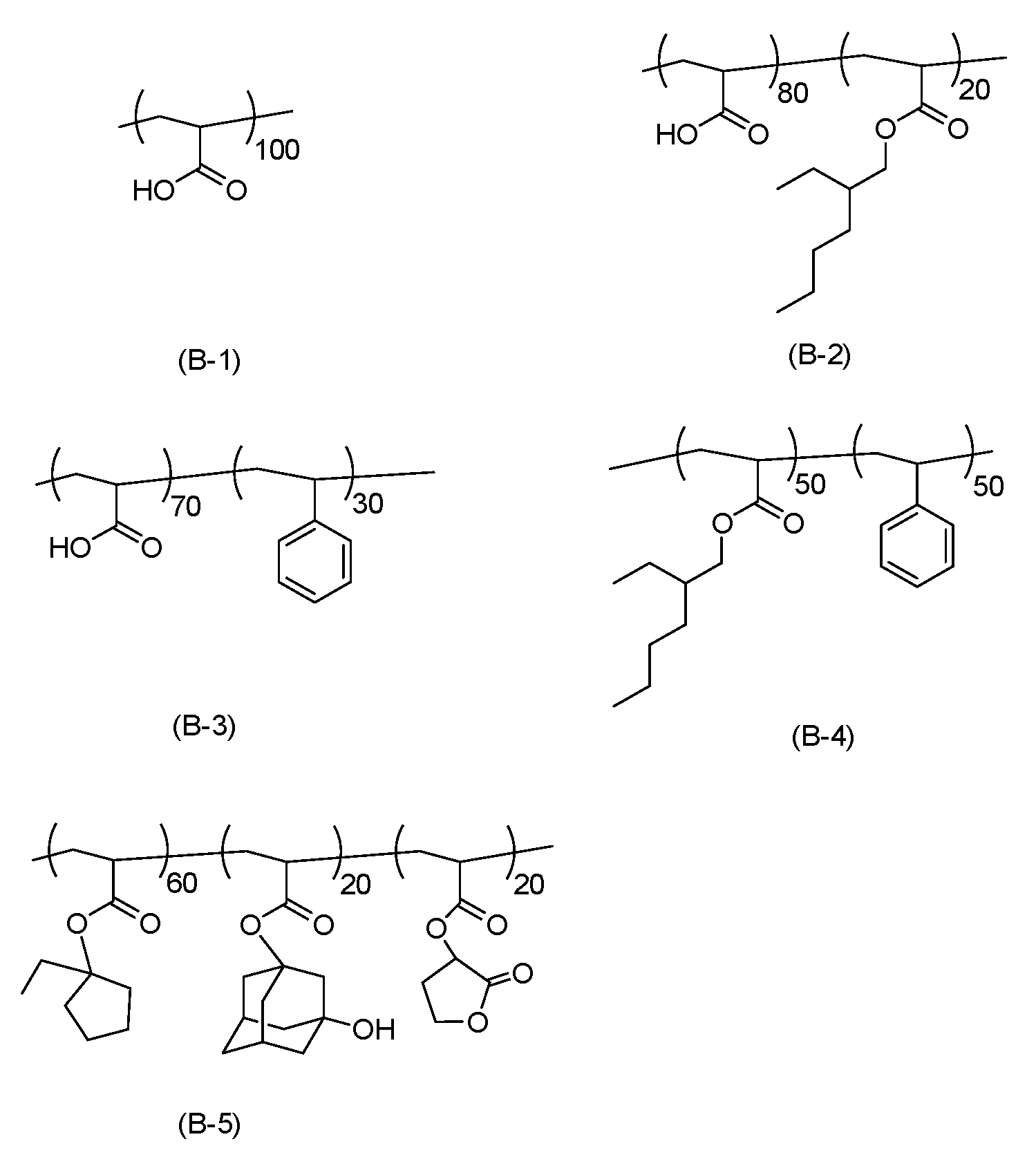
[合成例2-1](重合体(B-2)の合成)
アクリル酸63g、2-エチルヘキシルアクリレート36g及び、2,2’-アゾビス(2-メチルプロピオン酸)ジメチル21.2gを添加し、単量体溶液を調製した。反応容器に、窒素雰囲気下、メチルイソブチルケトン300gを入れ、80℃に加熱し、攪拌しながら、上記単量体溶液を3時間かけて滴下した。滴下開始を重合反応の開始時間とし、重合反応を6時間実施した後、30℃以下に冷却した。反応溶液にプロピレングリコールモノメチルエーテル300gを加え、メチルイソブチルケトンを減圧濃縮により除去し、重合体(B-2)のプロピレングリコールモノメチルエーテル溶液を得た。重合体(B-2)のMwは6,500であった。
アクリル酸63g、2-エチルヘキシルアクリレート36g及び、2,2’-アゾビス(2-メチルプロピオン酸)ジメチル21.2gを添加し、単量体溶液を調製した。反応容器に、窒素雰囲気下、メチルイソブチルケトン300gを入れ、80℃に加熱し、攪拌しながら、上記単量体溶液を3時間かけて滴下した。滴下開始を重合反応の開始時間とし、重合反応を6時間実施した後、30℃以下に冷却した。反応溶液にプロピレングリコールモノメチルエーテル300gを加え、メチルイソブチルケトンを減圧濃縮により除去し、重合体(B-2)のプロピレングリコールモノメチルエーテル溶液を得た。重合体(B-2)のMwは6,500であった。
[合成例2-2](重合体(B-3)の合成)
アクリル酸66g、スチレン34g及び、2,2’-アゾビス(2-メチルプロピオン酸)ジメチル25.1gを添加し、単量体溶液を調製した。反応容器に、窒素雰囲気下、メチルイソブチルケトン300gを入れ、80℃に加熱し、攪拌しながら、上記単量体溶液を3時間かけて滴下した。滴下開始を重合反応の開始時間とし、重合反応を6時間実施した後、30℃以下に冷却した。反応溶液にプロピレングリコールモノメチルエーテル300gを加え、メチルイソブチルケトンを減圧濃縮により除去し、重合体(B-3)のプロピレングリコールモノメチルエーテル溶液を得た。重合体(B-3)のMwは5,300であった。
アクリル酸66g、スチレン34g及び、2,2’-アゾビス(2-メチルプロピオン酸)ジメチル25.1gを添加し、単量体溶液を調製した。反応容器に、窒素雰囲気下、メチルイソブチルケトン300gを入れ、80℃に加熱し、攪拌しながら、上記単量体溶液を3時間かけて滴下した。滴下開始を重合反応の開始時間とし、重合反応を6時間実施した後、30℃以下に冷却した。反応溶液にプロピレングリコールモノメチルエーテル300gを加え、メチルイソブチルケトンを減圧濃縮により除去し、重合体(B-3)のプロピレングリコールモノメチルエーテル溶液を得た。重合体(B-3)のMwは5,300であった。
[合成例2-3](重合体(B-4)の合成)
2-エチルヘキシルアクリレート65g、スチレン35g及び、2,2’-アゾビス(2-メチルプロピオン酸)ジメチル15.2gを添加し、単量体溶液を調製した。反応容器に、窒素雰囲気下、メチルイソブチルケトン300gを入れ、80℃に加熱し、攪拌しながら、上記単量体溶液を3時間かけて滴下した。滴下開始を重合反応の開始時間とし、重合反応を6時間実施した後、30℃以下に冷却した。反応溶液に酢酸プロピレングリコールモノメチルエーテル300gを加え、メチルイソブチルケトンを減圧濃縮により除去し、重合体(B-4)の酢酸プロピレングリコールモノメチルエーテル溶液を得た。重合体(B-4)のMwは5,800であった。
2-エチルヘキシルアクリレート65g、スチレン35g及び、2,2’-アゾビス(2-メチルプロピオン酸)ジメチル15.2gを添加し、単量体溶液を調製した。反応容器に、窒素雰囲気下、メチルイソブチルケトン300gを入れ、80℃に加熱し、攪拌しながら、上記単量体溶液を3時間かけて滴下した。滴下開始を重合反応の開始時間とし、重合反応を6時間実施した後、30℃以下に冷却した。反応溶液に酢酸プロピレングリコールモノメチルエーテル300gを加え、メチルイソブチルケトンを減圧濃縮により除去し、重合体(B-4)の酢酸プロピレングリコールモノメチルエーテル溶液を得た。重合体(B-4)のMwは5,800であった。
[合成例2-4](重合体(B-5)の合成)
1-エチルシクロペンチルアクリレート43g、3-ヒドロキシトリシクロ(3.3.1.13,7)デカン-1-イルアクリレート33g、2-オキソテトラヒドロフラン-3-イルアクリレート24g及び、2,2’-アゾビス(2-メチルプロピオン酸)ジメチル16.2gを添加し、単量体溶液を調製した。反応容器に、窒素雰囲気下、メチルイソブチルケトン300gを入れ、80℃に加熱し、攪拌しながら、上記単量体溶液を3時間かけて滴下した。滴下開始を重合反応の開始時間とし、重合反応を6時間実施した後、30℃以下に冷却した。反応溶液に酢酸プロピレングリコールモノメチルエーテル300gを加え、メチルイソブチルケトンを減圧濃縮により除去し、重合体(B-5)の酢酸プロピレングリコールモノメチルエーテル溶液を得た。重合体(B-5)のMwは6,600であった。
1-エチルシクロペンチルアクリレート43g、3-ヒドロキシトリシクロ(3.3.1.13,7)デカン-1-イルアクリレート33g、2-オキソテトラヒドロフラン-3-イルアクリレート24g及び、2,2’-アゾビス(2-メチルプロピオン酸)ジメチル16.2gを添加し、単量体溶液を調製した。反応容器に、窒素雰囲気下、メチルイソブチルケトン300gを入れ、80℃に加熱し、攪拌しながら、上記単量体溶液を3時間かけて滴下した。滴下開始を重合反応の開始時間とし、重合反応を6時間実施した後、30℃以下に冷却した。反応溶液に酢酸プロピレングリコールモノメチルエーテル300gを加え、メチルイソブチルケトンを減圧濃縮により除去し、重合体(B-5)の酢酸プロピレングリコールモノメチルエーテル溶液を得た。重合体(B-5)のMwは6,600であった。
<組成物の調製>
組成物の調製に用いた[A]重合体、[B]重合体、[C]溶媒、[D]架橋剤及び[E]酸発生剤について以下に示す。
組成物の調製に用いた[A]重合体、[B]重合体、[C]溶媒、[D]架橋剤及び[E]酸発生剤について以下に示す。
[[A]重合体]
上記合成した重合体(A-1)~(A-11)
上記合成した重合体(A-1)~(A-11)
[[B]重合体]
実施例:重合体(B-1)~(B-5)
比較例:重合体(B-2)~(B-4)
実施例:重合体(B-1)~(B-5)
比較例:重合体(B-2)~(B-4)
[[C]溶媒]
C-1:酢酸プロピレングリコールモノメチルエーテル
C-2:プロピレングリコールモノメチルエーテル
C-3:4-メチル-2-ペンタノール
C-1:酢酸プロピレングリコールモノメチルエーテル
C-2:プロピレングリコールモノメチルエーテル
C-3:4-メチル-2-ペンタノール
[[D]架橋剤]
D-1:下記式(D-1)で表される化合物
D-2:下記式(D-2)で表される化合物
D-1:下記式(D-1)で表される化合物
D-2:下記式(D-2)で表される化合物
[[E]酸発生剤]
E-1:下記式(E-1)で表される化合物
E-2:下記式(E-2)で表される化合物
E-3:下記式(E-3)で表される化合物
E-1:下記式(E-1)で表される化合物
E-2:下記式(E-2)で表される化合物
E-3:下記式(E-3)で表される化合物
[実施例1]
[A]重合体としての(A-1)100質量部、[C]溶媒としての(C-2)1100質量部、(C-3)200質量部(重合体(A-1)の4-メチル-2-ペンタノール溶液に含まれる4-メチル-2-ペンタノールも含む。)に溶解した。得られた溶液を孔径0.45μmのポリテトラフルオロエチレン(PTFE)メンブランフィルターでろ過して、組成物(J-1)を調製した。
[A]重合体としての(A-1)100質量部、[C]溶媒としての(C-2)1100質量部、(C-3)200質量部(重合体(A-1)の4-メチル-2-ペンタノール溶液に含まれる4-メチル-2-ペンタノールも含む。)に溶解した。得られた溶液を孔径0.45μmのポリテトラフルオロエチレン(PTFE)メンブランフィルターでろ過して、組成物(J-1)を調製した。
[実施例2~24及び比較例1~3]
下記表1に示す種類及び含有量の各成分を使用したこと以外は、実施例1と同様にして組成物(J-2)~(J-24)及び(CJ-1)~(CJ-3)を調製した。表1中の「A、B、D、E」の列における「-」は、該当する成分を使用しなかったことを示す。
下記表1に示す種類及び含有量の各成分を使用したこと以外は、実施例1と同様にして組成物(J-2)~(J-24)及び(CJ-1)~(CJ-3)を調製した。表1中の「A、B、D、E」の列における「-」は、該当する成分を使用しなかったことを示す。
<評価>
上記調製した組成物を用いて、以下の方法により、耐溶媒性、除去容易性及びレジストパターンの矩形性を評価した。評価結果を下記表2に示す。
上記調製した組成物を用いて、以下の方法により、耐溶媒性、除去容易性及びレジストパターンの矩形性を評価した。評価結果を下記表2に示す。
[耐溶媒性]
上記調製した組成物を、12インチシリコンウェハ上に、スピンコーター(東京エレクトロン(株)の「CLEAN TRACK ACT12」)による回転塗工法により塗工した。次に、大気雰囲気下にて、250℃で60秒間加熱した後、23℃で60秒間冷却することにより、平均厚み5nmのレジスト下層膜を形成し、基板上にレジスト下層膜が形成されたレジスト下層膜付き基板を得た。上記得られたレジスト下層膜付き基板をシクロヘキサノン(23℃)に1分間浸漬した。浸漬前後の平均膜厚を測定した。浸漬前のレジスト下層膜の平均厚みをX0、浸漬後のレジスト下層膜の平均厚みをXとして、(X-X0)×100/X0で求められる数値の絶対値を算出し、膜厚変化率(%)とした。溶媒耐性は、膜厚変化率が1%未満の場合は「A」(良好)と、1%以上10%未満の場合は「B」(やや良好)と、10%以上の場合は「C」(不良)と評価した。
上記調製した組成物を、12インチシリコンウェハ上に、スピンコーター(東京エレクトロン(株)の「CLEAN TRACK ACT12」)による回転塗工法により塗工した。次に、大気雰囲気下にて、250℃で60秒間加熱した後、23℃で60秒間冷却することにより、平均厚み5nmのレジスト下層膜を形成し、基板上にレジスト下層膜が形成されたレジスト下層膜付き基板を得た。上記得られたレジスト下層膜付き基板をシクロヘキサノン(23℃)に1分間浸漬した。浸漬前後の平均膜厚を測定した。浸漬前のレジスト下層膜の平均厚みをX0、浸漬後のレジスト下層膜の平均厚みをXとして、(X-X0)×100/X0で求められる数値の絶対値を算出し、膜厚変化率(%)とした。溶媒耐性は、膜厚変化率が1%未満の場合は「A」(良好)と、1%以上10%未満の場合は「B」(やや良好)と、10%以上の場合は「C」(不良)と評価した。
[除去容易性]
上記調製した組成物を、12インチシリコンウェハ上に、スピンコーター(東京エレクトロン(株)の「CLEAN TRACK ACT12」)による回転塗工法により塗工した。次に、大気雰囲気下にて、250℃で60秒間加熱した後、23℃で60秒間冷却することにより、平均厚み5nmのレジスト下層膜を形成し、基板上にレジスト下層膜が形成されたレジスト下層膜付き基板を得た。上記得られたレジスト下層膜付き基板を2.38質量%のテトラメチルアンモニウムヒドロキシド水溶液(20℃~25℃)、に60秒間浸漬した後、水で洗浄し、乾燥することにより、評価用基板を得た。上記得られた各評価用基板の断面について、電界放出形走査電子顕微鏡((株)日立ハイテクノロジーズの「SU8220」)を用いて15万倍に拡大して観察し、レジスト下層膜が残存していない場合は「A」(良好)と、レジスト下層膜が残存している場合は「B」(不良)と評価した。
上記調製した組成物を、12インチシリコンウェハ上に、スピンコーター(東京エレクトロン(株)の「CLEAN TRACK ACT12」)による回転塗工法により塗工した。次に、大気雰囲気下にて、250℃で60秒間加熱した後、23℃で60秒間冷却することにより、平均厚み5nmのレジスト下層膜を形成し、基板上にレジスト下層膜が形成されたレジスト下層膜付き基板を得た。上記得られたレジスト下層膜付き基板を2.38質量%のテトラメチルアンモニウムヒドロキシド水溶液(20℃~25℃)、に60秒間浸漬した後、水で洗浄し、乾燥することにより、評価用基板を得た。上記得られた各評価用基板の断面について、電界放出形走査電子顕微鏡((株)日立ハイテクノロジーズの「SU8220」)を用いて15万倍に拡大して観察し、レジスト下層膜が残存していない場合は「A」(良好)と、レジスト下層膜が残存している場合は「B」(不良)と評価した。
<EUV露光用レジスト組成物の調製>
EUV露光用レジスト組成物(R-1)は、4-ヒドロキシスチレンに由来する構造単位(1)、スチレンに由来する構造単位(2)及び4-t-ブトキシスチレンに由来する構造単位(3)(各構造単位の含有割合は、(1)/(2)/(3)=65/5/30(モル%))を有する重合体100質量部と、感放射線性酸発生剤としてのトリフェニルスルホニウムトリフオロメタンスルホネート1.0質量部と、溶媒としての乳酸エチル4,400質量部及びプロピレングリコールモノメチルエーテルアセテート1,900質量部とを混合し、得られた溶液を孔径0.2μmのフィルターでろ過することで得た。
EUV露光用レジスト組成物(R-1)は、4-ヒドロキシスチレンに由来する構造単位(1)、スチレンに由来する構造単位(2)及び4-t-ブトキシスチレンに由来する構造単位(3)(各構造単位の含有割合は、(1)/(2)/(3)=65/5/30(モル%))を有する重合体100質量部と、感放射線性酸発生剤としてのトリフェニルスルホニウムトリフオロメタンスルホネート1.0質量部と、溶媒としての乳酸エチル4,400質量部及びプロピレングリコールモノメチルエーテルアセテート1,900質量部とを混合し、得られた溶液を孔径0.2μmのフィルターでろ過することで得た。
[パターン矩形性(EUV露光)]
12インチシリコンウェハ上に、有機下層膜形成用材料(JSR(株)の「HM8006」)をスピンコーター(東京エレクトロン(株)の「CLEAN TRACK ACT12」)による回転塗工法により塗工した後、250℃で60秒間加熱を行うことにより平均厚み100nmの有機下層膜を形成した。この有機下層膜上に、ケイ素含有膜形成用組成物(JSR(株)の「NFC SOG080」)を塗工し、220℃で60秒間加熱した後、23℃で30秒間冷却することにより平均厚み20nmのケイ素含有膜を形成した。上記形成したケイ素含有膜上に、上記調製した組成物を塗工し、250℃で60秒間加熱した後、23℃で30秒間冷却することにより平均厚み5nmのレジスト下層膜を形成した。上記形成したレジスト下層膜上に、EUV露光用レジスト組成物(R-1)を塗工し、130℃で60秒間加熱した後、23℃で30秒間冷却することにより平均厚み50nmのレジスト膜を形成した。次いで、EUVスキャナー(ASML社の「TWINSCAN NXE:3300B」(NA0.3、シグマ0.9、クアドルポール照明、ウェハ上寸法が線幅16nmの1対1ラインアンドスペースのマスク)を用いてレジスト膜に極端紫外線を照射した。極端紫外線の照射後、基板を110℃で60秒間加熱を行い、次いで23℃で60秒間冷却した。その後、2.38質量%のテトラメチルアンモニウムヒドロキシド水溶液(20℃~25℃)を用い、パドル法により現像した後、水で洗浄し、乾燥することにより、レジストパターンが形成された評価用基板を得た。上記評価用基板のレジストパターンの測長及び観察には走査型電子顕微鏡((株)日立ハイテクノロジーズの「SU8220」)を用いた。パターン矩形性は、パターンの断面形状が矩形である場合を「A」(良好)と、パターンの断面に裾引きがある場合を「B」(やや良好)と、パターンに残渣(欠陥)がある場合を「C」(不良)と評価した。
12インチシリコンウェハ上に、有機下層膜形成用材料(JSR(株)の「HM8006」)をスピンコーター(東京エレクトロン(株)の「CLEAN TRACK ACT12」)による回転塗工法により塗工した後、250℃で60秒間加熱を行うことにより平均厚み100nmの有機下層膜を形成した。この有機下層膜上に、ケイ素含有膜形成用組成物(JSR(株)の「NFC SOG080」)を塗工し、220℃で60秒間加熱した後、23℃で30秒間冷却することにより平均厚み20nmのケイ素含有膜を形成した。上記形成したケイ素含有膜上に、上記調製した組成物を塗工し、250℃で60秒間加熱した後、23℃で30秒間冷却することにより平均厚み5nmのレジスト下層膜を形成した。上記形成したレジスト下層膜上に、EUV露光用レジスト組成物(R-1)を塗工し、130℃で60秒間加熱した後、23℃で30秒間冷却することにより平均厚み50nmのレジスト膜を形成した。次いで、EUVスキャナー(ASML社の「TWINSCAN NXE:3300B」(NA0.3、シグマ0.9、クアドルポール照明、ウェハ上寸法が線幅16nmの1対1ラインアンドスペースのマスク)を用いてレジスト膜に極端紫外線を照射した。極端紫外線の照射後、基板を110℃で60秒間加熱を行い、次いで23℃で60秒間冷却した。その後、2.38質量%のテトラメチルアンモニウムヒドロキシド水溶液(20℃~25℃)を用い、パドル法により現像した後、水で洗浄し、乾燥することにより、レジストパターンが形成された評価用基板を得た。上記評価用基板のレジストパターンの測長及び観察には走査型電子顕微鏡((株)日立ハイテクノロジーズの「SU8220」)を用いた。パターン矩形性は、パターンの断面形状が矩形である場合を「A」(良好)と、パターンの断面に裾引きがある場合を「B」(やや良好)と、パターンに残渣(欠陥)がある場合を「C」(不良)と評価した。
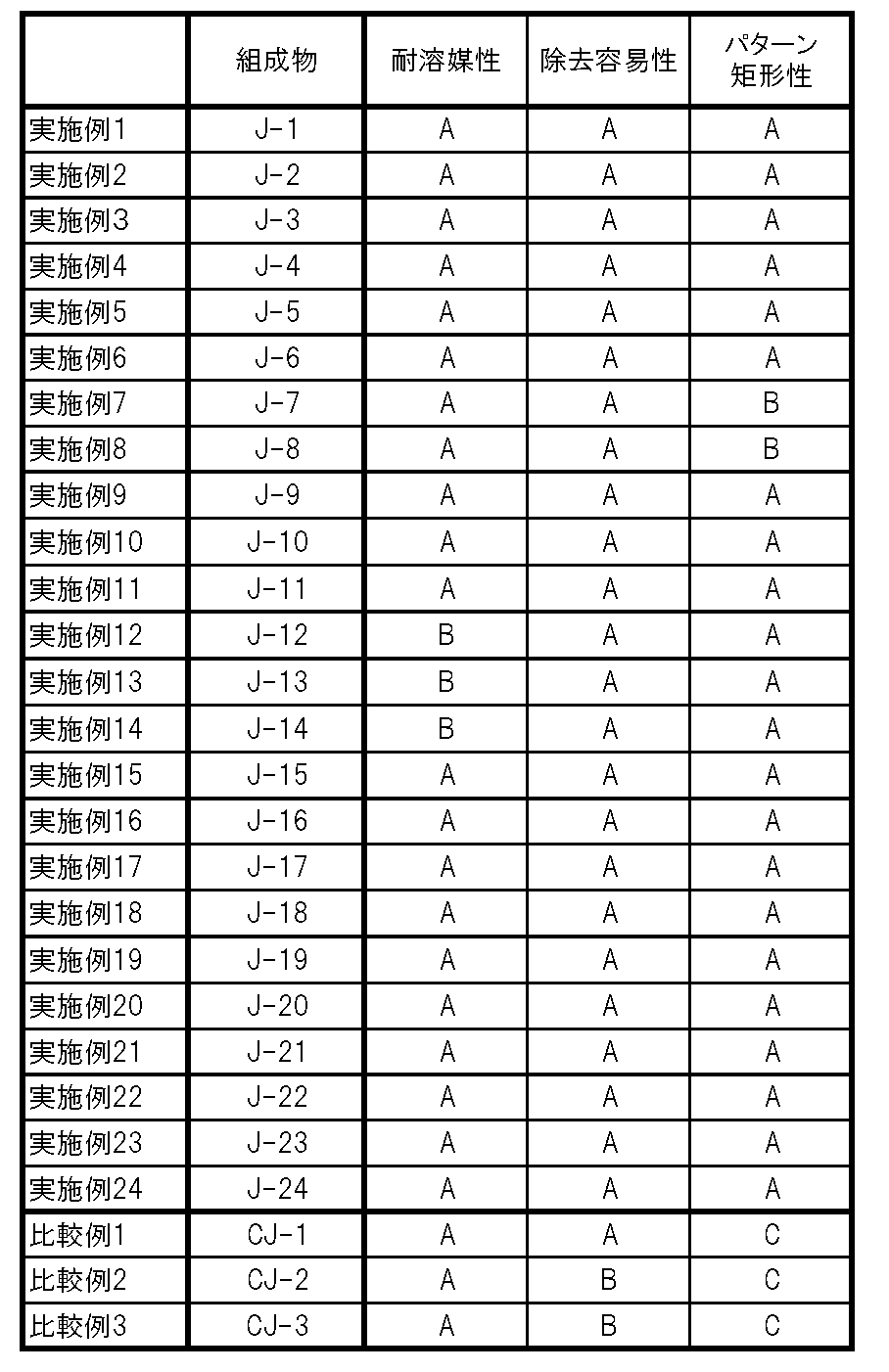
表2の結果から分かるように、実施例の組成物から形成されたレジスト下層膜は、比較例の組成物から形成されたレジスト下層膜と比較して、耐溶媒性、除去容易性及びパターン矩形性に優れていた。
本発明の半導体基板の製造方法によれば、耐溶媒性及びパターン矩形性に優れるレジスト下層膜を形成可能なレジスト下層膜形成用組成物を用いるため、半導体基板を効率的に製造することができる。本発明のレジスト下層膜形成用組成物によれば、耐溶媒性及びパターン矩形性に優れる膜を形成することができる。また、本発明のレジスト下層膜形成用組成物によれば、半導体基板等の製造工程における現像プロセスにおいて、レジスト膜とともにレジスト下層膜を除去することもできるため、除去容易性に優れる膜を形成することができる。従って、これらは、今後さらに微細化が進行すると予想される半導体デバイスの製造等に好適に用いることができる。
Claims (14)
- 基板に直接又は間接にレジスト下層膜形成用組成物を塗工する工程と、
上記レジスト下層膜形成用組成物塗工工程により形成されたレジスト下層膜にレジスト膜形成用組成物を塗工する工程と、
上記レジスト膜形成用組成物塗工工程により形成されたレジスト膜を放射線により露光する工程と、
少なくとも上記露光されたレジスト膜を現像する工程と
を備え、
上記レジスト下層膜形成用組成物が、
スルホン酸基を含む重合体と、
溶媒と
を含有する、半導体基板の製造方法。 - 上記重合体が、下記式(1)で表される繰り返し単位を有する、請求項1に記載の半導体基板の製造方法。

- 上記放射線が極端紫外線である、請求項1又は2に記載の半導体基板の製造方法。
- 上記露光されたレジスト膜を現像する工程において、さらに、上記レジスト下層膜の一部を現像する、請求項1~3のいずれか1項に記載の半導体基板の製造方法。
- 上記露光されたレジスト膜を現像する工程において用いられる現像液が、塩基性液である、請求項1~4のいずれか1項に記載の半導体基板の製造方法。
- レジスト下層膜形成用組成物塗工工程前に、
基板に直接又は間接にケイ素含有膜を形成する工程をさらに備える、請求項1~5のいずれか1項に記載の半導体基板の製造方法。 - スルホン酸基を含む重合体と、
溶媒と
を含有する、レジスト下層膜形成用組成物。 - 上記重合体が、下記式(1)で表される繰り返し単位を有する、請求項7に記載のレジスト下層膜形成用組成物。
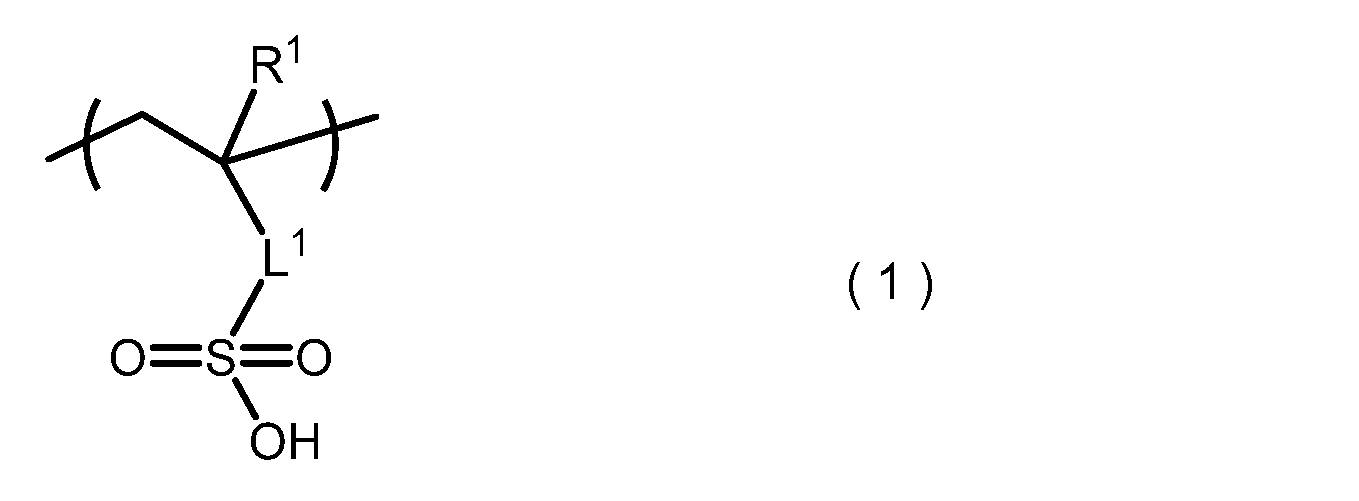
- 上記式(1)中、L1で表される2価の連結基が、2価の炭化水素基、カルボニル基、酸素原子、イミノ基又はこれらの組み合わせである、請求項8に記載のレジスト下層膜形成用組成物。
- 上記重合体が、下記式(2)で表される繰り返し単位をさらに有する、請求項8又は9に記載のレジスト下層膜形成用組成物。
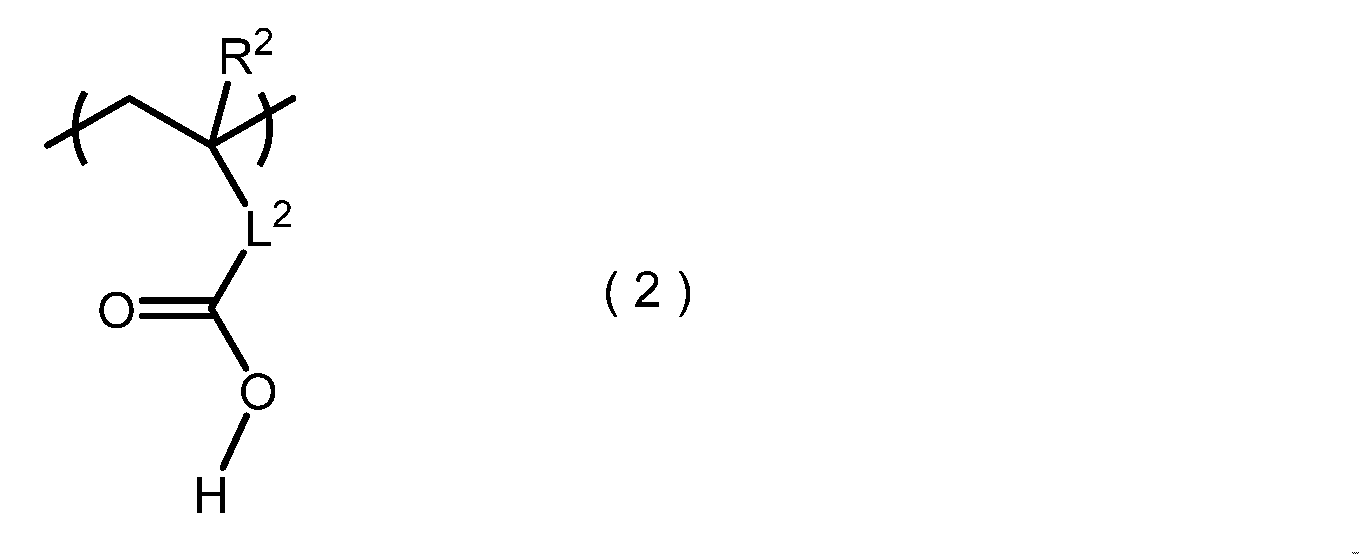
- 上記重合体が、下記式(3)で表される繰り返し単位(上記式(2)である場合を除く。)をさらに有する、請求項8~10のいずれか1項に記載のレジスト下層膜形成用組成物。
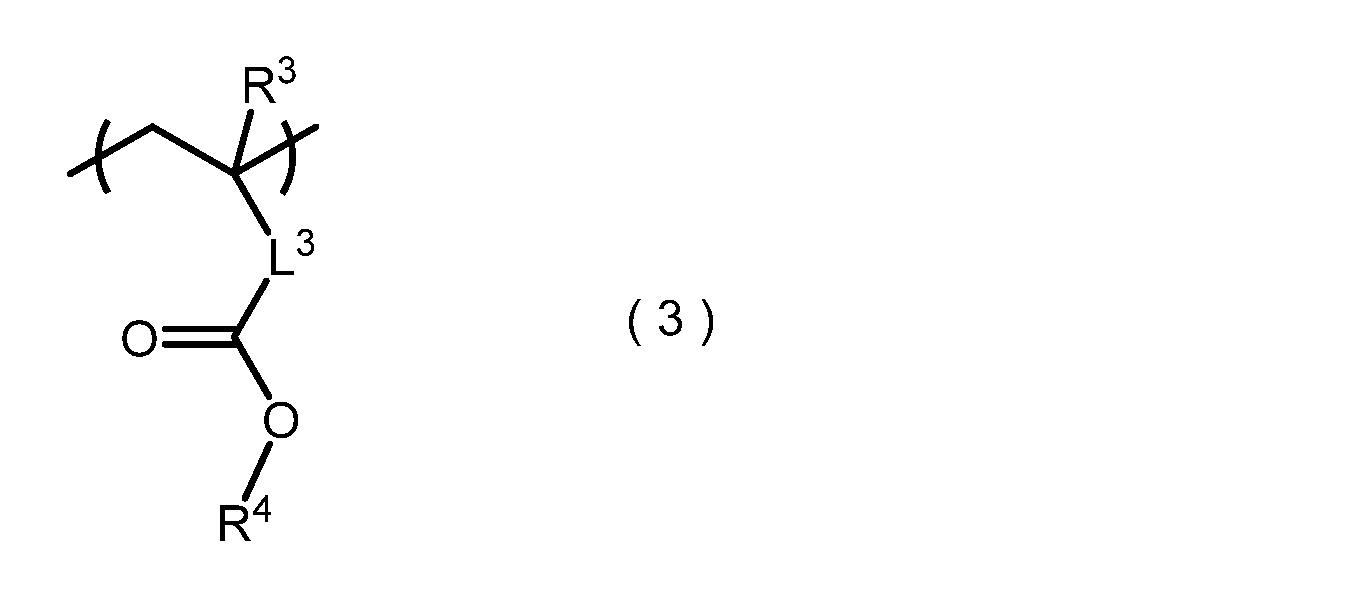
- 上記重合体が、下記式(4)で表される繰り返し単位(上記式(1)、上記式(2)及び上記式(3)である場合を除く。)をさらに有する、請求項8~11のいずれか1項に記載のレジスト下層膜形成用組成物。

- 上記重合体を構成する全繰り返し単位に占める上記式(1)で表される繰り返し単位の含有割合が1モル%以上70モル%以下である、請求項8~12のいずれか1項に記載のレジスト下層膜形成用組成物。
- 上記レジスト下層膜形成用組成物中の上記溶媒以外の成分に占める上記重合体の含有割合が1質量%以上である、請求項7~13のいずれか1項に記載のレジスト下層膜形成用組成物。
Applications Claiming Priority (2)
| Application Number | Priority Date | Filing Date | Title |
|---|---|---|---|
| JP2021045762 | 2021-03-19 | ||
| JP2021-045762 | 2021-03-19 |
Publications (1)
| Publication Number | Publication Date |
|---|---|
| WO2022196485A1 true WO2022196485A1 (ja) | 2022-09-22 |
Family
ID=83320581
Family Applications (1)
| Application Number | Title | Priority Date | Filing Date |
|---|---|---|---|
| PCT/JP2022/010261 Ceased WO2022196485A1 (ja) | 2021-03-19 | 2022-03-09 | 半導体基板の製造方法及びレジスト下層膜形成用組成物 |
Country Status (2)
| Country | Link |
|---|---|
| TW (1) | TW202239786A (ja) |
| WO (1) | WO2022196485A1 (ja) |
Citations (3)
| Publication number | Priority date | Publication date | Assignee | Title |
|---|---|---|---|---|
| JP2008239646A (ja) * | 2007-03-23 | 2008-10-09 | Jsr Corp | 上層反射防止膜形成用樹脂及び上層反射防止膜形成用組成物並びにレジストパターン形成方法 |
| JP2009511969A (ja) * | 2005-10-13 | 2009-03-19 | インターナショナル・ビジネス・マシーンズ・コーポレーション | 193nmの放射波長において低屈折率を有する上面反射防止コーティング組成物 |
| JP2010237491A (ja) * | 2009-03-31 | 2010-10-21 | Nissan Chem Ind Ltd | レジスト下層膜形成組成物及びそれを用いたレジストパターンの形成方法 |
-
2022
- 2022-03-09 WO PCT/JP2022/010261 patent/WO2022196485A1/ja not_active Ceased
- 2022-03-15 TW TW111109319A patent/TW202239786A/zh unknown
Patent Citations (3)
| Publication number | Priority date | Publication date | Assignee | Title |
|---|---|---|---|---|
| JP2009511969A (ja) * | 2005-10-13 | 2009-03-19 | インターナショナル・ビジネス・マシーンズ・コーポレーション | 193nmの放射波長において低屈折率を有する上面反射防止コーティング組成物 |
| JP2008239646A (ja) * | 2007-03-23 | 2008-10-09 | Jsr Corp | 上層反射防止膜形成用樹脂及び上層反射防止膜形成用組成物並びにレジストパターン形成方法 |
| JP2010237491A (ja) * | 2009-03-31 | 2010-10-21 | Nissan Chem Ind Ltd | レジスト下層膜形成組成物及びそれを用いたレジストパターンの形成方法 |
Also Published As
| Publication number | Publication date |
|---|---|
| TW202239786A (zh) | 2022-10-16 |
Similar Documents
| Publication | Publication Date | Title |
|---|---|---|
| TWI308993B (en) | Photoresist composition and method of forming the same | |
| CN103582665B (zh) | 底层组合物及其方法 | |
| JP5673960B2 (ja) | 感光性レジスト下層膜形成組成物 | |
| JP7439823B2 (ja) | レジスト下層膜形成用組成物、レジスト下層膜、レジスト下層膜の形成方法及びパターニングされた基板の製造方法 | |
| KR20110013374A (ko) | 반사방지 코팅 조성물 | |
| TW200827935A (en) | Pattern formation method | |
| TW200923585A (en) | Resist underlayer coating forming composition containing branched polyhydroxystyrene | |
| WO2005085954A1 (ja) | 液浸露光用ポジ型レジスト組成物およびレジストパターンの形成方法 | |
| TWI497208B (zh) | 圖案形成方法 | |
| WO2024203160A1 (ja) | 半導体基板の製造方法及びレジスト下層膜形成用組成物 | |
| US9023585B2 (en) | Resist composition and method of forming resist pattern | |
| TWI443121B (zh) | 用於光阻底層之含芳香環的化合物、含有其之光阻底層組成物及使用其圖案化裝置之方法 | |
| TW202235471A (zh) | 半導體基板的製造方法、組成物、聚合物及聚合物的製造方法 | |
| TWI757987B (zh) | 光阻劑組成物、製造半導體裝置的方法、以及形成光阻劑圖案的方法 | |
| KR20100062629A (ko) | 반사방지 하드마스크 조성물 | |
| CN102597138B (zh) | 含硅涂料组合物及其使用方法 | |
| WO2023068075A1 (ja) | 半導体基板の製造方法及びレジスト下層膜形成用組成物 | |
| JP2023059024A (ja) | 半導体基板の製造方法及び組成物 | |
| TW201841998A (zh) | 含矽膜形成用組成物、含矽膜、圖案形成方法及聚矽氧烷 | |
| TWI881888B (zh) | 光微影用塗佈材料、阻劑材料及圖案形成方法 | |
| CN118307703B (zh) | 一种桥型结构光刻胶树脂和KrF光刻胶组合物及其制备方法 | |
| CN113204170A (zh) | 抗蚀剂底层组合物和使用所述组合物形成图案的方法 | |
| TWI911471B (zh) | 半導體基板的製造方法及抗蝕劑底層膜形成用組成物 | |
| WO2023204078A1 (ja) | 半導体基板の製造方法及びケイ素含有組成物 | |
| TW202229214A (zh) | 半導體基板的製造方法、組成物及抗蝕劑底層膜 |
Legal Events
| Date | Code | Title | Description |
|---|---|---|---|
| 121 | Ep: the epo has been informed by wipo that ep was designated in this application |
Ref document number: 22771236 Country of ref document: EP Kind code of ref document: A1 |
|
| NENP | Non-entry into the national phase |
Ref country code: DE |
|
| 122 | Ep: pct application non-entry in european phase |
Ref document number: 22771236 Country of ref document: EP Kind code of ref document: A1 |
|
| NENP | Non-entry into the national phase |
Ref country code: JP |