WO2022195934A1 - ゲーム用のコンピュータプログラム、並びにゲームシステム及びその制御方法 - Google Patents
ゲーム用のコンピュータプログラム、並びにゲームシステム及びその制御方法 Download PDFInfo
- Publication number
- WO2022195934A1 WO2022195934A1 PCT/JP2021/036479 JP2021036479W WO2022195934A1 WO 2022195934 A1 WO2022195934 A1 WO 2022195934A1 JP 2021036479 W JP2021036479 W JP 2021036479W WO 2022195934 A1 WO2022195934 A1 WO 2022195934A1
- Authority
- WO
- WIPO (PCT)
- Prior art keywords
- user
- turn
- selection
- calculation
- battle
- Prior art date
- Legal status (The legal status is an assumption and is not a legal conclusion. Google has not performed a legal analysis and makes no representation as to the accuracy of the status listed.)
- Ceased
Links
Images














Classifications
-
- A—HUMAN NECESSITIES
- A63—SPORTS; GAMES; AMUSEMENTS
- A63F—CARD, BOARD, OR ROULETTE GAMES; INDOOR GAMES USING SMALL MOVING PLAYING BODIES; VIDEO GAMES; GAMES NOT OTHERWISE PROVIDED FOR
- A63F13/00—Video games, i.e. games using an electronically generated display having two or more dimensions
- A63F13/80—Special adaptations for executing a specific game genre or game mode
- A63F13/828—Managing virtual sport teams
-
- A—HUMAN NECESSITIES
- A63—SPORTS; GAMES; AMUSEMENTS
- A63F—CARD, BOARD, OR ROULETTE GAMES; INDOOR GAMES USING SMALL MOVING PLAYING BODIES; VIDEO GAMES; GAMES NOT OTHERWISE PROVIDED FOR
- A63F13/00—Video games, i.e. games using an electronically generated display having two or more dimensions
- A63F13/60—Generating or modifying game content before or while executing the game program, e.g. authoring tools specially adapted for game development or game-integrated level editor
- A63F13/63—Generating or modifying game content before or while executing the game program, e.g. authoring tools specially adapted for game development or game-integrated level editor by the player, e.g. authoring using a level editor
-
- A—HUMAN NECESSITIES
- A63—SPORTS; GAMES; AMUSEMENTS
- A63F—CARD, BOARD, OR ROULETTE GAMES; INDOOR GAMES USING SMALL MOVING PLAYING BODIES; VIDEO GAMES; GAMES NOT OTHERWISE PROVIDED FOR
- A63F13/00—Video games, i.e. games using an electronically generated display having two or more dimensions
- A63F13/55—Controlling game characters or game objects based on the game progress
- A63F13/58—Controlling game characters or game objects based on the game progress by computing conditions of game characters, e.g. stamina, strength, motivation or energy level
-
- A—HUMAN NECESSITIES
- A63—SPORTS; GAMES; AMUSEMENTS
- A63F—CARD, BOARD, OR ROULETTE GAMES; INDOOR GAMES USING SMALL MOVING PLAYING BODIES; VIDEO GAMES; GAMES NOT OTHERWISE PROVIDED FOR
- A63F13/00—Video games, i.e. games using an electronically generated display having two or more dimensions
- A63F13/40—Processing input control signals of video game devices, e.g. signals generated by the player or derived from the environment
- A63F13/42—Processing input control signals of video game devices, e.g. signals generated by the player or derived from the environment by mapping the input signals into game commands, e.g. mapping the displacement of a stylus on a touch screen to the steering angle of a virtual vehicle
-
- A—HUMAN NECESSITIES
- A63—SPORTS; GAMES; AMUSEMENTS
- A63F—CARD, BOARD, OR ROULETTE GAMES; INDOOR GAMES USING SMALL MOVING PLAYING BODIES; VIDEO GAMES; GAMES NOT OTHERWISE PROVIDED FOR
- A63F13/00—Video games, i.e. games using an electronically generated display having two or more dimensions
- A63F13/40—Processing input control signals of video game devices, e.g. signals generated by the player or derived from the environment
- A63F13/44—Processing input control signals of video game devices, e.g. signals generated by the player or derived from the environment involving timing of operations, e.g. performing an action within a time slot
-
- A—HUMAN NECESSITIES
- A63—SPORTS; GAMES; AMUSEMENTS
- A63F—CARD, BOARD, OR ROULETTE GAMES; INDOOR GAMES USING SMALL MOVING PLAYING BODIES; VIDEO GAMES; GAMES NOT OTHERWISE PROVIDED FOR
- A63F13/00—Video games, i.e. games using an electronically generated display having two or more dimensions
- A63F13/45—Controlling the progress of the video game
-
- A—HUMAN NECESSITIES
- A63—SPORTS; GAMES; AMUSEMENTS
- A63F—CARD, BOARD, OR ROULETTE GAMES; INDOOR GAMES USING SMALL MOVING PLAYING BODIES; VIDEO GAMES; GAMES NOT OTHERWISE PROVIDED FOR
- A63F13/00—Video games, i.e. games using an electronically generated display having two or more dimensions
- A63F13/45—Controlling the progress of the video game
- A63F13/49—Saving the game status; Pausing or ending the game
-
- A—HUMAN NECESSITIES
- A63—SPORTS; GAMES; AMUSEMENTS
- A63F—CARD, BOARD, OR ROULETTE GAMES; INDOOR GAMES USING SMALL MOVING PLAYING BODIES; VIDEO GAMES; GAMES NOT OTHERWISE PROVIDED FOR
- A63F13/00—Video games, i.e. games using an electronically generated display having two or more dimensions
- A63F13/50—Controlling the output signals based on the game progress
- A63F13/53—Controlling the output signals based on the game progress involving additional visual information provided to the game scene, e.g. by overlay to simulate a head-up display [HUD] or displaying a laser sight in a shooting game
- A63F13/533—Controlling the output signals based on the game progress involving additional visual information provided to the game scene, e.g. by overlay to simulate a head-up display [HUD] or displaying a laser sight in a shooting game for prompting the player, e.g. by displaying a game menu
-
- A—HUMAN NECESSITIES
- A63—SPORTS; GAMES; AMUSEMENTS
- A63F—CARD, BOARD, OR ROULETTE GAMES; INDOOR GAMES USING SMALL MOVING PLAYING BODIES; VIDEO GAMES; GAMES NOT OTHERWISE PROVIDED FOR
- A63F13/00—Video games, i.e. games using an electronically generated display having two or more dimensions
- A63F13/80—Special adaptations for executing a specific game genre or game mode
- A63F13/812—Ball games, e.g. soccer or baseball
Definitions
- the present invention relates to a computer program, etc., for providing a type of game in which a competition progresses by a computer repeatedly calculating the behavior of an object.
- a game system that provides a type of game in which the computer repeatedly calculates the actions of objects in the game space to progress the battle
- the user can play a role such as a director in order to reflect the user's selection in the calculation of the actions of the objects.
- a game system is known in which a player can take over and give instructions at any time during the progress of a match (see, for example, Patent Document 1).
- Patent Document 1 there are game systems in which the user's selection is made to intervene when a specific situation occurs that is an important trigger in terms of the progress of the battle.
- the user may be at a loss as to when to give the instruction.
- the user leaves the opportunity for selection to the computer's judgment of the situation, there is no regularity in the opportunity for selection, and it is difficult for the user to grasp when the opportunity for selection will occur. Therefore, even if an opportunity for selection occurs at a certain timing, the user cannot grasp at what timing an opportunity for selection will occur next. Therefore, there is a possibility that sufficient strategy cannot be ensured in that selection cannot be made in consideration of the next and subsequent selection opportunities.
- a computer program for a game causes a computer of a game system to calculate behaviors of objects of a user and an opponent within a predetermined field, and By functioning as a match calculation means for advancing the match, a first turn to be the attacking side of the match and a second turn to be the defense side of the match are determined based on the calculation result of the action.
- a computer program for gaming for providing, by the computer, a game that occurs to switch between a user and the opponent, wherein the computer controls the game between the first turn and the second turn.
- selection opportunity providing means for temporarily suspending the action of the object in conjunction with the switching to provide the user with an opportunity to make a selection regarding the battle; It is configured to function as calculation control means for controlling the calculation of the battle calculation means so as to be reflected in the calculation of the battle calculation means within the target period until the turn is switched.
- a game system includes a battle calculation means for advancing a battle between the user and the opponent by calculating the actions of the objects of the user and the opponent within a predetermined field. and based on the calculation result of the action, a first turn to be the offensive side of the battle and a second turn to be the defensive side of the battle are determined between the user and the opponent
- selection opportunity granting means for stopping and granting the user an opportunity to make a selection regarding the battle; It further functions as computation control means for controlling the computation of the competition computation means so as to be reflected in the computation of the competition computation means.
- a method of controlling a game system causes a computer of a game system to calculate behaviors of objects of a user and an opponent within a predetermined field, thereby causing the interaction between the user and the opponent. function as a match calculation means for advancing the match between the players, and based on the calculation result of the action, the first turn to be the attacking side of the match and the second turn to be the defense side of the match are divided into the above-mentioned
- a method of controlling a game system for providing, by the computer, a game that occurs so as to switch between a user and the opponent, wherein the computer controls the first turn and the second turn.
- selection opportunity providing means for temporarily suspending the action of the object in conjunction with the switching to provide the user with an opportunity to make a selection regarding the battle; It further functions as calculation control means for controlling the calculation of the battle calculation means so as to be reflected in the calculation of the battle calculation means within the target period until the turn is switched.
- FIG. 4 is a diagram showing an example of a turn mechanism in a match
- FIG. 4 is a diagram showing an example of a configuration within one turn
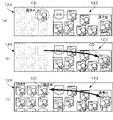
- the figure which shows an example of the screen displayed at the time of selection of a player list The figure which shows an example of the screen displayed when the display regarding a player is selected.
- the figure which shows an example of the influence which influence has on a player's parameter.
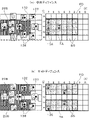
- FIG. 4 is a diagram showing an example of the relationship between attack-type tactics, arrangement of corresponding tactical marks, and target areas;
- FIG. 10 is a diagram showing an example of the relationship between the tactics of the attack area, the arrangement of the corresponding tactical marks, and the target area;
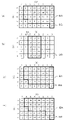
- FIG. 10 is a diagram showing an example of the relationship between defensive-type tactics, placement of corresponding tactical marks, and target areas;
- FIG. 10 is a diagram showing an example of the relationship between tactics in a defense area, placement of corresponding tactical marks, and target areas;
- FIG. 11 is a diagram showing an example of action tendencies when a change in calculation tendencies corresponding to the occurrence of an offensive tactic appears as a player's action;
- FIG. 11 is a diagram showing an example of action tendencies when a change in calculation tendencies corresponding to the occurrence of an offensive tactic appears as a player's action;
- FIG. 11 is a diagram showing
- FIG. 11 is a diagram showing an example of action tendencies when a change in calculation tendencies corresponding to the occurrence of defense-related tactics is manifested as a player's action
- FIG. 4 is a diagram showing an example of the configuration of a control system in a user device; The figure which shows an example of a structure of a battle
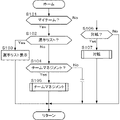
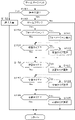
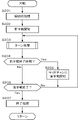
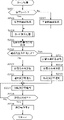
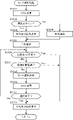
- FIG. 4 is a flowchart showing an example of a home processing procedure executed by a game control unit; 4 is a flow chart showing an example of the procedure of team management processing executed by the game control unit; 4 is a flowchart showing an example of the procedure of a battle process executed by a game control unit; 4 is a flow chart showing an example of a procedure of turn processing executed by a game control unit; 4 is a flow chart showing an example of a procedure of card selection processing executed by a game control unit; The figure which shows an example of area division of the ground in the modification which targets a baseball game.
- FIG. 47 is a diagram showing an example of correspondence of tactics to each area in FIG. 46; The figure which shows an example of the corresponding relationship of the team strategy in a modification, and the tendency of a player's action.
- FIG. 1 shows an example of the overall configuration of a game system 1 according to this embodiment.
- the game system 1 is configured as a client-server system including a plurality of user devices 3 as clients and a server 4 connected to the user devices 3 via a network NT (the Internet as an example).
- NT the Internet as an example
- the user device 3 is a device that is used by the user on a daily basis, and is an information communication terminal device that has information communication functions via the network NT.
- a smart phone 3 a or a tablet terminal 3 b having a communication function is used as the user device 3 .
- a PC (abbreviation for personal computer) may be used as the user device 3 .
- the user device 3 functions as a game terminal device that provides a user with a predetermined game by executing a predetermined game program.
- the user device 3 may be a stationary game machine for personal or home use provided as a so-called consumer game machine, or may be a portable game machine.
- a commercial game machine provided as a so-called arcade game machine can also be used as the user device 3 .
- the server 4 may be configured by appropriately combining a plurality of server units, or may be configured by a single server unit.
- the server 4 may be configured as a cloud server using cloud computing technology.
- the server 4 provides the user devices 3 with various game-related services, for example, a service of matching players to compete in the game, a service of relaying game information to be shared between the user devices 3, and the like.
- the game system 1 may be added with a commercial game machine or the like as appropriate.
- a commercial game machine may be used as a client that provides a game linked with the game provided by the user device 3 .
- a commercial game machine or the like may be used as the user device 3 for playing the game according to the present embodiment.
- a game provided via the user device 3 includes an element in which the user and the opponent compete using game media.
- the opponent may be a real user using any user device 3 or a virtual entity controlled by the computer of the user device 3 .
- the opponent is also an existence that can be included in the concept of the user.
- the opponent means a user who is the opponent of the opponent from the point of view of the person who plays the game, and it does not matter whether the user is an actual user or not. Matches don't necessarily have to be one-on-one.
- a single user may compete with a plurality of opponents at the same time, or a so-called group competition in which a group including the user competes against another group may be possible.
- Game media are media used by users to convey their intentions regarding various choices in the game.
- Game media may be expressed in various forms such as cards, items, pieces, etc., as long as the user can recognize them as objects used to convey their intentions.
- the game media may be prepared as virtual media displayed on the game screen, or may be provided to the user as physical media.
- a physical card is used as a game medium
- information recorded on the card is obtained by the user device 3, and a virtual game medium corresponding to the physical card is generated based on the obtained information. May appear in game.
- the physical medium is not limited to a flat card, and may be a three-dimensional figure or the like, and the user device 3 can acquire information recorded on these or virtual game media based thereon. It may be a configuration.
- the game medium is assumed to be a virtual medium unless otherwise specified.
- the game provided by the user device 3 may be configured as a game of an appropriate genre as long as it includes elements of competition.
- the game further includes an element in which objects act in the virtual space of the game and battle progresses based on the user's selection through the use of game media.
- the object may be anything that can be thought of as an object to act in the game.
- Game media and objects do not necessarily need to be visually distinguished. For example, when a card, which is an example of game content, appears on the game screen, a three-dimensional character, item, or the like corresponding to the card may be made to act in the game as an object, and the state of the action may be displayed on the game screen. .
- the user may directly operate an object displayed on the game screen to select its action or the like.
- the objects themselves act as game media and they are visually indistinguishable. Therefore, on the game screen, the game content and the object may be grasped as separate entities, or they may be grasped as the same entity. Selection of a game medium leads to selection of an object through this, and the two are substantially synonymous.
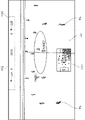
- FIG. 2 shows an example of a game screen in a soccer game.
- players PL of the user and opponents act in a virtual field FD in the same way as in real soccer.
- the battle proceeds accordingly.
- a player PL is an example of an object that operates in the virtual space of the game.
- the match here means a match in real soccer, and one match corresponds to one match in soccer.
- the game screen 100 shown in FIG. 2 is obtained by observing the action of the player PL on the field FD from a predetermined viewpoint.
- the viewpoint is automatically switched to the optimal position according to the battle situation.
- a map 101 indicating the position of the player PL in the entire field FD is displayed at the bottom center of the game screen 100, and the team names of the user and the opponent, score, elapsed time (or remaining time), etc. are displayed at the top.
- each player PL The actions of each player PL are sequentially and repeatedly calculated by the computer of the user device 3 .
- Each player PL automatically acts according to a series of calculation results, and the match progresses.
- a player card is used as an example of game media in order to reflect the user's intentions on the actions of the player PL.
- Opportunities to use player cards are given to users at appropriate times before the competition and at predetermined times during the competition.
- FIG. 3 shows the basic configuration of the game.
- the game of this embodiment also has a basic configuration in which items that can be selected by the user are hierarchically presented to the user, and processing is executed according to the user's selection.
- the game program is started up on the user device 3, a login process and other necessary processes are performed, and a home screen is displayed with a predetermined home screen.
- the user is presented with multiple selections including "My Team" and "Competition”.
- My Team is selected, the user is presented with several options including "Team Management” and "Player List”. Under “my team”, for example, selection items for the user to acquire player cards for a fee or for free, or selection items for setting various game environments may be added as appropriate.
- Player list is a selection item for the user to check the details of the player cards owned by the user.
- the user can confirm various information about the player card owned by the user.
- Team management is a selection item for the user to make various selections regarding the form of use of player cards. If “Team Management” is selected, “Players” and “Game Plan” are presented to the user as sub-selects. When “Player” is selected, the user is further presented with a number of options including “Change Player”. When “Player Substitution” is selected, the user can select placement of player cards on the field. In soccer, there are positions such as forward and midfielder, and in "player change", the user can select which player card to place in which position.
- Game Plan is a selection item for selecting tactics for battles.
- "Formation”, “Attack Type”, “Attack Area”, “Defense Type” and “Defense Area” are presented to the user as subordinate selection items. These items follow the tactics in real soccer.
- "Formation” is a selection item for setting the formation (arrangement) of player cards. For example, formations such as “3-2-3-2” and “4-3-3” can be selected.
- “Attack type”, “attack area”, “defense type” and “defense area” indicate the types (categories) for the user to select tactics in battle.
- “Attack type” and “Attack area” are selection items for the user to specify tactics belonging to the category during attack
- “Defense type” and “Defense area” are selection items for the user to specify tactics belonging to the category during defense. is a selection item to specify.
- Choices in the "game plan” affect the computation of player behavior in matches under certain conditions. Specific examples of the selection items in the "game plan” and the effect of those selections on the calculation of actions will be described later.
- FIG. 4 shows an example of a turn-based system.
- the battle is divided into a plurality of turns, with switching between offense and defense between the user and the opponent as delimiters.
- Turns include an attack turn as an example of the first turn and a defense turn as an example of the second turn. These turns occur reciprocally and simultaneously for each of the user and the opponent. That is, when the user is in the offensive turn, the opponent is in the defensive turn, and when the opponent is in the offensive turn, the user is in the defensive turn.
- Each offensive turn and defensive turn is divided into an instruction part and an action part.
- the instruction part is a part in which the user and the opponent select player cards.
- the selection of player cards in the instruction part is associated with the application of "influence” to calculations in the action part and the application of "team tactics".
- "Influence” and “Team Tactics” affect calculations in action parts. The influence is set to produce at least a favorable situation for the user. Details will be described later.
- the instruction part starts in conjunction with the turn change, and ends when the predetermined time limit elapses or, even before the time limit elapses, when the user and the opponent finish their selections. do.
- the action part the action of the player is calculated while referring to the result of selection in the instruction part, and the player automatically acts according to the calculation result.
- one offense turn and one defense turn ends, and the offense turn and defense turn are switched between the user and the opponent.
- the instruction part for the next turn will start.
- the match is divided into the first half and the second half, and the turn ends when the game time for each of the first half and the second half has passed.
- FIG. (4-1) Player Card FIG. 6 shows an example of the player list screen 110 displayed when the "player list" in FIG. 3 is selected.
- a player list screen 110 displays a list of player card CDs possessed by the user.
- the player card CD includes a player image cd1 representing the player with a face or the like, a favorite position cd2, a total parameter value cd3, and a cost cd4.
- the favorite position cd2 indicates the position in the formation that the player corresponding to the player card CD is good at using an alphabetic character string as its abbreviation.
- the parameter total value cd3 is a value obtained by synthesizing the values of various parameters set in association with the player card CD using a predetermined formula.
- the parameter total value cd3 indicates the level of the total ability of the player corresponding to the player card CD. The higher the number, the higher the ability of the player.
- the cost cd4 indicates the size of the cost required when using the player card CD in a match. The cost cd4 may be differentiated according to the player card CD so that the higher the comprehensive ability, the higher the cost.
- FIG. 7 shows an example of the team management screen 120 displayed when "team management" is selected.
- the team management screen 120 includes selection areas 121 corresponding to each of the lower selection items "Player” and "Game Plan”.
- the display content of the team management screen 120 changes according to the selection in the selection area 121 .
- FIG. 7 shows the display contents when "Player" is selected.
- the team management screen 120 of FIG. 7 includes a menu 122 showing user selectable items and a map 123 showing a soccer field.
- the positions on the formation in which the player cards CD can be arranged are set.
- a player card CD is arranged at each position.
- the arrangement of positions on the map 123 of FIG. 7 changes according to the selection of "formation" of FIG.
- Eleven player card CDs arranged at eleven positions on the map 123 constitute a deck for the battle. A player corresponding to the player card CD included in the deck becomes a player who participates in the match in the user's team.
- the content displayed on the team management screen 120 changes to the state shown in FIG.
- a group of player card CDs that can be used in a match are displayed side by side in the candidate list 124 on the left side.
- the player card CD in the candidate list 124 is at least part of the player card group owned by the user.
- Player card CDs not owned by the user may be added to the candidate list 124 as appropriate under computer control. For example, if the user does not own 11 or more player card CDs required for the match, an appropriate player card CD may be added to the candidate list 124 .
- the user touches and selects one of the player card CDs (player A's card in the illustrated example) from the candidate list 124, and the selected player card CD is displayed in FIG. 8(b).
- the player card CD player B's card in the illustrated example placed at the destination position is dragged to any position on the map 123 as shown in FIG. It will be replaced with the given player card CD.
- the user can appropriately arrange the player card CD at each of the 11 positions on the formation.
- the position as the role that each player should play on the field is also determined corresponding to the arrangement of those player card CDs.
- the computer may select a player card CD from the candidate list 124 and place it in each position while prioritizing that the position in the formation matches the good position of the player card CD.
- the player card CD may be arranged in a position different from the favored position.
- the total value of the parameters decreases for the player card CD placed in a position other than the favored position.
- the player card with the reference sign CDz in FIG. 9 is placed in a position other than the favored position, and its parameter total value is reduced.
- visual elements such as the display color of the good position and the total parameter value may be changed to clearly indicate to the user the inconsistency with the good position and the decrease in the total parameter value.
- a decrease in the total value of the parameters acts to reduce the ability of the player and limit their actions compared to when the player card CD is placed in the best position. Therefore, placing the player card CD in the best position is advantageous in the match. Therefore, it is preferable for the user to arrange player card CDs having the position as a good position for each position in the formation, and in this respect, the user can be motivated to collect various player card CDs. Even if it is possible to arrange a player card CD whose favored position matches each position, the user is free to arrange the player card CD in a position other than the favored position. For example, when a favorite player card CD is preferentially used in a match, it is possible to choose to intentionally place the player card CD in a position other than the favored position.
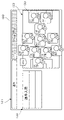
- FIG. 10 shows the display contents of the game plan setting screen 130 displayed when "game plan” is selected in team management.
- the game plan setting screen 130 includes a menu 131 including "formation”, “attack type”, “attack area”, “defense type” and “defense area” as selection items, and a map 132 showing formations on the field. .
- the selection items of the menu 131 correspond to the selection items under the "game plan” in FIG.
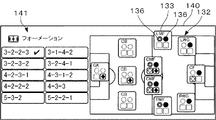
- Position indicators 133 are displayed on the map 132 according to the arrangement corresponding to the formation selected in "Formation”.
- the position indicator 133 displays positions in the formation using their abbreviations. For example, the center forward position index 133 is given “CF”, and the position index 133 corresponding to the left wing is given "LWG".
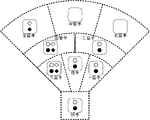
- Each position indicator 133 is provided with two circular blanks 134 and two rectangular blanks 135 . A portion of each of the blanks 134, 135 displays a tactical mark 136.
- FIG. There are four types of tactical marks 136 associated with the selection items of the menu 131, namely, “attack type”, “attack area”, “defense type” and “defense area”.
- the tactic mark 136 associates the team tactics selected by the user with the player card CD for each of the "attack type”, “attack area”, “defense type” and “defense area”. Since two blanks 134 and 135 are provided for one position indicator 133, two tactical marks 136 for the attacking side and two for the defending side are provided for one position, for a total of four tactics. A mark 136 can be set.
- the tactical mark 136 there may be positions where the tactical mark 136 is not set.
- four tactical marks 136 are set for the position index 133 of "CMF”, and no tactical mark 136 is set for each of the position indices 133 of "GK" and "CB".
- the tactical marks 136 are visually differentiated according to the corresponding team tactics.
- the appearance of the tactical mark 136 may be arbitrary as long as the corresponding relationship with selection items such as "attack type” can be identified.
- a common element is given to the tactical mark 136 between the tactics related to attacking "attack type” and “attack area”, and between the tactics related to defense “defensive type” and “defensive area", the attacking side It may be possible to identify whether the tactical mark 136 is related to offense or defense by commonly assigning to the tactical mark 136 elements different from the tactics. For example, a common element may be added, such as unifying the colors of the tactical marks 136 of the attacking side and unifying the tactical marks 136 of the defending side in a different color.
- the tactical marks 136 corresponding to the selection items are attached to the "attack type”, “attack area”, “defense type” and “defense area” of the menu 131.
- FIG. The correspondence relationship between the positions on the formation and the tactical marks 136 is appropriately changed in accordance with the selection in each of "formation”, “attack type”, “attack area”, “defense type” and “defense area”. A specific example of the change according to selection will be described later.
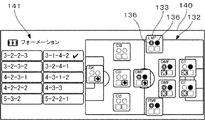
- the formation selection screen 140 includes a menu 141 showing formation candidates that can be selected by the user, and a map 132 .
- the map 132 is the same as the map 132 of FIG. 10, but the arrangement of the position indicators 133 and the corresponding relationship between the position indicators 133 and the tactical marks 136 change according to the formation selectively displayed on the menu 141.
- FIG. 11 shows the map 132 when the "3-3-3-3" formation is selected
- FIG. 12 shows the map when the "3-1-4-2" formation is selected. 132 is shown.
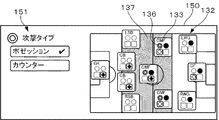
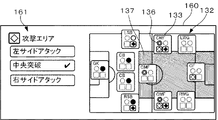
- the attack type selection screen 150 of FIG. 13 is displayed, and when “attack area” is selected, the attack area selection screen 160 of FIG.
- the defense type selection screen 170 of FIG. 15 is displayed, and when the "defense area” is selected, the defense area selection screen 180 of FIG. 16 is displayed.
- Screens 150 , 160 , 170 , 180 are common to formation selection screen 140 in that they include menus 151 , 161 , 171 , 181 indicating selection items that can be selected by the user, and map 132 . Examples of selection items are “possession” and “counter” on the attack type selection screen 150 of FIG.
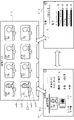
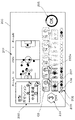
- FIG. 17 shows an example of the instruction screen 200 displayed in the instruction part of each turn during the battle.
- the instruction screen 200 includes a battle status display section 201 , a hand display section 202 , a tactic display section 203 , a cost display section 204 and a remaining time display section 205 .
- the competition status display section 201 displays the score of each team of the user and the opponent, the elapsed time of the competition, the position of the ball on the field, It is displayed so that the position of the player of the enemy friend can be identified.
- a predetermined number (five as an example) of player cards CDs that the user can select in the current instruction part are displayed as the user's hand.
- a hand is selected by a predetermined method from the user's deck, that is, 11 player card CDs arranged at each position of the formation. A specific example of selection will be described later.
- a selection mark 202a such as a check mark is attached to the player card CD selected in the hand display section 202.
- an influence map 206 is displayed in one-to-one correspondence with the player card CD.
- the influence map 206 of the selected player card CD is differentiated and displayed using a difference in brightness or the like so as to stand out more than the influence map 206 corresponding to the unselected player card CD.
- Added to the influence map 206 is an area image 207 indicating an influence area within the field set corresponding to the player card CD.
- the influence area is an area on the field where influence is generated corresponding to the selection of the player card CD.
- Influence is a concept that has a predetermined influence on the calculation of the action when the player acts within the area of influence.
- the setting position of the influence area is differentiated according to the player card CD.
- a tactical mark 136 associated with the player card CD is also displayed in the hand display section 202 .
- the player card CD and the tactical mark 136 are associated with each other by placing the player card CD at each position on the formation illustrated in FIGS. 10-16.
- the player card CD and the tactical mark 136 are associated. That is, the tactical mark 136 is not directly associated with the player card CD.
- the tactical mark 136 is associated with the player card CD through the position on the formation.
- the tactical display section 203 determines whether the user is in an offensive turn or a defensive turn is displayed by the words "attack” or "defense”.
- the tactics display section 203 displays the tactics of "attack type” and “attack area” for the attack turn, and "defense type” and “defense area” for the defense turn. ” tactics are displayed further.
- FIG. 17 it is shown that the user is in the offensive turn, “possession” is selected as the attack type, and "central breakthrough" is selected as the attack area.
- tactical marks 136 corresponding to the tactics of the offensive side or the defensive side are displayed based on the selection of the player card CD in the instruction part in accordance with the offensive turn or the defensive turn. For example, in the case of an attack turn, tactical marks 136 corresponding to "attack type” and "attack area” are displayed based on the selection of the player card CD. When the user selects one player card CD associated with the tactical mark 136 corresponding to the "attack type”, one tactical mark 136 is also displayed for the "attack type” in the tactical display section 203 correspondingly. Is displayed. The number of displayed tactical marks 136 in the tactical display section 203 corresponds to the achievement status of the tactical generation conditions.
- each tactic meets the conditions for occurrence when a predetermined number of player cards CD associated with the corresponding tactic mark 136 are selected in the instruction part, and the effect corresponding to the tactic is applied to the calculation in the action part. reflected.
- the generation condition for the "possession” tactic as the "attack type” in the tactic display section 203 is set. It is filled. However, in order to satisfy the tactic generation condition, it is sufficient to select at least two player cards CD associated with the same tactic. It is not prevented that three or more player card CDs associated with the same tactic are selected.
- the cost display portion 204 shows the cost that can be consumed in one instruction part (hereinafter sometimes referred to as the upper limit cost).
- the cost set for the selected card CD (cost cd4 in FIG. 6) is subtracted from the upper limit cost of the cost display section 204.
- FIG. Therefore, the user can select one or a plurality of player card CDs within a range not exceeding the upper limit cost.
- the maximum cost increases at appropriate times. For example, a predetermined value is added to the upper limit cost at the start of the instructed part. A maximum value may be set for the upper limit cost.
- FIG. 17 indicates that the maximum value of the upper limit cost is ten.
- the instruction part has a time limit.
- the remaining time display section 205 displays the remaining time for one instruction part, for example, in the form of a pie chart.
- the selection of the player card CD in the instruction part can be reflected in the calculations in the action part from the two perspectives of influence and team tactics.
- the user selects the player card CD in consideration of the area image 207 corresponding to the player card CD and the tactical mark 136 within the range of the upper limit cost and within the limited time in both the offensive turn and the defensive turn.
- the player card CD considering matters such as which position in the field should be the area of influence shown in the area image 207, or whether or not the selected team tactic should be generated.
- the strategic nature of the game can be enhanced, and the interest in the game can be enhanced.
- the player card CD is not directly associated with the tactics, but is associated with the tactics and the player card CD through the user's choice of position in the formation. Therefore, even if the user does not have player card CDs corresponding to various tactics, the user can set the player card CD as a game medium to be used for generating a desired tactic through selection of the position where the player card CD is to be placed. can do. Therefore, even a user who does not have enough game media can generate various tactics. As a result, many users can enjoy the strategic and playfulness of the game, which arises from the use of tactics, and the interest in the game increases.
- positions in a formation may include positions where multiple tactical marks 136 are displayed.
- a total of four tactical marks 136 are set in the position index 133 of "CMF", two for each of the offensive side and the defensive side.
- the player card CD placed in that position is associated with tactics of all categories.
- the user can display the player card CD as a necessary player card CD for generating tactics regardless of whether it is an offensive turn or a defensive turn. can be selected as Such a player card CD functions as an example of specific game media that can be used to generate effects in both offensive and defensive turns.
- the strategic value of the player card CD can be increased.
- the player card CD can be selected for the generation of tactics, compared to the case where only the player card CD that can be used for the generation of tactics is provided only in either the offensive turn or the defensive turn. It is possible to give users more opportunities. Therefore, it is possible to reduce the frequency of situations in which there is no option to generate tactics in offensive turns or defensive turns. Attack turns and defense turns occur mutually and simultaneously between the user and the opponent. , it is possible to increase the variety or flexibility of tactics in the match. As a result, the interest in the game can be further enhanced.
- one or more tactical marks 136 on the offensive side and one or more tactical marks 136 on the defensive side are required for the same position.
- Each of the one or more tactical marks 136 may be associated. It is not always necessary to associate two or more tactical marks 136 with the same position on the offensive side and/or the defensive side.
- not only the two player card CDs from the left end of the hand display section 202, but also the player card CD at the right end functions as an example of specific game media.
- one player card CD can be used as a player card CD necessary for satisfying the conditions for generating a plurality of tactics in the same turn.
- This also makes it possible to enhance the strategic value of the player card CD.
- two player cards CD from the left end of the hand display portion 202 are associated with two tactical marks 136 for each of the offensive side and the defensive side. Therefore, those player card CDs function as player card CDs for generating respective tactics of "attack type” and “attack area” in attack turns, and "defense type” and “defense area” in defensive turns. It is possible to function as a player card CD for generating each tactic.
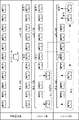
- Fig. 18 shows an example of the relationship between the deck and hand in the instruction part.
- 11 player cards in the deck are distinguished by player IDs 1-11.
- 5 player cards are randomly selected as a hand from 11 player cards in the deck.
- the remaining 6 player cards are left as a draw pile.
- the arrangement order of the six player cards in the deck is determined appropriately.
- the left end is the top of the arrangement order, and the right side is the rear of the arrangement order.
- 1 to 5 player cards are selected from the hand within the range of the upper limit cost. be. The selected player card is removed from your hand.
- the number of cards in your hand is reduced by the selected number.
- the number of player cards equal to the shortage in the hand is replenished from the deck to the hand. Replenishment is done in order from the top according to the order of the player cards in the deck.
- player cards removed from the hand in the previous turn are replenished at the back of the deck.
- FIG. 19 As described above, the influence is generated in association with the position on the formation of the player card CD selected in the instruction part.
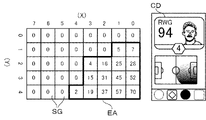
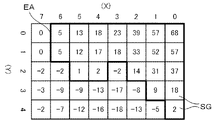
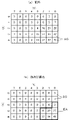
- the field FD is divided vertically and horizontally into a plurality of segments SG in a matrix.
- the front-rear direction of the field FD (the direction in which the goal faces) is indicated by the X-axis direction
- the left-right direction is indicated by the Y-axis direction.
- the segment SG may be identified by a combination of coordinate values 0 to 7 in the X-axis direction and coordinate values 0 to 4 in the Y-axis direction attached outside the field in the drawing.
- the number of divisions of the field FD in each direction is an example and may be set as appropriate.
- the example in FIG. 19 shows a small number of divisions, and in practice the field FD may be divided into many segments SG.
- the position of the player card CD on the map 123 of FIG. 7 and the position of each position index 133 shown on the map 132 of FIGS. 10 to 16 are associated with any one segment SG. Therefore, the segment SG corresponding to the player card selected in the instruction part is uniquely determined from the formation selected by the user and the player card arranged at each position on the formation.
- the abbreviations of the positions included in the position indicators 133 of FIGS. 10 to 16 do not necessarily need to be subdivided according to the number of divisions of the segment SG. For example, regarding each segment SG with coordinate values [0, 1], coordinate values [0, 2], and coordinate value [0, 3] in FIG. , the position indicator 133 may indicate "CF" indicating center forward.
- the good position associated with the player card CD does not necessarily need to be associated with the segment SG on a one-to-one basis. A plurality of segments SG adjacent to each other may be associated as good positions.
- a player card CD whose favorite position is "RWG" (abbreviation for right wing) is arranged in the RWG position on the formation, and this player card CD is displayed on the instruction screen in FIG. Assume that at 200 it is selected from the hand.
- RWG abbreviation for right wing
- each segment decreases as it moves away from the reference segment SG.
- Influence is set to SG. Influence is set in a range from 0 (minimum value) to 100 (maximum value). However, the maximum value is an example. Influence need not necessarily be limited to whole numbers.
- the influence of the segment SG corresponding to the position of the player card CD increases as the total value of the parameters of the player card CD (corresponding to the total parameter value cd3 in FIG. 6) increases within the range not exceeding the maximum value described above. is set to Also, the distribution of influence is determined in association with the player card CD.
- the range of the segment SG for which the influence greater than 0 is set corresponds to the influence area EA enclosed by the thick line in FIG.
- Influence map 206 of instruction screen 200 in FIG. 17 displays area of influence EA as area image 207 .
- the area image 207 is configured to express the magnitude distribution of the influence in a user-identifiable manner using gradation expression such as gradation, color change, and the like.
- the influence of the influence on the calculation of the action part is a basic value (hereinafter referred to as a basic value) determined by associating the value of the parameter of the player who acts within the area of influence EA with the player card. It is generated by changing from
- a basic value determined by associating the value of the parameter of the player who acts within the area of influence EA with the player card. It is generated by changing from
- the value of a player's parameter can be considered as a variable value with respect to the basic value of the parameter set to the player card, it is understood that the value of the parameter of a player card changes according to influence. is also possible. Therefore, the value of the parameter of the player card and the value of the parameter of the player are substantially synonymous. Also, as shown in FIG.
- the value after the decrease may be used as the basic value.
- the basic value of the parameter when referring to the influence is a precondition value before the change due to the influence, and may be a value changed due to other factors.
- Fig. 21 shows an example of how influence influences parameter values.
- the distribution of influence in FIG. 21 is matched to the example in FIG.
- EA the value of at least one parameter for that player increases based on influence.
- FIG. 21 shows an example in which the value of the running ability parameter of the athlete changes according to the influence.
- the running power value changes so that the magnitude of the influence is reflected in the magnitude of the increment to the base value. For example, when the influence is 15, the running power increases to 80, and when the influence is 45, the running power increases to 82, and so on.
- the relationship between the magnitude of the influence and the increment of the parameter value may be proportional, or the relationship may be such that the influence is divided into stages and the increment is changed according to the stage.
- the range of influence is 0 to 100, as shown in FIG. 80 to 100
- the correspondence relationship may be set such that the increment (number of increments) of the parameter value is increased by 1 according to each step.
- FIG. 21 is an example in which the stepwise increase of FIG. 22 is applied.
- the parameter increase according to influence is not applied only to the player corresponding to the player card that generates influence, that is, the player corresponding to the player card selected in the instruction part. If it is a player in the user's own team, the increase of the parameter according to the influence is applied as long as it acts within the area of influence.
- the players to whom the parameter change is applied may be restricted with appropriate conditions. For example, with respect to the formation position of the player card selected in the instruction part, a restriction is imposed such that the influence is applied only to the player corresponding to the player card placed in the position within a certain range. good too.
- a center forward player card is selected in the instruction part, only the center forward and left and right wing players are subject to application.
- multiple player cards may be selected.
- influence may be generated for each player card, and the distribution of influence may be determined so as to total the influence corresponding to each player card over the entire field.
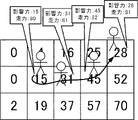
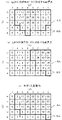
- FIG. 23 An example is shown in FIG. In FIG. 23, for example, the influence corresponding to the left center midfielder (LCMF) player card is distributed as shown in FIG. Assume the distribution as shown.
- the influence distribution as a whole may be determined as shown in FIG. For example, focusing on the segment SG (segment SG at the upper right end) of coordinate values [0, 0], the influence is 2 in FIG. has an influence of 68 as shown in FIG.
- FIGS. 24 and 25 An example is shown in FIGS. 24 and 25.
- FIG. FIG. 24 shows an example of influence distribution when the opponent selects a player card in the position of left midfielder. Since the opponent is on the opposite side of the user, the front, rear, left, and right directions are in a relationship of being reversed from that of the user.
- FIG. 24 is an example in which the distribution of FIG. 23(a) is inverted.
- the influence corresponding to the selection of the player card by the user occurs in the distribution of FIG. is expressed as a negative value, and that value is added to the influence of FIG. 23(c) for each segment.
- segments with negative influence may occur.
- the influence of the segment SG with coordinate values [3, 4] is a negative value.
- influence is not reflected in the value of the parameter for the players of the user's team. That is, influence is only used for positive influence to increase the value of a parameter with respect to the user's player, and negative influence is not used to decrease the value of the parameter.
- the parameters of the opponent's player are used only for the positive influence of increasing the value of the parameter with respect to the user's player, and the negative influence decreases the value of the opponent's player's parameter.
- the influence of negative values may be used to reduce the value of the parameter. Note that when the influence distributions based on the selections of the user and the opponent are superimposed, the influence distribution on the opponent may be a distribution in which the positive and negative influences on the user are reversed.
- the distribution of influence is predetermined for each player card.
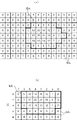
- a basic area BA A region surrounded by a thick line in the figure
- the distribution of influence within the basic region BA is set.
- each segment of the basic area BA is matched with the segment SG corresponding to the position where the player card is arranged, by matching the reference segment SGc having the maximum influence within the basic area.
- Associate SG with each segment SG of the field is excluded.
- the influence area EA can be identified and the influence of each segment SG within the influence area EA can be determined.
- the distribution of the influence is determined based on the selection of player cards by the user and the opponent in the instruction part of each turn, and the set of segments SG set with positive influence is It is determined as an area of influence EA.
- the set influence acts to increase the player's parameter when the player is positioned within the area of influence EA in the action part following the instruction part, and as a result, affects the calculation of the action of the player. give. For example, if the value of the parameter of the athlete's running ability is increased from the basic value, there is an effect that the speed when the athlete runs is faster inside the influence area EA than outside the influence area EA.
- the target period for parameter changes due to influence is the period from the start to the end of the action part within the same turn as the instruction part in which the influence was generated, in other words, the period until the next attack turn and defense turn are replaced. applicable to at least part of the applicable period.
- influence parameters may be increased for all periods of interest.
- an upper limit may be set for the number of times the parameter is increased, the time, the number of players, and the like, and the parameter value may be changed within the range that does not exceed the upper limit even within the target period.
- the influence may be changed within the target period, such as gradually decreasing the influence over time within one turn.
- the influence may exceed the target period and at least part of it will remain on the next turn.
- the influence set based on the selection in one instruction part may be applied only within the same turn including the instruction part, or may be applied over a plurality of turns.
- the influence determined based on the selection of the player card in the new turn and the influence in the previous turn are overlapped to create a new influence.
- a distribution may be defined. In that case, the influence of each segment SG in the previous turn may be superimposed as it is, or the influence of the previous turn may be reduced and superimposed. An example of the latter case is shown in FIG. If the distribution of influence in the previous turn was set as shown in FIG. obtain.
- this distribution be, for example, the distribution of residual influence.
- the remaining influence of each segment SG is added to the new influence of each segment SG determined based on the selection of the indicated part, and the obtained value is determined as the influence of each segment SG.
- the remaining influence is not limited to the example of uniformly decreasing the value, and may be determined by an appropriate method such as multiplying by a constant ratio less than one.
- influence was used as a value for increasing the parameter value for the user's player, but it is also possible to use it as a value for decreasing the parameter value for the opponent's player.
- the influence may be applied in such a manner that the value of the player's parameter is reduced by an amount equivalent to the influence.
- Changes in parameters using influence may be adjusted in consideration of various information such as positions in the formation of player cards corresponding to players located in the area of influence, or favorite positions. For example, an adjustment may be made such that the parameters of a player whose area of influence includes a good position are increased more greatly than those of other players.
- FIG. 17 As described above, in the example of FIG. 17, when the user selects two player card CDs associated with the tactical mark 136 of the same category in the instruction part, the conditions for generating the tactics of that category are satisfied. The effect according to the tactic is reflected in the calculation of the action part. There are two types of effects when a tactic occurs: a correction to the influence and a change in the calculation tendency in the action part. Influence correction is to further increase the aforementioned influence value only within the target area set in association with the tactic. On the other hand, the change in computational tendency is to change the computational tendency of the action part so that the player is more likely to act within the target area. Details will be described below in order.
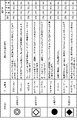
- FIG. 28 shows an example of correspondence relationships among tactic marks, tactic options in each category, player behavior tendencies, and changes in influence. 13 to 16, "Possession” and “Counter” are related to “Attack Type”, and “Center Breakthrough”, “Left Side Attack” and “Right Side Attack” are related to "Attack Area”, and "Defense Type”. ⁇ Forecheck'' and ⁇ Retreat'' are prepared for ⁇ Central Defense'' and ⁇ Side Defense'' for ⁇ Field Area'' respectively. These tactics imitate tactics that are sometimes used in real soccer. Also, the player's action tendency characterizes the calculation tendency, and the tendency is set following that of actual soccer.
- a tendency is set as a tendency to give priority to possession of the ball and to show a movement in which a teammate player supports the player who is in possession of the ball.
- priority is given to attacking forward, and a tendency is set so that teammates also actively jump forward.
- Tactics related to "attack area” are differentiated in terms of the area in which the attack is weighted. "Central breakthrough” tends to assemble an attack in the center of the field, “Right side attack” tends to deploy to the right side of the field and launch an attack, “Left side attack” tends to deploy to the left side of the field and attack are set respectively.
- the tendency is set to try to regain the ball by applying pressure from a high position (forward position) in the enemy's territory, and in the “Retreat” tactics, retreat to the own half. and the tendency to strengthen the defense is set.
- Tactics related to "defensive areas” are differentiated in terms of areas in which defense is weighted. "Central defense” tends to drive opposing players into the center of the field and try to steal the ball, while “side defense” tends to drive opposing players to the left and right sides to try to steal the ball. be done.
- the "correction rate" in Fig. 28 indicates the content of influence correction.
- the number of selected player cards CDs corresponding to the same category is distinguished between 2 and 5, and the more the number, the higher the correction rate by 20%. is set.
- the correction rate is the rate of increase for the influence set according to the user's selection. For example, if the influence before correction is 20 and the correction rate is 20%, the influence after correction is 24. The relationship between the correction rate and the number of cards is set equally for all tactics.
- FIG. 29 to 32 show the correspondence between the placement of tactical marks on the formation for each tactic and the extent of the target area on the field.
- the left side of each figure shows the map 132 illustrated in FIGS. 13 to 16 for each tactic, and the right side shows the field FD divided into segments SG following FIG. TA.
- the map 132 also displays a tactical area image 208 indicating the target area TA.
- the tactical area image 208 may be displayed to indicate the target area TA using various identification techniques such as gradation expression and color change.
- FIG. 29 corresponds to the "attack type” category, with (a) showing the correspondence in the case of "possession” and (b) showing the correspondence in the case of "counter”.
- Figure 30 corresponds to the category of "attack area", (a) is the correspondence relationship in the case of "center breakthrough", (b) is the correspondence relationship in the case of "left side attack”, (c) is the "right side attack”. The corresponding relationships in the case of "site attack” are shown respectively.
- FIG. 31 corresponds to the "defensive type” category, (a) shows the correspondence in the case of "forecheck”, and (b) shows the correspondence in the case of "retreat”.
- FIG. 32 corresponds to the category of "defensive area", (a) shows the corresponding relationship in the case of "central defense", and (b) shows the corresponding relationship in the case of "side defense”.
- the relationship between the position of the tactical mark 136 corresponding to each tactic on the formation and the target area TA is such that at least one tactical mark 136 corresponding to each tactic corresponds to each tactic. is set to be included in the target area TA.
- the target area TA is set in the range of coordinate values 3 to 5 in the X-axis direction and coordinate values 0 to 4 in the Y-axis direction.
- Tactical marks 136 corresponding to "type" are placed in three segments SG with coordinate values [4,1], [5,2] and [4,3] contained within the target area TA. That is, at least one player card placed in the position of the target area TA functions as a player card to be selected in the instruction part in order to generate the tactics associated with that player card. there is The same applies to the examples of FIGS. 30 to 32.
- the tactical marks 136 corresponding to each tactical be arranged within the target area TA.
- the "defense type” tactical marks 136 are arranged in three places in the target area TA.
- "Defense type” tactical marks 136 are also arranged at three places on the right side of the field positioned as . Therefore, if two or more forward player cards are selected in the instruction part, the tactic of "Forecheck" will occur.
- the above relationship is based on the fact that the range on the field that should be emphasized from the content of each tactic is set as the target area TA, and the position of the player expected to play an active role from the content of each tactic is selected for the generation of the tactic. It is set according to the intention of setting it as the position of the player card to be played.
- the possession tactic in real soccer is understood as a tactic of constructing an attack by connecting passes from the middle of the field. Therefore, in the “possession” tactic, the target area TA is set in the middle of the field, and the position of the midfielder is set as the position of the tactical mark 136 .
- the intention is the same with respect to "forecheck”.
- the forecheck tactic in real soccer is understood as a tactic that aims to take back the ball at a position as high as possible by applying pressure from the opponent's team. Therefore, the target area TA is set in the range from the vicinity of the middle of the field to the enemy line, and in addition to the position of the midfielder, the position of the forward is set as the position of the tactical mark 136 . Accordingly, the placement of the tactical mark 136 expresses that the forwards, in addition to the midfielders, are actively involved in the defense and act as personnel to put pressure on the opponent players.
- Influence correction further increases the influence generated according to the selection of the player card CD in the instruction part in the target area TA.
- Both the influence in the area of influence EA and the correction in the target area TA have in common that they have the effect of increasing the value of the player's parameter.
- the influence is inevitably generated in the influence area EA based on the position of the player card.
- correction by team tactics occurs when conditions for generation of team tactics are satisfied based on selection of player cards in the instruction part.
- the correction in the area of interest TA is distinguished from the generation of influence in the area of influence EA.
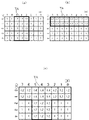
- FIG. 33(a) shows an example of distribution of influence generated according to the selection of player cards. This example is the same as the example of the influence distribution corresponding to the two player cards shown in FIG. 23(c).
- a target area TA is set near the middle of the field as shown in FIG. ), and a correction factor of 20% is applied to each segment SG included in the target area TA (see FIG. 28).
- the rate of increase in influence in each segment SG is as shown in FIG. 33(b).
- the influence of the segment SG within the target area TA is corrected to 1.2 times, and the influence of the segment SG outside the target area TA is increased by 1, that is, not corrected. Therefore, the distribution of influence after correction is as shown in FIG. 33(c).
- the fraction below the decimal point is processed by rounding off.
- the distribution of influence may be superimposed on the distribution of influence generated according to the opponent's choice.
- the influence distribution is corrected according to the generation of the user's team tactics, and the corrected influence distribution is superimposed on the opponent's influence distribution. For example, if the influence after correction is distributed as shown in FIG. 33(c) and the influence of the opponent is distributed as shown in FIG. 24, the distribution of FIG. is finally determined as the distribution of the user's influence over the players.
- Tactics from multiple categories may meet the conditions for occurrence in a single turn.
- a correction factor may be applied to the region of interest corresponding to each tactic.
- the correction factors may be totaled for the overlapped portion.
- the increase rate of each segment SG is distributed as shown in FIG. If the increase rate of each segment SG when the tactic "attack" occurs is distributed as shown in FIG. ). Since the segment SG in the range of 3 to 5 in the X coordinate and 0 to 1 in the Y coordinate overlaps the target area TA, the respective correction rates of 20% are summed and the correction rate of 40% is applied. The rate of increase is 1.4 times.
- the change in calculation tendency is to change the calculation so that the tendency of the player to act in the target area TA increases compared to the case where the tactic does not occur.
- the player's actions are calculated based on the values of various parameters set for the players, the situation of the match such as the position of the ball and each player, etc. , the obtained calculation result is reflected in the next calculation condition, and the calculation is repeated. Since the calculation includes a stochastic element, the calculation result includes an uncertain element. If the calculation conditions are the same, the same calculation results are not always obtained.
- the arithmetic result may have a certain tendency.
- a player's ball behavior such as a player's tendency to dribble first, a tendency to pass first, a tendency to spread to the sides of the field, a tendency to play in the center, a tendency to go up to the opponent's half, and a retreat to one's own half.
- a certain tendency may appear in an action related to the movement of a player, such as a tendency. It is possible to adjust the computational tendencies of a computer to produce such behavioral tendencies.
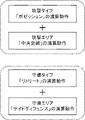
- the effect of team tactics includes correction of parameter values in the target area TA. Therefore, even if team tactics occur, if the players do not act in the target area of the tactics, the effects will not appear. In that case, the user cannot enjoy the merit of generating team tactics. Therefore, when a team tactic occurs, the calculation tendency is changed according to the tactic so that at least one player is more likely to play in the target area corresponding to that tactic. That is, as shown in FIG. 35, when team tactics have not occurred, the action of each player is calculated by normal calculation control and the action is controlled. On the other hand, when any of the tactical generation conditions is satisfied, the calculation control is changed so that the calculation tendency corresponding to that tactic is generated.
- FIG. 35 illustrates calculation tendencies corresponding to each of "possession”, "central breakthrough", “retreat” and "side defense", the calculation tendencies are differentiated for other tactics as well.
- Multiple tactics may meet the trigger conditions in a single turn.
- "attack type” tactics and "attack area” tactics are not exclusive and can occur simultaneously.
- computational control may be combined so that computational tendencies corresponding to respective tactics occur at the same time.
- the correction of influence and the change in calculation tendency described above are applied only in turns in which the conditions for generating tactics are satisfied.
- the effects of tactics generated in one turn may remain moderately in subsequent turns.
- the calculation tendency corresponding to the tactics of the attacking side may be handed over to the next and subsequent offensive turns, and the calculation tendency corresponding to the defensive tactics may be handed over to the next and subsequent defensive turns.
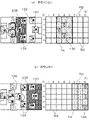
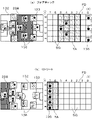
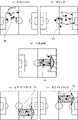
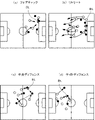
- FIG. 37 and 38 show examples in which changes in computational tendencies corresponding to the occurrence of team tactics are manifested as player actions.
- FIG. 37 shows an example of tactics in an offensive turn
- FIG. 38 shows an example of tactics in a defensive turn.
- the user's player is indicated by a white circle
- the opponent's player is indicated by a black circle
- the ball is indicated by reference symbol BL
- the actions of the players are indicated by appropriate arrows.
- FIG. 37(a) is an example of a case where the tactic of "possession" occurs, in which a teammate player supports a player holding the ball BL in his own half within a relatively close range. tend to take.
- FIG. 37(a) is an example of a case where the tactic of "possession" occurs, in which a teammate player supports a player holding the ball BL in his own half within a relatively close range. tend to take.
- FIGS. 37(c) to (e) show examples of "center breakthrough", “right side attack” and “left side attack”, respectively. In these examples, the players tend to attack by preferentially utilizing target areas in the center, right side, or left side of the field set for each tactic.
- FIG. 38(a) is an example of a case in which a "foreseek" tactic occurs, in which the user's player aggressively puts pressure on the opposing player in the opposing team to try to win back the ball BL. tend to take action.
- FIG. 38(b) is an example of a case where a "retreat” tactic occurs, in which the user's players tend to retreat early into their own half to solidify their defense.
- FIG. 38(c) is an example of a case where the "central defense" tactic occurs.
- FIG. 38(d) is an example of a case where a "side defense" tactic occurs.
- the user's player acts to drive the opposing player to the side of the field, and the opposing player's forward pass is passed by the teammate player's action to steal the ball BL. tend to take.
- the team tactics are intended to reproduce various tactics that can be adopted in real soccer in the game, and the target areas corresponding to each tactic are Even in soccer, it is set according to the range on the field that is emphasized according to the tactics.
- the tactic generation condition is satisfied, the computational tendency changes so that the tendency of the player to act in the target area increases, thereby causing the player's behavior to match the tactic set by the user. more likely.
- the user can feel as if the player is moving in accordance with the tactics set by the user, which increases the user's sense of satisfaction and understanding. Whether or not to generate each tactic is left to the selection of the player card by the user in the instruction part.
- the user can determine a good opportunity to generate a tactic and generate a tactic based on the battle situation. Furthermore, when a tactic is generated, the influence is increased and corrected in the target area, so that the player's parameters are reinforced when the player shows an action that preferentially utilizes the target area. As a result, the tactics are more likely to yield favorable results. This makes it possible for the user to feel as if his or her choice was right. Therefore, it is possible to enhance the strategy and playfulness of the game, and further enhance the interest of the game.
- the formation of the user's team and the team tactics for each category are set in a "game plan” that is separate from the battle.
- the selection of which position on the formation each player card is to be placed is also performed by "player replacement", which is separate from the battle.
- Opportunities for selection given to the user after the start of the match are opportunities to select player cards in the instruction part of each turn, change the formation and tactics, or change the position of the player cards on the formation. can't. Therefore, it is not possible to change the association between the player card and the tactics after the start of the match. Therefore, the user needs to make a strategy, set the formation and team tactics, and select the positions of the player cards before starting the match. While such a mechanism imposes restrictions on strategy planning and the choices to realize it, it is not possible to freely change it according to the situation of the match. It is possible to add the playfulness of selection to the game.
- control elements may be included in the game content. For example, at least some of the selection items in "team management" in FIG.
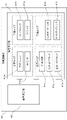
- the user device 3 is provided with a control unit 30 and a storage unit 31 .
- the control unit 30 is configured as a computer including a CPU and internal storage devices required for its operation, such as cache memory, RAM, and frame memory.
- the storage unit 31 is a storage device using a non-volatile storage medium such as a magnetic storage medium or flash memory that functions as an external storage device for the control unit 30 .
- control unit 30 Connected to the control unit 30 are an input device 32 that detects a user's operation and outputs an operation signal according to the detection result, and a display device 33 that displays a game screen or the like.
- a speaker unit for outputting sound, a communication control unit for controlling communication with the server 4, and the like are connected to the control unit 30, but they are omitted from the drawing.
- a game program Pg, game data Dg, and play data Dp are recorded in the storage unit 31 .
- the game program Pg is an application program that cooperates with the operating system that controls the basic operations of the control unit 30 to cause the control unit 30 to perform arithmetic processing and operation control necessary for the game.
- the game data Dg is data that should be appropriately referred to in controlling the game.
- the game data Dg includes, for example, player data Dg1 and setting data Dg2.
- the player data Dg1 is data describing characteristics of various players appearing in the game or player cards corresponding to those players.
- the player data Dg1 may include various parameter values associated with the player or player card, attribute information such as the player's name, image data for representing the appearance of the player, and the like.
- the selection data Dg1 may also include data for specifying the above-described player-specific influence distribution (FIG. 26(a)).
- the setting data Dg2 includes items to be set in advance in the game, such as the arrangement of position indicators 133 in each formation, the arrangement of tactical marks 136 for each formation and tactic, or the range of target areas corresponding to each tactic. may include various information about.
- the play data Dp is data for each user associated with game play by the user of the user device 3 .
- the play data Dp may include 11 player cards selected by the user, their positions on the field, and information indicating formation and tactical selections in the game plan.
- the play data Dp includes player data Dp1.
- Information for identifying the player card owned by the user is recorded in the player data Dp1.
- information indicating the current values of the parameters may be further recorded in the player data Dp1.
- the parameter values in the player data Dg1 of the game data Dg may be initial values before the user's play record is reflected.
- the above-described program Pg and game data Dg are appropriately distributed from the server 4 to the user device 3 and stored in the storage unit 31 .
- the play data Dp is appropriately updated according to the play of the game on the user device 3, and is stored in the server 4 at appropriate timing in association with the identification information of the user. Also, when the user completes authentication with the server 4 when playing the game, play data Dp corresponding to the user is provided from the server 4 to the user device 3 and stored in the storage unit 31 .
- the control unit 30 executes the game program Pg, the control unit 30 is provided with a game control section 35, a battle calculation section 36, and an image drawing section 37.
- Each part 35 to 37 is a logical device realized by cooperation of the computer hardware of the control unit 30 and the game program Pg as software.
- the game control unit 35 is in charge of various processes necessary for progressing the game according to a predetermined procedure.
- the game control unit 35 generates status data Ds for determining the status of the battle in the game, stores it in the internal storage device of the control unit 30, and appropriately updates the status data Ds as the game progresses. do.
- the status data Ds includes, for example, the progress of the match, such as the current positions of the players of the user and the opponent on the field, the position of the ball, the elapsed time of the match, and the score. Various information may be included to indicate whether the
- the battle calculation unit 36 is a logical calculation unit that operates under the control of the game control unit 35 and calculates the actions of each player in the battle.
- the game control unit 35 gives the arrangement of the player cards before the start of the battle and various selection results in each instructed part during the battle as calculation conditions to the battle calculation unit 36 to control the calculation operation.
- the game control unit 35 functions as an example of arithmetic control means.
- the battle calculation unit 36 displays the battle situation, including the actions of each player, according to the frame rate of the display device 33 based on the calculation conditions given from the game control unit 36 and information on the battle situation described in the status data Ds. Computes repeatedly in cycles.
- the battle calculation unit 36 functions as an example of battle calculation means.
- the battle calculation unit 36 is further provided with a normal calculation unit 40 and a specific calculation unit 41 in order to change the calculation tendency according to whether team tactics occur or not.
- the normal calculation unit 40 is a calculation unit that is used for calculation of a battle when no team tactics have occurred.
- the specific calculation unit 41 is a calculation unit that is used when the conditions for generating team tactics are satisfied.
- the specific calculator 41 further includes a plurality of calculators 41a to 41i. These calculation units 41a to 41i are associated one-to-one with a plurality of tactics prepared for the battle.
- the computing units 41a-41i are differentiated in their operation so as to generate computing tendencies that match the corresponding tactics.
- the computation unit 41a corresponding to "possession” is set to have its computation operation set so that the tendency for the intended action to occur in “possession” increases, and the computation unit 41b corresponding to "counter” The calculation operation is set so that the tendency for the behavior to occur is increased.
- Such computing units 41a to 41i may be configured as logical computing units using AI (artificial intelligence), for example.
- AI artificial intelligence
- the computation unit 41a corresponding to "possession” can learn a large number of cases in which the intended action occurs in possession, and acquire a computation tendency suitable for "possession".
- the other calculation units 41b to 41i may acquire calculation tendencies that match the intent of tactics.
- the match calculation section 36 of the control unit 30 of any one of the user devices 3 may representatively execute the match calculation, and the other user devices 3 may share the calculation result.
- the computation of the battle may be distributed to the control units 30 of the plurality of user devices 3 and processed.
- the server 4 may bear at least part of the following processing.
- FIG. 41 shows an example of a procedure of home processing executed when some user operation is detected while the home screen is displayed.
- the game control unit 35 first determines whether or not "my team" has been selected on the home screen (step S101), and if not, "player list” is selected. It is determined whether or not it has been (step S103).
- the game control unit 35 displays the player list screen 110 shown in FIG. 6, and appropriately controls the display contents according to the user's operation (step S103).
- step S105 determines whether or not "team management” has been selected.
- the game control unit 35 executes team management processing (step S105).
- the game control unit 35 determines whether or not another selection item in the home screen is selected as necessary, and executes processing according to the determination result. For example, a process for purchasing a player card or the like may be executed, but details thereof will be omitted.
- step S106 determines whether or not "fight" has been selected.
- step S107 the game control unit 35 executes predetermined battle processing.
- the user may be allowed to select whether to play against a real user or against a computer-controlled virtual user. If the opponent is a real user, a match is requested to the server 4 to acquire the opponent. After completing the above process, the game control unit 35 finishes the home process and waits for a new user selection.
- FIG. 42 shows an example of the team management process procedure executed in step S105 of FIG.
- the game control unit 35 first displays the team management screen 120 of FIG. It is determined whether or not (step S151). If the determination in step S151 is affirmative, the game control unit 35 executes a process of setting player cards to be placed in each position on the formation according to the user's operation as illustrated in FIG. 8 (step S152). ). When a selection item other than "player change" is selected from the display of "players" on the team management screen 120 of FIG. Details will be omitted.
- step S151 determines whether or not the user has selected the display of "game plan" on the team management screen 120 (step S153). If the determination is affirmative, the game control unit 35 allows the user to select “formation”, “attack type”, “attack area”, “defense type” and “defense area” as selection items of the "game plan”. It is determined in order whether or not it has been done (steps S154 to S157). If any item is selected, the game control unit 35 obtains the user's selection of the item selected by the user, and holds the selection result as the setting of the current game plan (steps S161 to S164). In these processes, the screens 140, 150, 160, 170, and 180 illustrated in FIGS.
- the game plan settings may be held in the status data Ds shown in FIG. 39, or may be recorded in the play data Dp as necessary.
- the game control unit 35 ends the team management process. Thereby, the display may be returned to the home screen.
- FIG. 43 shows an example of the battle process procedure executed in step S107 of FIG.
- the game control unit 35 first executes a predetermined pre-start process (step S201). For example, the processes required to start the match, such as determining the opponent, selecting the attacking side and kickoff, are executed.
- the pre-start process is complete, the game control unit 35 starts the first half of the game and starts timing the game (step S202). After that, the game control unit 35 executes a predetermined turn process (step S203).
- the game control unit 35 determines whether or not it is time to end the first half of the game (step S204). If the first half of the game has ended at the end of this turn, a positive determination is made in step S204, and if the first half has not ended or the second half has already started, a negative determination is made in step S204.
- step S204 determines whether or not the second half of the game has ended (step S206). If the second half has not ended yet, the game control unit 35 returns to the process of step S203. On the other hand, if it is determined in step S206 that the second half of the game has ended, the game control unit 35 executes predetermined end processing (step S207), and then ends the battle processing of FIG. In the process of step S207, for example, a process of displaying win/loss, score difference, and other competition results and storing the results in the play data Dp may be performed.
- FIG. 44 shows an example of the turn processing procedure executed in step S203 of FIG.
- the game control unit 35 first determines whether or not it is the user's turn to attack (step S221). In the case of an attack turn, the game control unit 35 determines the tactics of the attacking side category selected in the game plan, that is, the tactics selected with respect to the "attack type” and "attack area” in this turn. (step S222). On the other hand, in the case of a defensive turn, the game control unit 35 selects the tactics of the defensive side category selected in the game plan, that is, the tactics selected for the "defensive type” and "defensive area” in this turn. It is acquired as a tactic to be determined (step S223).
- step S224 the game control unit 35 executes a predetermined card selection process.
- This process is a process of displaying the instruction screen 200 shown in FIG. 17 and acquiring the user's selection. By executing the card selection process, the instruction part in one turn is realized.
- the game control unit 35 acquires the opponent's influence distribution determined based on the opponent's selection (step S225). If the opponent is a virtual user, the game control unit 35 may acquire the results of the processes executed in parallel with respect to the opponent. If the actual user is the opponent, the user's selection may be acquired from the execution subject of the process relating to the opponent. If the opponent has generated a tactic, the influence distribution obtained in step S225 is the distribution after applying the influence correction corresponding to the tactic.
- the game control unit 35 determines whether or not the occurrence conditions related to the tactics to be determined in step S222 or S223 are satisfied based on the user's selection result obtained by the card selection process in step S224 (step S226). If two or more player cards associated with the same tactic to be determined are selected in either the offensive turn or the defensive turn, it is determined that the occurrence condition for that tactic is satisfied. Since two types of tactics are to be determined in each of the offensive turn and the defensive turn, step S226 determines the generation condition for each tactic.
- step S226 When it is determined in step S226 that the generation condition is not satisfied for any of the two types of tactics, the game control unit 35 determines the influence distribution corresponding to the player card selected in the process of step S224. (Step S227). In this case, the influence correction due to the generation of the user's tactics is not applied, and the distribution obtained by superimposing the influence distribution obtained in step S225 is determined as the user's influence over the players. After that, the game control unit 35 selects the normal calculation unit 40 of FIG. 39 as the calculation unit that should calculate the action of the user's player (step S228).
- step S226 if it is determined in step S226 that the condition for generating at least one tactic is satisfied, the game control unit 35 acquires the influence correction factor corresponding to the tactic that satisfies the condition for generating (step S231). In this case, the correction factor changes according to the number of selected player cards associated with the tactics that satisfy the occurrence conditions. Next, the game control unit 35 corrects the distribution of influence determined corresponding to the player card selected in the card selection process of step S224 with the obtained correction factor, and further corrects the distribution of influence of the opponent. By superimposing, the distribution of the user's influence over the players is determined (step S232).
- the game control unit 35 selects a calculation unit corresponding to a tactic that satisfies the tactic generation condition from the calculation units 41a to 41i of the specific calculation unit 41 as a calculation unit to calculate the action of the player of the user (step S233). In this case, if the conditions for generating two tactics are satisfied, the computing units corresponding to the respective tactics are selected.
- step S228 or S233 the game control unit 35 operates the battle calculation unit 36 so that the battle is calculated by the selected calculation unit (step S234). As a result, the turn shifts from the instruction part to the action part.
- the selection in step S228 or S233 is applied only to the action of the player of the user, and the action of the opponent's player is calculated by the calculation unit selected by the process of step S228 or S233 regarding the opponent. Then, based on the calculation results of the actions of the user's player and the opponent's player, the situation of the match is uniquely determined and the match progresses.
- step S235 When the calculation operation by the match calculation unit 36 is started, the game control unit 35 sequentially monitors the calculation results and determines whether or not a change of offense and defense has occurred (step S235).
- control of the ball changes between the user and the opponent, when the ball goes out of the field and offense and defense change, when a foul occurs and offense and defense change, etc.
- a change of offense and defense occurs, affirmative determination is made in step S235.
- step S235 If it is determined in step S235 that a change of offense and defense has not occurred, the game control unit 35 returns to step S234 and causes the battle calculation unit 36 to continue the calculation operation. In this case, the action part continues within one turn, and the player automatically acts to progress the match.
- step S235 when it is determined in step S235 that a change of offense and defense has occurred, the game control section 35 stops the calculation operation of the battle calculation section 36 (step S236), and then finishes the turn processing of FIG. The process proceeds to step S204. This completes the action part of this turn. Then, unless it is determined in step S206 in FIG. 43 that the second half of the game has ended, the battle proceeds to the next turn, the attack turn and the defense turn are switched between the user and the opponent, and the next turn processing is started. executed.
- FIG. 45 shows an example of the procedure of card selection processing executed in step S224 of FIG.
- the game control unit 35 first adds a predetermined value (eg, 6) to the maximum cost value that the user can consume in this turn (step S301). However, if the upper limit cost reaches the maximum value, the additional value will be adjusted so that it does not exceed the maximum value.
- the game control unit 35 determines whether or not the current turn is the first turn after the start of the battle, that is, the first turn of the first half of the game (step S302). If it is the first turn, the game control unit 35 randomly selects 5 player cards from the 11 player cards as a deck as a hand, and determines the order of the remaining 6 player cards, and selects them.
- a player card is determined as a deck (step S303). If the determination in step S302 is negative, the game control unit 35 identifies the number of cards remaining in the hand from the previous turn, and adds the player cards from the deck to the number of cards that are short of the number of cards in the hand so that the number of cards in the hand is five. Replenish (step S304). Determination and supplementation of player cards in steps S304 and S305 may be performed in the manner shown in FIG.
- the game control unit 35 When a hand of five cards is prepared in the process of step S303 or S304, the game control unit 35 presents the hand of cards to the user (step S305). Also, with the presentation to the user as a trigger, the game control unit 35 starts counting the elapsed time of the instruction part. Next, the game control unit 35 determines whether the value of the upper limit cost is insufficient, that is, whether it is smaller than the value necessary for selecting one or more player cards (step S306). If the upper limit cost is not insufficient, the game control unit 35 determines whether or not the elapsed time of the indicated part has exceeded the time limit (step S307).
- the game control unit 35 acquires the content of the player card selection by the user (step S308), and causes the upper limit cost to be consumed according to the cost of the selected player car (step S309). However, in the process of step S308, it is impossible to select a player card for which a cost exceeding the current value of the maximum cost is set. If no player card is selected in step S308, the consumption amount of the upper limit cost is set to 0 and the current value of the upper limit cost is maintained in step S309.
- the game control unit 35 determines whether or not the selection of player cards for the current instruction part has ended (step S310). For example, it is determined whether the user has explicitly indicated the end of selection. When all the five cards in the hand are selected, it may be determined that the selection is finished without requiring the user's instruction to end the selection. If it is not determined in step S310 that the selection has ended, the game control unit 35 returns to the process of step S306. When it is determined in step S310 that the selection has ended, the game control unit 35 removes the player cards selected in this turn from the hand, and replenishes the deck with those player cards from the back of the order of arrangement. By doing so, the hand and deck are updated (step S311). This update may also be performed in accordance with the procedure shown in FIG. If the user did not select a player card in this turn, the hand and deck should be kept as they are in step S311.
- step S306 or S307 the game control unit 35 skips steps S308 to S310 and proceeds to step S311. Also in this case, if the user has not selected a player card, the hand and deck may be maintained as they are. After finishing the process of step S311, the game control unit 35 finishes the card selection process for this turn, and proceeds to the process of step S225 in FIG.
- the various parameters set in association with the player card CD correspond to an example of at least one type of parameter set in the object
- the battle calculation unit 36 corresponds to step S234 in FIG. It functions as an example of the match calculation means by calculating the action of the player corresponding to the position of the player card CD selected by the user while referring to the values of the parameters corresponding to the player.
- the offensive turn corresponds to an example of the first turn
- the defensive turn corresponds to an example of the second turn
- the opportunity to select the player card CD given in the instruction part of each turn is an example of the opportunity to select the battle.
- the game control unit 35 functions as an example of selection opportunity giving means by stopping the arithmetic operation in step S236 of FIG. 44 and executing the processes of steps S301 to S311 of FIG.
- the game control section 35 functions as an example of calculation control means by executing the processing of steps S225 to S235 in FIG. 44 and causing the battle calculation section 36 to perform calculations reflecting the selection of the instructed part.
- the game control unit 35 functions as an example of an influence generating means by determining the influence distribution regarding the influence area EA corresponding to the player card CD selected in the instruction part in step S227 or S232 of FIG. .
- the effect corresponding to each of the attacking side's "attack type” and “attack area” is an example of the first specific effect
- the defending side's "defense type” and “defense area” categories The effects corresponding to the tactics each correspond to an example of the second specific effect.
- At least two player card CDs associated with at least one tactic of the attacking side category are selected, and in the instruction part of the defensive turn, at least one of the defensive category
- the selection of at least two player cards CD associated with tactics corresponds to an example of the effect generation condition
- the effect generation condition corresponding to the attacking side's tactics is an example of the first condition
- the defense side's Effect generation conditions corresponding to tactics correspond to examples of the second condition.
- the game control unit 35 functions as an example of effect occurrence determination means by determining whether or not the team tactic generation condition is satisfied in step S226 of FIG. It functions as an example of effect control means by selectively executing the processes of steps S227 and S228 or the processes of steps S231 to S233, and subsequently operating the battle calculation unit 36 in step S234.
- the game control unit 35 corrects the influence distribution within the target area TA so that the values of the parameters of the players positioned in the target area TA of the tactics increase in the processing of steps S231 and S232 of FIG.
- a player's action in the target area TA corresponds to an example of the specific action of the object.
- the game control unit 35 determines whether the calculation units 41a to 41i of the specific calculation unit 41 or the normal calculation unit 40 among the battle calculation units 36 is generated or not, depending on whether the team tactics are generated or not. By selectively operating , it functions as an example of calculation tendency control means.
- the present invention is not limited to the above embodiments, and may be implemented in various modified or modified forms.
- the selection opportunity regarding the battle is not limited to the example of selecting an object in the field via game media, but may be directly selecting an object.
- the user may be given an opportunity to make various selections, not limited to object selection.
- the processing for reflecting the selection in each turn in the calculation of the action is not limited to the example of changing the value of the parameter via the above-mentioned influence, as long as the user's selection can affect the action of the object. may be configured.
- the user's selection may be reflected in the behavior calculation by providing processing such as restricting at least a part of the object's behavior or permitting the object's special behavior according to the user's selection.
- the timing for reflecting the user's selection in the calculation of the behavior of the object may be set to at least a part of the target period within the same turn in which the user's selection was made. In subsequent turns, it is not excluded that the user's selection in the previous or previous turn is reflected in the calculation of the behavior of the object. For example, in the above-described form, through the remaining influence, the calculation of actions in the next and subsequent turns is reflected in the previous or previous selection of the user.
- a range in which the user's selection is reflected may be set according to various viewpoints such as, and a plurality of turns may be included in the range.
- the parameter is not limited to being set in terms of the ability or performance of the object's actions.
- a parameter corresponding to an object may be set from an appropriate viewpoint as long as it is referred to in the calculation of the behavior of the object.
- the change in the value of the parameter is not limited to the example applied to the object acting in the influence area or the object acting in the target area.
- Any parameter of the object may be set to change in connection with the user's selection.
- Correction of the parameters in the region of interest may be applied in any suitable manner as long as the correction can cause some change in the calculation of the behavior.
- the correction is not limited to the example of affecting the action of the user's object, and may be applied so as to affect the action of the opponent's object.
- the process of reflecting the user's selection in the calculation of the behavior of the object is not limited to determining whether or not the user's selection satisfies a predetermined effect generation condition. A user's selection may be reflected regardless of the success or failure of a condition.
- the effects are divided according to whether it is an offensive turn or a defensive turn, but an effect that is common to each turn may be set.
- the influence area EA corresponding to the position of the player card CD selected in the instruction part is set regardless of the success or failure of the conditions, and the parameters are set according to the influence distribution of the influence area EA.
- the value is strengthened, it is not limited to such processing, and the influence according to the user's selection may be reflected in the calculation of the behavior of the object.
- Opportunities for selection on turns do not necessarily have to be mutually and concurrently given to the user and their opponents. For example, an opportunity to select may be given only during either the offensive turn or the defensive turn. Furthermore, it is possible to allow a mode in which only the user is given the opportunity to make a selection and the opponent cannot make a selection. Turn switching may occur according to the result of the calculation of the behavior of the object. It is not limited to the type in which the respective objects of the user and their opponents compete in a jumbled manner in the virtual space of the game. For example, in baseball, volleyball, and American football, the offensive side and the defensive side are clearly divided. Even in type battles, as long as the offensive side and the defensive side are switched as a result of action calculation, the turn may be defined according to the switching of offense and defense.
- multiple tactics are set as the effects that occur in the battle, and the user can select the effect, but the selection of the effect is not always necessary.
- a fixed effect that is not selectable by the user may be set. There may be a case where the effect is selected without being left to the user's choice, such as automatically selecting the effect according to the battle situation.
- the user is allowed to play a soccer-based game, but the game target can be changed as appropriate as long as it includes elements of competition.
- a game directed to baseball may be provided. Modifications in that case are shown in FIGS. 46 to 48.
- FIG. 46 to 48 Modifications in that case are shown in FIGS. 46 to 48.
- the ground GD is divided into a plurality of areas A1 to A9 according to the respective defensive positions of the pitcher, catcher and fielder.
- the user's deck is composed of player cards corresponding to nine players to whom batting orders of 1st to 9th are assigned, and the players corresponding to these player cards are made to act as objects in the game space.
- a turn is divided into an attack turn during attack and a defense turn during defense in one inning. Then, in the attack turn, when starting an attack with no count and no out, an instruction part is provided to give an opportunity to select a player card.
- the defensive turn when starting an attack with no count no out, an instruction part is provided to give an opportunity to select a player card.
- the influence on the ground GD is determined by setting each area A1 to A9 in FIG. 46 or by finer units. Then, the player's parameters are changed according to the magnitude of influence. For example, when the user is on an offensive turn, a change may occur in which the value of a parameter related to the defense of a player on the defensive side is decreased according to the influence in the area where the influence is set. The user side may increase the parameter values of the batter player, for example, running power and hitting power. On the other hand, when the user is on a defensive turn, a change may be caused such as increasing the value of the parameter related to the defense of the user's team according to the influence.
- Team tactics can also be associated according to each player's position on the ground GD, for example, as shown in FIG.
- An example of team tactics in that case is shown in FIG.
- the tactics of the attacking side are "low batted ball”
- the attacking area is "pulling”
- the tactics of the defending side are "advance defense”
- the defense area is "left shift defense”. You may associate these tactics with a player card via the position on ground GD like the above-mentioned form.
- FIG. 47 shows an example of correspondence between each position and each tactic.
- the condition for generating each tactic may also be set so as to be satisfied when the user selects a predetermined number of player cards associated with the tactic in each turn.
- the influence is corrected with respect to the area included in the target area set in association with the tactic among the areas A1 to A9, and the calculation tendency regarding the behavior of the user's player is displayed in the figure. It should be changed so as to increase the possibility that the tendency of 48 will occur.
- a computer program for a game causes a computer (30) of a game system (1) to calculate actions within a predetermined field (FD) of each object (PL) of a user and his/her opponent. functioning as a match calculation means (36, S234) for progressing a match between the user and the opponent, based on the calculation result of the action, the first turn to be the attacking side of the match a game computer program (Pg) for providing, by said computer, a game in which said computer switches between said user and said opponent, and a second turn on the defense side of said match; a selection opportunity providing means for causing the computer to temporarily suspend the action of the object in conjunction with switching between the first turn and the second turn, and providing the user with an opportunity to select the battle.
- FD predetermined field
- PL object
- his/her opponent functioning as a match calculation means (36, S234) for progressing a match between the user and the opponent, based on the calculation result of the action, the first turn to be the attacking side of the match
- Pg game computer program
- a game system calculates the actions of the user and the opponent's respective objects (PL) within a predetermined field (FD), thereby enabling the user and the opponent to compete against each other. and a computer (30) functioning as a match calculation means (36, S234) for progressing the game, and based on the calculation result of the action, the first turn to be the attack side of the match and the defense side of the match
- a game system (1) for providing, by the computer, a game in which a second turn and a second turn alternate between the user and the opponent, wherein the computer performs the first turn and the selection opportunity giving means (35, S236, S301-S311) for temporarily suspending the action of the object in conjunction with the switch to the second turn and giving the user an opportunity to make a selection regarding the battle; Arithmetic control means for controlling the calculation of the match calculation means so that the selection is reflected in the calculation of the match calculation means within the target period until the next switch between the first turn and the second turn. (35, S225-S235).
- a control method for a game system is a computer (30) of a game system (1) that calculates the actions of a user and an opponent's respective objects (PL) within a predetermined field (FD). By doing so, it functions as a battle calculation means (36, S234) for progressing the battle between the user and the opponent, and based on the calculation result of the action, the first turn to become the attacking side of the battle
- the progress of the match is divided into the first turn of the attacking side and the second turn of the defending side, and the user is given an opportunity to make a selection when the turns are switched. Therefore, even in a type of game in which the battle progresses automatically according to the calculation of the actions of the objects, there is moderate regularity and predictability as to when the opportunity for selection will occur, and as a result, the opportunity for selection is generated. It is possible to allow the user to grasp at what timing the is given, and appropriately reflect the user's intention in the progress of the battle. Moreover, the user's selection is reflected in the calculation of the behavior of the object in the turn in which the selection was made. Therefore, it is also clear how the user's selection affects the progress of the match. As a result, the user can repeat the selection while taking into account the battle situation in each turn. Therefore, it is easy to reflect the user's strategy and tactics in the progress of the battle through a series of selections, thereby increasing the interest in the game.
- the computer program according to one aspect of the present invention may be provided in a state stored in a storage medium.
- a storage medium By using this storage medium, for example, by installing and executing the computer program according to the present invention on a computer, the computer can be used to implement the system of the present invention.
- the storage medium storing the computer program may be a non-transitory storage medium such as a CDROM.
- the battle calculation means calculates the action while referring to the value of at least one type of parameter set for each object, and the calculation control means controls the field based on the user's selection.
- the user's selection may be reflected in the calculation by changing the value of the parameter with respect to at least one object in. According to this, the user's selection can be reflected in the behavior of the object through changes in the parameter values of the object.
- the selection opportunity providing means provides the user with an opportunity to set an area of influence (EA) within the field as an opportunity to make a selection regarding the battle, and the arithmetic control means provides at least one action in the area of influence.
- EA area of influence
- the arithmetic control means provides at least one action in the area of influence.
- an effect generating means 35, S227, S232
- the selection opportunity giving means may cause the user to select any object in the field, and set the influence area according to the object selected by the user.
- the area of influence can be set through object selection. Therefore, it is possible to apply a process of selecting an object placed at a position that plays a specific role in the field for setting the area of influence.
- the selection opportunity providing means provides the user with a selection opportunity necessary for generating a predetermined effect in the battle as a selection opportunity related to the battle, and the arithmetic control means provides the user with the opportunity for selection.
- an effect generation determination means (35, S226) for determining whether or not an effect generation condition for generating the predetermined effect is satisfied based on the selection; and when the effect generation condition is satisfied, the predetermined effect and correcting means (35, S231, S232) for generating the predetermined effect by correcting the value of the parameter with respect to the object taking the specific action associated with.
- the effect generation condition is satisfied based on the user's selection, the parameter related to the object taking the specific action is corrected. Therefore, it is possible to reflect the user's selections in the specific behavior of the object.
- the correction means sets a target area (TA) to which the effect is to be applied based on the user's selection, and if the effect generation condition is satisfied, the parameter The predetermined effect may be generated such that the value of is corrected. In this case, the user's selection can be reflected in the behavior of the object in the target area within the field.
- TA target area
- the arithmetic control means controls, when the effect generation condition is satisfied, to increase the tendency of at least one object to take the specific action in the target period compared to when the effect generation condition is not satisfied. It may further include calculation tendency control means (35, S233, S238) for further producing an effect of changing the calculation of the match calculation means as the predetermined effect. According to this, when the effect generation condition is satisfied based on the user's selection, the possibility that the object takes a specific action and the parameter value is corrected increases. Therefore, the user's selection can be easily reflected in the behavior of the object in the turn in which the selection was made, and the user's sense of satisfaction and understanding can be enhanced.
- the selection opportunity providing means provides the user with a selection opportunity necessary for generating a predetermined effect in the battle as a selection opportunity related to the battle, and the arithmetic control means provides the selection opportunity based on the user's selection.
- effect generation determination means (35, S226) for determining whether or not an effect generation condition for generating a predetermined effect related to the battle is satisfied; and when the effect generation condition is satisfied, the predetermined effect is generated in the battle, and if the effect generation condition is not satisfied, the effect control means (35, S227, S228, S231 to S234).
- the computation of the battle is controlled such that a predetermined effect is generated when the effect generation condition is satisfied based on the user's selection. Therefore, it is possible to reflect the user's selection in the progress of the battle in the turn in which the selection was made. Since the user is given an opportunity to make a selection when the turn is changed, the user can strategically determine when to make a selection to produce an effect.
- the selection opportunity giving means gives the user an opportunity to make a selection regarding the battle on each of the first turn and the second turn, and the effect occurrence determination means determines whether the effect occurrence condition is satisfied.
- the effect control means generates the first specific effect when the first condition is satisfied in the first turn, and generates the specific effect when the second condition is satisfied in the second turn.
- the calculation of the match calculation means may be controlled so as to generate a second specific effect.
- control unit (computer) 35 game control unit (calculation control means, selection opportunity provision means, effect generation means, effect generation determination means, effect control means, correction means, calculation tendency control means) 36 battle calculation section (match calculation means) 40 normal calculation unit 41 specific calculation unit 41a to 41i calculation unit 133 position index 13 tactical mark 136 tactical mark CD player card EA area of influence FD field PL player (object) TA target area
Landscapes
- Engineering & Computer Science (AREA)
- Multimedia (AREA)
- Human Computer Interaction (AREA)
- Theoretical Computer Science (AREA)
- Physics & Mathematics (AREA)
- Optics & Photonics (AREA)
- Management, Administration, Business Operations System, And Electronic Commerce (AREA)
Priority Applications (2)
| Application Number | Priority Date | Filing Date | Title |
|---|---|---|---|
| KR1020237026151A KR102830588B1 (ko) | 2021-03-15 | 2021-10-01 | 게임용 컴퓨터 프로그램, 그리고 게임 시스템 및 그 제어 방법 |
| US18/448,645 US20230381659A1 (en) | 2021-03-15 | 2023-08-11 | Non-transitory storage medium storing computer program for game, and game system and control method for same |
Applications Claiming Priority (2)
| Application Number | Priority Date | Filing Date | Title |
|---|---|---|---|
| JP2021041916A JP7093586B1 (ja) | 2021-03-15 | 2021-03-15 | ゲーム用のコンピュータプログラム、並びにゲームシステム及びその制御方法 |
| JP2021-041916 | 2021-03-15 |
Related Child Applications (1)
| Application Number | Title | Priority Date | Filing Date |
|---|---|---|---|
| US18/448,645 Continuation US20230381659A1 (en) | 2021-03-15 | 2023-08-11 | Non-transitory storage medium storing computer program for game, and game system and control method for same |
Publications (1)
| Publication Number | Publication Date |
|---|---|
| WO2022195934A1 true WO2022195934A1 (ja) | 2022-09-22 |
Family
ID=82217730
Family Applications (1)
| Application Number | Title | Priority Date | Filing Date |
|---|---|---|---|
| PCT/JP2021/036479 Ceased WO2022195934A1 (ja) | 2021-03-15 | 2021-10-01 | ゲーム用のコンピュータプログラム、並びにゲームシステム及びその制御方法 |
Country Status (4)
| Country | Link |
|---|---|
| US (1) | US20230381659A1 (enExample) |
| JP (2) | JP7093586B1 (enExample) |
| KR (1) | KR102830588B1 (enExample) |
| WO (1) | WO2022195934A1 (enExample) |
Families Citing this family (1)
| Publication number | Priority date | Publication date | Assignee | Title |
|---|---|---|---|---|
| CN112717394B (zh) * | 2021-01-21 | 2023-03-14 | 腾讯科技(深圳)有限公司 | 瞄准标记的显示方法、装置、设备及存储介质 |
Citations (6)
| Publication number | Priority date | Publication date | Assignee | Title |
|---|---|---|---|---|
| JP2005131310A (ja) * | 2003-10-31 | 2005-05-26 | Konami Computer Entertainment Yokyo Inc | ゲーム装置、ゲーム装置の制御方法及びプログラム |
| JP2007068581A (ja) * | 2005-09-02 | 2007-03-22 | Nintendo Co Ltd | ゲーム装置およびゲームプログラム |
| JP2012050755A (ja) * | 2010-09-02 | 2012-03-15 | Konami Digital Entertainment Co Ltd | ゲーム装置、ゲーム装置の制御方法、及びプログラム |
| JP2014198106A (ja) * | 2013-03-29 | 2014-10-23 | 株式会社コナミデジタルエンタテインメント | ゲーム制御装置、ゲームシステム、ゲーム制御方法、及びプログラム |
| JP6632008B1 (ja) * | 2019-03-04 | 2020-01-15 | 株式会社コナミデジタルエンタテインメント | ゲームシステム、ゲーム制御装置、プログラム、及びゲーム制御方法 |
| US10926178B1 (en) * | 2018-06-29 | 2021-02-23 | Electronic Arts Inc. | Presenting playable gameplay moments during a simulation of a game |
Family Cites Families (3)
| Publication number | Priority date | Publication date | Assignee | Title |
|---|---|---|---|---|
| JP2008114003A (ja) | 2006-11-08 | 2008-05-22 | Aruze Corp | シミュレーションロールプレイングゲームの制御システム |
| JP2010154951A (ja) | 2008-12-26 | 2010-07-15 | Sega Corp | ゲーム装置 |
| JP6737558B1 (ja) | 2019-02-18 | 2020-08-12 | 株式会社バンダイ | プログラム、端末、ゲームシステム及びゲーム管理装置 |
-
2021
- 2021-03-15 JP JP2021041916A patent/JP7093586B1/ja active Active
- 2021-10-01 WO PCT/JP2021/036479 patent/WO2022195934A1/ja not_active Ceased
- 2021-10-01 KR KR1020237026151A patent/KR102830588B1/ko active Active
-
2022
- 2022-06-10 JP JP2022094049A patent/JP7672709B2/ja active Active
-
2023
- 2023-08-11 US US18/448,645 patent/US20230381659A1/en active Pending
Patent Citations (6)
| Publication number | Priority date | Publication date | Assignee | Title |
|---|---|---|---|---|
| JP2005131310A (ja) * | 2003-10-31 | 2005-05-26 | Konami Computer Entertainment Yokyo Inc | ゲーム装置、ゲーム装置の制御方法及びプログラム |
| JP2007068581A (ja) * | 2005-09-02 | 2007-03-22 | Nintendo Co Ltd | ゲーム装置およびゲームプログラム |
| JP2012050755A (ja) * | 2010-09-02 | 2012-03-15 | Konami Digital Entertainment Co Ltd | ゲーム装置、ゲーム装置の制御方法、及びプログラム |
| JP2014198106A (ja) * | 2013-03-29 | 2014-10-23 | 株式会社コナミデジタルエンタテインメント | ゲーム制御装置、ゲームシステム、ゲーム制御方法、及びプログラム |
| US10926178B1 (en) * | 2018-06-29 | 2021-02-23 | Electronic Arts Inc. | Presenting playable gameplay moments during a simulation of a game |
| JP6632008B1 (ja) * | 2019-03-04 | 2020-01-15 | 株式会社コナミデジタルエンタテインメント | ゲームシステム、ゲーム制御装置、プログラム、及びゲーム制御方法 |
Non-Patent Citations (2)
| Title |
|---|
| ANONYMOUS: "[Review]Football, Tactics & Glory Trial Play", 14 June 2018 (2018-06-14), pages 1 - 24, XP055967264, Retrieved from the Internet <URL:https://steam4.com/post-3472/> [retrieved on 20221003] * |
| THOUSANDPOUNDPIG: "Tactical Soccer - Turn based football..", 27 November 2015 (2015-11-27), pages 1 - 2, XP055969445, Retrieved from the Internet <URL:https://www.youtube.com/watch?v=VO1XsQU6mVU> [retrieved on 20221010] * |
Also Published As
| Publication number | Publication date |
|---|---|
| KR102830588B1 (ko) | 2025-07-08 |
| JP7093586B1 (ja) | 2022-06-30 |
| JP7672709B2 (ja) | 2025-05-08 |
| JP2022141633A (ja) | 2022-09-29 |
| JP2022141549A (ja) | 2022-09-29 |
| KR20230127325A (ko) | 2023-08-31 |
| US20230381659A1 (en) | 2023-11-30 |
Similar Documents
| Publication | Publication Date | Title |
|---|---|---|
| JP3910890B2 (ja) | ゲームシステム、プログラム及び情報記憶媒体 | |
| US8409011B2 (en) | System and method of conducting simulated combat | |
| CN113171608B (zh) | 用于基于网络的视频游戏应用程序的系统和方法 | |
| JP6593892B2 (ja) | ゲームシステム、ゲーム制御装置、及びプログラム | |
| JP6527189B2 (ja) | コンピュータシステム及びゲームシステム | |
| JP7318962B2 (ja) | ゲーム用のコンピュータプログラム、並びにゲームシステム及びその制御方法 | |
| US20230381659A1 (en) | Non-transitory storage medium storing computer program for game, and game system and control method for same | |
| JP6284204B2 (ja) | ゲームシステム、ゲーム制御装置、及びプログラム | |
| JP6494176B2 (ja) | プログラム、ゲーム装置及びサーバシステム | |
| JP7318963B2 (ja) | ゲーム用のコンピュータプログラム、並びにゲームシステム及びその制御方法 | |
| JP7323205B2 (ja) | ゲーム用のコンピュータプログラム、並びにゲームシステム及びその制御方法 | |
| JP5162011B2 (ja) | ゲーム運営装置、ゲーム制御プログラム、及びゲーム制御方法 | |
| JP2016007549A (ja) | プログラム | |
| JP2019146998A (ja) | コンピュータシステム及びゲームシステム | |
| JP2023116771A (ja) | ゲームプログラム、コンピュータの制御方法及び情報処理装置 | |
| WO2024174446A1 (zh) | 游戏信息的显示控制方法、装置和电子设备 | |
| CN113018861A (zh) | 虚拟角色显示方法、装置、计算机设备和存储介质 | |
| JP6650005B2 (ja) | コンピュータプログラム、処理方法および情報処理装置 | |
| JP2007313017A (ja) | ゲームプログラム、ゲーム装置及びゲーム方法 | |
| JP2019209184A (ja) | ゲームシステム、ゲーム制御装置、及びプログラム | |
| JP7144061B2 (ja) | ゲーム装置、及びプログラム | |
| JP6952363B2 (ja) | ゲーム装置、及びプログラム | |
| JP3788599B2 (ja) | プログラム、情報記憶媒体、およびゲーム装置 | |
| JP6593894B2 (ja) | ゲームシステム、ゲーム制御装置、及びプログラム | |
| CN120919628A (zh) | 虚拟装备的推荐方法、装置、设备及存储介质 |
Legal Events
| Date | Code | Title | Description |
|---|---|---|---|
| 121 | Ep: the epo has been informed by wipo that ep was designated in this application |
Ref document number: 21931677 Country of ref document: EP Kind code of ref document: A1 |
|
| ENP | Entry into the national phase |
Ref document number: 20237026151 Country of ref document: KR Kind code of ref document: A |
|
| NENP | Non-entry into the national phase |
Ref country code: DE |
|
| 122 | Ep: pct application non-entry in european phase |
Ref document number: 21931677 Country of ref document: EP Kind code of ref document: A1 |