WO2022186013A1 - 水処理方法および水処理剤組成物 - Google Patents
水処理方法および水処理剤組成物 Download PDFInfo
- Publication number
- WO2022186013A1 WO2022186013A1 PCT/JP2022/007345 JP2022007345W WO2022186013A1 WO 2022186013 A1 WO2022186013 A1 WO 2022186013A1 JP 2022007345 W JP2022007345 W JP 2022007345W WO 2022186013 A1 WO2022186013 A1 WO 2022186013A1
- Authority
- WO
- WIPO (PCT)
- Prior art keywords
- water
- chlorine
- treated
- oxidizing agent
- water treatment
- Prior art date
- Legal status (The legal status is an assumption and is not a legal conclusion. Google has not performed a legal analysis and makes no representation as to the accuracy of the status listed.)
- Ceased
Links
Images


Classifications
-
- B—PERFORMING OPERATIONS; TRANSPORTING
- B01—PHYSICAL OR CHEMICAL PROCESSES OR APPARATUS IN GENERAL
- B01D—SEPARATION
- B01D61/00—Processes of separation using semi-permeable membranes, e.g. dialysis, osmosis or ultrafiltration; Apparatus, accessories or auxiliary operations specially adapted therefor
- B01D61/02—Reverse osmosis; Hyperfiltration ; Nanofiltration
- B01D61/04—Feed pretreatment
-
- C—CHEMISTRY; METALLURGY
- C02—TREATMENT OF WATER, WASTE WATER, SEWAGE, OR SLUDGE
- C02F—TREATMENT OF WATER, WASTE WATER, SEWAGE, OR SLUDGE
- C02F1/00—Treatment of water, waste water, or sewage
- C02F1/44—Treatment of water, waste water, or sewage by dialysis, osmosis or reverse osmosis
- C02F1/441—Treatment of water, waste water, or sewage by dialysis, osmosis or reverse osmosis by reverse osmosis
-
- B—PERFORMING OPERATIONS; TRANSPORTING
- B01—PHYSICAL OR CHEMICAL PROCESSES OR APPARATUS IN GENERAL
- B01D—SEPARATION
- B01D61/00—Processes of separation using semi-permeable membranes, e.g. dialysis, osmosis or ultrafiltration; Apparatus, accessories or auxiliary operations specially adapted therefor
- B01D61/02—Reverse osmosis; Hyperfiltration ; Nanofiltration
- B01D61/025—Reverse osmosis; Hyperfiltration
-
- B—PERFORMING OPERATIONS; TRANSPORTING
- B01—PHYSICAL OR CHEMICAL PROCESSES OR APPARATUS IN GENERAL
- B01D—SEPARATION
- B01D61/00—Processes of separation using semi-permeable membranes, e.g. dialysis, osmosis or ultrafiltration; Apparatus, accessories or auxiliary operations specially adapted therefor
- B01D61/02—Reverse osmosis; Hyperfiltration ; Nanofiltration
- B01D61/12—Controlling or regulating
-
- B—PERFORMING OPERATIONS; TRANSPORTING
- B01—PHYSICAL OR CHEMICAL PROCESSES OR APPARATUS IN GENERAL
- B01D—SEPARATION
- B01D61/00—Processes of separation using semi-permeable membranes, e.g. dialysis, osmosis or ultrafiltration; Apparatus, accessories or auxiliary operations specially adapted therefor
- B01D61/14—Ultrafiltration; Microfiltration
- B01D61/20—Accessories; Auxiliary operations
-
- B—PERFORMING OPERATIONS; TRANSPORTING
- B01—PHYSICAL OR CHEMICAL PROCESSES OR APPARATUS IN GENERAL
- B01D—SEPARATION
- B01D61/00—Processes of separation using semi-permeable membranes, e.g. dialysis, osmosis or ultrafiltration; Apparatus, accessories or auxiliary operations specially adapted therefor
- B01D61/58—Multistep processes
-
- B—PERFORMING OPERATIONS; TRANSPORTING
- B01—PHYSICAL OR CHEMICAL PROCESSES OR APPARATUS IN GENERAL
- B01D—SEPARATION
- B01D65/00—Accessories or auxiliary operations, in general, for separation processes or apparatus using semi-permeable membranes
- B01D65/02—Membrane cleaning or sterilisation ; Membrane regeneration
-
- B—PERFORMING OPERATIONS; TRANSPORTING
- B01—PHYSICAL OR CHEMICAL PROCESSES OR APPARATUS IN GENERAL
- B01D—SEPARATION
- B01D65/00—Accessories or auxiliary operations, in general, for separation processes or apparatus using semi-permeable membranes
- B01D65/08—Prevention of membrane fouling or of concentration polarisation
-
- C—CHEMISTRY; METALLURGY
- C02—TREATMENT OF WATER, WASTE WATER, SEWAGE, OR SLUDGE
- C02F—TREATMENT OF WATER, WASTE WATER, SEWAGE, OR SLUDGE
- C02F1/00—Treatment of water, waste water, or sewage
- C02F1/008—Control or steering systems not provided for elsewhere in subclass C02F
-
- C—CHEMISTRY; METALLURGY
- C02—TREATMENT OF WATER, WASTE WATER, SEWAGE, OR SLUDGE
- C02F—TREATMENT OF WATER, WASTE WATER, SEWAGE, OR SLUDGE
- C02F1/00—Treatment of water, waste water, or sewage
- C02F1/50—Treatment of water, waste water, or sewage by addition or application of a germicide or by oligodynamic treatment
-
- C—CHEMISTRY; METALLURGY
- C02—TREATMENT OF WATER, WASTE WATER, SEWAGE, OR SLUDGE
- C02F—TREATMENT OF WATER, WASTE WATER, SEWAGE, OR SLUDGE
- C02F1/00—Treatment of water, waste water, or sewage
- C02F1/66—Treatment of water, waste water, or sewage by neutralisation; pH adjustment
-
- C—CHEMISTRY; METALLURGY
- C02—TREATMENT OF WATER, WASTE WATER, SEWAGE, OR SLUDGE
- C02F—TREATMENT OF WATER, WASTE WATER, SEWAGE, OR SLUDGE
- C02F1/00—Treatment of water, waste water, or sewage
- C02F1/70—Treatment of water, waste water, or sewage by reduction
-
- C—CHEMISTRY; METALLURGY
- C02—TREATMENT OF WATER, WASTE WATER, SEWAGE, OR SLUDGE
- C02F—TREATMENT OF WATER, WASTE WATER, SEWAGE, OR SLUDGE
- C02F1/00—Treatment of water, waste water, or sewage
- C02F1/72—Treatment of water, waste water, or sewage by oxidation
- C02F1/76—Treatment of water, waste water, or sewage by oxidation with halogens or compounds of halogens
-
- C—CHEMISTRY; METALLURGY
- C02—TREATMENT OF WATER, WASTE WATER, SEWAGE, OR SLUDGE
- C02F—TREATMENT OF WATER, WASTE WATER, SEWAGE, OR SLUDGE
- C02F1/00—Treatment of water, waste water, or sewage
- C02F1/72—Treatment of water, waste water, or sewage by oxidation
- C02F1/76—Treatment of water, waste water, or sewage by oxidation with halogens or compounds of halogens
- C02F1/766—Treatment of water, waste water, or sewage by oxidation with halogens or compounds of halogens by means of halogens other than chlorine or of halogenated compounds containing halogen other than chlorine
-
- B—PERFORMING OPERATIONS; TRANSPORTING
- B01—PHYSICAL OR CHEMICAL PROCESSES OR APPARATUS IN GENERAL
- B01D—SEPARATION
- B01D2311/00—Details relating to membrane separation process operations and control
- B01D2311/04—Specific process operations in the feed stream; Feed pretreatment
-
- B—PERFORMING OPERATIONS; TRANSPORTING
- B01—PHYSICAL OR CHEMICAL PROCESSES OR APPARATUS IN GENERAL
- B01D—SEPARATION
- B01D2311/00—Details relating to membrane separation process operations and control
- B01D2311/06—Specific process operations in the permeate stream
-
- B—PERFORMING OPERATIONS; TRANSPORTING
- B01—PHYSICAL OR CHEMICAL PROCESSES OR APPARATUS IN GENERAL
- B01D—SEPARATION
- B01D2311/00—Details relating to membrane separation process operations and control
- B01D2311/12—Addition of chemical agents
-
- B—PERFORMING OPERATIONS; TRANSPORTING
- B01—PHYSICAL OR CHEMICAL PROCESSES OR APPARATUS IN GENERAL
- B01D—SEPARATION
- B01D2317/00—Membrane module arrangements within a plant or an apparatus
- B01D2317/02—Elements in series
-
- B—PERFORMING OPERATIONS; TRANSPORTING
- B01—PHYSICAL OR CHEMICAL PROCESSES OR APPARATUS IN GENERAL
- B01D—SEPARATION
- B01D2321/00—Details relating to membrane cleaning, regeneration, sterilization or to the prevention of fouling
- B01D2321/16—Use of chemical agents
- B01D2321/167—Use of scale inhibitors
-
- B—PERFORMING OPERATIONS; TRANSPORTING
- B01—PHYSICAL OR CHEMICAL PROCESSES OR APPARATUS IN GENERAL
- B01D—SEPARATION
- B01D61/00—Processes of separation using semi-permeable membranes, e.g. dialysis, osmosis or ultrafiltration; Apparatus, accessories or auxiliary operations specially adapted therefor
- B01D61/14—Ultrafiltration; Microfiltration
-
- C—CHEMISTRY; METALLURGY
- C02—TREATMENT OF WATER, WASTE WATER, SEWAGE, OR SLUDGE
- C02F—TREATMENT OF WATER, WASTE WATER, SEWAGE, OR SLUDGE
- C02F2301/00—General aspects of water treatment
- C02F2301/08—Multistage treatments, e.g. repetition of the same process step under different conditions
-
- C—CHEMISTRY; METALLURGY
- C02—TREATMENT OF WATER, WASTE WATER, SEWAGE, OR SLUDGE
- C02F—TREATMENT OF WATER, WASTE WATER, SEWAGE, OR SLUDGE
- C02F2303/00—Specific treatment goals
- C02F2303/20—Prevention of biofouling
Definitions
- the present invention relates to a water treatment method and a water treatment agent composition used in the water treatment method.
- Reverse osmosis membrane treatment using reverse osmosis membranes is used in many processes such as pure water production, wastewater recovery, and seawater desalination. Reverse osmosis membrane treatment is generally applied after a pretreatment process such as sand filtration or membrane filtration treatment. However, if a chlorine-based oxidant such as hypochlorous acid flows into the reverse osmosis membrane, the membrane performance will be significantly deteriorated. It decomposes chlorous acid, etc., and suppresses deterioration of the reverse osmosis membrane.
- a stabilized hypobromous acid composition or the like containing a stabilized chlorine compound such as chloramine or chlorosulfamic acid or a bromine-based oxidant such as bromine and sulfamic acid is added to the feed water of the reverse osmosis membrane to which a reducing agent has been added.
- Biofouling is suppressed by adding a sterilizing agent (slime control agent) that does not easily cause deterioration of the reverse osmosis membrane.
- Patent Document 1 in reverse osmosis membrane treatment, sodium metabisulfite is added as a reducing agent to water to be treated to which sodium hypochlorite has been added before reverse osmosis membrane treatment, and potassium iodide is added. It is described that contamination by microorganisms can be suppressed by generating iodine by
- an aqueous iodide solution obtained by dissolving an iodide salt in water is used in cleaning processes and etching solutions for manufacturing polarizing plates, analytical reagents for quantifying various substances, and residual chlorine in water to be treated such as tap water. It is used as a reducing agent in water treatment, a disinfectant in water treatment, etc.
- Patent Document 2 describes that a 1N sodium hydroxide aqueous solution containing 5% by weight of potassium iodide remains colorless at room temperature for one week in Examples.
- an alkaline compound is added to a liquid in which the concentration of at least one selected from the group consisting of elemental iodine, compounds containing elemental iodine, iodine ions, and ions containing elemental iodine is less than 10% by mass. It is described that the release of iodine into the air during evaporative concentration can be suppressed by adding it to adjust the pH.
- the iodide aqueous solutions described in Patent Documents 2 and 3 both have a low iodide salt content in the iodide aqueous solution, and a method for suppressing the release of iodine when the iodide aqueous solution has a high concentration is described. It has not been. If the iodide salt content in the aqueous iodide solution is low, a large amount of the aqueous iodide solution may be required, for example, when used for water treatment, and transportation and storage costs associated with an increase in the amount of the aqueous iodide solution used. , there is a concern that the manufacturing cost will increase. Therefore, there is a demand for a water treatment agent composition that is a high-concentration iodide aqueous solution in which liberation of iodine is suppressed.
- JP-A-56-033009 JP 2010-271141 A Japanese Patent Application Laid-Open No. 2006-232662
- An object of the present invention is to suppress deterioration of the reverse osmosis membrane and slime formation in reverse osmosis membrane treatment of water to be treated containing at least one of a chlorine-based oxidizing agent and a bromine-based oxidizing agent or containing iodide ions. and a water treatment agent composition used in the water treatment method.
- Another object of the present invention is to provide a water treatment agent composition containing a high concentration of iodide salt and inhibiting the liberation of iodine.
- the present invention includes a reverse osmosis membrane treatment step of obtaining concentrated water and permeated water using a reverse osmosis membrane for water to be treated, wherein the water to be treated contains at least one of a chlorine-based oxidant and a bromine-based oxidant. 1 mol or more of iodide ions are added to water with respect to 1 mol of free chlorine and free bromine in the water to be treated, or iodide ions in the water to be treated are added to the water to be treated containing iodide ions.
- This is a water treatment method in which at least one of a chlorine-based oxidizing agent and a bromine-based oxidizing agent is added so that the amount of free chlorine and the amount of free bromine are 1 mol or less per 1 mol.
- the free iodine CT value which is expressed by the concentration of free iodine produced (mg/L) ⁇ time of addition of iodide ions (h), is preferably 1.25 (mg/L ⁇ h) or less.
- free iodine concentration (mg/L) generated in the water to be treated to which at least one of the above is added x free iodine CT value represented by the addition time (h) of at least one of the chlorine-based oxidizing agent and the bromine-based oxidizing agent is preferably 1.25 (mg/L ⁇ h) or less.
- the iodide ion is added before the reverse It is preferable to set the time to reach the permeable membrane at 15 seconds or longer.
- the present invention comprises a membrane filtration treatment process in which the water to be treated is subjected to membrane filtration using a separation membrane, and the membrane filtration treated water obtained in the membrane filtration treatment process is separated into concentrated water and permeated water using a reverse osmosis membrane. and a reverse osmosis membrane treatment step to obtain the amount of free chlorine in the water to be treated and the free 1 mol or more of iodide ion is added to 1 mol of bromine, or chlorine-based
- This water treatment method comprises adding at least one of an oxidizing agent and a brominated oxidizing agent so that the amounts of free chlorine and free bromine are 1 mol or less.
- the free iodine CT value which is expressed by the concentration of free iodine produced (mg/L) ⁇ time of addition of iodide ions (h), is preferably 1.25 (mg/L ⁇ h) or less.
- free iodine concentration (mg/L) generated in the water to be treated to which at least one of the above is added x free iodine CT value represented by the addition time (h) of at least one of the chlorine-based oxidizing agent and the bromine-based oxidizing agent is preferably 1.25 (mg/L ⁇ h) or less.
- the iodide ion is added before the reverse It is preferable to set the time to reach the permeable membrane at 15 seconds or longer.
- the to-be-treated water after adding the iodide ions It is preferable to control the amount of the iodide ion added so that the oxidation-reduction potential of water is 550 mV or less.
- the present invention is a water treatment agent composition that is used in the water treatment method and contains water and an iodide salt.
- the water treatment agent composition preferably further contains iodine.
- the water treatment agent composition preferably further contains an alkaline agent.
- the alkaline agent is preferably a hydroxide.
- the TOC of the water treatment agent composition is preferably 10 mg/L or less.
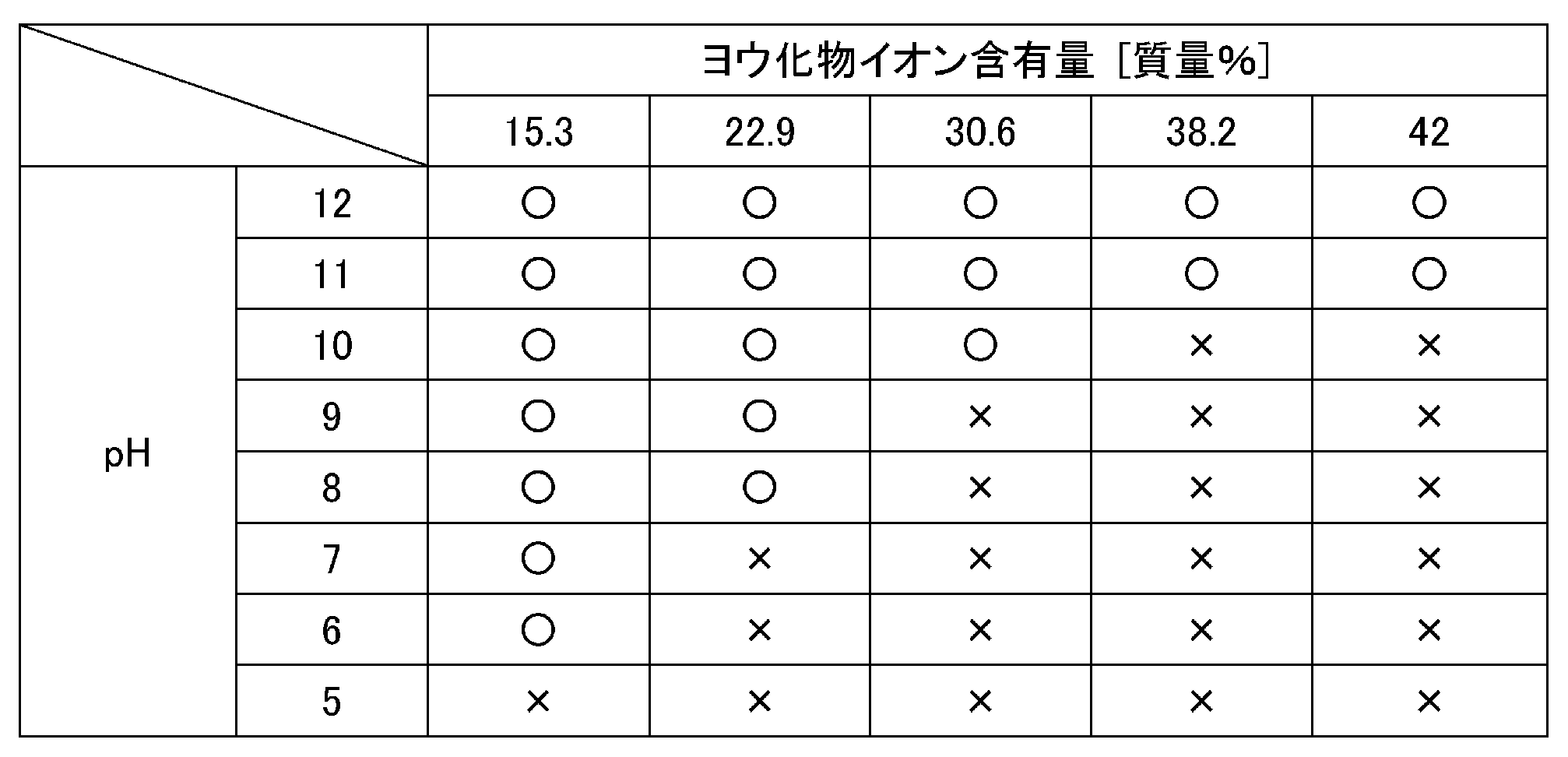
- FIG. 4 is a graph showing a calibration curve created by changing the concentration of hypochlorous acid and keeping the ammonium ion constant. 4 is a graph showing the relationship between the iodide ion content (% by mass) in the water treatment agent compositions of Examples 5 to 8, Comparative Examples 3 to 6, and Reference Example 4, and the pH at which no free iodine was detected. . 10 is a graph showing changes in oxidation-reduction potential (mV) versus elapsed time (seconds) in Examples 9 and 10.
- mV oxidation-reduction potential
- Fig. 1 shows an outline of an example of a water treatment apparatus for carrying out the water treatment method according to the embodiment of the present invention.
- the water treatment apparatus 1 uses a reverse osmosis membrane to separate concentrated water and permeated water from water to be treated containing at least one of a chlorine-based oxidant and a bromine-based oxidant or to-be-treated water containing iodide ions.
- a reverse osmosis membrane device 14 is provided as a reverse osmosis membrane treatment means to obtain the water.
- the water treatment apparatus 1 may include a water tank 10 for storing water to be treated.
- the water treatment apparatus 1 uses a separation membrane for water to be treated containing at least one of a chlorine-based oxidant and a bromine-based oxidant or water to be treated containing iodide ions in the upstream stage of a reverse osmosis membrane device 14.
- a membrane filtration device 12 may be provided as a membrane filtration treatment means for performing membrane filtration treatment.
- a water pipe 18 to be treated is connected to the water inlet of the water tank 10 to be treated.
- the to-be-treated water outlet of the to-be-treated water tank 10 and the to-be-treated water inlet of the membrane filtration device 12 are connected by a to-be-treated water pipe 20 .
- a membrane filtration treated water outlet of the membrane filtration device 12 and a membrane filtration treated water inlet of the reverse osmosis membrane device 14 are connected by a membrane filtration treated water pipe 22 via a pump 16 .
- a permeated water pipe 24 is connected to the permeated water outlet of the reverse osmosis membrane device 14, and a concentrated water pipe 26 is connected to the concentrated water outlet.
- At least one of the chemical inlet of the water tank 10 to be treated, the water to be treated pipe 20, and the membrane filtration treatment water pipe 22 is provided with iodide ion adding means for adding iodide ions or a chlorine-based oxidizing agent and a bromine-based oxidizing agent.
- An addition pipe 28 may be connected as oxidant addition means for adding at least one of the agents.
- at least one of the to-be-treated water pipe 18, the to-be-treated water pipe 20, and the membrane filtration treated water pipe 22 has a reducing agent addition pipe as reducing agent addition means for adding a reducing agent. 30 may be connected.
- the water to be treated containing at least one of the chlorine-based oxidizing agent and the bromine-based oxidizing agent or the water to be treated containing iodide ions is passed through the water-to-be-treated pipe 18.
- the membrane filtration device 12 After being stored in the water tank 10 to be treated accordingly, it is sent to the membrane filtration device 12 through the water pipe 20 to be treated.
- the membrane filtration device 12 the water to be treated is subjected to membrane filtration using a separation membrane (membrane filtration process).
- the membrane filtration treated water obtained in the membrane filtration treatment step is sent to the reverse osmosis membrane device 14 through the membrane filtration treated water pipe 22 .
- reverse osmosis membrane treatment is performed on membrane filtration treated water using a reverse osmosis membrane to obtain concentrated water and permeated water (reverse osmosis membrane treatment step). Permeate is discharged through permeate line 24 and concentrate is discharged through concentrate line 26 .
- the water to be treated containing at least one of the chlorine-based oxidant and the bromine-based oxidant or the water to be treated containing iodide ions is reverse osmosis.
- the water is sent to the membrane device 14, and in the reverse osmosis membrane device 14, the water to be treated is subjected to reverse osmosis membrane treatment to obtain concentrated water and permeated water using a reverse osmosis membrane (reverse osmosis membrane treatment step).
- the water treatment device 1 when the water treatment device 1 includes the membrane filtration device 12 and the membrane filtration treatment step is performed, at least one of the chlorine-based oxidant and the bromine-based oxidant 1 mol or more of iodide ion is added through the addition pipe 28 to the water to be treated in the membrane filtration process containing one (iodide ion addition step ).
- the water treatment device 1 does not include the membrane filtration device 12, the water to be treated in the reverse osmosis membrane treatment process containing at least one of the chlorine-based oxidizing agent and the bromine-based oxidizing agent contains liberation of the water to be treated.
- iodide ions 1 mol or more of iodide ions are added through the addition pipe 28 with respect to 1 mol of chlorine and free bromine (iodide ion addition step).
- "at least one of a chlorine-based oxidizing agent and a bromine-based oxidizing agent” may be simply described as “a chlorine-based oxidizing agent, etc.”.
- the amount of iodide ions in the water to be treated in the membrane filtration treatment process is added to the water to be treated.
- At least one of a chlorine-based oxidizing agent and a bromine-based oxidizing agent is added to 1 mol through the addition pipe 28 so that the amount of free chlorine and the amount of free bromine are 1 mol or less (oxidizing agent addition step).
- the water to be treated in the reverse osmosis membrane treatment process containing iodide ions is added with a chlorine-based oxidizing agent per 1 mol of iodide ions in the water to be treated. and at least one of the brominated oxidant is added through the addition pipe 28 so that the amount of free chlorine and the amount of free bromine are 1 mol or less (oxidant addition step).
- iodide ions By adding iodide ions to water to be treated with a reverse osmosis membrane that contains chlorine-based oxidants, it is possible to reduce chlorine-based oxidants that may cause deterioration of the reverse osmosis membrane.
- the iodide ion is oxidized to iodine having bactericidal activity by a chlorine-based oxidizing agent or the like, and changes its form into a slime inhibitor that suppresses slime formation and hardly deteriorates the reverse osmosis membrane. Therefore, by adding iodide ions to the water to be treated that contains a chlorine-based oxidizing agent or the like, it is possible to suppress the deterioration of the reverse osmosis membrane and suppress the formation of slime.
- the iodide ions are oxidized to iodine having sterilizing power by the chlorine-based oxidizing agent, and the reverse osmosis membrane Transforms into a slime inhibitor that inhibits slime formation with little deterioration of Chlorine-based oxidizing agents and the like, which may cause deterioration of the reverse osmosis membrane, are reduced by iodide ions. Therefore, by adding a chlorine-based oxidizing agent or the like to the water to be treated containing iodide ions, it is possible to suppress the deterioration of the reverse osmosis membrane and suppress the formation of slime.
- the place where iodide ions are added to the water to be treated containing chlorine-based oxidizing agents or the like, or the place to add chlorine-based oxidizing agents to water to be treated containing iodide ions is the water tank 10 to be treated. , the water pipe to be treated 20 before the membrane filtration device 12 and the membrane filtration treated water pipe 22 after the membrane filtration device 12 .
- the place where iodide ions or the chlorine-based oxidant is added is the water to be treated in the membrane filtration process, that is, the water tank 10 to be treated, or It is preferable that it is the to-be-processed water pipe 20 in front of the membrane filtration apparatus 12 .
- any oxidizing agent having a higher oxidation-reduction potential (ORP) than that of iodine may be used.
- ORP oxidation-reduction potential
- a similar effect can be obtained with a hypobromous acid composition, but it is preferable that the oxidizing agent is in a form that can be detected as free chlorine in terms of reaction speed and the like.
- Typical oxidizing agents include hypochlorous acid, hypobromous acid, salts thereof, and the like.
- the concentration of at least one of the chlorine-based oxidant and the bromine-based oxidant in the water to be treated containing the chlorine-based oxidant is, for example, in the range of 0.05 to 10 mg/L.
- the concentration of iodide ions in the water to be treated containing iodide ions is, for example, in the range of 0.01 to 40 mg/L.
- total chlorine is the concentration determined by the spectrophotometric method using N,N-diethyl-p-phenylenediammonium sulfate (DPD) described in "JIS K 0120: 2013, 33. Residual chlorine".
- DPD is oxidized by an oxidizing agent
- oxidizing agents include chlorine, bromine, iodine, hydrogen peroxide, ozone, etc.
- the forms of chlorine quantified as total chlorine are all forms having oxidizing power such as hypochlorous acid, hypochlorite ions, chlorine and combined chlorine such as chloramine and dichloramine. Bromine and iodine can also be measured in all oxidizing forms.
- Quantified as free chlorine is a form that can be measured without adding potassium iodide in the above "total chlorine" measurement method, such as hypochlorous acid, hypobromous acid, chlorine, bromine, iodine, etc. .
- hypochlorous acid When adding iodide ions to hypochlorous acid, if a sufficient amount of iodide ions is added to hypochlorous acid, all the oxidizing power will be due to iodine, but with respect to hypochlorous acid If a sufficient amount of iodide ions is not added, some of the oxidizing power is due to hypochlorous acid and some is due to iodine. However, in the DPD method, both hypochlorous acid and iodine are detected as free chlorine, so it is difficult to confirm whether sufficient iodide ions are added to hypochlorous acid. rice field. If the amount of iodide ions added is insufficient, free chlorine derived from hypochlorous acid may remain and cause deterioration of the reverse osmosis membrane. It is necessary to selectively measure free chlorine derived from chloric acid.
- Iodine is known to have low reactivity with amine compounds, and can be suitably used without substantially inhibiting the reaction according to the present method.
- a calibration curve was created by adding ammonium ions to water so as to contain 10 mg/L and varying the content of hypochlorous acid.
- a calibration curve was prepared by the procedure shown below, and the R2 value was 0.999. The measurement results are shown in FIG.
- the same method was used to replace hypochlorous acid with iodine, but no color developed, and it was confirmed again that only free chlorine derived from hypochlorous acid developed color in this method.
- hypochlorous acid was added so that the free chlorine concentration was 5 mg / L
- potassium iodide was added so that the iodide ion was 0.1 mol to 10 mol with respect to the free chlorine concentration.
- Hypochlorous acid analysis was performed. When the free chlorine concentration of the solution was measured before and after addition of potassium iodide using an absorption photometer DR3900 manufactured by HACH, there was almost no change in the free chlorine concentration.
- the concentration of free chlorine derived from hypochlorous acid in the mixed solution was measured by the following procedure. Table 1 shows the results.
- Patent Document 1 when iodine is used as an additive, a concentration of about 5 to 15 ppm is suitable, and in the examples, an aqueous solution of potassium iodide is added to a solution containing hypochlorous acid. , to be added in an amount sufficient to generate 15 ppm of iodine.
- the amount of potassium iodide added is As a result, 0.6 mg/L of free chlorine derived from hypochlorous acid remains, which may deteriorate the reverse osmosis membrane.
- free iodide ions generated in the water to be treated which is obtained by adding 1 mol or more of iodide ions to 1 mol of free chlorine and 1 mol of free bromine in the water to be treated containing chlorine-based oxidizing agents, etc.
- the free iodine CT value represented by iodine concentration (mg/L) ⁇ iodide ion addition time (h) is preferably 1.25 (mg/L ⁇ h) or less, and 1.0 (mg/ L ⁇ h) or less is more preferable.
- a chlorine-based oxidizing agent and a bromine-based oxidizing agent is used to reduce the amount of free chlorine and the amount of free bromine to 1 mol or less per 1 mol of iodide ion amount of water to be treated containing iodide ions.
- the free iodine concentration (mg/L) generated in the water to be treated obtained by adding so as to be free iodine represented by the addition time (h) of at least one of the chlorine-based oxidizing agent and the bromine-based oxidizing agent
- the CT value is preferably 1.25 (mg/L ⁇ h) or less, more preferably 1.0 (mg/L ⁇ h) or less. If the free iodine CT value exceeds 1.25, the water quality of permeated water of the reverse osmosis membrane may deteriorate.
- iodide ion addition step or the oxidizing agent addition step as a method of adding iodide ions or chlorine-based oxidizing agents to the water to be treated, iodide ions or chlorine-based oxidizing agents are continuously added to the water to be treated. It may be continuous addition, or intermittent addition with an addition period in which iodide ions or chlorine-based oxidizing agents are added to the water to be treated and a non-addition period in which iodide ions or chlorine-based oxidizing agents are not added to the water to be treated. It's okay. Intermittent addition is preferred from the viewpoint of chemical cost and the like.
- intermittent addition is preferably performed in which the addition period is continuously 10 seconds or more and 3 hours or less and the non-addition period is continuous 5 seconds or more and less than 48 hours.
- the reducing agent is added to the water to be treated in the membrane filtration process or the water to be treated in the reverse osmosis membrane treatment process (membrane filtration treated water) through the reducing agent addition pipe 30 (reducing agent addition step).
- the locations where the reducing agent is added to the water to be treated during the non-addition period are the water to be treated pipe 18, the water to be treated pipe 20 before the membrane filtration device 12, and the membrane filtration treated water pipe 22 after the membrane filtration device 12. may be either.
- the point of addition of the reducing agent is preferably before the point of addition of iodide ions, chlorine-based oxidizing agents, or the like.
- the reducing agent may cause deterioration of the reverse osmosis membrane.
- the reducing agent include sulfites such as sodium sulfite, hydrogen sulfites such as sodium hydrogen sulfite, thiosulfates such as sodium thiosulfate, hydrazine, hydroxylamine, and hydrogen sulfide.
- sulfites, hydrogen sulfites and thiosulfates are preferred, and thiosulfates are more preferred, from the viewpoint of safety and the like.
- sulfites and hydrogen sulfites react with free iodine in an equimolar amount to a reducing agent
- thiosulfates react in the following formula (3).
- 1 ⁇ 2 mole of free iodine reacts with the reducing agent.
- the reducing agent reduces the free iodine generated during the addition period, but by using thiosulfate, the amount of reduction is greater than that of sulfite and hydrogen sulfite. can be suppressed.
- the time from the addition of the iodide ions to the arrival at the reverse osmosis membrane is 15 seconds. It is preferable to set it to 20 seconds or longer, and more preferably to set it to 20 seconds or longer. If the time from adding iodide ions to reaching the reverse osmosis membrane is less than 15 seconds, the chlorine-based oxidizing agent and the like may not be sufficiently reduced by the iodide ions, which may deteriorate the reverse osmosis membrane. .
- iodide ions are added to the reverse osmosis membrane device 14 that performs the reverse osmosis membrane treatment step. Opening to the atmosphere and aeration may reduce the amount of free iodine. From this point of view, the addition of iodide ions is preferably a line addition in which the iodide ions are added to the piping.
- the oxidation-reduction potential (ORP) of the water to be treated in reverse osmosis membrane treatment after adding 1 mol or more of iodide ion per 1 mol of free chlorine and 1 mol of free bromine in the water to be treated containing chlorine-based oxidizing agents is 550 mV. It is preferable to control the amount of iodide ions to be added so as to be as follows. This oxidation-reduction potential is preferably 540 mV or less, more preferably 520 mV or less. If this oxidation-reduction potential exceeds 550 mV, deterioration of the reverse osmosis membrane may be caused.
- the amount of iodide ions added to the water to be treated can be easily controlled by the oxidation-reduction potential.
- the addition of iodide ions to the water to be treated The amount can be controlled by redox potential.
- iodide ions added to the water to be treated 1.0 mol or more of iodide ions should be added to 1 mol of free chlorine and free bromine.
- the iodide ion may be added as a solid iodide salt such as sodium iodide or potassium iodide, or as an aqueous solution in which an iodide salt such as sodium iodide or potassium iodide is dissolved in advance.
- iodine may be dissolved in an aqueous solution in which an iodide salt such as sodium iodide or potassium iodide is dissolved, and an aqueous solution containing free iodine may be added in advance. From the viewpoint of handling and the like, it is preferable to add it as an aqueous solution, and from the viewpoint of storage stability and the like, it is more preferable to add it as an aqueous solution containing no free iodine.
- the water treatment agent composition used in the water treatment method according to this embodiment is a composition containing water and an iodide salt. If the content of the chlorine-based oxidizing agent or the like contained in the water to be treated is small (for example, 0.1 mg/L or less), the amount of iodine produced by oxidation by the iodide salt will be small. In such cases, the water treatment composition may further contain iodine.
- the water treatment agent composition used in the water treatment method according to the present embodiment contains water and an iodide salt, and the content of the iodide salt in the water treatment agent composition is 20% by mass as iodide ion.
- the present inventors have found that the pH is equal to or higher than the value calculated by the above formula (1), so that the content of the iodide salt is It was found that the liberation of iodine is suppressed even at a high concentration of 20% by mass or more as iodide ions.
- the pH of the water treatment agent composition is preferably the value calculated by the above formula (1) + 0.35 or more.
- the iodide salt contained in the water treatment agent composition is an inorganic salt of iodine, and examples thereof include sodium iodide, potassium iodide, lithium iodide, copper iodide, zinc iodide, etc.
- Sodium iodide or potassium iodide is preferable from the viewpoint.
- One type of iodide salt may be contained in the water treatment agent composition, or two or more types may be contained.
- the content of the iodide salt in the water treatment agent composition is preferably 20% by mass or more, more preferably 30% by mass or more, and even more preferably 40% by mass or more. If the content of the iodide salt is less than 20% by mass, there is concern about an increase in chemical usage costs such as transportation, storage and addition of chemicals due to an increase in the amount used.
- the upper limit of the iodide salt content is, for example, 56% by mass or less.
- the iodine content is preferably 3% by mass or more, more preferably 5% by mass or more, and even more preferably 10% by mass or more. . If the iodine content is less than 3% by mass, the bactericidal power may be insufficient.
- the upper limit of the iodine content is, for example, 30% by mass or less.
- the water treatment agent composition may further contain an alkaline agent.
- an alkaline agent it is sufficient if it can raise the pH of the solution.
- Hydrogen carbonates such as carbonates, sodium hydrogen carbonate, potassium hydrogen carbonate, and the like are included.
- hydroxides such as sodium hydroxide, potassium hydroxide, and calcium hydroxide are preferable, and sodium hydroxide or potassium hydroxide is more preferable, from the viewpoint of safety, formulation cost, and the like.
- the alkaline agent is preferably contained in the composition in an amount of 0.01% by mass or more, more preferably 0.1% by mass or more.
- the upper limit of the content of the alkaline agent is, for example, less than 10% by mass.
- the content of the iodide salt in the water treatment agent composition is preferably 20% by mass or more, more preferably 30% by mass or more, and even more preferably 40% by mass or more as iodide ions. If the content of the iodide salt is less than 20% by mass in terms of iodide ions, there is concern that an increase in the amount used will increase the cost of using chemicals.
- the upper limit of the iodide salt content is, for example, 42% by mass or less as iodide ion.
- the total iodine in the water treatment agent composition can be determined by the above DPD (N,N-diethyl-p-phenylenediamine) method.
- the water treatment agent composition according to the present embodiment does not contain organic matter.
- free of organic matter means that the TOC of the water treatment composition is 100 mg/L or less, preferably 10 mg/L or less.
- the water treatment agent composition according to the present embodiment can be suitably used as a water treatment agent for reducing residual chlorine in water to be treated and sterilizing water to be treated.
- the iodide ions contained in the water treatment agent composition can effectively reduce residual chlorine to render it harmless.
- the water treatment agent composition according to the present embodiment is particularly suitable for use as a sterilization aid in reverse osmosis membrane treatment.
- oxidizing agents such as hypochlorous acid and hypobromous acid are generally added for sterilization and suppression of slime formation.
- these oxidizing agents remain in the water to be treated without being consumed for the purpose of sterilization and suppression of slime formation, and flow into the subsequent water treatment equipment, adversely affecting the subsequent water treatment equipment. It is The inflow of residual chlorine and the like is said to cause corrosion in, for example, cooling towers, performance deterioration of reverse osmosis membranes in reverse osmosis membrane devices, and significant oxidative deterioration in resin towers and electrodeionization (EDI) systems.
- EDI electrodeionization
- the water treatment agent composition according to the present embodiment can suppress such influence on the water treatment equipment in the latter stage, corrosion in the cooling tower, performance deterioration of the reverse osmosis membrane in the reverse osmosis membrane device, resin tower and Oxidative deterioration and the like in an electrodeionization (EDI) system can be suppressed.
- EDI electrodeionization
- the water treatment agent composition When water treatment is performed using the water treatment agent composition, for example, the water treatment agent composition may be added to water to be treated containing at least one of a chlorine-based oxidant and a bromine-based oxidant. .
- the water treatment agent composition in a water treatment method for treating water containing at least one of a chlorine-based oxidant and a bromine-based oxidant with a reverse osmosis membrane, the water treatment agent composition may be added to the water to be treated. good.
- the iodide ion is oxidized to iodine having bactericidal activity by a chlorine-based oxidizing agent or the like, and changes its form to a slime inhibitor that suppresses slime formation and hardly deteriorates a reverse osmosis membrane or the like. Therefore, by adding iodide ions to the water to be treated containing chlorine-based oxidizing agents and the like, it is possible to suppress the deterioration of the reverse osmosis membrane and the like, and suppress the formation of slime.
- Example 1 Hypochlorous acid was added to the water supply (water to be treated) of the reverse osmosis membrane apparatus so as to be 5 mg/L as free chlorine under the following test conditions. After the high-pressure RO pump, potassium iodide was added so that iodide ions were 0.5 mol, 1.0 mol, and 2.0 mol relative to free chlorine. Free chlorine was measured using an absorption photometer DR3900 manufactured by HACH. Table 2 shows the results.
- Test conditions ⁇ Test device: Reverse osmosis membrane element test device ⁇ Supply pressure: 0.2 to 0.35 MPa ⁇ Water supply: Sagamihara well water (dechlorination treatment, bacteria count 2 ⁇ 10 3 CFU/mL) ⁇ Water temperature: 16-19°C ⁇ pH: 7.3 to 7.7 ⁇ Hypochlorous acid concentration: added to the water to be treated so that it becomes 5 mg / L as free chlorine ⁇ Potassium iodide: 99.8% potassium iodide manufactured by Godo Resources Co., Ltd. ⁇ Reverse osmosis membrane: manufactured by Nitto Denko Corporation, 4-inch reverse osmosis membrane element (ESPA2) ⁇ Amount of water: 500 L/h of concentrated water, 125 L/h of permeated water
- Test conditions ⁇ Test water: Sagamihara well water (dechlorination treatment, bacteria count 2 ⁇ 10 3 CFU/mL) - Drug: water treatment agent composition containing free iodine (potassium iodide content: 20% by mass) ⁇ pH: 7.0 ⁇ Reverse osmosis membrane: ES20, ESPA2, LFC3 manufactured by Nitto Denko Corporation, TML10D manufactured by Toray Industries, Inc.
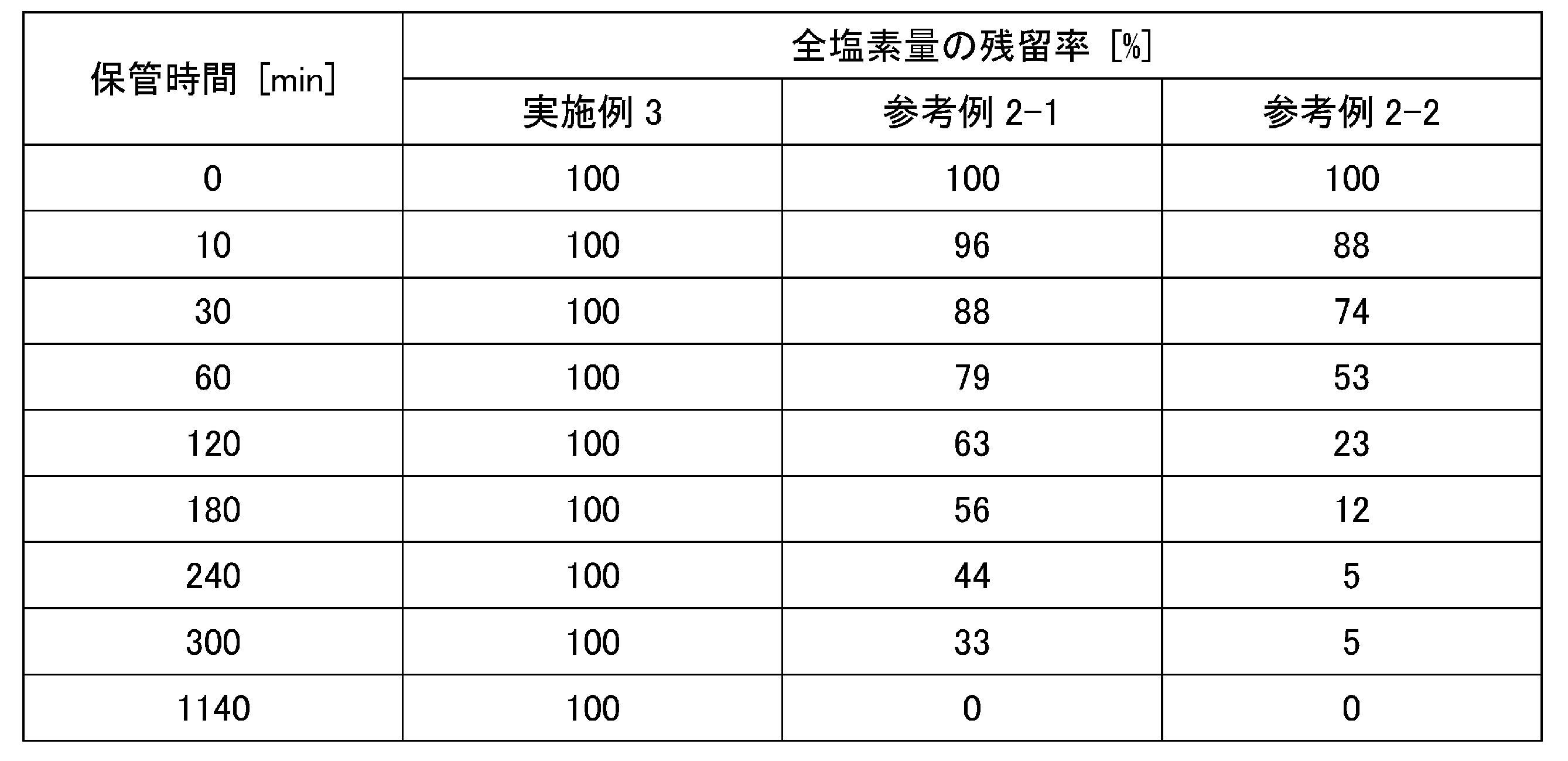
- Example 3 A potassium iodide aqueous solution (potassium iodide content: 20% by mass) was added to pure water containing hypochlorous acid so that the total chlorine concentration was 0.5 mg / L, and a stirrer was added under the following storage conditions. The solution was stored in an eyeboy wide-mouthed bottle (AS ONE) while being stirred using the same method, and the residual ratio (%) of the total amount of chlorine was calculated after a predetermined period of time. Table 4 shows the results.
- Example 3 Close the lid and seal Reference Example 2-1: Remove the lid and open the top Reference Example 2-2: Remove the lid and air aeration
- Example 3 100% of all chlorine remained even after 1140 minutes, but in Reference Example 2-1, the residual rate of all chlorine decreased after 10 minutes and reached 0 after 1140 minutes.
- Reference Example 2-2 the residual rate of total chlorine decreased after 10 minutes as in Reference Example 2-1, and the residual rate of total chlorine was lower than in Reference Example 2-1.
- the closed system hardly reduces the total chlorine and maintains a sufficient bactericidal effect.
- Example 4 Comparative Example 2, Reference Example 3>
- sodium hypochlorite was added to the test water so that the concentration of free chlorine was 1 mg/L
- potassium iodide was added so that the amount of free chlorine was 0.1 to 10 mol.
- the oxidation-reduction potential (ORP) was measured using a portable ORP meter (manufactured by TOA DKK, model RM-30P). Table 5 shows the results. There was almost no increase or decrease in the concentration of free chlorine before and after the addition of potassium iodide.
- Example 9 Pure water was mixed with sodium hypochlorite (1 mg/L as free chlorine concentration) and potassium iodide (1.5 mol relative to the amount of free chlorine), and the oxidation-reduction potential (ORP) was measured over time. .
- ORP oxidation-reduction potential
- Example 9 potassium iodide was added to the sodium hypochlorite solution, and in Example 10, sodium hypochlorite was added to the potassium iodide solution.
- the oxidation-reduction potential was measured using a portable ORP meter (manufactured by TOA DKK, model RM-30P). The results are shown in FIG.
- Example 9 the oxidation-reduction potential before mixing was 700 mV or more, but it gradually decreased after mixing, and after 15 seconds or more, the oxidation-reduction potential stabilized at around 550 mV.
- Example 10 the oxidation-reduction potential before mixing was 400 mV or less, but it gradually increased after mixing, and after 15 seconds or more, the oxidation-reduction potential stabilized at around 550 mV.
- Example 9 As described above, in both Examples 9 and 10, the oxidation-reduction potential settles down to around 550 mV, but in Example 9, a high oxidation-reduction potential is maintained until around 15 seconds. Therefore, when injecting iodide ions after injecting hypochlorous acid, it is preferable to set the injection point so that the time until the iodide ions reach the reverse osmosis membrane is 15 seconds or more.
- the sodium hypochlorite is implanted after the iodide ion is implanted, there is no particular limitation on the setting of the implantation point.
Landscapes
- Chemical & Material Sciences (AREA)
- Engineering & Computer Science (AREA)
- Water Supply & Treatment (AREA)
- Life Sciences & Earth Sciences (AREA)
- Hydrology & Water Resources (AREA)
- Environmental & Geological Engineering (AREA)
- Organic Chemistry (AREA)
- Chemical Kinetics & Catalysis (AREA)
- Nanotechnology (AREA)
- Separation Using Semi-Permeable Membranes (AREA)
- Treatment Of Water By Oxidation Or Reduction (AREA)
Abstract
Description
pH=5.24×log(ヨウ化物イオン含有量(質量%))-8.27 (1)
「JIS K 0102:2013の42.2 インドフェノール青吸光光度法」に記載されている方法は、アンモニウムイオンの測定を目的としており、次亜塩素酸の濃度を一定としてアンモニウムイオンの量を変化させることによって検量線を作成する。これに対して、今回の測定では次亜塩素酸の濃度の測定を目的としているため、まずは次亜塩素酸の濃度を変化させてアンモニウムイオンを一定とすることによって検量線の作成が可能かどうかを検証した。
2.アンモニウムイオンが10mg/Lとなるように塩化アンモニウム溶液を加え、40mLまで水を加えて混合する。
3.JIS K 0102に規定のナトリウムフェノキシド溶液10mLを加えて混合する。
4.液温を20~25℃に保って約30分間放置する。
5.この溶液の一部を630nm付近の吸光度で測定する。
2.遊離塩素に対して0.1~10molとなるようにヨウ化カリウム溶液を加え、水を加えて25mLとする。
3.アンモニウムイオンを10mg/L含有するように塩化アンモニウム溶液を加え、40mLまで水を加えて混合する。
4.JIS K 0102に規定のナトリウムフェノキシド溶液10mLを加えて混合する。
5.液温を20~25℃に保って約30分間放置する。
6.この溶液の一部を630nm付近の吸光度で測定し、混合液中の次亜塩素酸由来の遊離塩素濃度を求める。
7.混合液の遊離塩素濃度から次亜塩素酸由来の遊離塩素濃度を差し引くことによってヨウ素由来の遊離塩素濃度を求める。

I2+HSO3 -+H2O→2I-+3H++SO4 2- 式(2)
I2+2S2O3 2-→2I-+S4O6 2- 式(3)
本実施形態に係る水処理方法に用いられる水処理剤組成物は、水とヨウ化物塩とを含有する組成物である。被処理水に含まれる塩素系酸化剤等の含有量が少ない(例えば、0.1mg/L以下)とヨウ化物塩によって酸化されて生成するヨウ素の量が少なくなる。このような場合には、水処理剤組成物は、さらにヨウ素を含んでもよい。
pH=5.24×log(ヨウ化物イオン含有量(質量%))-8.27 (1)
以下の試験条件で、逆浸透膜装置の給水(被処理水)に次亜塩素酸を遊離塩素として5mg/Lとなるように含有させた。高圧ROポンプの後にヨウ化物イオンが遊離塩素に対して0.5mol、1.0mol、2.0molとなるようにヨウ化カリウムを添加した。遊離塩素は、HACH社製の吸光光度計DR3900を用いて測定した。結果を表2に示す。
・試験装置:逆浸透膜エレメント試験装置
・供給圧力:0.2~0.35MPa
・給水:相模原井水(脱塩素処理、菌数2×10³CFU/mL)
・水温:16~19℃
・pH:7.3~7.7
・次亜塩素酸濃度:遊離塩素として5mg/Lとなるように被処理水に添加
・ヨウ化カリウム:(株)合同資源製99.8%ヨウ化カリウム
・逆浸透膜:日東電工社製、4インチ逆浸透膜エレメント(ESPA2)
・水量:濃縮水500L/h、透過水125L/h
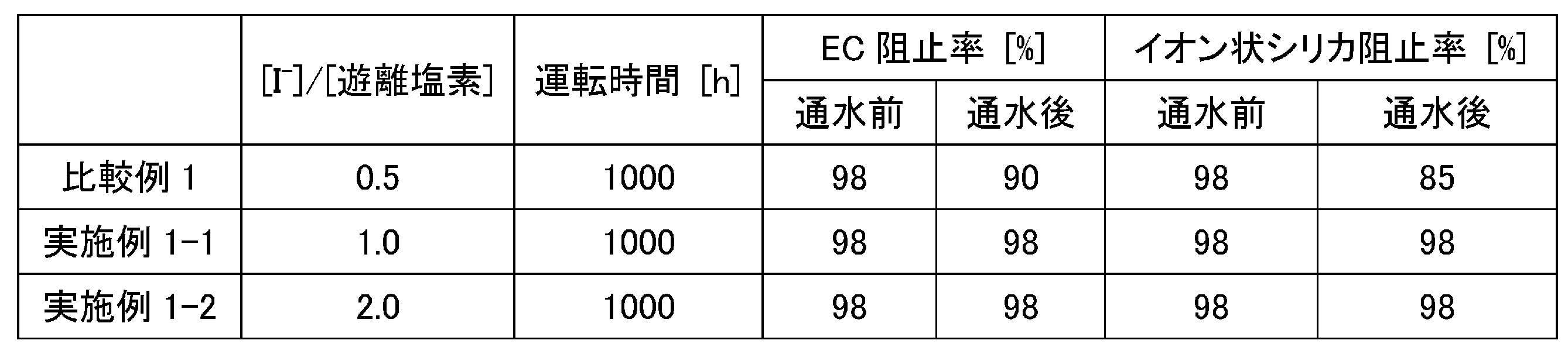
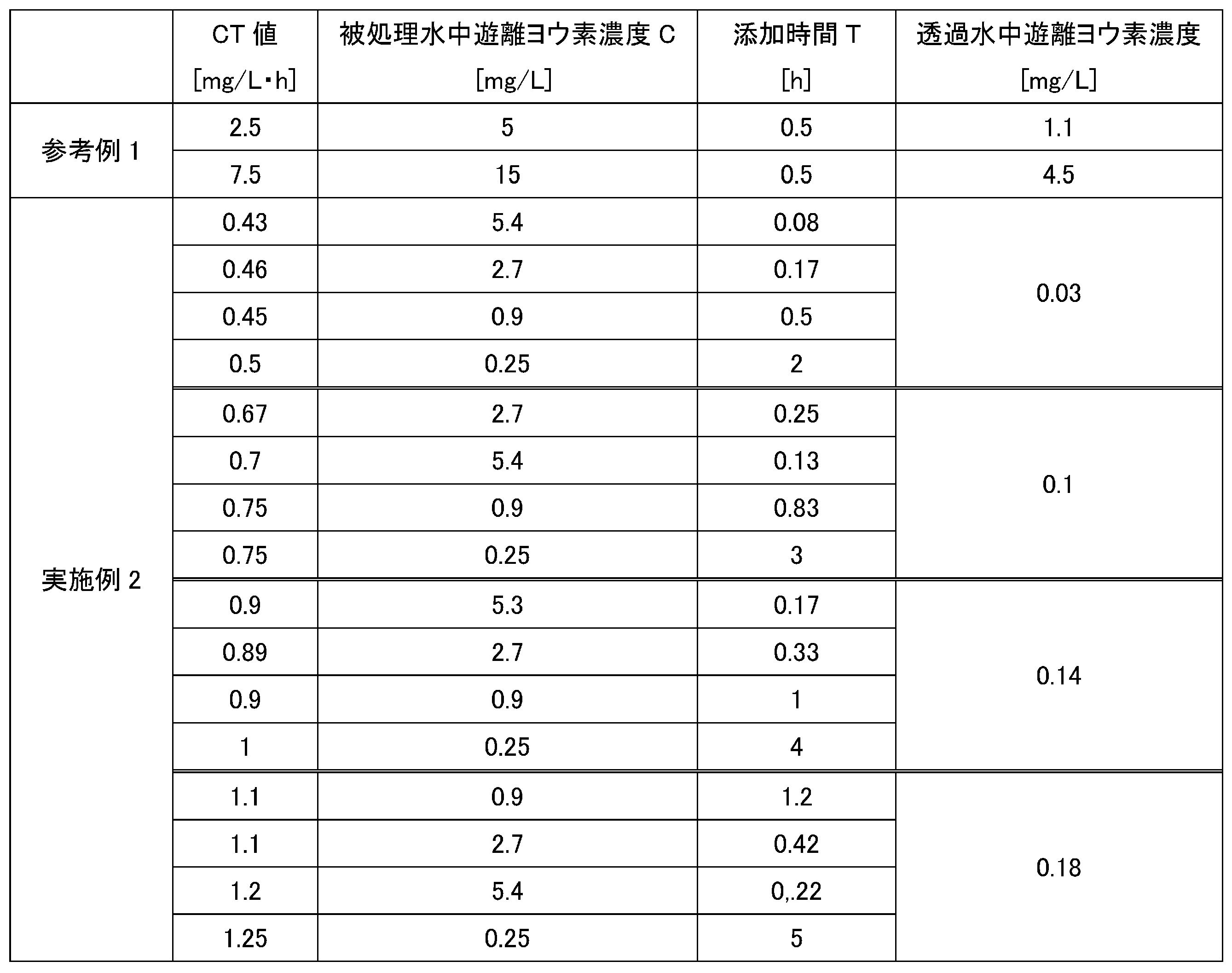
図1に示す水処理装置を用いて、以下の試験条件で、(被処理水中の遊離ヨウ素(mg・L))×(ヨウ化物イオンの添加時間(h))で表される遊離ヨウ素CT値(mg/L・h)を表3に示すように変えて処理を行った。結果を表3に示す。
・試験水:相模原井水(脱塩素処理、菌数2×10³CFU/mL)
・薬剤:遊離ヨウ素を含有する水処理剤組成物(ヨウ化カリウム含有量:20質量%)
・pH:7.0
・逆浸透膜:日東電工社製ES20、ESPA2、LFC3、東レ社製TML10D
次亜塩素酸を含有する純水にヨウ化カリウム水溶液(ヨウ化カリウム含有量:20質量%)を全塩素濃度として0.5mg/Lとなるように添加し、以下の保管条件でスターラ―を用いて撹拌しながらアイボーイ広口瓶(アズワン)に保管して所定時間後の全塩素量の残留率(%)を算出した。結果を表4に示す。
実施例3:ふたを閉めて密閉
参考例2-1:ふたを外して上部解放
参考例2-2:ふたを外して空気曝気
以下の試験条件で、試験水に次亜塩素酸ナトリウムを遊離塩素濃度として1mg/Lとなるように添加し、ヨウ化カリウムを遊離塩素量に対して0.1~10molとなるように添加した。酸化還元電位(ORP)は、ポータブルORP計(TOA DKK製、RM-30P型)を用いて測定した。結果を表5に示す。ヨウ化カリウム添加前後で遊離塩素濃度の増減はほとんどなかった。
・試験水:相模原井水(脱塩素)
・pH:7.0(次亜塩素酸ナトリウム添加後に調整)
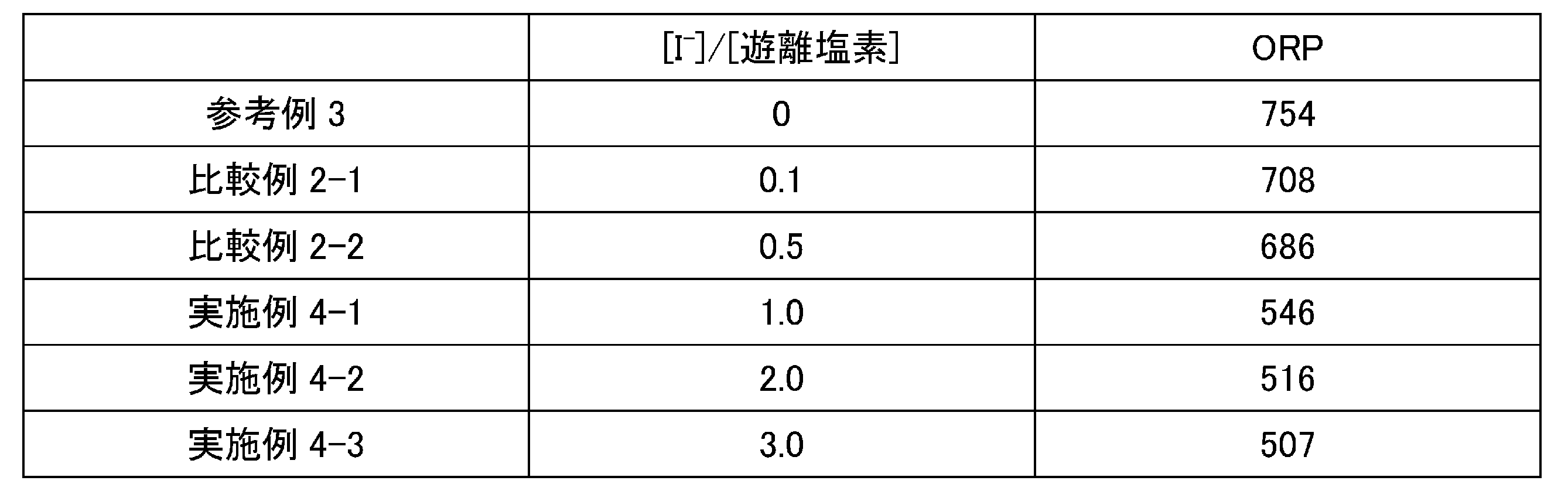
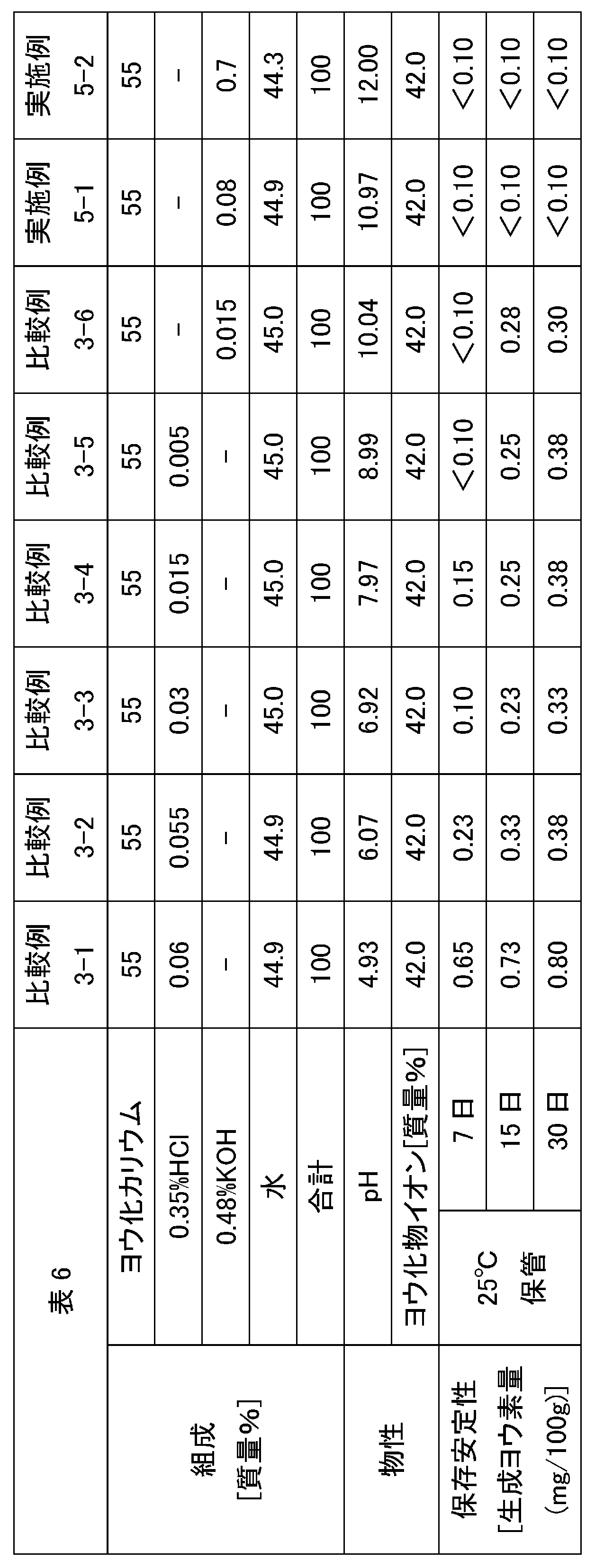
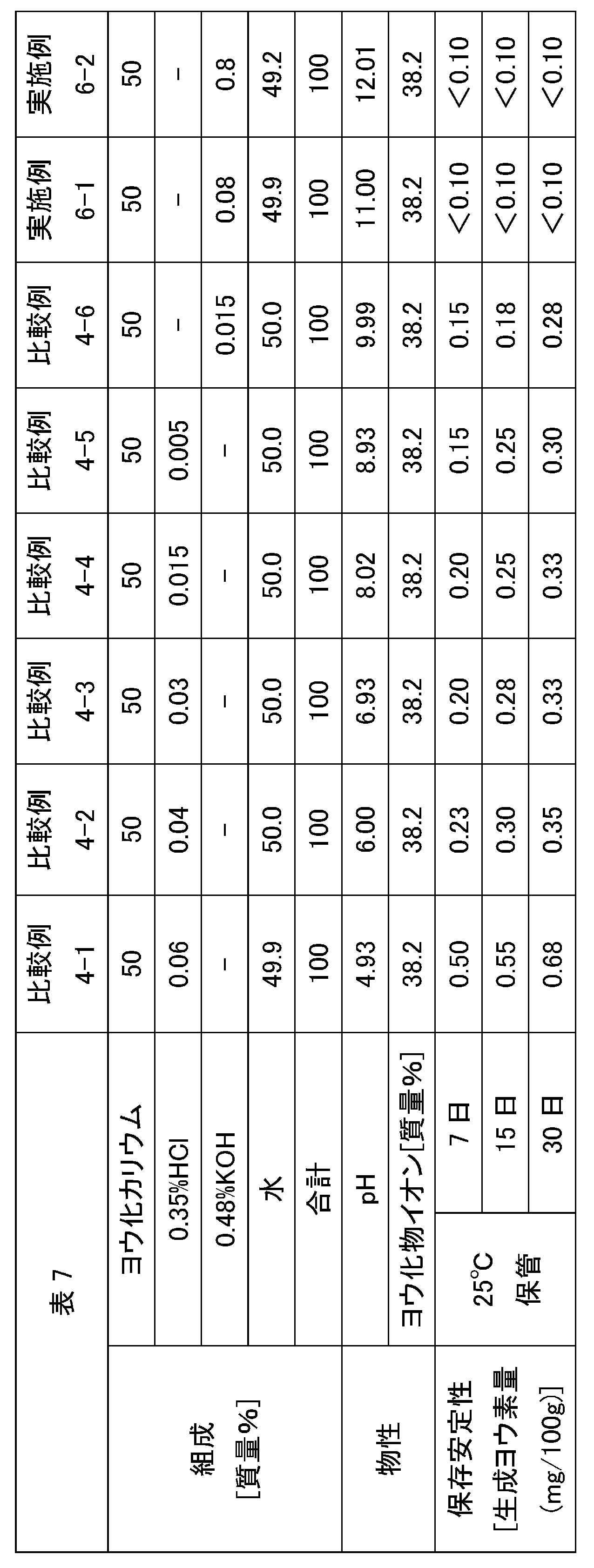
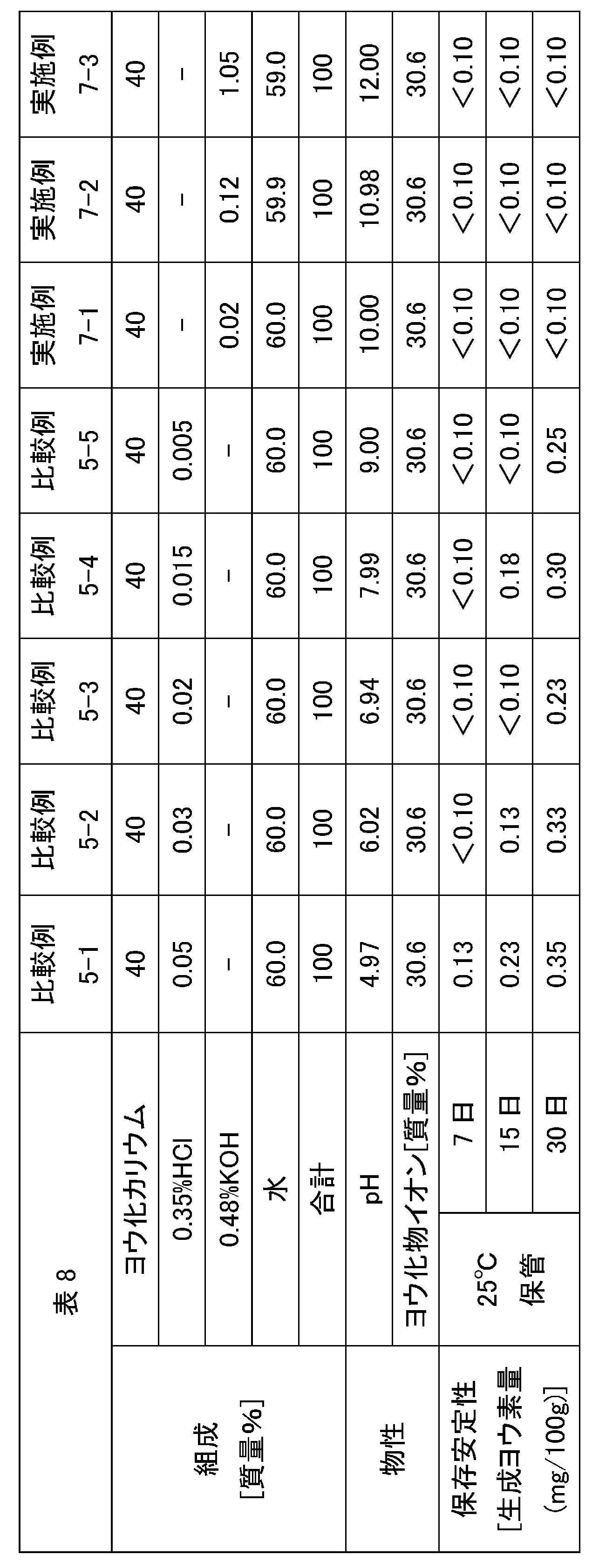
表6から表10に示す組成で、ヨウ化カリウムとpH調整剤(酸またはアルカリ)と水とを混合して保存安定性試験を実施した。それぞれの組成、pHにおいて室温(25±2℃)条件で遮光密閉して、7日、14日、30日保管後の有効成分の測定を行った。遊離したヨウ素の量は、HACH社製の吸光光度計DR3900を用いて測定した。


純水に次亜塩素酸ナトリウム(遊離塩素濃度として1mg/L)と、ヨウ化カリウム(遊離塩素量に対して1.5mol)とを混合し、経時的に酸化還元電位(ORP)を測定した。実施例9では、次亜塩素酸ナトリウム溶液に対してヨウ化カリウムを添加し、実施例10では、ヨウ化カリウム溶液に対して次亜塩素酸ナトリウムを添加した。酸化還元電位は、ポータブルORP計(TOA DKK製、RM-30P型)を用いて測定した。結果を図5に示す。
Claims (15)
- 被処理水について逆浸透膜を用いて濃縮水と透過水とを得る逆浸透膜処理工程を含み、
塩素系酸化剤および臭素系酸化剤のうち少なくとも1つを含有する前記被処理水に、前記被処理水の遊離塩素量および遊離臭素量1molに対してヨウ化物イオンを1mol以上添加する、または、
ヨウ化物イオンを含有する前記被処理水に、前記被処理水のヨウ化物イオン量1molに対して塩素系酸化剤および臭素系酸化剤のうち少なくとも1つを遊離塩素量および遊離臭素量が1mol以下になるように添加する、
ことを特徴とする水処理方法。 - 請求項1に記載の水処理方法であって、
前記塩素系酸化剤および臭素系酸化剤のうち少なくとも1つを含有する前記被処理水に前記ヨウ化物イオンを添加する場合において、前記ヨウ化物イオンを添加した被処理水中に生成される遊離ヨウ素濃度(mg/L)×ヨウ化物イオンの添加時間(h)で表される遊離ヨウ素CT値が、1.25(mg/L・h)以下であることを特徴とする水処理方法。 - 請求項1に記載の水処理方法であって、
前記ヨウ化物イオンを含有する前記被処理水に前記塩素系酸化剤および臭素系酸化剤のうち少なくとも1つを添加する場合において、前記塩素系酸化剤および臭素系酸化剤のうち少なくとも1つを添加した被処理水中に生成される遊離ヨウ素濃度(mg/L)×塩素系酸化剤および臭素系酸化剤のうち少なくとも1つの添加時間(h)で表される遊離ヨウ素CT値が、1.25(mg/L・h)以下であることを特徴とする水処理方法。 - 請求項1に記載の水処理方法であって、
前記塩素系酸化剤および臭素系酸化剤のうち少なくとも1つを含有する前記被処理水に前記ヨウ化物イオンを添加する場合において、前記ヨウ化物イオンを添加してから前記逆浸透膜に到達するまでの時間を15秒以上に設定することを特徴とする水処理方法。 - 被処理水について分離膜を用いて膜ろ過処理する膜ろ過処理工程と、
前記膜ろ過処理工程で得られた膜ろ過処理水について逆浸透膜を用いて濃縮水と透過水とを得る逆浸透膜処理工程と、
を含み、
前記膜ろ過処理工程における塩素系酸化剤および臭素系酸化剤のうち少なくとも1つを含有する前記被処理水に、前記被処理水の遊離塩素量および遊離臭素量1molに対してヨウ化物イオンを1mol以上添加する、または、
前記膜ろ過処理工程におけるヨウ化物イオンを含有する前記被処理水に、前記被処理水のヨウ化物イオン量1molに対して塩素系酸化剤および臭素系酸化剤のうち少なくとも1つを遊離塩素量および遊離臭素量が1mol以下になるように添加する、
ことを特徴とする水処理方法。 - 請求項5に記載の水処理方法であって、
前記塩素系酸化剤および臭素系酸化剤のうち少なくとも1つを含有する前記被処理水に前記ヨウ化物イオンを添加する場合において、前記ヨウ化物イオンを添加した被処理水中に生成される遊離ヨウ素濃度(mg/L)×ヨウ化物イオンの添加時間(h)で表される遊離ヨウ素CT値が、1.25(mg/L・h)以下であることを特徴とする水処理方法。 - 請求項5に記載の水処理方法であって、
前記ヨウ化物イオンを含有する前記被処理水に前記塩素系酸化剤および臭素系酸化剤のうち少なくとも1つを添加する場合において、前記塩素系酸化剤および臭素系酸化剤のうち少なくとも1つを添加した被処理水中に生成される遊離ヨウ素濃度(mg/L)×塩素系酸化剤および臭素系酸化剤のうち少なくとも1つの添加時間(h)で表される遊離ヨウ素CT値が、1.25(mg/L・h)以下であることを特徴とする水処理方法。 - 請求項5に記載の水処理方法であって、
前記塩素系酸化剤および臭素系酸化剤のうち少なくとも1つを含有する前記被処理水に前記ヨウ化物イオンを添加する場合において、前記ヨウ化物イオンを添加してから前記逆浸透膜に到達するまでの時間を15秒以上に設定することを特徴とする水処理方法。 - 請求項1~8のいずれか1項に記載の水処理方法であって、
前記塩素系酸化剤および臭素系酸化剤のうち少なくとも1つを含有する前記被処理水に前記ヨウ化物イオンを添加する場合において、前記ヨウ化物イオンを添加する箇所から前記逆浸透膜処理工程までを密閉系で行うことを特徴とする水処理方法。 - 請求項1~9のいずれか1項に記載の水処理方法であって、
前記塩素系酸化剤および臭素系酸化剤のうち少なくとも1つを含有する前記被処理水に前記ヨウ化物イオンを添加する場合において、前記ヨウ化物イオンを添加した後の被処理水の酸化還元電位が550mV以下となるように前記ヨウ化物イオンの添加量を制御することを特徴とする水処理方法。 - 請求項1~10のいずれか1項に記載の水処理方法に用いられ、
水とヨウ化物塩とを含有することを特徴とする水処理剤組成物。 - 請求項11に記載の水処理剤組成物であって、
さらにヨウ素を含むことを特徴とする水処理剤組成物。 - 請求項11または12に記載の水処理剤組成物であって、
前記水処理剤組成物中の前記ヨウ化物塩の含有量が、ヨウ化物イオンとして20質量%以上であり、
前記水処理剤組成物のpHが、下記式(1)により計算される値以上であることを特徴とする水処理剤組成物。
pH=5.24×log(ヨウ化物イオン含有量(質量%))-8.27 (1) - 請求項13に記載の水処理剤組成物であって、
さらにアルカリ剤を含有することを特徴とする水処理剤組成物。 - 請求項13または14に記載の水処理剤組成物であって、
前記水処理剤組成物のTOCが、10mg/L以下であることを特徴とする水処理剤組成物。
Priority Applications (3)
| Application Number | Priority Date | Filing Date | Title |
|---|---|---|---|
| CN202280016887.6A CN116888082B (zh) | 2021-03-05 | 2022-02-22 | 水处理方法以及水处理剂组合物 |
| KR1020237028945A KR20230138498A (ko) | 2021-03-05 | 2022-02-22 | 수처리 방법 및 수처리제 조성물 |
| US18/280,056 US20240139682A1 (en) | 2021-03-05 | 2022-02-22 | Water treatment method and water treatment agent composition |
Applications Claiming Priority (6)
| Application Number | Priority Date | Filing Date | Title |
|---|---|---|---|
| JP2021-035671 | 2021-03-05 | ||
| JP2021035671A JP7767017B2 (ja) | 2021-03-05 | 2021-03-05 | 水処理剤組成物および水処理方法 |
| JP2021035669 | 2021-03-05 | ||
| JP2021-035669 | 2021-03-05 | ||
| JP2022024870A JP2022135970A (ja) | 2021-03-05 | 2022-02-21 | 水処理方法および水処理剤組成物 |
| JP2022-024870 | 2022-02-21 |
Publications (1)
| Publication Number | Publication Date |
|---|---|
| WO2022186013A1 true WO2022186013A1 (ja) | 2022-09-09 |
Family
ID=83155073
Family Applications (1)
| Application Number | Title | Priority Date | Filing Date |
|---|---|---|---|
| PCT/JP2022/007345 Ceased WO2022186013A1 (ja) | 2021-03-05 | 2022-02-22 | 水処理方法および水処理剤組成物 |
Country Status (5)
| Country | Link |
|---|---|
| US (1) | US20240139682A1 (ja) |
| KR (1) | KR20230138498A (ja) |
| CN (1) | CN116888082B (ja) |
| TW (1) | TW202302210A (ja) |
| WO (1) | WO2022186013A1 (ja) |
Cited By (2)
| Publication number | Priority date | Publication date | Assignee | Title |
|---|---|---|---|---|
| WO2023243244A1 (ja) * | 2022-06-16 | 2023-12-21 | オルガノ株式会社 | 水処理方法、水処理装置、スライム抑制剤、および洗浄方法 |
| US12221360B2 (en) | 2021-09-24 | 2025-02-11 | Bechtel Energy Technologies & Solutions, Inc. | Low energy ejector desalination system |
Citations (7)
| Publication number | Priority date | Publication date | Assignee | Title |
|---|---|---|---|---|
| JP2006088095A (ja) * | 2004-09-27 | 2006-04-06 | V-Tech Corp | 焼却炉から発生するガスの処理方法 |
| JP2014129978A (ja) * | 2012-12-28 | 2014-07-10 | Kanto Natural Gas Development Co Ltd | 熱交換器の防汚処理方法および防汚処理システム |
| JP2015186773A (ja) * | 2014-03-26 | 2015-10-29 | 東レ株式会社 | 造水方法および造水装置 |
| JP2015186774A (ja) * | 2014-03-26 | 2015-10-29 | 東レ株式会社 | 造水方法および造水装置 |
| JP2018008182A (ja) * | 2016-07-11 | 2018-01-18 | オルガノ株式会社 | 逆浸透膜を用いる水処理方法、および逆浸透膜におけるシリカの阻止率向上剤 |
| JP2020037059A (ja) * | 2018-09-03 | 2020-03-12 | オルガノ株式会社 | 膜ろ過システムおよび膜ろ過方法 |
| JP2020163354A (ja) * | 2019-03-29 | 2020-10-08 | アクアス株式会社 | 水系の洗浄方法 |
Family Cites Families (5)
| Publication number | Priority date | Publication date | Assignee | Title |
|---|---|---|---|---|
| US4278548A (en) | 1979-08-20 | 1981-07-14 | E. I. Du Pont De Nemours And Company | Control of biological growth in reverse osmosis permeators |
| JP4995465B2 (ja) | 2005-01-28 | 2012-08-08 | 日宝化学株式会社 | 運搬方法および運搬容器 |
| JP2010271141A (ja) | 2009-05-20 | 2010-12-02 | Toyota Motor Corp | 鉛検出方法 |
| WO2016136304A1 (ja) * | 2015-02-24 | 2016-09-01 | オルガノ株式会社 | 逆浸透膜の改質方法、逆浸透膜、ホウ素含有水の処理方法、および分離膜の運転方法 |
| WO2018084061A1 (ja) * | 2016-11-07 | 2018-05-11 | オルガノ株式会社 | 逆浸透膜処理方法および逆浸透膜処理システム |
-
2022
- 2022-02-22 US US18/280,056 patent/US20240139682A1/en active Pending
- 2022-02-22 WO PCT/JP2022/007345 patent/WO2022186013A1/ja not_active Ceased
- 2022-02-22 CN CN202280016887.6A patent/CN116888082B/zh active Active
- 2022-02-22 KR KR1020237028945A patent/KR20230138498A/ko active Pending
- 2022-03-02 TW TW111107439A patent/TW202302210A/zh unknown
Patent Citations (7)
| Publication number | Priority date | Publication date | Assignee | Title |
|---|---|---|---|---|
| JP2006088095A (ja) * | 2004-09-27 | 2006-04-06 | V-Tech Corp | 焼却炉から発生するガスの処理方法 |
| JP2014129978A (ja) * | 2012-12-28 | 2014-07-10 | Kanto Natural Gas Development Co Ltd | 熱交換器の防汚処理方法および防汚処理システム |
| JP2015186773A (ja) * | 2014-03-26 | 2015-10-29 | 東レ株式会社 | 造水方法および造水装置 |
| JP2015186774A (ja) * | 2014-03-26 | 2015-10-29 | 東レ株式会社 | 造水方法および造水装置 |
| JP2018008182A (ja) * | 2016-07-11 | 2018-01-18 | オルガノ株式会社 | 逆浸透膜を用いる水処理方法、および逆浸透膜におけるシリカの阻止率向上剤 |
| JP2020037059A (ja) * | 2018-09-03 | 2020-03-12 | オルガノ株式会社 | 膜ろ過システムおよび膜ろ過方法 |
| JP2020163354A (ja) * | 2019-03-29 | 2020-10-08 | アクアス株式会社 | 水系の洗浄方法 |
Cited By (2)
| Publication number | Priority date | Publication date | Assignee | Title |
|---|---|---|---|---|
| US12221360B2 (en) | 2021-09-24 | 2025-02-11 | Bechtel Energy Technologies & Solutions, Inc. | Low energy ejector desalination system |
| WO2023243244A1 (ja) * | 2022-06-16 | 2023-12-21 | オルガノ株式会社 | 水処理方法、水処理装置、スライム抑制剤、および洗浄方法 |
Also Published As
| Publication number | Publication date |
|---|---|
| US20240139682A1 (en) | 2024-05-02 |
| CN116888082B (zh) | 2025-11-14 |
| KR20230138498A (ko) | 2023-10-05 |
| TW202302210A (zh) | 2023-01-16 |
| CN116888082A (zh) | 2023-10-13 |
Similar Documents
| Publication | Publication Date | Title |
|---|---|---|
| TWI597235B (zh) | Production method of hypobromous acid stabilized composition, hypobromous acid stabilized composition, and slime inhibition method of separation membrane | |
| KR102101320B1 (ko) | 현장에서 직접 제조한 살균제로 역삼투막을 살균처리하는 방법 및 장치 | |
| JP6970516B2 (ja) | 逆浸透膜を用いる水処理方法 | |
| WO2016104356A1 (ja) | 分離膜のスライム抑制方法 | |
| WO2018092852A1 (ja) | 逆浸透膜処理システムおよび逆浸透膜処理方法 | |
| JP2016221500A (ja) | 逆浸透膜装置の前処理方法及び水処理装置 | |
| KR102494388B1 (ko) | 역침투막 처리 방법, 수계의 바이오파울링 억제 방법 및 그를 위한 장치 | |
| WO2022186013A1 (ja) | 水処理方法および水処理剤組成物 | |
| TW201827347A (zh) | 利用逆滲透膜的水處理方法及水處理裝置 | |
| WO2021192583A1 (ja) | 水回収システムおよび水回収方法 | |
| JP6837301B2 (ja) | 逆浸透膜処理方法および逆浸透膜処理システム | |
| JP2022135970A (ja) | 水処理方法および水処理剤組成物 | |
| JP7008470B2 (ja) | 逆浸透膜処理方法および逆浸透膜処理システム | |
| JP2018069124A (ja) | 逆浸透膜を用いる水処理装置および水処理方法 | |
| US20260001792A1 (en) | Method for producing slime-suppressing auxiliary agent for reverse osmosis membrane, slime-suppressing auxiliary agent for reverse osmosis membrane, and water treatment method | |
| JP7141919B2 (ja) | 逆浸透膜処理方法、逆浸透膜処理システム、水処理方法、および水処理システム | |
| Arevalo | Modeling free chlorine and chloramine decay in a pilot distribution system | |
| JP7767017B2 (ja) | 水処理剤組成物および水処理方法 | |
| JP7492876B2 (ja) | 水処理方法および水処理装置 | |
| EP4455097A1 (en) | Microorganism contamination prevention method for water system | |
| TW202521480A (zh) | 水性膜分離系統中之生物滅除控制 | |
| JP7471143B2 (ja) | 水処理方法および水処理装置 | |
| Shukla | Comparing Hydrogen Peroxide and Sodium Perborate Ultraviolet Advanced Oxidation Processes for 1, 4-Dioxane Removal from Wastewater Effluent | |
| WO2016194443A1 (ja) | 逆浸透膜装置の前処理方法及び水処理装置 | |
| KR20230135049A (ko) | 막 분리 방법 |
Legal Events
| Date | Code | Title | Description |
|---|---|---|---|
| 121 | Ep: the epo has been informed by wipo that ep was designated in this application |
Ref document number: 22763069 Country of ref document: EP Kind code of ref document: A1 |
|
| ENP | Entry into the national phase |
Ref document number: 20237028945 Country of ref document: KR Kind code of ref document: A |
|
| WWE | Wipo information: entry into national phase |
Ref document number: 202280016887.6 Country of ref document: CN Ref document number: 1020237028945 Country of ref document: KR |
|
| WWE | Wipo information: entry into national phase |
Ref document number: 18280056 Country of ref document: US |
|
| NENP | Non-entry into the national phase |
Ref country code: DE |
|
| 122 | Ep: pct application non-entry in european phase |
Ref document number: 22763069 Country of ref document: EP Kind code of ref document: A1 |