WO2022185689A1 - 合成皮革 - Google Patents
合成皮革 Download PDFInfo
- Publication number
- WO2022185689A1 WO2022185689A1 PCT/JP2021/048261 JP2021048261W WO2022185689A1 WO 2022185689 A1 WO2022185689 A1 WO 2022185689A1 JP 2021048261 W JP2021048261 W JP 2021048261W WO 2022185689 A1 WO2022185689 A1 WO 2022185689A1
- Authority
- WO
- WIPO (PCT)
- Prior art keywords
- layer
- yellowing
- mass
- polycarbonate
- polyurethane resin
- Prior art date
- Legal status (The legal status is an assumption and is not a legal conclusion. Google has not performed a legal analysis and makes no representation as to the accuracy of the status listed.)
- Ceased
Links
Images


Classifications
-
- D—TEXTILES; PAPER
- D06—TREATMENT OF TEXTILES OR THE LIKE; LAUNDERING; FLEXIBLE MATERIALS NOT OTHERWISE PROVIDED FOR
- D06N—WALL, FLOOR, OR LIKE COVERING MATERIALS, e.g. LINOLEUM, OILCLOTH, ARTIFICIAL LEATHER, ROOFING FELT, CONSISTING OF A FIBROUS WEB COATED WITH A LAYER OF MACROMOLECULAR MATERIAL; FLEXIBLE SHEET MATERIAL NOT OTHERWISE PROVIDED FOR
- D06N3/00—Artificial leather, oilcloth or other material obtained by covering fibrous webs with macromolecular material, e.g. resins, rubber or derivatives thereof
- D06N3/0002—Artificial leather, oilcloth or other material obtained by covering fibrous webs with macromolecular material, e.g. resins, rubber or derivatives thereof characterised by the substrate
- D06N3/0009—Artificial leather, oilcloth or other material obtained by covering fibrous webs with macromolecular material, e.g. resins, rubber or derivatives thereof characterised by the substrate using knitted fabrics
-
- D—TEXTILES; PAPER
- D06—TREATMENT OF TEXTILES OR THE LIKE; LAUNDERING; FLEXIBLE MATERIALS NOT OTHERWISE PROVIDED FOR
- D06N—WALL, FLOOR, OR LIKE COVERING MATERIALS, e.g. LINOLEUM, OILCLOTH, ARTIFICIAL LEATHER, ROOFING FELT, CONSISTING OF A FIBROUS WEB COATED WITH A LAYER OF MACROMOLECULAR MATERIAL; FLEXIBLE SHEET MATERIAL NOT OTHERWISE PROVIDED FOR
- D06N3/00—Artificial leather, oilcloth or other material obtained by covering fibrous webs with macromolecular material, e.g. resins, rubber or derivatives thereof
- D06N3/12—Artificial leather, oilcloth or other material obtained by covering fibrous webs with macromolecular material, e.g. resins, rubber or derivatives thereof with macromolecular compounds obtained otherwise than by reactions only involving carbon-to-carbon unsaturated bonds, e.g. gelatine proteins
- D06N3/14—Artificial leather, oilcloth or other material obtained by covering fibrous webs with macromolecular material, e.g. resins, rubber or derivatives thereof with macromolecular compounds obtained otherwise than by reactions only involving carbon-to-carbon unsaturated bonds, e.g. gelatine proteins with polyurethanes
- D06N3/145—Artificial leather, oilcloth or other material obtained by covering fibrous webs with macromolecular material, e.g. resins, rubber or derivatives thereof with macromolecular compounds obtained otherwise than by reactions only involving carbon-to-carbon unsaturated bonds, e.g. gelatine proteins with polyurethanes two or more layers of polyurethanes
-
- B—PERFORMING OPERATIONS; TRANSPORTING
- B32—LAYERED PRODUCTS
- B32B—LAYERED PRODUCTS, i.e. PRODUCTS BUILT-UP OF STRATA OF FLAT OR NON-FLAT, e.g. CELLULAR OR HONEYCOMB, FORM
- B32B5/00—Layered products characterised by the non- homogeneity or physical structure, i.e. comprising a fibrous, filamentary, particulate or foam layer; Layered products characterised by having a layer differing constitutionally or physically in different parts
- B32B5/02—Layered products characterised by the non- homogeneity or physical structure, i.e. comprising a fibrous, filamentary, particulate or foam layer; Layered products characterised by having a layer differing constitutionally or physically in different parts characterised by structural features of a fibrous or filamentary layer
- B32B5/026—Knitted fabric
-
- B—PERFORMING OPERATIONS; TRANSPORTING
- B32—LAYERED PRODUCTS
- B32B—LAYERED PRODUCTS, i.e. PRODUCTS BUILT-UP OF STRATA OF FLAT OR NON-FLAT, e.g. CELLULAR OR HONEYCOMB, FORM
- B32B5/00—Layered products characterised by the non- homogeneity or physical structure, i.e. comprising a fibrous, filamentary, particulate or foam layer; Layered products characterised by having a layer differing constitutionally or physically in different parts
- B32B5/18—Layered products characterised by the non- homogeneity or physical structure, i.e. comprising a fibrous, filamentary, particulate or foam layer; Layered products characterised by having a layer differing constitutionally or physically in different parts characterised by features of a layer of foamed material
-
- B—PERFORMING OPERATIONS; TRANSPORTING
- B32—LAYERED PRODUCTS
- B32B—LAYERED PRODUCTS, i.e. PRODUCTS BUILT-UP OF STRATA OF FLAT OR NON-FLAT, e.g. CELLULAR OR HONEYCOMB, FORM
- B32B7/00—Layered products characterised by the relation between layers; Layered products characterised by the relative orientation of features between layers, or by the relative values of a measurable parameter between layers, i.e. products comprising layers having different physical, chemical or physicochemical properties; Layered products characterised by the interconnection of layers
- B32B7/02—Physical, chemical or physicochemical properties
-
- B—PERFORMING OPERATIONS; TRANSPORTING
- B32—LAYERED PRODUCTS
- B32B—LAYERED PRODUCTS, i.e. PRODUCTS BUILT-UP OF STRATA OF FLAT OR NON-FLAT, e.g. CELLULAR OR HONEYCOMB, FORM
- B32B7/00—Layered products characterised by the relation between layers; Layered products characterised by the relative orientation of features between layers, or by the relative values of a measurable parameter between layers, i.e. products comprising layers having different physical, chemical or physicochemical properties; Layered products characterised by the interconnection of layers
- B32B7/04—Interconnection of layers
- B32B7/12—Interconnection of layers using interposed adhesives or interposed materials with bonding properties
-
- D—TEXTILES; PAPER
- D06—TREATMENT OF TEXTILES OR THE LIKE; LAUNDERING; FLEXIBLE MATERIALS NOT OTHERWISE PROVIDED FOR
- D06N—WALL, FLOOR, OR LIKE COVERING MATERIALS, e.g. LINOLEUM, OILCLOTH, ARTIFICIAL LEATHER, ROOFING FELT, CONSISTING OF A FIBROUS WEB COATED WITH A LAYER OF MACROMOLECULAR MATERIAL; FLEXIBLE SHEET MATERIAL NOT OTHERWISE PROVIDED FOR
- D06N3/00—Artificial leather, oilcloth or other material obtained by covering fibrous webs with macromolecular material, e.g. resins, rubber or derivatives thereof
- D06N3/0002—Artificial leather, oilcloth or other material obtained by covering fibrous webs with macromolecular material, e.g. resins, rubber or derivatives thereof characterised by the substrate
- D06N3/0015—Artificial leather, oilcloth or other material obtained by covering fibrous webs with macromolecular material, e.g. resins, rubber or derivatives thereof characterised by the substrate using fibres of specified chemical or physical nature, e.g. natural silk
- D06N3/0036—Polyester fibres
-
- D—TEXTILES; PAPER
- D06—TREATMENT OF TEXTILES OR THE LIKE; LAUNDERING; FLEXIBLE MATERIALS NOT OTHERWISE PROVIDED FOR
- D06N—WALL, FLOOR, OR LIKE COVERING MATERIALS, e.g. LINOLEUM, OILCLOTH, ARTIFICIAL LEATHER, ROOFING FELT, CONSISTING OF A FIBROUS WEB COATED WITH A LAYER OF MACROMOLECULAR MATERIAL; FLEXIBLE SHEET MATERIAL NOT OTHERWISE PROVIDED FOR
- D06N3/00—Artificial leather, oilcloth or other material obtained by covering fibrous webs with macromolecular material, e.g. resins, rubber or derivatives thereof
- D06N3/0043—Artificial leather, oilcloth or other material obtained by covering fibrous webs with macromolecular material, e.g. resins, rubber or derivatives thereof characterised by their foraminous structure; Characteristics of the foamed layer or of cellular layers
-
- D—TEXTILES; PAPER
- D06—TREATMENT OF TEXTILES OR THE LIKE; LAUNDERING; FLEXIBLE MATERIALS NOT OTHERWISE PROVIDED FOR
- D06N—WALL, FLOOR, OR LIKE COVERING MATERIALS, e.g. LINOLEUM, OILCLOTH, ARTIFICIAL LEATHER, ROOFING FELT, CONSISTING OF A FIBROUS WEB COATED WITH A LAYER OF MACROMOLECULAR MATERIAL; FLEXIBLE SHEET MATERIAL NOT OTHERWISE PROVIDED FOR
- D06N3/00—Artificial leather, oilcloth or other material obtained by covering fibrous webs with macromolecular material, e.g. resins, rubber or derivatives thereof
- D06N3/0043—Artificial leather, oilcloth or other material obtained by covering fibrous webs with macromolecular material, e.g. resins, rubber or derivatives thereof characterised by their foraminous structure; Characteristics of the foamed layer or of cellular layers
- D06N3/005—Artificial leather, oilcloth or other material obtained by covering fibrous webs with macromolecular material, e.g. resins, rubber or derivatives thereof characterised by their foraminous structure; Characteristics of the foamed layer or of cellular layers obtained by blowing or swelling agent
-
- D—TEXTILES; PAPER
- D06—TREATMENT OF TEXTILES OR THE LIKE; LAUNDERING; FLEXIBLE MATERIALS NOT OTHERWISE PROVIDED FOR
- D06N—WALL, FLOOR, OR LIKE COVERING MATERIALS, e.g. LINOLEUM, OILCLOTH, ARTIFICIAL LEATHER, ROOFING FELT, CONSISTING OF A FIBROUS WEB COATED WITH A LAYER OF MACROMOLECULAR MATERIAL; FLEXIBLE SHEET MATERIAL NOT OTHERWISE PROVIDED FOR
- D06N3/00—Artificial leather, oilcloth or other material obtained by covering fibrous webs with macromolecular material, e.g. resins, rubber or derivatives thereof
- D06N3/0056—Artificial leather, oilcloth or other material obtained by covering fibrous webs with macromolecular material, e.g. resins, rubber or derivatives thereof characterised by the compounding ingredients of the macro-molecular coating
- D06N3/0059—Organic ingredients with special effects, e.g. oil- or water-repellent, antimicrobial, flame-resistant, magnetic, bactericidal, odour-influencing agents; perfumes
-
- D—TEXTILES; PAPER
- D06—TREATMENT OF TEXTILES OR THE LIKE; LAUNDERING; FLEXIBLE MATERIALS NOT OTHERWISE PROVIDED FOR
- D06N—WALL, FLOOR, OR LIKE COVERING MATERIALS, e.g. LINOLEUM, OILCLOTH, ARTIFICIAL LEATHER, ROOFING FELT, CONSISTING OF A FIBROUS WEB COATED WITH A LAYER OF MACROMOLECULAR MATERIAL; FLEXIBLE SHEET MATERIAL NOT OTHERWISE PROVIDED FOR
- D06N3/00—Artificial leather, oilcloth or other material obtained by covering fibrous webs with macromolecular material, e.g. resins, rubber or derivatives thereof
- D06N3/0056—Artificial leather, oilcloth or other material obtained by covering fibrous webs with macromolecular material, e.g. resins, rubber or derivatives thereof characterised by the compounding ingredients of the macro-molecular coating
- D06N3/0063—Inorganic compounding ingredients, e.g. metals, carbon fibres, Na2CO3, metal layers; Post-treatment with inorganic compounds
-
- D—TEXTILES; PAPER
- D06—TREATMENT OF TEXTILES OR THE LIKE; LAUNDERING; FLEXIBLE MATERIALS NOT OTHERWISE PROVIDED FOR
- D06N—WALL, FLOOR, OR LIKE COVERING MATERIALS, e.g. LINOLEUM, OILCLOTH, ARTIFICIAL LEATHER, ROOFING FELT, CONSISTING OF A FIBROUS WEB COATED WITH A LAYER OF MACROMOLECULAR MATERIAL; FLEXIBLE SHEET MATERIAL NOT OTHERWISE PROVIDED FOR
- D06N3/00—Artificial leather, oilcloth or other material obtained by covering fibrous webs with macromolecular material, e.g. resins, rubber or derivatives thereof
- D06N3/0086—Artificial leather, oilcloth or other material obtained by covering fibrous webs with macromolecular material, e.g. resins, rubber or derivatives thereof characterised by the application technique
- D06N3/0095—Artificial leather, oilcloth or other material obtained by covering fibrous webs with macromolecular material, e.g. resins, rubber or derivatives thereof characterised by the application technique by inversion technique; by transfer processes
-
- D—TEXTILES; PAPER
- D06—TREATMENT OF TEXTILES OR THE LIKE; LAUNDERING; FLEXIBLE MATERIALS NOT OTHERWISE PROVIDED FOR
- D06N—WALL, FLOOR, OR LIKE COVERING MATERIALS, e.g. LINOLEUM, OILCLOTH, ARTIFICIAL LEATHER, ROOFING FELT, CONSISTING OF A FIBROUS WEB COATED WITH A LAYER OF MACROMOLECULAR MATERIAL; FLEXIBLE SHEET MATERIAL NOT OTHERWISE PROVIDED FOR
- D06N3/00—Artificial leather, oilcloth or other material obtained by covering fibrous webs with macromolecular material, e.g. resins, rubber or derivatives thereof
- D06N3/12—Artificial leather, oilcloth or other material obtained by covering fibrous webs with macromolecular material, e.g. resins, rubber or derivatives thereof with macromolecular compounds obtained otherwise than by reactions only involving carbon-to-carbon unsaturated bonds, e.g. gelatine proteins
- D06N3/14—Artificial leather, oilcloth or other material obtained by covering fibrous webs with macromolecular material, e.g. resins, rubber or derivatives thereof with macromolecular compounds obtained otherwise than by reactions only involving carbon-to-carbon unsaturated bonds, e.g. gelatine proteins with polyurethanes
- D06N3/146—Artificial leather, oilcloth or other material obtained by covering fibrous webs with macromolecular material, e.g. resins, rubber or derivatives thereof with macromolecular compounds obtained otherwise than by reactions only involving carbon-to-carbon unsaturated bonds, e.g. gelatine proteins with polyurethanes characterised by the macromolecular diols used
-
- D—TEXTILES; PAPER
- D06—TREATMENT OF TEXTILES OR THE LIKE; LAUNDERING; FLEXIBLE MATERIALS NOT OTHERWISE PROVIDED FOR
- D06N—WALL, FLOOR, OR LIKE COVERING MATERIALS, e.g. LINOLEUM, OILCLOTH, ARTIFICIAL LEATHER, ROOFING FELT, CONSISTING OF A FIBROUS WEB COATED WITH A LAYER OF MACROMOLECULAR MATERIAL; FLEXIBLE SHEET MATERIAL NOT OTHERWISE PROVIDED FOR
- D06N3/00—Artificial leather, oilcloth or other material obtained by covering fibrous webs with macromolecular material, e.g. resins, rubber or derivatives thereof
- D06N3/12—Artificial leather, oilcloth or other material obtained by covering fibrous webs with macromolecular material, e.g. resins, rubber or derivatives thereof with macromolecular compounds obtained otherwise than by reactions only involving carbon-to-carbon unsaturated bonds, e.g. gelatine proteins
- D06N3/14—Artificial leather, oilcloth or other material obtained by covering fibrous webs with macromolecular material, e.g. resins, rubber or derivatives thereof with macromolecular compounds obtained otherwise than by reactions only involving carbon-to-carbon unsaturated bonds, e.g. gelatine proteins with polyurethanes
- D06N3/147—Artificial leather, oilcloth or other material obtained by covering fibrous webs with macromolecular material, e.g. resins, rubber or derivatives thereof with macromolecular compounds obtained otherwise than by reactions only involving carbon-to-carbon unsaturated bonds, e.g. gelatine proteins with polyurethanes characterised by the isocyanates used
-
- B—PERFORMING OPERATIONS; TRANSPORTING
- B32—LAYERED PRODUCTS
- B32B—LAYERED PRODUCTS, i.e. PRODUCTS BUILT-UP OF STRATA OF FLAT OR NON-FLAT, e.g. CELLULAR OR HONEYCOMB, FORM
- B32B2307/00—Properties of the layers or laminate
- B32B2307/70—Other properties
- B32B2307/732—Dimensional properties
- B32B2307/737—Dimensions, e.g. volume or area
- B32B2307/7375—Linear, e.g. length, distance or width
- B32B2307/7376—Thickness
-
- D—TEXTILES; PAPER
- D06—TREATMENT OF TEXTILES OR THE LIKE; LAUNDERING; FLEXIBLE MATERIALS NOT OTHERWISE PROVIDED FOR
- D06N—WALL, FLOOR, OR LIKE COVERING MATERIALS, e.g. LINOLEUM, OILCLOTH, ARTIFICIAL LEATHER, ROOFING FELT, CONSISTING OF A FIBROUS WEB COATED WITH A LAYER OF MACROMOLECULAR MATERIAL; FLEXIBLE SHEET MATERIAL NOT OTHERWISE PROVIDED FOR
- D06N2203/00—Macromolecular materials of the coating layers
- D06N2203/06—Macromolecular compounds obtained otherwise than by reactions only involving carbon-to-carbon unsaturated bonds
- D06N2203/068—Polyurethanes
-
- D—TEXTILES; PAPER
- D06—TREATMENT OF TEXTILES OR THE LIKE; LAUNDERING; FLEXIBLE MATERIALS NOT OTHERWISE PROVIDED FOR
- D06N—WALL, FLOOR, OR LIKE COVERING MATERIALS, e.g. LINOLEUM, OILCLOTH, ARTIFICIAL LEATHER, ROOFING FELT, CONSISTING OF A FIBROUS WEB COATED WITH A LAYER OF MACROMOLECULAR MATERIAL; FLEXIBLE SHEET MATERIAL NOT OTHERWISE PROVIDED FOR
- D06N2205/00—Condition, form or state of the materials
- D06N2205/04—Foam
-
- D—TEXTILES; PAPER
- D06—TREATMENT OF TEXTILES OR THE LIKE; LAUNDERING; FLEXIBLE MATERIALS NOT OTHERWISE PROVIDED FOR
- D06N—WALL, FLOOR, OR LIKE COVERING MATERIALS, e.g. LINOLEUM, OILCLOTH, ARTIFICIAL LEATHER, ROOFING FELT, CONSISTING OF A FIBROUS WEB COATED WITH A LAYER OF MACROMOLECULAR MATERIAL; FLEXIBLE SHEET MATERIAL NOT OTHERWISE PROVIDED FOR
- D06N2209/00—Properties of the materials
- D06N2209/14—Properties of the materials having chemical properties
- D06N2209/145—Oleophobic
-
- D—TEXTILES; PAPER
- D06—TREATMENT OF TEXTILES OR THE LIKE; LAUNDERING; FLEXIBLE MATERIALS NOT OTHERWISE PROVIDED FOR
- D06N—WALL, FLOOR, OR LIKE COVERING MATERIALS, e.g. LINOLEUM, OILCLOTH, ARTIFICIAL LEATHER, ROOFING FELT, CONSISTING OF A FIBROUS WEB COATED WITH A LAYER OF MACROMOLECULAR MATERIAL; FLEXIBLE SHEET MATERIAL NOT OTHERWISE PROVIDED FOR
- D06N2209/00—Properties of the materials
- D06N2209/16—Properties of the materials having other properties
- D06N2209/1678—Resistive to light or to UV
-
- D—TEXTILES; PAPER
- D06—TREATMENT OF TEXTILES OR THE LIKE; LAUNDERING; FLEXIBLE MATERIALS NOT OTHERWISE PROVIDED FOR
- D06N—WALL, FLOOR, OR LIKE COVERING MATERIALS, e.g. LINOLEUM, OILCLOTH, ARTIFICIAL LEATHER, ROOFING FELT, CONSISTING OF A FIBROUS WEB COATED WITH A LAYER OF MACROMOLECULAR MATERIAL; FLEXIBLE SHEET MATERIAL NOT OTHERWISE PROVIDED FOR
- D06N2213/00—Others characteristics
- D06N2213/03—Fibrous web coated on one side with at least two layers of the same polymer type, e.g. two coatings of polyolefin
Definitions
- the present invention relates to synthetic leather. More specifically, it relates to a synthetic leather having excellent oleic acid resistance.
- synthetic leather has been used in various fields, such as vehicle interior materials such as vehicle seats and door linings, interior material applications such as furniture and chairs, and fashion applications such as bags and shoes.
- vehicle interior materials are required to have a high degree of durability because they are used under severe conditions.
- vehicle seats, steering wheels, etc. which often come into direct contact with the human body, there is a strong demand for durability against sebum secreted from the human body, especially against oleic acid, which is the main component of sebum.
- Patent Document 1 describes a synthetic leather in which a polyurethane resin skin layer is laminated on the surface of a fiber substrate via a polyurethane resin adhesive layer.
- Patent Document 1 describes that a silicone-modified non-yellowing polycarbonate-based polyurethane resin is used as the polyurethane resin forming the skin layer, thereby satisfying the oleic acid resistance required for vehicle interior materials.
- the synthetic leather described in Patent Document 1 has room for improvement in applications where higher oleic acid resistance is required.
- Examples of such applications include parts of vehicle interior materials that are frequently touched by the human body, especially hands, such as steering wheels, shift levers, and armrests.
- the present invention has been made in view of such circumstances, and its purpose is to provide a synthetic leather excellent in oleic acid resistance.
- a synthetic leather according to an embodiment of the present invention comprises a fibrous base material, an adhesive layer containing a non-yellowing polycarbonate-based polyurethane resin and/or a yellowing-resistant polycarbonate-based polyurethane resin, and a non-yellowing polycarbonate-based polyurethane resin. and a skin layer laminated on the fibrous base material via a layer.
- the synthetic leather according to this embodiment is formed by laminating an adhesive layer and a skin layer on a fibrous base material.
- the skin layer contains a non-yellowing polycarbonate-based polyurethane resin.
- the adhesive layer contains a non-yellowing polycarbonate polyurethane resin and/or a yellowing polycarbonate polyurethane resin.
- the non-yellowing type and the yellowing type have an aromatic structure, and an intermolecular force acts due to interaction of ⁇ electrons between aromatic rings. Therefore, it is considered that the intermolecular interaction of the polyurethane resin is enhanced. Therefore, penetration of oleic acid can be suppressed, and oleic acid resistance can be improved. In addition, the intermolecular interaction of the polyurethane resin is increased at the interface between the skin layer and the adhesive layer, and for the same reason as above, the resistance to oleic acid can be improved.
- FIG. 1 schematically shows the cross-sectional structure of synthetic leather 1 according to one embodiment.
- a skin layer 4 is directly laminated on one surface of a fibrous base material 2 via an adhesive layer 3 . Therefore, the adhesive layer 3 and the skin layer 4 are laminated in this order on one surface of the fibrous base material 2 .
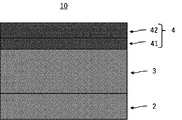
- FIG. 2 schematically shows a cross-sectional structure of synthetic leather 10 according to another embodiment.
- This synthetic leather 10 differs from the synthetic leather 1 in FIG. 1 in that the skin layer 4 has a two-layer structure. Therefore, in the example of FIG. 2, the adhesive layer 3, the skin layer 41, and the skin layer 42 are laminated on one surface of the fibrous base material 2 in this order.
- FIG. 3 schematically shows a cross-sectional structure of synthetic leather 100 according to another embodiment.
- an anchor coat layer 5 and a foam layer 6 are provided between the adhesive layer 3 and the skin layer 4 , and a protective layer 7 is provided on the skin layer 4 . Therefore, in the example of FIG. 3, the adhesive layer 3, the anchor coat layer 5, the foam layer 6, the skin layer 4 and the protective layer 7 are laminated in this order on one surface of the fibrous base material 2. As shown in FIG.
- the front surface of the synthetic leather is flat, but it may be provided with unevenness in consideration of the design.
- the front side of the synthetic leather refers to the side (design side) of the front and back of the synthetic leather that is visible during use.
- the fibrous base material is not particularly limited, and examples thereof include fabrics such as woven fabrics, knitted fabrics and non-woven fabrics, and leather (including split leather). Among these, knitted fabrics or woven fabrics are preferred, and knitted fabrics are more preferred, from the viewpoint that the resulting synthetic leather has good sewability.
- the fabric is coated or impregnated with conventionally known solvent-based or solvent-free (including water-based) polymer compounds (e.g., polyurethane resins, copolymers thereof, and polyvinyl chloride resins), followed by dry coagulation or wet coagulation. You can use the one that has been made.
- the fibrous base material may be colored with dyes or pigments.
- the thickness of the fibrous base material is not particularly limited, and is preferably 0.9 to 1.3 mm, more preferably 1.0 to 1.2 mm, from the viewpoint of wear resistance, strength, and tactile feel. is.
- the above thickness of the fibrous base material is the thickness of the fibrous base material before laminating the adhesive layer and the skin layer, but the thickness of the fibrous base material in the synthetic leather after lamination is within the same range. May be set.
- the synthetic leather according to the present embodiment includes an adhesive layer containing a non-yellowing polycarbonate-based polyurethane resin and/or a yellowing-resistant polycarbonate-based polyurethane resin as a resin layer on the above-described fibrous base material, and a non-yellowing polycarbonate-based polyurethane resin.
- a skin layer containing is laminated.
- non-yellowing polycarbonate-based polyurethane resin and the yellowing-type polycarbonate-based polyurethane resin are polycarbonate-based polyurethane resins having aromatic rings in their molecules, and are different from non-yellowing polycarbonate-based polyurethane resins having no aromatic rings.
- non-yellowing polycarbonate-based polyurethane resins include the following (A1) and (A2).
- A1) Those obtained by the reaction of a polycarbonate polyol component and a non-yellowing polyisocyanate component
- A2) Those obtained by the reaction of a polycarbonate polyol and a yellowing polyisocyanate component and containing an ultraviolet absorber and/or a light stabilizer
- the non-yellowing type polycarbonate-based polyurethane resin may contain other polyol components and polyisocyanate components as copolymerization components as long as the effect is not impaired.
- yellowing polycarbonate-based polyurethane resins include those obtained by reacting (B) a polycarbonate polyol component and a yellowing polyisocyanate component and not containing an ultraviolet absorber and/or a light stabilizer.
- the yellowing type polycarbonate-based polyurethane resin may contain other polyol components and polyisocyanate components as copolymerization components as long as the effect is not impaired.
- polycarbonate polyol component examples include at least one polyalkylene carbonate diol selected from the group consisting of polyethylene carbonate diol, polybutylene carbonate diol, and polyhexamethylene carbonate diol.
- An araliphatic polyisocyanate is used as the non-yellowing polyisocyanate component.
- An araliphatic polyisocyanate is a polyisocyanate in which an isocyanate group is not directly bonded to an aromatic ring. Examples thereof include araliphatic diisocyanates such as xylylene diisocyanate (XDI) and tetramethylxylylene diisocyanate (TMXDI), and these may be used singly or in combination.
- Aromatic polyisocyanate is used as the yellowing polyisocyanate component.
- An aromatic polyisocyanate is a polyisocyanate in which an isocyanate group is directly attached to an aromatic ring.
- aromatic diisocyanates such as phenylene diisocyanate, toluene diisocyanate (TDI), 4,4'- or 2,4'-diphenylmethane diisocyanate (MDI), and naphthalene diisocyanate, which may be used alone or in combination of two or more. You may Among these, it is preferable to use TDI and/or MDI from the viewpoint of improving oleic acid resistance.
- ultraviolet absorbers examples include “Tinuvin326” and “Tinuvin400” (manufactured by BASF Japan Ltd.).
- light stabilizers examples include “Tinuvin 144” and “Tinuvin 5866” (manufactured by BASF Japan Ltd.).
- non-yellowing polycarbonate-based polyurethane resin (A1) examples include those obtained by reacting a polycarbonate polyol component, a non-yellowing polyisocyanate component, and a low-molecular chain extender. It may also be obtained by reacting a urethane polycarbonate polyol prepolymer obtained by reacting a polycarbonate polyol component and a non-yellowing polyisocyanate component with a non-yellowing polyisocyanate component (urethane curing agent).
- non-yellowing urethane polyisocyanate prepolymer obtained by reacting a polycarbonate polyol component and a non-yellowing polyisocyanate component with a polycarbonate polyol component.
- the non-yellowing polycarbonate-based polyurethane resin (A2) is obtained by adding a polycarbonate polyol component, a yellowing polyisocyanate component, a low molecular chain extender, an ultraviolet absorber and a light stabilizer, and reacting them. Examples are given.
- an ultraviolet absorber and a light stabilizer are added, and these are reacted.
- a yellowing urethane polyisocyanate prepolymer obtained by reacting a polycarbonate polyol component and a yellowing polyisocyanate component, and in addition to the polycarbonate polyol component, an ultraviolet absorber and a light stabilizer are added, and these are reacted. Anything is fine.
- Examples of the yellowing polycarbonate-based polyurethane resin (B) include those obtained by reacting a polycarbonate polyol component, a yellowing polyisocyanate component, and a low-molecular chain extender. It may also be obtained by reacting a urethane polycarbonate polyol prepolymer obtained by reacting a polycarbonate polyol component and a yellowing polyisocyanate component with a yellowing polyisocyanate component (urethane curing agent). It may also be obtained by reacting a yellowing urethane polyisocyanate prepolymer obtained by reacting a polycarbonate polyol component and a yellowing polyisocyanate component with a polycarbonate polyol component.
- Examples of the low-molecular-weight chain extender include compounds having at least two active hydrogen atoms, such as aliphatic diols, alicyclic diols, aliphatic diamines, alicyclic diamines, and hydrazine derivatives at least one of the
- a non-yellowing polycarbonate-based polyurethane resin is used as described above.
- the intermolecular interaction (hydrogen bond, van der Waals force, ⁇ - ⁇ stacking interaction) of the polyurethane resin is enhanced and the gap between molecules is reduced. Therefore, penetration of oleic acid can be suppressed, and resistance to oleic acid can be improved.
- the form of the non-yellowing polycarbonate polyurethane resin for the skin layer is not particularly limited, and may be appropriately selected according to the application.
- it may be solvent-free, hot-melt, solvent-based, or water-based, and may be one-component or two-component curing type. From the viewpoint of film-forming properties, a solvent-based one-liquid type is preferred.
- the skin layer is made of a resin whose main component is a non-yellowing polycarbonate-based polyurethane resin.
- the resin forming the skin layer may be only a non-yellowing type polycarbonate-based polyurethane resin, but may contain other resins such as polyurethane resins as long as the effect is not impaired.
- 60% by mass or more, more preferably 80% by mass or more, of the resin forming the skin layer is preferably the non-yellowing polycarbonate-based polyurethane resin.
- the skin layer may contain additives such as a cross-linking agent and a coloring agent, if necessary.
- the cross-linking agent is incorporated into the resin through a reaction to form a cross-linked structure.
- cross-linking agents include isocyanate-based cross-linking agents and carbodiimide-based cross-linking agents. Among them, an isocyanate-based cross-linking agent is preferable. By adding an isocyanate-based cross-linking agent, the cross-linking density of the resin can be increased, thereby improving the oleic acid resistance. Ethanol resistance can also be imparted.
- Isocyanate-based cross-linking agents include, for example, phenylene diisocyanate, aromatic polyisocyanates such as TDI, MDI and naphthalene diisocyanate, araliphatic polyisocyanates such as XDI and TMXDI, hexamethylene diisocyanate (HDI), lysine diisocyanate, cyclohexane diisocyanate, and isophorone.
- Aliphatic polyisocyanates such as diisocyanate (IPDI), dicyclohexylmethane diisocyanate, or alicyclic polyisocyanates can be mentioned.
- At least one selected from the group consisting of aliphatic diisocyanates, alicyclic diisocyanates and araliphatic diisocyanates is preferably used from the viewpoint of yellowing resistance. From the viewpoint of oleic acid resistance and ethanol resistance, it is preferable to use at least one selected from the group consisting of aromatic diisocyanates and araliphatic diisocyanates.
- the content of the isocyanate-based cross-linking agent in the skin layer is not particularly limited. It may be 10% by mass, or 3 to 10% by mass. When the content of the isocyanate-based cross-linking agent is 15% by mass or less, it is possible to prevent the texture from becoming rough and hard.
- the coloring agent is not particularly limited, and conventionally known pigments, dyes, etc. can be exemplified. Addition of a coloring agent can improve the design.
- the content of the coloring agent in the skin layer is not particularly limited. It is preferably 28 to 32% by mass. When the content of the coloring agent is 20% by mass or more, the resulting synthetic leather has a dark surface color, and discoloration of the polyurethane resin due to heat or light can be suppressed. When the content of the colorant is 38% by mass or less, the rubbing fastness is not impaired.
- the skin layer may be formed of one layer, or may be formed of two or more layers.
- the skin layer is formed of two layers.
- the form of the non-yellowing polycarbonate-based polyurethane resin forming the first skin layer (skin layer 42) on the front side is preferably a solvent-based one-liquid type from the viewpoint of film-forming properties.
- the form of the non-yellowing type polycarbonate polyurethane resin that forms the second skin layer (skin layer 41) on the adhesive layer side has a low environmental load and dissolves the first skin layer during lamination (when recoating the resin liquid).
- a water-based one-liquid type is preferable from the viewpoint that it is difficult to form, and a solvent-based one-liquid type is preferable from the viewpoint of film-forming properties.
- the skin layer may be formed of three or more layers.
- the form of the non-yellowing type polycarbonate-based polyurethane resin forming the first skin layer is preferably a solvent-based one-liquid type from the viewpoint of film-forming properties.
- the form of the non-yellowing polycarbonate polyurethane resin that forms the skin layer in contact with the adhesive layer has a low environmental impact and is less likely to dissolve the existing layer during lamination (during recoating). is preferred, and from the viewpoint of film-forming properties, a solvent-based one-liquid type is preferred.
- the form of the non-yellowing polycarbonate-based polyurethane resin forming the skin layer existing between the first skin layer and the skin layer in contact with the adhesive layer may be the same as the "skin layer in contact with the adhesive layer".
- a solvent-based system or a water-based system may be selected accordingly.
- the content of the cross-linking agent and the coloring agent in the above-mentioned skin layer is the outermost skin layer (skin layer 42 in FIG. 2) or the skin layer in contact with the protective layer. It is sufficient if the numerical range of is satisfied.
- the thickness of the skin layer is preferably 17-80 ⁇ m, more preferably 20-70 ⁇ m, and even more preferably 25-60 ⁇ m.
- the thickness is 17 ⁇ m or more, the effect of improving resistance to oleic acid can be enhanced.
- the thickness is 80 ⁇ m or less, it is possible to prevent the texture of the obtained synthetic leather from becoming rough and hard.
- the skin layer is formed of a plurality of layers, the total thickness of the plurality of skin layers should satisfy the above numerical range.
- the resin constituting the adhesive layer one or both of the non-yellowing polycarbonate polyurethane resin and the yellowing polycarbonate polyurethane resin are used as described above.
- this resin the intermolecular interaction (hydrogen bond, van der Waals force, ⁇ - ⁇ stacking interaction) of the polyurethane resin is enhanced and the gap between molecules is reduced. Therefore, penetration of oleic acid can be suppressed, and resistance to oleic acid can be improved.
- the skin layer and the adhesive layer have an aromatic structure. Therefore, the intermolecular interaction of the polyurethane resin is increased also at the interface between the skin layer and the adhesive layer, and for the same reason as above, the oleic acid resistance can be improved.
- the form of the non-yellowing type polycarbonate-based polyurethane resin for the adhesive layer is not particularly limited, and may be appropriately selected according to the application.
- it may be solvent-free, hot-melt, solvent-based, or water-based, and may be one-component or two-component curing type.
- a solvent-based two-liquid curing type is preferred.
- the adhesive layer is made of a resin whose main component is a non-yellowing polycarbonate polyurethane resin and/or a yellowing polycarbonate polyurethane resin.
- the resin forming the adhesive layer may be only a non-yellowing polycarbonate-based polyurethane resin and/or a yellowing polycarbonate-based polyurethane resin alone, but may contain other resins such as polyurethane resins within a range that does not impair the effect.
- 60 mass % or more, more preferably 80 mass % or more of the resin forming the adhesive layer is preferably the non-yellowing polycarbonate-based polyurethane resin and/or the yellowing polycarbonate-based polyurethane resin.
- the adhesive layer may contain additives such as cross-linking agents, colorants, catalysts and flame retardants as necessary.
- cross-linking agents include isocyanate-based cross-linking agents and carbodiimide-based cross-linking agents.
- colorants include pigments and dyes.
- catalysts include amine-based catalysts and organic tin compounds.
- the thickness of the adhesive layer is preferably 100-200 ⁇ m, more preferably 145-195 ⁇ m.
- the thickness is 100 ⁇ m or more, the oleic acid resistance is good, and the fibrous base material can be concealed to provide good design.
- the thickness is 200 ⁇ m or less, it is possible to prevent the texture of the obtained synthetic leather from becoming rough and hard.
- the thickness of the adhesive layer is preferably greater than the thickness of the skin layer. This improves the texture. Moreover, the thickness of the adhesive layer is preferably greater than the thickness of the foam layer, and preferably greater than the thickness of the anchor coat layer. This improves the texture.
- the adhesive layer is preferably a non-porous layer.
- the resin layers other than the foam layer that is, the skin layer, the anchor coat layer and the protective layer, are all preferably non-porous layers.
- a foam layer may be provided between the skin layer and the adhesive layer, or a foam layer and an anchor coat layer may be provided.
- the foam layer is laminated on the back surface of the skin layer (that is, under the skin layer).
- the foam layer is a layer provided to increase the thickness of the resin layer of the synthetic leather, thereby making it difficult for oleic acid to permeate and further improving the resistance to oleic acid. Since it is a foam layer, even if the thickness of the resin layer is large, the texture is not impaired. In addition, by providing a foam layer, it is possible to impart a feeling of coolness to the touch.
- the anchor coat layer is provided between the foam layer and the adhesive layer. That is, the anchor coat layer is laminated on the back surface of the foam layer (that is, under the foam layer), and is a layer provided to enhance the adhesiveness between the foam layer and the adhesive layer.
- the foam layer and the anchor coat layer preferably contain a polyurethane resin.
- the polyurethane resin contained in the foam layer and the anchor coat layer is preferably a polycarbonate-based polyurethane resin. It is more preferable to use the same polyurethane resin as the skin layer. That is, from the viewpoint of improving oleic acid resistance, the foam layer and the anchor coat layer preferably contain a non-yellowing polycarbonate polyurethane resin. It is preferable to be By using a non-yellowing polycarbonate-based polyurethane resin, the intermolecular interaction (hydrogen bond, van der Waals force, ⁇ - ⁇ stacking interaction) of the polyurethane resin is increased, and the gap between molecules is reduced.
- the form of the non-yellowing polycarbonate-based polyurethane resin used for the foam layer and the anchor coat layer is not particularly limited, and may be appropriately selected according to the application.
- it may be solvent-free, hot-melt, solvent-based, or water-based, and may be one-component or two-component curing type.
- hollow fine particles hollow fine particles having an outer shell made of a thermoplastic resin
- it is preferably a water-based one-liquid type.
- Additives such as foaming agents, hollow fine particles, cross-linking agents, leveling agents, thickeners, pH adjusters, antifoaming agents, and colorants are used in the foam layer and the anchor coat layer, in addition to resins, if necessary. be able to.
- cross-linking agents include isocyanate-based cross-linking agents and carbodiimide-based cross-linking agents.
- isocyanate-based cross-linking agent it is preferable to use at least one selected from the group consisting of aliphatic diisocyanates, alicyclic diisocyanates and araliphatic diisocyanates, similarly to the skin layer.
- the means for forming pores in the foam layer is not particularly limited, and known methods can be adopted. Examples thereof include physical foaming by mechanical stirring, chemical foaming by adding a foaming agent, and foaming (blocked pore) formation by adding hollow fine particles. Alternatively, closed pores may be formed by coating the surface of the layer with a non-porous layer after forming pores by wet coating of polyurethane resin. From the viewpoint that the shape and size of the pores and the expansion ratio can be easily adjusted, it is preferable to form the pores by adding hollow fine particles.
- Hollow fine particles are spherical particles whose internal microscopic voids are covered with a film (called an outer shell, outer wall, etc.) made of various materials. Among them, it is preferable that the material does not expand in volume even when heat-treated. By using such hollow fine particles, it is possible to minimize the volume fluctuation of the foam layer during production, reduce the variation in quality, and prevent the resin around the hollow fine particles from being stretched and thinned. Prevents and prevents oleic acid resistance from being impaired.
- hollow fine particles that satisfy the above conditions can be used as the hollow fine particles.
- examples thereof include organic hollow fine particles having outer shells made of thermosetting resins such as phenol resins, epoxy resins and urea resins, and thermoplastic resins such as acrylic resins and vinyl chloride resins.
- thermosetting resins such as phenol resins, epoxy resins and urea resins
- thermoplastic resins such as acrylic resins and vinyl chloride resins.
- inorganic hollow fine particles having an outer shell made of glass, shirasu, silica, alumina or carbon can also be used.
- organic hollow fine particles coated with an inorganic fine powder such as calcium carbonate, talc or titanium oxide.
- organic hollow fine particles having an outer shell made of a thermoplastic resin or organic hollow fine particles having a surface coated with an inorganic fine powder are preferable.
- the hollow fine particles having an outer shell made of a thermoplastic resin used as a preferred embodiment are typically obtained by pre-foaming a microcapsule-type foaming agent.
- the microcapsule-type foaming agent itself encloses a volatile foaming agent such as a low-boiling hydrocarbon in an outer shell made of a thermoplastic resin that can be softened and expanded by heat treatment.
- the microcapsule-type foaming agent may be used as it is, or may be used as a pre-foamed product obtained by foaming in advance. Among them, a foamed body is preferable from the viewpoint of heat resistance.
- the thickness of the foam layer is preferably 70-170 ⁇ m in one embodiment.
- the thickness is 70 ⁇ m or more, oleic acid resistance can be improved.
- the thickness is 170 ⁇ m or less, workability can be improved.
- the thickness of the anchor coat layer is preferably 17 to 27 ⁇ m in one embodiment.
- the thickness is 17 ⁇ m or more, it is possible to prevent the outer shell of the hollow fine particles in the foam layer from being dissolved by the solvent of the adhesive layer.
- the thickness is 27 ⁇ m or less, it is possible to prevent the texture from becoming rough and hard.
- a protective layer may be further provided on the skin layer.
- the protective layer preferably contains a polycarbonate-based polyurethane resin.
- the form of the polycarbonate-based polyurethane resin for the protective layer is not particularly limited, and may be appropriately selected according to the application.
- it may be solvent-free, hot-melt, solvent-based, or water-based, and may be one-component or two-component curing type. From the viewpoints of abrasion resistance, texture, and touch, a water-based one-liquid type is preferred.
- the polycarbonate-based polyurethane resin that constitutes the protective layer is obtained, for example, by reacting a polycarbonate polyol component, a polyisocyanate component, and a low-molecular-weight chain extender.
- polycarbonate polyol component for example, at least one polyalkylene carbonate diol selected from the group consisting of polyethylene carbonate diol, polybutylene carbonate diol, and polyhexamethylene carbonate diol can be used.
- the polyisocyanate component for example, at least one organic polyisocyanate selected from aliphatic polyisocyanate, alicyclic polyisocyanate, araliphatic polyisocyanate, aromatic polyisocyanate, etc. can be used. From the viewpoint of light resistance, at least one selected from the group consisting of aliphatic diisocyanates, alicyclic diisocyanates and araliphatic diisocyanates is preferred, and among them at least one selected from the group consisting of HDI, XDI and IPDI. It is preferable to use
- low-molecular-weight chain extenders include compounds having at least two active hydrogen atoms. at least one of the
- the protective layer may contain a resin other than a polycarbonate-based polyurethane resin, and in addition to the resin, if necessary, additives such as a cross-linking agent, a leveling agent, a matting agent, and a coloring agent. good too.
- cross-linking agents include isocyanate-based cross-linking agents and carbodiimide-based cross-linking agents. Aliphatic polyisocyanates and/or alicyclic polyisocyanates are preferred as isocyanate cross-linking agents.
- matting agents include inorganic particles such as silica.
- the thickness of the protective layer is preferably 6 to 16 ⁇ m in one embodiment. When the thickness is 6 ⁇ m or more, good wear resistance can be obtained. When the thickness is 16 ⁇ m or less, it is possible to prevent the texture from becoming rough and hard.
- the synthetic leather according to this embodiment preferably has a dark surface color (that is, the color of the front surface). Due to the dark color, discoloration of the non-yellowing type polycarbonate-based polyurethane resin due to heat or light can be suppressed (made inconspicuous).
- L * in the L * a * b * color system is preferably 27 or less, more preferably 25 or less.
- the L * a * b * color system is a color display method standardized by the International Commission on Illumination (CIE 1976) and stipulated by JIS (JIS Z 8781-4:2013). Note that L * is obtained by measuring L * for arbitrary three locations using an integrating sphere spectrophotometer (Color-i5, manufactured by X-Rite) and calculating the average value of these. can be done.
- Lamination of the skin layer and adhesive layer of synthetic leather is performed, for example, by the following method.
- a skin layer is formed by applying a resin liquid (skin layer-forming resin composition) for forming a skin layer to a releasable substrate, followed by dry solidification.
- a resin liquid adheresive layer resin composition
- the surface of the releasable substrate may be flat, or may have unevenness such as a textured pattern.
- the lamination is performed, for example, by the following method. After applying the resin liquid for forming the skin layer to the releasable base material, the resin liquid is dry solidified to form the skin layer, and then the resin liquid for forming the foam layer on the skin layer (resin composition for foam layer). is applied, followed by dry solidification to form a skin layer and a foam layer on the releasable substrate. After that, after applying a resin liquid for forming an adhesive layer on the foam layer, while it is still viscous, it is pressed against one side of the fibrous base material to laminate the adhesive layer, the foam layer, and the skin layer. do.
- anchor coat layer resin composition When providing an anchor coat layer, its lamination is performed in the same manner as the foam layer. That is, after forming the skin layer and the foam layer on the releasable substrate, before applying the resin liquid for forming the adhesive, the resin liquid for forming the anchor coat layer on the foam layer (anchor coat layer resin composition) is applied, followed by dry solidification to form a skin layer, a foam layer, and an anchor coat layer on the releasable substrate.
- a protective layer when a protective layer is provided, its lamination is performed, for example, by the following method. After laminating the adhesive layer and the skin layer on the fibrous base material by the above method, a protective layer-forming resin solution (resin composition for protective layer) is applied on the skin layer and dried to form a protective layer. do.
- a protective layer-forming resin solution resin composition for protective layer
- each resin liquid As for the method of applying each resin liquid, known methods such as knife coating, roll coating, gravure coating, or spray coating can be used. A desired amount of each resin liquid may be applied in one application, or the desired amount may be applied in two or more portions.
- the use of the synthetic leather according to this embodiment is not particularly limited.
- it can be used as an interior material for various vehicles, including automobile seats, ceiling materials, dashboards, door lining materials, steering wheels, shift levers, and armrests.
- Other uses include interior uses such as upholstery for sofas and chairs, and fashion uses such as bags and shoes.
- a new paper waste cut to 50 mm length and 120 mm width was placed on top of the paper waste.
- the test piece is placed in the center of a lidded stainless steel pad (EBM18-8 seasoning container lidded vat, manufactured by Ebematsu Shoji Co., Ltd.), and the stainless pad is set to a predetermined temperature in a blower constant temperature dryer (DRS420DA). , manufactured by Advantech Toyo Co., Ltd.) for a predetermined time (heat treatment). After heat treatment according to the following heat treatment conditions, the stainless steel pad was taken out from the blower constant temperature dryer and allowed to stand at room temperature for 1 hour.
- DRS420DA blower constant temperature dryer
- test piece after the oleic acid treatment was cut into a size of 50 mm in length and 120 mm in width together with the mounting paper.
- the test piece was attached to the table of a Beslick abrasion tester (manufactured by GIULIANI TECHNOLOGIE srl) with a double-sided tape (double-sided tape for rubber, 775, manufactured by Teraoka Seisakusho Co., Ltd.).
- a 1.5 cm square felt (701 (model number), manufactured by Swisstest Testmaterialien AG) to the tip of the friction element (1.5 cm square flat plate) with double-sided tape (double-sided tape for rubber, 775, manufactured by Teraoka Seisakusho Co., Ltd.).
- a load of 9.8 N (1000 gf) is applied to the friction element so that the surface pressure on the surface of the test piece is 444 g / cm 2 (4.5 N / cm 2 ), the stroke is 37.5 mm, and 40 times ( The felt was rubbed against the test piece at reciprocation)/min. After rubbing 1000 times, the surface appearance of the test piece was observed. Evaluation was performed according to the following evaluation criteria, and grade 4 or higher was regarded as a pass.
- Grade 5 Abnormality (paint film lift, tear) is not observed at all Grade 4: Abnormality (paint film lift, tear) is slightly observed but not conspicuous Grade 3: Abnormality (paint film lift, tear), Approved Grade 2: Abnormality (paint film lifting, tearing) is slightly observed Grade 1: Abnormality (painting film lifting, tearing) is significantly observed
- a test piece having a width of 70 mm and a length of 200 mm was taken.
- the test piece was attached to a high-temperature fade meter (UV fade meter U48, manufactured by Suga Test Instruments Co., Ltd.), and the resin layer side of the test piece was irradiated for 400 hours.
- the irradiation range was 45 mm ⁇ 65 mm, and each test piece was irradiated at three locations.
- the high-temperature fade meter was lit with one carbon arc (light intensity configuration according to JIS L0842: 2004), the distance from the light source to the test piece was 250 mm, the machine temperature was 55 to 65 ° C, and the black panel temperature of the sample stand was 83 ⁇ 3.
- Grade 5 Color discoloration is about No. 5 of the standard gray color chart Grade 4: Color discoloration is about No. 4 of the standard gray color chart Grade 3: Color discoloration is about No. 3 of the standard gray color chart Grade 2: Discoloration is about No. 2 of the standard gray color chart Grade 1: Color discoloration is about No. 1 of the standard gray color chart
- Example 1 ⁇ Fibrous base material> Using an 18G circular knitting machine, 330dtex/96f polyester processed yarn is used as front and connecting yarns, and 330dtex/96f polyester processed yarn is introduced as back yarn, and a circular knitted fabric is knitted with a knitting structure of mock rody structure. did. The resulting circular knitted fabric was washed with water and dried to obtain a circular knitted fabric (basis weight: 480 g/m 2 , thickness: 1.0 mm) as a fibrous base material.
- ⁇ Prescription 1 Resin composition for skin layer> ⁇ Main agent: Non-yellowing type polycarbonate polyurethane resin: 100 parts by mass (manufactured by Dainichiseika Kogyo Co., Ltd., Lezamin CU-9450NL, solvent-based one-liquid type, solid content 30% by mass)
- Cross-linking agent isocyanate-based cross-linking agent (HDI type): 5 parts by mass (Rezamin NE cross-linking agent manufactured by Dainichiseika Kogyo Co., Ltd., solid content 75% by mass)
- Coloring agent carbon black pigment: 30 parts by mass (EX-GP-16-249 BLACK manufactured by Stahl Japan Co., Ltd., solid content 45% by mass)
- DMF 45 parts by mass
- Preparation method DMF was used to adjust the viscosity to 3,000 mPa ⁇ s (Brookfield viscometer, rotor: No. 4, 12 rpm, 23°C).
- ⁇ Prescription 2 Resin composition for foam layer>
- Main agent Non-yellowing type polycarbonate polyurethane resin: 100 parts by mass (Hydran WLI-620AR, water-based one-liquid type, solid content 40% by mass, manufactured by DIC Corporation)
- Hollow fine particles foamed microcapsules: 25 parts by mass (Matsumoto Yushi Pharmaceutical Co., Ltd., Matsumoto Microsphere FN-100S (used in a foamed state by heat treatment), average particle size 50 ⁇ m, solid content 100% by mass, powder , shell: acrylonitrile-based polymer, inclusions: isopentane, foamed product)
- Cross-linking agent isocyanate-based cross-linking agent (HDI type): 1 part by mass (AQUADERM XL-50 manufactured by LANXESS Corporation, solid content 50% by mass)
- Leveling agent Silicone leveling agent: 1 part by mass (AQUADERM Fluid H, manufactured by LANXESS KK, solid content 100% by mass
- ⁇ Prescription 3 Resin composition for anchor coat layer> ⁇ Main agent: Non-yellowing type polycarbonate polyurethane resin: 100 parts by mass (Hydran WLI-620AR, water-based one-liquid type, solid content 40% by mass, manufactured by DIC Corporation) ⁇ Cross-linking agent: isocyanate-based cross-linking agent (HDI type): 1 part by mass (AQUADERM XL-50 manufactured by LANXESS Corporation, solid content 50% by mass) ⁇ Leveling agent: Silicone leveling agent: 1 part by mass (AQUADERM Fluid H, manufactured by LANXESS KK, solid content 100% by mass) Coloring agent: carbon black pigment: 10 parts by mass (EUDERM Black BN manufactured by LANXESS Corporation, solid content 25% by mass) Preparation method: The above agents were mixed and stirred to prepare a resin composition for an anchor coat layer. The obtained resin composition for anchor coat layer had a viscosity of 5,000 mPa ⁇ s (Brookfield viscometer, rotor: No.
- ⁇ Prescription 4 Resin composition for adhesive layer>
- Production Example 1 Polyisocyanate solution/polyol component: Polycarbonate-based polyol: 20 parts by mass (manufactured by Ube Industries, Ltd., ETERNACOLL UH-200, solid content 100% by mass) - Diisocyanate component: XDI system: 9.02 parts by mass (manufactured by Mitsui Chemicals, Takenate 500, solid content 100% by mass)
- Preparation method The above were mixed and heated to 25 to 80°C at a heating rate of 1°C/min. The mixture was stirred at 80°C for 60 minutes to complete the urethane reaction and obtain a polyisocyanate solution.
- ⁇ Prescription 5 Resin composition for protective layer> ⁇ Main agent: water-based polycarbonate-based polyurethane resin: 90 parts by mass (BAYDERM Finish 61UD, water-based one-liquid type, solid content 35% by mass) Matting agent: Silica-containing water-based polycarbonate polyurethane resin: 10 parts by mass (HYDRHOLAC UD-2, solid content 25% by mass) ⁇ Crosslinking agent: isocyanate crosslinker (HDI type): 1 part by mass (AQUADERM XL-50, solid content 50% by mass) ⁇ Leveling agent: Silicone leveling agent: 1 part by mass (AQUADERM Fluid H, solid content 100% by mass) - Water: 20 parts by mass All raw materials, except for water, are manufactured by LANXESS Corporation.
- Preparation method The above agents were mixed and stirred to prepare a protective layer resin composition.
- the obtained resin composition for protective layer had a viscosity of 200 mPa ⁇ s (Brookfield viscometer, rotor: No. 1, 12 rpm, 23° C.).
- the resin composition for the skin layer prepared according to Formulation 1 above is applied to release paper (ARX196M, manufactured by Asahi Roll Co., Ltd.) having a textured uneven pattern with a comma coater so that the coating amount is 110 g / m 2 . It was applied in a sheet form and treated in a dryer at 100° C. for 3 minutes and then at 130° C. for 3 minutes to form a skin layer. The thickness of the skin layer obtained was 27 ⁇ m.
- the foam layer resin composition prepared according to Formulation 2 above is coated on the surface of the skin layer formed on the release paper with a comma coater in a sheet form so that the coating amount is 90 g/m 2 , It was treated at 100° C. for 3 minutes in a dryer to form a foam layer.
- the foam layer obtained had a thickness of 120 ⁇ m.
- the resin composition for the anchor coat layer prepared according to Formulation 3 above was coated on the surface of the foam layer formed on the release paper with a comma coater in a sheet form so that the coating amount was 65 g/m 2 . , at 100° C. for 3 minutes in a dryer, and subsequently at 130° C. for 3 minutes to form an anchor coat layer.
- the thickness of the resulting anchor coat layer was 22 ⁇ m.
- the adhesive layer resin composition prepared according to Formulation 4 above was applied in a sheet form by a knife coater to the surface of the anchor coat layer formed on the release paper so that the coating amount was 360 g/m 2 . , 2 minutes at 80°C in a dryer, followed by 2 minutes at 100°C and 2 minutes at 130°C for pre-drying.
- the polyester circular knitted fabric as the fibrous base material was overlaid on the adhesive layer, and after applying pressure at 120° C. and 39.2 N/cm 2 for 1 minute using a laminator, the release paper was peeled off.
- the thickness of the adhesive layer obtained was 170 ⁇ m.
- the protective layer resin composition prepared according to Formulation 5 above was coated in a sheet form on the surface of the skin layer after peeling off the release paper by a reverse coater so that the coating amount was 59 g/m 2 . It was treated in a dryer at 100° C. for 3 minutes and then at 140° C. for 3 minutes to form a protective layer with a thickness of 11 ⁇ m to obtain a synthetic leather.
- the thickness of each layer is measured by observing the vertical cross section of the synthetic leather with a microscope (manufactured by Keyence Corporation, Digital HF Microscope VH-8000) and measuring the thickness at any 10 points. This value is obtained by calculating the average value.
- Example 2 Synthetic leather was obtained in the same manner as in Example 1 except that the foam layer and the anchor coat layer were not formed and the thickness of the skin layer was changed to 30 ⁇ m.
- Example 3 In Example 2, after the skin layer was formed, a second skin layer resin composition prepared according to Formulation 6 below was applied to the surface of the skin layer formed on the release paper with a comma coater in an amount of 70 g/ It was applied in a sheet form so as to be m 2 . Drying at 100° C. for 3 minutes followed by 130° C. for 3 minutes formed a second skin layer with a layer thickness of 30 ⁇ m. A synthetic leather was obtained in the same manner as in Example 2 except for the above.
- ⁇ Prescription 6 Resin composition for second skin layer> ⁇ Main agent: Non-yellowing type polycarbonate polyurethane resin: 100 parts by mass (Hydran WLI-620AR, water-based one-liquid type, solid content 40% by mass, manufactured by DIC Corporation) ⁇ Cross-linking agent: isocyanate-based cross-linking agent (HDI type): 1 part by mass (AQUADERM XL-50 manufactured by LANXESS Corporation, solid content 50% by mass) ⁇ Leveling agent: Silicone leveling agent: 1 part by mass (AQUADERM Fluid H, manufactured by LANXESS KK, solid content 100% by mass) Coloring agent: carbon black pigment: 10 parts by mass (manufactured by LANXESS, EUDERMBlackB-N, solid content 25% by mass) Preparation method: The above agents were mixed and stirred to prepare a second skin layer resin composition. The obtained second skin layer resin composition had a viscosity of 5,000 mPa ⁇ s (Brookfield viscometer, rotor:
- Example 4 Synthetic leather was obtained in the same manner as in Example 1, except that the skin layer resin composition for forming the skin layer was changed to formulation 7 below.
- ⁇ Prescription 7 Resin composition for skin layer> ⁇ Main agent: Non-yellowing type polycarbonate polyurethane resin: 100 parts by mass (manufactured by Dainichiseika Kogyo Co., Ltd., Lezamin ME-8210NS, solvent-based one-liquid type, solid content 30% by mass)
- Cross-linking agent isocyanate-based cross-linking agent (HDI type): 5 parts by mass (Rezamin NE cross-linking agent manufactured by Dainichiseika Kogyo Co., Ltd., solid content 75% by mass)
- Coloring agent carbon black pigment: 24 parts by mass (EX-GP-16-249 BLACK manufactured by Stahl Japan Co., Ltd., solid content 45% by mass)
- - DMF 45 parts by mass
- Preparation method The above agents were mixed and stirred to prepare a resin composition for skin layer.
- the obtained resin composition for skin layer had a viscosity of 3,000 mPa ⁇ s (Brookfield viscometer, rotor
- Example 5 Synthetic leather was obtained in the same manner as in Example 1 except that the foam layer, anchor coat layer and protective layer were not formed.
- Example 6 Synthetic leather was obtained in the same manner as in Example 1, except that the thickness of the adhesive layer was 100 ⁇ m.
- Example 7 A synthetic leather was obtained in the same manner as in Example 1 except that the thickness of the adhesive layer was changed to 200 ⁇ m.
- Example 8 Synthetic leather was obtained in the same manner as in Example 1, except that the thickness of the foam layer was changed to 70 ⁇ m.
- Example 9 Synthetic leather was obtained in the same manner as in Example 1, except that the foam layer had a thickness of 170 ⁇ m.
- Example 10 Synthetic leather was obtained in the same manner as in Example 1, except that the skin layer resin composition for forming the skin layer was changed to formulation 8 below.
- ⁇ Prescription 8 Resin composition for skin layer> ⁇ Main agent: Non-yellowing type polycarbonate polyurethane resin: 100 parts by mass (manufactured by Dainichiseika Kogyo Co., Ltd., Lezamin ME-8210NS, solvent-based one-liquid type, solid content 30% by mass)
- Cross-linking agent isocyanate-based cross-linking agent (HDI type): 5 parts by mass (Rezamin NE cross-linking agent manufactured by Dainichiseika Kogyo Co., Ltd., solid content 75% by mass)
- Coloring agent carbon black pigment: 30 parts by mass (EX-GP-16-249 BLACK manufactured by Stahl Japan Co., Ltd., solid content 45% by mass)
- DMF 45 parts by mass
- Preparation method DMF was used to adjust the viscosity to 3,000 mPa ⁇ s (Brookfield viscometer, rotor: No. 4, 12 rpm, 23°C).
- Example 11 Synthetic leather was obtained in the same manner as in Example 1, except that the adhesive layer resin composition for forming the adhesive layer was changed to recipe 9 below.
- ⁇ Prescription 9 Resin composition for adhesive layer>
- Production Example 3 Polyisocyanate solution/polyol component: Polycarbonate-based polyol: 20 parts by mass (manufactured by Ube Industries, Ltd., ETERNACOLL UH-200, solid content 100% by mass)
- Diisocyanate component MDI system: 12 parts by mass (Millionate MT manufactured by Tosoh Corporation, solid content 100% by mass)
- Preparation method The above were mixed and heated to 25 to 80°C at a heating rate of 1°C/min. The mixture was stirred at 80°C for 60 minutes to complete the urethane reaction and obtain a polyisocyanate solution.
- Example 12 Synthetic leather was obtained in the same manner as in Example 1 except that the thickness of the adhesive layer was changed to 20 ⁇ m.
- Example 1 In Example 1, the anchor coat layer was not formed, and the foam layer resin composition forming the foam layer and the adhesive layer resin composition forming the adhesive layer were changed to formulations 10 and 11 below. Synthetic leather was obtained in the same manner as in Example 1 except that
- ⁇ Prescription 10 Resin composition for foam layer> ⁇ Main agent: yellowing type polycarbonate polyurethane resin: 100 parts by mass (LCC Binder UB-1770, manufactured by Lanxess KK, water-based one-liquid type, solid content 30% by mass) ⁇ Hollow fine particles: foamed microcapsules: 25 parts by mass (Matsumoto Yushi Pharmaceutical Co., Ltd., Matsumoto Microsphere FN-100S (used in a foamed state by heat treatment), average particle size 50 ⁇ m, solid content 100% by mass, powder , shell: acrylonitrile-based polymer, inclusions: isopentane, foamed product) ⁇ Cross-linking agent: isocyanate-based cross-linking agent: 1 part by mass (AQUADERM XL-50 manufactured by LANXESS Corporation, solid content 50% by mass) ⁇ Leveling agent: Silicone leveling agent: 1 part by mass (AQUADERM Fluid H, manufactured by LANXESS KK, solid content 100% by mass) Coloring agent:
- ⁇ Prescription 11 Resin composition for adhesive layer>
- Production Example 4 Polyisocyanate solution/polyol component: polyether-based polyol: 20 parts by mass (EXCENOL 2020 manufactured by AGC Inc., solid content 100% by mass)
- Diisocyanate component MDI system: 12 parts by mass (manufactured by Tosoh Corporation, Millionate MT, solid content 100% by mass)
- Preparation method The above were mixed and heated to 25 to 80°C at a heating rate of 1°C/min. The mixture was stirred at 80°C for 60 minutes to complete the urethane reaction and obtain a polyisocyanate solution.
- Example 2 In Example 1, the procedure was the same as in Example 1, except that the foam layer and the anchor coat layer were not formed, and the skin layer resin composition for forming the skin layer was changed to recipe 12 below. , got synthetic leather.
- ⁇ Prescription 12 Resin composition for skin layer> ⁇ Main agent: Non-yellowing polyether-based polyurethane resin: 100 parts by mass (Dainichiseika Kogyo Co., Ltd., Heimlen Y-201B, solvent-based one-liquid type, solid content 30% by mass)
- Cross-linking agent isocyanate-based cross-linking agent: 5 parts by mass (Rezamin NE cross-linking agent manufactured by Dainichiseika Kogyo Co., Ltd., solid content 75% by mass)
- Coloring agent carbon black pigment: 30 parts by mass (EX-GP-16-249 BLACK manufactured by Stahl Japan Co., Ltd., solid content 45% by mass)
- - DMF 45 parts by mass
- Preparation method The above agents were mixed and stirred to prepare a resin composition for skin layer.
- the obtained resin composition for skin layer had a viscosity of 3,000 mPa ⁇ s (Brookfield viscometer, rotor: No. 4, 12 rpm,
- Example 3 In Example 1, the procedure was the same as in Example 1, except that the foam layer and the anchor coat layer were not formed, and the skin layer resin composition for forming the skin layer was changed to Formula 13 below. , got synthetic leather.
- ⁇ Prescription 13 Resin composition for skin layer> ⁇ Main agent: Non-yellowing type polycarbonate polyurethane resin: 100 parts by mass (Rezamin NE-8850, solvent-based one-liquid type, solid content 30% by mass, manufactured by Dainichiseika Kogyo Co., Ltd.) Cross-linking agent: isocyanate-based cross-linking agent: 5 parts by mass (Rezamin NE cross-linking agent manufactured by Dainichiseika Kogyo Co., Ltd., solid content 75% by mass) Coloring agent: carbon black pigment: 30 parts by mass (EX-GP-16-249 BLACK manufactured by Stahl Japan Co., Ltd., solid content 45% by mass) - DMF: 45 parts by mass Preparation method: The above agents were mixed and stirred to prepare a resin composition for skin layer. The obtained resin composition for skin layer had a viscosity of 3,000 mPa ⁇ s (Brookfield viscometer, rotor: No. 4, 12 rpm, 23° C.).
- Example 4 In Example 1, the procedure was the same as in Example 1, except that the foam layer and the anchor coat layer were not formed, and the skin layer resin composition for forming the skin layer was changed to recipe 14 below. , got synthetic leather.
- ⁇ Prescription 14 Resin composition for skin layer> ⁇ Main agent: silicone-modified non-yellowing polycarbonate polyurethane resin: 135 parts by mass (manufactured by Dainichiseika Kogyo Co., Ltd., Lezamin NES-9015-22, solvent-based one-liquid type, solid content 22% by mass)
- Cross-linking agent isocyanate-based cross-linking agent: 5 parts by mass (Rezamin NE cross-linking agent manufactured by Dainichiseika Kogyo Co., Ltd., solid content 75% by mass)
- Coloring agent carbon black pigment: 30 parts by mass (EX-GP-16-249 BLACK manufactured by Stahl Japan Co., Ltd., solid content 45% by mass)
- - DMF 45 parts by mass
- Preparation method The above agents were mixed and stirred to prepare a resin composition for skin layer.
- the obtained resin composition for skin layer had a viscosity of 3,000 mPa ⁇ s (Brookfield viscometer,
- Comparative Example 1 yellowing polyether-based polyurethane resin was used for the adhesive layer, so the resistance to oleic acid was poor.
- Comparative Example 2 a polyether-based polyurethane resin was used in the skin layer
- Comparative Example 3 a non-yellowing polyurethane resin was used in the skin layer
- Comparative Example 4 a silicone-modified non-yellowing polyurethane resin was used in the skin layer. All of them were inferior to Comparative Example 1 in oleic acid resistance.
- Examples 1 to 12 are excellent in oleic acid resistance. However, the appearance change in resistance to oleic acid was acceptable, and the abrasion resistance was also grade 4, indicating excellent resistance to oleic acid. Further, in Examples 1 to 3 and 5 to 12, the L * of the surface color was 27 or less, and the yellowing resistance was excellent even though the non-yellowing type polyurethane resin was not used.
- a fibrous base material an adhesive layer containing a non-yellowing polycarbonate polyurethane resin and/or a yellowing polycarbonate polyurethane resin, and a fibrous base containing a non-yellowing polycarbonate polyurethane resin via the adhesive layer
- a synthetic leather having a skin layer laminated to a material.
- the synthetic leather according to [1] further comprising a protective layer laminated on the skin layer.
- the protective layer contains a polycarbonate-based polyurethane resin.
- the non-yellowing polycarbonate polyurethane resin contained in the adhesive layer and/or the skin layer is (A1) obtained by reacting a polycarbonate polyol component and a non-yellowing polyisocyanate component, or (A2) The synthetic leather according to any one of [1] to [11], which is obtained by reacting a polycarbonate polyol with a yellowing polyisocyanate component and contains an ultraviolet absorber and/or a light stabilizer. [13] The synthetic leather according to [12], wherein the non-yellowing polyisocyanate component is an araliphatic polyisocyanate, preferably XDI and/or TMXDI.
- the yellowing polycarbonate-based polyurethane resin contained in the adhesive layer is obtained by the reaction of (B) a polycarbonate polyol component and a yellowing polyisocyanate component and does not contain an ultraviolet absorber and/or a light stabilizer.
- the synthetic leather according to any one of [1] to [13].
- the yellowing polyisocyanate component is an aromatic polyisocyanate, preferably at least one selected from the group consisting of phenylene diisocyanate, TDI, MDI, and naphthalene diisocyanate [12] to [14]. Synthetic leather according to any one of.
- the resin according to any one of [1] to [15], wherein 60% by mass or more, more preferably 80% by mass or more of the resin forming the skin layer is the non-yellowing polycarbonate-based polyurethane resin.
- the skin layer has a crosslinked structure formed by an isocyanate-based cross-linking agent, and the content of the isocyanate-based cross-linking agent in the skin layer is 0.1 to 15% by mass, more preferably 1 to 10% by mass. , More preferably 3 to 10% by mass, the synthetic leather according to any one of [1] to [16].
- the skin layer contains a coloring agent, and the content of the coloring agent in the skin layer is 20 to 38% by mass, more preferably 25 to 35% by mass, still more preferably 28 to 32% by mass, [1]
Landscapes
- Engineering & Computer Science (AREA)
- Textile Engineering (AREA)
- Chemical & Material Sciences (AREA)
- Chemical Kinetics & Catalysis (AREA)
- Dispersion Chemistry (AREA)
- Inorganic Chemistry (AREA)
- Synthetic Leather, Interior Materials Or Flexible Sheet Materials (AREA)
Priority Applications (5)
| Application Number | Priority Date | Filing Date | Title |
|---|---|---|---|
| JP2023503402A JPWO2022185689A1 (https=) | 2021-03-03 | 2021-12-24 | |
| EP21929245.5A EP4303356A4 (en) | 2021-03-03 | 2021-12-24 | ARTIFICIAL LEATHERETTE |
| US18/266,351 US20240026603A1 (en) | 2021-03-03 | 2021-12-24 | Synthetic leather |
| CN202180091879.3A CN116802356A (zh) | 2021-03-03 | 2021-12-24 | 合成皮革 |
| MX2023010056A MX2023010056A (es) | 2021-03-03 | 2021-12-24 | Cuero sintetico. |
Applications Claiming Priority (2)
| Application Number | Priority Date | Filing Date | Title |
|---|---|---|---|
| JP2021-033831 | 2021-03-03 | ||
| JP2021033831 | 2021-03-03 |
Publications (1)
| Publication Number | Publication Date |
|---|---|
| WO2022185689A1 true WO2022185689A1 (ja) | 2022-09-09 |
Family
ID=83153948
Family Applications (1)
| Application Number | Title | Priority Date | Filing Date |
|---|---|---|---|
| PCT/JP2021/048261 Ceased WO2022185689A1 (ja) | 2021-03-03 | 2021-12-24 | 合成皮革 |
Country Status (6)
| Country | Link |
|---|---|
| US (1) | US20240026603A1 (https=) |
| EP (1) | EP4303356A4 (https=) |
| JP (1) | JPWO2022185689A1 (https=) |
| CN (1) | CN116802356A (https=) |
| MX (1) | MX2023010056A (https=) |
| WO (1) | WO2022185689A1 (https=) |
Cited By (1)
| Publication number | Priority date | Publication date | Assignee | Title |
|---|---|---|---|---|
| WO2025204137A1 (ja) * | 2024-03-28 | 2025-10-02 | セーレン株式会社 | 合成皮革及びその製造方法 |
Citations (9)
| Publication number | Priority date | Publication date | Assignee | Title |
|---|---|---|---|---|
| JPS5848752U (ja) * | 1981-09-29 | 1983-04-01 | 村上 憲司 | 装飾エナメル皮革地 |
| JPS6075689A (ja) * | 1983-10-01 | 1985-04-30 | Toray Ind Inc | 銀付人工皮革 |
| JPH0931862A (ja) * | 1995-07-10 | 1997-02-04 | Achilles Corp | 合成皮革 |
| JPH11302983A (ja) * | 1998-04-27 | 1999-11-02 | Achilles Corp | 装飾シート及びその製造方法 |
| JP2003138487A (ja) * | 2001-10-26 | 2003-05-14 | Komatsu Seiren Co Ltd | 着色された合成皮革およびその製造方法 |
| JP2006322113A (ja) * | 2005-05-20 | 2006-11-30 | Achilles Corp | 耐摩耗性に優れる合成皮革 |
| JP2016204554A (ja) * | 2015-04-24 | 2016-12-08 | 東ソー株式会社 | ポリウレタン樹脂および該組成物を用いた皮革用接着剤 |
| KR20170119141A (ko) * | 2016-04-18 | 2017-10-26 | 주식회사 디케이앤디 | 자동차 내장재용 친환경 폴리우레탄 인공피혁의 제조방법 |
| WO2018123290A1 (ja) * | 2016-12-26 | 2018-07-05 | 共和レザー株式会社 | 合成皮革 |
Family Cites Families (11)
| Publication number | Priority date | Publication date | Assignee | Title |
|---|---|---|---|---|
| JPH0784710B2 (ja) * | 1986-07-01 | 1995-09-13 | アキレス株式会社 | 難燃性合成皮革とその製造方法 |
| US5166300A (en) * | 1990-07-20 | 1992-11-24 | Lord Corporation | Non-yellowing polyurethane adhesives |
| JP2771316B2 (ja) * | 1990-07-25 | 1998-07-02 | 帝人株式会社 | 高透湿性合成皮革 |
| JPH05163684A (ja) * | 1991-12-12 | 1993-06-29 | Achilles Corp | 皮革様シート状物の製造方法 |
| JP4070256B2 (ja) * | 1996-10-21 | 2008-04-02 | 日華化学株式会社 | ポリカーボネート系ポリウレタン樹脂組成物 |
| US6353051B1 (en) * | 1999-03-10 | 2002-03-05 | E. I. Du Pont De Nemours And Company | Top coating for synthetic leathers |
| JP5940336B2 (ja) * | 2012-03-26 | 2016-06-29 | 共和レザー株式会社 | 合成皮革の製造方法 |
| CN106661184B (zh) * | 2014-07-31 | 2021-10-15 | 3M创新有限公司 | 热塑性聚氨酯组合物、制品及其方法 |
| CN109153637B (zh) * | 2017-04-10 | 2020-12-08 | 三井化学株式会社 | 苯二甲撑二异氰酸酯组合物、苯二甲撑二异氰酸酯改性物组合物、二液型树脂原料及树脂 |
| EP3789537B1 (en) * | 2018-06-07 | 2024-11-27 | DIC Corporation | Synthetic leather |
| CN111501371A (zh) * | 2019-01-30 | 2020-08-07 | 阿基里斯株式会社 | 合成皮革 |
-
2021
- 2021-12-24 CN CN202180091879.3A patent/CN116802356A/zh active Pending
- 2021-12-24 MX MX2023010056A patent/MX2023010056A/es unknown
- 2021-12-24 JP JP2023503402A patent/JPWO2022185689A1/ja active Pending
- 2021-12-24 WO PCT/JP2021/048261 patent/WO2022185689A1/ja not_active Ceased
- 2021-12-24 EP EP21929245.5A patent/EP4303356A4/en active Pending
- 2021-12-24 US US18/266,351 patent/US20240026603A1/en active Pending
Patent Citations (9)
| Publication number | Priority date | Publication date | Assignee | Title |
|---|---|---|---|---|
| JPS5848752U (ja) * | 1981-09-29 | 1983-04-01 | 村上 憲司 | 装飾エナメル皮革地 |
| JPS6075689A (ja) * | 1983-10-01 | 1985-04-30 | Toray Ind Inc | 銀付人工皮革 |
| JPH0931862A (ja) * | 1995-07-10 | 1997-02-04 | Achilles Corp | 合成皮革 |
| JPH11302983A (ja) * | 1998-04-27 | 1999-11-02 | Achilles Corp | 装飾シート及びその製造方法 |
| JP2003138487A (ja) * | 2001-10-26 | 2003-05-14 | Komatsu Seiren Co Ltd | 着色された合成皮革およびその製造方法 |
| JP2006322113A (ja) * | 2005-05-20 | 2006-11-30 | Achilles Corp | 耐摩耗性に優れる合成皮革 |
| JP2016204554A (ja) * | 2015-04-24 | 2016-12-08 | 東ソー株式会社 | ポリウレタン樹脂および該組成物を用いた皮革用接着剤 |
| KR20170119141A (ko) * | 2016-04-18 | 2017-10-26 | 주식회사 디케이앤디 | 자동차 내장재용 친환경 폴리우레탄 인공피혁의 제조방법 |
| WO2018123290A1 (ja) * | 2016-12-26 | 2018-07-05 | 共和レザー株式会社 | 合成皮革 |
Non-Patent Citations (1)
| Title |
|---|
| See also references of EP4303356A4 * |
Cited By (1)
| Publication number | Priority date | Publication date | Assignee | Title |
|---|---|---|---|---|
| WO2025204137A1 (ja) * | 2024-03-28 | 2025-10-02 | セーレン株式会社 | 合成皮革及びその製造方法 |
Also Published As
| Publication number | Publication date |
|---|---|
| EP4303356A4 (en) | 2025-06-25 |
| CN116802356A (zh) | 2023-09-22 |
| US20240026603A1 (en) | 2024-01-25 |
| MX2023010056A (es) | 2023-09-06 |
| EP4303356A1 (en) | 2024-01-10 |
| JPWO2022185689A1 (https=) | 2022-09-09 |
Similar Documents
| Publication | Publication Date | Title |
|---|---|---|
| US7767293B2 (en) | Leather-like sheet | |
| US8288006B2 (en) | Artificial leather | |
| US10035925B2 (en) | Composition for car interior trim and preparation method using the same | |
| TWI883293B (zh) | 水性聚胺基甲酸酯樹脂、表面處理劑及使用其進行表面處理之皮革 | |
| JP5734801B2 (ja) | 合成皮革用基布及び合成皮革 | |
| JP4050438B2 (ja) | 表面被覆を施したポリオレフィン系樹脂成形品 | |
| JP7205028B2 (ja) | 合成樹脂表皮材及びその製造方法 | |
| KR20010112255A (ko) | 다공질 형성용 수계 우레탄 수지 조성물, 섬유 시트상복합물의 제조방법 및 인공 피혁 | |
| JP2739435B2 (ja) | 皮革様シートおよびその製造方法 | |
| JP5398451B2 (ja) | 合成皮革の製造方法 | |
| KR20180078057A (ko) | 크래쉬 패드용 인조피혁 및 이를 포함하는 크래쉬 패드 | |
| JP2014129622A (ja) | 合成皮革 | |
| WO2022185689A1 (ja) | 合成皮革 | |
| JP5728293B2 (ja) | 合成樹脂表皮材の製造方法 | |
| TW200817483A (en) | Flexible polymer coating and coated flexible substrates | |
| JP2004211262A (ja) | 耐摩耗性の良好な皮革様シート | |
| JP2019112737A (ja) | 開口部を有するシート状物およびその製造方法 | |
| JP2019099800A (ja) | 耐エタノール性に優れた本革製品 | |
| JPWO2014192283A1 (ja) | 合成皮革 | |
| JP5415195B2 (ja) | 耐摩耗性に優れたヌバック様皮革調シート | |
| WO2019044750A1 (ja) | ウレタン樹脂積層体、及びその製造方法 | |
| JP7638088B2 (ja) | パール調皮革様シート | |
| JP3516845B2 (ja) | 表面物性に優れた立体感のある合成皮革 | |
| JP7303042B2 (ja) | 合成皮革 | |
| JP3400281B2 (ja) | 皮革様シートおよびその製造方法 |
Legal Events
| Date | Code | Title | Description |
|---|---|---|---|
| 121 | Ep: the epo has been informed by wipo that ep was designated in this application |
Ref document number: 21929245 Country of ref document: EP Kind code of ref document: A1 |
|
| ENP | Entry into the national phase |
Ref document number: 2023503402 Country of ref document: JP Kind code of ref document: A |
|
| WWE | Wipo information: entry into national phase |
Ref document number: 18266351 Country of ref document: US |
|
| WWE | Wipo information: entry into national phase |
Ref document number: 202180091879.3 Country of ref document: CN |
|
| WWE | Wipo information: entry into national phase |
Ref document number: MX/A/2023/010056 Country of ref document: MX |
|
| WWE | Wipo information: entry into national phase |
Ref document number: 2021929245 Country of ref document: EP |
|
| NENP | Non-entry into the national phase |
Ref country code: DE |
|
| ENP | Entry into the national phase |
Ref document number: 2021929245 Country of ref document: EP Effective date: 20231004 |